



 Articulo en XML
 Referencias del artículo
 Traducción automática
 Enviar articulo por email
 Citado por SciELO
  Similares en
SciELO
Similares en
SciELO  uBio
uBio 
 Permalink
Revista Científica
versión impresa ISSN 0798-2259
Rev. Cient. (Maracaibo) v.16 n.4 Maracaibo jul. 2006
Novel IC Thermometer Placed in the Uterotubal Junction to Measure Bovine Uterine Temperature. Technical Note
Noris Roa1, Shunichi Kamimura2, Hideto Kurataki 2, Katsumi Hamana2, Kazuo Morita2, Ikuo Shibata3 and Tiburcio Linares1
1National Institute of Agriculture Research (INIA-CENIAP). Maracay, Aragua State, Venezuela. E-mail: nroa@inia.gov.ve 2Theriogenology Laboratory, Kagoshima University, Japan. 3Sanyo Electric Tokyo, Japan.
ABSTRACT
Physio-environments in bovine uterus have not been adequately reported due to the limitations in methodology. The objective of the study was to measure bovine uterine temperature (UT) by a novel IC thermometer (IC). Data was compared with conventional rectal (RT) and vaginal temperature (VT). IC is a chip housed in a button shaped stainless steel enclosure, 15 mm in length, 5mm in width with a range of +15 to +46°C in 0.125°C increments. It was calibrated with a standard mercury thermometer, and was also correlated with a rectal thermometer installed with a sensor probe (0.1°C precision). UT was measured in 20 min intervals for 4 weeks, while RT and VT were measured every 4 hr. Eleven Japanese Black cows, 8 in the summer and 3 in the winter were subjected to caesarian section (CS). By trans-lumbar laparotomy, IC was installing in the left uterine horn proximate to the uterotubal junction during CS. After recording for 4 weeks, IC was removed by 2nd CS and mounted on the chip reader in the PC. The accumulated data were analyzed by ANOVA for repeated measures. Ambient temperature (AT) was simultaneously recorded. In 5 cows, blood was daily collected for hormonal (estradiol) assay and underwent ultrasonography to monitor ovarian dynamics. Temperature after operation was temporarily elevated for 4 days (0.14°C) and excluded. Averages in UT, RT and VT in the summer (AT: 28.76°C) were 38.57 ± 0.23°C, 38.67 ± 0.23°C, 38.60 ± 0.35°C, and those in the winter (AT: 14.46°C) were 38.63 ± 0.21°C, 38.68 ± 0.21°C, 38.67 ± 0.20°C, respectively. UT was significantly lower than RT or VT, and UT in the summer was lower than in the winter (P < 0.01). Diurnal rhythm was observed at all three temperatures, lowest at 08:00 and highest at 20:00 h. Upon ovulation, UT in the luteal phase was significantly higher (38.61 ± 0.20°C) than in the follicular phase (38.51 ± 0.22°C, P < 0.01), whereas no difference was observed in RT or VT. In conclusion, IC placed in the uterotubal junction successfully measured UT and detected diurnal rhythm. UT fluctuation was stable, but showed a hyperthermia in luteal phase. It appear that IC device can be use to monitory uterine temperature during estrus cycle and probably in some other reproductive physiology processes in cows.
Key words: IC thermometer, uterine temperature, cows
Novedoso termómetro intracorporal ubicado en la unión uterotubárica para medir
la temperatura uterina bovina. Nota técnica
RESUMEN
No se ha reportado adecuadamente el ambiente fisiológico del útero bovino debido a las limitaciones en la metodología. El objetivo del estudio fue medir la temperatura uterina bovina (UT) con un nuevo termómetro intracorporal (IC). Los datos fueron comparados con la temperatura rectal (RT) y vaginal (VT) convencional. El IC es un dispositivo alojado dentro de un botón de acero limpio, con 15 mm de longitud, 5 mm de ancho, y con un rango de +15 a +46°C en 0,125 incrementos de °C. Se calibró con un termómetro del mercurio normal, y también se puso en correlación con un termómetro rectal instalado con una sonda sensora de temperatura (0,1°C de precisión). UT era medida a intervalos de 20 min durante 4 semanas, mientras RT y VT eran medidas cada 4 h. Once vacas Negras Japonesas, 8 en el verano y 3 en invierno, se sometieron a secciones de cesárea (CS). Por laparotomía trans-lumbar el IC se instaló en el cuerno uterino izquierdo próximo a la unión del uterotubarica, durante una CS. Después de grabar durante 4 semanas, el CI fue removido con una 2da CS y el dispositivo se montó en el lector del mismo, en la PC. Los datos acumulados se analizaron por ANOVA para mediciones repetidas. La temperatura ambiental (AT) se grabó simultáneamente. En 5 vacas, se colectó sangre, diariamente, para determinaciones hormonales (estradiol) y se realizó ultrasonografía para supervisar la dinámica ovárica. La temperatura después de la cirugía fue temporalmente elevada durante 4 días (0,14°C) y se excluyó. Los promedios en UT, RT y VT en verano (AT: 28,76°C) fueron 38,57 ± 0.23°C, 38,67 ± 0,23°C, 38,60 ± 0,35°C, y en invierno (AT: 14,46°C) fueron 38,63 ± 0,21°C, 38,68 ± 0,21°C, 38,67 ± 0,20°C, respectivamente. UT fue significativamente baja que RT o VT, y UT en el verano fue más baja que en invierno (P < 0,01). Se observó el ritmo diurno en todas las tres temperaturas, más bajo a las 08:00 y más alto a las 20:00 hs. En la ovulación, UT en la fase luteal fue significativamente superior (38,61 ± 0,20°C) que en la fase del folicular (38,51 ± 0,22°C, P < 0,01), sin embargo no se observó ninguna diferencia en RT o VT. En conclusión, el IC colocado en la unión uterotubal midió efectivamente la UT y detectó su ritmo diurno. La fluctuación de la UT fue estable, pero mostró hipertermia en la fase lúteal. El IC, aparentemente es un dispositivo adecuado para medir la temperatura uterina durante el ciclo estral y probablemente, en otros procesos reproductivos fisiológicos en las vacas.
Palabras clave: Termómetro IC, temperatura uterina, vacas.
Recibido: 20 / 09 / 2005. Aceptado: 05 / 04 / 2006.
INTRODUCTION
The development of hyperthermia during heat stress and the physiological adjustments to reduce hyperthermia can result in decreased reproductive function [1-3]. The intrauterine environment is compromised in cows that are heat stressed; there is a decrease in blood flow to the uterus and an increase in uterine temperature [4-5]. Rectal temperature and, to a lesser extent, vaginal temperature are commonly used to assess bovine temperature. Rectal temperature may be influenced by the propensity for fecal existence, interval after feed intake and hyperactivity. Heat stress seems to be hazardous on embryo development and conceptus maturity, but the information on these areas is limited due to the methodological reasons [2-7].
IC thermometer can serve as a standard one data base and carry relevant information while affixed to an object. Armored in IC, the thermometer can measure temperatures in demanding environments and can be reusable for number of cycles. The novel IC is 15 mm in length and 5 mm in width, and can be installed inside the uterine lumen. The relation of thermal biology and reproductive physiology is still unclear, and therefore further research in these areas is necessary to identify the problem [6]. A study was designed to measure bovine uterine temperature (UT) by novel IC thermometer (IC). Data was compared with conventional rectal (RT) and vaginal temperature (VT).
MATERIALS AND METHODS
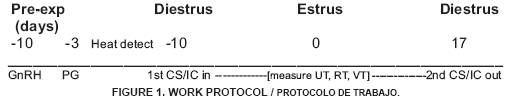
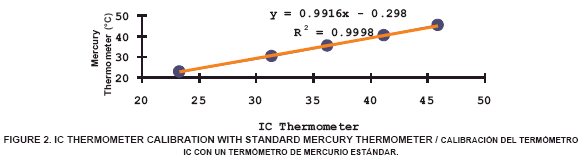
Eleven Japanese Black cows, 8 in the summer and 3 in the winter were subjected to caesarian section (CS) by trans-lumbar laparotomy to install IC in the left uterine horn proximate to the uterotubal junction. After recording for 4 weeks, IC was removed by 2nd CS. The presynchronized protocol in cows was with GnRH and PG injection. On day 10 before estrus, 1st caesarian section (CS) was performed to install IC. IC was removed by 2nd CS, 4 weeks later. During IC insertion, uterine temperature (UT) was measured in 20 min intervals, while rectal (RT) and vaginal temperature (VT) was measured every 4 hr (FIG. 1). After recording for 4 weeks, IC was removed by 2nd CS and mounted on the chip reader in the PC. Ambient temperature (AT) was simultaneously recorded. In 5 cows, blood was daily collected for hormonal assay and underwent ultrasonography to monitor ovarian dynamics. The Ultrasonography evaluations and blood samplings were done before CS, daily during IC insertion and after CS. UT monitored by IC Thermometer Cool Memory® IC thermometer, 15 mm in diameter, 5 mm thickness and 0.1°C precision. The RT and VT were measurement by rectal thermometer with 0.1°C precision and the AT by digital thermo hygrometer, with 0.1°C precision. The IC thermometer was calibrated with a standard mercury thermometer (FIG. 2).
The statistical analysis was Pearson correlations among the intrauterine, rectal and vaginal temperatures; accumulated data for temperature was analyzed using the repeated measures analysis of ANOVA [8].
RESULTS AND DISCUSSION
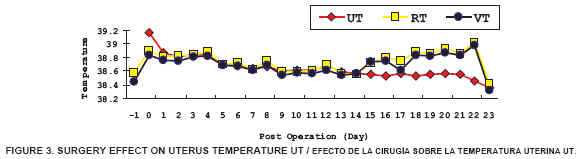
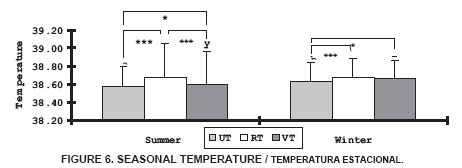
The IC thermometer was calibrated with a standard mercury thermometer and the data of both devices were significantly correlated (FIG. 2). The UT (intrauterine temperature) measured by IC was temporarily elevated after caesarian section for four days (0.14°C increase), and therefore the data were excluded (FIG. 3). There was a linear relationship among the UT, rectal (RT) and vaginal temperatures (VT). Averages in UT, RT and VT in the summer (AT: 28.76°C) were 38.57 ± 0.23°C, 38.67 ± 0.23°C, 38.60 ± 0.35°C, and those in the winter (AT: 14.46°C) were 38.63 ± 0.21°C, 38.68 ± 0.21°C, 38.67 ± 0.20°C, respectively. UT was significantly lower than RT or VT, and UT in the summer was lower than in the winter (P < 0.01).
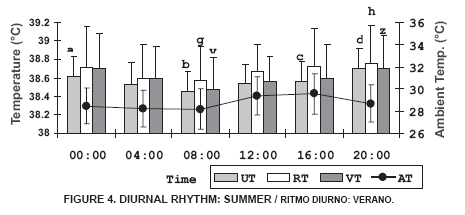
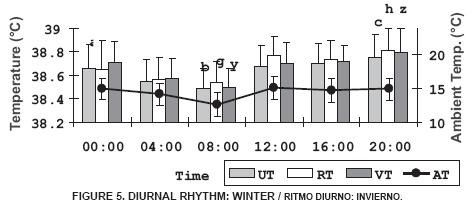
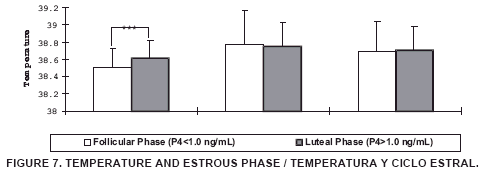
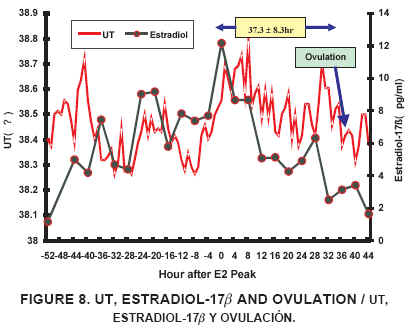
Diurnal rhythm was observed at all three temperatures; UT, RT and VT, lowest at 08:00 and highest at 20:00 in both summer and winter period (FIGS. 4 and 5). Averages in UT were significantly lower than RT and VT in both seasons and UT fluctuation was rather stable (FIG. 6). Upon ovulation, UT in the luteal phase was significantly higher (38.61 ± 0.20°C) than in the follicular phase (38.51 ± 0.22°C, P < 0.01), whereas neither difference was observed in RT or VT (FIG. 7). Peak of Estradiol-17b levels preceded UT peak by 8 h and also correlated with ovulation by 37 h (FIG. 8).
CONCLUSION
IC placed in the uterotubal junction was successfully to measure intrauterine temperature and detected diurnal rhythm. Fluctuation of uterine temperature was rather stable compared to rectal and vaginal temperature, and showed a luteal phase hyperthermia. The implication, the values for intrauterine temperature in predicting heat stress are higher than those for rectal or vaginal temperature because intrauterine temperature probably more closely reflects core body temperature. It appear that IC device can be use to monitory uterine temperature during estrus cycle and probably in some other reproductive physiology processes in cows.
BIBLIOGRAPHIC REFERENCES
1. JOUSAN, FD; DROST, M; HANSEN, PJ. Factors associated with early and mid-to-late fetal loss in lactating and no lactating Holstein cattle in a hot climate. J. Anim. Sci. 83:1017-1022. 2005. [ Links ]
2. KYLE, BL; KENNEDY, AD; SMALL, JA. Measurement of vaginal temperature by radio telemetry for the prediction of estrus in beef cows. Theriogenol. 49:1437-1449. 1998. [ Links ]
3. RENSIS, FD; SCARAMUZZI, RJ. Heat stress and seasonal effects on reproduction in the dairy cow – a review. Theriogenol. 60:1139-1151. 2003. [ Links ]
4. RIVERA, RM; HANSEN, PJ. Development of cultured bovine embryos after exposure to high temperatures in the physiological range. Reprod. 121:107-115. 2001. [ Links ]
5. ROMAN-PONCE, H; THATCHER, WW; CANTON, D; BARRON, DH; WILCOX, CJ. Thermal stress effects on uterine blood flow in dairy cows. J. Anim. Sci. 46: 175-180. 1978. [ Links ]
6. RONCHI, B; STRADAIOLI, G; VERINI, S. A; BERNABUCCI, U; LACETERA, N; ACCORSI, PA; NARDONE, A; SEREN, E. Influence of heat stress or feed restriction on plasma progesterone, oestradiol-17b, LH, FSH, prolactin and cortisol in Holstein heifers. Livest Prod Sci. 68: 231-241. 2001. [ Links ]
7. SCISCIONE, AC; ZAINIA, T; LEET, T; WINN, JN; WINN, HN. A new device for measuring intrauterine temperature. Am. J. Obstet. Gynecol. 184:1431-1435. 2001. [ Links ]
8. STATISTIC ANALYSIS SYSTEM INSTITUTE (SAS), Systems for Windows (1999-2001). In: SAS/STATTM User´guide (Release 8.02 Ed). Cary, NC. [ Links ]
