<?xml version="1.0" encoding="ISO-8859-1"?><article xmlns:mml="http://www.w3.org/1998/Math/MathML" xmlns:xlink="http://www.w3.org/1999/xlink" xmlns:xsi="http://www.w3.org/2001/XMLSchema-instance">
<front>
<journal-meta>
<journal-id>0004-0622</journal-id>
<journal-title><![CDATA[Archivos Latinoamericanos de Nutrición]]></journal-title>
<abbrev-journal-title><![CDATA[ALAN]]></abbrev-journal-title>
<issn>0004-0622</issn>
<publisher>
<publisher-name><![CDATA[Sociedad Latinoamericana de Nutrición]]></publisher-name>
</publisher>
</journal-meta>
<article-meta>
<article-id>S0004-06222001000100014</article-id>
<title-group>
<article-title xml:lang="en"><![CDATA[Development and sensory evaluation of soy milk based yoghurt]]></article-title>
</title-group>
<contrib-group>
<contrib contrib-type="author">
<name>
<surname><![CDATA[Fávaro Trindade]]></surname>
<given-names><![CDATA[C . S]]></given-names>
</name>
<xref ref-type="aff" rid="A01"/>
</contrib>
<contrib contrib-type="author">
<name>
<surname><![CDATA[Terzi]]></surname>
<given-names><![CDATA[S. C]]></given-names>
</name>
<xref ref-type="aff" rid="A01"/>
</contrib>
<contrib contrib-type="author">
<name>
<surname><![CDATA[Trugo]]></surname>
<given-names><![CDATA[L.C]]></given-names>
</name>
<xref ref-type="aff" rid="A01"/>
</contrib>
<contrib contrib-type="author">
<name>
<surname><![CDATA[Della Modesta]]></surname>
<given-names><![CDATA[R. C]]></given-names>
</name>
<xref ref-type="aff" rid="A01"/>
</contrib>
<contrib contrib-type="author">
<name>
<surname><![CDATA[Couri]]></surname>
<given-names><![CDATA[S]]></given-names>
</name>
<xref ref-type="aff" rid="A01"/>
</contrib>
</contrib-group>
<aff id="A01">
<institution><![CDATA[,Universidade Federal Rural do Rio de Janeiro Instituto de Química Universidade Federal do Rio de Janeiro]]></institution>
<addr-line><![CDATA[ ]]></addr-line>
<country>Brazil</country>
</aff>
<pub-date pub-type="pub">
<day>00</day>
<month>03</month>
<year>2001</year>
</pub-date>
<pub-date pub-type="epub">
<day>00</day>
<month>03</month>
<year>2001</year>
</pub-date>
<volume>51</volume>
<numero>1</numero>
<fpage>100</fpage>
<lpage>104</lpage>
<copyright-statement/>
<copyright-year/>
<self-uri xlink:href="http://ve.scielo.org/scielo.php?script=sci_arttext&amp;pid=S0004-06222001000100014&amp;lng=en&amp;nrm=iso"></self-uri><self-uri xlink:href="http://ve.scielo.org/scielo.php?script=sci_abstract&amp;pid=S0004-06222001000100014&amp;lng=en&amp;nrm=iso"></self-uri><self-uri xlink:href="http://ve.scielo.org/scielo.php?script=sci_pdf&amp;pid=S0004-06222001000100014&amp;lng=en&amp;nrm=iso"></self-uri><abstract abstract-type="short" xml:lang="en"><p><![CDATA[Yoghurts were prepared by fermentation of soy milk using a mixed starter culture containing Lactobacillus bulgaricus and Streptococcus thermophilus. Soy milk at 9(0) Brix was homogenised under pressure (17 MPa) and fermented with and without addition of sucrose (2.0 and 2.5 g per 100 g) for 4, 5, 6 and 7 hours. The yoghurts were evaluated in terms of sensory qualitty, pH, titrable acidity, phytic acid and oligosaccharides: A yoghurt with the best sensory quality was obtained using the homogenised soy milk with 2% sucrose addition and fermented for 6 h. Lactobacillus bulgaricus and Streptococcus thermophilus did not produce phytases and a-galactosidases at the experimental conditions, consequently, phytic acid and galactosides were not affected by the process]]></p></abstract>
<abstract abstract-type="short" xml:lang="pt"><p><![CDATA[Desenvolvimento e avaliação sensorial de iogurte de soja. Foram elaborados iogurtes através da fermentação de leite de soja, usando uma cultura mista de Lactobacillus bulgaricus e Streptococcus thermophilus. O leite de soja com 9(0) Brix foi homogeinizado sob pressão (17 MPa) e fermentado com e sem adição de sacarose (2,0 e 2,5 g por 100 g) por 4, 5, 6 e 7 horas. Os iogurtes obtidos foram analisados em relação as características sensoriais, pH, acidez titulável, fitatos e oligossacarídeos. Foi obtido um iogurte com ótimas qualidades sensoriais, a partir do leite de soja homogeinizado, com adição de 2% de sacarose e fermentado por 6 h. Os microrganismos utilizados não produziram fitases e a-galactosidases e, consequentemente, os teores de a-galactosídeos e de fitatos não foram alterados pelo processamento]]></p></abstract>
<kwd-group>
<kwd lng="en"><![CDATA[Soymilk]]></kwd>
<kwd lng="en"><![CDATA[soy yoghurt]]></kwd>
<kwd lng="en"><![CDATA[yoghurt sensory analysis]]></kwd>
<kwd lng="en"><![CDATA[phytate]]></kwd>
<kwd lng="en"><![CDATA[alpha-galactosides]]></kwd>
<kwd lng="pt"><![CDATA[Leite de soja]]></kwd>
<kwd lng="pt"><![CDATA[iogurte de soja]]></kwd>
<kwd lng="pt"><![CDATA[análise sensorial]]></kwd>
<kwd lng="pt"><![CDATA[fitato]]></kwd>
<kwd lng="pt"><![CDATA[alfa-galactosídeos]]></kwd>
</kwd-group>
</article-meta>
</front><body><![CDATA[  <font FACE="Arial" COLOR="#800000">      <p>&nbsp;</p> </font><font SIZE="4"><b>      <p ALIGN="CENTER">&nbsp;</p>      <p ALIGN="CENTER">Development and sensory evaluation of soy milk based yoghurt</b> </p> </font><i>      <p ALIGN="CENTER">&nbsp;</p>      <p ALIGN="CENTER">C . S. Fávaro Trindade, Terzi, S. C., L.C. Trugo, R. C. Della Modesta, S. Couri</i> </p>      <p ALIGN="CENTER">&nbsp;</p>      <p ALIGN="CENTER">Universidade Federal Rural do Rio de Janeiro, EMBRAPA-CTAA, Rio de Janeiro, Instituto de Química, </p>      <p ALIGN="CENTER">Universidade Federal do Rio de Janeiro, Brazil </p> <b>      <p ALIGN="JUSTIFY">&nbsp;</p>      ]]></body>
<body><![CDATA[<p ALIGN="JUSTIFY">&nbsp;</p>      <p ALIGN="JUSTIFY">SUMMARY.</b> </p>      <p ALIGN="JUSTIFY">&nbsp;</p>      <p ALIGN="JUSTIFY">Yoghurts were prepared by fermentation of soy milk using a mixed starter culture containing <i>Lactobacillus bulgaricus</i> and <i>Streptococcus thermophilus</i>. Soy milk at 9<sup>0</sup> Brix was homogenised under pressure (17 MPa) and fermented with and without addition of sucrose (2.0 and 2.5 g per 100 g) for 4, 5, 6 and 7 hours. The yoghurts were evaluated in terms of sensory qualitty, pH<b>,</b> titrable acidity, phytic acid and oligosaccharides: A yoghurt with the best sensory quality was obtained using the homogenised soy milk with 2% sucrose addition and fermented for 6 h. <i>Lactobacillus bulgaricus</i> and <i>Streptococcus thermophilus </i>did not produce phytases and a-galactosidases at the experimental conditions, consequently, phytic acid and galactosides were not affected by the process. </p> <b>      <p ALIGN="JUSTIFY">&nbsp;</p>      <p ALIGN="JUSTIFY">Key words:</b> Soymilk, soy yoghurt, yoghurt sensory analysis, phytate, alpha-galactosides. </p> <b>      <p ALIGN="JUSTIFY">&nbsp;</p>      <p ALIGN="JUSTIFY">RESUMO</b>. </p>      <p ALIGN="JUSTIFY">&nbsp;</p> <b>      <p ALIGN="JUSTIFY">Desenvolvimento e avaliação sensorial de iogurte de soja. </b>Foram elaborados iogurtes através da fermentação de leite de soja, usando uma cultura mista de Lactobacillus bulgaricus e Streptococcus thermophilus. O leite de soja com 9<sup>0</sup> Brix foi homogeinizado sob pressão (17 MPa) e fermentado com e sem adição de sacarose (2,0 e 2,5 g por 100 g) por 4, 5, 6 e 7 horas. Os iogurtes obtidos foram analisados em relação as características sensoriais, pH, acidez titulável, fitatos e oligossacarídeos. Foi obtido um iogurte com ótimas qualidades sensoriais, a partir do leite de soja homogeinizado, com adição de 2% de sacarose e fermentado por 6 h. Os microrganismos utilizados não produziram fitases e a-galactosidases e, consequentemente, os teores de a-galactosídeos e de fitatos não foram alterados pelo processamento. </p> <b>      ]]></body>
<body><![CDATA[<p ALIGN="JUSTIFY">&nbsp;</p>      <p ALIGN="JUSTIFY">Palavras-chave:</b> Leite de soja, iogurte de soja, análise sensorial, fitato, alfa-galactosídeos. </p>      <p>&nbsp;</p>      <p ALIGN="JUSTIFY">Recibido: 22-10-1999 </p>      <p>Aceptado: 18-09-2000</p>      <p>&nbsp;</p> <b>      <p ALIGN="CENTER">&nbsp;</p>      <p>INTRODUCTION</b> </p>      <p>&nbsp;</p>      <p ALIGN="JUSTIFY">Many soy products have limited human use in the Western hemisphere due to undesirable off-flavours (1,2). Fermentation processes, which have long been used in the Orient, may improve the sensorial attributes and also to decrease or mask the properties of undesirable compounds contributing to the production of better derived soy products (1). Lactic acid fermentation has been reported as a mean to reduce beany flavours and anti-nutritional factors, such as phytic acid, in soy bean products and together with the addition of sweeteners it is possible to obtain products with better acceptance by panellists (2,3). </p>      ]]></body>
<body><![CDATA[<p ALIGN="JUSTIFY">The presence of galactosides such as raffinose and stachyose in soybean products leads to controversial opinions among researchers because these oligosacharides are not digested by non-ruminants consequently forming gases in the large intestine (4). In contrast, galactosides are considered as probiotics and are in fact added to specific products with therapeutic purposes (5). </p>      <p ALIGN="JUSTIFY">Soy-based foods may provide additional benefits for the consumer for example due to their hypolipidemic, anti-cholesterolemic and counteratherogenic properties and also to their reduced allergenicity (6). Consequently, soy milk based yoghurts offer a considerable appeal for a growing segment of consumers with certain dietary and health concern. In addition, soy milk yoghurt have several nutritional advantages over cow milk yoghurt such as, reduced levels of cholesterol, of saturated fat and free of lactose. Although some reports are found in the literature dealing with soy milk yoghurt production, not so many data are available providing a complete characterization of the products, including the sensory evaluation and the residual amounts of phytates and a-galactosides </p>      <p ALIGN="JUSTIFY">Thus, the purpose of the present study was to develop soy milk yoghurts with good acceptability, to characterize the products in terms of their composition and evaluate the fate of the phytates and alpha-galactosides after processing. </p> <b>      <p ALIGN="CENTER">&nbsp;</p>      <p ALIGN="CENTER">MATERIALS AND METHODS </p>      <p ALIGN="JUSTIFY">&nbsp;</p>      <p ALIGN="JUSTIFY">Yoghurt production</b> </p>      <p ALIGN="JUSTIFY">Soy milks were prepared with soybean &amp;#091;<i>Glycine Max</i> (L.) Merril&amp;#093;, cultivar EMBRAPA-4, supplied by SPSB-EMBRAPA, Ponta Grossa-PR, Brazil. The milk was obtained by using a procedure already described in the literature (7). The soy milk homogenization process and the yoghurt production were based on previous descriptions(8). The soy milk temperature was adjusted to 45<sup>o</sup>C, inoculated with 3% commercial yoghurt culture (50:50 mixture of <i>Lactobacillus delbruckii subsp. bulgaricus</i> and <i>Streptococcus salivarus subsp. thermophilus</i> from Chr. Hansen's (Brazil) and incubated from 4 to 7 h at 45<sup>o</sup>C. The experiments were conducted using soy milk at 9<sup>0</sup> Brix homogenised at 17 MPa and with addition of sucrose in the concentrations of 2.0 or 2.5 g per 100g of soy milk. Fermentation times were of 4, 5, 6 and 7 h periods. </p>      <p ALIGN="JUSTIFY">&nbsp;</p> <b>      <p ALIGN="JUSTIFY">Analytical procedures</b> </p>      ]]></body>
<body><![CDATA[<p ALIGN="JUSTIFY">&nbsp;</p>      <p ALIGN="JUSTIFY">Moisture, protein and ash values were determined using standard A.O.A.C. procedures (9) and fat was determined by the Bligh-Dyer method (10). </p>      <p ALIGN="JUSTIFY">Samples were freeze-dried,<b> </b>milled and then passed through a 0.75 mm sieve. The initial moisture content of the samples were taken into account for data comparison. All results were reported on a wet weight basis. For sugar determination the samples were previously deffated with petroleum ether. All determinations were made in triplicate. </p>      <p ALIGN="JUSTIFY">Titratable acidity was estimated by titrating 10 g of sample with 0.1N NaOH using phenolphthalein as the indicator. Changes in pH were followed using a pHmeter (Micronal, Brazil). </p>      <p ALIGN="JUSTIFY">The determination of soluble solids in the soy milk (from 0o to 32°Brix) was carried out using a refractometer, (Atago, USA). </p>      <p ALIGN="JUSTIFY">Phytic acid determination was achieved by ion exchange chromatography followed by a colorimetric reaction (11). </p>      <p ALIGN="JUSTIFY">Oligosaccharides were extracted from the samples and purified prior to high-performance liquid chromatography (12). A HPLC equipment with a 20ml loop and a refractive index detector (Waters, USA) was used with a Silica-NH<sub>2</sub> column of 250 x 4.6 mm, id. (Waters, USA<b>) </b>at a flow rate of 1.0 ml/min. Standard solutions of glucose, fructose, sucrose, lactose, raffinose, mellibiose and stachyose were used for peak identification. Quantification was achieved by external standardisation using an electronic integrator (Waters, USA). </p> <b>      <p ALIGN="JUSTIFY">&nbsp;</p>      <p ALIGN="JUSTIFY">Sensory analysis</b> </p>      <p ALIGN="JUSTIFY">&nbsp;</p>      ]]></body>
<body><![CDATA[<p ALIGN="JUSTIFY">Eleven trained judges were selected based on their ability to discriminate and reproduce the results. </p>      <p ALIGN="JUSTIFY">All samples were served at temperatures of 7-10<sup>o</sup>C using plastic cups labelled with three-digit codes from a random number table. Water was available for panel members to rinse their mouths between samples. Crakers were supplied as needed to aid in removing beany flavour between tasting. </p>      <p ALIGN="JUSTIFY">The round table discussion and the paired directional two-sided comparison test were applied (13). The tests were conducted in partitioned booths with fluorescent lighting. The sensory analysis was directed to identify the best product by the formulation of the following questions to the panel: 1)which sample has the better consistency?; 2) which sample has the better taste?. </p>      <p ALIGN="JUSTIFY">Analysis of variance was used for statistical treatment of the data (p&lt;0.05) </p> <b>      <p ALIGN="CENTER">&nbsp;</p>      <p ALIGN="CENTER">RESULTS AND DISCUSSION </p>      <p ALIGN="JUSTIFY">&nbsp;</p>      <p ALIGN="JUSTIFY">Effect of fermentation </p> </b>      <p ALIGN="JUSTIFY">&nbsp;</p>      <p ALIGN="JUSTIFY">The coagulation of soy milk yoghurt occurred within 4 hours of fermentation, with pH of 5,5 and titratable acidity of 0,24% (as lactic acid %) These results were similar to those obtained when lactic-acid bacteria activity in soymilk was studied (14). </p>      ]]></body>
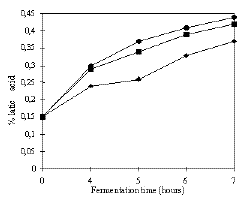
<body><![CDATA[<p ALIGN="JUSTIFY">As shown in the Figures 1 and 2 the titrable acidity increased and pH decreased as a function of fermentation time, particularly in the samples enriched with sucrose hich is in agreement with other observations (2,15). Acid production in the medium depends upon the growth of the organisms and their ability to ferment the available carbohydrates. <i>S. thermophilus</i> readly utilises sucrose, the major fermentable sugar in soybeans, and produces substantial amounts of acid in soy milk, however, <i>L. bulgaricus</i> is unable to use this sugar (16). After 7 h of fermentation the pH obtained was 4.5 which is quite acceptable for yoghurts (17). </p>      <p ALIGN="CENTER">&nbsp;</p>      <p ALIGN="CENTER"><a href="#fig1">FIGURE 1</a> </p>      <p ALIGN="CENTER">Variation of titratable acidity in function </p>      <p ALIGN="CENTER">of fermentation time </p>      <p ALIGN="CENTER"><a name="fig1"></a> </p>      <p ALIGN="CENTER"><img src="/img/fbpe/alan/v51n1/Nd0.gif" alt="Nd0.gif (2926 bytes)" width="300" height="200"></p> <font FACE="Symbol">      
<p ALIGN="JUSTIFY">&nbsp;</p>      <p ALIGN="JUSTIFY">¨</font> Standard fermentation </p> <font FACE="Courier New">      <p ALIGN="JUSTIFY">?</font> Fermentation with 2% sucrose addition </p> <font FACE="Marlett">      ]]></body>
<body><![CDATA[<p ALIGN="JUSTIFY">h</font> Fermentation with 2.5% sucrose addition </p>      <p ALIGN="CENTER">&nbsp;</p>      <p ALIGN="CENTER"><a href="#fig2">FIGURE 2</a> </p>      <p ALIGN="CENTER">Variation of pH in function of fermentation time </p>      <p ALIGN="CENTER"><a name="fig2"></a> </p>      <p ALIGN="CENTER"><img src="/img/fbpe/alan/v51n1/Nd1.gif" alt="Nd1.gif (2363 bytes)" width="300" height="200"></p> <font FACE="Symbol">      
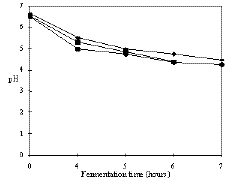
<p ALIGN="JUSTIFY">¨</font> Standard fermentation </p> <font FACE="Courier New">      <p ALIGN="JUSTIFY">?</font> Fermentation with 2% sucrose addition </p> <font FACE="Marlett">      <p ALIGN="JUSTIFY">h</font> Fermentation with 2.5% sucrose addition </p>      <p ALIGN="JUSTIFY">&nbsp;</p>      ]]></body>
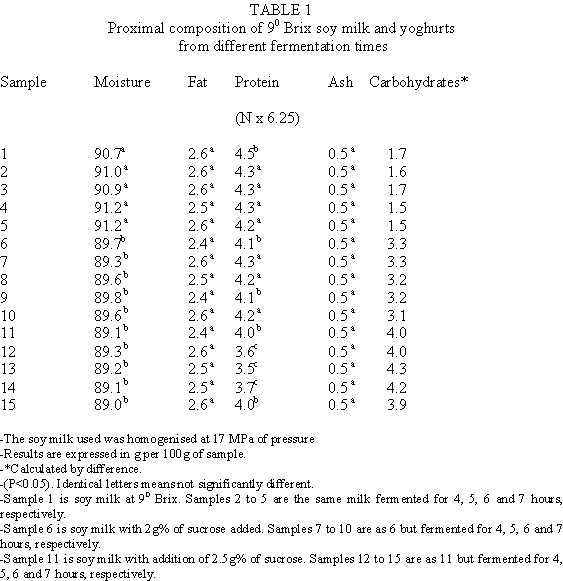
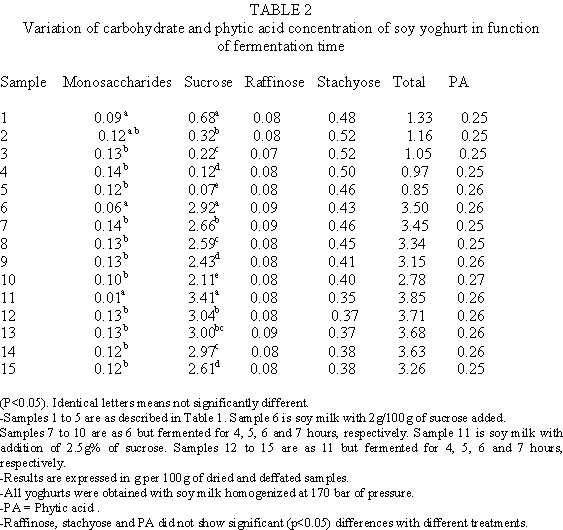
<body><![CDATA[<p ALIGN="JUSTIFY">The proximal composition of soy milk before and after fermentation at different times is presented in <a href="#tab1"> Table</a> 1. The results did not show any great differences when compared with other soy milks described in the literature (3). The carbohydrate composition showed that the a-galactosides are readly extracted from the flour, with stachyose largely predominant over raffinose (Table 2). The presence of chromatographic peaks that appear within the first 5 min of analysis, with similar retention times for glucose, fructose and galactose, in addition to the galactosides which are eluted later in the chromatogram have been reported (16). In the present work a small peak appeared with a similar retention time of glucose and this was considered to represent the total monosaccharides present in the samples. </p>      <p ALIGN="JUSTIFY">The amount of monosaccharides increased significantly (P&lt;0.05) with the fermentation in all treatments probably due to the hydrolysis of major carbohydrates with higher degree of polimerization. </p> <i>      <p ALIGN="JUSTIFY">L. bulgaricus</i> and <i>S. thermophilus</i> do not possess a-galactosidade activity but <i>S. thermophilus</i> has invertase activity (16). In the present work while raffinose and stachyose concentrations were not significantly reduced (P&lt;0.05), a reduction in sucrose of 90% was reached, as shown in Table 2, supporting the indication of low a-galactosidase and high invertase activities. </p>      <p ALIGN="JUSTIFY">According to the results shown in <a href="#tab2"> Table</a> 2, the phytic acid concentration did not change significantly (P&lt;0.05) during fermentation in any one of the studied conditions indicating that the bacteria used is not efficient to decrease this anti-nutritional factor extracted from the soy flour. </p>      <p ALIGN="CENTER"><a name="tab1"></a></p>      <p ALIGN="CENTER"><img src="/img/fbpe/alan/v51n1/Favaro%20CTable1.gif" alt="Favaro CTable1.gif (10714 bytes)" width="500" height="600"></p>      
<p ALIGN="CENTER">&nbsp;</p> <b>      <p>Sensory characteristics of yoghurt</b> </p>      <p>&nbsp;</p>      <p ALIGN="JUSTIFY">Although some authors have used cow milk based yoghurt for panellists to be compared with soy milk based yoghurt (2,19), in the present work the panel concluded that the two yoghurts are two different products, therefore, the cow milk yoghurt can not be reference. The most relevant attributes of soy milk yoghurt determined by the taste panel were: a) visual texture (great syneresis); b) texture or consistency in the mouth (consistent, firm, creamy, chalky, airy, and greasy); c) taste (soy, bitter, oil, sweet, acid, bean, and nut). </p>      ]]></body>
<body><![CDATA[<p ALIGN="JUSTIFY">In preliminary experiments the panel rejected the yoghurt prepared with 5<sup>0</sup> Brix soy milk because of consistency. Excessive syneresis after 20 h of production could be an effect of the use of 13 MPa of pressure for homogenization. However, they did not detect any significant difference (p&lt;0.05) between pressures of 17 and 20 MPa, when evaluated by the paired directional two-sided comparison test. The panel also rejected glucose in favour of sucrose which they considered to be a better sweetner then glucose. Based on these information, further experiments were carried out using only sucrose as sweetner, soy milk at 9<sup>0</sup> Brix and 17 MPa of homogenization pressure and the other results were discharged. </p>      <p ALIGN="CENTER"><a name="tab2"></a></p>      <p ALIGN="CENTER"><img src="/img/fbpe/alan/v51n1/Favaro%20CTable2.gif" alt="Favaro CTable2.gif (12388 bytes)" width="500" height="600"></p>      
<p ALIGN="CENTER">&nbsp;</p>      <p ALIGN="JUSTIFY">The selection of treatments with sucrose rather then glucose addition by the panel is somehow in accordance with results described elsewhere (3) since sucrose appears to have the property of masking the usual beany flavour detected in soy derived products. </p>      <p ALIGN="JUSTIFY">Samples submitted to 4 h of fermentation were considered to have little yoghurt characteristics in contrast with 7 h, which were considered to have better quality. The panel also described a decrease in chalkiness and an increase in astringency in the 7h of fermentation samples. Samples with 2.5% of added sucrose and submitted to 5 h fermentation and with 2% sucrose and 6 h fermentation were selected as having better global quality. </p>      <p ALIGN="JUSTIFY">In conclusion, soy milk yoghurt prepared from a 9<sup>0 </sup>Brix soy milk, with the addition of 2% sucrose before fermentation, homogenised under pressure of 17 MPa and fermented for 6h was considered the better product and presented a great potential for commercial production. </p>      <p ALIGN="JUSTIFY">&nbsp;</p> <b>      <p ALIGN="CENTER">ACKNOWLEDGMENTS</b> </p>      <p ALIGN="CENTER">&nbsp;</p>      ]]></body>
<body><![CDATA[<p ALIGN="JUSTIFY">The authors would like to thank CNPq, FAPERJ and EMBRAPA-Agoindústria de Alimentos for the financial support. </p> <b>      <p ALIGN="CENTER">&nbsp;</p>      <p>REFERENCES</b> </p>      <p ALIGN="CENTER">&nbsp;</p>      <!-- ref --><p ALIGN="JUSTIFY">1. Kanda H, Wang HL, Hesseltine CW, Warner K. Yoghurt production by<i> Lactobacillus</i> fermentation of soybean milk.<i> </i>Proc. Biochem. 1976; 1: 23-25. &nbsp;&nbsp;&nbsp;&nbsp;&nbsp;&nbsp;&nbsp;&nbsp;[&#160;<a href="javascript:void(0);" onclick="javascript: window.open('/scielo.php?script=sci_nlinks&ref=366409&pid=S0004-0622200100010001400001&lng=','','width=640,height=500,resizable=yes,scrollbars=1,menubar=yes,');">Links</a>&#160;]<!-- end-ref --><!-- ref --><p ALIGN="JUSTIFY">2. Pinthong R, Macrae R, Rothwell J. The development of a soya-based yoghurt. Part II: sensory evaluation and analysis of volatiles. J. Food Techn. 1980; 15: 647-652. &nbsp;&nbsp;&nbsp;&nbsp;&nbsp;&nbsp;&nbsp;&nbsp;[&#160;<a href="javascript:void(0);" onclick="javascript: window.open('/scielo.php?script=sci_nlinks&ref=366410&pid=S0004-0622200100010001400002&lng=','','width=640,height=500,resizable=yes,scrollbars=1,menubar=yes,');">Links</a>&#160;]<!-- end-ref --><!-- ref --><p ALIGN="JUSTIFY">3. Buono MA, Setser C, Erickson LE, Fung DYC. Soymilk yoghurt: sensory evaluation and chemical measurement<i>. </i>J. Food Sci. 1990; 55: 528-531. &nbsp;&nbsp;&nbsp;&nbsp;&nbsp;&nbsp;&nbsp;&nbsp;[&#160;<a href="javascript:void(0);" onclick="javascript: window.open('/scielo.php?script=sci_nlinks&ref=366411&pid=S0004-0622200100010001400003&lng=','','width=640,height=500,resizable=yes,scrollbars=1,menubar=yes,');">Links</a>&#160;]<!-- end-ref --><!-- ref --><p ALIGN="JUSTIFY">4. Olson AC, Gray GM, Gumbmann MR, Sell CR and Wagner JR. Flatulence causing factors in legumes. In Antinutrientes and Natural Toxicants in Foods, ed.R.L. Ory, pp. 275-294. Food and Nutrition Press Inc., Westport, CT, 1981. &nbsp;&nbsp;&nbsp;&nbsp;&nbsp;&nbsp;&nbsp;&nbsp;[&#160;<a href="javascript:void(0);" onclick="javascript: window.open('/scielo.php?script=sci_nlinks&ref=366412&pid=S0004-0622200100010001400004&lng=','','width=640,height=500,resizable=yes,scrollbars=1,menubar=yes,');">Links</a>&#160;]<!-- end-ref --><!-- ref --><p ALIGN="JUSTIFY">5. Kailasaphathy K, Rybka SL. Acidophilus and B. Bifidobacterium spp. _their therapeutic potential and survival in yogurt. The Australian J Dairy Techn., 1997; 52: 28-35. &nbsp;&nbsp;&nbsp;&nbsp;&nbsp;&nbsp;&nbsp;&nbsp;[&#160;<a href="javascript:void(0);" onclick="javascript: window.open('/scielo.php?script=sci_nlinks&ref=366413&pid=S0004-0622200100010001400005&lng=','','width=640,height=500,resizable=yes,scrollbars=1,menubar=yes,');">Links</a>&#160;]<!-- end-ref --><!-- ref --><p ALIGN="JUSTIFY">6. Sipos EF. Edible uses of soybean protein. Presented at Soybean Utilisation Alternatives Symposium. Univ. of Minnesota, Feb. 16-18, Minneapolis, MN. 1988. &nbsp;&nbsp;&nbsp;&nbsp;&nbsp;&nbsp;&nbsp;&nbsp;[&#160;<a href="javascript:void(0);" onclick="javascript: window.open('/scielo.php?script=sci_nlinks&ref=366414&pid=S0004-0622200100010001400006&lng=','','width=640,height=500,resizable=yes,scrollbars=1,menubar=yes,');">Links</a>&#160;]<!-- end-ref --><!-- ref --><p ALIGN="JUSTIFY">7. Wilkens WF, Mattick LR, Hand DB. Effects of processing method on oxidative off-flavors of soybean milk. Food Techn., 1967; 21: 86-89. &nbsp;&nbsp;&nbsp;&nbsp;&nbsp;&nbsp;&nbsp;&nbsp;[&#160;<a href="javascript:void(0);" onclick="javascript: window.open('/scielo.php?script=sci_nlinks&ref=366415&pid=S0004-0622200100010001400007&lng=','','width=640,height=500,resizable=yes,scrollbars=1,menubar=yes,');">Links</a>&#160;]<!-- end-ref --><!-- ref --><p ALIGN="JUSTIFY">8. Fávaro Trindade CS, Cascardo Silva F, Freitas S, Couri S. Comportamiento reologico de los &quot;yogurts&quot; de soya homogeneizados y no homogeneizados. Alimentaria, 1997; 285: 67-73. &nbsp;&nbsp;&nbsp;&nbsp;&nbsp;&nbsp;&nbsp;&nbsp;[&#160;<a href="javascript:void(0);" onclick="javascript: window.open('/scielo.php?script=sci_nlinks&ref=366416&pid=S0004-0622200100010001400008&lng=','','width=640,height=500,resizable=yes,scrollbars=1,menubar=yes,');">Links</a>&#160;]<!-- end-ref --><!-- ref --><p ALIGN="JUSTIFY">9. A.O.A.C. Official methods of analysis. ed., Association of Official Analytical Chemists, Washington, DC, USA, 1984. &nbsp;&nbsp;&nbsp;&nbsp;&nbsp;&nbsp;&nbsp;&nbsp;[&#160;<a href="javascript:void(0);" onclick="javascript: window.open('/scielo.php?script=sci_nlinks&ref=366417&pid=S0004-0622200100010001400009&lng=','','width=640,height=500,resizable=yes,scrollbars=1,menubar=yes,');">Links</a>&#160;]<!-- end-ref --><!-- ref --><p ALIGN="JUSTIFY">10. Bligh EG, Dyer WJ. A rapid method of total lipid extraction and purification. Can J Bio Chem Physiol. 1959; 37: 911-917. &nbsp;&nbsp;&nbsp;&nbsp;&nbsp;&nbsp;&nbsp;&nbsp;[&#160;<a href="javascript:void(0);" onclick="javascript: window.open('/scielo.php?script=sci_nlinks&ref=366418&pid=S0004-0622200100010001400010&lng=','','width=640,height=500,resizable=yes,scrollbars=1,menubar=yes,');">Links</a>&#160;]<!-- end-ref --><!-- ref --><p ALIGN="JUSTIFY">11. Harland BF &amp; Oberleas D. A modified method for phytate analysis using an ion exchange procedure. Application to texture vegetable proeins. Cereal Chem., 1977; 54: 827-832. &nbsp;&nbsp;&nbsp;&nbsp;&nbsp;&nbsp;&nbsp;&nbsp;[&#160;<a href="javascript:void(0);" onclick="javascript: window.open('/scielo.php?script=sci_nlinks&ref=366419&pid=S0004-0622200100010001400011&lng=','','width=640,height=500,resizable=yes,scrollbars=1,menubar=yes,');">Links</a>&#160;]<!-- end-ref --><!-- ref --><p ALIGN="JUSTIFY">12. Shukla VKS. Quantitative determination of oligossaccharides in defatted soybean products by high speed liquid chromatography. Fett Wissenschaft Tecnologie, 1987; 89: 5-79. &nbsp;&nbsp;&nbsp;&nbsp;&nbsp;&nbsp;&nbsp;&nbsp;[&#160;<a href="javascript:void(0);" onclick="javascript: window.open('/scielo.php?script=sci_nlinks&ref=366420&pid=S0004-0622200100010001400012&lng=','','width=640,height=500,resizable=yes,scrollbars=1,menubar=yes,');">Links</a>&#160;]<!-- end-ref --><!-- ref --><p ALIGN="JUSTIFY">13. Meilgaard M, Civille GV, Carr BT. Sensory evaluation techniques. Boca Raton: CRC Press, v. 1, 125 p; v. 2, 159 p, 1987. &nbsp;&nbsp;&nbsp;&nbsp;&nbsp;&nbsp;&nbsp;&nbsp;[&#160;<a href="javascript:void(0);" onclick="javascript: window.open('/scielo.php?script=sci_nlinks&ref=366421&pid=S0004-0622200100010001400013&lng=','','width=640,height=500,resizable=yes,scrollbars=1,menubar=yes,');">Links</a>&#160;]<!-- end-ref --><!-- ref --><p ALIGN="JUSTIFY">14. Angeles AG, Marth EH. Growth and activity of lactic-acid bacteria in soymilk. I: growth and acid production. J Milk and Food Techn., 1971; 34: 30-36. &nbsp;&nbsp;&nbsp;&nbsp;&nbsp;&nbsp;&nbsp;&nbsp;[&#160;<a href="javascript:void(0);" onclick="javascript: window.open('/scielo.php?script=sci_nlinks&ref=366422&pid=S0004-0622200100010001400014&lng=','','width=640,height=500,resizable=yes,scrollbars=1,menubar=yes,');">Links</a>&#160;]<!-- end-ref --><!-- ref --><p ALIGN="JUSTIFY">15. Wang S, Marinho CS, Carvalho EP. Produção de Yoghurt de soja com diferentes associações de bactérias láticas. Pesq Agropec Bras., 1994; 29: 1593-1601. &nbsp;&nbsp;&nbsp;&nbsp;&nbsp;&nbsp;&nbsp;&nbsp;[&#160;<a href="javascript:void(0);" onclick="javascript: window.open('/scielo.php?script=sci_nlinks&ref=366423&pid=S0004-0622200100010001400015&lng=','','width=640,height=500,resizable=yes,scrollbars=1,menubar=yes,');">Links</a>&#160;]<!-- end-ref --><!-- ref --><p ALIGN="JUSTIFY">16. Mital BK, Steinkraus KH. Growth of lactic acid bacteria in soy milks. J Food Sci, 1974; 39: 1018-1022. &nbsp;&nbsp;&nbsp;&nbsp;&nbsp;&nbsp;&nbsp;&nbsp;[&#160;<a href="javascript:void(0);" onclick="javascript: window.open('/scielo.php?script=sci_nlinks&ref=366424&pid=S0004-0622200100010001400016&lng=','','width=640,height=500,resizable=yes,scrollbars=1,menubar=yes,');">Links</a>&#160;]<!-- end-ref --><!-- ref --><p ALIGN="JUSTIFY">17. Tamine AY, Robinson RK. Yogur ciencia y tecnologia. Zaragoza: Acribia, 502 p., 1991. &nbsp;&nbsp;&nbsp;&nbsp;&nbsp;&nbsp;&nbsp;&nbsp;[&#160;<a href="javascript:void(0);" onclick="javascript: window.open('/scielo.php?script=sci_nlinks&ref=366425&pid=S0004-0622200100010001400017&lng=','','width=640,height=500,resizable=yes,scrollbars=1,menubar=yes,');">Links</a>&#160;]<!-- end-ref --><!-- ref --><p ALIGN="JUSTIFY">18. Mital BK, Steinkraus KH. Flavor acceptability of unfermented and lactic-fermented soy milks. J. Milk Food Techn., 1976; 39: 342-344. &nbsp;&nbsp;&nbsp;&nbsp;&nbsp;&nbsp;&nbsp;&nbsp;[&#160;<a href="javascript:void(0);" onclick="javascript: window.open('/scielo.php?script=sci_nlinks&ref=366426&pid=S0004-0622200100010001400018&lng=','','width=640,height=500,resizable=yes,scrollbars=1,menubar=yes,');">Links</a>&#160;]<!-- end-ref --> ]]></body>
<back>
<ref-list>
<ref id="B1">
<label>1</label><nlm-citation citation-type="journal">
<person-group person-group-type="author">
<name>
<surname><![CDATA[Kanda]]></surname>
<given-names><![CDATA[H]]></given-names>
</name>
<name>
<surname><![CDATA[Wang]]></surname>
<given-names><![CDATA[HL]]></given-names>
</name>
<name>
<surname><![CDATA[Hesseltine]]></surname>
<given-names><![CDATA[CW]]></given-names>
</name>
<name>
<surname><![CDATA[Warner]]></surname>
<given-names><![CDATA[K]]></given-names>
</name>
</person-group>
<article-title xml:lang="en"><![CDATA[Yoghurt production by Lactobacillus fermentation of soybean milk]]></article-title>
<source><![CDATA[Proc. Biochem]]></source>
<year>1976</year>
<volume>1</volume>
<page-range>23-25</page-range></nlm-citation>
</ref>
<ref id="B2">
<label>2</label><nlm-citation citation-type="journal">
<person-group person-group-type="author">
<name>
<surname><![CDATA[Pinthong]]></surname>
<given-names><![CDATA[R]]></given-names>
</name>
<name>
<surname><![CDATA[Macrae]]></surname>
<given-names><![CDATA[R]]></given-names>
</name>
<name>
<surname><![CDATA[Rothwell]]></surname>
<given-names><![CDATA[J]]></given-names>
</name>
</person-group>
<article-title xml:lang="en"><![CDATA[The development of a soya-based yoghurt: Part II: sensory evaluation and analysis of volatiles]]></article-title>
<source><![CDATA[J. Food Techn]]></source>
<year>1980</year>
<volume>15</volume>
<page-range>647-652</page-range></nlm-citation>
</ref>
<ref id="B3">
<label>3</label><nlm-citation citation-type="journal">
<person-group person-group-type="author">
<name>
<surname><![CDATA[Buono]]></surname>
<given-names><![CDATA[MA]]></given-names>
</name>
<name>
<surname><![CDATA[Setser]]></surname>
<given-names><![CDATA[C]]></given-names>
</name>
<name>
<surname><![CDATA[Erickson]]></surname>
<given-names><![CDATA[LE]]></given-names>
</name>
<name>
<surname><![CDATA[Fung]]></surname>
<given-names><![CDATA[DYC]]></given-names>
</name>
</person-group>
<article-title xml:lang="en"><![CDATA[Soymilk yoghurt: sensory evaluation and chemical measurement]]></article-title>
<source><![CDATA[J. Food Sci]]></source>
<year>1990</year>
<volume>55</volume>
<page-range>528-531</page-range></nlm-citation>
</ref>
<ref id="B4">
<label>4</label><nlm-citation citation-type="book">
<person-group person-group-type="author">
<name>
<surname><![CDATA[Olson]]></surname>
<given-names><![CDATA[AC]]></given-names>
</name>
<name>
<surname><![CDATA[Gray]]></surname>
<given-names><![CDATA[GM]]></given-names>
</name>
<name>
<surname><![CDATA[Gumbmann]]></surname>
<given-names><![CDATA[MR]]></given-names>
</name>
<name>
<surname><![CDATA[Sell]]></surname>
<given-names><![CDATA[CR]]></given-names>
</name>
<name>
<surname><![CDATA[Wagner]]></surname>
<given-names><![CDATA[JR]]></given-names>
</name>
</person-group>
<source><![CDATA[Flatulence causing factors in legumes: In Antinutrientes and Natural Toxicants in Foods]]></source>
<year>1981</year>
<page-range>275-294</page-range><publisher-loc><![CDATA[Westport^eCT CT]]></publisher-loc>
<publisher-name><![CDATA[Food and Nutrition Press Inc]]></publisher-name>
</nlm-citation>
</ref>
<ref id="B5">
<label>5</label><nlm-citation citation-type="journal">
<person-group person-group-type="author">
<name>
<surname><![CDATA[Kailasaphathy]]></surname>
<given-names><![CDATA[K]]></given-names>
</name>
<name>
<surname><![CDATA[Rybka]]></surname>
<given-names><![CDATA[SL]]></given-names>
</name>
</person-group>
<article-title xml:lang="en"><![CDATA[Acidophilus and B. Bifidobacterium spp: their therapeutic potential and survival in yogurt]]></article-title>
<source><![CDATA[The Australian J Dairy Techn]]></source>
<year>1997</year>
<volume>52</volume>
<page-range>28-35</page-range></nlm-citation>
</ref>
<ref id="B6">
<label>6</label><nlm-citation citation-type="confpro">
<person-group person-group-type="author">
<name>
<surname><![CDATA[Sipos]]></surname>
<given-names><![CDATA[EF]]></given-names>
</name>
</person-group>
<source><![CDATA[Edible uses of soybean protein]]></source>
<year>1988</year>
<conf-name><![CDATA[ Symposium]]></conf-name>
<conf-loc> </conf-loc>
<publisher-loc><![CDATA[Minneapolis, MN ]]></publisher-loc>
<publisher-name><![CDATA[Univ. of Minnesota]]></publisher-name>
</nlm-citation>
</ref>
<ref id="B7">
<label>7</label><nlm-citation citation-type="journal">
<person-group person-group-type="author">
<name>
<surname><![CDATA[Wilkens]]></surname>
<given-names><![CDATA[WF]]></given-names>
</name>
<name>
<surname><![CDATA[Mattick]]></surname>
<given-names><![CDATA[LR]]></given-names>
</name>
<name>
<surname><![CDATA[Hand]]></surname>
<given-names><![CDATA[DB]]></given-names>
</name>
</person-group>
<article-title xml:lang="en"><![CDATA[Effects of processing method on oxidative off-flavors of soybean milk]]></article-title>
<source><![CDATA[Food Techn]]></source>
<year>1967</year>
<volume>21</volume>
<page-range>86-89</page-range></nlm-citation>
</ref>
<ref id="B8">
<label>8</label><nlm-citation citation-type="journal">
<person-group person-group-type="author">
<name>
<surname><![CDATA[Fávaro Trindade]]></surname>
<given-names><![CDATA[CS]]></given-names>
</name>
<name>
<surname><![CDATA[Cascardo Silva]]></surname>
<given-names><![CDATA[F]]></given-names>
</name>
<name>
<surname><![CDATA[Freitas]]></surname>
<given-names><![CDATA[S]]></given-names>
</name>
<name>
<surname><![CDATA[Couri]]></surname>
<given-names><![CDATA[S]]></given-names>
</name>
</person-group>
<article-title xml:lang="es"><![CDATA[Comportamiento reologico de los "yogurts" de soya homogeneizados y no homogeneizados]]></article-title>
<source><![CDATA[Alimentaria]]></source>
<year>1997</year>
<volume>285</volume>
<page-range>67-73</page-range></nlm-citation>
</ref>
<ref id="B9">
<label>9</label><nlm-citation citation-type="book">
<collab>A.O.A.C</collab>
<source><![CDATA[Official methods of analysis]]></source>
<year>1984</year>
<publisher-loc><![CDATA[Washington, DC ]]></publisher-loc>
<publisher-name><![CDATA[Association of Official Analytical Chemists]]></publisher-name>
</nlm-citation>
</ref>
<ref id="B10">
<label>10</label><nlm-citation citation-type="journal">
<person-group person-group-type="author">
<name>
<surname><![CDATA[Bligh]]></surname>
<given-names><![CDATA[EG]]></given-names>
</name>
<name>
<surname><![CDATA[Dyer]]></surname>
<given-names><![CDATA[WJ]]></given-names>
</name>
</person-group>
<article-title xml:lang="en"><![CDATA[A rapid method of total lipid extraction and purification]]></article-title>
<source><![CDATA[Can J Bio Chem Physiol]]></source>
<year>1959</year>
<volume>37</volume>
<page-range>911-917</page-range></nlm-citation>
</ref>
<ref id="B11">
<label>11</label><nlm-citation citation-type="journal">
<person-group person-group-type="author">
<name>
<surname><![CDATA[Harland]]></surname>
<given-names><![CDATA[BF]]></given-names>
</name>
<name>
<surname><![CDATA[Oberleas]]></surname>
<given-names><![CDATA[D]]></given-names>
</name>
</person-group>
<article-title xml:lang="en"><![CDATA[A modified method for phytate analysis using an ion exchange procedure: Application to texture vegetable proeins]]></article-title>
<source><![CDATA[Cereal Chem]]></source>
<year>1977</year>
<volume>54</volume>
<page-range>827-832</page-range></nlm-citation>
</ref>
<ref id="B12">
<label>12</label><nlm-citation citation-type="journal">
<person-group person-group-type="author">
<name>
<surname><![CDATA[Shukla]]></surname>
<given-names><![CDATA[VKS]]></given-names>
</name>
</person-group>
<article-title xml:lang="en"><![CDATA[Quantitative determination of oligossaccharides in defatted soybean products by high speed liquid chromatography]]></article-title>
<source><![CDATA[Fett Wissenschaft Tecnologie]]></source>
<year>1987</year>
<volume>89</volume>
<page-range>5-79</page-range></nlm-citation>
</ref>
<ref id="B13">
<label>13</label><nlm-citation citation-type="book">
<person-group person-group-type="author">
<name>
<surname><![CDATA[Meilgaard]]></surname>
<given-names><![CDATA[M]]></given-names>
</name>
<name>
<surname><![CDATA[Civille]]></surname>
<given-names><![CDATA[GV]]></given-names>
</name>
<name>
<surname><![CDATA[Carr]]></surname>
<given-names><![CDATA[BT]]></given-names>
</name>
</person-group>
<source><![CDATA[Sensory evaluation techniques]]></source>
<year>1987</year>
<volume>1</volume><volume>2</volume>
<page-range>125</page-range><publisher-loc><![CDATA[Boca Raton ]]></publisher-loc>
<publisher-name><![CDATA[CRC Press]]></publisher-name>
</nlm-citation>
</ref>
<ref id="B14">
<label>14</label><nlm-citation citation-type="journal">
<person-group person-group-type="author">
<name>
<surname><![CDATA[Angeles]]></surname>
<given-names><![CDATA[AG]]></given-names>
</name>
<name>
<surname><![CDATA[Marth]]></surname>
<given-names><![CDATA[EH]]></given-names>
</name>
</person-group>
<article-title xml:lang="en"><![CDATA[Growth and activity of lactic-acid bacteria in soymilk: I: growth and acid production]]></article-title>
<source><![CDATA[J Milk and Food Techn]]></source>
<year>1971</year>
<volume>34</volume>
<page-range>30-36</page-range></nlm-citation>
</ref>
<ref id="B15">
<label>15</label><nlm-citation citation-type="journal">
<person-group person-group-type="author">
<name>
<surname><![CDATA[Wang]]></surname>
<given-names><![CDATA[S]]></given-names>
</name>
<name>
<surname><![CDATA[Marinho]]></surname>
<given-names><![CDATA[CS]]></given-names>
</name>
<name>
<surname><![CDATA[Carvalho]]></surname>
<given-names><![CDATA[EP]]></given-names>
</name>
</person-group>
<article-title xml:lang="pt"><![CDATA[Produção de Yoghurt de soja com diferentes associações de bactérias láticas]]></article-title>
<source><![CDATA[Pesq Agropec Bras]]></source>
<year>1994</year>
<volume>29</volume>
<page-range>1593-1601</page-range></nlm-citation>
</ref>
<ref id="B16">
<label>16</label><nlm-citation citation-type="journal">
<person-group person-group-type="author">
<name>
<surname><![CDATA[Mital]]></surname>
<given-names><![CDATA[BK]]></given-names>
</name>
<name>
<surname><![CDATA[Steinkraus]]></surname>
<given-names><![CDATA[KH]]></given-names>
</name>
</person-group>
<article-title xml:lang="en"><![CDATA[Growth of lactic acid bacteria in soy milks]]></article-title>
<source><![CDATA[J Food Sci]]></source>
<year>1974</year>
<volume>39</volume>
<page-range>1018-1022</page-range></nlm-citation>
</ref>
<ref id="B17">
<label>17</label><nlm-citation citation-type="book">
<person-group person-group-type="author">
<name>
<surname><![CDATA[Tamine]]></surname>
<given-names><![CDATA[AY]]></given-names>
</name>
<name>
<surname><![CDATA[Robinson]]></surname>
<given-names><![CDATA[RK]]></given-names>
</name>
</person-group>
<source><![CDATA[Yogur ciencia y tecnologia]]></source>
<year>1991</year>
<page-range>502</page-range><publisher-loc><![CDATA[Zaragoza ]]></publisher-loc>
<publisher-name><![CDATA[Acribia]]></publisher-name>
</nlm-citation>
</ref>
<ref id="B18">
<label>18</label><nlm-citation citation-type="journal">
<person-group person-group-type="author">
<name>
<surname><![CDATA[Mital]]></surname>
<given-names><![CDATA[BK]]></given-names>
</name>
<name>
<surname><![CDATA[Steinkraus]]></surname>
<given-names><![CDATA[KH]]></given-names>
</name>
</person-group>
<article-title xml:lang="en"><![CDATA[Flavor acceptability of unfermented and lactic-fermented soy milks]]></article-title>
<source><![CDATA[J. Milk Food Techn]]></source>
<year>1976</year>
<volume>39</volume>
<page-range>342-344</page-range></nlm-citation>
</ref>
</ref-list>
</back>
</article>
