<?xml version="1.0" encoding="ISO-8859-1"?><article xmlns:mml="http://www.w3.org/1998/Math/MathML" xmlns:xlink="http://www.w3.org/1999/xlink" xmlns:xsi="http://www.w3.org/2001/XMLSchema-instance">
<front>
<journal-meta>
<journal-id>0004-0622</journal-id>
<journal-title><![CDATA[Archivos Latinoamericanos de Nutrición]]></journal-title>
<abbrev-journal-title><![CDATA[ALAN]]></abbrev-journal-title>
<issn>0004-0622</issn>
<publisher>
<publisher-name><![CDATA[Sociedad Latinoamericana de Nutrición]]></publisher-name>
</publisher>
</journal-meta>
<article-meta>
<article-id>S0004-06222003000300003</article-id>
<title-group>
<article-title xml:lang="en"><![CDATA[Interactions Among Indicators of B1, B2, B6 and Vitamin C Status in University Students]]></article-title>
</title-group>
<contrib-group>
<contrib contrib-type="author">
<name>
<surname><![CDATA[Avila]]></surname>
<given-names><![CDATA[AV]]></given-names>
</name>
<xref ref-type="aff" rid="A01"/>
</contrib>
<contrib contrib-type="author">
<name>
<surname><![CDATA[Liuzzi]]></surname>
<given-names><![CDATA[JP]]></given-names>
</name>
<xref ref-type="aff" rid="A01"/>
</contrib>
<contrib contrib-type="author">
<name>
<surname><![CDATA[Cioccia]]></surname>
<given-names><![CDATA[AM]]></given-names>
</name>
<xref ref-type="aff" rid="A01"/>
</contrib>
<contrib contrib-type="author">
<name>
<surname><![CDATA[Hevia]]></surname>
<given-names><![CDATA[P]]></given-names>
</name>
<xref ref-type="aff" rid="A01"/>
</contrib>
</contrib-group>
<aff id="A01">
<institution><![CDATA[,Universidad Central de Venezuela Escuela de Nutrición y Dietética Universidad Simón Bolívar]]></institution>
<addr-line><![CDATA[Caracas ]]></addr-line>
<country>Venezuela</country>
</aff>
<pub-date pub-type="pub">
<day>00</day>
<month>09</month>
<year>2003</year>
</pub-date>
<pub-date pub-type="epub">
<day>00</day>
<month>09</month>
<year>2003</year>
</pub-date>
<volume>53</volume>
<numero>3</numero>
<fpage>238</fpage>
<lpage>242</lpage>
<copyright-statement/>
<copyright-year/>
<self-uri xlink:href="http://ve.scielo.org/scielo.php?script=sci_arttext&amp;pid=S0004-06222003000300003&amp;lng=en&amp;nrm=iso"></self-uri><self-uri xlink:href="http://ve.scielo.org/scielo.php?script=sci_abstract&amp;pid=S0004-06222003000300003&amp;lng=en&amp;nrm=iso"></self-uri><self-uri xlink:href="http://ve.scielo.org/scielo.php?script=sci_pdf&amp;pid=S0004-06222003000300003&amp;lng=en&amp;nrm=iso"></self-uri><abstract abstract-type="short" xml:lang="en"><p><![CDATA[SUMMARY: In 209 young university students (109 males and 80 females) with body mass index within the normal range, the activation coefficient of the erythrocyte transketolase (ETKAC) glutathione reductase (EGRAC) and aspartate amino transferase (EASTAC) as well as the circulating levels of vitamin C were determined. Using the usual cutoff points for ETKAC and serum vitamin C and higher than usual cutoff points for EASTAC and EGRAC 99, 95, 92, and 87% of the study subjects exhibited activation coefficients which were compatible with an acceptable status for vitamin B2, B6, C and B1 respectively. A correlation analysis showed a high correlation (r = 0.81) between erythrocyte indicators of B1 and B2 status a lower correlation between indicators of the status of these vitamins and B6 and no correlation between the indicators of B1, B2 and B6 status and serum vitamin C. This study indicated that in this largely nutritionally adequate population, the activation coefficient of the erythrocyte enzymes used here as markers of the nutritional status of B1, B2 and B6 were related between themselves and varied in the same direction. These changes, however, were not associated with circulating levels of vitamin C.]]></p></abstract>
<abstract abstract-type="short" xml:lang="es"><p><![CDATA[RESUMEN: Relaciones entre indicadores del estado nutricional de las vitaminas B1, B2, B6, y C en una población de estudiantes universitarios. Los niveles séricos de vitamin C y los coeficientes de activación de las enzimas eritrocitarias: transcetolasa (ETKAC), glutation reductasa (EGRAC), y aspartato amino transferasa (EASTAC) se midieron en una muestra de 209 estudiantes universitarios (109 hombres y 80 mujeres) que presentaban índices de masa corporal dentro de los niveles normales. Usando los puntos de corte habituales para la vitamina C y ETKAC así como puntos de corte mayores que lo habitual para EASTAC y EGRAC 99, 95, 92 y 87% de los estudiantes mostraron valores dentro de la normalidad para las vitaminas B2, B6, C y B1 respectivamente. Un estudio de correlación, mostró una alta correlación entre los indicadores eritrocitartios de las vitaminas B1 y B2 (r = 0.81), una correlación intermedia entre los indicadores de estas vitaminas y el de la vitamina B6 y ninguno de estos indicadores correlacionó con los niveles séricos de la vitamina C. En general, este estudio muestra que en esta población de individuos esencialmente normales, los indicadores eritrocitarios del estado nutricional de las vitaminas B1, B2 y B6 mostraron una correlacion entre ellos y cambiaron en la misma dirección. En contraste, el estado nutricional de estas vitaminas del complejo B no se correlacionaron con los niveles séricos de la vitamina C.]]></p></abstract>
<kwd-group>
<kwd lng="en"><![CDATA[B1, B2, B6]]></kwd>
<kwd lng="en"><![CDATA[vitamin C,]]></kwd>
<kwd lng="en"><![CDATA[ETKAC,EASTAC]]></kwd>
<kwd lng="en"><![CDATA[EGRAC]]></kwd>
<kwd lng="en"><![CDATA[interactions]]></kwd>
<kwd lng="es"><![CDATA[B1, B2, B6]]></kwd>
<kwd lng="es"><![CDATA[Vitamina C]]></kwd>
<kwd lng="es"><![CDATA[ETKAC]]></kwd>
<kwd lng="es"><![CDATA[EASTAC]]></kwd>
<kwd lng="es"><![CDATA[EGRAC]]></kwd>
<kwd lng="es"><![CDATA[interacciones]]></kwd>
</kwd-group>
</article-meta>
</front><body><![CDATA[   <B>    <P ALIGN="CENTER"><font face="Times New Roman" size="4">Interactions Among  Indicators of B<SUB>1</SUB>, B<SUB>2</SUB>, B<SUB>6</SUB> and Vitamin C Status in University Students.</font></P>     <P ALIGN="CENTER"></B><I><font face="Times New Roman" size="3">Avila AV,  Liuzzi JP, Cioccia AM  and  Hevia P</font></P> </I>     <P ALIGN="CENTER"><font face="Times New Roman" size="3">Escuela de Nutrici&oacute;n y Diet&eacute;tica, Universidad Central de Venezuela, Caracas. Venezuela.</font></P>     <P ALIGN="CENTER"><font face="Times New Roman" size="3">Universidad Sim&oacute;n Bol&iacute;var, Caracas Venezuela</font></P>     <P ALIGN="CENTER"></P> <B>    <P ALIGN="JUSTIFY"><font face="Times New Roman" size="3">SUMMARY:</font></B> <font face="Times New Roman" size="3"> In  209 young university  students (109 males and 80 females) with  body mass index  within the normal range, the activation coefficient of the erythrocyte transketolase (ETKAC) glutathione reductase (EGRAC) and aspartate amino transferase (EASTAC) as well as the circulating levels of vitamin C were determined. Using the usual cutoff points for ETKAC and serum vitamin C and higher than usual cutoff points for EASTAC and EGRAC  99, 95, 92, and 87% of the study subjects exhibited activation coefficients which were compatible with an acceptable status for vitamin B<sub>2</sub>, B<sub>6</sub>, C and B<sub>1</sub> respectively. A correlation analysis showed a high correlation (r = 0.81) between erythrocyte indicators of B<sub>1</sub> and B<sub>2</sub> status a lower correlation between indicators of the status of these vitamins and B6 and no correlation between the indicators of B<sub>1</sub>, B<sub>2</sub> and B<sub>6 </sub> status and serum vitamin C. This study indicated that in this largely nutritionally adequate population, the activation coefficient of the erythrocyte enzymes used here as markers of the nutritional status of B<sub>1</sub>, B<sub>2</sub> and B<sub>6</sub> were related between themselves and varied in the same direction. These changes, however, were not associated with circulating levels of vitamin C.</font></P> <B>    <P ALIGN="JUSTIFY"><font face="Times New Roman" size="3">Key words: </font> </B><font face="Times New Roman" size="3">B<SUB>1</SUB>, B<SUB>2</SUB>, B<SUB>6</SUB>, vitamin C, ETKAC,EASTAC,EGRAC, interactions.</font></P>     <P ALIGN="JUSTIFY"><B><font face="Times New Roman" size="3">RESUMEN</font></B><font face="Times New Roman" size="3">: <B>Relaciones entre indicadores del estado nutricional de las vitaminas B1, B2, B6, y C en una poblaci&oacute;n de estudiantes universitarios</B>. Los niveles s&eacute;ricos de vitamin C y los coeficientes de activaci&oacute;n de las enzimas eritrocitarias: transcetolasa (ETKAC), glutation reductasa (EGRAC), y aspartato amino transferasa (EASTAC) se midieron en una muestra de 209 estudiantes universitarios (109 hombres y 80 mujeres) que presentaban &iacute;ndices de masa corporal dentro de los niveles normales. Usando los puntos de corte habituales para la vitamina C y ETKAC as&iacute; como puntos de corte mayores que lo habitual para EASTAC y EGRAC 99, 95, 92 y 87% de los estudiantes mostraron valores dentro de la normalidad para las vitaminas B<SUB>2</SUB>, B<SUB>6</SUB>, C y B<SUB>1</SUB> respectivamente. Un estudio de correlaci&oacute;n, mostr&oacute; una alta correlaci&oacute;n entre los indicadores eritrocitartios de las vitaminas B<SUB>1</SUB> y B<SUB>2</SUB>  (r = 0.81), una correlaci&oacute;n intermedia entre los indicadores de estas vitaminas y el de la vitamina B<SUB>6</SUB> y ninguno de estos indicadores correlacion&oacute; con los niveles s&eacute;ricos de la vitamina C.  En general, este estudio muestra que en esta poblaci&oacute;n de individuos esencialmente normales, los indicadores eritrocitarios del estado nutricional de las vitaminas B<SUB>1</SUB>, B<SUB>2</SUB> y B<SUB>6</SUB> mostraron una correlacion entre ellos  y cambiaron en la misma direcci&oacute;n. En contraste, el estado nutricional de estas vitaminas del  complejo B no se correlacionaron con los niveles s&eacute;ricos de la vitamina C.</font></P> <B>    <P ALIGN="JUSTIFY"><font face="Times New Roman" size="3">Palabras claves</font></B> <font face="Times New Roman" size="3"> : B<SUB>1</SUB>, B<SUB>2</SUB>, B<SUB>6</SUB>, Vitamina C, ETKAC, EASTAC,EGRAC, interacciones.</font></P>     ]]></body>
<body><![CDATA[<P ALIGN="JUSTIFY"><font face="Times New Roman" size="3">Recibido: 21-07-2002</font>&nbsp;&nbsp;&nbsp; <font face="Times New Roman" size="3">Aceptado: 28-02-2003</font></P> <B>    <P ALIGN="left"><font face="Times New Roman" size="3">INTRODUCTION</font></P> </B>     <P ALIGN="JUSTIFY"><font face="Times New Roman" size="3">During the last decades a new concept has evolved concerning with micronutrient requirements. Currently it is accepted that the optimal intake of vitamins and minerals should include not only the amount necessary for preventing the clinical signs of deficiency but also to promote health benefits (1), primarily associated with the prevention of chronic diseases such as cancer, cardiovascular diseases (2)<I>,</I> cataracts (3)<I>,</I> joint inflammation and arthritis (4). This new role of the micronutrients emphasizes the utility of maintaining, throughout the whole life cycle, an optimal nutritional status for the prevention of these diseases whose symptoms are seen at maturity and old age.</font></P>     <P ALIGN="JUSTIFY"><font face="Times New Roman" size="3">The majority of the benefits offered by the micronutrients &quot;beyond deficiency&quot; is thought to be related to the function of vitamins and minerals as well as other compounds present mainly in fruits and vegetables as potential antioxidants (5). Among the essential vitamins, vitamin C, vitamin E and the carotenes with pro vitamin A activity are considered to be antioxidants (6). Additionally, niacin, riboflavin and thiamin are involved in antioxidant sparing and vitamin C regeneration. This is so because one way of achieving this regeneration is through the oxidation of glutathione which in turn can be reduced in the FAD dependent-glutathione reductase system (7). The NADPH required by this system is generated mainly in the pentose phosphate shunt which includes thiamin dependent-transketolases (8). Therefore, these B vitamins may also contribute in maintaining antioxidant capacity in mammalian organisms as it has been already showed by others in the case of niacin (9).</font></P>     <P ALIGN="JUSTIFY"><font face="Times New Roman" size="3">In this study, indicators of the nutritional status of vitamin C, thiamin, riboflavin and pyridoxine were determined in a sample of university students. The purpose of this, was on the one hand to identify potential deficiencies of these vitamins in the students and on the other hand to look for possible interactions among the indicators of the four water soluble vitamins studied here.</font></P>     <P ALIGN="JUSTIFY"><font face="Times New Roman" size="3">The indicators of the status of B<sub>1</sub>, B2 and B<sub>6</sub> used in this study were the activation coefficient of erythrocyte tranketolase (ETKAC), glutathione reductase (EGRAC), and aspartate amino transferase (EASTAC). The serum levels of vitamin C was used as an indicator of vitamin C status.</font>   </P>     <P ALIGN="JUSTIFY"><B><font face="Times New Roman" size="3">SUBJECTS AND METHODS</font>   </P> </B>     <P ALIGN="JUSTIFY"><font face="Times New Roman" size="3">The studied population included 209 young university students randomly selected from the different undergraduate programs offered by the Universidad Sim&oacute;n Bol&iacute;var in Caracas city. The students gave their written consent of participation before entering the study.</font></P>     <P ALIGN="JUSTIFY"><font face="Times New Roman" size="3">After measuring weight and height (Stadiometer Holtain-Limit. UK. Scale Detecto. Spain), a 12 h fast blood sample was drawn into evacuated tubes containing EDTA.  Within 1h of collection, samples were centrifuged at 3000xg for 8-10 min at 4&#176; C, plasma and  buffy coat were removed and the remaining red cells frozen and stored at - 20&#176; C until analyzed. The erythrocyte activities of the enzymes aspartate amino transferase (AST, EC 2.6.1.2), transketolase (ETK, EC 2.2.1.1) and  glutathione reductase (EGR, EC1.6.4.2) as well as their coefficient of activation with pyridoxal-5-phosphate (PLP), thiamin pyrophosphate (TPP) and riboflavin (FAD) were determined as indicators of the nutritional status of B<SUB>6</SUB>, B<SUB>1</SUB> and B<SUB>2</SUB> respectively. The conditions for determining these enzymes were those reported by  Bayoumi and Rosalki (10). Since the activity of these enzymes is expressed in terms of the hemoglobin content of samples of red cell hemolizates, hemoglobin was determined  by the cyanmethemoglobin method (11). In the same subjects, serum ascorbic acid was determined using 2,4-dinitrophenylhydrazine (12).</font> </P>     <P ALIGN="JUSTIFY"><font face="Times New Roman" size="3">The population data are presented as means and standard deviation. Cases found to differ from the guidelines used to determine nutritional status for the studied vitamins were expressed as a percent of the total population. Differences between males and females were established using the Student´s t-test at 5%. Correlation and regression analysis were used to determine relationships between variables. The BMDP Statistical Software was used in all cases (13).</font> </P>     ]]></body>
<body><![CDATA[<P ALIGN="JUSTIFY"><B><font face="Times New Roman" size="3">RESULTS</font> </P> </B>     <P ALIGN="JUSTIFY"><font face="Times New Roman" size="3"><a href="#tabl1">Table 1</a> data shows that the university students studied here, independent of their sex, were slightly older than twenty years. Within the group, there were more males than females and the males were heavier, taller and had a higher body mass index than the female subjects.</font> </P>     <P ALIGN="CENTER"><font face="Times New Roman" size="3"><a name="tabl1"></a>TABLE 1</font></P>     <P ALIGN="CENTER"><font face="Times New Roman" size="3">Study subjects grouped by sex.</font></P>     <CENTER><TABLE BORDER="1" CELLSPACING=1 CELLPADDING=4 WIDTH=433> <TR><TD WIDTH="71" VALIGN="TOP">&nbsp;</TD> <TD WIDTH="99" VALIGN="TOP">     <P ALIGN="CENTER"><font face="Times New Roman" size="3">Population</font></TD> <TD WIDTH="106" VALIGN="TOP">     <P ALIGN="CENTER"><font face="Times New Roman" size="3">Males</font></TD> <TD WIDTH="105" VALIGN="TOP">     <P ALIGN="CENTER"><font face="Times New Roman" size="3">Females</font></TD> </TR> <TR><TD WIDTH="71" VALIGN="TOP">     <P ALIGN="JUSTIFY"><font face="Times New Roman" size="3">Age (y)</font></TD> <TD WIDTH="99" VALIGN="TOP">     <P ALIGN="CENTER"><font face="Times New Roman" size="3">20.5 &#177;  2.4 <SUP>1</SUP></font></TD> <TD WIDTH="106" VALIGN="TOP">     ]]></body>
<body><![CDATA[<P ALIGN="CENTER"><font face="Times New Roman" size="3">20.8 &#177;  2.47</font></TD> <TD WIDTH="105" VALIGN="TOP">     <P ALIGN="CENTER"><font face="Times New Roman" size="3">20.2 &#177;  2.2</font></TD> </TR> <TR><TD WIDTH="71" VALIGN="TOP">     <P ALIGN="JUSTIFY"><font face="Times New Roman" size="3">Weight (Kg)</font></TD> <TD WIDTH="99" VALIGN="TOP">     <P ALIGN="CENTER"><font face="Times New Roman" size="3">61.6 &#177;  12.9</font></TD> <TD WIDTH="106" VALIGN="TOP">     <P ALIGN="CENTER"><font face="Times New Roman" size="3">69.8 &#177;  12.9 *</font></TD> <TD WIDTH="105" VALIGN="TOP">     <P ALIGN="CENTER"><font face="Times New Roman" size="3">53.33 &#177;  7.54</font></TD> </TR> <TR><TD WIDTH="71" VALIGN="TOP">     <P ALIGN="JUSTIFY"><font face="Times New Roman" size="3">Height (cm)</font></TD> <TD WIDTH="99" VALIGN="TOP">     <P ALIGN="CENTER"><font face="Times New Roman" size="3">168.3 &#177;  9.5</font></TD> <TD WIDTH="106" VALIGN="TOP">     <P ALIGN="CENTER"><font face="Times New Roman" size="3">175.5 &#177;  6.7 *</font></TD> <TD WIDTH="105" VALIGN="TOP">     <P ALIGN="CENTER"><font face="Times New Roman" size="3">161.0 &#177;  5.5</font></TD> </TR> <TR><TD WIDTH="71" VALIGN="TOP">     ]]></body>
<body><![CDATA[<P ALIGN="JUSTIFY"><font face="Times New Roman" size="3">BMI<SUP> 2</SUP></font></TD> <TD WIDTH="99" VALIGN="TOP">     <P ALIGN="CENTER"><font face="Times New Roman" size="3">21.7 &#177;  3.8</font></TD> <TD WIDTH="106" VALIGN="TOP">     <P ALIGN="CENTER"><font face="Times New Roman" size="3">22.7 &#177;  3.6</font></TD> <TD WIDTH="105" VALIGN="TOP">     <P ALIGN="CENTER"><font face="Times New Roman" size="3">20.6 &#177;  4.3</font></TD> </TR> <TR><TD WIDTH="71" VALIGN="TOP">     <P ALIGN="JUSTIFY"><font face="Times New Roman" size="3">n <SUP>3</SUP></font></TD> <TD WIDTH="99" VALIGN="TOP">     <P ALIGN="CENTER"><font face="Times New Roman" size="3">209</font></TD> <TD WIDTH="106" VALIGN="TOP">     <P ALIGN="CENTER"><font face="Times New Roman" size="3">129</font></TD> <TD WIDTH="105" VALIGN="TOP">     <P ALIGN="CENTER"><font face="Times New Roman" size="3">80</font></TD> </TR> </TABLE> </CENTER>      <p ALIGN="JUSTIFY"><font face="Times New Roman" size="3">&nbsp;&nbsp;&nbsp;&nbsp;&nbsp;&nbsp;&nbsp;&nbsp;&nbsp;&nbsp;&nbsp;&nbsp;&nbsp;&nbsp;&nbsp;&nbsp;&nbsp;&nbsp;&nbsp;&nbsp;1. Means &#177;  SD. 2. Body mass index. 3 Number of subjects. * Different from the females p&lt;0.05.</font></p>      <P ALIGN="JUSTIFY"><font face="Times New Roman" size="3">The data in <a href="#tabl2"> Table 2</a> show the mean activation coefficients found in single samples of erythrocytes obtained from the 129 young males and from the 80 young females under study. As shown in the Table, the three enzymes  measured were stimulated by the <I>in vitro</I> addition of their coenzymes. Also, this activation was slightly but significantly higher in the females. Since the higher the activation coefficient of these enzymes by their coenzymes the greater the degree of vitamin deficiency (14), the data in <a href="#tabl2"> Table 2</a> suggest that the male group featured a slightly better status of the vitamins B<sub>6</sub>, B<sub>2</sub> and B<sub>1</sub> than the female group. <a href="#tabl2"> Table 2</a> also shows that the females had higher circulating levels of vitamin C.</font>  </P>     ]]></body>
<body><![CDATA[<P ALIGN="CENTER"></P>     <P ALIGN="CENTER"><font face="Times New Roman" size="3"><a name="tabl2"></a>TABLE 2</font></P>     <P ALIGN="CENTER"><font face="Times New Roman" size="3">Activation Coefficient<SUP>1</SUP> (AC) of the erythrocyte Aspartate Amino Transferase (EASTAC), Glutathione Reductase (EGRAC)and Transketolase (ETKAC) enzymes and serum vitamin C levels in the study subjects.</font></P> <FONT SIZE=2></FONT>     <CENTER><TABLE BORDER="1" CELLSPACING=1 CELLPADDING=4 WIDTH=527> <TR><TD WIDTH="142" VALIGN="TOP">&nbsp;</TD> <TD WIDTH="108" VALIGN="TOP"> <B>    <P ALIGN="CENTER"><font face="Times New Roman" size="3">Population</font></B></TD> <TD WIDTH="100" VALIGN="TOP"> <B>    <P ALIGN="CENTER"><font face="Times New Roman" size="3">Males</font></B></TD> <TD WIDTH="125" VALIGN="TOP"> <B>    <P ALIGN="CENTER"><font face="Times New Roman" size="3">Females</font></B></TD> </TR> <TR><TD WIDTH="142" VALIGN="TOP"> <B>    <P ALIGN="JUSTIFY"><font face="Times New Roman" size="3">EASTAC</font></B></TD> <TD WIDTH="108" VALIGN="TOP">     <P ALIGN="CENTER"><font face="Times New Roman" size="3">1.75 &#177;  0.16 <SUP>2</SUP></font></TD> <TD WIDTH="100" VALIGN="TOP">     <P ALIGN="CENTER"><font face="Times New Roman" size="3">1.74 &#177;  0.17</font></TD> <TD WIDTH="125" VALIGN="TOP">     ]]></body>
<body><![CDATA[<P ALIGN="CENTER"><font face="Times New Roman" size="3">1.78 &#177;  0.16<SUP>*</SUP></font></TD> </TR> <TR><TD WIDTH="142" VALIGN="TOP"> <B>    <P ALIGN="JUSTIFY"><font face="Times New Roman" size="3">EGRAC</font></B></TD> <TD WIDTH="108" VALIGN="TOP">     <P ALIGN="CENTER"><font face="Times New Roman" size="3">1.21 &#177;  0.07</font></TD> <TD WIDTH="100" VALIGN="TOP">     <P ALIGN="CENTER"><font face="Times New Roman" size="3">1.20 &#177;  0.06</font></TD> <TD WIDTH="125" VALIGN="TOP">     <P ALIGN="CENTER"><font face="Times New Roman" size="3">1.23 &#177;  0.08<SUP>*</SUP></font></TD> </TR> <TR><TD WIDTH="142" VALIGN="TOP"> <B>    <P ALIGN="JUSTIFY"><font face="Times New Roman" size="3">ETKAC</font></B></TD> <TD WIDTH="108" VALIGN="TOP">     <P ALIGN="CENTER"><font face="Times New Roman" size="3">1.11 &#177;  0.04</font></TD> <TD WIDTH="100" VALIGN="TOP">     <P ALIGN="CENTER"><font face="Times New Roman" size="3">1.10 &#177;  0.03</font></TD> <TD WIDTH="125" VALIGN="TOP">     <P ALIGN="CENTER"><font face="Times New Roman" size="3">1.13 &#177;  0.04<SUP>*</SUP></font></TD> </TR> <TR><TD WIDTH="142" VALIGN="TOP"> <B>    <P ALIGN="JUSTIFY"><font face="Times New Roman" size="3">Vitamin C</font></B> <font face="Times New Roman" size="3"> (<font FACE="Symbol">m</font> moles/L)</font></TD> <TD WIDTH="108" VALIGN="TOP">     ]]></body>
<body><![CDATA[<P ALIGN="CENTER"><font face="Times New Roman" size="3">38.04 &#177;  11.92</font></TD> <TD WIDTH="100" VALIGN="TOP">     <P ALIGN="CENTER"><font face="Times New Roman" size="3">36.34 &#177;  10.79</font></TD> <TD WIDTH="125" VALIGN="TOP">     <P ALIGN="CENTER"><font face="Times New Roman" size="3">42.02 &#177;  12.49*</font></TD> </TR> <TR><TD WIDTH="142" VALIGN="TOP"> <B>    <P ALIGN="JUSTIFY"><font size="3"><font face="Times New Roman">n </font> <SUP><font face="Times New Roman">3</font></SUP></font></B></TD> <TD WIDTH="108" VALIGN="TOP">     <P ALIGN="CENTER"><font face="Times New Roman" size="3">209</font></TD> <TD WIDTH="100" VALIGN="TOP">     <P ALIGN="CENTER"><font face="Times New Roman" size="3">129</font></TD> <TD WIDTH="125" VALIGN="TOP">     <P ALIGN="CENTER"><font face="Times New Roman" size="3">80</font></TD> </TR> </TABLE> </CENTER>     <blockquote>       <blockquote>      <P ALIGN="JUSTIFY"><font face="Times New Roman" size="3">1. Enzyme activity with additional coenzyme/Enzyme activity without additional coenzyme.  2. Means &#177;  SD. 3. Number of subjects. * Different from the males p&lt;0.05. EASTAC, EGRAC and ETK were used as indices of B<sub>6</sub>, B<sub>2</sub> and B<sub>1</sub> status respectively.</font></P>   </blockquote> </blockquote>      ]]></body>
<body><![CDATA[<P ALIGN="JUSTIFY"><font face="Times New Roman" size="3"><a href="#tabl3">Table 3</a> information indicates the number of male and female subjects whose indices fell within the acceptable, marginal and deficient range for each of the four water soluble vitamins studied here. Since  this study included more males, <a href="#tabl3"> Table 3</a> also shows the percentage of males and females found in the same categories for B<sub>6</sub>, B<sub>2</sub>, B<sub>1</sub> and Vitamin C. The results showed that using the cutoff points indicated in the table, the majority of the subjects independent of their sex were in the acceptable range for all these vitamins. In addition, the results showed that there were no males with a marginal or deficient index of B<sub>2</sub> status, only 2.3% of them showed a marginal index for B<sub>6</sub> status and slightly more than 7 and 8% had low indices for B<sub>1</sub> and vitamin C status respectively. In the case of the females, only a very low fraction of the population showed indices of a marginal B2 status but the fraction of the population with marginal indices for B1 and B6 was approximately three times higher than that found in the male population. In contrast with the lower B vitamin status found in the females, low circulating levels of vitamin C were equally frequent in males and females.</font> </P> <FONT SIZE=2>    <P ALIGN="JUSTIFY"></P> </FONT>    <P ALIGN="CENTER"><font face="Times New Roman" size="3"><a name="tabl3"></a>TABLE 3</font></P>     <P ALIGN="CENTER"><font face="Times New Roman" size="3">Subjects with activation coefficients<SUP>1</SUP> (AC) for erythrocyte Aspartate Amino Transferase (EASTAC), Glutathione Reductase (EGRAC) and Transketolase (ETKAC) enzymes and serum vitamin C levels in the acceptable, marginal and deficient range.</font></P> <FONT SIZE=2></FONT>     <CENTER><TABLE BORDER="1" CELLSPACING=1 CELLPADDING=4 WIDTH=474> <TR><TD WIDTH="113" VALIGN="TOP">&nbsp;</TD> <TD WIDTH="103" VALIGN="TOP" COLSPAN=2> <B>    <P ALIGN="CENTER"><font face="Times New Roman" size="3">Population</font></B></TD> <TD WIDTH="100" VALIGN="TOP" COLSPAN=2> <B>    <P ALIGN="CENTER"><font face="Times New Roman" size="3">Males</font></B></TD> <TD WIDTH="106" VALIGN="TOP" COLSPAN=2> <B>    <P ALIGN="CENTER"><font face="Times New Roman" size="3">Females</font></B></TD> </TR> <TR><TD WIDTH="113" VALIGN="TOP">&nbsp;</TD> <TD WIDTH="54" VALIGN="TOP">     <P ALIGN="CENTER"><font face="Times New Roman" size="3">Subjects</font></TD> <TD WIDTH="37" VALIGN="TOP">     <P ALIGN="CENTER"><font face="Times New Roman" size="3">%</font></TD> <TD WIDTH="52" VALIGN="TOP">     ]]></body>
<body><![CDATA[<P ALIGN="CENTER"><font face="Times New Roman" size="3">Subjects</font></TD> <TD WIDTH="36" VALIGN="TOP">     <P ALIGN="CENTER"><font face="Times New Roman" size="3">%</font></TD> <TD WIDTH="53" VALIGN="TOP">     <P ALIGN="CENTER"><font face="Times New Roman" size="3">Subjects</font></TD> <TD WIDTH="41" VALIGN="TOP">     <P ALIGN="CENTER"><font face="Times New Roman" size="3">%</font></TD> </TR> <TR><TD WIDTH="113" VALIGN="TOP"> <B>    <P ALIGN="JUSTIFY"><font face="Times New Roman" size="3">EASTAC</font></B></TD> <TD WIDTH="273" VALIGN="TOP" colspan="6">&nbsp;</TD> </TR> <TR><TD WIDTH="113" VALIGN="TOP">     <P ALIGN="JUSTIFY"><font face="Times New Roman" size="3">Acceptable</font></TD> <TD WIDTH="54" VALIGN="TOP">     <P ALIGN="CENTER"><font face="Times New Roman" size="3">199</font></TD> <TD WIDTH="37" VALIGN="TOP">     <P ALIGN="CENTER"><font face="Times New Roman" size="3">95.22</font></TD> <TD WIDTH="52" VALIGN="TOP">     <P ALIGN="CENTER"><font face="Times New Roman" size="3">126</font></TD> <TD WIDTH="36" VALIGN="TOP">     <P ALIGN="CENTER"><font face="Times New Roman" size="3">97.7</font></TD> <TD WIDTH="53" VALIGN="TOP">     ]]></body>
<body><![CDATA[<P ALIGN="CENTER"><font face="Times New Roman" size="3">74</font></TD> <TD WIDTH="41" VALIGN="TOP">     <P ALIGN="CENTER"><font face="Times New Roman" size="3">92.50</font></TD> </TR> <TR><TD WIDTH="113" VALIGN="TOP">     <P ALIGN="JUSTIFY"><font face="Times New Roman" size="3">Marginal (&gt;2.0)<SUP>2</SUP></font></TD> <TD WIDTH="54" VALIGN="TOP">     <P ALIGN="CENTER"><font face="Times New Roman" size="3">10</font></TD> <TD WIDTH="37" VALIGN="TOP">     <P ALIGN="CENTER"><font face="Times New Roman" size="3">4.78</font></TD> <TD WIDTH="52" VALIGN="TOP">     <P ALIGN="CENTER"><font face="Times New Roman" size="3">4</font></TD> <TD WIDTH="36" VALIGN="TOP">     <P ALIGN="CENTER"><font face="Times New Roman" size="3">2.33</font></TD> <TD WIDTH="53" VALIGN="TOP">     <P ALIGN="CENTER"><font face="Times New Roman" size="3">6</font></TD> <TD WIDTH="41" VALIGN="TOP">     <P ALIGN="CENTER"><font face="Times New Roman" size="3">7.50</font></TD> </TR> <TR><TD WIDTH="113" VALIGN="TOP">     <P ALIGN="JUSTIFY"><font face="Times New Roman" size="3">Deficient</font></TD> <TD WIDTH="54" VALIGN="TOP">     ]]></body>
<body><![CDATA[<P ALIGN="CENTER"><font face="Times New Roman" size="3">0</font></TD> <TD WIDTH="37" VALIGN="TOP">     <P ALIGN="CENTER"><font face="Times New Roman" size="3">0</font></TD> <TD WIDTH="52" VALIGN="TOP">     <P ALIGN="CENTER"><font face="Times New Roman" size="3">0</font></TD> <TD WIDTH="36" VALIGN="TOP">     <P ALIGN="CENTER"><font face="Times New Roman" size="3">0</font></TD> <TD WIDTH="53" VALIGN="TOP">     <P ALIGN="CENTER"><font face="Times New Roman" size="3">0</font></TD> <TD WIDTH="41" VALIGN="TOP">     <P ALIGN="CENTER"><font face="Times New Roman" size="3">0</font></TD> </TR> <TR><TD WIDTH="113" VALIGN="TOP"> <B>    <P ALIGN="JUSTIFY"><font face="Times New Roman" size="3">EGRAC</font></B></TD> <TD WIDTH="273" VALIGN="TOP" colspan="6">&nbsp;</TD> </TR> <TR><TD WIDTH="113" VALIGN="TOP">     <P ALIGN="JUSTIFY"><font face="Times New Roman" size="3">Acceptable</font></TD> <TD WIDTH="54" VALIGN="TOP">     <P ALIGN="CENTER"><font face="Times New Roman" size="3">207</font></TD> <TD WIDTH="37" VALIGN="TOP">     <P ALIGN="CENTER"><font face="Times New Roman" size="3">99.04</font></TD> <TD WIDTH="52" VALIGN="TOP">     ]]></body>
<body><![CDATA[<P ALIGN="CENTER"><font face="Times New Roman" size="3">129</font></TD> <TD WIDTH="36" VALIGN="TOP">     <P ALIGN="CENTER"><font face="Times New Roman" size="3">100</font></TD> <TD WIDTH="53" VALIGN="TOP">     <P ALIGN="CENTER"><font face="Times New Roman" size="3">78</font></TD> <TD WIDTH="41" VALIGN="TOP">     <P ALIGN="CENTER"><font face="Times New Roman" size="3">97.50</font></TD> </TR> <TR><TD WIDTH="113" VALIGN="TOP">     <P ALIGN="JUSTIFY"><font face="Times New Roman" size="3">Marginal (&gt;1.4)<SUP>3</SUP></font></TD> <TD WIDTH="54" VALIGN="TOP">     <P ALIGN="CENTER"><font face="Times New Roman" size="3">2</font></TD> <TD WIDTH="37" VALIGN="TOP">     <P ALIGN="CENTER"><font face="Times New Roman" size="3">0.96</font></TD> <TD WIDTH="52" VALIGN="TOP">     <P ALIGN="CENTER"><font face="Times New Roman" size="3">0</font></TD> <TD WIDTH="36" VALIGN="TOP">     <P ALIGN="CENTER"><font face="Times New Roman" size="3">0</font></TD> <TD WIDTH="53" VALIGN="TOP">     <P ALIGN="CENTER"><font face="Times New Roman" size="3">2</font></TD> <TD WIDTH="41" VALIGN="TOP">     ]]></body>
<body><![CDATA[<P ALIGN="CENTER"><font face="Times New Roman" size="3">2.50</font></TD> </TR> <TR><TD WIDTH="113" VALIGN="TOP">     <P ALIGN="JUSTIFY"><font face="Times New Roman" size="3">Deficient</font></TD> <TD WIDTH="54" VALIGN="TOP">     <P ALIGN="CENTER"><font face="Times New Roman" size="3">0</font></TD> <TD WIDTH="37" VALIGN="TOP">     <P ALIGN="CENTER"><font face="Times New Roman" size="3">0</font></TD> <TD WIDTH="52" VALIGN="TOP">     <P ALIGN="CENTER"><font face="Times New Roman" size="3">0</font></TD> <TD WIDTH="36" VALIGN="TOP">     <P ALIGN="CENTER"><font face="Times New Roman" size="3">0</font></TD> <TD WIDTH="53" VALIGN="TOP">     <P ALIGN="CENTER"><font face="Times New Roman" size="3">0</font></TD> <TD WIDTH="41" VALIGN="TOP">     <P ALIGN="CENTER"><font face="Times New Roman" size="3">0</font></TD> </TR> <TR><TD WIDTH="113" VALIGN="TOP"> <B>    <P ALIGN="JUSTIFY"><font face="Times New Roman" size="3">ETKAC</font></B></TD> <TD WIDTH="273" VALIGN="TOP" colspan="6">&nbsp;</TD> </TR> <TR><TD WIDTH="113" VALIGN="TOP">     <P ALIGN="JUSTIFY"><font face="Times New Roman" size="3">Acceptable</font></TD> <TD WIDTH="54" VALIGN="TOP">     ]]></body>
<body><![CDATA[<P ALIGN="CENTER"><font face="Times New Roman" size="3">181</font></TD> <TD WIDTH="37" VALIGN="TOP">     <P ALIGN="CENTER"><font face="Times New Roman" size="3">86.60</font></TD> <TD WIDTH="52" VALIGN="TOP">     <P ALIGN="CENTER"><font face="Times New Roman" size="3">119</font></TD> <TD WIDTH="36" VALIGN="TOP">     <P ALIGN="CENTER"><font face="Times New Roman" size="3">92.25</font></TD> <TD WIDTH="53" VALIGN="TOP">     <P ALIGN="CENTER"><font face="Times New Roman" size="3">62</font></TD> <TD WIDTH="41" VALIGN="TOP">     <P ALIGN="CENTER"><font face="Times New Roman" size="3">77.50</font></TD> </TR> <TR><TD WIDTH="113" VALIGN="TOP">     <P ALIGN="JUSTIFY"><font face="Times New Roman" size="3">Marginal (&gt;1.15)<SUP>4</SUP></font></TD> <TD WIDTH="54" VALIGN="TOP">     <P ALIGN="CENTER"><font face="Times New Roman" size="3">26</font></TD> <TD WIDTH="37" VALIGN="TOP">     <P ALIGN="CENTER"><font face="Times New Roman" size="3">12.44</font></TD> <TD WIDTH="52" VALIGN="TOP">     <P ALIGN="CENTER"><font face="Times New Roman" size="3">10</font></TD> <TD WIDTH="36" VALIGN="TOP">     ]]></body>
<body><![CDATA[<P ALIGN="CENTER"><font face="Times New Roman" size="3">7.75</font></TD> <TD WIDTH="53" VALIGN="TOP">     <P ALIGN="CENTER"><font face="Times New Roman" size="3">16</font></TD> <TD WIDTH="41" VALIGN="TOP">     <P ALIGN="CENTER"><font face="Times New Roman" size="3">20.00</font></TD> </TR> <TR><TD WIDTH="113" VALIGN="TOP">     <P ALIGN="JUSTIFY"><font face="Times New Roman" size="3">Deficient (&gt;1.24)<SUP>4</SUP></font></TD> <TD WIDTH="54" VALIGN="TOP">     <P ALIGN="CENTER"><font face="Times New Roman" size="3">2</font></TD> <TD WIDTH="37" VALIGN="TOP">     <P ALIGN="CENTER"><font face="Times New Roman" size="3">0.96</font></TD> <TD WIDTH="52" VALIGN="TOP">     <P ALIGN="CENTER"><font face="Times New Roman" size="3">0</font></TD> <TD WIDTH="36" VALIGN="TOP">     <P ALIGN="CENTER"><font face="Times New Roman" size="3">0</font></TD> <TD WIDTH="53" VALIGN="TOP">     <P ALIGN="CENTER"><font face="Times New Roman" size="3">2</font></TD> <TD WIDTH="41" VALIGN="TOP">     <P ALIGN="CENTER"><font face="Times New Roman" size="3">2.50</font></TD> </TR> <TR><TD WIDTH="113" VALIGN="TOP"> <B>    ]]></body>
<body><![CDATA[<P ALIGN="JUSTIFY"><font face="Times New Roman" size="3">Vitamin C</font></B></TD> <TD WIDTH="273" VALIGN="TOP" colspan="6">&nbsp;</TD> </TR> <TR><TD WIDTH="113" VALIGN="TOP">     <P ALIGN="JUSTIFY"><font face="Times New Roman" size="3">Acceptable</font></TD> <TD WIDTH="54" VALIGN="TOP">     <P ALIGN="CENTER"><font face="Times New Roman" size="3">192</font></TD> <TD WIDTH="37" VALIGN="TOP">     <P ALIGN="CENTER"><font face="Times New Roman" size="3">91.87</font></TD> <TD WIDTH="52" VALIGN="TOP">     <P ALIGN="CENTER"><font face="Times New Roman" size="3">118</font></TD> <TD WIDTH="36" VALIGN="TOP">     <P ALIGN="CENTER"><font face="Times New Roman" size="3">91.47</font></TD> <TD WIDTH="53" VALIGN="TOP">     <P ALIGN="CENTER"><font face="Times New Roman" size="3">74</font></TD> <TD WIDTH="41" VALIGN="TOP">     <P ALIGN="CENTER"><font face="Times New Roman" size="3">92.50</font></TD> </TR> <TR><TD WIDTH="113" VALIGN="TOP">     <P ALIGN="JUSTIFY"><font face="Times New Roman" size="3">Marginal (&lt;23)<SUP>5</SUP></font></TD> <TD WIDTH="54" VALIGN="TOP">     <P ALIGN="CENTER"><font face="Times New Roman" size="3">15</font></TD> <TD WIDTH="37" VALIGN="TOP">     ]]></body>
<body><![CDATA[<P ALIGN="CENTER"><font face="Times New Roman" size="3">7.18</font></TD> <TD WIDTH="52" VALIGN="TOP">     <P ALIGN="CENTER"><font face="Times New Roman" size="3">9</font></TD> <TD WIDTH="36" VALIGN="TOP">     <P ALIGN="CENTER"><font face="Times New Roman" size="3">6.98</font></TD> <TD WIDTH="53" VALIGN="TOP">     <P ALIGN="CENTER"><font face="Times New Roman" size="3">6</font></TD> <TD WIDTH="41" VALIGN="TOP">     <P ALIGN="CENTER"><font face="Times New Roman" size="3">7.50</font></TD> </TR> <TR><TD WIDTH="113" VALIGN="TOP">     <P ALIGN="JUSTIFY"><font face="Times New Roman" size="3">Deficient (&lt;11)<SUP>5</SUP></font></TD> <TD WIDTH="54" VALIGN="TOP">     <P ALIGN="CENTER"><font face="Times New Roman" size="3">2</font></TD> <TD WIDTH="37" VALIGN="TOP">     <P ALIGN="CENTER"><font face="Times New Roman" size="3">0.96</font></TD> <TD WIDTH="52" VALIGN="TOP">     <P ALIGN="CENTER"><font face="Times New Roman" size="3">2</font></TD> <TD WIDTH="36" VALIGN="TOP">     <P ALIGN="CENTER"><font face="Times New Roman" size="3">1.55</font></TD> <TD WIDTH="53" VALIGN="TOP">     ]]></body>
<body><![CDATA[<P ALIGN="CENTER"><font face="Times New Roman" size="3">0</font></TD> <TD WIDTH="41" VALIGN="TOP">     <P ALIGN="CENTER"><font face="Times New Roman" size="3">0</font></TD> </TR> <TR><TD WIDTH="113" VALIGN="TOP"> <B>    <P ALIGN="JUSTIFY"><font face="Times New Roman" size="3">n </font> </B><font size="3"><font face="Times New Roman"><SUP>6</SUP></font></font></TD> <TD WIDTH="54" VALIGN="TOP">     <P ALIGN="CENTER"><font face="Times New Roman" size="3">209</font></TD> <TD WIDTH="37" VALIGN="TOP">     <P ALIGN="CENTER"><font face="Times New Roman" size="3">100</font></TD> <TD WIDTH="52" VALIGN="TOP">     <P ALIGN="CENTER"><font face="Times New Roman" size="3">129</font></TD> <TD WIDTH="36" VALIGN="TOP">     <P ALIGN="CENTER"><font face="Times New Roman" size="3">100</font></TD> <TD WIDTH="53" VALIGN="TOP">     <P ALIGN="CENTER"><font face="Times New Roman" size="3">80</font></TD> <TD WIDTH="41" VALIGN="TOP">     <P ALIGN="CENTER"><font face="Times New Roman" size="3">100</font></TD> </TR> </TABLE> </CENTER>    <P ALIGN="JUSTIFY"><font face="Times New Roman" size="3">1.Activation coeficient = Enzyme activity with additional coenzyme/ Enzyme activity without additional coenzyme. 2. Value indicating inadequate status according to Sauberlich et al. (18). 3.Value indicating inadequate status according to Bates et al (19) and Boisvert et al (20). 4. Value indicating inadequate status according to Gibson (14) and Sauberlich (15). 5. (<font FACE="Symbol">m</font> moles/L) Value indicating inadequate status according to Jacobs et al (27). 6. Number of subjects.</font></P>     ]]></body>
<body><![CDATA[<P ALIGN="JUSTIFY"><font face="Times New Roman" size="3"><a href="#tabl4">Table 4</a> summarizes the correlation coefficients found between the activation coefficient of erythrocyte aspartate amino transferase, transketolase and glutathione reductase used here as indicators of B<sub>6</sub>, B<sub>1</sub> and B<sub>2</sub> status respectively and also between these activation coefficients and the serum levels of vitamin C. The data show that in this sample of young, largely nutritionally adequate students, those having indices of a low B<sub>1</sub> or B2 status, had also a tendency to show indices of a low B<sub>6</sub> status. However, none of these B vitamin indices, correlated with serum vitamin C. In addition, <a href="#tabl4"> Table 4</a> shows a very high correlation between the indexes of B<SUB>1</SUB> and B<SUB>2</SUB> status both in the males and the females.</font> </P>     <P ALIGN="JUSTIFY"></P>     <P ALIGN="CENTER"><font face="Times New Roman" size="3"><a name="tabl4"></a>TABLE 4</font></P>     <P ALIGN="CENTER"><font face="Times New Roman" size="3">PEARSON CORRELATION COEFFICIENTS BETWEEN ERYTHROCYTE FUNCTIONAL INDICATORS OF B<sub>1</sub>, B<sub>2</sub>, B<sub>6 </sub><sup>1</sup>STATUS AND SERUM VITAMIN C IN THE STUDY SUBJECTS.</font></P> <FONT SIZE=2></FONT>     <CENTER><TABLE BORDER CELLSPACING=1 CELLPADDING=4 WIDTH=307> <TR><TD WIDTH="29%" VALIGN="TOP">     <P ALIGN="JUSTIFY"><font face="Times New Roman" size="3">Nutrient</font></TD> <TD WIDTH="28%" VALIGN="TOP">     <P ALIGN="CENTER"><font face="Times New Roman" size="3">Population</font></TD> <TD WIDTH="22%" VALIGN="TOP">     <P ALIGN="CENTER"><font face="Times New Roman" size="3">Males</font></TD> <TD WIDTH="22%" VALIGN="TOP">     <P ALIGN="CENTER"><font face="Times New Roman" size="3">Females</font></TD> </TR> <TR><TD WIDTH="29%" VALIGN="TOP">     <P ALIGN="JUSTIFY"><font face="Times New Roman" size="3">B<sub>1</sub> vs B<sub>2</sub></font></TD> <TD WIDTH="28%" VALIGN="TOP">     ]]></body>
<body><![CDATA[<P ALIGN="CENTER"><font face="Times New Roman" size="3">0.81&#42;</font></TD> <TD WIDTH="22%" VALIGN="TOP">     <P ALIGN="CENTER"><font face="Times New Roman" size="3">0.75&#42;</font></TD> <TD WIDTH="22%" VALIGN="TOP">     <P ALIGN="CENTER"><font face="Times New Roman" size="3">0.85&#42;</font></TD> </TR> <TR><TD WIDTH="29%" VALIGN="TOP">     <P ALIGN="JUSTIFY"><font face="Times New Roman" size="3">B<sub>1</sub> vs B<sub>6</sub></font></TD> <TD WIDTH="28%" VALIGN="TOP">     <P ALIGN="CENTER"><font face="Times New Roman" size="3">0.43&#42;</font></TD> <TD WIDTH="22%" VALIGN="TOP">     <P ALIGN="CENTER"><font face="Times New Roman" size="3">0.36&#42;</font></TD> <TD WIDTH="22%" VALIGN="TOP">     <P ALIGN="CENTER"><font face="Times New Roman" size="3">0.49&#42;</font></TD> </TR> <TR><TD WIDTH="29%" VALIGN="TOP">     <P ALIGN="JUSTIFY"><font face="Times New Roman" size="3">B<sub>2</sub> vs B<sub>6</sub></font></TD> <TD WIDTH="28%" VALIGN="TOP">     <P ALIGN="CENTER"><font face="Times New Roman" size="3">0.29&#42;</font></TD> <TD WIDTH="22%" VALIGN="TOP">     <P ALIGN="CENTER"><font face="Times New Roman" size="3">0.15</font></TD> <TD WIDTH="22%" VALIGN="TOP">     ]]></body>
<body><![CDATA[<P ALIGN="CENTER"><font face="Times New Roman" size="3">0.45&#42;</font></TD> </TR> <TR><TD WIDTH="29%" VALIGN="TOP">     <P ALIGN="JUSTIFY"><font face="Times New Roman" size="3">B<sub>1</sub> vs Vit C</font></TD> <TD WIDTH="28%" VALIGN="TOP">     <P ALIGN="CENTER"><font face="Times New Roman" size="3">0.11</font></TD> <TD WIDTH="22%" VALIGN="TOP">     <P ALIGN="CENTER"><font face="Times New Roman" size="3">-0.04</font></TD> <TD WIDTH="22%" VALIGN="TOP">     <P ALIGN="CENTER"><font face="Times New Roman" size="3">0.15</font></TD> </TR> <TR><TD WIDTH="29%" VALIGN="TOP">     <P ALIGN="JUSTIFY"><font face="Times New Roman" size="3">B<sub>2 </sub> vs Vit C</font></TD> <TD WIDTH="28%" VALIGN="TOP">     <P ALIGN="CENTER"><font face="Times New Roman" size="3">-0.07</font></TD> <TD WIDTH="22%" VALIGN="TOP">     <P ALIGN="CENTER"><font face="Times New Roman" size="3">-0.15</font></TD> <TD WIDTH="22%" VALIGN="TOP">     <P ALIGN="CENTER"><font face="Times New Roman" size="3">-0.03</font></TD> </TR> <TR><TD WIDTH="29%" VALIGN="TOP">     <P ALIGN="JUSTIFY"><font face="Times New Roman" size="3">B<sub>6</sub> vs Vit C</font></TD> <TD WIDTH="28%" VALIGN="TOP">     ]]></body>
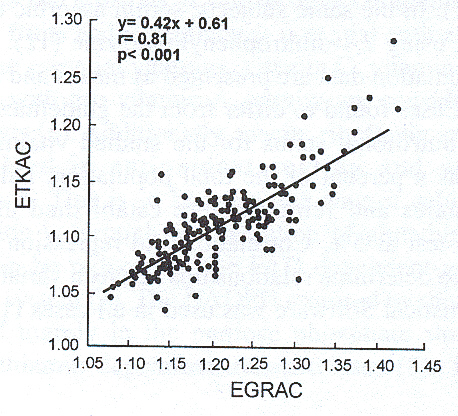
<body><![CDATA[<P ALIGN="CENTER"><font face="Times New Roman" size="3">0.04</font></TD> <TD WIDTH="22%" VALIGN="TOP">     <P ALIGN="CENTER"><font face="Times New Roman" size="3">-0.07</font></TD> <TD WIDTH="22%" VALIGN="TOP">     <P ALIGN="CENTER"><font face="Times New Roman" size="3">0.06</font></TD> </TR> </TABLE> </CENTER>      <P ALIGN="center"><font face="Times New Roman" size="3">1. For B<SUB>1</SUB> ETKAC, for B<SUB>2</SUB> EGRAC and for B<SUB>6</SUB> EASTAC. * P&lt; 0.001</font></P>      <P ALIGN="JUSTIFY"><font face="Times New Roman" size="3">In accordance with the data on <a href="#tabl4"> Table 4</a>, <a href="#fig1"> Figure 1</a> shows the linear regression line calculated from the activation coefficient of the transketolase and glutathione reductase, measured in the erythrocyte samples, of all the subjects included in this study. The figure indicates that subjects showing a low ETKAC also had a low EGRAC. Conversely, subjects having a high ETKAC also had a high EGRAC.</font> </P> <FONT SIZE=2>    <P ALIGN="JUSTIFY"></P> </FONT>    <P ALIGN="CENTER"><font face="Times New Roman" size="3"><a name="fig1"></a>FIGURE 1</font></P>     <P ALIGN="CENTER"><font face="Times New Roman" size="3">Relationship between the activation coefficient of the erythrocyte glutathione reductase (EGRAC) and transketolase (ETKAC) in 209 young university students.</font></P>     <P ALIGN="center"><font face="Times New Roman" size="3"><IMG SRC="/img/fbpe/alan/v53n3/art03fig01.jpg" WIDTH=458 HEIGHT=416></font></P>     
<P ALIGN="JUSTIFY"></P> <FONT SIZE=2> <I> </I></FONT><B>    ]]></body>
<body><![CDATA[<P ALIGN="left"><font face="Times New Roman" size="3">DISCUSSION</font></P> </B>    <P ALIGN="JUSTIFY"><font face="Times New Roman" size="3">The studied population included a group of young university students without any obvious sign of nutritional deficiencies. The group was quite homogeneous in terms of age, had more males and their calculated body mass index were in the normal range (14).</font> </P>     <P ALIGN="JUSTIFY"><font face="Times New Roman" size="3">In the study group, the activation coefficient of the erythrocyte aspartate amino transferase , glutathione reductase and transketolase were determined. These coefficients are considered functional assays for the status of B<SUB>6</SUB>, B<SUB>2</SUB> and B<SUB>1</SUB> respectively (14) and they have been used in the screening for deficiencies of these vitamins both in normal populations  (14-15) and also in  detecting and correcting B vitamin deficiencies occurring spontaneously in different parts of the world (16-17).</font> </P>     <P ALIGN="JUSTIFY"><font face="Times New Roman" size="3">Cutoff points for the interpretation of the activation coefficients of these erythrocyte enzymes have recently been reviewed (14,15) and, the literature shows a good agreement in the case of the transketolase but not for the aspartate amino transferase or glutathione reductase. Accordingly, different investigators (18-21) have used different values to represent acceptable, marginal or deficient status of B<sub>6</sub> and B<sub>2</sub> in the populations they have studied. In this study, the values used for the transketolase assay are those reported by Sauberlich (15) and Gibson (14)<I>.</I> However, the values used for the activation of aspartate amino transferase and glutathione reductase were considerably higher and similar to those recommended by Sauberlich  (18) and  Bates et al (19) as well as Boisvert et al (20) respectively. Using these cutoff points the mean values for the activation coefficient of the enzymes studied here fell well within the acceptable range both in the males and in the female students.</font> </P>     <P ALIGN="JUSTIFY"><font face="Times New Roman" size="3">The decision to use higher activation coefficients for these two enzymes was made since there were no obvious signs of nutritional deficiencies in any of the subjects. In other populations with no signs of deficiency, activation coefficients higher than those established as the upper limit of normality (14-15) have also been used for the three enzymes measured in this study (18-26). These discrepancies limit the value of using these enzymes in predicting vitamin status.</font></P>     <P ALIGN="JUSTIFY"><font face="Times New Roman" size="3">As described by Sauberlich (15)<I>,</I> the guidelines for interpreting  vitamin C status, from serum vitamin C levels has also been a matter of debate with acceptable levels ranging from 11-34 <font FACE="Symbol">m</font>m mol/L. In this study we used 23 <font FACE="Symbol">m</font>m mol/L based on the work of Jacob et al (27). Using this value, it appears that on the average, the  study subjects had an appropriate status for this water soluble vitamin. The higher circulating levels of vitamin C found here for the females has also been reported by others (27,28).</font></P>     <P ALIGN="JUSTIFY"><font face="Times New Roman" size="3">This interpretation of the data suggested that in general, the population as a whole as well as the males and females studied here had acceptable indices for B<sub>1</sub>, B<sub>2</sub>, B<sub>6</sub> and vitamin C. However, there were a few subjects with marginal or deficient indices for some of these vitamins. In general, the fraction of the subjects within the acceptable range was much higher than that within a marginal or deficient range and, among those in the  latter group, there were more females than males. After comparing the percentage of  the subjects showing low B vitamin indices in this study with those found in non-supplemented healthy subjects in other studies (21), it appears that the incidence of marginal indices for the three B vitamins in this population, fell well within a reasonable range. The incidence of low serum vitamin C levels, found in this study, is similar to previous studies reported by us in an older population (28).</font></P>     <P ALIGN="JUSTIFY"><font face="Times New Roman" size="3">The results of the correlation analysis performed here on EASTAC, EGRAC and ETKAC showed a direct relationship between the activation coefficient for the three enzymes. The strongest of these relationships was seen between EGRAC and ETKAC. The relationship between ETKAC and EASTAC was intermediate and the lowest was seen between EGRAC and EATAC.</font></P>     <P ALIGN="JUSTIFY"><font face="Times New Roman" size="3">A certain degree of agreement between indicators of nutritional status for various nutrients, like those seen in this study for B<sub>1</sub> and B<sub>6</sub> or B<sub>2</sub> and B<sub>6</sub> erythrocyte dependent enzymes, may be expected. This agreement may result from coincidences of the same nutrients in the foods consumed or due to biochemical relationships between them.<I> </I>However, a relationship as high as that seen here for the erythrocyte B<sub>1</sub> and B<sub>2</sub> dependent enzymes was unexpected. Thus, riboflavin  and thiamin are not present in the same foods (29-30)<I> </I>and neither riboflavin nor thiamin are required in the synthesis or interconversions of the active thiamin coenzymes (29) or the flavin nucleotides (30). Nevertheless, since in the erythrocyte the utilization of glucose in the pentose phosphate shunt as well as the capacity of reducing glutathione are critical in maintaining integrity and function (31), it is possible that in this cell the enzymes of  these two systems, namely the B<sub>1</sub> dependent transketolases and the B<sub>2</sub> dependent glutathione reductase, may be related.</font>   </P>     <P ALIGN="JUSTIFY"><font face="Times New Roman" size="3">In contrast to the strong relationship between the indicators of B<sub>1</sub> and B<sub>2</sub> status just described, these results showed that there was no relationship between the level of vitamin C measured in the serum and the activation coefficient of any of the B vitamin dependent enzymes measured in the erythrocytes of the same individuals. It is possible that a more complete assessment of the status of B<sub>1</sub>, B<sub>2</sub> and vitamin C, together with a larger variability in the nutritional status of these vitamins in the subjects, may be needed to show a relationship between these two B vitamins and vitamin C.</font>  </P>     ]]></body>
<body><![CDATA[<P ALIGN="JUSTIFY"><B><font face="Times New Roman" size="3">REFERENCES</font>  </P> <OL>  </B>    <!-- ref --></OL>  <font face="Times New Roman" size="3">1. Machlin LJ. Introduction. In<I>:</I> Beyond Deficiency. New Views on the Function and Health Effects of Vitamins. Annals of the New York Academy of Sciences  669 pp 1-6, 1992.</font>    &nbsp;&nbsp;&nbsp;&nbsp;&nbsp;&nbsp;&nbsp;&nbsp;[&#160;<a href="javascript:void(0);" onclick="javascript: window.open('/scielo.php?script=sci_nlinks&ref=417816&pid=S0004-0622200300030000300001&lng=','','width=640,height=500,resizable=yes,scrollbars=1,menubar=yes,');">Links</a>&#160;]<!-- end-ref --><!-- ref --><p><font face="Times New Roman" size="3">2. Krebs-Smith SM and Kantor LS. Choose a variety of fruits and vegetables daily: Understanding the complexities. J Nutr 2001;131:487S-501S.</font>    &nbsp;&nbsp;&nbsp;&nbsp;&nbsp;&nbsp;&nbsp;&nbsp;[&#160;<a href="javascript:void(0);" onclick="javascript: window.open('/scielo.php?script=sci_nlinks&ref=417817&pid=S0004-0622200300030000300002&lng=','','width=640,height=500,resizable=yes,scrollbars=1,menubar=yes,');">Links</a>&#160;]<!-- end-ref --><!-- ref --><p><font face="Times New Roman" size="3">3. Lyle BJ, Mares-Perlman JA, Klein BEK, Klein R, Palta M, Bowen PE and  Greger JL. Serum carotenoids and tocopherols and incidence of aged-related nuclear cataracts<I>. </I>Amer J Clin Nutr 1999;69:272-277.</font>    &nbsp;&nbsp;&nbsp;&nbsp;&nbsp;&nbsp;&nbsp;&nbsp;[&#160;<a href="javascript:void(0);" onclick="javascript: window.open('/scielo.php?script=sci_nlinks&ref=417818&pid=S0004-0622200300030000300003&lng=','','width=640,height=500,resizable=yes,scrollbars=1,menubar=yes,');">Links</a>&#160;]<!-- end-ref --><!-- ref --><p><font face="Times New Roman" size="3">4. Darlington LG and Stone TW. Antioxidants and fatty acids in the amelioration of rheumatoid arthritis and related disorders. Brit J Nutr 2001;85:251-269.</font>    &nbsp;&nbsp;&nbsp;&nbsp;&nbsp;&nbsp;&nbsp;&nbsp;[&#160;<a href="javascript:void(0);" onclick="javascript: window.open('/scielo.php?script=sci_nlinks&ref=417819&pid=S0004-0622200300030000300004&lng=','','width=640,height=500,resizable=yes,scrollbars=1,menubar=yes,');">Links</a>&#160;]<!-- end-ref --><!-- ref --><p><font face="Times New Roman" size="3">5. Byers T and Guerrero N. Epidemiological evidence for vitamin C and Vitamin E in cancer prevention. Amer J Clin Nutr 1995;62:1385S-1392S.</font>    &nbsp;&nbsp;&nbsp;&nbsp;&nbsp;&nbsp;&nbsp;&nbsp;[&#160;<a href="javascript:void(0);" onclick="javascript: window.open('/scielo.php?script=sci_nlinks&ref=417820&pid=S0004-0622200300030000300005&lng=','','width=640,height=500,resizable=yes,scrollbars=1,menubar=yes,');">Links</a>&#160;]<!-- end-ref --><!-- ref --><p><font face="Times New Roman" size="3">6. Sies H, Stahl W and Sundquist A. Antioxidant functions of vitamins: Vitamins E and C, Beta-Carotene and other Carotenoids. In: Beyond Deficiency. New Views on the Function and Health Effects of Vitamins. Annals of the New York Academy of Sciences 669 pp. 7-20, 1992.</font>    &nbsp;&nbsp;&nbsp;&nbsp;&nbsp;&nbsp;&nbsp;&nbsp;[&#160;<a href="javascript:void(0);" onclick="javascript: window.open('/scielo.php?script=sci_nlinks&ref=417821&pid=S0004-0622200300030000300006&lng=','','width=640,height=500,resizable=yes,scrollbars=1,menubar=yes,');">Links</a>&#160;]<!-- end-ref --><!-- ref --><p><font face="Times New Roman" size="3">7. Sen ChK and Packer L. Thiol homeostasis and supplements in physical excercise. Amer J Clin Nutr 2000;72:653S-659S.</font>    &nbsp;&nbsp;&nbsp;&nbsp;&nbsp;&nbsp;&nbsp;&nbsp;[&#160;<a href="javascript:void(0);" onclick="javascript: window.open('/scielo.php?script=sci_nlinks&ref=417822&pid=S0004-0622200300030000300007&lng=','','width=640,height=500,resizable=yes,scrollbars=1,menubar=yes,');">Links</a>&#160;]<!-- end-ref --><!-- ref --><p><font face="Times New Roman" size="3">8. Schwartz NB. Carbohydrate Metabolism II. Special pathways and glycoconjugates.  In:  Textbook   of   Biochemistry  with  Clinical  Correlations (Devlin TM. ed).  pp. 665-691, Wiley &amp; Sons,  New York, 2002.</font>    &nbsp;&nbsp;&nbsp;&nbsp;&nbsp;&nbsp;&nbsp;&nbsp;[&#160;<a href="javascript:void(0);" onclick="javascript: window.open('/scielo.php?script=sci_nlinks&ref=417823&pid=S0004-0622200300030000300008&lng=','','width=640,height=500,resizable=yes,scrollbars=1,menubar=yes,');">Links</a>&#160;]<!-- end-ref --><!-- ref --><p><font face="Times New Roman" size="3">9. Melo SS, Arantes MR, Meirelles MS, Jordao AA Jr. and Vannucchi, H. Lipid peroxidation in nicotinamide-supplemented rats with stretozotocin-induced diabetes. Acta Diabetol 2000;37:33-39.</font>    &nbsp;&nbsp;&nbsp;&nbsp;&nbsp;&nbsp;&nbsp;&nbsp;[&#160;<a href="javascript:void(0);" onclick="javascript: window.open('/scielo.php?script=sci_nlinks&ref=417824&pid=S0004-0622200300030000300009&lng=','','width=640,height=500,resizable=yes,scrollbars=1,menubar=yes,');">Links</a>&#160;]<!-- end-ref --><!-- ref --><p><font face="Times New Roman" size="3">10. Bayomi RA and Rosalki SB. Evaluation of methods of coenzyme activation of erythrocyte enzymes for detection of deficiency of vitamins B1, B2 and B6 in the human. Clin Chem 1976;22:327-335.</font>    &nbsp;&nbsp;&nbsp;&nbsp;&nbsp;&nbsp;&nbsp;&nbsp;[&#160;<a href="javascript:void(0);" onclick="javascript: window.open('/scielo.php?script=sci_nlinks&ref=417825&pid=S0004-0622200300030000300010&lng=','','width=640,height=500,resizable=yes,scrollbars=1,menubar=yes,');">Links</a>&#160;]<!-- end-ref --><!-- ref --><p><font face="Times New Roman" size="3">11. Drabkin DL and Austin JH. Spectrophotometric studies: spectrophotometric constants for common hemoglobin derivatives in human, dog and rabbit blood. J Biol Chem 1932;98:719-733</font><I><font face="Times New Roman" size="3">.</font> </I>    &nbsp;&nbsp;&nbsp;&nbsp;&nbsp;&nbsp;&nbsp;&nbsp;[&#160;<a href="javascript:void(0);" onclick="javascript: window.open('/scielo.php?script=sci_nlinks&ref=417826&pid=S0004-0622200300030000300011&lng=','','width=640,height=500,resizable=yes,scrollbars=1,menubar=yes,');">Links</a>&#160;]<!-- end-ref --><!-- ref --><p><font face="Times New Roman" size="3">12. Omaye ST, Turnbull JD and Sauberlich HE. Selected methods for the determination of ascorbic acid in animal cells, tissues and fluids. In: Methods in Enzymology (McCormick DB, Wright LD de)  62:3-11, 1979.</font>    &nbsp;&nbsp;&nbsp;&nbsp;&nbsp;&nbsp;&nbsp;&nbsp;[&#160;<a href="javascript:void(0);" onclick="javascript: window.open('/scielo.php?script=sci_nlinks&ref=417827&pid=S0004-0622200300030000300012&lng=','','width=640,height=500,resizable=yes,scrollbars=1,menubar=yes,');">Links</a>&#160;]<!-- end-ref --><!-- ref --><p><font face="Times New Roman" size="3">13. Dixon WJ, Brown MB, Engelman L and Jennrich RY. BMDP Statistical Software Manual. University of California, 1990.</font>    &nbsp;&nbsp;&nbsp;&nbsp;&nbsp;&nbsp;&nbsp;&nbsp;[&#160;<a href="javascript:void(0);" onclick="javascript: window.open('/scielo.php?script=sci_nlinks&ref=417828&pid=S0004-0622200300030000300013&lng=','','width=640,height=500,resizable=yes,scrollbars=1,menubar=yes,');">Links</a>&#160;]<!-- end-ref --><!-- ref --><p><font face="Times New Roman" size="3">14. Gibson RS. Principles of Nutritional Assessment. Oxford University Press. Oxford, 1990.</font>    &nbsp;&nbsp;&nbsp;&nbsp;&nbsp;&nbsp;&nbsp;&nbsp;[&#160;<a href="javascript:void(0);" onclick="javascript: window.open('/scielo.php?script=sci_nlinks&ref=417829&pid=S0004-0622200300030000300014&lng=','','width=640,height=500,resizable=yes,scrollbars=1,menubar=yes,');">Links</a>&#160;]<!-- end-ref --><!-- ref --><p><font face="Times New Roman" size="3">15. Sauberlich HE. Laboratory Tests for the Assessment of Nutritional Status. CRC Press. Boca Raton, 1999.</font>    &nbsp;&nbsp;&nbsp;&nbsp;&nbsp;&nbsp;&nbsp;&nbsp;[&#160;<a href="javascript:void(0);" onclick="javascript: window.open('/scielo.php?script=sci_nlinks&ref=417830&pid=S0004-0622200300030000300015&lng=','','width=640,height=500,resizable=yes,scrollbars=1,menubar=yes,');">Links</a>&#160;]<!-- end-ref --><!-- ref --><p><font face="Times New Roman" size="3">16. Macias-Matos C, Rodriguez-Ojeda A, Chi N, Jim&eacute;nez S, Zuleta D and Bates CJ. Biochemical evidence of thiamine depletion during the Cuban neuropathy epidemic, 1992-1993. Amer J Clin Nutr 1996;64:347-353.</font>    &nbsp;&nbsp;&nbsp;&nbsp;&nbsp;&nbsp;&nbsp;&nbsp;[&#160;<a href="javascript:void(0);" onclick="javascript: window.open('/scielo.php?script=sci_nlinks&ref=417831&pid=S0004-0622200300030000300016&lng=','','width=640,height=500,resizable=yes,scrollbars=1,menubar=yes,');">Links</a>&#160;]<!-- end-ref --><!-- ref --><p><font face="Times New Roman" size="3">17. Bates CJ, Phil D, Prentice AM, Paul AA, Sutcliffe BA, Watkinson M and Whitehead RG. Riboflavin status in Gambian pregnant and lactating women and its implications for recommended dietary allowances. Amer J  Clin  Nutr 1951;34:928-935.</font>    &nbsp;&nbsp;&nbsp;&nbsp;&nbsp;&nbsp;&nbsp;&nbsp;[&#160;<a href="javascript:void(0);" onclick="javascript: window.open('/scielo.php?script=sci_nlinks&ref=417832&pid=S0004-0622200300030000300017&lng=','','width=640,height=500,resizable=yes,scrollbars=1,menubar=yes,');">Links</a>&#160;]<!-- end-ref --><!-- ref --><p><font face="Times New Roman" size="3">18. Sauberlich HE, Canham JE, Baker EM, Raica N and Herman YF. Biochemical assessment of the nutritional status of vitamin B-6 in the human. Amer J Clin Nutr 1972;25:629-642.</font>    &nbsp;&nbsp;&nbsp;&nbsp;&nbsp;&nbsp;&nbsp;&nbsp;[&#160;<a href="javascript:void(0);" onclick="javascript: window.open('/scielo.php?script=sci_nlinks&ref=417833&pid=S0004-0622200300030000300018&lng=','','width=640,height=500,resizable=yes,scrollbars=1,menubar=yes,');">Links</a>&#160;]<!-- end-ref --><!-- ref --><p><font face="Times New Roman" size="3">19. Bates JC, Powers HJ, Downes R, Brubachere D, Sutcliffe V and Thurnill A. Riboflavin status of adolescent vs elderly Gambian subjects before and during supplementation. Amer  J  Clin  Nutr 1989;50:825-829.</font>    &nbsp;&nbsp;&nbsp;&nbsp;&nbsp;&nbsp;&nbsp;&nbsp;[&#160;<a href="javascript:void(0);" onclick="javascript: window.open('/scielo.php?script=sci_nlinks&ref=417834&pid=S0004-0622200300030000300019&lng=','','width=640,height=500,resizable=yes,scrollbars=1,menubar=yes,');">Links</a>&#160;]<!-- end-ref --><!-- ref --><p><font face="Times New Roman" size="3">20. Boisvert WA, Mendoza I, Castaneda C, De Portocarrero L, Solomons NW, Gershoff SN and  Russell R. Riboflavin requirements of healthy elderly humans and its relationship to macronutrient composition of the diet. J Nutr  1993;123:915-925.</font>    &nbsp;&nbsp;&nbsp;&nbsp;&nbsp;&nbsp;&nbsp;&nbsp;[&#160;<a href="javascript:void(0);" onclick="javascript: window.open('/scielo.php?script=sci_nlinks&ref=417835&pid=S0004-0622200300030000300020&lng=','','width=640,height=500,resizable=yes,scrollbars=1,menubar=yes,');">Links</a>&#160;]<!-- end-ref --><!-- ref --><p><font face="Times New Roman" size="3">21. Manore MM. Effect of physical activity on thiamine, riboflavin and vitamin B-6 requirements. Amer J Clin Nutr 2000;72:598S-606S.</font>    &nbsp;&nbsp;&nbsp;&nbsp;&nbsp;&nbsp;&nbsp;&nbsp;[&#160;<a href="javascript:void(0);" onclick="javascript: window.open('/scielo.php?script=sci_nlinks&ref=417836&pid=S0004-0622200300030000300021&lng=','','width=640,height=500,resizable=yes,scrollbars=1,menubar=yes,');">Links</a>&#160;]<!-- end-ref --><!-- ref --><p><font face="Times New Roman" size="3">22. Van der Beek EJ, Van Dokkum W, Schrijver J, Wedel M, Gaillard AWK, Wesstra A, Van de Weerd H and Hermus RJJ. Thiamin, riboflavin, and vitamins B-6 and C: impact of combined restricted intake on functional performance in man.  Amer  J  Clin  Nutr 1988;48:1451-1452.</font>    &nbsp;&nbsp;&nbsp;&nbsp;&nbsp;&nbsp;&nbsp;&nbsp;[&#160;<a href="javascript:void(0);" onclick="javascript: window.open('/scielo.php?script=sci_nlinks&ref=417837&pid=S0004-0622200300030000300022&lng=','','width=640,height=500,resizable=yes,scrollbars=1,menubar=yes,');">Links</a>&#160;]<!-- end-ref --><!-- ref --><p><font face="Times New Roman" size="3">23. Fu-Liu CS, Fujitaki C and Lewis JS. Riboflavin status: Dietary intake, urinary excretion, and erythrocyte glutathione reductase coefficient activity of female university students<I>.</I> Nutr Res 1986;6:601-608.</font>    &nbsp;&nbsp;&nbsp;&nbsp;&nbsp;&nbsp;&nbsp;&nbsp;[&#160;<a href="javascript:void(0);" onclick="javascript: window.open('/scielo.php?script=sci_nlinks&ref=417838&pid=S0004-0622200300030000300023&lng=','','width=640,height=500,resizable=yes,scrollbars=1,menubar=yes,');">Links</a>&#160;]<!-- end-ref --><!-- ref --><p><font face="Times New Roman" size="3">24. Booth CK, Clark T and  Fenn A. Folic acid, Riboflavin and B-6 status of a group of first time blood donors. Amer J Clin Nutr 1998;68:1075-1080.</font>    &nbsp;&nbsp;&nbsp;&nbsp;&nbsp;&nbsp;&nbsp;&nbsp;[&#160;<a href="javascript:void(0);" onclick="javascript: window.open('/scielo.php?script=sci_nlinks&ref=417839&pid=S0004-0622200300030000300024&lng=','','width=640,height=500,resizable=yes,scrollbars=1,menubar=yes,');">Links</a>&#160;]<!-- end-ref --><!-- ref --><p><font face="Times New Roman" size="3">25. Madigan Sh, Tracey F, McNulty H, Eato-Evans J, Coulter J, McCartney H and Strain JJ. Riboflavin and vitamin B-6 intakes and status and biochemical responses to riboflavin supplementation in free-living elderly people. Amer  J  Clin  Nutr 1998;68:389-395.</font>    &nbsp;&nbsp;&nbsp;&nbsp;&nbsp;&nbsp;&nbsp;&nbsp;[&#160;<a href="javascript:void(0);" onclick="javascript: window.open('/scielo.php?script=sci_nlinks&ref=417840&pid=S0004-0622200300030000300025&lng=','','width=640,height=500,resizable=yes,scrollbars=1,menubar=yes,');">Links</a>&#160;]<!-- end-ref --><!-- ref --><p><font face="Times New Roman" size="3">26. Bailey AL, Finglas PM, Wright AJA and Southo S. Thiamin intake, erythrocyte (EC 2.2.1.1) activity and total erythrocyte thiamin in adolescents. Brit  J  Nutr 1993;72:111-125.</font>    &nbsp;&nbsp;&nbsp;&nbsp;&nbsp;&nbsp;&nbsp;&nbsp;[&#160;<a href="javascript:void(0);" onclick="javascript: window.open('/scielo.php?script=sci_nlinks&ref=417841&pid=S0004-0622200300030000300026&lng=','','width=640,height=500,resizable=yes,scrollbars=1,menubar=yes,');">Links</a>&#160;]<!-- end-ref --><!-- ref --><p><font face="Times New Roman" size="3">27. Jacob RS, Skala JH, Omaye ST and Hevia P. Biochemical methods for assessing vitamin C status of the individual. In: Nutritional Status Assessment of the IndividuaL. (Livingston, G.E.,ed.) pp. 323-337, Food and Nutrition Press, New York, 1989.</font>    &nbsp;&nbsp;&nbsp;&nbsp;&nbsp;&nbsp;&nbsp;&nbsp;[&#160;<a href="javascript:void(0);" onclick="javascript: window.open('/scielo.php?script=sci_nlinks&ref=417842&pid=S0004-0622200300030000300027&lng=','','width=640,height=500,resizable=yes,scrollbars=1,menubar=yes,');">Links</a>&#160;]<!-- end-ref --><!-- ref --><p><font face="Times New Roman" size="3">28. Hevia P, Mella C, Cioccia AM, Car&iacute;as D, Avila AV, and Arciniegas EL. Lipidos s&eacute;ricos y niveles de las vitaminas A,C y E en una poblaci&oacute;n adulta de Caracas.  Arch Latinoam  Nutr 1998;48:112-121.</font>    &nbsp;&nbsp;&nbsp;&nbsp;&nbsp;&nbsp;&nbsp;&nbsp;[&#160;<a href="javascript:void(0);" onclick="javascript: window.open('/scielo.php?script=sci_nlinks&ref=417843&pid=S0004-0622200300030000300028&lng=','','width=640,height=500,resizable=yes,scrollbars=1,menubar=yes,');">Links</a>&#160;]<!-- end-ref --><!-- ref --><p><font face="Times New Roman" size="3">29. Rivlin RS and Pinto JT. Riboflavin (Vitamin B2). In:<I> </I>Handbook of Vitamins. (Rucker RB, Suttie JW, McCormick DB and Machlin LJ, eds.) pp. 255-273, Marcel Dekker Inc., New York, 2001.</font>    &nbsp;&nbsp;&nbsp;&nbsp;&nbsp;&nbsp;&nbsp;&nbsp;[&#160;<a href="javascript:void(0);" onclick="javascript: window.open('/scielo.php?script=sci_nlinks&ref=417844&pid=S0004-0622200300030000300029&lng=','','width=640,height=500,resizable=yes,scrollbars=1,menubar=yes,');">Links</a>&#160;]<!-- end-ref --><!-- ref --><p><font face="Times New Roman" size="3">30. Tanphaichitr V. Thiamin.<I> </I>In:<I> </I>Handbook of Vitamins. (Rucker RB, Suttie JW, McCormick DB and Machlin LJ, eds.) pp. 275-316, Marcel Dekker Inc., New York, 2001.</font>    &nbsp;&nbsp;&nbsp;&nbsp;&nbsp;&nbsp;&nbsp;&nbsp;[&#160;<a href="javascript:void(0);" onclick="javascript: window.open('/scielo.php?script=sci_nlinks&ref=417845&pid=S0004-0622200300030000300030&lng=','','width=640,height=500,resizable=yes,scrollbars=1,menubar=yes,');">Links</a>&#160;]<!-- end-ref --><!-- ref --><p><font face="Times New Roman" size="3">31. Harris RA. Carbohydrate metabolism. Major metabolic pathways and their control. In: Textbook of Biochemistry with Clinical Correlations  (Devlin, T.M. ed.) pp. 597-664, Wiley &amp; Sons, New York, 2002.</font>    &nbsp;&nbsp;&nbsp;&nbsp;&nbsp;&nbsp;&nbsp;&nbsp;[&#160;<a href="javascript:void(0);" onclick="javascript: window.open('/scielo.php?script=sci_nlinks&ref=417846&pid=S0004-0622200300030000300031&lng=','','width=640,height=500,resizable=yes,scrollbars=1,menubar=yes,');">Links</a>&#160;]<!-- end-ref --> ]]></body>
<back>
<ref-list>
<ref id="B1">
<label>1</label><nlm-citation citation-type="journal">
<article-title xml:lang="en"><![CDATA[Beyond Deficiency. New Views on the Function and Health Effects of Vitamins]]></article-title>
<source><![CDATA[Annals of the New York Academy of Sciences]]></source>
<year>1992</year>
<volume>669</volume>
<page-range>1-6</page-range></nlm-citation>
</ref>
<ref id="B2">
<label>2</label><nlm-citation citation-type="journal">
<person-group person-group-type="author">
<name>
<surname><![CDATA[Krebs-Smith]]></surname>
<given-names><![CDATA[SM]]></given-names>
</name>
<name>
<surname><![CDATA[Kantor]]></surname>
<given-names><![CDATA[LS]]></given-names>
</name>
</person-group>
<article-title xml:lang="en"><![CDATA[Choose a variety of fruits and vegetables daily: Understanding the complexities]]></article-title>
<source><![CDATA[J Nutr]]></source>
<year>2001</year>
<volume>131</volume>
<page-range>487S-501S</page-range></nlm-citation>
</ref>
<ref id="B3">
<label>3</label><nlm-citation citation-type="journal">
<person-group person-group-type="author">
<name>
<surname><![CDATA[Lyle]]></surname>
<given-names><![CDATA[BJ]]></given-names>
</name>
<name>
<surname><![CDATA[Mares-Perlman]]></surname>
<given-names><![CDATA[JA]]></given-names>
</name>
<name>
<surname><![CDATA[Klein]]></surname>
<given-names><![CDATA[BEK]]></given-names>
</name>
<name>
<surname><![CDATA[Klein]]></surname>
<given-names><![CDATA[R]]></given-names>
</name>
<name>
<surname><![CDATA[Palta]]></surname>
<given-names><![CDATA[M]]></given-names>
</name>
<name>
<surname><![CDATA[Bowen]]></surname>
<given-names><![CDATA[PE]]></given-names>
</name>
<name>
<surname><![CDATA[Greger]]></surname>
<given-names><![CDATA[JL]]></given-names>
</name>
</person-group>
<article-title xml:lang="en"><![CDATA[Serum carotenoids and tocopherols and incidence of aged-related nuclear cataracts]]></article-title>
<source><![CDATA[Amer J Clin Nutr]]></source>
<year>1999</year>
<volume>69</volume>
<page-range>272-277</page-range></nlm-citation>
</ref>
<ref id="B4">
<label>4</label><nlm-citation citation-type="journal">
<person-group person-group-type="author">
<name>
<surname><![CDATA[Darlington]]></surname>
<given-names><![CDATA[LG]]></given-names>
</name>
<name>
<surname><![CDATA[Stone]]></surname>
<given-names><![CDATA[TW]]></given-names>
</name>
</person-group>
<article-title xml:lang="en"><![CDATA[Antioxidants and fatty acids in the amelioration of rheumatoid arthritis and related disorders]]></article-title>
<source><![CDATA[Brit J Nutr]]></source>
<year>2001</year>
<volume>85</volume>
<page-range>251-269</page-range></nlm-citation>
</ref>
<ref id="B5">
<label>5</label><nlm-citation citation-type="journal">
<person-group person-group-type="author">
<name>
<surname><![CDATA[Byers]]></surname>
<given-names><![CDATA[T]]></given-names>
</name>
<name>
<surname><![CDATA[Guerrero]]></surname>
<given-names><![CDATA[N]]></given-names>
</name>
</person-group>
<article-title xml:lang="en"><![CDATA[Epidemiological evidence for vitamin C and Vitamin E in cancer prevention]]></article-title>
<source><![CDATA[Amer J Clin Nutr]]></source>
<year>1995</year>
<volume>62</volume>
<page-range>1385S-1392S</page-range></nlm-citation>
</ref>
<ref id="B6">
<label>6</label><nlm-citation citation-type="journal">
<article-title xml:lang="en"><![CDATA[Beyond Deficiency. New Views on the Function and Health Effects of Vitamins]]></article-title>
<source><![CDATA[Annals of the New York Academy of Sciences]]></source>
<year>1992</year>
<volume>669</volume>
<page-range>7-20</page-range></nlm-citation>
</ref>
<ref id="B7">
<label>7</label><nlm-citation citation-type="journal">
<person-group person-group-type="author">
<name>
<surname><![CDATA[Sen]]></surname>
<given-names><![CDATA[ChK]]></given-names>
</name>
<name>
<surname><![CDATA[Packer]]></surname>
<given-names><![CDATA[L]]></given-names>
</name>
</person-group>
<article-title xml:lang="en"><![CDATA[Thiol homeostasis and supplements in physical excercise]]></article-title>
<source><![CDATA[Amer J Clin Nutr]]></source>
<year>2000</year>
<volume>72</volume>
<page-range>653S-659S</page-range></nlm-citation>
</ref>
<ref id="B8">
<label>8</label><nlm-citation citation-type="book">
<person-group person-group-type="author">
<name>
<surname><![CDATA[Devlin]]></surname>
<given-names><![CDATA[TM]]></given-names>
</name>
</person-group>
<source><![CDATA[Textbook of Biochemistry with Clinical Correlations]]></source>
<year>2002</year>
<page-range>665-691</page-range><publisher-loc><![CDATA[^eNew York New York]]></publisher-loc>
<publisher-name><![CDATA[Wiley & Sons]]></publisher-name>
</nlm-citation>
</ref>
<ref id="B9">
<label>9</label><nlm-citation citation-type="journal">
<person-group person-group-type="author">
<name>
<surname><![CDATA[Melo]]></surname>
<given-names><![CDATA[SS]]></given-names>
</name>
<name>
<surname><![CDATA[Arantes]]></surname>
<given-names><![CDATA[MR]]></given-names>
</name>
<name>
<surname><![CDATA[Meirelles]]></surname>
<given-names><![CDATA[MS]]></given-names>
</name>
<name>
<surname><![CDATA[Jordao]]></surname>
<given-names><![CDATA[AA Jr]]></given-names>
</name>
<name>
<surname><![CDATA[Vannucchi]]></surname>
<given-names><![CDATA[H]]></given-names>
</name>
</person-group>
<article-title xml:lang="en"><![CDATA[Lipid peroxidation in nicotinamide-supplemented rats with stretozotocin-induced diabetes]]></article-title>
<source><![CDATA[Acta Diabetol]]></source>
<year>2000</year>
<volume>37</volume>
<page-range>33-39</page-range></nlm-citation>
</ref>
<ref id="B10">
<label>10</label><nlm-citation citation-type="journal">
<person-group person-group-type="author">
<name>
<surname><![CDATA[Bayomi]]></surname>
<given-names><![CDATA[RA]]></given-names>
</name>
<name>
<surname><![CDATA[Rosalki]]></surname>
<given-names><![CDATA[SB]]></given-names>
</name>
</person-group>
<article-title xml:lang="en"><![CDATA[Evaluation of methods of coenzyme activation of erythrocyte enzymes for detection of deficiency of vitamins B1, B2 and B6 in the human]]></article-title>
<source><![CDATA[Clin Chem]]></source>
<year>1976</year>
<volume>22</volume>
<page-range>327-335</page-range></nlm-citation>
</ref>
<ref id="B11">
<label>11</label><nlm-citation citation-type="journal">
<person-group person-group-type="author">
<name>
<surname><![CDATA[Drabkin]]></surname>
<given-names><![CDATA[DL]]></given-names>
</name>
<name>
<surname><![CDATA[Austin]]></surname>
<given-names><![CDATA[JH]]></given-names>
</name>
</person-group>
<article-title xml:lang="en"><![CDATA[Spectrophotometric studies: spectrophotometric constants for common hemoglobin derivatives in human, dog and rabbit blood]]></article-title>
<source><![CDATA[J Biol Chem]]></source>
<year>1932</year>
<volume>98</volume>
<page-range>719-733</page-range></nlm-citation>
</ref>
<ref id="B12">
<label>12</label><nlm-citation citation-type="">
<person-group person-group-type="author">
<name>
<surname><![CDATA[McCormick]]></surname>
<given-names><![CDATA[DB]]></given-names>
</name>
<name>
<surname><![CDATA[Wright]]></surname>
<given-names><![CDATA[LD]]></given-names>
</name>
</person-group>
<source><![CDATA[Methods in Enzymology]]></source>
<year>1979</year>
<volume>) 62</volume>
<page-range>3-11</page-range></nlm-citation>
</ref>
<ref id="B13">
<label>13</label><nlm-citation citation-type="book">
<person-group person-group-type="author">
<name>
<surname><![CDATA[Dixon]]></surname>
<given-names><![CDATA[WJ]]></given-names>
</name>
<name>
<surname><![CDATA[Brown]]></surname>
<given-names><![CDATA[MB]]></given-names>
</name>
<name>
<surname><![CDATA[Engelman]]></surname>
<given-names><![CDATA[L]]></given-names>
</name>
<name>
<surname><![CDATA[Jennrich]]></surname>
<given-names><![CDATA[RY]]></given-names>
</name>
</person-group>
<source><![CDATA[BMDP Statistical Software Manual]]></source>
<year>1990</year>
<publisher-name><![CDATA[University of California]]></publisher-name>
</nlm-citation>
</ref>
<ref id="B14">
<label>14</label><nlm-citation citation-type="book">
<person-group person-group-type="author">
<name>
<surname><![CDATA[Gibson]]></surname>
<given-names><![CDATA[RS]]></given-names>
</name>
</person-group>
<source><![CDATA[Principles of Nutritional Assessment]]></source>
<year>1990</year>
<publisher-loc><![CDATA[^eOxford Oxford]]></publisher-loc>
<publisher-name><![CDATA[Oxford University Press]]></publisher-name>
</nlm-citation>
</ref>
<ref id="B15">
<label>15</label><nlm-citation citation-type="book">
<person-group person-group-type="author">
<name>
<surname><![CDATA[Sauberlich]]></surname>
<given-names><![CDATA[HE]]></given-names>
</name>
</person-group>
<source><![CDATA[Laboratory Tests for the Assessment of Nutritional Status]]></source>
<year>1999</year>
<publisher-loc><![CDATA[Boca Raton ]]></publisher-loc>
<publisher-name><![CDATA[CRC Press]]></publisher-name>
</nlm-citation>
</ref>
<ref id="B16">
<label>16</label><nlm-citation citation-type="journal">
<person-group person-group-type="author">
<name>
<surname><![CDATA[Macias-Matos]]></surname>
<given-names><![CDATA[C]]></given-names>
</name>
<name>
<surname><![CDATA[Rodriguez-Ojeda]]></surname>
<given-names><![CDATA[A]]></given-names>
</name>
<name>
<surname><![CDATA[Chi]]></surname>
<given-names><![CDATA[N]]></given-names>
</name>
<name>
<surname><![CDATA[Jiménez]]></surname>
<given-names><![CDATA[S]]></given-names>
</name>
<name>
<surname><![CDATA[Zuleta]]></surname>
<given-names><![CDATA[D]]></given-names>
</name>
<name>
<surname><![CDATA[Bates]]></surname>
<given-names><![CDATA[CJ]]></given-names>
</name>
</person-group>
<article-title xml:lang="en"><![CDATA[Biochemical evidence of thiamine depletion during the Cuban neuropathy epidemic, 1992-1993]]></article-title>
<source><![CDATA[Amer J Clin Nutr]]></source>
<year>1996</year>
<volume>64</volume>
<page-range>347-353</page-range></nlm-citation>
</ref>
<ref id="B17">
<label>17</label><nlm-citation citation-type="journal">
<person-group person-group-type="author">
<name>
<surname><![CDATA[Bates]]></surname>
<given-names><![CDATA[CJ]]></given-names>
</name>
<name>
<surname><![CDATA[Phil]]></surname>
<given-names><![CDATA[D]]></given-names>
</name>
<name>
<surname><![CDATA[Prentice]]></surname>
<given-names><![CDATA[AM]]></given-names>
</name>
<name>
<surname><![CDATA[Paul]]></surname>
<given-names><![CDATA[AA]]></given-names>
</name>
<name>
<surname><![CDATA[Sutcliffe]]></surname>
<given-names><![CDATA[BA]]></given-names>
</name>
<name>
<surname><![CDATA[Watkinson]]></surname>
<given-names><![CDATA[M]]></given-names>
</name>
<name>
<surname><![CDATA[Whitehead]]></surname>
<given-names><![CDATA[RG]]></given-names>
</name>
</person-group>
<article-title xml:lang="en"><![CDATA[Riboflavin status in Gambian pregnant and lactating women and its implications for recommended dietary allowances]]></article-title>
<source><![CDATA[Amer J Clin Nutr]]></source>
<year>1951</year>
<volume>34</volume>
<page-range>928-935</page-range></nlm-citation>
</ref>
<ref id="B18">
<label>18</label><nlm-citation citation-type="journal">
<person-group person-group-type="author">
<name>
<surname><![CDATA[Sauberlich]]></surname>
<given-names><![CDATA[HE]]></given-names>
</name>
<name>
<surname><![CDATA[Canham]]></surname>
<given-names><![CDATA[JE]]></given-names>
</name>
<name>
<surname><![CDATA[Baker]]></surname>
<given-names><![CDATA[EM]]></given-names>
</name>
<name>
<surname><![CDATA[Raica]]></surname>
<given-names><![CDATA[N]]></given-names>
</name>
<name>
<surname><![CDATA[Herman]]></surname>
<given-names><![CDATA[YF]]></given-names>
</name>
</person-group>
<article-title xml:lang="en"><![CDATA[Biochemical assessment of the nutritional status of vitamin B-6 in the human]]></article-title>
<source><![CDATA[Amer J Clin Nutr]]></source>
<year>1972</year>
<volume>25</volume>
<page-range>629-642</page-range></nlm-citation>
</ref>
<ref id="B19">
<label>19</label><nlm-citation citation-type="journal">
<person-group person-group-type="author">
<name>
<surname><![CDATA[Bates]]></surname>
<given-names><![CDATA[JC]]></given-names>
</name>
<name>
<surname><![CDATA[Powers]]></surname>
<given-names><![CDATA[HJ]]></given-names>
</name>
<name>
<surname><![CDATA[Downes]]></surname>
<given-names><![CDATA[R]]></given-names>
</name>
<name>
<surname><![CDATA[Brubachere]]></surname>
<given-names><![CDATA[D]]></given-names>
</name>
<name>
<surname><![CDATA[Sutcliffe]]></surname>
<given-names><![CDATA[V]]></given-names>
</name>
<name>
<surname><![CDATA[Thurnill]]></surname>
<given-names><![CDATA[A]]></given-names>
</name>
</person-group>
<article-title xml:lang="en"><![CDATA[Riboflavin status of adolescent vs elderly Gambian subjects before and during supplementation]]></article-title>
<source><![CDATA[Amer J Clin Nutr]]></source>
<year>1989</year>
<volume>50</volume>
<page-range>825-829</page-range></nlm-citation>
</ref>
<ref id="B20">
<label>20</label><nlm-citation citation-type="journal">
<person-group person-group-type="author">
<name>
<surname><![CDATA[Boisvert]]></surname>
<given-names><![CDATA[WA]]></given-names>
</name>
<name>
<surname><![CDATA[Mendoza]]></surname>
<given-names><![CDATA[I]]></given-names>
</name>
<name>
<surname><![CDATA[Castaneda]]></surname>
<given-names><![CDATA[C]]></given-names>
</name>
<name>
<surname><![CDATA[De Portocarrero]]></surname>
<given-names><![CDATA[L]]></given-names>
</name>
<name>
<surname><![CDATA[Solomons]]></surname>
<given-names><![CDATA[NW]]></given-names>
</name>
<name>
<surname><![CDATA[Gershoff]]></surname>
<given-names><![CDATA[SN]]></given-names>
</name>
<name>
<surname><![CDATA[Russell]]></surname>
<given-names><![CDATA[R]]></given-names>
</name>
</person-group>
<article-title xml:lang="en"><![CDATA[Riboflavin requirements of healthy elderly humans and its relationship to macronutrient composition of the diet]]></article-title>
<source><![CDATA[J Nutr]]></source>
<year>1993</year>
<volume>123</volume>
<page-range>915-925</page-range></nlm-citation>
</ref>
<ref id="B21">
<label>21</label><nlm-citation citation-type="journal">
<person-group person-group-type="author">
<name>
<surname><![CDATA[Manore]]></surname>
<given-names><![CDATA[MM]]></given-names>
</name>
</person-group>
<source><![CDATA[Amer J Clin Nutr]]></source>
<year>2000</year>
<volume>72</volume>
<page-range>598S-606S</page-range></nlm-citation>
</ref>
<ref id="B22">
<label>22</label><nlm-citation citation-type="journal">
<person-group person-group-type="author">
<name>
<surname><![CDATA[Van der Beek]]></surname>
<given-names><![CDATA[EJ]]></given-names>
</name>
<name>
<surname><![CDATA[Van Dokkum]]></surname>
<given-names><![CDATA[W]]></given-names>
</name>
<name>
<surname><![CDATA[Schrijver]]></surname>
<given-names><![CDATA[J]]></given-names>
</name>
<name>
<surname><![CDATA[Wedel]]></surname>
<given-names><![CDATA[M]]></given-names>
</name>
<name>
<surname><![CDATA[Gaillard]]></surname>
<given-names><![CDATA[AWK]]></given-names>
</name>
<name>
<surname><![CDATA[Wesstra]]></surname>
<given-names><![CDATA[A]]></given-names>
</name>
<name>
<surname><![CDATA[Van de Weerd]]></surname>
<given-names><![CDATA[H]]></given-names>
</name>
<name>
<surname><![CDATA[Hermus]]></surname>
<given-names><![CDATA[RJJ]]></given-names>
</name>
</person-group>
<article-title xml:lang="en"><![CDATA[Thiamin, riboflavin, and vitamins B-6 and C: impact of combined restricted intake on functional performance in man]]></article-title>
<source><![CDATA[Amer J Clin Nutr]]></source>
<year>1988</year>
<volume>48</volume>
<page-range>1451-1452</page-range></nlm-citation>
</ref>
<ref id="B23">
<label>23</label><nlm-citation citation-type="journal">
<person-group person-group-type="author">
<name>
<surname><![CDATA[Fu-Liu]]></surname>
<given-names><![CDATA[CS]]></given-names>
</name>
<name>
<surname><![CDATA[Fujitaki]]></surname>
<given-names><![CDATA[C]]></given-names>
</name>
<name>
<surname><![CDATA[Lewis]]></surname>
<given-names><![CDATA[JS]]></given-names>
</name>
</person-group>
<article-title xml:lang="en"><![CDATA[Riboflavin status: Dietary intake, urinary excretion, and erythrocyte glutathione reductase coefficient activity of female university students]]></article-title>
<source><![CDATA[Nutr Res]]></source>
<year>1986</year>
<volume>6</volume>
<page-range>601-608</page-range></nlm-citation>
</ref>
<ref id="B24">
<label>24</label><nlm-citation citation-type="journal">
<person-group person-group-type="author">
<name>
<surname><![CDATA[Booth]]></surname>
<given-names><![CDATA[CK]]></given-names>
</name>
<name>
<surname><![CDATA[Clark]]></surname>
<given-names><![CDATA[T]]></given-names>
</name>
<name>
<surname><![CDATA[Fenn]]></surname>
<given-names><![CDATA[A]]></given-names>
</name>
</person-group>
<article-title xml:lang="en"><![CDATA[Folic acid, Riboflavin and B-6 status of a group of first time blood donors]]></article-title>
<source><![CDATA[Amer J Clin Nutr]]></source>
<year>1998</year>
<volume>68</volume>
<page-range>1075-1080</page-range></nlm-citation>
</ref>
<ref id="B25">
<label>25</label><nlm-citation citation-type="journal">
<person-group person-group-type="author">
<name>
<surname><![CDATA[Madigan]]></surname>
<given-names><![CDATA[Sh]]></given-names>
</name>
<name>
<surname><![CDATA[Tracey]]></surname>
<given-names><![CDATA[F]]></given-names>
</name>
<name>
<surname><![CDATA[McNulty]]></surname>
<given-names><![CDATA[H]]></given-names>
</name>
<name>
<surname><![CDATA[Eato-Evans]]></surname>
<given-names><![CDATA[J]]></given-names>
</name>
<name>
<surname><![CDATA[Coulter]]></surname>
<given-names><![CDATA[J]]></given-names>
</name>
<name>
<surname><![CDATA[McCartney]]></surname>
<given-names><![CDATA[H]]></given-names>
</name>
<name>
<surname><![CDATA[Strain]]></surname>
<given-names><![CDATA[JJ]]></given-names>
</name>
</person-group>
<article-title xml:lang="en"><![CDATA[Riboflavin and vitamin B-6 intakes and status and biochemical responses to riboflavin supplementation in free-living elderly people]]></article-title>
<source><![CDATA[Amer J Clin Nutr]]></source>
<year>1998</year>
<volume>68</volume>
<page-range>389-395</page-range></nlm-citation>
</ref>
<ref id="B26">
<label>26</label><nlm-citation citation-type="journal">
<person-group person-group-type="author">
<name>
<surname><![CDATA[Bailey]]></surname>
<given-names><![CDATA[AL]]></given-names>
</name>
<name>
<surname><![CDATA[Finglas]]></surname>
<given-names><![CDATA[PM]]></given-names>
</name>
<name>
<surname><![CDATA[Wright]]></surname>
<given-names><![CDATA[AJA]]></given-names>
</name>
<name>
<surname><![CDATA[Southo]]></surname>
<given-names><![CDATA[S]]></given-names>
</name>
</person-group>
<article-title xml:lang="en"><![CDATA[Thiamin intake, erythrocyte (EC 2.2.1.1) activity and total erythrocyte thiamin in adolescents]]></article-title>
<source><![CDATA[Brit J Nutr]]></source>
<year>1993</year>
<volume>72</volume>
<page-range>111-125</page-range></nlm-citation>
</ref>
<ref id="B27">
<label>27</label><nlm-citation citation-type="book">
<person-group person-group-type="author">
<name>
<surname><![CDATA[Livingston]]></surname>
<given-names><![CDATA[G.E]]></given-names>
</name>
</person-group>
<source><![CDATA[Nutritional Status Assessment of the IndividuaL]]></source>
<year>1989</year>
<page-range>323-337</page-range><publisher-loc><![CDATA[^eNew York New York]]></publisher-loc>
<publisher-name><![CDATA[Food and Nutrition Press]]></publisher-name>
</nlm-citation>
</ref>
<ref id="B28">
<label>28</label><nlm-citation citation-type="journal">
<person-group person-group-type="author">
<name>
<surname><![CDATA[Hevia]]></surname>
<given-names><![CDATA[P]]></given-names>
</name>
<name>
<surname><![CDATA[Mella]]></surname>
<given-names><![CDATA[C]]></given-names>
</name>
<name>
<surname><![CDATA[Cioccia]]></surname>
<given-names><![CDATA[AM]]></given-names>
</name>
<name>
<surname><![CDATA[Carías]]></surname>
<given-names><![CDATA[D]]></given-names>
</name>
<name>
<surname><![CDATA[Avila]]></surname>
<given-names><![CDATA[AV]]></given-names>
</name>
<name>
<surname><![CDATA[Arciniegas]]></surname>
<given-names><![CDATA[EL]]></given-names>
</name>
</person-group>
<article-title xml:lang="es"><![CDATA[Lipidos séricos y niveles de las vitaminas A,C y E en una población adulta de Caracas]]></article-title>
<source><![CDATA[Arch Latinoam Nutr]]></source>
<year>1998</year>
<volume>48</volume>
<page-range>112-121</page-range></nlm-citation>
</ref>
<ref id="B29">
<label>29</label><nlm-citation citation-type="book">
<person-group person-group-type="author">
<name>
<surname><![CDATA[Rucker]]></surname>
<given-names><![CDATA[RB]]></given-names>
</name>
<name>
<surname><![CDATA[Suttie]]></surname>
<given-names><![CDATA[JW]]></given-names>
</name>
<name>
<surname><![CDATA[McCormick]]></surname>
<given-names><![CDATA[DB]]></given-names>
</name>
<name>
<surname><![CDATA[Machlin]]></surname>
<given-names><![CDATA[LJ]]></given-names>
</name>
</person-group>
<source><![CDATA[Handbook of Vitamins]]></source>
<year>2001</year>
<page-range>255-273</page-range><publisher-loc><![CDATA[^eNew York New York]]></publisher-loc>
<publisher-name><![CDATA[Marcel Dekker]]></publisher-name>
</nlm-citation>
</ref>
<ref id="B30">
<label>30</label><nlm-citation citation-type="book">
<person-group person-group-type="author">
<name>
<surname><![CDATA[Rucker]]></surname>
<given-names><![CDATA[RB]]></given-names>
</name>
<name>
<surname><![CDATA[Suttie]]></surname>
<given-names><![CDATA[JW]]></given-names>
</name>
<name>
<surname><![CDATA[McCormick]]></surname>
<given-names><![CDATA[DB]]></given-names>
</name>
<name>
<surname><![CDATA[Machlin]]></surname>
<given-names><![CDATA[LJ]]></given-names>
</name>
</person-group>
<source><![CDATA[Handbook of Vitamins]]></source>
<year>2001</year>
<page-range>275-316</page-range><publisher-loc><![CDATA[^eNew York New York]]></publisher-loc>
<publisher-name><![CDATA[Marcel Dekker]]></publisher-name>
</nlm-citation>
</ref>
<ref id="B31">
<label>31</label><nlm-citation citation-type="book">
<person-group person-group-type="author">
<name>
<surname><![CDATA[Devlin]]></surname>
<given-names><![CDATA[T.M]]></given-names>
</name>
</person-group>
<source><![CDATA[Textbook of Biochemistry with Clinical Correlations]]></source>
<year>2002</year>
<page-range>597-664</page-range><publisher-loc><![CDATA[New York ]]></publisher-loc>
<publisher-name><![CDATA[Wiley & Sons]]></publisher-name>
</nlm-citation>
</ref>
</ref-list>
</back>
</article>
