<?xml version="1.0" encoding="ISO-8859-1"?><article xmlns:mml="http://www.w3.org/1998/Math/MathML" xmlns:xlink="http://www.w3.org/1999/xlink" xmlns:xsi="http://www.w3.org/2001/XMLSchema-instance">
<front>
<journal-meta>
<journal-id>0004-0622</journal-id>
<journal-title><![CDATA[Archivos Latinoamericanos de Nutrición]]></journal-title>
<abbrev-journal-title><![CDATA[ALAN]]></abbrev-journal-title>
<issn>0004-0622</issn>
<publisher>
<publisher-name><![CDATA[Sociedad Latinoamericana de Nutrición]]></publisher-name>
</publisher>
</journal-meta>
<article-meta>
<article-id>S0004-06222004000300010</article-id>
<title-group>
<article-title xml:lang="es"><![CDATA[Desarrollo de un producto de panificación apto para el adulto mayor a base de harina de trigo y harina de arroz]]></article-title>
</title-group>
<contrib-group>
<contrib contrib-type="author">
<name>
<surname><![CDATA[Reyes Aguilar]]></surname>
<given-names><![CDATA[María José]]></given-names>
</name>
<xref ref-type="aff" rid="A01"/>
</contrib>
<contrib contrib-type="author">
<name>
<surname><![CDATA[de Palomo]]></surname>
<given-names><![CDATA[Patricia]]></given-names>
</name>
<xref ref-type="aff" rid="A01"/>
</contrib>
<contrib contrib-type="author">
<name>
<surname><![CDATA[Bressani]]></surname>
<given-names><![CDATA[Ricardo]]></given-names>
</name>
<xref ref-type="aff" rid="A02"/>
</contrib>
</contrib-group>
<aff id="A01">
<institution><![CDATA[,Universidad del Valle de Guatemala Departamento de Ingenieria en Ciencias de Alimentos ]]></institution>
<addr-line><![CDATA[ ]]></addr-line>
</aff>
<aff id="A02">
<institution><![CDATA[,Universidad del Valle de Guatemala Instituto de Investigaciones Centro de Ciencia y Tecnologia de Alimentos]]></institution>
<addr-line><![CDATA[ ]]></addr-line>
</aff>
<pub-date pub-type="pub">
<day>00</day>
<month>09</month>
<year>2004</year>
</pub-date>
<pub-date pub-type="epub">
<day>00</day>
<month>09</month>
<year>2004</year>
</pub-date>
<volume>54</volume>
<numero>3</numero>
<fpage>314</fpage>
<lpage>321</lpage>
<copyright-statement/>
<copyright-year/>
<self-uri xlink:href="http://ve.scielo.org/scielo.php?script=sci_arttext&amp;pid=S0004-06222004000300010&amp;lng=en&amp;nrm=iso"></self-uri><self-uri xlink:href="http://ve.scielo.org/scielo.php?script=sci_abstract&amp;pid=S0004-06222004000300010&amp;lng=en&amp;nrm=iso"></self-uri><self-uri xlink:href="http://ve.scielo.org/scielo.php?script=sci_pdf&amp;pid=S0004-06222004000300010&amp;lng=en&amp;nrm=iso"></self-uri><abstract abstract-type="short" xml:lang="es"><p><![CDATA[Como un aporte a la nutrición / alimentación de la creciente población de adultos mayores en Guatemala, se desarrolló el presente trabajo cuyo objetivo fue evaluar la calidad química, nutritiva y sensorial de pan preparado de la sustitución parcial de harina de trigo por harina de arroz.Se evaluaron sustituciones de 15, 20, 30, 40, 50 y 60 % de harina de trigo por harina de arroz. Se encontraron diferencias con el pan control (100% harina de trigo) en el proceso de preparación, en la textura, volumen, altura, peso y volumen específico. Se notaron efectos importantes en el manejo de las masas en particular con los de 40, 50 y 60% de harina de arroz. Así mismo, a mayor nivel de arroz se encontró una textura harinosa. La calidad de la proteína del pan aumentó con el nivel de sustitución, sin embargo la diferencia en calidad proteínica entre el pan de trigo y el de 60% de arroz no alcanzó significancia estadística. En base a un análisis estadístico de las características físicas se seleccionó el pan con 30 y 40% de harina arroz y a través de una prueba de preferencia se seleccionó el pan con 30% de harina de arroz como el más adecuado para los fines del estudio. Este pan no fue diferente al pan de trigo en varios parámetros nutricionales y en algunos fue superior. Cada porción de pan tiene un peso de 80 gramos (2 rebanadas) que aporta cantidades adecuadas de calorías, proteína y sodio aunque un poco menos en fibra dietética que el pan de 100% trigo.]]></p></abstract>
<abstract abstract-type="short" xml:lang="en"><p><![CDATA[Development of bakery products of greater andul consumption based on wheat and rice flour. The present investigation was developed as a contribution to Guatemalan's elderly food and nutrition. Its main objective was to evaluate the chemical, nutritional and sensory quality of bread prepared from the partial substitution of wheat flour with rice flour.Wheat flour substitutions with rice flour in the order of 15, 20, 30, 40, 50 and 60 % were evaluated. Differences with the control (100% wheat bread) were found during the process of preparation, as well as texture, volume, height, weight and specific volume. Important effects in dough handling were noted specifically in the 40, 50 and 60% rice bread. Thus, a sandy texture was found in breads of higher rice levels. The bread protein quality increased with the level of substitution; however the protein quality difference between the wheat bread and the bread with 60% rice flour did not achieve statistical significance. Based on a statistical analysis of the physical properties the bread with 30 and 40% rice flour was selected, and through a preference test between these last two, the 30% rice flour bread was selected as the sample best suited to the present study’s purposes. This bread was not different to wheat bread in many nutritional parameters, although in others it showed to be superior. Each serving size of bread has a weight of 80 grams (2 slices) that contributes adequate quantity of calories, protein and sodium, although a little less dietary fiber than 100% wheat bread.]]></p></abstract>
<kwd-group>
<kwd lng="es"><![CDATA[Adultos]]></kwd>
<kwd lng="es"><![CDATA[pan de trigo/arroz]]></kwd>
<kwd lng="es"><![CDATA[características físicas]]></kwd>
<kwd lng="es"><![CDATA[químicas]]></kwd>
<kwd lng="es"><![CDATA[sensoriales]]></kwd>
<kwd lng="es"><![CDATA[sustitución parcial de harinas]]></kwd>
<kwd lng="en"><![CDATA[Elder people]]></kwd>
<kwd lng="en"><![CDATA[wheat / rice bread]]></kwd>
<kwd lng="en"><![CDATA[physical]]></kwd>
<kwd lng="en"><![CDATA[chemical and sensory properties]]></kwd>
<kwd lng="en"><![CDATA[partial flour substitution]]></kwd>
</kwd-group>
</article-meta>
</front><body><![CDATA[   <B>    <P ALIGN="CENTER"><font size="4">Desarrollo de un producto de panificaci&oacute;n apto para el adulto mayor a base de harina de trigo y harina de arroz</font></P> </B><I>    <P ALIGN="CENTER">Mar&iacute;a Jos&eacute; Reyes Aguilar<SUP>1</SUP>, Patricia de Palomo<SUP>1</SUP>, Ricardo Bressani<SUP>2</P> </I></SUP>    <P ALIGN="CENTER">Departamento de Ingenier&iacute;a en Ciencias de Alimentos, Universidad del Valle de Guatemala <SUP>1</SUP>, Centro de Ciencia y Tecnolog&iacute;a de Alimentos, Instituto de Investigaciones, Universidad del Valle de Guatemala <SUP>2</P> </SUP><B>    <P ALIGN="JUSTIFY">RESUMEN</P>     <P ALIGN="JUSTIFY">&nbsp;&nbsp;&nbsp; </B> Como un aporte a la nutrici&oacute;n / alimentaci&oacute;n de la creciente poblaci&oacute;n de adultos mayores en Guatemala, se desarroll&oacute; el presente trabajo cuyo objetivo fue evaluar la calidad qu&iacute;mica, nutritiva y sensorial de pan preparado de la sustituci&oacute;n parcial de harina de trigo por harina de arroz.Se evaluaron sustituciones de 15, 20, 30, 40, 50 y 60 % de harina de trigo por harina de arroz. Se encontraron diferencias con el pan control (100% harina de trigo) en el proceso de preparaci&oacute;n, en la textura, volumen, altura, peso y volumen espec&iacute;fico. Se notaron efectos importantes en el manejo de las masas en particular con los de 40, 50 y 60% de harina de arroz. As&iacute; mismo, a mayor nivel de arroz se encontr&oacute; una textura harinosa. La calidad de la prote&iacute;na del pan aument&oacute; con el nivel de sustituci&oacute;n, sin embargo la diferencia en calidad prote&iacute;nica entre el pan de trigo y el de 60% de arroz no alcanz&oacute; significancia estad&iacute;stica. En base a un an&aacute;lisis estad&iacute;stico de las caracter&iacute;sticas f&iacute;sicas se seleccion&oacute; el pan con 30 y 40% de harina arroz y a trav&eacute;s de una prueba de preferencia se seleccion&oacute; el pan con 30% de harina de arroz como el m&aacute;s adecuado para los fines del estudio. Este pan no fue diferente al pan de trigo en varios par&aacute;metros nutricionales y en algunos fue superior. Cada porci&oacute;n de pan tiene un peso de 80 gramos (2 rebanadas) que aporta cantidades adecuadas de calor&iacute;as, prote&iacute;na y sodio aunque un poco menos en fibra diet&eacute;tica que el pan de 100% trigo.</P> <B>    <P ALIGN="JUSTIFY">Palabras clave</B>: Adultos, pan de trigo/arroz, caracter&iacute;sticas f&iacute;sicas, qu&iacute;micas, sensoriales, sustituci&oacute;n parcial de harinas. </P> <B>    <P ALIGN="JUSTIFY">SUMMARY</P>     <P ALIGN="JUSTIFY">&nbsp;&nbsp;&nbsp; </B>Development of bakery products of greater andul consumption based on wheat and rice flour. <B> </B>The present investigation was developed as a contribution to Guatemalan's elderly food and nutrition. Its main objective was to evaluate the chemical, nutritional and sensory quality of bread prepared from the partial substitution of wheat flour with rice flour.Wheat flour substitutions with rice flour in the order of 15, 20, 30, 40, 50 and 60 % were evaluated. Differences with the control (100% wheat bread) were found during the process of preparation, as well as texture, volume, height, weight and specific volume. Important effects in dough handling were noted specifically in the 40, 50 and 60% rice bread. Thus, a sandy texture was found in breads of higher rice levels. The bread protein quality increased with the level of substitution; however the protein quality difference between the wheat bread and the bread with 60% rice flour did not achieve statistical significance. Based on a statistical analysis of the physical properties the bread with 30 and 40% rice flour was selected, and through a preference test between these last two, the 30% rice flour bread was selected as the sample best suited to the present study’s purposes. This bread was not different to wheat bread in many nutritional parameters, although in others it showed to be superior. Each serving size of bread has a weight of 80 grams (2 slices) that contributes adequate quantity of calories, protein and sodium, although a little less dietary fiber than 100% wheat bread.</P> <B>    <P ALIGN="JUSTIFY">Key words</B>: Elder people, wheat / rice bread, physical, chemical and sensory properties, partial flour substitution.</P>     ]]></body>
<body><![CDATA[<P ALIGN="JUSTIFY"><b>Recibido:17-12-2003</b></P>     <P ALIGN="JUSTIFY"><b>Aceptado:23-08-2004</b></P> <B>    <P ALIGN="justify">INTRODUCCION</P> </B>    <P ALIGN="JUSTIFY">&nbsp;&nbsp;&nbsp; Los datos de poblaci&oacute;n de Am&eacute;rica Latina (1) indican que en todos los pa&iacute;ses ha habido un aumento continuo en el n&uacute;mero total de personas con un aumento en la poblaci&oacute;n de 65 a&ntilde;os y m&aacute;s que fluct&uacute;an entre 3% al 13%. Para el a&ntilde;o 2020 m&aacute;s de 1000 millones de personas de 60 a&ntilde;os y m&aacute;s vivir&aacute;n en el mundo y alrededor de 700 millones en los pa&iacute;ses en desarrollo. </P>     <P ALIGN="JUSTIFY">&nbsp;&nbsp;&nbsp; En Guatemala, las proyecciones para el a&ntilde;o 2002 basadas en el censo de 1994, estimaron que habr&iacute;a 317,510 adultos mayores y en el a&ntilde;o 2005 serian 467,364 (2,3). Este grupo creciente de la poblaci&oacute;n merece un rol participativo dentro de la sociedad y una forma de lograrlo es tener ancianos sanos y bien alimentados.</P>     <P ALIGN="JUSTIFY">&nbsp;&nbsp;&nbsp; Se sabe que los problemas de salud de los adultos mayores, se encuentran asociados a los procesos de cambios fisiol&oacute;gicos que experimenta el organismo y cuyas expresiones latentes son lentitud de reacciones, modificaciones en las funciones motoras y de los sentidos, p&eacute;rdida de la energ&iacute;a y disminuci&oacute;n de las defensas frente a las enfermedades. Estos cambios hacen que las personas mayores sean m&aacute;s vulnerables al medio y que tengan una mayor propensi&oacute;n a las enfermedades y accidentes, con consecuencias f&iacute;sicas, psicol&oacute;gicas y sociales. Todos estos cambios influyen sobre la calidad de vida de los ancianos y pueden afectar tambi&eacute;n su estado nutricional (4).</P>     <P ALIGN="JUSTIFY">&nbsp;&nbsp;&nbsp; Las &aacute;reas que est&aacute;n relacionadas a nutrici&oacute;n son la boca y su condici&oacute;n para masticar; as&iacute; mismo, est&aacute; la percepci&oacute;n sensorial que por lo general se pierde con la dificultad de reconocer el color, olor, aroma y sabor del alimento. Adem&aacute;s est&aacute;n los problemas que resultan por mal funcionamiento del aparato digestivo en lo que es la movilidad del es&oacute;fago, en la menor movilidad gastrointestinal y vaciamiento g&aacute;strico disminuido. Existe tambi&eacute;n una reducci&oacute;n en la secreci&oacute;n de &aacute;cido clorh&iacute;drico. Otros factores son el sistema muscular y del esqueleto que interfieren con funcionalidad, aumento en deposici&oacute;n de grasa y menor densidad &oacute;sea. Finalmente est&aacute;n los problemas mentales y habilidades cognitivas que pueden interferir en el estado nutricional del individuo (4). </P>     <P ALIGN="JUSTIFY">&nbsp;&nbsp;&nbsp; Los ancianos necesitan alimentos de valor nutritivo concentrado y prefieren alimentos f&aacute;ciles de preparar y comer. Les gustan los productos de panader&iacute;a, especialmente de buen sabor, ya que son los m&aacute;s accesibles, no requieren de mayor preparaci&oacute;n y son f&aacute;ciles de comer. Los requerimientos de prote&iacute;na son relativamente altos entre 0.8 - 1.0 g/kg de peso, y preferiblemente prote&iacute;na de alta calidad. Los de fibra se recomiendan entre 20 - 35 g/d&iacute;a y de carbohidratos alrededor del 50 - 55% de las calor&iacute;as totales. Otro nutriente importante es la ingesti&oacute;n de sodio que debe ser reducida (250 a 2000 mg diarios), con ingesti&oacute;n adecuada de vitaminas, minerales y de agua (5,6). El desarrollo de alimentos para la poblaci&oacute;n de la tercera edad se ha venido ejecutando en el tiempo. Morales de Le&oacute;n y col. (8) desarrollaron y evaluaron una pasta para sopa a base amaranto, trigo y frijol que resulto ser apropiada para la alimentaci&oacute;n de personas adultas. Otros estudios corresponden a pan fortificado (9), alimentos de reposter&iacute;a (10,11), pastas enriquecidas (12) y alimentos de humedad intermedia (13,14).</P>     <P ALIGN="JUSTIFY">&nbsp;&nbsp;&nbsp; Como un aporte a la nutrici&oacute;n/alimentaci&oacute;n del adulto, se decidi&oacute; desarrollar un pan con sustituci&oacute;n parcial de la harina de trigo con harina de arroz. Se evaluaron diferentes proporciones de sustituci&oacute;n de harina de trigo por la de arroz para encontrar la &oacute;ptima en la elaboraci&oacute;n del pan. As&iacute; mismo, se considero de vital importancia la determinaci&oacute;n del grado de aceptaci&oacute;n del producto fabricado. Se realizaron pruebas f&iacute;sicas y sensoriales con el objeto de seleccionar el producto con mejores preferencias, tomando en cuenta sus dimensiones as&iacute; como su apariencia, sabor y textura; propiedades determinantes para la aceptaci&oacute;n del producto por la poblaci&oacute;n de la tercera edad, a quien es orientado el producto. Finalmente los panes de los diversos mercados de harina de trigo y de arroz fueron evaluados por su calidad prote&iacute;nica.</P> <B>    <P ALIGN="justify">MATERIALES Y METODOS</P>     ]]></body>
<body><![CDATA[<P ALIGN="JUSTIFY">Materia prima</P> </B>    <P ALIGN="JUSTIFY">&nbsp;&nbsp;&nbsp; Para la elaboraci&oacute;n del pan se utiliz&oacute; harina de trigo duro enriquecida con tiamina, riboflavina, niacina y hierro, adquirida en el mercado. El arroz fue de una marca comercial que fue molido a 80 mesh en un molino de martillos. Adem&aacute;s, se utiliz&oacute; levadura de panader&iacute;a (5%), sal (2%), aceite (2%) y agua (la cantidad necesaria).</P> <B>    <P ALIGN="JUSTIFY">Metodolog&iacute;a</P>     <P ALIGN="JUSTIFY">Formulaci&oacute;n del producto</P> </B>    <P ALIGN="JUSTIFY">&nbsp;&nbsp;&nbsp; Se elaboraron muestras de pan blanco con las composiciones porcentuales de harina de trigo: harina de arroz siguientes: 100:0, 85:15, 80:20, 70:30, 60:40, 50:50 y 40:60.</P> <B>    <P ALIGN="JUSTIFY">Panificaci&oacute;n</P> </B>    <P ALIGN="JUSTIFY">&nbsp;&nbsp;&nbsp; Se elaboraron las muestras siguiendo los pasos esenciales que se siguen en la fabricaci&oacute;n de pan blanco por m&eacute;todo de masa directa (15), que consiste en el pesado de los ingredientes y seguido del mezclado manual como se describe a continuaci&oacute;n.</P>     <P ALIGN="JUSTIFY">&nbsp;&nbsp;&nbsp; Se disolvi&oacute; la levadura en agua tibia con az&uacute;car hasta obtener una pasta espesa que se dej&oacute; reposar a una temperatura de 35°C durante 10 minutos. Luego se coloc&oacute; sobre la mesa la mezcla de las harinas formando una corona. En el centro se distribuy&oacute; la sal, la grasa y la levadura disuelta. Se trabaj&oacute; con las manos de manera que se integraran los ingredientes. Luego se procedi&oacute; al amasado por 20 minutos hasta formar una masa lisa, la cual se dej&oacute; reposar para su maduraci&oacute;n aproximadamente por una hora a 35°C hasta que aument&oacute; el doble de su volumen.</P>     <P ALIGN="JUSTIFY">&nbsp;&nbsp;&nbsp; La masa, se volvi&oacute; a trabajar con las manos durante 10 minutos para quitar el aire. Luego se distribuy&oacute; en moldes rectangulares para pan, engrasados y enharinados, dej&aacute;ndolos reposar nuevamente por 10 minutos. El pan permaneci&oacute; en el horno de 20 a 25 minutos a una temperatura de 227 - 246°C (hasta que la masa estaba dorada y cocida). Al salir del horno, el pan se sac&oacute; de los moldes (18x8x5cm) y se dej&oacute; enfriar antes de empacarlo.</P> <B>    <P ALIGN="JUSTIFY">An&aacute;lisis f&iacute;sicos</P> </B>    ]]></body>
<body><![CDATA[<P ALIGN="JUSTIFY">&nbsp;&nbsp;&nbsp; Se realiz&oacute; una evaluaci&oacute;n de las caracter&iacute;sticas f&iacute;sicas del pan control y de los sustituidos por harina de arroz, midiendo con una regla graduada las dimensiones de altura, ancho y largo de las hogazas, y con una balanza su peso. Los datos de dichas mediciones, consideradas como las m&aacute;s importantes en un pan a base de harinas compuestas, fueron analizados estad&iacute;sticamente por an&aacute;lisis de varianza.</P>     <P ALIGN="JUSTIFY">&nbsp;&nbsp;&nbsp; Se determin&oacute; la firmeza o dureza del pan usando el m&eacute;todo est&aacute;ndar de la AACC 74-09 utilizando el textur&oacute;metro TA-XT2 marca Stable Micro Systems (16).</P> <B>    <P ALIGN="JUSTIFY">An&aacute;lisis qu&iacute;mico</P> </B>    <P ALIGN="JUSTIFY">&nbsp;&nbsp;&nbsp; Se realiz&oacute; un an&aacute;lisis proximal tanto de las harinas de arroz y trigo, as&iacute; como de las muestras de pan 100% trigo y las que fueron seleccionadas por la prueba sensorial de preferencia, cuantificando con los siguientes m&eacute;todos de la AOAC (17):</P><DIR>      <P ALIGN="JUSTIFY">a.&#9;Humedad, M&eacute;todo No. 14.004, horno de aire</P>     <P ALIGN="JUSTIFY">b.&#9;Cenizas, M&eacute;todo No. 14.006, m&eacute;todo directo</P>     <P ALIGN="JUSTIFY">c.&#9;Grasa, M&eacute;todo No. 14.018, extracto et&eacute;reo</P>     <P ALIGN="JUSTIFY">d.&#9;Prote&iacute;na, M&eacute;todo No. 14.026, Kjeldahl</P>     <P ALIGN="JUSTIFY">e.&#9;Fibra diet&eacute;tica, M&eacute;todo No. 45.4.07</P>     <P ALIGN="JUSTIFY">f.&#9;Carbohidratos por diferencia</P>     ]]></body>
<body><![CDATA[<P ALIGN="JUSTIFY">g.&#9;Calor&iacute;as por calorimetr&iacute;a, usando el equipo marca Parr No. 1901</P>     <P ALIGN="JUSTIFY">h.&#9;Sodio por fotometr&iacute;a de llama</P></DIR>      <P ALIGN="JUSTIFY">Los panes de trigo y trigo/arroz se analizaron tambi&eacute;n por: </P><DIR>      <P ALIGN="JUSTIFY">a.&#9;Lisina disponible, M&eacute;todo de Hurrel y col (18) </P>     <P ALIGN="JUSTIFY">b.&#9;Contenido de amilosa, M&eacute;todo de Juliano (19)</P>     <p ALIGN="justify"><A NAME="OLE_LINK1">c. Digestibilidad de la prote&iacute;na in vitro, M&eacute;todo de Mertz y col (20)</p> </DIR>      <P ALIGN="JUSTIFY">&nbsp;&nbsp;&nbsp; Los an&aacute;lisis fueron hechos en triplicado para cada muestra.</P> <B>    <P ALIGN="JUSTIFY"></A>Evaluaci&oacute;n sensorial</P> </B>    <P ALIGN="JUSTIFY">&nbsp;&nbsp;&nbsp; Las formulaciones que no fueron significativamente diferentes de acuerdo al an&aacute;lisis de varianza fueron evaluadas con un panel de treinta personas de la tercera edad con un rango de edad entre 65 y 78 a&ntilde;os y de ambos sexos. Era importante que las personas que evaluaran este producto fueran mayores de 65 a&ntilde;os pues hacia ellas est&aacute; dirigido el producto espec&iacute;ficamente. Para este ensayo se utiliz&oacute; el test discriminatorio pareado de preferencia. En &eacute;sta prueba los panelistas seleccionaron entre las muestras, indicando si prefer&iacute;an una muestra sobre otra. El uso de la opci&oacute;n de "no prefiero ninguna" o "las dos me desagradan igual" no se utiliz&oacute; ya que reducir&iacute;a el poder estad&iacute;stico de la prueba pues se har&iacute;a necesaria una mayor diferencia en las preferencias para poder obtener significancia estad&iacute;stica.</P>     <P ALIGN="JUSTIFY">&nbsp;&nbsp;&nbsp; Las muestras (A) y (B) se presentaron en recipientes id&eacute;nticos codificados con n&uacute;meros aleatorios de 3 d&iacute;gitos, en dos posibles &oacute;rdenes de presentaci&oacute;n: A y B &oacute; B y A. Las muestras se presentaron en ambos &oacute;rdenes el mismo n&uacute;mero de veces.</P>     ]]></body>
<body><![CDATA[<P ALIGN="JUSTIFY">&nbsp;&nbsp;&nbsp; El pan blanco preferido seg&uacute;n la prueba de preferencia realizada se evalu&oacute; por medio de una prueba hed&oacute;nica (21). En &eacute;sta prueba se le pidi&oacute; al mismo panel que aplic&oacute; el test de preferencia que evaluara la aceptabilidad del pan que result&oacute; seleccionado. En &eacute;ste ensayo se le pidi&oacute; al panel que luego de su primera impresi&oacute;n respondiera cu&aacute;nto le gust&oacute; o disgust&oacute; el producto, de acuerdo a la escala verbal - num&eacute;rica presentada en la boleta de evaluaci&oacute;n. Para esta prueba se utiliz&oacute; una escala hed&oacute;nica de 5 puntos, en la cual cada panelista eligi&oacute; entre las siguientes opciones:</P><DIR>      <P ALIGN="JUSTIFY">-&#9;Me gusta mucho</P>     <P ALIGN="JUSTIFY">-&#9;Me gusta</P>     <P ALIGN="JUSTIFY">-&#9;No me gusta ni me disgusta</P>     <P ALIGN="JUSTIFY">-&#9;Me disgusta</P>     <P ALIGN="JUSTIFY">-&#9;Me disgusta mucho</P></DIR>      <P ALIGN="JUSTIFY">&nbsp;&nbsp;&nbsp; Cada panelista recibi&oacute; una muestra codificada del producto junto con la hoja de respuestas. A cada uno de los incisos (me gusta, no me gusta, etc.) que describen cada caracter&iacute;stica (sabor, textura, etc.) se le asign&oacute; un valor en escala de peor a mejor (0 para la peor y 4 para la mejor). La suma de todos los valores, de todos los incisos divididos en el n&uacute;mero total de personas entrevistadas, nos di&oacute; la cantidad que mejor describe cada cualidad.</P>     <P ALIGN="JUSTIFY">&nbsp;&nbsp;&nbsp; Los panes para los paneles sensoriales fueron almacenados en bolsas de pl&aacute;stico durante una noche a temperatura ambiente. La hogaza de pan fue cortada en rebanadas de 1 cm de grosor. Para prevenir que se secaran las muestras fueron cubiertas con un material pl&aacute;stico antes de servirlas.</P>     <P ALIGN="JUSTIFY">&nbsp;&nbsp;&nbsp; Con &eacute;sta prueba se midi&oacute; agrado o desagrado del pan blanco desarrollado en la poblaci&oacute;n de la tercera edad.</P> <B>    <P ALIGN="JUSTIFY">Evaluaci&oacute;n biol&oacute;gica</P> </B>    ]]></body>
<body><![CDATA[<P ALIGN="JUSTIFY">&nbsp;&nbsp;&nbsp; Muestras de panes de todas las formulaciones se rebanaron y se pusieron a secar a una temperatura no mayor de 60°C. Luego se molieron. Esto se repiti&oacute; dos veces. Las harinas resultantes se analizaron por humedad y prote&iacute;na como ya fuera indicado. </P>     <P ALIGN="JUSTIFY">&nbsp;&nbsp;&nbsp; Las harinas se incorporaron en la siguiente dieta basal: harina de pan 90%, minerales 4% AIN 93M (22), aceite vegetal 5%, vitaminas 1% AIN 76A (22). Adem&aacute;s de estas dietas experimentales se prepar&oacute; una dieta de caseina para dar 10% de prote&iacute;na y una dieta aproteica para ser utilizada en el m&eacute;todo de NPR. Se utilizaron 72 ratas (36 hembras y 36 machos) de 22 - 24 d&iacute;as de edad y se distribuyeron por peso entre 9 grupos, con 8 ratas/grupo. La alimentaci&oacute;n fue adlibitum por un per&iacute;odo de 21 d&iacute;as. Las ratas dispon&iacute;an de agua todo el tiempo y la T° del laboratorio se mantuvo a 25°C con 12 horas de luz y 12 de oscuridad. Se pesaron cada 7 d&iacute;as. </P> <B>    <P ALIGN="justify">RESULTADOS Y DISCUSION</P>     <P ALIGN="JUSTIFY">An&aacute;lisis qu&iacute;mico proximal de ingredientes</P> </B>    <P ALIGN="JUSTIFY">La Tabla 1 resume los datos de composici&oacute;n qu&iacute;mica de las harinas utilizadas en el estudio.</P>     <P ALIGN="CENTER"><b>TABLA 1</b></P>     <P ALIGN="CENTER"><b>Composici&oacute;n qu&iacute;mica proximal (%) de la materia prima</b></P>     <P ALIGN="CENTER"><b>(base natural)</b></P>     <CENTER><TABLE BORDER CELLSPACING=1 CELLPADDING=4 WIDTH=331> <TR><TD WIDTH="35%" VALIGN="TOP">     <P ALIGN="JUSTIFY"><FONT SIZE=2>Componente</FONT></TD> <TD WIDTH="32%" VALIGN="TOP"> <FONT SIZE=2>    ]]></body>
<body><![CDATA[<P ALIGN="justify">Harina de Trigo</FONT></TD> <TD WIDTH="33%" VALIGN="TOP"> <FONT SIZE=2>    <P ALIGN="justify">Harina de Arroz</FONT></TD> </TR> <TR><TD WIDTH="35%" VALIGN="TOP"> <FONT SIZE=2>    <P ALIGN="JUSTIFY">Carbohidratos </FONT></TD> <TD WIDTH="32%" VALIGN="TOP"> <FONT SIZE=2>    <P ALIGN="justify">77.32 <U>+</U> 0.26</FONT></TD> <TD WIDTH="33%" VALIGN="TOP"> <FONT SIZE=2>    <P ALIGN="justify">85.96 <U>+</U> 0.39</FONT></TD> </TR> <TR><TD WIDTH="35%" VALIGN="TOP"> <FONT SIZE=2>    <P ALIGN="JUSTIFY">Prote&iacute;na </FONT></TD> <TD WIDTH="32%" VALIGN="TOP"> <FONT SIZE=2>    <P ALIGN="justify">10.62 <U>+</U> 0.06</FONT></TD> <TD WIDTH="33%" VALIGN="TOP"> <FONT SIZE=2>    <P ALIGN="justify">5.91 <U>+</U> 0.58</FONT></TD> </TR> <TR><TD WIDTH="35%" VALIGN="TOP"> <FONT SIZE=2>    <P ALIGN="JUSTIFY">Grasa </FONT></TD> <TD WIDTH="32%" VALIGN="TOP"> <FONT SIZE=2>    <P ALIGN="justify">1.38 <U>+</U> 0.11</FONT></TD> <TD WIDTH="33%" VALIGN="TOP"> <FONT SIZE=2>    ]]></body>
<body><![CDATA[<P ALIGN="justify">0.65 <U>+</U> 0.05</FONT></TD> </TR> <TR><TD WIDTH="35%" VALIGN="TOP"> <FONT SIZE=2>    <P ALIGN="JUSTIFY">Humedad </FONT></TD> <TD WIDTH="32%" VALIGN="TOP"> <FONT SIZE=2>    <P ALIGN="justify">10.09 <U>+</U> 0.20</FONT></TD> <TD WIDTH="33%" VALIGN="TOP"> <FONT SIZE=2>    <P ALIGN="justify">7.63 <U>+</U> 0.56</FONT></TD> </TR> <TR><TD WIDTH="35%" VALIGN="TOP"> <FONT SIZE=2>    <P ALIGN="JUSTIFY">Cenizas </FONT></TD> <TD WIDTH="32%" VALIGN="TOP"> <FONT SIZE=2>    <P ALIGN="justify">0.59 <U>+</U> 0.02</FONT></TD> <TD WIDTH="33%" VALIGN="TOP"> <FONT SIZE=2>    <P ALIGN="justify">0.36 <U>+</U> 0.03</FONT></TD> </TR> <TR><TD WIDTH="35%" VALIGN="TOP"> <FONT SIZE=2>    <P ALIGN="JUSTIFY">Energ&iacute;a cal/100 g</FONT></TD> <TD WIDTH="32%" VALIGN="TOP"> <FONT SIZE=2>    <P ALIGN="justify">362</FONT></TD> <TD WIDTH="33%" VALIGN="TOP"> <FONT SIZE=2>    <P ALIGN="justify">373</FONT></TD> </TR> </TABLE> </CENTER>      ]]></body>
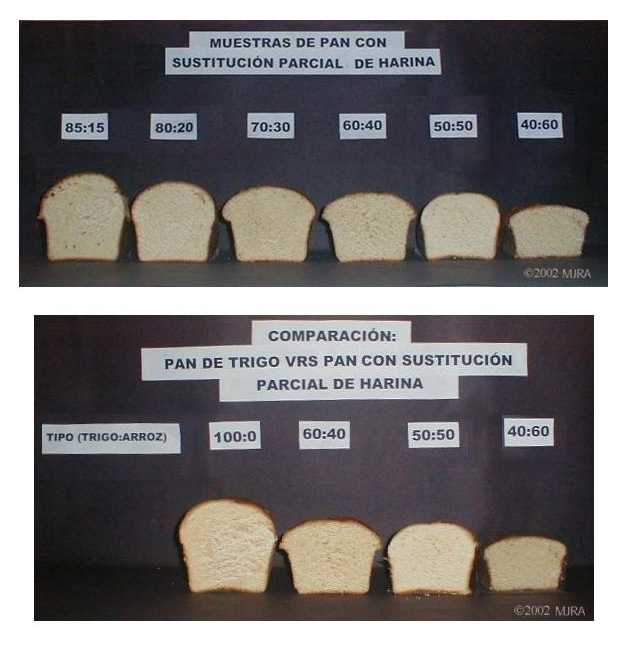
<body><![CDATA[<P ALIGN="JUSTIFY">&nbsp;&nbsp;&nbsp; Como se puede observar, la harina de trigo es superior a la harina de arroz en su contenido de prote&iacute;na, grasa y cenizas, mientras que la harina de arroz conten&iacute;a cantidades similares de carbohidratos y energ&iacute;a en base seca. Los valores son similares a los indicados en las Tablas de Composici&oacute;n de Alimentos (23). </P> <B>     <P ALIGN="JUSTIFY">An&aacute;lisis f&iacute;sico del pan</P> </B>    <P ALIGN="JUSTIFY">&nbsp;&nbsp;&nbsp; Se inici&oacute; el presente trabajo con un dise&ntilde;o experimental en el que la variable independiente para el desarrollo del producto final fue el nivel de sustituci&oacute;n de harina de trigo por harina de arroz en porcentajes de 0, 15, 20, 30, 40, 50 y 60% por peso.</P>     <P ALIGN="JUSTIFY">&nbsp;&nbsp;&nbsp; En la evaluaci&oacute;n de la preparaci&oacute;n del pan vale la pena indicar que hubo diferencias muy notables en el manejo de las masas, principalmente las de los panes hechos con mayor sustituci&oacute;n de harina de trigo (40, 50 y 60% de sustituci&oacute;n).</P>     <P ALIGN="JUSTIFY">&nbsp;&nbsp;&nbsp; Estas diferencias fueron b&aacute;sicamente: la textura de la masa, un tanto arenosa, as&iacute; como una notable absorci&oacute;n del agua de dichas formulaciones que dieron como resultado masas pegajosas y un poco dif&iacute;ciles de manejar. Esto se pudo evitar en buena medida al realizar la mezcla de ingredientes con un 90% de la mezcla de harinas y luego en la fase de amasado se agreg&oacute; el 10% restante en la mesa de trabajo y a las manos para evitar lo pegajoso. Con los panes hechos con sustituci&oacute;n de 15, 20 y 30% casi no hubo problemas de este tipo por la menor cantidad de harina de arroz a&ntilde;adida a la harina de trigo.</P>     <P ALIGN="JUSTIFY">&nbsp;&nbsp;&nbsp; En el an&aacute;lisis f&iacute;sico cada uno de los 18 panes resultantes (6 niveles x 3 repeticiones) fueron evaluados por su volumen, textura y apariencia en general y luego comparados contra un pan control de 100% de trigo (ver <b><a href="#fig1"> Figura 1</a></b> y Tabla 2).</P>     <P ALIGN="CENTER"><b><a href="#fig1">FIGURA 1</a></b></P>     <P ALIGN="CENTER"><b>Efectos de la sustituci&oacute;n de la harina de trigo por harina de arroz a diferentes porcentajes</b></P>     <P ALIGN="CENTER"><b><a name="fig1"><img border="0" src="/img/fbpe/alan/v54n3/art10fig1.JPG" align="center" width="570" height="585"></a></b></P>     
<P ALIGN="CENTER"><b>TABLA 2</b></P>     ]]></body>
<body><![CDATA[<P ALIGN="CENTER"><b>Dimensiones de los panes con diferentes porcentajes de sustituci&oacute;n de harina de trigo por harina de arroz</b></P>     <P ALIGN="justify">    <CENTER><TABLE BORDER CELLSPACING=1 CELLPADDING=4 WIDTH=472> <TR><TD WIDTH="19%" VALIGN="TOP" COLSPAN=2>     <P ALIGN="JUSTIFY"><FONT SIZE=2>% Sustituci&oacute;n</FONT></TD> <TD WIDTH="31%" VALIGN="TOP" COLSPAN=3> <FONT SIZE=2>    <P ALIGN="JUSTIFY">Altura (cm)</FONT></TD> <TD WIDTH="18%" VALIGN="TOP" COLSPAN=2> <FONT SIZE=2>    <P ALIGN="justify">Volumen (cm<SUP>3</SUP>)</FONT></TD> <TD WIDTH="14%" VALIGN="TOP" COLSPAN=2> <FONT SIZE=2>    <P ALIGN="justify">Volumen Espec&iacute;fico</FONT></TD> <TD WIDTH="18%" VALIGN="TOP"> <FONT SIZE=2>    <P ALIGN="justify">Peso</FONT></TD> </TR> <TR><TD WIDTH="11%" VALIGN="TOP"> <FONT SIZE=2>    <P ALIGN="JUSTIFY">Trigo</FONT></TD> <TD WIDTH="13%" VALIGN="TOP" COLSPAN=2> <FONT SIZE=2>    <P ALIGN="JUSTIFY">Arroz</FONT></TD> <TD WIDTH="18%" VALIGN="TOP">     ]]></body>
<body><![CDATA[<P ALIGN="justify">&nbsp;</TD> <TD WIDTH="18%" VALIGN="TOP" COLSPAN=2>     <P ALIGN="justify">&nbsp;</TD> <TD WIDTH="16%" VALIGN="TOP" COLSPAN=2> <FONT SIZE=2>    <P ALIGN="justify">(cm<SUP>3</SUP>/g)</FONT></TD> <TD WIDTH="25%" VALIGN="TOP" COLSPAN=2> <FONT SIZE=2>    <P ALIGN="justify">(g)</FONT></TD> </TR> <TR><TD WIDTH="11%" VALIGN="TOP"> <FONT SIZE=2>    <P ALIGN="JUSTIFY">100</FONT></TD> <TD WIDTH="13%" VALIGN="TOP" COLSPAN=2> <FONT SIZE=2>    <P ALIGN="JUSTIFY">0</FONT></TD> <TD WIDTH="18%" VALIGN="TOP"> <FONT SIZE=2>    <P ALIGN="justify">9.23 <U>+</U> 1.17</FONT></TD> <TD WIDTH="18%" VALIGN="TOP" COLSPAN=2> <FONT SIZE=2>    <P ALIGN="justify">1126.84 <U>+</U> 94.58</FONT></TD> <TD WIDTH="16%" VALIGN="TOP" COLSPAN=2> <FONT SIZE=2>    <P ALIGN="justify">2.46 <U>+</U> 0.19</FONT></TD> <TD WIDTH="25%" VALIGN="TOP" COLSPAN=2> <FONT SIZE=2>    <P ALIGN="justify">458.3 <U>+</U> 10.4</FONT></TD> </TR> <TR><TD WIDTH="11%" VALIGN="TOP"> <FONT SIZE=2>    ]]></body>
<body><![CDATA[<P ALIGN="JUSTIFY">85</FONT></TD> <TD WIDTH="13%" VALIGN="TOP" COLSPAN=2> <FONT SIZE=2>    <P ALIGN="JUSTIFY">15</FONT></TD> <TD WIDTH="18%" VALIGN="TOP"> <FONT SIZE=2>    <P ALIGN="justify">8.95 <U>+</U> 0.37</FONT></TD> <TD WIDTH="18%" VALIGN="TOP" COLSPAN=2> <FONT SIZE=2>    <P ALIGN="justify">1110.15 <U>+</U> 63.28</FONT></TD> <TD WIDTH="16%" VALIGN="TOP" COLSPAN=2> <FONT SIZE=2>    <P ALIGN="justify">2.43 <U>+</U> 0.16</FONT></TD> <TD WIDTH="25%" VALIGN="TOP" COLSPAN=2> <FONT SIZE=2>    <P ALIGN="justify">458.7 <U>+</U> 8.5</FONT></TD> </TR> <TR><TD WIDTH="11%" VALIGN="TOP"> <FONT SIZE=2>    <P ALIGN="JUSTIFY">80</FONT></TD> <TD WIDTH="13%" VALIGN="TOP" COLSPAN=2> <FONT SIZE=2>    <P ALIGN="JUSTIFY">20</FONT></TD> <TD WIDTH="18%" VALIGN="TOP"> <FONT SIZE=2>    <P ALIGN="justify">8.60 <U>+</U> 0.18</FONT></TD> <TD WIDTH="18%" VALIGN="TOP" COLSPAN=2> <FONT SIZE=2>    <P ALIGN="justify">1053.30 <U>+</U> 11.76</FONT></TD> <TD WIDTH="16%" VALIGN="TOP" COLSPAN=2> <FONT SIZE=2>    ]]></body>
<body><![CDATA[<P ALIGN="justify">2.33 <U>+</U> 0.02</FONT></TD> <TD WIDTH="25%" VALIGN="TOP" COLSPAN=2> <FONT SIZE=2>    <P ALIGN="justify">451.0 <U>+</U> 2.9</FONT></TD> </TR> <TR><TD WIDTH="11%" VALIGN="TOP"> <FONT SIZE=2>    <P ALIGN="JUSTIFY">70</FONT></TD> <TD WIDTH="13%" VALIGN="TOP" COLSPAN=2> <FONT SIZE=2>    <P ALIGN="JUSTIFY">30</FONT></TD> <TD WIDTH="18%" VALIGN="TOP"> <FONT SIZE=2>    <P ALIGN="justify">8.63 <U>+</U> 0.39</FONT></TD> <TD WIDTH="18%" VALIGN="TOP" COLSPAN=2> <FONT SIZE=2>    <P ALIGN="justify">1079.42 <U>+</U> 58.31</FONT></TD> <TD WIDTH="16%" VALIGN="TOP" COLSPAN=2> <FONT SIZE=2>    <P ALIGN="justify">2.33 <U>+</U> 0.10</FONT></TD> <TD WIDTH="25%" VALIGN="TOP" COLSPAN=2> <FONT SIZE=2>    <P ALIGN="justify">467.5 <U>+</U> 10.4</FONT></TD> </TR> <TR><TD WIDTH="11%" VALIGN="TOP"> <FONT SIZE=2>    <P ALIGN="JUSTIFY">60</FONT></TD> <TD WIDTH="13%" VALIGN="TOP" COLSPAN=2> <FONT SIZE=2>    <P ALIGN="JUSTIFY">40</FONT></TD> <TD WIDTH="18%" VALIGN="TOP"> <FONT SIZE=2>    ]]></body>
<body><![CDATA[<P ALIGN="justify">7.65 <U>+</U> 0.97</FONT></TD> <TD WIDTH="18%" VALIGN="TOP" COLSPAN=2> <FONT SIZE=2>    <P ALIGN="justify">916.39 <U>+</U> 139.65</FONT></TD> <TD WIDTH="16%" VALIGN="TOP" COLSPAN=2> <FONT SIZE=2>    <P ALIGN="justify">1.89 <U>+</U> 0.27</FONT></TD> <TD WIDTH="25%" VALIGN="TOP" COLSPAN=2> <FONT SIZE=2>    <P ALIGN="justify">461.2 <U>+</U> 13.8</FONT></TD> </TR> <TR><TD WIDTH="11%" VALIGN="TOP"> <FONT SIZE=2>    <P ALIGN="JUSTIFY">50</FONT></TD> <TD WIDTH="13%" VALIGN="TOP" COLSPAN=2> <FONT SIZE=2>    <P ALIGN="JUSTIFY">50</FONT></TD> <TD WIDTH="18%" VALIGN="TOP"> <FONT SIZE=2>    <P ALIGN="justify">7.45 <U>+</U> 0.13</FONT></TD> <TD WIDTH="18%" VALIGN="TOP" COLSPAN=2> <FONT SIZE=2>    <P ALIGN="justify">914.10 <U>+</U> 19.10</FONT></TD> <TD WIDTH="16%" VALIGN="TOP" COLSPAN=2> <FONT SIZE=2>    <P ALIGN="justify">2.01 <U>+</U> 0.04</FONT></TD> <TD WIDTH="25%" VALIGN="TOP" COLSPAN=2> <FONT SIZE=2>    <P ALIGN="justify">455.0 <U>+</U> 4.1</FONT></TD> </TR> <TR><TD WIDTH="11%" VALIGN="TOP"> <FONT SIZE=2>    ]]></body>
<body><![CDATA[<P ALIGN="JUSTIFY">40</FONT></TD> <TD WIDTH="13%" VALIGN="TOP" COLSPAN=2> <FONT SIZE=2>    <P ALIGN="JUSTIFY">60</FONT></TD> <TD WIDTH="18%" VALIGN="TOP"> <FONT SIZE=2>    <P ALIGN="justify">5.93 <U>+</U> 0.67</FONT></TD> <TD WIDTH="18%" VALIGN="TOP" COLSPAN=2> <FONT SIZE=2>    <P ALIGN="justify">702.30 <U>+</U> 89.54</FONT></TD> <TD WIDTH="16%" VALIGN="TOP" COLSPAN=2> <FONT SIZE=2>    <P ALIGN="justify">1.58 <U>+</U> 0.20</FONT></TD> <TD WIDTH="25%" VALIGN="TOP" COLSPAN=2> <FONT SIZE=2>    <P ALIGN="justify">445.0 <U>+</U> 5.0</FONT></TD> </TR> </TABLE> </CENTER>      <P ALIGN="JUSTIFY">&nbsp;&nbsp;&nbsp; La evaluaci&oacute;n visual de los panes con sustituci&oacute;n de m&aacute;s de 50% de harina detect&oacute; un menor tama&ntilde;o de poros y hogazas m&aacute;s compactas. El pan con 60% de sustituci&oacute;n produjo hogazas con casi el mismo tama&ntilde;o que la masa original que se coloc&oacute; en el molde, lo que indica que no se produjo una retenci&oacute;n de gas durante la maduraci&oacute;n. Por lo que se puede afirmar que a mayor porcentaje de sustituci&oacute;n de harina se obtiene un menor tama&ntilde;o de hogaza de pan.</P>     <P ALIGN="JUSTIFY">&nbsp;&nbsp;&nbsp; Con respecto a la evaluaci&oacute;n de las caracter&iacute;sticas f&iacute;sicas del pan, las medidas de ancho y largo de los diferentes tratamientos de sustituci&oacute;n permanecieron m&aacute;s o menos constantes, se presentan en la <b><a href="#fig2a"> figura 2a</a> y <a href="#Fig2b">2b</a>.</b> </P>     <P ALIGN="CENTER"><b><a href="#fig2a">FIGURA 2a</a></b></P>     <P ALIGN="CENTER"><b>Comparaci&oacute;n de promedios de las mediciones de alto, ancho y largo de las formulaciones</b></P>     ]]></body>
<body><![CDATA[<P ALIGN="CENTER"><a name="fig2a"><img border="0" src="/img/fbpe/alan/v54n3/art10fig2a.jpg" align="center" width="557" height="373"></a></P>     
<P ALIGN="center"><b><a href="#Fig2b">FIGURA 2b</a></b></P>     <P ALIGN="center"><b>Comparación entre las mediciones de volumen y peso de las formulaciones</b></P>     <P ALIGN="center"><a name="fig2b"><img border="0" src="/img/fbpe/alan/v54n3/art10fig2b.jpg" align="center" width="565" height="389"></a></P> <FONT COLOR="#800080"> </FONT>    
<P ALIGN="JUSTIFY">&nbsp;&nbsp;&nbsp; Por otra parte las medidas de altura, volumen y peso que se resumen en la Tabla 2 presentaron mayor diferencia entre si, not&aacute;ndose un decremento en magnitud de las mismas al aumentar el porcentaje de sustituci&oacute;n de harina de trigo por harina de arroz.</P>     <P ALIGN="JUSTIFY">&nbsp;&nbsp;&nbsp; Los anteriores resultados fueron analizados estad&iacute;sticamente con la prueba de an&aacute;lisis de varianza para determinar si hab&iacute;a diferencia significativa entre las muestras como se muestra a continuaci&oacute;n. </P>     <P ALIGN="CENTER"><b>TABLA 3</b></P>     <P ALIGN="CENTER"><b>An&aacute;lisis de varianza (<FONT FACE=Symbol>a</FONT> <FONT FACE=Symbol>£</FONT> 0.05) entre los panes con diferentes porcentajes de sustituci&oacute;n de harina respecto al control (100% trigo)</b></P>     <CENTER><TABLE BORDER CELLSPACING=1 CELLPADDING=4 WIDTH=432> <TR><TD WIDTH="19%" VALIGN="TOP">     <P ALIGN="JUSTIFY"><FONT SIZE=2>Dimensi&oacute;n</FONT></TD> <TD WIDTH="24%" VALIGN="TOP"> <FONT SIZE=2>    ]]></body>
<body><![CDATA[<P ALIGN="JUSTIFY">F experimental</FONT></TD> <TD WIDTH="16%" VALIGN="TOP"> <FONT SIZE=2>    <P ALIGN="JUSTIFY">F cr&iacute;tica</FONT></TD> <TD WIDTH="42%" VALIGN="TOP"> <FONT SIZE=2>    <P ALIGN="JUSTIFY">Resultado</FONT></TD> </TR> <TR><TD WIDTH="19%" VALIGN="TOP"> <FONT SIZE=2>    <P ALIGN="JUSTIFY">Altura</FONT></TD> <TD WIDTH="24%" VALIGN="TOP"> <FONT SIZE=2>    <P ALIGN="justify">10.06&#9;&gt;</FONT></TD> <TD WIDTH="16%" VALIGN="TOP"> <FONT SIZE=2>    <P ALIGN="justify">2.85</FONT></TD> <TD WIDTH="42%" VALIGN="TOP"> <FONT SIZE=2>    <P ALIGN="JUSTIFY">Si hay diferencia significativa</FONT></TD> </TR> <TR><TD WIDTH="19%" VALIGN="TOP"> <FONT SIZE=2>    <P ALIGN="JUSTIFY">Volumen</FONT></TD> <TD WIDTH="24%" VALIGN="TOP"> <FONT SIZE=2>    <P ALIGN="justify">12.98&#9;&gt;</FONT></TD> <TD WIDTH="16%" VALIGN="TOP"> <FONT SIZE=2>    <P ALIGN="justify">2.85</FONT></TD> <TD WIDTH="42%" VALIGN="TOP"> <FONT SIZE=2>    ]]></body>
<body><![CDATA[<P ALIGN="JUSTIFY">Si hay diferencia significativa</FONT></TD> </TR> <TR><TD WIDTH="19%" VALIGN="TOP"> <FONT SIZE=2>    <P ALIGN="JUSTIFY">Peso</FONT></TD> <TD WIDTH="24%" VALIGN="TOP"> <FONT SIZE=2>    <P ALIGN="justify">4.14&#9;&gt;</FONT></TD> <TD WIDTH="16%" VALIGN="TOP"> <FONT SIZE=2>    <P ALIGN="justify">2.85</FONT></TD> <TD WIDTH="42%" VALIGN="TOP"> <FONT SIZE=2>    <P ALIGN="JUSTIFY">Si hay diferencia significativa</FONT></TD> </TR> </TABLE> </CENTER>      <P ALIGN="JUSTIFY">&nbsp;&nbsp;&nbsp; En la Tabla 3 se puede observar que s&iacute; hubo diferencias significativas en todas las caracter&iacute;sticas entre los panes con harina de arroz y el pan control. Por consiguiente el pan control es significativamente diferente a los panes con sustituci&oacute;n de harina de trigo con harina de arroz.</P>     <P ALIGN="JUSTIFY">&nbsp;&nbsp;&nbsp; Esta diferencia significativa fue debida a que durante la fabricaci&oacute;n de las masas, la sustituci&oacute;n de harina de trigo por harina de arroz redujo la cohesividad y la propiedad de retener el di&oacute;xido de carbono producido durante la fermentaci&oacute;n dando como resultados panes m&aacute;s compactos.</P>     <P ALIGN="CENTER"><b>TABLA 4</b></P>     <P ALIGN="CENTER"><b>An&aacute;lisis de varianza (<FONT FACE=Symbol>a</FONT> <FONT FACE=Symbol>£</FONT> 0.05) entre los panes con diferentes porcentajes de sustituci&oacute;n de harina</b></P>     <CENTER><TABLE BORDER CELLSPACING=1 CELLPADDING=4 WIDTH=432> <TR><TD WIDTH="19%" VALIGN="TOP">     ]]></body>
<body><![CDATA[<P ALIGN="JUSTIFY"><FONT SIZE=2>Dimensi&oacute;n</FONT></TD> <TD WIDTH="24%" VALIGN="TOP"> <FONT SIZE=2>    <P ALIGN="JUSTIFY">F experimental</FONT></TD> <TD WIDTH="16%" VALIGN="TOP"> <FONT SIZE=2>    <P ALIGN="JUSTIFY">F cr&iacute;tica</FONT></TD> <TD WIDTH="42%" VALIGN="TOP"> <FONT SIZE=2>    <P ALIGN="JUSTIFY">Resultado</FONT></TD> </TR> <TR><TD WIDTH="19%" VALIGN="TOP"> <FONT SIZE=2>    <P ALIGN="JUSTIFY">Altura</FONT></TD> <TD WIDTH="24%" VALIGN="TOP"> <FONT SIZE=2>    <P ALIGN="justify">15.77&#9;&gt;</FONT></TD> <TD WIDTH="16%" VALIGN="TOP"> <FONT SIZE=2>    <P ALIGN="justify">3.11</FONT></TD> <TD WIDTH="42%" VALIGN="TOP"> <FONT SIZE=2>    <P ALIGN="JUSTIFY">Si hay diferencia significativa</FONT></TD> </TR> <TR><TD WIDTH="19%" VALIGN="TOP"> <FONT SIZE=2>    <P ALIGN="JUSTIFY">Volumen</FONT></TD> <TD WIDTH="24%" VALIGN="TOP"> <FONT SIZE=2>    <P ALIGN="justify">14.74&#9;&gt;</FONT></TD> <TD WIDTH="16%" VALIGN="TOP"> <FONT SIZE=2>    ]]></body>
<body><![CDATA[<P ALIGN="justify">3.11</FONT></TD> <TD WIDTH="42%" VALIGN="TOP"> <FONT SIZE=2>    <P ALIGN="JUSTIFY">Si hay diferencia significativa</FONT></TD> </TR> <TR><TD WIDTH="19%" VALIGN="TOP"> <FONT SIZE=2>    <P ALIGN="JUSTIFY">Peso</FONT></TD> <TD WIDTH="24%" VALIGN="TOP"> <FONT SIZE=2>    <P ALIGN="justify">5.66&#9;&gt;</FONT></TD> <TD WIDTH="16%" VALIGN="TOP"> <FONT SIZE=2>    <P ALIGN="justify">3.11</FONT></TD> <TD WIDTH="42%" VALIGN="TOP"> <FONT SIZE=2>    <P ALIGN="JUSTIFY">Si hay diferencia significativa</FONT></TD> </TR> </TABLE> </CENTER>     <P ALIGN="JUSTIFY">&nbsp;&nbsp;&nbsp; El an&aacute;lisis de varianza de las mediciones f&iacute;sicas entre los panes con sustituci&oacute;n parcial de arroz que se presenta en la tabla 4, demostr&oacute; que si existe una diferencia significativa en cuanto a las tres variables medidas entre los panes con sustituci&oacute;n de harina de trigo con harina de arroz.</P>     <P ALIGN="JUSTIFY">&nbsp;&nbsp;&nbsp; De estos resultados se hizo necesario realizar un an&aacute;lisis de varianza por factor para cada pan a manera de compararlos entre si, encontr&aacute;ndose lo siguiente:</P><DIR>      <P ALIGN="JUSTIFY">a.&#9;Las formulaciones con 15, 20, 30 y 40% de sustituci&oacute;n de harina de trigo por harina de arroz presentan diferencia significativa sobre el resto de muestras pero no entre si.</P>     <P ALIGN="JUSTIFY">b.&#9;La formulaci&oacute;n con 50% de sustituci&oacute;n no difiere significativamente de la formulaci&oacute;n con 60% de sustituci&oacute;n, pero si del resto de las muestras en cuanto a sus dimensiones de altura y volumen.</P>     ]]></body>
<body><![CDATA[<P ALIGN="JUSTIFY">c.&#9;La formulaci&oacute;n con 60% de sustituci&oacute;n difiere significativamente de todas las muestras.</P></DIR>      <P ALIGN="JUSTIFY">&nbsp;&nbsp;&nbsp; A partir de &eacute;stos resultados y de la evaluaci&oacute;n visual de las muestras se descartaron las formulaciones con 60 y 50%. Tambi&eacute;n fueron descartadas las formulaciones con 15 y 20% de sustituci&oacute;n puesto que para los fines del trabajo se consider&oacute; que no era una sustituci&oacute;n significativa.</P> <B>    <P ALIGN="JUSTIFY">Evaluaci&oacute;n sensorial</P> </B>    <P ALIGN="JUSTIFY">&nbsp;&nbsp;&nbsp; Con las dos formulaciones restantes (30% y 40% de sustituci&oacute;n), se procedi&oacute; a realizar una evaluaci&oacute;n sensorial para detectar la preferencia de los panelistas entre las dos muestras. El total de preferencias obtenidas que fue 22 de 30 se analiz&oacute; por tablas de distribuci&oacute;n binomial del m&iacute;nimo de juicios para establecer preferencias significativas. </P>     <P ALIGN="JUSTIFY">&nbsp;&nbsp;&nbsp; Se determin&oacute; que existe una preferencia con un nivel de 5% de significancia entre los resultados obtenidos para la formulaci&oacute;n con 30% de sustituci&oacute;n de harina de trigo con harina de arroz. En otras palabras, el panel se&ntilde;al&oacute; como producto preferido el elaborado con un 30% de sustituci&oacute;n de harina, con un nivel de significancia del 5%. Estos resultados nos permiten afirmar con certeza que la muestra con 30% de sustituci&oacute;n es la preferida, y que solamente 5 de cada 100 preferencias por dicha formulaci&oacute;n podr&iacute;a deberse al azar.</P>     <P ALIGN="JUSTIFY">&nbsp;&nbsp;&nbsp; La aceptabilidad de la formulaci&oacute;n preferida se determin&oacute; por el mismo panel sensorial de personas de la tercera edad por medio de una escala hed&oacute;nica de 5 puntos. Los resultados de la evaluaci&oacute;n se presentan en la <b><a href="#tab5"> Tabla 5</a>.</b> </P>     <P ALIGN="CENTER"><b><a href="#tab5">TABLA 5</a></b></P>     <P ALIGN="CENTER"><b>Prueba hed&oacute;nica de 5 puntos para la muestra con 30% de harina de arroz</b></P>     <P ALIGN="justify">    <CENTER><a name="tab5"><img border="0" src="/img/fbpe/alan/v54n3/art10tab5.jpg" align="center" width="565" height="154"></a> </CENTER>      
]]></body>
<body><![CDATA[<P ALIGN="JUSTIFY">&nbsp;&nbsp;&nbsp; Los resultados de la evaluaci&oacute;n sensorial indican que la muestra de pan con sustituci&oacute;n parcial de harina de trigo con un 30% de harina de arroz fue calificada en cuanto a su sabor, textura, color y apariencia general como "Me gusta" por la poblaci&oacute;n de la tercera edad. El an&aacute;lisis estad&iacute;stico de la evaluaci&oacute;n sensorial nos confirma con un 95% de confianza que las caracter&iacute;sticas calificadas si tienen el valor encontrado con un error menor a 0.25. Esto nos indica que el valor encontrado es ese <U>+</U> 0.25.</P>     <P ALIGN="JUSTIFY">&nbsp;&nbsp;&nbsp; En algunas observaciones anotadas por los encuestadores se encontr&oacute; un comentario en com&uacute;n, el cual era que el pan era f&aacute;cil de ensalivar al masticar, comentario positivo puesto que consideran que el pan s&aacute;ndwich que actualmente est&aacute; en el mercado se apelmaza en el paladar durante la masticaci&oacute;n, lo cual dificulta tragarlo.</P> <B>    <P ALIGN="JUSTIFY">An&aacute;lisis qu&iacute;micos</P> </B>    <P ALIGN="JUSTIFY">&nbsp;&nbsp;&nbsp; La muestra de harina de arroz analizada present&oacute; un contenido de amilosa de 7.55%, lo que indica que el arroz utilizado para la realizaci&oacute;n de este trabajo de investigaci&oacute;n es de bajo contenido de amilosa, caracter&iacute;stica que hace a la harina de arroz utilizada, ideal para la producci&oacute;n de pan con una buena textura de miga. Esta afirmaci&oacute;n se basa en que el contenido de amilosa es un factor que afecta la textura de los panes leudados, es decir, solo el arroz con bajo contenido de amilosa y baja temperatura de gelatinizaci&oacute;n resulta en panes suaves sin importar el tama&ntilde;o del grano. Si alguno de los dos factores es alto la textura del pan se vuelve arenosa.</P>     <P ALIGN="JUSTIFY">&nbsp;&nbsp;&nbsp; Los resultados de an&aacute;lisis proximal del pan de trigo vrs. el pan con 30% de arroz se presentan en la Tabla 6. </P>     <P ALIGN="CENTER"><b>TABLA 6</b></P>     <P ALIGN="CENTER"><b>Composici&oacute;n qu&iacute;mica proximal entre el pan de 100% de trigo y el pan trigo : arroz (70:30)</b></P>     <CENTER><TABLE BORDER CELLSPACING=1 CELLPADDING=4 WIDTH=452> <TR><TD WIDTH="50%" VALIGN="TOP">     <P ALIGN="justify">&nbsp;</TD> <TD WIDTH="21%" VALIGN="TOP"> <FONT SIZE=2>    <P ALIGN="justify">Trigo (100%)</FONT></TD> <TD WIDTH="29%" VALIGN="TOP"> <FONT SIZE=2>    ]]></body>
<body><![CDATA[<P ALIGN="justify">Trigo: Arroz (70:30)</FONT></TD> </TR> <TR><TD WIDTH="50%" VALIGN="TOP"> <FONT SIZE=2>    <P ALIGN="JUSTIFY">Humedad, g/100g</FONT></TD> <TD WIDTH="21%" VALIGN="TOP"> <FONT SIZE=2>    <P ALIGN="justify">32.44 <U>+</U> 0.17</FONT></TD> <TD WIDTH="29%" VALIGN="TOP"> <FONT SIZE=2>    <P ALIGN="justify">31.03 <U>+</U> 0.32</FONT></TD> </TR> <TR><TD WIDTH="50%" VALIGN="TOP"> <FONT SIZE=2>    <P ALIGN="JUSTIFY">Prote&iacute;na, g/100g</FONT></TD> <TD WIDTH="21%" VALIGN="TOP"> <FONT SIZE=2>    <P ALIGN="justify">13.22 <U>+</U> 0.17</FONT></TD> <TD WIDTH="29%" VALIGN="TOP"> <FONT SIZE=2>    <P ALIGN="justify">11.36 <U>+</U> 0.36</FONT></TD> </TR> <TR><TD WIDTH="50%" VALIGN="TOP"> <FONT SIZE=2>    <P ALIGN="JUSTIFY">Grasa, g/100g</FONT></TD> <TD WIDTH="21%" VALIGN="TOP"> <FONT SIZE=2>    <P ALIGN="justify">3.85 <U>+</U> 0.17</FONT></TD> <TD WIDTH="29%" VALIGN="TOP"> <FONT SIZE=2>    <P ALIGN="justify">4.48 <U>+</U> 0.11</FONT></TD> </TR> <TR><TD WIDTH="50%" VALIGN="TOP"> <FONT SIZE=2>    ]]></body>
<body><![CDATA[<P ALIGN="JUSTIFY">Cenizas, g/100g</FONT></TD> <TD WIDTH="21%" VALIGN="TOP"> <FONT SIZE=2>    <P ALIGN="justify">1.09 <U>+</U> 0.17</FONT></TD> <TD WIDTH="29%" VALIGN="TOP"> <FONT SIZE=2>    <P ALIGN="justify">1.98 <U>+</U> 0.03</FONT></TD> </TR> <TR><TD WIDTH="50%" VALIGN="TOP"> <FONT SIZE=2>    <P ALIGN="JUSTIFY">Carbohidratos, %</FONT></TD> <TD WIDTH="21%" VALIGN="TOP"> <FONT SIZE=2>    <P ALIGN="justify">49.40 <U>+</U> 0.17</FONT></TD> <TD WIDTH="29%" VALIGN="TOP"> <FONT SIZE=2>    <P ALIGN="justify">51.65 <U>+</U> 0.39</FONT></TD> </TR> <TR><TD WIDTH="50%" VALIGN="TOP"> <FONT SIZE=2>    <P ALIGN="JUSTIFY">Fibra Diet&eacute;tica Total, %</FONT></TD> <TD WIDTH="21%" VALIGN="TOP"> <FONT SIZE=2>    <P ALIGN="justify">3.28</FONT></TD> <TD WIDTH="29%" VALIGN="TOP"> <FONT SIZE=2>    <P ALIGN="justify">2.89</FONT></TD> </TR> <TR><TD WIDTH="50%" VALIGN="TOP"> <FONT SIZE=2>    <P ALIGN="JUSTIFY">Lisina Disponible mg/g</FONT></TD> <TD WIDTH="21%" VALIGN="TOP"> <FONT SIZE=2>    ]]></body>
<body><![CDATA[<P ALIGN="justify">23.32</FONT></TD> <TD WIDTH="29%" VALIGN="TOP"> <FONT SIZE=2>    <P ALIGN="justify">35.10</FONT></TD> </TR> <TR><TD WIDTH="50%" VALIGN="TOP"> <FONT SIZE=2>    <P ALIGN="JUSTIFY">Sodio mg/100 g</FONT></TD> <TD WIDTH="21%" VALIGN="TOP"> <FONT SIZE=2>    <P ALIGN="justify">184</FONT></TD> <TD WIDTH="29%" VALIGN="TOP"> <FONT SIZE=2>    <P ALIGN="justify">173</FONT></TD> </TR> <TR><TD WIDTH="50%" VALIGN="TOP"> <FONT SIZE=2>    <P ALIGN="JUSTIFY">Prote&iacute;na Digerible (%)</FONT></TD> <TD WIDTH="21%" VALIGN="TOP"> <FONT SIZE=2>    <P ALIGN="justify">5.29 ± 0.001</FONT></TD> <TD WIDTH="29%" VALIGN="TOP"> <FONT SIZE=2>    <P ALIGN="justify">5.84 ± 0.004</FONT></TD> </TR> </TABLE> </CENTER>      <P ALIGN="JUSTIFY">&nbsp;&nbsp;&nbsp; En el an&aacute;lisis de prote&iacute;nas se obtuvo un resultado de 11.36% de prote&iacute;na en el pan desarrollado. Dado que cada porci&oacute;n de pan tiene un peso de 80 g (2 rebanadas), cada porci&oacute;n aporta 9.09 g de prote&iacute;na. Esto a su vez nos da un contenido de 27.27 g de prote&iacute;na al ingerir 3 porciones diarias que es el consumo m&aacute;ximo de pan recomendado para personas de tercera edad. Esta cantidad de prote&iacute;nas obtenidas en el pan aporta 43.25% y 54.54% de la ingesta diaria recomendada de prote&iacute;nas para un adulto mayor de sexo masculino y femenino respectivamente.</P>     <P ALIGN="JUSTIFY">&nbsp;&nbsp;&nbsp; Es de inter&eacute;s discutir el efecto complementario nutricional del arroz como fuente de prote&iacute;na a las prote&iacute;nas en la harina de trigo. Esto se detalla en la Tabla 7, en donde se ve que conforme aumenta el nivel de arroz en la formula aumenta la calidad de la prote&iacute;na de 1.33 a 1.61, aunque la diferencia no es estad&iacute;sticamente significativa. A pesar que se ha indicado que el contenido de prote&iacute;nas del arroz es limitado, su calidad es mejor a la de otros cereales. En comparaci&oacute;n con la harina de trigo, el contenido de amino&aacute;cidos del arroz (especialmente lisina) es m&aacute;s alto que los amino&aacute;cidos del trigo, lo cual hace que las prote&iacute;nas del arroz sean biol&oacute;gicamente mejores que las del trigo.</P>     ]]></body>
<body><![CDATA[<P ALIGN="CENTER"><b>TABLA 7</b></P>     <P ALIGN="CENTER"><b>Calidad prote&iacute;nica de panes elaborados con diferentes proporciones de harina de trigo y de harina de arroz</b></P>       <CENTER><TABLE BORDER CELLSPACING=1 CELLPADDING=4 WIDTH=394> <TR><TD WIDTH="18%" VALIGN="TOP" COLSPAN=2>     <P ALIGN="justify"><FONT SIZE=2>Dieta</FONT></TD> <TD WIDTH="33%" VALIGN="TOP" COLSPAN=3> <FONT SIZE=2>    <P ALIGN="justify">Aumento en peso</FONT></TD> <TD WIDTH="24%" VALIGN="TOP"> <FONT SIZE=2>    <P ALIGN="justify">Alimento</P>     <P ALIGN="justify">ingerido</FONT></TD> <TD WIDTH="26%" VALIGN="TOP" COLSPAN=2> <FONT SIZE=2>    <P ALIGN="justify">NPR</FONT></TD> </TR> <TR><TD WIDTH="15%" VALIGN="TOP"> <FONT SIZE=2>    <P ALIGN="JUSTIFY">Trigo</FONT></TD> <TD WIDTH="11%" VALIGN="TOP" COLSPAN=2> <FONT SIZE=2>    <P ALIGN="justify">Arroz</FONT></TD> <TD WIDTH="22%" VALIGN="TOP"> <FONT SIZE=2>    ]]></body>
<body><![CDATA[<P ALIGN="justify">promedio, g</FONT></TD> <TD WIDTH="28%" VALIGN="TOP" COLSPAN=3> <FONT SIZE=2>    <P ALIGN="justify">promedio, g</FONT></TD> <TD WIDTH="24%" VALIGN="TOP">     <P ALIGN="justify">&nbsp;</TD> </TR> <TR><TD WIDTH="15%" VALIGN="TOP"> <FONT SIZE=2>    <P ALIGN="JUSTIFY">100</FONT></TD> <TD WIDTH="11%" VALIGN="TOP" COLSPAN=2> <FONT SIZE=2>    <P ALIGN="justify">0</FONT></TD> <TD WIDTH="22%" VALIGN="TOP"> <FONT SIZE=2>    <P ALIGN="justify">9 c</FONT></TD> <TD WIDTH="28%" VALIGN="TOP" COLSPAN=3> <FONT SIZE=2>    <P ALIGN="justify">120</FONT></TD> <TD WIDTH="24%" VALIGN="TOP"> <FONT SIZE=2>    <P ALIGN="justify">1.33 <U>+</U> 0.20 b</FONT></TD> </TR> <TR><TD WIDTH="15%" VALIGN="TOP"> <FONT SIZE=2>    <P ALIGN="JUSTIFY">85</FONT></TD> <TD WIDTH="11%" VALIGN="TOP" COLSPAN=2> <FONT SIZE=2>    <P ALIGN="justify">15</FONT></TD> <TD WIDTH="22%" VALIGN="TOP"> <FONT SIZE=2>    ]]></body>
<body><![CDATA[<P ALIGN="justify">13 bc</FONT></TD> <TD WIDTH="28%" VALIGN="TOP" COLSPAN=3> <FONT SIZE=2>    <P ALIGN="justify">141</FONT></TD> <TD WIDTH="24%" VALIGN="TOP"> <FONT SIZE=2>    <P ALIGN="justify">1.38 <U>+</U> 0.34 b</FONT></TD> </TR> <TR><TD WIDTH="15%" VALIGN="TOP"> <FONT SIZE=2>    <P ALIGN="justify">80</FONT></TD> <TD WIDTH="11%" VALIGN="TOP" COLSPAN=2> <FONT SIZE=2>    <P ALIGN="justify">20</FONT></TD> <TD WIDTH="22%" VALIGN="TOP"> <FONT SIZE=2>    <P ALIGN="justify">11 bc</FONT></TD> <TD WIDTH="28%" VALIGN="TOP" COLSPAN=3> <FONT SIZE=2>    <P ALIGN="justify">125</FONT></TD> <TD WIDTH="24%" VALIGN="TOP"> <FONT SIZE=2>    <P ALIGN="justify">1.55 <U>+</U> 0.36 b</FONT></TD> </TR> <TR><TD WIDTH="15%" VALIGN="TOP"> <FONT SIZE=2>    <P ALIGN="JUSTIFY">70</FONT></TD> <TD WIDTH="11%" VALIGN="TOP" COLSPAN=2> <FONT SIZE=2>    <P ALIGN="justify">30</FONT></TD> <TD WIDTH="22%" VALIGN="TOP"> <FONT SIZE=2>    ]]></body>
<body><![CDATA[<P ALIGN="justify">16 bc</FONT></TD> <TD WIDTH="28%" VALIGN="TOP" COLSPAN=3> <FONT SIZE=2>    <P ALIGN="justify">141</FONT></TD> <TD WIDTH="24%" VALIGN="TOP"> <FONT SIZE=2>    <P ALIGN="justify">1.61 <U>+</U> 0.38 b</FONT></TD> </TR> <TR><TD WIDTH="15%" VALIGN="TOP"> <FONT SIZE=2>    <P ALIGN="JUSTIFY">60</FONT></TD> <TD WIDTH="11%" VALIGN="TOP" COLSPAN=2> <FONT SIZE=2>    <P ALIGN="justify">40</FONT></TD> <TD WIDTH="22%" VALIGN="TOP"> <FONT SIZE=2>    <P ALIGN="justify">16 bc</FONT></TD> <TD WIDTH="28%" VALIGN="TOP" COLSPAN=3> <FONT SIZE=2>    <P ALIGN="justify">141</FONT></TD> <TD WIDTH="24%" VALIGN="TOP"> <FONT SIZE=2>    <P ALIGN="justify">1.65 <U>+</U> 0.24 b</FONT></TD> </TR> <TR><TD WIDTH="15%" VALIGN="TOP"> <FONT SIZE=2>    <P ALIGN="JUSTIFY">50</FONT></TD> <TD WIDTH="11%" VALIGN="TOP" COLSPAN=2> <FONT SIZE=2>    <P ALIGN="justify">50</FONT></TD> <TD WIDTH="22%" VALIGN="TOP"> <FONT SIZE=2>    ]]></body>
<body><![CDATA[<P ALIGN="justify">15 bc</FONT></TD> <TD WIDTH="28%" VALIGN="TOP" COLSPAN=3> <FONT SIZE=2>    <P ALIGN="justify">124</FONT></TD> <TD WIDTH="24%" VALIGN="TOP"> <FONT SIZE=2>    <P ALIGN="justify">1.72 <U>+</U> 0.48 b</FONT></TD> </TR> <TR><TD WIDTH="15%" VALIGN="TOP"> <FONT SIZE=2>    <P ALIGN="JUSTIFY">40</FONT></TD> <TD WIDTH="11%" VALIGN="TOP" COLSPAN=2> <FONT SIZE=2>    <P ALIGN="justify">60</FONT></TD> <TD WIDTH="22%" VALIGN="TOP"> <FONT SIZE=2>    <P ALIGN="justify">23 b</FONT></TD> <TD WIDTH="28%" VALIGN="TOP" COLSPAN=3> <FONT SIZE=2>    <P ALIGN="justify">143</FONT></TD> <TD WIDTH="24%" VALIGN="TOP"> <FONT SIZE=2>    <P ALIGN="justify">1.97 <U>+</U> 0.40 b</FONT></TD> </TR> <TR><TD WIDTH="15%" VALIGN="TOP"> <FONT SIZE=2>    <P ALIGN="JUSTIFY">Caseina</FONT></TD> <TD WIDTH="11%" VALIGN="TOP" COLSPAN=2>     <P ALIGN="justify">&nbsp;</TD> <TD WIDTH="22%" VALIGN="TOP"> <FONT SIZE=2>    ]]></body>
<body><![CDATA[<P ALIGN="justify">97 b</FONT></TD> <TD WIDTH="28%" VALIGN="TOP" COLSPAN=3> <FONT SIZE=2>    <P ALIGN="justify">277</FONT></TD> <TD WIDTH="24%" VALIGN="TOP"> <FONT SIZE=2>    <P ALIGN="justify">3.59 <U>+</U> 0.31 a</FONT></TD> </TR> <TR><TD WIDTH="15%" VALIGN="TOP">     <P ALIGN="justify">&nbsp;</TD> <TD WIDTH="11%" VALIGN="TOP" COLSPAN=2>     <P ALIGN="justify">&nbsp;</TD> <TD WIDTH="22%" VALIGN="TOP">     <P ALIGN="justify">&nbsp;</TD> <TD WIDTH="28%" VALIGN="TOP" COLSPAN=3>     <P ALIGN="justify">&nbsp;</TD> <TD WIDTH="24%" VALIGN="TOP">     <P ALIGN="justify">&nbsp;</TD> </TR> </TABLE> </CENTER>      <P ALIGN="JUSTIFY">&nbsp;&nbsp;&nbsp; Esto &uacute;ltimo se pudo comprobar no solo por la respuesta biol&oacute;gica sino con un an&aacute;lisis de la lisina disponible en el producto con sustituci&oacute;n de harina de trigo con harina de arroz comparado con un pan control. Los resultados de la Tabla 6 confirman que el pan con 30% de sustituci&oacute;n de la harina de trigo con harina de arroz tiene m&aacute;s lisina disponible por gramo de prote&iacute;na (3.09 mg lisina/g prote&iacute;na), que el pan elaborado solamente con harina de trigo (1.84 mg lisina/g prote&iacute;na).</P>     <P ALIGN="JUSTIFY">&nbsp;&nbsp;&nbsp; De estos resultados podemos afirmar que una porci&oacute;n de nuestro producto aporta 28.08 mg lisina en comparaci&oacute;n de 19.46 mg de lisina que aporta una porci&oacute;n del pan control. Estos resultados demuestran que el arroz es una fuente aceptable de lisina para los productos de panificaci&oacute;n ejerciendo un efecto complementario.</P>     ]]></body>
<body><![CDATA[<P ALIGN="JUSTIFY">&nbsp;&nbsp;&nbsp; Se determin&oacute; la calidad de la prote&iacute;na del producto desarrollado, no solo por su composici&oacute;n en el amino&aacute;cido lisina y la respuesta biol&oacute;gica, sino que tambi&eacute;n por su digestibilidad. Se determin&oacute; que el porcentaje de prote&iacute;na que puede ser absorbido en forma de amino&aacute;cidos del pan con sustituci&oacute;n parcial de harina de trigo con harina de arroz (5.84%) es mayor que el del pan control (5.29%). El an&aacute;lisis de &eacute;stos hallazgos confirma que las prote&iacute;nas del producto desarrollado son de mejor calidad que las del pan control as&iacute; como la ventaja nutricional que tiene la sustituci&oacute;n parcial de la harina de trigo con harina de arroz en productos de panificaci&oacute;n.</P>     <P ALIGN="JUSTIFY">&nbsp;&nbsp;&nbsp; Como se indica en la Tabla 8, referente al an&aacute;lisis nutricional del pan 70:30 trigo arroz, su consumo aportar&iacute;a cantidades atractivas de los diferentes nutrientes que fueron analizados.</P>     <P ALIGN="CENTER"><b>TABLA 8</b></P>     <P ALIGN="CENTER"><b>An&aacute;lisis nutricional del pan con 30% de sustituci&oacute;n con harina de arroz</b></P>     <CENTER><TABLE BORDER CELLSPACING=1 CELLPADDING=4 WIDTH=326> <TR><TD WIDTH="47%" VALIGN="TOP" COLSPAN=2>     <P ALIGN="JUSTIFY"><FONT SIZE=2>Tama&ntilde;o por porci&oacute;n </P>     <P ALIGN="JUSTIFY">Porciones por envase</FONT></TD> <TD WIDTH="53%" VALIGN="TOP" COLSPAN=2> <FONT SIZE=2>    <P ALIGN="JUSTIFY">2 rodajas - 80 g</P>     <P ALIGN="JUSTIFY">Aproximadamente 6</FONT></TD> </TR> <TR><TD WIDTH="37%" VALIGN="TOP"> <FONT SIZE=2>    <P ALIGN="JUSTIFY">Cantidad / Porci&oacute;n</P>     ]]></body>
<body><![CDATA[<P ALIGN="JUSTIFY">Calor&iacute;as</FONT></TD> <TD WIDTH="22%" VALIGN="TOP" COLSPAN=2> <FONT SIZE=2>    <P ALIGN="justify">356</FONT></TD> <TD WIDTH="41%" VALIGN="TOP">     <P ALIGN="justify">&nbsp;</TD> </TR> <TR><TD WIDTH="37%" VALIGN="TOP">     <P ALIGN="justify">&nbsp;</TD> <TD WIDTH="22%" VALIGN="TOP" COLSPAN=2>     <P ALIGN="justify">&nbsp;</TD> <TD WIDTH="41%" VALIGN="TOP"> <FONT SIZE=2>    <P ALIGN="justify">% del Valor Diario*</FONT></TD> </TR> <TR><TD WIDTH="37%" VALIGN="TOP"> <FONT SIZE=2>    <P ALIGN="JUSTIFY">Grasa total</FONT></TD> <TD WIDTH="22%" VALIGN="TOP" COLSPAN=2> <FONT SIZE=2>    <P ALIGN="justify">3.58 g</FONT></TD> <TD WIDTH="41%" VALIGN="TOP"> <FONT SIZE=2>    <P ALIGN="justify">4.11</FONT></TD> </TR> <TR><TD WIDTH="37%" VALIGN="TOP"> <FONT SIZE=2>    <P ALIGN="JUSTIFY">Sodio</FONT></TD> <TD WIDTH="22%" VALIGN="TOP" COLSPAN=2> <FONT SIZE=2>    ]]></body>
<body><![CDATA[<P ALIGN="justify">138.4 mg</FONT></TD> <TD WIDTH="41%" VALIGN="TOP"> <FONT SIZE=2>    <P ALIGN="justify">6.92</FONT></TD> </TR> <TR><TD WIDTH="37%" VALIGN="TOP"> <FONT SIZE=2>    <P ALIGN="JUSTIFY">Carbohidratos</FONT></TD> <TD WIDTH="22%" VALIGN="TOP" COLSPAN=2> <FONT SIZE=2>    <P ALIGN="justify">41.32 g</FONT></TD> <TD WIDTH="41%" VALIGN="TOP"> <FONT SIZE=2>    <P ALIGN="justify">13.24</FONT></TD> </TR> <TR><TD WIDTH="37%" VALIGN="TOP"> <FONT SIZE=2>    <P ALIGN="JUSTIFY">Prote&iacute;nas</FONT></TD> <TD WIDTH="22%" VALIGN="TOP" COLSPAN=2> <FONT SIZE=2>    <P ALIGN="justify">9.09 g</FONT></TD> <TD WIDTH="41%" VALIGN="TOP"> <FONT SIZE=2>    <P ALIGN="justify">14.43</FONT></TD> </TR> <TR><TD WIDTH="37%" VALIGN="TOP"> <FONT SIZE=2>    <P ALIGN="JUSTIFY">Fibra diet&eacute;tica</FONT></TD> <TD WIDTH="22%" VALIGN="TOP" COLSPAN=2> <FONT SIZE=2>    <P ALIGN="justify">2.31 g</FONT></TD> <TD WIDTH="41%" VALIGN="TOP"> <FONT SIZE=2>    ]]></body>
<body><![CDATA[<P ALIGN="justify">7.70</FONT></TD> </TR> </TABLE> </CENTER>  <FONT SIZE=2>    <P align="center">* Basados en una dieta de 2,400 calor&iacute;as</P>  </FONT>    <P ALIGN="JUSTIFY">&nbsp;&nbsp;&nbsp; Para la determinaci&oacute;n de la vida de anaquel, se evaluaron cada d&iacute;a, desde su elaboraci&oacute;n hasta 5 d&iacute;as de almacenamiento, las caracter&iacute;sticas de sabor, textura y crecimiento de hongos en rodajas de pan. En el cuarto d&iacute;a se sintieron variaciones leves en la textura por la retrogradaci&oacute;n de los almidones y para el d&iacute;a siete se present&oacute; crecimiento de mohos. Para retardar la aparici&oacute;n de hongos, se utilizo un preservante antif&uacute;ngico, con el cual se logr&oacute; aumentar la vida de anaquel del producto a tres semanas.</P>     <P ALIGN="JUSTIFY">&nbsp;&nbsp;&nbsp; Finalmente, se hizo un an&aacute;lisis de compresibilidad del producto desarrollado compar&aacute;ndolo con el control (Tabla 9). Esto debido a que la dureza o firmeza del pan se relaciona bien con su envejecimiento. Los valores de dureza, expresados en kilogramos de fuerza de compresi&oacute;n del pan con 30% de sustituci&oacute;n de harina y del pan control est&aacute;n en la tabla.</P>     <P ALIGN="CENTER"><b>TABLA 9</b></P>     <P ALIGN="CENTER"><b>Evaluaci&oacute;n de dureza del pan trigo: Arroz (70:30) Comparado con el pan de trigo (100%)</b></P>       <CENTER><TABLE BORDER CELLSPACING=1 CELLPADDING=4 WIDTH=354> <TR><TD WIDTH="41%" VALIGN="TOP" COLSPAN=2>     <P ALIGN="JUSTIFY">Tiempo D&iacute;as</TD> <TD WIDTH="59%" VALIGN="TOP" COLSPAN=2>     <P ALIGN="JUSTIFY">Fuerza de compresi&oacute;n (kg)</TD> </TR> <TR><TD WIDTH="28%" VALIGN="TOP">     <P ALIGN="justify">&nbsp;</TD> <TD WIDTH="32%" VALIGN="TOP" COLSPAN=2>     ]]></body>
<body><![CDATA[<P ALIGN="justify">Pan de trigo</P>     <P ALIGN="justify">(100%)</TD> <TD WIDTH="40%" VALIGN="TOP">     <P ALIGN="justify">Pan de trigo/arroz</P>     <P ALIGN="justify">(70%/30%)</TD> </TR> <TR><TD WIDTH="28%" VALIGN="TOP">     <P ALIGN="justify">0</TD> <TD WIDTH="32%" VALIGN="TOP" COLSPAN=2>     <P ALIGN="justify">3.56</TD> <TD WIDTH="40%" VALIGN="TOP">     <P ALIGN="justify">7.67</TD> </TR> <TR><TD WIDTH="28%" VALIGN="TOP">     <P ALIGN="justify">2</TD> <TD WIDTH="32%" VALIGN="TOP" COLSPAN=2>     <P ALIGN="justify">3.46</TD> <TD WIDTH="40%" VALIGN="TOP">     <P ALIGN="justify">16.43</TD> </TR> <TR><TD WIDTH="28%" VALIGN="TOP">     ]]></body>
<body><![CDATA[<P ALIGN="justify">5</TD> <TD WIDTH="32%" VALIGN="TOP" COLSPAN=2>     <P ALIGN="justify">29.65</TD> <TD WIDTH="40%" VALIGN="TOP">     <P ALIGN="justify">19.82</TD> </TR> </TABLE> </CENTER>      <P ALIGN="JUSTIFY">&nbsp;&nbsp;&nbsp; Es claro que la velocidad de endurecimiento del pan con sustituci&oacute;n de harina es mayor que el pan control. El aumento de dureza en el pan con sustituci&oacute;n de harina durante el segundo d&iacute;a a temperatura ambiente sugiere el inicio de la retrogradaci&oacute;n del almid&oacute;n. Adem&aacute;s, si se calcula la fuerza media de compresi&oacute;n de ambas muestras, se obtienen 14.64 y 12.22 kg de fuerza para el pan con sustituci&oacute;n parcial de harina y para el pan de trigo respectivamente.</P>     <P ALIGN="JUSTIFY">&nbsp;&nbsp;&nbsp; De estas fuerzas medias se puede decir que el producto desarrollado es m&aacute;s firme que el pan control. Sin embargo, el an&aacute;lisis de varianza de todos los valores demostr&oacute; que la dureza del pan con sustituci&oacute;n de harina no es significativamente diferente que la dureza del pan de trigo (F experimental &lt; F cr&iacute;tico: 0.07 &lt; 7.71).</P> <B>    <P ALIGN="justify">CONCLUSIONES</P><DIR>  </B>    <P ALIGN="JUSTIFY">1.&#9;S&iacute; fue posible desarrollar un pan blanco (tipo s&aacute;ndwich) con sustituci&oacute;n parcial de la harina de trigo (70%) por harina de arroz (30%), apto para ser consumido por personas de la tercera edad.</P>     <P ALIGN="JUSTIFY">2.&#9;Los porcentajes de composici&oacute;n qu&iacute;mica del pan son apropiados para una dieta de una persona de la tercera edad. </P>     <P ALIGN="JUSTIFY">3.&#9;El producto final demostr&oacute; tener un buen grado de aceptabilidad dentro del panel de personas de la tercera edad que lo evaluaron sensorialmente.</P>     <P ALIGN="JUSTIFY">4.&#9;El pan con 30% de sustituci&oacute;n parcial de harina de trigo con harina de arroz comparado con un pan de trigo tiene menor contenido de prote&iacute;nas pero de mejor calidad por su digestibilidad y contenido del amino&aacute;cido lisina.</P>     ]]></body>
<body><![CDATA[<P ALIGN="JUSTIFY">5.&#9;El producto desarrollado es ideal para pacientes en dietas bajas en sodio y bajas en prote&iacute;nas.</P>     <P ALIGN="JUSTIFY">6.&#9;El consumo habitual de arroz se aconseja a toda la poblaci&oacute;n, y especialmente a personas de la tercera edad con hipertensi&oacute;n ya que una caracter&iacute;stica de este alimento es su bajo contenido en sodio. El pan desarrollado es una excelente opci&oacute;n para aumentar el consumo de arroz en las personas de la tercera edad con efectos positivos en su salud.</P></DIR>  <B>    <P ALIGN="justify">REFERENCIAS</P>  </B>    <!-- ref --><P ALIGN="JUSTIFY">1.&#9;OPS. Las Condiciones de Salud en las Am&eacute;ricas. Vol. 1 Ed. 1990, OPS, Washington, DC Pub. Cient. 524. &nbsp;&nbsp;&nbsp;&nbsp;&nbsp;&nbsp;&nbsp;&nbsp;[&#160;<a href="javascript:void(0);" onclick="javascript: window.open('/scielo.php?script=sci_nlinks&ref=444082&pid=S0004-0622200400030001000001&lng=','','width=640,height=500,resizable=yes,scrollbars=1,menubar=yes,');">Links</a>&#160;]<!-- end-ref --><!-- ref --><P ALIGN="JUSTIFY">2.&#9;INE. 1996. Rep&uacute;blica de Guatemala: Caracter&iacute;sticas de Poblaci&oacute;n y Habitaci&oacute;n, Cifras Definitivas. Instituto Nacional de Estad&iacute;stica, INE, Sistema Estad&iacute;stico Nacional, SEN. Guatemala. 162 pp.&nbsp;&nbsp;&nbsp;&nbsp;&nbsp;&nbsp;&nbsp;&nbsp;[&#160;<a href="javascript:void(0);" onclick="javascript: window.open('/scielo.php?script=sci_nlinks&ref=444083&pid=S0004-0622200400030001000002&lng=','','width=640,height=500,resizable=yes,scrollbars=1,menubar=yes,');">Links</a>&#160;]<!-- end-ref --><!-- ref --><P ALIGN="JUSTIFY">3.&#9;INE. 2001. Guatemala: Proyecciones de Poblaci&oacute;n a Nivel Departamental y Municipal por a&ntilde;o Calendario - Per&iacute;odo 2000 - 2005. Instituto Nacional de Estad&iacute;stica 194 pp.&nbsp;&nbsp;&nbsp;&nbsp;&nbsp;&nbsp;&nbsp;&nbsp;[&#160;<a href="javascript:void(0);" onclick="javascript: window.open('/scielo.php?script=sci_nlinks&ref=444084&pid=S0004-0622200400030001000003&lng=','','width=640,height=500,resizable=yes,scrollbars=1,menubar=yes,');">Links</a>&#160;]<!-- end-ref --><!-- ref --><P ALIGN="JUSTIFY">4.&#9;BJ Anthony. Nutritional assessment of the Elderly, Cajanus1999;32(4) 201-216.&nbsp;&nbsp;&nbsp;&nbsp;&nbsp;&nbsp;&nbsp;&nbsp;[&#160;<a href="javascript:void(0);" onclick="javascript: window.open('/scielo.php?script=sci_nlinks&ref=444085&pid=S0004-0622200400030001000004&lng=','','width=640,height=500,resizable=yes,scrollbars=1,menubar=yes,');">Links</a>&#160;]<!-- end-ref --><!-- ref --><P ALIGN="JUSTIFY">5.&#9;Havel R. et. Al. Recommended dietary allowances. 10ª edici&oacute;n. Food and Nutrition Board Commission on Life Sciences, National Research Council. National Academy Press. EEUU. 1989;285 pp.&nbsp;&nbsp;&nbsp;&nbsp;&nbsp;&nbsp;&nbsp;&nbsp;[&#160;<a href="javascript:void(0);" onclick="javascript: window.open('/scielo.php?script=sci_nlinks&ref=444086&pid=S0004-0622200400030001000005&lng=','','width=640,height=500,resizable=yes,scrollbars=1,menubar=yes,');">Links</a>&#160;]<!-- end-ref --><!-- ref --><P ALIGN="JUSTIFY">6.&#9;Buzinci K. Drug therapy in the Elderly. Cajanus1999;32(4) 194-200.&nbsp;&nbsp;&nbsp;&nbsp;&nbsp;&nbsp;&nbsp;&nbsp;[&#160;<a href="javascript:void(0);" onclick="javascript: window.open('/scielo.php?script=sci_nlinks&ref=444087&pid=S0004-0622200400030001000006&lng=','','width=640,height=500,resizable=yes,scrollbars=1,menubar=yes,');">Links</a>&#160;]<!-- end-ref --><!-- ref --><P ALIGN="JUSTIFY">7.&#9;Horwitz, A. Gu&iacute;as alimentarias y metas nutricionales en el envejecimiento. Arch Latinoamer Nutr. 1988;38:723-749.&nbsp;&nbsp;&nbsp;&nbsp;&nbsp;&nbsp;&nbsp;&nbsp;[&#160;<a href="javascript:void(0);" onclick="javascript: window.open('/scielo.php?script=sci_nlinks&ref=444088&pid=S0004-0622200400030001000007&lng=','','width=640,height=500,resizable=yes,scrollbars=1,menubar=yes,');">Links</a>&#160;]<!-- end-ref --><!-- ref --><P ALIGN="JUSTIFY">8.&#9;Morales de Le&oacute;n J, M del Pilar Mercado Godinez y P Cecin Salomon. Desarrollo de una pasta para sopa dise&ntilde;ada de acuerdo a los gustos y recomendaciones nutricias para los ancianos. Arch. Latinoamer Nutr. 1997;47:152-156.&nbsp;&nbsp;&nbsp;&nbsp;&nbsp;&nbsp;&nbsp;&nbsp;[&#160;<a href="javascript:void(0);" onclick="javascript: window.open('/scielo.php?script=sci_nlinks&ref=444089&pid=S0004-0622200400030001000008&lng=','','width=640,height=500,resizable=yes,scrollbars=1,menubar=yes,');">Links</a>&#160;]<!-- end-ref --><!-- ref --><P ALIGN="JUSTIFY">9.&#9;Topp O, E Wittig de Penna, A Bunger, D Soto, L Cariaga, E Cornejo, R Fuenzalida. Desarrollo de alimentos para el adulto mayor pan fortificado. Alimentos 1994;19(2):18-27.&nbsp;&nbsp;&nbsp;&nbsp;&nbsp;&nbsp;&nbsp;&nbsp;[&#160;<a href="javascript:void(0);" onclick="javascript: window.open('/scielo.php?script=sci_nlinks&ref=444090&pid=S0004-0622200400030001000009&lng=','','width=640,height=500,resizable=yes,scrollbars=1,menubar=yes,');">Links</a>&#160;]<!-- end-ref --><!-- ref --><P ALIGN="JUSTIFY">10.&#9;Wittig de PE, A Bunger, S Acevedo, D Soto, L Cariaga, R Fuenzalida, E Cornejo. Desarrollo y control de un alimento de reposter&iacute;a para el adulto mayor. Arch Latinoamer Nutr. 1994;44:95-5 # 359.&nbsp;&nbsp;&nbsp;&nbsp;&nbsp;&nbsp;&nbsp;&nbsp;[&#160;<a href="javascript:void(0);" onclick="javascript: window.open('/scielo.php?script=sci_nlinks&ref=444091&pid=S0004-0622200400030001000010&lng=','','width=640,height=500,resizable=yes,scrollbars=1,menubar=yes,');">Links</a>&#160;]<!-- end-ref --><!-- ref --><P ALIGN="JUSTIFY">11.&#9;Vera MS, Wittig de Penna E, A Bunger, D Soto, L Cariaga, R Fuenzalida, E Cornejo, L L&oacute;pez. Desarrollo de productos para el adulto mayor: Bud&iacute;n enriquecido con vitaminas. Arch. Latinoamer Nutr. 1995;41:63-66.&nbsp;&nbsp;&nbsp;&nbsp;&nbsp;&nbsp;&nbsp;&nbsp;[&#160;<a href="javascript:void(0);" onclick="javascript: window.open('/scielo.php?script=sci_nlinks&ref=444092&pid=S0004-0622200400030001000011&lng=','','width=640,height=500,resizable=yes,scrollbars=1,menubar=yes,');">Links</a>&#160;]<!-- end-ref --><!-- ref --><P ALIGN="JUSTIFY">12.&#9;Wittig de Penna, EL Serrano, A Bunger, D Soto, L L&oacute;pez, N Hern&aacute;ndez &amp; J Ruales. Optimizaci&oacute;n de una formulaci&oacute;n de espaguetis enriquecidos con fibra diet&eacute;tica y micronutrientes para el adulto mayor. Arch Latinoamer Nutr. 2002;52:91-100.&nbsp;&nbsp;&nbsp;&nbsp;&nbsp;&nbsp;&nbsp;&nbsp;[&#160;<a href="javascript:void(0);" onclick="javascript: window.open('/scielo.php?script=sci_nlinks&ref=444093&pid=S0004-0622200400030001000012&lng=','','width=640,height=500,resizable=yes,scrollbars=1,menubar=yes,');">Links</a>&#160;]<!-- end-ref --><!-- ref --><P ALIGN="JUSTIFY">13.&#9;Morales de Le&oacute;n J, PC Salm&oacute;n, ML Crail Ch&aacute;vez. Desarrollo de un picadillo de humedad intermedia para ancianos con base en soya texturizada. Arch Latinoamer. Nutr. 1995;45(4):329-335.&nbsp;&nbsp;&nbsp;&nbsp;&nbsp;&nbsp;&nbsp;&nbsp;[&#160;<a href="javascript:void(0);" onclick="javascript: window.open('/scielo.php?script=sci_nlinks&ref=444094&pid=S0004-0622200400030001000013&lng=','','width=640,height=500,resizable=yes,scrollbars=1,menubar=yes,');">Links</a>&#160;]<!-- end-ref --><!-- ref --><P ALIGN="JUSTIFY">14.&#9;Del Catillo VC, MA de Rom&aacute;n &amp; JC Gotiffredi. Alimentos de humedad intermedia para ancianos en base a extrusado de ma&iacute;z: soya, adicionado con calcio. Arch Latinoamer Nutr. 2000;50(3) 296-300.&nbsp;&nbsp;&nbsp;&nbsp;&nbsp;&nbsp;&nbsp;&nbsp;[&#160;<a href="javascript:void(0);" onclick="javascript: window.open('/scielo.php?script=sci_nlinks&ref=444095&pid=S0004-0622200400030001000014&lng=','','width=640,height=500,resizable=yes,scrollbars=1,menubar=yes,');">Links</a>&#160;]<!-- end-ref --><!-- ref --><P ALIGN="JUSTIFY">15.&#9;Matz, S. 1992. Bakery Technology and Engineering. 3ª Edici&oacute;n. EEUU. 853 pp.&nbsp;&nbsp;&nbsp;&nbsp;&nbsp;&nbsp;&nbsp;&nbsp;[&#160;<a href="javascript:void(0);" onclick="javascript: window.open('/scielo.php?script=sci_nlinks&ref=444096&pid=S0004-0622200400030001000015&lng=','','width=640,height=500,resizable=yes,scrollbars=1,menubar=yes,');">Links</a>&#160;]<!-- end-ref --><!-- ref --><P ALIGN="JUSTIFY">16.&#9;AACC 74-09.&nbsp;&nbsp;&nbsp;&nbsp;&nbsp;&nbsp;&nbsp;&nbsp;[&#160;<a href="javascript:void(0);" onclick="javascript: window.open('/scielo.php?script=sci_nlinks&ref=444097&pid=S0004-0622200400030001000016&lng=','','width=640,height=500,resizable=yes,scrollbars=1,menubar=yes,');">Links</a>&#160;]<!-- end-ref --><!-- ref --><P ALIGN="JUSTIFY">17.&#9;Association of Official Analytical Chemists. AOAC. 1984. Official Methods of Analysis. 14ª Edici&oacute;n. Arlington, Virginia. EEUU. 1141 pp.&nbsp;&nbsp;&nbsp;&nbsp;&nbsp;&nbsp;&nbsp;&nbsp;[&#160;<a href="javascript:void(0);" onclick="javascript: window.open('/scielo.php?script=sci_nlinks&ref=444098&pid=S0004-0622200400030001000017&lng=','','width=640,height=500,resizable=yes,scrollbars=1,menubar=yes,');">Links</a>&#160;]<!-- end-ref --><!-- ref --><P ALIGN="JUSTIFY">18.&#9;Hurrell, R., P. Lerman &amp; K. Carpenter. Reactive lysine in food stuffs as measured by a rapid dye-binding procedure. J Food Sci. 1979;44:1221-1231, 1979.&nbsp;&nbsp;&nbsp;&nbsp;&nbsp;&nbsp;&nbsp;&nbsp;[&#160;<a href="javascript:void(0);" onclick="javascript: window.open('/scielo.php?script=sci_nlinks&ref=444099&pid=S0004-0622200400030001000018&lng=','','width=640,height=500,resizable=yes,scrollbars=1,menubar=yes,');">Links</a>&#160;]<!-- end-ref --><!-- ref --><P ALIGN="JUSTIFY">19.&#9;Juliano BO. A simplified assay for milled-rice amylose. Cereal Sci Today. 1971;Vol. 16, No. 10 [334-340] pp.&nbsp;&nbsp;&nbsp;&nbsp;&nbsp;&nbsp;&nbsp;&nbsp;[&#160;<a href="javascript:void(0);" onclick="javascript: window.open('/scielo.php?script=sci_nlinks&ref=444100&pid=S0004-0622200400030001000019&lng=','','width=640,height=500,resizable=yes,scrollbars=1,menubar=yes,');">Links</a>&#160;]<!-- end-ref --><!-- ref --><P ALIGN="JUSTIFY">20.&#9;Mertz, E.T., M.M. Hassen, C.C. Whiltern, A. Kirleis, L. Tu and J. Actell. Pepsin digestibility of proteins in sorghum and major cereals. Pric. Nat. Acid. Sci. U.S. 81:72, 1984.&nbsp;&nbsp;&nbsp;&nbsp;&nbsp;&nbsp;&nbsp;&nbsp;[&#160;<a href="javascript:void(0);" onclick="javascript: window.open('/scielo.php?script=sci_nlinks&ref=444101&pid=S0004-0622200400030001000020&lng=','','width=640,height=500,resizable=yes,scrollbars=1,menubar=yes,');">Links</a>&#160;]<!-- end-ref --><!-- ref --><P ALIGN="JUSTIFY">21.&#9;Wittig de Penna, E. 1981. Evaluaci&oacute;n Sensorial. Una metodolog&iacute;a actual para tecnolog&iacute;a de alimentos. Talleres Gr&aacute;ficos USACH. Chile. 134 pp.&nbsp;&nbsp;&nbsp;&nbsp;&nbsp;&nbsp;&nbsp;&nbsp;[&#160;<a href="javascript:void(0);" onclick="javascript: window.open('/scielo.php?script=sci_nlinks&ref=444102&pid=S0004-0622200400030001000021&lng=','','width=640,height=500,resizable=yes,scrollbars=1,menubar=yes,');">Links</a>&#160;]<!-- end-ref --><!-- ref --><P ALIGN="JUSTIFY">22. Dyets Inc. Products Catalog 1999. 2508 Easton Ave. Bethlehem, Pa. 18017. INCAP. 1993. Valor Nutritivo de los Alimentos de Centro Am&eacute;rica. Instituto de Nutrici&oacute;n de Centro Am&eacute;rica y Panam&aacute;, INCAP/Organizaci&oacute;n Panamericana de Salud, OPS. Guatemala. 98 pp.&nbsp;&nbsp;&nbsp;&nbsp;&nbsp;&nbsp;&nbsp;&nbsp;[&#160;<a href="javascript:void(0);" onclick="javascript: window.open('/scielo.php?script=sci_nlinks&ref=444103&pid=S0004-0622200400030001000022&lng=','','width=640,height=500,resizable=yes,scrollbars=1,menubar=yes,');">Links</a>&#160;]<!-- end-ref --> ]]></body>
<back>
<ref-list>
<ref id="B1">
<label>1</label><nlm-citation citation-type="book">
<collab>OPS</collab>
<source><![CDATA[Las Condiciones de Salud en las Américas]]></source>
<year>1990</year>
<volume>1</volume>
<page-range>524</page-range><publisher-loc><![CDATA[Washington, DC ]]></publisher-loc>
<publisher-name><![CDATA[OPS]]></publisher-name>
</nlm-citation>
</ref>
<ref id="B2">
<label>2</label><nlm-citation citation-type="book">
<collab>INE</collab>
<source><![CDATA[República de Guatemala: Características de Población y Habitación, Cifras Definitivas]]></source>
<year>1996</year>
<page-range>162</page-range><publisher-name><![CDATA[Instituto Nacional de Estadística, INE, Sistema Estadístico Nacional, SEN]]></publisher-name>
</nlm-citation>
</ref>
<ref id="B3">
<label>3</label><nlm-citation citation-type="book">
<collab>INE</collab>
<source><![CDATA[Guatemala: Proyecciones de Población a Nivel Departamental y Municipal por año Calendario - Período 2000 - 2005]]></source>
<year>2001</year>
<page-range>194</page-range><publisher-name><![CDATA[Instituto Nacional de Estadística]]></publisher-name>
</nlm-citation>
</ref>
<ref id="B4">
<label>4</label><nlm-citation citation-type="journal">
<person-group person-group-type="author">
<name>
<surname><![CDATA[Anthony]]></surname>
<given-names><![CDATA[BJ]]></given-names>
</name>
</person-group>
<article-title xml:lang="en"><![CDATA[Nutritional assessment of the Elderly]]></article-title>
<source><![CDATA[Cajanus]]></source>
<year>1999</year>
<volume>32</volume>
<numero>4</numero>
<issue>4</issue>
<page-range>201-216</page-range></nlm-citation>
</ref>
<ref id="B5">
<label>5</label><nlm-citation citation-type="book">
<person-group person-group-type="author">
<name>
<surname><![CDATA[Havel]]></surname>
<given-names><![CDATA[R.]]></given-names>
</name>
</person-group>
<source><![CDATA[Recommended dietary allowances]]></source>
<year>1989</year>
<edition>10ª</edition>
<page-range>285</page-range><publisher-name><![CDATA[Food and Nutrition Board Commission on Life Sciences, National Research Council. National Academy Press]]></publisher-name>
</nlm-citation>
</ref>
<ref id="B6">
<label>6</label><nlm-citation citation-type="journal">
<person-group person-group-type="author">
<name>
<surname><![CDATA[Buzinci]]></surname>
<given-names><![CDATA[K]]></given-names>
</name>
</person-group>
<article-title xml:lang="en"><![CDATA[Drug therapy in the Elderly]]></article-title>
<source><![CDATA[Cajanus]]></source>
<year>1999</year>
<volume>32</volume>
<numero>4</numero>
<issue>4</issue>
<page-range>194-200</page-range></nlm-citation>
</ref>
<ref id="B7">
<label>7</label><nlm-citation citation-type="journal">
<person-group person-group-type="author">
<name>
<surname><![CDATA[Horwitz]]></surname>
<given-names><![CDATA[A]]></given-names>
</name>
</person-group>
<article-title xml:lang="es"><![CDATA[Guías alimentarias y metas nutricionales en el envejecimiento]]></article-title>
<source><![CDATA[Arch Latinoamer Nutr.]]></source>
<year>1988</year>
<volume>38</volume>
<page-range>723-749</page-range></nlm-citation>
</ref>
<ref id="B8">
<label>8</label><nlm-citation citation-type="journal">
<person-group person-group-type="author">
<name>
<surname><![CDATA[Morales de León]]></surname>
<given-names><![CDATA[J]]></given-names>
</name>
<name>
<surname><![CDATA[Mercado Godinez]]></surname>
<given-names><![CDATA[M del Pilar]]></given-names>
</name>
<name>
<surname><![CDATA[Salomon]]></surname>
<given-names><![CDATA[P Cecin]]></given-names>
</name>
</person-group>
<article-title xml:lang="es"><![CDATA[Desarrollo de una pasta para sopa diseñada de acuerdo a los gustos y recomendaciones nutricias para los ancianos]]></article-title>
<source><![CDATA[Arch. Latinoamer Nutr.]]></source>
<year>1997</year>
<volume>47</volume>
<page-range>152-156</page-range></nlm-citation>
</ref>
<ref id="B9">
<label>9</label><nlm-citation citation-type="journal">
<person-group person-group-type="author">
<name>
<surname><![CDATA[Topp]]></surname>
<given-names><![CDATA[O]]></given-names>
</name>
<name>
<surname><![CDATA[Wittig de Penna]]></surname>
<given-names><![CDATA[E]]></given-names>
</name>
<name>
<surname><![CDATA[Bunger]]></surname>
<given-names><![CDATA[A]]></given-names>
</name>
<name>
<surname><![CDATA[Soto]]></surname>
<given-names><![CDATA[D]]></given-names>
</name>
<name>
<surname><![CDATA[Cariaga]]></surname>
<given-names><![CDATA[L]]></given-names>
</name>
<name>
<surname><![CDATA[Cornejo]]></surname>
<given-names><![CDATA[E]]></given-names>
</name>
<name>
<surname><![CDATA[Fuenzalida]]></surname>
<given-names><![CDATA[R]]></given-names>
</name>
</person-group>
<article-title xml:lang="es"><![CDATA[Desarrollo de alimentos para el adulto mayor pan fortificado]]></article-title>
<source><![CDATA[Alimentos]]></source>
<year>1994</year>
<volume>19</volume>
<numero>2</numero>
<issue>2</issue>
<page-range>18-27</page-range></nlm-citation>
</ref>
<ref id="B10">
<label>10</label><nlm-citation citation-type="journal">
<person-group person-group-type="author">
<name>
<surname><![CDATA[Wittig de]]></surname>
<given-names><![CDATA[PE]]></given-names>
</name>
<name>
<surname><![CDATA[Bunger]]></surname>
<given-names><![CDATA[A]]></given-names>
</name>
<name>
<surname><![CDATA[Acevedo]]></surname>
<given-names><![CDATA[S]]></given-names>
</name>
<name>
<surname><![CDATA[Soto]]></surname>
<given-names><![CDATA[D]]></given-names>
</name>
<name>
<surname><![CDATA[Cariaga]]></surname>
<given-names><![CDATA[L]]></given-names>
</name>
<name>
<surname><![CDATA[Fuenzalida]]></surname>
<given-names><![CDATA[R]]></given-names>
</name>
<name>
<surname><![CDATA[Cornejo]]></surname>
<given-names><![CDATA[E]]></given-names>
</name>
</person-group>
<article-title xml:lang="es"><![CDATA[Desarrollo y control de un alimento de repostería para el adulto mayor]]></article-title>
<source><![CDATA[Arch Latinoamer Nutr.]]></source>
<year>1994</year>
<volume>44</volume>
<page-range>95-5 # 359</page-range></nlm-citation>
</ref>
<ref id="B11">
<label>11</label><nlm-citation citation-type="journal">
<person-group person-group-type="author">
<name>
<surname><![CDATA[Vera]]></surname>
<given-names><![CDATA[MS]]></given-names>
</name>
<name>
<surname><![CDATA[Wittig de Penna]]></surname>
<given-names><![CDATA[E]]></given-names>
</name>
<name>
<surname><![CDATA[Bunger]]></surname>
<given-names><![CDATA[A]]></given-names>
</name>
<name>
<surname><![CDATA[Soto]]></surname>
<given-names><![CDATA[D]]></given-names>
</name>
<name>
<surname><![CDATA[Cariaga]]></surname>
<given-names><![CDATA[L]]></given-names>
</name>
<name>
<surname><![CDATA[Fuenzalida]]></surname>
<given-names><![CDATA[R]]></given-names>
</name>
<name>
<surname><![CDATA[Cornejo]]></surname>
<given-names><![CDATA[E]]></given-names>
</name>
<name>
<surname><![CDATA[López]]></surname>
<given-names><![CDATA[L]]></given-names>
</name>
</person-group>
<article-title xml:lang="es"><![CDATA[Desarrollo de productos para el adulto mayor: Budín enriquecido con vitaminas]]></article-title>
<source><![CDATA[Arch. Latinoamer Nutr.]]></source>
<year>1995</year>
<volume>41</volume>
<page-range>63-66</page-range></nlm-citation>
</ref>
<ref id="B12">
<label>12</label><nlm-citation citation-type="journal">
<person-group person-group-type="author">
<name>
<surname><![CDATA[Wittig de Penna]]></surname>
<given-names><![CDATA[EL]]></given-names>
</name>
<name>
<surname><![CDATA[Serrano]]></surname>
<given-names><![CDATA[A]]></given-names>
</name>
<name>
<surname><![CDATA[Bunger]]></surname>
<given-names><![CDATA[D]]></given-names>
</name>
<name>
<surname><![CDATA[Soto]]></surname>
<given-names><![CDATA[L]]></given-names>
</name>
<name>
<surname><![CDATA[López]]></surname>
<given-names><![CDATA[N Hernández]]></given-names>
</name>
<name>
<surname><![CDATA[Ruales]]></surname>
<given-names><![CDATA[J]]></given-names>
</name>
</person-group>
<article-title xml:lang="es"><![CDATA[Optimización de una formulación de espaguetis enriquecidos con fibra dietética y micronutrientes para el adulto mayor]]></article-title>
<source><![CDATA[Arch Latinoamer Nutr.]]></source>
<year>2002</year>
<volume>52</volume>
<page-range>91-100</page-range></nlm-citation>
</ref>
<ref id="B13">
<label>13</label><nlm-citation citation-type="journal">
<person-group person-group-type="author">
<name>
<surname><![CDATA[Morales de León]]></surname>
<given-names><![CDATA[J]]></given-names>
</name>
<name>
<surname><![CDATA[Salmón]]></surname>
<given-names><![CDATA[PC]]></given-names>
</name>
<name>
<surname><![CDATA[Crail Chávez]]></surname>
<given-names><![CDATA[ML]]></given-names>
</name>
</person-group>
<article-title xml:lang="es"><![CDATA[Desarrollo de un picadillo de humedad intermedia para ancianos con base en soya texturizada]]></article-title>
<source><![CDATA[Arch Latinoamer. Nutr.]]></source>
<year>1995</year>
<volume>45</volume>
<numero>4</numero>
<issue>4</issue>
<page-range>329-335</page-range></nlm-citation>
</ref>
<ref id="B14">
<label>14</label><nlm-citation citation-type="journal">
<person-group person-group-type="author">
<name>
<surname><![CDATA[Del Catillo]]></surname>
<given-names><![CDATA[VC]]></given-names>
</name>
<name>
<surname><![CDATA[de Román]]></surname>
<given-names><![CDATA[MA]]></given-names>
</name>
<name>
<surname><![CDATA[Gotiffredi]]></surname>
<given-names><![CDATA[JC]]></given-names>
</name>
</person-group>
<article-title xml:lang="es"><![CDATA[Alimentos de humedad intermedia para ancianos en base a extrusado de maíz: soya, adicionado con calcio]]></article-title>
<source><![CDATA[Arch Latinoamer Nutr.]]></source>
<year>2000</year>
<volume>50</volume>
<numero>3</numero>
<issue>3</issue>
<page-range>296-300</page-range></nlm-citation>
</ref>
<ref id="B15">
<label>15</label><nlm-citation citation-type="">
<person-group person-group-type="author">
<name>
<surname><![CDATA[Matz]]></surname>
<given-names><![CDATA[S.]]></given-names>
</name>
</person-group>
<source><![CDATA[Bakery Technology and Engineering]]></source>
<year>1992</year>
<edition>3ª</edition>
<page-range>853</page-range></nlm-citation>
</ref>
<ref id="B16">
<label>16</label><nlm-citation citation-type="">
<source><![CDATA[]]></source>
<year></year>
</nlm-citation>
</ref>
<ref id="B17">
<label>17</label><nlm-citation citation-type="">
<collab>Association of Official Analytical Chemists. AOAC</collab>
<source><![CDATA[Official Methods of Analysis]]></source>
<year>1984</year>
<edition>14ª</edition>
<page-range>1141</page-range><publisher-loc><![CDATA[Arlington^eVirginia Virginia]]></publisher-loc>
</nlm-citation>
</ref>
<ref id="B18">
<label>18</label><nlm-citation citation-type="journal">
<person-group person-group-type="author">
<name>
<surname><![CDATA[Hurrell]]></surname>
<given-names><![CDATA[R.]]></given-names>
</name>
<name>
<surname><![CDATA[Lerman]]></surname>
<given-names><![CDATA[P.]]></given-names>
</name>
<name>
<surname><![CDATA[Carpenter]]></surname>
<given-names><![CDATA[K.]]></given-names>
</name>
</person-group>
<article-title xml:lang="en"><![CDATA[Reactive lysine in food stuffs as measured by a rapid dye-binding procedure]]></article-title>
<source><![CDATA[J Food Sci.]]></source>
<year>1979</year>
<month>19</month>
<day>79</day>
<volume>44</volume>
<page-range>1221-1231</page-range></nlm-citation>
</ref>
<ref id="B19">
<label>19</label><nlm-citation citation-type="journal">
<person-group person-group-type="author">
<name>
<surname><![CDATA[Juliano]]></surname>
<given-names><![CDATA[BO]]></given-names>
</name>
</person-group>
<article-title xml:lang="en"><![CDATA[A simplified assay for milled-rice amylose]]></article-title>
<source><![CDATA[Cereal Sci Today.]]></source>
<year>1971</year>
<volume>16</volume>
<numero>10</numero>
<issue>10</issue>
<page-range>334-340</page-range></nlm-citation>
</ref>
<ref id="B20">
<label>20</label><nlm-citation citation-type="journal">
<person-group person-group-type="author">
<name>
<surname><![CDATA[Mertz]]></surname>
<given-names><![CDATA[E.T.]]></given-names>
</name>
<name>
<surname><![CDATA[Hassen]]></surname>
<given-names><![CDATA[M.M.]]></given-names>
</name>
<name>
<surname><![CDATA[Whiltern]]></surname>
<given-names><![CDATA[C.C.]]></given-names>
</name>
<name>
<surname><![CDATA[Kirleis]]></surname>
<given-names><![CDATA[A.]]></given-names>
</name>
<name>
<surname><![CDATA[Tu]]></surname>
<given-names><![CDATA[L.]]></given-names>
</name>
<name>
<surname><![CDATA[Actell]]></surname>
<given-names><![CDATA[J.]]></given-names>
</name>
</person-group>
<article-title xml:lang="en"><![CDATA[Pepsin digestibility of proteins in sorg hum and major cereals]]></article-title>
<source><![CDATA[Pric. Nat. Acid. Sci.]]></source>
<year>1984</year>
<volume>81</volume>
<page-range>72</page-range></nlm-citation>
</ref>
<ref id="B21">
<label>21</label><nlm-citation citation-type="book">
<person-group person-group-type="author">
<name>
<surname><![CDATA[Wittig de Penna]]></surname>
<given-names><![CDATA[E]]></given-names>
</name>
</person-group>
<source><![CDATA[Evaluación Sensorial. Una metodología actual para tecnología de alimentos]]></source>
<year>1981</year>
<page-range>134</page-range><publisher-name><![CDATA[Talleres Gráficos USACH]]></publisher-name>
</nlm-citation>
</ref>
<ref id="B22">
<label>22</label><nlm-citation citation-type="">
<collab>Organización Panamericana de Salud, OPS.^dInstituto de Nutrición de Centro América y Panamá, INCAP</collab>
<source><![CDATA[Valor Nutritivo de los Alimentos de Centro América]]></source>
<year></year>
<page-range>98</page-range></nlm-citation>
</ref>
</ref-list>
</back>
</article>
