<?xml version="1.0" encoding="ISO-8859-1"?><article xmlns:mml="http://www.w3.org/1998/Math/MathML" xmlns:xlink="http://www.w3.org/1999/xlink" xmlns:xsi="http://www.w3.org/2001/XMLSchema-instance">
<front>
<journal-meta>
<journal-id>0004-0622</journal-id>
<journal-title><![CDATA[Archivos Latinoamericanos de Nutrición]]></journal-title>
<abbrev-journal-title><![CDATA[ALAN]]></abbrev-journal-title>
<issn>0004-0622</issn>
<publisher>
<publisher-name><![CDATA[Sociedad Latinoamericana de Nutrición]]></publisher-name>
</publisher>
</journal-meta>
<article-meta>
<article-id>S0004-06222004000400003</article-id>
<title-group>
<article-title xml:lang="es"><![CDATA[El té verde ¿una buena elección para la prevención de enfermedades cardiovasculares?]]></article-title>
</title-group>
<contrib-group>
<contrib contrib-type="author">
<name>
<surname><![CDATA[Hernández Figueroa]]></surname>
<given-names><![CDATA[Tania T]]></given-names>
</name>
<xref ref-type="aff" rid="A01"/>
</contrib>
<contrib contrib-type="author">
<name>
<surname><![CDATA[Rodríguez-Rodríguez]]></surname>
<given-names><![CDATA[Elena]]></given-names>
</name>
</contrib>
<contrib contrib-type="author">
<name>
<surname><![CDATA[Sánchez-Muniz]]></surname>
<given-names><![CDATA[Francisco J.]]></given-names>
</name>
</contrib>
</contrib-group>
<aff id="A01">
<institution><![CDATA[,Departamento de Nutricion y Bromatologia I Facultad de Farmacia Universidad Complutense de Madrid]]></institution>
<addr-line><![CDATA[Madrid ]]></addr-line>
<country>Spain</country>
</aff>
<pub-date pub-type="pub">
<day>00</day>
<month>12</month>
<year>2004</year>
</pub-date>
<pub-date pub-type="epub">
<day>00</day>
<month>12</month>
<year>2004</year>
</pub-date>
<volume>54</volume>
<numero>4</numero>
<fpage>380</fpage>
<lpage>394</lpage>
<copyright-statement/>
<copyright-year/>
<self-uri xlink:href="http://ve.scielo.org/scielo.php?script=sci_arttext&amp;pid=S0004-06222004000400003&amp;lng=en&amp;nrm=iso"></self-uri><self-uri xlink:href="http://ve.scielo.org/scielo.php?script=sci_abstract&amp;pid=S0004-06222004000400003&amp;lng=en&amp;nrm=iso"></self-uri><self-uri xlink:href="http://ve.scielo.org/scielo.php?script=sci_pdf&amp;pid=S0004-06222004000400003&amp;lng=en&amp;nrm=iso"></self-uri><abstract abstract-type="short" xml:lang="es"><p><![CDATA[El té (Camellia sinensis) ha sido usado durante siglos como bebida medicinal y es consumido por cerca de dos tercios de la población mundial diariamente. Es originario del sur de China y es cultivado extensamente en Asia y en los países de África central. Los tres principales tipos de son: negro, oolong y verde. El té verde es una bebida no fermentada y su consumo es habitual en los países asiáticos. Este último se produce a partir de las hojas frescas de la planta Camellia sinensis y en ellas existe: agua, proteínas, hidratos de carbono, minerales, vitaminas y polifenoles del tipo flavonoides. Los principales flavonoides en el té verde son las catequinas, las cuales constituyen cerca de un tercio de su peso seco total. La catequina más abundante es la galato de epigalocatequina (>50%). En los últimos años ha crecido el interés en el té verde y sus catequizas y su papel en la disminución de los factores de riesgo de las enfermedades cardiovasculares (ECV). El objetivo de este trabajo es revisar numerosos estudios acerca del té y su relación con diferentes factores de riesgo de ECV. De algunos de ellos puede resumirse que el té verde y sus catequinas (i) tienen efecto reductor del peso corporal, posiblemente a través de su interferencia sobre el sistema adrenosimpático y de enzimas que intervienen en la síntesis de ácidos grasos, (ii) presentan actividad antioxidante con incrementos de la fase de latencia en la oxidación de las LDL, (iii) reducen la absorción del colesterol y sus niveles plasmáticos, (iv) interfieren la expresión de moléculas de adhesión celular, (v) tienen actividad antitrombótica al inhibir la agregación plaquetaria y (vi) disminuyen la presión arterial sistólica y diastólica. Aunque estos efectos positivos sugieren que un consumo superior a 7 tazas de té verde al día (3,5 g de catequinas diarias) es una buena elección para prevenir las ECV, son aún necesarios más estudios que profundicen en los mecanismos de acción del té verde y sus catequinas en el ser humano, para así poder recomendar su uso en la prevención y tratamiento de las ECV en la población en general o sólo en individuos "diana".]]></p></abstract>
<abstract abstract-type="short" xml:lang="en"><p><![CDATA[The green tea, a good choice for cardiovascular disease prevention?. Tea (Camellia sinensis) has been used for centuries as a medical drink. Around two-thirds of the world’s population drink tea. It is originated from southern China and entensive cultivated in Asia and in central African countries. Tea can be grouped into three main types, black, oolong, and green tea. Green tea is not fermented and is a major beverage consumed in Asian countries. Green tea is produced from freshly harvest leaves of the tea plant and they contain water, proteins, carbohydrates, minerals, vitamins and polyphenols of the flavonoid type. The major flavonoids in green tea are catechins which constitute about one third of its total dry weight. The major catechin present is epigallocatechin gallate (>50%). New data have increased the interest in green tea or its catechins and its role in treatment of cardiovascular disease (CHD) risk factors. The aim of the present paper is to review some studies that have found a relationship between green tea and CHD risk factors. From some of them it can be summarized that of green tea and its catechins consumptions (i) decrease body weight by interfering within the sympathoadrenal system and fatty acid synthesis, (ii) decrease cholesterol absorption and plasma levels, (iii) have strong free radical-scavenging activity inhibiting LDL oxidation, (iv) reduce the adhesion molecule expression, (v) have antitrombotic activities by inhibiting platelet aggregation and (vi) decrease systolic and diastolic blood pressures. The positive effects found suggest that a daily intake of 7 cups of green tea (3.5 g catechins) is a good choose for CHD prevention; however, it is still necessary more studies to check the action of the green tea and its catechins in humans in order to recommended its use in the general population or only in target subjects.]]></p></abstract>
<kwd-group>
<kwd lng="es"><![CDATA[Agregación plaquetaria]]></kwd>
<kwd lng="es"><![CDATA[aterosclerosis]]></kwd>
<kwd lng="es"><![CDATA[catequinas]]></kwd>
<kwd lng="es"><![CDATA[enfermedad cardiovascular]]></kwd>
<kwd lng="es"><![CDATA[lesión endotelial]]></kwd>
<kwd lng="es"><![CDATA[lipoproteínas]]></kwd>
<kwd lng="es"><![CDATA[peroxidación]]></kwd>
<kwd lng="es"><![CDATA[té verde]]></kwd>
<kwd lng="en"><![CDATA[Atherosclerosis]]></kwd>
<kwd lng="en"><![CDATA[catechins]]></kwd>
<kwd lng="en"><![CDATA[cardiovascular diseases]]></kwd>
<kwd lng="en"><![CDATA[endothelial lesion]]></kwd>
<kwd lng="en"><![CDATA[green tea]]></kwd>
<kwd lng="en"><![CDATA[lipoproteins]]></kwd>
<kwd lng="en"><![CDATA[platelet aggregation]]></kwd>
<kwd lng="en"><![CDATA[peroxidation]]></kwd>
</kwd-group>
</article-meta>
</front><body><![CDATA[   <B><FONT SIZE=4>    <P ALIGN="CENTER">El t&eacute; verde ¿una buena elecci&oacute;n para la prevenci&oacute;n de enfermedades cardiovasculares?</P> </B></FONT>    <P ALIGN="CENTER">Tania T. Hern&aacute;ndez Figueroa, Elena Rodr&iacute;guez-Rodr&iacute;guez, Francisco J. S&aacute;nchez-Muniz&nbsp;</P>     <P ALIGN="CENTER">Departamento de Nutrici&oacute;n y Bromatolog&iacute;a I (Nutrici&oacute;n). Facultad de Farmacia. Universidad Complutense de Madrid. Madrid (Spain)</P> <B>    <P ALIGN="JUSTIFY">RESUMEN</P>     <P ALIGN="JUSTIFY">&nbsp; </B>El t&eacute; (Camellia sinensis) ha sido usado durante siglos como bebida medicinal y es consumido por cerca de dos tercios de la poblaci&oacute;n mundial diariamente. Es originario del sur de China y es cultivado extensamente en Asia y en los pa&iacute;ses de &Aacute;frica central. Los tres principales tipos de son: negro, oolong y verde. El t&eacute; verde es una bebida no fermentada y su consumo es habitual en los pa&iacute;ses asi&aacute;ticos. Este &uacute;ltimo se produce a partir de las hojas frescas de la planta Camellia sinensis y en ellas existe: agua, prote&iacute;nas, hidratos de carbono, minerales, vitaminas y polifenoles del tipo flavonoides. Los principales flavonoides en el t&eacute; verde son las catequinas, las cuales constituyen cerca de un tercio de su peso seco total. La catequina m&aacute;s abundante es la galato de epigalocatequina (&gt;50%). En los &uacute;ltimos a&ntilde;os ha crecido el inter&eacute;s en el t&eacute; verde y sus catequizas y su papel en la disminuci&oacute;n de los factores de riesgo de las enfermedades cardiovasculares (ECV). El objetivo de este trabajo es revisar numerosos estudios acerca del t&eacute; y su relaci&oacute;n con diferentes factores de riesgo de ECV. De algunos de ellos puede resumirse que el t&eacute; verde y sus catequinas (i) tienen efecto reductor del peso corporal, posiblemente a trav&eacute;s de su interferencia sobre el sistema adrenosimp&aacute;tico y de enzimas que intervienen en la s&iacute;ntesis de &aacute;cidos grasos, (ii) presentan actividad antioxidante con incrementos de la fase de latencia en la oxidaci&oacute;n de las LDL, (iii) reducen la absorci&oacute;n del colesterol y sus niveles plasm&aacute;ticos, (iv) interfieren la expresi&oacute;n de mol&eacute;culas de adhesi&oacute;n celular, (v) tienen actividad antitromb&oacute;tica al inhibir la agregaci&oacute;n plaquetaria y (vi) disminuyen la presi&oacute;n arterial sist&oacute;lica y diast&oacute;lica. Aunque estos efectos positivos sugieren que un consumo superior a 7 tazas de t&eacute; verde al d&iacute;a (3,5 g de catequinas diarias) es una buena elecci&oacute;n para prevenir las ECV, son a&uacute;n necesarios m&aacute;s estudios que profundicen en los mecanismos de acci&oacute;n del t&eacute; verde y sus catequinas en el ser humano, para as&iacute; poder recomendar su uso en la prevenci&oacute;n y tratamiento de las ECV en la poblaci&oacute;n en general o s&oacute;lo en individuos "diana".</P> <B>    <P ALIGN="JUSTIFY">Palabras clave</B>: Agregaci&oacute;n plaquetaria, aterosclerosis, catequinas, enfermedad cardiovascular, lesi&oacute;n endotelial, lipoprote&iacute;nas, peroxidaci&oacute;n, t&eacute; verde.</P> <B>    <P ALIGN="JUSTIFY">SUMMARY</P>     <P ALIGN="JUSTIFY">&nbsp;The green tea, a good choice for cardiovascular disease prevention?. </B>Tea (Camellia sinensis) has been used for centuries as a medical drink. Around two-thirds of the world’s population drink tea. It is originated from southern China and entensive cultivated in Asia and in central African countries. Tea can be grouped into three main types, black, oolong, and green tea. Green tea is not fermented and is a major beverage consumed in Asian countries. Green tea is produced from freshly harvest leaves of the tea plant and they contain water, proteins, carbohydrates, minerals, vitamins and polyphenols of the flavonoid type. The major flavonoids in green tea are catechins which constitute about one third of its total dry weight. The major catechin present is epigallocatechin gallate (&gt;50%). New data have increased the interest in green tea or its catechins and its role in treatment of cardiovascular disease (CHD) risk factors. The aim of the present paper is to review some studies that have found a relationship between green tea and CHD risk factors. From some of them it can be summarized that of green tea and its catechins consumptions (i) decrease body weight by interfering within the sympathoadrenal system and fatty acid synthesis, (ii) decrease cholesterol absorption and plasma levels, (iii) have strong free radical-scavenging activity inhibiting LDL oxidation, (iv) reduce the adhesion molecule expression, (v) have antitrombotic activities by inhibiting platelet aggregation and (vi) decrease systolic and diastolic blood pressures. The positive effects found suggest that a daily intake of 7 cups of green tea (3.5 g catechins) is a good choose for CHD prevention; however, it is still necessary more studies to check the action of the green tea and its catechins in humans in order to recommended its use in the general population or only in target subjects.</P> <B>    <P ALIGN="JUSTIFY">Key words:</B> Atherosclerosis, catechins, cardiovascular diseases, endothelial lesion, green tea, lipoproteins, platelet aggregation, peroxidation.&nbsp;</P> <B>    ]]></body>
<body><![CDATA[<P ALIGN="JUSTIFY">Recibido:</B>16-07-2004<B>&nbsp;&nbsp;&nbsp; Aceptado: </B>24-01-2005.</P> <B>    <P>INTRODUCCION</P> </B>    <P ALIGN="JUSTIFY">El t&eacute; es una de las bebidas m&aacute;s antiguas del mundo y sus extractos son uno de los agentes medicinales usados desde tiempos ancestrales (1). Despu&eacute;s del agua es la bebida de preferencia y actualmente dos tercios de la poblaci&oacute;n mundial lo ingieren (2-6). Durante siglos, tanto el t&eacute; verde como el negro, constituyeron las bebidas seguras y de preferencia en los pa&iacute;ses asi&aacute;ticos. Sin embargo, no fue hasta el siglo XVI cuando se populariz&oacute; en occidente, gracias a los exploradores y comerciantes europeos. Entonces era comercialmente muy caro y Rusia adquiri&oacute; una gran importancia en "la ruta" del t&eacute; (7). En China, se lleva consumiendo desde hace casi 3000 a&ntilde;os, siendo este pa&iacute;s su principal productor. Es ampliamente cultivado en el sur de Asia, incluyendo China, India, Jap&oacute;n, Taiwan, Sri Lanka e Indonesia (1). En Jap&oacute;n su consumo comenz&oacute; gracias a ser introducido por unos monjes budistas en el a&ntilde;o 800 d.c. En la era Kamakura (1191-1333) los monjes describieron los efectos beneficiosos del t&eacute; en su libro "Manteniendo la salud bebiendo t&eacute;". De este pasaje podemos deducir que el t&eacute; verde ha sido valorado como potente medicaci&oacute;n desde tiempos remotos (1,8).</P>     <P ALIGN="JUSTIFY">El t&eacute; verde es consumido mayoritariamente en los pa&iacute;ses asi&aacute;ticos, donde su significado va m&aacute;s all&aacute; del de una simple bebida, siendo sin&oacute;nimo de bienestar, armon&iacute;a, belleza, serenidad y su consumo se convierte en un ritual de gran importancia social y cultural. Por su parte, el t&eacute; negro, es m&aacute;s consumido en los pa&iacute;ses occidentales (9) en donde su consumo, en t&eacute;rminos generales, tambi&eacute;n tiene connotaciones de importancia socio- cultural.</P> <B>    <P ALIGN="JUSTIFY">Descripci&oacute;n de la planta y origen geogr&aacute;fico</P> </B>    <P ALIGN="JUSTIFY">El t&eacute; pertenece a la familia Te&aacute;cea. Es un &aacute;rbol peque&ntilde;o de hoja perenne que puede llegar a medir 5-10 m de alto en estado salvaje, aunque cuando se cultiva no suele sobrepasar los dos metros de altura. Sus hojas son de color verde oscuro, se disponen alternas y miden generalmente entre 5-10 cm de largo por 2-4 cm de ancho. Son peque&ntilde;as, dentadas en sus dos terceras partes superiores y se disponen aisladamente o en grupos de 2 &oacute; 3. El fruto es una peque&ntilde;a c&aacute;psula redondeada, en cuyo interior se localizan las semillas (10).</P>     <P ALIGN="JUSTIFY">Aunque originario del sudeste asi&aacute;tico, desde la India y Sri Lanka hasta China o Jap&oacute;n, el t&eacute; crece de manera extensa en las regiones tropicales y subtropicales. Para que el crecimiento del t&eacute; sea &oacute;ptimo, requiere suelos bien drenados, ricos en materia org&aacute;nica y con un pH ligeramente &aacute;cido. Las condiciones ideales de cultivo son clima h&uacute;medo, temperatura que oscile entre 14-27 ºC, irradiaci&oacute;n solar de un m&iacute;nimo de 5 horas diarias, humedad del aire entre 70-90% y lluvias abundantes y regulares durante todo el a&ntilde;o. La recolecci&oacute;n tiene lugar cuando la planta alcanza los 3 a&ntilde;os de edad (11).</P> <B>    <P ALIGN="JUSTIFY">Tipos principales de t&eacute;</P> </B>    <P ALIGN="JUSTIFY">Seg&uacute;n el C&oacute;digo Alimentario Argentino, por t&eacute; gen&eacute;ricamente se entiende exclusivamente el producto obtenido por el procesamiento conveniente de las yemas, hojas j&oacute;venes, pec&iacute;olos y tallos tiernos de la especie Camellia sinensis (12). El Real Decreto 13547/ 1983 (Espa&ntilde;a) define al t&eacute; como las hojas j&oacute;venes y las yemas sanas y limpias de distintas especies del g&eacute;nero bot&aacute;nico Thea en buen estado de conservaci&oacute;n, convenientemente preparadas para el consumo humano, y poseyendo el aroma y gusto caracter&iacute;sticos de su variedad y zona de producci&oacute;n.</P>     <P ALIGN="JUSTIFY">Existen cuatro tipos principales de t&eacute;, pero a ellos hay que sumar las m&uacute;ltiples variedades existentes dentro de cada categor&iacute;a que suman m&aacute;s de 30 t&eacute;s en todo el mundo (2):</P><DIR>  <B>    ]]></body>
<body><![CDATA[<P ALIGN="JUSTIFY">-&#9;</B>T&eacute; blanco<B>:</B> Se produce a escala muy limitada lo que explica el elevado precio que alcanza. China y Sri Lanka son los principales exportadores. </P> <B>    <P ALIGN="JUSTIFY">-&#9;</B>T&eacute; semifermentado o t&eacute; Oolong:<B> </B>Se elabora principalmente en China y en Taiw&aacute;n.</P> <B>    <P ALIGN="JUSTIFY">-&#9;</B>T&eacute; de fermentaci&oacute;n completa<B>:</B> El t&eacute; negro pertenece a esta categor&iacute;a. Su manufactura incluye un paso de oxidaci&oacute;n enzim&aacute;tica en el cual la mayor&iacute;a de las catequinas (polifenoles) se convierten en productos de condensaci&oacute;n complejos (teaflavinas y tearubiginas) (13).</P> <B>    <P ALIGN="JUSTIFY">- </B>T&eacute; no fermentado<B>:</B> El t&eacute; verde es un ejemplo de este tipo de t&eacute;. Su elaboraci&oacute;n proviene de las hojas frescas, secas y j&oacute;venes de la Camellia sinensis; a diferencia de los anteriores, no se somete a proceso de oxidaci&oacute;n enzim&aacute;tica (4,13). El t&eacute; verde es poco arom&aacute;tico, de sabor amargo y la infusi&oacute;n obtenida es verdosa (7). Tambi&eacute;n se le conoce como Thea sinensis L (4).</P> <B>    <P ALIGN="JUSTIFY">-&#9;</B>T&eacute; descafeinado: es el t&eacute; verde o negro o semifermentado, desprovisto de la mayor parte de su cafe&iacute;na.</P> <B>    <P ALIGN="JUSTIFY">-&#9;</B>Extracto soluble de t&eacute;: es el producto soluble en agua, obtenido por total o parcial evaporaci&oacute;n de la infusi&oacute;n de t&eacute;.</P> <B>    <P ALIGN="JUSTIFY">- </B>T&eacute; aromatizado: son los t&eacute;s definidos anteriormente, los que por adicci&oacute;n de sustancias arom&aacute;ticas autorizadas, plantas arom&aacute;ticas o especias, se las comunica un aroma o sabor caracter&iacute;sticos.</P></DIR>  <B>    <P ALIGN="JUSTIFY">Variedades y tipos de t&eacute; verde</P> </B>    <P ALIGN="JUSTIFY">Existen numerosas variedades de t&eacute; verde en China y Jap&oacute;n (7). Las m&aacute;s conocidas son:</P><DIR>      <P ALIGN="JUSTIFY">-&#9;Lung Chen: Es la variedad m&aacute;s famosa y tal t&eacute;rmino significa "Pozo del Drag&oacute;n".</P>     ]]></body>
<body><![CDATA[<P ALIGN="JUSTIFY">-&#9;Bancha: Se extrae del tallo de la planta del mismo nombre.</P>     <P ALIGN="JUSTIFY">-&#9;Gunpowdwer: Se hierve con menta y az&uacute;car. Es agridulce.</P>     <P ALIGN="JUSTIFY">-&#9;Sencha: Es de color amarillo y tiene sabor a verduras.</P>     <P ALIGN="JUSTIFY">-&#9;Matcha: Se sirve en la ceremonia del t&eacute; en Jap&oacute;n</P>     <P ALIGN="JUSTIFY">-&#9;Gyokuro: Sabor a hierba cortada.</P>     <P ALIGN="JUSTIFY">- Pi Lo Chun: Aroma a &aacute;rboles frutales. Significa "caracol verde"</P></DIR>  <B>    <P ALIGN="JUSTIFY">Fabricaci&oacute;n del t&eacute; verde</P> </B>    <P ALIGN="JUSTIFY">La importancia que se le atribuye al t&eacute; verde en cuanto a sus propiedades saludables frente al resto de t&eacute;s reside en su proceso de fabricaci&oacute;n. Las hojas no fermentadas al sol contienen mayor n&uacute;mero de polifenoles, ya que las enzimas que contribuyen a su oxidaci&oacute;n quedan inactivas (14).</P>     <P ALIGN="JUSTIFY">El proceso es el siguiente (7): 1. Inmediatamente despu&eacute;s de recolectar las hojas se llevan a la f&aacute;brica. Se cuecen al vapor o por acci&oacute;n del aire caliente para detener el proceso de oxidaci&oacute;n de las enzimas. 2. Se enrollan las hojas sobre placas o bandejas calientes para reducir el contenido de humedad. 3. Se retuercen las hojas, para adaptar el contenido de agua. 4. Se dejan secar y se envasan. Todos estos procesos no alteran la composici&oacute;n qu&iacute;mica del t&eacute; verde. </P> <B>    <P ALIGN="JUSTIFY">Composici&oacute;n qu&iacute;mica del t&eacute;&#9;</P> </B>    ]]></body>
<body><![CDATA[<P ALIGN="JUSTIFY">A pesar de que tanto el t&eacute; verde como el t&eacute; negro se obtienen a partir de las hojas de la especie Camellia sinensis, presentan diferente composici&oacute;n qu&iacute;mica debido a que, como ya se ha explicado, se aplican diferentes procedimientos para su obtenci&oacute;n (9). En la hoja fresca de la planta destaca la presencia de agua, prote&iacute;nas (15-20%), gl&uacute;cidos (35%), sales minerales, vitaminas (&aacute;cido asc&oacute;rbico y algunas del complejo B), bases p&uacute;ricas (cafe&iacute;na, teobromina y teofilina) y derivados polifen&oacute;licos (flavonoides) (9) (<a HREF="#TABLA_1">Tabla 1</a>).</P> <B>    <P ALIGN="CENTER"><A NAME="TABLA_1">TABLA 1</A></B> </P>     <P ALIGN="CENTER">Composici&oacute;n del t&eacute; verde y negro (por 100 g).</P>     <P ALIGN="CENTER">    <CENTER><TABLE BORDER CELLSPACING=1 CELLPADDING=4 WIDTH=377> <TR><TD WIDTH="78%" VALIGN="TOP" COLSPAN=4> <B><FONT SIZE=2>    <P ALIGN="CENTER">T&eacute; verde</B></FONT></TD> <TD WIDTH="22%" VALIGN="TOP" COLSPAN=2> <B><FONT SIZE=2>    <P ALIGN="CENTER">T&eacute; negro</B></FONT></TD> </TR> <TR><TD WIDTH="40%" VALIGN="TOP">     <P>&#9;</TD> <TD WIDTH="15%" VALIGN="TOP"> <FONT SIZE=2>    <P ALIGN="CENTER">Hoja</FONT></TD> <TD WIDTH="18%" VALIGN="TOP"> <FONT SIZE=2>    <P ALIGN="CENTER">Infusi&oacute;n*</FONT></TD> <TD WIDTH="9%" VALIGN="TOP" COLSPAN=2> <FONT SIZE=2>    ]]></body>
<body><![CDATA[<P ALIGN="CENTER">Hoja</FONT></TD> <TD WIDTH="18%" VALIGN="TOP"> <FONT SIZE=2>    <P ALIGN="CENTER">Infusi&oacute;n*</FONT></TD> </TR> <TR><TD WIDTH="40%" VALIGN="TOP"> <FONT SIZE=2>    <P>Macronutrientes (g)&#9;&#9;&#9;&#9;</FONT></TD> <TD WIDTH="60%" VALIGN="TOP" COLSPAN=5>     <P>&nbsp;</TD> </TR> <TR><TD WIDTH="40%" VALIGN="TOP"> <FONT SIZE=2>    <P>Prote&iacute;nas</FONT></TD> <TD WIDTH="15%" VALIGN="TOP"> <FONT SIZE=2>    <P ALIGN="CENTER">24</FONT></TD> <TD WIDTH="18%" VALIGN="TOP"> <FONT SIZE=2>    <P ALIGN="CENTER">0,1</FONT></TD> <TD WIDTH="9%" VALIGN="TOP" COLSPAN=2> <FONT SIZE=2>    <P ALIGN="CENTER">20,6</FONT></TD> <TD WIDTH="18%" VALIGN="TOP"> <FONT SIZE=2>    <P ALIGN="CENTER">0,2</FONT></TD> </TR> <TR><TD WIDTH="40%" VALIGN="TOP"> <FONT SIZE=2>    <P>L&iacute;pidos</FONT></TD> <TD WIDTH="15%" VALIGN="TOP"> <FONT SIZE=2>    ]]></body>
<body><![CDATA[<P ALIGN="CENTER">4,6</FONT></TD> <TD WIDTH="18%" VALIGN="TOP"> <FONT SIZE=2>    <P ALIGN="CENTER">0</FONT></TD> <TD WIDTH="9%" VALIGN="TOP" COLSPAN=2> <FONT SIZE=2>    <P ALIGN="CENTER">2,5</FONT></TD> <TD WIDTH="18%" VALIGN="TOP"> <FONT SIZE=2>    <P ALIGN="CENTER">0</FONT></TD> </TR> <TR><TD WIDTH="40%" VALIGN="TOP"> <FONT SIZE=2>    <P>Az&uacute;cares</FONT></TD> <TD WIDTH="15%" VALIGN="TOP"> <FONT SIZE=2>    <P ALIGN="CENTER">35,2</FONT></TD> <TD WIDTH="18%" VALIGN="TOP"> <FONT SIZE=2>    <P ALIGN="CENTER">0,1</FONT></TD> <TD WIDTH="9%" VALIGN="TOP" COLSPAN=2> <FONT SIZE=2>    <P ALIGN="CENTER">32,1</FONT></TD> <TD WIDTH="18%" VALIGN="TOP"> <FONT SIZE=2>    <P ALIGN="CENTER">0,1</FONT></TD> </TR> <TR><TD WIDTH="40%" VALIGN="TOP"> <FONT SIZE=2>    <P>Fibra</FONT></TD> <TD WIDTH="15%" VALIGN="TOP"> <FONT SIZE=2>    ]]></body>
<body><![CDATA[<P ALIGN="CENTER">10,6</FONT></TD> <TD WIDTH="18%" VALIGN="TOP"> <FONT SIZE=2>    <P ALIGN="CENTER">0</FONT></TD> <TD WIDTH="9%" VALIGN="TOP" COLSPAN=2> <FONT SIZE=2>    <P ALIGN="CENTER">10,9</FONT></TD> <TD WIDTH="18%" VALIGN="TOP"> <FONT SIZE=2>    <P ALIGN="CENTER">0</FONT></TD> </TR> <TR><TD WIDTH="40%" VALIGN="TOP"> <FONT SIZE=2>    <P>Cenizas (g)</FONT></TD> <TD WIDTH="15%" VALIGN="TOP"> <FONT SIZE=2>    <P ALIGN="CENTER">5,4</FONT></TD> <TD WIDTH="18%" VALIGN="TOP"> <FONT SIZE=2>    <P ALIGN="CENTER">0,1</FONT></TD> <TD WIDTH="9%" VALIGN="TOP" COLSPAN=2> <FONT SIZE=2>    <P ALIGN="CENTER">5,2</FONT></TD> <TD WIDTH="18%" VALIGN="TOP"> <FONT SIZE=2>    <P ALIGN="CENTER">0,1</FONT></TD> </TR> <TR><TD WIDTH="40%" VALIGN="TOP"> <FONT SIZE=2>    <P>Minerales (mg)</FONT></TD> <TD WIDTH="60%" VALIGN="TOP" COLSPAN=5>     ]]></body>
<body><![CDATA[<P>&nbsp;</TD> </TR> <TR><TD WIDTH="40%" VALIGN="TOP"> <FONT SIZE=2>    <P>Calcio</FONT></TD> <TD WIDTH="15%" VALIGN="TOP"> <FONT SIZE=2>    <P ALIGN="CENTER">440</FONT></TD> <TD WIDTH="18%" VALIGN="TOP"> <FONT SIZE=2>    <P ALIGN="CENTER">2</FONT></TD> <TD WIDTH="9%" VALIGN="TOP" COLSPAN=2> <FONT SIZE=2>    <P ALIGN="CENTER">470</FONT></TD> <TD WIDTH="18%" VALIGN="TOP"> <FONT SIZE=2>    <P ALIGN="CENTER">2</FONT></TD> </TR> <TR><TD WIDTH="40%" VALIGN="TOP"> <FONT SIZE=2>    <P>F&oacute;sforo</FONT></TD> <TD WIDTH="15%" VALIGN="TOP"> <FONT SIZE=2>    <P ALIGN="CENTER">280</FONT></TD> <TD WIDTH="18%" VALIGN="TOP"> <FONT SIZE=2>    <P ALIGN="CENTER">1</FONT></TD> <TD WIDTH="9%" VALIGN="TOP" COLSPAN=2> <FONT SIZE=2>    <P ALIGN="CENTER">320</FONT></TD> <TD WIDTH="18%" VALIGN="TOP"> <FONT SIZE=2>    ]]></body>
<body><![CDATA[<P ALIGN="CENTER">3</FONT></TD> </TR> <TR><TD WIDTH="40%" VALIGN="TOP"> <FONT SIZE=2>    <P>Hierro</FONT></TD> <TD WIDTH="15%" VALIGN="TOP"> <FONT SIZE=2>    <P ALIGN="CENTER">20</FONT></TD> <TD WIDTH="18%" VALIGN="TOP"> <FONT SIZE=2>    <P ALIGN="CENTER">0,1</FONT></TD> <TD WIDTH="9%" VALIGN="TOP" COLSPAN=2> <FONT SIZE=2>    <P ALIGN="CENTER">17,4</FONT></TD> <TD WIDTH="18%" VALIGN="TOP"> <FONT SIZE=2>    <P ALIGN="CENTER">0</FONT></TD> </TR> <TR><TD WIDTH="40%" VALIGN="TOP"> <FONT SIZE=2>    <P>Sodio</FONT></TD> <TD WIDTH="15%" VALIGN="TOP"> <FONT SIZE=2>    <P ALIGN="CENTER">3</FONT></TD> <TD WIDTH="18%" VALIGN="TOP"> <FONT SIZE=2>    <P ALIGN="CENTER">2</FONT></TD> <TD WIDTH="9%" VALIGN="TOP" COLSPAN=2> <FONT SIZE=2>    <P ALIGN="CENTER">3</FONT></TD> <TD WIDTH="18%" VALIGN="TOP"> <FONT SIZE=2>    ]]></body>
<body><![CDATA[<P ALIGN="CENTER">2</FONT></TD> </TR> <TR><TD WIDTH="40%" VALIGN="TOP"> <FONT SIZE=2>    <P>Potasio</FONT></TD> <TD WIDTH="15%" VALIGN="TOP"> <FONT SIZE=2>    <P ALIGN="CENTER">2200</FONT></TD> <TD WIDTH="18%" VALIGN="TOP"> <FONT SIZE=2>    <P ALIGN="CENTER">18</FONT></TD> <TD WIDTH="9%" VALIGN="TOP" COLSPAN=2> <FONT SIZE=2>    <P ALIGN="CENTER">2000</FONT></TD> <TD WIDTH="18%" VALIGN="TOP"> <FONT SIZE=2>    <P ALIGN="CENTER">16</FONT></TD> </TR> <TR><TD WIDTH="40%" VALIGN="TOP"> <FONT SIZE=2>    <P>Vitaminas</FONT></TD> <TD WIDTH="60%" VALIGN="TOP" COLSPAN=5>     <P>&nbsp;</TD> </TR> <TR><TD WIDTH="40%" VALIGN="TOP"> <FONT SIZE=2>    <P>Vitamina A (UI)</FONT></TD> <TD WIDTH="15%" VALIGN="TOP"> <FONT SIZE=2>    <P ALIGN="CENTER">13000</FONT></TD> <TD WIDTH="18%" VALIGN="TOP"> <FONT SIZE=2>    ]]></body>
<body><![CDATA[<P ALIGN="CENTER">0</FONT></TD> <TD WIDTH="9%" VALIGN="TOP" COLSPAN=2> <FONT SIZE=2>    <P ALIGN="CENTER">900</FONT></TD> <TD WIDTH="18%" VALIGN="TOP"> <FONT SIZE=2>    <P ALIGN="CENTER">0</FONT></TD> </TR> <TR><TD WIDTH="40%" VALIGN="TOP"> <FONT SIZE=2>    <P>Tiamina (mg)</FONT></TD> <TD WIDTH="15%" VALIGN="TOP"> <FONT SIZE=2>    <P ALIGN="CENTER">0,35</FONT></TD> <TD WIDTH="18%" VALIGN="TOP"> <FONT SIZE=2>    <P ALIGN="CENTER">0</FONT></TD> <TD WIDTH="9%" VALIGN="TOP" COLSPAN=2> <FONT SIZE=2>    <P ALIGN="CENTER">0,1</FONT></TD> <TD WIDTH="18%" VALIGN="TOP"> <FONT SIZE=2>    <P ALIGN="CENTER">0</FONT></TD> </TR> <TR><TD WIDTH="40%" VALIGN="TOP"> <FONT SIZE=2>    <P>Riboflavina (mg)</FONT></TD> <TD WIDTH="15%" VALIGN="TOP"> <FONT SIZE=2>    <P ALIGN="CENTER">1,4</FONT></TD> <TD WIDTH="18%" VALIGN="TOP"> <FONT SIZE=2>    ]]></body>
<body><![CDATA[<P ALIGN="CENTER">0,03</FONT></TD> <TD WIDTH="9%" VALIGN="TOP" COLSPAN=2> <FONT SIZE=2>    <P ALIGN="CENTER">0,8</FONT></TD> <TD WIDTH="18%" VALIGN="TOP"> <FONT SIZE=2>    <P ALIGN="CENTER">0,01</FONT></TD> </TR> <TR><TD WIDTH="40%" VALIGN="TOP"> <FONT SIZE=2>    <P>Niacina (mg)</FONT></TD> <TD WIDTH="15%" VALIGN="TOP"> <FONT SIZE=2>    <P ALIGN="CENTER">4</FONT></TD> <TD WIDTH="18%" VALIGN="TOP"> <FONT SIZE=2>    <P ALIGN="CENTER">0,1</FONT></TD> <TD WIDTH="9%" VALIGN="TOP" COLSPAN=2> <FONT SIZE=2>    <P ALIGN="CENTER">10</FONT></TD> <TD WIDTH="18%" VALIGN="TOP"> <FONT SIZE=2>    <P ALIGN="CENTER">0,2</FONT></TD> </TR> <TR><TD WIDTH="40%" VALIGN="TOP"> <FONT SIZE=2>    <P>Vitamina C (mg)</FONT></TD> <TD WIDTH="15%" VALIGN="TOP"> <FONT SIZE=2>    <P ALIGN="CENTER">250</FONT></TD> <TD WIDTH="18%" VALIGN="TOP"> <FONT SIZE=2>    ]]></body>
<body><![CDATA[<P ALIGN="CENTER">4</FONT></TD> <TD WIDTH="9%" VALIGN="TOP" COLSPAN=2> <FONT SIZE=2>    <P ALIGN="CENTER">0</FONT></TD> <TD WIDTH="18%" VALIGN="TOP"> <FONT SIZE=2>    <P ALIGN="CENTER">0</FONT></TD> </TR> <TR><TD WIDTH="40%" VALIGN="TOP"> <FONT SIZE=2>    <P>Cafe&iacute;na (mg)</FONT></TD> <TD WIDTH="15%" VALIGN="TOP"> <FONT SIZE=2>    <P ALIGN="CENTER">2,3</FONT></TD> <TD WIDTH="18%" VALIGN="TOP"> <FONT SIZE=2>    <P ALIGN="CENTER">0,02</FONT></TD> <TD WIDTH="9%" VALIGN="TOP" COLSPAN=2> <FONT SIZE=2>    <P ALIGN="CENTER">2,7</FONT></TD> <TD WIDTH="18%" VALIGN="TOP"> <FONT SIZE=2>    <P ALIGN="CENTER">0,05</FONT></TD> </TR> </TABLE> </CENTER>  <FONT SIZE=2>    <P ALIGN="CENTER">&nbsp; </P>     <P ALIGN="JUSTIFY">&nbsp;&nbsp;&nbsp;&nbsp;&nbsp;&nbsp;&nbsp;&nbsp;&nbsp;&nbsp;&nbsp;&nbsp;&nbsp;&nbsp;&nbsp;&nbsp;&nbsp;&nbsp;&nbsp;&nbsp;&nbsp;&nbsp;&nbsp;&nbsp;&nbsp;&nbsp;&nbsp;&nbsp;&nbsp;&nbsp;&nbsp;&nbsp; Infusi&oacute;n preparada con 3 gramos de hojas en 100 ml de agua hirviendo durante </P>     ]]></body>
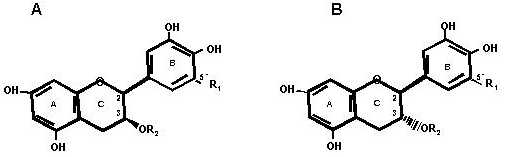
<body><![CDATA[<P ALIGN="JUSTIFY">&nbsp;2 minutos.&nbsp;Adaptado de Yamamoto et al (15) </P> </FONT>    <P ALIGN="JUSTIFY">De los polifenoles totales, el 59,9% lo constituyen las catequinas (9). Las catequinas est&aacute;n formadas por 15 &aacute;tomos de carbono y contiene dos n&uacute;cleos fen&oacute;licos (anillos A y B) que est&aacute;n unidos por tres &aacute;tomos de carbono que forman parte, junto con un &aacute;tomo de ox&iacute;geno, del anillo C. Los carbonos 2 y 3 del anillo C son asim&eacute;tricos y seg&uacute;n la posici&oacute;n espacial de los sustituyentes del carbono 3, las catequinas pueden ser enanti&oacute;meros (+) o (-) (15). Se han definido ocho catequinas diferentes al extraer los polifenoles del t&eacute; con etilacetato, siendo las mayoritarias el (-)-galato de epigalocatequina (EGCG) y (+)-galocatequina (GC), que representan el 51,8% de las ocho catequinas. En menor cantidad se encuentran otras catequinas (15,16) (<a HREF="#FIGURA 1">Figura 1</a>).</P> <B>    <P ALIGN="CENTER">FIGURA 1</P> </B>    <P ALIGN="CENTER">Estructura qu&iacute;mica de las catequinas del t&eacute;</P>     <P ALIGN="CENTER"><a name="FIGURA 1"><img border="0" src="/img/fbpe/Alan/v54n4/art3img1.jpg"></a></P>     
<P>A: enanti&oacute;meros (+)</P> <U>    <P>R1</U>&nbsp;&nbsp;&nbsp;&nbsp;&nbsp;&nbsp; <U>R2</U>&nbsp;&nbsp;&nbsp;&nbsp;&nbsp;&nbsp;&nbsp;&nbsp;&nbsp;&nbsp;&nbsp;&nbsp;&nbsp; <U>Catequina</P> </U>    <P>H&nbsp;&nbsp;&nbsp;&nbsp;&nbsp;&nbsp;&nbsp;&nbsp;&nbsp; H&nbsp;&nbsp;&nbsp;&nbsp;&nbsp;&nbsp;&nbsp;&nbsp;&nbsp;&nbsp;&nbsp;&nbsp;&nbsp; catequina (C)</P>     <P>H&nbsp;&nbsp;&nbsp;&nbsp;&nbsp;&nbsp;&nbsp;&nbsp; galato&nbsp;&nbsp;&nbsp;&nbsp;&nbsp;&nbsp; galato de catequina (CG)&nbsp;&nbsp;</P>     <P>OH&nbsp;&nbsp;&nbsp;&nbsp;&nbsp; H&nbsp;&nbsp;&nbsp;&nbsp;&nbsp;&nbsp;&nbsp;&nbsp;&nbsp;&nbsp;&nbsp;&nbsp; galocatequina (GC)</P>     ]]></body>
<body><![CDATA[<P>OH&nbsp;&nbsp;&nbsp;&nbsp; galato&nbsp;&nbsp;&nbsp;&nbsp;&nbsp;&nbsp; galato de galocatequina (GCG)</P>     <P>B: enanti&oacute;meros (-)</P> <U>    <P>R1</U>&nbsp;&nbsp;&nbsp;&nbsp;&nbsp;&nbsp; <U>R2</U>&nbsp;&nbsp;&nbsp;&nbsp;&nbsp;&nbsp;&nbsp;&nbsp;&nbsp;&nbsp;&nbsp;&nbsp; <U>Catequina </P> </U>    <P>H&nbsp;&nbsp;&nbsp;&nbsp;&nbsp;&nbsp;&nbsp;&nbsp; H&nbsp;&nbsp;&nbsp;&nbsp;&nbsp;&nbsp;&nbsp;&nbsp;&nbsp;&nbsp;&nbsp; epicatequina (EC)</P>     <P>H&nbsp;&nbsp;&nbsp;&nbsp;&nbsp;&nbsp; galato&nbsp;&nbsp;&nbsp;&nbsp;&nbsp;&nbsp; galato de epicatequina (ECG)</P>     <P>OH&nbsp;&nbsp;&nbsp;&nbsp;&nbsp; H&nbsp;&nbsp;&nbsp;&nbsp;&nbsp;&nbsp;&nbsp;&nbsp;&nbsp;&nbsp;&nbsp;&nbsp; epigalocatequina (EGC)</P>     <P>OH&nbsp;&nbsp;&nbsp; galato&nbsp;&nbsp;&nbsp;&nbsp;&nbsp;&nbsp;&nbsp; galato de epigalocatequina (EGCG)</P>     <P ALIGN="JUSTIFY">Seg&uacute;n el m&eacute;todo empleado en la obtenci&oacute;n, la cantidad de estos flavonoides es diferente. En la obtenci&oacute;n del t&eacute; negro se dejan fermentar las hojas, lo que permite que el enzima polifenol oxidasa oxide las catequinas de la hoja a quinonas, que posteriormente condensan para formar flavanoles (F), tearubiginas (TR) y teaflavinas (TF), que son una mezcla de teaflavina 1 (TF<SUB>1</SUB>), 3-galato de teaflavina (TF<SUB>2</SUB>A), 3´-galato de teaflavina (TF<SUB>2</SUB>B) y 3,3´-digalato de teaflavina (TF<SUB>3</SUB>) (6). En el caso del t&eacute; verde no se dejan fermentar las hojas y el enzima polifenoloxidasa no act&uacute;a, por lo que las catequinas apenas sufren transformaci&oacute;n y son los componentes mayoritarios de la hoja, representando el 6-16% del peso seco de la misma (18,19) (<a HREF="#TABLA_2">Tabla 2</a>).<B> </B>Si se considera que las catequinas constituyen el 10% del peso seco de la hoja del t&eacute; y que para preparar una taza de infusi&oacute;n de t&eacute; verde se utilizan aproximadamente 4-5 g de hojas secas, una taza de t&eacute; contendr&aacute; aproximadamente 400-500 mg de catequinas (21).</P> <B>    <P ALIGN="CENTER"><A NAME="TABLA_2">TABLA 2</A></B> </P>     <P ALIGN="CENTER">Concentraci&oacute;n (mg/100 g) de flavonoides en los diferentes tipos de t&eacute; </P>     ]]></body>
<body><![CDATA[<P ALIGN="CENTER">    <CENTER><TABLE BORDER CELLSPACING=1 CELLPADDING=4 WIDTH=353> <TR><TD WIDTH="49%" VALIGN="TOP">     <P>&nbsp;</TD> <TD WIDTH="27%" VALIGN="TOP"> <B><FONT SIZE=2>    <P ALIGN="CENTER">T&eacute; negro</P>     <P ALIGN="CENTER">(infusi&oacute;n)<SUP>1</B></SUP></FONT></TD> <TD WIDTH="24%" VALIGN="TOP"> <B><FONT SIZE=2>    <P ALIGN="CENTER">T&eacute; verde</P>     <P ALIGN="CENTER">(infusi&oacute;n)<SUP>1</B></SUP></FONT></TD> </TR> <TR><TD WIDTH="49%" VALIGN="TOP"> <FONT SIZE=2>    <P ALIGN="JUSTIFY">Catequina</FONT></TD> <TD WIDTH="27%" VALIGN="TOP"> <FONT SIZE=2>    <P ALIGN="CENTER">1,4</FONT></TD> <TD WIDTH="24%" VALIGN="TOP"> <FONT SIZE=2>    <P ALIGN="CENTER">2,85</FONT></TD> </TR> <TR><TD WIDTH="49%" VALIGN="TOP"> <FONT SIZE=2>    ]]></body>
<body><![CDATA[<P ALIGN="JUSTIFY">Epicatequina</FONT></TD> <TD WIDTH="27%" VALIGN="TOP"> <FONT SIZE=2>    <P ALIGN="CENTER">2,34</FONT></TD> <TD WIDTH="24%" VALIGN="TOP"> <FONT SIZE=2>    <P ALIGN="CENTER">8,66</FONT></TD> </TR> <TR><TD WIDTH="49%" VALIGN="TOP"> <FONT SIZE=2>    <P ALIGN="JUSTIFY">Galato de epicatequina</FONT></TD> <TD WIDTH="27%" VALIGN="TOP"> <FONT SIZE=2>    <P ALIGN="CENTER">7,15</FONT></TD> <TD WIDTH="24%" VALIGN="TOP"> <FONT SIZE=2>    <P ALIGN="CENTER">21,96</FONT></TD> </TR> <TR><TD WIDTH="49%" VALIGN="TOP"> <FONT SIZE=2>    <P ALIGN="JUSTIFY">Epigalocatequina</FONT></TD> <TD WIDTH="27%" VALIGN="TOP"> <FONT SIZE=2>    <P ALIGN="CENTER">9,23</FONT></TD> <TD WIDTH="24%" VALIGN="TOP"> <FONT SIZE=2>    <P ALIGN="CENTER">16,72</FONT></TD> </TR> <TR><TD WIDTH="49%" VALIGN="TOP"> <FONT SIZE=2>    <P ALIGN="JUSTIFY">Galato de epigalocatequina</FONT></TD> <TD WIDTH="27%" VALIGN="TOP"> <FONT SIZE=2>    ]]></body>
<body><![CDATA[<P ALIGN="CENTER">10,31</FONT></TD> <TD WIDTH="24%" VALIGN="TOP"> <FONT SIZE=2>    <P ALIGN="CENTER">88,32</FONT></TD> </TR> <TR><TD WIDTH="49%" VALIGN="TOP"> <FONT SIZE=2>    <P ALIGN="JUSTIFY">Galocatequina</FONT></TD> <TD WIDTH="27%" VALIGN="TOP"> <FONT SIZE=2>    <P ALIGN="CENTER">1,26</FONT></TD> <TD WIDTH="24%" VALIGN="TOP"> <FONT SIZE=2>    <P ALIGN="CENTER">Trazas</FONT></TD> </TR> <TR><TD WIDTH="49%" VALIGN="TOP"> <FONT SIZE=2>    <P ALIGN="JUSTIFY">Teaflavinas</FONT></TD> <TD WIDTH="27%" VALIGN="TOP"> <FONT SIZE=2>    <P ALIGN="CENTER">6,09</FONT></TD> <TD WIDTH="24%" VALIGN="TOP"> <FONT SIZE=2>    <P ALIGN="CENTER">0,07</FONT></TD> </TR> <TR><TD WIDTH="49%" VALIGN="TOP"> <FONT SIZE=2>    <P ALIGN="JUSTIFY">Tearubiginas</FONT></TD> <TD WIDTH="27%" VALIGN="TOP"> <FONT SIZE=2>    <P ALIGN="CENTER">73,44</FONT></TD> <TD WIDTH="24%" VALIGN="TOP"> <FONT SIZE=2>    ]]></body>
<body><![CDATA[<P ALIGN="CENTER">1,08</FONT></TD> </TR> </TABLE> </CENTER>  <FONT SIZE=2>     <P ALIGN="JUSTIFY">&nbsp;&nbsp;&nbsp;&nbsp;&nbsp;&nbsp;&nbsp;&nbsp;&nbsp;&nbsp;&nbsp;&nbsp;&nbsp;&nbsp;&nbsp;&nbsp;&nbsp;&nbsp;&nbsp;&nbsp;&nbsp;&nbsp;&nbsp;&nbsp;&nbsp;&nbsp;&nbsp;&nbsp;Los datos corresponden para cada flavonoide a la suma de los enanti&oacute;meros (+) y (-) </P>     <P ALIGN="JUSTIFY">&nbsp;&nbsp;&nbsp;&nbsp;&nbsp;&nbsp;&nbsp;&nbsp;&nbsp;&nbsp;&nbsp;&nbsp;&nbsp;&nbsp;&nbsp;&nbsp;&nbsp;&nbsp;&nbsp;&nbsp;&nbsp;&nbsp;&nbsp;&nbsp;&nbsp;&nbsp;&nbsp;&nbsp;Adaptado de Bhagwat et al (20)</P> </FONT><B>    <P ALIGN="JUSTIFY">Procesos que afectan a la concentraci&oacute;n de catequinas del t&eacute; verde</P> </B>    <P ALIGN="JUSTIFY">La composici&oacute;n del t&eacute; var&iacute;a seg&uacute;n la especie, estaci&oacute;n del a&ntilde;o, edad de las hojas, clima y pr&aacute;cticas hort&iacute;colas (22). Las hojas manufacturadas j&oacute;venes contienen menos EGCG, (-)-epigalocatequina (EGC), EC y CT que las m&aacute;s viejas, no ocurriendo as&iacute; con los niveles de cafe&iacute;na, que son mayores en las primeras (23). La temperatura es uno de los par&aacute;metros m&aacute;s importantes que afectan a la estabilidad de las catequinas. En la preparaci&oacute;n tradicional del t&eacute;, en la que se deja enfriar el agua previamente hervida, la disminuci&oacute;n en el contenido de catequinas es muy peque&ntilde;a. En algunos estudios se ha comprobado que cuando una soluci&oacute;n de catequinas se deja reposar durante 7 horas a temperatura ambiente no se producen p&eacute;rdidas importantes de las mismas. Sin embargo, cuando esta misma soluci&oacute;n se deja durante 15 minutos a 98 ºC se produce una p&eacute;rdida del 10 al 15 % (21).&nbsp;</P> <B>    <P ALIGN="JUSTIFY">Efectos fisiol&oacute;gicos y terap&eacute;uticos del t&eacute; verde</P>     <P ALIGN="JUSTIFY">V&iacute;a de administraci&oacute;n y biodisponibilidad de las catequinas del t&eacute;</P> </B>    <P ALIGN="JUSTIFY">Como se ha comentado, el t&eacute; es muy rico en catequinas (<a HREF="#TABLA_2">Tabla 2</a>). En particular, los extractos de t&eacute; verde contienen elevadas cantidades de (-)-EGCG, que representa m&aacute;s del 50% de las catequinas totales y es, adem&aacute;s, la que mayor actividad farmacol&oacute;gica presenta (24). Se han asociado al consumo de t&eacute; diferentes efectos beneficiosos sobre la salud y en particular estos efectos se han atribuido a las principales catequinas del t&eacute; verde: EGCG, EC, EGC y (-)-galato de epicatequina (ECG) (25,26). </P>     <P ALIGN="JUSTIFY">Diferentes estudios han demostrado que los polifenoles, tanto como si se toma infusi&oacute;n de t&eacute; o extracto de catequinas, presentan efectos indirectos a nivel gastrointestinal y un efecto directo sobre diferentes tejidos, ya que se han encontrado polifenoles en sangre, orina, saliva y heces tras su ingesta (27-29). Al aumentar el consumo de t&eacute;, se produce un aumento en la excreci&oacute;n de EC y EGCG, aunque esta relaci&oacute;n no es muy neta (28).&nbsp;</P>     <P ALIGN="JUSTIFY">La administraci&oacute;n oral de EGCG es menos eficaz que la intraperitoneal (debido a que en el tracto gastrointestinal la EGCG puede sufrir degradaciones, interacciones y a que la absorci&oacute;n es menos eficaz). Sin embargo, el consumo prolongado de t&eacute; verde o de extractos que contengan EGCG puede imitar algunos de los efectos que aparecen en animales administrados con EGCG intraperitonealmente (1). </P>     ]]></body>
<body><![CDATA[<P ALIGN="JUSTIFY">Es interesante se&ntilde;alar que al a&ntilde;adir leche al t&eacute;, pr&aacute;ctica muy habitual en ciertos pa&iacute;ses como el Reino Unido (20), se induce una disminuci&oacute;n de la biodisponibilidad de los polifenoles del t&eacute; que provoca una disminuci&oacute;n de la actividad de esta infusi&oacute;n in vivo, sin que se afecte su capacidad antioxidante in vitro (2). Estos efectos s&oacute;lo se observan cuando la cantidad de leche a&ntilde;adida es muy elevada (25%). Cuando se a&ntilde;ade un 10-15% de leche, que es la cantidad que habitualmente se utiliza, no se afecta en forma relevante la biodisponibilidad de las catequinas del t&eacute; ni sus efectos in vivo (30,31). Existen dos hip&oacute;tesis para explicar dicha interacci&oacute;n. La primera de ellas es la formaci&oacute;n de complejos resistentes a la hidr&oacute;lisis g&aacute;strica entre los polifenoles del t&eacute; y las prote&iacute;nas de la leche, lo que impide su absorci&oacute;n a nivel gastrointestinal (32). La segunda hip&oacute;tesis es que los polifenoles son solubles a pH &aacute;cido, al cual se encuentran en forma no ionizada y se absorben con facilidad. La leche, al producir un ligero aumento del pH g&aacute;strico, provoca una ionizaci&oacute;n de los polifenoles e impide su absorci&oacute;n (33).&nbsp;</P> <B>    <P ALIGN="JUSTIFY">Mecanismo de acci&oacute;n del t&eacute; en el control de peso corporal</P> </B>    <P ALIGN="JUSTIFY">La obesidad es una enfermedad metab&oacute;lica muy prevalerte en la sociedad occidental. La resistencia a la insulina que se produce en la mayor&iacute;a de los pacientes obesos es clave promoviendo un incremento del riesgo cardiovascular debido a la producci&oacute;n incrementada de lipoprote&iacute;nas de baja densidad (LDL) y de muy baja densidad (VLDL) (34,35). A su vez en estos pacientes es frecuente la hipertensi&oacute;n ligada a la hiperinsulinemia y el incremento de la trombog&eacute;nesis (35). Para conseguir una disminuci&oacute;n del peso corporal se puede actuar en t&eacute;rminos generales de dos posibles formas, bien reduciendo la ingesta energ&eacute;tica, bien aumentando el gasto energ&eacute;tico (34,36,37). El gasto energ&eacute;tico lo constituyen la actividad f&iacute;sica, el gasto energ&eacute;tico basal junto con la termog&eacute;nesis obligatoria y la termog&eacute;nesis facultativa, en respuesta a determinadas situaciones, como la ingesta de energ&iacute;a y la exposici&oacute;n al fr&iacute;o (38). El sistema nervioso simp&aacute;tico es el encargado de regular la termog&eacute;nesis y la oxidaci&oacute;n de la grasa, por eso, un posible tratamiento contra la obesidad incluir&iacute;a a aquellas sustancias que act&uacute;an sobre dicho sistema o sobre su neurotransmisor, la noradrenalina (39-41). A este grupo de sustancias que tienen efectos sobre el peso corporal pertenecen algunos componentes del t&eacute; (39,42,43). Las catequinas del t&eacute; act&uacute;an in vitro, inhibiendo la catecol o-metiltransferasa (COMT), enzima responsable de la degradaci&oacute;n de la noradrenalina, lo que produce un aumento del tiempo de actuaci&oacute;n de dicho neurotransmisor sobre los receptores <FONT FACE=Symbol>b</FONT> <SUB>3</SUB> de los adipocitos marrones, incrementando as&iacute; la termog&eacute;nesis y/o la oxidaci&oacute;n de la grasa (34,44,45). Estudios in vitro han puesto de manifiesto la capacidad de la cafe&iacute;na, cuando se administra junto con adrenalina, de inhibir la fosfodiesterasa intracelular. Esta inhibici&oacute;n conlleva un aumento del AMPc en el adipocito, que es un mediador de la acci&oacute;n de las catecolaminas sobre la termog&eacute;nesis (45,46). Teniendo en cuenta estos hechos, en un estudio realizado en 10 varones sanos de 24 a 26 a&ntilde;os se comprob&oacute; que el gasto energ&eacute;tico en 24 horas y la oxidaci&oacute;n de la grasa aumentaban al administrar un extracto de t&eacute; (90 mg de EGCG) y cafe&iacute;na (50 mg) (37). Esto se deb&iacute;a a la acci&oacute;n sin&eacute;rgica de la cafe&iacute;na con los polifenoles del t&eacute; y, en concreto, con el m&aacute;s abundante, la EGCG (47). Al considerar los resultados de los estudios in vitro de la termog&eacute;nesis en el tejido adiposo marr&oacute;n de ratas (48) y los resultados in vivo de la biodisponibilidad de las catequinas en humanos (49,50) puede afirmarse que los efectos termog&eacute;nicos del extracto de t&eacute; verde se deben, al menos en parte, a las interacciones entre las catequinas del t&eacute; (fundamentalmente la EGCG), la cafe&iacute;na y la noradrenalina (37). Siguiendo con &eacute;sta l&iacute;nea de investigaci&oacute;n, al administrar inyecciones intraperitoneales de EGCG a ratas, se produc&iacute;a una p&eacute;rdida de peso en las mismas debido a una disminuci&oacute;n en la ingesta, hecho que no ocurr&iacute;a al administrar (-)–epicatequina (EC), EGC ni ECG (1,51). Esta p&eacute;rdida de apetito podr&iacute;a deberse a un efecto en la eficacia de la oxidaci&oacute;n de l&iacute;pidos m&aacute;s que a un efecto directo de la EGCG (47) o bien a una acci&oacute;n relacionada con neurop&eacute;ptidos diferentes de la leptina, ya que la EGCG produce el mismo efecto en ratas knockout que no presentan el receptor para leptina (43,51). Otros posibles mecanismos por los que el t&eacute; podr&iacute;a contribuir a la p&eacute;rdida de peso se han observado en preadipocitos 3T3-L1 de ratones. La EGCG a una concentraci&oacute;n de 10 &#956;<FONT FACE="Times New Roman">mol/L, pero no la EC, EGC ni la ECG, inhibi&#963; la proliferaci&#963;n de los preadipocitos en un 50% y la acumulaci&#963;</FONT>n de triacilglicerol en un 54% en estas c&eacute;lulas durante su diferenciaci&oacute;n a adipocitos (43). Adem&aacute;s, tanto la EGCG como la ECG en una concentraci&oacute;n de 0,31 mmol/L, inhibieron un 50% la actividad de la acetil-CoA carboxilasa, enzima que interviene en la bios&iacute;ntesis de &aacute;cidos grasos (52).</P>     <P ALIGN="JUSTIFY">Seg&uacute;n los resultados obtenidos en animales de experimentaci&oacute;n se requerir&iacute;a en humanos un consumo diario de bebidas de t&eacute; verde equivalente a 20 g o m&aacute;s de t&eacute; seco a 4 tazas al d&iacute;a de infusi&oacute;n, para mostrar los mismos efectos (1).</P> <B>    <P ALIGN="JUSTIFY">Acci&oacute;n del t&eacute; sobre la absorci&oacute;n de colesterol y concentraci&oacute;n de los l&iacute;pidos y lipoprote&iacute;nas plasm&aacute;ticas</P> </B>    <P ALIGN="JUSTIFY">Diversos estudios en animales de experimentaci&oacute;n han puesto de manifiesto que las catequinas disminuyen la absorci&oacute;n de colesterol y los niveles plasm&aacute;ticos de este colesterol (53-59), obteniendo resultados similares en humanos (60,61). La disminuci&oacute;n del colesterol en plasma se debe fundamentalmente al efecto de la EGCG del t&eacute; (57,59,62). Para la absorci&oacute;n del colesterol en el yeyuno proximal es necesario, en primer lugar, que se produzca su emulsificaci&oacute;n de los l&iacute;pidos en el est&oacute;mago, la hidr&oacute;lisis posterior en el intestino delgado de los &eacute;steres de colesterol por la colesterol esterasa pancre&aacute;tica y la posterior solubilizaci&oacute;n en micelas. Una vez en las c&eacute;lulas intestinales, el colesterol se reesterifica y se transporta a la linfa por los quilomicrones (63). De esta manera, las mol&eacute;culas que influyen en la absorci&oacute;n de colesterol podr&iacute;an actuar bien interfiriendo en la afinidad de las micelas por los enterocitos o en la afinidad del colesterol por las micelas. Estas alteraciones afectar&iacute;an al metabolismo hep&aacute;tico del colesterol y podr&iacute;an afectar a la s&iacute;ntesis y catabolismo de lipoprote&iacute;nas (59). Estos efectos se han comprobado en estudios realizados in vitro y en animales de experimentaci&oacute;n. As&iacute;, se ha observado que las catequinas del t&eacute; verde disminuyen la absorci&oacute;n intestinal del colesterol al disminuir su solubilidad en las micelas (56). En concreto, al a&ntilde;adir EGCG aislada en concentraciones crecientes desde 109 µM hasta 436 µM a una mezcla de micelas, la concentraci&oacute;n de colesterol en las mismas disminu&iacute;a un 65% (59). Adem&aacute;s en ese estudio tambi&eacute;n se encontr&oacute; que la EGCG induc&iacute;a un aumento del tama&ntilde;o de las micelas (59), hecho que afecta a su afinidad por la membrana de los enterocitos y a la solubilidad del colesterol en las mismas (64). </P>     <P ALIGN="JUSTIFY">Otros han encontrado que la incorporaci&oacute;n de las catequinas a las bicapas de fosfol&iacute;pidos disminuyen la fluidez de las mismas afectando a su estructura, siendo esta acci&oacute;n realizada de forma m&aacute;s eficaz por las catequinas esterificadas con galato que por las catequinas no sustituidas (65,66). Este hecho produce una disminuci&oacute;n de la captaci&oacute;n del colesterol por los enterocitos, lo que explicar&iacute;a la disminuci&oacute;n del colesterol plasm&aacute;tico observada en animales de experimentaci&oacute;n. En concreto, al a&ntilde;adir un 1% de EGCG a la dieta de ratas, el colesterol plasm&aacute;tico de estos animales disminuye significativamente sin que la concentraci&oacute;n del colesterol transportado por las lipoprote&iacute;nas de alta densidad (HDL-colesterol) se vea afectada (59). Sin embargo, al administrar una dosis del 2,5% de polifenoles (constitu&iacute;da por una mezcla de catequinas), a ratas alimentadas con una dieta rica en colesterol, se produc&iacute;a un aumento del HDL-colesterol m&aacute;s que un descenso del colesterol total (67).</P>     <P ALIGN="JUSTIFY">En estos estudios en los que se administraba una dieta rica en colesterol a animales de experimentaci&oacute;n se observ&oacute; adem&aacute;s de una disminuci&oacute;n en sus niveles s&eacute;ricos que las catequinas actuaban disminuyendo la absorci&oacute;n intestinal del mismo (53,56,68), lo que produc&iacute;a un aumento en heces de l&iacute;pidos totales y colesterol (53) y de &aacute;cidos grasos y esteroles neutros y &aacute;cidos (68). Otros en ratas ovaridectomizadas encontraron que una dosis de 20 g de hojas de t&eacute; disminu&iacute;a la absorci&oacute;n linf&aacute;tica de colesterol y alteraba la absorci&oacute;n de &aacute;cidos grasos (58).</P>     <P ALIGN="JUSTIFY">Con respecto a la actividad de algunos enzimas, estudios in vitro muestran que tanto la lipasa g&aacute;strica como la lipasa pancre&aacute;tica son dr&aacute;sticamente inhibidas por el t&eacute; verde (69), mientras que las actividades de la 3-hidroximetilglutaril-CoA reductasa, &aacute;cido graso sintasa y colesterol 7&#945;-hidroxilasa no se encuentran afectadas. Esto sugiere que el efecto de las catequinas se debe, tal y como se describe en los estudios ya comentados, a <FONT FACE="Times New Roman">la disminuci&#963;n de la absorci&#963;n intestinal del colesterol (57,70). </P> </FONT>    <P ALIGN="JUSTIFY">Los resultados obtenidos en animales de experimentaci&oacute;n sugieren la posibilidad de su extrapolaci&oacute;n al ser humano, en particular en lo referente al EGCG (59). La mayor&iacute;a de las investigaciones llevadas a cabo se han realizado en japoneses en los que el consumo de t&eacute; es una pr&aacute;ctica muy habitual (61). Se encontr&oacute; una relaci&oacute;n inversa entre el consumo de t&eacute; y los niveles de colesterol total en suero (61,71-73), y, s&oacute;lo en alguno de ellos, una disminuci&oacute;n de los triglic&eacute;ridos y un aumento de la concentraci&oacute;n de HDL-colesterol (72,73), as&iacute; como un bajo cociente de riesgo LDL-colesterol/HDL-colesterol (72). En estudios realizados hace a&ntilde;os (71-73) s&oacute;lo se incluyeron varones pero cuando m&aacute;s recientemente se introdujeron mujeres en la muestra, no se encontr&oacute; ning&uacute;n efecto del t&eacute; sobre los niveles lip&iacute;dicos sangu&iacute;neos (60). Estos resultados pod&iacute;an deberse en principio al reducido n&uacute;mero de individuos estudiados, ya que posteriormente, en una muestra mayor en la que se inclu&iacute;an tanto a hombres como mujeres, s&iacute; se obtuvieron resultados positivos del consumo de t&eacute; sobre los niveles de lipoprote&iacute;nas (61). </P>     ]]></body>
<body><![CDATA[<P ALIGN="JUSTIFY">En la mayor&iacute;a de los estudios realizados se ha observado un efecto positivo sobre los niveles de colesterol en suero (<a HREF="#TABLA_3">Tablas 3</a> y <a HREF="#TABLA_4">4</a>), estando la disminuci&oacute;n del 1% de este l&iacute;pido asociada con una reducci&oacute;n del 2 al 3% en el riesgo de padecer enfermedades cardiovasculares en pa&iacute;ses occidentales (74) y del 5% en pa&iacute;ses orientales (75)<B>. </B>Sin embargo, es necesario realizar m&aacute;s estudios para confirmar el efecto beneficioso del t&eacute; verde sobre los niveles lip&iacute;dicos sangu&iacute;neos (61), y en particular sobre aspectos m&aacute;s espec&iacute;ficos tales como concentraci&oacute;n de Lp(a), tama&ntilde;o y composici&oacute;n de LDL y HDL, etc.</P> <B>    <P ALIGN="CENTER"><A NAME="TABLA_3">TABLA 3</A></P> </B>    <P ALIGN="CENTER">Efectos del consumo de t&eacute; verde sobre los l&iacute;pidos sangu&iacute;neos en humanos</P>     <div align="center">       <center><TABLE BORDER="1" CELLSPACING=1 CELLPADDING=4 WIDTH=505> <TR><TD WIDTH="84" VALIGN="TOP"> <B><FONT SIZE=2>    <P ALIGN="CENTER">Investigador</FONT></B></TD> <TD WIDTH="84" VALIGN="TOP"> <B><FONT SIZE=2>    <P ALIGN="CENTER">Fecha del estudio</FONT></B></TD> <TD WIDTH="69" VALIGN="TOP"> <B><FONT SIZE=2>    <P ALIGN="CENTER">Muestra</FONT></B></TD> <TD WIDTH="69" VALIGN="TOP"> <B><FONT SIZE=2>    <P ALIGN="CENTER">Consumo de t&eacute;</FONT></B></TD> <TD WIDTH="135" VALIGN="TOP"> <B><FONT SIZE=2>    <P ALIGN="CENTER">Resultados obtenidos</FONT></B></TD> </TR> <TR><TD WIDTH="84" VALIGN="TOP"> <FONT SIZE=2>    ]]></body>
<body><![CDATA[<P ALIGN="CENTER">Kono et al, (71)</FONT></TD> <TD WIDTH="84" VALIGN="TOP"> <FONT SIZE=2>    <P ALIGN="CENTER">Desde1986 </P>     <P ALIGN="CENTER">hasta 1988</FONT></TD> <TD WIDTH="69" VALIGN="TOP"> <FONT SIZE=2>    <P ALIGN="CENTER">1306 varones</FONT></TD> <TD WIDTH="69" VALIGN="TOP"> <FONT SIZE=2>    <P ALIGN="CENTER">0-2 tazas/d&iacute;a</P>     <P ALIGN="CENTER">= 9 tazas/d&iacute;a</FONT></TD> <TD WIDTH="135" VALIGN="TOP"> <FONT SIZE=2>    <P ALIGN="CENTER">Disminuci&oacute;n del CT 8 mg/dL (= 9 tazas/ d&iacute;a)</FONT></TD> </TR> <TR><TD WIDTH="84" VALIGN="TOP"> <FONT SIZE=2>    <P>Imai (72)</FONT></TD> <TD WIDTH="84" VALIGN="TOP"> <FONT SIZE=2>    <P ALIGN="CENTER">Desde1986</P>     <P ALIGN="CENTER">hasta 1990</FONT></TD> <TD WIDTH="69" VALIGN="TOP"> <FONT SIZE=2>    ]]></body>
<body><![CDATA[<P ALIGN="CENTER">1371 varones</FONT></TD> <TD WIDTH="69" VALIGN="TOP"> <FONT SIZE=2>    <P ALIGN="justify">= 3 tazas/d&iacute;a</P>     <P ALIGN="CENTER">4 -9 tazas/d&iacute;a</P>     <P ALIGN="justify">=10 tazas/d&iacute;a</FONT></TD> <TD WIDTH="135" VALIGN="TOP"> <FONT SIZE=2>    <P ALIGN="CENTER">Ver resultados detallados en </FONT><a HREF="#TABLA_4"><FONT SIZE=2>Tabla 4</FONT></a></TD> </TR> <TR><TD WIDTH="84" VALIGN="TOP"> <FONT SIZE=2>    <P>Kono et al (73)</FONT></TD> <TD WIDTH="84" VALIGN="TOP"> <FONT SIZE=2>    <P ALIGN="CENTER">Desde1991</P>     <P ALIGN="CENTER">hasta 1992</FONT></TD> <TD WIDTH="69" VALIGN="TOP"> <FONT SIZE=2>    <P ALIGN="CENTER">2062 varones</FONT></TD> <TD WIDTH="69" VALIGN="TOP"> <FONT SIZE=2>    <P ALIGN="CENTER">&lt; 9 tazas/d&iacute;a</P>     ]]></body>
<body><![CDATA[<P ALIGN="CENTER">= 9 tazas/d&iacute;a</FONT></TD> <TD WIDTH="135" VALIGN="TOP"> <FONT SIZE=2>    <P>Disminuci&oacute;n del CT y LDL 6,2 mg/dL</FONT> <FONT SIZE=2>en ambos casos (= 9 tazas/ d&iacute;a)</FONT> </TD> </TR> <TR><TD WIDTH="84" VALIGN="TOP"> <FONT SIZE=2>    <P>Tsubono y Tsugane (60)</FONT></TD> <TD WIDTH="84" VALIGN="TOP"> <FONT SIZE=2>    <P ALIGN="CENTER">Desde 1989</P>     <P ALIGN="CENTER">hasta 1991</FONT></TD> <TD WIDTH="69" VALIGN="TOP"> <FONT SIZE=2>    <P ALIGN="CENTER">207 varones y</P>     <P ALIGN="CENTER">164 mujeres</FONT></TD> <TD WIDTH="69" VALIGN="TOP"> <FONT SIZE=2>    <P ALIGN="CENTER">&lt;1 taza/d&iacute;a</P>     <P ALIGN="CENTER">1-4 tazas/d&iacute;a</P>     <P ALIGN="CENTER">=5 tazas /d&iacute;a</FONT></TD> <TD WIDTH="135" VALIGN="TOP"> <FONT SIZE=2>    ]]></body>
<body><![CDATA[<P>Ning&uacute;n efecto sobre el nivel de l&iacute;pidos</FONT></TD> </TR> <TR><TD WIDTH="84" VALIGN="TOP"> <FONT SIZE=2>    <P>Tokunaga et al (61)</FONT></TD> <TD WIDTH="84" VALIGN="TOP"> <FONT SIZE=2>    <P ALIGN="CENTER">Desde1995</P>     <P ALIGN="CENTER">Hasta 1996</FONT></TD> <TD WIDTH="69" VALIGN="TOP"> <FONT SIZE=2>    <P ALIGN="CENTER">8476 varones</P>     <P ALIGN="CENTER">5440 mujeres</FONT></TD> <TD WIDTH="69" VALIGN="TOP"> <FONT SIZE=2>    <P ALIGN="justify">=10 tazas/d&iacute;a</P>     <P ALIGN="justify">&gt;10 tazas/d&iacute;a</FONT></TD> <TD WIDTH="135" VALIGN="TOP"> <FONT SIZE=2>    <P>Disminuci&oacute;n del CT (0,6 mg/dL con 1</FONT> <FONT SIZE=2>taza/d&iacute;a y 4,16 mg/dL con &gt;10 tazas/d&iacute;a).</FONT> </TD> </TR> </TABLE>   </center>   </div> <FONT SIZE=2>    <P ALIGN="CENTER">CT: colesterol total, LDL: lipoprote&iacute;nas de baja densidad. </P> </FONT><B>    ]]></body>
<body><![CDATA[<P ALIGN="CENTER"><A NAME="TABLA_4">TABLA 4</A></P> </B>    <P ALIGN="CENTER">Modificaciones de los l&iacute;pidos y lipoprote&iacute;nas plasm&aacute;ticas por el consumo de t&eacute; </P>     <P ALIGN="CENTER">    <CENTER><TABLE BORDER CELLSPACING=1 CELLPADDING=4 WIDTH=553> <TR><TD WIDTH="48%" VALIGN="TOP">     <P>&nbsp;</TD> <TD WIDTH="21%" VALIGN="TOP"> <U><FONT SIZE=2>    <P>&lt;</U></FONT> <FONT SIZE=2>3 tazas/d&iacute;a</FONT></TD> <TD WIDTH="15%" VALIGN="TOP"> <FONT SIZE=2>    <P>4-9 tazas/d&iacute;a</FONT></TD> <TD WIDTH="16%" VALIGN="TOP"> <U><FONT SIZE=2>    <P>&gt;</U>10tazas/d&iacute;a</FONT></TD> </TR> <TR><TD WIDTH="48%" VALIGN="TOP"> <FONT SIZE=2>    <P>Colesterol (mmol/L)</FONT></TD> <TD WIDTH="21%" VALIGN="TOP"> <FONT SIZE=2>    <P>4,85±0,05***</FONT></TD> <TD WIDTH="15%" VALIGN="TOP"> <FONT SIZE=2>    ]]></body>
<body><![CDATA[<P>4,76±0,03</FONT></TD> <TD WIDTH="16%" VALIGN="TOP"> <FONT SIZE=2>    <P>4,58±0,05***</FONT></TD> </TR> <TR><TD WIDTH="48%" VALIGN="TOP"> <FONT SIZE=2>    <P>Triglic&eacute;ridos (mmol/L)</FONT></TD> <TD WIDTH="21%" VALIGN="TOP"> <FONT SIZE=2>    <P>1,65±0,06*</FONT></TD> <TD WIDTH="15%" VALIGN="TOP"> <FONT SIZE=2>    <P>1,60±0,05</FONT></TD> <TD WIDTH="16%" VALIGN="TOP"> <FONT SIZE=2>    <P>1,45±0,07*</FONT></TD> </TR> <TR><TD WIDTH="48%" VALIGN="TOP"> <FONT SIZE=2>    <P>LDL + VLDL (% del total de lipoprote&iacute;nas)<SUP>1</SUP></FONT></TD> <TD WIDTH="21%" VALIGN="TOP"> <FONT SIZE=2>    <P>62,5±0,3</FONT></TD> <TD WIDTH="15%" VALIGN="TOP"> <FONT SIZE=2>    <P>62,6±0,3</FONT></TD> <TD WIDTH="16%" VALIGN="TOP"> <FONT SIZE=2>    <P>61,7±0,2</FONT></TD> </TR> <TR><TD WIDTH="48%" VALIGN="TOP"> <FONT SIZE=2>    ]]></body>
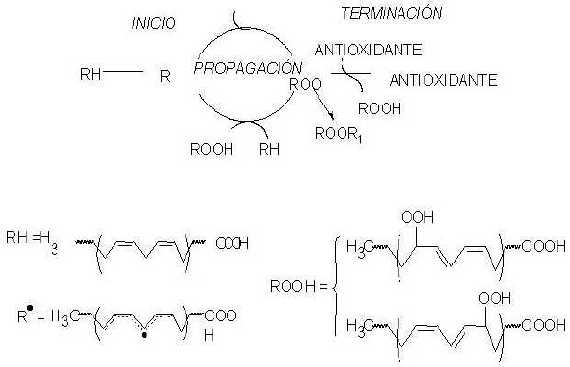
<body><![CDATA[<P>HDL (% del total de lipoprote&iacute;nas )<SUP>1</SUP></FONT></TD> <TD WIDTH="21%" VALIGN="TOP"> <FONT SIZE=2>    <P>36,4±0,3*</FONT></TD> <TD WIDTH="15%" VALIGN="TOP"> <FONT SIZE=2>    <P>36,4±0,3</FONT></TD> <TD WIDTH="16%" VALIGN="TOP"> <FONT SIZE=2>    <P>37,4±0,4*</FONT></TD> </TR> </TABLE> </CENTER> <DIR> <DIR>  <SUP><FONT SIZE=2>    <P ALIGN="CENTER">1 </SUP>Determinados por electroforesis en gel de agarosa</P>     <P ALIGN="JUSTIFY">***p&lt;0,001 *p&lt;0,05.</P>     <P ALIGN="JUSTIFY">Adaptado de Imai (72)</P></DIR> </DIR>  </FONT><B>    <P ALIGN="JUSTIFY">Efecto antioxidante de los polifenoles (catequinas) del t&eacute; verde frente a la peroxidaci&oacute;n de LDL</P> </B>    <P ALIGN="JUSTIFY">Los polifenoles presentan una fuerte actividad antioxidante en muchos sistemas lip&iacute;dicos y en particular contra la oxidaci&oacute;n de las LDL, aspecto de importancia crucial en el desarrollo de la lesi&oacute;n ateroscler&oacute;tica (76-79). En las LDL se produce una modificaci&oacute;n peroxidativa de sus &aacute;cidos grasos poliinsaturados (AGP) por la acci&oacute;n de los radicales libres (80). En este proceso intervienen iones met&aacute;licos y mecanismos oxidativos existentes en las c&eacute;lulas endoteliales, m&uacute;sculo liso y macr&oacute;fagos (81). Se han propuesto como candidatos del origen de la oxidaci&oacute;n de los AGP a las enzimas NADPH oxidasa, mieloperoxidasa, citocromo P<SUB>450</SUB>, la cadena de transporte electr&oacute;nico mitocondrial, xantina oxidasa, ceruloplasmina y lipooxigenasa (82). Cuando los niveles de colesterol s&eacute;rico est&aacute;n elevados se producen radicales super&oacute;xido en grandes cantidades (O<SUB>2</SUB><SUP>- </SUP>)<SUB> </SUB>que inactivan el NO y promueven la formaci&oacute;n de otros radicales de ox&iacute;geno como el peroxinitrito y el radical hidroxilo (83) (<a HREF="#FIGURA 2">Figura 2</a>).</P> <B>    <P ALIGN="CENTER">FIGURA 2</P> </B>    ]]></body>
<body><![CDATA[<P>Esquema de la oxidaci&oacute;n de los &aacute;cidos grasos poliinsaturados de las lipoprote&iacute;nas de baja densidad</P>     <P ALIGN="CENTER"><a name="FIGURA 2"><img border="0" src="/img/fbpe/Alan/v54n4/art3img2.jpg"></a></P>     
<P>RH.- &Aacute;cido graso insaturado&nbsp;&nbsp;&nbsp; R.- Radical libre</P>     <P>ROO.- Radical per&oacute;xido&nbsp;&nbsp;&nbsp;&nbsp;&nbsp;&nbsp;&nbsp;&nbsp;&nbsp; ROOH.- Hidroper&oacute;xido</P>     <P>Adaptado de S&aacute;nchez-Muniz y S&aacute;nchez-Montero (87)</P>     <P ALIGN="JUSTIFY">Las sustancias conteniendo radicales libres son neutralizadas por los antioxidantes end&oacute;genos (K-tocoferol, 2-carotenos, ubiquinol y otros) de las lipoprote&iacute;nas. En estas condiciones las LDL comienzan a oxidarse, denomin&aacute;ndose a este periodo "fase de latencia". Cuando se agotan los antioxidantes, los AGP son atacados por radicales libres y se forman compuestos con dobles enlaces conjugados. A continuaci&oacute;n, se producen per&oacute;xidos lip&iacute;dicos y se propagan los radicales libres destruyendo nuevas mol&eacute;culas de AGP (84) (<a HREF="#FIGURA 2">Figuras 2</a> y <a HREF="#FIGURA 3">3</a>).</P> <B>    <P ALIGN="CENTER">FIGURA 3</P> </B>    <P>Modificaci&oacute;n oxidativa de las lipoprote&iacute;nas de baja densidad (LDL). Se esquematizan los cambios cualitativos m&aacute;s importantes</P>     <P ALIGN="CENTER"><a name="FIGURA 3"><img border="0" src="/img/fbpe/Alan/v54n4/art3img3.jpg"></a></P>     
<P ALIGN="JUSTIFY">Los hidroper&oacute;xidos lip&iacute;dicos pueden fragmentarse a aldeh&iacute;dos, como el malondialdeh&iacute;do o el 4-hidroxinonenal que, al unirse a grupos &#949;-amino<FONT FACE="Times New Roman">s de la apolipoprote&#957;na (Apo) B-100, proporcionan carga neta negativa a la LDL y aumenta su reconocimiento por los receptores barrenderos (scavenger) (85,86) (</FONT><a HREF="#FIGURA 3">Figura 3</a>).<B> </B>Adem&aacute;s la Apo B-100 puede fragmentarse por oxidaciones no enzim&aacute;ticas y algunos de los fragmentos formados pueden ser transferidos desde las LDL nativas a la LDL oxidadas, lo que produce un aumento de la carga negativa de estas part&iacute;culas (88,89) (<a href="#FIGURA 3">Figura 3</a>).</P>     ]]></body>
<body><![CDATA[<P ALIGN="JUSTIFY">Numerosas investigaciones han demostrado los efectos antioxidantes y la capacidad para neutralizar radicales libres de las catequinas (90-96). Para llevar a cabo esta &uacute;ltima acci&oacute;n es fundamental la presencia de 3 grupos hidroxilos en el anillo B y del grupo galato en la posici&oacute;n 3 de la catequina (91,92,94).</P>     <P ALIGN="JUSTIFY">La capacidad antioxidante del t&eacute; ha sido evaluada in vitro (2,97,98) e in vivo tras la ingesta de t&eacute; (2,3,97,99,100). Los estudios realizados in vitro han puesto de manifiesto la capacidad de los flavonoides para inhibir de forma dosis-dependiente la oxidaci&oacute;n inducida por Cu<SUP>2+</SUP> de las LDL aisladas del plasma (97,99,101-105). Para explicar este hecho se han propuesto diferentes mecanismos en los que intervienen las catequinas tales como (i) la quelaci&oacute;n del Cu<SUP>2+</SUP> y de otros metales i&oacute;nicos, (ii) el efecto directo como antioxidante interrumpiendo la reacci&oacute;n de radicales libres en cadena, (iii) la aceleraci&oacute;n del reciclaje del radical tocoferilo a tocoferol de la LDL (97,106), (iv) la inhibici&oacute;n de la enzima lipooxigenasa de las c&eacute;lulas endoteliales (107) y (v) la prevenci&oacute;n de la fragmentaci&oacute;n de la Apo B de las LDL (89,108). Para observar el efecto antioxidante de las catequinas en plasma, y no de las LDL aisladas, se necesita una menor concentraci&oacute;n de las mismas, lo que indica que su acci&oacute;n antioxidante tambi&eacute;n se debe a su capacidad de donar hidr&oacute;geno (109). Este efecto antioxidante es mayor en la ECG, seguida de EGCG, EC y EGC (108,110). Adem&aacute;s, en plasma tambi&eacute;n se ha observado un retraso de la utilizaci&oacute;n de antioxidantes end&oacute;genos liposolubles (&#945;-tocoferol y <FONT FACE=Symbol>b</FONT> -caroteno), previniendo su depleci&oacute;n y disminuyendo la peroxidaci&oacute;n lip&iacute;dica gracias a su capacidad de atrapar a los radicales libres que inician la oxidaci&oacute;n (91,94,106,107,111). Se ha observado tambi&eacute;n un potente efecto dosis-dependiente sobre la prolongaci&oacute;n del tiempo de iniciaci&oacute;n de la oxidaci&oacute;n o fase de latencia (99,110) y una disminuci&oacute;n de la susceptibilidad de las LDL a la oxidaci&oacute;n mediada por macr&oacute;fagos, presentando la mayor actividad la EGCG a una dosis de 400 µmol/L (99). Parad&oacute;jicamente, se ha puesto de manifiesto el poder pro-oxidante de las catequinas cuando est&aacute;n en presencia de cobre al producirse un aumento de la divisi&oacute;n del DNA y una mayor peroxidaci&oacute;n de AGP (112).&nbsp;</P>     <P ALIGN="JUSTIFY">Los estudios anteriormente descritos se han centrado en los efectos antioxidantes de las catequinas del t&eacute; verde. Sin embargo, es de inter&eacute;s comentar que tambi&eacute;n presentan actividad antioxidante los pol&iacute;meros formados a partir de la oxidaci&oacute;n de las catequizas, los cuales son excelentes antioxidantes en todos los sistemas lip&iacute;dicos y no lip&iacute;dicos, en sistemas enzim&aacute;ticos y no enzim&aacute;ticos, y adem&aacute;s, no tienen actividad prooxidante (101). El mecanismo propuesto para esta capacidad antioxidante incluye el reconocimiento y quelaci&oacute;n de radicales libres, la quelaci&oacute;n de iones met&aacute;licos, la activaci&oacute;n de enzimas antioxidantes y la inactivaci&oacute;n de enzimas oxidantes (101).&nbsp;</P>     <P ALIGN="JUSTIFY">En los estudios in vivo en los que se aislaron las lipoprote&iacute;nas del suero (3,97,99,100) se observ&oacute; que la incorporaci&oacute;n de polifenoles a dichas lipoprote&iacute;nas era muy peque&ntilde;a y que adem&aacute;s no se encontraba ning&uacute;n efecto del t&eacute; sobre la oxidaci&oacute;n de las LDL (3,14,20). Sin embargo, al cultivar las LDL aisladas con c&eacute;lulas endoteliales en presencia de un extracto de t&eacute; verde de diferentes concentraciones (1&#956;<FONT FACE="Times New Roman">g/ml, 5&#956;g/ml y 10&#956;g/ml) s&#957; se observ&#963; una inhibici&#963;</FONT>n de la oxidaci&oacute;n de las LDL inducida por dichas c&eacute;lulas. En concreto, la oxidaci&oacute;n estaba totalmente inhibida al usar la concentraci&oacute;n m&aacute;s elevada del extracto de t&eacute; (57). Tambi&eacute;n se observaron los efectos antioxidantes del t&eacute; frente a la oxidaci&oacute;n de las lipoprote&iacute;nas en suero y no en un tamp&oacute;n, ya que en el suero las condiciones son m&aacute;s similares a las de la zona subendotelial arterial, que es donde se produce la formaci&oacute;n de lipoprote&iacute;nas m&iacute;nimamente oxidadas (113). Solamente se encontr&oacute; que la actividad antioxidante del suero aumentaba de forma significativa en algunos de ellos (2,3,67), y de forma no significativa en otros (14). Adem&aacute;s, en un estudio hecho en ratas con enfermedad osteog&eacute;nica, y por lo tanto con deficiencia de vitamina C, se midi&oacute; la capacidad del t&eacute; verde para modificar la oxidaci&oacute;n de LDL y se encontr&oacute; que el &aacute;cido asc&oacute;rbico plasm&aacute;tico y el t&eacute; verde prolongaban la fase de latencia un 25% y disminu&iacute;an la susceptibilidad de las LDL a la oxidaci&oacute;n por efecto sin&eacute;rgico con agentes lipof&iacute;licos (vitamina E) (114). Por otro lado, en conejos hipercolesterol&eacute;micos se observ&oacute; que el t&eacute; verde aumentaba los niveles de vitamina E plasm&aacute;ticos un 63% y disminu&iacute;a el coeficiente m&aacute;ximo de oxidaci&oacute;n de las LDL desde 13,4 ± 0,4 nmol/minuto a 11,2 ± 0,6 nmol/minuto en 13 semanas (13).&nbsp;</P>     <P ALIGN="JUSTIFY">Aunque las evaluaciones de la oxidabilidad de las lipoprote&iacute;nas in vitro pueden proveer una gu&iacute;a &uacute;til para valorar el potencial antioxidante del t&eacute;, los efectos en humanos son muy limitados (98) (<a HREF="#TABLA_5">Tabla 5</a>).</P> <B>    <P ALIGN="CENTER"><A NAME="TABLA_5">TABLA 5</A></P> </B>    <P ALIGN="CENTER">Efectos del consumo de t&eacute; verde en la capacidad antioxidante del plasma</P>     <div align="center">       <center><TABLE BORDER="1" CELLSPACING=1 CELLPADDING=4 WIDTH=560> <TR><TD WIDTH="112" VALIGN="TOP"> <B><FONT SIZE=2>    <P ALIGN="CENTER">Investigador</FONT></B></TD> <TD WIDTH="51" VALIGN="TOP"> <B><FONT SIZE=2>    ]]></body>
<body><![CDATA[<P ALIGN="CENTER">Lugar</FONT></B></TD> <TD WIDTH="124" VALIGN="TOP"> <B><FONT SIZE=2>    <P ALIGN="CENTER">Muestra</FONT></B></TD> <TD WIDTH="51" VALIGN="TOP"> <B><FONT SIZE=2>    <P ALIGN="CENTER">Consumo de t&eacute;</FONT></B></TD> <TD WIDTH="178" VALIGN="TOP"> <B><FONT SIZE=2>    <P ALIGN="CENTER">Resultados obtenidos</FONT></B></TD> </TR> <TR><TD WIDTH="112" VALIGN="TOP"> <FONT SIZE=2>    <P>Serafini et al (2)</FONT></TD> <TD WIDTH="51" VALIGN="TOP"> <FONT SIZE=2>    <P ALIGN="CENTER">Italia</FONT></TD> <TD WIDTH="124" VALIGN="TOP"> <FONT SIZE=2>    <P ALIGN="CENTER">10 individuos sanos</FONT></TD> <TD WIDTH="51" VALIGN="TOP"> <FONT SIZE=2>    <P ALIGN="CENTER">300 ml</FONT></TD> <TD WIDTH="178" VALIGN="TOP"> <FONT SIZE=2>    <P>Aumenta la capacidad antioxidante del plasma (<FONT FACE=Symbol>D</FONT>TRAP<SUP>1</SUP>= 158µmol/L)</FONT></TD> </TR> <TR><TD WIDTH="112" VALIGN="TOP"> <FONT SIZE=2>    <P>Van het Hof et al (3)</FONT></TD> <TD WIDTH="51" VALIGN="TOP"> <FONT SIZE=2>    ]]></body>
<body><![CDATA[<P ALIGN="CENTER">Holanda</FONT></TD> <TD WIDTH="124" VALIGN="TOP"> <FONT SIZE=2>    <P ALIGN="CENTER">45 individuos sanos</FONT></TD> <TD WIDTH="51" VALIGN="TOP"> <FONT SIZE=2>    <P ALIGN="CENTER">900 ml</FONT></TD> <TD WIDTH="178" VALIGN="TOP"> <FONT SIZE=2>    <P>Sin efecto</FONT></TD> </TR> <TR><TD WIDTH="112" VALIGN="TOP"> <FONT SIZE=2>    <P>Ishikawa et al (99)</FONT></TD> <TD WIDTH="51" VALIGN="TOP"> <FONT SIZE=2>    <P ALIGN="CENTER">Jap&oacute;n</FONT></TD> <TD WIDTH="124" VALIGN="TOP"> <FONT SIZE=2>    <P ALIGN="CENTER">14 individuos sanos</FONT></TD> <TD WIDTH="51" VALIGN="TOP"> <FONT SIZE=2>    <P ALIGN="CENTER">750 ml</FONT></TD> <TD WIDTH="178" VALIGN="TOP"> <FONT SIZE=2>    <P>Prolongaci&oacute;n del "lag time" 8 minutos</FONT></TD> </TR> <TR><TD WIDTH="112" VALIGN="TOP"> <FONT SIZE=2>    <P>Hodgson et al (98)</FONT></TD> <TD WIDTH="51" VALIGN="TOP"> <FONT SIZE=2>    ]]></body>
<body><![CDATA[<P ALIGN="CENTER">Australia</FONT></TD> <TD WIDTH="124" VALIGN="TOP"> <FONT SIZE=2>    <P ALIGN="CENTER">20 individuos sanos</FONT></TD> <TD WIDTH="51" VALIGN="TOP"> <FONT SIZE=2>    <P ALIGN="CENTER">1000 ml&#9;</FONT></TD> <TD WIDTH="178" VALIGN="TOP"> <FONT SIZE=2>    <P>Prolongaci&oacute;n del "lag time" 4 minutos</FONT></TD> </TR> <TR><TD WIDTH="112" VALIGN="TOP"> <FONT SIZE=2>    <P>Hodgson et al (14)</FONT></TD> <TD WIDTH="51" VALIGN="TOP"> <FONT SIZE=2>    <P ALIGN="CENTER">Australia</FONT></TD> <TD WIDTH="124" VALIGN="TOP"> <FONT SIZE=2>    <P ALIGN="CENTER">13 individuos hipertensos e hipercolesterol&eacute;micos</FONT></TD> <TD WIDTH="51" VALIGN="TOP"> <FONT SIZE=2>    <P ALIGN="CENTER">1000 ml</FONT></TD> <TD WIDTH="178" VALIGN="TOP"> <FONT SIZE=2>    <P>Sin efecto</FONT></TD> </TR> </TABLE>   </center> </div> <SUP><FONT SIZE=2>    <P>1</FONT></SUP><FONT FACE=Symbol>D</FONT><FONT SIZE=2>TRAP: Variaci&oacute;n del potencial antioxidante total del plasma</P> </FONT>    ]]></body>
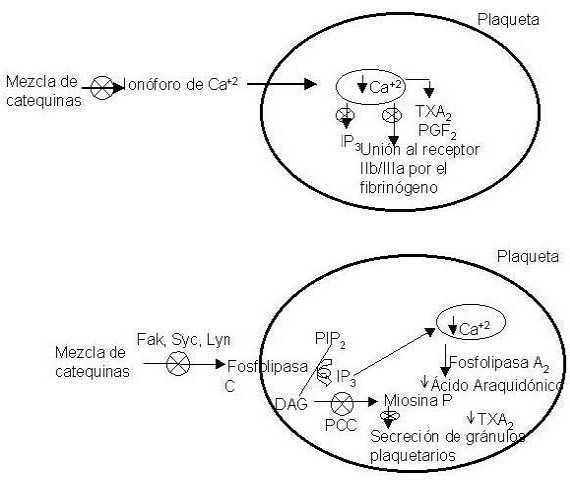
<body><![CDATA[<P ALIGN="JUSTIFY">En resumen, se puede afirmar que el mecanismo de acci&oacute;n de los antioxidantes del t&eacute; verde en el organismo cursa con su acumulaci&oacute;n en la pared arterial y con la disminuci&oacute;n de la oxidaci&oacute;n de las LDL (al aumentar el estado antioxidante de las c&eacute;lulas, mediante la quelaci&oacute;n de iones met&aacute;licos o inhibici&oacute;n de la actividad de enzimas oxidantes) (13). Independientemente del mecanismo de acci&oacute;n, la mayor&iacute;a de los estudios realizados sugieren que el consumo diario de t&eacute; verde convierte a las LDL en m&aacute;s resistente a la oxidaci&oacute;n, lo que conduce a una disminuci&oacute;n del riesgo de sufrir enfermedades cardiovasculares (115).&nbsp;</P> <B>    <P ALIGN="JUSTIFY">Acci&oacute;n del t&eacute; sobre la adhesi&oacute;n de monocitos al endotelio vascular</P> </B>    <P ALIGN="JUSTIFY">Una fase fundamental en el desarrollo de la ateroesclerosis lo constituye la adhesi&oacute;n de monocitos a la pared endotelial y su posterior infiltraci&oacute;n y diferenciaci&oacute;n a macr&oacute;fagos (35). Para que los monocitos se adhieran a la pared endotelial es fundamental la presencia de sustancias tales como la mol&eacute;cula de adhesi&oacute;n a c&eacute;lulas vasculares (1VCAM-1) que es la que tiene una mayor importancia en la iniciaci&oacute;n de la ateroesclerosis (116), la mol&eacute;cula de adhesi&oacute;n intercelular (1ICAM-1) y la mol&eacute;cula de adhesi&oacute;n de leucocitos al endotelio-E (E-selectina) (117); siendo necesario para la expresi&oacute;n de la mol&eacute;cula VCAM-1 la presencia del factor de transcripci&oacute;n NF-8B (118,119).</P>     <P ALIGN="JUSTIFY">En c&eacute;lulas endoteliales de cord&oacute;n umbilical humano (HUVECs), en las que se induc&iacute;a la expresi&oacute;n de las mol&eacute;culas de adhesi&oacute;n anteriormente citadas y posteriormente se cultivaban con concentraciones de catequinas entre 10 y 100 &#956;<FONT FACE="Times New Roman">M, se vio que &#970;nicamente se inhib&#957;a de forma dosis-dependiente la expresi&#963;</FONT>n de VCAM-1. Dicha inhibici&oacute;n se produc&iacute;a a nivel del RNAm y no afectaba a la activaci&oacute;n del factor NF-8B. Por otra parte la catequina m&aacute;s eficaz result&oacute; ser la EGCG, seguida de la ECG, mientras que ni la EC ni la EGC mostraron efecto significativo (120). Esto indica que s&oacute;lo las catequinas que presentan el grupo galato reducen la expresi&oacute;n de las mol&eacute;culas de adhesi&oacute;n (121).&nbsp;</P> <B>    <P ALIGN="JUSTIFY">Acci&oacute;n del t&eacute; sobre la agregaci&oacute;n plaquetaria</P> </B>    <P ALIGN="JUSTIFY">Las plaquetas presentan un importante papel tanto como en el mantenimiento de la hemostasia como en la formaci&oacute;n de trombos, ya que para esto es necesario la activaci&oacute;n y la agregaci&oacute;n de las plaquetas (122). Por esta raz&oacute;n, la inhibici&oacute;n de la funci&oacute;n plaquetaria representa un camino prometedor para la prevenci&oacute;n de las trombosis (4).</P>     <P ALIGN="JUSTIFY">Un mecanismo fundamental para que se produzca la agregaci&oacute;n plaquetaria es el incremento de calcio en el interior de la plaqueta. El ion&oacute;foro de calcio A23187 aumenta el flujo de calcio desde el exterior hasta el interior de la plaqueta consiguiendo aumentar la concentraci&oacute;n de calcio intracelular. Este aumento conduce a la formaci&oacute;n de diferentes endoper&oacute;xidos y a la fosforilaci&oacute;n de diversas prote&iacute;nas que son necesarias para que se produzca la agregaci&oacute;n (123). Dicho ion&oacute;foro es inhibido por la GTC y la EGCG del t&eacute; verde y su inhibici&oacute;n conduce a una disminuci&oacute;n del Ca<SUP>2+</SUP> en el interior de la plaqueta (4). Esta disminuci&oacute;n trae como consecuencias una inhibici&oacute;n de la formaci&oacute;n del inositol trifosfato (IP<SUB>3</SUB>), una inhibici&oacute;n de la uni&oacute;n del fibrin&oacute;geno a su receptor plaquetario IIb/IIIa (124) y posiblemente un descenso del tromboxano A<SUB>2</SUB> (TXA<SUB>2</SUB>) y de la prostaglandina F<SUB><FONT FACE="Times New Roman">2&#945; </SUB></FONT>(PGF<SUB><FONT FACE="Times New Roman">2&#945;</SUB></FONT>) (4), impidiendo todo ello la agregaci&oacute;n plaquetaria (4,124) (<a HREF="#FIGURA 4">Figura 4a</a>).</P>     <P ALIGN="CENTER">&nbsp;<B>FIGURA 4 </B></P>     <P ALIGN="CENTER">Posibles mecanismos de acci&oacute;n del las catequinas sobre la agregaci&oacute;n plaquetaria</P>     <P ALIGN="CENTER"><a name="FIGURA 4"><img border="0" src="/img/fbpe/Alan/v54n4/art3img4.jpg"></a></P>     
]]></body>
<body><![CDATA[<P>IP<SUB>2 </SUB>:<SUB> </SUB>Fosfoditil inositol difosfato </P>     <P>IP<SUB>3 </SUB>: Inositol trifosfato</P>     <P>DAG: Diacilglicerol</P>     <P>PCC: Proteinquinasa C</P>     <P align="center">&nbsp;&nbsp;&nbsp;&nbsp;&nbsp;&nbsp;&nbsp;&nbsp;&nbsp;&nbsp;&nbsp;&nbsp;&nbsp;&nbsp; <img border="0" src="/img/fbpe/Alan/v54n4/art03.5.gif" align="left"><FONT SIZE=2>&nbsp;&nbsp; </FONT></P>     
<P><font size="3"> V&iacute;a de proceso inhibida</font></P>     <P ALIGN="JUSTIFY"><font size="3">a. Esquema realizado a partir de los datos y conclusiones de Kang et al (4,124)</font></P>     <P ALIGN="JUSTIFY"><font size="3">b. Esquema realizado a partir de los datos y conclusiones de Lill et al (17) y Deana et al (128)</font></P>     <P ALIGN="JUSTIFY">Otro mecanismo proagregante consiste en la fosforilaci&oacute;n inducida por la trombina de residuos de tiroxina de prote&iacute;nas quinasas de las plaquetas (125). La activaci&oacute;n de las prote&iacute;nas quinasas FAK, Syk y Lyn conduce a la fosforilaci&oacute;n de prote&iacute;nas que son necesarias para la activaci&oacute;n de la fosfolipasa C, que regula el aumento de calcio intracelular y la activaci&oacute;n de la prote&iacute;n quinasa C, que es necesaria a su vez para la expresi&oacute;n del receptor IIb/IIIa del fibrin&oacute;geno (126,127). Diferentes estudios han encontrado una inhibici&oacute;n de la activaci&oacute;n de las prote&iacute;nas quinasas FAK (17), Syk y Lyn (128) por la EGCG del t&eacute;, lo que conduce a un efecto antiagregante de las plaquetas (17). (<a HREF="#FIGURA 4">Figura 4b</a>). Sin embargo otros han observado una activaci&oacute;n de la prote&iacute;na quinasa Syk, lo que produce el efecto contrario sobre las plaquetas (17).</P>     <P ALIGN="JUSTIFY">En estudios in vivo las catequinas del t&eacute; verde tienen actividad antitromb&oacute;tica de manera dosis dependiente similar a la aspirina, siendo su porcentaje de protecci&oacute;n del 40, 65, 85% a dosis de 10, 50 y 100 mg/kg respectivamente; siendo en el caso concreto de la EGCG del 45,5 y 69,1% a una dosis de 10 y 50g/kg respectivamente. De igual manera, se ha demostrado una prolongaci&oacute;n en el tiempo de coagulaci&oacute;n similar al de este f&aacute;rmaco (4). Tambi&eacute;n es de inter&eacute;s se&ntilde;alar que las tres catequinas (EGCG, (+)-galato de catequina (CG), ECG) que contienen el grupo galato en la posici&oacute;n tres inhiben de manera importante la agregaci&oacute;n plaquetaria; mientras que las catequinas sin este grupo (C, EC) o las catequinas con el grupo galato en posici&oacute;n dos, no tienen este efecto sobre las plaquetas (17).</P> <B>    ]]></body>
<body><![CDATA[<P ALIGN="JUSTIFY">Efectos sobre la presi&oacute;n arterial</P> </B>    <P ALIGN="JUSTIFY">No existe pr&aacute;cticamente informaci&oacute;n bibliogr&aacute;fica contrastada de los efectos de las catequinas sobre la presi&oacute;n arterial. En este sentido, se ha comprobado en un estudio realizado en 218 mujeres de edad avanzada (<U>&gt;</U>70 a&ntilde;os) que por cada taza de t&eacute; consumida, se produc&iacute;a un descenso de 2,2 mmHg en la presi&oacute;n arterial sist&oacute;lica y 0,9 mmHg en la diast&oacute;lica, lo que indica que una ingesta regular y a largo plazo de t&eacute; tendr&iacute;a efectos favorables sobre la tensi&oacute;n arterial (129).&nbsp;</P> <B>    <P ALIGN="JUSTIFY">Efectos del t&eacute; verde y polimorfismo gen&eacute;tico</P> </B>    <P ALIGN="JUSTIFY">La aplicaci&oacute;n de la gen&eacute;tica ha supuesto avances muy importantes a la hora de identificar y valorar la calidad de diferentes variedades de t&eacute; (130). Adem&aacute;s la respuesta a las catequinas del t&eacute; es diferente en unos individuos de otros, sugiriendo que debe hablarse de individuos hipo e hiperrespondedores. Este aspecto ya ha sido comentado para el colesterol y la grasa diet&eacute;tica (131), y tiene su origen, muy posiblemente, en la existencia de polimorfismos gen&eacute;ticos (132). Al igual que ocurre con la ingesta de caf&eacute; y en particular de sus dos diterpenos (Cafestol y Kahweol) (133), la relaci&oacute;n dosis-respuesta del t&eacute; podr&iacute;a estar a su vez condicionada por variantes gen&eacute;ticas (I) de la Apo AIV y la prote&iacute;na ligante intestinal de &aacute;cidos grasos (IFABP) que modulan la absorci&oacute;n de grasa y colesterol, (II) de la actividad del enzima acil-CoA-colesterol-acil-transferasa (ACAT) o (III) de mecanismos relacionados con el transporte retr&oacute;grado de colesterol debido a mutaciones en los genes que codifican entre otras a la prote&iacute;na transferidora de &eacute;steres de colesterol (CETP) y la transferasa de grupos acilos desde la lecitina al colesterol (LCAT), etc. </P>     <P ALIGN="JUSTIFY">Muy recientemente se ha propuesto que la EGCG modifica la expresi&oacute;n g&eacute;nica mediada por H<SUB>2</SUB>O<SUB>2</SUB>, que a su vez modula la concentraci&oacute;n de multitud de prote&iacute;nas (134). Tambi&eacute;n se ha se&ntilde;alado que los polifenoles del t&eacute; ejercen unos efectos inhibitorios del desarrollo de la lesi&oacute;n ateroescler&oacute;tica a trav&eacute;s de inhibir genes codificantes para PPAR-gamma, CD36, LXR-alpha, C-myc y estimular genes codificantes para LDL-R y PPAR-alpha a nivel transcripcional (135).</P> <B>    <P ALIGN="JUSTIFY">Futuras investigaciones</P> </B>    <P ALIGN="JUSTIFY">A la vista de los estudios revisados, creemos que es necesaria la realizaci&oacute;n de m&aacute;s investigaciones bien controladas sobre el t&eacute; verde y/o sus flavonoides usando marcadores de enfermedad cardiovascular tales como la disfunci&oacute;n endotelial o el grado de progresi&oacute;n y/o regresi&oacute;n de la placa ateromatosa, tanto en hombres como en mujeres (136,137). Adem&aacute;s es necesario determinar cu&aacute;l de estos polifenoles, solos o en combinaci&oacute;n, son necesarios para reducir la formaci&oacute;n de la estr&iacute;a grasa en modelos animales (138).</P>     <P ALIGN="JUSTIFY">Con respecto al papel del t&eacute; sobre el control de peso corporal, es necesario usar los componentes purificados para identificar los componentes activos que le confieren al t&eacute; dicha propiedad; as&iacute; como, elucidar los efectos de la EGCG a largo plazo sobre el balance energ&eacute;tico y la utilizaci&oacute;n de sustratos termog&eacute;nicos en modelos animales y humanos (43). Los ensayos deben programarse a largo plazo y por tanto con ingestas cr&oacute;nicas.</P>     <P ALIGN="JUSTIFY">El t&eacute; verde muestra gran variedad de acciones sobre las plaquetas humanas. Muchos mecanismos pueden contribuir a los efectos beneficiosos de las catequinas en la aterosclerosis, como por ejemplo la inhibici&oacute;n de la funci&oacute;n plaquetaria por parte de estas catequinas. Al haberse encontrado un efecto activador de la EGCG sobre la fosforilaci&oacute;n de residuos de tiroxina de prote&iacute;nas quinasas que produce un aumento de la agregaci&oacute;n plaquetaria, hace que sea necesaria la realizaci&oacute;n de m&aacute;s estudios sobre el t&eacute; verde o las catequinas aisladas antes de recomendar definitivamente su empleo en la prevenci&oacute;n o en el tratamiento de la ateroesclerosis (17).</P>     <P ALIGN="JUSTIFY">Tambi&eacute;n se deben realizar m&aacute;s estudios sobre interacci&oacute;n con alimentos, biodisponibilidad, concentraci&oacute;n alcanzada en los diferentes tejidos y capacidad antioxidante in vivo de las catequinas del t&eacute; verde y sus metabolitos (111), as&iacute; como estudios para establecer su actividad antioxidante sobre el colesterol en animales de experimentaci&oacute;n. Tambi&eacute;n deben investigarse estos efectos en las formas de catequinas sint&eacute;ticas conjugadas, porque la actividad secuestrante de radicales libres de estas sustancias es diferentes dependiendo de la posici&oacute;n sustituida en la mol&eacute;cula (91,101).</P>     ]]></body>
<body><![CDATA[<P ALIGN="JUSTIFY">En cuanto a los oxipol&iacute;meros derivados de las catequinas del t&eacute; verde, se debe estudiar su estructura de forma m&aacute;s precisa y la relaci&oacute;n de &eacute;sta con el mecanismo antioxidante de los mismos (139) y los riesgos potenciales del consumo de t&eacute; conteniendo catequinas oxidadas.</P>     <P ALIGN="JUSTIFY">Adem&aacute;s es importante tener en cuenta los efectos adversos potenciales derivados del uso del t&eacute; verde o de sus catequinas. Por ejemplo, los efectos sobre el sistema endocrino y sus consecuencias en mujeres embarazadas y ni&ntilde;os (1). En este sentido, investigaciones recientes han demostrado que inyecciones intraperitoneales de EGCG producen cambios significativos en varios par&aacute;metros endocrinos. Despu&eacute;s de haber realizado una administraci&oacute;n de este tipo a ratas durante siete d&iacute;as, los niveles de testosterona disminuyeron aproximadamente un 75% en machos y los de 17 2-estradiol un 34% en hembras. Adem&aacute;s, en los machos, el peso de los &oacute;rganos sensibles a andr&oacute;genos se redujo 50-70% y en las hembras el peso de los &oacute;rganos sensibles a estr&oacute;genos, aproximadamente un 50%. Por tanto, las variaciones en el peso de los &oacute;rganos sexuales son catequino-dependientes, mostrando la EGCG el mayor efecto y adem&aacute;s dichas variaciones revierten al administrar hormonas sexuales de forma ex&oacute;gena (51).</P>     <P ALIGN="JUSTIFY">En cuanto a la presi&oacute;n arterial, que es un factor de riesgo de enfermedad cardiovascular bien establecido (36) y en cuyo desarrollo el estr&eacute;s oxidativo parece jugar un papel muy importante (140), se deben realizar m&aacute;s estudios sobre el consumo a largo plazo de t&eacute; verde ya que &eacute;ste, rico en sustancias antioxidantes, podr&iacute;a disminuir el da&ntilde;o oxidativo que eleva la presi&oacute;n arterial (141). </P>     <P ALIGN="JUSTIFY">Por &uacute;ltimo, la b&uacute;squeda de genes candidatos que expliquen la variabilidad de respuesta interindividual al consumo de t&eacute; es un tema cient&iacute;fico de indiscutible futuro e importancia.&nbsp;</P> <B>    <P>CONCLUSION&nbsp;</P> </B>    <P ALIGN="JUSTIFY">Los estudios revisados sugieren que un consumo superior a 7 tazas de t&eacute; verde al d&iacute;a (3,5 g de catequinas diarias) ser&iacute;a una buena elecci&oacute;n para la prevenci&oacute;n de enfermedades cardiovasculares, siempre que su consumo se realice en el marco de un ambiente correcto donde dieta y ejercicio sean equilibrados y correctos.&nbsp;</P>     <P ALIGN="JUSTIFY">Estos resultados apoyan lo expuesto hace ya muchas centurias por el monje Esai: "El t&eacute; es una medicina milagrosa para mantener la salud. El t&eacute; tiene un extraordinario poder para prolongar la vida. En cualquier lugar donde una persona cultive t&eacute;, le seguir&aacute; una larga vida" (8).</P> <B>    <P>AGRADECIMIENTOS</P> </B>    <P ALIGN="JUSTIFY">Este trabajo ha sido subvencionado por el Proyecto del Plan Nacional de Investigaci&oacute;n Cient&iacute;fica, Desarrollo e Innovaci&oacute;n Tecnol&oacute;gica referencia AGL 2001-2398-C03-03. Agradecemos al curso de Doctorado en Farmacia de la Universidad Complutense de Madrid "Nutrici&oacute;n y Enfermedades Cardiovasculares" por su contribuci&oacute;n en este art&iacute;culo.</P> <B>    <P>REFERENCIAS</P> </B>    ]]></body>
<body><![CDATA[<!-- ref --><P>1.Liao S. The medical action of androgens and green tea epigallocatechin gallate. HKMJ 2001;7: 369-374. &nbsp;&nbsp;&nbsp;&nbsp;&nbsp;&nbsp;&nbsp;&nbsp;[&#160;<a href="javascript:void(0);" onclick="javascript: window.open('/scielo.php?script=sci_nlinks&ref=447823&pid=S0004-0622200400040000300001&lng=','','width=640,height=500,resizable=yes,scrollbars=1,menubar=yes,');">Links</a>&#160;]<!-- end-ref --><!-- ref --><P ALIGN="JUSTIFY">2.&#9;Serafini M, Ghiselli A, Ferro-Luzzi A. In vivo antioxidant effect of green and green tea in man. Eur J Clin Nutr 1996;50: 28-32.&nbsp;&nbsp;&nbsp;&nbsp;&nbsp;&nbsp;&nbsp;&nbsp;[&#160;<a href="javascript:void(0);" onclick="javascript: window.open('/scielo.php?script=sci_nlinks&ref=447824&pid=S0004-0622200400040000300002&lng=','','width=640,height=500,resizable=yes,scrollbars=1,menubar=yes,');">Links</a>&#160;]<!-- end-ref --><!-- ref --><P ALIGN="JUSTIFY">3.&#9;Van het Hof KH, der Boer HS, Wiseman SA, Lien N, Westrate JA, Tijburg LB. Consumption of green or black tea does not increase resistance of low-density lipoprotein to oxidative modification. Am J Clin Nutr 1997;66: 261-266.&nbsp;&nbsp;&nbsp;&nbsp;&nbsp;&nbsp;&nbsp;&nbsp;[&#160;<a href="javascript:void(0);" onclick="javascript: window.open('/scielo.php?script=sci_nlinks&ref=447825&pid=S0004-0622200400040000300003&lng=','','width=640,height=500,resizable=yes,scrollbars=1,menubar=yes,');">Links</a>&#160;]<!-- end-ref --><!-- ref --><P ALIGN="JUSTIFY">4.&#9;Kang WS, Lim IH , Yuk DY. Antithrombotic activities of green tea catechins and (-)-epigallocatechin gallate. Thromb Res 1999;96: 229-237.&nbsp;&nbsp;&nbsp;&nbsp;&nbsp;&nbsp;&nbsp;&nbsp;[&#160;<a href="javascript:void(0);" onclick="javascript: window.open('/scielo.php?script=sci_nlinks&ref=447826&pid=S0004-0622200400040000300004&lng=','','width=640,height=500,resizable=yes,scrollbars=1,menubar=yes,');">Links</a>&#160;]<!-- end-ref --><!-- ref --><P ALIGN="JUSTIFY">5.&#9;Valcic S, Burr J, Timmermann B , Liebler D. Antioxidant chemistry of green tea catechins. New oxidation products of (-)-epigallocatechin from their reactions with peroxyl radicals. Chem Res Toxicol 2000;13:801-810.&nbsp;&nbsp;&nbsp;&nbsp;&nbsp;&nbsp;&nbsp;&nbsp;[&#160;<a href="javascript:void(0);" onclick="javascript: window.open('/scielo.php?script=sci_nlinks&ref=447827&pid=S0004-0622200400040000300005&lng=','','width=640,height=500,resizable=yes,scrollbars=1,menubar=yes,');">Links</a>&#160;]<!-- end-ref --><!-- ref --><P ALIGN="JUSTIFY">6.&#9;Leung LK, Su Y, Chen R, Zhang Z, Huang Y, Chen ZY. Theaflavins in black tea and catechins in green tea are equally effective antioxidants. J Nutr 2001; 131: 2248-2251.&nbsp;&nbsp;&nbsp;&nbsp;&nbsp;&nbsp;&nbsp;&nbsp;[&#160;<a href="javascript:void(0);" onclick="javascript: window.open('/scielo.php?script=sci_nlinks&ref=447828&pid=S0004-0622200400040000300006&lng=','','width=640,height=500,resizable=yes,scrollbars=1,menubar=yes,');">Links</a>&#160;]<!-- end-ref --><!-- ref --><P ALIGN="JUSTIFY">7.&#9;Fundaci&oacute;n Erosky, 2001. Consultado en www.consumer.es en Mayo, 2004.&nbsp;&nbsp;&nbsp;&nbsp;&nbsp;&nbsp;&nbsp;&nbsp;[&#160;<a href="javascript:void(0);" onclick="javascript: window.open('/scielo.php?script=sci_nlinks&ref=447829&pid=S0004-0622200400040000300007&lng=','','width=640,height=500,resizable=yes,scrollbars=1,menubar=yes,');">Links</a>&#160;]<!-- end-ref --><!-- ref --><P ALIGN="JUSTIFY">8.&#9;Oguni I Haray. Green tea has many medicinal activities for preventing disease such as cancer, cardio-vascular diseases and diabetes. Japan: Chunichi-shinbun Nagoya, 1990.&nbsp;&nbsp;&nbsp;&nbsp;&nbsp;&nbsp;&nbsp;&nbsp;[&#160;<a href="javascript:void(0);" onclick="javascript: window.open('/scielo.php?script=sci_nlinks&ref=447830&pid=S0004-0622200400040000300008&lng=','','width=640,height=500,resizable=yes,scrollbars=1,menubar=yes,');">Links</a>&#160;]<!-- end-ref --><!-- ref --><P ALIGN="JUSTIFY">9.&#9;Graham NH. Green tea composition, consumption, and polyphenol chemistry. Prev Med 1992;21: 334-350.&nbsp;&nbsp;&nbsp;&nbsp;&nbsp;&nbsp;&nbsp;&nbsp;[&#160;<a href="javascript:void(0);" onclick="javascript: window.open('/scielo.php?script=sci_nlinks&ref=447831&pid=S0004-0622200400040000300009&lng=','','width=640,height=500,resizable=yes,scrollbars=1,menubar=yes,');">Links</a>&#160;]<!-- end-ref --><!-- ref --><P ALIGN="JUSTIFY">10.&#9;Devesa JA. Plantas con semillas. In: Izco J, Barreno E, Burgu&eacute;s M, Costa M, Devesa J, Fern&aacute;ndez J, Gallardo T, Llinona X, Salvo E, Talaberas S, Valdes B. Bot&aacute;nica. McGraw-Hill: Madrid; 1997: 379-581. &nbsp;&nbsp;&nbsp;&nbsp;&nbsp;&nbsp;&nbsp;&nbsp;[&#160;<a href="javascript:void(0);" onclick="javascript: window.open('/scielo.php?script=sci_nlinks&ref=447832&pid=S0004-0622200400040000300010&lng=','','width=640,height=500,resizable=yes,scrollbars=1,menubar=yes,');">Links</a>&#160;]<!-- end-ref --><!-- ref --><P ALIGN="JUSTIFY">11.&#9;Innatia. Consultado en: www.innatia.com/te/te_verde.php Mayo, 2004.&nbsp;&nbsp;&nbsp;&nbsp;&nbsp;&nbsp;&nbsp;&nbsp;[&#160;<a href="javascript:void(0);" onclick="javascript: window.open('/scielo.php?script=sci_nlinks&ref=447833&pid=S0004-0622200400040000300011&lng=','','width=640,height=500,resizable=yes,scrollbars=1,menubar=yes,');">Links</a>&#160;]<!-- end-ref --><!-- ref --><P ALIGN="JUSTIFY">12.&#9;Salazarp L. Consultado en: www.nutriinfo.com.ar/pagina/info/t&eacute;verde.htlm. Mayo, 2004.&nbsp;&nbsp;&nbsp;&nbsp;&nbsp;&nbsp;&nbsp;&nbsp;[&#160;<a href="javascript:void(0);" onclick="javascript: window.open('/scielo.php?script=sci_nlinks&ref=447834&pid=S0004-0622200400040000300012&lng=','','width=640,height=500,resizable=yes,scrollbars=1,menubar=yes,');">Links</a>&#160;]<!-- end-ref --><!-- ref --><P ALIGN="JUSTIFY">13.&#9;Tijburg L, Wiseman S, Meijer G, Weststrate J. Effects of green tea, black tea and dietary lipophylic antioxidants on LDL oxidizability and atherosclerosis in hypercholesterolaemic rabbits. Atherosclerosis 1997;135: 37-47.&nbsp;&nbsp;&nbsp;&nbsp;&nbsp;&nbsp;&nbsp;&nbsp;[&#160;<a href="javascript:void(0);" onclick="javascript: window.open('/scielo.php?script=sci_nlinks&ref=447835&pid=S0004-0622200400040000300013&lng=','','width=640,height=500,resizable=yes,scrollbars=1,menubar=yes,');">Links</a>&#160;]<!-- end-ref --><!-- ref --><P ALIGN="JUSTIFY">14.&#9;Hodgson JM, Puddey IB, Croft KD, Burke V, Mori VB, Cacceta R, Beilin L. Acute effects of ingestion of black and green tea on lipoprotein oxidation. Am J Clin Nutr 2000;71: 1103-1107.&nbsp;&nbsp;&nbsp;&nbsp;&nbsp;&nbsp;&nbsp;&nbsp;[&#160;<a href="javascript:void(0);" onclick="javascript: window.open('/scielo.php?script=sci_nlinks&ref=447836&pid=S0004-0622200400040000300014&lng=','','width=640,height=500,resizable=yes,scrollbars=1,menubar=yes,');">Links</a>&#160;]<!-- end-ref --><!-- ref --><P ALIGN="JUSTIFY">15.&#9;Yamamoto T, Juneja LR, Chu DC, Kim M, editors. Chemistry and applications of green tea. New York: CRC Press, 1997.&nbsp;&nbsp;&nbsp;&nbsp;&nbsp;&nbsp;&nbsp;&nbsp;[&#160;<a href="javascript:void(0);" onclick="javascript: window.open('/scielo.php?script=sci_nlinks&ref=447837&pid=S0004-0622200400040000300015&lng=','','width=640,height=500,resizable=yes,scrollbars=1,menubar=yes,');">Links</a>&#160;]<!-- end-ref --><!-- ref --><P ALIGN="JUSTIFY">16. Liang Y, Ma W, Lu J, Wu Y. Comparison of chemical compositions of Ilex latifolia Thumb and Camellia sinensis L. Food Chemistry 2001;75: 339-343.&nbsp;&nbsp;&nbsp;&nbsp;&nbsp;&nbsp;&nbsp;&nbsp;[&#160;<a href="javascript:void(0);" onclick="javascript: window.open('/scielo.php?script=sci_nlinks&ref=447838&pid=S0004-0622200400040000300016&lng=','','width=640,height=500,resizable=yes,scrollbars=1,menubar=yes,');">Links</a>&#160;]<!-- end-ref --><!-- ref --><P ALIGN="JUSTIFY">17.&#9;Lill G, Voit S, Schr&ouml;r K , Weber AA. Complex effects of different green tea catechins on human platelets. FEBS Letters 2003;546: 265-270.&nbsp;&nbsp;&nbsp;&nbsp;&nbsp;&nbsp;&nbsp;&nbsp;[&#160;<a href="javascript:void(0);" onclick="javascript: window.open('/scielo.php?script=sci_nlinks&ref=447839&pid=S0004-0622200400040000300017&lng=','','width=640,height=500,resizable=yes,scrollbars=1,menubar=yes,');">Links</a>&#160;]<!-- end-ref --><!-- ref --><P ALIGN="JUSTIFY">18.&#9;Astill C, Birch MR, Dacombe C, Humphrey PG, Martin PT. Factors affecting the caffeine and polyphenol contents of black and green tea infusions. J Agric Food Chem 2001;49: 5340-5347.&nbsp;&nbsp;&nbsp;&nbsp;&nbsp;&nbsp;&nbsp;&nbsp;[&#160;<a href="javascript:void(0);" onclick="javascript: window.open('/scielo.php?script=sci_nlinks&ref=447840&pid=S0004-0622200400040000300018&lng=','','width=640,height=500,resizable=yes,scrollbars=1,menubar=yes,');">Links</a>&#160;]<!-- end-ref --><!-- ref --><P ALIGN="JUSTIFY">19.&#9;Wang H. Determination of flavonols in green and black tea leaves and green tea infusions by high performance liquid chromatography. Food Research Int 2001;34: 223-227.&nbsp;&nbsp;&nbsp;&nbsp;&nbsp;&nbsp;&nbsp;&nbsp;[&#160;<a href="javascript:void(0);" onclick="javascript: window.open('/scielo.php?script=sci_nlinks&ref=447841&pid=S0004-0622200400040000300019&lng=','','width=640,height=500,resizable=yes,scrollbars=1,menubar=yes,');">Links</a>&#160;]<!-- end-ref --><!-- ref --><P ALIGN="JUSTIFY">20.&#9;Bhagwat S, Beecher GR, Haytowitz DB, Holden JM, Dwyer J, Peterson J, Gebhardt SE, Elridge AL, Agarwal S, Balentine DA. Flavonoid composition of tea: Comparison of black and green teas. Agricultural Research Service, 2003. En: http://www.nal.usda.gov/fnic/foodcomp/Data/Other/IFT2003_TeaFlav.pdf&nbsp;&nbsp;&nbsp;&nbsp;&nbsp;&nbsp;&nbsp;&nbsp;[&#160;<a href="javascript:void(0);" onclick="javascript: window.open('/scielo.php?script=sci_nlinks&ref=447842&pid=S0004-0622200400040000300020&lng=','','width=640,height=500,resizable=yes,scrollbars=1,menubar=yes,');">Links</a>&#160;]<!-- end-ref --><!-- ref --><P ALIGN="JUSTIFY">21.&#9;Chen ZY, Zhu QY, Tsang D, Huang Y. Degradation of green tea catechins in tea drinks. J Agric Food Chem 2001;49: 477-482.&nbsp;&nbsp;&nbsp;&nbsp;&nbsp;&nbsp;&nbsp;&nbsp;[&#160;<a href="javascript:void(0);" onclick="javascript: window.open('/scielo.php?script=sci_nlinks&ref=447843&pid=S0004-0622200400040000300021&lng=','','width=640,height=500,resizable=yes,scrollbars=1,menubar=yes,');">Links</a>&#160;]<!-- end-ref --><!-- ref --><P ALIGN="JUSTIFY">22.&#9;Lin YL, Juan IM, Chen YL, Liang YC, Lin JK. Composition of polyphenols in fresh tea leaves and association of their oxygen radical-absorbing capacity with antiproliferative actions in fibroblast cell. J Agric Food Chem 1996;44: 1387-1394.&nbsp;&nbsp;&nbsp;&nbsp;&nbsp;&nbsp;&nbsp;&nbsp;[&#160;<a href="javascript:void(0);" onclick="javascript: window.open('/scielo.php?script=sci_nlinks&ref=447844&pid=S0004-0622200400040000300022&lng=','','width=640,height=500,resizable=yes,scrollbars=1,menubar=yes,');">Links</a>&#160;]<!-- end-ref --><!-- ref --><P ALIGN="JUSTIFY">23.&#9;Lin YS, Tsai YJ, Tsay JS, Lin JK. Factors affecting the levels of tea polyphenols and caffeine in tea leaves. J Agric Chem 2003;51: 1864-1873.&nbsp;&nbsp;&nbsp;&nbsp;&nbsp;&nbsp;&nbsp;&nbsp;[&#160;<a href="javascript:void(0);" onclick="javascript: window.open('/scielo.php?script=sci_nlinks&ref=447845&pid=S0004-0622200400040000300023&lng=','','width=640,height=500,resizable=yes,scrollbars=1,menubar=yes,');">Links</a>&#160;]<!-- end-ref --><!-- ref --><P ALIGN="JUSTIFY">24.&#9;Stagg GV , Millin DJ. The nutritional and therapeutic value of tea-a review. J Sci Food Agric 1975;26: 1439-1459.&nbsp;&nbsp;&nbsp;&nbsp;&nbsp;&nbsp;&nbsp;&nbsp;[&#160;<a href="javascript:void(0);" onclick="javascript: window.open('/scielo.php?script=sci_nlinks&ref=447846&pid=S0004-0622200400040000300024&lng=','','width=640,height=500,resizable=yes,scrollbars=1,menubar=yes,');">Links</a>&#160;]<!-- end-ref --><!-- ref --><P ALIGN="JUSTIFY">25.&#9;Yang CS, Landau JM. Effects of tea consumption nutrition health. J Nutr 2000;130: 2409-2412.&nbsp;&nbsp;&nbsp;&nbsp;&nbsp;&nbsp;&nbsp;&nbsp;[&#160;<a href="javascript:void(0);" onclick="javascript: window.open('/scielo.php?script=sci_nlinks&ref=447847&pid=S0004-0622200400040000300025&lng=','','width=640,height=500,resizable=yes,scrollbars=1,menubar=yes,');">Links</a>&#160;]<!-- end-ref --><!-- ref --><P ALIGN="JUSTIFY">26.&#9;Mukhtar H, Ahmad N. Tea polyphenols: Prevention of cancer and optimizing health. Am J Clin Nutr 2000;71: 1698S-1704S.&nbsp;&nbsp;&nbsp;&nbsp;&nbsp;&nbsp;&nbsp;&nbsp;[&#160;<a href="javascript:void(0);" onclick="javascript: window.open('/scielo.php?script=sci_nlinks&ref=447848&pid=S0004-0622200400040000300026&lng=','','width=640,height=500,resizable=yes,scrollbars=1,menubar=yes,');">Links</a>&#160;]<!-- end-ref --><!-- ref --><P ALIGN="JUSTIFY">27.&#9;He YH, Kies C. Green and black tea consumption by humans: impact on polyphenol concentrations in feces, blood and urine. Plant Foods Hum Nutr 1994;46: 221-229.&nbsp;&nbsp;&nbsp;&nbsp;&nbsp;&nbsp;&nbsp;&nbsp;[&#160;<a href="javascript:void(0);" onclick="javascript: window.open('/scielo.php?script=sci_nlinks&ref=447849&pid=S0004-0622200400040000300027&lng=','','width=640,height=500,resizable=yes,scrollbars=1,menubar=yes,');">Links</a>&#160;]<!-- end-ref --><!-- ref --><P ALIGN="JUSTIFY">28.&#9;Yang CS, Chen L, Lee MJ, Balentine D, Kuo MC, Schantz SP. Blood and urine levels of tea catechins after ingestion of different amounts of green tea by human volunteers. Cancer Epid Bio Prev 1998;7: 351-354.&nbsp;&nbsp;&nbsp;&nbsp;&nbsp;&nbsp;&nbsp;&nbsp;[&#160;<a href="javascript:void(0);" onclick="javascript: window.open('/scielo.php?script=sci_nlinks&ref=447850&pid=S0004-0622200400040000300028&lng=','','width=640,height=500,resizable=yes,scrollbars=1,menubar=yes,');">Links</a>&#160;]<!-- end-ref --><!-- ref --><P ALIGN="JUSTIFY">29.&#9;Yang CS, Lee MJ, Chen L. Human salivary tea catechin levels and catechin esterase activities: implications in human cancer prevention studies. Cancer Epidemiol Biomarkers Prev 1999;8: 83-89.&nbsp;&nbsp;&nbsp;&nbsp;&nbsp;&nbsp;&nbsp;&nbsp;[&#160;<a href="javascript:void(0);" onclick="javascript: window.open('/scielo.php?script=sci_nlinks&ref=447851&pid=S0004-0622200400040000300029&lng=','','width=640,height=500,resizable=yes,scrollbars=1,menubar=yes,');">Links</a>&#160;]<!-- end-ref --><!-- ref --><P ALIGN="JUSTIFY">30.&#9;Van het Hof KH, Kivits GAA, Westrate JA, Tijburg LBM. Bioavaility of catechins from tea: the effect of milk. Eur J Clin Nutr 1998;52: 356-359.&nbsp;&nbsp;&nbsp;&nbsp;&nbsp;&nbsp;&nbsp;&nbsp;[&#160;<a href="javascript:void(0);" onclick="javascript: window.open('/scielo.php?script=sci_nlinks&ref=447852&pid=S0004-0622200400040000300030&lng=','','width=640,height=500,resizable=yes,scrollbars=1,menubar=yes,');">Links</a>&#160;]<!-- end-ref --><!-- ref --><P ALIGN="JUSTIFY">31.&#9;Hollman PCH, Gaag M, Mengelers MJB, Trijp JMP, Vries JHM, Katan MB. Absorption and disposition kinetics of the dietary antioxidant quercetin in man. Free Rad Biol Med 1996;21: 703-707.&nbsp;&nbsp;&nbsp;&nbsp;&nbsp;&nbsp;&nbsp;&nbsp;[&#160;<a href="javascript:void(0);" onclick="javascript: window.open('/scielo.php?script=sci_nlinks&ref=447853&pid=S0004-0622200400040000300031&lng=','','width=640,height=500,resizable=yes,scrollbars=1,menubar=yes,');">Links</a>&#160;]<!-- end-ref --><!-- ref --><P ALIGN="JUSTIFY">32.&#9;Brown PJ , Wright WB. An investigation of the interactions between milk proteins and tea poliphenols. J Chromatog 1963;11: 5504-514.&nbsp;&nbsp;&nbsp;&nbsp;&nbsp;&nbsp;&nbsp;&nbsp;[&#160;<a href="javascript:void(0);" onclick="javascript: window.open('/scielo.php?script=sci_nlinks&ref=447854&pid=S0004-0622200400040000300032&lng=','','width=640,height=500,resizable=yes,scrollbars=1,menubar=yes,');">Links</a>&#160;]<!-- end-ref --><!-- ref --><P ALIGN="JUSTIFY">33.&#9;Fingl E, Woodbury DM. General principles. In: Goodman LS, Gilman A, editors. The pharmacological basis of therapeutics. New York: Macmillan, 1970:24-25. &nbsp;&nbsp;&nbsp;&nbsp;&nbsp;&nbsp;&nbsp;&nbsp;[&#160;<a href="javascript:void(0);" onclick="javascript: window.open('/scielo.php?script=sci_nlinks&ref=447855&pid=S0004-0622200400040000300033&lng=','','width=640,height=500,resizable=yes,scrollbars=1,menubar=yes,');">Links</a>&#160;]<!-- end-ref --><!-- ref --><P ALIGN="JUSTIFY">34.&#9;Bastida S, S&aacute;nchez-Muniz FJ. Nutrici&oacute;n y obesidad. Rev Nutr Practica, 1999, 3: 49-58.&nbsp;&nbsp;&nbsp;&nbsp;&nbsp;&nbsp;&nbsp;&nbsp;[&#160;<a href="javascript:void(0);" onclick="javascript: window.open('/scielo.php?script=sci_nlinks&ref=447856&pid=S0004-0622200400040000300034&lng=','','width=640,height=500,resizable=yes,scrollbars=1,menubar=yes,');">Links</a>&#160;]<!-- end-ref --><!-- ref --><P ALIGN="JUSTIFY">35.&#9;S&aacute;nchez-Muniz FJ, Varela Gallego P, Bastida Codina S, Gonz&aacute;lez Lorenzo JM Enfermedad cardiovascular. Hipertensi&oacute;n arterial. Dislipemia. En Cuidados farmacol&oacute;gicos y nutricionales en el paciente de edad avanzada. Carbajal A y Varela P, editors. Tema 2. Fundaci&oacute;n General de la Universidad Complutense 2001: 1-47.&nbsp;&nbsp;&nbsp;&nbsp;&nbsp;&nbsp;&nbsp;&nbsp;[&#160;<a href="javascript:void(0);" onclick="javascript: window.open('/scielo.php?script=sci_nlinks&ref=447857&pid=S0004-0622200400040000300035&lng=','','width=640,height=500,resizable=yes,scrollbars=1,menubar=yes,');">Links</a>&#160;]<!-- end-ref --><!-- ref --><P ALIGN="JUSTIFY">36.&#9;Bastida S, S&aacute;nchez-Muniz FJ. Fitoterapia en el control del exceso de peso. En Plantas medicinales en su farmacia. Formaci&oacute;n sobre plantas medicinales por el farmac&eacute;utico. Edufarm y Consejo General de Colegios Oficiales de Farmac&eacute;uticos, 2000: 37-46.&nbsp;&nbsp;&nbsp;&nbsp;&nbsp;&nbsp;&nbsp;&nbsp;[&#160;<a href="javascript:void(0);" onclick="javascript: window.open('/scielo.php?script=sci_nlinks&ref=447858&pid=S0004-0622200400040000300036&lng=','','width=640,height=500,resizable=yes,scrollbars=1,menubar=yes,');">Links</a>&#160;]<!-- end-ref --><!-- ref --><P ALIGN="JUSTIFY">37.&#9;Dulloo A, Duret D, Rohrer D, Girardier L, Mensi N, Fathi M, Chantre P, Vandermander J. Efficacy of a green tea extract rich in catechin polyphenols and caffeine in increasing 24-h energy expenditure and fat oxidation in humans. Am J Nutr 1999;70: 1040-1045.&nbsp;&nbsp;&nbsp;&nbsp;&nbsp;&nbsp;&nbsp;&nbsp;[&#160;<a href="javascript:void(0);" onclick="javascript: window.open('/scielo.php?script=sci_nlinks&ref=447859&pid=S0004-0622200400040000300037&lng=','','width=640,height=500,resizable=yes,scrollbars=1,menubar=yes,');">Links</a>&#160;]<!-- end-ref --><!-- ref --><P ALIGN="JUSTIFY">38.&#9;Bret&oacute;n I. ¿Por qu&eacute; nos hacemos obesos? Rev Nutr Practica 2004;6: 9-13.&nbsp;&nbsp;&nbsp;&nbsp;&nbsp;&nbsp;&nbsp;&nbsp;[&#160;<a href="javascript:void(0);" onclick="javascript: window.open('/scielo.php?script=sci_nlinks&ref=447860&pid=S0004-0622200400040000300038&lng=','','width=640,height=500,resizable=yes,scrollbars=1,menubar=yes,');">Links</a>&#160;]<!-- end-ref --><!-- ref --><P ALIGN="JUSTIFY">39.&#9;Dulloo AG. Strategies to counteract readjustments towards lower metabolic rates during obesity management. Nutrition 1993;9: 366-372.&nbsp;&nbsp;&nbsp;&nbsp;&nbsp;&nbsp;&nbsp;&nbsp;[&#160;<a href="javascript:void(0);" onclick="javascript: window.open('/scielo.php?script=sci_nlinks&ref=447861&pid=S0004-0622200400040000300039&lng=','','width=640,height=500,resizable=yes,scrollbars=1,menubar=yes,');">Links</a>&#160;]<!-- end-ref --><!-- ref --><P ALIGN="JUSTIFY">40.&#9;Landsberg L, Young JB. Sympathoadrenal activity and obesity: physiological rationale for the use of adrenergic thermogenic drugs. Int Obes Relat Metab Disord 1993;65: S29-S34.&nbsp;&nbsp;&nbsp;&nbsp;&nbsp;&nbsp;&nbsp;&nbsp;[&#160;<a href="javascript:void(0);" onclick="javascript: window.open('/scielo.php?script=sci_nlinks&ref=447862&pid=S0004-0622200400040000300040&lng=','','width=640,height=500,resizable=yes,scrollbars=1,menubar=yes,');">Links</a>&#160;]<!-- end-ref --><!-- ref --><P ALIGN="JUSTIFY">41. Arch JRS, Wilson JB. Prospects for &#946;</FONT><SUB>3</SUB>-adrenoceptor agonists in the treatment of obesity and diabetes. Int J Obes Relat Metab Disord 1996;20: 191-199.&nbsp;&nbsp;&nbsp;&nbsp;&nbsp;&nbsp;&nbsp;&nbsp;[&#160;<a href="javascript:void(0);" onclick="javascript: window.open('/scielo.php?script=sci_nlinks&ref=447863&pid=S0004-0622200400040000300041&lng=','','width=640,height=500,resizable=yes,scrollbars=1,menubar=yes,');">Links</a>&#160;]<!-- end-ref --><!-- ref --><P ALIGN="JUSTIFY">42. Liao S, Liang T. Methods and compositions for inhibiting 5&#945;-reductase activity. US patent 5, 605, 909,1997.&nbsp;&nbsp;&nbsp;&nbsp;&nbsp;&nbsp;&nbsp;&nbsp;[&#160;<a href="javascript:void(0);" onclick="javascript: window.open('/scielo.php?script=sci_nlinks&ref=447864&pid=S0004-0622200400040000300042&lng=','','width=640,height=500,resizable=yes,scrollbars=1,menubar=yes,');">Links</a>&#160;]<!-- end-ref --><!-- ref --><P ALIGN="JUSTIFY">43.&#9;Kao YH, Hiipakka RA, Liao S. Modulation of obesity by a green tea catechin. Am J Clin Nutr 2000; 72: 1232-1234.&nbsp;&nbsp;&nbsp;&nbsp;&nbsp;&nbsp;&nbsp;&nbsp;[&#160;<a href="javascript:void(0);" onclick="javascript: window.open('/scielo.php?script=sci_nlinks&ref=447865&pid=S0004-0622200400040000300043&lng=','','width=640,height=500,resizable=yes,scrollbars=1,menubar=yes,');">Links</a>&#160;]<!-- end-ref --><!-- ref --><P ALIGN="JUSTIFY">44.&#9;Borchardt RT, Huber JA. Catechol-o-methyltransferase: structure-activity relationship for inhibition by flavonoids. J Med Chem 1975;18: 120-122.&nbsp;&nbsp;&nbsp;&nbsp;&nbsp;&nbsp;&nbsp;&nbsp;[&#160;<a href="javascript:void(0);" onclick="javascript: window.open('/scielo.php?script=sci_nlinks&ref=447866&pid=S0004-0622200400040000300044&lng=','','width=640,height=500,resizable=yes,scrollbars=1,menubar=yes,');">Links</a>&#160;]<!-- end-ref --><!-- ref --><P ALIGN="JUSTIFY">45.&#9;Palou A. Los genes de la obesidad. Formaci&oacute;n Continuada en Nutrici&oacute;n y Obesidad 1998;6: 280-298.&nbsp;&nbsp;&nbsp;&nbsp;&nbsp;&nbsp;&nbsp;&nbsp;[&#160;<a href="javascript:void(0);" onclick="javascript: window.open('/scielo.php?script=sci_nlinks&ref=447867&pid=S0004-0622200400040000300045&lng=','','width=640,height=500,resizable=yes,scrollbars=1,menubar=yes,');">Links</a>&#160;]<!-- end-ref --><!-- ref --><P ALIGN="JUSTIFY">46.&#9;Dulloo AG, Seydoux J, Girardier L. Potentiation of the thermogenic antiobesity effects of ephedrine by dietary methylxanthines: adenosine antagonism or phosphodiesterase inhibition? Metabolism. 1992;41:1 233-41.&nbsp;&nbsp;&nbsp;&nbsp;&nbsp;&nbsp;&nbsp;&nbsp;[&#160;<a href="javascript:void(0);" onclick="javascript: window.open('/scielo.php?script=sci_nlinks&ref=447868&pid=S0004-0622200400040000300046&lng=','','width=640,height=500,resizable=yes,scrollbars=1,menubar=yes,');">Links</a>&#160;]<!-- end-ref --><!-- ref --><P ALIGN="JUSTIFY">47.&#9;Dullo A, Seydoux J, Girardier L, Chantre P, Vandermander J. Green tea and thermogenesis: interactions between catechin-polyphenols, caffeine and sympathetic activity. Int J Obes Relat Metab Disord 2000;24: 252-258.&nbsp;&nbsp;&nbsp;&nbsp;&nbsp;&nbsp;&nbsp;&nbsp;[&#160;<a href="javascript:void(0);" onclick="javascript: window.open('/scielo.php?script=sci_nlinks&ref=447869&pid=S0004-0622200400040000300047&lng=','','width=640,height=500,resizable=yes,scrollbars=1,menubar=yes,');">Links</a>&#160;]<!-- end-ref --><!-- ref --><P ALIGN="JUSTIFY">48.&#9;Dulloo AG, Seydoux J, Girardier L. Tealine and thermogenesis: interactions between polyphenols, caffeine and sympathetic activity. Int J Obes Relat Metab Disord 1996;20: 71-79.&nbsp;&nbsp;&nbsp;&nbsp;&nbsp;&nbsp;&nbsp;&nbsp;[&#160;<a href="javascript:void(0);" onclick="javascript: window.open('/scielo.php?script=sci_nlinks&ref=447870&pid=S0004-0622200400040000300048&lng=','','width=640,height=500,resizable=yes,scrollbars=1,menubar=yes,');">Links</a>&#160;]<!-- end-ref --><!-- ref --><P ALIGN="JUSTIFY">49.&#9;Lee MJ, Wang ZY, Li H, Chen L, Sun Y, Gobbo S, Balentine DA, Yang CS. Analysis of plasma and urinary tea polyphenols in human subjects. Cancer Epidemiol Biomarkers Prev 1995;44: 93-399.&nbsp;&nbsp;&nbsp;&nbsp;&nbsp;&nbsp;&nbsp;&nbsp;[&#160;<a href="javascript:void(0);" onclick="javascript: window.open('/scielo.php?script=sci_nlinks&ref=447871&pid=S0004-0622200400040000300049&lng=','','width=640,height=500,resizable=yes,scrollbars=1,menubar=yes,');">Links</a>&#160;]<!-- end-ref --><!-- ref --><P ALIGN="JUSTIFY">50.&#9;Hollman PCH, Tijburg LBM, Yang CS. Bioavailability of flavonoids from tea. Crit Rev Food Science Nutr 1997;37: 719-738.&nbsp;&nbsp;&nbsp;&nbsp;&nbsp;&nbsp;&nbsp;&nbsp;[&#160;<a href="javascript:void(0);" onclick="javascript: window.open('/scielo.php?script=sci_nlinks&ref=447872&pid=S0004-0622200400040000300050&lng=','','width=640,height=500,resizable=yes,scrollbars=1,menubar=yes,');">Links</a>&#160;]<!-- end-ref --><!-- ref --><P ALIGN="JUSTIFY">51.&#9;Kao YH, Hiipakka RA, Liao S. Modulation of endocrine systems and food intake by green tea epigallocatechin gallate. Endocrinology 2000a;141: 980-987.&nbsp;&nbsp;&nbsp;&nbsp;&nbsp;&nbsp;&nbsp;&nbsp;[&#160;<a href="javascript:void(0);" onclick="javascript: window.open('/scielo.php?script=sci_nlinks&ref=447873&pid=S0004-0622200400040000300051&lng=','','width=640,height=500,resizable=yes,scrollbars=1,menubar=yes,');">Links</a>&#160;]<!-- end-ref --><!-- ref --><P ALIGN="JUSTIFY">52. Watanabe J, Kawabata J, Niki R. Isolation and identification of acetyl-CoA carboxylase inhibitors from green tea (Camellia sinensis). Biosci Biotechnol Biochem 1998;62: 532-534.&nbsp;&nbsp;&nbsp;&nbsp;&nbsp;&nbsp;&nbsp;&nbsp;[&#160;<a href="javascript:void(0);" onclick="javascript: window.open('/scielo.php?script=sci_nlinks&ref=447874&pid=S0004-0622200400040000300052&lng=','','width=640,height=500,resizable=yes,scrollbars=1,menubar=yes,');">Links</a>&#160;]<!-- end-ref --><!-- ref --><P ALIGN="JUSTIFY">53.&#9;Muramatsu K, Fukuyo M, Hara Y. Effect of green tea catechins on plasma cholesterol level in cholesterol- fed rats. J Nutr Sci Vitaminol 1986;32: 613-622.&nbsp;&nbsp;&nbsp;&nbsp;&nbsp;&nbsp;&nbsp;&nbsp;[&#160;<a href="javascript:void(0);" onclick="javascript: window.open('/scielo.php?script=sci_nlinks&ref=447875&pid=S0004-0622200400040000300053&lng=','','width=640,height=500,resizable=yes,scrollbars=1,menubar=yes,');">Links</a>&#160;]<!-- end-ref --><!-- ref --><P ALIGN="JUSTIFY">54.&#9;Matsuda H, Chisaka T, Kubomura Y, Yamahara J, Sawada T, Fujimura H, Kimura H. Effects of crude drugs on experimental hypercholesterolemia. Tea and its active principles. J Ethnopharmacol 1986;17: 213-224.&nbsp;&nbsp;&nbsp;&nbsp;&nbsp;&nbsp;&nbsp;&nbsp;[&#160;<a href="javascript:void(0);" onclick="javascript: window.open('/scielo.php?script=sci_nlinks&ref=447876&pid=S0004-0622200400040000300054&lng=','','width=640,height=500,resizable=yes,scrollbars=1,menubar=yes,');">Links</a>&#160;]<!-- end-ref --><!-- ref --><P ALIGN="JUSTIFY">55.&#9;Ando T, Nishimura T, Matsubayashi A, Ejiri H, Inoue K, Nakayama Y, Uchiyama S, Kakuda T, Mukai I. Effects of tea catechins on cholesterol absorption with exogenously hypercholesterolemic rat (ExHC-Ta). Bull Kanagawa Dent Coll 1989;17: 21-23.&nbsp;&nbsp;&nbsp;&nbsp;&nbsp;&nbsp;&nbsp;&nbsp;[&#160;<a href="javascript:void(0);" onclick="javascript: window.open('/scielo.php?script=sci_nlinks&ref=447877&pid=S0004-0622200400040000300055&lng=','','width=640,height=500,resizable=yes,scrollbars=1,menubar=yes,');">Links</a>&#160;]<!-- end-ref --><!-- ref --><P ALIGN="JUSTIFY">56.&#9;Ikeda I, Imasato Y, Sasaki E, Nakayama M, Nagao H, Takeo T, Yayabe F, Sugano M. Tea catechins decrease micellar solubility and intestinal absorption of cholesterol in rats. Biochim Biophys Acta 1992;1127: 141-146.&nbsp;&nbsp;&nbsp;&nbsp;&nbsp;&nbsp;&nbsp;&nbsp;[&#160;<a href="javascript:void(0);" onclick="javascript: window.open('/scielo.php?script=sci_nlinks&ref=447878&pid=S0004-0622200400040000300056&lng=','','width=640,height=500,resizable=yes,scrollbars=1,menubar=yes,');">Links</a>&#160;]<!-- end-ref --><!-- ref --><P ALIGN="JUSTIFY">57.&#9;Yang TT, Koo MW. Chinese green tea lowers cholesterol level trough an increased in fecal lipid excretion. Life Sci 2000;66: 411-423. &nbsp;&nbsp;&nbsp;&nbsp;&nbsp;&nbsp;&nbsp;&nbsp;[&#160;<a href="javascript:void(0);" onclick="javascript: window.open('/scielo.php?script=sci_nlinks&ref=447879&pid=S0004-0622200400040000300057&lng=','','width=640,height=500,resizable=yes,scrollbars=1,menubar=yes,');">Links</a>&#160;]<!-- end-ref --><!-- ref --><P ALIGN="JUSTIFY">58.&#9;L&ouml;est HB, Noh SK, Koo SI. Green tea extract inhibits the lymphatic absorption of cholesterol and a-tocopherol in ovaridectomized rats. Am Soc Nutr Sci 2002;132: 1282- 1288.&nbsp;&nbsp;&nbsp;&nbsp;&nbsp;&nbsp;&nbsp;&nbsp;[&#160;<a href="javascript:void(0);" onclick="javascript: window.open('/scielo.php?script=sci_nlinks&ref=447880&pid=S0004-0622200400040000300058&lng=','','width=640,height=500,resizable=yes,scrollbars=1,menubar=yes,');">Links</a>&#160;]<!-- end-ref --><!-- ref --><P ALIGN="JUSTIFY">59.&#9;Raederstorff DG, Schlachter MF, Elste V, Weber P. Effect of EGCG on lipid absorption and plasma lipid levels in rats. J Nutr Biochem 2003;14: 326-332.&nbsp;&nbsp;&nbsp;&nbsp;&nbsp;&nbsp;&nbsp;&nbsp;[&#160;<a href="javascript:void(0);" onclick="javascript: window.open('/scielo.php?script=sci_nlinks&ref=447881&pid=S0004-0622200400040000300059&lng=','','width=640,height=500,resizable=yes,scrollbars=1,menubar=yes,');">Links</a>&#160;]<!-- end-ref --><!-- ref --><P ALIGN="JUSTIFY">60.&#9;Tsubono Y, Tsugane S. Green tea intake in relation to serum lipid levels in middle-aged Japanese men and women. Ann Epidemiol 1997;7: 280-284.&nbsp;&nbsp;&nbsp;&nbsp;&nbsp;&nbsp;&nbsp;&nbsp;[&#160;<a href="javascript:void(0);" onclick="javascript: window.open('/scielo.php?script=sci_nlinks&ref=447882&pid=S0004-0622200400040000300060&lng=','','width=640,height=500,resizable=yes,scrollbars=1,menubar=yes,');">Links</a>&#160;]<!-- end-ref --><!-- ref --><P ALIGN="JUSTIFY">61.&#9;Tokunaga S, White I, Frost C, Tanaka K, Kono S, Tokudome S, Akamatsu T, Moriyama T, Zakouji H. Green tea consumption and serum lipids and lipoproteins in a population of healthy workers in Japan. Ann Epidemiol 2002;12: 157-165.&nbsp;&nbsp;&nbsp;&nbsp;&nbsp;&nbsp;&nbsp;&nbsp;[&#160;<a href="javascript:void(0);" onclick="javascript: window.open('/scielo.php?script=sci_nlinks&ref=447883&pid=S0004-0622200400040000300061&lng=','','width=640,height=500,resizable=yes,scrollbars=1,menubar=yes,');">Links</a>&#160;]<!-- end-ref --><!-- ref --><P ALIGN="JUSTIFY">62.&#9;Yang TT, Koo MW. Hypocholesterolemic effects of Chinese tea. Pharmacol Res 1997;35: 505-512.&nbsp;&nbsp;&nbsp;&nbsp;&nbsp;&nbsp;&nbsp;&nbsp;[&#160;<a href="javascript:void(0);" onclick="javascript: window.open('/scielo.php?script=sci_nlinks&ref=447884&pid=S0004-0622200400040000300062&lng=','','width=640,height=500,resizable=yes,scrollbars=1,menubar=yes,');">Links</a>&#160;]<!-- end-ref --><!-- ref --><P ALIGN="JUSTIFY">63.&#9;Ros E. Intestinal absorption of triglyceride and cholesterol. Dietary and pharmacological inhibition to reduce cardiovascular risk. Atherosclerosis 2000;151: 357-379.&nbsp;&nbsp;&nbsp;&nbsp;&nbsp;&nbsp;&nbsp;&nbsp;[&#160;<a href="javascript:void(0);" onclick="javascript: window.open('/scielo.php?script=sci_nlinks&ref=447885&pid=S0004-0622200400040000300063&lng=','','width=640,height=500,resizable=yes,scrollbars=1,menubar=yes,');">Links</a>&#160;]<!-- end-ref --><!-- ref --><P ALIGN="JUSTIFY">64.&#9;Caniparoli JP, Gains N, Zulauf M. Influence of stigmastanyl phosphorylcholine on the size, mass, and shape of taurocholate/ lecithin/ cholesterol mixed micelles. Prog Colloid Polym Sci 1992;89: 268-270.&nbsp;&nbsp;&nbsp;&nbsp;&nbsp;&nbsp;&nbsp;&nbsp;[&#160;<a href="javascript:void(0);" onclick="javascript: window.open('/scielo.php?script=sci_nlinks&ref=447886&pid=S0004-0622200400040000300064&lng=','','width=640,height=500,resizable=yes,scrollbars=1,menubar=yes,');">Links</a>&#160;]<!-- end-ref --><!-- ref --><P ALIGN="JUSTIFY">65.&#9;Hashimoto T, Kumazawa S, Nanjo F, Hara Y, Nakayama T. Interaction of tea catechins with lipid bilayers investigated with liposome systems. Biosci Biotechnol Biochem 1999;63: 2252-2255.&nbsp;&nbsp;&nbsp;&nbsp;&nbsp;&nbsp;&nbsp;&nbsp;[&#160;<a href="javascript:void(0);" onclick="javascript: window.open('/scielo.php?script=sci_nlinks&ref=447887&pid=S0004-0622200400040000300065&lng=','','width=640,height=500,resizable=yes,scrollbars=1,menubar=yes,');">Links</a>&#160;]<!-- end-ref --><!-- ref --><P ALIGN="JUSTIFY">66.&#9;Tsuchiya. Effects of green tea catechins on membrane fluidity. Pharmacology 1999;59: 34-44.&nbsp;&nbsp;&nbsp;&nbsp;&nbsp;&nbsp;&nbsp;&nbsp;[&#160;<a href="javascript:void(0);" onclick="javascript: window.open('/scielo.php?script=sci_nlinks&ref=447888&pid=S0004-0622200400040000300066&lng=','','width=640,height=500,resizable=yes,scrollbars=1,menubar=yes,');">Links</a>&#160;]<!-- end-ref --><!-- ref --><P ALIGN="JUSTIFY">67.&#9;Yokozawa T, Nakawa T, Kitani K. Antioxidative activity of green tea polyphenol in cholesterol fed-rats. J Agric Food Chem 2002;50: 3549-3552.&nbsp;&nbsp;&nbsp;&nbsp;&nbsp;&nbsp;&nbsp;&nbsp;[&#160;<a href="javascript:void(0);" onclick="javascript: window.open('/scielo.php?script=sci_nlinks&ref=447889&pid=S0004-0622200400040000300067&lng=','','width=640,height=500,resizable=yes,scrollbars=1,menubar=yes,');">Links</a>&#160;]<!-- end-ref --><!-- ref --><P ALIGN="JUSTIFY">68. Chang PT, Fong WP, Cheung YL, Huang Y, Ho WK, Chen ZY. Jasmine green tea epicatechins are hypolipedemic in hamsters (Misocricetus auratus) fed a high fat diet. J Nutr 1999;129: 1094-1101.&nbsp;&nbsp;&nbsp;&nbsp;&nbsp;&nbsp;&nbsp;&nbsp;[&#160;<a href="javascript:void(0);" onclick="javascript: window.open('/scielo.php?script=sci_nlinks&ref=447890&pid=S0004-0622200400040000300068&lng=','','width=640,height=500,resizable=yes,scrollbars=1,menubar=yes,');">Links</a>&#160;]<!-- end-ref --><!-- ref --><P ALIGN="JUSTIFY">69.&#9;Juhel C, Armand M, Pafum Y, Rosier C, Vandermander J, Lairon D. Green tea extract (AR25) inhibits lipolysis of triglycerides in gastric and duodenal medium in vitro. J Nutr Biochem 2002;11: 45-51.&nbsp;&nbsp;&nbsp;&nbsp;&nbsp;&nbsp;&nbsp;&nbsp;[&#160;<a href="javascript:void(0);" onclick="javascript: window.open('/scielo.php?script=sci_nlinks&ref=447891&pid=S0004-0622200400040000300069&lng=','','width=640,height=500,resizable=yes,scrollbars=1,menubar=yes,');">Links</a>&#160;]<!-- end-ref --><!-- ref --><P ALIGN="JUSTIFY">70.&#9;Chisaka T, Matsuda H, Kuboruma Y, Mochizuki M, Yamahara J, Fujimura H. The effect of crude drugs on experimental hypercolesterolemia: mode of action of (-)-epigallocatechin gallate in tea leaves. Chem Pharm Bull 1988;36: 227-233.&nbsp;&nbsp;&nbsp;&nbsp;&nbsp;&nbsp;&nbsp;&nbsp;[&#160;<a href="javascript:void(0);" onclick="javascript: window.open('/scielo.php?script=sci_nlinks&ref=447892&pid=S0004-0622200400040000300070&lng=','','width=640,height=500,resizable=yes,scrollbars=1,menubar=yes,');">Links</a>&#160;]<!-- end-ref --><!-- ref --><P ALIGN="JUSTIFY">71.&#9;Kono S, Shinchi K, Ikeda N, Yanai F, Imanishi K. Green tea consumption and serum lipid profiles: a cross- sectional study in northen Kyushu, Japan. Prev Med 1992;21: 526-531.&nbsp;&nbsp;&nbsp;&nbsp;&nbsp;&nbsp;&nbsp;&nbsp;[&#160;<a href="javascript:void(0);" onclick="javascript: window.open('/scielo.php?script=sci_nlinks&ref=447893&pid=S0004-0622200400040000300071&lng=','','width=640,height=500,resizable=yes,scrollbars=1,menubar=yes,');">Links</a>&#160;]<!-- end-ref --><!-- ref --><P ALIGN="JUSTIFY">72.&#9;Imai K. Cross sectional study of effects of drinking green tea on cardiovascular and liver diseases. BMJ 1995;310: 693-696.&nbsp;&nbsp;&nbsp;&nbsp;&nbsp;&nbsp;&nbsp;&nbsp;[&#160;<a href="javascript:void(0);" onclick="javascript: window.open('/scielo.php?script=sci_nlinks&ref=447894&pid=S0004-0622200400040000300072&lng=','','width=640,height=500,resizable=yes,scrollbars=1,menubar=yes,');">Links</a>&#160;]<!-- end-ref --><!-- ref --><P ALIGN="JUSTIFY">73.&#9;Kono S, Shinchi K, Wakabayashi K, Honjo S, Todoroki I, Sakurai Y, Imanishi K, Nishikawa H, Ogawa S, Katsurada M. Relation of green tea consumption to serum lipids and lipoproteins in Japanese men. J Epidemiol 1996;6: 128-133.&nbsp;&nbsp;&nbsp;&nbsp;&nbsp;&nbsp;&nbsp;&nbsp;[&#160;<a href="javascript:void(0);" onclick="javascript: window.open('/scielo.php?script=sci_nlinks&ref=447895&pid=S0004-0622200400040000300073&lng=','','width=640,height=500,resizable=yes,scrollbars=1,menubar=yes,');">Links</a>&#160;]<!-- end-ref --><!-- ref --><P ALIGN="JUSTIFY">74.&#9;Law MR, Wald NJ, Thompson SG. By how much and how quickly does reduction in serum cholesterol concentration lower risk of ischaemic heart disease? BMJ 1994;308: 367-372. &nbsp;&nbsp;&nbsp;&nbsp;&nbsp;&nbsp;&nbsp;&nbsp;[&#160;<a href="javascript:void(0);" onclick="javascript: window.open('/scielo.php?script=sci_nlinks&ref=447896&pid=S0004-0622200400040000300074&lng=','','width=640,height=500,resizable=yes,scrollbars=1,menubar=yes,');">Links</a>&#160;]<!-- end-ref --><!-- ref --><P ALIGN="JUSTIFY">75.&#9;Chen Z, Peto R, Collins R, MacMahon S, Lu J, Li W. Serum cholesterol concentration and coronary disease in a population with low cholesterol concentrations. BMJ 1991;303: 276-282.&nbsp;&nbsp;&nbsp;&nbsp;&nbsp;&nbsp;&nbsp;&nbsp;[&#160;<a href="javascript:void(0);" onclick="javascript: window.open('/scielo.php?script=sci_nlinks&ref=447897&pid=S0004-0622200400040000300075&lng=','','width=640,height=500,resizable=yes,scrollbars=1,menubar=yes,');">Links</a>&#160;]<!-- end-ref --><!-- ref --><P ALIGN="JUSTIFY">76.&#9;Steinberg DM, Parthasarathy S, Carew TE, Khoo C, Witztum J. Beyond cholesterol: modifications of low density lipoprotein that increase its atherogenecity. N Engl J Med 1989;320: 915-924.&nbsp;&nbsp;&nbsp;&nbsp;&nbsp;&nbsp;&nbsp;&nbsp;[&#160;<a href="javascript:void(0);" onclick="javascript: window.open('/scielo.php?script=sci_nlinks&ref=447898&pid=S0004-0622200400040000300076&lng=','','width=640,height=500,resizable=yes,scrollbars=1,menubar=yes,');">Links</a>&#160;]<!-- end-ref --><!-- ref --><P ALIGN="JUSTIFY">77.&#9;Frankel EN, Kanner J, German JB, Parks E, Kinsella JE. Inhibition of oxidation of human low-density lipoprotein by phenolic substances in red wine. Lancet 1993;34: 454-457.&nbsp;&nbsp;&nbsp;&nbsp;&nbsp;&nbsp;&nbsp;&nbsp;[&#160;<a href="javascript:void(0);" onclick="javascript: window.open('/scielo.php?script=sci_nlinks&ref=447899&pid=S0004-0622200400040000300077&lng=','','width=640,height=500,resizable=yes,scrollbars=1,menubar=yes,');">Links</a>&#160;]<!-- end-ref --><!-- ref --><P ALIGN="JUSTIFY">78.&#9;Chung KT, Wong TY, Huang YW, Lin Y. Tannis and human health: a review. Crit Rev Food Sci Nutr 1998;38: 421-464.&nbsp;&nbsp;&nbsp;&nbsp;&nbsp;&nbsp;&nbsp;&nbsp;[&#160;<a href="javascript:void(0);" onclick="javascript: window.open('/scielo.php?script=sci_nlinks&ref=447900&pid=S0004-0622200400040000300078&lng=','','width=640,height=500,resizable=yes,scrollbars=1,menubar=yes,');">Links</a>&#160;]<!-- end-ref --><!-- ref --><P ALIGN="JUSTIFY">79.&#9;Kalkan Yildirim H, Delen Akcay Y, Guvenc U, Yildirim Sozmen E. Protection capacity against low-density lipoprotein oxidation and antioxidant potential of some organic and non-organic wines. Int J Food Sci Nutr 2004;55: 351-362.&nbsp;&nbsp;&nbsp;&nbsp;&nbsp;&nbsp;&nbsp;&nbsp;[&#160;<a href="javascript:void(0);" onclick="javascript: window.open('/scielo.php?script=sci_nlinks&ref=447901&pid=S0004-0622200400040000300079&lng=','','width=640,height=500,resizable=yes,scrollbars=1,menubar=yes,');">Links</a>&#160;]<!-- end-ref --><!-- ref --><P ALIGN="JUSTIFY">80.&#9;Esterbauer H, Gebicki J, Puhl H, Jurgens G. The role of lipid peroxidation and antioxidants in the oxidative modification of LDL. Free Radic Biol Med 1992;13: 341-390.&nbsp;&nbsp;&nbsp;&nbsp;&nbsp;&nbsp;&nbsp;&nbsp;[&#160;<a href="javascript:void(0);" onclick="javascript: window.open('/scielo.php?script=sci_nlinks&ref=447902&pid=S0004-0622200400040000300080&lng=','','width=640,height=500,resizable=yes,scrollbars=1,menubar=yes,');">Links</a>&#160;]<!-- end-ref --><!-- ref --><P ALIGN="JUSTIFY">81.&#9;Heinecke JW. Oxidants and antioxidants in the pathogenesis of atherosclerosis: implications for the oxidized low-density lipoprotein hypothesis. Atherosclerosis 1998;141: 1-15.&nbsp;&nbsp;&nbsp;&nbsp;&nbsp;&nbsp;&nbsp;&nbsp;[&#160;<a href="javascript:void(0);" onclick="javascript: window.open('/scielo.php?script=sci_nlinks&ref=447903&pid=S0004-0622200400040000300081&lng=','','width=640,height=500,resizable=yes,scrollbars=1,menubar=yes,');">Links</a>&#160;]<!-- end-ref --><!-- ref --><P ALIGN="JUSTIFY">82.&#9;Young IS, McEneny J. Lipoprotein oxidation and atherosclerosis. Bio Soc Trans 2001;29: 358-362.&nbsp;&nbsp;&nbsp;&nbsp;&nbsp;&nbsp;&nbsp;&nbsp;[&#160;<a href="javascript:void(0);" onclick="javascript: window.open('/scielo.php?script=sci_nlinks&ref=447904&pid=S0004-0622200400040000300082&lng=','','width=640,height=500,resizable=yes,scrollbars=1,menubar=yes,');">Links</a>&#160;]<!-- end-ref --><!-- ref --><P ALIGN="JUSTIFY">83.&#9;Ohara Y, Peterson TE, Harrison DG. Hypercholesterolemia increases endothelial superoxide anion production. J Clin Invest 1993;91: 2546-2551.&nbsp;&nbsp;&nbsp;&nbsp;&nbsp;&nbsp;&nbsp;&nbsp;[&#160;<a href="javascript:void(0);" onclick="javascript: window.open('/scielo.php?script=sci_nlinks&ref=447905&pid=S0004-0622200400040000300083&lng=','','width=640,height=500,resizable=yes,scrollbars=1,menubar=yes,');">Links</a>&#160;]<!-- end-ref --><!-- ref --><P ALIGN="JUSTIFY">84.&#9;Ortega H, Carrero P, Mart&iacute;nez-Botas J, G&oacute;mez-Coronado D, Lasunci&oacute;n MA. Propiedades antioxidantes del vino y de los flavonoides. In: De Oya M, Garc&eacute;s C, editors. Metabolismo lip&iacute;dico: Sociedad y Colesterol. Madrid: IDEPSA, 1997:210-214.&nbsp;&nbsp;&nbsp;&nbsp;&nbsp;&nbsp;&nbsp;&nbsp;[&#160;<a href="javascript:void(0);" onclick="javascript: window.open('/scielo.php?script=sci_nlinks&ref=447906&pid=S0004-0622200400040000300084&lng=','','width=640,height=500,resizable=yes,scrollbars=1,menubar=yes,');">Links</a>&#160;]<!-- end-ref --><!-- ref --><P ALIGN="JUSTIFY">85.&#9;Steinberg D. Low density lipoprotein oxidation and its pathobiological significance. J Biol Chem 1997;272: 20963-20966.&nbsp;&nbsp;&nbsp;&nbsp;&nbsp;&nbsp;&nbsp;&nbsp;[&#160;<a href="javascript:void(0);" onclick="javascript: window.open('/scielo.php?script=sci_nlinks&ref=447907&pid=S0004-0622200400040000300085&lng=','','width=640,height=500,resizable=yes,scrollbars=1,menubar=yes,');">Links</a>&#160;]<!-- end-ref --><!-- ref --><P ALIGN="JUSTIFY">86.&#9;Devaraj S, Jialal I. Oxidized low density lipoprotein and atherosclerosis. Int J Lab Res 1996;26: 178-184.&nbsp;&nbsp;&nbsp;&nbsp;&nbsp;&nbsp;&nbsp;&nbsp;[&#160;<a href="javascript:void(0);" onclick="javascript: window.open('/scielo.php?script=sci_nlinks&ref=447908&pid=S0004-0622200400040000300086&lng=','','width=640,height=500,resizable=yes,scrollbars=1,menubar=yes,');">Links</a>&#160;]<!-- end-ref --><!-- ref --><P ALIGN="JUSTIFY">87.&#9;S&aacute;nchez-Muniz FJ, S&aacute;nchez-Montero JM. Enzymatic methods for the study of thermally oxidized oils and fats. In: Boskou D, Elmadfa I, editors. Frying of food. USA: TechnomicPublishing Co, 1999: 105-141.&nbsp;&nbsp;&nbsp;&nbsp;&nbsp;&nbsp;&nbsp;&nbsp;[&#160;<a href="javascript:void(0);" onclick="javascript: window.open('/scielo.php?script=sci_nlinks&ref=447909&pid=S0004-0622200400040000300087&lng=','','width=640,height=500,resizable=yes,scrollbars=1,menubar=yes,');">Links</a>&#160;]<!-- end-ref --><!-- ref --><P ALIGN="JUSTIFY">88.&#9;Yang M, Leake D, Rice-Evans A. Non-oxidative modification of native low-density lipoprotein by oxidized low-density lipoprotein. Biochem J 1996;316: 377-380.&nbsp;&nbsp;&nbsp;&nbsp;&nbsp;&nbsp;&nbsp;&nbsp;[&#160;<a href="javascript:void(0);" onclick="javascript: window.open('/scielo.php?script=sci_nlinks&ref=447910&pid=S0004-0622200400040000300088&lng=','','width=640,height=500,resizable=yes,scrollbars=1,menubar=yes,');">Links</a>&#160;]<!-- end-ref --><!-- ref --><P ALIGN="JUSTIFY">89.&#9;Tanaka K, Iguchi H, Taketani S, Nakata R, Tokumaru S, Sugimoto T, Kojo S. Facile degradation of apolipoprotein B by radical reactions and the presence of cleaved proteins in serum. J Biochem 1999;125: 173-176.&nbsp;&nbsp;&nbsp;&nbsp;&nbsp;&nbsp;&nbsp;&nbsp;[&#160;<a href="javascript:void(0);" onclick="javascript: window.open('/scielo.php?script=sci_nlinks&ref=447911&pid=S0004-0622200400040000300089&lng=','','width=640,height=500,resizable=yes,scrollbars=1,menubar=yes,');">Links</a>&#160;]<!-- end-ref --><!-- ref --><P ALIGN="JUSTIFY">90.&#9;Terao J, Piskula M, Yao Q. Protective effect of epicatechin, epicatechin gallate, and quercetin on lipid peroxidation in phospholipid bilayers. Arch Biochem Biophys 1994;308: 278-284.&nbsp;&nbsp;&nbsp;&nbsp;&nbsp;&nbsp;&nbsp;&nbsp;[&#160;<a href="javascript:void(0);" onclick="javascript: window.open('/scielo.php?script=sci_nlinks&ref=447912&pid=S0004-0622200400040000300090&lng=','','width=640,height=500,resizable=yes,scrollbars=1,menubar=yes,');">Links</a>&#160;]<!-- end-ref --><!-- ref --><P ALIGN="JUSTIFY">91.&#9;Salah N, Miller NJ, Paganga G, Tijburg L, Bolwell GP, Rice C. Polyphenolic flavanols as scavengers of aqueous phase radicals and as chain-breaking antioxidants. Arch Biochem Biophys 1995;322: 339-346.&nbsp;&nbsp;&nbsp;&nbsp;&nbsp;&nbsp;&nbsp;&nbsp;[&#160;<a href="javascript:void(0);" onclick="javascript: window.open('/scielo.php?script=sci_nlinks&ref=447913&pid=S0004-0622200400040000300091&lng=','','width=640,height=500,resizable=yes,scrollbars=1,menubar=yes,');">Links</a>&#160;]<!-- end-ref --><!-- ref --><P ALIGN="JUSTIFY">92.&#9;Nanjo F, Goto K, Seto R, Suzuki M, Sakai M, Hara Y. Scavenging effects of tea catechins and their derivatives on 1,1-diphenyl-2-picrylhydrazyl radical. Free Radical Biol Med 1996;21: 895-902.&nbsp;&nbsp;&nbsp;&nbsp;&nbsp;&nbsp;&nbsp;&nbsp;[&#160;<a href="javascript:void(0);" onclick="javascript: window.open('/scielo.php?script=sci_nlinks&ref=447914&pid=S0004-0622200400040000300092&lng=','','width=640,height=500,resizable=yes,scrollbars=1,menubar=yes,');">Links</a>&#160;]<!-- end-ref --><!-- ref --><P ALIGN="JUSTIFY">93.&#9;Da Silva EL, Piskula M, Terao J. Enhancement of antioxidative ability of rat plasma by oral administration of (-)-epicatechin. Free Radical Biol Med 1998;24: 1209-1216.&nbsp;&nbsp;&nbsp;&nbsp;&nbsp;&nbsp;&nbsp;&nbsp;[&#160;<a href="javascript:void(0);" onclick="javascript: window.open('/scielo.php?script=sci_nlinks&ref=447915&pid=S0004-0622200400040000300093&lng=','','width=640,height=500,resizable=yes,scrollbars=1,menubar=yes,');">Links</a>&#160;]<!-- end-ref --><!-- ref --><P ALIGN="JUSTIFY">94.&#9;Guo Q, Zhao B, Shen S, Hou J, Hu J, Xin W. ESR study on the structure- antioxidant relationship of tea catechins and their epimers. Biochim Biophys Acta 1999;1427: 13-23. &nbsp;&nbsp;&nbsp;&nbsp;&nbsp;&nbsp;&nbsp;&nbsp;[&#160;<a href="javascript:void(0);" onclick="javascript: window.open('/scielo.php?script=sci_nlinks&ref=447916&pid=S0004-0622200400040000300094&lng=','','width=640,height=500,resizable=yes,scrollbars=1,menubar=yes,');">Links</a>&#160;]<!-- end-ref --><!-- ref --><P ALIGN="JUSTIFY">95.&#9;Kondo K, Kurihara M, Miyata N, Suzuki T, Toyoda M. Scavenging mechanism of (-) -epigallocatechin gallate and (-)-epicatechin gallate on peroxyl radicals and formation of superoxide during the inhibitory action. Free Radical Biol Med 1999;27: 855-863.&nbsp;&nbsp;&nbsp;&nbsp;&nbsp;&nbsp;&nbsp;&nbsp;[&#160;<a href="javascript:void(0);" onclick="javascript: window.open('/scielo.php?script=sci_nlinks&ref=447917&pid=S0004-0622200400040000300095&lng=','','width=640,height=500,resizable=yes,scrollbars=1,menubar=yes,');">Links</a>&#160;]<!-- end-ref --><!-- ref --><P ALIGN="JUSTIFY">96.&#9;Da Silva PA, Nave JA, Pereira VA. Antioxidant protection of low density lipoprotein by procyanidins: structure/ activity relationships. Bio Pharm 2003;66: 947- 954.&nbsp;&nbsp;&nbsp;&nbsp;&nbsp;&nbsp;&nbsp;&nbsp;[&#160;<a href="javascript:void(0);" onclick="javascript: window.open('/scielo.php?script=sci_nlinks&ref=447918&pid=S0004-0622200400040000300096&lng=','','width=640,height=500,resizable=yes,scrollbars=1,menubar=yes,');">Links</a>&#160;]<!-- end-ref --><!-- ref --><P ALIGN="JUSTIFY">97.&#9;McAnlis GT, McEneny J, Pearce J, Young IS. Black tea consumption does not protect low density lipoprotein from oxidative modification. Eur J Clin Nutr 1998;52: 202-206&nbsp;&nbsp;&nbsp;&nbsp;&nbsp;&nbsp;&nbsp;&nbsp;[&#160;<a href="javascript:void(0);" onclick="javascript: window.open('/scielo.php?script=sci_nlinks&ref=447919&pid=S0004-0622200400040000300097&lng=','','width=640,height=500,resizable=yes,scrollbars=1,menubar=yes,');">Links</a>&#160;]<!-- end-ref --><!-- ref --><P ALIGN="JUSTIFY">98.&#9;Hodgson JM, Mori TA, Puddey IB, Croft KD, Beilin LJ. In vitro antioxidant activity of black and green tea: effects on lipoprotein oxidation in human serum. J Sci Food Agric 1999;79: 561-566.&nbsp;&nbsp;&nbsp;&nbsp;&nbsp;&nbsp;&nbsp;&nbsp;[&#160;<a href="javascript:void(0);" onclick="javascript: window.open('/scielo.php?script=sci_nlinks&ref=447920&pid=S0004-0622200400040000300098&lng=','','width=640,height=500,resizable=yes,scrollbars=1,menubar=yes,');">Links</a>&#160;]<!-- end-ref --><!-- ref --><P ALIGN="JUSTIFY">99.&#9;Ishikawa T, Suzukawa M, Ito T, Yoshida H, Ayaori M, Nishiwaki M, Yonemura A, Hara Y, Nakamura H. Effect of tea flavonoid supplementation on the susceptibility of low-density lipoprotein to oxidative modification. Am J Clin Nutr 1997;66: 261-266.&nbsp;&nbsp;&nbsp;&nbsp;&nbsp;&nbsp;&nbsp;&nbsp;[&#160;<a href="javascript:void(0);" onclick="javascript: window.open('/scielo.php?script=sci_nlinks&ref=447921&pid=S0004-0622200400040000300099&lng=','','width=640,height=500,resizable=yes,scrollbars=1,menubar=yes,');">Links</a>&#160;]<!-- end-ref --><!-- ref --><P ALIGN="JUSTIFY">100.Princen HM, van Duyvenvoorde W, Buytenhek R, Blonk C, Tijburg L, Langius J, Meinders A, Pijl H. No effect of consumption of green and black tea on plasma lipid and antioxidants levels and on LDL oxidation in smokers. Arterioscler Thromb Vasc Biol 1998;18: 833-841.&nbsp;&nbsp;&nbsp;&nbsp;&nbsp;&nbsp;&nbsp;&nbsp;[&#160;<a href="javascript:void(0);" onclick="javascript: window.open('/scielo.php?script=sci_nlinks&ref=447922&pid=S0004-0622200400040000300100&lng=','','width=640,height=500,resizable=yes,scrollbars=1,menubar=yes,');">Links</a>&#160;]<!-- end-ref --><!-- ref --><P ALIGN="JUSTIFY">101.Osada K, Takahashi M, Hoshima S, Nakamura M, Nakamura S, Sugano M. Tea catechins inhibit cholesterol oxidation accompanying oxidation of low density lipoprotein in vitro. Com Biochem Physio 2001;128: 153-164.&nbsp;&nbsp;&nbsp;&nbsp;&nbsp;&nbsp;&nbsp;&nbsp;[&#160;<a href="javascript:void(0);" onclick="javascript: window.open('/scielo.php?script=sci_nlinks&ref=447923&pid=S0004-0622200400040000300101&lng=','','width=640,height=500,resizable=yes,scrollbars=1,menubar=yes,');">Links</a>&#160;]<!-- end-ref --><!-- ref --><P ALIGN="JUSTIFY">102.Yamaka N, Oda O, Nagao S. Green tea catechins Duch as (-)epicatechin and (-epigallocatechin acelerate Cu<SUP>2+</SUP> induced low-density lipoprotein in propagation phase. FEBS Lett 1997;401: 230-234. &nbsp;&nbsp;&nbsp;&nbsp;&nbsp;&nbsp;&nbsp;&nbsp;[&#160;<a href="javascript:void(0);" onclick="javascript: window.open('/scielo.php?script=sci_nlinks&ref=447924&pid=S0004-0622200400040000300102&lng=','','width=640,height=500,resizable=yes,scrollbars=1,menubar=yes,');">Links</a>&#160;]<!-- end-ref --><!-- ref --><P ALIGN="JUSTIFY">103.Yokozawa T, Dong E. Influence of green tea and its three major components upon low-density lipoprotein oxidation. Exp Toxic Pathol 1997;49: 329-335.&nbsp;&nbsp;&nbsp;&nbsp;&nbsp;&nbsp;&nbsp;&nbsp;[&#160;<a href="javascript:void(0);" onclick="javascript: window.open('/scielo.php?script=sci_nlinks&ref=447925&pid=S0004-0622200400040000300103&lng=','','width=640,height=500,resizable=yes,scrollbars=1,menubar=yes,');">Links</a>&#160;]<!-- end-ref --><!-- ref --><P ALIGN="JUSTIFY">104.Miura S, Watanabe J, Sano M, Tomiya T, Osawa T, Hara T, Tomita I. Effects of various natural oxidants on the Cu<SUP>2+</SUP>-mediated modification of low-density lipoprotein. Biol Pharm Bull 1995;18: 1-4.&nbsp;&nbsp;&nbsp;&nbsp;&nbsp;&nbsp;&nbsp;&nbsp;[&#160;<a href="javascript:void(0);" onclick="javascript: window.open('/scielo.php?script=sci_nlinks&ref=447926&pid=S0004-0622200400040000300104&lng=','','width=640,height=500,resizable=yes,scrollbars=1,menubar=yes,');">Links</a>&#160;]<!-- end-ref --><!-- ref --><P ALIGN="JUSTIFY">105.Vinson JA, Dabbagh YH, Serry MM, Jang J. Plant flavonoids, especially tea flavonoids, are powerful antioxidants using an in vitro oxidation model for heart disease. J Agric Food Chem 1995;43: 2800-2802.&nbsp;&nbsp;&nbsp;&nbsp;&nbsp;&nbsp;&nbsp;&nbsp;[&#160;<a href="javascript:void(0);" onclick="javascript: window.open('/scielo.php?script=sci_nlinks&ref=447927&pid=S0004-0622200400040000300105&lng=','','width=640,height=500,resizable=yes,scrollbars=1,menubar=yes,');">Links</a>&#160;]<!-- end-ref --><!-- ref --><P ALIGN="JUSTIFY">106. Rice-Evans CA, Miller NJ, Paganga G. Structure-antioxidant activity relationship of flavonoids and phenolic acids. Free Rad Biol Med 1996;20: 933-956.&nbsp;&nbsp;&nbsp;&nbsp;&nbsp;&nbsp;&nbsp;&nbsp;[&#160;<a href="javascript:void(0);" onclick="javascript: window.open('/scielo.php?script=sci_nlinks&ref=447928&pid=S0004-0622200400040000300106&lng=','','width=640,height=500,resizable=yes,scrollbars=1,menubar=yes,');">Links</a>&#160;]<!-- end-ref --><!-- ref --><P ALIGN="JUSTIFY">107. Ho CT, Chen Q, Shu H, Zhang KQ, Rosen RT. Antioxidative effect of polyphenol extract prepared from various Chinese Teas. Prev Med 1992;21: 520-525.&nbsp;&nbsp;&nbsp;&nbsp;&nbsp;&nbsp;&nbsp;&nbsp;[&#160;<a href="javascript:void(0);" onclick="javascript: window.open('/scielo.php?script=sci_nlinks&ref=447929&pid=S0004-0622200400040000300107&lng=','','width=640,height=500,resizable=yes,scrollbars=1,menubar=yes,');">Links</a>&#160;]<!-- end-ref --><!-- ref --><P ALIGN="JUSTIFY">108. Hashimoto R, Ya<FONT FACE="Times New Roman">ita M, Tanaka K, Hara Y, Kojo S. Inhibition of radical reaction of apolipoprotein B-100 and &#945;-tocopherol in human plasma by green tea catechins. J Agric Food Chem 2000;48: 6380-6383.&nbsp;&nbsp;&nbsp;&nbsp;&nbsp;&nbsp;&nbsp;&nbsp;[&#160;<a href="javascript:void(0);" onclick="javascript: window.open('/scielo.php?script=sci_nlinks&ref=447930&pid=S0004-0622200400040000300108&lng=','','width=640,height=500,resizable=yes,scrollbars=1,menubar=yes,');">Links</a>&#160;]<!-- end-ref --><!-- ref --><P ALIGN="JUSTIFY">109.Brown JE, Khodr H, Hider RC, Rice-Evans CA. Structural dependence of flavonoid interactions with Cu<SUP>2+</SUP> ions: implications for their antioxidant properties. Biochem J. 1998;330: 1173-1178.&nbsp;&nbsp;&nbsp;&nbsp;&nbsp;&nbsp;&nbsp;&nbsp;[&#160;<a href="javascript:void(0);" onclick="javascript: window.open('/scielo.php?script=sci_nlinks&ref=447931&pid=S0004-0622200400040000300109&lng=','','width=640,height=500,resizable=yes,scrollbars=1,menubar=yes,');">Links</a>&#160;]<!-- end-ref --><!-- ref --><P ALIGN="JUSTIFY">110.Liu ZQ, Ma LP, Zhou B, Yang L, Liu ZL. Antioxidative effects of green tea polyphenols on free radical initiated and photosensitized peroxidation of human low density lipoprotein. Chem Phys Lipids 2000;106: 53-63.&nbsp;&nbsp;&nbsp;&nbsp;&nbsp;&nbsp;&nbsp;&nbsp;[&#160;<a href="javascript:void(0);" onclick="javascript: window.open('/scielo.php?script=sci_nlinks&ref=447932&pid=S0004-0622200400040000300110&lng=','','width=640,height=500,resizable=yes,scrollbars=1,menubar=yes,');">Links</a>&#160;]<!-- end-ref --><!-- ref --><P ALIGN="JUSTIFY">111.Lotito SB, Fraga CG. (+)-Catechin prevents human plasma oxidation. Free Rad Biol Med 1998;24: 435-441.&nbsp;&nbsp;&nbsp;&nbsp;&nbsp;&nbsp;&nbsp;&nbsp;[&#160;<a href="javascript:void(0);" onclick="javascript: window.open('/scielo.php?script=sci_nlinks&ref=447933&pid=S0004-0622200400040000300111&lng=','','width=640,height=500,resizable=yes,scrollbars=1,menubar=yes,');">Links</a>&#160;]<!-- end-ref --><!-- ref --><P ALIGN="JUSTIFY">112.Hayakawa F, Kimura T, Maeda T, Fujita M, Sohmiya H, Fujii M, Ando T. DNA cleavage reaction and linolenic acid peroxidation induced by tea catechins in the presence of cupric ion. Biochim Biophys Acta 1997;1336: 123-131.&nbsp;&nbsp;&nbsp;&nbsp;&nbsp;&nbsp;&nbsp;&nbsp;[&#160;<a href="javascript:void(0);" onclick="javascript: window.open('/scielo.php?script=sci_nlinks&ref=447934&pid=S0004-0622200400040000300112&lng=','','width=640,height=500,resizable=yes,scrollbars=1,menubar=yes,');">Links</a>&#160;]<!-- end-ref --><!-- ref --><P ALIGN="JUSTIFY">113.Frei B. Cardiovascular disease and nutrient antioxidants: role of low-density lipoprotein oxidation. CRC Crit Rev Food Sci Nutr 1995;35: 83-98.&nbsp;&nbsp;&nbsp;&nbsp;&nbsp;&nbsp;&nbsp;&nbsp;[&#160;<a href="javascript:void(0);" onclick="javascript: window.open('/scielo.php?script=sci_nlinks&ref=447935&pid=S0004-0622200400040000300113&lng=','','width=640,height=500,resizable=yes,scrollbars=1,menubar=yes,');">Links</a>&#160;]<!-- end-ref --><!-- ref --><P ALIGN="JUSTIFY">114.Kasaoka S, Hase K, Morita T, Kiriyama S. Green tea flavonoids inhibit the LDL oxidation in osteogenic disordered rats fed a marginal ascorbic acid in diet. J Nutr Biochem 2002;13: 96-102.&nbsp;&nbsp;&nbsp;&nbsp;&nbsp;&nbsp;&nbsp;&nbsp;[&#160;<a href="javascript:void(0);" onclick="javascript: window.open('/scielo.php?script=sci_nlinks&ref=447936&pid=S0004-0622200400040000300114&lng=','','width=640,height=500,resizable=yes,scrollbars=1,menubar=yes,');">Links</a>&#160;]<!-- end-ref --><!-- ref --><P ALIGN="JUSTIFY">115.Miura J, Chiba T, Miura S, Tomita I, Umegaki K, Ikeda M, Tomita T. Green tea polyphenols (flavan 3-ols) prevent oxidative modification of low density lipoproteins: an ex vivo study in humans. J Nutr Biochem 2000;11: 216-222.&nbsp;&nbsp;&nbsp;&nbsp;&nbsp;&nbsp;&nbsp;&nbsp;[&#160;<a href="javascript:void(0);" onclick="javascript: window.open('/scielo.php?script=sci_nlinks&ref=447937&pid=S0004-0622200400040000300115&lng=','','width=640,height=500,resizable=yes,scrollbars=1,menubar=yes,');">Links</a>&#160;]<!-- end-ref --><!-- ref --><P ALIGN="JUSTIFY">116.Cybulsky MI, Iiyama K, Li H et al. A major role for VCAM-1, but not ICAM-1, in early atherosclerosis. J Clin Invest 2001;107:1255-1262.&nbsp;&nbsp;&nbsp;&nbsp;&nbsp;&nbsp;&nbsp;&nbsp;[&#160;<a href="javascript:void(0);" onclick="javascript: window.open('/scielo.php?script=sci_nlinks&ref=447938&pid=S0004-0622200400040000300116&lng=','','width=640,height=500,resizable=yes,scrollbars=1,menubar=yes,');">Links</a>&#160;]<!-- end-ref --><!-- ref --><P ALIGN="JUSTIFY">117.Cybulsky MI , Gimbrone MA. Endothelial expression of a mononuclear leukocyte adhesion molecule during atherosclerosis. Science 1991;251: 788-791.&nbsp;&nbsp;&nbsp;&nbsp;&nbsp;&nbsp;&nbsp;&nbsp;[&#160;<a href="javascript:void(0);" onclick="javascript: window.open('/scielo.php?script=sci_nlinks&ref=447939&pid=S0004-0622200400040000300117&lng=','','width=640,height=500,resizable=yes,scrollbars=1,menubar=yes,');">Links</a>&#160;]<!-- end-ref --><!-- ref --><P ALIGN="JUSTIFY">118.Lenardo MJ, Baltimore D. NF-kappa B: a pleitropic mediator of inducible and tissue specific gene control. Cell 1989;58: 227-229.&nbsp;&nbsp;&nbsp;&nbsp;&nbsp;&nbsp;&nbsp;&nbsp;[&#160;<a href="javascript:void(0);" onclick="javascript: window.open('/scielo.php?script=sci_nlinks&ref=447940&pid=S0004-0622200400040000300118&lng=','','width=640,height=500,resizable=yes,scrollbars=1,menubar=yes,');">Links</a>&#160;]<!-- end-ref --><!-- ref --><P ALIGN="JUSTIFY">119.Mauri N, Offermann MK, Swerlick R, Kunsch C, Rosen CA, Ahmad M, Alexander RW, Medford RM. Vascular cell adhesion molecule-1 (VCAM-1) gene transcription and expression are regulated through an antioxidant-sensitive mechanism in human vascular endothelial cells. J Clin Invest 1993;92: 1866-1874.&nbsp;&nbsp;&nbsp;&nbsp;&nbsp;&nbsp;&nbsp;&nbsp;[&#160;<a href="javascript:void(0);" onclick="javascript: window.open('/scielo.php?script=sci_nlinks&ref=447941&pid=S0004-0622200400040000300119&lng=','','width=640,height=500,resizable=yes,scrollbars=1,menubar=yes,');">Links</a>&#160;]<!-- end-ref --><!-- ref --><P ALIGN="JUSTIFY">120.Ludwig A, Lorenz M, Grimbo N, Steinle F, Meiners S, Bartsch C, Stangl K, Baumann G, Stangl V. The tea flavonoid epigallocatechin-3-gallate reduces cytokine-induced VCAM-1 expression and monocyte adhesion to endothelial cells. Biochem Biophy Res Com 2004;316: 659-665.&nbsp;&nbsp;&nbsp;&nbsp;&nbsp;&nbsp;&nbsp;&nbsp;[&#160;<a href="javascript:void(0);" onclick="javascript: window.open('/scielo.php?script=sci_nlinks&ref=447942&pid=S0004-0622200400040000300120&lng=','','width=640,height=500,resizable=yes,scrollbars=1,menubar=yes,');">Links</a>&#160;]<!-- end-ref --><!-- ref --><P ALIGN="JUSTIFY">121.Murase T, Kume N, Hase Y, Shibuya Y, Nishizawa Y, Tokimitsu I, Kita T. Gallates inhibit cytokine-induced nuclear translocation of NF-kappa B and expression of leukocyte adhesion molecules in vascular endothelial cells. Atheroscler Thromb Vasc Biol 1999;19: 1412-1420.&nbsp;&nbsp;&nbsp;&nbsp;&nbsp;&nbsp;&nbsp;&nbsp;[&#160;<a href="javascript:void(0);" onclick="javascript: window.open('/scielo.php?script=sci_nlinks&ref=447943&pid=S0004-0622200400040000300121&lng=','','width=640,height=500,resizable=yes,scrollbars=1,menubar=yes,');">Links</a>&#160;]<!-- end-ref --><!-- ref --><P ALIGN="JUSTIFY">122.Di Minno G, Silver MJ. Mouse antithrombotic assay: A simple method for the evaluation of antithrombotic agents in vivo. Potentiation of antithrombotic activity by ethyl alcohol. J Pharmacol Exp Ther 1983; 225:57-60.&nbsp;&nbsp;&nbsp;&nbsp;&nbsp;&nbsp;&nbsp;&nbsp;[&#160;<a href="javascript:void(0);" onclick="javascript: window.open('/scielo.php?script=sci_nlinks&ref=447944&pid=S0004-0622200400040000300122&lng=','','width=640,height=500,resizable=yes,scrollbars=1,menubar=yes,');">Links</a>&#160;]<!-- end-ref --><!-- ref --><P ALIGN="JUSTIFY">123.Walker TR, Watson SP. Synergy between Ca<SUP>2+</SUP> and protein kinase C is the major factor in determining the level of secretion from human platelets. Biochem J 1993;289: 277-282.&nbsp;&nbsp;&nbsp;&nbsp;&nbsp;&nbsp;&nbsp;&nbsp;[&#160;<a href="javascript:void(0);" onclick="javascript: window.open('/scielo.php?script=sci_nlinks&ref=447945&pid=S0004-0622200400040000300123&lng=','','width=640,height=500,resizable=yes,scrollbars=1,menubar=yes,');">Links</a>&#160;]<!-- end-ref --><!-- ref --><P ALIGN="JUSTIFY">124.Kang WS, Chung KH, Chung JH, Lee JY, Park JB, Zhang YH, Yoo HS, Yun YP. Antiplatelet activity of green tea catechins is mediated by inhibition of cytoplasmatic calcium increase. J Cardiovasc Pharmacol 2001;38: 875-884&nbsp;&nbsp;&nbsp;&nbsp;&nbsp;&nbsp;&nbsp;&nbsp;[&#160;<a href="javascript:void(0);" onclick="javascript: window.open('/scielo.php?script=sci_nlinks&ref=447946&pid=S0004-0622200400040000300124&lng=','','width=640,height=500,resizable=yes,scrollbars=1,menubar=yes,');">Links</a>&#160;]<!-- end-ref --><!-- ref --><P ALIGN="JUSTIFY">125.Sachinidis A, Skach RA, Seul C, Ko Y, Hescheler J, Ahn H, Fingerler J. Inhibition of the PDGF beta-receptor tyrosine phosphorylation and its downstream intracellular signal transduction<B> </B>pathway in rat and human vascular smooth muscle cells by different catechins. FASEB 2002;16: 893-895.&nbsp;&nbsp;&nbsp;&nbsp;&nbsp;&nbsp;&nbsp;&nbsp;[&#160;<a href="javascript:void(0);" onclick="javascript: window.open('/scielo.php?script=sci_nlinks&ref=447947&pid=S0004-0622200400040000300125&lng=','','width=640,height=500,resizable=yes,scrollbars=1,menubar=yes,');">Links</a>&#160;]<!-- end-ref --><!-- ref --><P ALIGN="JUSTIFY">126.Watson S, Berlanga O, Best D, Frampton J.<B> </B>Update on collagen receptor interactions in platelets: is the two-state model still valid? Platelets 2000;11: 252-258.&nbsp;&nbsp;&nbsp;&nbsp;&nbsp;&nbsp;&nbsp;&nbsp;[&#160;<a href="javascript:void(0);" onclick="javascript: window.open('/scielo.php?script=sci_nlinks&ref=447948&pid=S0004-0622200400040000300126&lng=','','width=640,height=500,resizable=yes,scrollbars=1,menubar=yes,');">Links</a>&#160;]<!-- end-ref --><!-- ref --><P ALIGN="JUSTIFY">127.Ozdener F, Kunapuli SP, Daniel JL. Carboxyl terminal sequence of human phospholipase Cgamma2. Platelets 2001;12: 121-123.&nbsp;&nbsp;&nbsp;&nbsp;&nbsp;&nbsp;&nbsp;&nbsp;[&#160;<a href="javascript:void(0);" onclick="javascript: window.open('/scielo.php?script=sci_nlinks&ref=447949&pid=S0004-0622200400040000300127&lng=','','width=640,height=500,resizable=yes,scrollbars=1,menubar=yes,');">Links</a>&#160;]<!-- end-ref --><!-- ref --><P ALIGN="JUSTIFY">128.Deana R, Turetta L, Donella-Deana A, Dona M, Brunati AM, De Michiel L, Garbisa S. Green tea epigallocatechin-3-gallate inhibits platelet signalling pathways triggered by both proteolytic and non-proteolytic agonists. Thromb Haemost 2003; 89: 866-874.&nbsp;&nbsp;&nbsp;&nbsp;&nbsp;&nbsp;&nbsp;&nbsp;[&#160;<a href="javascript:void(0);" onclick="javascript: window.open('/scielo.php?script=sci_nlinks&ref=447950&pid=S0004-0622200400040000300128&lng=','','width=640,height=500,resizable=yes,scrollbars=1,menubar=yes,');">Links</a>&#160;]<!-- end-ref --><!-- ref --><P ALIGN="JUSTIFY">129.Hodgson JM, Devine A, Puddey IB, Chan SY, Beilin LJ, Prince RL. Tea intake is inversely related to blood pressure in older women. Asia Pac J Clin Nutr 2003;12: S18.&nbsp;&nbsp;&nbsp;&nbsp;&nbsp;&nbsp;&nbsp;&nbsp;[&#160;<a href="javascript:void(0);" onclick="javascript: window.open('/scielo.php?script=sci_nlinks&ref=447951&pid=S0004-0622200400040000300129&lng=','','width=640,height=500,resizable=yes,scrollbars=1,menubar=yes,');">Links</a>&#160;]<!-- end-ref --><!-- ref --><P ALIGN="JUSTIFY">130.Kaundun SS, Matsumoto S. Identification of processed Japanese green tea based on polymorphisms generated by STS-RFLP analysis. J Agric Food Chem. 2003;51: 1765-1770. &nbsp;&nbsp;&nbsp;&nbsp;&nbsp;&nbsp;&nbsp;&nbsp;[&#160;<a href="javascript:void(0);" onclick="javascript: window.open('/scielo.php?script=sci_nlinks&ref=447952&pid=S0004-0622200400040000300130&lng=','','width=640,height=500,resizable=yes,scrollbars=1,menubar=yes,');">Links</a>&#160;]<!-- end-ref --><!-- ref --><P ALIGN="JUSTIFY">131.Beynen AC, Katan MB, Van Zutphen LF. Hypo- and hyperresponders: individual differences in the response of serum cholesterol concentration to changes in diet. Adv Lipid Res. 1987;22: 115-171.&nbsp;&nbsp;&nbsp;&nbsp;&nbsp;&nbsp;&nbsp;&nbsp;[&#160;<a href="javascript:void(0);" onclick="javascript: window.open('/scielo.php?script=sci_nlinks&ref=447953&pid=S0004-0622200400040000300131&lng=','','width=640,height=500,resizable=yes,scrollbars=1,menubar=yes,');">Links</a>&#160;]<!-- end-ref --><!-- ref --><P ALIGN="JUSTIFY">132.Ordovas JM. The quest for cardiovascular health in the genomic era: nutrigenetics and plasma lipoproteins. Proc Nutr Soc. 2004; 63:145-152.&nbsp;&nbsp;&nbsp;&nbsp;&nbsp;&nbsp;&nbsp;&nbsp;[&#160;<a href="javascript:void(0);" onclick="javascript: window.open('/scielo.php?script=sci_nlinks&ref=447954&pid=S0004-0622200400040000300132&lng=','','width=640,height=500,resizable=yes,scrollbars=1,menubar=yes,');">Links</a>&#160;]<!-- end-ref --><!-- ref --><P ALIGN="JUSTIFY">133.De Roos B. Metabolic and mechanistic facts regarding the coffe diterpenes cafestol and Kahweol. In: Vaquero P, Garc&iacute;a-Arias T, Carbajal A, S&aacute;nchez-Mun&iacute;z F, editors. Bioavaility of Micronutrients and Minor Dietary Compounds. Metabolic and Technologycal Aspects. India: Research Signpost, 2003:147-160.&nbsp;&nbsp;&nbsp;&nbsp;&nbsp;&nbsp;&nbsp;&nbsp;[&#160;<a href="javascript:void(0);" onclick="javascript: window.open('/scielo.php?script=sci_nlinks&ref=447955&pid=S0004-0622200400040000300133&lng=','','width=640,height=500,resizable=yes,scrollbars=1,menubar=yes,');">Links</a>&#160;]<!-- end-ref --><!-- ref --><P ALIGN="JUSTIFY">134.Vittal R, Selvanayagam ZE, Sun Y, Hong J, Liu F, Chin KV, Yang CS. Gene expression changes induced by green tea polyphenol (-)-epigallocatechin-3-gallate in human bronchial epithelial 21BES cells analyzed by DNA microarray. Mol Cancer Ther 2004;3: 1091-1099.&nbsp;&nbsp;&nbsp;&nbsp;&nbsp;&nbsp;&nbsp;&nbsp;[&#160;<a href="javascript:void(0);" onclick="javascript: window.open('/scielo.php?script=sci_nlinks&ref=447956&pid=S0004-0622200400040000300134&lng=','','width=640,height=500,resizable=yes,scrollbars=1,menubar=yes,');">Links</a>&#160;]<!-- end-ref --><!-- ref --><P ALIGN="JUSTIFY">135.Kaul D, Sikand K, Shukla AR. Effect of green tea polyphenols on the genes with atherosclerotic potential. Phytother Res 2004;18: 177-179.&nbsp;&nbsp;&nbsp;&nbsp;&nbsp;&nbsp;&nbsp;&nbsp;[&#160;<a href="javascript:void(0);" onclick="javascript: window.open('/scielo.php?script=sci_nlinks&ref=447957&pid=S0004-0622200400040000300135&lng=','','width=640,height=500,resizable=yes,scrollbars=1,menubar=yes,');">Links</a>&#160;]<!-- end-ref --><!-- ref --><P ALIGN="JUSTIFY">136.Sasazuki S, Kodama H, Yoshimasu K, Liu Y, Washio M, Tanaka K, Tokunaga S, Kono S, Arai H, Doi Y, Kawano T, Nakagaki O, Takada K, Koyanagi S, Hiyamuta K, Nii T, Shirai K, Ideishi M, Arakawa K, Mohri M, Takeshita A. Relation between green tea consumption and the severity of coronary atherosclerosis among Japanese men and women. Ann Epidemiol 2000;10: 401-408.&nbsp;&nbsp;&nbsp;&nbsp;&nbsp;&nbsp;&nbsp;&nbsp;[&#160;<a href="javascript:void(0);" onclick="javascript: window.open('/scielo.php?script=sci_nlinks&ref=447958&pid=S0004-0622200400040000300136&lng=','','width=640,height=500,resizable=yes,scrollbars=1,menubar=yes,');">Links</a>&#160;]<!-- end-ref --><!-- ref --><P ALIGN="JUSTIFY">137.Riemersma RA, Rice-Evans CA, Tyrrell RM, Clifford MN, Lean ME. Tea flavonoids and cardiovascular health. QJM 2001;94: 277-282.&nbsp;&nbsp;&nbsp;&nbsp;&nbsp;&nbsp;&nbsp;&nbsp;[&#160;<a href="javascript:void(0);" onclick="javascript: window.open('/scielo.php?script=sci_nlinks&ref=447959&pid=S0004-0622200400040000300137&lng=','','width=640,height=500,resizable=yes,scrollbars=1,menubar=yes,');">Links</a>&#160;]<!-- end-ref --><!-- ref --><P ALIGN="JUSTIFY">138.Crawford RS, Kirk EA, Rosenfeld ME, LeBoeuf RC, Chait A. Dietary antioxidants inhibit development of fatty streak lesions in the LDL receptor-deficient mouse. Arterioscler Thromb Vasc Biol 1998;18: 1506-1513.&nbsp;&nbsp;&nbsp;&nbsp;&nbsp;&nbsp;&nbsp;&nbsp;[&#160;<a href="javascript:void(0);" onclick="javascript: window.open('/scielo.php?script=sci_nlinks&ref=447960&pid=S0004-0622200400040000300138&lng=','','width=640,height=500,resizable=yes,scrollbars=1,menubar=yes,');">Links</a>&#160;]<!-- end-ref --><!-- ref --><P ALIGN="JUSTIFY">139.Li M , Xie B, Evaluation of the antioxidant and pro-oxidant effects of tea catechin oxipolymers. J Agric Food Chem 2000; 48: 6362-6366.&nbsp;&nbsp;&nbsp;&nbsp;&nbsp;&nbsp;&nbsp;&nbsp;[&#160;<a href="javascript:void(0);" onclick="javascript: window.open('/scielo.php?script=sci_nlinks&ref=447961&pid=S0004-0622200400040000300139&lng=','','width=640,height=500,resizable=yes,scrollbars=1,menubar=yes,');">Links</a>&#160;]<!-- end-ref --><!-- ref --><P ALIGN="JUSTIFY">140.Portaluppi F, Boari B, Manfredini R. Oxidative stress in essential hypertension. Curr Pharm Des 2004;10: 1695-1698.&nbsp;&nbsp;&nbsp;&nbsp;&nbsp;&nbsp;&nbsp;&nbsp;[&#160;<a href="javascript:void(0);" onclick="javascript: window.open('/scielo.php?script=sci_nlinks&ref=447962&pid=S0004-0622200400040000300140&lng=','','width=640,height=500,resizable=yes,scrollbars=1,menubar=yes,');">Links</a>&#160;]<!-- end-ref --><!-- ref --><P ALIGN="JUSTIFY">141.Negishi H, Xu JW, Ikeda K, Njelekela M, Nara Y, Yamori Y. Black and green tea polyphenols attenuate blood pressure increases in stroke-prone spontaneously hypertensive rats. J Nutr 2004 ;134: 38-42.&nbsp;&nbsp;&nbsp;&nbsp;&nbsp;&nbsp;&nbsp;&nbsp;[&#160;<a href="javascript:void(0);" onclick="javascript: window.open('/scielo.php?script=sci_nlinks&ref=447963&pid=S0004-0622200400040000300141&lng=','','width=640,height=500,resizable=yes,scrollbars=1,menubar=yes,');">Links</a>&#160;]<!-- end-ref --> ]]></body>
<back>
<ref-list>
<ref id="B1">
<label>1</label><nlm-citation citation-type="book">
<person-group person-group-type="author">
<name>
<surname><![CDATA[Liao]]></surname>
<given-names><![CDATA[S]]></given-names>
</name>
</person-group>
<source><![CDATA[The medical action of androgens and green tea epigallocatechin gallate.]]></source>
<year>2001</year>
<volume>7</volume>
<page-range>369-374</page-range><publisher-name><![CDATA[HKMJ]]></publisher-name>
</nlm-citation>
</ref>
<ref id="B2">
<label>2</label><nlm-citation citation-type="journal">
<person-group person-group-type="author">
<name>
<surname><![CDATA[Serafini]]></surname>
<given-names><![CDATA[M]]></given-names>
</name>
<name>
<surname><![CDATA[Ghiselli]]></surname>
<given-names><![CDATA[A]]></given-names>
</name>
<name>
<surname><![CDATA[Ferro-Luzzi]]></surname>
<given-names><![CDATA[A]]></given-names>
</name>
</person-group>
<article-title xml:lang="en"><![CDATA[In vivo antioxidant effect of green and green tea in man.]]></article-title>
<source><![CDATA[Eur J Clin Nutr]]></source>
<year>1996</year>
<volume>50</volume>
<page-range>28-32</page-range></nlm-citation>
</ref>
<ref id="B3">
<label>3</label><nlm-citation citation-type="journal">
<person-group person-group-type="author">
<name>
<surname><![CDATA[Hof KH]]></surname>
<given-names><![CDATA[Van het]]></given-names>
</name>
<name>
<surname><![CDATA[Boer HS]]></surname>
<given-names><![CDATA[der]]></given-names>
</name>
<name>
<surname><![CDATA[Wiseman]]></surname>
<given-names><![CDATA[SA]]></given-names>
</name>
<name>
<surname><![CDATA[Lien]]></surname>
<given-names><![CDATA[N]]></given-names>
</name>
<name>
<surname><![CDATA[Westrate]]></surname>
<given-names><![CDATA[JA]]></given-names>
</name>
<name>
<surname><![CDATA[Tijburg]]></surname>
<given-names><![CDATA[LB.]]></given-names>
</name>
</person-group>
<article-title xml:lang="en"><![CDATA[Consumption of green or black tea does not increase resistance of low-density lipoprotein to oxidative modification.]]></article-title>
<source><![CDATA[Am J Clin Nutr]]></source>
<year>1997</year>
<volume>66</volume>
<page-range>261-266</page-range></nlm-citation>
</ref>
<ref id="B4">
<label>4.</label><nlm-citation citation-type="">
<person-group person-group-type="author">
<name>
<surname><![CDATA[Kang]]></surname>
<given-names><![CDATA[WS]]></given-names>
</name>
<name>
<surname><![CDATA[Lim]]></surname>
<given-names><![CDATA[IH]]></given-names>
</name>
<name>
<surname><![CDATA[Yuk]]></surname>
<given-names><![CDATA[DY]]></given-names>
</name>
</person-group>
<source><![CDATA[Antithrombotic activities of green tea catechins and (-)-epigallocatechin gallate. Thromb Res]]></source>
<year>1999</year>
<volume>96</volume>
<page-range>229-237.</page-range></nlm-citation>
</ref>
<ref id="B5">
<label>5</label><nlm-citation citation-type="journal">
<person-group person-group-type="author">
<name>
<surname><![CDATA[Valcic]]></surname>
<given-names><![CDATA[S]]></given-names>
</name>
<name>
<surname><![CDATA[Burr]]></surname>
<given-names><![CDATA[J]]></given-names>
</name>
</person-group>
<article-title xml:lang="en"><![CDATA[Antioxidant chemistry of green tea catechins. New oxidation products of (-)-epigallocatechin from their reactions with peroxyl radicals.]]></article-title>
<source><![CDATA[Chem Res Toxicol]]></source>
<year>2000</year>
<volume>13</volume>
<page-range>801-810</page-range></nlm-citation>
</ref>
<ref id="B6">
<label>6</label><nlm-citation citation-type="journal">
<person-group person-group-type="author">
<name>
<surname><![CDATA[Leung]]></surname>
<given-names><![CDATA[LK]]></given-names>
</name>
<name>
<surname><![CDATA[Su]]></surname>
<given-names><![CDATA[Y]]></given-names>
</name>
<name>
<surname><![CDATA[Chen]]></surname>
<given-names><![CDATA[R]]></given-names>
</name>
<name>
<surname><![CDATA[Zhang]]></surname>
<given-names><![CDATA[Z]]></given-names>
</name>
<name>
<surname><![CDATA[Huang]]></surname>
<given-names><![CDATA[Y]]></given-names>
</name>
<name>
<surname><![CDATA[Chen]]></surname>
<given-names><![CDATA[ZY]]></given-names>
</name>
</person-group>
<article-title xml:lang="en"><![CDATA[Theaflavins in black tea and catechins in green tea are equally effective antioxidants]]></article-title>
<source><![CDATA[J Nutr]]></source>
<year></year>
<volume>131</volume>
<page-range>2248-2251</page-range></nlm-citation>
</ref>
<ref id="B7">
<label>7</label><nlm-citation citation-type="book">
<source><![CDATA[]]></source>
<year></year>
<publisher-name><![CDATA[Fundación Erosky]]></publisher-name>
</nlm-citation>
</ref>
<ref id="B8">
<label>8</label><nlm-citation citation-type="book">
<person-group person-group-type="author">
<name>
<surname><![CDATA[Haray]]></surname>
<given-names><![CDATA[Oguni I]]></given-names>
</name>
</person-group>
<source><![CDATA[Green tea has many medicinal activities for preventing disease such as cancer, cardio-vascular diseases and diabetes]]></source>
<year>1990</year>
<month>.</month>
<publisher-name><![CDATA[Chunichi-shinbun Nagoya]]></publisher-name>
</nlm-citation>
</ref>
<ref id="B9">
<label>9</label><nlm-citation citation-type="journal">
<person-group person-group-type="author">
<name>
<surname><![CDATA[Graham]]></surname>
<given-names><![CDATA[NH.]]></given-names>
</name>
</person-group>
<article-title xml:lang="en"><![CDATA[Green tea composition, consumption, and polyphenol chemistry]]></article-title>
<source><![CDATA[Prev Med]]></source>
<year>1992</year>
<volume>21</volume>
<page-range>334-350</page-range></nlm-citation>
</ref>
<ref id="B10">
<label>10</label><nlm-citation citation-type="book">
<person-group person-group-type="author">
<name>
<surname><![CDATA[Devesa]]></surname>
<given-names><![CDATA[JA]]></given-names>
</name>
<name>
<surname><![CDATA[Barreno]]></surname>
<given-names><![CDATA[E]]></given-names>
</name>
<name>
<surname><![CDATA[Burgués]]></surname>
<given-names><![CDATA[M]]></given-names>
</name>
<name>
<surname><![CDATA[Costa]]></surname>
<given-names><![CDATA[M]]></given-names>
</name>
<name>
<surname><![CDATA[Devesa]]></surname>
<given-names><![CDATA[J]]></given-names>
</name>
<name>
<surname><![CDATA[Fernández]]></surname>
<given-names><![CDATA[J]]></given-names>
</name>
<name>
<surname><![CDATA[Gallardo]]></surname>
<given-names><![CDATA[T]]></given-names>
</name>
<name>
<surname><![CDATA[Llinona]]></surname>
<given-names><![CDATA[X]]></given-names>
</name>
<name>
<surname><![CDATA[Salvo]]></surname>
<given-names><![CDATA[E]]></given-names>
</name>
<name>
<surname><![CDATA[Talaberas]]></surname>
<given-names><![CDATA[S]]></given-names>
</name>
<name>
<surname><![CDATA[Valdes]]></surname>
<given-names><![CDATA[B]]></given-names>
</name>
</person-group>
<source><![CDATA[Plantas con semillas]]></source>
<year>1997</year>
<page-range>379-581.</page-range><publisher-loc><![CDATA[Madrid ]]></publisher-loc>
<publisher-name><![CDATA[Botánica. McGraw-Hill]]></publisher-name>
</nlm-citation>
</ref>
<ref id="B11">
<label>11</label><nlm-citation citation-type="">
<source><![CDATA[Innatia.]]></source>
<year></year>
</nlm-citation>
</ref>
<ref id="B12">
<label>12</label><nlm-citation citation-type="">
<person-group person-group-type="author">
<name>
<surname><![CDATA[Salazarp]]></surname>
<given-names><![CDATA[L]]></given-names>
</name>
</person-group>
<source><![CDATA[]]></source>
<year></year>
</nlm-citation>
</ref>
<ref id="B13">
<label>13.</label><nlm-citation citation-type="journal">
<person-group person-group-type="author">
<name>
<surname><![CDATA[Tijburg]]></surname>
<given-names><![CDATA[L]]></given-names>
</name>
<name>
<surname><![CDATA[Wiseman]]></surname>
<given-names><![CDATA[S]]></given-names>
</name>
<name>
<surname><![CDATA[Meijer]]></surname>
<given-names><![CDATA[G]]></given-names>
</name>
<name>
<surname><![CDATA[Weststrate]]></surname>
<given-names><![CDATA[J]]></given-names>
</name>
</person-group>
<article-title xml:lang="en"><![CDATA[. Effects of green tea, black tea and dietary lipophylic antioxidants on LDL oxidizability and atherosclerosis in hypercholesterolaemic rabbits.]]></article-title>
<source><![CDATA[Atherosclerosis]]></source>
<year>1997</year>
<volume>135</volume><volume>37-47.</volume>
</nlm-citation>
</ref>
<ref id="B14">
<label>14</label><nlm-citation citation-type="journal">
<person-group person-group-type="author">
<name>
<surname><![CDATA[Hodgson]]></surname>
<given-names><![CDATA[JM]]></given-names>
</name>
<name>
<surname><![CDATA[Puddey]]></surname>
<given-names><![CDATA[IB]]></given-names>
</name>
<name>
<surname><![CDATA[Croft]]></surname>
<given-names><![CDATA[KD]]></given-names>
</name>
<name>
<surname><![CDATA[Burke]]></surname>
<given-names><![CDATA[V]]></given-names>
</name>
<name>
<surname><![CDATA[Mori]]></surname>
<given-names><![CDATA[VB]]></given-names>
</name>
<name>
<surname><![CDATA[Cacceta]]></surname>
<given-names><![CDATA[R]]></given-names>
</name>
<name>
<surname><![CDATA[Beilin]]></surname>
<given-names><![CDATA[L]]></given-names>
</name>
</person-group>
<article-title xml:lang="en"><![CDATA[Acute effects of ingestion of black and green tea on lipoprotein oxidation]]></article-title>
<source><![CDATA[Am J Clin Nutr]]></source>
<year>2000</year>
<volume>71</volume>
<page-range>1103-1107.</page-range></nlm-citation>
</ref>
<ref id="B15">
<label>15</label><nlm-citation citation-type="book">
<person-group person-group-type="author">
<name>
<surname><![CDATA[Yamamoto]]></surname>
<given-names><![CDATA[T]]></given-names>
</name>
<name>
<surname><![CDATA[Juneja]]></surname>
<given-names><![CDATA[LR,]]></given-names>
</name>
<name>
<surname><![CDATA[Chu]]></surname>
<given-names><![CDATA[DC]]></given-names>
</name>
<name>
<surname><![CDATA[Kim]]></surname>
<given-names><![CDATA[M]]></given-names>
</name>
</person-group>
<source><![CDATA[Chemistry and applications of green tea.]]></source>
<year>1997</year>
<publisher-name><![CDATA[CRC Press]]></publisher-name>
</nlm-citation>
</ref>
<ref id="B16">
<label>16</label><nlm-citation citation-type="journal">
<person-group person-group-type="author">
<name>
<surname><![CDATA[Liang]]></surname>
<given-names><![CDATA[Y]]></given-names>
</name>
<name>
<surname><![CDATA[Ma]]></surname>
<given-names><![CDATA[W]]></given-names>
</name>
<name>
<surname><![CDATA[Lu]]></surname>
<given-names><![CDATA[J]]></given-names>
</name>
<name>
<surname><![CDATA[Wu]]></surname>
<given-names><![CDATA[Y]]></given-names>
</name>
</person-group>
<article-title xml:lang="en"><![CDATA[Comparison of chemical compositions of Ilex latifolia Thumb and Camellia sinensis L]]></article-title>
<source><![CDATA[Food Chemistry]]></source>
<year>2001</year>
<volume>75</volume>
<page-range>339-343</page-range></nlm-citation>
</ref>
<ref id="B17">
<label>17</label><nlm-citation citation-type="book">
<person-group person-group-type="author">
<name>
<surname><![CDATA[Lill]]></surname>
<given-names><![CDATA[G]]></given-names>
</name>
<name>
<surname><![CDATA[Voit]]></surname>
<given-names><![CDATA[S]]></given-names>
</name>
<name>
<surname><![CDATA[Schrör]]></surname>
<given-names><![CDATA[K]]></given-names>
</name>
<name>
<surname><![CDATA[Weber]]></surname>
<given-names><![CDATA[AA]]></given-names>
</name>
</person-group>
<source><![CDATA[Complex effects of different green tea catechins on human platelets]]></source>
<year>2003</year>
<volume>546</volume>
<page-range>265-270</page-range><publisher-name><![CDATA[FEBS Letters]]></publisher-name>
</nlm-citation>
</ref>
<ref id="B18">
<label>18.</label><nlm-citation citation-type="journal">
<person-group person-group-type="author">
<name>
<surname><![CDATA[Astill]]></surname>
<given-names><![CDATA[C]]></given-names>
</name>
<name>
<surname><![CDATA[Birch]]></surname>
<given-names><![CDATA[MR]]></given-names>
</name>
<name>
<surname><![CDATA[Dacombe]]></surname>
<given-names><![CDATA[C]]></given-names>
</name>
<name>
<surname><![CDATA[Humphrey]]></surname>
<given-names><![CDATA[PG]]></given-names>
</name>
<name>
<surname><![CDATA[Martin]]></surname>
<given-names><![CDATA[PT]]></given-names>
</name>
</person-group>
<article-title xml:lang="en"><![CDATA[. Factors affecting the caffeine and polyphenol contents of black and green tea infusions]]></article-title>
<source><![CDATA[J Agric Food Chem]]></source>
<year>2001</year>
<volume>49</volume>
<page-range>5340-5347</page-range></nlm-citation>
</ref>
<ref id="B19">
<label>19</label><nlm-citation citation-type="journal">
<person-group person-group-type="author">
<name>
<surname><![CDATA[Wang]]></surname>
<given-names><![CDATA[H]]></given-names>
</name>
</person-group>
<article-title xml:lang="en"><![CDATA[Determination of flavonols in green and black tea leaves and green tea infusions by high performance liquid chromatography]]></article-title>
<source><![CDATA[Food Research Int]]></source>
<year>2001</year>
<volume>34</volume>
<page-range>223-227</page-range></nlm-citation>
</ref>
<ref id="B20">
<label>20</label><nlm-citation citation-type="">
<person-group person-group-type="author">
<name>
<surname><![CDATA[Bhagwat]]></surname>
<given-names><![CDATA[S]]></given-names>
</name>
<name>
<surname><![CDATA[Beecher]]></surname>
<given-names><![CDATA[GR]]></given-names>
</name>
<name>
<surname><![CDATA[Haytowitz]]></surname>
<given-names><![CDATA[DB]]></given-names>
</name>
<name>
<surname><![CDATA[Holden]]></surname>
<given-names><![CDATA[JM]]></given-names>
</name>
<name>
<surname><![CDATA[Dwyer]]></surname>
<given-names><![CDATA[J]]></given-names>
</name>
<name>
<surname><![CDATA[Peterson]]></surname>
<given-names><![CDATA[J]]></given-names>
</name>
<name>
<surname><![CDATA[Gebhardt]]></surname>
<given-names><![CDATA[SE]]></given-names>
</name>
<name>
<surname><![CDATA[Elridge]]></surname>
<given-names><![CDATA[AL,]]></given-names>
</name>
<name>
<surname><![CDATA[Agarwal]]></surname>
<given-names><![CDATA[S]]></given-names>
</name>
<name>
<surname><![CDATA[Balentine]]></surname>
<given-names><![CDATA[DA]]></given-names>
</name>
</person-group>
<source><![CDATA[Flavonoid composition of tea: Comparison of black and green teas.]]></source>
<year></year>
</nlm-citation>
</ref>
<ref id="B21">
<label>21</label><nlm-citation citation-type="journal">
<person-group person-group-type="author">
<name>
<surname><![CDATA[Chen]]></surname>
<given-names><![CDATA[ZY]]></given-names>
</name>
<name>
<surname><![CDATA[Zhu]]></surname>
<given-names><![CDATA[QY]]></given-names>
</name>
<name>
<surname><![CDATA[Tsang]]></surname>
<given-names><![CDATA[D]]></given-names>
</name>
<name>
<surname><![CDATA[Huang]]></surname>
<given-names><![CDATA[Y]]></given-names>
</name>
</person-group>
<article-title xml:lang="en"><![CDATA[Degradation of green tea catechins in tea drinks.]]></article-title>
<source><![CDATA[J Agric Food Chem]]></source>
<year>2001</year>
<volume>49</volume>
<page-range>477-482.</page-range></nlm-citation>
</ref>
<ref id="B22">
<label>22</label><nlm-citation citation-type="journal">
<person-group person-group-type="author">
<name>
<surname><![CDATA[Lin]]></surname>
<given-names><![CDATA[YL]]></given-names>
</name>
<name>
<surname><![CDATA[Juan]]></surname>
<given-names><![CDATA[IM]]></given-names>
</name>
<name>
<surname><![CDATA[Chen]]></surname>
<given-names><![CDATA[YL]]></given-names>
</name>
<name>
<surname><![CDATA[Liang]]></surname>
<given-names><![CDATA[YC,]]></given-names>
</name>
<name>
<surname><![CDATA[Lin]]></surname>
<given-names><![CDATA[JK]]></given-names>
</name>
</person-group>
<article-title xml:lang="en"><![CDATA[Composition of polyphenols in fresh tea leaves and association of their oxygen radical-absorbing capacity with antiproliferative actions in fibroblast cell]]></article-title>
<source><![CDATA[J Agric Food Chem]]></source>
<year>1996</year>
<volume>44</volume>
<page-range>1387-1394.</page-range></nlm-citation>
</ref>
<ref id="B23">
<label>23</label><nlm-citation citation-type="journal">
<person-group person-group-type="author">
<name>
<surname><![CDATA[Lin]]></surname>
<given-names><![CDATA[YS]]></given-names>
</name>
<name>
<surname><![CDATA[Tsai]]></surname>
<given-names><![CDATA[YJ]]></given-names>
</name>
<name>
<surname><![CDATA[Tsay]]></surname>
<given-names><![CDATA[JS]]></given-names>
</name>
<name>
<surname><![CDATA[Lin]]></surname>
<given-names><![CDATA[JK]]></given-names>
</name>
</person-group>
<article-title xml:lang="en"><![CDATA[Factors affecting the levels of tea polyphenols and caffeine in tea leaves]]></article-title>
<source><![CDATA[J Agric Chem]]></source>
<year>2003</year>
<volume>51</volume>
<page-range>1864-1873.</page-range></nlm-citation>
</ref>
<ref id="B24">
<label>24</label><nlm-citation citation-type="journal">
<person-group person-group-type="author">
<name>
<surname><![CDATA[Stagg]]></surname>
<given-names><![CDATA[GV]]></given-names>
</name>
<name>
<surname><![CDATA[Millin]]></surname>
<given-names><![CDATA[DJ]]></given-names>
</name>
</person-group>
<article-title xml:lang="en"><![CDATA[The nutritional and therapeutic value of tea-a review]]></article-title>
<source><![CDATA[J Sci Food Agric]]></source>
<year>1975</year>
<volume>26</volume>
<page-range>1439-1459.</page-range></nlm-citation>
</ref>
<ref id="B25">
<label>25</label><nlm-citation citation-type="journal">
<person-group person-group-type="author">
<name>
<surname><![CDATA[Yang]]></surname>
<given-names><![CDATA[CS]]></given-names>
</name>
<name>
<surname><![CDATA[Landau]]></surname>
<given-names><![CDATA[JM]]></given-names>
</name>
</person-group>
<article-title xml:lang="en"><![CDATA[Effects of tea consumption nutrition health]]></article-title>
<source><![CDATA[J Nutr]]></source>
<year></year>
<page-range>2409-2412.</page-range></nlm-citation>
</ref>
<ref id="B26">
<label>26</label><nlm-citation citation-type="journal">
<person-group person-group-type="author">
<name>
<surname><![CDATA[Mukhtar]]></surname>
<given-names><![CDATA[H]]></given-names>
</name>
<name>
<surname><![CDATA[Ahmad]]></surname>
<given-names><![CDATA[N]]></given-names>
</name>
</person-group>
<article-title xml:lang="en"><![CDATA[Tea polyphenols: Prevention of cancer and optimizing health.]]></article-title>
<source><![CDATA[Am J Clin Nutr]]></source>
<year>2000</year>
<page-range>1698S-1704S</page-range></nlm-citation>
</ref>
<ref id="B27">
<label>27</label><nlm-citation citation-type="journal">
<person-group person-group-type="author">
<name>
<surname><![CDATA[YH]]></surname>
<given-names><![CDATA[He]]></given-names>
</name>
</person-group>
<article-title xml:lang="en"><![CDATA[Green and black tea consumption by humans: impact on polyphenol concentrations in feces, blood and urine]]></article-title>
<source><![CDATA[Plant Foods Hum Nutr]]></source>
<year>1994</year>
<volume>46</volume>
<page-range>221-229.</page-range></nlm-citation>
</ref>
<ref id="B28">
<label>28.</label><nlm-citation citation-type="journal">
<person-group person-group-type="author">
<name>
<surname><![CDATA[Yang]]></surname>
<given-names><![CDATA[CS]]></given-names>
</name>
<name>
<surname><![CDATA[Chen]]></surname>
<given-names><![CDATA[L]]></given-names>
</name>
<name>
<surname><![CDATA[Lee]]></surname>
<given-names><![CDATA[MJ]]></given-names>
</name>
<name>
<surname><![CDATA[Balentine]]></surname>
<given-names><![CDATA[D]]></given-names>
</name>
<name>
<surname><![CDATA[Kuo]]></surname>
<given-names><![CDATA[MC]]></given-names>
</name>
<name>
<surname><![CDATA[Schantz]]></surname>
<given-names><![CDATA[SP]]></given-names>
</name>
</person-group>
<article-title xml:lang="en"><![CDATA[Blood and urine levels of tea catechins after ingestion of different amounts of green tea by human volunteers]]></article-title>
<source><![CDATA[Cancer Epid Bio Prev]]></source>
<year>1998</year>
<volume>7</volume>
<page-range>351-354</page-range></nlm-citation>
</ref>
<ref id="B29">
<label>29</label><nlm-citation citation-type="journal">
<person-group person-group-type="author">
<name>
<surname><![CDATA[Yang]]></surname>
<given-names><![CDATA[CS]]></given-names>
</name>
<name>
<surname><![CDATA[Lee]]></surname>
<given-names><![CDATA[MJ]]></given-names>
</name>
<name>
<surname><![CDATA[Chen]]></surname>
<given-names><![CDATA[L]]></given-names>
</name>
</person-group>
<article-title xml:lang="en"><![CDATA[Human salivary tea catechin levels and catechin esterase activities: implications in human cancer prevention studies]]></article-title>
<source><![CDATA[Cancer Epidemiol Biomarkers Prev]]></source>
<year>1999</year>
<volume>8</volume>
<page-range>83-89</page-range></nlm-citation>
</ref>
<ref id="B30">
<label>30</label><nlm-citation citation-type="journal">
<person-group person-group-type="author">
<name>
<surname><![CDATA[Hof KH]]></surname>
<given-names><![CDATA[Van het]]></given-names>
</name>
<name>
<surname><![CDATA[Kivits]]></surname>
<given-names><![CDATA[GAA,]]></given-names>
</name>
<name>
<surname><![CDATA[Westrate]]></surname>
<given-names><![CDATA[JA]]></given-names>
</name>
<name>
<surname><![CDATA[Tijburg]]></surname>
<given-names><![CDATA[LBM]]></given-names>
</name>
</person-group>
<article-title xml:lang="en"><![CDATA[Bioavaility of catechins from tea: the effect of milk]]></article-title>
<source><![CDATA[Eur J Clin Nutr]]></source>
<year>1998</year>
<volume>52</volume>
<page-range>356-359</page-range></nlm-citation>
</ref>
<ref id="B31">
<label>31</label><nlm-citation citation-type="journal">
<person-group person-group-type="author">
<name>
<surname><![CDATA[Hollman]]></surname>
<given-names><![CDATA[PCH]]></given-names>
</name>
<name>
<surname><![CDATA[Gaag]]></surname>
<given-names><![CDATA[M]]></given-names>
</name>
<name>
<surname><![CDATA[Mengelers]]></surname>
<given-names><![CDATA[MJB]]></given-names>
</name>
<name>
<surname><![CDATA[Trijp]]></surname>
<given-names><![CDATA[JMP,]]></given-names>
</name>
<name>
<surname><![CDATA[Katan]]></surname>
<given-names><![CDATA[MB]]></given-names>
</name>
</person-group>
<article-title xml:lang="en"><![CDATA[Absorption and disposition kinetics of the dietary antioxidant quercetin in man.]]></article-title>
<source><![CDATA[Free Rad Biol Med]]></source>
<year>1996</year>
<volume>21</volume>
<page-range>703-707</page-range></nlm-citation>
</ref>
<ref id="B32">
<label>32</label><nlm-citation citation-type="journal">
<person-group person-group-type="author">
<name>
<surname><![CDATA[Brown]]></surname>
<given-names><![CDATA[PJ]]></given-names>
</name>
<name>
<surname><![CDATA[Wright]]></surname>
<given-names><![CDATA[WB]]></given-names>
</name>
</person-group>
<article-title xml:lang="en"><![CDATA[An investigation of the interactions between milk proteins and tea poliphenols]]></article-title>
<source><![CDATA[J Chromatog]]></source>
<year>1963</year>
<page-range>5504-514</page-range></nlm-citation>
</ref>
<ref id="B33">
<label>33</label><nlm-citation citation-type="">
<person-group person-group-type="author">
<name>
<surname><![CDATA[Fingl]]></surname>
<given-names><![CDATA[E]]></given-names>
</name>
<name>
<surname><![CDATA[Woodbury]]></surname>
<given-names><![CDATA[DM]]></given-names>
</name>
</person-group>
<source><![CDATA[The pharmacological basis of therapeutics]]></source>
<year>1970</year>
<page-range>24-25.</page-range><publisher-loc><![CDATA[New York: Macmillan ]]></publisher-loc>
</nlm-citation>
</ref>
<ref id="B34">
<label>34</label><nlm-citation citation-type="journal">
<person-group person-group-type="author">
<name>
<surname><![CDATA[Bastida]]></surname>
<given-names><![CDATA[S]]></given-names>
</name>
</person-group>
<article-title xml:lang="es"><![CDATA[. Nutrición y obesidad]]></article-title>
<source><![CDATA[Rev Nutr Practica,]]></source>
<year>1999</year>
<volume>3</volume>
<page-range>49-58.</page-range></nlm-citation>
</ref>
<ref id="B35">
<label>35</label><nlm-citation citation-type="book">
<person-group person-group-type="author">
<name>
<surname><![CDATA[Sánchez-Muniz]]></surname>
<given-names><![CDATA[FJ]]></given-names>
</name>
<name>
<surname><![CDATA[Varela Gallego]]></surname>
<given-names><![CDATA[P]]></given-names>
</name>
<name>
<surname><![CDATA[Bastida]]></surname>
<given-names><![CDATA[Codina]]></given-names>
</name>
<name>
<surname><![CDATA[González]]></surname>
<given-names><![CDATA[Lorenzo JM]]></given-names>
</name>
</person-group>
<source><![CDATA[Enfermedad cardiovascular. Hipertensión arterial. Dislipemia. En Cuidados farmacológicos y nutricionales en el paciente de edad avanzada]]></source>
<year>2001</year>
<page-range>1-47.</page-range><publisher-name><![CDATA[Fundación General de la Universidad Complutense]]></publisher-name>
</nlm-citation>
</ref>
<ref id="B36">
<label>36</label><nlm-citation citation-type="book">
<person-group person-group-type="author">
<name>
<surname><![CDATA[Bastida]]></surname>
<given-names><![CDATA[S]]></given-names>
</name>
</person-group>
<source><![CDATA[Fitoterapia en el control del exceso de peso. En Plantas medicinales en su farmacia. Formación sobre plantas medicinales por el farmacéutico.]]></source>
<year></year>
<page-range>37-46</page-range><publisher-name><![CDATA[Edufarm y Consejo General de Colegios Oficiales de Farmacéuticos]]></publisher-name>
</nlm-citation>
</ref>
<ref id="B37">
<label>37.</label><nlm-citation citation-type="journal">
<person-group person-group-type="author">
<name>
<surname><![CDATA[Dulloo]]></surname>
<given-names><![CDATA[A]]></given-names>
</name>
<name>
<surname><![CDATA[Duret]]></surname>
<given-names><![CDATA[D]]></given-names>
</name>
<name>
<surname><![CDATA[Rohrer]]></surname>
<given-names><![CDATA[D]]></given-names>
</name>
<name>
<surname><![CDATA[Girardier]]></surname>
<given-names><![CDATA[L]]></given-names>
</name>
<name>
<surname><![CDATA[Mensi]]></surname>
<given-names><![CDATA[N]]></given-names>
</name>
<name>
<surname><![CDATA[Fathi]]></surname>
<given-names><![CDATA[M,]]></given-names>
</name>
<name>
<surname><![CDATA[Chantre]]></surname>
<given-names><![CDATA[P]]></given-names>
</name>
<name>
<surname><![CDATA[Vandermander]]></surname>
<given-names><![CDATA[J]]></given-names>
</name>
</person-group>
<article-title xml:lang="en"><![CDATA[Efficacy of a green tea extract rich in catechin polyphenols and caffeine in increasing 24-h energy expenditure and fat oxidation in humans]]></article-title>
<source><![CDATA[Am J Nutr]]></source>
<year>1999</year>
<volume>70</volume>
<page-range>1040-1045</page-range></nlm-citation>
</ref>
<ref id="B38">
<label>38</label><nlm-citation citation-type="journal">
<person-group person-group-type="author">
<name>
<surname><![CDATA[Bretón]]></surname>
<given-names><![CDATA[I]]></given-names>
</name>
</person-group>
<article-title xml:lang="es"><![CDATA[¿Por qué nos hacemos obesos?]]></article-title>
<source><![CDATA[Rev Nutr Practica]]></source>
<year>2004</year>
<volume>6</volume>
<page-range>9-13</page-range></nlm-citation>
</ref>
<ref id="B39">
<label>39</label><nlm-citation citation-type="journal">
<person-group person-group-type="author">
<name>
<surname><![CDATA[Dulloo]]></surname>
<given-names><![CDATA[AG]]></given-names>
</name>
</person-group>
<article-title xml:lang="en"><![CDATA[Strategies to counteract readjustments towards lower metabolic rates during obesity management]]></article-title>
<source><![CDATA[Nutrition]]></source>
<year>1993</year>
<volume>9</volume>
<page-range>366-372</page-range></nlm-citation>
</ref>
<ref id="B40">
<label>40</label><nlm-citation citation-type="journal">
<person-group person-group-type="author">
<name>
<surname><![CDATA[Landsberg]]></surname>
<given-names><![CDATA[L]]></given-names>
</name>
<name>
<surname><![CDATA[Young]]></surname>
<given-names><![CDATA[JB]]></given-names>
</name>
</person-group>
<article-title xml:lang="en"><![CDATA[Sympathoadrenal activity and obesity: physiological rationale for the use of adrenergic thermogenic drugs]]></article-title>
<source><![CDATA[Int Obes Relat Metab Disord]]></source>
<year>1993</year>
<volume>65</volume>
<page-range>: S29-S34</page-range></nlm-citation>
</ref>
<ref id="B41">
<label>41</label><nlm-citation citation-type="journal">
<person-group person-group-type="author">
<name>
<surname><![CDATA[Arch]]></surname>
<given-names><![CDATA[JRS]]></given-names>
</name>
<name>
<surname><![CDATA[Wilson]]></surname>
<given-names><![CDATA[JB]]></given-names>
</name>
</person-group>
<article-title xml:lang="en"><![CDATA[Prospects for &#946;3-adrenoceptor agonists in the treatment of obesity and diabetes]]></article-title>
<source><![CDATA[Int J Obes Relat Metab Disord]]></source>
<year>1996</year>
<volume>20</volume>
<page-range>191-199</page-range></nlm-citation>
</ref>
<ref id="B42">
<label>42</label><nlm-citation citation-type="">
<person-group person-group-type="author">
<name>
<surname><![CDATA[Liao]]></surname>
<given-names><![CDATA[S]]></given-names>
</name>
</person-group>
<source><![CDATA[Methods and compositions for inhibiting 5&#945;-reductase activity. US patent]]></source>
<year>1997</year>
<page-range>5, 605, 909</page-range></nlm-citation>
</ref>
<ref id="B43">
<label>43</label><nlm-citation citation-type="journal">
<person-group person-group-type="author">
<name>
<surname><![CDATA[Kao]]></surname>
<given-names><![CDATA[YH]]></given-names>
</name>
<name>
<surname><![CDATA[Hiipakka]]></surname>
<given-names><![CDATA[RA]]></given-names>
</name>
</person-group>
<article-title xml:lang="en"><![CDATA[Modulation of obesity by a green tea catechin.]]></article-title>
<source><![CDATA[Am J Clin Nutr]]></source>
<year>2000</year>
<page-range>1232-1234.</page-range></nlm-citation>
</ref>
<ref id="B44">
<label>44.</label><nlm-citation citation-type="journal">
<person-group person-group-type="author">
<name>
<surname><![CDATA[Borchardt]]></surname>
<given-names><![CDATA[RT]]></given-names>
</name>
<name>
<surname><![CDATA[Huber]]></surname>
<given-names><![CDATA[JA]]></given-names>
</name>
</person-group>
<article-title xml:lang="en"><![CDATA[Catechol-o-methyltransferase: structure-activity relationship for inhibition by flavonoids]]></article-title>
<source><![CDATA[J Med Chem]]></source>
<year>1975</year>
<volume>18</volume>
<page-range>120-122.</page-range></nlm-citation>
</ref>
<ref id="B45">
<label>45.</label><nlm-citation citation-type="">
<person-group person-group-type="author">
<name>
<surname><![CDATA[Palou]]></surname>
<given-names><![CDATA[A]]></given-names>
</name>
</person-group>
<source><![CDATA[Los genes de la obesidad. Formación Continuada en Nutrición y Obesidad]]></source>
<year></year>
<volume>6</volume>
<page-range>280-298</page-range></nlm-citation>
</ref>
<ref id="B46">
<label>46</label><nlm-citation citation-type="">
<person-group person-group-type="author">
<name>
<surname><![CDATA[Dulloo]]></surname>
<given-names><![CDATA[AG]]></given-names>
</name>
<name>
<surname><![CDATA[Seydoux]]></surname>
<given-names><![CDATA[J]]></given-names>
</name>
</person-group>
<source><![CDATA[Potentiation of the thermogenic antiobesity effects of ephedrine by dietary methylxanthines: adenosine antagonism or phosphodiesterase inhibition? Metabolism.]]></source>
<year>1992</year>
<volume>41</volume>
<page-range>233-41</page-range></nlm-citation>
</ref>
<ref id="B47">
<label>47</label><nlm-citation citation-type="journal">
<person-group person-group-type="author">
<name>
<surname><![CDATA[Dullo]]></surname>
<given-names><![CDATA[A]]></given-names>
</name>
<name>
<surname><![CDATA[Seydoux]]></surname>
<given-names><![CDATA[J]]></given-names>
</name>
<name>
<surname><![CDATA[Girardier]]></surname>
<given-names><![CDATA[L]]></given-names>
</name>
<name>
<surname><![CDATA[Chantre]]></surname>
<given-names><![CDATA[P]]></given-names>
</name>
</person-group>
<article-title xml:lang="en"><![CDATA[Green tea and thermogenesis: interactions between catechin-polyphenols, caffeine and sympathetic activity]]></article-title>
<source><![CDATA[Int J Obes Relat Metab Disord]]></source>
<year></year>
<volume>24</volume>
<page-range>252-258.</page-range></nlm-citation>
</ref>
<ref id="B48">
<label>48</label><nlm-citation citation-type="journal">
<person-group person-group-type="author">
<name>
<surname><![CDATA[Dulloo]]></surname>
<given-names><![CDATA[AG]]></given-names>
</name>
</person-group>
<article-title xml:lang="en"><![CDATA[Tealine and thermogenesis: interactions between polyphenols, caffeine and sympathetic activity]]></article-title>
<source><![CDATA[Int J Obes Relat Metab Disord 1996]]></source>
<year></year>
<volume>20</volume>
<page-range>71-79.</page-range></nlm-citation>
</ref>
<ref id="B49">
<label>49</label><nlm-citation citation-type="journal">
<person-group person-group-type="author">
<name>
<surname><![CDATA[Lee]]></surname>
<given-names><![CDATA[MJ]]></given-names>
</name>
</person-group>
<article-title xml:lang="en"><![CDATA[Analysis of plasma and urinary tea polyphenols in human subjects]]></article-title>
<source><![CDATA[Cancer Epidemiol Biomarkers Prev]]></source>
<year>1995</year>
<volume>44</volume>
<page-range>93-399.</page-range></nlm-citation>
</ref>
<ref id="B50">
<label>50</label><nlm-citation citation-type="journal">
<person-group person-group-type="author">
<name>
<surname><![CDATA[Hollman]]></surname>
<given-names><![CDATA[PCH]]></given-names>
</name>
</person-group>
<article-title xml:lang="en"><![CDATA[Bioavailability of flavonoids from tea]]></article-title>
<source><![CDATA[Crit Rev Food Science Nutr]]></source>
<year>1997</year>
<volume>37</volume>
<page-range>719-738</page-range></nlm-citation>
</ref>
<ref id="B51">
<label>51</label><nlm-citation citation-type="journal">
<person-group person-group-type="author">
<name>
<surname><![CDATA[Kao]]></surname>
<given-names><![CDATA[YH]]></given-names>
</name>
</person-group>
<article-title xml:lang="en"><![CDATA[Modulation of endocrine systems and food intake by green tea epigallocatechin gallate]]></article-title>
<source><![CDATA[Endocrinology]]></source>
<year></year>
<volume>141</volume>
<page-range>980-987.</page-range></nlm-citation>
</ref>
<ref id="B52">
<label>52</label><nlm-citation citation-type="journal">
<person-group person-group-type="author">
<name>
<surname><![CDATA[Watanabe]]></surname>
<given-names><![CDATA[J]]></given-names>
</name>
</person-group>
<article-title xml:lang="en"><![CDATA[Isolation and identification of acetyl-CoA carboxylase inhibitors from green tea (Camellia sinensis).]]></article-title>
<source><![CDATA[Biosci Biotechnol Biochem]]></source>
<year>1998</year>
<volume>62</volume>
<page-range>532-534.</page-range></nlm-citation>
</ref>
<ref id="B53">
<label>53</label><nlm-citation citation-type="journal">
<person-group person-group-type="author">
<name>
<surname><![CDATA[Muramatsu]]></surname>
<given-names><![CDATA[K]]></given-names>
</name>
</person-group>
<article-title xml:lang="en"><![CDATA[Effect of green tea catechins on plasma cholesterol level in cholesterol- fed rats]]></article-title>
<source><![CDATA[J Nutr Sci Vitaminol]]></source>
<year>1986</year>
<page-range>613-622</page-range></nlm-citation>
</ref>
<ref id="B54">
<label>54</label><nlm-citation citation-type="journal">
<person-group person-group-type="author">
<name>
<surname><![CDATA[Matsuda]]></surname>
<given-names><![CDATA[H]]></given-names>
</name>
<name>
<surname><![CDATA[Chisaka]]></surname>
<given-names><![CDATA[T]]></given-names>
</name>
<name>
<surname><![CDATA[Kubomura]]></surname>
<given-names><![CDATA[Y]]></given-names>
</name>
<name>
<surname><![CDATA[Yamahara]]></surname>
<given-names><![CDATA[J]]></given-names>
</name>
<name>
<surname><![CDATA[Sawada]]></surname>
<given-names><![CDATA[T]]></given-names>
</name>
<name>
<surname><![CDATA[Fujimura]]></surname>
<given-names><![CDATA[H]]></given-names>
</name>
<name>
<surname><![CDATA[Kimura]]></surname>
<given-names><![CDATA[H]]></given-names>
</name>
</person-group>
<article-title xml:lang="en"><![CDATA[Effects of crude drugs on experimental hypercholesterolemia. Tea and its active principles]]></article-title>
<source><![CDATA[J Ethnopharmacol]]></source>
<year>1986</year>
<page-range>213-224</page-range></nlm-citation>
</ref>
<ref id="B55">
<label>55</label><nlm-citation citation-type="">
<person-group person-group-type="author">
<name>
<surname><![CDATA[Ando]]></surname>
<given-names><![CDATA[T]]></given-names>
</name>
<name>
<surname><![CDATA[Nishimura]]></surname>
<given-names><![CDATA[T]]></given-names>
</name>
<name>
<surname><![CDATA[Matsubayashi]]></surname>
<given-names><![CDATA[A]]></given-names>
</name>
<name>
<surname><![CDATA[Ejiri]]></surname>
<given-names><![CDATA[H]]></given-names>
</name>
<name>
<surname><![CDATA[Inoue]]></surname>
<given-names><![CDATA[K]]></given-names>
</name>
<name>
<surname><![CDATA[Nakayama]]></surname>
<given-names><![CDATA[Y]]></given-names>
</name>
<name>
<surname><![CDATA[Uchiyama]]></surname>
<given-names><![CDATA[S]]></given-names>
</name>
<name>
<surname><![CDATA[Kakuda]]></surname>
<given-names><![CDATA[T]]></given-names>
</name>
<name>
<surname><![CDATA[Mukai]]></surname>
<given-names><![CDATA[I]]></given-names>
</name>
</person-group>
<source><![CDATA[Effects of tea catechins on cholesterol absorption with exogenously hypercholesterolemic rat (ExHC-Ta). Bull Kanagawa Dent Coll]]></source>
<year>1989</year>
<volume>17</volume>
<page-range>21-23</page-range></nlm-citation>
</ref>
<ref id="B56">
<label>56.</label><nlm-citation citation-type="journal">
<person-group person-group-type="author">
<name>
<surname><![CDATA[Ikeda]]></surname>
<given-names><![CDATA[I]]></given-names>
</name>
<name>
<surname><![CDATA[Imasato]]></surname>
<given-names><![CDATA[Y]]></given-names>
</name>
</person-group>
<article-title xml:lang="en"><![CDATA[Tea catechins decrease micellar solubility and intestinal absorption of cholesterol in rats.]]></article-title>
<source><![CDATA[Biochim Biophys Acta]]></source>
<year>1992</year>
<volume>1127</volume>
<page-range>141-146.</page-range></nlm-citation>
</ref>
<ref id="B57">
<label>57</label><nlm-citation citation-type="">
<person-group person-group-type="author">
<name>
<surname><![CDATA[Yang]]></surname>
<given-names><![CDATA[TT]]></given-names>
</name>
<name>
<surname><![CDATA[Koo]]></surname>
<given-names><![CDATA[MW]]></given-names>
</name>
</person-group>
<source><![CDATA[Chinese green tea lowers cholesterol level trough an increased in fecal lipid excretion. Life Sci]]></source>
<year></year>
<volume>66</volume>
<page-range>411-423.</page-range></nlm-citation>
</ref>
<ref id="B58">
<label>58</label><nlm-citation citation-type="journal">
<person-group person-group-type="author">
<name>
<surname><![CDATA[Löest]]></surname>
<given-names><![CDATA[HB]]></given-names>
</name>
<name>
<surname><![CDATA[Noh]]></surname>
<given-names><![CDATA[SK]]></given-names>
</name>
<name>
<surname><![CDATA[Koo]]></surname>
<given-names><![CDATA[SI]]></given-names>
</name>
</person-group>
<article-title xml:lang="en"><![CDATA[Green tea extract inhibits the lymphatic absorption of cholesterol and a-tocopherol in ovaridectomized rats]]></article-title>
<source><![CDATA[Am Soc Nutr Sci]]></source>
<year>2002</year>
<volume>132</volume>
<page-range>1282- 1288.</page-range></nlm-citation>
</ref>
<ref id="B59">
<label>59.</label><nlm-citation citation-type="journal">
<person-group person-group-type="author">
<name>
<surname><![CDATA[Raederstorff]]></surname>
<given-names><![CDATA[DG]]></given-names>
</name>
<name>
<surname><![CDATA[Schlachter]]></surname>
<given-names><![CDATA[MF]]></given-names>
</name>
<name>
<surname><![CDATA[Elste]]></surname>
<given-names><![CDATA[V]]></given-names>
</name>
<name>
<surname><![CDATA[Weber]]></surname>
<given-names><![CDATA[P.]]></given-names>
</name>
</person-group>
<article-title xml:lang="en"><![CDATA[Effect of EGCG on lipid absorption and plasma lipid levels in rats]]></article-title>
<source><![CDATA[J Nutr Biochem]]></source>
<year>2003</year>
<volume>14</volume>
<page-range>326-332.</page-range></nlm-citation>
</ref>
<ref id="B60">
<label>60</label><nlm-citation citation-type="journal">
<person-group person-group-type="author">
<name>
<surname><![CDATA[Tsubono]]></surname>
<given-names><![CDATA[Y]]></given-names>
</name>
</person-group>
<article-title xml:lang="en"><![CDATA[Green tea intake in relation to serum lipid levels in middle-aged Japanese men and women]]></article-title>
<source><![CDATA[Ann Epidemiol]]></source>
<year></year>
<volume>7</volume>
<page-range>280-284</page-range></nlm-citation>
</ref>
<ref id="B61">
<label>61</label><nlm-citation citation-type="journal">
<person-group person-group-type="author">
<name>
<surname><![CDATA[Tokunaga]]></surname>
<given-names><![CDATA[S]]></given-names>
</name>
<name>
<surname><![CDATA[White]]></surname>
<given-names><![CDATA[I]]></given-names>
</name>
<name>
<surname><![CDATA[Frost]]></surname>
<given-names><![CDATA[C]]></given-names>
</name>
<name>
<surname><![CDATA[Tanaka]]></surname>
<given-names><![CDATA[K]]></given-names>
</name>
<name>
<surname><![CDATA[Kono]]></surname>
<given-names><![CDATA[S]]></given-names>
</name>
<name>
<surname><![CDATA[Tokudome]]></surname>
<given-names><![CDATA[S]]></given-names>
</name>
<name>
<surname><![CDATA[Akamatsu]]></surname>
<given-names><![CDATA[T]]></given-names>
</name>
<name>
<surname><![CDATA[Moriyama]]></surname>
<given-names><![CDATA[T]]></given-names>
</name>
<name>
<surname><![CDATA[Zakouji]]></surname>
<given-names><![CDATA[H]]></given-names>
</name>
</person-group>
<article-title xml:lang="en"><![CDATA[Green tea consumption and serum lipids and lipoproteins in a population of healthy workers in Japan]]></article-title>
<source><![CDATA[Ann Epidemiol]]></source>
<year>2002</year>
<volume>12</volume>
<page-range>157-165</page-range></nlm-citation>
</ref>
<ref id="B62">
<label>62</label><nlm-citation citation-type="journal">
<person-group person-group-type="author">
<name>
<surname><![CDATA[Yang]]></surname>
<given-names><![CDATA[TT]]></given-names>
</name>
<name>
<surname><![CDATA[Koo]]></surname>
<given-names><![CDATA[MW]]></given-names>
</name>
</person-group>
<article-title xml:lang="en"><![CDATA[Hypocholesterolemic effects of Chinese tea]]></article-title>
<source><![CDATA[Pharmacol Res]]></source>
<year>1997</year>
<volume>35</volume>
<page-range>505-512.</page-range></nlm-citation>
</ref>
<ref id="B63">
<label>63</label><nlm-citation citation-type="journal">
<person-group person-group-type="author">
<name>
<surname><![CDATA[Ros]]></surname>
<given-names><![CDATA[E]]></given-names>
</name>
</person-group>
<article-title xml:lang="en"><![CDATA[Intestinal absorption of triglyceride and cholesterol. Dietary and pharmacological inhibition to reduce cardiovascular risk]]></article-title>
<source><![CDATA[Atherosclerosis]]></source>
<year>2000</year>
<volume>151</volume>
<page-range>357-379.</page-range></nlm-citation>
</ref>
<ref id="B64">
<label>64</label><nlm-citation citation-type="journal">
<person-group person-group-type="author">
<name>
<surname><![CDATA[Caniparoli]]></surname>
<given-names><![CDATA[JP]]></given-names>
</name>
</person-group>
<article-title xml:lang="en"><![CDATA[Influence of stigmastanyl phosphorylcholine on the size, mass, and shape of taurocholate/ lecithin/ cholesterol mixed micelles]]></article-title>
<source><![CDATA[Prog Colloid Polym Sci]]></source>
<year>1992</year>
<volume>89</volume>
<page-range>: 268-270.</page-range></nlm-citation>
</ref>
<ref id="B65">
<label>65</label><nlm-citation citation-type="journal">
<person-group person-group-type="author">
<name>
<surname><![CDATA[Hashimoto]]></surname>
<given-names><![CDATA[T]]></given-names>
</name>
<name>
<surname><![CDATA[Kumazawa]]></surname>
<given-names><![CDATA[S]]></given-names>
</name>
<name>
<surname><![CDATA[Nanjo]]></surname>
<given-names><![CDATA[F]]></given-names>
</name>
<name>
<surname><![CDATA[Hara]]></surname>
<given-names><![CDATA[Y]]></given-names>
</name>
<name>
<surname><![CDATA[Nakayama]]></surname>
<given-names><![CDATA[T]]></given-names>
</name>
</person-group>
<article-title xml:lang="en"><![CDATA[Interaction of tea catechins with lipid bilayers investigated with liposome systems]]></article-title>
<source><![CDATA[Biosci Biotechnol Biochem]]></source>
<year>1999</year>
<volume>63</volume>
<page-range>2252-2255</page-range></nlm-citation>
</ref>
<ref id="B66">
<label>66</label><nlm-citation citation-type="">
<source><![CDATA[Tsuchiya. Effects of green tea catechins on membrane fluidity. Pharmacology]]></source>
<year>1999</year>
<volume>59</volume>
<page-range>34-44.</page-range></nlm-citation>
</ref>
<ref id="B67">
<label>67.</label><nlm-citation citation-type="journal">
<person-group person-group-type="author">
<name>
<surname><![CDATA[Yokozawa]]></surname>
<given-names><![CDATA[T]]></given-names>
</name>
<name>
<surname><![CDATA[Nakawa]]></surname>
<given-names><![CDATA[T]]></given-names>
</name>
<name>
<surname><![CDATA[Kitani]]></surname>
<given-names><![CDATA[K]]></given-names>
</name>
</person-group>
<article-title xml:lang="en"><![CDATA[Antioxidative activity of green tea polyphenol in cholesterol fed-rats]]></article-title>
<source><![CDATA[J Agric Food Chem]]></source>
<year></year>
<volume>50</volume>
<page-range>3549-3552</page-range></nlm-citation>
</ref>
<ref id="B68">
<label>68</label><nlm-citation citation-type="">
<person-group person-group-type="author">
<name>
<surname><![CDATA[Chang]]></surname>
<given-names><![CDATA[PT]]></given-names>
</name>
<name>
<surname><![CDATA[Fong]]></surname>
<given-names><![CDATA[WP]]></given-names>
</name>
<name>
<surname><![CDATA[Cheung]]></surname>
<given-names><![CDATA[YL,]]></given-names>
</name>
<name>
<surname><![CDATA[Huang]]></surname>
<given-names><![CDATA[Y]]></given-names>
</name>
<name>
<surname><![CDATA[Ho]]></surname>
<given-names><![CDATA[WK]]></given-names>
</name>
<name>
<surname><![CDATA[Chen]]></surname>
<given-names><![CDATA[ZY]]></given-names>
</name>
</person-group>
<source><![CDATA[Jasmine green tea epicatechins are hypolipedemic in hamsters (Misocricetus auratus) fed a high fat diet. J Nutr]]></source>
<year>1999</year>
<volume>129</volume>
<page-range>1094-1101.</page-range></nlm-citation>
</ref>
<ref id="B69">
<label>69</label><nlm-citation citation-type="journal">
<person-group person-group-type="author">
<name>
<surname><![CDATA[Juhel]]></surname>
<given-names><![CDATA[C]]></given-names>
</name>
<name>
<surname><![CDATA[Armand]]></surname>
<given-names><![CDATA[M]]></given-names>
</name>
<name>
<surname><![CDATA[Pafum]]></surname>
<given-names><![CDATA[Y]]></given-names>
</name>
<name>
<surname><![CDATA[Rosier]]></surname>
<given-names><![CDATA[C]]></given-names>
</name>
<name>
<surname><![CDATA[Vandermander]]></surname>
<given-names><![CDATA[J]]></given-names>
</name>
<name>
<surname><![CDATA[Lairon]]></surname>
<given-names><![CDATA[D]]></given-names>
</name>
</person-group>
<article-title xml:lang="en"><![CDATA[Green tea extract (AR25) inhibits lipolysis of triglycerides in gastric and duodenal medium in vitro]]></article-title>
<source><![CDATA[J Nutr Biochem]]></source>
<year></year>
<page-range>45-51.</page-range></nlm-citation>
</ref>
<ref id="B70">
<label>70</label><nlm-citation citation-type="journal">
<person-group person-group-type="author">
<name>
<surname><![CDATA[Chisaka]]></surname>
<given-names><![CDATA[T]]></given-names>
</name>
<name>
<surname><![CDATA[Matsuda]]></surname>
<given-names><![CDATA[H]]></given-names>
</name>
<name>
<surname><![CDATA[Mochizuki]]></surname>
<given-names><![CDATA[M]]></given-names>
</name>
<name>
<surname><![CDATA[Yamahara]]></surname>
<given-names><![CDATA[J]]></given-names>
</name>
<name>
<surname><![CDATA[Fujimura]]></surname>
<given-names><![CDATA[H]]></given-names>
</name>
</person-group>
<article-title xml:lang="en"><![CDATA[The effect of crude drugs on experimental hypercolesterolemia: mode of action of (-)-epigallocatechin gallate in tea leaves]]></article-title>
<source><![CDATA[Chem Pharm Bull]]></source>
<year>1988</year>
<page-range>227-233</page-range></nlm-citation>
</ref>
<ref id="B71">
<label>71</label><nlm-citation citation-type="book">
<person-group person-group-type="author">
<name>
<surname><![CDATA[Kono]]></surname>
<given-names><![CDATA[S]]></given-names>
</name>
<name>
<surname><![CDATA[Shinchi]]></surname>
<given-names><![CDATA[K]]></given-names>
</name>
<name>
<surname><![CDATA[Ikeda]]></surname>
<given-names><![CDATA[N]]></given-names>
</name>
<name>
<surname><![CDATA[Yanai]]></surname>
<given-names><![CDATA[F]]></given-names>
</name>
<name>
<surname><![CDATA[Imanishi]]></surname>
<given-names><![CDATA[K.]]></given-names>
</name>
</person-group>
<source><![CDATA[Green tea consumption and serum lipid profiles: a cross- sectional study in northen Kyushu, Japan]]></source>
<year>1992</year>
<volume>21</volume>
<page-range>526-531</page-range><publisher-name><![CDATA[Prev Med]]></publisher-name>
</nlm-citation>
</ref>
<ref id="B72">
<label>72</label><nlm-citation citation-type="book">
<person-group person-group-type="author">
<name>
<surname><![CDATA[Imai]]></surname>
<given-names><![CDATA[K]]></given-names>
</name>
</person-group>
<source><![CDATA[Cross sectional study of effects of drinking green tea on cardiovascular and liver diseases]]></source>
<year>1995</year>
<volume>310</volume>
<page-range>693-696</page-range><publisher-name><![CDATA[BMJ]]></publisher-name>
</nlm-citation>
</ref>
<ref id="B73">
<label>73</label><nlm-citation citation-type="journal">
<person-group person-group-type="author">
<name>
<surname><![CDATA[Kono]]></surname>
<given-names><![CDATA[S]]></given-names>
</name>
<name>
<surname><![CDATA[Shinchi]]></surname>
<given-names><![CDATA[K]]></given-names>
</name>
<name>
<surname><![CDATA[Wakabayashi]]></surname>
<given-names><![CDATA[K]]></given-names>
</name>
<name>
<surname><![CDATA[Honjo]]></surname>
<given-names><![CDATA[S]]></given-names>
</name>
<name>
<surname><![CDATA[Todoroki]]></surname>
<given-names><![CDATA[I]]></given-names>
</name>
<name>
<surname><![CDATA[Imanishi]]></surname>
<given-names><![CDATA[K]]></given-names>
</name>
<name>
<surname><![CDATA[Nishikawa]]></surname>
<given-names><![CDATA[H]]></given-names>
</name>
<name>
<surname><![CDATA[Ogawa]]></surname>
<given-names><![CDATA[S]]></given-names>
</name>
<name>
<surname><![CDATA[Katsurada]]></surname>
<given-names><![CDATA[M]]></given-names>
</name>
</person-group>
<article-title xml:lang="en"><![CDATA[Relation of green tea consumption to serum lipids and lipoproteins in Japanese men]]></article-title>
<source><![CDATA[J Epidemiol]]></source>
<year>1996</year>
<volume>6</volume>
<page-range>128-133</page-range></nlm-citation>
</ref>
<ref id="B74">
<label>74</label><nlm-citation citation-type="book">
<person-group person-group-type="author">
<name>
<surname><![CDATA[Law]]></surname>
<given-names><![CDATA[MR]]></given-names>
</name>
<name>
<surname><![CDATA[Wald]]></surname>
<given-names><![CDATA[NJ]]></given-names>
</name>
<name>
<surname><![CDATA[Thompson]]></surname>
<given-names><![CDATA[SG]]></given-names>
</name>
</person-group>
<source><![CDATA[By how much and how quickly does reduction in serum cholesterol concentration lower risk of ischaemic heart disease?]]></source>
<year>1994</year>
<volume>308</volume>
<page-range>367-372</page-range><publisher-name><![CDATA[BMJ]]></publisher-name>
</nlm-citation>
</ref>
<ref id="B75">
<label>75</label><nlm-citation citation-type="book">
<person-group person-group-type="author">
<name>
<surname><![CDATA[Chen]]></surname>
<given-names><![CDATA[Z]]></given-names>
</name>
<name>
<surname><![CDATA[Peto]]></surname>
<given-names><![CDATA[R]]></given-names>
</name>
<name>
<surname><![CDATA[Collins]]></surname>
<given-names><![CDATA[R]]></given-names>
</name>
<name>
<surname><![CDATA[MacMahon]]></surname>
<given-names><![CDATA[S]]></given-names>
</name>
<name>
<surname><![CDATA[Lu]]></surname>
<given-names><![CDATA[J]]></given-names>
</name>
<name>
<surname><![CDATA[Li]]></surname>
<given-names><![CDATA[W]]></given-names>
</name>
</person-group>
<source><![CDATA[Serum cholesterol concentration and coronary disease in a population with low cholesterol concentrations]]></source>
<year>1991</year>
<page-range>276-282.</page-range><publisher-name><![CDATA[BMJ]]></publisher-name>
</nlm-citation>
</ref>
<ref id="B76">
<label>76</label><nlm-citation citation-type="journal">
<person-group person-group-type="author">
<name>
<surname><![CDATA[Steinberg]]></surname>
<given-names><![CDATA[DM]]></given-names>
</name>
<name>
<surname><![CDATA[Parthasarathy]]></surname>
<given-names><![CDATA[S]]></given-names>
</name>
<name>
<surname><![CDATA[Carew]]></surname>
<given-names><![CDATA[TE]]></given-names>
</name>
<name>
<surname><![CDATA[Khoo]]></surname>
<given-names><![CDATA[C]]></given-names>
</name>
<name>
<surname><![CDATA[Witztum]]></surname>
<given-names><![CDATA[J]]></given-names>
</name>
</person-group>
<article-title xml:lang="en"><![CDATA[Beyond cholesterol: modifications of low density lipoprotein that increase its atherogenecity]]></article-title>
<source><![CDATA[N Engl J Med]]></source>
<year>1989</year>
<volume>320</volume>
<page-range>915-924.</page-range></nlm-citation>
</ref>
<ref id="B77">
<label>77</label><nlm-citation citation-type="book">
<person-group person-group-type="author">
<name>
<surname><![CDATA[Frankel]]></surname>
<given-names><![CDATA[EN]]></given-names>
</name>
<name>
<surname><![CDATA[Kanner]]></surname>
<given-names><![CDATA[J]]></given-names>
</name>
<name>
<surname><![CDATA[German]]></surname>
<given-names><![CDATA[JB]]></given-names>
</name>
<name>
<surname><![CDATA[Parks]]></surname>
<given-names><![CDATA[E]]></given-names>
</name>
<name>
<surname><![CDATA[Kinsella]]></surname>
<given-names><![CDATA[JE]]></given-names>
</name>
</person-group>
<source><![CDATA[Inhibition of oxidation of human low-density lipoprotein by phenolic substances in red wine.]]></source>
<year>1993</year>
<volume>34</volume>
<page-range>454-457.</page-range><publisher-name><![CDATA[Lancet]]></publisher-name>
</nlm-citation>
</ref>
<ref id="B78">
<label>78</label><nlm-citation citation-type="journal">
<person-group person-group-type="author">
<name>
<surname><![CDATA[Chung]]></surname>
<given-names><![CDATA[KT]]></given-names>
</name>
<name>
<surname><![CDATA[Wong]]></surname>
<given-names><![CDATA[TY]]></given-names>
</name>
<name>
<surname><![CDATA[Huang]]></surname>
<given-names><![CDATA[YW]]></given-names>
</name>
<name>
<surname><![CDATA[Lin]]></surname>
<given-names><![CDATA[Y]]></given-names>
</name>
</person-group>
<article-title xml:lang="en"><![CDATA[Tannis and human health: a review.]]></article-title>
<source><![CDATA[Crit Rev Food Sci Nutr]]></source>
<year>1998</year>
<volume>38</volume>
<page-range>421-464</page-range></nlm-citation>
</ref>
<ref id="B79">
<label>79</label><nlm-citation citation-type="journal">
<person-group person-group-type="author">
<name>
<surname><![CDATA[Kalkan Yildirim]]></surname>
<given-names><![CDATA[H]]></given-names>
</name>
<name>
<surname><![CDATA[Delen Akcay]]></surname>
<given-names><![CDATA[Y]]></given-names>
</name>
<name>
<surname><![CDATA[Guvenc]]></surname>
<given-names><![CDATA[U]]></given-names>
</name>
<name>
<surname><![CDATA[Yildirim Sozmen]]></surname>
<given-names><![CDATA[E]]></given-names>
</name>
</person-group>
<article-title xml:lang="en"><![CDATA[Protection capacity against low-density lipoprotein oxidation and antioxidant potential of some organic and non-organic wines]]></article-title>
<source><![CDATA[Int J Food Sci Nutr]]></source>
<year></year>
<page-range>351-362</page-range></nlm-citation>
</ref>
<ref id="B80">
<label>80</label><nlm-citation citation-type="journal">
<person-group person-group-type="author">
<name>
<surname><![CDATA[Esterbauer]]></surname>
<given-names><![CDATA[H]]></given-names>
</name>
<name>
<surname><![CDATA[Gebicki]]></surname>
<given-names><![CDATA[J]]></given-names>
</name>
<name>
<surname><![CDATA[Puhl]]></surname>
<given-names><![CDATA[H]]></given-names>
</name>
<name>
<surname><![CDATA[Jurgens]]></surname>
<given-names><![CDATA[G]]></given-names>
</name>
</person-group>
<article-title xml:lang="en"><![CDATA[The role of lipid peroxidation and antioxidants in the oxidative modification of LDL]]></article-title>
<source><![CDATA[Free Radic Biol Med]]></source>
<year>1992</year>
<volume>13</volume>
<page-range>341-390</page-range></nlm-citation>
</ref>
<ref id="B81">
<label>81</label><nlm-citation citation-type="journal">
<person-group person-group-type="author">
<name>
<surname><![CDATA[Heinecke]]></surname>
<given-names><![CDATA[JW]]></given-names>
</name>
</person-group>
<article-title xml:lang="en"><![CDATA[Oxidants and antioxidants in the pathogenesis of atherosclerosis: implications for the oxidized low-density lipoprotein hypothesis]]></article-title>
<source><![CDATA[Atherosclerosis]]></source>
<year>1998</year>
<volume>141</volume>
<page-range>1-15.</page-range></nlm-citation>
</ref>
<ref id="B82">
<label>82</label><nlm-citation citation-type="journal">
<person-group person-group-type="author">
<name>
<surname><![CDATA[Young]]></surname>
<given-names><![CDATA[IS]]></given-names>
</name>
<name>
<surname><![CDATA[McEneny]]></surname>
<given-names><![CDATA[J]]></given-names>
</name>
</person-group>
<article-title xml:lang="en"><![CDATA[Lipoprotein oxidation and atherosclerosis.]]></article-title>
<source><![CDATA[Bio Soc Trans]]></source>
<year>2001</year>
<volume>29</volume>
<page-range>358-362</page-range></nlm-citation>
</ref>
<ref id="B83">
<label>83</label><nlm-citation citation-type="journal">
<person-group person-group-type="author">
<name>
<surname><![CDATA[Ohara]]></surname>
<given-names><![CDATA[Y]]></given-names>
</name>
<name>
<surname><![CDATA[Peterson]]></surname>
<given-names><![CDATA[TE]]></given-names>
</name>
<name>
<surname><![CDATA[Harrison]]></surname>
<given-names><![CDATA[DG]]></given-names>
</name>
</person-group>
<article-title xml:lang="en"><![CDATA[Hypercholesterolemia increases endothelial superoxide anion production]]></article-title>
<source><![CDATA[J Clin Invest]]></source>
<year>1993</year>
<page-range>: 2546-2551</page-range></nlm-citation>
</ref>
<ref id="B84">
<label>84.</label><nlm-citation citation-type="book">
<person-group person-group-type="author">
<name>
<surname><![CDATA[Ortega]]></surname>
<given-names><![CDATA[H]]></given-names>
</name>
<name>
<surname><![CDATA[Carrero]]></surname>
<given-names><![CDATA[P]]></given-names>
</name>
<name>
<surname><![CDATA[Martínez-Botas]]></surname>
<given-names><![CDATA[J]]></given-names>
</name>
<name>
<surname><![CDATA[Gómez-Coronado]]></surname>
<given-names><![CDATA[D]]></given-names>
</name>
<name>
<surname><![CDATA[Lasunción]]></surname>
<given-names><![CDATA[MA]]></given-names>
</name>
</person-group>
<source><![CDATA[. Propiedades antioxidantes del vino y de los flavonoides. In: De Oya M, Garcés C, editors. Metabolismo lipídico]]></source>
<year>1997</year>
<page-range>210-214.</page-range><publisher-name><![CDATA[Sociedad y Colesterol. Madrid: IDEPSA]]></publisher-name>
</nlm-citation>
</ref>
<ref id="B85">
<label>85.</label><nlm-citation citation-type="journal">
<person-group person-group-type="author">
<name>
<surname><![CDATA[Steinberg]]></surname>
<given-names><![CDATA[D]]></given-names>
</name>
</person-group>
<article-title xml:lang="en"><![CDATA[Low density lipoprotein oxidation and its pathobiological significance.]]></article-title>
<source><![CDATA[J Biol Chem]]></source>
<year>1997</year>
<page-range>20963-20966.</page-range></nlm-citation>
</ref>
<ref id="B86">
<label>86</label><nlm-citation citation-type="book">
<person-group person-group-type="author">
<name>
<surname><![CDATA[Devaraj]]></surname>
<given-names><![CDATA[S]]></given-names>
</name>
</person-group>
<source><![CDATA[Oxidized low density lipoprotein and atherosclerosis]]></source>
<year>1996</year>
<volume>26</volume>
<page-range>178-184.</page-range><publisher-name><![CDATA[Int J Lab Res]]></publisher-name>
</nlm-citation>
</ref>
<ref id="B87">
<label>87.</label><nlm-citation citation-type="book">
<person-group person-group-type="author">
<name>
<surname><![CDATA[Sánchez-Muniz]]></surname>
<given-names><![CDATA[FJ]]></given-names>
</name>
</person-group>
<source><![CDATA[Enzymatic methods for the study of thermally oxidized oils and fats]]></source>
<year>1999</year>
<page-range>105-141</page-range><publisher-name><![CDATA[Frying of food. USA: TechnomicPublishing Co,]]></publisher-name>
</nlm-citation>
</ref>
<ref id="B88">
<label>88.</label><nlm-citation citation-type="journal">
<person-group person-group-type="author">
<name>
<surname><![CDATA[Yang]]></surname>
<given-names><![CDATA[M]]></given-names>
</name>
<name>
<surname><![CDATA[Leake]]></surname>
<given-names><![CDATA[D]]></given-names>
</name>
<name>
<surname><![CDATA[Rice-Evans]]></surname>
<given-names><![CDATA[A]]></given-names>
</name>
</person-group>
<article-title xml:lang="en"><![CDATA[Non-oxidative modification of native low-density lipoprotein by oxidized low-density lipoprotein]]></article-title>
<source><![CDATA[Biochem J]]></source>
<year>1996</year>
<page-range>377-380</page-range></nlm-citation>
</ref>
<ref id="B89">
<label>89.</label><nlm-citation citation-type="journal">
<person-group person-group-type="author">
<name>
<surname><![CDATA[Tanaka]]></surname>
<given-names><![CDATA[K]]></given-names>
</name>
<name>
<surname><![CDATA[Iguchi]]></surname>
<given-names><![CDATA[H]]></given-names>
</name>
<name>
<surname><![CDATA[Taketani]]></surname>
<given-names><![CDATA[S,]]></given-names>
</name>
<name>
<surname><![CDATA[Nakata]]></surname>
<given-names><![CDATA[R]]></given-names>
</name>
<name>
<surname><![CDATA[Tokumaru]]></surname>
<given-names><![CDATA[S]]></given-names>
</name>
<name>
<surname><![CDATA[Sugimoto]]></surname>
<given-names><![CDATA[T]]></given-names>
</name>
<name>
<surname><![CDATA[Kojo]]></surname>
<given-names><![CDATA[S]]></given-names>
</name>
</person-group>
<article-title xml:lang="en"><![CDATA[Facile degradation of apolipoprotein B by radical reactions and the presence of cleaved proteins in serum]]></article-title>
<source><![CDATA[J Biochem]]></source>
<year>1999</year>
<volume>125</volume>
<page-range>173-176</page-range></nlm-citation>
</ref>
<ref id="B90">
<label>90.</label><nlm-citation citation-type="journal">
<person-group person-group-type="author">
<name>
<surname><![CDATA[Terao]]></surname>
<given-names><![CDATA[J]]></given-names>
</name>
<name>
<surname><![CDATA[Piskula]]></surname>
<given-names><![CDATA[M]]></given-names>
</name>
<name>
<surname><![CDATA[Yao]]></surname>
<given-names><![CDATA[Q]]></given-names>
</name>
</person-group>
<article-title xml:lang="en"><![CDATA[Protective effect of epicatechin, epicatechin gallate, and quercetin on lipid peroxidation in phospholipid bilayers]]></article-title>
<source><![CDATA[Arch Biochem Biophys]]></source>
<year>1994</year>
<volume>308</volume>
<page-range>278-284.</page-range></nlm-citation>
</ref>
<ref id="B91">
<label>91</label><nlm-citation citation-type="journal">
<person-group person-group-type="author">
<name>
<surname><![CDATA[Salah]]></surname>
<given-names><![CDATA[N]]></given-names>
</name>
<name>
<surname><![CDATA[Miller]]></surname>
<given-names><![CDATA[NJ]]></given-names>
</name>
<name>
<surname><![CDATA[Paganga]]></surname>
<given-names><![CDATA[G]]></given-names>
</name>
<name>
<surname><![CDATA[Tijburg]]></surname>
<given-names><![CDATA[L]]></given-names>
</name>
<name>
<surname><![CDATA[Bolwell]]></surname>
<given-names><![CDATA[GP]]></given-names>
</name>
<name>
<surname><![CDATA[Rice]]></surname>
<given-names><![CDATA[C]]></given-names>
</name>
</person-group>
<article-title xml:lang="en"><![CDATA[Polyphenolic flavanols as scavengers of aqueous phase radicals and as chain-breaking antioxidants]]></article-title>
<source><![CDATA[Arch Biochem Biophys]]></source>
<year>1995</year>
<volume>322</volume>
<page-range>339-346.</page-range></nlm-citation>
</ref>
<ref id="B92">
<label>92</label><nlm-citation citation-type="journal">
<person-group person-group-type="author">
<name>
<surname><![CDATA[Nanjo]]></surname>
<given-names><![CDATA[F]]></given-names>
</name>
<name>
<surname><![CDATA[Goto]]></surname>
<given-names><![CDATA[K]]></given-names>
</name>
<name>
<surname><![CDATA[Seto]]></surname>
<given-names><![CDATA[R,]]></given-names>
</name>
<name>
<surname><![CDATA[Suzuki]]></surname>
<given-names><![CDATA[M]]></given-names>
</name>
<name>
<surname><![CDATA[Sakai]]></surname>
<given-names><![CDATA[M]]></given-names>
</name>
<name>
<surname><![CDATA[Hara]]></surname>
<given-names><![CDATA[Y]]></given-names>
</name>
</person-group>
<article-title xml:lang="en"><![CDATA[Scavenging effects of tea catechins and their derivatives on 1,1-diphenyl-2-picrylhydrazyl radical]]></article-title>
<source><![CDATA[Free Radical Biol Med]]></source>
<year>1996</year>
<volume>21</volume>
<page-range>895-902.</page-range></nlm-citation>
</ref>
<ref id="B93">
<label>93</label><nlm-citation citation-type="journal">
<person-group person-group-type="author">
<name>
<surname><![CDATA[Da Silva]]></surname>
<given-names><![CDATA[EL]]></given-names>
</name>
<name>
<surname><![CDATA[Piskula]]></surname>
<given-names><![CDATA[M]]></given-names>
</name>
<name>
<surname><![CDATA[Terao]]></surname>
<given-names><![CDATA[J]]></given-names>
</name>
</person-group>
<article-title xml:lang="en"><![CDATA[. Enhancement of antioxidative ability of rat plasma by oral administration of (-)-epicatechin]]></article-title>
<source><![CDATA[Free Radical Biol Med]]></source>
<year>1998</year>
<volume>24</volume>
<page-range>1209-1216</page-range></nlm-citation>
</ref>
<ref id="B94">
<label>94</label><nlm-citation citation-type="journal">
<person-group person-group-type="author">
<name>
<surname><![CDATA[Guo]]></surname>
<given-names><![CDATA[Q]]></given-names>
</name>
<name>
<surname><![CDATA[Zhao]]></surname>
<given-names><![CDATA[B]]></given-names>
</name>
<name>
<surname><![CDATA[Shen]]></surname>
<given-names><![CDATA[S]]></given-names>
</name>
<name>
<surname><![CDATA[Hou]]></surname>
<given-names><![CDATA[J]]></given-names>
</name>
<name>
<surname><![CDATA[Hu J,]]></surname>
<given-names><![CDATA[Xin W]]></given-names>
</name>
</person-group>
<article-title xml:lang="en"><![CDATA[ESR study on the structure- antioxidant relationship of tea catechins and their epimers]]></article-title>
<source><![CDATA[Biochim Biophys Acta]]></source>
<year>1999</year>
<page-range>13-23.</page-range></nlm-citation>
</ref>
<ref id="B95">
<label>95.</label><nlm-citation citation-type="journal">
<person-group person-group-type="author">
<name>
<surname><![CDATA[Kondo]]></surname>
<given-names><![CDATA[K]]></given-names>
</name>
<name>
<surname><![CDATA[Kurihara]]></surname>
<given-names><![CDATA[M]]></given-names>
</name>
<name>
<surname><![CDATA[Miyata]]></surname>
<given-names><![CDATA[N]]></given-names>
</name>
<name>
<surname><![CDATA[Suzuki]]></surname>
<given-names><![CDATA[T]]></given-names>
</name>
<name>
<surname><![CDATA[Toyoda]]></surname>
<given-names><![CDATA[M]]></given-names>
</name>
</person-group>
<article-title xml:lang="en"><![CDATA[Scavenging mechanism of (-) -epigallocatechin gallate and (-)-epicatechin gallate on peroxyl radicals and formation of superoxide during the inhibitory action]]></article-title>
<source><![CDATA[Free Radical Biol Med]]></source>
<year>1999</year>
<volume>27</volume>
<page-range>855-863.</page-range></nlm-citation>
</ref>
<ref id="B96">
<label>96</label><nlm-citation citation-type="journal">
<person-group person-group-type="author">
<name>
<surname><![CDATA[Da Silva]]></surname>
<given-names><![CDATA[PA]]></given-names>
</name>
<name>
<surname><![CDATA[Nave]]></surname>
<given-names><![CDATA[JA]]></given-names>
</name>
<name>
<surname><![CDATA[Pereira]]></surname>
<given-names><![CDATA[VA]]></given-names>
</name>
</person-group>
<article-title xml:lang="en"><![CDATA[Antioxidant protection of low density lipoprotein by procyanidins: structure/ activity relationships]]></article-title>
<source><![CDATA[Bio Pharm]]></source>
<year>2003</year>
<volume>66</volume>
<page-range>947- 954.</page-range></nlm-citation>
</ref>
<ref id="B97">
<label>97</label><nlm-citation citation-type="journal">
<person-group person-group-type="author">
<name>
<surname><![CDATA[McAnlis]]></surname>
<given-names><![CDATA[GT]]></given-names>
</name>
<name>
<surname><![CDATA[McEneny]]></surname>
<given-names><![CDATA[J]]></given-names>
</name>
<name>
<surname><![CDATA[Pearce]]></surname>
<given-names><![CDATA[J]]></given-names>
</name>
<name>
<surname><![CDATA[Young]]></surname>
<given-names><![CDATA[IS]]></given-names>
</name>
</person-group>
<article-title xml:lang="en"><![CDATA[Black tea consumption does not protect low density lipoprotein from oxidative modification]]></article-title>
<source><![CDATA[Eur J Clin Nutr]]></source>
<year>1998</year>
<volume>52</volume>
<page-range>202-206</page-range></nlm-citation>
</ref>
<ref id="B98">
<label>98.</label><nlm-citation citation-type="journal">
<person-group person-group-type="author">
<name>
<surname><![CDATA[Hodgson]]></surname>
<given-names><![CDATA[JM]]></given-names>
</name>
<name>
<surname><![CDATA[Mori]]></surname>
<given-names><![CDATA[TA]]></given-names>
</name>
<name>
<surname><![CDATA[Croft]]></surname>
<given-names><![CDATA[KD]]></given-names>
</name>
</person-group>
<article-title xml:lang="en"><![CDATA[In vitro antioxidant activity of black and green tea: effects on lipoprotein oxidation in human serum]]></article-title>
<source><![CDATA[J Sci Food Agric]]></source>
<year></year>
<page-range>561-566</page-range></nlm-citation>
</ref>
<ref id="B99">
<label>99</label><nlm-citation citation-type="journal">
<person-group person-group-type="author">
<name>
<surname><![CDATA[Ishikawa]]></surname>
<given-names><![CDATA[T]]></given-names>
</name>
<name>
<surname><![CDATA[Suzukawa]]></surname>
<given-names><![CDATA[M]]></given-names>
</name>
<name>
<surname><![CDATA[Yoshida]]></surname>
<given-names><![CDATA[H]]></given-names>
</name>
<name>
<surname><![CDATA[Ayaori]]></surname>
<given-names><![CDATA[M,]]></given-names>
</name>
<name>
<surname><![CDATA[Yonemura]]></surname>
<given-names><![CDATA[A]]></given-names>
</name>
</person-group>
<article-title xml:lang="en"><![CDATA[Effect of tea flavonoid supplementation on the susceptibility of low-density lipoprotein to oxidative modification]]></article-title>
<source><![CDATA[Am J Clin Nutr]]></source>
<year></year>
<page-range>261-266</page-range></nlm-citation>
</ref>
<ref id="B100">
<label>100</label><nlm-citation citation-type="journal">
<person-group person-group-type="author">
<name>
<surname><![CDATA[Princen]]></surname>
<given-names><![CDATA[HM]]></given-names>
</name>
<name>
<surname><![CDATA[van Duyvenvoorde]]></surname>
<given-names><![CDATA[W]]></given-names>
</name>
<name>
<surname><![CDATA[Blonk]]></surname>
<given-names><![CDATA[C]]></given-names>
</name>
<name>
<surname><![CDATA[Meinders]]></surname>
<given-names><![CDATA[A]]></given-names>
</name>
</person-group>
<article-title xml:lang="en"><![CDATA[No effect of consumption of green and black tea on plasma lipid and antioxidants levels and on LDL oxidation in smokers]]></article-title>
<source><![CDATA[Arterioscler Thromb Vasc Biol]]></source>
<year></year>
<volume>18</volume>
<page-range>833-841</page-range></nlm-citation>
</ref>
<ref id="B101">
<label>101</label><nlm-citation citation-type="journal">
<person-group person-group-type="author">
<name>
<surname><![CDATA[Osada]]></surname>
<given-names><![CDATA[K]]></given-names>
</name>
<name>
<surname><![CDATA[Takahashi]]></surname>
<given-names><![CDATA[M]]></given-names>
</name>
<name>
<surname><![CDATA[Nakamura]]></surname>
<given-names><![CDATA[M]]></given-names>
</name>
</person-group>
<article-title xml:lang="en"><![CDATA[Tea catechins inhibit cholesterol oxidation accompanying oxidation of low density lipoprotein in vitro]]></article-title>
<source><![CDATA[Com Biochem Physio]]></source>
<year></year>
<volume>128</volume>
<page-range>153-164</page-range></nlm-citation>
</ref>
<ref id="B102">
<label>102.</label><nlm-citation citation-type="book">
<person-group person-group-type="author">
<name>
<surname><![CDATA[Yamaka]]></surname>
<given-names><![CDATA[N]]></given-names>
</name>
</person-group>
<source><![CDATA[Green tea catechins Duch as (-)epicatechin and (-epigallocatechin acelerate Cu2+ induced low-density lipoprotein in propagation phase.]]></source>
<year></year>
<page-range>230-234</page-range><publisher-name><![CDATA[FEBS Lett]]></publisher-name>
</nlm-citation>
</ref>
<ref id="B103">
<label>103.</label><nlm-citation citation-type="journal">
<person-group person-group-type="author">
<name>
<surname><![CDATA[Yokozawa]]></surname>
<given-names><![CDATA[T]]></given-names>
</name>
</person-group>
<article-title xml:lang="en"><![CDATA[. Influence of green tea and its three major components upon low-density lipoprotein oxidation]]></article-title>
<source><![CDATA[Exp Toxic Pathol]]></source>
<year></year>
<volume>49</volume>
<page-range>329-335</page-range></nlm-citation>
</ref>
<ref id="B104">
<label>104.</label><nlm-citation citation-type="journal">
<person-group person-group-type="author">
<name>
<surname><![CDATA[Miura]]></surname>
<given-names><![CDATA[S]]></given-names>
</name>
</person-group>
<article-title xml:lang="en"><![CDATA[Effects of various natural oxidants on the Cu2+-mediated modification of low-density lipoprotein]]></article-title>
<source><![CDATA[Biol Pharm Bull]]></source>
<year></year>
<volume>18</volume>
<page-range>1-4</page-range></nlm-citation>
</ref>
<ref id="B105">
<label>105</label><nlm-citation citation-type="journal">
<person-group person-group-type="author">
<name>
<surname><![CDATA[Vinson]]></surname>
<given-names><![CDATA[JA]]></given-names>
</name>
<name>
<surname><![CDATA[Dabbagh]]></surname>
<given-names><![CDATA[YH]]></given-names>
</name>
</person-group>
<article-title xml:lang="en"><![CDATA[Plant flavonoids, especially tea flavonoids, are powerful antioxidants using an in vitro oxidation model for heart disease.]]></article-title>
<source><![CDATA[J Agric Food Chem]]></source>
<year></year>
<volume>43</volume>
<page-range>2800-2802</page-range></nlm-citation>
</ref>
<ref id="B106">
<label>106</label><nlm-citation citation-type="journal">
<person-group person-group-type="author">
<name>
<surname><![CDATA[Rice-Evans]]></surname>
<given-names><![CDATA[CA]]></given-names>
</name>
</person-group>
<article-title xml:lang="en"><![CDATA[Structure-antioxidant activity relationship of flavonoids and phenolic acids]]></article-title>
<source><![CDATA[Free Rad Biol Med]]></source>
<year></year>
<volume>20</volume>
<page-range>933-956</page-range></nlm-citation>
</ref>
<ref id="B107">
<label>107.</label><nlm-citation citation-type="journal">
<person-group person-group-type="author">
<name>
<surname><![CDATA[Ho]]></surname>
<given-names><![CDATA[CT]]></given-names>
</name>
</person-group>
<article-title xml:lang="en"><![CDATA[Antioxidative effect of polyphenol extract prepared from various Chinese Teas]]></article-title>
<source><![CDATA[Prev Med]]></source>
<year></year>
<volume>21</volume>
<page-range>520-525</page-range></nlm-citation>
</ref>
<ref id="B108">
<label>108</label><nlm-citation citation-type="journal">
<person-group person-group-type="author">
<name>
<surname><![CDATA[Hashimoto]]></surname>
<given-names><![CDATA[R]]></given-names>
</name>
</person-group>
<article-title xml:lang="en"><![CDATA[Inhibition of radical reaction of apolipoprotein B-100 and &#945;-tocopherol in human plasma by green tea catechins.]]></article-title>
<source><![CDATA[J Agric Food Chem]]></source>
<year></year>
<volume>48</volume>
<page-range>6380-6383</page-range></nlm-citation>
</ref>
<ref id="B109">
<label>109</label><nlm-citation citation-type="journal">
<person-group person-group-type="author">
<name>
<surname><![CDATA[Brown]]></surname>
<given-names><![CDATA[JE]]></given-names>
</name>
<name>
<surname><![CDATA[Hider]]></surname>
<given-names><![CDATA[RC]]></given-names>
</name>
</person-group>
<article-title xml:lang="en"><![CDATA[Rice-Evans CA. Structural dependence of flavonoid interactions with Cu2+ ions: implications for their antioxidant properties]]></article-title>
<source><![CDATA[Biochem J]]></source>
<year></year>
<volume>330</volume>
<page-range>1173-1178</page-range></nlm-citation>
</ref>
<ref id="B110">
<label>110.</label><nlm-citation citation-type="">
<person-group person-group-type="author">
<name>
<surname><![CDATA[Liu]]></surname>
<given-names><![CDATA[ZQ]]></given-names>
</name>
<name>
<surname><![CDATA[Ma]]></surname>
<given-names><![CDATA[LP]]></given-names>
</name>
<name>
<surname><![CDATA[Yang]]></surname>
<given-names><![CDATA[L]]></given-names>
</name>
</person-group>
<source><![CDATA[Antioxidative effects of green tea polyphenols on free radical initiated and photosensitized peroxidation of human low density lipoprotein. Chem Phys Lipids]]></source>
<year>2000</year>
<volume>106</volume>
<page-range>53-63.</page-range></nlm-citation>
</ref>
<ref id="B111">
<label>111.</label><nlm-citation citation-type="journal">
<person-group person-group-type="author">
<name>
<surname><![CDATA[Lotito]]></surname>
<given-names><![CDATA[SB]]></given-names>
</name>
</person-group>
<article-title xml:lang="en"><![CDATA[(+)-Catechin prevents human plasma oxidation]]></article-title>
<source><![CDATA[Free Rad Biol Med]]></source>
<year></year>
<volume>24</volume>
<page-range>: 435-441.</page-range></nlm-citation>
</ref>
<ref id="B112">
<label>112</label><nlm-citation citation-type="">
<person-group person-group-type="author">
<name>
<surname><![CDATA[Hayakawa]]></surname>
<given-names><![CDATA[F]]></given-names>
</name>
<name>
<surname><![CDATA[Kimura]]></surname>
<given-names><![CDATA[T]]></given-names>
</name>
<name>
<surname><![CDATA[Fujita]]></surname>
<given-names><![CDATA[M]]></given-names>
</name>
</person-group>
<source><![CDATA[DNA cleavage reaction and linolenic acid peroxidation induced by tea catechins in the presence of cupric ion. Biochim Biophys Acta]]></source>
<year></year>
<page-range>: 123-131</page-range></nlm-citation>
</ref>
<ref id="B113">
<label>113</label><nlm-citation citation-type="journal">
<person-group person-group-type="author">
<name>
<surname><![CDATA[Frei]]></surname>
<given-names><![CDATA[B]]></given-names>
</name>
</person-group>
<article-title xml:lang="en"><![CDATA[Cardiovascular disease and nutrient antioxidants: role of low-density lipoprotein oxidation.]]></article-title>
<source><![CDATA[CRC Crit Rev Food Sci Nutr]]></source>
<year></year>
<volume>35</volume>
<page-range>83-98.</page-range></nlm-citation>
</ref>
<ref id="B114">
<label>114</label><nlm-citation citation-type="journal">
<person-group person-group-type="author">
<name>
<surname><![CDATA[Kasaoka]]></surname>
<given-names><![CDATA[S]]></given-names>
</name>
<name>
<surname><![CDATA[Kiriyama]]></surname>
<given-names><![CDATA[S]]></given-names>
</name>
</person-group>
<article-title xml:lang="en"><![CDATA[Green tea flavonoids inhibit the LDL oxidation in osteogenic disordered rats fed a marginal ascorbic acid in diet]]></article-title>
<source><![CDATA[J Nutr Biochem]]></source>
<year></year>
<volume>13</volume>
<page-range>96-102</page-range></nlm-citation>
</ref>
<ref id="B115">
<label>115.</label><nlm-citation citation-type="journal">
<person-group person-group-type="author">
<name>
<surname><![CDATA[Miura]]></surname>
<given-names><![CDATA[J]]></given-names>
</name>
<name>
<surname><![CDATA[Tomita]]></surname>
<given-names><![CDATA[I]]></given-names>
</name>
<name>
<surname><![CDATA[Umegaki]]></surname>
<given-names><![CDATA[K]]></given-names>
</name>
</person-group>
<article-title xml:lang="en"><![CDATA[Green tea polyphenols (flavan 3-ols) prevent oxidative modification of low density lipoproteins: an ex vivo study in humans]]></article-title>
<source><![CDATA[J Nutr Biochem]]></source>
<year></year>
<page-range>216-222.</page-range></nlm-citation>
</ref>
<ref id="B116">
<label>116.</label><nlm-citation citation-type="journal">
<person-group person-group-type="author">
<name>
<surname><![CDATA[Cybulsky]]></surname>
<given-names><![CDATA[MI]]></given-names>
</name>
</person-group>
<article-title xml:lang="en"><![CDATA[A major role for VCAM-1, but not ICAM-1, in early atherosclerosis]]></article-title>
<source><![CDATA[J Clin Invest]]></source>
<year></year>
<page-range>1255-1262.</page-range></nlm-citation>
</ref>
<ref id="B117">
<label>117</label><nlm-citation citation-type="journal">
<person-group person-group-type="author">
<name>
<surname><![CDATA[Cybulsky]]></surname>
<given-names><![CDATA[MI]]></given-names>
</name>
</person-group>
<article-title xml:lang="en"><![CDATA[Endothelial expression of a mononuclear leukocyte adhesion molecule during atherosclerosis]]></article-title>
<source><![CDATA[Science]]></source>
<year></year>
<page-range>788-791.</page-range></nlm-citation>
</ref>
<ref id="B118">
<label>118</label><nlm-citation citation-type="">
<person-group person-group-type="author">
<name>
<surname><![CDATA[Lenardo]]></surname>
<given-names><![CDATA[MJ]]></given-names>
</name>
</person-group>
<source><![CDATA[NF-kappa B: a pleitropic mediator of inducible and tissue specific gene control. Cell]]></source>
<year></year>
<page-range>227-229.</page-range></nlm-citation>
</ref>
<ref id="B119">
<label>119</label><nlm-citation citation-type="journal">
<person-group person-group-type="author">
<name>
<surname><![CDATA[Mauri]]></surname>
<given-names><![CDATA[N]]></given-names>
</name>
<name>
<surname><![CDATA[Swerlick]]></surname>
<given-names><![CDATA[R]]></given-names>
</name>
<name>
<surname><![CDATA[Ahmad]]></surname>
<given-names><![CDATA[M]]></given-names>
</name>
<name>
<surname><![CDATA[Medford]]></surname>
<given-names><![CDATA[RM]]></given-names>
</name>
</person-group>
<article-title xml:lang="en"><![CDATA[Vascular cell adhesion molecule-1 (VCAM-1) gene transcription and expression are regulated through an antioxidant-sensitive mechanism in human vascular endothelial cells]]></article-title>
<source><![CDATA[J Clin Invest]]></source>
<year></year>
<volume>92</volume>
<page-range>1866-1874.</page-range></nlm-citation>
</ref>
<ref id="B120">
<label>120</label><nlm-citation citation-type="journal">
<person-group person-group-type="author">
<name>
<surname><![CDATA[Ludwig]]></surname>
<given-names><![CDATA[A,]]></given-names>
</name>
<name>
<surname><![CDATA[Steinle]]></surname>
<given-names><![CDATA[F]]></given-names>
</name>
<name>
<surname><![CDATA[Bartsch]]></surname>
<given-names><![CDATA[C]]></given-names>
</name>
<name>
<surname><![CDATA[Baumann]]></surname>
<given-names><![CDATA[G,]]></given-names>
</name>
</person-group>
<article-title xml:lang="en"><![CDATA[The tea flavonoid epigallocatechin-3-gallate reduces cytokine-induced VCAM-1 expression and monocyte adhesion to endothelial cells]]></article-title>
<source><![CDATA[Biochem Biophy Res Com]]></source>
<year></year>
<page-range>659-665</page-range></nlm-citation>
</ref>
<ref id="B121">
<label>121</label><nlm-citation citation-type="">
<person-group person-group-type="author">
<name>
<surname><![CDATA[Murase]]></surname>
<given-names><![CDATA[T]]></given-names>
</name>
<name>
<surname><![CDATA[Nishizawa]]></surname>
<given-names><![CDATA[Y]]></given-names>
</name>
<name>
<surname><![CDATA[Tokimitsu]]></surname>
<given-names><![CDATA[I]]></given-names>
</name>
<name>
<surname><![CDATA[Kita]]></surname>
<given-names><![CDATA[T]]></given-names>
</name>
</person-group>
<source><![CDATA[Gallates inhibit cytokine-induced nuclear translocation of NF-kappa B and expression of leukocyte adhesion molecules in vascular endothelial cells. Atheroscler Thromb Vasc Biol]]></source>
<year></year>
<page-range>1412-1420.</page-range></nlm-citation>
</ref>
<ref id="B122">
<label>122</label><nlm-citation citation-type="journal">
<person-group person-group-type="author">
<name>
<surname><![CDATA[Di Minno]]></surname>
<given-names><![CDATA[G]]></given-names>
</name>
</person-group>
<article-title xml:lang="en"><![CDATA[Mouse antithrombotic assay: A simple method for the evaluation of antithrombotic agents in vivo. Potentiation of antithrombotic activity by ethyl alcohol.]]></article-title>
<source><![CDATA[J Pharmacol Exp Ther]]></source>
<year></year>
<volume>225</volume>
<page-range>57-60.</page-range></nlm-citation>
</ref>
<ref id="B123">
<label>123</label><nlm-citation citation-type="journal">
<person-group person-group-type="author">
<name>
<surname><![CDATA[Walker]]></surname>
<given-names><![CDATA[TR]]></given-names>
</name>
</person-group>
<article-title xml:lang="en"><![CDATA[Synergy between Ca2+ and protein kinase C is the major factor in determining the level of secretion from human platelets]]></article-title>
<source><![CDATA[Biochem J]]></source>
<year></year>
<page-range>277-282</page-range></nlm-citation>
</ref>
<ref id="B124">
<label>124</label><nlm-citation citation-type="journal">
<person-group person-group-type="author">
<name>
<surname><![CDATA[Kang]]></surname>
<given-names><![CDATA[WS]]></given-names>
</name>
<name>
<surname><![CDATA[Chung]]></surname>
<given-names><![CDATA[JH]]></given-names>
</name>
<name>
<surname><![CDATA[Park]]></surname>
<given-names><![CDATA[JB]]></given-names>
</name>
<name>
<surname><![CDATA[Zhang]]></surname>
<given-names><![CDATA[YH]]></given-names>
</name>
<name>
<surname><![CDATA[Yun]]></surname>
<given-names><![CDATA[YP]]></given-names>
</name>
</person-group>
<article-title xml:lang="en"><![CDATA[Antiplatelet activity of green tea catechins is mediated by inhibition of cytoplasmatic calcium increase]]></article-title>
<source><![CDATA[J Cardiovasc Pharmacol]]></source>
<year></year>
<volume>38</volume>
<page-range>875-884</page-range></nlm-citation>
</ref>
<ref id="B125">
<label>125</label><nlm-citation citation-type="book">
<person-group person-group-type="author">
<name>
<surname><![CDATA[Sachinidis]]></surname>
<given-names><![CDATA[A]]></given-names>
</name>
<name>
<surname><![CDATA[Skach]]></surname>
<given-names><![CDATA[RA]]></given-names>
</name>
<name>
<surname><![CDATA[Hescheler]]></surname>
<given-names><![CDATA[J]]></given-names>
</name>
<name>
<surname><![CDATA[Fingerler]]></surname>
<given-names><![CDATA[J.]]></given-names>
</name>
</person-group>
<source><![CDATA[Inhibition of the PDGF beta-receptor tyrosine phosphorylation and its downstream intracellular signal transduction pathway in rat and human vascular smooth muscle cells by different catechins.]]></source>
<year>2002</year>
<volume>16</volume>
<page-range>893-895.</page-range><publisher-name><![CDATA[FASEB]]></publisher-name>
</nlm-citation>
</ref>
<ref id="B126">
<label>126</label><nlm-citation citation-type="journal">
<person-group person-group-type="author">
<name>
<surname><![CDATA[Watson]]></surname>
<given-names><![CDATA[S]]></given-names>
</name>
</person-group>
<article-title xml:lang="en"><![CDATA[Update on collagen receptor interactions in platelets: is the two-state model still valid?]]></article-title>
<source><![CDATA[Platelets]]></source>
<year></year>
<volume>11</volume>
<page-range>252-258</page-range></nlm-citation>
</ref>
<ref id="B127">
<label>127</label><nlm-citation citation-type="journal">
<person-group person-group-type="author">
<name>
<surname><![CDATA[Ozdener]]></surname>
<given-names><![CDATA[F]]></given-names>
</name>
</person-group>
<article-title xml:lang="en"><![CDATA[Carboxyl terminal sequence of human phospholipase Cgamma2.]]></article-title>
<source><![CDATA[Platelets]]></source>
<year></year>
<volume>12</volume>
<page-range>121-123</page-range></nlm-citation>
</ref>
<ref id="B128">
<label>128</label><nlm-citation citation-type="">
<person-group person-group-type="author">
<name>
<surname><![CDATA[Deana]]></surname>
<given-names><![CDATA[R]]></given-names>
</name>
<name>
<surname><![CDATA[Dona]]></surname>
<given-names><![CDATA[M]]></given-names>
</name>
<name>
<surname><![CDATA[Brunati]]></surname>
<given-names><![CDATA[AM]]></given-names>
</name>
<name>
<surname><![CDATA[Garbisa]]></surname>
<given-names><![CDATA[S]]></given-names>
</name>
</person-group>
<source><![CDATA[Green tea epigallocatechin-3-gallate inhibits platelet signalling pathways triggered by both proteolytic and non-proteolytic agonists. Thromb Haemost]]></source>
<year></year>
<volume>89</volume>
<page-range>866-874.</page-range></nlm-citation>
</ref>
<ref id="B129">
<label>129</label><nlm-citation citation-type="journal">
<person-group person-group-type="author">
<name>
<surname><![CDATA[Hodgson]]></surname>
<given-names><![CDATA[JM]]></given-names>
</name>
<name>
<surname><![CDATA[Devine]]></surname>
<given-names><![CDATA[A]]></given-names>
</name>
<name>
<surname><![CDATA[Puddey]]></surname>
<given-names><![CDATA[IB]]></given-names>
</name>
<name>
<surname><![CDATA[Chan]]></surname>
<given-names><![CDATA[SY]]></given-names>
</name>
<name>
<surname><![CDATA[Prince]]></surname>
<given-names><![CDATA[RL]]></given-names>
</name>
</person-group>
<article-title xml:lang="en"><![CDATA[Tea intake is inversely related to blood pressure in older women]]></article-title>
<source><![CDATA[Asia Pac J Clin Nutr]]></source>
<year></year>
<volume>12</volume>
<page-range>18</page-range></nlm-citation>
</ref>
<ref id="B130">
<label>130</label><nlm-citation citation-type="journal">
<person-group person-group-type="author">
<name>
<surname><![CDATA[Kaundun]]></surname>
<given-names><![CDATA[SS]]></given-names>
</name>
</person-group>
<article-title xml:lang="en"><![CDATA[Matsumoto S. Identification of processed Japanese green tea based on polymorphisms generated by STS-RFLP analysis]]></article-title>
<source><![CDATA[J Agric Food Chem.]]></source>
<year></year>
<page-range>1765-1770.</page-range></nlm-citation>
</ref>
<ref id="B131">
<label>131</label><nlm-citation citation-type="journal">
<person-group person-group-type="author">
<name>
<surname><![CDATA[Beynen]]></surname>
<given-names><![CDATA[AC]]></given-names>
</name>
<name>
<surname><![CDATA[Katan]]></surname>
<given-names><![CDATA[MB]]></given-names>
</name>
<name>
<surname><![CDATA[Zutphen]]></surname>
<given-names><![CDATA[LF.]]></given-names>
</name>
</person-group>
<article-title xml:lang="en"><![CDATA[Hypo- and hyperresponders: individual differences in the response of serum cholesterol concentration to changes in diet]]></article-title>
<source><![CDATA[Adv Lipid Res]]></source>
<year></year>
<page-range>115-171</page-range></nlm-citation>
</ref>
<ref id="B132">
<label>132.</label><nlm-citation citation-type="journal">
<person-group person-group-type="author">
<name>
<surname><![CDATA[Ordovas]]></surname>
<given-names><![CDATA[JM.]]></given-names>
</name>
</person-group>
<article-title xml:lang="en"><![CDATA[The quest for cardiovascular health in the genomic era: nutrigenetics and plasma lipoproteins]]></article-title>
<source><![CDATA[Proc Nutr Soc.]]></source>
<year></year>
<volume>63</volume>
<page-range>145-152.</page-range></nlm-citation>
</ref>
<ref id="B133">
<label>133</label><nlm-citation citation-type="">
<person-group person-group-type="author">
<name>
<surname><![CDATA[De Roos]]></surname>
<given-names><![CDATA[B]]></given-names>
</name>
</person-group>
<source><![CDATA[Bioavaility of Micronutrients and Minor Dietary Compounds. Metabolic and Technologycal Aspects. India: Research Signpost,]]></source>
<year></year>
<page-range>147-160.</page-range></nlm-citation>
</ref>
<ref id="B134">
<label>134</label><nlm-citation citation-type="journal">
<person-group person-group-type="author">
<name>
<surname><![CDATA[Vittal]]></surname>
<given-names><![CDATA[R]]></given-names>
</name>
<name>
<surname><![CDATA[Selvanayagam]]></surname>
<given-names><![CDATA[ZE]]></given-names>
</name>
<name>
<surname><![CDATA[Sun]]></surname>
<given-names><![CDATA[Y]]></given-names>
</name>
<name>
<surname><![CDATA[Chin]]></surname>
<given-names><![CDATA[KV]]></given-names>
</name>
<name>
<surname><![CDATA[Yang]]></surname>
<given-names><![CDATA[CS]]></given-names>
</name>
</person-group>
<article-title xml:lang="en"><![CDATA[Gene expression changes induced by green tea polyphenol (-)-epigallocatechin-3-gallate in human bronchial epithelial 21BES cells analyzed by DNA microarray.]]></article-title>
<source><![CDATA[Mol Cancer Ther]]></source>
<year></year>
<page-range>1091-1099</page-range></nlm-citation>
</ref>
<ref id="B135">
<label>135</label><nlm-citation citation-type="journal">
<person-group person-group-type="author">
<name>
<surname><![CDATA[Kaul]]></surname>
<given-names><![CDATA[D]]></given-names>
</name>
<name>
<surname><![CDATA[Sikand]]></surname>
<given-names><![CDATA[K]]></given-names>
</name>
<name>
<surname><![CDATA[Shukla]]></surname>
<given-names><![CDATA[AR]]></given-names>
</name>
</person-group>
<article-title xml:lang="en"><![CDATA[Effect of green tea polyphenols on the genes with atherosclerotic potential.]]></article-title>
<source><![CDATA[Phytother Res]]></source>
<year></year>
<volume>18</volume>
<page-range>177-179.</page-range></nlm-citation>
</ref>
<ref id="B136">
<label>136</label><nlm-citation citation-type="journal">
<person-group person-group-type="author">
<name>
<surname><![CDATA[Sasazuki]]></surname>
<given-names><![CDATA[S]]></given-names>
</name>
<name>
<surname><![CDATA[Kodama]]></surname>
<given-names><![CDATA[H]]></given-names>
</name>
<name>
<surname><![CDATA[Yoshimasu]]></surname>
<given-names><![CDATA[K]]></given-names>
</name>
<name>
<surname><![CDATA[Washio]]></surname>
<given-names><![CDATA[M]]></given-names>
</name>
<name>
<surname><![CDATA[Tanaka]]></surname>
<given-names><![CDATA[K]]></given-names>
</name>
<name>
<surname><![CDATA[Arai]]></surname>
<given-names><![CDATA[H]]></given-names>
</name>
<name>
<surname><![CDATA[Doi]]></surname>
<given-names><![CDATA[Y]]></given-names>
</name>
<name>
<surname><![CDATA[Kawano]]></surname>
<given-names><![CDATA[T]]></given-names>
</name>
<name>
<surname><![CDATA[Nakagaki]]></surname>
<given-names><![CDATA[O]]></given-names>
</name>
<name>
<surname><![CDATA[Takada]]></surname>
<given-names><![CDATA[K]]></given-names>
</name>
<name>
<surname><![CDATA[Hiyamuta]]></surname>
<given-names><![CDATA[K]]></given-names>
</name>
<name>
<surname><![CDATA[Shirai]]></surname>
<given-names><![CDATA[K]]></given-names>
</name>
<name>
<surname><![CDATA[Arakawa]]></surname>
<given-names><![CDATA[K]]></given-names>
</name>
<name>
<surname><![CDATA[Mohri]]></surname>
<given-names><![CDATA[M]]></given-names>
</name>
</person-group>
<article-title xml:lang="en"><![CDATA[Relation between green tea consumption and the severity of coronary atherosclerosis among Japanese men and women.]]></article-title>
<source><![CDATA[Ann Epidemiol]]></source>
<year></year>
<page-range>401-408</page-range></nlm-citation>
</ref>
<ref id="B137">
<label>137</label><nlm-citation citation-type="book">
<person-group person-group-type="author">
<name>
<surname><![CDATA[Riemersma]]></surname>
<given-names><![CDATA[RA]]></given-names>
</name>
<name>
<surname><![CDATA[Rice-Evans]]></surname>
<given-names><![CDATA[CA]]></given-names>
</name>
<name>
<surname><![CDATA[Tyrrell]]></surname>
<given-names><![CDATA[RM]]></given-names>
</name>
</person-group>
<source><![CDATA[Tea flavonoids and cardiovascular health.]]></source>
<year></year>
<page-range>277-282.</page-range><publisher-name><![CDATA[QJM]]></publisher-name>
</nlm-citation>
</ref>
<ref id="B138">
<label>138</label><nlm-citation citation-type="journal">
<person-group person-group-type="author">
<name>
<surname><![CDATA[Crawford]]></surname>
<given-names><![CDATA[RS]]></given-names>
</name>
<name>
<surname><![CDATA[Rosenfeld]]></surname>
<given-names><![CDATA[ME]]></given-names>
</name>
<name>
<surname><![CDATA[LeBoeuf]]></surname>
<given-names><![CDATA[RC]]></given-names>
</name>
<name>
<surname><![CDATA[Chait]]></surname>
<given-names><![CDATA[A]]></given-names>
</name>
</person-group>
<article-title xml:lang="en"><![CDATA[Dietary antioxidants inhibit development of fatty streak lesions in the LDL receptor-deficient mouse]]></article-title>
<source><![CDATA[Arterioscler Thromb Vasc Biol]]></source>
<year></year>
<volume>18</volume>
<page-range>1506-1513</page-range></nlm-citation>
</ref>
<ref id="B139">
<label>139</label><nlm-citation citation-type="journal">
<person-group person-group-type="author">
<name>
<surname><![CDATA[Li]]></surname>
<given-names><![CDATA[M]]></given-names>
</name>
</person-group>
<article-title xml:lang="en"><![CDATA[Evaluation of the antioxidant and pro-oxidant effects of tea catechin oxipolymers]]></article-title>
<source><![CDATA[J Agric Food Chem]]></source>
<year></year>
<volume>48</volume>
<page-range>6362-6366.</page-range></nlm-citation>
</ref>
<ref id="B140">
<label>140</label><nlm-citation citation-type="journal">
<person-group person-group-type="author">
<name>
<surname><![CDATA[Portaluppi]]></surname>
<given-names><![CDATA[F]]></given-names>
</name>
<name>
<surname><![CDATA[Boari]]></surname>
<given-names><![CDATA[B]]></given-names>
</name>
<name>
<surname><![CDATA[Manfredini]]></surname>
<given-names><![CDATA[R]]></given-names>
</name>
</person-group>
<article-title xml:lang="en"><![CDATA[Oxidative stress in essential hypertension]]></article-title>
<source><![CDATA[Curr Pharm Des]]></source>
<year></year>
<page-range>1695-1698.</page-range></nlm-citation>
</ref>
<ref id="B141">
<label>141</label><nlm-citation citation-type="journal">
<person-group person-group-type="author">
<name>
<surname><![CDATA[Negishi]]></surname>
<given-names><![CDATA[H]]></given-names>
</name>
<name>
<surname><![CDATA[Xu]]></surname>
<given-names><![CDATA[JW]]></given-names>
</name>
<name>
<surname><![CDATA[Ikeda]]></surname>
<given-names><![CDATA[K]]></given-names>
</name>
<name>
<surname><![CDATA[Njelekela]]></surname>
<given-names><![CDATA[M]]></given-names>
</name>
<name>
<surname><![CDATA[Nara]]></surname>
<given-names><![CDATA[Y]]></given-names>
</name>
<name>
<surname><![CDATA[Yamori]]></surname>
<given-names><![CDATA[Y]]></given-names>
</name>
</person-group>
<article-title xml:lang="en"><![CDATA[Black and green tea polyphenols attenuate blood pressure increases in stroke-prone spontaneously hypertensive rats.]]></article-title>
<source><![CDATA[J Nutr]]></source>
<year></year>
<page-range>38-42</page-range></nlm-citation>
</ref>
</ref-list>
</back>
</article>