<?xml version="1.0" encoding="ISO-8859-1"?><article xmlns:mml="http://www.w3.org/1998/Math/MathML" xmlns:xlink="http://www.w3.org/1999/xlink" xmlns:xsi="http://www.w3.org/2001/XMLSchema-instance">
<front>
<journal-meta>
<journal-id>0004-0622</journal-id>
<journal-title><![CDATA[Archivos Latinoamericanos de Nutrición]]></journal-title>
<abbrev-journal-title><![CDATA[ALAN]]></abbrev-journal-title>
<issn>0004-0622</issn>
<publisher>
<publisher-name><![CDATA[Sociedad Latinoamericana de Nutrición]]></publisher-name>
</publisher>
</journal-meta>
<article-meta>
<article-id>S0004-06222005000400008</article-id>
<title-group>
<article-title xml:lang="es"><![CDATA[Contenido En Acidos Grasos Trans de las Margarinas: Evolución en las Últimas Décadas y Tendencias Actuales.]]></article-title>
</title-group>
<contrib-group>
<contrib contrib-type="author">
<name>
<surname><![CDATA[Griguol Chulich¹]]></surname>
<given-names><![CDATA[Viviana I]]></given-names>
</name>
<xref ref-type="aff" rid="A01"/>
</contrib>
<contrib contrib-type="author">
<name>
<surname><![CDATA[León-Camacho]]></surname>
<given-names><![CDATA[Manuel]]></given-names>
</name>
<xref ref-type="aff" rid="A02"/>
</contrib>
<contrib contrib-type="author">
<name>
<surname><![CDATA[Vicario Romero]]></surname>
<given-names><![CDATA[Isabel M.]]></given-names>
</name>
</contrib>
</contrib-group>
<aff id="A01">
<institution><![CDATA[,Facultad de Farmacia Universidad de Sevilla ]]></institution>
<addr-line><![CDATA[Sevilla ]]></addr-line>
<country>España</country>
</aff>
<aff id="A02">
<institution><![CDATA[,Consejo Superior de Investigaciones Cientificas Instituto de la Grasa ]]></institution>
<addr-line><![CDATA[ ]]></addr-line>
</aff>
<pub-date pub-type="pub">
<day>00</day>
<month>12</month>
<year>2005</year>
</pub-date>
<pub-date pub-type="epub">
<day>00</day>
<month>12</month>
<year>2005</year>
</pub-date>
<volume>55</volume>
<numero>4</numero>
<fpage>367</fpage>
<lpage>374</lpage>
<copyright-statement/>
<copyright-year/>
<self-uri xlink:href="http://ve.scielo.org/scielo.php?script=sci_arttext&amp;pid=S0004-06222005000400008&amp;lng=en&amp;nrm=iso"></self-uri><self-uri xlink:href="http://ve.scielo.org/scielo.php?script=sci_abstract&amp;pid=S0004-06222005000400008&amp;lng=en&amp;nrm=iso"></self-uri><self-uri xlink:href="http://ve.scielo.org/scielo.php?script=sci_pdf&amp;pid=S0004-06222005000400008&amp;lng=en&amp;nrm=iso"></self-uri><abstract abstract-type="short" xml:lang="es"><p><![CDATA[El proceso de hidrogenación llevado a cabo en la industria para obtener margarinas conlleva la formación de una cierta cantidad de isómeros trans. El consumo de este alimento así como la cantidad de estos isómeros que contiene, han sido motivo de gran controversia en las últimas décadas. Mientras que en la década de los ochenta, se consideraba saludable el consumo de margarinas, en la década de los noventa numerosos estudios indicaron que el 18:1t, incrementaba las concentraciones de LDL-colesterol y reducía los niveles de HDL-colesterol, además de asociar su ingesta con un incremento del riesgo de sufrir enfermedad coronaria. La creciente publicidad sobre los efectos desfavorables de los ácidos grasos trans parece haber influenciado a los productores de margarinas, a reducir la cantidad de estos isómeros en sus productos. Mientras tanto, Estados Unidos ha adoptado una legislación para especificar su contenido en el etiquetado de los alimentos y en Europa, Dinamarca ha limitado los niveles máximos permitidos en los alimentos.]]></p></abstract>
<abstract abstract-type="short" xml:lang="en"><p><![CDATA[Trans fatty acids isomers are formed during the hydrogenation process used in the food industry to harden oils. In the last decades there has been a great controversy about the consumption of margarine due to the levels of trans fatty acids they contain. While in the eighties consumption of margarines was considered healthy, during the nineties several studies indicated that consumption of 18:1t increased LDL-cholesterol levels and decreased HDL-cholesterol level, and was related with an increased risk of coronary heart disease. The publicity about the unfavourable effects of trans fatty acid consumption seems to have influenced margarine producers to reduce the trans fatty acid content of margarines. Meanwhile USA has adopted a new legislation about trans fatty acid labelling. In Europe, Dinamarca has limited the maximum level of trans fatty acids allowed in food products.]]></p></abstract>
<kwd-group>
<kwd lng="es"><![CDATA[margarina]]></kwd>
<kwd lng="es"><![CDATA[ácidos grasos trans]]></kwd>
<kwd lng="es"><![CDATA[salud]]></kwd>
<kwd lng="es"><![CDATA[etiqueta]]></kwd>
<kwd lng="en"><![CDATA[margarine]]></kwd>
<kwd lng="en"><![CDATA[trans fatty acids]]></kwd>
<kwd lng="en"><![CDATA[health]]></kwd>
<kwd lng="en"><![CDATA[label]]></kwd>
</kwd-group>
</article-meta>
</front><body><![CDATA[   <B>    <P ALIGN="CENTER"><font size="2" face="Verdana">Contenido En Acidos Grasos Trans de las Margarinas: Evoluci&oacute;n en las &Uacute;ltimas D&eacute;cadas y Tendencias Actuales.</font></P> </B>     <P ALIGN="center"><font size="2" face="Verdana">Viviana I. Griguol Chulich<SUP>1</SUP>, Doctora en Biolog&iacute;a; Manuel Le&oacute;n-Camacho<SUP>2</SUP>, Doctor en Qu&iacute;mica.; Isabel M. Vicario Romero<SUP>1*</SUP>, Doctora en Farmacia&nbsp;</font></P> <SUP>    <P ALIGN="JUSTIFY"><font size="2" face="Verdana">1</font></SUP><font size="2" face="Verdana">&Aacute;rea de Nutrici&oacute;n y Bromatolog&iacute;a. Facultad de Farmacia. Universidad de Sevilla. 41012 Sevilla, Espa&ntilde;a.&nbsp;</font></P>     <P ALIGN="JUSTIFY"> <SUP><font size="2" face="Verdana">2</font></SUP><font size="2" face="Verdana">Instituto de la Grasa. Consejo Superior de Investigaciones Cient&iacute;ficas. Avda. Padre Garc&iacute;a Tejero. 41012  Sevilla, Espa&ntilde;a</font></P>     <P ALIGN="JUSTIFY"></P>     <P ALIGN="JUSTIFY"><font size="2" face="Verdana">Correspondencia: Isabel M. Vicario Romero, &Aacute;rea de Nutrici&oacute;n y Bromatolog&iacute;a. Universidad de Sevilla, Facultad de Farmacia. C/ P. Garc&iacute;a Gonz&aacute;lez s/n 41012 SEVILLA ESPA&Ntilde;A, e-mail: <A HREF="mailto:vicario@us.es">vicario@us.es</A>, TFNO: 954 55 67 61, FAX: 954 55 70 17</font></P>     <P><font size="2" face="Verdana">T&Iacute;TULO ABREVIADO: &Aacute;CIDOS GRASOS TRANS EN MARGARINAS</font></P> <B>    <P><font size="2" face="Verdana">Resumen</font></P> </B>    <P ALIGN="JUSTIFY"><font size="2" face="Verdana">El proceso de hidrogenaci&oacute;n llevado a cabo en la industria para obtener margarinas conlleva la formaci&oacute;n de una cierta cantidad de is&oacute;meros  <I>trans. </I>El consumo de este alimento as&iacute; como la cantidad de estos is&oacute;meros que contiene, han sido motivo de gran controversia en las &uacute;ltimas d&eacute;cadas. Mientras que en la d&eacute;cada de los ochenta, se consideraba saludable el consumo de margarinas, en la d&eacute;cada de los noventa numerosos estudios indicaron que el 18:1t, incrementaba las concentraciones de LDL-colesterol y reduc&iacute;a los niveles de HDL-colesterol, adem&aacute;s de asociar su ingesta con un incremento del riesgo de sufrir enfermedad coronaria. La creciente publicidad sobre los efectos desfavorables de los &aacute;cidos grasos <I>trans</I> parece haber influenciado a los productores de margarinas, a reducir la cantidad de estos is&oacute;meros en sus productos. Mientras tanto, Estados Unidos ha adoptado una legislaci&oacute;n para especificar su contenido en el etiquetado de los alimentos y en Europa, Dinamarca ha limitado los niveles m&aacute;ximos permitidos en los alimentos.</font></P> <B>    ]]></body>
<body><![CDATA[<P><font size="2" face="Verdana">Palabras Clave: </font> </B><font size="2" face="Verdana">margarina, &aacute;cidos grasos trans, salud, etiqueta</font><B><font size="2" face="Verdana">.</font></P>     <P ALIGN="JUSTIFY"><font size="2" face="Verdana">SUMMARY</font></P> </B>    <P ALIGN="JUSTIFY"><font size="2" face="Verdana">Trans fatty acids isomers are formed during the hydrogenation process used in the food industry to harden oils. In the last decades there has been a great controversy about the consumption of margarine due to the levels of trans fatty acids they contain. While in the eighties consumption of margarines was considered healthy, during the nineties several studies indicated that consumption of 18:1t increased LDL-cholesterol levels and decreased HDL-cholesterol level, and was related with an increased risk of coronary heart disease. The publicity about the unfavourable effects of <I>trans</I><B> </B>fatty acid<B> </B>consumption seems to have influenced margarine producers to reduce the trans fatty acid content of margarines. Meanwhile USA has adopted a new legislation about <I>trans</I> fatty acid labelling. In Europe,  Dinamarca has limited the maximum level of trans fatty acids allowed in food products.</font></P> <B>    <P><font size="2" face="Verdana">KEYWORDS: </font>  </B><font size="2" face="Verdana">margarine, trans fatty acids, health, label</font><B><font size="2" face="Verdana">.</font></P>  </B>     <P><font size="2" face="Verdana"><b>Recibido: 29-03-2005 Aceptado: 09-12-2005</b> </font> </P> <B>     <P><font size="2" face="Verdana">Margarine’s Trans-Fatty Acid Composition: Modifications During the Last Decades and New Trends.</font></P>      <P><font size="2" face="Verdana">Introducci&oacute;n</font> </P> </B>    <P ALIGN="JUSTIFY"><font size="2" face="Verdana">Las margarinas son alimentos para extender preparados con una mezcla de grasas y/o aceites con otros ingredientes tales como agua y/o productos l&aacute;cteos, etc. (1). A menudo se fabrican combinando grasas s&oacute;lidas y un aceite. Las primeras pueden prepararse con aceites hidrogenados y una mezcla de grasas s&oacute;lidas naturales o grasas interesterificadas. El segundo suele ser aceite de girasol, canola<I>,</I> soja, y, ocasionalmente, aceite de oliva.</font> </P>     <P ALIGN="JUSTIFY"><font size="2" face="Verdana">El proceso de hidrogenaci&oacute;n se lleva a cabo en la industria para obtener grasas con caracter&iacute;sticas reol&oacute;gicas apropiadas. Este proceso conlleva a la formaci&oacute;n de una cierta cantidad de is&oacute;meros respecto a los &aacute;cidos grasos de origen, en los cuales se modifica la configuraci&oacute;n <I>cis</I> a <I>trans</I>. Este cambio tiene repercusi&oacute;n nutricional. Entre otros efectos, se produce una p&eacute;rdida funcional de las propiedades de los &aacute;cidos grasos esenciales, es m&aacute;s, compiten con estos e inhiben la actividad de la enzima &#8710;-6-desaturasa. Las implicaciones fisiol&oacute;gicas de esta inhibici&oacute;n en los ni&ntilde;os son en gran parte desconocidas (2).</font> </P>     <P ALIGN="JUSTIFY"><font size="2" face="Verdana">Otro efecto negativo que se le atribuyen a estos is&oacute;meros se produce sobre el metabolismo de las lipoprote&iacute;nas. Diversos estudios indican que el 18:1t incrementa las concentraciones de LDL-colesterol, comparado con los &aacute;cidos oleico y linoleico (3)(4)(5)(6). Sin embargo, los efectos sobre las HDL son menos consistentes; as&iacute; algunos estudios no detectan ning&uacute;n efecto (7)(8)(9), mientras que de Roos et al. (10) indican que estos is&oacute;meros provocan un incremento en la relaci&oacute;n colesterol LDL/colesterol HDL aproximadamente el doble al originado por las grasas saturadas. Tambi&eacute;n pueden atribuirse a los &aacute;cidos grasos <I>trans</I> peque&ntilde;os incrementos en los niveles de Lp(a) (9)(11).</font> </P>     ]]></body>
<body><![CDATA[<P ALIGN="JUSTIFY"><font size="2" face="Verdana">Debido a estas evidencias, la Administraci&oacute;n de Alimentos y Medicamentos de Estados Unidos (FDA) ha propuesto la inclusi&oacute;n de los &aacute;cidos grasos <I>trans </I>en el recuadro de la Declaraci&oacute;n Nutricional  para alimentos que contienen m&aacute;s de 0,5 gramos de grasa <I>trans</I> por raci&oacute;n (12). En el etiquetado nutricional, despu&eacute;s del encabezado &quot;Grasas saturadas&quot;, un s&iacute;mbolo como un asterisco informar&aacute; a los consumidores de una nota al pie que se&ntilde;ala que el producto &quot;*incluye x g de grasa<I> trans</I>&quot;. Si un  alimento contiene menos de 0,5 gramos de grasa <I>trans</I>, dicha etiqueta ser&aacute; opcional, ya que los m&eacute;todos anal&iacute;ticos no pueden medir niveles menores de una manera confiable. Este etiquetado debe estar presente en todos los productos alimenticios antes del 2006 (13). En este sentido, Dinamarca ha sido el primero en poner un l&iacute;mite legal al contenido de &aacute;cidos grasos <I>trans</I> de los alimentos, mediante una legislaci&oacute;n interna que impide la comercializaci&oacute;n de productos que contengan m&aacute;s de un 2% de dichos &aacute;cidos grasos desde el 2004<I>.</I> El Danish Nutrition Council recomienda que antes de que acabe el a&ntilde;o 2005 cese el uso de &aacute;cidos grasos trans en la elaboraci&oacute;n de los alimentos, y hasta entonces la declaraci&oacute;n de su contenido est&aacute; siendo obligatoria (14).</font></P> <B>    <P ALIGN="JUSTIFY"></P>     <P ALIGN="JUSTIFY"><font size="2" face="Verdana">El  consumo de margarinas y su incidencia sobre la salud</font></P> </B>    <P ALIGN="JUSTIFY"><font size="2" face="Verdana">Ha habido gran controversia acerca de la seguridad en el consumo de las margarinas. As&iacute;, en la d&eacute;cada de los ochenta se aseguraba que las mismas pod&iacute;an consumirse con total seguridad por ser fuente de &aacute;cidos grasos poliinsaturados, carecer de colesterol y contener poca cantidad de &aacute;cidos grasos saturados (15); otros autores (16) sostienen que eran fuente de vitamina E y esteroles tales como: sitosterol, campesterol y estigmasterol, todos ellos con importancia significativa en la dieta.</font></P>     <P ALIGN="JUSTIFY"><font size="2" face="Verdana">Sin embargo, desde la d&eacute;cada de los noventa, numerosos estudios mostraron que el 18:1t incrementaba las concentraciones de LDL-colesterol (17)(18)(19)(20)(21) y reduc&iacute;a los niveles de HDL-colesterol (18)(19)(21). Otros estudios epidemiol&oacute;gicos realizados (17)(18)(22)(23), proporcionaron evidencias de una relaci&oacute;n positiva entre ingesta de &aacute;cidos grasos <I>trans</I> e incremento del riesgo de sufrir una Enfermedad Coronaria (EC). Sin embargo, cient&iacute;ficos respaldados por el Instituto Americano de Nutrici&oacute;n, manifestaron que no se pod&iacute;a correlacionar la ingesta de estos &aacute;cidos grasos con dicha enfermedad (25). Es por ello que se sucedieron numerosas publicaciones para aclarar este asunto. As&iacute;, Tavani <I>et al</I>. (26) en un estudio llevado a cabo en 429 mujeres italianas de entre 18 y 74 a&ntilde;os de edad, observaron que una ingesta elevada o media de margarinas se asociaba con un incremento en el riesgo de  padecer infarto agudo de miocardio. En el mismo a&ntilde;o Hu <I>et al.,</I> (27) publicaron una valoraci&oacute;n epidemiol&oacute;gica con datos basados en 80.082 enfermeras americanas entre 34 y 59 a&ntilde;os de edad donde llegaron a la conclusi&oacute;n de que era m&aacute;s efectivo para la prevenci&oacute;n de enfermedades coronarias en mujeres, reemplazar las grasas saturadas y<I> trans</I> insaturadas por grasas no hidrogenadas monoinsaturadas o poliinsaturadas, que reducir la ingesta total de grasa. Cierra esta d&eacute;cada y abre la siguiente el estudio TRANSFAIR (28)(29) llevado a cabo en 14  pa&iacute;ses del oeste de Europa, en el que no se encontr&oacute; correlaci&oacute;n positiva entre ingesta de <I>trans</I> y riesgo de EC, aunque se aconsejaba la disminuci&oacute;n de la ingesta de &aacute;cidos grasos elevadores del colesterol, entre ellos los &aacute;cidos grasos <I>trans.</I> En el estudio de Ancianos de Zutphen (30) participaron 667 hombres  holandeses con edades comprendidas entre 64 y 84 a&ntilde;os, lleg&aacute;ndose a la conclusi&oacute;n de que la ingesta de &aacute;cidos grasos <I>trans </I>estaba positivamente asociada al riesgo de EC.</font> </P> <B>    <P ALIGN="JUSTIFY"></P>     <P ALIGN="JUSTIFY"><font size="2" face="Verdana">Contenido en &aacute;cidos grasos trans de las margarinas en la d&eacute;cada de los ochenta</font></P> </B>    <P ALIGN="JUSTIFY"><font size="2" face="Verdana">En esta d&eacute;cada se observa una gran variabilidad en el contenido de &aacute;cidos grasos <I>trans</I> en margarinas, que oscila desde su ausencia hasta niveles superiores al 30% (<a href="#t1">Tabla 1</a>). En el estudio realizado por  Enig <I>et al </I>(31) en 40 muestras de margarinas de Estados Unidos se encontraron niveles similares a los registrados en la d&eacute;cada anterior en margarinas de ese mismo pa&iacute;s y de Canad&aacute; (32)(33).</font> </P>     <P ALIGN="center"><a name="t1"><img border="0" src="/img/fbpe/Alan/v55n4/art8%20tab1.jpg" width="450" height="250"></a> </P>     
<P ALIGN="JUSTIFY"><font size="2" face="Verdana">Es de destacar la mejora de las t&eacute;cnicas anal&iacute;ticas, as&iacute; la longitud de las columnas usadas en la cromatograf&iacute;a de gases var&iacute;a de los 6,1 m de los trabajos de Gildenberg y Firestone (34) y de Coll y Gutierrez (35), de 15 m en el de Enig <I>et al.</I> (31), pas&aacute;ndose a la de 50 m en el trabajo de Hern&aacute;ndez y Boatella (36), hasta la de 100 m en el de Slover <I>et al.</I> (37). Obviamente, se consiguieron mejores separaciones de los distintos is&oacute;meros de los &aacute;cidos grasos con la ultima columna, ya que en las primeras s&oacute;lo pod&iacute;an darse los valores de los &aacute;cidos <I>trans</I> monoenoicos como C18:1t y los del <I>trans</I> dienoicos como C18:2t, que expresaban la suma de los distintos is&oacute;meros de cada uno de ellos, lleg&aacute;ndose a identificar con la columna de 100 m individualmente a los is&oacute;meros del primero como: 13t; 12t + 10t; 9t + 11t + 13c; 8t; 7t, 6t; ?t y 12c + 11c + 5t; y a los del segundo como: 9t, 12c; 9c, 12t; y 9t, 12t. Cabe decir que con la columna de 50 m, aunque no se lograron separar los distintos is&oacute;meros del octadecenoicos, se separaron los tres del octadecadienoico mencionados anteriormente (36). Esto tambi&eacute;n hab&iacute;a sido observado en un trabajo de Sampugna <I>et al.</I> (38) comparando columnas de 15 m y 75 m.</font></P>     ]]></body>
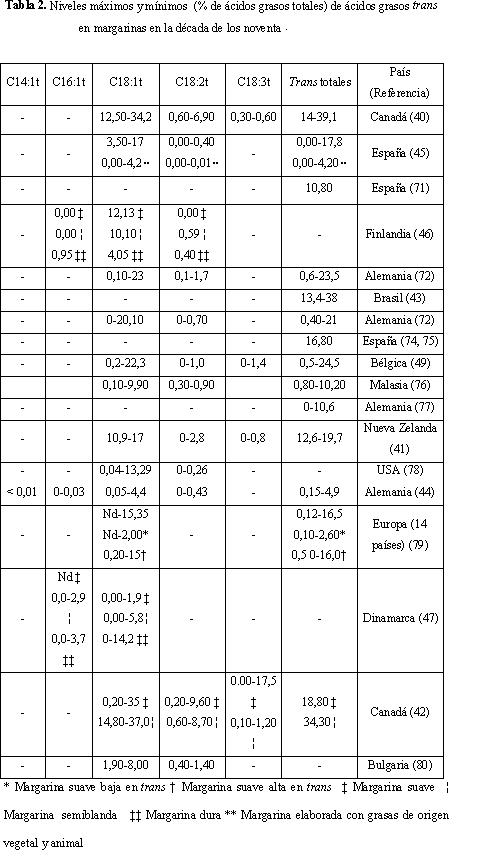
<body><![CDATA[<P ALIGN="JUSTIFY"> <font size="2" face="Verdana"> Se aprecia tambi&eacute;n en esta d&eacute;cada que no se identifican los is&oacute;meros <I>trans</I> de los &aacute;cidos miristoleico, palmitoleico y linolenico, siendo los mayoritarios los del oleico y linoleico, en ese orden. El origen de estos es atribuible a la hidrogenaci&oacute;n parcial de los aceites nativos, que origina is&oacute;meros de posici&oacute;n y geom&eacute;tricos de dichos &aacute;cidos grasos. Dicha hidrogenaci&oacute;n, que es probablemente la mayor herramienta de los productores de margarinas, tiene la finalidad de reducir el grado de insaturaci&oacute;n y elevar el punto de fusi&oacute;n del aceite. El proceso normalmente no se hace completo, porque las grasas totalmente saturadas tienen puntos de fusi&oacute;n muy elevados y sin las caracter&iacute;sticas pl&aacute;sticas deseadas (39).</font> </P>     <P ALIGN="JUSTIFY"><font size="2" face="Verdana">Finalmente destaca el menor contenido de &aacute;cidos grasos <I>trans</I> en las margarinas espa&ntilde;olas (35) elaboradas en esta &eacute;poca mayoritariamente con una mezcla de grasas de origen vegetal y animal, ya que estas &uacute;ltimas contienen dichos is&oacute;meros en peque&ntilde;a cantidad, procedentes de la alimentaci&oacute;n del animal.</font></P>     <P ALIGN="JUSTIFY"></P> <B>    <P ALIGN="JUSTIFY"><font size="2" face="Verdana">Contenido en &aacute;cidos grasos trans de las margarinas en la d&eacute;cada de los noventa</font></P> </B>    <P ALIGN="JUSTIFY"><font size="2" face="Verdana">Esta d&eacute;cada se inicia con la afirmaci&oacute;n de que la ingesta de &aacute;cidos grasos <I>trans</I> en condiciones normales no ejerce efectos adversos para la salud siempre que se ingieran cantidades adecuadas de &aacute;cidos grasos esenciales; se destacaba, sin embargo, la necesidad de buscar m&eacute;todos anal&iacute;ticos fiables para la determinaci&oacute;n exacta de la cantidad de estos &aacute;cidos grasos en los distintos alimentos. La publicaci&oacute;n de los trabajos mencionados anteriormente sobre una asociaci&oacute;n positiva entre consumo de <I>trans</I> y enfermedades cardiovasculares increment&oacute; dicha b&uacute;squeda.</font></P>     <P ALIGN="JUSTIFY"><font size="2" face="Verdana">Para ello se extendi&oacute; el uso de columnas capilares de 50 m y 60 m en la mayor&iacute;a de los trabajos (<a href="#t2">Tabla 2</a>), as&iacute; como de 100 m (41, 42), siendo la excepci&oacute;n la de 4 m utilizada por Block y Barrera (43). Ratnayake y Beare-Rogers (40) realizan una separaci&oacute;n previa en cromatograf&iacute;a en capa fina con nitrato de plata para mejorar la separaci&oacute;n posterior de los distintos is&oacute;meros en el cromat&oacute;grafo gas-liquido, logrando identificar los siguientes is&oacute;meros del C18:1t: 6t-11t; 12t-13t; 14t y 15t; por su parte, los del C18:2t identificados fueron: 9t, 12t; 9t,12c; ct/tc; 9c, 12t y 9t, 12c. En cuanto a los is&oacute;meros del C18:3 identificados fueron los siguientes: 9c, 12t, 15t + 9t, 12c, 15t; 9t, 12c, 15c y 9c, 12t, 15c. Los dem&aacute;s autores no separan los distintos is&oacute;meros del C18:1t, aunque en algunos casos separan varios de los is&oacute;meros del C18:2t (41, 42, 44). Por su parte, Fern&aacute;ndez San Juan (45) identifica los &aacute;cidos elaidico y linoelaidico, aunque los denomina C18:1t y C18:2t, respectivamente.</font></P>     <P ALIGN="JUSTIFY"><font size="2" face="Verdana">Se aprecia, en las distintas investigaciones realizadas, la tendencia a no detectar C14:1t en las margarinas analizadas (<a href="#t2">Tabla 2</a>), excepto por Fritche y Seinhart (44), que lo encuentran en peque&ntilde;a cantidad. Por su parte, el C16:1t es detectado en  aquellas margarinas que han sido elaboradas con aceites de pescado hidrogenados. En relaci&oacute;n a dicho &aacute;cido graso puede destacarse que su contenido aumenta al incrementarse la dureza de la margarina (46)(47), lo que indicar&iacute;a su formaci&oacute;n en el proceso de hidrogenaci&oacute;n a que es sometido el aceite de pescado en su endurecimiento para convertirlo en margarina. En relaci&oacute;n al C18:3t, destacan las cantidades reducidas de los mismos. Seg&uacute;n Ackman <I>et al.,</I> (48) la presencia de los is&oacute;meros <I>trans</I> geom&eacute;tricos de los &aacute;cidos linoleico y linol&eacute;nico en las margarinas se debe a que las mismas est&aacute;n constituidas por aceites  refinados o desodorizados por procedimientos f&iacute;sicos, ya que al exponer los aceites a elevadas temperaturas se forman dichos is&oacute;meros; sin embargo no siempre est&aacute;n presentes en los aceites refinados, indicando la gran variaci&oacute;n existente en las pr&aacute;cticas de los procesos de refinaci&oacute;n (31).</font></P>     <P ALIGN="center"><a name="t2"><img border="0" src="/img/fbpe/Alan/v55n4/art8%20tab2.jpg" width="480" height="864"></a></P>     
<P ALIGN="JUSTIFY"><font size="2" face="Verdana">El is&oacute;mero mayoritario en las margarinas es el C18:1t (&gt; 90 %) (49). Dentro de &eacute;ste, el &aacute;cido ela&iacute;dico (t-9) frecuentemente ha sido el is&oacute;mero m&aacute;s importante en margarinas (50) aunque tambi&eacute;n se ha encontrado como mayoritarios junto a &eacute;l, al t-10, con una media de 24% y 21%, respectivamente, seguidos del t6-8, con 18,5 %; t12 y t13-14 con alrededor de 10%; t15 y t16 que representan aproximadamente el 1% del total de estos is&oacute;meros, y finalmente t4 y t5, que no alcanzan el &uacute;ltimo porcentaje citado (51).</font></P>     <P ALIGN="JUSTIFY"><font size="2" face="Verdana">Por su parte, Hyv&ouml;nen <I>et al.,</I> (46) identifican is&oacute;meros <I>trans</I> del C20 y C22, aunque solo en las margarinas duras, las cuales se elaboran con aceites marinos hidrogenados.</font> </P>     ]]></body>
<body><![CDATA[<P ALIGN="JUSTIFY"></P> <B>    <P ALIGN="JUSTIFY"><font size="2" face="Verdana">Tendencias actuales</font></P> </B>    <P ALIGN="JUSTIFY"><font size="2" face="Verdana">Se aprecia en la <a href="#t3"> Tabla 3</a> que el contenido medio de &aacute;cidos grasos <I>trans </I>en muestras correspondientes al a&ntilde;o 2000 y posteriores son inferiores a las detectadas en d&eacute;cadas anteriores. As&iacute; en las margarinas austriacas se detectan los niveles m&aacute;s bajos, del 1,60% (52), seguidas de las portuguesas (53) y espa&ntilde;olas (54), ambas con 2,50%. Destaca adem&aacute;s que dicho contenido asciende seg&uacute;n lo hace la dureza de las margarinas (55)(56)(57). Tambi&eacute;n se aprecia la gran variabilidad en el contenido de estos is&oacute;meros en las margarinas turcas (55)(58)(59) y pakistan&iacute;es (57). En relaci&oacute;n a las margarinas griegas (60), aunque su contenido en <I>trans</I> es relativamente bajo, los autores indican una elevada cantidad de &aacute;cidos grasos saturados, que discrepa con lo declarado en la etiqueta. Lo mismo ocurre en el estudio de Tekin <I>et al.</I> (58), ya que 4 de las 14 margarinas analizadas son &quot;libres de <I>trans</I>&quot;, pero tienen elevadas cantidades de &aacute;cidos grasos saturados de cadena corta, lo que sugiere que han sido elaboradas con aceite de coco.</font></P>     <P ALIGN="center"><a name="t3"><img border="0" src="/img/fbpe/Alan/v55n4/art8%20tab3.jpg" width="435" height="570"></a></P>     
<P ALIGN="JUSTIFY"><font size="2" face="Verdana">En cuanto a los distintos is&oacute;meros <I>trans</I>, se verifica el predominio del C18:1t, seguido de C18:2t, como en d&eacute;cadas anteriores. Le siguen en cantidad C18:3t y C16:1t, mientras que no se detecta C14:1t. Algunos autores (61)(62) tambi&eacute;n identifican is&oacute;meros <I>trans</I> del C20:1 &oacute; C22:1, provenientes de aceites de pescado hidrogenados.</font> </P>     <P ALIGN="JUSTIFY"><font size="2" face="Verdana">En Espa&ntilde;a, donde la dieta Mediterr&aacute;nea esta muy arraigada, es el pa&iacute;s que muestra los menores niveles de muertes por enfermedades cardiovasculares de toda Europa (63). Tradicionalmente el aceite de oliva es la mayor fuente grasa en dicha dieta, aunque ha habido un incremento gradual en la ingesta de margarinas y mantequillas en los &uacute;ltimos a&ntilde;os. Aunque la ingesta de margarina en 2000 era aun baja (2,46 g/persona/d&iacute;a), la ingesta de alimentos que la contienen (boller&iacute;a industrial, galletas, etc.) se ha incrementado (64). Puede decirse que en Espa&ntilde;a la tendencia tambi&eacute;n es a reducir este tipo de &aacute;cidos grasos, ya que hasta 1996, con la excepci&oacute;n de las seis margarinas analizadas por Coll y Guti&eacute;rrez (35), el contenido de los mismos estaba por encima del 10%, reduci&eacute;ndose a 8,87% en 2000 (65), hasta llegar al 2,50% actual (53) (<a href="#t4">Tabla 4</a>). Todos estos estudios destacan la gran variabilidad de dichos &aacute;cidos grasos existente entre las muestras: entre 0,30% y 34,70%. Esta variabilidad puede explicarse por los distintos par&aacute;metros usados durante el proceso de fabricaci&oacute;n, por ejemplo las condiciones de hidrogenaci&oacute;n y/o desodorizaci&oacute;n (66), as&iacute; como por la cantidad de &aacute;cidos grasos insaturados presentes en las materias primas usadas para la elaboraci&oacute;n de estos productos (31). Henninger y Ulberth (67) afirman que la composici&oacute;n de las margarinas puede depender del precio que las materias primas tengan en el mercado. Otra raz&oacute;n de la variabilidad es la aparici&oacute;n de las margarinas llamadas &quot;libres de <I>trans</I>&quot;. Una pr&aacute;ctica utilizada para producirlas es la llamada &quot;interesterificaci&oacute;n&quot;, que es una alternativa al proceso de hidrogenaci&oacute;n parcial que puede ser usada para conseguir aceites y grasas deseadas desde un punto de vista funcional. Consiste en una mezcla de aceites o grasas vegetales altamente saturadas (ej. aceite de palma o aceites totalmente hidrogenados) con aceites l&iacute;quidos. Los niveles de &aacute;cidos grasos <I>trans </I>de las mezclas interesterificadas son muy bajos (0,10%), comparados con los de las grasas de los alimentos comerciales (1,30% – 12,10%) (68).</font></P>     <P ALIGN="center"><a name="t4"><img border="0" src="/img/fbpe/Alan/v55n4/art8%20tab4.jpg" width="350" height="365"></a></P>     
<P ALIGN="JUSTIFY"><font size="2" face="Verdana">Los diversos estudios sobre los efectos desfavorables de los &aacute;cidos grasos <I>trans</I> parecen haber influido en los productores de margarinas, que han reducido las cantidades de estos is&oacute;meros en sus productos (42). En la <a href="#t4"> Tabla 4 </a> se observa la tendencia a la reducci&oacute;n de los &aacute;cidos grasos <I>trans</I> en las margarinas espa&ntilde;olas; la <a href="#t5"> Tabla 5</a> muestra la misma tendencia en pa&iacute;ses como Francia (69), Austria (67), Alemania (51, 61), Escocia (62), Dinamarca (70) y Estados Unidos (56); mientras que en Canad&aacute; (42), las margarinas siguen teniendo cantidades elevadas de estos &aacute;cidos grasos.</font> </P>     <P ALIGN="center"><a name="t5"><img border="0" src="/img/fbpe/Alan/v55n4/art8%20tab5.jpg" width="440" height="575"></a> </P> <b>     
<p ALIGN="JUSTIFY"><font face="Verdana" size="2">Referencias</font></p> </b>     ]]></body>
<body><![CDATA[<!-- ref --><p ALIGN="JUSTIFY"><font face="Verdana" size="2">1. Lawson H. Food Oils and Fats. Technology, Utilization and Nutrition. Ed. Chapman &amp; Hall. 1995 New York&nbsp;</font>&nbsp;&nbsp;&nbsp;&nbsp;&nbsp;&nbsp;&nbsp;&nbsp;[&#160;<a href="javascript:void(0);" onclick="javascript: window.open('/scielo.php?script=sci_nlinks&ref=464002&pid=S0004-0622200500040000800001&lng=','','width=640,height=500,resizable=yes,scrollbars=1,menubar=yes,');">Links</a>&#160;]<!-- end-ref --><!-- ref --><P ALIGN="JUSTIFY"><font size="2" face="Verdana">2. Craig-Smidt M C. Isomeric fatty acids: Evaluating status and implications for maternal and child health. Lipids 2001; 36(9): 997-1006.</font>&nbsp;&nbsp;&nbsp;&nbsp;&nbsp;&nbsp;&nbsp;&nbsp;[&#160;<a href="javascript:void(0);" onclick="javascript: window.open('/scielo.php?script=sci_nlinks&ref=464003&pid=S0004-0622200500040000800002&lng=','','width=640,height=500,resizable=yes,scrollbars=1,menubar=yes,');">Links</a>&#160;]<!-- end-ref --><!-- ref --><P ALIGN="JUSTIFY"><font size="2" face="Verdana">3. Sundran K, Ismail A, Hayes KC, Jeyamalar R, Pathmanathan R. Trans (elaidic) fatty acids adversely affect the lipoprotein profile relative to specific saturated fatty acids in humans. J Nutr 1997; 127(3): 514S-20S.</font>&nbsp;&nbsp;&nbsp;&nbsp;&nbsp;&nbsp;&nbsp;&nbsp;[&#160;<a href="javascript:void(0);" onclick="javascript: window.open('/scielo.php?script=sci_nlinks&ref=464004&pid=S0004-0622200500040000800003&lng=','','width=640,height=500,resizable=yes,scrollbars=1,menubar=yes,');">Links</a>&#160;]<!-- end-ref --><!-- ref --><P ALIGN="JUSTIFY"><font size="2" face="Verdana">4. Zock P, Urgert R, Hulshof P, Katan M. Dietary trans fatty acids: a risk for coronary disease. Ned Tijdschr Geneeskd 1998; 142(30): 1701-04.</font>&nbsp;&nbsp;&nbsp;&nbsp;&nbsp;&nbsp;&nbsp;&nbsp;[&#160;<a href="javascript:void(0);" onclick="javascript: window.open('/scielo.php?script=sci_nlinks&ref=464005&pid=S0004-0622200500040000800004&lng=','','width=640,height=500,resizable=yes,scrollbars=1,menubar=yes,');">Links</a>&#160;]<!-- end-ref --><!-- ref --><P ALIGN="JUSTIFY"><font size="2" face="Verdana">5. Morgado N, Sanhueza J, Galleguillos A, Nieto S, Valenzuela A.  Effect of dietary hydrogenated fish oil on the plasma lipoprotein profile and on the fatty acid composition of different tissues on the rat. Ann Nutr Metab 1999; 43(5): 310-18.</font>&nbsp;&nbsp;&nbsp;&nbsp;&nbsp;&nbsp;&nbsp;&nbsp;[&#160;<a href="javascript:void(0);" onclick="javascript: window.open('/scielo.php?script=sci_nlinks&ref=464006&pid=S0004-0622200500040000800005&lng=','','width=640,height=500,resizable=yes,scrollbars=1,menubar=yes,');">Links</a>&#160;]<!-- end-ref --><!-- ref --><P ALIGN="JUSTIFY"><font size="2" face="Verdana">6. Nestel, P. Saturated and trans fatty acids and coronary heart disease. EHJ 1999; 1 (Suplement): S19-S23.</font>&nbsp;&nbsp;&nbsp;&nbsp;&nbsp;&nbsp;&nbsp;&nbsp;[&#160;<a href="javascript:void(0);" onclick="javascript: window.open('/scielo.php?script=sci_nlinks&ref=464007&pid=S0004-0622200500040000800006&lng=','','width=640,height=500,resizable=yes,scrollbars=1,menubar=yes,');">Links</a>&#160;]<!-- end-ref --><!-- ref --><P ALIGN="JUSTIFY"><font size="2" face="Verdana">7. Lichtenstein, A. H. <I>Trans</I> fatty acids and blood lipid levels, Lp(a), parameters of cholesterol metaboism, and hemostatic factors. J Nutr Biochem 1998; 9(Mayo): 244-48.</font>&nbsp;&nbsp;&nbsp;&nbsp;&nbsp;&nbsp;&nbsp;&nbsp;[&#160;<a href="javascript:void(0);" onclick="javascript: window.open('/scielo.php?script=sci_nlinks&ref=464008&pid=S0004-0622200500040000800007&lng=','','width=640,height=500,resizable=yes,scrollbars=1,menubar=yes,');">Links</a>&#160;]<!-- end-ref --><!-- ref --><P ALIGN="JUSTIFY"><font size="2" face="Verdana">8. Lichtenstein, A. H. <I>Trans</I> fatty acids and cardiovascular disease risk. Current Opinion in Lipidology  2000; 11(1): 37-42.</font>&nbsp;&nbsp;&nbsp;&nbsp;&nbsp;&nbsp;&nbsp;&nbsp;[&#160;<a href="javascript:void(0);" onclick="javascript: window.open('/scielo.php?script=sci_nlinks&ref=464009&pid=S0004-0622200500040000800008&lng=','','width=640,height=500,resizable=yes,scrollbars=1,menubar=yes,');">Links</a>&#160;]<!-- end-ref --><!-- ref --><P ALIGN="JUSTIFY"><font size="2" face="Verdana">9. Stachowska E, Chlubek D, Ciechanowski K. Trans isomers of unsaturated fatty acids-metabolic action and clinical effects. Pol Mekuriusz Lek 2001;  10(57): 173-76.</font>&nbsp;&nbsp;&nbsp;&nbsp;&nbsp;&nbsp;&nbsp;&nbsp;[&#160;<a href="javascript:void(0);" onclick="javascript: window.open('/scielo.php?script=sci_nlinks&ref=464010&pid=S0004-0622200500040000800009&lng=','','width=640,height=500,resizable=yes,scrollbars=1,menubar=yes,');">Links</a>&#160;]<!-- end-ref --><!-- ref --><P ALIGN="JUSTIFY"><font size="2" face="Verdana">10. de Roos N, Schouten E, Katan M. Consumption of a solid fat rich in lauric acid results in more favorable serum lipid profile in healthy men and women than consumption of a solid fat rich in <I>trans</I>-fatty acids. J Nutr 2001; 131(Feb.): 242-45.</font>&nbsp;&nbsp;&nbsp;&nbsp;&nbsp;&nbsp;&nbsp;&nbsp;[&#160;<a href="javascript:void(0);" onclick="javascript: window.open('/scielo.php?script=sci_nlinks&ref=464011&pid=S0004-0622200500040000800010&lng=','','width=640,height=500,resizable=yes,scrollbars=1,menubar=yes,');">Links</a>&#160;]<!-- end-ref --><!-- ref --><P ALIGN="JUSTIFY"><font size="2" face="Verdana">11. Lichtenstein A H, Ausman LM, Jalbert SM, Schaefer EJ.  Effects of different forms of dietary hydrogenated fats on serum lipoprotein cholesterol levels. N Engl J Med 1999; 340(25): 1933-40.</font>&nbsp;&nbsp;&nbsp;&nbsp;&nbsp;&nbsp;&nbsp;&nbsp;[&#160;<a href="javascript:void(0);" onclick="javascript: window.open('/scielo.php?script=sci_nlinks&ref=464012&pid=S0004-0622200500040000800011&lng=','','width=640,height=500,resizable=yes,scrollbars=1,menubar=yes,');">Links</a>&#160;]<!-- end-ref --><!-- ref --><P ALIGN="JUSTIFY"><font size="2" face="Verdana">12. Institute of Food Science and Technology. U. S. Food and Drug Administration. Trans fatty acids. 1999; Nov. Disponible en la World Wide Web: http: www.ifst.org/tfedb.htm.</font> &nbsp;&nbsp;&nbsp;&nbsp;&nbsp;&nbsp;&nbsp;&nbsp;[&#160;<a href="javascript:void(0);" onclick="javascript: window.open('/scielo.php?script=sci_nlinks&ref=464013&pid=S0004-0622200500040000800012&lng=','','width=640,height=500,resizable=yes,scrollbars=1,menubar=yes,');">Links</a>&#160;]<!-- end-ref --><!-- ref --><P ALIGN="JUSTIFY"><font size="2" face="Verdana">13. Wilkening V. Proposed changes in U.S.A. regulations for food labeling. J Food Com Anal 2001; 14(3): 309-14.</font>&nbsp;&nbsp;&nbsp;&nbsp;&nbsp;&nbsp;&nbsp;&nbsp;[&#160;<a href="javascript:void(0);" onclick="javascript: window.open('/scielo.php?script=sci_nlinks&ref=464014&pid=S0004-0622200500040000800013&lng=','','width=640,height=500,resizable=yes,scrollbars=1,menubar=yes,');">Links</a>&#160;]<!-- end-ref --><!-- ref --><P ALIGN="JUSTIFY"><font size="2" face="Verdana">14. Stender S, Dyeberg J. The importance of trans-fatty acids for health. Ugeskr Laeger 2001 Abril 23; 163(17): 2349-53.</font>&nbsp;&nbsp;&nbsp;&nbsp;&nbsp;&nbsp;&nbsp;&nbsp;[&#160;<a href="javascript:void(0);" onclick="javascript: window.open('/scielo.php?script=sci_nlinks&ref=464015&pid=S0004-0622200500040000800014&lng=','','width=640,height=500,resizable=yes,scrollbars=1,menubar=yes,');">Links</a>&#160;]<!-- end-ref --><!-- ref --><P ALIGN="JUSTIFY"><font size="2" face="Verdana">15. Beare-Rogers J L, Gray L M, Hollywood R. The linoleic acid and trans fatty acids of margarines. Am J Clin Nutr 1979; 32: 1805-09.</font> &nbsp;&nbsp;&nbsp;&nbsp;&nbsp;&nbsp;&nbsp;&nbsp;[&#160;<a href="javascript:void(0);" onclick="javascript: window.open('/scielo.php?script=sci_nlinks&ref=464016&pid=S0004-0622200500040000800015&lng=','','width=640,height=500,resizable=yes,scrollbars=1,menubar=yes,');">Links</a>&#160;]<!-- end-ref --><!-- ref --><P ALIGN="JUSTIFY"><font size="2" face="Verdana">16. Slover H, Thompson R, Davis C, Merola G. Lipids in margarines and margarine-like foods. JAOCS 1985; 62(4): 775-86.</font>&nbsp;&nbsp;&nbsp;&nbsp;&nbsp;&nbsp;&nbsp;&nbsp;[&#160;<a href="javascript:void(0);" onclick="javascript: window.open('/scielo.php?script=sci_nlinks&ref=464017&pid=S0004-0622200500040000800016&lng=','','width=640,height=500,resizable=yes,scrollbars=1,menubar=yes,');">Links</a>&#160;]<!-- end-ref --><!-- ref --><P ALIGN="JUSTIFY"><font size="2" face="Verdana">17. Troisi R,  Willett W, Weiss S. Trans fatty acids intake in relation to serum lipid concentrations in adult men. Am J Clin Nutr 1992; 56: 1019-24.</font>&nbsp;&nbsp;&nbsp;&nbsp;&nbsp;&nbsp;&nbsp;&nbsp;[&#160;<a href="javascript:void(0);" onclick="javascript: window.open('/scielo.php?script=sci_nlinks&ref=464018&pid=S0004-0622200500040000800017&lng=','','width=640,height=500,resizable=yes,scrollbars=1,menubar=yes,');">Links</a>&#160;]<!-- end-ref --><!-- ref --><P ALIGN="JUSTIFY"><font size="2" face="Verdana">18. Mensink R,  Katan M. Effect of dietary <I>trans</I> fatty acids on high-density and low density lipoproteins cholesterol levels in healthy subjects. N Engl J Med 1990; 323: 439-45.</font> &nbsp;&nbsp;&nbsp;&nbsp;&nbsp;&nbsp;&nbsp;&nbsp;[&#160;<a href="javascript:void(0);" onclick="javascript: window.open('/scielo.php?script=sci_nlinks&ref=464019&pid=S0004-0622200500040000800018&lng=','','width=640,height=500,resizable=yes,scrollbars=1,menubar=yes,');">Links</a>&#160;]<!-- end-ref --><!-- ref --><P ALIGN="JUSTIFY"><font size="2" face="Verdana">19. Zock P, Katan M. Hydrogenation alternaives: effects of trans fatty acids and stearic acid versus linoleic acid on serum lipids and lipoproteins in humans. J Lipid Res 1992; 33: 399-410.</font>&nbsp;&nbsp;&nbsp;&nbsp;&nbsp;&nbsp;&nbsp;&nbsp;[&#160;<a href="javascript:void(0);" onclick="javascript: window.open('/scielo.php?script=sci_nlinks&ref=464020&pid=S0004-0622200500040000800019&lng=','','width=640,height=500,resizable=yes,scrollbars=1,menubar=yes,');">Links</a>&#160;]<!-- end-ref --><!-- ref --><P ALIGN="JUSTIFY"><font size="2" face="Verdana">20. Wood R, Kubena K, O¨Brien, B, Tseng S, Martin G. Effect of butter, mono and polyunsaturated fatty acid enriched butter, <I>trans</I> fatty acid margarine, and zero<I> trans</I> fatty acid margarine on serum lipids and lipoproteins in healthy men. J Lipid Res 1993; 34: 1-11.</font>&nbsp;&nbsp;&nbsp;&nbsp;&nbsp;&nbsp;&nbsp;&nbsp;[&#160;<a href="javascript:void(0);" onclick="javascript: window.open('/scielo.php?script=sci_nlinks&ref=464021&pid=S0004-0622200500040000800020&lng=','','width=640,height=500,resizable=yes,scrollbars=1,menubar=yes,');">Links</a>&#160;]<!-- end-ref --><!-- ref --><P ALIGN="JUSTIFY"><font size="2" face="Verdana">21. Judd J, Clevidence B, Muesing R, Witte J, Sunkin M,  Podczasy J. Dietary trans fatty acids: effects on plasma lipids and lipoproteins of healthy men and women. Am J Clin Nutr 1994; 59: 861-68.</font>&nbsp;&nbsp;&nbsp;&nbsp;&nbsp;&nbsp;&nbsp;&nbsp;[&#160;<a href="javascript:void(0);" onclick="javascript: window.open('/scielo.php?script=sci_nlinks&ref=464022&pid=S0004-0622200500040000800021&lng=','','width=640,height=500,resizable=yes,scrollbars=1,menubar=yes,');">Links</a>&#160;]<!-- end-ref --><!-- ref --><P ALIGN="JUSTIFY"><font size="2" face="Verdana">22. Willett W,  Stampfer M, Manson J, Colditz G, Speizer F, Rosner, B, Sampson L, Hennekens Ch. Intake of trans fatty acids and risk of coronary heart disease among women. The Lancet 1993; 341(6): 581-85.</font>&nbsp;&nbsp;&nbsp;&nbsp;&nbsp;&nbsp;&nbsp;&nbsp;[&#160;<a href="javascript:void(0);" onclick="javascript: window.open('/scielo.php?script=sci_nlinks&ref=464023&pid=S0004-0622200500040000800022&lng=','','width=640,height=500,resizable=yes,scrollbars=1,menubar=yes,');">Links</a>&#160;]<!-- end-ref --><!-- ref --><P ALIGN="JUSTIFY"><font size="2" face="Verdana">23. Aro A, Kardinaal A, Salminen I, Kard JD, Riemersma RA, Delgado Rodr&iacute;guez M, Gomez Aracena J, Huttunen JK, Kohlmeier BL, Martin BC, Martin Moreno JM, Mazaev VP, Ringstad J, Thamm M, van´t Veer P, Kok FJ. Adipose tissue isomeric<I> trans</I> fatty acids and risk of myocardial infarction in nine coutries: the EURAMIC study. The Lancet 1995; 345(4): 273-79.</font>&nbsp;&nbsp;&nbsp;&nbsp;&nbsp;&nbsp;&nbsp;&nbsp;[&#160;<a href="javascript:void(0);" onclick="javascript: window.open('/scielo.php?script=sci_nlinks&ref=464024&pid=S0004-0622200500040000800023&lng=','','width=640,height=500,resizable=yes,scrollbars=1,menubar=yes,');">Links</a>&#160;]<!-- end-ref --><!-- ref --><P ALIGN="JUSTIFY"><font size="2" face="Verdana">24. British Nutrition Foundation`s Task Force. Trans fatty acids. British Nutrition Foundation Nutrition Bulletin 1995.</font>&nbsp;&nbsp;&nbsp;&nbsp;&nbsp;&nbsp;&nbsp;&nbsp;[&#160;<a href="javascript:void(0);" onclick="javascript: window.open('/scielo.php?script=sci_nlinks&ref=464025&pid=S0004-0622200500040000800024&lng=','','width=640,height=500,resizable=yes,scrollbars=1,menubar=yes,');">Links</a>&#160;]<!-- end-ref --><!-- ref --><P ALIGN="JUSTIFY"><font size="2" face="Verdana">25. American Society of Clinical Nutrition/American Institute of Nutrition. Position paper on trans fatty acids. Am J Clin Nutr 1996; 63: 663-70.</font>&nbsp;&nbsp;&nbsp;&nbsp;&nbsp;&nbsp;&nbsp;&nbsp;[&#160;<a href="javascript:void(0);" onclick="javascript: window.open('/scielo.php?script=sci_nlinks&ref=464026&pid=S0004-0622200500040000800025&lng=','','width=640,height=500,resizable=yes,scrollbars=1,menubar=yes,');">Links</a>&#160;]<!-- end-ref --><!-- ref --><P ALIGN="JUSTIFY"><font size="2" face="Verdana">26. Tavani A,  Negri E, D'Avanzo B, La Vecchia C. Margarine intake and risk of nonfatal acute myocardial infarction in Italian women. Eur J Clin Nutr  1997; 51(1): 30-32.</font>&nbsp;&nbsp;&nbsp;&nbsp;&nbsp;&nbsp;&nbsp;&nbsp;[&#160;<a href="javascript:void(0);" onclick="javascript: window.open('/scielo.php?script=sci_nlinks&ref=464027&pid=S0004-0622200500040000800026&lng=','','width=640,height=500,resizable=yes,scrollbars=1,menubar=yes,');">Links</a>&#160;]<!-- end-ref --><!-- ref --><P ALIGN="JUSTIFY"><font size="2" face="Verdana">27. Hu FB, Stampfer MJ, Manson J. Dietary fat intake and the risk of coronary heart disease in women. N Engl J Med 1997; 337: 1491-99.</font> &nbsp;&nbsp;&nbsp;&nbsp;&nbsp;&nbsp;&nbsp;&nbsp;[&#160;<a href="javascript:void(0);" onclick="javascript: window.open('/scielo.php?script=sci_nlinks&ref=464028&pid=S0004-0622200500040000800027&lng=','','width=640,height=500,resizable=yes,scrollbars=1,menubar=yes,');">Links</a>&#160;]<!-- end-ref --><!-- ref --><P ALIGN="JUSTIFY"><font size="2" face="Verdana">28. Hulshof P, van Erp-Baart MA, Anttolainen M, Becker W, Couet C, Hermann-Kunz E, Kesteloot H, Leth T, Martins I, Moreiras O, Moschandreas J, Pizzoferrato L, Rimestad A, Thorgeisdottir H, Amelsvoort JM, Aro A, Kafatos A, Lanzmann-Petithory D, van Poppel G.  Intake of fatty acids in western Europe with emphasis on trans fatty acids: the TRANSFAIR study. Eur J Clin Nutr 1999; Feb 53(2): 143-57.</font>&nbsp;&nbsp;&nbsp;&nbsp;&nbsp;&nbsp;&nbsp;&nbsp;[&#160;<a href="javascript:void(0);" onclick="javascript: window.open('/scielo.php?script=sci_nlinks&ref=464029&pid=S0004-0622200500040000800028&lng=','','width=640,height=500,resizable=yes,scrollbars=1,menubar=yes,');">Links</a>&#160;]<!-- end-ref --><!-- ref --><P ALIGN="JUSTIFY"><font size="2" face="Verdana">29. van de Vijver LP, Kardinaal A, Couet C, Aro A,  Kafatos A, Stengrimsdottir L, Amorim CJA, Moreiras O, Becker W, van Amelsvoort J, Vidal-Jessel S, Salminen I, Moschandreas J, Sigfus Martins I, Carbajal A, Ytterfors, A, van Poppel G. Association between trans fatty acid intake and cardiovascular factors in Europe: the TRANSFAIR study. Eur J Clin Nutr 2000; Feb 54(2): 126-35.</font>&nbsp;&nbsp;&nbsp;&nbsp;&nbsp;&nbsp;&nbsp;&nbsp;[&#160;<a href="javascript:void(0);" onclick="javascript: window.open('/scielo.php?script=sci_nlinks&ref=464030&pid=S0004-0622200500040000800029&lng=','','width=640,height=500,resizable=yes,scrollbars=1,menubar=yes,');">Links</a>&#160;]<!-- end-ref --><!-- ref --><P ALIGN="JUSTIFY"><font size="2" face="Verdana">30. Oomen CM, Ocke MC, Feskens EJ, van Erp-Baart MA, Kok FJ, Kromhout D. Association between trans fatty acid intake and 10-year risk of coronary heart disease in the Zutphen Elderly Study; a prospective population-based study. The Lancet 2001; Mar 10(537): 746-51.</font>&nbsp;&nbsp;&nbsp;&nbsp;&nbsp;&nbsp;&nbsp;&nbsp;[&#160;<a href="javascript:void(0);" onclick="javascript: window.open('/scielo.php?script=sci_nlinks&ref=464031&pid=S0004-0622200500040000800030&lng=','','width=640,height=500,resizable=yes,scrollbars=1,menubar=yes,');">Links</a>&#160;]<!-- end-ref --><!-- ref --><P ALIGN="JUSTIFY"><font size="2" face="Verdana">31. Enig M,  Pallansch L, Sampugna J,  Keeney M. Fatty acid composition of the fat in selected food items with emphasis on <I>trans</I> components. JAOCS 1983; 60(10): 1788-95.</font>&nbsp;&nbsp;&nbsp;&nbsp;&nbsp;&nbsp;&nbsp;&nbsp;[&#160;<a href="javascript:void(0);" onclick="javascript: window.open('/scielo.php?script=sci_nlinks&ref=464032&pid=S0004-0622200500040000800031&lng=','','width=640,height=500,resizable=yes,scrollbars=1,menubar=yes,');">Links</a>&#160;]<!-- end-ref --><!-- ref --><P ALIGN="JUSTIFY"><font size="2" face="Verdana">32. Carpenter DL, Slover H. Lipid composition of selected margarines. J Am Oil Chem Soc 1974; 50: 372.</font> &nbsp;&nbsp;&nbsp;&nbsp;&nbsp;&nbsp;&nbsp;&nbsp;[&#160;<a href="javascript:void(0);" onclick="javascript: window.open('/scielo.php?script=sci_nlinks&ref=464033&pid=S0004-0622200500040000800032&lng=','','width=640,height=500,resizable=yes,scrollbars=1,menubar=yes,');">Links</a>&#160;]<!-- end-ref --><!-- ref --><P ALIGN="JUSTIFY"><font size="2" face="Verdana">33. Carpenter DL, Lehman BS, Mason BS, Slover H. Lipid composition of selected vegetable oils. J Am Oil Chem Soc 1976; 53: 713.</font> &nbsp;&nbsp;&nbsp;&nbsp;&nbsp;&nbsp;&nbsp;&nbsp;[&#160;<a href="javascript:void(0);" onclick="javascript: window.open('/scielo.php?script=sci_nlinks&ref=464034&pid=S0004-0622200500040000800033&lng=','','width=640,height=500,resizable=yes,scrollbars=1,menubar=yes,');">Links</a>&#160;]<!-- end-ref --><!-- ref --><P ALIGN="JUSTIFY"><font size="2" face="Verdana">34. Gildenberg L, Firestone D. Gas chromatographic determination of <I>trans</I> unsaturation in margarine: collaborative study. J Assoc Off Anal Chem 1985; 68(1): 46-51.</font>&nbsp;&nbsp;&nbsp;&nbsp;&nbsp;&nbsp;&nbsp;&nbsp;[&#160;<a href="javascript:void(0);" onclick="javascript: window.open('/scielo.php?script=sci_nlinks&ref=464035&pid=S0004-0622200500040000800034&lng=','','width=640,height=500,resizable=yes,scrollbars=1,menubar=yes,');">Links</a>&#160;]<!-- end-ref --><!-- ref --><P ALIGN="JUSTIFY"><font size="2" face="Verdana">35. Coll Hell&iacute;n L, Guti&eacute;rrez Ruiz ML. Determinaci&oacute;n de &aacute;cidos grasos trans-insaturados en margarinas y mantequillas. Anales de Bromatolog&iacute;a  1989;  XLI(1): 115-28.</font> &nbsp;&nbsp;&nbsp;&nbsp;&nbsp;&nbsp;&nbsp;&nbsp;[&#160;<a href="javascript:void(0);" onclick="javascript: window.open('/scielo.php?script=sci_nlinks&ref=464036&pid=S0004-0622200500040000800035&lng=','','width=640,height=500,resizable=yes,scrollbars=1,menubar=yes,');">Links</a>&#160;]<!-- end-ref --><!-- ref --><P ALIGN="JUSTIFY"><font size="2" face="Verdana">36. Hern&aacute;ndez i Abascal N, Boatella i Riera J. Contenidos de is&oacute;meros <I>trans</I> de los &aacute;cidos grasos en margarinas. Grasas y Aceites 1988;  39(6): 348-52.</font>&nbsp;&nbsp;&nbsp;&nbsp;&nbsp;&nbsp;&nbsp;&nbsp;[&#160;<a href="javascript:void(0);" onclick="javascript: window.open('/scielo.php?script=sci_nlinks&ref=464037&pid=S0004-0622200500040000800036&lng=','','width=640,height=500,resizable=yes,scrollbars=1,menubar=yes,');">Links</a>&#160;]<!-- end-ref --><!-- ref --><P ALIGN="JUSTIFY"><font size="2" face="Verdana">37. Slover H, Thompson R, Davis C, Merola G. Lipids in margarines and margarine-like foods. JAOCS 1985; 62(4): 775-86.</font>&nbsp;&nbsp;&nbsp;&nbsp;&nbsp;&nbsp;&nbsp;&nbsp;[&#160;<a href="javascript:void(0);" onclick="javascript: window.open('/scielo.php?script=sci_nlinks&ref=464038&pid=S0004-0622200500040000800037&lng=','','width=640,height=500,resizable=yes,scrollbars=1,menubar=yes,');">Links</a>&#160;]<!-- end-ref --><!-- ref --><P ALIGN="JUSTIFY"><font size="2" face="Verdana">38. Sampugna J, Pallansch L, Enig M, Keeney M. Rapid analysis of <I>trans</I> fatty acids on SP 2340 glass capillary columns. J Chrom 1982; 249: 245-55.</font>&nbsp;&nbsp;&nbsp;&nbsp;&nbsp;&nbsp;&nbsp;&nbsp;[&#160;<a href="javascript:void(0);" onclick="javascript: window.open('/scielo.php?script=sci_nlinks&ref=464039&pid=S0004-0622200500040000800038&lng=','','width=640,height=500,resizable=yes,scrollbars=1,menubar=yes,');">Links</a>&#160;]<!-- end-ref --><!-- ref --><P ALIGN="JUSTIFY"><font size="2" face="Verdana">39. Valenzuela A, King J, Nieto S. <I>Trans </I>fatty acid isomers from hydrogenated fats: the controversy about health implications. Grasas y Aceites 1995; 46(6): 369-75.</font>&nbsp;&nbsp;&nbsp;&nbsp;&nbsp;&nbsp;&nbsp;&nbsp;[&#160;<a href="javascript:void(0);" onclick="javascript: window.open('/scielo.php?script=sci_nlinks&ref=464040&pid=S0004-0622200500040000800039&lng=','','width=640,height=500,resizable=yes,scrollbars=1,menubar=yes,');">Links</a>&#160;]<!-- end-ref --><!-- ref --><P ALIGN="JUSTIFY"><font size="2" face="Verdana">40. Ratnayake W, Rogers B. Problems of analyzing c18 cis and <I>trans</I> fatty acids of margarine on the SP 2340 capillary column. J Chrom Sci 1990; 28: 633-39.</font>&nbsp;&nbsp;&nbsp;&nbsp;&nbsp;&nbsp;&nbsp;&nbsp;[&#160;<a href="javascript:void(0);" onclick="javascript: window.open('/scielo.php?script=sci_nlinks&ref=464041&pid=S0004-0622200500040000800040&lng=','','width=640,height=500,resizable=yes,scrollbars=1,menubar=yes,');">Links</a>&#160;]<!-- end-ref --><!-- ref --><P ALIGN="JUSTIFY"><font size="2" face="Verdana">41. Lake R, Thomson, Devane G,  Scholes P. <I>Trans</I> fatty acid content of selected New Zealand foods. J Food Comp Anal 1998; 9: 365-74.</font>&nbsp;&nbsp;&nbsp;&nbsp;&nbsp;&nbsp;&nbsp;&nbsp;[&#160;<a href="javascript:void(0);" onclick="javascript: window.open('/scielo.php?script=sci_nlinks&ref=464042&pid=S0004-0622200500040000800041&lng=','','width=640,height=500,resizable=yes,scrollbars=1,menubar=yes,');">Links</a>&#160;]<!-- end-ref --><!-- ref --><P ALIGN="JUSTIFY"><font size="2" face="Verdana">42. Ratnayake W, Pelletier R, Hollywood R, Bacler S, Leyte D. Trans fatty acids in Canadian margarines: recent trends. JAOCS 1998; 75(11): 1587-94.</font>&nbsp;&nbsp;&nbsp;&nbsp;&nbsp;&nbsp;&nbsp;&nbsp;[&#160;<a href="javascript:void(0);" onclick="javascript: window.open('/scielo.php?script=sci_nlinks&ref=464043&pid=S0004-0622200500040000800042&lng=','','width=640,height=500,resizable=yes,scrollbars=1,menubar=yes,');">Links</a>&#160;]<!-- end-ref --><!-- ref --><P ALIGN="JUSTIFY"><font size="2" face="Verdana">43. Block J, Barrera Arellano D. Produtos hidrogenados no Brasil: Is&oacute;meros trans, caracter&iacute;sticas f&iacute;sico qu&iacute;micas e composicao em &aacute;cidos graxos. ALAN 1994; 44(4): 281-85.</font>&nbsp;&nbsp;&nbsp;&nbsp;&nbsp;&nbsp;&nbsp;&nbsp;[&#160;<a href="javascript:void(0);" onclick="javascript: window.open('/scielo.php?script=sci_nlinks&ref=464044&pid=S0004-0622200500040000800043&lng=','','width=640,height=500,resizable=yes,scrollbars=1,menubar=yes,');">Links</a>&#160;]<!-- end-ref --><!-- ref --><P ALIGN="JUSTIFY"><font size="2" face="Verdana">44. Fritsche J, Steinhart H. Contents of <I>trans</I> fatty acids (TFA) in German foods and estimation of daily intake. Feet/Lipid 1997; 9: 314-18.</font> &nbsp;&nbsp;&nbsp;&nbsp;&nbsp;&nbsp;&nbsp;&nbsp;[&#160;<a href="javascript:void(0);" onclick="javascript: window.open('/scielo.php?script=sci_nlinks&ref=464045&pid=S0004-0622200500040000800044&lng=','','width=640,height=500,resizable=yes,scrollbars=1,menubar=yes,');">Links</a>&#160;]<!-- end-ref --><!-- ref --><P ALIGN="JUSTIFY"><font size="2" face="Verdana">45. Fern&aacute;ndez San Juan, P. M. &Aacute;cidos grasos <I>trans</I>  insaturados. Estudio de su contenido en margarinas y grasas comestibles. Alimentaci&oacute;n, Equipos y Tecnolog&iacute;a 1991; Ene-Feb: 281-84.</font>&nbsp;&nbsp;&nbsp;&nbsp;&nbsp;&nbsp;&nbsp;&nbsp;[&#160;<a href="javascript:void(0);" onclick="javascript: window.open('/scielo.php?script=sci_nlinks&ref=464046&pid=S0004-0622200500040000800045&lng=','','width=640,height=500,resizable=yes,scrollbars=1,menubar=yes,');">Links</a>&#160;]<!-- end-ref --><!-- ref --><P ALIGN="JUSTIFY"><font size="2" face="Verdana">46. Hyv&ouml;nen L, Lampi A, Varo P, Koivistoinen P. Fatty acid analysis, TAG equivalentes as net fat value, and nutritional attributes of commercial fats and oils. Food Comp Anal 1993; 6: 24-40.</font>&nbsp;&nbsp;&nbsp;&nbsp;&nbsp;&nbsp;&nbsp;&nbsp;[&#160;<a href="javascript:void(0);" onclick="javascript: window.open('/scielo.php?script=sci_nlinks&ref=464047&pid=S0004-0622200500040000800046&lng=','','width=640,height=500,resizable=yes,scrollbars=1,menubar=yes,');">Links</a>&#160;]<!-- end-ref --><!-- ref --><P ALIGN="JUSTIFY"><font size="2" face="Verdana">47. Ovensen L, Leth L, Hansen K. Fatty acid composition and contents of <I>trans</I> monounsaturated fatty acids in frying fats, and in margarines and shortenings in Denmark. JAOCS 1998; 75(9): 1079-83.</font>&nbsp;&nbsp;&nbsp;&nbsp;&nbsp;&nbsp;&nbsp;&nbsp;[&#160;<a href="javascript:void(0);" onclick="javascript: window.open('/scielo.php?script=sci_nlinks&ref=464048&pid=S0004-0622200500040000800047&lng=','','width=640,height=500,resizable=yes,scrollbars=1,menubar=yes,');">Links</a>&#160;]<!-- end-ref --><!-- ref --><P ALIGN="JUSTIFY"><font size="2" face="Verdana">48. Ackman GG, Hooper SN, Hooper DL. Linolenic acid artefacts from deodorization of oils. JAOCS 1974; 51: 42-49.</font> &nbsp;&nbsp;&nbsp;&nbsp;&nbsp;&nbsp;&nbsp;&nbsp;[&#160;<a href="javascript:void(0);" onclick="javascript: window.open('/scielo.php?script=sci_nlinks&ref=464049&pid=S0004-0622200500040000800048&lng=','','width=640,height=500,resizable=yes,scrollbars=1,menubar=yes,');">Links</a>&#160;]<!-- end-ref --><!-- ref --><P ALIGN="JUSTIFY"><font size="2" face="Verdana">49. De Greyt W, Radanyi O, Kellens M, Huygebaert A. Contribution of<I> trans</I> fatty acids from vegetable oils and margarines to de Belgian diet. Feet/Lipid 1996; 98: 30-33.</font>&nbsp;&nbsp;&nbsp;&nbsp;&nbsp;&nbsp;&nbsp;&nbsp;[&#160;<a href="javascript:void(0);" onclick="javascript: window.open('/scielo.php?script=sci_nlinks&ref=464050&pid=S0004-0622200500040000800049&lng=','','width=640,height=500,resizable=yes,scrollbars=1,menubar=yes,');">Links</a>&#160;]<!-- end-ref --><!-- ref --><P ALIGN="JUSTIFY"><font size="2" face="Verdana">50. Precht D, Molkentin J. <I>Trans</I> fatty acids: Implications for health, analytical methods, incidence in edible fats and intake. Die Nahrung 1995; 39: 343-74.</font>&nbsp;&nbsp;&nbsp;&nbsp;&nbsp;&nbsp;&nbsp;&nbsp;[&#160;<a href="javascript:void(0);" onclick="javascript: window.open('/scielo.php?script=sci_nlinks&ref=464051&pid=S0004-0622200500040000800050&lng=','','width=640,height=500,resizable=yes,scrollbars=1,menubar=yes,');">Links</a>&#160;]<!-- end-ref --><!-- ref --><P ALIGN="JUSTIFY"><font size="2" face="Verdana">51. Molkentin J, Precht D. Isomeric distribution and rapid determination of <I>trans</I> - octadecenoic acids in German brands of partially hydrogenated edible fats. Nahrung 1996; 40(6): 297-304.</font> &nbsp;&nbsp;&nbsp;&nbsp;&nbsp;&nbsp;&nbsp;&nbsp;[&#160;<a href="javascript:void(0);" onclick="javascript: window.open('/scielo.php?script=sci_nlinks&ref=464052&pid=S0004-0622200500040000800051&lng=','','width=640,height=500,resizable=yes,scrollbars=1,menubar=yes,');">Links</a>&#160;]<!-- end-ref --><!-- ref --><P ALIGN="JUSTIFY"><font size="2" face="Verdana">52. Wagner K, Auer E, Elmadfa, I. Content of trans fatty acids in margarines, plant oils, fried products and chocolate spreads in Austria. Eur Food Res Technol 2000; 210: 237-41.</font> &nbsp;&nbsp;&nbsp;&nbsp;&nbsp;&nbsp;&nbsp;&nbsp;[&#160;<a href="javascript:void(0);" onclick="javascript: window.open('/scielo.php?script=sci_nlinks&ref=464053&pid=S0004-0622200500040000800052&lng=','','width=640,height=500,resizable=yes,scrollbars=1,menubar=yes,');">Links</a>&#160;]<!-- end-ref --><!-- ref --><P ALIGN="JUSTIFY"><font size="2" face="Verdana">53. Torres D, Casal S, Oliveira B. Fatty acid composition of Portuguese spreadable fats with emphasis on<I> trans </I>isomers. Eur Food Res Technol 2002; 21(4):108-11.</font>&nbsp;&nbsp;&nbsp;&nbsp;&nbsp;&nbsp;&nbsp;&nbsp;[&#160;<a href="javascript:void(0);" onclick="javascript: window.open('/scielo.php?script=sci_nlinks&ref=464054&pid=S0004-0622200500040000800053&lng=','','width=640,height=500,resizable=yes,scrollbars=1,menubar=yes,');">Links</a>&#160;]<!-- end-ref --><!-- ref --><P ALIGN="JUSTIFY"><font size="2" face="Verdana">54. Larqu&eacute; E, Garaulet M, P&eacute;rez-Llamas F, Zamora S, Tebar J. Composici&oacute;n en &aacute;cidos grasos de las margarinas de mayor consumo en Espa&ntilde;a y su importancia nutricional. Grasas y Aceites 2003; 54(1): 65-70.</font>&nbsp;&nbsp;&nbsp;&nbsp;&nbsp;&nbsp;&nbsp;&nbsp;[&#160;<a href="javascript:void(0);" onclick="javascript: window.open('/scielo.php?script=sci_nlinks&ref=464055&pid=S0004-0622200500040000800054&lng=','','width=640,height=500,resizable=yes,scrollbars=1,menubar=yes,');">Links</a>&#160;]<!-- end-ref --><!-- ref --><P ALIGN="JUSTIFY"><font size="2" face="Verdana">55. Yilmaz N, Demirbas A, Sahin A. Changes in membrane fatty acid composition of human erythrocytes obtained from dietary margarine users and non-users. Food Chem 2000; 70: 371-75.</font>&nbsp;&nbsp;&nbsp;&nbsp;&nbsp;&nbsp;&nbsp;&nbsp;[&#160;<a href="javascript:void(0);" onclick="javascript: window.open('/scielo.php?script=sci_nlinks&ref=464056&pid=S0004-0622200500040000800055&lng=','','width=640,height=500,resizable=yes,scrollbars=1,menubar=yes,');">Links</a>&#160;]<!-- end-ref --><!-- ref --><P ALIGN="JUSTIFY"><font size="2" face="Verdana">56. Okamoto T, Matsuzaki H, Maruyama T, Niiya I, Sugano M. <I>Trans</I> fatty acid contents of margarines and baked confectioneries produced in the United States.  J Oleo Sci 2001; 50(2): 137-42.</font>&nbsp;&nbsp;&nbsp;&nbsp;&nbsp;&nbsp;&nbsp;&nbsp;[&#160;<a href="javascript:void(0);" onclick="javascript: window.open('/scielo.php?script=sci_nlinks&ref=464057&pid=S0004-0622200500040000800056&lng=','','width=640,height=500,resizable=yes,scrollbars=1,menubar=yes,');">Links</a>&#160;]<!-- end-ref --><!-- ref --><P ALIGN="JUSTIFY"><font size="2" face="Verdana">57. Bhanger MI, Anwar F. Fatty acid (FA) composition and contents of trans unsaturated FA in hydrogenated vegetable oils and blended fats from Pakistan.  JAOCS 2004; 2(81): 129-34.</font>&nbsp;&nbsp;&nbsp;&nbsp;&nbsp;&nbsp;&nbsp;&nbsp;[&#160;<a href="javascript:void(0);" onclick="javascript: window.open('/scielo.php?script=sci_nlinks&ref=464058&pid=S0004-0622200500040000800057&lng=','','width=640,height=500,resizable=yes,scrollbars=1,menubar=yes,');">Links</a>&#160;]<!-- end-ref --><!-- ref --><P ALIGN="JUSTIFY"><font size="2" face="Verdana">58. Tekin A, Cizmeci M, Karabacak H, Kayahan M.  Trans fatty acids and solid fat contents of margarines marketed in Turkey. JAOCS  2004; 79(5): 443-45.</font>&nbsp;&nbsp;&nbsp;&nbsp;&nbsp;&nbsp;&nbsp;&nbsp;[&#160;<a href="javascript:void(0);" onclick="javascript: window.open('/scielo.php?script=sci_nlinks&ref=464059&pid=S0004-0622200500040000800058&lng=','','width=640,height=500,resizable=yes,scrollbars=1,menubar=yes,');">Links</a>&#160;]<!-- end-ref --><!-- ref --><P ALIGN="JUSTIFY"><font size="2" face="Verdana">59. Cetin M, Yildrim A, Sahin A. Determination of fatty acids and some undesirable fatty acid isomers in selected Turkish margarines <STRONG>Eur J Lipid Sci Technol</STRONG><B> 2</B>003; 105(11): 683-87.</font>&nbsp;&nbsp;&nbsp;&nbsp;&nbsp;&nbsp;&nbsp;&nbsp;[&#160;<a href="javascript:void(0);" onclick="javascript: window.open('/scielo.php?script=sci_nlinks&ref=464060&pid=S0004-0622200500040000800059&lng=','','width=640,height=500,resizable=yes,scrollbars=1,menubar=yes,');">Links</a>&#160;]<!-- end-ref --><!-- ref --><P ALIGN="JUSTIFY"><font size="2" face="Verdana">60. Triantafillou D, Zografos V, Katsikas H. Fatty acid content of margarines in the Greek market (including trans fatty acids): a contribution to improving consumers´ information. Int J Food Sci Nutr 2003; 54(2): 135-41.</font> &nbsp;&nbsp;&nbsp;&nbsp;&nbsp;&nbsp;&nbsp;&nbsp;[&#160;<a href="javascript:void(0);" onclick="javascript: window.open('/scielo.php?script=sci_nlinks&ref=464061&pid=S0004-0622200500040000800060&lng=','','width=640,height=500,resizable=yes,scrollbars=1,menubar=yes,');">Links</a>&#160;]<!-- end-ref --><!-- ref --><P ALIGN="JUSTIFY"><font size="2" face="Verdana">61. Precht D, Molkentin J. Recent trends in the fatty acid composition of German sunflower margarines, shortenings and cooking fats with emphasis on individual C16:1, C18:1, C18:2, C18:3 and C20:1 <I>trans</I> isomers. Nahrung 2000; 44(4): 222-28.</font>&nbsp;&nbsp;&nbsp;&nbsp;&nbsp;&nbsp;&nbsp;&nbsp;[&#160;<a href="javascript:void(0);" onclick="javascript: window.open('/scielo.php?script=sci_nlinks&ref=464062&pid=S0004-0622200500040000800061&lng=','','width=640,height=500,resizable=yes,scrollbars=1,menubar=yes,');">Links</a>&#160;]<!-- end-ref --><!-- ref --><P ALIGN="JUSTIFY"><font size="2" face="Verdana">62. Wilson R, Lyall K, Payne JA, Riemersma RA. Quantitative analysis of long-chain trans-monoenes originating from hydrogenated marine oil. Lipids 2000; 35(6): 681-87.</font>&nbsp;&nbsp;&nbsp;&nbsp;&nbsp;&nbsp;&nbsp;&nbsp;[&#160;<a href="javascript:void(0);" onclick="javascript: window.open('/scielo.php?script=sci_nlinks&ref=464063&pid=S0004-0622200500040000800062&lng=','','width=640,height=500,resizable=yes,scrollbars=1,menubar=yes,');">Links</a>&#160;]<!-- end-ref --><!-- ref --><P ALIGN="JUSTIFY"><font size="2" face="Verdana">63. Uemura K, Pisa Z. Trends in cardiovascular disease mortality in industrialized countries since 1950. Wld Hlth Stat Q 1988; 41, 155-78.</font> &nbsp;&nbsp;&nbsp;&nbsp;&nbsp;&nbsp;&nbsp;&nbsp;[&#160;<a href="javascript:void(0);" onclick="javascript: window.open('/scielo.php?script=sci_nlinks&ref=464064&pid=S0004-0622200500040000800063&lng=','','width=640,height=500,resizable=yes,scrollbars=1,menubar=yes,');">Links</a>&#160;]<!-- end-ref --><!-- ref --><P ALIGN="JUSTIFY"><font size="2" face="Verdana">64. MAPA. La Alimentaci&oacute;n En Espa&ntilde;a. Ed. Secretar&iacute;a General de Agricultura Pesca y Alimentaci&oacute;n. Direcci&oacute;n general de Alimentaci&oacute;n Ministerio de Agricultura. Madrid: 2001.</font>&nbsp;&nbsp;&nbsp;&nbsp;&nbsp;&nbsp;&nbsp;&nbsp;[&#160;<a href="javascript:void(0);" onclick="javascript: window.open('/scielo.php?script=sci_nlinks&ref=464065&pid=S0004-0622200500040000800064&lng=','','width=640,height=500,resizable=yes,scrollbars=1,menubar=yes,');">Links</a>&#160;]<!-- end-ref --><!-- ref --><P ALIGN="JUSTIFY"><font size="2" face="Verdana">65. Alonso L, Fraga M J, Ju&aacute;rez M. Determination of trans fatty acids and fatty acid profiles in margarines marketed in Spain. JAOCS 2000; 77(2): 131-36.</font> &nbsp;&nbsp;&nbsp;&nbsp;&nbsp;&nbsp;&nbsp;&nbsp;[&#160;<a href="javascript:void(0);" onclick="javascript: window.open('/scielo.php?script=sci_nlinks&ref=464066&pid=S0004-0622200500040000800065&lng=','','width=640,height=500,resizable=yes,scrollbars=1,menubar=yes,');">Links</a>&#160;]<!-- end-ref --><!-- ref --><P ALIGN="JUSTIFY"><font size="2" face="Verdana">66. Fritsche  J, Steinhart H. Analysis, occurrence, and physiological properties of trans fatty acids (TFA) with particular emphasis on conjugated linoleic acid isomers (CLA)- a review. Feet/Lipid 1998; 100(6); 190-210.</font> &nbsp;&nbsp;&nbsp;&nbsp;&nbsp;&nbsp;&nbsp;&nbsp;[&#160;<a href="javascript:void(0);" onclick="javascript: window.open('/scielo.php?script=sci_nlinks&ref=464067&pid=S0004-0622200500040000800066&lng=','','width=640,height=500,resizable=yes,scrollbars=1,menubar=yes,');">Links</a>&#160;]<!-- end-ref --><!-- ref --><P ALIGN="JUSTIFY"><font size="2" face="Verdana">67. Henninger M, Ulberth F. <I>Trans</I> fatty acids in margarines and shortenings marketed in Austria. Z Lebensm Unters Forsch 1996; 203: 210-15.</font>&nbsp;&nbsp;&nbsp;&nbsp;&nbsp;&nbsp;&nbsp;&nbsp;[&#160;<a href="javascript:void(0);" onclick="javascript: window.open('/scielo.php?script=sci_nlinks&ref=464068&pid=S0004-0622200500040000800067&lng=','','width=640,height=500,resizable=yes,scrollbars=1,menubar=yes,');">Links</a>&#160;]<!-- end-ref --><!-- ref --><P ALIGN="JUSTIFY"><font size="2" face="Verdana">68. Petrauskaite V, De Greyt W, Kellens M, Huygebaert A. Physical and chemical properties of <I>trans</I> free fats produced by chemical interesterification of vegetable oil blends. JAOCS 1998; 75(4): 489-93.</font>&nbsp;&nbsp;&nbsp;&nbsp;&nbsp;&nbsp;&nbsp;&nbsp;[&#160;<a href="javascript:void(0);" onclick="javascript: window.open('/scielo.php?script=sci_nlinks&ref=464069&pid=S0004-0622200500040000800068&lng=','','width=640,height=500,resizable=yes,scrollbars=1,menubar=yes,');">Links</a>&#160;]<!-- end-ref --><!-- ref --><P ALIGN="JUSTIFY"><font size="2" face="Verdana">69. Bayard C, Wolff L. <I>Trans</I> 18:1 acids in french tub margarines and shortenings: recent trends. JAOCS 1995; 72(12): 1485-89.</font>&nbsp;&nbsp;&nbsp;&nbsp;&nbsp;&nbsp;&nbsp;&nbsp;[&#160;<a href="javascript:void(0);" onclick="javascript: window.open('/scielo.php?script=sci_nlinks&ref=464070&pid=S0004-0622200500040000800069&lng=','','width=640,height=500,resizable=yes,scrollbars=1,menubar=yes,');">Links</a>&#160;]<!-- end-ref --><!-- ref --><P ALIGN="JUSTIFY"><font size="2" face="Verdana">70. Ovensen L, Leth T, Hansen K. Fatty acid composition of Danish margarines and shortenings,with special emphasis on <I>trans</I> fatty acids. Lipids 1996; 31(9): 971-75.</font>&nbsp;&nbsp;&nbsp;&nbsp;&nbsp;&nbsp;&nbsp;&nbsp;[&#160;<a href="javascript:void(0);" onclick="javascript: window.open('/scielo.php?script=sci_nlinks&ref=464071&pid=S0004-0622200500040000800070&lng=','','width=640,height=500,resizable=yes,scrollbars=1,menubar=yes,');">Links</a>&#160;]<!-- end-ref --><!-- ref --><P ALIGN="JUSTIFY"><font size="2" face="Verdana">71. Boatella J, Rafecas M, Codony R. Isomeric trans fatty acids in the Spanish diet and their relationships with changes in fat intake patterns. Eur J Clin Nut 1993; 47(1): S62-S65.</font> &nbsp;&nbsp;&nbsp;&nbsp;&nbsp;&nbsp;&nbsp;&nbsp;[&#160;<a href="javascript:void(0);" onclick="javascript: window.open('/scielo.php?script=sci_nlinks&ref=464072&pid=S0004-0622200500040000800071&lng=','','width=640,height=500,resizable=yes,scrollbars=1,menubar=yes,');">Links</a>&#160;]<!-- end-ref --><!-- ref --><P ALIGN="JUSTIFY"><font size="2" face="Verdana">72. Pfalzgraf A, Timm M, Steinhart H. Content of <I>trans</I> fatty acids in food. Zeitchrift f&uuml;r Ern&auml;hrungswissenschaft. 1994; 33(1): 24-43.</font> &nbsp;&nbsp;&nbsp;&nbsp;&nbsp;&nbsp;&nbsp;&nbsp;[&#160;<a href="javascript:void(0);" onclick="javascript: window.open('/scielo.php?script=sci_nlinks&ref=464073&pid=S0004-0622200500040000800072&lng=','','width=640,height=500,resizable=yes,scrollbars=1,menubar=yes,');">Links</a>&#160;]<!-- end-ref --><!-- ref --><P ALIGN="JUSTIFY"><font size="2" face="Verdana">73. Pfalzgraf A, Steinhart H. Gehalte von trans-fetts&auml;uren in margarinen. Dtsch Lebensm Rundsch 1995; 91: 113-14.</font>&nbsp;&nbsp;&nbsp;&nbsp;&nbsp;&nbsp;&nbsp;&nbsp;[&#160;<a href="javascript:void(0);" onclick="javascript: window.open('/scielo.php?script=sci_nlinks&ref=464074&pid=S0004-0622200500040000800073&lng=','','width=640,height=500,resizable=yes,scrollbars=1,menubar=yes,');">Links</a>&#160;]<!-- end-ref --><!-- ref --><P ALIGN="JUSTIFY"><font size="2" face="Verdana">74. Fern&aacute;ndez San Juan P M. Efectos producidos por la hidrogenaci&oacute;n sobre los aceites y grasas comestibles. &Aacute;cidos grasos trans-insaturados. Contenido en los alimentos. Alimentaria 1995; 93(Abril): 93-98.</font>&nbsp;&nbsp;&nbsp;&nbsp;&nbsp;&nbsp;&nbsp;&nbsp;[&#160;<a href="javascript:void(0);" onclick="javascript: window.open('/scielo.php?script=sci_nlinks&ref=464075&pid=S0004-0622200500040000800074&lng=','','width=640,height=500,resizable=yes,scrollbars=1,menubar=yes,');">Links</a>&#160;]<!-- end-ref --><!-- ref --><P ALIGN="JUSTIFY"><font size="2" face="Verdana">75.Fern&aacute;ndez San Juan P M. Study of isomeric <I>trans</I>-fatty acids content in the commercial Spanish foods. Int J Food Sci Nutr 1996; 47(5): 399-403.</font>&nbsp;&nbsp;&nbsp;&nbsp;&nbsp;&nbsp;&nbsp;&nbsp;[&#160;<a href="javascript:void(0);" onclick="javascript: window.open('/scielo.php?script=sci_nlinks&ref=464076&pid=S0004-0622200500040000800075&lng=','','width=640,height=500,resizable=yes,scrollbars=1,menubar=yes,');">Links</a>&#160;]<!-- end-ref --><!-- ref --><P ALIGN="JUSTIFY"><font size="2" face="Verdana">76. Idris N, de Man L, Tang T, Chong C. Chemical composition and physical properties of soft (tub) margarines sold in Malaysia. JAOCS 1996; 73(8): 995-1001.</font>&nbsp;&nbsp;&nbsp;&nbsp;&nbsp;&nbsp;&nbsp;&nbsp;[&#160;<a href="javascript:void(0);" onclick="javascript: window.open('/scielo.php?script=sci_nlinks&ref=464077&pid=S0004-0622200500040000800076&lng=','','width=640,height=500,resizable=yes,scrollbars=1,menubar=yes,');">Links</a>&#160;]<!-- end-ref --><!-- ref --><P ALIGN="JUSTIFY"><font size="2" face="Verdana">77. Demmelmair H, Festl B, Wolfram G, Koletzko B. Trans fatty acid contents in spreads and cold cuts usually consumed by children. Zeitchrift f&uuml;r Ern&auml;hrungswissenschaft 1996; 35(3): 235-40.</font>&nbsp;&nbsp;&nbsp;&nbsp;&nbsp;&nbsp;&nbsp;&nbsp;[&#160;<a href="javascript:void(0);" onclick="javascript: window.open('/scielo.php?script=sci_nlinks&ref=464078&pid=S0004-0622200500040000800077&lng=','','width=640,height=500,resizable=yes,scrollbars=1,menubar=yes,');">Links</a>&#160;]<!-- end-ref --><!-- ref --><P ALIGN="JUSTIFY"><font size="2" face="Verdana">78. Ali LH, Angyal G, Weaver, CM,  Rader JI Comparison of capillary column gas chromatographic and AOAC gravimetric procedures for total fat and distribution of fatty acids in foods. Food Chem 1997; 58: 149-60.</font>&nbsp;&nbsp;&nbsp;&nbsp;&nbsp;&nbsp;&nbsp;&nbsp;[&#160;<a href="javascript:void(0);" onclick="javascript: window.open('/scielo.php?script=sci_nlinks&ref=464079&pid=S0004-0622200500040000800078&lng=','','width=640,height=500,resizable=yes,scrollbars=1,menubar=yes,');">Links</a>&#160;]<!-- end-ref --><!-- ref --><P ALIGN="JUSTIFY"><font size="2" face="Verdana">79. Aro A, van Amelsvoort J, Becker W, van Erp-Baart M A, Kafatos A, Leth T, van Poppel G. Trans fatty acids in dietary fats and oils from 14 European countries: the TRANSFAIR study. J Food Comp Anal 1998; 11: 137-49.</font> &nbsp;&nbsp;&nbsp;&nbsp;&nbsp;&nbsp;&nbsp;&nbsp;[&#160;<a href="javascript:void(0);" onclick="javascript: window.open('/scielo.php?script=sci_nlinks&ref=464080&pid=S0004-0622200500040000800079&lng=','','width=640,height=500,resizable=yes,scrollbars=1,menubar=yes,');">Links</a>&#160;]<!-- end-ref --><!-- ref --><P ALIGN="JUSTIFY"><font size="2" face="Verdana">80. Tsanev R, Russeva A, Rizov T, Dontcheva I. Content of <I>trans</I> fatty acids in edible margarines. JAOCS 1998; 75(2): 143-45.</font>&nbsp;&nbsp;&nbsp;&nbsp;&nbsp;&nbsp;&nbsp;&nbsp;[&#160;<a href="javascript:void(0);" onclick="javascript: window.open('/scielo.php?script=sci_nlinks&ref=464081&pid=S0004-0622200500040000800080&lng=','','width=640,height=500,resizable=yes,scrollbars=1,menubar=yes,');">Links</a>&#160;]<!-- end-ref --><!-- ref --><P ALIGN="JUSTIFY"><font size="2" face="Verdana">81. Tavella M, Peterson G, Espeche M, Cavallero E, Cipolla L, Perego L, Caballero B. Trans fatty acids content of a selection of foods in Argentina. Food Chem 2000; 69: 209-13.</font> &nbsp;&nbsp;&nbsp;&nbsp;&nbsp;&nbsp;&nbsp;&nbsp;[&#160;<a href="javascript:void(0);" onclick="javascript: window.open('/scielo.php?script=sci_nlinks&ref=464082&pid=S0004-0622200500040000800081&lng=','','width=640,height=500,resizable=yes,scrollbars=1,menubar=yes,');">Links</a>&#160;]<!-- end-ref --> ]]></body>
<back>
<ref-list>
<ref id="B1">
<label>1</label><nlm-citation citation-type="book">
<person-group person-group-type="author">
<name>
<surname><![CDATA[Lawson]]></surname>
<given-names><![CDATA[H]]></given-names>
</name>
</person-group>
<source><![CDATA[Food Oils and Fats. Technology, Utilization and Nutrition]]></source>
<year>1995</year>
<publisher-loc><![CDATA[New York ]]></publisher-loc>
<publisher-name><![CDATA[Chapman & Hall]]></publisher-name>
</nlm-citation>
</ref>
<ref id="B2">
<label>2</label><nlm-citation citation-type="journal">
<person-group person-group-type="author">
<name>
<surname><![CDATA[Craig-Smidt]]></surname>
<given-names><![CDATA[M C]]></given-names>
</name>
</person-group>
<article-title xml:lang="en"><![CDATA[Isomeric fatty acids: Evaluating status and implications for maternal and child health]]></article-title>
<source><![CDATA[Lipids]]></source>
<year>2001</year>
<volume>36(9)</volume>
<page-range>997-1006</page-range></nlm-citation>
</ref>
<ref id="B3">
<label>3</label><nlm-citation citation-type="journal">
<person-group person-group-type="author">
<name>
<surname><![CDATA[Sundran]]></surname>
<given-names><![CDATA[K]]></given-names>
</name>
<name>
<surname><![CDATA[Ismail]]></surname>
<given-names><![CDATA[A]]></given-names>
</name>
<name>
<surname><![CDATA[Hayes]]></surname>
<given-names><![CDATA[KC]]></given-names>
</name>
<name>
<surname><![CDATA[Jeyamalar]]></surname>
<given-names><![CDATA[R]]></given-names>
</name>
<name>
<surname><![CDATA[Pathmanathan]]></surname>
<given-names><![CDATA[R]]></given-names>
</name>
</person-group>
<article-title xml:lang="en"><![CDATA[Trans (elaidic) fatty acids adversely affect the lipoprotein profile relative to specific saturated fatty acids in humans]]></article-title>
<source><![CDATA[J Nutr]]></source>
<year>1997</year>
<volume>127(3)</volume>
<page-range>514S-20S</page-range></nlm-citation>
</ref>
<ref id="B4">
<label>4</label><nlm-citation citation-type="journal">
<person-group person-group-type="author">
<name>
<surname><![CDATA[Zock]]></surname>
<given-names><![CDATA[P]]></given-names>
</name>
<name>
<surname><![CDATA[Urgert]]></surname>
<given-names><![CDATA[R]]></given-names>
</name>
<name>
<surname><![CDATA[Hulshof]]></surname>
<given-names><![CDATA[P]]></given-names>
</name>
<name>
<surname><![CDATA[Katan]]></surname>
<given-names><![CDATA[M]]></given-names>
</name>
</person-group>
<article-title xml:lang="en"><![CDATA[Dietary trans fatty acids: a risk for coronary disease]]></article-title>
<source><![CDATA[Ned Tijdschr Geneeskd]]></source>
<year>1998</year>
<volume>142(30)</volume>
<page-range>1701-04</page-range></nlm-citation>
</ref>
<ref id="B5">
<label>5</label><nlm-citation citation-type="journal">
<person-group person-group-type="author">
<name>
<surname><![CDATA[Morgado]]></surname>
<given-names><![CDATA[N]]></given-names>
</name>
<name>
<surname><![CDATA[Sanhueza]]></surname>
<given-names><![CDATA[J]]></given-names>
</name>
<name>
<surname><![CDATA[Galleguillos]]></surname>
<given-names><![CDATA[A]]></given-names>
</name>
<name>
<surname><![CDATA[Nieto]]></surname>
<given-names><![CDATA[S]]></given-names>
</name>
<name>
<surname><![CDATA[Valenzuela]]></surname>
<given-names><![CDATA[A]]></given-names>
</name>
</person-group>
<article-title xml:lang="en"><![CDATA[Effect of dietary hydrogenated fish oil on the plasma lipoprotein profile and on the fatty acid composition of different tissues on the rat]]></article-title>
<source><![CDATA[Ann Nutr Metab]]></source>
<year>1999</year>
<volume>43(5)</volume>
<page-range>310-18</page-range></nlm-citation>
</ref>
<ref id="B6">
<label>6</label><nlm-citation citation-type="journal">
<person-group person-group-type="author">
<name>
<surname><![CDATA[Nestel,]]></surname>
<given-names><![CDATA[P]]></given-names>
</name>
</person-group>
<article-title xml:lang="en"><![CDATA[Saturated and trans fatty acids and coronary heart disease]]></article-title>
<source><![CDATA[EHJ]]></source>
<year>1999</year>
<volume>1 (Suplement)</volume>
<page-range>S19-S23</page-range></nlm-citation>
</ref>
<ref id="B7">
<label>7</label><nlm-citation citation-type="journal">
<person-group person-group-type="author">
<name>
<surname><![CDATA[Lichtenstein,]]></surname>
<given-names><![CDATA[A]]></given-names>
</name>
</person-group>
<source><![CDATA[H Trans fatty acids and blood lipid levels, Lp(a), parameters of cholesterol metaboism, and hemostatic factors. J Nutr Biochem]]></source>
<year>1998</year>
<volume>9(Mayo)</volume>
<page-range>244-48</page-range></nlm-citation>
</ref>
<ref id="B8">
<label>8</label><nlm-citation citation-type="journal">
<person-group person-group-type="author">
<name>
<surname><![CDATA[Lichtenstein,]]></surname>
<given-names><![CDATA[A]]></given-names>
</name>
</person-group>
<source><![CDATA[H Trans fatty acids and cardiovascular disease risk. Current Opinion in Lipidology]]></source>
<year>2000</year>
<volume>11(1)</volume>
<page-range>37-42</page-range></nlm-citation>
</ref>
<ref id="B9">
<label>9</label><nlm-citation citation-type="journal">
<person-group person-group-type="author">
<name>
<surname><![CDATA[Stachowska]]></surname>
<given-names><![CDATA[E]]></given-names>
</name>
<name>
<surname><![CDATA[Chlubek]]></surname>
<given-names><![CDATA[D]]></given-names>
</name>
<name>
<surname><![CDATA[Ciechanowski]]></surname>
<given-names><![CDATA[K]]></given-names>
</name>
</person-group>
<article-title xml:lang="en"><![CDATA[Trans isomers of unsaturated fatty acids-metabolic action and clinical effects]]></article-title>
<source><![CDATA[Pol Mekuriusz Lek]]></source>
<year>2001</year>
<volume>10(57)</volume>
<page-range>173-76</page-range></nlm-citation>
</ref>
<ref id="B10">
<label>10</label><nlm-citation citation-type="journal">
<person-group person-group-type="author">
<name>
<surname><![CDATA[de]]></surname>
<given-names><![CDATA[Roos N]]></given-names>
</name>
<name>
<surname><![CDATA[Schouten]]></surname>
<given-names><![CDATA[E]]></given-names>
</name>
<name>
<surname><![CDATA[Katan]]></surname>
<given-names><![CDATA[M]]></given-names>
</name>
</person-group>
<article-title xml:lang="en"><![CDATA[Consumption of a solid fat rich in lauric acid results in more favorable serum lipid profile in healthy men and women than consumption of a solid fat rich in trans-fatty acids]]></article-title>
<source><![CDATA[J Nutr]]></source>
<year>2001</year>
<volume>131(Feb.)</volume>
<page-range>242-45</page-range></nlm-citation>
</ref>
<ref id="B11">
<label>11</label><nlm-citation citation-type="journal">
<person-group person-group-type="author">
<name>
<surname><![CDATA[Lichtenstein]]></surname>
<given-names><![CDATA[A H]]></given-names>
</name>
<name>
<surname><![CDATA[Ausman]]></surname>
<given-names><![CDATA[LM]]></given-names>
</name>
<name>
<surname><![CDATA[Jalbert]]></surname>
<given-names><![CDATA[SM]]></given-names>
</name>
<name>
<surname><![CDATA[Schaefer]]></surname>
<given-names><![CDATA[EJ]]></given-names>
</name>
</person-group>
<article-title xml:lang="en"><![CDATA[Effects of different forms of dietary hydrogenated fats on serum lipoprotein cholesterol levels]]></article-title>
<source><![CDATA[N Engl J Med]]></source>
<year>1999</year>
<volume>340(25)</volume>
<page-range>1933-40</page-range></nlm-citation>
</ref>
<ref id="B12">
<label>12</label><nlm-citation citation-type="">
<collab>Institute of Food Science and Technology. U. S. Food and Drug Administration</collab>
<source><![CDATA[Trans fatty acids]]></source>
<year>1999</year>
</nlm-citation>
</ref>
<ref id="B13">
<label>13</label><nlm-citation citation-type="journal">
<person-group person-group-type="author">
<name>
<surname><![CDATA[Wilkening]]></surname>
<given-names><![CDATA[V]]></given-names>
</name>
</person-group>
<article-title xml:lang="en"><![CDATA[Proposed changes in U.S.A]]></article-title>
<source><![CDATA[regulations for food labeling. J Food Com Anal]]></source>
<year>2001</year>
<volume>14(3)</volume>
<page-range>309-14</page-range></nlm-citation>
</ref>
<ref id="B14">
<label>14</label><nlm-citation citation-type="journal">
<person-group person-group-type="author">
<name>
<surname><![CDATA[Stender]]></surname>
<given-names><![CDATA[S]]></given-names>
</name>
<name>
<surname><![CDATA[Dyeberg]]></surname>
<given-names><![CDATA[J]]></given-names>
</name>
</person-group>
<article-title xml:lang="en"><![CDATA[The importance of trans-fatty acids for health]]></article-title>
<source><![CDATA[Ugeskr Laeger 2001 Abril]]></source>
<year>23</year>
<volume>163(17)</volume>
<page-range>2349-53</page-range></nlm-citation>
</ref>
<ref id="B15">
<label>15</label><nlm-citation citation-type="journal">
<person-group person-group-type="author">
<name>
<surname><![CDATA[Beare-Rogers]]></surname>
<given-names><![CDATA[J L]]></given-names>
</name>
<name>
<surname><![CDATA[Gray]]></surname>
<given-names><![CDATA[L M]]></given-names>
</name>
<name>
<surname><![CDATA[Hollywood]]></surname>
<given-names><![CDATA[R]]></given-names>
</name>
</person-group>
<article-title xml:lang="en"><![CDATA[The linoleic acid and trans fatty acids of margarines]]></article-title>
<source><![CDATA[Am J Clin Nutr]]></source>
<year>1979</year>
<volume>32</volume>
<page-range>1805-09</page-range></nlm-citation>
</ref>
<ref id="B16">
<label>16</label><nlm-citation citation-type="journal">
<person-group person-group-type="author">
<name>
<surname><![CDATA[Slover]]></surname>
<given-names><![CDATA[H]]></given-names>
</name>
<name>
<surname><![CDATA[Thompson]]></surname>
<given-names><![CDATA[R]]></given-names>
</name>
<name>
<surname><![CDATA[Davis]]></surname>
<given-names><![CDATA[C]]></given-names>
</name>
<name>
<surname><![CDATA[Merola]]></surname>
<given-names><![CDATA[G]]></given-names>
</name>
</person-group>
<article-title xml:lang="en"><![CDATA[Lipids in margarines and margarine-like foods]]></article-title>
<source><![CDATA[JAOCS]]></source>
<year>1985</year>
<volume>62(4)</volume>
<page-range>775-86</page-range></nlm-citation>
</ref>
<ref id="B17">
<label>17</label><nlm-citation citation-type="journal">
<person-group person-group-type="author">
<name>
<surname><![CDATA[Troisi]]></surname>
<given-names><![CDATA[R]]></given-names>
</name>
<name>
<surname><![CDATA[Willett]]></surname>
<given-names><![CDATA[W]]></given-names>
</name>
<name>
<surname><![CDATA[Weiss]]></surname>
<given-names><![CDATA[S]]></given-names>
</name>
</person-group>
<article-title xml:lang="en"><![CDATA[Trans fatty acids intake in relation to serum lipid concentrations in adult men]]></article-title>
<source><![CDATA[Am J Clin Nutr]]></source>
<year>1992</year>
<volume>56</volume>
<page-range>1019-24</page-range></nlm-citation>
</ref>
<ref id="B18">
<label>18</label><nlm-citation citation-type="journal">
<person-group person-group-type="author">
<name>
<surname><![CDATA[Mensink]]></surname>
<given-names><![CDATA[R]]></given-names>
</name>
<name>
<surname><![CDATA[Katan]]></surname>
<given-names><![CDATA[M]]></given-names>
</name>
</person-group>
<article-title xml:lang="en"><![CDATA[Effect of dietary trans fatty acids on high-density and low density lipoproteins cholesterol levels in healthy subjects]]></article-title>
<source><![CDATA[N Engl J Med]]></source>
<year>1990</year>
<volume>323</volume>
<page-range>439-45</page-range></nlm-citation>
</ref>
<ref id="B19">
<label>19</label><nlm-citation citation-type="journal">
<person-group person-group-type="author">
<name>
<surname><![CDATA[Zock]]></surname>
<given-names><![CDATA[P]]></given-names>
</name>
<name>
<surname><![CDATA[Katan]]></surname>
<given-names><![CDATA[M]]></given-names>
</name>
</person-group>
<article-title xml:lang="en"><![CDATA[Hydrogenation alternaives: effects of trans fatty acids and stearic acid versus linoleic acid on serum lipids and lipoproteins in humans]]></article-title>
<source><![CDATA[J Lipid Res]]></source>
<year>1992</year>
<volume>33</volume>
<page-range>399-410</page-range></nlm-citation>
</ref>
<ref id="B20">
<label>20</label><nlm-citation citation-type="journal">
<person-group person-group-type="author">
<name>
<surname><![CDATA[Wood]]></surname>
<given-names><![CDATA[R]]></given-names>
</name>
<name>
<surname><![CDATA[Kubena]]></surname>
<given-names><![CDATA[K]]></given-names>
</name>
<name>
<surname><![CDATA[O¨Brien,]]></surname>
<given-names><![CDATA[B]]></given-names>
</name>
<name>
<surname><![CDATA[Tseng]]></surname>
<given-names><![CDATA[S]]></given-names>
</name>
<name>
<surname><![CDATA[Martin]]></surname>
<given-names><![CDATA[G]]></given-names>
</name>
</person-group>
<article-title xml:lang="en"><![CDATA[Effect of butter, mono and polyunsaturated fatty acid enriched butter, trans fatty acid margarine, and zero trans fatty acid margarine on serum lipids and lipoproteins in healthy men]]></article-title>
<source><![CDATA[J Lipid Res]]></source>
<year>1993</year>
<volume>34</volume>
<page-range>1-11</page-range></nlm-citation>
</ref>
<ref id="B21">
<label>21</label><nlm-citation citation-type="journal">
<person-group person-group-type="author">
<name>
<surname><![CDATA[Judd]]></surname>
<given-names><![CDATA[J]]></given-names>
</name>
<name>
<surname><![CDATA[Clevidence]]></surname>
<given-names><![CDATA[B]]></given-names>
</name>
<name>
<surname><![CDATA[Muesing]]></surname>
<given-names><![CDATA[R]]></given-names>
</name>
<name>
<surname><![CDATA[Witte]]></surname>
<given-names><![CDATA[J]]></given-names>
</name>
<name>
<surname><![CDATA[Sunkin]]></surname>
<given-names><![CDATA[M]]></given-names>
</name>
<name>
<surname><![CDATA[Podczasy]]></surname>
<given-names><![CDATA[J]]></given-names>
</name>
</person-group>
<article-title xml:lang="en"><![CDATA[Dietary trans fatty acids: effects on plasma lipids and lipoproteins of healthy men and women]]></article-title>
<source><![CDATA[Am J Clin Nutr]]></source>
<year>1994</year>
<volume>59</volume>
<page-range>861-68</page-range></nlm-citation>
</ref>
<ref id="B22">
<label>22</label><nlm-citation citation-type="journal">
<person-group person-group-type="author">
<name>
<surname><![CDATA[Willett]]></surname>
<given-names><![CDATA[W]]></given-names>
</name>
<name>
<surname><![CDATA[Stampfer]]></surname>
<given-names><![CDATA[M]]></given-names>
</name>
<name>
<surname><![CDATA[Manson]]></surname>
<given-names><![CDATA[J]]></given-names>
</name>
<name>
<surname><![CDATA[Colditz]]></surname>
<given-names><![CDATA[G]]></given-names>
</name>
<name>
<surname><![CDATA[Speizer]]></surname>
<given-names><![CDATA[F]]></given-names>
</name>
<name>
<surname><![CDATA[Rosner,]]></surname>
<given-names><![CDATA[B]]></given-names>
</name>
<name>
<surname><![CDATA[Sampson]]></surname>
<given-names><![CDATA[L]]></given-names>
</name>
<name>
<surname><![CDATA[Hennekens]]></surname>
<given-names><![CDATA[Ch]]></given-names>
</name>
</person-group>
<article-title xml:lang="en"><![CDATA[Intake of trans fatty acids and risk of coronary heart disease among women]]></article-title>
<source><![CDATA[The Lancet]]></source>
<year>1993</year>
<volume>341(6)</volume>
<page-range>581-85</page-range></nlm-citation>
</ref>
<ref id="B23">
<label>23</label><nlm-citation citation-type="journal">
<person-group person-group-type="author">
<name>
<surname><![CDATA[Aro]]></surname>
<given-names><![CDATA[A]]></given-names>
</name>
<name>
<surname><![CDATA[Kardinaal]]></surname>
<given-names><![CDATA[A]]></given-names>
</name>
<name>
<surname><![CDATA[Salminen]]></surname>
<given-names><![CDATA[I]]></given-names>
</name>
<name>
<surname><![CDATA[Kard]]></surname>
<given-names><![CDATA[JD]]></given-names>
</name>
<name>
<surname><![CDATA[Riemersma]]></surname>
<given-names><![CDATA[RA]]></given-names>
</name>
<name>
<surname><![CDATA[Delgado]]></surname>
<given-names><![CDATA[Rodríguez M]]></given-names>
</name>
<name>
<surname><![CDATA[Gomez]]></surname>
<given-names><![CDATA[Aracena J]]></given-names>
</name>
<name>
<surname><![CDATA[Huttunen]]></surname>
<given-names><![CDATA[JK]]></given-names>
</name>
<name>
<surname><![CDATA[Kohlmeier]]></surname>
<given-names><![CDATA[BL]]></given-names>
</name>
<name>
<surname><![CDATA[Martin]]></surname>
<given-names><![CDATA[BC]]></given-names>
</name>
<name>
<surname><![CDATA[Martin]]></surname>
<given-names><![CDATA[Moreno JM]]></given-names>
</name>
<name>
<surname><![CDATA[Mazaev]]></surname>
<given-names><![CDATA[VP]]></given-names>
</name>
<name>
<surname><![CDATA[Ringstad]]></surname>
<given-names><![CDATA[J]]></given-names>
</name>
<name>
<surname><![CDATA[Thamm]]></surname>
<given-names><![CDATA[M]]></given-names>
</name>
<name>
<surname><![CDATA[van´t]]></surname>
<given-names><![CDATA[Veer P]]></given-names>
</name>
<name>
<surname><![CDATA[Kok]]></surname>
<given-names><![CDATA[FJ]]></given-names>
</name>
</person-group>
<article-title xml:lang="en"><![CDATA[Adipose tissue isomeric trans fatty acids and risk of myocardial infarction in nine coutries: the EURAMIC study]]></article-title>
<source><![CDATA[The Lancet]]></source>
<year>1995</year>
<volume>345(4)</volume>
<page-range>273-79</page-range></nlm-citation>
</ref>
<ref id="B24">
<label>24</label><nlm-citation citation-type="">
<collab>British Nutrition Foundation`s Task Force</collab>
<source><![CDATA[Trans fatty acids. British Nutrition Foundation Nutrition Bulletin]]></source>
<year>1995</year>
</nlm-citation>
</ref>
<ref id="B25">
<label>25</label><nlm-citation citation-type="journal">
<person-group person-group-type="author">
<name>
<surname><![CDATA[American]]></surname>
<given-names><![CDATA[Society of Clinical Nutrition/American Institute of Nutrition]]></given-names>
</name>
</person-group>
<article-title xml:lang="en"><![CDATA[Position paper on trans fatty acids]]></article-title>
<source><![CDATA[Am J Clin Nutr]]></source>
<year>1996</year>
<volume>63</volume>
<page-range>663-70</page-range></nlm-citation>
</ref>
<ref id="B26">
<label>26</label><nlm-citation citation-type="journal">
<person-group person-group-type="author">
<name>
<surname><![CDATA[Tavani]]></surname>
<given-names><![CDATA[A]]></given-names>
</name>
<name>
<surname><![CDATA[Negri]]></surname>
<given-names><![CDATA[E]]></given-names>
</name>
<name>
<surname><![CDATA[D'Avanzo]]></surname>
<given-names><![CDATA[B]]></given-names>
</name>
<name>
<surname><![CDATA[La]]></surname>
<given-names><![CDATA[Vecchia C]]></given-names>
</name>
</person-group>
<article-title xml:lang="en"><![CDATA[Margarine intake and risk of nonfatal acute myocardial infarction in Italian women]]></article-title>
<source><![CDATA[Eur J Clin Nutr]]></source>
<year>1997</year>
<volume>51(1)</volume>
<page-range>30-32</page-range></nlm-citation>
</ref>
<ref id="B27">
<label>27</label><nlm-citation citation-type="journal">
<person-group person-group-type="author">
<name>
<surname><![CDATA[Hu]]></surname>
<given-names><![CDATA[FB]]></given-names>
</name>
<name>
<surname><![CDATA[Stampfer]]></surname>
<given-names><![CDATA[MJ]]></given-names>
</name>
<name>
<surname><![CDATA[Manson]]></surname>
<given-names><![CDATA[J]]></given-names>
</name>
</person-group>
<article-title xml:lang="en"><![CDATA[Dietary fat intake and the risk of coronary heart disease in women]]></article-title>
<source><![CDATA[N Engl J Med]]></source>
<year>1997</year>
<volume>337</volume>
<page-range>1491-99</page-range></nlm-citation>
</ref>
<ref id="B28">
<label>28</label><nlm-citation citation-type="journal">
<person-group person-group-type="author">
<name>
<surname><![CDATA[Hulshof]]></surname>
<given-names><![CDATA[P]]></given-names>
</name>
<name>
<surname><![CDATA[van]]></surname>
<given-names><![CDATA[Erp-Baart MA]]></given-names>
</name>
<name>
<surname><![CDATA[Anttolainen]]></surname>
<given-names><![CDATA[M]]></given-names>
</name>
<name>
<surname><![CDATA[Becker]]></surname>
<given-names><![CDATA[W]]></given-names>
</name>
<name>
<surname><![CDATA[Couet]]></surname>
<given-names><![CDATA[C]]></given-names>
</name>
<name>
<surname><![CDATA[Hermann-Kunz]]></surname>
<given-names><![CDATA[E]]></given-names>
</name>
<name>
<surname><![CDATA[Kesteloot]]></surname>
<given-names><![CDATA[H]]></given-names>
</name>
<name>
<surname><![CDATA[Leth]]></surname>
<given-names><![CDATA[T]]></given-names>
</name>
<name>
<surname><![CDATA[Martins]]></surname>
<given-names><![CDATA[I]]></given-names>
</name>
<name>
<surname><![CDATA[Moreiras]]></surname>
<given-names><![CDATA[O]]></given-names>
</name>
<name>
<surname><![CDATA[Moschandreas]]></surname>
<given-names><![CDATA[J]]></given-names>
</name>
<name>
<surname><![CDATA[Pizzoferrato]]></surname>
<given-names><![CDATA[L]]></given-names>
</name>
<name>
<surname><![CDATA[Rimestad]]></surname>
<given-names><![CDATA[A]]></given-names>
</name>
<name>
<surname><![CDATA[Thorgeisdottir]]></surname>
<given-names><![CDATA[H]]></given-names>
</name>
<name>
<surname><![CDATA[Amelsvoort]]></surname>
<given-names><![CDATA[JM]]></given-names>
</name>
<name>
<surname><![CDATA[Aro]]></surname>
<given-names><![CDATA[A]]></given-names>
</name>
<name>
<surname><![CDATA[Kafatos]]></surname>
<given-names><![CDATA[A]]></given-names>
</name>
<name>
<surname><![CDATA[Lanzmann-Petithory]]></surname>
<given-names><![CDATA[D]]></given-names>
</name>
<name>
<surname><![CDATA[van]]></surname>
<given-names><![CDATA[Poppel G]]></given-names>
</name>
</person-group>
<article-title xml:lang="en"><![CDATA[Intake of fatty acids in western Europe with emphasis on trans fatty acids: the TRANSFAIR study]]></article-title>
<source><![CDATA[Eur J Clin Nutr]]></source>
<year>1999</year>
<volume>Feb 53(2)</volume>
<page-range>143-57</page-range></nlm-citation>
</ref>
<ref id="B29">
<label>29</label><nlm-citation citation-type="journal">
<person-group person-group-type="author">
<name>
<surname><![CDATA[van]]></surname>
<given-names><![CDATA[de Vijver LP]]></given-names>
</name>
<name>
<surname><![CDATA[Kardinaal]]></surname>
<given-names><![CDATA[A]]></given-names>
</name>
<name>
<surname><![CDATA[Couet]]></surname>
<given-names><![CDATA[C]]></given-names>
</name>
<name>
<surname><![CDATA[Aro]]></surname>
<given-names><![CDATA[A]]></given-names>
</name>
<name>
<surname><![CDATA[Kafatos]]></surname>
<given-names><![CDATA[A]]></given-names>
</name>
<name>
<surname><![CDATA[Stengrimsdottir]]></surname>
<given-names><![CDATA[L]]></given-names>
</name>
<name>
<surname><![CDATA[Amorim]]></surname>
<given-names><![CDATA[CJA]]></given-names>
</name>
<name>
<surname><![CDATA[Moreiras]]></surname>
<given-names><![CDATA[O]]></given-names>
</name>
<name>
<surname><![CDATA[Becker]]></surname>
<given-names><![CDATA[W]]></given-names>
</name>
<name>
<surname><![CDATA[van]]></surname>
<given-names><![CDATA[Amelsvoort J]]></given-names>
</name>
<name>
<surname><![CDATA[Vidal-Jessel]]></surname>
<given-names><![CDATA[S]]></given-names>
</name>
<name>
<surname><![CDATA[Salminen]]></surname>
<given-names><![CDATA[I]]></given-names>
</name>
<name>
<surname><![CDATA[Moschandreas]]></surname>
<given-names><![CDATA[J]]></given-names>
</name>
<name>
<surname><![CDATA[Sigfus]]></surname>
<given-names><![CDATA[Martins I]]></given-names>
</name>
<name>
<surname><![CDATA[Carbajal]]></surname>
<given-names><![CDATA[A]]></given-names>
</name>
<name>
<surname><![CDATA[Ytterfors,]]></surname>
<given-names><![CDATA[A]]></given-names>
</name>
<name>
<surname><![CDATA[van]]></surname>
<given-names><![CDATA[Poppel G]]></given-names>
</name>
</person-group>
<article-title xml:lang="en"><![CDATA[Association between trans fatty acid intake and cardiovascular factors in Europe: the TRANSFAIR study]]></article-title>
<source><![CDATA[Eur J Clin Nutr]]></source>
<year>2000</year>
<volume>Feb 54(2)</volume>
<page-range>126-35</page-range></nlm-citation>
</ref>
<ref id="B30">
<label>30</label><nlm-citation citation-type="journal">
<person-group person-group-type="author">
<name>
<surname><![CDATA[Oomen]]></surname>
<given-names><![CDATA[CM]]></given-names>
</name>
<name>
<surname><![CDATA[Ocke]]></surname>
<given-names><![CDATA[MC]]></given-names>
</name>
<name>
<surname><![CDATA[Feskens]]></surname>
<given-names><![CDATA[EJ]]></given-names>
</name>
<name>
<surname><![CDATA[van]]></surname>
<given-names><![CDATA[Erp-Baart MA]]></given-names>
</name>
<name>
<surname><![CDATA[Kok]]></surname>
<given-names><![CDATA[FJ]]></given-names>
</name>
<name>
<surname><![CDATA[Kromhout]]></surname>
<given-names><![CDATA[D]]></given-names>
</name>
</person-group>
<article-title xml:lang="en"><![CDATA[Association between trans fatty acid intake and 10-year risk of coronary heart disease in the Zutphen Elderly Study; a prospective population-based study]]></article-title>
<source><![CDATA[The Lancet]]></source>
<year>2001</year>
<volume>Mar 10(537)</volume>
<page-range>746-51</page-range></nlm-citation>
</ref>
<ref id="B31">
<label>31</label><nlm-citation citation-type="journal">
<person-group person-group-type="author">
<name>
<surname><![CDATA[Enig]]></surname>
<given-names><![CDATA[M]]></given-names>
</name>
<name>
<surname><![CDATA[Pallansch]]></surname>
<given-names><![CDATA[L]]></given-names>
</name>
<name>
<surname><![CDATA[Sampugna]]></surname>
<given-names><![CDATA[J]]></given-names>
</name>
<name>
<surname><![CDATA[Keeney]]></surname>
<given-names><![CDATA[M]]></given-names>
</name>
</person-group>
<article-title xml:lang="en"><![CDATA[Fatty acid composition of the fat in selected food items with emphasis on trans components]]></article-title>
<source><![CDATA[JAOCS]]></source>
<year>1983</year>
<volume>60(10)</volume>
<page-range>1788-95</page-range></nlm-citation>
</ref>
<ref id="B32">
<label>32</label><nlm-citation citation-type="journal">
<person-group person-group-type="author">
<name>
<surname><![CDATA[Carpenter]]></surname>
<given-names><![CDATA[DL]]></given-names>
</name>
<name>
<surname><![CDATA[Slover]]></surname>
<given-names><![CDATA[H]]></given-names>
</name>
</person-group>
<article-title xml:lang="en"><![CDATA[Lipid composition of selected margarines]]></article-title>
<source><![CDATA[J Am Oil Chem Soc]]></source>
<year>1974</year>
<volume>50</volume>
<page-range>372</page-range></nlm-citation>
</ref>
<ref id="B33">
<label>33</label><nlm-citation citation-type="journal">
<person-group person-group-type="author">
<name>
<surname><![CDATA[Carpenter]]></surname>
<given-names><![CDATA[DL]]></given-names>
</name>
<name>
<surname><![CDATA[Lehman]]></surname>
<given-names><![CDATA[BS]]></given-names>
</name>
<name>
<surname><![CDATA[Mason]]></surname>
<given-names><![CDATA[BS]]></given-names>
</name>
<name>
<surname><![CDATA[Slover]]></surname>
<given-names><![CDATA[H]]></given-names>
</name>
</person-group>
<article-title xml:lang="en"><![CDATA[Lipid composition of selected vegetable oils]]></article-title>
<source><![CDATA[J Am Oil Chem Soc]]></source>
<year>1976</year>
<volume>53</volume>
<page-range>713</page-range></nlm-citation>
</ref>
<ref id="B34">
<label>34</label><nlm-citation citation-type="journal">
<person-group person-group-type="author">
<name>
<surname><![CDATA[Gildenberg]]></surname>
<given-names><![CDATA[L]]></given-names>
</name>
<name>
<surname><![CDATA[Firestone]]></surname>
<given-names><![CDATA[D]]></given-names>
</name>
</person-group>
<article-title xml:lang="en"><![CDATA[Gas chromatographic determination of trans unsaturation in margarine: collaborative study]]></article-title>
<source><![CDATA[J Assoc Off Anal Chem]]></source>
<year>1985</year>
<volume>68(1)</volume>
<page-range>46-51</page-range></nlm-citation>
</ref>
<ref id="B35">
<label>35</label><nlm-citation citation-type="journal">
<person-group person-group-type="author">
<name>
<surname><![CDATA[Coll]]></surname>
<given-names><![CDATA[Hellín L]]></given-names>
</name>
<name>
<surname><![CDATA[Gutiérrez]]></surname>
<given-names><![CDATA[Ruiz ML]]></given-names>
</name>
</person-group>
<article-title xml:lang="en"><![CDATA[Determinación de ácidos grasos trans-insaturados en margarinas y mantequillas]]></article-title>
<source><![CDATA[Anales de Bromatología]]></source>
<year>1989</year>
<volume>XLI(1)</volume>
<page-range>115-28</page-range></nlm-citation>
</ref>
<ref id="B36">
<label>36</label><nlm-citation citation-type="journal">
<person-group person-group-type="author">
<name>
<surname><![CDATA[Hernández]]></surname>
<given-names><![CDATA[i Abascal N]]></given-names>
</name>
<name>
<surname><![CDATA[Boatella]]></surname>
<given-names><![CDATA[i Riera J]]></given-names>
</name>
</person-group>
<article-title xml:lang="en"><![CDATA[Contenidos de isómeros trans de los ácidos grasos en margarinas]]></article-title>
<source><![CDATA[Grasas y Aceites]]></source>
<year>1988</year>
<volume>39(6)</volume>
<page-range>348-52</page-range></nlm-citation>
</ref>
<ref id="B37">
<label>37</label><nlm-citation citation-type="journal">
<person-group person-group-type="author">
<name>
<surname><![CDATA[Slover]]></surname>
<given-names><![CDATA[H]]></given-names>
</name>
<name>
<surname><![CDATA[Thompson]]></surname>
<given-names><![CDATA[R]]></given-names>
</name>
<name>
<surname><![CDATA[Davis]]></surname>
<given-names><![CDATA[C]]></given-names>
</name>
<name>
<surname><![CDATA[Merola]]></surname>
<given-names><![CDATA[G]]></given-names>
</name>
</person-group>
<article-title xml:lang="en"><![CDATA[Lipids in margarines and margarine-like foods]]></article-title>
<source><![CDATA[JAOCS]]></source>
<year>1985</year>
<volume>62(4)</volume>
<page-range>775-86</page-range></nlm-citation>
</ref>
<ref id="B38">
<label>38</label><nlm-citation citation-type="journal">
<person-group person-group-type="author">
<name>
<surname><![CDATA[Sampugna]]></surname>
<given-names><![CDATA[J]]></given-names>
</name>
<name>
<surname><![CDATA[Pallansch]]></surname>
<given-names><![CDATA[L]]></given-names>
</name>
<name>
<surname><![CDATA[Enig]]></surname>
<given-names><![CDATA[M]]></given-names>
</name>
<name>
<surname><![CDATA[Keeney]]></surname>
<given-names><![CDATA[M]]></given-names>
</name>
</person-group>
<article-title xml:lang="en"><![CDATA[Rapid analysis of trans fatty acids on SP 2340 glass capillary columns]]></article-title>
<source><![CDATA[J Chrom]]></source>
<year>1982</year>
<volume>249</volume>
<page-range>245-55</page-range></nlm-citation>
</ref>
<ref id="B39">
<label>39</label><nlm-citation citation-type="journal">
<person-group person-group-type="author">
<name>
<surname><![CDATA[Valenzuela]]></surname>
<given-names><![CDATA[A]]></given-names>
</name>
<name>
<surname><![CDATA[King]]></surname>
<given-names><![CDATA[J]]></given-names>
</name>
<name>
<surname><![CDATA[Nieto]]></surname>
<given-names><![CDATA[S]]></given-names>
</name>
</person-group>
<article-title xml:lang="en"><![CDATA[Trans fatty acid isomers from hydrogenated fats: the controversy about health implications]]></article-title>
<source><![CDATA[Grasas y Aceites]]></source>
<year>1995</year>
<volume>46(6)</volume>
<page-range>369-75</page-range></nlm-citation>
</ref>
<ref id="B40">
<label>40</label><nlm-citation citation-type="journal">
<person-group person-group-type="author">
<name>
<surname><![CDATA[Ratnayake]]></surname>
<given-names><![CDATA[W]]></given-names>
</name>
<name>
<surname><![CDATA[Rogers]]></surname>
<given-names><![CDATA[B]]></given-names>
</name>
</person-group>
<article-title xml:lang="en"><![CDATA[Problems of analyzing c18 cis and trans fatty acids of margarine on the SP 2340 capillary column]]></article-title>
<source><![CDATA[J Chrom Sci]]></source>
<year>1990</year>
<volume>28</volume>
<page-range>633-39</page-range></nlm-citation>
</ref>
<ref id="B41">
<label>41</label><nlm-citation citation-type="journal">
<person-group person-group-type="author">
<name>
<surname><![CDATA[Lake]]></surname>
<given-names><![CDATA[R]]></given-names>
</name>
<name>
<surname><![CDATA[Thomson,]]></surname>
<given-names><![CDATA[Devane G]]></given-names>
</name>
<name>
<surname><![CDATA[Scholes]]></surname>
<given-names><![CDATA[P]]></given-names>
</name>
</person-group>
<article-title xml:lang="en"><![CDATA[Trans fatty acid content of selected New Zealand foods]]></article-title>
<source><![CDATA[J Food Comp Anal]]></source>
<year>1998</year>
<volume>9</volume>
<page-range>365-74</page-range></nlm-citation>
</ref>
<ref id="B42">
<label>42</label><nlm-citation citation-type="journal">
<person-group person-group-type="author">
<name>
<surname><![CDATA[Ratnayake]]></surname>
<given-names><![CDATA[W]]></given-names>
</name>
<name>
<surname><![CDATA[Pelletier]]></surname>
<given-names><![CDATA[R]]></given-names>
</name>
<name>
<surname><![CDATA[Hollywood]]></surname>
<given-names><![CDATA[R]]></given-names>
</name>
<name>
<surname><![CDATA[Bacler]]></surname>
<given-names><![CDATA[S]]></given-names>
</name>
<name>
<surname><![CDATA[Leyte]]></surname>
<given-names><![CDATA[D]]></given-names>
</name>
</person-group>
<article-title xml:lang="en"><![CDATA[Trans fatty acids in Canadian margarines: recent trends]]></article-title>
<source><![CDATA[JAOCS]]></source>
<year>1998</year>
<volume>75(11)</volume>
<page-range>1587-94</page-range></nlm-citation>
</ref>
<ref id="B43">
<label>43</label><nlm-citation citation-type="journal">
<person-group person-group-type="author">
<name>
<surname><![CDATA[Block]]></surname>
<given-names><![CDATA[J]]></given-names>
</name>
<name>
<surname><![CDATA[Barrera]]></surname>
<given-names><![CDATA[Arellano D]]></given-names>
</name>
</person-group>
<article-title xml:lang="es"><![CDATA[Produtos hidrogenados no Brasil: Isómeros trans, características físico químicas e composicao em ácidos graxos]]></article-title>
<source><![CDATA[ALAN]]></source>
<year>1994</year>
<volume>44(4)</volume>
<page-range>281-85</page-range></nlm-citation>
</ref>
<ref id="B44">
<label>44</label><nlm-citation citation-type="journal">
<person-group person-group-type="author">
<name>
<surname><![CDATA[Fritsche]]></surname>
<given-names><![CDATA[J]]></given-names>
</name>
<name>
<surname><![CDATA[Steinhart]]></surname>
<given-names><![CDATA[H]]></given-names>
</name>
</person-group>
<article-title xml:lang="es"><![CDATA[Contents of trans fatty acids (TFA) in German foods and estimation of daily intake]]></article-title>
<source><![CDATA[Feet/Lipid]]></source>
<year>1997</year>
<volume>9</volume>
<page-range>314-18</page-range></nlm-citation>
</ref>
<ref id="B45">
<label>45</label><nlm-citation citation-type="journal">
<person-group person-group-type="author">
<name>
<surname><![CDATA[Fernández]]></surname>
<given-names><![CDATA[San Juan]]></given-names>
</name>
<name>
<surname><![CDATA[P.]]></surname>
<given-names><![CDATA[M]]></given-names>
</name>
</person-group>
<article-title xml:lang="es"><![CDATA[Ácidos grasos trans insaturados]]></article-title>
<source><![CDATA[Estudio de su contenido en margarinas y grasas comestibles. Alimentación, Equipos y Tecnología]]></source>
<year>1991</year>
<volume>Ene-Feb</volume>
<page-range>281-84</page-range></nlm-citation>
</ref>
<ref id="B46">
<label>46</label><nlm-citation citation-type="journal">
<person-group person-group-type="author">
<name>
<surname><![CDATA[Hyvönen]]></surname>
<given-names><![CDATA[L]]></given-names>
</name>
<name>
<surname><![CDATA[Lampi]]></surname>
<given-names><![CDATA[A]]></given-names>
</name>
<name>
<surname><![CDATA[Varo]]></surname>
<given-names><![CDATA[P]]></given-names>
</name>
<name>
<surname><![CDATA[Koivistoinen]]></surname>
<given-names><![CDATA[P]]></given-names>
</name>
</person-group>
<article-title xml:lang="en"><![CDATA[Fatty acid analysis, TAG equivalentes as net fat value, and nutritional attributes of commercial fats and oils]]></article-title>
<source><![CDATA[Food Comp Anal]]></source>
<year>1993</year>
<volume>6</volume>
<page-range>24-40</page-range></nlm-citation>
</ref>
<ref id="B47">
<label>47</label><nlm-citation citation-type="journal">
<person-group person-group-type="author">
<name>
<surname><![CDATA[Ovensen]]></surname>
<given-names><![CDATA[L]]></given-names>
</name>
<name>
<surname><![CDATA[Leth]]></surname>
<given-names><![CDATA[L]]></given-names>
</name>
<name>
<surname><![CDATA[Hansen]]></surname>
<given-names><![CDATA[K]]></given-names>
</name>
</person-group>
<article-title xml:lang="en"><![CDATA[Fatty acid composition and contents of trans monounsaturated fatty acids in frying fats, and in margarines and shortenings in Denmark]]></article-title>
<source><![CDATA[JAOCS]]></source>
<year>1998</year>
<volume>75(9)</volume>
<page-range>1079-83</page-range></nlm-citation>
</ref>
<ref id="B48">
<label>48</label><nlm-citation citation-type="journal">
<person-group person-group-type="author">
<name>
<surname><![CDATA[Ackman]]></surname>
<given-names><![CDATA[GG]]></given-names>
</name>
<name>
<surname><![CDATA[Hooper]]></surname>
<given-names><![CDATA[SN]]></given-names>
</name>
<name>
<surname><![CDATA[Hooper]]></surname>
<given-names><![CDATA[DL]]></given-names>
</name>
</person-group>
<article-title xml:lang="en"><![CDATA[Linolenic acid artefacts from deodorization of oils]]></article-title>
<source><![CDATA[JAOCS]]></source>
<year>1974</year>
<volume>51</volume>
<page-range>42-49</page-range></nlm-citation>
</ref>
<ref id="B49">
<label>49</label><nlm-citation citation-type="journal">
<person-group person-group-type="author">
<name>
<surname><![CDATA[De]]></surname>
<given-names><![CDATA[Greyt W]]></given-names>
</name>
<name>
<surname><![CDATA[Radanyi]]></surname>
<given-names><![CDATA[O]]></given-names>
</name>
<name>
<surname><![CDATA[Kellens]]></surname>
<given-names><![CDATA[M]]></given-names>
</name>
<name>
<surname><![CDATA[Huygebaert]]></surname>
<given-names><![CDATA[A]]></given-names>
</name>
</person-group>
<article-title xml:lang="en"><![CDATA[Contribution of trans fatty acids from vegetable oils and margarines to de Belgian diet]]></article-title>
<source><![CDATA[Feet/Lipid]]></source>
<year>1996</year>
<volume>98</volume>
<page-range>30-33</page-range></nlm-citation>
</ref>
<ref id="B50">
<label>50</label><nlm-citation citation-type="journal">
<person-group person-group-type="author">
<name>
<surname><![CDATA[Precht]]></surname>
<given-names><![CDATA[D]]></given-names>
</name>
<name>
<surname><![CDATA[Molkentin]]></surname>
<given-names><![CDATA[J]]></given-names>
</name>
</person-group>
<article-title xml:lang="en"><![CDATA[Trans fatty acids: Implications for health, analytical methods, incidence in edible fats and intake]]></article-title>
<source><![CDATA[Die Nahrung]]></source>
<year>1995</year>
<volume>39</volume>
<page-range>343-74</page-range></nlm-citation>
</ref>
<ref id="B51">
<label>51</label><nlm-citation citation-type="journal">
<person-group person-group-type="author">
<name>
<surname><![CDATA[Molkentin]]></surname>
<given-names><![CDATA[J]]></given-names>
</name>
<name>
<surname><![CDATA[Precht]]></surname>
<given-names><![CDATA[D]]></given-names>
</name>
</person-group>
<article-title xml:lang="en"><![CDATA[Isomeric distribution and rapid determination of trans - octadecenoic acids in German brands of partially hydrogenated edible fats]]></article-title>
<source><![CDATA[Nahrung]]></source>
<year>1996</year>
<volume>40(6)</volume>
<page-range>297-304</page-range></nlm-citation>
</ref>
<ref id="B52">
<label>52</label><nlm-citation citation-type="journal">
<person-group person-group-type="author">
<name>
<surname><![CDATA[Wagner]]></surname>
<given-names><![CDATA[K]]></given-names>
</name>
<name>
<surname><![CDATA[Auer]]></surname>
<given-names><![CDATA[E]]></given-names>
</name>
<name>
<surname><![CDATA[Elmadfa,]]></surname>
<given-names><![CDATA[I]]></given-names>
</name>
</person-group>
<article-title xml:lang="en"><![CDATA[Content of trans fatty acids in margarines, plant oils, fried products and chocolate spreads in Austria]]></article-title>
<source><![CDATA[Eur Food Res Technol]]></source>
<year>2000</year>
<volume>210</volume>
<page-range>237-41</page-range></nlm-citation>
</ref>
<ref id="B53">
<label>53</label><nlm-citation citation-type="journal">
<person-group person-group-type="author">
<name>
<surname><![CDATA[Torres]]></surname>
<given-names><![CDATA[D]]></given-names>
</name>
<name>
<surname><![CDATA[Casal]]></surname>
<given-names><![CDATA[S]]></given-names>
</name>
<name>
<surname><![CDATA[Oliveira]]></surname>
<given-names><![CDATA[B]]></given-names>
</name>
</person-group>
<article-title xml:lang="en"><![CDATA[Fatty acid composition of Portuguese spreadable fats with emphasis on trans isomers]]></article-title>
<source><![CDATA[Eur Food Res Technol]]></source>
<year>2002</year>
<volume>21(4)</volume>
<page-range>108-11</page-range></nlm-citation>
</ref>
<ref id="B54">
<label>54</label><nlm-citation citation-type="journal">
<person-group person-group-type="author">
<name>
<surname><![CDATA[Larqué]]></surname>
<given-names><![CDATA[E]]></given-names>
</name>
<name>
<surname><![CDATA[Garaulet]]></surname>
<given-names><![CDATA[M]]></given-names>
</name>
<name>
<surname><![CDATA[Pérez-Llamas]]></surname>
<given-names><![CDATA[F]]></given-names>
</name>
<name>
<surname><![CDATA[Zamora]]></surname>
<given-names><![CDATA[S]]></given-names>
</name>
<name>
<surname><![CDATA[Tebar]]></surname>
<given-names><![CDATA[J]]></given-names>
</name>
</person-group>
<article-title xml:lang="es"><![CDATA[Composición en ácidos grasos de las margarinas de mayor consumo en España y su importancia nutricional]]></article-title>
<source><![CDATA[Grasas y Aceites]]></source>
<year>2003</year>
<volume>54(1)</volume>
<page-range>65-70</page-range></nlm-citation>
</ref>
<ref id="B55">
<label>55</label><nlm-citation citation-type="journal">
<person-group person-group-type="author">
<name>
<surname><![CDATA[Yilmaz]]></surname>
<given-names><![CDATA[N]]></given-names>
</name>
<name>
<surname><![CDATA[Demirbas]]></surname>
<given-names><![CDATA[A]]></given-names>
</name>
<name>
<surname><![CDATA[Sahin]]></surname>
<given-names><![CDATA[A]]></given-names>
</name>
</person-group>
<article-title xml:lang="es"><![CDATA[Changes in membrane fatty acid composition of human erythrocytes obtained from dietary margarine users and non-users]]></article-title>
<source><![CDATA[Food Chem]]></source>
<year>2000</year>
<volume>70</volume>
<page-range>371-75</page-range></nlm-citation>
</ref>
<ref id="B56">
<label>56</label><nlm-citation citation-type="journal">
<person-group person-group-type="author">
<name>
<surname><![CDATA[Okamoto]]></surname>
<given-names><![CDATA[T]]></given-names>
</name>
<name>
<surname><![CDATA[Matsuzaki]]></surname>
<given-names><![CDATA[H]]></given-names>
</name>
<name>
<surname><![CDATA[Maruyama]]></surname>
<given-names><![CDATA[T]]></given-names>
</name>
<name>
<surname><![CDATA[Niiya]]></surname>
<given-names><![CDATA[I]]></given-names>
</name>
<name>
<surname><![CDATA[Sugano]]></surname>
<given-names><![CDATA[M]]></given-names>
</name>
</person-group>
<article-title xml:lang="es"><![CDATA[Trans fatty acid contents of margarines and baked confectioneries produced in the United States]]></article-title>
<source><![CDATA[J Oleo Sci]]></source>
<year>2001</year>
<volume>50(2)</volume>
<page-range>137-42</page-range></nlm-citation>
</ref>
<ref id="B57">
<label>57</label><nlm-citation citation-type="journal">
<person-group person-group-type="author">
<name>
<surname><![CDATA[Bhanger]]></surname>
<given-names><![CDATA[MI]]></given-names>
</name>
<name>
<surname><![CDATA[Anwar]]></surname>
<given-names><![CDATA[F]]></given-names>
</name>
</person-group>
<article-title xml:lang="en"><![CDATA[Fatty acid (FA) composition and contents of trans unsaturated FA in hydrogenated vegetable oils and blended fats from Pakistan]]></article-title>
<source><![CDATA[JAOCS]]></source>
<year>2004</year>
<volume>2(81)</volume>
<page-range>129-34</page-range></nlm-citation>
</ref>
<ref id="B58">
<label>58</label><nlm-citation citation-type="journal">
<person-group person-group-type="author">
<name>
<surname><![CDATA[Tekin]]></surname>
<given-names><![CDATA[A]]></given-names>
</name>
<name>
<surname><![CDATA[Cizmeci]]></surname>
<given-names><![CDATA[M]]></given-names>
</name>
<name>
<surname><![CDATA[Karabacak]]></surname>
<given-names><![CDATA[H]]></given-names>
</name>
<name>
<surname><![CDATA[Kayahan]]></surname>
<given-names><![CDATA[M]]></given-names>
</name>
</person-group>
<article-title xml:lang="en"><![CDATA[Trans fatty acids and solid fat contents of margarines marketed in Turkey]]></article-title>
<source><![CDATA[JAOCS]]></source>
<year>2004</year>
<volume>79(5)</volume>
<page-range>443-45</page-range></nlm-citation>
</ref>
<ref id="B59">
<label>59</label><nlm-citation citation-type="journal">
<person-group person-group-type="author">
<name>
<surname><![CDATA[Cetin]]></surname>
<given-names><![CDATA[M]]></given-names>
</name>
<name>
<surname><![CDATA[Yildrim]]></surname>
<given-names><![CDATA[A]]></given-names>
</name>
<name>
<surname><![CDATA[Sahin]]></surname>
<given-names><![CDATA[A]]></given-names>
</name>
</person-group>
<article-title xml:lang="en"><![CDATA[Determination of fatty acids and some undesirable fatty acid isomers in selected Turkish margarines]]></article-title>
<source><![CDATA[Eur J Lipid Sci Technol]]></source>
<year>2003</year>
<volume>105(11)</volume>
<page-range>683-87</page-range></nlm-citation>
</ref>
<ref id="B60">
<label>60</label><nlm-citation citation-type="journal">
<person-group person-group-type="author">
<name>
<surname><![CDATA[Triantafillou]]></surname>
<given-names><![CDATA[D]]></given-names>
</name>
<name>
<surname><![CDATA[Zografos]]></surname>
<given-names><![CDATA[V]]></given-names>
</name>
<name>
<surname><![CDATA[Katsikas]]></surname>
<given-names><![CDATA[H]]></given-names>
</name>
</person-group>
<article-title xml:lang="en"><![CDATA[Fatty acid content of margarines in the Greek market (including trans fatty acids): a contribution to improving consumers´ information]]></article-title>
<source><![CDATA[Int J Food Sci Nutr]]></source>
<year>2003</year>
<volume>54(2)</volume>
<page-range>135-41</page-range></nlm-citation>
</ref>
<ref id="B61">
<label>61</label><nlm-citation citation-type="journal">
<person-group person-group-type="author">
<name>
<surname><![CDATA[Precht]]></surname>
<given-names><![CDATA[D]]></given-names>
</name>
<name>
<surname><![CDATA[Molkentin]]></surname>
<given-names><![CDATA[J]]></given-names>
</name>
</person-group>
<article-title xml:lang="en"><![CDATA[Recent trends in the fatty acid composition of German sunflower margarines, shortenings and cooking fats with emphasis on individual C16:1, C18:1, C18:2, C18:3 and C20:1 trans isomers]]></article-title>
<source><![CDATA[Nahrung]]></source>
<year>2000</year>
<volume>44(4)</volume>
<page-range>222-28</page-range></nlm-citation>
</ref>
<ref id="B62">
<label>62</label><nlm-citation citation-type="journal">
<person-group person-group-type="author">
<name>
<surname><![CDATA[Wilson]]></surname>
<given-names><![CDATA[R]]></given-names>
</name>
<name>
<surname><![CDATA[Lyall]]></surname>
<given-names><![CDATA[K]]></given-names>
</name>
<name>
<surname><![CDATA[Payne]]></surname>
<given-names><![CDATA[JA]]></given-names>
</name>
<name>
<surname><![CDATA[Riemersma]]></surname>
<given-names><![CDATA[RA]]></given-names>
</name>
</person-group>
<article-title xml:lang="en"><![CDATA[Quantitative analysis of long-chain trans-monoenes originating from hydrogenated marine oil]]></article-title>
<source><![CDATA[Lipids]]></source>
<year>2000</year>
<volume>35(6)</volume>
<page-range>681-87</page-range></nlm-citation>
</ref>
<ref id="B63">
<label>63</label><nlm-citation citation-type="book">
<person-group person-group-type="author">
<name>
<surname><![CDATA[Uemura]]></surname>
<given-names><![CDATA[K]]></given-names>
</name>
<name>
<surname><![CDATA[Pisa]]></surname>
<given-names><![CDATA[Z]]></given-names>
</name>
</person-group>
<source><![CDATA[Trends in cardiovascular disease mortality in industrialized countries since 1950.]]></source>
<year>1988</year>
<page-range>155-78</page-range><publisher-name><![CDATA[Wld Hlth Stat Q]]></publisher-name>
</nlm-citation>
</ref>
<ref id="B64">
<label>64</label><nlm-citation citation-type="book">
<source><![CDATA[MAPA. La Alimentación En España]]></source>
<year>2001</year>
<publisher-loc><![CDATA[Madrid ]]></publisher-loc>
<publisher-name><![CDATA[Secretaría General de Agricultura Pesca y Alimentación. Dirección general de Alimentación Ministerio de Agricultura.]]></publisher-name>
</nlm-citation>
</ref>
<ref id="B65">
<label>65</label><nlm-citation citation-type="journal">
<person-group person-group-type="author">
<name>
<surname><![CDATA[Alonso]]></surname>
<given-names><![CDATA[L]]></given-names>
</name>
<name>
<surname><![CDATA[Fraga]]></surname>
<given-names><![CDATA[M J]]></given-names>
</name>
<name>
<surname><![CDATA[Juárez]]></surname>
<given-names><![CDATA[M]]></given-names>
</name>
</person-group>
<article-title xml:lang="en"><![CDATA[Determination of trans fatty acids and fatty acid profiles in margarines marketed in Spain]]></article-title>
<source><![CDATA[JAOCS]]></source>
<year>2000</year>
<volume>77(2)</volume>
<page-range>131-36</page-range></nlm-citation>
</ref>
<ref id="B66">
<label>66</label><nlm-citation citation-type="journal">
<person-group person-group-type="author">
<name>
<surname><![CDATA[Fritsche]]></surname>
<given-names><![CDATA[J]]></given-names>
</name>
<name>
<surname><![CDATA[Steinhart]]></surname>
<given-names><![CDATA[H]]></given-names>
</name>
</person-group>
<article-title xml:lang="en"><![CDATA[Analysis, occurrence, and physiological properties of trans fatty acids (TFA) with particular emphasis on conjugated linoleic acid isomers (CLA)- a review]]></article-title>
<source><![CDATA[Feet/Lipid]]></source>
<year>1998</year>
<volume>100</volume>
<page-range>190-210</page-range></nlm-citation>
</ref>
<ref id="B67">
<label>67</label><nlm-citation citation-type="journal">
<person-group person-group-type="author">
<name>
<surname><![CDATA[Henninger]]></surname>
<given-names><![CDATA[M]]></given-names>
</name>
<name>
<surname><![CDATA[Ulberth]]></surname>
<given-names><![CDATA[F]]></given-names>
</name>
</person-group>
<article-title xml:lang="en"><![CDATA[Trans fatty acids in margarines and shortenings marketed in Austria]]></article-title>
<source><![CDATA[Z Lebensm Unters Forsch]]></source>
<year>1996</year>
<volume>203</volume>
<page-range>210-15</page-range></nlm-citation>
</ref>
<ref id="B68">
<label>68</label><nlm-citation citation-type="journal">
<person-group person-group-type="author">
<name>
<surname><![CDATA[Petrauskaite]]></surname>
<given-names><![CDATA[V]]></given-names>
</name>
<name>
<surname><![CDATA[De]]></surname>
<given-names><![CDATA[Greyt W]]></given-names>
</name>
<name>
<surname><![CDATA[Kellens]]></surname>
<given-names><![CDATA[M]]></given-names>
</name>
<name>
<surname><![CDATA[Huygebaert]]></surname>
<given-names><![CDATA[A]]></given-names>
</name>
</person-group>
<article-title xml:lang="en"><![CDATA[Physical and chemical properties of trans free fats produced by chemical interesterification of vegetable oil blends]]></article-title>
<source><![CDATA[JAOCS]]></source>
<year>1998</year>
<volume>75(4)</volume>
<page-range>489-93</page-range></nlm-citation>
</ref>
<ref id="B69">
<label>69</label><nlm-citation citation-type="journal">
<person-group person-group-type="author">
<name>
<surname><![CDATA[Bayard]]></surname>
<given-names><![CDATA[C]]></given-names>
</name>
<name>
<surname><![CDATA[Wolff]]></surname>
<given-names><![CDATA[L]]></given-names>
</name>
</person-group>
<article-title xml:lang="en"><![CDATA[Trans 18:1 acids in french tub margarines and shortenings: recent trends]]></article-title>
<source><![CDATA[JAOCS]]></source>
<year>1995</year>
<volume>72(12)</volume>
<page-range>1485-89</page-range></nlm-citation>
</ref>
<ref id="B70">
<label>70</label><nlm-citation citation-type="journal">
<person-group person-group-type="author">
<name>
<surname><![CDATA[Ovensen]]></surname>
<given-names><![CDATA[L]]></given-names>
</name>
<name>
<surname><![CDATA[Leth]]></surname>
<given-names><![CDATA[T]]></given-names>
</name>
<name>
<surname><![CDATA[Hansen]]></surname>
<given-names><![CDATA[K]]></given-names>
</name>
</person-group>
<article-title xml:lang="en"><![CDATA[Fatty acid composition of Danish margarines and shortenings,with special emphasis on trans fatty acids]]></article-title>
<source><![CDATA[Lipids]]></source>
<year>1996</year>
<volume>31(9)</volume>
<page-range>971-75</page-range></nlm-citation>
</ref>
<ref id="B71">
<label>71</label><nlm-citation citation-type="journal">
<person-group person-group-type="author">
<name>
<surname><![CDATA[Boatella]]></surname>
<given-names><![CDATA[J]]></given-names>
</name>
<name>
<surname><![CDATA[Rafecas]]></surname>
<given-names><![CDATA[M]]></given-names>
</name>
<name>
<surname><![CDATA[Codony]]></surname>
<given-names><![CDATA[R]]></given-names>
</name>
</person-group>
<article-title xml:lang="en"><![CDATA[Isomeric trans fatty acids in the Spanish diet and their relationships with changes in fat intake patterns]]></article-title>
<source><![CDATA[Eur J Clin Nut]]></source>
<year>1993</year>
<volume>47(1)</volume>
<page-range>S62-S65</page-range></nlm-citation>
</ref>
<ref id="B72">
<label>72</label><nlm-citation citation-type="journal">
<person-group person-group-type="author">
<name>
<surname><![CDATA[Pfalzgraf]]></surname>
<given-names><![CDATA[A]]></given-names>
</name>
<name>
<surname><![CDATA[Timm]]></surname>
<given-names><![CDATA[M]]></given-names>
</name>
<name>
<surname><![CDATA[Steinhart]]></surname>
<given-names><![CDATA[H]]></given-names>
</name>
</person-group>
<article-title xml:lang="en"><![CDATA[Content of trans fatty acids in food]]></article-title>
<source><![CDATA[Zeitchrift für Ernährungswissenschaft.]]></source>
<year>1994</year>
<volume>33(1)</volume>
<page-range>24-43</page-range></nlm-citation>
</ref>
<ref id="B73">
<label>73</label><nlm-citation citation-type="journal">
<person-group person-group-type="author">
<name>
<surname><![CDATA[Pfalzgraf]]></surname>
<given-names><![CDATA[A]]></given-names>
</name>
<name>
<surname><![CDATA[Steinhart]]></surname>
<given-names><![CDATA[H]]></given-names>
</name>
</person-group>
<article-title xml:lang="en"><![CDATA[Gehalte von trans-fettsäuren in margarinen]]></article-title>
<source><![CDATA[Dtsch Lebensm Rundsch]]></source>
<year>1995</year>
<volume>91</volume>
<page-range>113-14</page-range></nlm-citation>
</ref>
<ref id="B74">
<label>74</label><nlm-citation citation-type="journal">
<person-group person-group-type="author">
<name>
<surname><![CDATA[Fernández]]></surname>
<given-names><![CDATA[San Juan P M]]></given-names>
</name>
</person-group>
<article-title xml:lang="en"><![CDATA[Efectos producidos por la hidrogenación sobre los aceites y grasas comestibles]]></article-title>
<source><![CDATA[Ácidos grasos trans-insaturados. Contenido en los alimentos. Alimentaria]]></source>
<year>1995</year>
<volume>93(Abril)</volume>
<page-range>93-98</page-range></nlm-citation>
</ref>
<ref id="B75">
<label>75</label><nlm-citation citation-type="journal">
<person-group person-group-type="author">
<name>
<surname><![CDATA[Fernández]]></surname>
<given-names><![CDATA[San Juan P M]]></given-names>
</name>
</person-group>
<article-title xml:lang="en"><![CDATA[Study of isomeric trans-fatty acids content in the commercial Spanish foods]]></article-title>
<source><![CDATA[Int J Food Sci Nutr]]></source>
<year>1996</year>
<volume>47(5)</volume>
<page-range>399-403</page-range></nlm-citation>
</ref>
<ref id="B76">
<label>76</label><nlm-citation citation-type="journal">
<person-group person-group-type="author">
<name>
<surname><![CDATA[Idris]]></surname>
<given-names><![CDATA[N]]></given-names>
</name>
<name>
<surname><![CDATA[de]]></surname>
<given-names><![CDATA[Man L]]></given-names>
</name>
<name>
<surname><![CDATA[Tang]]></surname>
<given-names><![CDATA[T]]></given-names>
</name>
<name>
<surname><![CDATA[Chong]]></surname>
<given-names><![CDATA[C]]></given-names>
</name>
</person-group>
<article-title xml:lang="en"><![CDATA[Chemical composition and physical properties of soft (tub) margarines sold in Malaysia]]></article-title>
<source><![CDATA[JAOCS]]></source>
<year>1996</year>
<volume>73(8)</volume>
<page-range>995-1001</page-range></nlm-citation>
</ref>
<ref id="B77">
<label>77</label><nlm-citation citation-type="journal">
<person-group person-group-type="author">
<name>
<surname><![CDATA[Demmelmair]]></surname>
<given-names><![CDATA[H]]></given-names>
</name>
<name>
<surname><![CDATA[Festl]]></surname>
<given-names><![CDATA[B]]></given-names>
</name>
<name>
<surname><![CDATA[Wolfram]]></surname>
<given-names><![CDATA[G]]></given-names>
</name>
<name>
<surname><![CDATA[Koletzko]]></surname>
<given-names><![CDATA[B]]></given-names>
</name>
</person-group>
<article-title xml:lang="en"><![CDATA[Trans fatty acid contents in spreads and cold cuts usually consumed by children]]></article-title>
<source><![CDATA[Zeitchrift für Ernährungswissenschaft]]></source>
<year>1996</year>
<volume>35(3)</volume>
<page-range>235-40</page-range></nlm-citation>
</ref>
<ref id="B78">
<label>78</label><nlm-citation citation-type="book">
<person-group person-group-type="author">
<name>
<surname><![CDATA[LH]]></surname>
<given-names><![CDATA[Ali]]></given-names>
</name>
<name>
<surname><![CDATA[ngyal]]></surname>
<given-names><![CDATA[G]]></given-names>
</name>
<name>
<surname><![CDATA[Weave]]></surname>
<given-names><![CDATA[CM]]></given-names>
</name>
</person-group>
<source><![CDATA[Rader JI Comparison of capillary column gas chromatographic and AOAC gravimetric procedures for total fat and distribution of fatty acids in foods]]></source>
<year>1997</year>
<volume>58</volume>
<page-range>149-60</page-range><publisher-name><![CDATA[Food Chem]]></publisher-name>
</nlm-citation>
</ref>
<ref id="B79">
<label>79</label><nlm-citation citation-type="book">
<person-group person-group-type="author">
<name>
<surname><![CDATA[Aro]]></surname>
<given-names><![CDATA[A]]></given-names>
</name>
<name>
<surname><![CDATA[van Amelsvoort]]></surname>
<given-names><![CDATA[J]]></given-names>
</name>
</person-group>
<source><![CDATA[Trans fatty acids in dietary fats and oils from 14 European countries: the TRANSFAIR study.]]></source>
<year>1998</year>
<page-range>137-49</page-range><publisher-name><![CDATA[J Food Comp Anal]]></publisher-name>
</nlm-citation>
</ref>
<ref id="B80">
<label>80</label><nlm-citation citation-type="journal">
<person-group person-group-type="author">
<name>
<surname><![CDATA[Tsanev]]></surname>
<given-names><![CDATA[R]]></given-names>
</name>
<name>
<surname><![CDATA[Russeva]]></surname>
<given-names><![CDATA[A]]></given-names>
</name>
<name>
<surname><![CDATA[Rizov]]></surname>
<given-names><![CDATA[T]]></given-names>
</name>
<name>
<surname><![CDATA[Dontcheva]]></surname>
<given-names><![CDATA[I]]></given-names>
</name>
</person-group>
<article-title xml:lang="en"><![CDATA[Content of trans fatty acids in edible margarines]]></article-title>
<source><![CDATA[JAOCS]]></source>
<year>1998</year>
<volume>75(2)</volume>
<page-range>143-45</page-range></nlm-citation>
</ref>
<ref id="B81">
<label>81</label><nlm-citation citation-type="journal">
<person-group person-group-type="author">
<name>
<surname><![CDATA[Tavella]]></surname>
<given-names><![CDATA[M]]></given-names>
</name>
<name>
<surname><![CDATA[Peterson]]></surname>
<given-names><![CDATA[G]]></given-names>
</name>
<name>
<surname><![CDATA[Espeche]]></surname>
<given-names><![CDATA[M]]></given-names>
</name>
<name>
<surname><![CDATA[Cavallero]]></surname>
<given-names><![CDATA[E]]></given-names>
</name>
<name>
<surname><![CDATA[Cipolla]]></surname>
<given-names><![CDATA[L]]></given-names>
</name>
<name>
<surname><![CDATA[Perego]]></surname>
<given-names><![CDATA[L]]></given-names>
</name>
<name>
<surname><![CDATA[Caballero]]></surname>
<given-names><![CDATA[B]]></given-names>
</name>
</person-group>
<article-title xml:lang="en"><![CDATA[Trans fatty acids content of a selection of foods in Argentina]]></article-title>
<source><![CDATA[Food Chem]]></source>
<year>2000</year>
<volume>69</volume>
<page-range>209-13</page-range></nlm-citation>
</ref>
</ref-list>
</back>
</article>