<?xml version="1.0" encoding="ISO-8859-1"?><article xmlns:mml="http://www.w3.org/1998/Math/MathML" xmlns:xlink="http://www.w3.org/1999/xlink" xmlns:xsi="http://www.w3.org/2001/XMLSchema-instance">
<front>
<journal-meta>
<journal-id>0004-0622</journal-id>
<journal-title><![CDATA[Archivos Latinoamericanos de Nutrición]]></journal-title>
<abbrev-journal-title><![CDATA[ALAN]]></abbrev-journal-title>
<issn>0004-0622</issn>
<publisher>
<publisher-name><![CDATA[Sociedad Latinoamericana de Nutrición]]></publisher-name>
</publisher>
</journal-meta>
<article-meta>
<article-id>S0004-06222007000200009</article-id>
<title-group>
<article-title xml:lang="en"><![CDATA[A short training program improves the accuracy of portion-size estimates in future dietitians]]></article-title>
</title-group>
<contrib-group>
<contrib contrib-type="author">
<name>
<surname><![CDATA[Arroyo]]></surname>
<given-names><![CDATA[Marta]]></given-names>
</name>
<xref ref-type="aff" rid="A01"/>
</contrib>
<contrib contrib-type="author">
<name>
<surname><![CDATA[Martínez de la Pera]]></surname>
<given-names><![CDATA[Concepción]]></given-names>
</name>
<xref ref-type="aff" rid="A01"/>
</contrib>
<contrib contrib-type="author">
<name>
<surname><![CDATA[Ansotegui]]></surname>
<given-names><![CDATA[Laura]]></given-names>
</name>
<xref ref-type="aff" rid="A01"/>
</contrib>
<contrib contrib-type="author">
<name>
<surname><![CDATA[Mª Rocandio]]></surname>
<given-names><![CDATA[Ana]]></given-names>
</name>
<xref ref-type="aff" rid="A01"/>
</contrib>
</contrib-group>
<aff id="A01">
<institution><![CDATA[,University of the Basque Country Faculty of Pharmacy Department of Nutrition and Food Science]]></institution>
<addr-line><![CDATA[ ]]></addr-line>
</aff>
<pub-date pub-type="pub">
<day>00</day>
<month>06</month>
<year>2007</year>
</pub-date>
<pub-date pub-type="epub">
<day>00</day>
<month>06</month>
<year>2007</year>
</pub-date>
<volume>57</volume>
<numero>2</numero>
<fpage>163</fpage>
<lpage>167</lpage>
<copyright-statement/>
<copyright-year/>
<self-uri xlink:href="http://ve.scielo.org/scielo.php?script=sci_arttext&amp;pid=S0004-06222007000200009&amp;lng=en&amp;nrm=iso"></self-uri><self-uri xlink:href="http://ve.scielo.org/scielo.php?script=sci_abstract&amp;pid=S0004-06222007000200009&amp;lng=en&amp;nrm=iso"></self-uri><self-uri xlink:href="http://ve.scielo.org/scielo.php?script=sci_pdf&amp;pid=S0004-06222007000200009&amp;lng=en&amp;nrm=iso"></self-uri><abstract abstract-type="short" xml:lang="en"><p><![CDATA[The objective of this study was to determine whether a short training program, using real foods, would decreased their portion-size estimation errors after training. 90 student volunteers (20.18±0.44 y old) of the University of the Basque Country (Spain) were trained in observational techniques and tested in food-weight estimation during and after a 3-hour training period. The program included 57 commonly consumed foods that represent a variety of forms (125 different shapes). Estimates of food weight were compared with actual weights. Effectiveness of training was determined by examining change in the absolute percentage error for all observers and over all foods over time. Data were analyzed using SPSS vs. 13.0. The portion-size errors decreased after training for most of the foods. Additionally, the accuracy of their estimates clearly varies by food group and forms. Amorphous was the food type estimated least accurately both before and after training. Our findings suggest that future dietitians can be trained to estimate quantities by direct observation across a wide range of foods. However this training may have been too brief for participants to fully assimilate the application]]></p></abstract>
<abstract abstract-type="short" xml:lang="es"><p><![CDATA[Un programa de entrenamiento breve mejora la pre cisión en la estimación de raciones en futuros dietistas. El objetivo del presente estudio fue determinar si un programa de entrenamiento breve, con alimentos reales, podría reducir el error en la estimación de raciones tras el entrenamiento. 90 estudiantes voluntarios(20,18±0,44 años) de la Universidad del País Vasco (España) recibieron un entrenamiento en técnicas observacionales, y se valoró su capacidad para estimar el peso de alimentos durante y después de un periodo de tres horas de entrenamiento. Dicho programa incluyó 57 alimentos de consumo habitual que representan una amplia variedad de formas (125 formas diferentes). Los pesos estimados se compararon con los pesos reales y la efectividad del programa se determinó examinando los cambios en el porcentaje de error absoluto a lo largo del tiempo. Los datos se analizaron con el programa SPSS vs. 13.0. Los errores en la estimación de raciones disminuyeron tras el entrenamiento para la mayoría de los alimentos. Además, la precisión en la estimación varió ampliamente según el grupo de alimentos y las formas. Los alimentos que se estimaron con menor precisión fueron los amorfos, tanto antes como después del entrenamiento. Nuestros resultados sugieren que el programa de entrenamiento implementado para la estimación de raciones en un amplio rango de alimentos por observación directa resulta eficaz en futuros dietistas. Sin embargo, este entrenamiento pudo ser demasiado breve para que los participantes asimilaran su aplicación]]></p></abstract>
<kwd-group>
<kwd lng="en"><![CDATA[portion size]]></kwd>
<kwd lng="en"><![CDATA[accuracy]]></kwd>
<kwd lng="en"><![CDATA[training program]]></kwd>
<kwd lng="en"><![CDATA[future dietitians]]></kwd>
<kwd lng="es"><![CDATA[Raciones de alimentos]]></kwd>
<kwd lng="es"><![CDATA[precisión]]></kwd>
<kwd lng="es"><![CDATA[programa de entrenamiento]]></kwd>
<kwd lng="es"><![CDATA[futuros dietistas]]></kwd>
</kwd-group>
</article-meta>
</front><body><![CDATA[ <p ALIGN="center" style="word-spacing: 0; line-height: 100%; margin-bottom: 0"><font size="3"><b><font face="Verdana">A short training program improves the accuracy</font> <font face="Verdana">of portion-size estimates in future dietitians</font></b></font></p>     <p ALIGN="center" style="word-spacing: 0; line-height: 100%; margin-bottom: 0"><font face="Verdana" size="2"><b>Marta Arroyo, Concepción Martínez de la Pera, Laura Ansotegui, Ana Mª Rocandio</b></font></p>     <p ALIGN="left" style="word-spacing: 0; line-height: 100%; margin-bottom: 0"><font size="2" face="Verdana">Department of Nutrition and Food Science. Faculty of Pharmacy, University of the Basque Country. Vitoria – Gasteiz, Spain</font></p>     <p ALIGN="justify" style="word-spacing: 0; line-height: 100%; margin-bottom: 0"><font face="Verdana" size="2"><b>SUMMARY.</b></font></p>     <p ALIGN="justify" style="word-spacing: 0; line-height: 100%; margin-bottom: 0"><font face="Verdana" size="2">The objective of this study was to determine whether</font> <font face="Verdana" size="2">a short training program, using real foods, would decreased their</font> <font face="Verdana" size="2">portion-size estimation errors after training. 90 student volunteers</font> <font face="Verdana" size="2">(20.18±0.44 y old) of the University of the Basque Country (Spain)</font> <font face="Verdana" size="2">were trained in observational techniques and tested in food-weight</font> <font face="Verdana" size="2">estimation during and after a 3-hour training period. The program</font> <font face="Verdana" size="2">included 57 commonly consumed foods that represent a variety of</font> <font face="Verdana" size="2">forms (125 different shapes). Estimates of food weight were compared</font> <font face="Verdana" size="2">with actual weights. Effectiveness of training was determined by</font> <font face="Verdana" size="2">examining change in the absolute percentage error for all observers</font> <font face="Verdana" size="2">and over all foods over time. Data were analyzed using SPSS vs.</font> <font face="Verdana" size="2">13.0. The portion-size errors decreased after training for most of the</font> <font face="Verdana" size="2">foods. Additionally, the accuracy of their estimates clearly varies by</font> <font face="Verdana" size="2">food group and forms. Amorphous was the food type estimated least</font> <font face="Verdana" size="2">accurately both before and after training. Our findings suggest that</font> <font face="Verdana" size="2">future dietitians can be trained to estimate quantities by direct</font> <font face="Verdana" size="2">observation across a wide range of foods. However this training may</font> <font face="Verdana" size="2">have been too brief for participants to fully assimilate the application.</font></p>     <p ALIGN="justify" style="word-spacing: 0; line-height: 100%; margin-bottom: 0"><font face="Verdana" size="2"><b>Key words:</b> portion size; accuracy; training program; future dietitians.</font></p>     <p ALIGN="justify" style="word-spacing: 0; line-height: 100%; margin-bottom: 0"><font face="Verdana" size="2"><b>RESUMEN.</b></font></p>     <p ALIGN="justify" style="word-spacing: 0; line-height: 100%; margin-bottom: 0"><font face="Verdana" size="2">Un programa de entrenamiento breve mejora la pre</font> <font face="Verdana" size="2">cisión en la estimación de raciones en futuros dietistas. El objetivo</font> <font face="Verdana" size="2">del presente estudio fue determinar si un programa de entrenamiento</font> <font face="Verdana" size="2">breve, con alimentos reales, podría reducir el error en la estimación</font> <font face="Verdana" size="2">de raciones tras el entrenamiento. 90 estudiantes voluntarios(20,18±0,44 años) de la Universidad del País Vasco (España)</font> <font face="Verdana" size="2">recibieron un entrenamiento en técnicas observacionales, y se valoró</font> <font face="Verdana" size="2">su capacidad para estimar el peso de alimentos durante y después de</font> <font face="Verdana" size="2">un periodo de tres horas de entrenamiento. Dicho programa incluyó</font> <font face="Verdana" size="2">57 alimentos de consumo habitual que representan una amplia</font> <font face="Verdana" size="2">variedad de formas (125 formas diferentes). Los pesos estimados se</font> <font face="Verdana" size="2">compararon con los pesos reales y la efectividad del programa se</font> <font face="Verdana" size="2">determinó examinando los cambios en el porcentaje de error absoluto</font> <font face="Verdana" size="2">a lo largo del tiempo. Los datos se analizaron con el programa SPSS</font> <font face="Verdana" size="2">vs. 13.0. Los errores en la estimación de raciones disminuyeron tras</font> <font face="Verdana" size="2">el entrenamiento para la mayoría de los alimentos. Además, la</font> <font face="Verdana" size="2">precisión en la estimación varió ampliamente según el grupo de</font> <font face="Verdana" size="2">alimentos y las formas. Los alimentos que se estimaron con menor</font> <font face="Verdana" size="2">precisión fueron los amorfos, tanto antes como después del</font> <font face="Verdana" size="2">entrenamiento. Nuestros resultados sugieren que el programa de</font> <font face="Verdana" size="2">entrenamiento implementado para la estimación de raciones en un</font> <font face="Verdana" size="2">amplio rango de alimentos por observación directa resulta eficaz en</font> <font face="Verdana" size="2">futuros dietistas. Sin embargo, este entrenamiento pudo ser demasiado</font> <font face="Verdana" size="2">breve para que los participantes asimilaran su aplicación.</font></p>     <p ALIGN="justify" style="word-spacing: 0; line-height: 100%; margin-bottom: 0"><font face="Verdana" size="2"><b>Palabras clave:</b> Raciones de alimentos, precisión, programa de</font> <font face="Verdana" size="2">entrenamiento, futuros dietistas.</font></p>     <p ALIGN="justify" style="word-spacing: 0; line-height: 100%; margin-bottom: 0"><font face="Verdana" size="2"><b>Recibido:</b> 02-02-2007</font> <b> </b><font face="Verdana" size="2"><b>Aceptado: </b>22-06-2007</font></p>     ]]></body>
<body><![CDATA[<p ALIGN="justify" style="word-spacing: 0; line-height: 100%; margin-bottom: 0"><font face="Verdana" size="2"><b>INTRODUCTION</b></font></p>     <p ALIGN="justify" style="word-spacing: 0; line-height: 100%; margin-bottom: 0"><font face="Verdana" size="2">Current methods of assessing dietary intake appear to be</font> <font face="Verdana" size="2">ineffective, and have resulted in inaccurate reports of intake.</font> <font face="Verdana" size="2">One potential source of error in dietary intake studies is</font> <font face="Verdana" size="2">portion-size estimation (1-3). Many investigators have</font> <font face="Verdana" size="2">recommended training people in portion-size estimation</font> <font face="Verdana" size="2">techniques to improve their ability to make accurate</font> <font face="Verdana" size="2">estimations (4-6).</font></p>     <p ALIGN="justify" style="word-spacing: 0; line-height: 100%; margin-bottom: 0"><font face="Verdana" size="2">Research related to portion-size estimation spans several</font> <font face="Verdana" size="2">broad areas: factors that affect portion-size estimation (7), types</font> <font face="Verdana" size="2">of measurement aids used (2,8-10), the validation of portionsize</font> <font face="Verdana" size="2">estimation when using aids (11-15), and determination of</font> <font face="Verdana" size="2">average or standard portion sizes for use when portion-size information</font> <font face="Verdana" size="2">cannot be obtained any other way (1).</font></p>     <p ALIGN="justify" style="word-spacing: 0; line-height: 100%; margin-bottom: 0"><font face="Verdana" size="2">Although several studies support the concept that training in</font> <font face="Verdana" size="2">portion-size estimation improves the accuracy of dietary</font> <font face="Verdana" size="2">reporting in adults (1,16,17), few studies have been conducted</font> <font face="Verdana" size="2">to evaluate the efficacy of such training in university students of</font> <font face="Verdana" size="2">Human Nutrition and Dietetic. Dietitians frequently find a barrier</font> <font face="Verdana" size="2">to control the amount of food consumed by patients, and they</font> <font face="Verdana" size="2">play a decisive role in the accurate estimation of the portion size</font> <font face="Verdana" size="2">when they use methods to obtain dietary intake data, such as the</font> <font face="Verdana" size="2">direct observation of eating, the food record, the food frequency</font> <font face="Verdana" size="2">questionnaires, and the dietary recalls. Most of these methods</font> <font face="Verdana" size="2">rely on the individual’s ability to keep accurate records or recall</font> <font face="Verdana" size="2">food consumed and on the interviewer’s ability.</font></p>     <p ALIGN="justify" style="word-spacing: 0; line-height: 100%; margin-bottom: 0"><font face="Verdana" size="2">Dietitians can work as clinical professional who have duties</font> <font face="Verdana" size="2">for planning, education, supervision and evaluation of a</font> <font face="Verdana" size="2">clinically devised eating plan to restore the patient to functional nutritional health (18). Moreover dietitians can research</font> <font face="Verdana" size="2">about nutrition and health-interactive issues. And in many cases</font> <font face="Verdana" size="2">the foods records were reviewed to ensure accuracy and completeness</font> <font face="Verdana" size="2">(i.e., portion sizes provided) by a dietitian. It is, therefore,</font> <font face="Verdana" size="2">essential that the program in nutrition and dietetic include</font> <font face="Verdana" size="2">formation and training on nutritional assessment and</font> <font face="Verdana" size="2">inside of this area on portion-size estimation.</font></p>     <p ALIGN="justify" style="word-spacing: 0; line-height: 100%; margin-bottom: 0"><font face="Verdana" size="2">Based on the assumption that training in portion-size</font> <font face="Verdana" size="2">estimation could reduce estimation error, we developed and</font> <font face="Verdana" size="2">tested a practical portion size measurement program in a group</font> <font face="Verdana" size="2">of future dietitians. Unlike previous reports on this subject</font> <font face="Verdana" size="2">(2,12,19), this study includes a big number of foods and shapes.</font> <font face="Verdana" size="2">We sought to determine whether a short training program by</font> <font face="Verdana" size="2">direct observation, using real foods, would decrease portionsize</font> <font face="Verdana" size="2">estimation error.</font></p>     <p ALIGN="justify" style="word-spacing: 0; line-height: 100%; margin-bottom: 0"><font face="Verdana" size="2"><b>METHODS</b></font></p>     <p ALIGN="justify" style="word-spacing: 0; line-height: 100%; margin-bottom: 0"><font face="Verdana" size="2"><b>Sample</b></font></p>     <p ALIGN="justify" style="word-spacing: 0; line-height: 100%; margin-bottom: 0"><font face="Verdana" size="2">Participants consisted of 90 subjects (83 female and 7 male)</font> <font face="Verdana" size="2">student volunteers who were recruited through the university.</font> <font face="Verdana" size="2">All participants had prior training in nutrition (second academic</font> <font face="Verdana" size="2">year) though none of the subjects had experience in the</font> <font face="Verdana" size="2">estimation of portion sizes and none of them had received any</font> <font face="Verdana" size="2">training on estimation of food portion sizes. The mean (SD)</font> <font face="Verdana" size="2">age of the students was 20.18 (0.44) years (range 20-22). All</font> <font face="Verdana" size="2">students were classified as normal-weight according to their</font> <font face="Verdana" size="2">BMI (20) and their socio-economic status level was medium</font> <font face="Verdana" size="2">(21). Participants gave their written informed consent. The</font> <font face="Verdana" size="2">University Ethical Committee on Human Research approved</font> <font face="Verdana" size="2">the experimental protocol.</font></p>     <p ALIGN="justify" style="word-spacing: 0; line-height: 100%; margin-bottom: 0"><font face="Verdana" size="2"><b>Foods</b></font></p>     ]]></body>
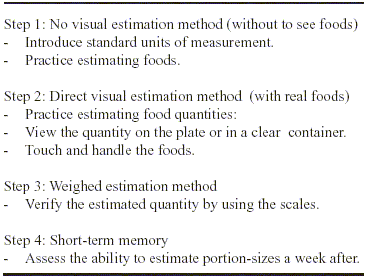
<body><![CDATA[<p ALIGN="justify" style="word-spacing: 0; line-height: 100%; margin-bottom: 0"><font face="Verdana" size="2">57 foods were selected using several criteria: they are commonly</font> <font face="Verdana" size="2">consumed foods (22-24) and they represent a variety</font> <font face="Verdana" size="2">of forms: solid (items that have a geometric shape) (n=43),</font> <font face="Verdana" size="2">amorphous (n=12), and liquid (n=2). Amorphous foods are</font> <font face="Verdana" size="2">those that do not have a specified shape, rather they mound or</font> <font face="Verdana" size="2">assume the shape of the container, such as tossed salad, sliced</font> <font face="Verdana" size="2">fruit and rice (7). Foods selected were sorted into seven groups:</font> <font face="Verdana" size="2">grains (7 foods and 22 different shapes), vegetables (9 foods</font> <font face="Verdana" size="2">and 18 different shapes), fruits (4 foods and 8 different shapes),</font> <font face="Verdana" size="2">proteins (21 foods and 42 different shapes), fats and oils (4</font> <font face="Verdana" size="2">foods and 10 different shapes), dairy (3 foods and 8 differentshapes) and &quot;another&quot; (9 foods and 17 different shapes). &quot;Another&quot;</font> <font face="Verdana" size="2">group included: sweets, salt, meat extract and instant</font> <font face="Verdana" size="2">coffee. Each student assessed the 57 foods selected previously.</font></p>     <p ALIGN="justify" style="word-spacing: 0; line-height: 100%; margin-bottom: 0"><font face="Verdana" size="2">The measurements chosen were common standard portion</font> <font face="Verdana" size="2">sizes, such as cup, glass, dish, slice, etc. And the containerschosen were commonly available in convenience stores and</font> <font face="Verdana" size="2">local restaurants. We included portion size for the main course</font> <font face="Verdana" size="2">and for the accompaniment.</font></p>     <p ALIGN="justify" style="word-spacing: 0; line-height: 100%; margin-bottom: 0"><font face="Verdana" size="2"><b>Procedure</b></font></p>     <p ALIGN="justify" style="word-spacing: 0; line-height: 100%; margin-bottom: 0"><font face="Verdana" size="2">Individual practice estimation sessions were conducted</font> <font face="Verdana" size="2">during the training period. To reduce any potential for bias,</font> <font face="Verdana" size="2">participants were not told specific information about the true</font> <font face="Verdana" size="2">purpose of the study before the interview.</font></p>     <p ALIGN="justify" style="word-spacing: 0; line-height: 100%; margin-bottom: 0"><font face="Verdana" size="2">Activities to improve observers´ food-estimation skills</font> <font face="Verdana" size="2">included 4 steps (<a href="#fig1">Figure 1</a>). The step 1-3 carried out for three</font> <font face="Verdana" size="2">consecutive hours. During the training program the portion</font> <font face="Verdana" size="2">sizes and shapes of each food varied. By varying these factors,</font> <font face="Verdana" size="2">it was possible to explore whether this training promote</font> <font face="Verdana" size="2">accurate estimates foods in their various forms.</font></p>     <p ALIGN="justify" style="word-spacing: 0; line-height: 100%; margin-bottom: 0"><a name="fig1"></a></p>     <p ALIGN="center" style="word-spacing: 0; line-height: 100%; margin-bottom: 0"><font face="Verdana" size="2"><b>FIGURE 1. </b></font><font face="Verdana" size="2">Four-step portion-size estimation and measurement</font> <font face="Verdana" size="2">training program</font></p>     <p ALIGN="center" style="word-spacing: 0; line-height: 100%; margin-bottom: 0"><img border="0" src="/img/fbpe/alan/v57n2/art09fig1.gif" align="center" width="365" height="278"></p>     
<p ALIGN="justify" style="word-spacing: 0; line-height: 100%; margin-bottom: 0"><font face="Verdana" size="2">First, the respondent was asked to report the weight of different</font> <font face="Verdana" size="2">foods that is considered a portion size (step 1). The</font> <font face="Verdana" size="2">first step involved applying a no visual estimation method</font> <font face="Verdana" size="2">(without to see foods) and consisted of a half-hour group session.</font> <font face="Verdana" size="2">The aims of this step were to introduce standard units of</font> <font face="Verdana" size="2">measurement and to practice estimating foods.</font></p>     <p ALIGN="justify" style="word-spacing: 0; line-height: 100%; margin-bottom: 0"><font face="Verdana" size="2">Second, the respondents were permitted to examine and</font> <font face="Verdana" size="2">handle the real foods and they were asked to estimate each</font> <font face="Verdana" size="2">food weight (step 2). The foods were arranged on a table in</font> <font face="Verdana" size="2">the sequence in which participants were to estimate their</font> <font face="Verdana" size="2">amounts. Actual food weight was provided after each estimate</font> <font face="Verdana" size="2">to allow each observer to evaluate his food specific estimation</font> <font face="Verdana" size="2">skills. The second step involved applying a direct visual</font> <font face="Verdana" size="2">estimation method and consisted of a one and half hours</font> <font face="Verdana" size="2">group session. The aim of the second step was to continue to</font> <font face="Verdana" size="2">practice estimating food quantities.</font></p>     ]]></body>
<body><![CDATA[<p ALIGN="justify" style="word-spacing: 0; line-height: 100%; margin-bottom: 0"><font face="Verdana" size="2">The step 3 consisted of a 1-hours group session in which</font> <font face="Verdana" size="2">subjects practiced measuring various foods with the quantity</font> <font face="Verdana" size="2">that they considered household measures. Next, participants</font> <font face="Verdana" size="2">established the weight using scales (Soehnle Ref. 8025; max</font> <font face="Verdana" size="2">2 kg; 0-1000 g = 1g, 1000-2000 = 2 g). The third step involved applying a weighed estimation method and the aim</font> <font face="Verdana" size="2">was to verify the estimated quantity.</font></p>     <p ALIGN="justify" style="word-spacing: 0; line-height: 100%; margin-bottom: 0"><font face="Verdana" size="2">Finally, the subjects were asked to estimate portion sizes of</font> <font face="Verdana" size="2">the different preweighed food quantities up to 1 week after</font> <font face="Verdana" size="2">training (step 4). In the last step no handling of food was permitted.The aim of the fourth step was to assess the ability to</font> <font face="Verdana" size="2">estimate portion-sizes a week after (short-term memory).</font></p>     <p ALIGN="justify" style="word-spacing: 0; line-height: 100%; margin-bottom: 0"><font face="Verdana" size="2">This study employed three questionnaires that were filled</font> <font face="Verdana" size="2">out in the step 1 (no visual), 2 (direct visual) and 4 (1 weekafter). The sequence of the foods listed on the questionnairesvaried according to the sequence in which the foods were to</font> <font face="Verdana" size="2">be estimated. Before each step the participants had been trained</font> <font face="Verdana" size="2">in the method to fill out the questionnaires.</font></p>     <p ALIGN="justify" style="word-spacing: 0; line-height: 100%; margin-bottom: 0"><font face="Verdana" size="2"><b>Statistical analyses</b></font></p>     <p ALIGN="justify" style="word-spacing: 0; line-height: 100%; margin-bottom: 0"><font face="Verdana" size="2">The equation for calculating percentage estimation error was</font> <font face="Verdana" size="2">[(estimated portion – measured portion) ÷ measured portion] x</font> <font face="Verdana" size="2">100 (0% error would be a &quot;perfect&quot; score) (25). Effectiveness of</font> <font face="Verdana" size="2">training was determined by examining change in the absolute</font> <font face="Verdana" size="2">percentage error for all observers and over all foods over time.</font></p>     <p ALIGN="justify" style="word-spacing: 0; line-height: 100%; margin-bottom: 0"><font face="Verdana" size="2">Using two methods, the difference method (D) and the absolute</font> <font face="Verdana" size="2">value method (AV) performed this calculation. The D</font> <font face="Verdana" size="2">method distinguishes between overestimation and underestimation</font> <font face="Verdana" size="2">(positive and negative scores, respectively), allowing</font> <font face="Verdana" size="2">for evaluation of the mean direction of error for the total testand for each food variable. The AV method ignores positive</font> <font face="Verdana" size="2">and negative signs, thus providing the absolute value of the</font> <font face="Verdana" size="2">percentage error of estimation. Larger errors are expected with</font> <font face="Verdana" size="2">use of the AV method because errors are additive.</font></p>     <p ALIGN="justify" style="word-spacing: 0; line-height: 100%; margin-bottom: 0"><font face="Verdana" size="2">Outliers, defined as respondents whose percentage recall</font> <font face="Verdana" size="2">error was more than 3 standard deviations outside of the overall</font> <font face="Verdana" size="2">mean for a particular food, were not included in analysesfor mean percentage estimation error for that food. Eliminatingoutliers was important because large deviations in a single</font> <font face="Verdana" size="2">respondent’s data (for example, a respondent who overestimated</font> <font face="Verdana" size="2">the portion size of green beans by more than 1,000%)</font> <font face="Verdana" size="2">would have had a major impact on the mean misestimation</font> <font face="Verdana" size="2">for that food.</font></p>     <p ALIGN="justify" style="word-spacing: 0; line-height: 100%; margin-bottom: 0"><font face="Verdana" size="2">Data were analyzed using SPSS vs. 13.0. (SPSS Inc., Chicago,</font> <font face="Verdana" size="2">IL, USA) and reported as median ± Standard Deviation</font> <font face="Verdana" size="2">(S.D.). For each food group (grains, vegetables, fruits, proteins,</font> <font face="Verdana" size="2">fats and oils, dairy and &quot;another&quot;) and food type (solid,</font> <font face="Verdana" size="2">amorphous and liquid), the difference between percentage</font> <font face="Verdana" size="2">estimation errors was analyzed by using Student’s t test and</font> <font face="Verdana" size="2">the Mann-Whitney U test. Alpha level for all of these analyses</font> <font face="Verdana" size="2">was set at P&lt;0.05 (two-tail test).</font></p>     <p ALIGN="justify" style="word-spacing: 0; line-height: 100%; margin-bottom: 0"><font face="Verdana" size="2"><b>RESULTS AND DISCUSSION</b></font></p>     <p ALIGN="justify" style="word-spacing: 0; line-height: 100%; margin-bottom: 0"><font face="Verdana" size="2">The mean percentage errors between weighed foods and</font> <font face="Verdana" size="2">estimates calculated by the D method according to the food</font> <font face="Verdana" size="2">group were shown in <a href="#tab1">Table 1</a>. A comparison of the scores by</font> <font face="Verdana" size="2">the D method revealed that there were no significant differences</font> <font face="Verdana" size="2">between the different steps for either food group, except</font> <font face="Verdana" size="2">for the grains, fruits and protein groups. Error in estimates</font> <font face="Verdana" size="2">of proteins (meat, poultry, fish, beans and eggs) for the</font> <font face="Verdana" size="2">D method decreased between step 1 and 2, but estimated</font> <font face="Verdana" size="2">weights for this food group showed increase in error over time.</font> <font face="Verdana" size="2">In general, dairy, vegetables and fruits were accurately determined</font> <font face="Verdana" size="2">before, during and after training, by a small margin.</font></p>     ]]></body>
<body><![CDATA[<p ALIGN="justify" style="word-spacing: 0; line-height: 100%; margin-bottom: 0"><a name="tab1"></a></p>     <p ALIGN="center" style="word-spacing: 0; line-height: 100%; margin-bottom: 0"><font face="Verdana" size="2"><b>TABLE 1. </b></font><font face="Verdana" size="2">Median percentage errors between weighed foods</font> <font face="Verdana" size="2">and estimates by food groups (difference method)</font></p>     <p ALIGN="center" style="word-spacing: 0; line-height: 100%; margin-bottom: 0"><img border="0" src="/img/fbpe/alan/v57n2/art09tab1.gif" align="center" width="490" height="408"></p>     
<p ALIGN="justify" style="word-spacing: 0; line-height: 100%; margin-bottom: 0"><font face="Verdana" size="2">The differences between the portion-size errors were significant</font> <font face="Verdana" size="2">for the AV method, for most of the food groups (<a href="#tab2">Table</a></font><a href="#tab2"> <font face="Verdana" size="2">2</font></a><font face="Verdana" size="2">). A comparison of these errors revealed that the training</font> <font face="Verdana" size="2">program did significantly improve estimation accuracy betweenstep 1 and 4 for all food types, except for the fats and</font> <font face="Verdana" size="2">oils, and dairy. Our results concur with others that even shortterm</font> <font face="Verdana" size="2">exposure to practical portion size measurement program</font> <font face="Verdana" size="2">may improve estimation accuracy of food weight (12,26).</font></p>     <p ALIGN="justify" style="word-spacing: 0; line-height: 100%; margin-bottom: 0"><a name="tab2"></a></p>     <p ALIGN="center" style="word-spacing: 0; line-height: 100%; margin-bottom: 0"><font face="Verdana" size="2"><b>TABLE 2. </b></font><font face="Verdana" size="2">Median percentage errors between weighed foods</font> <font face="Verdana" size="2">and estimates by food groups (absolute value method)</font></p>     <p ALIGN="center" style="word-spacing: 0; line-height: 100%; margin-bottom: 0"><img border="0" src="/img/fbpe/alan/v57n2/art09tab2.gif" align="center" width="500" height="400"></p>     
<p ALIGN="justify" style="word-spacing: 0; line-height: 100%; margin-bottom: 0"><font face="Verdana" size="2">Using the AV method of calculating percentage estimation</font> <font face="Verdana" size="2">error provides information regarding total error because error</font> <font face="Verdana" size="2">are additive. Since percentage estimation error was generally</font> <font face="Verdana" size="2">greater by the AV method than by the D method, we found</font> <font face="Verdana" size="2">that overall improvement in estimation accuracy was affected</font> <font face="Verdana" size="2">by the calculation method.</font></p>     <p ALIGN="justify" style="word-spacing: 0; line-height: 100%; margin-bottom: 0"><font face="Verdana" size="2">Additionally, the accuracy of their estimates varied by food</font> <font face="Verdana" size="2">group. Gittelsohn et al. (27) have reported a similar trend. In</font> <font face="Verdana" size="2">our case, due issue of concern is that observer estimates are</font> <font face="Verdana" size="2">relatively less accurate for &quot;another&quot;, fats and oils and proteins.</font> <font face="Verdana" size="2">These data should be considered when designing future</font> <font face="Verdana" size="2">programs to improve the accuracy of portion size estimates.</font></p>     <p ALIGN="justify" style="word-spacing: 0; line-height: 100%; margin-bottom: 0"><font face="Verdana" size="2">We also found that accuracy of estimation varied by food</font> <font face="Verdana" size="2">form after training (<a href="#tab3">Table 3</a>): liquids were estimated the most</font> <font face="Verdana" size="2">accurately (median error = 14.18%); followed by solids (median</font> <font face="Verdana" size="2">error = 14.51%); and finally, amorphous foods (median</font> <font face="Verdana" size="2">error = 33.96%) (D method). Amorphous was the food type</font> <font face="Verdana" size="2">estimated least accurately both before and after training, which</font> <font face="Verdana" size="2">is consistent with reports of portion-size estimation ability in</font> <font face="Verdana" size="2">other studies (28-31).</font></p>     ]]></body>
<body><![CDATA[<p ALIGN="justify" style="word-spacing: 0; line-height: 100%; margin-bottom: 0"><a name="tab3"></a></p>     <p ALIGN="center" style="word-spacing: 0; line-height: 100%; margin-bottom: 0"><font face="Verdana" size="2"><b>TABLE 3. </b></font><font face="Verdana" size="2">Median percentage errors between weighed foods and estimates by food types</font></p>     <p ALIGN="center" style="word-spacing: 0; line-height: 100%; margin-bottom: 0"><img border="0" src="/img/fbpe/alan/v57n2/art09tab3.gif" align="center" width="580" height="167"></p>     
<p ALIGN="justify" style="word-spacing: 0; line-height: 100%; margin-bottom: 0"><font face="Verdana" size="2">We recognize some critical limitations of this study such as</font> <font face="Verdana" size="2">the sample size, the lack of a control condition, and the length</font> <font face="Verdana" size="2">of the training program. To improve the accuracy of estimates,additional time should be spent on estimating several foods(amorphous foods, fats and oils, proteins and &quot;another&quot;). Periodicretesting, both during the training and study periods, is</font> <font face="Verdana" size="2">recommended to maintain high levels of accuracy for all observers.</font> <font face="Verdana" size="2">This training may have been too brief for participants</font> <font face="Verdana" size="2">to fully assimilate the application. The translation of cognitive</font> <font face="Verdana" size="2">capacity for estimation and measurement skills into accurate</font> <font face="Verdana" size="2">food estimation ability is likely to require more than</font> <font face="Verdana" size="2">one training session, particularly to produce longer-term result</font> <font face="Verdana" size="2">(32).</font></p>     <p ALIGN="justify" style="word-spacing: 0; line-height: 100%; margin-bottom: 0"><font face="Verdana" size="2">Since most of the studies related to the portion size estimation</font> <font face="Verdana" size="2">training did not use in university students of Human Nutrition</font> <font face="Verdana" size="2">and Dietetic, it is not easy to compare with our results.</font> <font face="Verdana" size="2">However, we would like to point out that our training program</font> <font face="Verdana" size="2">comprise a wide list of foods and different sizes and shapes,</font> <font face="Verdana" size="2">what allow to explore whether this training promote accurate</font> <font face="Verdana" size="2">estimates foods in their various forms.</font></p>     <p ALIGN="justify" style="word-spacing: 0; line-height: 100%; margin-bottom: 0"><font face="Verdana" size="2">This study also shows that precision in portion size estimation</font> <font face="Verdana" size="2">is not yet a realistic expectation. The critical questions that</font> <font face="Verdana" size="2">remain are: What level of accuracy is realistic and acceptable?</font> <font face="Verdana" size="2">What type of training in portion size estimation is necessary</font> <font face="Verdana" size="2">to reach this acceptable level?.</font></p>     <p ALIGN="justify" style="word-spacing: 0; line-height: 100%; margin-bottom: 0"><font face="Verdana" size="2">Part of the difficulty in establishing an acceptable level of</font> <font face="Verdana" size="2">accuracy is the lack of consensus on the expression of error</font> <font face="Verdana" size="2">rates. Moreover, acceptable levels of accuracy may differ</font> <font face="Verdana" size="2">depending on the use of promotion estimates, i.e., for</font> <font face="Verdana" size="2">nutritional monitoring of populations, or for individual</font> <font face="Verdana" size="2">nutrition intervention in health promotion, disease prevention</font> <font face="Verdana" size="2">and disease management (33).</font></p>     <p ALIGN="justify" style="word-spacing: 0; line-height: 100%; margin-bottom: 0"><font face="Verdana" size="2">In summary, our findings suggest that future dietitians can</font> <font face="Verdana" size="2">be trained to estimate quantities by direct observation acrossa wide range of foods. Additionally our results will assist inthe development of more effective training programs for the</font> <font face="Verdana" size="2">portion-size estimation, which is likely to reduce respondent</font> <font face="Verdana" size="2">errors and promote the collection of accurate data.</font></p>     <p ALIGN="justify" style="word-spacing: 0; line-height: 100%; margin-bottom: 0"><font face="Verdana" size="2"><b>REFERENCES</b></font></p>     <!-- ref --><p ALIGN="justify" style="word-spacing: 0; line-height: 100%; margin-bottom: 0"><font face="Verdana" size="2">1. Scagliusi FB, Polacow VO, Artioli GG, Benatti FB, Lancha</font> <font face="Verdana" size="2">AH Jr. Selective underreporting of energy intake in women:</font> <font face="Verdana" size="2">magnitude, determinants, and effect of training. J Am Diet</font> <font face="Verdana" size="2">Assoc. 2003;103:1306-13.</font>&nbsp;&nbsp;&nbsp;&nbsp;&nbsp;&nbsp;&nbsp;&nbsp;[&#160;<a href="javascript:void(0);" onclick="javascript: window.open('/scielo.php?script=sci_nlinks&ref=477543&pid=S0004-0622200700020000900001&lng=','','width=640,height=500,resizable=yes,scrollbars=1,menubar=yes,');">Links</a>&#160;]<!-- end-ref --><!-- ref --><p ALIGN="justify" style="word-spacing: 0; line-height: 100%; margin-bottom: 0"><font face="Verdana" size="2">2. Godwin SL, Chambers E, Cleveland L. Accuracy of reporting</font> <font face="Verdana" size="2">dietary intake using various portion-size aids in-person and via</font> <font face="Verdana" size="2">telephone. J Am Diet Assoc. 2004;104:585-94.</font>&nbsp;&nbsp;&nbsp;&nbsp;&nbsp;&nbsp;&nbsp;&nbsp;[&#160;<a href="javascript:void(0);" onclick="javascript: window.open('/scielo.php?script=sci_nlinks&ref=477544&pid=S0004-0622200700020000900002&lng=','','width=640,height=500,resizable=yes,scrollbars=1,menubar=yes,');">Links</a>&#160;]<!-- end-ref --><!-- ref --><p ALIGN="justify" style="word-spacing: 0; line-height: 100%; margin-bottom: 0"><font face="Verdana" size="2">3. Volker DH, Leary C, Gill TP. Portion size of campus takeaway</font> <font face="Verdana" size="2">foods and serving size estimates of common foods. Asia Pac J</font> <font face="Verdana" size="2">Clin Nutr. 2003;12(Suppl):25S.</font>&nbsp;&nbsp;&nbsp;&nbsp;&nbsp;&nbsp;&nbsp;&nbsp;[&#160;<a href="javascript:void(0);" onclick="javascript: window.open('/scielo.php?script=sci_nlinks&ref=477545&pid=S0004-0622200700020000900003&lng=','','width=640,height=500,resizable=yes,scrollbars=1,menubar=yes,');">Links</a>&#160;]<!-- end-ref --><!-- ref --><p ALIGN="justify" style="word-spacing: 0; line-height: 100%; margin-bottom: 0"><font face="Verdana" size="2">4. Barrett-Connor E. Nutrition epidemiology: how do we know</font> <font face="Verdana" size="2">what they ate? Am J Clin Nutr. 1991;54(Suppl):182S-187S.</font>&nbsp;&nbsp;&nbsp;&nbsp;&nbsp;&nbsp;&nbsp;&nbsp;[&#160;<a href="javascript:void(0);" onclick="javascript: window.open('/scielo.php?script=sci_nlinks&ref=477546&pid=S0004-0622200700020000900004&lng=','','width=640,height=500,resizable=yes,scrollbars=1,menubar=yes,');">Links</a>&#160;]<!-- end-ref --><!-- ref --><p ALIGN="justify" style="word-spacing: 0; line-height: 100%; margin-bottom: 0"><font face="Verdana" size="2">5. Schwartz J, Byrd-Bredbenner C. The effect of practical portion</font> <font face="Verdana" size="2">size measurement aids on the accuracy of portion size estimates</font> <font face="Verdana" size="2">made by young adults. J Hum Nutr Diet. 2004;17(4):351-357.</font>&nbsp;&nbsp;&nbsp;&nbsp;&nbsp;&nbsp;&nbsp;&nbsp;[&#160;<a href="javascript:void(0);" onclick="javascript: window.open('/scielo.php?script=sci_nlinks&ref=477547&pid=S0004-0622200700020000900005&lng=','','width=640,height=500,resizable=yes,scrollbars=1,menubar=yes,');">Links</a>&#160;]<!-- end-ref --><!-- ref --><p ALIGN="justify" style="word-spacing: 0; line-height: 100%; margin-bottom: 0"><font face="Verdana" size="2">6. Faggiano F, Vineis P, Cravanzola D, Pisani P, Xompero G, Riboli</font> <font face="Verdana" size="2">E, Kaaks R. Validation of a method for the estimation of food</font> <font face="Verdana" size="2">portion size. Epidemiology 1991;3:379-382.</font>&nbsp;&nbsp;&nbsp;&nbsp;&nbsp;&nbsp;&nbsp;&nbsp;[&#160;<a href="javascript:void(0);" onclick="javascript: window.open('/scielo.php?script=sci_nlinks&ref=477548&pid=S0004-0622200700020000900006&lng=','','width=640,height=500,resizable=yes,scrollbars=1,menubar=yes,');">Links</a>&#160;]<!-- end-ref --><!-- ref --><p ALIGN="justify" style="word-spacing: 0; line-height: 100%; margin-bottom: 0"><font face="Verdana" size="2">7. Chambers E IV, Godwin SL, Vecchio F. Cognitive strategies</font> <font face="Verdana" size="2">for reporting portion sizes using dietary recall procedures. J</font> <font face="Verdana" size="2">Am Diet Assoc. 2000;100:891-897.</font>&nbsp;&nbsp;&nbsp;&nbsp;&nbsp;&nbsp;&nbsp;&nbsp;[&#160;<a href="javascript:void(0);" onclick="javascript: window.open('/scielo.php?script=sci_nlinks&ref=477549&pid=S0004-0622200700020000900007&lng=','','width=640,height=500,resizable=yes,scrollbars=1,menubar=yes,');">Links</a>&#160;]<!-- end-ref --><!-- ref --><p ALIGN="justify" style="word-spacing: 0; line-height: 100%; margin-bottom: 0"><font face="Verdana" size="2">8. Godwin S, McGuire B, Chambers E IV, McDowell M, Cleveland</font> <font face="Verdana" size="2">L, Edwards E, Ingwersen L. Evaluation of portion size</font> <font face="Verdana" size="2">estimation aids used for meat in 24-hour dietary recalls. Nutr</font> <font face="Verdana" size="2">Res. 2001;21:1217-1233.</font>&nbsp;&nbsp;&nbsp;&nbsp;&nbsp;&nbsp;&nbsp;&nbsp;[&#160;<a href="javascript:void(0);" onclick="javascript: window.open('/scielo.php?script=sci_nlinks&ref=477550&pid=S0004-0622200700020000900008&lng=','','width=640,height=500,resizable=yes,scrollbars=1,menubar=yes,');">Links</a>&#160;]<!-- end-ref --><!-- ref --><p ALIGN="justify" style="word-spacing: 0; line-height: 100%; margin-bottom: 0"><font face="Verdana" size="2">9. Lillegaard IT, Overby NC, Andersen LF. Can children and</font> <font face="Verdana" size="2">adolescents use photographs of food to estimate portion sizes?</font> <font face="Verdana" size="2">Eur J Clin Nutr. 2005;59:611-7.</font>&nbsp;&nbsp;&nbsp;&nbsp;&nbsp;&nbsp;&nbsp;&nbsp;[&#160;<a href="javascript:void(0);" onclick="javascript: window.open('/scielo.php?script=sci_nlinks&ref=477551&pid=S0004-0622200700020000900009&lng=','','width=640,height=500,resizable=yes,scrollbars=1,menubar=yes,');">Links</a>&#160;]<!-- end-ref --><!-- ref --><p ALIGN="justify" style="word-spacing: 0; line-height: 100%; margin-bottom: 0"><font face="Verdana" size="2">10. Williamson DA, Allen HR, Martin PD, Alfonso A, Gerald B,</font> <font face="Verdana" size="2">Hunt A. Digital photography: a new method for estimating food</font> <font face="Verdana" size="2">intake in cafeteria settings. Eat Weight Disord.2004;9:24-8.</font>&nbsp;&nbsp;&nbsp;&nbsp;&nbsp;&nbsp;&nbsp;&nbsp;[&#160;<a href="javascript:void(0);" onclick="javascript: window.open('/scielo.php?script=sci_nlinks&ref=477552&pid=S0004-0622200700020000900010&lng=','','width=640,height=500,resizable=yes,scrollbars=1,menubar=yes,');">Links</a>&#160;]<!-- end-ref --><!-- ref --><p ALIGN="justify" style="word-spacing: 0; line-height: 100%; margin-bottom: 0"><font face="Verdana" size="2">11. McGuire B, Chambers E IV, Godwin S, Brenner S. Size categories</font> <font face="Verdana" size="2">most effective for estimating portion sizes of muffins. J</font> <font face="Verdana" size="2">Am Diet Assoc. 2001;101:472-474.</font>&nbsp;&nbsp;&nbsp;&nbsp;&nbsp;&nbsp;&nbsp;&nbsp;[&#160;<a href="javascript:void(0);" onclick="javascript: window.open('/scielo.php?script=sci_nlinks&ref=477553&pid=S0004-0622200700020000900011&lng=','','width=640,height=500,resizable=yes,scrollbars=1,menubar=yes,');">Links</a>&#160;]<!-- end-ref --><!-- ref --><p ALIGN="justify" style="word-spacing: 0; line-height: 100%; margin-bottom: 0"><font face="Verdana" size="2">12. Byrd-Bredbenner C, Schwartz J. The effect of practical portion</font> <font face="Verdana" size="2">size measurement aids on the accuracy of portion size estimates</font> <font face="Verdana" size="2">made by young adults. J Hum Nutr Diet. 2004;17:351-7.</font>&nbsp;&nbsp;&nbsp;&nbsp;&nbsp;&nbsp;&nbsp;&nbsp;[&#160;<a href="javascript:void(0);" onclick="javascript: window.open('/scielo.php?script=sci_nlinks&ref=477554&pid=S0004-0622200700020000900012&lng=','','width=640,height=500,resizable=yes,scrollbars=1,menubar=yes,');">Links</a>&#160;]<!-- end-ref --><!-- ref --><p ALIGN="justify" style="word-spacing: 0; line-height: 100%; margin-bottom: 0"><font face="Verdana" size="2">13. Matheson DM, Hanson KA, McDonald TE, Robinson TN.</font> <font face="Verdana" size="2">Validity of children’s food portion estimates: a comparison of</font> <font face="Verdana" size="2">2 measurement aids. Arch Pediatr Adolesc Med. 2002;156:867-</font> <font face="Verdana" size="2">71.</font>&nbsp;&nbsp;&nbsp;&nbsp;&nbsp;&nbsp;&nbsp;&nbsp;[&#160;<a href="javascript:void(0);" onclick="javascript: window.open('/scielo.php?script=sci_nlinks&ref=477555&pid=S0004-0622200700020000900013&lng=','','width=640,height=500,resizable=yes,scrollbars=1,menubar=yes,');">Links</a>&#160;]<!-- end-ref --><!-- ref --><p ALIGN="justify" style="word-spacing: 0; line-height: 100%; margin-bottom: 0"><font face="Verdana" size="2">14. Slimani N, Valsta L. EFCOSUM Group. Perspectives of using</font> <font face="Verdana" size="2">the EPIC-SOFT programme in the context of pan-European</font> <font face="Verdana" size="2">nutritional monitoring surveys: methodological and practical</font> <font face="Verdana" size="2">implications. Eur J Clin Nutr. 2002;56 (Suppl2):63S-74S.</font>&nbsp;&nbsp;&nbsp;&nbsp;&nbsp;&nbsp;&nbsp;&nbsp;[&#160;<a href="javascript:void(0);" onclick="javascript: window.open('/scielo.php?script=sci_nlinks&ref=477556&pid=S0004-0622200700020000900014&lng=','','width=640,height=500,resizable=yes,scrollbars=1,menubar=yes,');">Links</a>&#160;]<!-- end-ref --><!-- ref --><p ALIGN="justify" style="word-spacing: 0; line-height: 100%; margin-bottom: 0"><font face="Verdana" size="2">15. Steyn NP, Senekal M, Norris SA, Whati L, Mackeown JM, Nel</font> <font face="Verdana" size="2">JH. How well do adolescents determine portion sizes of foods</font> <font face="Verdana" size="2">and beverages? Asia Pac J Clin Nutr. 2006;15:35-42.</font>&nbsp;&nbsp;&nbsp;&nbsp;&nbsp;&nbsp;&nbsp;&nbsp;[&#160;<a href="javascript:void(0);" onclick="javascript: window.open('/scielo.php?script=sci_nlinks&ref=477557&pid=S0004-0622200700020000900015&lng=','','width=640,height=500,resizable=yes,scrollbars=1,menubar=yes,');">Links</a>&#160;]<!-- end-ref --><!-- ref --><p ALIGN="justify" style="word-spacing: 0; line-height: 100%; margin-bottom: 0"><font face="Verdana" size="2">16. Weber JL, Lytle L, Gittelsohn J, Cunningham-Sabo L, Heller</font> <font face="Verdana" size="2">K, Anliker JA, Stevens J, Hurley J, Ring K. Validity of selfreported</font> <font face="Verdana" size="2">dietary intake at school meals by American Indian</font> <font face="Verdana" size="2">children: the Pathways Study. J Am Diet Assoc. 2004;104:746-</font> <font face="Verdana" size="2">52.</font>&nbsp;&nbsp;&nbsp;&nbsp;&nbsp;&nbsp;&nbsp;&nbsp;[&#160;<a href="javascript:void(0);" onclick="javascript: window.open('/scielo.php?script=sci_nlinks&ref=477558&pid=S0004-0622200700020000900016&lng=','','width=640,height=500,resizable=yes,scrollbars=1,menubar=yes,');">Links</a>&#160;]<!-- end-ref --><!-- ref --><p ALIGN="justify" style="word-spacing: 0; line-height: 100%; margin-bottom: 0"><font face="Verdana" size="2">17. Ayala GX. An experimental evaluation of a group- versus</font> <font face="Verdana" size="2">computer-based intervention to improve food portion size</font> <font face="Verdana" size="2">estimation skills. Health Educ Res. 2006;21:133-45.</font>&nbsp;&nbsp;&nbsp;&nbsp;&nbsp;&nbsp;&nbsp;&nbsp;[&#160;<a href="javascript:void(0);" onclick="javascript: window.open('/scielo.php?script=sci_nlinks&ref=477559&pid=S0004-0622200700020000900017&lng=','','width=640,height=500,resizable=yes,scrollbars=1,menubar=yes,');">Links</a>&#160;]<!-- end-ref --><!-- ref --><p ALIGN="justify" style="word-spacing: 0; line-height: 100%; margin-bottom: 0"><font face="Verdana" size="2">18. Cuervo M, Brehme U, Egli IM, Elmadfa I, Gronowska-Senger</font> <font face="Verdana" size="2">A, Tetens I, Martínez JA, Branca F. Nutrition, Dietetics and</font> <font face="Verdana" size="2">Food Sciences Degrees across Europe. Ann Nutr Metab.</font> <font face="Verdana" size="2">2007;51:115-118.</font>&nbsp;&nbsp;&nbsp;&nbsp;&nbsp;&nbsp;&nbsp;&nbsp;[&#160;<a href="javascript:void(0);" onclick="javascript: window.open('/scielo.php?script=sci_nlinks&ref=477560&pid=S0004-0622200700020000900018&lng=','','width=640,height=500,resizable=yes,scrollbars=1,menubar=yes,');">Links</a>&#160;]<!-- end-ref --><!-- ref --><p ALIGN="justify" style="word-spacing: 0; line-height: 100%; margin-bottom: 0"><font face="Verdana" size="2">19. Slawson DL, Eck LH. Intense practice enhances accuracy of</font> <font face="Verdana" size="2">portion size estimation of amorphous foods. J Am Diet Assoc.</font> <font face="Verdana" size="2">1997;97:295-297.</font>&nbsp;&nbsp;&nbsp;&nbsp;&nbsp;&nbsp;&nbsp;&nbsp;[&#160;<a href="javascript:void(0);" onclick="javascript: window.open('/scielo.php?script=sci_nlinks&ref=477561&pid=S0004-0622200700020000900019&lng=','','width=640,height=500,resizable=yes,scrollbars=1,menubar=yes,');">Links</a>&#160;]<!-- end-ref --><!-- ref --><p ALIGN="justify" style="word-spacing: 0; line-height: 100%; margin-bottom: 0"><font face="Verdana" size="2">20. WHO. Programme of Nutrition. Family and Reproductive</font> <font face="Verdana" size="2">Health. Obesity. Preventing and managing the global epidemic.</font> <font face="Verdana" size="2">Report of a WHO consultation on obesity. Ginebra, June 3-</font> <font face="Verdana" size="2">5th, 1997. Ginebra WHO, 1998.</font>&nbsp;&nbsp;&nbsp;&nbsp;&nbsp;&nbsp;&nbsp;&nbsp;[&#160;<a href="javascript:void(0);" onclick="javascript: window.open('/scielo.php?script=sci_nlinks&ref=477562&pid=S0004-0622200700020000900020&lng=','','width=640,height=500,resizable=yes,scrollbars=1,menubar=yes,');">Links</a>&#160;]<!-- end-ref --><!-- ref --><p ALIGN="justify" style="word-spacing: 0; line-height: 100%; margin-bottom: 0"><font face="Verdana" size="2">21. Grupo de trabajo de la Sociedad Española de Epidemiología y</font> <font face="Verdana" size="2">de la Sociedad Española de Medicina de Familia y Comunitaria.</font> <font face="Verdana" size="2">Una propuesta de medida de la clase social. Aten Primaria</font> <font face="Verdana" size="2">2000;25:350-63.</font>&nbsp;&nbsp;&nbsp;&nbsp;&nbsp;&nbsp;&nbsp;&nbsp;[&#160;<a href="javascript:void(0);" onclick="javascript: window.open('/scielo.php?script=sci_nlinks&ref=477563&pid=S0004-0622200700020000900021&lng=','','width=640,height=500,resizable=yes,scrollbars=1,menubar=yes,');">Links</a>&#160;]<!-- end-ref --><!-- ref --><p ALIGN="justify" style="word-spacing: 0; line-height: 100%; margin-bottom: 0"><font face="Verdana" size="2">22. Servicio Central de Publicaciones del Gobierno Vasco. Encuesta</font> <font face="Verdana" size="2">de nutrición de la Comunidad Autónoma del País Vasco. Vitoria-</font> <font face="Verdana" size="2">Gasteiz, Spain; 1994.</font>&nbsp;&nbsp;&nbsp;&nbsp;&nbsp;&nbsp;&nbsp;&nbsp;[&#160;<a href="javascript:void(0);" onclick="javascript: window.open('/scielo.php?script=sci_nlinks&ref=477564&pid=S0004-0622200700020000900022&lng=','','width=640,height=500,resizable=yes,scrollbars=1,menubar=yes,');">Links</a>&#160;]<!-- end-ref --><!-- ref --><p ALIGN="justify" style="word-spacing: 0; line-height: 100%; margin-bottom: 0"><font face="Verdana" size="2">23. Fregapane G, Asensio-Garcia C. Dietary assessment of educated</font> <font face="Verdana" size="2">Spanish population using a self-administered meal-based food</font> <font face="Verdana" size="2">frequency questionnaire. Eur J Epidemiol. 2000;16:183-191.</font>&nbsp;&nbsp;&nbsp;&nbsp;&nbsp;&nbsp;&nbsp;&nbsp;[&#160;<a href="javascript:void(0);" onclick="javascript: window.open('/scielo.php?script=sci_nlinks&ref=477565&pid=S0004-0622200700020000900023&lng=','','width=640,height=500,resizable=yes,scrollbars=1,menubar=yes,');">Links</a>&#160;]<!-- end-ref --><!-- ref --><p ALIGN="justify" style="word-spacing: 0; line-height: 100%; margin-bottom: 0"><font face="Verdana" size="2">24. Carbajal A, Sánchez Muniz FJ. Guía de Prácticas. In: Nutrición</font> <font face="Verdana" size="2">y Dietética. García-Arias MT, García-Fernández MC (eds.)</font> <font face="Verdana" size="2">Universidad de León, 2003;1-130.</font>&nbsp;&nbsp;&nbsp;&nbsp;&nbsp;&nbsp;&nbsp;&nbsp;[&#160;<a href="javascript:void(0);" onclick="javascript: window.open('/scielo.php?script=sci_nlinks&ref=477566&pid=S0004-0622200700020000900024&lng=','','width=640,height=500,resizable=yes,scrollbars=1,menubar=yes,');">Links</a>&#160;]<!-- end-ref --><!-- ref --><p ALIGN="justify" style="word-spacing: 0; line-height: 100%; margin-bottom: 0"><font face="Verdana" size="2">25. Bolland JE, Yuhas JA, Bolland TW. Estimation of food portion</font> <font face="Verdana" size="2">sizes: effectiveness of training. J Am Diet Assoc. 1988;88:817–</font> <font face="Verdana" size="2">21.</font>&nbsp;&nbsp;&nbsp;&nbsp;&nbsp;&nbsp;&nbsp;&nbsp;[&#160;<a href="javascript:void(0);" onclick="javascript: window.open('/scielo.php?script=sci_nlinks&ref=477567&pid=S0004-0622200700020000900025&lng=','','width=640,height=500,resizable=yes,scrollbars=1,menubar=yes,');">Links</a>&#160;]<!-- end-ref --><!-- ref --><p ALIGN="justify" style="word-spacing: 0; line-height: 100%; margin-bottom: 0"><font face="Verdana" size="2">26. Bolland JE, Ward JY, Bolland TW. Improved accuracy of</font> <font face="Verdana" size="2">estimating food quantities up to 4 weeks after training. J Am</font> <font face="Verdana" size="2">Diet Assoc 1990;90:1402–1404, 1407.</font>&nbsp;&nbsp;&nbsp;&nbsp;&nbsp;&nbsp;&nbsp;&nbsp;[&#160;<a href="javascript:void(0);" onclick="javascript: window.open('/scielo.php?script=sci_nlinks&ref=477568&pid=S0004-0622200700020000900026&lng=','','width=640,height=500,resizable=yes,scrollbars=1,menubar=yes,');">Links</a>&#160;]<!-- end-ref --><!-- ref --><p ALIGN="justify" style="word-spacing: 0; line-height: 100%; margin-bottom: 0"><font face="Verdana" size="2">27. Gittelsohn J, Shankar AV, Pokhrel RP, West KP Jr. Accuracy of</font> <font face="Verdana" size="2">estimating food intake by observation. J Am Diet Assoc.</font> <font face="Verdana" size="2">1994;94:1273-7.</font>&nbsp;&nbsp;&nbsp;&nbsp;&nbsp;&nbsp;&nbsp;&nbsp;[&#160;<a href="javascript:void(0);" onclick="javascript: window.open('/scielo.php?script=sci_nlinks&ref=477569&pid=S0004-0622200700020000900027&lng=','','width=640,height=500,resizable=yes,scrollbars=1,menubar=yes,');">Links</a>&#160;]<!-- end-ref --><!-- ref --><p ALIGN="justify" style="word-spacing: 0; line-height: 100%; margin-bottom: 0"><font face="Verdana" size="2">28. Venter CS, MacIntyre UE, Vorster HH. The development and</font> <font face="Verdana" size="2">testing of a food portion photograph book for use in an African</font> <font face="Verdana" size="2">population. J Hum Nutr Diet. 2000;13:205-218.</font>&nbsp;&nbsp;&nbsp;&nbsp;&nbsp;&nbsp;&nbsp;&nbsp;[&#160;<a href="javascript:void(0);" onclick="javascript: window.open('/scielo.php?script=sci_nlinks&ref=477570&pid=S0004-0622200700020000900028&lng=','','width=640,height=500,resizable=yes,scrollbars=1,menubar=yes,');">Links</a>&#160;]<!-- end-ref --><!-- ref --><p ALIGN="justify" style="word-spacing: 0; line-height: 100%; margin-bottom: 0"><font face="Verdana" size="2">29. Weber JL, Tinsley AM, Houtkooper LB, Lohman TG. Multimethod</font> <font face="Verdana" size="2">training increases portion size estimation accuracy by</font> <font face="Verdana" size="2">food type. J Am Diet Assoc. 1997;97:176-9.</font>&nbsp;&nbsp;&nbsp;&nbsp;&nbsp;&nbsp;&nbsp;&nbsp;[&#160;<a href="javascript:void(0);" onclick="javascript: window.open('/scielo.php?script=sci_nlinks&ref=477571&pid=S0004-0622200700020000900029&lng=','','width=640,height=500,resizable=yes,scrollbars=1,menubar=yes,');">Links</a>&#160;]<!-- end-ref --><!-- ref --><p ALIGN="justify" style="word-spacing: 0; line-height: 100%; margin-bottom: 0"><font face="Verdana" size="2">30. Howat M, Mohan R, Champagne C, Monlezun C, Wozniak P,</font> <font face="Verdana" size="2">Bray G.Validity and reliability of reported dietary intake data.</font> <font face="Verdana" size="2">J Am Diet Assoc. 1994;94:169-73.</font>&nbsp;&nbsp;&nbsp;&nbsp;&nbsp;&nbsp;&nbsp;&nbsp;[&#160;<a href="javascript:void(0);" onclick="javascript: window.open('/scielo.php?script=sci_nlinks&ref=477572&pid=S0004-0622200700020000900030&lng=','','width=640,height=500,resizable=yes,scrollbars=1,menubar=yes,');">Links</a>&#160;]<!-- end-ref --><!-- ref --><p ALIGN="justify" style="word-spacing: 0; line-height: 100%; margin-bottom: 0"><font face="Verdana" size="2">31. Ervin R, Smiciklas-Wright H. Accuracy in estimating and recalling</font> <font face="Verdana" size="2">portion sizes of foods among elderly adults. Nutr Res.</font> <font face="Verdana" size="2">2001;703-713.</font>&nbsp;&nbsp;&nbsp;&nbsp;&nbsp;&nbsp;&nbsp;&nbsp;[&#160;<a href="javascript:void(0);" onclick="javascript: window.open('/scielo.php?script=sci_nlinks&ref=477573&pid=S0004-0622200700020000900031&lng=','','width=640,height=500,resizable=yes,scrollbars=1,menubar=yes,');">Links</a>&#160;]<!-- end-ref --><!-- ref --><p ALIGN="justify" style="word-spacing: 0; line-height: 100%; margin-bottom: 0"><font face="Verdana" size="2">32. Weer JL, Cunningham-Sabo L, Skipper B, Lytle L, Stevens J,</font> <font face="Verdana" size="2">Gittelsohn J, Anliker J, Heller K, Pablo JL. Portion-size</font> <font face="Verdana" size="2">estimation training in second-and third-grade American Indian</font> <font face="Verdana" size="2">children. Am J Clin Nutr. 1999;69(4Suppl):782S-787S.</font>&nbsp;&nbsp;&nbsp;&nbsp;&nbsp;&nbsp;&nbsp;&nbsp;[&#160;<a href="javascript:void(0);" onclick="javascript: window.open('/scielo.php?script=sci_nlinks&ref=477574&pid=S0004-0622200700020000900032&lng=','','width=640,height=500,resizable=yes,scrollbars=1,menubar=yes,');">Links</a>&#160;]<!-- end-ref --><!-- ref --><p ALIGN="justify" style="word-spacing: 0; line-height: 100%; margin-bottom: 0"><font face="Verdana" size="2">33. Hernández T, Wilder L, Kuehn D, Rubotzky K, Moser-Veillon</font> <font face="Verdana" size="2">P, Godwin S, Thompson C, Wang C. Portion size estimation</font> <font face="Verdana" size="2">and expectation of accuracy. J Food Comp and Análisis</font> <font face="Verdana" size="2">2006;19;14S-21S.</font>&nbsp;&nbsp;&nbsp;&nbsp;&nbsp;&nbsp;&nbsp;&nbsp;[&#160;<a href="javascript:void(0);" onclick="javascript: window.open('/scielo.php?script=sci_nlinks&ref=477575&pid=S0004-0622200700020000900033&lng=','','width=640,height=500,resizable=yes,scrollbars=1,menubar=yes,');">Links</a>&#160;]<!-- end-ref --> ]]></body>
<back>
<ref-list>
<ref id="B1">
<label>1</label><nlm-citation citation-type="journal">
<person-group person-group-type="author">
<name>
<surname><![CDATA[Scagliusi]]></surname>
<given-names><![CDATA[FB]]></given-names>
</name>
<name>
<surname><![CDATA[Polacow]]></surname>
<given-names><![CDATA[VO]]></given-names>
</name>
<name>
<surname><![CDATA[Artioli]]></surname>
<given-names><![CDATA[GG]]></given-names>
</name>
<name>
<surname><![CDATA[Benatti]]></surname>
<given-names><![CDATA[FB]]></given-names>
</name>
<name>
<surname><![CDATA[Lancha]]></surname>
<given-names><![CDATA[AH Jr]]></given-names>
</name>
</person-group>
<article-title xml:lang="en"><![CDATA[Selective underreporting of energy intake in women: magnitude, determinants, and effect of training]]></article-title>
<source><![CDATA[J Am Diet Assoc]]></source>
<year>2003</year>
<volume>103</volume>
<page-range>1306-13</page-range></nlm-citation>
</ref>
<ref id="B2">
<label>2</label><nlm-citation citation-type="journal">
<person-group person-group-type="author">
<name>
<surname><![CDATA[Godwin]]></surname>
<given-names><![CDATA[SL]]></given-names>
</name>
<name>
<surname><![CDATA[Chambers]]></surname>
<given-names><![CDATA[E]]></given-names>
</name>
<name>
<surname><![CDATA[Cleveland]]></surname>
<given-names><![CDATA[L]]></given-names>
</name>
</person-group>
<article-title xml:lang="en"><![CDATA[Accuracy of reporting dietary intake using various portion-size aids in-person and via telephone]]></article-title>
<source><![CDATA[J Am Diet Assoc]]></source>
<year>2004</year>
<volume>104</volume>
<page-range>585-94</page-range></nlm-citation>
</ref>
<ref id="B3">
<label>3</label><nlm-citation citation-type="journal">
<person-group person-group-type="author">
<name>
<surname><![CDATA[Volker]]></surname>
<given-names><![CDATA[DH]]></given-names>
</name>
<name>
<surname><![CDATA[Leary]]></surname>
<given-names><![CDATA[C]]></given-names>
</name>
<name>
<surname><![CDATA[Gill]]></surname>
<given-names><![CDATA[TP]]></given-names>
</name>
</person-group>
<article-title xml:lang="en"><![CDATA[Portion size of campus takeaway foods and serving size estimates of common foods]]></article-title>
<source><![CDATA[Asia Pac J Clin Nutr]]></source>
<year>2003</year>
<volume>12</volume>
<page-range>25S</page-range></nlm-citation>
</ref>
<ref id="B4">
<label>4</label><nlm-citation citation-type="journal">
<person-group person-group-type="author">
<name>
<surname><![CDATA[Barrett-Connor]]></surname>
<given-names><![CDATA[E]]></given-names>
</name>
</person-group>
<article-title xml:lang="en"><![CDATA[Nutrition epidemiology: how do we know what they ate?]]></article-title>
<source><![CDATA[Am J Clin Nutr]]></source>
<year>1991</year>
<volume>54</volume>
<page-range>182S-187S</page-range></nlm-citation>
</ref>
<ref id="B5">
<label>5</label><nlm-citation citation-type="journal">
<person-group person-group-type="author">
<name>
<surname><![CDATA[Schwartz]]></surname>
<given-names><![CDATA[J]]></given-names>
</name>
<name>
<surname><![CDATA[Byrd-Bredbenner]]></surname>
<given-names><![CDATA[C]]></given-names>
</name>
</person-group>
<article-title xml:lang="en"><![CDATA[The effect of practical portion size measurement aids on the accuracy of portion size estimates made by young adults]]></article-title>
<source><![CDATA[J Hum Nutr Diet]]></source>
<year>2004</year>
<volume>17</volume>
<numero>4</numero>
<issue>4</issue>
<page-range>351-357</page-range></nlm-citation>
</ref>
<ref id="B6">
<label>6</label><nlm-citation citation-type="journal">
<person-group person-group-type="author">
<name>
<surname><![CDATA[Faggiano]]></surname>
<given-names><![CDATA[F]]></given-names>
</name>
<name>
<surname><![CDATA[Vineis]]></surname>
<given-names><![CDATA[P]]></given-names>
</name>
<name>
<surname><![CDATA[Cravanzola]]></surname>
<given-names><![CDATA[D]]></given-names>
</name>
<name>
<surname><![CDATA[Pisani]]></surname>
<given-names><![CDATA[P]]></given-names>
</name>
<name>
<surname><![CDATA[Xompero]]></surname>
<given-names><![CDATA[G]]></given-names>
</name>
<name>
<surname><![CDATA[Riboli]]></surname>
<given-names><![CDATA[E]]></given-names>
</name>
<name>
<surname><![CDATA[Kaaks]]></surname>
<given-names><![CDATA[R]]></given-names>
</name>
</person-group>
<article-title xml:lang="en"><![CDATA[Validation of a method for the estimation of food portion size]]></article-title>
<source><![CDATA[Epidemiology]]></source>
<year>1991</year>
<volume>3</volume>
<page-range>379-382</page-range></nlm-citation>
</ref>
<ref id="B7">
<label>7</label><nlm-citation citation-type="journal">
<person-group person-group-type="author">
<name>
<surname><![CDATA[Chambers E]]></surname>
<given-names><![CDATA[IV]]></given-names>
</name>
<name>
<surname><![CDATA[Godwin]]></surname>
<given-names><![CDATA[SL]]></given-names>
</name>
<name>
<surname><![CDATA[Vecchio]]></surname>
<given-names><![CDATA[F]]></given-names>
</name>
</person-group>
<article-title xml:lang="en"><![CDATA[Cognitive strategies for reporting portion sizes using dietary recall procedures]]></article-title>
<source><![CDATA[J Am Diet Assoc]]></source>
<year>2000</year>
<volume>100</volume>
<page-range>891-897</page-range></nlm-citation>
</ref>
<ref id="B8">
<label>8</label><nlm-citation citation-type="journal">
<person-group person-group-type="author">
<name>
<surname><![CDATA[Godwin]]></surname>
<given-names><![CDATA[S]]></given-names>
</name>
<name>
<surname><![CDATA[McGuire]]></surname>
<given-names><![CDATA[B]]></given-names>
</name>
<name>
<surname><![CDATA[Chambers E]]></surname>
<given-names><![CDATA[IV]]></given-names>
</name>
<name>
<surname><![CDATA[McDowell]]></surname>
<given-names><![CDATA[M]]></given-names>
</name>
<name>
<surname><![CDATA[Cleveland]]></surname>
<given-names><![CDATA[L]]></given-names>
</name>
<name>
<surname><![CDATA[Edwards]]></surname>
<given-names><![CDATA[E]]></given-names>
</name>
<name>
<surname><![CDATA[Ingwersen]]></surname>
<given-names><![CDATA[L]]></given-names>
</name>
</person-group>
<article-title xml:lang="en"><![CDATA[Evaluation of portion size estimation aids used for meat in 24-hour dietary recalls]]></article-title>
<source><![CDATA[Nutr Res]]></source>
<year>2001</year>
<volume>21</volume>
<page-range>1217-1233</page-range></nlm-citation>
</ref>
<ref id="B9">
<label>9</label><nlm-citation citation-type="journal">
<person-group person-group-type="author">
<name>
<surname><![CDATA[Lillegaard]]></surname>
<given-names><![CDATA[IT]]></given-names>
</name>
<name>
<surname><![CDATA[Overby]]></surname>
<given-names><![CDATA[NC]]></given-names>
</name>
<name>
<surname><![CDATA[Andersen]]></surname>
<given-names><![CDATA[LF]]></given-names>
</name>
</person-group>
<article-title xml:lang="en"><![CDATA[Can children and adolescents use photographs of food to estimate portion sizes?]]></article-title>
<source><![CDATA[Eur J Clin Nutr]]></source>
<year>2005</year>
<volume>59</volume>
<page-range>611-7</page-range></nlm-citation>
</ref>
<ref id="B10">
<label>10</label><nlm-citation citation-type="journal">
<person-group person-group-type="author">
<name>
<surname><![CDATA[Williamson]]></surname>
<given-names><![CDATA[DA]]></given-names>
</name>
<name>
<surname><![CDATA[Allen]]></surname>
<given-names><![CDATA[HR]]></given-names>
</name>
<name>
<surname><![CDATA[Martin]]></surname>
<given-names><![CDATA[PD]]></given-names>
</name>
<name>
<surname><![CDATA[Alfonso]]></surname>
<given-names><![CDATA[A]]></given-names>
</name>
<name>
<surname><![CDATA[Gerald]]></surname>
<given-names><![CDATA[B]]></given-names>
</name>
<name>
<surname><![CDATA[Hunt]]></surname>
<given-names><![CDATA[A]]></given-names>
</name>
</person-group>
<article-title xml:lang="en"><![CDATA[Digital photography: a new method for estimating food intake in cafeteria settings]]></article-title>
<source><![CDATA[Eat Weight Disord]]></source>
<year>2004</year>
<volume>9</volume>
<page-range>24-8</page-range></nlm-citation>
</ref>
<ref id="B11">
<label>11</label><nlm-citation citation-type="journal">
<person-group person-group-type="author">
<name>
<surname><![CDATA[McGuire]]></surname>
<given-names><![CDATA[B]]></given-names>
</name>
<name>
<surname><![CDATA[Chambers E]]></surname>
<given-names><![CDATA[IV]]></given-names>
</name>
<name>
<surname><![CDATA[Godwin]]></surname>
<given-names><![CDATA[S]]></given-names>
</name>
<name>
<surname><![CDATA[Brenner]]></surname>
<given-names><![CDATA[S]]></given-names>
</name>
</person-group>
<article-title xml:lang="en"><![CDATA[Size categories most effective for estimating portion sizes of muffins]]></article-title>
<source><![CDATA[J Am Diet Assoc]]></source>
<year>2001</year>
<volume>101</volume>
<page-range>472-474</page-range></nlm-citation>
</ref>
<ref id="B12">
<label>12</label><nlm-citation citation-type="journal">
<person-group person-group-type="author">
<name>
<surname><![CDATA[Byrd-Bredbenner]]></surname>
<given-names><![CDATA[C]]></given-names>
</name>
<name>
<surname><![CDATA[Schwartz]]></surname>
<given-names><![CDATA[J]]></given-names>
</name>
</person-group>
<article-title xml:lang="en"><![CDATA[The effect of practical portion size measurement aids on the accuracy of portion size estimates made by young adults]]></article-title>
<source><![CDATA[J Hum Nutr Diet]]></source>
<year>2004</year>
<volume>17</volume>
<page-range>351-7</page-range></nlm-citation>
</ref>
<ref id="B13">
<label>13</label><nlm-citation citation-type="journal">
<person-group person-group-type="author">
<name>
<surname><![CDATA[Matheson]]></surname>
<given-names><![CDATA[DM]]></given-names>
</name>
<name>
<surname><![CDATA[Hanson]]></surname>
<given-names><![CDATA[KA]]></given-names>
</name>
<name>
<surname><![CDATA[McDonald]]></surname>
<given-names><![CDATA[TE]]></given-names>
</name>
<name>
<surname><![CDATA[Robinson]]></surname>
<given-names><![CDATA[TN]]></given-names>
</name>
</person-group>
<article-title xml:lang="en"><![CDATA[Validity of children’s food portion estimates: a comparison of 2 measurement aids]]></article-title>
<source><![CDATA[Arch Pediatr Adolesc Med]]></source>
<year>2002</year>
<volume>156</volume>
<page-range>867- 71</page-range></nlm-citation>
</ref>
<ref id="B14">
<label>14</label><nlm-citation citation-type="journal">
<person-group person-group-type="author">
<name>
<surname><![CDATA[Slimani]]></surname>
<given-names><![CDATA[N]]></given-names>
</name>
<name>
<surname><![CDATA[Valsta]]></surname>
<given-names><![CDATA[L]]></given-names>
</name>
</person-group>
<article-title xml:lang="en"><![CDATA[EFCOSUM Group. Perspectives of using the EPIC-SOFT programme in the context of pan-European nutritional monitoring surveys: methodological and practical implications]]></article-title>
<source><![CDATA[Eur J Clin Nutr]]></source>
<year>2002</year>
<volume>56</volume>
<numero>^s2</numero>
<issue>^s2</issue>
<supplement>2</supplement>
<page-range>63S-74S</page-range></nlm-citation>
</ref>
<ref id="B15">
<label>15</label><nlm-citation citation-type="journal">
<person-group person-group-type="author">
<name>
<surname><![CDATA[Steyn]]></surname>
<given-names><![CDATA[NP]]></given-names>
</name>
<name>
<surname><![CDATA[Senekal]]></surname>
<given-names><![CDATA[M]]></given-names>
</name>
<name>
<surname><![CDATA[Norris]]></surname>
<given-names><![CDATA[SA]]></given-names>
</name>
<name>
<surname><![CDATA[Whati]]></surname>
<given-names><![CDATA[L]]></given-names>
</name>
<name>
<surname><![CDATA[Mackeown]]></surname>
<given-names><![CDATA[JM]]></given-names>
</name>
<name>
<surname><![CDATA[Nel]]></surname>
<given-names><![CDATA[JH]]></given-names>
</name>
</person-group>
<article-title xml:lang="en"><![CDATA[How well do adolescents determine portion sizes of foods and beverages?]]></article-title>
<source><![CDATA[Asia Pac J Clin Nutr]]></source>
<year>2006</year>
<volume>15</volume>
<page-range>35-42</page-range></nlm-citation>
</ref>
<ref id="B16">
<label>16</label><nlm-citation citation-type="journal">
<person-group person-group-type="author">
<name>
<surname><![CDATA[Weber]]></surname>
<given-names><![CDATA[JL]]></given-names>
</name>
<name>
<surname><![CDATA[Lytle]]></surname>
<given-names><![CDATA[L]]></given-names>
</name>
<name>
<surname><![CDATA[Gittelsohn]]></surname>
<given-names><![CDATA[J]]></given-names>
</name>
<name>
<surname><![CDATA[Cunningham-Sabo]]></surname>
<given-names><![CDATA[L]]></given-names>
</name>
<name>
<surname><![CDATA[Heller]]></surname>
<given-names><![CDATA[K]]></given-names>
</name>
<name>
<surname><![CDATA[Anliker]]></surname>
<given-names><![CDATA[JA]]></given-names>
</name>
<name>
<surname><![CDATA[Stevens]]></surname>
<given-names><![CDATA[J]]></given-names>
</name>
<name>
<surname><![CDATA[Hurley]]></surname>
<given-names><![CDATA[J]]></given-names>
</name>
<name>
<surname><![CDATA[Ring]]></surname>
<given-names><![CDATA[K]]></given-names>
</name>
</person-group>
<article-title xml:lang="en"><![CDATA[Validity of selfreported dietary intake at school meals by American Indian children: the Pathways Study]]></article-title>
<source><![CDATA[J Am Diet Assoc]]></source>
<year>2004</year>
<volume>104</volume>
<page-range>746- 52</page-range></nlm-citation>
</ref>
<ref id="B17">
<label>17</label><nlm-citation citation-type="journal">
<person-group person-group-type="author">
<name>
<surname><![CDATA[Ayala]]></surname>
<given-names><![CDATA[GX]]></given-names>
</name>
</person-group>
<article-title xml:lang="en"><![CDATA[An experimental evaluation of a group- versus computer-based intervention to improve food portion size estimation skills]]></article-title>
<source><![CDATA[Health Educ Res]]></source>
<year>2006</year>
<volume>21</volume>
<page-range>133-45</page-range></nlm-citation>
</ref>
<ref id="B18">
<label>18</label><nlm-citation citation-type="journal">
<person-group person-group-type="author">
<name>
<surname><![CDATA[Cuervo]]></surname>
<given-names><![CDATA[M]]></given-names>
</name>
<name>
<surname><![CDATA[Brehme]]></surname>
<given-names><![CDATA[U]]></given-names>
</name>
<name>
<surname><![CDATA[Egli]]></surname>
<given-names><![CDATA[IM]]></given-names>
</name>
<name>
<surname><![CDATA[Elmadfa]]></surname>
<given-names><![CDATA[I]]></given-names>
</name>
<name>
<surname><![CDATA[Gronowska-Senger]]></surname>
<given-names><![CDATA[A]]></given-names>
</name>
<name>
<surname><![CDATA[Tetens]]></surname>
<given-names><![CDATA[I]]></given-names>
</name>
<name>
<surname><![CDATA[Martínez]]></surname>
<given-names><![CDATA[JA]]></given-names>
</name>
<name>
<surname><![CDATA[Branca]]></surname>
<given-names><![CDATA[F]]></given-names>
</name>
</person-group>
<article-title xml:lang="en"><![CDATA[Nutrition, Dietetics and Food Sciences Degrees across Europe]]></article-title>
<source><![CDATA[Ann Nutr Metab]]></source>
<year>2007</year>
<volume>51</volume>
<page-range>115-118</page-range></nlm-citation>
</ref>
<ref id="B19">
<label>19</label><nlm-citation citation-type="journal">
<person-group person-group-type="author">
<name>
<surname><![CDATA[Slawson]]></surname>
<given-names><![CDATA[DL]]></given-names>
</name>
<name>
<surname><![CDATA[Eck]]></surname>
<given-names><![CDATA[LH]]></given-names>
</name>
</person-group>
<article-title xml:lang="en"><![CDATA[Intense practice enhances accuracy of portion size estimation of amorphous foods]]></article-title>
<source><![CDATA[J Am Diet Assoc]]></source>
<year>1997</year>
<volume>97</volume>
<page-range>295-297</page-range></nlm-citation>
</ref>
<ref id="B20">
<label>20</label><nlm-citation citation-type="book">
<collab>Programme of Nutrition. Family and Reproductive Health</collab>
<source><![CDATA[Obesity. Preventing and managing the global epidemic: Report of a WHO consultation on obesity]]></source>
<year>1997</year>
<edition>5th</edition>
<publisher-loc><![CDATA[Ginebra ]]></publisher-loc>
<publisher-name><![CDATA[Ginebra WHO]]></publisher-name>
</nlm-citation>
</ref>
<ref id="B21">
<label>21</label><nlm-citation citation-type="journal">
<article-title xml:lang="es"><![CDATA[Grupo de trabajo de la Sociedad Española de Epidemiología y de la Sociedad Española de Medicina de Familia y Comunitaria.: Una propuesta de medida de la clase social]]></article-title>
<source><![CDATA[Aten Primaria]]></source>
<year>2000</year>
<volume>25</volume>
<page-range>350-63</page-range></nlm-citation>
</ref>
<ref id="B22">
<label>22</label><nlm-citation citation-type="book">
<collab>Servicio Central de Publicaciones del Gobierno Vasco</collab>
<source><![CDATA[Encuesta de nutrición de la Comunidad Autónoma del País Vasco]]></source>
<year>1994</year>
<publisher-name><![CDATA[Vitoria- Gasteiz, Spain]]></publisher-name>
</nlm-citation>
</ref>
<ref id="B23">
<label>23</label><nlm-citation citation-type="journal">
<person-group person-group-type="author">
<name>
<surname><![CDATA[Fregapane]]></surname>
<given-names><![CDATA[G]]></given-names>
</name>
<name>
<surname><![CDATA[Asensio-Garcia]]></surname>
<given-names><![CDATA[C]]></given-names>
</name>
</person-group>
<article-title xml:lang="en"><![CDATA[Dietary assessment of educated Spanish population using a self-administered meal-based food frequency questionnaire]]></article-title>
<source><![CDATA[Eur J Epidemiol]]></source>
<year>2000</year>
<volume>16</volume>
<page-range>183-191</page-range></nlm-citation>
</ref>
<ref id="B24">
<label>24</label><nlm-citation citation-type="book">
<person-group person-group-type="author">
<name>
<surname><![CDATA[Carbajal]]></surname>
<given-names><![CDATA[A]]></given-names>
</name>
<name>
<surname><![CDATA[Sánchez Muniz]]></surname>
<given-names><![CDATA[FJ]]></given-names>
</name>
</person-group>
<article-title xml:lang="es"><![CDATA[Guía de Prácticas]]></article-title>
<person-group person-group-type="editor">
<name>
<surname><![CDATA[García-Arias]]></surname>
<given-names><![CDATA[MT]]></given-names>
</name>
<name>
<surname><![CDATA[García-Fernández]]></surname>
<given-names><![CDATA[MC]]></given-names>
</name>
</person-group>
<source><![CDATA[Nutrición y Dietética]]></source>
<year>2003</year>
<page-range>1-130</page-range><publisher-name><![CDATA[Universidad de León]]></publisher-name>
</nlm-citation>
</ref>
<ref id="B25">
<label>25</label><nlm-citation citation-type="journal">
<person-group person-group-type="author">
<name>
<surname><![CDATA[Bolland]]></surname>
<given-names><![CDATA[JE]]></given-names>
</name>
<name>
<surname><![CDATA[Yuhas]]></surname>
<given-names><![CDATA[JA]]></given-names>
</name>
<name>
<surname><![CDATA[Bolland]]></surname>
<given-names><![CDATA[TW]]></given-names>
</name>
</person-group>
<article-title xml:lang="en"><![CDATA[Estimation of food portion sizes: effectiveness of training]]></article-title>
<source><![CDATA[J Am Diet Assoc]]></source>
<year>1988</year>
<volume>88</volume>
<page-range>817- 21</page-range></nlm-citation>
</ref>
<ref id="B26">
<label>26</label><nlm-citation citation-type="journal">
<person-group person-group-type="author">
<name>
<surname><![CDATA[Bolland]]></surname>
<given-names><![CDATA[JE]]></given-names>
</name>
<name>
<surname><![CDATA[Ward]]></surname>
<given-names><![CDATA[JY]]></given-names>
</name>
<name>
<surname><![CDATA[Bolland]]></surname>
<given-names><![CDATA[TW]]></given-names>
</name>
</person-group>
<article-title xml:lang="en"><![CDATA[Improved accuracy of estimating food quantities up to 4 weeks after training]]></article-title>
<source><![CDATA[J Am Diet Assoc]]></source>
<year>1990</year>
<volume>90</volume>
<page-range>1402-1404, 1407</page-range></nlm-citation>
</ref>
<ref id="B27">
<label>27</label><nlm-citation citation-type="journal">
<person-group person-group-type="author">
<name>
<surname><![CDATA[Gittelsohn]]></surname>
<given-names><![CDATA[J]]></given-names>
</name>
<name>
<surname><![CDATA[Shankar]]></surname>
<given-names><![CDATA[AV]]></given-names>
</name>
<name>
<surname><![CDATA[Pokhrel]]></surname>
<given-names><![CDATA[RP]]></given-names>
</name>
<name>
<surname><![CDATA[West]]></surname>
<given-names><![CDATA[KP Jr]]></given-names>
</name>
</person-group>
<article-title xml:lang="en"><![CDATA[Accuracy of estimating food intake by observation]]></article-title>
<source><![CDATA[J Am Diet Assoc]]></source>
<year>1994</year>
<volume>94</volume>
<page-range>1273-7</page-range></nlm-citation>
</ref>
<ref id="B28">
<label>28</label><nlm-citation citation-type="journal">
<person-group person-group-type="author">
<name>
<surname><![CDATA[Venter]]></surname>
<given-names><![CDATA[CS]]></given-names>
</name>
<name>
<surname><![CDATA[MacIntyre]]></surname>
<given-names><![CDATA[UE]]></given-names>
</name>
<name>
<surname><![CDATA[Vorster]]></surname>
<given-names><![CDATA[HH]]></given-names>
</name>
</person-group>
<article-title xml:lang="en"><![CDATA[The development and testing of a food portion photograph book for use in an African population]]></article-title>
<source><![CDATA[J Hum Nutr Diet]]></source>
<year>2000</year>
<volume>13</volume>
<page-range>205-218</page-range></nlm-citation>
</ref>
<ref id="B29">
<label>29</label><nlm-citation citation-type="journal">
<person-group person-group-type="author">
<name>
<surname><![CDATA[Weber]]></surname>
<given-names><![CDATA[JL]]></given-names>
</name>
<name>
<surname><![CDATA[Tinsley]]></surname>
<given-names><![CDATA[AM]]></given-names>
</name>
<name>
<surname><![CDATA[Houtkooper]]></surname>
<given-names><![CDATA[LB]]></given-names>
</name>
<name>
<surname><![CDATA[Lohman]]></surname>
<given-names><![CDATA[TG]]></given-names>
</name>
</person-group>
<article-title xml:lang="en"><![CDATA[Multimethod training increases portion size estimation accuracy by food type]]></article-title>
<source><![CDATA[J Am Diet Assoc]]></source>
<year>1997</year>
<volume>97</volume>
<page-range>176-9</page-range></nlm-citation>
</ref>
<ref id="B30">
<label>30</label><nlm-citation citation-type="journal">
<person-group person-group-type="author">
<name>
<surname><![CDATA[Howat]]></surname>
<given-names><![CDATA[M]]></given-names>
</name>
<name>
<surname><![CDATA[Mohan]]></surname>
<given-names><![CDATA[R]]></given-names>
</name>
<name>
<surname><![CDATA[Champagne]]></surname>
<given-names><![CDATA[C]]></given-names>
</name>
<name>
<surname><![CDATA[Monlezun]]></surname>
<given-names><![CDATA[C]]></given-names>
</name>
<name>
<surname><![CDATA[Wozniak]]></surname>
<given-names><![CDATA[P]]></given-names>
</name>
<name>
<surname><![CDATA[Bray]]></surname>
<given-names><![CDATA[G]]></given-names>
</name>
</person-group>
<source><![CDATA[J Am Diet Assoc]]></source>
<year>1994</year>
<volume>94</volume>
<page-range>169-73</page-range></nlm-citation>
</ref>
<ref id="B31">
<label>31</label><nlm-citation citation-type="journal">
<person-group person-group-type="author">
<name>
<surname><![CDATA[Ervin]]></surname>
<given-names><![CDATA[R]]></given-names>
</name>
<name>
<surname><![CDATA[Smiciklas-Wright]]></surname>
<given-names><![CDATA[H]]></given-names>
</name>
</person-group>
<article-title xml:lang="en"><![CDATA[Accuracy in estimating and recalling portion sizes of foods among elderly adults]]></article-title>
<source><![CDATA[Nutr Res]]></source>
<year>2001</year>
<page-range>703-713</page-range></nlm-citation>
</ref>
<ref id="B32">
<label>32</label><nlm-citation citation-type="journal">
<person-group person-group-type="author">
<name>
<surname><![CDATA[Weer]]></surname>
<given-names><![CDATA[JL]]></given-names>
</name>
<name>
<surname><![CDATA[Cunningham-Sabo]]></surname>
<given-names><![CDATA[L]]></given-names>
</name>
<name>
<surname><![CDATA[Skipper]]></surname>
<given-names><![CDATA[B]]></given-names>
</name>
<name>
<surname><![CDATA[Lytle]]></surname>
<given-names><![CDATA[L]]></given-names>
</name>
<name>
<surname><![CDATA[Stevens]]></surname>
<given-names><![CDATA[J]]></given-names>
</name>
<name>
<surname><![CDATA[Gittelsohn]]></surname>
<given-names><![CDATA[J]]></given-names>
</name>
<name>
<surname><![CDATA[Anliker]]></surname>
<given-names><![CDATA[J]]></given-names>
</name>
<name>
<surname><![CDATA[Heller]]></surname>
<given-names><![CDATA[K]]></given-names>
</name>
<name>
<surname><![CDATA[Pablo]]></surname>
<given-names><![CDATA[JL]]></given-names>
</name>
</person-group>
<article-title xml:lang="en"><![CDATA[Portion-size estimation training in second-and third-grade American Indian children]]></article-title>
<source><![CDATA[Am J Clin Nutr]]></source>
<year>1999</year>
<volume>69</volume>
<numero>4</numero>
<issue>4</issue>
<page-range>782S-787S</page-range></nlm-citation>
</ref>
<ref id="B33">
<label>33</label><nlm-citation citation-type="journal">
<person-group person-group-type="author">
<name>
<surname><![CDATA[Hernández]]></surname>
<given-names><![CDATA[T]]></given-names>
</name>
<name>
<surname><![CDATA[Wilder]]></surname>
<given-names><![CDATA[L]]></given-names>
</name>
<name>
<surname><![CDATA[Kuehn]]></surname>
<given-names><![CDATA[D]]></given-names>
</name>
<name>
<surname><![CDATA[Rubotzky]]></surname>
<given-names><![CDATA[K]]></given-names>
</name>
<name>
<surname><![CDATA[Moser-Veillon]]></surname>
<given-names><![CDATA[P]]></given-names>
</name>
<name>
<surname><![CDATA[Godwin]]></surname>
<given-names><![CDATA[S]]></given-names>
</name>
<name>
<surname><![CDATA[Thompson]]></surname>
<given-names><![CDATA[C]]></given-names>
</name>
<name>
<surname><![CDATA[Wang]]></surname>
<given-names><![CDATA[C]]></given-names>
</name>
</person-group>
<article-title xml:lang="en"><![CDATA[Portion size estimation and expectation of accuracy]]></article-title>
<source><![CDATA[J Food Comp and Análisis]]></source>
<year>2006</year>
<volume>19</volume>
<page-range>14S-21S</page-range></nlm-citation>
</ref>
</ref-list>
</back>
</article>
