<?xml version="1.0" encoding="ISO-8859-1"?><article xmlns:mml="http://www.w3.org/1998/Math/MathML" xmlns:xlink="http://www.w3.org/1999/xlink" xmlns:xsi="http://www.w3.org/2001/XMLSchema-instance">
<front>
<journal-meta>
<journal-id>0004-0622</journal-id>
<journal-title><![CDATA[Archivos Latinoamericanos de Nutrición]]></journal-title>
<abbrev-journal-title><![CDATA[ALAN]]></abbrev-journal-title>
<issn>0004-0622</issn>
<publisher>
<publisher-name><![CDATA[Sociedad Latinoamericana de Nutrición]]></publisher-name>
</publisher>
</journal-meta>
<article-meta>
<article-id>S0004-06222008000100005</article-id>
<title-group>
<article-title xml:lang="en"><![CDATA[Short stature and food habits as determining factors for the low productivity of sugarcane labourers in the State of Alagoas, north-eastern Brazil]]></article-title>
<article-title xml:lang="pt"><![CDATA[Baixa estatura e hábitos alimentares como fatores determinantes de baixa produtividade em cortadores de cana do Estado de Alagoas, Nordeste do Brasil]]></article-title>
</title-group>
<contrib-group>
<contrib contrib-type="author">
<name>
<surname><![CDATA[Florêncio]]></surname>
<given-names><![CDATA[Telma T]]></given-names>
</name>
<xref ref-type="aff" rid="A01"/>
</contrib>
<contrib contrib-type="author">
<name>
<surname><![CDATA[Ferreira]]></surname>
<given-names><![CDATA[Haroldo S]]></given-names>
</name>
<xref ref-type="aff" rid="A01"/>
</contrib>
<contrib contrib-type="author">
<name>
<surname><![CDATA[Cavalcante]]></surname>
<given-names><![CDATA[Jairo C]]></given-names>
</name>
<xref ref-type="aff" rid="A01"/>
</contrib>
<contrib contrib-type="author">
<name>
<surname><![CDATA[de Assunção]]></surname>
<given-names><![CDATA[Monica L]]></given-names>
</name>
<xref ref-type="aff" rid="A01"/>
</contrib>
<contrib contrib-type="author">
<name>
<surname><![CDATA[Sawaya]]></surname>
<given-names><![CDATA[Ana Lydia]]></given-names>
</name>
<xref ref-type="aff" rid="A01"/>
</contrib>
</contrib-group>
<aff id="A01">
<institution><![CDATA[,Federal University of Alagoas  ]]></institution>
<addr-line><![CDATA[Maceió AL]]></addr-line>
<country>Brazil</country>
</aff>
<pub-date pub-type="pub">
<day>00</day>
<month>03</month>
<year>2008</year>
</pub-date>
<pub-date pub-type="epub">
<day>00</day>
<month>03</month>
<year>2008</year>
</pub-date>
<volume>58</volume>
<numero>1</numero>
<fpage>33</fpage>
<lpage>39</lpage>
<copyright-statement/>
<copyright-year/>
<self-uri xlink:href="http://ve.scielo.org/scielo.php?script=sci_arttext&amp;pid=S0004-06222008000100005&amp;lng=en&amp;nrm=iso"></self-uri><self-uri xlink:href="http://ve.scielo.org/scielo.php?script=sci_abstract&amp;pid=S0004-06222008000100005&amp;lng=en&amp;nrm=iso"></self-uri><self-uri xlink:href="http://ve.scielo.org/scielo.php?script=sci_pdf&amp;pid=S0004-06222008000100005&amp;lng=en&amp;nrm=iso"></self-uri><abstract abstract-type="short" xml:lang="en"><p><![CDATA[Undernutrition, especially in the prenatal period and/ or until 5 years of age, can cause stunting. Adults with short stature resultant from this process show a series of functional deficits, amongst which is a reduced capacity to do physical work. The aim of this investigation was to evaluate the dietary pattern, nutritional status and stature of sugarcane cutters, and to determine possible associations with worker productivity. Sixty-two male sugarcane cutters (18-50 y) were selected randomly from a population of 600 workers from a plantation in Alagoas (Brazil), and classified as underweight, normal weight or overweight according to BMI (BMI = 21.5, 21.5 to = 25 and >25 kg/m2, respectively). Body fat composition (%) was estimated by electrical bioimpedance and dietary intake by the direct weighing of food consumed. Whilst the average productivity was 8.13 ton/day, labourers with normal BMI values were more productive (9.12 ton/dia) and ingested significantly (p<0.05) greater amounts of energy (16506.4 kJ/dia) than their underweight (7.48 ± 1.5; 12380.7 ± 4184.1) or overweight (9.12 ± 1.5; 16506.4 ± 6360.0) counterparts, respectively. There were associations (ñ<0.05) between productivity, stature, energy intake and age. The tallest individuals (= 170 cm) had higher productivity and tended to have a higher energy intake, whilst those with the shortest stature (= 160 cm), had a significantly lower productivity, however ingested a similar quantity of energy, and tended to have a large accumulation of body fat. Multiple regression analysis identified stature as the parameter most associated with productivity, independent of age and body fat percentage. Productivity of the tallest individuals was 1.87 ton/day higher than that of the shortest individuals. The results emphasise the importance of good nutritional status throughout life for full development of working productivity.]]></p></abstract>
<abstract abstract-type="short" xml:lang="pt"><p><![CDATA[A desnutrição, especialmente durante o período pré-natal e/ou até os 5 anos de idade, pode causar déficit estatural. Adultos com baixa estatura resultante desse processo revelam uma série de deficiências funcionais, tal como uma menor capacidade para realizar trabalho físico. O objetivo deste estudo foi avaliar o padrão dietético, o estado nutricional e a estaturam de cortadores de cana e investigar possíveis associações com a produtividade desses trabalhadores. Sessenta e dois homens (18-50 anos) foram sorteados a partir de uma população de 600 trabalhadores de um canavial de Alagoas (Brasil) e classificados pelo Índice de Massa Corporal (IMC, kg/m²) nas categorias baixo peso (= 21,5), normal (21,5 a = 25) ou sobrepeso (> 25). A proporção de gordura corporal (G%) foi estimada por bioimpedância elétrica e a ingestão dietética por pesagem direta dos alimentos. A produtividade média foi 8,13 toneladas/dia (t/dia). Os trabalhadores com IMC normal foram os mais produtivos (9,12 t/dia) e apresentaram maior (p <0,05) ingestão energética (16506,4 KJ/dia) relativamente àqueles com baixo peso (7,48 ± 1,5 t/dia; 12380,7 ± 4184,1 KJ/dia) ou com sobrepeso (9,12 ± 1,5 t/ dia; 16506,4 ± 6360,0 KJ/dia). Houve associações (ñ <0,05) entre a produtividade, estatura, ingestão calórica e a idade. Os indivíduos mais altos (= 170 cm) tiveram maior produtividade e apresentaram tendência para uma maior ingestão energética, enquanto aqueles de menor estatura (= 160 cm), tiveram produtividade significativamente menor, ingeriram relativamente a mesma quantidade de energia e tenderam a ter maior acúmulo de gordura corporal. A análise de regressão múltipla identificou a estatura como a variável que mais fortemente associou-se com a produtividade, independentemente da idade e G%. A produtividade dos indivíduos mais altos foi 1,87 t/dia superior à dos indivíduos mais baixos. Esses resultados ressaltam a importância de uma boa condição nutricional ao longo da vida a fim de garantir a esses trabalhadores o pleno desenvolvimento de sua capacidade de trabalho.]]></p></abstract>
<kwd-group>
<kwd lng="en"><![CDATA[Rural workers]]></kwd>
<kwd lng="en"><![CDATA[malnutrition]]></kwd>
<kwd lng="en"><![CDATA[energy intake]]></kwd>
<kwd lng="en"><![CDATA[productivity]]></kwd>
<kwd lng="pt"><![CDATA[Trabalhadores rurais]]></kwd>
<kwd lng="pt"><![CDATA[desnutrição]]></kwd>
<kwd lng="pt"><![CDATA[ingestão de energia]]></kwd>
<kwd lng="pt"><![CDATA[produtividade]]></kwd>
</kwd-group>
</article-meta>
</front><body><![CDATA[   <b>     <p ALIGN="center" style="word-spacing: 0; margin-top: 0; margin-bottom: 0"><font color="#231f20" face="Verdana" size="3">Short stature and food habits as determining factors for the low</font> </b>  <font color="#231f20" face="Verdana" size="3">  <b> productivity of sugarcane labourers in the State of Alagoas, </b> </font>  <b> <font color="#231f20" face="Verdana" size="3">north-eastern Brazil</font></p>     <p ALIGN="center" style="word-spacing: 0; margin-top: 0; margin-bottom: 0">&nbsp;</p> </b>     <p ALIGN="center" style="word-spacing: 0; margin-top: 0; margin-bottom: 0"><font size="2" color="#231f20" face="Verdana"><b>Telma T Florêncio, Haroldo S Ferreira, Jairo C Cavalcante, Monica L de Assunção, Ana Lydia Sawaya</b></font></p>     <p ALIGN="justify" style="word-spacing: 0; margin-top: 0; margin-bottom: 0">&nbsp;</p>     <p ALIGN="justify" style="word-spacing: 0; margin-top: 0; margin-bottom: 0"><font size="2" color="#231f20" face="Verdana">Federal University of Alagoas, Maceió, AL, Brazil. Federal University of São Paulo </font><font size="2" color="#231f20" face="Verdana">Rua Botucatu, São Paulo, SP, Brazil</font></p> <b>     <p ALIGN="justify"><font color="#231f20" face="Verdana" size="2">SUMMARY.</font></p>     <p ALIGN="justify"></b><font color="#231f20" face="Verdana" size="2">Undernutrition, especially in the prenatal period and/</font> <font color="#231f20" face="Verdana" size="2">or until 5 years of age, can cause stunting. Adults with short stature</font> <font color="#231f20" face="Verdana" size="2">resultant from this process show a series of functional deficits,</font> <font color="#231f20" face="Verdana" size="2">amongst which is a reduced capacity to do physical work. The aim</font> <font color="#231f20" face="Verdana" size="2">of this investigation was to evaluate the dietary pattern, nutritional</font> <font color="#231f20" face="Verdana" size="2">status and stature of sugarcane cutters, and to determine possible</font> <font color="#231f20" face="Verdana" size="2">associations with worker productivity. Sixty-two male sugarcane</font> <font color="#231f20" face="Verdana" size="2">cutters (18-50 y) were selected randomly from a population of 600</font> <font color="#231f20" face="Verdana" size="2">workers from a plantation in Alagoas (Brazil), and classified as</font> <font color="#231f20" face="Verdana" size="2">underweight, normal weight or overweight according to BMI (BMI</font> <font color="#231f20" face="Verdana" size="2">= 21.5, 21.5 to = 25 and &gt;25 kg/m2, respectively). Body fat</font> <font color="#231f20" face="Verdana" size="2">composition (%) was estimated by electrical bioimpedance and</font> <font color="#231f20" face="Verdana" size="2">dietary intake by the direct weighing of food consumed. Whilst the</font> <font color="#231f20" face="Verdana" size="2">average productivity was 8.13 ton/day, labourers with normal BMI</font> <font color="#231f20" face="Verdana" size="2">values were more productive (9.12 ton/dia) and ingested significantly</font> <font color="#231f20" face="Verdana" size="2">(p&lt;0.05) greater amounts of energy (16506.4 kJ/dia) than their</font> <font color="#231f20" face="Verdana" size="2">underweight (7.48 ± 1.5; 12380.7 ± 4184.1) or overweight (9.12 ±</font> <font color="#231f20" face="Verdana" size="2">1.5; 16506.4 ± 6360.0) counterparts, respectively. There were</font> <font color="#231f20" face="Verdana" size="2">associations (ñ&lt;0.05) between productivity, stature, energy intake</font> <font color="#231f20" face="Verdana" size="2">and age. The tallest individuals (= 170 cm) had higher productivity</font> <font color="#231f20" face="Verdana" size="2">and tended to have a higher energy intake, whilst those with the</font> <font color="#231f20" face="Verdana" size="2">shortest stature (= 160 cm), had a significantly lower productivity,</font> <font color="#231f20" face="Verdana" size="2">however ingested a similar quantity of energy, and tended to have a</font> <font color="#231f20" face="Verdana" size="2">large accumulation of body fat. Multiple regression analysis identified</font> <font color="#231f20" face="Verdana" size="2">stature as the parameter most associated with productivity,</font> <font color="#231f20" face="Verdana" size="2">independent of age and body fat percentage. Productivity of the tallest</font> <font color="#231f20" face="Verdana" size="2">individuals was 1.87 ton/day higher than that of the shortest</font> <font color="#231f20" face="Verdana" size="2">individuals. The results emphasise the importance of good nutritional</font> <font color="#231f20" face="Verdana" size="2">status throughout life for full development of working productivity.</font></p> <b>     <p ALIGN="justify"><font color="#231f20" face="Verdana" size="2">Keywords: </font></b><font color="#231f20" face="Verdana" size="2">Rural workers, malnutrition , energy intake, productivity.</font></p> <b>     <p ALIGN="center"><font color="#231f20" face="Verdana" size="2"> Baixa estatura e hábitos alimentares como fatores</font></b> <font color="#231f20" face="Verdana" size="2"><b>determinantes de baixa produtividade em cortadores de cana</b></font> <font color="#231f20" face="Verdana" size="2"><b>do Estado de Alagoas, Nordeste do Brasil</b></font></p>     ]]></body>
<body><![CDATA[<p ALIGN="justify"><font color="#231f20" face="Verdana" size="2"><b>RESUMO</b></font></p>     <p ALIGN="justify"> <font color="#231f20" face="Verdana" size="2">A desnutrição,</font> <font color="#231f20" face="Verdana" size="2">especialmente durante o período pré-natal e/ou até os 5 anos de idade,</font> <font color="#231f20" face="Verdana" size="2">pode causar déficit estatural. Adultos com baixa estatura resultante</font> <font color="#231f20" face="Verdana" size="2">desse processo revelam uma série de deficiências funcionais, tal como</font> <font color="#231f20" face="Verdana" size="2">uma menor capacidade para realizar trabalho físico. O objetivo deste</font> <font color="#231f20" face="Verdana" size="2">estudo foi avaliar o padrão dietético, o estado nutricional e a estatura</font>m <font color="#231f20" face="Verdana" size="2">de cortadores de cana e investigar possíveis associações com a</font> <font color="#231f20" face="Verdana" size="2">produtividade desses trabalhadores. Sessenta e dois homens (18-50</font> <font color="#231f20" face="Verdana" size="2">anos) foram sorteados a partir de uma população de 600 trabalhadores</font> <font color="#231f20" face="Verdana" size="2">de um canavial de Alagoas (Brasil) e classificados pelo Índice de Massa</font> <font color="#231f20" face="Verdana" size="2">Corporal (IMC, kg/m</font><font face="Verdana" size="2" color="#231F20"><sup>2</sup></font><font color="#231f20" face="Verdana" size="2">) nas categorias baixo peso (= 21,5), normal</font> <font color="#231f20" face="Verdana" size="2">(21,5 a = 25) ou sobrepeso (&gt; 25). A proporção de gordura corporal</font> <font color="#231f20" face="Verdana" size="2">(G%) foi estimada por bioimpedância elétrica e a ingestão dietética</font> <font color="#231f20" face="Verdana" size="2">por pesagem direta dos alimentos. A produtividade média foi 8,13</font> <font color="#231f20" face="Verdana" size="2">toneladas/dia (t/dia). Os trabalhadores com IMC normal foram os mais</font> <font color="#231f20" face="Verdana" size="2">produtivos (9,12 t/dia) e apresentaram maior (p &lt;0,05) ingestão</font> <font color="#231f20" face="Verdana" size="2">energética (16506,4 KJ/dia) relativamente àqueles com baixo peso (7,48</font> <font color="#231f20" face="Verdana" size="2">± 1,5 t/dia; 12380,7 ± 4184,1 KJ/dia) ou com sobrepeso (9,12 ± 1,5 t/</font> <font color="#231f20" face="Verdana" size="2">dia; 16506,4 ± 6360,0 KJ/dia). Houve associações (ñ &lt;0,05) entre a</font> <font color="#231f20" face="Verdana" size="2">produtividade, estatura, ingestão calórica e a idade. Os indivíduos mais</font> <font color="#231f20" face="Verdana" size="2">altos (= 170 cm) tiveram maior produtividade e apresentaram tendência</font> <font color="#231f20" face="Verdana" size="2">para uma maior ingestão energética, enquanto aqueles de menor estatura</font> <font color="#231f20" face="Verdana" size="2">(= 160 cm), tiveram produtividade significativamente menor, ingeriram</font> <font color="#231f20" face="Verdana" size="2">relativamente a mesma quantidade de energia e tenderam a ter maior</font> <font color="#231f20" face="Verdana" size="2">acúmulo de gordura corporal. A análise de regressão múltipla identificou</font> <font color="#231f20" face="Verdana" size="2">a estatura como a variável que mais fortemente associou-se com a</font> <font color="#231f20" face="Verdana" size="2">produtividade, independentemente da idade e G%. A produtividade</font> <font color="#231f20" face="Verdana" size="2">dos indivíduos mais altos foi 1,87 t/dia superior à dos indivíduos mais</font> <font color="#231f20" face="Verdana" size="2">baixos. Esses resultados ressaltam a importância de uma boa condição</font> <font color="#231f20" face="Verdana" size="2">nutricional ao longo da vida a fim de garantir a esses trabalhadores o</font> <font color="#231f20" face="Verdana" size="2">pleno desenvolvimento de sua capacidade de trabalho.</font></p> <b>     <p ALIGN="justify"><font color="#231f20" face="Verdana" size="2">Palavras-chave: </font></b><font color="#231f20" face="Verdana" size="2">Trabalhadores rurais, desnutrição, ingestão de</font> <font color="#231f20" face="Verdana" size="2">energia, produtividade.</font></p>     <p ALIGN="justify"><font SIZE="2" COLOR="#231f20" face="Verdana"><b>Recibido:</b> 28-08-2007</font> <font SIZE="2" COLOR="#231f20" face="Verdana"><b>Aceptado:</b> 18-12-2007</font></p>     <p ALIGN="justify"><b><font SIZE="2" COLOR="#231f20" face="Verdana">INTRODUCTION</font></p> </b>     <p ALIGN="justify"><font SIZE="2" COLOR="#231f20" face="Verdana">Agricultural labour in developing countries is carried out</font> <font SIZE="2" COLOR="#231f20" face="Verdana">by a large number of workers (1-3) whose productivity may</font> <font SIZE="2" COLOR="#231f20" face="Verdana">be restricted by under-nourishment (4-6). There are few</font> <font SIZE="2" COLOR="#231f20" face="Verdana">studies, however, concerning the productivity of rural workers</font> <font SIZE="2" COLOR="#231f20" face="Verdana">involved in activities that demand high energy expenditure. It</font> <font SIZE="2" COLOR="#231f20" face="Verdana">has been previously reported that the productivity of sugarcane</font> <font SIZE="2" COLOR="#231f20" face="Verdana">cutters was directly related to his body size, lean mass and</font> <font SIZE="2" COLOR="#231f20" face="Verdana">percentage of body fat, and that the capacity for intense</font> <font SIZE="2" COLOR="#231f20" face="Verdana">strenuous labour was proportional to the maximum</font> <font SIZE="2" COLOR="#231f20" face="Verdana">consumption of oxygen (7-9). Furthermore, the studies showed</font> <font SIZE="2" COLOR="#231f20" face="Verdana">that all of these determining factors were significantly</font> <font SIZE="2" COLOR="#231f20" face="Verdana">diminished by chronic undernutrition.</font> <font SIZE="2" COLOR="#231f20" face="Verdana">In the northeast of Brazil, 60 million tons of sugar cane</font> <font SIZE="2" COLOR="#231f20" face="Verdana">are produced annually, most of which is cut manually by a</font> <font SIZE="2" COLOR="#231f20" face="Verdana">workforce of approximately 100,000 labourers who toil for</font> <font SIZE="2" COLOR="#231f20" face="Verdana">an average of 8 h per day (10). Owing to the competitive nature</font> <font SIZE="2" COLOR="#231f20" face="Verdana">of the sugarcane sector, the demand for intensive labour has</font> <font SIZE="2" COLOR="#231f20" face="Verdana">increased in such a way that the amount of energy required</font> <font SIZE="2" COLOR="#231f20" face="Verdana">from workers has doubled within the last few years.</font> <font SIZE="2" COLOR="#231f20" face="Verdana">The worldwide consumption of sugar increases annually</font> <font SIZE="2" COLOR="#231f20" face="Verdana">about 2%. In this context, Brazil has an important role to play</font> <font SIZE="2" COLOR="#231f20" face="Verdana">since some 900,000 Km2 of its vast land mass are potentially</font> <font SIZE="2" COLOR="#231f20" face="Verdana">available for sugarcane plantations (11). For these reasons, it</font> <font SIZE="2" COLOR="#231f20" face="Verdana">is very important that the dietary pattern and health status of</font> <font SIZE="2" COLOR="#231f20" face="Verdana">sugarcane labourers be thoroughly investigated.</font></p>     <p ALIGN="justify"><font SIZE="2" COLOR="#231f20" face="Verdana">A previous study of a low income urban population from</font> <font SIZE="2" COLOR="#231f20" face="Verdana">this area revealed that the prevalence of short stature was 22.4%</font> <font SIZE="2" COLOR="#231f20" face="Verdana">in adult males (12) and that nutritional habits were simple,</font> <font SIZE="2" COLOR="#231f20" face="Verdana">consisting mainly of non-industrialised foods with low lipid intake</font> <font SIZE="2" COLOR="#231f20" face="Verdana">and energy consumption below the recommended limits (13),</font> <font SIZE="2" COLOR="#231f20" face="Verdana">representing a dietary pattern similar to that reported by Castro</font> <font SIZE="2" COLOR="#231f20" face="Verdana">(14). The studied population consisted of 315 families from a</font> <font SIZE="2" COLOR="#231f20" face="Verdana">rural population from Maceió, Northeastern Brazil who had</font> <font SIZE="2" COLOR="#231f20" face="Verdana">migrated to large shanty towns in urban areas and had begun to</font> <font SIZE="2" COLOR="#231f20" face="Verdana">present a high incidence of chronic diseases (15). It has previously</font> <font SIZE="2" COLOR="#231f20" face="Verdana">been demonstrated that short stature (=160cm) is an independent</font> <font SIZE="2" COLOR="#231f20" face="Verdana">and determining factor associated with obesity, hypertension (16)</font> <font SIZE="2" COLOR="#231f20" face="Verdana">and increased risk of diabetes (17-19).</font></p>     <p ALIGN="justify"><font SIZE="2" COLOR="#231f20" face="Verdana">Since there is scarce literature concerning the effect of short</font> <font SIZE="2" COLOR="#231f20" face="Verdana">stature on the productivity of rural workers, the present study</font> <font SIZE="2" COLOR="#231f20" face="Verdana">investigated the dietary pattern, nutritional status and stature</font> <font SIZE="2" COLOR="#231f20" face="Verdana">of sugarcane cutters in north-eastern Brazil to determine</font> <font SIZE="2" COLOR="#231f20" face="Verdana">possible associations with worker productivity.</font></p> <b>     <p ALIGN="justify"><font SIZE="2" COLOR="#231f20" face="Verdana">MATERIALS AND METHODS</font></p>     <p ALIGN="justify"><font SIZE="2" COLOR="#231f20" face="Verdana">Site of study and subjects</font></p> </b>     ]]></body>
<body><![CDATA[<p ALIGN="justify"><font SIZE="2" COLOR="#231f20" face="Verdana">The study was conducted during the 2003/2004 harvesting</font> <font SIZE="2" COLOR="#231f20" face="Verdana">season and involved sugarcane cutters employed by a factory</font> <font SIZE="2" COLOR="#231f20" face="Verdana">25 km distant from Maceió, the capital of the State of Alagoas,</font> <font SIZE="2" COLOR="#231f20" face="Verdana">Brazil. The company employs approximately 1000 workers</font> <font SIZE="2" COLOR="#231f20" face="Verdana">to process 750,000 tons of sugarcane each season: 600 of the</font> <font SIZE="2" COLOR="#231f20" face="Verdana">workers are permanent employees and live in the region, whilst</font> <font SIZE="2" COLOR="#231f20" face="Verdana">400 are occasional workers.</font> <font SIZE="2" COLOR="#231f20" face="Verdana">The criteria for inclusion in the study were (i) male gender,</font> <font SIZE="2" COLOR="#231f20" face="Verdana">medium brown ethnicity, (ii) permanent status of employment</font> <font SIZE="2" COLOR="#231f20" face="Verdana">by the company, since the diet of such individuals during</font> <font SIZE="2" COLOR="#231f20" face="Verdana">harvesting was likely to remain the same as that during the</font> <font SIZE="2" COLOR="#231f20" face="Verdana">non-harvesting season, and (iii) individuals who claimed to</font> <font SIZE="2" COLOR="#231f20" face="Verdana">perform intense physical activities during the non-harvesting</font> <font SIZE="2" COLOR="#231f20" face="Verdana">season, in order to avoid any interference with respect to the</font> <font SIZE="2" COLOR="#231f20" face="Verdana">studied variables through adaptation to strenuous work. The</font> <font SIZE="2" COLOR="#231f20" face="Verdana">sample was randomly selected from all the 600 permanent</font> <font SIZE="2" COLOR="#231f20" face="Verdana">workers of the company for the calculation, to reach</font> <font SIZE="2" COLOR="#231f20" face="Verdana">percentage of 11%. This percentage allowed a precision of</font> <font SIZE="2" COLOR="#231f20" face="Verdana">2.5% at the 95% confidence interval. The selected group</font> <font SIZE="2" COLOR="#231f20" face="Verdana">consisted of 66 men (18 -50 y), who lived in seven farms in</font> <font SIZE="2" COLOR="#231f20" face="Verdana">the vicinity. During the study, two men left their jobs and two</font> <font SIZE="2" COLOR="#231f20" face="Verdana">others changed their occupation at the factory, and hence the</font> <font SIZE="2" COLOR="#231f20" face="Verdana">final sample population consisted of 62 sugarcane cutters.</font></p> <b>     <p ALIGN="justify"><font SIZE="2" COLOR="#231f20" face="Verdana">Collection of data</font></p> </b>     <p ALIGN="justify"><font SIZE="2" COLOR="#231f20" face="Verdana">Productivity levels were reported at the end of each</font> <font SIZE="2" COLOR="#231f20" face="Verdana">working day and the results were compiled by the company’s</font> <font SIZE="2" COLOR="#231f20" face="Verdana">supervisor in a table that had to be confirmed by the workers</font> <font SIZE="2" COLOR="#231f20" face="Verdana">and further verified by the representative of the Sugar Workers</font> <font SIZE="2" COLOR="#231f20" face="Verdana">Trade Union. Since the remuneration of the labourers was</font> <font SIZE="2" COLOR="#231f20" face="Verdana">based on the amount (in tons) of harvested sugarcane, it was</font> <font SIZE="2" COLOR="#231f20" face="Verdana">possible to determine the productivity of each individual from</font> <font SIZE="2" COLOR="#231f20" face="Verdana">the information provided by the factory, that measures the</font> <font SIZE="2" COLOR="#231f20" face="Verdana">sugarcane harvest per day in tons. Mean productivity (tons/</font> <font SIZE="2" COLOR="#231f20" face="Verdana">day) of each individual was determined during the 6 month</font> <font SIZE="2" COLOR="#231f20" face="Verdana">harvesting period.</font></p>     <p ALIGN="justify"> <font SIZE="2" COLOR="#231f20" face="Verdana">Each subject was asked to answer a questionnaire</font> <font SIZE="2" COLOR="#231f20" face="Verdana">concerning personal details (including age), social, economic</font> <font SIZE="2" COLOR="#231f20" face="Verdana">background and physical activity. Anthropometric parameters</font> <font SIZE="2" COLOR="#231f20" face="Verdana">were obtained at the start and the end of the harvest season</font> <font SIZE="2" COLOR="#231f20" face="Verdana">prior to the working day with subjects bare foot and using</font> <font SIZE="2" COLOR="#231f20" face="Verdana">light clothes, and included weight, stature, skin fold thickness</font> <font SIZE="2" COLOR="#231f20" face="Verdana">(triceps, biceps, suprailiac and subscapular) and body fat</font> <font SIZE="2" COLOR="#231f20" face="Verdana">percentage. Body weight (kg) was determined using a</font> <font SIZE="2" COLOR="#231f20" face="Verdana">Filizola</font><font face="Verdana" size="2" color="#231F20"><sup>®</sup></font> <font SIZE="2" COLOR="#231f20" face="Verdana"> electronic scale with a maximum tare of 150 kg</font> <font SIZE="2" COLOR="#231f20" face="Verdana">and a precision of 100 g, whilst height (cm) was determined</font> <font SIZE="2" COLOR="#231f20" face="Verdana">using a stadiometer consisting of a non-extendable 2 m</font> <font SIZE="2" COLOR="#231f20" face="Verdana">measuring tape with 0.1 cm subdivisions. Body mass index</font> <font SIZE="2" COLOR="#231f20" face="Verdana">(BMI) was given by the quotient of body weight (kg) and the</font> <font SIZE="2" COLOR="#231f20" face="Verdana">square of the height (m</font><font face="Verdana" size="2" color="#231F20"><sup>2</sup></font><font SIZE="2" COLOR="#231f20" face="Verdana">). In order to classify subjects</font> <font SIZE="2" COLOR="#231f20" face="Verdana">according to their BMI values, the cut-off points proposed by</font> <font SIZE="2" COLOR="#231f20" face="Verdana">the World Health Organization (20) were adapted since</font> <font SIZE="2" COLOR="#231f20" face="Verdana">individuals below 21.5 kg/m</font><font face="Verdana" size="2" color="#231F20"><sup>2</sup></font> <font SIZE="2" COLOR="#231f20" face="Verdana"> are not able to perform high</font> <font SIZE="2" COLOR="#231f20" face="Verdana">intensity work efficiently. Thus, the cut-off points were:</font> <font SIZE="2" COLOR="#231f20" face="Verdana">underweight, BMI = 21.5 kg/m</font><font face="Verdana" size="2" color="#231F20"><sup>2</sup></font><font SIZE="2" COLOR="#231f20" face="Verdana">; normal weight, 21.5 &lt; BMI =</font> <font SIZE="2" COLOR="#231f20" face="Verdana">25 kg/m</font><font face="Verdana" size="2" color="#231F20"><sup>2</sup></font><font SIZE="2" COLOR="#231f20" face="Verdana">; and overweight/obesity BMI &gt; 25 kg/m</font><font face="Verdana" size="2" color="#231F20"><sup>2</sup></font><font SIZE="2" COLOR="#231f20" face="Verdana">. Skin fold</font> <font SIZE="2" COLOR="#231f20" face="Verdana">thickness was measured using a Lange calliper. Body fat</font> <font SIZE="2" COLOR="#231f20" face="Verdana">composition (%) was calculated according to the equation</font> <font SIZE="2" COLOR="#231f20" face="Verdana">proposed by Womersley &amp; Durnim (21) based on the sum of</font> <font SIZE="2" COLOR="#231f20" face="Verdana">skin fold thickness values. Body fat percentage was also</font> <font SIZE="2" COLOR="#231f20" face="Verdana">determined by bioelectrical impedance using a Tanita-TBF 300</font> <font SIZE="2" COLOR="#231f20" face="Verdana">(Tanita Corporation of America, Arlington Heights, IL, USA)</font> <font SIZE="2" COLOR="#231f20" face="Verdana">body fat analyser and the equation proposed by Brozek </font><i><font color="#231f20" face="Verdana" size="2">et al. </font> </i> <font SIZE="2" COLOR="#231f20" face="Verdana">(22). All measurements were carried out by trained professionals</font> <font SIZE="2" COLOR="#231f20" face="Verdana">and followed the recommendations of Frisancho (22).</font></p>     <p ALIGN="justify"> <font SIZE="2" COLOR="#231f20" face="Verdana">The typical physical activity of the sugarcane cutters was</font> <font SIZE="2" COLOR="#231f20" face="Verdana">determined over a complete working period. Normally labourers</font> <font SIZE="2" COLOR="#231f20" face="Verdana">left the factory headquarters at 5:00 h and were transported on</font> <font SIZE="2" COLOR="#231f20" face="Verdana">company lorries to arrive in the fields at 6:00 h where they ate</font> <font SIZE="2" COLOR="#231f20" face="Verdana">breakfast. Work commenced at 6:30 h and was characterised by</font> <font SIZE="2" COLOR="#231f20" face="Verdana">continuous and repetitive movements that involved encircling</font> <font SIZE="2" COLOR="#231f20" face="Verdana">the sugarcane stems, bending down, cutting the base of the canes,</font> <font SIZE="2" COLOR="#231f20" face="Verdana">lifting the bundle, turning round and placing the material in piles.</font></p>     <p ALIGN="justify"><font SIZE="2" COLOR="#231f20" face="Verdana">The labourers stopped at 11:00 h for a 2-h lunch break and then</font> <font SIZE="2" COLOR="#231f20" face="Verdana">continued to work until 16:30 h when company lorries returned</font> <font SIZE="2" COLOR="#231f20" face="Verdana">them to their homes.</font> <font SIZE="2" COLOR="#231f20" face="Verdana">In order to obtain information concerning the habitual</font> <font SIZE="2" COLOR="#231f20" face="Verdana">eating habits of the subjects, the food that would normally be</font> <font SIZE="2" COLOR="#231f20" face="Verdana">eaten by the labourers was weighed directly. Sugarcane cutters</font> <font SIZE="2" COLOR="#231f20" face="Verdana">typically take their breakfast and lunch in two separate</font> <font SIZE="2" COLOR="#231f20" face="Verdana">containers. On two random days, the meal containers were</font> <font SIZE="2" COLOR="#231f20" face="Verdana">collected and transferred to the laboratory for weighing:</font> <font SIZE="2" COLOR="#231f20" face="Verdana">alternative meals were provided by the researchers. In order</font> <font SIZE="2" COLOR="#231f20" face="Verdana">to evaluate the evening meal, researchers visited their homes</font> <font SIZE="2" COLOR="#231f20" face="Verdana">on two arbitrary days and weighed the food that would be</font> <font SIZE="2" COLOR="#231f20" face="Verdana">consumed at dinner. All food samples were weighed on a</font> <font SIZE="2" COLOR="#231f20" face="Verdana">Filizola electronic scale with a maximum tare of 1500 g and a</font> <font SIZE="2" COLOR="#231f20" face="Verdana">precision of 0.05 g. At the same time, details about the</font> <font SIZE="2" COLOR="#231f20" face="Verdana">composition and methods of preparation of the evaluated meals</font> <font SIZE="2" COLOR="#231f20" face="Verdana">were obtained.</font></p>     <p ALIGN="justify"><font SIZE="2" COLOR="#231f20" face="Verdana">Since labourers chew sugarcane whilst cutting, researchers</font> <font SIZE="2" COLOR="#231f20" face="Verdana">observed individuals during one half of a working period (4</font> <font SIZE="2" COLOR="#231f20" face="Verdana">hours) and determined their average consumption. The amount</font> <font SIZE="2" COLOR="#231f20" face="Verdana">of sugarcane chewed was converted into juice equivalents in</font> <font SIZE="2" COLOR="#231f20" face="Verdana">order to facilitate quantification. The energy values of the</font> <font SIZE="2" COLOR="#231f20" face="Verdana">macronutrients consumed were calculated using a Brazilian</font> <font SIZE="2" COLOR="#231f20" face="Verdana">software – Programa de Apoio à Nutrição (Nutrition Support</font> <font SIZE="2" COLOR="#231f20" face="Verdana">Program) (24).</font></p>     <p ALIGN="justify"><font SIZE="2" COLOR="#231f20" face="Verdana">To calculate the energy requirements (ER) of the labourers,</font> <font SIZE="2" COLOR="#231f20" face="Verdana">we considered the average values for men 18-60y, applying</font> <font SIZE="2" COLOR="#231f20" face="Verdana">the following equation indicated by the World Health</font> <font SIZE="2" COLOR="#231f20" face="Verdana">Organization (25):</font></p>     <p ALIGN="center"> <font SIZE="2" COLOR="#231f20" face="Verdana">ER = 0.0557 x 62.5</font><font face="Verdana" size="2" color="#231F20"><sup>a</sup></font> <font SIZE="2" COLOR="#231f20" face="Verdana"> + 3.26296 x 2.1</font><font face="Verdana" size="2" color="#231F20"><sup>b</sup></font> <font SIZE="2" COLOR="#231f20" face="Verdana"> = 14.162.8 KJ</font></p>     <p ALIGN="justify"><font SIZE="2" COLOR="#231f20" face="Verdana">a = average current weight in our sample;</font></p>     ]]></body>
<body><![CDATA[<p ALIGN="justify"><font SIZE="2" COLOR="#231f20" face="Verdana">b = factor activity</font></p> <b>     <p ALIGN="justify"><font SIZE="2" COLOR="#231f20" face="Verdana">Statistical analysis</font></p> </b>     <p ALIGN="justify"><font SIZE="2" COLOR="#231f20" face="Verdana">The results were expressed in terms of central tendency</font> <font SIZE="2" COLOR="#231f20" face="Verdana">and dispersion, and were analysed by ANOVA and, where</font> <font SIZE="2" COLOR="#231f20" face="Verdana">appropriate, the Tukey post-hoc test. The homogeneity of</font> <font SIZE="2" COLOR="#231f20" face="Verdana">variances was verified using Levene’s test and the normality</font> <font SIZE="2" COLOR="#231f20" face="Verdana">of the data was evaluated using the test of Shapiro-Wilk. Simple</font> <font SIZE="2" COLOR="#231f20" face="Verdana">linear regression was used to assess the relation between the</font> <font SIZE="2" COLOR="#231f20" face="Verdana">final values of BMI and the anthropometric variables and</font> <font SIZE="2" COLOR="#231f20" face="Verdana">energy intake. Multiple regression analysis was performed to</font> <font SIZE="2" COLOR="#231f20" face="Verdana">establish the main factors (stature, BMI and energy intake)</font> <font SIZE="2" COLOR="#231f20" face="Verdana">associated with productivity after adjusting for age. All of the</font> <font SIZE="2" COLOR="#231f20" face="Verdana">statistical analyses were carried out using SPSS 6.0 software</font> <font SIZE="2" COLOR="#231f20" face="Verdana">(SPSS/PC + Inc., Chicago, IL, USA). A p value of 0.05 was</font> <font SIZE="2" COLOR="#231f20" face="Verdana">considered statistically significant.</font></p>     <p ALIGN="justify"><font SIZE="2" COLOR="#231f20" face="Verdana">The study was approved by the Ethical Committee of the</font> <font SIZE="2" COLOR="#231f20" face="Verdana">Federal University of Alagoas. Appropriate informed consent</font> <font SIZE="2" COLOR="#231f20" face="Verdana">was obtained in writing from each participant prior to the study.</font></p> <b>     <p ALIGN="justify"><font SIZE="2" COLOR="#231f20" face="Verdana">RESULTS</font></p> </b>     <p ALIGN="justify"><font SIZE="2" COLOR="#231f20" face="Verdana">The anthropometric and nutritional profile is shown in</font> <font SIZE="2" COLOR="#231f20" face="Verdana"><a href="#tab1">Table 1</a>. The average stature was 168.0 cm, the mean BMI</font> <font SIZE="2" COLOR="#231f20" face="Verdana">was within the normal range, and the average body fat</font> <font SIZE="2" COLOR="#231f20" face="Verdana">composition was 13.4%. The typical diet of the workers was</font> <font SIZE="2" COLOR="#231f20" face="Verdana">composed of only 12 different types of food (<a href="#tab2">Table 2</a>) and</font> <font SIZE="2" COLOR="#231f20" face="Verdana">provided a balanced content of macronutrients. The average</font> <font SIZE="2" COLOR="#231f20" face="Verdana">consumption of sugarcane juice was 240 mL/day, and of water</font> <font SIZE="2" COLOR="#231f20" face="Verdana">drank was 10 L/day (The amount of energy ingested was</font> <font SIZE="2" COLOR="#231f20" face="Verdana">equivalent to 13774 kJ/day. The average productivity of each</font> <font SIZE="2" COLOR="#231f20" face="Verdana">sugarcane cutter was 8.13 ± 1.6 ton/day.</font></p>     <p ALIGN="center"><a name="tab1"><img border="0" src="/img/fbpe/alan/v58n1/art05tab1.gif" width="507" height="728"></a></p>     
<p ALIGN="justify">&nbsp;</p>     <p ALIGN="center"><a name="tab2"><img border="0" src="/img/fbpe/alan/v58n1/art05tab2.gif" width="494" height="337"></a></p>     
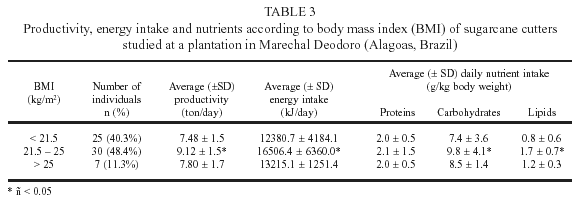
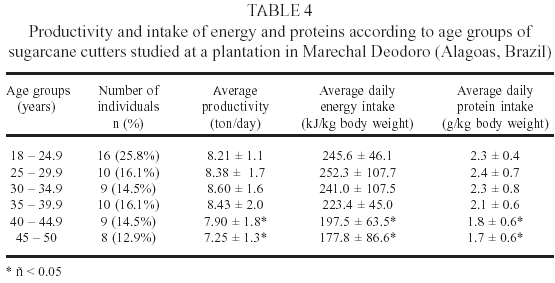
<p ALIGN="justify"><font SIZE="2" COLOR="#231f20" face="Verdana">The labourers whose BMI values were within the normal</font> <font SIZE="2" COLOR="#231f20" face="Verdana">range presented higher productivity and ingested significantly</font> <font SIZE="2" COLOR="#231f20" face="Verdana">greater amounts of energy than underweight or overweight</font> <font SIZE="2" COLOR="#231f20" face="Verdana">workers (<a href="#tab3">Table 3</a>). Individuals older than 40 years of age were</font> <font SIZE="2" COLOR="#231f20" face="Verdana">less productive and ingested lower amounts of energy and</font> <font SIZE="2" COLOR="#231f20" face="Verdana">proteins than their younger colleagues (<a href="#tab4">Table 4</a>). Although</font> <font SIZE="2" COLOR="#231f20" face="Verdana">individuals aged between 30 and 35 years were the most</font> <font SIZE="2" COLOR="#231f20" face="Verdana">productive, the actual differences in productivities were quite</font> <font SIZE="2" COLOR="#231f20" face="Verdana">small (about 13%) for workers within the age range 18 to 40</font> <font SIZE="2" COLOR="#231f20" face="Verdana">years. A highly significant (ñ &lt; 0.0005) association between</font> <font SIZE="2" COLOR="#231f20" face="Verdana">age and productivity was found.</font></p>     ]]></body>
<body><![CDATA[<p ALIGN="center"><a name="tab3"><img border="0" src="/img/fbpe/alan/v58n1/art05tab3.gif" width="572" height="201"></a></p>     
<p ALIGN="justify">&nbsp;</p>     <p ALIGN="center"><a name="tab4"><img border="0" src="/img/fbpe/alan/v58n1/art05tab4.gif" width="555" height="283"></a></p>     
<p ALIGN="justify"><font SIZE="2" COLOR="#231f20" face="Verdana">There were statistically significant associations (ñ &lt; 0.05)</font>  <font SIZE="2" COLOR="#231f20" face="Verdana">between productivity, stature, energy intake and age <a href="#tab5">table 5</a>. The tallest individuals had higher productivity and tended</font> <font SIZE="2" COLOR="#231f20" face="Verdana">to have a higher energy and protein intake. Those with short</font> <font SIZE="2" COLOR="#231f20" face="Verdana">stature (Height = 160 cm) had relatively higher protein and</font> <font SIZE="2" COLOR="#231f20" face="Verdana">energy intake and tended to have a larger accumulation of body</font> <font SIZE="2" COLOR="#231f20" face="Verdana">fat but not higher productivity. Older men tended to be of</font> <font SIZE="2" COLOR="#231f20" face="Verdana">shorter stature than their younger counterparts and presented</font> <font SIZE="2" COLOR="#231f20" face="Verdana">higher percentages of body fat and lower productivities. On</font> <font SIZE="2" COLOR="#231f20" face="Verdana">the other hand, young men were taller, exhibited lower</font> <font SIZE="2" COLOR="#231f20" face="Verdana">percentages of body fat and higher productivities. The loss of</font> <font SIZE="2" COLOR="#231f20" face="Verdana">body fat during the harvesting season was minimal within all</font> <font SIZE="2" COLOR="#231f20" face="Verdana">age groups and the mean differences were not statistically</font> <font SIZE="2" COLOR="#231f20" face="Verdana">significant.</font></p>     <p ALIGN="center"><a name="tab5"><img border="0" src="/img/fbpe/alan/v58n1/art05tab5.gif" width="576" height="205"></a></p>     
<p ALIGN="justify"><font SIZE="2" COLOR="#231f20" face="Verdana">Multiple regression analysis of the results identified stature</font> <font SIZE="2" COLOR="#231f20" face="Verdana">as the parameter most associated with productivity, even after</font> <font SIZE="2" COLOR="#231f20" face="Verdana">adjusting for age and proportion of body fat. In this context,</font> <font SIZE="2" COLOR="#231f20" face="Verdana">the tallest individuals (= 170 cm) cut 1.87 tons of sugar cane</font> <font SIZE="2" COLOR="#231f20" face="Verdana">per day more than the shortest (= 160 cm) individuals.</font></p> <b>     <p ALIGN="justify"><font SIZE="2" COLOR="#231f20" face="Verdana">DISCUSSION</font></p> </b>     <p ALIGN="justify"><font SIZE="2" COLOR="#231f20" face="Verdana">In order to attain the production targets established by the</font> <font SIZE="2" COLOR="#231f20" face="Verdana">sugar and alcohol industries, rural labourers must be able to</font> <font SIZE="2" COLOR="#231f20" face="Verdana">endure intense physical activity during the long hours of work</font> <font SIZE="2" COLOR="#231f20" face="Verdana">demanded throughout the harvesting season. The present</font> <font SIZE="2" COLOR="#231f20" face="Verdana">results indicate that 48.4% of the total of sugarcane cutters</font> <font SIZE="2" COLOR="#231f20" face="Verdana">studied presented BMI values above 21.5Kg/m</font><font face="Verdana" size="2" color="#231F20"><sup>2</sup></font><font SIZE="2" COLOR="#231f20" face="Verdana">, whilst their</font> <font SIZE="2" COLOR="#231f20" face="Verdana">body fat percentages were similar to those found in athletes.</font> <font SIZE="2" COLOR="#231f20" face="Verdana">Their productivity was 2-fold higher (8.13 ton/day) than that</font> <font SIZE="2" COLOR="#231f20" face="Verdana">determined some decades earlier for Guatemalan and</font> <font SIZE="2" COLOR="#231f20" face="Verdana">Colombian workers (7, 8, 26), with similar nutritional status.</font> <font SIZE="2" COLOR="#231f20" face="Verdana">It is likely that the increment in productivity depends on the</font> <font SIZE="2" COLOR="#231f20" face="Verdana">current wages system, based on worker productivity.</font></p>     <p ALIGN="justify"><font SIZE="2" COLOR="#231f20" face="Verdana">The diet of the studied labourers was monotonous but wellbalanced</font> <font SIZE="2" COLOR="#231f20" face="Verdana">in terms of macronutrients. The quantities of food</font> <font SIZE="2" COLOR="#231f20" face="Verdana">consumed in each meal were small in accordance with the</font> <font SIZE="2" COLOR="#231f20" face="Verdana">low level of earnings of the workers. Meals were characterised</font> <font SIZE="2" COLOR="#231f20" face="Verdana">by ingredients rich in carbohydrates, and consisted basically</font> <font SIZE="2" COLOR="#231f20" face="Verdana">of maize, beans, rice and manioc preparations, together with</font> <font SIZE="2" COLOR="#231f20" face="Verdana">easily accessible animal products such as fish, free-range</font> <font SIZE="2" COLOR="#231f20" face="Verdana">chicken and eggs. Drinking coffee with sugar was also</font> <font SIZE="2" COLOR="#231f20" face="Verdana">common. Fruits and vegetables were rarely found in the</font> <font SIZE="2" COLOR="#231f20" face="Verdana">evaluated meals. It is likely that this dietary profile amongst</font> <font SIZE="2" COLOR="#231f20" face="Verdana">the rural population has been responsible for the high</font> <font SIZE="2" COLOR="#231f20" face="Verdana">prevalence of short stature (27-29). It is well known that</font> <font SIZE="2" COLOR="#231f20" face="Verdana">inadequate nutrition in early life and growth deficit can produce</font> <font SIZE="2" COLOR="#231f20" face="Verdana">deleterious effects in adult life, including obesity and other</font> <font SIZE="2" COLOR="#231f20" face="Verdana">symptoms associated with metabolic syndrome (30,31).</font></p>     <p ALIGN="justify"><font SIZE="2" COLOR="#231f20" face="Verdana">Studies involving different categories of manual workers</font> <font SIZE="2" COLOR="#231f20" face="Verdana">have demonstrated that only well-nourished individuals are</font> <font SIZE="2" COLOR="#231f20" face="Verdana">able fully to develop their productive potential (6, 32-35). The</font> <font SIZE="2" COLOR="#231f20" face="Verdana">present investigation revealed that mean energy intake was</font> <font SIZE="2" COLOR="#231f20" face="Verdana">13773.7 kJ/day, whilst the ideal daily intake should be 14162.8</font> <font SIZE="2" COLOR="#231f20" face="Verdana">k according to the WHO (25) recommendations for highly</font> <font SIZE="2" COLOR="#231f20" face="Verdana">active men or 15062.4 kJ/day (9). Underweight labourers</font> <font SIZE="2" COLOR="#231f20" face="Verdana">ingested 12380.7 kJ/day only.</font> <font SIZE="2" COLOR="#231f20" face="Verdana">The average amount of protein ingested by workers was</font> <font SIZE="2" COLOR="#231f20" face="Verdana">similar to that recommended for elite athletes, i.e. 1.5 to 2.5</font> <font SIZE="2" COLOR="#231f20" face="Verdana">g/kg weight (36). However, it is important to consider that</font> <font SIZE="2" COLOR="#231f20" face="Verdana">when energy needs are not fully met, part of this protein can</font> <font SIZE="2" COLOR="#231f20" face="Verdana">be used to overcome energy deficiency, especially in the case</font> <font SIZE="2" COLOR="#231f20" face="Verdana">of underweight workers, rather than being channelled into</font> <font SIZE="2" COLOR="#231f20" face="Verdana">normal dynamic and structural functions (26). According to</font> <font SIZE="2" COLOR="#231f20" face="Verdana">Ferreira et al. (37), the daily intake of carbohydrate by</font></p>     ]]></body>
<body><![CDATA[<p ALIGN="justify"><font SIZE="2" COLOR="#231f20" face="Verdana">individuals who perform intense physical exercise should be</font> <font SIZE="2" COLOR="#231f20" face="Verdana">10 g/kg body weight in order to restore muscle glycogen and</font> <font SIZE="2" COLOR="#231f20" face="Verdana">to preserve muscle protein. This implies that to reach an</font> <font SIZE="2" COLOR="#231f20" face="Verdana">adequate consumption of carbohydrate, these workers should</font> <font SIZE="2" COLOR="#231f20" face="Verdana">ingest about 625g/day. The well-nourished (BMI = 21.5 kg/</font> <font SIZE="2" COLOR="#231f20" face="Verdana">m</font><font face="Verdana" size="2" color="#231F20"><sup>2</sup></font> <font SIZE="2" COLOR="#231f20" face="Verdana"> ) ingested 612 g/day of carbohydrate, which is comparable</font> <font SIZE="2" COLOR="#231f20" face="Verdana">with the recommended value. With respect to lipid nutrients,</font> <font SIZE="2" COLOR="#231f20" face="Verdana">the undernourished workers (BMI &lt; 21.5 kg/m</font><font face="Verdana" size="2" color="#231F20"><sup>2</sup></font><font SIZE="2" COLOR="#231f20" face="Verdana">) received</font> <font SIZE="2" COLOR="#231f20" face="Verdana">amounts that were below the recommended daily intake of 1</font> <font SIZE="2" COLOR="#231f20" face="Verdana">g/kg body weight (38).</font> <font SIZE="2" COLOR="#231f20" face="Verdana">In the present study, highest productivity was associated</font> <font SIZE="2" COLOR="#231f20" face="Verdana">with young (30 – 35 year old) and well-nourished (BMI =</font> <font SIZE="2" COLOR="#231f20" face="Verdana">21.5 &lt; 25 kg/m</font><font face="Verdana" size="2" color="#231F20"><sup>2</sup></font><font SIZE="2" COLOR="#231f20" face="Verdana">) labourers, and this finding demonstrates the</font> <font SIZE="2" COLOR="#231f20" face="Verdana">negative effect of underweight and overweight on productivity.</font></p>     <p ALIGN="justify"><font SIZE="2" COLOR="#231f20" face="Verdana">A negative correlation between productivity and age was also</font> <font SIZE="2" COLOR="#231f20" face="Verdana">established, and this was attributed to the diminished aerobic</font> <font SIZE="2" COLOR="#231f20" face="Verdana">capacity of older workers, as previously suggested (39-41).</font> <font SIZE="2" COLOR="#231f20" face="Verdana">The present work demonstrated that men of short stature,</font> <font SIZE="2" COLOR="#231f20" face="Verdana">although ingesting adequate energy amounts, exhibit increased</font> <font SIZE="2" COLOR="#231f20" face="Verdana">body fat percentages and lower productivities compared with</font> <font SIZE="2" COLOR="#231f20" face="Verdana">their taller workmates. Although it is not possible to affirm</font> <font SIZE="2" COLOR="#231f20" face="Verdana">that the short stature of all the workers studied was determined</font> <font SIZE="2" COLOR="#231f20" face="Verdana">by under-nutrition in the phases of growth and development,</font> <font SIZE="2" COLOR="#231f20" face="Verdana">as genetic factors can also be involved, the body of evidence</font> <font SIZE="2" COLOR="#231f20" face="Verdana">seems to indicate that growth retardation is responsible for</font> <font SIZE="2" COLOR="#231f20" face="Verdana">low productivity.. A study of sugarcane cutters in Australia</font> <font SIZE="2" COLOR="#231f20" face="Verdana">and Zimbabwe (42) observed that the tallest men presented</font> <font SIZE="2" COLOR="#231f20" face="Verdana">the highest aerobic capacities and were the most efficient</font> <font SIZE="2" COLOR="#231f20" face="Verdana">workers. Moreover, a study in India reported that rural</font> <font SIZE="2" COLOR="#231f20" face="Verdana">labourers ingesting higher amounts of energy and having larger</font> <font SIZE="2" COLOR="#231f20" face="Verdana">chest girths (at inhalation) were the most productive (6).</font> <font SIZE="2" COLOR="#231f20" face="Verdana">In a previous study, we have shown that the prevalence of</font> <font SIZE="2" COLOR="#231f20" face="Verdana">short stature amongst men living in a shanty town was 22.4</font> <font SIZE="2" COLOR="#231f20" face="Verdana">%. Since, most people living in this area are rural migrants, it</font> <font SIZE="2" COLOR="#231f20" face="Verdana">may be that those with short stature were induced to migrate</font> <font SIZE="2" COLOR="#231f20" face="Verdana">because of their low productivity, among other reasons (12).</font></p>     <p ALIGN="justify"><font SIZE="2" COLOR="#231f20" face="Verdana">Stepwise multiple regression analysis revealed a significant</font> <font SIZE="2" COLOR="#231f20" face="Verdana">relationship between productivity, stature, BMI and energy</font> <font SIZE="2" COLOR="#231f20" face="Verdana">intake, and emphasised the importance of nutritional status,</font> <font SIZE="2" COLOR="#231f20" face="Verdana">during the early life of the individual to development of</font> <font SIZE="2" COLOR="#231f20" face="Verdana">working capacity. The most productive workers were those</font> <font SIZE="2" COLOR="#231f20" face="Verdana">with BMI = 21.5 kg/m</font><font face="Verdana" size="2" color="#231F20"><sup>2</sup></font><font SIZE="2" COLOR="#231f20" face="Verdana">, of high stature and with balanced</font> <font SIZE="2" COLOR="#231f20" face="Verdana">energy intake (16506.4 kJ): moreover, their wages were higher</font> <font SIZE="2" COLOR="#231f20" face="Verdana">implying that they could afford a better quality of life. Chronic</font> <font SIZE="2" COLOR="#231f20" face="Verdana">undernutrition must be eradicated if an enhancement in rural</font> <font SIZE="2" COLOR="#231f20" face="Verdana">productivity is to be achieved, and this goal will only be</font> <font SIZE="2" COLOR="#231f20" face="Verdana">possible through an improvement in the quality of the diet of</font> <font SIZE="2" COLOR="#231f20" face="Verdana">the workers.</font></p> <b>     <p ALIGN="justify"><font SIZE="2" COLOR="#231f20" face="Verdana">REFERENCES</font></p> </b>     <!-- ref --><p ALIGN="justify"><font color="#231f20" face="Verdana" size="2">1. Alessi NP, Navarro VL. Saúde e trabalho rural: o caso dos</font> <font color="#231f20" face="Verdana" size="2">trabalhadores da cultura canavieira na região de Ribeirão Preto,</font> <font color="#231f20" face="Verdana" size="2">São Paulo, Brasil. Cad Saúde Pública 1997; 13 (Suppl. 2), 111-</font> <font color="#231f20" face="Verdana" size="2">21.</font>&nbsp;&nbsp;&nbsp;&nbsp;&nbsp;&nbsp;&nbsp;&nbsp;[&#160;<a href="javascript:void(0);" onclick="javascript: window.open('/scielo.php?script=sci_nlinks&ref=484507&pid=S0004-0622200800010000500001&lng=','','width=640,height=500,resizable=yes,scrollbars=1,menubar=yes,');">Links</a>&#160;]<!-- end-ref --><!-- ref --><p ALIGN="justify"><font color="#231f20" face="Verdana" size="2">2. Roy SK. Factors affecting the work productivity of Oraon</font> <font color="#231f20" face="Verdana" size="2">agricultural laborers of Jalpaiguri district, West Bengal. Am J</font> <font color="#231f20" face="Verdana" size="2">Phys Anthropo 2002; 117: 228-35.</font>&nbsp;&nbsp;&nbsp;&nbsp;&nbsp;&nbsp;&nbsp;&nbsp;[&#160;<a href="javascript:void(0);" onclick="javascript: window.open('/scielo.php?script=sci_nlinks&ref=484508&pid=S0004-0622200800010000500002&lng=','','width=640,height=500,resizable=yes,scrollbars=1,menubar=yes,');">Links</a>&#160;]<!-- end-ref --><!-- ref --><p ALIGN="justify"><font color="#231f20" face="Verdana" size="2">3. Weinberger K. Assessment of the nutritional impact of</font> <font color="#231f20" face="Verdana" size="2">agricultural research: the case of mungbean in Pakistan. Food</font> <font color="#231f20" face="Verdana" size="2">Nutr Bull 2005; 26: 287-94.</font>&nbsp;&nbsp;&nbsp;&nbsp;&nbsp;&nbsp;&nbsp;&nbsp;[&#160;<a href="javascript:void(0);" onclick="javascript: window.open('/scielo.php?script=sci_nlinks&ref=484509&pid=S0004-0622200800010000500003&lng=','','width=640,height=500,resizable=yes,scrollbars=1,menubar=yes,');">Links</a>&#160;]<!-- end-ref --><!-- ref --><p ALIGN="justify"><font color="#231f20" face="Verdana" size="2">4. Belavady B. Nutrition and efficiency in agricultural laborers.</font> <font color="#231f20" face="Verdana" size="2">Indian J Med Res 1966; 54: 971-76.</font>&nbsp;&nbsp;&nbsp;&nbsp;&nbsp;&nbsp;&nbsp;&nbsp;[&#160;<a href="javascript:void(0);" onclick="javascript: window.open('/scielo.php?script=sci_nlinks&ref=484510&pid=S0004-0622200800010000500004&lng=','','width=640,height=500,resizable=yes,scrollbars=1,menubar=yes,');">Links</a>&#160;]<!-- end-ref --><!-- ref --><p ALIGN="justify"><font color="#231f20" face="Verdana" size="2">5. Viteri FE, Torun B, Immink MDC, Flores R. Marginal</font> <font color="#231f20" face="Verdana" size="2">malnutrition and working capacity. In Nutrition in Health and</font> <font color="#231f20" face="Verdana" size="2">Disease and International Development, pp. 277-283 [AE</font> <font color="#231f20" face="Verdana" size="2">Harper and GK Davis, editors]. New York: Alan R. Liss. 1981</font>&nbsp;&nbsp;&nbsp;&nbsp;&nbsp;&nbsp;&nbsp;&nbsp;[&#160;<a href="javascript:void(0);" onclick="javascript: window.open('/scielo.php?script=sci_nlinks&ref=484511&pid=S0004-0622200800010000500005&lng=','','width=640,height=500,resizable=yes,scrollbars=1,menubar=yes,');">Links</a>&#160;]<!-- end-ref --><!-- ref --><p ALIGN="justify"><font color="#231f20" face="Verdana" size="2">6. Roy SK, Mozumdar A, Kar S. Effect of skill on work</font> <font color="#231f20" face="Verdana" size="2">productivity and physical body dimensions of the Oraon tea</font> <font color="#231f20" face="Verdana" size="2">garden labourers of the Jalpaiguri district, West Bengal, India.</font> <font color="#231f20" face="Verdana" size="2">Anthropol Anz 2005; 63:449-60.</font>&nbsp;&nbsp;&nbsp;&nbsp;&nbsp;&nbsp;&nbsp;&nbsp;[&#160;<a href="javascript:void(0);" onclick="javascript: window.open('/scielo.php?script=sci_nlinks&ref=484512&pid=S0004-0622200800010000500006&lng=','','width=640,height=500,resizable=yes,scrollbars=1,menubar=yes,');">Links</a>&#160;]<!-- end-ref --><!-- ref --><p ALIGN="justify"><font color="#231f20" face="Verdana" size="2">7. Spurr GB, Barac-Nieto M, Maksud MG. Productivity and</font> <font color="#231f20" face="Verdana" size="2">maximal oxygen consumption in sugar cane cutters. Am J Clin</font> <font color="#231f20" face="Verdana" size="2">Nutr 1977; 30:322-25.</font>&nbsp;&nbsp;&nbsp;&nbsp;&nbsp;&nbsp;&nbsp;&nbsp;[&#160;<a href="javascript:void(0);" onclick="javascript: window.open('/scielo.php?script=sci_nlinks&ref=484513&pid=S0004-0622200800010000500007&lng=','','width=640,height=500,resizable=yes,scrollbars=1,menubar=yes,');">Links</a>&#160;]<!-- end-ref --><!-- ref --><p ALIGN="justify"><font color="#231f20" face="Verdana" size="2">8. Spurr GB, Barac-Nieto M, Maksud MG. Energy expenditure,</font> <font color="#231f20" face="Verdana" size="2">productivity, and physical work capacity of sugarcane loaders.</font> <font color="#231f20" face="Verdana" size="2">Am J Clin Nutr 1977; 30:1740-46.</font>&nbsp;&nbsp;&nbsp;&nbsp;&nbsp;&nbsp;&nbsp;&nbsp;[&#160;<a href="javascript:void(0);" onclick="javascript: window.open('/scielo.php?script=sci_nlinks&ref=484514&pid=S0004-0622200800010000500008&lng=','','width=640,height=500,resizable=yes,scrollbars=1,menubar=yes,');">Links</a>&#160;]<!-- end-ref --><!-- ref --><p ALIGN="justify"><font color="#231f20" face="Verdana" size="2">9. Sppur GB. Body size, physical work capacity and productivity</font> <font color="#231f20" face="Verdana" size="2">in hard work: Is bigger better? In Linear Growth Retardation</font> <font color="#231f20" face="Verdana" size="2">in Less Developed Countries, Nestlé Nutrition Series, 14</font> <font color="#231f20" face="Verdana" size="2">[JC Waterlow, editor]. New York: Raven Press. 1988</font>&nbsp;&nbsp;&nbsp;&nbsp;&nbsp;&nbsp;&nbsp;&nbsp;[&#160;<a href="javascript:void(0);" onclick="javascript: window.open('/scielo.php?script=sci_nlinks&ref=484515&pid=S0004-0622200800010000500009&lng=','','width=640,height=500,resizable=yes,scrollbars=1,menubar=yes,');">Links</a>&#160;]<!-- end-ref --><!-- ref --><p ALIGN="justify"><font color="#231f20" face="Verdana" size="2">10. Food and Agriculture Organization (FAO). Sugar. Global information</font> <font color="#231f20" face="Verdana" size="2">and early warning system on food and agriculture.</font> <font color="#231f20" face="Verdana" size="2">Food Outlook 2004; 3:18-19.</font>&nbsp;&nbsp;&nbsp;&nbsp;&nbsp;&nbsp;&nbsp;&nbsp;[&#160;<a href="javascript:void(0);" onclick="javascript: window.open('/scielo.php?script=sci_nlinks&ref=484516&pid=S0004-0622200800010000500010&lng=','','width=640,height=500,resizable=yes,scrollbars=1,menubar=yes,');">Links</a>&#160;]<!-- end-ref --><!-- ref --><p ALIGN="justify"><font color="#231f20" face="Verdana" size="2">11. Jarrell P, Rekas M. Biofuels Coming Online: International</font> <font color="#231f20" face="Verdana" size="2">Biofuel Use Expands. United States Department of Agriculture.</font> <font color="#231f20" face="Verdana" size="2">Foreign Agricultural Service FAS Worldwide. July 2006.</font>&nbsp;&nbsp;&nbsp;&nbsp;&nbsp;&nbsp;&nbsp;&nbsp;[&#160;<a href="javascript:void(0);" onclick="javascript: window.open('/scielo.php?script=sci_nlinks&ref=484517&pid=S0004-0622200800010000500011&lng=','','width=640,height=500,resizable=yes,scrollbars=1,menubar=yes,');">Links</a>&#160;]<!-- end-ref --><!-- ref --><p ALIGN="justify"><font color="#231f20" face="Verdana" size="2">12. Florêncio TMMT, Ferreira HS, França AP, Cavalcante JC,</font> <font color="#231f20" face="Verdana" size="2">Sawaya AL. Obesity and undernutrition in a very-low-income</font> <font color="#231f20" face="Verdana" size="2">population in the city of Maceió, northeastern Brazil. Brit J</font> <font color="#231f20" face="Verdana" size="2">Nutr 2001; 86:277-85.</font>&nbsp;&nbsp;&nbsp;&nbsp;&nbsp;&nbsp;&nbsp;&nbsp;[&#160;<a href="javascript:void(0);" onclick="javascript: window.open('/scielo.php?script=sci_nlinks&ref=484518&pid=S0004-0622200800010000500012&lng=','','width=640,height=500,resizable=yes,scrollbars=1,menubar=yes,');">Links</a>&#160;]<!-- end-ref --><!-- ref --><p ALIGN="justify"><font color="#231f20" face="Verdana" size="2">13. Florêncio TMMT, Ferreira HS, Luciano SM, Cavalcante JC,</font> <font color="#231f20" face="Verdana" size="2">Sawaya A Food consumed does not account for the higher</font> <font color="#231f20" face="Verdana" size="2">prevalence of obesity among short-statured adults in a verylow-</font> <font color="#231f20" face="Verdana" size="2">income population in the northeast of Brazil (Maceió,</font> <font color="#231f20" face="Verdana" size="2">Alagoas). Eur J Clin Nutr 2003; 57:1437-46.</font>&nbsp;&nbsp;&nbsp;&nbsp;&nbsp;&nbsp;&nbsp;&nbsp;[&#160;<a href="javascript:void(0);" onclick="javascript: window.open('/scielo.php?script=sci_nlinks&ref=484519&pid=S0004-0622200800010000500013&lng=','','width=640,height=500,resizable=yes,scrollbars=1,menubar=yes,');">Links</a>&#160;]<!-- end-ref --><!-- ref --><p ALIGN="justify"><font color="#231f20" face="Verdana" size="2">14. Castro J. Geografia da Fome. Rio de Janeiro: Editora Antares,</font> <font color="#231f20" face="Verdana" size="2">1946.</font>&nbsp;&nbsp;&nbsp;&nbsp;&nbsp;&nbsp;&nbsp;&nbsp;[&#160;<a href="javascript:void(0);" onclick="javascript: window.open('/scielo.php?script=sci_nlinks&ref=484520&pid=S0004-0622200800010000500014&lng=','','width=640,height=500,resizable=yes,scrollbars=1,menubar=yes,');">Links</a>&#160;]<!-- end-ref --><!-- ref --><p ALIGN="justify"><font color="#231f20" face="Verdana" size="2">15. Florêncio TMMT, Ferreira HS, Cavalcante JC, Sawaya AL.</font> <font color="#231f20" face="Verdana" size="2">Short stature, obesity and arterial hypertension in a very low</font> <font color="#231f20" face="Verdana" size="2">income population in Northeastern Brazil. Nut Metab Cardiovas</font> <font color="#231f20" face="Verdana" size="2">Dis 2004; 14:1-8.</font>&nbsp;&nbsp;&nbsp;&nbsp;&nbsp;&nbsp;&nbsp;&nbsp;[&#160;<a href="javascript:void(0);" onclick="javascript: window.open('/scielo.php?script=sci_nlinks&ref=484521&pid=S0004-0622200800010000500015&lng=','','width=640,height=500,resizable=yes,scrollbars=1,menubar=yes,');">Links</a>&#160;]<!-- end-ref --><!-- ref --><p ALIGN="justify"><font color="#231f20" face="Verdana" size="2">16. Varela-Silva MI, Frisancho AR, Bogin B, Chatkoff D, Smith</font> <font color="#231f20" face="Verdana" size="2">PK, Dickinson F, Winham D. Behavioral, environmental, metabolic</font> <font color="#231f20" face="Verdana" size="2">and intergenerational components of early life undernutrition</font> <font color="#231f20" face="Verdana" size="2">leading to later obesity in developing nations and in</font> <font color="#231f20" face="Verdana" size="2">minority groups in the U.S.A. coll Antropol. 2007</font> <font color="#231f20" face="Verdana" size="2">Mar;31(1):39-46.</font>&nbsp;&nbsp;&nbsp;&nbsp;&nbsp;&nbsp;&nbsp;&nbsp;[&#160;<a href="javascript:void(0);" onclick="javascript: window.open('/scielo.php?script=sci_nlinks&ref=484522&pid=S0004-0622200800010000500016&lng=','','width=640,height=500,resizable=yes,scrollbars=1,menubar=yes,');">Links</a>&#160;]<!-- end-ref --><!-- ref --><p ALIGN="justify"><font color="#231f20" face="Verdana" size="2">17. Jackson AA. Nutrition in the early life – “long term effects”.</font> <font color="#231f20" face="Verdana" size="2">Cajanus 1997; 30:197-214.</font>&nbsp;&nbsp;&nbsp;&nbsp;&nbsp;&nbsp;&nbsp;&nbsp;[&#160;<a href="javascript:void(0);" onclick="javascript: window.open('/scielo.php?script=sci_nlinks&ref=484523&pid=S0004-0622200800010000500017&lng=','','width=640,height=500,resizable=yes,scrollbars=1,menubar=yes,');">Links</a>&#160;]<!-- end-ref --><!-- ref --><p ALIGN="justify"><font color="#231f20" face="Verdana" size="2">18. Sichieri R, Siqueira SK, Pereira AR, Ascherio A. Short stature</font> <font color="#231f20" face="Verdana" size="2">and hypertension in the city of Rio de Janeiro, Brazil. Public</font> <font color="#231f20" face="Verdana" size="2">Health Nutr 1999; 3: 77- 82.</font>&nbsp;&nbsp;&nbsp;&nbsp;&nbsp;&nbsp;&nbsp;&nbsp;[&#160;<a href="javascript:void(0);" onclick="javascript: window.open('/scielo.php?script=sci_nlinks&ref=484524&pid=S0004-0622200800010000500018&lng=','','width=640,height=500,resizable=yes,scrollbars=1,menubar=yes,');">Links</a>&#160;]<!-- end-ref --><!-- ref --><p ALIGN="justify"><font color="#231f20" face="Verdana" size="2">19. Sawaya AL, Martins PA, Martins VJB. Impact of globalization</font> <font color="#231f20" face="Verdana" size="2">on food consumption, and health in urban areas. Case study:</font> <font color="#231f20" face="Verdana" size="2">Brazil. FAO Technical Workshop on “Globalization of food</font> <font color="#231f20" face="Verdana" size="2">systems: impacts on food security an nutrition”, Rome, Italy.</font> <font color="#231f20" face="Verdana" size="2">2003</font>&nbsp;&nbsp;&nbsp;&nbsp;&nbsp;&nbsp;&nbsp;&nbsp;[&#160;<a href="javascript:void(0);" onclick="javascript: window.open('/scielo.php?script=sci_nlinks&ref=484525&pid=S0004-0622200800010000500019&lng=','','width=640,height=500,resizable=yes,scrollbars=1,menubar=yes,');">Links</a>&#160;]<!-- end-ref --><!-- ref --><p ALIGN="justify"><font color="#231f20" face="Verdana" size="2">20. World Health Organization. Physical Status: the Use and</font> <font color="#231f20" face="Verdana" size="2">Interpretation of Anthropometry. Technical Report Series no.</font> <font color="#231f20" face="Verdana" size="2">854. Geneva: WHO, 1995.</font>&nbsp;&nbsp;&nbsp;&nbsp;&nbsp;&nbsp;&nbsp;&nbsp;[&#160;<a href="javascript:void(0);" onclick="javascript: window.open('/scielo.php?script=sci_nlinks&ref=484526&pid=S0004-0622200800010000500020&lng=','','width=640,height=500,resizable=yes,scrollbars=1,menubar=yes,');">Links</a>&#160;]<!-- end-ref --><!-- ref --><p ALIGN="justify"><font color="#231f20" face="Verdana" size="2">21. Womersley J, Durnin JA. A comparison of the skinfold method</font> <font color="#231f20" face="Verdana" size="2">with extent of overweight and various weight-height</font> <font color="#231f20" face="Verdana" size="2">relationships in the assessment of obesity. J Nutr 1977; 38:</font> <font color="#231f20" face="Verdana" size="2">271-84.</font>&nbsp;&nbsp;&nbsp;&nbsp;&nbsp;&nbsp;&nbsp;&nbsp;[&#160;<a href="javascript:void(0);" onclick="javascript: window.open('/scielo.php?script=sci_nlinks&ref=484527&pid=S0004-0622200800010000500021&lng=','','width=640,height=500,resizable=yes,scrollbars=1,menubar=yes,');">Links</a>&#160;]<!-- end-ref --><!-- ref --><p ALIGN="justify"><font color="#231f20" face="Verdana" size="2">22. Brozek J, Grande F, Andreson JT, Kemp A. Densitometric</font> <font color="#231f20" face="Verdana" size="2">analysis of body composition: some quantitative assumptions.</font> <font color="#231f20" face="Verdana" size="2">Ann NY Acad Sci 110,113-140, 1963.</font>&nbsp;&nbsp;&nbsp;&nbsp;&nbsp;&nbsp;&nbsp;&nbsp;[&#160;<a href="javascript:void(0);" onclick="javascript: window.open('/scielo.php?script=sci_nlinks&ref=484528&pid=S0004-0622200800010000500022&lng=','','width=640,height=500,resizable=yes,scrollbars=1,menubar=yes,');">Links</a>&#160;]<!-- end-ref --><!-- ref --><p ALIGN="justify"><font color="#231f20" face="Verdana" size="2">23. Frisancho AR. Anthropometric Standards for the Assessment</font> <font color="#231f20" face="Verdana" size="2">of Growth and Nutritional Status. Ann Arbor: The University</font> <font color="#231f20" face="Verdana" size="2">of Michigan Press, 1990.</font>&nbsp;&nbsp;&nbsp;&nbsp;&nbsp;&nbsp;&nbsp;&nbsp;[&#160;<a href="javascript:void(0);" onclick="javascript: window.open('/scielo.php?script=sci_nlinks&ref=484529&pid=S0004-0622200800010000500023&lng=','','width=640,height=500,resizable=yes,scrollbars=1,menubar=yes,');">Links</a>&#160;]<!-- end-ref --><!-- ref --><p ALIGN="justify"><font color="#231f20" face="Verdana" size="2">24. Escola Paulista de Medicina. Programa de Apoio à Nutrição,</font> <font color="#231f20" face="Verdana" size="2">Centro de Informática, Universidade Federal de São Paulo, São</font> <font color="#231f20" face="Verdana" size="2">Paulo, Brazil, 2005.</font>&nbsp;&nbsp;&nbsp;&nbsp;&nbsp;&nbsp;&nbsp;&nbsp;[&#160;<a href="javascript:void(0);" onclick="javascript: window.open('/scielo.php?script=sci_nlinks&ref=484530&pid=S0004-0622200800010000500024&lng=','','width=640,height=500,resizable=yes,scrollbars=1,menubar=yes,');">Links</a>&#160;]<!-- end-ref --><!-- ref --><p ALIGN="justify"><font color="#231f20" face="Verdana" size="2">25. World Health Organization. Energy and Protein Requirements.</font> <font color="#231f20" face="Verdana" size="2">Technical Report Series no. 724. Geneva: Joint WHO/Food and</font> <font color="#231f20" face="Verdana" size="2">Agriculture Organization Expert Committee, 1985.</font>&nbsp;&nbsp;&nbsp;&nbsp;&nbsp;&nbsp;&nbsp;&nbsp;[&#160;<a href="javascript:void(0);" onclick="javascript: window.open('/scielo.php?script=sci_nlinks&ref=484531&pid=S0004-0622200800010000500025&lng=','','width=640,height=500,resizable=yes,scrollbars=1,menubar=yes,');">Links</a>&#160;]<!-- end-ref --><!-- ref --><p ALIGN="justify"><font color="#231f20" face="Verdana" size="2">26. Immink MDC, Blake CC, Viteri FE, Flores R, Torun B. Energy</font> <font color="#231f20" face="Verdana" size="2">supplementation and productivity of Guatemalan sugar-cane</font> <font color="#231f20" face="Verdana" size="2">cutters: A longitudinal approach. Arch Latinoam Nutr 1986;</font> <font color="#231f20" face="Verdana" size="2">36: 247-59.</font>&nbsp;&nbsp;&nbsp;&nbsp;&nbsp;&nbsp;&nbsp;&nbsp;[&#160;<a href="javascript:void(0);" onclick="javascript: window.open('/scielo.php?script=sci_nlinks&ref=484532&pid=S0004-0622200800010000500026&lng=','','width=640,height=500,resizable=yes,scrollbars=1,menubar=yes,');">Links</a>&#160;]<!-- end-ref --><!-- ref --><p ALIGN="justify"><font color="#231f20" face="Verdana" size="2">27. Chaves N. Novas estratégias para o combate à fome endêmica.</font> <font color="#231f20" face="Verdana" size="2">In Anais da Convenção Nacional de Nutrição e Dietética, pp.</font> <font color="#231f20" face="Verdana" size="2">145 -152. Brasília: Associação de Nutricionsitas do Distrito</font> <font color="#231f20" face="Verdana" size="2">Federal, 1980.</font>&nbsp;&nbsp;&nbsp;&nbsp;&nbsp;&nbsp;&nbsp;&nbsp;[&#160;<a href="javascript:void(0);" onclick="javascript: window.open('/scielo.php?script=sci_nlinks&ref=484533&pid=S0004-0622200800010000500027&lng=','','width=640,height=500,resizable=yes,scrollbars=1,menubar=yes,');">Links</a>&#160;]<!-- end-ref --><!-- ref --><p ALIGN="justify"><font color="#231f20" face="Verdana" size="2">28. Cascudo CL . História de Alimentação no Brasil. São Paulo:</font> <font color="#231f20" face="Verdana" size="2">Editora da Universidade de São Paulo, 1983.</font>&nbsp;&nbsp;&nbsp;&nbsp;&nbsp;&nbsp;&nbsp;&nbsp;[&#160;<a href="javascript:void(0);" onclick="javascript: window.open('/scielo.php?script=sci_nlinks&ref=484534&pid=S0004-0622200800010000500028&lng=','','width=640,height=500,resizable=yes,scrollbars=1,menubar=yes,');">Links</a>&#160;]<!-- end-ref --><!-- ref --><p ALIGN="justify"><font color="#231f20" face="Verdana" size="2">29. Freire G. Nordeste. Rio de Janeiro: Editora Record, 1989.</font>&nbsp;&nbsp;&nbsp;&nbsp;&nbsp;&nbsp;&nbsp;&nbsp;[&#160;<a href="javascript:void(0);" onclick="javascript: window.open('/scielo.php?script=sci_nlinks&ref=484535&pid=S0004-0622200800010000500029&lng=','','width=640,height=500,resizable=yes,scrollbars=1,menubar=yes,');">Links</a>&#160;]<!-- end-ref --><!-- ref --><p ALIGN="justify"><font color="#231f20" face="Verdana" size="2">30. Barker DJP. Fetal and Infant Origins of Adult Disease. London:</font> <font color="#231f20" face="Verdana" size="2">British Medical Journal Publishing, 1992.</font>&nbsp;&nbsp;&nbsp;&nbsp;&nbsp;&nbsp;&nbsp;&nbsp;[&#160;<a href="javascript:void(0);" onclick="javascript: window.open('/scielo.php?script=sci_nlinks&ref=484536&pid=S0004-0622200800010000500030&lng=','','width=640,height=500,resizable=yes,scrollbars=1,menubar=yes,');">Links</a>&#160;]<!-- end-ref --><!-- ref --><p ALIGN="justify"><font color="#231f20" face="Verdana" size="2">31. Popkin BM, Richards MK, Monteiro CA. Stunting is associated</font> <font color="#231f20" face="Verdana" size="2">with overweight in children of four nations that are undergoing</font> <font color="#231f20" face="Verdana" size="2">the nutrition transition. J Nutr 1996; 126: 3009-16.</font>&nbsp;&nbsp;&nbsp;&nbsp;&nbsp;&nbsp;&nbsp;&nbsp;[&#160;<a href="javascript:void(0);" onclick="javascript: window.open('/scielo.php?script=sci_nlinks&ref=484537&pid=S0004-0622200800010000500031&lng=','','width=640,height=500,resizable=yes,scrollbars=1,menubar=yes,');">Links</a>&#160;]<!-- end-ref --><!-- ref --><p ALIGN="justify"><font color="#231f20" face="Verdana" size="2">32. Wolgemuth JD, Latham MC, Hall AC, Crompton DWT. Worker</font> <font color="#231f20" face="Verdana" size="2">productivity and nutritional status of Kenyan road construction</font> <font color="#231f20" face="Verdana" size="2">laborers. Am J Clin Nutr 1982; 36: 68-78.</font>&nbsp;&nbsp;&nbsp;&nbsp;&nbsp;&nbsp;&nbsp;&nbsp;[&#160;<a href="javascript:void(0);" onclick="javascript: window.open('/scielo.php?script=sci_nlinks&ref=484538&pid=S0004-0622200800010000500032&lng=','','width=640,height=500,resizable=yes,scrollbars=1,menubar=yes,');">Links</a>&#160;]<!-- end-ref --><!-- ref --><p ALIGN="justify"><font color="#231f20" face="Verdana" size="2">33. Torún B. Increase of physical activity by improvement of the</font> <font color="#231f20" face="Verdana" size="2">nutritional status. Arch Latinoam Nutr 1989; 39: 308-26.</font>&nbsp;&nbsp;&nbsp;&nbsp;&nbsp;&nbsp;&nbsp;&nbsp;[&#160;<a href="javascript:void(0);" onclick="javascript: window.open('/scielo.php?script=sci_nlinks&ref=484539&pid=S0004-0622200800010000500033&lng=','','width=640,height=500,resizable=yes,scrollbars=1,menubar=yes,');">Links</a>&#160;]<!-- end-ref --><!-- ref --><p ALIGN="justify"><font color="#231f20" face="Verdana" size="2">34. Scopinho AR, Eid F, Vian CEF, Silva PRC. Novas tecnologias</font> <font color="#231f20" face="Verdana" size="2">e saúde do trabalhador: a mecanização do corte da cana-deaçúcar.</font> <font color="#231f20" face="Verdana" size="2">Cad Saúde Pública 1999; 15:147-61.</font>&nbsp;&nbsp;&nbsp;&nbsp;&nbsp;&nbsp;&nbsp;&nbsp;[&#160;<a href="javascript:void(0);" onclick="javascript: window.open('/scielo.php?script=sci_nlinks&ref=484540&pid=S0004-0622200800010000500034&lng=','','width=640,height=500,resizable=yes,scrollbars=1,menubar=yes,');">Links</a>&#160;]<!-- end-ref --><!-- ref --><p ALIGN="justify"><font color="#231f20" face="Verdana" size="2">35. Yamauchi T, Ohtsuka R. Basal metabolic rate and energy costs</font> <font color="#231f20" face="Verdana" size="2">at rest and during exercise in rural-and urban-dwelling Papua</font> <font color="#231f20" face="Verdana" size="2">New Guinea highlanders. Eur J Clin Nutr 2000; 54: 494-9.</font>&nbsp;&nbsp;&nbsp;&nbsp;&nbsp;&nbsp;&nbsp;&nbsp;[&#160;<a href="javascript:void(0);" onclick="javascript: window.open('/scielo.php?script=sci_nlinks&ref=484541&pid=S0004-0622200800010000500035&lng=','','width=640,height=500,resizable=yes,scrollbars=1,menubar=yes,');">Links</a>&#160;]<!-- end-ref --><!-- ref --><p ALIGN="justify"><font color="#231f20" face="Verdana" size="2">36. Peters EM. Nutritional aspects in ultra-endurance exercise. Curr</font> <font color="#231f20" face="Verdana" size="2">Opin Clin Nutr Metab Care 2003; 6: 427-34.</font>&nbsp;&nbsp;&nbsp;&nbsp;&nbsp;&nbsp;&nbsp;&nbsp;[&#160;<a href="javascript:void(0);" onclick="javascript: window.open('/scielo.php?script=sci_nlinks&ref=484542&pid=S0004-0622200800010000500036&lng=','','width=640,height=500,resizable=yes,scrollbars=1,menubar=yes,');">Links</a>&#160;]<!-- end-ref --><!-- ref --><p ALIGN="justify"><font color="#231f20" face="Verdana" size="2">37. Ferreira AMD, Ribeiro BG, Soares EA. Consumo de</font> <font color="#231f20" face="Verdana" size="2">carboidratos e lipídios no desempenho em exercícios de ultraresistência.</font> <font color="#231f20" face="Verdana" size="2">Rev Bras Med Esporte 2001; 7: 67-74.</font>&nbsp;&nbsp;&nbsp;&nbsp;&nbsp;&nbsp;&nbsp;&nbsp;[&#160;<a href="javascript:void(0);" onclick="javascript: window.open('/scielo.php?script=sci_nlinks&ref=484543&pid=S0004-0622200800010000500037&lng=','','width=640,height=500,resizable=yes,scrollbars=1,menubar=yes,');">Links</a>&#160;]<!-- end-ref --><!-- ref --><p ALIGN="justify"><font color="#231f20" face="Verdana" size="2">38. Haskell WL, Kiernan M. Methodological issues in measuring</font> <font color="#231f20" face="Verdana" size="2">physical activity and physical fitness when evaluating the role</font> <font color="#231f20" face="Verdana" size="2">of dietary supplements for physically active people. Am J Clin</font> <font color="#231f20" face="Verdana" size="2">Nutr 2001; 72 (Suppl):541S-50S.</font>&nbsp;&nbsp;&nbsp;&nbsp;&nbsp;&nbsp;&nbsp;&nbsp;[&#160;<a href="javascript:void(0);" onclick="javascript: window.open('/scielo.php?script=sci_nlinks&ref=484544&pid=S0004-0622200800010000500038&lng=','','width=640,height=500,resizable=yes,scrollbars=1,menubar=yes,');">Links</a>&#160;]<!-- end-ref --><!-- ref --><p ALIGN="justify"><font color="#231f20" face="Verdana" size="2">39. Davies CTM. Relationship of maximum aerobic power output</font> <font color="#231f20" face="Verdana" size="2">to productivity and absenteeism of East African sugar cane</font> <font color="#231f20" face="Verdana" size="2">workers. Br J Ind Med 1973; 30:146-54.</font>&nbsp;&nbsp;&nbsp;&nbsp;&nbsp;&nbsp;&nbsp;&nbsp;[&#160;<a href="javascript:void(0);" onclick="javascript: window.open('/scielo.php?script=sci_nlinks&ref=484545&pid=S0004-0622200800010000500039&lng=','','width=640,height=500,resizable=yes,scrollbars=1,menubar=yes,');">Links</a>&#160;]<!-- end-ref --><!-- ref --><p ALIGN="justify"><font color="#231f20" face="Verdana" size="2">40. Bains K, Kaur B, Mann SK. Measurement of energy cost of</font> <font color="#231f20" face="Verdana" size="2">selected household and farm activities performed by rural</font> <font color="#231f20" face="Verdana" size="2">women. Food Nutr Bull 2002; 23:274-9.</font>&nbsp;&nbsp;&nbsp;&nbsp;&nbsp;&nbsp;&nbsp;&nbsp;[&#160;<a href="javascript:void(0);" onclick="javascript: window.open('/scielo.php?script=sci_nlinks&ref=484546&pid=S0004-0622200800010000500040&lng=','','width=640,height=500,resizable=yes,scrollbars=1,menubar=yes,');">Links</a>&#160;]<!-- end-ref --><!-- ref --><p ALIGN="justify"><font color="#231f20" face="Verdana" size="2">41. Seale JL, Klein G, Friedmann J, Jensen GL, Mitchell DC,</font> <font color="#231f20" face="Verdana" size="2">Smiciklas-Wright H. Energy expenditure measured by doubly</font> <font color="#231f20" face="Verdana" size="2">labeled water, activity recall, and diet records in the rural elderly.</font> <font color="#231f20" face="Verdana" size="2">Nutrition 2002; 18: 568-73.</font>&nbsp;&nbsp;&nbsp;&nbsp;&nbsp;&nbsp;&nbsp;&nbsp;[&#160;<a href="javascript:void(0);" onclick="javascript: window.open('/scielo.php?script=sci_nlinks&ref=484547&pid=S0004-0622200800010000500041&lng=','','width=640,height=500,resizable=yes,scrollbars=1,menubar=yes,');">Links</a>&#160;]<!-- end-ref --><!-- ref --><p ALIGN="justify"><font color="#231f20" face="Verdana" size="2">42. Morrison JF, Blake GT. Physiological observations in cane</font> <font color="#231f20" face="Verdana" size="2">cutters. Eur J Appl Physiol Occup Physiol 1974; 33:247-54.</font>&nbsp;&nbsp;&nbsp;&nbsp;&nbsp;&nbsp;&nbsp;&nbsp;[&#160;<a href="javascript:void(0);" onclick="javascript: window.open('/scielo.php?script=sci_nlinks&ref=484548&pid=S0004-0622200800010000500042&lng=','','width=640,height=500,resizable=yes,scrollbars=1,menubar=yes,');">Links</a>&#160;]<!-- end-ref --> ]]></body>
<back>
<ref-list>
<ref id="B1">
<label>1</label><nlm-citation citation-type="journal">
<person-group person-group-type="author">
<name>
<surname><![CDATA[Alessi]]></surname>
<given-names><![CDATA[NP]]></given-names>
</name>
<name>
<surname><![CDATA[Navarro]]></surname>
<given-names><![CDATA[VL]]></given-names>
</name>
</person-group>
<article-title xml:lang="pt"><![CDATA[Saúde e trabalho rural: o caso dos trabalhadores da cultura canavieira na região de Ribeirão Preto, São Paulo, Brasil]]></article-title>
<source><![CDATA[Cad Saúde Pública]]></source>
<year>1997</year>
<volume>13</volume>
<numero>^s2</numero>
<issue>^s2</issue>
<supplement>2</supplement>
<page-range>111- 21</page-range></nlm-citation>
</ref>
<ref id="B2">
<label>2</label><nlm-citation citation-type="journal">
<person-group person-group-type="author">
<name>
<surname><![CDATA[Roy]]></surname>
<given-names><![CDATA[SK]]></given-names>
</name>
</person-group>
<article-title xml:lang="en"><![CDATA[Factors affecting the work productivity of Oraon agricultural laborers of Jalpaiguri district, West Bengal]]></article-title>
<source><![CDATA[Am J Phys Anthropo]]></source>
<year>2002</year>
<volume>117</volume>
<page-range>228-35</page-range></nlm-citation>
</ref>
<ref id="B3">
<label>3</label><nlm-citation citation-type="journal">
<person-group person-group-type="author">
<name>
<surname><![CDATA[Weinberger]]></surname>
<given-names><![CDATA[K]]></given-names>
</name>
</person-group>
<article-title xml:lang="en"><![CDATA[Assessment of the nutritional impact of agricultural research: the case of mungbean in Pakistan]]></article-title>
<source><![CDATA[Food Nutr Bull]]></source>
<year>2005</year>
<volume>26</volume>
<page-range>287-94</page-range></nlm-citation>
</ref>
<ref id="B4">
<label>4</label><nlm-citation citation-type="journal">
<person-group person-group-type="author">
<name>
<surname><![CDATA[Belavady]]></surname>
<given-names><![CDATA[B]]></given-names>
</name>
</person-group>
<article-title xml:lang="en"><![CDATA[Nutrition and efficiency in agricultural laborers]]></article-title>
<source><![CDATA[Indian J Med Res]]></source>
<year>1966</year>
<volume>54</volume>
<page-range>971-76</page-range></nlm-citation>
</ref>
<ref id="B5">
<label>5</label><nlm-citation citation-type="book">
<person-group person-group-type="author">
<name>
<surname><![CDATA[Viteri]]></surname>
<given-names><![CDATA[FE]]></given-names>
</name>
<name>
<surname><![CDATA[Torun]]></surname>
<given-names><![CDATA[B]]></given-names>
</name>
<name>
<surname><![CDATA[Immink]]></surname>
<given-names><![CDATA[MDC]]></given-names>
</name>
<name>
<surname><![CDATA[Flores]]></surname>
<given-names><![CDATA[R]]></given-names>
</name>
<name>
<surname><![CDATA[Harper]]></surname>
<given-names><![CDATA[AE]]></given-names>
</name>
<name>
<surname><![CDATA[Davis]]></surname>
<given-names><![CDATA[GK]]></given-names>
</name>
</person-group>
<source><![CDATA[Marginal malnutrition and working capacity: In Nutrition in Health and Disease and International Development]]></source>
<year>1981</year>
<page-range>277-283</page-range><publisher-loc><![CDATA[New York ]]></publisher-loc>
<publisher-name><![CDATA[Alan R. Liss]]></publisher-name>
</nlm-citation>
</ref>
<ref id="B6">
<label>6</label><nlm-citation citation-type="journal">
<person-group person-group-type="author">
<name>
<surname><![CDATA[Roy]]></surname>
<given-names><![CDATA[SK]]></given-names>
</name>
<name>
<surname><![CDATA[Mozumdar]]></surname>
<given-names><![CDATA[A]]></given-names>
</name>
<name>
<surname><![CDATA[Kar]]></surname>
<given-names><![CDATA[S]]></given-names>
</name>
</person-group>
<article-title xml:lang="en"><![CDATA[Effect of skill on work productivity and physical body dimensions of the Oraon tea garden labourers of the Jalpaiguri district, West Bengal, India]]></article-title>
<source><![CDATA[Anthropol Anz]]></source>
<year>2005</year>
<volume>63</volume>
<page-range>449-60</page-range></nlm-citation>
</ref>
<ref id="B7">
<label>7</label><nlm-citation citation-type="journal">
<person-group person-group-type="author">
<name>
<surname><![CDATA[Spurr]]></surname>
<given-names><![CDATA[GB]]></given-names>
</name>
<name>
<surname><![CDATA[Barac-Nieto]]></surname>
<given-names><![CDATA[M]]></given-names>
</name>
<name>
<surname><![CDATA[Maksud]]></surname>
<given-names><![CDATA[MG]]></given-names>
</name>
</person-group>
<article-title xml:lang="en"><![CDATA[Productivity and maximal oxygen consumption in sugar cane cutters]]></article-title>
<source><![CDATA[Am J Clin Nutr]]></source>
<year>1977</year>
<volume>30</volume>
<page-range>322-25</page-range></nlm-citation>
</ref>
<ref id="B8">
<label>8</label><nlm-citation citation-type="journal">
<person-group person-group-type="author">
<name>
<surname><![CDATA[Spurr]]></surname>
<given-names><![CDATA[GB]]></given-names>
</name>
<name>
<surname><![CDATA[Barac-Nieto]]></surname>
<given-names><![CDATA[M]]></given-names>
</name>
<name>
<surname><![CDATA[Maksud]]></surname>
<given-names><![CDATA[MG]]></given-names>
</name>
</person-group>
<article-title xml:lang="en"><![CDATA[Energy expenditure, productivity, and physical work capacity of sugarcane loaders]]></article-title>
<source><![CDATA[Am J Clin Nutr]]></source>
<year>1977</year>
<volume>30</volume>
<page-range>1740-46</page-range></nlm-citation>
</ref>
<ref id="B9">
<label>9</label><nlm-citation citation-type="book">
<person-group person-group-type="author">
<name>
<surname><![CDATA[Sppur]]></surname>
<given-names><![CDATA[GB]]></given-names>
</name>
<name>
<surname><![CDATA[Waterlow]]></surname>
<given-names><![CDATA[JC]]></given-names>
</name>
</person-group>
<source><![CDATA[Body size, physical work capacity and productivity in hard work: Is bigger better? In Linear Growth Retardation in Less Developed Countries]]></source>
<year>1988</year>
<publisher-loc><![CDATA[New York ]]></publisher-loc>
<publisher-name><![CDATA[Raven Press]]></publisher-name>
</nlm-citation>
</ref>
<ref id="B10">
<label>10</label><nlm-citation citation-type="journal">
<collab>Food and Agriculture Organization</collab>
<article-title xml:lang="en"><![CDATA[Sugar: Global information and early warning system on food and agriculture]]></article-title>
<source><![CDATA[Food Outlook]]></source>
<year>2004</year>
<volume>3</volume>
<page-range>18-19</page-range></nlm-citation>
</ref>
<ref id="B11">
<label>11</label><nlm-citation citation-type="book">
<person-group person-group-type="author">
<name>
<surname><![CDATA[Jarrell]]></surname>
<given-names><![CDATA[P]]></given-names>
</name>
<name>
<surname><![CDATA[Rekas]]></surname>
<given-names><![CDATA[M]]></given-names>
</name>
</person-group>
<source><![CDATA[Biofuels Coming Online: International Biofuel Use Expands]]></source>
<year>July</year>
<month> 2</month>
<day>00</day>
<publisher-name><![CDATA[United States Department of Agriculture. Foreign Agricultural Service FAS Worldwide]]></publisher-name>
</nlm-citation>
</ref>
<ref id="B12">
<label>12</label><nlm-citation citation-type="journal">
<person-group person-group-type="author">
<name>
<surname><![CDATA[Florêncio]]></surname>
<given-names><![CDATA[TMMT]]></given-names>
</name>
<name>
<surname><![CDATA[Ferreira]]></surname>
<given-names><![CDATA[HS]]></given-names>
</name>
<name>
<surname><![CDATA[França]]></surname>
<given-names><![CDATA[AP]]></given-names>
</name>
<name>
<surname><![CDATA[Cavalcante]]></surname>
<given-names><![CDATA[JC]]></given-names>
</name>
<name>
<surname><![CDATA[Sawaya]]></surname>
<given-names><![CDATA[AL]]></given-names>
</name>
</person-group>
<article-title xml:lang="en"><![CDATA[Obesity and undernutrition in a very-low-income population in the city of Maceió, northeastern Brazil]]></article-title>
<source><![CDATA[Brit J Nutr]]></source>
<year>2001</year>
<volume>86</volume>
<page-range>277-85</page-range></nlm-citation>
</ref>
<ref id="B13">
<label>13</label><nlm-citation citation-type="journal">
<person-group person-group-type="author">
<name>
<surname><![CDATA[Florêncio]]></surname>
<given-names><![CDATA[TMMT]]></given-names>
</name>
<name>
<surname><![CDATA[Ferreira]]></surname>
<given-names><![CDATA[HS]]></given-names>
</name>
<name>
<surname><![CDATA[Luciano]]></surname>
<given-names><![CDATA[SM]]></given-names>
</name>
<name>
<surname><![CDATA[Cavalcante]]></surname>
<given-names><![CDATA[JC]]></given-names>
</name>
</person-group>
<article-title xml:lang="en"><![CDATA[Sawaya A Food consumed does not account for the higher prevalence of obesity among short-statured adults in a verylow- income population in the northeast of Brazil (Maceió, Alagoas)]]></article-title>
<source><![CDATA[Eur J Clin Nutr]]></source>
<year>2003</year>
<volume>57</volume>
<page-range>1437-46</page-range></nlm-citation>
</ref>
<ref id="B14">
<label>14</label><nlm-citation citation-type="book">
<person-group person-group-type="author">
<name>
<surname><![CDATA[Castro]]></surname>
<given-names><![CDATA[J]]></given-names>
</name>
</person-group>
<source><![CDATA[Geografia da Fome]]></source>
<year>1946</year>
<publisher-loc><![CDATA[Rio de Janeiro ]]></publisher-loc>
<publisher-name><![CDATA[Editora Antares]]></publisher-name>
</nlm-citation>
</ref>
<ref id="B15">
<label>15</label><nlm-citation citation-type="journal">
<person-group person-group-type="author">
<name>
<surname><![CDATA[Florêncio]]></surname>
<given-names><![CDATA[TMMT]]></given-names>
</name>
<name>
<surname><![CDATA[Ferreira]]></surname>
<given-names><![CDATA[HS]]></given-names>
</name>
<name>
<surname><![CDATA[Cavalcante]]></surname>
<given-names><![CDATA[JC]]></given-names>
</name>
<name>
<surname><![CDATA[Sawaya]]></surname>
<given-names><![CDATA[AL]]></given-names>
</name>
</person-group>
<article-title xml:lang="en"><![CDATA[Short stature, obesity and arterial hypertension in a very low income population in Northeastern Brazil]]></article-title>
<source><![CDATA[Nut Metab Cardiovas Dis]]></source>
<year>2004</year>
<volume>14</volume>
<page-range>1-8</page-range></nlm-citation>
</ref>
<ref id="B16">
<label>16</label><nlm-citation citation-type="journal">
<person-group person-group-type="author">
<name>
<surname><![CDATA[Varela-Silva]]></surname>
<given-names><![CDATA[MI]]></given-names>
</name>
<name>
<surname><![CDATA[Frisancho]]></surname>
<given-names><![CDATA[AR]]></given-names>
</name>
<name>
<surname><![CDATA[Bogin]]></surname>
<given-names><![CDATA[B]]></given-names>
</name>
<name>
<surname><![CDATA[Chatkoff]]></surname>
<given-names><![CDATA[D]]></given-names>
</name>
<name>
<surname><![CDATA[Smith]]></surname>
<given-names><![CDATA[PK]]></given-names>
</name>
<name>
<surname><![CDATA[Dickinson]]></surname>
<given-names><![CDATA[F]]></given-names>
</name>
<name>
<surname><![CDATA[Winham]]></surname>
<given-names><![CDATA[D]]></given-names>
</name>
</person-group>
<article-title xml:lang="pt"><![CDATA[Behavioral, environmental, metabolic and intergenerational components of early life undernutrition leading to later obesity in developing nations and in minority groups in the U.S.A]]></article-title>
<source><![CDATA[coll Antropol.]]></source>
<year>2007</year>
<month> M</month>
<day>ar</day>
<volume>31</volume>
<numero>1</numero>
<issue>1</issue>
<page-range>39-46</page-range></nlm-citation>
</ref>
<ref id="B17">
<label>17</label><nlm-citation citation-type="journal">
<person-group person-group-type="author">
<name>
<surname><![CDATA[Jackson]]></surname>
<given-names><![CDATA[AA]]></given-names>
</name>
</person-group>
<article-title xml:lang="en"><![CDATA[Nutrition in the early life - “long term effects”]]></article-title>
<source><![CDATA[Cajanus]]></source>
<year>1997</year>
<volume>30</volume>
<page-range>197-214</page-range></nlm-citation>
</ref>
<ref id="B18">
<label>18</label><nlm-citation citation-type="journal">
<person-group person-group-type="author">
<name>
<surname><![CDATA[Sichieri]]></surname>
<given-names><![CDATA[R]]></given-names>
</name>
<name>
<surname><![CDATA[Siqueira]]></surname>
<given-names><![CDATA[SK]]></given-names>
</name>
<name>
<surname><![CDATA[Pereira]]></surname>
<given-names><![CDATA[AR]]></given-names>
</name>
<name>
<surname><![CDATA[Ascherio]]></surname>
<given-names><![CDATA[A]]></given-names>
</name>
</person-group>
<article-title xml:lang="en"><![CDATA[Short stature and hypertension in the city of Rio de Janeiro, Brazil]]></article-title>
<source><![CDATA[Public Health Nutr]]></source>
<year>1999</year>
<volume>3</volume>
<page-range>77- 82</page-range></nlm-citation>
</ref>
<ref id="B19">
<label>19</label><nlm-citation citation-type="book">
<person-group person-group-type="author">
<name>
<surname><![CDATA[Sawaya]]></surname>
<given-names><![CDATA[AL]]></given-names>
</name>
<name>
<surname><![CDATA[Martins]]></surname>
<given-names><![CDATA[PA]]></given-names>
</name>
<name>
<surname><![CDATA[Martins]]></surname>
<given-names><![CDATA[VJB]]></given-names>
</name>
</person-group>
<source><![CDATA[Impact of globalization on food consumption, and health in urban areas: Case study: Brazil.]]></source>
<year>2003</year>
<publisher-loc><![CDATA[Rome ]]></publisher-loc>
<publisher-name><![CDATA[FAO Technical Workshop on “Globalization of food systems: impacts on food security an nutrition”]]></publisher-name>
</nlm-citation>
</ref>
<ref id="B20">
<label>20</label><nlm-citation citation-type="book">
<collab>World Health Organization</collab>
<source><![CDATA[Physical Status: the Use and Interpretation of Anthropometry]]></source>
<year>1995</year>
<publisher-loc><![CDATA[Geneva ]]></publisher-loc>
<publisher-name><![CDATA[WHO]]></publisher-name>
</nlm-citation>
</ref>
<ref id="B21">
<label>21</label><nlm-citation citation-type="journal">
<person-group person-group-type="author">
<name>
<surname><![CDATA[Womersley]]></surname>
<given-names><![CDATA[J]]></given-names>
</name>
<name>
<surname><![CDATA[Durnin]]></surname>
<given-names><![CDATA[JA]]></given-names>
</name>
</person-group>
<article-title xml:lang="en"><![CDATA[A comparison of the skinfold method with extent of overweight and various weight-height relationships in the assessment of obesity]]></article-title>
<source><![CDATA[J Nutr]]></source>
<year>1977</year>
<volume>38</volume>
<page-range>271-84</page-range></nlm-citation>
</ref>
<ref id="B22">
<label>22</label><nlm-citation citation-type="journal">
<person-group person-group-type="author">
<name>
<surname><![CDATA[Brozek]]></surname>
<given-names><![CDATA[J]]></given-names>
</name>
<name>
<surname><![CDATA[Grande]]></surname>
<given-names><![CDATA[F]]></given-names>
</name>
<name>
<surname><![CDATA[Andreson]]></surname>
<given-names><![CDATA[JT]]></given-names>
</name>
<name>
<surname><![CDATA[Kemp]]></surname>
<given-names><![CDATA[A]]></given-names>
</name>
</person-group>
<article-title xml:lang="en"><![CDATA[Densitometric analysis of body composition: some quantitative assumptions]]></article-title>
<source><![CDATA[Ann NY Acad Sci]]></source>
<year>1963</year>
<volume>110</volume>
<page-range>113-140</page-range></nlm-citation>
</ref>
<ref id="B23">
<label>23</label><nlm-citation citation-type="book">
<person-group person-group-type="author">
<name>
<surname><![CDATA[Frisancho]]></surname>
<given-names><![CDATA[AR]]></given-names>
</name>
</person-group>
<source><![CDATA[Anthropometric Standards for the Assessment of Growth and Nutritional Status]]></source>
<year>1990</year>
<publisher-name><![CDATA[Ann Arbor: The University of Michigan Press]]></publisher-name>
</nlm-citation>
</ref>
<ref id="B24">
<label>24</label><nlm-citation citation-type="book">
<collab>Escola Paulista de Medicina</collab>
<source><![CDATA[Programa de Apoio à Nutrição, Centro de Informática]]></source>
<year>2005</year>
<publisher-loc><![CDATA[São Paulo ]]></publisher-loc>
<publisher-name><![CDATA[Universidade Federal de São Paulo]]></publisher-name>
</nlm-citation>
</ref>
<ref id="B25">
<label>25</label><nlm-citation citation-type="book">
<collab>World Health Organization</collab>
<source><![CDATA[Energy and Protein Requirements]]></source>
<year>1985</year>
<publisher-loc><![CDATA[Geneva ]]></publisher-loc>
<publisher-name><![CDATA[Joint WHO/Food and Agriculture Organization Expert Committee]]></publisher-name>
</nlm-citation>
</ref>
<ref id="B26">
<label>26</label><nlm-citation citation-type="journal">
<person-group person-group-type="author">
<name>
<surname><![CDATA[Immink]]></surname>
<given-names><![CDATA[MDC]]></given-names>
</name>
<name>
<surname><![CDATA[Blake]]></surname>
<given-names><![CDATA[CC]]></given-names>
</name>
<name>
<surname><![CDATA[Viteri]]></surname>
<given-names><![CDATA[FE]]></given-names>
</name>
<name>
<surname><![CDATA[Flores]]></surname>
<given-names><![CDATA[R]]></given-names>
</name>
<name>
<surname><![CDATA[Torun]]></surname>
<given-names><![CDATA[B]]></given-names>
</name>
</person-group>
<article-title xml:lang="en"><![CDATA[Energy supplementation and productivity of Guatemalan sugar-cane cutters: A longitudinal approach]]></article-title>
<source><![CDATA[Arch Latinoam Nutr]]></source>
<year>1986</year>
<volume>36</volume>
<page-range>247-59</page-range></nlm-citation>
</ref>
<ref id="B27">
<label>27</label><nlm-citation citation-type="book">
<person-group person-group-type="author">
<name>
<surname><![CDATA[Chaves]]></surname>
<given-names><![CDATA[N]]></given-names>
</name>
</person-group>
<source><![CDATA[Novas estratégias para o combate à fome endêmica: In Anais da Convenção Nacional de Nutrição e Dietética]]></source>
<year>1980</year>
<page-range>145 -152</page-range><publisher-loc><![CDATA[Brasília ]]></publisher-loc>
<publisher-name><![CDATA[Associação de Nutricionsitas do Distrito Federal]]></publisher-name>
</nlm-citation>
</ref>
<ref id="B28">
<label>28</label><nlm-citation citation-type="book">
<person-group person-group-type="author">
<name>
<surname><![CDATA[Cascudo]]></surname>
<given-names><![CDATA[CL]]></given-names>
</name>
</person-group>
<source><![CDATA[História de Alimentação no Brasil]]></source>
<year>1983</year>
<publisher-loc><![CDATA[São Paulo ]]></publisher-loc>
<publisher-name><![CDATA[Editora da Universidade de São Paulo]]></publisher-name>
</nlm-citation>
</ref>
<ref id="B29">
<label>29</label><nlm-citation citation-type="book">
<person-group person-group-type="author">
<name>
<surname><![CDATA[Freire]]></surname>
<given-names><![CDATA[G]]></given-names>
</name>
</person-group>
<source><![CDATA[Nordeste]]></source>
<year>1989</year>
<publisher-loc><![CDATA[Rio de Janeiro ]]></publisher-loc>
<publisher-name><![CDATA[Editora Record]]></publisher-name>
</nlm-citation>
</ref>
<ref id="B30">
<label>30</label><nlm-citation citation-type="book">
<person-group person-group-type="author">
<name>
<surname><![CDATA[Barker]]></surname>
<given-names><![CDATA[DJP]]></given-names>
</name>
</person-group>
<source><![CDATA[Fetal and Infant Origins of Adult Disease]]></source>
<year>1992</year>
<publisher-loc><![CDATA[London ]]></publisher-loc>
<publisher-name><![CDATA[British Medical Journal Publishing]]></publisher-name>
</nlm-citation>
</ref>
<ref id="B31">
<label>31</label><nlm-citation citation-type="journal">
<person-group person-group-type="author">
<name>
<surname><![CDATA[Popkin]]></surname>
<given-names><![CDATA[BM]]></given-names>
</name>
<name>
<surname><![CDATA[Richards]]></surname>
<given-names><![CDATA[MK]]></given-names>
</name>
<name>
<surname><![CDATA[Monteiro]]></surname>
<given-names><![CDATA[CA]]></given-names>
</name>
</person-group>
<article-title xml:lang="en"><![CDATA[Stunting is associated with overweight in children of four nations that are undergoing the nutrition transition]]></article-title>
<source><![CDATA[J Nutr]]></source>
<year>1996</year>
<volume>126</volume>
<page-range>3009-16</page-range></nlm-citation>
</ref>
<ref id="B32">
<label>32</label><nlm-citation citation-type="journal">
<person-group person-group-type="author">
<name>
<surname><![CDATA[Wolgemuth]]></surname>
<given-names><![CDATA[JD]]></given-names>
</name>
<name>
<surname><![CDATA[Latham]]></surname>
<given-names><![CDATA[MC]]></given-names>
</name>
<name>
<surname><![CDATA[Hall]]></surname>
<given-names><![CDATA[AC]]></given-names>
</name>
<name>
<surname><![CDATA[Crompton]]></surname>
<given-names><![CDATA[DWT]]></given-names>
</name>
</person-group>
<article-title xml:lang="en"><![CDATA[Worker productivity and nutritional status of Kenyan road construction laborers]]></article-title>
<source><![CDATA[Am J Clin Nutr]]></source>
<year>1982</year>
<volume>36</volume>
<page-range>68-78</page-range></nlm-citation>
</ref>
<ref id="B33">
<label>33</label><nlm-citation citation-type="journal">
<person-group person-group-type="author">
<name>
<surname><![CDATA[Torún]]></surname>
<given-names><![CDATA[B]]></given-names>
</name>
</person-group>
<article-title xml:lang="en"><![CDATA[Increase of physical activity by improvement of the nutritional status]]></article-title>
<source><![CDATA[Arch Latinoam Nutr]]></source>
<year>1989</year>
<volume>39</volume>
<page-range>308-26</page-range></nlm-citation>
</ref>
<ref id="B34">
<label>34</label><nlm-citation citation-type="journal">
<person-group person-group-type="author">
<name>
<surname><![CDATA[Scopinho]]></surname>
<given-names><![CDATA[AR]]></given-names>
</name>
<name>
<surname><![CDATA[Eid]]></surname>
<given-names><![CDATA[F]]></given-names>
</name>
<name>
<surname><![CDATA[Vian]]></surname>
<given-names><![CDATA[CEF]]></given-names>
</name>
<name>
<surname><![CDATA[Silva]]></surname>
<given-names><![CDATA[PRC]]></given-names>
</name>
</person-group>
<article-title xml:lang="pt"><![CDATA[Novas tecnologias e saúde do trabalhador: a mecanização do corte da cana-deaçúcar]]></article-title>
<source><![CDATA[Cad Saúde Pública]]></source>
<year>1999</year>
<volume>15</volume>
<page-range>147-61</page-range></nlm-citation>
</ref>
<ref id="B35">
<label>35</label><nlm-citation citation-type="journal">
<person-group person-group-type="author">
<name>
<surname><![CDATA[Yamauchi]]></surname>
<given-names><![CDATA[T]]></given-names>
</name>
<name>
<surname><![CDATA[Ohtsuka]]></surname>
<given-names><![CDATA[R]]></given-names>
</name>
</person-group>
<article-title xml:lang="en"><![CDATA[Basal metabolic rate and energy costs at rest and during exercise in rural-and urban-dwelling Papua New Guinea highlanders]]></article-title>
<source><![CDATA[Eur J Clin Nutr]]></source>
<year>2000</year>
<volume>54</volume>
<page-range>494-9</page-range></nlm-citation>
</ref>
<ref id="B36">
<label>36</label><nlm-citation citation-type="journal">
<person-group person-group-type="author">
<name>
<surname><![CDATA[Peters]]></surname>
<given-names><![CDATA[EM]]></given-names>
</name>
</person-group>
<article-title xml:lang="en"><![CDATA[Nutritional aspects in ultra-endurance exercise]]></article-title>
<source><![CDATA[Curr Opin Clin Nutr Metab Care]]></source>
<year>2003</year>
<volume>6</volume>
<page-range>427-34</page-range></nlm-citation>
</ref>
<ref id="B37">
<label>37</label><nlm-citation citation-type="journal">
<person-group person-group-type="author">
<name>
<surname><![CDATA[Ferreira]]></surname>
<given-names><![CDATA[AMD]]></given-names>
</name>
<name>
<surname><![CDATA[Ribeiro]]></surname>
<given-names><![CDATA[BG]]></given-names>
</name>
<name>
<surname><![CDATA[Soares]]></surname>
<given-names><![CDATA[EA]]></given-names>
</name>
</person-group>
<article-title xml:lang="es"><![CDATA[Consumo de carboidratos e lipídios no desempenho em exercícios de ultraresistência]]></article-title>
<source><![CDATA[Rev Bras Med Esporte]]></source>
<year>2001</year>
<volume>7</volume>
<page-range>67-74</page-range></nlm-citation>
</ref>
<ref id="B38">
<label>38</label><nlm-citation citation-type="journal">
<person-group person-group-type="author">
<name>
<surname><![CDATA[Haskell]]></surname>
<given-names><![CDATA[WL]]></given-names>
</name>
<name>
<surname><![CDATA[Kiernan]]></surname>
<given-names><![CDATA[M]]></given-names>
</name>
</person-group>
<article-title xml:lang="en"><![CDATA[Methodological issues in measuring physical activity and physical fitness when evaluating the role of dietary supplements for physically active people]]></article-title>
<source><![CDATA[Am J Clin Nutr]]></source>
<year>2001</year>
<volume>72</volume>
<page-range>541S-50S</page-range></nlm-citation>
</ref>
<ref id="B39">
<label>39</label><nlm-citation citation-type="journal">
<person-group person-group-type="author">
<name>
<surname><![CDATA[Davies]]></surname>
<given-names><![CDATA[CTM]]></given-names>
</name>
</person-group>
<article-title xml:lang="en"><![CDATA[Relationship of maximum aerobic power output to productivity and absenteeism of East African sugar cane workers]]></article-title>
<source><![CDATA[Br J Ind Med]]></source>
<year>1973</year>
<volume>30</volume>
<page-range>146-54</page-range></nlm-citation>
</ref>
<ref id="B40">
<label>40</label><nlm-citation citation-type="journal">
<person-group person-group-type="author">
<name>
<surname><![CDATA[Bains]]></surname>
<given-names><![CDATA[K]]></given-names>
</name>
<name>
<surname><![CDATA[Kaur]]></surname>
<given-names><![CDATA[B]]></given-names>
</name>
<name>
<surname><![CDATA[Mann]]></surname>
<given-names><![CDATA[SK]]></given-names>
</name>
</person-group>
<article-title xml:lang="en"><![CDATA[Measurement of energy cost of selected household and farm activities performed by rural women]]></article-title>
<source><![CDATA[Food Nutr Bull]]></source>
<year>2002</year>
<volume>23</volume>
<page-range>274-9</page-range></nlm-citation>
</ref>
<ref id="B41">
<label>41</label><nlm-citation citation-type="journal">
<person-group person-group-type="author">
<name>
<surname><![CDATA[Seale]]></surname>
<given-names><![CDATA[JL]]></given-names>
</name>
<name>
<surname><![CDATA[Klein]]></surname>
<given-names><![CDATA[G]]></given-names>
</name>
<name>
<surname><![CDATA[Friedmann]]></surname>
<given-names><![CDATA[J]]></given-names>
</name>
<name>
<surname><![CDATA[Jensen]]></surname>
<given-names><![CDATA[GL]]></given-names>
</name>
<name>
<surname><![CDATA[Mitchell]]></surname>
<given-names><![CDATA[DC]]></given-names>
</name>
<name>
<surname><![CDATA[Smiciklas-Wright]]></surname>
<given-names><![CDATA[H]]></given-names>
</name>
</person-group>
<article-title xml:lang="en"><![CDATA[Energy expenditure measured by doubly labeled water, activity recall, and diet records in the rural elderly]]></article-title>
<source><![CDATA[Nutrition]]></source>
<year>2002</year>
<volume>18</volume>
<page-range>568-73</page-range></nlm-citation>
</ref>
<ref id="B42">
<label>42</label><nlm-citation citation-type="journal">
<person-group person-group-type="author">
<name>
<surname><![CDATA[Morrison]]></surname>
<given-names><![CDATA[JF]]></given-names>
</name>
<name>
<surname><![CDATA[Blake]]></surname>
<given-names><![CDATA[GT]]></given-names>
</name>
</person-group>
<article-title xml:lang="en"><![CDATA[Physiological observations in cane cutters]]></article-title>
<source><![CDATA[Eur J Appl Physiol Occup Physiol]]></source>
<year>1974</year>
<volume>33</volume>
<page-range>247-54</page-range></nlm-citation>
</ref>
</ref-list>
</back>
</article>