<?xml version="1.0" encoding="ISO-8859-1"?><article xmlns:mml="http://www.w3.org/1998/Math/MathML" xmlns:xlink="http://www.w3.org/1999/xlink" xmlns:xsi="http://www.w3.org/2001/XMLSchema-instance">
<front>
<journal-meta>
<journal-id>0004-0622</journal-id>
<journal-title><![CDATA[Archivos Latinoamericanos de Nutrición]]></journal-title>
<abbrev-journal-title><![CDATA[ALAN]]></abbrev-journal-title>
<issn>0004-0622</issn>
<publisher>
<publisher-name><![CDATA[Sociedad Latinoamericana de Nutrición]]></publisher-name>
</publisher>
</journal-meta>
<article-meta>
<article-id>S0004-06222016000200001</article-id>
<title-group>
<article-title xml:lang="en"><![CDATA[Review: dietary phenolic compounds, health benefits and bioaccessibility]]></article-title>
<article-title xml:lang="es"><![CDATA[Review: compuestos fenólicos dietéticos, beneficios a la salud y bioaccesibilidad]]></article-title>
</title-group>
<contrib-group>
<contrib contrib-type="author">
<name>
<surname><![CDATA[Gutiérrez-Grijalva]]></surname>
<given-names><![CDATA[Erick Paul]]></given-names>
</name>
</contrib>
<contrib contrib-type="author">
<name>
<surname><![CDATA[Ambriz-Pére]]></surname>
<given-names><![CDATA[Dulce Libna]]></given-names>
</name>
</contrib>
<contrib contrib-type="author">
<name>
<surname><![CDATA[Leyva-López]]></surname>
<given-names><![CDATA[Nayely]]></given-names>
</name>
</contrib>
<contrib contrib-type="author">
<name>
<surname><![CDATA[Castillo-López]]></surname>
<given-names><![CDATA[Ramón Ignacio]]></given-names>
</name>
</contrib>
<contrib contrib-type="author">
<name>
<surname><![CDATA[Heredia]]></surname>
<given-names><![CDATA[José Basilio]]></given-names>
</name>
</contrib>
</contrib-group>
<aff id="A">
<institution><![CDATA[,  ]]></institution>
<addr-line><![CDATA[ ]]></addr-line>
</aff>
<pub-date pub-type="pub">
<day>00</day>
<month>06</month>
<year>2016</year>
</pub-date>
<pub-date pub-type="epub">
<day>00</day>
<month>06</month>
<year>2016</year>
</pub-date>
<volume>66</volume>
<numero>2</numero>
<fpage>87</fpage>
<lpage>100</lpage>
<copyright-statement/>
<copyright-year/>
<self-uri xlink:href="http://ve.scielo.org/scielo.php?script=sci_arttext&amp;pid=S0004-06222016000200001&amp;lng=en&amp;nrm=iso"></self-uri><self-uri xlink:href="http://ve.scielo.org/scielo.php?script=sci_abstract&amp;pid=S0004-06222016000200001&amp;lng=en&amp;nrm=iso"></self-uri><self-uri xlink:href="http://ve.scielo.org/scielo.php?script=sci_pdf&amp;pid=S0004-06222016000200001&amp;lng=en&amp;nrm=iso"></self-uri><abstract abstract-type="short" xml:lang="en"><p><![CDATA[Phenolic compounds are ubiquitous in plant-based foods. High dietary intake of fruits, vegetables and cereals are related to a decreased rate in chronic diseases. Phenolic compounds are thought to be responsible, at least in part, for those health effects. Nonetheless, the bioaccessibility of phenolic compounds is not often considered in these studies; thus, a precise mechanism of action of phenolic compounds is not known. In this review, we aim to present a comprehensive knowledge of the potential health promotion effects of polyphenols and the importance of considering the factors that affect their bioavailability on research projects.]]></p></abstract>
<abstract abstract-type="short" xml:lang="es"><p><![CDATA[Los compuestos fenólicos son ubicuos en alimentos de origen vegetal. La alta ingesta de frutas, vegetales y cereales está relacionada con un bajo índice en padecimientos crónicos. Se cree que los compuestos fenólicos son, en parte, responsables de este efecto benéfico. Sin embargo, la bioaccesibilidad y biotransformación de los compuestos fenólicos generalmente no es considerada en este tipo de estudios. Por lo tanto, no se ha podido obtener un mecanismo de acción de los compuestos fenólicos. En este trabajo, presentamos una revisión de literatura del potencial benéfico de los compuestos fenólicos y cómo diversos factores pueden afectar su absorción y metabolismo.]]></p></abstract>
<kwd-group>
<kwd lng="en"><![CDATA[Phenolic compounds]]></kwd>
<kwd lng="en"><![CDATA[biotransformation]]></kwd>
<kwd lng="en"><![CDATA[metabolism]]></kwd>
<kwd lng="es"><![CDATA[Compuestos fenólicos]]></kwd>
<kwd lng="es"><![CDATA[biotransformación]]></kwd>
<kwd lng="es"><![CDATA[metabolismo]]></kwd>
</kwd-group>
</article-meta>
</front><body><![CDATA[ <p align="center"><b><font face="Verdana">Review</font><font face="Verdana">:  dietary phenolic compounds, health benefits and bioaccessibility</font></b></p>     <p align="center"><font size="2" face="Verdana">Erick Paul Gutiérrez-Grijalva,  Dulce Libna Ambriz-Pére, Nayely Leyva-López, Ramón Ignacio Castillo-López, José  Basilio Heredia</font></p>     <p align="justify"><font size="2" face="Verdana">Research Center for Food &amp;  Development (CIAD), AC., Functional Foods and Nutraceutical Laboratory,  Culiacán, Sinaloa, 80110 México</font></p>     <p align="justify"><font size="2" face="Verdana"><b>SUMMARY</b> Phenolic  compounds are ubiquitous in plant-based foods. High dietary intake of fruits,  vegetables and cereals are related to a decreased rate in chronic diseases.  Phenolic compounds are thought to be responsible, at least in part, for those  health effects. Nonetheless, the bioaccessibility of phenolic compounds is not  often considered in these studies; thus, a precise mechanism of action of  phenolic compounds is not known. In this review, we aim to present a  comprehensive knowledge of the potential health promotion effects of polyphenols  and the importance of considering the factors that affect their bioavailability  on research projects.</font></p>     <p align="justify"><font size="2" face="Verdana"><b>Key words:</b> Phenolic  compounds, biotransformation, metabolism</font></p>     <p align="center"><font size="2" face="Verdana"><b>Review: compuestos fenólicos  dietéticos, beneficios a la salud y bioaccesibilidad.</b></font></p>     <p align="justify"><font size="2" face="Verdana"><b>RESUMEN </b>Los compuestos  fenólicos son ubicuos en alimentos de origen vegetal. La alta ingesta de frutas,  vegetales y cereales está relacionada con un bajo índice en padecimientos  crónicos. Se cree que los compuestos fenólicos son, en parte, responsables de  este efecto benéfico. Sin embargo, la bioaccesibilidad y biotransformación de  los compuestos fenólicos generalmente no es considerada en este tipo de  estudios. Por lo tanto, no se ha podido obtener un mecanismo de acción de los  compuestos fenólicos. En este trabajo, presentamos una revisión de literatura  del potencial benéfico de los compuestos fenólicos y cómo diversos factores  pueden afectar su absorción y metabolismo.</font></p>     <p align="justify"><font size="2" face="Verdana"><b>Palabras clave:</b>  Compuestos fenólicos, biotransformación, metabolismo</font></p>     <p align="justify"><font size="2" face="Verdana">Recibido: 08-12-2015</font></p>     <p align="justify"><font size="2" face="Verdana">Aceptado: 08-03-2016</font></p>     ]]></body>
<body><![CDATA[<p align="justify"><b><font size="2" face="Verdana">INTRODUCTION</font></b></p>     <p align="justify"><font size="2" face="Verdana">In recent years, there has been  an increased awareness of the effect of food on health, thus leading to a rise  in the consumption of fruit, vegetables, and cereal-based food. Many studies  have approached the bioactive properties of bioactive compounds such as phenolic  compounds. Nonetheless, bioactive claims are made without taking into  consideration the further modifications to which phenolic compounds are  subjected once ingested. This study is a comprehensive review of the health  claims and bioavailability of phenolic compounds.</font></p>     <p align="justify"><b><font size="2" face="Verdana">PHENOLIC COMPOUNDS IN  CEREALS, FRUITS, AND VEGETABLES</font></b></p>     <p align="justify"><font size="2" face="Verdana">Phenolic compounds constitute a  substantial and an important group of phenylpropanoids produced by plants as  secondary metabolites. Plants synthesize them to function as a chemicaldefense  against predators and to participate in reproduction as well as in plant-plant  interference (1). Phenolic compounds have an aromatic ring and several hydroxyl  groups attached to it. Phenolic compounds can be classified into different  groups. They are grouped as a function of the number of phenolic rings that they  contain and the radicals that bind these rings to another one (2).</font></p>     <p align="justify"><font size="2" face="Verdana">Recently, phenolic compounds  have received considerable attention because their dietary intake is  relatedtolowerincidenceof chronic degenerative diseases, such as cancer,  diabetes, Alzheimer’s disease and cardiovascular diseases. Cereals, fruits, and  vegetables are rich sources of phenolic compounds. In fact, the health benefits  of their dietary intake have been related, at least in part, to their phenolic  compounds content.</font></p>     <p align="justify"><b><font size="2" face="Verdana">Effect of Consumption of  Phenolics on Human Health</font></b></p>     <p align="justify"><font size="2" face="Verdana">Epidemiological studies have  related dietary intake of phenolic-rich food with lower incidence in the  appearance of several chronic diseases (3, 4). In this section of the review, we  will discuss the epidemiological evidence that supports phenolics health  benefits.</font></p>     <p style="text-autospace: none" align="justify"><b> <span lang="EN-US" style="font-family: TimesNewRomanPS-BoldMT; color: #191919"> <font size="2" face="Verdana">Phenolics in Cereals and Their Relationship With  Health</font></span></b></p>     <p style="text-autospace: none" align="justify"> <span lang="EN-US" style="font-family: TimesNewRomanPSMT; color: #191919"> <font size="2" face="Verdana">Phenolic compounds are among the health-promoting  phytochemicals present in cereals. Phenolic compounds are receiving much  attention because of their antioxidant properties. Phenolic acids and flavonoids  are the most common types of phenolic compounds found in whole grains. In  cereals, phenolic compounds can be present in the free or bounded form; bound  phenolics are mostly attached to arabinosyl chains of cell wall arabinoxylans  (5, 6). Most of these bound phenolic compounds are located in the aleurone  layer, but can also found in seed and embryos (7-10).</font></span></p>     <p style="text-autospace: none" align="justify"> <span lang="EN-US" style="font-family: TimesNewRomanPSMT; color: #191919"> <font size="2" face="Verdana">Irakli, Samanidou (11) reported that phenolic  acids such as coumaric, ferulic, gallic, hydroxybenzoic, vanillic, syringic, and  sinapic acid are found in both, free and bounded form in durum wheat, bread  wheat, barley, oat, rye, rice, corn, and triticale. In cereals, the free  phenolic acids constitute a small portion of the total phenolic content while  bound phenolic acids are the most predominant. In this case, it was proven that  the total of bound phenolic acids constitutes from 88 % (rye) to 99.5 % (corn)  of the total phenolic acids. Regardless phenolic acids being the most  predominant in cereals, flavonoids are also present in grains. 20 genotypes of  small grains cereals, including bread wheat, durum wheat, rye, hull-less barley,  and hull-less oat were analyzed for total phenolic and flavonoid content. The  highest content of these phytochemicals was found in hull-less barley, followed  by hull-less oat, rye, durum wheat, and bread wheat. Nevertheless, monomeric  phenolic compounds like catechin and epicatechin were only detected in hull-less  barley genotypes (12). So it is concluded that the phenolic composition depends  greatly on the type and variety of cereal.</font></span></p>     ]]></body>
<body><![CDATA[<p style="text-autospace: none" align="justify"> <span lang="EN-US" style="font-family: TimesNewRomanPSMT; color: #191919"> <font size="2" face="Verdana">It has been suggested that phenolic compounds play  a significant role in the prevention of many chronic diseases due to their  antioxidant, anti-inflammatory and anti-carcinogenic properties (7). In this  sense, Hole, Grimmer (13) analyzed the anti-inflammatory action</font></span><font face="Verdana"><span lang="EN-US" style="font-family: TimesNewRomanPSMT; color: #191919"><font size="2">  of ferulic, caffeic, </font></span> <span style="font-family: TimesNewRomanPSMT; color: #191919"><font size="2">&#961;</font></span><span lang="EN-US" style="font-family: TimesNewRomanPSMT; color: #191919"><font size="2">-coumaric  and sinapic acids found</font></span></font><span lang="EN-US" style="font-family: TimesNewRomanPSMT; color: #191919"><font size="2" face="Verdana">  in extracts of free and bound phenolic acids from oat, barley, and wheat flour  by studying the modulation of</font></span><font face="Verdana"><span lang="EN-US" style="font-family: TimesNewRomanPSMT; color: #191919"><font size="2">  NF-</font></span><span style="font-family: TimesNewRomanPSMT; color: #191919"><font size="2">&#954;</font></span><span lang="EN-US" style="font-family: TimesNewRomanPSMT; color: #191919"><font size="2">B  activity.NF-</font></span><span style="font-family: TimesNewRomanPSMT; color: #191919"><font size="2">&#954;</font></span><span lang="EN-US" style="font-family: TimesNewRomanPSMT; color: #191919"><font size="2">B  is a transcription factor involved</font></span></font><span lang="EN-US" style="font-family: TimesNewRomanPSMT; color: #191919"><font size="2" face="Verdana">  in the regulation of pro-inflammatory genes that plays a critical role in the  control of innate immunity processes and whose increased activation has been  detected in several human cancers (14). The results of this study</font></span><font face="Verdana"><span lang="EN-US" style="font-family: TimesNewRomanPSMT; color: #191919"><font size="2">  indicated that modulation of NF-</font></span><span style="font-family: TimesNewRomanPSMT; color: #191919"><font size="2">&#954;</font></span><span lang="EN-US" style="font-family: TimesNewRomanPSMT; color: #191919"><font size="2">B  activity exposed</font></span></font><span lang="EN-US" style="font-family: TimesNewRomanPSMT; color: #191919"><font size="2" face="Verdana">  to cereal extracts containing phenolic acids is the result of phenolic acids  synergic action. Moreover, a combination</font></span><font face="Verdana"><span lang="EN-US" style="font-family: TimesNewRomanPSMT; color: #191919"><font size="2">  of ferulic, caffeic, </font></span> <span style="font-family: TimesNewRomanPSMT; color: #191919"><font size="2">&#961;</font></span><span lang="EN-US" style="font-family: TimesNewRomanPSMT; color: #191919"><font size="2">-coumaric  and sinapic acid</font></span></font><span lang="EN-US" style="font-family: TimesNewRomanPSMT; color: #191919"><font size="2" face="Verdana">  in low concentrations had a significant synergistic effect</font></span><font face="Verdana"><span lang="EN-US" style="font-family: TimesNewRomanPSMT; color: #191919"><font size="2">  on NF-</font></span><span style="font-family: TimesNewRomanPSMT; color: #191919"><font size="2">&#954;</font></span><span lang="EN-US" style="font-family: TimesNewRomanPSMT; color: #191919"><font size="2">B  activity; while higher concentrations had better effect suppressing NF-</font></span><span style="font-family: TimesNewRomanPSMT; color: #191919"><font size="2">&#954;</font></span><span lang="EN-US" style="font-family: TimesNewRomanPSMT; color: #191919"><font size="2">B  activity (13). An</font></span></font><span lang="EN-US" style="font-family: TimesNewRomanPSMT; color: #191919"><font size="2" face="Verdana">  important thing to remark is that in this study, the concentrations of extracts  from cereal grains are similar to those found in the human diet, so their  results increase the knowledge about the health-promoting effect of phenolic  acids from cereal consumption.</font></span></p>     <p style="text-autospace: none" align="justify"> <span lang="EN-US" style="font-family: TimesNewRomanPSMT; color: #191919"> <font size="2" face="Verdana">Whole cereal grains are an excellent source of  phenolic acids, and its consumption is associated with lower incidence of  chronic diseases. Giacco, Costabile (15) reported that a diet based on  whole-grain cereal products reduces postprandial insulin, and plasma  triglyceride concentrations in individuals with metabolic syndrome, in 29 and 43  % respectively. The effects of whole-grain cereals on postprandial insulin and  plasma triglyceride concentrations might explain the relationship between  consumption of cereals and a reduced risk of type 2 diabetes and cardiovascular  diseases. Nevertheless, the responsible compounds of these effects were not  reported.</font></span></p>     <p style="text-autospace: none" align="justify"><b> <span lang="EN-US" style="font-family: TimesNewRomanPS-BoldMT; color: #191919"> <font size="2" face="Verdana">Phenolics in Fruits and Their Relationship With  Health</font></span></b></p>     <p style="text-autospace: none" align="justify"> <span lang="EN-US" style="font-family: TimesNewRomanPSMT; color: #191919"> <font size="2" face="Verdana">Apples are one of the most popular fruits whose  health benefits are attributed to phenolic compounds. The four polyphenol groups  predominant in apples are flavan-3-ols, phenolic acids, dihydrochalcones and  flavonols(16). Some phenolics such as chlorogenic acid, phloretin, epicatechin,  quercetin and procyanidin B2 have been identified as major antioxidants in  apples (17). In this sense, some in vitro properties of apple polyphenols have  been elucidated, among these: enhancement of glutathione S-transferases, reduced  formation of H2O2, protection against oxidative-induced DNA damage, inhibition  of intestinal glucose absorption (which could help against metabolic syndrome)  (18-20).</font></span></p>     <p style="text-autospace: none" align="justify"> <span lang="EN-US" style="font-family: TimesNewRomanPSMT; color: #191919"> <font size="2" face="Verdana">Mango fruits contain several bioactive compounds,  such as vitamins, carotenoids, terpenoids and phenolic compounds. Phenolic acids  like gallic, protocatechuic, chlorogenic and vanillic acids are predominant in  mango pulp (21). On this subject, Noratto, Bertoldi (22) reported the presence  of hydrolysable tannins and mangiferin in mango pulp of different varieties.  Additionally, mango peel is a rich source of these bioactive compounds.  Furthermore, gallic, protocatechuic, syringic and ferulic acids were phenolic  acids identified in the bound phenolic fraction of mango peel dietary fiber.  Among the bound flavonoids identified, kaempferol and quercetin were  predominant, but traces of rutinwere also present (23). Amongst the in vitro  health properties of mango polyphenols, it has been suggested that they can  inhibit adipogenesis (24), also, anti-cancer properties of mango extracts have  been proven, this anti-cancer bioactivity was mainly attributed to polyphenolics  compounds in mango (22, 25, 26); also, in vivo studies have shown anti-cancer  and antioxidant capacity of mango (27).</font></span></p>     <p style="text-autospace: none" align="justify"> <span lang="EN-US" style="font-family: TimesNewRomanPSMT; color: #191919"> <font size="2" face="Verdana">Citrus fruits are rich in various nutrients, such  as vitamins A and C, folic acid and dietary fiber. Furthermore, these fruits are  a source of bioactive compounds, being cinnamic acid derivatives, coumarins, and  flavonoids the major groups of phenolic compounds (28). Citrus fruit has  considerable amounts of flavonoids like, flavones, flavonols, and anthocyanins;  however the main flavonoids are flavanones, which the most frequently found are  hesperidin, naringin, nariturin and eriocitrin (29, 30). Other phenolics often  found in citrus</font></span><font face="Verdana"><span lang="EN-US" style="font-family: TimesNewRomanPSMT; color: #191919"><font size="2">  are </font></span><span style="font-family: TimesNewRomanPSMT; color: #191919"> <font size="2">&#961;</font></span><span lang="EN-US" style="font-family: TimesNewRomanPSMT; color: #191919"><font size="2">-coumaric,  ferulic, caffeic and sinapic acids (30).</font></span></font><span lang="EN-US" style="font-family: TimesNewRomanPSMT; color: #191919"><font size="2" face="Verdana">  The daily consumption of grapefruit and orange juice has shown to decrease  diastolic blood pressure (31, 32)</font></span></p>     <p style="text-autospace: none" align="justify"> <span lang="EN-US" style="font-family: TimesNewRomanPSMT; color: #191919"> <font size="2" face="Verdana">It is always important to remember that phenolic  composition and concentration are dependent on the variety and ripeness stage of  the fruit, as of the part of the fruit that is being analyzed.</font></span></p>     <p style="text-autospace: none" align="justify"> <span lang="EN-US" style="font-family: TimesNewRomanPSMT; color: #191919"> <font size="2" face="Verdana">There is epidemiological and experimental evidence  that consumption of fruits has a positive effect on health; this effect has  been, in part, attributed to their content of phenolic compounds (33-36). In  this regard, McCann, Gill (37) investigated the ability of a phenolic extract of  apple waste (material left after juice extraction) to affect a range of colon  cancer biomarkers, namely: DNA damage, colonocyte barrier function, cell cycle  progression and invasion in vitro using HT29, HT115 and CaCo-2 cell lines as  models. Flavan-3-ols, phloretin glycosides, quercetin glycosides, cyanidin  glycoside and hydroxycinnamic acids were among the phenolic compounds present in  apple phenolic extracts. Phenolic compounds from apples proved to help to  decrease DNA damage in HT29 cells significantly, to enhance the colonic barrier  function of CaCo-2 cells and to reduce the invasive potential of HT115 cells.  These authors concluded that apple consumption may serve to protect against  colon cancer by protecting gut cells against DNA damage and abnormal  extracellular behavior. Additionally, some studies relate apple consumption to  lower plasma cholesterol and reduction of risk of cardiovascular disease (38).</font></span></p>     <p style="text-autospace: none" align="justify"> <span lang="EN-US" style="font-family: TimesNewRomanPSMT; color: #191919"> <font size="2" face="Verdana">Studies on yuzu (Citrus junosSiebold ex Tanaka)  show that peel and pomace exerted anti-obesity effects in zebrafish with  diet-induced obesity. Yuzu peel suppressed the rise in plasma triacylglycerol  and liver lipid accumulation (39). Yuzu peel and pomace are rich in flavonoids,  such as hesperidin, naringin, and eriocitrinthat are recognized to have the  ability to lower total blood cholesterol (40). In this sense, a recent study by  Wu, Jiang (41), high-fat-diet-induced obese mice were fed from 50-200 mg/kg of  blueberry anthocyanins, found that supplementation at high dose of anthocyanins  decreased serum glucose, attenuated epididymal adipocytes, improved lipid  profiles and down-regulated</font></span><font face="Verdana"><span lang="EN-US" style="font-family: TimesNewRomanPSMT; color: #191919"><font size="2">  expression levels of inflammation-related genes TNF</font></span><span style="font-family: TimesNewRomanPSMT; color: #191919"><font size="2">&#945;</font></span><span lang="EN-US" style="font-family: TimesNewRomanPSMT; color: #191919"><font size="2">,  IL-6 PPAR</font></span><span style="font-family: TimesNewRomanPSMT; color: #191919"><font size="2">&#947;</font></span><span lang="EN-US" style="font-family: TimesNewRomanPSMT; color: #191919"><font size="2">  and FAS; their results suggest that anthocyanins</font></span></font><span lang="EN-US" style="font-family: TimesNewRomanPSMT; color: #191919"><font size="2" face="Verdana">  could help to reduce obesity.</font></span></p>     <p style="text-autospace: none" align="justify"><b> <span lang="EN-US" style="font-family: TimesNewRomanPS-BoldMT; color: #191919"> <font size="2" face="Verdana">Phenolics in Vegetables and their relationship  with health</font></span></b></p>     ]]></body>
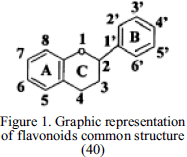
<body><![CDATA[<p style="text-autospace: none" align="justify"> <span lang="EN-US" style="font-family: TimesNewRomanPSMT; color: #191919"> <font size="2" face="Verdana">Phenolic acids and isocoumarins were the  predominant phenolics in carrots (42, 43). Among the most common phenolic  compounds found in vegetables are flavonoids, phenolic acids and isocoumarins.  For example, most of the compounds detected in black carrot</font></span><font face="Verdana"><span lang="EN-US" style="font-family: TimesNewRomanPSMT; color: #191919"><font size="2">  roots and black carrot juice are composed of </font></span> <span style="font-family: TimesNewRomanPSMT; color: #191919"><font size="2">&#961;</font></span><span lang="EN-US" style="font-family: TimesNewRomanPSMT; color: #191919"><font size="2">-coumaric,</font></span></font><span lang="EN-US" style="font-family: TimesNewRomanPSMT; color: #191919"><font size="2" face="Verdana">  caffeic and ferulic acids; 5-caffeoylquinic acid was the predominant phenolic  acid. Besides, some phenolic glycosides like dihydroxybenzoic acid hexoside and  quercetin-3-O-galactoside were detected (43). Alasalvar, Grigor (44) examined  the phenolic content of carrots of four different colours: orange, purple,  yellow and white. The four colored carrots contained mainly hydroxycinnamic acid  derivatives, namely 3'-caffeoylquinic</font></span><font face="Verdana"><span lang="EN-US" style="font-family: TimesNewRomanPSMT; color: #191919"><font size="2">  acid, 5'-caffeoylquinic acid, 3'-</font></span><span style="font-family: TimesNewRomanPSMT; color: #191919"><font size="2">&#961;</font></span><span lang="EN-US" style="font-family: TimesNewRomanPSMT; color: #191919"><font size="2">-coumaroylquinic</font></span></font><span lang="EN-US" style="font-family: TimesNewRomanPSMT; color: #191919"><font size="2" face="Verdana">  acid, 3'-feruloyquinic acid, 3',4'-dicaffeoylquinic</font></span><font face="Verdana"><span lang="EN-US" style="font-family: TimesNewRomanPSMT; color: #191919"><font size="2">  acid, 5'-feruloyquinic acid, 5'-</font></span><span style="font-family: TimesNewRomanPSMT; color: #191919"><font size="2">&#961;</font></span><span lang="EN-US" style="font-family: TimesNewRomanPSMT; color: #191919"><font size="2">-coumaroylquinic  acid,</font></span></font><span lang="EN-US" style="font-family: TimesNewRomanPSMT; color: #191919"><font size="2" face="Verdana">  4'-feruloylquinic acid, 3',5'-dicaffeoylquinic acid, 3',4'-diferuloylquinic acid  and 3',5'-diferuloylquinic acid. Anthocyanin content, a type of flavonoids, has  also been reported in carrots. The anthocyanins found in purple carrots roots  are cyanidin-3-xylosyl (glucosyl)-galactoside, cyanidin-3-xylosylagalactoside,  cyanidin-3-xylosyl-(sinapoylglucosyl)-galactoside, cyanidin-3-xylosyl (feruloylglucosyl)-galactoside,  cyanidin-3-xylosyl (coumaroylglucosyl)-galactoside, pelargonidin-3-xylosyl (feruloylglucosyl)-galactoside  and peonidin-3-xylosyl (feruloylglucosyl)-galactoside(45).</font></span></p>     <p style="text-autospace: none" align="justify"> <span lang="EN-US" style="font-family: TimesNewRomanPSMT; color: #191919"> <font size="2" face="Verdana">In this sense another vegetable that has been  widely studied are tomatoes, which are a key component in the Mediterranean diet  and its dietary intake is associated with lower risk of chronic degenerative  diseases, such as cancer and cardiovascular diseases (46). Vallverdu-Queralt,  Regueiro (47) conducted an extensive study to identify the number of phenolic  compounds extracted from tomato samples. They identified a total of 38 phenolic  compounds, among which gallic acid, protocatechuic acid, caffeic acid  derivatives, ferulic acid derivatives, kaempferol, rutin, naringenin, phloridzin,  and quercetin were present.</font></span></p>     <p style="text-autospace: none" align="justify"> <span lang="EN-US" style="font-family: TimesNewRomanPSMT; color: #191919"> <font size="2" face="Verdana">Lettuce might be relevant as a dietary source of  phenolic compounds. Several phenolicswere identified in five varieties of  lettuce (iceberg, romaine, continental, red oak leaf and lollorosso). The  phenolic compounds identified were 5-O-caffeoylquinic acid, caffeoylmalic acid,  dicaffeoyltartaric acid, and 3,5-dicaffeoylquinic acid, flavonoid-malonyl  glycosides (quercetin-3-malonylglucoside-7-glucuronide,  quercetin-3-malonylglucoside-7-glucoside, quercetin-3-malonylglucoside) and</font></span><span lang="FR" style="font-family: TimesNewRomanPSMT; color: #191919"><font size="2" face="Verdana">  flavonoid glycosides (quercetin-3-glucuronide, quercetin-3-glucoside,  quercetin-3-rutinoside, luteolin-7-glucuronide, and luteolin-7-glucoside,  luteolin-7-</font></span><span lang="EN-US" style="font-family: TimesNewRomanPSMT; color: #191919"><font size="2" face="Verdana">rutinoside)  groups.Caffeic acid derivatives were the main phenolic compounds in green  varieties; while flavonols were present in red varieties in higher quantities;  besides, anthocyanins were present only in red-leafed varieties (48).</font></span></p>     <p style="text-autospace: none" align="justify"> <span lang="EN-US" style="font-family: TimesNewRomanPSMT; color: #191919"> <font size="2" face="Verdana">Onions, spinach and pepper fruits are a rich  source of flavonoids (5). A blended mix of juice and pulp of carrot, parsley,  beet, kale, broccoli, cabbage, tomato, and spinach, as well as sugar beet fiber,  garlic powder, oat bran fiber, and rice bran was analyzed in order to identify  the phenolic composition of this vegetable mix. Among the variety of phenolic  compounds found, flavonols were the most abundant. A total of 28 compounds were  identified which belong to the dihydrochalcones, flavone, flavonols,  hydroxycinnamic acids, lignans and glucosinolategroups(49).</font></span></p>     <p style="text-autospace: none" align="justify"> <span lang="EN-US" style="font-family: TimesNewRomanPSMT; color: #191919"> <font size="2" face="Verdana">Reactive oxygen species (ROS) is a collective term  that describes O2-derived free radicals, such as superoxide</font></span><span style="font-family: TimesNewRomanPSMT; color: #191919"><font size="2" face="Verdana">  anion (O2</font></span><span style="font-family: Verdana; color: #191919"><font size="2">•</font></span><span style="font-family: TimesNewRomanPSMT; color: #191919"><font size="2" face="Verdana">-),  hydroxyl (HO</font></span><span style="font-family: Verdana; color: #191919"><font size="2">•</font></span><span style="font-family: TimesNewRomanPSMT; color: #191919"><font size="2" face="Verdana">),  peroxyl (RO2</font></span><span style="font-family: Verdana; color: #191919"><font size="2">•</font></span><span style="font-family: TimesNewRomanPSMT; color: #191919"><font size="2" face="Verdana">),</font></span><span lang="EN-US" style="font-family: TimesNewRomanPSMT; color: #191919"><font size="2" face="Verdana">  and alkoxy (RO</font></span><span style="font-family: Verdana; color: #191919"><font size="2">•</font></span><span lang="EN-US" style="font-family: TimesNewRomanPSMT; color: #191919"><font size="2" face="Verdana">)  radicals; O2-derived nonradical species such as hydrogen peroxide (H2O2) are  also included. Reactive species of oxygen (ROS) are relevant mediators and  influential factors in the development of colorectal cancer (50). Phenolic  compounds with antioxidant potential are shown to play an important role in  modulating the ROS level in the intestinal contents. Olejnik, Kowalska (45)  studied the effect of digested purple carrot extract, rich in anthocyanins, on  ROS generation and oxidative DNA damage in colon cells. Digested purple carrot  extract exhibited intracellular ROS-inhibitory capacity, with 1 mg/mL showing  the ROS clearance of 18.4 %. Digested purple carrot extract showed a 20.7 %  reduction in oxidative DNA damage in colon mucosa. These findings indicate that  purple carrot extract is capable of colonic cells protection against the adverse  effects of oxidative stress. For this reason,phenolics contained in purple  carrot extract may have a protective capacity of colonic cells (45).</font></span></p>     <p style="text-autospace: none" align="justify"> <span lang="EN-US" style="font-family: TimesNewRomanPSMT; color: #191919"> <font size="2" face="Verdana">Treatment of rats with CCl4 plus lettuce extract  ameliorated the toxic effects of CCl4. This plant contains flavonoids that  scavenge the oxidative damage to different cells and organs. These results  demonstrate that ethanol lettuce extract treatment increases the antioxidants  defense mechanism against CCl4-induced toxicity and provides evidence that it  may have a therapeutic role in free radical mediated diseases(51).</font></span></p>     <p style="text-autospace: none" align="justify"> <span lang="EN-US" style="font-family: TimesNewRomanPSMT; color: #191919"> <font size="2" face="Verdana">Nevertheless, sole dietary consumption of  plantbased foods allows us to utilize fully the phenolic compounds present in  those foods. There are a lot of factors that affect the bioactivity of phenolic  compounds present in plant foods. This subject will be further discussed.</font></span></p>     <p style="text-autospace: none" align="justify"><b> <span lang="EN-US" style="font-family: TimesNewRomanPS-BoldMT; color: #191919"> <font size="2" face="Verdana">DIETARY PHENOLIC COMPOUNDS</font></span></b></p>     <p style="text-autospace: none" align="justify"> <span lang="EN-US" style="font-family: TimesNewRomanPSMT; color: #191919"> <font size="2" face="Verdana">Phenolic compounds are derived from the secondary  metabolism of plants. Phenolics are chemical compounds that have at least one  aromatic ring to which one or more hydroxyl groups are bonded to aromatic or  aliphatic structures (52). There is a wide variety of phenolic compounds.  Nonetheless, this study will focus only in 2 groups:</font></span></p>     <p style="text-autospace: none" align="justify"> <span lang="EN-US" style="font-family: TimesNewRomanPSMT; color: #191919"> <font size="2" face="Verdana">1) Flavonoids, composed of two aromatic rings  linked through an oxygen heterocycle and depending on the degree of  hydrogenation (<a href="#fig1">Figure 1</a>) and the replacement of the heterocycle they can be  sub-classified as flavonols, flavones, isoflavones, anthocyanins,  proanthocyanidins, flavanones, etc. Flavonoids are mostly found in the form of  glycoside, the main sugars to which they are linked are glucose, rhamnose,  galactose and xylose.</font></span></p>     ]]></body>
<body><![CDATA[<p style="text-autospace: none" align="center"> <a name="fig1"> <img border="0" src="/img/fbpe/alan/v66n2/art01fig1.gif" width="187" height="157"></a></p>     
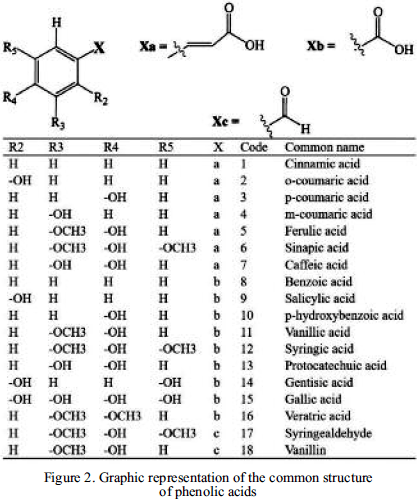
<p style="text-autospace: none" align="justify"> <span lang="EN-US" style="font-family: TimesNewRomanPSMT; color: #191919"> <font size="2" face="Verdana">2) Non-flavonoids, like benzoic and cinnamic  compounds, which are commonly called phenolic acids, these contain an aromatic  ring that can be attached to different functional groups or esterified to  organic acids (<a href="#fig2">Figure 2</a>). Some other phenolic compounds are stilbenes, tannins,  lignins, and lignans. Properties, like color, flavour and astringency are caused  by the presence of such compounds.</font></span></p>     <p style="text-autospace: none" align="center"> <a name="fig2"> <img border="0" src="/img/fbpe/alan/v66n2/art01fig2.gif" width="418" height="501"></a></p>     
<p style="text-autospace: none" align="justify"> <span lang="EN-US" style="font-family: TimesNewRomanPSMT; color: #191919"> <font size="2" face="Verdana">In recent years, phenolic compounds have been of  increasing interest to science and industry for their beneficial health effects,  especially because of its antioxidants properties. Halliwell and Gutteridge (53)</font></span><font face="Verdana"><span lang="EN-US" style="font-family: TimesNewRomanPSMT; color: #191919"><font size="2">  defined an antioxidant as </font></span> <span style="font-family: TimesNewRomanPSMT; color: #191919"><font size="2">“</font><span lang="EN-US"><font size="2">any  substance that, when</font></span></span></font><span lang="EN-US" style="font-family: TimesNewRomanPSMT; color: #191919"><font size="2" face="Verdana">  present at low concentrations compared with that of an oxidizable substrate,  significantly delays or inhibits</font></span><font face="Verdana"><span lang="EN-US" style="font-family: TimesNewRomanPSMT; color: #191919"><font size="2">  oxidation of that substrate</font></span><span style="font-family: TimesNewRomanPSMT; color: #191919"><font size="2">”</font><span lang="EN-US"><font size="2">.  An antioxidant should also</font></span></span></font><span lang="EN-US" style="font-family: TimesNewRomanPSMT; color: #191919"><font size="2" face="Verdana">  have the ability that after scavenging the radical, to form a new radical that  is stable enough intramolecular hydrogen bonding on further oxidation (54). Free  radicals, in turn, are molecules with an unpaired electron and seek electrons  from other molecules to gain stability. Molecules as proteins, lipids or DNA,  are known to function as a target for these free radicals, which may lead to a  deteriorative process called oxidation (2, 55).</font></span></p>     <p style="text-autospace: none" align="justify"> <span lang="EN-US" style="font-family: TimesNewRomanPSMT; color: #191919"> <font size="2" face="Verdana">Antioxidant activity of phenolic compounds is  attributed to their capacity to act as reducing agents to free radicals. Some  common phenolic compounds found in nature are flavonoles, flavones, isoflavones,  anthocyanins, flavonones, chatequines and proanthocyanidins(2, 35, 55).  Additionally, the potential phenolic compounds have also been attributed, at  least partially, to its anti-inflammatory properties (56).</font></span></p>     <p style="text-autospace: none" align="justify"> <span lang="EN-US" style="font-family: TimesNewRomanPSMT; color: #191919"> <font size="2" face="Verdana">The main factor on antioxidant activity of  phenolic compounds is its number and position of hydroxyl groups. Flavonoids  possess more hydroxyl groups thus present higher antioxidant activity.</font></span></p>     <p style="text-autospace: none" align="justify"> <span lang="EN-US" style="font-family: TimesNewRomanPSMT; color: #191919"> <font size="2" face="Verdana">Moreover, the solubility and stearic effects of  each molecule may be affected by the structure the molecule; for example, the  presence of glycosylated derivatives of other adducts, can increase or decrease  the antioxidant activity of phenolic compounds. Flavonoid compounds are commonly  present in plants as glycosides, but can be released by the action of enzymes to  its corresponding aglycone. The antioxidant activity of phenolic acids is also  based on the binding of these compounds to organic acids and sugars. The  mechanisms by which these compounds act may vary depending on the concentration  and types of compounds present in foods (52).</font></span></p>     <p style="text-autospace: none" align="justify"><b> <span lang="EN-US" style="font-family: TimesNewRomanPS-BoldMT; color: #191919"> <font size="2" face="Verdana">FACTORS AFFECTING THE BIOAVAILABILITY OF DIETARY  PHENOLIC COMPOUNDS</font></span></b></p>     <p style="text-autospace: none" align="justify"> <span lang="EN-US" style="font-family: TimesNewRomanPSMT; color: #191919"> <font size="2" face="Verdana">A balanced diet provides many different phenolic  compounds. Thus their bioavailability may vary, besides the diet changes in  every country and every season. To consider phenolic compounds nutraceutical  potential it is important to know how much of a phenolic is present in specific  food or dietary supplement; also, it is necessary to know how much of it is  bioavailable.</font></span></p>     <p style="text-autospace: none" align="justify"> <span lang="EN-US" style="font-family: TimesNewRomanPSMT; color: #191919"> <font size="2" face="Verdana">Bioavailability is defined as that fraction of an  ingested nutrient or compound that reaches the systemic circulation and the  specific sites where it can exert its biological action.Bioavailability depends  on proper absorption, the release of a dosage form and presystemic elimination.  Therefore, bioavailability also depends on the route of administration and  dosage form used, but can vary from one individual to another, especially when  factors that alter the absorption (57).</font></span></p>     ]]></body>
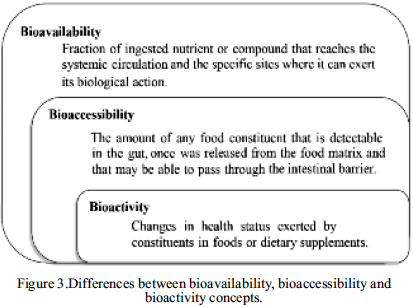
<body><![CDATA[<p style="text-autospace: none" align="justify"> <span lang="EN-US" style="font-family: TimesNewRomanPSMT; color: #191919"> <font size="2" face="Verdana">Bioavailability is related to other two concepts:  bioaccessibility and bioactivity. In this sense, bioaccessibility is described  as the amount of any food constituent that is released from the food matrix,  detectable in the gut, and that may be able to pass through the intestinal  barrier (21). This is crucial because only the compounds that released from the  matrix or absorbed in the small intestine are potentially bioavailable and  bioactive (<a href="#fig3">Figure 3</a>) (58).</font></span></p>     <p style="text-autospace: none" align="center"> <a name="fig3"> <img border="0" src="/img/fbpe/alan/v66n2/art01fig3.gif" width="413" height="307"></a></p>     
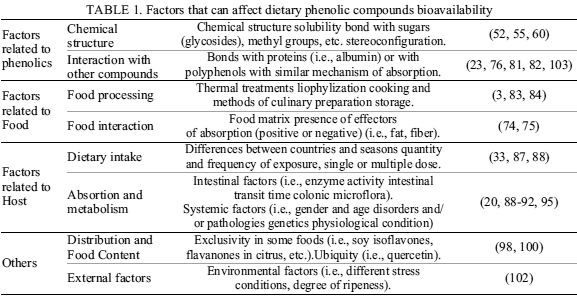
<p style="text-autospace: none" align="justify"> <span lang="EN-US" style="font-family: TimesNewRomanPSMT; color: #191919"> <font size="2" face="Verdana">Furthermore, recently it was proposed that once a  compound is absorbed it is inevitably bioactive, because of this was suggested  that the concept of bioavailability includes bioactivity (59). Nonetheless, it  is important to note that the fact that a compound being bioavailable does not  always imply its bioactive (<a href="#fig1">Figure 1</a>).</font></span></p>     <p style="text-autospace: none" align="justify"> <span lang="EN-US" style="font-family: TimesNewRomanPSMT; color: #191919"> <font size="2" face="Verdana">Phenolic bioavailability varies over a wide range  from 0.3% estimated for anthocyanins to 43% in the case of isoflavones(55). In  this sense, bioavailability is influenced by phenolic structure, food processing  and matrix, host, among others; besides all these factors can interact with each  other and influence phenolic compounds bioavailability (<a href="#tab1">Table 1</a>).</font></span></p>     <p style="text-autospace: none" align="center"> <a name="tab1"> <img border="0" src="/img/fbpe/alan/v66n2/art01tab1.gif" width="577" height="297"></a></p>     
<p style="text-autospace: none" align="justify"><b> <span lang="EN-US" style="font-family: TimesNewRomanPS-BoldMT; color: #191919"> <font size="2" face="Verdana">Factors Related to Phenolic Chemical Structure</font></span></b></p>     <p style="text-autospace: none" align="justify"> <span lang="EN-US" style="font-family: TimesNewRomanPSMT; color: #191919"> <font size="2" face="Verdana">-Solubility</font></span></p>     <p style="text-autospace: none" align="justify"> <span lang="EN-US" style="font-family: TimesNewRomanPSMT; color: #191919"> <font size="2" face="Verdana">The degree of solubility is given by the chemical  structure of a molecule. It has been observed in both in vivo and in vitro  studies, using phenolic compounds with different solubility, that there is  variation in susceptibility to digestion, fermentation, and absorption from the  gastrointestinal tract (52). These lead to suggest a classification of phenolic  compounds that distinguishes between extractable and nonextractable phenols.  Extractable polyphenols have low-intermediate molecular mass, and they can be  extracted using different solvents such as water, methanol, aqueous acetone,  etc. Aamong the major extractable polyphenols, we can find some hydrolysable  tannins and proanthocyanidins. In the other hand, nonextractable polyphenols are  high molecular weight compounds that are mostly bound to dietary fiber or  protein that remains insoluble in the usual solvent and requires an extra step  of hydrolysis during extraction to make them soluble and bioavailable (60).  Also, it has been observed that the specific absorption of various extractable  phenolics, depends on their extractability with different solvents (61).</font></span></p>     <p style="text-autospace: none" align="justify"> <span lang="EN-US" style="font-family: TimesNewRomanPSMT; color: #191919"> <font size="2" face="Verdana">-Glycosylation</font></span></p>     <p style="text-autospace: none" align="justify"> <span lang="EN-US" style="font-family: TimesNewRomanPSMT; color: #191919"> <font size="2" face="Verdana">Phenolic compounds exist as free aglycones and  glycoside forms, the last ones can be as O-glycosides or as Cglycosides, with a  number of sugars, glucose is the most commonly encountered, followed by  galactose, rhamnose, xylose and arabinose, while mannose, fructose, glucuronic  and galacturonic acids are unusual (62).</font></span></p>     ]]></body>
<body><![CDATA[<p style="text-autospace: none" align="justify"> <span lang="EN-US" style="font-family: TimesNewRomanPSMT; color: #191919"> <font size="2" face="Verdana">Aglycones and polyphenols bound to glucose,  galactose or xylose are absorbed in the small intestine</font></span><font face="Verdana"><span lang="EN-US" style="font-family: TimesNewRomanPSMT; color: #191919"><font size="2">  after deglycosylation by </font></span> <span style="font-family: TimesNewRomanPSMT; color: #191919"><font size="2">&#946;</font></span><span lang="EN-US" style="font-family: TimesNewRomanPSMT; color: #191919"><font size="2">-glucosidase  and lactase</font></span></font><span lang="EN-US" style="font-family: TimesNewRomanPSMT; color: #191919"><font size="2" face="Verdana">  phlorizin hydrolase (4), these enzymes releasing the aglycone into the  intestinal lumen for absorption by a diffusion mechanism. Phenolic compounds  bound to rhamnose must reach the colon to be hydrolysed by bacterial  ramnosidasesbefore its absorption (55).</font></span></p>     <p style="text-autospace: none" align="justify"> <span lang="EN-US" style="font-family: TimesNewRomanPSMT; color: #191919"> <font size="2" face="Verdana">Flavonoids bound to sugars as </font></span> <font face="Verdana"> <span style="font-family: TimesNewRomanPSMT; color: #191919"><font size="2">&#946;</font></span></font><span lang="EN-US" style="font-family: TimesNewRomanPSMT; color: #191919"><font size="2" face="Verdana">-glycosides  are considered non-absorbable, only aglyconescan pass through the gut wall. The  major sites of flavonoid metabolism are the liver and the colonic flora. In the  liver occurs O-methylation, sulphation, and glucuronidation of hydroxyl groups  improving flavonoid absorption; moreover, flavonoid glycosides are hydrolysed  only by colon microorganisms, after this they can be absorbed (63).</font></span></p>     <p style="text-autospace: none" align="justify"> <span lang="EN-US" style="font-family: TimesNewRomanPSMT; color: #191919"> <font size="2" face="Verdana">Most of in vivo studies show gastric absorption of  aglycones as quercetin and daidzein while glycosides are poorly absorbed (55).  However, Hollman and Katan (64) observed that quercetin glycosides from onions  were absorbed far well than the pure aglycone. Isoflavonesaglycones are absorbed  in the stomach while their glycosides are absorbed in the intestine (4)</font></span></p>     <p style="text-autospace: none" align="justify"> <span lang="EN-US" style="font-family: TimesNewRomanPSMT; color: #191919"> <font size="2" face="Verdana">Within the glycosylated polyphenols, anthocyanins  appear to be an exception, since the predominant forms in blood are their intact  glycosides. Some authors have suggested the existence of a particular mechanism  of anthocyanins absorption at the gastric level, which could involve transport  via gastric bilitranslocase (2, 55, 65).</font></span></p>     <p style="text-autospace: none" align="justify"> <span lang="EN-US" style="font-family: TimesNewRomanPSMT; color: #191919"> <font size="2" face="Verdana">-Acetylation and Methylation</font></span></p>     <p style="text-autospace: none" align="justify"> <span lang="EN-US" style="font-family: TimesNewRomanPSMT; color: #191919"> <font size="2" face="Verdana">The acylated flavonoids such as epicatechin and  epicatechingallateare absorbed without prior hydrolysis or deconjugation(4, 66).  Studies have shown that approximately 50% of the amount of (</font></span><span style="font-family: Verdana; color: #191919"><font size="2">–</font></span><span lang="EN-US" style="font-family: TimesNewRomanPSMT; color: #191919"><font size="2" face="Verdana">)-epicatechin  that reaches the intestinal cells is absorbed, and a percentage of metabolites  (especially sulfate conjugates) eliminated by efflux into the intestinal lumen,  and there exists a relatively modest elimination of (</font></span><span style="font-family: Verdana; color: #191919"><font size="2">–</font></span><span lang="EN-US" style="font-family: TimesNewRomanPSMT; color: #191919"><font size="2" face="Verdana">)-epicatechin  by bile; it also has been observed a potential absorption of (</font></span><span style="font-family: Verdana; color: #191919"><font size="2">–</font></span><span lang="EN-US" style="font-family: TimesNewRomanPSMT; color: #191919"><font size="2" face="Verdana">)-epicatechin  and elimination by efflux in another segment of the gut lumen (67).</font></span></p>     <p style="text-autospace: none" align="justify"> <span lang="EN-US" style="font-family: TimesNewRomanPSMT; color: #191919"> <font size="2" face="Verdana">The O-methylation of flavonoids is a natural  xenobiotic transformation by the O-methyl transferases, they are high selective  enzymatic systems in plants, microbes, and mammalians (68). Methylation of  phenolic compounds significantly increases their ability to be transported  across biological membranes, making them more stable to metabolic changes also  increase biological efficacy, particularly its antitumor activity. In this  sense, O-methylated flavonoids exhibited a superior anticancer activity than the  corresponding hydroxylated derivatives, being more resistant to the hepatic  metabolism and showing a higher intestinal absorption (69). Moreover, methylated  flavonoids showed effects on transport proteins that play a central role in the  defense of organism against toxic compounds (multidrug resistance proteins)  (70). It has been suggested that increasing the degree of methylation and  decreasing the number of free hydroxyl groups that are available for conjugation  with glucuronic acid and sulfate groups, stability and ability to transport  across biological membranes is increased (71).</font></span></p>     <p style="text-autospace: none" align="justify"> <span lang="EN-US" style="font-family: TimesNewRomanPSMT; color: #191919"> <font size="2" face="Verdana">-Polymerization</font></span></p>     <p style="text-autospace: none" align="justify"> <span lang="EN-US" style="font-family: TimesNewRomanPSMT; color: #191919"> <font size="2" face="Verdana">Bioavailability and metabolism of monomeric  phenols have been extensively studied, but little is known about the  bioavailability of polymeric phenolics such as tannins, and the results are  still controversial. Tannins bioactivity mostly depends on their grade of  polymerisation and solubility. For example, highly polymerized tannins exhibit  low bioaccessibility in the small intestine and low fermentability by colonic  microflora(72).</font></span></p>     <p style="text-autospace: none" align="justify"><b> <span lang="EN-US" style="font-family: TimesNewRomanPS-BoldMT; color: #191919"> <font size="2" face="Verdana">Factors Related to Food</font></span></b></p>     ]]></body>
<body><![CDATA[<p style="text-autospace: none" align="justify"> <span lang="EN-US" style="font-family: TimesNewRomanPSMT; color: #191919"> <font size="2" face="Verdana">-Food Matrix</font></span></p>     <p style="text-autospace: none" align="justify"> <span lang="EN-US" style="font-family: TimesNewRomanPSMT; color: #191919"> <font size="2" face="Verdana">The biological properties and bioavailability of  some phenolicsdepends largely on their release from the food matrix and their  subsequent interaction with target tissues. Today, the food matrix is considered  as the factor most decisive in the bioavailability and absorption of dietary  polyphenols (73).</font></span></p>     <p style="text-autospace: none" align="justify"> <span lang="EN-US" style="font-family: TimesNewRomanPSMT; color: #191919"> <font size="2" face="Verdana">Most cereal phenolics have covalent interactions  with glycosides from the cell wall, forming ester linkages which are not  hydrolysed by Phase I and II biotransformation enzymes, this limiting their  release into the colon to be metabolized by intestinal microbiota (74, 75).Such  interactions depend on the specific porosity and surface properties of the cell  wall that can measure between 4 and 10 mm diameter which restricts the  penetration of molecules with high molecular weight polyphenols (&gt;10 kDa) (76).  These bound phenolics are denominated conjugated.</font></span></p>     <p style="text-autospace: none" align="justify"> <span lang="EN-US" style="font-family: TimesNewRomanPSMT; color: #191919"> <font size="2" face="Verdana">Free and some conjugated phenolic acids are  thought to be readily available for absorption in the human small and large  intestines; however, those covalently bound to indigestible polysaccharides can  only be absorbed after being released from cell structures by digestive enzymes  or microorganisms in intestinal lumen. The bound phenolic acids have very low  bioavailability because the bran matrix severely hinders their access to the  necessary enzymes (such as ferulate esterases, xylanases) that contribute to  their release in the human gastrointestinal tract(55, 77).</font></span></p>     <p style="text-autospace: none" align="justify"> <span lang="EN-US" style="font-family: TimesNewRomanPSMT; color: #191919"> <font size="2" face="Verdana">Also, during the mastication of plant foods, the  cells are disrupted, and polyphenols are released from the cell; this can cause  phytochemicals interact with components of dietary fiber as cellulose,  hemicellulose, and pectin, which affects bioavailability, increasing or  decreasing (78-80).</font></span></p>     <p style="text-autospace: none" align="justify"> <span lang="EN-US" style="font-family: TimesNewRomanPSMT; color: #191919"> <font size="2" face="Verdana">Furthermore, some phenolic acids such as  chlorogenic and caffeicacids, can form interactions with proteins, however,  these interactions proved to be slightly disrupted during an in vitro digestion  process and does not affect its bioavailability and absorption (81, 82).</font></span></p>     <p style="text-autospace: none" align="justify"> <span lang="EN-US" style="font-family: TimesNewRomanPSMT; color: #191919"> <font size="2" face="Verdana">-Food Processing</font></span></p>     <p style="text-autospace: none" align="justify"> <span lang="EN-US" style="font-family: TimesNewRomanPSMT; color: #191919"> <font size="2" face="Verdana">Food processing can either increase or decrease  the phenolic content,it depends on the process. For example, milling processes  have shown to increase the solvent-extractable phenolic content, because this  processes increase the specific surface area of the particle and thus increase  the accessibility of phenolic compounds to extraction solvents (77). Thermal  processing techniques such as steaming, autoclaving, drying, roasting, and  microwave heating are widely used in cereal processing for improving sensorial  characteristics, stability and safety of the products, also, some of these  techniques have shown the potential to increase the extractability of phenolic  compounds in the materials, especially autoclaving (increase </font></span> <span lang="EN-US" style="font-family: Verdana; color: #191919"><font size="2">&#8776;</font></span><span lang="EN-US" style="font-family: TimesNewRomanPSMT; color: #191919"><font size="2" face="Verdana">  50%) (83).</font></span></p>     <p style="text-autospace: none" align="justify"> <span lang="EN-US" style="font-family: TimesNewRomanPSMT; color: #191919"> <font size="2" face="Verdana">On the other hand, some processes tend to decrease  the extractable phenolic content. For example, extrusion cooking causes  decomposition of heat-labile phenolic compounds (3).</font></span></p>     <p style="text-autospace: none" align="justify"> <span lang="EN-US" style="font-family: TimesNewRomanPSMT; color: #191919"> <font size="2" face="Verdana">The storage is included as a food process that can  or cannot cause-effect, increase or decrease the phenolic content. Broccoli and  lettuce were stored at modified atmospheres (argon, helium and nitrogen  atmosphere containing 2% oxygen) during9days, the authors observed that the  content of total phenolics was reduced in relation to the control sample (stored  in air) (84). Oppositely, frozen red raspberries were stored at</font></span><font face="Verdana"><span lang="EN-US" style="font-family: TimesNewRomanPSMT; color: #191919"><font size="2">  4 </font></span><span lang="EN-US" style="color: #191919"><font size="2">°</font></span><span lang="EN-US" style="font-family: TimesNewRomanPSMT; color: #191919"><font size="2">C  for 3 days, and then at 18 </font></span> <span lang="EN-US" style="color: #191919"><font size="2">°</font></span><span lang="EN-US" style="font-family: TimesNewRomanPSMT; color: #191919"><font size="2">C  for 24 h, after this,</font></span></font><span lang="EN-US" style="font-family: TimesNewRomanPSMT; color: #191919"><font size="2" face="Verdana">  the authors observed that anthocyanin levels were unaffected while elligitannins  increased (85).</font></span></p>     ]]></body>
<body><![CDATA[<p align="justify"><b> <span lang="EN-US" style="font-family: TimesNewRomanPS-BoldMT; color: #191919"> <font size="2" face="Verdana">Factors Related to Host</font></span></b></p>     <p style="text-autospace: none" align="justify"> <span lang="EN-US" style="font-family: TimesNewRomanPSMT; color: #191919"> <font size="2" face="Verdana">-Dietary Intake</font></span></p>     <p style="text-autospace: none" align="justify"> <span lang="EN-US" style="font-family: TimesNewRomanPSMT; color: #191919"> <font size="2" face="Verdana">Phenolics dietary intake it is affected by the  food availability, every country and seasons offer a different wide range of  possibilities; besides, the quantity and frequency of exposure to particular  compounds is determinant. Additionally, the diet of each host is diverse,  because of this every host responds in a different way to phenolics. There are  reports demonstrating that subjects with low circulating levels of antioxidants  respond promptly to a rich phenolic diet. However, once plasma levels reach a  certain concentration, there is no significant increase (86). This could be a  defense mechanism of the human body homeostasis, avoiding accumulation in  tissues where antioxidants might be potentially dangerous (87).</font></span></p>     <p style="text-autospace: none" align="justify"> <span lang="EN-US" style="font-family: TimesNewRomanPSMT; color: #191919"> <font size="2" face="Verdana">-Absorption and Metabolism</font></span></p>     <p style="text-autospace: none" align="justify"> <span lang="EN-US" style="font-family: TimesNewRomanPSMT; color: #191919"> <font size="2" face="Verdana">Renouf et al. (88) performed a dose</font></span><span style="font-family: Verdana; color: #191919"><font size="2">–</font></span><span lang="EN-US" style="font-family: TimesNewRomanPSMT; color: #191919"><font size="2" face="Verdana">response  study with ten healthy subjects, measuring plasma bioavailability of coffee  phenolics and their metabolites; they observed significantinterindividual  variability in plasma appearance, and this variability was greater for the most  abundant metabolites. Multiple factors could explain this variability, from  genetic background to gut microbial composition. However, they affirm that to  identify the cause(s) of this variability of the metabolic fate of coffee  metabolites remains very difficult.</font></span></p>     <p style="text-autospace: none" align="justify"> <span lang="EN-US" style="font-family: TimesNewRomanPSMT; color: #191919"> <font size="2" face="Verdana">Mechanism of Absorption of Phenolic Acids</font></span></p>     <p style="text-autospace: none" align="justify"> <span lang="EN-US" style="font-family: TimesNewRomanPSMT; color: #191919"> <font size="2" face="Verdana">Nowadays, the precise mechanism of absorption of  phenolic compounds is being studied. In this study, the mechanism in which  ferulic acid is absorbed will be explained as a model of all phenolic acids.</font></span></p>     <p style="text-autospace: none" align="justify"> <span lang="EN-US" style="font-family: TimesNewRomanPSMT; color: #191919"> <font size="2" face="Verdana">A study by Konishi and Shimizu (89), on the  transepithelial transport of ferulic acid, using Caco-2 cell monolayers,  reported that ferulic acid transport was dependent on pH, in the apical-basolateral  direction, and that the permeation rate of ferulic acid was  concentration-dependent; they also reported that ferulic acid uses various  substrates for monocarboxylic acid transporters (MCTs); and it is suggested that  other phenolic acids could be recognized and transported by MCT by intestinal  absorption. In contrast, a study published by Poquet, Clifford (90) used  co-cultured Caco-2 and mucus-producing HT29-MTX cells to study ferulic acid  uptake, they found that ferulic acid was permeated by passive diffusion  suggesting a transcellular transport. On the other hand, phenolic acids could  have different transport mechanisms since they possess different chemical  structures and properties. This is the case of rosmarinic acid, a study by  Konishi and Kobayashi (91), reported that rosmarinic acid could be absorbed via  paracellular, and that it could be further metabolized and degraded into m-coumaric  and hydroxylatedphenylpropionic acids by gut microflora, and then absorbed and  distributed by the MCT. In a similar way, the transport</font></span><font face="Verdana"><span lang="EN-US" style="font-family: TimesNewRomanPSMT; color: #191919"><font size="2">  mode of </font></span> <span style="font-family: TimesNewRomanPSMT; color: #191919"><font size="2">&#961;</font></span><span lang="EN-US" style="font-family: TimesNewRomanPSMT; color: #191919"><font size="2">-coumaric  acid and gallic acid, under a Caco-</font></span></font><span lang="EN-US" style="font-family: TimesNewRomanPSMT; color: #191919"><font size="2" face="Verdana">2  cell monolayer was studied. The authors reported that</font></span><font face="Verdana"><span lang="EN-US" style="font-family: TimesNewRomanPSMT; color: #191919"><font size="2">  while the transepithelial transport of </font></span> <span style="font-family: TimesNewRomanPSMT; color: #191919"><font size="2">&#961;</font></span><span lang="EN-US" style="font-family: TimesNewRomanPSMT; color: #191919"><font size="2">-coumaric  acid is</font></span></font><span lang="EN-US" style="font-family: TimesNewRomanPSMT; color: #191919"><font size="2" face="Verdana">  via the MCT, the permeation of gallic acid appears to be via paracellular(92).</font></span></p>     <p style="text-autospace: none" align="justify"> <span lang="EN-US" style="font-family: TimesNewRomanPSMT; color: #191919"> <font size="2" face="Verdana">Additionally, once absorbed some phenolic acids  may undergo through phase II metabolism. As it is the case of caffeic and  dihydrocaffeic acids, both possess the catechol group, this makes it a target  for sulfation at the 3-OH group by human liver S9, intestinal S9 and SULT1A1;  the latter has been suggested as the most active enzyme in the sulfation of  caffeic and dihydrocaffeic acids. Furthermore, glucuronidation can also occur in  caffeic acid, UGT1A1 and UGT1A9 are the active enzymes reported in this process.  While UGT1A1 catalyses the formation of caffeic acid-4-Oglucuronide, UGT1A9  conjugated the 3-OH and 4-OH groups of caffeic acid (93).</font></span></p>     <p style="text-autospace: none" align="justify"> <span lang="EN-US" style="font-family: TimesNewRomanPSMT; color: #191919"> <font size="2" face="Verdana">Moreover, in vivo studies</font></span></p>     ]]></body>
<body><![CDATA[<p style="text-autospace: none" align="justify"> <span lang="EN-US" style="font-family: TimesNewRomanPSMT; color: #191919"> <font size="2" face="Verdana">As it can be observed, the absorption of phenolic  acids is not well known nor its mechanisms. The information on this subject is  yet quite limited, and more studies are needed to understand the exact  mechanisms of the most important phenolic acids in regard of their beneficial  health effect.</font></span></p>     <p style="text-autospace: none" align="justify"> <span lang="EN-US" style="font-family: TimesNewRomanPSMT; color: #191919"> <font size="2" face="Verdana">Mechanism of Absorption of Flavonoids</font></span></p>     <p style="text-autospace: none" align="justify"><font face="Verdana"> <font size="2"> <span lang="EN-US" style="font-family: TimesNewRomanPSMT; color: #191919">In  2015, Actis</span><span style="font-family: TimesNewRomanPSMT; color: #191919">-</span></font><span lang="EN-US" style="font-family: TimesNewRomanPSMT; color: #191919"><font size="2">Goretta,  Dew (94) reported a</font></span></font><span lang="EN-US" style="font-family: TimesNewRomanPSMT; color: #191919"><font size="2" face="Verdana">  study on the absorption of hesperetin-7-O-rutinoside (hesperidin) using in vivo  models (humans); they report that hesperidin was hydrolysed by brush border  enzymes without involvement of pancreatic, stomach, or other enzymes,  additionally no hesperidin metabolites were detected in blood, only amount  traces were excreted in urine. In this sense, epicatechin is suggested to be  absorbed in the jejunum and that its conjugation is a major determinant of the  metabolic fate of epicatechin in the body (67). A study using Caco-2 cell  monolayers found that quercetin and naringeninare poorly absorbed by Caco-2  cells; quercetin was absorbed by passive diffusion and a pH-dependent mechanism  mediated by the organic anion transporting protein B, and that intestinal  permeability was higher for naringenin than for quercetin. It is also  mentionedthat, naringenin transport is somewhat ATP-dependent (95). Moreover,  genistein absorption was studied by Liu and Hu (96) using Caco-2 cell monolayers  and rats; in Caco-2 cells they reported that aglycones of genistein are 5 times  more permeable than their corresponding glycosides; besides in rats, aglycones  of genistein underwent phase II transformations of glucuronidation and sulfation.</font></span></p>     <p style="text-autospace: none" align="justify"> <span lang="EN-US" style="font-family: TimesNewRomanPSMT; color: #191919"> <font size="2" face="Verdana">The wide variety of flavonoids, their different  molecular size, chemical structure, and chemical properties can vary the way in  which they are absorbed, transported, metabolized and excreted. For this reason,  it is highly important that the mechanisms of absorption are studied for each  phenolic compound of interest, without assuming any general behaviour on their  absorption and further metabolism.</font></span></p>     <p style="text-autospace: none" align="justify"><b> <span lang="EN-US" style="font-family: TimesNewRomanPS-BoldMT; color: #191919"> <font size="2" face="Verdana">Other Factors</font></span></b></p>     <p style="text-autospace: none" align="justify"> <span lang="EN-US" style="font-family: TimesNewRomanPSMT; color: #191919"> <font size="2" face="Verdana">-Distribution and Food Content.</font></span></p>     <p style="text-autospace: none" align="justify"> <span lang="EN-US" style="font-family: TimesNewRomanPSMT; color: #191919"> <font size="2" face="Verdana">Plant polyphenol composition is highly variable  both qualitatively and quantitatively; while some phenolics are ubiquitous, as  quercetin, others are restricted to specific families or species (i.e.  isoflavones in legumes, flavanones in citrus). Some phenolics as anthocyanins  are very common,they can be found in all parts of the plant, although they are  accumulated mostly in flowers and fruits, but are also present in leaves, stems  and storage organs. In general, the level of anthocyanins in fruits is much  higher than in vegetables, among fruits the richest in anthocyanins are various  berries and black currants (97).</font></span></p>     <p style="text-autospace: none" align="justify"> <span lang="EN-US" style="font-family: TimesNewRomanPSMT; color: #191919"> <font size="2" face="Verdana">It has been observed that genetic factors,  environmental conditions, and growth or maturation stages are determinant  influences in phenolic content, causing large variations even within single  species (52).</font></span></p>     <p style="text-autospace: none" align="justify"> <span lang="EN-US" style="font-family: TimesNewRomanPSMT; color: #191919"> <font size="2" face="Verdana">For example, in grapes and apples, anthocyanins  are found only in the red varieties (because of the color) and accumulate toward  the end of ripening. Pinot noir grapes contain only anthocyanin 3-glucosides,  whereas other grape cultivars also contain acylatedanthocyanins(98). Most of the  phenolics in apples are hydroxycinnamic acids, flavanols and dihydrochalcones,  these compounds are very common in most of the fruits, but dihydrochalcones like  phloridzin and phloretin are unique to apples and apple trees (17, 38, 99).</font></span></p>     <p style="text-autospace: none" align="justify"> <span lang="EN-US" style="font-family: TimesNewRomanPSMT; color: #191919"> <font size="2" face="Verdana">In the case of tannins, hydrolysable tannins are  characterized by a restricted taxonomic distribution and are mainly associated  with dicotyledonous plants; it has also been observed that most of the plants  that can synthesize hydrolysable tannins are unable to synthesize condensed and  vice versa (100).</font></span></p>     ]]></body>
<body><![CDATA[<p style="text-autospace: none" align="justify"> <span lang="EN-US" style="font-family: TimesNewRomanPSMT; color: #191919"> <font size="2" face="Verdana">-External Factors</font></span></p>     <p style="text-autospace: none" align="justify"> <span lang="EN-US" style="font-family: TimesNewRomanPSMT; color: #191919"> <font size="2" face="Verdana">There several factors related to polyphenolics  production in plants, among this there are external factors as environmental  conditions, UV light exposure, insect and pathogens attack. Plants responses to  light UV radiation include increased content of phenolic compounds, such as of  hydrolysable tannins, flavonol, and anthocyanin compounds. Flavonols have been  implicatedin providing photoprotection against UV irradiation through a  screening function. Furthermore, the total phenol content increased  proportionately with the dose of UV radiation (101). These increase in phenolic  content is bigger especially with UV-C light, exposure of C. nivalis cells to  UV-A light (365nm) for 5 days resulted in a 5</font></span><span style="font-family: Verdana; color: #191919"><font size="2">–</font></span><span lang="EN-US" style="font-family: TimesNewRomanPSMT; color: #191919"><font size="2" face="Verdana">12%  increase in total phenolics, whereas exposure to UV-C light (254 nm) led to a 12</font></span><span style="font-family: Verdana; color: #191919"><font size="2">–</font></span><span lang="EN-US" style="font-family: TimesNewRomanPSMT; color: #191919"><font size="2" face="Verdana">24%  increase in phenolics after 7 days of exposure (102).</font></span></p>     <p style="text-autospace: none" align="justify"> <span lang="EN-US" style="font-family: TimesNewRomanPSMT; color: #191919"> <font size="2" face="Verdana">Among all phenolic compounds, tannins have been  major associated to insect attack. It has been observed that insect damage and  wounding can have strong stimulatory effects on tannin production in some  plants, suggesting that tannin synthesis contributes to induceddefense by  deterrence and/or toxicity (100, 103).</font></span></p>     <p style="text-autospace: none" align="justify"><b> <span lang="EN-US" style="font-family: TimesNewRomanPS-BoldMT; color: #191919"> <font size="2" face="Verdana">CONCLUSIONS</font></span></b></p>     <p style="text-autospace: none" align="justify"> <span lang="EN-US" style="font-family: TimesNewRomanPSMT; color: #191919"> <font size="2" face="Verdana">Epidemiological studies relate a decreased rate of  chronic diseases in individuals with higher intake of phenolic-rich foods.  Nevertheless, little is known about the biological activities of phenolic  compounds that have gone through the digestion process and its relation to the  factors affecting its bioaccessibility. In this regard, it has been argued that  the phenolic compounds once ingested, are oxidized during digestion and lose  their biological properties. On the other hand, epidemiological evidence  suggests that consumption of polyphenolrich foods reduces the incidence of  chronic diseases.</font></span></p>     <p style="text-autospace: none" align="justify"><font face="Verdana"> <span lang="EN-US" style="font-family: TimesNewRomanPSMT; color: #191919"> <font size="2">There have been efforts to study phenolic</font></span><span style="font-family: TimesNewRomanPSMT; color: #191919"><font size="2">’</font><span lang="EN-US"><font size="2">s  metabolism; nonetheless, the main limiting factor in this kind of research is  the lack of chromatographic standards of each metabolite produced. Obtaining  these standards may be difficult considering the wide spectrum of phenolic  compounds that exist in nature and the high number of metabolites that are  produced during digestion and metabolism.</font></span></span></font></p>     <p align="justify"> <span lang="EN-US" style="font-family: TimesNewRomanPSMT; color: #191919"> <font size="2" face="Verdana">Finally, it is recommended as highly critical that  each factor that affects polyphenols bioavailability must be considered to be  properly used in the pharmacological industry. In this sense, it is important to  obtain the pharmacokinetic of phenolic compounds, their interaction with other  drugs, interaction with other food constituents and their effective doses.  Additionally, to create further dietary recommendations, it is relevant to  understand phenolic compounds relationship with food matrix and how it affects  their bioaccessibility.</font></span></p>     <p align="justify"><b><font size="2" face="Verdana">REFERENCES</font></b></p>     <!-- ref --><p align="justify"><font size="2" face="Verdana">1. Velderrain-Rodríguez G,  Palafox-Carlos H, Wall-Medrano A, Ayala-zavala J, Chen CO, Robles-Sánchez M, et  al. Phenolic compounds: their journey after intake. Food Funct.  2014;5(2):189-97.</font>&nbsp;&nbsp;&nbsp;&nbsp;&nbsp;&nbsp;&nbsp;&nbsp;[&#160;<a href="javascript:void(0);" onclick="javascript: window.open('/scielo.php?script=sci_nlinks&ref=533285&pid=S0004-0622201600020000100001&lng=','','width=640,height=500,resizable=yes,scrollbars=1,menubar=yes,');">Links</a>&#160;]<!-- end-ref --><!-- ref --><p align="justify"><font size="2" face="Verdana">2. Manach C, Williamson G,  Morand C, Scalbert A, Rémésy C. Bioavailability and bioefficacy of polyphenols  in humans. I. Review of 97 bioavailability studies. Am J Clin Nutr.  2005;81(1):230S-42S.</font>&nbsp;&nbsp;&nbsp;&nbsp;&nbsp;&nbsp;&nbsp;&nbsp;[&#160;<a href="javascript:void(0);" onclick="javascript: window.open('/scielo.php?script=sci_nlinks&ref=533286&pid=S0004-0622201600020000100002&lng=','','width=640,height=500,resizable=yes,scrollbars=1,menubar=yes,');">Links</a>&#160;]<!-- end-ref --><!-- ref --><p align="justify"><font size="2" face="Verdana">3. Sharma R. Polyphenols in  health and disease: practice and mechanisms of benefits. Polyphenols in human  health and disease, Academic, San Diego 2014. p. 757-78.</font>&nbsp;&nbsp;&nbsp;&nbsp;&nbsp;&nbsp;&nbsp;&nbsp;[&#160;<a href="javascript:void(0);" onclick="javascript: window.open('/scielo.php?script=sci_nlinks&ref=533287&pid=S0004-0622201600020000100003&lng=','','width=640,height=500,resizable=yes,scrollbars=1,menubar=yes,');">Links</a>&#160;]<!-- end-ref --><!-- ref --><p align="justify"><font size="2" face="Verdana">4. Rein MJ, Renouf M, Cruz  Hernandez C, Actis Goretta L, Thakkar SK, da Silva Pinto M. Bioavailability of  bioactive food compounds: a challenging journey to bioefficacy. Br J Clin  Pharmacol. 2013;75(3):588-602.</font>&nbsp;&nbsp;&nbsp;&nbsp;&nbsp;&nbsp;&nbsp;&nbsp;[&#160;<a href="javascript:void(0);" onclick="javascript: window.open('/scielo.php?script=sci_nlinks&ref=533288&pid=S0004-0622201600020000100004&lng=','','width=640,height=500,resizable=yes,scrollbars=1,menubar=yes,');">Links</a>&#160;]<!-- end-ref --><!-- ref --><p align="justify"><font size="2" face="Verdana">5. Naczk M, Shahidi F.  Phenolics in cereals, fruits and vegetables: Occurrence, extraction and analysis.  J Pharm Biomed Anal. 2006 8/28/;41(5):1523-42.</font>&nbsp;&nbsp;&nbsp;&nbsp;&nbsp;&nbsp;&nbsp;&nbsp;[&#160;<a href="javascript:void(0);" onclick="javascript: window.open('/scielo.php?script=sci_nlinks&ref=533289&pid=S0004-0622201600020000100005&lng=','','width=640,height=500,resizable=yes,scrollbars=1,menubar=yes,');">Links</a>&#160;]<!-- end-ref --><!-- ref --><p align="justify"><font size="2" face="Verdana">6. Vieno P, Anna-Maija L, Päivi  E, Marjatta S-M, Kirsi-Helena L. CHAPTER 7: Micronutrients and Phytochemicals  in Wheat Grain. WHEAT: Chemistry and Technology: AACC International, Inc.; 2009.  p.179-222.</font>&nbsp;&nbsp;&nbsp;&nbsp;&nbsp;&nbsp;&nbsp;&nbsp;[&#160;<a href="javascript:void(0);" onclick="javascript: window.open('/scielo.php?script=sci_nlinks&ref=533290&pid=S0004-0622201600020000100006&lng=','','width=640,height=500,resizable=yes,scrollbars=1,menubar=yes,');">Links</a>&#160;]<!-- end-ref --><!-- ref --><p align="justify"><font size="2" face="Verdana">7. Bondia-Pons I, Aura A-M,  Vuorela S, Kolehmainen M, Mykkänen H, Poutanen K. Rye phenolics in nutrition and  health. J Cereal Sci. 2009;49(3):323-36.</font>&nbsp;&nbsp;&nbsp;&nbsp;&nbsp;&nbsp;&nbsp;&nbsp;[&#160;<a href="javascript:void(0);" onclick="javascript: window.open('/scielo.php?script=sci_nlinks&ref=533291&pid=S0004-0622201600020000100007&lng=','','width=640,height=500,resizable=yes,scrollbars=1,menubar=yes,');">Links</a>&#160;]<!-- end-ref --><!-- ref --><p align="justify"><font size="2" face="Verdana">8. Vitaglione P, Napolitano A,  Fogliano V. Cereal dietary fibre: a natural functional ingredient to deliver  phenolic compounds into the gut. Trends Food Sci Technol. 2008;19(9):451-63.</font>&nbsp;&nbsp;&nbsp;&nbsp;&nbsp;&nbsp;&nbsp;&nbsp;[&#160;<a href="javascript:void(0);" onclick="javascript: window.open('/scielo.php?script=sci_nlinks&ref=533292&pid=S0004-0622201600020000100008&lng=','','width=640,height=500,resizable=yes,scrollbars=1,menubar=yes,');">Links</a>&#160;]<!-- end-ref --><!-- ref --><p align="justify"><font size="2" face="Verdana">9. Arranz S, Saura-Calixto F,  Shaha S, Kroon PA. High contents of nonextractable polyphenols in fruits suggest  that polyphenol contents of plant foods have been underestimated. J Agric Food  Chem. 2009;57(16):7298- 303.</font>&nbsp;&nbsp;&nbsp;&nbsp;&nbsp;&nbsp;&nbsp;&nbsp;[&#160;<a href="javascript:void(0);" onclick="javascript: window.open('/scielo.php?script=sci_nlinks&ref=533293&pid=S0004-0622201600020000100009&lng=','','width=640,height=500,resizable=yes,scrollbars=1,menubar=yes,');">Links</a>&#160;]<!-- end-ref --><!-- ref --><p align="justify"><font size="2" face="Verdana">10. Wang W, Guo J, Zhang J, Peng  J, Liu T, Xin Z. Isolation, identification and antioxidant activity of  bound phenolic compounds present in rice bran. Food Chem. 2015;171:40-9.</font>&nbsp;&nbsp;&nbsp;&nbsp;&nbsp;&nbsp;&nbsp;&nbsp;[&#160;<a href="javascript:void(0);" onclick="javascript: window.open('/scielo.php?script=sci_nlinks&ref=533294&pid=S0004-0622201600020000100010&lng=','','width=640,height=500,resizable=yes,scrollbars=1,menubar=yes,');">Links</a>&#160;]<!-- end-ref --><!-- ref --><p align="justify"><font size="2" face="Verdana">11. Irakli MN, Samanidou VF,  Biliaderis CG, Papadoyannis IN. Development and validation of an HPLC-method for  determination of free and bound phenolic acids in cereals after solid-phase  extraction. Food Chem. 2012;134(3):1624-32.</font>&nbsp;&nbsp;&nbsp;&nbsp;&nbsp;&nbsp;&nbsp;&nbsp;[&#160;<a href="javascript:void(0);" onclick="javascript: window.open('/scielo.php?script=sci_nlinks&ref=533295&pid=S0004-0622201600020000100011&lng=','','width=640,height=500,resizable=yes,scrollbars=1,menubar=yes,');">Links</a>&#160;]<!-- end-ref --><!-- ref --><p align="justify"><font size="2" face="Verdana">12. Žili&#263; S, Šukalovi&#263; VH-T,  Dodig D, Maksimovi&#263; V, Maksimovi&#263; M, Basi&#263; Z. Antioxidant activity of small  grain cereals caused by phenolics and lipid soluble antioxidants. J Cereal Sci.  2011;54(3):417-24.</font>&nbsp;&nbsp;&nbsp;&nbsp;&nbsp;&nbsp;&nbsp;&nbsp;[&#160;<a href="javascript:void(0);" onclick="javascript: window.open('/scielo.php?script=sci_nlinks&ref=533296&pid=S0004-0622201600020000100012&lng=','','width=640,height=500,resizable=yes,scrollbars=1,menubar=yes,');">Links</a>&#160;]<!-- end-ref --><!-- ref --><p align="justify"><font size="2" face="Verdana">13. Hole AS, Grimmer S, Jensen MR, Sahlstrøm S. Synergistic and suppressive effects of dietary phenolic acids  and other phytochemicals from cereal extracts on nuclear factor kappa B activity.  Food Chem. 2012;133(3):969-77.</font>&nbsp;&nbsp;&nbsp;&nbsp;&nbsp;&nbsp;&nbsp;&nbsp;[&#160;<a href="javascript:void(0);" onclick="javascript: window.open('/scielo.php?script=sci_nlinks&ref=533297&pid=S0004-0622201600020000100013&lng=','','width=640,height=500,resizable=yes,scrollbars=1,menubar=yes,');">Links</a>&#160;]<!-- end-ref --><!-- ref --><p align="justify"><font size="2" face="Verdana">14. Escarcega R, Fuentes-Alexandro  S, Garcia-Carrasco M, Gatica A, Zamora A. The transcription factor nuclear  factor-kappa B and cancer. Clin Oncol. 2007;19(2):154-61.</font>&nbsp;&nbsp;&nbsp;&nbsp;&nbsp;&nbsp;&nbsp;&nbsp;[&#160;<a href="javascript:void(0);" onclick="javascript: window.open('/scielo.php?script=sci_nlinks&ref=533298&pid=S0004-0622201600020000100014&lng=','','width=640,height=500,resizable=yes,scrollbars=1,menubar=yes,');">Links</a>&#160;]<!-- end-ref --><!-- ref --><p align="justify"><font size="2" face="Verdana">15. Giacco R, Costabile G,  Della Pepa G, Anniballi G, Griffo E, Mangione A, et al. A whole-grain cereal-based  diet lowers postprandial plasma insulin and triglyceride levels in individuals  with metabolic syndrome. Nut Metab Cardiovasc Dis. 2014;24(8):837-44.</font>&nbsp;&nbsp;&nbsp;&nbsp;&nbsp;&nbsp;&nbsp;&nbsp;[&#160;<a href="javascript:void(0);" onclick="javascript: window.open('/scielo.php?script=sci_nlinks&ref=533299&pid=S0004-0622201600020000100015&lng=','','width=640,height=500,resizable=yes,scrollbars=1,menubar=yes,');">Links</a>&#160;]<!-- end-ref --><!-- ref --><p align="justify"><font size="2" face="Verdana">16. Ceymann M, Arrigoni E,  Schärer H, Bozzi Nising A, Hurrell RF. Identification of apples rich in health-promoting  flavan-3-ols and phenolic acids by measuring the polyphenol profile. J Food  Compost Anal. 2012 5//;26(1–2):128-35.</font>&nbsp;&nbsp;&nbsp;&nbsp;&nbsp;&nbsp;&nbsp;&nbsp;[&#160;<a href="javascript:void(0);" onclick="javascript: window.open('/scielo.php?script=sci_nlinks&ref=533300&pid=S0004-0622201600020000100016&lng=','','width=640,height=500,resizable=yes,scrollbars=1,menubar=yes,');">Links</a>&#160;]<!-- end-ref --><!-- ref --><p align="justify"><font size="2" face="Verdana">17. Lee KW, Kim YJ, Kim D-O, Lee HJ,  Lee CY. Major phenolics in apple and their contribution to the total antioxidant  capacity. J Agric Food Chem. 2003; 51 (22): 6516-20.</font>&nbsp;&nbsp;&nbsp;&nbsp;&nbsp;&nbsp;&nbsp;&nbsp;[&#160;<a href="javascript:void(0);" onclick="javascript: window.open('/scielo.php?script=sci_nlinks&ref=533301&pid=S0004-0622201600020000100017&lng=','','width=640,height=500,resizable=yes,scrollbars=1,menubar=yes,');">Links</a>&#160;]<!-- end-ref --><!-- ref --><p align="justify"><font size="2" face="Verdana">18. Miene C, Klenow S, Veeriah  S, Richling E, Glei M. Impact of apple polyphenols on GSTT2 gene expression,  subsequent protection of DNA and modulation of proliferation using LT97 human  colon adenoma cells. Mol Nutr Food Res. 2009;53(10):1254-62.</font>&nbsp;&nbsp;&nbsp;&nbsp;&nbsp;&nbsp;&nbsp;&nbsp;[&#160;<a href="javascript:void(0);" onclick="javascript: window.open('/scielo.php?script=sci_nlinks&ref=533302&pid=S0004-0622201600020000100018&lng=','','width=640,height=500,resizable=yes,scrollbars=1,menubar=yes,');">Links</a>&#160;]<!-- end-ref --><!-- ref --><p align="justify"><font size="2" face="Verdana">19. Petermann A, Miene C,  SchulzRaffelt G, Palige K, Hölzer J, Glei M, et al. GSTT2, a phase II gene  induced by apple polyphenols, protects colon epithelial cells against genotoxic  damage. Mol Nutr Food Res. 2009;53(10):1245-53.</font>&nbsp;&nbsp;&nbsp;&nbsp;&nbsp;&nbsp;&nbsp;&nbsp;[&#160;<a href="javascript:void(0);" onclick="javascript: window.open('/scielo.php?script=sci_nlinks&ref=533303&pid=S0004-0622201600020000100019&lng=','','width=640,height=500,resizable=yes,scrollbars=1,menubar=yes,');">Links</a>&#160;]<!-- end-ref --><!-- ref --><p align="justify"><font size="2" face="Verdana">20. Schulze C, Bangert A,  Kottra G, Geillinger KE, Schwanck B, Vollert H, et al. Inhibition of the  intestinal sodium coupled glucose transporter 1 (SGLT1) by extracts and  polyphenols from apple reduces postprandial blood glucose levels in mice and  humans. Mol Nutr Food Res. 2014;58(9):1795-808.</font>&nbsp;&nbsp;&nbsp;&nbsp;&nbsp;&nbsp;&nbsp;&nbsp;[&#160;<a href="javascript:void(0);" onclick="javascript: window.open('/scielo.php?script=sci_nlinks&ref=533304&pid=S0004-0622201600020000100020&lng=','','width=640,height=500,resizable=yes,scrollbars=1,menubar=yes,');">Links</a>&#160;]<!-- end-ref --><!-- ref --><p align="justify"><font size="2" face="Verdana">21. Palafox-Carlos H, Yahia EM,  González-Aguilar GA. Identification and quantification of major phenolic  compounds from mango (Mangifera indica, cv. Ataulfo) fruit by HPLC–DAD–MS/MS-ESI  and their individual contribution to the antioxidant activity during ripening.  Food Chem. 2012 11/1/;135(1):105-11.</font>&nbsp;&nbsp;&nbsp;&nbsp;&nbsp;&nbsp;&nbsp;&nbsp;[&#160;<a href="javascript:void(0);" onclick="javascript: window.open('/scielo.php?script=sci_nlinks&ref=533305&pid=S0004-0622201600020000100021&lng=','','width=640,height=500,resizable=yes,scrollbars=1,menubar=yes,');">Links</a>&#160;]<!-- end-ref --><!-- ref --><p align="justify"><font size="2" face="Verdana">22. Noratto GD, Bertoldi MC,  Krenek K, Talcott ST, Stringheta PC, Mertens-Talcott SU. Anticarcinogenic  Effects of Polyphenolics from Mango (<i>Mangifera indica</i>) Varieties. J Agric  Food Chem. 2010 2010/04/14;58(7):4104- 12.</font>&nbsp;&nbsp;&nbsp;&nbsp;&nbsp;&nbsp;&nbsp;&nbsp;[&#160;<a href="javascript:void(0);" onclick="javascript: window.open('/scielo.php?script=sci_nlinks&ref=533306&pid=S0004-0622201600020000100022&lng=','','width=640,height=500,resizable=yes,scrollbars=1,menubar=yes,');">Links</a>&#160;]<!-- end-ref --><!-- ref --><p align="justify"><font size="2" face="Verdana">23. Ajila C, Rao UP. Mango peel  dietary fibre: Composition and associated bound phenolics. J Funct Foods.  2013;5(1):444-50.</font>&nbsp;&nbsp;&nbsp;&nbsp;&nbsp;&nbsp;&nbsp;&nbsp;[&#160;<a href="javascript:void(0);" onclick="javascript: window.open('/scielo.php?script=sci_nlinks&ref=533307&pid=S0004-0622201600020000100023&lng=','','width=640,height=500,resizable=yes,scrollbars=1,menubar=yes,');">Links</a>&#160;]<!-- end-ref --><!-- ref --><p align="justify"><font size="2" face="Verdana">24. Taing M-W, Pierson J-T,  Hoang VL, Shaw PN, Dietzgen RG, Gidley MJ, et al. Mango fruit peel and flesh  extracts affect adipogenesis in 3T3-L1 cells. Food Funct. 2012;3(8):828-36.</font>&nbsp;&nbsp;&nbsp;&nbsp;&nbsp;&nbsp;&nbsp;&nbsp;[&#160;<a href="javascript:void(0);" onclick="javascript: window.open('/scielo.php?script=sci_nlinks&ref=533308&pid=S0004-0622201600020000100024&lng=','','width=640,height=500,resizable=yes,scrollbars=1,menubar=yes,');">Links</a>&#160;]<!-- end-ref --><!-- ref --><p align="justify"><font size="2" face="Verdana">25. Pierson J-T, Curry MC, Shaw  PN, Dietzgen RG, Gidley MJ, Roberts-Thomson SJ, et al. Polyphenolic contents and  the effects of methanol extracts from mango varieties on breast cancer cells.  Food Sci Biotechnol. 2015;24(1):265-71.</font>&nbsp;&nbsp;&nbsp;&nbsp;&nbsp;&nbsp;&nbsp;&nbsp;[&#160;<a href="javascript:void(0);" onclick="javascript: window.open('/scielo.php?script=sci_nlinks&ref=533309&pid=S0004-0622201600020000100025&lng=','','width=640,height=500,resizable=yes,scrollbars=1,menubar=yes,');">Links</a>&#160;]<!-- end-ref --><!-- ref --><p align="justify"><font size="2" face="Verdana">26. García-Solís P, Yahia EM,  Morales-Tlalpan V, Díaz-Muñoz M. Screening of antiproliferative effect of  aqueous extracts of plant foods consumed in Mexico on the breast cancer cell  line MCF-7. Int J Food Sci Nutr. 2009;60(sup6):32-46.</font>&nbsp;&nbsp;&nbsp;&nbsp;&nbsp;&nbsp;&nbsp;&nbsp;[&#160;<a href="javascript:void(0);" onclick="javascript: window.open('/scielo.php?script=sci_nlinks&ref=533310&pid=S0004-0622201600020000100026&lng=','','width=640,height=500,resizable=yes,scrollbars=1,menubar=yes,');">Links</a>&#160;]<!-- end-ref --><!-- ref --><p align="justify"><font size="2" face="Verdana">27. García-Solís P, Yahia EM,  Aceves C. Study of the effect of ‘Ataulfo’mango (<i>Mangifera indica L</i>.)  intake on mammary carcinogenesis and antioxidant capacity in plasma of N-methyl-N-nitrosourea  (MNU)-treated rats. Food Chem. 2008;111(2):309-15.</font>&nbsp;&nbsp;&nbsp;&nbsp;&nbsp;&nbsp;&nbsp;&nbsp;[&#160;<a href="javascript:void(0);" onclick="javascript: window.open('/scielo.php?script=sci_nlinks&ref=533311&pid=S0004-0622201600020000100027&lng=','','width=640,height=500,resizable=yes,scrollbars=1,menubar=yes,');">Links</a>&#160;]<!-- end-ref --><!-- ref --><p align="justify"><font size="2" face="Verdana">28. Turner T, Burri BJ. Potential nutritional benefits of current citrus consumption. Agric.  2013;3(1):170-87.</font>&nbsp;&nbsp;&nbsp;&nbsp;&nbsp;&nbsp;&nbsp;&nbsp;[&#160;<a href="javascript:void(0);" onclick="javascript: window.open('/scielo.php?script=sci_nlinks&ref=533312&pid=S0004-0622201600020000100028&lng=','','width=640,height=500,resizable=yes,scrollbars=1,menubar=yes,');">Links</a>&#160;]<!-- end-ref --><!-- ref --><p align="justify"><font size="2" face="Verdana">29. Benavente-García O,  Castillo J, Marin FR, Ortuño A, Del Río JA. Uses and Properties of Citrus  Flavonoids. J Agric Food Chem. 1997 1997/12/01;45(12):4505-15.</font>&nbsp;&nbsp;&nbsp;&nbsp;&nbsp;&nbsp;&nbsp;&nbsp;[&#160;<a href="javascript:void(0);" onclick="javascript: window.open('/scielo.php?script=sci_nlinks&ref=533313&pid=S0004-0622201600020000100029&lng=','','width=640,height=500,resizable=yes,scrollbars=1,menubar=yes,');">Links</a>&#160;]<!-- end-ref --><!-- ref --><p align="justify"><font size="2" face="Verdana">30. Sun Y, Qiao L, Shen Y,  Jiang P, Chen J, Ye X. Phytochemical Profile and Antioxidant Activity of  Physiological Drop of Citrus Fruits. J Food Sci. 2013;78(1):C37-C42.</font>&nbsp;&nbsp;&nbsp;&nbsp;&nbsp;&nbsp;&nbsp;&nbsp;[&#160;<a href="javascript:void(0);" onclick="javascript: window.open('/scielo.php?script=sci_nlinks&ref=533314&pid=S0004-0622201600020000100030&lng=','','width=640,height=500,resizable=yes,scrollbars=1,menubar=yes,');">Links</a>&#160;]<!-- end-ref --><!-- ref --><p align="justify"><font size="2" face="Verdana">31. Morand C, Dubray C,  Milenkovic D, Lioger D, Martin JF, Scalbert A, et al. Hesperidin contributes to  the vascular protective effects of orange juice: a randomized crossover study in  healthy volunteers. Am J Clin Nutr. 2011;93(1):73-80.</font>&nbsp;&nbsp;&nbsp;&nbsp;&nbsp;&nbsp;&nbsp;&nbsp;[&#160;<a href="javascript:void(0);" onclick="javascript: window.open('/scielo.php?script=sci_nlinks&ref=533315&pid=S0004-0622201600020000100031&lng=','','width=640,height=500,resizable=yes,scrollbars=1,menubar=yes,');">Links</a>&#160;]<!-- end-ref --><!-- ref --><p align="justify"><font size="2" face="Verdana">32. Reshef N, Hayari Y, Goren  C, Boaz M, Madar Z, Knobler H. Antihypertensive Effect of Sweetie Fruit in  Patients With Stage I Hypertension*. Am J Hypertens. 2005;18(10):1360-3.</font>&nbsp;&nbsp;&nbsp;&nbsp;&nbsp;&nbsp;&nbsp;&nbsp;[&#160;<a href="javascript:void(0);" onclick="javascript: window.open('/scielo.php?script=sci_nlinks&ref=533316&pid=S0004-0622201600020000100032&lng=','','width=640,height=500,resizable=yes,scrollbars=1,menubar=yes,');">Links</a>&#160;]<!-- end-ref --><!-- ref --><p align="justify"><font size="2" face="Verdana">33. Wang Y, Li F, Wang Z, Qiu  T, Shen Y, Wang M. Fruit and vegetable consumption and risk of lung cancer: A  dose–response meta-analysis of prospective cohort studies. Lung Cancer.  2015;88(2):124-30.</font>&nbsp;&nbsp;&nbsp;&nbsp;&nbsp;&nbsp;&nbsp;&nbsp;[&#160;<a href="javascript:void(0);" onclick="javascript: window.open('/scielo.php?script=sci_nlinks&ref=533317&pid=S0004-0622201600020000100033&lng=','','width=640,height=500,resizable=yes,scrollbars=1,menubar=yes,');">Links</a>&#160;]<!-- end-ref --><!-- ref --><p align="justify"><font size="2" face="Verdana">34. Del Rio D, Rodriguez-Mateos  A, Spencer JP, Tognolini M, Borges G, Crozier A. Dietary (poly) phenolics in  human health: structures, bioavailability, and evidence of protective effects  against chronic diseases. Antioxid Redox Signal. 2013;18(14):1818-92.</font>&nbsp;&nbsp;&nbsp;&nbsp;&nbsp;&nbsp;&nbsp;&nbsp;[&#160;<a href="javascript:void(0);" onclick="javascript: window.open('/scielo.php?script=sci_nlinks&ref=533318&pid=S0004-0622201600020000100034&lng=','','width=640,height=500,resizable=yes,scrollbars=1,menubar=yes,');">Links</a>&#160;]<!-- end-ref --><!-- ref --><p align="justify"><font size="2" face="Verdana">35. Scalbert A, Manach C,  Morand C, Rémésy C, Jiménez L. Dietary polyphenols and the prevention of  diseases. Crit Rev Food Sci Nutr. 2005;45(4):287-306.</font>&nbsp;&nbsp;&nbsp;&nbsp;&nbsp;&nbsp;&nbsp;&nbsp;[&#160;<a href="javascript:void(0);" onclick="javascript: window.open('/scielo.php?script=sci_nlinks&ref=533319&pid=S0004-0622201600020000100035&lng=','','width=640,height=500,resizable=yes,scrollbars=1,menubar=yes,');">Links</a>&#160;]<!-- end-ref --><!-- ref --><p align="justify"><font size="2" face="Verdana">36. Feliciano RP, Pritzel S,  Heiss C, Rodriguez-Mateos A. Flavonoid intake and cardiovascular disease risk.  Curr Opin Food Sci. 2015;2:92-9.</font>&nbsp;&nbsp;&nbsp;&nbsp;&nbsp;&nbsp;&nbsp;&nbsp;[&#160;<a href="javascript:void(0);" onclick="javascript: window.open('/scielo.php?script=sci_nlinks&ref=533320&pid=S0004-0622201600020000100036&lng=','','width=640,height=500,resizable=yes,scrollbars=1,menubar=yes,');">Links</a>&#160;]<!-- end-ref --><!-- ref --><p align="justify"><font size="2" face="Verdana">37. McCann M, Gill C, O’Brien  G, Rao J, McRoberts W, Hughes P, et al. Anti-cancer properties of phenolics from  apple waste on colon carcinogenesis in vitro. Food Chem Toxicol.  2007;45(7):1224-30.</font>&nbsp;&nbsp;&nbsp;&nbsp;&nbsp;&nbsp;&nbsp;&nbsp;[&#160;<a href="javascript:void(0);" onclick="javascript: window.open('/scielo.php?script=sci_nlinks&ref=533321&pid=S0004-0622201600020000100037&lng=','','width=640,height=500,resizable=yes,scrollbars=1,menubar=yes,');">Links</a>&#160;]<!-- end-ref --><!-- ref --><p align="justify"><font size="2" face="Verdana">38. Serra AT, Rocha J, Sepodes  B, Matias AA, Feliciano RP, de Carvalho A, et al. Evaluation of cardiovascular  protective effect of different apple varieties–correlation of response with  composition. Food Chem. 2012;135(4):2378-86.</font>&nbsp;&nbsp;&nbsp;&nbsp;&nbsp;&nbsp;&nbsp;&nbsp;[&#160;<a href="javascript:void(0);" onclick="javascript: window.open('/scielo.php?script=sci_nlinks&ref=533322&pid=S0004-0622201600020000100038&lng=','','width=640,height=500,resizable=yes,scrollbars=1,menubar=yes,');">Links</a>&#160;]<!-- end-ref --><!-- ref --><p align="justify"><font size="2" face="Verdana">39. zang L, Shimada Y, Kawajiri  J, Tanaka T, Nishimura N. Effects of Yuzu (Citrus junos Siebold ex Tanaka) peel  on the diet-induced obesity in a zebrafish model. J Funct Foods.  2014;10:499-510.</font>&nbsp;&nbsp;&nbsp;&nbsp;&nbsp;&nbsp;&nbsp;&nbsp;[&#160;<a href="javascript:void(0);" onclick="javascript: window.open('/scielo.php?script=sci_nlinks&ref=533323&pid=S0004-0622201600020000100039&lng=','','width=640,height=500,resizable=yes,scrollbars=1,menubar=yes,');">Links</a>&#160;]<!-- end-ref --><!-- ref --><p align="justify"><font size="2" face="Verdana">40. Bok S-H, Lee S-H, Park Y-B,  Bae K-H, Son K-H, Jeong T-S, et al. Plasma and hepatic cholesterol and hepatic  activities of 3-hydroxy-3-methyl-glutaryl-CoA reductase and acyl CoA:  cholesterol transferase are lower in rats fed citrus peel extract or a mixture  of citrus bioflavonoids. J Nutr. 1999;129(6):1182-5.</font>&nbsp;&nbsp;&nbsp;&nbsp;&nbsp;&nbsp;&nbsp;&nbsp;[&#160;<a href="javascript:void(0);" onclick="javascript: window.open('/scielo.php?script=sci_nlinks&ref=533324&pid=S0004-0622201600020000100040&lng=','','width=640,height=500,resizable=yes,scrollbars=1,menubar=yes,');">Links</a>&#160;]<!-- end-ref --><!-- ref --><p align="justify"><font size="2" face="Verdana">41. Wu T, Jiang Z, Yin J, Long  H, Zheng X. Anti-obesity effects of artificial planting blueberry (<i>Vaccinium  ashei</i>) anthocyanin in high-fat diet-treated mice. Int J Food Sci Nutr.  2016:1-8.</font>&nbsp;&nbsp;&nbsp;&nbsp;&nbsp;&nbsp;&nbsp;&nbsp;[&#160;<a href="javascript:void(0);" onclick="javascript: window.open('/scielo.php?script=sci_nlinks&ref=533325&pid=S0004-0622201600020000100041&lng=','','width=640,height=500,resizable=yes,scrollbars=1,menubar=yes,');">Links</a>&#160;]<!-- end-ref --><!-- ref --><p align="justify"><font size="2" face="Verdana">42. Babic I, Amiot M, Nguyen-The  C. Changes in phenolic content in fresh ready-to-use shredded carrots during  storage. Physiol Bas Posth Technol 1992;343:123-8.</font>&nbsp;&nbsp;&nbsp;&nbsp;&nbsp;&nbsp;&nbsp;&nbsp;[&#160;<a href="javascript:void(0);" onclick="javascript: window.open('/scielo.php?script=sci_nlinks&ref=533326&pid=S0004-0622201600020000100042&lng=','','width=640,height=500,resizable=yes,scrollbars=1,menubar=yes,');">Links</a>&#160;]<!-- end-ref --><!-- ref --><p align="justify"><font size="2" face="Verdana">43. Kammerer DR, Kammerer J,  Valet R, Carle R. Recovery of polyphenols from the by-products of plant food  processing and application as valuable food ingredients. Food Res Int.  2014;65:2-12.</font>&nbsp;&nbsp;&nbsp;&nbsp;&nbsp;&nbsp;&nbsp;&nbsp;[&#160;<a href="javascript:void(0);" onclick="javascript: window.open('/scielo.php?script=sci_nlinks&ref=533327&pid=S0004-0622201600020000100043&lng=','','width=640,height=500,resizable=yes,scrollbars=1,menubar=yes,');">Links</a>&#160;]<!-- end-ref --><!-- ref --><p align="justify"><font size="2" face="Verdana">44. Alasalvar C, Grigor JM,  Zhang D, Quantick PC, Shahidi F. Comparison of volatiles, phenolics, sugars,  antioxidant vitamins, and sensory quality of different colored carrot varieties.  J Agric Food Chem. 2001;49(3):1410-6.</font>&nbsp;&nbsp;&nbsp;&nbsp;&nbsp;&nbsp;&nbsp;&nbsp;[&#160;<a href="javascript:void(0);" onclick="javascript: window.open('/scielo.php?script=sci_nlinks&ref=533328&pid=S0004-0622201600020000100044&lng=','','width=640,height=500,resizable=yes,scrollbars=1,menubar=yes,');">Links</a>&#160;]<!-- end-ref --><!-- ref --><p align="justify"><font size="2" face="Verdana">45. Olejnik A, Kowalska K,  Olkowicz M, Rychlik J, Juzwa W, Myszka K, et al. Anti-inflammatory effects of  gastrointestinal digested <i>Sambucus nigra</i> L. fruit extract analysed in co-cultured  intestinal epithelial cells and lipopolysaccharide- stimulated macrophages. J Funct Foods. 2015;19:649-60.</font>&nbsp;&nbsp;&nbsp;&nbsp;&nbsp;&nbsp;&nbsp;&nbsp;[&#160;<a href="javascript:void(0);" onclick="javascript: window.open('/scielo.php?script=sci_nlinks&ref=533329&pid=S0004-0622201600020000100045&lng=','','width=640,height=500,resizable=yes,scrollbars=1,menubar=yes,');">Links</a>&#160;]<!-- end-ref --><!-- ref --><p align="justify"><font size="2" face="Verdana">46. Paran E, Novack V,  Engelhard YN, Hazan-Halevy I. The effects of natural antioxidants from tomato  extract in treated but uncontrolled hypertensive patients. Cardiovasc Drug Ther.  2009;23(2):145-51.</font>&nbsp;&nbsp;&nbsp;&nbsp;&nbsp;&nbsp;&nbsp;&nbsp;[&#160;<a href="javascript:void(0);" onclick="javascript: window.open('/scielo.php?script=sci_nlinks&ref=533330&pid=S0004-0622201600020000100046&lng=','','width=640,height=500,resizable=yes,scrollbars=1,menubar=yes,');">Links</a>&#160;]<!-- end-ref --><!-- ref --><p align="justify"><font size="2" face="Verdana">47. Vallverdú-Queralt A,  Regueiro J, Martínez-Huélamo M, Alvarenga JFR, Leal LN, Lamuela-Raventos RM. A  comprehensive study on the phenolic profile of widely used culinary herbs and  spices: Rosemary, thyme, oregano, cinnamon, cumin and bay. Food Chem.  2014;154:299-307.</font>&nbsp;&nbsp;&nbsp;&nbsp;&nbsp;&nbsp;&nbsp;&nbsp;[&#160;<a href="javascript:void(0);" onclick="javascript: window.open('/scielo.php?script=sci_nlinks&ref=533331&pid=S0004-0622201600020000100047&lng=','','width=640,height=500,resizable=yes,scrollbars=1,menubar=yes,');">Links</a>&#160;]<!-- end-ref --><!-- ref --><p align="justify"><font size="2" face="Verdana">48. Llorach R, Martínez-Sánchez  A, Tomás-Barberán FA, Gil MI, Ferreres F. Characterisation of polyphenols and  antioxidant properties of five lettuce varieties and escarole. Food Chem.  2008;108(3):1028-38.</font>&nbsp;&nbsp;&nbsp;&nbsp;&nbsp;&nbsp;&nbsp;&nbsp;[&#160;<a href="javascript:void(0);" onclick="javascript: window.open('/scielo.php?script=sci_nlinks&ref=533332&pid=S0004-0622201600020000100048&lng=','','width=640,height=500,resizable=yes,scrollbars=1,menubar=yes,');">Links</a>&#160;]<!-- end-ref --><!-- ref --><p align="justify"><font size="2" face="Verdana">49. Bresciani L, Calani L,  Cossu M, Mena P, Sayegh M, Ray S, et al. (Poly) phenolic characterization of  three food supplements containing 36 different fruits, vegetables and berries.  PharmaNutrition. 2015;3(2):11-9.</font>&nbsp;&nbsp;&nbsp;&nbsp;&nbsp;&nbsp;&nbsp;&nbsp;[&#160;<a href="javascript:void(0);" onclick="javascript: window.open('/scielo.php?script=sci_nlinks&ref=533333&pid=S0004-0622201600020000100049&lng=','','width=640,height=500,resizable=yes,scrollbars=1,menubar=yes,');">Links</a>&#160;]<!-- end-ref --><!-- ref --><p align="justify"><font size="2" face="Verdana">50. Afanas’ev I. Reactive  oxygen species signaling in cancer: comparison with aging. Aging Dis.  2011;2(3):219.</font>&nbsp;&nbsp;&nbsp;&nbsp;&nbsp;&nbsp;&nbsp;&nbsp;[&#160;<a href="javascript:void(0);" onclick="javascript: window.open('/scielo.php?script=sci_nlinks&ref=533334&pid=S0004-0622201600020000100050&lng=','','width=640,height=500,resizable=yes,scrollbars=1,menubar=yes,');">Links</a>&#160;]<!-- end-ref --><!-- ref --><p align="justify"><font size="2" face="Verdana">51. Hefnawy HTM, Ramadan MF.  Protective effects of Lactuca sativa ethanolic extract on carbon tetrachloride  induced oxidative damage in rats. Asian Pacific Journal of Tropical Disease.  2013;3(4):277-85.</font>&nbsp;&nbsp;&nbsp;&nbsp;&nbsp;&nbsp;&nbsp;&nbsp;[&#160;<a href="javascript:void(0);" onclick="javascript: window.open('/scielo.php?script=sci_nlinks&ref=533335&pid=S0004-0622201600020000100051&lng=','','width=640,height=500,resizable=yes,scrollbars=1,menubar=yes,');">Links</a>&#160;]<!-- end-ref --><!-- ref --><p align="justify"><font size="2" face="Verdana">52. Bravo L. Polyphenols:  chemistry, dietary sources, metabolism, and nutritional significance. Nutr Rev.  1998;56(11):317-33.</font>&nbsp;&nbsp;&nbsp;&nbsp;&nbsp;&nbsp;&nbsp;&nbsp;[&#160;<a href="javascript:void(0);" onclick="javascript: window.open('/scielo.php?script=sci_nlinks&ref=533336&pid=S0004-0622201600020000100052&lng=','','width=640,height=500,resizable=yes,scrollbars=1,menubar=yes,');">Links</a>&#160;]<!-- end-ref --><!-- ref --><p align="justify"><font size="2" face="Verdana">53. Halliwell B, Gutteridge JM.  The definition and measurement of antioxidants in biological systems. Free Radic  Biol Med. 1995;18(1):125-6.</font>&nbsp;&nbsp;&nbsp;&nbsp;&nbsp;&nbsp;&nbsp;&nbsp;[&#160;<a href="javascript:void(0);" onclick="javascript: window.open('/scielo.php?script=sci_nlinks&ref=533337&pid=S0004-0622201600020000100053&lng=','','width=640,height=500,resizable=yes,scrollbars=1,menubar=yes,');">Links</a>&#160;]<!-- end-ref --><!-- ref --><p align="justify"><font size="2" face="Verdana">54. Carocho M, Ferreira IC. A  review on antioxidants, prooxidants and related controversy: Natural and  synthetic compounds, screening and analysis methodologies and future  perspectives. Food Chem Toxicol. 2013;51:15-25.</font>&nbsp;&nbsp;&nbsp;&nbsp;&nbsp;&nbsp;&nbsp;&nbsp;[&#160;<a href="javascript:void(0);" onclick="javascript: window.open('/scielo.php?script=sci_nlinks&ref=533338&pid=S0004-0622201600020000100054&lng=','','width=640,height=500,resizable=yes,scrollbars=1,menubar=yes,');">Links</a>&#160;]<!-- end-ref --><!-- ref --><p align="justify"><font size="2" face="Verdana">55. Manach C, Scalbert A,  Morand C, Rémésy C, Jiménez L. Polyphenols: food sources and bioavailability. Am  J Clin Nutr. 2004;79(5):727-47.</font>&nbsp;&nbsp;&nbsp;&nbsp;&nbsp;&nbsp;&nbsp;&nbsp;[&#160;<a href="javascript:void(0);" onclick="javascript: window.open('/scielo.php?script=sci_nlinks&ref=533339&pid=S0004-0622201600020000100055&lng=','','width=640,height=500,resizable=yes,scrollbars=1,menubar=yes,');">Links</a>&#160;]<!-- end-ref --><!-- ref --><p align="justify"><font size="2" face="Verdana">56. Ambriz-Pérez DL, Leyva-López  N, Gutierrez-Grijalva EP, Heredia JB, Yildiz F. Phenolic compounds: Natural  alternative in inflammation treatment. A Review. Cogent Food Agric.  2016;2(1):1131412.</font>&nbsp;&nbsp;&nbsp;&nbsp;&nbsp;&nbsp;&nbsp;&nbsp;[&#160;<a href="javascript:void(0);" onclick="javascript: window.open('/scielo.php?script=sci_nlinks&ref=533340&pid=S0004-0622201600020000100056&lng=','','width=640,height=500,resizable=yes,scrollbars=1,menubar=yes,');">Links</a>&#160;]<!-- end-ref --><!-- ref --><p align="justify"><font size="2" face="Verdana">57. Chen M-L, Shah V, Patnaik  R, Adams W, Hussain A, Conner D, et al. Bioavailability and bioequivalence: an  FDA regulatory overview. Pharm Res. 2001;18(12): 1645-50.</font>&nbsp;&nbsp;&nbsp;&nbsp;&nbsp;&nbsp;&nbsp;&nbsp;[&#160;<a href="javascript:void(0);" onclick="javascript: window.open('/scielo.php?script=sci_nlinks&ref=533341&pid=S0004-0622201600020000100057&lng=','','width=640,height=500,resizable=yes,scrollbars=1,menubar=yes,');">Links</a>&#160;]<!-- end-ref --><!-- ref --><p align="justify"><font size="2" face="Verdana">58. Tagliazucchi D, Verzelloni  E, Bertolini D, Conte A. In vitro bio-accessibility and antioxidant activity of  grape polyphenols. Food Chem. 2010;120(2):599-606.</font>&nbsp;&nbsp;&nbsp;&nbsp;&nbsp;&nbsp;&nbsp;&nbsp;[&#160;<a href="javascript:void(0);" onclick="javascript: window.open('/scielo.php?script=sci_nlinks&ref=533342&pid=S0004-0622201600020000100058&lng=','','width=640,height=500,resizable=yes,scrollbars=1,menubar=yes,');">Links</a>&#160;]<!-- end-ref --><!-- ref --><p align="justify"><font size="2" face="Verdana">59. Stahl W, van den Berg H,  Arthur J, Bast A, Dainty J, Faulks RM, et al. Bioavailability and metabolism.  Mol Aspects Med. 2002. p. 39-100.</font>&nbsp;&nbsp;&nbsp;&nbsp;&nbsp;&nbsp;&nbsp;&nbsp;[&#160;<a href="javascript:void(0);" onclick="javascript: window.open('/scielo.php?script=sci_nlinks&ref=533343&pid=S0004-0622201600020000100059&lng=','','width=640,height=500,resizable=yes,scrollbars=1,menubar=yes,');">Links</a>&#160;]<!-- end-ref --><!-- ref --><p align="justify"><font size="2" face="Verdana">60. Bravo L, Abia R,  Saura-Calixto F. Polyphenols as dietary fiber associated compounds. Comparative  study on in vivo and in vitro properties. J Agric Food Chem. 1994;42(7):1481-7.</font>&nbsp;&nbsp;&nbsp;&nbsp;&nbsp;&nbsp;&nbsp;&nbsp;[&#160;<a href="javascript:void(0);" onclick="javascript: window.open('/scielo.php?script=sci_nlinks&ref=533344&pid=S0004-0622201600020000100060&lng=','','width=640,height=500,resizable=yes,scrollbars=1,menubar=yes,');">Links</a>&#160;]<!-- end-ref --><!-- ref --><p align="justify"><font size="2" face="Verdana">61. Jimenez-Ramsey LM, Rogler  JC, Housley TL, Butler LG, Elkin RG. Absorption and distribution of 14C-labeled  condensed tannins and related sorghum phenolics in chickens. J Agric Food Chem.  1994;42(4):963-7.</font>&nbsp;&nbsp;&nbsp;&nbsp;&nbsp;&nbsp;&nbsp;&nbsp;[&#160;<a href="javascript:void(0);" onclick="javascript: window.open('/scielo.php?script=sci_nlinks&ref=533345&pid=S0004-0622201600020000100061&lng=','','width=640,height=500,resizable=yes,scrollbars=1,menubar=yes,');">Links</a>&#160;]<!-- end-ref --><!-- ref --><p align="justify"><font size="2" face="Verdana">62. Di Carlo G, Mascolo N, Izzo  AA, Capasso F. Flavonoids: old and new aspects of a class of natural therapeutic  drugs. Life Sci. 1999;65(4):337-53.</font>&nbsp;&nbsp;&nbsp;&nbsp;&nbsp;&nbsp;&nbsp;&nbsp;[&#160;<a href="javascript:void(0);" onclick="javascript: window.open('/scielo.php?script=sci_nlinks&ref=533346&pid=S0004-0622201600020000100062&lng=','','width=640,height=500,resizable=yes,scrollbars=1,menubar=yes,');">Links</a>&#160;]<!-- end-ref --><!-- ref --><p align="justify"><font size="2" face="Verdana">63. Stalmach A, Edwards CA,  Wightman JD, Crozier A. Colonic catabolism of dietary phenolic and polyphenolic  compounds from Concord grape juice. Food Funct. 2013;4(1):52-62.</font>&nbsp;&nbsp;&nbsp;&nbsp;&nbsp;&nbsp;&nbsp;&nbsp;[&#160;<a href="javascript:void(0);" onclick="javascript: window.open('/scielo.php?script=sci_nlinks&ref=533347&pid=S0004-0622201600020000100063&lng=','','width=640,height=500,resizable=yes,scrollbars=1,menubar=yes,');">Links</a>&#160;]<!-- end-ref --><!-- ref --><p align="justify"><font size="2" face="Verdana">64. Hollman PCH, Katan MB.  Absorption, metabolism and health effects of dietary flavonoids in man. Biomed  Pharmacother. 1997;51(8):305-10.</font>&nbsp;&nbsp;&nbsp;&nbsp;&nbsp;&nbsp;&nbsp;&nbsp;[&#160;<a href="javascript:void(0);" onclick="javascript: window.open('/scielo.php?script=sci_nlinks&ref=533348&pid=S0004-0622201600020000100064&lng=','','width=640,height=500,resizable=yes,scrollbars=1,menubar=yes,');">Links</a>&#160;]<!-- end-ref --><!-- ref --><p align="justify"><font size="2" face="Verdana">65. McGhie TK, Walton MC. The  bioavailability and absorption of anthocyanins: towards a better understanding.  Molecular nutrition &amp; food research. 2007;51(6):702-13.</font>&nbsp;&nbsp;&nbsp;&nbsp;&nbsp;&nbsp;&nbsp;&nbsp;[&#160;<a href="javascript:void(0);" onclick="javascript: window.open('/scielo.php?script=sci_nlinks&ref=533349&pid=S0004-0622201600020000100065&lng=','','width=640,height=500,resizable=yes,scrollbars=1,menubar=yes,');">Links</a>&#160;]<!-- end-ref --><!-- ref --><p align="justify"><font size="2" face="Verdana">66. Karakaya S. Bioavailability  of phenolic compounds. Crit Rev Food Sci Nutr. 2004;44(6):453-64.</font>&nbsp;&nbsp;&nbsp;&nbsp;&nbsp;&nbsp;&nbsp;&nbsp;[&#160;<a href="javascript:void(0);" onclick="javascript: window.open('/scielo.php?script=sci_nlinks&ref=533350&pid=S0004-0622201600020000100066&lng=','','width=640,height=500,resizable=yes,scrollbars=1,menubar=yes,');">Links</a>&#160;]<!-- end-ref --><!-- ref --><p align="justify"><font size="2" face="Verdana">67. Actis-Goretta L, Lévèques  A, Rein M, Teml A, Schäfer C, Hofmann U, et al. Intestinal absorption,  metabolism, and excretion of (–)-epicatechin in healthy humans assessed by using  an intestinal perfusion technique. Am J Clin Nutr. 2013;98(4):924-33.</font>&nbsp;&nbsp;&nbsp;&nbsp;&nbsp;&nbsp;&nbsp;&nbsp;[&#160;<a href="javascript:void(0);" onclick="javascript: window.open('/scielo.php?script=sci_nlinks&ref=533351&pid=S0004-0622201600020000100067&lng=','','width=640,height=500,resizable=yes,scrollbars=1,menubar=yes,');">Links</a>&#160;]<!-- end-ref --><!-- ref --><p align="justify"><font size="2" face="Verdana">68. Das S, Rosazza JP.  Microbial and Enzymatic Transformations of Flavonoid. J Nat Prod.  2006;69(3):499-508.</font>&nbsp;&nbsp;&nbsp;&nbsp;&nbsp;&nbsp;&nbsp;&nbsp;[&#160;<a href="javascript:void(0);" onclick="javascript: window.open('/scielo.php?script=sci_nlinks&ref=533352&pid=S0004-0622201600020000100068&lng=','','width=640,height=500,resizable=yes,scrollbars=1,menubar=yes,');">Links</a>&#160;]<!-- end-ref --><!-- ref --><p align="justify"><font size="2" face="Verdana">69. Bernini R, Crisante F,  Ginnasi MC. A convenient and safe O-methylation of flavonoids with dimethyl  carbonate (DMC). Molecules. 2011;16(2):1418-25.</font>&nbsp;&nbsp;&nbsp;&nbsp;&nbsp;&nbsp;&nbsp;&nbsp;[&#160;<a href="javascript:void(0);" onclick="javascript: window.open('/scielo.php?script=sci_nlinks&ref=533353&pid=S0004-0622201600020000100069&lng=','','width=640,height=500,resizable=yes,scrollbars=1,menubar=yes,');">Links</a>&#160;]<!-- end-ref --><!-- ref --><p align="justify"><font size="2" face="Verdana">70. van Zanden JJ, Wortelboer  HM, Bijlsma S, Punt A, Usta M, van Bladeren PJ, et al. Quantitative structure  activity relationship studies on the flavonoid mediated inhibition of multidrug  resistance proteins 1 and 2. Biochem Pharmacol. 2005;69(4):699-708.</font>&nbsp;&nbsp;&nbsp;&nbsp;&nbsp;&nbsp;&nbsp;&nbsp;[&#160;<a href="javascript:void(0);" onclick="javascript: window.open('/scielo.php?script=sci_nlinks&ref=533354&pid=S0004-0622201600020000100070&lng=','','width=640,height=500,resizable=yes,scrollbars=1,menubar=yes,');">Links</a>&#160;]<!-- end-ref --><!-- ref --><p align="justify"><font size="2" face="Verdana">71. Walle T. Methylation of  dietary flavones increases their metabolic stability and chemopreventive effects.  Int J Mol Sci. 2009;10(11):5002-19.</font>&nbsp;&nbsp;&nbsp;&nbsp;&nbsp;&nbsp;&nbsp;&nbsp;[&#160;<a href="javascript:void(0);" onclick="javascript: window.open('/scielo.php?script=sci_nlinks&ref=533355&pid=S0004-0622201600020000100071&lng=','','width=640,height=500,resizable=yes,scrollbars=1,menubar=yes,');">Links</a>&#160;]<!-- end-ref --><!-- ref --><p align="justify"><font size="2" face="Verdana">72. Serrano J, PuupponenPimiä  R, Dauer A, Aura AM, Saura Calixto F. Tannins: Current knowledge of food sources,  intake, bioavailability and biological effects. Mol Nutr Food Res.  2009;53(S2):S310-S29.</font>&nbsp;&nbsp;&nbsp;&nbsp;&nbsp;&nbsp;&nbsp;&nbsp;[&#160;<a href="javascript:void(0);" onclick="javascript: window.open('/scielo.php?script=sci_nlinks&ref=533356&pid=S0004-0622201600020000100072&lng=','','width=640,height=500,resizable=yes,scrollbars=1,menubar=yes,');">Links</a>&#160;]<!-- end-ref --><!-- ref --><p align="justify"><font size="2" face="Verdana">73. Adom KK, Sorrells ME, Liu  RH. Phytochemicals and antioxidant activity of milled fractions of different  wheat varieties. J Agric Food Chem. 2005;53(6):2297- 306.</font>&nbsp;&nbsp;&nbsp;&nbsp;&nbsp;&nbsp;&nbsp;&nbsp;[&#160;<a href="javascript:void(0);" onclick="javascript: window.open('/scielo.php?script=sci_nlinks&ref=533357&pid=S0004-0622201600020000100073&lng=','','width=640,height=500,resizable=yes,scrollbars=1,menubar=yes,');">Links</a>&#160;]<!-- end-ref --><!-- ref --><p align="justify"><font size="2" face="Verdana">74. Fardet A. New hypotheses  for the health-protective mechanisms of whole-grain cereals: what is beyond  fibre? Nutr Res Rev. 2010;23(01):65-134.</font>&nbsp;&nbsp;&nbsp;&nbsp;&nbsp;&nbsp;&nbsp;&nbsp;[&#160;<a href="javascript:void(0);" onclick="javascript: window.open('/scielo.php?script=sci_nlinks&ref=533358&pid=S0004-0622201600020000100074&lng=','','width=640,height=500,resizable=yes,scrollbars=1,menubar=yes,');">Links</a>&#160;]<!-- end-ref --><!-- ref --><p align="justify"><font size="2" face="Verdana">75. Pekkinen J, Rosa NN,  Savolainen O-I, Keski-Rahkonen P, Mykkänen H, Poutanen K, et al. Disintegration  of wheat aleurone structure has an impact on the bioavailability of phenolic  compounds and other phytochemicals as evidenced by altered urinary metabolite  profile of diet-induced obese mice. Nutr Metab. 2014;11(1):1.</font>&nbsp;&nbsp;&nbsp;&nbsp;&nbsp;&nbsp;&nbsp;&nbsp;[&#160;<a href="javascript:void(0);" onclick="javascript: window.open('/scielo.php?script=sci_nlinks&ref=533359&pid=S0004-0622201600020000100075&lng=','','width=640,height=500,resizable=yes,scrollbars=1,menubar=yes,');">Links</a>&#160;]<!-- end-ref --><!-- ref --><p align="justify"><font size="2" face="Verdana">76. Hanlin R, Hrmova M,  Harbertson J, Downey M. Review: Condensed tannin and grape cell wall  interactions and their impact on tannin extractability into wine. Aust J Grape Wine Res. 2010;16(1):173-88.</font>&nbsp;&nbsp;&nbsp;&nbsp;&nbsp;&nbsp;&nbsp;&nbsp;[&#160;<a href="javascript:void(0);" onclick="javascript: window.open('/scielo.php?script=sci_nlinks&ref=533360&pid=S0004-0622201600020000100076&lng=','','width=640,height=500,resizable=yes,scrollbars=1,menubar=yes,');">Links</a>&#160;]<!-- end-ref --><!-- ref --><p align="justify"><font size="2" face="Verdana">77. zhou K, Laux JJ, Yu L.  Comparison of Swiss red wheat grain and fractions for their antioxidant  properties. J Agric Food Chem. 2004;52(5):1118-23.</font>&nbsp;&nbsp;&nbsp;&nbsp;&nbsp;&nbsp;&nbsp;&nbsp;[&#160;<a href="javascript:void(0);" onclick="javascript: window.open('/scielo.php?script=sci_nlinks&ref=533361&pid=S0004-0622201600020000100077&lng=','','width=640,height=500,resizable=yes,scrollbars=1,menubar=yes,');">Links</a>&#160;]<!-- end-ref --><!-- ref --><p align="justify"><font size="2" face="Verdana">78. Alminger M, Aura AM, Bohn  T, Dufour C, El S, Gomes A, et al. In Vitro Models for Studying Secondary Plant  Metabolite Digestion and Bioaccessibility. Compr Rev Food Sci Food Saf.  2014;13(4):413-36.</font>&nbsp;&nbsp;&nbsp;&nbsp;&nbsp;&nbsp;&nbsp;&nbsp;[&#160;<a href="javascript:void(0);" onclick="javascript: window.open('/scielo.php?script=sci_nlinks&ref=533362&pid=S0004-0622201600020000100078&lng=','','width=640,height=500,resizable=yes,scrollbars=1,menubar=yes,');">Links</a>&#160;]<!-- end-ref --><!-- ref --><p align="justify"><font size="2" face="Verdana">79. Padayachee A, Netzel G,  Netzel M, Day L, zabaras D, Mikkelsen D, et al. Binding of polyphenols to plant  cell wall analogues–Part 2: Phenolic acids. Food Chem. 2012;135(4):2287-92.</font>&nbsp;&nbsp;&nbsp;&nbsp;&nbsp;&nbsp;&nbsp;&nbsp;[&#160;<a href="javascript:void(0);" onclick="javascript: window.open('/scielo.php?script=sci_nlinks&ref=533363&pid=S0004-0622201600020000100079&lng=','','width=640,height=500,resizable=yes,scrollbars=1,menubar=yes,');">Links</a>&#160;]<!-- end-ref --><!-- ref --><p align="justify"><font size="2" face="Verdana">80. Padayachee A, Netzel G,  Netzel M, Day L, zabaras D, Mikkelsen D, et al. Binding of polyphenols to plant  cell wall analogues–Part 1: Anthocyanins. Food Chem. 2012;134(1):155-61.</font>&nbsp;&nbsp;&nbsp;&nbsp;&nbsp;&nbsp;&nbsp;&nbsp;[&#160;<a href="javascript:void(0);" onclick="javascript: window.open('/scielo.php?script=sci_nlinks&ref=533364&pid=S0004-0622201600020000100080&lng=','','width=640,height=500,resizable=yes,scrollbars=1,menubar=yes,');">Links</a>&#160;]<!-- end-ref --><!-- ref --><p align="justify"><font size="2" face="Verdana">81. Bennick A. Interaction of  plant polyphenols with salivary proteins. Crit Rev Oral Biol Med.  2002;13(2):184- 96.</font>&nbsp;&nbsp;&nbsp;&nbsp;&nbsp;&nbsp;&nbsp;&nbsp;[&#160;<a href="javascript:void(0);" onclick="javascript: window.open('/scielo.php?script=sci_nlinks&ref=533365&pid=S0004-0622201600020000100081&lng=','','width=640,height=500,resizable=yes,scrollbars=1,menubar=yes,');">Links</a>&#160;]<!-- end-ref --><!-- ref --><p align="justify"><font size="2" face="Verdana">82. Bordenave N, Hamaker BR,  Ferruzzi MG. Nature and consequences of non-covalent interactions between  flavonoids and macronutrients in foods. Food Funct. 2014;5(1):18-34.</font>&nbsp;&nbsp;&nbsp;&nbsp;&nbsp;&nbsp;&nbsp;&nbsp;[&#160;<a href="javascript:void(0);" onclick="javascript: window.open('/scielo.php?script=sci_nlinks&ref=533366&pid=S0004-0622201600020000100082&lng=','','width=640,height=500,resizable=yes,scrollbars=1,menubar=yes,');">Links</a>&#160;]<!-- end-ref --><!-- ref --><p align="justify"><font size="2" face="Verdana">83. Dona AM. Enhancing  antioxidant activity and extractability of bioactive compounds of wheat bran  using thermal treatments: University of Manitoba; 2011.</font>&nbsp;&nbsp;&nbsp;&nbsp;&nbsp;&nbsp;&nbsp;&nbsp;[&#160;<a href="javascript:void(0);" onclick="javascript: window.open('/scielo.php?script=sci_nlinks&ref=533367&pid=S0004-0622201600020000100083&lng=','','width=640,height=500,resizable=yes,scrollbars=1,menubar=yes,');">Links</a>&#160;]<!-- end-ref --><!-- ref --><p align="justify"><font size="2" face="Verdana">84. Jamie P, Saltveit ME.  Postharvest changes in broccoli and lettuce during storage in argon, helium, and  nitrogen atmospheres containing 2% oxygen. Postharvest Biol Technol.  2002;26(1):113-6.</font>&nbsp;&nbsp;&nbsp;&nbsp;&nbsp;&nbsp;&nbsp;&nbsp;[&#160;<a href="javascript:void(0);" onclick="javascript: window.open('/scielo.php?script=sci_nlinks&ref=533368&pid=S0004-0622201600020000100084&lng=','','width=640,height=500,resizable=yes,scrollbars=1,menubar=yes,');">Links</a>&#160;]<!-- end-ref --><!-- ref --><p align="justify"><font size="2" face="Verdana">85. Mullen W, Stewart AJ, Lean  MEJ, Gardner P, Duthie GG, Crozier A. Effect of freezing and storage on the  phenolics, ellagitannins, flavonoids, and antioxidant capacity of red  raspberries. J Agric Food Chem. 2002;50(18):5197-201.</font>&nbsp;&nbsp;&nbsp;&nbsp;&nbsp;&nbsp;&nbsp;&nbsp;[&#160;<a href="javascript:void(0);" onclick="javascript: window.open('/scielo.php?script=sci_nlinks&ref=533369&pid=S0004-0622201600020000100085&lng=','','width=640,height=500,resizable=yes,scrollbars=1,menubar=yes,');">Links</a>&#160;]<!-- end-ref --><!-- ref --><p align="justify"><font size="2" face="Verdana">86. Riso P, Pinder A,  Santangelo A, Porrini M. Does tomato consumption effectively increase the  resistance of lymphocyte DNA to oxidative damage? Am J Clin Nutr.  1999;69(4):712-8.</font>&nbsp;&nbsp;&nbsp;&nbsp;&nbsp;&nbsp;&nbsp;&nbsp;[&#160;<a href="javascript:void(0);" onclick="javascript: window.open('/scielo.php?script=sci_nlinks&ref=533370&pid=S0004-0622201600020000100086&lng=','','width=640,height=500,resizable=yes,scrollbars=1,menubar=yes,');">Links</a>&#160;]<!-- end-ref --><!-- ref --><p align="justify"><font size="2" face="Verdana">87. Porrini M, Riso P. Factors  influencing the bioavailability of antioxidants in foods: A critical appraisal.  Nut Metab Cardiovasc Dis. 2008;18(10):647-50.</font>&nbsp;&nbsp;&nbsp;&nbsp;&nbsp;&nbsp;&nbsp;&nbsp;[&#160;<a href="javascript:void(0);" onclick="javascript: window.open('/scielo.php?script=sci_nlinks&ref=533371&pid=S0004-0622201600020000100087&lng=','','width=640,height=500,resizable=yes,scrollbars=1,menubar=yes,');">Links</a>&#160;]<!-- end-ref --><!-- ref --><p align="justify"><font size="2" face="Verdana">88. Renouf M, Marmet C,  Giuffrida F, Lepage M, Barron D, Beaumont M, et al. Dose–response plasma  appearance of coffee chlorogenic and phenolic acids in adults. Mol Nut Food Res.  2014;58(2):301-9.</font>&nbsp;&nbsp;&nbsp;&nbsp;&nbsp;&nbsp;&nbsp;&nbsp;[&#160;<a href="javascript:void(0);" onclick="javascript: window.open('/scielo.php?script=sci_nlinks&ref=533372&pid=S0004-0622201600020000100088&lng=','','width=640,height=500,resizable=yes,scrollbars=1,menubar=yes,');">Links</a>&#160;]<!-- end-ref --><!-- ref --><p align="justify"><font size="2" face="Verdana">89. Konishi Y, Shimizu M.  Transepithelial transport of ferulic acid by monocarboxylic acid transporter in  Caco-2 cell monolayers. Biosci Biotechnol Biochem. 2003;67(4):856-62.</font>&nbsp;&nbsp;&nbsp;&nbsp;&nbsp;&nbsp;&nbsp;&nbsp;[&#160;<a href="javascript:void(0);" onclick="javascript: window.open('/scielo.php?script=sci_nlinks&ref=533373&pid=S0004-0622201600020000100089&lng=','','width=640,height=500,resizable=yes,scrollbars=1,menubar=yes,');">Links</a>&#160;]<!-- end-ref --><!-- ref --><p align="justify"><font size="2" face="Verdana">90. Poquet L, Clifford MN,  Williamson G. Transport and metabolism of ferulic acid through the colonic  epithelium. Drug Metabol Dispos. 2008;36(1):190-7.</font>&nbsp;&nbsp;&nbsp;&nbsp;&nbsp;&nbsp;&nbsp;&nbsp;[&#160;<a href="javascript:void(0);" onclick="javascript: window.open('/scielo.php?script=sci_nlinks&ref=533374&pid=S0004-0622201600020000100090&lng=','','width=640,height=500,resizable=yes,scrollbars=1,menubar=yes,');">Links</a>&#160;]<!-- end-ref --><!-- ref --><p align="justify"><font size="2" face="Verdana">91. Konishi Y, Kobayashi S.  Transepithelial transport of rosmarinic acid in intestinal Caco-2 cell  monolayers. Biosc Biotechnol Biochem. 2005;69(3):583-91.</font>&nbsp;&nbsp;&nbsp;&nbsp;&nbsp;&nbsp;&nbsp;&nbsp;[&#160;<a href="javascript:void(0);" onclick="javascript: window.open('/scielo.php?script=sci_nlinks&ref=533375&pid=S0004-0622201600020000100091&lng=','','width=640,height=500,resizable=yes,scrollbars=1,menubar=yes,');">Links</a>&#160;]<!-- end-ref --><!-- ref --><p align="justify"><font size="2" face="Verdana">92. Konishi Y, Kobayashi S,  Shimizu M. Transepithelial transport of p-coumaric acid and gallic acid in  Caco-2 cell monolayers. Biosc Biotechnol Biochem. 2003; 67(11):2317-24.</font>&nbsp;&nbsp;&nbsp;&nbsp;&nbsp;&nbsp;&nbsp;&nbsp;[&#160;<a href="javascript:void(0);" onclick="javascript: window.open('/scielo.php?script=sci_nlinks&ref=533376&pid=S0004-0622201600020000100092&lng=','','width=640,height=500,resizable=yes,scrollbars=1,menubar=yes,');">Links</a>&#160;]<!-- end-ref --><!-- ref --><p align="justify"><font size="2" face="Verdana">93. Wong CC, Meinl W, Glatt  H-R, Barron D, Stalmach A, Steiling H, et al. In vitro and in vivo conjugation of dietary hydroxycinnamic acids by UDP-glucuronosyltransferases and  sulfotransferases in humans. J Nutr Biochem. 2010;21(11):1060-8.</font>&nbsp;&nbsp;&nbsp;&nbsp;&nbsp;&nbsp;&nbsp;&nbsp;[&#160;<a href="javascript:void(0);" onclick="javascript: window.open('/scielo.php?script=sci_nlinks&ref=533377&pid=S0004-0622201600020000100093&lng=','','width=640,height=500,resizable=yes,scrollbars=1,menubar=yes,');">Links</a>&#160;]<!-- end-ref --><!-- ref --><p align="justify"><font size="2" face="Verdana">94. Actis Goretta L, Dew TP,  Lévèques A, Pereira Caro G, Rein M, Teml A, et al. Gastrointestinal absorption  and metabolism of hesperetin 7 O rutinoside and hesperetin 7 O glucoside in  healthy humans. Mol Nutr Food Res. 2015;59(9):1651-62.</font>&nbsp;&nbsp;&nbsp;&nbsp;&nbsp;&nbsp;&nbsp;&nbsp;[&#160;<a href="javascript:void(0);" onclick="javascript: window.open('/scielo.php?script=sci_nlinks&ref=533378&pid=S0004-0622201600020000100094&lng=','','width=640,height=500,resizable=yes,scrollbars=1,menubar=yes,');">Links</a>&#160;]<!-- end-ref --><!-- ref --><p align="justify"><font size="2" face="Verdana">95. Chabane MN, Ahmad AA,  Peluso J, Muller CD, Ubeaud Séquier G. Quercetin and naringenin transport across  human intestinal Caco 2 cells. J Pharm Pharmacol. 2009;61(11):1473-83.</font>&nbsp;&nbsp;&nbsp;&nbsp;&nbsp;&nbsp;&nbsp;&nbsp;[&#160;<a href="javascript:void(0);" onclick="javascript: window.open('/scielo.php?script=sci_nlinks&ref=533379&pid=S0004-0622201600020000100095&lng=','','width=640,height=500,resizable=yes,scrollbars=1,menubar=yes,');">Links</a>&#160;]<!-- end-ref --><!-- ref --><p align="justify"><font size="2" face="Verdana">96. Liu Y, Hu M. Absorption and  metabolism of flavonoids in the caco-2 cell culture model and a perused rat  intestinal model. Drug Metab Dispos. 2002;30(4):370-7.</font>&nbsp;&nbsp;&nbsp;&nbsp;&nbsp;&nbsp;&nbsp;&nbsp;[&#160;<a href="javascript:void(0);" onclick="javascript: window.open('/scielo.php?script=sci_nlinks&ref=533380&pid=S0004-0622201600020000100096&lng=','','width=640,height=500,resizable=yes,scrollbars=1,menubar=yes,');">Links</a>&#160;]<!-- end-ref --><!-- ref --><p align="justify"><font size="2" face="Verdana">97. Andrés-Lacueva C, Medina-Remon  A, Llorach R, Urpi-Sarda M, Khan N, Chiva-Blanch G, et al. Phenolic compounds:  Chemistry and occurrence in fruits and vegetables. Fruit and Vegetable  Phytochemicals: Chemistry, Nutritional Value and Stability: Wiley-Blackwell:  Iowa; 2010. p. 53-80.</font>&nbsp;&nbsp;&nbsp;&nbsp;&nbsp;&nbsp;&nbsp;&nbsp;[&#160;<a href="javascript:void(0);" onclick="javascript: window.open('/scielo.php?script=sci_nlinks&ref=533381&pid=S0004-0622201600020000100097&lng=','','width=640,height=500,resizable=yes,scrollbars=1,menubar=yes,');">Links</a>&#160;]<!-- end-ref --><!-- ref --><p align="justify"><font size="2" face="Verdana">98. Cheynier V. Polyphenols in  foods are more complex than often thought. Am J Clin Nutr. 2005;81(1):223S-9S.</font>&nbsp;&nbsp;&nbsp;&nbsp;&nbsp;&nbsp;&nbsp;&nbsp;[&#160;<a href="javascript:void(0);" onclick="javascript: window.open('/scielo.php?script=sci_nlinks&ref=533382&pid=S0004-0622201600020000100098&lng=','','width=640,height=500,resizable=yes,scrollbars=1,menubar=yes,');">Links</a>&#160;]<!-- end-ref --><!-- ref --><p align="justify"><font size="2" face="Verdana">99. Kalinowska M, Bielawska A,  Lewandowska-Siwkiewicz H, Priebe W, Lewandowski W. Apples: Content of phenolic  compounds vs. variety, part of apple and cultivation model, extraction of  phenolic compounds, biological properties. Plant Physiol Biochem. 2014;84:  169-88.</font>&nbsp;&nbsp;&nbsp;&nbsp;&nbsp;&nbsp;&nbsp;&nbsp;[&#160;<a href="javascript:void(0);" onclick="javascript: window.open('/scielo.php?script=sci_nlinks&ref=533383&pid=S0004-0622201600020000100099&lng=','','width=640,height=500,resizable=yes,scrollbars=1,menubar=yes,');">Links</a>&#160;]<!-- end-ref --><!-- ref --><p align="justify"><font size="2" face="Verdana">100. Haslam E. Vegetable  tannins–Lessons of a phytochemical lifetime. Phytochem. 2007;68(22):2713-21.</font>&nbsp;&nbsp;&nbsp;&nbsp;&nbsp;&nbsp;&nbsp;&nbsp;[&#160;<a href="javascript:void(0);" onclick="javascript: window.open('/scielo.php?script=sci_nlinks&ref=533384&pid=S0004-0622201600020000100100&lng=','','width=640,height=500,resizable=yes,scrollbars=1,menubar=yes,');">Links</a>&#160;]<!-- end-ref --><!-- ref --><p align="justify"><font size="2" face="Verdana">101. Younis ME-B, Hasaneen MNA-G,  Abdel-Aziz HMM. An enhancing effect of visible light and UV radiation on  phenolic compounds and various antioxidants in broad bean seedlings. Plant  Signal Behav. 2010;5(10):1197-203.</font>&nbsp;&nbsp;&nbsp;&nbsp;&nbsp;&nbsp;&nbsp;&nbsp;[&#160;<a href="javascript:void(0);" onclick="javascript: window.open('/scielo.php?script=sci_nlinks&ref=533385&pid=S0004-0622201600020000100101&lng=','','width=640,height=500,resizable=yes,scrollbars=1,menubar=yes,');">Links</a>&#160;]<!-- end-ref --><!-- ref --><p align="justify"><font size="2" face="Verdana">102. Duval B, Shetty K, Thomas  WH. Phenolic compounds and antioxidant properties in the snow alga Chlamydomonas  nivalis after exposure to UV light. J Appl Phycol. 1999;11(6):559-66.</font>&nbsp;&nbsp;&nbsp;&nbsp;&nbsp;&nbsp;&nbsp;&nbsp;[&#160;<a href="javascript:void(0);" onclick="javascript: window.open('/scielo.php?script=sci_nlinks&ref=533386&pid=S0004-0622201600020000100102&lng=','','width=640,height=500,resizable=yes,scrollbars=1,menubar=yes,');">Links</a>&#160;]<!-- end-ref --><!-- ref --><p align="justify"><font size="2" face="Verdana">103. Barbehenn RV, Constabel CP.  Tannins in plant–herbivore interactions. Phytochem. 2011;72(13):1551-65.</font>&nbsp;&nbsp;&nbsp;&nbsp;&nbsp;&nbsp;&nbsp;&nbsp;[&#160;<a href="javascript:void(0);" onclick="javascript: window.open('/scielo.php?script=sci_nlinks&ref=533387&pid=S0004-0622201600020000100103&lng=','','width=640,height=500,resizable=yes,scrollbars=1,menubar=yes,');">Links</a>&#160;]<!-- end-ref --> ]]></body>
<back>
<ref-list>
<ref id="B1">
<label>1</label><nlm-citation citation-type="journal">
<person-group person-group-type="author">
<name>
<surname><![CDATA[Velderrain-Rodríguez]]></surname>
<given-names><![CDATA[G]]></given-names>
</name>
<name>
<surname><![CDATA[Palafox-Carlos]]></surname>
<given-names><![CDATA[H]]></given-names>
</name>
<name>
<surname><![CDATA[Wall-Medrano]]></surname>
<given-names><![CDATA[A]]></given-names>
</name>
<name>
<surname><![CDATA[Ayala-zavala]]></surname>
<given-names><![CDATA[J]]></given-names>
</name>
<name>
<surname><![CDATA[Chen]]></surname>
<given-names><![CDATA[CO]]></given-names>
</name>
<name>
<surname><![CDATA[Robles-Sánchez]]></surname>
<given-names><![CDATA[M]]></given-names>
</name>
</person-group>
<article-title xml:lang="en"><![CDATA[Phenolic compounds: their journey after intake]]></article-title>
<source><![CDATA[Food Funct.]]></source>
<year>2014</year>
<volume>5</volume>
<numero>2</numero>
<issue>2</issue>
<page-range>189-97</page-range></nlm-citation>
</ref>
<ref id="B2">
<label>2</label><nlm-citation citation-type="journal">
<person-group person-group-type="author">
<name>
<surname><![CDATA[Manach]]></surname>
<given-names><![CDATA[C]]></given-names>
</name>
<name>
<surname><![CDATA[Williamson]]></surname>
<given-names><![CDATA[G]]></given-names>
</name>
<name>
<surname><![CDATA[Morand]]></surname>
<given-names><![CDATA[C]]></given-names>
</name>
<name>
<surname><![CDATA[Scalbert]]></surname>
<given-names><![CDATA[A]]></given-names>
</name>
<name>
<surname><![CDATA[Rémésy]]></surname>
<given-names><![CDATA[C]]></given-names>
</name>
</person-group>
<article-title xml:lang="en"><![CDATA[Bioavailability and bioefficacy of polyphenols in humans: I. Review of 97 bioavailability studies]]></article-title>
<source><![CDATA[Am J Clin Nutr.]]></source>
<year>2005</year>
<volume>81</volume>
<numero>1</numero>
<issue>1</issue>
<page-range>230S-42S</page-range></nlm-citation>
</ref>
<ref id="B3">
<label>3</label><nlm-citation citation-type="book">
<person-group person-group-type="author">
<name>
<surname><![CDATA[Sharma]]></surname>
<given-names><![CDATA[R]]></given-names>
</name>
</person-group>
<source><![CDATA[Polyphenols in health and disease: practice and mechanisms of benefits]]></source>
<year>2014</year>
<page-range>757-78</page-range><publisher-loc><![CDATA[San Diego ]]></publisher-loc>
<publisher-name><![CDATA[Polyphenols in human health and disease, Academic]]></publisher-name>
</nlm-citation>
</ref>
<ref id="B4">
<label>4</label><nlm-citation citation-type="journal">
<person-group person-group-type="author">
<name>
<surname><![CDATA[Rein]]></surname>
<given-names><![CDATA[MJ]]></given-names>
</name>
<name>
<surname><![CDATA[Renouf]]></surname>
<given-names><![CDATA[M]]></given-names>
</name>
<name>
<surname><![CDATA[Cruz Hernandez]]></surname>
<given-names><![CDATA[C]]></given-names>
</name>
<name>
<surname><![CDATA[Actis Goretta]]></surname>
<given-names><![CDATA[L]]></given-names>
</name>
<name>
<surname><![CDATA[Thakkar]]></surname>
<given-names><![CDATA[SK]]></given-names>
</name>
<name>
<surname><![CDATA[da Silva Pinto]]></surname>
<given-names><![CDATA[M]]></given-names>
</name>
</person-group>
<article-title xml:lang="en"><![CDATA[Bioavailability of bioactive food compounds: a challenging journey to bioefficacy]]></article-title>
<source><![CDATA[Br J Clin Pharmacol.]]></source>
<year>2013</year>
<volume>75</volume>
<numero>3</numero>
<issue>3</issue>
<page-range>588-602</page-range></nlm-citation>
</ref>
<ref id="B5">
<label>5</label><nlm-citation citation-type="journal">
<person-group person-group-type="author">
<name>
<surname><![CDATA[Naczk]]></surname>
<given-names><![CDATA[M]]></given-names>
</name>
<name>
<surname><![CDATA[Shahidi]]></surname>
<given-names><![CDATA[F]]></given-names>
</name>
</person-group>
<article-title xml:lang="en"><![CDATA[Phenolics in cereals, fruits and vegetables: Occurrence, extraction and analysis]]></article-title>
<source><![CDATA[J Pharm Biomed Anal]]></source>
<year>2006</year>
<month> 8</month>
<day>/2</day>
<volume>41</volume>
<numero>5</numero>
<issue>5</issue>
<page-range>1523-42</page-range></nlm-citation>
</ref>
<ref id="B6">
<label>6</label><nlm-citation citation-type="book">
<person-group person-group-type="author">
<name>
<surname><![CDATA[Vieno]]></surname>
<given-names><![CDATA[P]]></given-names>
</name>
<name>
<surname><![CDATA[Anna-Maija]]></surname>
<given-names><![CDATA[L]]></given-names>
</name>
<name>
<surname><![CDATA[Päivi]]></surname>
<given-names><![CDATA[E]]></given-names>
</name>
<name>
<surname><![CDATA[Marjatta]]></surname>
<given-names><![CDATA[S-M]]></given-names>
</name>
<name>
<surname><![CDATA[Kirsi-Helena]]></surname>
<given-names><![CDATA[L]]></given-names>
</name>
</person-group>
<source><![CDATA[CHAPTER 7: Micronutrients and Phytochemicals in Wheat Grain]]></source>
<year>2009</year>
<page-range>179-222</page-range><publisher-name><![CDATA[AACC International, Inc]]></publisher-name>
</nlm-citation>
</ref>
<ref id="B7">
<label>7</label><nlm-citation citation-type="journal">
<person-group person-group-type="author">
<name>
<surname><![CDATA[Bondia-Pons]]></surname>
<given-names><![CDATA[I]]></given-names>
</name>
<name>
<surname><![CDATA[Aura]]></surname>
<given-names><![CDATA[A-M]]></given-names>
</name>
<name>
<surname><![CDATA[Vuorela]]></surname>
<given-names><![CDATA[S]]></given-names>
</name>
<name>
<surname><![CDATA[Kolehmainen]]></surname>
<given-names><![CDATA[M]]></given-names>
</name>
<name>
<surname><![CDATA[Mykkänen]]></surname>
<given-names><![CDATA[H]]></given-names>
</name>
<name>
<surname><![CDATA[Poutanen]]></surname>
<given-names><![CDATA[K]]></given-names>
</name>
</person-group>
<article-title xml:lang="en"><![CDATA[Rye phenolics in nutrition and health]]></article-title>
<source><![CDATA[J Cereal Sci.]]></source>
<year>2009</year>
<volume>49</volume>
<numero>3</numero>
<issue>3</issue>
<page-range>323-36</page-range></nlm-citation>
</ref>
<ref id="B8">
<label>8</label><nlm-citation citation-type="journal">
<person-group person-group-type="author">
<name>
<surname><![CDATA[Vitaglione]]></surname>
<given-names><![CDATA[P]]></given-names>
</name>
<name>
<surname><![CDATA[Napolitano]]></surname>
<given-names><![CDATA[A]]></given-names>
</name>
<name>
<surname><![CDATA[Fogliano]]></surname>
<given-names><![CDATA[V]]></given-names>
</name>
</person-group>
<article-title xml:lang="en"><![CDATA[Cereal dietary fibre: a natural functional ingredient to deliver phenolic compounds into the gut]]></article-title>
<source><![CDATA[Trends Food Sci Technol.]]></source>
<year>2008</year>
<volume>19</volume>
<numero>9</numero>
<issue>9</issue>
<page-range>451-63</page-range></nlm-citation>
</ref>
<ref id="B9">
<label>9</label><nlm-citation citation-type="journal">
<person-group person-group-type="author">
<name>
<surname><![CDATA[Arranz]]></surname>
<given-names><![CDATA[S]]></given-names>
</name>
<name>
<surname><![CDATA[Saura-Calixto]]></surname>
<given-names><![CDATA[F]]></given-names>
</name>
<name>
<surname><![CDATA[Shaha]]></surname>
<given-names><![CDATA[S]]></given-names>
</name>
<name>
<surname><![CDATA[Kroon]]></surname>
<given-names><![CDATA[PA]]></given-names>
</name>
</person-group>
<article-title xml:lang="en"><![CDATA[High contents of nonextractable polyphenols in fruits suggest that polyphenol contents of plant foods have been underestimated]]></article-title>
<source><![CDATA[J Agric Food Chem.]]></source>
<year>2009</year>
<volume>57</volume>
<numero>16</numero>
<issue>16</issue>
<page-range>7298- 303</page-range></nlm-citation>
</ref>
<ref id="B10">
<label>10</label><nlm-citation citation-type="journal">
<person-group person-group-type="author">
<name>
<surname><![CDATA[Wang]]></surname>
<given-names><![CDATA[W]]></given-names>
</name>
<name>
<surname><![CDATA[Guo]]></surname>
<given-names><![CDATA[J]]></given-names>
</name>
<name>
<surname><![CDATA[Zhang]]></surname>
<given-names><![CDATA[J]]></given-names>
</name>
<name>
<surname><![CDATA[Peng]]></surname>
<given-names><![CDATA[J]]></given-names>
</name>
<name>
<surname><![CDATA[Liu]]></surname>
<given-names><![CDATA[T]]></given-names>
</name>
<name>
<surname><![CDATA[Xin]]></surname>
<given-names><![CDATA[Z]]></given-names>
</name>
</person-group>
<article-title xml:lang="en"><![CDATA[Isolation, identification and antioxidant activity of bound phenolic compounds present in rice bran]]></article-title>
<source><![CDATA[Food Chem.]]></source>
<year>2015</year>
<volume>171</volume>
<page-range>40-9</page-range></nlm-citation>
</ref>
<ref id="B11">
<label>11</label><nlm-citation citation-type="journal">
<person-group person-group-type="author">
<name>
<surname><![CDATA[Irakli]]></surname>
<given-names><![CDATA[MN]]></given-names>
</name>
<name>
<surname><![CDATA[Samanidou]]></surname>
<given-names><![CDATA[VF]]></given-names>
</name>
<name>
<surname><![CDATA[Biliaderis]]></surname>
<given-names><![CDATA[CG]]></given-names>
</name>
<name>
<surname><![CDATA[Papadoyannis]]></surname>
<given-names><![CDATA[IN]]></given-names>
</name>
</person-group>
<article-title xml:lang="en"><![CDATA[Development and validation of an HPLC-method for determination of free and bound phenolic acids in cereals after solid-phase extraction]]></article-title>
<source><![CDATA[Food Chem.]]></source>
<year>2012</year>
<volume>134</volume>
<numero>3</numero>
<issue>3</issue>
<page-range>1624-32</page-range></nlm-citation>
</ref>
<ref id="B12">
<label>12</label><nlm-citation citation-type="journal">
<person-group person-group-type="author">
<name>
<surname><![CDATA[Žili]]></surname>
<given-names><![CDATA[S]]></given-names>
</name>
<name>
<surname><![CDATA[Šukalovi]]></surname>
<given-names><![CDATA[VH-T]]></given-names>
</name>
<name>
<surname><![CDATA[Dodig]]></surname>
<given-names><![CDATA[D]]></given-names>
</name>
<name>
<surname><![CDATA[Maksimovi]]></surname>
<given-names><![CDATA[V]]></given-names>
</name>
<name>
<surname><![CDATA[Maksimovi]]></surname>
<given-names><![CDATA[M]]></given-names>
</name>
<name>
<surname><![CDATA[Basi]]></surname>
<given-names><![CDATA[Z]]></given-names>
</name>
</person-group>
<article-title xml:lang="en"><![CDATA[Antioxidant activity of small grain cereals caused by phenolics and lipid soluble antioxidants]]></article-title>
<source><![CDATA[J Cereal Sci.]]></source>
<year>2011</year>
<volume>54</volume>
<numero>3</numero>
<issue>3</issue>
<page-range>417-24</page-range></nlm-citation>
</ref>
<ref id="B13">
<label>13</label><nlm-citation citation-type="journal">
<person-group person-group-type="author">
<name>
<surname><![CDATA[Hole]]></surname>
<given-names><![CDATA[AS]]></given-names>
</name>
<name>
<surname><![CDATA[Grimmer]]></surname>
<given-names><![CDATA[S]]></given-names>
</name>
<name>
<surname><![CDATA[Jensen]]></surname>
<given-names><![CDATA[MR]]></given-names>
</name>
<name>
<surname><![CDATA[Sahlstrøm]]></surname>
<given-names><![CDATA[S]]></given-names>
</name>
</person-group>
<article-title xml:lang="en"><![CDATA[Synergistic and suppressive effects of dietary phenolic acids and other phytochemicals from cereal extracts on nuclear factor kappa B activity]]></article-title>
<source><![CDATA[Food Chem.]]></source>
<year>2012</year>
<volume>133</volume>
<numero>3</numero>
<issue>3</issue>
<page-range>969-77</page-range></nlm-citation>
</ref>
<ref id="B14">
<label>14</label><nlm-citation citation-type="journal">
<person-group person-group-type="author">
<name>
<surname><![CDATA[Escarcega]]></surname>
<given-names><![CDATA[R]]></given-names>
</name>
<name>
<surname><![CDATA[Fuentes-Alexandro]]></surname>
<given-names><![CDATA[S]]></given-names>
</name>
<name>
<surname><![CDATA[Garcia-Carrasco]]></surname>
<given-names><![CDATA[M]]></given-names>
</name>
<name>
<surname><![CDATA[Gatica]]></surname>
<given-names><![CDATA[A]]></given-names>
</name>
<name>
<surname><![CDATA[Zamora]]></surname>
<given-names><![CDATA[A]]></given-names>
</name>
</person-group>
<article-title xml:lang="en"><![CDATA[The transcription factor nuclear factor-kappa B and cancer]]></article-title>
<source><![CDATA[Clin Oncol.]]></source>
<year>2007</year>
<volume>19</volume>
<numero>2</numero>
<issue>2</issue>
<page-range>154-61</page-range></nlm-citation>
</ref>
<ref id="B15">
<label>15</label><nlm-citation citation-type="journal">
<person-group person-group-type="author">
<name>
<surname><![CDATA[Giacco]]></surname>
<given-names><![CDATA[R]]></given-names>
</name>
<name>
<surname><![CDATA[Costabile]]></surname>
<given-names><![CDATA[G]]></given-names>
</name>
<name>
<surname><![CDATA[Della Pepa]]></surname>
<given-names><![CDATA[G]]></given-names>
</name>
<name>
<surname><![CDATA[Anniballi]]></surname>
<given-names><![CDATA[G]]></given-names>
</name>
<name>
<surname><![CDATA[Griffo]]></surname>
<given-names><![CDATA[E]]></given-names>
</name>
<name>
<surname><![CDATA[Mangione]]></surname>
<given-names><![CDATA[A]]></given-names>
</name>
</person-group>
<article-title xml:lang="en"><![CDATA[A whole-grain cereal-based diet lowers postprandial plasma insulin and triglyceride levels in individuals with metabolic syndrome]]></article-title>
<source><![CDATA[Nut Metab Cardiovasc Dis.]]></source>
<year>2014</year>
<volume>24</volume>
<numero>8</numero>
<issue>8</issue>
<page-range>837-44</page-range></nlm-citation>
</ref>
<ref id="B16">
<label>16</label><nlm-citation citation-type="journal">
<person-group person-group-type="author">
<name>
<surname><![CDATA[Ceymann]]></surname>
<given-names><![CDATA[M]]></given-names>
</name>
<name>
<surname><![CDATA[Arrigoni]]></surname>
<given-names><![CDATA[E]]></given-names>
</name>
<name>
<surname><![CDATA[Schärer]]></surname>
<given-names><![CDATA[H]]></given-names>
</name>
<name>
<surname><![CDATA[Bozzi Nising]]></surname>
<given-names><![CDATA[A]]></given-names>
</name>
<name>
<surname><![CDATA[Hurrell]]></surname>
<given-names><![CDATA[RF]]></given-names>
</name>
</person-group>
<article-title xml:lang="en"><![CDATA[Identification of apples rich in health-promoting flavan-3-ols and phenolic acids by measuring the polyphenol profile]]></article-title>
<source><![CDATA[J Food Compost Anal.]]></source>
<year>2012</year>
<volume>26</volume>
<numero>1-2</numero>
<issue>1-2</issue>
<page-range>128-35</page-range></nlm-citation>
</ref>
<ref id="B17">
<label>17</label><nlm-citation citation-type="journal">
<person-group person-group-type="author">
<name>
<surname><![CDATA[Lee]]></surname>
<given-names><![CDATA[KW]]></given-names>
</name>
<name>
<surname><![CDATA[Kim]]></surname>
<given-names><![CDATA[YJ]]></given-names>
</name>
<name>
<surname><![CDATA[Kim]]></surname>
<given-names><![CDATA[D-O]]></given-names>
</name>
<name>
<surname><![CDATA[Lee]]></surname>
<given-names><![CDATA[HJ]]></given-names>
</name>
<name>
<surname><![CDATA[Lee]]></surname>
<given-names><![CDATA[CY]]></given-names>
</name>
</person-group>
<article-title xml:lang="en"><![CDATA[Major phenolics in apple and their contribution to the total antioxidant capacity]]></article-title>
<source><![CDATA[J Agric Food Chem.]]></source>
<year>2003</year>
<volume>51</volume>
<numero>22</numero>
<issue>22</issue>
<page-range>6516-20</page-range></nlm-citation>
</ref>
<ref id="B18">
<label>18</label><nlm-citation citation-type="journal">
<person-group person-group-type="author">
<name>
<surname><![CDATA[Miene]]></surname>
<given-names><![CDATA[C]]></given-names>
</name>
<name>
<surname><![CDATA[Klenow]]></surname>
<given-names><![CDATA[S]]></given-names>
</name>
<name>
<surname><![CDATA[Veeriah]]></surname>
<given-names><![CDATA[S]]></given-names>
</name>
<name>
<surname><![CDATA[Richling]]></surname>
<given-names><![CDATA[E]]></given-names>
</name>
<name>
<surname><![CDATA[Glei]]></surname>
<given-names><![CDATA[M]]></given-names>
</name>
</person-group>
<article-title xml:lang="en"><![CDATA[Impact of apple polyphenols on GSTT2 gene expression, subsequent protection of DNA and modulation of proliferation using LT97 human colon adenoma cells]]></article-title>
<source><![CDATA[Mol Nutr Food Res.]]></source>
<year>2009</year>
<volume>53</volume>
<numero>10</numero>
<issue>10</issue>
<page-range>1254-62</page-range></nlm-citation>
</ref>
<ref id="B19">
<label>19</label><nlm-citation citation-type="journal">
<person-group person-group-type="author">
<name>
<surname><![CDATA[Petermann]]></surname>
<given-names><![CDATA[A]]></given-names>
</name>
<name>
<surname><![CDATA[Miene]]></surname>
<given-names><![CDATA[C]]></given-names>
</name>
<name>
<surname><![CDATA[SchulzRaffelt]]></surname>
<given-names><![CDATA[G]]></given-names>
</name>
<name>
<surname><![CDATA[Palige]]></surname>
<given-names><![CDATA[K]]></given-names>
</name>
<name>
<surname><![CDATA[Hölzer]]></surname>
<given-names><![CDATA[J]]></given-names>
</name>
<name>
<surname><![CDATA[Glei]]></surname>
<given-names><![CDATA[M]]></given-names>
</name>
</person-group>
<article-title xml:lang="en"><![CDATA[GSTT2, a phase II gene induced by apple polyphenols, protects colon epithelial cells against genotoxic damage]]></article-title>
<source><![CDATA[Mol Nutr Food Res.]]></source>
<year>2009</year>
<volume>53</volume>
<numero>10</numero>
<issue>10</issue>
<page-range>1245-53</page-range></nlm-citation>
</ref>
<ref id="B20">
<label>20</label><nlm-citation citation-type="journal">
<person-group person-group-type="author">
<name>
<surname><![CDATA[Schulze]]></surname>
<given-names><![CDATA[C]]></given-names>
</name>
<name>
<surname><![CDATA[Bangert]]></surname>
<given-names><![CDATA[A]]></given-names>
</name>
<name>
<surname><![CDATA[Kottra]]></surname>
<given-names><![CDATA[G]]></given-names>
</name>
<name>
<surname><![CDATA[Geillinger]]></surname>
<given-names><![CDATA[KE]]></given-names>
</name>
<name>
<surname><![CDATA[Schwanck]]></surname>
<given-names><![CDATA[B]]></given-names>
</name>
<name>
<surname><![CDATA[Vollert]]></surname>
<given-names><![CDATA[H]]></given-names>
</name>
</person-group>
<article-title xml:lang="en"><![CDATA[Inhibition of the intestinal sodium coupled glucose transporter 1 (SGLT1) by extracts and polyphenols from apple reduces postprandial blood glucose levels in mice and humans]]></article-title>
<source><![CDATA[Mol Nutr Food Res.]]></source>
<year>2014</year>
<volume>58</volume>
<numero>9</numero>
<issue>9</issue>
<page-range>1795-808</page-range></nlm-citation>
</ref>
<ref id="B21">
<label>21</label><nlm-citation citation-type="journal">
<person-group person-group-type="author">
<name>
<surname><![CDATA[Palafox-Carlos]]></surname>
<given-names><![CDATA[H]]></given-names>
</name>
<name>
<surname><![CDATA[Yahia]]></surname>
<given-names><![CDATA[EM]]></given-names>
</name>
<name>
<surname><![CDATA[González-Aguilar]]></surname>
<given-names><![CDATA[GA]]></given-names>
</name>
</person-group>
<article-title xml:lang="en"><![CDATA[Identification and quantification of major phenolic compounds from mango (Mangifera indica, cv. Ataulfo) fruit by HPLC-DAD-MS/MS-ESI and their individual contribution to the antioxidant activity during ripening]]></article-title>
<source><![CDATA[Food Chem.]]></source>
<year>2012</year>
<month> 1</month>
<day>1/</day>
<volume>135</volume>
<numero>1</numero>
<issue>1</issue>
<page-range>105-11</page-range></nlm-citation>
</ref>
<ref id="B22">
<label>22</label><nlm-citation citation-type="journal">
<person-group person-group-type="author">
<name>
<surname><![CDATA[Noratto]]></surname>
<given-names><![CDATA[GD]]></given-names>
</name>
<name>
<surname><![CDATA[Bertoldi]]></surname>
<given-names><![CDATA[MC]]></given-names>
</name>
<name>
<surname><![CDATA[Krenek]]></surname>
<given-names><![CDATA[K]]></given-names>
</name>
<name>
<surname><![CDATA[Talcott]]></surname>
<given-names><![CDATA[ST]]></given-names>
</name>
<name>
<surname><![CDATA[Stringheta]]></surname>
<given-names><![CDATA[PC]]></given-names>
</name>
<name>
<surname><![CDATA[Mertens-Talcott]]></surname>
<given-names><![CDATA[SU]]></given-names>
</name>
</person-group>
<article-title xml:lang="en"><![CDATA[Anticarcinogenic Effects of Polyphenolics from Mango (Mangifera indica) Varieties]]></article-title>
<source><![CDATA[J Agric Food Chem.]]></source>
<year>2010</year>
<month>/0</month>
<day>4/</day>
<volume>58</volume>
<numero>7</numero>
<issue>7</issue>
<page-range>4104- 12</page-range></nlm-citation>
</ref>
<ref id="B23">
<label>23</label><nlm-citation citation-type="journal">
<person-group person-group-type="author">
<name>
<surname><![CDATA[Ajila]]></surname>
<given-names><![CDATA[C]]></given-names>
</name>
<name>
<surname><![CDATA[Rao]]></surname>
<given-names><![CDATA[UP]]></given-names>
</name>
</person-group>
<article-title xml:lang="en"><![CDATA[Mango peel dietary fibre: Composition and associated bound phenolics]]></article-title>
<source><![CDATA[J Funct Foods.]]></source>
<year>2013</year>
<volume>5</volume>
<numero>1</numero>
<issue>1</issue>
<page-range>444-50</page-range></nlm-citation>
</ref>
<ref id="B24">
<label>24</label><nlm-citation citation-type="journal">
<person-group person-group-type="author">
<name>
<surname><![CDATA[Taing]]></surname>
<given-names><![CDATA[M-W]]></given-names>
</name>
<name>
<surname><![CDATA[Pierson]]></surname>
<given-names><![CDATA[J-T]]></given-names>
</name>
<name>
<surname><![CDATA[Hoang]]></surname>
<given-names><![CDATA[VL]]></given-names>
</name>
<name>
<surname><![CDATA[Shaw]]></surname>
<given-names><![CDATA[PN]]></given-names>
</name>
<name>
<surname><![CDATA[Dietzgen]]></surname>
<given-names><![CDATA[RG]]></given-names>
</name>
<name>
<surname><![CDATA[Gidley]]></surname>
<given-names><![CDATA[MJ]]></given-names>
</name>
</person-group>
<article-title xml:lang="en"><![CDATA[Mango fruit peel and flesh extracts affect adipogenesis in 3T3-L1 cells]]></article-title>
<source><![CDATA[Food Funct.]]></source>
<year>2012</year>
<volume>3</volume>
<numero>8</numero>
<issue>8</issue>
<page-range>828-36</page-range></nlm-citation>
</ref>
<ref id="B25">
<label>25</label><nlm-citation citation-type="journal">
<person-group person-group-type="author">
<name>
<surname><![CDATA[Pierson]]></surname>
<given-names><![CDATA[J-T]]></given-names>
</name>
<name>
<surname><![CDATA[Curry]]></surname>
<given-names><![CDATA[MC]]></given-names>
</name>
<name>
<surname><![CDATA[Shaw]]></surname>
<given-names><![CDATA[PN]]></given-names>
</name>
<name>
<surname><![CDATA[Dietzgen]]></surname>
<given-names><![CDATA[RG]]></given-names>
</name>
<name>
<surname><![CDATA[Gidley]]></surname>
<given-names><![CDATA[MJ]]></given-names>
</name>
<name>
<surname><![CDATA[Roberts-Thomson]]></surname>
<given-names><![CDATA[SJ]]></given-names>
</name>
</person-group>
<article-title xml:lang="en"><![CDATA[Polyphenolic contents and the effects of methanol extracts from mango varieties on breast cancer cells]]></article-title>
<source><![CDATA[Food Sci Biotechnol.]]></source>
<year>2015</year>
<volume>24</volume>
<numero>1</numero>
<issue>1</issue>
<page-range>265-71</page-range></nlm-citation>
</ref>
<ref id="B26">
<label>26</label><nlm-citation citation-type="journal">
<person-group person-group-type="author">
<name>
<surname><![CDATA[García-Solís]]></surname>
<given-names><![CDATA[P]]></given-names>
</name>
<name>
<surname><![CDATA[Yahia]]></surname>
<given-names><![CDATA[EM]]></given-names>
</name>
<name>
<surname><![CDATA[Morales-Tlalpan]]></surname>
<given-names><![CDATA[V]]></given-names>
</name>
<name>
<surname><![CDATA[Díaz-Muñoz]]></surname>
<given-names><![CDATA[M]]></given-names>
</name>
</person-group>
<article-title xml:lang="en"><![CDATA[Screening of antiproliferative effect of aqueous extracts of plant foods consumed in Mexico on the breast cancer cell line MCF-7]]></article-title>
<source><![CDATA[Int J Food Sci Nutr.]]></source>
<year>2009</year>
<volume>60</volume>
<numero>^s6</numero>
<issue>^s6</issue>
<supplement>6</supplement>
<page-range>32-46</page-range></nlm-citation>
</ref>
<ref id="B27">
<label>27</label><nlm-citation citation-type="journal">
<person-group person-group-type="author">
<name>
<surname><![CDATA[García-Solís]]></surname>
<given-names><![CDATA[P]]></given-names>
</name>
<name>
<surname><![CDATA[Yahia]]></surname>
<given-names><![CDATA[EM]]></given-names>
</name>
<name>
<surname><![CDATA[Aceves]]></surname>
<given-names><![CDATA[C]]></given-names>
</name>
</person-group>
<article-title xml:lang="en"><![CDATA[Study of the effect of ‘Ataulfo’mango (Mangifera indica L.) intake on mammary carcinogenesis and antioxidant capacity in plasma of N-methyl-N-nitrosourea (MNU)-treated rats]]></article-title>
<source><![CDATA[Food Chem.]]></source>
<year>2008</year>
<volume>111</volume>
<numero>2</numero>
<issue>2</issue>
<page-range>309-15</page-range></nlm-citation>
</ref>
<ref id="B28">
<label>28</label><nlm-citation citation-type="journal">
<person-group person-group-type="author">
<name>
<surname><![CDATA[Turner]]></surname>
<given-names><![CDATA[T]]></given-names>
</name>
<name>
<surname><![CDATA[Burri]]></surname>
<given-names><![CDATA[BJ]]></given-names>
</name>
</person-group>
<article-title xml:lang="en"><![CDATA[Potential nutritional benefits of current citrus consumption]]></article-title>
<source><![CDATA[Agric.]]></source>
<year>2013</year>
<volume>3</volume>
<numero>1</numero>
<issue>1</issue>
<page-range>170-87</page-range></nlm-citation>
</ref>
<ref id="B29">
<label>29</label><nlm-citation citation-type="journal">
<person-group person-group-type="author">
<name>
<surname><![CDATA[Benavente-García]]></surname>
<given-names><![CDATA[O]]></given-names>
</name>
<name>
<surname><![CDATA[Castillo]]></surname>
<given-names><![CDATA[J]]></given-names>
</name>
<name>
<surname><![CDATA[Marin]]></surname>
<given-names><![CDATA[FR]]></given-names>
</name>
<name>
<surname><![CDATA[Ortuño]]></surname>
<given-names><![CDATA[A]]></given-names>
</name>
<name>
<surname><![CDATA[Del Río]]></surname>
<given-names><![CDATA[JA]]></given-names>
</name>
</person-group>
<article-title xml:lang="en"><![CDATA[Uses and Properties of Citrus Flavonoids]]></article-title>
<source><![CDATA[J Agric Food Chem.]]></source>
<year>1997</year>
<month>/1</month>
<day>2/</day>
<volume>45</volume>
<numero>12</numero>
<issue>12</issue>
<page-range>4505-15</page-range></nlm-citation>
</ref>
<ref id="B30">
<label>30</label><nlm-citation citation-type="journal">
<person-group person-group-type="author">
<name>
<surname><![CDATA[Sun]]></surname>
<given-names><![CDATA[Y]]></given-names>
</name>
<name>
<surname><![CDATA[Qiao]]></surname>
<given-names><![CDATA[L]]></given-names>
</name>
<name>
<surname><![CDATA[Shen]]></surname>
<given-names><![CDATA[Y]]></given-names>
</name>
<name>
<surname><![CDATA[Jiang]]></surname>
<given-names><![CDATA[P]]></given-names>
</name>
<name>
<surname><![CDATA[Chen]]></surname>
<given-names><![CDATA[J]]></given-names>
</name>
<name>
<surname><![CDATA[Ye]]></surname>
<given-names><![CDATA[X]]></given-names>
</name>
</person-group>
<article-title xml:lang="en"><![CDATA[Phytochemical Profile and Antioxidant Activity of Physiological Drop of Citrus Fruits]]></article-title>
<source><![CDATA[J Food Sci.]]></source>
<year>2013</year>
<volume>78</volume>
<numero>1</numero>
<issue>1</issue>
<page-range>C37-C42</page-range></nlm-citation>
</ref>
<ref id="B31">
<label>31</label><nlm-citation citation-type="journal">
<person-group person-group-type="author">
<name>
<surname><![CDATA[Morand]]></surname>
<given-names><![CDATA[C]]></given-names>
</name>
<name>
<surname><![CDATA[Dubray]]></surname>
<given-names><![CDATA[C]]></given-names>
</name>
<name>
<surname><![CDATA[Milenkovic]]></surname>
<given-names><![CDATA[D]]></given-names>
</name>
<name>
<surname><![CDATA[Lioger]]></surname>
<given-names><![CDATA[D]]></given-names>
</name>
<name>
<surname><![CDATA[Martin]]></surname>
<given-names><![CDATA[JF]]></given-names>
</name>
<name>
<surname><![CDATA[Scalbert]]></surname>
<given-names><![CDATA[A]]></given-names>
</name>
</person-group>
<article-title xml:lang="en"><![CDATA[Hesperidin contributes to the vascular protective effects of orange juice: a randomized crossover study in healthy volunteers]]></article-title>
<source><![CDATA[Am J Clin Nutr.]]></source>
<year>2011</year>
<volume>93</volume>
<numero>1</numero>
<issue>1</issue>
<page-range>73-80</page-range></nlm-citation>
</ref>
<ref id="B32">
<label>32</label><nlm-citation citation-type="journal">
<person-group person-group-type="author">
<name>
<surname><![CDATA[Reshef]]></surname>
<given-names><![CDATA[N]]></given-names>
</name>
<name>
<surname><![CDATA[Hayari]]></surname>
<given-names><![CDATA[Y]]></given-names>
</name>
<name>
<surname><![CDATA[Goren]]></surname>
<given-names><![CDATA[C]]></given-names>
</name>
<name>
<surname><![CDATA[Boaz]]></surname>
<given-names><![CDATA[M]]></given-names>
</name>
<name>
<surname><![CDATA[Madar]]></surname>
<given-names><![CDATA[Z]]></given-names>
</name>
<name>
<surname><![CDATA[Knobler]]></surname>
<given-names><![CDATA[H]]></given-names>
</name>
</person-group>
<article-title xml:lang="en"><![CDATA[Antihypertensive Effect of Sweetie Fruit in Patients With Stage I Hypertension*]]></article-title>
<source><![CDATA[Am J Hypertens.]]></source>
<year>2005</year>
<volume>18</volume>
<numero>10</numero>
<issue>10</issue>
<page-range>1360-3</page-range></nlm-citation>
</ref>
<ref id="B33">
<label>33</label><nlm-citation citation-type="journal">
<person-group person-group-type="author">
<name>
<surname><![CDATA[Wang]]></surname>
<given-names><![CDATA[Y]]></given-names>
</name>
<name>
<surname><![CDATA[Li]]></surname>
<given-names><![CDATA[F]]></given-names>
</name>
<name>
<surname><![CDATA[Wang]]></surname>
<given-names><![CDATA[Z]]></given-names>
</name>
<name>
<surname><![CDATA[Qiu]]></surname>
<given-names><![CDATA[T]]></given-names>
</name>
<name>
<surname><![CDATA[Shen]]></surname>
<given-names><![CDATA[Y]]></given-names>
</name>
<name>
<surname><![CDATA[Wang]]></surname>
<given-names><![CDATA[M]]></given-names>
</name>
</person-group>
<article-title xml:lang="en"><![CDATA[Fruit and vegetable consumption and risk of lung cancer: A dose-response meta-analysis of prospective cohort studies]]></article-title>
<source><![CDATA[Lung Cancer.]]></source>
<year>2015</year>
<volume>88</volume>
<numero>2</numero>
<issue>2</issue>
<page-range>124-30</page-range></nlm-citation>
</ref>
<ref id="B34">
<label>34</label><nlm-citation citation-type="journal">
<person-group person-group-type="author">
<name>
<surname><![CDATA[Del Rio]]></surname>
<given-names><![CDATA[D]]></given-names>
</name>
<name>
<surname><![CDATA[Rodriguez-Mateos]]></surname>
<given-names><![CDATA[A]]></given-names>
</name>
<name>
<surname><![CDATA[Spencer]]></surname>
<given-names><![CDATA[JP]]></given-names>
</name>
<name>
<surname><![CDATA[Tognolini]]></surname>
<given-names><![CDATA[M]]></given-names>
</name>
<name>
<surname><![CDATA[Borges]]></surname>
<given-names><![CDATA[G]]></given-names>
</name>
<name>
<surname><![CDATA[Crozier]]></surname>
<given-names><![CDATA[A]]></given-names>
</name>
</person-group>
<article-title xml:lang="en"><![CDATA[Dietary (poly) phenolics in human health: structures, bioavailability, and evidence of protective effects against chronic diseases]]></article-title>
<source><![CDATA[Antioxid Redox Signal.]]></source>
<year>2013</year>
<volume>18</volume>
<numero>14</numero>
<issue>14</issue>
<page-range>1818-92</page-range></nlm-citation>
</ref>
<ref id="B35">
<label>35</label><nlm-citation citation-type="journal">
<person-group person-group-type="author">
<name>
<surname><![CDATA[Scalbert]]></surname>
<given-names><![CDATA[A]]></given-names>
</name>
<name>
<surname><![CDATA[Manach]]></surname>
<given-names><![CDATA[C]]></given-names>
</name>
<name>
<surname><![CDATA[Morand]]></surname>
<given-names><![CDATA[C]]></given-names>
</name>
<name>
<surname><![CDATA[Rémésy]]></surname>
<given-names><![CDATA[C]]></given-names>
</name>
<name>
<surname><![CDATA[Jiménez]]></surname>
<given-names><![CDATA[L]]></given-names>
</name>
</person-group>
<article-title xml:lang="en"><![CDATA[Dietary polyphenols and the prevention of diseases]]></article-title>
<source><![CDATA[Crit Rev Food Sci Nutr.]]></source>
<year>2005</year>
<volume>45</volume>
<numero>4</numero>
<issue>4</issue>
<page-range>287-306</page-range></nlm-citation>
</ref>
<ref id="B36">
<label>36</label><nlm-citation citation-type="journal">
<person-group person-group-type="author">
<name>
<surname><![CDATA[Feliciano]]></surname>
<given-names><![CDATA[RP]]></given-names>
</name>
<name>
<surname><![CDATA[Pritzel]]></surname>
<given-names><![CDATA[S]]></given-names>
</name>
<name>
<surname><![CDATA[Heiss]]></surname>
<given-names><![CDATA[C]]></given-names>
</name>
<name>
<surname><![CDATA[Rodriguez-Mateos]]></surname>
<given-names><![CDATA[A]]></given-names>
</name>
</person-group>
<article-title xml:lang="en"><![CDATA[Flavonoid intake and cardiovascular disease risk]]></article-title>
<source><![CDATA[Curr Opin Food Sci.]]></source>
<year>2015</year>
<volume>2</volume>
<page-range>92-9</page-range></nlm-citation>
</ref>
<ref id="B37">
<label>37</label><nlm-citation citation-type="journal">
<person-group person-group-type="author">
<name>
<surname><![CDATA[McCann]]></surname>
<given-names><![CDATA[M]]></given-names>
</name>
<name>
<surname><![CDATA[Gill]]></surname>
<given-names><![CDATA[C]]></given-names>
</name>
<name>
<surname><![CDATA[O’Brien]]></surname>
<given-names><![CDATA[G]]></given-names>
</name>
<name>
<surname><![CDATA[Rao]]></surname>
<given-names><![CDATA[J]]></given-names>
</name>
<name>
<surname><![CDATA[McRoberts]]></surname>
<given-names><![CDATA[W]]></given-names>
</name>
<name>
<surname><![CDATA[Hughes]]></surname>
<given-names><![CDATA[P]]></given-names>
</name>
</person-group>
<article-title xml:lang="en"><![CDATA[Anti-cancer properties of phenolics from apple waste on colon carcinogenesis in vitro]]></article-title>
<source><![CDATA[Food Chem Toxicol.]]></source>
<year>2007</year>
<volume>45</volume>
<numero>7</numero>
<issue>7</issue>
<page-range>1224-30</page-range></nlm-citation>
</ref>
<ref id="B38">
<label>38</label><nlm-citation citation-type="journal">
<person-group person-group-type="author">
<name>
<surname><![CDATA[Serra]]></surname>
<given-names><![CDATA[AT]]></given-names>
</name>
<name>
<surname><![CDATA[Rocha]]></surname>
<given-names><![CDATA[J]]></given-names>
</name>
<name>
<surname><![CDATA[Sepodes]]></surname>
<given-names><![CDATA[B]]></given-names>
</name>
<name>
<surname><![CDATA[Matias]]></surname>
<given-names><![CDATA[AA]]></given-names>
</name>
<name>
<surname><![CDATA[Feliciano]]></surname>
<given-names><![CDATA[RP]]></given-names>
</name>
<name>
<surname><![CDATA[de Carvalho]]></surname>
<given-names><![CDATA[A]]></given-names>
</name>
</person-group>
<article-title xml:lang="en"><![CDATA[Evaluation of cardiovascular protective effect of different apple varieties-correlation of response with composition]]></article-title>
<source><![CDATA[Food Chem.]]></source>
<year>2012</year>
<volume>135</volume>
<numero>4</numero>
<issue>4</issue>
<page-range>2378-86</page-range></nlm-citation>
</ref>
<ref id="B39">
<label>39</label><nlm-citation citation-type="journal">
<person-group person-group-type="author">
<name>
<surname><![CDATA[zang]]></surname>
<given-names><![CDATA[L]]></given-names>
</name>
<name>
<surname><![CDATA[Shimada]]></surname>
<given-names><![CDATA[Y]]></given-names>
</name>
<name>
<surname><![CDATA[Kawajiri]]></surname>
<given-names><![CDATA[J]]></given-names>
</name>
<name>
<surname><![CDATA[Tanaka]]></surname>
<given-names><![CDATA[T]]></given-names>
</name>
<name>
<surname><![CDATA[Nishimura]]></surname>
<given-names><![CDATA[N]]></given-names>
</name>
</person-group>
<article-title xml:lang="en"><![CDATA[Effects of Yuzu (Citrus junos Siebold ex Tanaka) peel on the diet-induced obesity in a zebrafish model]]></article-title>
<source><![CDATA[J Funct Foods.]]></source>
<year>2014</year>
<volume>10</volume>
<page-range>499-510</page-range></nlm-citation>
</ref>
<ref id="B40">
<label>40</label><nlm-citation citation-type="journal">
<person-group person-group-type="author">
<name>
<surname><![CDATA[Bok]]></surname>
<given-names><![CDATA[S-H]]></given-names>
</name>
<name>
<surname><![CDATA[Lee]]></surname>
<given-names><![CDATA[S-H]]></given-names>
</name>
<name>
<surname><![CDATA[Park]]></surname>
<given-names><![CDATA[Y-B]]></given-names>
</name>
<name>
<surname><![CDATA[Bae]]></surname>
<given-names><![CDATA[K-H]]></given-names>
</name>
<name>
<surname><![CDATA[Son]]></surname>
<given-names><![CDATA[K-H]]></given-names>
</name>
<name>
<surname><![CDATA[Jeong]]></surname>
<given-names><![CDATA[T-S]]></given-names>
</name>
</person-group>
<article-title xml:lang="en"><![CDATA[Plasma and hepatic cholesterol and hepatic activities of 3-hydroxy-3-methyl-glutaryl-CoA reductase and acyl CoA: cholesterol transferase are lower in rats fed citrus peel extract or a mixture of citrus bioflavonoids]]></article-title>
<source><![CDATA[J Nutr.]]></source>
<year>1999</year>
<volume>129</volume>
<numero>6</numero>
<issue>6</issue>
<page-range>1182-5</page-range></nlm-citation>
</ref>
<ref id="B41">
<label>41</label><nlm-citation citation-type="journal">
<person-group person-group-type="author">
<name>
<surname><![CDATA[Wu]]></surname>
<given-names><![CDATA[T]]></given-names>
</name>
<name>
<surname><![CDATA[Jiang]]></surname>
<given-names><![CDATA[Z]]></given-names>
</name>
<name>
<surname><![CDATA[Yin]]></surname>
<given-names><![CDATA[J]]></given-names>
</name>
<name>
<surname><![CDATA[Long]]></surname>
<given-names><![CDATA[H]]></given-names>
</name>
<name>
<surname><![CDATA[Zheng]]></surname>
<given-names><![CDATA[X]]></given-names>
</name>
</person-group>
<article-title xml:lang="en"><![CDATA[Anti-obesity effects of artificial planting blueberry (Vaccinium ashei) anthocyanin in high-fat diet-treated mice]]></article-title>
<source><![CDATA[Int J Food Sci Nutr.]]></source>
<year>2016</year>
<page-range>1-8</page-range></nlm-citation>
</ref>
<ref id="B42">
<label>42</label><nlm-citation citation-type="journal">
<person-group person-group-type="author">
<name>
<surname><![CDATA[Babic]]></surname>
<given-names><![CDATA[I]]></given-names>
</name>
<name>
<surname><![CDATA[Amiot]]></surname>
<given-names><![CDATA[M]]></given-names>
</name>
<name>
<surname><![CDATA[Nguyen-The]]></surname>
<given-names><![CDATA[C]]></given-names>
</name>
</person-group>
<article-title xml:lang="en"><![CDATA[Changes in phenolic content in fresh ready-to-use shredded carrots during storage]]></article-title>
<source><![CDATA[Physiol Bas Posth Technol]]></source>
<year>1992</year>
<volume>343</volume>
<page-range>123-8</page-range></nlm-citation>
</ref>
<ref id="B43">
<label>43</label><nlm-citation citation-type="journal">
<person-group person-group-type="author">
<name>
<surname><![CDATA[Kammerer]]></surname>
<given-names><![CDATA[DR]]></given-names>
</name>
<name>
<surname><![CDATA[Kammerer]]></surname>
<given-names><![CDATA[J]]></given-names>
</name>
<name>
<surname><![CDATA[Valet]]></surname>
<given-names><![CDATA[R]]></given-names>
</name>
<name>
<surname><![CDATA[Carle]]></surname>
<given-names><![CDATA[R]]></given-names>
</name>
</person-group>
<article-title xml:lang="en"><![CDATA[Recovery of polyphenols from the by-products of plant food processing and application as valuable food ingredients]]></article-title>
<source><![CDATA[Food Res Int.]]></source>
<year>2014</year>
<volume>65</volume>
<page-range>2-12</page-range></nlm-citation>
</ref>
<ref id="B44">
<label>44</label><nlm-citation citation-type="journal">
<person-group person-group-type="author">
<name>
<surname><![CDATA[Alasalvar]]></surname>
<given-names><![CDATA[C]]></given-names>
</name>
<name>
<surname><![CDATA[Grigor]]></surname>
<given-names><![CDATA[JM]]></given-names>
</name>
<name>
<surname><![CDATA[Zhang]]></surname>
<given-names><![CDATA[D]]></given-names>
</name>
<name>
<surname><![CDATA[Quantick]]></surname>
<given-names><![CDATA[PC]]></given-names>
</name>
<name>
<surname><![CDATA[Shahidi]]></surname>
<given-names><![CDATA[F]]></given-names>
</name>
</person-group>
<article-title xml:lang="en"><![CDATA[Comparison of volatiles, phenolics, sugars, antioxidant vitamins, and sensory quality of different colored carrot varieties]]></article-title>
<source><![CDATA[J Agric Food Chem.]]></source>
<year>2001</year>
<volume>49</volume>
<numero>3</numero>
<issue>3</issue>
<page-range>1410-6</page-range></nlm-citation>
</ref>
<ref id="B45">
<label>45</label><nlm-citation citation-type="journal">
<person-group person-group-type="author">
<name>
<surname><![CDATA[Olejnik]]></surname>
<given-names><![CDATA[A]]></given-names>
</name>
<name>
<surname><![CDATA[Kowalska]]></surname>
<given-names><![CDATA[K]]></given-names>
</name>
<name>
<surname><![CDATA[Olkowicz]]></surname>
<given-names><![CDATA[M]]></given-names>
</name>
<name>
<surname><![CDATA[Rychlik]]></surname>
<given-names><![CDATA[J]]></given-names>
</name>
<name>
<surname><![CDATA[Juzwa]]></surname>
<given-names><![CDATA[W]]></given-names>
</name>
<name>
<surname><![CDATA[Myszka]]></surname>
<given-names><![CDATA[K]]></given-names>
</name>
</person-group>
<article-title xml:lang="en"><![CDATA[Anti-inflammatory effects of gastrointestinal digested Sambucus nigra L. fruit extract analysed in co-cultured intestinal epithelial cells and lipopolysaccharide- stimulated macrophages]]></article-title>
<source><![CDATA[J Funct Foods.]]></source>
<year>2015</year>
<volume>19</volume>
<page-range>649-60</page-range></nlm-citation>
</ref>
<ref id="B46">
<label>46</label><nlm-citation citation-type="journal">
<person-group person-group-type="author">
<name>
<surname><![CDATA[Paran]]></surname>
<given-names><![CDATA[E]]></given-names>
</name>
<name>
<surname><![CDATA[Novack]]></surname>
<given-names><![CDATA[V]]></given-names>
</name>
<name>
<surname><![CDATA[Engelhard]]></surname>
<given-names><![CDATA[YN]]></given-names>
</name>
<name>
<surname><![CDATA[Hazan-Halevy]]></surname>
<given-names><![CDATA[I]]></given-names>
</name>
</person-group>
<article-title xml:lang="en"><![CDATA[The effects of natural antioxidants from tomato extract in treated but uncontrolled hypertensive patients]]></article-title>
<source><![CDATA[Cardiovasc Drug Ther.]]></source>
<year>2009</year>
<volume>23</volume>
<numero>2</numero>
<issue>2</issue>
<page-range>145-51</page-range></nlm-citation>
</ref>
<ref id="B47">
<label>47</label><nlm-citation citation-type="journal">
<person-group person-group-type="author">
<name>
<surname><![CDATA[Vallverdú-Queralt]]></surname>
<given-names><![CDATA[A]]></given-names>
</name>
<name>
<surname><![CDATA[Regueiro]]></surname>
<given-names><![CDATA[J]]></given-names>
</name>
<name>
<surname><![CDATA[Martínez-Huélamo]]></surname>
<given-names><![CDATA[M]]></given-names>
</name>
<name>
<surname><![CDATA[Alvarenga]]></surname>
<given-names><![CDATA[JFR]]></given-names>
</name>
<name>
<surname><![CDATA[Leal]]></surname>
<given-names><![CDATA[LN]]></given-names>
</name>
<name>
<surname><![CDATA[Lamuela-Raventos]]></surname>
<given-names><![CDATA[RM]]></given-names>
</name>
</person-group>
<article-title xml:lang="en"><![CDATA[A comprehensive study on the phenolic profile of widely used culinary herbs and spices: Rosemary, thyme, oregano, cinnamon, cumin and bay]]></article-title>
<source><![CDATA[Food Chem.]]></source>
<year>2014</year>
<volume>154</volume>
<page-range>299-307</page-range></nlm-citation>
</ref>
<ref id="B48">
<label>48</label><nlm-citation citation-type="journal">
<person-group person-group-type="author">
<name>
<surname><![CDATA[Llorach]]></surname>
<given-names><![CDATA[R]]></given-names>
</name>
<name>
<surname><![CDATA[Martínez-Sánchez]]></surname>
<given-names><![CDATA[A]]></given-names>
</name>
<name>
<surname><![CDATA[Tomás-Barberán]]></surname>
<given-names><![CDATA[FA]]></given-names>
</name>
<name>
<surname><![CDATA[Gil]]></surname>
<given-names><![CDATA[MI]]></given-names>
</name>
<name>
<surname><![CDATA[Ferreres]]></surname>
<given-names><![CDATA[F]]></given-names>
</name>
</person-group>
<article-title xml:lang="en"><![CDATA[Characterisation of polyphenols and antioxidant properties of five lettuce varieties and escarole]]></article-title>
<source><![CDATA[Food Chem.]]></source>
<year>2008</year>
<volume>108</volume>
<numero>3</numero>
<issue>3</issue>
<page-range>1028-38</page-range></nlm-citation>
</ref>
<ref id="B49">
<label>49</label><nlm-citation citation-type="journal">
<person-group person-group-type="author">
<name>
<surname><![CDATA[Bresciani]]></surname>
<given-names><![CDATA[L]]></given-names>
</name>
<name>
<surname><![CDATA[Calani]]></surname>
<given-names><![CDATA[L]]></given-names>
</name>
<name>
<surname><![CDATA[Cossu]]></surname>
<given-names><![CDATA[M]]></given-names>
</name>
<name>
<surname><![CDATA[Mena]]></surname>
<given-names><![CDATA[P]]></given-names>
</name>
<name>
<surname><![CDATA[Sayegh]]></surname>
<given-names><![CDATA[M]]></given-names>
</name>
<name>
<surname><![CDATA[Ray]]></surname>
<given-names><![CDATA[S]]></given-names>
</name>
</person-group>
<article-title xml:lang="en"><![CDATA[(Poly) phenolic characterization of three food supplements containing 36 different fruits, vegetables and berries]]></article-title>
<source><![CDATA[PharmaNutrition.]]></source>
<year>2015</year>
<volume>3</volume>
<numero>2</numero>
<issue>2</issue>
<page-range>11-9</page-range></nlm-citation>
</ref>
<ref id="B50">
<label>50</label><nlm-citation citation-type="journal">
<person-group person-group-type="author">
<name>
<surname><![CDATA[Afanas’ev]]></surname>
<given-names><![CDATA[I]]></given-names>
</name>
</person-group>
<article-title xml:lang="en"><![CDATA[Reactive oxygen species signaling in cancer: comparison with aging]]></article-title>
<source><![CDATA[Aging Dis.]]></source>
<year>2011</year>
<volume>2</volume>
<numero>3</numero>
<issue>3</issue>
<page-range>219</page-range></nlm-citation>
</ref>
<ref id="B51">
<label>51</label><nlm-citation citation-type="journal">
<person-group person-group-type="author">
<name>
<surname><![CDATA[Hefnawy]]></surname>
<given-names><![CDATA[HTM]]></given-names>
</name>
<name>
<surname><![CDATA[Ramadan]]></surname>
<given-names><![CDATA[MF]]></given-names>
</name>
</person-group>
<article-title xml:lang="en"><![CDATA[Protective effects of Lactuca sativa ethanolic extract on carbon tetrachloride induced oxidative damage in rats]]></article-title>
<source><![CDATA[Asian Pacific Journal of Tropical Disease.]]></source>
<year>2013</year>
<volume>3</volume>
<numero>4</numero>
<issue>4</issue>
<page-range>277-85</page-range></nlm-citation>
</ref>
<ref id="B52">
<label>52</label><nlm-citation citation-type="journal">
<person-group person-group-type="author">
<name>
<surname><![CDATA[Bravo]]></surname>
<given-names><![CDATA[L]]></given-names>
</name>
</person-group>
<article-title xml:lang="en"><![CDATA[Polyphenols: chemistry, dietary sources, metabolism, and nutritional significance]]></article-title>
<source><![CDATA[Nutr Rev.]]></source>
<year>1998</year>
<volume>56</volume>
<numero>11</numero>
<issue>11</issue>
<page-range>317-33</page-range></nlm-citation>
</ref>
<ref id="B53">
<label>53</label><nlm-citation citation-type="journal">
<person-group person-group-type="author">
<name>
<surname><![CDATA[Halliwell]]></surname>
<given-names><![CDATA[B]]></given-names>
</name>
<name>
<surname><![CDATA[Gutteridge]]></surname>
<given-names><![CDATA[JM]]></given-names>
</name>
</person-group>
<article-title xml:lang="en"><![CDATA[The definition and measurement of antioxidants in biological systems]]></article-title>
<source><![CDATA[Free Radic Biol Med.]]></source>
<year>1995</year>
<volume>18</volume>
<numero>1</numero>
<issue>1</issue>
<page-range>125-6</page-range></nlm-citation>
</ref>
<ref id="B54">
<label>54</label><nlm-citation citation-type="journal">
<person-group person-group-type="author">
<name>
<surname><![CDATA[Carocho]]></surname>
<given-names><![CDATA[M]]></given-names>
</name>
<name>
<surname><![CDATA[Ferreira]]></surname>
<given-names><![CDATA[IC]]></given-names>
</name>
</person-group>
<article-title xml:lang="en"><![CDATA[A review on antioxidants, prooxidants and related controversy: Natural and synthetic compounds, screening and analysis methodologies and future perspectives]]></article-title>
<source><![CDATA[Food Chem Toxicol.]]></source>
<year>2013</year>
<volume>51</volume>
<page-range>15-25</page-range></nlm-citation>
</ref>
<ref id="B55">
<label>55</label><nlm-citation citation-type="journal">
<person-group person-group-type="author">
<name>
<surname><![CDATA[Manach]]></surname>
<given-names><![CDATA[C]]></given-names>
</name>
<name>
<surname><![CDATA[Scalbert]]></surname>
<given-names><![CDATA[A]]></given-names>
</name>
<name>
<surname><![CDATA[Morand]]></surname>
<given-names><![CDATA[C]]></given-names>
</name>
<name>
<surname><![CDATA[Rémésy]]></surname>
<given-names><![CDATA[C]]></given-names>
</name>
<name>
<surname><![CDATA[Jiménez]]></surname>
<given-names><![CDATA[L]]></given-names>
</name>
</person-group>
<article-title xml:lang="en"><![CDATA[Polyphenols: food sources and bioavailability]]></article-title>
<source><![CDATA[Am J Clin Nutr.]]></source>
<year>2004</year>
<volume>79</volume>
<numero>5</numero>
<issue>5</issue>
<page-range>727-47</page-range></nlm-citation>
</ref>
<ref id="B56">
<label>56</label><nlm-citation citation-type="journal">
<person-group person-group-type="author">
<name>
<surname><![CDATA[Ambriz-Pérez]]></surname>
<given-names><![CDATA[DL]]></given-names>
</name>
<name>
<surname><![CDATA[Leyva-López]]></surname>
<given-names><![CDATA[N]]></given-names>
</name>
<name>
<surname><![CDATA[Gutierrez-Grijalva]]></surname>
<given-names><![CDATA[EP]]></given-names>
</name>
<name>
<surname><![CDATA[Heredia]]></surname>
<given-names><![CDATA[JB]]></given-names>
</name>
<name>
<surname><![CDATA[Yildiz]]></surname>
<given-names><![CDATA[F]]></given-names>
</name>
</person-group>
<article-title xml:lang="en"><![CDATA[Phenolic compounds: Natural alternative in inflammation treatment. A Review]]></article-title>
<source><![CDATA[Cogent Food Agric.]]></source>
<year>2016</year>
<volume>2</volume>
<numero>1</numero>
<issue>1</issue>
<page-range>1131412</page-range></nlm-citation>
</ref>
<ref id="B57">
<label>57</label><nlm-citation citation-type="journal">
<person-group person-group-type="author">
<name>
<surname><![CDATA[Chen]]></surname>
<given-names><![CDATA[M-L]]></given-names>
</name>
<name>
<surname><![CDATA[Shah]]></surname>
<given-names><![CDATA[V]]></given-names>
</name>
<name>
<surname><![CDATA[Patnaik]]></surname>
<given-names><![CDATA[R]]></given-names>
</name>
<name>
<surname><![CDATA[Adams]]></surname>
<given-names><![CDATA[W]]></given-names>
</name>
<name>
<surname><![CDATA[Hussain]]></surname>
<given-names><![CDATA[A]]></given-names>
</name>
<name>
<surname><![CDATA[Conner]]></surname>
<given-names><![CDATA[D]]></given-names>
</name>
</person-group>
<article-title xml:lang="en"><![CDATA[Bioavailability and bioequivalence: an FDA regulatory overview]]></article-title>
<source><![CDATA[Pharm Res.]]></source>
<year>2001</year>
<volume>18</volume>
<numero>12</numero>
<issue>12</issue>
<page-range>1645-50</page-range></nlm-citation>
</ref>
<ref id="B58">
<label>58</label><nlm-citation citation-type="journal">
<person-group person-group-type="author">
<name>
<surname><![CDATA[Tagliazucchi]]></surname>
<given-names><![CDATA[D]]></given-names>
</name>
<name>
<surname><![CDATA[Verzelloni]]></surname>
<given-names><![CDATA[E]]></given-names>
</name>
<name>
<surname><![CDATA[Bertolini]]></surname>
<given-names><![CDATA[D]]></given-names>
</name>
<name>
<surname><![CDATA[Conte]]></surname>
<given-names><![CDATA[A]]></given-names>
</name>
</person-group>
<article-title xml:lang="en"><![CDATA[In vitro bio-accessibility and antioxidant activity of grape polyphenols]]></article-title>
<source><![CDATA[Food Chem.]]></source>
<year>2010</year>
<volume>120</volume>
<numero>2</numero>
<issue>2</issue>
<page-range>599-606</page-range></nlm-citation>
</ref>
<ref id="B59">
<label>59</label><nlm-citation citation-type="journal">
<person-group person-group-type="author">
<name>
<surname><![CDATA[Stahl]]></surname>
<given-names><![CDATA[W]]></given-names>
</name>
<name>
<surname><![CDATA[van den Berg]]></surname>
<given-names><![CDATA[H]]></given-names>
</name>
<name>
<surname><![CDATA[Arthur]]></surname>
<given-names><![CDATA[J]]></given-names>
</name>
<name>
<surname><![CDATA[Bast]]></surname>
<given-names><![CDATA[A]]></given-names>
</name>
<name>
<surname><![CDATA[Dainty]]></surname>
<given-names><![CDATA[J]]></given-names>
</name>
<name>
<surname><![CDATA[Faulks]]></surname>
<given-names><![CDATA[RM]]></given-names>
</name>
</person-group>
<article-title xml:lang="en"><![CDATA[Bioavailability and metabolism]]></article-title>
<source><![CDATA[Mol Aspects Med]]></source>
<year>2002</year>
<page-range>39-100</page-range></nlm-citation>
</ref>
<ref id="B60">
<label>60</label><nlm-citation citation-type="journal">
<person-group person-group-type="author">
<name>
<surname><![CDATA[Bravo]]></surname>
<given-names><![CDATA[L]]></given-names>
</name>
<name>
<surname><![CDATA[Abia]]></surname>
<given-names><![CDATA[R]]></given-names>
</name>
<name>
<surname><![CDATA[Saura-Calixto]]></surname>
<given-names><![CDATA[F]]></given-names>
</name>
</person-group>
<article-title xml:lang="en"><![CDATA[Polyphenols as dietary fiber associated compounds: Comparative study on in vivo and in vitro properties]]></article-title>
<source><![CDATA[J Agric Food Chem.]]></source>
<year>1994</year>
<volume>42</volume>
<numero>7</numero>
<issue>7</issue>
<page-range>1481-7</page-range></nlm-citation>
</ref>
<ref id="B61">
<label>61</label><nlm-citation citation-type="journal">
<person-group person-group-type="author">
<name>
<surname><![CDATA[Jimenez-Ramsey]]></surname>
<given-names><![CDATA[LM]]></given-names>
</name>
<name>
<surname><![CDATA[Rogler]]></surname>
<given-names><![CDATA[JC]]></given-names>
</name>
<name>
<surname><![CDATA[Housley]]></surname>
<given-names><![CDATA[TL]]></given-names>
</name>
<name>
<surname><![CDATA[Butler]]></surname>
<given-names><![CDATA[LG]]></given-names>
</name>
<name>
<surname><![CDATA[Elkin]]></surname>
<given-names><![CDATA[RG]]></given-names>
</name>
</person-group>
<article-title xml:lang="en"><![CDATA[Absorption and distribution of 14C-labeled condensed tannins and related sorghum phenolics in chickens]]></article-title>
<source><![CDATA[J Agric Food Chem.]]></source>
<year>1994</year>
<volume>42</volume>
<numero>4</numero>
<issue>4</issue>
<page-range>963-7</page-range></nlm-citation>
</ref>
<ref id="B62">
<label>62</label><nlm-citation citation-type="journal">
<person-group person-group-type="author">
<name>
<surname><![CDATA[Di Carlo]]></surname>
<given-names><![CDATA[G]]></given-names>
</name>
<name>
<surname><![CDATA[Mascolo]]></surname>
<given-names><![CDATA[N]]></given-names>
</name>
<name>
<surname><![CDATA[Izzo]]></surname>
<given-names><![CDATA[AA]]></given-names>
</name>
<name>
<surname><![CDATA[Capasso]]></surname>
<given-names><![CDATA[F]]></given-names>
</name>
</person-group>
<article-title xml:lang="en"><![CDATA[Flavonoids: old and new aspects of a class of natural therapeutic drugs]]></article-title>
<source><![CDATA[Life Sci.]]></source>
<year>1999</year>
<volume>65</volume>
<numero>4</numero>
<issue>4</issue>
<page-range>337-53</page-range></nlm-citation>
</ref>
<ref id="B63">
<label>63</label><nlm-citation citation-type="journal">
<person-group person-group-type="author">
<name>
<surname><![CDATA[Stalmach]]></surname>
<given-names><![CDATA[A]]></given-names>
</name>
<name>
<surname><![CDATA[Edwards]]></surname>
<given-names><![CDATA[CA]]></given-names>
</name>
<name>
<surname><![CDATA[Wightman]]></surname>
<given-names><![CDATA[JD]]></given-names>
</name>
<name>
<surname><![CDATA[Crozier]]></surname>
<given-names><![CDATA[A]]></given-names>
</name>
</person-group>
<article-title xml:lang="en"><![CDATA[Colonic catabolism of dietary phenolic and polyphenolic compounds from Concord grape juice]]></article-title>
<source><![CDATA[Food Funct.]]></source>
<year>2013</year>
<volume>4</volume>
<numero>1</numero>
<issue>1</issue>
<page-range>52-62</page-range></nlm-citation>
</ref>
<ref id="B64">
<label>64</label><nlm-citation citation-type="journal">
<person-group person-group-type="author">
<name>
<surname><![CDATA[Hollman]]></surname>
<given-names><![CDATA[PCH]]></given-names>
</name>
<name>
<surname><![CDATA[Katan]]></surname>
<given-names><![CDATA[MB]]></given-names>
</name>
</person-group>
<article-title xml:lang="en"><![CDATA[Absorption, metabolism and health effects of dietary flavonoids in man]]></article-title>
<source><![CDATA[Biomed Pharmacother.]]></source>
<year>1997</year>
<volume>51</volume>
<numero>8</numero>
<issue>8</issue>
<page-range>305-10</page-range></nlm-citation>
</ref>
<ref id="B65">
<label>65</label><nlm-citation citation-type="journal">
<person-group person-group-type="author">
<name>
<surname><![CDATA[McGhie]]></surname>
<given-names><![CDATA[TK]]></given-names>
</name>
<name>
<surname><![CDATA[Walton]]></surname>
<given-names><![CDATA[MC]]></given-names>
</name>
</person-group>
<article-title xml:lang="en"><![CDATA[The bioavailability and absorption of anthocyanins: towards a better understanding]]></article-title>
<source><![CDATA[Molecular nutrition & food research.]]></source>
<year>2007</year>
<volume>51</volume>
<numero>6</numero>
<issue>6</issue>
<page-range>702-13</page-range></nlm-citation>
</ref>
<ref id="B66">
<label>66</label><nlm-citation citation-type="journal">
<person-group person-group-type="author">
<name>
<surname><![CDATA[Karakaya]]></surname>
<given-names><![CDATA[S]]></given-names>
</name>
</person-group>
<article-title xml:lang="en"><![CDATA[Bioavailability of phenolic compounds]]></article-title>
<source><![CDATA[Crit Rev Food Sci Nutr.]]></source>
<year>2004</year>
<volume>44</volume>
<numero>6</numero>
<issue>6</issue>
<page-range>453-64</page-range></nlm-citation>
</ref>
<ref id="B67">
<label>67</label><nlm-citation citation-type="journal">
<person-group person-group-type="author">
<name>
<surname><![CDATA[Actis-Goretta]]></surname>
<given-names><![CDATA[L]]></given-names>
</name>
<name>
<surname><![CDATA[Lévèques]]></surname>
<given-names><![CDATA[A]]></given-names>
</name>
<name>
<surname><![CDATA[Rein]]></surname>
<given-names><![CDATA[M]]></given-names>
</name>
<name>
<surname><![CDATA[Teml]]></surname>
<given-names><![CDATA[A]]></given-names>
</name>
<name>
<surname><![CDATA[Schäfer]]></surname>
<given-names><![CDATA[C]]></given-names>
</name>
<name>
<surname><![CDATA[Hofmann]]></surname>
<given-names><![CDATA[U]]></given-names>
</name>
</person-group>
<article-title xml:lang="en"><![CDATA[Intestinal absorption, metabolism, and excretion of (-)-epicatechin in healthy humans assessed by using an intestinal perfusion technique]]></article-title>
<source><![CDATA[Am J Clin Nutr.]]></source>
<year>2013</year>
<volume>98</volume>
<numero>4</numero>
<issue>4</issue>
<page-range>924-33</page-range></nlm-citation>
</ref>
<ref id="B68">
<label>68</label><nlm-citation citation-type="journal">
<person-group person-group-type="author">
<name>
<surname><![CDATA[Das]]></surname>
<given-names><![CDATA[S]]></given-names>
</name>
<name>
<surname><![CDATA[Rosazza]]></surname>
<given-names><![CDATA[JP]]></given-names>
</name>
</person-group>
<article-title xml:lang="en"><![CDATA[Microbial and Enzymatic Transformations of Flavonoid]]></article-title>
<source><![CDATA[J Nat Prod.]]></source>
<year>2006</year>
<volume>69</volume>
<numero>3</numero>
<issue>3</issue>
<page-range>499-508</page-range></nlm-citation>
</ref>
<ref id="B69">
<label>69</label><nlm-citation citation-type="journal">
<person-group person-group-type="author">
<name>
<surname><![CDATA[Bernini]]></surname>
<given-names><![CDATA[R]]></given-names>
</name>
<name>
<surname><![CDATA[Crisante]]></surname>
<given-names><![CDATA[F]]></given-names>
</name>
<name>
<surname><![CDATA[Ginnasi]]></surname>
<given-names><![CDATA[MC]]></given-names>
</name>
</person-group>
<article-title xml:lang="en"><![CDATA[A convenient and safe O-methylation of flavonoids with dimethyl carbonate (DMC)]]></article-title>
<source><![CDATA[Molecules.]]></source>
<year>2011</year>
<volume>16</volume>
<numero>2</numero>
<issue>2</issue>
<page-range>1418-25</page-range></nlm-citation>
</ref>
<ref id="B70">
<label>70</label><nlm-citation citation-type="journal">
<person-group person-group-type="author">
<name>
<surname><![CDATA[van Zanden]]></surname>
<given-names><![CDATA[JJ]]></given-names>
</name>
<name>
<surname><![CDATA[Wortelboer]]></surname>
<given-names><![CDATA[HM]]></given-names>
</name>
<name>
<surname><![CDATA[Bijlsma]]></surname>
<given-names><![CDATA[S]]></given-names>
</name>
<name>
<surname><![CDATA[Punt]]></surname>
<given-names><![CDATA[A]]></given-names>
</name>
<name>
<surname><![CDATA[Usta]]></surname>
<given-names><![CDATA[M]]></given-names>
</name>
<name>
<surname><![CDATA[van Bladeren]]></surname>
<given-names><![CDATA[PJ]]></given-names>
</name>
</person-group>
<article-title xml:lang="en"><![CDATA[Quantitative structure activity relationship studies on the flavonoid mediated inhibition of multidrug resistance proteins 1 and 2]]></article-title>
<source><![CDATA[Biochem Pharmacol.]]></source>
<year>2005</year>
<volume>69</volume>
<numero>4</numero>
<issue>4</issue>
<page-range>699-708</page-range></nlm-citation>
</ref>
<ref id="B71">
<label>71</label><nlm-citation citation-type="journal">
<person-group person-group-type="author">
<name>
<surname><![CDATA[Walle]]></surname>
<given-names><![CDATA[T]]></given-names>
</name>
</person-group>
<article-title xml:lang="en"><![CDATA[Methylation of dietary flavones increases their metabolic stability and chemopreventive effects]]></article-title>
<source><![CDATA[Int J Mol Sci.]]></source>
<year>2009</year>
<volume>10</volume>
<numero>11</numero>
<issue>11</issue>
<page-range>5002-19</page-range></nlm-citation>
</ref>
<ref id="B72">
<label>72</label><nlm-citation citation-type="journal">
<person-group person-group-type="author">
<name>
<surname><![CDATA[Serrano]]></surname>
<given-names><![CDATA[J]]></given-names>
</name>
<name>
<surname><![CDATA[PuupponenPimiä]]></surname>
<given-names><![CDATA[R]]></given-names>
</name>
<name>
<surname><![CDATA[Dauer]]></surname>
<given-names><![CDATA[A]]></given-names>
</name>
<name>
<surname><![CDATA[Aura]]></surname>
<given-names><![CDATA[AM]]></given-names>
</name>
<name>
<surname><![CDATA[Saura Calixto]]></surname>
<given-names><![CDATA[F]]></given-names>
</name>
</person-group>
<article-title xml:lang="en"><![CDATA[Tannins: Current knowledge of food sources, intake, bioavailability and biological effects]]></article-title>
<source><![CDATA[Mol Nutr Food Res.]]></source>
<year>2009</year>
<volume>53</volume>
<numero>^s2</numero>
<issue>^s2</issue>
<supplement>2</supplement>
<page-range>S310-S29</page-range></nlm-citation>
</ref>
<ref id="B73">
<label>73</label><nlm-citation citation-type="journal">
<person-group person-group-type="author">
<name>
<surname><![CDATA[Adom]]></surname>
<given-names><![CDATA[KK]]></given-names>
</name>
<name>
<surname><![CDATA[Sorrells]]></surname>
<given-names><![CDATA[ME]]></given-names>
</name>
<name>
<surname><![CDATA[Liu]]></surname>
<given-names><![CDATA[RH]]></given-names>
</name>
</person-group>
<article-title xml:lang="en"><![CDATA[Phytochemicals and antioxidant activity of milled fractions of different wheat varieties]]></article-title>
<source><![CDATA[J Agric Food Chem.]]></source>
<year>2005</year>
<volume>53</volume>
<numero>6</numero>
<issue>6</issue>
<page-range>2297- 306</page-range></nlm-citation>
</ref>
<ref id="B74">
<label>74</label><nlm-citation citation-type="journal">
<person-group person-group-type="author">
<name>
<surname><![CDATA[Fardet]]></surname>
<given-names><![CDATA[A]]></given-names>
</name>
</person-group>
<article-title xml:lang="en"><![CDATA[New hypotheses for the health-protective mechanisms of whole-grain cereals: what is beyond fibre?]]></article-title>
<source><![CDATA[Nutr Res Rev.]]></source>
<year>2010</year>
<volume>23</volume>
<numero>01</numero>
<issue>01</issue>
<page-range>65-134</page-range></nlm-citation>
</ref>
<ref id="B75">
<label>75</label><nlm-citation citation-type="journal">
<person-group person-group-type="author">
<name>
<surname><![CDATA[Pekkinen]]></surname>
<given-names><![CDATA[J]]></given-names>
</name>
<name>
<surname><![CDATA[Rosa]]></surname>
<given-names><![CDATA[NN]]></given-names>
</name>
<name>
<surname><![CDATA[Savolainen]]></surname>
<given-names><![CDATA[O-I]]></given-names>
</name>
<name>
<surname><![CDATA[Keski-Rahkonen]]></surname>
<given-names><![CDATA[P]]></given-names>
</name>
<name>
<surname><![CDATA[Mykkänen]]></surname>
<given-names><![CDATA[H]]></given-names>
</name>
<name>
<surname><![CDATA[Poutanen]]></surname>
<given-names><![CDATA[K]]></given-names>
</name>
</person-group>
<article-title xml:lang="en"><![CDATA[Disintegration of wheat aleurone structure has an impact on the bioavailability of phenolic compounds and other phytochemicals as evidenced by altered urinary metabolite profile of diet-induced obese mice]]></article-title>
<source><![CDATA[Nutr Metab.]]></source>
<year>2014</year>
<volume>11</volume>
<numero>1</numero>
<issue>1</issue>
<page-range>1</page-range></nlm-citation>
</ref>
<ref id="B76">
<label>76</label><nlm-citation citation-type="journal">
<person-group person-group-type="author">
<name>
<surname><![CDATA[Hanlin]]></surname>
<given-names><![CDATA[R]]></given-names>
</name>
<name>
<surname><![CDATA[Hrmova]]></surname>
<given-names><![CDATA[M]]></given-names>
</name>
<name>
<surname><![CDATA[Harbertson]]></surname>
<given-names><![CDATA[J]]></given-names>
</name>
<name>
<surname><![CDATA[Downey]]></surname>
<given-names><![CDATA[M]]></given-names>
</name>
</person-group>
<article-title xml:lang="en"><![CDATA[Review: Condensed tannin and grape cell wall interactions and their impact on tannin extractability into wine]]></article-title>
<source><![CDATA[Aust J Grape Wine Res.]]></source>
<year>2010</year>
<volume>16</volume>
<numero>1</numero>
<issue>1</issue>
<page-range>173-88</page-range></nlm-citation>
</ref>
<ref id="B77">
<label>77</label><nlm-citation citation-type="journal">
<person-group person-group-type="author">
<name>
<surname><![CDATA[zhou]]></surname>
<given-names><![CDATA[K]]></given-names>
</name>
<name>
<surname><![CDATA[Laux]]></surname>
<given-names><![CDATA[JJ]]></given-names>
</name>
<name>
<surname><![CDATA[Yu]]></surname>
<given-names><![CDATA[L]]></given-names>
</name>
</person-group>
<article-title xml:lang="en"><![CDATA[Comparison of Swiss red wheat grain and fractions for their antioxidant properties]]></article-title>
<source><![CDATA[J Agric Food Chem.]]></source>
<year>2004</year>
<volume>52</volume>
<numero>5</numero>
<issue>5</issue>
<page-range>1118-23</page-range></nlm-citation>
</ref>
<ref id="B78">
<label>78</label><nlm-citation citation-type="journal">
<person-group person-group-type="author">
<name>
<surname><![CDATA[Alminger]]></surname>
<given-names><![CDATA[M]]></given-names>
</name>
<name>
<surname><![CDATA[Aura]]></surname>
<given-names><![CDATA[AM]]></given-names>
</name>
<name>
<surname><![CDATA[Bohn]]></surname>
<given-names><![CDATA[T]]></given-names>
</name>
<name>
<surname><![CDATA[Dufour]]></surname>
<given-names><![CDATA[C]]></given-names>
</name>
<name>
<surname><![CDATA[El]]></surname>
<given-names><![CDATA[S]]></given-names>
</name>
<name>
<surname><![CDATA[Gomes]]></surname>
<given-names><![CDATA[A]]></given-names>
</name>
</person-group>
<article-title xml:lang="en"><![CDATA[In Vitro Models for Studying Secondary Plant Metabolite Digestion and Bioaccessibility]]></article-title>
<source><![CDATA[Compr Rev Food Sci Food Saf.]]></source>
<year>2014</year>
<volume>13</volume>
<numero>4</numero>
<issue>4</issue>
<page-range>413-36</page-range></nlm-citation>
</ref>
<ref id="B79">
<label>79</label><nlm-citation citation-type="journal">
<person-group person-group-type="author">
<name>
<surname><![CDATA[Padayachee]]></surname>
<given-names><![CDATA[A]]></given-names>
</name>
<name>
<surname><![CDATA[Netzel]]></surname>
<given-names><![CDATA[G]]></given-names>
</name>
<name>
<surname><![CDATA[Netzel]]></surname>
<given-names><![CDATA[M]]></given-names>
</name>
<name>
<surname><![CDATA[Day]]></surname>
<given-names><![CDATA[L]]></given-names>
</name>
<name>
<surname><![CDATA[zabaras]]></surname>
<given-names><![CDATA[D]]></given-names>
</name>
<name>
<surname><![CDATA[Mikkelsen]]></surname>
<given-names><![CDATA[D]]></given-names>
</name>
</person-group>
<article-title xml:lang="en"><![CDATA[Binding of polyphenols to plant cell wall analogues-Part 2: Phenolic acids]]></article-title>
<source><![CDATA[Food Chem.]]></source>
<year>2012</year>
<volume>135</volume>
<numero>4</numero>
<issue>4</issue>
<page-range>2287-92</page-range></nlm-citation>
</ref>
<ref id="B80">
<label>80</label><nlm-citation citation-type="journal">
<person-group person-group-type="author">
<name>
<surname><![CDATA[Padayachee]]></surname>
<given-names><![CDATA[A]]></given-names>
</name>
<name>
<surname><![CDATA[Netzel]]></surname>
<given-names><![CDATA[G]]></given-names>
</name>
<name>
<surname><![CDATA[Netzel]]></surname>
<given-names><![CDATA[M]]></given-names>
</name>
<name>
<surname><![CDATA[Day]]></surname>
<given-names><![CDATA[L]]></given-names>
</name>
<name>
<surname><![CDATA[zabaras]]></surname>
<given-names><![CDATA[D]]></given-names>
</name>
<name>
<surname><![CDATA[Mikkelsen]]></surname>
<given-names><![CDATA[D]]></given-names>
</name>
</person-group>
<article-title xml:lang="en"><![CDATA[Binding of polyphenols to plant cell wall analogues-Part 1: Anthocyanins]]></article-title>
<source><![CDATA[Food Chem.]]></source>
<year>2012</year>
<volume>134</volume>
<numero>1</numero>
<issue>1</issue>
<page-range>155-61</page-range></nlm-citation>
</ref>
<ref id="B81">
<label>81</label><nlm-citation citation-type="journal">
<person-group person-group-type="author">
<name>
<surname><![CDATA[Bennick]]></surname>
<given-names><![CDATA[A]]></given-names>
</name>
</person-group>
<article-title xml:lang="en"><![CDATA[Interaction of plant polyphenols with salivary proteins]]></article-title>
<source><![CDATA[Crit Rev Oral Biol Med.]]></source>
<year>2002</year>
<volume>13</volume>
<numero>2</numero>
<issue>2</issue>
<page-range>184- 96</page-range></nlm-citation>
</ref>
<ref id="B82">
<label>82</label><nlm-citation citation-type="journal">
<person-group person-group-type="author">
<name>
<surname><![CDATA[Bordenave]]></surname>
<given-names><![CDATA[N]]></given-names>
</name>
<name>
<surname><![CDATA[Hamaker]]></surname>
<given-names><![CDATA[BR]]></given-names>
</name>
<name>
<surname><![CDATA[Ferruzzi]]></surname>
<given-names><![CDATA[MG]]></given-names>
</name>
</person-group>
<article-title xml:lang="en"><![CDATA[Nature and consequences of non-covalent interactions between flavonoids and macronutrients in foods]]></article-title>
<source><![CDATA[Food Funct.]]></source>
<year>2014</year>
<volume>5</volume>
<numero>1</numero>
<issue>1</issue>
<page-range>18-34</page-range></nlm-citation>
</ref>
<ref id="B83">
<label>83</label><nlm-citation citation-type="book">
<person-group person-group-type="author">
<name>
<surname><![CDATA[Dona]]></surname>
<given-names><![CDATA[AM]]></given-names>
</name>
</person-group>
<source><![CDATA[Enhancing antioxidant activity and extractability of bioactive compounds of wheat bran using thermal treatments]]></source>
<year>2011</year>
<publisher-name><![CDATA[University of Manitoba]]></publisher-name>
</nlm-citation>
</ref>
<ref id="B84">
<label>84</label><nlm-citation citation-type="journal">
<person-group person-group-type="author">
<name>
<surname><![CDATA[Jamie]]></surname>
<given-names><![CDATA[P]]></given-names>
</name>
<name>
<surname><![CDATA[Saltveit]]></surname>
<given-names><![CDATA[ME]]></given-names>
</name>
</person-group>
<article-title xml:lang="en"><![CDATA[Postharvest changes in broccoli and lettuce during storage in argon, helium, and nitrogen atmospheres containing 2% oxygen]]></article-title>
<source><![CDATA[Postharvest Biol Technol.]]></source>
<year>2002</year>
<volume>26</volume>
<numero>1</numero>
<issue>1</issue>
<page-range>113-6</page-range></nlm-citation>
</ref>
<ref id="B85">
<label>85</label><nlm-citation citation-type="journal">
<person-group person-group-type="author">
<name>
<surname><![CDATA[Mullen]]></surname>
<given-names><![CDATA[W]]></given-names>
</name>
<name>
<surname><![CDATA[Stewart]]></surname>
<given-names><![CDATA[AJ]]></given-names>
</name>
<name>
<surname><![CDATA[Lean]]></surname>
<given-names><![CDATA[MEJ]]></given-names>
</name>
<name>
<surname><![CDATA[Gardner]]></surname>
<given-names><![CDATA[P]]></given-names>
</name>
<name>
<surname><![CDATA[Duthie]]></surname>
<given-names><![CDATA[GG]]></given-names>
</name>
<name>
<surname><![CDATA[Crozier]]></surname>
<given-names><![CDATA[A]]></given-names>
</name>
</person-group>
<article-title xml:lang="en"><![CDATA[Effect of freezing and storage on the phenolics, ellagitannins, flavonoids, and antioxidant capacity of red raspberries]]></article-title>
<source><![CDATA[J Agric Food Chem.]]></source>
<year>2002</year>
<volume>50</volume>
<numero>18</numero>
<issue>18</issue>
<page-range>5197-201</page-range></nlm-citation>
</ref>
<ref id="B86">
<label>86</label><nlm-citation citation-type="journal">
<person-group person-group-type="author">
<name>
<surname><![CDATA[Riso]]></surname>
<given-names><![CDATA[P]]></given-names>
</name>
<name>
<surname><![CDATA[Pinder]]></surname>
<given-names><![CDATA[A]]></given-names>
</name>
<name>
<surname><![CDATA[Santangelo]]></surname>
<given-names><![CDATA[A]]></given-names>
</name>
<name>
<surname><![CDATA[Porrini]]></surname>
<given-names><![CDATA[M]]></given-names>
</name>
</person-group>
<article-title xml:lang="en"><![CDATA[Does tomato consumption effectively increase the resistance of lymphocyte DNA to oxidative damage?]]></article-title>
<source><![CDATA[Am J Clin Nutr.]]></source>
<year>1999</year>
<volume>69</volume>
<numero>4</numero>
<issue>4</issue>
<page-range>712-8</page-range></nlm-citation>
</ref>
<ref id="B87">
<label>87</label><nlm-citation citation-type="journal">
<person-group person-group-type="author">
<name>
<surname><![CDATA[Porrini]]></surname>
<given-names><![CDATA[M]]></given-names>
</name>
<name>
<surname><![CDATA[Riso]]></surname>
<given-names><![CDATA[P]]></given-names>
</name>
</person-group>
<article-title xml:lang="en"><![CDATA[Factors influencing the bioavailability of antioxidants in foods: A critical appraisal]]></article-title>
<source><![CDATA[Nut Metab Cardiovasc Dis.]]></source>
<year>2008</year>
<volume>18</volume>
<numero>10</numero>
<issue>10</issue>
<page-range>647-50</page-range></nlm-citation>
</ref>
<ref id="B88">
<label>88</label><nlm-citation citation-type="journal">
<person-group person-group-type="author">
<name>
<surname><![CDATA[Renouf]]></surname>
<given-names><![CDATA[M]]></given-names>
</name>
<name>
<surname><![CDATA[Marmet]]></surname>
<given-names><![CDATA[C]]></given-names>
</name>
<name>
<surname><![CDATA[Giuffrida]]></surname>
<given-names><![CDATA[F]]></given-names>
</name>
<name>
<surname><![CDATA[Lepage]]></surname>
<given-names><![CDATA[M]]></given-names>
</name>
<name>
<surname><![CDATA[Barron]]></surname>
<given-names><![CDATA[D]]></given-names>
</name>
<name>
<surname><![CDATA[Beaumont]]></surname>
<given-names><![CDATA[M]]></given-names>
</name>
</person-group>
<article-title xml:lang="en"><![CDATA[Dose-response plasma appearance of coffee chlorogenic and phenolic acids in adults]]></article-title>
<source><![CDATA[Mol Nut Food Res.]]></source>
<year>2014</year>
<volume>58</volume>
<numero>2</numero>
<issue>2</issue>
<page-range>301-9</page-range></nlm-citation>
</ref>
<ref id="B89">
<label>89</label><nlm-citation citation-type="journal">
<person-group person-group-type="author">
<name>
<surname><![CDATA[Konishi]]></surname>
<given-names><![CDATA[Y]]></given-names>
</name>
<name>
<surname><![CDATA[Shimizu]]></surname>
<given-names><![CDATA[M]]></given-names>
</name>
</person-group>
<article-title xml:lang="en"><![CDATA[Transepithelial transport of ferulic acid by monocarboxylic acid transporter in Caco-2 cell monolayers]]></article-title>
<source><![CDATA[Biosci Biotechnol Biochem.]]></source>
<year>2003</year>
<volume>67</volume>
<numero>4</numero>
<issue>4</issue>
<page-range>856-62</page-range></nlm-citation>
</ref>
<ref id="B90">
<label>90</label><nlm-citation citation-type="journal">
<person-group person-group-type="author">
<name>
<surname><![CDATA[Poquet]]></surname>
<given-names><![CDATA[L]]></given-names>
</name>
<name>
<surname><![CDATA[Clifford]]></surname>
<given-names><![CDATA[MN]]></given-names>
</name>
<name>
<surname><![CDATA[Williamson]]></surname>
<given-names><![CDATA[G]]></given-names>
</name>
</person-group>
<article-title xml:lang="en"><![CDATA[Transport and metabolism of ferulic acid through the colonic epithelium]]></article-title>
<source><![CDATA[Drug Metabol Dispos.]]></source>
<year>2008</year>
<volume>36</volume>
<numero>1</numero>
<issue>1</issue>
<page-range>190-7</page-range></nlm-citation>
</ref>
<ref id="B91">
<label>91</label><nlm-citation citation-type="journal">
<person-group person-group-type="author">
<name>
<surname><![CDATA[Konishi]]></surname>
<given-names><![CDATA[Y]]></given-names>
</name>
<name>
<surname><![CDATA[Kobayashi]]></surname>
<given-names><![CDATA[S]]></given-names>
</name>
</person-group>
<article-title xml:lang="en"><![CDATA[Transepithelial transport of rosmarinic acid in intestinal Caco-2 cell monolayers]]></article-title>
<source><![CDATA[Biosc Biotechnol Biochem.]]></source>
<year>2005</year>
<volume>69</volume>
<numero>3</numero>
<issue>3</issue>
<page-range>583-91</page-range></nlm-citation>
</ref>
<ref id="B92">
<label>92</label><nlm-citation citation-type="journal">
<person-group person-group-type="author">
<name>
<surname><![CDATA[Konishi]]></surname>
<given-names><![CDATA[Y]]></given-names>
</name>
<name>
<surname><![CDATA[Kobayashi]]></surname>
<given-names><![CDATA[S]]></given-names>
</name>
<name>
<surname><![CDATA[Shimizu]]></surname>
<given-names><![CDATA[M]]></given-names>
</name>
</person-group>
<article-title xml:lang="en"><![CDATA[Transepithelial transport of p-coumaric acid and gallic acid in Caco-2 cell monolayers]]></article-title>
<source><![CDATA[Biosc Biotechnol Biochem.]]></source>
<year>2003</year>
<volume>67</volume>
<numero>11</numero>
<issue>11</issue>
<page-range>2317-24</page-range></nlm-citation>
</ref>
<ref id="B93">
<label>93</label><nlm-citation citation-type="journal">
<person-group person-group-type="author">
<name>
<surname><![CDATA[Wong]]></surname>
<given-names><![CDATA[CC]]></given-names>
</name>
<name>
<surname><![CDATA[Meinl]]></surname>
<given-names><![CDATA[W]]></given-names>
</name>
<name>
<surname><![CDATA[Glatt]]></surname>
<given-names><![CDATA[H-R]]></given-names>
</name>
<name>
<surname><![CDATA[Barron]]></surname>
<given-names><![CDATA[D]]></given-names>
</name>
<name>
<surname><![CDATA[Stalmach]]></surname>
<given-names><![CDATA[A]]></given-names>
</name>
<name>
<surname><![CDATA[Steiling]]></surname>
<given-names><![CDATA[H]]></given-names>
</name>
</person-group>
<article-title xml:lang="en"><![CDATA[In vitro and in vivo conjugation of dietary hydroxycinnamic acids by UDP-glucuronosyltransferases and sulfotransferases in humans]]></article-title>
<source><![CDATA[J Nutr Biochem.]]></source>
<year>2010</year>
<volume>21</volume>
<numero>11</numero>
<issue>11</issue>
<page-range>1060-8</page-range></nlm-citation>
</ref>
<ref id="B94">
<label>94</label><nlm-citation citation-type="journal">
<person-group person-group-type="author">
<name>
<surname><![CDATA[Actis Goretta]]></surname>
<given-names><![CDATA[L]]></given-names>
</name>
<name>
<surname><![CDATA[Dew]]></surname>
<given-names><![CDATA[TP]]></given-names>
</name>
<name>
<surname><![CDATA[Lévèques]]></surname>
<given-names><![CDATA[A]]></given-names>
</name>
<name>
<surname><![CDATA[Pereira Caro]]></surname>
<given-names><![CDATA[G]]></given-names>
</name>
<name>
<surname><![CDATA[Rein]]></surname>
<given-names><![CDATA[M]]></given-names>
</name>
<name>
<surname><![CDATA[Teml]]></surname>
<given-names><![CDATA[A]]></given-names>
</name>
</person-group>
<article-title xml:lang="en"><![CDATA[Gastrointestinal absorption and metabolism of hesperetin 7 O rutinoside and hesperetin 7 O glucoside in healthy humans]]></article-title>
<source><![CDATA[Mol Nutr Food Res.]]></source>
<year>2015</year>
<volume>59</volume>
<numero>9</numero>
<issue>9</issue>
<page-range>1651-62</page-range></nlm-citation>
</ref>
<ref id="B95">
<label>95</label><nlm-citation citation-type="journal">
<person-group person-group-type="author">
<name>
<surname><![CDATA[Chabane]]></surname>
<given-names><![CDATA[MN]]></given-names>
</name>
<name>
<surname><![CDATA[Ahmad]]></surname>
<given-names><![CDATA[AA]]></given-names>
</name>
<name>
<surname><![CDATA[Peluso]]></surname>
<given-names><![CDATA[J]]></given-names>
</name>
<name>
<surname><![CDATA[Muller]]></surname>
<given-names><![CDATA[CD]]></given-names>
</name>
<name>
<surname><![CDATA[Ubeaud Séquier]]></surname>
<given-names><![CDATA[G]]></given-names>
</name>
</person-group>
<article-title xml:lang="en"><![CDATA[Quercetin and naringenin transport across human intestinal Caco 2 cells]]></article-title>
<source><![CDATA[J Pharm Pharmacol.]]></source>
<year>2009</year>
<volume>61</volume>
<numero>11</numero>
<issue>11</issue>
<page-range>1473-83</page-range></nlm-citation>
</ref>
<ref id="B96">
<label>96</label><nlm-citation citation-type="journal">
<person-group person-group-type="author">
<name>
<surname><![CDATA[Liu]]></surname>
<given-names><![CDATA[Y]]></given-names>
</name>
<name>
<surname><![CDATA[Hu]]></surname>
<given-names><![CDATA[M]]></given-names>
</name>
</person-group>
<article-title xml:lang="en"><![CDATA[Absorption and metabolism of flavonoids in the caco-2 cell culture model and a perused rat intestinal model]]></article-title>
<source><![CDATA[Drug Metab Dispos.]]></source>
<year>2002</year>
<volume>30</volume>
<numero>4</numero>
<issue>4</issue>
<page-range>370-7</page-range></nlm-citation>
</ref>
<ref id="B97">
<label>97</label><nlm-citation citation-type="book">
<person-group person-group-type="author">
<name>
<surname><![CDATA[Andrés-Lacueva]]></surname>
<given-names><![CDATA[C]]></given-names>
</name>
<name>
<surname><![CDATA[Medina-Remon]]></surname>
<given-names><![CDATA[A]]></given-names>
</name>
<name>
<surname><![CDATA[Llorach]]></surname>
<given-names><![CDATA[R]]></given-names>
</name>
<name>
<surname><![CDATA[Urpi-Sarda]]></surname>
<given-names><![CDATA[M]]></given-names>
</name>
<name>
<surname><![CDATA[Khan]]></surname>
<given-names><![CDATA[N]]></given-names>
</name>
<name>
<surname><![CDATA[Chiva-Blanch]]></surname>
<given-names><![CDATA[G]]></given-names>
</name>
</person-group>
<article-title xml:lang="en"><![CDATA[Phenolic compounds: Chemistry and occurrence in fruits and vegetables]]></article-title>
<source><![CDATA[Fruit and Vegetable Phytochemicals: Chemistry, Nutritional Value and Stability]]></source>
<year>2010</year>
<page-range>53-80</page-range><publisher-loc><![CDATA[Iowa ]]></publisher-loc>
<publisher-name><![CDATA[Wiley-Blackwell]]></publisher-name>
</nlm-citation>
</ref>
<ref id="B98">
<label>98</label><nlm-citation citation-type="journal">
<person-group person-group-type="author">
<name>
<surname><![CDATA[Cheynier]]></surname>
<given-names><![CDATA[V]]></given-names>
</name>
</person-group>
<article-title xml:lang="en"><![CDATA[Polyphenols in foods are more complex than often thought]]></article-title>
<source><![CDATA[Am J Clin Nutr.]]></source>
<year>2005</year>
<volume>81</volume>
<numero>1</numero>
<issue>1</issue>
<page-range>223S-9S</page-range></nlm-citation>
</ref>
<ref id="B99">
<label>99</label><nlm-citation citation-type="journal">
<person-group person-group-type="author">
<name>
<surname><![CDATA[Kalinowska]]></surname>
<given-names><![CDATA[M]]></given-names>
</name>
<name>
<surname><![CDATA[Bielawska]]></surname>
<given-names><![CDATA[A]]></given-names>
</name>
<name>
<surname><![CDATA[Lewandowska-Siwkiewicz]]></surname>
<given-names><![CDATA[H]]></given-names>
</name>
<name>
<surname><![CDATA[Priebe]]></surname>
<given-names><![CDATA[W]]></given-names>
</name>
<name>
<surname><![CDATA[Lewandowski]]></surname>
<given-names><![CDATA[W]]></given-names>
</name>
</person-group>
<article-title xml:lang="en"><![CDATA[Apples: Content of phenolic compounds vs. variety, part of apple and cultivation model, extraction of phenolic compounds, biological properties]]></article-title>
<source><![CDATA[Plant Physiol Biochem.]]></source>
<year>2014</year>
<volume>84</volume>
<page-range>169-88</page-range></nlm-citation>
</ref>
<ref id="B100">
<label>100</label><nlm-citation citation-type="journal">
<person-group person-group-type="author">
<name>
<surname><![CDATA[Haslam]]></surname>
<given-names><![CDATA[E]]></given-names>
</name>
</person-group>
<article-title xml:lang="en"><![CDATA[Vegetable tannins-Lessons of a phytochemical lifetime]]></article-title>
<source><![CDATA[Phytochem.]]></source>
<year>2007</year>
<volume>68</volume>
<numero>22</numero>
<issue>22</issue>
<page-range>2713-21</page-range></nlm-citation>
</ref>
<ref id="B101">
<label>101</label><nlm-citation citation-type="journal">
<person-group person-group-type="author">
<name>
<surname><![CDATA[Younis]]></surname>
<given-names><![CDATA[ME-B]]></given-names>
</name>
<name>
<surname><![CDATA[Hasaneen]]></surname>
<given-names><![CDATA[MNA-G]]></given-names>
</name>
<name>
<surname><![CDATA[Abdel-Aziz]]></surname>
<given-names><![CDATA[HMM]]></given-names>
</name>
</person-group>
<article-title xml:lang="en"><![CDATA[An enhancing effect of visible light and UV radiation on phenolic compounds and various antioxidants in broad bean seedlings]]></article-title>
<source><![CDATA[Plant Signal Behav.]]></source>
<year>2010</year>
<volume>5</volume>
<numero>10</numero>
<issue>10</issue>
<page-range>1197-203</page-range></nlm-citation>
</ref>
<ref id="B102">
<label>102</label><nlm-citation citation-type="journal">
<person-group person-group-type="author">
<name>
<surname><![CDATA[Duval]]></surname>
<given-names><![CDATA[B]]></given-names>
</name>
<name>
<surname><![CDATA[Shetty]]></surname>
<given-names><![CDATA[K]]></given-names>
</name>
<name>
<surname><![CDATA[Thomas]]></surname>
<given-names><![CDATA[WH]]></given-names>
</name>
</person-group>
<article-title xml:lang="en"><![CDATA[Phenolic compounds and antioxidant properties in the snow alga Chlamydomonas nivalis after exposure to UV light]]></article-title>
<source><![CDATA[J Appl Phycol.]]></source>
<year>1999</year>
<volume>11</volume>
<numero>6</numero>
<issue>6</issue>
<page-range>559-66</page-range></nlm-citation>
</ref>
<ref id="B103">
<label>103</label><nlm-citation citation-type="journal">
<person-group person-group-type="author">
<name>
<surname><![CDATA[Barbehenn]]></surname>
<given-names><![CDATA[RV]]></given-names>
</name>
<name>
<surname><![CDATA[Constabel]]></surname>
<given-names><![CDATA[CP]]></given-names>
</name>
</person-group>
<article-title xml:lang="en"><![CDATA[Tannins in plant-herbivore interactions]]></article-title>
<source><![CDATA[Phytochem.]]></source>
<year>2011</year>
<volume>72</volume>
<numero>13</numero>
<issue>13</issue>
<page-range>1551-65</page-range></nlm-citation>
</ref>
</ref-list>
</back>
</article>