<?xml version="1.0" encoding="ISO-8859-1"?><article xmlns:mml="http://www.w3.org/1998/Math/MathML" xmlns:xlink="http://www.w3.org/1999/xlink" xmlns:xsi="http://www.w3.org/2001/XMLSchema-instance">
<front>
<journal-meta>
<journal-id>0004-0622</journal-id>
<journal-title><![CDATA[Archivos Latinoamericanos de Nutrición]]></journal-title>
<abbrev-journal-title><![CDATA[ALAN]]></abbrev-journal-title>
<issn>0004-0622</issn>
<publisher>
<publisher-name><![CDATA[Sociedad Latinoamericana de Nutrición]]></publisher-name>
</publisher>
</journal-meta>
<article-meta>
<article-id>S0004-06222016000300007</article-id>
<title-group>
<article-title xml:lang="en"><![CDATA[Antioxidant, cytotoxic and alpha-glucosidase inhibition activities from the Mexican berry “Anacahuita” (Cordia boissieri)]]></article-title>
<article-title xml:lang="es"><![CDATA[Actividad antioxidante, citotóxica e inhibidora de la alpha glucosidasa por la baya mexicana “Anacahuita” (Cordia boissieri)]]></article-title>
</title-group>
<contrib-group>
<contrib contrib-type="author">
<name>
<surname><![CDATA[Viveros-Valdez]]></surname>
<given-names><![CDATA[Ezequiel]]></given-names>
</name>
</contrib>
<contrib contrib-type="author">
<name>
<surname><![CDATA[Jaramillo-Mora]]></surname>
<given-names><![CDATA[Carlos]]></given-names>
</name>
</contrib>
<contrib contrib-type="author">
<name>
<surname><![CDATA[Oranday-Cárdenas]]></surname>
<given-names><![CDATA[Azucena]]></given-names>
</name>
</contrib>
<contrib contrib-type="author">
<name>
<surname><![CDATA[Morán-Martínez]]></surname>
<given-names><![CDATA[Javier]]></given-names>
</name>
</contrib>
<contrib contrib-type="author">
<name>
<surname><![CDATA[Carranza-Rosales]]></surname>
<given-names><![CDATA[Pilar]]></given-names>
</name>
</contrib>
</contrib-group>
<aff id="A">
<institution><![CDATA[,  ]]></institution>
<addr-line><![CDATA[ ]]></addr-line>
</aff>
<pub-date pub-type="pub">
<day>00</day>
<month>09</month>
<year>2016</year>
</pub-date>
<pub-date pub-type="epub">
<day>00</day>
<month>09</month>
<year>2016</year>
</pub-date>
<volume>66</volume>
<numero>3</numero>
<fpage>211</fpage>
<lpage>218</lpage>
<copyright-statement/>
<copyright-year/>
<self-uri xlink:href="http://ve.scielo.org/scielo.php?script=sci_arttext&amp;pid=S0004-06222016000300007&amp;lng=en&amp;nrm=iso"></self-uri><self-uri xlink:href="http://ve.scielo.org/scielo.php?script=sci_abstract&amp;pid=S0004-06222016000300007&amp;lng=en&amp;nrm=iso"></self-uri><self-uri xlink:href="http://ve.scielo.org/scielo.php?script=sci_pdf&amp;pid=S0004-06222016000300007&amp;lng=en&amp;nrm=iso"></self-uri><abstract abstract-type="short" xml:lang="en"><p><![CDATA[This study describes the total phenolic and flavonoid content as well as cytotoxic, alpha-glucosidase inhibition and antiradical/antioxidant potential of extracts obtained from the edible fruits of Cordia boissieri, which is widely distributed throughout northeastern Mexico. Phenolic and flavonoid content were evaluated by means of the Folin-Ciocalteu method and aluminum chloride colorimetric assay respectively. The antiradical/antioxidant activity was determined by the 2,2-diphenyl-1-picrylhydrazyl (DPPH) scavenging and Trolox Equivalent Antioxidant Capacity (TEAC) assays. Cytotoxic activity was assessed by means of human cancer cell lines (MCF-7 and HeLa), alpha-glucosidase inhibition was determined by colorimetric assay using p-Nitrophenyl &#945;-D-glucopyranoside (PNPG) as a substrate. Results indicate that extract of C. boissieri fruit has a good antioxidant potential to show a EC50: 137.76 ± 35 &#956;g/mL and 65 ± 2 &#956;M/g in the DPPH and TEAC assays respectively, inhibitor of the enzyme alpha-glucosidase involved in sugar uptake (IC50: 215.20 ± 35 &#956;g/mL), cytotoxic activities against MCF-7 (IC50: 310 ± 42 &#956;g/mL) and HeLa (IC50: 450.4 ± 21 &#956;g/mL) cancer cell lines as well as an important phenolic content with 230 ± 23 mg/100g and 54± 11 mg/100g of phenols and flavonoids totals respectively. These results point towards an interesting potential for the fruits of C. boissieri as chemopreventive properties and expand the possibilities for agro-industrial uses.]]></p></abstract>
<abstract abstract-type="short" xml:lang="es"><p><![CDATA[Este estudio describe el contenido de fenoles y flavonoides totales, el efecto citotóxico, la inhibición de la enzima alfaglucosidasa y el potencial antirradical/ antioxidante del extracto obtenidos a partir de los frutos de Cordia boissieri, especie distribuida por todo el noreste de México. El contenido de fenoles y flavonoides totales se determinó por medio de los métodos de Folin-Ciocalteu y cloruro férrico respectivamente. La actividad antirradical / antioxidante se determinó mediante el secuestro del radical libre 2,2-difenil-1-picrilhidrazil (DPPH) y el ensayo de Capacidad Antioxidante Equivalente al Trolox (CAET). La actividad citotóxica se evaluó sobre las líneas celulares de cáncer humano (MCF-7 y HeLa), para determinar la inhibición de la enzima alfa-glucosidasa se utilizó el ensayo colorimétrico utilizando como sustrato p-Nitrofenil-&#945;-D-Glucopiranósido (PNPG). Los resultados indican que el extracto del fruto de C. boissieri tiene un buen contenido de antioxidantes al mostrar una CE50 de 137.76 ± 35 &#956;g/mL y de 65 ± 2 &#956;M/g en los ensayos de DPPH y CAET respectivamente, un efecto inhibitorio interesante sobre la enzima alfa-glucosidasa, implicadas en la absorción de azúcar (CI50: 215.20 ± 35 &#956;g/mL), efecto citotóxico contra las células cancerosas MCF-7 (CI50: 310 ± 42 &#956;g/mL) y HeLa (450.4 ± 21 &#956;g/mL), así como un importante contenido compuestos fenólicos con 230 ± 23 mg / 100g y 54 ± 11 mg / 100 g de fenoles y flavonoides totales, respectivamente. Estos resultados sugieren el potencial del fruto de C. boissieri como una fuente importante de compuestos quimiopreventivos y amplían las posibilidades para su aprovechamiento agroindustrial.]]></p></abstract>
<kwd-group>
<kwd lng="en"><![CDATA[Fruits]]></kwd>
<kwd lng="en"><![CDATA[antioxidants]]></kwd>
<kwd lng="en"><![CDATA[alpha-glucosidase]]></kwd>
<kwd lng="en"><![CDATA[chemopreventive]]></kwd>
<kwd lng="es"><![CDATA[Frutos]]></kwd>
<kwd lng="es"><![CDATA[antioxidantes]]></kwd>
<kwd lng="es"><![CDATA[alpha-glucosidasa]]></kwd>
<kwd lng="es"><![CDATA[quimopreventivo]]></kwd>
</kwd-group>
</article-meta>
</front><body><![CDATA[ <p style="text-autospace: none" align="center"><font face="Verdana"><b> <span lang="EN-US" style="font-family: Arial-BoldMT">Antioxidant, cytotoxic and  alpha-glucosidase inhibition activities from the Mexican berry “Anacahuita” (</span><i><span lang="EN-US" style="font-family: Arial-BoldItalicMT">Cordia  boissieri</span></i><span lang="EN-US" style="font-family: Arial-BoldMT">)</span></b></font></p>     <p style="text-autospace: none" align="center"> <span style="font-family: TimesNewRomanPS-ItalicMT"> <font size="2" face="Verdana">Ezequiel Viveros-Valdez, Carlos Jaramillo-Mora,  Azucena Oranday-Cárdenas, Javier Morán-Martínez, Pilar Carranza-Rosales.</font></span></p>     <p style="text-autospace: none" align="justify"><font face="Verdana"> <span style="font-family: TimesNewRomanPSMT"><font size="2">Universidad Aut</font></span><font size="2"><span style="font-family: Arial-BoldMT">ó</span><span style="font-family: TimesNewRomanPSMT">noma  de Nuevo Le</span><span style="font-family: Arial-BoldMT">ó</span><span style="font-family: TimesNewRomanPSMT">n,  Facultad de Ciencias Biol</span><span style="font-family: Arial-BoldMT">ó</span><span style="font-family: TimesNewRomanPSMT">gicas,  San Nicol</span><span style="font-family: Arial-BoldMT">á</span><span style="font-family: TimesNewRomanPSMT">s  de los Garza, Nuevo Le</span><span style="font-family: Arial-BoldMT">ó</span><span style="font-family: TimesNewRomanPSMT">n.  M</span><span style="font-family: Arial-BoldMT">é</span><span style="font-family: TimesNewRomanPSMT">xico.  Instituto Mexicano del Seguro Social, Centro de Investigaci</span><span style="font-family: Arial-BoldMT">ó</span><span style="font-family: TimesNewRomanPSMT">n  Biom</span><span style="font-family: Arial-BoldMT">é</span><span style="font-family: TimesNewRomanPSMT">dica  del Noreste, Monterrey, Nuevo Le</span><span style="font-family: Arial-BoldMT">ó</span><span style="font-family: TimesNewRomanPSMT">n. </span><span lang="EN-US" style="font-family: TimesNewRomanPSMT">M</span><span lang="EN-US" style="font-family: Arial-BoldMT">é</span></font><span lang="EN-US" style="font-family: TimesNewRomanPSMT"><font size="2">xico.</font></span></font></p>     <p style="text-autospace: none" align="justify"><font face="Verdana"><b> <span lang="EN-US" style="font-family: TimesNewRomanPS-BoldMT"><font size="2"> SUMMARY: </font></span></b> <span lang="EN-US" style="font-family: TimesNewRomanPSMT"><font size="2">This  study describes the total phenolic and flavonoid content as well as cytotoxic,  alpha-glucosidase inhibition and antiradical/antioxidant potential of extracts  obtained from the edible fruits of </font></span><i> <span lang="EN-US" style="font-family: TimesNewRomanPS-ItalicMT"><font size="2"> Cordia boissieri</font></span></i><span lang="EN-US" style="font-family: TimesNewRomanPSMT"><font size="2">,  which is widely distributed throughout northeastern Mexico. Phenolic and  flavonoid content were evaluated by means of the Folin-Ciocalteu method and  aluminum chloride colorimetric assay respectively. The antiradical/antioxidant  activity was determined by the 2,2-diphenyl-1-picrylhydrazyl (DPPH) scavenging  and Trolox Equivalent Antioxidant Capacity (TEAC) assays. Cytotoxic activity was  assessed by means of human cancer cell lines (MCF-7 and HeLa), alpha-glucosidase  inhibition was determined by colorimetric assay using p-Nitrophenyl </font> </span><span style="font-family: TimesNewRomanPSMT"><font size="2">&#945;</font></span><span lang="EN-US" style="font-family: TimesNewRomanPSMT"><font size="2">-D-glucopyranoside  (PNPG) as a substrate. Results indicate that extract of </font></span><i> <span lang="EN-US" style="font-family: TimesNewRomanPS-ItalicMT"><font size="2"> C. boissieri </font></span></i> <span lang="EN-US" style="font-family: TimesNewRomanPSMT"><font size="2">fruit  has a good antioxidant potential to show a EC<sub>50</sub>: 137.76 </font> </span><span style="font-family: TimesNewRomanPSMT"><font size="2">±<span lang="EN-US">  35 </span>&#956;</font></span><span lang="EN-US" style="font-family: TimesNewRomanPSMT"><font size="2">g/mL  and 65 </font></span><span style="font-family: TimesNewRomanPSMT"> <font size="2">±<span lang="EN-US"> 2 </span>&#956;</font></span><span lang="EN-US" style="font-family: TimesNewRomanPSMT"><font size="2">M/g  in the DPPH and TEAC assays respectively, inhibitor of the enzyme alpha-glucosidase  involved in sugar uptake (IC<sub>50</sub>: 215.20 </font></span> <span style="font-family: TimesNewRomanPSMT"><font size="2">±<span lang="EN-US">  35 </span>&#956;</font></span><span lang="EN-US" style="font-family: TimesNewRomanPSMT"><font size="2">g/mL),  cytotoxic activities against MCF-7 (IC<sub>50</sub>: 310 </font></span> <span style="font-family: TimesNewRomanPSMT"><font size="2">±<span lang="EN-US">  42 </span>&#956;</font></span><span lang="EN-US" style="font-family: TimesNewRomanPSMT"><font size="2">g/mL)  and HeLa (IC<sub>50</sub>: 450.4 </font></span> <span style="font-family: TimesNewRomanPSMT"><font size="2">±<span lang="EN-US">  21 </span>&#956;</font></span><span lang="EN-US" style="font-family: TimesNewRomanPSMT"><font size="2">g/mL)  cancer cell lines as well as an important phenolic content with 230 </font> </span><span style="font-family: TimesNewRomanPSMT"><font size="2">±<span lang="EN-US">  23 mg/100g and 54</span>±</font><span lang="EN-US"><font size="2"> 11 mg/100g of  phenols and flavonoids totals respectively. These results point towards an  interesting potential for the fruits of </font></span></span><i> <span lang="EN-US" style="font-family: TimesNewRomanPS-ItalicMT"><font size="2"> C. boissieri </font></span></i> <span lang="EN-US" style="font-family: TimesNewRomanPSMT"><font size="2">as  chemopreventive properties and expand the possibilities for agro-industrial  uses.</font></span></font></p>     <p style="text-autospace: none" align="justify"><font face="Verdana"><b> <span lang="EN-US" style="font-family: TimesNewRomanPS-BoldMT"><font size="2"> Key words</font></span></b><span lang="EN-US" style="font-family: TimesNewRomanPSMT"><font size="2">:  Fruits, antioxidants, alpha-glucosidase, chemopreventive.</font></span></font></p>     <p style="text-autospace: none" align="center"><font face="Verdana"><b> <span style="font-family: TimesNewRomanPS-BoldMT"><font size="2">Actividad  antioxidante, citotóxica e inhibidora de la alpha glucosidasa por la baya  mexicana “Anacahuita” (</font></span><i><span style="font-family: TimesNewRomanPS-BoldItalicMT"><font size="2">Cordia  boissieri</font></span></i><span style="font-family: TimesNewRomanPS-BoldMT"><font size="2">).</font></span></b></font></p>     <p style="text-autospace: none" align="justify"><font face="Verdana"><b> <span style="font-family: TimesNewRomanPS-BoldMT"><font size="2">RESUMEN: </font> </span></b><span style="font-family: TimesNewRomanPSMT"><font size="2">Este  estudio describe el contenido de fenoles y flavonoides totales, el efecto citot</font></span><span style="font-family: TimesNewRomanPS-BoldMT"><font size="2">ó</font></span><span style="font-family: TimesNewRomanPSMT"><font size="2">xico,  la inhibici</font></span><span style="font-family: TimesNewRomanPS-BoldMT"><font size="2">ó</font></span><span style="font-family: TimesNewRomanPSMT"><font size="2">n  de la enzima alfaglucosidasa y el potencial antirradical/ antioxidante del  extracto obtenidos a partir de los frutos de </font></span><i> <span style="font-family: TimesNewRomanPS-ItalicMT"><font size="2">Cordia  boissieri</font></span></i><span style="font-family: TimesNewRomanPSMT"><font size="2">,  especie distribuida por todo el noreste de M</font></span><span style="font-family: TimesNewRomanPS-BoldMT"><font size="2">é</font></span><span style="font-family: TimesNewRomanPSMT"><font size="2">xico.  El contenido de fenoles y flavonoides totales se determin</font></span><span style="font-family: TimesNewRomanPS-BoldMT"><font size="2">ó</font></span><span style="font-family: TimesNewRomanPSMT"><font size="2">  por medio de los m</font></span><span style="font-family: TimesNewRomanPS-BoldMT"><font size="2">é</font></span><span style="font-family: TimesNewRomanPSMT"><font size="2">todos  de Folin-Ciocalteu y cloruro f</font></span><span style="font-family: TimesNewRomanPS-BoldMT"><font size="2">é</font></span><span style="font-family: TimesNewRomanPSMT"><font size="2">rrico  respectivamente. La actividad antirradical / antioxidante se determin</font></span><span style="font-family: TimesNewRomanPS-BoldMT"><font size="2">ó</font></span><span style="font-family: TimesNewRomanPSMT"><font size="2">  mediante el secuestro del radical libre 2,2-difenil-1-picrilhidrazil (DPPH) y el  ensayo de Capacidad Antioxidante Equivalente al Trolox (CAET). La actividad  citot</font></span><span style="font-family: TimesNewRomanPS-BoldMT"><font size="2">ó</font></span><span style="font-family: TimesNewRomanPSMT"><font size="2">xica  se evalu</font></span><span style="font-family: TimesNewRomanPS-BoldMT"><font size="2">ó</font></span><span style="font-family: TimesNewRomanPSMT"><font size="2">  sobre las l</font></span><span style="font-family: TimesNewRomanPS-BoldMT"><font size="2">í</font></span><span style="font-family: TimesNewRomanPSMT"><font size="2">neas  celulares de c</font></span><span style="font-family: TimesNewRomanPS-BoldMT"><font size="2">á</font></span><span style="font-family: TimesNewRomanPSMT"><font size="2">ncer  humano (MCF-7 y HeLa), para determinar la inhibici</font></span><span style="font-family: TimesNewRomanPS-BoldMT"><font size="2">ó</font></span><span style="font-family: TimesNewRomanPSMT"><font size="2">n  de la enzima alfa-glucosidasa se utiliz</font></span><span style="font-family: TimesNewRomanPS-BoldMT"><font size="2">ó</font></span><span style="font-family: TimesNewRomanPSMT"><font size="2">  el ensayo colorim</font></span><span style="font-family: TimesNewRomanPS-BoldMT"><font size="2">é</font></span><font size="2"><span style="font-family: TimesNewRomanPSMT">trico</span></font><font size="2"><span style="font-family: TimesNewRomanPSMT">  utilizando como sustrato p-Nitrofenil-&#945;-D-Glucopiran</span></font><span style="font-family: TimesNewRomanPS-BoldMT"><font size="2">ó</font></span><span style="font-family: TimesNewRomanPSMT"><font size="2">sido  (PNPG). Los resultados indican que el extracto del fruto de </font></span><i> <span style="font-family: TimesNewRomanPS-ItalicMT"><font size="2">C. boissieri </font></span></i><span style="font-family: TimesNewRomanPSMT"><font size="2"> tiene un buen contenido de antioxidantes al mostrar una CE<sub>50</sub> de  137.76 ± 35 &#956;g/mL y de 65 ± 2 &#956;M/g en los ensayos de DPPH y CAET  respectivamente, un efecto inhibitorio interesante sobre la enzima alfa-glucosidasa,  implicadas en la absorci</font></span><span style="font-family: TimesNewRomanPS-BoldMT"><font size="2">ó</font></span><span style="font-family: TimesNewRomanPSMT"><font size="2">n  de az</font></span><span style="font-family: TimesNewRomanPS-BoldMT"><font size="2">ú</font></span><span style="font-family: TimesNewRomanPSMT"><font size="2">car  (CI<sub>50</sub>: 215.20 ± 35 &#956;g/mL), efecto citot</font></span><span style="font-family: TimesNewRomanPS-BoldMT"><font size="2">ó</font></span><span style="font-family: TimesNewRomanPSMT"><font size="2">xico  contra las c</font></span><span style="font-family: TimesNewRomanPS-BoldMT"><font size="2">é</font></span><span style="font-family: TimesNewRomanPSMT"><font size="2">lulas  cancerosas MCF-7 (CI<sub>50</sub>: 310 ± 42 &#956;g/mL) y HeLa (450.4 ± 21 &#956;g/mL), as</font></span><span style="font-family: TimesNewRomanPS-BoldMT"><font size="2">í</font></span><span style="font-family: TimesNewRomanPSMT"><font size="2">  como un importante contenido compuestos fen</font></span><span style="font-family: TimesNewRomanPS-BoldMT"><font size="2">ó</font></span><font size="2"><span style="font-family: TimesNewRomanPSMT">licos</span></font><font size="2"><span style="font-family: TimesNewRomanPSMT">  con 230 ± 23 mg / 100g y 54 ± 11 mg / 100 g de fenoles y flavonoides totales,  respectivamente. Estos resultados sugieren el potencial del fruto de </span> </font><i><span style="font-family: TimesNewRomanPS-ItalicMT"><font size="2">C.  boissieri </font></span></i><span style="font-family: TimesNewRomanPSMT"> <font size="2">como una fuente importante de compuestos quimiopreventivos y ampl</font></span><span style="font-family: TimesNewRomanPS-BoldMT"><font size="2">í</font></span><span style="font-family: TimesNewRomanPSMT"><font size="2">an  las posibilidades para su aprovechamiento agroindustrial.</font></span></font></p>     <p style="text-autospace: none" align="justify"><font face="Verdana"><b> <span style="font-family: TimesNewRomanPS-BoldMT"><font size="2">Palabras clave: </font></span></b><span style="font-family: TimesNewRomanPSMT"><font size="2"> Frutos, antioxidantes, alpha-glucosidasa, quimopreventivo.</font></span></font></p>     <p style="text-autospace: none" align="justify"> <span style="font-family: TimesNewRomanPSMT"><font size="2" face="Verdana"> Recibido: 15-04-2016</font></span></p>     <p style="text-autospace: none" align="justify"> <span style="font-family: TimesNewRomanPSMT"><font size="2" face="Verdana"> Aceptado: 27-06-2016</font></span></p>     ]]></body>
<body><![CDATA[<p style="text-autospace: none" align="justify"><b> <span lang="EN-US" style="font-family: TimesNewRomanPS-BoldMT"> <font size="2" face="Verdana">INTRODUCTION</font></span></b></p>     <p style="text-autospace: none" align="justify"> <span lang="EN-US" style="font-family: TimesNewRomanPSMT"> <font size="2" face="Verdana">In recent years there has been a growing trend of  studies related to the bioactive properties and compounds present in plant  foods; this is mainly due to scarce reports about deleterious side effects  associated with their consumption (1,2). In fact, different investigations have  shown that increased consumption of fresh fruits is related with a lower  incidence of disease, particularly of degenerative ailments associated to the  ageing process, including cancer prevention (3, 4).</font></span></p>     <p style="text-autospace: none" align="justify"><font face="Verdana"> <span lang="EN-US" style="font-family: TimesNewRomanPSMT"><font size="2"> Consumption of berries has increased over the last years, and different kinds of  berries are being widely consumed across many countries, given their high  contents of bioactive compounds and their health-beneficial effects (5). Their  protective mechanisms are attributed to the presence of natural antioxidants,  such as flavonoids, which help to scavenge free radicals and reactive oxidants  in the body (6). In this context, the genus Cordia has been screened for  biological activities (7, 8), however, the fruits of </font></span> <font size="2"><i> <span lang="EN-US" style="font-family: TimesNewRomanPS-ItalicMT">Cordia  boissieri </span></i><span lang="EN-US" style="font-family: TimesNewRomanPSMT"> (Mexican anacahuita) remains unstudied, and in spite of they are used in  traditional medicine to treat diseases such as coughs and colds (9). This is of  particular interest, given that the species is common in the northeast regions  of Mexico and it is not exploited. </span><i> <span lang="EN-US" style="font-family: TimesNewRomanPS-ItalicMT">Cordia  boissieri </span></i><span lang="EN-US" style="font-family: TimesNewRomanPSMT"> is a native North American evergreen tree which reaches 6 meters in height with  a 3 to 4.5- meters spread, has silvery green leaves with a velvety texture, and  white flowers appear year- round, these are followed by yellow-green fruits with  a sweet flesh relished by birds and other wildlife; one of the major forms of  human consumption is like jellies (10). The main objectives of this study were  to evaluate the total phenolic and flavonoid content, antioxidant and </span> <span style="font-family: TimesNewRomanPSMT">&#945;</span><span lang="EN-US" style="font-family: TimesNewRomanPSMT">-Glucosidase  inhibitory potential, as well as cytotoxic activity of the fruits from </span> <i><span lang="EN-US" style="font-family: TimesNewRomanPS-ItalicMT">C. boissieri</span></i></font><span lang="EN-US" style="font-family: TimesNewRomanPSMT"><font size="2">.</font></span></font></p>     <p style="text-autospace: none" align="justify"><b> <span lang="EN-US" style="font-family: TimesNewRomanPS-BoldMT"> <font size="2" face="Verdana">MATERIALS AND METHODS</font></span></b></p>     <p style="text-autospace: none" align="justify"><b> <span lang="EN-US" style="font-family: TimesNewRomanPS-BoldMT"> <font size="2" face="Verdana">Preparation of the fresh fruit extract</font></span></b></p>     <p style="text-autospace: none" align="justify"><font face="Verdana"> <span lang="EN-US" style="font-family: TimesNewRomanPSMT"><font size="2">The  fruits of </font></span><font size="2"><i> <span lang="EN-US" style="font-family: TimesNewRomanPS-ItalicMT">Cordia  boissieri </span></i><span lang="EN-US" style="font-family: TimesNewRomanPSMT"> were obtained from trees located in the municipality of San Nicol</span><span lang="EN-US" style="font-family: TimesNewRomanPS-BoldMT">á</span><span lang="EN-US" style="font-family: TimesNewRomanPSMT">s  de los Garza, Nuevo Le</span><span lang="EN-US" style="font-family: TimesNewRomanPS-BoldMT">ó</span><span lang="EN-US" style="font-family: TimesNewRomanPSMT">n  (M</span><span lang="EN-US" style="font-family: TimesNewRomanPS-BoldMT">é</span><span lang="EN-US" style="font-family: TimesNewRomanPSMT">xico)  in a random sampling between the months of October and November of 2014.  Taxonomic identification was provided by Dr. Marco Antonio Guzm</span><span lang="EN-US" style="font-family: TimesNewRomanPS-BoldMT">á</span></font><span lang="EN-US" style="font-family: TimesNewRomanPSMT"><font size="2">n  Lucio and a voucher specimen (Accession Number: 26307) was deposited in the  FCBUANL herbarium.</font></span></font></p>     <p style="text-autospace: none" align="justify"><font face="Verdana"> <span lang="EN-US" style="font-family: TimesNewRomanPSMT"><font size="2">The  fresh fruits of </font></span><font size="2"><i> <span lang="EN-US" style="font-family: TimesNewRomanPS-ItalicMT">C. boissieri </span></i><span lang="EN-US" style="font-family: TimesNewRomanPSMT">were ground  to a pulp and mixed with water 10% w/v. The juice (300 mL) was passed through an  Amberlite XAD-7 column, then the column was washed with distilled water and  eluted with 900 Ml methanol, the organic extract was concentrated in vacuo to  dryness; the Amberlite-retained namely </span><i> <span lang="EN-US" style="font-family: TimesNewRomanPS-ItalicMT">C. boissieri </span></i><span lang="EN-US" style="font-family: TimesNewRomanPSMT">methanolic  fruit extract (1.7 g) was stored at 4</span></font><span style="font-family: TimesNewRomanPSMT"><font size="2">°</font><span lang="EN-US"><font size="2">  C until use (11).</font></span></span></font></p>     <p style="text-autospace: none" align="justify"><b> <span lang="EN-US" style="font-family: TimesNewRomanPS-BoldMT"> <font size="2" face="Verdana">Chemicals and reagents</font></span></b></p>     <p style="text-autospace: none" align="justify"> <span lang="EN-US" style="font-family: TimesNewRomanPSMT"> <font size="2" face="Verdana">All reagents were of analytical grade and obtained  from Sigma Aldrich Chemical Co. (Saint Louis, MO, USA), except the minimal  essential medium (MEM) and fetal bovine serum, both were obtained from  Invitrogen (Grand Island, NY, USA).</font></span></p>     <p style="text-autospace: none" align="justify"><b> <span lang="EN-US" style="font-family: TimesNewRomanPS-BoldMT"> <font size="2" face="Verdana">Determination of total phenolics</font></span></b></p>     ]]></body>
<body><![CDATA[<p style="text-autospace: none" align="justify"><font face="Verdana"> <span lang="EN-US" style="font-family: TimesNewRomanPSMT"><font size="2">Total  phenolic content was determined using the Folin-Ciocalteu reagent as described  by Singleton and Rossi (12) with some modifications. One hundred </font></span> <font size="2"><span style="font-family: TimesNewRomanPSMT">&#956;</span><span lang="EN-US" style="font-family: TimesNewRomanPSMT">L  of each sample, 250 </span><span style="font-family: TimesNewRomanPSMT">&#956;</span><span lang="EN-US" style="font-family: TimesNewRomanPSMT">L  of Folin-Ciocalteu</span><span style="font-family: TimesNewRomanPSMT">’<span lang="EN-US">s  reagent (1 N), 1250 </span>&#956;</span><span lang="EN-US" style="font-family: TimesNewRomanPSMT">L  of sodium carbonate (20%) and 400 </span> <span style="font-family: TimesNewRomanPSMT">&#956;</span></font><span lang="EN-US" style="font-family: TimesNewRomanPSMT"><font size="2">L  of distilled water were placed into test tubes. The contents of each tube were  homogenized and incubated for 2 h. The absorbance of each mixture was measured  at 760 nm, with gallic acid as a standard. Total phenolic content was expressed  as mg of gallic acid eq./100g of fresh fruit.</font></span></font></p>     <p style="text-autospace: none" align="justify"><b> <span lang="EN-US" style="font-family: TimesNewRomanPS-BoldMT"> <font size="2" face="Verdana">Determination of the flavonoid content</font></span></b></p>     <p style="text-autospace: none" align="justify"><font face="Verdana"> <span lang="EN-US" style="font-family: TimesNewRomanPSMT"><font size="2"> Flavonoid content was determined by use of the aluminum chloride colorimetric  assay (+). The fruit extract (250 </font></span></font><font size="2"> <font face="Verdana"><span style="font-family: TimesNewRomanPSMT">&#956;</span><span lang="EN-US" style="font-family: TimesNewRomanPSMT">L)  or standard solution of catechin (50</span></font><span style="font-family: Verdana">–</span><font face="Verdana"><span lang="EN-US" style="font-family: TimesNewRomanPSMT">500  mg/L) was mixed with 1,250 </span><span style="font-family: TimesNewRomanPSMT">&#956;</span><span lang="EN-US" style="font-family: TimesNewRomanPSMT">L  deionized water and 150 </span><span style="font-family: TimesNewRomanPSMT">&#956;</span><span lang="EN-US" style="font-family: TimesNewRomanPSMT">l  NaNO2. After standing at room temperature for 5 min, 150 </span> <span style="font-family: TimesNewRomanPSMT">&#956;</span><span lang="EN-US" style="font-family: TimesNewRomanPSMT">l  of water solution of AlCl3 (2%) was added to the solution, followed by 500 </span><span style="font-family: TimesNewRomanPSMT">&#956;</span></font></font><font face="Verdana"><span lang="EN-US" style="font-family: TimesNewRomanPSMT"><font size="2">L  of 1 M of NaOH after another 5 min. The absorbance in the reaction mixture was  measured at 415 nm. Results were expressed as mg (+) Catechin eq. /100g of fresh  fruit (13).</font></span></font></p>     <p style="text-autospace: none" align="justify"><b> <span lang="EN-US" style="font-family: TimesNewRomanPS-BoldMT"> <font size="2" face="Verdana">Free radical scavenging activity</font></span></b></p>     <p style="text-autospace: none" align="justify"><font face="Verdana"> <span lang="EN-US" style="font-family: TimesNewRomanPSMT"><font size="2">The  Trolox equivalent antioxidant capacity (TEAC) of the extracts was determined by  the ABTS [2, 2</font></span></font><font size="2"><font face="Verdana"><span style="font-family: TimesNewRomanPSMT">&#8242;<span lang="EN-US">-azinobis  (3-ethylbenzothiazoline-6-sulfonic acid)] cation radical discoloration assay  (14) and the values are reported as </span>&#956;</span><span lang="EN-US" style="font-family: TimesNewRomanPSMT">M  Trolox/g of extract. The method is based on the consumption of the preformed  ABTS</span></font><span style="font-family: Verdana">•</span><font face="Verdana"><span lang="EN-US" style="font-family: TimesNewRomanPSMT">+  in the presence of potassium persulfate followed at the maximum absorption of  734 nm. Addition of antioxidants to ABTS</span></font><span style="font-family: Verdana">•</span><font face="Verdana"><span lang="EN-US" style="font-family: TimesNewRomanPSMT">+  reduces it to ABTS. The assay was performed on 96 wells microplates, the  absorbance of ABTS</span></font><span style="font-family: Verdana">•</span><font face="Verdana"><span lang="EN-US" style="font-family: TimesNewRomanPSMT">+  was adjusted to 0.70 </span><span style="font-family: TimesNewRomanPSMT">±<span lang="EN-US">  0.02. The decrease of the absorption was measured after 6 min. To determine the  antiradical/antioxidant activity, 100 </span>&#956;</span><span lang="EN-US" style="font-family: TimesNewRomanPSMT">l  of DPPH</span></font><span style="font-family: Verdana">•</span><font face="Verdana"><span lang="EN-US" style="font-family: TimesNewRomanPSMT">  (2 mg/L) were mixed with 100 </span> <span style="font-family: TimesNewRomanPSMT">&#956;</span><span lang="EN-US" style="font-family: TimesNewRomanPSMT">l  of serial dilutions of the test solution in 96-well microplates; MeOH and Trolox</span><span lang="EN-US" style="font-family: TimesNewRomanPS-BoldMT">®</span></font></font><font face="Verdana"><span lang="EN-US" style="font-family: TimesNewRomanPSMT"><font size="2">  were used as a negative and positive controls, respectively. The decrease in  absorbance at 517 nm was measured (13).</font></span></font></p>     <p style="text-autospace: none" align="justify"><b> <span lang="EN-US" style="font-family: TimesNewRomanPS-BoldMT"> <font size="2" face="Verdana">Cytotoxic Assay</font></span></b></p>     <p style="text-autospace: none" align="justify"><font face="Verdana"> <span lang="EN-US" style="font-family: TimesNewRomanPSMT"><font size="2">The  cancer cell lines MCF-7 and HeLa (American Type Culture Collection No. HTB-22  and CCL-2 respectively) were grown in minimal essential medium (MEM) with 10%  fetal bovine, penicillin [100 U/mL], streptomycin [100 </font></span> <font size="2"><span style="font-family: TimesNewRomanPSMT">&#956;</span></font><span lang="EN-US" style="font-family: TimesNewRomanPSMT"><font size="2">g/mL]  and incubated in an atmosphere of 5% CO<sub>2</sub> at 37</font></span><font size="2"><span style="font-family: TimesNewRomanPSMT">°<span lang="EN-US">C.  Cytotoxic assays were performed in 96-well microplates containing 5 </span>×<span lang="EN-US">  103 cells/well. Cell cultures were exposed to different concentrations of the  fruit methanolic extract for 48 h. Cell viability was measured by WST-1 assay  after treatment, to do this, 10 </span>&#956;</span></font><span lang="EN-US" style="font-family: TimesNewRomanPSMT"><font size="2">L  of WST-1 were added to each well and after 90 min of incubation, and the  absorbance was measured at 450 nm. Taxol was used as positive control, and cell  culture medium, and 1% DMSO were used as negative controls.</font></span></font></p>     <p style="text-autospace: none" align="justify"><b> <span lang="EN-US" style="font-family: TimesNewRomanPS-BoldMT"> <font size="2" face="Verdana">Alpha-Glucosidase Inhibition Assay</font></span></b></p>     <p style="text-autospace: none" align="justify"><font face="Verdana"> <span lang="EN-US" style="font-family: TimesNewRomanPSMT"><font size="2">A  modified version of the protocol described by Yang et al. (15) was employed in  this study, wherein Saccharomyces cerevisiae </font></span><font size="2"> <span style="font-family: TimesNewRomanPSMT">&#945;</span><span lang="EN-US" style="font-family: TimesNewRomanPSMT">-Glucosidase  (E.C.3.2.1.20) was suspended in 0.25 M phosphate buffer (pH 6.5). A separate 5  mM p-Nitrophenyl </span><span style="font-family: TimesNewRomanPSMT">&#945;</span><span lang="EN-US" style="font-family: TimesNewRomanPSMT">-D-glucopyranoside  (pNPG) solution was prepared using the same buffer. A sample of fruit methanolic  extract was added to the enzymatic solution and allowed to incubate for 10  minutes at 37</span></font><span style="font-family: TimesNewRomanPSMT"><font size="2">°<span lang="EN-US">C.  Afterwards, the pNPG solution was added to the enzymatic-plant extract solution  and allowed to incubate for additional 45 minutes at 37</span>°</font><span lang="EN-US"><font size="2">C.  Once the incubation period was over, the reaction was stopped by the addition of  a 1 M solution of Na</font></span></span><span lang="EN-US" style="font-family: TimesNewRomanPSMT"><font size="2">2CO3.  Acarbose was used as positive control. The test solution was then analyzed using  a spectrophotometer adjusted at 405 nm in order to evaluate enzymatic activity.</font></span></font></p>     <p style="text-autospace: none" align="justify"><b> <span lang="EN-US" style="font-family: TimesNewRomanPS-BoldMT"> <font size="2" face="Verdana">Statistical analysis</font></span></b></p>     ]]></body>
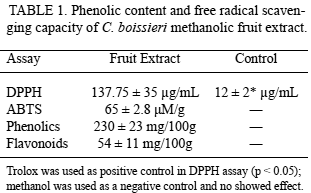
<body><![CDATA[<p align="justify"><font face="Verdana"> <span lang="EN-US" style="font-family: TimesNewRomanPSMT"><font size="2">All  data are given as the mean </font></span> <span style="font-family: TimesNewRomanPSMT"><font size="2">±</font><span lang="EN-US"><font size="2">  SD of three measurements. The concentration of the samples that inhibited 50% of  cell growth (IC50), enzymatic reaction or half maximal effective concentrations  (EC50) in DPPH radical scavenging activity was calculated from the log-dose  inhibition growth curve obtained by a nonlinear regression algorithm, all values  were compared by paired t tests using SPSS (Version 10 for Windows, SPSS Inc.,  Chicago, IL), p&lt;0.05 was considered significant.</font></span></span></font></p>     <p style="text-autospace: none" align="justify"><b> <span lang="EN-US" style="font-family: TimesNewRomanPS-BoldMT"> <font size="2" face="Verdana">RESULTS</font></span></b></p>     <p style="text-autospace: none" align="justify"><font face="Verdana"> <span lang="EN-US" style="font-family: TimesNewRomanPSMT"><font size="2"> Phenolic compounds are extremely diverse in the plants. In the fruits, the  phenolic compounds are related with sensory quality and in recent years they  have gained interest for its beneficial effect protector to prevent damage by  free radicals (16). The structures of this secondary metabolites contain a  polyphenol structure with numerous hydroxyl groups that can donate electrons and  thus stabilize free radicals. Exist numerous rapid techniques quantification of  phenolic compounds by colorimetric assays, in this work it was used an  extrapolation of our results obtained with phosphomolybdic-phosphotungstic acid  reagent for total phenolics, the calibration equation was y = -0.0023+0.0057x (n  = 3, r<sup>2</sup> = 0.996) for gallic acid and a optimize spectrophotometric  method based on flavonoid-aluminum chloride (AlCl<sub>3</sub>) complexation to  determine the total flavonoid content, the calibration equation was y=  0.1187x-0.2218 (n = 3, r<sup>2</sup> = 0.843) for catechin. <a href="#tab1">Table 1</a> shows the phenolic content and free radical scavenging capacity of </font></span> <font size="2"><i> <span lang="EN-US" style="font-family: TimesNewRomanPS-ItalicMT">C. boissieri </span></i><span lang="EN-US" style="font-family: TimesNewRomanPSMT">fruit  extract, based in DPPH assay although there is a significant difference between  the antioxidant activities of the fruit methanolic extract compared with trolox  (water-soluble vitamin E analogue), it is important to mention that the trolox  is a pure compound, while the extract is a mixture of compounds not determined.  While for the cytotoxicity assay, the viability of each cell type was examined  by the WST-1 reduction assay method. We have previously examined the  relationship between culture cell density and its ability to form formazan (data  not shown). The inhibition rate in <a href="#fig1">Figure 1</a> displays the cytotoxicity of </span> <i><span lang="EN-US" style="font-family: TimesNewRomanPS-ItalicMT">C. boissieri </span></i><span lang="EN-US" style="font-family: TimesNewRomanPSMT">fruit  extract at various concentrations after 48 h, which was estimated from the cell  population of the control and cell populations after treatment. The cytotoxicity  show a marking effect against on MCF-7 compared with HeLa cells, the taxol (paclitaxel),  a natural antitumor compound, was more cytotoxic against cancer cell lines. The  inhibition enzymatic assay showed that the fruits extract of </span><i> <span lang="EN-US" style="font-family: TimesNewRomanPS-ItalicMT">C. boissieri </span></i></font><span lang="EN-US" style="font-family: TimesNewRomanPSMT"> <font size="2">against alpha glucosidase enzyme (<a href="#fig2">Figure 2</a>) depended on their  concentration, the acarbose an anti-diabetic drug used to treat type 2 diabetes  mellitus have more significant inhibition activity against alpha glucosidase  than the fruit extract, but again, it is important note that this is a pure  substance.</font></span></font></p>     <p style="text-autospace: none" align="center"><a name="tab1"> <img border="0" src="/img/fbpe/alan/v66n3/art07tab1.gif" width="311" height="193"></a></p>     
<p style="text-autospace: none" align="center"> <img border="0" src="/img/fbpe/alan/v66n3/art07tab2.gif" width="313" height="201"></p>     
<p style="text-autospace: none" align="center"><a name="fig1"> <img border="0" src="/img/fbpe/alan/v66n3/art07fig1.gif" width="580" height="286"></a></p>     
<p style="text-autospace: none" align="center"><a name="fig2"> <img border="0" src="/img/fbpe/alan/v66n3/art07fig2.gif" width="576" height="309"></a></p>     
<p style="text-autospace: none" align="justify"><b> <span lang="EN-US" style="font-family: TimesNewRomanPS-BoldMT"> <font size="2" face="Verdana">DISCUSSION</font></span></b></p>     <p style="text-autospace: none" align="justify"><font face="Verdana">     <span lang="EN-US" style="font-family: TimesNewRomanPSMT"><font size="2">Many      ]]></body>
<body><![CDATA[methods are used to evaluate antioxidant activities from natural compounds in      foods. Two free radicals which are commonly used to assess antioxidant activity      in vitro are 2, 2-azinobis (3-ethylbenzothiazoline-6-sulfonic acid) (ABTS) and      2, 2-diphenyl-1-picrylhydrazyl (DPPH), both methods employ the principle of a      synthetic colored free radical, and the ability of a sample to scavenge the      radical monitored by spectrophotometer. The ABTS assay is interesting in organic      extracts because the wavelength absorption at 734 nm eliminates color      interference, this assay is based on the decreasing absorbance changes of a      blue/green to a colorless solution; whereas the DPPH assay is based on the      reduction of the purple to yellow (17). According to our results, the </font>     ]]></body>
<body><![CDATA[</span><font size="2"><span style="font-family: TimesNewRomanPSMT">“<span lang="EN-US">Mexican      anacahuita</span>”<span lang="EN-US"> has good antioxidant potential with EC50 =      137.75 </span>±<span lang="EN-US"> 35 </span>&#956;</span><span lang="EN-US" style="font-family: TimesNewRomanPSMT">g/mL      when compared with other wild un-common fruits like: </span><i>     <span lang="EN-US" style="font-family: TimesNewRomanPS-ItalicMT">Litchi      chinensis </span></i><span lang="EN-US" style="font-family: TimesNewRomanPSMT">     (102 </span><span style="font-family: TimesNewRomanPSMT">&#956;</span><span lang="EN-US" style="font-family: TimesNewRomanPSMT">g/mL),     </span><i><span lang="EN-US" style="font-family: TimesNewRomanPS-ItalicMT">     Lonicera caerulea </span></i>     <span lang="EN-US" style="font-family: TimesNewRomanPSMT">(76.14 </span>     ]]></body>
<body><![CDATA[<span style="font-family: TimesNewRomanPSMT">±<span lang="EN-US"> 4.04 to 134.92     </span>±<span lang="EN-US"> 4.62 </span>&#956;</span><span lang="EN-US" style="font-family: TimesNewRomanPSMT">g/mL),     </span><i><span lang="EN-US" style="font-family: TimesNewRomanPS-ItalicMT">     Physalis alkekengi </span></i>     <span lang="EN-US" style="font-family: TimesNewRomanPSMT">(248 </span>     <span style="font-family: TimesNewRomanPSMT">&#956;</span><span lang="EN-US" style="font-family: TimesNewRomanPSMT">g/mL)      and vegetables like: </span><i>     <span lang="EN-US" style="font-family: TimesNewRomanPS-ItalicMT">Moringa      oleifera </span></i><span lang="EN-US" style="font-family: TimesNewRomanPSMT">     (376 </span><span style="font-family: TimesNewRomanPSMT">&#956;</span><span lang="EN-US" style="font-family: TimesNewRomanPSMT">g/mL),     ]]></body>
<body><![CDATA[</span><i><span lang="EN-US" style="font-family: TimesNewRomanPS-ItalicMT">     Chenopodium álbum </span></i>     <span lang="EN-US" style="font-family: TimesNewRomanPSMT">(454.7 </span>     <span style="font-family: TimesNewRomanPSMT">&#956;</span><span lang="EN-US" style="font-family: TimesNewRomanPSMT">g/mL)     </span><i><span lang="EN-US" style="font-family: TimesNewRomanPS-ItalicMT">     Caralluma tuberculata (</span></i><span lang="EN-US" style="font-family: TimesNewRomanPSMT">695.7     </span><span style="font-family: TimesNewRomanPSMT">&#956;</span><span lang="EN-US" style="font-family: TimesNewRomanPSMT">g/mL)      (18- 21). ABTS results, on the other hand, were low (6.5 </span>     <span style="font-family: TimesNewRomanPSMT">±<span lang="EN-US"> 0.28 </span>&#956;</span><span lang="EN-US" style="font-family: TimesNewRomanPSMT">M/g)      when compared to the Brazilian berries (6.3 </span>     ]]></body>
<body><![CDATA[<span style="font-family: TimesNewRomanPSMT">±<span lang="EN-US"> 0.2 to 125     </span>±<span lang="EN-US"> 9.7 </span>&#956;</span><span lang="EN-US" style="font-family: TimesNewRomanPSMT">M/g).      The same standing applies when phenolic content is compared to those same      berries, rating a medium content according to the standards they employed. Total      phenolic content is similar or superior to that exhibited by wild berries and      cultivars (22, 23). On the other side, alpha-glucosidase is one of the enzymes      responsible for breaking down carbohydrates to smaller sugar particles, like      glucose, to facilitate their absorption. Alphaglucosidase inhibitors block by      competitive and reversible interaction these intestinal enzymes; they slow the      digestion of carbohydrates and delay glucose absorption. This results in a      ]]></body>
<body><![CDATA[smaller and slower rise of blood glucose levels following meals, and throughout      the day, for this reason it is important to study alpha glucosidase inhibitors      as possible nutraceuticals (24); in this regard, the </span>     <span style="font-family: TimesNewRomanPSMT">“<span lang="EN-US">anacahuita</span>”<span lang="EN-US">      showed moderate inhibitory activity (<a href="#fig1">Figure.1</a>) when compared to the blueberries      used in the previously mentioned report, however inhibition was on par or      superior when compared to that displayed by root extracts of four species of Flemingia (25), as well as when compared to controls. The cytotoxic effects of     </span></span><i>     <span lang="EN-US" style="font-family: TimesNewRomanPS-ItalicMT">C. boissieri     </span></i><span lang="EN-US" style="font-family: TimesNewRomanPSMT">fruits      ]]></body>
<body><![CDATA[against HeLa cells it was good (<a href="#fig2">Figure.2</a>) if is compared with previous reports      of non-traditional fruits and analyzed under similar conditions, like: </span>     <i><span lang="EN-US" style="font-family: TimesNewRomanPS-ItalicMT">Pyracantha      coccinea </span></i><span lang="EN-US" style="font-family: TimesNewRomanPSMT">     (IC 500 </span><span style="font-family: TimesNewRomanPSMT">&#956;</span><span lang="EN-US" style="font-family: TimesNewRomanPSMT">g/mL),     </span><i><span lang="EN-US" style="font-family: TimesNewRomanPS-ItalicMT">     Zosima absinthifolia </span></i>     <span lang="EN-US" style="font-family: TimesNewRomanPSMT">(IC 1 mg/mL), </span>     <i><span lang="EN-US" style="font-family: TimesNewRomanPS-ItalicMT">Cipadessa      baccifera </span></i><span lang="EN-US" style="font-family: TimesNewRomanPSMT">     ]]></body>
<body><![CDATA[(133 </span><span style="font-family: TimesNewRomanPSMT">&#956;</span><span lang="EN-US" style="font-family: TimesNewRomanPSMT">g/mL),     </span><i><span lang="EN-US" style="font-family: TimesNewRomanPS-ItalicMT">     Solanum erianthum </span></i>     <span lang="EN-US" style="font-family: TimesNewRomanPSMT">(142 </span>     <span style="font-family: TimesNewRomanPSMT">&#956;</span><span lang="EN-US" style="font-family: TimesNewRomanPSMT">g/mL)      (26-29) on the other side, the methanolic fruit extract of </span><i>     <span lang="EN-US" style="font-family: TimesNewRomanPS-ItalicMT">C. boissieri     </span></i><span lang="EN-US" style="font-family: TimesNewRomanPSMT">was poorly      active against MCF-7 cell line in comparative with fruit extracts of </span><i>     <span lang="EN-US" style="font-family: TimesNewRomanPS-ItalicMT">B. racemosa     ]]></body>
<body><![CDATA[</span></i><span lang="EN-US" style="font-family: TimesNewRomanPSMT">(57 </span>     <span style="font-family: TimesNewRomanPSMT">&#956;</span><span lang="EN-US" style="font-family: TimesNewRomanPSMT">g/mL)      and </span><i><span lang="EN-US" style="font-family: TimesNewRomanPS-ItalicMT">     H. sabdariffa </span></i>     <span lang="EN-US" style="font-family: TimesNewRomanPSMT">(112 </span>     <span style="font-family: TimesNewRomanPSMT">&#956;</span><span lang="EN-US" style="font-family: TimesNewRomanPSMT">g/mL),      but good when compared to malay apple (</span><i><span lang="EN-US" style="font-family: TimesNewRomanPS-ItalicMT">Syzygium      malaccense </span></i><span lang="EN-US" style="font-family: TimesNewRomanPSMT">     with IC50=632.3 </span><span style="font-family: TimesNewRomanPSMT">&#956;</span><span lang="EN-US" style="font-family: TimesNewRomanPSMT">g/ml)      (30,31). Taking into account the above the cytotoxicity of methanolic extracts      ]]></body>
<body><![CDATA[from </span><i><span lang="EN-US" style="font-family: TimesNewRomanPS-ItalicMT">     C. boissieri </span></i></font>     <span lang="EN-US" style="font-family: TimesNewRomanPSMT"><font size="2">     (Mexican anacahuita) is moderate compared to other uncommon fruits, however, it      could be a good source of compounds with antioxidant activity and potential      alpha-glucosidase inhibitory effect</font></span></font></p>     <p style="text-autospace: none" align="justify"><b> <span lang="EN-US" style="font-family: TimesNewRomanPS-BoldMT"> <font size="2" face="Verdana">CONCLUSION</font></span></b></p>     <p style="text-autospace: none" align="justify"><font face="Verdana"> <span lang="EN-US" style="font-family: TimesNewRomanPSMT"><font size="2"> Perspectives of utilization of Latin American native fruits are relatively big.  The research accomplished indicated the fruits of </font></span><font size="2"> <i><span lang="EN-US" style="font-family: TimesNewRomanPS-ItalicMT">C. boissieri </span></i></font><span lang="EN-US" style="font-family: TimesNewRomanPSMT"> <font size="2">(Mexican anacahuita) as potential source of bioactive substances  that could be considered like a possible nutraceutical product.</font></span></font></p>     <p style="text-autospace: none" align="justify"><b> <span lang="EN-US" style="font-family: TimesNewRomanPS-BoldMT"> <font size="2" face="Verdana">AKNOWLEDGEMENTS</font></span></b></p>     <p style="text-autospace: none" align="justify"> <span lang="EN-US" style="font-family: TimesNewRomanPSMT"> <font size="2" face="Verdana">The autors are grateful to PROMEP, for funding the  project 103.5/13/6044.</font></span></p>     ]]></body>
<body><![CDATA[<p style="text-autospace: none" align="justify"><b> <span lang="EN-US" style="font-family: TimesNewRomanPS-BoldMT"> <font size="2" face="Verdana">REFERENCES</font></span></b></p>     <!-- ref --><p style="text-autospace: none" align="justify"> <span lang="EN-US" style="font-family: TimesNewRomanPSMT"> <font size="2" face="Verdana">1. Zhang YJ, Gan RY, Li S, Zhou Y, Li AN, Xu DP,  Li HB. Antioxidant Phytochemicals for the Prevention and Treatment of Chronic  Diseases. Molecules 2015, 20(12): 21138-21156.</font></span>&nbsp;&nbsp;&nbsp;&nbsp;&nbsp;&nbsp;&nbsp;&nbsp;[&#160;<a href="javascript:void(0);" onclick="javascript: window.open('/scielo.php?script=sci_nlinks&ref=535165&pid=S0004-0622201600030000700001&lng=','','width=640,height=500,resizable=yes,scrollbars=1,menubar=yes,');">Links</a>&#160;]<!-- end-ref --><!-- ref --><p style="text-autospace: none" align="justify"> <span lang="EN-US" style="font-family: TimesNewRomanPSMT"> <font size="2" face="Verdana">2. Ozturk A, Demirsoy L, Demirsoy H, Ozturk S.  Quality characteristics and phenolic compounds of european pear cultivars. Afr J  Tradit Complement Altern Med 2015, 12 (5): 63-69.</font></span>&nbsp;&nbsp;&nbsp;&nbsp;&nbsp;&nbsp;&nbsp;&nbsp;[&#160;<a href="javascript:void(0);" onclick="javascript: window.open('/scielo.php?script=sci_nlinks&ref=535166&pid=S0004-0622201600030000700002&lng=','','width=640,height=500,resizable=yes,scrollbars=1,menubar=yes,');">Links</a>&#160;]<!-- end-ref --><!-- ref --><p style="text-autospace: none" align="justify"><font face="Verdana"> <span lang="EN-US" style="font-family: TimesNewRomanPSMT"><font size="2">3. Da  Silva Pereira AC, Wurlitzer NJ, Dion</font></span><span lang="EN-US" style="font-family: TimesNewRomanPS-BoldMT"><font size="2">í</font></span><span lang="EN-US" style="font-family: TimesNewRomanPSMT"><font size="2">sio  AP, Lacerda Soares MV, Rocha Bastos MS, Alves RE, Montenegro Brasil I.  Synergistic, additive and antagonistic effects of fruit mixtures on total  antioxidant capacities and bioactive compounds in tropical fruit juices. Arch  Latinoam Nutr 2015, 65(2): 119-127.</font></span></font>&nbsp;&nbsp;&nbsp;&nbsp;&nbsp;&nbsp;&nbsp;&nbsp;[&#160;<a href="javascript:void(0);" onclick="javascript: window.open('/scielo.php?script=sci_nlinks&ref=535167&pid=S0004-0622201600030000700003&lng=','','width=640,height=500,resizable=yes,scrollbars=1,menubar=yes,');">Links</a>&#160;]<!-- end-ref --><!-- ref --><p style="text-autospace: none" align="justify"><font face="Verdana"> <span lang="EN-US" style="font-family: TimesNewRomanPSMT"><font size="2">4.  Kanera IM, Bolman CA, Mesters I, Willems RA, Beaulen AA, Lechner L. Prevalence  and correlates of healthy lifestyle behaviors among early cancer survivors. </font></span><span lang="PT-BR" style="font-family: TimesNewRomanPSMT"> <font size="2">BMC Cancer 2016, 16(1):4.</font></span></font>&nbsp;&nbsp;&nbsp;&nbsp;&nbsp;&nbsp;&nbsp;&nbsp;[&#160;<a href="javascript:void(0);" onclick="javascript: window.open('/scielo.php?script=sci_nlinks&ref=535168&pid=S0004-0622201600030000700004&lng=','','width=640,height=500,resizable=yes,scrollbars=1,menubar=yes,');">Links</a>&#160;]<!-- end-ref --><!-- ref --><p style="text-autospace: none" align="justify"><font face="Verdana"> <span lang="PT-BR" style="font-family: TimesNewRomanPSMT"><font size="2">5.  Abrantes Sarmento JD, Dantas de Morais PL, Irael de Souza F, Ramos da Costa L,  de Assis Melo NJ. </font></span> <span lang="EN-US" style="font-family: TimesNewRomanPSMT"><font size="2"> Bioactive compounds and antioxidant activity of </font></span><i> <span lang="EN-US" style="font-family: TimesNewRomanPS-ItalicMT"><font size="2"> Ximenia americana </font></span></i> <span lang="EN-US" style="font-family: TimesNewRomanPSMT"><font size="2">coming  from different collection sites. Arch Latinoam Nutr 2015, 65(4): 263-270.</font></span></font>&nbsp;&nbsp;&nbsp;&nbsp;&nbsp;&nbsp;&nbsp;&nbsp;[&#160;<a href="javascript:void(0);" onclick="javascript: window.open('/scielo.php?script=sci_nlinks&ref=535169&pid=S0004-0622201600030000700005&lng=','','width=640,height=500,resizable=yes,scrollbars=1,menubar=yes,');">Links</a>&#160;]<!-- end-ref --><!-- ref --><p style="text-autospace: none" align="justify"> <span lang="EN-US" style="font-family: TimesNewRomanPSMT"> <font size="2" face="Verdana">6. Sakulnarmrat K, Konzcak I. Composition of  native Australian herbs polyphenolic-rich fractions and in vitro inhibitory  activities against key enzymes relevant to metabolic syndrome. Food Chem 2012,  134(2012): 1011-1019.</font></span>&nbsp;&nbsp;&nbsp;&nbsp;&nbsp;&nbsp;&nbsp;&nbsp;[&#160;<a href="javascript:void(0);" onclick="javascript: window.open('/scielo.php?script=sci_nlinks&ref=535170&pid=S0004-0622201600030000700006&lng=','','width=640,height=500,resizable=yes,scrollbars=1,menubar=yes,');">Links</a>&#160;]<!-- end-ref --><!-- ref --><p style="text-autospace: none" align="justify"><font face="Verdana"> <span lang="PT-BR" style="font-family: TimesNewRomanPSMT"><font size="2">7.  Jamkhande PG, Barde SR, Patwekar SL, Tidke PS. </font></span> <span lang="EN-US" style="font-family: TimesNewRomanPSMT"><font size="2">Plant  profile, phytochemistry and pharmacology of </font></span><i> <span lang="EN-US" style="font-family: TimesNewRomanPS-ItalicMT"><font size="2"> Cordia dichotoma </font></span></i> <span lang="EN-US" style="font-family: TimesNewRomanPSMT"><font size="2">(Indian  cherry): A review. Asian Pac J Trop Biomed 2013, 3(12): 1009-1012.</font></span></font>&nbsp;&nbsp;&nbsp;&nbsp;&nbsp;&nbsp;&nbsp;&nbsp;[&#160;<a href="javascript:void(0);" onclick="javascript: window.open('/scielo.php?script=sci_nlinks&ref=535171&pid=S0004-0622201600030000700007&lng=','','width=640,height=500,resizable=yes,scrollbars=1,menubar=yes,');">Links</a>&#160;]<!-- end-ref --><!-- ref --><p style="text-autospace: none" align="justify"><font face="Verdana"> <span lang="PT-BR" style="font-family: TimesNewRomanPSMT"><font size="2">8.  Hernandez T, Canales M, Teran B, Avila O, Duran A, Garcia AM, Hernandez H,  Angeles-Lopez O, Fernandez-Araiza M, Avila G. Antimicrobial activity of the  essential oil and extracts of </font></span><i> <span lang="PT-BR" style="font-family: TimesNewRomanPS-ItalicMT"><font size="2"> Cordia curassavica </font></span></i> <span lang="PT-BR" style="font-family: TimesNewRomanPSMT"><font size="2">(Boraginaceae). </font></span><span lang="EN-US" style="font-family: TimesNewRomanPSMT"> <font size="2">J Ethnopharmacol 2007, 111(1): 137</font></span></font><span style="font-family: Verdana"><font size="2">–</font></span><span lang="EN-US" style="font-family: TimesNewRomanPSMT"><font size="2" face="Verdana">141.</font></span>&nbsp;&nbsp;&nbsp;&nbsp;&nbsp;&nbsp;&nbsp;&nbsp;[&#160;<a href="javascript:void(0);" onclick="javascript: window.open('/scielo.php?script=sci_nlinks&ref=535172&pid=S0004-0622201600030000700008&lng=','','width=640,height=500,resizable=yes,scrollbars=1,menubar=yes,');">Links</a>&#160;]<!-- end-ref --><!-- ref --><p style="text-autospace: none" align="justify"><font face="Verdana"> <span style="font-family: TimesNewRomanPSMT"><font size="2">9. Mart</font></span><font size="2">í</font><span style="font-family: TimesNewRomanPSMT"><font size="2">nez  M. Las plantas medicinales de M</font></span><font size="2">é</font><span style="font-family: TimesNewRomanPSMT"><font size="2">xico.  6a ed, M</font></span><font size="2">é</font><span style="font-family: TimesNewRomanPSMT"><font size="2">xico:  Ediciones Botas; 1967.</font></span></font>&nbsp;&nbsp;&nbsp;&nbsp;&nbsp;&nbsp;&nbsp;&nbsp;[&#160;<a href="javascript:void(0);" onclick="javascript: window.open('/scielo.php?script=sci_nlinks&ref=535173&pid=S0004-0622201600030000700009&lng=','','width=640,height=500,resizable=yes,scrollbars=1,menubar=yes,');">Links</a>&#160;]<!-- end-ref --><!-- ref --><p style="text-autospace: none" align="justify"><font face="Verdana"> <span style="font-family: TimesNewRomanPSMT"><font size="2">10. Alvarado V</font></span><font size="2">á</font><span style="font-family: TimesNewRomanPSMT"><font size="2">zquez  M, Rahim Foroughbakhch P, Jurado Y Enrique, Rocha E Alejandra. Caracterizaci</font></span><font size="2">ó</font><span style="font-family: TimesNewRomanPSMT"><font size="2">n  morfol</font></span><font size="2">ó</font><span style="font-family: TimesNewRomanPSMT"><font size="2">gica  y nutricional del fruto de anacahuita (</font></span><i><span style="font-family: TimesNewRomanPS-ItalicMT"><font size="2">Cordia  boissieri </font></span></i><span style="font-family: TimesNewRomanPSMT"> <font size="2">A. DC.) en dos localidades del Noreste de M</font></span><font size="2">é</font><span style="font-family: TimesNewRomanPSMT"><font size="2">xico.  Pit</font></span><font size="2">ó</font><span style="font-family: TimesNewRomanPSMT"><font size="2">n  2014, 85-90.</font></span></font>&nbsp;&nbsp;&nbsp;&nbsp;&nbsp;&nbsp;&nbsp;&nbsp;[&#160;<a href="javascript:void(0);" onclick="javascript: window.open('/scielo.php?script=sci_nlinks&ref=535174&pid=S0004-0622201600030000700010&lng=','','width=640,height=500,resizable=yes,scrollbars=1,menubar=yes,');">Links</a>&#160;]<!-- end-ref --><!-- ref --><p style="text-autospace: none" align="justify"><font face="Verdana"> <span style="font-family: TimesNewRomanPSMT"><font size="2">11. Quispe C.,  Viveros-Valdez E, Yarleque JA, Arones MR, Paniagua JC, Schmeda-Hirschmann G.  High speed centrifugal countercurrent chromatography (HSCCC) isolation and  identification by LC-MSn analysis of the polar phenolics from </font></span><i> <span style="font-family: TimesNewRomanPS-ItalicMT"><font size="2">Vasconcellea  quercifolia</font></span></i><span style="font-family: TimesNewRomanPSMT"><font size="2">.  J Chil Chem Soc 2013, 58 (3):1830-1835.</font></span></font>&nbsp;&nbsp;&nbsp;&nbsp;&nbsp;&nbsp;&nbsp;&nbsp;[&#160;<a href="javascript:void(0);" onclick="javascript: window.open('/scielo.php?script=sci_nlinks&ref=535175&pid=S0004-0622201600030000700011&lng=','','width=640,height=500,resizable=yes,scrollbars=1,menubar=yes,');">Links</a>&#160;]<!-- end-ref --><!-- ref --><p style="text-autospace: none" align="justify"> <span lang="EN-US" style="font-family: TimesNewRomanPSMT"> <font size="2" face="Verdana">12. Singleton VL, Rossi Jr, JA. Colorimetric of  total phenolics with phosphomolybdicphosphotungstic acid reagents. Am J Enol  Viticult 1965, 16(3): 144</font></span><span style="font-family: Verdana"><font size="2">–</font></span><span lang="EN-US" style="font-family: TimesNewRomanPSMT"><font size="2" face="Verdana">158.</font></span>&nbsp;&nbsp;&nbsp;&nbsp;&nbsp;&nbsp;&nbsp;&nbsp;[&#160;<a href="javascript:void(0);" onclick="javascript: window.open('/scielo.php?script=sci_nlinks&ref=535176&pid=S0004-0622201600030000700012&lng=','','width=640,height=500,resizable=yes,scrollbars=1,menubar=yes,');">Links</a>&#160;]<!-- end-ref --><!-- ref --><p style="text-autospace: none" align="justify"><font face="Verdana"> <span lang="EN-US" style="font-family: TimesNewRomanPSMT"><font size="2">13.  Viveros-Valdez E, Rivas-Morales C, Carranza-Rosales P, Mendoza S,  Schmeda-Hirschmann G. Free radical scavengers from the Mexican herbal tea </font> </span><span style="font-family: TimesNewRomanPSMT"><font size="2">“<span lang="EN-US">poleo</span>”</font><span lang="EN-US"><font size="2">  (</font></span></span><i><span lang="EN-US" style="font-family: TimesNewRomanPS-ItalicMT"><font size="2">Hedeoma  drummondii</font></span></i><span lang="EN-US" style="font-family: TimesNewRomanPSMT"><font size="2">).  Z Naturforsch c 2008, 63(5-6): 341-346.</font></span></font>&nbsp;&nbsp;&nbsp;&nbsp;&nbsp;&nbsp;&nbsp;&nbsp;[&#160;<a href="javascript:void(0);" onclick="javascript: window.open('/scielo.php?script=sci_nlinks&ref=535177&pid=S0004-0622201600030000700013&lng=','','width=640,height=500,resizable=yes,scrollbars=1,menubar=yes,');">Links</a>&#160;]<!-- end-ref --><!-- ref --><p style="text-autospace: none" align="justify"> <span lang="EN-US" style="font-family: TimesNewRomanPSMT"> <font size="2" face="Verdana">14. Re R, Pellegrini N, Proteggente A, Pannala A,  Yang M, Rice-Evans C. Antioxidant activity applying an improved ABTS radical  cation decolorization assay. Free Radical Bio Med 1999, 26 (9-10): 1231-1237.</font></span>&nbsp;&nbsp;&nbsp;&nbsp;&nbsp;&nbsp;&nbsp;&nbsp;[&#160;<a href="javascript:void(0);" onclick="javascript: window.open('/scielo.php?script=sci_nlinks&ref=535178&pid=S0004-0622201600030000700014&lng=','','width=640,height=500,resizable=yes,scrollbars=1,menubar=yes,');">Links</a>&#160;]<!-- end-ref --><!-- ref --><p style="text-autospace: none" align="justify"><font face="Verdana"> <span lang="EN-US" style="font-family: TimesNewRomanPSMT"><font size="2">15.  Yang Z, Wang Y, Wang Y, Zhang Y. Bioassayguided screening and isolation of </font></span><span style="font-family: TimesNewRomanPSMT"><font size="2">&#945;</font></span><span lang="EN-US" style="font-family: TimesNewRomanPSMT"><font size="2">-Glucosidase  and tyrosinase inhibitors from leaves of </font></span><i> <span lang="EN-US" style="font-family: TimesNewRomanPS-ItalicMT"><font size="2"> Morus alba</font></span></i><span lang="EN-US" style="font-family: TimesNewRomanPSMT"><font size="2">. </font></span><span lang="PT-BR" style="font-family: TimesNewRomanPSMT"> <font size="2">Food Chem 2011, 131(2011): 617-625.</font></span></font>&nbsp;&nbsp;&nbsp;&nbsp;&nbsp;&nbsp;&nbsp;&nbsp;[&#160;<a href="javascript:void(0);" onclick="javascript: window.open('/scielo.php?script=sci_nlinks&ref=535179&pid=S0004-0622201600030000700015&lng=','','width=640,height=500,resizable=yes,scrollbars=1,menubar=yes,');">Links</a>&#160;]<!-- end-ref --><!-- ref --><p style="text-autospace: none" align="justify"> <span lang="EN-US" style="font-family: TimesNewRomanPSMT"> <font size="2" face="Verdana">16. Oliveira de Lacerda de L, Carvalho Veras de M,  Melo L. Health promoting and sensory properties of phenolic compounds in food.  Revista Ceres 2014, 61: 764-779.</font></span>&nbsp;&nbsp;&nbsp;&nbsp;&nbsp;&nbsp;&nbsp;&nbsp;[&#160;<a href="javascript:void(0);" onclick="javascript: window.open('/scielo.php?script=sci_nlinks&ref=535180&pid=S0004-0622201600030000700016&lng=','','width=640,height=500,resizable=yes,scrollbars=1,menubar=yes,');">Links</a>&#160;]<!-- end-ref --><!-- ref --><p style="text-autospace: none" align="justify"><font face="Verdana"> <span lang="EN-US" style="font-family: TimesNewRomanPSMT"><font size="2">17.  Ademola Ayeleso O, Oluwafemi Oguntibeju O, Nicole Brooks L. In Vitro Study on  the Antioxidant Potentials of the Leaves and Fruits of </font></span><i> <span lang="EN-US" style="font-family: TimesNewRomanPS-ItalicMT"><font size="2"> Nauclea latifolia</font></span></i><span lang="EN-US" style="font-family: TimesNewRomanPSMT"><font size="2">.  Scientific World Journal 2014, 2014: 437081.</font></span></font>&nbsp;&nbsp;&nbsp;&nbsp;&nbsp;&nbsp;&nbsp;&nbsp;[&#160;<a href="javascript:void(0);" onclick="javascript: window.open('/scielo.php?script=sci_nlinks&ref=535181&pid=S0004-0622201600030000700017&lng=','','width=640,height=500,resizable=yes,scrollbars=1,menubar=yes,');">Links</a>&#160;]<!-- end-ref --><!-- ref --><p style="text-autospace: none" align="justify"> <span lang="EN-US" style="font-family: TimesNewRomanPSMT"> <font size="2" face="Verdana">18. Prakash D, Upadhyay G, Pushpangadan P, Gupta  C. Antioxidant and free radical scavenging activities of some fruits. J  Complement Integr Med 2011, 8(1): Article 23.</font></span>&nbsp;&nbsp;&nbsp;&nbsp;&nbsp;&nbsp;&nbsp;&nbsp;[&#160;<a href="javascript:void(0);" onclick="javascript: window.open('/scielo.php?script=sci_nlinks&ref=535182&pid=S0004-0622201600030000700018&lng=','','width=640,height=500,resizable=yes,scrollbars=1,menubar=yes,');">Links</a>&#160;]<!-- end-ref --><!-- ref --><p style="text-autospace: none" align="justify"><font face="Verdana"> <span lang="EN-US" style="font-family: TimesNewRomanPSMT"><font size="2">19.  Laczk</font></span><span lang="EN-US"><font size="2">ó</font></span><span lang="EN-US" style="font-family: TimesNewRomanPSMT"><font size="2">-Z</font></span><span lang="EN-US"><font size="2">ö</font></span><span lang="EN-US" style="font-family: TimesNewRomanPSMT"><font size="2">ld  E, Zupk</font></span><span lang="EN-US"><font size="2">ó</font></span><span lang="EN-US" style="font-family: TimesNewRomanPSMT"><font size="2">  I, R</font></span><span lang="EN-US"><font size="2">é</font></span><span lang="EN-US" style="font-family: TimesNewRomanPSMT"><font size="2">thy  B, Csedo K, Hohmann J. Antioxidant activity of the fruits and hydrophilic  compounds of </font></span><i> <span lang="EN-US" style="font-family: TimesNewRomanPS-ItalicMT"><font size="2"> Physalis alkekengi. </font></span></i> <span lang="EN-US" style="font-family: TimesNewRomanPSMT"><font size="2">Acta  Pharm Hung 2009, 79(4):169-73.</font></span></font>&nbsp;&nbsp;&nbsp;&nbsp;&nbsp;&nbsp;&nbsp;&nbsp;[&#160;<a href="javascript:void(0);" onclick="javascript: window.open('/scielo.php?script=sci_nlinks&ref=535183&pid=S0004-0622201600030000700019&lng=','','width=640,height=500,resizable=yes,scrollbars=1,menubar=yes,');">Links</a>&#160;]<!-- end-ref --><!-- ref --><p style="text-autospace: none" align="justify"><font face="Verdana"> <span lang="EN-US" style="font-family: TimesNewRomanPSMT"><font size="2">20. Rop  O., </font></span><span lang="EN-US"><font size="2">&#344;</font></span><span lang="EN-US" style="font-family: TimesNewRomanPSMT"><font size="2">ezn</font></span><span lang="EN-US"><font size="2">í&#269;</font></span><span lang="EN-US" style="font-family: TimesNewRomanPSMT"><font size="2">ek  V, Ml</font></span><span lang="EN-US"><font size="2">&#269;</font></span><span lang="EN-US" style="font-family: TimesNewRomanPSMT"><font size="2">ek  J, Jur</font></span><span lang="EN-US"><font size="2">í</font></span><span lang="EN-US" style="font-family: TimesNewRomanPSMT"><font size="2">kov</font></span><span lang="EN-US"><font size="2">á</font></span><span lang="EN-US" style="font-family: TimesNewRomanPSMT"><font size="2">  T, Bal</font></span><span lang="EN-US"><font size="2">í</font></span><span lang="EN-US" style="font-family: TimesNewRomanPSMT"><font size="2">k  J, Sochor J, Kram</font></span><span lang="EN-US"><font size="2">á&#345;</font></span><span lang="EN-US" style="font-family: TimesNewRomanPSMT"><font size="2">ov</font></span><span lang="EN-US"><font size="2">á</font></span><span lang="EN-US" style="font-family: TimesNewRomanPSMT"><font size="2">  D. Antioxidant and radical oxygen species scavenging activities of 12 cultivars  of blue honeysuckle fruit. Hort Sci 2011, 38(2): 63-70.</font></span></font>&nbsp;&nbsp;&nbsp;&nbsp;&nbsp;&nbsp;&nbsp;&nbsp;[&#160;<a href="javascript:void(0);" onclick="javascript: window.open('/scielo.php?script=sci_nlinks&ref=535184&pid=S0004-0622201600030000700020&lng=','','width=640,height=500,resizable=yes,scrollbars=1,menubar=yes,');">Links</a>&#160;]<!-- end-ref --><!-- ref --><p style="text-autospace: none" align="justify"> <span lang="EN-US" style="font-family: TimesNewRomanPSMT"> <font size="2" face="Verdana">21. Khattak KF. Nutrient composition, phenolic  content and free radical scavenging activity of some uncommon vegetables of  Pakistan. Pak J Pharm Sci 2011,24(3):277-83.</font></span>&nbsp;&nbsp;&nbsp;&nbsp;&nbsp;&nbsp;&nbsp;&nbsp;[&#160;<a href="javascript:void(0);" onclick="javascript: window.open('/scielo.php?script=sci_nlinks&ref=535185&pid=S0004-0622201600030000700021&lng=','','width=640,height=500,resizable=yes,scrollbars=1,menubar=yes,');">Links</a>&#160;]<!-- end-ref --><!-- ref --><p style="text-autospace: none" align="justify"><font face="Verdana"> <span lang="EN-US" style="font-family: TimesNewRomanPSMT"><font size="2">22.  Rufino MSM, Alves RE, de Brito ES, P</font></span><span lang="EN-US"><font size="2">é</font></span><span lang="EN-US" style="font-family: TimesNewRomanPSMT"><font size="2">rez-Jim</font></span><span lang="EN-US"><font size="2">é</font></span><span lang="EN-US" style="font-family: TimesNewRomanPSMT"><font size="2">nez  J, Saura-Calixto F, Mancini-Filho J. Bioactive compounds and antioxidant  capacities of 18 non-traditional tropical fruits from Brazil. Food Chem 2010,  121(2010): 996</font></span></font><span style="font-family: Verdana"><font size="2">–</font></span><span lang="EN-US" style="font-family: TimesNewRomanPSMT"><font size="2" face="Verdana">1002.</font></span>&nbsp;&nbsp;&nbsp;&nbsp;&nbsp;&nbsp;&nbsp;&nbsp;[&#160;<a href="javascript:void(0);" onclick="javascript: window.open('/scielo.php?script=sci_nlinks&ref=535186&pid=S0004-0622201600030000700022&lng=','','width=640,height=500,resizable=yes,scrollbars=1,menubar=yes,');">Links</a>&#160;]<!-- end-ref --><!-- ref --><p style="text-autospace: none" align="justify"><font face="Verdana"> <span lang="EN-US" style="font-family: TimesNewRomanPSMT"><font size="2">23.  Wang SY, Camp MJ, Ehlenfeldt MK. Antioxidant capacity and a-glucosidase  inhibitory activity in peel and flesh of blueberry (</font></span><i><span lang="EN-US" style="font-family: TimesNewRomanPS-ItalicMT"><font size="2">Vaccinium </font></span></i><span lang="EN-US" style="font-family: TimesNewRomanPSMT"> <font size="2">spp.) cultivars. Food Chem 2012, 132(2012): 1759</font></span></font><span style="font-family: Verdana"><font size="2">–</font></span><span lang="EN-US" style="font-family: TimesNewRomanPSMT"><font size="2" face="Verdana">1768.</font></span>&nbsp;&nbsp;&nbsp;&nbsp;&nbsp;&nbsp;&nbsp;&nbsp;[&#160;<a href="javascript:void(0);" onclick="javascript: window.open('/scielo.php?script=sci_nlinks&ref=535187&pid=S0004-0622201600030000700023&lng=','','width=640,height=500,resizable=yes,scrollbars=1,menubar=yes,');">Links</a>&#160;]<!-- end-ref --><!-- ref --><p style="text-autospace: none" align="justify"><font face="Verdana"> <span lang="EN-US" style="font-family: TimesNewRomanPSMT"><font size="2">24.  Pods</font></span><span lang="EN-US"><font size="2">&#281;</font></span><span lang="EN-US" style="font-family: TimesNewRomanPSMT"><font size="2">dek  A, Majewska I, Redzynia M, Sosnowska D, Kozio</font></span><span lang="EN-US"><font size="2">&#322;</font></span><span lang="EN-US" style="font-family: TimesNewRomanPSMT"><font size="2">kiewicz  M. In vitro inhibitory effect on digestive enzymes and antioxidant potential of  commonly consumed fruits. J Agric Food Chem 2014, 62(20): 4610-4617.</font></span></font>&nbsp;&nbsp;&nbsp;&nbsp;&nbsp;&nbsp;&nbsp;&nbsp;[&#160;<a href="javascript:void(0);" onclick="javascript: window.open('/scielo.php?script=sci_nlinks&ref=535188&pid=S0004-0622201600030000700024&lng=','','width=640,height=500,resizable=yes,scrollbars=1,menubar=yes,');">Links</a>&#160;]<!-- end-ref --><!-- ref --><p style="text-autospace: none" align="justify"><font face="Verdana"> <span style="font-family: TimesNewRomanPSMT"><font size="2">25. Hsieh P-C, Huang  G-J, Ho Y-L, Lin Y-H, Huang S-H, Chiang Y-C, Tseng M-C, Chang Y-S. </font> </span><span lang="EN-US" style="font-family: TimesNewRomanPSMT"><font size="2"> Activities of antioxidants, </font></span> <span style="font-family: TimesNewRomanPSMT"><font size="2">&#945;</font></span><span lang="EN-US" style="font-family: TimesNewRomanPSMT"><font size="2">-Glucosidase  inhibitors and aldose reductase inhibitors of the aqueous extracts of four  Flemingia species in Taiwan. Bot Stud 2010, 51: 293-302.</font></span></font>&nbsp;&nbsp;&nbsp;&nbsp;&nbsp;&nbsp;&nbsp;&nbsp;[&#160;<a href="javascript:void(0);" onclick="javascript: window.open('/scielo.php?script=sci_nlinks&ref=535189&pid=S0004-0622201600030000700025&lng=','','width=640,height=500,resizable=yes,scrollbars=1,menubar=yes,');">Links</a>&#160;]<!-- end-ref --><!-- ref --><p style="text-autospace: none" align="justify"><font face="Verdana"> <span lang="EN-US" style="font-family: TimesNewRomanPSMT"><font size="2">26.  Vahabi L, Monajemi R, Hosseini S.A. The Cytotoxic Effect of Methanolic Extract  of </font></span><i> <span lang="EN-US" style="font-family: TimesNewRomanPS-ItalicMT"><font size="2"> Pyracantha coccinea </font></span></i> <span lang="EN-US" style="font-family: TimesNewRomanPSMT"><font size="2">M.  Roemer Fruit on Hela cell line, Antioxidant Capacities and Total Phenol Contents  of Methanolic and Aquatic Extract of this fruit. Biomed Pharmacol J 2015, 8.</font></span></font>&nbsp;&nbsp;&nbsp;&nbsp;&nbsp;&nbsp;&nbsp;&nbsp;[&#160;<a href="javascript:void(0);" onclick="javascript: window.open('/scielo.php?script=sci_nlinks&ref=535190&pid=S0004-0622201600030000700026&lng=','','width=640,height=500,resizable=yes,scrollbars=1,menubar=yes,');">Links</a>&#160;]<!-- end-ref --><!-- ref --><p style="text-autospace: none" align="justify"><font face="Verdana"> <span lang="EN-US" style="font-family: TimesNewRomanPSMT"><font size="2">27.  Razavi SM, Ghasemiyan A, Salehi S, Zahri F. Screening of biological activity of </font></span><i> <span lang="EN-US" style="font-family: TimesNewRomanPS-ItalicMT"><font size="2"> Zosima absinthifolia </font></span></i> <span lang="EN-US" style="font-family: TimesNewRomanPSMT"><font size="2">fruits  extracts. EurAsia J BioSci 2009, 4:25-28.</font></span></font>&nbsp;&nbsp;&nbsp;&nbsp;&nbsp;&nbsp;&nbsp;&nbsp;[&#160;<a href="javascript:void(0);" onclick="javascript: window.open('/scielo.php?script=sci_nlinks&ref=535191&pid=S0004-0622201600030000700027&lng=','','width=640,height=500,resizable=yes,scrollbars=1,menubar=yes,');">Links</a>&#160;]<!-- end-ref --><!-- ref --><p style="text-autospace: none" align="justify"><font face="Verdana"> <span lang="EN-US" style="font-family: TimesNewRomanPSMT"><font size="2">28.  Kavitha KR, Bopaiah AK, Ramakrishnaiah H, Naveen Kumar N. Cytotoxicity of </font> </span><i><span lang="EN-US" style="font-family: TimesNewRomanPS-ItalicMT"> <font size="2">Cipadessa baccifera </font></span></i> <span lang="EN-US" style="font-family: TimesNewRomanPSMT"><font size="2">(Roth.)  Miq., on HeLa, Jurkat, MCF-7, and KB cell lines. Int J Pharm Bio Sci 2015, 6(3):  230 </font></span></font><span style="font-family: Verdana"><font size="2">–</font></span><span lang="EN-US" style="font-family: TimesNewRomanPSMT"><font size="2" face="Verdana">  237.</font></span>&nbsp;&nbsp;&nbsp;&nbsp;&nbsp;&nbsp;&nbsp;&nbsp;[&#160;<a href="javascript:void(0);" onclick="javascript: window.open('/scielo.php?script=sci_nlinks&ref=535192&pid=S0004-0622201600030000700028&lng=','','width=640,height=500,resizable=yes,scrollbars=1,menubar=yes,');">Links</a>&#160;]<!-- end-ref --><!-- ref --><p style="text-autospace: none" align="justify"><font face="Verdana"> <span lang="EN-US" style="font-family: TimesNewRomanPSMT"><font size="2">29.  Radhika Mahadev H, Ramakrishnaiah H, Krishna V, Deepalakshmi AP, Naveen Kumar N.  Cytotoxic Activity Of Methanolic Extracts of </font></span><i> <span lang="EN-US" style="font-family: TimesNewRomanPS-ItalicMT"><font size="2"> Solanum erianthum </font></span></i> <span lang="EN-US" style="font-family: TimesNewRomanPSMT"><font size="2">D. Don.  Int J Pharm Pharm Sci 2014, 7(2):106-108.</font></span></font>&nbsp;&nbsp;&nbsp;&nbsp;&nbsp;&nbsp;&nbsp;&nbsp;[&#160;<a href="javascript:void(0);" onclick="javascript: window.open('/scielo.php?script=sci_nlinks&ref=535193&pid=S0004-0622201600030000700029&lng=','','width=640,height=500,resizable=yes,scrollbars=1,menubar=yes,');">Links</a>&#160;]<!-- end-ref --><!-- ref --><p style="text-autospace: none" align="justify"><font face="Verdana"> <span lang="EN-US" style="font-family: TimesNewRomanPSMT"><font size="2">30.  Norliyana Amran, Anis Najwa Abdul Rani, Roziahanim Mahmud, Khoo Boon Yin.  Antioxidant and Cytotoxic Effect of </font></span><i> <span lang="EN-US" style="font-family: TimesNewRomanPS-ItalicMT"><font size="2"> Barringtonia racemosa </font></span></i> <span lang="EN-US" style="font-family: TimesNewRomanPSMT"><font size="2">and </font></span><i> <span lang="EN-US" style="font-family: TimesNewRomanPS-ItalicMT"><font size="2"> Hibiscus sabdariffa </font></span></i> <span lang="EN-US" style="font-family: TimesNewRomanPSMT"><font size="2">Fruit  Extracts in MCF-7 Human Breast Cancer Cell Line. Pharmacognosy Res 2016, 8(1):  66</font></span></font><span style="font-family: Verdana"><font size="2">–</font></span><span lang="EN-US" style="font-family: TimesNewRomanPSMT"><font size="2" face="Verdana">70.</font></span>&nbsp;&nbsp;&nbsp;&nbsp;&nbsp;&nbsp;&nbsp;&nbsp;[&#160;<a href="javascript:void(0);" onclick="javascript: window.open('/scielo.php?script=sci_nlinks&ref=535194&pid=S0004-0622201600030000700030&lng=','','width=640,height=500,resizable=yes,scrollbars=1,menubar=yes,');">Links</a>&#160;]<!-- end-ref --><!-- ref --><p style="text-autospace: none" align="justify"> <span lang="EN-US" style="font-family: TimesNewRomanPSMT"> <font size="2" face="Verdana">31. Rabeta MS, Chan S, Neda GD, Lam KL, Ong MT.  Anticancer effect of underutilized fruits. Int Food Res J 2013, 20(2): 551-556.</font></span>&nbsp;&nbsp;&nbsp;&nbsp;&nbsp;&nbsp;&nbsp;&nbsp;[&#160;<a href="javascript:void(0);" onclick="javascript: window.open('/scielo.php?script=sci_nlinks&ref=535195&pid=S0004-0622201600030000700031&lng=','','width=640,height=500,resizable=yes,scrollbars=1,menubar=yes,');">Links</a>&#160;]<!-- end-ref --> ]]></body>
<back>
<ref-list>
<ref id="B1">
<label>1</label><nlm-citation citation-type="journal">
<person-group person-group-type="author">
<name>
<surname><![CDATA[Zhang]]></surname>
<given-names><![CDATA[YJ]]></given-names>
</name>
<name>
<surname><![CDATA[Gan]]></surname>
<given-names><![CDATA[RY]]></given-names>
</name>
<name>
<surname><![CDATA[Li]]></surname>
<given-names><![CDATA[S]]></given-names>
</name>
<name>
<surname><![CDATA[Zhou]]></surname>
<given-names><![CDATA[Y]]></given-names>
</name>
<name>
<surname><![CDATA[Li]]></surname>
<given-names><![CDATA[AN]]></given-names>
</name>
<name>
<surname><![CDATA[Xu]]></surname>
<given-names><![CDATA[DP]]></given-names>
</name>
<name>
<surname><![CDATA[Li]]></surname>
<given-names><![CDATA[HB]]></given-names>
</name>
</person-group>
<article-title xml:lang="en"><![CDATA[Antioxidant Phytochemicals for the Prevention and Treatment of Chronic Diseases]]></article-title>
<source><![CDATA[Molecules]]></source>
<year>2015</year>
<volume>20</volume>
<numero>12</numero>
<issue>12</issue>
<page-range>21138-21156</page-range></nlm-citation>
</ref>
<ref id="B2">
<label>2</label><nlm-citation citation-type="journal">
<person-group person-group-type="author">
<name>
<surname><![CDATA[Ozturk]]></surname>
<given-names><![CDATA[A]]></given-names>
</name>
<name>
<surname><![CDATA[Demirsoy]]></surname>
<given-names><![CDATA[L]]></given-names>
</name>
<name>
<surname><![CDATA[Demirsoy]]></surname>
<given-names><![CDATA[H]]></given-names>
</name>
<name>
<surname><![CDATA[Ozturk]]></surname>
<given-names><![CDATA[S]]></given-names>
</name>
</person-group>
<article-title xml:lang="en"><![CDATA[Quality characteristics and phenolic compounds of european pear cultivars]]></article-title>
<source><![CDATA[Afr J Tradit Complement Altern Med]]></source>
<year>2015</year>
<volume>12</volume>
<numero>5</numero>
<issue>5</issue>
<page-range>63-69</page-range></nlm-citation>
</ref>
<ref id="B3">
<label>3</label><nlm-citation citation-type="journal">
<person-group person-group-type="author">
<name>
<surname><![CDATA[Da Silva Pereira]]></surname>
<given-names><![CDATA[AC]]></given-names>
</name>
<name>
<surname><![CDATA[Wurlitzer]]></surname>
<given-names><![CDATA[NJ]]></given-names>
</name>
<name>
<surname><![CDATA[Dionísio]]></surname>
<given-names><![CDATA[AP]]></given-names>
</name>
<name>
<surname><![CDATA[Lacerda Soares]]></surname>
<given-names><![CDATA[MV]]></given-names>
</name>
<name>
<surname><![CDATA[Rocha Bastos]]></surname>
<given-names><![CDATA[MS]]></given-names>
</name>
<name>
<surname><![CDATA[Alves]]></surname>
<given-names><![CDATA[RE]]></given-names>
</name>
<name>
<surname><![CDATA[Montenegro Brasil]]></surname>
<given-names><![CDATA[I]]></given-names>
</name>
</person-group>
<article-title xml:lang="en"><![CDATA[Synergistic, additive and antagonistic effects of fruit mixtures on total antioxidant capacities and bioactive compounds in tropical fruit juices]]></article-title>
<source><![CDATA[Arch Latinoam Nutr]]></source>
<year>2015</year>
<volume>65</volume>
<numero>2</numero>
<issue>2</issue>
<page-range>119-127</page-range></nlm-citation>
</ref>
<ref id="B4">
<label>4</label><nlm-citation citation-type="journal">
<person-group person-group-type="author">
<name>
<surname><![CDATA[Kanera]]></surname>
<given-names><![CDATA[IM]]></given-names>
</name>
<name>
<surname><![CDATA[Bolman]]></surname>
<given-names><![CDATA[CA]]></given-names>
</name>
<name>
<surname><![CDATA[Mesters]]></surname>
<given-names><![CDATA[I]]></given-names>
</name>
<name>
<surname><![CDATA[Willems]]></surname>
<given-names><![CDATA[RA]]></given-names>
</name>
<name>
<surname><![CDATA[Beaulen]]></surname>
<given-names><![CDATA[AA]]></given-names>
</name>
<name>
<surname><![CDATA[Lechner]]></surname>
<given-names><![CDATA[L]]></given-names>
</name>
</person-group>
<article-title xml:lang="en"><![CDATA[Prevalence and correlates of healthy lifestyle behaviors among early cancer survivors]]></article-title>
<source><![CDATA[BMC Cancer]]></source>
<year>2016</year>
<volume>16</volume>
<numero>1</numero>
<issue>1</issue>
<page-range>4</page-range></nlm-citation>
</ref>
<ref id="B5">
<label>5</label><nlm-citation citation-type="journal">
<person-group person-group-type="author">
<name>
<surname><![CDATA[Abrantes Sarmento]]></surname>
<given-names><![CDATA[JD]]></given-names>
</name>
<name>
<surname><![CDATA[Dantas de Morais]]></surname>
<given-names><![CDATA[PL]]></given-names>
</name>
<name>
<surname><![CDATA[Irael de Souza]]></surname>
<given-names><![CDATA[F]]></given-names>
</name>
<name>
<surname><![CDATA[Ramos da Costa]]></surname>
<given-names><![CDATA[L]]></given-names>
</name>
<name>
<surname><![CDATA[de Assis Melo]]></surname>
<given-names><![CDATA[NJ]]></given-names>
</name>
</person-group>
<article-title xml:lang="en"><![CDATA[Bioactive compounds and antioxidant activity of Ximenia americana coming from different collection sites]]></article-title>
<source><![CDATA[Arch Latinoam Nutr]]></source>
<year>2015</year>
<volume>65</volume>
<numero>4</numero>
<issue>4</issue>
<page-range>263-270</page-range></nlm-citation>
</ref>
<ref id="B6">
<label>6</label><nlm-citation citation-type="journal">
<person-group person-group-type="author">
<name>
<surname><![CDATA[Sakulnarmrat]]></surname>
<given-names><![CDATA[K]]></given-names>
</name>
<name>
<surname><![CDATA[Konzcak]]></surname>
<given-names><![CDATA[I]]></given-names>
</name>
</person-group>
<article-title xml:lang="en"><![CDATA[Composition of native Australian herbs polyphenolic-rich fractions and in vitro inhibitory activities against key enzymes relevant to metabolic syndrome]]></article-title>
<source><![CDATA[Food Chem]]></source>
<year>2012</year>
<volume>134</volume>
<numero>2012</numero>
<issue>2012</issue>
<page-range>1011-1019</page-range></nlm-citation>
</ref>
<ref id="B7">
<label>7</label><nlm-citation citation-type="journal">
<person-group person-group-type="author">
<name>
<surname><![CDATA[Jamkhande]]></surname>
<given-names><![CDATA[PG]]></given-names>
</name>
<name>
<surname><![CDATA[Barde]]></surname>
<given-names><![CDATA[SR]]></given-names>
</name>
<name>
<surname><![CDATA[Patwekar]]></surname>
<given-names><![CDATA[SL]]></given-names>
</name>
<name>
<surname><![CDATA[Tidke]]></surname>
<given-names><![CDATA[PS]]></given-names>
</name>
</person-group>
<article-title xml:lang="en"><![CDATA[Plant profile, phytochemistry and pharmacology of Cordia dichotoma (Indian cherry): A review]]></article-title>
<source><![CDATA[Asian Pac J Trop Biomed]]></source>
<year>2013</year>
<volume>3</volume>
<numero>12</numero>
<issue>12</issue>
<page-range>1009-1012</page-range></nlm-citation>
</ref>
<ref id="B8">
<label>8</label><nlm-citation citation-type="journal">
<person-group person-group-type="author">
<name>
<surname><![CDATA[Hernandez]]></surname>
<given-names><![CDATA[T]]></given-names>
</name>
<name>
<surname><![CDATA[Canales]]></surname>
<given-names><![CDATA[M]]></given-names>
</name>
<name>
<surname><![CDATA[Teran]]></surname>
<given-names><![CDATA[B]]></given-names>
</name>
<name>
<surname><![CDATA[Avila]]></surname>
<given-names><![CDATA[O]]></given-names>
</name>
<name>
<surname><![CDATA[Duran]]></surname>
<given-names><![CDATA[A]]></given-names>
</name>
<name>
<surname><![CDATA[Garcia]]></surname>
<given-names><![CDATA[AM]]></given-names>
</name>
<name>
<surname><![CDATA[Hernandez]]></surname>
<given-names><![CDATA[H]]></given-names>
</name>
<name>
<surname><![CDATA[Angeles-Lopez]]></surname>
<given-names><![CDATA[O]]></given-names>
</name>
<name>
<surname><![CDATA[Fernandez-Araiza]]></surname>
<given-names><![CDATA[M]]></given-names>
</name>
<name>
<surname><![CDATA[Avila]]></surname>
<given-names><![CDATA[G]]></given-names>
</name>
</person-group>
<article-title xml:lang="en"><![CDATA[Antimicrobial activity of the essential oil and extracts of Cordia curassavica (Boraginaceae)]]></article-title>
<source><![CDATA[J Ethnopharmacol]]></source>
<year>2007</year>
<volume>111</volume>
<numero>1</numero>
<issue>1</issue>
<page-range>137-141</page-range></nlm-citation>
</ref>
<ref id="B9">
<label>9</label><nlm-citation citation-type="book">
<person-group person-group-type="author">
<name>
<surname><![CDATA[Martínez]]></surname>
<given-names><![CDATA[M]]></given-names>
</name>
</person-group>
<source><![CDATA[Las plantas medicinales de México]]></source>
<year>1967</year>
<edition>6a</edition>
<publisher-name><![CDATA[Ediciones Botas]]></publisher-name>
</nlm-citation>
</ref>
<ref id="B10">
<label>10</label><nlm-citation citation-type="journal">
<person-group person-group-type="author">
<name>
<surname><![CDATA[Alvarado Vázquez]]></surname>
<given-names><![CDATA[M]]></given-names>
</name>
<name>
<surname><![CDATA[Rahim Foroughbakhch]]></surname>
<given-names><![CDATA[P]]></given-names>
</name>
<name>
<surname><![CDATA[Jurado Y]]></surname>
<given-names><![CDATA[Enrique]]></given-names>
</name>
<name>
<surname><![CDATA[Rocha E]]></surname>
<given-names><![CDATA[Alejandra]]></given-names>
</name>
</person-group>
<article-title xml:lang="es"><![CDATA[Caracterización morfológica y nutricional del fruto de anacahuita (Cordia boissieri A. DC.) en dos localidades del Noreste de México]]></article-title>
<source><![CDATA[Pitón]]></source>
<year>2014</year>
<page-range>85-90</page-range></nlm-citation>
</ref>
<ref id="B11">
<label>11</label><nlm-citation citation-type="journal">
<person-group person-group-type="author">
<name>
<surname><![CDATA[Quispe]]></surname>
<given-names><![CDATA[C.]]></given-names>
</name>
<name>
<surname><![CDATA[Viveros-Valdez]]></surname>
<given-names><![CDATA[E]]></given-names>
</name>
<name>
<surname><![CDATA[Yarleque]]></surname>
<given-names><![CDATA[JA]]></given-names>
</name>
<name>
<surname><![CDATA[Arones]]></surname>
<given-names><![CDATA[MR]]></given-names>
</name>
<name>
<surname><![CDATA[Paniagua]]></surname>
<given-names><![CDATA[JC]]></given-names>
</name>
<name>
<surname><![CDATA[Schmeda-Hirschmann]]></surname>
<given-names><![CDATA[G]]></given-names>
</name>
</person-group>
<article-title xml:lang="en"><![CDATA[High speed centrifugal countercurrent chromatography (HSCCC) isolation and identification by LC-MSn analysis of the polar phenolics from Vasconcellea quercifolia]]></article-title>
<source><![CDATA[J Chil Chem Soc]]></source>
<year>2013</year>
<volume>58</volume>
<numero>3</numero>
<issue>3</issue>
<page-range>1830-1835</page-range></nlm-citation>
</ref>
<ref id="B12">
<label>12</label><nlm-citation citation-type="journal">
<person-group person-group-type="author">
<name>
<surname><![CDATA[Singleton]]></surname>
<given-names><![CDATA[VL]]></given-names>
</name>
<name>
<surname><![CDATA[Rossi]]></surname>
<given-names><![CDATA[Jr, JA]]></given-names>
</name>
</person-group>
<article-title xml:lang="en"><![CDATA[Colorimetric of total phenolics with phosphomolybdicphosphotungstic acid reagents]]></article-title>
<source><![CDATA[Am J Enol Viticult]]></source>
<year>1965</year>
<volume>16</volume>
<numero>3</numero>
<issue>3</issue>
<page-range>144-158</page-range></nlm-citation>
</ref>
<ref id="B13">
<label>13</label><nlm-citation citation-type="journal">
<person-group person-group-type="author">
<name>
<surname><![CDATA[Viveros-Valdez]]></surname>
<given-names><![CDATA[E]]></given-names>
</name>
<name>
<surname><![CDATA[Rivas-Morales]]></surname>
<given-names><![CDATA[C]]></given-names>
</name>
<name>
<surname><![CDATA[Carranza-Rosales]]></surname>
<given-names><![CDATA[P]]></given-names>
</name>
<name>
<surname><![CDATA[Mendoza]]></surname>
<given-names><![CDATA[S]]></given-names>
</name>
<name>
<surname><![CDATA[Schmeda-Hirschmann]]></surname>
<given-names><![CDATA[G]]></given-names>
</name>
</person-group>
<article-title xml:lang="en"><![CDATA[Free radical scavengers from the Mexican herbal tea “poleo” (Hedeoma drummondii)]]></article-title>
<source><![CDATA[Z Naturforsch c]]></source>
<year>2008</year>
<volume>63</volume>
<numero>5-6</numero>
<issue>5-6</issue>
<page-range>341-346</page-range></nlm-citation>
</ref>
<ref id="B14">
<label>14</label><nlm-citation citation-type="journal">
<person-group person-group-type="author">
<name>
<surname><![CDATA[Re]]></surname>
<given-names><![CDATA[R]]></given-names>
</name>
<name>
<surname><![CDATA[Pellegrini]]></surname>
<given-names><![CDATA[N]]></given-names>
</name>
<name>
<surname><![CDATA[Proteggente]]></surname>
<given-names><![CDATA[A]]></given-names>
</name>
<name>
<surname><![CDATA[Pannala]]></surname>
<given-names><![CDATA[A]]></given-names>
</name>
<name>
<surname><![CDATA[Yang]]></surname>
<given-names><![CDATA[M]]></given-names>
</name>
<name>
<surname><![CDATA[Rice-Evans]]></surname>
<given-names><![CDATA[C]]></given-names>
</name>
</person-group>
<article-title xml:lang="en"><![CDATA[Antioxidant activity applying an improved ABTS radical cation decolorization assay]]></article-title>
<source><![CDATA[Free Radical Bio Med]]></source>
<year>1999</year>
<volume>26</volume>
<numero>9-10</numero>
<issue>9-10</issue>
<page-range>1231-1237</page-range></nlm-citation>
</ref>
<ref id="B15">
<label>15</label><nlm-citation citation-type="journal">
<person-group person-group-type="author">
<name>
<surname><![CDATA[Yang]]></surname>
<given-names><![CDATA[Z]]></given-names>
</name>
<name>
<surname><![CDATA[Wang]]></surname>
<given-names><![CDATA[Y]]></given-names>
</name>
<name>
<surname><![CDATA[Wang]]></surname>
<given-names><![CDATA[Y]]></given-names>
</name>
<name>
<surname><![CDATA[Zhang]]></surname>
<given-names><![CDATA[Y]]></given-names>
</name>
</person-group>
<article-title xml:lang="en"><![CDATA[Bioassayguided screening and isolation of &#945;-Glucosidase and tyrosinase inhibitors from leaves of Morus alba]]></article-title>
<source><![CDATA[Food Chem]]></source>
<year>2011</year>
<volume>131</volume>
<numero>2011</numero>
<issue>2011</issue>
<page-range>617-625</page-range></nlm-citation>
</ref>
<ref id="B16">
<label>16</label><nlm-citation citation-type="journal">
<person-group person-group-type="author">
<name>
<surname><![CDATA[Oliveira de Lacerda]]></surname>
<given-names><![CDATA[de L]]></given-names>
</name>
<name>
<surname><![CDATA[Carvalho Veras]]></surname>
<given-names><![CDATA[de M]]></given-names>
</name>
<name>
<surname><![CDATA[Melo]]></surname>
<given-names><![CDATA[L]]></given-names>
</name>
</person-group>
<article-title xml:lang="en"><![CDATA[Health promoting and sensory properties of phenolic compounds in food]]></article-title>
<source><![CDATA[Revista Ceres]]></source>
<year>2014</year>
<volume>61</volume>
<page-range>764-779</page-range></nlm-citation>
</ref>
<ref id="B17">
<label>17</label><nlm-citation citation-type="journal">
<person-group person-group-type="author">
<name>
<surname><![CDATA[Ademola Ayeleso]]></surname>
<given-names><![CDATA[O]]></given-names>
</name>
<name>
<surname><![CDATA[Oluwafemi Oguntibeju]]></surname>
<given-names><![CDATA[O]]></given-names>
</name>
<name>
<surname><![CDATA[Nicole Brooks]]></surname>
<given-names><![CDATA[L]]></given-names>
</name>
</person-group>
<article-title xml:lang="en"><![CDATA[In Vitro Study on the Antioxidant Potentials of the Leaves and Fruits of Nauclea latifolia]]></article-title>
<source><![CDATA[Scientific World Journal]]></source>
<year>2014</year>
<volume>2014</volume>
<page-range>437081</page-range></nlm-citation>
</ref>
<ref id="B18">
<label>18</label><nlm-citation citation-type="journal">
<person-group person-group-type="author">
<name>
<surname><![CDATA[Prakash]]></surname>
<given-names><![CDATA[D]]></given-names>
</name>
<name>
<surname><![CDATA[Upadhyay]]></surname>
<given-names><![CDATA[G]]></given-names>
</name>
<name>
<surname><![CDATA[Pushpangadan]]></surname>
<given-names><![CDATA[P]]></given-names>
</name>
<name>
<surname><![CDATA[Gupta]]></surname>
<given-names><![CDATA[C]]></given-names>
</name>
</person-group>
<article-title xml:lang="en"><![CDATA[Antioxidant and free radical scavenging activities of some fruits]]></article-title>
<source><![CDATA[J Complement Integr Med]]></source>
<year>2011</year>
<volume>8</volume>
<numero>1</numero>
<issue>1</issue>
<page-range>Article 23</page-range></nlm-citation>
</ref>
<ref id="B19">
<label>19</label><nlm-citation citation-type="journal">
<person-group person-group-type="author">
<name>
<surname><![CDATA[Laczkó-Zöld]]></surname>
<given-names><![CDATA[E]]></given-names>
</name>
<name>
<surname><![CDATA[Zupkó]]></surname>
<given-names><![CDATA[I]]></given-names>
</name>
<name>
<surname><![CDATA[Réthy]]></surname>
<given-names><![CDATA[B]]></given-names>
</name>
<name>
<surname><![CDATA[Csedo]]></surname>
<given-names><![CDATA[K]]></given-names>
</name>
<name>
<surname><![CDATA[Hohmann]]></surname>
<given-names><![CDATA[J]]></given-names>
</name>
</person-group>
<article-title xml:lang="en"><![CDATA[Antioxidant activity of the fruits and hydrophilic compounds of Physalis alkekengi]]></article-title>
<source><![CDATA[Acta Pharm Hung]]></source>
<year>2009</year>
<volume>79</volume>
<numero>4</numero>
<issue>4</issue>
<page-range>169-73</page-range></nlm-citation>
</ref>
<ref id="B20">
<label>20</label><nlm-citation citation-type="journal">
<person-group person-group-type="author">
<name>
<surname><![CDATA[Rop]]></surname>
<given-names><![CDATA[O.]]></given-names>
</name>
<name>
<surname><![CDATA[ezníek]]></surname>
<given-names><![CDATA[V]]></given-names>
</name>
<name>
<surname><![CDATA[Mlek]]></surname>
<given-names><![CDATA[J]]></given-names>
</name>
<name>
<surname><![CDATA[Juríková]]></surname>
<given-names><![CDATA[T]]></given-names>
</name>
<name>
<surname><![CDATA[Balík]]></surname>
<given-names><![CDATA[J]]></given-names>
</name>
<name>
<surname><![CDATA[Sochor]]></surname>
<given-names><![CDATA[J]]></given-names>
</name>
<name>
<surname><![CDATA[Kramáová]]></surname>
<given-names><![CDATA[D]]></given-names>
</name>
</person-group>
<article-title xml:lang="en"><![CDATA[Antioxidant and radical oxygen species scavenging activities of 12 cultivars of blue honeysuckle fruit]]></article-title>
<source><![CDATA[Hort Sci]]></source>
<year>2011</year>
<volume>38</volume>
<numero>2</numero>
<issue>2</issue>
<page-range>63-70</page-range></nlm-citation>
</ref>
<ref id="B21">
<label>21</label><nlm-citation citation-type="journal">
<person-group person-group-type="author">
<name>
<surname><![CDATA[Khattak]]></surname>
<given-names><![CDATA[KF]]></given-names>
</name>
</person-group>
<article-title xml:lang="en"><![CDATA[Nutrient composition, phenolic content and free radical scavenging activity of some uncommon vegetables of Pakistan]]></article-title>
<source><![CDATA[Pak J Pharm Sci]]></source>
<year>2011</year>
<volume>24</volume>
<numero>3</numero>
<issue>3</issue>
<page-range>277-83</page-range></nlm-citation>
</ref>
<ref id="B22">
<label>22</label><nlm-citation citation-type="journal">
<person-group person-group-type="author">
<name>
<surname><![CDATA[Rufino]]></surname>
<given-names><![CDATA[MSM]]></given-names>
</name>
<name>
<surname><![CDATA[Alves]]></surname>
<given-names><![CDATA[RE]]></given-names>
</name>
<name>
<surname><![CDATA[de Brito]]></surname>
<given-names><![CDATA[ES]]></given-names>
</name>
<name>
<surname><![CDATA[Pérez-Jiménez]]></surname>
<given-names><![CDATA[J]]></given-names>
</name>
<name>
<surname><![CDATA[Saura-Calixto]]></surname>
<given-names><![CDATA[F]]></given-names>
</name>
<name>
<surname><![CDATA[Mancini-Filho]]></surname>
<given-names><![CDATA[J]]></given-names>
</name>
</person-group>
<article-title xml:lang="en"><![CDATA[Bioactive compounds and antioxidant capacities of 18 non-traditional tropical fruits from Brazil]]></article-title>
<source><![CDATA[Food Chem]]></source>
<year>2010</year>
<volume>121</volume>
<numero>2010</numero>
<issue>2010</issue>
<page-range>996-1002</page-range></nlm-citation>
</ref>
<ref id="B23">
<label>23</label><nlm-citation citation-type="journal">
<person-group person-group-type="author">
<name>
<surname><![CDATA[Wang]]></surname>
<given-names><![CDATA[SY]]></given-names>
</name>
<name>
<surname><![CDATA[Camp]]></surname>
<given-names><![CDATA[MJ]]></given-names>
</name>
<name>
<surname><![CDATA[Ehlenfeldt]]></surname>
<given-names><![CDATA[MK]]></given-names>
</name>
</person-group>
<article-title xml:lang="en"><![CDATA[Antioxidant capacity and a-glucosidase inhibitory activity in peel and flesh of blueberry (Vaccinium spp.) cultivars]]></article-title>
<source><![CDATA[Food Chem]]></source>
<year>2012</year>
<volume>132</volume>
<numero>2012</numero>
<issue>2012</issue>
<page-range>1759-1768</page-range></nlm-citation>
</ref>
<ref id="B24">
<label>24</label><nlm-citation citation-type="journal">
<person-group person-group-type="author">
<name>
<surname><![CDATA[Podsdek]]></surname>
<given-names><![CDATA[A]]></given-names>
</name>
<name>
<surname><![CDATA[Majewska]]></surname>
<given-names><![CDATA[I]]></given-names>
</name>
<name>
<surname><![CDATA[Redzynia]]></surname>
<given-names><![CDATA[M]]></given-names>
</name>
<name>
<surname><![CDATA[Sosnowska]]></surname>
<given-names><![CDATA[D]]></given-names>
</name>
<name>
<surname><![CDATA[Koziokiewicz]]></surname>
<given-names><![CDATA[M]]></given-names>
</name>
</person-group>
<article-title xml:lang="en"><![CDATA[In vitro inhibitory effect on digestive enzymes and antioxidant potential of commonly consumed fruits]]></article-title>
<source><![CDATA[J Agric Food Chem]]></source>
<year>2014</year>
<volume>62</volume>
<numero>20</numero>
<issue>20</issue>
<page-range>4610-4617</page-range></nlm-citation>
</ref>
<ref id="B25">
<label>25</label><nlm-citation citation-type="journal">
<person-group person-group-type="author">
<name>
<surname><![CDATA[Hsieh]]></surname>
<given-names><![CDATA[P-C]]></given-names>
</name>
<name>
<surname><![CDATA[Huang]]></surname>
<given-names><![CDATA[G-J]]></given-names>
</name>
<name>
<surname><![CDATA[Ho]]></surname>
<given-names><![CDATA[Y-L]]></given-names>
</name>
<name>
<surname><![CDATA[Lin]]></surname>
<given-names><![CDATA[Y-H]]></given-names>
</name>
<name>
<surname><![CDATA[Huang]]></surname>
<given-names><![CDATA[S-H]]></given-names>
</name>
<name>
<surname><![CDATA[Chiang]]></surname>
<given-names><![CDATA[Y-C]]></given-names>
</name>
<name>
<surname><![CDATA[Tseng]]></surname>
<given-names><![CDATA[M-C]]></given-names>
</name>
<name>
<surname><![CDATA[Chang]]></surname>
<given-names><![CDATA[Y-S]]></given-names>
</name>
</person-group>
<article-title xml:lang="en"><![CDATA[Activities of antioxidants, &#945;-Glucosidase inhibitors and aldose reductase inhibitors of the aqueous extracts of four Flemingia species in Taiwan]]></article-title>
<source><![CDATA[Bot Stud]]></source>
<year>2010</year>
<volume>51</volume>
<page-range>293-302</page-range></nlm-citation>
</ref>
<ref id="B26">
<label>26</label><nlm-citation citation-type="journal">
<person-group person-group-type="author">
<name>
<surname><![CDATA[Vahabi]]></surname>
<given-names><![CDATA[L]]></given-names>
</name>
<name>
<surname><![CDATA[Monajemi]]></surname>
<given-names><![CDATA[R]]></given-names>
</name>
<name>
<surname><![CDATA[Hosseini]]></surname>
<given-names><![CDATA[S.A]]></given-names>
</name>
</person-group>
<article-title xml:lang="en"><![CDATA[The Cytotoxic Effect of Methanolic Extract of Pyracantha coccinea M. Roemer Fruit on Hela cell line, Antioxidant Capacities and Total Phenol Contents of Methanolic and Aquatic Extract of this fruit]]></article-title>
<source><![CDATA[Biomed Pharmacol J]]></source>
<year>2015</year>
<volume>8</volume>
</nlm-citation>
</ref>
<ref id="B27">
<label>27</label><nlm-citation citation-type="journal">
<person-group person-group-type="author">
<name>
<surname><![CDATA[Razavi]]></surname>
<given-names><![CDATA[SM]]></given-names>
</name>
<name>
<surname><![CDATA[Ghasemiyan]]></surname>
<given-names><![CDATA[A]]></given-names>
</name>
<name>
<surname><![CDATA[Salehi]]></surname>
<given-names><![CDATA[S]]></given-names>
</name>
<name>
<surname><![CDATA[Zahri]]></surname>
<given-names><![CDATA[F]]></given-names>
</name>
</person-group>
<article-title xml:lang="en"><![CDATA[Screening of biological activity of Zosima absinthifolia fruits extracts]]></article-title>
<source><![CDATA[EurAsia J BioSci]]></source>
<year>2009</year>
<volume>4</volume>
<page-range>25-28</page-range></nlm-citation>
</ref>
<ref id="B28">
<label>28</label><nlm-citation citation-type="journal">
<person-group person-group-type="author">
<name>
<surname><![CDATA[Kavitha]]></surname>
<given-names><![CDATA[KR]]></given-names>
</name>
<name>
<surname><![CDATA[Bopaiah]]></surname>
<given-names><![CDATA[AK]]></given-names>
</name>
<name>
<surname><![CDATA[Ramakrishnaiah]]></surname>
<given-names><![CDATA[H]]></given-names>
</name>
<name>
<surname><![CDATA[Naveen Kumar]]></surname>
<given-names><![CDATA[N]]></given-names>
</name>
</person-group>
<article-title xml:lang="en"><![CDATA[Cytotoxicity of Cipadessa baccifera (Roth.) Miq., on HeLa, Jurkat, MCF-7, and KB cell lines]]></article-title>
<source><![CDATA[Int J Pharm Bio Sci]]></source>
<year>2015</year>
<volume>6</volume>
<numero>3</numero>
<issue>3</issue>
<page-range>230 - 237</page-range></nlm-citation>
</ref>
<ref id="B29">
<label>29</label><nlm-citation citation-type="journal">
<person-group person-group-type="author">
<name>
<surname><![CDATA[RadhikaMahadev]]></surname>
<given-names><![CDATA[H]]></given-names>
</name>
<name>
<surname><![CDATA[Ramakrishnaiah]]></surname>
<given-names><![CDATA[H]]></given-names>
</name>
<name>
<surname><![CDATA[Krishna]]></surname>
<given-names><![CDATA[V]]></given-names>
</name>
<name>
<surname><![CDATA[Deepalakshmi]]></surname>
<given-names><![CDATA[AP]]></given-names>
</name>
<name>
<surname><![CDATA[Naveen Kumar]]></surname>
<given-names><![CDATA[N]]></given-names>
</name>
</person-group>
<article-title xml:lang="en"><![CDATA[Cytotoxic Activity Of Methanolic Extracts of Solanum erianthum D. Don]]></article-title>
<source><![CDATA[Int J Pharm Pharm Sci]]></source>
<year>2014</year>
<volume>7</volume>
<numero>2</numero>
<issue>2</issue>
<page-range>106-108</page-range></nlm-citation>
</ref>
<ref id="B30">
<label>30</label><nlm-citation citation-type="journal">
<person-group person-group-type="author">
<name>
<surname><![CDATA[Norliyana]]></surname>
<given-names><![CDATA[Amran]]></given-names>
</name>
<name>
<surname><![CDATA[Anis Najwa]]></surname>
<given-names><![CDATA[Abdul Rani]]></given-names>
</name>
<name>
<surname><![CDATA[Roziahanim]]></surname>
<given-names><![CDATA[Mahmud]]></given-names>
</name>
<name>
<surname><![CDATA[Khoo Boon]]></surname>
<given-names><![CDATA[Yin]]></given-names>
</name>
</person-group>
<article-title xml:lang="en"><![CDATA[Antioxidant and Cytotoxic Effect of Barringtonia racemosa and Hibiscus sabdariffa Fruit Extracts in MCF-7 Human Breast Cancer Cell Line]]></article-title>
<source><![CDATA[Pharmacognosy Res]]></source>
<year>2016</year>
<volume>8</volume>
<numero>1</numero>
<issue>1</issue>
<page-range>66-70</page-range></nlm-citation>
</ref>
<ref id="B31">
<label>31</label><nlm-citation citation-type="journal">
<person-group person-group-type="author">
<name>
<surname><![CDATA[Rabeta]]></surname>
<given-names><![CDATA[MS]]></given-names>
</name>
<name>
<surname><![CDATA[Chan]]></surname>
<given-names><![CDATA[S]]></given-names>
</name>
<name>
<surname><![CDATA[Neda]]></surname>
<given-names><![CDATA[GD]]></given-names>
</name>
<name>
<surname><![CDATA[Lam]]></surname>
<given-names><![CDATA[KL]]></given-names>
</name>
<name>
<surname><![CDATA[Ong]]></surname>
<given-names><![CDATA[MT]]></given-names>
</name>
</person-group>
<article-title xml:lang="en"><![CDATA[Anticancer effect of underutilized fruits]]></article-title>
<source><![CDATA[Int Food Res J]]></source>
<year>2013</year>
<volume>20</volume>
<numero>2</numero>
<issue>2</issue>
<page-range>551-556</page-range></nlm-citation>
</ref>
</ref-list>
</back>
</article>
