<?xml version="1.0" encoding="ISO-8859-1"?><article xmlns:mml="http://www.w3.org/1998/Math/MathML" xmlns:xlink="http://www.w3.org/1999/xlink" xmlns:xsi="http://www.w3.org/2001/XMLSchema-instance">
<front>
<journal-meta>
<journal-id>0084-5906</journal-id>
<journal-title><![CDATA[Acta Botánica Venezuelica]]></journal-title>
<abbrev-journal-title><![CDATA[Acta Bot. Venez.]]></abbrev-journal-title>
<issn>0084-5906</issn>
<publisher>
<publisher-name><![CDATA[Fundación Instituto Botánico de Venezuela Dr. Tobías Lasser]]></publisher-name>
</publisher>
</journal-meta>
<article-meta>
<article-id>S0084-59062009000100002</article-id>
<title-group>
<article-title xml:lang="en"><![CDATA[Asynopsis of polygalaceae in Indiansubcontinent: Its distribution and endemism]]></article-title>
<article-title xml:lang="es"><![CDATA[Una sinopsis de Polygalaceae en el subcontinente indio: su distribución y endemismo]]></article-title>
</title-group>
<contrib-group>
<contrib contrib-type="author">
<name>
<surname><![CDATA[Ranjan Kundu]]></surname>
<given-names><![CDATA[Subir]]></given-names>
</name>
<xref ref-type="aff" rid="A01"/>
</contrib>
</contrib-group>
<aff id="A01">
<institution><![CDATA[,Botanical Survey of India  ]]></institution>
<addr-line><![CDATA[Howrah ]]></addr-line>
<country>India</country>
</aff>
<pub-date pub-type="pub">
<day>00</day>
<month>06</month>
<year>2009</year>
</pub-date>
<pub-date pub-type="epub">
<day>00</day>
<month>06</month>
<year>2009</year>
</pub-date>
<volume>32</volume>
<numero>1</numero>
<fpage>63</fpage>
<lpage>77</lpage>
<copyright-statement/>
<copyright-year/>
<self-uri xlink:href="http://ve.scielo.org/scielo.php?script=sci_arttext&amp;pid=S0084-59062009000100002&amp;lng=en&amp;nrm=iso"></self-uri><self-uri xlink:href="http://ve.scielo.org/scielo.php?script=sci_abstract&amp;pid=S0084-59062009000100002&amp;lng=en&amp;nrm=iso"></self-uri><self-uri xlink:href="http://ve.scielo.org/scielo.php?script=sci_pdf&amp;pid=S0084-59062009000100002&amp;lng=en&amp;nrm=iso"></self-uri><abstract abstract-type="short" xml:lang="es"><p><![CDATA[Una revisión preliminar de Polygalaceae en el subcontinente indio ha sido preparada sobre la base de la observación de diferentes especies pertenecientes a esta familia en un há­bitat natural y el análisis de especímenes de herbario y de literatura taxonómica. En el subcontinente indio (Bangladesh, Bhutan, Myanmar, Nepal, Pakistan, Sri Lanka e India) la fa­milia Polygalaceae está pobremente representada (6,37% de la distribución global). Este artículo trata la distribución, fitoendemismo, posibles fósiles ancestrales, potencial econó­mico y riesgos de supervivencia de especies existentes. El estado actual de fitoendemismo en Polygalaceae en el subcontinente indio (35,29% en 2002-2007) ha sido comparado con la información de investigaciones anteriores (21,87% en 1939-1940) finalizadas en el siglo XX. El aumento de la tasa de endemismo indica un incremento en el número de especies en­démicas o un lapso de decrecimiento de especies pan-endémicas pertenecientes a esta fami­lia. Para una mejor comprensión de los aspectos funcionales del porcentaje dinámico de las especies, la tasa de endemismo de un grupo determinado ha sido usada aquí como un indica­dor clave. El crecimiento en una misma zona geográfica ha sido registrado en intervalos de tiempo diferente y posteriormente es considerado para narrar los estudios académicos en la forma de presupuestos económicos de recursos renovables para asegurar su conservación y uso sostenible.]]></p></abstract>
<abstract abstract-type="short" xml:lang="en"><p><![CDATA[A preliminary checklist of Polygalaceae in Indian subcontinent has been prepared on the basis of primary observations of different taxa belonging to this family in wild habitats and on secondary observations based on examined herbarium specimens and taxonomic lite­rature. On the Indian subcontinent (comprising Bangladesh, Bhutan, Myanmar, Nepal, Pa­kistan, Sri Lanka and India), the family Polygalaceae is poorly represented (6.37% of global distribution). The present paper deals with a brief review of distribution, phytoendemism, possible fossil ancestry, economic potential and survival threat on existing taxa. The present status of phytoendemism of Polygalaceae in Indian subcontinent (35.29% in 2002-2007) has been compared to the data of previous investigations (21.87% in 1939-1940) done in the XX century. The increasing rate of endemism either indicates towards increasing number of en­demic taxa or decreasing span of distribution of pan-endemic taxa belonging to this family. For a better understanding of the functional aspects of species dynamics the percentage of rate of endemism of a particular group of plants has been used as key index here. The growing on same geographical location has been recorded in different time intervals and has further been considered to narrate the academic studies in form of qualitative economic appraisal of renewable resources for ensuring its conservation sustainable utilization.]]></p></abstract>
<kwd-group>
<kwd lng="es"><![CDATA[Endemismo]]></kwd>
<kwd lng="es"><![CDATA[Polygalaceae]]></kwd>
<kwd lng="es"><![CDATA[subcontinente indio]]></kwd>
<kwd lng="en"><![CDATA[Endemism]]></kwd>
<kwd lng="en"><![CDATA[Indian subcontinent]]></kwd>
<kwd lng="en"><![CDATA[Polygalaceae]]></kwd>
</kwd-group>
</article-meta>
</front><body><![CDATA[ <p align=center style='margin-bottom:5.9pt;'><b> <span lang=EN-US style='font-family:"Verdana";color:#211E1E;mso-ansi-language: EN-US'>Asynopsis of polygalaceae in Indian</span></b><b style='mso-bidi-font-weight: normal'><span lang=EN-US style='font-family:"Verdana";mso-ansi-language: EN-US'>subcontinent</span></b><b><span lang=EN-US style='font-family:"Verdana"; color:#211E1E;mso-ansi-language:EN-US'>: Its distribution and endemism</span></b></p>     <p align=center style='margin-bottom:5.9pt;'><b> <span style='font-family: "Verdana";color:#211E1E'>Una sinopsis de <span class=SpellE>Polygalaceae</span> en el subcontinente indio: su distribución y endemismo<o:p></o:p></span></b></p>      <p align=right style='text-align:center'><span class=SpellE><b> <span lang=EN-US style='font-family:"Verdana"; color:#211E1E;mso-ansi-language:EN-US'><font size="2">Subir</font></span></b></span><b><span lang=EN-US style='font-family:"Verdana";color:#211E1E; mso-ansi-language:EN-US'><font size="2"> <span class=SpellE>Ranjan</span> Kundu</font></span></b></p>     <p align=right style='text-align:justify'> <span lang=EN-US style='font-family:"Verdana";color:#211E1E;mso-ansi-language: EN-US; mso-bidi-font-style:normal'><font size="2">Botanical Survey of <st1:country-region w:st="on">India</st1:country-region>, Howrah-711103, </font> <st1:place w:st="on"><st1:country-region w:st="on"> <font size="2">India</font></st1:country-region></st1:place><span style='mso-spacerun:yes'><font size="2"> </font></span><font size="2"><a href="mailto:subirranjan25@rediffmail.com">subirranjan25@rediffmail.com</a></font></span></p>      <p style='text-align:justify'><b> <span style='font-family:"Verdana"; color:#211E1E'><font size="2">RESUMEN</font></span></b></p>     <p style='text-align:justify'><font face="Verdana" size="2">Una revisión preliminar de <span class=SpellE>Polygalaceae</span> en el subcontinente indio ha sido preparada sobre la base de la observación de diferentes especies pertenecientes a esta familia en un há­bitat natural y el análisis de especímenes de herbario y de literatura taxonómica. En el subcontinente indio (Bangladesh, Bhutan, Myanmar, Nepal, <span class=SpellE>Pakistan</span>, Sri Lanka e India) la fa­milia <span class=SpellE>Polygalaceae</span> está pobremente representada (6,37% de la distribución global). Este artículo trata la distribución, <span class=SpellE>fitoendemismo</span>, posibles fósiles ancestrales, potencial econó­mico y riesgos de supervivencia de especies existentes. El estado actual de <span class=SpellE>fitoendemismo</span> en <span class=SpellE>Polygalaceae</span> en el subcontinente indio (35,29% en 2002-2007) ha sido comparado con la información de investigaciones anteriores (21,87% en 1939-1940) finalizadas en el siglo XX. El aumento de la tasa de endemismo indica un incremento en el número de especies en­démicas o un lapso de decrecimiento de especies pan-endémicas pertenecientes a esta fami­lia. Para una mejor comprensión de los aspectos funcionales del porcentaje dinámico de las especies, la tasa de endemismo de un grupo determinado ha sido usada aquí como un indica­dor clave. El crecimiento en una misma zona geográfica ha sido registrado en intervalos de tiempo diferente y posteriormente es considerado para narrar los estudios académicos en la forma de presupuestos económicos de recursos renovables para asegurar su conservación y uso sostenible. </font></p>      <p style='text-align:justify'><span class=SpellE><b> <span lang=EN-US style='font-family:"Verdana";color:#211E1E;mso-ansi-language: EN-US'><font size="2">Palabras</font></span></b></span><font size="2"><b><span lang=EN-US style='font-family:"Verdana"; color:#211E1E;mso-ansi-language:EN-US'> clave: </span></b><span class=SpellE> <span lang=EN-US style='font-family:"Verdana";color:#211E1E;mso-ansi-language: EN-US'>Endemismo</span></span></font><span lang=EN-US style='font-family:"Verdana"; color:#211E1E;mso-ansi-language:EN-US'><font size="2">, <span class=SpellE>Polygalaceae</span>, <span class=SpellE>subcontinente</span> <st1:City w:st="on"><st1:place w:st="on"><span   class=SpellE>indio</span></st1:place></st1:City> </font> <o:p></o:p></span></p>      <p style='text-align:justify'><b> <span lang=EN-US style='font-family: "Verdana";color:#211E1E;mso-ansi-language:EN-US'><font size="2">ABSTRACT</font></span></b></p>     <p style='text-align:justify'><span lang=EN-US style='mso-ansi-language:EN-US'><font face="Verdana" size="2">A preliminary checklist of <span class=SpellE>Polygalaceae</span> in Indian subcontinent has been prepared on the basis of primary observations of different <span class=SpellE>taxa</span> belonging to this family in wild habitats and on secondary observations based on examined herbarium specimens and taxonomic lite­rature. On the Indian subcontinent (comprising <st1:country-region w:st="on"><st1:PlaceType w:st="on">Bangladesh</st1:PlaceType></st1:country-region>, <st1:country-region w:st="on"><st1:PlaceType w:st="on">Bhutan</st1:PlaceType></st1:country-region>, <st1:country-region w:st="on"><st1:PlaceType w:st="on">Myanmar</st1:PlaceType></st1:country-region>, <st1:country-region w:st="on"><st1:PlaceType w:st="on">Nepal</st1:PlaceType></st1:country-region>, <st1:country-region w:st="on"><st1:PlaceType w:st="on">Pa­kistan</st1:PlaceType></st1:country-region>, <st1:country-region w:st="on"><st1:PlaceType w:st="on">Sri Lanka</st1:PlaceType></st1:country-region> and <st1:place w:st="on"><st1:country-region w:st="on"><st1:PlaceType w:st="on">India</st1:PlaceType></st1:country-region></st1:place>), the family <span class=SpellE>Polygalaceae</span> is poorly represented (6.37% of global distribution). The present paper deals with a brief review of distribution, <span class=SpellE>phytoendemism</span>, possible fossil ancestry, economic potential and survival threat on existing <span class=SpellE>taxa</span>. The present status of <span class=SpellE>phytoendemism</span> of <span class=SpellE>Polygalaceae</span> in Indian subcontinent (35.29% in 2002-2007) has been compared to the data of previous investigations (21.87% in 1939-1940) done in the XX century. The increasing rate of endemism either indicates towards increasing number of en­demic <span class=SpellE>taxa</span> or decreasing span of distribution of pan-endemic <span class=SpellE>taxa</span> belonging to this family. For a better understanding of the functional aspects of species dynamics the percentage of rate of endemism of a particular group of plants has been used as key index here. The growing on same geographical location has been recorded in different time intervals and has further been considered to narrate the academic studies in form of qualitative economic appraisal of renewable resources for ensuring its conservation sustainable utilization. </font> <o:p></o:p></span></p>      <p style='text-align:justify'><b> <span lang=EN-US style='font-family: "Verdana";color:#211E1E;mso-ansi-language:EN-US'><font size="2">Key Words:  </font> </span></b> <span lang=EN-US style='font-family:"Verdana";color:#211E1E;mso-ansi-language: EN-US'><font size="2">Endemism, Indian subcontinent, <span class=SpellE>Polygalaceae</span></font></span></p>      ]]></body>
<body><![CDATA[<p style='text-align:justify'><b> <span lang=EN-US style='font-family: "Verdana";color:#211E1E;mso-ansi-language:EN-US'><font size="2">INTRODUCTION</font></span></b></p>     <p style='text-align:justify'><span class=SpellE> <span lang=EN-US style='font-family:"Verdana";color:#211E1E; mso-ansi-language:EN-US'><font size="2">Polygalaceae</font></span></span><span lang=EN-US style='font-family:"Verdana";color:#211E1E;mso-ansi-language:EN-US'><font size="2">, with tree, herbs, shrubs and woody climbers comprise ca. 21 genera and about 900 species (<span class=SpellE>Chadat</span> 1980; <span class=SpellE>Banerjee</span> 1993; <span class=SpellE>Eriksen</span> 1993; <span class=SpellE>Erik­sen</span> &amp; <span class=SpellE>Persson</span> 2006) and is a sub cosmopolitan family diversely distributed over American and African tropics. Apart from <span class=SpellE>ethnobotanical</span> importance, the under­exploited genetic resources belonging to this family deserve conservation on the face of threat of depletion of wild habitats. Apparently, the family <span class=SpellE>Polygalaceae</span> is a minor floristic element in the Indian subcontinent, yet the <span class=SpellE>phytogeographical</span> analysis of Indian subcontinent would remain incomplete due to lack of any recent studies on this group of plants.</font></span></p>     <p style='text-align:justify'> <span lang=EN-US style='font-family:"Verdana";color:#211E1E;mso-ansi-language:EN-US'> <font size="2">The lack of contemporary <span class=SpellE>phytogeographical</span> analysis of <span class=SpellE>Polygalaceae</span> in the South Asian region, which is pre-requisite criteria to adopt conservation strategies on a national level as well as regional level, lead to undertake the pres­ent studies. The last <span class=SpellE>phytogeographical</span> review of this family on the Indian sub­continent was done in 1939-1940 (<span class=SpellE>Chatterjee</span> 1939). Thus a review is necessary to monitor the species dynamics of <span class=SpellE>Polygalaceae</span> in the same geographical loca­tion after a period of time. Species dynamics is a key indicator in predicting whether a particular group of plants is in a mode of expansion or extinction (<span class=SpellE>Ahmedullah</span> &amp; <span class=SpellE>Nayar</span> 1986) apparently, the present study is an academic study where economic potential of a group of plants has been overlooked. Hence, “species dynamics” has been used as a key tool to determine sustainable utiliza­tion pattern as well as planning of conservation strategies, based on its mode of expansion, diversification or extinction by recommending its commercial exploitation and scientific regeneration process. For a developing country, sus­tainable utilization of overexploited as well as underexploited plant resource would be considered as a potential indigenous, renewable, natural resource, which could play an important role in socio-economic development. But, most of the time it<span style='mso-spacerun:yes'>  </span>has<span style='mso-spacerun:yes'>  </span>been found<span style='mso-spacerun:yes'>  </span>that<span style='mso-spacerun:yes'>  </span>the conservation<span style='mso-spacerun:yes'>  </span>initiative,<span style='mso-spacerun:yes'>  </span>strategies,<span style='mso-spacerun:yes'>  </span>and ethics is much more pro-active in developed countries than in developing countries, enriched with tropical and subtropical floristic resources.</font></span></p>     <p style='text-align:justify'><b> <span lang=EN-US style='font-family: "Verdana";color:#211E1E;mso-ansi-language:EN-US'><font size="2">MATERIALS AND METHODS</font></span></b></p>     <p style='text-align:justify'> <span lang=EN-US style='font-family:"Verdana";color:#211E1E;mso-ansi-language: EN-US'><font size="2">To prepare a preliminary checklist of <span class=SpellE>Polygalaceae</span> in Indian subcontinent, available floristic works of Indian subcontinent and other major regions have been consulted, starting with Index <span class=SpellE>Kewensis</span> (Hooker &amp; Jackson 1895) and its supple­ments. The list of endemic <span class=SpellE>taxa</span> has been prepared from Dar (1973), <span class=SpellE>Trimen</span> (1974), Hara (1979), <span class=SpellE>Sumithraachari</span> (1987), Tan (1991) and Chen et al. (2007), and subsequently confirmed by studying the <span class=SpellE>exsiccata</span> of six Indian herbaria: viz. BSIS (Industrial Section of Indian Museum, Botanical Survey of India), CAL (Central National Herbarium, Botanical Survey of India), FRC (Herbarium, Divi­sion of Genetics and Tree Breeding, Institute of Forest Genetics and Tree Breed­ing, Coimbatore), MH (Herbarium of Botanical Survey of India, Southern Circle, Coimbatore), RRCBL (Medicinal Plant Herbarium, Regional Research Laborato­ry, Bangalore), RBGT (Herbarium, Tropical Botanic Garden, Research Institute, Trivandrum, Kerala) and from the Herbarium of Royal Botanic Gardens, Kew (K). The microfiches of C. Linnaeus’s collection from two European Herbaria have also been studied, viz. Herbarium, <span class=SpellE>Linnean</span> Society of London, U.K. (LINN) and Herbarium of <span class=SpellE>Naturhistoriska</span> <span class=SpellE>Riksmuseet</span>, Stockholm, Sweden (S). In search of endemic and threatened <span class=SpellE>taxa</span>, field surveys have been undertaken in Central and Southern Western <span class=SpellE>Ghat</span> regions of <st1:country-region w:st="on"><st1:place  w:st="on"><st1:PlaceType w:st="on">India</st1:PlaceType></st1:place></st1:country-region>. The required data on threatened <span class=SpellE>taxa</span> of <span class=SpellE>Polygalaceae</span> were partially accumulated from World Conservation Monitoring Centre, <st1:place w:st="on"><st1:PlaceType w:st="on"><st1:City   w:st="on"><st1:PlaceType w:st="on">Cambridge</st1:PlaceType></st1:City>, <st1:country-region   w:st="on"><st1:PlaceType w:st="on">U.K.</st1:PlaceType></st1:country-region></st1:PlaceType></st1:place> The assortment of endemic <span class=SpellE>taxa</span> of <span class=SpellE>Polygalaceae</span> in dif­ferent <span class=SpellE>phytocorias</span> has been made following the <span class=SpellE>phytocorial</span> classification of <span class=SpellE>Kun­du</span> (2001).</font></span></p>     <p style='text-align:justify'> <span lang=EN-US style='font-family:"Verdana";color:#211E1E;mso-ansi-language: EN-US'><font size="2">The percentage of<span style='mso-spacerun:yes'>  </span>endemism<span style='mso-spacerun:yes'>  </span>of<span style='mso-spacerun:yes'>  </span><span class=SpellE>Polygalaceae</span><span style='mso-spacerun:yes'>  </span>has<span style='mso-spacerun:yes'>  </span>been<span style='mso-spacerun:yes'>  </span>calculated<span style='mso-spacerun:yes'>  </span>by<span style='mso-spacerun:yes'>  </span><span class=SpellE>Chat­terjee</span> in 1939-1940 as follows: 100y/x, where the number of <span class=SpellE>taxa</span> belonging to <span class=SpellE>Polygalaceae</span> in the Indian subcontinent (comprising of British India, Burma, Ceylon, Royal British Nepal and Royal Bhutan) and other parts of the world are “x” and the <span class=SpellE>taxa</span> exclusively belonging to the family <span class=SpellE>Polygalaceae</span> in Indian sub­continent are “y”.</font></span></p>     <p style='text-align:justify'> <span lang=EN-US style='font-family:"Verdana";color:#211E1E;mso-ansi-language: EN-US'><font size="2">In 2002-2006, replication of entire process has been repeated on the same matrix to witness the changing index of “Species dynamics” of <span class=SpellE>Polygalaceae</span> under influence of changing factors, viz. climatic, <span class=SpellE>edaphic</span>, topographic, ecolog­ical, anthropological and biological, etc. Though area and locations of the study remains the same, the intra-political boundaries have been changed in 2002­2006: British India has been divided in <st1:country-region w:st="on"><st1:PlaceType w:st="on">India</st1:PlaceType></st1:country-region>, <st1:country-region w:st="on"><st1:PlaceType w:st="on">Bangladesh</st1:PlaceType></st1:country-region> and <st1:country-region w:st="on"><st1:PlaceType w:st="on">Pakistan</st1:PlaceType></st1:country-region>; <st1:country-region w:st="on"><st1:PlaceType w:st="on">Burma</st1:PlaceType></st1:country-region> has been newly recognized as <st1:country-region w:st="on"><st1:PlaceType  w:st="on">Myanmar</st1:PlaceType></st1:country-region>; Royal British Nepal became <st1:PlaceName w:st="on"><st1:PlaceType w:st="on">Nepal</st1:PlaceType></st1:PlaceName> <st1:PlaceType w:st="on">Republic</st1:PlaceType> and Royal Bhutan became <st1:country-region w:st="on"><st1:place w:st="on"><st1:PlaceType w:st="on">Bhutan</st1:PlaceType></st1:place></st1:country-region> as well as <span class=SpellE>Druk</span> now.</font></span></p>     <p style='text-align:justify'><b> <span lang=EN-US style='font-family: "Verdana";color:#211E1E;mso-ansi-language:EN-US'><font size="2">RESULTS AND DISCUSSION</font></span></b></p>     <p style='text-align:justify'><b> <span lang=EN-US style='font-family: "Verdana";color:#211E1E;mso-ansi-language:EN-US'><font size="2">Distribution of <span class=SpellE>Polygalaceae</span> in Indian subcontinent</font></span></b></p>     <p style='text-align:justify'><span class=SpellE> <span lang=EN-US style='font-family:"Verdana";color:#211E1E; mso-ansi-language:EN-US'><font size="2">Banerjee</font></span></span><span lang=EN-US style='font-family:"Verdana";color:#211E1E;mso-ansi-language:EN-US'><font size="2"> (1993) enlisted four genera and ca. 32 species of <span class=SpellE>Polygalaceae</span> occurring in <st1:country-region w:st="on"><st1:place w:st="on"><st1:PlaceType   w:st="on">India</st1:PlaceType></st1:place></st1:country-region>. However, the present study reveals that 43 <span class=SpellE>taxa</span> (comprising 31 species and 12 subspecies) are represented here. The checklist of <span class=SpellE>Polygalaceae</span> distributed over Indian subcontinent and other places of the world is given in <a href="#tab1">Table 1</a>.</font></span></p>     ]]></body>
<body><![CDATA[<p style='text-align:center'><a name="tab1"> <img border="0" src="/img/fbpe/abv/v32n1/art02tab1.gif" width="546" height="2253"></a></p>      
<p style='text-align:justify;line-height:normal'><b> <span lang=EN-US style='font-family:"Verdana";color:#211E1E;mso-ansi-language: EN-US'><font size="2">Endemism of <span class=SpellE>Polygalaceae</span> in <st1:country-region w:st="on"><st1:place w:st="on"><st1:PlaceType w:st="on">India</st1:PlaceType></st1:place></st1:country-region> </font> </span></b><span lang=EN-US style='font-family:"Times New Roman";color:#211E1E; mso-ansi-language:EN-US'><o:p></o:p></span></p>      <p style='text-align:justify;line-height:normal'> <span lang=EN-US style='font-family:"Verdana";color:#211E1E;mso-ansi-language: EN-US'><font size="2">Analysis of species distribution pattern of <span class=SpellE>Polygalaceae</span> revealed that out of fifty-one <span class=SpellE>taxa</span>, six are strictly confined and endemic to <st1:country-region w:st="on"><st1:place w:st="on"><st1:PlaceType   w:st="on">India</st1:PlaceType></st1:place></st1:country-region> (<a href="#tab2">Table 2</a>). Among six <span class=SpellE>taxa</span>, four are restricted in Southern Western <span class=SpellE>Ghat</span> (P-14), one <span class=SpellE>taxon</span> is spatially distributed in Southern Eastern <span class=SpellE>Ghat</span> (P-11), Central Western <span class=SpellE>Ghat</span> (P-13) and Southern Western <span class=SpellE>Ghat</span> (P-14) and the rest one is extended over from Indian Peninsular region to Western <span class=SpellE>Ghat</span> regions. It has been found that Himalayan regions, mainly <st1:place w:st="on"><st1:PlaceType  w:st="on">Eastern Himalayas</st1:PlaceType></st1:place> (P-4) and Northern Eastern India (P-5) con­tain fewer endemic <span class=SpellE>Polygalaceae</span> <span class=SpellE>taxa</span> than Western <span class=SpellE>Ghat</span> regions, particularly, Southern Western <span class=SpellE>Ghat</span>. Hence the Southern Western <span class=SpellE>Ghat</span> region should be regarded as endemic matrix for <span class=SpellE>Polygalaceae</span> of India. Among the four genera, <i style='mso-bidi-font-style:normal'>Polygala</i> is solely represented with ca. 6 endemic <span class=SpellE>taxa</span>.</font></span></p>     <p style='text-align:center;line-height:normal'><a name="tab2"> <img border="0" src="/img/fbpe/abv/v32n1/art02tab2.gif" width="555" height="250"></a></p>      
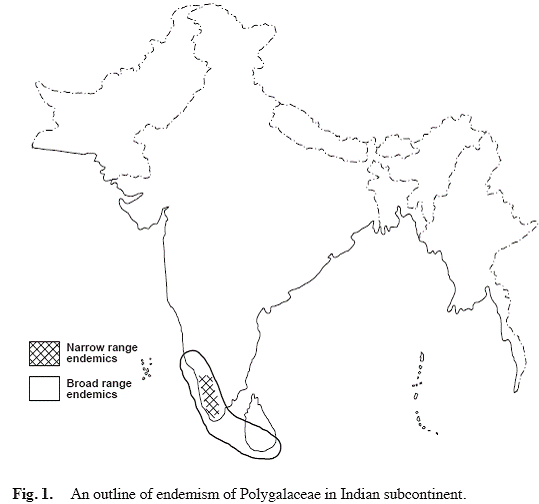
<p style='text-align:justify;line-height:normal'><b> <span lang=EN-US style='font-family:"Verdana";color:#211E1E;mso-ansi-language: EN-US'><font size="2">Endemism of <span class=SpellE>Polygalaceae</span> in Indian subcontinent</font></span></b></p>     <p style='text-align:justify;line-height:normal'> <span lang=EN-US style='font-family:"Verdana";color:#211E1E;mso-ansi-language: EN-US'><font size="2">In the broader aspect, extent of endemism of <span class=SpellE>Polygalaceae</span> in Indian subcon­tinent is given in <a href="#tab3">Table 3</a>. The investigation revealed that there are twelve <span class=SpellE>taxa</span> belonging to <span class=SpellE>Polygalaceae</span> confined in the Indian subcontinent. Among twelve <span class=SpellE>taxa</span>, three are restricted to Indo-Nepal-Bhutan Himalayas (out of three, two belong to <i style='mso-bidi-font-style: normal'>Polygala </i>and one belongs to <span class=SpellE><i style='mso-bidi-font-style: normal'>Salomonia</i></span><i style='mso-bidi-font-style:normal'> genus</i>). One <span class=SpellE>taxon</span> of <i style='mso-bidi-font-style:normal'>Polygala</i> is con­fined to Indo-Myanmar region and rest of the eight <span class=SpellE>taxa</span> (comprising seven <span class=SpellE>taxa</span> belonging to <i style='mso-bidi-font-style:normal'>Polygala </i>and one <span class=SpellE>taxon</span> that belongs to <span class=SpellE><i style='mso-bidi-font-style:normal'>Salomonia</i></span><i style='mso-bidi-font-style:normal'> genus</i>) are restrict­ed to Indo-Sri Lankan region. These ca. 12 <span class=SpellE>taxa</span> should be categorized as “Broad Range Endemics” (B.R.E.) (<span class=SpellE>Kundu</span> 2005); on the other hand the ca. 6 <span class=SpellE>taxa</span>, which are absolutely confined to <st1:country-region w:st="on"><st1:place w:st="on"><st1:PlaceType   w:st="on">India</st1:PlaceType></st1:place></st1:country-region>, should be regarded as “Narrow Range Endemics” (N.R.E.) (<span class=SpellE>Kundu</span> 2005). Among 18 <span class=SpellE>taxa</span> (comprising of six narrow range endemics and twelve broad range endemics), 12 <span class=SpellE>taxa</span> (which are endemic in subcontinent i.e. E.I.S.) i.e. 66.6% endemic <span class=SpellE>taxa</span> are restricted to Indo-Sri Lankan region, hence, this region should be considered as “endemic resort” (<span class=SpellE>Kundu</span> 2007), which is function­ally recognized as either “<span class=SpellE>refugium</span>” or “centre of diversity” for <span class=SpellE>Polygalaceae</span> in Indian subcontinent (<a href="#fig1">Fig.1</a>).</font></span></p>     <p style='text-align:center;line-height:normal'><a name="tab3"> <img border="0" src="/img/fbpe/abv/v32n1/art02tab3.gif" width="571" height="275"></a></p>     
<p style='text-align:center;line-height:normal'><a name="fig1"> <img border="0" src="/img/fbpe/abv/v32n1/art02fig1.gif" width="539" height="504"></a></p>     
<p style='text-align:justify;'> <span lang=EN-US style='font-family:"Verdana";color:#211E1E;mso-ansi-language:EN-US'> <font size="2">It has been found that the total number of <span class=SpellE>taxa</span> belonging to <span class=SpellE>Polygalaceae</span> on the Indian subcontinent is ca. 51, whereas the total number of <span class=SpellE>taxa</span> in <st1:place w:st="on"><st1:country-region w:st="on"><st1:PlaceType w:st="on">India</st1:PlaceType></st1:country-region></st1:place> is 43 (84.31%). The number of endemic <span class=SpellE>taxa</span> in the Indian subcontinent is not so impres­sive: ca. 18 <span class=SpellE>taxa</span> (35.29%). The number of narrow range endemics is ca. 6 <span class=SpellE>taxa</span> (11.76%) and the number of broad range endemics is ca. 12 <span class=SpellE>taxa</span> (23.52%). From the viewpoint of “Species Dynamics”, the percentage of endemism of <span class=SpellE>Poly­galaceae</span> on the Indian subcontinent in 1939-1940 (<span class=SpellE>Chatterjee</span> 1939) was 21.87%, whereas in 2002-2004, it has become 35.29%. The positive index of <span class=SpellE>phytoen­demism</span> could be defined as either an increasing number (numerical increase) of endemic <span class=SpellE>taxa</span> or further shrinkage of distributional area of pan-endemic <span class=SpellE>taxa</span> (vir­tual increasing) or a combination of both. Apparently, the interpretation of an increased rate of endemism depends upon the discovery of new endemic species and reduction of previously widespread <span class=SpellE>taxa</span> in a particular matrix. But it is logical to argument that new endemic <span class=SpellE>taxa</span> would be a maiden discovery or it might be recognition of new varieties from existing mother-stock. So the rate of endemism is an index of species dynamics, the key tool to track the evolutionary process of a plant group, in a particular matrix.</font></span></p>     <p style='text-align:justify;'><b> <span lang=EN-US style='font-family:"Verdana";color:#211E1E;mso-ansi-language: EN-US'><font size="2">Threatened <span class=SpellE>taxa</span> belonging to <span class=SpellE>Polygalaceae</span> in <st1:country-region w:st="on"><st1:place  w:st="on"><st1:PlaceType w:st="on">India</st1:PlaceType></st1:place></st1:country-region> </font> </span></b></p>     ]]></body>
<body><![CDATA[<p style='text-align:justify;'><span class=SpellE> <span lang=EN-US style='font-family:"Verdana";color:#211E1E; mso-ansi-language:EN-US'><font size="2">Phytoendemism</font></span></span><span lang=EN-US style='font-family:"Verdana";color:#211E1E;mso-ansi-language:EN-US'><font size="2"> is an interdisciplinary study which bridges between <span class=SpellE>phyto­geographical</span> and floristic studies. Apparently, it deals with academic and theoret­ical studies of evolutionary sciences. The contemporary changes of perception helps to narrate academic and theoretical aspects of “endemic floristic elements” under a political boundary, in terms of socio-economic appraisal of renewable, indigenous, natural resources deserving conservation. Identification of indige­nous resources is a primary socio-economic concern of a developing country, but sustainable use (scientific cultivation and commercial exploitation from the field) and trading of it beyond the regional territory is the ultimate goal. As<span style='mso-spacerun:yes'>  </span>commercial demand of market could only be met by commercial growth of indigenous resource and it would be the ultimate responsibilities of indigenous resource based industries and market to ensure the existence of “indigenous resources” by following sustainable utilization policy.</font></span></p>     <p style='text-align:justify;'> <span lang=EN-US style='font-family:"Verdana";color:#211E1E;mso-ansi-language:EN-US'>  <font size="2">From an economic perspective, the increasing rate of <span class=SpellE>phytoendemism</span> is an important index for national economy of any developing state but shrinkage of a particular <span class=SpellE>germplasm</span> due to habitat destruction and anthropogenic interference is a key negative gradient from conservation as well as economic viewpoint (Myers 1980). If the potential resource is overexploited the loss is irreversible to the socie­ty. Though species like <i style='mso-bidi-font-style:normal'>Polygala <span class=SpellE>chinensis</span>, Polygala japonica</i> are neither endemic nor threatened <span class=SpellE>taxa</span>, yet leaves of first one has been cooked as vegetable in Western parts of India (<span class=SpellE>Gammie</span> 1902) and the second one is consumed as staple food (leaves, shoot, root) in China (Read 1946). The endemics of <span class=SpellE>Polygalaceae</span> and locally confined pan-endemics with isolated small patches are the outfall of habitat disturbance and anthropogenic interference (e.g. ethno botanical exploitation, con­version of wild habitat to cultivation field, urbanization, etc.). Overall, it has been estimated that there are three <span class=SpellE>taxa</span> facing various degrees of survival threat (<a href="#tab4">Table 4</a>), like habitat disturbance coupled with narrow gene pool which accelerates the genetic erosion of <span class=SpellE><i style='mso-bidi-font-style:normal'>Epirixanthes</i></span><i style='mso-bidi-font-style: normal'> <span class=SpellE>elongata</span></i> (during field survey it has been observed that it flowers normally on the habitat, under anthropogenic pressure but fruit set­ting of it is very low: 25-35% and population distribution is disjunctive type) and the rest two <span class=SpellE>taxa</span>, <i style='mso-bidi-font-style:normal'>Polygala <span class=SpellE>tricholopha</span></i> and <i style='mso-bidi-font-style:normal'>Polygala <span class=SpellE>telephioides</span></i> which have eth­no-medicinal importance as well as local uses as food and alcohol fermentation (<span class=SpellE>Bannerjee</span> 1993) and it could be done at a commercial level by involving “Research &amp; Development” of pharmaceutical industries and breweries.</font></span></p>     <p style='text-align:center;'><a name="tab4"> <img border="0" src="/img/fbpe/abv/v32n1/art02tab4.gif" width="559" height="313"></a></p>     
<p style='text-align:justify;'><b> <span lang=EN-US style='font-family:"Verdana";mso-ansi-language:EN-US'><font size="2">Possible fossil evidence in relation to endemics of <span class=SpellE>Polygalaceae</span> in <st1:country-region w:st="on"><st1:place w:st="on"><st1:PlaceType w:st="on">India</st1:PlaceType></st1:place></st1:country-region></font></span></b></p>     <p style='text-align:justify;'> <span lang=EN-US style='font-family:"Verdana";color:#211E1E;mso-ansi-language:EN-US'> <font size="2">Searching of <span class=SpellE>fossiliferous</span> ancestors of the living endemics (endemic <span class=SpellE>taxon</span>) of a taxonomic group (e.g. family) is an endeavor to understand the evolutionary history through a geological time scale. The result gives a putative perception about origin and dispersal of ancestors of living representatives in ancient time. When fossil history combined with the important characters of living groups viz. habit (e.g. herb, tree, liana, etc.), habitat (e.g. desert, mountain top, sea shore), ecological traits (e.g. altitude, rainfall, substratum with varied pH level, type of succession, etc.), reproductive biology (<span class=SpellE>Faverger</span> &amp; <span class=SpellE>Contandriopoulos</span> 1961), etc., it is easy to predict whether the particular group of endemics would be treated as <span class=SpellE>Palaeo</span>-endemics (Carlquist1965), Neo-endemics or <span class=SpellE>Holo</span>-endemics (Herzog 1926; Richardson 1978). As conservation and sustainable utilization strategies for <span class=SpellE>Palaeo</span>-endemics are invariably different than Neo-endemics. It is interesting to focus on <span class=SpellE>phylogenetic</span> relationship by studying the fossil remains of the ancestors of the modern <span class=SpellE>taxa</span>, which are referable to the endemic <span class=SpellE>taxa</span> of the family <span class=SpellE>Poly­galaceae</span> now-a-days. The fossil pollens representatives of <span class=SpellE>Polygalaceae</span>, <span class=SpellE><i style='mso-bidi-font-style:normal'>Polygalacidetes</i></span><i style='mso-bidi-font-style:normal'> <span class=SpellE>clasus</span></i> <span class=SpellE>Sah</span> &amp; <span class=SpellE>Dutta</span> has been found in <st1:country-region w:st="on"><st1:place w:st="on"><st1:PlaceType w:st="on">Assam</st1:PlaceType></st1:place></st1:country-region> and <span class=SpellE>Shillong</span> plateau, Meghalaya of <span class=SpellE>Palaeocene</span> period, Tertiary era (<span class=SpellE>Sah</span> &amp; <span class=SpellE>Dutta</span> 1968) and it has resemblance to the living endemic representative of <span class=SpellE>Polygalaceae</span>: <i style='mso-bidi-font-style:normal'>Polygala <span class=SpellE>globulifera</span> </i>var<i style='mso-bidi-font-style:normal'>. <span class=SpellE>kachinensis</span></i>. The fossil pollen of <i style='mso-bidi-font-style:normal'>Polygala </i>has also been found in <span class=SpellE>Haigam</span> lake, evidenced from <span class=SpellE>palaeo-stratigraphic</span> deposition of Quaternary era (Vishnu <span class=SpellE>Mittre</span> &amp; Sharma 1966). Though, there are a number of living representa­tives of <span class=SpellE>Polygalaceae</span> found in North-Western Himalaya and North-Eastern India, there is no living endemic <span class=SpellE>taxon</span> of <span class=SpellE>Polygalaceae</span> so far reported from those matri­ces and it has been noticed that all endemic <span class=SpellE>taxa</span> of <span class=SpellE>Polygalaceae</span> are distributed in Southern part of India, which left a space for further inquiry about <span class=SpellE>Palaeo-Spatio-Temporal</span> movement of <span class=SpellE>Polygalaceae</span> in the background of <span class=SpellE>palaeo</span>-climatic change. However, it helps to predict the geological age and distributional pattern of predecessor of living <span class=SpellE>Polygalaceae</span> in <st1:country-region w:st="on"><st1:place w:st="on"><st1:PlaceType w:st="on">India</st1:PlaceType></st1:place></st1:country-region>. Over viewing the characteristics like habit, habitat, ecological features, fossil histories (mostly Tertiary-Quater­nary representatives), etc., of <span class=SpellE>Polygalaceae</span> in <st1:country-region w:st="on"><st1:place  w:st="on"><st1:PlaceType w:st="on">India</st1:PlaceType></st1:place></st1:country-region>, the endemics belonging to this family would not be categorized under <span class=SpellE>Palaeoendemics</span> and which does not support further that “endemic resort” is of relict habitat like “<span class=SpellE>refugium</span>”. As the living endemic <span class=SpellE>taxa</span> of <span class=SpellE>Polygalaceae</span> do not show high level of <span class=SpellE>ploidy</span> and <span class=SpellE>infra­specific</span> representation is not high either, hence it could not be categorized under <span class=SpellE>Neoendemics</span> either. Rather, it might be considered under <span class=SpellE>Holoendemics</span> (some­where between <span class=SpellE>Palaeoendemics</span> and <span class=SpellE>Neoendemics</span>) and which further helps to recognize the “endemic resort” as “centre of diversity”.</font></span></p>     <p style='text-align:justify;'><b> <span lang=EN-US style='font-family: "Verdana";color:#211E1E;mso-ansi-language:EN-US'><font size="2">CONCLUSION</font></span></b></p>     <p style='text-align:justify;'> <span lang=EN-US style='font-family:"Verdana";color:#211E1E;mso-ansi-language: EN-US'><font size="2">The species occupancy in a particular habitat (P) in a particular geographi­cal matrix is not static forever and “Species Dynamics” is the key indicator of the changes of “Species Occupancy” in <span class=SpellE>spatio</span>-temporal scale. If (P), the proportion of the available habitat to species occupancy become less than one (P&lt;1), the species would generally be considered in the mode of extinction (<span class=SpellE>Wimberly</span> 2006), if the proportion is greater than one the species would naturally be considered in the mode of expansion or diversification. If evolutionary process has been considered as legitimate ongoing process of expansion, diversification as well as extinction of plant kingdom inception of geological time scale, “Species Dynamics” would be considered as “functional index” of the changing phase. The change of number of living <span class=SpellE>taxa</span> in a particular matrix varies from one climatic regime to another cli­matic regime. Likewise, the representation of endemic component of a taxonom­ic group (e.g. percentage of endemism of a family) varies on the same matrix from time to time. The observation on rate of endemism of a taxonomic group could help to undertake short-term use and utilization measure as well as instant conser­vation strategies in the local level. Without any comparative studies of endemism of a taxonomic group in a particular matrix, it is almost impossible to understand that whether the group of plants is in the mode of diversification as well as expan­sion or extinction. For undertaking the long-term strategies for conservation and sustainable utilization of a group of plants in a regional level and global level, changing of “functional index” needs to be considered.</font></span></p>     <p style='text-align:justify;'> <span lang=EN-US style='font-family:"Verdana";color:#211E1E;mso-ansi-language: EN-US'><font size="2">After studying the fossil evidences related to endemic living representa­tives of <span class=SpellE>Polygalaceae</span>, it has been noticed that they are mostly Tertiary-Quater­nary representatives so those would not be categorized under “<span class=SpellE>Palaeoendemics</span>”. After <span class=SpellE>phytogeographical</span> analysis as well as reviewing species dynamics of the living representatives it has been noticed that rate of endemism has been increased in passage of time and this increase is not due to numerical increasing of neo-endemic <span class=SpellE>taxa</span> rather considered to be virtual increasing of endemic <span class=SpellE>taxa</span> (shrinkage of area of distribution of <span class=SpellE>panendemic</span> <span class=SpellE>taxa</span>) belonging to <span class=SpellE>Poly­galaceae</span>; hence it should be positioned between <span class=SpellE>Palaeo</span> and <span class=SpellE>Neoendemics</span>, when overall changing variables e.g. <span class=SpellE>edaphic</span>, climatic, anthropogenic, stochastic and biological, etc. don’t drive this group of plants in the mode of diversification. After considering the following factors like: high rate of endemism (which is vir­tual in nature), nature of endemic resort (which is centre of diversity), the rate of diversity (which is very low or negative) and the endemic <span class=SpellE>taxa</span> belonging to <span class=SpellE>Poly­galaceae</span> should be considered as “<span class=SpellE>Holoendemics</span>”. Logically, the confinement of endemic <span class=SpellE>taxa</span> of <span class=SpellE>Polygalaceae</span> on physically alike “<st1:place w:st="on"><st1:PlaceType  w:st="on">Island</st1:PlaceType></st1:place> habitat”, an isolated <span class=SpellE>refugium</span> with <span class=SpellE>Holoendemics</span> and <span class=SpellE>Epibiotics</span> make these “<span class=SpellE>Holoendemics</span>” con­sidered to be “Island Endemics” (<span class=SpellE>Carlquist</span> 1965; Gentry 1986).</font></span></p>     <p style='text-align:justify;'><b> <span lang=EN-US style='font-family: "Verdana";color:#211E1E;mso-ansi-language:EN-US'><font size="2">ACKNOWLEDGEMENTS</font></span></b></p>     <p style='text-align:justify;'> <span lang=EN-US style='font-family:"Verdana";color:#211E1E;mso-ansi-language:EN-US'> <font size="2">I wish to thank my friend Ms. Catalina Bernal, <st1:place w:st="on"><st1:PlaceType  w:st="on"><st1:City w:st="on"><st1:PlaceType w:st="on">Richmond Hill</st1:PlaceType></st1:City>,   <st1:State w:st="on"><st1:PlaceType w:st="on">ON</st1:PlaceType></st1:State>,   <st1:country-region w:st="on"><st1:PlaceType w:st="on">Canada</st1:PlaceType></st1:country-region></st1:PlaceType></st1:place>, for her sincere effort to go through the article and translate the abstract and key words in Spanish without which this work would remain incomplete.</font></span></p>     ]]></body>
<body><![CDATA[<p style='text-align:justify;'><b> <span lang=EN-US style='font-family: "Verdana";color:#211E1E;mso-ansi-language:EN-US'><font size="2">BIBLIOGRAPHY  </font> </span></b><span lang=EN-US style='font-family:"Times New Roman";color:#211E1E;mso-ansi-language: EN-US'><o:p></o:p></span></p>      <!-- ref --><p style='text-align:justify;tab-stops:467.8pt'><span class=SpellE> <span lang=EN-US style='font-family:"Verdana"; color:#211E1E;mso-ansi-language:EN-US'><font size="2">1. Ahmedullah</font></span></span><span lang=EN-US style='font-family:"Verdana";color:#211E1E;mso-ansi-language: EN-US'><font size="2">, M. &amp; M.P. <span class=SpellE>Nayar</span>. 1986. <i style='mso-bidi-font-style:normal'>Endemic plants of Indian region (Peninsular <st1:country-region w:st="on"><st1:place w:st="on"><st1:PlaceType w:st="on">India</st1:PlaceType></st1:place></st1:country-region>).</i> Botanical<span style='mso-spacerun:yes'>  </span>Survey<span style='mso-spacerun:yes'>  </span>of <st1:country-region w:st="on"><st1:PlaceType  w:st="on">India</st1:PlaceType></st1:country-region>, <st1:place w:st="on"><st1:City  w:st="on"><st1:PlaceType w:st="on">Calcutta</st1:PlaceType></st1:City></st1:place>.</font></span>&nbsp;&nbsp;&nbsp;&nbsp;&nbsp;&nbsp;&nbsp;&nbsp;[&#160;<a href="javascript:void(0);" onclick="javascript: window.open('/scielo.php?script=sci_nlinks&ref=031828&pid=S0084-5906200900010000200001&lng=','','width=640,height=500,resizable=yes,scrollbars=1,menubar=yes,');">Links</a>&#160;]<!-- end-ref --><!-- ref --><p style='text-align:justify;tab-stops:467.8pt'><span lang="en-us"> <font size="2" color="#211E1E"><span style="font-family: Verdana">2. </span> </font></span><span class=SpellE> <span lang=EN-US style='font-family:"Verdana";color:#211E1E; mso-ansi-language:EN-US'><font size="2">Banerjee</font></span></span><span lang=EN-US style='font-family:"Verdana";color:#211E1E;mso-ansi-language:EN-US'><font size="2">,<span style='mso-spacerun:yes'>  </span>R.N. 1993. <span class=SpellE>Polygalaceae</span>. In: <i style='mso-bidi-font-style:normal'>Flora of <st1:country-region w:st="on"><st1:place  w:st="on"><st1:PlaceType w:st="on">India</st1:PlaceType></st1:place></st1:country-region></i> (Sharma, B.D. &amp; N.P. <span class=SpellE>Balakrishnan</span>, eds.) 2: 450-493. Botanical<span style='mso-spacerun:yes'>  </span>Survey<span style='mso-spacerun:yes'>  </span>of <st1:country-region w:st="on"><st1:PlaceType  w:st="on">India</st1:PlaceType></st1:country-region>, <st1:place w:st="on"><st1:City  w:st="on"><st1:PlaceType w:st="on">Calcutta</st1:PlaceType></st1:City></st1:place>.</font></span>&nbsp;&nbsp;&nbsp;&nbsp;&nbsp;&nbsp;&nbsp;&nbsp;[&#160;<a href="javascript:void(0);" onclick="javascript: window.open('/scielo.php?script=sci_nlinks&ref=031829&pid=S0084-5906200900010000200002&lng=','','width=640,height=500,resizable=yes,scrollbars=1,menubar=yes,');">Links</a>&#160;]<!-- end-ref --><!-- ref --><p style='text-align:justify;tab-stops:467.8pt'><span class=SpellE> <span lang=EN-US style='font-family:"Verdana"; color:#211E1E;mso-ansi-language:EN-US'><font size="2">3. Carlquist</font></span></span><span lang=EN-US style='font-family:"Verdana";color:#211E1E;mso-ansi-language:EN-US'><font size="2">, S. 1965. <i style='mso-bidi-font-style:normal'>Island life: A natural history of the islands of the world.</i> Natural History Press, Garden City, <span class=SpellE>New York</span>.</font></span>&nbsp;&nbsp;&nbsp;&nbsp;&nbsp;&nbsp;&nbsp;&nbsp;[&#160;<a href="javascript:void(0);" onclick="javascript: window.open('/scielo.php?script=sci_nlinks&ref=031830&pid=S0084-5906200900010000200003&lng=','','width=640,height=500,resizable=yes,scrollbars=1,menubar=yes,');">Links</a>&#160;]<!-- end-ref --><!-- ref --><p style='text-align:justify;tab-stops:467.8pt'><span class=SpellE> <span lang=EN-US style='font-family:"Verdana";color:#211E1E; mso-ansi-language:EN-US'><font size="2">4. Chadat</font></span></span><span lang=EN-US style='font-family: "Verdana";color:#211E1E;mso-ansi-language:EN-US'><font size="2">, R. 1980. <span class=SpellE>Monographia</span> <span class=SpellE>polygalacearum</span>. <span class=SpellE><i style='mso-bidi-font-style:normal'>Mem</i></span><i style='mso-bidi-font-style:normal'>. Soc. Phys. Hist. Nat. Geneva</i> </font></span><span lang=EN-US style='font-family: "Verdana";color:#211E1E;mso-ansi-language:EN-US'><font size="2">7</font></span><span lang=EN-US style='font-family: "Verdana";color:#211E1E;mso-ansi-language:EN-US'><font size="2">(Suppl.): 1-143.</font></span>&nbsp;&nbsp;&nbsp;&nbsp;&nbsp;&nbsp;&nbsp;&nbsp;[&#160;<a href="javascript:void(0);" onclick="javascript: window.open('/scielo.php?script=sci_nlinks&ref=031831&pid=S0084-5906200900010000200004&lng=','','width=640,height=500,resizable=yes,scrollbars=1,menubar=yes,');">Links</a>&#160;]<!-- end-ref --><!-- ref --><p style='text-align:justify;tab-stops:467.8pt'><span class=SpellE> <span lang=EN-US style='font-family:"Verdana";color:#211E1E; mso-ansi-language:EN-US'><font size="2">5. Chatterjee</font></span></span><span lang=EN-US style='font-family:"Verdana";color:#211E1E;mso-ansi-language:EN-US'><font size="2">, D. 1939. Studies on the endemic flora of India and Burma. <i style='mso-bidi-font-style: normal'>J. <span class=SpellE>Asiat</span>. Soc. Bengal</i> (Sci.) 5: 19-68.</font></span>&nbsp;&nbsp;&nbsp;&nbsp;&nbsp;&nbsp;&nbsp;&nbsp;[&#160;<a href="javascript:void(0);" onclick="javascript: window.open('/scielo.php?script=sci_nlinks&ref=031832&pid=S0084-5906200900010000200005&lng=','','width=640,height=500,resizable=yes,scrollbars=1,menubar=yes,');">Links</a>&#160;]<!-- end-ref --><!-- ref --><p style='text-align:justify;tab-stops:467.8pt'><span lang="en-us"> <font size="2" color="#211E1E"><span style="font-family: Verdana">6. </span> </font></span> <span lang=EN-US style='font-family:"Verdana";color:#211E1E;mso-ansi-language:EN-US'> <font size="2">Chen, S.K., M.A. <span class=SpellE>Haiying</span> &amp; J.A.N. Parnell. 2007. <span class=SpellE>Polygalaceae</span>. In: <i style='mso-bidi-font-style: normal'>Flora of <st1:country-region w:st="on"><st1:place w:st="on"><st1:PlaceType   w:st="on">China</st1:PlaceType></st1:place></st1:country-region></i> (<span class=SpellE>Zhi-Ke</span>, Y., ed.) 11: 139-159. Science Press, <st1:City w:st="on"><st1:PlaceType w:st="on">Beijing</st1:PlaceType></st1:City> and <st1:PlaceName w:st="on"><st1:PlaceType w:st="on">Mis­souri</st1:PlaceType></st1:PlaceName> <st1:PlaceType w:st="on">Botanical Garden</st1:PlaceType> Press, <st1:City w:st="on"><st1:place  w:st="on"><st1:PlaceType w:st="on">St. Louis</st1:PlaceType></st1:place></st1:City>.</font></span>&nbsp;&nbsp;&nbsp;&nbsp;&nbsp;&nbsp;&nbsp;&nbsp;[&#160;<a href="javascript:void(0);" onclick="javascript: window.open('/scielo.php?script=sci_nlinks&ref=031833&pid=S0084-5906200900010000200006&lng=','','width=640,height=500,resizable=yes,scrollbars=1,menubar=yes,');">Links</a>&#160;]<!-- end-ref --><!-- ref --><p style='text-align:justify;tab-stops:467.8pt'><span lang="en-us"> <font size="2" color="#211E1E"><span style="font-family: Verdana">7. </span> </font></span> <span lang=EN-US style='font-family:"Verdana";color:#211E1E;mso-ansi-language:EN-US'> <font size="2">Dar, M.I. 1973. <span class=SpellE>Polygalaceae</span>. In: <i style='mso-bidi-font-style:normal'>Flora of <st1:place w:st="on"><st1:PlaceType  w:st="on">West Pakistan</st1:PlaceType></st1:place></i> (<span class=SpellE>Nasir</span>, E. &amp; S.I. Ali, eds.) 52: 1-11. <st1:country-region w:st="on"><st1:PlaceType  w:st="on">Pakistan</st1:PlaceType></st1:country-region> Agricultural Research Council, <st1:City w:st="on"><st1:place w:st="on"><st1:PlaceType w:st="on">Islamabad</st1:PlaceType></st1:place></st1:City>.</font></span>&nbsp;&nbsp;&nbsp;&nbsp;&nbsp;&nbsp;&nbsp;&nbsp;[&#160;<a href="javascript:void(0);" onclick="javascript: window.open('/scielo.php?script=sci_nlinks&ref=031834&pid=S0084-5906200900010000200007&lng=','','width=640,height=500,resizable=yes,scrollbars=1,menubar=yes,');">Links</a>&#160;]<!-- end-ref --><!-- ref --><p style='text-align:justify;tab-stops:467.8pt'><span lang="en-us"> <font size="2" color="#211E1E"><span style="font-family: Verdana">8.</span></font></span><span lang=EN-US style='font-family:"Verdana";color:#211E1E;mso-ansi-language:EN-US'><span style='mso-spacerun:yes'><font size="2"> </font></span><font size="2"><span class=SpellE>Eriksen</span>, B. 1993. <i style='mso-bidi-font-style:normal'>Taxonomical studies in the <span class=SpellE>Polygalaceae</span> and <span class=SpellE>Valerianaceae</span>.</i> (Ph.D. Thesis) <st1:PlaceType w:st="on">University</st1:PlaceType> of Goteborg, Goteborg, Sweden.</font></span>&nbsp;&nbsp;&nbsp;&nbsp;&nbsp;&nbsp;&nbsp;&nbsp;[&#160;<a href="javascript:void(0);" onclick="javascript: window.open('/scielo.php?script=sci_nlinks&ref=031835&pid=S0084-5906200900010000200008&lng=','','width=640,height=500,resizable=yes,scrollbars=1,menubar=yes,');">Links</a>&#160;]<!-- end-ref --><!-- ref --><p style='text-align:justify;tab-stops:467.8pt'><span lang="en-us"> <font size="2" color="#211E1E"><span style="font-family: Verdana">9.</span></font></span><span lang=EN-US style='font-family:"Verdana";color:#211E1E;mso-ansi-language:EN-US'><span style='mso-spacerun:yes'><font size="2"> </font></span><font size="2"><span class=SpellE>Eriksen</span>, B. &amp; C. <span class=SpellE>Persson</span>, 2006. <span class=SpellE>Polygalaceae</span>. In: <i style='mso-bidi-font-style:normal'>Families and genera of vascular plants</i> (<span class=SpellE>Kubitzki</span>, K., ed.) 9: 345-363. Springer, Berlin.</font></span>&nbsp;&nbsp;&nbsp;&nbsp;&nbsp;&nbsp;&nbsp;&nbsp;[&#160;<a href="javascript:void(0);" onclick="javascript: window.open('/scielo.php?script=sci_nlinks&ref=031836&pid=S0084-5906200900010000200009&lng=','','width=640,height=500,resizable=yes,scrollbars=1,menubar=yes,');">Links</a>&#160;]<!-- end-ref --><!-- ref --><p style='text-align:justify;tab-stops:467.8pt'><span lang="en-us"> <font size="2" color="#211E1E"><span style="font-family: Verdana">10.</span></font></span><span lang=EN-US style='font-family:"Verdana";color:#211E1E;mso-ansi-language:EN-US'><span style='mso-spacerun:yes'><font size="2"> </font></span><font size="2"><span class=SpellE>Favarger</span>, C. &amp; T. <span class=SpellE>Contandriopoulos</span>. 1961. <span class=SpellE>Essai</span> <span class=SpellE>sur</span> <span class=SpellE>l’endemism</span>. <span class=SpellE><i style='mso-bidi-font-style:normal'>Ber</i></span><i style='mso-bidi-font-style:normal'>. <span class=SpellE>Schwiez</span>. Bot. <span class=SpellE>Ges</span>.</i> 71: 384-406. </font> <o:p></o:p></span>&nbsp;&nbsp;&nbsp;&nbsp;&nbsp;&nbsp;&nbsp;&nbsp;[&#160;<a href="javascript:void(0);" onclick="javascript: window.open('/scielo.php?script=sci_nlinks&ref=031837&pid=S0084-5906200900010000200010&lng=','','width=640,height=500,resizable=yes,scrollbars=1,menubar=yes,');">Links</a>&#160;]<!-- end-ref --><!-- ref --><p style='margin-right:43.95pt;text-align:justify;'><span class=SpellE> <span lang=EN-US style='font-family:"Verdana";color:#211E1E; mso-ansi-language:EN-US'><font size="2">11. Gammie</font></span></span><span lang=EN-US style='font-family: "Verdana";color:#211E1E;mso-ansi-language:EN-US'><font size="2">, G.A. <st1:metricconverter ProductID="1902. A" w:st="on"><st1:PlaceType w:st="on">1902. A</st1:PlaceType></st1:metricconverter> note on plants used for food during famines and seasons of scarcity in the <st1:City w:st="on"><st1:place w:st="on"><st1:PlaceType w:st="on">Bombay</st1:PlaceType></st1:place></st1:City> presidency. <st1:country-region w:st="on"><st1:place w:st="on"><st1:PlaceType   w:st="on">India</st1:PlaceType></st1:place></st1:country-region>. <i style='mso-bidi-font-style:normal'>Bot. <span class=SpellE>Surv</span>. Rec</i>. 2(2): 171-196. </font> <o:p></o:p></span>&nbsp;&nbsp;&nbsp;&nbsp;&nbsp;&nbsp;&nbsp;&nbsp;[&#160;<a href="javascript:void(0);" onclick="javascript: window.open('/scielo.php?script=sci_nlinks&ref=031838&pid=S0084-5906200900010000200011&lng=','','width=640,height=500,resizable=yes,scrollbars=1,menubar=yes,');">Links</a>&#160;]<!-- end-ref --><!-- ref --><p style='margin-right:2.5pt;text-align:justify;'> <span lang=EN-US style='font-family:"Verdana";color:#211E1E;mso-ansi-language: EN-US'><font size="2">12. Gentry, A.H. 1986. Endemism in tropical vs. temperate plant communities. In: <i style='mso-bidi-font-style:normal'>Conservation biology: The science of scarcity and diversity</i> (Soule, M., ed.), pp. 153-181. <span class=SpellE>Sinauer</span> Associates, Sunderland, Mass. </font> <o:p></o:p></span>&nbsp;&nbsp;&nbsp;&nbsp;&nbsp;&nbsp;&nbsp;&nbsp;[&#160;<a href="javascript:void(0);" onclick="javascript: window.open('/scielo.php?script=sci_nlinks&ref=031839&pid=S0084-5906200900010000200012&lng=','','width=640,height=500,resizable=yes,scrollbars=1,menubar=yes,');">Links</a>&#160;]<!-- end-ref --><!-- ref --><p style='margin-right:2.5pt;text-align:justify;tab-stops:16.0cm'> <span lang=EN-US style='font-family:"Verdana"; color:#211E1E;mso-ansi-language:EN-US'><font size="2">13. Hara, H. 1979. <span class=SpellE>Polygalaceae</span>. In: <i style='mso-bidi-font-style:normal'>Enumeration of flowering plants of <st1:country-region w:st="on"><st1:place w:st="on"><st1:PlaceType w:st="on">Nepal</st1:PlaceType></st1:place></st1:country-region></i> (Hara, H., ed.) 2: 50-51. <st1:PlaceName w:st="on"><st1:PlaceType w:st="on">British</st1:PlaceType></st1:PlaceName> Museum, London. </font> <o:p></o:p></span>&nbsp;&nbsp;&nbsp;&nbsp;&nbsp;&nbsp;&nbsp;&nbsp;[&#160;<a href="javascript:void(0);" onclick="javascript: window.open('/scielo.php?script=sci_nlinks&ref=031840&pid=S0084-5906200900010000200013&lng=','','width=640,height=500,resizable=yes,scrollbars=1,menubar=yes,');">Links</a>&#160;]<!-- end-ref --><!-- ref --><p style='margin-right:43.95pt;text-align:justify;'> <span lang=EN-US style='font-family:"Verdana";color:#211E1E;mso-ansi-language: EN-US'><font size="2">14. Herzog, T. 1926. <span class=SpellE><i style='mso-bidi-font-style:normal'>Geographie</i></span><i style='mso-bidi-font-style:normal'> <span class=SpellE>der</span> Moose</i>. <st1:place w:st="on"><st1:PlaceType w:st="on"><st1:City w:st="on"><st1:PlaceType w:st="on">Jena</st1:PlaceType></st1:City>,   <st1:country-region w:st="on"><st1:PlaceType w:st="on">Germany</st1:PlaceType></st1:country-region></st1:PlaceType></st1:place>. </font> <o:p></o:p></span>&nbsp;&nbsp;&nbsp;&nbsp;&nbsp;&nbsp;&nbsp;&nbsp;[&#160;<a href="javascript:void(0);" onclick="javascript: window.open('/scielo.php?script=sci_nlinks&ref=031841&pid=S0084-5906200900010000200014&lng=','','width=640,height=500,resizable=yes,scrollbars=1,menubar=yes,');">Links</a>&#160;]<!-- end-ref --><!-- ref --><p style='text-align:justify;'> <span lang=EN-US style='font-family:"Verdana";color:#211E1E;mso-ansi-language: EN-US'><font size="2">15. Hooker, J.D. &amp; B.D. Jackson. 1895. <i style='mso-bidi-font-style: normal'>Index <span class=SpellE>Kewensis</span> <span class=SpellE>Plantarum</span> <span class=SpellE>Phanerogamarum</span> <span class=SpellE>nomina</span> et <span class=SpellE>Synonyma</span> <span class=SpellE>Omnium</span> <span class=SpellE>generum</span> et <span class=SpellE>specierum</span> a <span class=SpellE>Linnaeo</span> <span class=SpellE>usq</span>.</i> The Clarendon Press, <st1:City w:st="on"><st1:place w:st="on"><st1:PlaceType w:st="on">Oxford</st1:PlaceType></st1:place></st1:City>. </font> <o:p></o:p></span>&nbsp;&nbsp;&nbsp;&nbsp;&nbsp;&nbsp;&nbsp;&nbsp;[&#160;<a href="javascript:void(0);" onclick="javascript: window.open('/scielo.php?script=sci_nlinks&ref=031842&pid=S0084-5906200900010000200015&lng=','','width=640,height=500,resizable=yes,scrollbars=1,menubar=yes,');">Links</a>&#160;]<!-- end-ref --><!-- ref --><p style='text-align:justify;tab-stops:467.8pt'><span class=SpellE> <span lang=EN-US style='font-family:"Verdana"; color:#211E1E;mso-ansi-language:EN-US'><font size="2">16. Kundu</font></span></span><span lang=EN-US style='font-family:"Verdana";color:#211E1E;mso-ansi-language:EN-US'><font size="2">, S.R. 2001. <span class=SpellE>Phytogeographical</span> provinces (<span class=SpellE>Phytocorias</span>) of <st1:country-region w:st="on"><st1:place  w:st="on"><st1:PlaceType w:st="on">India</st1:PlaceType></st1:place></st1:country-region>: An account. <span class=SpellE><i style='mso-bidi-font-style:normal'>Geobios</i></span> 29: 69-88. </font> <o:p></o:p></span>&nbsp;&nbsp;&nbsp;&nbsp;&nbsp;&nbsp;&nbsp;&nbsp;[&#160;<a href="javascript:void(0);" onclick="javascript: window.open('/scielo.php?script=sci_nlinks&ref=031843&pid=S0084-5906200900010000200016&lng=','','width=640,height=500,resizable=yes,scrollbars=1,menubar=yes,');">Links</a>&#160;]<!-- end-ref --><!-- ref --><p style='text-align:justify;'><span class=SpellE> <span lang=EN-US style='font-family:"Verdana";color:#211E1E; mso-ansi-language:EN-US'><font size="2">17. Kundu</font></span></span><span lang=EN-US style='font-family: "Verdana";color:#211E1E;mso-ansi-language:EN-US'><font size="2">, S.R. <st1:metricconverter ProductID="2005. A" w:st="on">2005. A</st1:metricconverter> synopsis of <span class=SpellE>Berberidaceae</span> on the Indian subcontinent: Its distribution and endemism<i style='mso-bidi-font-style:normal'>. Bot. <span class=SpellE>Lithuanica</span></i> 11(1): 23-33. </font> <o:p></o:p></span>&nbsp;&nbsp;&nbsp;&nbsp;&nbsp;&nbsp;&nbsp;&nbsp;[&#160;<a href="javascript:void(0);" onclick="javascript: window.open('/scielo.php?script=sci_nlinks&ref=031844&pid=S0084-5906200900010000200017&lng=','','width=640,height=500,resizable=yes,scrollbars=1,menubar=yes,');">Links</a>&#160;]<!-- end-ref --><!-- ref --><p style='text-align:justify;'><span class=SpellE> <span lang=EN-US style='font-family:"Verdana";color:#211E1E; mso-ansi-language:EN-US'><font size="2">18. Kundu</font></span></span><span lang=EN-US style='font-family: "Verdana";color:#211E1E;mso-ansi-language:EN-US'><font size="2">, S.R. <st1:metricconverter ProductID="2007. A" w:st="on">2007. A</st1:metricconverter> compendium of <span class=SpellE>Brassicaceae</span> in Indian subcontinent: Its distribution and endemism. <span class=SpellE><i style='mso-bidi-font-style:normal'>Thaiszia</i></span><i style='mso-bidi-font-style:normal'> </i>J. Bot. 17: 59-95. </font> <o:p></o:p></span>&nbsp;&nbsp;&nbsp;&nbsp;&nbsp;&nbsp;&nbsp;&nbsp;[&#160;<a href="javascript:void(0);" onclick="javascript: window.open('/scielo.php?script=sci_nlinks&ref=031845&pid=S0084-5906200900010000200018&lng=','','width=640,height=500,resizable=yes,scrollbars=1,menubar=yes,');">Links</a>&#160;]<!-- end-ref --><!-- ref --><p style='text-align:justify;'> <span lang=EN-US style='font-family:"Verdana";color:#211E1E;mso-ansi-language: EN-US'><font size="2">19. Myers, N. 1980 (<span class=SpellE>repr</span>. ed.). <i style='mso-bidi-font-style:normal'>The sinking ark: A new look at the problem of disappearing species. </i><span class=SpellE>Pergamon</span> Press, <st1:City w:st="on"><st1:place w:st="on"><st1:PlaceType w:st="on">Toronto</st1:PlaceType></st1:place></st1:City>. </font> <o:p></o:p></span>&nbsp;&nbsp;&nbsp;&nbsp;&nbsp;&nbsp;&nbsp;&nbsp;[&#160;<a href="javascript:void(0);" onclick="javascript: window.open('/scielo.php?script=sci_nlinks&ref=031846&pid=S0084-5906200900010000200019&lng=','','width=640,height=500,resizable=yes,scrollbars=1,menubar=yes,');">Links</a>&#160;]<!-- end-ref --><!-- ref --><p style='text-align:justify;'> <span lang=EN-US style='font-family:"Verdana";color:#211E1E;mso-ansi-language: EN-US'><font size="2">20. Read, B.E. (ed.). 1946. <i style='mso-bidi-font-style:normal'>Famine foods listed in Chiu <span class=SpellE>huang</span> pen <span class=SpellE>t’sao</span>: giving their identity, nutritional values and notes on their preparation.</i> Henry Lester Institute of Medical Research, Shanghai, China. </font> <o:p></o:p></span>&nbsp;&nbsp;&nbsp;&nbsp;&nbsp;&nbsp;&nbsp;&nbsp;[&#160;<a href="javascript:void(0);" onclick="javascript: window.open('/scielo.php?script=sci_nlinks&ref=031847&pid=S0084-5906200900010000200020&lng=','','width=640,height=500,resizable=yes,scrollbars=1,menubar=yes,');">Links</a>&#160;]<!-- end-ref --><!-- ref --><p style='text-align:justify;'><st1:City w:st="on"><st1:place w:st="on"><st1:PlaceType w:st="on"> <span lang=EN-US    style='font-family:"Verdana";color:#211E1E;mso-ansi-language:EN-US'> <font size="2">21. Richardson</font></span></st1:PlaceType></st1:place></st1:City><span lang=EN-US style='font-family:"Verdana";color:#211E1E;mso-ansi-language: EN-US'><font size="2">, I.B.K.1978. Endemic <span class=SpellE>taxa</span> and the taxonomist. In: <i style='mso-bidi-font-style:normal'>Essays in plant taxonomy</i> (Street, H.E., ed.), pp. 245-262. Academic Press, <st1:City w:st="on"><st1:place w:st="on"><st1:PlaceType   w:st="on">London</st1:PlaceType></st1:place></st1:City>. </font> <o:p></o:p></span>&nbsp;&nbsp;&nbsp;&nbsp;&nbsp;&nbsp;&nbsp;&nbsp;[&#160;<a href="javascript:void(0);" onclick="javascript: window.open('/scielo.php?script=sci_nlinks&ref=031848&pid=S0084-5906200900010000200021&lng=','','width=640,height=500,resizable=yes,scrollbars=1,menubar=yes,');">Links</a>&#160;]<!-- end-ref --><!-- ref --><p style='text-align:justify;'><span class=SpellE> <span lang=EN-US style='font-family:"Verdana";color:#211E1E; mso-ansi-language:EN-US'><font size="2">22. Sah</font></span></span><span lang=EN-US style='font-family: "Verdana";color:#211E1E;mso-ansi-language:EN-US'><font size="2">, S.G.D. &amp; S.K. <span class=SpellE>Dutta</span>. 1968. <span class=SpellE>Palynostratigraphy</span> of the tertiary formations of Assam–2, <span class=SpellE>Stratigraphic</span> significance of spores and pollen in the Ter­tiary succession of <st1:country-region w:st="on"><st1:place w:st="on"><st1:PlaceType w:st="on">Assam</st1:PlaceType></st1:place></st1:country-region>. <span class=SpellE><i style='mso-bidi-font-style:normal'>Palaeobotanist</i></span><i style='mso-bidi-font-style:normal'> </i>16: 177-195. </font> <o:p></o:p></span>&nbsp;&nbsp;&nbsp;&nbsp;&nbsp;&nbsp;&nbsp;&nbsp;[&#160;<a href="javascript:void(0);" onclick="javascript: window.open('/scielo.php?script=sci_nlinks&ref=031849&pid=S0084-5906200900010000200022&lng=','','width=640,height=500,resizable=yes,scrollbars=1,menubar=yes,');">Links</a>&#160;]<!-- end-ref --><!-- ref --><p style='text-align:justify;'><span class=SpellE> <span lang=EN-US style='font-family:"Verdana";color:#211E1E; mso-ansi-language:EN-US'><font size="2">23. Sumithraachari</font></span></span><span lang=EN-US style='font-family:"Verdana";color:#211E1E;mso-ansi-language:EN-US'><font size="2">, D.B. 1987. <span class=SpellE>Polygalaceae</span>. In: A <i style='mso-bidi-font-style: normal'>revised handbook to the flora of <st1:country-region w:st="on"><st1:place  w:st="on"><st1:PlaceType w:st="on">Ceylon</st1:PlaceType></st1:place></st1:country-region></i> (<span class=SpellE>Dassanayake</span>, M.D., ed.) 6: 301-317. <span class=SpellE>Amerind</span> Publishing Co. Pvt. Ltd., <st1:City w:st="on"><st1:place  w:st="on"><st1:PlaceType w:st="on">New Delhi</st1:PlaceType></st1:place></st1:City>. </font> <o:p></o:p></span>&nbsp;&nbsp;&nbsp;&nbsp;&nbsp;&nbsp;&nbsp;&nbsp;[&#160;<a href="javascript:void(0);" onclick="javascript: window.open('/scielo.php?script=sci_nlinks&ref=031850&pid=S0084-5906200900010000200023&lng=','','width=640,height=500,resizable=yes,scrollbars=1,menubar=yes,');">Links</a>&#160;]<!-- end-ref --><!-- ref --><p style='text-align:justify;'> <span lang=EN-US style='font-family:"Verdana";color:#211E1E;mso-ansi-language: EN-US'><font size="2">24. Tan, K. 1991. <span class=SpellE>Polygalaceae</span>. In: <i style='mso-bidi-font-style:normal'>Flora of <st1:place w:st="on"><st1:country-region  w:st="on"><st1:PlaceType w:st="on">Bhutan</st1:PlaceType></st1:country-region></st1:place></i> (<span class=SpellE>Grierson</span>, A.J.C. &amp; D.G. Long, eds.). 2(1): 42-52. <st1:PlaceName w:st="on"><st1:PlaceType w:st="on">Royal</st1:PlaceType></st1:PlaceName> Botanic Garden, Edinburgh. </font> <o:p></o:p></span>&nbsp;&nbsp;&nbsp;&nbsp;&nbsp;&nbsp;&nbsp;&nbsp;[&#160;<a href="javascript:void(0);" onclick="javascript: window.open('/scielo.php?script=sci_nlinks&ref=031851&pid=S0084-5906200900010000200024&lng=','','width=640,height=500,resizable=yes,scrollbars=1,menubar=yes,');">Links</a>&#160;]<!-- end-ref --><!-- ref --><p style='text-align:justify;'><span class=SpellE> <span lang=EN-US style='font-family:"Verdana";color:#211E1E; mso-ansi-language:EN-US'><font size="2">25. Trimen</font></span></span><span lang=EN-US style='font-family: "Verdana";color:#211E1E;mso-ansi-language:EN-US'><font size="2">, H. 1974 (revised ed.). <i style='mso-bidi-font-style:normal'>A handbook to the flora of Ceylon.</i> <span class=SpellE>Bishen</span> Singh <span class=SpellE>Mahendra</span> Pal Singh, <st1:City w:st="on"><st1:place w:st="on"><st1:PlaceType w:st="on">Dehra    Dun</st1:PlaceType></st1:place></st1:City>. </font> <o:p></o:p></span>&nbsp;&nbsp;&nbsp;&nbsp;&nbsp;&nbsp;&nbsp;&nbsp;[&#160;<a href="javascript:void(0);" onclick="javascript: window.open('/scielo.php?script=sci_nlinks&ref=031852&pid=S0084-5906200900010000200025&lng=','','width=640,height=500,resizable=yes,scrollbars=1,menubar=yes,');">Links</a>&#160;]<!-- end-ref --><!-- ref --><p style='text-align:justify;'> <span lang=EN-US style='font-family:"Verdana";color:#211E1E;mso-ansi-language: EN-US'><font size="2">26. Vishnu-<span class=SpellE>Mittre</span>, K.S.S. &amp; B.D. Sharma. 1966. Studies of postglacial <span class=SpellE>vegetational</span> history from the <span class=SpellE>Kasmir</span> Valley 1. <st1:place w:st="on"><st1:PlaceType w:st="on"><st1:PlaceName   w:st="on"><st1:PlaceType w:st="on"><span class=SpellE>Haigam</span></st1:PlaceType></st1:PlaceName>   Lake</st1:PlaceType></st1:place>. <span class=SpellE><i style='mso-bidi-font-style: normal'>Palaeobotanist</i></span><i style='mso-bidi-font-style:normal'> </i>15: 185-212. </font> <o:p></o:p></span>&nbsp;&nbsp;&nbsp;&nbsp;&nbsp;&nbsp;&nbsp;&nbsp;[&#160;<a href="javascript:void(0);" onclick="javascript: window.open('/scielo.php?script=sci_nlinks&ref=031853&pid=S0084-5906200900010000200026&lng=','','width=640,height=500,resizable=yes,scrollbars=1,menubar=yes,');">Links</a>&#160;]<!-- end-ref --><!-- ref --><p style='text-align:justify;'><span class=SpellE> <span lang=EN-US style='font-family:"Verdana";color:#211E1E; mso-ansi-language:EN-US'><font size="2">27. Wimberly</font></span></span><span lang=EN-US style='font-family:"Verdana";color:#211E1E;mso-ansi-language:EN-US'><font size="2">, M.C. 2006. Species dynamics in disturbed landscapes: when does a shifting habitat mosaic enhance connectivity?. <i style='mso-bidi-font-style:normal'>Landscape Ecol</i>. 21(1): 35-46.</font></span>&nbsp;&nbsp;&nbsp;&nbsp;&nbsp;&nbsp;&nbsp;&nbsp;[&#160;<a href="javascript:void(0);" onclick="javascript: window.open('/scielo.php?script=sci_nlinks&ref=031854&pid=S0084-5906200900010000200027&lng=','','width=640,height=500,resizable=yes,scrollbars=1,menubar=yes,');">Links</a>&#160;]<!-- end-ref --> ]]></body>
<back>
<ref-list>
<ref id="B1">
<label>1</label><nlm-citation citation-type="book">
<person-group person-group-type="author">
<name>
<surname><![CDATA[Ahmedullah]]></surname>
<given-names><![CDATA[M]]></given-names>
</name>
<name>
<surname><![CDATA[Nayar]]></surname>
<given-names><![CDATA[M.P]]></given-names>
</name>
</person-group>
<source><![CDATA[Endemic plants of Indian region (Peninsular India)]]></source>
<year>1986</year>
<publisher-loc><![CDATA[Calcutta ]]></publisher-loc>
<publisher-name><![CDATA[Botanical Survey of India]]></publisher-name>
</nlm-citation>
</ref>
<ref id="B2">
<label>2</label><nlm-citation citation-type="book">
<person-group person-group-type="author">
<name>
<surname><![CDATA[Banerjee]]></surname>
<given-names><![CDATA[R.N]]></given-names>
</name>
</person-group>
<article-title xml:lang="en"><![CDATA[Polygalaceae]]></article-title>
<person-group person-group-type="editor">
<name>
<surname><![CDATA[Sharma]]></surname>
<given-names><![CDATA[B.D]]></given-names>
</name>
<name>
<surname><![CDATA[Balakrishnan]]></surname>
<given-names><![CDATA[N.P]]></given-names>
</name>
</person-group>
<source><![CDATA[Flora of India]]></source>
<year>1993</year>
<volume>2</volume>
<page-range>450-493</page-range><publisher-name><![CDATA[Botanical Survey of India]]></publisher-name>
</nlm-citation>
</ref>
<ref id="B3">
<label>3</label><nlm-citation citation-type="book">
<person-group person-group-type="author">
<name>
<surname><![CDATA[Carlquist]]></surname>
<given-names><![CDATA[S]]></given-names>
</name>
</person-group>
<source><![CDATA[Island life: A natural history of the islands of the world]]></source>
<year>1965</year>
<publisher-loc><![CDATA[New York ]]></publisher-loc>
<publisher-name><![CDATA[Natural History Press, Garden City]]></publisher-name>
</nlm-citation>
</ref>
<ref id="B4">
<label>4</label><nlm-citation citation-type="journal">
<person-group person-group-type="author">
<name>
<surname><![CDATA[Chadat]]></surname>
<given-names><![CDATA[R]]></given-names>
</name>
</person-group>
<article-title xml:lang="en"><![CDATA[Monographia polygalacearum]]></article-title>
<source><![CDATA[Mem. Soc. Phys. Hist. Nat. Geneva]]></source>
<year>1980</year>
<volume>7</volume>
<numero>^sSuppl</numero>
<issue>^sSuppl</issue>
<supplement>Suppl</supplement>
<page-range>1-143</page-range></nlm-citation>
</ref>
<ref id="B5">
<label>5</label><nlm-citation citation-type="journal">
<person-group person-group-type="author">
<name>
<surname><![CDATA[Chatterjee]]></surname>
<given-names><![CDATA[D]]></given-names>
</name>
</person-group>
<article-title xml:lang="en"><![CDATA[Studies on the endemic flora of India and Burma]]></article-title>
<source><![CDATA[J. Asiat. Soc. Bengal (Sci.)]]></source>
<year>1939</year>
<volume>5</volume>
<page-range>19-68</page-range></nlm-citation>
</ref>
<ref id="B6">
<label>6</label><nlm-citation citation-type="book">
<person-group person-group-type="author">
<name>
<surname><![CDATA[Chen]]></surname>
<given-names><![CDATA[S.K]]></given-names>
</name>
<name>
<surname><![CDATA[Haiying]]></surname>
<given-names><![CDATA[M.A]]></given-names>
</name>
<name>
<surname><![CDATA[Parnell]]></surname>
<given-names><![CDATA[J.A.N.]]></given-names>
</name>
</person-group>
<article-title xml:lang="en"><![CDATA[Polygalaceae]]></article-title>
<person-group person-group-type="editor">
<name>
<surname><![CDATA[Zhi-Ke]]></surname>
<given-names><![CDATA[Y]]></given-names>
</name>
</person-group>
<source><![CDATA[Flora of China]]></source>
<year>2007</year>
<volume>11</volume>
<page-range>139-159</page-range><publisher-loc><![CDATA[St. Louis ]]></publisher-loc>
<publisher-name><![CDATA[Science Press, Beijing and Mis­souri Botanical Garden Press]]></publisher-name>
</nlm-citation>
</ref>
<ref id="B7">
<label>7</label><nlm-citation citation-type="book">
<person-group person-group-type="author">
<name>
<surname><![CDATA[Dar]]></surname>
<given-names><![CDATA[M.I]]></given-names>
</name>
</person-group>
<person-group person-group-type="editor">
<name>
<surname><![CDATA[Nasir]]></surname>
<given-names><![CDATA[E]]></given-names>
</name>
<name>
<surname><![CDATA[Ali]]></surname>
<given-names><![CDATA[S.I]]></given-names>
</name>
</person-group>
<source><![CDATA[Flora of West Pakistan]]></source>
<year></year>
<volume>52</volume>
<page-range>1-11</page-range><publisher-loc><![CDATA[Islamabad ]]></publisher-loc>
<publisher-name><![CDATA[Pakistan Agricultural Research Council]]></publisher-name>
</nlm-citation>
</ref>
<ref id="B8">
<label>8</label><nlm-citation citation-type="book">
<person-group person-group-type="author">
<name>
<surname><![CDATA[B]]></surname>
<given-names><![CDATA[Eriksen,]]></given-names>
</name>
</person-group>
<source><![CDATA[Taxonomical studies in the Polygalaceae and Valerianaceae]]></source>
<year>1993</year>
<publisher-loc><![CDATA[Goteborg ]]></publisher-loc>
<publisher-name><![CDATA[University of Goteborg]]></publisher-name>
</nlm-citation>
</ref>
<ref id="B9">
<label>9</label><nlm-citation citation-type="book">
<person-group person-group-type="author">
<name>
<surname><![CDATA[Eriksen]]></surname>
<given-names><![CDATA[B]]></given-names>
</name>
<name>
<surname><![CDATA[Persson]]></surname>
<given-names><![CDATA[C]]></given-names>
</name>
</person-group>
<article-title xml:lang="en"><![CDATA[Polygalaceae]]></article-title>
<person-group person-group-type="editor">
<name>
<surname><![CDATA[Kubitzki]]></surname>
<given-names><![CDATA[K]]></given-names>
</name>
</person-group>
<source><![CDATA[Families and genera of vascular plants]]></source>
<year>2006</year>
<volume>9</volume>
<page-range>345-363</page-range><publisher-loc><![CDATA[Berlin ]]></publisher-loc>
<publisher-name><![CDATA[Springer]]></publisher-name>
</nlm-citation>
</ref>
<ref id="B10">
<label>10</label><nlm-citation citation-type="journal">
<person-group person-group-type="author">
<name>
<surname><![CDATA[Favarger]]></surname>
<given-names><![CDATA[C]]></given-names>
</name>
<name>
<surname><![CDATA[Contandriopoulos]]></surname>
<given-names><![CDATA[T]]></given-names>
</name>
</person-group>
<article-title xml:lang="fr"><![CDATA[Essai sur l’endemism]]></article-title>
<source><![CDATA[Ber. Schwiez. Bot. Ges.]]></source>
<year>1961</year>
<volume>71</volume>
<page-range>384-406</page-range></nlm-citation>
</ref>
<ref id="B11">
<label>11</label><nlm-citation citation-type="journal">
<person-group person-group-type="author">
<name>
<surname><![CDATA[Gammie]]></surname>
<given-names><![CDATA[G.A]]></given-names>
</name>
</person-group>
<article-title xml:lang="en"><![CDATA[A note on plants used for food during famines and seasons of scarcity in the Bombay presidency]]></article-title>
<source><![CDATA[India. Bot. Surv. Rec.]]></source>
<year>1902</year>
<volume>2</volume>
<numero>2</numero>
<issue>2</issue>
<page-range>171-196</page-range></nlm-citation>
</ref>
<ref id="B12">
<label>12</label><nlm-citation citation-type="book">
<person-group person-group-type="author">
<name>
<surname><![CDATA[Gentry]]></surname>
<given-names><![CDATA[A.H]]></given-names>
</name>
</person-group>
<article-title xml:lang="en"><![CDATA[Endemism in tropical vs. temperate plant communities]]></article-title>
<person-group person-group-type="editor">
<name>
<surname><![CDATA[Soule]]></surname>
<given-names><![CDATA[M]]></given-names>
</name>
</person-group>
<source><![CDATA[Conservation biology: The science of scarcity and diversity]]></source>
<year>1986</year>
<page-range>153-181</page-range><publisher-loc><![CDATA[Sunderland^eMass Mass]]></publisher-loc>
<publisher-name><![CDATA[Sinauer Associates]]></publisher-name>
</nlm-citation>
</ref>
<ref id="B13">
<label>13</label><nlm-citation citation-type="book">
<person-group person-group-type="author">
<name>
<surname><![CDATA[Hara]]></surname>
<given-names><![CDATA[H]]></given-names>
</name>
</person-group>
<article-title xml:lang="en"><![CDATA[Polygalaceae]]></article-title>
<person-group person-group-type="editor">
<name>
<surname><![CDATA[Hara]]></surname>
<given-names><![CDATA[H]]></given-names>
</name>
</person-group>
<source><![CDATA[Enumeration of flowering plants of Nepal]]></source>
<year>1979</year>
<volume>2</volume>
<page-range>50-51</page-range><publisher-loc><![CDATA[London ]]></publisher-loc>
<publisher-name><![CDATA[British Museum]]></publisher-name>
</nlm-citation>
</ref>
<ref id="B14">
<label>14</label><nlm-citation citation-type="book">
<person-group person-group-type="author">
<name>
<surname><![CDATA[Herzog]]></surname>
<given-names><![CDATA[T]]></given-names>
</name>
</person-group>
<source><![CDATA[Geographie der Moose]]></source>
<year>1926</year>
<publisher-loc><![CDATA[Germany ]]></publisher-loc>
<publisher-name><![CDATA[Jena]]></publisher-name>
</nlm-citation>
</ref>
<ref id="B15">
<label>15</label><nlm-citation citation-type="book">
<person-group person-group-type="author">
<name>
<surname><![CDATA[Hooker]]></surname>
<given-names><![CDATA[J.D]]></given-names>
</name>
<name>
<surname><![CDATA[Jackson]]></surname>
<given-names><![CDATA[B.D]]></given-names>
</name>
</person-group>
<source><![CDATA[Index Kewensis Plantarum Phanerogamarum nomina et Synonyma Omnium generum et specierum a Linnaeo usq]]></source>
<year>1895</year>
<publisher-loc><![CDATA[Oxford ]]></publisher-loc>
<publisher-name><![CDATA[The Clarendon Press]]></publisher-name>
</nlm-citation>
</ref>
<ref id="B16">
<label>16</label><nlm-citation citation-type="journal">
<person-group person-group-type="author">
<name>
<surname><![CDATA[Kundu]]></surname>
<given-names><![CDATA[S.R]]></given-names>
</name>
</person-group>
<article-title xml:lang="en"><![CDATA[Phytogeographical provinces (Phytocorias) of India: An account]]></article-title>
<source><![CDATA[Geobios]]></source>
<year>2001</year>
<volume>29</volume>
<page-range>69-88</page-range></nlm-citation>
</ref>
<ref id="B17">
<label>17</label><nlm-citation citation-type="journal">
<person-group person-group-type="author">
<name>
<surname><![CDATA[Kundu]]></surname>
<given-names><![CDATA[S.R]]></given-names>
</name>
</person-group>
<article-title xml:lang="en"><![CDATA[A synopsis of Berberidaceae on the Indian subcontinent: Its distribution and endemism]]></article-title>
<source><![CDATA[Bot. Lithuanica]]></source>
<year>2005</year>
<volume>11</volume>
<numero>1</numero>
<issue>1</issue>
<page-range>23-33</page-range></nlm-citation>
</ref>
<ref id="B18">
<label>18</label><nlm-citation citation-type="journal">
<person-group person-group-type="author">
<name>
<surname><![CDATA[Kundu]]></surname>
<given-names><![CDATA[S.R]]></given-names>
</name>
</person-group>
<article-title xml:lang="en"><![CDATA[A compendium of Brassicaceae in Indian subcontinent: Its distribution and endemism]]></article-title>
<source><![CDATA[Thaiszia J. Bot.]]></source>
<year>2007</year>
<volume>17</volume>
<page-range>59-95</page-range></nlm-citation>
</ref>
<ref id="B19">
<label>19</label><nlm-citation citation-type="book">
<person-group person-group-type="author">
<name>
<surname><![CDATA[Myers]]></surname>
<given-names><![CDATA[N]]></given-names>
</name>
</person-group>
<source><![CDATA[The sinking ark: A new look at the problem of disappearing species]]></source>
<year>1980</year>
<publisher-loc><![CDATA[Toronto ]]></publisher-loc>
<publisher-name><![CDATA[Pergamon Press]]></publisher-name>
</nlm-citation>
</ref>
<ref id="B20">
<label>20</label><nlm-citation citation-type="book">
<person-group person-group-type="author">
<name>
<surname><![CDATA[Read]]></surname>
<given-names><![CDATA[B.E]]></given-names>
</name>
</person-group>
<source><![CDATA[Famine foods listed in Chiu huang pen t’sao: giving their identity, nutritional values and notes on their preparation]]></source>
<year>1946</year>
<publisher-loc><![CDATA[Shanghai ]]></publisher-loc>
<publisher-name><![CDATA[Henry Lester Institute of Medical Research]]></publisher-name>
</nlm-citation>
</ref>
<ref id="B21">
<label>21</label><nlm-citation citation-type="book">
<person-group person-group-type="author">
<name>
<surname><![CDATA[Richardson]]></surname>
<given-names><![CDATA[I.B.K]]></given-names>
</name>
</person-group>
<article-title xml:lang="en"><![CDATA[Endemic taxa and the taxonomist]]></article-title>
<person-group person-group-type="editor">
<name>
<surname><![CDATA[Street]]></surname>
<given-names><![CDATA[H.E]]></given-names>
</name>
</person-group>
<source><![CDATA[Essays in plant taxonomy]]></source>
<year>1978</year>
<page-range>245-262</page-range><publisher-loc><![CDATA[London ]]></publisher-loc>
<publisher-name><![CDATA[Academic Press]]></publisher-name>
</nlm-citation>
</ref>
<ref id="B22">
<label>22</label><nlm-citation citation-type="journal">
<person-group person-group-type="author">
<name>
<surname><![CDATA[Sah]]></surname>
<given-names><![CDATA[S.G.D]]></given-names>
</name>
<name>
<surname><![CDATA[Dutta]]></surname>
<given-names><![CDATA[S.K]]></given-names>
</name>
</person-group>
<article-title xml:lang="en"><![CDATA[Palynostratigraphy of the tertiary formations of Assam-2, Stratigraphic significance of spores and pollen in the Ter­tiary succession of Assam]]></article-title>
<source><![CDATA[Palaeobotanist]]></source>
<year>1968</year>
<volume>16</volume>
<page-range>177-195</page-range></nlm-citation>
</ref>
<ref id="B23">
<label>23</label><nlm-citation citation-type="book">
<person-group person-group-type="author">
<name>
<surname><![CDATA[Sumithraachari]]></surname>
<given-names><![CDATA[D.B]]></given-names>
</name>
</person-group>
<article-title xml:lang="en"><![CDATA[Polygalaceae]]></article-title>
<person-group person-group-type="editor">
<name>
<surname><![CDATA[Dassanayake]]></surname>
<given-names><![CDATA[M.D]]></given-names>
</name>
</person-group>
<source><![CDATA[A revised handbook to the flora of Ceylon]]></source>
<year>1987</year>
<volume>6</volume>
<page-range>301-317</page-range><publisher-loc><![CDATA[New Delhi ]]></publisher-loc>
<publisher-name><![CDATA[Amerind Publishing Co. Pvt. Ltd.]]></publisher-name>
</nlm-citation>
</ref>
<ref id="B24">
<label>24</label><nlm-citation citation-type="book">
<person-group person-group-type="author">
<name>
<surname><![CDATA[Tan]]></surname>
<given-names><![CDATA[K]]></given-names>
</name>
</person-group>
<person-group person-group-type="editor">
<name>
<surname><![CDATA[Grierson]]></surname>
<given-names><![CDATA[A.J.C]]></given-names>
</name>
<name>
<surname><![CDATA[Long]]></surname>
<given-names><![CDATA[D.G]]></given-names>
</name>
</person-group>
<source><![CDATA[Flora of Bhutan]]></source>
<year>1991</year>
<volume>2</volume>
<page-range>42-52</page-range><publisher-loc><![CDATA[Edinburgh ]]></publisher-loc>
<publisher-name><![CDATA[Royal Botanic Garden]]></publisher-name>
</nlm-citation>
</ref>
<ref id="B25">
<label>25</label><nlm-citation citation-type="book">
<person-group person-group-type="author">
<name>
<surname><![CDATA[Trimen]]></surname>
<given-names><![CDATA[H]]></given-names>
</name>
</person-group>
<source><![CDATA[A handbook to the flora of Ceylon]]></source>
<year>1974</year>
<publisher-name><![CDATA[Bishen Singh Mahendra Pal Singh, Dehra Dun]]></publisher-name>
</nlm-citation>
</ref>
<ref id="B26">
<label>26</label><nlm-citation citation-type="journal">
<person-group person-group-type="author">
<name>
<surname><![CDATA[Vishnu-Mittre]]></surname>
<given-names><![CDATA[K.S.S]]></given-names>
</name>
<name>
<surname><![CDATA[Sharma]]></surname>
<given-names><![CDATA[B.D]]></given-names>
</name>
</person-group>
<article-title xml:lang="en"><![CDATA[Studies of postglacial vegetational history from the Kasmir Valley 1 Haigam Lake.]]></article-title>
<source><![CDATA[Palaeobotanist]]></source>
<year>1966</year>
<volume>15</volume>
<page-range>185-212</page-range></nlm-citation>
</ref>
<ref id="B27">
<label>27</label><nlm-citation citation-type="journal">
<person-group person-group-type="author">
<name>
<surname><![CDATA[Wimberly]]></surname>
<given-names><![CDATA[M.C]]></given-names>
</name>
</person-group>
<article-title xml:lang="en"><![CDATA[Species dynamics in disturbed landscapes: when does a shifting habitat mosaic enhance connectivity?]]></article-title>
<source><![CDATA[Landscape Ecol.]]></source>
<year>2006</year>
<volume>21</volume>
<numero>1</numero>
<issue>1</issue>
<page-range>35-46</page-range></nlm-citation>
</ref>
</ref-list>
</back>
</article>