<?xml version="1.0" encoding="ISO-8859-1"?><article xmlns:mml="http://www.w3.org/1998/Math/MathML" xmlns:xlink="http://www.w3.org/1999/xlink" xmlns:xsi="http://www.w3.org/2001/XMLSchema-instance">
<front>
<journal-meta>
<journal-id>0252-8274</journal-id>
<journal-title><![CDATA[Ernstia]]></journal-title>
<abbrev-journal-title><![CDATA[Ernstia]]></abbrev-journal-title>
<issn>0252-8274</issn>
<publisher>
<publisher-name><![CDATA[Universidad Central de Venezuela]]></publisher-name>
</publisher>
</journal-meta>
<article-meta>
<article-id>S0252-82742010000100002</article-id>
<title-group>
<article-title xml:lang="en"><![CDATA[Synthesis of secondary compounds as a uv-screening strategy of lichenized fungi from the tropical andes and its possible role on the early earth]]></article-title>
<article-title xml:lang="es"><![CDATA[Síntesis de compuestos secundarios como una estrategia de pantalla contra radiación ultravioleta en hongos liquenizados de los andes tropicales y su posible rol en la edad temprana de la tierra]]></article-title>
</title-group>
<contrib-group>
<contrib contrib-type="author">
<name>
<surname><![CDATA[Marcano]]></surname>
<given-names><![CDATA[Vicente]]></given-names>
</name>
<xref ref-type="aff" rid="A01"/>
</contrib>
<contrib contrib-type="author">
<name>
<surname><![CDATA[Balza]]></surname>
<given-names><![CDATA[Alirio]]></given-names>
</name>
<xref ref-type="aff" rid="A02"/>
</contrib>
<contrib contrib-type="author">
<name>
<surname><![CDATA[Pérez]]></surname>
<given-names><![CDATA[Roxana]]></given-names>
</name>
<xref ref-type="aff" rid="A01"/>
</contrib>
<contrib contrib-type="author">
<name>
<surname><![CDATA[Rojas]]></surname>
<given-names><![CDATA[José Alberto]]></given-names>
</name>
<xref ref-type="aff" rid="A02"/>
</contrib>
<contrib contrib-type="author">
<name>
<surname><![CDATA[Díaz]]></surname>
<given-names><![CDATA[Ricardo]]></given-names>
</name>
<xref ref-type="aff" rid="A01"/>
</contrib>
<contrib contrib-type="author">
<name>
<surname><![CDATA[Palacios]]></surname>
<given-names><![CDATA[Ernesto]]></given-names>
</name>
<xref ref-type="aff" rid="A02"/>
</contrib>
</contrib-group>
<aff id="A01">
<institution><![CDATA[,Universidad de Los Andes Comisión Rectoral Programa de Ciencias Espaciales- Proyecto CIAE ]]></institution>
<addr-line><![CDATA[Mérida ]]></addr-line>
<country>Venezuela</country>
</aff>
<aff id="A02">
<institution><![CDATA[,Universidad de Los Andes Centro de Microscopia Electrónica ]]></institution>
<addr-line><![CDATA[Mérida ]]></addr-line>
<country>Venezuela</country>
</aff>
<pub-date pub-type="pub">
<day>00</day>
<month>06</month>
<year>2010</year>
</pub-date>
<pub-date pub-type="epub">
<day>00</day>
<month>06</month>
<year>2010</year>
</pub-date>
<volume>20</volume>
<numero>1</numero>
<fpage>21</fpage>
<lpage>46</lpage>
<copyright-statement/>
<copyright-year/>
<self-uri xlink:href="http://ve.scielo.org/scielo.php?script=sci_arttext&amp;pid=S0252-82742010000100002&amp;lng=en&amp;nrm=iso"></self-uri><self-uri xlink:href="http://ve.scielo.org/scielo.php?script=sci_abstract&amp;pid=S0252-82742010000100002&amp;lng=en&amp;nrm=iso"></self-uri><self-uri xlink:href="http://ve.scielo.org/scielo.php?script=sci_pdf&amp;pid=S0252-82742010000100002&amp;lng=en&amp;nrm=iso"></self-uri><abstract abstract-type="short" xml:lang="en"><p><![CDATA[Photochemical analysis of secondary compounds in lichens from the Venezuelan Andean snow and glacier zones (4800-5000 m) was carried out in order to determine the absorbance capacity of UV radiation in the UVA, UVB and UVC ranges, and to characterize the probable UV-protective function. Spectrotometric (UV-VIS, NIR, FTIR, MS, NMR) and chromatographic (HPTLC) standardized techniques were utilized to identify the lichen compounds. UVB radiation in the glacier zone (5000 m) revealed a value of ~ 3 W m-2 which is sufficient to produce important biochemical and cell alterations. Of a total of 25 lichen species distributed in the glacier and snow zones, 68% showed the presence of phenolic compounds having strong absorption for UVC radiation, 96% had strong absorption for UVB radiation and 100% had strong absorption for UVA radiation. The substance groups that had the highest resistance to UVA and UVB radiation were characterized by ester bonds among both phenolic units (depsides). They were the most abundant products to be found among the lichens, whereas substances having ester and ether bonds in both phenolic units (depsidones) had a higher capacity to absorb UVC radiation. Microorganisms having adaptive UV-screening responses similar to the lichens investigated are expected to occur on the early Earth in O2 levels &#8804; 10-2.]]></p></abstract>
<abstract abstract-type="short" xml:lang="es"><p><![CDATA[Se realizó un análisis fotoquímico de compuestos secundarios presentes en líquenes procedentes de las zonas nival y glaciar de los Andes Venezolanos con la finalidad de determinar la capacidad de absorbancia de radiación UV en los rangos UVA, UVB y UVC y caracterizar de esta manera la probable función UV-protectora. Técnicas normalizadas espectrométricas (UV-VIS, NIR, FTIR, MS, NMR) y cromatográficas (HPTLC) se utilizaron para identificar los compuesto liquénicos. La UVB radiación en la zona glaciar (5000 m) mostró un valor de ~ 3 W m-2 lo cual es suficiente para producir importantes alteraciones celulares y bioquímicas. De un total de 25 especies de líquenes distribuidas en las zonas nival y glaciar, el 68% reveló la presencia de compuestos fenólicos presentando una fuerte absorción para la radiación UVC; un 96% presentó una fuerte absorción para la radiación UVB, mientras el 100% mostró una fuerte absorción para la radiación UVA. Los grupos de sustancias que presentaron la más alta resistencia para las radiaciones UVA y UVB estuvieron caracterizados por enlaces ester entre ambas unidades fenólicas (dépsidos). Estos productos fueron los más abundantes hallados en los líquenes, mientras sustancias presentando enlaces ester y éter entre ambas unidades fenólicas (depsidonas) mostraron la más alta capacidad para absorber la radiación UVC. Microorganismos presentando respuestas adaptativas para protegerse de la radiación UV, de manera similar a los líquenes investigados, pudieron haber estado presentes en la tierra primitiva cuando los niveles de oxígeno fueron < 10-2.]]></p></abstract>
<kwd-group>
<kwd lng="en"><![CDATA[Venezuelan Andes]]></kwd>
<kwd lng="en"><![CDATA[Snow and Glacier Zones]]></kwd>
<kwd lng="en"><![CDATA[Cryoextremophile Lichens]]></kwd>
<kwd lng="en"><![CDATA[UV radiation]]></kwd>
<kwd lng="en"><![CDATA[UV-Screening Compounds]]></kwd>
<kwd lng="es"><![CDATA[Andes Venezolanos]]></kwd>
<kwd lng="es"><![CDATA[Zonas Nival y Glaciar]]></kwd>
<kwd lng="es"><![CDATA[Líquenes Crioextremofilicos]]></kwd>
<kwd lng="es"><![CDATA[Radiación UV]]></kwd>
<kwd lng="es"><![CDATA[Compuestos UV-protector]]></kwd>
</kwd-group>
</article-meta>
</front><body><![CDATA[   <b><font FACE="TimesNewRomanPS-BoldMT" SIZE="4" COLOR="#231f20"></font> <font COLOR="#231f20" face="Verdana">     <p align="center"> <span lang="EN-US" style="font-family: TimesNewRomanPS-BoldMT; color: #231F20"> Synthesis of secondary compounds as a uv-screening strategy of lichenized fungi  from the tropical andes and its possible role on the early earth</span></p> </font></b><font SIZE="2" COLOR="#231f20" face="Verdana">     <p ALIGN="center"><b>Vicente Marcano<sup>1</sup>, Alirio Balza<sup>2</sup>,  Roxana Pérez<sup>1</sup>, José Alberto Rojas<sup>2</sup>, Ricardo Díaz<sup>1</sup>,  Ernesto Palacios <sup>2</sup>†</b></p>     <p ALIGN="justify">1 Grupo de Ciencias Atmosféricas y del Espacio - Comisión  Rectoral Programa de Ciencias Espaciales- Proyecto CIAE, Universidad de Los  Andes, Mérida, Venezuela.</p>     <p ALIGN="justify">2 Centro de Microscopia Electrónica, Universidad de Los  Andes, Mérida, Venezuela. <a href="mailto:vicente.marcano@gmail.com"> vicente.marcano@gmail.com</a>; <a href="mailto:marcvin@ula.ve">marcvin@ula.ve</a></p>     <p ALIGN="justify"><b>ABSTRACT</b></p>     <p ALIGN="justify">Photochemical analysis of secondary compounds in lichens from  the Venezuelan Andean snow and glacier zones (4800-5000 m) was carried out in  order to determine the absorbance capacity of UV radiation in the UVA, UVB and  UVC ranges, and to characterize the probable UV-protective function.  Spectrotometric (UV-VIS, NIR, FTIR, MS, NMR) and chromatographic (HPTLC)  standardized techniques were utilized to identify the lichen compounds. UVB  radiation in the glacier zone (5000 m) revealed a value of ~ 3 W m<sup>-2</sup>  which is sufficient to produce important biochemical and cell alterations. Of a  total of 25 lichen species distributed in the glacier and snow zones, 68% showed  the presence of phenolic compounds having strong absorption for UVC radiation,  96% had strong absorption for UVB radiation and 100% had strong absorption for  UVA radiation. The substance groups that had the highest resistance to UVA and  UVB radiation were characterized by ester bonds among both phenolic units (depsides).  They were the most abundant products to be found among the lichens, whereas  substances having ester and ether bonds in both phenolic units (depsidones) had  a higher capacity to absorb UVC radiation. Microorganisms having adaptive UV-screening  responses similar to the lichens investigated are expected to occur on the early  Earth in O<sub>2</sub> levels &#8804; 10<sup>-2</sup>.</p>     <p ALIGN="justify"><b>KEY WORDS</b> Venezuelan Andes, Snow and Glacier Zones,  Cryoextremophile Lichens, UV radiation, UV-Screening Compounds.</p>     <p ALIGN="center"><b>Síntesis de compuestos secundarios como una estrategia de  pantalla contra radiación ultravioleta en hongos liquenizados de los andes  tropicales y su posible rol en la edad temprana de la tierra</b></p>     <p ALIGN="justify"><b>COMPENDIO</b></p>     ]]></body>
<body><![CDATA[<p ALIGN="justify">Se realizó un análisis fotoquímico de compuestos secundarios  presentes en líquenes procedentes de las zonas nival y glaciar de los Andes  Venezolanos con la finalidad de determinar la capacidad de absorbancia de  radiación UV en los rangos UVA, UVB y UVC y caracterizar de esta manera la  probable función UV-protectora. Técnicas normalizadas espectrométricas (UV-VIS,  NIR, FTIR, MS, NMR) y cromatográficas (HPTLC) se utilizaron para identificar los  compuesto liquénicos. La UVB radiación en la zona glaciar (5000 m) mostró un  valor de ~ 3 W m-2 lo cual es suficiente para producir importantes alteraciones  celulares y bioquímicas. De un total de 25 especies de líquenes distribuidas en  las zonas nival y glaciar, el 68% reveló la presencia de compuestos fenólicos  presentando una fuerte absorción para la radiación UVC; un 96% presentó una  fuerte absorción para la radiación UVB, mientras el 100% mostró una fuerte  absorción para la radiación UVA. Los grupos de sustancias que presentaron la más  alta resistencia para las radiaciones UVA y UVB estuvieron caracterizados por  enlaces ester entre ambas unidades fenólicas (dépsidos). Estos productos fueron  los más abundantes hallados en los líquenes, mientras sustancias presentando  enlaces ester y éter entre ambas unidades fenólicas (depsidonas) mostraron la  más alta capacidad para absorber la radiación UVC. Microorganismos presentando  respuestas adaptativas para protegerse de la radiación UV, de manera similar a  los líquenes investigados, pudieron haber estado presentes en la tierra  primitiva cuando los niveles de oxígeno fueron &lt; 10-2.</p>     <p ALIGN="justify"><b>PALABRAS CLAVE</b> Andes Venezolanos, Zonas Nival y  Glaciar, Líquenes Crioextremofilicos, Radiación UV, Compuestos UV-protector.</p>     <p ALIGN="justify">Recibido: 07/03/09 Aceptado: 15/04/10</p>     <p ALIGN="justify"><b>INTRODUCTION</b></p>     <p ALIGN="justify">In the early earth, organisms exposed to intense UV radiation  at surface habitats could have synthesized UV screening and energy quenching  compounds in order to avoid damages in the biochemical machinery (Vishniac 1996,  Garcia- Pichel 1998, Garcia-Pichel and Castenholz 1991, Quesada and Vincent  1997, Cockell and Knowland 1999, Wynn-Williams and Edwards 2000, Cockell and  Horneck 2001, Wynn-Williams et al. 2002, Onofri et al. 2003, De Vera et al.  2003, Marcano et al. 2001, 2002a, 2002b, 2006).</p>     <p ALIGN="justify">The development of UV-screening strategies in heterotrophic-photosynthetic  organisms similar to lichens could have allowed their occurrence in surface  habitats before 1 Gyr ago when the ozone shield was not fully formed. Although  the oldest certain fossil lichen is Early Devonian (Taylor et al. 1995), there  is strong evidence for the occurrence of lichen-like associations from  Witwatersrand, South Africa, dated between 2.2 and 2.7 billion years old (Hallbauer  and van Warmelo 1974). Lichens are able to synthesize secondary compounds by  mevalonic acid, acetate-polymalonate, and shikimic pathways. These compounds are  generally extracellular and concentrate in the external tissues of lichens (e.g.  cortical layer). Likewise, these compounds are found in the internal tissues (e.g.  medulla). The most common fate of acetatepolymalonate- derived phenolic acids is  intermolecular esterification of two or three similar units. For instance, the  carboxylic acid of one unit is joined to the hydroxyl para to the carboxylic  acid of the second unit. Such esterifications lead to the para-depsides. If an  ester linkage joins the first unit to a position meta to the carboxylic acid of  the second ring, a meta-depside results (Culberson 1969). The compounds  synthesized by the mevalonic acid and acetatepolymalonate pathways, such as  phenolic carboxylic acid derivatives (e.g. paraand meta-depsides, and depsidones),  xanthones, dibenzofurane derivatives (e.g. usnic acid) (Marcano et al. 1999),  and anthraquinones, show absorbances ranging between 200 and 400 nm that offer  protection to the lichen before the UV radiation could cause a lethal effect at  the molecular level (Harborne 1968, Rundel 1978, Solhaug and Gauslaa 1996,  Bacherau and Asta 1997, Wynn- Williams and Edwards 2000, Wynn-Williams et al.  1999, 2002, Bjerke et al. 2002). For instance, the high absorbance between  280-320 nm exhibited by these compounds suggests a protective effect for  aromatic amino acids, proteins, purines, pyrimidines, or nucleic acids, of the  UVB (280-315 nm) radiation fluxes. UVA (315-400 nm) radiation is less damaging  than UVC (200-280 nm), but it can mediate photooxidative damage through reactive  oxygen species such as H2O2 within cells (Jagger 1985, Mancinelli and White  2000). Although these pigments can also absorb UVC radiation (Harborne 1968,  Towers 1968), such function is irrelevant today because the atmosphere of modern  Earth screens out all UVC before it reaches the biosphere. However, this  capability would have been vital on early Earth.</p>     <p ALIGN="justify">Our interest with this paper is to determine the capacity of  the secondary compounds synthesized by lichens occurring in the Tropical Andean  glacier and snow zones to absorb UV radiation in the UVA, UVB, and UVC  wavelength ranges, and therefore, to infer its possible UV-protective function  to the lethal effects of this radiation on the cell components and functions of  the lichen. Thus, it is expected that the results obtained in this work may  contribute to a better understanding of the characteristics and limits of the  adaptations exhibited by the organisms in the tropical high mountain regions,  and thereby may increase the knowledge about adaptative responses developed by  microorganisms in ages when the ozone shield would have not fully screened UV  radiation (Cockell 2000a, 2000b 2002). Likewise, the study of the UV-screening  role of the lichen compounds may constitute an important contribution in the  biology of terrestrial environments exposed to intense UV radiation.</p>     <p ALIGN="justify"><b>MATERIALES Y MÉTODOS</b></p>     <p ALIGN="justify">STUDY AREA</p>     <p ALIGN="justify">The study area was located at the Venezuelan Andean glacier  and snow zones, forming part of the Sierra Nevada de Mérida National Park  (8°32.5’ N, 71°035’ W), and comprises the Pico Espejo (&#8805; 4765 m, periglacier  desert) and Pico Bolívar (~ 5000 m, glacier desert) sectors (Monasterio and  Reyes 1980, Diaz et al. 1997). Both glacier and snow zones show mean annual  temperatures &#8804; 2 °C, wide daily surface thermal oscillations (&#8805; 20 ºC), daily  cycles of freezing and thawing, intense UVB, UVA, and PAR (400-700 nm) radiation,  and low O<sub>2</sub> (120 ~ mbars), N<sub>2</sub> (410 ~ mbars), and CO2 (~ 16  x 10<sup>-2</sup> mbars) partial pressures. Mean values of atmospheric pressure  in the glacier and snow zones were near 50% sea level (~ 561 mbar; sea level,  1014 mbar) (Marcano et al. 2003). An increment of the mean soil temperature (&gt; 3  ºC) with the increment of depth (10, 20 and 40 cm) may allow microbian activity  concerning nitrogen fixation (Azócar and Monasterio 1980, Diaz et al. 1997,  Marcano et al. 2003). Because of the extreme climatic conditions occurring in  the glacier and snow zones, the dominant species were some grasses having  anthocyaninic pigments (Agrostis, Calamagrostis), mosses, epilithic and  endolithic microlichens, cyanobacteria (Oscillatoria, Nostoc), chromobacteria,  and diazotroph and heterotrophic soil microorganisms (Marcano and Morales 1994a,  1995, Marcano et al. 1996, 1997).</p>     ]]></body>
<body><![CDATA[<p ALIGN="justify">High UV and PAR radiation, and low temperatures in the  glacier and snow zones determine the existence of lichens having specialized  adaptations in order to avoid enzymatic inactivation and possible damages in  membranes and biomolecules (Jagger 1985, Mancinelli and White 2000, Rothschild  and Mancinelli 2002). Although such adaptations are not well known in the  glacier and snow zones, it is expected that microorganisms exhibit the following  features:</p>     <p ALIGN="justify">1. Production of UV-screening secondary metabolites such as  polyketides, xanthones, anthraquinones, and usnic acids (Quesada and Vincent  1997, Garcia-Pichel 1998, Wynn-Williams et al. 1999, 2002).</p>     <p ALIGN="justify">2. Capacity to colonize cracks in rock formations as a  permanent habitat, and in subsoil in order to resist freezing (Friedmann 1982).</p>     <p ALIGN="justify">3. Synthesis of antifreeze substances such as proteins,  sugars and phenolic acids (Kappen 1973, Morita 1975, Rothschild and Mancinelli  2002).</p>     <p ALIGN="justify">4. Production of higher amounts of carotenoids, in comparison  to the amounts of chlorophyll (chl a) in photobionts, in order to compensate the  oxidizing effects of UV radiation (Cockell and Knowland 1999, George et al.  2001).</p>     <p ALIGN="justify">CLIMATIC MEASUREMENTS</p>     <p ALIGN="justify">Climatic data were obtained from several climatic stations  placed within the Pico Espejo and Pico Bolívar sectors. These climatic stations  belong to the Bioclimatic Scientific Program of the Sierra Nevada de Mérida  National Park, which is supported by the University of the Andes, NASA Ames  Research Center, USA, and Institute of Nuclear Sciences of the UNAM, México.  Thermal sensors (mod. HOBO H8 4-channel logger, Onset Computer Corporation)  provided with 4 thermocouples (TMC6-HA), were placed beneath the soil surface at  10, 20 and 40 cm. One thermocouple was placed on the soil surface. Humidity and  precipitation data were registered at 2 m above the surface utilizing HOBO  loggers. The error in the temperature measurement is ± 0.5 ºC, whereas in the  relative humidity measurement the error is ± 3%. Recorded data were retrieved by  a field computer using BOXCAR 3.6. The stations were emplaced on 15 March 2001  and they are operating continuously. The complete dataset as well as climate  data from other years are available at the website: http:// www.ing.ula.ve/~cme/red.  UVB and UVA radiation records were obtained utilizing Thies UV sensors (data  loggers). On the other hand, values about the altitudinal distribution of the  UVB and UVA radiation at the Andean tropical high mountain were also modeled for  average conditions of total ozone O<sub>3</sub> (D)= 260 (7º N), solar zenith  angle </font><font SIZE="2" COLOR="#231f20" face="Symbol">q</font><font SIZE="2" COLOR="#231f20" face="Verdana">  = 30º, and cloudiness (F = 0.6), according to Feister (1994), Piazena (1996) and  Dvorkin and Steinberger (1999).</font></p>     <p ALIGN="justify"><font SIZE="2" COLOR="#231f20" face="Verdana">Statistical  analyses</font></p>     <p ALIGN="justify"><font SIZE="2" COLOR="#231f20" face="Verdana">Plot analysis  of the climatic and chemical data was carried out using MATLAB 5.3. Parametric  statistical tests were conducted using Graphpad Instat 2.4a and SPSS 7.5.</font></p>     <p ALIGN="justify"><b><font size="2" face="Verdana">CHEMICAL ANALYSIS OF  PIGMENTS</font></b></p>     ]]></body>
<body><![CDATA[<p ALIGN="justify"><font size="2" face="Verdana">Separation of lichen compounds  was carried out utilizing HPTLC or nano-TLC standardized methods (Culberson  1972, Culberson and Johnson 1976; Culberson et al. 1981, White and James 1985,  Arup <i>et al</i>. 1993). In a first HPTLC analysis, acetone extracts of the  lichen thalli were separated on silica gel Merck 60 F<sub>254</sub> (10 x 10 cm)  plates that had been cleaned prior to use with repetitive solvent elutions, and  were activated at 120°C for 2 hours. After application of the extract and  elution standards, the HPTLC plates were developed with a mixture of toluene/dioxane/acetic  acid (180:45:5), and toluene/acetic acid (170:30). The dried plates were sprayed  with H<sub>2</sub>SO<sub>4</sub> 10 % v/v and then exposed to UV (ë 354 nm)  light to display the bands. Rf values were analyzed using blanks and the  Wintabolites 3.2 software (Mietzch et al. 1994). On the other hand, a second  HPTLC analysis was carried out on plates not sprayed with H<sub>2</sub>SO<sub>4</sub>.  This analysis was made by running large samples as bands that were detected with  the help of a short wave UV-lamp, cut from the chromatogram, scraped off, eluted  with methanol, and analyzed by UV spectrophotometry at 322 and 212 nm against  blanks. Lichen compounds utilized as blanks were characterized previously by  Fourier transform infrared (FTIR), mass (MS), and nuclear magnetic resonance (RMN)  spectroscopy (Morales and Marcano 1992, Marcano and Morales 1994b, Marcano <i>et  al</i>. 1999).</font></p>     <p ALIGN="justify"><font size="2" face="Verdana">Additionally, a collection of  spectra at the 200-400 nm region corresponding to lichen methanolic and  ethanolic extracts were obtained in order to infer the absorbance capacity in  the UV-spectrum region of the lichen compounds. Likewise, molar extinction  coefficients (&#949;), of the extracted and separated lichen compounds, were  determined for each wavelength of the full UV spectrum. Ultraviolet spectra of  the lichen compounds were obtained utilizing a Shimadzu spectrophotometer.</font></p>     <p ALIGN="justify"><b><font size="2" face="Verdana">MICROSCOPICAL ANALYSIS</font></b></p>     <p ALIGN="justify"><font size="2" face="Verdana">The cell morphology was  evaluated by fluorescence microscopy (FM). Particularly, this technique allowed  the location in the lichen tissues (e.g. epicortex, cortex or medulla) of the  synthesized metabolites, due to the color of the fluorescence response emitted  by such substances (Kauppi and Verseghy-Patay 1990). Specimens were examined in  a Zeiss fluorescence microscope.</font></p>     <p ALIGN="justify"><b><font size="2" face="Verdana">RESULTS</font></b></p>     <p ALIGN="justify"><font size="2" face="Verdana">Altitudinal distribution of  effective UVB radiation (W m<sup>-2</sup>) at the Andean tropical high mountain  revealed an increase estimated at ~ 18 mW m<sup>-2</sup> per 100 m,  corresponding to ~ 3 W m<sup>-2</sup> in the region located in the glacier and  snow zones (<a href="#fig1">Fig. 1</a>). On the other hand, the altitudinal  distribution of the UV effective global radiation (J m-2)<sub>plr</sub>,  producing responses in plants from the Andean tropical high mountain, showed an  increment of ~ 150 J m-2 per 100 m, and a value of ~ 2.25 kJ m<sup>-2</sup> for  the region located in the glacier and snow zones (<a href="#fig2">Fig. 2</a>).</font></p>     <p ALIGN="center"><a name="fig1"> <img border="0" src="/img/fbpe/ern/v20n1/art02fig1.gif" width="521" height="349"></a></p>     
<p ALIGN="center"><a name="fig2"> <img border="0" src="/img/fbpe/ern/v20n1/art02fig2.gif" width="516" height="352"></a></p>     
<p ALIGN="justify"><font face="Verdana" size="2">A total of 25 lichen species  were registered in the glacier and nival zones (<a href="#tab1">Table I</a>).  The more abundant and frequent species were <i>Candelariella vitellina</i> Hoffm.  Müll. Arg., <i>Rhizocarpon geographicum</i> (L.) DC., <i>Stereocaulon strictum</i>  Th. Fr., <i>Tephromela atra</i> (Huds.) Hafelln., <i>Umbilicaria polyrrhiza</i>  (L.) Fr., <i>U. polyphylla</i> (L.) Baumg, <i>Xanthoparmelia conspersa</i> (Ach.)  Hale, and <i>Xanthoria elegans</i> (Link) Th. Fr. Particularly, <i>Xanthoria</i> <i>elegans</i> has been reported previously in the Antarctic revealing the  presence of the anthraquinone parietin as an UV-screening compound (Solhaug and  Gauslaa 1996, Wynn-Williams and Edwards 2000, Wynn-Williams et al. 1999, 2002,  Edwards 2004). Likewise, <i>Rhizocarpon geographicum</i>, having rhizocarpic (product  from the shikimic acid pathway) and barbatic acids (&#946;-orcinol paradepside), and <i>Tephromela atra</i>, containing atranorin (&#946;-orcinol para-depside), have been  reported for the Antarctic continent (Olech 2001, Østedal and Lewis-Smith 2001).  However, several other lichen genera and species occurring in the Andean glacier  and nival zones are also known from the Antarctic (Friedmann 1982, Kappen 1993,  Wynn-Williams <i>et al</i>. 1999, Østedal and Lewis-Smith 2001). That continent  exhibits large ozone changes during the year and, thereby, increases of UVB  radiation (Madronich et al. 1996). Spectrophotometric analysis of the total  extracts revealed that 32% of the species found in the glacier and snow zones  showed vulnerability to biochemical damages produced by UVC radiation, 4% were  vulnerable to such damages at the UVB region, and no species showed evidences of  vulnerability at the UVA region (<a href="#tab2">Table II</a>). On the other  hand, 68% of the species showed a potential resistance to effects of biochemical  damages of UVC radiation, 96% to UVB, and 100% to UVA radiation damage effects (<a href="#tab3">Table  III</a>).</font></p>     <p ALIGN="center"><a name="tab1"> <img border="0" src="/img/fbpe/ern/v20n1/art02tab1.gif" width="505" height="370"></a></p>     
]]></body>
<body><![CDATA[<p ALIGN="center"><a name="tab2"> <img border="0" src="/img/fbpe/ern/v20n1/art02tab2.gif" width="504" height="414"></a></p>     
<p ALIGN="center"><a name="tab3"> <img border="0" src="/img/fbpe/ern/v20n1/art02tab3.gif" width="508" height="924"></a></p>     
<p ALIGN="justify"><font face="Verdana" size="2">Particularly, analyses of the  absorption spectra corresponding to total extracts revealed that <i>Lecanora</i>  sp. shows a total vulnerability to the damaginge effects of UVC radiation,  indicated by the low absorbance in the 220 and 280 nm wavelengths. Likewise, <i> Candellariela</i> sp., <i>Umbilicaria</i> <i>polyphylla</i> and U. <i>polyrrhiza</i>  showed a remarkable vulnerability at the UVC region (<a href="#fig3">Fig. 3</a>).  On the other hand, <i>Hypotrachyna</i> sp., <i>Candelariella</i> <i>vitellina</i>  and <i>Dictyonema zahlbrucknerii</i> (Schiffn.) V. Marcano exhibited higher  potential resistance to the damage effects of the UVB and UVA radiation (<a href="#fig4">Fig.  4</a>). <i>Pertusaria</i> <i>pertusa</i> Dibb., <i>Rhizocarpon geographicum,  Stereocaulon strictum</i> and <i>Tephromela</i> <i>atra</i> also showed a high  absorbance at the UVB and UVA spectrum range. In <i>D. zahlbrucknerii</i> lichen  compounds were not detected but, due to the occurrence of cyanobacterial  symbionts, it is thought that their high absorbance at the UVC region could be a  consequence of the presence of cyanobacterial pigments, such as scytonemin and  mycosporine-like amino acid derivatives (Garcia-Pichel and Castenholz 1991,  Budel et al. 1997, Wynn-Williams et al. 1999). Analysis by fluorescence  microscopy and HPTLC revealed the frequent occurrence of &#946;-orcinol depsidones,  and orcinol and &#946;-orcinol depsides, in the medullar tissue of lichen, whereas  dibenzofurane derivatives and atranorin (&#946;-orcinol para-depside) were located in  the cortical tissue.</font></p>     <p ALIGN="center"><a name="fig3"> <img border="0" src="/img/fbpe/ern/v20n1/art02fig3.gif" width="563" height="585"></a></p>     
<p ALIGN="center"><a name="fig4"> <img border="0" src="/img/fbpe/ern/v20n1/art02fig4.gif" width="563" height="773"></a></p>     
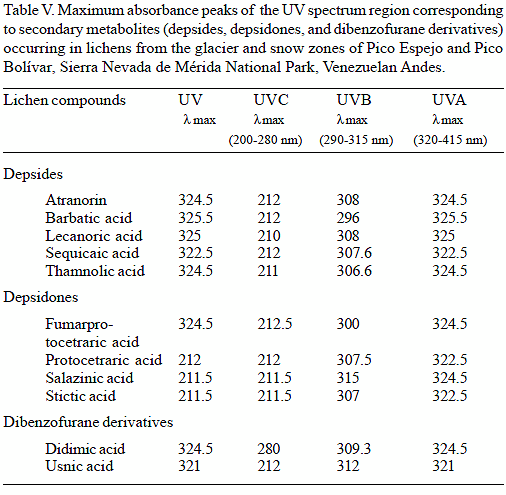
<p ALIGN="justify"><font face="Verdana" size="2">Analyses of the lichen  compounds separated by HPTLC, utilizing blanks identified by FTIR, MS and NMR  spectrometry, revealed the presence of 11 major compounds. Comparisons of the  molar extinction coefficients (&#949;) of lichen compounds showed that the &#946;-orcinol  depsidones have higher absorbance at the UVC region, whereas the orcinol and &#946;-orcinol  depsides (para- or meta) exhibited lower absorbance (<a href="#fig5">Fig. 5</a>).  At the UVB region the depsides exhibited higher absorbance (<a href="#fig6">Fig.  6</a>), whereas at the UVA region thamnolic acid (&#946;-orcinol <i>meta</i>-depside)  and usnic acid (dibenzofurane derivative) showed higher absorbance in comparison  to the depsidones and other depsides that exhibited lower absorbance (<a href="#fig7">Fig.  7</a>). At the biochemically important wavelengths (220, 260 and 280 nm), usnic,  didimic (dibenzofurane derivatives), sequicaic (orcinol <i>meta</i>-depside),  thamnolic (&#946;-orcinol meta-depside), and lecanoric acids (orcinol para-depside)  showed lower e values, whereas salazinic, protocetraric, and stictic acids (&#946;-orcinol  depsidones) exhibited higher e values at the 220 and 260 nm wavelengths, and  barbatic acid (&#946;-orcinol para-depside) at 280 nm (<a href="#tab4">Table IV</a>).  At the full UV spectrum, the lichen compounds showed higher absorbance only at  211, 306 and 324 nm (<a href="#tab5">Table V</a>).</font></p>     <p ALIGN="center"><a name="fig5"> <img border="0" src="/img/fbpe/ern/v20n1/art02fig5.gif" width="508" height="429"></a></p>     
<p ALIGN="center"><a name="fig6"> <img border="0" src="/img/fbpe/ern/v20n1/art02fig6.gif" width="508" height="403"></a></p>     
<p ALIGN="center"><a name="fig7"> <img border="0" src="/img/fbpe/ern/v20n1/art02fig7.gif" width="510" height="359"></a></p>     
<p ALIGN="center"><a name="tab4"> <img border="0" src="/img/fbpe/ern/v20n1/art02tab4.gif" width="509" height="528"></a></p>     
]]></body>
<body><![CDATA[<p ALIGN="center"><a name="tab5"> <img border="0" src="/img/fbpe/ern/v20n1/art02tab5.gif" width="506" height="495"></a></p>     
<p ALIGN="justify"><b><font face="Verdana" size="2">DISCUSSION</font></b></p>     <p ALIGN="justify"><font face="Verdana" size="2">Both effective UVB radiation  and effective global UV radiation, producing responses in plants, revealed  values ~ 1.6 times higher in the glacier and snow zones in comparison to that  registered at sea level. This intensity would be sufficient to produce important  biochemical and cell alterations (Jagger 1985, Feister 1994). Because the Sierra  Nevada de Mérida is located in the tropical region (8° 32’ N), it is expected  that the effective UV radiation reaching the ground would be two and four times  higher during all the year than at latitudes from subtropical regions (Caldwell  et al. 1980, Feister 1994). UVB fluxes reaching the ground in the glacier and  snow zones were similar to those UVB fluxes reaching the ground estimated for  the Mid-Proterozoic atmosphere containing ~ 10<sup>-2</sup> PAL of O<sub>2</sub>  (Segura <i>et al</i>. 2003).</font></p>     <p ALIGN="justify"><font face="Verdana" size="2">On the Earth’s surface, only 4%  of the UVB and 96% of the UVA radiation would penetrate. Although the DNA  absorption spectrum shows major absorbance located at 260 nm, an important  absorption is also observed at the UVB region. UVB irradiance at the Andean high  mountain could be sufficient to generate damages in the lipoproteins of cell  membranes and organelles, and deleterious mutations in DNA, viz. thymine dimers  (Jagger 1985, Cockell and Knowland 1999), if organisms have no efficient UV-screening  strategies. Amino acids, such as tryptophan, tyrosine, and cystine, also have an  important absorbance at the UVC and UVB regions (Jagger 1985). Thus, proteins  constituted by aromatic residues or having disulphur bonds could be susceptible  to structural and functional changes when exposed to intense UV radiation in  tropical mountain environments above 4000 m (Caldwell et al. 1980).</font></p>     <p ALIGN="justify"><font face="Verdana" size="2">However, lichen species exposed  to high UV radiation at this tropical high mountain have UV-screening strategies  based on the synthesis of phenolic secondary metabolites, generated probably  during millions years of evolution. According to Cockell (1998) and Cockell and  Knowland (1999), all the lichensubstance groups studied would have showed  absorption maxima at the UV region depending upon the presence of conjugate  structures having &#960;–electron systems, and causing energetic transitions of &#960;-electrons  to anti-bonding &#960;*- electron orbitals, when they are exposed to UV radiation.  The remarkable capacity of absorbance at the UVB and UVA regions that the lichen  compounds from the Andean glacier and snow zones have, and further, the high  frequency of occurrence of these substances in the lichens studied (96%),  suggest an adequate adaptation to such an environment. On the other hand, the  fact that only 68% of the species are resistant to the UVC radiation would be  expected, because the penetration of this radiation is avoided by the ozone  shield before reaching the ground.</font></p>     <p ALIGN="justify"><font size="2" face="Verdana">Molar extinction coefficients  (&#949;) of the analyzed compounds revealed that the &#946;-orcinol depsidones have higher  absorbance at the UVC region whereas the orcinol and &#946;-orcinol, depsides and  dibenzofurane derivatives, showed lower absorbance in that UV spectrum region.  Depsidones are constituted of two acetate-polymalonate-derived phenolic acid  units linked by an ester bond between the 4' and 1 positions of both phenolic  units, and generally by an ether bond between the 2 and 5' positions, whereas  the depsides have the same ester bond only between the 4' and 1 positions of  both phenolic units (Culberson 1969). Both depsides and depsidones are  considered products of orsellinic acid-type cyclization unique to lichens (Marcano  1994, Huneck and Yoshimura 1996). On the other hand, dibenzofurane derivatives  are constituted of two such acetate polymalonate-derived phenolic acid units  linked by an ether bond and a carboncarbon bond, and are considered products  either of orsellinic acid-type cyclization (didimic acid) or phloroglucinol-type  cyclization (usnic acid). These compounds are unknown in non-lichen-forming  fungi and appear to be extremely rare in all living systems (Culberson 1969).</font></p>     <p ALIGN="justify"><font size="2" face="Verdana">According to Sala and Sargent  (1981), and Rogers (1989), there is strong evidence that &#946;-orcinol depsidones  were derived not from para-depsides by oxidation, but by acylation of one  orsellinic acid with another, followed by intramolecular rearrangements. Thus,  this substance group could be considered as old or older than depsides. The  presence of ether bonds in esterified compounds, such as &#946;-orcinol depsidones,  is related to the capacity to absorb significantly UVC radiation. These  substances could have been originated ~ 2 billions years ago before the  formation of the ozone shield (Kasting 1987, Cockell 2000a). On the other hand,  in carbonaceous meteorites (e.g. Murchison) there is evidence for the existence  of phenolic carboxylic acid and dibenzofurane derivatives similar to those  occurring in lichens (Hayatsu <i>et al</i>. 1980). These substances would be  synthesized abiogenically by Fischer-Tropsch-type reactions during the solar  nebula formation, or by other processes (Pizzarello 2004). However, both  observations could suggest the old age of these compounds and the possibility of  the occurrence of life forms based on similar UV-screening strategies in  terrestrial environments exposed to intense UV radiation.</font></p>     <p ALIGN="justify"><b><font size="2" face="Verdana">CONCLUSIONS</font></b></p>     <p ALIGN="justify"><font size="2" face="Verdana">In this work, we have attempted  to demonstrate that phenolic carboxylic acid derivatives have the capacity to  screen out UV radiation, and thereby, to avoid the lethal effects that such  radiation could cause in organisms exposed at high elevations. Among the species  studied, 96-100% showed a high absorbance of UVB and UVA radiation, whereas 68%  showed a high absorbance of UVC radiation. Lichen capacity to synthesize  phenolic compounds having electronic transitions &#960; to &#960;* could be considered a  success for colonizing the high-UV, tropical high mountain glacier and snow  zones.</font></p>     <p ALIGN="justify"><font size="2" face="Verdana">Phenolic substances presenting  a high resistance to UVA radiation are characterized by ester bonds among both  phenolic units (depsides). These substances constitute the more abundant  products found in lichens. Compounds presenting both ester and ether bonds among  both phenolic units (depsidones), and absorbing UVC radiation, could have been  originated probably before the Proterozoic and Phanerozoic, when the ozone  shield was not fully formed. The relative low frequency of depsidones in lichens  could suggest a reduced UVscreening role nowadays due to the existence of the  ozone shield. Finally, it is important to point out that the data obtained in  this study are from a region of the Earth having «very extreme» bioclimatic  conditions due to the effects of the latitude on the daily surface thermal  oscillations, and to the altitudinal effects on the O<sub>2</sub>, CO<sub>2</sub>,  and N<sub>2</sub> partial pressures, and on surface temperatures.</font></p>     ]]></body>
<body><![CDATA[<p ALIGN="justify"><b><font size="2" face="Verdana">ACKNOWLEDGEMENTS</font></b></p>     <p ALIGN="justify"><font size="2" face="Verdana">The authors wish to thank the  Cable Railway System of Mérida for their assistance to access Pico Espejo  Station during several years. This work was supported by a Grant-in-Aid from  CDCHT (M-790-04) of the University of the Andes, NASA Ames Research Center, USA,  and Institute of Nuclear Sciences of the UNAM, México.</font></p>     <p ALIGN="justify"><b><font size="2" face="Verdana">REFERENCES</font></b></p>     <!-- ref --><p ALIGN="justify"><font size="2" face="Verdana">1. Arup, U., S. Ekman, L.  Lindblom and J.E. Mattson. 1993. High performance thin layer chromatography,  HPTLC, an advanced method for screening lichen substances. Lichenologist 25:  61-71.</font>&nbsp;&nbsp;&nbsp;&nbsp;&nbsp;&nbsp;&nbsp;&nbsp;[&#160;<a href="javascript:void(0);" onclick="javascript: window.open('/scielo.php?script=sci_nlinks&ref=2878748&pid=S0252-8274201000010000200001&lng=','','width=640,height=500,resizable=yes,scrollbars=1,menubar=yes,');">Links</a>&#160;]<!-- end-ref --><!-- ref --><p ALIGN="justify"><font size="2" face="Verdana">2. Azócar, A. y M. Monasterio.  1980. Caracterización ecológica del clima en el páramo de Mucubají. In: M.  Monasterio (Ed.). Estudios ecológicos en los páramos andinos. 207-223. Ediciones  de la Universidad de Los Andes, Mérida. 312 p.</font>&nbsp;&nbsp;&nbsp;&nbsp;&nbsp;&nbsp;&nbsp;&nbsp;[&#160;<a href="javascript:void(0);" onclick="javascript: window.open('/scielo.php?script=sci_nlinks&ref=2878749&pid=S0252-8274201000010000200002&lng=','','width=640,height=500,resizable=yes,scrollbars=1,menubar=yes,');">Links</a>&#160;]<!-- end-ref --><!-- ref --><p ALIGN="justify"><font size="2" face="Verdana">3. Bacherau, F. and J. Asta.  1997. Effects of solar ultraviolet radiation at high altitude on the physiology  and the biochemistry of a terricolous lichen (Cetraria islandica L.). Symbiosis  23: 197-217.</font>&nbsp;&nbsp;&nbsp;&nbsp;&nbsp;&nbsp;&nbsp;&nbsp;[&#160;<a href="javascript:void(0);" onclick="javascript: window.open('/scielo.php?script=sci_nlinks&ref=2878750&pid=S0252-8274201000010000200003&lng=','','width=640,height=500,resizable=yes,scrollbars=1,menubar=yes,');">Links</a>&#160;]<!-- end-ref --><!-- ref --><p ALIGN="justify"><font size="2" face="Verdana">4. Bjerke, J.W., K. Lerfall and  A. Elvebbakk. 2002. Effects of ultraviolet radiation and PAR on the content of  usnic and divaricatic acids in two arcticalpine lichens. Photochem. Photobiol.  Sci. 1: 678-685.</font>&nbsp;&nbsp;&nbsp;&nbsp;&nbsp;&nbsp;&nbsp;&nbsp;[&#160;<a href="javascript:void(0);" onclick="javascript: window.open('/scielo.php?script=sci_nlinks&ref=2878751&pid=S0252-8274201000010000200004&lng=','','width=640,height=500,resizable=yes,scrollbars=1,menubar=yes,');">Links</a>&#160;]<!-- end-ref --><!-- ref --><p ALIGN="justify"><font size="2" face="Verdana">5. Budel, B., U. Karsten and F.  Garcia-Pichel. 1997. Ultraviolet-absorbing scytonemin and mycosporine-like amino  acid derivatives in exposed, rockinhabiting cyanobacterial lichens. Oecologia  112: 165-172.</font>&nbsp;&nbsp;&nbsp;&nbsp;&nbsp;&nbsp;&nbsp;&nbsp;[&#160;<a href="javascript:void(0);" onclick="javascript: window.open('/scielo.php?script=sci_nlinks&ref=2878752&pid=S0252-8274201000010000200005&lng=','','width=640,height=500,resizable=yes,scrollbars=1,menubar=yes,');">Links</a>&#160;]<!-- end-ref --><!-- ref --><p ALIGN="justify"><font size="2" face="Verdana">6. Caldwell, M., M.R.  Robberecht and W. Billings. 1980. A steep latitudinal gradient of solar  ultraviolet-B radiation in the arctic-alpine life zone. Ecology 61: 600-611.</font>&nbsp;&nbsp;&nbsp;&nbsp;&nbsp;&nbsp;&nbsp;&nbsp;[&#160;<a href="javascript:void(0);" onclick="javascript: window.open('/scielo.php?script=sci_nlinks&ref=2878753&pid=S0252-8274201000010000200006&lng=','','width=640,height=500,resizable=yes,scrollbars=1,menubar=yes,');">Links</a>&#160;]<!-- end-ref --><!-- ref --><p ALIGN="justify"><font size="2" face="Verdana">7. Cockell, C.S. 1998. UV  radiation, evolution and p-electron system. Biol. J. Linn. Soc. 63: 449-457.</font>&nbsp;&nbsp;&nbsp;&nbsp;&nbsp;&nbsp;&nbsp;&nbsp;[&#160;<a href="javascript:void(0);" onclick="javascript: window.open('/scielo.php?script=sci_nlinks&ref=2878754&pid=S0252-8274201000010000200007&lng=','','width=640,height=500,resizable=yes,scrollbars=1,menubar=yes,');">Links</a>&#160;]<!-- end-ref --><!-- ref --><p ALIGN="justify"><font size="2" face="Verdana">8. Cockell, C.S. 2000a. The  ultraviolet history of the terrestrial planets: Implications for biological  evolution. Planet. Space Sci. 48: 203-214. </font>&nbsp;&nbsp;&nbsp;&nbsp;&nbsp;&nbsp;&nbsp;&nbsp;[&#160;<a href="javascript:void(0);" onclick="javascript: window.open('/scielo.php?script=sci_nlinks&ref=2878755&pid=S0252-8274201000010000200008&lng=','','width=640,height=500,resizable=yes,scrollbars=1,menubar=yes,');">Links</a>&#160;]<!-- end-ref --><!-- ref --><p ALIGN="justify"><font size="2" face="Verdana">9. Cockell, C.S. 2000b.  Ultraviolet radiation and the photobiology of earth’s early oceans. Orig. Life  Evol. Biosph. 30: 467-499.</font>&nbsp;&nbsp;&nbsp;&nbsp;&nbsp;&nbsp;&nbsp;&nbsp;[&#160;<a href="javascript:void(0);" onclick="javascript: window.open('/scielo.php?script=sci_nlinks&ref=2878756&pid=S0252-8274201000010000200009&lng=','','width=640,height=500,resizable=yes,scrollbars=1,menubar=yes,');">Links</a>&#160;]<!-- end-ref --><!-- ref --><p ALIGN="justify"><font size="2" face="Verdana">10. Cockell, C.S. 2002.  Photobiology uncertainties in the Archean and post-Archean world. International  J. Astrobiology 1: 31-38.</font>&nbsp;&nbsp;&nbsp;&nbsp;&nbsp;&nbsp;&nbsp;&nbsp;[&#160;<a href="javascript:void(0);" onclick="javascript: window.open('/scielo.php?script=sci_nlinks&ref=2878757&pid=S0252-8274201000010000200010&lng=','','width=640,height=500,resizable=yes,scrollbars=1,menubar=yes,');">Links</a>&#160;]<!-- end-ref --><!-- ref --><p ALIGN="justify"><font size="2" face="Verdana">11. Cockell, C.S. and G.  Horneck. 2001. The history of the UV radiation climate of the Earth –  theoretical and space-based observations. Photochem. Photobiol. 73: 447-451.</font>&nbsp;&nbsp;&nbsp;&nbsp;&nbsp;&nbsp;&nbsp;&nbsp;[&#160;<a href="javascript:void(0);" onclick="javascript: window.open('/scielo.php?script=sci_nlinks&ref=2878758&pid=S0252-8274201000010000200011&lng=','','width=640,height=500,resizable=yes,scrollbars=1,menubar=yes,');">Links</a>&#160;]<!-- end-ref --><!-- ref --><p ALIGN="justify"><font size="2" face="Verdana">12. Cockell, C.S. and J.K.  Knowland. 1999. Ultraviolet radiation screening compounds. Biol. Rev. 74:  311-345.</font>&nbsp;&nbsp;&nbsp;&nbsp;&nbsp;&nbsp;&nbsp;&nbsp;[&#160;<a href="javascript:void(0);" onclick="javascript: window.open('/scielo.php?script=sci_nlinks&ref=2878759&pid=S0252-8274201000010000200012&lng=','','width=640,height=500,resizable=yes,scrollbars=1,menubar=yes,');">Links</a>&#160;]<!-- end-ref --><!-- ref --><p ALIGN="justify"><font size="2" face="Verdana">13. Culberson, C.F. 1969.  Chemical and botanical guide to lichen products. University of North Carolina  Press, Chape Hill, USA. 628 p.</font>&nbsp;&nbsp;&nbsp;&nbsp;&nbsp;&nbsp;&nbsp;&nbsp;[&#160;<a href="javascript:void(0);" onclick="javascript: window.open('/scielo.php?script=sci_nlinks&ref=2878760&pid=S0252-8274201000010000200013&lng=','','width=640,height=500,resizable=yes,scrollbars=1,menubar=yes,');">Links</a>&#160;]<!-- end-ref --><!-- ref --><p ALIGN="justify"><font size="2" face="Verdana">14. Culberson, C.F. 1972.  Improved conditions and new data for the identification of lichen products by a  standard thin-layer chromatographic method. J. Chromatogr. 72: 113-377.</font>&nbsp;&nbsp;&nbsp;&nbsp;&nbsp;&nbsp;&nbsp;&nbsp;[&#160;<a href="javascript:void(0);" onclick="javascript: window.open('/scielo.php?script=sci_nlinks&ref=2878761&pid=S0252-8274201000010000200014&lng=','','width=640,height=500,resizable=yes,scrollbars=1,menubar=yes,');">Links</a>&#160;]<!-- end-ref --><!-- ref --><p ALIGN="justify"><font size="2" face="Verdana">15. Culberson, C.F. and A.  Johnson. 1976. A standardized two-dimensional thinlayer chromatographic method  for lichen products. J. Chromatogr. 128: 253-259.</font>&nbsp;&nbsp;&nbsp;&nbsp;&nbsp;&nbsp;&nbsp;&nbsp;[&#160;<a href="javascript:void(0);" onclick="javascript: window.open('/scielo.php?script=sci_nlinks&ref=2878762&pid=S0252-8274201000010000200015&lng=','','width=640,height=500,resizable=yes,scrollbars=1,menubar=yes,');">Links</a>&#160;]<!-- end-ref --><!-- ref --><p ALIGN="justify"><font size="2" face="Verdana">16. Culberson, C.F., W.L.  Culberson and A. Johnson. 1981. A standardized TLC analysis of ß-orcinol  depsidones. Bryologist 84: 16-29.</font>&nbsp;&nbsp;&nbsp;&nbsp;&nbsp;&nbsp;&nbsp;&nbsp;[&#160;<a href="javascript:void(0);" onclick="javascript: window.open('/scielo.php?script=sci_nlinks&ref=2878763&pid=S0252-8274201000010000200016&lng=','','width=640,height=500,resizable=yes,scrollbars=1,menubar=yes,');">Links</a>&#160;]<!-- end-ref --><!-- ref --><p ALIGN="justify"><font size="2" face="Verdana">17. De Vera, J.P., G. Horneck,  P. Rettberg and S. Ott. 2003. The potential of the lichen symbiosis to cope with  extreme conditions of outer space – I. Influence of UV radiation and space  vacuum on the vitality of lichen symbiosis and germination capacity. Int. J.  Astrobiology 1: 234-242.</font>&nbsp;&nbsp;&nbsp;&nbsp;&nbsp;&nbsp;&nbsp;&nbsp;[&#160;<a href="javascript:void(0);" onclick="javascript: window.open('/scielo.php?script=sci_nlinks&ref=2878764&pid=S0252-8274201000010000200017&lng=','','width=640,height=500,resizable=yes,scrollbars=1,menubar=yes,');">Links</a>&#160;]<!-- end-ref --><!-- ref --><p ALIGN="justify"><font size="2" face="Verdana">18. Diaz, A., J. Péfaur and P.  Durant. 1997. Ecology of South American páramos with emphasis on the fauna of  the Venezuelan páramos. In: F E. Wielgolaski (Ed.). Polar and alpine tundra,  ecosystem of the world. 263- 310. Elsevier, Amsterdam, Holanda. 348 p.</font>&nbsp;&nbsp;&nbsp;&nbsp;&nbsp;&nbsp;&nbsp;&nbsp;[&#160;<a href="javascript:void(0);" onclick="javascript: window.open('/scielo.php?script=sci_nlinks&ref=2878765&pid=S0252-8274201000010000200018&lng=','','width=640,height=500,resizable=yes,scrollbars=1,menubar=yes,');">Links</a>&#160;]<!-- end-ref --><!-- ref --><p ALIGN="justify"><font size="2" face="Verdana">19. Dvorkin, A.Y. and E.H.  Steinberger. 1999. Modeling the altitude effect on solar UV radiation. Solar  Energy 65: 181-187.</font>&nbsp;&nbsp;&nbsp;&nbsp;&nbsp;&nbsp;&nbsp;&nbsp;[&#160;<a href="javascript:void(0);" onclick="javascript: window.open('/scielo.php?script=sci_nlinks&ref=2878766&pid=S0252-8274201000010000200019&lng=','','width=640,height=500,resizable=yes,scrollbars=1,menubar=yes,');">Links</a>&#160;]<!-- end-ref --><!-- ref --><p ALIGN="justify"><font size="2" face="Verdana">20. Edwards, H.G.M. 2004. Raman  spectroscopic protocol for the molecular recognition of key biomarkers in  astrobiological recognition. Orig. Life Evol. Biosph. 34: 3-11.</font>&nbsp;&nbsp;&nbsp;&nbsp;&nbsp;&nbsp;&nbsp;&nbsp;[&#160;<a href="javascript:void(0);" onclick="javascript: window.open('/scielo.php?script=sci_nlinks&ref=2878767&pid=S0252-8274201000010000200020&lng=','','width=640,height=500,resizable=yes,scrollbars=1,menubar=yes,');">Links</a>&#160;]<!-- end-ref --><!-- ref --><p ALIGN="justify"><font size="2" face="Verdana">21. Feister, U. 1994. Model  calculations and measurements of chemically and biologically effective UV  radiation reaching the ground. Ber. Dt. Wetterd. 190: 1-79.</font>&nbsp;&nbsp;&nbsp;&nbsp;&nbsp;&nbsp;&nbsp;&nbsp;[&#160;<a href="javascript:void(0);" onclick="javascript: window.open('/scielo.php?script=sci_nlinks&ref=2878768&pid=S0252-8274201000010000200021&lng=','','width=640,height=500,resizable=yes,scrollbars=1,menubar=yes,');">Links</a>&#160;]<!-- end-ref --><!-- ref --><p ALIGN="justify"><font size="2" face="Verdana">22. Friedmann, E.I. 1982.  Endolithic microorganisms in the Antarctic cold desert. Science 215: 1045-1053.</font>&nbsp;&nbsp;&nbsp;&nbsp;&nbsp;&nbsp;&nbsp;&nbsp;[&#160;<a href="javascript:void(0);" onclick="javascript: window.open('/scielo.php?script=sci_nlinks&ref=2878769&pid=S0252-8274201000010000200022&lng=','','width=640,height=500,resizable=yes,scrollbars=1,menubar=yes,');">Links</a>&#160;]<!-- end-ref --><!-- ref --><p ALIGN="justify"><font size="2" face="Verdana">23. Garcia-Pichel, F. 1998.  Solar ultraviolet and the evolutionary history of cyanobacteria. Orig. Life Evol.  Biosph. 28: 321-347.</font>&nbsp;&nbsp;&nbsp;&nbsp;&nbsp;&nbsp;&nbsp;&nbsp;[&#160;<a href="javascript:void(0);" onclick="javascript: window.open('/scielo.php?script=sci_nlinks&ref=2878770&pid=S0252-8274201000010000200023&lng=','','width=640,height=500,resizable=yes,scrollbars=1,menubar=yes,');">Links</a>&#160;]<!-- end-ref --><!-- ref --><p ALIGN="justify"><font size="2" face="Verdana">24. Garcia-Pichel, F. and R.W.  Castenholz. 1991. Occurrence of UV-absorbing, mycosporine-like compounds among  cyanobacterial isolates and an estimate of their screening capacity. Appl.  Environ. Microbiol. 59: 163- 169.</font>&nbsp;&nbsp;&nbsp;&nbsp;&nbsp;&nbsp;&nbsp;&nbsp;[&#160;<a href="javascript:void(0);" onclick="javascript: window.open('/scielo.php?script=sci_nlinks&ref=2878771&pid=S0252-8274201000010000200024&lng=','','width=640,height=500,resizable=yes,scrollbars=1,menubar=yes,');">Links</a>&#160;]<!-- end-ref --><!-- ref --><p ALIGN="justify"><font size="2" face="Verdana">25. George, A.L., A.W. Murray  and P. Montiel. 2001. Tolerance of Antarctic cyanobacterial mats to enhanced UV  radiation. Fems Microbiol. Ecol. 37: 91-101.</font>&nbsp;&nbsp;&nbsp;&nbsp;&nbsp;&nbsp;&nbsp;&nbsp;[&#160;<a href="javascript:void(0);" onclick="javascript: window.open('/scielo.php?script=sci_nlinks&ref=2878772&pid=S0252-8274201000010000200025&lng=','','width=640,height=500,resizable=yes,scrollbars=1,menubar=yes,');">Links</a>&#160;]<!-- end-ref --><!-- ref --><p ALIGN="justify"><font size="2" face="Verdana">26. Hallbauer, D.K. and K.T.  van Warmelo. 1974. Fossilized plants in thucholite from Precambrian rocks of the  Witwatersrand, South Africa. Precambrian Res. 1: 199-212.</font>&nbsp;&nbsp;&nbsp;&nbsp;&nbsp;&nbsp;&nbsp;&nbsp;[&#160;<a href="javascript:void(0);" onclick="javascript: window.open('/scielo.php?script=sci_nlinks&ref=2878773&pid=S0252-8274201000010000200026&lng=','','width=640,height=500,resizable=yes,scrollbars=1,menubar=yes,');">Links</a>&#160;]<!-- end-ref --><!-- ref --><p ALIGN="justify"><font size="2" face="Verdana">27. Harborne, J.B. 1968.  Biochemistry of phenolic compounds. Academic Press, New York, USA. 429 p.</font>&nbsp;&nbsp;&nbsp;&nbsp;&nbsp;&nbsp;&nbsp;&nbsp;[&#160;<a href="javascript:void(0);" onclick="javascript: window.open('/scielo.php?script=sci_nlinks&ref=2878774&pid=S0252-8274201000010000200027&lng=','','width=640,height=500,resizable=yes,scrollbars=1,menubar=yes,');">Links</a>&#160;]<!-- end-ref --><!-- ref --><p ALIGN="justify"><font size="2" face="Verdana">28. Hayatsu, R., R.E. Winans,  R. Scott, R.L. McBeth, L P. Moore and M.H. Studier. 1980. Phenolic ethers in the  organic polymer of the Murchison meteorite. Science 207: 1202-1204.</font>&nbsp;&nbsp;&nbsp;&nbsp;&nbsp;&nbsp;&nbsp;&nbsp;[&#160;<a href="javascript:void(0);" onclick="javascript: window.open('/scielo.php?script=sci_nlinks&ref=2878775&pid=S0252-8274201000010000200028&lng=','','width=640,height=500,resizable=yes,scrollbars=1,menubar=yes,');">Links</a>&#160;]<!-- end-ref --><!-- ref --><p ALIGN="justify"><font size="2" face="Verdana">29. Huneck, S. and I. Yoshimura.  1996. Identification of lichen substances. Springer- Verlag, Berlin, Germany.  216 p.</font>&nbsp;&nbsp;&nbsp;&nbsp;&nbsp;&nbsp;&nbsp;&nbsp;[&#160;<a href="javascript:void(0);" onclick="javascript: window.open('/scielo.php?script=sci_nlinks&ref=2878776&pid=S0252-8274201000010000200029&lng=','','width=640,height=500,resizable=yes,scrollbars=1,menubar=yes,');">Links</a>&#160;]<!-- end-ref --><!-- ref --><p ALIGN="justify"><font size="2" face="Verdana">30. Jagger, J. 1985. Solar-UV  actions on living cells. Praeger Scientific, New York, USA. 185 p.</font>&nbsp;&nbsp;&nbsp;&nbsp;&nbsp;&nbsp;&nbsp;&nbsp;[&#160;<a href="javascript:void(0);" onclick="javascript: window.open('/scielo.php?script=sci_nlinks&ref=2878777&pid=S0252-8274201000010000200030&lng=','','width=640,height=500,resizable=yes,scrollbars=1,menubar=yes,');">Links</a>&#160;]<!-- end-ref --><!-- ref --><p ALIGN="justify"><font face="Verdana" size="2">31. Kappen, L. 1973. Response  to extreme environments. In: Ahmadjian V. and M.E. Hale (Eds.). The Lichens.  311-380. Academic Press, London, England. 416 p.</font>&nbsp;&nbsp;&nbsp;&nbsp;&nbsp;&nbsp;&nbsp;&nbsp;[&#160;<a href="javascript:void(0);" onclick="javascript: window.open('/scielo.php?script=sci_nlinks&ref=2878778&pid=S0252-8274201000010000200031&lng=','','width=640,height=500,resizable=yes,scrollbars=1,menubar=yes,');">Links</a>&#160;]<!-- end-ref --><!-- ref --><p ALIGN="justify"><font size="2" face="Verdana">32. Kappen, L. 1993. Lichens in  the Antarctic region. In: Friedmann, E.I. (Ed.). Antarctic microbiology.  433-490. Wiley-Liss. New York, USA. 367 p.</font>&nbsp;&nbsp;&nbsp;&nbsp;&nbsp;&nbsp;&nbsp;&nbsp;[&#160;<a href="javascript:void(0);" onclick="javascript: window.open('/scielo.php?script=sci_nlinks&ref=2878779&pid=S0252-8274201000010000200032&lng=','','width=640,height=500,resizable=yes,scrollbars=1,menubar=yes,');">Links</a>&#160;]<!-- end-ref --><!-- ref --><p ALIGN="justify"><font size="2" face="Verdana">33. Kasting, J.F. 1987.  Theoretical constraints on oxygen and carbon dioxide concentrations in the  Precambrian atmosphere. Precambrian Res. 34: 205-229.</font>&nbsp;&nbsp;&nbsp;&nbsp;&nbsp;&nbsp;&nbsp;&nbsp;[&#160;<a href="javascript:void(0);" onclick="javascript: window.open('/scielo.php?script=sci_nlinks&ref=2878780&pid=S0252-8274201000010000200033&lng=','','width=640,height=500,resizable=yes,scrollbars=1,menubar=yes,');">Links</a>&#160;]<!-- end-ref --><!-- ref --><p ALIGN="justify"><font size="2" face="Verdana">34. Kauppi, M. and K. Verseghy-Patay.  1990. Determination of the distribution of lichen substances in the thallus by  fluorescence microscopy. Ann. Bot. Fenn. 27: 189-202.</font>&nbsp;&nbsp;&nbsp;&nbsp;&nbsp;&nbsp;&nbsp;&nbsp;[&#160;<a href="javascript:void(0);" onclick="javascript: window.open('/scielo.php?script=sci_nlinks&ref=2878781&pid=S0252-8274201000010000200034&lng=','','width=640,height=500,resizable=yes,scrollbars=1,menubar=yes,');">Links</a>&#160;]<!-- end-ref --><!-- ref --><p ALIGN="justify"><font size="2" face="Verdana">35. Madronich, S., E.  Weatherhead and S. J. Flocke. 1996. Trends in UV radiation. In: Bowman K. and S.  El-Sayed (Eds.). Special issue on stratospheric ozone depletion. Inter. J.  Environm. Studies 51: 183-198.</font>&nbsp;&nbsp;&nbsp;&nbsp;&nbsp;&nbsp;&nbsp;&nbsp;[&#160;<a href="javascript:void(0);" onclick="javascript: window.open('/scielo.php?script=sci_nlinks&ref=2878782&pid=S0252-8274201000010000200035&lng=','','width=640,height=500,resizable=yes,scrollbars=1,menubar=yes,');">Links</a>&#160;]<!-- end-ref --><!-- ref --><p ALIGN="justify"><font size="2" face="Verdana">36. Mancinelli, R.L. and M.R.  White. 2000. Inhibition of denitrification by ultraviolet radiation. Adv. Space  Res. 26: 2041-2046.</font>&nbsp;&nbsp;&nbsp;&nbsp;&nbsp;&nbsp;&nbsp;&nbsp;[&#160;<a href="javascript:void(0);" onclick="javascript: window.open('/scielo.php?script=sci_nlinks&ref=2878783&pid=S0252-8274201000010000200036&lng=','','width=640,height=500,resizable=yes,scrollbars=1,menubar=yes,');">Links</a>&#160;]<!-- end-ref --><!-- ref --><p ALIGN="justify"><font size="2" face="Verdana">37. Marcano, V. 1994.  Introduction to study of Venezuelan Andean lichens, Vol I. Koeltz Scientific  Books, Stuttgart, Germany. 338 p.</font>&nbsp;&nbsp;&nbsp;&nbsp;&nbsp;&nbsp;&nbsp;&nbsp;[&#160;<a href="javascript:void(0);" onclick="javascript: window.open('/scielo.php?script=sci_nlinks&ref=2878784&pid=S0252-8274201000010000200037&lng=','','width=640,height=500,resizable=yes,scrollbars=1,menubar=yes,');">Links</a>&#160;]<!-- end-ref --><!-- ref --><p ALIGN="justify"><font size="2" face="Verdana">38. Marcano, V. and A. Morales.  1994a. The Alectoria Ach. genus (Lichenized Ascomycetes) in the Venezuelan  Andes. Ernstia 4: 89-100.</font>&nbsp;&nbsp;&nbsp;&nbsp;&nbsp;&nbsp;&nbsp;&nbsp;[&#160;<a href="javascript:void(0);" onclick="javascript: window.open('/scielo.php?script=sci_nlinks&ref=2878785&pid=S0252-8274201000010000200038&lng=','','width=640,height=500,resizable=yes,scrollbars=1,menubar=yes,');">Links</a>&#160;]<!-- end-ref --><!-- ref --><p ALIGN="justify"><font size="2" face="Verdana">39. Marcano, V. and A. Morales.  1994b. New species of Ramalina from Venezuela. Bryologist 97: 26-33.</font>&nbsp;&nbsp;&nbsp;&nbsp;&nbsp;&nbsp;&nbsp;&nbsp;[&#160;<a href="javascript:void(0);" onclick="javascript: window.open('/scielo.php?script=sci_nlinks&ref=2878786&pid=S0252-8274201000010000200039&lng=','','width=640,height=500,resizable=yes,scrollbars=1,menubar=yes,');">Links</a>&#160;]<!-- end-ref --><!-- ref --><p ALIGN="justify"><font size="2" face="Verdana">40. Marcano, V. and A. Morales.  1995. Revision of Umbilicaria genus (Lichenized Ascomycetes) in the Venezuelan  Andes. Ernstia 4: 21-35.</font>&nbsp;&nbsp;&nbsp;&nbsp;&nbsp;&nbsp;&nbsp;&nbsp;[&#160;<a href="javascript:void(0);" onclick="javascript: window.open('/scielo.php?script=sci_nlinks&ref=2878787&pid=S0252-8274201000010000200040&lng=','','width=640,height=500,resizable=yes,scrollbars=1,menubar=yes,');">Links</a>&#160;]<!-- end-ref --><!-- ref --><p ALIGN="justify"><font size="2" face="Verdana">41. Marcano, V., A. Morales, H.  Sipman and L. Calderón. 1996. A first checklist of the lichen-forming fungi of  the Venezuelan Andes. Trop. Bryo. 12: 193-235.</font>&nbsp;&nbsp;&nbsp;&nbsp;&nbsp;&nbsp;&nbsp;&nbsp;[&#160;<a href="javascript:void(0);" onclick="javascript: window.open('/scielo.php?script=sci_nlinks&ref=2878788&pid=S0252-8274201000010000200041&lng=','','width=640,height=500,resizable=yes,scrollbars=1,menubar=yes,');">Links</a>&#160;]<!-- end-ref --><!-- ref --><p ALIGN="justify"><font size="2" face="Verdana">42. Marcano, V., L. Galiz, S.  Mohali, A. Morales and E. Palacios. 1997. Revision of Leprocaulon Nyl. ex Lamy  genus (Lichenes Imperfecti) in Venezuela. Trop. Bryo. 13: 47-56.</font>&nbsp;&nbsp;&nbsp;&nbsp;&nbsp;&nbsp;&nbsp;&nbsp;[&#160;<a href="javascript:void(0);" onclick="javascript: window.open('/scielo.php?script=sci_nlinks&ref=2878789&pid=S0252-8274201000010000200042&lng=','','width=640,height=500,resizable=yes,scrollbars=1,menubar=yes,');">Links</a>&#160;]<!-- end-ref --><!-- ref --><p ALIGN="justify"><font size="2" face="Verdana">43. Marcano, V., A. Morales and  V. Rodríguez. 1999. Occurrence of usnic acid in Usnea laevis Nylander (Lichenized  Ascomycetes) from the Venezuelan Andes. J. Ethnopharmacol. 66: 343-346.</font>&nbsp;&nbsp;&nbsp;&nbsp;&nbsp;&nbsp;&nbsp;&nbsp;[&#160;<a href="javascript:void(0);" onclick="javascript: window.open('/scielo.php?script=sci_nlinks&ref=2878790&pid=S0252-8274201000010000200043&lng=','','width=640,height=500,resizable=yes,scrollbars=1,menubar=yes,');">Links</a>&#160;]<!-- end-ref --><!-- ref --><p ALIGN="justify"><font size="2" face="Verdana">44. Marcano, V., P. Benitez and  E. Palacios-Prü. 2001. Adaptative response of a fungus species to hydrocarbon  environments: Results from experiments in laboratory. In: Chela-Flores, J., T.  Owen and F. Raulin (Eds.). First steps in the origin of life in the Universe.  247-250. Kluwer Academic Publishing, Dordrecht, The Netherlands. 428 p.</font>&nbsp;&nbsp;&nbsp;&nbsp;&nbsp;&nbsp;&nbsp;&nbsp;[&#160;<a href="javascript:void(0);" onclick="javascript: window.open('/scielo.php?script=sci_nlinks&ref=2878791&pid=S0252-8274201000010000200044&lng=','','width=640,height=500,resizable=yes,scrollbars=1,menubar=yes,');">Links</a>&#160;]<!-- end-ref --><!-- ref --><p ALIGN="justify"><font size="2" face="Verdana">45. Marcano, V., P. Benitez. and  E. Palacios-Prü. 2002a. Growth of al ower eukaryote in non-aromatic hydrocarbon  media ³C12 and its exobiological significance. Planet. Space Sci. 50: 693-709.</font>&nbsp;&nbsp;&nbsp;&nbsp;&nbsp;&nbsp;&nbsp;&nbsp;[&#160;<a href="javascript:void(0);" onclick="javascript: window.open('/scielo.php?script=sci_nlinks&ref=2878792&pid=S0252-8274201000010000200045&lng=','','width=640,height=500,resizable=yes,scrollbars=1,menubar=yes,');">Links</a>&#160;]<!-- end-ref --><!-- ref --><p ALIGN="justify"><font size="2" face="Verdana">46. Marcano, V., P. Benitez,  and E. Palacios-Prü. 2002b. Ecophysiological responses of a Fusarium species  grown in non-hydrocarbon media ³C12. Rev. Ecol. Latinoameric. 8: 25-43.</font>&nbsp;&nbsp;&nbsp;&nbsp;&nbsp;&nbsp;&nbsp;&nbsp;[&#160;<a href="javascript:void(0);" onclick="javascript: window.open('/scielo.php?script=sci_nlinks&ref=2878793&pid=S0252-8274201000010000200046&lng=','','width=640,height=500,resizable=yes,scrollbars=1,menubar=yes,');">Links</a>&#160;]<!-- end-ref --><!-- ref --><p ALIGN="justify"><font size="2" face="Verdana">47. Marcano, V., P. Matheus, A.  Balza, F.J. Durán, C.P. McKay, R. Navarro- González, D. Davila, W. Davis and E.  Palacios-Pru. 2003. Tropical Andean ecosystems as models for extrasolar and  solar planetary habitats. Orig. Life Evol. Biosph. 32: 503-505.</font>&nbsp;&nbsp;&nbsp;&nbsp;&nbsp;&nbsp;&nbsp;&nbsp;[&#160;<a href="javascript:void(0);" onclick="javascript: window.open('/scielo.php?script=sci_nlinks&ref=2878794&pid=S0252-8274201000010000200047&lng=','','width=640,height=500,resizable=yes,scrollbars=1,menubar=yes,');">Links</a>&#160;]<!-- end-ref --><!-- ref --><p ALIGN="justify"><font size="2" face="Verdana">48. Marcano, V., P. Benitez, E.  Palacios-Prü. 2006. UV-screening strategies of a lower eukaryote grown in  hydrocarbon media. Orig. Life Evol. Biosph. 36: 65-84.</font>&nbsp;&nbsp;&nbsp;&nbsp;&nbsp;&nbsp;&nbsp;&nbsp;[&#160;<a href="javascript:void(0);" onclick="javascript: window.open('/scielo.php?script=sci_nlinks&ref=2878795&pid=S0252-8274201000010000200048&lng=','','width=640,height=500,resizable=yes,scrollbars=1,menubar=yes,');">Links</a>&#160;]<!-- end-ref --><!-- ref --><p ALIGN="justify"><font size="2" face="Verdana">49. Mietzch. E., T. Lumbsch. and  J. Elix. 1994. Wintabolites (Mactabolites for Windows). Users Manual, Essen. 54  p.</font>&nbsp;&nbsp;&nbsp;&nbsp;&nbsp;&nbsp;&nbsp;&nbsp;[&#160;<a href="javascript:void(0);" onclick="javascript: window.open('/scielo.php?script=sci_nlinks&ref=2878796&pid=S0252-8274201000010000200049&lng=','','width=640,height=500,resizable=yes,scrollbars=1,menubar=yes,');">Links</a>&#160;]<!-- end-ref --><!-- ref --><p ALIGN="justify"><font size="2" face="Verdana">50. Monasterio, M. y S. Reyes.  1980. Diversidad ambiental y variación de la vegetación en los páramos de los  Andes Venezolanos. In: Monasterio M. (Ed.). Estudios ecológicos en los páramos  andinos. 47-91. Ediciones de la Universidad de Los Andes, Mérida. 312 p.</font>&nbsp;&nbsp;&nbsp;&nbsp;&nbsp;&nbsp;&nbsp;&nbsp;[&#160;<a href="javascript:void(0);" onclick="javascript: window.open('/scielo.php?script=sci_nlinks&ref=2878797&pid=S0252-8274201000010000200050&lng=','','width=640,height=500,resizable=yes,scrollbars=1,menubar=yes,');">Links</a>&#160;]<!-- end-ref --><!-- ref --><p ALIGN="justify"><font size="2" face="Verdana">51. Morales, A. and V. Marcano.  1992. Chemical compounds of Ramalina from Western Venezuela. Second  International Lichenological Symposium IAL 2, Båstad, Sweden, Abstracts, 61-62.</font>&nbsp;&nbsp;&nbsp;&nbsp;&nbsp;&nbsp;&nbsp;&nbsp;[&#160;<a href="javascript:void(0);" onclick="javascript: window.open('/scielo.php?script=sci_nlinks&ref=2878798&pid=S0252-8274201000010000200051&lng=','','width=640,height=500,resizable=yes,scrollbars=1,menubar=yes,');">Links</a>&#160;]<!-- end-ref --><!-- ref --><p ALIGN="justify"><font size="2" face="Verdana">52. Morita, R. 1975.  Psychrophilic Bacteria. Bacteriol. Rev. 39: 144-167.</font>&nbsp;&nbsp;&nbsp;&nbsp;&nbsp;&nbsp;&nbsp;&nbsp;[&#160;<a href="javascript:void(0);" onclick="javascript: window.open('/scielo.php?script=sci_nlinks&ref=2878799&pid=S0252-8274201000010000200052&lng=','','width=640,height=500,resizable=yes,scrollbars=1,menubar=yes,');">Links</a>&#160;]<!-- end-ref --><!-- ref --><p ALIGN="justify"><font size="2" face="Verdana">53. Olech, M. 2001. Annotated  checklist of Antarctic lichens and lichenicolous fungi. The Institute of Botany  of the Jagiellonian University, Kraków, 145 p.</font>&nbsp;&nbsp;&nbsp;&nbsp;&nbsp;&nbsp;&nbsp;&nbsp;[&#160;<a href="javascript:void(0);" onclick="javascript: window.open('/scielo.php?script=sci_nlinks&ref=2878800&pid=S0252-8274201000010000200053&lng=','','width=640,height=500,resizable=yes,scrollbars=1,menubar=yes,');">Links</a>&#160;]<!-- end-ref --><!-- ref --><p ALIGN="justify"><font size="2" face="Verdana">54. Onofri, S., L. Selbmann, L.  Zucconi and S. Pagano. 2003. Antarctic microfungi as models for exobiology.  Planet. Space Sci. 52: 229-237.</font>&nbsp;&nbsp;&nbsp;&nbsp;&nbsp;&nbsp;&nbsp;&nbsp;[&#160;<a href="javascript:void(0);" onclick="javascript: window.open('/scielo.php?script=sci_nlinks&ref=2878801&pid=S0252-8274201000010000200054&lng=','','width=640,height=500,resizable=yes,scrollbars=1,menubar=yes,');">Links</a>&#160;]<!-- end-ref --><!-- ref --><p ALIGN="justify"><font size="2" face="Verdana">55. Østedal, D.O. and R.I.  Lewis-Smith. 2001. Lichens of Antarctica and South Georgia. A guide to their  identification and ecology. Cambridge University Press. USA. 411 p.</font>&nbsp;&nbsp;&nbsp;&nbsp;&nbsp;&nbsp;&nbsp;&nbsp;[&#160;<a href="javascript:void(0);" onclick="javascript: window.open('/scielo.php?script=sci_nlinks&ref=2878802&pid=S0252-8274201000010000200055&lng=','','width=640,height=500,resizable=yes,scrollbars=1,menubar=yes,');">Links</a>&#160;]<!-- end-ref --><!-- ref --><p ALIGN="justify"><font size="2" face="Verdana">56. Piazena, H. 1996. The  effect of altitude upon solar UV-B and UV-A irradiance in the tropical Chilean  Andes. Solar Energy 57: 133-140.</font>&nbsp;&nbsp;&nbsp;&nbsp;&nbsp;&nbsp;&nbsp;&nbsp;[&#160;<a href="javascript:void(0);" onclick="javascript: window.open('/scielo.php?script=sci_nlinks&ref=2878803&pid=S0252-8274201000010000200056&lng=','','width=640,height=500,resizable=yes,scrollbars=1,menubar=yes,');">Links</a>&#160;]<!-- end-ref --><!-- ref --><p ALIGN="justify"><font size="2" face="Verdana">57. Pizzarello, S. 2004.  Chemical evolution and meteorites: an update. Orig. Life Evol. Biosph. 34:  25-34.</font>&nbsp;&nbsp;&nbsp;&nbsp;&nbsp;&nbsp;&nbsp;&nbsp;[&#160;<a href="javascript:void(0);" onclick="javascript: window.open('/scielo.php?script=sci_nlinks&ref=2878804&pid=S0252-8274201000010000200057&lng=','','width=640,height=500,resizable=yes,scrollbars=1,menubar=yes,');">Links</a>&#160;]<!-- end-ref --><!-- ref --><p ALIGN="justify"><font size="2" face="Verdana">58. Quesada, A.W. and F.  Vincent. 1997. Strategies of adaptation by Antarctic cyanobacteria to  ultraviolet radiation. Eur. J. Phycology 32: 335-342.</font>&nbsp;&nbsp;&nbsp;&nbsp;&nbsp;&nbsp;&nbsp;&nbsp;[&#160;<a href="javascript:void(0);" onclick="javascript: window.open('/scielo.php?script=sci_nlinks&ref=2878805&pid=S0252-8274201000010000200058&lng=','','width=640,height=500,resizable=yes,scrollbars=1,menubar=yes,');">Links</a>&#160;]<!-- end-ref --><!-- ref --><p ALIGN="justify"><font size="2" face="Verdana">59. Rogers, R.W. 1989. Chemical  variation and the species concept in lichenized ascomycetes. Bot. J. Linn. Soc.  101: 229-339.</font>&nbsp;&nbsp;&nbsp;&nbsp;&nbsp;&nbsp;&nbsp;&nbsp;[&#160;<a href="javascript:void(0);" onclick="javascript: window.open('/scielo.php?script=sci_nlinks&ref=2878806&pid=S0252-8274201000010000200059&lng=','','width=640,height=500,resizable=yes,scrollbars=1,menubar=yes,');">Links</a>&#160;]<!-- end-ref --><!-- ref --><p ALIGN="justify"><font size="2" face="Verdana">60. Rothschild, L.J. and R.L.  Mancinelli. 2002. Life in extreme environments. Nature 409: 1092-1101.</font>&nbsp;&nbsp;&nbsp;&nbsp;&nbsp;&nbsp;&nbsp;&nbsp;[&#160;<a href="javascript:void(0);" onclick="javascript: window.open('/scielo.php?script=sci_nlinks&ref=2878807&pid=S0252-8274201000010000200060&lng=','','width=640,height=500,resizable=yes,scrollbars=1,menubar=yes,');">Links</a>&#160;]<!-- end-ref --><!-- ref --><p ALIGN="justify"><font size="2" face="Verdana">61. Rundel, P.W. 1978. The  ecological role of secondary lichen substances. Biochem. Sys. Ecol. 6: 157-170.</font>&nbsp;&nbsp;&nbsp;&nbsp;&nbsp;&nbsp;&nbsp;&nbsp;[&#160;<a href="javascript:void(0);" onclick="javascript: window.open('/scielo.php?script=sci_nlinks&ref=2878808&pid=S0252-8274201000010000200061&lng=','','width=640,height=500,resizable=yes,scrollbars=1,menubar=yes,');">Links</a>&#160;]<!-- end-ref --><!-- ref --><p ALIGN="justify"><font size="2" face="Verdana">62. Sala, T. and M.V. Sargent.  1981. Depsidone synthesis. Part 16. Benzophenoneris- 31, 51-diene-21, 31-dione-Depsidone  interconversion: a new theory of Depsidone biosynthesis. J. Chem. Soc., Perkin  Trans. 1: 855-869.</font>&nbsp;&nbsp;&nbsp;&nbsp;&nbsp;&nbsp;&nbsp;&nbsp;[&#160;<a href="javascript:void(0);" onclick="javascript: window.open('/scielo.php?script=sci_nlinks&ref=2878809&pid=S0252-8274201000010000200062&lng=','','width=640,height=500,resizable=yes,scrollbars=1,menubar=yes,');">Links</a>&#160;]<!-- end-ref --><!-- ref --><p ALIGN="justify"><font size="2" face="Verdana">63. Segura, A., K. Krelove,  J.F. Kasting, D. Sommerlatt, V. Meadows, D. Crisp, M. Cohen and E. Zwer. 2003.  Ozone concentrations and ultraviolet fluxes on earth-like planets around other  stars. Astrobiology 3: 689-708.</font>&nbsp;&nbsp;&nbsp;&nbsp;&nbsp;&nbsp;&nbsp;&nbsp;[&#160;<a href="javascript:void(0);" onclick="javascript: window.open('/scielo.php?script=sci_nlinks&ref=2878810&pid=S0252-8274201000010000200063&lng=','','width=640,height=500,resizable=yes,scrollbars=1,menubar=yes,');">Links</a>&#160;]<!-- end-ref --><!-- ref --><p ALIGN="justify"><font size="2" face="Verdana">64. Solhaug, K.A. and Y.  Gauslaa. 1996. Parietin, a photoprotective secondary product of the lichen  Xanthoria parietina. Oecologia 108: 412-418.</font>&nbsp;&nbsp;&nbsp;&nbsp;&nbsp;&nbsp;&nbsp;&nbsp;[&#160;<a href="javascript:void(0);" onclick="javascript: window.open('/scielo.php?script=sci_nlinks&ref=2878811&pid=S0252-8274201000010000200064&lng=','','width=640,height=500,resizable=yes,scrollbars=1,menubar=yes,');">Links</a>&#160;]<!-- end-ref --><!-- ref --><p ALIGN="justify"><font size="2" face="Verdana">65. Taylor, T.N., H. Hass, W.  Remy and H. Kerp. 1995. The oldest fossil lichen. Nature 378: 244.</font>&nbsp;&nbsp;&nbsp;&nbsp;&nbsp;&nbsp;&nbsp;&nbsp;[&#160;<a href="javascript:void(0);" onclick="javascript: window.open('/scielo.php?script=sci_nlinks&ref=2878812&pid=S0252-8274201000010000200065&lng=','','width=640,height=500,resizable=yes,scrollbars=1,menubar=yes,');">Links</a>&#160;]<!-- end-ref --><!-- ref --><p ALIGN="justify"><font size="2" face="Verdana">66. Towers, G..H. 1968.  Metabolism of phenolics in higher plants and microorganisms. In: Harborne J.B.  (Ed.). Biochemistry of phenolic compounds. 249-294. Academic Press. New York,  USA.429 p.</font>&nbsp;&nbsp;&nbsp;&nbsp;&nbsp;&nbsp;&nbsp;&nbsp;[&#160;<a href="javascript:void(0);" onclick="javascript: window.open('/scielo.php?script=sci_nlinks&ref=2878813&pid=S0252-8274201000010000200066&lng=','','width=640,height=500,resizable=yes,scrollbars=1,menubar=yes,');">Links</a>&#160;]<!-- end-ref --><!-- ref --><p ALIGN="justify"> <span lang="EN-US" style="font-size: 10.0pt; font-family: Verdana">67. Vishniac,  H.S. 1996. Biodiversity of yeasts and filamentous microfungi in terrestrial  Antarctic ecosystems. Biodivers Conserv. 5: 1365-1378.</span>&nbsp;&nbsp;&nbsp;&nbsp;&nbsp;&nbsp;&nbsp;&nbsp;[&#160;<a href="javascript:void(0);" onclick="javascript: window.open('/scielo.php?script=sci_nlinks&ref=2878814&pid=S0252-8274201000010000200067&lng=','','width=640,height=500,resizable=yes,scrollbars=1,menubar=yes,');">Links</a>&#160;]<!-- end-ref --><!-- ref --><p ALIGN="justify"><font size="2" face="Verdana">68. White, F.J. and P.W. James.  1985. A new guide to microchemical techniques for the identification of lichen  substances. British Lichen Society 57 (Suppl.): 1-41.</font>&nbsp;&nbsp;&nbsp;&nbsp;&nbsp;&nbsp;&nbsp;&nbsp;[&#160;<a href="javascript:void(0);" onclick="javascript: window.open('/scielo.php?script=sci_nlinks&ref=2878815&pid=S0252-8274201000010000200068&lng=','','width=640,height=500,resizable=yes,scrollbars=1,menubar=yes,');">Links</a>&#160;]<!-- end-ref --><!-- ref --><p ALIGN="justify"><font size="2" face="Verdana">69. Wynn-Williams, D.D., H.G.M.  Edwards and F. Garcia-Pichel. 1999. Functional biomolecules of Antarctic  stromatolitic and endolithic cyanobacterial communities. Eur. J. Phycol. 34:  381-391.</font>&nbsp;&nbsp;&nbsp;&nbsp;&nbsp;&nbsp;&nbsp;&nbsp;[&#160;<a href="javascript:void(0);" onclick="javascript: window.open('/scielo.php?script=sci_nlinks&ref=2878816&pid=S0252-8274201000010000200069&lng=','','width=640,height=500,resizable=yes,scrollbars=1,menubar=yes,');">Links</a>&#160;]<!-- end-ref --><!-- ref --><p ALIGN="justify"><font size="2" face="Verdana">70. Wynn-Williams, D.D. and  H.G.M. Edwards. 2000. Antarctic ecosystems as models for extraterrestrial  surface habitats. Planet. Space Sci. 48: 1965- 1075.</font>&nbsp;&nbsp;&nbsp;&nbsp;&nbsp;&nbsp;&nbsp;&nbsp;[&#160;<a href="javascript:void(0);" onclick="javascript: window.open('/scielo.php?script=sci_nlinks&ref=2878817&pid=S0252-8274201000010000200070&lng=','','width=640,height=500,resizable=yes,scrollbars=1,menubar=yes,');">Links</a>&#160;]<!-- end-ref --><!-- ref --><p ALIGN="justify"><font size="2" face="Verdana">71. Wynn-Williams, D.D., H.G.M.  Edwards, E.M. Newton and J.M. Holden. 2002. Pigmentation as a survival strategy  for ancient and modern photosynthetic microbes under high ultraviolet stress on  planetary surfaces. Int. J. Astrobiology 1: 39-49.</font>&nbsp;&nbsp;&nbsp;&nbsp;&nbsp;&nbsp;&nbsp;&nbsp;[&#160;<a href="javascript:void(0);" onclick="javascript: window.open('/scielo.php?script=sci_nlinks&ref=2878818&pid=S0252-8274201000010000200071&lng=','','width=640,height=500,resizable=yes,scrollbars=1,menubar=yes,');">Links</a>&#160;]<!-- end-ref --> ]]></body>
<back>
<ref-list>
<ref id="B1">
<label>1</label><nlm-citation citation-type="journal">
<person-group person-group-type="author">
<name>
<surname><![CDATA[Arup]]></surname>
<given-names><![CDATA[U]]></given-names>
</name>
<name>
<surname><![CDATA[Ekman]]></surname>
<given-names><![CDATA[S]]></given-names>
</name>
<name>
<surname><![CDATA[Lindblom]]></surname>
<given-names><![CDATA[L]]></given-names>
</name>
<name>
<surname><![CDATA[Mattson]]></surname>
<given-names><![CDATA[J.E]]></given-names>
</name>
</person-group>
<article-title xml:lang="en"><![CDATA[High performance thin layer chromatography, HPTLC, an advanced method for screening lichen substances]]></article-title>
<source><![CDATA[Lichenologist]]></source>
<year>1993</year>
<volume>25</volume>
<page-range>61-71</page-range></nlm-citation>
</ref>
<ref id="B2">
<label>2</label><nlm-citation citation-type="book">
<person-group person-group-type="author">
<name>
<surname><![CDATA[Azócar]]></surname>
<given-names><![CDATA[A]]></given-names>
</name>
<name>
<surname><![CDATA[Monasterio]]></surname>
<given-names><![CDATA[M]]></given-names>
</name>
</person-group>
<article-title xml:lang="es"><![CDATA[Caracterización ecológica del clima en el páramo de Mucubají]]></article-title>
<person-group person-group-type="editor">
<name>
<surname><![CDATA[Monasterio]]></surname>
<given-names><![CDATA[M]]></given-names>
</name>
</person-group>
<source><![CDATA[Estudios ecológicos en los páramos andinos]]></source>
<year>1980</year>
<page-range>207-223</page-range><publisher-loc><![CDATA[Mérida ]]></publisher-loc>
<publisher-name><![CDATA[Ediciones de la Universidad de Los Andes]]></publisher-name>
</nlm-citation>
</ref>
<ref id="B3">
<label>3</label><nlm-citation citation-type="journal">
<person-group person-group-type="author">
<name>
<surname><![CDATA[Bacherau]]></surname>
<given-names><![CDATA[F]]></given-names>
</name>
<name>
<surname><![CDATA[Asta]]></surname>
<given-names><![CDATA[J]]></given-names>
</name>
</person-group>
<article-title xml:lang="en"><![CDATA[Effects of solar ultraviolet radiation at high altitude on the physiology and the biochemistry of a terricolous lichen (Cetraria islandica L.)]]></article-title>
<source><![CDATA[Symbiosis]]></source>
<year>1997</year>
<volume>23</volume>
<page-range>197-217</page-range></nlm-citation>
</ref>
<ref id="B4">
<label>4</label><nlm-citation citation-type="journal">
<person-group person-group-type="author">
<name>
<surname><![CDATA[Bjerke]]></surname>
<given-names><![CDATA[J.W]]></given-names>
</name>
<name>
<surname><![CDATA[Lerfall]]></surname>
<given-names><![CDATA[K]]></given-names>
</name>
<name>
<surname><![CDATA[Elvebbakk]]></surname>
<given-names><![CDATA[A]]></given-names>
</name>
</person-group>
<article-title xml:lang="en"><![CDATA[Effects of ultraviolet radiation and PAR on the content of usnic and divaricatic acids in two arcticalpine lichens]]></article-title>
<source><![CDATA[Photochem. Photobiol. Sci.]]></source>
<year>2002</year>
<volume>1</volume>
<page-range>678-685</page-range></nlm-citation>
</ref>
<ref id="B5">
<label>5</label><nlm-citation citation-type="journal">
<person-group person-group-type="author">
<name>
<surname><![CDATA[Budel]]></surname>
<given-names><![CDATA[B]]></given-names>
</name>
<name>
<surname><![CDATA[Karsten]]></surname>
<given-names><![CDATA[U]]></given-names>
</name>
<name>
<surname><![CDATA[Garcia-Pichel]]></surname>
<given-names><![CDATA[F]]></given-names>
</name>
</person-group>
<article-title xml:lang="en"><![CDATA[Ultraviolet-absorbing scytonemin and mycosporine-like amino acid derivatives in exposed, rockinhabiting cyanobacterial lichens]]></article-title>
<source><![CDATA[Oecologia]]></source>
<year>1997</year>
<volume>112</volume>
<page-range>165-172</page-range></nlm-citation>
</ref>
<ref id="B6">
<label>6</label><nlm-citation citation-type="journal">
<person-group person-group-type="author">
<name>
<surname><![CDATA[Caldwell]]></surname>
<given-names><![CDATA[M]]></given-names>
</name>
<name>
<surname><![CDATA[Robberecht]]></surname>
<given-names><![CDATA[M.R]]></given-names>
</name>
<name>
<surname><![CDATA[Billings]]></surname>
<given-names><![CDATA[W]]></given-names>
</name>
</person-group>
<article-title xml:lang="en"><![CDATA[A steep latitudinal gradient of solar ultraviolet-B radiation in the arctic-alpine life zone]]></article-title>
<source><![CDATA[Ecology]]></source>
<year>1980</year>
<volume>61</volume>
<page-range>600-611</page-range></nlm-citation>
</ref>
<ref id="B7">
<label>7</label><nlm-citation citation-type="journal">
<person-group person-group-type="author">
<name>
<surname><![CDATA[Cockell]]></surname>
<given-names><![CDATA[C.S]]></given-names>
</name>
</person-group>
<article-title xml:lang="en"><![CDATA[UV radiation, evolution and p-electron system]]></article-title>
<source><![CDATA[Biol. J. Linn. Soc.]]></source>
<year>1998</year>
<volume>63</volume>
<page-range>449-457</page-range></nlm-citation>
</ref>
<ref id="B8">
<label>8</label><nlm-citation citation-type="journal">
<person-group person-group-type="author">
<name>
<surname><![CDATA[Cockell]]></surname>
<given-names><![CDATA[C.S]]></given-names>
</name>
</person-group>
<article-title xml:lang="en"><![CDATA[The ultraviolet history of the terrestrial planets: Implications for biological evolution]]></article-title>
<source><![CDATA[Planet. Space Sci.]]></source>
<year>2000</year>
<month>a</month>
<volume>48</volume>
<page-range>203-214</page-range></nlm-citation>
</ref>
<ref id="B9">
<label>9</label><nlm-citation citation-type="journal">
<person-group person-group-type="author">
<name>
<surname><![CDATA[Cockell]]></surname>
<given-names><![CDATA[C.S]]></given-names>
</name>
</person-group>
<article-title xml:lang="en"><![CDATA[Ultraviolet radiation and the photobiology of earth’s early oceans]]></article-title>
<source><![CDATA[Orig. Life Evol. Biosph.]]></source>
<year>2000</year>
<month>b</month>
<volume>30</volume>
<page-range>467-499</page-range></nlm-citation>
</ref>
<ref id="B10">
<label>10</label><nlm-citation citation-type="journal">
<person-group person-group-type="author">
<name>
<surname><![CDATA[Cockell]]></surname>
<given-names><![CDATA[C.S]]></given-names>
</name>
</person-group>
<article-title xml:lang="en"><![CDATA[Photobiology uncertainties in the Archean and post-Archean world]]></article-title>
<source><![CDATA[International J. Astrobiology]]></source>
<year>2002</year>
<volume>1</volume>
<page-range>31-38</page-range></nlm-citation>
</ref>
<ref id="B11">
<label>11</label><nlm-citation citation-type="journal">
<person-group person-group-type="author">
<name>
<surname><![CDATA[Cockell]]></surname>
<given-names><![CDATA[C.S]]></given-names>
</name>
<name>
<surname><![CDATA[Horneck]]></surname>
<given-names><![CDATA[G]]></given-names>
</name>
</person-group>
<article-title xml:lang="en"><![CDATA[The history of the UV radiation climate of the Earth - theoretical and space-based observations]]></article-title>
<source><![CDATA[Photochem. Photobiol.]]></source>
<year>2001</year>
<volume>73</volume>
<page-range>447-451</page-range></nlm-citation>
</ref>
<ref id="B12">
<label>12</label><nlm-citation citation-type="journal">
<person-group person-group-type="author">
<name>
<surname><![CDATA[Cockell]]></surname>
<given-names><![CDATA[C.S]]></given-names>
</name>
<name>
<surname><![CDATA[Knowland]]></surname>
<given-names><![CDATA[J.K]]></given-names>
</name>
</person-group>
<article-title xml:lang="en"><![CDATA[Ultraviolet radiation screening compounds]]></article-title>
<source><![CDATA[Biol. Rev.]]></source>
<year>1999</year>
<volume>74</volume>
<page-range>311-345</page-range></nlm-citation>
</ref>
<ref id="B13">
<label>13</label><nlm-citation citation-type="book">
<person-group person-group-type="author">
<name>
<surname><![CDATA[Culberson]]></surname>
<given-names><![CDATA[C.F]]></given-names>
</name>
</person-group>
<source><![CDATA[Chemical and botanical guide to lichen products]]></source>
<year>1969</year>
<page-range>628</page-range><publisher-loc><![CDATA[Chape Hill ]]></publisher-loc>
<publisher-name><![CDATA[University of North Carolina Press]]></publisher-name>
</nlm-citation>
</ref>
<ref id="B14">
<label>14</label><nlm-citation citation-type="journal">
<person-group person-group-type="author">
<name>
<surname><![CDATA[Culberson]]></surname>
<given-names><![CDATA[C.F]]></given-names>
</name>
</person-group>
<article-title xml:lang="en"><![CDATA[Improved conditions and new data for the identification of lichen products by a standard thin-layer chromatographic method]]></article-title>
<source><![CDATA[J. Chromatogr.]]></source>
<year>1972</year>
<volume>72</volume>
<page-range>113-377</page-range></nlm-citation>
</ref>
<ref id="B15">
<label>15</label><nlm-citation citation-type="journal">
<person-group person-group-type="author">
<name>
<surname><![CDATA[Culberson]]></surname>
<given-names><![CDATA[C.F]]></given-names>
</name>
<name>
<surname><![CDATA[Johnson]]></surname>
<given-names><![CDATA[A]]></given-names>
</name>
</person-group>
<article-title xml:lang="en"><![CDATA[A standardized two-dimensional thinlayer chromatographic method for lichen products]]></article-title>
<source><![CDATA[J. Chromatogr.]]></source>
<year>1976</year>
<volume>128</volume>
<page-range>253-259</page-range></nlm-citation>
</ref>
<ref id="B16">
<label>16</label><nlm-citation citation-type="journal">
<person-group person-group-type="author">
<name>
<surname><![CDATA[Culberson]]></surname>
<given-names><![CDATA[C.F]]></given-names>
</name>
<name>
<surname><![CDATA[Culberson]]></surname>
<given-names><![CDATA[W.L]]></given-names>
</name>
<name>
<surname><![CDATA[Johnson]]></surname>
<given-names><![CDATA[A]]></given-names>
</name>
</person-group>
<article-title xml:lang="en"><![CDATA[A standardized TLC analysis of ß-orcinol depsidones]]></article-title>
<source><![CDATA[Bryologist]]></source>
<year>1981</year>
<volume>84</volume>
<page-range>16-29</page-range></nlm-citation>
</ref>
<ref id="B17">
<label>17</label><nlm-citation citation-type="journal">
<person-group person-group-type="author">
<name>
<surname><![CDATA[De Vera]]></surname>
<given-names><![CDATA[J.P]]></given-names>
</name>
<name>
<surname><![CDATA[Horneck]]></surname>
<given-names><![CDATA[G]]></given-names>
</name>
<name>
<surname><![CDATA[Rettberg]]></surname>
<given-names><![CDATA[P]]></given-names>
</name>
<name>
<surname><![CDATA[Ott]]></surname>
<given-names><![CDATA[S]]></given-names>
</name>
</person-group>
<article-title xml:lang="en"><![CDATA[The potential of the lichen symbiosis to cope with extreme conditions of outer space - I]]></article-title>
<source><![CDATA[Influence of UV radiation and space vacuum on the vitality of lichen symbiosis and germination capacity. Int. J. Astrobiology]]></source>
<year>2003</year>
<volume>1</volume>
<page-range>234-242</page-range></nlm-citation>
</ref>
<ref id="B18">
<label>18</label><nlm-citation citation-type="book">
<person-group person-group-type="author">
<name>
<surname><![CDATA[Diaz]]></surname>
<given-names><![CDATA[A]]></given-names>
</name>
<name>
<surname><![CDATA[Péfaur]]></surname>
<given-names><![CDATA[J]]></given-names>
</name>
<name>
<surname><![CDATA[Durant]]></surname>
<given-names><![CDATA[P]]></given-names>
</name>
</person-group>
<article-title xml:lang="en"><![CDATA[Ecology of South American páramos with emphasis on the fauna of the Venezuelan páramos]]></article-title>
<person-group person-group-type="editor">
<name>
<surname><![CDATA[Wielgolaski]]></surname>
<given-names><![CDATA[F E]]></given-names>
</name>
</person-group>
<source><![CDATA[Polar and alpine tundra, ecosystem of the world]]></source>
<year>1997</year>
<page-range>263- 310</page-range><publisher-loc><![CDATA[Amsterdam ]]></publisher-loc>
<publisher-name><![CDATA[Elsevier]]></publisher-name>
</nlm-citation>
</ref>
<ref id="B19">
<label>19</label><nlm-citation citation-type="journal">
<person-group person-group-type="author">
<name>
<surname><![CDATA[Dvorkin]]></surname>
<given-names><![CDATA[A.Y]]></given-names>
</name>
<name>
<surname><![CDATA[Steinberger]]></surname>
<given-names><![CDATA[E.H]]></given-names>
</name>
</person-group>
<article-title xml:lang="en"><![CDATA[Modeling the altitude effect on solar UV radiation]]></article-title>
<source><![CDATA[Solar Energy]]></source>
<year>1999</year>
<volume>65</volume>
<page-range>181-187</page-range></nlm-citation>
</ref>
<ref id="B20">
<label>20</label><nlm-citation citation-type="journal">
<person-group person-group-type="author">
<name>
<surname><![CDATA[Edwards]]></surname>
<given-names><![CDATA[H.G.M]]></given-names>
</name>
</person-group>
<article-title xml:lang="en"><![CDATA[Raman spectroscopic protocol for the molecular recognition of key biomarkers in astrobiological recognition]]></article-title>
<source><![CDATA[Orig. Life Evol. Biosph.]]></source>
<year>2004</year>
<volume>34</volume>
<page-range>3-11</page-range></nlm-citation>
</ref>
<ref id="B21">
<label>21</label><nlm-citation citation-type="journal">
<person-group person-group-type="author">
<name>
<surname><![CDATA[Feister]]></surname>
<given-names><![CDATA[U]]></given-names>
</name>
</person-group>
<article-title xml:lang="en"><![CDATA[Model calculations and measurements of chemically and biologically effective UV radiation reaching the ground]]></article-title>
<source><![CDATA[Ber. Dt. Wetterd.]]></source>
<year>1994</year>
<volume>190</volume>
<page-range>1-79</page-range></nlm-citation>
</ref>
<ref id="B22">
<label>22</label><nlm-citation citation-type="journal">
<person-group person-group-type="author">
<name>
<surname><![CDATA[Friedmann]]></surname>
<given-names><![CDATA[E.I]]></given-names>
</name>
</person-group>
<article-title xml:lang="en"><![CDATA[Endolithic microorganisms in the Antarctic cold desert]]></article-title>
<source><![CDATA[Science]]></source>
<year>1982</year>
<volume>215</volume>
<page-range>1045-1053</page-range></nlm-citation>
</ref>
<ref id="B23">
<label>23</label><nlm-citation citation-type="journal">
<person-group person-group-type="author">
<name>
<surname><![CDATA[Garcia-Pichel]]></surname>
<given-names><![CDATA[F]]></given-names>
</name>
</person-group>
<article-title xml:lang="en"><![CDATA[Solar ultraviolet and the evolutionary history of cyanobacteria]]></article-title>
<source><![CDATA[Orig. Life Evol. Biosph.]]></source>
<year>1998</year>
<volume>28</volume>
<page-range>321-347</page-range></nlm-citation>
</ref>
<ref id="B24">
<label>24</label><nlm-citation citation-type="journal">
<person-group person-group-type="author">
<name>
<surname><![CDATA[Garcia-Pichel]]></surname>
<given-names><![CDATA[F]]></given-names>
</name>
<name>
<surname><![CDATA[Castenholz]]></surname>
<given-names><![CDATA[R.W]]></given-names>
</name>
</person-group>
<article-title xml:lang="en"><![CDATA[Occurrence of UV-absorbing, mycosporine-like compounds among cyanobacterial isolates and an estimate of their screening capacity]]></article-title>
<source><![CDATA[Appl. Environ. Microbiol.]]></source>
<year>1991</year>
<volume>59</volume>
<page-range>163- 169</page-range></nlm-citation>
</ref>
<ref id="B25">
<label>25</label><nlm-citation citation-type="journal">
<person-group person-group-type="author">
<name>
<surname><![CDATA[George]]></surname>
<given-names><![CDATA[A.L]]></given-names>
</name>
<name>
<surname><![CDATA[Murray]]></surname>
<given-names><![CDATA[A.W]]></given-names>
</name>
<name>
<surname><![CDATA[Montiel]]></surname>
<given-names><![CDATA[P]]></given-names>
</name>
</person-group>
<article-title xml:lang="en"><![CDATA[Tolerance of Antarctic cyanobacterial mats to enhanced UV radiation]]></article-title>
<source><![CDATA[Fems Microbiol. Ecol.]]></source>
<year>2001</year>
<volume>37</volume>
<page-range>91-101</page-range></nlm-citation>
</ref>
<ref id="B26">
<label>26</label><nlm-citation citation-type="journal">
<person-group person-group-type="author">
<name>
<surname><![CDATA[Hallbauer]]></surname>
<given-names><![CDATA[D.K]]></given-names>
</name>
<name>
<surname><![CDATA[van Warmelo]]></surname>
<given-names><![CDATA[K.T]]></given-names>
</name>
</person-group>
<article-title xml:lang="en"><![CDATA[Fossilized plants in thucholite from Precambrian rocks of the Witwatersrand, South Africa]]></article-title>
<source><![CDATA[Precambrian Res.]]></source>
<year>1974</year>
<volume>1</volume>
<page-range>199-212</page-range></nlm-citation>
</ref>
<ref id="B27">
<label>27</label><nlm-citation citation-type="book">
<person-group person-group-type="author">
<name>
<surname><![CDATA[Harborne]]></surname>
<given-names><![CDATA[J.B]]></given-names>
</name>
</person-group>
<source><![CDATA[Biochemistry of phenolic compounds]]></source>
<year>1968</year>
<page-range>429</page-range><publisher-loc><![CDATA[New York ]]></publisher-loc>
<publisher-name><![CDATA[Academic Press]]></publisher-name>
</nlm-citation>
</ref>
<ref id="B28">
<label>28</label><nlm-citation citation-type="journal">
<person-group person-group-type="author">
<name>
<surname><![CDATA[R.]]></surname>
<given-names><![CDATA[Hayatsu,]]></given-names>
</name>
<name>
<surname><![CDATA[Winans]]></surname>
<given-names><![CDATA[R.E]]></given-names>
</name>
<name>
<surname><![CDATA[Scott]]></surname>
<given-names><![CDATA[R]]></given-names>
</name>
<name>
<surname><![CDATA[McBeth]]></surname>
<given-names><![CDATA[R.L]]></given-names>
</name>
<name>
<surname><![CDATA[Moore]]></surname>
<given-names><![CDATA[L P]]></given-names>
</name>
<name>
<surname><![CDATA[Studier]]></surname>
<given-names><![CDATA[M.H]]></given-names>
</name>
</person-group>
<article-title xml:lang="en"><![CDATA[Phenolic ethers in the organic polymer of the Murchison meteorite]]></article-title>
<source><![CDATA[Science]]></source>
<year>1980</year>
<volume>207</volume>
<page-range>1202-1204</page-range></nlm-citation>
</ref>
<ref id="B29">
<label>29</label><nlm-citation citation-type="book">
<person-group person-group-type="author">
<name>
<surname><![CDATA[Huneck]]></surname>
<given-names><![CDATA[S]]></given-names>
</name>
<name>
<surname><![CDATA[Yoshimura]]></surname>
<given-names><![CDATA[I]]></given-names>
</name>
</person-group>
<source><![CDATA[Identification of lichen substances]]></source>
<year>1996</year>
<page-range>216</page-range><publisher-loc><![CDATA[Berlin ]]></publisher-loc>
<publisher-name><![CDATA[Springer- Verlag]]></publisher-name>
</nlm-citation>
</ref>
<ref id="B30">
<label>30</label><nlm-citation citation-type="book">
<person-group person-group-type="author">
<name>
<surname><![CDATA[Jagger]]></surname>
<given-names><![CDATA[J]]></given-names>
</name>
</person-group>
<source><![CDATA[Solar-UV actions on living cells]]></source>
<year>1985</year>
<page-range>185</page-range><publisher-loc><![CDATA[New York ]]></publisher-loc>
<publisher-name><![CDATA[Praeger Scientific]]></publisher-name>
</nlm-citation>
</ref>
<ref id="B31">
<label>31</label><nlm-citation citation-type="book">
<person-group person-group-type="author">
<name>
<surname><![CDATA[Kappen]]></surname>
<given-names><![CDATA[L]]></given-names>
</name>
</person-group>
<article-title xml:lang="en"><![CDATA[Response to extreme environments]]></article-title>
<person-group person-group-type="editor">
<name>
<surname><![CDATA[Ahmadjian]]></surname>
<given-names><![CDATA[V]]></given-names>
</name>
<name>
<surname><![CDATA[Hale]]></surname>
<given-names><![CDATA[M.E]]></given-names>
</name>
</person-group>
<source><![CDATA[The Lichens]]></source>
<year>1973</year>
<page-range>311-380</page-range><publisher-loc><![CDATA[London ]]></publisher-loc>
<publisher-name><![CDATA[Academic Press]]></publisher-name>
</nlm-citation>
</ref>
<ref id="B32">
<label>32</label><nlm-citation citation-type="book">
<person-group person-group-type="author">
<name>
<surname><![CDATA[Kappen]]></surname>
<given-names><![CDATA[L]]></given-names>
</name>
</person-group>
<article-title xml:lang="en"><![CDATA[Lichens in the Antarctic region]]></article-title>
<person-group person-group-type="editor">
<name>
<surname><![CDATA[Friedmann]]></surname>
<given-names><![CDATA[E.I]]></given-names>
</name>
</person-group>
<source><![CDATA[Antarctic microbiology]]></source>
<year>1993</year>
<page-range>433-490</page-range><publisher-loc><![CDATA[New York ]]></publisher-loc>
<publisher-name><![CDATA[Wiley-Liss]]></publisher-name>
</nlm-citation>
</ref>
<ref id="B33">
<label>33</label><nlm-citation citation-type="journal">
<person-group person-group-type="author">
<name>
<surname><![CDATA[Kasting]]></surname>
<given-names><![CDATA[J.F]]></given-names>
</name>
</person-group>
<article-title xml:lang="en"><![CDATA[Theoretical constraints on oxygen and carbon dioxide concentrations in the Precambrian atmosphere]]></article-title>
<source><![CDATA[Precambrian Res.]]></source>
<year>1987</year>
<volume>34</volume>
<page-range>205-229</page-range></nlm-citation>
</ref>
<ref id="B34">
<label>34</label><nlm-citation citation-type="journal">
<person-group person-group-type="author">
<name>
<surname><![CDATA[Kauppi]]></surname>
<given-names><![CDATA[M]]></given-names>
</name>
<name>
<surname><![CDATA[Verseghy-Patay]]></surname>
<given-names><![CDATA[K]]></given-names>
</name>
</person-group>
<article-title xml:lang="en"><![CDATA[Determination of the distribution of lichen substances in the thallus by fluorescence microscopy]]></article-title>
<source><![CDATA[Ann. Bot. Fenn.]]></source>
<year>1990</year>
<volume>27</volume>
<page-range>189-202</page-range></nlm-citation>
</ref>
<ref id="B35">
<label>35</label><nlm-citation citation-type="">
<person-group person-group-type="author">
<name>
<surname><![CDATA[Madronich]]></surname>
<given-names><![CDATA[S]]></given-names>
</name>
<name>
<surname><![CDATA[Weatherhead]]></surname>
<given-names><![CDATA[E]]></given-names>
</name>
<name>
<surname><![CDATA[Flocke]]></surname>
<given-names><![CDATA[S. J]]></given-names>
</name>
</person-group>
<article-title xml:lang="en"><![CDATA[Trends in UV radiation]]></article-title>
<person-group person-group-type="editor">
<name>
<surname><![CDATA[Bowman]]></surname>
<given-names><![CDATA[K]]></given-names>
</name>
<name>
<surname><![CDATA[El-Sayed]]></surname>
<given-names><![CDATA[S]]></given-names>
</name>
</person-group>
<source><![CDATA[Special issue on stratospheric ozone depletion]]></source>
<year>1996</year>
<volume>51</volume>
<page-range>183-198</page-range></nlm-citation>
</ref>
<ref id="B36">
<label>36</label><nlm-citation citation-type="journal">
<person-group person-group-type="author">
<name>
<surname><![CDATA[Mancinelli]]></surname>
<given-names><![CDATA[R.L]]></given-names>
</name>
<name>
<surname><![CDATA[White]]></surname>
<given-names><![CDATA[M.R]]></given-names>
</name>
</person-group>
<article-title xml:lang="en"><![CDATA[Inhibition of denitrification by ultraviolet radiation]]></article-title>
<source><![CDATA[Adv. Space Res.]]></source>
<year>2000</year>
<volume>26</volume>
<page-range>2041-2046</page-range></nlm-citation>
</ref>
<ref id="B37">
<label>37</label><nlm-citation citation-type="book">
<person-group person-group-type="author">
<name>
<surname><![CDATA[Marcano]]></surname>
<given-names><![CDATA[V]]></given-names>
</name>
</person-group>
<source><![CDATA[Introduction to study of Venezuelan Andean lichens]]></source>
<year>1994</year>
<volume>I</volume>
<page-range>338</page-range><publisher-loc><![CDATA[Stuttgart ]]></publisher-loc>
<publisher-name><![CDATA[Koeltz Scientific Books]]></publisher-name>
</nlm-citation>
</ref>
<ref id="B38">
<label>38</label><nlm-citation citation-type="journal">
<person-group person-group-type="author">
<name>
<surname><![CDATA[Marcano]]></surname>
<given-names><![CDATA[V]]></given-names>
</name>
<name>
<surname><![CDATA[Morales]]></surname>
<given-names><![CDATA[A]]></given-names>
</name>
</person-group>
<article-title xml:lang="en"><![CDATA[The Alectoria Ach. genus (Lichenized Ascomycetes) in the Venezuelan Andes]]></article-title>
<source><![CDATA[Ernstia]]></source>
<year>1994</year>
<month>a</month>
<volume>4</volume>
<page-range>89-100</page-range></nlm-citation>
</ref>
<ref id="B39">
<label>39</label><nlm-citation citation-type="journal">
<person-group person-group-type="author">
<name>
<surname><![CDATA[Marcano]]></surname>
<given-names><![CDATA[V]]></given-names>
</name>
<name>
<surname><![CDATA[Morales]]></surname>
<given-names><![CDATA[A]]></given-names>
</name>
</person-group>
<article-title xml:lang="en"><![CDATA[New species of Ramalina from Venezuela]]></article-title>
<source><![CDATA[Bryologist]]></source>
<year>1994</year>
<month>b</month>
<volume>97</volume>
<page-range>26-33</page-range></nlm-citation>
</ref>
<ref id="B40">
<label>40</label><nlm-citation citation-type="journal">
<person-group person-group-type="author">
<name>
<surname><![CDATA[Marcano]]></surname>
<given-names><![CDATA[V]]></given-names>
</name>
<name>
<surname><![CDATA[Morales]]></surname>
<given-names><![CDATA[A]]></given-names>
</name>
</person-group>
<article-title xml:lang="en"><![CDATA[Revision of Umbilicaria genus (Lichenized Ascomycetes) in the Venezuelan Andes]]></article-title>
<source><![CDATA[Ernstia]]></source>
<year>1995</year>
<volume>4</volume>
<page-range>21-35</page-range></nlm-citation>
</ref>
<ref id="B41">
<label>41</label><nlm-citation citation-type="journal">
<person-group person-group-type="author">
<name>
<surname><![CDATA[Marcano]]></surname>
<given-names><![CDATA[V]]></given-names>
</name>
<name>
<surname><![CDATA[Morales]]></surname>
<given-names><![CDATA[A]]></given-names>
</name>
<name>
<surname><![CDATA[Sipman]]></surname>
<given-names><![CDATA[H]]></given-names>
</name>
<name>
<surname><![CDATA[Calderón]]></surname>
<given-names><![CDATA[L]]></given-names>
</name>
</person-group>
<article-title xml:lang="en"><![CDATA[A first checklist of the lichen-forming fungi of the Venezuelan Andes]]></article-title>
<source><![CDATA[Trop. Bryo.]]></source>
<year>1996</year>
<volume>12</volume>
<page-range>193-235</page-range></nlm-citation>
</ref>
<ref id="B42">
<label>42</label><nlm-citation citation-type="journal">
<person-group person-group-type="author">
<name>
<surname><![CDATA[Marcano]]></surname>
<given-names><![CDATA[V]]></given-names>
</name>
<name>
<surname><![CDATA[Galiz]]></surname>
<given-names><![CDATA[L]]></given-names>
</name>
<name>
<surname><![CDATA[Mohali]]></surname>
<given-names><![CDATA[S]]></given-names>
</name>
<name>
<surname><![CDATA[Morales]]></surname>
<given-names><![CDATA[A]]></given-names>
</name>
<name>
<surname><![CDATA[Palacios]]></surname>
<given-names><![CDATA[E]]></given-names>
</name>
</person-group>
<article-title xml:lang="en"><![CDATA[Revision of Leprocaulon Nyl. ex Lamy genus (Lichenes Imperfecti) in Venezuela]]></article-title>
<source><![CDATA[Trop. Bryo.]]></source>
<year>1997</year>
<volume>13</volume>
<page-range>47-56</page-range></nlm-citation>
</ref>
<ref id="B43">
<label>43</label><nlm-citation citation-type="journal">
<person-group person-group-type="author">
<name>
<surname><![CDATA[Marcano]]></surname>
<given-names><![CDATA[V]]></given-names>
</name>
<name>
<surname><![CDATA[Morales]]></surname>
<given-names><![CDATA[A]]></given-names>
</name>
<name>
<surname><![CDATA[Rodríguez]]></surname>
<given-names><![CDATA[V]]></given-names>
</name>
</person-group>
<article-title xml:lang="en"><![CDATA[Occurrence of usnic acid in Usnea laevis Nylander (Lichenized Ascomycetes) from the Venezuelan Andes]]></article-title>
<source><![CDATA[J. Ethnopharmacol.]]></source>
<year>1999</year>
<volume>66</volume>
<page-range>343-346</page-range></nlm-citation>
</ref>
<ref id="B44">
<label>44</label><nlm-citation citation-type="book">
<person-group person-group-type="author">
<name>
<surname><![CDATA[Marcano]]></surname>
<given-names><![CDATA[V]]></given-names>
</name>
<name>
<surname><![CDATA[Benitez]]></surname>
<given-names><![CDATA[P]]></given-names>
</name>
<name>
<surname><![CDATA[Palacios-Prü]]></surname>
<given-names><![CDATA[E]]></given-names>
</name>
</person-group>
<article-title xml:lang="en"><![CDATA[Adaptative response of a fungus species to hydrocarbon environments: Results from experiments in laboratory]]></article-title>
<person-group person-group-type="editor">
<name>
<surname><![CDATA[Chela-Flores]]></surname>
<given-names><![CDATA[J]]></given-names>
</name>
<name>
<surname><![CDATA[Owen]]></surname>
<given-names><![CDATA[T]]></given-names>
</name>
<name>
<surname><![CDATA[Raulin]]></surname>
<given-names><![CDATA[F]]></given-names>
</name>
</person-group>
<source><![CDATA[First steps in the origin of life in the Universe]]></source>
<year>2001</year>
<page-range>247-250</page-range><publisher-loc><![CDATA[The Netherlands ]]></publisher-loc>
<publisher-name><![CDATA[Kluwer Academic Publishing]]></publisher-name>
</nlm-citation>
</ref>
<ref id="B45">
<label>45</label><nlm-citation citation-type="journal">
<person-group person-group-type="author">
<name>
<surname><![CDATA[Marcano]]></surname>
<given-names><![CDATA[V]]></given-names>
</name>
<name>
<surname><![CDATA[Benitez.]]></surname>
<given-names><![CDATA[P]]></given-names>
</name>
<name>
<surname><![CDATA[Palacios-Prü]]></surname>
<given-names><![CDATA[E]]></given-names>
</name>
</person-group>
<article-title xml:lang="en"><![CDATA[Growth of al ower eukaryote in non-aromatic hydrocarbon media ³C12 and its exobiological significance]]></article-title>
<source><![CDATA[Planet. Space Sci.]]></source>
<year>2002</year>
<month>a</month>
<volume>50</volume>
<page-range>693-709</page-range></nlm-citation>
</ref>
<ref id="B46">
<label>46</label><nlm-citation citation-type="journal">
<person-group person-group-type="author">
<name>
<surname><![CDATA[Marcano]]></surname>
<given-names><![CDATA[V]]></given-names>
</name>
<name>
<surname><![CDATA[Benitez]]></surname>
<given-names><![CDATA[P]]></given-names>
</name>
<name>
<surname><![CDATA[Palacios-Prü]]></surname>
<given-names><![CDATA[E]]></given-names>
</name>
</person-group>
<article-title xml:lang="en"><![CDATA[Ecophysiological responses of a Fusarium species grown in non-hydrocarbon media ³C12]]></article-title>
<source><![CDATA[Rev. Ecol. Latinoameric.]]></source>
<year>2002</year>
<month>b</month>
<volume>8</volume>
<page-range>25-43</page-range></nlm-citation>
</ref>
<ref id="B47">
<label>47</label><nlm-citation citation-type="journal">
<person-group person-group-type="author">
<name>
<surname><![CDATA[Marcano]]></surname>
<given-names><![CDATA[V]]></given-names>
</name>
<name>
<surname><![CDATA[Matheus]]></surname>
<given-names><![CDATA[P]]></given-names>
</name>
<name>
<surname><![CDATA[Balza]]></surname>
<given-names><![CDATA[A]]></given-names>
</name>
<name>
<surname><![CDATA[Durán]]></surname>
<given-names><![CDATA[F.J]]></given-names>
</name>
<name>
<surname><![CDATA[McKay]]></surname>
<given-names><![CDATA[C.P]]></given-names>
</name>
<name>
<surname><![CDATA[Navarro- González]]></surname>
<given-names><![CDATA[R]]></given-names>
</name>
<name>
<surname><![CDATA[Davila]]></surname>
<given-names><![CDATA[D]]></given-names>
</name>
<name>
<surname><![CDATA[Davis]]></surname>
<given-names><![CDATA[W]]></given-names>
</name>
<name>
<surname><![CDATA[Palacios-Pru]]></surname>
<given-names><![CDATA[E]]></given-names>
</name>
</person-group>
<article-title xml:lang="en"><![CDATA[Tropical Andean ecosystems as models for extrasolar and solar planetary habitats]]></article-title>
<source><![CDATA[Orig. Life Evol. Biosph.]]></source>
<year>2003</year>
<volume>32</volume>
<page-range>503-505</page-range></nlm-citation>
</ref>
<ref id="B48">
<label>48</label><nlm-citation citation-type="journal">
<person-group person-group-type="author">
<name>
<surname><![CDATA[Marcano]]></surname>
<given-names><![CDATA[V]]></given-names>
</name>
<name>
<surname><![CDATA[Benitez]]></surname>
<given-names><![CDATA[P]]></given-names>
</name>
<name>
<surname><![CDATA[Palacios-Prü]]></surname>
<given-names><![CDATA[E]]></given-names>
</name>
</person-group>
<article-title xml:lang="en"><![CDATA[UV-screening strategies of a lower eukaryote grown in hydrocarbon media]]></article-title>
<source><![CDATA[Orig. Life Evol. Biosph.]]></source>
<year>2006</year>
<volume>36</volume>
<page-range>65-84</page-range></nlm-citation>
</ref>
<ref id="B49">
<label>49</label><nlm-citation citation-type="book">
<person-group person-group-type="author">
<name>
<surname><![CDATA[Mietzch]]></surname>
<given-names><![CDATA[E]]></given-names>
</name>
<name>
<surname><![CDATA[Lumbsch.]]></surname>
<given-names><![CDATA[T]]></given-names>
</name>
<name>
<surname><![CDATA[Elix]]></surname>
<given-names><![CDATA[J]]></given-names>
</name>
</person-group>
<source><![CDATA[Wintabolites (Mactabolites for Windows)]]></source>
<year>1994</year>
<page-range>54</page-range><publisher-loc><![CDATA[Essen ]]></publisher-loc>
<publisher-name><![CDATA[Users Manual]]></publisher-name>
</nlm-citation>
</ref>
<ref id="B50">
<label>50</label><nlm-citation citation-type="book">
<person-group person-group-type="author">
<name>
<surname><![CDATA[Monasterio]]></surname>
<given-names><![CDATA[M]]></given-names>
</name>
<name>
<surname><![CDATA[Reyes]]></surname>
<given-names><![CDATA[S]]></given-names>
</name>
</person-group>
<article-title xml:lang="es"><![CDATA[Diversidad ambiental y variación de la vegetación en los páramos de los Andes Venezolanos]]></article-title>
<person-group person-group-type="editor">
<name>
<surname><![CDATA[Monasterio]]></surname>
<given-names><![CDATA[M]]></given-names>
</name>
</person-group>
<source><![CDATA[Estudios ecológicos en los páramos andinos]]></source>
<year>1980</year>
<page-range>47-91</page-range><publisher-loc><![CDATA[Mérida ]]></publisher-loc>
<publisher-name><![CDATA[Ediciones de la Universidad de Los Andes]]></publisher-name>
</nlm-citation>
</ref>
<ref id="B51">
<label>51</label><nlm-citation citation-type="confpro">
<person-group person-group-type="author">
<name>
<surname><![CDATA[Morales]]></surname>
<given-names><![CDATA[A]]></given-names>
</name>
<name>
<surname><![CDATA[Marcano]]></surname>
<given-names><![CDATA[V]]></given-names>
</name>
</person-group>
<source><![CDATA[Chemical compounds of Ramalina from Western Venezuela]]></source>
<year>1992</year>
<conf-name><![CDATA[Second International Lichenological Symposium IAL 2]]></conf-name>
<conf-loc>Båstad </conf-loc>
<page-range>61-62</page-range></nlm-citation>
</ref>
<ref id="B52">
<label>52</label><nlm-citation citation-type="journal">
<person-group person-group-type="author">
<name>
<surname><![CDATA[Morita]]></surname>
<given-names><![CDATA[R]]></given-names>
</name>
</person-group>
<article-title xml:lang="en"><![CDATA[Psychrophilic Bacteria]]></article-title>
<source><![CDATA[Bacteriol. Rev.]]></source>
<year>1975</year>
<volume>39</volume>
<page-range>144-167</page-range></nlm-citation>
</ref>
<ref id="B53">
<label>53</label><nlm-citation citation-type="book">
<person-group person-group-type="author">
<name>
<surname><![CDATA[Olech]]></surname>
<given-names><![CDATA[M]]></given-names>
</name>
</person-group>
<source><![CDATA[Annotated checklist of Antarctic lichens and lichenicolous fungi]]></source>
<year>2001</year>
<page-range>145</page-range><publisher-loc><![CDATA[Kraków ]]></publisher-loc>
<publisher-name><![CDATA[The Institute of Botany of the Jagiellonian University]]></publisher-name>
</nlm-citation>
</ref>
<ref id="B54">
<label>54</label><nlm-citation citation-type="journal">
<person-group person-group-type="author">
<name>
<surname><![CDATA[Onofri]]></surname>
<given-names><![CDATA[S]]></given-names>
</name>
<name>
<surname><![CDATA[Selbmann]]></surname>
<given-names><![CDATA[L]]></given-names>
</name>
<name>
<surname><![CDATA[Zucconi]]></surname>
<given-names><![CDATA[L]]></given-names>
</name>
<name>
<surname><![CDATA[Pagano]]></surname>
<given-names><![CDATA[S]]></given-names>
</name>
</person-group>
<article-title xml:lang="en"><![CDATA[Antarctic microfungi as models for exobiology]]></article-title>
<source><![CDATA[Planet. Space Sci.]]></source>
<year>2003</year>
<volume>52</volume>
<page-range>229-237</page-range></nlm-citation>
</ref>
<ref id="B55">
<label>55</label><nlm-citation citation-type="book">
<person-group person-group-type="author">
<name>
<surname><![CDATA[Østedal]]></surname>
<given-names><![CDATA[D.O]]></given-names>
</name>
<name>
<surname><![CDATA[Lewis-Smith]]></surname>
<given-names><![CDATA[R.I]]></given-names>
</name>
</person-group>
<source><![CDATA[Lichens of Antarctica and South Georgia.: A guide to their identification and ecology]]></source>
<year>2001</year>
<page-range>411</page-range><publisher-loc><![CDATA[USA ]]></publisher-loc>
<publisher-name><![CDATA[Cambridge University Press]]></publisher-name>
</nlm-citation>
</ref>
<ref id="B56">
<label>56</label><nlm-citation citation-type="journal">
<person-group person-group-type="author">
<name>
<surname><![CDATA[Piazena]]></surname>
<given-names><![CDATA[H]]></given-names>
</name>
</person-group>
<article-title xml:lang="en"><![CDATA[The effect of altitude upon solar UV-B and UV-A irradiance in the tropical Chilean Andes]]></article-title>
<source><![CDATA[Solar Energy]]></source>
<year>1996</year>
<volume>57</volume>
<page-range>133-140</page-range></nlm-citation>
</ref>
<ref id="B57">
<label>57</label><nlm-citation citation-type="journal">
<person-group person-group-type="author">
<name>
<surname><![CDATA[Pizzarello]]></surname>
<given-names><![CDATA[S]]></given-names>
</name>
</person-group>
<article-title xml:lang="en"><![CDATA[Chemical evolution and meteorites: an update]]></article-title>
<source><![CDATA[Orig. Life Evol. Biosph.]]></source>
<year>2004</year>
<volume>34</volume>
<page-range>25-34</page-range></nlm-citation>
</ref>
<ref id="B58">
<label>58</label><nlm-citation citation-type="journal">
<person-group person-group-type="author">
<name>
<surname><![CDATA[Quesada]]></surname>
<given-names><![CDATA[A.W]]></given-names>
</name>
<name>
<surname><![CDATA[Vincent]]></surname>
<given-names><![CDATA[F]]></given-names>
</name>
</person-group>
<article-title xml:lang="en"><![CDATA[Strategies of adaptation by Antarctic cyanobacteria to ultraviolet radiation]]></article-title>
<source><![CDATA[Eur. J. Phycology]]></source>
<year>1997</year>
<volume>32</volume>
<page-range>335-342</page-range></nlm-citation>
</ref>
<ref id="B59">
<label>59</label><nlm-citation citation-type="journal">
<person-group person-group-type="author">
<name>
<surname><![CDATA[Rogers]]></surname>
<given-names><![CDATA[R.W]]></given-names>
</name>
</person-group>
<article-title xml:lang="en"><![CDATA[Chemical variation and the species concept in lichenized ascomycetes]]></article-title>
<source><![CDATA[Bot. J. Linn. Soc.]]></source>
<year>1989</year>
<volume>101</volume>
<page-range>229-339</page-range></nlm-citation>
</ref>
<ref id="B60">
<label>60</label><nlm-citation citation-type="journal">
<person-group person-group-type="author">
<name>
<surname><![CDATA[Rothschild]]></surname>
<given-names><![CDATA[L.J]]></given-names>
</name>
<name>
<surname><![CDATA[Mancinelli]]></surname>
<given-names><![CDATA[R.L]]></given-names>
</name>
</person-group>
<article-title xml:lang="en"><![CDATA[Life in extreme environments]]></article-title>
<source><![CDATA[Nature]]></source>
<year>2002</year>
<volume>409</volume>
<page-range>1092-1101</page-range></nlm-citation>
</ref>
<ref id="B61">
<label>61</label><nlm-citation citation-type="journal">
<person-group person-group-type="author">
<name>
<surname><![CDATA[Rundel]]></surname>
<given-names><![CDATA[P.W]]></given-names>
</name>
</person-group>
<article-title xml:lang="en"><![CDATA[The ecological role of secondary lichen substances]]></article-title>
<source><![CDATA[Biochem. Sys. Ecol.]]></source>
<year>1978</year>
<volume>6</volume>
<page-range>157-170</page-range></nlm-citation>
</ref>
<ref id="B62">
<label>62</label><nlm-citation citation-type="journal">
<person-group person-group-type="author">
<name>
<surname><![CDATA[Sala]]></surname>
<given-names><![CDATA[T]]></given-names>
</name>
<name>
<surname><![CDATA[Sargent]]></surname>
<given-names><![CDATA[M.V]]></given-names>
</name>
</person-group>
<article-title xml:lang="en"><![CDATA[Depsidone synthesis. Part 16. Benzophenoneris- 31, 51-diene-21, 31-dione-Depsidone interconversion: a new theory of Depsidone biosynthesis]]></article-title>
<source><![CDATA[J. Chem. Soc.]]></source>
<year>1981</year>
<volume>Perkin Trans. 1</volume>
<page-range>855-869</page-range></nlm-citation>
</ref>
<ref id="B63">
<label>63</label><nlm-citation citation-type="journal">
<person-group person-group-type="author">
<name>
<surname><![CDATA[Segura]]></surname>
<given-names><![CDATA[A]]></given-names>
</name>
<name>
<surname><![CDATA[Krelove]]></surname>
<given-names><![CDATA[K]]></given-names>
</name>
<name>
<surname><![CDATA[Kasting]]></surname>
<given-names><![CDATA[J.F]]></given-names>
</name>
<name>
<surname><![CDATA[Sommerlatt]]></surname>
<given-names><![CDATA[D]]></given-names>
</name>
<name>
<surname><![CDATA[Meadows]]></surname>
<given-names><![CDATA[V]]></given-names>
</name>
<name>
<surname><![CDATA[Crisp]]></surname>
<given-names><![CDATA[D]]></given-names>
</name>
<name>
<surname><![CDATA[Cohen]]></surname>
<given-names><![CDATA[M]]></given-names>
</name>
<name>
<surname><![CDATA[Zwer]]></surname>
<given-names><![CDATA[E]]></given-names>
</name>
</person-group>
<article-title xml:lang="en"><![CDATA[Ozone concentrations and ultraviolet fluxes on earth-like planets around other stars]]></article-title>
<source><![CDATA[Astrobiology]]></source>
<year>2003</year>
<volume>3</volume>
<page-range>689-708</page-range></nlm-citation>
</ref>
<ref id="B64">
<label>64</label><nlm-citation citation-type="journal">
<person-group person-group-type="author">
<name>
<surname><![CDATA[Solhaug]]></surname>
<given-names><![CDATA[K.A]]></given-names>
</name>
<name>
<surname><![CDATA[Gauslaa]]></surname>
<given-names><![CDATA[Y]]></given-names>
</name>
</person-group>
<article-title xml:lang="en"><![CDATA[Parietin, a photoprotective secondary product of the lichen Xanthoria parietina]]></article-title>
<source><![CDATA[Oecologia]]></source>
<year>1996</year>
<volume>108</volume>
<page-range>412-418</page-range></nlm-citation>
</ref>
<ref id="B65">
<label>65</label><nlm-citation citation-type="journal">
<person-group person-group-type="author">
<name>
<surname><![CDATA[Taylor]]></surname>
<given-names><![CDATA[T.N]]></given-names>
</name>
<name>
<surname><![CDATA[Hass]]></surname>
<given-names><![CDATA[H]]></given-names>
</name>
<name>
<surname><![CDATA[Remy]]></surname>
<given-names><![CDATA[W]]></given-names>
</name>
<name>
<surname><![CDATA[Kerp]]></surname>
<given-names><![CDATA[H]]></given-names>
</name>
</person-group>
<article-title xml:lang="en"><![CDATA[The oldest fossil lichen]]></article-title>
<source><![CDATA[Nature]]></source>
<year>1995</year>
<volume>378</volume>
<page-range>244</page-range></nlm-citation>
</ref>
<ref id="B66">
<label>66</label><nlm-citation citation-type="book">
<person-group person-group-type="author">
<name>
<surname><![CDATA[Towers]]></surname>
<given-names><![CDATA[G..H]]></given-names>
</name>
</person-group>
<article-title xml:lang="en"><![CDATA[Metabolism of phenolics in higher plants and microorganisms]]></article-title>
<person-group person-group-type="editor">
<name>
<surname><![CDATA[Harborne]]></surname>
<given-names><![CDATA[J.B]]></given-names>
</name>
</person-group>
<source><![CDATA[Biochemistry of phenolic compounds]]></source>
<year>1968</year>
<page-range>249-294</page-range><publisher-loc><![CDATA[New York ]]></publisher-loc>
<publisher-name><![CDATA[Academic Press]]></publisher-name>
</nlm-citation>
</ref>
<ref id="B67">
<label>67</label><nlm-citation citation-type="journal">
<person-group person-group-type="author">
<name>
<surname><![CDATA[Vishniac]]></surname>
<given-names><![CDATA[H.S]]></given-names>
</name>
</person-group>
<article-title xml:lang="en"><![CDATA[Biodiversity of yeasts and filamentous microfungi in terrestrial Antarctic ecosystems]]></article-title>
<source><![CDATA[Biodivers Conserv.]]></source>
<year>1996</year>
<volume>5</volume>
<page-range>1365-1378</page-range></nlm-citation>
</ref>
<ref id="B68">
<label>68</label><nlm-citation citation-type="journal">
<person-group person-group-type="author">
<name>
<surname><![CDATA[White]]></surname>
<given-names><![CDATA[F.J]]></given-names>
</name>
<name>
<surname><![CDATA[James]]></surname>
<given-names><![CDATA[P.W]]></given-names>
</name>
</person-group>
<article-title xml:lang="en"><![CDATA[A new guide to microchemical techniques for the identification of lichen substances]]></article-title>
<source><![CDATA[British Lichen Society 57]]></source>
<year>1985</year>
<volume>(Suppl.)</volume>
<page-range>1-41</page-range></nlm-citation>
</ref>
<ref id="B69">
<label>69</label><nlm-citation citation-type="journal">
<person-group person-group-type="author">
<name>
<surname><![CDATA[Wynn-Williams]]></surname>
<given-names><![CDATA[D.D]]></given-names>
</name>
<name>
<surname><![CDATA[Edwards]]></surname>
<given-names><![CDATA[H.G.M]]></given-names>
</name>
<name>
<surname><![CDATA[Garcia-Pichel]]></surname>
<given-names><![CDATA[F]]></given-names>
</name>
</person-group>
<article-title xml:lang="en"><![CDATA[Functional biomolecules of Antarctic stromatolitic and endolithic cyanobacterial communities]]></article-title>
<source><![CDATA[Eur. J. Phycol.]]></source>
<year>1999</year>
<volume>34</volume>
<page-range>381-391</page-range></nlm-citation>
</ref>
<ref id="B70">
<label>70</label><nlm-citation citation-type="journal">
<person-group person-group-type="author">
<name>
<surname><![CDATA[Wynn-Williams]]></surname>
<given-names><![CDATA[D.D]]></given-names>
</name>
<name>
<surname><![CDATA[Edwards]]></surname>
<given-names><![CDATA[H.G.M]]></given-names>
</name>
</person-group>
<article-title xml:lang="en"><![CDATA[Antarctic ecosystems as models for extraterrestrial surface habitats]]></article-title>
<source><![CDATA[Planet. Space Sci.]]></source>
<year>2000</year>
<volume>48</volume>
<page-range>1965- 1075</page-range></nlm-citation>
</ref>
<ref id="B71">
<label>71</label><nlm-citation citation-type="journal">
<person-group person-group-type="author">
<name>
<surname><![CDATA[Wynn-Williams]]></surname>
<given-names><![CDATA[D.D]]></given-names>
</name>
<name>
<surname><![CDATA[Edwards]]></surname>
<given-names><![CDATA[H.G.M]]></given-names>
</name>
<name>
<surname><![CDATA[Newton]]></surname>
<given-names><![CDATA[E.M]]></given-names>
</name>
<name>
<surname><![CDATA[Holden]]></surname>
<given-names><![CDATA[J.M]]></given-names>
</name>
</person-group>
<article-title xml:lang="en"><![CDATA[Pigmentation as a survival strategy for ancient and modern photosynthetic microbes under high ultraviolet stress on planetary surfaces]]></article-title>
<source><![CDATA[Int. J. Astrobiology]]></source>
<year>2002</year>
<volume>1</volume>
<page-range>39-49</page-range></nlm-citation>
</ref>
</ref-list>
</back>
</article>