<?xml version="1.0" encoding="ISO-8859-1"?><article xmlns:mml="http://www.w3.org/1998/Math/MathML" xmlns:xlink="http://www.w3.org/1999/xlink" xmlns:xsi="http://www.w3.org/2001/XMLSchema-instance">
<front>
<journal-meta>
<journal-id>0254-0770</journal-id>
<journal-title><![CDATA[Revista Técnica de la Facultad de Ingeniería Universidad del Zulia]]></journal-title>
<abbrev-journal-title><![CDATA[Rev. Téc. Ing. Univ. Zulia]]></abbrev-journal-title>
<issn>0254-0770</issn>
<publisher>
<publisher-name><![CDATA[Facultad de Ingeniería, Universidad del Zulia]]></publisher-name>
</publisher>
</journal-meta>
<article-meta>
<article-id>S0254-07702005000200008</article-id>
<title-group>
<article-title xml:lang="en"><![CDATA[Electrochemical studies of Fe(CN)6(4-)/Fe(CN)6(3-) on gold ultramicroelectrodes varying the concentrations of KF as supporting electrolyte]]></article-title>
<article-title xml:lang="en"><![CDATA[Estudios electroquímicos del sistema Fe(CN)6(4-)/Fe(CN)6(3-) sobre ultramicroelectrodos de oro variando la concentración de KF como electrolito de soporte]]></article-title>
</title-group>
<contrib-group>
<contrib contrib-type="author">
<name>
<surname><![CDATA[Menolasina]]></surname>
<given-names><![CDATA[Sabino]]></given-names>
</name>
<xref ref-type="aff" rid="A01"/>
</contrib>
</contrib-group>
<aff id="A01">
<institution><![CDATA[,Postgrado en Automatización e Instrumentación Facultad de Farmacia Departamento de Análisis y Control]]></institution>
<addr-line><![CDATA[ Mérida]]></addr-line>
<country>Venezuela</country>
</aff>
<pub-date pub-type="pub">
<day>00</day>
<month>08</month>
<year>2005</year>
</pub-date>
<pub-date pub-type="epub">
<day>00</day>
<month>08</month>
<year>2005</year>
</pub-date>
<volume>28</volume>
<numero>2</numero>
<fpage>159</fpage>
<lpage>168</lpage>
<copyright-statement/>
<copyright-year/>
<self-uri xlink:href="http://ve.scielo.org/scielo.php?script=sci_arttext&amp;pid=S0254-07702005000200008&amp;lng=en&amp;nrm=iso"></self-uri><self-uri xlink:href="http://ve.scielo.org/scielo.php?script=sci_abstract&amp;pid=S0254-07702005000200008&amp;lng=en&amp;nrm=iso"></self-uri><self-uri xlink:href="http://ve.scielo.org/scielo.php?script=sci_pdf&amp;pid=S0254-07702005000200008&amp;lng=en&amp;nrm=iso"></self-uri><abstract abstract-type="short" xml:lang="en"><p><![CDATA[Gold disk ultramicroelectrodes of 10 mum diameter were fabricated using gold wires. These ultramicroelectrodes were characterized by electrochemical measurements and scanning electron microscopy (SEM). Electrochemical behavior of the hexacyano ferrate couple using gold ultramicroelectrodes (10 mum diameter) was investigated in a range of different concentrations of KF as supporting electrolyte. The steady state response at a gold ultramicrodisc at different concentrations of hexacyanoferrate couple with high concentrations of electrolyte was utilised to determine the diffusion coefficients of both electroactive species. Voltammetric experiments shown, that the oxidation and reduction of this couple is affected by the concentration of the supporting electrolyte. Theoretical Tafel plots were calculated considering double layer effects and comparisons with the experimental results indicated that determination of the heterogeneous rate constants for the free (unpaired) anions species seems to be imposible. Even at lower concentrations and after correction for double layer effects, the reaction is still dominated by ion pair effects.]]></p></abstract>
<abstract abstract-type="short" xml:lang="es"><p><![CDATA[Ultramicroelectrodos de oro de 10 mym de diámetro fueron fabricados utilizando alambres de oro. Estos ultramicroelectrodos fueron caracterizados electroquimicamente y utilizando microscopía de barrido electrónico para determinar la forma real de la superficie y obtener información acerca de la calidad del sello entre la interface del metal y el material aislante utilidado en la construcción del electrodo. El comportamiento electroquímico de la pareja redox Fe(CN)6(4-)/Fe(CN)6(3-) fue investigado a diferentes concentraciones del electrolito de soporte KF. Los experimentos realizados por Voltamperometría mostraron que la oxidación y reducción de estas especies son afectadas por la concentración del electrolito de soporte. La velocidad de transferencia electrónica es favorecida al aumentar la concentración del electrolito de soporte. Cálculos teóricos de curvas Tafel tomando en cuenta los efectos de la doble capa fueron realizados y comparados con los resultados experimentales. Estos estudios mostraron que no se puede determinar las constantes de velocidad heterogénea para las especies iónicas no apareadas, debida a que aún a concentraciones muy bajas del electrolito de soporte, la reacción sigue siendo controlada por efectos de par iónico.]]></p></abstract>
<kwd-group>
<kwd lng="en"><![CDATA[Gold ultramicroelectrodes]]></kwd>
<kwd lng="en"><![CDATA[scanning electron microscopy]]></kwd>
<kwd lng="en"><![CDATA[Tafel plots]]></kwd>
<kwd lng="es"><![CDATA[Ultramicroelectrodos]]></kwd>
<kwd lng="es"><![CDATA[microscopía de barrido electrónico]]></kwd>
<kwd lng="es"><![CDATA[curvas Tafel]]></kwd>
</kwd-group>
</article-meta>
</front><body><![CDATA[  <BASEFONT SIZE="3">     <p align="center"><b><FONT COLOR="#1f1a17" FACE="Verdana"> Electrochemical studies of Fe(CN)<SUB>6</SUB><SUP>4-</SUP>/Fe(CN)<SUB>6</SUB><SUP>3-</SUP> on gold ultramicroelectrodes  varying the concentrations of KF as supporting electrolyte&nbsp; </FONT></b></p> <font face="Verdana" size="2"> <A NAME="_VPID_23"></A> </font>     <P ALIGN="center"><FONT COLOR="#1f1a17" SIZE="2" FACE="Verdana"> Sabino Menolasina&nbsp; </FONT></P>     <P ALIGN="justify"><FONT COLOR="#1f1a17" SIZE="2" FACE="Verdana"> Departamento de An&#225;lisis y Control, Facultad de Farmacia, Universidad de  los Andes, M&#233;rida, Venezuela 501. E-mail: sabino@.ula.ve<B>&nbsp;</B> </FONT></P>     <P ALIGN="justify"><FONT COLOR="#1f1a17" SIZE="2" FACE="Verdana"> <B>Abstract&nbsp;</B> </FONT></P>     <P ALIGN="justify"><FONT COLOR="#1f1a17" SIZE="2" FACE="Verdana"> Gold disk ultramicroelectrodes of 10 </FONT><FONT COLOR="#1f1a17" SIZE="2" FACE="Symbol"> m</FONT><FONT COLOR="#1f1a17" SIZE="2" FACE="Verdana">m diameter were fabricated using  gold wires. These ultramicroelectrodes were characterized by electrochemical  measurements and scanning electron microscopy (SEM). Electrochemical behavior  of the hexacyano ferrate couple using gold ultramicroelectrodes (10 </FONT><FONT COLOR="#1f1a17" SIZE="2" FACE="Symbol"> m</FONT><FONT COLOR="#1f1a17" SIZE="2" FACE="Verdana">m  diameter) was investigated in a range of different concentrations of KF  as supporting electrolyte. The steady state response at a gold ultramicrodisc  at different concentrations of hexacyanoferrate couple with high concentrations  of electrolyte was utilised to determine the diffusion coefficients of  both electroactive species. Voltammetric experiments shown, that the oxidation  and reduction of this couple is affected by the concentration of the supporting  electrolyte. Theoretical Tafel plots were calculated considering double  layer effects and comparisons with the experimental results indicated that  determination of the heterogeneous rate constants for the free (unpaired)  anions species seems to be imposible. Even at lower concentrations and  after correction for double layer effects, the reaction is still dominated  by ion pair effects.&nbsp;<FONT COLOR="#1f1a17" SIZE="2"> </FONT> </FONT></P>     <P ALIGN="justify"><FONT COLOR="#1f1a17" SIZE="2" FACE="Verdana"> <B>Key word:&nbsp;</B>Gold ultramicroelectrodes; scanning electron microscopy; Tafel plots.</FONT></P>     <P ALIGN="center"><b><FONT COLOR="#1f1a17" SIZE="2" FACE="Verdana"> Estudios electroqu&#237;micos del sistema Fe(CN)<SUB>6</SUB><SUP>4-</SUP>/Fe(CN)<SUB>6</SUB><SUP>3-</SUP> sobre ultramicroelectrodos de  oro variando la concentraci&#243;n de KF como electrolito de soporte&nbsp; </FONT></b></P>     <P ALIGN="justify"><FONT COLOR="#1f1a17" SIZE="2" FACE="Verdana"> <B>Resumen&nbsp;</B> </FONT></P>     <P ALIGN="justify"><FONT COLOR="#1f1a17" SIZE="2" FACE="Verdana"> Ultramicroelectrodos de oro de 10 </FONT><FONT COLOR="#1f1a17" SIZE="2" FACE="Symbol"> m</FONT><FONT COLOR="#1f1a17" SIZE="2" FACE="Verdana">m</FONT><FONT COLOR="#1f1a17" SIZE="2" FACE="Bookman"><FONT COLOR="#1f1a17" FACE="Verdana" SIZE="2"> de di&#225;metro fueron fabricados utilizando  alambres de oro. Estos ultramicroelectrodos fueron caracterizados electroquimicamente  y utilizando microscop&#237;a de barrido electr&#243;nico para determinar la forma  real de la superficie y obtener informaci&#243;n acerca de la calidad del sello  entre la interface del metal y el material aislante utilidado en la construcci&#243;n  del electrodo. El comportamiento electroqu&#237;mico de la pareja redox Fe(CN)</FONT><FONT COLOR="#1f1a17" FACE="Verdana"><SUB>6</SUB><SUP>4-</SUP></FONT><FONT COLOR="#1f1a17" FACE="Verdana" SIZE="2">/Fe(CN)</FONT><FONT COLOR="#1f1a17" FACE="Verdana"><SUB>6</SUB><SUP>3-</SUP></FONT><FONT COLOR="#1f1a17" FACE="Verdana" SIZE="2">  fue investigado a diferentes concentraciones del electrolito de soporte  KF. Los experimentos realizados por Voltamperometr&#237;a mostraron que la oxidaci&#243;n  y reducci&#243;n de estas especies son afectadas por la concentraci&#243;n del electrolito  de soporte. La velocidad de transferencia electr&#243;nica es favorecida al  aumentar la concentraci&#243;n del electrolito de soporte. C&#225;lculos te&#243;ricos  de curvas Tafel tomando en cuenta los efectos de la doble capa fueron realizados  y comparados con los resultados experimentales. Estos estudios mostraron  que no se puede determinar las constantes de velocidad heterog&#233;nea para  las especies i&#243;nicas no apareadas, debida a que a&#250;n a concentraciones muy  bajas del electrolito de soporte, la reacci&#243;n sigue siendo controlada por  efectos de par i&#243;nico.&nbsp; </FONT> </FONT></P>     ]]></body>
<body><![CDATA[<P ALIGN="justify"><FONT COLOR="#1f1a17" SIZE="2" FACE="Verdana"> <B>Palabras clave:&nbsp;</B>Ultramicroelectrodos; microscop&#237;a de barrido electr&#243;nico; curvas Tafel.</FONT></P>     <P ALIGN="justify"><FONT COLOR="#1f1a17" SIZE="2" FACE="Verdana"> Recibido el 13 de Septiembre 2004</FONT></P>     <P ALIGN="justify"><FONT COLOR="#1f1a17" SIZE="2" FACE="Verdana"> En forma revisada el 13 de Junio 2005</FONT></P>     <P ALIGN="justify"><FONT COLOR="#1f1a17" SIZE="2" FACE="Verdana"> <B>Introduction&nbsp;</B> </FONT></P>     <P ALIGN="justify"><FONT COLOR="#1f1a17" SIZE="2" FACE="Verdana"> Electrochemical studies of the hexacyanoferrate couple in absence of supporting  electrolyte KCl using carbon ultramicroelectrodes have shown that the reduction  of Fe(CN)</FONT><FONT COLOR="#1f1a17" SIZE="2" FACE="Bookman"><FONT COLOR="#1f1a17" FACE="Verdana"><SUB>6</SUB><SUP>3-</SUP></FONT><FONT COLOR="#1f1a17" FACE="Verdana" SIZE="2"> is suppressed completely [1]. This suppression was attributed  to a &#147;dynamic diffuse layer effect&#148; in which the transport of charged reactants  across the diffuse part of the double layer limits the rate of their electroreduction.  However, other factors such as the kinetics of electron transfer at the  surface could be involved. The influence of ion pair formation between  the hexacyanoferrate couple and the alkali metal cations of the electrolyte  on the rate and mechanism of the charge transfer has been established [2,  3]. First order dependence of the rate constant on cation concentration  of the electrolyte was found by Peter et.al. [3] for this couple over a  wide range of electrolyte concentrations. Other authors have suggested  that the hexacyanoferrate electrode transfer process can also be governed  by other factors besides the processes of charge transfer and diffusion  [4, 5]. Adsorption of ferrocyanide and ferricyanide on the electrode surface  has been reported. Fleischman <I>et al.</I> [4] studied this redox system in alkali  chloride solutions using enhanced Raman spectroscopy (SERS) on gold surface.  Beriet and Pletcher [5] have reported that the reduction of ferricyanide  as well as the oxidation of ferrocyanide could be affected by surface poisoning  on the platinum surface. However it is necessary to point out that the  experiments carried out by Fleischmann et.al and Beriet and Pletcher were  made using KCl as supporting electrolyte and it is known that chloride  ions can be adsorbed at Pt and Au electrodes [6]. The adsortion of this  anion can change the kinetic behaviour of the hexacyanoferrate redox system  in solutions of low concentrations of supporting electrolyte. Although  some authors have verified the presence of adsorbed species [4, 5] on Pt  and Au electrodes, other authors have not found any evidence of specific  adsorption [3] on gold electrodes when KF was used as supporting electrolyte.  On the other hands, the hexacyanoferrate system is often considered as  a &#145;model&#146; redox system [7, 8].&nbsp;</FONT></FONT><FONT COLOR="#1f1a17" SIZE="2" FACE="Verdana"> </FONT></P>     <P ALIGN="justify"><FONT COLOR="#1f1a17" SIZE="2" FACE="Verdana"> All the research carried out on this system so far has shown that many  problems related to the charge transfer mechanism still require investigation.  In the present work the hexacyanoferrate couple was studied in a range  of different concentrations of KF as supporting electrolyte. The aim was  to obtain information that will allow an understanding of the relative  importance of the effects produced when much, little or no supporting electrolyte  was used, as well as to obtain more information about the charge transfer  kinetics of this system.&nbsp; </FONT></P>     <P ALIGN="justify"><FONT COLOR="#1f1a17" SIZE="2" FACE="Verdana"> <B>Experimental&nbsp;</B> </FONT></P>     <P ALIGN="justify"><FONT COLOR="#1f1a17" SIZE="2" FACE="Verdana"> Reagent grade concentrated 70% HClO</FONT><FONT COLOR="#1f1a17" SIZE="2" FACE="Bookman"><FONT COLOR="#1f1a17" FACE="Verdana"><SUB>4</SUB></FONT><FONT COLOR="#1f1a17" FACE="Verdana" SIZE="2">, KF, K</FONT><FONT COLOR="#1f1a17" FACE="Verdana"><SUB>3</SUB></FONT><FONT COLOR="#1f1a17" FACE="Verdana" SIZE="2">Fe(CN)</FONT><FONT COLOR="#1f1a17" FACE="Verdana"><SUB>6</SUB></FONT><FONT COLOR="#1f1a17" FACE="Verdana" SIZE="2">, K</FONT><FONT COLOR="#1f1a17" FACE="Verdana"><SUB>4</SUB></FONT><FONT COLOR="#1f1a17" FACE="Verdana" SIZE="2">Fe(CN)</FONT><FONT COLOR="#1f1a17" FACE="Verdana"><SUB>6</SUB></FONT><FONT COLOR="#1f1a17" FACE="Verdana" SIZE="2">, were obtained  from Fluka; All these chemicals were used as received. Supporting electrolyte  solutions of KF were treated with purified active charcoal for gas adsorption  (particle size 0.85-1.70 mm) from BDH to eliminate organic impurities.  The fabrication of gold ultramicroelectrodes proved to be a difficult task.  The main difficulty for reproducing a good seal stems from the relatively  large difference between the thermal expansion coefficients of the gold  and glass, which produces a large gap at the gold-glass interface. It was  found that using a composite of AralditeTM CY1301 + Hardener HY 1300 from  Ciba-Geigy Plastic, very good seals between the gold and the composite  could be obtained. Gold discs were then fabricated using gold wires of  10 and 20 </FONT> </FONT><FONT COLOR="#1f1a17" SIZE="2" FACE="Symbol"> m</FONT><FONT COLOR="#1f1a17" SIZE="2" FACE="Verdana">m</FONT><FONT COLOR="#1f1a17" SIZE="2" FACE="Verdana"> diameter, 99.99% (Goodfellow Metal). The gold ultramicroelectrodes  were polished with different grades of alumina (Buehler) and using ultrapure  water as lubricant.&nbsp; </FONT></P>     <P ALIGN="justify"><FONT COLOR="#1f1a17" SIZE="2" FACE="Verdana"> The gold ultramicroelectrodes were treated electrochemically by cycling  between 0 and 1.45 V vs. SCE in 0.2 mol dm</FONT><FONT COLOR="#1f1a17" SIZE="2" FACE="Bookman"><FONT COLOR="#1f1a17" FACE="Verdana"><SUP>-3</SUP></FONT><FONT COLOR="#1f1a17" FACE="Verdana" SIZE="2"> HClO</FONT><FONT COLOR="#1f1a17" FACE="Verdana"><SUB>4</SUB></FONT><FONT COLOR="#1f1a17" FACE="Verdana" SIZE="2">.&nbsp;</FONT></FONT><FONT COLOR="#1f1a17" SIZE="2" FACE="Verdana"> </FONT></P>     <P ALIGN="justify"><FONT COLOR="#1f1a17" SIZE="2" FACE="Verdana"> Electrochemical experiments were carried out using a single compartment  cell with a two electrode configuration using a saturated calomel electrode  (SCE) as reference electrode. Cyclic voltammetry experiments were carried  out using a waveform generator (Hitek Instruments) coupled to a current  amplifier with a low pass filter (sensitivity of 0.01</FONT><FONT COLOR="#1f1a17" FACE="Symbol" SIZE="2">m</FONT><FONT COLOR="#1f1a17" FACE="Verdana" SIZE="2"><FONT COLOR="#1f1a17" SIZE="2" FACE="Bookman">A V</FONT></FONT><FONT COLOR="#1f1a17" SIZE="2" FACE="Bookman"><FONT COLOR="#1f1a17" FACE="Verdana"><SUP>1</SUP></FONT><FONT COLOR="#1f1a17" FACE="Verdana" SIZE="2">), built in house.  The amplifier and the cell were placed in an earthed metal Faraday box.&nbsp;</FONT></FONT><FONT COLOR="#1f1a17" SIZE="2" FACE="Verdana"> </FONT></P>     ]]></body>
<body><![CDATA[<P ALIGN="justify"><FONT COLOR="#1f1a17" SIZE="2" FACE="Verdana"> <B>Results and Discussion&nbsp;</B> </FONT></P>     <P ALIGN="justify"><FONT COLOR="#1f1a17" SIZE="2" FACE="Verdana"> The electrochemical characterization was performed using HClO</FONT><FONT COLOR="#1f1a17" SIZE="2" FACE="Bookman"><FONT COLOR="#1f1a17" FACE="Verdana"><SUB>4</SUB></FONT><FONT COLOR="#1f1a17" FACE="Verdana" SIZE="2"> as supporting  electrolyte because the range of potential where oxygen electrosoption  occur can be reduced, hence increased surface roughening avoided<B>. </B><a href="#f1">Figure  1</a> show the voltammogram obtained at a gold ultramicroelectrode in HClO</FONT><FONT COLOR="#1f1a17" FACE="Verdana"><SUB>4</SUB></FONT><FONT COLOR="#1f1a17" FACE="Verdana" SIZE="2">  aqueous solution. In the double layer region, an electrode process is observed  around 0.65 V. This shoulder is attributed to the adsorption of the ClO</FONT><FONT COLOR="#1f1a17" FACE="Verdana"><SUB>4</SUB><SUP>-</SUP></FONT><FONT COLOR="#1f1a17" FACE="Verdana" SIZE="2">  anion [9]. In the oxide formation region, replacement of the adsorbed anions  by OH</FONT><FONT COLOR="#1f1a17" FACE="Verdana"><SUP>-</SUP></FONT><FONT COLOR="#1f1a17" FACE="Verdana" SIZE="2"> occurs and two peaks are observed. The first peak at 1.25 V is attributed  to the formation of the first sublattice of OH</FONT><FONT COLOR="#1f1a17" FACE="Verdana"><SUP>-</SUP></FONT><FONT COLOR="#1f1a17" FACE="Verdana" SIZE="2"> deposited in between adsorbed  anions [9]:</FONT></FONT></P>     <P ALIGN="center"><a name="f1"><img border="0" src="/img/fbpe/rtfiuz/v28n2/art08img01.gif" width="409" height="387"></a></P>     
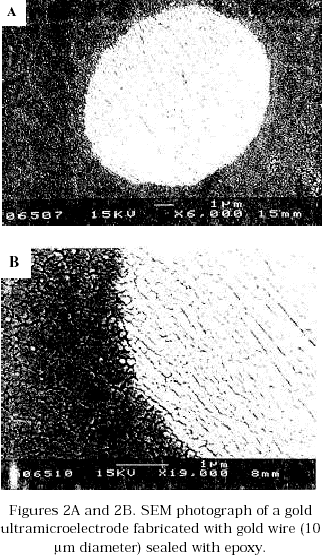
<P ALIGN="justify"><FONT COLOR="#1f1a17" SIZE="2" FACE="Verdana">[<i>M<sub>x</sub>A<sup>-</sup></i>]<i>M</i> + <i>H<sub>2</sub>O</i> </FONT><FONT COLOR="#1f1a17" SIZE="2" FACE="Times New Roman"> &#8594;</FONT><FONT COLOR="#1f1a17" SIZE="2" FACE="Verdana">[<i>M<sub>x</sub>A<sup>-</sup></i>]<i>MOH</i>  + <i>H</i><sup>+</sup> + <i>e</i><sup>-</sup> &nbsp;&nbsp;&nbsp;&nbsp;(1)</FONT></P>     <P ALIGN="justify"><FONT COLOR="#1f1a17" SIZE="2" FACE="Verdana">where [<I>M</I></FONT><FONT COLOR="#1f1a17" SIZE="2" FACE="Bookman"><FONT COLOR="#1f1a17" FACE="Verdana"><SUB><I>x</I></SUB></FONT><FONT COLOR="#1f1a17" FACE="Verdana" SIZE="2"><I>A</I></FONT><FONT COLOR="#1f1a17" FACE="Verdana"><SUP><I>-</I></SUP></FONT><FONT COLOR="#1f1a17" FACE="Verdana" SIZE="2">]M represent the adsorbed anions on metal. The second peak at  1.35 V has been attributed to the deposition of OH</FONT><FONT COLOR="#1f1a17" FACE="Verdana"><SUP>-</SUP></FONT><FONT COLOR="#1f1a17" FACE="Verdana" SIZE="2"> accompanied by desorption  of the anions [10]:&nbsp;</FONT></FONT><FONT COLOR="#1f1a17" SIZE="2" FACE="Verdana"> </FONT></P>     <P ALIGN="justify"><FONT COLOR="#1f1a17" SIZE="2" FACE="Verdana"> <i>M<sub>x</sub>A<sup>-</sup></i>&nbsp;<i>+ H<sub>2</sub>O </i> </FONT><FONT COLOR="#1f1a17" SIZE="2" FACE="Symbol"> Û</FONT><FONT COLOR="#1f1a17" SIZE="2" FACE="Verdana">&nbsp;<i>M<sub>x-</sub></i><sub>1</sub>&nbsp;<i>+  MOH + A<sup>- </sup>+</i>&nbsp;<i>H</i><sup>+</sup> + <i>e</i><sup>-&nbsp;&nbsp;&nbsp;&nbsp;&nbsp; </sup>(2)&nbsp; </FONT></P>     <P ALIGN="justify"><FONT COLOR="#1f1a17" SIZE="2" FACE="Verdana"> A peak is observed on the cathodic side of the voltammogram between 0.85  and 0.9 V, which corresponds to the reduction of adsorbed oxygen. The shape  of the voltammogram is similar to that reported for polycrystalline gold  [11]. The effective area of the gold ultramicroelectrode was calculated  taking into account that the cathodic charge in aqueous solutions of HClO</FONT><FONT COLOR="#1f1a17" SIZE="2" FACE="Bookman"><FONT COLOR="#1f1a17" FACE="Verdana"><SUB>4</SUB></FONT><FONT COLOR="#1f1a17" FACE="Verdana" SIZE="2">  increases almost linearly with the applied potential above 1.2 V and that  this charge is independent of pH [12].&nbsp;</FONT></FONT><FONT COLOR="#1f1a17" SIZE="2" FACE="Verdana"> </FONT></P>     <P ALIGN="justify"><FONT COLOR="#1f1a17" SIZE="2" FACE="Verdana"> The charge value (Q</FONT><FONT COLOR="#1f1a17" SIZE="2" FACE="Bookman"><FONT COLOR="#1f1a17" FACE="Verdana"><SUB>B</SUB></FONT><FONT COLOR="#1f1a17" FACE="Verdana" SIZE="2">) used was taken from the curve cathodic charge vs  anodization potential reported by Brummer et.al. [12]. This value and the  charge obtained experimentally by integration of the oxide stripping peak (<a href="#f3">Figure<B> </B>3</a>) were used to calculate the real area of the microdisc from the  ratio: <img border="0" src="/img/fbpe/rtfiuz/v28n2/art08ec3.gif" width="95" height="38">. For a series of experiments carried out at 60 mV/s, using  gold wires of 10 </FONT> </FONT><FONT COLOR="#1f1a17" FACE="Symbol" SIZE="2">m</FONT><FONT COLOR="#1f1a17" FACE="Verdana" SIZE="2">m</FONT><FONT COLOR="#1f1a17" SIZE="2" FACE="Bookman"><FONT COLOR="#1f1a17" FACE="Verdana" SIZE="2"> diameter, the real area calculated was 77.38 &#177; 2.21  </FONT> </FONT><FONT COLOR="#1f1a17" SIZE="2" FACE="Symbol"> m</FONT><FONT COLOR="#1f1a17" SIZE="2" FACE="Bookman"><FONT COLOR="#1f1a17" FACE="Verdana" SIZE="2">m</FONT><FONT COLOR="#1f1a17" FACE="Verdana"><SUP>2</SUP></FONT><FONT COLOR="#1f1a17" FACE="Verdana" SIZE="2">. The quality of the seal between the electrode material and the insulating  material as well as the shape of the microdisk were investigated by scanning  electron microscopy (<a href="#f2">Figures 2A and 2B</a>).</FONT></FONT></P>     
<P ALIGN="center"><a name="f2"><img border="0" src="/img/fbpe/rtfiuz/v28n2/art08img02.gif" width="323" height="559"></a></P>     
<P ALIGN="center"><a name="f3"><img border="0" src="/img/fbpe/rtfiuz/v28n2/art08img03.gif" width="580" height="294"></a></P>     
]]></body>
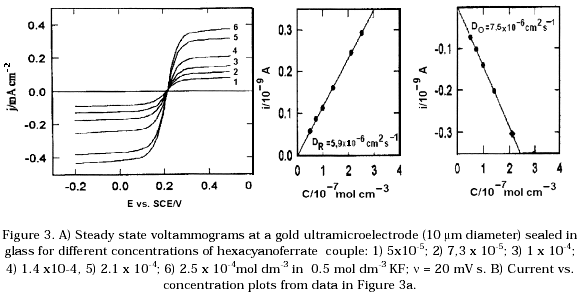
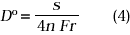
<body><![CDATA[<P ALIGN="justify"><FONT COLOR="#1f1a17" SIZE="2" FACE="Verdana">Steady state voltammetric studies to different concentrations of the hexacyanoferrate  couple were performed keeping the concentrations of ferrocyanide equal  to the concentration of ferricyanide to determine the diffusion coefficient  of the oxidised and reduced forms (<a href="#f3">Figure 3a</a>). In these experiments it  was observed that the diffusion limited current was proportional to the  concentration (<a href="#f3">Figure 3b</a>). The diffusion coefficients of the oxidised and  reduced species were determined from the slope of plots of diffusion current  vs. concentration applying the equation:</FONT></P>     <P ALIGN="justify"><img border="0" src="/img/fbpe/rtfiuz/v28n2/art08ec4.gif" width="130" height="35"></P>     
<P ALIGN="justify"><FONT COLOR="#1f1a17" SIZE="2" FACE="Verdana">The value obtained for the oxidised species was 5.74x10</FONT><FONT COLOR="#1f1a17" SIZE="2" FACE="Bookman"><FONT COLOR="#1f1a17" FACE="Verdana"><SUP>-6</SUP></FONT><FONT COLOR="#1f1a17" FACE="Verdana" SIZE="2"> &#177; 0.2x10</FONT><FONT COLOR="#1f1a17" FACE="Verdana"><SUP>-6</SUP></FONT><FONT COLOR="#1f1a17" FACE="Verdana" SIZE="2"> cm</FONT><FONT COLOR="#1f1a17" FACE="Verdana"><SUP>2</SUP></FONT><FONT COLOR="#1f1a17" FACE="Verdana" SIZE="2">  s</FONT><FONT COLOR="#1f1a17" FACE="Verdana"><SUP>-1</SUP></FONT><FONT COLOR="#1f1a17" FACE="Verdana" SIZE="2"> and the value for the reduced species was 7.25x10</FONT><FONT COLOR="#1f1a17" FACE="Verdana"><SUP>-6</SUP></FONT><FONT COLOR="#1f1a17" FACE="Verdana" SIZE="2"> &#177; 0.2x10</FONT><FONT COLOR="#1f1a17" FACE="Verdana"><SUP>-6</SUP></FONT><FONT COLOR="#1f1a17" FACE="Verdana" SIZE="2"> cm</FONT><FONT COLOR="#1f1a17" FACE="Verdana"><SUP>2</SUP></FONT><FONT COLOR="#1f1a17" FACE="Verdana" SIZE="2">  s</FONT><FONT COLOR="#1f1a17" FACE="Verdana"><SUP>-1</SUP></FONT><FONT COLOR="#1f1a17" FACE="Verdana" SIZE="2">. These values agree with the values reported in the literature [13].<B>&nbsp;</B></FONT></FONT><FONT COLOR="#1f1a17" SIZE="2" FACE="Verdana"> </FONT></P>     <P ALIGN="justify"><FONT COLOR="#1f1a17" SIZE="2" FACE="Verdana"> <B>Supporting electrolyte dependence&nbsp;</B> </FONT></P>     <P ALIGN="justify"><FONT COLOR="#1f1a17" SIZE="2" FACE="Verdana"> A very large number of experiments were carried out using different [electrolyte]/  [hexacyanoferrate couple] ratios. All the experiments were initiated at  the equilibrium potential. In solutions where the concentration of supporting  electrolyte was &gt; 0.1 mol dm</FONT><FONT COLOR="#1f1a17" SIZE="2" FACE="Bookman"><FONT COLOR="#1f1a17" FACE="Verdana"><SUP>-3</SUP></FONT><FONT COLOR="#1f1a17" FACE="Verdana" SIZE="2">, well defined steady-state behaviour was  observed using a gold ultramicroelectrode (<a href="#f4">Figure 4A</a>). The equilibrium  potential of the hexacyanoferrate couple shifted to more positive potential  as the concentration of supporting electrolyte was increased beyond 0.1  mol.dm</FONT><FONT COLOR="#1f1a17" FACE="Verdana"><SUP>-3</SUP></FONT><FONT COLOR="#1f1a17" FACE="Verdana" SIZE="2">. Although the equilibrium potential had an unknown contribution  from the liquid junction potential of the reference electrode (SCE), the  changes observed seemed too large to be attributed to changes of liquid  junction potential. The potential shift was attributed to the association  of the K</FONT><FONT COLOR="#1f1a17" FACE="Verdana"><SUP>+</SUP></FONT><FONT COLOR="#1f1a17" FACE="Verdana" SIZE="2"> cations and the hexacyanoferrate ions. When the concentration  of supporting electrolyte was &lt; 0.1 mol dm</FONT><FONT COLOR="#1f1a17" FACE="Verdana"><SUP>-3</SUP></FONT><FONT COLOR="#1f1a17" FACE="Verdana" SIZE="2"> and the hexacyanoferrate couple  concentration </FONT> </FONT><FONT COLOR="#1f1a17" SIZE="2" FACE="Symbol"> &#163;</FONT><FONT COLOR="#1f1a17" SIZE="2" FACE="Bookman"><FONT COLOR="#1f1a17" FACE="Verdana" SIZE="2"> 1x10</FONT><FONT COLOR="#1f1a17" FACE="Verdana"><SUP>-3</SUP></FONT><FONT COLOR="#1f1a17" FACE="Verdana" SIZE="2"> mol dm</FONT><FONT COLOR="#1f1a17" FACE="Verdana"><SUP>-3</SUP></FONT><FONT COLOR="#1f1a17" FACE="Verdana" SIZE="2">, steady state limiting currents were not  observed (<a href="#f4">Figure 4B</a>).</FONT></FONT></P>     <P ALIGN="center"><a name="f4"><img border="0" src="/img/fbpe/rtfiuz/v28n2/art08img04.gif" width="290" height="514"></a></P>     
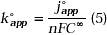
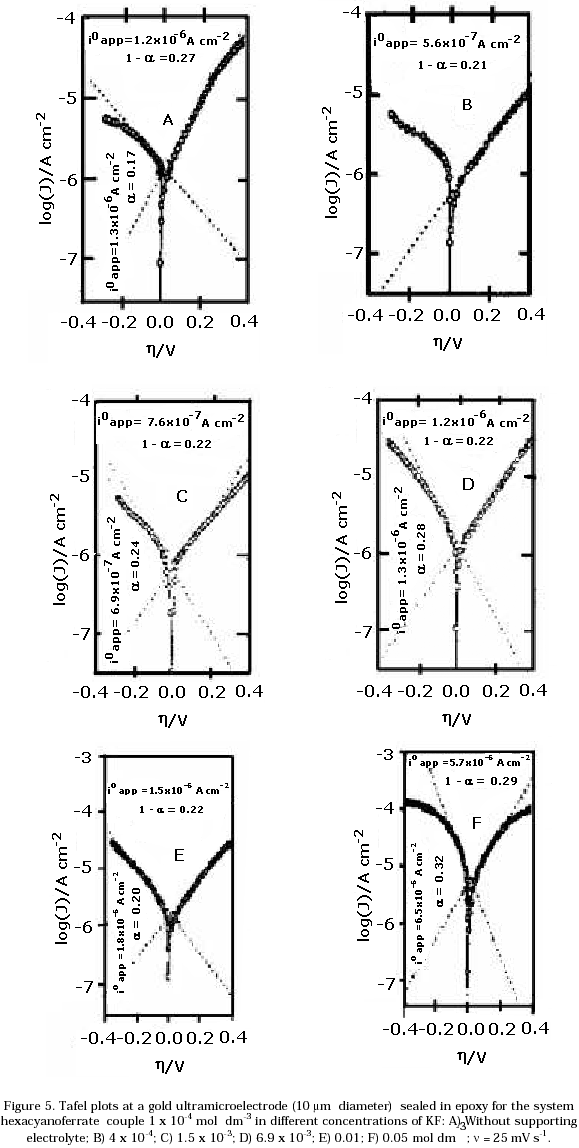
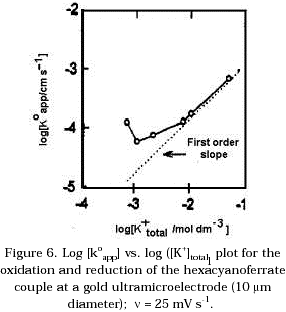
<P ALIGN="justify"><FONT COLOR="#1f1a17" SIZE="2" FACE="Verdana">According to Wightman <I>et al.</I> [14], electrochemical measurements performed  when the electrolyte/analyte ratio is &gt; 1 can give information which is  not affected due to scavanging electrolyte in the diffuse layer. In a series  of experiments the [electrolyte]/ [hexacyanoferrate couple] ratio was changed  from 0 to 100, using a constant concentration of hexacyanoferrate. However  no steady-state behaviour was observed. On the other hands, if migration  effects are considered, the ratio i</FONT><SUB><FONT COLOR="#1f1a17" SIZE="2" FACE="Verdana">i</FONT><FONT COLOR="#1f1a17" SIZE="2" FACE="Verdana"> </FONT> </SUB><FONT COLOR="#1f1a17" SIZE="2" FACE="Bookman"> <FONT COLOR="#1f1a17" FACE="Verdana" SIZE="2">/i</FONT><FONT COLOR="#1f1a17" FACE="Verdana"><SUB>d</SUB></FONT><FONT COLOR="#1f1a17" FACE="Verdana" SIZE="2"> (where i</FONT><FONT COLOR="#1f1a17" FACE="Verdana"><SUB>i</SUB></FONT><FONT COLOR="#1f1a17" FACE="Verdana" SIZE="2"> is the limiting current  when supporting electrolyte is absent from solution and i</FONT><FONT COLOR="#1f1a17" FACE="Verdana"><SUB>d</SUB></FONT><FONT COLOR="#1f1a17" FACE="Verdana" SIZE="2"> is the diffusion  controlled limiting current in the presence of excess supporting electrolyte)  must be &gt; 1 for the anion oxidation, according the equations developed  by Amatore <I>et al</I>. [15] for the oxidation or reduction of multiply charged  ions in the absence of supporting electrolyte. For this reason comparisons  with this model can not be made. Moreover, this model has been developed  by making several assumptions such as similar diffusion coefficients for  products and reactant, no double layer effects, and no ion pairing.</FONT></FONT></P>     <P ALIGN="justify"><FONT COLOR="#1f1a17" SIZE="2" FACE="Verdana">According to the results obtained by Campbell and Peter [16] for the system  Fe(CN)</FONT><FONT COLOR="#1f1a17" SIZE="2" FACE="Bookman"><FONT COLOR="#1f1a17" FACE="Verdana"><SUB>6</SUB><SUP>4-</SUP></FONT><FONT COLOR="#1f1a17" FACE="Verdana" SIZE="2">/Fe(CN)</FONT><FONT COLOR="#1f1a17" FACE="Verdana"><SUB>6</SUB><SUP>3-</SUP></FONT><FONT COLOR="#1f1a17" FACE="Verdana" SIZE="2"> on gold electrodes using impedance measurements and  KF as supporting electrolyte, a minimum in the apparent rate constant is  observed when the total concentration of K</FONT><FONT COLOR="#1f1a17" FACE="Verdana"><SUP>+</SUP></FONT><FONT COLOR="#1f1a17" FACE="Verdana" SIZE="2"> cations is increased over the  range 4x10</FONT><FONT COLOR="#1f1a17" FACE="Verdana"><SUP>-4</SUP></FONT><FONT COLOR="#1f1a17" FACE="Verdana" SIZE="2"> to 1 mol dm</FONT><FONT COLOR="#1f1a17" FACE="Verdana"><SUP>-3</SUP></FONT><FONT COLOR="#1f1a17" FACE="Verdana" SIZE="2">. Experiments with different concentration of  supporting electrolyte in the range where the total concentration of K</FONT><FONT COLOR="#1f1a17" FACE="Verdana"><SUP>+  </SUP></FONT><FONT COLOR="#1f1a17" FACE="Verdana" SIZE="2">increase from 7x10</FONT><FONT COLOR="#1f1a17" FACE="Verdana"><SUP>-4</SUP></FONT><FONT COLOR="#1f1a17" FACE="Verdana" SIZE="2"> to 0.01 mol dm</FONT><FONT COLOR="#1f1a17" FACE="Verdana"><SUP>-3</SUP></FONT><FONT COLOR="#1f1a17" FACE="Verdana" SIZE="2"> were carried out. <a href="#f5"> Figure 5</a> shows  Tafel plots under the experimental conditions mentioned above. From these  plots, the apparent exchange current <I>i</I></FONT><FONT COLOR="#1f1a17" FACE="Verdana"><SUP><I>o</I></SUP><SUB><I>app</I></SUB></FONT><FONT COLOR="#1f1a17" FACE="Verdana" SIZE="2"> and the electron transfer coefficients  were determined for both processes. It was found that the sum of the electron  transfer coefficients for the anodic and cathodic processes is less than  one. These results agree with the values obtained by Peter <I>et al.</I> [3] using  a coulostatic method. <a href="#f6"> Figure 6</a> shows log k</FONT><FONT COLOR="#1f1a17" FACE="Verdana"><SUP>o</SUP><SUB>app</SUB></FONT><FONT COLOR="#1f1a17" FACE="Verdana" SIZE="2"> vs. log [K</FONT><FONT COLOR="#1f1a17" FACE="Verdana"><SUP>+</SUP></FONT><FONT COLOR="#1f1a17" FACE="Verdana" SIZE="2">]</FONT><FONT COLOR="#1f1a17" FACE="Verdana"><SUB> total</SUB></FONT><FONT COLOR="#1f1a17" FACE="Verdana" SIZE="2"> plots  for the oxidation and reduction processes. The k</FONT><FONT COLOR="#1f1a17" FACE="Verdana"><SUP>o</SUP><SUB>app</SUB></FONT><FONT COLOR="#1f1a17" FACE="Verdana" SIZE="2"> was determined using  the equation: <img border="0" src="/img/fbpe/rtfiuz/v28n2/art08ec5.gif" width="107" height="35">. Where <I>j</I></FONT><FONT COLOR="#1f1a17" FACE="Verdana"><SUP>o</SUP><SUB><I>app</I></SUB></FONT><FONT COLOR="#1f1a17" FACE="Verdana" SIZE="2"> is the exchange current density and C</FONT></FONT><SUP><FONT COLOR="#1f1a17" SIZE="2" FACE="Symbol">&#165;</FONT><FONT COLOR="#1f1a17" SIZE="2" FACE="Bookman"><FONT COLOR="#1f1a17" FACE="Verdana"> </FONT> </FONT></SUP><FONT COLOR="#1f1a17" SIZE="2" FACE="Bookman"> <FONT COLOR="#1f1a17" FACE="Verdana" SIZE="2">is the concentration of the hexacyanoferrate couple in the bulk solution.  A minimum in the apparent rate constant <I>k</I></FONT><FONT COLOR="#1f1a17" FACE="Verdana"><SUP><I>o</I></SUP><SUB><I>app</I></SUB></FONT><FONT COLOR="#1f1a17" FACE="Verdana" SIZE="2"> is found when the total concentration  of K</FONT><FONT COLOR="#1f1a17" FACE="Verdana"><SUP>+</SUP></FONT><FONT COLOR="#1f1a17" FACE="Verdana" SIZE="2"> is between 1x10</FONT><FONT COLOR="#1f1a17" FACE="Verdana"><SUP>-3</SUP></FONT><FONT COLOR="#1f1a17" FACE="Verdana" SIZE="2"> to 3x10</FONT><FONT COLOR="#1f1a17" FACE="Verdana"><SUP>-2</SUP></FONT><FONT COLOR="#1f1a17" FACE="Verdana" SIZE="2"> mol dm</FONT><FONT COLOR="#1f1a17" FACE="Verdana"><SUP>-3</SUP></FONT><FONT COLOR="#1f1a17" FACE="Verdana" SIZE="2">.</FONT></FONT></P>     
<P ALIGN="center"><a name="f5"><img border="0" src="/img/fbpe/rtfiuz/v28n2/art08img05.gif" width="579" height="1148"></a></P>     
<P ALIGN="center"><a name="f6"><img border="0" src="/img/fbpe/rtfiuz/v28n2/art08img06.gif" width="286" height="312"></a></P>     
]]></body>
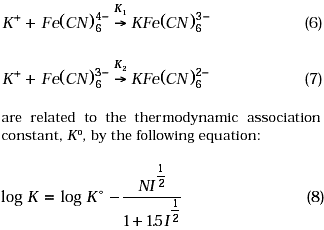
<body><![CDATA[<P ALIGN="justify"><FONT COLOR="#1f1a17" SIZE="2" FACE="Verdana">Effects of association of the K</FONT><FONT COLOR="#1f1a17" SIZE="2" FACE="Bookman"><FONT COLOR="#1f1a17" FACE="Verdana"><SUP>+ </SUP></FONT> <FONT COLOR="#1f1a17" FACE="Verdana" SIZE="2">cation with the hexacyanoferrate couple  or double layer effects on the rate of electron transfer could be responsible  for the behaviour observed in this range. According to Eaton <I>et al.</I> [17]  the association constant K</FONT><FONT COLOR="#1f1a17" FACE="Verdana"><SUB>1</SUB></FONT><FONT COLOR="#1f1a17" FACE="Verdana" SIZE="2"> and K</FONT><FONT COLOR="#1f1a17" FACE="Verdana"><SUB>2</SUB></FONT><FONT COLOR="#1f1a17" FACE="Verdana" SIZE="2"> for the equilibrium reactions:</FONT></FONT></P>     <P ALIGN="justify"><a name="e6"><img border="0" src="/img/fbpe/rtfiuz/v28n2/art08ec6.gif" width="324" height="230"></a></P>     
<P ALIGN="justify"><FONT COLOR="#1f1a17" SIZE="2" FACE="Verdana">based on the extended Debye-H&#252;ckel theory; where K=K</FONT><FONT COLOR="#1f1a17" SIZE="2" FACE="Bookman"><FONT COLOR="#1f1a17" FACE="Verdana"><SUB>1</SUB></FONT><FONT COLOR="#1f1a17" FACE="Verdana" SIZE="2"> or K</FONT><FONT COLOR="#1f1a17" FACE="Verdana"><SUB>2</SUB></FONT><FONT COLOR="#1f1a17" FACE="Verdana" SIZE="2">, are the equilibrium  constants depending on the equilibrium studied, and they are defined in  terms of the molar concentration of the species present in the reaction;  where N is a constant; N=4.08 for reaction (<a href="#e6">6</a>), and N=3.06 for the reaction (<a href="#e6">7</a>); I is the ionic strength. From this equation, values of K were determined  for a constant concentration of the hexacyanoferrate couple and different  concentrations of supporting electrolyte. From these values, the concentrations  of KFe(CN)</FONT><FONT COLOR="#1f1a17" FACE="Verdana"><SUB>6</SUB><SUP>3-</SUP></FONT><FONT COLOR="#1f1a17" FACE="Verdana" SIZE="2"> and KFe(CN)</FONT><FONT COLOR="#1f1a17" FACE="Verdana"><SUB>6</SUB><SUP>2-</SUP></FONT><FONT COLOR="#1f1a17" FACE="Verdana" SIZE="2"> were determined.</FONT></FONT></P>     <P ALIGN="justify"><FONT COLOR="#1f1a17" SIZE="2" FACE="Verdana"><a href="#f7">Figure 7</a> shows the behavior of ion-pair association with the total concentration  of K</FONT><FONT COLOR="#1f1a17" SIZE="2" FACE="Bookman"><FONT COLOR="#1f1a17" FACE="Verdana"><SUP>+</SUP></FONT><FONT COLOR="#1f1a17" FACE="Verdana" SIZE="2"> present in the system. Not surprisingly, it is observed that the  ion association of the ferrocyanide anion occurs more appreciable than  the association of the ferricyanide anion. When the total concentration  of K</FONT><FONT COLOR="#1f1a17" FACE="Verdana"><SUP>+</SUP></FONT><FONT COLOR="#1f1a17" FACE="Verdana" SIZE="2"> is 2.2x10</FONT><FONT COLOR="#1f1a17" FACE="Verdana"><SUP>-3</SUP></FONT><FONT COLOR="#1f1a17" FACE="Verdana" SIZE="2"> mol dm</FONT><FONT COLOR="#1f1a17" FACE="Verdana"><SUP>-3</SUP></FONT><FONT COLOR="#1f1a17" FACE="Verdana" SIZE="2">, the extent of the association is 24% for the  ferrocyanide anion, while it is only 4% for the ferricyanide anion (<a href="#f7">Figure 7</a>).</FONT></FONT></P>     <P ALIGN="center"><a name="f7"><img border="0" src="/img/fbpe/rtfiuz/v28n2/art08img07.gif" width="290" height="446"></a></P>     
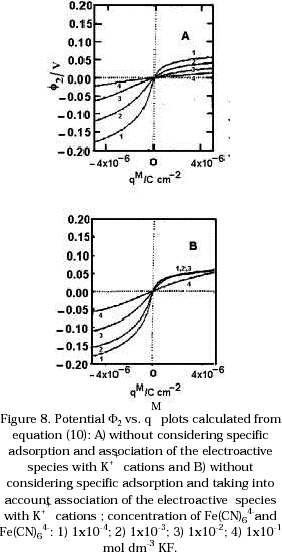
<P ALIGN="justify"><FONT COLOR="#1f1a17" SIZE="2" FACE="Verdana">From <a href="#f5"> Figure 5</a> the Tafel plot for the electrochemical process in absence  of supporting electrolyte shows the anodic and cathodic branches are not  symmetrical. The anodic branch is higher than the cathodic branch. This  behavior may be attributed to double layer effects.&nbsp; </FONT></P>     <P ALIGN="justify"><FONT COLOR="#1f1a17" SIZE="2" FACE="Verdana"> For gold polycristalline surfaces the potential of zero charge is </FONT><FONT COLOR="#1f1a17" SIZE="2" FACE="Bookman"> <FONT COLOR="#1f1a17" FACE="Verdana" SIZE="2">~ -0.05  &#177; 0.1V vs. SCE [18]. This means the charge on the metal surface (q</FONT><FONT COLOR="#1f1a17" FACE="Verdana"><SUP>M</SUP></FONT><FONT COLOR="#1f1a17" FACE="Verdana" SIZE="2">) near  the equilibrium potential is positive. This excess of positive charge on  the metal will result in the concentration of ferrocyanide anions near  to the electrode surface being higher than in a bulk solution and higher  than the concentration of ferricyanide anions at the microelectrode surface.  This difference in concentration produces that the current density at potentials  positive of the equilibrium potential will be enhanced. The plots in <a href="#f8"> Figures  8a and 8b</a> were obtained using the following equation:</FONT></FONT></P>     <P ALIGN="justify"><img border="0" src="/img/fbpe/rtfiuz/v28n2/art08ec9.gif" width="310" height="36"></P>     
<P ALIGN="center"><a name="f8"><img border="0" src="/img/fbpe/rtfiuz/v28n2/art08img08.gif" width="282" height="554"></a></P>     
<P ALIGN="justify"><FONT COLOR="#1f1a17" SIZE="2" FACE="Verdana">which is derived from the Gouy - Chapman theory of the diffuse double layer.  The plots were calculated considering no association of the anion with  the K</FONT><FONT COLOR="#1f1a17" SIZE="2" FACE="Bookman"><FONT COLOR="#1f1a17" FACE="Verdana"><SUP>+</SUP></FONT><FONT COLOR="#1f1a17" FACE="Verdana" SIZE="2"> cations (<a href="#f8">Figure 8a</a>) and considering this association effects (<a href="#f8">Figure 8b</a>). In this equation, c</FONT><FONT COLOR="#1f1a17" FACE="Verdana"><SUB>i</SUB><SUP>S</SUP></FONT><FONT COLOR="#1f1a17" FACE="Verdana" SIZE="2"> is the concentration of ions in bulk solution,  and </FONT> </FONT><FONT COLOR="#1f1a17" SIZE="2" FACE="Symbol"> f</FONT><FONT COLOR="#1f1a17" SIZE="2" FACE="Bookman"><FONT COLOR="#1f1a17" FACE="Verdana"><SUB>2</SUB></FONT><FONT COLOR="#1f1a17" FACE="Verdana" SIZE="2"> is the potential in the outer-Helmholtz layer [19]. From these plots  it is seen that when the electrode is charged positively, a high concentration  of anions must be near to the electrode surface, which is reflected in  the small values of &#248;</FONT><FONT COLOR="#1f1a17" FACE="Verdana"><SUB>2</SUB></FONT><FONT COLOR="#1f1a17" FACE="Verdana" SIZE="2">. If association of these electroactive species with  the cations from the supporting electrolyte is considered, the concentration  of these species near to the electrode surface is less with respect to  the situation where no association is considered. This behaviour is also  observed in the values of &#248;</FONT><FONT COLOR="#1f1a17" FACE="Verdana"><SUB>2</SUB></FONT><FONT COLOR="#1f1a17" FACE="Verdana" SIZE="2"> in <a href="#f8"> Figure 8b</a>.&nbsp;</FONT></FONT><FONT COLOR="#1f1a17" SIZE="2" FACE="Verdana"> </FONT></P>     ]]></body>
<body><![CDATA[<P ALIGN="justify"><FONT COLOR="#1f1a17" SIZE="2" FACE="Verdana"> The charge on the metal electrode can be related to the potential by the  equation:</FONT></P>     <P ALIGN="justify"><img border="0" src="/img/fbpe/rtfiuz/v28n2/art08ec10.gif" width="172" height="53"></P>     
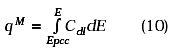
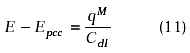
<P ALIGN="justify"><FONT COLOR="#1f1a17" SIZE="2" FACE="Verdana"> if C</FONT><FONT COLOR="#1f1a17" SIZE="2" FACE="Bookman"><FONT COLOR="#1f1a17" FACE="Verdana"><SUB>dl</SUB></FONT><FONT COLOR="#1f1a17" FACE="Verdana" SIZE="2"> is considered constant in the potential range studied, the potential  diference E-E</FONT><FONT COLOR="#1f1a17" FACE="Verdana"><SUB>pzc</SUB></FONT><FONT COLOR="#1f1a17" FACE="Verdana" SIZE="2"> is given by:</FONT></FONT></P>     <P ALIGN="justify"><img border="0" src="/img/fbpe/rtfiuz/v28n2/art08ec11.gif" width="190" height="53"></P>     
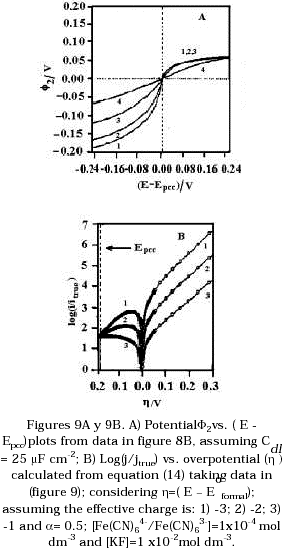
<P ALIGN="justify"><FONT COLOR="#1f1a17" SIZE="2" FACE="Verdana"><a href="#f9">Figure 9A</a> shows the behaviour of &#248;</FONT><FONT COLOR="#1f1a17" SIZE="2" FACE="Bookman"><FONT COLOR="#1f1a17" FACE="Verdana"><SUB>2 </SUB></FONT> <FONT COLOR="#1f1a17" FACE="Verdana" SIZE="2">vs. E-E</FONT><FONT COLOR="#1f1a17" FACE="Verdana"><SUB>pzc</SUB></FONT><FONT COLOR="#1f1a17" FACE="Verdana" SIZE="2"> calculated using this aproximation  and C</FONT></FONT><SUB><FONT COLOR="#1f1a17" SIZE="2" FACE="Verdana">dl</FONT><FONT COLOR="#1f1a17" SIZE="2" FACE="Verdana"> </FONT> </SUB><FONT COLOR="#1f1a17" SIZE="2" FACE="Bookman"> <FONT COLOR="#1f1a17" FACE="Verdana" SIZE="2">equal to 25 </FONT> </FONT><FONT COLOR="#1f1a17" SIZE="2" FACE="Symbol"> m</FONT><FONT COLOR="#1f1a17" SIZE="2" FACE="Bookman"><FONT COLOR="#1f1a17" FACE="Verdana" SIZE="2">F cm</FONT><FONT COLOR="#1f1a17" FACE="Verdana"><SUP>-2</SUP></FONT><FONT COLOR="#1f1a17" FACE="Verdana" SIZE="2">.</FONT></FONT></P>     <P ALIGN="center"><a name="f9"><img border="0" src="/img/fbpe/rtfiuz/v28n2/art08img09.gif" width="283" height="548"></a></P>     
<P ALIGN="justify"><FONT COLOR="#1f1a17" SIZE="2" FACE="Verdana">According to <a href="#f4"> Figure<B> </B>4A</a> the equilibrium potential of the hexacyanoferrate  couple shifted to more positive potential as the concentration of supporting  electrolyte was increased. This mean that for building Tafel plots, the  overpotential must be calculated taking into account the formal potential  (E</FONT><FONT COLOR="#1f1a17" SIZE="2" FACE="Bookman"><FONT COLOR="#1f1a17" FACE="Verdana"><SUP>o</SUP></FONT><FONT COLOR="#1f1a17" FACE="Verdana" SIZE="2">&#146;), which is dependent on the medium since it includes the logarithmic  activity coefficient terms (</FONT></FONT><FONT COLOR="#1f1a17" SIZE="2" FACE="Symbol">g</FONT><FONT COLOR="#1f1a17" SIZE="2" FACE="Bookman"><FONT COLOR="#1f1a17" FACE="Verdana"><SUB>i</SUB></FONT><FONT COLOR="#1f1a17" FACE="Verdana" SIZE="2">) as well as the standard electrode potential  (E</FONT><FONT COLOR="#1f1a17" FACE="Verdana"><SUP>o</SUP></FONT><FONT COLOR="#1f1a17" FACE="Verdana" SIZE="2">), according to the following relationship:</FONT></FONT></P>     <P ALIGN="justify"><img border="0" src="/img/fbpe/rtfiuz/v28n2/art08ec12.gif" width="240" height="45"></P>     
<P ALIGN="justify"><FONT COLOR="#1f1a17" SIZE="2" FACE="Verdana">If the overpotential (</FONT><FONT COLOR="#1f1a17" FACE="Symbol" SIZE="2">h</FONT><FONT COLOR="#1f1a17" FACE="Verdana" SIZE="2"><FONT COLOR="#1f1a17" SIZE="2" FACE="Bookman">)  </FONT><FONT COLOR="#1f1a17" SIZE="2"> is calculated as (E - E</FONT></FONT><FONT COLOR="#1f1a17" FACE="Verdana" SIZE="2"><SUP>o</SUP></FONT><FONT COLOR="#1f1a17" SIZE="2" FACE="Bookman"><FONT COLOR="#1f1a17" FACE="Verdana" SIZE="2">&#146;) and this data and &#248;</FONT><FONT COLOR="#1f1a17" FACE="Verdana"><SUB>2</SUB></FONT><FONT COLOR="#1f1a17" FACE="Verdana" SIZE="2">  are taken from <a href="#f9"> Figure 9A</a>, the behavior of the ratio between the current  density and the true exchange current density can be evaluated for the  hexacyanoferrate couple at conditions where supporting electrolyte is present  or absent using the equation:</FONT></FONT></P>     <P ALIGN="justify"><img border="0" src="/img/fbpe/rtfiuz/v28n2/art08ec13.gif" width="297" height="51"></P>     
]]></body>
<body><![CDATA[<P ALIGN="justify"><FONT COLOR="#1f1a17" SIZE="2" FACE="Verdana">where <I>j</I></FONT><FONT COLOR="#1f1a17" SIZE="2" FACE="Bookman"><FONT COLOR="#1f1a17" FACE="Verdana"><SUB><I>t</I></SUB><SUP><I>o</I></SUP></FONT><FONT COLOR="#1f1a17" FACE="Verdana" SIZE="2"> is the true exchange current density, <I>a</I> is the cathodic transfer  coefficient, <I>z</I> is the ionic valence of the oxidised species, <I>f</I> = F/RT,  <I>n</I> is the number of electrons transfered. <a href="#f9"> Figure 9B</a> shows this behavior.  It is seen that the theory predict that the cathodic current should be  considerably hindered by double layer effects even taking into account  the formation of ion-pair. Experimentally this effect was not as large  as predicted in <a href="#f9"> Figure 9B</a>. The ion - pair species may be reacting faster  than the free ferricyanide anions present near to the electrode- solution  interface. The association constant of formation of ion - pair species  may be different in the double layer from the association constant of these  species in the bulk solution. The concentration of the ion - pairs species  in equilibrium with the free association species may be affected in the  double layer region due to the potential difference developed in the electrode  - solution interface.&nbsp;</FONT></FONT><FONT COLOR="#1f1a17" SIZE="2" FACE="Verdana"> </FONT></P>     <P ALIGN="justify"><FONT COLOR="#1f1a17" SIZE="2" FACE="Verdana"> Electrochemical and chemical reactions could be also occurring in parallel  during the oxidation and reduction of the hexacyanoferrate couple, influencing  the electrochemical response observed experimentally.</FONT></P>     <P ALIGN="justify"><FONT COLOR="#1f1a17" SIZE="2" FACE="Verdana"> <B>Conclusi&#243;n&nbsp;</B> </FONT></P>     <P ALIGN="justify"><FONT COLOR="#1f1a17" SIZE="2" FACE="Verdana"> Microelectrode studies of the oxidation and reduction of hexacyanoferrate  couple have shown that the electrochemical process is affected by the concentration  of KF the supporting electrolyte. The experimental results show that a  low concentration of potassium ion and overall ionic strength, the electrode  kinetics become dominated by double layer effects. At higher concentration  of potassium ion, the apparent rate constant increases approximately linearly  with [K</FONT><FONT COLOR="#1f1a17" SIZE="2" FACE="Bookman"><FONT COLOR="#1f1a17" FACE="Verdana"><SUP>+</SUP></FONT><FONT COLOR="#1f1a17" FACE="Verdana" SIZE="2">] as has been reported previosly [6]. Attempts to model the double  layer effects on assuming that the reaction involves the free hexacyanoferrate  ions showed that the predicted influence of the potential was larger than  that observed experimentally. This provides evidence that the main reacting  species are ion pairs, even at these low ionic strengths. The reason for  this apparent anomaly is that the rate constants for the ion pair species  are considerably higher than those for the free ions. Therefore the electrode  reaction proceeds via the ion pairs, even when they are minority species.  The experimental Tafel plots gave </FONT> </FONT><FONT COLOR="#1f1a17" SIZE="2" FACE="Symbol"> a</FONT><FONT COLOR="#1f1a17" SIZE="2" FACE="Bookman"><FONT COLOR="#1f1a17" FACE="Verdana" SIZE="2"> and (</FONT></FONT><FONT COLOR="#1f1a17" SIZE="2" FACE="Symbol">a</FONT><FONT COLOR="#1f1a17" SIZE="2" FACE="Bookman"><FONT COLOR="#1f1a17" FACE="Verdana" SIZE="2"> -1) values that do not sum to  unity. This effect has been reported previously for measurements made by  the coulostatic metods at much higher concentrations of KF [6]. The reason  for this anomalous behaviour remains obscure. It is certainly not due to  a preceding rate limiting chemical step involving ion pair formation, since  this is expected to occur with a second order rate constant in excess of  the diffusion controlled limit of 10</FONT><FONT COLOR="#1f1a17" FACE="Verdana"><SUP>10</SUP></FONT><FONT COLOR="#1f1a17" FACE="Verdana" SIZE="2"> dm</FONT><FONT COLOR="#1f1a17" FACE="Verdana"><SUP>3</SUP></FONT><FONT COLOR="#1f1a17" FACE="Verdana" SIZE="2"> mol s</FONT><FONT COLOR="#1f1a17" FACE="Verdana"><SUP>-1</SUP></FONT><FONT COLOR="#1f1a17" FACE="Verdana" SIZE="2">. Tafel plots predicted  for taking into account the double layer effect show a large effect only  on the cathodic branch. By contrast the anodic branch is largely unaffected  because </FONT> </FONT><FONT COLOR="#1f1a17" SIZE="2" FACE="Symbol"> f</FONT><FONT COLOR="#1f1a17" SIZE="2" FACE="Bookman"><FONT COLOR="#1f1a17" FACE="Verdana"><SUB>2</SUB></FONT><FONT COLOR="#1f1a17" FACE="Verdana" SIZE="2"> is small. It therefore seems unlikely that double layer effects  are responsables for the observed values of </FONT> </FONT><FONT COLOR="#1f1a17" SIZE="2" FACE="Symbol"> a</FONT><FONT COLOR="#1f1a17" SIZE="2" FACE="Verdana">. The hexacyanoferrate system  is often considered as a &#145;model&#146; redox system. However this study has revealed  that the system is extremely complex. Comparison of experimental rate constant  with values predicted by Marcus theory [20] are clearly not justified because  the reacting species are ion pairs and the apparent rate constant is sensitive  to the total potassium ion concentration.&nbsp; </FONT></P>     <P ALIGN="justify"><FONT COLOR="#1f1a17" SIZE="2" FACE="Verdana"> In conclusion, this study has shown that it appears impossible to determine  the rate constants for the hexacyanoferrate couple for the free (unpaired)  anionic species. Even at the lower concentrations and after correction  for double layer effects, the reaction is still dominated by ion pair effects.</FONT></P>     <P ALIGN="justify"><FONT COLOR="#1f1a17" SIZE="2" FACE="Verdana"> <B>Acknowledgements&nbsp;</B> </FONT></P>     <P ALIGN="justify"><FONT COLOR="#1f1a17" SIZE="2" FACE="Verdana"> I would like to acknowledge the Universidad de Los Andes and the Concejo  Nacional de Investigaciones Cient&#237;ficas y T&#232;cnologicas (CONICIT) for their  financial support and is particularly grateful to Professor Laurence Peter,  Bath University, for his valuable advice and for helpful discussions.</FONT></P>     <P ALIGN="justify"><FONT COLOR="#1f1a17" SIZE="2" FACE="Verdana"> <B>References&nbsp;</B> </FONT></P>     <!-- ref --><P ALIGN="justify"><FONT COLOR="#1f1a17" SIZE="2" FACE="Verdana"> 1. Lee C., Anson F.C., &#147;Inhibition of the electroreduction of Fe(CN)</FONT><FONT COLOR="#1f1a17" SIZE="2" FACE="Bookman"><FONT COLOR="#1f1a17" FACE="Verdana"><SUB>6</SUB><SUP>3-</SUP></FONT><FONT COLOR="#1f1a17" FACE="Verdana" SIZE="2"> at  microelectrodes in the absence of supporting electrolyte-mediation of the  inhibited reduction by methyl viologen&#148;. J. Electroanal. Chem., Vol. 323,  (1992), 381-389.&nbsp;</FONT></FONT><FONT COLOR="#1f1a17" SIZE="2" FACE="Verdana"> </FONT>&nbsp;&nbsp;&nbsp;&nbsp;&nbsp;&nbsp;&nbsp;&nbsp;[&#160;<a href="javascript:void(0);" onclick="javascript: window.open('/scielo.php?script=sci_nlinks&ref=2329863&pid=S0254-0770200500020000800001&lng=','','width=640,height=500,resizable=yes,scrollbars=1,menubar=yes,');">Links</a>&#160;]<!-- end-ref --><!-- ref --><P ALIGN="justify"><FONT COLOR="#1f1a17" SIZE="2" FACE="Verdana"> 2. Bieman D.J., Fancett W.R., &#147;The influence of ion pairing in the mechanism  of electroreduction of anions&#148;. J Electroanal.Chem., Vol. 34,<B> </B>(1972), 27-34.&nbsp; </FONT>&nbsp;&nbsp;&nbsp;&nbsp;&nbsp;&nbsp;&nbsp;&nbsp;[&#160;<a href="javascript:void(0);" onclick="javascript: window.open('/scielo.php?script=sci_nlinks&ref=2329864&pid=S0254-0770200500020000800002&lng=','','width=640,height=500,resizable=yes,scrollbars=1,menubar=yes,');">Links</a>&#160;]<!-- end-ref --><!-- ref --><P ALIGN="justify"><FONT COLOR="#1f1a17" SIZE="2" FACE="Verdana"> 3. Peter L.M., Durr W., Bindra P., Gerischer H., &#147;Influence of alkali-metal  cations on rate of Fe(CN)</FONT><FONT COLOR="#1f1a17" SIZE="2" FACE="Bookman"><FONT COLOR="#1f1a17" FACE="Verdana"><SUB>6</SUB><SUP>3-</SUP></FONT><FONT COLOR="#1f1a17" FACE="Verdana" SIZE="2">/Fe(CN)</FONT><FONT COLOR="#1f1a17" FACE="Verdana"><SUB>6</SUB><SUP>4-</SUP></FONT><FONT COLOR="#1f1a17" FACE="Verdana" SIZE="2">electrode process&#148;. J.Electroanal.,  Chem., Vol. 71, (1976) 31-50.&nbsp;</FONT></FONT><FONT COLOR="#1f1a17" SIZE="2" FACE="Verdana"> </FONT>&nbsp;&nbsp;&nbsp;&nbsp;&nbsp;&nbsp;&nbsp;&nbsp;[&#160;<a href="javascript:void(0);" onclick="javascript: window.open('/scielo.php?script=sci_nlinks&ref=2329865&pid=S0254-0770200500020000800003&lng=','','width=640,height=500,resizable=yes,scrollbars=1,menubar=yes,');">Links</a>&#160;]<!-- end-ref --><!-- ref --><P ALIGN="justify"><FONT COLOR="#1f1a17" SIZE="2" FACE="Verdana"> 4. Fleischmamn M, Graves P.R., Robinson J., &#147;The Raman-Spectroscopy of the  ferricyanide ferrocyanide system at gold beta-palladium hydride and platinum-elecrtrodes&#148;  J. Electroanal. Chem., Vol 182, (1985), 87-98.&nbsp; </FONT>&nbsp;&nbsp;&nbsp;&nbsp;&nbsp;&nbsp;&nbsp;&nbsp;[&#160;<a href="javascript:void(0);" onclick="javascript: window.open('/scielo.php?script=sci_nlinks&ref=2329866&pid=S0254-0770200500020000800004&lng=','','width=640,height=500,resizable=yes,scrollbars=1,menubar=yes,');">Links</a>&#160;]<!-- end-ref --><!-- ref --><P ALIGN="justify"><FONT COLOR="#1f1a17" SIZE="2" FACE="Verdana"> 5. Beriet C., Pletcher D., &#147;A microelectrode study of the mechanism and kinetics  of the ferro-ferricyanide couple in aqueous-media-the influence of the  electrolyte and its concentration&#148;. J. Electroanal. Chem., Vol. 361, (1993),  93-101.&nbsp; </FONT>&nbsp;&nbsp;&nbsp;&nbsp;&nbsp;&nbsp;&nbsp;&nbsp;[&#160;<a href="javascript:void(0);" onclick="javascript: window.open('/scielo.php?script=sci_nlinks&ref=2329867&pid=S0254-0770200500020000800005&lng=','','width=640,height=500,resizable=yes,scrollbars=1,menubar=yes,');">Links</a>&#160;]<!-- end-ref --><!-- ref --><P ALIGN="justify"><FONT COLOR="#1f1a17" SIZE="2" FACE="Verdana"> 6. Shi Z., Wu S., Lipkowki J., &#147;Investigations of Cl</FONT><FONT COLOR="#1f1a17" SIZE="2" FACE="Bookman"><FONT COLOR="#1f1a17" FACE="Verdana"><SUP>-</SUP></FONT><FONT COLOR="#1f1a17" FACE="Verdana" SIZE="2"> adsorption at the Au(111)  electrode in the presence of underpotentially deposited copper atoms&#148;.  J. Electroanal. Chem., Vol. 384, (&nbsp;1995) 171-177<I>.</I>&nbsp;</FONT></FONT><FONT COLOR="#1f1a17" SIZE="2" FACE="Verdana"> </FONT>&nbsp;&nbsp;&nbsp;&nbsp;&nbsp;&nbsp;&nbsp;&nbsp;[&#160;<a href="javascript:void(0);" onclick="javascript: window.open('/scielo.php?script=sci_nlinks&ref=2329868&pid=S0254-0770200500020000800006&lng=','','width=640,height=500,resizable=yes,scrollbars=1,menubar=yes,');">Links</a>&#160;]<!-- end-ref --><!-- ref --><P ALIGN="justify"><FONT COLOR="#1f1a17" SIZE="2" FACE="Verdana"> 7. Ertl P.; Robello E., Battaglini F., Mikkelsen S.,<B> </B>&#147;Rapid Antibiotic Susceptibility  Testing via Electrochemical Measurement of Ferricyanide Reduction by Escherichia  coli and Clostridium sporogenes&#148;. Analytical Chem., Vol. 72, (2000),4957-4961.&nbsp; </FONT>&nbsp;&nbsp;&nbsp;&nbsp;&nbsp;&nbsp;&nbsp;&nbsp;[&#160;<a href="javascript:void(0);" onclick="javascript: window.open('/scielo.php?script=sci_nlinks&ref=2329869&pid=S0254-0770200500020000800007&lng=','','width=640,height=500,resizable=yes,scrollbars=1,menubar=yes,');">Links</a>&#160;]<!-- end-ref --><!-- ref --><P ALIGN="justify"><FONT COLOR="#1f1a17" SIZE="2" FACE="Verdana"> 8. Rosseinsky D., Glasser L., Brooke H. D., &#147;Thermodynamic clarification of  the curious ferric/potassium ion exchange accompanying the electrochromic  redox reactions of Prussian Blue, iron(III) hexacyanoferrate(II)&#148;. J. of  the American Chemical Soc., Vol 126, (2004) 10472-10477.&nbsp; </FONT>&nbsp;&nbsp;&nbsp;&nbsp;&nbsp;&nbsp;&nbsp;&nbsp;[&#160;<a href="javascript:void(0);" onclick="javascript: window.open('/scielo.php?script=sci_nlinks&ref=2329870&pid=S0254-0770200500020000800008&lng=','','width=640,height=500,resizable=yes,scrollbars=1,menubar=yes,');">Links</a>&#160;]<!-- end-ref --><!-- ref --><P ALIGN="justify"><FONT COLOR="#1f1a17" SIZE="2" FACE="Verdana"> 9. Kozlowska H.A., Conway B.E., &#147;Elementary steps of electrochemical oxidation  of single-crystal planes of Au-I. Chemical basis of processes involving  geometry of anions and the electrode surfaces&#148;. Electrochim. Acta, Vol.  31, (1986) 1051-1061.&nbsp; </FONT>&nbsp;&nbsp;&nbsp;&nbsp;&nbsp;&nbsp;&nbsp;&nbsp;[&#160;<a href="javascript:void(0);" onclick="javascript: window.open('/scielo.php?script=sci_nlinks&ref=2329871&pid=S0254-0770200500020000800009&lng=','','width=640,height=500,resizable=yes,scrollbars=1,menubar=yes,');">Links</a>&#160;]<!-- end-ref --><!-- ref --><P ALIGN="justify"><FONT COLOR="#1f1a17" SIZE="2" FACE="Verdana"> 10. Laitinen H.Q.A., Chao S. M.; &#147;The anodic surface oxidation of gold&#148;. J.  Electrochem. Soc., Vol. 108, (1961) 726-731.&nbsp; </FONT>&nbsp;&nbsp;&nbsp;&nbsp;&nbsp;&nbsp;&nbsp;&nbsp;[&#160;<a href="javascript:void(0);" onclick="javascript: window.open('/scielo.php?script=sci_nlinks&ref=2329872&pid=S0254-0770200500020000800010&lng=','','width=640,height=500,resizable=yes,scrollbars=1,menubar=yes,');">Links</a>&#160;]<!-- end-ref --><!-- ref --><P ALIGN="justify"><FONT COLOR="#1f1a17" SIZE="2" FACE="Verdana"> 11. Hoare J. P., &#147;A cyclic voltammetric study of the gold-oxygen system&#148;. J.  Electrochem. Soc., Vol. 131, (1984) 1808-1815.&nbsp; </FONT>&nbsp;&nbsp;&nbsp;&nbsp;&nbsp;&nbsp;&nbsp;&nbsp;[&#160;<a href="javascript:void(0);" onclick="javascript: window.open('/scielo.php?script=sci_nlinks&ref=2329873&pid=S0254-0770200500020000800011&lng=','','width=640,height=500,resizable=yes,scrollbars=1,menubar=yes,');">Links</a>&#160;]<!-- end-ref --><!-- ref --><P ALIGN="justify"><FONT COLOR="#1f1a17" SIZE="2" FACE="Verdana"> 12. Brummer S.B., Makrides A.C., &#147;Surface oxidation of gold electrodes&#148;. J.  Electrochem. Soc., Vol. 111, (1964) 1122-1128.&nbsp; </FONT>&nbsp;&nbsp;&nbsp;&nbsp;&nbsp;&nbsp;&nbsp;&nbsp;[&#160;<a href="javascript:void(0);" onclick="javascript: window.open('/scielo.php?script=sci_nlinks&ref=2329874&pid=S0254-0770200500020000800012&lng=','','width=640,height=500,resizable=yes,scrollbars=1,menubar=yes,');">Links</a>&#160;]<!-- end-ref --><!-- ref --><P ALIGN="justify"><FONT COLOR="#1f1a17" SIZE="2" FACE="Verdana"> 13. Kunimatsu K., Shigematsu Y., Uosaki K., Kita H., &#147;Study of the Fe(CN)</FONT><FONT COLOR="#1f1a17" SIZE="2" FACE="Bookman"><FONT COLOR="#1f1a17" FACE="Verdana"><SUB>6</SUB><SUP>3-</SUP></FONT><FONT COLOR="#1f1a17" FACE="Verdana" SIZE="2">/Fe(CN)</FONT><FONT COLOR="#1f1a17" FACE="Verdana"><SUB>6</SUB><SUP>4-</SUP></FONT><FONT COLOR="#1f1a17" FACE="Verdana" SIZE="2">  redox system on Pt by EMIRS.1. Infrared-Spectra of the intermediates in  the charge-transfer&#148;. J. Electroanal. Chem., Vol. 262, (1989) 195-209.&nbsp;</FONT></FONT><FONT COLOR="#1f1a17" SIZE="2" FACE="Verdana"> </FONT>&nbsp;&nbsp;&nbsp;&nbsp;&nbsp;&nbsp;&nbsp;&nbsp;[&#160;<a href="javascript:void(0);" onclick="javascript: window.open('/scielo.php?script=sci_nlinks&ref=2329875&pid=S0254-0770200500020000800013&lng=','','width=640,height=500,resizable=yes,scrollbars=1,menubar=yes,');">Links</a>&#160;]<!-- end-ref --><!-- ref --><P ALIGN="justify"><FONT COLOR="#1f1a17" SIZE="2" FACE="Verdana"> 14. Drew S.M., Wightman R.M., Amatore C.A., &#147;Voltammetry of ferrocene in low  electrolyte-solutions&#148;. J. Electroanal. Chem., Vol. 317, (1991) 117-124.&nbsp; </FONT>&nbsp;&nbsp;&nbsp;&nbsp;&nbsp;&nbsp;&nbsp;&nbsp;[&#160;<a href="javascript:void(0);" onclick="javascript: window.open('/scielo.php?script=sci_nlinks&ref=2329876&pid=S0254-0770200500020000800014&lng=','','width=640,height=500,resizable=yes,scrollbars=1,menubar=yes,');">Links</a>&#160;]<!-- end-ref --><!-- ref --><P ALIGN="justify"><FONT COLOR="#1f1a17" SIZE="2" FACE="Verdana"> 15. Amatore C., Fooset B., Bartelt J., Deakin M.R., Wightman R.M., &#147;Electrochemical  kinetics at microelectrodes.5. Migrational effects on steady or quasi-steady-state  voltammograms&#148;. J. Electroanal. Chem., Vol. 256, (1988), 255-268.&nbsp; </FONT>&nbsp;&nbsp;&nbsp;&nbsp;&nbsp;&nbsp;&nbsp;&nbsp;[&#160;<a href="javascript:void(0);" onclick="javascript: window.open('/scielo.php?script=sci_nlinks&ref=2329877&pid=S0254-0770200500020000800015&lng=','','width=640,height=500,resizable=yes,scrollbars=1,menubar=yes,');">Links</a>&#160;]<!-- end-ref --><!-- ref --><P ALIGN="justify"><FONT COLOR="#1f1a17" SIZE="2" FACE="Verdana"> 16. Campbell S.A., Peter L.M., &#147;The effect of [K+] on the heterogeneous rate-constant  for the Fe(CN)63-/Fe(CN)64- redox couple investigated by AC-Impedance Spectroscopy&#148;.  J. Electroanal. Chem., Vol. 364, (1994) 257-260.&nbsp; </FONT>&nbsp;&nbsp;&nbsp;&nbsp;&nbsp;&nbsp;&nbsp;&nbsp;[&#160;<a href="javascript:void(0);" onclick="javascript: window.open('/scielo.php?script=sci_nlinks&ref=2329878&pid=S0254-0770200500020000800016&lng=','','width=640,height=500,resizable=yes,scrollbars=1,menubar=yes,');">Links</a>&#160;]<!-- end-ref --><!-- ref --><P ALIGN="justify"><FONT COLOR="#1f1a17" SIZE="2" FACE="Verdana"> 17. Hanania G.I.H., Irvine D.H., Eaton W.A., George P., &#147;Thermodynamic aspects  of potassium hexacyanoferrate(3)-(2) system.2. Reduction potential&#148;. J.  Phys. Chem., Vol. 71, (1967) 2016-2022.&nbsp; </FONT>&nbsp;&nbsp;&nbsp;&nbsp;&nbsp;&nbsp;&nbsp;&nbsp;[&#160;<a href="javascript:void(0);" onclick="javascript: window.open('/scielo.php?script=sci_nlinks&ref=2329879&pid=S0254-0770200500020000800017&lng=','','width=640,height=500,resizable=yes,scrollbars=1,menubar=yes,');">Links</a>&#160;]<!-- end-ref --><!-- ref --><P ALIGN="justify"><FONT COLOR="#1f1a17" SIZE="2" FACE="Verdana"> 18. Clavillier J., Vanhuong N., &#147;Study of the polycrystalline gold interface  in contact with aqueous solutions of potassium perchlorate and perchloric  acid&#148;. J. Electroanal. Chem.Interfacial Electrochem., Vol. 80, (1977) 101-114.&nbsp; </FONT>&nbsp;&nbsp;&nbsp;&nbsp;&nbsp;&nbsp;&nbsp;&nbsp;[&#160;<a href="javascript:void(0);" onclick="javascript: window.open('/scielo.php?script=sci_nlinks&ref=2329880&pid=S0254-0770200500020000800018&lng=','','width=640,height=500,resizable=yes,scrollbars=1,menubar=yes,');">Links</a>&#160;]<!-- end-ref --><!-- ref --><P ALIGN="justify"><FONT COLOR="#1f1a17" SIZE="2" FACE="Verdana"> 19. Delahay P., Double layer and Electrode Kinetics, Interscience, New York,  1965, Ch.3,4,7,8,9.&nbsp; </FONT>&nbsp;&nbsp;&nbsp;&nbsp;&nbsp;&nbsp;&nbsp;&nbsp;[&#160;<a href="javascript:void(0);" onclick="javascript: window.open('/scielo.php?script=sci_nlinks&ref=2329881&pid=S0254-0770200500020000800019&lng=','','width=640,height=500,resizable=yes,scrollbars=1,menubar=yes,');">Links</a>&#160;]<!-- end-ref --><!-- ref --><P ALIGN="justify"><FONT COLOR="#1f1a17" SIZE="2" FACE="Verdana"> 20. Hale J.M., Reactions of molecules at electrodes, N.S. Hush, Ed.; Wiley-Interscience,  1971, pp 229.</FONT>&nbsp;&nbsp;&nbsp;&nbsp;&nbsp;&nbsp;&nbsp;&nbsp;[&#160;<a href="javascript:void(0);" onclick="javascript: window.open('/scielo.php?script=sci_nlinks&ref=2329882&pid=S0254-0770200500020000800020&lng=','','width=640,height=500,resizable=yes,scrollbars=1,menubar=yes,');">Links</a>&#160;]<!-- end-ref --> ]]></body>
<back>
<ref-list>
<ref id="B1">
<label>1</label><nlm-citation citation-type="journal">
<person-group person-group-type="author">
<name>
<surname><![CDATA[Lee]]></surname>
<given-names><![CDATA[C]]></given-names>
</name>
<name>
<surname><![CDATA[Anson]]></surname>
<given-names><![CDATA[F.C]]></given-names>
</name>
</person-group>
<article-title xml:lang="en"><![CDATA[Inhibition of the electroreduction of Fe(CN)6(3-) at microelectrodes in the absence of supporting electrolyte-mediation of the inhibited reduction by methyl viologen]]></article-title>
<source><![CDATA[J. Electroanal. Chem]]></source>
<year>1992</year>
<volume>323</volume>
<page-range>381-389</page-range></nlm-citation>
</ref>
<ref id="B2">
<label>2</label><nlm-citation citation-type="journal">
<person-group person-group-type="author">
<name>
<surname><![CDATA[Bieman]]></surname>
<given-names><![CDATA[D.J]]></given-names>
</name>
<name>
<surname><![CDATA[Fancett]]></surname>
<given-names><![CDATA[W.R]]></given-names>
</name>
</person-group>
<article-title xml:lang="en"><![CDATA[The influence of ion pairing in the mechanism of electroreduction of anions]]></article-title>
<source><![CDATA[J Electroanal.Chem]]></source>
<year>1972</year>
<volume>34</volume>
<page-range>27-34</page-range></nlm-citation>
</ref>
<ref id="B3">
<label>3</label><nlm-citation citation-type="journal">
<person-group person-group-type="author">
<name>
<surname><![CDATA[Peter]]></surname>
<given-names><![CDATA[L.M]]></given-names>
</name>
<name>
<surname><![CDATA[Durr]]></surname>
<given-names><![CDATA[W]]></given-names>
</name>
<name>
<surname><![CDATA[Bindra]]></surname>
<given-names><![CDATA[P]]></given-names>
</name>
<name>
<surname><![CDATA[Gerischer]]></surname>
<given-names><![CDATA[H]]></given-names>
</name>
</person-group>
<article-title xml:lang="en"><![CDATA[Influence of alkali-metal cations on rate of Fe(CN)6(3-)/Fe(CN)6(4-)electrode process]]></article-title>
<source><![CDATA[J.Electroanal., Chem]]></source>
<year>1976</year>
<volume>71</volume>
<page-range>31-50</page-range></nlm-citation>
</ref>
<ref id="B4">
<label>4</label><nlm-citation citation-type="journal">
<person-group person-group-type="author">
<name>
<surname><![CDATA[Fleischmamn]]></surname>
<given-names><![CDATA[M]]></given-names>
</name>
<name>
<surname><![CDATA[Graves]]></surname>
<given-names><![CDATA[P.R]]></given-names>
</name>
<name>
<surname><![CDATA[Robinson]]></surname>
<given-names><![CDATA[J]]></given-names>
</name>
</person-group>
<article-title xml:lang="en"><![CDATA[The Raman-Spectroscopy of the ferricyanide ferrocyanide system at gold beta-palladium hydride and platinum-elecrtrodes]]></article-title>
<source><![CDATA[J. Electroanal. Chem]]></source>
<year>1985</year>
<volume>182</volume>
<page-range>87-98</page-range></nlm-citation>
</ref>
<ref id="B5">
<label>5</label><nlm-citation citation-type="journal">
<person-group person-group-type="author">
<name>
<surname><![CDATA[Beriet]]></surname>
<given-names><![CDATA[C]]></given-names>
</name>
<name>
<surname><![CDATA[Pletcher]]></surname>
<given-names><![CDATA[D]]></given-names>
</name>
</person-group>
<article-title xml:lang="en"><![CDATA[A microelectrode study of the mechanism and kinetics of the ferro-ferricyanide couple in aqueous-media-the influence of the electrolyte and its concentration]]></article-title>
<source><![CDATA[J. Electroanal. Chem]]></source>
<year>1993</year>
<volume>361</volume>
<page-range>93-101</page-range></nlm-citation>
</ref>
<ref id="B6">
<label>6</label><nlm-citation citation-type="journal">
<person-group person-group-type="author">
<name>
<surname><![CDATA[Shi]]></surname>
<given-names><![CDATA[Z]]></given-names>
</name>
<name>
<surname><![CDATA[Wu]]></surname>
<given-names><![CDATA[S]]></given-names>
</name>
<name>
<surname><![CDATA[Lipkowki]]></surname>
<given-names><![CDATA[J]]></given-names>
</name>
</person-group>
<article-title xml:lang="en"><![CDATA[Investigations of Cl- adsorption at the Au(111) electrode in the presence of underpotentially deposited copper atoms]]></article-title>
<source><![CDATA[J. Electroanal. Chem]]></source>
<year>1995</year>
<volume>384</volume>
<page-range>171-177</page-range></nlm-citation>
</ref>
<ref id="B7">
<label>7</label><nlm-citation citation-type="journal">
<person-group person-group-type="author">
<name>
<surname><![CDATA[Ertl]]></surname>
<given-names><![CDATA[P]]></given-names>
</name>
<name>
<surname><![CDATA[Robello]]></surname>
<given-names><![CDATA[E]]></given-names>
</name>
<name>
<surname><![CDATA[Battaglini]]></surname>
<given-names><![CDATA[F]]></given-names>
</name>
<name>
<surname><![CDATA[Mikkelsen]]></surname>
<given-names><![CDATA[S]]></given-names>
</name>
</person-group>
<article-title xml:lang="en"><![CDATA[Rapid Antibiotic Susceptibility Testing via Electrochemical Measurement of Ferricyanide Reduction by Escherichia coli and Clostridium sporogenes]]></article-title>
<source><![CDATA[Analytical Chem]]></source>
<year>2000</year>
<volume>72</volume>
<page-range>4957-4961</page-range></nlm-citation>
</ref>
<ref id="B8">
<label>8</label><nlm-citation citation-type="journal">
<person-group person-group-type="author">
<name>
<surname><![CDATA[Rosseinsky]]></surname>
<given-names><![CDATA[D]]></given-names>
</name>
<name>
<surname><![CDATA[Glasser]]></surname>
<given-names><![CDATA[L]]></given-names>
</name>
<name>
<surname><![CDATA[Brooke]]></surname>
<given-names><![CDATA[H. D]]></given-names>
</name>
</person-group>
<article-title xml:lang="en"><![CDATA[Thermodynamic clarification of the curious ferric/potassium ion exchange accompanying the electrochromic redox reactions of Prussian Blue, iron(III) hexacyanoferrate(II)]]></article-title>
<source><![CDATA[J. of the American Chemical Soc]]></source>
<year>2004</year>
<volume>126</volume>
<page-range>10472-10477</page-range></nlm-citation>
</ref>
<ref id="B9">
<label>9</label><nlm-citation citation-type="journal">
<person-group person-group-type="author">
<name>
<surname><![CDATA[Kozlowska]]></surname>
<given-names><![CDATA[H.A]]></given-names>
</name>
<name>
<surname><![CDATA[Conway]]></surname>
<given-names><![CDATA[B.E]]></given-names>
</name>
</person-group>
<article-title xml:lang="en"><![CDATA[Elementary steps of electrochemical oxidation of single-crystal planes of Au-I. Chemical basis of processes involving geometry of anions and the electrode surfaces]]></article-title>
<source><![CDATA[Electrochim. Acta]]></source>
<year>1986</year>
<volume>31</volume>
<page-range>1051-1061</page-range></nlm-citation>
</ref>
<ref id="B10">
<label>10</label><nlm-citation citation-type="journal">
<person-group person-group-type="author">
<name>
<surname><![CDATA[Laitinen]]></surname>
<given-names><![CDATA[H.Q.A]]></given-names>
</name>
<name>
<surname><![CDATA[Chao]]></surname>
<given-names><![CDATA[S. M]]></given-names>
</name>
</person-group>
<article-title xml:lang="en"><![CDATA[The anodic surface oxidation of gold]]></article-title>
<source><![CDATA[J. Electrochem. Soc]]></source>
<year>1961</year>
<volume>108</volume>
<page-range>726-731</page-range></nlm-citation>
</ref>
<ref id="B11">
<label>11</label><nlm-citation citation-type="journal">
<person-group person-group-type="author">
<name>
<surname><![CDATA[Hoare]]></surname>
<given-names><![CDATA[J. P]]></given-names>
</name>
</person-group>
<article-title xml:lang="en"><![CDATA[A cyclic voltammetric study of the gold-oxygen system]]></article-title>
<source><![CDATA[J. Electrochem. Soc]]></source>
<year>1984</year>
<volume>131</volume>
<page-range>1808-1815</page-range></nlm-citation>
</ref>
<ref id="B12">
<label>12</label><nlm-citation citation-type="journal">
<person-group person-group-type="author">
<name>
<surname><![CDATA[Brummer]]></surname>
<given-names><![CDATA[S.B]]></given-names>
</name>
<name>
<surname><![CDATA[Makrides]]></surname>
<given-names><![CDATA[A.C]]></given-names>
</name>
</person-group>
<article-title xml:lang="en"><![CDATA[Surface oxidation of gold electrodes]]></article-title>
<source><![CDATA[J. Electrochem. Soc]]></source>
<year>1964</year>
<volume>111</volume>
<page-range>1122-1128</page-range></nlm-citation>
</ref>
<ref id="B13">
<label>13</label><nlm-citation citation-type="journal">
<person-group person-group-type="author">
<name>
<surname><![CDATA[Kunimatsu]]></surname>
<given-names><![CDATA[K]]></given-names>
</name>
<name>
<surname><![CDATA[Shigematsu]]></surname>
<given-names><![CDATA[Y]]></given-names>
</name>
<name>
<surname><![CDATA[Uosaki]]></surname>
<given-names><![CDATA[K]]></given-names>
</name>
<name>
<surname><![CDATA[Kita]]></surname>
<given-names><![CDATA[H]]></given-names>
</name>
</person-group>
<article-title xml:lang="en"><![CDATA[Study of the Fe(CN)6(3-)/Fe(CN)6(4-) redox system on Pt by EMIRS.1: Infrared-Spectra of the intermediates in the charge-transfer]]></article-title>
<source><![CDATA[J. Electroanal. Chem]]></source>
<year>1989</year>
<volume>262</volume>
<page-range>195-209</page-range></nlm-citation>
</ref>
<ref id="B14">
<label>14</label><nlm-citation citation-type="journal">
<person-group person-group-type="author">
<name>
<surname><![CDATA[Drew]]></surname>
<given-names><![CDATA[S.M]]></given-names>
</name>
<name>
<surname><![CDATA[Wightman]]></surname>
<given-names><![CDATA[R.M]]></given-names>
</name>
<name>
<surname><![CDATA[Amatore]]></surname>
<given-names><![CDATA[C.A]]></given-names>
</name>
</person-group>
<article-title xml:lang="en"><![CDATA[Voltammetry of ferrocene in low electrolyte-solutions]]></article-title>
<source><![CDATA[J. Electroanal. Chem]]></source>
<year>1991</year>
<volume>317</volume>
<page-range>117-124</page-range></nlm-citation>
</ref>
<ref id="B15">
<label>15</label><nlm-citation citation-type="journal">
<person-group person-group-type="author">
<name>
<surname><![CDATA[Amatore]]></surname>
<given-names><![CDATA[C]]></given-names>
</name>
<name>
<surname><![CDATA[Fooset]]></surname>
<given-names><![CDATA[B]]></given-names>
</name>
<name>
<surname><![CDATA[Bartelt]]></surname>
<given-names><![CDATA[J]]></given-names>
</name>
<name>
<surname><![CDATA[Deakin]]></surname>
<given-names><![CDATA[M.R]]></given-names>
</name>
<name>
<surname><![CDATA[Wightman]]></surname>
<given-names><![CDATA[R.M]]></given-names>
</name>
</person-group>
<article-title xml:lang="en"><![CDATA[Electrochemical kinetics at microelectrodes.5: Migrational effects on steady or quasi-steady-state voltammograms]]></article-title>
<source><![CDATA[J. Electroanal. Chem]]></source>
<year>1988</year>
<volume>256</volume>
<page-range>255-268</page-range></nlm-citation>
</ref>
<ref id="B16">
<label>16</label><nlm-citation citation-type="journal">
<person-group person-group-type="author">
<name>
<surname><![CDATA[Campbell]]></surname>
<given-names><![CDATA[S.A]]></given-names>
</name>
<name>
<surname><![CDATA[Peter]]></surname>
<given-names><![CDATA[L.M]]></given-names>
</name>
</person-group>
<article-title xml:lang="en"><![CDATA[The effect of [K+] on the heterogeneous rate-constant for the Fe(CN)63-/Fe(CN)64- redox couple investigated by AC-Impedance Spectroscopy]]></article-title>
<source><![CDATA[J. Electroanal. Chem]]></source>
<year>1994</year>
<volume>364</volume>
<page-range>257-260</page-range></nlm-citation>
</ref>
<ref id="B17">
<label>17</label><nlm-citation citation-type="journal">
<person-group person-group-type="author">
<name>
<surname><![CDATA[Hanania]]></surname>
<given-names><![CDATA[G.I.H]]></given-names>
</name>
<name>
<surname><![CDATA[Irvine]]></surname>
<given-names><![CDATA[D.H]]></given-names>
</name>
<name>
<surname><![CDATA[Eaton]]></surname>
<given-names><![CDATA[W.A]]></given-names>
</name>
<name>
<surname><![CDATA[George]]></surname>
<given-names><![CDATA[P]]></given-names>
</name>
</person-group>
<article-title xml:lang="en"><![CDATA[Thermodynamic aspects of potassium hexacyanoferrate(3)-(2) system.2: Reduction potential]]></article-title>
<source><![CDATA[J. Phys. Chem]]></source>
<year>1967</year>
<volume>71</volume>
<page-range>2016-2022</page-range></nlm-citation>
</ref>
<ref id="B18">
<label>18</label><nlm-citation citation-type="journal">
<person-group person-group-type="author">
<name>
<surname><![CDATA[Clavillier]]></surname>
<given-names><![CDATA[J]]></given-names>
</name>
<name>
<surname><![CDATA[Vanhuong]]></surname>
<given-names><![CDATA[N]]></given-names>
</name>
</person-group>
<article-title xml:lang="en"><![CDATA[Study of the polycrystalline gold interface in contact with aqueous solutions of potassium perchlorate and perchloric acid]]></article-title>
<source><![CDATA[J. Electroanal. Chem.Interfacial Electrochem]]></source>
<year>1977</year>
<volume>80</volume>
<page-range>101-114</page-range></nlm-citation>
</ref>
<ref id="B19">
<label>19</label><nlm-citation citation-type="book">
<person-group person-group-type="author">
<name>
<surname><![CDATA[Delahay]]></surname>
<given-names><![CDATA[P]]></given-names>
</name>
</person-group>
<source><![CDATA[Double layer and Electrode Kinetics]]></source>
<year>1965</year>
<publisher-loc><![CDATA[New York ]]></publisher-loc>
<publisher-name><![CDATA[Interscience]]></publisher-name>
</nlm-citation>
</ref>
<ref id="B20">
<label>20</label><nlm-citation citation-type="book">
<person-group person-group-type="author">
<name>
<surname><![CDATA[Hale]]></surname>
<given-names><![CDATA[J.M]]></given-names>
</name>
</person-group>
<article-title xml:lang="en"><![CDATA[Reactions of molecules at electrodes]]></article-title>
<person-group person-group-type="editor">
<name>
<surname><![CDATA[Hush]]></surname>
<given-names><![CDATA[N.S]]></given-names>
</name>
</person-group>
<source><![CDATA[]]></source>
<year>1971</year>
<page-range>229</page-range><publisher-name><![CDATA[Wiley-Interscience]]></publisher-name>
</nlm-citation>
</ref>
</ref-list>
</back>
</article>