<?xml version="1.0" encoding="ISO-8859-1"?><article xmlns:mml="http://www.w3.org/1998/Math/MathML" xmlns:xlink="http://www.w3.org/1999/xlink" xmlns:xsi="http://www.w3.org/2001/XMLSchema-instance">
<front>
<journal-meta>
<journal-id>0254-0770</journal-id>
<journal-title><![CDATA[Revista Técnica de la Facultad de Ingeniería Universidad del Zulia]]></journal-title>
<abbrev-journal-title><![CDATA[Rev. Téc. Ing. Univ. Zulia]]></abbrev-journal-title>
<issn>0254-0770</issn>
<publisher>
<publisher-name><![CDATA[Facultad de Ingeniería, Universidad del Zulia]]></publisher-name>
</publisher>
</journal-meta>
<article-meta>
<article-id>S0254-07702010000100008</article-id>
<title-group>
<article-title xml:lang="en"><![CDATA[Directed hyper-graphs for RDF documents]]></article-title>
<article-title xml:lang="es"><![CDATA[Hipergrafos dirigidos para documentos RDF]]></article-title>
</title-group>
<contrib-group>
<contrib contrib-type="author">
<name>
<surname><![CDATA[Martínez-Morales]]></surname>
<given-names><![CDATA[Amadís Antonio]]></given-names>
</name>
<xref ref-type="aff" rid="A01"/>
</contrib>
<contrib contrib-type="author">
<name>
<surname><![CDATA[Vidal]]></surname>
<given-names><![CDATA[María-Esther]]></given-names>
</name>
<xref ref-type="aff" rid="A02"/>
</contrib>
</contrib-group>
<aff id="A01">
<institution><![CDATA[,Universidad de Carabobo Facultad Experimental de Ciencias y Tecnología Departamento de Computación]]></institution>
<addr-line><![CDATA[Valencia ]]></addr-line>
<country>Venezuela</country>
</aff>
<aff id="A02">
<institution><![CDATA[,Universidad Simón Bolívar Departamento de Computación y Tecnología de la Información ]]></institution>
<addr-line><![CDATA[ ]]></addr-line>
<country>Venezuela</country>
</aff>
<pub-date pub-type="pub">
<day>00</day>
<month>04</month>
<year>2010</year>
</pub-date>
<pub-date pub-type="epub">
<day>00</day>
<month>04</month>
<year>2010</year>
</pub-date>
<volume>33</volume>
<numero>1</numero>
<fpage>59</fpage>
<lpage>67</lpage>
<copyright-statement/>
<copyright-year/>
<self-uri xlink:href="http://ve.scielo.org/scielo.php?script=sci_arttext&amp;pid=S0254-07702010000100008&amp;lng=en&amp;nrm=iso"></self-uri><self-uri xlink:href="http://ve.scielo.org/scielo.php?script=sci_abstract&amp;pid=S0254-07702010000100008&amp;lng=en&amp;nrm=iso"></self-uri><self-uri xlink:href="http://ve.scielo.org/scielo.php?script=sci_pdf&amp;pid=S0254-07702010000100008&amp;lng=en&amp;nrm=iso"></self-uri><abstract abstract-type="short" xml:lang="en"><p><![CDATA[Resource Description Framework (RDF) is a W3C proposal to express metadata about resources in the Web. The RDF data model has been formalized using several graph-based representations; each one offers different expressive power and support for the tasks of query answering and semantic reasoning. In this paper, we propose a directed hyper-graph formal model to represent and manage RDF documents efficiently. We have developed algorithms that exploit the properties of the proposed representation, and conducted an experimental study to analyze the space and time savings of our solution with respect to the labeled directed graph representation. Our study has been performed over synthetic and real-world RDF documents, and we could observe that our approach reduces the space required to store an RDF document and speeds up the task of query answering, overcoming the labeled directed graph representation]]></p></abstract>
<abstract abstract-type="short" xml:lang="es"><p><![CDATA[Resource Description Framework (RDF) es una propuesta del W3C para expresar metadatos acerca de recursos en el Web. El modelo de datos de RDF ha sido formalizado utilizando diversas representaciones basadas en grafos, cada una de las cuales ofrece diferente poder expresivo y soporte para las tareas de responder consultas y razonamiento semántico. En este trabajo se propone el desarrollo de un modelo formal, basado en hipergrafos dirigidos, para el almacenamiento y administración eficiente de documentos RDF. A tal fin, se han desarrollado algoritmos que explotan las propiedades de la representación propuesta y se ha realizado un estudio experimental para analizar las mejoras en espacio y tiempo de esta solución con respecto a la representación basada en grafos dirigidos etiquetados. El estudio fue realizado sobre documentos RDF sintetizados y reales, los resultados obtenidos confirman que el enfoque propuesto reduce el espacio requerido para almacenar un documento RDF y acelera la tarea de responder consultas, mejorando los resultados obtenidos por la representación basada en grafos dirigidos etiquetados]]></p></abstract>
<kwd-group>
<kwd lng="en"><![CDATA[Data model]]></kwd>
<kwd lng="en"><![CDATA[directed hyper-graphs]]></kwd>
<kwd lng="en"><![CDATA[Resource Description Framework (RDF)]]></kwd>
<kwd lng="es"><![CDATA[Hipergrafos dirigidos]]></kwd>
<kwd lng="es"><![CDATA[modelo de datos]]></kwd>
<kwd lng="es"><![CDATA[Resource Description Framework (RDF)]]></kwd>
</kwd-group>
</article-meta>
</front><body><![CDATA[  <BASEFONT SIZE="3"> <MULTICOL GUTTER="39" COLS="2">     <P align="CENTER" style="line-height: 100%; word-spacing: 0"> <B><font color="#1f1a17" face="Verdana" size="3">Directed hyper-graphs for RDF documents&nbsp;</font></B> </P>     <P align="CENTER" style="line-height: 100%; word-spacing: 0"><font size="2" face="Verdana" color="#1f1a17"><b> Amad&#237;s Antonio Mart&#237;nez-Morales <SUP>1, 2</SUP> and Mar&#237;a-Esther Vidal <SUP>2</SUP></b></font></P>     <P align="justify" style="line-height: 100%; word-spacing: 0"><font size="2" face="Verdana" color="#1f1a17"><SUP>1 </SUP>Departamento de Computaci&#243;n, Facultad Experimental de Ciencias y Tecnolog&#237;a,  Universidad de Carabobo. Valencia, Venezuela. Tel&#233;fono: +58-241-6004000,  Ext. 375200. <a href="mailto:aamartin@uc.edu.ve">aamartin@uc.edu.ve</a>.</font></P>     <P align="justify" style="line-height: 100%; word-spacing: 0"><FONT COLOR="#1f1a17" size="2" face="Verdana"><FONT COLOR="#1f1a17" FACE="Bookman" SIZE="2"><SUP>2 </SUP></FONT><FONT COLOR="#1f1a17">Departamento de Computaci&#243;n y Tecnolog&#237;a  de la Informaci&#243;n, Universidad Sim&#243;n Bol&#237;var. Valle de Sartenejas, Baruta,  Venezuela.    <BR> Tel&#233;fono: +58-212-9063268. <a href="mailto:mvidal@ldc.usb.ve"> mvidal@ldc.usb.ve</a> &nbsp;</FONT> </FONT></P>     <P align="justify" style="line-height: 100%; word-spacing: 0"> <B><FONT COLOR="#1f1a17" size="2" face="Verdana"> Abstract&nbsp; </FONT></B> </P>     <P align="justify" style="line-height: 100%; word-spacing: 0"><FONT COLOR="#1f1a17" size="2" face="Verdana"> Resource Description Framework (RDF) is a W3C proposal to express metadata  about resources in the Web. The RDF data model has been formalized using  several graph-based representations; each one offers different expressive  power and support for the tasks of query answering and semantic reasoning.  In this paper, we propose a directed hyper-graph formal model to represent  and manage RDF documents efficiently. We have developed algorithms that  exploit the properties of the proposed representation, and conducted an  experimental study to analyze the space and time savings of our solution  with respect to the labeled directed graph representation. Our study has  been performed over synthetic and real-world RDF documents, and we could  observe that our approach reduces the space required to store an RDF document  and speeds up the task of query answering, overcoming the labeled directed  graph representation.&nbsp; </FONT></P>     <P align="justify" style="line-height: 100%; word-spacing: 0"> <B><FONT COLOR="#1f1a17" size="2" face="Verdana"> Key words:&nbsp;</FONT></B><FONT COLOR="#1f1a17" size="2" face="Verdana">Data model, directed hyper-graphs, Resource Description Framework (RDF).</FONT></P>     <P align="center" style="line-height: 100%; word-spacing: 0"><FONT COLOR="#1f1a17" size="2" face="Verdana"><b>Hipergrafos dirigidos para documentos RDF&nbsp;</b></FONT></P>     ]]></body>
<body><![CDATA[<P align="justify" style="line-height: 100%; word-spacing: 0"> <B><FONT COLOR="#1f1a17" size="2" face="Verdana"> Resumen</FONT></B></P>     <P align="justify" style="line-height: 100%; word-spacing: 0"><font size="2"> <I><FONT COLOR="#1f1a17" face="Verdana"> Resource Description Framework </FONT></I> <FONT COLOR="#1f1a17" face="Verdana">  (RDF) es una propuesta del W3C para expresar  metadatos acerca de recursos en el Web. El modelo de datos de RDF ha sido  formalizado utilizando diversas representaciones basadas en grafos, cada  una de las cuales ofrece diferente poder expresivo y soporte para las tareas  de responder consultas y razonamiento sem&#225;ntico. En este trabajo se propone  el desarrollo de un modelo formal, basado en hipergrafos dirigidos, para  el almacenamiento y administraci&#243;n eficiente de documentos RDF. A tal fin,  se han desarrollado algoritmos que explotan las propiedades de la representaci&#243;n  propuesta y se ha realizado un estudio experimental para analizar las mejoras  en espacio y tiempo de esta soluci&#243;n con respecto a la representaci&#243;n basada  en grafos dirigidos etiquetados. El estudio fue realizado sobre documentos  RDF sintetizados y reales, los resultados obtenidos confirman que el enfoque  propuesto reduce el espacio requerido para almacenar un documento RDF y  acelera la tarea de responder consultas, mejorando los resultados obtenidos  por la representaci&#243;n basada en grafos dirigidos etiquetados.&nbsp; </FONT></font></P>     <P align="justify" style="line-height: 100%; word-spacing: 0"> <B><FONT COLOR="#1f1a17" size="2" face="Verdana"> Palabras clave:&nbsp;</FONT></B><FONT COLOR="#1f1a17" size="2" face="Verdana">Hipergrafos dirigidos, modelo de datos, Resource Description Framework  (RDF).</FONT></P>     <P align="justify" style="line-height: 100%; word-spacing: 0"><FONT COLOR="#1f1a17" size="2" face="Verdana"><b>Received:</b> December 10, 2008&nbsp; <b>Revised:</b> November 23, 2009&nbsp;</FONT></P> </MULTICOL>     <P align="justify" style="line-height: 100%; word-spacing: 0"><B><FONT COLOR="#1f1a17" size="2" face="Verdana">Introduction&nbsp; </FONT></B> </P>     <P align="justify" style="line-height: 100%; word-spacing: 0"><FONT COLOR="#1f1a17" size="2" face="Verdana"> Resource Description Framework (RDF) [1, 2, 3, 4] is a language proposed  by the World Wide Web Consortium (W3C) to express metadata about resources  in the Web. The main goal of RDF is to describe resources in a machine-interpretable  way such that these descriptions can be processed by applications. An RDF  management system requires support for two main tasks: (1) answering queries  posed by users and software agents and (2) semantic reasoning to discover  relationships between resources. In the literature, the RDF data model  has been formalized using different graph-based representations: labeled  directed graphs [3, 5], undirected hyper-graphs [6], and bipartite graphs  [6, 7]. Each one of these representations has its own limitations with  respect to the expressive power of the RDF data model and support for the  tasks of query answering and semantic reasoning.&nbsp; </FONT></P> </MULTICOL> <MULTICOL GUTTER="39" COLS="2">     <P align="justify" style="line-height: 100%; word-spacing: 0"><FONT COLOR="#1f1a17" size="2" face="Verdana"> In this paper we propose a directed hyper-graph formal model for RDF to  represent, store, and process RDF documents efficiently, overcoming the  limitations of the existing representations. Basically, a directed hyper-graph  is defined by a set of nodes and a set of hyper-arcs; each hyper-arc connects  a set of source nodes to a set of target nodes. Directed hyper-graphs have  been successfully used as a modeling tool to represent concepts and structures  in many application areas (<I>e.g.,</I> formal languages, relational databases,  production and manufacturing systems, public transportation systems, and  topic maps [8, 9, 10]).&nbsp; </FONT></P>     <P align="justify" style="line-height: 100%; word-spacing: 0"><FONT COLOR="#1f1a17" size="2" face="Verdana"> In an RDF directed hyper-graph, the information is only stored in the nodes,  and the hyper-arcs only preserve the role of each node and the concept  of direction of RDF graphs. Thus, each resource (subject, property, or  value) is stored only once, and the space complexity of an RDF document  is reduced if a resource appears several times in the document. Besides,  RDF directed hyper-graphs define implicit position-based indexes [11] for  an RDF document, which can support efficient evaluation of queries over  the document.&nbsp; </FONT></P>     <P align="justify" style="line-height: 100%; word-spacing: 0"><FONT COLOR="#1f1a17" size="2" face="Verdana"> We have developed algorithms that exploit the properties of the proposed  approach, and conducted an empirical study to analyze the space and time  savings of our solution with respect to the labeled directed graph (LDG)  representation. Our study has been performed over a variety of synthetic  and real-world RDF documents, and we could observe that our approach scales  better than the LDG representation in terms of space and time complexity.  These results encourage us to develop algorithms to solve the tasks of  query answering and semantic reasoning, and to extend the proposed approach  to represent RDF Schema (RDFS) [12, 13] data models.&nbsp; </FONT></P>     <P align="justify" style="line-height: 100%; word-spacing: 0"><FONT COLOR="#1f1a17" size="2" face="Verdana"> The main contributions of this paper are: (1) an efficient representation  of RDF documents based on the directed hyper-graph formal model, (2) an  analysis of the expressive power of the directed hyper-graph model, (3)  a formal space complexity study of the proposed representation to store  RDF documents, (4) query answering algorithms that exploit the properties  of the directed hyper-graphs, and (5) an empirical study of the impact  of our approach on the task of query answering. This paper extends and  updates the work reported in [14].&nbsp; </FONT></P>     ]]></body>
<body><![CDATA[<P align="justify" style="line-height: 100%; word-spacing: 0"><FONT COLOR="#1f1a17" size="2" face="Verdana"> The rest of this paper is structured as follows. Section 2 describes the  existing approaches to represent the RDF data model, including their limitations.  In Section 3, we present our RDF model based on directed hyper-graphs.  Section 4 reports our preliminary experimental results. Finally, in Section  5, the concluding remarks and future work are pointed out.&nbsp; </FONT></P>     <P align="justify" style="line-height: 100%; word-spacing: 0"> <B><FONT COLOR="#1f1a17" size="2" face="Verdana"> Related Work&nbsp; </FONT></B> </P>     <P align="justify" style="line-height: 100%; word-spacing: 0"><FONT COLOR="#1f1a17" size="2" face="Verdana"> An RDF document can be represented as a graph, where each node is a resource  and each arc represents a property. Formally, an RDF graph is defined as  follows [5, 15]: Suppose there is an infinite set <I><B>U</B></I> (URI references), an  infinite set <I><B>B</B></I> = { <I>b</I><FONT COLOR="#1f1a17" FACE="Bookman" SIZE="1"><SUB><I>j</I></SUB>: <I>j </FONT> </FONT><font color="#1f1a17" face="Symbol" size="3">&#179;</font><FONT COLOR="#1f1a17" size="2" face="Verdana">  0 </FONT> </I><FONT COLOR="#1f1a17" size="2" face="Verdana">  } (blank nodes), and an infinite set <I><B>L</B></I> (RDF  literals). A triple (<I>s</I>, <I>p</I>, <I>o</I>) </FONT><font color="#1f1a17" face="Symbol" size="3">&#206; </font><FONT COLOR="#1f1a17" size="2" face="Verdana">  (<I><B>U</B></I>  </FONT><font color="#1f1a17" face="Symbol" size="3">&#200;</font><FONT COLOR="#1f1a17" size="2" face="Verdana">  <I><B>B</B></I>) &#215; <I><B>U</B></I> &#215; (<I><B>U</B></I>  </FONT><font color="#1f1a17" face="Symbol" size="3">&#200;</font><FONT COLOR="#1f1a17" size="2" face="Verdana">  <I><B>B</B></I>  </FONT><font color="#1f1a17" face="Symbol" size="3">&#200;</font><FONT COLOR="#1f1a17" size="2" face="Verdana">  <I><B>L</B></I>) is called an  RDF triple, where <I>s</I> represents a subject, <I>p</I> a predicate, and <I>o</I> an object.&nbsp; </FONT></P>     <P align="justify" style="line-height: 100%; word-spacing: 0"> <B><FONT COLOR="#1f1a17" size="2" face="Verdana"> Definition 1&nbsp; </FONT></B> </P>     <P align="justify" style="line-height: 100%; word-spacing: 0"><FONT COLOR="#1f1a17" size="2" face="Verdana"> An RDF graph <I>T</I> is a set of RDF triples.&nbsp; </FONT></P>     <P align="justify" style="line-height: 100%; word-spacing: 0"><font size="2"> <I><FONT COLOR="#1f1a17" face="Verdana"> T </FONT></I> <FONT COLOR="#1f1a17" face="Verdana">  = {(<I>s</I>, <I>p</I>, <I>o</I>): (<I>s</I>, <I>p</I>, <I>o</I>) </FONT></font><font color="#1f1a17" face="Symbol" size="3">&#206; </font><FONT COLOR="#1f1a17" size="2" face="Verdana">  (<I><B>U </B></I></FONT><FONT COLOR="#1f1a17" size="2" face="Symbol">&#200; </FONT><FONT COLOR="#1f1a17" size="2" face="Verdana"><I><B>B</B></I>) &#215; <I><B>U</B></I> &#215; (<I><B>U </B></I> </FONT><font color="#1f1a17" face="Symbol" size="3">&#200;</font><FONT COLOR="#1f1a17" size="2" face="Verdana"> <B><I>B </I></B> </FONT><font color="#1f1a17" face="Symbol" size="3">&#200;</font><FONT COLOR="#1f1a17" size="2" face="Verdana"> <B><I>L</I></B>)}&nbsp; </FONT></P>     <P align="justify" style="line-height: 100%; word-spacing: 0"><FONT COLOR="#1f1a17" size="2" face="Verdana"> The universe of <I>T</I>, <I>univ</I>(<I>T</I>), is the set of elements of <I><B>U</B></I>  </FONT> <FONT COLOR="#1f1a17" face="Symbol" size="2">&#200;</FONT><FONT COLOR="#1f1a17" size="2" face="Verdana">  <I><B>B</B></I>  </FONT><FONT COLOR="#1f1a17" size="2" face="Symbol"> &#200; </FONT><FONT COLOR="#1f1a17" size="2" face="Verdana">  <I><B>L</B></I> that occur  in the triples of <I>T</I>. The vocabulary of <I>T</I> is the set <I>vocab</I>(<I>T</I>) = <I>univ</I>(<I>T</I>)  - <I><B>B</B></I>. <I>sub</I>(<I>T</I>) (resp. <I>pred</I>(<I>T</I>), <I>obj</I>(<I>T</I>)) is the set of all elements in <I>univ</I>(<I>T</I>)  that occur as a subject (resp. predicate, object) in an RDF graph <I>T</I>. The  size of <I>T</I>, |<I>T</I>|, is the number of RDF triples in <I>T</I>. An RDF graph is simple  if it does not use vocabulary with a predefined semantics in RDF Schema  (RDFS). Let <I>Var</I> be a set of variables disjoint from <I><B>U</B></I>, <I><B>B</B></I>, and <I><B>L</B></I>. A triple  (<I>v</I><SUB><I>1</I></SUB>, <I>v</I><SUB><I>2</I></SUB>, <I>v</I><SUB><I>3</I></SUB>) </FONT><font color="#1f1a17" face="Symbol" size="3">&#206;</font><FONT COLOR="#1f1a17" size="2" face="Verdana">  (<I><B>U</B></I>  </FONT><FONT COLOR="#1f1a17" size="2" face="Symbol"> &#200; </FONT><FONT COLOR="#1f1a17" size="2" face="Verdana">  <I>Var</I>) &#215; (<I><B>U</B></I>  </FONT><FONT COLOR="#1f1a17" size="2" face="Symbol"> &#200; </FONT><FONT COLOR="#1f1a17" size="2" face="Verdana">  <I>Var</I>) &#215; (<I><B>U</B></I>  </FONT><FONT COLOR="#1f1a17" size="2" face="Symbol"> &#200; </FONT><FONT COLOR="#1f1a17" size="2" face="Verdana">  <I><B>L</B></I>  </FONT><FONT COLOR="#1f1a17" size="2" face="Symbol"> &#200; </FONT><FONT COLOR="#1f1a17" size="2" face="Verdana">  <I>Var</I>) is a triple pattern.  A graph pattern is a set of triple patterns. Given a graph pattern <I>P</I>, we  denote by <I>var</I>(<I>P</I>) the set of variables mentioned in <I>P</I>. An elemental query  <I>Q</I> is an expression of the form <I>Q</I>: <I>H</I>  </FONT><FONT COLOR="#1f1a17" size="2" face="Symbol"> &#172; </FONT><FONT COLOR="#1f1a17" size="2" face="Verdana">  <I>B</I>, where<I> H</I> = (<I>H</I><SUB><I>1</I></SUB>,..., <I>H</I><SUB><I>n</I></SUB>) is a list  of variables such that (</FONT><FONT COLOR="#1f1a17" size="2" face="Symbol">&#147;</FONT><FONT COLOR="#1f1a17" size="2" face="Verdana"><I>i</I>: 1 </FONT><font color="#1f1a17" face="Symbol" size="3">&#163;</font><FONT COLOR="#1f1a17" size="2" face="Verdana"> <I>i</I>  </FONT><font color="#1f1a17" face="Symbol" size="3">&#163;</font><FONT COLOR="#1f1a17" size="2" face="Verdana"> <I>n</I>: <I>H</I><SUB><I>i</I></SUB> </FONT><font color="#1f1a17" face="Symbol" size="3">&#206;</font><FONT COLOR="#1f1a17" size="2" face="Verdana"> <I>var</I>(<I>B</I>)) (safety condition),  and <I>B</I> is a graph pattern. We denote <I>H</I> by <I>Head</I>(<I>Q</I>) and <I>B</I> by <I>Body</I>(<I>Q</I>). If |<I>B</I>|  = 1 then <I>Q</I> is a basic query, if |<I>B</I>| &gt; 1 then <I>Q</I> is a conjunctive query.</FONT></P>     <P align="justify" style="line-height: 100%; word-spacing: 0"><FONT COLOR="#1f1a17" size="2" face="Verdana">Given an RDF graph <I>T</I>, the required space complexity to store the RDF document  represented by <I>T</I> is <I>O</I>(|<I>T</I>|). If there are no blank nodes in <I>T</I>, then the  required time complexity to answer an elemental query <I>Q</I> against the RDF  document represented by <I>T</I> is <I>O</I>(|<I>T</I>|<FONT COLOR="#1f1a17" FACE="Bookman" SIZE="1"><SUP><I>k</I></SUP>), where <I>k</I>  </FONT></FONT><FONT COLOR="#1f1a17" face="Symbol" size="2">&#179;</FONT><FONT COLOR="#1f1a17" size="2" face="Verdana"> 1 is an integer that represents  the number of triple patterns in <I>Body</I>(<I>Q</I>). RDF graphs allow several representations:  labeled directed graphs [3, 5], undirected hyper-graphs [6], and bipartite  graphs [6, 7]. Each one of these representations has its own limitations  with respect to the RDF data model, in terms of expressive power, space  complexity, and support for the tasks of query answering and semantic reasoning.&nbsp;</FONT></P>     <P align="justify" style="line-height: 100%; word-spacing: 0"><FONT COLOR="#1f1a17" size="2" face="Verdana"> In the labeled directed graph model, given an RDF graph <I>T</I>, the set of nodes  <I>W</I> is comprised of elements in <I>sub</I>(<I>T</I>) </FONT> <FONT COLOR="#1f1a17" face="Symbol" size="2">&#200;</FONT> <FONT COLOR="#1f1a17" size="2" face="Verdana">  <I>obj</I>(<I>T</I>), and the set of arcs <I>E</I> is  composed of elements in <I>pred</I>(<I>T</I>) [3, 5]. Thus, each RDF triple (<I>s</I>, <I>p</I>, <I>o</I>) </FONT><font color="#1f1a17" face="Symbol" size="3"> &#206;</font><FONT COLOR="#1f1a17" size="2" face="Verdana">  <I>T</I> is represented by a labeled arc, <I>s</I> &#151;<I>p</I></FONT><I><font color="#1f1a17" size="2" face="Verdana"> </font><FONT COLOR="#1f1a17" size="2" face="Symbol">&#174; </FONT></I><FONT COLOR="#1f1a17" size="2" face="Verdana">  <I>o</I>. The number of nodes and arcs  for directed labeled graphs representing RDF graphs is |<I>W</I>| </FONT><FONT COLOR="#1f1a17" size="2" face="Symbol">  &#163; </FONT><FONT COLOR="#1f1a17" size="2" face="Verdana">  2 |<I>T</I>| and  |<I>E</I>| = |<I>T</I>| [6]. Thus, given an RDF graph <I>T</I>, the required space complexity  to store the RDF document represented by <I>T</I> using this model is <I>O</I>(|<I>T</I>|).&nbsp; </FONT></P>     <P align="justify" style="line-height: 100%; word-spacing: 0"><FONT COLOR="#1f1a17" size="2" face="Verdana"> This approach has two main drawbacks [6]. First, a resource may simultaneously  appear as a predicate, a subject and/or an object in the same RDF graph.  For example, in the RDF graph <I>T</I><FONT COLOR="#1f1a17"><SUB><I>1</I></SUB> = {(<I>Picasso</I>, <I>paints</I>, <I>Guernica</I>), (<I>Guernica</I>,  <I>type</I>, <I>Paint</I>), (<I>Zapata</I>, <I>type</I>, <I>Paint</I>), (<I>paints</I>, <I>range</I>, <I>Paint</I>), (<I>paints</I>, <I>domain</I>,  <I>Painter</I>)}, the resource <I>paints</I> occurs as a predicate and a subject. This  situation can be modeled by allowing multiple occurrences of the same resource  in the resulting labeled directed graph, as arcs or nodes labels (<a href="#fig1">Figure 1</a>). However, this compromises one of the more important properties of graph  theory: the intersection between the nodes and arcs labels must be empty.  Second, a predicate may relate other predicates in an RDF graph. For example,  in the RDF graph <I>T</I><SUB><I>2</I></SUB> = {(<I>Painter</I>, <I>paints</I>, <I>Paint</I>), (<I>Artist</I>, <I>creates</I>, <I>Artifact</I>),  (<I>paints</I>, <I>subPropertyOf</I>, <I>creates</I>)}, the predicate <I>subPropertyOf</I> relates  the predicates <I>paints</I> and <I>creates</I>. This situation can be modeled by extending  the notion of arc by allowing the connection between arcs (<a href="#fig2">Figure 2</a>). However,  the resulting structure is not a graph in the strict mathematical sense,  because the set of arcs must be a subset of the Cartesian product of the  set of nodes. Since these two simple situations violate some graph constraints,  it is not possible to use concepts and search algorithms of graph theory  to manipulate RDF graphs. Thus, while labeled directed graph model is the  most widely used representation, it can not be considered a formal model  for RDF [16].</FONT></FONT></P>     ]]></body>
<body><![CDATA[<P align="center" style="line-height: 100%; word-spacing: 0"><a name="fig1"><img border="0" src="/img/fbpe/rtfiuz/v33n1/art08fig1.jpg" align="center" width="461" height="143"></a></P>     
<P align="center" style="line-height: 100%; word-spacing: 0"><font face="Verdana" size="2"><b>Figure 1. </b>RDF graph allowing multiple occurrences of the same resource.</font></P>     <P align="center" style="line-height: 100%; word-spacing: 0"><a name="fig2"><img border="0" src="/img/fbpe/rtfiuz/v33n1/art08fig2.jpg" align="center" width="292" height="163"></a></P>     
<P align="center" style="line-height: 100%; word-spacing: 0"><font face="Verdana" size="2"><b>Figure 2.</b> RDF graph extending the notion of arc.</font></P>     <P style="line-height: 100%; word-spacing: 0"><FONT COLOR="#1f1a17" size="2" face="Verdana">In the undirected hyper-graph model, given an RDF graph <I>T</I>, each RDF triple  <I>t</I> = (<I>s</I>, <I>p</I>, <I>o</I>) <FONT COLOR="#1f1a17">&#206; <I>T</I> is a hyper-edge and each element of <I>t</I> (subject <I>s</I>, predicate  <I>p</I>, and object <I>o</I>) is a node (<a href="#fig3">Figure 3</a>) [6]. The number of nodes and hyper-edges  for undirected hyper-graphs representing RDF graphs is |<I>W</I>| = |<I>univ</I>(<I>T</I>)|  and |<I>E</I>| = |<I>T</I>| [6]. Thus, given an RDF graph <I>T</I>, the required space complexity  to store the RDF document represented by <I>T</I> using this model is <I>O</I>(<I>max</I>(|<I>univ</I>(<I>T</I>)|,  |<I>T</I>|)). However, this representation loses the concept of direction in RDF  graphs, which impacts the task of semantic reasoning. Additionally, it  may not be easy to graphically represent large RDF graphs, like the museum  example [17].</FONT></FONT></P>     <P align="center" style="line-height: 100%; word-spacing: 0"><a name="fig3"><img border="0" src="/img/fbpe/rtfiuz/v33n1/art08fig3.jpg" align="center" width="324" height="107"></a></P>     
<P align="center" style="line-height: 100%; word-spacing: 0"><font face="Verdana" size="2"><b>Figure 3.</b> Undirected hyper-graph for (s, p, o).</font></P>     <P align="justify" style="line-height: 100%; word-spacing: 0"><FONT COLOR="#1f1a17" size="2" face="Verdana"> In the bipartite graph model, given an RDF graph <I>T</I>, there are two types  of nodes in <I>W</I>: statement nodes <I>St</I> (one for each RDF triple (<I>s</I>, <I>p</I>, <I>o</I>) <FONT COLOR="#1f1a17">&#206;  <I>T</I>) and value nodes <I>Val</I> (one for each element <I>w</I>   </FONT></FONT><font color="#1f1a17" face="Symbol" size="3">  &#206;</font><FONT COLOR="#1f1a17" size="2" face="Verdana">  <I>univ</I>(<I>T</I>)). Arcs in <I>E</I> relate  statement and value nodes as follows: each <I>t</I>  &#206; <I>St</I> has three out-coming  arcs that point to the corresponding node for the subject, predicate, or  object of the RDF triple represented by the statement node <I>t</I>  (<a href="#fig4">Figure 4</a>).  The number of nodes and arcs of bipartite graphs representing RDF graphs  is |<I>St</I>| = |<I>T</I>|, |<I>Val</I>| = |<I>univ</I>(<I>T</I>)|, and |<I>E</I>| = 3 |<I>T</I>| [6, 7]. Thus, given an  RDF graph <I>T</I>, the required space complexity to store the RDF document represented  by <I>T</I> using this model is <I>O</I>(<I>max</I>(|<I>univ</I>(<I>T</I>)|, |<I>T</I>|)). While bipartite graphs  satisfy the requirement of a formal graph representation for RDF, issues  such as reification, entailment, and semantic reasoning have not been addressed  yet [16].</FONT></P>     <P align="center" style="line-height: 100%; word-spacing: 0"><a name="fig4"><img border="0" src="/img/fbpe/rtfiuz/v33n1/art08fig4.jpg" align="center" width="358" height="127"></a></P>     
<P align="center" style="line-height: 100%; word-spacing: 0"><font face="Verdana" size="2"><b>Figure 4. </b>Bipartite graph for (s, p, o).</font></P>     ]]></body>
<body><![CDATA[<P align="justify" style="line-height: 100%; word-spacing: 0"><B><FONT COLOR="#1f1a17" size="2" face="Verdana">Proposed Solution&nbsp; </FONT></B> </P>     <P align="justify" style="line-height: 100%; word-spacing: 0"><FONT COLOR="#1f1a17" size="2" face="Verdana"> In this work we propose a directed hyper-graph formal model for RDF. Basically,  a directed hyper-graph is defined by a set of nodes and a set of hyper-arcs,  each one of them connecting a set of source nodes to a set of target nodes.  Directed hyper-graphs have been successfully used as a modeling tool to  represent concepts and structures in many application areas (<I>e.g.</I>, formal  languages, relational databases, production and manufacturing systems,  public transportation systems, and topic maps [8, 9, 10]). An RDF directed  hyper-graph is formally defined as follows:&nbsp; </FONT></P>     <P align="justify" style="line-height: 100%; word-spacing: 0"> <B><FONT COLOR="#1f1a17" size="2" face="Verdana"> Definition 2&nbsp; </FONT></B> </P>     <P align="justify" style="line-height: 100%; word-spacing: 0"><FONT COLOR="#1f1a17" size="2" face="Verdana"> Let <I>T</I> be an RDF graph. The RDF directed hyper-graph representing <I>T</I> is a  tuple <I><B>H</B></I>(<I>T</I>) = (<I>W</I>, <I>E</I>, <FONT COLOR="#1f1a17">r) such that:&nbsp;</FONT> </FONT></P> <UL>     <LI>       <p style="line-height: 100%; word-spacing: 0" align="justify"><font size="2"> <I><FONT COLOR="#1f1a17" face="Verdana"> W </FONT></I> <FONT COLOR="#1f1a17" face="Verdana">  = { <I>w</I>: <I>w</I>  </FONT></font><font color="#1f1a17" face="Symbol" size="3">&#206;</font> <FONT COLOR="#1f1a17" face="Verdana" size="2">  <I>univ</I>(<I>T</I>) } is the set of nodes.&nbsp; </FONT></LI>     <LI>       <p style="line-height: 100%; word-spacing: 0" align="justify"><font size="2" face="Verdana"> <I><FONT COLOR="#1f1a17"> E </FONT></I> <FONT COLOR="#1f1a17">  = { <I>e</I><SUB><I>i</I></SUB>: 1 </FONT></font> <FONT COLOR="#1f1a17" face="Symbol" size="2"> &#163; </FONT><font size="2" face="Verdana" COLOR="#1f1a17">  <I>i</I>   </font><font size="2" COLOR="#1f1a17" face="Symbol">   &#163;</font><font size="2" face="Verdana" COLOR="#1f1a17">  |<I>T</I>| } is the set of hyper-arcs.&nbsp;</font></LI>     <LI>       <p style="line-height: 100%; word-spacing: 0" align="justify"><font color="#1f1a17" size="2"><I><FONT face="Symbol">r</FONT></I><FONT COLOR="#1f1a17" face="Verdana">: <I>W</I> &#215; <I>E</I>   </FONT><FONT COLOR="#1f1a17" face="Symbol">    &#174; </FONT><FONT COLOR="#1f1a17" face="Verdana"> {&#145;<I>s&#146;</I>, &#145;<I>p&#146;</I>, &#145;<I>o&#146;</I>} is the role function of nodes w.r.t. hyper-arcs.  Let <I>t</I>  </FONT><font color="#1f1a17" face="Symbol" size="3">  &#206;</font><FONT COLOR="#1f1a17" face="Verdana"> <I>T</I> be an RDF triple, <I>e</I>  </FONT><font color="#1f1a17" face="Symbol" size="3">  &#206;</font><FONT COLOR="#1f1a17" face="Verdana"> <I>E</I> an hyper-arc, and <I>w</I>   </FONT><font color="#1f1a17" face="Symbol" size="3">    &#206;</font><FONT COLOR="#1f1a17" face="Verdana"> <I>orig</I>(<I>e</I>) </FONT><FONT COLOR="#1f1a17" face="Symbol" size="2"> &#200; </FONT><FONT COLOR="#1f1a17" face="Verdana"> <I>dest</I>(<I>e</I>)  a node. Then, the following must hold:&nbsp; </FONT></font></LI>     ]]></body>
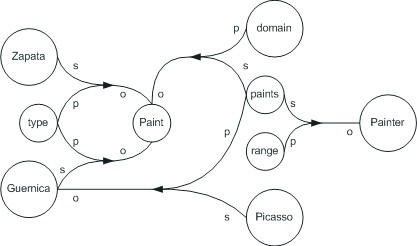
<body><![CDATA[<LI>       <p style="line-height: 100%; word-spacing: 0" align="justify"><FONT COLOR="#1f1a17" size="2" face="Verdana"> (</FONT><FONT COLOR="#1f1a17" face="Symbol" size="2">r</FONT><FONT COLOR="#1f1a17" size="2" face="Verdana">(<I>w</I>, <I>e</I>) = &#145;<I>s&#146;</I>) </FONT><FONT COLOR="#1f1a17" size="2" face="Symbol"> &#219; </FONT><FONT COLOR="#1f1a17" size="2" face="Verdana"> (<I>w</I>  </FONT><FONT COLOR="#1f1a17" size="2" face="Symbol"> </FONT><font color="#1f1a17" face="Symbol" size="3">  &#206;</font><FONT COLOR="#1f1a17" size="2" face="Verdana"> <I>orig</I>(<I>e</I>)) </FONT><FONT COLOR="#1f1a17" size="2" face="Symbol"> &#217; </FONT><FONT COLOR="#1f1a17" size="2" face="Verdana"> (<I>w</I>   </FONT><font color="#1f1a17" face="Symbol" size="3">  &#206; </font><FONT COLOR="#1f1a17" size="2" face="Verdana"><I>sub</I>({<I>t</I>}))&nbsp; </FONT></LI>     <LI>       <p style="line-height: 100%; word-spacing: 0" align="justify"><FONT COLOR="#1f1a17" size="2" face="Verdana"> (</FONT><I><FONT COLOR="#1f1a17" face="Symbol" size="2">r</FONT></I><FONT COLOR="#1f1a17" size="2" face="Verdana">(<I>w</I>, <I>e</I>) = &#145;<I>p&#146;</I>) </FONT><FONT COLOR="#1f1a17" size="2" face="Symbol"> &#219; </FONT><FONT COLOR="#1f1a17" size="2" face="Verdana"> (<I>w</I>  </FONT><font color="#1f1a17" face="Symbol" size="3">  &#206;</font><FONT COLOR="#1f1a17" size="2" face="Verdana"> <I>orig</I>(<I>e</I>)) </FONT><FONT COLOR="#1f1a17" size="2" face="Symbol"> &#217; </FONT><FONT COLOR="#1f1a17" size="2" face="Verdana"> (<I>w</I> </FONT><font color="#1f1a17" face="Symbol" size="3">  &#206;</font><FONT COLOR="#1f1a17" size="2" face="Verdana"> <I>pred</I>({<I>t</I>}))&nbsp; </FONT></LI>     <LI>       <p style="line-height: 100%; word-spacing: 0" align="justify"><FONT COLOR="#1f1a17" size="2" face="Verdana"> (</FONT><I><FONT COLOR="#1f1a17" face="Symbol" size="2">r</FONT></I><FONT COLOR="#1f1a17" size="2" face="Verdana">(<I>w</I>, <I>e</I>) = &#145;<I>o&#146;</I>) </FONT><FONT COLOR="#1f1a17" size="2" face="Symbol"> &#219; </FONT><FONT COLOR="#1f1a17" size="2" face="Verdana"> (<I>w</I>  </FONT><font color="#1f1a17" face="Symbol" size="3">  &#206;</font><FONT COLOR="#1f1a17" size="2" face="Verdana"> <I>dest</I>(<I>e</I>)) </FONT><FONT COLOR="#1f1a17" size="2" face="Symbol"> &#217; </FONT><FONT COLOR="#1f1a17" size="2" face="Verdana"> (<I>w</I> </FONT><font color="#1f1a17" face="Symbol" size="3">  &#206;</font><FONT COLOR="#1f1a17" size="2" face="Verdana"> <I>obj</I>({<I>t</I>}))&nbsp; </FONT></LI>     </UL>     <P align="justify" style="line-height: 100%; word-spacing: 0"><FONT COLOR="#1f1a17" size="2" face="Verdana"> <a href="#fig5"> Figures 5</a> and <a href="#fig6"> 6</a> show RDF directed hyper-graphs representing the RDF graphs  <I>T</I><FONT COLOR="#1f1a17"><SUB><I>1</I></SUB> and <I>T</I><SUB><I>2</I></SUB> of Section 2, respectively. To understand the relationship between  hyper-arcs and RDF triples consider, for example, the right topmost hyper-arc  in <a href="#fig6"> Figure 6</a>, which corresponds with the RDF triple <I>e</I> = (<I>Artist</I>, <I>creates</I>,  <I>Artifact</I>). In this case, </FONT></FONT> <I><FONT COLOR="#1f1a17" face="Symbol" size="2">r</FONT></I><FONT COLOR="#1f1a17" size="2" face="Verdana">(<I>Artist</I>, <I>e</I>) = &#145;<I>s&#146;</I>, <I>r</I>(<I>creates</I>, <I>e</I>) = &#145;<I>p&#146;</I>, and <I>r</I>(<I>Artifact</I>,  <I>e</I>) = &#145;<I>o&#146;</I>. In our approach, given an RDF graph <I>T</I>, each node corresponds  to an element <I>w</I>  </FONT><font color="#1f1a17" face="Symbol" size="3">  &#206;</font><FONT COLOR="#1f1a17" size="2" face="Verdana"> <I>univ</I>(<I>T</I>). Thus, the information is only stored in the  nodes, and the hyper-arcs only preserve the role of each node and the concept  of direction of RDF graphs. An advantage of this representation is that  each resource (subject, property, or value) is stored only once, and the  space required to store an RDF document is reduced if a resource appears  several times in the document. In this way, the space complexity of our  approach may be smaller than the complexity of representations presented  in Section 2. In addition, concepts, techniques, and algorithms of hyper-graph  theory may be used to manipulate RDF graphs under this representation.</FONT></P>     <P align="center" style="line-height: 100%; word-spacing: 0"><a name="fig5"><img border="0" src="/img/fbpe/rtfiuz/v33n1/art08fig5.jpg" align="center" width="417" height="246"></a></P>     
<P align="center" style="line-height: 100%; word-spacing: 0"><font face="Verdana" size="2"><b>Figure 5.</b> RDF directed hyper-graph for RDF graph T<sub>1</sub>.</font></P>     ]]></body>
<body><![CDATA[<P align="center" style="line-height: 100%; word-spacing: 0"><a name="fig6"><img border="0" src="/img/fbpe/rtfiuz/v33n1/art08fig6.jpg" align="center" width="417" height="314"></a></P>     
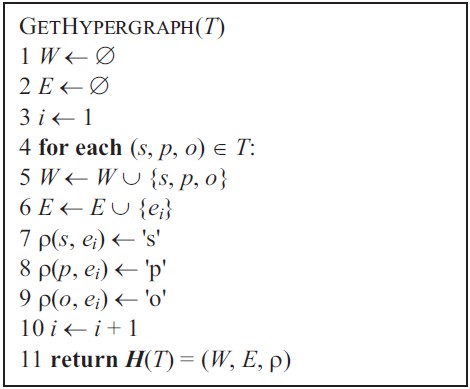
<P align="center" style="line-height: 100%; word-spacing: 0"><font face="Verdana" size="2"><b>Figure 6.</b> Directed hyper-graph for T<sub>2</sub>.</font></P> <MULTICOL GUTTER="39" COLS="2">     <P align="justify" style="line-height: 100%; word-spacing: 0"><FONT COLOR="#1f1a17" size="2" face="Verdana"> The number of nodes and hyper-arcs required for directed hyper-graphs representing  RDF graphs can be obtained from Definition 2, and it is stated in Proposition  1.&nbsp; </FONT></P>     <P align="justify" style="line-height: 100%; word-spacing: 0"> <B><FONT COLOR="#1f1a17" size="2" face="Verdana"> Proposition 1&nbsp; </FONT></B> </P>     <P align="justify" style="line-height: 100%; word-spacing: 0"><FONT COLOR="#1f1a17" size="2" face="Verdana"> Let <I>T</I> be an RDF graph and <I><B>H</B></I>(<I>T</I>) = (<I>W</I>, <I>E</I>, <FONT COLOR="#1f1a17"><I>r</I>) the RDF directed hyper-graph  representing <I>T</I>. Then, we have that |<I>W</I>| = |<I>univ</I>(<I>T</I>)| and |<I>E</I>| = |<I>T</I>|.&nbsp;</FONT> </FONT></P>     <P align="justify" style="line-height: 100%; word-spacing: 0"><FONT COLOR="#1f1a17" size="2" face="Verdana"> Thus, given an RDF graph <I>T</I>, the required space complexity to store the  RDF document represented by <I>T</I> using this model is <I>O</I>(<I>max</I>(|<I>univ</I>(<I>T</I>)|, |<I>T</I>|)).  The transformation from an RDF graph to the corresponding RDF directed  hyper-graph is shown in <a href="#algorit1"> Algorithm 1</a> and Proposition 2. Given an RDF graph  <I>T</I>, <a href="#algorit1"> Algorithm 1</a> scans all the triples in <I>T</I> (line 4). For each triple <I>t</I> =  (<I>s</I>, <I>p</I>, <I>o</I>) in <I>T</I>, it adds the elements <I>s</I>, <I>p</I>, and <I>o</I> to the set of nodes (line  5), the identifier for the hyper-arc corresponding to the triple <I>t</I> to the  set of hyper-arcs (line 6), and the roles (subject, predicate, or object)  of each node w.r.t. the hyper-arc to the role function (lines 7-9). Note  that, using this approach, RDF directed hyper-graphs define implicit position-based  indexes [11] for an RDF document, which can support efficient evaluation  of queries over the document.</FONT></P>     <P align="center" style="line-height: 100%; word-spacing: 0"><a name="algorit1"><img border="0" src="/img/fbpe/rtfiuz/v33n1/art08algoritmo1.jpg" align="center" width="470" height="389"></a></P>     
<P align="center" style="line-height: 100%; word-spacing: 0"><font face="Verdana" size="2"><b>Algorithm 1.</b> Directed hyper-graph construction.</font></P>     <P align="justify" style="line-height: 100%; word-spacing: 0"> <B><FONT COLOR="#1f1a17" size="2" face="Verdana"> Proposition 2&nbsp; </FONT></B> </P>     <P align="justify" style="line-height: 100%; word-spacing: 0"><FONT COLOR="#1f1a17" size="2" face="Verdana"> Algorithm GETHYPERGRAPH takes an RDF graph <I>T</I> as input and computes the  RDF directed hyper-graph representing <I>T</I>, <I><B>H</B></I>(<I>T</I>), as output.&nbsp; </FONT></P>     ]]></body>
<body><![CDATA[<P align="justify" style="line-height: 100%; word-spacing: 0"><FONT COLOR="#1f1a17" size="2" face="Verdana"> The cost of the transformation from an RDF graph <I>T</I> to the corresponding  RDF directed hyper-graph <I><B>H</B></I>(<I>T</I>) is defined in terms of the size of <I>T</I> in Proposition  3.&nbsp; </FONT></P>     <P align="justify" style="line-height: 100%; word-spacing: 0"> <B><FONT COLOR="#1f1a17" size="2" face="Verdana"> Proposition 3&nbsp; </FONT></B> </P>     <P align="justify" style="line-height: 100%; word-spacing: 0"><FONT COLOR="#1f1a17" size="2" face="Verdana"> Algorithm GETHYPERGRAPH computes <I><B>H</B></I>(<I>T</I>) in <I>O</I>(|<I>T</I>|) time.&nbsp; </FONT></P>     <P align="justify" style="line-height: 100%; word-spacing: 0"><FONT COLOR="#1f1a17" size="2" face="Verdana"> Intuitively, the most expensive operation performed at each iteration of  the <B>for</B> loop in <a href="#algorit1"> Algorithm 1</a> is a set-add for the nodes. If <I>W</I> is implemented  as a hashed set of the elements labels, this operation can be performed  in <I>O</I>(1) time. Thus, the time complexity of <a href="#algorit1"> Algorithm 1</a> is <I>O</I>(|<I>T</I>|). We found  that this result is better than the <I>O</I>(|<I>T</I>| <I>lg</I>(|<I>T</I>|)) time complexity obtained  in [6, 7].&nbsp; </FONT></P>     <P align="justify" style="line-height: 100%; word-spacing: 0"><FONT COLOR="#1f1a17" size="2" face="Verdana"> Given an RDF simple graph without blank nodes <I>T</I>, a basic query with one  unbound argument (a basic query <I>Q</I> is an elemental query <I>Q</I>: <I>H</I>  </FONT> <FONT COLOR="#1f1a17" face="Symbol" size="2">&#172;</FONT> <FONT COLOR="#1f1a17" size="2" face="Verdana">  <I>B</I>, where  |<I>B</I>| = 1), and an RDF directed hyper-graph representing <I>T</I>, <a href="#algorit2"> Algorithm 2</a> and  Proposition 4 present the task of basic query answering over <I><B>H</B></I>(<I>T</I>). <a href="#algorit2"> Algorithm  2</a> determines the role (subject, predicate, or object) of the variable in  the query (lines 1, 7, and 12). In each case, it identifies the relevant  hyper-arcs according to the instantiations on the query (lines 2-3, 8-9,  and 13-14). The query answer set is comprised of the hyper-arcs that are  relevant to these instantiations (lines 4-5, 10-11, and 15-16).</FONT></P>     <P align="center" style="line-height: 100%; word-spacing: 0"><a name="algorit2"><img border="0" src="/img/fbpe/rtfiuz/v33n1/art08algoritmo2.jpg" align="center" width="468" height="538"></a></P>     
<P align="center" style="line-height: 100%; word-spacing: 0"><font face="Verdana" size="2"><b>Algorithm 2.</b> Basic query answering, one variable.</font></P>     <P align="justify" style="line-height: 100%; word-spacing: 0"> <B><FONT COLOR="#1f1a17" size="2" face="Verdana"> Proposition 4&nbsp; </FONT></B> </P>     <P align="justify" style="line-height: 100%; word-spacing: 0"><FONT COLOR="#1f1a17" size="2" face="Verdana"> Let <I>T</I> be an RDF simple graph without blank nodes. Algorithm BASICQANSONEVAR  receives a basic query <I>Q</I> with one variable and the RDF directed hyper-graph  representing <I>T</I>, <I><B>H</B></I>(<I>T</I>), and computes the answer set of <I>Q</I> w.r.t. <I>T</I>.&nbsp;</FONT></P>     <P align="justify" style="line-height: 100%; word-spacing: 0"><FONT COLOR="#1f1a17" size="2" face="Verdana"> Time complexity of <a href="#algorit2"> Algorithm 2</a> is defined in terms of the size of <I><B>H</B></I>(<I>T</I>)  in Proposition 5.</FONT></P>     ]]></body>
<body><![CDATA[<P align="justify" style="line-height: 100%; word-spacing: 0"><B><FONT COLOR="#1f1a17" size="2" face="Verdana">Proposition 5&nbsp; </FONT></B> </P>     <P align="justify" style="line-height: 100%; word-spacing: 0"><FONT COLOR="#1f1a17" size="2" face="Verdana"> Let <I>T</I> be an RDF simple graph without blank nodes, <I>Q</I> a basic query with  one variable, and <I><B>H</B></I>(<I>T</I>) the RDF directed hyper-graph representing <I>T</I>. Algorithm  BASICQANSONEVAR computes the answer set of <I>Q</I> in <I>O</I>(|<I>T</I>|) time.&nbsp; </FONT></P>     <P align="justify" style="line-height: 100%; word-spacing: 0"><FONT COLOR="#1f1a17" size="2" face="Verdana"> Intuitively, to identify the relevant hyper-arcs for the query answer is  the most expensive operation performed in <a href="#algorit2"> Algorithm 2</a>. Note that it is  a two-fold operation. In the first step, the relevant hyper-arcs set for  each instantiation of the query <I>Q</I> has to be identified, while, in the second  step, these sets of instantiations are intersected. Assuming that <I>W</I> is  implemented as a hashed set of the elements labels, the first step is done  through a hash lookup which returns the relevant hyper-arcs set for the  instantiations; this step can be performed in <I>O</I>(1) time. The time complexity  of the second step depends on the size of the relevant hyper-arcs set for  the instantiations which, in the worst case, is |<I>T</I>|. Thus, the time complexity  of <a href="#algorit2"> Algorithm 2</a> is <I>O</I>(<I>max</I>(1, |<I>T</I>|)) = <I>O</I>(|<I>T</I>|) time.&nbsp; </FONT></P>     <P align="justify" style="line-height: 100%; word-spacing: 0"><FONT COLOR="#1f1a17" size="2" face="Verdana"> <a href="#algorit2"> Algorithm 2</a> can be modified in a straightforward way for the task of basic  query answering with two unbound arguments. Finally, we briefly analyze  the behavior of our approach in the presence of updates/insertions on an  RDF document. If these operations occur toward the start of the document,  then they can require the update of the whole structure, because of the  existing order on the elements labels over this representation. Thus, our  approach is adequate on environments where updates/insertions are not frequent  operations.&nbsp; </FONT></P>     <P align="justify" style="line-height: 100%; word-spacing: 0"> <B><FONT COLOR="#1f1a17" size="2" face="Verdana"> Experimental Results&nbsp; </FONT></B> </P>     <P align="justify" style="line-height: 100%; word-spacing: 0"><FONT COLOR="#1f1a17" size="2" face="Verdana"> An initial prototype was developed based on definitions 1 and 2, and <a href="#algorit1"> algorithms  1</a> and <a href="#algorit2">2</a>. Labeled directed graph (LDG) and directed hyper-graph (DH) representations  were studied empirically; we considered a set of ten synthetic RDF documents  randomly generated using a uniform distribution. RDF documents syntax was  expressed using N-Triples format [2]. Synthetic documents considered in  this experimental study corresponded to simple RDF graphs (<I>i.e.</I>, an RDF  graph that does not use vocabulary with a predefined semantics in RDF Schema).  Document sizes were increased, ranging from 100000 RDF triples to 1000000  RDF triples. Our prototype was developed using PYTHON programming language  and all the experiments were performed on a machine with a 3.0 GHz Intel  Core2 Duo processor, 2 GB of RAM, and 420 GB of local SATA disk, running  Fedora 9 Linux operating system.&nbsp; </FONT></P>     <P align="justify" style="line-height: 100%; word-spacing: 0"><FONT COLOR="#1f1a17" size="2" face="Verdana"> We reported three metrics to accomplish this preliminary experimental study:  (1) the time required to load each document (in secs.), (2) the space in  memory needed to load each document (in MB), and (3) the time required  to answer a basic query (in secs.).</FONT></P>     <P align="justify" style="line-height: 100%; word-spacing: 0"><FONT COLOR="#1f1a17" size="2" face="Verdana"> <a href="#fig7"> Figure 7</a> reports the time required to load each document; note that DH  time shows a linear behavior and it is about a half-order of magnitude  smaller than LDG time. In <a href="#fig7"> Figure 8</a>, we can observe that the space complexity  of both approaches (LDG and DH) linearly increases as the number of triples  in the documents. However, DH space is smaller than LDG space; due to the  fact that there are resources which can appear several times in the same  document, and in our approach each element is stored only once.</FONT></P>     <P align="center" style="line-height: 100%; word-spacing: 0"><a name="fig7"><img border="0" src="/img/fbpe/rtfiuz/v33n1/art08fig7.jpg" align="center" width="490" height="316"></a></P>     
<P align="center" style="line-height: 100%; word-spacing: 0"><font face="Verdana" size="2"><b>Figure 7. </b>Load time (secs).</font></P>     ]]></body>
<body><![CDATA[<P align="center" style="line-height: 100%; word-spacing: 0"><a name="fig8"><img border="0" src="/img/fbpe/rtfiuz/v33n1/art08fig8.jpg" align="center" width="493" height="323"></a></P>     
<P align="center" style="line-height: 100%; word-spacing: 0"><font face="Verdana" size="2"><b>Figure 8. </b>Structure size (MB).</font></P>     <P align="justify" style="line-height: 100%; word-spacing: 0"><FONT COLOR="#1f1a17" size="2" face="Verdana"> Additionally, we evaluated our prototype on four real-world RDF datasets:  the Mindswap research group (www.cs.umd.edu/~hendler/2003/MindPeople4-30.rdf),  a webcrawl of arbitrary RDF (activerdf.org/webcrawl_10k.nt), a FOAF dataset  (rdfweb.org/2003/02/28/cwm-crawler- output.rdf), and the ontoworld.org  Semantic Wiki (ontoworld.org/RDF/ontoworld.xml) [18]. These datasets have  different characteristics (<a href="#tab1">Table 1</a>), and they were converted to N-Triples  format using an RDF/XML parser [19]. The space and load time required for  each dataset, with respect to DH and LDG, is shown in <a href="#tab2"> Table 2</a>. Again, the  difference between the two approaches is due to the fact that there are  resources which appear several times in the same document, and in our approach  each element is stored only once.</FONT></P>     <p ALIGN="CENTER"><font COLOR="#1f1a17" SIZE="2" face="Verdana"><b><a name="tab1">Table 1.</a> </b>Evaluation datasets&nbsp;</font></p>     <div align="center">       <center>   <table width="580">     <tr>       <td WIDTH="120" VALIGN="TOP">             <p ALIGN="CENTER"><font COLOR="#1f1a17" SIZE="2" face="Verdana">Dataset&nbsp;</font></p>       </td>       <td WIDTH="120" VALIGN="TOP">             <p ALIGN="CENTER"><font COLOR="#1f1a17" SIZE="2" face="Verdana">Classes&nbsp;</font></p>       </td>       <td WIDTH="120" VALIGN="TOP">             <p ALIGN="CENTER"><font COLOR="#1f1a17" SIZE="2" face="Verdana">Resources&nbsp;</font></p>       </td>       <td WIDTH="120" VALIGN="TOP">             <p ALIGN="CENTER"><font COLOR="#1f1a17" SIZE="2" face="Verdana">Triples&nbsp;</font></p>       </td>       <td WIDTH="120" VALIGN="TOP">             ]]></body>
<body><![CDATA[<p ALIGN="CENTER"><font COLOR="#1f1a17" SIZE="2" face="Verdana">Size         (KB)&nbsp;</font></p>       </td>     </tr>     <tr>       <td WIDTH="120" VALIGN="TOP">             <p ALIGN="LEFT"><font COLOR="#1f1a17" SIZE="2" face="Verdana">&nbsp;&nbsp;&nbsp;&nbsp;&nbsp;&nbsp;&nbsp;Mindpeople&nbsp;</font></p>       </td>       <td WIDTH="120" VALIGN="TOP">             <p ALIGN="CENTER"><font COLOR="#1f1a17" SIZE="2" face="Verdana">14&nbsp;</font></p>       </td>       <td WIDTH="120" VALIGN="TOP">             <p ALIGN="CENTER"><font COLOR="#1f1a17" SIZE="2" face="Verdana">&nbsp;273&nbsp;</font></p>       </td>       <td WIDTH="120" VALIGN="TOP">             <p ALIGN="CENTER"><font COLOR="#1f1a17" SIZE="2" face="Verdana">&nbsp;1082&nbsp;</font></p>       </td>       <td WIDTH="120" VALIGN="TOP">             <p ALIGN="CENTER"><font COLOR="#1f1a17" SIZE="2" face="Verdana">&nbsp;140.3362&nbsp;</font></p>       </td>     </tr>     <tr>       <td WIDTH="120" VALIGN="TOP">             <p ALIGN="LEFT"><font COLOR="#1f1a17" SIZE="2" face="Verdana">&nbsp;&nbsp;&nbsp;&nbsp;&nbsp;&nbsp;&nbsp;Webcrawl&nbsp;</font></p>       </td>       <td WIDTH="120" VALIGN="TOP">             <p ALIGN="CENTER"><font COLOR="#1f1a17" SIZE="2" face="Verdana">&nbsp;2&nbsp;</font></p>       </td>       <td WIDTH="120" VALIGN="TOP">             <p ALIGN="CENTER"><font COLOR="#1f1a17" SIZE="2" face="Verdana">&nbsp;112&nbsp;</font></p>       </td>       <td WIDTH="120" VALIGN="TOP">             <p ALIGN="CENTER"><font COLOR="#1f1a17" SIZE="2" face="Verdana">10000&nbsp;</font></p>       </td>       <td WIDTH="120" VALIGN="TOP">             ]]></body>
<body><![CDATA[<p ALIGN="CENTER"><font COLOR="#1f1a17" SIZE="2" face="Verdana">1398.1409&nbsp;</font></p>       </td>     </tr>     <tr>       <td WIDTH="120" VALIGN="TOP">             <p ALIGN="LEFT"><font COLOR="#1f1a17" SIZE="2" face="Verdana">&nbsp;&nbsp;&nbsp;&nbsp;&nbsp;&nbsp;&nbsp;FOAF&nbsp;</font></p>       </td>       <td WIDTH="120" VALIGN="TOP">             <p ALIGN="CENTER"><font COLOR="#1f1a17" SIZE="2" face="Verdana">&nbsp;4&nbsp;</font></p>       </td>       <td WIDTH="120" VALIGN="TOP">             <p ALIGN="CENTER"><font COLOR="#1f1a17" SIZE="2" face="Verdana">3123&nbsp;</font></p>       </td>       <td WIDTH="120" VALIGN="TOP">             <p ALIGN="CENTER"><font COLOR="#1f1a17" SIZE="2" face="Verdana">&nbsp;9758&nbsp;</font></p>       </td>       <td WIDTH="120" VALIGN="TOP">             <p ALIGN="CENTER"><font COLOR="#1f1a17" SIZE="2" face="Verdana">1476.4329&nbsp;</font></p>       </td>     </tr>     <tr>       <td WIDTH="120" VALIGN="TOP">             <p ALIGN="LEFT"><font COLOR="#1f1a17" SIZE="2" face="Verdana">&nbsp;&nbsp;&nbsp;&nbsp;&nbsp;&nbsp;&nbsp;Ontoworld&nbsp;</font></p>       </td>       <td WIDTH="120" VALIGN="TOP">             <p ALIGN="CENTER"><font COLOR="#1f1a17" SIZE="2" face="Verdana">42&nbsp;</font></p>       </td>       <td WIDTH="120" VALIGN="TOP">             <p ALIGN="CENTER"><font COLOR="#1f1a17" SIZE="2" face="Verdana">4467&nbsp;</font></p>       </td>       <td WIDTH="120" VALIGN="TOP">             <p ALIGN="CENTER"><font COLOR="#1f1a17" SIZE="2" face="Verdana">55619&nbsp;</font></p>       </td>       <td WIDTH="120" VALIGN="TOP">             ]]></body>
<body><![CDATA[<p ALIGN="CENTER"><font COLOR="#1f1a17" SIZE="2" face="Verdana">9878.6468&nbsp;</font></p>       </td>     </tr>   </table>   </center> </div>     <p ALIGN="CENTER"><font COLOR="#1f1a17" size="2" face="Verdana"><b><a name="tab2">Table 2.</a></b><a name="tab2"> </a>Space and load time required for the evaluation datasets&nbsp;</font></p>     <div align="center">       <center>   <table width="580">     <tr>       <td WIDTH="117" VALIGN="TOP" ROWSPAN="2">             <p ALIGN="CENTER"><font COLOR="#1f1a17" size="2" face="Verdana">Dataset&nbsp;</font></p>       </td>       <td WIDTH="117" VALIGN="TOP" COLSPAN="2">             <p ALIGN="CENTER"><font COLOR="#1f1a17" size="2" face="Verdana">DH&nbsp;</font></p>       </td>       <td WIDTH="16" VALIGN="TOP"><font face="Verdana" size="2">&nbsp;</font></td>       <td WIDTH="117" VALIGN="TOP" COLSPAN="2">             <p ALIGN="CENTER"><font COLOR="#1f1a17" size="2" face="Verdana">LDG&nbsp;</font></p>       </td>     </tr>     <tr>       <td WIDTH="117" VALIGN="TOP">             <p ALIGN="CENTER"><font COLOR="#1f1a17" size="2" face="Verdana">Size         (KB)&nbsp;</font></p>       </td>       <td WIDTH="117" VALIGN="TOP">             <p ALIGN="CENTER"><font COLOR="#1f1a17" size="2" face="Verdana">Load         Time (secs.)&nbsp;</font></p>       </td>       <td WIDTH="16" VALIGN="TOP"><font face="Verdana" size="2">&nbsp;</font></td>       <td WIDTH="117" VALIGN="TOP">             <p ALIGN="CENTER"><font COLOR="#1f1a17" size="2" face="Verdana">Size         (KB)&nbsp;</font></p>       </td>       <td WIDTH="117" VALIGN="TOP">             ]]></body>
<body><![CDATA[<p ALIGN="CENTER"><font COLOR="#1f1a17" size="2" face="Verdana">Load         Time (secs.)&nbsp;</font></p>       </td>     </tr>     <tr>       <td WIDTH="117" VALIGN="TOP">             <p ALIGN="LEFT"><font COLOR="#1f1a17" size="2" face="Verdana">&nbsp;&nbsp;&nbsp;&nbsp;&nbsp;&nbsp;Mindpeople&nbsp;</font></p>       </td>       <td WIDTH="117" VALIGN="TOP">             <p ALIGN="CENTER"><font COLOR="#1f1a17" size="2" face="Verdana">&nbsp;&nbsp;81.167&nbsp;</font></p>       </td>       <td WIDTH="117" VALIGN="TOP">             <p ALIGN="CENTER"><font COLOR="#1f1a17" size="2" face="Verdana">0.0190&nbsp;</font></p>       </td>       <td WIDTH="16" VALIGN="TOP"><font face="Verdana" size="2">&nbsp;</font></td>       <td WIDTH="117" VALIGN="TOP">             <p ALIGN="CENTER"><font COLOR="#1f1a17" size="2" face="Verdana">&nbsp;&nbsp;92.246&nbsp;</font></p>       </td>       <td WIDTH="117" VALIGN="TOP">             <p ALIGN="CENTER"><font COLOR="#1f1a17" size="2" face="Verdana">0.0570&nbsp;</font></p>       </td>     </tr>     <tr>       <td WIDTH="117" VALIGN="TOP">             <p ALIGN="LEFT"><font COLOR="#1f1a17" size="2" face="Verdana">&nbsp;&nbsp;&nbsp;&nbsp;&nbsp;&nbsp;Webcrawl&nbsp;</font></p>       </td>       <td WIDTH="117" VALIGN="TOP">             <p ALIGN="CENTER"><font COLOR="#1f1a17" size="2" face="Verdana">&nbsp;565.453&nbsp;</font></p>       </td>       <td WIDTH="117" VALIGN="TOP">             <p ALIGN="CENTER"><font COLOR="#1f1a17" size="2" face="Verdana">0.1410&nbsp;</font></p>       </td>       <td WIDTH="16" VALIGN="TOP"><font face="Verdana" size="2">&nbsp;</font></td>       <td WIDTH="117" VALIGN="TOP">             <p ALIGN="CENTER"><font COLOR="#1f1a17" size="2" face="Verdana">&nbsp;805.080&nbsp;</font></p>       </td>       <td WIDTH="117" VALIGN="TOP">             ]]></body>
<body><![CDATA[<p ALIGN="CENTER"><font COLOR="#1f1a17" size="2" face="Verdana">0.5379&nbsp;</font></p>       </td>     </tr>     <tr>       <td WIDTH="117" VALIGN="TOP">             <p ALIGN="LEFT"><font COLOR="#1f1a17" size="2" face="Verdana">&nbsp;&nbsp;&nbsp;&nbsp;&nbsp;&nbsp;FOAF&nbsp;</font></p>       </td>       <td WIDTH="117" VALIGN="TOP">             <p ALIGN="CENTER"><font COLOR="#1f1a17" size="2" face="Verdana">1039.294&nbsp;</font></p>       </td>       <td WIDTH="117" VALIGN="TOP">             <p ALIGN="CENTER"><font COLOR="#1f1a17" size="2" face="Verdana">0.1440&nbsp;</font></p>       </td>       <td WIDTH="16" VALIGN="TOP"><font face="Verdana" size="2">&nbsp;</font></td>       <td WIDTH="117" VALIGN="TOP">             <p ALIGN="CENTER"><font COLOR="#1f1a17" size="2" face="Verdana">&nbsp;902.356&nbsp;</font></p>       </td>       <td WIDTH="117" VALIGN="TOP">             <p ALIGN="CENTER"><font COLOR="#1f1a17" size="2" face="Verdana">0.5829&nbsp;</font></p>       </td>     </tr>     <tr>       <td WIDTH="117" VALIGN="TOP">             <p ALIGN="LEFT"><font COLOR="#1f1a17" size="2" face="Verdana">&nbsp;&nbsp;&nbsp;&nbsp;&nbsp;&nbsp;Ontoworld&nbsp;</font></p>       </td>       <td WIDTH="117" VALIGN="TOP">             <p ALIGN="CENTER"><font COLOR="#1f1a17" size="2" face="Verdana">6255.260&nbsp;</font></p>       </td>       <td WIDTH="117" VALIGN="TOP">             <p ALIGN="CENTER"><font COLOR="#1f1a17" size="2" face="Verdana">0.8589&nbsp;</font></p>       </td>       <td WIDTH="16" VALIGN="TOP"><font face="Verdana" size="2">&nbsp;</font></td>       <td WIDTH="117" VALIGN="TOP">             <p ALIGN="CENTER"><font COLOR="#1f1a17" size="2" face="Verdana">6304.939&nbsp;</font></p>       </td>       <td WIDTH="117" VALIGN="TOP">             ]]></body>
<body><![CDATA[<p ALIGN="CENTER"><font COLOR="#1f1a17" size="2" face="Verdana">4.1184&nbsp;</font></p>       </td>     </tr>   </table>   </center> </div>     <P align="justify" style="line-height: 100%; word-spacing: 0"><FONT COLOR="#1f1a17" size="2" face="Verdana"> Finally, we ran twenty basic queries over each synthetic dataset: ten of  these queries contained one variable, and they were characterized by the  access patterns (?<I>s</I>, <I>p</I>, <I>o</I>), (<I>s</I>, ?<I>p</I>, <I>o</I>), and (<I>s</I>, <I>p</I>, ?<I>o</I>); the other ten queries  contained two variables, and they were characterized by the access patterns  (?<I>s</I>, ?<I>p</I>, <I>o</I>), (?<I>s</I>, <I>p</I>, ?<I>o</I>), and (<I>s</I>, ?<I>p</I>, ?<I>o</I>). <a href="#fig9"> Figures 9</a> and <a href="#fig10"> 10</a> report, for  each dataset, the time required to answer a basic query with one and two  variables, respectively, for DH and LDG.</FONT></P>     <P align="center" style="line-height: 100%; word-spacing: 0"><a name="fig9"><img border="0" src="/img/fbpe/rtfiuz/v33n1/art08fig9.jpg" align="center" width="496" height="326"></a></P>     
<P align="center" style="line-height: 100%; word-spacing: 0"><font face="Verdana" size="2"><b>Figure 9. </b>Basic query answering time (one variable).</font></P>     <P align="center" style="line-height: 100%; word-spacing: 0"><a name="fig10"><img border="0" src="/img/fbpe/rtfiuz/v33n1/art08fig10.jpg" align="center" width="492" height="321"></a></P>     
<P align="center" style="line-height: 100%; word-spacing: 0"><font face="Verdana" size="2"><b>Figure 10. </b>Basic query answering time (two variables).</font></P>     <P align="justify" style="line-height: 100%; word-spacing: 0"><FONT COLOR="#1f1a17" size="2" face="Verdana"> Note that, although the behavior of both approaches is similar, DH time  is smaller than LDG time. Thus our approach requires less time than the  LDG representation for the task of basic query answering. These results  depend on the selectivity of the instantiations on each query. Large selectivity  requires more time than a small one to determine the answer set, because  it implies larger sets of relevant triples.</FONT></P>     <P align="justify" style="line-height: 100%; word-spacing: 0"><B><FONT COLOR="#1f1a17" size="2" face="Verdana">Conclusions and Future Work&nbsp; </FONT></B> </P>     <P align="justify" style="line-height: 100%; word-spacing: 0"><FONT COLOR="#1f1a17" size="2" face="Verdana"> We proposed a directed hyper-graph formal model to represent RDF documents.  In our initial experimental results we could observe that our proposed  representation requires less space to represent RDF documents; in addition,  it is able to speed up the task of basic query answering. Accordingly,  the directed hyper-graph formal model seems to be an alternative to represent  RDF documents efficiently, which may scale up better than existing representations  to manage large RDF documents. These results have encouraged us to define  RDF query evaluation techniques based on this RDF model.&nbsp; </FONT></P>     <P align="justify" style="line-height: 100%; word-spacing: 0"><FONT COLOR="#1f1a17" size="2" face="Verdana"> In the future, we plan to compare our approach against other existing models,  e.g., the bipartite graph model. Also, we will extend this initial representation  to model RDF Schema (RDFS) graphs, and implement query evaluation algorithms  for conjunctive and SPARQL [20] queries. We will formally study the impact  of this model on issues like blank nodes, reification, entailment, and  on the tasks of query answering and semantic reasoning. Finally, we will  conduct a more extensive empirical study to analyze the suitability of  the RDF hyper-graph model.&nbsp; </FONT></P>     ]]></body>
<body><![CDATA[<P align="justify" style="line-height: 100%; word-spacing: 0"> <B><FONT COLOR="#1f1a17" size="2" face="Verdana"> References&nbsp; </FONT></B> </P>     <!-- ref --><P align="justify" style="line-height: 100%; word-spacing: 0"><FONT COLOR="#1f1a17" size="2" face="Verdana"> 1.&nbsp;D. Beckett, &#147;RDF/XML Syntax Specification (Revised),&#148; Tech. Rep. Recommendation,  W3C, February 2004.&nbsp;</FONT>&nbsp;&nbsp;&nbsp;&nbsp;&nbsp;&nbsp;&nbsp;&nbsp;[&#160;<a href="javascript:void(0);" onclick="javascript: window.open('/scielo.php?script=sci_nlinks&ref=2370181&pid=S0254-0770201000010000800001&lng=','','width=640,height=500,resizable=yes,scrollbars=1,menubar=yes,');">Links</a>&#160;]<!-- end-ref --><!-- ref --><P align="justify" style="line-height: 100%; word-spacing: 0"><FONT COLOR="#1f1a17" size="2" face="Verdana"> 2.&nbsp;J. Grant and D. Beckett, &#147;RDF Test Cases,&#148; Tech. Rep. Recommendation, W3C,  February 2004.&nbsp;</FONT>&nbsp;&nbsp;&nbsp;&nbsp;&nbsp;&nbsp;&nbsp;&nbsp;[&#160;<a href="javascript:void(0);" onclick="javascript: window.open('/scielo.php?script=sci_nlinks&ref=2370182&pid=S0254-0770201000010000800002&lng=','','width=640,height=500,resizable=yes,scrollbars=1,menubar=yes,');">Links</a>&#160;]<!-- end-ref --><!-- ref --><P align="justify" style="line-height: 100%; word-spacing: 0"><FONT COLOR="#1f1a17" size="2" face="Verdana"> 3.&nbsp;G. Klyne and J.J. Carroll, &#147;Resource Description Framework (RDF): Concepts  and Abstract Syntax,&#148; Tech. Rep. Recommendation, W3C, February 2004.&nbsp;</FONT>&nbsp;&nbsp;&nbsp;&nbsp;&nbsp;&nbsp;&nbsp;&nbsp;[&#160;<a href="javascript:void(0);" onclick="javascript: window.open('/scielo.php?script=sci_nlinks&ref=2370183&pid=S0254-0770201000010000800003&lng=','','width=640,height=500,resizable=yes,scrollbars=1,menubar=yes,');">Links</a>&#160;]<!-- end-ref --><!-- ref --><P align="justify" style="line-height: 100%; word-spacing: 0"><FONT COLOR="#1f1a17" size="2" face="Verdana"> 4.&nbsp;F. Manola and E. Miller, &#147;RDF Primer,&#148; Tech. Rep. Recommendation, W3C,  February 2004.&nbsp;</FONT>&nbsp;&nbsp;&nbsp;&nbsp;&nbsp;&nbsp;&nbsp;&nbsp;[&#160;<a href="javascript:void(0);" onclick="javascript: window.open('/scielo.php?script=sci_nlinks&ref=2370184&pid=S0254-0770201000010000800004&lng=','','width=640,height=500,resizable=yes,scrollbars=1,menubar=yes,');">Links</a>&#160;]<!-- end-ref --><!-- ref --><P align="justify" style="line-height: 100%; word-spacing: 0"><FONT COLOR="#1f1a17" size="2" face="Verdana"> 5.&nbsp;C. Guti&#233;rrez, C.A. Hurtado, and A.O. Mendelzon, &#147;Foundations of Semantic  Web Databases,&#148; in Proc. of the 23<FONT COLOR="#1f1a17"><SUP>rd </SUP>SIGMOD/ PODS, pp. 95-106, France,  2004.&nbsp;</FONT> </FONT>&nbsp;&nbsp;&nbsp;&nbsp;&nbsp;&nbsp;&nbsp;&nbsp;[&#160;<a href="javascript:void(0);" onclick="javascript: window.open('/scielo.php?script=sci_nlinks&ref=2370185&pid=S0254-0770201000010000800005&lng=','','width=640,height=500,resizable=yes,scrollbars=1,menubar=yes,');">Links</a>&#160;]<!-- end-ref --><!-- ref --><P align="justify" style="line-height: 100%; word-spacing: 0"><FONT COLOR="#1f1a17" size="2" face="Verdana"> 6.&nbsp;J. Hayes, &#147;A Graph Model for RDF,&#148; Master&#146;s thesis, Technische Universit&#228;t  Darmstadt, Department of Computer Science, Darmstadt, Germany, October  2004.&nbsp;</FONT>&nbsp;&nbsp;&nbsp;&nbsp;&nbsp;&nbsp;&nbsp;&nbsp;[&#160;<a href="javascript:void(0);" onclick="javascript: window.open('/scielo.php?script=sci_nlinks&ref=2370186&pid=S0254-0770201000010000800006&lng=','','width=640,height=500,resizable=yes,scrollbars=1,menubar=yes,');">Links</a>&#160;]<!-- end-ref --><!-- ref --><P align="justify" style="line-height: 100%; word-spacing: 0"><FONT COLOR="#1f1a17" size="2" face="Verdana"> 7.&nbsp;J. Hayes and C. Guti&#233;rrez, &#147;Bipartite Graphs as Intermediate Model for  RDF,&#148; in Proc. of the 3<FONT COLOR="#1f1a17"><SUP>rd</SUP> ISWC, pp. 47-61, Japan 2004.&nbsp;</FONT> </FONT>&nbsp;&nbsp;&nbsp;&nbsp;&nbsp;&nbsp;&nbsp;&nbsp;[&#160;<a href="javascript:void(0);" onclick="javascript: window.open('/scielo.php?script=sci_nlinks&ref=2370187&pid=S0254-0770201000010000800007&lng=','','width=640,height=500,resizable=yes,scrollbars=1,menubar=yes,');">Links</a>&#160;]<!-- end-ref --><!-- ref --><P align="justify" style="line-height: 100%; word-spacing: 0"><FONT COLOR="#1f1a17" size="2" face="Verdana"> 8.&nbsp;P. Auillans, P.O. de Mendez, P. Rosenstiehl, and B. Vatant, &#147;A Formal Model  for Topic Maps,&#148; in Proc. of the 1<FONT COLOR="#1f1a17"><SUP>st</SUP> ISWC, pp. 69-83, Italy 2002.&nbsp;</FONT> </FONT>&nbsp;&nbsp;&nbsp;&nbsp;&nbsp;&nbsp;&nbsp;&nbsp;[&#160;<a href="javascript:void(0);" onclick="javascript: window.open('/scielo.php?script=sci_nlinks&ref=2370188&pid=S0254-0770201000010000800008&lng=','','width=640,height=500,resizable=yes,scrollbars=1,menubar=yes,');">Links</a>&#160;]<!-- end-ref --><!-- ref --><P align="justify" style="line-height: 100%; word-spacing: 0"><FONT COLOR="#1f1a17" size="2" face="Verdana"> 9.&nbsp;G. Gallo, G. Longo, S. Pallottino, and S.V. Nguyen, &#147;Directed Hypergraphs  and Applications,&#148; Discrete Applied Mathematics, vol. 42, pp. 177-201,  April 1993.&nbsp;</FONT>&nbsp;&nbsp;&nbsp;&nbsp;&nbsp;&nbsp;&nbsp;&nbsp;[&#160;<a href="javascript:void(0);" onclick="javascript: window.open('/scielo.php?script=sci_nlinks&ref=2370189&pid=S0254-0770201000010000800009&lng=','','width=640,height=500,resizable=yes,scrollbars=1,menubar=yes,');">Links</a>&#160;]<!-- end-ref --><!-- ref --><P align="justify" style="line-height: 100%; word-spacing: 0"><FONT COLOR="#1f1a17" size="2" face="Verdana"> 10.&nbsp;G. Gallo and M.G. Scutell&#224;, &#147;Directed Hypergraphs as a Modelling Paradigm,&#148;  Tech. Rep. TR-99-02, Universit&#224; di Pisa, February 1999.&nbsp;</FONT>&nbsp;&nbsp;&nbsp;&nbsp;&nbsp;&nbsp;&nbsp;&nbsp;[&#160;<a href="javascript:void(0);" onclick="javascript: window.open('/scielo.php?script=sci_nlinks&ref=2370190&pid=S0254-0770201000010000800010&lng=','','width=640,height=500,resizable=yes,scrollbars=1,menubar=yes,');">Links</a>&#160;]<!-- end-ref --><!-- ref --><P align="justify" style="line-height: 100%; word-spacing: 0"><FONT COLOR="#1f1a17" size="2" face="Verdana"> 11.&nbsp;R. Sacks-Davis, T. Dao, J.A. Thom, and J. Zobel, &#147;Indexing Documents for  Queries on Structure, Content, and Attributes,&#148; in Proc. of the International  Conference on Digital Media Information Bases, pp. 236-245, Japan 1997.&nbsp;</FONT>&nbsp;&nbsp;&nbsp;&nbsp;&nbsp;&nbsp;&nbsp;&nbsp;[&#160;<a href="javascript:void(0);" onclick="javascript: window.open('/scielo.php?script=sci_nlinks&ref=2370191&pid=S0254-0770201000010000800011&lng=','','width=640,height=500,resizable=yes,scrollbars=1,menubar=yes,');">Links</a>&#160;]<!-- end-ref --><!-- ref --><P align="justify" style="line-height: 100%; word-spacing: 0"><FONT COLOR="#1f1a17" size="2" face="Verdana"> 12.&nbsp;D. Brickley and R. V. Guha, &#147;RDF Vocabulary Description Language 1.0: RDF  Schema,&#148; Tech. Rep. Recommendation, W3C, February 2004.&nbsp;</FONT>&nbsp;&nbsp;&nbsp;&nbsp;&nbsp;&nbsp;&nbsp;&nbsp;[&#160;<a href="javascript:void(0);" onclick="javascript: window.open('/scielo.php?script=sci_nlinks&ref=2370192&pid=S0254-0770201000010000800012&lng=','','width=640,height=500,resizable=yes,scrollbars=1,menubar=yes,');">Links</a>&#160;]<!-- end-ref --><!-- ref --><P align="justify" style="line-height: 100%; word-spacing: 0"><FONT COLOR="#1f1a17" size="2" face="Verdana"> 13.&nbsp;P. Hayes, &#147;RDF Semantics,&#148; Tech. Rep. Recommendation, W3C, February 2004.&nbsp;</FONT>&nbsp;&nbsp;&nbsp;&nbsp;&nbsp;&nbsp;&nbsp;&nbsp;[&#160;<a href="javascript:void(0);" onclick="javascript: window.open('/scielo.php?script=sci_nlinks&ref=2370193&pid=S0254-0770201000010000800013&lng=','','width=640,height=500,resizable=yes,scrollbars=1,menubar=yes,');">Links</a>&#160;]<!-- end-ref --><!-- ref --><P align="justify" style="line-height: 100%; word-spacing: 0"><FONT COLOR="#1f1a17" size="2" face="Verdana"> 14.&nbsp;A.A. Mart&#237;nez-Morales and M.E. Vidal, &#147;A Directed Hypergraph Model for  RDF,&#148; in Proc. of the 2<FONT COLOR="#1f1a17"><SUP>nd</SUP> KWEPSY, pp. 96-97, Austria, 2007.&nbsp;</FONT> </FONT>&nbsp;&nbsp;&nbsp;&nbsp;&nbsp;&nbsp;&nbsp;&nbsp;[&#160;<a href="javascript:void(0);" onclick="javascript: window.open('/scielo.php?script=sci_nlinks&ref=2370194&pid=S0254-0770201000010000800014&lng=','','width=640,height=500,resizable=yes,scrollbars=1,menubar=yes,');">Links</a>&#160;]<!-- end-ref --><!-- ref --><P align="justify" style="line-height: 100%; word-spacing: 0"><FONT COLOR="#1f1a17" size="2" face="Verdana"> 15.&nbsp;C. Guti&#233;rrez, C.A. Hurtado, and A.O. Mendelzon, &#147;Formal aspects of querying  RDF databases,&#148; in Proc. of the 1<FONT COLOR="#1f1a17"><SUP>st</SUP> SWDB, pp. 293-307, Germany, 2003.&nbsp;</FONT> </FONT>&nbsp;&nbsp;&nbsp;&nbsp;&nbsp;&nbsp;&nbsp;&nbsp;[&#160;<a href="javascript:void(0);" onclick="javascript: window.open('/scielo.php?script=sci_nlinks&ref=2370195&pid=S0254-0770201000010000800015&lng=','','width=640,height=500,resizable=yes,scrollbars=1,menubar=yes,');">Links</a>&#160;]<!-- end-ref --><!-- ref --><P align="justify" style="line-height: 100%; word-spacing: 0"><FONT COLOR="#1f1a17" size="2" face="Verdana"> 16.&nbsp;F. Dau, &#147;RDF as Graph-Based, Diagrammatic Logic,&#148; in Proc. of the 16<FONT COLOR="#1f1a17"><SUP>th</SUP>  ISMIS, pp. 332-337, Italy, 2006.&nbsp;</FONT> </FONT>&nbsp;&nbsp;&nbsp;&nbsp;&nbsp;&nbsp;&nbsp;&nbsp;[&#160;<a href="javascript:void(0);" onclick="javascript: window.open('/scielo.php?script=sci_nlinks&ref=2370196&pid=S0254-0770201000010000800016&lng=','','width=640,height=500,resizable=yes,scrollbars=1,menubar=yes,');">Links</a>&#160;]<!-- end-ref --><!-- ref --><P align="justify" style="line-height: 100%; word-spacing: 0"><FONT COLOR="#1f1a17" size="2" face="Verdana"> 17.&nbsp;G. Karvounarakis, V. Christophides, D. Plexousakis, and S. Alexaki, &#147;Querying  RDF Descriptions for Community Web Portals,&#148; in Actes des 17&#232;me Journ&#233;es  Bases de Donn&#233;es Avanc&#233;es (BDA 2001), Agadir, Maroc, pp. 133-144, C&#233;padu&#232;s  Edition, October 2001.&nbsp;</FONT>&nbsp;&nbsp;&nbsp;&nbsp;&nbsp;&nbsp;&nbsp;&nbsp;[&#160;<a href="javascript:void(0);" onclick="javascript: window.open('/scielo.php?script=sci_nlinks&ref=2370197&pid=S0254-0770201000010000800017&lng=','','width=640,height=500,resizable=yes,scrollbars=1,menubar=yes,');">Links</a>&#160;]<!-- end-ref --><!-- ref --><P align="justify" style="line-height: 100%; word-spacing: 0"><FONT COLOR="#1f1a17" size="2" face="Verdana"> 18.&nbsp;E. Oren, S. Gerke, and S. Decker, &#147;Simple Algorithms for Predicate Suggestions  using Similarity and Co-Occurrence,&#148; in Proc. of the 4<FONT COLOR="#1f1a17"><SUP>th</SUP> ESWC, pp. 160-174,  Austria, 2007.&nbsp;</FONT> </FONT>&nbsp;&nbsp;&nbsp;&nbsp;&nbsp;&nbsp;&nbsp;&nbsp;[&#160;<a href="javascript:void(0);" onclick="javascript: window.open('/scielo.php?script=sci_nlinks&ref=2370198&pid=S0254-0770201000010000800018&lng=','','width=640,height=500,resizable=yes,scrollbars=1,menubar=yes,');">Links</a>&#160;]<!-- end-ref --><!-- ref --><P align="justify" style="line-height: 100%; word-spacing: 0"><FONT COLOR="#1f1a17" size="2" face="Verdana"> 19.&nbsp;S.B. Palmer, &#147;An RDF/XML Parser in Python.&#148; <a href="http://infomesh.net/2003/rdfparser">http://infomesh.net/2003/rdfparser</a>, August 2003.&nbsp;</FONT>&nbsp;&nbsp;&nbsp;&nbsp;&nbsp;&nbsp;&nbsp;&nbsp;[&#160;<a href="javascript:void(0);" onclick="javascript: window.open('/scielo.php?script=sci_nlinks&ref=2370199&pid=S0254-0770201000010000800019&lng=','','width=640,height=500,resizable=yes,scrollbars=1,menubar=yes,');">Links</a>&#160;]<!-- end-ref --><!-- ref --><P align="justify" style="line-height: 100%; word-spacing: 0"><FONT COLOR="#1f1a17" size="2" face="Verdana"> 20.&nbsp;E. Prud&#146;hommeaux and A. Seaborne, &#147;SPARQL Query Language for RDF,&#148; Tech.  Rep. Recommendation, W3C and Hewlett-Packard Laboratories, Bristol, January  2008.&nbsp;</FONT>&nbsp;&nbsp;&nbsp;&nbsp;&nbsp;&nbsp;&nbsp;&nbsp;[&#160;<a href="javascript:void(0);" onclick="javascript: window.open('/scielo.php?script=sci_nlinks&ref=2370200&pid=S0254-0770201000010000800020&lng=','','width=640,height=500,resizable=yes,scrollbars=1,menubar=yes,');">Links</a>&#160;]<!-- end-ref --> ]]></body>
<back>
<ref-list>
<ref id="B1">
<label>1</label><nlm-citation citation-type="">
<person-group person-group-type="author">
<name>
<surname><![CDATA[Beckett]]></surname>
<given-names><![CDATA[D]]></given-names>
</name>
</person-group>
<source><![CDATA[RDF/XML Syntax Specification (Revised): Tech. Rep. Recommendation, W3C]]></source>
<year>Febr</year>
<month>ua</month>
<day>ry</day>
</nlm-citation>
</ref>
<ref id="B2">
<label>2</label><nlm-citation citation-type="">
<person-group person-group-type="author">
<name>
<surname><![CDATA[Grant]]></surname>
<given-names><![CDATA[J]]></given-names>
</name>
<name>
<surname><![CDATA[Beckett]]></surname>
<given-names><![CDATA[D]]></given-names>
</name>
</person-group>
<source><![CDATA[RDF Test Cases]]></source>
<year>Febr</year>
<month>ua</month>
<day>ry</day>
</nlm-citation>
</ref>
<ref id="B3">
<label>3</label><nlm-citation citation-type="">
<person-group person-group-type="author">
<name>
<surname><![CDATA[Klyne]]></surname>
<given-names><![CDATA[G]]></given-names>
</name>
<name>
<surname><![CDATA[Carroll]]></surname>
<given-names><![CDATA[J.J]]></given-names>
</name>
</person-group>
<source><![CDATA[Resource Description Framework (RDF): Concepts and Abstract Syntax]]></source>
<year>Febr</year>
<month>ua</month>
<day>ry</day>
</nlm-citation>
</ref>
<ref id="B4">
<label>4</label><nlm-citation citation-type="">
<person-group person-group-type="author">
<name>
<surname><![CDATA[Manola]]></surname>
<given-names><![CDATA[F]]></given-names>
</name>
<name>
<surname><![CDATA[Miller]]></surname>
<given-names><![CDATA[E]]></given-names>
</name>
</person-group>
<source><![CDATA[RDF Primer]]></source>
<year>brua</year>
<month>ry</month>
<day> 2</day>
</nlm-citation>
</ref>
<ref id="B5">
<label>5</label><nlm-citation citation-type="">
<person-group person-group-type="author">
<name>
<surname><![CDATA[Gutiérrez]]></surname>
<given-names><![CDATA[C]]></given-names>
</name>
<name>
<surname><![CDATA[Hurtado]]></surname>
<given-names><![CDATA[C.A]]></given-names>
</name>
<name>
<surname><![CDATA[Mendelzon]]></surname>
<given-names><![CDATA[A.O]]></given-names>
</name>
</person-group>
<source><![CDATA[Foundations of Semantic Web Databases]]></source>
<year>2004</year>
<page-range>95-106</page-range><publisher-loc><![CDATA[France ]]></publisher-loc>
</nlm-citation>
</ref>
<ref id="B6">
<label>6</label><nlm-citation citation-type="">
<person-group person-group-type="author">
<name>
<surname><![CDATA[Hayes]]></surname>
<given-names><![CDATA[J]]></given-names>
</name>
</person-group>
<source><![CDATA[A Graph Model for RDF]]></source>
<year></year>
</nlm-citation>
</ref>
<ref id="B7">
<label>7</label><nlm-citation citation-type="">
<person-group person-group-type="author">
<name>
<surname><![CDATA[Hayes]]></surname>
<given-names><![CDATA[J]]></given-names>
</name>
<name>
<surname><![CDATA[Gutiérrez]]></surname>
<given-names><![CDATA[C]]></given-names>
</name>
</person-group>
<source><![CDATA[Bipartite Graphs as Intermediate Model for RDF]]></source>
<year>2004</year>
<page-range>47-61</page-range></nlm-citation>
</ref>
<ref id="B8">
<label>8</label><nlm-citation citation-type="">
<person-group person-group-type="author">
<name>
<surname><![CDATA[Auillans]]></surname>
<given-names><![CDATA[P]]></given-names>
</name>
<name>
<surname><![CDATA[de Mendez]]></surname>
<given-names><![CDATA[P.O]]></given-names>
</name>
<name>
<surname><![CDATA[Rosenstiehl]]></surname>
<given-names><![CDATA[P]]></given-names>
</name>
<name>
<surname><![CDATA[Vatant]]></surname>
<given-names><![CDATA[B]]></given-names>
</name>
</person-group>
<source><![CDATA[A Formal Model for Topic Maps]]></source>
<year>2002</year>
<page-range>69-83</page-range></nlm-citation>
</ref>
<ref id="B9">
<label>9</label><nlm-citation citation-type="journal">
<person-group person-group-type="author">
<name>
<surname><![CDATA[Gallo]]></surname>
<given-names><![CDATA[G]]></given-names>
</name>
<name>
<surname><![CDATA[Longo]]></surname>
<given-names><![CDATA[G]]></given-names>
</name>
<name>
<surname><![CDATA[Pallottino]]></surname>
<given-names><![CDATA[S]]></given-names>
</name>
<name>
<surname><![CDATA[Nguyen]]></surname>
<given-names><![CDATA[S.V]]></given-names>
</name>
</person-group>
<source><![CDATA[Discrete Applied MathematicsDirected Hypergraphs and Applications]]></source>
<year>Apri</year>
<month>l </month>
<day>19</day>
<volume>42</volume>
<page-range>177-201</page-range></nlm-citation>
</ref>
<ref id="B10">
<label>10</label><nlm-citation citation-type="book">
<person-group person-group-type="author">
<name>
<surname><![CDATA[Gallo]]></surname>
<given-names><![CDATA[G]]></given-names>
</name>
<name>
<surname><![CDATA[Scutellà]]></surname>
<given-names><![CDATA[M.G]]></given-names>
</name>
</person-group>
<source><![CDATA[Directed Hypergraphs as a Modelling Paradigm]]></source>
<year>Febr</year>
<month>ua</month>
<day>ry</day>
<publisher-name><![CDATA[Università di Pisa]]></publisher-name>
</nlm-citation>
</ref>
<ref id="B11">
<label>11</label><nlm-citation citation-type="">
<person-group person-group-type="author">
<name>
<surname><![CDATA[Sacks-Davis]]></surname>
<given-names><![CDATA[R]]></given-names>
</name>
<name>
<surname><![CDATA[Dao]]></surname>
<given-names><![CDATA[T]]></given-names>
</name>
<name>
<surname><![CDATA[Thom]]></surname>
<given-names><![CDATA[J.A]]></given-names>
</name>
<name>
<surname><![CDATA[Zobel]]></surname>
<given-names><![CDATA[J]]></given-names>
</name>
</person-group>
<source><![CDATA[Indexing Documents for Queries on Structure, Content, and Attributes]]></source>
<year>1997</year>
<page-range>236-245</page-range></nlm-citation>
</ref>
<ref id="B12">
<label>12</label><nlm-citation citation-type="">
<person-group person-group-type="author">
<name>
<surname><![CDATA[Brickley]]></surname>
<given-names><![CDATA[D]]></given-names>
</name>
<name>
<surname><![CDATA[Guha]]></surname>
<given-names><![CDATA[R. V]]></given-names>
</name>
</person-group>
<source><![CDATA[RDF Vocabulary Description Language 1.0: RDF Schema]]></source>
<year>Febr</year>
<month>ua</month>
<day>ry</day>
</nlm-citation>
</ref>
<ref id="B13">
<label>13</label><nlm-citation citation-type="">
<person-group person-group-type="author">
<name>
<surname><![CDATA[Hayes]]></surname>
<given-names><![CDATA[P]]></given-names>
</name>
</person-group>
<source><![CDATA[RDF Semantics]]></source>
<year>Febr</year>
<month>ua</month>
<day>ry</day>
</nlm-citation>
</ref>
<ref id="B14">
<label>14</label><nlm-citation citation-type="">
<person-group person-group-type="author">
<name>
<surname><![CDATA[Martínez-Morales]]></surname>
<given-names><![CDATA[A.A]]></given-names>
</name>
<name>
<surname><![CDATA[Vidal]]></surname>
<given-names><![CDATA[M.E]]></given-names>
</name>
</person-group>
<source><![CDATA[A Directed Hypergraph Model for RDF]]></source>
<year>2007</year>
<page-range>96-97</page-range></nlm-citation>
</ref>
<ref id="B15">
<label>15</label><nlm-citation citation-type="">
<person-group person-group-type="author">
<name>
<surname><![CDATA[Gutiérrez]]></surname>
<given-names><![CDATA[C]]></given-names>
</name>
<name>
<surname><![CDATA[Hurtado]]></surname>
<given-names><![CDATA[C.A]]></given-names>
</name>
<name>
<surname><![CDATA[Mendelzon]]></surname>
<given-names><![CDATA[A.O]]></given-names>
</name>
</person-group>
<source><![CDATA[Formal aspects of querying RDF databases]]></source>
<year>2003</year>
<page-range>293-307</page-range></nlm-citation>
</ref>
<ref id="B16">
<label>16</label><nlm-citation citation-type="">
<person-group person-group-type="author">
<name>
<surname><![CDATA[Dau]]></surname>
<given-names><![CDATA[F]]></given-names>
</name>
</person-group>
<source><![CDATA[RDF as Graph-Based, Diagrammatic Logic]]></source>
<year>2006</year>
<page-range>332-337</page-range></nlm-citation>
</ref>
<ref id="B17">
<label>17</label><nlm-citation citation-type="book">
<person-group person-group-type="author">
<name>
<surname><![CDATA[Karvounarakis]]></surname>
<given-names><![CDATA[G]]></given-names>
</name>
<name>
<surname><![CDATA[Christophides]]></surname>
<given-names><![CDATA[V]]></given-names>
</name>
<name>
<surname><![CDATA[Plexousakis]]></surname>
<given-names><![CDATA[D]]></given-names>
</name>
<name>
<surname><![CDATA[Alexaki]]></surname>
<given-names><![CDATA[S]]></given-names>
</name>
</person-group>
<source><![CDATA[Querying RDF Descriptions for Community Web Portals]]></source>
<year>Octo</year>
<month>be</month>
<day>r </day>
<page-range>133-144</page-range><publisher-name><![CDATA[Cépaduès Edition]]></publisher-name>
</nlm-citation>
</ref>
<ref id="B18">
<label>18</label><nlm-citation citation-type="">
<person-group person-group-type="author">
<name>
<surname><![CDATA[Oren]]></surname>
<given-names><![CDATA[E]]></given-names>
</name>
<name>
<surname><![CDATA[Gerke]]></surname>
<given-names><![CDATA[S]]></given-names>
</name>
<name>
<surname><![CDATA[Decker]]></surname>
<given-names><![CDATA[S]]></given-names>
</name>
</person-group>
<source><![CDATA[Simple Algorithms for Predicate Suggestions using Similarity and Co-Occurrence]]></source>
<year>2007</year>
<page-range>160-174</page-range></nlm-citation>
</ref>
<ref id="B19">
<label>19</label><nlm-citation citation-type="">
<person-group person-group-type="author">
<name>
<surname><![CDATA[Palmer]]></surname>
<given-names><![CDATA[S.B]]></given-names>
</name>
</person-group>
<source><![CDATA[An RDF/XML Parser in Python]]></source>
<year>Augu</year>
<month>st</month>
<day> 2</day>
</nlm-citation>
</ref>
<ref id="B20">
<label>20</label><nlm-citation citation-type="">
<person-group person-group-type="author">
<name>
<surname><![CDATA[Prudhommeaux]]></surname>
<given-names><![CDATA[E]]></given-names>
</name>
<name>
<surname><![CDATA[Seaborne]]></surname>
<given-names><![CDATA[A]]></given-names>
</name>
</person-group>
<source><![CDATA[SPARQL Query Language for RDF]]></source>
<year>Janu</year>
<month>ar</month>
<day>y </day>
</nlm-citation>
</ref>
</ref-list>
</back>
</article>