<?xml version="1.0" encoding="ISO-8859-1"?><article xmlns:mml="http://www.w3.org/1998/Math/MathML" xmlns:xlink="http://www.w3.org/1999/xlink" xmlns:xsi="http://www.w3.org/2001/XMLSchema-instance">
<front>
<journal-meta>
<journal-id>0254-0770</journal-id>
<journal-title><![CDATA[Revista Técnica de la Facultad de Ingeniería Universidad del Zulia]]></journal-title>
<abbrev-journal-title><![CDATA[Rev. Téc. Ing. Univ. Zulia]]></abbrev-journal-title>
<issn>0254-0770</issn>
<publisher>
<publisher-name><![CDATA[Facultad de Ingeniería, Universidad del Zulia]]></publisher-name>
</publisher>
</journal-meta>
<article-meta>
<article-id>S0254-07702012000100013</article-id>
<title-group>
<article-title xml:lang="en"><![CDATA[Theoretical and practical validation tests for a Near-Field to Far-Field transformation algorithm using spherical wave expansion]]></article-title>
<article-title xml:lang="es"><![CDATA[Ensayos de validación teóricos y prácticos para un algoritmo de transformación de medidas en campo cercano a campo lejano usando la expansión de ondas en coordenadas esféricas]]></article-title>
</title-group>
<contrib-group>
<contrib contrib-type="author">
<name>
<surname><![CDATA[Páez]]></surname>
<given-names><![CDATA[Eduardo Javier]]></given-names>
</name>
<xref ref-type="aff" rid="A01"/>
</contrib>
<contrib contrib-type="author">
<name>
<surname><![CDATA[Regina]]></surname>
<given-names><![CDATA[Juan Pedro]]></given-names>
</name>
<xref ref-type="aff" rid="A02"/>
</contrib>
<contrib contrib-type="author">
<name>
<surname><![CDATA[Sandoval]]></surname>
<given-names><![CDATA[María Daniela]]></given-names>
</name>
<xref ref-type="aff" rid="A02"/>
</contrib>
<contrib contrib-type="author">
<name>
<surname><![CDATA[Del Pino]]></surname>
<given-names><![CDATA[Paulino]]></given-names>
</name>
<xref ref-type="aff" rid="A02"/>
</contrib>
<contrib contrib-type="author">
<name>
<surname><![CDATA[Tremola]]></surname>
<given-names><![CDATA[Ciro Daniel]]></given-names>
</name>
<xref ref-type="aff" rid="A01"/>
</contrib>
<contrib contrib-type="author">
<name>
<surname><![CDATA[Azpúrua]]></surname>
<given-names><![CDATA[Barón Marco]]></given-names>
</name>
<xref ref-type="aff" rid="A01"/>
</contrib>
</contrib-group>
<aff id="A01">
<institution><![CDATA[,Instituto de Ingeniería  ]]></institution>
<addr-line><![CDATA[Baruta ]]></addr-line>
<country>Venezuela</country>
</aff>
<aff id="A02">
<institution><![CDATA[,Universidad de Carabobo  ]]></institution>
<addr-line><![CDATA[ ]]></addr-line>
<country>Venezuela</country>
</aff>
<pub-date pub-type="pub">
<day>00</day>
<month>04</month>
<year>2012</year>
</pub-date>
<pub-date pub-type="epub">
<day>00</day>
<month>04</month>
<year>2012</year>
</pub-date>
<volume>35</volume>
<numero>1</numero>
<fpage>109</fpage>
<lpage>118</lpage>
<copyright-statement/>
<copyright-year/>
<self-uri xlink:href="http://ve.scielo.org/scielo.php?script=sci_arttext&amp;pid=S0254-07702012000100013&amp;lng=en&amp;nrm=iso"></self-uri><self-uri xlink:href="http://ve.scielo.org/scielo.php?script=sci_abstract&amp;pid=S0254-07702012000100013&amp;lng=en&amp;nrm=iso"></self-uri><self-uri xlink:href="http://ve.scielo.org/scielo.php?script=sci_pdf&amp;pid=S0254-07702012000100013&amp;lng=en&amp;nrm=iso"></self-uri><abstract abstract-type="short" xml:lang="en"><p><![CDATA[The use of spherical wave expansion of the solution of the wave equation to predict Far-Field values from data measured in the Near-Field region is a well known technique, typically used to perform antenna measurements in compact anechoic chambers. However, when designing the computing algorithm it is fundamental to validate the results and to quantify the numerical error of the method. In this regard, a computer application that samples the electric Near-Field and calculates the values of the electric Far-Field region using spherical wave expansion was developed to measure antenna radiation patterns in the Fresnel zone inside a fully anechoic chamber. In order to validate the code, this paper describes three validation methods: firstly, using the theoretical electric Near-Field values of an infinitesimal dipole as the input to the algorithm to compare the output with the response analytically expected; secondly, using a Far-Field electric field data of a calibrated half wavelength dipole measured in an anechoic chamber and finally, using an electric Near-Field data of a calibrated half wavelength dipole measured in the same chamber. These methods provide simple procedures to calculate the error introduced by the code in different scenarios that should be considered to estimate the measurement uncertainty.]]></p></abstract>
<abstract abstract-type="short" xml:lang="es"><p><![CDATA[El uso de la expansión de la solución de la ecuación de onda en coordenadas esféricas es una técnica bien conocida para la caracterización de antenas dentro de cámaras anecoicas compactas. Sin embargo, al diseñar el algoritmo de cómputo, es fundamental validar los resultados y cuantificar el error numérico del método. Para ello, se desarrolló un código que calcula el campo eléctrico radiado a partir de las muestras de campo eléctrico en la zona de Fresnel utilizando expansión de ondas en coordenadas esféricas, permitiendo estimar el patrón de radiación. La validación del código se realiza de tres maneras: primeramente, se utilizan los valores de campo eléctrico cercano generado por un dipolo infinitesimal calculados analíticamente, para compararse luego los resultados de dicho algoritmo con los valores de campo lejano de la antena obtenidos por su expresión analítica; en segundo lugar, se mide el campo eléctrico en zona lejana de un dipolo de media onda calibrado, se utilizan dichos valores como entrada al programa y la salida se compara con la entrada utilizada; y, finalmente, se mide el campo eléctrico en zona cercana de un dipolo de media onda calibrado, se determina el campo lejano con el algoritmo y los valores resultantes se comparan con las mediciones de la misma antena en campo lejano. Estas pruebas permitieron calcular el error introducido por el código en escenarios diferentes, los cuales ayudan a estimar la incertidumbre de la medición.]]></p></abstract>
<kwd-group>
<kwd lng="en"><![CDATA[near-field far-field]]></kwd>
<kwd lng="en"><![CDATA[numerical transformation]]></kwd>
<kwd lng="en"><![CDATA[spherical wave expansion]]></kwd>
<kwd lng="en"><![CDATA[antenna radiation pattern]]></kwd>
<kwd lng="es"><![CDATA[campo cercano-campo lejano]]></kwd>
<kwd lng="es"><![CDATA[transformación numérica]]></kwd>
<kwd lng="es"><![CDATA[cámara anecoica]]></kwd>
<kwd lng="es"><![CDATA[expansión de ondas en coordenadas esféricas]]></kwd>
<kwd lng="es"><![CDATA[patrón de radiación]]></kwd>
</kwd-group>
</article-meta>
</front><body><![CDATA[ <p align="center">  <b><font size="4">Theoretical and practical validation tests  for a Near-Field to Far-Field transformation  algorithm using spherical wave expansion</font></b></p>     <p align="center">  <b>  Ensayos de validación teóricos y prácticos  para un algoritmo de transformación de medidas  en campo cercano a campo lejano usando la  expansión de ondas en coordenadas esféricas</b></p>     <p align="center">  Eduardo Javier Páez<sup>1</sup>, Juan Pedro Regina<sup>2</sup>, María Daniela Sandoval<sup>2</sup>,  Paulino Del Pino<sup>2</sup>, Ciro Daniel Tremola<sup>1</sup>, Barón Marco Azpúrua<sup>1</sup></p>     <p align="center">  <sup>1 </sup>Instituto de Ingeniería. Campo tecnológico de Sartenejas,  Carretera Nacional Baruta-Hoyo de la Puerta, Urbanización Monte Elena II.  Sartenejas, Baruta 1040-A, Venezuela. <a href="mailto:epaez@fii.gov.ve"> epaez@fii.gov.ve</a>&nbsp; , <a href="mailto:ctremola@fii.gov.ve">ctremola@fii.gov.ve</a> ,  <a href="mailto:bazpurua@fii.gov.ve">bazpurua@fii.gov.ve</a></p>     <p align="center">  <sup>2</sup> Universidad de Carabobo, Venezuela. <a href="mailto:jpreginag@gmail.com"> jpreginag@gmail.com</a> , <a href="mailto:marysg87@hotmail.com"> marysg87@hotmail.com</a> ,  <a href="mailto:pdelpi@uc.edu.ve">pdelpi@uc.edu.ve</a></p>     <p align="justify">  <b>Abstract</b></p>     <p align="justify">  The use of spherical wave expansion of the solution of the wave equation to  predict Far-Field values  from data measured in the Near-Field region is a well known technique, typically  used to perform antenna  measurements in compact anechoic chambers. However, when designing the computing  algorithm it is  fundamental to validate the results and to quantify the numerical error of the  method. In this regard, a  computer application that samples the electric Near-Field and calculates the  values of the electric  Far-Field region using spherical wave expansion was developed to measure antenna  radiation patterns in  the Fresnel zone inside a fully anechoic chamber. In order to validate the code,  this paper describes three  validation methods: firstly, using the theoretical electric Near-Field values of  an infinitesimal dipole as the  input to the algorithm to compare the output with the response analytically  expected; secondly, using a  Far-Field electric field data of a calibrated half wavelength dipole measured in  an anechoic chamber and  finally, using an electric Near-Field data of a calibrated half wavelength  dipole measured in the same  chamber. These methods provide simple procedures to calculate the error  introduced by the code in different  scenarios that should be considered to estimate the measurement uncertainty. </p>     <p align="justify">  <b>Keywords: </b>near-field far-field, numerical transformation, spherical wave  expansion, antenna  radiation pattern, anechoic chamber.</p>     <p align="justify">  <b>Resumen</b></p>     <p align="justify">  El uso de la expansión de la solución de la ecuación de onda en coordenadas  esféricas es una técnica  bien conocida para la caracterización de antenas dentro de cámaras anecoicas  compactas. Sin embargo,  al diseñar el algoritmo de cómputo, es fundamental validar los resultados y  cuantificar el error numérico  del método. Para ello, se desarrolló un código que calcula el campo eléctrico  radiado a partir de las muestras  de campo eléctrico en la zona de Fresnel utilizando expansión de ondas en  coordenadas esféricas,  permitiendo estimar el patrón de radiación. La validación del código se realiza  de tres maneras: primeramente,  se utilizan los valores de campo eléctrico cercano generado por un dipolo  infinitesimal calculados  analíticamente, para compararse luego los resultados de dicho algoritmo con los  valores de campo lejano  de la antena obtenidos por su expresión analítica; en segundo lugar, se mide el  campo eléctrico en zona lejana  de un dipolo de media onda calibrado, se utilizan dichos valores como entrada al  programa y la salida  se compara con la entrada utilizada; y, finalmente, se mide el campo eléctrico  en zona cercana de un dipolo  de media onda calibrado, se determina el campo lejano con el algoritmo y los  valores resultantes se comparan  con las mediciones de la misma antena en campo lejano. Estas pruebas permitieron  calcular el  error introducido por el código en escenarios diferentes, los cuales ayudan a  estimar la incertidumbre de  la medición.</p>     ]]></body>
<body><![CDATA[<p align="justify"><b>  Palabras clave:</b> campo cercano-campo lejano, transformación numérica, cámara  anecoica,  expansión de ondas en coordenadas esféricas, patrón de radiación.</p>     <p align="justify">  <b>1. Introduction</b></p>     <p align="justify">  Near-Field (NF) antenna measurement systems  have emerged as a reliable alternative to antenna  measurement techniques in the Far-Field  (FF). Basically, the method consists in measuring  the power radiated by the antenna in the  Near-Field region, and converting these samples  to Far-Field using mathematical transformation  techniques (NF-FF). The selection of the most appropriate  technique for the NF-FF transformation  depends in most cases of practical considerations  of measurement systems. For those compact  anechoic chambers in where multi-axial positioning  systems are used to rotate the antenna  in a spherical coordinate system, it is recommend  using the Spherical-Wave Expansions  technique.</p>     <p align="justify">  In the 70s, Ludwig used the Spherical-Wave  Expansions as a numerical technique to express  fields in any region of space [1]. That approach  included 99.9% of the radiated power for the calculation  of maximum wave order, resulting in  Far-Field distributions corresponding to the  Near-Field (NF) theoretical synthesized. Thus, it  was concluded that the proposed technique was  adequate to transform data from Near-Field to  the Far-Field region or viceversa. Subsequently,  it was found that the major sources of experimental  error occur when measurements are  taken in the nearby area. Therefore, it was suggested  that it should be considered probe’s compensation  and the Nyquist theorem to establish  the spacing between the points of the sampling  grid of electric field [2-4].</p>     <p align="justify">  Years later, it was proposed an alternative  method for Near-Field to Far-Field transformation  using spherical coordinates. The main contribution  of this technique was a pseudo-Green  function which, when pre-computed and stored  in a database, enables the software to run without  major computational requirements [5].  Based upon those previous wor s, a computer  application that samples the electric  Near-Field and calculates the values of the electric  Far-Field region using the spherical wave expansion  technique was developed to measure antenna  radiation patterns in the Fresnel zone inside  a fully anechoic chamber. Our research ends  with the validation test made of to verify the  proper functioning of the algorithm and to quantify  the numerical error in the results.</p>     <p align="justify"><b>  2. Field regions</b></p>     <p align="justify">  The space surrounding an antenna is usually  subdivided into three regions, as shown in  Figure 1. The inner zone, r&lt;r0, is known as the  Reactive Near-Field region, the intermediate one,  r0&lt;r&lt;r1, is called Radiating Near-Field or Fresnel  region and the last one is known as the Far-Field  region or the Fraunhofer zone. These regions are  so designated to identify the field structure in  each one. Although no abrupt changes in the  field configurations are noted as the boundaries  are crossed, there are distinct differences among  them. The boundaries separating these regions  are not unique, although various criteria have  been established and are commonly used to identify  the regions [6].  In that sense, the most commonly used criteria  to calculate r<sub>0</sub> is given by,</p>     <p align="justify"><img border="0" src="/img/fbpe/rtfiuz/v35n1/art13.1.jpg"></p>     
<p align="justify">&nbsp;</p>     <p align="justify"><a name="f1"></a></p>     ]]></body>
<body><![CDATA[<p align="center"><img border="0" src="/img/fbpe/rtfiuz/v35n1/art13.2.jpg" width="356" height="387"></p>     
<p align="justify">  Nevertheless, there are also other two criteria  to determine r0, which are Polk’s criteria (2)  and Kay’s criteria (3):</p>     <p align="justify"><img border="0" src="/img/fbpe/rtfiuz/v35n1/art13.3.jpg" width="334" height="443"></p>     
<p align="justify">  As a general rule, the far field distance is  given by </p>     <p align="justify">  <img border="0" src="/img/fbpe/rtfiuz/v35n1/art13.4.jpg" width="335" height="74"></p>     
<p align="justify">  It is important to notice that in the  Far-Field region the field components are essentially  transverse and the angular distribution is  independent of the radial distance where the  measurements are made. This explains why all  the conventional antenna measurements and  calibrations should be performed in the Fraunhofer  zone [6].</p>     <p align="justify"><b>  3. Spherical wave expansion</b></p>     <p align="justify">&nbsp;</p>     <p align="justify"><b>  </b><img border="0" src="/img/fbpe/rtfiuz/v35n1/art13.5.jpg"></p>     
<p align="justify">  In the most general case, it should be used  a linear combination of the even and odd terms in  (8) and (9) but when there is symmetry in the azimuthal  axis of the measured electric field, then  the expansion can be made only based on even  terms or odd terms.  The values of weighted coefficients a and b  are determined in terms of the tangential electric  field measured in Near-Field, Enf, within a  sphere of radius <img border="0" src="/img/fbpe/rtfiuz/v35n1/art13.6.jpg" width="76" height="23"> that  contains all  sources, and <b>M</b> and <b>N</b> vector fields evaluated at  the same radius [1, 9, 10]. </p>     
]]></body>
<body><![CDATA[<p align="justify">  <img border="0" src="/img/fbpe/rtfiuz/v35n1/art13.7.jpg" width="336" height="219"></p>     
<p align="justify">  The Far-Field values are obtained through  the weighted coefficients am,n and bm,n, and M  and N vector fields evaluated in a radio belonging  to the far zone. In (8) and (9), the limit of the summation  must be truncated, so a maximum value  for n has been proposed as in [1, 10]:  <img border="0" src="/img/fbpe/rtfiuz/v35n1/art13.8.jpg"></p>     
<p align="justify">  where, D is the maximum size of the antenna. For  n&gt;nmax the contribution of the elements of the  summation is not significant to the value of convergence  of the summation. The value of m is  bounded by:</p>     <p align="justify"><img border="0" src="/img/fbpe/rtfiuz/v35n1/art13.9.jpg"></p>     
<p align="justify">  In addition, for values of m higher than n  the associated Legendre function is zero.</p>     <p align="justify"><a name="f2"></a></p>     <p align="center"><img border="0" src="/img/fbpe/rtfiuz/v35n1/art13.10.jpg" width="335" height="266"></p>     
<p align="justify">&nbsp;</p>     <p align="justify">  Additionally, in order to diminish the sampling  error it is recommended that the angular  separation between samples (Figure 2) satisfies   [11]:</p>     <p align="justify"><img border="0" src="/img/fbpe/rtfiuz/v35n1/art13.11.jpg"></p>     
]]></body>
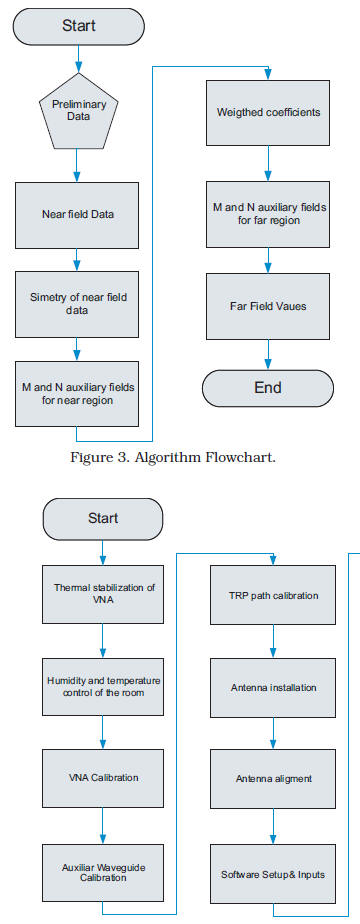
<body><![CDATA[<p align="justify">  Finally, it is important to note that NF-FF  transformation using spherical wave expansion  reduces the truncation errors in the calculation  of the weighted coefficients, a and b, because the  measurement grid encloses completely the antenna  under test. In addition, the probe’s compensation  becomes unnecessary since the antenna  under test and the field probe are always  aligned [12, 13]. However, a disadvantage of this  technique is that it involves a complex mathematical  formulation due to the emergence of  Hankel functions and associated Legendre polynomials.  For this reason, matrix operations and  numerical integration become necessary and the  computation time and memory requirements increase.</p>     <p align="justify"><b>  4. The NF-FF Transformation  algorithm</b></p>     <p align="justify">  The general outline of the algorithm is  shown in Figure 3. The preliminary data refers to  the input parameters of the algorithm: the operation  frequency, dimensions of the antenna under  test, the measurement distance in the Near-Field  region and the distance in the Far-Field region  where the <b>M</b> and <b>N</b> vectors will be computed.</p>     <p align="justify"><a name="f3"></a></p>     <p align="center"><img border="0" src="/img/fbpe/rtfiuz/v35n1/art13.12.jpg" width="360" height="924"><img border="0" src="/img/fbpe/rtfiuz/v35n1/art13.13.jpg" width="329" height="379"></p>     
<p align="justify"> <img border="0" src="/img/fbpe/rtfiuz/v35n1/art13.14.jpg"></p>     
<p align="justify"><a name="f4"></a></p>     <p align="justify">  Then, from the data of the tangential electric field  measured in Near-Field the coefficients a<sub>m,n</sub> and  b<sub>m,n</sub> are calculated. Subsequently, the electric field in Far-Field is  computed using the new M  and N vectors corresponding to a distance in the  Far-Field region and from the coefficients previously  calculated.</p>     <p align="justify"><b>  5. Experimental procedure</b></p>     <p align="justify">  In the experimental procedure was employed  the following high-frequency measurement  equipments: Vector Network Analyzer (VNA),  Multi-Axis Positioning System (MAPS), Multi-  Controller (MDC), Anechoic Chamber, Waveguides,  Ferrite cable, Alignment Laser, control  and data acquisition software. The measurement  of electric field in the Fresnel zone must be made  of with caution, considering the factors that  would imply a distortion in the results. The test  procedure is shown in Figure 4, resumed as a  flowchart. It is important, in order to reduce errors,  to wait until the VNA has reached thermal  stabilization. To ensure repeatability of measurements,  the relative humidity should be between  the ranges recommended by equipment’s manufacturers  (30-60%). Then, a routine calibration  (open, short and match) of the VNA should be  performed with the purpose of compensating the</p>     ]]></body>
<body><![CDATA[<p align="justify">  measurement plane to the antenna input port  under test. The total attenuation of the cable  paths should be measured in order to calculate  the tangential electric field. Finally, the antenna  under test should be aligned to the receiving antenna  (field probe) using a laser multi axis.</p>     <p align="justify">  <b>6. Validating tests</b></p>     <p align="justify"><b>  Test 1: NF-FF transformation  for an infinitesimal dipole</b></p>     <p align="justify">  This method consists in the transformation  of theoretical electric Near-Field distribution obtained  from the equations that describe the electric  field in any region of space for an infinitesimal  dipole [6]. The aforementioned theoretical  equations are given by,</p>     <p align="justify"> <img border="0" src="/img/fbpe/rtfiuz/v35n1/art13.15.jpg" width="339" height="101"></p>     
<p align="justify">  where<span style="font-style: italic"> I<sub>0</sub></span> is the current in z  direction of the dipole,  is the wave impedance in free space, l is the  length of the dipole, r is the distance from the origin  of coordinates to the source point and is the  elevation angle as defined in spherical coordinates.  In order to validate the computer application,  the output of the algorithm was compared  with the values corresponding to the evaluation  of the expressions (17) and (18) for a r in the  Far-Field region according to (7). The discrepancy  on both results would represent the numerical  errors introduced by the code. The length of  the measured dipole was 1 cm at 3 GHz and was  used an angular resolution of 20° in both azimuthal  and elevation angle. The value of r used  en Near-Field was 1 cm and in the Far-Field region  was 20 m.</p>     <p align="justify">  <b>Test 2: FF-FF transformation  for a Half-wave dipole</b></p>     <p align="justify">  This test used as the input for the algorithm,  measurements made of in Far-Field region  in order to transform it to a larger measurement  radius. Both patterns were expected to be  similar. In consequence, this experiment was a  Far-Field to Far-Field transformation. Certainly,  the uncertainty associated to the results includes  several contributions (such as instruments  resolution, calibration uncertainties and  positioning and alignment errors associated with  the antenna mounting) besides the numerical error.  For this test, a half wavelength dipole was  employed at 2.45 GHz using a distance of 5 m in  the Far-Field region. An angular resolution of 15°  in both azimuthal and elevation angle.</p>     <p align="justify">  <b>Test 3: NF-FF Full FF transformation  for a Half-wave dipole</b></p>     <p align="justify">  In the last validation test was used a calibrated  half wavelength dipole. The measurements  were made of in the Fresnel region the  within anechoic chamber and then the transformation  was performed using our computer application.  The result was compared with the electric  Far-Field measured directly from the same dipole  in the Far-Field region using the same anechoic  chamber. It was used the same Half-wave dipole  reported in Test 2. The measurement distance in  NF was 0.75 m and 5 m in the Far-Field region.  An angular resolution of 15° in both azimuthal  and elevation angle was used.</p>     ]]></body>
<body><![CDATA[<p align="justify">  <b>7. Results</b></p>     <p align="justify">  Figure 5 shows the FF radiation pattern of  an infinitesimal dipole at 3 GHz. Both, the FF pattern  from NF calculations using the algorithm  and the FF pattern directly evaluated in (17) and  (18) were plotted superimposed. As shown, the  code is able to reproduce the Far-Field data corresponding  to a closed equation data describing a  Near-Field region. This simple example also  shows that the algorithm introduces a minimum  numerical error.</p>     <p align="justify">  In Figure 6, it is shown both the FF radiation  pattern of a half-wave dipole at 2.45 GHz  measured at 5 m and the FF radiation pattern  transformed at 20 m. As shown, the code reproduces  a Far-Field data corresponding to an extreme  case, where the data is measured in  Far-Field and then the code is also evaluated in  the far region. This test demonstrates the code  introduces an error due to the sampling spatial  grid. The reported error was less than 2 dB for the  worst case, corresponding to <img border="0" src="/img/fbpe/rtfiuz/v35n1/art13.16.gif" width="64" height="27"></p>     
<p align="justify"><a name="f5"></a></p>     <p align="center"> <img border="0" src="/img/fbpe/rtfiuz/v35n1/art13.17.jpg" width="614" height="389"></p>     
<p align="justify"><a name="f6"></a></p>     <p align="center"> <img border="0" src="/img/fbpe/rtfiuz/v35n1/art13.18.jpg" width="610" height="375"></p>     
<p align="justify"><a name="f7"></a></p>     <p align="center"> <img border="0" src="/img/fbpe/rtfiuz/v35n1/art13.19.jpg" width="440" height="381"></p>     
<p align="justify">  In Figure 8, it is shown both the FF radiation  pattern of a half-wave dipole at 2.45 GHz  measured at 5 m and the FF radiation pattern  transformed from the NF measurements made at  0.75 m. This last experiment validates the functionality  of the algorithm converting data to the  Far-Field region from Near-Field. Table 1 show  that maximum error reported was 3 dB in theta  20°.</p>     ]]></body>
<body><![CDATA[<p align="justify"><a name="f8"></a></p>     <p align="center"> <img border="0" src="/img/fbpe/rtfiuz/v35n1/art13.20.jpg" width="627" height="391"></p>     
<p align="justify">  Finally, some additional results are shown  as a complement to this paper in order to verify  the functionality of the developed computer application. This comparative test  consisted in the  processing of a Near-Field data provided by the  TSC Group from UPC, Barcelona. The electric  Near-Field data corresponds to a waveguide slotted  antenna at 9.63 GHz, the maximum antenna  dimension was 19.17 cm and the measurement  distance was 5.35 m. The results are shown in  Figure 9, 10 and 11 using the third Ludwig convention  [14].</p>     <p align="justify"><b>  8. Conclusions</b></p>     <p align="justify">  It has been developed an algorithm that receives  as input the values of tangential electric  field measurements on a spherical surface in the  Near-Field or Far-Field zone, and from these  data, calculates the values of electric field in the  Far-Field zone using the spherical wave expansion  technique. For this purpose the results were</p>     <p align="justify"><a name="t1"></a></p>     <p align="center"> <img border="0" src="/img/fbpe/rtfiuz/v35n1/art13.21.jpg" width="700" height="423"></p>     
<p align="justify"><a name="f9"></a></p>     <p align="center"> <img border="0" src="/img/fbpe/rtfiuz/v35n1/art13.22.jpg"></p>     
<p align="justify"><a name="f10"></a></p>     ]]></body>
<body><![CDATA[<p align="center"> <img border="0" src="/img/fbpe/rtfiuz/v35n1/art13.23.jpg"></p>     
<p align="justify"><a name="f11"></a></p>     <p align="center"> <img border="0" src="/img/fbpe/rtfiuz/v35n1/art13.24.jpg"> </p>     
<p align="justify">&nbsp;</p>     <p align="justify">  validated using three experimental tests. The  first experiment shows the amount of numerical  errors using data obtained evaluating theoretical  formulation. From the results of the second experiment,  we conclude that the numerical error  introduced by the algorithm is small, even in  some cases could be considered negligible. In addition  to this exercise, is verified that the expansion  wave is a method capable to calculate the  field in any region.</p>     <p align="justify">  The quality of the data measured in the  nearby area plays an important role in the accuracy  of the results. It was observed in the third  experiment that if the Near-Field data is corrupted,  either by noise, multipath reflections, links  parasites or any other cause the results obtained  by the algorithm may diverge from reality seriously.</p>     <p align="justify">  <b>Acknowledgements</b></p>     <p align="justify">  Special thanks to Dr. Alfonso Zozaya by  their valuables contributions in electromagnetic  theory during this development and to Dr. Jordi  Romeu and Dr. Sebastian Blanch, from UPC,  Barcelona, for providing us valuable data file.</p>     <p align="justify">  <b>References</b></p>     <p align="justify">  1. Ludwig, Arthur C. “Near-Field Far-Field  Transformation Using Spherical-Wave Expansions.  IEEE Transactions on Antennas  and Propagation, Vol. AP-19, No. 2, marzo  (1971) 2.1, 2.5.3, 5.</p>     ]]></body>
<body><![CDATA[<p align="justify">  2. Pierri, Rocco; D’Elia, Giuseppe; Soldovieri,  Francesco. “A Two Probes Scanning  Phaseless Near-Field Far-Field Transformation  Technique”. IEEE Transactions on Antennas  and Propagation, Vol. AP-47, No. 5,  mayo (1999).</p>     <!-- ref --><p align="justify">  3. Trzaska, Hubert. “Electromagnetic Field  Measurements In The Near Field”. Atlanta.  Noble Publishing, 2001. 2.6&nbsp;&nbsp;&nbsp;&nbsp;&nbsp;&nbsp;&nbsp;&nbsp;[&#160;<a href="javascript:void(0);" onclick="javascript: window.open('/scielo.php?script=sci_nlinks&ref=2382650&pid=S0254-0770201200010001300003&lng=','','width=640,height=500,resizable=yes,scrollbars=1,menubar=yes,');">Links</a>&#160;]<!-- end-ref --><p align="justify">  4. Yaghjian, A. D.: “An Overview of Near-Field  Antenna Measurements”, IEEE Transactions  on Antennas and Propagation, Vol.  AP-34, No. 1 (1986).</p>     <p align="justify">  5. Sarkar, T. K., Petre, P., Taaghol, A. and Harrington  R. F.: “An Alternative Spherical  Near-Field to Far-Field Transformation”,  Progress in Electromagnetic Research, Vol.  16 (1997), 269-286.</p>     <!-- ref --><p align="justify">  6. Balanis, C. A. “Antenna Theory. Analysis and  Design”, John Wiley &amp; Sons, New Jersey,  2005. 2.2, 2.5, 2.8, 3.2, 4.1.    &nbsp;&nbsp;&nbsp;&nbsp;&nbsp;&nbsp;&nbsp;&nbsp;[&#160;<a href="javascript:void(0);" onclick="javascript: window.open('/scielo.php?script=sci_nlinks&ref=2382653&pid=S0254-0770201200010001300006&lng=','','width=640,height=500,resizable=yes,scrollbars=1,menubar=yes,');">Links</a>&#160;]<!-- end-ref --></p>     <p align="justify">  7. Bucci, Ovidio; D’Elia, Giuseppe; Leone,  Giovanni; Pierri, Rocco. “Far-Field Pattern  Determination from the Near-Field Amplitude  on Two Surfaces”. IEEE Transactions  on Antennas and Propagation, vol. AP-38,  No. 11, noviembre 1990. 1.1, 2.1</p>     <p align="justify">  8. Bucci, Ovidio; D’Elia, Giuseppe; Migliore,  Marco. An Efective Near-Field Far-Field  Transformation Technique from Truncated  and Inaccurate Amplitude-Only Data. IEEE  Transactions on Antennas and Propagation,  Vol. AP-47, No. 9, septiembre 1999. 2.1</p>     <p align="justify">  9. Bucci, Ovidio; Gennarelli, Claudio. Use of  Sampling Expansions in Near-Field  Far-Field Transformation: The Cylindrical  Case. IEEE Transactions on Antennas and  Propagation, Vol. AP-36, No. 6, junio 1988.  3.1</p>     <p align="justify">  10. [10] P. D. Potter, “Application of spherical  wave theory to Cassegrainian-fed paraboloids”,  IEEE Trans. Antennas Propagat.,Vol.  AP-15, Nov. 1967, pp. 727-736.</p>     ]]></body>
<body><![CDATA[<p align="justify">  11. Yaghjian, Arthur D. An Overview of  Near-Field Antenna Measurements. IEEE  Transactions on Antennas and Propagation,  Vol. AP-34, No. 1, enero 1986. 2.1, 2.6.1,  2.6.2.</p>     <!-- ref --><p align="justify">  12. Stratton, Julius A. Electromagnetic Theory.  Wiley and Interscience, 2007. 2.4.1, 2.4.1,    &nbsp;&nbsp;&nbsp;&nbsp;&nbsp;&nbsp;&nbsp;&nbsp;[&#160;<a href="javascript:void(0);" onclick="javascript: window.open('/scielo.php?script=sci_nlinks&ref=2382660&pid=S0254-0770201200010001300012&lng=','','width=640,height=500,resizable=yes,scrollbars=1,menubar=yes,');">Links</a>&#160;]<!-- end-ref --></p>     <p align="justify">  13. Schmidt, Carsten; Leibfritz, Martin; Eibert,  Thomas. Fully Probe-Corrected Near-Field  Far-Field Transformation Employing Plane  Wave Expansion and Diagonal Translation  Operators. IEEE Transactions on Antennas  and Propagation, Vol. AP-56, No. 3, marzo  (2008)</p>     <p align="justify">  14. Ludwig, A. C., “The Definition of Cross Polarization”,  IEEE Transactions on Antennas  and Propagation, pp 116-119 (1973).</p>     <p align="justify">  Recibido el 7 de Abril de 2011  En forma revisada el 16 de Enero de 2012  Rev. Téc. Ing. Univ. Zulia. Vol. 35, No. 1, 2012  118 Páez y col.</p>       ]]></body>
<back>
<ref-list>
<ref id="B1">
<label>1</label><nlm-citation citation-type="journal">
<person-group person-group-type="author">
<name>
<surname><![CDATA[Ludwig,]]></surname>
<given-names><![CDATA[Arthur C]]></given-names>
</name>
</person-group>
<article-title xml:lang="en"><![CDATA[Near-Field Far-Field Transformation Using Spherical-Wave Expansions]]></article-title>
<source><![CDATA[IEEE Transactions on Antennas and Propagation, AP-19, 2, marzo]]></source>
<year>1971</year>
<numero>2.1</numero>
<issue>2.1</issue>
<page-range>5</page-range></nlm-citation>
</ref>
<ref id="B2">
<label>2</label><nlm-citation citation-type="journal">
<person-group person-group-type="author">
<name>
<surname><![CDATA[Pierri,]]></surname>
<given-names><![CDATA[Rocco]]></given-names>
</name>
<name>
<surname><![CDATA[D’Elia,]]></surname>
<given-names><![CDATA[Giuseppe]]></given-names>
</name>
<name>
<surname><![CDATA[Soldovieri,]]></surname>
<given-names><![CDATA[Francesco]]></given-names>
</name>
</person-group>
<article-title xml:lang="en"><![CDATA[A Two Probes Scanning Phaseless Near-Field Far-Field Transformation Technique]]></article-title>
<source><![CDATA[IEEE Transactions on Antennas and]]></source>
<year>mayo</year>
<month> 1</month>
<day>99</day>
<volume>AP-47</volume>
<numero>5</numero>
<issue>5</issue>
</nlm-citation>
</ref>
<ref id="B3">
<label>3</label><nlm-citation citation-type="book">
<person-group person-group-type="author">
<name>
<surname><![CDATA[Trzaska,]]></surname>
<given-names><![CDATA[Hubert]]></given-names>
</name>
</person-group>
<source><![CDATA[Electromagnetic Field Measurements In The Near Field]]></source>
<year>2001</year>
<page-range>2-6</page-range><publisher-name><![CDATA[Atlanta. Noble Publishing,]]></publisher-name>
</nlm-citation>
</ref>
<ref id="B4">
<label>4</label><nlm-citation citation-type="journal">
<person-group person-group-type="author">
<name>
<surname><![CDATA[Yaghjian,]]></surname>
<given-names><![CDATA[AD]]></given-names>
</name>
</person-group>
<article-title xml:lang="en"><![CDATA[An Overview of Near-Field Antenna Measurements]]></article-title>
<source><![CDATA[IEEE Transactions on Antennas and Propagation]]></source>
<year>1986</year>
<volume>AP-34</volume>
<numero>1</numero>
<issue>1</issue>
</nlm-citation>
</ref>
<ref id="B5">
<label>5</label><nlm-citation citation-type="journal">
<person-group person-group-type="author">
<name>
<surname><![CDATA[Sarkar,]]></surname>
<given-names><![CDATA[TK.]]></given-names>
</name>
<name>
<surname><![CDATA[Petre,]]></surname>
<given-names><![CDATA[P.]]></given-names>
</name>
<name>
<surname><![CDATA[Taaghol,]]></surname>
<given-names><![CDATA[A.]]></given-names>
</name>
<name>
<surname><![CDATA[Harrington]]></surname>
<given-names><![CDATA[RF]]></given-names>
</name>
</person-group>
<article-title xml:lang="en"><![CDATA[An Alternative Spherical Near-Field to Far-Field Transformation]]></article-title>
<source><![CDATA[Progress in Electromagnetic Research]]></source>
<year>1997</year>
<volume>16</volume>
<page-range>269-286</page-range></nlm-citation>
</ref>
<ref id="B6">
<label>6</label><nlm-citation citation-type="book">
<person-group person-group-type="author">
<name>
<surname><![CDATA[Balanis,]]></surname>
<given-names><![CDATA[CA]]></given-names>
</name>
</person-group>
<source><![CDATA[Antenna Theory]]></source>
<year>2005</year>
<page-range>2.2, 2.5, 2.8, 3.2, 4.1.</page-range><publisher-loc><![CDATA[New Jersey ]]></publisher-loc>
<publisher-name><![CDATA[Analysis and Design, John Wiley & Sons]]></publisher-name>
</nlm-citation>
</ref>
<ref id="B7">
<label>7</label><nlm-citation citation-type="journal">
<person-group person-group-type="author">
<name>
<surname><![CDATA[Bucci,]]></surname>
<given-names><![CDATA[Ovidio]]></given-names>
</name>
<name>
<surname><![CDATA[D’Elia,]]></surname>
<given-names><![CDATA[Giuseppe]]></given-names>
</name>
<name>
<surname><![CDATA[Leone,]]></surname>
<given-names><![CDATA[Giovanni]]></given-names>
</name>
<name>
<surname><![CDATA[Pierri,]]></surname>
<given-names><![CDATA[Rocco]]></given-names>
</name>
</person-group>
<article-title xml:lang="en"><![CDATA[Far-Field Pattern Determination from the Near-Field Amplitude on Two Surfaces]]></article-title>
<source><![CDATA[IEEE Transactions on Antennas and Propagation]]></source>
<year>novi</year>
<month>em</month>
<day>br</day>
<volume>AP-38</volume>
<numero>11</numero>
<issue>11</issue>
<page-range>1.1, 2.1</page-range></nlm-citation>
</ref>
<ref id="B8">
<label>8</label><nlm-citation citation-type="journal">
<person-group person-group-type="author">
<name>
<surname><![CDATA[Bucci]]></surname>
<given-names><![CDATA[Ovidio]]></given-names>
</name>
<name>
<surname><![CDATA[D’Elia]]></surname>
<given-names><![CDATA[Giuseppe]]></given-names>
</name>
<name>
<surname><![CDATA[Migliore]]></surname>
<given-names><![CDATA[Marco]]></given-names>
</name>
</person-group>
<article-title xml:lang="en"><![CDATA[An Efective Near-Field Far-Field Transformation Technique from Truncated and Inaccurate Amplitude-Only Data]]></article-title>
<source><![CDATA[IEEE Transactions on Antennas and Propagation]]></source>
<year>sept</year>
<month>ie</month>
<day>mb</day>
<volume>AP-47</volume>
<numero>9</numero>
<issue>9</issue>
<page-range>2.1</page-range></nlm-citation>
</ref>
<ref id="B9">
<label>9</label><nlm-citation citation-type="">
<person-group person-group-type="author">
<name>
<surname><![CDATA[Bucci]]></surname>
<given-names><![CDATA[Ovidio]]></given-names>
</name>
<name>
<surname><![CDATA[Gennarelli]]></surname>
<given-names><![CDATA[Claudio]]></given-names>
</name>
</person-group>
<source><![CDATA[Use of Sampling Expansions in Near-Field Far-Field Transformation: The Cylindrical Case]]></source>
<year>6, j</year>
<month>un</month>
<day>io</day>
<volume>AP-36</volume>
<page-range>3.1</page-range></nlm-citation>
</ref>
<ref id="B10">
<label>10</label><nlm-citation citation-type="journal">
<person-group person-group-type="author">
<name>
<surname><![CDATA[P.D,]]></surname>
<given-names><![CDATA[Potter]]></given-names>
</name>
</person-group>
<article-title xml:lang="en"><![CDATA[Application of spherical wave theory to Cassegrainian-fed paraboloids]]></article-title>
<source><![CDATA[IEEE Trans Antennas Propagat]]></source>
<year>Nov </year>
<month>19</month>
<day>67</day>
<volume>AP-15</volume>
<page-range>727-736</page-range></nlm-citation>
</ref>
<ref id="B11">
<label>11</label><nlm-citation citation-type="journal">
<person-group person-group-type="author">
<name>
<surname><![CDATA[Yaghjian,]]></surname>
<given-names><![CDATA[ArthurD]]></given-names>
</name>
</person-group>
<article-title xml:lang="en"><![CDATA[An Overview of Near-Field Antenna Measurements]]></article-title>
<source><![CDATA[IEEE Transactions on Antennas and Propagation]]></source>
<year>1, e</year>
<month>ne</month>
<day>ro</day>
<volume>AP-34</volume>
<page-range>2. 1, 2.6.1, 2.6.2.</page-range></nlm-citation>
</ref>
<ref id="B12">
<label>12</label><nlm-citation citation-type="book">
<person-group person-group-type="author">
<name>
<surname><![CDATA[Stratton,]]></surname>
<given-names><![CDATA[Julius A]]></given-names>
</name>
</person-group>
<source><![CDATA[Electromagnetic Theory]]></source>
<year>2007</year>
<page-range>2.4.1, 2.4.1</page-range><publisher-name><![CDATA[Wiley and Interscience,]]></publisher-name>
</nlm-citation>
</ref>
<ref id="B13">
<label>13</label><nlm-citation citation-type="journal">
<person-group person-group-type="author">
<name>
<surname><![CDATA[Schmidt]]></surname>
<given-names><![CDATA[Carsten]]></given-names>
</name>
<name>
<surname><![CDATA[Leibfritz]]></surname>
<given-names><![CDATA[Martin]]></given-names>
</name>
<name>
<surname><![CDATA[Eibert]]></surname>
<given-names><![CDATA[Thomas]]></given-names>
</name>
</person-group>
<article-title xml:lang="en"><![CDATA[Fully Probe-Corrected Near-Field Far-Field Transformation Employing Plane Wave Expansion and Diagonal Translation Operators]]></article-title>
<source><![CDATA[IEEE Transactions on Antennas and Propagation]]></source>
<year>3, m</year>
<month>ar</month>
<day>zo</day>
<volume>AP-56</volume>
</nlm-citation>
</ref>
<ref id="B14">
<label>14</label><nlm-citation citation-type="book">
<person-group person-group-type="author">
<name>
<surname><![CDATA[Ludwig]]></surname>
<given-names><![CDATA[AC]]></given-names>
</name>
</person-group>
<source><![CDATA[The Definition of Cross Polarization]]></source>
<year>1973</year>
<publisher-name><![CDATA[IEEE Transactions on Antennas and Propagation, 116-119]]></publisher-name>
</nlm-citation>
</ref>
</ref-list>
</back>
</article>