<?xml version="1.0" encoding="ISO-8859-1"?><article xmlns:mml="http://www.w3.org/1998/Math/MathML" xmlns:xlink="http://www.w3.org/1999/xlink" xmlns:xsi="http://www.w3.org/2001/XMLSchema-instance">
<front>
<journal-meta>
<journal-id>0255-6952</journal-id>
<journal-title><![CDATA[Revista Latinoamericana de Metalurgia y Materiales]]></journal-title>
<abbrev-journal-title><![CDATA[Rev. LatinAm. Metal. Mater.]]></abbrev-journal-title>
<issn>0255-6952</issn>
<publisher>
<publisher-name><![CDATA[Universidad Simón Bolívar    ]]></publisher-name>
</publisher>
</journal-meta>
<article-meta>
<article-id>S0255-69522014000100016</article-id>
<title-group>
<article-title xml:lang="en"><![CDATA[NMR STUDY OF THE MICROSTRUCTURE OF METHYL-N-HEXADECYL ITACONATE WITH STYRENE COPOLYMERS]]></article-title>
<article-title xml:lang="es"><![CDATA[ESTUDIO DE LA MICROESTRUCTURA DE COPOLÍMEROS DE METIL-N-HEXADECIL ITACONATO CON ESTIRENO]]></article-title>
</title-group>
<contrib-group>
<contrib contrib-type="author">
<name>
<surname><![CDATA[López-Carrasquero]]></surname>
<given-names><![CDATA[Francisco]]></given-names>
</name>
</contrib>
<contrib contrib-type="author">
<name>
<surname><![CDATA[Koteich-Khatib]]></surname>
<given-names><![CDATA[Sonia]]></given-names>
</name>
</contrib>
<contrib contrib-type="author">
<name>
<surname><![CDATA[Bahsas]]></surname>
<given-names><![CDATA[Alí]]></given-names>
</name>
</contrib>
<contrib contrib-type="author">
<name>
<surname><![CDATA[Dugarte]]></surname>
<given-names><![CDATA[Nahir]]></given-names>
</name>
</contrib>
<contrib contrib-type="author">
<name>
<surname><![CDATA[Rangel- Rangel]]></surname>
<given-names><![CDATA[Elizabeth]]></given-names>
</name>
</contrib>
<contrib contrib-type="author">
<name>
<surname><![CDATA[Fernández]]></surname>
<given-names><![CDATA[Álvaro]]></given-names>
</name>
</contrib>
</contrib-group>
<aff id="A">
<institution><![CDATA[,  ]]></institution>
<addr-line><![CDATA[ ]]></addr-line>
</aff>
<pub-date pub-type="pub">
<day>00</day>
<month>06</month>
<year>2014</year>
</pub-date>
<pub-date pub-type="epub">
<day>00</day>
<month>06</month>
<year>2014</year>
</pub-date>
<volume>34</volume>
<numero>1</numero>
<fpage>148</fpage>
<lpage>157</lpage>
<copyright-statement/>
<copyright-year/>
<self-uri xlink:href="http://ve.scielo.org/scielo.php?script=sci_arttext&amp;pid=S0255-69522014000100016&amp;lng=en&amp;nrm=iso"></self-uri><self-uri xlink:href="http://ve.scielo.org/scielo.php?script=sci_abstract&amp;pid=S0255-69522014000100016&amp;lng=en&amp;nrm=iso"></self-uri><self-uri xlink:href="http://ve.scielo.org/scielo.php?script=sci_pdf&amp;pid=S0255-69522014000100016&amp;lng=en&amp;nrm=iso"></self-uri><abstract abstract-type="short" xml:lang="en"><p><![CDATA[A series of copolymers of styrene with methyl-n-hexadecylitaconates using different compositions in the feed have been prepared in bulk via radical at 60ºC with AIBN as initiator. In most of the cases the copolymers were obtained in good yields and the increase of one of the monomers in the feed mixture raises its amount in the copolymer and in some cases the copolymer composition is close to the feed ratio. The copolymers molecular structure was characterized by FTIR and a detailed study of NMR spectroscopy which included ¹H, 13C and bidimentional experiments. The NMR studies indicate that the copolymers have a mainly random distribution of the monomeric units and the chemical shifts of the signals, especially the OCH3 and OCH2 are strongly influenced by the neighbor environment. 13C NMR chemical shifts were also analyzed by simulation studies using ab initio Gauge-Independent Atomic Orbital (GIAO) calculations; we observed a good correlation between the experimental and calculated values.]]></p></abstract>
<abstract abstract-type="short" xml:lang="es"><p><![CDATA[En este trabajo se preparó una serie de copolímeros de estireno con metil n-hexadecilitaconato con diferentes composiciones. Las polimerizaciones se llevaron a cabo por vía radical, en masa a 60ºC y AIBN como iniciador. En la mayoría de los casos los copolímeros se obtuvieron con buenos rendimientos y el incremento de cualquiera de los monómeros en la relación de alimentación incrementa su contenido en el copolímero, observándose en algunos casos que la composición del copolímero es bastante próxima a la relación usada en la alimentación. La estructura molecular de los copolímeros fue caracterizada mediante FTIR y un detallado estudio de RMN que incluyó ¹H, 13C y experimentos bidimensionales. Los estudios de RMN indicaron que los copolímeros son básicamente al azar y que los desplazamientos químicos de muchas señales, y de modo particular las de los OCH3 y OCH2 correspondientes a las unidades de itaconato, están fuertemente influenciados por el entorno vecino. Los desplazamientos químicos de RMN-13C fueron analizados mediante estudios de simulación, donde se empleó el método GIAO (por sus siglas en inglés Gauge-Independent Atomic Orbital), observándose una buena correlación entre los valores experimentales y los calculados.]]></p></abstract>
<kwd-group>
<kwd lng="en"><![CDATA[Alkyl itaconates]]></kwd>
<kwd lng="en"><![CDATA[Styrene]]></kwd>
<kwd lng="en"><![CDATA[Copolymers]]></kwd>
<kwd lng="en"><![CDATA[NMR]]></kwd>
<kwd lng="en"><![CDATA[Gauge-Independent Atomic Orbital (GIAO) method.]]></kwd>
<kwd lng="es"><![CDATA[Itaconatos de n-alquílo]]></kwd>
<kwd lng="es"><![CDATA[Estireno]]></kwd>
<kwd lng="es"><![CDATA[Copolímeros]]></kwd>
<kwd lng="es"><![CDATA[RMN]]></kwd>
<kwd lng="es"><![CDATA[método GIAO.]]></kwd>
</kwd-group>
</article-meta>
</front><body><![CDATA[ <P   align="center" ><FONT size="+1" color="#000000"></B>NMR STUDY OF THE MICROSTRUCTURE OF METHYL-<I>N</I>-HEXADECYL ITACONAT<FONT size="+1" color="#000000"></B>E  WITH STYRENE COPOLYMERS  </P >    <P   align="center" ><FONT size="+1"><I>Francisco L&oacute;pez-Carrasquero</I><Sup><FONT size="+1"><I>1</I></Sup><FONT size="+1"><I>*, Sonia Koteich-Khatib</I><Sup><FONT size="+1"><I>2</I></Sup><FONT size="+1"><I>, Al&iacute; Bahsas</I><Sup><FONT size="+1"><I>2</I></Sup><FONT size="+1"><I>, Nahir Dugarte</I><Sup><FONT size="+1"><I>1</I></Sup><FONT size="+1"><I>, Elizabeth Rangel</I><FONT size="+1"><I>- </I><I>Rangel</I><Sup><FONT size="+1"><I>1 </I></Sup><FONT size="+1"><I>and &Aacute;lvaro Fern&aacute;ndez</I><Sup><Sup><FONT size="+1"><I>3  </I></Sup></Sup></P >    <P   align="justify" ><FONT size="+1">1: Grupo de Pol&iacute;meros ULA; 2: Laboratorio de Resonancia Magn&eacute;tica Nuclear; 3: Grupo de Procesos Din&aacute;micos en Qu&iacute;mica, Departamento de Qu&iacute;mica, Facultad de Ciencias, Universidad de Los Andes. 5101, M&eacute;rida, Venezuela. </P >    <P   align="center" ><I>* </I><I>e-mail: flopezc@ula.ve </I></P >     <p align="center"><IMG align="" width="637" height="229"  src="/img/fbpe/rlmm/v34n1/art16_img_2.jpg" ></p>     
<DIV class="Part"   ><H4   align="justify" ><FONT size="+1" color="#1E487C"><B>ABSTRACT </H4 >    <P   align="justify" ><FONT size="+1" color="#000000"></B>A series of copolymers of styrene with methyl-<I>n</I>-hexadecylitaconates using different compositions in the feed have been prepared in bulk via radical at 60&ordm;C with AIBN as initiator. In most of the cases the copolymers were obtained in good yields and the increase of one of the monomers in the feed mixture raises its amount in the copolymer and in some cases the copolymer composition is close to the feed ratio. The copolymers molecular structure was characterized by FTIR and a detailed study of NMR spectroscopy which included <Sup><FONT size="+1">1</Sup><FONT size="+1">H, <Sup><FONT size="+1">13</Sup><FONT size="+1">C and bidimentional experiments. The NMR studies indicate that the copolymers have a mainly random distribution of the monomeric units and the chemical shifts of the signals, especially the OCH<FONT size="+1">3 <FONT size="+1">and OCH<FONT size="+1">2 <FONT size="+1">are strongly influenced by the neighbor environment. <Sup><FONT size="+1">13</Sup><FONT size="+1">C NMR chemical shifts were also analyzed by simulation studies using ab initio Gauge-Independent Atomic Orbital (GIAO) calculations; we observed a good correlation between the experimental and calculated values. </P >    <P   align="justify" ><FONT size="+1"><I>Keywords</I><B><I>: </I><FONT size="+1"></B><I>Alkyl itaconates, Styrene, Copolymers, NMR, Gauge-Independent Atomic Orbital (GIAO) method. </I></P >    <P   align="center" ><FONT size="+1">ESTUDIO DE LA MICROESTRUCTURA DE COPOL&Iacute;MEROS DE METIL-<I>N</I>-HEXADECI<FONT size="+1">L  ITACONATO CON ESTIRENO  </P ></DIV >    <DIV class="Part"   >    ]]></body>
<body><![CDATA[<DIV class="Sect"   ><H4   align="justify" ><FONT color="#1E487C"><B>RESUMEN </H4 ></DIV >    <P   align="justify" ><FONT size="+1" color="#000000"></B>En este trabajo se prepar&oacute; una serie de copol&iacute;meros de estireno con metil <I>n</I>-hexadecilitaconato con diferentes composiciones. Las polimerizaciones se llevaron a cabo por v&iacute;a radical, en masa a 60&ordm;C y AIBN como iniciador. En la mayor&iacute;a de los casos los copol&iacute;meros se obtuvieron con buenos rendimientos y el incremento de cualquiera de los mon&oacute;meros en la relaci&oacute;n de alimentaci&oacute;n incrementa su contenido en el copol&iacute;mero, observ&aacute;ndose en algunos casos que la composici&oacute;n del copol&iacute;mero es bastante pr&oacute;xima a la relaci&oacute;n usada en la alimentaci&oacute;n. La estructura molecular de los copol&iacute;meros fue caracterizada mediante FTIR y un detallado estudio de RMN que incluy&oacute; <Sup><FONT size="+1">1</Sup><FONT size="+1">H, <Sup><FONT size="+1">13</Sup><FONT size="+1">C y experimentos bidimensionales. Los estudios de RMN indicaron que los copol&iacute;meros son b&aacute;sicamente al azar y que los desplazamientos qu&iacute;micos de muchas se&ntilde;ales, y de modo particular las de los OCH<FONT size="+1">3 <FONT size="+1">y OCH<FONT size="+1">2 <FONT size="+1">correspondientes a las unidades de itaconato, est&aacute;n fuertemente influenciados por el entorno vecino. Los desplazamientos qu&iacute;micos de RMN-<Sup><FONT size="+1">13</Sup><FONT size="+1">C fueron analizados mediante estudios de simulaci&oacute;n, donde se emple&oacute; el m&eacute;todo GIAO (por sus siglas en ingl&eacute;s Gauge-Independent Atomic Orbital), observ&aacute;ndose una buena correlaci&oacute;n entre los valores experimentales y los calculados. </P >    <P   align="justify" ><FONT size="+1"><I>Palabras Claves</I><B><I>: </I><FONT size="+1"></B><I>Itaconatos de n-alqu&iacute;lo, Estireno, Copol&iacute;meros, RMN, m&eacute;todo GIAO. </I></P >    <P   align="center" ><FONT size="+1" color="#1E487C"><B>Recibido: <FONT color="#000000"></B>03-03-2013 ; <FONT color="#1E487C"><B>Revisado: <FONT color="#000000"></B>22-04-2013 <FONT color="#1E487C">pISSN: <FONT color="#000000">0255-6952 | <FONT color="#1E487C">eISSN: <FONT color="#000000">2244-7113 </P >    <P   align="center" ><FONT size="+1" color="#C00000"><B>148 </P >    <P   align="center" ><FONT size="+1" color="#1E487C">Aceptado: <FONT color="#000000"></B>28-04-2013 ; <FONT color="#1E487C"><B>Publicado: <FONT color="#000000"></B>14-05-2013 <FONT color="#001F5F"><I>Rev. LatinAm. Metal. Mat. </I>2014; <B>34 </B>(1): 148-157 </P >    <DIV class="Sect"   >    <DIV class="Sect"   ><H4   align="justify" ><FONT size="+1"><B>1. INTRODUCTION </H4 >    <P   align="justify" ><FONT color="#000000"></B>The early works of Cowie related to the synthesis and the study of polyitaconates at the beginning of the 70&rsquo;s [1-4] inspired many researchers to investigate in this area and the interest for the study of these polymers have been continued until today. Most of the interest of these researches has been oriented to the study of their solid state and dissolution properties [4-11], as well as their thermal degradation [12-17]. The copolymerization of itaconates with vinyl monomers has also been studied [18-26]. </P >    <P   align="justify" >The microstructure of polyitaconates has been studied by NMR spectroscopy and probably the first study on the tacticity of polyitaconates was performed by Horta, <I>et al</I>, in 1987 [27]. In this paper it was established that the carbonyl groups are sensitive to the stereochemistry when are evaluated by <Sup><FONT size="+1">13</Sup><FONT size="+1">C-NMR. Subsequent studies confirmed these results [8, 28], as well as -C<B>H<FONT size="+1">2<FONT size="+1"></B>-COO protons are sensitive to the stereochemistry in <Sup><FONT size="+1">1</Sup><FONT size="+1">H NMR [9]. Solid state <Sup><FONT size="+1">13</Sup><FONT size="+1">C CP/MAS NMR has been used to study the crystallization of <I>n</I>-alkyl side chain in comb-like poly(<I>n</I>-alkyl-itaconate)s [8, 9]. Composition and structure of some copolymers of <I>n</I>alkylitaconate and styrene have been studied by <Sup><FONT size="+1">13</Sup><FONT size="+1">C NMR [26, 29]. </P >    ]]></body>
<body><![CDATA[<P   align="justify" >On the other hand, theoretical calculation of the chemical shielding tensors (CST) parameters by using ab initio techniques has become a powerful tool in the investigation of molecular structure. The ability to accurately evaluate and correlate the magnitude of the CST with variations in bond angles or the nearest-neighbor interactions has seen a number of recent applications in the investigation of molecular structure [30]. The gauge-independent atomic orbital (GIAO) method [31-33] at the Density Functional Theory (DFT) level is among the most popular and versatile methods available in the determination of the chemical shifts [34-39]. </P >    <P   align="justify" >In this work we report the copolymerization and a detailed study of the microstructure by NMR of a series of random copolymers of methyl-<I>n-</I>hexadecyl itaconate (MeI-16) with styrene with various </P >    <P   align="justify" ><FONT size="+1">13<Sub><FONT size="+1">C</Sub></P >    <P   align="justify" >compositions. The NMR chemical shielding tensors for the methoxy group of the itaconate unit in this series of copolymers has been also analyzed using ab initio GIAO calculations and the results compared with the experimental ones. </P ></DIV ></DIV >    <DIV class="Sect"   >    <DIV class="Sect"   ><H4   align="justify" ><FONT color="#001F5F"><B>2. EXPERIMENTAL PART </H4 >    <DIV class="Sect"   ><H4   align="justify" ><FONT color="#1E487C">2.1 Materials </H4 >    <P   align="justify" ><FONT color="#000000"></B>Styrene (Aldrich) was dried over CaH<FONT size="+1">2 <FONT size="+1">and distilled under reduced pressure. </P >    <P   align="justify" >Itaconic acid (Aldrich 99.9 + %), 1-hexadecanol (Aldrich 99%) and other chemicals (analytical grade or better) were used without further purification. </P ></DIV >    <DIV class="Sect"   ><H4   align="justify" ><FONT color="#1E487C"><B>2.2 Monomer synthesis </H4 >    ]]></body>
<body><![CDATA[<P   align="justify" ><FONT color="#000000"></B>Mono-n-hexadecyl itaconate (MI-16) was synthesized by esterification of itaconic acid with the hexadecanol using acetyl chloride as catalyst [9]. Methyl-<I>n</I>-hexadecyl itaconate (MeI-16) was synthesized by methylation of the mono-nhexadecyl itaconate (MI-16) with diazomethane following methods previously reported [6, 8-9]. </P ></DIV >    <DIV class="Sect"   ><H4   align="justify" ><FONT color="#1E487C"><B>2.3 Copolymerization </H4 >    <P   align="justify" ><FONT color="#000000"></B>Copolymerization of MeI-16 with styrene was carried out in bulk at 60&ordm;C under nitrogen atmosphere using AIBN (1% molar) during 48 hours. The molar ratio itaconate/styrene in the feed was varied as 1:0; 4:1; 2:1; 1:1; 1:2 and 0:1. The obtained copolymers were purified by dissolution in chloroform and precipitation with methanol. The purification process was repeated several times. In some cases it was necessary to boil the copolymers with methanol to eliminate traces of unreacted itaconate. Yields were determined gravimetrically based on the weight of the starting monomers. </P ></DIV >    <DIV class="Sect"   ><H4   align="justify" ><FONT color="#1E487C"><B>2.4 Characterization </H4 >    <P   align="justify" ><FONT color="#000000"></B>Infrared spectra were recorded on a Perkin-Elmer 2000 instrument from KBr discs samples or films prepared by casting. </P >    <P   align="justify" >NMR spectra were obtained with a Bruker Avance DRX 400 spectrometer at room temperature from samples dissolved in benzene-d<FONT size="+1">6<FONT size="+1">. </P ></DIV ></DIV >    <DIV class="Sect"   >    <DIV class="Sect"   ><H4   align="justify" ><FONT color="#1E487C"><B>2.5 Theoretical method </H4 >    <P   align="justify" ><FONT color="#000000"></B>As a first approach to modeling the polymer structure, in this work we used a minimalist model, in which the general structure is represented by trimeric forms of itaconate (I) and styrene (S) combination units. The trimeric units were formed as follow: </P >    <P   align="center" >III, IIS, and SIS </P >    ]]></body>
<body><![CDATA[<P   align="justify" >To determine the chemical shifts values, an accurate determination of the molecular geometry is necessary, that is why, the structures of all compounds, polymer fragments and tetramethylsilane (TMS), were optimized by using the hybrid density functional B3LYP method [9] and the 6-311G++(d,p) basis set. As well known, the chemical shift value is correlated with by the isotropic chemical shielding value (&sigma;<FONT size="+1">iso<FONT size="+1">), defined as [30]: </P ></DIV >    <DIV class="Sect"   >&nbsp;</DIV >    <DIV class="Sect"   >    <P   align="center" >&sigma;<FONT size="+1">iso <FONT size="+1">= 1/3(&sigma;<FONT size="+1">xx <FONT size="+1">+ &sigma;<FONT size="+1">yy <FONT size="+1">+ &sigma;<FONT size="+1">zz<FONT size="+1">) (Eq. 1) </P ></DIV >    <P   align="justify" >where the &sigma;<FONT size="+1">ii <FONT size="+1">are the shielding tensor at the principal coordinates axes of the molecular system. </P >    <P   align="justify" >The calculated <Sup><FONT size="+1">13</Sup><FONT size="+1">C NMR chemical shifts values and the energy minimized structures for all structures were calculated using the GAUSSIAN 98 software [40]. The <Sup><FONT size="+1">13</Sup><FONT size="+1">C chemical shifts were calculated with GIAO method at the DFT level of theory were employed, in which the B3LYP functional and the 6-311G++(d,p) basis set were used. </P ></DIV ></DIV >    <DIV class="Sect"   ><H4   align="justify" ><FONT color="#001F5F"><B>3<FONT size="+1" color="#001F5F"><B>. 	RESULTS AND DISCUSSION </H4 >    <DIV class="Sect"   ><H4   align="justify" ><FONT color="#1E487C">3.<FONT color="#1E487C">1 	Synthesis and characterization of the copolymer series </H4 >    <P   align="justify" ><FONT color="#000000"></B>In this work, the copolymerization between MeI-16 and styrene was carried out using the reaction conditions described above. </P >    <P   align="justify" >The reaction is represented in Scheme 1 and the results are shown in Table 1. </P > 			    ]]></body>
<body><![CDATA[<p align="center"> 			<IMG width="416" height="159"  src="/img/fbpe/rlmm/v34n1/art16_img_7.jpg" ></p> 			    
<P   align="center" ><FONT size="+1" color="#C00000"><B>Scheme 1. <FONT color="#000000"></B>Copolymerization reactions between methyl-<I>n</I>-hexadecyl itaconate and styrene. </P >    <P   align="center" ><FONT color="#C00000"><B>Table 1. <FONT color="#000000"></B>Results of the copolymerization of MeI-<I>16 </I>with styrene<Sup><FONT size="+1">(a) </Sup>. </P >    <P   ><FONT size="+1"><I>(b</I><FONT size="+1" color="#000000"></B><I>) 	</I><I>(c) (d) -5(e) (e) (f) </I></P >    <P   ><FONT size="+1"><I>MeI-16:SMeI-16:SYieldM</I><FONT size="+1"><I>w</I><FONT size="+1"><I>&middot;10M</I><FONT size="+1"><I>w</I><FONT size="+1"><I>/M</I><FONT size="+1"><I>n </I><FONT size="+1"><I>T</I><FONT size="+1"><I>d </I><FONT size="+1"><I>(mol:mol) (mol:mol) (%) (Da) (&ordm;C) </I></P ><TABLE   align="center" border=0 cellspacing=0 cellpadding=2 ><TR    ><TH   align="center" width="127"  valign="top" height="15"  >1:0 </TH ><TH   align="center" width="132"  valign="top" height="15"  >-</TH ><TH   align="center" width="111"  valign="top" height="15"  >42.4 </TH ><TH   align="center" width="107"  valign="top" height="15"  >0.70 </TH ><TH   align="center" width="105"  valign="top" height="15"  >3.68 </TH ><TH   align="center" width="76"  valign="top" height="15"  >371 </TH ></TR ><TR    ><TD    align="center" width="127"  valign="middle" height="21"  >4:1 </TD ><TD    align="center" width="132"  valign="middle" height="21"  >2.6:1 </TD ><TD    align="center" width="111"  valign="middle" height="21"  >55.3 </TD ><TD    align="center" width="107"  valign="middle" height="21"  >0.29 </TD ><TD    align="center" width="105"  valign="middle" height="21"  >2.15 </TD ><TD    align="center" width="76"  valign="middle" height="21"  >401 </TD ></TR ><TR    ><TD    align="center" width="127"  valign="middle" height="21"  >2:1 </TD ><TD    align="center" width="132"  valign="middle" height="21"  >1.3:1 </TD ><TD    align="center" width="111"  valign="middle" height="21"  >47.3 </TD ><TD    align="center" width="107"  valign="middle" height="21"  >0.64 </TD ><TD    align="center" width="105"  valign="middle" height="21"  >3.05 </TD ><TD    align="center" width="76"  valign="middle" height="21"  >387 </TD ></TR ><TR    ><TD    align="center" width="127"  valign="middle" height="21"  >1:1 </TD ><TD    align="center" width="132"  valign="middle" height="21"  >1:1.2 </TD ><TD    align="center" width="111"  valign="middle" height="21"  >47.1 </TD ><TD    align="center" width="107"  valign="middle" height="21"  >0.80 </TD ><TD    align="center" width="105"  valign="middle" height="21"  >3.21 </TD ><TD    align="center" width="76"  valign="middle" height="21"  >380 </TD ></TR ><TR    ><TD    align="center" width="127"  valign="middle" height="21"  >1:2 </TD ><TD    align="center" width="132"  valign="middle" height="21"  >1:1.6 </TD ><TD    align="center" width="111"  valign="middle" height="21"  >56.3 </TD ><TD    align="center" width="107"  valign="middle" height="21"  >0.79 </TD ><TD    align="center" width="105"  valign="middle" height="21"  >3.93 </TD ><TD    align="center" width="76"  valign="middle" height="21"  >387 </TD ></TR ><TR    ><TD    align="center" width="127"  valign="bottom" height="15"  >0:1 </TD ><TD    align="center" width="132"  valign="bottom" height="15"  >-</TD ><TD    align="center" width="111"  valign="bottom" height="15"  >92.4 </TD ><TD    align="center" width="107"  valign="bottom" height="15"  >1.59 </TD ><TD    align="center" width="105"  valign="bottom" height="15"  >2.17 </TD ><TD    align="center" width="76"  valign="bottom" height="15"  >436 </TD ></TR ></TABLE >    <P   ><Sup><FONT size="+1">(a) </Sup><FONT size="+1">In bulk at 60&ordm;C during 48 hours under nitrogen atmosphere using AIBN (1% mol/mol). <Sup><FONT size="+1">(b) </Sup><FONT size="+1">Feed composition. <Sup><FONT size="+1">(c) </Sup><FONT size="+1">Copolymer composition measured by <Sup><FONT size="+1">1</Sup><FONT size="+1">H NMR. <Sup><FONT size="+1">(d) </Sup><FONT size="+1">Determined from total monomer amount. <Sup><FONT size="+1">(e) </Sup><FONT size="+1">From GPC masured in THF at 40&ordm;C. <Sup><FONT size="+1">(f) </Sup><FONT size="+1">Decomposition temperature corresponding to the maximum of the DTGA curve. </P >    <P   ><FONT size="+1">As it is shown, all the copolymers were obtained and in some cases the copolymer composition is with yields in the order of 50% and in most cases close to the feed ratio. The Thermal stability of the the weight-average molecular weight (<I>M</I><FONT size="+1">w<FONT size="+1">) near copolymers, as recently reported by us, is 70,000 Da. The increase of one of the monomers in intermediate between both homopolymers [41]. the feed mixture raises its amount in the copolymer </P >    <P   >In Figure 1 are shown all the FTIR spectra of the series of MeI-16-<I>co</I>-S together with those of were similar and exhibit the characteristic bands of poly(methyl-<I>n</I>-hexadecyl itaconate) (PMeI-16) and both moieties and the only difference is due to the polystyrene (PS). The spectra of all copolymers intensity of the bands. </P > 			    <p align="center"><IMG align="" width="416" height="224"  src="/img/fbpe/rlmm/v34n1/art16_img_10.jpg" ></p> 			    
<P   align="center" ><FONT size="+1" color="#C00000"><B>Figure 1. <FONT color="#000000"></B>FTIR spectra of the series of MeI-16-<I>co</I>-S copolymers and of both homopolymers. </P > 			    ]]></body>
<body><![CDATA[<p align="center"><IMG align="" width="416" height="429"  src="/img/fbpe/rlmm/v34n1/art16_img_11.jpg" ></p> 			    
<P   align="center" ><FONT color="#C00000"><B>Figure 2. <FONT color="#000000"></B>Expanded <Sup><FONT size="+1">1</Sup><FONT size="+1">H NMR spectra in the zone of 0 to 5 ppm for the PMeI-16-<I>co</I>-S copolymer series carried out in benzene-d<FONT size="+1">6 <FONT size="+1">at 25&ordm;C. </P >    <DIV class="Sect"   >&nbsp;</DIV >    <P   align="justify" ><FONT size="+1">There it can be seen qualitatively that the most important bands of the styrene moiety, 3100-3000 cm<Sup><FONT size="+1">-1 </Sup><FONT size="+1">(stretching =C-H of the aromatic ring), 1602 </P >    <DIV class="Sect"   >    <P   align="justify" ><FONT size="+1">-1 -1 </P ></DIV >    <P   align="justify" ><FONT size="+1">cm(symmetric ring stretch), 1500 cm(ring stretch), 1450 cm<Sup><FONT size="+1">-1 </Sup><FONT size="+1">(&ldquo;sideways&rdquo; ring stretch) 760 cm<Sup><FONT size="+1">-1 </Sup><FONT size="+1">(out-of-plane ring C-H bending) and 700 cm<Sup><FONT size="+1">-1 </Sup><FONT size="+1">(out-of-plane ring bending), increase their intensities in comparison with those of the itaconate, as the amount of itaconate diminishes in the copolymers composition. </P >    <P   align="justify" >As in FTIR spectra, the intensity of the signals in the <Sup><FONT size="+1">1</Sup><FONT size="+1">H NMR spectra (Figure 2) changes following the composition. All the copolymers compositions are </P >    <DIV class="Sect"   >    <P   ><Sup><FONT size="+1">1</Sup><Sub><FONT size="+1">H</Sub></P ></DIV >    ]]></body>
<body><![CDATA[<P   >reported in Table 1 and were determined by NMR in the same way as we described in a previous paper [41]. </P >    <P   >With the aim of investigating the structure and the distribution of the monomers in the main chain of the copolymers, a detailed NMR study was performed with the whole series. In Figures 2 and 3 the <Sup><FONT size="+1">1</Sup><FONT size="+1">H and <Sup><FONT size="+1">13</Sup><FONT size="+1">C NMR spectra of all the copolymers synthesized in this work with the corresponding peak assignments and compared with poly(methyl<I>n</I>-hexadecyl itaconate) (PMeI-16) and polystyrene (PS) are shown. </P > 			    <p align="center"><IMG align="" width="360" height="555"  src="/img/fbpe/rlmm/v34n1/art16_img_14.jpg" ></p> 			    
<P   align="justify" ><FONT size="+1" color="#C00000"><B>Figure 3. <FONT color="#000000"></B>(A) <Sup><FONT size="+1">13</Sup><FONT size="+1">C NMR spectra with the corresponding peak assignments for the PMeI-16-<I>co</I>-S copolymer series carried out in benzene-d<FONT size="+1">6 <FONT size="+1">at 25&ordm;C. (B) Expanded <Sup><FONT size="+1">13</Sup><FONT size="+1">C NMR spectra of the PMeI-16-<I>co</I>-S copolymer series on the zone of 35 to 70 ppm. </P >    <DIV class="Sect"   >    <P   align="justify" ><FONT size="+1">There it can be appreciated that the signals of OCH<FONT size="+1">3 </P >    <P   align="justify" ><FONT size="+1">(a) and OCH<FONT size="+1">2 <FONT size="+1">(e), are not only shifted to high field in comparison with the corresponding signal of the homopolymer, but also are highly split and broadened. This split rises with the increase of the styrene proportion in the copolymer. In the case of the OCH<FONT size="+1">3 <FONT size="+1">(a) at least three types of protons at 3.32, </P >    <P   align="justify" >2.96 and 2.71 ppm can be observed, whereas for the OCH<FONT size="+1">2 <FONT size="+1">(e) the signal experiments a broadening between 4.25 and 3.5 ppm. The corresponding signals in the <Sup><FONT size="+1">13</Sup><FONT size="+1">C NMR spectra (51.9 ppm for OCH<FONT size="+1">3 </P >    <P   align="justify" ><FONT size="+1">(a) and 64.5 for OCH<FONT size="+1">2 <FONT size="+1">(e)) show a similar behavior as may be appreciated in Figure 3 (Figure 3B shows the expanded zone between 35 and 65 ppm for a better view). For example, in the case of the OCH<FONT size="+1">3<FONT size="+1">(a) the singlet that appears at 52 ppm in the homopolymer splits at least in three signals at 51.7, </P >    <P   align="justify" >51.0 and 50.5 ppm as will be explained later. This fact not only indicates that the copolymerization was successfully carried out, but also suggests that the units of styrene and itaconate are randomly distributed in the copolymer chain as we have reported recently [29]. </P >    ]]></body>
<body><![CDATA[<P   align="justify" >The assignment of both, proton and carbon signals, were done by the HMQC bidimensional spectra. Figure 4 shows the HMQC spectra of the MeI-16<I>co</I>-S 1:2 copolymer with the corresponding cross&ndash; peak of the signals. There is a clear interaction between the 2.71 and 2.96 ppm signals in the <Sup><FONT size="+1">1</Sup><FONT size="+1">H NMR with those that appears centered at 51 ppm in the <Sup><FONT size="+1">13</Sup><FONT size="+1">C NMR assigned to the OCH<FONT size="+1">3 <FONT size="+1">carbon. It is noticeable that the interaction between the signals of the OCH<FONT size="+1">3 <FONT size="+1">(a) at about 3.55 ppm in the <Sup><FONT size="+1">1</Sup><FONT size="+1">H NMR and </P >    <P   align="justify" >51.9 ppm in the <Sup><FONT size="+1">13</Sup><FONT size="+1">C NMR in the homopolymer is not observed in the copolymers. Finally the broad signal that appears between 3.5 and 4.0 ppm shows a very strong interaction with the signal at 64.5 ppm </P >    <P   align="justify" ><FONT size="+1">13<Sub><FONT size="+1">C</Sub></P >    <P   align="justify" >in the NMR confirming that the former corresponds to the OCH<FONT size="+1">2 <FONT size="+1">(e). </P ></DIV > 			    <p align="center"><IMG align="" width="492" height="449"  src="/img/fbpe/rlmm/v34n1/art16_img_17.jpg" ></p> 			    
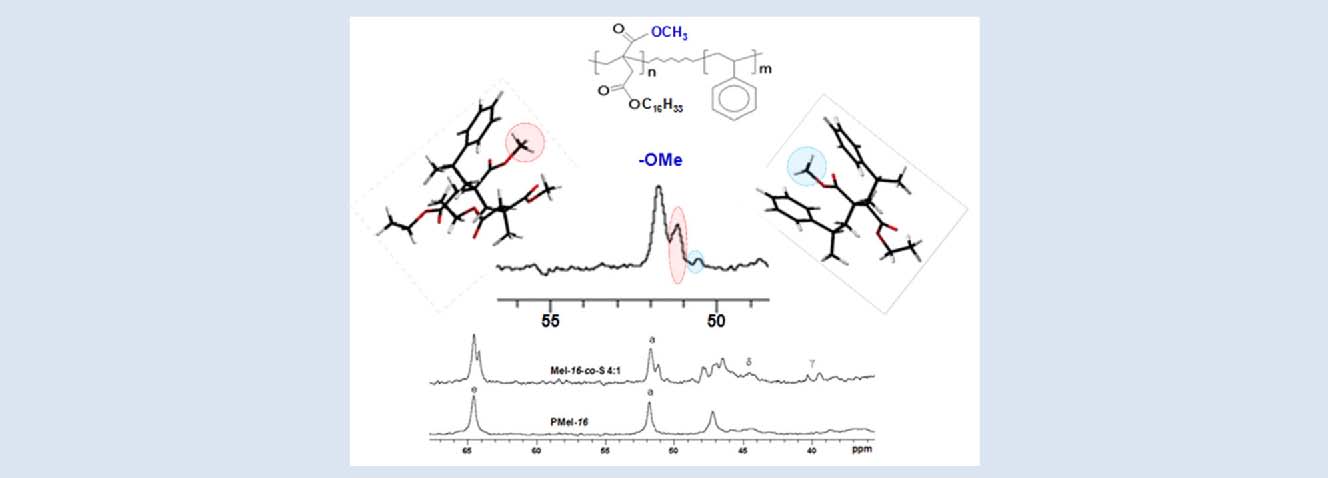
<P   align="center" ><FONT size="+1" color="#C00000"><B>Figure 4. <FONT color="#000000"></B>HMQC spectrum of the MeI-<I>16</I>-<I>co</I>-S 4:1 copolymer carried out in benzene at 25&ordm;C. </P >    <P   align="justify" ><FONT size="+1">If a simple model of a triad is used to explain the microstructure, the signals in the homopolymer would correspond to a sequence of itaconateitaconate-itaconate (III). When a small amount of styrene is incorporated in the polymer, two new signals of less intensity at 51.0 and 64.0 ppm appear in the <Sup><FONT size="+1">13</Sup><FONT size="+1">C NMR together with the formers (Figure 3 b). Both signals may be considered as corresponding to an itaconate-itaconate-styrene (IIS) sequence. For the OCH<FONT size="+1">3<FONT size="+1">, another very week peak at 50.5 ppm, attributed to a SIS sequence is also observed. With the increase of the styrene content in the copolymer these new signals raise in relation to the original ones. The splitting and the broadening of these signals are due to a change of the chemical environment produced when an itaconate unit is adjacent to a styrene one; the shift to higher field is probably due to the itaconate&acute;s OCH<FONT size="+1">3 <FONT size="+1">or OCH<FONT size="+1">2 <FONT size="+1">groups are located inside the protection cone of the aromatic ring of the styrene unit as may be observed in Figure 5. The structures shown in Figure 5 were generated by theoretical calculations of chemical shielding with ab initio methods and will be discussed later. For example, for the methoxy group, the signal that appears at 51.0 ppm is due to the itaconate unit which is located in the center of a IIS where the OCH<FONT size="+1">3 <FONT size="+1">group is oriented toward the aromatic ring, as shown in Figure 5 A; whereas the signal at 50.5 ppm is due to a situation where the OCH<FONT size="+1">3 <FONT size="+1">group of the itaconate in a SIS triad is adjacent to two aromatic rings as may be seen in Figure 5B. The signal centered at 64.0 ppm becomes broader with the increase of the styrene content in the copolymer, probably for the same reasons, the OCH<FONT size="+1">2 <FONT size="+1">group of the itaconate is oriented towards the phenyl ring in the IIS and SIS triads. </P >    <P   align="justify" >To corroborate these facts, we carried out some theoretical calculations of chemical shielding with ab initio methods employing optimized conformations obtained by using the hybrid density functional B3LYP method and the 6-311G++ (d,p) basis set. As we mentioned above, from these calculations two energy minimized structures shown in Figure 5 were generated. The first one corresponding to the IIS situation in which an itaconate unit is between a styrene and other itaconate unit (Figure 5A). The second is due to a SIS situation where an itaconate unit is between two styrene units (Figure 5B). For both situations is clear that the methoxy group of the itaconate unit is located inside the protection cone of the aromatic ring of the neighbor styrene unit as suggested by NMR experiments. </P >    <DIV class="Sect"   > 				    <p align="center"><IMG align="" width="303" height="140"  src="/img/fbpe/rlmm/v34n1/art16_img_20.jpg" ></DIV >    
]]></body>
<body><![CDATA[<P   align="justify" ><FONT size="+1" color="#C00000"><B>Figure 5. <FONT color="#000000"></B>Simulated structures of two different conformations adopted by the MeI-16-<I>co</I>-S showing the relative orientations of OCH<FONT size="+1">3 <FONT size="+1">respect to the aromatic ring. </P >    <P   align="justify" >(A) OCH<FONT size="+1">3 <FONT size="+1">next to an aromatic ring in a sequence IIS. (B) OCH<FONT size="+1">3 <FONT size="+1">between two aromatic rings in a sequence SIS. </P >    <P   align="justify" ><FONT size="+1">The calculated <Sup><FONT size="+1">13</Sup><FONT size="+1">C NMR chemical shifts for the methoxy groups of the above structures are given in Table 2. In order to compare the predicted values with experimental results, we subtract the calculated &sigma;<FONT size="+1">iso <FONT size="+1">values from that of the TMS molecule modeled. </P >    <P   align="justify" >As may be seen in Table 2, the calculated chemical shift values for the methoxy group agree adequately with those obtained experimentally, corroborating the presence of IIS and SIS sequences in the copolymer chain. It can be inferred that these results are also applicable to those observed chemical shift of the OCH<FONT size="+1">2 <FONT size="+1">group. </P >    <P   align="justify" ><FONT size="+1" color="#C00000"><B>Table 2</B>. <FONT color="#000000">Isotropic chemical shielding values for the methoxy group in <Sup><FONT size="+1">13</Sup><FONT size="+1">C NMR compared with experimental data. </P >    <DIV class="Sect"   ><TABLE   align="center" border=0 cellspacing=0 cellpadding=2 ><TR    ><TD    align="left" width="67"  valign="top" height="11"  ><I>Structure </I></TD ><TD    align="center" width="115"  valign="top" height="11"  ><I>Calculated </I></TD ><TD    align="center" width="97"  valign="top" height="11"  ><I>Observed </I></TD ></TR ><TR    ><TD    align="left" width="67"  valign="top" height="18"  ></TD><TD    align="center" width="115"  valign="middle" height="18"  ><FONT size="+1"><I>13</I><FONT size="+1"><I>C NMR shift </I></TD ><TD    align="center" width="97"  valign="middle" height="18"  ><FONT size="+1"><I>13</I><FONT size="+1"><I>C NMR shift </I></TD ></TR ><TR    ><TD    align="left" width="67"  valign="top" height="21"  ></TD><TD    align="center" width="115"  valign="middle" height="21"  ><I>(in ppm)</I><FONT size="+1"><I>(a) </I></TD ><TD    align="center" width="97"  valign="middle" height="21"  ><FONT size="+1"><I>(in ppm)</I><FONT size="+1"><I>(b) </I></TD ></TR ><TR    ><TD    align="left" width="67"  valign="middle" height="19"  ><FONT size="+1">S-I-S </TD ><TD    align="center" width="115"  valign="middle" height="19"  >50.8 </TD ><TD    align="center" width="97"  valign="middle" height="19"  >50.5 </TD ></TR ><TR    ><TD    align="left" width="67"  valign="middle" height="21"  >I-I-S </TD ><TD    align="center" width="115"  valign="middle" height="21"  >51.6<FONT size="+1">(c) </TD ><TD    align="center" width="97"  valign="middle" height="21"  ><FONT size="+1">51.0 </TD ></TR ><TR    ><TD    align="left" width="67"  valign="middle" height="21"  >I-I-S </TD ><TD    align="center" width="115"  valign="middle" height="21"  >52.4<FONT size="+1">(d) </TD ><TD    align="center" width="97"  valign="bottom" height="21"  ><FONT size="+1">-</TD ></TR ><TR    ><TD    align="left" width="67"  valign="bottom" height="16"  >I-I-I </TD ><TD    align="center" width="115"  valign="bottom" height="16"  >52.9 </TD ><TD    align="center" width="97"  valign="bottom" height="16"  >51.9<FONT size="+1">(e) </TD ></TR ></TABLE ></DIV >    <P   align="justify" >(a) </P >    <P   align="justify" ><FONT size="+1">Calculated with GIAO method at the DFT level of theory, in which the B3LYP functional and the 6311G++(d,p) basis set were used. <Sup><FONT size="+1">(b) </Sup><FONT size="+1">Carried out in benzene-d<FONT size="+1">6 <FONT size="+1">at 25&ordm;C. <Sup><FONT size="+1">(c) </Sup><FONT size="+1">Shift of the methoxy group of the Itaconate at the middle. <Sup><FONT size="+1">(d) </Sup><FONT size="+1">Shift of the methoxy of the Itaconate of the extreme. <Sup><FONT size="+1">(e) </Sup><FONT size="+1">Chemical shift measured for the homopolymer 51.9 ppm. </P >    <DIV class="Sect"   >    <P   align="justify" ><FONT size="+1">The shift of both signals to higher field occurs as mentioned when the methoxy or methyleneoxy groups are on the same side of the ring and the group remains in the protection cone of the ring. There is clear that the effect on the OCH<FONT size="+1">3 <FONT size="+1">is greater than on the OCH<FONT size="+1">2 <FONT size="+1">because the former is closer to the benzene ring. </P >    ]]></body>
<body><![CDATA[<P   align="justify" >The additional signals located between the described ones would correspond to intermediate situations, but it is necessary to conduct more conformational studies on molecular stability to corroborate this fact. </P >    <P   align="justify" >The styrene ring also influences the second methylene of the itaconate side chain (f in Figure 2) shifting this signal in the <Sup><FONT size="+1">1</Sup><FONT size="+1">H NMR to higher field, overlapping it over interior protons (g). This situation was observed in the COSY spectrum (not shown here). </P >    <P   align="justify" >The itaconate units also have an effect over the styrene signals in <Sup><FONT size="+1">13</Sup><FONT size="+1">C and <Sup><FONT size="+1">1</Sup><FONT size="+1">H NMR. The methyne carbon of the styrene unit (&gamma;) also undergoes splitting in two main signals centered at 40.3 y 39.3 ppm in the <Sup><FONT size="+1">13</Sup><FONT size="+1">C NMR as may be observed in Figure </P >    <P   align="justify" >3. When the copolymer has a high styrene content (MeI-16-<I>co</I>-S 1:2), the signal centered in 40.3 ppm is broad, slightly split in two peaks at 40.5 and 40.2 </P >    <P   align="justify" >ppm and is more intense than that located at 39.3 ppm. The splitting of the low field signal is possible due to the presence of the sequences SSS and SSI, while that appearing at 39.3 ppm is probably caused by the ISI triad. When the itaconate content increases, the signal at 40.5 ppm decreases in relation to the others and is not even present for MeI-16-<I>co</I>-S 4:1 copolymer. This fact allows to assign this peak to the SSS sequence and the relative increase of the signal at 39.3 ppm confirms that it is due to the ISI sequence. </P >    <P   align="justify" >The CH proton (&gamma;) is also shifted to low field and split in at least two broad signals at 2.2 and 2.4 ppm </P >    <P   align="justify" ><Sup><FONT size="+1">1</Sup><Sub><FONT size="+1">H</Sub></P >    <P   align="justify" >in the NMR spectra. In the HMQC spectra (Figure 4) the correlation of the signals undoubtedly confirm that the low field signal corresponds to the ISI sequence, whereas the other must correspond to the SSI and SSS sequences. These signals overlap the broad CH<FONT size="+1">2<FONT size="+1">-COO (c) signal. </P >    <P   align="justify" >The presence of styrene units also affects the multiplicity and intensity of carbonyl signals (b) and (d), this effect being more prominent in the former one due to its proximity to the aromatic ring as may be seen in the expanded <Sup><FONT size="+1">13</Sup><FONT size="+1">C NMR spectrum in the zone between 170 and 177 ppm shown in Figure 6. </P ></DIV > 			    <p align="center"><IMG align="" width="375" height="356"  src="/img/fbpe/rlmm/v34n1/art16_img_23.jpg" ></p> 			    
]]></body>
<body><![CDATA[<P   align="center" ><FONT size="+1" color="#C00000"><B>Figure 6. <FONT color="#000000"></B>Expanded <Sup><FONT size="+1">13</Sup><FONT size="+1">C NMR spectra of the PMeI-16-<I>co</I>-S copolymer series from 170 to 177 ppm. The new peaks in the copolymers are indicated with arrows (see text). </P >    <P   align="justify" ><FONT size="+1">For the copolymers with high content of styrene, the signal of the vinyl carbonyl (b) shows significant changes. The peak corresponding to the syndiotactic triad that appears at 176 ppm, suffers a slight shift to higher field accompanied with splitting, likewise the heterotactic and syndiotactic signals also shifted at 175 and 174 ppm respectively. The interaction at three bonds between the MeO protons that appears at 2.7 and 3.0 ppm with the signal at 175 ppm and the one at 3.3 ppm with the carbon signal at 176 ppm are observed in the HMBC spectrum, confirming that these shifts are due to the presence of IIS and SIS sequences in the copolymer. This is consistent with the appearance of a peak at 170.5 ppm carbonyl ester (d). </P >    <P   align="justify" >From these results, it is clear that the chemical shift is not only influenced by the stereochemistry but also by the composition, it is important to remember that the carbonyl signals, in the homopolymer, are </P >    <DIV class="Sect"   >    <P   align="justify" ><Sup><FONT size="+1">13</Sup><Sub><FONT size="+1">C</Sub></P ></DIV >    <P   >very sensitive to stereochemistry factors in NMR. Finally, the random distribution of the constitutional units in the copolymers is also confirmed by all these results. </P ></DIV ></DIV >    <DIV class="Sect"   ><H4   align="justify" ><FONT color="#001F5F"><B>4. CONCLUSIONS </H4 >    <P   align="justify" ><FONT color="#000000"></B>The results obtained here allow us to conclude that the poly (methyl-<I>n</I>-hexadecyl itaconate-<I>co</I>-styrene) copolymers obtained are mainly random. The chemical shifts of the main groups present in both units of the copolymer are strongly influenced not only by the composition and electronic factors of the surrounding but also by the stereochemistry. The experimental chemical shifts of the methoxy groups in <Sup><FONT size="+1">13</Sup><FONT size="+1">C NMR were in a very good agreement with those calculated by theoretical model which allow to suggest that structures optimized by the theoretical method are present in the polymeric structure. </P ></DIV >    <DIV class="Sect"   ><H4   align="justify" ><FONT color="#001F5F"><B>5. ACKNOWLEDGMENTS </H4 >    <P   align="justify" ><FONT color="#000000"></B>This work has been supported by the Consejo de Desarrollo Cient&iacute;fico Human&iacute;stico y Tecnol&oacute;gico de la Universidad de Los Andes, M&eacute;rida (Venezuela) (CDCHT-ULA) through the grants C-1517-08-A and C-1746-11-08-B. The authors also thank MSc. Carlos Torres, of the Laboratorio de Pol&iacute;meros, Departamento de Qu&iacute;mica, Facultad de Ciencias, Universidad de Los Andes (M&eacute;rida, Venezuela) for his help with some IR experiments. </P ></DIV >    ]]></body>
<body><![CDATA[<DIV class="Sect"   ><H4   ><FONT color="#001F5F"><B>6. REFERENCIAS </H4 >    <P   align="justify" ><FONT size="+1" color="#000000"></B>[1]<FONT size="+1">. 	Cowie JMG, McEwen IJ, Veli&#269;kovi&#263; J. Polymer 1975; 16(12): 869-872. </P >    <P   align="justify" >[2]. 	Cowie JMG, Henshall SAE, McEwen IJ, Veli&#269;kovi&#263; J. Polymer 1977; 18(6): 612-616. </P >    <P   align="justify" >[3]. 	Cowie JMG, Haq Z. Eur. Polym. J. 1977; 13(10): 745-750. </P >    <P   align="" >[4]. 	Cowie JMG, Haq Z. Brit. Polym. J. 1977; 9: 241</P >    <P   >245. [5]. Veli&#269;kovi&#263; J, Filipovic J. Makromol. Chem. 1984; </P ><DL   ><DT   >185: </DT ><DD   >569&ndash;578. [6]. Le&oacute;n A, L&oacute;pez M, Gargallo L, Radi&#263; D, Horta A. </DD ><DT   >J. </DT ><DD   >Macromol. Sci. Phys. 1990; B29(4): 351-358. [7]. Gargallo L, Opazo A, Leiva A, Radi&#263; D, Polymer 1998; 39(10): 2069-2072. [8]. Carrillo M, Mart&iacute;nez De Ilarduya A, Arnal Ml, Torres C, L&oacute;pez-Carrasquero F. Polym. Bull. 2002; 48(1): 59-66. [9]. L&oacute;pez-Carrasquero F, Mart&iacute;nez de Ilarduya A, C&aacute;rdenas M, Carrillo M, Arnal ML, Laredo E, Torres C, M&eacute;ndez B, M&uuml;ller AJ. Polymer 2003; 44(17): 4969-4979. [10]. Arrighi V, Mc Ewen J, Holmes PF. Macromolecules 2004; 37(16): 6210-6218. [11]. Genix A-C, Laupr&eacute;tre F. Macromolecules 2005; 38(7): 2786-2794. [12]. Velada JL, Cesteros C, Madoz A, Katime I. Macromol. Chem., Phys. 1995; 196: 3171-3185. [13]. Velada JL, Hern&aacute;ez E, Cesteros LC, Katime I. Polym. Degrad. Stabil. 1996: 52: 273-282. [14]. Katsikas L, Paunovi&#263; I, Popovi&#263; IG. Thermal Analysis 1997; 49: 87-94. [15]. Boskovic G, Katsikas L, Veli&#269;kovi&#263; J, Popovi&#263; IG. Polymer 2000; 41(15): 5769-5775. [16]. Popovi&#263; IG, Katsikas L, Veli&#269;kovi&#263; J Polym. Degrad. Stabil. 2005; 89(1): 153-164. [17]. Popovi&#263; IG, Katsikas L, Velickovi&#263; J (2005) Polym Degrad Stabil 89(1): 165-174. [18]. Madruga EL, Fern&aacute;ndez-Garc&iacute;a M. Polymer 1994; 35(20): 4437-4442. [19]. Madruga EL, Fern&aacute;ndez-Garc&iacute;a M. Eur. Polym. J. 1995; 31(11): 1103-1107. [20]. Fern&aacute;ndez-Garc&iacute;a M, Madruga EL, Cuervo-Rodr&iacute;guez R. Polymer 1996; 37(2): 263-268. [21]. Fern&aacute;ndez-Garc&iacute;a M., Madruga EL. Polymer 1997; 38(6): 1367-1371. [22]. Fern&aacute;ndez-Garc&iacute;a M, De la Fuente JL, Madruga EL. Polym. Eng. Sci. 2001; 41(9): 1616-1625. </DD ></DL >    <P   align="justify" >[23]. 	Nakamura H, Seno M, Tanaka H, Sato T. Makromol. Chem. 1993; 194(6): 1773-1783. </P >    <DIV class="Sect"   >    <P   align="justify" >[24]. 	Otsu T, Watanabe H. Eur. Polym. J. 1993; 29(23): 167-174. </P >    <P   align="justify" >[25]. 	Opazo A, Gargallo L, Radi&#263; D. Polym. Bull. 1996; 36(4): 511-516. </P >    ]]></body>
<body><![CDATA[<P   align="justify" >[26]. 	C&aacute;rdenas MC, Rangel Rangel E, Torres C, L&oacute;pez-Carrasquero F. Rev. Iberoam. Pol&iacute;. 2008; 9: 222</P >    <P   >227. [27]. Horta A, Hern&aacute;ndez-Fuentes I, Gargallo L, Radi&#263; </P >    <P   align="justify" >D. Macromol. Chem. Rapid. Commun<B>.</B>1987; 8: 523-528. </P >    <P   align="justify" >[28]. 	Hirano T, Tateiwa S, Seno M, Sato T. J. Polym. Sci., Part A.: Polym. Chem. 2000; 38(13): 24892491. </P >    <P   align="justify" >[29]. 	Rangel-Rangel E, Torres C, Rinc&oacute;n L, Koteich-Khatib S, L&oacute;pez-Carrasquero F. LatinAm. Metal Mat. 2012; 32(1): 79-88. </P >    <P   align="justify" >[30]. 	Cheeseman JR, Trucks GW, Keith TA, and Frisch MJ. J. Chem. Phys. 1996; 104: 5497-509. </P >    <P   align="justify" >[31]. 	Wolinski K, Hilton JF, and Pulay P. J. Am. Chem. Soc. 1990; 112: 8251-8260. </P >    <P   align="justify" >[32]. 	Ditchfield R. Mol. Phys. 1974; 27: 789-807. </P >    <P   align="justify" >[33]. 	Ditchfield R. J Chem. Phys. 1976; 65(): 31233134. </P >    <P   align="justify" >[34]. 	Krishnamurty S, Heine T, Goursot A. J. Phys. Chem. B. 2003; 107(24): 5728&ndash;5732. </P >    ]]></body>
<body><![CDATA[<P   align="justify" >[35]. 	Zhou P, Li G, Shao Z, Pan X, Yu T. J. Phys., Chem. B. 2001; 105(50): 12469&ndash;12476. </P >    <P   align="justify" >[36]. 	Consentino U, Villa A, Pitea D, Moro G, Barone V, Maiocchi A. J. Am. Chem. Soc. 2002; 124(17): 4901&ndash;4909. </P >    <P   align="" >[37]. 	Dong S, Ida R, Wa G A. J. Phys., Chem. A. 2000; 104(47): 11194-11202. [38]. Malkin VG, Malkina OL, Steinebrunner G, Huber </P >    <P   align="" >H. Chem. Eur. J. 1996; 2(4): 452-457. [39]. Mennucci B, Mart&iacute;nez J M, Tomasi J. J. Phys., Chem. A. 2001, 105(30): 7287-7296. [40]. Frisch MJ., Trucks GW, Schlegel HB, Scuseria GE, Robb MA, Cheeseman JR, Zakrzewski VG, Montgomery JA Jr, Stratmann RE, Burant JC, Dapprich S, Millam JM, Daniels AD, Kudin KN, Strain MC, Farkas O, Tomasi J, Barone V, Cossi M, Cammi R, Mennucci B, Pomelli C, Adamo C, Clifford S, Ochterski J, Petersson GA, Ayala PY, Cui Q, Morokuma K, Salvador P, Dannenberg JJ, Malick DK, Rabuck AD, Raghavachari K, Foresman JB, Cioslowski J, Ortiz JV, Baboul AG, Stefanov BB, Liu G, Liashenko A, Piskorz P, Komaromi I, Gomperts R, Martin R.L, Fox DJ, Keith T, Al-Laham MA, Peng CY, Nanayakkara A, Challacombe M, Gill PMW, Johnson B, Chen </P >    <P   align="justify" >W, Wong MW, Andres JL, Gonzalez C, Head-Gordon M, Replogle ES, Pople JA, Gaussian 98 (Gaussian, Inc., Pittsburgh, PA, 1998). </P >    <P   align="justify" >[41]. 	L&oacute;pez-Carrasquero F, Rangel-Rangel E, C&aacute;rdenas M, Torres C, Dugarte N, Laredo E. Polym. Bull. 2013; 70(1): 131-146. </P ></DIV ></DIV ></DIV >     ]]></body>

</article>
