<?xml version="1.0" encoding="ISO-8859-1"?><article xmlns:mml="http://www.w3.org/1998/Math/MathML" xmlns:xlink="http://www.w3.org/1999/xlink" xmlns:xsi="http://www.w3.org/2001/XMLSchema-instance">
<front>
<journal-meta>
<journal-id>0378-1844</journal-id>
<journal-title><![CDATA[Interciencia]]></journal-title>
<abbrev-journal-title><![CDATA[INCI]]></abbrev-journal-title>
<issn>0378-1844</issn>
<publisher>
<publisher-name><![CDATA[ASOCIACIÓN INTERCIENCIA]]></publisher-name>
</publisher>
</journal-meta>
<article-meta>
<article-id>S0378-18442003000500008</article-id>
<title-group>
<article-title xml:lang="en"><![CDATA[Limiting amino acids in wheat for growing-finishing pigs]]></article-title>
</title-group>
<contrib-group>
<contrib contrib-type="author">
<name>
<surname><![CDATA[Pichardo]]></surname>
<given-names><![CDATA[Adrián]]></given-names>
</name>
<xref ref-type="aff" rid="A01"/>
</contrib>
<contrib contrib-type="author">
<name>
<surname><![CDATA[Cervantes-Ramírez,]]></surname>
<given-names><![CDATA[Miguel]]></given-names>
</name>
<xref ref-type="aff" rid="A02"/>
</contrib>
<contrib contrib-type="author">
<name>
<surname><![CDATA[Cuca]]></surname>
<given-names><![CDATA[Manuel]]></given-names>
</name>
<xref ref-type="aff" rid="A03"/>
</contrib>
<contrib contrib-type="author">
<name>
<surname><![CDATA[Figueroa]]></surname>
<given-names><![CDATA[José L]]></given-names>
</name>
<xref ref-type="aff" rid="A04"/>
</contrib>
<contrib contrib-type="author">
<name>
<surname><![CDATA[B. Araiza]]></surname>
<given-names><![CDATA[Alfonso]]></given-names>
</name>
<xref ref-type="aff" rid="A05"/>
</contrib>
<contrib contrib-type="author">
<name>
<surname><![CDATA[Torrentera]]></surname>
<given-names><![CDATA[Noemí]]></given-names>
</name>
<xref ref-type="aff" rid="A06"/>
</contrib>
<contrib contrib-type="author">
<name>
<surname><![CDATA[Maximiliano]]></surname>
<given-names><![CDATA[Cervantes]]></given-names>
</name>
<xref ref-type="aff" rid="A07"/>
</contrib>
</contrib-group>
<aff id="A01">
<institution><![CDATA[,Universidad Autonoma de Chapingo  ]]></institution>
<addr-line><![CDATA[ ]]></addr-line>
<country>México</country>
</aff>
<aff id="A02">
<institution><![CDATA[,Universidad Autonoma Baja California  ]]></institution>
<addr-line><![CDATA[ ]]></addr-line>
</aff>
<aff id="A03">
<institution><![CDATA[,Universidad Autonoma Baja California  ]]></institution>
<addr-line><![CDATA[ ]]></addr-line>
<country>México</country>
</aff>
<aff id="A04">
<institution><![CDATA[,Universidad Autonoma Baja California  ]]></institution>
<addr-line><![CDATA[ ]]></addr-line>
<country>México</country>
</aff>
<aff id="A05">
<institution><![CDATA[,Universidad de Sonora  ]]></institution>
<addr-line><![CDATA[ ]]></addr-line>
<country>México</country>
</aff>
<aff id="A06">
<institution><![CDATA[,Universidad Autonoma Metropolitana  ]]></institution>
<addr-line><![CDATA[ ]]></addr-line>
<country>México</country>
</aff>
<aff id="A07">
<institution><![CDATA[,Universidad Autonoma Metropolitana  ]]></institution>
<addr-line><![CDATA[ ]]></addr-line>
<country>México</country>
</aff>
<pub-date pub-type="pub">
<day>00</day>
<month>05</month>
<year>2003</year>
</pub-date>
<pub-date pub-type="epub">
<day>00</day>
<month>05</month>
<year>2003</year>
</pub-date>
<volume>28</volume>
<numero>5</numero>
<fpage>287</fpage>
<lpage>291</lpage>
<copyright-statement/>
<copyright-year/>
<self-uri xlink:href="http://ve.scielo.org/scielo.php?script=sci_arttext&amp;pid=S0378-18442003000500008&amp;lng=en&amp;nrm=iso"></self-uri><self-uri xlink:href="http://ve.scielo.org/scielo.php?script=sci_abstract&amp;pid=S0378-18442003000500008&amp;lng=en&amp;nrm=iso"></self-uri><self-uri xlink:href="http://ve.scielo.org/scielo.php?script=sci_pdf&amp;pid=S0378-18442003000500008&amp;lng=en&amp;nrm=iso"></self-uri><abstract abstract-type="short" xml:lang="en"><p><![CDATA[Four experiments involving 136 crossbred (Landrace-Hampshire-Duroc) pigs were conducted to determine the order of the first three limiting amino acids (LAA) in wheat for growing and finishing pigs. Treatments consisted in additions of lysine, threonine and/or methionine to adjusted basal and control diets. In Exp. 1, lysine increased daily gain (ADG), intake of feed (FI), lysine (LI), threonine (TI) and methionine (MI), and improved feed conversion (F/G). Additional threonine increased ADG and TI, and improved F/G. Methionine increased MI, but did not affect ADG or F/G. In Exp. 2, threonine increased ADG and TI, and improved F/G. Inclusion of methionine tended to decrease ADG and depressed F/G. Pigs fed lysine-threonine added and control diets showed no differences in ADG, FI or F/G, although control fed pigs had higher TI and MI. In Exp. 3, threonine alone did not affect ADG or F/G, but combined with methionine increased ADG and improved FG. There were no differences in ADG and F/G between control or lysine-threonine added diets. In Exp. 4, threonine tended to increase ADG and improved F/G while methionine reduced ADG. Addition of threonine plus methionine increased ADG, but did not affect FI or F/G. These data indicate that, in wheat, lysine and threonine are the first and second LAA for growing and finishing pigs. Methionine alone does not limit growth in pigs fed wheat-based diets, but appears to enhance the threonine response in finishing pigs. Lysine and threonine can replace soybean meal in wheat-based diets for growing-finishing pigs.]]></p></abstract>
<abstract abstract-type="short" xml:lang="es"><p><![CDATA[Se realizaron cuatro experimentos con 136 cerdos cruzados (Landrace-Hampshire-Duroc) para determinar el orden de los tres primeros aminoácidos limitantes (AAL) en trigo para cerdos en crecimiento y finalización. Los tratamientos consistieron en adiciones de lisina, treonina y/o metionina a dietas base y en una dieta testigo. En el Exp. 1, lisina incrementó la ganancia diaria de peso (GDP), consumo de alimento (CDA), lisina (CDL), treonina (CDT) y metionina (CDM), y mejoró la conversión alimenticia (C/G). La adición de treonina incrementó GDP y CDT, y mejoró C/G. Metionina incrementó el CDM, pero no afectó GDP o C/G. En el Exp. 2, treonina incrementó GDP y CDT, e incrementó C/G. La inclusión de metionina tendió a reducir GDP y a deprimir C/G. No hubo diferencias en GDP, CDA o C/G entre los cerdos bajo dieta base con lisina y treonina o dieta testigo; aunque los testigos tuvieron mayor CDT y CDM. En el Exp. 3, treonina sola no afectó GDP o C/G, pero combinada con metionina incrementó GDP y mejoró C/G. No hubo diferencias en GDP y C/G entre las dietas testigo y la adicionada con lisina y treonina. En el Exp. 4, treonina tendió a incrementar GDP y a mejorar C/G, mientras que metionina redujo GDP. La adición de treonina y metionina incrementó GDP, pero no afectó CDA ni C/G. Estos datos indican que, en trigo, lisina y treonina son el primero y segundo AAL para cerdos en crecimiento y finalización. Metionina sola no limita el crecimiento de cerdos en dietas con base trigo, pero parece potenciar la respuesta de treonina en cerdos de finalización. Lisina y treonina pueden sustituir la pasta de soya en dietas con base trigo para cerdos en crecimiento y finalización.]]></p></abstract>
<abstract abstract-type="short" xml:lang="pt"><p><![CDATA[Realizaram-se quatro experimentos com 136 porcos cruzados (Landrace-Hampshire-Duroc) para determinar a ordem dos três primeiros aminoácidos limitantes (AAL) no trigo para porcos em crescimento e finalização. Os tratamentos consistiram em adições de lisina, treonina e/ou metionina a dietas base e numa dieta testemunha. No Experimento 1, lisina incrementou a ganância diária de peso (GDP), consumo de alimento (CDA), lisina (CDL), treonina (CDT) e metionina (CDM), e melhorou a conversão alimentícia (C/G). A adição de treonina incrementou a GDP e o CDT, e melhorou a C/G. Metionina incrementou o CDM, mas não afetou a GDP ou a C/G. No Experimento 2, treonina incrementou a GDP e o CDT, e incrementou a C/G. A inclusão de metionina tendeu a reduzir a GDP e a deprimir a C/G. Não houve diferenças na GDP, CDA ou C/G entre os porcos sob dieta base com lisina e treonina ou dieta testemunha; embora as testemunhas tiveram maior CDT e CDM. No Experimento 3, treonina só, não afetou a GDP ou a C/G, mas combinada com metionina, incrementou a GDP e melhorou a C/G. Não houve diferenças na GDP e a C/G entre as dietas testemunha e a adicionada com lisina e treonina. No Experimento 4, treonina tendeu a incrementar a GDP e a melhorar a C/G, enquanto que metionina reduziu a GDP. A adição de treonina e metionina incrementou a GDP, mas não afetou o CDA nem a C/G. Estes dados indicam que, no trigo, lisina e treonina são o primeiro e segundo AAL para porcos em crescimento e finalização. Metionina só, não limita o crescimento dos porcos em dietas baseadas no trigo, mas parece potenciar a resposta de treonina em porcos de finalização. Lisina e treonina podem substituir a massa de soja em dietas baseadas no trigo para porcos em crescimento e finalização.]]></p></abstract>
<kwd-group>
<kwd lng="en"><![CDATA[Limiting Amino Acids]]></kwd>
<kwd lng="en"><![CDATA[Pig Feed /]]></kwd>
<kwd lng="en"><![CDATA[Wheat]]></kwd>
</kwd-group>
</article-meta>
</front><body><![CDATA[   <B><FONT SIZE=4>    <P align="center">LIMITING AMINO ACIDS IN WHEAT FOR GROWING-FINISHING PIGS</P> </FONT> </B>     <P align="center"><font size="3">Adri&aacute;n Pichardo, Miguel Cervantes-Ram&iacute;rez, Manuel Cuca, Jos&eacute; L. Figueroa, Alfonso B. Araiza,</font></P>     <P align="center"><font size="3">&nbsp;Noem&iacute; Torrentera and Maximiliano Cervantes</font></P> <I> </I>    <P align="justify">Adri&aacute;n Pichardo Gonz&aacute;lez. Agricultural Engineer, Universidad Aut&oacute;noma de Chapingo, M&eacute;xico. M.Sc. in Animal Production, Colegio de Postgraduados, M&eacute;xico. Nutrition Specialist, ALPURA, M&eacute;xico. </P>     <P align="justify">Miguel Cervantes-Ram&iacute;rez. Zoothecnical Engineer. Ph.D in Ruminal Nutrition, University of Kentucky, USA. Professor, Instituto de Ciencias Agr&iacute;colas, Universidad Aut&oacute;noma de Baja California, Mexicali, Baja California, M&eacute;xico (ICA-UABC). Address: Lago Reindeer # 933, Jardines del Lago, Mexicali, B.C., M&eacute;xico. e-mail: Miguel_Cervantes@uabc.mx</P>     <P align="justify">Manuel Cuca Garc&iacute;a. Agricultural Engineer. Ph.D. in Animal Nutrition, University of Wisconsin, USA. Professor, Colegio de Postgraduados, Montecillos, M&eacute;xico.</P>     <P align="justify">Jos&eacute; L. Figueroa Velasco. Agricultural Engineer. Ph.D. in Animal Nutrition, University of Nebraska, USA. Researcher, Colegio de Postgraduados, Montecillos, M&eacute;xico.</P>     <P align="justify">Alfonso B. Araiza Pi&ntilde;a. Agricultural Engineer, Universidad de Sonora, M&eacute;xico. M.Sc. in Animal Production Sciences, ICA-UABC.</P>     <P align="justify">Noem&iacute; Torrentera Olivera. Food Engineer and Master in Meat Sciences, Universidad Aut&oacute;noma Metropolitana, M&eacute;xico. Researcher, ICA-UABC).</P>     ]]></body>
<body><![CDATA[<P align="justify">Maximiliano Cervantes Ram&iacute;rez. Agricultural Engineer. M.Sc. in Irrigation Sciences, Colegio de Postgraduados, M&eacute;xico. Researcher, ICA-UABC.</P>      <P align="justify"><B>Summary</P>  </B>     <P align="justify">Four experiments involving 136 crossbred (Landrace-Hampshire-Duroc) pigs were conducted to determine the order of the first three limiting amino acids (LAA) in wheat for growing and finishing pigs. Treatments consisted in additions of lysine, threonine and/or methionine to adjusted basal and control diets. In Exp. 1, lysine increased daily gain (ADG), intake of feed (FI), lysine (LI), threonine (TI) and methionine (MI), and improved feed conversion (F/G). Additional threonine increased ADG and TI, and improved F/G. Methionine increased MI, but did not affect ADG or F/G. In Exp. 2, threonine increased ADG and TI, and improved F/G. Inclusion of methionine tended to decrease ADG and depressed F/G. Pigs fed lysine-threonine added and control diets showed no differences in ADG, FI or F/G, although control fed pigs had higher TI and MI. In Exp. 3, threonine alone did not affect ADG or F/G, but combined with methionine increased ADG and improved FG. There were no differences in ADG and F/G between control or lysine-threonine added diets. In Exp. 4, threonine tended to increase ADG and improved F/G while methionine reduced ADG. Addition of threonine plus methionine increased ADG, but did not affect FI or F/G. These data indicate that, in wheat, lysine and threonine are the first and second LAA for growing and finishing pigs. Methionine alone does not limit growth in pigs fed wheat-based diets, but appears to enhance the threonine response in finishing pigs. Lysine and threonine can replace soybean meal in wheat-based diets for growing-finishing pigs.</P>      <P align="justify"><B>Resumen</P>  </B>     <P align="justify">Se realizaron cuatro experimentos con 136 cerdos cruzados (Landrace-Hampshire-Duroc) para determinar el orden de los tres primeros amino&aacute;cidos limitantes (AAL) en trigo para cerdos en crecimiento y finalizaci&oacute;n. Los tratamientos consistieron en adiciones de lisina, treonina y/o metionina a dietas base y en una dieta testigo. En el Exp. 1, lisina increment&oacute; la ganancia diaria de peso (GDP), consumo de alimento (CDA), lisina (CDL), treonina (CDT) y metionina (CDM), y mejor&oacute; la conversi&oacute;n alimenticia (C/G). La adici&oacute;n de treonina increment&oacute; GDP y CDT, y mejor&oacute; C/G. Metionina increment&oacute; el CDM, pero no afect&oacute; GDP o C/G. En el Exp. 2, treonina increment&oacute; GDP y CDT, e increment&oacute; C/G. La inclusi&oacute;n de metionina tendi&oacute; a reducir GDP y a deprimir C/G. No hubo diferencias en GDP, CDA o C/G entre los cerdos bajo dieta base con lisina y treonina o dieta testigo; aunque los testigos tuvieron mayor CDT y CDM. En el Exp. 3, treonina sola no afect&oacute; GDP o C/G, pero combinada con metionina increment&oacute; GDP y mejor&oacute; C/G. No hubo diferencias en GDP y C/G entre las dietas testigo y la adicionada con lisina y treonina. En el Exp. 4, treonina tendi&oacute; a incrementar GDP y a mejorar C/G, mientras que metionina redujo GDP. La adici&oacute;n de treonina y metionina increment&oacute; GDP, pero no afect&oacute; CDA ni C/G. Estos datos indican que, en trigo, lisina y treonina son el primero y segundo AAL para cerdos en crecimiento y finalizaci&oacute;n. Metionina sola no limita el crecimiento de cerdos en dietas con base trigo, pero parece potenciar la respuesta de treonina en cerdos de finalizaci&oacute;n. Lisina y treonina pueden sustituir la pasta de soya en dietas con base trigo para cerdos en crecimiento y finalizaci&oacute;n.</P>      <P align="justify"><B>Resumo</P>  </B>      <P align="justify">Realizaram-se quatro experimentos com 136 porcos cruzados (Landrace-Hampshire-Duroc) para determinar a ordem dos tr&ecirc;s primeiros amino&aacute;cidos limitantes (AAL) no trigo para porcos em crescimento e finaliza&ccedil;&atilde;o.  Os tratamentos consistiram em adi&ccedil;&otilde;es de lisina, treonina e/ou metionina a dietas base e numa dieta testemunha.  No Experimento 1, lisina incrementou a gan&acirc;ncia di&aacute;ria de peso (GDP), consumo de alimento (CDA), lisina (CDL), treonina (CDT) e metionina (CDM), e melhorou a convers&atilde;o aliment&iacute;cia (C/G).  A adi&ccedil;&atilde;o de treonina incrementou a GDP e o CDT, e melhorou a C/G.  Metionina incrementou o CDM, mas n&atilde;o afetou a GDP ou a C/G. No Experimento 2, treonina incrementou a GDP e o CDT, e incrementou a C/G.  A inclus&atilde;o de metionina tendeu a reduzir a GDP e a deprimir a C/G.  N&atilde;o houve diferen&ccedil;as na GDP, CDA ou C/G entre os porcos sob dieta base com lisina e treonina ou dieta testemunha; embora as testemunhas tiveram maior CDT e CDM. No Experimento 3, treonina s&oacute;, n&atilde;o afetou a GDP ou  a C/G, mas combinada com metionina, incrementou a GDP e melhorou a C/G.  N&atilde;o houve diferen&ccedil;as na GDP e a C/G entre as dietas testemunha e a adicionada com lisina e treonina. No Experimento 4, treonina tendeu a incrementar a GDP e a melhorar a C/G, enquanto que metionina reduziu a GDP. A adi&ccedil;&atilde;o de treonina e metionina incrementou a GDP, mas n&atilde;o afetou o CDA nem a C/G. Estes dados indicam que, no trigo, lisina e treonina s&atilde;o o primeiro e segundo AAL para porcos em crescimento e finaliza&ccedil;&atilde;o. Metionina s&oacute;, n&atilde;o limita o crescimento dos porcos em dietas baseadas no trigo, mas parece potenciar a resposta de treonina em porcos de finaliza&ccedil;&atilde;o. Lisina e treonina podem substituir a massa de soja em dietas baseadas no trigo para porcos em crescimento e finaliza&ccedil;&atilde;o.</P>  <I>  <B>      <P align="justify">KEYWORDS / Limiting Amino Acids / Pig Feed / Wheat /</P> </B></I>    <P align="justify"><font size="3"><b>Re ceived:</b>02/11/2003. <b> Modified: </b> 04/04/2003. <b> Accepted:</b> 04/25/2003</font></P>     <P align="justify"><B>Introduction</P> </B>     ]]></body>
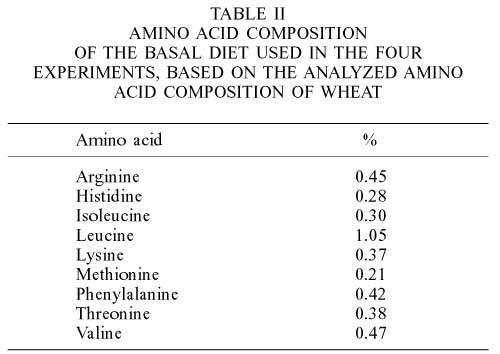
<body><![CDATA[<P align="justify">Wheat is the first grain produced in the world (Slafer and Satorro, 1999). It is used mainly for human consumption and most of the available information is related to industrial quality for human food (Gupta <I>et al</I>., 1992; Jia, <I>et al</I>., 1996). Nevertheless, when grain production exceeds the industrial demand, wheat availability for use in animal feeding increases. Under these circumstances, the price of wheat is comparable to that of sorghum and corn. However, the available information regarding the nutritional characteristics of wheat for pigs is very limited.</P>     <P align="justify">The order of the limiting amino acids (LAA) in corn and sorghum is well known (Russell <I>et al</I>., 1983; Tanksley and Knabe, 1984; Cervantes <I>et al</I>., 1997), but very little is known about wheat. Lysine is the LAA in most cereals (Lewis, 2001) but there is scarce information regarding the next LAA in wheat. Based on the AA composition (NRC, 1998), lysine, threonine and methionine appear to be the first LAA in wheat; however, there is no available data to support that assumption. The high availability of crystalline AA in the market, at competitive prices, makes it necessary to identify the first LAA in wheat, in order that feed ingredients could be used more efficiently in diets for swine. The objectives of this study were to determine the order of the first LAA in wheat for growing and finishing pigs, and to evaluate the response of pigs fed low protein, wheat-based diets added with crystalline AA.</P>  <B>    <P align="justify">Materials and Methods</P> </B>     <P align="justify">Four experiments involving 136 crossbred growing-finishing pigs (Landrace-Hampshire-Duroc) were conducted at the Experimental Swine Unit of the <I>Instituto de Ciencias Agr&iacute;colas, Universidad Aut&oacute;noma de Baja California, </I>Mexico. Sufficient animals were weighed to obtain homogeneous groups of pigs based on age, weight, sex and litter, before starting each experiment. These groups were randomly distributed among the different treatments; no more than one pig from the same litter was allowed to remain in the same treatment, in order to avoid genetic effects.<I> </I>Both the basal and control diets (<a href="#t1">Table I</a>) were added with a vitamin and mineral premix to meet or exceed their requirements for growing and finishing pigs (NRC, 1998). Single sources of wheat and soybean meal were used. Amino acid analysis of wheat (<a href="#t2">Table II</a>) was performed at the University of Missouri Experiment Station Chemical Laboratories (Columbia, MO) using ion-exchange chromatography after acid hydrolysis.</P>      <P align="center"><a name="t1"><img border="0" src="/img/fbpe/inci/v28n5/Image878.jpg" width="500" height="417"></a></P>      
<P align="center"><a name="t2"><img border="0" src="/img/fbpe/inci/v28n5/Image879.jpg" width="500" height="354"></a></P>      
<P align="justify">Pigs were housed either individually in 0.6 x 1.2m pens (Exp. 1 and Exp. 2, growing trials) or in pairs (one male and one female) in 1.0 x 1.2m pens (Exp. 3 and Exp. 4, finishing trials).<I> </I>Twenty-eight growing pigs, distributed in four treatments, were used in each of Exp. 1 (22.5kg initial weight) and Exp. 2 (24.8kg initial weight); there were 7 replicates per treatment, and each experiment lasted 28d.<I> </I>Forty finishing pigs were used in each of Exp. 3 (54.2kg initial weight) and Exp. 4 (53.7kg initial weight); there were 5 two-pig replicates per treatment, and each experiment lasted 49d.<I> </I>All animals had free access to feed and drinking water all the time, and were weighed on a weekly basis. Feed intake (FI), feed:gain ratio (F/G) and daily intakes of lysine (LI), threonine (TI) and methionine (MI) were also registered weekly. All experiments were conducted according to a randomized complete block design (Steel and Torrie, 1980). The pen was considered as the experimental unit. The data were analyzed using the GLM procedure of SAS (SAS, 1988); mean comparisons were made by non-orthogonal (Exps. 1, 2 and 3) and orthogonal (Exp. 4) contrasts.</P>  <I>    <P align="justify">Experiment 1</P> </I>     <P align="justify">This experiment was conducted to determine the order of the first three LAA in wheat for growing pigs. Four treatments consisted of the corresponding basal diet (see <a href="#t1"> Table I</a>); basal diet + 0.38% HCl-L-lysine (L); basal diet + 0.38% L + 0.23% L-threonine (T); and basal diet + 0.38% L + 0.23% T + 0.05% DL-methionine (M). The basal diet (<a href="#t1">Table I</a>) was formulated with wheat as the only major ingredient, supplemented with vitamins and minerals and corn starch.<I> </I>Crystalline L, T and M were added to the diet to contain 0.75, 0.56 and 0.26%, respectively. The wheat content in all diets remained constant.</P>  <I>    <P align="justify">Experiment 2</P> </I>     ]]></body>
<body><![CDATA[<P align="justify">Data from Exp. 1 indicate that lysine and threonine are the first and second LAA in wheat for growing pigs. However, previous reports (Ward and Southern, 1992; Cervantes <I>et al</I>., 1997) indicate that the performance of pigs fed diets containing sorghum as the only major ingredient, and added with the first three LAA, is inferior to that of pigs fed high protein, sorghum-soybean meal diets. Thus, this experiment was conducted to determine if the performance of pigs fed diets containing only wheat and added with crystalline L and T was similar to that of pigs consuming high protein, wheat-soybean meal diets.<I> </I>Four treatments consisted of the corresponding basal diet + 0.58% L; the same + 0.23% T; the latter + 0.05% M; and control wheat-soybean meal diet. The basal diet (<a href="#t1">Table I</a>) was formulated with wheat as the only major ingredient, added with crystalline L. The control diet (<a href="#t1">Table I</a>) was formulated with wheat and soybean meal to meet 100% of the lysine requirement for 20 to 50kg pigs (NRC, 1998).<I> </I>Crystalline L and M were added to match their levels in the control diet.</P>  <I>    <P align="justify">Experiment 3</P> </I>     <P align="justify">Since the growth capacity and protein deposition decreases with the increase in age of the pigs, this experiment was conducted to determine if the order of the first three LAA in wheat was the same for growing as for finishing pigs. Four treatments consisted of the corresponding basal diet containing 0.75% L; the same + 0.14% T; the latter + 0.05% M; and control wheat-soybean meal diet. The basal diet was formulated with wheat as the only major ingredient, and supplemented with 0.38% L.<I> </I>Crystalline L, T and M were added to elevate their content in the diet to 0.75, 0.52 and 0.31%, respectively. The control diet was formulated with wheat and soybean meal (see <a href="#t1"> Table I</a>) to contain 0.75% lysine.</P>  <I>    <P align="justify">Experiment 4</P> </I>     <P align="justify">Results from Exp. 3 do not show clearly which are the second and third LAA. Therefore, this experiment was designed to separate the effects of added T and M, and to determine which is the second LAA for finishing pigs. Four treatments consisted of the corresponding basal diet with 0.75% L; the same + 0.14% T; basal diet + 0.75% L + 0.05% M; and basal diet + 0.75% L + 0.14% + 0.05% M. The basal diet was formulated with wheat as the only major ingredient and supplemented with 0.38% crystalline L. The data were analyzed according to the indicated design, with a 2x2 factorial arrangement; the factors were the additions of T and M; also, three orthogonal contrasts were constructed to analyze the effects of single and combined additions of threonine and methionine.</P>  <B>    <P align="justify">Results and Discussion</P> </B>     <P align="justify">The results of Exp. 1 are presented in <a href="#t3"> Table III</a>. Lysine addition to the basal diet increased (P&lt;0.01) the average daily gain (ADG), FI, LI, TI and MI, and improved (P&lt;0.01) F/G. The ADG increased 64%, while FI, LI, TI and MI increased 42, 218, 41 and 41%, respectively, as compared to pigs fed the basal diet. This response indicates that lysine is the first LAA in wheat for growing pigs, and coincides with the estimation made considering the AA composition values of wheat and the requirements of growing pigs (NRC, 1998). Although lysine was the only crystalline amino acid added in T2, the increase in TI and MI was attributed to the increase in FI. On the other hand, the percentage increment in LI was four times higher than that observed in ADG. Also, the ADG of pigs that received the basal diet added with lysine, was smaller than the expected for pigs weighing between 20 and 50kg (NRC, 1998). This indicated that the basal diet added with lysine was still limiting in one or more of the other essential AA.</P>      <P align="center"><a name="t3"><img border="0" src="/img/fbpe/inci/v28n5/Image880.jpg" width="500" height="439"></a></P>      
<P align="justify">Threonine inclusion additionally improved (P&lt;0.01) ADG, F/G and TI, but did not affect (P&gt;0.10) FI, LI and MI. The additional increase in ADG was around 55%, while F/G and TI additionally improved by 34 and 44%, respectively, as compared with pigs fed the basal diet. This response indicates that threonine is the second LAA in wheat for growing pigs. The increase in ADG and TI was similar, which suggested that the performance of pigs fed the wheat diets could still be improved with higher dietary threonine levels.<I> </I>Methionine inclusion increased (P&lt;0.05) MI, but no additional effect (P&gt;0.10) on ADG, FI, LI and TI, or F/G was observed. This response indicates that methionine is not limiting in wheat for growing pigs, and confirms the previous suggestion that only lysine and threonine limit the growth of pigs fed diets containing only wheat as the major feed ingredient.</P>     <P align="justify">In Exp. 2 (<a href="#t4">Table IV</a>), threonine addition to the basal diet increased ADG and TI, and improved (P&lt;0.01) F/G, but did not affect (P&gt;0.10) FI, LI or MI. This result agrees with that obtained in Exp. 1, and confirms that threonine is the second LAA in wheat for growing pigs. The additional inclusion of methionine did not improve performance; in fact, it tended to reduce (P&lt;0.10) ADG and deteriorated (P&lt;0.01) F/G. In a previous study (Cervantes <I>et al</I>., 1997), the inclusion of crystalline methionine to low protein, sorghum-soybean meal diets, negatively affected FI and ADG; therefore the excess of methionine could have affected FI.<I> </I>Although the addition of crystalline methionine in this experiment slightly increased its content in the diet to 0.25%, which is hardly equal to 12.5% above the requirement, Edmonds and Baker (1987) indicated that young pigs are very sensitive to excess methionine.<I> </I>Katz and Baker (1975) found that chicks fed excess methionine decreased plasma threonine concentration and increased threonine oxidation.<I> </I>Because the basal diet was added with sufficient amounts of crystalline lysine, threonine became the first LAA; thus, an increase in the oxidation of threonine as a result of the methionine excess could have even enhanced the limitation of threonine in the wheat-based diet.<I> </I>In this regard, Wahlstrom and Libal (1974) found that as little as 0.2% added methionine reduced the performance of growing-finishing pigs, and this effect was alleviated by the addition of 0.2% threonine.<I> </I>The interactions between these amino acids may be responsible for the depression in performance of pigs caused by supplementing methionine to wheat-based diets.</P>      ]]></body>
<body><![CDATA[<P align="center"><a name="t4"><img border="0" src="/img/fbpe/inci/v28n5/Image881.jpg" width="438" height="404"></a></P>      
<P align="justify">Results of Exp. 3 are shown in <a href="#t5"> Table V</a>. Although threonine addition to the basal diet increased (P&lt;0.05) TI, it did not affect (P&gt;0.10) ADG, FI, or F/G.<I> </I>The inclusion of methionine in diet added with lysine and threonine increased (P&lt;0.05) ADG and MI, and tended to improve (P&lt;0.10) F/G, in comparison with pigs that received the basal diet. This response suggests that either methionine is the second LAA or that both threonine and methionine are equally limiting in wheat for finishing pigs. Pigs that consumed the basal diet with threonine and methionine had a higher (P&lt;0.05) ADG as compared with those fed the control diet. TI of pigs fed the control diet tended to be lower (P&lt;0.10) than that of pigs fed the diet added with threonine and methionine (13.3 <I>vs</I>. 15.2g/d, respectively), but MI was similar (P&gt;0.10) between both treatments.<I> </I>The LI was similar in all pigs; this was expected because there were no differences in FI and because all diets were formulated to contain the same lysine level. </P>      <P align="center"><a name="t5"><img border="0" src="/img/fbpe/inci/v28n5/Image882.jpg" width="442" height="406"></a></P>     
<P align="justify">The results of Exp. 4 (<a href="#t6">Table VI</a>) show an interaction (P&lt;0.01) between dietary threonine and methionine inclusions, in ADG, FI, LI, TI and MI. The single addition of threonine tended (P&lt;0.10) to increase ADG, increased (P&lt;0.01) TI and improved (P&lt;0.01) F/G. In contrast, the single inclusion of methionine reduced (P&lt;0.01) ADG, FI, LI, and TI, even though MI increased (P&lt;0.01).<I> </I>But, when threonine and methionine were added together to the diet, ADG was higher (P&lt;0.01), as compared with the basal diet. TI and MI were also higher (P&lt;0.01), as expected, in pigs fed the diet added with threonine and methionine. The ADG results of this experiment indicate that threonine is the second LAA in wheat for finishing pigs; also, the F/G ratio shows no additional benefit from adding methionine to the lysine-threonine-supplemented basal diet.<I> </I>The reduction in ADG and feed efficiency of pigs fed the basal diet supplemented only with methionine, resulted from the deficiency of threonine.<I> </I>Thus, methionine does not seem to limit the performance of finishing pigs; although there is a tendency to improve the ADG of finishing pigs when this amino acid is added to the wheat-based, lysine-threonine-supplemented diet.</P>      <P align="center"><a name="t6"><img border="0" src="/img/fbpe/inci/v28n5/Image883.jpg" width="442" height="402"></a></P>      
<P align="justify">Based on NRC (1998), the methionine requirement of finishing pigs (50 to 120kg body weight) ranges from 0.13 to 0.16%.<I> </I>On the other hand, Araiza <I>et al</I>., (2002) evaluated the apparent ileal digestibility of amino acids in the same wheat batch used in these experiments.<I> </I>They found that the content of ileal digestible methionine in this wheat was about 0.14%, which is equivalent to 90-108% of the amino acid requirement for these pigs.<I> </I>This indicates that methionine may be limiting in pigs weighing from 50 to 60kg, but it also suggests that there is a surplus of methionine when pigs weigh from 70 to 120kg.<I> </I>This might explain why methionine did not limit the overall growth when pigs weighed from 50 to 105kg.</P>     <P align="justify">Lysine appears to be the first LAA in all cereals, while the order of the other AA is different, depending on the grain. In sorghum, lysine and threonine are the first and second LAA for growing pigs (Hansen <I>et al</I>., 1993).<I> </I>Methionine and isoleucine in sorghum seem to jointly limit the growth of pigs (Cervantes <I>et al</I>., 1997), although the response to their inclusion in the diet has not been consistent. On the other hand, in corn, lysine is the first LAA, followed by tryptophan, and threonine and methionine seem to share the third limiting order for growing pigs (Russell <I>et al</I>., 1983).<I> </I>Although there was little information about the second and third LAA in wheat for growing and finishing pigs, data from these experiments show that threonine is the second LAA.</P>     <P align="justify">In this study the response to the addition of synthetic AA in pigs fed the wheat-based diet was higher than the response of pigs fed with sorghum based (Hansen <I>et al</I>., 1993; Cervantes <I>et al</I>., 1997) or corn based (Russell <I>et al</I>., 1983) diets.<I> </I>The ADG of pigs fed sorghum-soybean meal diets containing 10.5% CP and added with lysine, threonine, methionine, isoleucine and histidine, is consistently lower than that of pigs consuming sorghum-soybean meal diets with 16.5% CP (Cervantes <I>et al</I>., 1997).<I> </I>Similarly, pigs consuming corn-soybean meal diets with 10% CP, added with lysine, tryptophan, threonine and methionine, did not grow as fast and efficiently as those with high CP diets (Russell <I>et al</I>., 1983).<I> </I>In contrast, the data from Exps. 2 and 3 show that crystalline lysine and threonine can completely replace soybean meal in wheat-based diets without affecting the performance of finishing pigs.</P>  <B>    <P align="justify">Conclusions</P> </B>     <P align="justify">Lysine is the first limiting amino acid in wheat for growing and finishing pigs. Threonine is the second limiting amino acid for growing pigs. Methionine does not limit the weight gain or the feed/gain ratio of growing pigs. But methionine appears to enhance the growth of finishing pigs fed wheat-based diets added with lysine and threonine. Crystalline lysine and threonine in wheat-based diets can completely replace soybean meal without affecting the performance of growing and finishing pigs.</P>  <B>    ]]></body>
<body><![CDATA[<P align="justify">References</P> </B>     <!-- ref --><P align="justify">1. Araiza AB, Cervantes M, Espinoza E, Gonz&aacute;lez VM, Cervantes M, Torrentera N (2002) Apparent ileal amino acid digestibility in sorghum, corn and wheat for growing pigs. <I>J. Anim. Sci. 80 </I>(Suppl. 1): 219.&nbsp;&nbsp;&nbsp;&nbsp;&nbsp;&nbsp;&nbsp;&nbsp;[&#160;<a href="javascript:void(0);" onclick="javascript: window.open('/scielo.php?script=sci_nlinks&ref=966760&pid=S0378-1844200300050000800001&lng=','','width=640,height=500,resizable=yes,scrollbars=1,menubar=yes,');">Links</a>&#160;]<!-- end-ref --><!-- ref --><P align="justify">2. Cervantes RM, Cromwell GL, Knabe D (1997) Digestibilidad ileal de amino&aacute;cidos en dietas bajas en prote&iacute;na, complementadas con amino&aacute;cidos en cerdos en crecimiento. <I>Agrociencia 31</I>: 149-155.&nbsp;&nbsp;&nbsp;&nbsp;&nbsp;&nbsp;&nbsp;&nbsp;[&#160;<a href="javascript:void(0);" onclick="javascript: window.open('/scielo.php?script=sci_nlinks&ref=966761&pid=S0378-1844200300050000800002&lng=','','width=640,height=500,resizable=yes,scrollbars=1,menubar=yes,');">Links</a>&#160;]<!-- end-ref --><!-- ref --><P align="justify">3. Edmonds MS, Baker DH (1987) Amino acid excesses for young pigs: effects of excess methionine, tryptophan, threonine or leucine. <I>J. Anim. Sci. 64</I>: 1664-1671.&nbsp;&nbsp;&nbsp;&nbsp;&nbsp;&nbsp;&nbsp;&nbsp;[&#160;<a href="javascript:void(0);" onclick="javascript: window.open('/scielo.php?script=sci_nlinks&ref=966762&pid=S0378-1844200300050000800003&lng=','','width=640,height=500,resizable=yes,scrollbars=1,menubar=yes,');">Links</a>&#160;]<!-- end-ref --><!-- ref --><P align="justify">4. Gupta RB, Batey IL, MacRitchie F (1992) Relationships between protein composition and functional properties of wheat flours. <I>Cereal Chem. 69</I>: 125-131.&nbsp;&nbsp;&nbsp;&nbsp;&nbsp;&nbsp;&nbsp;&nbsp;[&#160;<a href="javascript:void(0);" onclick="javascript: window.open('/scielo.php?script=sci_nlinks&ref=966763&pid=S0378-1844200300050000800004&lng=','','width=640,height=500,resizable=yes,scrollbars=1,menubar=yes,');">Links</a>&#160;]<!-- end-ref --><!-- ref --><P align="justify">5. Hansen JA, Knabe DA, Burgoon KG (1993) Amino acid supplementation of low-protein sorghum-SBM diets for 20- to 50-kilogram swine. <I>J. Anim. Sci. 71</I>: 442-451.&nbsp;&nbsp;&nbsp;&nbsp;&nbsp;&nbsp;&nbsp;&nbsp;[&#160;<a href="javascript:void(0);" onclick="javascript: window.open('/scielo.php?script=sci_nlinks&ref=966764&pid=S0378-1844200300050000800005&lng=','','width=640,height=500,resizable=yes,scrollbars=1,menubar=yes,');">Links</a>&#160;]<!-- end-ref --><!-- ref --><P align="justify">6. Jia Y, Masbou V, Aussenac T, Fabre J, Debaeke P (1996) Effects of nitrogen fertilization and maturation conditions on protein aggregates and on the breadmaking quality of Soissons, a common wheat cultivar. <I>Cereal Chem. 73</I>: 123-130.&nbsp;&nbsp;&nbsp;&nbsp;&nbsp;&nbsp;&nbsp;&nbsp;[&#160;<a href="javascript:void(0);" onclick="javascript: window.open('/scielo.php?script=sci_nlinks&ref=966765&pid=S0378-1844200300050000800006&lng=','','width=640,height=500,resizable=yes,scrollbars=1,menubar=yes,');">Links</a>&#160;]<!-- end-ref --><!-- ref --><P align="justify">7. Katz RS, Baker DH (1975) Methionine toxicity in the chick: nutritional and metabolic implications. <I>J. Nutr. 105</I>:1168-1173.&nbsp;&nbsp;&nbsp;&nbsp;&nbsp;&nbsp;&nbsp;&nbsp;[&#160;<a href="javascript:void(0);" onclick="javascript: window.open('/scielo.php?script=sci_nlinks&ref=966766&pid=S0378-1844200300050000800007&lng=','','width=640,height=500,resizable=yes,scrollbars=1,menubar=yes,');">Links</a>&#160;]<!-- end-ref --><!-- ref --><P align="justify">8. Lewis AJ (2001) Amino acids in swine nutrition. In Lewis A, Southern JL (Eds.) <I>Swine Nutrition. </I>2<FONT SIZE=1>nd</FONT> ed. CRC Press. New York, USA. pp. 151-186&nbsp;&nbsp;&nbsp;&nbsp;&nbsp;&nbsp;&nbsp;&nbsp;[&#160;<a href="javascript:void(0);" onclick="javascript: window.open('/scielo.php?script=sci_nlinks&ref=966767&pid=S0378-1844200300050000800008&lng=','','width=640,height=500,resizable=yes,scrollbars=1,menubar=yes,');">Links</a>&#160;]<!-- end-ref --><!-- ref --><P align="justify">9. NRC (1998) <I>Nutrient Requirements of Swine</I> (10th ed.). National Research Council. National Academy Press. Washington DC, USA. 183 pp.&nbsp;&nbsp;&nbsp;&nbsp;&nbsp;&nbsp;&nbsp;&nbsp;[&#160;<a href="javascript:void(0);" onclick="javascript: window.open('/scielo.php?script=sci_nlinks&ref=966768&pid=S0378-1844200300050000800009&lng=','','width=640,height=500,resizable=yes,scrollbars=1,menubar=yes,');">Links</a>&#160;]<!-- end-ref --><!-- ref --><P align="justify">10. Russell LE, Cromwell GL, Stahly TS (1983) Tryptophan, threonine, isoleucine and methionine supplementation of a 12% protein, lysine-supplemented, corn-soybean meal diet for growing pigs. <I>J. Anim. Sci. 56</I>: 1115-1123.&nbsp;&nbsp;&nbsp;&nbsp;&nbsp;&nbsp;&nbsp;&nbsp;[&#160;<a href="javascript:void(0);" onclick="javascript: window.open('/scielo.php?script=sci_nlinks&ref=966769&pid=S0378-1844200300050000800010&lng=','','width=640,height=500,resizable=yes,scrollbars=1,menubar=yes,');">Links</a>&#160;]<!-- end-ref --><!-- ref --><P align="justify">11. SAS (1988) SAS/STAT <I>user’s guide</I>: Statistics. Release 6.03. SAS Institute. Cary, NC, USA. 956 pp.&nbsp;&nbsp;&nbsp;&nbsp;&nbsp;&nbsp;&nbsp;&nbsp;[&#160;<a href="javascript:void(0);" onclick="javascript: window.open('/scielo.php?script=sci_nlinks&ref=966770&pid=S0378-1844200300050000800011&lng=','','width=640,height=500,resizable=yes,scrollbars=1,menubar=yes,');">Links</a>&#160;]<!-- end-ref --><!-- ref --><P align="justify">12. Slafer GA, Satorro EH (1999) An introduction to the physiological-ecological analysis of wheat yield. In<I> </I>Satorro EH, Slafer GA (Eds.) <I>Wheat: Ecology and Physiology of Yield Determination.</I> Food Products Press. Binghampton, NY, USA. pp. 3-12.&nbsp;&nbsp;&nbsp;&nbsp;&nbsp;&nbsp;&nbsp;&nbsp;[&#160;<a href="javascript:void(0);" onclick="javascript: window.open('/scielo.php?script=sci_nlinks&ref=966771&pid=S0378-1844200300050000800012&lng=','','width=640,height=500,resizable=yes,scrollbars=1,menubar=yes,');">Links</a>&#160;]<!-- end-ref --><!-- ref --><P align="justify">13. Steel RGD, Torrie JH (1980) <I>Principles and Procedures of Statistics: A Biomedical Approach</I> (2<FONT SIZE=1>nd</FONT> ed.). McGraw-Hill. New York, USA. 622 pp.&nbsp;&nbsp;&nbsp;&nbsp;&nbsp;&nbsp;&nbsp;&nbsp;[&#160;<a href="javascript:void(0);" onclick="javascript: window.open('/scielo.php?script=sci_nlinks&ref=966772&pid=S0378-1844200300050000800013&lng=','','width=640,height=500,resizable=yes,scrollbars=1,menubar=yes,');">Links</a>&#160;]<!-- end-ref --><!-- ref --><P align="justify">14. Tanksley TDJr, Knabe A (1984) Ileal digestibilities of amino acids in pigs feeds and their use in formulating diets. <I>In </I>Haresing W, Cole DJA (Eds.) <I>Recent advances in Animal Nutrition</I>. Butterworths. London, UK. pp. 75-95.&nbsp;&nbsp;&nbsp;&nbsp;&nbsp;&nbsp;&nbsp;&nbsp;[&#160;<a href="javascript:void(0);" onclick="javascript: window.open('/scielo.php?script=sci_nlinks&ref=966773&pid=S0378-1844200300050000800014&lng=','','width=640,height=500,resizable=yes,scrollbars=1,menubar=yes,');">Links</a>&#160;]<!-- end-ref --><!-- ref --><P align="justify">15. Wahlstrom RC, Libal GW (1974) Gain, feed efficiency and carcass characteristics of swine fed supplemental lysine and methionine in corn-soybean meal diets during the growing and finishing periods. <I>J. Anim. Sci. 38</I>: 1261-1266&nbsp;&nbsp;&nbsp;&nbsp;&nbsp;&nbsp;&nbsp;&nbsp;[&#160;<a href="javascript:void(0);" onclick="javascript: window.open('/scielo.php?script=sci_nlinks&ref=966774&pid=S0378-1844200300050000800015&lng=','','width=640,height=500,resizable=yes,scrollbars=1,menubar=yes,');">Links</a>&#160;]<!-- end-ref --><!-- ref --><P align="justify">16. Ward TL, Southern LL (1992) Sorghum-crystalline amino acid-supplemented diets for finishing swine. <I>J. Anim. Sci. 70 </I>(Suppl.): 235.&nbsp;&nbsp;&nbsp;&nbsp;&nbsp;&nbsp;&nbsp;&nbsp;[&#160;<a href="javascript:void(0);" onclick="javascript: window.open('/scielo.php?script=sci_nlinks&ref=966775&pid=S0378-1844200300050000800016&lng=','','width=640,height=500,resizable=yes,scrollbars=1,menubar=yes,');">Links</a>&#160;]<!-- end-ref --> ]]></body>
<back>
<ref-list>
<ref id="B1">
<label>1</label><nlm-citation citation-type="journal">
<person-group person-group-type="author">
<name>
<surname><![CDATA[Araiza]]></surname>
<given-names><![CDATA[AB]]></given-names>
</name>
<name>
<surname><![CDATA[Cervantes]]></surname>
<given-names><![CDATA[M]]></given-names>
</name>
</person-group>
<article-title xml:lang="en"><![CDATA[Apparent ileal amino acid digestibility in sorghum, corn and wheat for growing pigs.]]></article-title>
<source><![CDATA[J. Anim. Sci.]]></source>
<year></year>
<volume>80</volume>
<page-range>219.</page-range></nlm-citation>
</ref>
<ref id="B2">
<label>2</label><nlm-citation citation-type="journal">
<person-group person-group-type="author">
<name>
<surname><![CDATA[Cervantes]]></surname>
<given-names><![CDATA[RM]]></given-names>
</name>
</person-group>
<article-title xml:lang="en"><![CDATA[Digestibilidad ileal de aminoácidos en dietas bajas en proteína, complementadas con aminoácidos en cerdos en crecimiento]]></article-title>
<source><![CDATA[Agrociencia]]></source>
<year></year>
<volume>31</volume>
<page-range>149-155</page-range></nlm-citation>
</ref>
<ref id="B3">
<label>3</label><nlm-citation citation-type="journal">
<person-group person-group-type="author">
<name>
<surname><![CDATA[Edmonds]]></surname>
<given-names><![CDATA[MS]]></given-names>
</name>
</person-group>
<article-title xml:lang="en"><![CDATA[Amino acid excesses for young pigs: effects of excess methionine, tryptophan, threonine or leucine]]></article-title>
<source><![CDATA[J. Anim. Sci.]]></source>
<year></year>
<volume>64</volume>
<page-range>1664-1671</page-range></nlm-citation>
</ref>
<ref id="B4">
<label>4</label><nlm-citation citation-type="journal">
<person-group person-group-type="author">
<name>
<surname><![CDATA[Gupta]]></surname>
<given-names><![CDATA[RB]]></given-names>
</name>
</person-group>
<article-title xml:lang="en"><![CDATA[Relationships between protein composition and functional properties of wheat flours]]></article-title>
<source><![CDATA[Cereal Chem.]]></source>
<year></year>
<volume>69</volume>
<page-range>125-131</page-range></nlm-citation>
</ref>
<ref id="B5">
<label>5</label><nlm-citation citation-type="journal">
<person-group person-group-type="author">
<name>
<surname><![CDATA[Hansen J]]></surname>
<given-names><![CDATA[A]]></given-names>
</name>
</person-group>
<article-title xml:lang="en"><![CDATA[Amino acid supplementation of low-protein sorghum-SBM diets for 20- to 50-kilogram swine]]></article-title>
<source><![CDATA[J. Anim. Sci.]]></source>
<year></year>
<volume>71</volume>
<page-range>442-451</page-range></nlm-citation>
</ref>
<ref id="B6">
<label>6</label><nlm-citation citation-type="journal">
<person-group person-group-type="author">
<name>
<surname><![CDATA[Jia]]></surname>
<given-names><![CDATA[Y]]></given-names>
</name>
<name>
<surname><![CDATA[Masbou]]></surname>
<given-names><![CDATA[V]]></given-names>
</name>
</person-group>
<article-title xml:lang="en"><![CDATA[Effects of nitrogen fertilization and maturation conditions on protein aggregates and on the breadmaking quality of Soissons, a common wheat cultivar]]></article-title>
<source><![CDATA[Cereal Chem.]]></source>
<year></year>
<volume>73</volume>
<page-range>123-130</page-range></nlm-citation>
</ref>
<ref id="B7">
<label>7</label><nlm-citation citation-type="journal">
<person-group person-group-type="author">
<name>
<surname><![CDATA[Katz]]></surname>
<given-names><![CDATA[RS]]></given-names>
</name>
</person-group>
<article-title xml:lang="en"><![CDATA[Methionine toxicity in the chick: nutritional and metabolic implications]]></article-title>
<source><![CDATA[J. Nutr.]]></source>
<year></year>
<volume>105</volume>
<page-range>1168-1173.</page-range></nlm-citation>
</ref>
<ref id="B8">
<label>8</label><nlm-citation citation-type="book">
<person-group person-group-type="author">
<name>
<surname><![CDATA[Lewis]]></surname>
<given-names><![CDATA[AJ]]></given-names>
</name>
</person-group>
<source><![CDATA[Amino acids in swine nutrition.]]></source>
<year></year>
<page-range>151-186</page-range><publisher-name><![CDATA[Swine Nutrition. 2nd ed. CRC Press. New York]]></publisher-name>
</nlm-citation>
</ref>
<ref id="B9">
<label>9</label><nlm-citation citation-type="book">
<source><![CDATA[Nutrient Requirements of Swine (10th ed.). National Research Council. National Academy]]></source>
<year></year>
<page-range>183</page-range><publisher-name><![CDATA[Press. Washington DC]]></publisher-name>
</nlm-citation>
</ref>
<ref id="B10">
<label>10</label><nlm-citation citation-type="journal">
<person-group person-group-type="author">
<name>
<surname><![CDATA[Russell]]></surname>
<given-names><![CDATA[LE]]></given-names>
</name>
<name>
<surname><![CDATA[Cromwell]]></surname>
<given-names><![CDATA[GL]]></given-names>
</name>
</person-group>
<article-title xml:lang="en"><![CDATA[Tryptophan, threonine, isoleucine and methionine supplementation of a 12% protein, lysine-supplemented, corn-soybean meal diet for growing pigs]]></article-title>
<source><![CDATA[J. Anim. Sci.]]></source>
<year></year>
<volume>56:</volume>
<page-range>1115-1123</page-range></nlm-citation>
</ref>
<ref id="B11">
<label>11.</label><nlm-citation citation-type="book">
<source><![CDATA[SAS/STAT user’s guide: Statistics. Release]]></source>
<year></year>
<page-range>956</page-range><publisher-name><![CDATA[Institute. Cary, NC,]]></publisher-name>
</nlm-citation>
</ref>
<ref id="B12">
<label>12</label><nlm-citation citation-type="">
<person-group person-group-type="author">
<name>
<surname><![CDATA[Slafer]]></surname>
<given-names><![CDATA[GA]]></given-names>
</name>
</person-group>
<source><![CDATA[Ecology and Physiology of Yield Determination. Food Products Press. Binghampton]]></source>
<year></year>
<page-range>3-12.</page-range></nlm-citation>
</ref>
<ref id="B13">
<label>13.</label><nlm-citation citation-type="book">
<person-group person-group-type="author">
<name>
<surname><![CDATA[Steel]]></surname>
<given-names><![CDATA[RGD]]></given-names>
</name>
</person-group>
<source><![CDATA[Principles and Procedures of Statistics: A Biomedical Approach]]></source>
<year></year>
<page-range>622</page-range><publisher-loc><![CDATA[New York ]]></publisher-loc>
<publisher-name><![CDATA[McGraw-Hill]]></publisher-name>
</nlm-citation>
</ref>
<ref id="B14">
<label>14</label><nlm-citation citation-type="">
<person-group person-group-type="author">
<name>
<surname><![CDATA[Tanksley]]></surname>
<given-names><![CDATA[TDJr]]></given-names>
</name>
</person-group>
<source><![CDATA[Recent advances in Animal Nutrition. Butterworths]]></source>
<year></year>
<page-range>75-95</page-range><publisher-loc><![CDATA[London, ]]></publisher-loc>
</nlm-citation>
</ref>
<ref id="B15">
<label>15</label><nlm-citation citation-type="book">
<person-group person-group-type="author">
<name>
<surname><![CDATA[Wahlstrom]]></surname>
<given-names><![CDATA[RC]]></given-names>
</name>
</person-group>
<source><![CDATA[Gain, feed efficiency and carcass characteristics of swine fed supplemental lysine and methionine in corn-soybean meal diets during the growing and finishing periods]]></source>
<year></year>
<volume>38</volume>
<page-range>1261-1266</page-range><publisher-name><![CDATA[J. Anim. Sci]]></publisher-name>
</nlm-citation>
</ref>
<ref id="B16">
<label>16</label><nlm-citation citation-type="journal">
<person-group person-group-type="author">
<name>
<surname><![CDATA[Ward]]></surname>
<given-names><![CDATA[TL]]></given-names>
</name>
<name>
<surname><![CDATA[Southern]]></surname>
<given-names><![CDATA[LL]]></given-names>
</name>
</person-group>
<article-title xml:lang="en"><![CDATA[Sorghum-crystalline amino acid-supplemented diets for finishing swine]]></article-title>
<source><![CDATA[J. Anim. Sci.]]></source>
<year>1992</year>
<volume>70</volume>
<page-range>235</page-range></nlm-citation>
</ref>
</ref-list>
</back>
</article>