<?xml version="1.0" encoding="ISO-8859-1"?><article xmlns:mml="http://www.w3.org/1998/Math/MathML" xmlns:xlink="http://www.w3.org/1999/xlink" xmlns:xsi="http://www.w3.org/2001/XMLSchema-instance">
<front>
<journal-meta>
<journal-id>0378-1844</journal-id>
<journal-title><![CDATA[Interciencia]]></journal-title>
<abbrev-journal-title><![CDATA[INCI]]></abbrev-journal-title>
<issn>0378-1844</issn>
<publisher>
<publisher-name><![CDATA[ASOCIACIÓN INTERCIENCIA]]></publisher-name>
</publisher>
</journal-meta>
<article-meta>
<article-id>S0378-18442003000900004</article-id>
<title-group>
<article-title xml:lang="en"><![CDATA[Vegetation of the saladillo area (province of santa fe) in the south of the chaco, argentina]]></article-title>
</title-group>
<contrib-group>
<contrib contrib-type="author">
<name>
<surname><![CDATA[Hilgert]]></surname>
<given-names><![CDATA[Norma I.]]></given-names>
</name>
<xref ref-type="aff" rid="A01"/>
</contrib>
<contrib contrib-type="author">
<name>
<surname><![CDATA[Pensiero]]></surname>
<given-names><![CDATA[José F]]></given-names>
</name>
<xref ref-type="aff" rid="A02"/>
</contrib>
<contrib contrib-type="author">
<name>
<surname><![CDATA[Marino]]></surname>
<given-names><![CDATA[Gustavo]]></given-names>
</name>
<xref ref-type="aff" rid="A03"/>
</contrib>
<contrib contrib-type="author">
<name>
<surname><![CDATA[Lewis]]></surname>
<given-names><![CDATA[Juan P]]></given-names>
</name>
<xref ref-type="aff" rid="A04"/>
</contrib>
<contrib contrib-type="author">
<name>
<surname><![CDATA[D’Angelo]]></surname>
<given-names><![CDATA[Carlos]]></given-names>
</name>
<xref ref-type="aff" rid="A05"/>
</contrib>
</contrib-group>
<aff id="A01">
<institution><![CDATA[,Universidad Nacional de Cordoba UNC Argentina Professor and Researcher Centro de Investigaciones Biologicas Universidad Autonoma de Hidalgo Mexico Researcher CONICET Argentina]]></institution>
<addr-line><![CDATA[Pachuca Hidalgo]]></addr-line>
<country>México</country>
</aff>
<aff id="A02">
<institution><![CDATA[,Researcher CONICET Argentina Universidad Nacional del Litoral UNL Argentina Dr UNC Professor Facultad de Ciencias Agrarias]]></institution>
<addr-line><![CDATA[ ]]></addr-line>
</aff>
<aff id="A03">
<institution><![CDATA[,Dr in XX Universidad Nacional de Buenos Aires Argentina Professor Facultad de Ciencias Agrarias UNL Argentina ]]></institution>
<addr-line><![CDATA[ ]]></addr-line>
</aff>
<aff id="A04">
<institution><![CDATA[,Universidad Nacional de Rosario Argentina Professor Facultad de Ciencias Agrarias Researcher CONICET Argentina]]></institution>
<addr-line><![CDATA[ ]]></addr-line>
</aff>
<aff id="A05">
<institution><![CDATA[,Professor Facultad de Ciencias Agrarias UNL Argentina M Cs Pontificia Universidad Catolica de Chile ]]></institution>
<addr-line><![CDATA[ ]]></addr-line>
</aff>
<pub-date pub-type="pub">
<day>00</day>
<month>09</month>
<year>2003</year>
</pub-date>
<pub-date pub-type="epub">
<day>00</day>
<month>09</month>
<year>2003</year>
</pub-date>
<volume>28</volume>
<numero>9</numero>
<fpage>512</fpage>
<lpage>520</lpage>
<copyright-statement/>
<copyright-year/>
<self-uri xlink:href="http://ve.scielo.org/scielo.php?script=sci_arttext&amp;pid=S0378-18442003000900004&amp;lng=en&amp;nrm=iso"></self-uri><self-uri xlink:href="http://ve.scielo.org/scielo.php?script=sci_abstract&amp;pid=S0378-18442003000900004&amp;lng=en&amp;nrm=iso"></self-uri><self-uri xlink:href="http://ve.scielo.org/scielo.php?script=sci_pdf&amp;pid=S0378-18442003000900004&amp;lng=en&amp;nrm=iso"></self-uri><abstract abstract-type="short" xml:lang="es"><p><![CDATA[En el presente artículo se analiza la vegetación del área delimitada por los ríos Saladillos de la provincia de Santa Fe, Argentina. La región se ubica al sur del Chaco santafesino entre el Arroyo el Toba y los ríos Saladillos al oeste del valle del río Paraná. El clima es cálido a templado, húmedo a subhúmedo. Hay tres tipos de bosques, los "espinillares" de Acacia caven, los "algarrobales" de Prosopis spp. y los "quebrachales" de Schinopsis balansae, distribuidos siguiendo un gradiente geográfico. El número de especies leñosas aumenta hacia el norte, y la estructura y estratificación se hacen más complejas en esa dirección. Las comunidades herbáceas más importantes son los pajonales o sabanas de Spartina argentinensis y Panicum prionitis, junto con otros pastos menos importantes. En las proximidades de las áreas inundadas por largos períodos o durante todo el año se encuentran juncales de Schoenoplectus californicus, totorales de Typha domingensis, canutillares y vegas de distintas especies hidrófilas. Las comunidades se distribuyen siguiendo un gradiente edáfico de salinidad y humedad. El área puede ser considerada un Chaco empobrecido con una fuerte influencia del río Paraná.]]></p></abstract>
<abstract abstract-type="short" xml:lang="en"><p><![CDATA[The vegetation of the Saladillo area of the province of Santa Fe, Argentina, is analyzed. The region is located in the south of the Santa Fe Chaco, between the Toba and Saladillo rivers, at the west of the Paraná River valley. Climate is humid to sub-humid and warm to temperate. There are three types of forests, the "espinillares" of Acacia caven, the "algarrobales" of Prosopis spp. and the "quebrachales" of Schinopsis balansae, distributed following a geographical gradient. The number of woody species increases northwards, and stratification and structure becomes more complex in that direction. The most important herbaceous plant communities are tall grasslands or savannas of Spartina argentinensis and Panicum prioniti, along with other less important grasslands. In lower areas flooded for long periods or the whole year, there are rushes of Schoenoplectus californicus, cattails of Typha domingensis and several hygrophilous meadows. The communities are distributed following a soil moisture and salinity gradient. The area can be considered as an impoverished Chaco region with a strong influence of the Paraná River.]]></p></abstract>
<abstract abstract-type="short" xml:lang="pt"><p><![CDATA[No presente artigo se analisa a vegetação da área delimitada pelos rios Saladillos da província de Santa Fé, Argentina. A região se localiza no sul del Chaco santafesino entre o Arroio el Toba e os rios Saladillos o oeste do vale do rio Paraná. O clima é quente a temperado, úmido a sub-úmido. Existem três tipos de bosques, os "espinillares" de Acacia caven, os "algarrobales" de Prosopis spp. e os "quebrachales" de Schinopsis balansae, distribuídos seguindo um gradiente geográfico. O número de espécies lenhosas aumenta para o norte, e a estrutura e estratificação se fazem mais complexas nessa direção. As comunidades herbáceas mais importantes são os pajonales ou sabanas de Spartina argentinensis e Panicum prionitis, junto com outros pastos menos importantes. Nas proximidades das áreas inundadas por largos períodos ou durante todo o ano se encontram juncais de Schoenoplectus californicus, totorais de Typha domingensis, canutillares e vegas de distintas espécies hidrófilas. As comunidades se distribuem seguindo um gradiente edáfico de salinidade e umidade. A área pode ser considerada um Chaco empobrecido com uma forte influencia do rio Paraná.]]></p></abstract>
<kwd-group>
<kwd lng="en"><![CDATA[Argentina]]></kwd>
<kwd lng="en"><![CDATA[Chaco]]></kwd>
<kwd lng="en"><![CDATA[Grasslands]]></kwd>
<kwd lng="en"><![CDATA[Savannas]]></kwd>
</kwd-group>
</article-meta>
</front><body><![CDATA[   <B>    <P align="center"><font face="Times New Roman" size="4">VEGETATION OF THE SALADILLO AREA (PROVINCE OF SANTA FE) IN THE SOUTH OF THE CHACO, ARGENTINA</font></P> </B>     <P align="center"><font face="Times New Roman" size="3">Norma I. Hilgert, Jos&eacute; F. Pensiero, Gustavo Marino, Juan P. Lewis and Carlos D’Angelo</font></P>     <P align="justify"><font face="Times New Roman" size="3">Norma I. Hilgert. Dr., Universidad Nacional de C&oacute;rdoba (UNC), Argentina. Professor and Researcher, Centro de Investigaciones Biol&oacute;gicas, Universidad Aut&oacute;noma de Hidalgo, M&eacute;xico. Researcher,  CONICET, Argentina. Address: Apartado Postal 69, Plaza Ju&aacute;rez, Pachuca, Hidalgo M&eacute;xico C.P. 42001. e-mail: normahilgert@yahoo.com.ar</font></P>     <P align="justify"><font face="Times New Roman" size="3">Jos&eacute; F. Pensiero. Dr., UNC. Professor, Facultad de Ciencias Agrarias, Universidad Nacional del Litoral (UNL),  Argentina. Researcher, CONICET,  Argentina.</font></P>     <P align="justify"><font face="Times New Roman" size="3">Gustavo Marino. Dr. in XX, Universidad Nacional de Buenos Aires, Argentina. Professor, Facultad de Ciencias Agrarias, UNL, Argentina.</font></P>     <P align="justify"><font face="Times New Roman" size="3">Juan P. Lewis. Ph.D., Cambridge University, England. Professor, Facultad de Ciencias Agrarias, Universidad Nacional de Rosario, Argentina. Researcher, CONICET Argentina.</font> </P>     <P align="justify"><font face="Times New Roman" size="3">Carlos D’Angelo. M.Cs., Pontificia Universidad Cat&oacute;lica de Chile. Professor, Facultad de Ciencias Agrarias, UNL, Argentina.</font></P>  <B>      <P align="justify"><font face="Times New Roman" size="3">Resumen</font></P>  </B>    <P align="justify"><font face="Times New Roman" size="3">En el presente art&iacute;culo se analiza la vegetaci&oacute;n del &aacute;rea delimitada por los r&iacute;os Saladillos de la provincia de Santa Fe, Argentina. La regi&oacute;n se ubica al sur del Chaco santafesino entre el Arroyo el Toba y los r&iacute;os Saladillos al oeste del valle del r&iacute;o Paran&aacute;. El clima es c&aacute;lido a templado, h&uacute;medo a subh&uacute;medo. Hay tres tipos de bosques, los &quot;espinillares&quot; de Acacia caven, los &quot;algarrobales&quot; de Prosopis spp. y los &quot;quebrachales&quot; de Schinopsis balansae, distribuidos siguiendo un gradiente geogr&aacute;fico. El n&uacute;mero de especies le&ntilde;osas aumenta hacia el norte, y la estructura y estratificaci&oacute;n se hacen m&aacute;s complejas en esa direcci&oacute;n. Las comunidades herb&aacute;ceas m&aacute;s importantes son los pajonales o sabanas de Spartina argentinensis y Panicum prionitis, junto con otros pastos menos importantes. En las proximidades de las &aacute;reas inundadas por largos per&iacute;odos o durante todo el a&ntilde;o se encuentran juncales de Schoenoplectus californicus, totorales de Typha domingensis, canutillares y vegas de distintas especies hidr&oacute;filas. Las comunidades se distribuyen siguiendo un gradiente ed&aacute;fico de salinidad y humedad. El &aacute;rea puede ser considerada un Chaco empobrecido con una fuerte influencia del r&iacute;o Paran&aacute;.</font> </P> <B>     ]]></body>
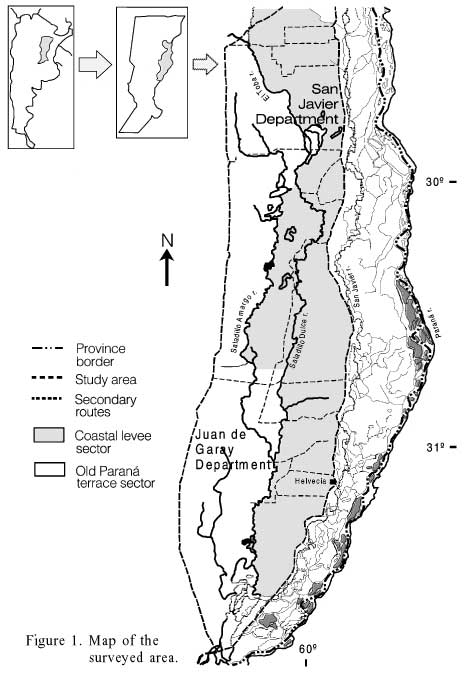
<body><![CDATA[<P align="justify"><font face="Times New Roman" size="3">Summary</font></P>  </B>    <P align="justify"><font face="Times New Roman" size="3">The vegetation of the Saladillo area of the province of Santa Fe, Argentina, is analyzed. The region is located in the south of the Santa Fe Chaco, between the Toba and Saladillo rivers, at the west of the Paran&aacute; River valley. Climate is humid to sub-humid and warm to temperate. There are three types of forests, the &quot;espinillares&quot; of Acacia caven, the &quot;algarrobales&quot; of Prosopis spp. and the &quot;quebrachales&quot; of Schinopsis balansae, distributed following a geographical gradient. The number of woody species increases northwards, and stratification and structure becomes more complex in that direction. The most important herbaceous plant communities are tall grasslands or savannas of Spartina argentinensis and Panicum prioniti, along with other less important grasslands. In lower areas flooded for long periods or the whole year, there are rushes of Schoenoplectus californicus, cattails of Typha domingensis </font> <font face="Times New Roman" size="3"> and several hygrophilous meadows. The communities are distributed following a soil moisture and salinity gradient. The area can be considered as an impoverished Chaco region with a strong influence of the Paran&aacute; River.</font></P> <B>     <P align="justify"><font face="Times New Roman" size="3">Resumo</font></P>  </B>    <P align="justify"><font face="Times New Roman" size="3">No presente artigo se analisa a vegeta&ccedil;&atilde;o da &aacute;rea delimitada pelos rios Saladillos da prov&iacute;ncia de Santa F&eacute;, Argentina. A regi&atilde;o se localiza no sul del Chaco santafesino entre o Arroio el Toba e os rios Saladillos o oeste do vale do rio Paran&aacute;. O clima &eacute; quente a temperado, &uacute;mido a sub-&uacute;mido. Existem tr&ecirc;s tipos de bosques, os &quot;espinillares&quot; de Acacia caven, os &quot;algarrobales&quot; de Prosopis spp. e os &quot;quebrachales&quot; de Schinopsis balansae, distribu&iacute;dos seguindo um gradiente geogr&aacute;fico. O n&uacute;mero de esp&eacute;cies lenhosas aumenta para o norte, e a estrutura e estratifica&ccedil;&atilde;o se fazem mais complexas nessa dire&ccedil;&atilde;o. As comunidades herb&aacute;ceas mais importantes s&atilde;o os pajonales ou sabanas de Spartina argentinensis e Panicum prionitis, junto com outros pastos menos importantes. Nas proximidades das &aacute;reas inundadas por largos per&iacute;odos ou durante todo o ano se encontram juncais de Schoenoplectus californicus, totorais de Typha domingensis, canutillares e vegas de distintas esp&eacute;cies hidr&oacute;filas. As comunidades se distribuem seguindo um gradiente ed&aacute;fico de salinidade e umidade. A &aacute;rea pode ser considerada um Chaco empobrecido com uma forte influencia do rio Paran&aacute;.</font>  </P>  <B>    <P align="justify"><font face="Times New Roman" size="3">KEYWORDS / Argentina </font> </B><font face="Times New Roman" size="3"> / Chaco / Forests / Grasslands / Savannas /</font></P>     <P align="justify"><font face="Times New Roman" size="3">Received: 04/23/2003. Modified: 08/25/2003. Accepted: 08/27/2003</font></P>     <P align="justify"><font face="Times New Roman" size="3">The area of the Saladillos lies at the eastern part of the of Santa Fe province center, comprising the western halves of the Garay and San Javier departments and small parts of other administrative units. At its western limits are the Toba and Saladillo Amargo rivers, while at the eastern limit the Paran&aacute; River valley is located (<a href="#fig1">Figure 1</a>). The region consists of plains with a considerable but gentle slope from NW to SE, and without any important orographic or topographic accidents. Most of it is on what the Paran&aacute; River bed was, which was modified by an upward movement of the bedrock during the Quaternary (Grassino, 1986; Iriondo, 1991). Several rivers that flow from N to S to the Paran&aacute; River drain the area; the main ones are the Saladillo Amargo and the Saladillo Dulce, whose names mean &quot;Bitter Brackish&quot; and &quot;Sweet Brackish&quot;, as an allusion to their water taste and composition.</font></P>      <P align="justify"><a name="fig1"></a></P>      <P align="center"><font face="Times New Roman" size="3"><IMG SRC="/img/fbpe/inci/v28n9/Image1059.jpg" WIDTH=464 HEIGHT=674></font></P>      
<P align="justify"><font face="Times New Roman" size="3">The climate (<a href="#tabl1">Table I</a>) is humid to sub humid and warm to temperate; rainfall is mainly during summer and there is a winter drought of variable length (C&aacute;ceres, 1980).</font></P>      ]]></body>
<body><![CDATA[<P align="justify"><a name="tabl1"></a></P>      <P align="center"><font face="Times New Roman" size="3"><IMG SRC="/img/fbpe/inci/v28n9/Image1060.jpg" WIDTH=578 HEIGHT=287></font></P>      
<P align="justify"><font face="Times New Roman" size="3">The area can be divided into two main physiographic sectors, the old Paran&aacute; River terrace and the coastal levee. In the first one, predominant soils are natracualfs, silty loam with sodium carbonate and high pH. On the coastal levee predominant soils are cuarzipsamment, sandy or sandy loams with low nutrient levels (Orellana and Priano, 1978).</font></P>     <P align="justify"><font face="Times New Roman" size="3">The area is covered by woodlands, savannas, tall grasslands and some prairies and hydrophilous meadows. Ragonese (1941) places the area in the region of &quot;espinillares&quot; (prickly mimosa forests), Parodi (1945) considered the area as Chaquenian, and Cabrera (1953; 1976) included the northern portion in the Chaco and the southern portion in the Thorn forest and scrub.</font></P>     <P align="justify"><font face="Times New Roman" size="3">The region is relatively well preserved, although there have been lumbering, grazing and agricultural activities, as well as man-made fires. The extreme south is used for vegetable crops, tomatoes and carrots. Near the town of Helvecia there are important rice cropping areas.</font></P>     <P align="justify"><font face="Times New Roman" size="3">In this paper the vegetation of the Saladillo Rivers area is analyzed, using numerical methods. Plant communities are determined and described.</font></P>  <B>    <P align="justify"><font face="Times New Roman" size="3">Material and Methods</font></P> </B>     <P align="justify"><font face="Times New Roman" size="3">Physiognomic units of landscape were determined with 1:150000, 1:50000 and 1:20000 aerial photographs and mapped on 1:100000 charts from the <I>Instituto Geogr&aacute;fico Militar</I>. Then, a general survey of the area was performed in order to define communities of dominance type (Whittaker, 1980), dividing the vegetation into forests, savannas and grasslands.</font></P>     <P align="justify"><font face="Times New Roman" size="3">During November and December 1994, 123 plots (4x4m) of herbaceous communities were analyzed. This plot size was chosen according to Lewis <I>et al.</I> (1990) as the minimum sampling area for this kind of communities. In each plot general descriptions of the vegetation and soil were recorded. All species and their frequencies were recorded using the Braun-Blanquet (1979) cover-abundance combined scale and then converted into the Westhoff and Van der Maarel (1980) scale.</font></P>     <P align="justify"><font face="Times New Roman" size="3">To avoid noise, 112 species, which were found in less than 3 plots, were eliminated from the analysis and an information matrix of 123 plots and 165 species was constructed. Data were ordered using a Detrend Correspondence Analysis (DECORANA), and classified with Ward’s Cluster analysis using relative euclidean distance as a similarity measure (McCune, 1993).</font></P>     ]]></body>
<body><![CDATA[<P align="justify"><font face="Times New Roman" size="3">According to their physiognomic aspects and dominant species, 8 forest stands were selected during July and August 1995. These stands were located in every low level disturbance area found, without any recent anthropic activity, while areas that showed high fragmentation or disturbance intensity were not considered as valid points for this study. The point-centered quarter method (Cottam and Curtis, 1956) was used to measure trees and shrubs. At each stand, mean height and tree cover were assessed, together with total and layer floristic richness and relative frequency of each woody species. Vegetation profiles were made from 250m2 cartographic quadrants (Davis and Richards, 1933; 1934). Data were analyzed using DECORANA and Principal Component Analysis (PCA), and classified according to Ward’s method (McCune, 1993). In December 1995, the herbaceous layer was analyzed in a similar way as the herbaceous communities.</font></P>     <P align="justify"><font face="Times New Roman" size="3">Plant specimens were determined and deposited in the herbarium of the <I>Facultad de Agronom&iacute;a y Veterinaria, Universidad Nacional del Litoral</I> (Santa Fe). The nomenclature follows Zuloaga and Morrone (1994; 1996; 1999).</font></P>  <B>    <P align="justify"><font face="Times New Roman" size="3">Results</font></P> </B>     <P align="justify"><font face="Times New Roman" size="3">The PCA scatter diagram of forest plots on the plane of axes I and II show three clusters arranged along a horseshoe gradient (<a href="#fig2 y 3">Figure 2</a>). DECORANA analysis shows the same three clusters distributed according to a gradient along Axis I (<a href="#fig2 y 3">Figure 3</a>). The same three clusters can be recognized when the plots are classified with Ward’s method (<a href="#fig4">Figure 4</a>).</font></P>      <P align="justify"><a name="fig2 y 3"></a></P>      <P align="center"><font face="Times New Roman" size="3"><IMG SRC="/img/fbpe/inci/v28n9/Image1061.jpg" WIDTH=578 HEIGHT=391></font></P>      
<P align="center"><a name="fig4"></a></P>     <P align="center"><font face="Times New Roman" size="3"><IMG SRC="/img/fbpe/inci/v28n9/Image1062.jpg" WIDTH=296 HEIGHT=488></font></P>      
<P align="justify"><font face="Times New Roman" size="3">In most forests <I>Geoffroea decorticans</I>, <I>Prosopis</I> sp., <I>Achatocarpus praecox, Celtis iguanaea</I> and <I>C. pallida</I> are present and can be abundant. The first cluster (A) are &quot;espinillares&quot; where <I>Acacia caven</I> predominates; the second (B) are &quot;algarrobales&quot; of <I>Prosopis</I> sp., which are floristically richer than the former cluster; and the third (C) are &quot;quebrachales&quot; characterized by the presence and abundance of <I>Schinopsis balansae</I>, <I>Aspidosperma quebracho-blanco</I> and <I>Acacia praecox</I>  (<a href="#tabl2">Table II</a>).</font></P>      <P align="justify"><a name="tabl2"></a></P>      ]]></body>
<body><![CDATA[<P align="center"><font face="Times New Roman" size="3"><IMG SRC="/img/fbpe/inci/v28n9/Image1063.jpg" WIDTH=578 HEIGHT=1109></font></P>      
<P align="justify"><font face="Times New Roman" size="3">The floristic richness of the woody strata increases significantly northwards (<a href="#fig5">Figure 5</a>) and forests also become structurally more complex (<a href="#fig6y7">Figures 6 and 7</a>). Individuals of the tree layers are clumped on the three forest types (<a href="#fig6y7">Figure 6</a>), so the canopy is not continuous but shows gaps of different sizes.</font></P>      <P align="justify"><a name="fig5"></a></P>      <P align="center"><font face="Times New Roman" size="3"><IMG SRC="/img/fbpe/inci/v28n9/Image1064.jpg" WIDTH=298 HEIGHT=336></font></P>      
<P align="center"><a name="fig6y7"></a></P>     <P align="center"><font face="Times New Roman" size="3"><IMG SRC="/img/fbpe/inci/v28n9/Image1065.jpg" WIDTH=578 HEIGHT=466></font></P>      
<P align="justify"><font face="Times New Roman" size="3">The &quot;espinillares&quot; are more frequent in the south of the region. They are relatively poor and have a 7m high tree layer that sometimes is very disperse. The shrub layer is not conspicuous and <I>Celtis pallida</I> is the only relevant species. There are some epiphytes like <I>Microgramma lycopodioides</I>, <I>Rhipsalis lumbricoides</I> and <I>Tillandsia </I>sp. The herbaceous layer in this region is considerably dense, covering close to 100% of the ground, and <I>Stenotaphrum secundatum</I>, <I>Sida rhombifolia</I> and <I>Cynodon dactylon</I> are frequent (<a href="#tabl3">Table III</a>).</font></P>      <P align="justify"><a name="tabl3"></a></P>      <P align="center"><font face="Times New Roman" size="3"><IMG SRC="/img/fbpe/inci/v28n9/Image1074.gif" WIDTH=578 HEIGHT=1096></font></P>      
<P align="center" style="margin-top: 0; margin-bottom: 0"><a name="contabl3"></a></P>      ]]></body>
<body><![CDATA[<P align="center" style="margin-top: 0; margin-bottom: 0">TABLE III (<span style="text-transform: capitalize">CONTINUES</span>)</P>      <P align="center" style="margin-top: 0; margin-bottom: 0">ASSOCIATION TABLE OF UNDERSTORY</P>     <P align="center"><font face="Times New Roman" size="3"><IMG SRC="/img/fbpe/inci/v28n9/Image1067.jpg" WIDTH=578 HEIGHT=648></font></P>      
<P align="justify"><font face="Times New Roman" size="3">The &quot;algarrobales&quot; are similar, but floristically richer, than the &quot;espinillares&quot;. The tree layers are 10-15m high and there is a shrub layer of <I>Celtis pallida</I>, <I>Grabowsquia duplicata</I>, <I>Vassobia brevifolia</I> that sometimes becomes dense (<a href="#tabl2">Table II</a>). There are some epiphytes, as in &quot;espinillares&quot;, and some lianas such as <I>Pithecoctenium cynanchoides</I>, <I>Dolichandra cynanchoides </I>and <I>Fosteronia glabrescens</I>. The herbaceous layer is heterogeneous, with an important light penetration at in places, being abundant <I>Cynodon dactylon</I>, <I>Carex bonariensis</I>, <I>Paspalum notatum</I>, <I>Setaria stolonifera, S. rhombifolia, </I>etc. In the shaded microsites <I>Oplismenus hirtellus </I>subsp. <I>setarius</I> and <I>Doryopteris</I> <I>pedata</I> are frequent (<a href="#tabl3">Table III</a>).</font></P>     <P align="justify"><font face="Times New Roman" size="3">The &quot;quebrachales&quot; are only present in the far north portion of the region. They are much richer than the &quot;algarrobales&quot;, with a tree layer &gt;15m high constituted by <I>Schinopsis balansae</I> and <I>Aspidosperma quebracho-blanco</I>, a lower tree stratum and a sometimes dense shrub layer (<a href="#fig6y7">Figure 7</a>). There are also variants of the &quot;quebrachal&quot;: one variant where <I>Aspidosperma quebracho-blanco</I> and <I>Prosopis</I> sp. are abundant on saline soils with a very heterogeneous herbaceous layer formed by a mosaic of &quot;peladales&quot;, with a low plant cover composed by <I>Sporobolus</I> <I>pyramidatus</I>, <I>Eragrostis lugens</I>, <I>Selaginella sellowii</I> etc, a depression cover with <I>Luziola</I> <I>peruviana</I>, <I>Leersia hexandra</I>, <I>Panicum hians</I>, and patches of spiny bromeliads <I>Aechme</I>a <I>distichanta</I> and <I>Dyckia remotiflora </I>var. <I>montevidensis</I>  (<a href="#tabl2">Tables II</a> and <a href="#tabl3">III</a>; <a href="#fig4"> Figure 4 </a> C1); another variant with <I>Eugenia uniflora</I>, <I>Gleditsia amorphoides</I>, <I>Scutia buxifolia</I>, <I>Hexachlamys edulis</I>  (<a href="#tabl3">Table II</a>; <a href="#fig4"> Figure 4</a> C2).</font></P>     <P align="justify"><font face="Times New Roman" size="3">When plots of herbaceous communities are classified according to Ward’s method they appear grouped in two main clusters, one further divided into four plant communities and the other with five very similar hygrophilous communities, a humid prairie, a tall grassland and a halophyte community (<a href="#fig8">Figure 8</a>).</font></P>      <P align="justify"><a name="fig8"></a></P>      <P align="center"><font face="Times New Roman" size="3"><IMG SRC="/img/fbpe/inci/v28n9/Image1068.jpg" WIDTH=581 HEIGHT=706></font></P>      
<P align="justify"><font face="Times New Roman" size="3">Most of these communities have an upper layer often &gt;1m high of the dominant species and a lower stratum with most other species. The general cover is usually very high, ranging from 70 to 90% of the ground, although plots of the halophyte community may have a high proportion of bare soil (<a href="#tabl4">Table IV</a>). Floristically they are very poor and in some plots there is an almost pure population of the dominant species. They contain very few constant species and usually very few species or even none at all in the highest constancy class, while most species are at the lowest constancy class (<a href="#tabl5">Table V</a>).</font></P>      <P align="justify"><a name="tabl4"></a></P>      ]]></body>
<body><![CDATA[<P align="center"><font face="Times New Roman" size="3"><IMG SRC="/img/fbpe/inci/v28n9/Image1069.jpg" WIDTH=578 HEIGHT=168></font></P>      
<P align="center"><a name="tabl5"></a></P>     <P align="center"><font face="Times New Roman" size="3"><IMG SRC="/img/fbpe/inci/v28n9/Image1070.jpg" WIDTH=578 HEIGHT=164></font></P>     
<P align="justify"><font face="Times New Roman" size="3">Some of these communities are floristically poorly defined (<a href="#tabl6">Table VI</a>) and often the most abundant species are of low constancy.</font></P>      <P align="justify"><a name="tabl6"></a></P>      <P align="center"><font face="Times New Roman" size="3"><IMG SRC="/img/fbpe/inci/v28n9/Image1071.jpg" WIDTH=578 HEIGHT=1097></font></P>      
<P align="center" style="margin-top: 0; margin-bottom: 0"><a name="contabl6"></a></P>      <P align="center" style="margin-top: 0; margin-bottom: 0">TABLE VI (continues)</P>     <P align="center" style="margin-top: 0; margin-bottom: 0">ASSOCIATION TABLE OF HERBACEOUS PLANT COMUNITIES</P>     <P align="center"><font face="Times New Roman" size="3"><IMG SRC="/img/fbpe/inci/v28n9/Image1072.jpg" WIDTH=578 HEIGHT=1097></font></P>      
]]></body>
<body><![CDATA[<P align="justify"><font face="Times New Roman" size="3">The four communities of the first cluster are three substitution communities and <I>Spartina argentinensis</I> tall grasslands. In these communities <I>Cynodon dactylon</I>, <I>Setaria parviflora</I>, <I>Aster squamatus</I>, <I>Cyperus entrerianus</I>, <I>Eryngium echinatum</I> and <I>Chaetotropis elongata</I> are fairly constant. Of the substitution communities, 1 and 2 are the richest floristic communities of the region with 133 and 115 species recorded in each of them and the highest average number of species per plot, while community 3 is rather poor, with <I>Cynodon dactylon</I> as the dominant species. <I>Sporobolus indicus</I>, <I>Conyza bonariensis</I>, <I>Dichondra microcalyx</I> and <I>Sisyrinchium platense</I> are common in the three communities. The first two substitution communities are very close to each other (<a href="#fig8">Figure 8</a>), <I>Paspalum notatum</I>, <I>Eragrostis lugens</I>, <I>Deyeuxia</I> <I>viridiflavescens</I> and <I>Verbena gracilescens</I> are fairly constant and faithful to the first one, and the second community appears to be a humid variant of the first one with <I>Eryngium paniculatum</I>, <I>Cyperus corymbosus</I>, <I>Paspalum rufum</I>, <I>Paspalum intermedium</I>, etc. The first is a rather low and comparatively rich prairie or turf, while the second community is a tall grassland.</font></P>     <P align="justify"><font face="Times New Roman" size="3">Community 3 is a turf of <I>Cynodon dactylon</I> with few other species, which may be the result of plowing and overgrazing the <I>Spartina argentinensis</I> tall grasslands and savannas.</font></P>     <P align="justify"><font face="Times New Roman" size="3">Community 4 is a tall grassland or savanna of <I>Spartina argentinensis</I>. The dominant species cover is variable, and at high places the floristic richness is low, and <I>vice versa</I>. Other species of the community are <I>Sarcocornia perennis</I>, <I>Sesuvium portulacastrum</I>, <I>Eryngium coronatum</I> and <I>Cynodon dactylon</I>.</font></P>     <P align="justify"><font face="Times New Roman" size="3">In the other main cluster are gathered hygrophilous communities together with <I>Panicum prionitis</I> tall grasslands or savannas, and halophytes communities. Five of the hygrophilous communities are very close to each other (5 to 9); they are the rushes of <I>Schoenoplectus californicus</I> (5) which appear in rather deep depressions, flooded almost the whole year, with an upper layer of variable density of <I>Schoenoplectus californicus</I> and sometimes a lower layer very similar to the other hygrophilous communities or a <I>Pistia stratiotes</I> pleuston. Community 9 is similar to this community, but the upper layer is a very dense population of <I>Typha domingensis</I> and hardly any other species. Communities 6, 7 and 8 are very similar to each other with the difference between 6 and 7 being the presence of a tall layer of <I>Thalia multiflora</I> and <I>Sagittaria montevidensis</I>, community 7 is a meadow of <I>Ludwigia peploide </I>and community 8 is a hygrophilus turf where <I>Echinochloa helodes, Leersia hexandra </I>and <I>Eleocharis parodii </I>are very frequent. Community 10 is also a low turf of hydrophilous gramineae dominated by <I>Luziola peruviana</I>. The most different communities of this group are successively chained to the hygrophilous communities. <I>Panicum prionitis</I> tall grasslands in the first place and then the community of halophytes (12). The first one has an upper layer of the dominant species and a low one composed mainly by more hygrophilous species. The most common species of the halophytes communities are fleshy Chenopodiaceae (<I>Sarcocornia perennis</I>) and <I>Sesuvium portulacastrum</I>, and in some places it has an upper layer of <I>Spartina densiflora </I>that can be very dense.</font></P>     <P align="justify"><font face="Times New Roman" size="3">When data are analyzed with DECORANA, the hygrophilous communities are pulled to one side by the first axis and all others to the right, while the second axis pulls the halophyte community to the upper part of the dispersion diagram and most other plots to the bottom (<a href="#fig9">Figure 9</a>).</font></P>      <P align="justify"><a name="fig9"></a></P>      <P align="center"><font face="Times New Roman" size="3"><IMG SRC="/img/fbpe/inci/v28n9/Image1073.jpg" WIDTH=298 HEIGHT=351></font></P>  <B>    
<P align="justify"><font face="Times New Roman" size="3">Discussion</font></P> </B>     <P align="justify"><font face="Times New Roman" size="3">There are three kinds of forests that are not very different from each other in the region. They are ordered along gradients. The most important gradient is a latitudinal one, as floristic richness, stratification and complexity increase northwards. But there may be an elevation gradient as well. Further north from this region, floristic richness of tree layers increases even more (Lewis, 1991; Lewis <I>et al.,</I> 1994). The forests of <I>Schinopsis balansae</I> appear in the north of the region and are strictly chaquenian forests (Ragonese, 1941; Cabrera, 1976; Lewis and Pire, 1981). The &quot;algarrobales&quot; and &quot;espinillares&quot; are more widespread towards the south, but as in the Chaco, on low saline soils there are &quot;algarrobales&quot; of <I>Prosopis </I>sp. (Lewis and Pire, 1981; Lewis, 1991).</font></P>     <P align="justify"><font face="Times New Roman" size="3">The most widespread herbaceous communities of the region are tall grasslands. Hygrophilous communities, on the other side, cover relatively little space and are confined to small internal depressions.</font></P>     ]]></body>
<body><![CDATA[<P align="justify"><font face="Times New Roman" size="3">The two most important tall grasslands are the <I>Spartina argentinensis</I> and <I>Panicum prionitis</I>. The former is a halophilous community very widespread further north which covers a considerably large area in the submeridional lowlands of the Chaco (Lewis <I>et al.,</I> 1990) and in most depressed saline areas of the eastern Chaco (Morello and Ad&aacute;moli, 1974; Lewis and Pire, 1981). Also there are <I>Spartina argentinensis</I> tall grasslands surrounding lake Mar Chiquita in Cordoba (Sayago, 1969), and there are several smaller stands further south, down to parallel 33oS (Lewis and Collantes, 1973; D’Angelo <I>et al.,</I> 1987). The latter is the most important grassland of the Paran&aacute; River valley (Franceschi and Lewis, 1979) but is very common in depressed areas of the eastern Chaco (Lewis and Pire, 1981) and the Paranense phytogeographical province (Cabrera and Willink, 1980). There are also other tall grasslands, such as the <I>Paspalum rufum</I> ones, but they are the result of the destruction of one of these communities. These communities are hyper-seasonal savannas (Sarmiento, 1984), and are flooded during some periods followed by rather long droughts, with some scattered trees. Often, tall grasslands are burnt in order to improve their forage quality, as the re-sprouts of the dominant species are more palatable than the old sclerophyllous leaves. However, periodical fires reduce the floristic richness of these communities and promote the strong dominance of the tall bunch grasses <I>Panicum prionitis</I> and <I>Spartina argentinensis</I>.</font></P>     <P align="justify"><font face="Times New Roman" size="3">Among the hygrophilous communities, both the <I>Schoenoplectus californicus</I> rushes and the <I>Typha domingensis</I> ones are very widespread on the American continent. The former species is found in the Pampa region (Vervoorst, 1967; Lewis <I>et al.,</I> 1985), in the Chaco (Morello and Ad&aacute;moli, 1974; Lewis and Pire, 1981; Franceschi and Lewis, 2000), on the valley of the Paran&aacute; River (Burkart, 1957; Franceschi and Lewis, 1979), and even on the high Andes (Heiser, 1979). The latter species is also found in the Pampa region (Vervoorst, 1967), in the Chaco region (Franceschi and Lewis, 2000), the Brasilian Pantanal (Prance and Schaller, 1982), and similar communities with <I>Typha angustifolia</I> and <I>Typha latifolia</I> exist up to North America (Grace and Wetzel, 1981). The other hygrophilous communities are very similar to each other and are very common on the whole Chaco region, and similar as well to some of the communities in the Paran&aacute; River valley.</font></P>     <P align="justify"><font face="Times New Roman" size="3">On very saline soils of the Chaco-pampean plain there are communities characterized by the presence of succulent plants, fundamentally <I>Sarcocornia perennis</I>. We have not enough data, but some of the stands have an upper layer of <I>Spartina densiflora</I> and in other regions tall grasslands of this species have been described (Lewis <I>et al.,</I> 1985; 1990; D’Angelo <I>et al.,</I> 1987). Communities with fleshy chenopods, different <I>Sarcocornia</I> species, together with <I>Spartina</I>, are common in marshes located at both sides of the Atlantic Ocean (Rieley and Page, 1990).</font></P>     <P align="justify"><font face="Times New Roman" size="3">If <a href="#tabl3"> Tables III</a> and <a href="#tabl6"> VI</a> are compared, the forest understory has a high proportion (31%) of Winter graminea that are scarce in the grassland and savanna regions, where most grasses are Summer graminea.</font></P>     <P align="justify"><font face="Times New Roman" size="3">Lumbering, fire, grazing and agriculture constitute the main disturbance sources in the region. Fires shape the tall grasslands, but plowing promotes their substitution by other grassland types. Forests are completely destroyed to give way to agriculture or forage crops, which are later abandoned and replaced by one of the substitution communities. On the best drier and less saline soils appear the <I>Paspalum notatum</I> prairie, which is rather similar to the &quot;flechillar de abra&quot; found in a neighboring area (Hilgert and D’Angelo, 1996) and the Pampean &quot;flechillares&quot; (Vervoorst, 1967;<B> </B>Le&oacute;n and Marangon, 1980; Le&oacute;n and Anderson, 1983;<B> </B>Lewis <I>et al.,</I> 1985) but with very little or none <I>Stipa </I>spp. Individuals. On other soils, other substitution tall grasslands appear which are not well-defined communities, and when overgrazed or present on old rice fields, the vegetation is replaced by a continuous <I>Cynodon dactylon</I> turf.</font></P>     <P align="justify"><font face="Times New Roman" size="3">The hygrophilous communities are strongly chained together as occurs in other regions (Carnevale <I>et al.,</I> 1999). This fact and the scatter diagram of data analyzed with DECORANA strongly suggest that all communities are distributed along two main gradients, possibly a soil moisture one and a salinity one, although this has to be proved in other studies.</font></P>     <P align="justify"><font face="Times New Roman" size="3">The region is an impoverished Chaco, lying also in the far south, is less tropical and winter is colder. Also, it appears to have a strong influence of the Paran&aacute; River, so the vegetation has strong affinities with the Paranense phytogeographical province.</font></P>  <B>    <P align="justify"><font face="Times New Roman" size="3">ACKNOWLEDGEMENTS</font></P> </B>     <P align="justify"><font face="Times New Roman" size="3">The authors thank Ruben Favot, Marcial Bugnon, Jorge Carbone and Pablo Carletti for their collaboration in fieldwork, Susana Stofella for her orientation and training with the Multivariate Analysis, Guillermo Gil for Figure drawings, and Alejandro C&oacute;rdoba for improving the English text. Finantial aid was provided by CAID, <I>Universidad Nacional del Litoral</I> and CONICET.</font></P>  <B>    <P align="justify"><font face="Times New Roman" size="3">REFERENCES</font></P> </B>     ]]></body>
<body><![CDATA[<!-- ref --><P align="justify"><font face="Times New Roman" size="3">1. Braun-Blanquet J (1979) <I>Fitosociolog&iacute;a</I>. Blume. Madrid, Spain. 820 pp.</font>&nbsp;&nbsp;&nbsp;&nbsp;&nbsp;&nbsp;&nbsp;&nbsp;[&#160;<a href="javascript:void(0);" onclick="javascript: window.open('/scielo.php?script=sci_nlinks&ref=971886&pid=S0378-1844200300090000400001&lng=','','width=640,height=500,resizable=yes,scrollbars=1,menubar=yes,');">Links</a>&#160;]<!-- end-ref --><!-- ref --><P align="justify"><font face="Times New Roman" size="3">2. Burkart A (1957) Ojeada sin&oacute;ptica sobre la vegetaci&oacute;n del delta del r&iacute;o Paran&aacute;. <I>Darwiniana 11</I>: 457-561.</font>&nbsp;&nbsp;&nbsp;&nbsp;&nbsp;&nbsp;&nbsp;&nbsp;[&#160;<a href="javascript:void(0);" onclick="javascript: window.open('/scielo.php?script=sci_nlinks&ref=971887&pid=S0378-1844200300090000400002&lng=','','width=640,height=500,resizable=yes,scrollbars=1,menubar=yes,');">Links</a>&#160;]<!-- end-ref --><!-- ref --><P align="justify"><font face="Times New Roman" size="3">3. Cabrera AL (1953) Esquema fitogeogr&aacute;fico de la Rep&uacute;blica Argentina. <I>Rev. Mus. La Plata</I><B> </B>(N.S.) 8, <I>Sec. Bot.</I> <I>33</I>: 87-168.</font>&nbsp;&nbsp;&nbsp;&nbsp;&nbsp;&nbsp;&nbsp;&nbsp;[&#160;<a href="javascript:void(0);" onclick="javascript: window.open('/scielo.php?script=sci_nlinks&ref=971888&pid=S0378-1844200300090000400003&lng=','','width=640,height=500,resizable=yes,scrollbars=1,menubar=yes,');">Links</a>&#160;]<!-- end-ref --><!-- ref --><P align="justify"><font face="Times New Roman" size="3">4. Cabrera AL (1976) <I>Regiones fitogeogr&aacute;ficas argentinas</I>. ACME.<B> </B>Buenos Aires, Argentina. 85 pp.</font>&nbsp;&nbsp;&nbsp;&nbsp;&nbsp;&nbsp;&nbsp;&nbsp;[&#160;<a href="javascript:void(0);" onclick="javascript: window.open('/scielo.php?script=sci_nlinks&ref=971889&pid=S0378-1844200300090000400004&lng=','','width=640,height=500,resizable=yes,scrollbars=1,menubar=yes,');">Links</a>&#160;]<!-- end-ref --><!-- ref --><P align="justify"><font face="Times New Roman" size="3">5. Cabrera AL, Willink A (1980) <I>Biogeograf&iacute;a de Am&eacute;rica Latina</I>. OEA. Serie Biol&oacute;gica Nº13. Washington DC, USA. 122 pp.</font>&nbsp;&nbsp;&nbsp;&nbsp;&nbsp;&nbsp;&nbsp;&nbsp;[&#160;<a href="javascript:void(0);" onclick="javascript: window.open('/scielo.php?script=sci_nlinks&ref=971890&pid=S0378-1844200300090000400005&lng=','','width=640,height=500,resizable=yes,scrollbars=1,menubar=yes,');">Links</a>&#160;]<!-- end-ref --><!-- ref --><P align="justify"><font face="Times New Roman" size="3">6. C&aacute;ceres LM (1980) <I>Caracterizaci&oacute;n clim&aacute;tica de la provincia de Santa Fe</I>. Ministerio de Agricultura y Ganader&iacute;a. Santa Fe. Departamento Aguas. Santa Fe, Argentina. 35 pp.</font>&nbsp;&nbsp;&nbsp;&nbsp;&nbsp;&nbsp;&nbsp;&nbsp;[&#160;<a href="javascript:void(0);" onclick="javascript: window.open('/scielo.php?script=sci_nlinks&ref=971891&pid=S0378-1844200300090000400006&lng=','','width=640,height=500,resizable=yes,scrollbars=1,menubar=yes,');">Links</a>&#160;]<!-- end-ref --><!-- ref --><P align="justify"><font face="Times New Roman" size="3">7. Carnevale NJ, Torres PS, Lewis JP (1999) An&aacute;lisis num&eacute;rico y estacionalidad de las comunidades higr&oacute;filas de los bajos submeridionales santafesinos (Argentina). <I>Bol. Soc. Arg. Bot. 34</I>: 39-46.</font>&nbsp;&nbsp;&nbsp;&nbsp;&nbsp;&nbsp;&nbsp;&nbsp;[&#160;<a href="javascript:void(0);" onclick="javascript: window.open('/scielo.php?script=sci_nlinks&ref=971892&pid=S0378-1844200300090000400007&lng=','','width=640,height=500,resizable=yes,scrollbars=1,menubar=yes,');">Links</a>&#160;]<!-- end-ref --><!-- ref --><P align="justify"><font face="Times New Roman" size="3">8. Cottam G, Curtis JT (1956) The use of distance measures in phytosociological sampling. <I>Ecology 37</I>: 451-460.</font>&nbsp;&nbsp;&nbsp;&nbsp;&nbsp;&nbsp;&nbsp;&nbsp;[&#160;<a href="javascript:void(0);" onclick="javascript: window.open('/scielo.php?script=sci_nlinks&ref=971893&pid=S0378-1844200300090000400008&lng=','','width=640,height=500,resizable=yes,scrollbars=1,menubar=yes,');">Links</a>&#160;]<!-- end-ref --><!-- ref --><P align="justify"><font face="Times New Roman" size="3">9. D’Angelo CD, Prado DE, Stofella SL, Lewis JP (1987) The Subchaquenian vegetation of the province of Santa Fe (Argentina). <I>Phytocoenologia. 15</I>: 329-352.</font>&nbsp;&nbsp;&nbsp;&nbsp;&nbsp;&nbsp;&nbsp;&nbsp;[&#160;<a href="javascript:void(0);" onclick="javascript: window.open('/scielo.php?script=sci_nlinks&ref=971894&pid=S0378-1844200300090000400009&lng=','','width=640,height=500,resizable=yes,scrollbars=1,menubar=yes,');">Links</a>&#160;]<!-- end-ref --><!-- ref --><P align="justify"><font face="Times New Roman" size="3">10. Davis TAW, Richards PW (1933) The vegetation of Moraballi, British Guiana: an ecological study of a limited area of tropical rainforest. Part I. <I>J. Ecol.</I> <I>1</I>: 350-384.</font>&nbsp;&nbsp;&nbsp;&nbsp;&nbsp;&nbsp;&nbsp;&nbsp;[&#160;<a href="javascript:void(0);" onclick="javascript: window.open('/scielo.php?script=sci_nlinks&ref=971895&pid=S0378-1844200300090000400010&lng=','','width=640,height=500,resizable=yes,scrollbars=1,menubar=yes,');">Links</a>&#160;]<!-- end-ref --><!-- ref --><P align="justify"><font face="Times New Roman" size="3">11. Davis TAW, Richards PW (1934) The vegetation of Moraballi, British Guiana: an ecological study of a limited area of tropical rainforest. Part II. <I>J. Ecol. 22</I>: 106-155.</font>&nbsp;&nbsp;&nbsp;&nbsp;&nbsp;&nbsp;&nbsp;&nbsp;[&#160;<a href="javascript:void(0);" onclick="javascript: window.open('/scielo.php?script=sci_nlinks&ref=971896&pid=S0378-1844200300090000400011&lng=','','width=640,height=500,resizable=yes,scrollbars=1,menubar=yes,');">Links</a>&#160;]<!-- end-ref --><!-- ref --><P align="justify"><font face="Times New Roman" size="3">12. Franceschi EA, Lewis JP (1979) Notas sobre la vegetaci&oacute;n del valle santafesino del r&iacute;o Paran&aacute;. R.A. <I>Ecosur 6</I>: 55-82.</font>&nbsp;&nbsp;&nbsp;&nbsp;&nbsp;&nbsp;&nbsp;&nbsp;[&#160;<a href="javascript:void(0);" onclick="javascript: window.open('/scielo.php?script=sci_nlinks&ref=971897&pid=S0378-1844200300090000400012&lng=','','width=640,height=500,resizable=yes,scrollbars=1,menubar=yes,');">Links</a>&#160;]<!-- end-ref --><!-- ref --><P align="justify"><font face="Times New Roman" size="3">13. Franceschi EA, Lewis JP (2000) Composici&oacute;n flor&iacute;stica y estacionalidad de Juncales de <I>Scirpus californicus</I> (Cyperaceae) y Totorales de <I>Typha domingensis</I> (Typhaceae) en los bajos submeridionales (Argentina). <I>Bol. Soc. Arg. Bot</I>. <I>34</I>: 171-178.</font>&nbsp;&nbsp;&nbsp;&nbsp;&nbsp;&nbsp;&nbsp;&nbsp;[&#160;<a href="javascript:void(0);" onclick="javascript: window.open('/scielo.php?script=sci_nlinks&ref=971898&pid=S0378-1844200300090000400013&lng=','','width=640,height=500,resizable=yes,scrollbars=1,menubar=yes,');">Links</a>&#160;]<!-- end-ref --><!-- ref --><P align="justify"><font face="Times New Roman" size="3">14. Grassino SB (1986)<B> </B><I>An&aacute;lisis integral de la provincia de Santa Fe</I>. Imprenta Oficial de la Provincia de Santa Fe. Argentina. 383 pp.</font>&nbsp;&nbsp;&nbsp;&nbsp;&nbsp;&nbsp;&nbsp;&nbsp;[&#160;<a href="javascript:void(0);" onclick="javascript: window.open('/scielo.php?script=sci_nlinks&ref=971899&pid=S0378-1844200300090000400014&lng=','','width=640,height=500,resizable=yes,scrollbars=1,menubar=yes,');">Links</a>&#160;]<!-- end-ref --><!-- ref --><P align="justify"><font face="Times New Roman" size="3">15. Grace JB, Wetzel RG (1981) Habitat partitioning and competitive displacement in cattails (<I>Typha</I>): Experimental field studies. <I>American Naturalist 118</I>: 463-474.</font>&nbsp;&nbsp;&nbsp;&nbsp;&nbsp;&nbsp;&nbsp;&nbsp;[&#160;<a href="javascript:void(0);" onclick="javascript: window.open('/scielo.php?script=sci_nlinks&ref=971900&pid=S0378-1844200300090000400015&lng=','','width=640,height=500,resizable=yes,scrollbars=1,menubar=yes,');">Links</a>&#160;]<!-- end-ref --><!-- ref --><P align="justify"><font face="Times New Roman" size="3">16. Heiser CB (1979)<B> </B>The Totora (<I>Scirpus californicus</I>) in Ecuador and Per&uacute;. <I>Econ. Bot. 32</I>: 222-236.</font>&nbsp;&nbsp;&nbsp;&nbsp;&nbsp;&nbsp;&nbsp;&nbsp;[&#160;<a href="javascript:void(0);" onclick="javascript: window.open('/scielo.php?script=sci_nlinks&ref=971901&pid=S0378-1844200300090000400016&lng=','','width=640,height=500,resizable=yes,scrollbars=1,menubar=yes,');">Links</a>&#160;]<!-- end-ref --><!-- ref --><P align="justify"><font face="Times New Roman" size="3">17. Hilgert NI, D’Angelo CH (1996) Las Comunidades Vegetales de los Dptos. Castellanos y Las Colonias (Santa Fe). <I>Bol. Soc. Arg. Bot. 32</I>: 3-16.</font>&nbsp;&nbsp;&nbsp;&nbsp;&nbsp;&nbsp;&nbsp;&nbsp;[&#160;<a href="javascript:void(0);" onclick="javascript: window.open('/scielo.php?script=sci_nlinks&ref=971902&pid=S0378-1844200300090000400017&lng=','','width=640,height=500,resizable=yes,scrollbars=1,menubar=yes,');">Links</a>&#160;]<!-- end-ref --><!-- ref --><P align="justify"><font face="Times New Roman" size="3">18. Iriondo MH (1991) El Holoceno en el Litoral. <I>Mus. Prov. Ciencias Naturales Florentino Ameghino 3</I>: 1-40.</font>&nbsp;&nbsp;&nbsp;&nbsp;&nbsp;&nbsp;&nbsp;&nbsp;[&#160;<a href="javascript:void(0);" onclick="javascript: window.open('/scielo.php?script=sci_nlinks&ref=971903&pid=S0378-1844200300090000400018&lng=','','width=640,height=500,resizable=yes,scrollbars=1,menubar=yes,');">Links</a>&#160;]<!-- end-ref --><!-- ref --><P align="justify"><font face="Times New Roman" size="3">19. Le&oacute;n RJC, Anderson DL (1983) El l&iacute;mite occidental del pastizal pampeano. <I>Tuexenia 3</I>: 67-83.</font>&nbsp;&nbsp;&nbsp;&nbsp;&nbsp;&nbsp;&nbsp;&nbsp;[&#160;<a href="javascript:void(0);" onclick="javascript: window.open('/scielo.php?script=sci_nlinks&ref=971904&pid=S0378-1844200300090000400019&lng=','','width=640,height=500,resizable=yes,scrollbars=1,menubar=yes,');">Links</a>&#160;]<!-- end-ref --><!-- ref --><P align="justify"><font face="Times New Roman" size="3">20. Le&oacute;n RJC, Marangon N (1980) Delimitaci&oacute;n de comunidades en el pastizal puntano. Sus relaciones con el pastoreo. <I>Bol. Soc. Arg. Bot. 19</I>: 277-288.</font>&nbsp;&nbsp;&nbsp;&nbsp;&nbsp;&nbsp;&nbsp;&nbsp;[&#160;<a href="javascript:void(0);" onclick="javascript: window.open('/scielo.php?script=sci_nlinks&ref=971905&pid=S0378-1844200300090000400020&lng=','','width=640,height=500,resizable=yes,scrollbars=1,menubar=yes,');">Links</a>&#160;]<!-- end-ref --><!-- ref --><P align="justify"><font face="Times New Roman" size="3">21. Lewis JP (1991) Three levels of floristical variation in the forest of Chaco, Argentina. <I>J. Veget. Sci. 2</I>: 125-130.</font>&nbsp;&nbsp;&nbsp;&nbsp;&nbsp;&nbsp;&nbsp;&nbsp;[&#160;<a href="javascript:void(0);" onclick="javascript: window.open('/scielo.php?script=sci_nlinks&ref=971906&pid=S0378-1844200300090000400021&lng=','','width=640,height=500,resizable=yes,scrollbars=1,menubar=yes,');">Links</a>&#160;]<!-- end-ref --><!-- ref --><P align="justify"><font face="Times New Roman" size="3">22. Lewis JP, Collantes MB (1973) El Espinal Periest&eacute;pico. <I>Ciencia e Investigaci&oacute;n 29</I>: 345-408.</font>&nbsp;&nbsp;&nbsp;&nbsp;&nbsp;&nbsp;&nbsp;&nbsp;[&#160;<a href="javascript:void(0);" onclick="javascript: window.open('/scielo.php?script=sci_nlinks&ref=971907&pid=S0378-1844200300090000400022&lng=','','width=640,height=500,resizable=yes,scrollbars=1,menubar=yes,');">Links</a>&#160;]<!-- end-ref --><!-- ref --><P align="justify"><font face="Times New Roman" size="3">23. Lewis JP, Pire EF (1981) Rese&ntilde;a sobre la vegetaci&oacute;n del Chaco santafesino. <I>La vegetaci&oacute;n de la Rep&uacute;blica Argentina. INTA, Serie Fitogeogr&aacute;fica 18</I>: 1-48.</font>&nbsp;&nbsp;&nbsp;&nbsp;&nbsp;&nbsp;&nbsp;&nbsp;[&#160;<a href="javascript:void(0);" onclick="javascript: window.open('/scielo.php?script=sci_nlinks&ref=971908&pid=S0378-1844200300090000400023&lng=','','width=640,height=500,resizable=yes,scrollbars=1,menubar=yes,');">Links</a>&#160;]<!-- end-ref --><!-- ref --><P align="justify"><font face="Times New Roman" size="3">24. Lewis JP, Collantes MB, Pire EF, Carnevalle NJ, Bocanelli SJ, Stofella SL, Prado DE (1985) Floristic groups and Plant communities of southeastern Santa Fe, Argentina. <I>Vegetatio 60</I>: 67-90.</font>&nbsp;&nbsp;&nbsp;&nbsp;&nbsp;&nbsp;&nbsp;&nbsp;[&#160;<a href="javascript:void(0);" onclick="javascript: window.open('/scielo.php?script=sci_nlinks&ref=971909&pid=S0378-1844200300090000400024&lng=','','width=640,height=500,resizable=yes,scrollbars=1,menubar=yes,');">Links</a>&#160;]<!-- end-ref --><!-- ref --><P align="justify"><font face="Times New Roman" size="3">25. Lewis JP, Pire EF, Prado DE, Stofella SL, Franceschi EA, Carnevale NJ (1990) Plant communities and phytogeographical position of a large depression in the Great Chaco, Argentina. <I>Vegetatio 86</I>: 25-38.</font>&nbsp;&nbsp;&nbsp;&nbsp;&nbsp;&nbsp;&nbsp;&nbsp;[&#160;<a href="javascript:void(0);" onclick="javascript: window.open('/scielo.php?script=sci_nlinks&ref=971910&pid=S0378-1844200300090000400025&lng=','','width=640,height=500,resizable=yes,scrollbars=1,menubar=yes,');">Links</a>&#160;]<!-- end-ref --><!-- ref --><P align="justify"><font face="Times New Roman" size="3">26. Lewis JP, Pire EF, Vesprini JL (1994) The mixed dense forest of the Southern Chaco. Contribution to the study of the flora and vegetation of the Chaco VIII. <I>Candollea 49</I>: 159-168.</font> &nbsp;&nbsp;&nbsp;&nbsp;&nbsp;&nbsp;&nbsp;&nbsp;[&#160;<a href="javascript:void(0);" onclick="javascript: window.open('/scielo.php?script=sci_nlinks&ref=971911&pid=S0378-1844200300090000400026&lng=','','width=640,height=500,resizable=yes,scrollbars=1,menubar=yes,');">Links</a>&#160;]<!-- end-ref --><!-- ref --><P align="justify"><font face="Times New Roman" size="3">27. McCune B (1991) <I>Multivariate analysis on the PC-ORD system</I>. Oregon State University. Corvallis, USA. 139 pp.</font>&nbsp;&nbsp;&nbsp;&nbsp;&nbsp;&nbsp;&nbsp;&nbsp;[&#160;<a href="javascript:void(0);" onclick="javascript: window.open('/scielo.php?script=sci_nlinks&ref=971912&pid=S0378-1844200300090000400027&lng=','','width=640,height=500,resizable=yes,scrollbars=1,menubar=yes,');">Links</a>&#160;]<!-- end-ref --><!-- ref --><P align="justify"><font face="Times New Roman" size="3">28. Morello J, Ad&aacute;moli J (1974) Las grandes unidades de vegetaci&oacute;n y ambiente del Chaco argentino. <I>Vegetaci&oacute;n y ambiente de la Provincia del Chaco. INTA. Ser. Fitogeogr&aacute;fica 13</I>: 1-130.</font>&nbsp;&nbsp;&nbsp;&nbsp;&nbsp;&nbsp;&nbsp;&nbsp;[&#160;<a href="javascript:void(0);" onclick="javascript: window.open('/scielo.php?script=sci_nlinks&ref=971913&pid=S0378-1844200300090000400028&lng=','','width=640,height=500,resizable=yes,scrollbars=1,menubar=yes,');">Links</a>&#160;]<!-- end-ref --><!-- ref --><P align="justify"><font face="Times New Roman" size="3">29. Orellana JA, Priano LJJ (1978) Origen y distribuci&oacute;n de los suelos santafesinos. <I>Revista FAVE 1</I>: 117-198.</font>&nbsp;&nbsp;&nbsp;&nbsp;&nbsp;&nbsp;&nbsp;&nbsp;[&#160;<a href="javascript:void(0);" onclick="javascript: window.open('/scielo.php?script=sci_nlinks&ref=971914&pid=S0378-1844200300090000400029&lng=','','width=640,height=500,resizable=yes,scrollbars=1,menubar=yes,');">Links</a>&#160;]<!-- end-ref --><!-- ref --><P align="justify"><font face="Times New Roman" size="3">30. Parodi LR (1945) Las regiones fitogeogr&aacute;ficas argentinas y sus relaciones con la industria forestal. <I>Plant Sci. Lat. Amer. 16</I>: 127-132.</font>&nbsp;&nbsp;&nbsp;&nbsp;&nbsp;&nbsp;&nbsp;&nbsp;[&#160;<a href="javascript:void(0);" onclick="javascript: window.open('/scielo.php?script=sci_nlinks&ref=971915&pid=S0378-1844200300090000400030&lng=','','width=640,height=500,resizable=yes,scrollbars=1,menubar=yes,');">Links</a>&#160;]<!-- end-ref --><!-- ref --><P align="justify"><font face="Times New Roman" size="3">31. Prance GT, Schaller GB (1982) Preliminary studies of some vegetation types of the Pantanal, Mato Grosso, Brazil. <I>Brittonia 34</I>: 228-251.</font>&nbsp;&nbsp;&nbsp;&nbsp;&nbsp;&nbsp;&nbsp;&nbsp;[&#160;<a href="javascript:void(0);" onclick="javascript: window.open('/scielo.php?script=sci_nlinks&ref=971916&pid=S0378-1844200300090000400031&lng=','','width=640,height=500,resizable=yes,scrollbars=1,menubar=yes,');">Links</a>&#160;]<!-- end-ref --><!-- ref --><P align="justify"><font face="Times New Roman" size="3">32. Ragonese<B> </B>AE (1941) La vegetaci&oacute;n de la provincia de Santa Fe. <I>Darwiniana 5</I>: 369-416.</font>&nbsp;&nbsp;&nbsp;&nbsp;&nbsp;&nbsp;&nbsp;&nbsp;[&#160;<a href="javascript:void(0);" onclick="javascript: window.open('/scielo.php?script=sci_nlinks&ref=971917&pid=S0378-1844200300090000400032&lng=','','width=640,height=500,resizable=yes,scrollbars=1,menubar=yes,');">Links</a>&#160;]<!-- end-ref --><!-- ref --><P align="justify"><font face="Times New Roman" size="3">33. Rieley JO, Page S (1990) <I>Ecology of Plant Communities</I>. Logman. Harlow, England. 178 pp.</font>&nbsp;&nbsp;&nbsp;&nbsp;&nbsp;&nbsp;&nbsp;&nbsp;[&#160;<a href="javascript:void(0);" onclick="javascript: window.open('/scielo.php?script=sci_nlinks&ref=971918&pid=S0378-1844200300090000400033&lng=','','width=640,height=500,resizable=yes,scrollbars=1,menubar=yes,');">Links</a>&#160;]<!-- end-ref --><!-- ref --><P align="justify"><font face="Times New Roman" size="3">34. Sarmiento G (1984) <I>The ecology of Neotropical Savannas</I>. Harvard University Press 235 p.</font>&nbsp;&nbsp;&nbsp;&nbsp;&nbsp;&nbsp;&nbsp;&nbsp;[&#160;<a href="javascript:void(0);" onclick="javascript: window.open('/scielo.php?script=sci_nlinks&ref=971919&pid=S0378-1844200300090000400034&lng=','','width=640,height=500,resizable=yes,scrollbars=1,menubar=yes,');">Links</a>&#160;]<!-- end-ref --><!-- ref --><P align="justify"><font face="Times New Roman" size="3">35. Sayago M (1969) Estudio fitogeogr&aacute;fico del norte de C&oacute;rdoba. <I>Bol.</I> <I>Acad. Nac. Cs. C&oacute;rdoba 46</I>: 123-427.</font>&nbsp;&nbsp;&nbsp;&nbsp;&nbsp;&nbsp;&nbsp;&nbsp;[&#160;<a href="javascript:void(0);" onclick="javascript: window.open('/scielo.php?script=sci_nlinks&ref=971920&pid=S0378-1844200300090000400035&lng=','','width=640,height=500,resizable=yes,scrollbars=1,menubar=yes,');">Links</a>&#160;]<!-- end-ref --><!-- ref --><P align="justify"><font face="Times New Roman" size="3">36. Vervoorst FB (1967) <I>Las comunidades vegetales de la depresi&oacute;n del salado</I>. Serie. Fitogeogr&aacute;fica. INTA. Buenos Aires, Argentina. 262 pp.</font>&nbsp;&nbsp;&nbsp;&nbsp;&nbsp;&nbsp;&nbsp;&nbsp;[&#160;<a href="javascript:void(0);" onclick="javascript: window.open('/scielo.php?script=sci_nlinks&ref=971921&pid=S0378-1844200300090000400036&lng=','','width=640,height=500,resizable=yes,scrollbars=1,menubar=yes,');">Links</a>&#160;]<!-- end-ref --><!-- ref --><P align="justify"><font face="Times New Roman" size="3">37. Westhoff V, Van Der Maarel E (1980) The Braun-Blanquet approach. In Whittaker RH (Ed.) <I>Classification of Plant Communities</I>. W. Junk. The Hague, Netherlands. pp. 287-339.</font>&nbsp;&nbsp;&nbsp;&nbsp;&nbsp;&nbsp;&nbsp;&nbsp;[&#160;<a href="javascript:void(0);" onclick="javascript: window.open('/scielo.php?script=sci_nlinks&ref=971922&pid=S0378-1844200300090000400037&lng=','','width=640,height=500,resizable=yes,scrollbars=1,menubar=yes,');">Links</a>&#160;]<!-- end-ref --><!-- ref --><P align="justify"><font face="Times New Roman" size="3">38. Whittaker RH (1980) Dominance Types in Classification of Plant Communities. In Whittaker RH (Ed.) <I>Classification of Plant Communities</I>. W. Junk. The Hague, Netherlands. pp. 65-81.</font>&nbsp;&nbsp;&nbsp;&nbsp;&nbsp;&nbsp;&nbsp;&nbsp;[&#160;<a href="javascript:void(0);" onclick="javascript: window.open('/scielo.php?script=sci_nlinks&ref=971923&pid=S0378-1844200300090000400038&lng=','','width=640,height=500,resizable=yes,scrollbars=1,menubar=yes,');">Links</a>&#160;]<!-- end-ref --><!-- ref --><P align="justify"><font face="Times New Roman" size="3">39. Zuloaga FO, Morrone O (ed.) (1994) Cat&aacute;logo de la familia Poaceae en la Rep&uacute;blica Argentina. <I>Monographs in Systematic Botany.</I> Vol. 47. Missouri Botanical Garden 178 p.</font>&nbsp;&nbsp;&nbsp;&nbsp;&nbsp;&nbsp;&nbsp;&nbsp;[&#160;<a href="javascript:void(0);" onclick="javascript: window.open('/scielo.php?script=sci_nlinks&ref=971924&pid=S0378-1844200300090000400039&lng=','','width=640,height=500,resizable=yes,scrollbars=1,menubar=yes,');">Links</a>&#160;]<!-- end-ref --><!-- ref --><P align="justify"><font face="Times New Roman" size="3">40. Zuloaga FO, Morrone O (eds.) (1996) Cat&aacute;logo de las plantas vasculares de la Rep&uacute;blica Argentina I. <I>Monographs in Systematic Botany</I>. Vol. 60. Missouri Botanical Garden. USA. 323 pp.</font>&nbsp;&nbsp;&nbsp;&nbsp;&nbsp;&nbsp;&nbsp;&nbsp;[&#160;<a href="javascript:void(0);" onclick="javascript: window.open('/scielo.php?script=sci_nlinks&ref=971925&pid=S0378-1844200300090000400040&lng=','','width=640,height=500,resizable=yes,scrollbars=1,menubar=yes,');">Links</a>&#160;]<!-- end-ref --><!-- ref --><P align="justify"><font face="Times New Roman" size="3">41. Zuloaga FO, Morrone O (ed.) (1999) Cat&aacute;logo de las plantas vasculares de la Rep&uacute;blica Argentina II. <I>Monographs in Systematic Botany</I>. Vol. 74. Missouri Botanical Garden. USA. 1269 pp.</font>&nbsp;&nbsp;&nbsp;&nbsp;&nbsp;&nbsp;&nbsp;&nbsp;[&#160;<a href="javascript:void(0);" onclick="javascript: window.open('/scielo.php?script=sci_nlinks&ref=971926&pid=S0378-1844200300090000400041&lng=','','width=640,height=500,resizable=yes,scrollbars=1,menubar=yes,');">Links</a>&#160;]<!-- end-ref --> ]]></body>
<back>
<ref-list>
<ref id="B1">
<label>1</label><nlm-citation citation-type="book">
<person-group person-group-type="author">
<name>
<surname><![CDATA[Blanquet]]></surname>
<given-names><![CDATA[J]]></given-names>
</name>
</person-group>
<source><![CDATA[Fitosociología]]></source>
<year>1979</year>
<page-range>820</page-range><publisher-loc><![CDATA[^eMadrid Madrid]]></publisher-loc>
<publisher-name><![CDATA[Blume]]></publisher-name>
</nlm-citation>
</ref>
<ref id="B2">
<label>2</label><nlm-citation citation-type="journal">
<person-group person-group-type="author">
<name>
<surname><![CDATA[Burkart]]></surname>
<given-names><![CDATA[A]]></given-names>
</name>
</person-group>
<article-title xml:lang="es"><![CDATA[Ojeada sinóptica sobre la vegetación del delta del río Paraná]]></article-title>
<source><![CDATA[Darwiniana]]></source>
<year>1957</year>
<volume>11</volume>
<page-range>457-561</page-range></nlm-citation>
</ref>
<ref id="B3">
<label>3</label><nlm-citation citation-type="journal">
<person-group person-group-type="author">
<name>
<surname><![CDATA[Cabrera]]></surname>
<given-names><![CDATA[AL]]></given-names>
</name>
</person-group>
<article-title xml:lang="es"><![CDATA[Esquema fitogeográfico de la República Argentina]]></article-title>
<source><![CDATA[Rev. Mus. La Plata (N.S.) 8, Sec. Bot]]></source>
<year>1953</year>
<volume>33</volume>
<page-range>87-168</page-range></nlm-citation>
</ref>
<ref id="B4">
<label>4</label><nlm-citation citation-type="book">
<person-group person-group-type="author">
<name>
<surname><![CDATA[Cabrera]]></surname>
<given-names><![CDATA[AL]]></given-names>
</name>
</person-group>
<source><![CDATA[Regiones fitogeográficas argentinas]]></source>
<year>1976</year>
<page-range>85</page-range><publisher-loc><![CDATA[^eBuenos Aires Buenos Aires]]></publisher-loc>
<publisher-name><![CDATA[ACME]]></publisher-name>
</nlm-citation>
</ref>
<ref id="B5">
<label>5</label><nlm-citation citation-type="book">
<person-group person-group-type="author">
<name>
<surname><![CDATA[Cabrera]]></surname>
<given-names><![CDATA[AL]]></given-names>
</name>
<name>
<surname><![CDATA[Willink]]></surname>
<given-names><![CDATA[A]]></given-names>
</name>
</person-group>
<source><![CDATA[Biogeografía de América Latina]]></source>
<year>1980</year>
<page-range>122</page-range><publisher-loc><![CDATA[^eWashington DC Washington DC]]></publisher-loc>
<publisher-name><![CDATA[OEA]]></publisher-name>
</nlm-citation>
</ref>
<ref id="B6">
<label>6</label><nlm-citation citation-type="book">
<person-group person-group-type="author">
<name>
<surname><![CDATA[Cáceres]]></surname>
<given-names><![CDATA[LM]]></given-names>
</name>
</person-group>
<source><![CDATA[Caracterización climática de la provincia de Santa Fe.]]></source>
<year>1980</year>
<page-range>35</page-range><publisher-loc><![CDATA[Santa Fe ]]></publisher-loc>
<publisher-name><![CDATA[Ministerio de Agricultura y Ganadería. Santa Fe. Departamento Aguas.]]></publisher-name>
</nlm-citation>
</ref>
<ref id="B7">
<label>7</label><nlm-citation citation-type="journal">
<person-group person-group-type="author">
<name>
<surname><![CDATA[Carnevale]]></surname>
<given-names><![CDATA[NJ]]></given-names>
</name>
<name>
<surname><![CDATA[Torres]]></surname>
<given-names><![CDATA[PS]]></given-names>
</name>
<name>
<surname><![CDATA[Lewis]]></surname>
<given-names><![CDATA[JP]]></given-names>
</name>
</person-group>
<article-title xml:lang="es"><![CDATA[Análisis numérico y estacionalidad de las comunidades higrófilas de los bajos submeridionales santafesinos (Argentina).]]></article-title>
<source><![CDATA[Bol. Soc. Arg. Bot]]></source>
<year>1999</year>
<volume>34</volume>
<page-range>39-46</page-range></nlm-citation>
</ref>
<ref id="B8">
<label>8</label><nlm-citation citation-type="journal">
<person-group person-group-type="author">
<name>
<surname><![CDATA[Cottam]]></surname>
<given-names><![CDATA[G]]></given-names>
</name>
<name>
<surname><![CDATA[Curtis]]></surname>
<given-names><![CDATA[JT]]></given-names>
</name>
</person-group>
<article-title xml:lang="en"><![CDATA[The use of distance measures in phytosociological sampling]]></article-title>
<source><![CDATA[Ecology]]></source>
<year>1956</year>
<volume>37</volume>
<page-range>451-460</page-range></nlm-citation>
</ref>
<ref id="B9">
<label>9</label><nlm-citation citation-type="journal">
<person-group person-group-type="author">
<name>
<surname><![CDATA[D’Angelo]]></surname>
<given-names><![CDATA[CD]]></given-names>
</name>
<name>
<surname><![CDATA[Prado]]></surname>
<given-names><![CDATA[DE]]></given-names>
</name>
<name>
<surname><![CDATA[Stofella]]></surname>
<given-names><![CDATA[SL]]></given-names>
</name>
<name>
<surname><![CDATA[Lewis]]></surname>
<given-names><![CDATA[JP]]></given-names>
</name>
</person-group>
<article-title xml:lang="en"><![CDATA[The Subchaquenian vegetation of the province of Santa Fe (Argentina).]]></article-title>
<source><![CDATA[Phytocoenologia]]></source>
<year>1987</year>
<volume>15</volume>
<page-range>329-352</page-range></nlm-citation>
</ref>
<ref id="B10">
<label>10</label><nlm-citation citation-type="journal">
<person-group person-group-type="author">
<name>
<surname><![CDATA[Davis]]></surname>
<given-names><![CDATA[TAW]]></given-names>
</name>
<name>
<surname><![CDATA[Richards]]></surname>
<given-names><![CDATA[PW]]></given-names>
</name>
</person-group>
<article-title xml:lang="en"><![CDATA[The vegetation of Moraballi, British Guiana: an ecological study of a limited area of tropical rainforest. Part I]]></article-title>
<source><![CDATA[J. Ecol.]]></source>
<year>1933</year>
<volume>1</volume>
<page-range>350-384</page-range></nlm-citation>
</ref>
<ref id="B11">
<label>11</label><nlm-citation citation-type="journal">
<person-group person-group-type="author">
<name>
<surname><![CDATA[Davis]]></surname>
<given-names><![CDATA[TAW]]></given-names>
</name>
<name>
<surname><![CDATA[Richards]]></surname>
<given-names><![CDATA[PW]]></given-names>
</name>
</person-group>
<article-title xml:lang="en"><![CDATA[The vegetation of Moraballi, British Guiana: an ecological study of a limited area of tropical rainforest. Part II]]></article-title>
<source><![CDATA[J. Ecol]]></source>
<year>1934</year>
<volume>22</volume>
<page-range>106-155</page-range></nlm-citation>
</ref>
<ref id="B12">
<label>12</label><nlm-citation citation-type="journal">
<person-group person-group-type="author">
<name>
<surname><![CDATA[Franceschi]]></surname>
<given-names><![CDATA[EA]]></given-names>
</name>
<name>
<surname><![CDATA[Lewis]]></surname>
<given-names><![CDATA[JP]]></given-names>
</name>
</person-group>
<article-title xml:lang="es"><![CDATA[Notas sobre la vegetación del valle santafesino del río Paraná. R.A]]></article-title>
<source><![CDATA[Ecosur]]></source>
<year>1979</year>
<volume>6</volume>
<page-range>55-82</page-range></nlm-citation>
</ref>
<ref id="B13">
<label>13</label><nlm-citation citation-type="journal">
<person-group person-group-type="author">
<name>
<surname><![CDATA[Franceschi]]></surname>
<given-names><![CDATA[EA]]></given-names>
</name>
<name>
<surname><![CDATA[Lewis]]></surname>
<given-names><![CDATA[JP]]></given-names>
</name>
</person-group>
<article-title xml:lang="es"><![CDATA[Composición florística y estacionalidad de Juncales de Scirpus californicus (Cyperaceae) y Totorales de Typha domingensis (Typhaceae) en los bajos submeridionales (Argentina).]]></article-title>
<source><![CDATA[Bol. Soc. Arg. Bot]]></source>
<year>2000</year>
<volume>34</volume>
<page-range>171-178</page-range></nlm-citation>
</ref>
<ref id="B14">
<label>14</label><nlm-citation citation-type="book">
<person-group person-group-type="author">
<name>
<surname><![CDATA[Grassino]]></surname>
<given-names><![CDATA[SB]]></given-names>
</name>
</person-group>
<source><![CDATA[Análisis integral de la provincia de Santa Fe]]></source>
<year>1986</year>
<page-range>383</page-range><publisher-name><![CDATA[Imprenta Oficial de la Provincia de Santa Fe]]></publisher-name>
</nlm-citation>
</ref>
<ref id="B15">
<label>15</label><nlm-citation citation-type="journal">
<person-group person-group-type="author">
<name>
<surname><![CDATA[Grace]]></surname>
<given-names><![CDATA[JB]]></given-names>
</name>
<name>
<surname><![CDATA[Wetzel]]></surname>
<given-names><![CDATA[RG]]></given-names>
</name>
</person-group>
<article-title xml:lang="en"><![CDATA[Habitat partitioning and competitive displacement in cattails (Typha: Experimental field studies]]></article-title>
<source><![CDATA[American Naturalist]]></source>
<year>1981</year>
<volume>118</volume>
<page-range>463-474</page-range></nlm-citation>
</ref>
<ref id="B16">
<label>16</label><nlm-citation citation-type="journal">
<person-group person-group-type="author">
<name>
<surname><![CDATA[Heiser]]></surname>
<given-names><![CDATA[CB]]></given-names>
</name>
</person-group>
<article-title xml:lang="en"><![CDATA[The Totora (Scirpus californicus) in Ecuador and Perú]]></article-title>
<source><![CDATA[Econ. Bot]]></source>
<year>1979</year>
<volume>32</volume>
<page-range>222-236</page-range></nlm-citation>
</ref>
<ref id="B17">
<label>17</label><nlm-citation citation-type="journal">
<person-group person-group-type="author">
<name>
<surname><![CDATA[Hilgert]]></surname>
<given-names><![CDATA[NI]]></given-names>
</name>
<name>
<surname><![CDATA[D’Angelo]]></surname>
<given-names><![CDATA[CH]]></given-names>
</name>
</person-group>
<article-title xml:lang="es"><![CDATA[Las Comunidades Vegetales de los Dptos. Castellanos y Las Colonias (Santa Fe).]]></article-title>
<source><![CDATA[Bol. Soc. Arg. Bot]]></source>
<year>1996</year>
<volume>32</volume>
<page-range>3-16</page-range></nlm-citation>
</ref>
<ref id="B18">
<label>18</label><nlm-citation citation-type="journal">
<person-group person-group-type="author">
<name>
<surname><![CDATA[Iriondo]]></surname>
<given-names><![CDATA[MH]]></given-names>
</name>
</person-group>
<article-title xml:lang="es"><![CDATA[El Holoceno en el Litoral. Mus. Prov. Ciencias Naturales]]></article-title>
<source><![CDATA[Florentino Ameghino]]></source>
<year>1991</year>
<volume>3</volume>
<page-range>1-40</page-range></nlm-citation>
</ref>
<ref id="B19">
<label>19</label><nlm-citation citation-type="journal">
<person-group person-group-type="author">
<name>
<surname><![CDATA[León]]></surname>
<given-names><![CDATA[RJC]]></given-names>
</name>
<name>
<surname><![CDATA[Anderson]]></surname>
<given-names><![CDATA[DL]]></given-names>
</name>
</person-group>
<article-title xml:lang="es"><![CDATA[El límite occidental del pastizal pampeano]]></article-title>
<source><![CDATA[Tuexenia]]></source>
<year>1983</year>
<volume>3</volume>
<page-range>67-83</page-range></nlm-citation>
</ref>
<ref id="B20">
<label>20</label><nlm-citation citation-type="journal">
<person-group person-group-type="author">
<name>
<surname><![CDATA[León]]></surname>
<given-names><![CDATA[RJC]]></given-names>
</name>
<name>
<surname><![CDATA[Marangon]]></surname>
<given-names><![CDATA[N]]></given-names>
</name>
</person-group>
<article-title xml:lang="es"><![CDATA[Delimitación de comunidades en el pastizal puntano. Sus relaciones con el pastoreo]]></article-title>
<source><![CDATA[Bol. Soc. Arg. Bot]]></source>
<year>1980</year>
<volume>19</volume>
<page-range>277-288</page-range></nlm-citation>
</ref>
<ref id="B21">
<label>21</label><nlm-citation citation-type="journal">
<person-group person-group-type="author">
<name>
<surname><![CDATA[Lewis]]></surname>
<given-names><![CDATA[JP]]></given-names>
</name>
</person-group>
<article-title xml:lang="en"><![CDATA[Three levels of floristical variation in the forest of Chaco, Argentina]]></article-title>
<source><![CDATA[J. Veget. Sci]]></source>
<year>1991</year>
<volume>2</volume>
<page-range>125-130</page-range></nlm-citation>
</ref>
<ref id="B22">
<label>22</label><nlm-citation citation-type="journal">
<person-group person-group-type="author">
<name>
<surname><![CDATA[Lewis]]></surname>
<given-names><![CDATA[JP]]></given-names>
</name>
<name>
<surname><![CDATA[Collantes]]></surname>
<given-names><![CDATA[MB]]></given-names>
</name>
</person-group>
<article-title xml:lang="es"><![CDATA[El Espinal Periestépico]]></article-title>
<source><![CDATA[Ciencia e Investigación]]></source>
<year>1973</year>
<volume>29</volume>
<page-range>345-408</page-range></nlm-citation>
</ref>
<ref id="B23">
<label>23</label><nlm-citation citation-type="journal">
<person-group person-group-type="author">
<name>
<surname><![CDATA[Lewis]]></surname>
<given-names><![CDATA[JP]]></given-names>
</name>
<name>
<surname><![CDATA[Pire]]></surname>
<given-names><![CDATA[EF]]></given-names>
</name>
</person-group>
<article-title xml:lang="es"><![CDATA[Reseña sobre la vegetación del Chaco santafesino: La vegetación de la República Argentina. INTA, Serie]]></article-title>
<source><![CDATA[Fitogeográfica]]></source>
<year>1981</year>
<volume>18</volume>
<page-range>1-48</page-range></nlm-citation>
</ref>
<ref id="B24">
<label>24</label><nlm-citation citation-type="journal">
<person-group person-group-type="author">
<name>
<surname><![CDATA[Lewis]]></surname>
<given-names><![CDATA[JP]]></given-names>
</name>
<name>
<surname><![CDATA[Collantes]]></surname>
<given-names><![CDATA[MB]]></given-names>
</name>
<name>
<surname><![CDATA[Pire]]></surname>
<given-names><![CDATA[EF]]></given-names>
</name>
<name>
<surname><![CDATA[Carnevalle]]></surname>
<given-names><![CDATA[NJ]]></given-names>
</name>
<name>
<surname><![CDATA[Bocanelli]]></surname>
<given-names><![CDATA[SJ]]></given-names>
</name>
<name>
<surname><![CDATA[Stofella]]></surname>
<given-names><![CDATA[SL]]></given-names>
</name>
<name>
<surname><![CDATA[Prado]]></surname>
<given-names><![CDATA[DE]]></given-names>
</name>
</person-group>
<article-title xml:lang="en"><![CDATA[Floristic groups and Plant communities of southeastern Santa Fe, Argentina]]></article-title>
<source><![CDATA[Vegetatio]]></source>
<year>1985</year>
<volume>60</volume>
<page-range>67-90</page-range></nlm-citation>
</ref>
<ref id="B25">
<label>25</label><nlm-citation citation-type="journal">
<person-group person-group-type="author">
<name>
<surname><![CDATA[Lewis]]></surname>
<given-names><![CDATA[JP]]></given-names>
</name>
<name>
<surname><![CDATA[Pire]]></surname>
<given-names><![CDATA[EF]]></given-names>
</name>
<name>
<surname><![CDATA[Prado]]></surname>
<given-names><![CDATA[DE]]></given-names>
</name>
<name>
<surname><![CDATA[Stofella]]></surname>
<given-names><![CDATA[SL]]></given-names>
</name>
<name>
<surname><![CDATA[Franceschi]]></surname>
<given-names><![CDATA[EA]]></given-names>
</name>
<name>
<surname><![CDATA[Carnevale]]></surname>
<given-names><![CDATA[NJ]]></given-names>
</name>
</person-group>
<article-title xml:lang="en"><![CDATA[Plant communities and phytogeographical position of a large depression in the Great Chaco, Argentina]]></article-title>
<source><![CDATA[Vegetatio]]></source>
<year>1990</year>
<volume>86</volume>
<page-range>25-38</page-range></nlm-citation>
</ref>
<ref id="B26">
<label>26</label><nlm-citation citation-type="journal">
<person-group person-group-type="author">
<name>
<surname><![CDATA[Lewis]]></surname>
<given-names><![CDATA[JP]]></given-names>
</name>
<name>
<surname><![CDATA[Pire]]></surname>
<given-names><![CDATA[EF]]></given-names>
</name>
<name>
<surname><![CDATA[Vesprini]]></surname>
<given-names><![CDATA[JL]]></given-names>
</name>
</person-group>
<article-title xml:lang="en"><![CDATA[The mixed dense forest of the Southern Chaco. Contribution to the study of the flora and vegetation of the Chaco VIII]]></article-title>
<source><![CDATA[Candollea]]></source>
<year>1994</year>
<volume>49</volume>
<page-range>159-168</page-range></nlm-citation>
</ref>
<ref id="B27">
<label>27</label><nlm-citation citation-type="book">
<person-group person-group-type="author">
<name>
<surname><![CDATA[McCune]]></surname>
<given-names><![CDATA[B]]></given-names>
</name>
</person-group>
<source><![CDATA[Multivariate analysis on the PC-ORD system]]></source>
<year>1991</year>
<page-range>139</page-range><publisher-loc><![CDATA[Corvallis ]]></publisher-loc>
<publisher-name><![CDATA[Oregon State University]]></publisher-name>
</nlm-citation>
</ref>
<ref id="B28">
<label>28</label><nlm-citation citation-type="journal">
<person-group person-group-type="author">
<name>
<surname><![CDATA[Morello]]></surname>
<given-names><![CDATA[J]]></given-names>
</name>
<name>
<surname><![CDATA[Adámoli]]></surname>
<given-names><![CDATA[J]]></given-names>
</name>
</person-group>
<article-title xml:lang="es"><![CDATA[Las grandes unidades de vegetación y ambiente del Chaco argentino. Vegetación y ambiente de la Provincia del Chaco. INTA. Ser]]></article-title>
<source><![CDATA[Fitogeográfica]]></source>
<year>1974</year>
<volume>13</volume>
<page-range>1-130</page-range></nlm-citation>
</ref>
<ref id="B29">
<label>29</label><nlm-citation citation-type="journal">
<person-group person-group-type="author">
<name>
<surname><![CDATA[Orellana]]></surname>
<given-names><![CDATA[JA]]></given-names>
</name>
<name>
<surname><![CDATA[Priano]]></surname>
<given-names><![CDATA[LJJ]]></given-names>
</name>
</person-group>
<article-title xml:lang="es"><![CDATA[Origen y distribución de los suelos santafesinos]]></article-title>
<source><![CDATA[Revista FAVE]]></source>
<year>1978</year>
<volume>1</volume>
<page-range>117-198</page-range></nlm-citation>
</ref>
<ref id="B30">
<label>30</label><nlm-citation citation-type="journal">
<person-group person-group-type="author">
<name>
<surname><![CDATA[Parodi]]></surname>
<given-names><![CDATA[LR]]></given-names>
</name>
</person-group>
<article-title xml:lang="es"><![CDATA[Las regiones fitogeográficas argentinas y sus relaciones con la industria forestal]]></article-title>
<source><![CDATA[Plant Sci. Lat. Amer]]></source>
<year>1945</year>
<volume>16</volume>
<page-range>127-132</page-range></nlm-citation>
</ref>
<ref id="B31">
<label>31</label><nlm-citation citation-type="journal">
<person-group person-group-type="author">
<name>
<surname><![CDATA[Prance]]></surname>
<given-names><![CDATA[GT]]></given-names>
</name>
<name>
<surname><![CDATA[Schaller]]></surname>
<given-names><![CDATA[GB]]></given-names>
</name>
</person-group>
<article-title xml:lang="en"><![CDATA[Preliminary studies of some vegetation types of the Pantanal, Mato Grosso, Brazil.]]></article-title>
<source><![CDATA[Brittonia]]></source>
<year>1982</year>
<volume>34</volume>
<page-range>228-251</page-range></nlm-citation>
</ref>
<ref id="B32">
<label>32</label><nlm-citation citation-type="journal">
<person-group person-group-type="author">
<name>
<surname><![CDATA[Ragonese]]></surname>
<given-names><![CDATA[AE]]></given-names>
</name>
</person-group>
<article-title xml:lang="es"><![CDATA[La vegetación de la provincia de Santa Fe]]></article-title>
<source><![CDATA[Darwiniana]]></source>
<year>1941</year>
<volume>5</volume>
<page-range>369-416</page-range></nlm-citation>
</ref>
<ref id="B33">
<label>33.</label><nlm-citation citation-type="book">
<person-group person-group-type="author">
<name>
<surname><![CDATA[Rieley]]></surname>
<given-names><![CDATA[JO]]></given-names>
</name>
<name>
<surname><![CDATA[Page]]></surname>
<given-names><![CDATA[S]]></given-names>
</name>
</person-group>
<source><![CDATA[Ecology of Plant Communities]]></source>
<year>1990</year>
<page-range>178</page-range><publisher-name><![CDATA[Logman. Harlow]]></publisher-name>
</nlm-citation>
</ref>
<ref id="B34">
<label>34</label><nlm-citation citation-type="book">
<person-group person-group-type="author">
<name>
<surname><![CDATA[Sarmiento]]></surname>
<given-names><![CDATA[G]]></given-names>
</name>
</person-group>
<source><![CDATA[The ecology of Neotropical Savannas]]></source>
<year>1984</year>
<page-range>235</page-range><publisher-name><![CDATA[Harvard University Press]]></publisher-name>
</nlm-citation>
</ref>
<ref id="B35">
<label>35</label><nlm-citation citation-type="journal">
<person-group person-group-type="author">
<name>
<surname><![CDATA[Sayago]]></surname>
<given-names><![CDATA[M]]></given-names>
</name>
</person-group>
<article-title xml:lang="es"><![CDATA[Estudio fitogeográfico del norte de Córdoba]]></article-title>
<source><![CDATA[Bol. Acad. Nac. Cs. Córdoba]]></source>
<year>1969</year>
<volume>46</volume>
<page-range>123-427</page-range></nlm-citation>
</ref>
<ref id="B36">
<label>36</label><nlm-citation citation-type="">
<person-group person-group-type="author">
<name>
<surname><![CDATA[Vervoorst]]></surname>
<given-names><![CDATA[FB]]></given-names>
</name>
</person-group>
<source><![CDATA[]]></source>
<year>1967</year>
</nlm-citation>
</ref>
<ref id="B37">
<label>37</label><nlm-citation citation-type="book">
<person-group person-group-type="author">
<name>
<surname><![CDATA[Whittaker]]></surname>
<given-names><![CDATA[RH]]></given-names>
</name>
</person-group>
<source><![CDATA[Classification of Plant Communities]]></source>
<year></year>
<page-range>287-339</page-range><publisher-loc><![CDATA[The Hague ]]></publisher-loc>
<publisher-name><![CDATA[W. Junk]]></publisher-name>
</nlm-citation>
</ref>
<ref id="B38">
<label>38</label><nlm-citation citation-type="book">
<person-group person-group-type="author">
<name>
<surname><![CDATA[Whittaker]]></surname>
<given-names><![CDATA[RH]]></given-names>
</name>
</person-group>
<source><![CDATA[Classification of Plant Communities]]></source>
<year></year>
<page-range>65-81</page-range><publisher-name><![CDATA[W. Junk. The Hague]]></publisher-name>
</nlm-citation>
</ref>
<ref id="B39">
<label>39</label><nlm-citation citation-type="book">
<person-group person-group-type="author">
<name>
<surname><![CDATA[Zuloaga]]></surname>
<given-names><![CDATA[FO]]></given-names>
</name>
<name>
<surname><![CDATA[Morrone]]></surname>
<given-names><![CDATA[O]]></given-names>
</name>
</person-group>
<source><![CDATA[Catálogo de la familia Poaceae en la República Argentina]]></source>
<year>1994</year>
<volume>47</volume>
<page-range>178</page-range><publisher-name><![CDATA[Missouri Botanical Garden]]></publisher-name>
</nlm-citation>
</ref>
<ref id="B40">
<label>40</label><nlm-citation citation-type="book">
<person-group person-group-type="author">
<name>
<surname><![CDATA[Zuloaga]]></surname>
<given-names><![CDATA[FO]]></given-names>
</name>
<name>
<surname><![CDATA[Morrone]]></surname>
<given-names><![CDATA[O]]></given-names>
</name>
</person-group>
<source><![CDATA[Catálogo de las plantas vasculares de la República Argentina I.]]></source>
<year>1996</year>
<volume>60</volume>
<page-range>323</page-range><publisher-name><![CDATA[Missouri Botanical Garden]]></publisher-name>
</nlm-citation>
</ref>
<ref id="B41">
<label>41</label><nlm-citation citation-type="book">
<person-group person-group-type="author">
<name>
<surname><![CDATA[Zuloaga]]></surname>
<given-names><![CDATA[FO]]></given-names>
</name>
<name>
<surname><![CDATA[Morrone]]></surname>
<given-names><![CDATA[O]]></given-names>
</name>
</person-group>
<source><![CDATA[Catálogo de las plantas vasculares de la República Argentina II]]></source>
<year>1999</year>
<volume>74</volume>
<page-range>1269</page-range><publisher-name><![CDATA[Missouri Botanical Garden]]></publisher-name>
</nlm-citation>
</ref>
</ref-list>
</back>
</article>
