<?xml version="1.0" encoding="ISO-8859-1"?><article xmlns:mml="http://www.w3.org/1998/Math/MathML" xmlns:xlink="http://www.w3.org/1999/xlink" xmlns:xsi="http://www.w3.org/2001/XMLSchema-instance">
<front>
<journal-meta>
<journal-id>0378-1844</journal-id>
<journal-title><![CDATA[Interciencia]]></journal-title>
<abbrev-journal-title><![CDATA[INCI]]></abbrev-journal-title>
<issn>0378-1844</issn>
<publisher>
<publisher-name><![CDATA[ASOCIACIÓN INTERCIENCIA]]></publisher-name>
</publisher>
</journal-meta>
<article-meta>
<article-id>S0378-18442003000900009</article-id>
<title-group>
<article-title xml:lang="en"><![CDATA[Effects of sustained harvests on wild populations of caiman crocodilus crocodilus in venezuela]]></article-title>
</title-group>
<contrib-group>
<contrib contrib-type="author">
<name>
<surname><![CDATA[Velasco]]></surname>
<given-names><![CDATA[Álvaro]]></given-names>
</name>
<xref ref-type="aff" rid="A01"/>
</contrib>
<contrib contrib-type="author">
<name>
<surname><![CDATA[Colomine]]></surname>
<given-names><![CDATA[Gregori]]></given-names>
</name>
<xref ref-type="aff" rid="A02"/>
</contrib>
<contrib contrib-type="author">
<name>
<surname><![CDATA[De Sola]]></surname>
<given-names><![CDATA[Roldan]]></given-names>
</name>
<xref ref-type="aff" rid="A03"/>
</contrib>
<contrib contrib-type="author">
<name>
<surname><![CDATA[Villarroel]]></surname>
<given-names><![CDATA[Gustavo]]></given-names>
</name>
<xref ref-type="aff" rid="A04"/>
</contrib>
</contrib-group>
<aff id="A01">
<institution><![CDATA[,Universidad Central de Venezuela Biologist Associated Researcher School of Sciences UCV]]></institution>
<addr-line><![CDATA[Caracas ]]></addr-line>
<country>Venezuela</country>
</aff>
<aff id="A02">
<institution><![CDATA[,Universidad Central de Venezuela Biologist School of Sciences]]></institution>
<addr-line><![CDATA[ ]]></addr-line>
</aff>
<aff id="A03">
<institution><![CDATA[,Universidad Central de Venezuela Biologist Direccion General de Fauna MARN]]></institution>
<addr-line><![CDATA[ ]]></addr-line>
</aff>
<aff id="A04">
<institution><![CDATA[,Universidad Central de Venezuela Biologist School of Sciences]]></institution>
<addr-line><![CDATA[ ]]></addr-line>
</aff>
<pub-date pub-type="pub">
<day>00</day>
<month>09</month>
<year>2003</year>
</pub-date>
<pub-date pub-type="epub">
<day>00</day>
<month>09</month>
<year>2003</year>
</pub-date>
<volume>28</volume>
<numero>9</numero>
<fpage>544</fpage>
<lpage>548</lpage>
<copyright-statement/>
<copyright-year/>
<self-uri xlink:href="http://ve.scielo.org/scielo.php?script=sci_arttext&amp;pid=S0378-18442003000900009&amp;lng=en&amp;nrm=iso"></self-uri><self-uri xlink:href="http://ve.scielo.org/scielo.php?script=sci_abstract&amp;pid=S0378-18442003000900009&amp;lng=en&amp;nrm=iso"></self-uri><self-uri xlink:href="http://ve.scielo.org/scielo.php?script=sci_pdf&amp;pid=S0378-18442003000900009&amp;lng=en&amp;nrm=iso"></self-uri><abstract abstract-type="short" xml:lang="en"><p><![CDATA[Venezuela’s commercial use program for Caiman crocodilus crocodilus began in 1983. It allowed the harvest of mature males of total length >1.80m (class IV males) on private lands. Approximately ten million hectares, involving different ecological regions are now included in the program, although not all areas are actually harvested. This study compares harvested and non-harvested populations within the same ecological regions. It was found that both absolute density and relative abundance of class IV males was higher in the harvested populations than in the non-harvested populations, supporting the view that sustainability has been achieved, probably through various compensatory responses of the population to its reduction through harvest of larger males.]]></p></abstract>
<abstract abstract-type="short" xml:lang="es"><p><![CDATA[El programa de aprovechamiento comercial de la baba se inició en 1983, permitiéndose cosechar, en tierras de propiedad privada, individuos que conforman la clase IV, con una longitud total >1,80m, representados únicamente por machos adultos. El área de implementación cubre aproximadamente diez millones de hectáreas que incluyen diversas regiones ecológicas, pero el recurso no se cosecha en toda la superficie. Este estudio realiza una comparación en áreas donde se cosecha con áreas donde no se aprovecha el recurso. Se encontró que en las áreas donde se aprovecha la especie, los valores de densidad y porcentaje de la clase IV son mayores, al compararlos con los valores encontrados en áreas donde no se cosecha el recurso. Los resultados muestran que programas de manejo bien diseñados permiten la sustentabilidad del recurso baba y tienen un efecto positivo sobre las poblaciones manejadas, a través de la cosecha de ejemplares adultos con longitud total >180cm (clase IV).]]></p></abstract>
<abstract abstract-type="short" xml:lang="pt"><p><![CDATA[O programa de aproveitamento comercial da baba se iniciou em 1983, permitindo-se plantar, em terras de propriedade privada, indivíduos que conformam a classe IV, com uma longitude total >1,80m, representados unicamente por machos adultos. A área de implementação cobre aproximadamente dez milhões de hectares que incluem diversas regiões ecológicas, mas o recurso não se colheita em toda a superfície. Este estudo realiza uma comparação em áreas onde se colheita com áreas onde não se aproveita o recurso. Encontrou-se que nas áreas onde se aproveita a espécie, os valores de densidade e porcentagem da classe IV são maiores, ao comparar-los com os valores encontrados em áreas onde não se colheita o recurso. Os resultados mostram que programas de direção bem desenhados permitem a sustentação do recurso baba e tem um efeito positivo sobre as populações dirigidas, através da colheita de exemplares adultos com longitude total >180cm (classe IV).]]></p></abstract>
<kwd-group>
<kwd lng="en"><![CDATA[Caiman crocodilus crocodilus]]></kwd>
<kwd lng="en"><![CDATA[Harvest]]></kwd>
<kwd lng="en"><![CDATA[Sustainable Use]]></kwd>
</kwd-group>
</article-meta>
</front><body><![CDATA[   <B>    <P align="center"><font size="4"><font face="Times New Roman">EFFECTS OF SUSTAINED HARVESTS ON WILD POPULATIONS</font></font> </B><font size="4"> </font>  <B><font face="Times New Roman" size="4">OF <I>Caiman crocodilus crocodilus </I>IN VENEZUELA</font> </P> </B>     <P align="center"><font face="Times New Roman" size="3">&Aacute;lvaro Velasco, Gregori Colomine, Roldan De Sola and Gustavo Villarroel</font></P>     <P><font face="Times New Roman" size="3">&Aacute;lvaro Velasco. Biologist, Universidad Central de Venezuela (UCV). Associated Researcher, School of Sciences, UCV. Address: Coordinaci&oacute;n de Extensi&oacute;n, Facultad de Ciencias, Av. Presidente Medina, UCV. Caracas, Venezuela. e-mail:velascoalvaro@tutopia.com</font></P>     <P style="margin-top: 0; margin-bottom: 0"><font face="Times New Roman" size="3">Gregori Colomine. Biologist, UCV. School of Sciences, UCV. e-mail: gcolomin@strix.ciens.ucv.ve</font></P>     <P style="margin-top: 0; margin-bottom: 0"><font face="Times New Roman" size="3">Roldan De Sola. Biologist, UCV. Direcci&oacute;n General de Fauna, MARN. e-mail: rdesola@marn.gov.ve</font></P>     <P style="margin-top: 0; margin-bottom: 0"><font face="Times New Roman" size="3">Gustavo Villarroel. Biologist, UCV. School of Sciences, UCV. e-mail: gvillar@strix.ciens.ucv.ve</font></P>  <B>      <P align="justify"><font face="Times New Roman" size="3">Summary</font></P> </B><I>     <P align="justify"><font face="Times New Roman" size="3">Venezuela’s commercial use program for </font> </I><font size="3" face="Times New Roman">Caiman crocodilus crocodilus</font><I> <font face="Times New Roman" size="3"> began in 1983. It allowed the harvest of mature males of total length &gt;1.80m (class IV males) on private lands. Approximately ten million hectares, involving different ecological regions are now included in the program, although not all areas are actually harvested. This study compares harvested and non-harvested populations within the same ecological regions. It was found that both absolute density and relative abundance of class IV males was higher in the harvested populations than in the non-harvested populations, supporting the view that sustainability has been achieved, probably through various compensatory responses of the population to its reduction through harvest of larger males.</font></P>  </I><B>    <P align="justify"><font face="Times New Roman" size="3">Resumen</font></P> </B><I>     ]]></body>
<body><![CDATA[<P align="justify"><font face="Times New Roman" size="3">El programa de aprovechamiento comercial de la baba se inici&oacute; en 1983, permiti&eacute;ndose cosechar, en tierras de propiedad privada, individuos que conforman la clase IV, con una longitud total &gt;1,80m, representados &uacute;nicamente por machos adultos. El &aacute;rea de implementaci&oacute;n cubre aproximadamente diez millones de hect&aacute;reas que incluyen diversas regiones ecol&oacute;gicas, pero el recurso no se cosecha en toda la superficie. Este estudio realiza una comparaci&oacute;n en &aacute;reas donde se cosecha con &aacute;reas donde no se aprovecha el recurso. Se encontr&oacute; que en las &aacute;reas donde se aprovecha la especie, los valores de densidad y porcentaje de la clase IV son mayores, al compararlos con los valores encontrados en &aacute;reas donde no se cosecha el recurso. Los resultados muestran que programas de manejo bien dise&ntilde;ados permiten la sustentabilidad del recurso baba y tienen un efecto positivo sobre las poblaciones manejadas, a trav&eacute;s de la cosecha de ejemplares adultos con longitud total &gt;180cm (clase IV).</font></P>  </I><B>    <P align="justify"><font face="Times New Roman" size="3">Resumo</font></P> </B><I>     <P align="justify"><font face="Times New Roman" size="3">O programa de aproveitamento comercial da baba se iniciou em 1983, permitindo-se plantar, em terras de propriedade privada, indiv&iacute;duos que conformam a classe IV, com uma longitude total &gt;1,80m, representados unicamente por machos adultos. A &aacute;rea de implementa&ccedil;&atilde;o cobre aproximadamente dez milh&otilde;es de hectares que incluem diversas regi&otilde;es ecol&oacute;gicas, mas o recurso n&atilde;o se colheita em toda a superf&iacute;cie. Este estudo realiza uma compara&ccedil;&atilde;o em &aacute;reas onde se colheita com &aacute;reas onde n&atilde;o se aproveita o recurso. Encontrou-se que nas &aacute;reas onde se aproveita a esp&eacute;cie, os valores de densidade e porcentagem da classe IV s&atilde;o maiores, ao comparar-los com os valores encontrados em &aacute;reas onde n&atilde;o se colheita o recurso. Os resultados mostram que programas de dire&ccedil;&atilde;o bem desenhados permitem a sustenta&ccedil;&atilde;o do recurso baba e tem um efeito positivo sobre as popula&ccedil;&otilde;es dirigidas, atrav&eacute;s da colheita de exemplares adultos com longitude total &gt;180cm (classe IV).</font></P>  </I><B>    <P align="justify"><font face="Times New Roman" size="3">KEYWORDS </font> </B><font face="Times New Roman" size="3"> / <I>Caiman crocodilus crocodilus</I> / Harvest / Sustainable Use /</font></P>     <P align="justify"><font face="Times New Roman" size="3">Received: 05/31/2003. Modified: 08/05/2003. Accepted: 08/15/2003</font></P> <B>    <P align="justify"><font face="Times New Roman" size="3">Introduction</font></P> </B>     <P align="justify"><font face="Times New Roman" size="3">In 1971, all 23 known species of true crocodiles, alligators, caimans and gavials were considered to be endangered, threatened or declining in abundance and/or distribution. By 1996, 25 years later, 16 of those species were once again abundant and widespread, a conservation success due in no small part to incentives to conservation created through sustainable use (King, 1999) and to the steady decline in illegal use and trade (Hutton and Webb, 2003).</font></P>     <P align="justify"><font face="Times New Roman" size="3">The role of economic incentives in promoting crocodilian conservation has been well established (Joanen <I>et al</I>., 1997; King, 1999; Hutton and Webb, 2003). Consumptive use such as commercial harvesting can positively influence the conservation of wild populations. In Venezuela’s case, conservation can be enhanced in two major ways:</font></P>     <P align="justify"><font face="Times New Roman" size="3">1- The ability to extract an economic return from a wildlife population on private lands, where landowners are the primary beneficiaries, can provide tangible economic incentives for landowners to maintain healthy populations and habitats, and to invest in the prevention of illegal use and trade.</font></P>     <P align="justify"><font face="Times New Roman" size="3">2- The selective removal of large dominant males from the population, which are suspected to constrain the growth and attainment of maturity of sub-adult males, could be expected to lead to a series of compensatory mechanisms likely to increase the wild population (Velasco <I>et al.</I>, 1995).</font></P>     ]]></body>
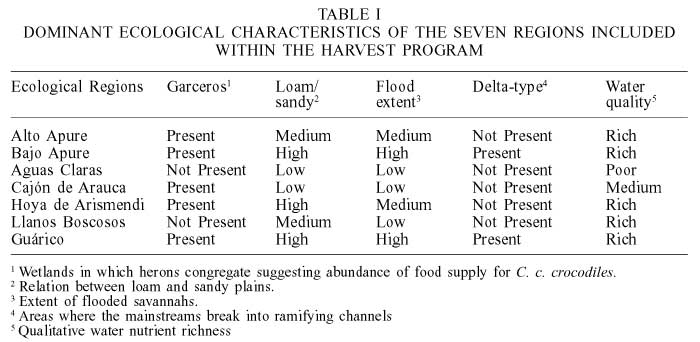
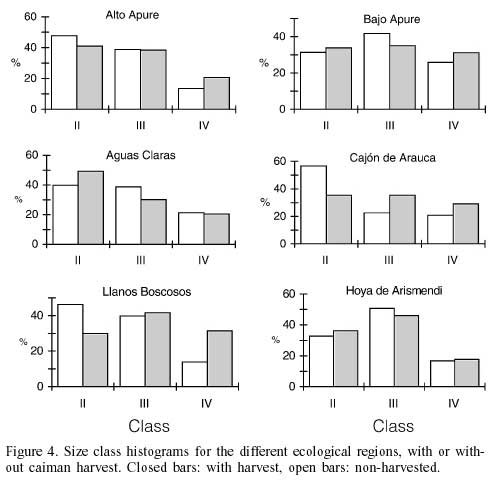
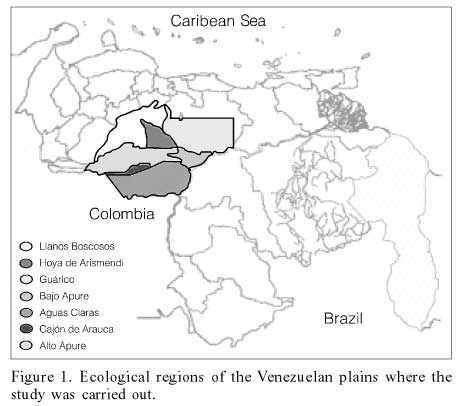
<body><![CDATA[<P align="justify"><font face="Times New Roman" size="3">Consumptive use of crocodiles within different management programs typically involves one or more of the following strategies: &quot;cropping&quot;, &quot;ranching&quot; or &quot;captive breeding&quot; (Thorbjarnarson, 1992, Ross, 1998). Direct hunting of adults or sub-adults in the wild (cropping) is one of the major ongoing forms of consumptive use in some countries (Magnusson, 1997), yet there have been few rigorous evaluations of the effects of harvesting on the structure and abundance of wild crocodilian populations (Mour&atilde;o <I>et al</I>., 1996).</font></P>     <P align="justify"><font face="Times New Roman" size="3">Regulated harvesting of the wild spectacled caiman (<I>Caiman crocodilus crocodilus</I>) has been permitted in Venezuela since 1983, under a program directed by the Ministry of the Environment and Natural Resources (MARN) through the General Direction of Fauna (Velasco and De Sola, 1997; Thorbjarnarson and Velasco, 1999a,b). The program allows harvesting, on authorized private cattle ranches, of a proportion of class IV caimans,<I> </I>with total length (TL) &gt;180cm, all adult males (Velasco and De Sola, 1999).</font></P>     <P align="justify"><font face="Times New Roman" size="3">The selective harvesting of large, mature males was designed to minimize the effects of the harvest on the reproductive potential of the wild populations by steering the harvest away from the mature females. It was also considered likely that such a harvest would allow a larger number of younger males to grow more rapidly, reach larger sizes more quickly and become reproductively active sooner than if the large, dominant, males remained within the population (Velasco <I>et al.</I>, 1995).</font></P>     <P align="justify"><font face="Times New Roman" size="3">This study reviews survey data from the main harvest areas in Venezuela, which for various reasons contain both harvested and non-harvested populations. It attempts to quantify likely effects of harvest by comparing densities (caimans/ha of total land) and population size structures. The null hypotheses was that harvesting would reduce densities generally and, specifically, the numbers of Class IV individuals.</font></P> <B>     <P align="justify"><font face="Times New Roman" size="3">Study area</font></P> </B>     <P align="justify"><font face="Times New Roman" size="3">The study was carried out in the western Llanos (plains) of Venezuela, abutting the Colombian border (<a href="#fig1">Figure 1</a>). The area is subdivided into seven regions, each of which has different ecological qualitative characteristics, as described by Velasco and Ayarzag&uuml;ena (1995) and six of them were examined in this study (<a href="#tabl1">Table I</a>).</font></P>      <P align="justify"><a name="fig1"></a></P>      <P align="center"><font face="Times New Roman" size="3"><IMG SRC="/img/fbpe/inci/v28n9/Image1094.jpg" WIDTH=464 HEIGHT=406></font></P>      
<P align="center"><a name="tabl1"></a></P>     <P align="center"><font face="Times New Roman" size="3"><IMG SRC="/img/fbpe/inci/v28n9/Image1095.jpg" WIDTH=578 HEIGHT=282></font></P>     
]]></body>
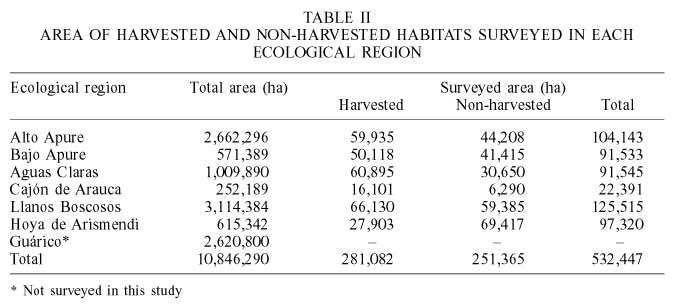
<body><![CDATA[<P align="justify"><font face="Times New Roman" size="3">Information on <I>C. c. crocodilus </I>densities and population size structures were gathered during monitoring programs undertaken by the <I>Facultad de Ciencias, Universidad Central de Venezuela</I> (UCV) and MARN. Information was gathered from five regions in 1996 (Alto Apure, Aguas Claras, Caj&oacute;n de Arauca, Llanos Boscosos and Hoya de Arismendi) and from the Bajo Apure region in 1999. The Gu&aacute;rico ecological region was not evaluated because no harvest took place for 5 years (1992-1996).</font></P>     <P align="justify"><font face="Times New Roman" size="3">Surveyed areas covered over 532,447ha of total land, or 4.9% of the total region. Of the area surveyed, 281,082ha (52.8%), contained harvested populations of <I>C. c. crocodilus,</I> and 251,365ha (47.2%) contained non-harvested populations (<a href="#tabl2">Table II</a>).</font></P>      <P align="justify"><a name="tabl2"></a></P>      <P align="center"><font face="Times New Roman" size="3"><IMG SRC="/img/fbpe/inci/v28n9/Image1096.jpg" WIDTH=578 HEIGHT=261></font></P> <B>     
<P align="justify"><font face="Times New Roman" size="3">Methods</font></P> </B>     <P align="justify"><font face="Times New Roman" size="3">All surveys were carried out during the annual dry season (March to May) in 1996 and 1999, when <I>C. c. crocodilus</I> are concentrated in remnant water bodies. Areas with both harvested and non-harvested populations were selected in each ecological region, and the population parameters were quantified as follows:</font></P> <I>    <P align="justify"><font face="Times New Roman" size="3">Population abundance</font></I> <font face="Times New Roman" size="3"> was estimated by night-light counts (Chabreck, 1966; Woodward and Marion, 1977). A powerful spotlight was scanned over water bodies and the number of eye-shines counted. The caimans sighted by this method represent a very high proportion (80 to 90%) of the total number present (Staton and Dixon, 1975; Ayarzag&uuml;ena, 1980; Seijas, 1986) and, thus, this was taken as the measure of absolute abundance. Density was calculated as the sum of total number of animals counted at night per ecological regions divided by the sum of total land area surveyed for each ecological region. In other words, the spotlight counts on water bodies for particular ranches are added and divided by the total land area of those particular ranches in each ecological region.</font></P> <I>    <P align="justify"><font face="Times New Roman" size="3">Population size structure</font></I> <font face="Times New Roman" size="3"> was estimated by allocating as many of the caimans sighted as possible into one of four general size classes (Ayarzag&uuml;ena, 1983):</font></P>      <P align="justify" style="margin-top: 0; margin-bottom: 0"><font face="Times New Roman" size="3">Class I. Hatchlings and animals &lt;60cm total length (TL).</font></P>     <P align="justify" style="margin-top: 0; margin-bottom: 0"><font face="Times New Roman" size="3">Class II. Animals &gt;60cm TL &lt;120cm.</font></P>     ]]></body>
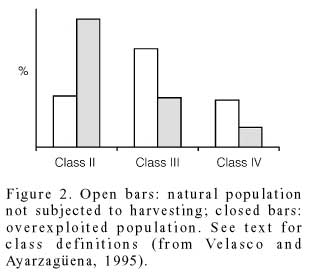
<body><![CDATA[<P align="justify" style="margin-top: 0; margin-bottom: 0"><font face="Times New Roman" size="3">Class III. Animals &gt;120cm TL &lt;180cm.</font></P>     <P align="justify" style="margin-top: 0; margin-bottom: 0"><font face="Times New Roman" size="3">Class IV. Animals &gt;180cm TL.</font></P>      <P align="justify"><font face="Times New Roman" size="3">Bar histograms with the proportions of individuals in each size class (II, III and IV) allowed two types of age structures to be defined (Velasco and Ayarzag&uuml;ena, 1995); one with pyramidal form, which indicates a population not subjected to harvesting, and another with a staggered form indicating an overexploited population, where the percentage of individuals in class IV is less than 15% of the total population (<a href="#fig2">Figure 2</a>).</font></P>      <P align="justify"><a name="fig2"></a></P>      <P align="center"><font face="Times New Roman" size="3"><IMG SRC="/img/fbpe/inci/v28n9/Image1097.jpg" WIDTH=314 HEIGHT=276></font></P>     
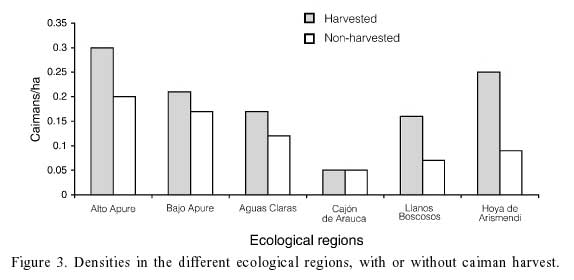
<P align="justify"><font face="Times New Roman" size="3">Individuals in class I were excluded from analyses, because numbers are highly variable from year to year, and are dependent upon the month when surveys are undertaken. In addition, there is a high mortality rate for hatchlings during their first year of life, and they are generally excluded from these types of analyses (Webb and Manolis, 1992).</font></P>     <P align="justify"><font face="Times New Roman" size="3">Statistical analysis was not employed to analyze the population abundance, because the MARN uses absolute values to calculate densities in each ecological region and to determinate the harvest quota in each cattle ranch (Velasco and De Sola, 1999; De Sola <I>et al.</I>, 2000).</font></P>  <B>    <P align="justify"><font face="Times New Roman" size="3">Results</font></P> </B>     <P align="justify"><font face="Times New Roman" size="3">Caiman densities in harvested and non-harvested areas are presented in <a href="#fig3"> Figure 3</a> for each ecological region, while size densities by classes for both types of areas are presented in <a href="#fig4"> Figure 4</a>.</font></P>      <P align="justify"><a name="fig3"></a></P>      ]]></body>
<body><![CDATA[<P align="center"><font face="Times New Roman" size="3"><IMG SRC="/img/fbpe/inci/v28n9/Image1098.jpg" WIDTH=574 HEIGHT=280></font></P>      
<P align="center"><a name="fig4"></a></P>     <P align="center"><font face="Times New Roman" size="3"><IMG SRC="/img/fbpe/inci/v28n9/Image1099.jpg" WIDTH=500 HEIGHT=480></font></P> <I>    
<P align="justify"><font face="Times New Roman" size="3">Alto Apure</font></P> </I>     <P align="justify"><font face="Times New Roman" size="3">Density <a href="#fig3"> (Figure 3</a>) in the harvested areas (0.30 caimans/ha) was higher than in the non-harvested areas (0.20 caimans/ha), and when adjusted for areas (<a href="#tabl2">Table II</a>), abundance in the harvested areas was twice that in non-harvested areas. The size structure in harvested and non-harvested populations had a similar, declining general form (<a href="#fig4">Figure 4</a>), but with a higher proportion of class IV individuals in the harvested (20.60%) than non-harvested areas (13.52%).</font></P>  <I>    <P align="justify"><font face="Times New Roman" size="3">Bajo Apure</font></P> </I>     <P align="justify"><font face="Times New Roman" size="3">The density was higher in areas harvested (0.21 caimans/ha) than in non-harvested areas (0.17 caimans/ha), and the size distribution was pyramidal in both areas. Areas with harvest had a higher proportion of class IV individuals (31.18%) than those without harvest (25.91%).</font></P>  <I>    <P align="justify"><font face="Times New Roman" size="3">Aguas Claras</font></P> </I>     <P align="justify"><font face="Times New Roman" size="3">Density in harvested areas was higher (0.17 caimans/ha) than non-harvested areas (0.12 caimans/ha).The size distribution showed differences in the relative number of classes II and III individuals, but class IV made up similar proportions in both harvested (20.49%) and non-harvested in harvested areas (21.32%).</font></P>  <I>    <P align="justify"><font face="Times New Roman" size="3">Caj&oacute;n de Arauca</font></P> </I>     ]]></body>
<body><![CDATA[<P align="justify"><font face="Times New Roman" size="3">This area had the lowest densities, and there was no difference in densities recorded at harvested and non-harvested areas (0.05 caimans/ha). In the harvested area proportions of classes II and III individuals were similar (<a href="#fig4">Figure 4</a>), but there was a high proportion of class IV individuals (29.03%). In non-harvested areas the size structure was dominated (56.63%) by class II individuals and classes III and IV were relatively reduced (22.49% and 20.87%, respectively).</font></P>  <I>    <P align="justify"><font face="Times New Roman" size="3">Llanos Boscosos</font></P> </I>     <P align="justify"><font face="Times New Roman" size="3">Density in harvested areas (0.16 caimans/ha) was much higher than in areas without harvest (0.07 caimans/ha). In the former areas the size structure was pyramidal, with a high proportion (31.44%) of class IV individuals relative to non-harvest areas, and a declining size structure was found, from high percentages of class II and III, individuals and a low proportion of class IV (13.93%) individuals.</font></P>  <I>    <P align="justify"><font face="Times New Roman" size="3">Hoya de Arismendi</font></P> </I>     <P align="justify"><font face="Times New Roman" size="3">Density in harvested areas (0.25 caimans/ha) was much higher than in non-harvested areas (0.09 caimans/ha), although total populations were similar due to the respective areas (<a href="#tabl2">Table II</a>). The size structure in both harvested and non-harvested areas was pyramidal, which is normally associated with non-harvested populations (Velasco and Ayarzag&uuml;ena, 1995). The proportion of class IV individuals was similar in harvested (17.59%) and non-harvested (16.65%) areas, but low relative to most other regions.</font></P>  <B>    <P align="justify"><font face="Times New Roman" size="3">Discussion</font></P> </B>     <P align="justify"><font face="Times New Roman" size="3">At the beginning of the program of commercial use of caimans in Venezuela, a census was undertaken to estimate caiman densities on each of the properties that requested permission to hunt. With time it became impossible to visit all the properties involved and samples were chosen for future surveys (Seijas, 1986). In these surveys, the caiman density was expressed as caimans/ha of water. In the early years the density was reported as the number of animals/ha of total land, including water bodies (Velasco and Ayarzag&uuml;ena, 1992), without any attempt to distinguish between areas with or without harvest. This type of separation began in 1996.</font></P>     <P align="justify"><font face="Times New Roman" size="3">One of the main results of the study is that most high-density populations that have been subjected to harvesting for more than 4 years, still contain high densities of caimans and, thus, a high degree of sustainability is involved.</font></P>     <P align="justify"><font face="Times New Roman" size="3">In all but one of the regions studied the density of caimans/ha was higher in the areas that had been subjected to repeated harvest than in those which had remained un-harvested (<a href="#fig3">Figure 3</a>). This in part reflects the reality that the harvesting program is a voluntary one, which is more likely to be implemented on those cattle ranching properties where caimans are most abundant in the first place. However, it also served to reinforce the observation that caiman densities is highly variable in the wild, with low density populations that will never increase, even in the complete absence of exploitation.</font></P>     <P align="justify"><font face="Times New Roman" size="3">The proportion of class IV individuals was consistently higher in the harvested areas (&gt;20%) than in the non-harvested areas (&lt;20%). The extent to which this may be biased by differences in the population structure between hunted and non-hunted areas prior to harvest cannot be resolved. However, it does demonstrate that the harvest of class IV individuals is followed by a significant recruitment into this size class. This is consistent with the observation, made in other species, that growth to maturity of sub-adult males may be boosted by removing the larger, older and well established ones from the population in question (Nichols <I>et al.</I>, 1976; Graig <I>et al</I>., 1992; Velasco and Ayarzag&uuml;ena, 1995; Velasco <I>et al</I>., 1994).</font></P>     ]]></body>
<body><![CDATA[<P align="justify"><font face="Times New Roman" size="3">However, some non-harvested areas show size structures of the staggered type, typical of harvested areas. This can be due to several possibilities that were not evaluated in this study, such as that the population has not recovered from previous crops, harvest taking place in areas that have not been granted permits, the moments when the surveys were carried out, and the effects of habitat and climate on size structure.</font></P>     <P align="justify"><font face="Times New Roman" size="3">The results obtained at the region of Aguas Claras were markedly different to those obtained at the others. There, density and the proportion of Class IV animals was smaller in the harvested areas than in the non-harvested areas. Furthermore, the distribution of individuals amongst the size classes was different in both harvested and non-harvested areas, with the highest proportion of individuals in the smallest size classes.</font></P>  <B>    <P align="justify"><font face="Times New Roman" size="3">Conclusions</font></P> </B>     <P align="justify"><font face="Times New Roman" size="3">The results obtained in the 1996 and 1999 censuses, in the six management regions, support the view that Venezuela’s caiman harvest is being sustained by the wild population, and that the program of commercial use implemented by MARN in 1983, now operating for 20 years, is achieving its goals. There is no indication that populations have declined significantly as a consequence of harvesting, nor that adult males, which are selectively harvested, have become rare or are in short supply. The program brings considerable economic benefits to the land owners involved, who now have a vested interest in caring for both caimans and their habitats. The program has also provided some unique insights into the manner in which wild caiman populations respond to controlled harvest, with implications for the conservation and management of this widespread species in other countries.</font></P>     <P align="justify"><font face="Times New Roman" size="3">The finding that densities were generally higher in harvested than in non-harvested areas could reflect hunting biases to some degree, but does allow rejection of some of the more dire predictions about the likely impacts of harvest. High density caiman populations subject to this type of harvest (class IV males) still exist in high density despite 20 years of harvest. Examination of the population size structures suggests this is being achieved by compensatory mechanisms, favoring recruitment and the enhanced growth to maturity of sub-adult males.</font></P>     <P align="justify"><font face="Times New Roman" size="3">Monitoring at this level of resolution should be adequate for ensuring that the Venezuelan caiman harvest is sustainable, and for giving early warning of any problems, be they related or not to the harvest. The monitoring program is thus sufficient to allow compliance with purpose of Article IV 2b of the Convention on International Trade in Endangered Species of Wild Fauna and Flora (CITES), which obligates the exporting State to provide assurances that the harvest for international trade is not detrimental to the survival of that species.</font></P>  <B>    <P align="justify"><font face="Times New Roman" size="3">ACKNOWLEDGMENTS</font></P> </B>     <P align="justify"><font face="Times New Roman" size="3">The authors thank Mirna Quero, Wildlife General Director, Ministry of Environment and Natural Resources (MARN); the cattle ranch owners that permited the surveys and the ranch guides; Argenis Ochoa, Alfredo Lander, Eligio Oropeza, Gerardo Cordero, Jos&eacute; Corazzelli, Mart&iacute;n Silva, Napole&oacute;n Le&oacute;n, Rafael Eduardo Miranda, Roger P&eacute;rez-Hern&aacute;ndez, Tom&aacute;s Pino and Wilman V&aacute;squez, for their help in the field; Jon Hutton, Bill Magnuson, James MacGregor and Grahame Webb for critically reading the manuscript; and Grahame Webb and Jon Hutton for their help in English editing.</font></P>  <B>    <P align="justify"><font face="Times New Roman" size="3">REFERENCES</font></P> </B>     <!-- ref --><P align="justify"><font face="Times New Roman" size="3">1. Ayarzag&uuml;ena J (1980) <I>Ecolog&iacute;a del caim&aacute;n de anteojos (</I>Caiman crocodilus<I>) en los llanos de Apure, Venezuela</I>. Tesis. Universidad Complutense de Madrid. Espa&ntilde;a. 216 pp.</font>&nbsp;&nbsp;&nbsp;&nbsp;&nbsp;&nbsp;&nbsp;&nbsp;[&#160;<a href="javascript:void(0);" onclick="javascript: window.open('/scielo.php?script=sci_nlinks&ref=972783&pid=S0378-1844200300090000900001&lng=','','width=640,height=500,resizable=yes,scrollbars=1,menubar=yes,');">Links</a>&#160;]<!-- end-ref --><!-- ref --><P align="justify"><font face="Times New Roman" size="3">2. Ayarzag&uuml;ena J (1983) <I>Ecolog&iacute;a del caim&aacute;n de anteojos o baba</I> (Caiman crocodilus <I>L</I>) <I>en los Llanos de Apure</I>. Do&ntilde;ana Nº10. Sevilla, Espa&ntilde;a. 136 pp.</font>&nbsp;&nbsp;&nbsp;&nbsp;&nbsp;&nbsp;&nbsp;&nbsp;[&#160;<a href="javascript:void(0);" onclick="javascript: window.open('/scielo.php?script=sci_nlinks&ref=972784&pid=S0378-1844200300090000900002&lng=','','width=640,height=500,resizable=yes,scrollbars=1,menubar=yes,');">Links</a>&#160;]<!-- end-ref --><!-- ref --><P align="justify"><font face="Times New Roman" size="3">3. De Sola R, Colomine G, Velasco A, Villarroel G (2000) Potentiality and current use of the populations of spectacled caiman subject to commercial use in Venezuela. In <I>Crocodiles</I>. Proc. 15th Working Meeting of the Crocodile Specialist Group. IUCN/The World Conservation Union. Gland, Switzerland. pp. 285-297.</font>&nbsp;&nbsp;&nbsp;&nbsp;&nbsp;&nbsp;&nbsp;&nbsp;[&#160;<a href="javascript:void(0);" onclick="javascript: window.open('/scielo.php?script=sci_nlinks&ref=972785&pid=S0378-1844200300090000900003&lng=','','width=640,height=500,resizable=yes,scrollbars=1,menubar=yes,');">Links</a>&#160;]<!-- end-ref --><!-- ref --><P align="justify"><font face="Times New Roman" size="3">4. Chabreck RH (1966) Methods of determining the size and composition of alligator populations in Louisiana. <I>Game and Fish. Comm. 20</I>: 105-112.</font>&nbsp;&nbsp;&nbsp;&nbsp;&nbsp;&nbsp;&nbsp;&nbsp;[&#160;<a href="javascript:void(0);" onclick="javascript: window.open('/scielo.php?script=sci_nlinks&ref=972786&pid=S0378-1844200300090000900004&lng=','','width=640,height=500,resizable=yes,scrollbars=1,menubar=yes,');">Links</a>&#160;]<!-- end-ref --><!-- ref --><P align="justify"><font face="Times New Roman" size="3">5. Graig GC, Gibson DStC, Hutton J (1992) A population model for the Nile Crocodile and simulation of differing harvesting strategies. In Hutton JM, Games I (Eds.) <I>The CITES Nile Crocodile Project</I>. CITES. France. pp. 1-52.</font>&nbsp;&nbsp;&nbsp;&nbsp;&nbsp;&nbsp;&nbsp;&nbsp;[&#160;<a href="javascript:void(0);" onclick="javascript: window.open('/scielo.php?script=sci_nlinks&ref=972787&pid=S0378-1844200300090000900005&lng=','','width=640,height=500,resizable=yes,scrollbars=1,menubar=yes,');">Links</a>&#160;]<!-- end-ref --><!-- ref --><P align="justify"><font face="Times New Roman" size="3">6. Hutton J, Webb G (2003) Crocodiles: legal trade snaps back. In Oldfield S (Ed.) <I>The Trade in Wildlife: Regulation for Conservation</I>. Earthscan. London, UK. pp. 108-120.</font>&nbsp;&nbsp;&nbsp;&nbsp;&nbsp;&nbsp;&nbsp;&nbsp;[&#160;<a href="javascript:void(0);" onclick="javascript: window.open('/scielo.php?script=sci_nlinks&ref=972788&pid=S0378-1844200300090000900006&lng=','','width=640,height=500,resizable=yes,scrollbars=1,menubar=yes,');">Links</a>&#160;]<!-- end-ref --><!-- ref --><P align="justify"><font face="Times New Roman" size="3">7. Joanen T, McNease L, Elsey R, Staton M (1997) The commercial consumptive use of the American alligator (<I>Alligator mississippiensis</I>) in Louisiana, its effects on conservation. In Freese C (Ed.) <I>Harvesting Wild Species: Implications for Biodiversity</I>. Johns Hopkins Univ. Press. Baltimore, USA.</font> &nbsp;&nbsp;&nbsp;&nbsp;&nbsp;&nbsp;&nbsp;&nbsp;[&#160;<a href="javascript:void(0);" onclick="javascript: window.open('/scielo.php?script=sci_nlinks&ref=972789&pid=S0378-1844200300090000900007&lng=','','width=640,height=500,resizable=yes,scrollbars=1,menubar=yes,');">Links</a>&#160;]<!-- end-ref --><!-- ref --><P align="justify"><font face="Times New Roman" size="3">8. King FW (1999) ¿Es posible el uso sustentable de la fauna silvestre s&iacute; este depende de un mercado externo? In Fang TG, Montenegro OL, Bodmer RE (Eds.) <I>Manejo y Conservaci&oacute;n de Fauna Silvestre en Am&eacute;rica Latina</I>. USA. pp: 37-40.</font>&nbsp;&nbsp;&nbsp;&nbsp;&nbsp;&nbsp;&nbsp;&nbsp;[&#160;<a href="javascript:void(0);" onclick="javascript: window.open('/scielo.php?script=sci_nlinks&ref=972790&pid=S0378-1844200300090000900008&lng=','','width=640,height=500,resizable=yes,scrollbars=1,menubar=yes,');">Links</a>&#160;]<!-- end-ref --><!-- ref --><P align="justify"><font face="Times New Roman" size="3">9. Magnusson WE (1997) Where are the ranches? <I>Crocodile Specialist Group Newslett. 16</I>: 204-209.</font>&nbsp;&nbsp;&nbsp;&nbsp;&nbsp;&nbsp;&nbsp;&nbsp;[&#160;<a href="javascript:void(0);" onclick="javascript: window.open('/scielo.php?script=sci_nlinks&ref=972791&pid=S0378-1844200300090000900009&lng=','','width=640,height=500,resizable=yes,scrollbars=1,menubar=yes,');">Links</a>&#160;]<!-- end-ref --><!-- ref --><P align="justify"><font face="Times New Roman" size="3">10. Mour&atilde;o G, Campos Z, Coutinho M, Abercrombie C (1996) Size structure of illegally harvested and surviving caiman <I>Caiman crocodilus yacare</I> in Pantanal, Brazil. <I>Biological Conservation 75</I>: 261-265.</font>&nbsp;&nbsp;&nbsp;&nbsp;&nbsp;&nbsp;&nbsp;&nbsp;[&#160;<a href="javascript:void(0);" onclick="javascript: window.open('/scielo.php?script=sci_nlinks&ref=972792&pid=S0378-1844200300090000900010&lng=','','width=640,height=500,resizable=yes,scrollbars=1,menubar=yes,');">Links</a>&#160;]<!-- end-ref --><!-- ref --><P align="justify"><font face="Times New Roman" size="3">11. Nichols JD, Viehman L, Chabreck RH, Fenderson B (1976) <I>Simulation of a commercially harvested alligator population in Louisiana</I>. Center for Agr. Sci. Bull. Nº691. Louisiana State University, USA. 59 pp.</font>&nbsp;&nbsp;&nbsp;&nbsp;&nbsp;&nbsp;&nbsp;&nbsp;[&#160;<a href="javascript:void(0);" onclick="javascript: window.open('/scielo.php?script=sci_nlinks&ref=972793&pid=S0378-1844200300090000900011&lng=','','width=640,height=500,resizable=yes,scrollbars=1,menubar=yes,');">Links</a>&#160;]<!-- end-ref --><!-- ref --><P align="justify"><font face="Times New Roman" size="3">12. Ross JP (Ed., 1998) <I>Crocodiles. Status Survey and Conservation Action Plan</I>. 2nd ed. IUCN/SSC Crocodile Specialist Group. IUCN. Gland, Switzerland. 96 pp.</font>&nbsp;&nbsp;&nbsp;&nbsp;&nbsp;&nbsp;&nbsp;&nbsp;[&#160;<a href="javascript:void(0);" onclick="javascript: window.open('/scielo.php?script=sci_nlinks&ref=972794&pid=S0378-1844200300090000900012&lng=','','width=640,height=500,resizable=yes,scrollbars=1,menubar=yes,');">Links</a>&#160;]<!-- end-ref --><!-- ref --><P align="justify"><font face="Times New Roman" size="3">13. Seijas AE (1986) Estimaciones poblacionales de baba (<I>Caiman crocodilus</I>) en los Llanos occidentales de Venezuela. <I>Vida Silvestre Neotropical. 1</I>: 24-30.</font>&nbsp;&nbsp;&nbsp;&nbsp;&nbsp;&nbsp;&nbsp;&nbsp;[&#160;<a href="javascript:void(0);" onclick="javascript: window.open('/scielo.php?script=sci_nlinks&ref=972795&pid=S0378-1844200300090000900013&lng=','','width=640,height=500,resizable=yes,scrollbars=1,menubar=yes,');">Links</a>&#160;]<!-- end-ref --><!-- ref --><P align="justify"><font face="Times New Roman" size="3">14. Staton M, Dixon JR (1975) Studies on the dry season biology of <I>Caiman crocodilus crocodilus</I> from the Venezuelan Llanos. <I>Mem. Sec. Nat. La Salle. 35</I>: 237-266.</font>&nbsp;&nbsp;&nbsp;&nbsp;&nbsp;&nbsp;&nbsp;&nbsp;[&#160;<a href="javascript:void(0);" onclick="javascript: window.open('/scielo.php?script=sci_nlinks&ref=972796&pid=S0378-1844200300090000900014&lng=','','width=640,height=500,resizable=yes,scrollbars=1,menubar=yes,');">Links</a>&#160;]<!-- end-ref --><!-- ref --><P align="justify"><font face="Times New Roman" size="3">15. Thorbjarnarson J (1992) <I>Crocodiles: An Action Plan for their Conservation</I>. IUCN. Gland, Switzerland. 136 pp.</font>&nbsp;&nbsp;&nbsp;&nbsp;&nbsp;&nbsp;&nbsp;&nbsp;[&#160;<a href="javascript:void(0);" onclick="javascript: window.open('/scielo.php?script=sci_nlinks&ref=972797&pid=S0378-1844200300090000900015&lng=','','width=640,height=500,resizable=yes,scrollbars=1,menubar=yes,');">Links</a>&#160;]<!-- end-ref --><!-- ref --><P align="justify"><font face="Times New Roman" size="3">16. Thorbjarnarson J, Velasco A (1999a) Economic Incentives for Management of Venezuelan Caiman. <I>Conservation Biol. 15</I>: 397-406.</font>&nbsp;&nbsp;&nbsp;&nbsp;&nbsp;&nbsp;&nbsp;&nbsp;[&#160;<a href="javascript:void(0);" onclick="javascript: window.open('/scielo.php?script=sci_nlinks&ref=972798&pid=S0378-1844200300090000900016&lng=','','width=640,height=500,resizable=yes,scrollbars=1,menubar=yes,');">Links</a>&#160;]<!-- end-ref --><!-- ref --><P align="justify"><font face="Times New Roman" size="3">17. Thorbjarnarson J, Velasco A (1999b) <I>Venezuela’s Caiman Harvest Program. An historical perspective and analysis of its conservation benefits</I>. Working Paper Nº11. Wildlife Conservation Society. New York, USA. 66 pp.</font>&nbsp;&nbsp;&nbsp;&nbsp;&nbsp;&nbsp;&nbsp;&nbsp;[&#160;<a href="javascript:void(0);" onclick="javascript: window.open('/scielo.php?script=sci_nlinks&ref=972799&pid=S0378-1844200300090000900017&lng=','','width=640,height=500,resizable=yes,scrollbars=1,menubar=yes,');">Links</a>&#160;]<!-- end-ref --><!-- ref --><P align="justify"><font face="Times New Roman" size="3">18. Velasco A, Ayarzag&uuml;ena J (1992) Population status of the spectacled caiman (<I>Caiman crocodilus</I>) in the Venezuelan plain. In <I>Crocodiles</I>. Proc. 11th Working Meeting. Crocodiles Specialist Group. IUCN/The World Conservation Union. Gland, Switzerland. Vol. II. pp. 184-199.</font>&nbsp;&nbsp;&nbsp;&nbsp;&nbsp;&nbsp;&nbsp;&nbsp;[&#160;<a href="javascript:void(0);" onclick="javascript: window.open('/scielo.php?script=sci_nlinks&ref=972800&pid=S0378-1844200300090000900018&lng=','','width=640,height=500,resizable=yes,scrollbars=1,menubar=yes,');">Links</a>&#160;]<!-- end-ref --><!-- ref --><P align="justify"><font face="Times New Roman" size="3">19. Velasco A, Ayarzag&uuml;ena J (1995) <I>Situaci&oacute;n actual de las poblaciones de baba (Caiman crocodilus) sometidas a aprovechamiento comercial en los llanos venezolanos</I>. Do&ntilde;ana Nº5. Sevilla, Espa&ntilde;a. 71 pp.</font>&nbsp;&nbsp;&nbsp;&nbsp;&nbsp;&nbsp;&nbsp;&nbsp;[&#160;<a href="javascript:void(0);" onclick="javascript: window.open('/scielo.php?script=sci_nlinks&ref=972801&pid=S0378-1844200300090000900019&lng=','','width=640,height=500,resizable=yes,scrollbars=1,menubar=yes,');">Links</a>&#160;]<!-- end-ref --><!-- ref --><P align="justify"><font face="Times New Roman" size="3">20. Velasco A, De Sola R (1997) Programa de manejo de la baba (<I>Caiman crocodilus</I>) de Venezuela. <I>Memorias 4a Reuni&oacute;n Regional de Especialistas en Cocodrilos de Am&eacute;rica Latina y del Caribe</I>. Centro Regional de Innovaci&oacute;n Agroindustrial. Villahermosa, Tabasco, Mexico. pp. 235-246.</font>&nbsp;&nbsp;&nbsp;&nbsp;&nbsp;&nbsp;&nbsp;&nbsp;[&#160;<a href="javascript:void(0);" onclick="javascript: window.open('/scielo.php?script=sci_nlinks&ref=972802&pid=S0378-1844200300090000900020&lng=','','width=640,height=500,resizable=yes,scrollbars=1,menubar=yes,');">Links</a>&#160;]<!-- end-ref --><!-- ref --><P align="justify"><font face="Times New Roman" size="3">21. Velasco A, De Sola R (1999) Programa de manejo de la baba (<I>Caiman crocodilus</I>) de Venezuela. <I>Vida Silvestre Neotropical 8</I>: 10-17.</font>&nbsp;&nbsp;&nbsp;&nbsp;&nbsp;&nbsp;&nbsp;&nbsp;[&#160;<a href="javascript:void(0);" onclick="javascript: window.open('/scielo.php?script=sci_nlinks&ref=972803&pid=S0378-1844200300090000900021&lng=','','width=640,height=500,resizable=yes,scrollbars=1,menubar=yes,');">Links</a>&#160;]<!-- end-ref --><!-- ref --><P align="justify"><font face="Times New Roman" size="3">22. Velasco A, Molinet R, Klein E (1994) Simulation model for optimum harvest of spectacled caiman (<I>Caiman crocodilus</I>) in Venezuela. In <I>Crocodiles</I>. Proc. 12th Working Meeting. Crocodile Specialist Group. IUCN/World Conservation Union. Gland, Switzerland. Vol. II. pp. 299-302.</font>&nbsp;&nbsp;&nbsp;&nbsp;&nbsp;&nbsp;&nbsp;&nbsp;[&#160;<a href="javascript:void(0);" onclick="javascript: window.open('/scielo.php?script=sci_nlinks&ref=972804&pid=S0378-1844200300090000900022&lng=','','width=640,height=500,resizable=yes,scrollbars=1,menubar=yes,');">Links</a>&#160;]<!-- end-ref --><!-- ref --><P align="justify"><font face="Times New Roman" size="3">23. Webb GJW, Manolis SC (1992) Monitoring saltwater crocodiles (<I>Crocodylus porosus</I>) in the Northern Territory of Australia. In McCullough DR, Barret RH (Eds.) <I>Wildlife 2001: Populations</I>. Elsevier. New York, USA. pp. 404-418.</font>&nbsp;&nbsp;&nbsp;&nbsp;&nbsp;&nbsp;&nbsp;&nbsp;[&#160;<a href="javascript:void(0);" onclick="javascript: window.open('/scielo.php?script=sci_nlinks&ref=972805&pid=S0378-1844200300090000900023&lng=','','width=640,height=500,resizable=yes,scrollbars=1,menubar=yes,');">Links</a>&#160;]<!-- end-ref --><!-- ref --><P align="justify"><font face="Times New Roman" size="3">24. Woodward AR, Marion RW (1977) An evaluation of factors affecting night light counts of alligators. <I>Proc. Ann. Conf. Southeastern Assoc. Fish and Wildl. Agencies. 32</I>: 291-302.</font>&nbsp;&nbsp;&nbsp;&nbsp;&nbsp;&nbsp;&nbsp;&nbsp;[&#160;<a href="javascript:void(0);" onclick="javascript: window.open('/scielo.php?script=sci_nlinks&ref=972806&pid=S0378-1844200300090000900024&lng=','','width=640,height=500,resizable=yes,scrollbars=1,menubar=yes,');">Links</a>&#160;]<!-- end-ref --> ]]></body>
<back>
<ref-list>
<ref id="B1">
<label>1</label><nlm-citation citation-type="">
<person-group person-group-type="author">
<name>
<surname><![CDATA[Ayarzagüena]]></surname>
<given-names><![CDATA[J]]></given-names>
</name>
</person-group>
<source><![CDATA[Ecología del caimán de anteojos (Caiman crocodilus) en los llanos de Apure, Venezuela]]></source>
<year>1980</year>
<page-range>216</page-range></nlm-citation>
</ref>
<ref id="B2">
<label>2</label><nlm-citation citation-type="book">
<person-group person-group-type="author">
<name>
<surname><![CDATA[Ayarzagüena]]></surname>
<given-names><![CDATA[J]]></given-names>
</name>
</person-group>
<source><![CDATA[Ecología del caimán de anteojos o baba (Caiman crocodilus L) en los Llanos de Apure]]></source>
<year>1983</year>
<page-range>136</page-range><publisher-name><![CDATA[Doñana Nº10. Sevilla]]></publisher-name>
</nlm-citation>
</ref>
<ref id="B3">
<label>3</label><nlm-citation citation-type="confpro">
<source><![CDATA[Crocodiles]]></source>
<year></year>
<conf-name><![CDATA[15th Working Meeting of the Crocodile Specialist Group]]></conf-name>
<conf-loc>Gland </conf-loc>
<page-range>285-297</page-range></nlm-citation>
</ref>
<ref id="B4">
<label>4</label><nlm-citation citation-type="journal">
<person-group person-group-type="author">
<name>
<surname><![CDATA[Chabreck]]></surname>
<given-names><![CDATA[RH]]></given-names>
</name>
</person-group>
<article-title xml:lang="en"><![CDATA[Methods of determining the size and composition of alligator populations in Louisiana]]></article-title>
<source><![CDATA[Game and Fish. Comm]]></source>
<year>1966</year>
<volume>20</volume>
<page-range>105-112</page-range></nlm-citation>
</ref>
<ref id="B5">
<label>5</label><nlm-citation citation-type="book">
<person-group person-group-type="author">
<name>
<surname><![CDATA[Hutton]]></surname>
<given-names><![CDATA[JM]]></given-names>
</name>
<name>
<surname><![CDATA[Games]]></surname>
<given-names><![CDATA[I]]></given-names>
</name>
</person-group>
<source><![CDATA[The CITES Nile Crocodile Project]]></source>
<year></year>
<page-range>1-52</page-range><publisher-name><![CDATA[CITES]]></publisher-name>
</nlm-citation>
</ref>
<ref id="B6">
<label>6</label><nlm-citation citation-type="book">
<person-group person-group-type="author">
<name>
<surname><![CDATA[Oldfield]]></surname>
<given-names><![CDATA[S]]></given-names>
</name>
</person-group>
<source><![CDATA[The Trade in Wildlife: Regulation for Conservation]]></source>
<year></year>
<page-range>108-120</page-range><publisher-loc><![CDATA[^eLondon London]]></publisher-loc>
<publisher-name><![CDATA[Earthscan]]></publisher-name>
</nlm-citation>
</ref>
<ref id="B7">
<label>7</label><nlm-citation citation-type="book">
<person-group person-group-type="author">
<name>
<surname><![CDATA[Freese]]></surname>
<given-names><![CDATA[C]]></given-names>
</name>
</person-group>
<source><![CDATA[Harvesting Wild Species: Implications for Biodiversity]]></source>
<year></year>
<publisher-loc><![CDATA[Baltimore ]]></publisher-loc>
<publisher-name><![CDATA[Johns Hopkins Univ. Press]]></publisher-name>
</nlm-citation>
</ref>
<ref id="B8">
<label>8</label><nlm-citation citation-type="">
<person-group person-group-type="author">
<name>
<surname><![CDATA[Fang]]></surname>
<given-names><![CDATA[TG]]></given-names>
</name>
<name>
<surname><![CDATA[Montenegro]]></surname>
<given-names><![CDATA[OL]]></given-names>
</name>
<name>
<surname><![CDATA[Bodmer]]></surname>
<given-names><![CDATA[RE]]></given-names>
</name>
</person-group>
<source><![CDATA[Manejo y Conservación de Fauna Silvestre en América Latina]]></source>
<year></year>
<page-range>37-40</page-range></nlm-citation>
</ref>
<ref id="B9">
<label>9</label><nlm-citation citation-type="journal">
<person-group person-group-type="author">
<name>
<surname><![CDATA[Magnusson]]></surname>
<given-names><![CDATA[WE]]></given-names>
</name>
</person-group>
<article-title xml:lang="en"><![CDATA[Where are the ranches?]]></article-title>
<source><![CDATA[Crocodile Specialist Group Newslett.]]></source>
<year>1997</year>
<volume>16</volume>
<page-range>204-209</page-range></nlm-citation>
</ref>
<ref id="B10">
<label>10</label><nlm-citation citation-type="journal">
<person-group person-group-type="author">
<name>
<surname><![CDATA[Mourão]]></surname>
<given-names><![CDATA[G]]></given-names>
</name>
<name>
<surname><![CDATA[Campos]]></surname>
<given-names><![CDATA[Z,]]></given-names>
</name>
<name>
<surname><![CDATA[Coutinho]]></surname>
<given-names><![CDATA[M]]></given-names>
</name>
<name>
<surname><![CDATA[Abercrombie]]></surname>
<given-names><![CDATA[C]]></given-names>
</name>
</person-group>
<article-title xml:lang="en"><![CDATA[Size structure of illegally harvested and surviving caiman Caiman crocodilus yacare in Pantanal, Brazil]]></article-title>
<source><![CDATA[Biological Conservation]]></source>
<year>1996</year>
<volume>75</volume>
<page-range>261-265</page-range></nlm-citation>
</ref>
<ref id="B11">
<label>11</label><nlm-citation citation-type="book">
<person-group person-group-type="author">
<name>
<surname><![CDATA[Nichols]]></surname>
<given-names><![CDATA[JD]]></given-names>
</name>
<name>
<surname><![CDATA[Viehman]]></surname>
<given-names><![CDATA[L]]></given-names>
</name>
<name>
<surname><![CDATA[Chabreck]]></surname>
<given-names><![CDATA[RH]]></given-names>
</name>
<name>
<surname><![CDATA[Fenderson]]></surname>
<given-names><![CDATA[B]]></given-names>
</name>
</person-group>
<source><![CDATA[Simulation of a commercially harvested alligator population in Louisiana]]></source>
<year>1976</year>
<page-range>59</page-range><publisher-name><![CDATA[Louisiana State University]]></publisher-name>
</nlm-citation>
</ref>
<ref id="B12">
<label>12</label><nlm-citation citation-type="book">
<person-group person-group-type="author">
<name>
<surname><![CDATA[Ross]]></surname>
<given-names><![CDATA[JP]]></given-names>
</name>
</person-group>
<source><![CDATA[Crocodiles. Status Survey and Conservation Action Plan]]></source>
<year>1998</year>
<edition>2nd</edition>
<page-range>96</page-range><publisher-loc><![CDATA[Gland ]]></publisher-loc>
<publisher-name><![CDATA[IUCN/SSC Crocodile Specialist Group. IUCN]]></publisher-name>
</nlm-citation>
</ref>
<ref id="B13">
<label>13</label><nlm-citation citation-type="journal">
<person-group person-group-type="author">
<name>
<surname><![CDATA[Seijas]]></surname>
<given-names><![CDATA[AE]]></given-names>
</name>
</person-group>
<article-title xml:lang="es"><![CDATA[Estimaciones poblacionales de baba (Caiman crocodilus) en los Llanos occidentales de Venezuela]]></article-title>
<source><![CDATA[Vida Silvestre Neotropical]]></source>
<year>1986</year>
<volume>1</volume>
<page-range>24-30</page-range></nlm-citation>
</ref>
<ref id="B14">
<label>14</label><nlm-citation citation-type="journal">
<person-group person-group-type="author">
<name>
<surname><![CDATA[Staton]]></surname>
<given-names><![CDATA[M]]></given-names>
</name>
<name>
<surname><![CDATA[Dixon]]></surname>
<given-names><![CDATA[JR]]></given-names>
</name>
</person-group>
<article-title xml:lang="en"><![CDATA[Studies on the dry season biology of Caiman crocodilus crocodilus from the Venezuelan Llanos]]></article-title>
<source><![CDATA[Mem. Sec. Nat. La Salle]]></source>
<year>1975</year>
<volume>35</volume>
<page-range>237-266</page-range></nlm-citation>
</ref>
<ref id="B15">
<label>15</label><nlm-citation citation-type="book">
<person-group person-group-type="author">
<name>
<surname><![CDATA[Thorbjarnarson]]></surname>
<given-names><![CDATA[J]]></given-names>
</name>
</person-group>
<source><![CDATA[Crocodiles: An Action Plan for their Conservation]]></source>
<year>1992</year>
<page-range>136</page-range><publisher-loc><![CDATA[Gland ]]></publisher-loc>
<publisher-name><![CDATA[IUCN]]></publisher-name>
</nlm-citation>
</ref>
<ref id="B16">
<nlm-citation citation-type="journal">
<person-group person-group-type="author">
<name>
<surname><![CDATA[Thorbjarnarson]]></surname>
<given-names><![CDATA[J]]></given-names>
</name>
<name>
<surname><![CDATA[Velasco]]></surname>
<given-names><![CDATA[A]]></given-names>
</name>
</person-group>
<article-title xml:lang="en"><![CDATA[Economic Incentives for Management of Venezuelan Caiman]]></article-title>
<source><![CDATA[Conservation Biol]]></source>
<year>1999</year>
<month>a</month>
<volume>15</volume>
<page-range>397-406</page-range></nlm-citation>
</ref>
<ref id="B17">
<label>17</label><nlm-citation citation-type="book">
<person-group person-group-type="author">
<name>
<surname><![CDATA[Thorbjarnarson]]></surname>
<given-names><![CDATA[J]]></given-names>
</name>
<name>
<surname><![CDATA[Velasco]]></surname>
<given-names><![CDATA[A]]></given-names>
</name>
</person-group>
<source><![CDATA[Venezuela’s Caiman Harvest Program. An historical perspective and analysis of its conservation benefits.]]></source>
<year>1999</year>
<month>b</month>
<page-range>66</page-range><publisher-loc><![CDATA[New York ]]></publisher-loc>
<publisher-name><![CDATA[Wildlife Conservation Society]]></publisher-name>
</nlm-citation>
</ref>
<ref id="B18">
<label>18</label><nlm-citation citation-type="confpro">
<source><![CDATA[Crocodiles]]></source>
<year></year>
<volume>II</volume>
<conf-name><![CDATA[11th Working Meeting. Crocodiles Specialist Group. IUCN/The World Conservation Union]]></conf-name>
<conf-loc>Gland </conf-loc>
<page-range>184-199</page-range></nlm-citation>
</ref>
<ref id="B19">
<label>19</label><nlm-citation citation-type="">
<person-group person-group-type="author">
<name>
<surname><![CDATA[Velasco]]></surname>
<given-names><![CDATA[A]]></given-names>
</name>
<name>
<surname><![CDATA[Ayarzagüena]]></surname>
<given-names><![CDATA[J]]></given-names>
</name>
</person-group>
<source><![CDATA[Situación actual de las poblaciones de baba (Caiman crocodilus) sometidas a aprovechamiento comercial en los llanos venezolanos]]></source>
<year>1995</year>
<page-range>71</page-range><publisher-loc><![CDATA[Sevilla ]]></publisher-loc>
</nlm-citation>
</ref>
<ref id="B20">
<label>20</label><nlm-citation citation-type="confpro">
<person-group person-group-type="author">
<name>
<surname><![CDATA[Velasco]]></surname>
<given-names><![CDATA[A]]></given-names>
</name>
<name>
<surname><![CDATA[De Sola]]></surname>
<given-names><![CDATA[R]]></given-names>
</name>
</person-group>
<source><![CDATA[Programa de manejo de la baba (Caiman crocodilus) de Venezuela]]></source>
<year>1997</year>
<conf-name><![CDATA[Memorias 4a Reunión Regional de Especialistas en Cocodrilos de América Latina y del Caribe]]></conf-name>
<conf-loc>Villahermosa Tabasco</conf-loc>
<page-range>235-246</page-range></nlm-citation>
</ref>
<ref id="B21">
<label>21</label><nlm-citation citation-type="journal">
<person-group person-group-type="author">
<name>
<surname><![CDATA[Velasco]]></surname>
<given-names><![CDATA[A]]></given-names>
</name>
<name>
<surname><![CDATA[De Sola]]></surname>
<given-names><![CDATA[R]]></given-names>
</name>
</person-group>
<article-title xml:lang="es"><![CDATA[Programa de manejo de la baba (Caiman crocodilus) de Venezuela]]></article-title>
<source><![CDATA[Vida Silvestre Neotropical]]></source>
<year>1999</year>
<volume>8</volume>
<page-range>10-17</page-range></nlm-citation>
</ref>
<ref id="B22">
<label>22</label><nlm-citation citation-type="">
<source><![CDATA[Crocodiles. Proc. 12th Working Meeting]]></source>
<year></year>
<volume>II</volume>
<page-range>299-302</page-range></nlm-citation>
</ref>
<ref id="B23">
<label>23</label><nlm-citation citation-type="book">
<person-group person-group-type="author">
<name>
<surname><![CDATA[McCullough]]></surname>
<given-names><![CDATA[DR]]></given-names>
</name>
<name>
<surname><![CDATA[Barret]]></surname>
<given-names><![CDATA[RH]]></given-names>
</name>
</person-group>
<source><![CDATA[Wildlife 2001: Populations]]></source>
<year></year>
<page-range>404-418</page-range><publisher-loc><![CDATA[New York ]]></publisher-loc>
<publisher-name><![CDATA[Elsevier]]></publisher-name>
</nlm-citation>
</ref>
<ref id="B24">
<label>24</label><nlm-citation citation-type="journal">
<person-group person-group-type="author">
<name>
<surname><![CDATA[Woodward]]></surname>
<given-names><![CDATA[AR]]></given-names>
</name>
<name>
<surname><![CDATA[Marion]]></surname>
<given-names><![CDATA[RW]]></given-names>
</name>
</person-group>
<article-title xml:lang="en"><![CDATA[An evaluation of factors affecting night light counts of alligators. Proc. Ann. Conf. Southeastern Assoc. Fish and Wildl]]></article-title>
<source><![CDATA[Agencies]]></source>
<year>1977</year>
<volume>32</volume>
<page-range>291-302</page-range></nlm-citation>
</ref>
</ref-list>
</back>
</article>