<?xml version="1.0" encoding="ISO-8859-1"?><article xmlns:mml="http://www.w3.org/1998/Math/MathML" xmlns:xlink="http://www.w3.org/1999/xlink" xmlns:xsi="http://www.w3.org/2001/XMLSchema-instance">
<front>
<journal-meta>
<journal-id>0378-1844</journal-id>
<journal-title><![CDATA[Interciencia]]></journal-title>
<abbrev-journal-title><![CDATA[INCI]]></abbrev-journal-title>
<issn>0378-1844</issn>
<publisher>
<publisher-name><![CDATA[ASOCIACIÓN INTERCIENCIA]]></publisher-name>
</publisher>
</journal-meta>
<article-meta>
<article-id>S0378-18442004000400005</article-id>
<title-group>
<article-title xml:lang="en"><![CDATA[Spatial partitioning of Fishes in the río Paraguay, Paraguay]]></article-title>
<article-title xml:lang="es"><![CDATA[LA REPARTICIÓN ESPACIAL DE LOS PECES EN EL RÍO PARAGUAY, PARAGUA]]></article-title>
<article-title xml:lang="pt"><![CDATA[A REPARTIÇÂO ESPACIAL DOS PEIXES NO RIO PARAGUAI, PARAGUAI]]></article-title>
</title-group>
<contrib-group>
<contrib contrib-type="author">
<name>
<surname><![CDATA[CHERNOFF]]></surname>
<given-names><![CDATA[BARRY]]></given-names>
</name>
<xref ref-type="aff" rid="A01"/>
</contrib>
<contrib contrib-type="author">
<name>
<surname><![CDATA[WILLINK]]></surname>
<given-names><![CDATA[PHILIP W]]></given-names>
</name>
<xref ref-type="aff" rid="A02"/>
</contrib>
<contrib contrib-type="author">
<name>
<surname><![CDATA[MACHADO-ALLISON]]></surname>
<given-names><![CDATA[ANTONIO]]></given-names>
</name>
<xref ref-type="aff" rid="A03"/>
</contrib>
</contrib-group>
<aff id="A01">
<institution><![CDATA[,Ph.D  ]]></institution>
<addr-line><![CDATA[ ]]></addr-line>
</aff>
<aff id="A02">
<institution><![CDATA[,Ph.D  ]]></institution>
<addr-line><![CDATA[Chicago ]]></addr-line>
<country>USA</country>
</aff>
<aff id="A03">
<institution><![CDATA[,BIologist  ]]></institution>
<addr-line><![CDATA[Caracas  ]]></addr-line>
<country>Venezuela</country>
</aff>
<pub-date pub-type="pub">
<day>00</day>
<month>04</month>
<year>2004</year>
</pub-date>
<pub-date pub-type="epub">
<day>00</day>
<month>04</month>
<year>2004</year>
</pub-date>
<volume>29</volume>
<numero>4</numero>
<fpage>183</fpage>
<lpage>192</lpage>
<copyright-statement/>
<copyright-year/>
<self-uri xlink:href="http://ve.scielo.org/scielo.php?script=sci_arttext&amp;pid=S0378-18442004000400005&amp;lng=en&amp;nrm=iso"></self-uri><self-uri xlink:href="http://ve.scielo.org/scielo.php?script=sci_abstract&amp;pid=S0378-18442004000400005&amp;lng=en&amp;nrm=iso"></self-uri><self-uri xlink:href="http://ve.scielo.org/scielo.php?script=sci_pdf&amp;pid=S0378-18442004000400005&amp;lng=en&amp;nrm=iso"></self-uri><abstract abstract-type="short" xml:lang="en"><p><![CDATA[The 173 species of freshwater fishes collected during the AquaRAP expedition to the Río Paraguay were analyzed to determine if distributional patterns existed within the region. The region was divided into five subregions and into eight macrohabitats. Two null hypotheses were tested and rejected: i) that fishes are randomly distributed with respect to subregion, and ii) that fishes are randomly distributed with respect to macrohabitat. The results show a strong subregional effect, such that two distributional elements were present. One consists of an association between the Río Paraguay and Río Negro subregions. The other consists of Río Apa and Riacho La Paz subregions. The analysis of distributions with respect to macrohabitats also reveals two components. The first relates the beach and main channel faunas to the macrohabitats that are inundated during seasonal flooding, such as flooded forests and lagoons. The assemblage associated with the flooding cycle accounts for more than 75% of the fishes collected. The second component comprises habitats found within Río Apa and Riacho La Paz (e.g. clear water, rapids, etc.). This component has a relatively sharp boundary with respect to Río Paraguay, with more than a 50% turnover in fauna. These results show that core conservation areas must be set up within situations in which the seasonal flooding cycle is unimpeded and the area of inundation is relatively unmodified. Also, Río Apa and Riacho La Paz represent a highly threatened area because of high rates of land conversion, aridity, and the fact that much of the fauna cannot be recolonized from nearby water sources.]]></p></abstract>
<abstract abstract-type="short" xml:lang="es"><p><![CDATA[Las 173 especies de peces dulceacuícolas colectados durante la expedición AquaRAP al Río Paraguay fueron analizadas para determinar si existen patrones de distribución dentro de la región. La región fue dividida en cinco subregiones y en ocho macrohábitats. Dos hipótesis nulas fueron examinadas y rechazadas: i) que los peces están distribuidos al azar con respecto a las subregiones; y, ii) que los peces están distribuidos al azar con respecto a los macrohábitats. Los resultados muestran un fuerte efecto subregional, tal que dos elementos distribucionales estaban presentes. Uno consiste de una asociación entre las subregiones del Río Paraguay y el Río Negro. El otro consiste de una asociación entre las subregiones de Río Apa y Riacho La Paz. El análisis de distribuciones con respecto a los macrohábitats también revela dos componentes. El primero relaciona las faunas presentes en la playa y el canal principal con los macrohábitats que son inundados periódicamente durante la estación lluviosa, tales como los bosques inundables y lagunas. El ensamblaje asociado con los ciclos de inundación corresponde a más del 75% de los peces colectados. El segundo componente comprende hábitats encontrados dentro del Río Apa y el Riacho La Paz (p.e. aguas claras, rápidos, etc.). Este componente posee un límite relativamente marcado con respecto al Río Paraguay con más del 50% de recambio en fauna. Estos resultados muestran que áreas básicas para conservación deben incluir situaciones en que el ciclo estacional de inundación ocurra y el área de inundación esté relativamente sin modificaciones. También, Río Apa y Riacho La Paz representan áreas con alta amenaza debido a altas tasas de conversión de la tierra, aridez y el hecho que mucha de su fauna no puede ser recolonizada a partir de fuentes ícticas de agua cercanas.]]></p></abstract>
<abstract abstract-type="short" xml:lang="pt"><p><![CDATA[As 173 espécies de peixes doceaqüícolas recolhidos durante a expedição AquaRAP ao Rio Paraguai foram analisadas para determinar se existem padrões de distribuição dentro da região. A região foi dividida em cinco sub-regiões e em oito macro-hábitats. Duas hipóteses nulas foram examinadas e recusadas: i) que os peixes estão distribuídos ao azar com respeito às subregiões; e, ii) que os peixes estão distribuídos ao azar com respeito aos macro-hábitats. Os resultados mostram um forte efeito sub-regional, tanto que dois elementos distribuicionais estavam presentes. Um consiste de uma associação entre as sub-regiões do Rio Paraguai e o Rio Negro. O outro consiste de uma associação entre as sub-regiões do Rio Apa e Riacho La Paz. A análise de distribuições com respeito aos macrohábitats também revela dois componentes. O primeiro relaciona as faunas presentes na praia e o canal principal com os macro-hábitats que são inundados periodicamente durante a estação de chuvas, tais como os bosques inundáveis e lagos. A ensamblagem associada com os ciclos de inundação corresponde a mais de 75% dos peixes recolhidos. O segundo componente compreende hábitats encontrados dentro do Rio Apa e o Riacho La Paz (p.e. águas claras, rápidos, etc.). Este componente possui um limite relativamente marcado com respeito ao Rio Paraguai com mais do 50% de recambio em fauna.]]></p></abstract>
<kwd-group>
<kwd lng="en"><![CDATA[Conservation]]></kwd>
<kwd lng="en"><![CDATA[Distribution]]></kwd>
<kwd lng="en"><![CDATA[Fishes]]></kwd>
<kwd lng="en"><![CDATA[Freshwater]]></kwd>
<kwd lng="en"><![CDATA[Paraguay]]></kwd>
</kwd-group>
</article-meta>
</front><body><![CDATA[ <p style="margin-top: 0px; margin-bottom: 0px" align="center"><b> <span lang="EN-US" style="font-family: Verdana">SPATIAL PARTITIONING OF FISHES  IN</span><span style="font-family: Verdana"> </span> <span lang="EN-US" style="font-family: Verdana">THE RÍO PARAGUAY, PARAGUAY</span></b></p>     <p style="margin-top: 0px; margin-bottom: 0px" align="center">&nbsp;</p>     <p style="margin-top: 0px; margin-bottom: 0px" align="center"><b> <span lang="EN-US" style="font-family: Verdana"><font size="2">BARRY CHERNOFF,  PHILIP W. WILLINK and ANTONIO  MACHADO-ALLISON</font></span></b></p>     <p style="margin-top: 0px; margin-bottom: 0px" align="center"><b> <span lang="EN-US" style="font-family: Verdana"><font size="2">&nbsp;</font></span></b></p>     <p style="margin-top: 0px; margin-bottom: 0px" align="center"> <span lang="EN-US" style="font-family: Verdana"><font size="2">Barry Chernoff.  Ph.D., University of Michigan, USA. Professor, Departments of Biology and Earth and  Environmental Sciences, Wesleyan University, USA. Address: Wesleyan University,  Middletown, CT 06459,</font></span><span style="font-family: Verdana"><font size="2"> USA. e-mail: bchernoff@wesleyan.edu</font></span></p>     <p style="margin-top: 0px; margin-bottom: 0px" align="center">&nbsp;</p>     <p style="margin-top: 0px; margin-bottom: 0px" align="center"> <span lang="EN-US" style="font-family: Verdana"><font size="2">Philip W. Willink.  Ph.D., University of Michigan, USA. Assistant Collection Manager, Field Museum of Natural  History, Chicago, USA. Address: Departament of Zoology, Field Museum of Natural  History, 1400 S. Lakeshore Drive,  Chicago, IL 60605, USA. e-mail: pwillink@fmnh.org</font></span></p>     <p style="margin-top: 0px; margin-bottom: 0px" align="center">&nbsp;</p>     <p style="margin-top: 0px; margin-bottom: 0px" align="center"> <span style="font-family: Verdana"><font size="2">Antonio Machado-Allison.  Biologist, Universidad Central de Venezuela (UCV). Ph.D., The George Washington University,  USA. Professor, UCV. Address: Laboratorio de Sistemática de Peces, Instituto de  Zoología Tropical, UCV. Apartado 47058.  Caracas 1041A, Venezuela. e-mail: amachado@strix.ciens.ucv.ve</font></span></p>     <p style="margin-top: 0px; margin-bottom: 0px" align="justify"> <span style="font-family: Verdana"><font size="2">&nbsp;</font></span></p>     ]]></body>
<body><![CDATA[<p style="margin-top: 0px; margin-bottom: 0px" align="justify"> <span lang="EN-US" style="font-weight: 700; font-family: Verdana"> <font size="2">Abstract:</font></span></p>     <p style="margin-top: 0px; margin-bottom: 0px" align="justify"> <span lang="EN-US" style="font-family: Verdana"><font size="2">&nbsp;</font></span></p>     <p style="margin-top: 0px; margin-bottom: 0px" align="justify"><i> <span lang="EN-US" style="font-family: Verdana"><font size="2">The 173 species  of freshwater fishes collected during the AquaRAP expedition to the Río Paraguay  were analyzed to determine if distributional patterns existed within the region.  The region was divided into five subregions and into eight macrohabitats. Two  null hypotheses were tested and rejected: i) that fishes are randomly  distributed with respect to subregion, and ii) that fishes are randomly  distributed with respect to macrohabitat. The results show a strong subregional  effect, such that two distributional elements were present. One consists of an  association between the Río Paraguay and Río Negro subregions. The other  consists of Río Apa and Riacho La Paz subregions. The analysis of distributions  with respect to macrohabitats also reveals two components. The first relates the  beach and main channel faunas to the macrohabitats that are inundated during  seasonal flooding, such as flooded forests and lagoons. The assemblage  associated with the flooding cycle accounts for more than 75% of the fishes  collected. The second component comprises habitats found within Río Apa and  Riacho La Paz (e.g. clear water, rapids, etc.). This component has a relatively  sharp boundary with respect to Río Paraguay, with more than a 50% turnover in  fauna. These results show that core conservation areas must be set up within  situations in which the seasonal flooding cycle is unimpeded and the area of  inundation is relatively unmodified. Also, Río Apa and Riacho La Paz represent a  highly threatened area because of high rates of land conversion, aridity, and  the fact that much of the fauna cannot be recolonized from nearby water sources.</font></span></i></p>     <p style="margin-top: 0px; margin-bottom: 0px" align="justify"><i> <span lang="EN-US" style="font-family: Verdana"><font size="2">&nbsp;</font></span></i></p>     <p style="margin-top: 0px; margin-bottom: 0px" align="justify"><b> <span style="font-family: Verdana"><font size="2">KEYWORDS: Conservation;  Distribution; Fishes; Freshwater; Paraguay</font></span></b><span lang="EN-US" style="font-family: Verdana"><font size="2">&nbsp;</font></span></p>     <p style="margin-top: 0px; margin-bottom: 0px" align="justify">&nbsp;</p>     <p style="margin-top: 0px; margin-bottom: 0px" align="justify"> <span lang="EN-US" style="font-family: Verdana"><font size="2">&nbsp;</font></span></p>     <p style="margin-top: 0px; margin-bottom: 0px" align="center"><b> <span style="font-family: Verdana"><font size="2">LA REPARTICIÓN ESPACIAL DE LOS  PECES EN EL RÍO PARAGUAY, PARAGUAY</font></span></b><span style="font-family: Verdana"><font size="2">&nbsp;</font></span></p>     <p style="margin-top: 0px; margin-bottom: 0px" align="justify"> <span style="font-family: Verdana"><font size="2">&nbsp;</font></span></p>     <p style="margin-top: 0px; margin-bottom: 0px" align="justify"> <span style="font-weight: 700; font-family: Verdana"><font size="2">Resumen:</font></span></p>     ]]></body>
<body><![CDATA[<p style="margin-top: 0px; margin-bottom: 0px" align="justify"> <span style="font-family: Verdana"><font size="2">&nbsp;</font></span></p>     <p style="margin-top: 0px; margin-bottom: 0px" align="justify"><i> <span style="font-family: Verdana"><font size="2">Las 173 especies de peces  dulceacuícolas colectados durante la expedición AquaRAP al Río Paraguay fueron  analizadas para determinar si existen patrones de distribución dentro de la  región. La región fue dividida en cinco subregiones y en ocho macrohábitats. Dos  hipótesis nulas fueron examinadas y rechazadas: i) que los peces están  distribuidos al azar con respecto a las subregiones; y, ii) que los peces están  distribuidos al azar con respecto a los macrohábitats. Los resultados muestran  un fuerte efecto subregional, tal que dos elementos distribucionales estaban  presentes. Uno consiste de una asociación entre las subregiones del Río Paraguay  y el Río Negro. El otro consiste de una asociación entre las subregiones de Río  Apa y Riacho La Paz. El análisis de distribuciones con respecto a los  macrohábitats también revela dos componentes. El primero relaciona las faunas  presentes en la playa y el canal principal con los macrohábitats que son  inundados periódicamente durante la estación lluviosa, tales como los bosques  inundables y lagunas. El ensamblaje asociado con los ciclos de inundación  corresponde a más del 75% de los peces colectados. El segundo componente  comprende hábitats encontrados dentro del Río Apa y el Riacho La Paz (p.e. aguas  claras, rápidos, etc.). Este componente posee un límite relativamente marcado</font></span></i><font size="2"><span style="font-family: Verdana"> </span></font><i><span style="font-family: Verdana"><font size="2">con respecto  al Río Paraguay con más del 50% de recambio en fauna. Estos resultados muestran  que áreas básicas para conservación deben incluir situaciones en que el ciclo  estacional de inundación ocurra y el área de inundación esté relativamente sin  modificaciones. También, Río Apa y Riacho La Paz representan áreas con alta  amenaza debido a altas tasas de conversión de la tierra, aridez y el hecho que  mucha de su fauna no puede ser recolonizada a partir de fuentes ícticas de agua  cercanas.</font></span></i></p>     <p style="margin-top: 0px; margin-bottom: 0px" align="justify"><i> <span style="font-family: Verdana"><font size="2">&nbsp;</font></span></i></p>     <p style="margin-top: 0px; margin-bottom: 0px" align="center">&nbsp;</p>     <p style="margin-top: 0px; margin-bottom: 0px" align="center"><b> <span style="font-family: Verdana"><font size="2">A REPARTIÇÂO ESPACIAL DOS  PEIXES NO RIO PARAGUAI, PARAGUAI</font></span></b></p>     <p style="margin-top: 0px; margin-bottom: 0px" align="justify"> <span style="font-family: Verdana"><font size="2">&nbsp;</font></span></p>     <p style="margin-top: 0px; margin-bottom: 0px" align="justify"> <font face="Verdana" size="2"><b>Resumo:</b></font></p>     <p style="margin-top: 0px; margin-bottom: 0px" align="justify">&nbsp;</p>     <p style="margin-top: 0px; margin-bottom: 0px" align="justify"><i> <span style="font-family: Verdana"><font size="2">As 173 espécies de peixes  doceaqüícolas recolhidos durante a expedição AquaRAP ao Rio Paraguai foram  analisadas para determinar se existem padrões de distribuição dentro da região.  A região foi dividida em cinco sub-regiões e em oito macro-hábitats. Duas  hipóteses nulas foram examinadas e recusadas: i) que os peixes estão  distribuídos ao azar com respeito às subregiões; e, ii) que os peixes estão  distribuídos ao azar com respeito aos macro-hábitats. Os resultados mostram um  forte efeito sub-regional, tanto que dois elementos distribuicionais estavam  presentes. Um consiste de uma associação entre as sub-regiões do Rio Paraguai e  o Rio Negro. O outro consiste de uma associação entre as sub-regiões do Rio Apa  e Riacho La Paz. A análise de distribuições com respeito aos macrohábitats  também revela dois componentes. O primeiro relaciona as faunas presentes na  praia e o canal principal com os macro-hábitats que são inundados periodicamente  durante a estação de chuvas, tais como os bosques inundáveis e lagos. A  ensamblagem associada com os ciclos de inundação corresponde a mais de 75% dos  peixes recolhidos. O segundo componente compreende hábitats encontrados dentro  do Rio Apa e o Riacho La Paz (p.e. águas claras, rápidos, etc.). Este componente  possui um limite relativamente marcado com respeito ao Rio Paraguai com mais do  50% de recambio em fauna.</font></span></i></p>     <p style="margin-top: 0px; margin-bottom: 0px" align="justify"> <span style="font-family: Verdana"><font size="2">&nbsp;</font></span></p>     ]]></body>
<body><![CDATA[<p style="margin-top: 0px; margin-bottom: 0px" align="center"> <span lang="EN-US" style="font-family: Verdana"><font size="2">Received:  04/10/2003. Modified: 02/19/2004. Accepted: 02/24/2004.</font></span></p>     <p style="margin-top: 0px; margin-bottom: 0px" align="justify"> <span lang="EN-US" style="font-family: Verdana"><font size="2">&nbsp;</font></span></p>     <p style="margin-top: 0px; margin-bottom: 0px" align="justify"> <font face="Verdana" size="2"><span lang="EN-US">&nbsp;</span></font></p>     <p style="margin-top: 0px; margin-bottom: 0px" align="justify"> <span lang="EN-US" style="font-family: Verdana"><font size="2">The fishes of the  Río Paraguay comprise a rich assemblage with more than 250 species documented  from the entire river basin (Bonetto, 1986; Lowe- McConnell, 1987). Toledo-Piza <i>et al</i>. (2001) collected 173 species in the Río Paraguay between  Concepción and the Río Negro. Based on observations made during a conservation  survey (AquaRAP), the area of collections was divided into five subregions: Río  Negro, Upper Río Paraguay, Lower Río Paraguay, Río Apa and Riacho La Paz (<a href="#fig1">Figure  1</a>). Furthermore, a number of macrohabitats (e.g. beaches, flooded forests,  rapids, etc.) were recognized within which the fishes were captured. There are  many trenchant threats to the aquatic ecosystems of the Río Paraguay (e.g.  Hidrovia, land conversion, etc.) and this paper will explore what the  consequences of the threats might be, given the distributions of fishes with  respect to the subregions and macrohabitats.</font></span></p>     <p style="margin-top: 0px; margin-bottom: 0px" align="justify"> <a name="fig1"></a></p>     <p style="margin-top: 0px; margin-bottom: 0px" align="justify"> &nbsp;</p>     <p style="margin-top: 0px; margin-bottom: 0px" align="center"> <span lang="EN-US" style="font-family: Verdana"><font size="2"> <img src="/img/fbpe/inci/v29n4/art4figura1.jpg" width="436" height="583"></font></span></p>     
<p style="margin-top: 0px; margin-bottom: 0px" align="justify"> &nbsp;</p>     <p style="margin-top: 0px; margin-bottom: 0px" align="justify"> <span lang="EN-US" style="font-family: Verdana"><font size="2">&nbsp;</font></span></p>     <p style="margin-top: 0px; margin-bottom: 0px" align="justify"> <span lang="EN-US" style="font-family: Verdana"><font size="2">A pattern of  heterogeneous distribution by the fishes within the Río Paraguay with respect to  subregions and macrohabitats would have important ramifications for conservation  recommendations. For example, if the fauna were homogeneously distributed, then  a core conservation area could be established that might effectively protect the  vast majority of the species. However, as the distribution of the species either  among subregions or among macrohabitats becomes increasingly distinct and  patchy, then a single core area, apart from the entire region, may not provide  the desired level of protection. Chernoff <i>et al</i>. (1999) demonstrated how  it is possible to use information on the relative heterogeneity of distributions  among sub-regions or among macrohabitats to predict possible faunal changes in  response to specific environmental threats and that such analyses be carried out  within the framework of a rapid assessment program.</font></span></p>     ]]></body>
<body><![CDATA[<p style="margin-top: 0px; margin-bottom: 0px" align="justify"> <span lang="EN-US" style="font-family: Verdana"><font size="2">&nbsp;</font></span></p>     <p style="margin-top: 0px; margin-bottom: 0px" align="justify"> <span lang="EN-US" style="font-family: Verdana"><font size="2">This paper will  test two null hypotheses that are critical to the conservation of freshwater  fishes of the Río Paraguay: that the fishes are randomly distributed among i)  five subregions; and ii) eight macrohabitats. To test these hypotheses we add to  the approaches of Chernoff <i>et al</i>. (1999) and use methods developed by  Atmar and Patterson (1993). Because the two null hypotheses are rejected, we  then estimate what changes in the ichthyofauna might take place given particular  environmental threats.</font></span></p>     <p style="margin-top: 0px; margin-bottom: 0px" align="justify"> <span lang="EN-US" style="font-family: Verdana"><font size="2">&nbsp;</font></span></p>     <p style="margin-top: 0px; margin-bottom: 0px" align="justify"><b> <span lang="EN-US" style="font-family: Verdana"><font size="2">Methods</font></span></b></p>     <p style="margin-top: 0px; margin-bottom: 0px" align="justify"><b> <span lang="EN-US" style="font-family: Verdana"><font size="2">&nbsp;</font></span></b></p>     <p style="margin-top: 0px; margin-bottom: 0px" align="justify"><i> <span lang="EN-US" style="font-family: Verdana"><font size="2">Regions</font></span></i></p>     <p style="margin-top: 0px; margin-bottom: 0px" align="justify"><i> <span lang="EN-US" style="font-family: Verdana"><font size="2">&nbsp;</font></span></i></p>     <p style="margin-top: 0px; margin-bottom: 0px" align="justify"> <span lang="EN-US" style="font-family: Verdana"><font size="2">The collecting  expedition took place in Sept 4 to 18, 1997, when 110 stations were sampled in  the Río Paraguay basin between Río Negro to the north and Río Aquidabán to the  south (<a href="#fig1">Figure 1</a>). The survey included portions of Río Apa  and Riacho La Paz, independent tributaries of Río Paraguay. The area was divided  into five sub-regions (<a href="#fig1">Figure 1</a>) with the number of  sampling stations as follows: i) Río Negro, 8 stations; ii) Upper Río Paraguay,  upstream from Cerritos Pão de Açúcar at 21º26'S, 57º55'W to just above the mouth  in Río Negro, 57 stations; iii) Lower Río Paraguay, downstream from Cerritos Pão  de Açúcar to the mouth of the Río Aquidabán at 23º04'S, 57º32'W, 26 stations;  iv) Río Apa, 15 stations; and v) Riacho La Paz, 4 stations. The exact localties  with their descriptions are given in map 2 and appendix 12 in Chernoff <i>et al</i>.  (2001).</font></span></p>     <p style="margin-top: 0px; margin-bottom: 0px" align="justify"> <span lang="EN-US" style="font-family: Verdana"><font size="2">&nbsp;</font></span></p>     <p style="margin-top: 0px; margin-bottom: 0px" align="justify"> <span lang="EN-US" style="font-family: Verdana"><font size="2">The Río Paraguay  in northern Paraguay is a large, meandering river flowing across relatively flat  terrain. Water level fluctuations and flat terrain result in widespread flooding  and frequent changes in the river’s course. Oxbow lakes collecand abandoned  channels are common. Forests and palm stands that line the shores are flooded  routinely for several months each year. Large masses of floating vegetation  (e.g. <i>Eichhornia </i>sp.) that form floating meadows are common. Rock  outcroppings near Cerritos Pão de Açúcar constrict the free flow of water  downstream; this point was used to separate the upper from the lower sections of  Río Paraguay. The Río Negro is a large black water tributary of the Río  Paraguay. In the lower reaches where the collections were made, there are  inundated forests and palm stands as well as floating meadows of <i>Eichornia</i>.</font></span></p>     ]]></body>
<body><![CDATA[<p style="margin-top: 0px; margin-bottom: 0px" align="justify"> <span lang="EN-US" style="font-family: Verdana"><font size="2">&nbsp;</font></span></p>     <p style="margin-top: 0px; margin-bottom: 0px" align="justify"> <span lang="EN-US" style="font-family: Verdana"><font size="2">The Río Apa  differs from Río Paraguay in that it is a smaller river through terra firme with  cascades and waterfalls. The bottom is predominantly sand and the banks are high  and well defined. Accumulations of tree trunks and branches are common. Habitat  diversity in Río Apa is lower than in Río Paraguay. Water levels can change  rapidly in response to rains; Río Apa acts as a storm water river. Riacho La Paz  passes through terra firme and is a riffle-and-pool headwater stream; the bottom  is sand and rock. Water levels change rapidly in response to rains. Habitat  diversity is low.</font></span></p>     <p style="margin-top: 0px; margin-bottom: 0px" align="justify"> <span lang="EN-US" style="font-family: Verdana"><font size="2">&nbsp;</font></span></p>     <p style="margin-top: 0px; margin-bottom: 0px" align="justify"><i> <span lang="EN-US" style="font-family: Verdana"><font size="2">Macrohabitats</font></span></i></p>     <p style="margin-top: 0px; margin-bottom: 0px" align="justify"><i> <span lang="EN-US" style="font-family: Verdana"><font size="2">&nbsp;</font></span></i></p>     <p style="margin-top: 0px; margin-bottom: 0px" align="justify"> <span lang="EN-US" style="font-family: Verdana"><font size="2">Nine  macrohabitats were collected in the upper Río Paraguay basin: Río Paraguay  beach, Río Apa beach, backwater, flooded forest, floating vegetation, lagoon,  main channel, clear water and rapids. Because only three species (<i>Bryconamericus </i>sp., <i>Holoshesthes pequira </i>and <i>Imparfinis minutus</i>) were  collected in a single sample from a rapids, this macrohabitat was not analyzed  further. Therefore, eight macrohabitats were included in the analyses.</font></span></p>     <p style="margin-top: 0px; margin-bottom: 0px" align="justify"> <span lang="EN-US" style="font-family: Verdana"><font size="2">&nbsp;</font></span></p>     <p style="margin-top: 0px; margin-bottom: 0px" align="justify"><i> <span lang="EN-US" style="font-family: Verdana"><font size="2">Data and  Statistics</font></span></i></p>     <p style="margin-top: 0px; margin-bottom: 0px" align="justify"><i> <span lang="EN-US" style="font-family: Verdana"><font size="2">&nbsp;</font></span></i></p>     <p style="margin-top: 0px; margin-bottom: 0px" align="justify"> <span lang="EN-US" style="font-family: Verdana"><font size="2">The occurrence of  any of the 173 species was recorded in species by subregion and species by  macrohabitat matrices (appendices 12 and 13 in Chernoff <i>et al</i>., 2001;  available at www. biodiversityscience.org/xp/CABS/research/ rap/aboutrap.xml)  from which hypotheses were tested. The presence of a species was scored as ‘1’  and its absence as ‘0’ in the matrices with species on the rows and subregion or  macrohabitat on the columns. Although all of the individuals captured at each  field sampling station were counted, no calculations of abundance were made and  the number of times that a species was collected in a subregion, in a  macrohabitat or in a type of water was not used.</font></span></p>     ]]></body>
<body><![CDATA[<p style="margin-top: 0px; margin-bottom: 0px" align="justify"> <span lang="EN-US" style="font-family: Verdana"><font size="2">&nbsp;</font></span></p>     <p style="margin-top: 0px; margin-bottom: 0px" align="justify"> &nbsp;</p>     <p style="margin-top: 0px; margin-bottom: 0px" align="center"> &nbsp;</p>     <p style="margin-top: 0px; margin-bottom: 0px" align="justify"> <span lang="EN-US" style="font-family: Verdana"><font size="2">&nbsp;</font></span></p>     <p style="margin-top: 0px; margin-bottom: 0px" align="justify"> <span lang="EN-US" style="font-family: Verdana"><font size="2">Given point  source data obtained in rapid assessments only the presence of a species should  be used as information. The absence of a species is ambiguous (Chernoff <i>et al</i>.,  1999), signifying either that i) it was not collected in a subregion or  macrohabitat; or ii) the species does not live in that subregion or macrohabitat.  Given the nature of rapid assessments the two alternatives cannot be  distinguished. The methods below use only the shared presence of a species as  information.</font></span></p>     <p style="margin-top: 0px; margin-bottom: 0px" align="justify"> <span lang="EN-US" style="font-family: Verdana"><font size="2">&nbsp;</font></span></p>     <p style="margin-top: 0px; margin-bottom: 0px" align="justify"> <span lang="EN-US" style="font-family: Verdana"><font size="2">The results of  the methods that follow are potentially influenced by relative effort. Effort  refers to the number of field stations (collections) that were made. This is  important because Toledo- Piza <i>et al</i>. (2001; see <a href="#fig6">fig.  6</a>.1) demonstrated that the species accumulation curve was not asymptotic and  the number of species continued to rise with the number of collections. To  determine if there is an effect of sampling effort, the number of species found  in each subregion or macrohabitat was regressed onto the number of collection  stations. Because the independent variable, number of collection stations, was  determined without error, type I least squares regressions (Sokal and Rohlf,  1995) were used. The regressions were constrained to pass through their origins  (0 collections, 0 species) because they are nontrivial.</font></span></p>     <p style="margin-top: 0px; margin-bottom: 0px" align="justify"> <span lang="EN-US" style="font-family: Verdana"><font size="2">&nbsp;</font></span></p>     <p style="margin-top: 0px; margin-bottom: 0px" align="justify"> <span lang="EN-US" style="font-family: Verdana"><font size="2">Chernoff <i>et al</i>.  (1999) selected Simpson’s Index of Similarity as the most consistent with data  collected during rapid inventories or with point source data, such as for  fossils, because only the joint presence contributes to the estimate of  similarty. The following table is used to calculate the similarity between two  lists or samples of species (or binary data) </font></span></p>     <p style="margin-top: 0px; margin-bottom: 0px" align="justify"> <span lang="EN-US" style="font-family: Verdana"><font size="2">&nbsp;</font></span></p>     ]]></body>
<body><![CDATA[<p style="margin-top: 0px; margin-bottom: 0px" align="center"> <span lang="EN-US" style="font-family: Verdana"><font size="2"> <img src="/img/fbpe/inci/v29n4/art4ejemplo1.jpg" width="204" height="78"></font></span></p>     
<p style="margin-top: 0px; margin-bottom: 0px" align="justify"> <span lang="EN-US" style="font-family: Verdana"><font size="2">&nbsp;</font></span></p>     <p style="margin-top: 0px; margin-bottom: 0px" align="justify"> <span lang="EN-US" style="font-family: Verdana"><font size="2">where a: number  of positive matches or species present in both samples, b: number of species  present in sample 2 and absent from sample 1, c: the converse of b, d: number of  negative matches or species absent from both localities. Simpson’s Index of  Similarity is,</font></span></p>     <p style="margin-top: 0px; margin-bottom: 0px" align="justify"> <span lang="EN-US" style="font-family: Verdana"><font size="2">&nbsp;</font></span></p>     <p style="margin-top: 0px; margin-bottom: 0px" align="center"> <span style="font-family: Verdana"><font size="2">S = a/n (1)</font></span></p>     <p style="margin-top: 0px; margin-bottom: 0px" align="justify"> <span lang="EN-US" style="font-family: Verdana"><font size="2">&nbsp;</font></span></p>     <p style="margin-top: 0px; margin-bottom: 0px" align="justify"> <span lang="EN-US" style="font-family: Verdana"><font size="2">where n: number  of species (a+b+c+d) in the samples, which is the same for both samples.</font></span></p>     <p style="margin-top: 0px; margin-bottom: 0px" align="justify"> <span lang="EN-US" style="font-family: Verdana"><font size="2">&nbsp;</font></span></p>     <p style="margin-top: 0px; margin-bottom: 0px" align="center"> <span style="font-family: Verdana"><font size="2">S<sub>s</sub> = a/n<sub>s</sub>  (2)</font></span></p>     <p style="margin-top: 0px; margin-bottom: 0px" align="justify"> <span lang="EN-US" style="font-family: Verdana"><font size="2">&nbsp;</font></span></p>     ]]></body>
<body><![CDATA[<p style="margin-top: 0px; margin-bottom: 0px" align="justify"> <span lang="EN-US" style="font-family: Verdana"><font size="2">where n<sub>s</sub>:  number of species present in the smaller of two lists. A robust estimate of  similarity, S'<sub>s</sub>, is calculated as follows:</font></span></p>     <p style="margin-top: 0px; margin-bottom: 0px" align="justify"> <span lang="EN-US" style="font-family: Verdana"><font size="2">1) create the ith  subset of the larger sample by rarefying the number of species in the larger  sample to equal the number of species in the smaller sample, n<sub>s</sub>,</font></span></p>     <p style="margin-top: 0px; margin-bottom: 0px" align="justify"> <span lang="EN-US" style="font-family: Verdana"><font size="2">2) calculate S</font></span><font size="2"><span lang="EN-US" style="font-family: Verdana"><sub>si</sub><i> </i></span></font><span lang="EN-US" style="font-family: Verdana"> <font size="2">for the ith subset with equation 2,</font></span></p>     <p style="margin-top: 0px; margin-bottom: 0px" align="justify"> <span lang="EN-US" style="font-family: Verdana"><font size="2">3) iterate steps  1 and 2, 200 times,</font></span></p>     <p style="margin-top: 0px; margin-bottom: 0px" align="justify"> <span lang="EN-US" style="font-family: Verdana"><font size="2">4) calculate a  mean similarity, S'<sub>s</sub>, from the 200 similarities, S</font></span><sub><font size="2"><span lang="EN-US" style="font-family: Verdana">si</span></font></sub><span lang="EN-US" style="font-family: Verdana"><font size="2">’s,  and enter into a table of similarities (e.g. <a href="#tabl1">Table I</a>),</font></span></p>     <p style="margin-top: 0px; margin-bottom: 0px" align="justify"> <span lang="EN-US" style="font-family: Verdana"><font size="2">5) repeat steps  1-4 for all pairs subregions or macrohabitats. It is critical to determine if  the mean similarities, S'<sub>s</sub>, among the subregions or macrohabitats  differ significantly from random lists of species. To do this, simulate across  the range of the number of species, n<sub>s</sub>, found in the subregions or  macrohabitats, as follows:</font></span></p>     <p style="margin-top: 0px; margin-bottom: 0px" align="justify"> <span lang="EN-US" style="font-family: Verdana"><font size="2">6) select n<sub>s</sub>  that corresponds to the number found in the macrohabitat or subregion with the  fewest species,</font></span></p>     <p style="margin-top: 0px; margin-bottom: 0px" align="justify"> <span lang="EN-US" style="font-family: Verdana"><font size="2">7) create two  random lists of species of size n<sub>s</sub>, each drawn from the set of all  species; referred to as the random pair,</font></span></p>     <p style="margin-top: 0px; margin-bottom: 0px" align="justify"> <span lang="EN-US" style="font-family: Verdana"><font size="2">8) calculate the  Simpson’s Similarity of the random pair,</font></span></p>     <p style="margin-top: 0px; margin-bottom: 0px" align="justify"> <span lang="EN-US" style="font-family: Verdana"><font size="2">9) iterate steps  7 and 8, 200 times,</font></span></p>     ]]></body>
<body><![CDATA[<p style="margin-top: 0px; margin-bottom: 0px" align="justify"> <span lang="EN-US" style="font-family: Verdana"><font size="2">10) calculate the  mean random similarity, S*<sub>n</sub>, where n refers to the number of species  present in a subregion or macrohabitat,</font></span></p>     <p style="margin-top: 0px; margin-bottom: 0px" align="justify"> <span lang="EN-US" style="font-family: Verdana"><font size="2">11) calculate the  standard deviation, D*<sub>n</sub>, of Simpson’s Similarity among the random  pairs,</font></span></p>     <p style="margin-top: 0px; margin-bottom: 0px" align="justify"> <span lang="EN-US" style="font-family: Verdana"><font size="2">12) increment ns  by 10 species and iterate steps 7-12 until ns exceeds the number of species in  the richest subregion or macrohabitat.</font></span></p>     <p style="margin-top: 0px; margin-bottom: 0px" align="justify"> <span lang="EN-US" style="font-family: Verdana"><font size="2">&nbsp;<a name="tabl1"></a></font></span></p>     <p style="margin-top: 0px; margin-bottom: 0px" align="center"> &nbsp;</p>     <p style="margin-top: 0px; margin-bottom: 0px" align="center"> <span lang="EN-US" style="font-family: Verdana"><font size="2">&nbsp;</font></span></p>     <p style="margin-top: 0px; margin-bottom: 0px" align="center"> <span lang="EN-US" style="font-family: Verdana"><font size="2"> <img src="/img/fbpe/inci/v29n4/art4tabla1.jpg" width="269" height="408"></font></span></p>     
<p style="margin-top: 0px; margin-bottom: 0px" align="justify"> <span lang="EN-US" style="font-family: Verdana"><font size="2">&nbsp;</font></span></p>     <p style="margin-top: 0px; margin-bottom: 0px" align="justify"> <span lang="EN-US" style="font-family: Verdana"><font size="2">These 200 random  similarities approximate a normal distribution (<a href="#fig2">Figure 2</a>)  Random similarity distributions were generated at intervals of 10 species in  order to estimate S*<sub>n</sub> and its standard deviation for samples  containing 20 to 120 species. This range of random list-sizes encompasses the  actual number of species observed in subregions and in macrohabitats. The means  and standard deviations are plotted against number of species found in a  subregion or macrohabitat (<a href="#fig3">Figure 3</a>). As the number of  species present in a sample increases the observed similarity due to random  effects also increases but the variance decreases.</font></span></p>     <p style="margin-top: 0px; margin-bottom: 0px" align="justify"> <a name="fig2"></a></p>     ]]></body>
<body><![CDATA[<p style="margin-top: 0px; margin-bottom: 0px" align="justify"> &nbsp;</p>     <p style="margin-top: 0px; margin-bottom: 0px" align="center"> <span lang="EN-US" style="font-family: Verdana"><font size="2"> <img src="/img/fbpe/inci/v29n4/art4figura2.jpg" width="545" height="351"></font></span></p>     
<p style="margin-top: 0px; margin-bottom: 0px" align="center"> <a name="fig3"></a></p>     <p style="margin-top: 0px; margin-bottom: 0px" align="center"> &nbsp;</p>     <p style="margin-top: 0px; margin-bottom: 0px" align="center"> <span lang="EN-US" style="font-family: Verdana"><font size="2"> <img src="/img/fbpe/inci/v29n4/art4figura3.jpg" width="550" height="183"></font></span></p>     
<p style="margin-top: 0px; margin-bottom: 0px" align="justify"> &nbsp;</p>     <p style="margin-top: 0px; margin-bottom: 0px" align="justify"> &nbsp;</p>     <p style="margin-top: 0px; margin-bottom: 0px" align="justify"> <span lang="EN-US" style="font-family: Verdana"><font size="2">&nbsp;</font></span></p>     <p style="margin-top: 0px; margin-bottom: 0px" align="justify"> <span lang="EN-US" style="font-family: Verdana"><font size="2">To complete the  analysis the observed mean similarity, S's (step 1) is compared to mean random  similarity, S*<sub>n</sub> (step 10), and its standard deviation, D*<sub>n</sub>  (step 11). Using a 2-tailed parametric approach, the probability of obtaining S'<sub>s</sub>  at random is calculated from the number of standard deviations that S'<sub>s</sub>  is either above or below S*<sub>n</sub>. This probability is obtained by  interpolation of the values presented in standard statistical tables (table A in  Rohlf and Sokal, 1995). The criterion for rejection of a null hypothesis that  S's= S*<sub>n</sub> was P=0.01. The significance of the probability values was  adjusted with the sequential Bonferroni technique (Rice, 1989) because each  sample is involved in multiple comparisons. The sequential Bonferroni procedure  is conservative, making it harder to reject a null hypothesis.</font></span></p>     <p style="margin-top: 0px; margin-bottom: 0px" align="justify"> <span lang="EN-US" style="font-family: Verdana"><font size="2">&nbsp;</font></span></p>     ]]></body>
<body><![CDATA[<p style="margin-top: 0px; margin-bottom: 0px" align="justify"> <span lang="EN-US" style="font-family: Verdana"><font size="2">If S'<sub>s</sub>  is found to be significantly different from S*<sub>n</sub>, then it is concluded  that the observed similarity is not due to random effects. If the significant  difference is on the lower tail of the distribution, then this indicates  boundaries of faunal turnover, habitat partitioning, etc. If the significant  difference is on the upper tail then it is concluded that the similarity is  indicative of biological dependence or correlation, such as nested subsets,  clinal variation, one population acting as the source population for another,  etc.</font></span></p>     <p style="margin-top: 0px; margin-bottom: 0px" align="justify"> <span lang="EN-US" style="font-family: Verdana"><font size="2">&nbsp;</font></span></p>     <p style="margin-top: 0px; margin-bottom: 0px" align="justify"> <span lang="EN-US" style="font-family: Verdana"><font size="2">If similarities  that are not random were discovered, then it was investigated whether the  pattern of species presence is also non-random. The measure of matrix disorder  as proposed by Atmar and Patterson (1993) calculates the matrix entropy as  measured by temperature. Temperature measures the deviation from complete order  (0º) to complete disorder (100º). To test whether the temperature could be  obtained due to random effects, 500 Monte Carlo simulations of randomly  determined matrices of the same geometry were calculated. Software to calculate  matrix disorder is available from the authors at www.fieldmuseum.org</font></span></p>     <p style="margin-top: 0px; margin-bottom: 0px" align="justify"> <span lang="EN-US" style="font-family: Verdana"><font size="2">&nbsp;</font></span></p>     <p style="margin-top: 0px; margin-bottom: 0px" align="justify"> <span lang="EN-US" style="font-family: Verdana"><font size="2">Branching  diagrams are constructed as follows. For the subregional data, a Gabriel Network  (Gabriel and Sokal, 1969) is used to represent the hydrological pattern of  connectivity upon which the pattern of similarities are displayed. Dendrograms  are constructed for the sub-regional and macrohabitat data sets using  Camin-Sokal parsimony (CSp). CSp does not allow reversals, only independent  acquisitions. An artificial outgroup was constructed of all zeros so that  clustering summarizes similarities due to the shared presence of species, not  the shared absence of species. PAUP* 4.0b was used to calculate CSp cluster  analyses. A non-hierarchical, overlapping dendrogram (see Sneath and Sokal,  1973) was constructed to summarize the largest similarites for each macrohabitat.</font></span></p>     <p style="margin-top: 0px; margin-bottom: 0px" align="justify"> <span lang="EN-US" style="font-family: Verdana"><font size="2">&nbsp;</font></span></p>     <p style="margin-top: 0px; margin-bottom: 0px" align="justify"> <span lang="EN-US" style="font-family: Verdana"><font size="2">A simulation  procedure was used to evaluate the large number of unique species that were  found in the Upper Río Paraguay subregion. Because this subregion had the  largest number of species it should be expected to contain the largest number of  unique species. This proposition became the null hypothesis and was tested as  follows. A set of five, independent, random samples were drawn from the total  list of all species such that one of the five contained the number of species  observed in one of the subregions: 105, 93, 85, 35 and 41 species. This  procedure was repeated 200 times to yield a distribution of the number of unique  species expected at random. The number of unique species observed in the Upper  Río Paraguay subregion was compared to the mean using standard deviations of the  distribution based upon random processes.</font></span></p>     <p style="margin-top: 0px; margin-bottom: 0px" align="justify"> <span lang="EN-US" style="font-family: Verdana"><font size="2">&nbsp;</font></span></p>     <p style="margin-top: 0px; margin-bottom: 0px" align="justify"><b> <span lang="EN-US" style="font-family: Verdana"><font size="2">Results</font></span></b></p>     <p style="margin-top: 0px; margin-bottom: 0px" align="justify"><b> <span lang="EN-US" style="font-family: Verdana"><font size="2">&nbsp;</font></span></b></p>     ]]></body>
<body><![CDATA[<p style="margin-top: 0px; margin-bottom: 0px" align="justify"><i> <span lang="EN-US" style="font-family: Verdana"><font size="2">Effort</font></span></i></p>     <p style="margin-top: 0px; margin-bottom: 0px" align="justify"><i> <span lang="EN-US" style="font-family: Verdana"><font size="2">&nbsp;</font></span></i></p>     <p style="margin-top: 0px; margin-bottom: 0px" align="justify"> <span lang="EN-US" style="font-family: Verdana"><font size="2">Confounding  effects of differential effort were not found to exist in the data sets for  subregions or macrohabitats. For subregions, the slope of the regression line  was not significantly different from zero (F=5.26, df=1&amp;3, P&lt;0.11). The number  of stations did not significantly affect the number of species captured in a  subregion. For example, 57 stations were collected in the Upper Río Paraguay  subregion from which 105 species were recorded. However, roughly half the effort  in the Lower Río Paraguay subregion (26 stations) resulted in almost the same  number of species (93). In the Apa subregion 85 species were collected from only  15 stations. The situation concerning the 10 macrohabitats is identical to that  of subregions: the slope was not significantly different from zero (F=3.72, df=1&amp;7,  P&gt;0.1).</font></span></p>     <p style="margin-top: 0px; margin-bottom: 0px" align="justify"> <span lang="EN-US" style="font-family: Verdana"><font size="2">&nbsp;</font></span></p>     <p style="margin-top: 0px; margin-bottom: 0px" align="justify"><i> <span lang="EN-US" style="font-family: Verdana"><font size="2">Subregions</font></span></i></p>     <p style="margin-top: 0px; margin-bottom: 0px" align="justify"><i> <span lang="EN-US" style="font-family: Verdana"><font size="2">&nbsp;</font></span></i></p>     <p style="margin-top: 0px; margin-bottom: 0px" align="justify"> <span lang="EN-US" style="font-family: Verdana"><font size="2">The fishes were  found to be neither evenly nor randomly distributed among the five subregions.  The Upper Río Paraguay subregion had the highest species richness; 60.7% of all  species were collected there. The Lower Río Paraguay and Río Apa subregions,  however, were not appreciably less diverse (<a href="#tabl1">Table I</a>).  These three regions account for 94.2% of all the species collected. Río Negro  and Riacho La Paz accounted for only 10 species not found in the other  subregions (<a href="#tabl1">Table I</a>). Despite the degree of apparent  overlap among subregions, a relatively small percentage of all the species  collected were found in all subregions. Out of the 173 species collected, only  nine species (5.2%) were captured in each of the subregions: <i>Aphyocharax  anisitsi, Characidium </i>cf. <i>fasciatum, Holoshesthes pequira, Moenkhausia  dichroura, Odontostilbe paraguayensis, Psellogrammus kennedyi, Pyrrhulina  australis, Steindachnerina brevipinna </i>and <i>Crenicichla lepidota</i>.</font></span></p>     <p style="margin-top: 0px; margin-bottom: 0px" align="justify"> <span lang="EN-US" style="font-family: Verdana"><font size="2">&nbsp;</font></span></p>     <p style="margin-top: 0px; margin-bottom: 0px" align="justify"> <span lang="EN-US" style="font-family: Verdana"><font size="2">The number of  species found uniquely in the Upper and Lower Río Paraguay and Río Apa  subregions comprise 19.4-28.2% of their species richnesses (<a href="#tabl1">Table  I</a>). A relatively high percentage would be expected from the Río Apa  subregion because it passes through terra firme soils and has different habitats  than are found in the Río Paraguay subregions. While some of the fishes  collected only in Río Apa, such as <i>Pimelodella laticeps </i>and <i> Thoracocharax stellatus </i>are probably transients, others such as <i> Imparfinis minutus</i>, <i>Jupiaba acanthogaster </i>and <i>Xenurobrycon  macropus </i>are not.</font></span></p>     <p style="margin-top: 0px; margin-bottom: 0px" align="justify"> <span lang="EN-US" style="font-family: Verdana"><font size="2">&nbsp;</font></span></p>     ]]></body>
<body><![CDATA[<p style="margin-top: 0px; margin-bottom: 0px" align="justify"> <span lang="EN-US" style="font-family: Verdana"><font size="2">The  interpretation of the high percentage of unique species in several of the  subregions requires careful consideration (<a href="#tabl1">Table I</a>). The  set of random samples of the size of the Upper Río Paraguay subregion has a mean  of 15.7 ±3.3 unique species. The observed value of 27 unique species is 3.4  standard deviations above the mean (P&lt;0.0002), significantly more than expected  by random processes. The fact that most of the species that were collected only  in the Upper Río Paraguay are known to have much larger distributions (e.g. in  the Pantanal of Brazil; Britski <i>et al</i>., 1999; Willink <i>et al</i>.,  2000) may indicate that this region is not necessarily unique but rather  influenced by the greater diversity found in the northern portions of the basin,  including the Pantanal (Bonetto, 1986).</font></span></p>     <p style="margin-top: 0px; margin-bottom: 0px" align="justify"> <span lang="EN-US" style="font-family: Verdana"><font size="2">&nbsp;</font></span></p>     <p style="margin-top: 0px; margin-bottom: 0px" align="justify"> <span lang="EN-US" style="font-family: Verdana"><font size="2">The numbers of  unique species (<a href="#tabl1">Table I</a>) found in Río Apa and in the Lower  Río Paraguay are also greater than expected at random. The list of unique  species for the Lower Río Paraguay contains many species that are clearly  artifacts of point source data, such as <i>Potamotrygon motoro, Serrasalmus  elongatus, S. spilopleura, Ageneiosus brevifilis, Pimelodus blochii, P.  maculatus, Pinirampus pirinampu </i>and <i>Sorubim </i></font></span> <font size="2"><i><span lang="EN-US" style="font-family: Verdana">lima</span></i></font><span lang="EN-US" style="font-family: Verdana"><font size="2">.  If we subtract minimally these 7 species from the list, then the number of  unique species within the Lower Río Paraguay is not significantly different  (P&lt;0.22) from that expected at random. Though it will be concluded (see below)  that there is an important non-random relationship between the Río Paraguay and  Río Apa subregions, the differences due to the number of unique species reflect  differences in macrohabitats that were sampled within each of these two  subregions.</font></span></p>     <p style="margin-top: 0px; margin-bottom: 0px" align="justify"> <span lang="EN-US" style="font-family: Verdana"><font size="2">&nbsp;</font></span></p>     <p style="margin-top: 0px; margin-bottom: 0px" align="justify"> <span lang="EN-US" style="font-family: Verdana"><font size="2">Seven of the 10  similarities coefficients (<a href="#tabl1">Table I</a>) were significantly  different from random similarities (P&lt;.0001). Most of the significant  similarities are above the mean random similarity, S* s, indicating that there  is biological dependence among the subregions (Chernoff <i>et al</i>., 1999).  The biological dependence may take the form of nested subsets or clinal  turnover, etc. (see Leibold and Mikkelson, 2002), that may be due to relative  area, hydrological connections or macrohabitats. For example, 29 of the 41  species collected in the Río Negro were found in the Upper Río Paraguay (S's  &gt;80%; <a href="#tabl1">Table I</a>). Because the collections were taken from  the lower reaches of Río Negro, in a relatively restricted area, this may  comprise a nested subset of the larger Upper Río Paraguay subregion. In another  example, more than 85% of the fishes collected in Riacho La Paz were also  present in Río Apa (<a href="#tabl1">Table I</a>). In this instance, however,  the two rivers are not confluent but rather they are adjacent drainages on the  east side of Río Paraguay. A nested relationship between the two would be due to  similar macrohabitats found in these tributaries.</font></span></p>     <p style="margin-top: 0px; margin-bottom: 0px" align="justify"> <span lang="EN-US" style="font-family: Verdana"><font size="2">&nbsp;</font></span></p>     <p style="margin-top: 0px; margin-bottom: 0px" align="center"> &nbsp;</p>     <p style="margin-top: 0px; margin-bottom: 0px" align="center"> <span lang="EN-US" style="font-family: Verdana"><font size="2">&nbsp;</font></span></p>     <p style="margin-top: 0px; margin-bottom: 0px" align="center"> &nbsp;</p>     <p style="margin-top: 0px; margin-bottom: 0px" align="center"> <span lang="EN-US" style="font-family: Verdana"><font size="2">&nbsp;</font></span></p>     ]]></body>
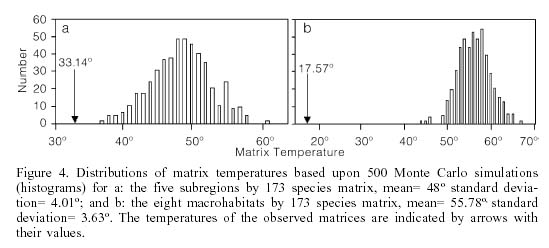
<body><![CDATA[<p style="margin-top: 0px; margin-bottom: 0px" align="center"> &nbsp;</p>     <p style="margin-top: 0px; margin-bottom: 0px" align="justify"> <span lang="EN-US" style="font-family: Verdana"><font size="2">&nbsp;</font></span></p>     <p style="margin-top: 0px; margin-bottom: 0px" align="justify"> <span lang="EN-US" style="font-family: Verdana"><font size="2">Entropy  statistics (Atmar and Patterson, 1993) were used to test if the similarity  matrix (<a href="#tabl1">Table I</a>) was more structured (less disorder) than  predicted at random. The subregional matrix had a temperature of 33.14º, a value  significantly cooler (has more structure; P=1.07x10<sup>-4</sup>) than that  predicted from 500 Monte Carlo simulations (<a href="#fig4">Figure 4a</a>).  Thus, the occurrence of fish species in the subregions is significantly  patterned despite the idiosyncratic occurrences of the unique species.</font></span></p>     <p style="margin-top: 0px; margin-bottom: 0px" align="justify"> <span lang="EN-US" style="font-family: Verdana"><font size="2">&nbsp;<a name="fig4"></a></font></span></p>     <p style="margin-top: 0px; margin-bottom: 0px" align="center"> <span lang="EN-US" style="font-family: Verdana"><font size="2"> <img src="/img/fbpe/inci/v29n4/art4figura4.jpg" width="549" height="248"></font></span></p>     
<p style="margin-top: 0px; margin-bottom: 0px" align="justify"> &nbsp;</p>     <p style="margin-top: 0px; margin-bottom: 0px" align="justify"> &nbsp;</p>     <p style="margin-top: 0px; margin-bottom: 0px" align="justify"> <span lang="EN-US" style="font-family: Verdana"><font size="2">The Camin-Sokal  parsimony analysis from the matrix of species distributions (appendix 13 in  Chernoff <i>et al</i>., 2001) produces two clusters of subregions (<a href="#fig5">Figure  5</a>): i) Río Negro-Upper Río Paraguay- Lower Río Paraguay, and ii) Río  Apa-Riacho La Paz. The groups result not only from high similarities but  particularly from the shared presence of species that were not found elsewhere.  For example, Riacho La Paz and Río Apa share 6 species uniquely (14.6% of the  Riacho La Paz collection) of which only the first would seem to be artifactual: <i>Astyanax fasciatus</i>, <i>Astyanax lineatus, Brachychalcinus retrospina,  Bryconamericus </i>sp. 1, <i>Otocinclus mariae, and Piabarchus </i>cf. <i>analis</i>.</font></span></p>     <p style="margin-top: 0px; margin-bottom: 0px" align="justify"> <a name="fig5"></a></p>     <p style="margin-top: 0px; margin-bottom: 0px" align="justify"> &nbsp;</p>     ]]></body>
<body><![CDATA[<p style="margin-top: 0px; margin-bottom: 0px" align="center"> <span lang="EN-US" style="font-family: Verdana"><font size="2"> <img src="/img/fbpe/inci/v29n4/art4figura5.jpg" width="356" height="297"></font></span></p>     
<p style="margin-top: 0px; margin-bottom: 0px" align="justify"> &nbsp;</p>     <p style="margin-top: 0px; margin-bottom: 0px" align="justify"> <span lang="EN-US" style="font-family: Verdana"><font size="2">&nbsp;</font></span></p>     <p style="margin-top: 0px; margin-bottom: 0px" align="justify"> <span lang="EN-US" style="font-family: Verdana"><font size="2">The groups  represent larger, riverine fauna and a terra firme tributary fauna, respectively  (<a href="#fig5">Figure 5</a>). The similarities between the two clusters are  largely not different from random expectations (<a href="#tabl1">Table I</a>).  The non-random artifacsimilarity between Riacho La Paz and the Lower Río  Paraguay is most likely due to the fact that samples were not taken very far  above the mouth of the former. Plotting the subregional similarities on the  Gabriel network (<a href="#fig6">Figure 6</a>) disputes the hypothesis that  faunal change is a function of distance. For example, the Lower and Upper Río  Paraguay and Río Negro subregions have almost identical similarities to Río Apa  despite the differences in distance (<a href="#fig6">Figure 6</a>, <a href="#tabl1">Table I</a>).</font></span></p>     <p style="margin-top: 0px; margin-bottom: 0px" align="justify"> <a name="fig6"></a></p>     <p style="margin-top: 0px; margin-bottom: 0px" align="center"> <span lang="EN-US" style="font-family: Verdana"><font size="2"> <img src="/img/fbpe/inci/v29n4/art4figura6.jpg" width="362" height="327"></font></span></p>     
<p style="margin-top: 0px; margin-bottom: 0px" align="justify"> <span lang="EN-US" style="font-family: Verdana"><font size="2">&nbsp;</font></span></p>     <p style="margin-top: 0px; margin-bottom: 0px" align="justify"><i> <span lang="EN-US" style="font-family: Verdana"><font size="2">Macrohabitat</font></span></i></p>     <p style="margin-top: 0px; margin-bottom: 0px" align="justify"><i> <span lang="EN-US" style="font-family: Verdana"><font size="2">&nbsp;</font></span></i></p>     <p style="margin-top: 0px; margin-bottom: 0px" align="justify"> <span lang="EN-US" style="font-family: Verdana"><font size="2">The fishes were  found to be neither evenly nor randomly distributed among the five subregions.  The patterns discovered are of large faunal overlaps and of dependence. The  beaches along Río Paraguay were the richest habitats with more than 1.6 times  the number of species found in the next richest macrohabitat, flooded forests (<a href="#tabl2">Table  II</a>). Clear water and Río Apa beach macrohabitats join the flooded forests in  the second tier of species richness.</font></span></p>     ]]></body>
<body><![CDATA[<p style="margin-top: 0px; margin-bottom: 0px" align="justify"> <span lang="EN-US" style="font-family: Verdana"><font size="2">&nbsp;</font></span></p>     <p style="margin-top: 0px; margin-bottom: 0px" align="justify"> &nbsp;</p>     <p style="margin-top: 0px; margin-bottom: 0px" align="justify"> &nbsp;</p>     <p style="margin-top: 0px; margin-bottom: 0px" align="justify"> &nbsp;</p>     <p style="margin-top: 0px; margin-bottom: 0px" align="justify"> <span lang="EN-US" style="font-family: Verdana"><font size="2">The overall  results indicate that species are widely dispersed among many of the  macrohabitat types. Few species were found exclusively in two macrohabitats and  just two pairs of macrohabitats shared 5 or more species exclusively (<a href="#tabl2">Table  II</a>). Furthermore, only four of the eight macrohabitats: Río Paraguay  beaches, Río Apa beaches, main channel and clear waters, had more than 10 unique  species.</font></span></p>     <p style="margin-top: 0px; margin-bottom: 0px" align="justify"> <span lang="EN-US" style="font-family: Verdana"><font size="2">&nbsp;</font></span></p>     <p style="margin-top: 0px; margin-bottom: 0px" align="justify"> <span lang="EN-US" style="font-family: Verdana"><font size="2">The results  indicate that there were also limitations on species distributions. There were  no species that were found in more than six macrohabitats. Fifteen and 35  species were found in six and five macrohabitats, respectively. The number of  fish species found in four or three macrohabitats continues to increase before  dropping off at two.</font></span></p>     <p style="margin-top: 0px; margin-bottom: 0px" align="justify"> <span lang="EN-US" style="font-family: Verdana"><font size="2">&nbsp;</font></span></p>     <p style="margin-top: 0px; margin-bottom: 0px" align="justify"> <span lang="EN-US" style="font-family: Verdana"><font size="2">Twenty of the 28  comparisons among macrohabitats were significantly different (P&lt;.0001) from  random similarity on the upper tail of the distribution (<a href="#tabl2">Table  II</a>). These results indicate that there are dependence relations among the  macrohabitats. Of the eight similarities that fall within expectations of random  similarity, six involve the main channel (<a href="#tabl2">Table II</a>). Only  the similarity of the main channel to the Río Paraguay beaches was significantly  different from random. The main channel habitat extends into deeper water from  beaches and shores. Many of the fish species found in the main channel were  larger (e.g. the stingray, <i>Potamotrygon motoro</i>, the dorado, <i>Salminus  maxillosus</i>, or the sorubí, <i>Sorubim </i></font></span><font size="2"><i> <span lang="EN-US" style="font-family: Verdana">lima</span></i></font><span lang="EN-US" style="font-family: Verdana"><font size="2">)  and were not taken in other habitats. Given the adjacent spatial relationship of  the beach and the main channel within Río Paraguay, it is not surprising that a  relatively high percentage of the species collected in the main channel should  also be collected along the beaches.</font></span></p>     <p style="margin-top: 0px; margin-bottom: 0px" align="justify"> <a name="tabl2"></a></p>     ]]></body>
<body><![CDATA[<p style="margin-top: 0px; margin-bottom: 0px" align="justify"> <span lang="EN-US" style="font-family: Verdana"><font size="2">&nbsp;</font></span></p>     <p style="margin-top: 0px; margin-bottom: 0px" align="center"> <span style="font-family: Verdana"><font size="2"> <img src="/img/fbpe/inci/v29n4/art4tabla2.jpg" width="541" height="386"></font></span></p>     
<p style="margin-top: 0px; margin-bottom: 0px" align="center"> <span style="font-family: Verdana"><font size="2">&nbsp;</font></span></p>     <p style="margin-top: 0px; margin-bottom: 0px" align="center"> &nbsp;</p>     <p style="margin-top: 0px; margin-bottom: 0px" align="justify"> <span style="font-family: Verdana"><font size="2">&nbsp;</font></span></p>     <p style="margin-top: 0px; margin-bottom: 0px" align="justify"> <span lang="EN-US" style="font-family: Verdana"><font size="2">The observed  temperature of the species by macrohabitat matrix, 17.6º, was more than 10.5  standard deviations below the mean of 500 Monte Carlo simulations (P=9.3x10<sup>-26</sup>, <a href="#fig4">Figure 4b</a>). The distribution of species among  macrohabitats is significantly more orderly than would be expected at random.  The idiosyncratic distribution of a number of species is not sufficient to  disrupt an overall pattern of order.</font></span></p>     <p style="margin-top: 0px; margin-bottom: 0px" align="justify"> <span lang="EN-US" style="font-family: Verdana"><font size="2">&nbsp;</font></span></p>     <p style="margin-top: 0px; margin-bottom: 0px" align="justify"> <span lang="EN-US" style="font-family: Verdana"><font size="2">The CSp analysis  (<a href="#fig7">Figure 7</a>) emphasizes the dissimilarities of the main  channel macrohabitat from the others. Among the remaining macrohabitats two  clusters are present: i) those primarily associated with the mainstem of Río  Paraguay; and ii) a cluster &nbsp;containing the Río Apa beach and clear water  macrohabitats. The larger cluster is interesting because the macrohabitats  cluster in relation to the flood cycle, from inland habitats to the shores of  the Río Paraguay.</font></span></p>     <p style="margin-top: 0px; margin-bottom: 0px" align="justify"> <span lang="EN-US" style="font-family: Verdana"><font size="2">&nbsp;<a name="fig7"></a></font></span></p>     <p style="margin-top: 0px; margin-bottom: 0px" align="center"> <span style="font-family: Verdana"><font size="2"> <img src="/img/fbpe/inci/v29n4/art4figura7.jpg" width="360" height="307"></font></span></p>     
]]></body>
<body><![CDATA[<p style="margin-top: 0px; margin-bottom: 0px" align="justify"> &nbsp;</p>     <p style="margin-top: 0px; margin-bottom: 0px" align="justify"> &nbsp;</p>     <p style="margin-top: 0px; margin-bottom: 0px" align="justify"> &nbsp;</p>     <p style="margin-top: 0px; margin-bottom: 0px" align="justify"> <span lang="EN-US" style="font-family: Verdana"><font size="2">The group  containing the Río Apa beach and clear water macrohabitats emphasizes the 5 fish  species shared uniquely by them rather than the fact that their highest overall  similarities are to the beaches of Río Paraguay. These species (e.g. <i> Brachychalcinus retrospina</i>, <i>Corydoras aeneus, </i>and <i>Pimelodella  mucosa</i>) prefer smaller habitats with sandy bottoms, and less than turbid  waters. All of the clear water habitats were either tributaries to Río Apa or in  Riacho La Paz.</font></span></p>     <p style="margin-top: 0px; margin-bottom: 0px" align="justify"> <span lang="EN-US" style="font-family: Verdana"><font size="2">&nbsp;</font></span></p>     <p style="margin-top: 0px; margin-bottom: 0px" align="justify"> <span lang="EN-US" style="font-family: Verdana"><font size="2">The  non-hierarchical diagram displays the largest number of significant similarities  among macrohabitats (<a href="#fig8">Figure 8</a>). This analysis places the  Río Paraguay beach macrohabitat at the center of a concentric arrangement of  habitats. In all cases the highest similarities are to the Río Paraguay beaches  and then, secondarily or thirdly, to other macrohabitats. For example,  backwaters join the flooded forests secondarily, which then joins equally but  independently to floating vegetation and to lagoons. This indicates an apparent  use of the environments by fish species at two levels. At the first level, Río  Paraguay serves as a source or a sink for populations moving into or out of the  other macrohabitats. At the second level, fishes are moving among several  interior macrohabitats (e.g. from flooded forests into lagoons) that are  interconnected during the flooding cycles.</font></span></p>     <p style="margin-top: 0px; margin-bottom: 0px" align="justify"> <a name="fig8"></a></p>     <p style="margin-top: 0px; margin-bottom: 0px" align="justify"> <span lang="EN-US" style="font-family: Verdana"><font size="2">&nbsp;</font></span></p>     <p style="margin-top: 0px; margin-bottom: 0px" align="center"> <font face="Verdana" size="2"><span lang="EN-US"> <img src="/img/fbpe/inci/v29n4/art4figura8.jpg" width="337" height="415"></span></font></p>     
<p style="margin-top: 0px; margin-bottom: 0px" align="justify"> &nbsp;</p>     ]]></body>
<body><![CDATA[<p style="margin-top: 0px; margin-bottom: 0px" align="justify"> <span lang="EN-US" style="font-family: Verdana"><font size="2">The species  accumulation curve for macrohabitats (<a href="#fig9">Figure 9</a>) was  modeled with a logarithmic regression, yielding</font></span></p>     <p style="margin-top: 0px; margin-bottom: 0px" align="justify"> <font face="Verdana" size="2"><span lang="EN-US">&nbsp;</span></font></p>     <p style="margin-top: 0px; margin-bottom: 0px" align="center"> <span style="font-family: Verdana"><font size="2">F = 65.67×H<sup>0.216</sup> + <span lang="es">&#949;</span></font></span></p>     <p style="margin-top: 0px; margin-bottom: 0px" align="justify"> <font face="Verdana" size="2"><span lang="EN-US">&nbsp;</span></font></p>     <p style="margin-top: 0px; margin-bottom: 0px" align="justify"> <span lang="EN-US" style="font-family: Verdana"><font size="2">where F:  cumulative frequency of species, H: number of macrohabitats, and </font></span> <font size="2"><span style="font-family: Verdana">å</span></font><span lang="EN-US" style="font-family: Verdana"><font size="2">:  error term. The regression is highly significant (F=500.70, df=1,6 and P&lt;.00001)  and explains the variance in the data (R<sup>2</sup>=.988). Both the intercept  and the exponent are significantly different from zero (P&lt;.00001). These results  will be used to recommend the number of macrohabitats that should be protected.</font></span></p>     <p style="margin-top: 0px; margin-bottom: 0px" align="justify"> <a name="fig9"></a></p>     <p style="margin-top: 0px; margin-bottom: 0px" align="justify"> &nbsp;</p>     <p style="margin-top: 0px; margin-bottom: 0px" align="center"> <font face="Verdana" size="2"><span lang="EN-US"> <img src="/img/fbpe/inci/v29n4/art4figura9.jpg" width="355" height="353"></span></font></p>     
<p style="margin-top: 0px; margin-bottom: 0px" align="justify"> <font face="Verdana" size="2"><span lang="EN-US">&nbsp;</span></font></p>     <p style="margin-top: 0px; margin-bottom: 0px" align="center"> &nbsp;</p>     ]]></body>
<body><![CDATA[<p style="margin-top: 0px; margin-bottom: 0px" align="justify"> <font face="Verdana" size="2"><span lang="EN-US">&nbsp;</span></font></p>     <p style="margin-top: 0px; margin-bottom: 0px" align="justify"><b> <span lang="EN-US" style="font-family: Verdana"><font size="2">Discussion</font></span></b></p>     <p style="margin-top: 0px; margin-bottom: 0px" align="justify"><b> <span lang="EN-US" style="font-family: Verdana"><font size="2">&nbsp;</font></span></b></p>     <p style="margin-top: 0px; margin-bottom: 0px" align="justify"> <span lang="EN-US" style="font-family: Verdana"><font size="2">Because of the  imminent threats to ecosystems and their organisms across the globe (Myers,  1988, 1990; Sisk <i>et al</i>., 1994), a strategy of biological assessments  across landscapes must target the best and most valuable habitats for immediate  conservation and for detailed study. To provide maximal value to the process,  inventories should provide not only surveys of the organisms and vital  environmental correlates but also hypotheses about community structure or  habitat partitioning within the region as well as resilience to environmental  threats.</font></span></p>     <p style="margin-top: 0px; margin-bottom: 0px" align="justify"> <font face="Verdana" size="2"><span lang="EN-US">&nbsp;</span></font></p>     <p style="margin-top: 0px; margin-bottom: 0px" align="justify"> <span lang="EN-US" style="font-family: Verdana"><font size="2">This task is  particularly daunting in application to aquatic ecosystems within tropical South  America because of their often-unappreciated dynamics and complexities (Goulding,  1980, 1981; Goulding <i>et al</i>., 1988; Machado- Allison, 1994; Barthem and  Goulding, 1997). Given their importance and challenges for conservation (Naiman <i>et al</i>., 1995; Pringle, 1997; Pringle <i>et al</i>., 2000), critical  information needs to be compiled from tropical aquatic systems. Human  development strategies (e.g. Almeida and Campari, 1995) within the basins of the  principal rivers of South America often completely ignore the impacts to and  needs of aquatic ecosystems.</font></span></p>     <p style="margin-top: 0px; margin-bottom: 0px" align="justify"> <font face="Verdana" size="2"><span lang="EN-US">&nbsp;</span></font></p>     <p style="margin-top: 0px; margin-bottom: 0px" align="justify"> <span lang="EN-US" style="font-family: Verdana"><font size="2">The methods used  in this paper are designed to test the null hypotheses of randomness of  distribution of the fishes (or any organisms) in relation to geography or  macrohabitats. Nonhomogeneous, patterned distributions require different  conservation strategies than does the situation where organisms are randomly or  homogeneously distributed (Atmar and Patterson, 1993; Christensen, 1997). Our  methods are appropriately conservative and robust, and have the advantage in  that we can determine whether the similarity is greater than or less than random  expectations. Though the use of point-source data is not necessarily  conservative, rapid assessment programs must provide beginning insights into  conservation plans to protect ecosystems and biodiversity to the maximum extent  possible. We are persuaded by the argumentation of Shrader-Frechette and McCoy  (1993) that the ethics of conservation require that we risk a type-I error  (rejection of a true null hypothesis) rather than a type-II error (failure to  reject a false null hypothesis). In the case presented here this means that it  is better to err on the side of recognizing structure within a biological  assemblage. The conservation plan will be more stringent than that required to  conserve a homogeneously distributed community (Barrett and Barrett, 1997;  Christensen, 1997).</font></span></p>     <p style="margin-top: 0px; margin-bottom: 0px" align="justify"> <font face="Verdana" size="2"><span lang="EN-US">&nbsp;</span></font></p>     <p style="margin-top: 0px; margin-bottom: 0px" align="center"> &nbsp;</p>     ]]></body>
<body><![CDATA[<p style="margin-top: 0px; margin-bottom: 0px" align="justify"> <font face="Verdana" size="2"><span lang="EN-US">&nbsp;</span></font></p>     <p style="margin-top: 0px; margin-bottom: 0px" align="justify"> <span lang="EN-US" style="font-family: Verdana"><font size="2">We first discuss  the results in relation to the two null hypotheses that the distributions of  fishes in Río Paraguay are homogeneous with respect to i) subregions; and ii)  macrohabitats. We then use that information in a predictive fashion relative to  the current environmental threats to the region. We will attempt to provide  lists of taxa as profiles for the assemblages that might survive under certain  conditions.</font></span></p>     <p style="margin-top: 0px; margin-bottom: 0px" align="justify"> <font face="Verdana" size="2"><span lang="EN-US">&nbsp;</span></font></p>     <p style="margin-top: 0px; margin-bottom: 0px" align="justify"><i> <span lang="EN-US" style="font-family: Verdana"><font size="2">Distributional  Patterns and Null Hypotheses</font></span></i></p>     <p style="margin-top: 0px; margin-bottom: 0px" align="justify"><i> <span lang="EN-US" style="font-family: Verdana"><font size="2">&nbsp;</font></span></i></p>     <p style="margin-top: 0px; margin-bottom: 0px" align="justify"> <span lang="EN-US" style="font-family: Verdana"><font size="2">For both  subregions and macrohabitats, similarities among fish faunas were greater than  expected at random (P&lt;0.01) indicating interdependency on variables associated  with geography or environment. We rejected (P&lt;&lt;0.001) null hypotheses of random  pattern using entropy measures for the subregion or macrohabitat by species  matrices. In the case of subregions, patterns of similarity and patterns of  shared species, both exclusive and ubiquitous (<a href="#fig5">Figures 5</a>, <a href="#fig6">6</a>) allowed us to discount smooth faunal turnover (clinal)  as the pattern. Rather, the subregion effect comprises two groups, a Río  Paraguay group and a Río Apa group, within which there are nested subsets. For  macrohabitats, nested patterns are most consistent with i) a fauna being derived  from (i.e., moving through) riverine habitats on seasonal cycles of flooding.  and ii) a Río Apa beach-clear water group distinguishable from a group of  macrohabitats connected to the Río Paraguay.</font></span></p>     <p style="margin-top: 0px; margin-bottom: 0px" align="justify"> <font face="Verdana" size="2"><span lang="EN-US">&nbsp;</span></font></p>     <p style="margin-top: 0px; margin-bottom: 0px" align="justify"> <span lang="EN-US" style="font-family: Verdana"><font size="2">The results are  consistent with published literature on the strong geographic and macrohabitat  related effects on freshwater fish distributions (Balon and Stewart, 1983; Balon <i>et al</i>., 1986; Hawkes <i>et al</i>., 1986; Matthews, 1986; Ibarra and  Stewart, 1989; Cox Fernandes, 1995; Chernoff <i>et al</i>., 1999). These and the  current study refute statements by Lowe-McConnell (1987) and Goulding <i>et al</i>.  (1988) that fish communities in the Neotropical lowlands are unstructured or  random. Diversity of fish species in Río Paraguay is a non-random interaction of  environmental quality and habitat diversity distributed through the river basin.  Only 9 out of 173 fish species (5.2%) were found in all subregions; not a single  species occurred in each of the eight major macrohabitats. In contrast, Chernoff <i>et al</i>. (1999) found 15.6% of the 313 species living in all six subregions  of the Upper Río Orthon watershed, Bolivia.</font></span></p>     <p style="margin-top: 0px; margin-bottom: 0px" align="justify"> <font face="Verdana" size="2"><span lang="EN-US">&nbsp;</span></font></p>     <p style="margin-top: 0px; margin-bottom: 0px" align="justify"> <span lang="EN-US" style="font-family: Verdana"><font size="2">The Río Paraguay  has its headwaters to the north and northwest, and flows from the tropics to the  temperate zone. While Gorman and Karr (1978) have postulated that species  richness should increase in the lower reaches of rivers, this is not the case  for Río Paraguay (Bonetto, 1986; Britski <i>et al</i>., 1999). Because the water  temperature decreases downstream, the numbers of fish species drop off as one  proceeds to the La Plata section of the river (Bonetto, 1986). The species  richness is much higher in the Pantanal than in the section of Río Paraguay that  we sampled; the Upper Río Paraguay subregion had slightly more species than  other regions. Importantly, many of the species collected uniquely in the Upper  Río Paraguay subregion are known from the Pantanal (Britski <i>et al</i>., 1999;  Toledo- Piza, 2001).</font></span></p>     ]]></body>
<body><![CDATA[<p style="margin-top: 0px; margin-bottom: 0px" align="justify"> <font face="Verdana" size="2"><span lang="EN-US">&nbsp;</span></font></p>     <p style="margin-top: 0px; margin-bottom: 0px" align="justify"> <span lang="EN-US" style="font-family: Verdana"><font size="2">The pattern of  species associations among the macrohabitats was found to be congruent with that  for the subregions. The two network analyses (<a href="#fig7">Figures 7</a>, <a href="#fig8">8</a>) emphasize four important features that are more easily  determined from the non-hierarchical cluster analysis. The first is that the Río  Paraguay beaches serve as the primary population source or sink for all of the  other macrohabitats. The Río Paraguay beaches are the most species rich and  share the highest number of species with each of the other macrohabitats (<a href="#tabl2">Table  II</a>).</font></span></p>     <p style="margin-top: 0px; margin-bottom: 0px" align="justify"> <font face="Verdana" size="2"><span lang="EN-US">&nbsp;</span></font></p>     <p style="margin-top: 0px; margin-bottom: 0px" align="justify"> <span lang="EN-US" style="font-family: Verdana"><font size="2">The second is  that patterns of similarities and shared taxa demonstrate the role of floods in  structuring faunal assemblages. Waters flood from the main river channel over  beaches into the forests and into local depressions forming lagoons, which then  may be stranded in the dry season. Twenty-nine of the 39 species found in  lagoons were also found in the flooded forests; none were found exclusively in  these two macrohabitats (<a href="#tabl2">Table II</a>). It follows that the  second largest observed similarity is between the backwater and flooded forest  macrohabitats (<a href="#tabl2">Table II</a>, <a href="#fig8">Figure 8</a>),  based upon species that prefer vegetation and less current (e.g. <i>Apistogramma </i>spp., <i>Cheirodon piaba, Hyphessobrycon eques, Odontostilbe paraguayensis,  Otocinclus vestitus, Pyrrhulina australis)</i>. These species not only have  important roles within the ecosystem (see Lowe-McConnell, 1987) but also have  high value in the ornamental fish trade.</font></span></p>     <p style="margin-top: 0px; margin-bottom: 0px" align="justify"> <font face="Verdana" size="2"><span lang="EN-US">&nbsp;</span></font></p>     <p style="margin-top: 0px; margin-bottom: 0px" align="justify"> <span lang="EN-US" style="font-family: Verdana"><font size="2">The third is that  the fishes that inhabit the deeper environments of the main channel often leave  deeper waters to inhabit the beach habitats during the evenings or early  mornings. The fish species collected in the trawls and in the gill nets are only  small portion of what is most certainly much larger fauna (Chernoff <i>et al</i>.,  1999). The only significant similarity found between the main channel and any  other macrohabitat was to the Río Paraguay beaches (<a href="#tabl3">Table III</a>).</font></span></p>     <p style="margin-top: 0px; margin-bottom: 0px" align="justify"> <font face="Verdana" size="2"><span lang="EN-US">&nbsp;<a name="tabl3"></a></span></font></p>     <p style="margin-top: 0px; margin-bottom: 0px" align="center"> <font face="Verdana" size="2"><span lang="EN-US"> <img src="/img/fbpe/inci/v29n4/art4tabla3.jpg" width="536" height="255"></span></font></p>     
<p style="margin-top: 0px; margin-bottom: 0px" align="justify"> <font face="Verdana" size="2"><span lang="EN-US">&nbsp;</span></font></p>     <p style="margin-top: 0px; margin-bottom: 0px" align="justify"> <span lang="EN-US" style="font-family: Verdana"><font size="2">The fourth is  that the relationship between the species of fishes found along Río Apa beaches  and clearwater macrohabitats represents another grouping. These macrohabitats  shared 37 species comprising the largest assemblage of ornamental and relatively  smaller species (&lt;120mm standard length), such as those in the <i>Astyanax,  Ancistrus, Apareiodon, Apistogramma, Bujurquina, Characidium, Cheirodon,  Corydoras, Hemigrammus, Holoshesthes, Moenkhausia, Otocinclus, Odontostilbe </i> and <i>Xenurobrycon </i>genera. The environments that provide critical habitat  for many of these smaller species beyond the flood zone of Río Paraguay must  become a key element of any conservation plan for the region.</font></span></p>     ]]></body>
<body><![CDATA[<p style="margin-top: 0px; margin-bottom: 0px" align="justify"> <font face="Verdana" size="2"><span lang="EN-US">&nbsp;</span></font></p>     <p style="margin-top: 0px; margin-bottom: 0px" align="justify"> <span lang="EN-US" style="font-family: Verdana"><font size="2">Despite the  complexity of some of the patterns that were discovered, we can derive a  preliminary plan for the conservation of the ichthyofauna based upon the species  accumulation analysis (<a href="#fig9">Figure 9</a>). The analysis indicates  the number of macrohabitats in good health that are required to protect the  majority of species of fishes. More than 90% of the biodiversity may be  protected if a biologically significant area containing at least four  macrohabitats (Río Paraguay and Río Apa beaches, and two flood zone  macrohabitats) is set aside. What is not known as yet is how much area  constitutes “biologically significant”, meaning of large enough area to maintain  sustainable populations of the species.</font></span></p>     <p style="margin-top: 0px; margin-bottom: 0px" align="justify"> <font face="Verdana" size="2"><span lang="EN-US">&nbsp;</span></font></p>     <p style="margin-top: 0px; margin-bottom: 0px" align="justify"><i> <span lang="EN-US" style="font-family: Verdana"><font size="2">Analysis of  Threats</font></span></i></p>     <p style="margin-top: 0px; margin-bottom: 0px" align="justify"><i> <span lang="EN-US" style="font-family: Verdana"><font size="2">&nbsp;</font></span></i></p>     <p style="margin-top: 0px; margin-bottom: 0px" align="justify"> <span lang="EN-US" style="font-family: Verdana"><font size="2">The major threats  facing the Río Paraguay drainage are diverse, with short- and long-term  consequences. They range from unregulated fisheries to habitat conversion to  channelization and dredging (Chernoff <i>et al</i>., 2001). These activities  threaten greatly the aquatic ecosystems of the Río Paraguay drainage. Large  scale alterations to the Río Paraguay drainage will result not only in a major  loss of biodiversity but also important commercial losses in fisheries.</font></span></p>     <p style="margin-top: 0px; margin-bottom: 0px" align="justify"> <font face="Verdana" size="2"><span lang="EN-US">&nbsp;</span></font></p>     <p style="margin-top: 0px; margin-bottom: 0px" align="justify"> <span lang="EN-US" style="font-family: Verdana"><font size="2">In order to  establish a baseline for estimation of the biological consequences of  environmental threats, we provide a hypothesis about those fish species that  might be the most resilient to environmental destruction. These lists are based  upon breadth of fish species distributions across the five subregions and across  the eight macrohabitats that we sampled within the Río Paraguay basin. The  breadth of distribution may be taken as an estimator of environmental tolerance  or survivability. We define “common taxa” to be those fish species that were  found in at least three subregions and in five macrohabitats. There are 31 such  species (<a href="#tabl3">Table III</a>). The list of common species includes  taxa from each of the major groups: tetras and their allies (characiforms),  catfishes (siluriforms), electric fishes (gymnotiforms), and cichlids (Cichlidae).  This assemblage is the one we consider most likely to exist in highly modified  habitats but comprises only 17.9% of the species that we captured (appendix 13  in Toledo-Piza <i>et al</i>., 2001). The following discussion of threats is  divided into subsections for clarity.</font></span></p>     <p style="margin-top: 0px; margin-bottom: 0px" align="justify"> <font face="Verdana" size="2"><span lang="EN-US">&nbsp;</span></font></p>     <p style="margin-top: 0px; margin-bottom: 0px" align="justify"><i> <span lang="EN-US" style="font-family: Verdana"><font size="2">Hidrovia  Paraguay-Paraná</font></span></i><span lang="EN-US" style="font-family: Verdana"><font size="2">.</font></span></p>     ]]></body>
<body><![CDATA[<p style="margin-top: 0px; margin-bottom: 0px" align="justify"> <span lang="EN-US" style="font-family: Verdana"><font size="2">&nbsp;</font></span></p>     <p style="margin-top: 0px; margin-bottom: 0px" align="justify"> <span lang="EN-US" style="font-family: Verdana"><font size="2">Brief  descriptions of the Hidrovia Project can be found in Heath (1995), Ponce (1995),  Hamilton (1999), Swarts (2000) and Pringle <i>et al</i>. (2000). The project  intends to deepen and, perhaps, straighten the Río Paraguay, making a connection  into the Amazon Basin in Bolivia. The immediate threats to the biotic systems of  Río Paraguay come from channelization and river straightening activities.  Secondary threats include pollution (bilge water and petroleum products) and  interchange of Amazonian and Río Paraguay faunas.</font></span></p>     <p style="margin-top: 0px; margin-bottom: 0px" align="justify"> <font face="Verdana" size="2"><span lang="EN-US">&nbsp;</span></font></p>     <p style="margin-top: 0px; margin-bottom: 0px" align="justify"> <span lang="EN-US" style="font-family: Verdana"><font size="2">Río Paraguay is a  relatively shallow river above Asunción and meanders greatly. The depth of the  river will need to be increased substantially in order to accommodate ocean  going container ships (Heath, 1995; Ponce, 1995). The installation and  maintenance of a commercial shipping channel will require constant dredging (as  is done in the Río Orinoco, Venezuela). Rock outcroppings, such as near Cerritos  Pão de Açúcar, may need to be eliminated. The overall effect of placing a large  channel and straightening of the river will be to change the pattern of  hydrography and sedimentation in the river (Hamilton, 1999; Ponce, 1995; Pringle <i>et al</i>., 2000). The deeper channel will actively pull water out of  tributaries and from flooded lowlands. More water will exit the system more  rapidly and will significantly decrease the degree and the time of inundation of  the broad flood plains of the Chaco and the Pantanal (see Hamilton, 1999).</font></span></p>     <p style="margin-top: 0px; margin-bottom: 0px" align="justify"> <font face="Verdana" size="2"><span lang="EN-US">&nbsp;</span></font></p>     <p style="margin-top: 0px; margin-bottom: 0px" align="justify"> <span lang="EN-US" style="font-family: Verdana"><font size="2">Reduction or  prevention of flooding in tropical rivers is perhaps the greatest threat not  only to biodiversity but also to productivity (Goulding, 1981; Petts, 1985;  Lowe-McConnell, 1987; Goulding <i>et al</i>., 1988; Machado-Allison, 1994;  Ponce, 1995; McCulley, 1996). Much of the dependence of the Río Paraguay fish  species on annual flooding is evident in our data (<a href="#fig8">Figure 8</a>).  Reduction of inland flooded macrohabitats would remove a critical resource for  fishes, both for food gathering and reproduction, and for nursery areas. The  number of species found in seasonally flooded habitats that result from  inundations is almost as great as the number found on beaches (<a href="#tabl2">Table  II</a>). Of the captured species, 90 (52%) were found in four macrohabitats,  including ornamental and commercially valuable food fishes. For example, all of  the pacus and pacu-relatives are important components of those habitats,  including <i>Metynnis mola, Myleus tiete, Piaractus mitrei, </i>and <i>Mylossoma  duriventre. </i>Other food or potential food fishes included: <i>Psectrogaster  curviventris, Pygocentrus nattereri, Liposarcus anisitsi, Cochliodon </i>sp.,  and <i>Triportheus nematurus. </i>There were numerous ornamentals that are  common in the aquarium trade, including <i>Gymnotus carapo, Eigenmannia  trilineatus, Pyrrhulina australis, Otocinclus </i>spp., <i>Hyphessobrycon eques,  Gymnocorymbus ternetzi, Bujurquina vittata, </i>and <i>Apistogramma </i>spp.</font></span></p>     <p style="margin-top: 0px; margin-bottom: 0px" align="justify"> <font face="Verdana" size="2"><span lang="EN-US">&nbsp;</span></font></p>     <p style="margin-top: 0px; margin-bottom: 0px" align="justify"> <span lang="EN-US" style="font-family: Verdana"><font size="2">Although the  “common species” (<a href="#tabl3">Table III</a>) are all found in the list of  90, they too are dependent upon maintenance of the flooding cycle to undergo  their life cycles. Many if not most of the species in the list of 90, begin to  yolk their eggs and spawn either on the rising floods or directly in the flooded  zone (Goulding, 1981; Lowe-McConnell, 1987, Machado-Allison, 1994). Thus,  reduction or elimination of the areas of inundation could result in almost 50%  loss of the total ichthyofauna. More than half of the 90 species were not  discovered in the Río Apa or clear water habitats.</font></span></p>     <p style="margin-top: 0px; margin-bottom: 0px" align="justify"> <font face="Verdana" size="2"><span lang="EN-US">&nbsp;</span></font></p>     <p style="margin-top: 0px; margin-bottom: 0px" align="justify"> <span lang="EN-US" style="font-family: Verdana"><font size="2">Another  consequence of increased drainage of the Río Paraguay due to Hidrovia or similar  projects would be a vast reduction of Río Apa and Riacho La Paz during the dry  season. The Río Apa-Riacho La Paz region contains minimally 30 fish species that  are associated with the terra-firme, more headwater-like habitats and were not  found elsewhere. These species are also potentially imperiled.</font></span></p>     ]]></body>
<body><![CDATA[<p style="margin-top: 0px; margin-bottom: 0px" align="justify"> <font face="Verdana" size="2"><span lang="EN-US">&nbsp;</span></font></p>     <p style="margin-top: 0px; margin-bottom: 0px" align="justify"> <span lang="EN-US" style="font-family: Verdana"><font size="2">For both the Río  Paraguay macrohabitats and the Río Apa- Riacho La Paz zone, the Pantanal of Mato  Grosso do Sul would be a likely source from which recolonization of the fish  fauna might be possible. However, the flood plains of the Pantanal, especially  in the north, will shrink in size (Hamilton, 1999) and we predict will suffer  heavy casualties. Using our data, and the heterogeneous patterns of distribution  and the dependency upon the flooding cycle, we calculate that more than 60% of  the fish species could be eliminated from the basin if the Hidrovia Project is  implemented. The economic costs of this extinction must be explored.</font></span></p>     <p style="margin-top: 0px; margin-bottom: 0px" align="justify"> <font face="Verdana" size="2"><span lang="EN-US">&nbsp;</span></font></p>     <p style="margin-top: 0px; margin-bottom: 0px" align="justify"><i> <span lang="EN-US" style="font-family: Verdana"><font size="2">Habitat  Conversion in Río Apa and Riacho La Paz</font></span></i><span lang="EN-US" style="font-family: Verdana"><font size="2">. </font></span></p>     <p style="margin-top: 0px; margin-bottom: 0px" align="justify"> <span lang="EN-US" style="font-family: Verdana"><font size="2">&nbsp;</font></span></p>     <p style="margin-top: 0px; margin-bottom: 0px" align="justify"> <span lang="EN-US" style="font-family: Verdana"><font size="2">Much of the Río  Apa sub-basin is used for agriculture and ranching. The area, however, is not  stable and continued habitat conversion is underway. Because this section is  more arid, with drier soils, river water is used for irrigation. Additionally,  because the waters are clear and not turbid, there is damage to the ecosystem  from sedimentation and erosion (Chernoff <i>et al</i>., 2001). The aquatic  ecosystems of the Río Apa basin are very fragile.</font></span></p>     <p style="margin-top: 0px; margin-bottom: 0px" align="justify"> <font face="Verdana" size="2"><span lang="EN-US">&nbsp;</span></font></p>     <p style="margin-top: 0px; margin-bottom: 0px" align="justify"> <span lang="EN-US" style="font-family: Verdana"><font size="2">Along Riacho La  Paz there are approximately 30 fish species that were not found in the more  lowland habitats. This represents approximately 17.3% of the fauna that is not  easily replaced. The closest sources for recolonization are in the headwaters of  the Pantanal or in Río Paraná. These are long distances and we doubt that these  fishes are active long-distance colonizers (e.g. <i>Microcharacidium</i>).  Continued habitat conversion could eliminate these species that are not found  elsewhere in this portion of the Río Paraguay basin.</font></span></p>     <p style="margin-top: 0px; margin-bottom: 0px" align="justify"> <font face="Verdana" size="2"><span lang="EN-US">&nbsp;</span></font></p>     <p style="margin-top: 0px; margin-bottom: 0px" align="justify"><b> <span lang="EN-US" style="font-family: Verdana"><font size="2">Conclusions and  Recommendations </font></span></b></p>     ]]></body>
<body><![CDATA[<p style="margin-top: 0px; margin-bottom: 0px" align="justify"><b> <span lang="EN-US" style="font-family: Verdana"><font size="2">&nbsp;</font></span></b></p>     <p style="margin-top: 0px; margin-bottom: 0px" align="justify"> <span lang="EN-US" style="font-family: Verdana"><font size="2">1. The freshwater  fishes are non-randomly distributed with respect to subregions. There is a  relatively sharp boundary between Río Apa-Riacho La Paz and Río Paraguay, with  more than a 50% turnover in species of fishes. Therefore, it is critical to  designate two areas within the Río Paraguay basin as core conservation areas: 1)  Upper Río Paraguay-Río Negro and 2) Río Apa- Riacho La Paz. Together they  represent more than 80% of the diversity within the region.</font></span></p>     <p style="margin-top: 0px; margin-bottom: 0px" align="justify"> <font face="Verdana" size="2"><span lang="EN-US">&nbsp;</span></font></p>     <p style="margin-top: 0px; margin-bottom: 0px" align="justify"> <span lang="EN-US" style="font-family: Verdana"><font size="2">2. The Río  Apa-Riacho La Paz zone is highly threatened because land conversion  (agriculture, ranching, etc.) is actively changing the characteristic of the  ecosystem. Extinction or reduction of the fauna in these streams will have  serious consequences for the overall biodiversity because potential sources of  organisms for recolonization are very far away (Pantanal headwaters and Río  Paraná).</font></span></p>     <p style="margin-top: 0px; margin-bottom: 0px" align="justify"> <font face="Verdana" size="2"><span lang="EN-US">&nbsp;</span></font></p>     <p style="margin-top: 0px; margin-bottom: 0px" align="justify"> <span lang="EN-US" style="font-family: Verdana"><font size="2">3. The freshwater  fishes are non-randomly distributed with respect to macrohabitats within the Río  Paraguay basin. Beach habitats serve as source populations for other habitats  that extend into the forest. These habitats are interconnected during periods of  inundation. Therefore, it is critical that the natural flood cycle be maintained  and that broad areas for inundation be modified as little as possible.  Interference or serious reduction of the flood cycle and inundated habitats  could result in as much as a 60% loss of the species in the basin.</font></span></p>     <p style="margin-top: 0px; margin-bottom: 0px" align="justify"> <font face="Verdana" size="2"><span lang="EN-US">&nbsp;</span></font></p>     <p style="margin-top: 0px; margin-bottom: 0px" align="justify"> <span lang="EN-US" style="font-family: Verdana"><font size="2">4. Sufficient  area of four macrohabitats (Río Paraguay and Río Apa beaches, plus two flood  zone habitats) are minimally necessary to protect the majority of the fishes. It  is critical, however, to determine how much area is needed to support  sustainable populations.</font></span></p>     <p style="margin-top: 0px; margin-bottom: 0px" align="justify"> <font face="Verdana" size="2"><span lang="EN-US">&nbsp;</span></font></p>     <p style="margin-top: 0px; margin-bottom: 0px" align="justify"> <span lang="EN-US" style="font-family: Verdana"><font size="2">4. Sufficient  area of four macrohabitats (Río Paraguay and Río Apa beaches, plus two flood  zone habitats) are minimally necessary to protect the majority of the fishes. It  is critical, however, to determine how much area is needed to support  sustainable populations.</font></span></p>     ]]></body>
<body><![CDATA[<p style="margin-top: 0px; margin-bottom: 0px" align="justify"> <font face="Verdana" size="2"><span lang="EN-US">&nbsp;</span></font></p>     <p style="margin-top: 0px; margin-bottom: 0px" align="justify"><b> <span lang="EN-US" style="font-family: Verdana"><font size="2">ACKNOWLEDGEMENTS</font></span></b></p>     <p style="margin-top: 0px; margin-bottom: 0px" align="justify"><b> <span lang="EN-US" style="font-family: Verdana"><font size="2">&nbsp;</font></span></b></p>     <p style="margin-top: 0px; margin-bottom: 0px" align="justify"> <span lang="EN-US" style="font-family: Verdana"><font size="2">The fieldwork and  AquaRAP program was funded through the generosity of the Rufford Foundation to  Conservation International. The authors are grateful to Leeanne Alonso, Bruce  Patterson, Matthew Leibold and Jensen R. Montambault for comments on the  manuscript or advice, and to Mónica Toledo- Piza, Jaime Sarmiento, Darío  Mandleburger and Mirta Medina for fieldwork. Equipment used was provided by  thoughtful gifts from the Comer Science and Education Foundation, Jay Fahn, and  Joan and Selma Goldstein. Lastly, the authors express their gratitude to John  McCarter, Russel Mittermeier and Peter Seligman for their continuing support of  the AquaRAP program.</font></span></p>     <p style="margin-top: 0px; margin-bottom: 0px" align="justify"> <font face="Verdana" size="2"><span lang="EN-US">&nbsp;</span></font></p>     <p style="margin-top: 0px; margin-bottom: 0px" align="justify"><b> <span lang="EN-US" style="font-family: Verdana"><font size="2">REFERENCES</font></span></b></p>     <p style="margin-top: 0px; margin-bottom: 0px" align="justify"><b> <span lang="EN-US" style="font-family: Verdana"><font size="2">&nbsp;</font></span></b></p>     <!-- ref --><p style="margin:0cm;margin-bottom:.0001pt"> <span lang="EN-US" style="font-size: 10.0pt; font-family: Verdana">1. Almeida  ALO, Campari JS (1995) <i>Sustainable development of the Brazilian Amazon</i>.  Oxford University Press: New York, USA. 189 pp.</span>&nbsp;&nbsp;&nbsp;&nbsp;&nbsp;&nbsp;&nbsp;&nbsp;[&#160;<a href="javascript:void(0);" onclick="javascript: window.open('/scielo.php?script=sci_nlinks&ref=981273&pid=S0378-1844200400040000500001&lng=','','width=640,height=500,resizable=yes,scrollbars=1,menubar=yes,');">Links</a>&#160;]<!-- end-ref --><p style="margin:0cm;margin-bottom:.0001pt"> <span lang="EN-US" style="font-size: 10.0pt; font-family: Verdana">&nbsp;</span></p>     <!-- ref --><p style="margin:0cm;margin-bottom:.0001pt"> <span lang="EN-US" style="font-size: 10.0pt; font-family: Verdana">2. Atmar W,  Patterson BD (1993) The measure of order and disorder in the distribution of  species found in fragmented habitat. <i>Oecologia 96</i>: 373-382.</span>&nbsp;&nbsp;&nbsp;&nbsp;&nbsp;&nbsp;&nbsp;&nbsp;[&#160;<a href="javascript:void(0);" onclick="javascript: window.open('/scielo.php?script=sci_nlinks&ref=981275&pid=S0378-1844200400040000500002&lng=','','width=640,height=500,resizable=yes,scrollbars=1,menubar=yes,');">Links</a>&#160;]<!-- end-ref --><p style="margin:0cm;margin-bottom:.0001pt"> <span lang="EN-US" style="font-size: 10.0pt; font-family: Verdana">&nbsp;</span></p>     <!-- ref --><p style="margin:0cm;margin-bottom:.0001pt"> <span lang="EN-US" style="font-size: 10.0pt; font-family: Verdana">3. Balon EK,  Crawford SS, Lelek A (1986) Fish communities of the upper Danube River (Germany,  Austria) prior to the new Rhein- Main-Donau connection. <i>Environmental Biology  of Fishes &nbsp;15</i>: 243-271.</span>&nbsp;&nbsp;&nbsp;&nbsp;&nbsp;&nbsp;&nbsp;&nbsp;[&#160;<a href="javascript:void(0);" onclick="javascript: window.open('/scielo.php?script=sci_nlinks&ref=981277&pid=S0378-1844200400040000500003&lng=','','width=640,height=500,resizable=yes,scrollbars=1,menubar=yes,');">Links</a>&#160;]<!-- end-ref --><p style="margin:0cm;margin-bottom:.0001pt"> <span lang="EN-US" style="font-size: 10.0pt; font-family: Verdana">&nbsp;</span></p>     <!-- ref --><p style="margin:0cm;margin-bottom:.0001pt"> <span lang="EN-US" style="font-size: 10.0pt; font-family: Verdana">4. Balon EK,  Stewart DJ (1983) Fish assemblages in a river with unusual gradient (Luongo,  Africa-Zaire system), reflections on river zonation and description of another  new species. <i>Environmental Biology of Fishes &nbsp;9</i>: 225-252.</span>&nbsp;&nbsp;&nbsp;&nbsp;&nbsp;&nbsp;&nbsp;&nbsp;[&#160;<a href="javascript:void(0);" onclick="javascript: window.open('/scielo.php?script=sci_nlinks&ref=981279&pid=S0378-1844200400040000500004&lng=','','width=640,height=500,resizable=yes,scrollbars=1,menubar=yes,');">Links</a>&#160;]<!-- end-ref --><p style="margin:0cm;margin-bottom:.0001pt"> <span lang="EN-US" style="font-size: 10.0pt; font-family: Verdana">&nbsp;</span></p>     <!-- ref --><p style="margin:0cm;margin-bottom:.0001pt"> <span lang="EN-US" style="font-size: 10.0pt; font-family: Verdana">5. Barrett  NE, Barrett JP (1997) Reserve design and the new conservation theory. In &nbsp;5.  Pickett STA, Ostfield RS, Schachak M, Likens GE (Eds.) <i>The ecological basis  of conservation: heterogeneity, ecosystems, and biodiversity</i>. Chapman and  Hall: New York, USA. pp 236-251.</span>&nbsp;&nbsp;&nbsp;&nbsp;&nbsp;&nbsp;&nbsp;&nbsp;[&#160;<a href="javascript:void(0);" onclick="javascript: window.open('/scielo.php?script=sci_nlinks&ref=981281&pid=S0378-1844200400040000500005&lng=','','width=640,height=500,resizable=yes,scrollbars=1,menubar=yes,');">Links</a>&#160;]<!-- end-ref --><p style="margin:0cm;margin-bottom:.0001pt"> <span lang="EN-US" style="font-size: 10.0pt; font-family: Verdana">&nbsp;</span></p>     <!-- ref --><p style="margin:0cm;margin-bottom:.0001pt"> <span lang="EN-US" style="font-size: 10.0pt; font-family: Verdana">6. Barthem R,  Goulding M (1997) <i>The catfish connection: ecology, migration, and  conservation of Amazon predators</i>. Columbia University Press: New York, USA.  144 pp.</span>&nbsp;&nbsp;&nbsp;&nbsp;&nbsp;&nbsp;&nbsp;&nbsp;[&#160;<a href="javascript:void(0);" onclick="javascript: window.open('/scielo.php?script=sci_nlinks&ref=981283&pid=S0378-1844200400040000500006&lng=','','width=640,height=500,resizable=yes,scrollbars=1,menubar=yes,');">Links</a>&#160;]<!-- end-ref --><p style="margin:0cm;margin-bottom:.0001pt"> <span lang="EN-US" style="font-size: 10.0pt; font-family: Verdana">&nbsp;</span></p>     <!-- ref --><p style="margin:0cm;margin-bottom:.0001pt"> <span lang="EN-US" style="font-size: 10.0pt; font-family: Verdana">7. Bonetto AA  (1986) Fish of the Paraná system. In &nbsp;7. Davies BR, Walker KF (Eds.) <i>The  ecology of river systems</i>. W. Junk: Dordrecht, Netherlands. pp 573-588.</span>&nbsp;&nbsp;&nbsp;&nbsp;&nbsp;&nbsp;&nbsp;&nbsp;[&#160;<a href="javascript:void(0);" onclick="javascript: window.open('/scielo.php?script=sci_nlinks&ref=981285&pid=S0378-1844200400040000500007&lng=','','width=640,height=500,resizable=yes,scrollbars=1,menubar=yes,');">Links</a>&#160;]<!-- end-ref --><p style="margin:0cm;margin-bottom:.0001pt"> <span lang="EN-US" style="font-size: 10.0pt; font-family: Verdana">&nbsp;</span></p>     <!-- ref --><p style="margin:0cm;margin-bottom:.0001pt"> <span style="font-size:10.0pt; font-family:Verdana">8. Britski HA, de Silimon KZS, Lopes BS (1999) <i>Peixes do  Pantanal: manual de identificação</i>. EMBRAPA: Brasília, Brasil. 184 pp.</span>&nbsp;&nbsp;&nbsp;&nbsp;&nbsp;&nbsp;&nbsp;&nbsp;[&#160;<a href="javascript:void(0);" onclick="javascript: window.open('/scielo.php?script=sci_nlinks&ref=981287&pid=S0378-1844200400040000500008&lng=','','width=640,height=500,resizable=yes,scrollbars=1,menubar=yes,');">Links</a>&#160;]<!-- end-ref --><p style="margin:0cm;margin-bottom:.0001pt"> <span style="font-size:10.0pt; font-family:Verdana">&nbsp;</span></p>     <!-- ref --><p style="margin:0cm;margin-bottom:.0001pt"> <span style="font-size:10.0pt; font-family:Verdana">9. Chernoff &nbsp;B, Willink &nbsp;PW, Sarmiento &nbsp;J, Machado- Allison  &nbsp;A, Menezes &nbsp;N, Ortega &nbsp;H &nbsp;( 1999) Geographic and macrohabitat partitioning of  fishes in Tahuamanu-Manuripi region, Upper Río Orthon basin, Bolivia:  conservation recommendations. </span> <span lang="EN-US" style="font-size: 10.0pt; font-family: Verdana">In &nbsp;Chernoff  &nbsp;B, Willink &nbsp;PW &nbsp;(Eds.) <i>A biological assessment of aquatic ecosystems of the  Upper Río Orthon basin, Pando, Bolivia</i>. Bulletin of Biological Assessment  15. Conservation International. Washington DC, USA. pp. 51-68.</span>&nbsp;&nbsp;&nbsp;&nbsp;&nbsp;&nbsp;&nbsp;&nbsp;[&#160;<a href="javascript:void(0);" onclick="javascript: window.open('/scielo.php?script=sci_nlinks&ref=981289&pid=S0378-1844200400040000500009&lng=','','width=640,height=500,resizable=yes,scrollbars=1,menubar=yes,');">Links</a>&#160;]<!-- end-ref --><p style="margin:0cm;margin-bottom:.0001pt"> <span lang="EN-US" style="font-size: 10.0pt; font-family: Verdana">&nbsp;</span></p>     <!-- ref --><p style="margin:0cm;margin-bottom:.0001pt"> <span lang="EN-US" style="font-size: 10.0pt; font-family: Verdana">10. Chernoff  B, Willink PW, Montambault J (2001) <i>A biological assesement of the aquatic  ecosystem of the Río Paraguay basin, Alto Paraguay, Paraguay</i>. Bulletin of  Biological Assessment 19. Conservation International: Washington DC, USA. 156  pp.</span>&nbsp;&nbsp;&nbsp;&nbsp;&nbsp;&nbsp;&nbsp;&nbsp;[&#160;<a href="javascript:void(0);" onclick="javascript: window.open('/scielo.php?script=sci_nlinks&ref=981291&pid=S0378-1844200400040000500010&lng=','','width=640,height=500,resizable=yes,scrollbars=1,menubar=yes,');">Links</a>&#160;]<!-- end-ref --><p style="margin:0cm;margin-bottom:.0001pt"> <span lang="EN-US" style="font-size: 10.0pt; font-family: Verdana">&nbsp;</span></p>     <!-- ref --><p style="margin:0cm;margin-bottom:.0001pt"> <span lang="EN-US" style="font-size: 10.0pt; font-family: Verdana">11.  Christensen NLJr (1997) Managing for heterogeneity and complexity on dynamic  landscapes. In &nbsp;11.&nbsp; Pickett STA, Ostfield RS, Schachak M, Likens GE (Eds.) <i> The ecological basis of conservation: heterogeneity, ecosystems, and  biodiversity. </i>Chapman and Hall: New York, USA. pp 167-186.</span>&nbsp;&nbsp;&nbsp;&nbsp;&nbsp;&nbsp;&nbsp;&nbsp;[&#160;<a href="javascript:void(0);" onclick="javascript: window.open('/scielo.php?script=sci_nlinks&ref=981293&pid=S0378-1844200400040000500011&lng=','','width=640,height=500,resizable=yes,scrollbars=1,menubar=yes,');">Links</a>&#160;]<!-- end-ref --><p style="margin:0cm;margin-bottom:.0001pt"> <span lang="EN-US" style="font-size: 10.0pt; font-family: Verdana">&nbsp;</span></p>     <!-- ref --><p style="margin:0cm;margin-bottom:.0001pt"> <span lang="EN-US" style="font-size: 10.0pt; font-family: Verdana">12. Cox  Fernandes &nbsp;C &nbsp;( 1995) <i>Diversity, distribution and community structure of  electric fishes (Gymnotiformes) in the channels of the Amazon River system,  Brasil. </i>PhD&nbsp; Dissertation. Duke University: Durham, NC, USA. 394 pp.</span>&nbsp;&nbsp;&nbsp;&nbsp;&nbsp;&nbsp;&nbsp;&nbsp;[&#160;<a href="javascript:void(0);" onclick="javascript: window.open('/scielo.php?script=sci_nlinks&ref=981295&pid=S0378-1844200400040000500012&lng=','','width=640,height=500,resizable=yes,scrollbars=1,menubar=yes,');">Links</a>&#160;]<!-- end-ref --><p style="margin:0cm;margin-bottom:.0001pt"> <span lang="EN-US" style="font-size: 10.0pt; font-family: Verdana">&nbsp;</span></p>     <!-- ref --><p style="margin:0cm;margin-bottom:.0001pt"> <span lang="EN-US" style="font-size: 10.0pt; font-family: Verdana">13. Gabriel  KR, Sokal RR (1969) A new statistical approach to geographic variation analysis. <i>Systematic Zoology</i></span><span lang="EN-US" style="font-size: 11.0pt; font-family: Arial; color: red"> </span><i><span lang="EN-US" style="font-size: 10.0pt; font-family: Verdana">&nbsp;18</span></i><span lang="EN-US" style="font-size: 10.0pt; font-family: Verdana">:  259-278.</span>&nbsp;&nbsp;&nbsp;&nbsp;&nbsp;&nbsp;&nbsp;&nbsp;[&#160;<a href="javascript:void(0);" onclick="javascript: window.open('/scielo.php?script=sci_nlinks&ref=981297&pid=S0378-1844200400040000500013&lng=','','width=640,height=500,resizable=yes,scrollbars=1,menubar=yes,');">Links</a>&#160;]<!-- end-ref --><p style="margin:0cm;margin-bottom:.0001pt"> <span lang="EN-US" style="font-size: 10.0pt; font-family: Verdana">&nbsp;</span></p>     <!-- ref --><p style="margin:0cm;margin-bottom:.0001pt"> <span lang="EN-US" style="font-size: 10.0pt; font-family: Verdana">14. Goulding  M (1980) <i>The fishes and the forests: explorations in Amazonian natural  history. </i>University of California Press: Los Angeles, CA, USA. 280 pp.</span>&nbsp;&nbsp;&nbsp;&nbsp;&nbsp;&nbsp;&nbsp;&nbsp;[&#160;<a href="javascript:void(0);" onclick="javascript: window.open('/scielo.php?script=sci_nlinks&ref=981299&pid=S0378-1844200400040000500014&lng=','','width=640,height=500,resizable=yes,scrollbars=1,menubar=yes,');">Links</a>&#160;]<!-- end-ref --><p style="margin:0cm;margin-bottom:.0001pt"> <span lang="EN-US" style="font-size: 10.0pt; font-family: Verdana">&nbsp;</span></p>     <!-- ref --><p style="margin:0cm;margin-bottom:.0001pt"> <span lang="EN-US" style="font-size: 10.0pt; font-family: Verdana">15. Goulding  M (1981) <i>Man and fisheries on an Amazon frontier. </i>W.Junk: Boston, USA.  137 pp.</span>&nbsp;&nbsp;&nbsp;&nbsp;&nbsp;&nbsp;&nbsp;&nbsp;[&#160;<a href="javascript:void(0);" onclick="javascript: window.open('/scielo.php?script=sci_nlinks&ref=981301&pid=S0378-1844200400040000500015&lng=','','width=640,height=500,resizable=yes,scrollbars=1,menubar=yes,');">Links</a>&#160;]<!-- end-ref --><p style="margin:0cm;margin-bottom:.0001pt"> <span lang="EN-US" style="font-size: 10.0pt; font-family: Verdana">&nbsp;</span></p>     <!-- ref --><p style="margin:0cm;margin-bottom:.0001pt"> <span lang="EN-US" style="font-size: 10.0pt; font-family: Verdana">16. Goulding  M, Carvalho ML, Ferreira EG (1988) <i>Río Negro: rich life in poor water:  Amazonian diversity and foodchain ecology as seen through fish communities. </i> SPB Academic Publishing: The Hague, Netherlands. 200 pp.</span>&nbsp;&nbsp;&nbsp;&nbsp;&nbsp;&nbsp;&nbsp;&nbsp;[&#160;<a href="javascript:void(0);" onclick="javascript: window.open('/scielo.php?script=sci_nlinks&ref=981303&pid=S0378-1844200400040000500016&lng=','','width=640,height=500,resizable=yes,scrollbars=1,menubar=yes,');">Links</a>&#160;]<!-- end-ref --><p style="margin:0cm;margin-bottom:.0001pt"> <span lang="EN-US" style="font-size: 10.0pt; font-family: Verdana">&nbsp;</span></p>     <!-- ref --><p style="margin:0cm;margin-bottom:.0001pt"> <span lang="EN-US" style="font-size: 10.0pt; font-family: Verdana">17. Gorman  OT, Karr JR (1978) Habitat structure and stream fish communities. <i>Ecology 59</i>:  507-515.</span>&nbsp;&nbsp;&nbsp;&nbsp;&nbsp;&nbsp;&nbsp;&nbsp;[&#160;<a href="javascript:void(0);" onclick="javascript: window.open('/scielo.php?script=sci_nlinks&ref=981305&pid=S0378-1844200400040000500017&lng=','','width=640,height=500,resizable=yes,scrollbars=1,menubar=yes,');">Links</a>&#160;]<!-- end-ref --><p style="margin:0cm;margin-bottom:.0001pt"> <span lang="EN-US" style="font-size: 10.0pt; font-family: Verdana">&nbsp;</span></p>     <!-- ref --><p style="margin:0cm;margin-bottom:.0001pt"> <span lang="EN-US" style="font-size: 10.0pt; font-family: Verdana">18. Hamilton  SK (1999) Potential effects of a major navigation project (the Paraguay-Paraná  Hidrovía) on inundation in the Pantanal floodplains: <i>Regulated Rivers.  Res.and Manag.</i></span><span lang="EN-US" style="font-size: 11.0pt; font-family: Arial; color: red"> </span><i><span lang="EN-US" style="font-size: 10.0pt; font-family: Verdana">15</span></i><span lang="EN-US" style="font-size: 10.0pt; font-family: Verdana">:  289-299.</span>&nbsp;&nbsp;&nbsp;&nbsp;&nbsp;&nbsp;&nbsp;&nbsp;[&#160;<a href="javascript:void(0);" onclick="javascript: window.open('/scielo.php?script=sci_nlinks&ref=981307&pid=S0378-1844200400040000500018&lng=','','width=640,height=500,resizable=yes,scrollbars=1,menubar=yes,');">Links</a>&#160;]<!-- end-ref --><p style="margin:0cm;margin-bottom:.0001pt"> <span lang="EN-US" style="font-size: 10.0pt; font-family: Verdana">&nbsp;</span></p>     <!-- ref --><p style="margin:0cm;margin-bottom:.0001pt"> <span lang="EN-US" style="font-size: 10.0pt; font-family: Verdana">19. Hawkes  CL, Miller DL, Layher WG (1986) Fish ecoregions of Kansas: stream fish  assemblage patterns and associated environmental correlates. <i>Environmental  Biology of Fishes &nbsp;17</i>: 267-279.</span>&nbsp;&nbsp;&nbsp;&nbsp;&nbsp;&nbsp;&nbsp;&nbsp;[&#160;<a href="javascript:void(0);" onclick="javascript: window.open('/scielo.php?script=sci_nlinks&ref=981309&pid=S0378-1844200400040000500019&lng=','','width=640,height=500,resizable=yes,scrollbars=1,menubar=yes,');">Links</a>&#160;]<!-- end-ref --><p style="margin:0cm;margin-bottom:.0001pt"> <span lang="EN-US" style="font-size: 10.0pt; font-family: Verdana">&nbsp;</span></p>     <!-- ref --><p style="margin:0cm;margin-bottom:.0001pt"> <span lang="EN-US" style="font-size: 10.0pt; font-family: Verdana">20. Heath R  (1995) Hell’s highway. <i>New Scientist 146</i>: 22-25.</span>&nbsp;&nbsp;&nbsp;&nbsp;&nbsp;&nbsp;&nbsp;&nbsp;[&#160;<a href="javascript:void(0);" onclick="javascript: window.open('/scielo.php?script=sci_nlinks&ref=981311&pid=S0378-1844200400040000500020&lng=','','width=640,height=500,resizable=yes,scrollbars=1,menubar=yes,');">Links</a>&#160;]<!-- end-ref --><p style="margin:0cm;margin-bottom:.0001pt"> <span lang="EN-US" style="font-size: 10.0pt; font-family: Verdana">&nbsp;</span></p>     <!-- ref --><p style="margin:0cm;margin-bottom:.0001pt"> <span lang="EN-US" style="font-size: 10.0pt; font-family: Verdana">21. Ibarra M,  Stewart DJ (1989) Longitudinal zonation of sandy beach fishes in the Napo River  basin, eastern Ecuador. <i>Copeia 1989</i>: 364- 381.</span>&nbsp;&nbsp;&nbsp;&nbsp;&nbsp;&nbsp;&nbsp;&nbsp;[&#160;<a href="javascript:void(0);" onclick="javascript: window.open('/scielo.php?script=sci_nlinks&ref=981313&pid=S0378-1844200400040000500021&lng=','','width=640,height=500,resizable=yes,scrollbars=1,menubar=yes,');">Links</a>&#160;]<!-- end-ref --><p style="margin:0cm;margin-bottom:.0001pt"> <span lang="EN-US" style="font-size: 10.0pt; font-family: Verdana">&nbsp;</span></p>     <!-- ref --><p style="margin:0cm;margin-bottom:.0001pt"> <span lang="EN-US" style="font-size: 10.0pt; font-family: Verdana">22. Leibold  MA, Mikkelson GM (2002) Coherence, species turnover, and boundary clumping:  elements of meta-community structure. <i>Oikos 97</i>: 237-250.</span>&nbsp;&nbsp;&nbsp;&nbsp;&nbsp;&nbsp;&nbsp;&nbsp;[&#160;<a href="javascript:void(0);" onclick="javascript: window.open('/scielo.php?script=sci_nlinks&ref=981315&pid=S0378-1844200400040000500022&lng=','','width=640,height=500,resizable=yes,scrollbars=1,menubar=yes,');">Links</a>&#160;]<!-- end-ref --><p style="margin:0cm;margin-bottom:.0001pt"> <span lang="EN-US" style="font-size: 10.0pt; font-family: Verdana">&nbsp;</span></p>     <!-- ref --><p style="margin:0cm;margin-bottom:.0001pt"> <span lang="EN-US" style="font-size: 10.0pt; font-family: Verdana">23.  Lowe-McConnell RH (1987) <i>Ecological studies in tropical fish communities. </i> </span><span style="font-size:10.0pt;font-family:Verdana">Cambridge University  Press: New York, USA. 382 pp.</span>&nbsp;&nbsp;&nbsp;&nbsp;&nbsp;&nbsp;&nbsp;&nbsp;[&#160;<a href="javascript:void(0);" onclick="javascript: window.open('/scielo.php?script=sci_nlinks&ref=981317&pid=S0378-1844200400040000500023&lng=','','width=640,height=500,resizable=yes,scrollbars=1,menubar=yes,');">Links</a>&#160;]<!-- end-ref --><p style="margin:0cm;margin-bottom:.0001pt"> <span style="font-size:10.0pt; font-family:Verdana">&nbsp;</span></p>     <!-- ref --><p style="margin:0cm;margin-bottom:.0001pt"> <span style="font-size:10.0pt; font-family:Verdana">24. Machado-Allison A (1987) <i>Los peces de los Llanos de  Venezuela: un ensayo sobre su historia natural. </i>Universidad Central de  Venezuela. Consejo de Desarollo Cientifico y Humanistico: Caracas, Venezuela. </span><span lang="EN-US" style="font-size: 10.0pt; font-family: Verdana">141  pp.</span>&nbsp;&nbsp;&nbsp;&nbsp;&nbsp;&nbsp;&nbsp;&nbsp;[&#160;<a href="javascript:void(0);" onclick="javascript: window.open('/scielo.php?script=sci_nlinks&ref=981319&pid=S0378-1844200400040000500024&lng=','','width=640,height=500,resizable=yes,scrollbars=1,menubar=yes,');">Links</a>&#160;]<!-- end-ref --><p style="margin:0cm;margin-bottom:.0001pt"> <span lang="EN-US" style="font-size: 10.0pt; font-family: Verdana">&nbsp;</span></p>     <!-- ref --><p style="margin:0cm;margin-bottom:.0001pt"> <span lang="EN-US" style="font-size: 10.0pt; font-family: Verdana">25.  Machado-Allison A (1994) Factors affecting fish communities in the flooded  plains of Venezuela. <i>Acta Biol.Venez. 15</i>: 59-75.</span>&nbsp;&nbsp;&nbsp;&nbsp;&nbsp;&nbsp;&nbsp;&nbsp;[&#160;<a href="javascript:void(0);" onclick="javascript: window.open('/scielo.php?script=sci_nlinks&ref=981321&pid=S0378-1844200400040000500025&lng=','','width=640,height=500,resizable=yes,scrollbars=1,menubar=yes,');">Links</a>&#160;]<!-- end-ref --><p style="margin:0cm;margin-bottom:.0001pt"> <span lang="EN-US" style="font-size: 10.0pt; font-family: Verdana">&nbsp;</span></p>     <!-- ref --><p style="margin:0cm;margin-bottom:.0001pt"> <span lang="EN-US" style="font-size: 10.0pt; font-family: Verdana">26. Matthews  WJ (1986) Fish faunal ‘breaks’ and stream order in the eastern and central  United States. <i>Environmental Biology of Fishes &nbsp;17</i>: 81-92.</span>&nbsp;&nbsp;&nbsp;&nbsp;&nbsp;&nbsp;&nbsp;&nbsp;[&#160;<a href="javascript:void(0);" onclick="javascript: window.open('/scielo.php?script=sci_nlinks&ref=981323&pid=S0378-1844200400040000500026&lng=','','width=640,height=500,resizable=yes,scrollbars=1,menubar=yes,');">Links</a>&#160;]<!-- end-ref --><p style="margin:0cm;margin-bottom:.0001pt"> <span lang="EN-US" style="font-size: 10.0pt; font-family: Verdana">&nbsp;</span></p>     <!-- ref --><p style="margin:0cm;margin-bottom:.0001pt"> <span lang="EN-US" style="font-size: 10.0pt; font-family: Verdana">27. McCulley  P (1996) <i>Silenced rivers. </i>Zed Books: New Jersey, USA. 320 pp.</span>&nbsp;&nbsp;&nbsp;&nbsp;&nbsp;&nbsp;&nbsp;&nbsp;[&#160;<a href="javascript:void(0);" onclick="javascript: window.open('/scielo.php?script=sci_nlinks&ref=981325&pid=S0378-1844200400040000500027&lng=','','width=640,height=500,resizable=yes,scrollbars=1,menubar=yes,');">Links</a>&#160;]<!-- end-ref --><p style="margin:0cm;margin-bottom:.0001pt"> <span lang="EN-US" style="font-size: 10.0pt; font-family: Verdana">&nbsp;</span></p>     <!-- ref --><p style="margin:0cm;margin-bottom:.0001pt"> <span lang="EN-US" style="font-size: 10.0pt; font-family: Verdana">28. Myers N  (1988) Threatened biotas: “hotspots” in tropical forests. <i>The  Environmentalist</i></span><span lang="EN-US" style="font-size: 11.0pt; font-family: Arial; color: red"> </span><i><span lang="EN-US" style="font-size: 10.0pt; font-family: Verdana">&nbsp;8</span></i><span lang="EN-US" style="font-size: 10.0pt; font-family: Verdana">:  1-20.</span>&nbsp;&nbsp;&nbsp;&nbsp;&nbsp;&nbsp;&nbsp;&nbsp;[&#160;<a href="javascript:void(0);" onclick="javascript: window.open('/scielo.php?script=sci_nlinks&ref=981327&pid=S0378-1844200400040000500028&lng=','','width=640,height=500,resizable=yes,scrollbars=1,menubar=yes,');">Links</a>&#160;]<!-- end-ref --><p style="margin:0cm;margin-bottom:.0001pt"> <span lang="EN-US" style="font-size: 10.0pt; font-family: Verdana">&nbsp;</span></p>     <!-- ref --><p style="margin:0cm;margin-bottom:.0001pt"> <span lang="EN-US" style="font-size: 10.0pt; font-family: Verdana">29. Myers N  (1990) The biodiversity challenge: expanded hot-spots analysis. <i>The  Environmentalist &nbsp;10</i>: 243-256.</span>&nbsp;&nbsp;&nbsp;&nbsp;&nbsp;&nbsp;&nbsp;&nbsp;[&#160;<a href="javascript:void(0);" onclick="javascript: window.open('/scielo.php?script=sci_nlinks&ref=981329&pid=S0378-1844200400040000500029&lng=','','width=640,height=500,resizable=yes,scrollbars=1,menubar=yes,');">Links</a>&#160;]<!-- end-ref --><p style="margin:0cm;margin-bottom:.0001pt"> <span lang="EN-US" style="font-size: 10.0pt; font-family: Verdana">&nbsp;</span></p>     <!-- ref --><p style="margin:0cm;margin-bottom:.0001pt"> <span lang="EN-US" style="font-size: 10.0pt; font-family: Verdana">30. Naiman  RJ, Magnusin JJ, McKnight DM, Stanford JA (1995) <i>The Freshwater imperative. </i>Island Press: Washington DC, USA. 165 pp.</span>&nbsp;&nbsp;&nbsp;&nbsp;&nbsp;&nbsp;&nbsp;&nbsp;[&#160;<a href="javascript:void(0);" onclick="javascript: window.open('/scielo.php?script=sci_nlinks&ref=981331&pid=S0378-1844200400040000500030&lng=','','width=640,height=500,resizable=yes,scrollbars=1,menubar=yes,');">Links</a>&#160;]<!-- end-ref --><p style="margin:0cm;margin-bottom:.0001pt"> <span lang="EN-US" style="font-size: 10.0pt; font-family: Verdana">&nbsp;</span></p>     <!-- ref --><p style="margin:0cm;margin-bottom:.0001pt"> <span lang="EN-US" style="font-size: 10.0pt; font-family: Verdana">31. Patterson  BD (1987) The principal of nested subsets and its implications for biological  conservation. <i>Conservation Biology</i></span><span lang="EN-US" style="font-size: 11.0pt; font-family: Arial; color: red"> </span><i><span lang="EN-US" style="font-size: 10.0pt; font-family: Verdana">&nbsp;1</span></i><span lang="EN-US" style="font-size: 10.0pt; font-family: Verdana">:  323-334.</span>&nbsp;&nbsp;&nbsp;&nbsp;&nbsp;&nbsp;&nbsp;&nbsp;[&#160;<a href="javascript:void(0);" onclick="javascript: window.open('/scielo.php?script=sci_nlinks&ref=981333&pid=S0378-1844200400040000500031&lng=','','width=640,height=500,resizable=yes,scrollbars=1,menubar=yes,');">Links</a>&#160;]<!-- end-ref --><p style="margin:0cm;margin-bottom:.0001pt"> <span lang="EN-US" style="font-size: 10.0pt; font-family: Verdana">&nbsp;</span></p>     <!-- ref --><p style="margin:0cm;margin-bottom:.0001pt"> <span lang="EN-US" style="font-size: 10.0pt; font-family: Verdana">32. Petts GE  (1985) <i>Impounded rivers. </i>Wiley: New York, USA. 344 pp.</span>&nbsp;&nbsp;&nbsp;&nbsp;&nbsp;&nbsp;&nbsp;&nbsp;[&#160;<a href="javascript:void(0);" onclick="javascript: window.open('/scielo.php?script=sci_nlinks&ref=981335&pid=S0378-1844200400040000500032&lng=','','width=640,height=500,resizable=yes,scrollbars=1,menubar=yes,');">Links</a>&#160;]<!-- end-ref --><p style="margin:0cm;margin-bottom:.0001pt"> <span lang="EN-US" style="font-size: 10.0pt; font-family: Verdana">&nbsp;</span></p>     <!-- ref --><p style="margin:0cm;margin-bottom:.0001pt"> <span lang="EN-US" style="font-size: 10.0pt; font-family: Verdana">33. Ponce V  (1995) <i>Hydrologic and environmental impact of the Parana-Paraguay Waterway on  the Pantanal of Mato Grosso, Brazil</i>. Special Report of the Environmental  Defense Fund. Berkeley: CA, USA. 124 pp.</span>&nbsp;&nbsp;&nbsp;&nbsp;&nbsp;&nbsp;&nbsp;&nbsp;[&#160;<a href="javascript:void(0);" onclick="javascript: window.open('/scielo.php?script=sci_nlinks&ref=981337&pid=S0378-1844200400040000500033&lng=','','width=640,height=500,resizable=yes,scrollbars=1,menubar=yes,');">Links</a>&#160;]<!-- end-ref --><p style="margin:0cm;margin-bottom:.0001pt"> <span lang="EN-US" style="font-size: 10.0pt; font-family: Verdana">&nbsp;</span></p>     <!-- ref --><p style="margin:0cm;margin-bottom:.0001pt"> <span lang="EN-US" style="font-size: 10.0pt; font-family: Verdana">34. Pringle  CM (1997) Expanding scientific research programs to address conservation  challenges in freshwater ecosystems. In &nbsp;34. Pickett STA, Ostfield RS, Schachak  M, Likens GE (Eds.) <i>The ecological basis of conservation: heterogeneity,  ecosystems, and biodiversity. </i>Chapman and Hall: New York, USA. pp 305-319.</span>&nbsp;&nbsp;&nbsp;&nbsp;&nbsp;&nbsp;&nbsp;&nbsp;[&#160;<a href="javascript:void(0);" onclick="javascript: window.open('/scielo.php?script=sci_nlinks&ref=981339&pid=S0378-1844200400040000500034&lng=','','width=640,height=500,resizable=yes,scrollbars=1,menubar=yes,');">Links</a>&#160;]<!-- end-ref --><p style="margin:0cm;margin-bottom:.0001pt"> <span lang="EN-US" style="font-size: 10.0pt; font-family: Verdana">&nbsp;</span></p>     <!-- ref --><p style="margin:0cm;margin-bottom:.0001pt"> <span lang="EN-US" style="font-size: 10.0pt; font-family: Verdana">35. Pringle  CM, Freeman MC, Freeman BJ (2000) Regional effects of hydrologic alterations on  riverine macrobiota in the New World: tropical - temperate comparisons. <i> BioScience 50</i>: 807-823.</span>&nbsp;&nbsp;&nbsp;&nbsp;&nbsp;&nbsp;&nbsp;&nbsp;[&#160;<a href="javascript:void(0);" onclick="javascript: window.open('/scielo.php?script=sci_nlinks&ref=981341&pid=S0378-1844200400040000500035&lng=','','width=640,height=500,resizable=yes,scrollbars=1,menubar=yes,');">Links</a>&#160;]<!-- end-ref --><p style="margin:0cm;margin-bottom:.0001pt"> <span lang="EN-US" style="font-size: 10.0pt; font-family: Verdana">&nbsp;</span></p>     <!-- ref --><p style="margin:0cm;margin-bottom:.0001pt"> <span lang="EN-US" style="font-size: 10.0pt; font-family: Verdana">36. Rice WR  (1989) Analyzing Tables of statistical tests. <i>Evolution 43</i>: 223-225.</span>&nbsp;&nbsp;&nbsp;&nbsp;&nbsp;&nbsp;&nbsp;&nbsp;[&#160;<a href="javascript:void(0);" onclick="javascript: window.open('/scielo.php?script=sci_nlinks&ref=981343&pid=S0378-1844200400040000500036&lng=','','width=640,height=500,resizable=yes,scrollbars=1,menubar=yes,');">Links</a>&#160;]<!-- end-ref --><p style="margin:0cm;margin-bottom:.0001pt"> <span lang="EN-US" style="font-size: 10.0pt; font-family: Verdana">&nbsp;</span></p>     <!-- ref --><p style="margin:0cm;margin-bottom:.0001pt"> <span lang="EN-US" style="font-size: 10.0pt; font-family: Verdana">37. Rohlf &nbsp;  FJ, Sokal &nbsp;RR &nbsp;( 1995) <i>Statistical Tables</i>. 3rd ed. Freeman. New York,  USA. 199 pp.</span>&nbsp;&nbsp;&nbsp;&nbsp;&nbsp;&nbsp;&nbsp;&nbsp;[&#160;<a href="javascript:void(0);" onclick="javascript: window.open('/scielo.php?script=sci_nlinks&ref=981345&pid=S0378-1844200400040000500037&lng=','','width=640,height=500,resizable=yes,scrollbars=1,menubar=yes,');">Links</a>&#160;]<!-- end-ref --><p style="margin:0cm;margin-bottom:.0001pt"> <span lang="EN-US" style="font-size: 10.0pt; font-family: Verdana">&nbsp;</span></p>     <!-- ref --><p style="margin:0cm;margin-bottom:.0001pt"> <span lang="EN-US" style="font-size: 10.0pt; font-family: Verdana">38.  Shrader-Frechette KS, McCoy ED (1993) <i>Methods in ecology. </i>Cambridge  University Press: New York, USA. 328 pp.</span>&nbsp;&nbsp;&nbsp;&nbsp;&nbsp;&nbsp;&nbsp;&nbsp;[&#160;<a href="javascript:void(0);" onclick="javascript: window.open('/scielo.php?script=sci_nlinks&ref=981347&pid=S0378-1844200400040000500038&lng=','','width=640,height=500,resizable=yes,scrollbars=1,menubar=yes,');">Links</a>&#160;]<!-- end-ref --><p style="margin:0cm;margin-bottom:.0001pt"> <span lang="EN-US" style="font-size: 10.0pt; font-family: Verdana">&nbsp;</span></p>     <!-- ref --><p style="margin:0cm;margin-bottom:.0001pt"> <span lang="EN-US" style="font-size: 10.0pt; font-family: Verdana">39. Sisk TD,  Launer AE, Switky KR, Ehrlich &nbsp;and</span><span lang="EN-US" style="font-size: 11.0pt; font-family: Arial; color: blue"> </span><span lang="EN-US" style="font-size: 10.0pt; font-family: Verdana">&nbsp;PR  (1994) Identifying extinction threats. <i>BioScience 44</i>: 592-604.</span>&nbsp;&nbsp;&nbsp;&nbsp;&nbsp;&nbsp;&nbsp;&nbsp;[&#160;<a href="javascript:void(0);" onclick="javascript: window.open('/scielo.php?script=sci_nlinks&ref=981349&pid=S0378-1844200400040000500039&lng=','','width=640,height=500,resizable=yes,scrollbars=1,menubar=yes,');">Links</a>&#160;]<!-- end-ref --><p style="margin:0cm;margin-bottom:.0001pt"> <span lang="EN-US" style="font-size: 10.0pt; font-family: Verdana">&nbsp;</span></p>     <!-- ref --><p style="margin:0cm;margin-bottom:.0001pt"> <span lang="EN-US" style="font-size: 10.0pt; font-family: Verdana">40. Sneath  PHA, Sokal RR (1973) <i>Numerical Taxonomy</i>. Freeman: San Francisco, USA.  573pp.</span>&nbsp;&nbsp;&nbsp;&nbsp;&nbsp;&nbsp;&nbsp;&nbsp;[&#160;<a href="javascript:void(0);" onclick="javascript: window.open('/scielo.php?script=sci_nlinks&ref=981351&pid=S0378-1844200400040000500040&lng=','','width=640,height=500,resizable=yes,scrollbars=1,menubar=yes,');">Links</a>&#160;]<!-- end-ref --><p style="margin:0cm;margin-bottom:.0001pt"> <span lang="EN-US" style="font-size: 10.0pt; font-family: Verdana">&nbsp;</span></p>     <!-- ref --><p style="margin:0cm;margin-bottom:.0001pt"> <span lang="EN-US" style="font-size: 10.0pt; font-family: Verdana">41. Sokal RR,  Rohlf FJ (1995) <i>Biometry</i>. 3rd ed. Freeman: New York, USA. 887 pp.</span>&nbsp;&nbsp;&nbsp;&nbsp;&nbsp;&nbsp;&nbsp;&nbsp;[&#160;<a href="javascript:void(0);" onclick="javascript: window.open('/scielo.php?script=sci_nlinks&ref=981353&pid=S0378-1844200400040000500041&lng=','','width=640,height=500,resizable=yes,scrollbars=1,menubar=yes,');">Links</a>&#160;]<!-- end-ref --><p style="margin:0cm;margin-bottom:.0001pt"> <span lang="EN-US" style="font-size: 10.0pt; font-family: Verdana">&nbsp;</span></p>     <!-- ref --><p style="margin:0cm;margin-bottom:.0001pt"> <span lang="EN-US" style="font-size: 10.0pt; font-family: Verdana">42. Swarts FA  (Ed.) (2000) <i>The Pantanal: understanding and preserving the world’s largest  wetland. </i>Paragon: St. Paul, MN, USA. 301 pp.</span>&nbsp;&nbsp;&nbsp;&nbsp;&nbsp;&nbsp;&nbsp;&nbsp;[&#160;<a href="javascript:void(0);" onclick="javascript: window.open('/scielo.php?script=sci_nlinks&ref=981355&pid=S0378-1844200400040000500042&lng=','','width=640,height=500,resizable=yes,scrollbars=1,menubar=yes,');">Links</a>&#160;]<!-- end-ref --><p style="margin:0cm;margin-bottom:.0001pt"> <span lang="EN-US" style="font-size: 10.0pt; font-family: Verdana">&nbsp;</span></p>     <!-- ref --><p style="margin:0cm;margin-bottom:.0001pt"> <span lang="EN-US" style="font-size: 10.0pt; font-family: Verdana">43. Toledo-Piza  M (2001) Geographic distribution of fish species collected during the AquaRAP  expedition to the Departmento Alto Paraguay, Paraguay. In &nbsp;43. Chernoff B,  Willink PW (Eds.) <i>A biological assessment of the aquatic ecosystems of the  Río Paraguay basin, Departamento Alto Paraguay, Paraguay. </i>Bulletin of  Biological Assessment 19. Conservation International: Washington DC, USA. pp  148-156.</span>&nbsp;&nbsp;&nbsp;&nbsp;&nbsp;&nbsp;&nbsp;&nbsp;[&#160;<a href="javascript:void(0);" onclick="javascript: window.open('/scielo.php?script=sci_nlinks&ref=981357&pid=S0378-1844200400040000500043&lng=','','width=640,height=500,resizable=yes,scrollbars=1,menubar=yes,');">Links</a>&#160;]<!-- end-ref --><p style="margin:0cm;margin-bottom:.0001pt"> <span lang="EN-US" style="font-size: 10.0pt; font-family: Verdana">&nbsp;</span></p>     <!-- ref --><p style="margin:0cm;margin-bottom:.0001pt"> <span lang="EN-US" style="font-size: 10.0pt; font-family: Verdana">44. Toledo-Piza  M, Chernoff B, Mandelburger D, Medina M, Sarmiento J, Willink PW (2001)  Diversity and abundance of fishes in the Upper and Lower Río Paraguay basin and  the Río Apa sub-basin. In &nbsp;44. Chernoff B, Willink PW (Eds.) <i>A biological  assessment of the aquatic ecosystems of the Río Paraguay basin, Departamento  Alto Paraguay, Paraguay. </i>Bulletin of Biological Assessment 19. Conservation  International: Washington DC, USA. pp 73-79.</span>&nbsp;&nbsp;&nbsp;&nbsp;&nbsp;&nbsp;&nbsp;&nbsp;[&#160;<a href="javascript:void(0);" onclick="javascript: window.open('/scielo.php?script=sci_nlinks&ref=981359&pid=S0378-1844200400040000500044&lng=','','width=640,height=500,resizable=yes,scrollbars=1,menubar=yes,');">Links</a>&#160;]<!-- end-ref --><p style="margin:0cm;margin-bottom:.0001pt"> <span lang="EN-US" style="font-size: 10.0pt; font-family: Verdana">&nbsp;</span></p>     <!-- ref --><p><span lang="EN-US" style="font-size: 10.0pt; font-family: Verdana">45.  Willink PW, Chernoff B, Alonso LE, Montambault JR, Lourival R (Eds.)&nbsp; (2000) <i> A Biological Assessment of the Aquatic Ecosystems of the Pantanal, Mato Grosso  do Sul, Brasil. </i>Bulletin of Biological Assessment 18. Conservation  International: Washington DC, USA. 306pp.</span>&nbsp;&nbsp;&nbsp;&nbsp;&nbsp;&nbsp;&nbsp;&nbsp;[&#160;<a href="javascript:void(0);" onclick="javascript: window.open('/scielo.php?script=sci_nlinks&ref=981361&pid=S0378-1844200400040000500045&lng=','','width=640,height=500,resizable=yes,scrollbars=1,menubar=yes,');">Links</a>&#160;]<!-- end-ref --> ]]></body>
<back>
<ref-list>
<ref id="B1">
<label>1</label><nlm-citation citation-type="book">
<person-group person-group-type="author">
<name>
<surname><![CDATA[Almeida]]></surname>
<given-names><![CDATA[ALO]]></given-names>
</name>
<name>
<surname><![CDATA[Campari]]></surname>
<given-names><![CDATA[JS]]></given-names>
</name>
</person-group>
<source><![CDATA[Sustainable development of the Brazilian Amazon]]></source>
<year>1995</year>
<page-range>189 pp</page-range><publisher-loc><![CDATA[New York ]]></publisher-loc>
<publisher-name><![CDATA[Oxford University Press]]></publisher-name>
</nlm-citation>
</ref>
<ref id="B2">
<label>2</label><nlm-citation citation-type="journal">
<person-group person-group-type="author">
<name>
<surname><![CDATA[Atmar]]></surname>
<given-names><![CDATA[W]]></given-names>
</name>
<name>
<surname><![CDATA[Patterson]]></surname>
<given-names><![CDATA[BD]]></given-names>
</name>
</person-group>
<article-title xml:lang="en"><![CDATA[The measure of order and disorder in the distribution of species found in fragmented habitat]]></article-title>
<source><![CDATA[Oecologia]]></source>
<year>1993</year>
<volume>96</volume>
<page-range>373-382</page-range></nlm-citation>
</ref>
<ref id="B3">
<label>3</label><nlm-citation citation-type="journal">
<person-group person-group-type="author">
<name>
<surname><![CDATA[Balon]]></surname>
<given-names><![CDATA[EK]]></given-names>
</name>
<name>
<surname><![CDATA[Crawford]]></surname>
<given-names><![CDATA[SS]]></given-names>
</name>
<name>
<surname><![CDATA[Lelek]]></surname>
<given-names><![CDATA[A]]></given-names>
</name>
</person-group>
<article-title xml:lang="en"><![CDATA[Fish communities of the upper Danube River (Germany, Austria) prior to the new Rhein- Main-Donau connection]]></article-title>
<source><![CDATA[Environmental Biology of Fishes]]></source>
<year>1986</year>
<volume>15</volume>
<page-range>243-271</page-range></nlm-citation>
</ref>
<ref id="B4">
<label>4</label><nlm-citation citation-type="journal">
<person-group person-group-type="author">
<name>
<surname><![CDATA[Balon]]></surname>
<given-names><![CDATA[EK]]></given-names>
</name>
<name>
<surname><![CDATA[Stewart]]></surname>
<given-names><![CDATA[DJ]]></given-names>
</name>
</person-group>
<article-title xml:lang="en"><![CDATA[Fish assemblages in a river with unusual gradient (Luongo, Africa-Zaire system), reflections on river zonation and description of another new species]]></article-title>
<source><![CDATA[Environmental Biology of Fishes]]></source>
<year>1983</year>
<volume>9</volume>
<page-range>225-252</page-range></nlm-citation>
</ref>
<ref id="B5">
<label>5</label><nlm-citation citation-type="book">
<person-group person-group-type="author">
<name>
<surname><![CDATA[Pickett]]></surname>
<given-names><![CDATA[STA]]></given-names>
</name>
<name>
<surname><![CDATA[Ostfield]]></surname>
<given-names><![CDATA[RS]]></given-names>
</name>
<name>
<surname><![CDATA[Schachak]]></surname>
<given-names><![CDATA[M]]></given-names>
</name>
<name>
<surname><![CDATA[Likens]]></surname>
<given-names><![CDATA[GE]]></given-names>
</name>
</person-group>
<source><![CDATA[The ecological basis of conservation: heterogeneity, ecosystems, and biodiversity]]></source>
<year></year>
<page-range>pp 236-251</page-range><publisher-loc><![CDATA[New York ]]></publisher-loc>
<publisher-name><![CDATA[Chapman and Hall]]></publisher-name>
</nlm-citation>
</ref>
<ref id="B6">
<label>6</label><nlm-citation citation-type="book">
<person-group person-group-type="author">
<name>
<surname><![CDATA[Barthem]]></surname>
<given-names><![CDATA[R]]></given-names>
</name>
<name>
<surname><![CDATA[Goulding]]></surname>
<given-names><![CDATA[M]]></given-names>
</name>
</person-group>
<source><![CDATA[The catfish connection: ecology, migration, and conservation of Amazon predators]]></source>
<year>1997</year>
<page-range>144 pp</page-range><publisher-loc><![CDATA[New York ]]></publisher-loc>
<publisher-name><![CDATA[Columbia University Press]]></publisher-name>
</nlm-citation>
</ref>
<ref id="B7">
<label>7</label><nlm-citation citation-type="book">
<person-group person-group-type="author">
<name>
<surname><![CDATA[Davies]]></surname>
<given-names><![CDATA[BR]]></given-names>
</name>
<name>
<surname><![CDATA[Walker]]></surname>
<given-names><![CDATA[KF]]></given-names>
</name>
</person-group>
<source><![CDATA[The ecology of river systems]]></source>
<year></year>
<page-range>pp 573-588</page-range><publisher-loc><![CDATA[Dordrecht ]]></publisher-loc>
<publisher-name><![CDATA[W. Junk]]></publisher-name>
</nlm-citation>
</ref>
<ref id="B8">
<label>8</label><nlm-citation citation-type="book">
<person-group person-group-type="author">
<name>
<surname><![CDATA[Britski]]></surname>
<given-names><![CDATA[HA]]></given-names>
</name>
<name>
<surname><![CDATA[de]]></surname>
<given-names><![CDATA[Silimon KZS]]></given-names>
</name>
<name>
<surname><![CDATA[Lopes]]></surname>
<given-names><![CDATA[BS]]></given-names>
</name>
</person-group>
<source><![CDATA[Peixes do Pantanal: manual de identificação]]></source>
<year>1999</year>
<page-range>184 pp</page-range><publisher-loc><![CDATA[Brasília ]]></publisher-loc>
<publisher-name><![CDATA[EMBRAPA]]></publisher-name>
</nlm-citation>
</ref>
<ref id="B9">
<label>9</label><nlm-citation citation-type="book">
<person-group person-group-type="author">
<name>
<surname><![CDATA[Chernoff]]></surname>
<given-names><![CDATA[B]]></given-names>
</name>
<name>
<surname><![CDATA[Willink]]></surname>
<given-names><![CDATA[PW]]></given-names>
</name>
<name>
<surname><![CDATA[Sarmiento]]></surname>
<given-names><![CDATA[J]]></given-names>
</name>
<name>
<surname><![CDATA[Machado- Allison]]></surname>
<given-names><![CDATA[A]]></given-names>
</name>
<name>
<surname><![CDATA[Menezes]]></surname>
<given-names><![CDATA[N]]></given-names>
</name>
<name>
<surname><![CDATA[Ortega]]></surname>
<given-names><![CDATA[H]]></given-names>
</name>
</person-group>
<article-title xml:lang="en"><![CDATA[Geographic and macrohabitat partitioning of fishes in Tahuamanu-Manuripi region, Upper Río Orthon basin, Bolivia: conservation recommendations]]></article-title>
<person-group person-group-type="editor">
<name>
<surname><![CDATA[Chernoff]]></surname>
<given-names><![CDATA[B]]></given-names>
</name>
<name>
<surname><![CDATA[Willink]]></surname>
<given-names><![CDATA[PW]]></given-names>
</name>
</person-group>
<source><![CDATA[A biological assessment of aquatic ecosystems of the Upper Río Orthon basin, Pando, Bolivia]]></source>
<year>1999</year>
<page-range>51-68</page-range><publisher-loc><![CDATA[Washington DC ]]></publisher-loc>
<publisher-name><![CDATA[Conservation International]]></publisher-name>
</nlm-citation>
</ref>
<ref id="B10">
<label>10</label><nlm-citation citation-type="book">
<person-group person-group-type="author">
<name>
<surname><![CDATA[Chernoff]]></surname>
<given-names><![CDATA[B]]></given-names>
</name>
<name>
<surname><![CDATA[Willink]]></surname>
<given-names><![CDATA[PW]]></given-names>
</name>
<name>
<surname><![CDATA[Montambault]]></surname>
<given-names><![CDATA[J]]></given-names>
</name>
</person-group>
<source><![CDATA[A biological assesement of the aquatic ecosystem of the Río Paraguay basin, Alto Paraguay, Paraguay]]></source>
<year>2001</year>
<page-range>156 pp</page-range><publisher-loc><![CDATA[Washington DC ]]></publisher-loc>
<publisher-name><![CDATA[Conservation International]]></publisher-name>
</nlm-citation>
</ref>
<ref id="B11">
<label>11</label><nlm-citation citation-type="book">
<person-group person-group-type="author">
<name>
<surname><![CDATA[  Pickett]]></surname>
<given-names><![CDATA[STA]]></given-names>
</name>
<name>
<surname><![CDATA[Ostfield]]></surname>
<given-names><![CDATA[RS]]></given-names>
</name>
<name>
<surname><![CDATA[Schachak]]></surname>
<given-names><![CDATA[M]]></given-names>
</name>
<name>
<surname><![CDATA[Likens]]></surname>
<given-names><![CDATA[GE]]></given-names>
</name>
</person-group>
<source><![CDATA[The ecological basis of conservation: heterogeneity, ecosystems, and biodiversity]]></source>
<year></year>
<page-range>pp 167-186</page-range><publisher-loc><![CDATA[New York ]]></publisher-loc>
<publisher-name><![CDATA[Chapman and Hall]]></publisher-name>
</nlm-citation>
</ref>
<ref id="B12">
<label>12</label><nlm-citation citation-type="">
<person-group person-group-type="author">
<name>
<surname><![CDATA[Cox Fernandes]]></surname>
<given-names><![CDATA[C]]></given-names>
</name>
</person-group>
<source><![CDATA[Diversity, distribution and community structure of electric fishes (Gymnotiformes) in the channels of the Amazon River system, Brasil]]></source>
<year>1995</year>
<page-range>394 pp</page-range><publisher-loc><![CDATA[Durham ]]></publisher-loc>
</nlm-citation>
</ref>
<ref id="B13">
<label>13</label><nlm-citation citation-type="journal">
<person-group person-group-type="author">
<name>
<surname><![CDATA[Gabriel]]></surname>
<given-names><![CDATA[KR]]></given-names>
</name>
<name>
<surname><![CDATA[Sokal]]></surname>
<given-names><![CDATA[RR]]></given-names>
</name>
</person-group>
<article-title xml:lang="en"><![CDATA[A new statistical approach to geographic variation analysis]]></article-title>
<source><![CDATA[Systematic Zoology]]></source>
<year>1969</year>
<volume>18</volume>
<page-range>259-278</page-range></nlm-citation>
</ref>
<ref id="B14">
<label>14</label><nlm-citation citation-type="book">
<person-group person-group-type="author">
<name>
<surname><![CDATA[Goulding]]></surname>
<given-names><![CDATA[M]]></given-names>
</name>
</person-group>
<source><![CDATA[The fishes and the forests: explorations in Amazonian natural history]]></source>
<year>1980</year>
<page-range>280 pp</page-range><publisher-loc><![CDATA[Los Angeles ]]></publisher-loc>
<publisher-name><![CDATA[University of California Press]]></publisher-name>
</nlm-citation>
</ref>
<ref id="B15">
<label>15</label><nlm-citation citation-type="book">
<person-group person-group-type="author">
<name>
<surname><![CDATA[Goulding]]></surname>
<given-names><![CDATA[M]]></given-names>
</name>
</person-group>
<source><![CDATA[Man and fisheries on an Amazon frontier]]></source>
<year>1981</year>
<page-range>137 pp</page-range><publisher-loc><![CDATA[Boston ]]></publisher-loc>
<publisher-name><![CDATA[W.Junk]]></publisher-name>
</nlm-citation>
</ref>
<ref id="B16">
<label>16</label><nlm-citation citation-type="book">
<person-group person-group-type="author">
<name>
<surname><![CDATA[Goulding]]></surname>
<given-names><![CDATA[M]]></given-names>
</name>
<name>
<surname><![CDATA[Carvalho]]></surname>
<given-names><![CDATA[ML]]></given-names>
</name>
<name>
<surname><![CDATA[Ferreira]]></surname>
<given-names><![CDATA[EG]]></given-names>
</name>
</person-group>
<source><![CDATA[Río Negro: rich life in poor water: Amazonian diversity and foodchain ecology as seen through fish communities]]></source>
<year>1988</year>
<page-range>200 pp</page-range><publisher-loc><![CDATA[The Hague ]]></publisher-loc>
<publisher-name><![CDATA[SPB Academic Publishing]]></publisher-name>
</nlm-citation>
</ref>
<ref id="B17">
<label>17</label><nlm-citation citation-type="journal">
<person-group person-group-type="author">
<name>
<surname><![CDATA[Gorman]]></surname>
<given-names><![CDATA[OT]]></given-names>
</name>
<name>
<surname><![CDATA[Karr]]></surname>
<given-names><![CDATA[JR]]></given-names>
</name>
</person-group>
<article-title xml:lang="en"><![CDATA[Habitat structure and stream fish communities]]></article-title>
<source><![CDATA[Ecology]]></source>
<year>1978</year>
<volume>59</volume>
<page-range>507-515</page-range></nlm-citation>
</ref>
<ref id="B18">
<label>18</label><nlm-citation citation-type="journal">
<person-group person-group-type="author">
<name>
<surname><![CDATA[Hamilton]]></surname>
<given-names><![CDATA[SK]]></given-names>
</name>
</person-group>
<article-title xml:lang="en"><![CDATA[Potential effects of a major navigation project (the Paraguay-Paraná Hidrovía) on inundation in the Pantanal floodplains: Regulated Rivers]]></article-title>
<source><![CDATA[Res.and Manag.]]></source>
<year>1999</year>
<volume>15</volume>
<page-range>289-299</page-range></nlm-citation>
</ref>
<ref id="B19">
<label>19</label><nlm-citation citation-type="journal">
<person-group person-group-type="author">
<name>
<surname><![CDATA[Hawkes]]></surname>
<given-names><![CDATA[CL]]></given-names>
</name>
<name>
<surname><![CDATA[Miller]]></surname>
<given-names><![CDATA[DL]]></given-names>
</name>
<name>
<surname><![CDATA[Layher]]></surname>
<given-names><![CDATA[WG]]></given-names>
</name>
</person-group>
<article-title xml:lang="en"><![CDATA[Fish ecoregions of Kansas: stream fish assemblage patterns and associated environmental correlates]]></article-title>
<source><![CDATA[Environmental Biology of Fishes]]></source>
<year>1986</year>
<volume>17</volume>
<page-range>267-279</page-range></nlm-citation>
</ref>
<ref id="B20">
<label>20</label><nlm-citation citation-type="journal">
<person-group person-group-type="author">
<name>
<surname><![CDATA[Heath]]></surname>
<given-names><![CDATA[R]]></given-names>
</name>
</person-group>
<article-title xml:lang="en"><![CDATA[Hell’s highway]]></article-title>
<source><![CDATA[New]]></source>
<year>1995</year>
<volume>Scientist 146</volume>
<page-range>22-25</page-range></nlm-citation>
</ref>
<ref id="B21">
<label>21</label><nlm-citation citation-type="journal">
<person-group person-group-type="author">
<name>
<surname><![CDATA[Ibarra]]></surname>
<given-names><![CDATA[M]]></given-names>
</name>
<name>
<surname><![CDATA[Stewart]]></surname>
<given-names><![CDATA[DJ]]></given-names>
</name>
</person-group>
<article-title xml:lang="en"><![CDATA[Longitudinal zonation of sandy beach fishes in the Napo River basin, eastern Ecuador]]></article-title>
<source><![CDATA[Copeia]]></source>
<year>1989</year>
<volume>1989</volume>
<page-range>364- 381</page-range></nlm-citation>
</ref>
<ref id="B22">
<label>22</label><nlm-citation citation-type="journal">
<person-group person-group-type="author">
<name>
<surname><![CDATA[Leibold]]></surname>
<given-names><![CDATA[MA]]></given-names>
</name>
<name>
<surname><![CDATA[Mikkelson]]></surname>
<given-names><![CDATA[GM]]></given-names>
</name>
</person-group>
<article-title xml:lang="en"><![CDATA[Coherence, species turnover, and boundary clumping: elements of meta-community structure]]></article-title>
<source><![CDATA[Oikos]]></source>
<year>2002</year>
<volume>97</volume>
<page-range>237-250</page-range></nlm-citation>
</ref>
<ref id="B23">
<label>23</label><nlm-citation citation-type="book">
<person-group person-group-type="author">
<name>
<surname><![CDATA[Lowe-McConnell]]></surname>
<given-names><![CDATA[RH]]></given-names>
</name>
</person-group>
<source><![CDATA[Ecological studies in tropical fish communities]]></source>
<year>1987</year>
<page-range>382 pp</page-range><publisher-loc><![CDATA[New York ]]></publisher-loc>
<publisher-name><![CDATA[Cambridge University Press]]></publisher-name>
</nlm-citation>
</ref>
<ref id="B24">
<label>24</label><nlm-citation citation-type="book">
<person-group person-group-type="author">
<name>
<surname><![CDATA[Machado-Allison]]></surname>
<given-names><![CDATA[A]]></given-names>
</name>
</person-group>
<source><![CDATA[Los peces de los Llanos de Venezuela: un ensayo sobre su historia natural]]></source>
<year>1987</year>
<page-range>141 pp</page-range><publisher-loc><![CDATA[Caracas ]]></publisher-loc>
<publisher-name><![CDATA[Universidad Central de Venezuela. Consejo de Desarollo Cientifico y Humanistico]]></publisher-name>
</nlm-citation>
</ref>
<ref id="B25">
<label>25</label><nlm-citation citation-type="journal">
<person-group person-group-type="author">
<name>
<surname><![CDATA[Machado-Allison]]></surname>
<given-names><![CDATA[A]]></given-names>
</name>
</person-group>
<article-title xml:lang="en"><![CDATA[Factors affecting fish communities in the flooded plains of Venezuela]]></article-title>
<source><![CDATA[Acta Biol.Venez.]]></source>
<year>1994</year>
<volume>15</volume>
<page-range>59-75</page-range></nlm-citation>
</ref>
<ref id="B26">
<label>26</label><nlm-citation citation-type="journal">
<person-group person-group-type="author">
<name>
<surname><![CDATA[Matthews]]></surname>
<given-names><![CDATA[WJ]]></given-names>
</name>
</person-group>
<article-title xml:lang="en"><![CDATA[Fish faunal ‘breaks’ and stream order in the eastern and central United States]]></article-title>
<source><![CDATA[Environmental Biology of Fishes]]></source>
<year>1986</year>
<volume>17</volume>
<page-range>81-92</page-range></nlm-citation>
</ref>
<ref id="B27">
<label>27</label><nlm-citation citation-type="book">
<person-group person-group-type="author">
<name>
<surname><![CDATA[McCulley]]></surname>
<given-names><![CDATA[P]]></given-names>
</name>
</person-group>
<source><![CDATA[Silenced rivers]]></source>
<year>1996</year>
<page-range>320 pp</page-range><publisher-loc><![CDATA[New Jersey ]]></publisher-loc>
<publisher-name><![CDATA[Zed Books]]></publisher-name>
</nlm-citation>
</ref>
<ref id="B28">
<label>28</label><nlm-citation citation-type="journal">
<person-group person-group-type="author">
<name>
<surname><![CDATA[Myers]]></surname>
<given-names><![CDATA[N]]></given-names>
</name>
</person-group>
<article-title xml:lang="en"><![CDATA[Threatened biotas: “hotspots” in tropical forests]]></article-title>
<source><![CDATA[The Environmentalist]]></source>
<year>1988</year>
<volume>8</volume>
<page-range>1-20</page-range></nlm-citation>
</ref>
<ref id="B29">
<label>29</label><nlm-citation citation-type="journal">
<person-group person-group-type="author">
<name>
<surname><![CDATA[Myers]]></surname>
<given-names><![CDATA[N]]></given-names>
</name>
</person-group>
<article-title xml:lang="en"><![CDATA[The biodiversity challenge: expanded hot-spots analysis]]></article-title>
<source><![CDATA[The Environmentalist]]></source>
<year>1990</year>
<volume>10</volume>
<page-range>243-256</page-range></nlm-citation>
</ref>
<ref id="B30">
<label>30</label><nlm-citation citation-type="book">
<person-group person-group-type="author">
<name>
<surname><![CDATA[Naiman]]></surname>
<given-names><![CDATA[RJ]]></given-names>
</name>
<name>
<surname><![CDATA[Magnusin]]></surname>
<given-names><![CDATA[JJ]]></given-names>
</name>
<name>
<surname><![CDATA[McKnight]]></surname>
<given-names><![CDATA[DM]]></given-names>
</name>
<name>
<surname><![CDATA[Stanford]]></surname>
<given-names><![CDATA[JA]]></given-names>
</name>
</person-group>
<source><![CDATA[The Freshwater imperative]]></source>
<year>1995</year>
<page-range>165 pp</page-range><publisher-loc><![CDATA[Washington DC ]]></publisher-loc>
<publisher-name><![CDATA[Island Press]]></publisher-name>
</nlm-citation>
</ref>
<ref id="B31">
<label>31</label><nlm-citation citation-type="journal">
<person-group person-group-type="author">
<name>
<surname><![CDATA[Patterson]]></surname>
<given-names><![CDATA[BD]]></given-names>
</name>
</person-group>
<article-title xml:lang="en"><![CDATA[The principal of nested subsets and its implications for biological conservation]]></article-title>
<source><![CDATA[Conservation Biology]]></source>
<year>1987</year>
<volume>1</volume>
<page-range>323-334</page-range></nlm-citation>
</ref>
<ref id="B32">
<label>32</label><nlm-citation citation-type="book">
<person-group person-group-type="author">
<name>
<surname><![CDATA[Petts]]></surname>
<given-names><![CDATA[GE]]></given-names>
</name>
</person-group>
<source><![CDATA[Impounded rivers]]></source>
<year>1985</year>
<page-range>344 pp</page-range><publisher-loc><![CDATA[New York ]]></publisher-loc>
<publisher-name><![CDATA[Wiley]]></publisher-name>
</nlm-citation>
</ref>
<ref id="B33">
<label>33</label><nlm-citation citation-type="book">
<person-group person-group-type="author">
<name>
<surname><![CDATA[Ponce]]></surname>
<given-names><![CDATA[V]]></given-names>
</name>
</person-group>
<source><![CDATA[Hydrologic and environmental impact of the Parana-Paraguay Waterway on the Pantanal of Mato Grosso, Brazil: Special Report of the Environmental Defense Fund]]></source>
<year>1995</year>
<page-range>124 pp</page-range><publisher-loc><![CDATA[CA ]]></publisher-loc>
<publisher-name><![CDATA[Berkeley]]></publisher-name>
</nlm-citation>
</ref>
<ref id="B34">
<label>34</label><nlm-citation citation-type="book">
<person-group person-group-type="author">
<name>
<surname><![CDATA[Pickett]]></surname>
<given-names><![CDATA[STA]]></given-names>
</name>
<name>
<surname><![CDATA[Ostfield]]></surname>
<given-names><![CDATA[RS]]></given-names>
</name>
<name>
<surname><![CDATA[Schachak]]></surname>
<given-names><![CDATA[M]]></given-names>
</name>
<name>
<surname><![CDATA[Likens]]></surname>
<given-names><![CDATA[GE]]></given-names>
</name>
</person-group>
<source><![CDATA[The ecological basis of conservation: heterogeneity, ecosystems, and biodiversity]]></source>
<year></year>
<page-range>pp 305-319</page-range><publisher-loc><![CDATA[New York ]]></publisher-loc>
<publisher-name><![CDATA[Chapman and Hall]]></publisher-name>
</nlm-citation>
</ref>
<ref id="B35">
<label>35</label><nlm-citation citation-type="journal">
<person-group person-group-type="author">
<name>
<surname><![CDATA[Pringle]]></surname>
<given-names><![CDATA[CM]]></given-names>
</name>
<name>
<surname><![CDATA[Freeman]]></surname>
<given-names><![CDATA[MC]]></given-names>
</name>
<name>
<surname><![CDATA[Freeman]]></surname>
<given-names><![CDATA[BJ]]></given-names>
</name>
</person-group>
<article-title xml:lang="en"><![CDATA[Regional effects of hydrologic alterations on riverine macrobiota in the New World: tropical - temperate comparisons]]></article-title>
<source><![CDATA[BioScience]]></source>
<year>2000</year>
<volume>50</volume>
<page-range>807-823</page-range></nlm-citation>
</ref>
<ref id="B36">
<label>36</label><nlm-citation citation-type="journal">
<person-group person-group-type="author">
<name>
<surname><![CDATA[Rice]]></surname>
<given-names><![CDATA[WR]]></given-names>
</name>
</person-group>
<article-title xml:lang="en"><![CDATA[Analyzing Tables of statistical tests]]></article-title>
<source><![CDATA[Evolution]]></source>
<year>1989</year>
<volume>43</volume>
<page-range>223-225</page-range></nlm-citation>
</ref>
<ref id="B37">
<label>37</label><nlm-citation citation-type="book">
<person-group person-group-type="author">
<name>
<surname><![CDATA[Rohlf]]></surname>
<given-names><![CDATA[FJ]]></given-names>
</name>
<name>
<surname><![CDATA[Sokal]]></surname>
<given-names><![CDATA[RR]]></given-names>
</name>
</person-group>
<source><![CDATA[Statistical Tables.]]></source>
<year>1995</year>
<edition>3rd</edition>
<page-range>199</page-range><publisher-loc><![CDATA[New York ]]></publisher-loc>
<publisher-name><![CDATA[Freeman]]></publisher-name>
</nlm-citation>
</ref>
<ref id="B38">
<label>38</label><nlm-citation citation-type="book">
<person-group person-group-type="author">
<name>
<surname><![CDATA[Shrader-Frechette]]></surname>
<given-names><![CDATA[KS]]></given-names>
</name>
<name>
<surname><![CDATA[McCoy]]></surname>
<given-names><![CDATA[ED]]></given-names>
</name>
</person-group>
<source><![CDATA[Methods in ecology]]></source>
<year>1993</year>
<page-range>328 pp</page-range><publisher-loc><![CDATA[New York ]]></publisher-loc>
<publisher-name><![CDATA[Cambridge University Press]]></publisher-name>
</nlm-citation>
</ref>
<ref id="B39">
<label>39</label><nlm-citation citation-type="journal">
<person-group person-group-type="author">
<name>
<surname><![CDATA[Sisk]]></surname>
<given-names><![CDATA[TD]]></given-names>
</name>
<name>
<surname><![CDATA[Launer]]></surname>
<given-names><![CDATA[AE]]></given-names>
</name>
<name>
<surname><![CDATA[Switky]]></surname>
<given-names><![CDATA[KR]]></given-names>
</name>
<name>
<surname><![CDATA[Ehrlich]]></surname>
<given-names><![CDATA[PR]]></given-names>
</name>
</person-group>
<article-title xml:lang="en"><![CDATA[Identifying extinction threats]]></article-title>
<source><![CDATA[BioScience]]></source>
<year>1994</year>
<volume>44</volume>
<page-range>592-604</page-range></nlm-citation>
</ref>
<ref id="B40">
<label>40</label><nlm-citation citation-type="book">
<person-group person-group-type="author">
<name>
<surname><![CDATA[Sneath]]></surname>
<given-names><![CDATA[PHA]]></given-names>
</name>
<name>
<surname><![CDATA[Sokal]]></surname>
<given-names><![CDATA[RR]]></given-names>
</name>
</person-group>
<source><![CDATA[Numerical Taxonomy]]></source>
<year>1973</year>
<page-range>573pp</page-range><publisher-loc><![CDATA[San Francisco ]]></publisher-loc>
<publisher-name><![CDATA[Freeman]]></publisher-name>
</nlm-citation>
</ref>
<ref id="B41">
<label>41</label><nlm-citation citation-type="book">
<person-group person-group-type="author">
<name>
<surname><![CDATA[Sokal]]></surname>
<given-names><![CDATA[RR]]></given-names>
</name>
<name>
<surname><![CDATA[Rohlf]]></surname>
<given-names><![CDATA[FJ]]></given-names>
</name>
</person-group>
<source><![CDATA[Biometry]]></source>
<year>1995</year>
<page-range>887 pp</page-range><publisher-loc><![CDATA[New York ]]></publisher-loc>
<publisher-name><![CDATA[3rd ed. Freeman]]></publisher-name>
</nlm-citation>
</ref>
<ref id="B42">
<label>42</label><nlm-citation citation-type="book">
<person-group person-group-type="author">
<name>
<surname><![CDATA[Swarts]]></surname>
<given-names><![CDATA[FA]]></given-names>
</name>
</person-group>
<source><![CDATA[The Pantanal: understanding and preserving the world’s largest wetland]]></source>
<year>2000</year>
<page-range>301 pp</page-range><publisher-loc><![CDATA[St. Paul^eMN MN]]></publisher-loc>
<publisher-name><![CDATA[Paragon]]></publisher-name>
</nlm-citation>
</ref>
<ref id="B43">
<label>43</label><nlm-citation citation-type="book">
<person-group person-group-type="author">
<name>
<surname><![CDATA[Chernoff]]></surname>
<given-names><![CDATA[B]]></given-names>
</name>
<name>
<surname><![CDATA[Willink]]></surname>
<given-names><![CDATA[PW]]></given-names>
</name>
</person-group>
<source><![CDATA[A biological assessment of the aquatic ecosystems of the Río Paraguay basin, Departamento Alto Paraguay, Paraguay]]></source>
<year></year>
<page-range>pp 148-156</page-range><publisher-loc><![CDATA[Washington DC ]]></publisher-loc>
<publisher-name><![CDATA[Conservation International]]></publisher-name>
</nlm-citation>
</ref>
<ref id="B44">
<label>44</label><nlm-citation citation-type="book">
<person-group person-group-type="author">
<name>
<surname><![CDATA[Chernoff]]></surname>
<given-names><![CDATA[B]]></given-names>
</name>
<name>
<surname><![CDATA[Willink]]></surname>
<given-names><![CDATA[PW]]></given-names>
</name>
</person-group>
<source><![CDATA[A biological assessment of the aquatic ecosystems of the Río Paraguay basin, Departamento Alto Paraguay, Paraguay]]></source>
<year>Eds.</year>
<page-range>pp 73-79</page-range><publisher-loc><![CDATA[Washington DC ]]></publisher-loc>
<publisher-name><![CDATA[Conservation International]]></publisher-name>
</nlm-citation>
</ref>
<ref id="B45">
<label>45</label><nlm-citation citation-type="book">
<person-group person-group-type="author">
<name>
<surname><![CDATA[Willink]]></surname>
<given-names><![CDATA[PW]]></given-names>
</name>
<name>
<surname><![CDATA[Chernoff]]></surname>
<given-names><![CDATA[B]]></given-names>
</name>
<name>
<surname><![CDATA[Alonso]]></surname>
<given-names><![CDATA[LE]]></given-names>
</name>
<name>
<surname><![CDATA[Montambault]]></surname>
<given-names><![CDATA[JR]]></given-names>
</name>
<name>
<surname><![CDATA[Lourival]]></surname>
<given-names><![CDATA[R]]></given-names>
</name>
</person-group>
<source><![CDATA[A Biological Assessment of the Aquatic Ecosystems of the Pantanal, Mato Grosso do Sul, Brasil]]></source>
<year>2000</year>
<page-range>306pp</page-range><publisher-loc><![CDATA[Washington DC ]]></publisher-loc>
<publisher-name><![CDATA[Conservation International]]></publisher-name>
</nlm-citation>
</ref>
</ref-list>
</back>
</article>