<?xml version="1.0" encoding="ISO-8859-1"?><article xmlns:mml="http://www.w3.org/1998/Math/MathML" xmlns:xlink="http://www.w3.org/1999/xlink" xmlns:xsi="http://www.w3.org/2001/XMLSchema-instance">
<front>
<journal-meta>
<journal-id>0378-1844</journal-id>
<journal-title><![CDATA[Interciencia]]></journal-title>
<abbrev-journal-title><![CDATA[INCI]]></abbrev-journal-title>
<issn>0378-1844</issn>
<publisher>
<publisher-name><![CDATA[ASOCIACIÓN INTERCIENCIA]]></publisher-name>
</publisher>
</journal-meta>
<article-meta>
<article-id>S0378-18442004000400010</article-id>
<title-group>
<article-title xml:lang="en"><![CDATA[Of rapid assessment approach to discuss ecological theories in wetland systems, Southern Brazil]]></article-title>
</title-group>
<contrib-group>
<contrib contrib-type="author">
<name>
<surname><![CDATA[Maltchik]]></surname>
<given-names><![CDATA[Leonardo]]></given-names>
</name>
<xref ref-type="aff" rid="A01"/>
</contrib>
<contrib contrib-type="author">
<name>
<surname><![CDATA[Callisto]]></surname>
<given-names><![CDATA[Marcos]]></given-names>
</name>
</contrib>
</contrib-group>
<aff id="A01">
<institution><![CDATA[,Ph.D. in Ecology, Universidad Autónoma de Madrid, Spain Professor, Universidade do Vale do Río dos Sinos (UNISINOS), Brazil ]]></institution>
<addr-line><![CDATA[São Leopoldo Río Grande do Sul]]></addr-line>
<country>Brazil</country>
</aff>
<aff id="A02">
<institution><![CDATA[,Ph.D. in Sciences, Universidade Federal do Río de Janeiro, Brazil Professor, Universidade Federal de Minas Gerais, Brazil ]]></institution>
<addr-line><![CDATA[ ]]></addr-line>
<country>Brazil</country>
</aff>
<pub-date pub-type="pub">
<day>00</day>
<month>04</month>
<year>2004</year>
</pub-date>
<pub-date pub-type="epub">
<day>00</day>
<month>04</month>
<year>2004</year>
</pub-date>
<volume>29</volume>
<numero>4</numero>
<fpage>219</fpage>
<lpage>223</lpage>
<copyright-statement/>
<copyright-year/>
<self-uri xlink:href="http://ve.scielo.org/scielo.php?script=sci_arttext&amp;pid=S0378-18442004000400010&amp;lng=en&amp;nrm=iso"></self-uri><self-uri xlink:href="http://ve.scielo.org/scielo.php?script=sci_abstract&amp;pid=S0378-18442004000400010&amp;lng=en&amp;nrm=iso"></self-uri><self-uri xlink:href="http://ve.scielo.org/scielo.php?script=sci_pdf&amp;pid=S0378-18442004000400010&amp;lng=en&amp;nrm=iso"></self-uri><abstract abstract-type="short" xml:lang="en"><p><![CDATA[The Rapid Assessment Program (RAP) constitutes a powerful tool used to select important areas for the conservation of biodiversity. The relationships between species diversity and the ecosystem size have been investigated by biologists, mainly in terrestrial ecosystems. Recent biodiversity surveys of algae, macrophytes and macroinvertebrates were developed in the Sinos river basin (southern Brazil) using the Aqua-Rap approach as a tool. The selection of wetlands (different size and classes) was fundamental to discuss the relationship between biodiversity and the size of ecosystems. Only macrophyte richness was positively correlated to the size of the wetland. The richness of algae and macroinvertebrates was not influenced by the size of the wetlands. These results show the importance of the inclusion of different biological communities to test ecological theories and to propose strategies for conservation programs.]]></p></abstract>
<abstract abstract-type="short" xml:lang="es"><p><![CDATA[El Programa de Evaluación Rápida (RAP) es una herramienta que puede ser usada para seleccionar áreas prioritarias para la conservación de la biodiversidad. La relación entre diversidad de especies y tamaño del ecosistema ha sido investigada por biólogos, principalmente en ecosistemas terrestres. Estudios sobre diversidad de algas, macrófitos y macroinvertebrados han sido llevados a cabo recientemente en la cuenca del Río do Sinos (sur de Brasil) a través del Programa Aqua-Rap. La selección de los humedales (distintos tamaños y clases) fue fundamental para discutir la relación entre la diversidad de especies y el tamaño del ecosistema. Solo la riqueza de macrófitos estuvo correlacionada con el tamaño de los humedales. La riqueza de algas y de macroinvertebrados no estuvo influenciada por el tamaño de estos sistemas. Estos resultados muestran la importancia de la inclusión de diferentes comunidades biológicas para testar teorías ecológicas y proponer estrategias a los programas de conservación.]]></p></abstract>
<abstract abstract-type="short" xml:lang="pt"><p><![CDATA[O Programa de Avaliação Rápida (RAP) é uma ferramenta que pode ser usada para selecionar áreas prioritárias para a conservação da biodiversidade. A relação entre diversidade de espécies e o tamanho de ecossistema tem sido pesquisada por biólogos, principalmente em ecossistemas terrestres. Estudos recentes sobre diversidade de algas, macrófitas e macroinvertebrados foram desenvolvidos na bacia do Río dos Sinos (sul do Brasil) usando a abordagem Aqua-Rap. A seleção de áreas úmidas (com diferentes tamanhos e classes) foi fundamental para discutir a relação entre a diversidade de espécies e tamanho do ecossistema. Somente a riqueza de macrófitas foi correlacionada com o tamanho da área úmida. A riqueza de algas e de macroinvertebrados não foi influenciada pelo tamanho dos ecossistemas. Estes resultados mostraram a importância de incluir diferentes comunidades biológicas para testar teorias ecológicas e propor estratégias para programas de conservação.]]></p></abstract>
<kwd-group>
<kwd lng="en"><![CDATA[Aqua-Rap]]></kwd>
<kwd lng="en"><![CDATA[Biodiversity]]></kwd>
<kwd lng="en"><![CDATA[Brazil]]></kwd>
<kwd lng="en"><![CDATA[Neotropical Region]]></kwd>
<kwd lng="en"><![CDATA[Wetlands]]></kwd>
</kwd-group>
</article-meta>
</front><body><![CDATA[ <p style="margin-top: 0px; margin-bottom: 0px" align="center"> <font face="Verdana"><b><span lang="EN-US">THE USE OF RAPID ASSESSMENT APPROACH  TO DISCUSS</span></b></font></p>     <p style="margin-top: 0px; margin-bottom: 0px" align="center"> <font face="Verdana"><b><span lang="EN-US">ECOLOGICAL THEORIES IN WETLAND  SYSTEMS,</span> <span lang="EN-US">SOUTHERN BRAZIL</span></b></font></p>     <p style="margin-top: 0px; margin-bottom: 0px" align="center"> <font face="Verdana" size="2"><b><span lang="EN-US">&nbsp;</span></b></font></p>     <p style="margin-top: 0px; margin-bottom: 0px" align="center"> <font face="Verdana" size="2"><i><span lang="EN-US">Leonardo Maltchik and Marcos  Callisto</span></i></font></p>     <p style="margin-top: 0px; margin-bottom: 0px" align="center"> <font face="Verdana" size="2"><i><span lang="EN-US">&nbsp;</span></i></font></p>     <p style="margin-top: 0px; margin-bottom: 0px" align="center"> <font face="Verdana"><font size="2">Leonardo Maltchik. Ph.D. in Ecology,  Universidad Autónoma de Madrid, Spain. Professor, Universidade do Vale do Río  dos Sinos (UNISINOS), Brazil. </font><span lang="EN-US"><font size="2">Address:  Laboratory of Ecology and Conservation and Aquatic Ecosystems, UNISINOS. </font> </span><font size="2">São Leopoldo, Río Grande do </font><span lang="FR"> <font size="2">Sul, Brazil. </font></span><font size="2">93.022-000. e-mail:  maltchik@bios.unisinos.br </font></font></p>     <p style="margin-top: 0px; margin-bottom: 0px" align="center">&nbsp;</p>     <p style="margin-top: 0px; margin-bottom: 0px" align="center"> <font size="2" face="Verdana">Marcos Callisto. Ph.D. in Sciences, Universidade  Federal do Río de Janeiro, Brazil. Professor, Universidade Federal de Minas  Gerais, Brazil. e-mail: callisto@icb.ufmg.br</font></p>     <p style="margin-top: 0px; margin-bottom: 0px" align="center">&nbsp;</p>     <p style="margin-top: 0px; margin-bottom: 0px" align="justify"><b> <font face="Verdana" size="2"><span lang="EN-US">SUMMARY</span></font></b></p>     ]]></body>
<body><![CDATA[<p style="margin-top: 0px; margin-bottom: 0px" align="justify"> <font face="Verdana" size="2"><span lang="EN-US">&nbsp;</span></font></p>     <p style="margin-top: 0px; margin-bottom: 0px" align="justify"> <font face="Verdana"><span lang="EN-US"><font size="2">The Rapid Assessment  Program (RAP) constitutes a powerful tool used to select important areas for the  conservation of biodiversity. The relationships between species diversity and  the ecosystem size have been investigated by biologists, mainly in terrestrial  ecosystems. Recent biodiversity surveys of algae, macrophytes and  macroinvertebrates were developed in the Sinos river basin (southern Brazil)  using the Aqua-Rap approach as a tool. The selection of wetlands (different size  and classes) was fundamental to discuss the relationship between biodiversity and  the size of ecosystems. Only macrophyte richness was positively correlated to  the size of the wetland. The richness of algae and macroinvertebrates was not  influenced by the size of the wetlands. These results show the importance of the  inclusion of different biological communities to test ecological theories and to  propose strategies for conservation programs.</font></span></font></p>     <p style="margin-top: 0px; margin-bottom: 0px" align="justify"> <font face="Verdana" size="2"><i><span lang="EN-US">&nbsp;</span></i></font></p>     <p style="margin-top: 0px; margin-bottom: 0px" align="justify"> <font face="Verdana" size="2"><b><span lang="EN-US">KEYWORDS</span>: <span lang="EN-US">Aqua-Rap</span>; <span lang="EN-US">Biodiversity</span>; <span lang="EN-US">Brazil</span>; <span lang="EN-US">Neotropical Region</span>; <span lang="EN-US">Wetlands</span></b><span lang="EN-US">&nbsp;</span></font></p>     <p style="margin-top: 0px; margin-bottom: 0px" align="justify"> <font face="Verdana" size="2"><span lang="EN-US">&nbsp;</span></font></p>     <p style="margin-top: 0px; margin-bottom: 0px" align="justify"><b> <font face="Verdana" size="2">RESUMEN</font></b></p>     <p style="margin-top: 0px; margin-bottom: 0px" align="justify"> <font face="Verdana" size="2"><span lang="EN-US">&nbsp;</span></font></p>     <p style="margin-top: 0px; margin-bottom: 0px" align="justify"> <font size="2" face="Verdana">El Programa de Evaluación Rápida (RAP) es  una herramienta que puede ser usada para seleccionar áreas prioritarias para la  conservación de la biodiversidad. La relación entre diversidad de especies y  tamaño del ecosistema ha sido investigada por biólogos, principalmente en  ecosistemas terrestres. Estudios sobre diversidad de algas, macrófitos y  macroinvertebrados han sido llevados a cabo recientemente en la cuenca del Río  do Sinos (sur de Brasil) a través del Programa Aqua-Rap. La selección de los  humedales (distintos tamaños  y clases) fue fundamental para discutir la relación entre la diversidad de  especies y el tamaño del ecosistema. Solo la riqueza de macrófitos estuvo  correlacionada con el tamaño de los humedales. La riqueza de algas y de  macroinvertebrados no estuvo influenciada por el tamaño de estos sistemas. Estos  resultados muestran la importancia de la inclusión de diferentes comunidades  biológicas para testar teorías ecológicas y proponer estrategias a los programas  de conservación.</font></p>     <p style="margin-top: 0px; margin-bottom: 0px" align="justify"> <font face="Verdana" size="2">&nbsp;</font></p>     <p style="margin-top: 0px; margin-bottom: 0px" align="justify"><b> <font face="Verdana" size="2">RESUMO</font></b></p>     ]]></body>
<body><![CDATA[<p style="margin-top: 0px; margin-bottom: 0px" align="justify"> <font face="Verdana" size="2">&nbsp;</font></p>     <p style="margin-top: 0px; margin-bottom: 0px" align="justify"> <font face="Verdana" size="2">O Programa de Avaliação Rápida (RAP) é uma  ferramenta que pode ser usada para selecionar áreas prioritárias para a  conservação da biodiversidade. A relação entre diversidade de espécies e o  tamanho de ecossistema tem sido pesquisada por biólogos, principalmente em  ecossistemas terrestres. Estudos recentes sobre diversidade de algas, macrófitas  e macroinvertebrados foram desenvolvidos na bacia do Río dos Sinos (sul do  Brasil) usando a abordagem Aqua-Rap. A seleção de áreas úmidas (com diferentes  tamanhos e classes) foi fundamental para discutir a relação entre a diversidade  de espécies e tamanho do ecossistema. Somente a riqueza de macrófitas foi  correlacionada com o tamanho da área úmida. A riqueza de algas e de  macroinvertebrados não foi influenciada pelo tamanho dos ecossistemas. Estes  resultados mostraram a importância de incluir diferentes comunidades biológicas  para testar teorias ecológicas e propor estratégias para programas de  conservação.</font></p>     <p style="margin-top: 0px; margin-bottom: 0px" align="justify"> <font face="Verdana" size="2">&nbsp;</font></p>     <p style="margin-top: 0px; margin-bottom: 0px" align="left"> <font face="Verdana" size="2"><b>Received</b>: 07/02/2003. <b>Modified</b>: 03/30/2004.  <b>Accepted</b>: 03/31/2004</font></p>     <p style="margin-top: 0px; margin-bottom: 0px" align="justify"> <font face="Verdana" size="2">&nbsp;</font></p>     <p style="margin-top: 0px; margin-bottom: 0px" align="justify"> <font face="Verdana" size="2">&nbsp;</font></p>     <p style="margin-top: 0px; margin-bottom: 0px" align="justify"> <font face="Verdana" size="2"><span lang="EN-US">One of the central theoretical  tasks of conservation biology is to assign priorities to environments on the  basis of their diversity value (Sarkar <i>et</i> <i>al.</i>, 2002). In the  tropics, the fundamental constraint for biodiversity conservation is the poor  knowledge about its high diversity and hotspots assessments (Barbosa and  Callisto, 2000). In aquatic ecosystems, the biodiversity has received even less  attention during the last decades. However, the fast degradation of these  ecosystems brings forth the urgent need for biodiversity surveys. Almost 50% of  the total wetlands have disappeared in the last century due to agriculture and  urban development (Shine and Klemm, 1999), and almost 2/3 of European wetlands  were lost in the beginning of the 20th century (Santamaria and Klaassen, 2002).</span></font></p>     <p style="margin-top: 0px; margin-bottom: 0px" align="justify"> <font face="Verdana" size="2"><span lang="EN-US">&nbsp;</span></font></p>     <p style="margin-top: 0px; margin-bottom: 0px" align="justify"> <font face="Verdana" size="2"><span lang="EN-US">The Rapid Assessment Programme  (RAP) constitutes a powerful program used to select important areas for the  conservation of biodiversity, concentrating the efforts of specialists in  sampling the highest possible number of sites in the shortest possible time (Mittermeier  and Forsyth, 1992). An extension of the RAP approach for aquatic ecosystems is  the Aqua-Rap Program, developed by Conservation International and the Field  Museum of Natural History (Chernoff <i>et al.</i>, 1996).</span></font></p>     <p style="margin-top: 0px; margin-bottom: 0px" align="justify"> <font face="Verdana" size="2"><span lang="EN-US">&nbsp;</span></font></p>     ]]></body>
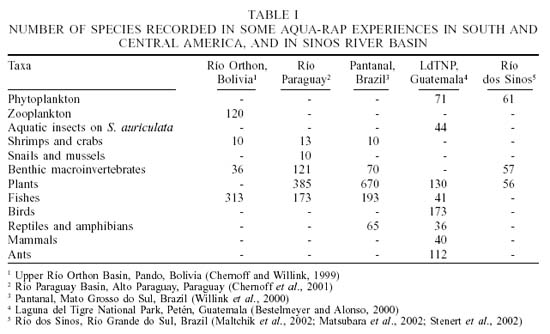
<body><![CDATA[<p style="margin-top: 0px; margin-bottom: 0px" align="justify"> <font face="Verdana" size="2"><span lang="EN-US">The South American Aquatic  Rapid Assessment Program (Aqua-Rap) was a multidisciplinary program devoted to  identify conservation priorities and sustainable management opportunities in  freshwater ecosystems in Latin America (Willink <i>et al.</i>, 2000). Aqua-  Rap´s main focus was to assess the biological value of selected tropical  freshwater ecosystems through rapid inventories, and to report the information  quickly to local policy makers, conservationists, scientists and international  funding agencies. The studies can be useful for the establishment of  conservation policies for biodiversity in tropical lands for two reasons: the  high biodiversity values have been poorly assessed, and there is a lack of  experts able to identify the taxa down to species level (Barbosa and Callisto,  2000). Aqua-Rap experiences (<a href="#tabl1">see Table I</a>) were carried out at the upper Orthon  river Basin (Tahuamano and Nareuda rivers) in the Bolivian Amazon area in 1996 (Chernoff  and Willink, 1999), the Paraguay river basin (covering a considerable area of  the Chaco) in 1997 (Chernoff <i>et al.</i>, 2001), Pantanal, Mato Grosso do Sul,  Brazil in 1998 (Willink <i>et al.</i>, 2000), and Laguna del Tigre National  Park, Petén-Guatemala in 1999 (Bestelmeyer and Alonso, 2000). Other studies have  been carried out in the Pastaza river basin, Ecuador- Peru, in 1999  (Conservation International, 2004), and the Caura River Basin, Venezuela, in  2000 (Chernoff <i>et al.</i>, 2003). These areas were evaluated and selected for  further detailed studies (Barbosa and Callisto, 2000). The Aqua-Rap experiences  concentrated mainly in the assessment of freshwater biodiversity in selected  areas of high biodiversity and low scientific knowledge, and it has never been  used to test ecological theories.</span></font></p>     <p style="margin-top: 0px; margin-bottom: 0px" align="justify">&nbsp;</p>     <p style="margin-top: 0px; margin-bottom: 0px" align="justify"><a name="tabl1"> </a></p>     <p style="margin-top: 0px; margin-bottom: 0px" align="center"> <font face="Verdana" size="2"><span lang="EN-US"> <img src="/img/fbpe/inci/v29n4/art9tabla1.jpg" width="550" height="334"></span></font></p>     
<p style="margin-top: 0px; margin-bottom: 0px" align="justify">&nbsp;</p>     <p style="margin-top: 0px; margin-bottom: 0px" align="justify"> <font face="Verdana" size="2"><span lang="EN-US">&nbsp;</span></font></p>     <p style="margin-top: 0px; margin-bottom: 0px" align="justify"> <font face="Verdana" size="2"><span lang="EN-US">In North America there has been  a renewed interest in the use of rapid assessment approaches, primarily because  of the high economic and time costs of quantitative approaches. The purpose is  to identify water quality problems associated with both point and non-point  source pollution and to document long-term regional changes in water quality (Resh  and Jackson, 1993). A similar approach is being used also to assess status of  fish communities (Plafkin <i>et al.</i>, 1989; Chernoff <i>et al.</i>, 2004).  Resh and Jackson (1993) proposed some ways to reduce the cost of the effort in  assessing environmental conditions at a site: 1) the number of habitats sampled  and replicate sample units taken per habitat are reduced; 2) less silt and  particulate debris are collected, which makes sorting easier and faster; 3) only  a fraction of the animals collected is considered, which means fewer have to be  identified; or (4) specimens are identified to family or even higher taxonomic  levels.</span></font></p>     <p style="margin-top: 0px; margin-bottom: 0px" align="justify"> <font face="Verdana" size="2"><span lang="EN-US">&nbsp;</span></font></p>     <p style="margin-top: 0px; margin-bottom: 0px" align="justify"> <font face="Verdana" size="2"><span lang="EN-US">The relationship between  species diversity and the size of an ecosystem has been investigated by  biologists. Numerous experiments have developed general theories about the  habitat size in order to construct species-specific regression models (MacArthur  and MacArthur, 1961; Petit and Petit, 1999). Much of this research was conducted  in terrestrial ecosystems (Harris, 1984; Fernández, 1997) and was intended to  produce suggestions of tools for conservation practices and to assess how size,  shape or connection between fragments can influence species diversity.</span></font></p>     <p style="margin-top: 0px; margin-bottom: 0px" align="justify"> <font face="Verdana" size="2"><span lang="EN-US">&nbsp;</span></font></p>     ]]></body>
<body><![CDATA[<p style="margin-top: 0px; margin-bottom: 0px" align="justify"> <font face="Verdana" size="2"><span lang="EN-US">&nbsp;</span></font></p>     <p style="margin-top: 0px; margin-bottom: 0px" align="justify"> <font face="Verdana" size="2"><span lang="EN-US">Wetlands are amongst the most  productive ecosystems on Earth and they are patches of high biological diversity  (Hails, 1996; Barbier <i>et al.</i>, 1997; Tiner, 1999). In this context,  wetlands are important areas for conservation. Wetlands may be seen as natural  ecological islands of freshwater habitats surrounded by terrestrial habitats.  These ecosystems provide excellent opportunities to assess the relationship  between species diversity and ecosystem size in undisturbed areas. In wetlands,  the relationships among species diversity and wetland size have been analyzed  for invertebrates (Lassen, 1975; Broenmark, 1985; Aho, 1978; Allen <i>et al.</i>,  1999), plants (Honnay <i>et al.</i>, 1999; Møller and Rørdam, 1985; Rorslett,  1991), amphibians (Babbit and Tanner, 2000; Houlahan and Findlay, 2003;  Snodgrass <i>et al.</i>, 2000) and birds (Tyser, 1983; Brown and Dinsmore, 1991;  Naugle <i>et al.</i>, 1999; Caziani <i>et al.</i>, 2001; Riffell <i>et al.</i>,  2001). These results have been useful for the establishment of wetland  regulations in the United States (Snodgrass <i>et al.</i>, 2000).</span></font></p>     <p style="margin-top: 0px; margin-bottom: 0px" align="justify"> <font face="Verdana" size="2"><span lang="EN-US">&nbsp;</span></font></p>     <p style="margin-top: 0px; margin-bottom: 0px" align="justify"> <font face="Verdana" size="2"><span lang="EN-US">Recent biodiversity surveys of  algae (Matsubara <i>et al.</i>, 2002), macrophytes (Maltchik <i>et al.</i>,  2002) and macroinvertebrates (Stenert <i>et al.</i>, 2002) were carried out in  the Sinos river basin, southern Brazil, using the Aqua-Rap Program. A total of  24 wetlands were selected in the Río dos Sinos basin (~4000km2), with different  areas (between 0.25 and &gt;10ha) and wetland classes (shallow lakes, floodplain  systems, bogs and marshes). The sampled wetlands constitute a great part of the  wetland classes in southern Brazil, and they may be flooded permanently,  periodically, or never flooded but saturated for extended periods during the  annual cycle. The hydrology of the majority of the sampled wetlands was affected  by precipitation, runoff, groundwater discharge and flooding from the streams  and rivers in different combinations.</span></font></p>     <p style="margin-top: 0px; margin-bottom: 0px" align="justify"> <font face="Verdana" size="2"><span lang="EN-US">&nbsp;</span></font></p>     <p style="margin-top: 0px; margin-bottom: 0px" align="justify"> <font face="Verdana" size="2"><span lang="EN-US">The selection of wetlands in  these studies (biodiversity survey through Aqua-Rap approach) was fundamental to  discuss ecological theories, such as the relationships between biodiversity and  the size of the ecosystem. The difference in sizes, altitude and classes of the  selected wetlands allowed establishing regression lines between the wetland size  and the richness of algae, macrophyte and macroinvertebrates. The results  provided criteria for the conservation policy in the Sinos river basin.</span></font></p>     <p style="margin-top: 0px; margin-bottom: 0px" align="justify"> <font face="Verdana" size="2"><span lang="EN-US">&nbsp;</span></font></p>     <p style="margin-top: 0px; margin-bottom: 0px" align="center">&nbsp;</p>     <p style="margin-top: 0px; margin-bottom: 0px" align="justify"> <font face="Verdana" size="2"><span lang="EN-US">&nbsp;</span></font></p>     <p style="margin-top: 0px; margin-bottom: 0px" align="justify"> <font face="Verdana" size="2"><span lang="EN-US">Samplings were carried out from  August to November 2001. The samplings of algae, macrophytes and  macroinvertebrates were qualitative, to identify more precisely the total  biodiversity of the studied ecosystem. However, the time spent for collections  varied between 20 and 70 minutes, depending on the wetland area. The sampling  was performed along the whole wetland area and distributed throughout the  various habitats (water depth and distance from the margins). The sampling  effort carried out among the different wetlands areas was sufficient to search  through the edges and the major part of the different habitats, and to compare  the differences in species richness.</span></font></p>     ]]></body>
<body><![CDATA[<p style="margin-top: 0px; margin-bottom: 0px" align="justify"> <font face="Verdana" size="2"><span lang="EN-US">&nbsp;</span></font></p>     <p style="margin-top: 0px; margin-bottom: 0px" align="justify"> <font face="Verdana" size="2"><span lang="EN-US">Only the richness of  macrophytes was positively correlated to the size of the wetlands; that of algae  and macroinvertebrates was not influenced by the size of the wetlands (<a href="#fig1">Figure  1</a>). The poor relationships to algae and macroinvertebrates richness was probably  due to the high species richness found in wetlands of small areas. These results  were important to include small wetlands in the conservation programs in  southern Brazil (Maltchik <i>et al.</i>, 2003).</span></font></p>     <p style="margin-top: 0px; margin-bottom: 0px" align="justify"><a name="fig1"> </a></p>     <p style="margin-top: 0px; margin-bottom: 0px" align="justify">&nbsp;</p>     <p style="margin-top: 0px; margin-bottom: 0px" align="center"> <font face="Verdana" size="2"><span lang="EN-US"> <img src="/img/fbpe/inci/v29n4/art9figura1.jpg" width="550" height="254"></span></font></p>     
<p style="margin-top: 0px; margin-bottom: 0px" align="justify"> <font face="Verdana" size="2"><span lang="EN-US">&nbsp;</span></font></p>     <p style="margin-top: 0px; margin-bottom: 0px" align="justify"> <font face="Verdana" size="2"><span lang="EN-US">The different regression lines  found for aquatic macrophytes, algae and macroinvertebrates corroborate the  importance of the inclusion of different biological communities to test  ecological theories and the weakness of the conservation strategies originated  from studies that analyze only a small part of the whole biodiversity. Chernoff <i>et al. </i>(2004) stated that the strategies for conservation of wetlands  should ideally be based upon as many groups of organisms as possible, including  information of their distributions and their biotic and abiotic interactions.  Findlay and Houlahan (1997), Semlitsch and Bodie (1998) and Oertli <i>et al. </i> (2002) analyzed the effect of area on species richness using different groups of  organisms. In the tropical region, the biodiversity surveys including results of  several organism groups are scarce (Willink <i>et al.</i>, 2000), probably due  to the lack of specialists needed to identify some organism groups at a specific  level, as is the case with aquatic macroinvertebrates.</span></font></p>     <p style="margin-top: 0px; margin-bottom: 0px" align="justify"> <font face="Verdana" size="2"><span lang="EN-US">&nbsp;</span></font></p>     <p style="margin-top: 0px; margin-bottom: 0px" align="justify"> <font face="Verdana" size="2"><span lang="EN-US">Studies carried out in a  shallow lake associated to a floodplain system in the Sinos river basin showed  that the richness of algae (Maltchik <i>et al.</i>, 2004a), macrophytes (Maltchik <i>et al.</i>, 2004b) and macroinvertebrates (Stenert <i>et al.</i>, 2003)  varied along an annual cycle. However, the number of macrophyte and  macroinvertebrate species found were much smaller than the diversity found in  the sampled wetlands in the Sinos river basin (<a href="#tabl2">Table II</a>). For algae, the result  was inverse, with a larger number of algae genera identified in the shallow lake  along an annual cycle. These results indicate that, depending on the analyzed  group, the species oscillations through the year may express a larger or smaller  importance in the biodiversity surveys. However, we are convinced that these  results suggest the efficiency of the RAP approach in recognizing the biological  diversity in the wetlands of southern Brazil.</span></font></p>     <p style="margin-top: 0px; margin-bottom: 0px" align="justify"><a name="tabl2"> </a></p>     ]]></body>
<body><![CDATA[<p style="margin-top: 0px; margin-bottom: 0px" align="center"> <font face="Verdana" size="2"><span lang="EN-US"> <img src="/img/fbpe/inci/v29n4/art8tabla2.jpg" width="407" height="872"></span></font></p>     
<p style="margin-top: 0px; margin-bottom: 0px" align="justify">&nbsp;</p>     <p style="margin-top: 0px; margin-bottom: 0px" align="justify">&nbsp;</p>     <p style="margin-top: 0px; margin-bottom: 0px" align="justify"> <font face="Verdana" size="2"><span lang="EN-US">&nbsp;</span></font></p>     <p style="margin-top: 0px; margin-bottom: 0px" align="justify"> <font face="Verdana" size="2"><span lang="EN-US">Our experience with the Rap  approach in the analysis of ecological studies was satisfactory. The results  gave some scientific support to launch new studies involving the relationships  between biodiversity and wetland area, at a larger spatial scale, especially  considering the total area of the State of the Río Grande do Sul (~250000km2).  However, our field experience led to several considerations as to the  relationships between species richness and wetland size through the Aqua-Rap  approach, which must be highlighted: 1) the need for qualitative sampling to  obtain better representations of the biological diversity; 2) the use of the  sample effort as a comparative measurement of the biological diversity among  wetlands; 3) finding the most appropriate time for sampling the individual  wetlands in order to go through the whole wetland area (various habitats) and to  compare the differences among the species richness; and 4) outlining the  sampling procedure in wetlands with sizes above 10ha.</span></font></p>     <p style="margin-top: 0px; margin-bottom: 0px" align="justify"> <font face="Verdana" size="2"><span lang="EN-US">&nbsp;</span></font></p>     <p style="margin-top: 0px; margin-bottom: 0px" align="justify"> <font face="Verdana" size="2"><span lang="EN-US">Finally, it is of paramount  importance to summarize the results of site surveys in a way that they can be  understood by non-specialists such as managers, other decisionmakers, and the  concerned public. Moreover, the rapid assessment approach can help in the  definition of new Conservation Units, involving the partnership among the  scientific community (which makes available the information related to the  biodiversity inventories), the government and the local society (Primack and  Rodrigues, 2001). However, a rapid expedition is not a substitute for long-term  scientific studies, mainly for some specific groups where the seasonal  variations throughout the year are very high (as in algae). Besides, the  ecological fragility of wetlands (Callisto <i>et al</i>, 1998), the urgent need  for the implementation of efficient conservation policies and the monitoring  species diversity indicators must be pointed out (Cavalcanti, 1999). Future  scientific surveys must consider the biological and conservation value of a  region, and how integrated solutions can work in order to preserve the maximum  amount of biodiversity in face of current and future threats (Willink <i>et al.</i>,  2000).</span></font></p>     <p style="margin-top: 0px; margin-bottom: 0px" align="justify"> <font face="Verdana" size="2"><span lang="EN-US">&nbsp;</span></font></p>     <p style="margin-top: 0px; margin-bottom: 0px" align="justify"> <font face="Verdana" size="2"><b><span lang="EN-US">ACKNOWLEDGEMENTS</span></b></font></p>     <p style="margin-top: 0px; margin-bottom: 0px" align="justify"> <font face="Verdana" size="2"><b><span lang="EN-US">&nbsp;</span></b></font></p>     ]]></body>
<body><![CDATA[<p style="margin-top: 0px; margin-bottom: 0px" align="justify"> <font face="Verdana" size="2"><span lang="EN-US">The authors are grateful to  Cristina Stenert, Ana Silva Rolon, Edison dos Santos and Carla Matsubara for  their technical assistance. This study was supported by CNPq, CAPES and UNISINOS.</span></font></p>     <p style="margin-top: 0px; margin-bottom: 0px" align="justify"> <font face="Verdana" size="2"><span lang="EN-US">&nbsp;</span></font></p>     <p style="margin-top: 0px; margin-bottom: 0px" align="justify"> <font face="Verdana" size="2"><b><span lang="EN-US">REFERENCES</span></b></font></p>     <p style="margin-top: 0px; margin-bottom: 0px" align="justify"> <font face="Verdana" size="2"><b><span lang="EN-US">&nbsp;</span></b></font></p>     <!-- ref --><p style="margin-top: 0px; margin-bottom: 0px" align="justify"> <font face="Verdana" size="2"><span lang="EN-US">1. Aho J (1978) Freshwater  snail populations and the theory of island biogeography. I. A case study in  southern Finland. <i>Ann. Zool. Fennici 15</i>: 146-154.</span></font>&nbsp;&nbsp;&nbsp;&nbsp;&nbsp;&nbsp;&nbsp;&nbsp;[&#160;<a href="javascript:void(0);" onclick="javascript: window.open('/scielo.php?script=sci_nlinks&ref=982688&pid=S0378-1844200400040001000001&lng=','','width=640,height=500,resizable=yes,scrollbars=1,menubar=yes,');">Links</a>&#160;]<!-- end-ref --><p style="margin-top: 0px; margin-bottom: 0px" align="justify"> <font face="Verdana" size="2"><span lang="EN-US">&nbsp;</span></font></p>     <!-- ref --><p style="margin-top: 0px; margin-bottom: 0px" align="justify"> <font face="Verdana"><span lang="EN-US"><font size="2">2. Allen AP, Whittier TR,  Kaufmann PR, Larsen DP, O’Connor RJ, Hughes RM, Stemberger RS, Dixit SS,  Brinkhurst RO, Herlihy AT, Paulsen SG (1999) Concordance of taxonomic richness  patterns across multiple assemblages in lakes of the northeastern United States. </font></span><i><span lang="EN-US"><font size="2">Can. J. Fisheries Aquatic  Scie. 56</font></span></i><span lang="EN-US"><font size="2">: 739-747.</font></span></font>&nbsp;&nbsp;&nbsp;&nbsp;&nbsp;&nbsp;&nbsp;&nbsp;[&#160;<a href="javascript:void(0);" onclick="javascript: window.open('/scielo.php?script=sci_nlinks&ref=982690&pid=S0378-1844200400040001000002&lng=','','width=640,height=500,resizable=yes,scrollbars=1,menubar=yes,');">Links</a>&#160;]<!-- end-ref --><p style="margin-top: 0px; margin-bottom: 0px" align="justify"> <font face="Verdana" size="2"><span lang="EN-US">&nbsp;</span></font></p>     <!-- ref --><p style="margin-top: 0px; margin-bottom: 0px" align="justify"> <font face="Verdana" size="2"><span lang="EN-US">3. Babbitt KJ, Tanner GW (2000)  Use of temporary wetlands by anurans in a hydrologically modified landscape. <i> Wetlands 20</i>: 313-322.</span></font>&nbsp;&nbsp;&nbsp;&nbsp;&nbsp;&nbsp;&nbsp;&nbsp;[&#160;<a href="javascript:void(0);" onclick="javascript: window.open('/scielo.php?script=sci_nlinks&ref=982692&pid=S0378-1844200400040001000003&lng=','','width=640,height=500,resizable=yes,scrollbars=1,menubar=yes,');">Links</a>&#160;]<!-- end-ref --><p style="margin-top: 0px; margin-bottom: 0px" align="justify"> <font face="Verdana" size="2"><span lang="EN-US">&nbsp;</span></font></p>     ]]></body>
<body><![CDATA[<!-- ref --><p style="margin-top: 0px; margin-bottom: 0px" align="justify"> <font face="Verdana" size="2"><span lang="EN-US">4. Barbier EB, Acreman MC,  Knowler D (1997) <i>Economic valuation of wetlands: a guide for policy makers  and planners. </i>Ramsar Convention Bureau. Gland, Switzerland. 127 pp.</span></font>&nbsp;&nbsp;&nbsp;&nbsp;&nbsp;&nbsp;&nbsp;&nbsp;[&#160;<a href="javascript:void(0);" onclick="javascript: window.open('/scielo.php?script=sci_nlinks&ref=982694&pid=S0378-1844200400040001000004&lng=','','width=640,height=500,resizable=yes,scrollbars=1,menubar=yes,');">Links</a>&#160;]<!-- end-ref --><p style="margin-top: 0px; margin-bottom: 0px" align="justify"> <font face="Verdana" size="2"><span lang="EN-US">&nbsp;</span></font></p>     <!-- ref --><p style="margin-top: 0px; margin-bottom: 0px" align="justify"> <font face="Verdana" size="2"><span lang="EN-US">5. Barbosa FAR, Callisto M  (2000) Rapid assessment of water quality and diversity of benthic  macroinvertebrates in upper and middle Paraguay River using the Aqua-Rap  approach. <i>Internat. Verein. Theoret. Angew. Limnol. 27</i>: 2688-2692.</span></font>&nbsp;&nbsp;&nbsp;&nbsp;&nbsp;&nbsp;&nbsp;&nbsp;[&#160;<a href="javascript:void(0);" onclick="javascript: window.open('/scielo.php?script=sci_nlinks&ref=982696&pid=S0378-1844200400040001000005&lng=','','width=640,height=500,resizable=yes,scrollbars=1,menubar=yes,');">Links</a>&#160;]<!-- end-ref --><p style="margin-top: 0px; margin-bottom: 0px" align="justify"> <font face="Verdana" size="2"><span lang="EN-US">&nbsp;</span></font></p>     <!-- ref --><p style="margin-top: 0px; margin-bottom: 0px" align="justify"> <font face="Verdana"><span lang="EN-US"><font size="2">6. Bestelmeyer BT, Alonso  LE (2000) </font><i><font size="2">A biological assessment of Laguna del Tigre  National Park, </font></i></span><i><span lang="EN-US"><font size="2">Petén,  Guatemala</font></span></i><span lang="EN-US"><font size="2">. RAP Bulletin of  Biological Assessment Nº16. 221 pp.</font></span></font>&nbsp;&nbsp;&nbsp;&nbsp;&nbsp;&nbsp;&nbsp;&nbsp;[&#160;<a href="javascript:void(0);" onclick="javascript: window.open('/scielo.php?script=sci_nlinks&ref=982698&pid=S0378-1844200400040001000006&lng=','','width=640,height=500,resizable=yes,scrollbars=1,menubar=yes,');">Links</a>&#160;]<!-- end-ref --><p style="margin-top: 0px; margin-bottom: 0px" align="justify"> <font face="Verdana" size="2"><span lang="EN-US">&nbsp;</span></font></p>     <!-- ref --><p style="margin-top: 0px; margin-bottom: 0px" align="justify"> <font face="Verdana" size="2"><span lang="EN-US">7. Broenmark C (1985)  Freshwater snail diversity: effects of pond area, habitat heterogeneity and  isolation. <i>Oecologia 67</i>: 127- 131.</span></font>&nbsp;&nbsp;&nbsp;&nbsp;&nbsp;&nbsp;&nbsp;&nbsp;[&#160;<a href="javascript:void(0);" onclick="javascript: window.open('/scielo.php?script=sci_nlinks&ref=982700&pid=S0378-1844200400040001000007&lng=','','width=640,height=500,resizable=yes,scrollbars=1,menubar=yes,');">Links</a>&#160;]<!-- end-ref --><p style="margin-top: 0px; margin-bottom: 0px" align="justify"> <font face="Verdana" size="2"><span lang="EN-US">&nbsp;</span></font></p>     <!-- ref --><p style="margin-top: 0px; margin-bottom: 0px" align="justify"> <font face="Verdana"><span lang="EN-US"><font size="2">8. Brown M, Dinsmore JJ  (1991) Area-dependent changes in bird densities in Iowa marshes. </font></span> <i><font size="2">J. Iowa Acad. Sci. 98</font></i><font size="2">: 124-126.</font></font>&nbsp;&nbsp;&nbsp;&nbsp;&nbsp;&nbsp;&nbsp;&nbsp;[&#160;<a href="javascript:void(0);" onclick="javascript: window.open('/scielo.php?script=sci_nlinks&ref=982702&pid=S0378-1844200400040001000008&lng=','','width=640,height=500,resizable=yes,scrollbars=1,menubar=yes,');">Links</a>&#160;]<!-- end-ref --><p style="margin-top: 0px; margin-bottom: 0px" align="justify"> <font face="Verdana" size="2">&nbsp;</font></p>     ]]></body>
<body><![CDATA[<!-- ref --><p style="margin-top: 0px; margin-bottom: 0px" align="justify"> <font face="Verdana"><span lang="EN-US"><font size="2">9. Callisto M, Esteves  FA, Gonçalves JFJr, Fonseca JJL (1998) Benthic macroinvertebrates as indicators  of ecological fragility of small rivers (“igarapés”) in a bauxite mining region  of Brazilian Amazonia. </font></span><i><font size="2">Amazoniana 15</font></i><font size="2">:  1-9.</font></font>&nbsp;&nbsp;&nbsp;&nbsp;&nbsp;&nbsp;&nbsp;&nbsp;[&#160;<a href="javascript:void(0);" onclick="javascript: window.open('/scielo.php?script=sci_nlinks&ref=982704&pid=S0378-1844200400040001000009&lng=','','width=640,height=500,resizable=yes,scrollbars=1,menubar=yes,');">Links</a>&#160;]<!-- end-ref --><p style="margin-top: 0px; margin-bottom: 0px" align="justify"> <font face="Verdana" size="2">&nbsp;</font></p>     <!-- ref --><p style="margin-top: 0px; margin-bottom: 0px" align="justify"> <font face="Verdana" size="2">10. Cavalcanti RB (1999) <i>Ações prioritárias  para a conservação da biodiversidade do cerrado e pantanal. </i>Conservation  International do Brasil. Belo Horizonte, Brazil. 26 pp.</font>&nbsp;&nbsp;&nbsp;&nbsp;&nbsp;&nbsp;&nbsp;&nbsp;[&#160;<a href="javascript:void(0);" onclick="javascript: window.open('/scielo.php?script=sci_nlinks&ref=982706&pid=S0378-1844200400040001000010&lng=','','width=640,height=500,resizable=yes,scrollbars=1,menubar=yes,');">Links</a>&#160;]<!-- end-ref --><p style="margin-top: 0px; margin-bottom: 0px" align="justify"> <font face="Verdana" size="2">&nbsp;</font></p>     <!-- ref --><p style="margin-top: 0px; margin-bottom: 0px" align="justify"> <font face="Verdana" size="2"><span lang="EN-US">11. Caziani SM, Derlindati EJ,  Talamo A, Sureda AL, Trucco CE, Nicolossi G (2001) Waterbird Richness in  Altiplano Wetlands of Northwestern Argentina. <i>Waterbirds 24</i>: 103-117.</span></font>&nbsp;&nbsp;&nbsp;&nbsp;&nbsp;&nbsp;&nbsp;&nbsp;[&#160;<a href="javascript:void(0);" onclick="javascript: window.open('/scielo.php?script=sci_nlinks&ref=982708&pid=S0378-1844200400040001000011&lng=','','width=640,height=500,resizable=yes,scrollbars=1,menubar=yes,');">Links</a>&#160;]<!-- end-ref --><p style="margin-top: 0px; margin-bottom: 0px" align="justify"> <font face="Verdana" size="2"><span lang="EN-US">&nbsp;</span></font></p>     <!-- ref --><p style="margin-top: 0px; margin-bottom: 0px" align="justify"> <font face="Verdana" size="2"><span lang="EN-US">12. Chernoff B, Willink PW  (1999) <i>A biological assessment of the aquatic ecosystems of the upper Río  Orthon basin, Pando, Bolívia</i>. RAP Bulletin of Biological Assessment Nº15.  145 pp.</span></font>&nbsp;&nbsp;&nbsp;&nbsp;&nbsp;&nbsp;&nbsp;&nbsp;[&#160;<a href="javascript:void(0);" onclick="javascript: window.open('/scielo.php?script=sci_nlinks&ref=982710&pid=S0378-1844200400040001000012&lng=','','width=640,height=500,resizable=yes,scrollbars=1,menubar=yes,');">Links</a>&#160;]<!-- end-ref --><p style="margin-top: 0px; margin-bottom: 0px" align="justify"> <font face="Verdana" size="2"><span lang="EN-US">&nbsp;</span></font></p>     <!-- ref --><p style="margin-top: 0px; margin-bottom: 0px" align="justify"> <font face="Verdana"><span lang="EN-US"><font size="2">13. Chernoff B, Barriga  R, Forsyth A, Foster R, Leon B, Machado- Allison A, Magalhães C, Menezes N,  Moskovits D, Hortega H, Sarmiento J (1996) </font><i><font size="2">Aqua- Rap.  Rapid Assessment Program for the Conservation of Aquatic Ecosystems in </font> </i></span><i><span lang="EN-US"><font size="2">Latin America. </font></span> </i><span lang="EN-US"><font size="2">Mimeo. 8 pp. + Annex.</font></span></font>&nbsp;&nbsp;&nbsp;&nbsp;&nbsp;&nbsp;&nbsp;&nbsp;[&#160;<a href="javascript:void(0);" onclick="javascript: window.open('/scielo.php?script=sci_nlinks&ref=982712&pid=S0378-1844200400040001000013&lng=','','width=640,height=500,resizable=yes,scrollbars=1,menubar=yes,');">Links</a>&#160;]<!-- end-ref --><p style="margin-top: 0px; margin-bottom: 0px" align="justify"> <font face="Verdana" size="2"><span lang="EN-US">&nbsp;</span></font></p>     ]]></body>
<body><![CDATA[<!-- ref --><p style="margin-top: 0px; margin-bottom: 0px" align="justify"> <font face="Verdana"><span lang="EN-US"><font size="2">14. Chernoff, B, Willink  PW, Montambault JR (2001) </font><i><font size="2">A biological assessment of  the aquatic ecosystems of the </font></i></span><i><span lang="EN-US"> <font size="2">Río Paraguay Basin, alto Paraguay, Paraguay</font></span></i><span lang="EN-US"><font size="2">.  Rap Bulletin of Biological Assessment Nº19. 156 pp.</font></span></font>&nbsp;&nbsp;&nbsp;&nbsp;&nbsp;&nbsp;&nbsp;&nbsp;[&#160;<a href="javascript:void(0);" onclick="javascript: window.open('/scielo.php?script=sci_nlinks&ref=982714&pid=S0378-1844200400040001000014&lng=','','width=640,height=500,resizable=yes,scrollbars=1,menubar=yes,');">Links</a>&#160;]<!-- end-ref --><p style="margin-top: 0px; margin-bottom: 0px" align="justify"> <font face="Verdana" size="2"><span lang="EN-US">&nbsp;</span></font></p>     <!-- ref --><p style="margin-top: 0px; margin-bottom: 0px" align="justify"> <font face="Verdana"><span lang="EN-US"><font size="2">15. Chernoff B,  Machado-Allison A, Riseng K, Montambault JR (2003) </font><i><font size="2">RAP  28: A Biological Assessment of the Aquatic Ecosystems of the </font></i></span> <i><span lang="EN-US"><font size="2">Caura River Basin, Bolivar State,  Venezuela. </font></span></i><span lang="EN-US"><font size="2">RAP Bulletin of  Biological Assessment Nº28. 284 pp.</font></span></font>&nbsp;&nbsp;&nbsp;&nbsp;&nbsp;&nbsp;&nbsp;&nbsp;[&#160;<a href="javascript:void(0);" onclick="javascript: window.open('/scielo.php?script=sci_nlinks&ref=982716&pid=S0378-1844200400040001000015&lng=','','width=640,height=500,resizable=yes,scrollbars=1,menubar=yes,');">Links</a>&#160;]<!-- end-ref --><p style="margin-top: 0px; margin-bottom: 0px" align="justify"> <font face="Verdana" size="2"><span lang="EN-US">&nbsp;</span></font></p>     <!-- ref --><p style="margin-top: 0px; margin-bottom: 0px" align="justify"> <font face="Verdana"><span lang="EN-US"><font size="2">16. Chernoff B, Willink  PW, Machado- Allison A, Mereles MF, Magalhães C, Barbosa FAR, Callisto M (2004)  Congruence of diversity patterns among fishes, invertebrates and aquatic plants  within the Río Paraguay Basin, Paraguay. </font></span><i><font size="2"> Interciência 29</font></i><font size="2">: 199-206.</font></font>&nbsp;&nbsp;&nbsp;&nbsp;&nbsp;&nbsp;&nbsp;&nbsp;[&#160;<a href="javascript:void(0);" onclick="javascript: window.open('/scielo.php?script=sci_nlinks&ref=982718&pid=S0378-1844200400040001000016&lng=','','width=640,height=500,resizable=yes,scrollbars=1,menubar=yes,');">Links</a>&#160;]<!-- end-ref --><p style="margin-top: 0px; margin-bottom: 0px" align="justify"> <font face="Verdana" size="2">&nbsp;</font></p>     <!-- ref --><p style="margin-top: 0px; margin-bottom: 0px" align="justify"> <font face="Verdana"><font size="2">17. Conservation International (2004)  Preliminary Report. www. biodiversityscience.org/xp/ CABS/research/rap/aquarap/  aquarap.xml Fernández FAS (1997) Efeitos da fragmentação de ecossistemas: A  situação das unidades de conservação. </font><i><font size="2">Anais do  Congresso Brasileiro de Unidades </font><span lang="EN-US"><font size="2">de  Conservação 1</font></span></i><span lang="EN-US"><font size="2">: 48-68.</font></span></font>&nbsp;&nbsp;&nbsp;&nbsp;&nbsp;&nbsp;&nbsp;&nbsp;[&#160;<a href="javascript:void(0);" onclick="javascript: window.open('/scielo.php?script=sci_nlinks&ref=982720&pid=S0378-1844200400040001000017&lng=','','width=640,height=500,resizable=yes,scrollbars=1,menubar=yes,');">Links</a>&#160;]<!-- end-ref --><p style="margin-top: 0px; margin-bottom: 0px" align="justify"> <font face="Verdana" size="2"><span lang="EN-US">&nbsp;</span></font></p>     <!-- ref --><p style="margin-top: 0px; margin-bottom: 0px" align="justify"> <font face="Verdana" size="2"><span lang="EN-US">18. Findlay SC, Houlahan J  (1997) Anthropogenic correlates of biodiversity in southeastern Ontario  wetlands. <i>Conserv. Biol. 11</i>: 1000-1009.</span></font>&nbsp;&nbsp;&nbsp;&nbsp;&nbsp;&nbsp;&nbsp;&nbsp;[&#160;<a href="javascript:void(0);" onclick="javascript: window.open('/scielo.php?script=sci_nlinks&ref=982722&pid=S0378-1844200400040001000018&lng=','','width=640,height=500,resizable=yes,scrollbars=1,menubar=yes,');">Links</a>&#160;]<!-- end-ref --><p style="margin-top: 0px; margin-bottom: 0px" align="justify"> <font face="Verdana" size="2"><span lang="EN-US">&nbsp;</span></font></p>     ]]></body>
<body><![CDATA[<!-- ref --><p style="margin-top: 0px; margin-bottom: 0px" align="justify"> <font face="Verdana" size="2"><span lang="EN-US">19. Hails AJ (1996) <i> Wetlands, biodiversity and Ramsar Convention: the role of the convention  wetlands in the conservation and wise use of biodiversity. </i>Ramsar Convention  Bureau. Gland, Switzerland. 196 pp.</span></font>&nbsp;&nbsp;&nbsp;&nbsp;&nbsp;&nbsp;&nbsp;&nbsp;[&#160;<a href="javascript:void(0);" onclick="javascript: window.open('/scielo.php?script=sci_nlinks&ref=982724&pid=S0378-1844200400040001000019&lng=','','width=640,height=500,resizable=yes,scrollbars=1,menubar=yes,');">Links</a>&#160;]<!-- end-ref --><p style="margin-top: 0px; margin-bottom: 0px" align="justify"> <font face="Verdana" size="2"><span lang="EN-US">&nbsp;</span></font></p>     <!-- ref --><p style="margin-top: 0px; margin-bottom: 0px" align="justify"> <font face="Verdana"><span lang="EN-US"><font size="2">20. Harris LD (1984) </font><i><font size="2">The Fragmented </font></i></span><i><span lang="EN-US"> <font size="2">Forest: Island Biogeographic Theory and the Preservation of  Biotic Diversity. </font></span></i><span lang="EN-US"><font size="2">Chicago  University Press. Chicago, USA. 211 pp.</font></span></font>&nbsp;&nbsp;&nbsp;&nbsp;&nbsp;&nbsp;&nbsp;&nbsp;[&#160;<a href="javascript:void(0);" onclick="javascript: window.open('/scielo.php?script=sci_nlinks&ref=982726&pid=S0378-1844200400040001000020&lng=','','width=640,height=500,resizable=yes,scrollbars=1,menubar=yes,');">Links</a>&#160;]<!-- end-ref --><p style="margin-top: 0px; margin-bottom: 0px" align="justify"> <font face="Verdana" size="2"><span lang="EN-US">&nbsp;</span></font></p>     <!-- ref --><p style="margin-top: 0px; margin-bottom: 0px" align="justify"> <font face="Verdana" size="2"><span lang="EN-US">21. Honnay O, Hermy M, Coppin P  (1999) Effect of area, age and diversity of forest patches in Belgium on plant  species richness, and implications for conservation and reforestation. <i>Biol.  Conserv. 87</i>: 73-84.</span></font>&nbsp;&nbsp;&nbsp;&nbsp;&nbsp;&nbsp;&nbsp;&nbsp;[&#160;<a href="javascript:void(0);" onclick="javascript: window.open('/scielo.php?script=sci_nlinks&ref=982728&pid=S0378-1844200400040001000021&lng=','','width=640,height=500,resizable=yes,scrollbars=1,menubar=yes,');">Links</a>&#160;]<!-- end-ref --><p style="margin-top: 0px; margin-bottom: 0px" align="justify"> <font face="Verdana" size="2"><span lang="EN-US">&nbsp;</span></font></p>     <!-- ref --><p style="margin-top: 0px; margin-bottom: 0px" align="justify"> <font face="Verdana"><span lang="EN-US"><font size="2">22. Houlahan JE, Findlay  CS (2003) The effects of adjacent land use on wetland amphibian species richness  and community composition. </font></span><i><span lang="EN-US"><font size="2"> Can. J. Fisheries Aquatic Sci. 60</font></span></i><span lang="EN-US"><font size="2">:  1078-1094.</font></span></font>&nbsp;&nbsp;&nbsp;&nbsp;&nbsp;&nbsp;&nbsp;&nbsp;[&#160;<a href="javascript:void(0);" onclick="javascript: window.open('/scielo.php?script=sci_nlinks&ref=982730&pid=S0378-1844200400040001000022&lng=','','width=640,height=500,resizable=yes,scrollbars=1,menubar=yes,');">Links</a>&#160;]<!-- end-ref --><p style="margin-top: 0px; margin-bottom: 0px" align="justify"> <font face="Verdana" size="2"><span lang="EN-US">&nbsp;</span></font></p>     <!-- ref --><p style="margin-top: 0px; margin-bottom: 0px" align="justify"> <font face="Verdana" size="2"><span lang="EN-US">23. Lassen HH (1975) The  diversity of freshwater snails in view of the equilibrium theory of island  biogeography. <i>Oecologia 19</i>: 1-8.</span></font>&nbsp;&nbsp;&nbsp;&nbsp;&nbsp;&nbsp;&nbsp;&nbsp;[&#160;<a href="javascript:void(0);" onclick="javascript: window.open('/scielo.php?script=sci_nlinks&ref=982732&pid=S0378-1844200400040001000023&lng=','','width=640,height=500,resizable=yes,scrollbars=1,menubar=yes,');">Links</a>&#160;]<!-- end-ref --><p style="margin-top: 0px; margin-bottom: 0px" align="justify"> <font face="Verdana" size="2"><span lang="EN-US">&nbsp;</span></font></p>     ]]></body>
<body><![CDATA[<!-- ref --><p style="margin-top: 0px; margin-bottom: 0px" align="justify"> <font face="Verdana" size="2"><span lang="EN-US">24. MacArthur RH, MacArthur J  (1961) On bird species diversity. <i>Ecology 42</i>: 594-598.</span></font>&nbsp;&nbsp;&nbsp;&nbsp;&nbsp;&nbsp;&nbsp;&nbsp;[&#160;<a href="javascript:void(0);" onclick="javascript: window.open('/scielo.php?script=sci_nlinks&ref=982734&pid=S0378-1844200400040001000024&lng=','','width=640,height=500,resizable=yes,scrollbars=1,menubar=yes,');">Links</a>&#160;]<!-- end-ref --><p style="margin-top: 0px; margin-bottom: 0px" align="justify"> <font face="Verdana" size="2"><span lang="EN-US">&nbsp;</span></font></p>     <!-- ref --><p style="margin-top: 0px; margin-bottom: 0px" align="justify"> <font face="Verdana" size="2">25. Maltchik L, Rolon AS, Groth C (2002)  Diversidade de macrófitas aquáticas em áreas úmidas da Bacia do Río dos Sinos,  Río Grande do Sul. <i>Pesquisas: Botânica 52</i>: 143- 154.</font>&nbsp;&nbsp;&nbsp;&nbsp;&nbsp;&nbsp;&nbsp;&nbsp;[&#160;<a href="javascript:void(0);" onclick="javascript: window.open('/scielo.php?script=sci_nlinks&ref=982736&pid=S0378-1844200400040001000025&lng=','','width=640,height=500,resizable=yes,scrollbars=1,menubar=yes,');">Links</a>&#160;]<!-- end-ref --><p style="margin-top: 0px; margin-bottom: 0px" align="justify"> <font face="Verdana" size="2">&nbsp;</font></p>     <p style="margin-top: 0px; margin-bottom: 0px" align="justify"> <font face="Verdana"><span lang="EN-US"><font size="2">26. Maltchik L, Costa ES,  Becker CG, Oliveira AE, (2003) Inventory of wetlands of Río Grande do Sul  (Brazil). </font></span><i><font size="2">Pesquisas: Botânica 53</font></i><font size="2">:  89-100.</font></font></p>     <p style="margin-top: 0px; margin-bottom: 0px" align="justify"> <font face="Verdana" size="2">&nbsp;</font></p>     <!-- ref --><p style="margin-top: 0px; margin-bottom: 0px" align="justify"> <font face="Verdana" size="2"><span lang="EN-US">27. Maltchik L, Avila IR,  Matsubara C, Schott P (2004a) Diversity and stability of phytoplankton in a  shallow lake associated to a floodplain system in the south of the Brazil. <i> Pesquisas: Botânica. </i>(in press).</span></font>&nbsp;&nbsp;&nbsp;&nbsp;&nbsp;&nbsp;&nbsp;&nbsp;[&#160;<a href="javascript:void(0);" onclick="javascript: window.open('/scielo.php?script=sci_nlinks&ref=982740&pid=S0378-1844200400040001000027&lng=','','width=640,height=500,resizable=yes,scrollbars=1,menubar=yes,');">Links</a>&#160;]<!-- end-ref --><p style="margin-top: 0px; margin-bottom: 0px" align="justify"> <font face="Verdana" size="2"><span lang="EN-US">&nbsp;</span></font></p>     <!-- ref --><p style="margin-top: 0px; margin-bottom: 0px" align="justify"> <font face="Verdana" size="2"><span lang="EN-US">28. Maltchik L, Rolon AS, Groth  C (2004b). The Effects of Flood Pulse on the Macrophyte Community in a Shallow  Lake of Southern Brazil. <i>Acta Limnol. Bras. 16: </i>(in press).</span></font>&nbsp;&nbsp;&nbsp;&nbsp;&nbsp;&nbsp;&nbsp;&nbsp;[&#160;<a href="javascript:void(0);" onclick="javascript: window.open('/scielo.php?script=sci_nlinks&ref=982742&pid=S0378-1844200400040001000028&lng=','','width=640,height=500,resizable=yes,scrollbars=1,menubar=yes,');">Links</a>&#160;]<!-- end-ref --><p style="margin-top: 0px; margin-bottom: 0px" align="justify"> <font face="Verdana" size="2"><span lang="EN-US">&nbsp;</span></font></p>     ]]></body>
<body><![CDATA[<!-- ref --><p style="margin-top: 0px; margin-bottom: 0px" align="justify"> <font face="Verdana" size="2">29. Matsubara CP, Maltchick L, Torgan LC (2002)  Diversidade de algas planctônicas e sua relação com o tamanho de área úmida na  Bacia do Río dos Sinos (Río Grande do Sul). <i>Pesquisas: Botânica 52</i>:  155-165.</font>&nbsp;&nbsp;&nbsp;&nbsp;&nbsp;&nbsp;&nbsp;&nbsp;[&#160;<a href="javascript:void(0);" onclick="javascript: window.open('/scielo.php?script=sci_nlinks&ref=982744&pid=S0378-1844200400040001000029&lng=','','width=640,height=500,resizable=yes,scrollbars=1,menubar=yes,');">Links</a>&#160;]<!-- end-ref --><p style="margin-top: 0px; margin-bottom: 0px" align="justify"> <font face="Verdana" size="2">&nbsp;</font></p>     <!-- ref --><p style="margin-top: 0px; margin-bottom: 0px" align="justify"> <font face="Verdana"><span lang="EN-US"><font size="2">30. Mittermeier RA,  Forsyth A (1992) Conservation Priorities: The Role of Rap<i>. </i>In Parker TA,  Carr JL (Eds.) </font><i><font size="2">Rapid Assessment Program: status of  forests remnants in the Cordillera de la Costa and Adjacent Areas of  South-western </font></i></span><i><span lang="EN-US"><font size="2">Ecuador</font></span></i><span lang="EN-US"><font size="2">.  Conservation International. Washington DC, USA. 172 pp.</font></span></font>&nbsp;&nbsp;&nbsp;&nbsp;&nbsp;&nbsp;&nbsp;&nbsp;[&#160;<a href="javascript:void(0);" onclick="javascript: window.open('/scielo.php?script=sci_nlinks&ref=982746&pid=S0378-1844200400040001000030&lng=','','width=640,height=500,resizable=yes,scrollbars=1,menubar=yes,');">Links</a>&#160;]<!-- end-ref --><p style="margin-top: 0px; margin-bottom: 0px" align="justify"> <font face="Verdana" size="2"><span lang="EN-US">&nbsp;</span></font></p>     <!-- ref --><p style="margin-top: 0px; margin-bottom: 0px" align="justify"> <font face="Verdana"><span lang="EN-US"><font size="2">31. Møller TR, Rørdam CP  (1985) Species numbers of vascular plants in relation to area, isolation and age  of ponds in Denmark. </font></span><i><span lang="FR"><font size="2">Oikos 45</font></span></i><span lang="FR"><font size="2">:  8-16.</font></span></font>&nbsp;&nbsp;&nbsp;&nbsp;&nbsp;&nbsp;&nbsp;&nbsp;[&#160;<a href="javascript:void(0);" onclick="javascript: window.open('/scielo.php?script=sci_nlinks&ref=982748&pid=S0378-1844200400040001000031&lng=','','width=640,height=500,resizable=yes,scrollbars=1,menubar=yes,');">Links</a>&#160;]<!-- end-ref --><p style="margin-top: 0px; margin-bottom: 0px" align="justify"> <font face="Verdana" size="2"><span lang="FR">&nbsp;</span></font></p>     <!-- ref --><p style="margin-top: 0px; margin-bottom: 0px" align="justify"> <font face="Verdana"><span lang="EN-US"><font size="2">32. Naugle DE, Higgins KF,  Nusser SM, Johnson WC (1999) Scaledependent habitat use in three species of  prairie wetland birds. </font></span><i><font size="2">Landscape Ecol. 14</font></i><font size="2">:  267-276.</font></font>&nbsp;&nbsp;&nbsp;&nbsp;&nbsp;&nbsp;&nbsp;&nbsp;[&#160;<a href="javascript:void(0);" onclick="javascript: window.open('/scielo.php?script=sci_nlinks&ref=982750&pid=S0378-1844200400040001000032&lng=','','width=640,height=500,resizable=yes,scrollbars=1,menubar=yes,');">Links</a>&#160;]<!-- end-ref --><p style="margin-top: 0px; margin-bottom: 0px" align="justify"> <font face="Verdana" size="2">&nbsp;</font></p>     <!-- ref --><p style="margin-top: 0px; margin-bottom: 0px" align="justify"> <font face="Verdana"><span lang="EN-US"><font size="2">33. Oertli B, Joye DA,  Castella E, Juge R, Cambin D, Lachavanne JB (2002) Does size matter? The  relationship between pond area and biodiversity. </font></span><i> <span lang="FR"><font size="2">Biol. Conserv. 104</font></span></i><span lang="FR"><font size="2">:  59-70.</font></span></font>&nbsp;&nbsp;&nbsp;&nbsp;&nbsp;&nbsp;&nbsp;&nbsp;[&#160;<a href="javascript:void(0);" onclick="javascript: window.open('/scielo.php?script=sci_nlinks&ref=982752&pid=S0378-1844200400040001000033&lng=','','width=640,height=500,resizable=yes,scrollbars=1,menubar=yes,');">Links</a>&#160;]<!-- end-ref --><p style="margin-top: 0px; margin-bottom: 0px" align="justify"> <font face="Verdana" size="2"><span lang="FR">&nbsp;</span></font></p>     ]]></body>
<body><![CDATA[<p style="margin-top: 0px; margin-bottom: 0px" align="justify"> <font face="Verdana" size="2"><span lang="EN-US">34. Petit LJ, Petit DR (1999)  Factors governing habitat selection by Prothonotary Warblers: field tests of  Fretwell-Lucas models. <i>Ecological Monographs 66</i>: 367-387.</span></font></p>     <p style="margin-top: 0px; margin-bottom: 0px" align="justify"> <font face="Verdana" size="2"><span lang="EN-US">&nbsp;</span></font></p>     <!-- ref --><p style="margin-top: 0px; margin-bottom: 0px" align="justify"> <font face="Verdana" size="2"><span lang="EN-US">35. Plafkin JL, Barbour MT,  Porter KD, Gross SK, Hughes RM (1989) <i>Rapid bioassessment protocols for use  in streams and rivers. Benthic macroinvertebrates and fish. </i> EPA/444/4-89/001. Office of Water Regulations and Standards. USEPA. Washington,  DC, USA. 110 pp.</span></font>&nbsp;&nbsp;&nbsp;&nbsp;&nbsp;&nbsp;&nbsp;&nbsp;[&#160;<a href="javascript:void(0);" onclick="javascript: window.open('/scielo.php?script=sci_nlinks&ref=982756&pid=S0378-1844200400040001000035&lng=','','width=640,height=500,resizable=yes,scrollbars=1,menubar=yes,');">Links</a>&#160;]<!-- end-ref --><p style="margin-top: 0px; margin-bottom: 0px" align="justify"> <font face="Verdana" size="2"><span lang="EN-US">&nbsp;</span></font></p>     <!-- ref --><p style="margin-top: 0px; margin-bottom: 0px" align="justify"> <font face="Verdana"><font size="2">36. Primack RB, Rodrigues E (2001) <i> Biología da Conservação</i>. Sinauer. Londrina, Brazil. </font> <span lang="EN-US"><font size="2">328 pp.</font></span></font>&nbsp;&nbsp;&nbsp;&nbsp;&nbsp;&nbsp;&nbsp;&nbsp;[&#160;<a href="javascript:void(0);" onclick="javascript: window.open('/scielo.php?script=sci_nlinks&ref=982758&pid=S0378-1844200400040001000036&lng=','','width=640,height=500,resizable=yes,scrollbars=1,menubar=yes,');">Links</a>&#160;]<!-- end-ref --><p style="margin-top: 0px; margin-bottom: 0px" align="justify"> <font face="Verdana" size="2"><span lang="EN-US">&nbsp;</span></font></p>     <!-- ref --><p style="margin-top: 0px; margin-bottom: 0px" align="justify"> <font face="Verdana" size="2"><span lang="EN-US">37. Resh VH, Jackson JK (1993)  Rapid assessment approaches to biomonitoring using benthic macroinvertebrates.  In Rosenberg DM, Resh VH (Eds.) <i>Freshwater biomonitoring and benthic  macroinvertebrates</i>. Chapman and Hall. New York, USA. pp. 195-233.</span></font>&nbsp;&nbsp;&nbsp;&nbsp;&nbsp;&nbsp;&nbsp;&nbsp;[&#160;<a href="javascript:void(0);" onclick="javascript: window.open('/scielo.php?script=sci_nlinks&ref=982760&pid=S0378-1844200400040001000037&lng=','','width=640,height=500,resizable=yes,scrollbars=1,menubar=yes,');">Links</a>&#160;]<!-- end-ref --><p style="margin-top: 0px; margin-bottom: 0px" align="justify"> <font face="Verdana" size="2"><span lang="EN-US">&nbsp;</span></font></p>     <!-- ref --><p style="margin-top: 0px; margin-bottom: 0px" align="justify"> <font face="Verdana" size="2"><span lang="EN-US">38. Riffell SK, Keas BE, Burton  TM (2001) Area and habitat relationships of birds in Great Lakes coastal wet  meadows. <i>Wetlands 21</i>: 492-507.</span></font>&nbsp;&nbsp;&nbsp;&nbsp;&nbsp;&nbsp;&nbsp;&nbsp;[&#160;<a href="javascript:void(0);" onclick="javascript: window.open('/scielo.php?script=sci_nlinks&ref=982762&pid=S0378-1844200400040001000038&lng=','','width=640,height=500,resizable=yes,scrollbars=1,menubar=yes,');">Links</a>&#160;]<!-- end-ref --><p style="margin-top: 0px; margin-bottom: 0px" align="justify"> <font face="Verdana" size="2"><span lang="EN-US">&nbsp;</span></font></p>     ]]></body>
<body><![CDATA[<!-- ref --><p style="margin-top: 0px; margin-bottom: 0px" align="justify"> <font face="Verdana" size="2"><span lang="EN-US">39. Rorslett B (1991) Principal  determinants of aquatic macrophyte richness in northern European lakes. <i> Aquatic Bot. 39</i>: 173-193.</span></font>&nbsp;&nbsp;&nbsp;&nbsp;&nbsp;&nbsp;&nbsp;&nbsp;[&#160;<a href="javascript:void(0);" onclick="javascript: window.open('/scielo.php?script=sci_nlinks&ref=982764&pid=S0378-1844200400040001000039&lng=','','width=640,height=500,resizable=yes,scrollbars=1,menubar=yes,');">Links</a>&#160;]<!-- end-ref --><p style="margin-top: 0px; margin-bottom: 0px" align="justify"> <font face="Verdana" size="2"><span lang="EN-US">&nbsp;</span></font></p>     <!-- ref --><p style="margin-top: 0px; margin-bottom: 0px" align="justify"> <font face="Verdana" size="2"><span lang="EN-US">40. Santamaria L, Klaassen M  (2002) Waterbird-mediated dispersal of aquatic organisms: An introduction. <i> Acta Oecol. 23</i>: 115-119.</span></font>&nbsp;&nbsp;&nbsp;&nbsp;&nbsp;&nbsp;&nbsp;&nbsp;[&#160;<a href="javascript:void(0);" onclick="javascript: window.open('/scielo.php?script=sci_nlinks&ref=982766&pid=S0378-1844200400040001000040&lng=','','width=640,height=500,resizable=yes,scrollbars=1,menubar=yes,');">Links</a>&#160;]<!-- end-ref --><p style="margin-top: 0px; margin-bottom: 0px" align="justify"> <font face="Verdana" size="2"><span lang="EN-US">&nbsp;</span></font></p>     <!-- ref --><p style="margin-top: 0px; margin-bottom: 0px" align="justify"> <font face="Verdana"><span lang="EN-US"><font size="2">41. Sarkar S, Aggarwal A,  Garson J, Margules CR, Zeidler J (2002) Place prioritization for biodiversity  content. </font><i><font size="2">J. Biosci. </font></i></span><i> <span lang="EN-US"><font size="2">Bangalore 27</font></span></i><span lang="EN-US"><font size="2">:  339-346.</font></span></font>&nbsp;&nbsp;&nbsp;&nbsp;&nbsp;&nbsp;&nbsp;&nbsp;[&#160;<a href="javascript:void(0);" onclick="javascript: window.open('/scielo.php?script=sci_nlinks&ref=982768&pid=S0378-1844200400040001000041&lng=','','width=640,height=500,resizable=yes,scrollbars=1,menubar=yes,');">Links</a>&#160;]<!-- end-ref --><p style="margin-top: 0px; margin-bottom: 0px" align="justify"> <font face="Verdana" size="2"><span lang="EN-US">&nbsp;</span></font></p>     <!-- ref --><p style="margin-top: 0px; margin-bottom: 0px" align="justify"> <font face="Verdana" size="2"><span lang="EN-US">42. Semlitsch RD, Bodie JR  (1998) Are small, isolated wetlands expendable? <i>Conserv. Biol. 12</i>:  1129-1133.</span></font>&nbsp;&nbsp;&nbsp;&nbsp;&nbsp;&nbsp;&nbsp;&nbsp;[&#160;<a href="javascript:void(0);" onclick="javascript: window.open('/scielo.php?script=sci_nlinks&ref=982770&pid=S0378-1844200400040001000042&lng=','','width=640,height=500,resizable=yes,scrollbars=1,menubar=yes,');">Links</a>&#160;]<!-- end-ref --><p style="margin-top: 0px; margin-bottom: 0px" align="justify"> <font face="Verdana" size="2"><span lang="EN-US">&nbsp;</span></font></p>     <!-- ref --><p style="margin-top: 0px; margin-bottom: 0px" align="justify"> <font face="Verdana" size="2"><span lang="EN-US">43. Shine C, Klemm C (1999) <i> Wetlands, water and the law. Using law to advance wetland conservation and wise  use</i>. Ramsar Convention Bureau. Gland, Switzerland. 332 pp.</span></font>&nbsp;&nbsp;&nbsp;&nbsp;&nbsp;&nbsp;&nbsp;&nbsp;[&#160;<a href="javascript:void(0);" onclick="javascript: window.open('/scielo.php?script=sci_nlinks&ref=982772&pid=S0378-1844200400040001000043&lng=','','width=640,height=500,resizable=yes,scrollbars=1,menubar=yes,');">Links</a>&#160;]<!-- end-ref --><p style="margin-top: 0px; margin-bottom: 0px" align="justify"> <font face="Verdana" size="2"><span lang="EN-US">&nbsp;</span></font></p>     ]]></body>
<body><![CDATA[<!-- ref --><p style="margin-top: 0px; margin-bottom: 0px" align="justify"> <font face="Verdana" size="2"><span lang="EN-US">44. Snodgrass JW, Komoroski MJ,  Lawrence Bryan A, Burger J (2000) Relationships among isolated wetland size,  hydroperiod, and amphibian species implications for wetland regulation. <i> Conserv. Biol. 14</i>: 414- 419.</span></font>&nbsp;&nbsp;&nbsp;&nbsp;&nbsp;&nbsp;&nbsp;&nbsp;[&#160;<a href="javascript:void(0);" onclick="javascript: window.open('/scielo.php?script=sci_nlinks&ref=982774&pid=S0378-1844200400040001000044&lng=','','width=640,height=500,resizable=yes,scrollbars=1,menubar=yes,');">Links</a>&#160;]<!-- end-ref --><p style="margin-top: 0px; margin-bottom: 0px" align="justify"> <font face="Verdana" size="2"><span lang="EN-US">&nbsp;</span></font></p>     <!-- ref --><p style="margin-top: 0px; margin-bottom: 0px" align="justify"> <font face="Verdana" size="2">45. Stenert C, Santos EM, Maltchik L (2003) Os  efeitos do pulso de inundação na comunidade de macroinvertebrados em uma lagõa  associada a uma planície de inundação do Sul do Brasil. In Henry R (Ed.) <i> Ecótonos nas interfaces dos ecossistemas aquáticos</i>. RIMA. São Carlos, Brazil.  pp. 49-62.</font>&nbsp;&nbsp;&nbsp;&nbsp;&nbsp;&nbsp;&nbsp;&nbsp;[&#160;<a href="javascript:void(0);" onclick="javascript: window.open('/scielo.php?script=sci_nlinks&ref=982776&pid=S0378-1844200400040001000045&lng=','','width=640,height=500,resizable=yes,scrollbars=1,menubar=yes,');">Links</a>&#160;]<!-- end-ref --><p style="margin-top: 0px; margin-bottom: 0px" align="justify"> <font face="Verdana" size="2">&nbsp;</font></p>     <!-- ref --><p style="margin-top: 0px; margin-bottom: 0px" align="justify"> <font face="Verdana"><font size="2">46. Stenert C, Santos EM, Oliva TD, Maltchik  L (2002) Diversidade de macroinvertebrados em Áreas Úmidas na Bacia do Río Dos  Sinos, Río Grande Do Sul, Brasil. </font><i><span lang="EN-US"><font size="2"> Acta Biol. Leopoldensia 24</font></span></i><span lang="EN-US"><font size="2">:  157-172.</font></span></font>&nbsp;&nbsp;&nbsp;&nbsp;&nbsp;&nbsp;&nbsp;&nbsp;[&#160;<a href="javascript:void(0);" onclick="javascript: window.open('/scielo.php?script=sci_nlinks&ref=982778&pid=S0378-1844200400040001000046&lng=','','width=640,height=500,resizable=yes,scrollbars=1,menubar=yes,');">Links</a>&#160;]<!-- end-ref --><p style="margin-top: 0px; margin-bottom: 0px" align="justify"> <font face="Verdana" size="2"><span lang="EN-US">&nbsp;</span></font></p>     <!-- ref --><p style="margin-top: 0px; margin-bottom: 0px" align="justify"> <font face="Verdana" size="2"><span lang="EN-US">47. Tiner RW (1999) <i>Wetland  indicators. </i>Lewis. New York, USA. 392 pp.</span></font>&nbsp;&nbsp;&nbsp;&nbsp;&nbsp;&nbsp;&nbsp;&nbsp;[&#160;<a href="javascript:void(0);" onclick="javascript: window.open('/scielo.php?script=sci_nlinks&ref=982780&pid=S0378-1844200400040001000047&lng=','','width=640,height=500,resizable=yes,scrollbars=1,menubar=yes,');">Links</a>&#160;]<!-- end-ref --><p style="margin-top: 0px; margin-bottom: 0px" align="justify"> <font face="Verdana" size="2"><span lang="EN-US">&nbsp;</span></font></p>     <!-- ref --><p style="margin-top: 0px; margin-bottom: 0px" align="justify"> <font face="Verdana" size="2"><span lang="EN-US">48. Tyser RW (1983)  Species-area relation of cattail marsh avifauna. <i>Passenger Pigeon 45</i>:  125-128.</span></font>&nbsp;&nbsp;&nbsp;&nbsp;&nbsp;&nbsp;&nbsp;&nbsp;[&#160;<a href="javascript:void(0);" onclick="javascript: window.open('/scielo.php?script=sci_nlinks&ref=982782&pid=S0378-1844200400040001000048&lng=','','width=640,height=500,resizable=yes,scrollbars=1,menubar=yes,');">Links</a>&#160;]<!-- end-ref --><p style="margin-top: 0px; margin-bottom: 0px" align="justify"> <font face="Verdana" size="2"><span lang="EN-US">&nbsp;</span></font></p>     ]]></body>
<body><![CDATA[<!-- ref --><p style="margin-top: 0px; margin-bottom: 0px" align="justify"> <font face="Verdana"><span lang="EN-US"><font size="2">49. Willink PW, Chernoff  B, Alonso LE, Montambault JR, Lourival R (2000) </font><i><font size="2">A  biological assessment of aquatic ecosystems of the Pantanal, MS, </font></i> </span><i><span lang="EN-US"><font size="2">Brazil</font></span></i><span lang="EN-US"><font size="2">.  RAP Bulletin of Biological Assessment </font></span><font size="2">Nº18. 306 pp.</font></font>&nbsp;&nbsp;&nbsp;&nbsp;&nbsp;&nbsp;&nbsp;&nbsp;[&#160;<a href="javascript:void(0);" onclick="javascript: window.open('/scielo.php?script=sci_nlinks&ref=982784&pid=S0378-1844200400040001000049&lng=','','width=640,height=500,resizable=yes,scrollbars=1,menubar=yes,');">Links</a>&#160;]<!-- end-ref --> ]]></body>
<back>
<ref-list>
<ref id="B1">
<label>1</label><nlm-citation citation-type="journal">
<person-group person-group-type="author">
<name>
<surname><![CDATA[Aho,]]></surname>
<given-names><![CDATA[J]]></given-names>
</name>
</person-group>
<article-title xml:lang="en"><![CDATA[Freshwater snail populations and the theory of island biogeography: I A case study in southern Finland]]></article-title>
<source><![CDATA[Ann.Zool.Fennici]]></source>
<year>1978</year>
<volume>15</volume>
<page-range>146-154</page-range></nlm-citation>
</ref>
<ref id="B2">
<label>2</label><nlm-citation citation-type="journal">
<person-group person-group-type="author">
<name>
<surname><![CDATA[Allen]]></surname>
<given-names><![CDATA[AP]]></given-names>
</name>
<name>
<surname><![CDATA[Whittier]]></surname>
<given-names><![CDATA[TR]]></given-names>
</name>
<name>
<surname><![CDATA[Kaufmann]]></surname>
<given-names><![CDATA[PR]]></given-names>
</name>
<name>
<surname><![CDATA[Larsen]]></surname>
<given-names><![CDATA[DP]]></given-names>
</name>
<name>
<surname><![CDATA[O’Connor]]></surname>
<given-names><![CDATA[RJ]]></given-names>
</name>
<name>
<surname><![CDATA[Hughes]]></surname>
<given-names><![CDATA[RM]]></given-names>
</name>
<name>
<surname><![CDATA[Stemberger]]></surname>
<given-names><![CDATA[RS]]></given-names>
</name>
<name>
<surname><![CDATA[Dixit]]></surname>
<given-names><![CDATA[SS]]></given-names>
</name>
<name>
<surname><![CDATA[Brinkhurst]]></surname>
<given-names><![CDATA[RO]]></given-names>
</name>
<name>
<surname><![CDATA[Herlihy]]></surname>
<given-names><![CDATA[AT]]></given-names>
</name>
<name>
<surname><![CDATA[Paulsen]]></surname>
<given-names><![CDATA[SG]]></given-names>
</name>
</person-group>
<article-title xml:lang="en"><![CDATA[Concordance of taxonomic richness patterns across multiple assemblages in lakes of the northeastern United States]]></article-title>
<source><![CDATA[Can.J.Fisheries]]></source>
<year>1999</year>
<volume>Aquatic Scie. 56</volume>
<page-range>739-747</page-range></nlm-citation>
</ref>
<ref id="B3">
<label>3</label><nlm-citation citation-type="journal">
<person-group person-group-type="author">
<name>
<surname><![CDATA[Babbitt]]></surname>
<given-names><![CDATA[KJ]]></given-names>
</name>
<name>
<surname><![CDATA[Tanner]]></surname>
<given-names><![CDATA[GW]]></given-names>
</name>
</person-group>
<article-title xml:lang="en"><![CDATA[Use of temporary wetlands by anurans in a hydrologically modified landscape]]></article-title>
<source><![CDATA[Wetlands]]></source>
<year>2000</year>
<volume>20</volume>
<page-range>313-322</page-range></nlm-citation>
</ref>
<ref id="B4">
<label>4</label><nlm-citation citation-type="book">
<person-group person-group-type="author">
<name>
<surname><![CDATA[Barbier]]></surname>
<given-names><![CDATA[EB]]></given-names>
</name>
<name>
<surname><![CDATA[Acreman]]></surname>
<given-names><![CDATA[MC]]></given-names>
</name>
<name>
<surname><![CDATA[Knowler]]></surname>
<given-names><![CDATA[D]]></given-names>
</name>
</person-group>
<source><![CDATA[Economic valuation of wetlands: a guide for policy makers and planners]]></source>
<year>1997</year>
<page-range>127</page-range><publisher-name><![CDATA[Ramsar Convention Bureau]]></publisher-name>
</nlm-citation>
</ref>
<ref id="B5">
<label>5</label><nlm-citation citation-type="journal">
<person-group person-group-type="author">
<name>
<surname><![CDATA[Barbosa]]></surname>
<given-names><![CDATA[FAR]]></given-names>
</name>
<name>
<surname><![CDATA[Callisto]]></surname>
<given-names><![CDATA[M]]></given-names>
</name>
</person-group>
<article-title xml:lang="en"><![CDATA[Rapid assessment of water quality and diversity of benthic macroinvertebrates in upper and middle Paraguay River using the Aqua-Rap approach]]></article-title>
<source><![CDATA[Internat.Verein.Theoret.Angew.Limnol]]></source>
<year>2000</year>
<volume>27</volume>
<page-range>2688-2692</page-range></nlm-citation>
</ref>
<ref id="B6">
<label>6</label><nlm-citation citation-type="">
<person-group person-group-type="author">
<name>
<surname><![CDATA[Bestelmeyer]]></surname>
<given-names><![CDATA[BT]]></given-names>
</name>
<name>
<surname><![CDATA[Alonso]]></surname>
<given-names><![CDATA[LE]]></given-names>
</name>
</person-group>
<source><![CDATA[A biological assessment of Laguna del Tigre National Park, Petén, Guatemala]]></source>
<year>2000</year>
<page-range>221</page-range></nlm-citation>
</ref>
<ref id="B7">
<label>7</label><nlm-citation citation-type="journal">
<person-group person-group-type="author">
<name>
<surname><![CDATA[Broenmark]]></surname>
<given-names><![CDATA[C]]></given-names>
</name>
</person-group>
<article-title xml:lang="en"><![CDATA[Freshwater snail diversity: effects of pond area, habitat heterogeneity and isolation]]></article-title>
<source><![CDATA[Oecologia]]></source>
<year>1985</year>
<volume>67</volume>
<page-range>127- 131</page-range></nlm-citation>
</ref>
<ref id="B8">
<label>8</label><nlm-citation citation-type="journal">
<person-group person-group-type="author">
<name>
<surname><![CDATA[Brown]]></surname>
<given-names><![CDATA[M]]></given-names>
</name>
<name>
<surname><![CDATA[Dinsmore]]></surname>
<given-names><![CDATA[JJ]]></given-names>
</name>
</person-group>
<article-title xml:lang="en"><![CDATA[Area-dependent changes in bird densities in Iowa marshes]]></article-title>
<source><![CDATA[J.Iowa Acad.Sci]]></source>
<year>1991</year>
<volume>98</volume>
<page-range>124-126</page-range></nlm-citation>
</ref>
<ref id="B9">
<label>9</label><nlm-citation citation-type="journal">
<person-group person-group-type="author">
<name>
<surname><![CDATA[Callisto]]></surname>
<given-names><![CDATA[M]]></given-names>
</name>
<name>
<surname><![CDATA[Esteves]]></surname>
<given-names><![CDATA[FA]]></given-names>
</name>
<name>
<surname><![CDATA[Gonçalves]]></surname>
<given-names><![CDATA[JFJr]]></given-names>
</name>
<name>
<surname><![CDATA[Fonseca]]></surname>
<given-names><![CDATA[JJL]]></given-names>
</name>
</person-group>
<article-title xml:lang="en"><![CDATA[Benthic macroinvertebrates as indicators of ecological fragility of small rivers (“igarapés”) in a bauxite mining region of Brazilian Amazonia]]></article-title>
<source><![CDATA[Amazoniana]]></source>
<year>1998</year>
<volume>15</volume>
<page-range>1-9</page-range></nlm-citation>
</ref>
<ref id="B10">
<label>10</label><nlm-citation citation-type="book">
<person-group person-group-type="author">
<name>
<surname><![CDATA[Cavalcanti]]></surname>
<given-names><![CDATA[RB]]></given-names>
</name>
</person-group>
<source><![CDATA[Ações prioritárias para a conservação da biodiversidade do cerrado e pantanal. Conservation International do Brasil]]></source>
<year>1999</year>
<page-range>26</page-range><publisher-name><![CDATA[Belo Horizonte]]></publisher-name>
</nlm-citation>
</ref>
<ref id="B11">
<label>11</label><nlm-citation citation-type="journal">
<person-group person-group-type="author">
<name>
<surname><![CDATA[Caziani]]></surname>
<given-names><![CDATA[SM]]></given-names>
</name>
<name>
<surname><![CDATA[Derlindati]]></surname>
<given-names><![CDATA[EJ]]></given-names>
</name>
<name>
<surname><![CDATA[Talamo]]></surname>
<given-names><![CDATA[A]]></given-names>
</name>
<name>
<surname><![CDATA[Sureda]]></surname>
<given-names><![CDATA[AL]]></given-names>
</name>
<name>
<surname><![CDATA[Trucco]]></surname>
<given-names><![CDATA[CE]]></given-names>
</name>
<name>
<surname><![CDATA[Nicolossi]]></surname>
<given-names><![CDATA[G]]></given-names>
</name>
</person-group>
<article-title xml:lang="en"><![CDATA[Waterbird Richness in Altiplano Wetlands of Northwestern Argentina]]></article-title>
<source><![CDATA[Waterbirds]]></source>
<year>2001</year>
<volume>24</volume>
<page-range>103-117</page-range></nlm-citation>
</ref>
<ref id="B12">
<label>12</label><nlm-citation citation-type="">
<person-group person-group-type="author">
<name>
<surname><![CDATA[Chernoff]]></surname>
<given-names><![CDATA[B]]></given-names>
</name>
<name>
<surname><![CDATA[Willink]]></surname>
<given-names><![CDATA[PW]]></given-names>
</name>
</person-group>
<source><![CDATA[A biological assessment of the aquatic ecosystems of the upper Río Orthon basin, Pando, Bolívia]]></source>
<year>1999</year>
<page-range>145</page-range></nlm-citation>
</ref>
<ref id="B13">
<label>13</label><nlm-citation citation-type="">
<person-group person-group-type="author">
<name>
<surname><![CDATA[Chernoff]]></surname>
<given-names><![CDATA[B]]></given-names>
</name>
<name>
<surname><![CDATA[Barriga]]></surname>
<given-names><![CDATA[R]]></given-names>
</name>
<name>
<surname><![CDATA[Forsyth]]></surname>
<given-names><![CDATA[A]]></given-names>
</name>
<name>
<surname><![CDATA[Foster]]></surname>
<given-names><![CDATA[R]]></given-names>
</name>
<name>
<surname><![CDATA[Leon]]></surname>
<given-names><![CDATA[B]]></given-names>
</name>
<name>
<surname><![CDATA[Machado- Allison]]></surname>
<given-names><![CDATA[A]]></given-names>
</name>
<name>
<surname><![CDATA[Magalhães]]></surname>
<given-names><![CDATA[C]]></given-names>
</name>
<name>
<surname><![CDATA[Menezes]]></surname>
<given-names><![CDATA[N]]></given-names>
</name>
<name>
<surname><![CDATA[Moskovits]]></surname>
<given-names><![CDATA[D]]></given-names>
</name>
<name>
<surname><![CDATA[Hortega]]></surname>
<given-names><![CDATA[H]]></given-names>
</name>
<name>
<surname><![CDATA[Sarmiento]]></surname>
<given-names><![CDATA[J]]></given-names>
</name>
</person-group>
<source><![CDATA[Aqua- Rap. Rapid Assessment Program for the Conservation of Aquatic Ecosystems in Latin America. Mimeo. 8 pp. + Annex]]></source>
<year>1996</year>
</nlm-citation>
</ref>
<ref id="B14">
<label>14</label><nlm-citation citation-type="">
<person-group person-group-type="author">
<name>
<surname><![CDATA[Chernoff]]></surname>
<given-names><![CDATA[B]]></given-names>
</name>
<name>
<surname><![CDATA[Willink]]></surname>
<given-names><![CDATA[PW]]></given-names>
</name>
<name>
<surname><![CDATA[Montambault]]></surname>
<given-names><![CDATA[JR]]></given-names>
</name>
</person-group>
<source><![CDATA[A biological assessment of the aquatic ecosystems of the Río Paraguay Basin, alto Paraguay, Paraguay]]></source>
<year>2001</year>
<page-range>156</page-range></nlm-citation>
</ref>
<ref id="B15">
<label>15</label><nlm-citation citation-type="">
<person-group person-group-type="author">
<name>
<surname><![CDATA[Chernoff]]></surname>
<given-names><![CDATA[B]]></given-names>
</name>
<name>
<surname><![CDATA[Machado-Allison]]></surname>
<given-names><![CDATA[A]]></given-names>
</name>
<name>
<surname><![CDATA[Riseng]]></surname>
<given-names><![CDATA[K]]></given-names>
</name>
<name>
<surname><![CDATA[Montambault]]></surname>
<given-names><![CDATA[JR]]></given-names>
</name>
</person-group>
<source><![CDATA[RAP 28: A Biological Assessment of the Aquatic Ecosystems of the Caura River Basin, Bolivar State, Venezuela]]></source>
<year>2003</year>
<page-range>284</page-range></nlm-citation>
</ref>
<ref id="B16">
<label>16</label><nlm-citation citation-type="journal">
<person-group person-group-type="author">
<name>
<surname><![CDATA[Chernoff]]></surname>
<given-names><![CDATA[B]]></given-names>
</name>
<name>
<surname><![CDATA[Willink]]></surname>
<given-names><![CDATA[PW]]></given-names>
</name>
<name>
<surname><![CDATA[Machado-Allison]]></surname>
<given-names><![CDATA[A]]></given-names>
</name>
<name>
<surname><![CDATA[Mereles]]></surname>
<given-names><![CDATA[MF]]></given-names>
</name>
<name>
<surname><![CDATA[Magalhães]]></surname>
<given-names><![CDATA[C]]></given-names>
</name>
<name>
<surname><![CDATA[Barbosa]]></surname>
<given-names><![CDATA[FAR]]></given-names>
</name>
<name>
<surname><![CDATA[Callisto]]></surname>
<given-names><![CDATA[M]]></given-names>
</name>
</person-group>
<article-title xml:lang="en"><![CDATA[Congruence of diversity patterns among fishes, invertebrates and aquatic plants within the Río Paraguay Basin, Paraguay]]></article-title>
<source><![CDATA[Interciência]]></source>
<year>2004</year>
<volume>29</volume>
<page-range>199-206</page-range></nlm-citation>
</ref>
<ref id="B17">
<label>17</label><nlm-citation citation-type="journal">
<collab>Conservation International</collab>
<article-title xml:lang="pt"><![CDATA[Efeitos da fragmentação de ecossistemas: A situação das unidades de conservação]]></article-title>
<source><![CDATA[Anais]]></source>
<year>1997</year>
<volume>do Congresso Brasileiro de Unidades de Conservação 1</volume>
<page-range>48-68</page-range></nlm-citation>
</ref>
<ref id="B18">
<label>18</label><nlm-citation citation-type="journal">
<person-group person-group-type="author">
<name>
<surname><![CDATA[Findlay]]></surname>
<given-names><![CDATA[SC]]></given-names>
</name>
<name>
<surname><![CDATA[Houlahan]]></surname>
<given-names><![CDATA[J]]></given-names>
</name>
</person-group>
<article-title xml:lang="en"><![CDATA[Anthropogenic correlates of biodiversity in southeastern Ontario wetlands]]></article-title>
<source><![CDATA[Conserv.Biol.]]></source>
<year>1997</year>
<volume>11</volume>
<page-range>1000-1009</page-range></nlm-citation>
</ref>
<ref id="B19">
<label>19</label><nlm-citation citation-type="book">
<person-group person-group-type="author">
<name>
<surname><![CDATA[Hails]]></surname>
<given-names><![CDATA[AJ]]></given-names>
</name>
</person-group>
<source><![CDATA[Wetlands, biodiversity and Ramsar Convention: the role of the convention wetlands in the conservation and wise use of biodiversity]]></source>
<year>1996</year>
<page-range>196</page-range><publisher-name><![CDATA[Ramsar Convention BureauGland, Switzerland]]></publisher-name>
</nlm-citation>
</ref>
<ref id="B20">
<label>20</label><nlm-citation citation-type="book">
<person-group person-group-type="author">
<name>
<surname><![CDATA[Harris]]></surname>
<given-names><![CDATA[LD]]></given-names>
</name>
</person-group>
<source><![CDATA[The Fragmented Forest: Island Biogeographic Theory and the Preservation of Biotic Diversity]]></source>
<year>1984</year>
<page-range>211</page-range><publisher-loc><![CDATA[Chicago ]]></publisher-loc>
<publisher-name><![CDATA[Chicago University Press]]></publisher-name>
</nlm-citation>
</ref>
<ref id="B21">
<label>21</label><nlm-citation citation-type="journal">
<person-group person-group-type="author">
<name>
<surname><![CDATA[Honnay]]></surname>
<given-names><![CDATA[O]]></given-names>
</name>
<name>
<surname><![CDATA[Hermy]]></surname>
<given-names><![CDATA[M]]></given-names>
</name>
<name>
<surname><![CDATA[Coppin]]></surname>
<given-names><![CDATA[P]]></given-names>
</name>
</person-group>
<article-title xml:lang="en"><![CDATA[Effect of area, age and diversity of forest patches in Belgium on plant species richness, and implications for conservation and reforestation]]></article-title>
<source><![CDATA[Biol. Conserv]]></source>
<year>1999</year>
<volume>87</volume>
<page-range>73-84</page-range></nlm-citation>
</ref>
<ref id="B22">
<label>22</label><nlm-citation citation-type="journal">
<person-group person-group-type="author">
<name>
<surname><![CDATA[Houlahan]]></surname>
<given-names><![CDATA[JE]]></given-names>
</name>
<name>
<surname><![CDATA[Findlay]]></surname>
<given-names><![CDATA[CS]]></given-names>
</name>
</person-group>
<article-title xml:lang="en"><![CDATA[The effects of adjacent land use on wetland amphibian species richness and community composition]]></article-title>
<source><![CDATA[Can. J. Fisheries Aquatic Sci.]]></source>
<year>2003</year>
<volume>60</volume>
<page-range>1078-1094</page-range></nlm-citation>
</ref>
<ref id="B23">
<label>23</label><nlm-citation citation-type="journal">
<person-group person-group-type="author">
<name>
<surname><![CDATA[Lassen]]></surname>
<given-names><![CDATA[HH]]></given-names>
</name>
</person-group>
<article-title xml:lang="en"><![CDATA[The diversity of freshwater snails in view of the equilibrium theory of island biogeography]]></article-title>
<source><![CDATA[Oecologia]]></source>
<year>1975</year>
<volume>19</volume>
<page-range>1-8</page-range></nlm-citation>
</ref>
<ref id="B24">
<label>24</label><nlm-citation citation-type="journal">
<person-group person-group-type="author">
<name>
<surname><![CDATA[MacArthur]]></surname>
<given-names><![CDATA[RH]]></given-names>
</name>
<name>
<surname><![CDATA[MacArthur]]></surname>
<given-names><![CDATA[J]]></given-names>
</name>
</person-group>
<article-title xml:lang="en"><![CDATA[On bird species diversity]]></article-title>
<source><![CDATA[Ecology]]></source>
<year>1961</year>
<volume>42</volume>
<page-range>594-598</page-range></nlm-citation>
</ref>
<ref id="B25">
<label>25</label><nlm-citation citation-type="journal">
<person-group person-group-type="author">
<name>
<surname><![CDATA[Maltchik]]></surname>
<given-names><![CDATA[L]]></given-names>
</name>
<name>
<surname><![CDATA[Rolon]]></surname>
<given-names><![CDATA[AS]]></given-names>
</name>
<name>
<surname><![CDATA[Groth]]></surname>
<given-names><![CDATA[C]]></given-names>
</name>
</person-group>
<article-title xml:lang="pt"><![CDATA[Diversidade de macrófitas aquáticas em áreas úmidas da Bacia do Río dos Sinos, Río Grande do Sul]]></article-title>
<source><![CDATA[Pesquisas:Botânica]]></source>
<year>2002</year>
<volume>52</volume>
<page-range>143- 154</page-range></nlm-citation>
</ref>
<ref id="B26">
<label>26</label><nlm-citation citation-type="journal">
<person-group person-group-type="author">
<name>
<surname><![CDATA[Maltchik]]></surname>
<given-names><![CDATA[L]]></given-names>
</name>
<name>
<surname><![CDATA[Costa]]></surname>
<given-names><![CDATA[ES]]></given-names>
</name>
<name>
<surname><![CDATA[Becker]]></surname>
<given-names><![CDATA[CG]]></given-names>
</name>
<name>
<surname><![CDATA[Oliveira]]></surname>
<given-names><![CDATA[AE,]]></given-names>
</name>
</person-group>
<article-title xml:lang="en"><![CDATA[Inventory of wetlands of Río Grande do Sul (Brazil)]]></article-title>
<source><![CDATA[Pesquisa.Botânica]]></source>
<year>2003</year>
<volume>53</volume>
<page-range>89-100</page-range></nlm-citation>
</ref>
<ref id="B27">
<label>27</label><nlm-citation citation-type="journal">
<person-group person-group-type="author">
<name>
<surname><![CDATA[Maltchik]]></surname>
<given-names><![CDATA[L]]></given-names>
</name>
<name>
<surname><![CDATA[Avila]]></surname>
<given-names><![CDATA[IR]]></given-names>
</name>
<name>
<surname><![CDATA[Matsubara]]></surname>
<given-names><![CDATA[C]]></given-names>
</name>
<name>
<surname><![CDATA[Schott]]></surname>
<given-names><![CDATA[P]]></given-names>
</name>
</person-group>
<article-title xml:lang="en"><![CDATA[Diversity and stability of phytoplankton in a shallow lake associated to a floodplain system in the south of the Brazil]]></article-title>
<source><![CDATA[Pesquisas]]></source>
<year>2004</year>
<month>a</month>
<volume>Botânica</volume>
</nlm-citation>
</ref>
<ref id="B28">
<label>28</label><nlm-citation citation-type="journal">
<person-group person-group-type="author">
<name>
<surname><![CDATA[Maltchik]]></surname>
<given-names><![CDATA[L]]></given-names>
</name>
<name>
<surname><![CDATA[Rolon]]></surname>
<given-names><![CDATA[AS]]></given-names>
</name>
<name>
<surname><![CDATA[Groth]]></surname>
<given-names><![CDATA[C]]></given-names>
</name>
</person-group>
<article-title xml:lang="en"><![CDATA[The Effects of Flood Pulse on the Macrophyte Community in a Shallow Lake of Southern Brazil]]></article-title>
<source><![CDATA[Acta Limnol.Bras]]></source>
<year>2004</year>
<month>b</month>
<volume>. 16</volume>
</nlm-citation>
</ref>
<ref id="B29">
<label>29</label><nlm-citation citation-type="journal">
<person-group person-group-type="author">
<name>
<surname><![CDATA[Matsubara]]></surname>
<given-names><![CDATA[CP]]></given-names>
</name>
<name>
<surname><![CDATA[Maltchick]]></surname>
<given-names><![CDATA[L]]></given-names>
</name>
<name>
<surname><![CDATA[Torgan]]></surname>
<given-names><![CDATA[LC]]></given-names>
</name>
</person-group>
<article-title xml:lang="pt"><![CDATA[Diversidade de algas planctônicas e sua relação com o tamanho de área úmida na Bacia do Río dos Sinos (Río Grande do Sul)]]></article-title>
<source><![CDATA[Pesquisas Botânica]]></source>
<year>2002</year>
<volume>52</volume>
<page-range>155-165</page-range></nlm-citation>
</ref>
<ref id="B30">
<label>30</label><nlm-citation citation-type="">
<person-group person-group-type="author">
<name>
<surname><![CDATA[Mittermeier]]></surname>
<given-names><![CDATA[RA]]></given-names>
</name>
<name>
<surname><![CDATA[Forsyth]]></surname>
<given-names><![CDATA[A]]></given-names>
</name>
</person-group>
<source><![CDATA[Conservation Priorities: The Role of Rap]]></source>
<year>1992</year>
<page-range>172</page-range><publisher-loc><![CDATA[Washington DC ]]></publisher-loc>
</nlm-citation>
</ref>
<ref id="B31">
<label>31</label><nlm-citation citation-type="journal">
<person-group person-group-type="author">
<name>
<surname><![CDATA[Møller]]></surname>
<given-names><![CDATA[TR]]></given-names>
</name>
<name>
<surname><![CDATA[Rørdam]]></surname>
<given-names><![CDATA[CP]]></given-names>
</name>
</person-group>
<article-title xml:lang="en"><![CDATA[Species numbers of vascular plants in relation to area, isolation and age of ponds in Denmark]]></article-title>
<source><![CDATA[Oikos]]></source>
<year>1985</year>
<volume>45</volume>
<page-range>8-16</page-range></nlm-citation>
</ref>
<ref id="B32">
<label>32</label><nlm-citation citation-type="journal">
<person-group person-group-type="author">
<name>
<surname><![CDATA[Naugle]]></surname>
<given-names><![CDATA[DE]]></given-names>
</name>
<name>
<surname><![CDATA[Higgins]]></surname>
<given-names><![CDATA[KF]]></given-names>
</name>
<name>
<surname><![CDATA[Nusser]]></surname>
<given-names><![CDATA[SM]]></given-names>
</name>
<name>
<surname><![CDATA[Johnson]]></surname>
<given-names><![CDATA[WC]]></given-names>
</name>
</person-group>
<article-title xml:lang="en"><![CDATA[Scaledependent habitat use in three species of prairie wetland birds]]></article-title>
<source><![CDATA[Landscape]]></source>
<year>1999</year>
<volume>Ecol. 14</volume>
<page-range>267-276</page-range></nlm-citation>
</ref>
<ref id="B33">
<label>33</label><nlm-citation citation-type="journal">
<person-group person-group-type="author">
<name>
<surname><![CDATA[Oertli]]></surname>
<given-names><![CDATA[B]]></given-names>
</name>
<name>
<surname><![CDATA[Joye]]></surname>
<given-names><![CDATA[DA]]></given-names>
</name>
<name>
<surname><![CDATA[Castella]]></surname>
<given-names><![CDATA[E]]></given-names>
</name>
<name>
<surname><![CDATA[Juge]]></surname>
<given-names><![CDATA[R]]></given-names>
</name>
<name>
<surname><![CDATA[Cambin]]></surname>
<given-names><![CDATA[D]]></given-names>
</name>
<name>
<surname><![CDATA[Lachavanne]]></surname>
<given-names><![CDATA[JB]]></given-names>
</name>
</person-group>
<article-title xml:lang="en"><![CDATA[Does size matter? The relationship between pond area and biodiversity]]></article-title>
<source><![CDATA[Biol. Conserv]]></source>
<year>2002</year>
<volume>. 104</volume>
<page-range>59-70</page-range></nlm-citation>
</ref>
<ref id="B34">
<label>34</label><nlm-citation citation-type="journal">
<person-group person-group-type="author">
<name>
<surname><![CDATA[Petit]]></surname>
<given-names><![CDATA[LJ]]></given-names>
</name>
<name>
<surname><![CDATA[Petit]]></surname>
<given-names><![CDATA[DR]]></given-names>
</name>
</person-group>
<article-title xml:lang="en"><![CDATA[Factors governing habitat selection by Prothonotary Warblers: field tests of Fretwell-Lucas models]]></article-title>
<source><![CDATA[Ecologica Monographl]]></source>
<year>1999</year>
<volume>s 66</volume>
<page-range>367-387</page-range></nlm-citation>
</ref>
<ref id="B35">
<label>35</label><nlm-citation citation-type="book">
<person-group person-group-type="author">
<name>
<surname><![CDATA[Plafkin]]></surname>
<given-names><![CDATA[JL]]></given-names>
</name>
<name>
<surname><![CDATA[Barbour]]></surname>
<given-names><![CDATA[MT]]></given-names>
</name>
<name>
<surname><![CDATA[Porter]]></surname>
<given-names><![CDATA[KD]]></given-names>
</name>
<name>
<surname><![CDATA[Gross]]></surname>
<given-names><![CDATA[SK]]></given-names>
</name>
<name>
<surname><![CDATA[Hughes]]></surname>
<given-names><![CDATA[RM]]></given-names>
</name>
</person-group>
<source><![CDATA[Rapid bioassessment protocols for use in streams and rivers. Benthic macroinvertebrates and fish. EPA/444/4-89/001]]></source>
<year>1989</year>
<page-range>110</page-range><publisher-loc><![CDATA[^eWashington, DC Washington, DC]]></publisher-loc>
<publisher-name><![CDATA[Office of Water Regulations and Standards. USEPA.]]></publisher-name>
</nlm-citation>
</ref>
<ref id="B36">
<label>36</label><nlm-citation citation-type="book">
<person-group person-group-type="author">
<name>
<surname><![CDATA[Primack]]></surname>
<given-names><![CDATA[RB]]></given-names>
</name>
<name>
<surname><![CDATA[Rodrigues]]></surname>
<given-names><![CDATA[E]]></given-names>
</name>
</person-group>
<source><![CDATA[Biología da Conservação.]]></source>
<year>2001</year>
<page-range>328</page-range><publisher-loc><![CDATA[Londrina ]]></publisher-loc>
<publisher-name><![CDATA[Sinauer]]></publisher-name>
</nlm-citation>
</ref>
<ref id="B37">
<label>37</label><nlm-citation citation-type="book">
<person-group person-group-type="author">
<name>
<surname><![CDATA[Rosenberg]]></surname>
<given-names><![CDATA[DM]]></given-names>
</name>
<name>
<surname><![CDATA[Resh]]></surname>
<given-names><![CDATA[VH]]></given-names>
</name>
</person-group>
<source><![CDATA[Freshwater biomonitoring and benthic macroinvertebrates]]></source>
<year></year>
<page-range>195-233</page-range><publisher-loc><![CDATA[New York ]]></publisher-loc>
<publisher-name><![CDATA[Chapman and Hall]]></publisher-name>
</nlm-citation>
</ref>
<ref id="B38">
<label>38</label><nlm-citation citation-type="journal">
<person-group person-group-type="author">
<name>
<surname><![CDATA[Riffell]]></surname>
<given-names><![CDATA[SK]]></given-names>
</name>
<name>
<surname><![CDATA[Keas]]></surname>
<given-names><![CDATA[BE]]></given-names>
</name>
<name>
<surname><![CDATA[Burton]]></surname>
<given-names><![CDATA[TM]]></given-names>
</name>
</person-group>
<article-title xml:lang="en"><![CDATA[Area and habitat relationships of birds in Great Lakes coastal wet meadows]]></article-title>
<source><![CDATA[Wetlands]]></source>
<year>2001</year>
<volume>21</volume>
<page-range>492-507</page-range></nlm-citation>
</ref>
<ref id="B39">
<label>39</label><nlm-citation citation-type="journal">
<person-group person-group-type="author">
<name>
<surname><![CDATA[Rorslett]]></surname>
<given-names><![CDATA[B]]></given-names>
</name>
</person-group>
<article-title xml:lang="en"><![CDATA[Principal determinants of aquatic macrophyte richness in northern European lakes]]></article-title>
<source><![CDATA[Aquatic.Bot.]]></source>
<year>1991</year>
<volume>39</volume>
<page-range>173-193</page-range></nlm-citation>
</ref>
<ref id="B40">
<label>40</label><nlm-citation citation-type="journal">
<person-group person-group-type="author">
<name>
<surname><![CDATA[Santamaria]]></surname>
<given-names><![CDATA[L]]></given-names>
</name>
<name>
<surname><![CDATA[Klaassen]]></surname>
<given-names><![CDATA[M]]></given-names>
</name>
</person-group>
<article-title xml:lang="en"><![CDATA[Waterbird-mediated dispersal of aquatic organisms: An introduction]]></article-title>
<source><![CDATA[Acta.Oecol.]]></source>
<year>2002</year>
<volume>23</volume>
<page-range>115-119</page-range></nlm-citation>
</ref>
<ref id="B41">
<label>41</label><nlm-citation citation-type="journal">
<person-group person-group-type="author">
<name>
<surname><![CDATA[Sarkar]]></surname>
<given-names><![CDATA[S]]></given-names>
</name>
<name>
<surname><![CDATA[Aggarwal]]></surname>
<given-names><![CDATA[A]]></given-names>
</name>
<name>
<surname><![CDATA[Garson]]></surname>
<given-names><![CDATA[J]]></given-names>
</name>
<name>
<surname><![CDATA[Margules]]></surname>
<given-names><![CDATA[CR]]></given-names>
</name>
<name>
<surname><![CDATA[Zeidler]]></surname>
<given-names><![CDATA[J]]></given-names>
</name>
</person-group>
<article-title xml:lang="en"><![CDATA[Place prioritization for biodiversity content]]></article-title>
<source><![CDATA[J.]]></source>
<year>2002</year>
<volume>Biosci.Bangalore 27</volume>
<page-range>339-346</page-range></nlm-citation>
</ref>
<ref id="B42">
<label>42</label><nlm-citation citation-type="journal">
<person-group person-group-type="author">
<name>
<surname><![CDATA[Semlitsch]]></surname>
<given-names><![CDATA[RD]]></given-names>
</name>
<name>
<surname><![CDATA[Bodie]]></surname>
<given-names><![CDATA[JR]]></given-names>
</name>
</person-group>
<article-title xml:lang="en"><![CDATA[Are small,isolated wetlands expendable?]]></article-title>
<source><![CDATA[Conserv.Biol.]]></source>
<year>1998</year>
<volume>12</volume>
<page-range>1129-1133</page-range></nlm-citation>
</ref>
<ref id="B43">
<label>43</label><nlm-citation citation-type="book">
<person-group person-group-type="author">
<name>
<surname><![CDATA[Shine]]></surname>
<given-names><![CDATA[C]]></given-names>
</name>
<name>
<surname><![CDATA[Klemm]]></surname>
<given-names><![CDATA[C]]></given-names>
</name>
</person-group>
<source><![CDATA[Wetlands, water and the law. Using law to advance wetland conservation and wise use]]></source>
<year>1999</year>
<page-range>332</page-range><publisher-loc><![CDATA[Gland ]]></publisher-loc>
<publisher-name><![CDATA[Ramsar Convention Bureau]]></publisher-name>
</nlm-citation>
</ref>
<ref id="B44">
<label>44</label><nlm-citation citation-type="journal">
<person-group person-group-type="author">
<name>
<surname><![CDATA[Snodgrass]]></surname>
<given-names><![CDATA[JW]]></given-names>
</name>
<name>
<surname><![CDATA[Komoroski]]></surname>
<given-names><![CDATA[MJ]]></given-names>
</name>
<name>
<surname><![CDATA[Lawrence Bryan]]></surname>
<given-names><![CDATA[A]]></given-names>
</name>
<name>
<surname><![CDATA[Burger]]></surname>
<given-names><![CDATA[J]]></given-names>
</name>
</person-group>
<article-title xml:lang="en"><![CDATA[Relationships among isolated wetland size, hydroperiod, and amphibian species implications for wetland regulation]]></article-title>
<source><![CDATA[Conserv.Biol.]]></source>
<year>2000</year>
<volume>14</volume>
<page-range>414- 419</page-range></nlm-citation>
</ref>
<ref id="B45">
<label>45</label><nlm-citation citation-type="book">
<person-group person-group-type="author">
<name>
<surname><![CDATA[Henry]]></surname>
<given-names><![CDATA[R]]></given-names>
</name>
</person-group>
<source><![CDATA[Ecótonos nas interfaces dos ecossistemas aquáticos.]]></source>
<year></year>
<page-range>49-62</page-range><publisher-loc><![CDATA[São Carlos ]]></publisher-loc>
<publisher-name><![CDATA[RIMA]]></publisher-name>
</nlm-citation>
</ref>
<ref id="B46">
<label>46</label><nlm-citation citation-type="journal">
<person-group person-group-type="author">
<name>
<surname><![CDATA[Stenert]]></surname>
<given-names><![CDATA[C]]></given-names>
</name>
<name>
<surname><![CDATA[Santos]]></surname>
<given-names><![CDATA[EM]]></given-names>
</name>
<name>
<surname><![CDATA[Oliva]]></surname>
<given-names><![CDATA[TD]]></given-names>
</name>
<name>
<surname><![CDATA[Maltchik]]></surname>
<given-names><![CDATA[L]]></given-names>
</name>
</person-group>
<article-title xml:lang="pt"><![CDATA[Diversidade de macroinvertebrados em Áreas Úmidas na Bacia do Río Dos Sinos, Río Grande Do Sul, Brasil]]></article-title>
<source><![CDATA[Acta.Biol.]]></source>
<year>2002</year>
<volume>Leopoldensia 24</volume>
<page-range>157-172</page-range></nlm-citation>
</ref>
<ref id="B47">
<label>47</label><nlm-citation citation-type="book">
<person-group person-group-type="author">
<name>
<surname><![CDATA[Tiner]]></surname>
<given-names><![CDATA[RW]]></given-names>
</name>
</person-group>
<source><![CDATA[Wetland indicators.]]></source>
<year>1999</year>
<page-range>392</page-range><publisher-loc><![CDATA[^eNew York New York]]></publisher-loc>
<publisher-name><![CDATA[Lewis]]></publisher-name>
</nlm-citation>
</ref>
<ref id="B48">
<label>48</label><nlm-citation citation-type="journal">
<person-group person-group-type="author">
<name>
<surname><![CDATA[Tyser]]></surname>
<given-names><![CDATA[RW]]></given-names>
</name>
</person-group>
<article-title xml:lang="en"><![CDATA[Species-area relation of cattail marsh avifauna]]></article-title>
<source><![CDATA[Passenger]]></source>
<year>1983</year>
<volume>Pigeon 45</volume>
<page-range>125-128</page-range></nlm-citation>
</ref>
<ref id="B49">
<label>49</label><nlm-citation citation-type="">
<person-group person-group-type="author">
<name>
<surname><![CDATA[Willink]]></surname>
<given-names><![CDATA[PW]]></given-names>
</name>
<name>
<surname><![CDATA[Chernoff]]></surname>
<given-names><![CDATA[B]]></given-names>
</name>
<name>
<surname><![CDATA[Alonso]]></surname>
<given-names><![CDATA[LE]]></given-names>
</name>
<name>
<surname><![CDATA[Montambault]]></surname>
<given-names><![CDATA[JR]]></given-names>
</name>
<name>
<surname><![CDATA[Lourival]]></surname>
<given-names><![CDATA[R]]></given-names>
</name>
</person-group>
<source><![CDATA[A biological assessment of aquatic ecosystems of the Pantanal, MS, Brazil]]></source>
<year>2000</year>
<page-range>306</page-range></nlm-citation>
</ref>
</ref-list>
</back>
</article>
