<?xml version="1.0" encoding="ISO-8859-1"?><article xmlns:mml="http://www.w3.org/1998/Math/MathML" xmlns:xlink="http://www.w3.org/1999/xlink" xmlns:xsi="http://www.w3.org/2001/XMLSchema-instance">
<front>
<journal-meta>
<journal-id>0378-1844</journal-id>
<journal-title><![CDATA[Interciencia]]></journal-title>
<abbrev-journal-title><![CDATA[INCI]]></abbrev-journal-title>
<issn>0378-1844</issn>
<publisher>
<publisher-name><![CDATA[ASOCIACIÓN INTERCIENCIA]]></publisher-name>
</publisher>
</journal-meta>
<article-meta>
<article-id>S0378-18442008000400009</article-id>
<title-group>
<article-title xml:lang="en"><![CDATA[Estimation of global solar radiation in Venezuela.]]></article-title>
<article-title xml:lang="es"><![CDATA[Estimación de la radiación solar global en Venezuela.]]></article-title>
<article-title xml:lang="pt"><![CDATA[Estimação da radiação solar global em Venezuela.]]></article-title>
</title-group>
<contrib-group>
<contrib contrib-type="author">
<name>
<surname><![CDATA[Almorox]]></surname>
<given-names><![CDATA[Javier]]></given-names>
</name>
<xref ref-type="aff" rid="A01"/>
</contrib>
<contrib contrib-type="author">
<name>
<surname><![CDATA[Benito]]></surname>
<given-names><![CDATA[Marta]]></given-names>
</name>
<xref ref-type="aff" rid="A02"/>
</contrib>
<contrib contrib-type="author">
<name>
<surname><![CDATA[Hontoria]]></surname>
<given-names><![CDATA[Chiquinquirá]]></given-names>
</name>
<xref ref-type="aff" rid="A03"/>
</contrib>
</contrib-group>
<aff id="A01">
<institution><![CDATA[,Universidad Politécnica de Madrid UPM  ]]></institution>
<addr-line><![CDATA[Madrid ]]></addr-line>
<country>Spain</country>
</aff>
<aff id="A02">
<institution><![CDATA[,Universidad Politécnica de Madrid UPM  ]]></institution>
<addr-line><![CDATA[ ]]></addr-line>
<country>Spain</country>
</aff>
<aff id="A03">
<institution><![CDATA[,Universidad Politécnica de Madrid UPM  ]]></institution>
<addr-line><![CDATA[ ]]></addr-line>
<country>Spain</country>
</aff>
<pub-date pub-type="pub">
<day>00</day>
<month>04</month>
<year>2008</year>
</pub-date>
<pub-date pub-type="epub">
<day>00</day>
<month>04</month>
<year>2008</year>
</pub-date>
<volume>33</volume>
<numero>4</numero>
<fpage>280</fpage>
<lpage>283</lpage>
<copyright-statement/>
<copyright-year/>
<self-uri xlink:href="http://ve.scielo.org/scielo.php?script=sci_arttext&amp;pid=S0378-18442008000400009&amp;lng=en&amp;nrm=iso"></self-uri><self-uri xlink:href="http://ve.scielo.org/scielo.php?script=sci_abstract&amp;pid=S0378-18442008000400009&amp;lng=en&amp;nrm=iso"></self-uri><self-uri xlink:href="http://ve.scielo.org/scielo.php?script=sci_pdf&amp;pid=S0378-18442008000400009&amp;lng=en&amp;nrm=iso"></self-uri><abstract abstract-type="short" xml:lang="en"><p><![CDATA[A new relationship between sunshine duration and solar radiation was investigated through the analysis of data on monthly global solar radiation and hours of bright sunshine for eleven meteorological stations in Venezuela during the period 1964-1993. Linear regression was used to fit the Angström-Prescott equation. Estimated values were compared with measured values in terms of root mean square error, mean bias error, mean absolute bias error, mean percentage error, and mean absolute percentage error. It is recommended that the t-statistic be used in conjunction with a set of error statistical parameters to more reliably assess a model’s performance. All the models fitted the data adequately and can be used to estimate monthly mean solar global radiation from sunshine hours. The Angström-Prescott’s correlation obtained for the eleven cities can be used for estimating global solar radiation in Venezuela where only sunshine hours data were available.]]></p></abstract>
<abstract abstract-type="short" xml:lang="es"><p><![CDATA[Una nueva relación entre la duración de la insolación y la radiación solar global se estudia a través del análisis de datos de radiación solar global y horas de sol de once estaciones meteorológicas de Venezuela en el período 1964-1993. Se usó el método de la regresión lineal para estimar la ecuación de Angström-Prescott. Los valores estimados fueron comparados con las mediciones usando los estadísticos error cuadrático medio RMSE, los errores de sesgo MBE y MABE; los errores porcentual medio MPE, y porcentual absoluto medio MAPE. Se recomienda también el uso del estadístico t en conjunción con todos esos errores estadísticos para una mejor validación del modelo. Todos los modelos analizados estiman los datos de forma adecuada y pueden ser empleados en la estimación de la radiación global solar a partir de los datos de insolación. El método de Angström-Prescott puede ser usado para estimar la radiación solar en Venezuela cuando se dispone de los datos de insolación únicamente.]]></p></abstract>
<abstract abstract-type="short" xml:lang="pt"><p><![CDATA[Uma nova relação entre a duração da insolação e a radiação solar global estuadia-se por meio do análise dos dados de radiação solar global e horas de sol de onze estações meteorológicas da Venezuela usando a série 1964-1993. Se usou o método da regressão linear para estimar a equação de Angström-Prescott. Os valores estimados se compararam com os medidos usando os estatísticos erro quadrático meio RMSE, os erros de sesgo MBE e MABE; os erros percentual meio MPE, e percentual absoluto meio MAPE. Se recomendou também o uso do estatístico t em conjunção com todos esses erros estatísticos para uma melhor validação do modelo. Todos os modelos analisados estimam os dados de uma forma adequada e podem ser usados na estimativa da radiação global solar a partir dos dados de insolação. O método de Angström-Prescott pode usarse para estimar a radiação solar com dados de insolação na Venezuela.]]></p></abstract>
<kwd-group>
<kwd lng="en"><![CDATA[Angström-Prescott Equation]]></kwd>
<kwd lng="en"><![CDATA[Correlation Models]]></kwd>
<kwd lng="en"><![CDATA[Global Solar Radiation]]></kwd>
<kwd lng="en"><![CDATA[Sunshine Duration]]></kwd>
</kwd-group>
</article-meta>
</front><body><![CDATA[   <B>     <p style="word-spacing: 0; line-height: 100%" align="center"><span lang="EN-US" style="mso-fareast-font-family: Times New Roman; mso-ansi-language: EN-US; mso-fareast-language: ES; mso-bidi-language: AR-SA"><font face="Verdana" size="3">Estimation of global solar radiation in Venezuela<span style="mso-tab-count:1">.</span></font></span></p>     <P style="word-spacing: 0; line-height: 100%" align="center"><font face="Verdana" size="2">Javier Almorox, Marta Benito and Chiquinquir&aacute; Hontoria</font></P>     <P style="word-spacing: 0; line-height: 100%" align="justify"><font face="Verdana" size="2">Javier Almorox Alonso</font></B><font face="Verdana" size="2">. Doctor in Agronomical Engineering, Universidad Polit&eacute;cnica de Madrid (UPM), Spain. Professor, UPM, Spain. Address: Departamento de Edafolog&iacute;a, Escuela T&eacute;cnica Superior de Ingenieros Agr&oacute;nomos, Avd. Complutense s/n 28040. Madrid. Spain. e-mail: javier.almorox@upm.es</font></P> <B>    <P style="word-spacing: 0; line-height: 100%" align="justify"><font face="Verdana" size="2">Marta Benito Capa</font></B><font face="Verdana" size="2">. Doctor in Agronomical Engineering, UPM, Spain. Professor, UPM, Spain. e-mail: marta.benito@upm.es</font></P> <B>    <P style="word-spacing: 0; line-height: 100%" align="justify"><font face="Verdana" size="2">Chiquinquir&aacute; Hontoria Fern&aacute;ndez</font></B><font face="Verdana" size="2">. Doctor in Agronomical Engineering, UPM, Spain. Professor, UPM, Spain. e-mail: c.hontoria@upm.es</font></P>     <P style="word-spacing: 0; line-height: 100%" align="justify"><b><font face="Verdana" size="2">SUMMARY</font></b></P>      <P style="word-spacing: 0; line-height: 100%" align="justify"><font face="Verdana" size="2">A new relationship between sunshine duration and solar radiation was investigated through the analysis of data on monthly global solar radiation and hours of bright sunshine for eleven meteorological stations in Venezuela during the period 1964-1993. Linear regression was used to fit the Angstr&ouml;m-Prescott equation. Estimated values were compared with measured values in terms of root mean square error, mean bias error, mean absolute bias error, mean percentage error, and mean absolute percentage error. It is recommended that the t-statistic be used in conjunction with a set of error statistical parameters to more reliably assess a model’s performance. All the models fitted the data adequately and can be used to estimate monthly mean solar global radiation from sunshine hours. The Angstr&ouml;m-Prescott’s correlation obtained for the eleven cities can be used for estimating global solar radiation in Venezuela where only sunshine hours data were available.</font></P>      <p style="word-spacing: 0; line-height: 100%" align="center"><b><font face="Verdana" size="2">Estimación de la radiación solar global en Venezuela.</font></b></p>     <P style="word-spacing: 0; line-height: 100%" align="justify"><b><font face="Verdana" size="2">RESUMEN</font></b></P>      ]]></body>
<body><![CDATA[<P style="word-spacing: 0; line-height: 100%" align="justify"><font face="Verdana" size="2">Una nueva relaci&oacute;n entre la duraci&oacute;n de la insolaci&oacute;n y la radiaci&oacute;n solar global se estudia a trav&eacute;s del an&aacute;lisis de datos de radiaci&oacute;n solar global y horas de sol de once estaciones meteorol&oacute;gicas de Venezuela en el per&iacute;odo 1964-1993. Se us&oacute; el m&eacute;todo de la regresi&oacute;n lineal para estimar la ecuaci&oacute;n de Angstr&ouml;m-Prescott. Los valores estimados fueron comparados con las mediciones usando los estad&iacute;sticos error cuadr&aacute;tico medio RMSE, los errores de sesgo MBE y MABE; los errores porcentual medio MPE, y porcentual absoluto medio MAPE. Se recomienda tambi&eacute;n el uso del estad&iacute;stico t en conjunci&oacute;n con todos esos errores estad&iacute;sticos para una mejor validaci&oacute;n del modelo. Todos los modelos analizados estiman los datos de forma adecuada y pueden ser empleados en la estimaci&oacute;n de la radiaci&oacute;n global solar a partir de los datos de insolaci&oacute;n. El m&eacute;todo de Angstr&ouml;m-Prescott puede ser usado para estimar la radiaci&oacute;n solar en Venezuela cuando se dispone de los datos de insolaci&oacute;n &uacute;nicamente.</font></P>      <p style="word-spacing: 0; line-height: 100%" align="center"><font face="Verdana" size="2">&nbsp;<b>Estimação da radiação solar global em Venezuela.</b></font></p>     <P style="word-spacing: 0; line-height: 100%" align="justify"><b><font face="Verdana" size="2">RESUMO</font></b></P>      <P style="word-spacing: 0; line-height: 100%" align="justify"><font face="Verdana" size="2">Uma nova rela&ccedil;&atilde;o entre a dura&ccedil;&atilde;o da insola&ccedil;&atilde;o e a radia&ccedil;&atilde;o solar global estuadia-se por meio do an&aacute;lise dos dados de radia&ccedil;&atilde;o solar global e horas de sol de onze esta&ccedil;&otilde;es meteorol&oacute;gicas da Venezuela usando a s&eacute;rie 1964-1993. Se usou o m&eacute;todo da regress&atilde;o linear para estimar a equa&ccedil;&atilde;o de Angstr&ouml;m-Prescott. Os valores estimados se compararam com os medidos usando os estat&iacute;sticos erro quadr&aacute;tico meio RMSE, os erros de sesgo MBE e MABE; os erros percentual meio MPE, e percentual absoluto meio MAPE. Se recomendou tamb&eacute;m o uso do estat&iacute;stico t em conjun&ccedil;&atilde;o com todos esses erros estat&iacute;sticos para uma melhor valida&ccedil;&atilde;o do modelo. Todos os modelos analisados estimam os dados de uma forma adequada e podem ser usados na estimativa da radia&ccedil;&atilde;o global solar a partir dos dados de insola&ccedil;&atilde;o. O m&eacute;todo de Angstr&ouml;m-Prescott pode usarse para estimar a radia&ccedil;&atilde;o solar com dados de insola&ccedil;&atilde;o na Venezuela.</font></P>  <B>    <P style="word-spacing: 0; line-height: 100%" align="justify"><font face="Verdana" size="2">KEYWORDS/ </font> </B><font face="Verdana" size="2"> Angstr&ouml;m-Prescott Equation/ Correlation Models/ Global Solar Radiation/ Sunshine Duration/</font> </P> <FONT SIZE=2>    <P style="word-spacing: 0; line-height: 100%" align="justify"><font face="Verdana" size="2"><b>Received:</b> 03/29/2007.<b> Modified:</b> 02/14/2008. <b> Accepted:</b> 02/20/2008.</font></P> </FONT><B>    <P style="word-spacing: 0; line-height: 100%" align="justify"><font face="Verdana" size="2">Introduction</font></P>  </B>    <P style="word-spacing: 0; line-height: 100%" align="justify"><font face="Verdana" size="2">Knowledge of the local global solar radiation is required by most of the models that simulate crop growth. It is also essential for many applications, including architectural and solar energy systems design, and evapotranspiration estimates. The global solar radiation on horizontal surface at the location of interest is the most critical input parameter employed in the design and prediction of the performance of a solar energy device (Hussain <I>et al</I>., 1999). Official studies (Contreras <I>et al.</I>, 2006) indicate that there is great potential for alternative energies in Venezuela, where solar energy could solve part of energy demand problem. Furthermore, as the energy source for photosynthesis and evapotranspiration, solar radiation is an important input to crop growth models (Allen <I>et al</I>., 1998). Boisvert (1990) reported that the error introduced by the estimate of global radiation used in the evapotranspiration from Penman´s method would be approximately the same as for the estimate of radiation. In spite of the importance of solar radiation measurements, these data are not available due to the operational difficulty in taking direct measurements and, hence, must be estimated. Venezuela has a variety of climates and is located in a region where the potential of global solar radiation in applications and agriculture are considerably high.</font></P>     <P style="word-spacing: 0; line-height: 100%" align="justify"><font face="Verdana" size="2">The empirical models can be roughly classified into three categories: a) sunshine-based models, b) cloud-based models, and c) meteorological data-based models (Almorox and Hontoria, 2004; Menges <I>et al</I>., 2006; Yang <I>et al</I>., 2006). The Angstr&ouml;m-Prescott models are sunshine-based and have been widely applied to estimate global solar radiation. A well calibrated Angstr&ouml;m-Prescott model is usually more accurate than a temperature based model and a cloud based model (Iziomon and Mayer, 2001; Trnka <I>et al</I>., 2005). The model has gained much popularity over the years. A number of studies have focused on tuning the empirical constants, and show that the parameters can be quite distinct in different regions. The applicability of these methods remains geographically limited and thus the model parameters have to be calibrated locally (Mart&iacute;nez-Lozano <I>et al</I>., 1984; Gueymard <I>et al</I>., 1995).</font></P>     <P style="word-spacing: 0; line-height: 100%" align="justify"><font face="Verdana" size="2">Several empirical models have been developed to calculate global solar radiation using various parameters. The parameters used as inputs in the calculations include sunshine duration, mean temperature, maximum temperature, soil temperature, relative humidity, number of rainy days, altitude, latitude, total precipiTable water, albedo, atmospheric pressure, cloudiness and evaporation. The most commonly used parameter for estimating global solar radiation is sunshine duration; can be easily and reliably measured, and data are widely available. The first author who employed a linear relationship between global radiation and sunshine duration was Angstr&ouml;m (1924):</font> </P>     ]]></body>
<body><![CDATA[<P style="word-spacing: 0; line-height: 100%" align="center"><font face="Verdana" size="2">H/H<SUB>c</SUB> =<I> </I>k + (1- k) (n/N)</font></P>     <P style="word-spacing: 0; line-height: 100%" align="justify"><font face="Verdana" size="2">where H: amount of global radiation; H<SUB>c</SUB>: global radiation under a real atmosphere in completely clear days; k: empirical constant, determined by Angstr&ouml;m as k= 0,25 from Stockholm data; n: number of hours measured by a sunshine recorder; and N: maximum possible number of hours of sunshine. The modified version of the Angstrom’s correlation has been the most convenient and widely used correlation for estimating the global radiation (Prescott, 1940):</font></P>     <P style="word-spacing: 0; line-height: 100%" align="center"><font face="Verdana" size="2">H/H<SUB>0</SUB> = a + b (n/N)&nbsp;&nbsp; (1)</font></P>     <P style="word-spacing: 0; line-height: 100%" align="justify"><font face="Verdana" size="2">where H<SUB>0</SUB>: extraterrestrial solar radiation on a horizontal surface (MJ·m<SUP>-2</SUP>·day<SUP>-1</SUP>), and a and b: empirically determined regression constants. These constants can assume a wide range of values depending on the location considered, and can be inferred from correlations established at neighboring locations. For example, when using the FAO 56 Penman estimation method (Allen ., 1998), use of Angstr&ouml;m values calibration is recommended. In a general sense it may be said that the factors influencing a and b are (Almorox <I>et al</I>., 2005): latitude, height of the station, reflection coefficient of the surface, mean solar altitude, water vapor concentration, natural or artificial pollution concentration.</font></P>     <P style="word-spacing: 0; line-height: 100%" align="justify"><font face="Verdana" size="2">The object of the present paper is to develop an improved Angstr&ouml;m-Prescott estimation for the prediction of monthly average global radiation on a horizontal surface from sunshine duration in various locations in Venezuela.</font></P> <B>    <P style="word-spacing: 0; line-height: 100%" align="justify"><font face="Verdana" size="2">Models and data</font></P> </B>    <P style="word-spacing: 0; line-height: 100%" align="justify"><font face="Verdana" size="2">In order to obtain sets of regression constants with data available in Venezuela, measured data of monthly mean of global solar radiation and sunshine duration corresponding to the period between 1964 and 1993 was employed. The data were obtained from the World Radiation Data Centre (WRDC, http://wrdc-mgo.nrel.gov/) from eleven meteorological stations across Venezuela, given in <a href="#tab1"> Table I</a>.</font></P>      <P style="word-spacing: 0; line-height: 100%" align="center"><a name="tab1"><img border="0" src="/img/fbpe/inci/v33n4/art09tab1.gif" width="506" height="400"></a></P>      
<P style="word-spacing: 0; line-height: 100%" align="center"><font face="Verdana" size="2">H<SUB>o</SUB>= (1/</font><font face="Symbol" size="3">&#112;</font><font face="Verdana" size="2"> ) I<SUB>sc</SUB> E<SUB>0</SUB> cos</font><font size="2" face="Symbol">&#108;</font><font face="Verdana" size="2">  cos</font><font face="Symbol" size="3">&#100;</font><font face="Verdana" size="2">  sinw<SUB>s</SUB> + (</font><font face="Symbol" size="3">&#112;</font><font face="Verdana" size="2"> /180) sin</font><font size="2" face="Symbol">&#108;</font><font face="Verdana" size="2">  sin</font><font size="3" face="Symbol">&#100;</font><font face="Verdana" size="2"> w<SUB>s</SUB>) MJ·m<SUP>-2</SUP>·day</font><SUP><font face="Verdana" size="2">-1</font></P> </SUP>      <P style="word-spacing: 0; line-height: 100%" align="justify"><font face="Verdana" size="2">Daily extraterrestrial radiation on a horizontal surface H<SUB>0</SUB> can be calculated as a function of the solar constant (I<SUB>sc</SUB>), the latitude of the site (</font><font size="2" face="Symbol">l</font><font face="Verdana" size="2">), the eccentricity correction factor of the Earth’s orbit (E<SUB>0</SUB>), the solar declination (</font><font size="3" face="Symbol">d</font><font face="Verdana" size="2">) and the mean sunrise hour angle (w<SUB>s</SUB>); using the equation </font><font face="Verdana" size="2">I<SUB>sc</SUB> is the amount of energy received at the top of the Earth’s atmosphere measured at an average distance between the Earth and the Sun on a surface oriented perpendicular to the Sun. The generally accepted solar constant of 118.108MJ·m<SUP>-2</SUP>·day<SUP>-1</SUP> is a satellite-measured yearly average. The solar declination in degrees can be computed from the Spencer formula (Spencer, 1971):</font></P>     ]]></body>
<body><![CDATA[<P style="word-spacing: 0; line-height: 100%" align="center"><font size="3" face="Symbol">d</font><font face="Verdana" size="2">= (180/</font><font face="Symbol" size="3">&#112;</font><font face="Verdana" size="2">) (0.006918-0.399912cos</font><font size="2" face="Symbol">G</font><font face="Verdana" size="2"> + 0.070257sin</font><font size="2" face="Symbol">G</font><font face="Verdana" size="2"> - 0.006758cos2</font><font size="2" face="Symbol">G</font><font face="Verdana" size="2"> + 0.000907sin2G -0.002697cos3</font><font size="2" face="Symbol">G</font><font face="Verdana" size="2"> + 0.00148·sin3</font><font size="2" face="Symbol">G</font><font face="Verdana" size="2">)</font></P>     <P style="word-spacing: 0; line-height: 100%" align="justify"><font face="Verdana" size="2">where the day angle </font><font size="2" face="Symbol">G</font><font face="Verdana" size="2"> (radians) is given by</font></P>     <P style="word-spacing: 0; line-height: 100%" align="center"><font size="2" face="Symbol">G</font><font face="Verdana" size="2"> = 2</font><font face="Symbol" size="3">&#112;</font><font face="Verdana" size="2">(n<SUB>day</SUB>-1)/365</font></P>     <P style="word-spacing: 0; line-height: 100%" align="justify"><font face="Verdana" size="2">where n<SUB>day</SUB> is the number of the Julian day of the year, starting from the first of January. The eccentricity correction factor is calculated by the expression (Spencer, 1971)</font></P>     <P style="word-spacing: 0; line-height: 100%" align="center"><font face="Verdana" size="2">E<sub>0</sub>= 1.00011 + 00034221cos</font><font size="2" face="Symbol">G </font><font face="Verdana" size="2">+ 0.00128sin</font><font size="2" face="Symbol">G </font><font face="Verdana" size="2">+ 0.000719cos2</font><font size="2" face="Symbol">G</font><font size="2" face="Symbol"> </font><font face="Verdana" size="2">+ 0.000077sin2</font><font size="2" face="Symbol">G</font></P>     <P style="word-spacing: 0; line-height: 100%" align="justify"><font face="Verdana" size="2">and the geometric mean sunrise hour angle on a horizontal surface, or theoretical sunrise/sunset w<SUB>s</SUB>, can be calculated in degrees from</font></P>     <P style="word-spacing: 0; line-height: 100%" align="center"><font face="Verdana" size="2">w<SUB>s</SUB>= cos<SUP>–1</SUP> [(-sin</font><font face="Symbol" size="3">&#108;</font><font face="Verdana" size="2"> ·sin</font><font size="3" face="Symbol">&#100;</font><font face="Verdana" size="2"> )/(cos</font><font face="Symbol" size="3">&#108;</font><font face="Verdana" size="2"> ·cos</font><font size="3" face="Symbol">&#100;</font><font face="Verdana" size="2"> )]</font></P>     <P style="word-spacing: 0; line-height: 100%" align="justify"><font face="Verdana" size="2">For a given month, the maximum possible sunshine duration can be calculated as</font></P>     <P style="word-spacing: 0; line-height: 100%" align="center"><font face="Verdana" size="2">N= w<SUB>s</SUB>/7.5</font></P> <B>    <P style="word-spacing: 0; line-height: 100%" align="justify"><font face="Verdana" size="2">Methods of analysis</font></P> </B>    ]]></body>
<body><![CDATA[<P style="word-spacing: 0; line-height: 100%" align="justify"><font face="Verdana" size="2">Coefficient values were calculated from regression analysis between H/H<SUB>o</SUB> and n/N for a long period and for each month. This method is considered by Tadros (2000) as the best for predicting global solar radiation. Yorukoglu and Celik (2006) concluded that the statistical analysis should be based on the ratio of solar radiation to extraterrestrial solar radiation <I>vs</I> the ratio of sunshine duration to day length.</font></P>     <P style="word-spacing: 0; line-height: 100%" align="justify"><font face="Verdana" size="2">The performance of the models was evaluated on the basis of the statistical measures like root mean square error (RMSE), mean bias error (MBE), mean absolute bias error (MABE), mean percentage error (MPE), and mean absolute percentage error (MAPE). These tests are the ones that are most commonly applied in comparing the models of solar radiation estimations (Ampratwum and Dorvlo, 1990; Hussain <I>et al.</I>, 1999; Rehman, 1999; Ertekin and Yaldiz, 2000; Tadros, 2000; Togrul <I>et al.</I>, 2000; Sabziparvar <I>et al.</I>, 2007).</font></P>     <P align="JUSTIFY" style="word-spacing: 0; line-height: 100%"><font face="Verdana" size="2">di= (1/H<SUB>io</SUB>)(H<SUB>im</SUB>-H<SUB>ic</SUB>)</font></P>     <P align="JUSTIFY" style="word-spacing: 0; line-height: 100%"><font face="Verdana" size="2">RMSE= [&#931;(d<SUB>i</SUB>)<SUP>2</SUP>/N<SUB>obs</SUB> ]</font><SUP><font face="Verdana" size="2">0.5</font></P> </SUP>    <P align="JUSTIFY" style="word-spacing: 0; line-height: 100%"><font face="Verdana" size="2">MBE= &#931;(d<SUB>i</SUB>)/N</font><SUB><font face="Verdana" size="2">obs</font></P> </SUB>    <P align="JUSTIFY" style="word-spacing: 0; line-height: 100%"><font face="Verdana" size="2">MABE= &#931; (<span style="mso-char-type: symbol; mso-symbol-font-family: Symbol; font-size: 12.0pt; font-family: Symbol; mso-ascii-font-family: Times New Roman; mso-fareast-font-family: Times New Roman; mso-hansi-font-family: Times New Roman; mso-bidi-font-family: Times New Roman; mso-ansi-language: ES; mso-fareast-language: ES; mso-bidi-language: AR-SA">½</span>d<SUB>i</SUB><span style="mso-char-type: symbol; mso-symbol-font-family: Symbol; font-size: 12.0pt; font-family: Symbol; mso-ascii-font-family: Times New Roman; mso-fareast-font-family: Times New Roman; mso-hansi-font-family: Times New Roman; mso-bidi-font-family: Times New Roman; mso-ansi-language: ES; mso-fareast-language: ES; mso-bidi-language: AR-SA">½</span>)/N</font><SUB><font face="Verdana" size="2">obs</font></P> </SUB>    <P align="JUSTIFY" style="word-spacing: 0; line-height: 100%"><font face="Verdana" size="2">MPE= 1/N<SUB>obs</SUB>  &#931;100[(H<SUB>im</SUB>-H<SUB>ic</SUB>)/H<SUB>im</SUB>]</font></P>     <P style="word-spacing: 0; line-height: 100%" align="justify"><font face="Verdana" size="2">MAPE= 1/N<SUB>obs</SUB>  &#931;100·[<span style="mso-char-type: symbol; mso-symbol-font-family: Symbol; font-size: 12.0pt; font-family: Symbol; mso-ascii-font-family: Times New Roman; mso-fareast-font-family: Times New Roman; mso-hansi-font-family: Times New Roman; mso-bidi-font-family: Times New Roman; mso-ansi-language: ES; mso-fareast-language: ES; mso-bidi-language: AR-SA">½</span>(H<SUB>im</SUB>-H<SUB>ic</SUB>)/H<SUB>im</SUB><span style="mso-char-type: symbol; mso-symbol-font-family: Symbol; font-size: 12.0pt; font-family: Symbol; mso-ascii-font-family: Times New Roman; mso-fareast-font-family: Times New Roman; mso-hansi-font-family: Times New Roman; mso-bidi-font-family: Times New Roman; mso-ansi-language: ES; mso-fareast-language: ES; mso-bidi-language: AR-SA">½</span>]</font></P>     <P style="word-spacing: 0; line-height: 100%" align="justify"><font face="Verdana" size="2">where d<SUB>i</SUB>: difference between the measured and calculated ratios H<SUB>m</SUB>/H<SUB>0</SUB>-H<SUB>c</SUB>/H<SUB>0</SUB>, N<SUB>obs</SUB>: number of data pairs, H<SUB>im</SUB>: measured solar radiation, H<SUB>ic</SUB>: calculated solar radiation, and H<SUB>io</SUB>: extraterrestrial solar radiation.</font></P>     <P style="word-spacing: 0; line-height: 100%" align="justify"><font face="Verdana" size="2">The RMSE provides information on the short-term performance of the correlations by allowing a term-by-term comparison of the deviation between the calculated and measured values. The smaller the value, the better the model performs, but a few large errors in the sum can produce a significant increase in the indicator. The values of the MBE represent the systematic error or bias, while the RMSE is a non-systematic error. A positive value of MBE shows an over-estimate while a negative value represents an under-estimate by the model. The MABE gives the absolute value of bias error and is a measure of the goodness of the correlation. The MPE is an overall measure of forecast bias, computed from the actual differences between a series of forecasts and actual data points observed; each difference being expressed as a percentage of each observed data point, then summed and averaged. The MAPE is an overall measure of forecast accuracy, computed from the absolute differences between a series of forecasts and actual data observed; each absolute difference is expressed as a percentage of each actual data, then summed and averaged. The MBE and MPE offer information regarding overestimation or underestimation of estimated data; low values of these mean errors are desirable, though it should be noted that overestimation of an individual data element will cancel underestimation in a separate observation.</font></P>     ]]></body>
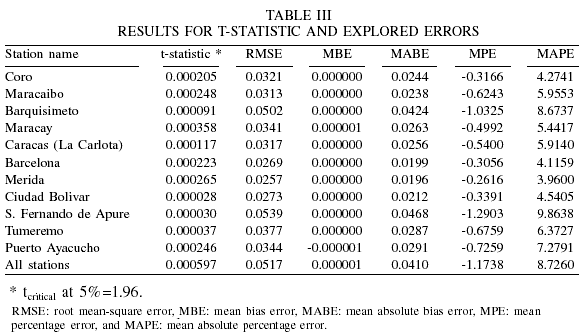
<body><![CDATA[<P style="word-spacing: 0; line-height: 100%" align="justify"><font face="Verdana" size="2">However, these estimated errors provide reasonable criteria to compare models but do not objectively indicate whether a model’s estimates are statistically significant. The t-statistic allows models to be compared and at the same time it indicates whether or not a model’s estimate is statistically significant at a particular confidence level (Stone, 1993; Jacovides and Kontoyiannis, 1995; Togrul <I>et al.</I>, 2000). The <I>t</I>-statistic is defined as</font></P>     <P style="word-spacing: 0; line-height: 100%" align="center"><font face="Verdana" size="2">t= [(N<SUB>obs</SUB>-1)MBE<SUP>2</SUP>/(RMSE<SUP>2</SUP>-MBE<SUP>2</SUP>)]</font><SUP><font face="Verdana" size="2">0.5</font></P> </SUP><B>    <P style="word-spacing: 0; line-height: 100%" align="justify"><font face="Verdana" size="2">Results and Discussion</font></P> </B>    <P style="word-spacing: 0; line-height: 100%" align="justify"><font face="Verdana" size="2">According to the statistical test results, it can be seen that all the regression equations gave good results. <a href="#tab2"> Table II</a> shows the values of the Angstr&ouml;m model parameters, the statistical parameters calculated using the models are presented in <a href="#tab3"> Table III</a>.</font></P>     <P style="word-spacing: 0; line-height: 100%" align="center"><a name="tab2"><img border="0" src="/img/fbpe/inci/v33n4/art09tab2.gif" width="350" height="386"></a></P>     
<P style="word-spacing: 0; line-height: 100%" align="center"><a name="tab3"><img border="0" src="/img/fbpe/inci/v33n4/art09tab3.gif" width="579" height="334"></a></P>      
<P style="word-spacing: 0; line-height: 100%" align="justify"><font face="Verdana" size="2">It is evident from <a href="#tab2"> Table II</a> that the values of a and b are subjected to a very large variability. In the developed models, the values of the constant <I>a</I> varies from 0.253 to 0.338, while the Angstr&ouml;m-Prescott coefficient b varies from 0.215 to 0.376. The overall mean and deviation of the eleven values of a, b, and a+b<I> </I>were, respectively, 0.292 ±0.045; 0.295 ±0.080; and 0.587 ±0.100.</font></P>     <P style="word-spacing: 0; line-height: 100%" align="justify"><font face="Verdana" size="2">For the estimation of monthly mean daily global solar radiation, the best performance based on RMSE, MABE, MPE and MAPE was achieved for the stations of Merida, Barcelona and Coro. The results were worse for S. Fernando, Barquisimeto, Puerto Ayacucho and Tumeremo. The comparison between the different models according to the t value shows that for all the stations, the calculated t values were less than the critical t value. These results show that the equations have statistical significance for all the stations (<a href="#tab3">Table III</a>).</font></P>     <P style="word-spacing: 0; line-height: 100%" align="justify"><font face="Verdana" size="2">Utilizing a combination of eleven stations in Venezuela, it has been shown that the global solar radiation across the country can be related with the relative sunshine duration. According to the results, the linear annual equation is recommended for the estimation of monthly average daily global solar radiation in areas where the radiation data is missing or unavailable. Its form is</font></P>     <P style="word-spacing: 0; line-height: 100%" align="center"><font face="Verdana" size="2">H/H<SUB>o</SUB>= 0.26+0.34(n/N)&nbsp; (2)</font></P>     ]]></body>
<body><![CDATA[<P style="word-spacing: 0; line-height: 100%" align="justify"><font face="Verdana" size="2">The present work will help advance the state of knowledge of global solar radiation to the point where it has applications in the estimation of evapotranspiration and crop growth models.</font></P> <B>    <P style="word-spacing: 0; line-height: 100%" align="justify"><font face="Verdana" size="2">Conclusion</font></P> </B>    <P style="word-spacing: 0; line-height: 100%" align="justify"><font face="Verdana" size="2">Solar radiation data is essential to the work of energy planners, engineers and agricultural scientists. Based on data at eleven stations in Venezuela, the Angstr&ouml;m-Prescott equation was obtained and the corresponding empirical coefficients are given for each station (<a href="#tab2">Table II</a>). The results show that these Angstr&ouml;m-Prescott coefficients are site-dependent, and showed good agreement. As the global solar radiation data are not available for most areas in Venezuela, a countrywide general equation was developed on the basis of the information at eleven stations. This equation (2) can be used to estimate the monthly average daily global solar radiation in Venezuela.</font></P> <B>    <P style="word-spacing: 0; line-height: 100%" align="justify"><font face="Verdana" size="2">References</font></P> </B>    <!-- ref --><P style="word-spacing: 0; line-height: 100%" align="justify"><font face="Verdana" size="2">1. Allen RG, Pereira LS, Raes D, Smith M (1998) <I>Crop evapotranspiration: Guidelines for computing crop water requirements.</I> FAO Irrigation and Drainage 56. Rome, Italy. 290 pp.</font>&nbsp;&nbsp;&nbsp;&nbsp;&nbsp;&nbsp;&nbsp;&nbsp;[&#160;<a href="javascript:void(0);" onclick="javascript: window.open('/scielo.php?script=sci_nlinks&ref=1067780&pid=S0378-1844200800040000900001&lng=','','width=640,height=500,resizable=yes,scrollbars=1,menubar=yes,');">Links</a>&#160;]<!-- end-ref --><!-- ref --><P style="word-spacing: 0; line-height: 100%" align="justify"><font face="Verdana" size="2">2. Almorox J, Hontoria C (2004) Global solar radiation estimation using sunshine duration in Spain. <I>Energy Conv. Manag. 45</I><B>:</B> 1529-1535.</font>&nbsp;&nbsp;&nbsp;&nbsp;&nbsp;&nbsp;&nbsp;&nbsp;[&#160;<a href="javascript:void(0);" onclick="javascript: window.open('/scielo.php?script=sci_nlinks&ref=1067781&pid=S0378-1844200800040000900002&lng=','','width=640,height=500,resizable=yes,scrollbars=1,menubar=yes,');">Links</a>&#160;]<!-- end-ref --><!-- ref --><P style="word-spacing: 0; line-height: 100%" align="justify"><font face="Verdana" size="2">3. Almorox J, Benito M, Hontoria C (2005) Estimation of monthly Angstr&ouml;m-Prescott equation coefficients from measured daily data in Toledo, Spain. <I>Renew. Energy.</I> <I>30</I>: 931-936.</font>&nbsp;&nbsp;&nbsp;&nbsp;&nbsp;&nbsp;&nbsp;&nbsp;[&#160;<a href="javascript:void(0);" onclick="javascript: window.open('/scielo.php?script=sci_nlinks&ref=1067782&pid=S0378-1844200800040000900003&lng=','','width=640,height=500,resizable=yes,scrollbars=1,menubar=yes,');">Links</a>&#160;]<!-- end-ref --><!-- ref --><P style="word-spacing: 0; line-height: 100%" align="justify"><font face="Verdana" size="2">4. Ampratwum DB, Dorvlo ASS (1990) Estimation of solar radiation from the number of sunshine hours. <I>Appl. Energy 62</I>: 161-167.</font>&nbsp;&nbsp;&nbsp;&nbsp;&nbsp;&nbsp;&nbsp;&nbsp;[&#160;<a href="javascript:void(0);" onclick="javascript: window.open('/scielo.php?script=sci_nlinks&ref=1067783&pid=S0378-1844200800040000900004&lng=','','width=640,height=500,resizable=yes,scrollbars=1,menubar=yes,');">Links</a>&#160;]<!-- end-ref --><!-- ref --><P style="word-spacing: 0; line-height: 100%" align="justify"><font face="Verdana" size="2">5. Angstr&ouml;m A (1924) Solar and terrestrial radiation.<I> Quart. J. Roy. Met. Soc. 50</I>: 121-125.</font>&nbsp;&nbsp;&nbsp;&nbsp;&nbsp;&nbsp;&nbsp;&nbsp;[&#160;<a href="javascript:void(0);" onclick="javascript: window.open('/scielo.php?script=sci_nlinks&ref=1067784&pid=S0378-1844200800040000900005&lng=','','width=640,height=500,resizable=yes,scrollbars=1,menubar=yes,');">Links</a>&#160;]<!-- end-ref --><!-- ref --><P style="word-spacing: 0; line-height: 100%" align="justify"><font face="Verdana" size="2">6. Boisvert JB, Hayhoe HN, Dub&eacute; PA (1990) Improving the estimation of global solar radiation across Canada. <I>Agric. For. Meteorol. 52</I>: 275-286.</font>&nbsp;&nbsp;&nbsp;&nbsp;&nbsp;&nbsp;&nbsp;&nbsp;[&#160;<a href="javascript:void(0);" onclick="javascript: window.open('/scielo.php?script=sci_nlinks&ref=1067785&pid=S0378-1844200800040000900006&lng=','','width=640,height=500,resizable=yes,scrollbars=1,menubar=yes,');">Links</a>&#160;]<!-- end-ref --><!-- ref --><P style="word-spacing: 0; line-height: 100%" align="justify"><font face="Verdana" size="2">7. Contreras A, Fausto Posso F, T Nejat Veziroglu (2006) Modeling and simulation of the production of hydrogen using hydroelectricity in Venezuela. <I>Int. J. Hydrogen Energy</I>.  32: 1219-1224.</font> &nbsp;&nbsp;&nbsp;&nbsp;&nbsp;&nbsp;&nbsp;&nbsp;[&#160;<a href="javascript:void(0);" onclick="javascript: window.open('/scielo.php?script=sci_nlinks&ref=1067786&pid=S0378-1844200800040000900007&lng=','','width=640,height=500,resizable=yes,scrollbars=1,menubar=yes,');">Links</a>&#160;]<!-- end-ref --><!-- ref --><P style="word-spacing: 0; line-height: 100%" align="justify"><font face="Verdana" size="2">8. Ertekin C, Yaldiz O (2000) Comparison of some existing models for estimating global solar radiation for Antalya (Turkey). <I>Energy Conv. Manag. 41</I>: 311-330.</font>&nbsp;&nbsp;&nbsp;&nbsp;&nbsp;&nbsp;&nbsp;&nbsp;[&#160;<a href="javascript:void(0);" onclick="javascript: window.open('/scielo.php?script=sci_nlinks&ref=1067787&pid=S0378-1844200800040000900008&lng=','','width=640,height=500,resizable=yes,scrollbars=1,menubar=yes,');">Links</a>&#160;]<!-- end-ref --><!-- ref --><P style="word-spacing: 0; line-height: 100%" align="justify"><font face="Verdana" size="2">9. Gueymard C, Jindra P, Estrada V (1995) A critical look at recent interpretations of the &Aring;ngstr&ouml;m approach and its future in global solar radiation prediction. <I>Solar Energy</I> <I>54</I>: 357-363.</font>&nbsp;&nbsp;&nbsp;&nbsp;&nbsp;&nbsp;&nbsp;&nbsp;[&#160;<a href="javascript:void(0);" onclick="javascript: window.open('/scielo.php?script=sci_nlinks&ref=1067788&pid=S0378-1844200800040000900009&lng=','','width=640,height=500,resizable=yes,scrollbars=1,menubar=yes,');">Links</a>&#160;]<!-- end-ref --><!-- ref --><P style="word-spacing: 0; line-height: 100%" align="justify"><font face="Verdana" size="2">10. Hussain M, Rahman L, Rahman MM (1999) Techniques to obtain improved predictions of global radiation from sunshine duration. <I>Renew. Energy 18</I>: 263-275.</font>&nbsp;&nbsp;&nbsp;&nbsp;&nbsp;&nbsp;&nbsp;&nbsp;[&#160;<a href="javascript:void(0);" onclick="javascript: window.open('/scielo.php?script=sci_nlinks&ref=1067789&pid=S0378-1844200800040000900010&lng=','','width=640,height=500,resizable=yes,scrollbars=1,menubar=yes,');">Links</a>&#160;]<!-- end-ref --><!-- ref --><P style="word-spacing: 0; line-height: 100%" align="justify"><font face="Verdana" size="2">11. Iziomon MG, Mayer H (2001) Performance of solar radiation models - a case study <I>Agric. For. Meteorol. 110</I>: 1-11.</font>&nbsp;&nbsp;&nbsp;&nbsp;&nbsp;&nbsp;&nbsp;&nbsp;[&#160;<a href="javascript:void(0);" onclick="javascript: window.open('/scielo.php?script=sci_nlinks&ref=1067790&pid=S0378-1844200800040000900011&lng=','','width=640,height=500,resizable=yes,scrollbars=1,menubar=yes,');">Links</a>&#160;]<!-- end-ref --><!-- ref --><P style="word-spacing: 0; line-height: 100%" align="justify"><font face="Verdana" size="2">12. Jacovides CP, Kontoyiannis H (1995) Statistical procedures for the evaluation of evapotranspiration computing models. <I>Agric. Water Manag.</I> 27: 365-371.</font>&nbsp;&nbsp;&nbsp;&nbsp;&nbsp;&nbsp;&nbsp;&nbsp;[&#160;<a href="javascript:void(0);" onclick="javascript: window.open('/scielo.php?script=sci_nlinks&ref=1067791&pid=S0378-1844200800040000900012&lng=','','width=640,height=500,resizable=yes,scrollbars=1,menubar=yes,');">Links</a>&#160;]<!-- end-ref --><!-- ref --><P style="word-spacing: 0; line-height: 100%" align="justify"><font face="Verdana" size="2">13. Mart&iacute;nez-Lozano JA, Tena F, Onrubia JE, de la Rubia J (1984) The historical evolution of the Angstr&ouml;m formula and its modifications: review and bibliography. <I>Agric. For. Meteorol. 33</I>: 109-128.</font>&nbsp;&nbsp;&nbsp;&nbsp;&nbsp;&nbsp;&nbsp;&nbsp;[&#160;<a href="javascript:void(0);" onclick="javascript: window.open('/scielo.php?script=sci_nlinks&ref=1067792&pid=S0378-1844200800040000900013&lng=','','width=640,height=500,resizable=yes,scrollbars=1,menubar=yes,');">Links</a>&#160;]<!-- end-ref --><!-- ref --><P style="word-spacing: 0; line-height: 100%" align="justify"><font face="Verdana" size="2">14. Menges HO, Ertekin C, Sonmete MH (2006) Evaluation of global solar radiation models for Konya, Turkey.<I> Energy Conv. Manag. 47</I>: 3149-3173.</font>&nbsp;&nbsp;&nbsp;&nbsp;&nbsp;&nbsp;&nbsp;&nbsp;[&#160;<a href="javascript:void(0);" onclick="javascript: window.open('/scielo.php?script=sci_nlinks&ref=1067793&pid=S0378-1844200800040000900014&lng=','','width=640,height=500,resizable=yes,scrollbars=1,menubar=yes,');">Links</a>&#160;]<!-- end-ref --><!-- ref --><P style="word-spacing: 0; line-height: 100%" align="justify"><font face="Verdana" size="2">15. Prescott JA (1940) Evaporation from water surface in relation to solar radiation. <I>Trans. R. Soc. Sci. Austr. 64</I>: 114-118.</font>&nbsp;&nbsp;&nbsp;&nbsp;&nbsp;&nbsp;&nbsp;&nbsp;[&#160;<a href="javascript:void(0);" onclick="javascript: window.open('/scielo.php?script=sci_nlinks&ref=1067794&pid=S0378-1844200800040000900015&lng=','','width=640,height=500,resizable=yes,scrollbars=1,menubar=yes,');">Links</a>&#160;]<!-- end-ref --><!-- ref --><P style="word-spacing: 0; line-height: 100%" align="justify"><font face="Verdana" size="2">16. Rehman S (1999) Empirical model of development and comparison with existing correlations.<I> Appl. Energy 64</I>: 369-378.</font>&nbsp;&nbsp;&nbsp;&nbsp;&nbsp;&nbsp;&nbsp;&nbsp;[&#160;<a href="javascript:void(0);" onclick="javascript: window.open('/scielo.php?script=sci_nlinks&ref=1067795&pid=S0378-1844200800040000900016&lng=','','width=640,height=500,resizable=yes,scrollbars=1,menubar=yes,');">Links</a>&#160;]<!-- end-ref --><!-- ref --><P style="word-spacing: 0; line-height: 100%" align="justify"><font face="Verdana" size="2">17. Sabziparvar AA, Shetaee H (2007) Estimation of global solar radiation in arid and semi-arid climates of East and West Iran. <I>Energy 32</I>: 649-655.</font>&nbsp;&nbsp;&nbsp;&nbsp;&nbsp;&nbsp;&nbsp;&nbsp;[&#160;<a href="javascript:void(0);" onclick="javascript: window.open('/scielo.php?script=sci_nlinks&ref=1067796&pid=S0378-1844200800040000900017&lng=','','width=640,height=500,resizable=yes,scrollbars=1,menubar=yes,');">Links</a>&#160;]<!-- end-ref --><!-- ref --><P style="word-spacing: 0; line-height: 100%" align="justify"><font face="Verdana" size="2">18. Spencer JW (1971) Fourier series representation of the position of the Sun. <I>Search 2</I>: 172.</font>&nbsp;&nbsp;&nbsp;&nbsp;&nbsp;&nbsp;&nbsp;&nbsp;[&#160;<a href="javascript:void(0);" onclick="javascript: window.open('/scielo.php?script=sci_nlinks&ref=1067797&pid=S0378-1844200800040000900018&lng=','','width=640,height=500,resizable=yes,scrollbars=1,menubar=yes,');">Links</a>&#160;]<!-- end-ref --><!-- ref --><P style="word-spacing: 0; line-height: 100%" align="justify"><font face="Verdana" size="2">19. Stone RJ (1993) Improved statistical procedure for the evaluation of solar- radiation estimation models. <I>Solar Energy 51</I>: 289-291.</font>&nbsp;&nbsp;&nbsp;&nbsp;&nbsp;&nbsp;&nbsp;&nbsp;[&#160;<a href="javascript:void(0);" onclick="javascript: window.open('/scielo.php?script=sci_nlinks&ref=1067798&pid=S0378-1844200800040000900019&lng=','','width=640,height=500,resizable=yes,scrollbars=1,menubar=yes,');">Links</a>&#160;]<!-- end-ref --><!-- ref --><P style="word-spacing: 0; line-height: 100%" align="justify"><font face="Verdana" size="2">20. Tadros MTY (2000) Uses of sunshine duration to estimate the global solar radiation over eight meteorological stations in Egypt.<I> Renew. Energy 21</I>: 231-246.</font>&nbsp;&nbsp;&nbsp;&nbsp;&nbsp;&nbsp;&nbsp;&nbsp;[&#160;<a href="javascript:void(0);" onclick="javascript: window.open('/scielo.php?script=sci_nlinks&ref=1067799&pid=S0378-1844200800040000900020&lng=','','width=640,height=500,resizable=yes,scrollbars=1,menubar=yes,');">Links</a>&#160;]<!-- end-ref --><!-- ref --><P style="word-spacing: 0; line-height: 100%" align="justify"><font face="Verdana" size="2">21. Togrul IT, Togrul H, Evin D (2000) Estimation of global solar radiation under clear sky radiation in Turkey.<I> Renew. Energy 21</I>: 271-287.</font>&nbsp;&nbsp;&nbsp;&nbsp;&nbsp;&nbsp;&nbsp;&nbsp;[&#160;<a href="javascript:void(0);" onclick="javascript: window.open('/scielo.php?script=sci_nlinks&ref=1067800&pid=S0378-1844200800040000900021&lng=','','width=640,height=500,resizable=yes,scrollbars=1,menubar=yes,');">Links</a>&#160;]<!-- end-ref --><!-- ref --><P style="word-spacing: 0; line-height: 100%" align="justify"><font face="Verdana" size="2">22. Trnka M, Zalud Z, Eitzinger J, Dubrovsk&yacute; M (2005) Central European lowlands estimated by various empirical formulae. <I>Agric. For. Meteorol. 131</I>: 54-76.</font>&nbsp;&nbsp;&nbsp;&nbsp;&nbsp;&nbsp;&nbsp;&nbsp;[&#160;<a href="javascript:void(0);" onclick="javascript: window.open('/scielo.php?script=sci_nlinks&ref=1067801&pid=S0378-1844200800040000900022&lng=','','width=640,height=500,resizable=yes,scrollbars=1,menubar=yes,');">Links</a>&#160;]<!-- end-ref --><!-- ref --><P style="word-spacing: 0; line-height: 100%" align="justify"><font face="Verdana" size="2">23. Yang K, Koike T, Ye B (2006) Improving estimation of hourly, daily, and monthly solar radiation by importing global data sets. <I>Agric. For. Meteorol. 137</I>: 43-55.</font>&nbsp;&nbsp;&nbsp;&nbsp;&nbsp;&nbsp;&nbsp;&nbsp;[&#160;<a href="javascript:void(0);" onclick="javascript: window.open('/scielo.php?script=sci_nlinks&ref=1067802&pid=S0378-1844200800040000900023&lng=','','width=640,height=500,resizable=yes,scrollbars=1,menubar=yes,');">Links</a>&#160;]<!-- end-ref --><!-- ref --><P style="word-spacing: 0; line-height: 100%" align="justify"><font face="Verdana" size="2">24. Yorukoglu M, Celik AN (2006) A critical review on the estimation of daily global solar radiation from sunshine duration. <I>Energy Conv. Manag. 47</I>: 2441-2450.</font>&nbsp;&nbsp;&nbsp;&nbsp;&nbsp;&nbsp;&nbsp;&nbsp;[&#160;<a href="javascript:void(0);" onclick="javascript: window.open('/scielo.php?script=sci_nlinks&ref=1067803&pid=S0378-1844200800040000900024&lng=','','width=640,height=500,resizable=yes,scrollbars=1,menubar=yes,');">Links</a>&#160;]<!-- end-ref --> ]]></body>
<back>
<ref-list>
<ref id="B1">
<label>1</label><nlm-citation citation-type="book">
<person-group person-group-type="author">
<name>
<surname><![CDATA[Allen ]]></surname>
<given-names><![CDATA[RG]]></given-names>
</name>
<name>
<surname><![CDATA[Pereira ]]></surname>
<given-names><![CDATA[LS]]></given-names>
</name>
<name>
<surname><![CDATA[Raes ]]></surname>
<given-names><![CDATA[D]]></given-names>
</name>
<name>
<surname><![CDATA[Smith]]></surname>
<given-names><![CDATA[M]]></given-names>
</name>
</person-group>
<source><![CDATA[Crop evapotranspiration: Guidelines for computing crop water requirements]]></source>
<year>1998</year>
<page-range>290</page-range><publisher-loc><![CDATA[Rome ]]></publisher-loc>
<publisher-name><![CDATA[FAO Irrigation and Drainage 56]]></publisher-name>
</nlm-citation>
</ref>
<ref id="B2">
<label>2</label><nlm-citation citation-type="journal">
<person-group person-group-type="author">
<name>
<surname><![CDATA[Almorox]]></surname>
<given-names><![CDATA[J]]></given-names>
</name>
<name>
<surname><![CDATA[Hontoria]]></surname>
<given-names><![CDATA[C]]></given-names>
</name>
</person-group>
<article-title xml:lang="en"><![CDATA[Global solar radiation estimation using sunshine duration in Spain]]></article-title>
<source><![CDATA[Energy Conv. Manag.]]></source>
<year>2004</year>
<volume>45</volume>
<page-range>1529-1535</page-range></nlm-citation>
</ref>
<ref id="B3">
<label>3</label><nlm-citation citation-type="journal">
<person-group person-group-type="author">
<name>
<surname><![CDATA[Almorox]]></surname>
<given-names><![CDATA[J]]></given-names>
</name>
<name>
<surname><![CDATA[Benito]]></surname>
<given-names><![CDATA[M]]></given-names>
</name>
<name>
<surname><![CDATA[Hontoria]]></surname>
<given-names><![CDATA[C]]></given-names>
</name>
</person-group>
<article-title xml:lang="en"><![CDATA[Estimation of monthly Angström-Prescott equation coefficients from measured daily data in Toledo, Spain]]></article-title>
<source><![CDATA[Renew. Energy.]]></source>
<year>2005</year>
<volume>30</volume>
<page-range>931-936</page-range></nlm-citation>
</ref>
<ref id="B4">
<label>4</label><nlm-citation citation-type="journal">
<person-group person-group-type="author">
<name>
<surname><![CDATA[Ampratwum]]></surname>
<given-names><![CDATA[DB]]></given-names>
</name>
<name>
<surname><![CDATA[Dorvlo]]></surname>
<given-names><![CDATA[ASS]]></given-names>
</name>
</person-group>
<article-title xml:lang="en"><![CDATA[Estimation of solar radiation from the number of sunshine hours]]></article-title>
<source><![CDATA[Appl. Energy]]></source>
<year>1990</year>
<volume>62</volume>
<page-range>161-167</page-range></nlm-citation>
</ref>
<ref id="B5">
<label>5</label><nlm-citation citation-type="journal">
<person-group person-group-type="author">
<name>
<surname><![CDATA[Angström]]></surname>
<given-names><![CDATA[A]]></given-names>
</name>
</person-group>
<article-title xml:lang="en"><![CDATA[Solar and terrestrial radiation]]></article-title>
<source><![CDATA[Quart. J. Roy. Met. Soc.]]></source>
<year>1924</year>
<volume>50</volume>
<page-range>121-125</page-range></nlm-citation>
</ref>
<ref id="B6">
<label>6</label><nlm-citation citation-type="journal">
<person-group person-group-type="author">
<name>
<surname><![CDATA[Boisvert]]></surname>
<given-names><![CDATA[JB]]></given-names>
</name>
<name>
<surname><![CDATA[Hayhoe]]></surname>
<given-names><![CDATA[HN]]></given-names>
</name>
<name>
<surname><![CDATA[Dubé]]></surname>
<given-names><![CDATA[PA]]></given-names>
</name>
</person-group>
<article-title xml:lang="en"><![CDATA[Improving the estimation of global solar radiation across Canada]]></article-title>
<source><![CDATA[Agric. For. Meteorol.]]></source>
<year>1990</year>
<volume>52</volume>
<page-range>275-286</page-range></nlm-citation>
</ref>
<ref id="B7">
<label>7</label><nlm-citation citation-type="journal">
<person-group person-group-type="author">
<name>
<surname><![CDATA[Contreras]]></surname>
<given-names><![CDATA[A]]></given-names>
</name>
<name>
<surname><![CDATA[Fausto Posso]]></surname>
<given-names><![CDATA[F]]></given-names>
</name>
<name>
<surname><![CDATA[Nejat Veziroglu]]></surname>
<given-names><![CDATA[T]]></given-names>
</name>
</person-group>
<article-title xml:lang="en"><![CDATA[Modeling and simulation of the production of hydrogen using hydroelectricity in Venezuela]]></article-title>
<source><![CDATA[Int. J. Hydrogen Energy.]]></source>
<year>2006</year>
<volume>32</volume>
<page-range>1219-1224</page-range></nlm-citation>
</ref>
<ref id="B8">
<label>8</label><nlm-citation citation-type="journal">
<person-group person-group-type="author">
<name>
<surname><![CDATA[Ertekin]]></surname>
<given-names><![CDATA[C]]></given-names>
</name>
<name>
<surname><![CDATA[Yaldiz]]></surname>
<given-names><![CDATA[O]]></given-names>
</name>
</person-group>
<article-title xml:lang="en"><![CDATA[Comparison of some existing models for estimating global solar radiation for Antalya (Turkey)]]></article-title>
<source><![CDATA[Energy Conv. Manag.]]></source>
<year>2000</year>
<volume>41</volume>
<page-range>311-330</page-range></nlm-citation>
</ref>
<ref id="B9">
<label>9</label><nlm-citation citation-type="journal">
<person-group person-group-type="author">
<name>
<surname><![CDATA[Gueymard]]></surname>
<given-names><![CDATA[C]]></given-names>
</name>
<name>
<surname><![CDATA[Jindra]]></surname>
<given-names><![CDATA[P]]></given-names>
</name>
<name>
<surname><![CDATA[Estrada]]></surname>
<given-names><![CDATA[V]]></given-names>
</name>
</person-group>
<article-title xml:lang="en"><![CDATA[A critical look at recent interpretations of the Ångström approach and its future in global solar radiation prediction]]></article-title>
<source><![CDATA[Solar Energy]]></source>
<year>1995</year>
<volume>54</volume>
<page-range>357-363</page-range></nlm-citation>
</ref>
<ref id="B10">
<label>10</label><nlm-citation citation-type="journal">
<person-group person-group-type="author">
<name>
<surname><![CDATA[Hussain]]></surname>
<given-names><![CDATA[M]]></given-names>
</name>
<name>
<surname><![CDATA[Rahman]]></surname>
<given-names><![CDATA[L]]></given-names>
</name>
<name>
<surname><![CDATA[Rahman]]></surname>
<given-names><![CDATA[MM]]></given-names>
</name>
</person-group>
<article-title xml:lang="en"><![CDATA[Techniques to obtain improved predictions of global radiation from sunshine duration]]></article-title>
<source><![CDATA[Renew. Energy]]></source>
<year>1999</year>
<volume>18</volume>
<page-range>263-275</page-range></nlm-citation>
</ref>
<ref id="B11">
<label>11</label><nlm-citation citation-type="journal">
<person-group person-group-type="author">
<name>
<surname><![CDATA[Iziomon]]></surname>
<given-names><![CDATA[MG]]></given-names>
</name>
<name>
<surname><![CDATA[Mayer]]></surname>
<given-names><![CDATA[H]]></given-names>
</name>
</person-group>
<article-title xml:lang="en"><![CDATA[Performance of solar radiation models - a case study Agric]]></article-title>
<source><![CDATA[For. Meteorol.]]></source>
<year>2001</year>
<volume>110</volume>
<page-range>1-11</page-range></nlm-citation>
</ref>
<ref id="B12">
<label>12</label><nlm-citation citation-type="journal">
<person-group person-group-type="author">
<name>
<surname><![CDATA[Jacovides]]></surname>
<given-names><![CDATA[CP]]></given-names>
</name>
<name>
<surname><![CDATA[Kontoyiannis]]></surname>
<given-names><![CDATA[H]]></given-names>
</name>
</person-group>
<article-title xml:lang="en"><![CDATA[Statistical procedures for the evaluation of evapotranspiration computing models]]></article-title>
<source><![CDATA[Agric. Water Manag.]]></source>
<year>1995</year>
<volume>27</volume>
<page-range>365-371</page-range></nlm-citation>
</ref>
<ref id="B13">
<label>13</label><nlm-citation citation-type="journal">
<person-group person-group-type="author">
<name>
<surname><![CDATA[Martínez-Lozano]]></surname>
<given-names><![CDATA[JA]]></given-names>
</name>
<name>
<surname><![CDATA[Tena]]></surname>
<given-names><![CDATA[F]]></given-names>
</name>
<name>
<surname><![CDATA[Onrubia]]></surname>
<given-names><![CDATA[JE]]></given-names>
</name>
<name>
<surname><![CDATA[de la Rubia]]></surname>
<given-names><![CDATA[J]]></given-names>
</name>
</person-group>
<article-title xml:lang="en"><![CDATA[The historical evolution of the Angström formula and its modifications: review and bibliography]]></article-title>
<source><![CDATA[Agric. For. Meteorol.]]></source>
<year>1984</year>
<volume>33</volume>
<page-range>109-128</page-range></nlm-citation>
</ref>
<ref id="B14">
<label>14</label><nlm-citation citation-type="journal">
<person-group person-group-type="author">
<name>
<surname><![CDATA[Menges]]></surname>
<given-names><![CDATA[HO]]></given-names>
</name>
<name>
<surname><![CDATA[Ertekin]]></surname>
<given-names><![CDATA[C]]></given-names>
</name>
<name>
<surname><![CDATA[Sonmete]]></surname>
<given-names><![CDATA[MH]]></given-names>
</name>
</person-group>
<article-title xml:lang="en"><![CDATA[Evaluation of global solar radiation models for Konya, Turkey]]></article-title>
<source><![CDATA[Energy Conv. Manag.]]></source>
<year>2006</year>
<volume>47</volume>
<page-range>3149-3173</page-range></nlm-citation>
</ref>
<ref id="B15">
<label>15</label><nlm-citation citation-type="journal">
<person-group person-group-type="author">
<name>
<surname><![CDATA[Prescott]]></surname>
<given-names><![CDATA[JA]]></given-names>
</name>
</person-group>
<article-title xml:lang="en"><![CDATA[Evaporation from water surface in relation to solar radiation]]></article-title>
<source><![CDATA[Trans. R. Soc. Sci. Austr.]]></source>
<year>1940</year>
<volume>64</volume>
<page-range>114-118</page-range></nlm-citation>
</ref>
<ref id="B16">
<label>16</label><nlm-citation citation-type="journal">
<person-group person-group-type="author">
<name>
<surname><![CDATA[Rehman]]></surname>
<given-names><![CDATA[S]]></given-names>
</name>
</person-group>
<article-title xml:lang="en"><![CDATA[Empirical model of development and comparison with existing correlations]]></article-title>
<source><![CDATA[Appl. Energy]]></source>
<year>1999</year>
<volume>64</volume>
<page-range>369-378</page-range></nlm-citation>
</ref>
<ref id="B17">
<label>17</label><nlm-citation citation-type="journal">
<person-group person-group-type="author">
<name>
<surname><![CDATA[Sabziparvar]]></surname>
<given-names><![CDATA[AA]]></given-names>
</name>
<name>
<surname><![CDATA[Shetaee]]></surname>
<given-names><![CDATA[H]]></given-names>
</name>
</person-group>
<article-title xml:lang="en"><![CDATA[Estimation of global solar radiation in arid and semi-arid climates of East and West Iran]]></article-title>
<source><![CDATA[Energy]]></source>
<year>2007</year>
<volume>32</volume>
<page-range>649-655</page-range></nlm-citation>
</ref>
<ref id="B18">
<label>18</label><nlm-citation citation-type="journal">
<person-group person-group-type="author">
<name>
<surname><![CDATA[Spencer]]></surname>
<given-names><![CDATA[JW]]></given-names>
</name>
</person-group>
<article-title xml:lang="en"><![CDATA[Fourier series representation of the position of the Sun]]></article-title>
<source><![CDATA[Search]]></source>
<year>1971</year>
<volume>2</volume>
<page-range>172</page-range></nlm-citation>
</ref>
<ref id="B19">
<label>19</label><nlm-citation citation-type="journal">
<person-group person-group-type="author">
<name>
<surname><![CDATA[Stone]]></surname>
<given-names><![CDATA[RJ]]></given-names>
</name>
</person-group>
<article-title xml:lang="en"><![CDATA[Improved statistical procedure for the evaluation of solar- radiation estimation models]]></article-title>
<source><![CDATA[Solar Energy]]></source>
<year>1993</year>
<volume>51</volume>
<page-range>289-291</page-range></nlm-citation>
</ref>
<ref id="B20">
<label>20</label><nlm-citation citation-type="journal">
<person-group person-group-type="author">
<name>
<surname><![CDATA[Tadros]]></surname>
<given-names><![CDATA[MTY]]></given-names>
</name>
</person-group>
<article-title xml:lang="en"><![CDATA[Uses of sunshine duration to estimate the global solar radiation over eight meteorological stations in Egypt]]></article-title>
<source><![CDATA[Renew. Energy]]></source>
<year>2000</year>
<volume>21</volume>
<page-range>231-246</page-range></nlm-citation>
</ref>
<ref id="B21">
<label>21</label><nlm-citation citation-type="journal">
<person-group person-group-type="author">
<name>
<surname><![CDATA[Togrul]]></surname>
<given-names><![CDATA[IT]]></given-names>
</name>
<name>
<surname><![CDATA[Togrul]]></surname>
<given-names><![CDATA[H]]></given-names>
</name>
<name>
<surname><![CDATA[Evin]]></surname>
<given-names><![CDATA[D]]></given-names>
</name>
</person-group>
<article-title xml:lang="en"><![CDATA[Estimation of global solar radiation under clear sky radiation in Turkey]]></article-title>
<source><![CDATA[Renew. Energy]]></source>
<year>2000</year>
<volume>21</volume>
<page-range>271-287</page-range></nlm-citation>
</ref>
<ref id="B22">
<label>22</label><nlm-citation citation-type="journal">
<person-group person-group-type="author">
<name>
<surname><![CDATA[Trnka]]></surname>
<given-names><![CDATA[M]]></given-names>
</name>
<name>
<surname><![CDATA[Zalud]]></surname>
<given-names><![CDATA[Z]]></given-names>
</name>
<name>
<surname><![CDATA[Eitzinger]]></surname>
<given-names><![CDATA[J]]></given-names>
</name>
<name>
<surname><![CDATA[Dubrovský]]></surname>
<given-names><![CDATA[M]]></given-names>
</name>
</person-group>
<article-title xml:lang="en"><![CDATA[Central European lowlands estimated by various empirical formulae]]></article-title>
<source><![CDATA[Agric. For. Meteorol.]]></source>
<year>2005</year>
<volume>131</volume>
<page-range>54-76</page-range></nlm-citation>
</ref>
<ref id="B23">
<label>23</label><nlm-citation citation-type="journal">
<person-group person-group-type="author">
<name>
<surname><![CDATA[Yang]]></surname>
<given-names><![CDATA[K]]></given-names>
</name>
<name>
<surname><![CDATA[Koike]]></surname>
<given-names><![CDATA[T]]></given-names>
</name>
<name>
<surname><![CDATA[Ye]]></surname>
<given-names><![CDATA[B]]></given-names>
</name>
</person-group>
<article-title xml:lang="en"><![CDATA[Improving estimation of hourly, daily, and monthly solar radiation by importing global data sets]]></article-title>
<source><![CDATA[Agric. For. Meteorol.]]></source>
<year>2006</year>
<volume>137</volume>
<page-range>43-55</page-range></nlm-citation>
</ref>
<ref id="B24">
<label>24</label><nlm-citation citation-type="journal">
<person-group person-group-type="author">
<name>
<surname><![CDATA[Yorukoglu]]></surname>
<given-names><![CDATA[M]]></given-names>
</name>
<name>
<surname><![CDATA[Celik]]></surname>
<given-names><![CDATA[AN]]></given-names>
</name>
</person-group>
<article-title xml:lang="en"><![CDATA[A critical review on the estimation of daily global solar radiation from sunshine duration]]></article-title>
<source><![CDATA[Energy Conv. Manag.]]></source>
<year>2006</year>
<volume>47</volume>
<page-range>2441-2450</page-range></nlm-citation>
</ref>
</ref-list>
</back>
</article>