<?xml version="1.0" encoding="ISO-8859-1"?><article xmlns:mml="http://www.w3.org/1998/Math/MathML" xmlns:xlink="http://www.w3.org/1999/xlink" xmlns:xsi="http://www.w3.org/2001/XMLSchema-instance">
<front>
<journal-meta>
<journal-id>0378-1844</journal-id>
<journal-title><![CDATA[Interciencia]]></journal-title>
<abbrev-journal-title><![CDATA[INCI]]></abbrev-journal-title>
<issn>0378-1844</issn>
<publisher>
<publisher-name><![CDATA[ASOCIACIÓN INTERCIENCIA]]></publisher-name>
</publisher>
</journal-meta>
<article-meta>
<article-id>S0378-18442009000900010</article-id>
<title-group>
<article-title xml:lang="en"><![CDATA[Biological and morphological characteristics of hylesia paulex (lepidoptera: saturniidae) fed with eucalyptus urophylla (myrtaceae)]]></article-title>
<article-title xml:lang="es"><![CDATA[Características biológicas y morfológicas de hylesia paulex (lepidoptera: saturniidae) alimentadas con eucalyptus urophylla (myrtaceae)]]></article-title>
<article-title xml:lang="pt"><![CDATA[Características biológicas e morfológicas da hylesia paulex (lepidoptera: saturniidae) alimentadas com eucalyptus urophylla (myrtaceae)]]></article-title>
</title-group>
<contrib-group>
<contrib contrib-type="author">
<name>
<surname><![CDATA[Pereira]]></surname>
<given-names><![CDATA[Alexandre Igor Azevedo]]></given-names>
</name>
<xref ref-type="aff" rid="A01"/>
</contrib>
<contrib contrib-type="author">
<name>
<surname><![CDATA[Zanuncio]]></surname>
<given-names><![CDATA[Virginia Vinha]]></given-names>
</name>
<xref ref-type="aff" rid="A02"/>
</contrib>
<contrib contrib-type="author">
<name>
<surname><![CDATA[Lorenzon]]></surname>
<given-names><![CDATA[Alexandre Simões]]></given-names>
</name>
<xref ref-type="aff" rid="A03"/>
</contrib>
<contrib contrib-type="author">
<name>
<surname><![CDATA[Bolognani]]></surname>
<given-names><![CDATA[Hélder]]></given-names>
</name>
<xref ref-type="aff" rid="A04"/>
</contrib>
<contrib contrib-type="author">
<name>
<surname><![CDATA[Fernandes]]></surname>
<given-names><![CDATA[Bianca Vique]]></given-names>
</name>
<xref ref-type="aff" rid="A05"/>
</contrib>
<contrib contrib-type="author">
<name>
<surname><![CDATA[Hendrik Mielke]]></surname>
<given-names><![CDATA[Olaf Hermann]]></given-names>
</name>
<xref ref-type="aff" rid="A06"/>
</contrib>
<contrib contrib-type="author">
<name>
<surname><![CDATA[Serrão]]></surname>
<given-names><![CDATA[José Eduardo]]></given-names>
</name>
<xref ref-type="aff" rid="A07"/>
</contrib>
<contrib contrib-type="author">
<name>
<surname><![CDATA[Zanuncio]]></surname>
<given-names><![CDATA[José Cola]]></given-names>
</name>
<xref ref-type="aff" rid="A08"/>
</contrib>
</contrib-group>
<aff id="A01">
<institution><![CDATA[,Universidade Federal de Viçosa  ]]></institution>
<addr-line><![CDATA[ ]]></addr-line>
<country>Brazil</country>
</aff>
<aff id="A02">
<institution><![CDATA[,Universidade Federal de Juiz de Fora  ]]></institution>
<addr-line><![CDATA[ ]]></addr-line>
<country>Brazil</country>
</aff>
<aff id="A03">
<institution><![CDATA[,Universidade Federal de Viçosa  ]]></institution>
<addr-line><![CDATA[ ]]></addr-line>
<country>Brazil</country>
</aff>
<aff id="A04">
<institution><![CDATA[,V & M Florestal  ]]></institution>
<addr-line><![CDATA[ ]]></addr-line>
<country>Brazil</country>
</aff>
<aff id="A05">
<institution><![CDATA[,V & M Florestal  ]]></institution>
<addr-line><![CDATA[ ]]></addr-line>
</aff>
<aff id="A06">
<institution><![CDATA[,UFPR  ]]></institution>
<addr-line><![CDATA[ ]]></addr-line>
<country>Brazil</country>
</aff>
<aff id="A07">
<institution><![CDATA[,UFV  ]]></institution>
<addr-line><![CDATA[ ]]></addr-line>
<country>Brazil</country>
</aff>
<aff id="A08">
<institution><![CDATA[,UFV  ]]></institution>
<addr-line><![CDATA[Viçosa MG]]></addr-line>
<country>Brasil</country>
</aff>
<pub-date pub-type="pub">
<day>00</day>
<month>09</month>
<year>2009</year>
</pub-date>
<pub-date pub-type="epub">
<day>00</day>
<month>09</month>
<year>2009</year>
</pub-date>
<volume>34</volume>
<numero>9</numero>
<fpage>645</fpage>
<lpage>649</lpage>
<copyright-statement/>
<copyright-year/>
<self-uri xlink:href="http://ve.scielo.org/scielo.php?script=sci_arttext&amp;pid=S0378-18442009000900010&amp;lng=en&amp;nrm=iso"></self-uri><self-uri xlink:href="http://ve.scielo.org/scielo.php?script=sci_abstract&amp;pid=S0378-18442009000900010&amp;lng=en&amp;nrm=iso"></self-uri><self-uri xlink:href="http://ve.scielo.org/scielo.php?script=sci_pdf&amp;pid=S0378-18442009000900010&amp;lng=en&amp;nrm=iso"></self-uri><abstract abstract-type="short" xml:lang="en"><p><![CDATA[Hylesia spp. (Saturniidae), important moths for public health due to urticating bristles of their larvae and/or adults, are collected in different habitats with potential to defoliate plants in agriculture and forest systems. Biological and morphological characteristics of Hylesia paulex (Dognin, 1922) (Lepidoptera: Saturniidae) fed with Eucalyptus urophylla (Myrtaceae) were studied in the laboratory. Recently-emerged caterpillars of this species were separated in 10 plastic pots (500ml) with 30 of them per pot, and fed daily with fresh leaves of E. urophylla until they reached adult stage. The egg incubation period of H. paulex was 32.00 ±1.19 days with 65.32 ±14.52% viability, and the duration of the larval stage reached 67.83 ±0.84 days, with seven instars. The gregarious behavior is important to maintain a high survival rate during this stage for H. paulex. The pre-pupa and pupa stages of this insect lasted 3.87 ±0.16 and 21.67 ±0.79 days, respectively. The longevity of females of this species was longer (4.50 ±0.54 days) than that of males (2.80 ±0.44 days). The mean number of eggs per egg mass was 132.3. Moths of H. paulex completed its life cycle, satisfactorily, with leaves of E. urophylla in the laboratory.]]></p></abstract>
<abstract abstract-type="short" xml:lang="es"><p><![CDATA[Hylesia spp. (Saturnidae), una polilla importante en salud pública debido a las cerdas urticantes de las l arvas y/o de los adultos, son recolectadas en diferentes ambientes con potencial de desfoliación de plantas tanto en agricultura como en sistemas forestales. Características biológicas y morfológicas de Hylesia paulex (Dognin, 1922) (Lepidoptera: Saturniidae) alimentados con Eucalyptus urophylla fueron estudiados en laboratorio. Larvas recién emergidas de esa especie fueron separadas en vasos plásticos (500 ml) con 30 individuos por vaso y alimentados diariamente con hojas frescas de E. urophylla hasta alcanzar el estado adulto. El periodo de incubación de los huevos de H. paulex fue de 32 ±1,19 días con un 65,32 ±14,52% de viabilidad y duración del estado larval de 67,83 ±0,84 días, con siete instares. El comportamiento gregario es importante para mantener una alta tasa de supervivencia durante estos estados en H. paulex. Los estados de pre-pupa y pupa del insecto duraron 3,87 ±0,16 y 21,67 ±0,79 días, respectivamente. La longevidad de las hembras de la especie fue de 4,50 ±0,54 días y para machos de 2,80 ±0,44 días. El número medio de huevos por masa de huevos fue de 132,3. La polilla H. paulex completa su ciclo de vida, satisfactoriamente, con hojas de E. urophylla en laboratorio.]]></p></abstract>
<abstract abstract-type="short" xml:lang="pt"><p><![CDATA[Hylesia spp. (Saturniidae), mariposas importantes para a saúde pública devido às cerdas urticantes de suas larvas e/ou adultos, são coletadas em diferentes hábitats com potencial de desfolhar plantas em sistemas agrícolas e florestais. Parâmetros biológicos e morfológicos de Hylesia paulex (Dognin, 1922) (Lepidoptera: Saturniidae) alimentada com Eucalyptus urophylla (Myrtaceae) foram estudados em laboratório. Lagartas recém-emergidas dessa espécie foram separadas em 10 potes plásticos (500ml) com 30 delas por pote e alimentadas, diariamente, com folhas frescas de E. urophylla até o estágio adulto. O período de incubação dos ovos de H. paulex foi de 32,00 ±1,19 dias com 65,32 ±14,52% de viabilidade e duração do estágio larval de 67,83 ±0,84 dias, com sete estádios. O comportamento gregário é importante para manter a alta taxa de sobrevivência durante esses estádios para H. paulex. Os estágios de pré-pupa e pupa desse inseto duraram 3,87 ±0,16 e 21,67 ±0,79 dias, respectivamente. A longevidade das fêmeas dessa espécie foi maior (4,50 ±0,54 dias) que a dos machos (2,80 ±0,44 dias). O número de ovos/postura foi de 132,3. Mariposas de H. paulex completaram seu ciclo de vida, satisfatoriamente, com folhas de E. urophylla em laboratório.]]></p></abstract>
<kwd-group>
<kwd lng="en"><![CDATA[Gregarism]]></kwd>
<kwd lng="en"><![CDATA[Hemileucinae]]></kwd>
<kwd lng="en"><![CDATA[Lepidopterism]]></kwd>
<kwd lng="en"><![CDATA[Moth]]></kwd>
</kwd-group>
</article-meta>
</front><body><![CDATA[   <B>     <p style="word-spacing: 0; line-height: 100%" align="center"><span lang="EN-US" style="mso-ansi-language: EN-US"><font face="Verdana" size="3">Biological and morphological characteristics of <i>hylesia paulex </i>(lepidoptera: saturniidae) fed with <i>eucalyptus urophylla</i> (myrtaceae)<o:p> </o:p> </font></span></p>     <P style="word-spacing: 0; line-height: 100%" align="center"><font face="Verdana" size="2">Alexandre Igor Azevedo Pereira, Virginia Vinha Zanuncio, Alexandre Sim&otilde;es Lorenzon, H&eacute;lder Bolognani, Bianca Vique Fernandes, Olaf Hermann Hendrik Mielke, Jos&eacute; Eduardo Serr&atilde;o and Jos&eacute; Cola Zanuncio</font></P>     <P style="word-spacing: 0; line-height: 100%" align="justify"><font face="Verdana" size="2">Alexandre Igor Azevedo Pereira</font></B><font face="Verdana" size="2">. Agronomist, Universidade Federal da Para&iacute;ba, Brazil. M.S. in Entomology and Doctoral student, Universidade Federal de Vi&ccedil;osa (UFV), Brazil. e-mail: <a href="mailto:aiapereira@yahoo.com.br"> aiapereira@yahoo.com.br</a>&nbsp;</font></P> <B>    <P style="word-spacing: 0; line-height: 100%" align="justify"><font face="Verdana" size="2">Virginia Vinha Zanuncio</font></B><font face="Verdana" size="2">. M.D., UFV, Brazil. Current Position: Phisician, Universidade Federal de Juiz de Fora, Brazil. e-mail: e-mail: <a href="mailto:vivizanuncio@yahoo.com.br"> vivizanuncio@yahoo.com.br</a>&nbsp;</font></P> <B>    <P style="word-spacing: 0; line-height: 100%" align="justify"><font face="Verdana" size="2">Alexandre Sim&otilde;es Lorenzon</font></B><font face="Verdana" size="2">. Agronomist and M.Sc. student, UFV, Brazil. e-mail: <a href="mailto:alelorenzon@ig.com.br"> alelorenzon@ig.com.br</a>&nbsp;</font></P> <B>    <P style="word-spacing: 0; line-height: 100%" align="justify"><font face="Verdana" size="2">Helder Bolognani</font></B><font face="Verdana" size="2">. Researcher, V &amp; M Florestal, Brazil. e-mail: <a href="mailto:elderb@vmtubes.com.br"> elderb@vmtubes.com.br</a>&nbsp;</font></P> <B>    <P style="word-spacing: 0; line-height: 100%" align="justify"><font face="Verdana" size="2">Bianca Vique Fernandes</font></B><font face="Verdana" size="2">. Forest Engineer, V &amp; M Florestal, e-mail: <a href="mailto:bianca.fernandes@vmtubes.com.br"> bianca.fernandes@vmtubes.com.br</a>&nbsp;</font></P> <B>    <P style="word-spacing: 0; line-height: 100%" align="justify"><font face="Verdana" size="2">Olaf Hermann Hendrik Mielke</font></B><font face="Verdana" size="2">. Doctor in Entomology, Universidade Federal do Paran&aacute; (UFPR), Brazil. Professor, UFPR, Brazil.&nbsp;</font> </P> <B>    <P style="word-spacing: 0; line-height: 100%" align="justify"><font face="Verdana" size="2">Jos&eacute; Eduardo Serr&atilde;o</font></B><font face="Verdana" size="2">. Doctor in Biological Sciences, Universidade de S&atilde;o Paulo, USP, Brasil. Professor, UFV, Brazil. e-mail: <a href="mailto:serrao@ufv.br"> serrao@ufv.br</a>&nbsp;</font></P> <B>    ]]></body>
<body><![CDATA[<P style="word-spacing: 0; line-height: 100%" align="justify"><font face="Verdana" size="2">Jos&eacute; Cola Zanuncio</font></B><font face="Verdana" size="2">. M.Sc. in Entomology, USP, Brazil. Ph.D. in Entomology,  University of British Columbia, Canada.  Professor. UFV, Brazil. Address: Departamento de Biologia Animal/BIOAGRO, UFV. CEP 36.571-000; Vi&ccedil;osa, MG, Brasil. e-mail: <a href="mailto:zanuncio@ufv.br"> zanuncio@ufv.br</a>&nbsp;</font></P>     <P style="word-spacing: 0; line-height: 100%" align="justify"><b><font face="Verdana" size="2">SUMMARY</font></b></P>     <P style="word-spacing: 0; line-height: 100%" align="justify"><font face="Verdana" size="2">Hylesia spp. (Saturniidae), important moths for public health due to urticating bristles of their larvae and/or adults, are collected in different habitats with potential to defoliate plants in agriculture and forest systems. Biological and morphological characteristics of Hylesia paulex (Dognin, 1922) (Lepidoptera: Saturniidae) fed with Eucalyptus urophylla (Myrtaceae) were studied in the laboratory. Recently-emerged caterpillars of this species were separated in 10 plastic pots (500ml) with 30 of them per pot, and fed daily with fresh leaves of E. urophylla until they reached adult stage. The egg incubation period of H. paulex was 32.00 ±1.19 days with 65.32 ±14.52% viability, and the duration of the larval stage reached 67.83 ±0.84 days, with seven instars. The gregarious behavior is important to maintain a high survival rate during this stage for H. paulex. The pre-pupa and pupa stages of this insect lasted 3.87 ±0.16 and 21.67 ±0.79 days, respectively. The longevity of females of this species was longer (4.50 ±0.54 days) than that of males (2.80 ±0.44 days). The mean number of eggs per egg mass was 132.3. Moths of H. paulex completed its life cycle, satisfactorily, with leaves of E. urophylla in the laboratory.</font></P>      <p style="word-spacing: 0; line-height: 100%" align="center"><b><font face="Verdana" size="2">Características biológicas y morfológicas de <i>hylesia paulex </i>(lepidoptera: saturniidae) alimentadas con <i>eucalyptus urophylla</i> (myrtaceae)<o:p> </o:p> </font></b></p>     <p style="word-spacing: 0; line-height: 100%" align="justify"><b><font face="Verdana" size="2"></o:p> RESUMEN</font></b></p>     <P style="word-spacing: 0; line-height: 100%" align="justify"><font face="Verdana" size="2">Hylesia spp. (Saturnidae), una polilla importante en salud p&uacute;blica debido a las cerdas urticantes de las l<o:p> arvas y/o de los adultos, son recolectadas en diferentes ambientes con potencial de desfoliaci&oacute;n de plantas tanto en agricultura como en sistemas forestales. Caracter&iacute;sticas biol&oacute;gicas y morfol&oacute;gicas de Hylesia paulex (Dognin, 1922) (Lepidoptera: Saturniidae) alimentados con Eucalyptus urophylla fueron estudiados en laboratorio. Larvas reci&eacute;n emergidas de esa especie fueron separadas en vasos pl&aacute;sticos (500 ml) con 30 individuos por vaso y alimentados diariamente con hojas frescas de E. urophylla hasta alcanzar el estado adulto. El periodo de incubaci&oacute;n de los huevos de H. paulex fue de 32 ±1,19 d&iacute;as con un 65,32 ±14,52% de viabilidad y duraci&oacute;n del estado larval de 67,83 ±0,84 d&iacute;as, con siete instares. El comportamiento gregario es importante para mantener una alta tasa de supervivencia durante estos estados en H. paulex. Los estados de pre-pupa y pupa del insecto duraron 3,87 ±0,16 y 21,67 ±0,79 d&iacute;as, respectivamente. La longevidad de las hembras de la especie fue de 4,50 ±0,54 d&iacute;as y para machos de 2,80 ±0,44 d&iacute;as. El n&uacute;mero medio de huevos por masa de huevos fue de 132,3. La polilla H. paulex completa su ciclo de vida, satisfactoriamente, con hojas de E. urophylla en laboratorio.</font></P>      <p style="word-spacing: 0; line-height: 100%" align="center"><b><font face="Verdana" size="2">Características biológicas e morfológicas da <i>hylesia paulex </i>(lepidoptera: saturniidae) alimentadas com <i>eucalyptus urophylla</i> (myrtaceae)<o:p> </o:p> </font></b></p>     <P style="word-spacing: 0; line-height: 100%" align="justify"><b><font face="Verdana" size="2">RESUMO</font></b></P>      <P style="word-spacing: 0; line-height: 100%" align="justify"><font face="Verdana" size="2">Hylesia spp. (Saturniidae), mariposas importantes para a sa&uacute;de p&uacute;blica devido &agrave;s cerdas urticantes de suas larvas e/ou adultos, s&atilde;o coletadas em diferentes h&aacute;bitats com potencial de desfolhar plantas em sistemas agr&iacute;colas e florestais. Par&acirc;metros biol&oacute;gicos e morfol&oacute;gicos de Hylesia paulex (Dognin, 1922) (Lepidoptera: Saturniidae) alimentada com Eucalyptus urophylla (Myrtaceae) foram estudados em laborat&oacute;rio. Lagartas rec&eacute;m-emergidas dessa esp&eacute;cie foram separadas em 10 potes pl&aacute;sticos (500ml) com 30 delas por pote e alimentadas, diariamente, com folhas frescas de E. urophylla at&eacute; o est&aacute;gio adulto. O per&iacute;odo de incuba&ccedil;&atilde;o dos ovos de H. paulex foi de 32,00 ±1,19 dias com 65,32 ±14,52% de viabilidade e dura&ccedil;&atilde;o do est&aacute;gio larval de 67,83 ±0,84 dias, com sete est&aacute;dios. O comportamento greg&aacute;rio &eacute; importante para manter a alta taxa de sobreviv&ecirc;ncia durante esses est&aacute;dios para H. paulex. Os est&aacute;gios de pr&eacute;-pupa e pupa desse inseto duraram 3,87 ±0,16 e 21,67 ±0,79 dias, respectivamente. A longevidade das f&ecirc;meas dessa esp&eacute;cie foi maior (4,50 ±0,54 dias) que a dos machos (2,80 ±0,44 dias). O n&uacute;mero de ovos/postura foi de 132,3. Mariposas de H. paulex completaram seu ciclo de vida, satisfatoriamente, com folhas de E. urophylla em laborat&oacute;rio.</font></P>  <B>    <P style="word-spacing: 0; line-height: 100%" align="justify"><font face="Verdana" size="2">KEYWORDS /</font> </B><font face="Verdana" size="2"> Gregarism / Hemileucinae / Lepidopterism / Moth /</font></P> <FONT SIZE=2>    ]]></body>
<body><![CDATA[<P style="word-spacing: 0; line-height: 100%" align="justify"><font face="Verdana" size="2">Received: 02/25/2008. Modified: 08/24/2009. Accepted: 08/25/2009.</font></P> </FONT> <B>    <P style="word-spacing: 0; line-height: 100%" align="justify"><font face="Verdana" size="2">Introduction</font></P> </B>     <P style="word-spacing: 0; line-height: 100%" align="justify"><font face="Verdana" size="2">Insects can be of medical, agricultural or veterinary importance, but few groups belong to more than one of these categories as Saturniidae moths do. Individuals of this family have defense structures with bristles that inject urticating substances and provoke burns in mammals (Forn&eacute;s and Hernand&eacute;z, 2001; Gouveia <I>et al</I>., 2005; Lorini <I>et al</I>., 2007). They also have potential as agricultural and forest pests (Borges <I>et al</I>., 2003; Freitas <I>et al</I>., 2005; Specht <I>et al</I>., 2006a) and social importance as food for humans (Ande, 2003).</font></P>     <P style="word-spacing: 0; line-height: 100%" align="justify"><font face="Verdana" size="2">The majority of the studies on the Saturniidae family (Rodr&iacute;guez-Morales <I>et al</I>., 2005; Salomon <I>et al</I>., 2005; Iserhard <I>et al</I>., 2007; Lundberg <I>et al</I>., 2007) refer to its capacity to cause dermatologic irritations as for <I>Hylesia</I> spp. (Saturniidae: Hemileucinae). They are small to medium size moths, found from Mexico to Argentina (Lemaire, 2002). The occurrence of these moths has also been recorded in population outbreaks in Brazil in agriculture (Camargo and Becker, 1999; Glasser <I>et al</I>., 1993; Camargo, 2007; Iserhard <I>et al</I>., 2007; Moreira <I>et al</I>., 2007) and forest monocultures (Zanuncio <I>et al</I>., 1998, 2001, 2006).</font></P>     <P style="word-spacing: 0; line-height: 100%" align="justify"><font face="Verdana" size="2">The genus <I>Hylesia</I> presents ~110 species (Lemaire, 2002) but the biology of most of them is poorly studied (Lemaire, 2002; Camargo, 2007), except for research on<I> Hylesia nanus</I> (Walker) by Santos <I>et al</I>. (1996), <I>H. nigricans</I> (Berg) by Specht <I>et al</I>. (2006a) and <I>H. metapyrrha</I> (Walker) by Specht <I>et al</I>. (2007). However, other studies should be performed to obtain information on the behavior, life cycle and adaptability of other species of that genus to specific hosts. Such data is important to prevent lepidopterism and erucism cases (dermatitis provoked by moths and caterpillars, respectively) (Rodr&iacute;guez-Morales <I>et al</I>., 2005) and to develop combat strategies against them (Salomon <I>et al</I>., 2005).</font></P>     <P style="word-spacing: 0; line-height: 100%" align="justify"><font face="Verdana" size="2">The present study had as a main goal the study the biological and morphological aspects of <I>H. paulex</I>, under laboratory conditions, fed with <I>Eucalyptus urophylla</I> (Myrtaceae) leaves.</font></P>  <B>    <P style="word-spacing: 0; line-height: 100%" align="justify"><font face="Verdana" size="2">Material and Methods</font></P> </B>     <P style="word-spacing: 0; line-height: 100%" align="justify"><font face="Verdana" size="2">The study was carried out at the Laboratory of Biological Control, Institute of Applied Biotechnology to Agriculture (BIOAGRO), Federal University of Vi&ccedil;osa (UFV), Vi&ccedil;osa, Minas Gerais, Brazil.</font></P>     <P style="word-spacing: 0; line-height: 100%" align="justify"><font face="Verdana" size="2">Pupae of <I>Hylesia paulex </I>(Dognin, 1922) (Lepidoptera: Saturniidae) were collected in a <I>Eucalyptus </I>spp. (Myrtaceae) plantation, in an area of savannah of Minas Gerais State, Brazil, and individualized in Petri dishes (9.0´1.5cm) at 25 ±2<SUP>o</SUP>C temperature, 60 ±10% relative humidity and 12h photoperiod.</font></P>     <P style="word-spacing: 0; line-height: 100%" align="justify"><font face="Verdana" size="2">Recently-emerged <I>H. paulex</I> adults were maintained in screened wood cages 60´60´60cm) under field conditions, ~30 pairs per cage, in order to obtain egg masses that were collected on dry cotton and transferred to Petri dishes (9.0´1.5cm) and kept under acclimatized chambers under the same conditions as the pupa stage. Groups of 30 newly-hatched caterpillars of <I>H. paulex</I> were put in ten 500ml plastic pots, with a screened cover in the center, and fed daily with fresh leaves of <I>E. urophylla</I>. The petiole of each eucalyptus leaf was wrapped in a moistened cotton wad to avoid drying and inserted in a plastic tube of odontological type anesthetic (2.5ml) with distilled water.</font></P>     ]]></body>
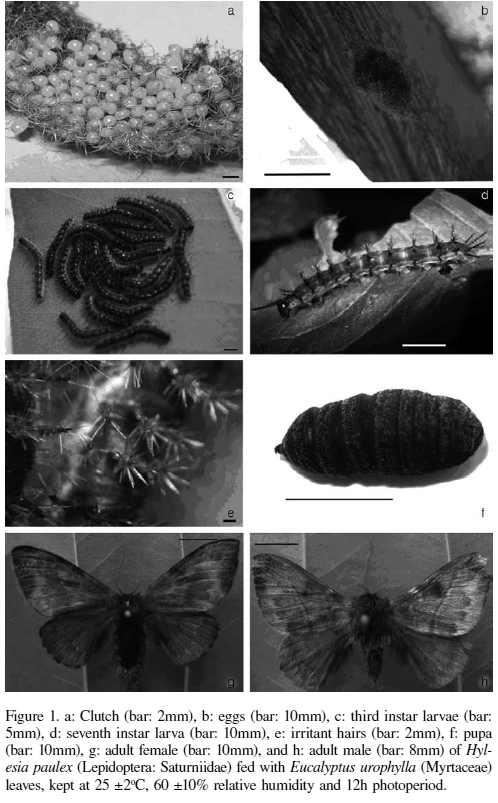
<body><![CDATA[<P style="word-spacing: 0; line-height: 100%" align="justify"><font face="Verdana" size="2">The eucalyptus leaves were washed in running water and bathed in sodium hypochlorite solution (10%) before being supplied to <I>H. paulex</I>, and renewed every 48h. The pots were cleaned daily and substituted when necessary, while the material used by the caterpillars to weave its pre-pupa and pupa stages shelter (branches and remains of leaves) was maintained.</font></P>     <P style="word-spacing: 0; line-height: 100%" align="justify"><font face="Verdana" size="2">The duration and number of specimens at each instar were obtained by measuring the head capsule of <I>H. paulex</I> with a stereoscopic microscope and micrometric ocular microscope. The duration of the pre-pupa and pupa periods, the weight of pupae and the sex rate of this insect were also recorded.</font></P>     <P style="word-spacing: 0; line-height: 100%" align="justify"><font face="Verdana" size="2">Thirty pairs of <I>H. paulex</I> were placed immediately after its emergency in five 30´30´30cm screened cages with wood bottom and glass cover under field conditions, to study the longevity and some reproductive parameters of this insect. Branches of <I>E. urophylla</I> were supplied in the interior of these cages wrapped in cotton wads soaked with water to test if this substratum is preferred by <I>H. paulex</I> females to lay their eggs.</font></P>     <P style="word-spacing: 0; line-height: 100%" align="justify"><font face="Verdana" size="2">Egg masses were collected from each cage and placed in Petri dishes (9.0´1.5cm). The number of eggs, incubation period, viability of eggs, pre-oviposition period, number of eggs per egg mass, and longevity of males and females were recorded. Female specimens<I> </I>were dissected to determine the number of ova kept in the abdomen.</font></P>     <P style="word-spacing: 0; line-height: 100%" align="justify"><font face="Verdana" size="2">A second experiment was carried out to test the hypothesis that the gregarious behavior is important for survival of <I>H. paulex</I> in immature stages. Third instar caterpillars per treatment were maintained in plastic pots (500ml) with densities of: one (treatment T1), five (T2), 10 (T3), 20 (T4) or 30 (T5) caterpillars per pot. Leaves of <I>E. urophylla</I> were offered <I>ad libitum</I> every 24h and the development and survival of the insects, as well as the weight of male and female pupae were registered.</font></P>     <P style="word-spacing: 0; line-height: 100%" align="justify"><font face="Verdana" size="2">Adult specimens of <I>H. paulex</I> were deposited in the Department of Zoology, Federal University of Paran&aacute;, Paran&aacute; State, Brazil, and in the Museum of Entomology and Laboratory of Biological Control of BIOAGRO, UFV, Brazil.</font></P>  <B>    <P style="word-spacing: 0; line-height: 100%" align="justify"><font face="Verdana" size="2">Results and Discussion</font></P> </B>     <P style="word-spacing: 0; line-height: 100%" align="justify"><font face="Verdana" size="2">The eggs of <I>H. paulex</I> have an oval shape, round extremities, flat in their long axis, clear beige color, are deposited in layers and measure 1.71 ±0.07mm long by 0.61 ±0.04mm wide (<a href="#fig1">Figure 1a</a>). The values of the incubation period (32.00 ±1.19 days) and egg viability (65.32 ±14.52%) were intermediate between those of 21.8 ±0.6 days and 16.2 ±8.1% for <I>H. nanus</I> (Walker), 90.83 ±4.23 days and 78.28 ±5.84% for <I>H. nigricans</I> (Berg), and 31.8 ±5.8 days and 80.9 ±20.97% for <I>Lonomia obliqua</I> (Walker) (Lepidoptera: Saturniidae) reported by Santos <I>et al</I>. (1996), Specht <I>et al</I>. (2006a), and Lorini <I>et al</I>. (2004), respectively. Egg masses of <I>H. paulex</I> were always covered by urticating hairs (<a href="#fig1">Figure 1b</a>) removed from the lateral-areas of the abdomen of the females, which indicates a possible defensive adaptation to avoid parasitism and/or predation (Rodr&iacute;guez <I>et al</I>., 2004). However, non-mated <I>H. paulex</I> females laid unfertile eggs that were not covered by hairs, as reported (Gardiner, 1967) for <I>Periphoba hircia</I> (Cramer) (Lepidoptera: Saturniidae).</font></P>      <P style="word-spacing: 0; line-height: 100%" align="center"><a name="fig1"><img border="0" src="/img/fbpe/inci/v34n9/art10fig1.gif" width="498" height="803"></a></P>      
<P style="word-spacing: 0; line-height: 100%" align="justify"><font face="Verdana" size="2">The larval stage of <I>H. paulex</I> lasted 67.83 ±0.84 days with seven instars (<a href="#tab1">Table I</a>). Females of <I>Automeris randa</I> (Druce) (Lepidoptera: Saturniidae) and <I>H. nigricans</I> had an additional instar to those of males (Tuskes, 1985; Specht <I>et al</I>., 2006a), which can be related to the sex dimorphism of these species, but this was not observed for <I>H. paulex</I>. The caterpillars of this species fed on the egg corium during the first hours of life, when they showed slow movements. Afterwards, they abandoned the egg mass and moved towards the <I>E. urophylla</I> leaves inside the pots. <I>Eucalyptus</I> spp. defoliators may prefer younger leaves mainly in their initial stages because they pose a lower physical impediment by being more turgid (Steinbauer and Matsuki, 2004). However, younger <I>H. paulex </I>larvae did not follow this pattern and preferred older <I>E. urophylla</I> leaves than younger ones, independently of instar, as found for most species of this plant in Brazil.</font></P>      ]]></body>
<body><![CDATA[<P style="word-spacing: 0; line-height: 100%" align="center"><a name="tab1"><img border="0" src="/img/fbpe/inci/v34n9/art10tab1.gif" width="525" height="373"></a></P>      
<P style="word-spacing: 0; line-height: 100%" align="justify"><font face="Verdana" size="2">Recently-emerged <I>H. paulex</I> caterpillars presented a black head and a clear orange ventral abdomen area, while its dorsal surface was clear brown (caramel) or clear ash with yellowish thorn tufts. During development the ventral area turns whitish and the dorsal one darkens (<a href="#fig1">Figure 1c</a>). Fully developed caterpillars were 4.01 ±0.27cm long, head of a brilliant red color, ash to black tegument, pronounced clear yellow tufts of thorns and small black stripes in the lateral parts (<a href="#fig1">Figure 1d</a>). The caterpillars of <I>H. paulex</I> presented a strong aggregation with few individuals dispersed from the group during the first instars. From the second to sixth instars they moved in single lines, during the night, in a similar pattern as that reported for <I>H. lineata </I>(Druce) by Fitzgerald and Pescador-Rubio (2002), for <I>Dirphia avicula</I> (Walker) (Lepidoptera: Saturniidae) by Zanuncio <I>et al</I>. (1994), and for <I>Euselasia</I> <I>eucerus</I> (Lepidoptera: Riodinidae) by Zanuncio <I>et al</I>. (2008).</font></P>     <P style="word-spacing: 0; line-height: 100%" align="justify"><font face="Verdana" size="2">In the second experiment (<a href="#fig2">Figure 2</a>), the third instar <I>H. paulex</I> caterpillars placed individually in 500ml pots (treatment T1) did not reach the fourth instar, while none of those in treatment T2 (five caterpillars per pot) reached the pupa stage. The accumulated mortality of caterpillars was lower in T3 and T4 (10 and 20 caterpillars per pot) than in the T5 (30 per pot) in the maximum age of 50 days.The intraspecific competition for food in this last treatment may be higher due to the limited space. Besides, most caterpillars of <I>H. paulex</I> presented symptoms of bacterial infection when 30 of them were reared per pot (T5), mainly in the last two instars, as also described for <I>H. metabus</I> (Cramer) (Lepidoptera: Saturniidae) by Osborn <I>et al</I>. (2002). This may have occurred due to horizontal transmission of pathogens, a negative characteristic of the gregarious behavior in insects (Cocroft, 2001). Caterpillars without infection completed satisfactorily the whole life cycle. The weight of pupae of each sex (<a href="#tab2">Table II</a>) did not differ between the treatments T3, T4 and T5 (F= 0.54; P&lt;0.05), suggesting that the survival of <I>H. paulex</I> is more affected by its gregarious behavior during its development than by nutrition conditions. The hypothesis that gregarious behavior benefits <I>H. paulex</I> was accepted, as found for other Lepidoptera species (Denno and Benrey, 1997; Reader and Hochuli, 2003).</font></P>      <P style="word-spacing: 0; line-height: 100%" align="center"><a name="fig2"><img border="0" src="/img/fbpe/inci/v34n9/art10fig2.gif" width="470" height="524"></a></P>     
<P style="word-spacing: 0; line-height: 100%" align="center"><a name="tab2"><img border="0" src="/img/fbpe/inci/v34n9/art10tab2.gif" width="574" height="286"></a></P>      
<P style="word-spacing: 0; line-height: 100%" align="justify"><font face="Verdana" size="2">Where they stayed during the day, <I>H. paulex </I>from the late instars wove a shelter in the form of a sack with a mixture of silk threads and remnants of branches, leaves and feces, which may represent a kind of defensive behavior of this genus (Santos <I>et al</I>., 1996; Specht <I>et al</I>., 2006a). At night, they abandoned the shelter to feed. The caterpillars of <I>H. paulex</I> presented a strong perception to sound and physical contacts (Hogue, 1972). When upset, they regurgitated a dark liquid, arched the posterior part of the body and they contorted wildly to defend themselves. The thorns at the back of <I>H. paulex</I> caterpillars have bunches, in pairs (<a href="#fig1">Figure 1e</a>), but without erucism, differing from other Saturniidae as <I>H. metabus</I> (Rodr&iacute;guez-Morales <I>et al</I>., 2005), <I>Lonomia obliqua</I> Walker (Lorini and Corseuil, 2001) and <I>Automeris illustris</I> Walker (Specht <I>et al</I>., 2006b). This characteristic facilitated the manipulation of <I>H. paulex</I> in the laboratory and can be useful for manual control of this species in the field.</font></P>     <P style="word-spacing: 0; line-height: 100%" align="justify"><font face="Verdana" size="2">The pre-pupa stage of <I>H. paulex</I> lasted 3.87 ±0.16 days, with a considerable reduction of the corporal length, feeding arrest and search for a place to build a cocoon, mainly with silk threads, remnants of branches, leaves and feces. Several individuals of <I>H. paulex</I> pupate together in a single substratum mass, also suggesting aggregation in this stage as shown for the Hemileucinae <I>H. acuta</I> Druce (Wolfe, 1998).</font></P>     <P style="word-spacing: 0; line-height: 100%" align="justify"><font face="Verdana" size="2">The pupa stage of <I>H. paulex</I>  (<a href="#fig1">Figure 1f</a>) lasted 21.67 ±0.79 days, with females being heavier and longer (385.75 ±12.69mg and 1.90 ±0.89cm) than males (248.17 ±7.32mg and 1.30 ±0.78cm), which can be explained by the accentuated sexual dimorphism of this species. The pupa remained protected, externally, by the same protection structure as in the pre-pupa stage. The sex was differentiated in pupae examining with a magnifying glass (10´) the ventral part of the last abdominal segment.</font></P>     <P style="word-spacing: 0; line-height: 100%" align="justify"><font face="Verdana" size="2">The adults of <I>H. paulex </I>emerged from the larger width of the pupa, with a sex rate of 0.59. The wings were usually fully extended after a few hours from emergence. Some adults stayed immobile while others walked slowly to the bottom of the cages, in a similar behavior (Manley, 1993) as in <I>Automeris io</I> (Fabricius) (Lepidoptera: Saturniidae). Adults that did not spread their wings after 24h did not mate. The egg masses of <I>H. paulex</I> were laid preferentially in the superior part of the cages, without a defined schedule, while mating always took place at night. The eucalyptus leaves inside the cages were not used as substratum for oviposition, indicating that females of <I>H. paulex </I>prefer to lay eggs on the trunk and branches of <I>E. urophylla</I>, as it is frequently observed in the field. The pre-oviposition period of this insect was 2.1 days, with 132 eggs per egg mass and 112 ova kept in the abdomen per female. The individualization of <I>H. paulex</I> pairs in the cages might have propitiated a lower fertilization and, consequently, larger retention of ova in the abdomen. The retention of ova in the abdomen was also found in other species of this family, and it can be related to the polyandry of females (Gardiner, 1967; Wolfe, 1998) or to the conditions of the present study.</font></P>     <P style="word-spacing: 0; line-height: 100%" align="justify"><font face="Verdana" size="2">The longevity of <I>H. paulex</I> males was shorter (2.80 ±0.44 days) than that of females (4.50 ±0.54 days). Males and females did not feed during the adult stage and, for this reason, the higher longevity of females can be related to the need of finding partners for mating. Adults of <I>H. paulex</I> present different characteristics among sexes, such as the size of the abdomen, span and color of the wings, and antennae type, as in other Saturniidae (Wolfe, 1998; Santos <I>et al</I>., 1996; Lorini and Corseuil, 2001; Camargo, 2007; Specht <I>et al</I>., 2007). The abdomen of females (<a href="#fig1">Figure 1g</a>) is more robust than that of males (<a href="#fig1">Figure 1h</a>) with hairs covering, in both sexes, the lateral subsequent parts of their abdomen. Hairs of the abdominal area of <I>H. paulex</I> females had urticating effects, which can lead to public health problems, as found for <I>H. metabus</I> (Rodr&iacute;guez-Morales <I>et al</I>., 2005) and <I>H. nigricans</I> (Salomon <I>et al</I>., 2005). The wing span of <I>H. paulex</I> was 5.04 ±0.14cm for females and 3.70 ±0.10cm for males. The wings of females of this species are gray and darker than those of males. Males have bipectinated antennae with a clear beige color, while those of females are filiform and with a dark color.</font></P>     ]]></body>
<body><![CDATA[<P style="word-spacing: 0; line-height: 100%" align="justify"><font face="Verdana" size="2">Species of the genus <I>Hylesia</I> developed satisfactorily with eucalyptus plants, as observed for <I>H. paulex </I>with <I>E. urophylla</I> in the present work. Thus, it is possible for this species to reach high population levels under monoculture conditions. Knowledge about the biological and morphological aspects of <I>H. paulex</I> are also useful for public health inspectors to develop measures to avoid dermatological damages by <I>Hylesia</I> moths in urban areas.</font></P>  <B>    <P style="word-spacing: 0; line-height: 100%" align="justify"><font face="Verdana" size="2">ACKNOWLEGEMENTS</font></P> </B>     <P style="word-spacing: 0; line-height: 100%" align="justify"><font face="Verdana" size="2">The authors acknowledge the financial support of Conselho Nacional de Desenvolvimento Cient&iacute;fico e Tecnol&oacute;gico (CNPq) and Funda&ccedil;&atilde;o de Amparo &agrave; Pesquisa do Estado de Minas Gerais (FAPEMIG), Brazil.</font></P>  <B>    <P style="word-spacing: 0; line-height: 100%" align="justify"><font face="Verdana" size="2">REFERENCES</font></P> </B>     <!-- ref --><P style="word-spacing: 0; line-height: 100%" align="justify"><font face="Verdana" size="2">1. Ande AT (2003) The lipid profile of the pallid emperor moth <I>Cirina</I> <I>forda</I> Westwood (Lepidoptera: Saturniidae) caterpillar. <I>Biokemistri 13</I>: 37-41.</font>&nbsp;&nbsp;&nbsp;&nbsp;&nbsp;&nbsp;&nbsp;&nbsp;[&#160;<a href="javascript:void(0);" onclick="javascript: window.open('/scielo.php?script=sci_nlinks&ref=1095772&pid=S0378-1844200900090001000001&lng=','','width=640,height=500,resizable=yes,scrollbars=1,menubar=yes,');">Links</a>&#160;]<!-- end-ref --><!-- ref --><P style="word-spacing: 0; line-height: 100%" align="justify"><font face="Verdana" size="2">2. Borges LR, L&aacute;zzari SMN, L&aacute;zzari FA (2003) Compara&ccedil;&atilde;o dos sistemas de cultivo nativo e adensado de erva mate, <I>Ilex paraguariensis </I>St. Hil., quanto &agrave; ocorr&ecirc;ncia e flutua&ccedil;&atilde;o populacional de insetos. <I>Rev. Bras. Entomol. 47</I>: 563-568.</font>&nbsp;&nbsp;&nbsp;&nbsp;&nbsp;&nbsp;&nbsp;&nbsp;[&#160;<a href="javascript:void(0);" onclick="javascript: window.open('/scielo.php?script=sci_nlinks&ref=1095773&pid=S0378-1844200900090001000002&lng=','','width=640,height=500,resizable=yes,scrollbars=1,menubar=yes,');">Links</a>&#160;]<!-- end-ref --><!-- ref --><P style="word-spacing: 0; line-height: 100%" align="justify"><font face="Verdana" size="2">3. Camargo AJA (2007) A new species of <I>Hylesia</I> H&uuml;bner (Lepidoptera, Saturniidae, Hemileucinae) from Brazilian Cerrado.<I> Rev. Bras. de Zool. 24</I>: 199-202.</font> &nbsp;&nbsp;&nbsp;&nbsp;&nbsp;&nbsp;&nbsp;&nbsp;[&#160;<a href="javascript:void(0);" onclick="javascript: window.open('/scielo.php?script=sci_nlinks&ref=1095774&pid=S0378-1844200900090001000003&lng=','','width=640,height=500,resizable=yes,scrollbars=1,menubar=yes,');">Links</a>&#160;]<!-- end-ref --><!-- ref --><P style="word-spacing: 0; line-height: 100%" align="justify"><font face="Verdana" size="2">4. Camargo AJA, Becker VO (1999) Saturniidae (Lepidoptera) from the brazilian cerrado: composition and biogeographic relationships. <I>Biotropica 31</I>: 696-705.</font> &nbsp;&nbsp;&nbsp;&nbsp;&nbsp;&nbsp;&nbsp;&nbsp;[&#160;<a href="javascript:void(0);" onclick="javascript: window.open('/scielo.php?script=sci_nlinks&ref=1095775&pid=S0378-1844200900090001000004&lng=','','width=640,height=500,resizable=yes,scrollbars=1,menubar=yes,');">Links</a>&#160;]<!-- end-ref --><!-- ref --><P style="word-spacing: 0; line-height: 100%" align="justify"><font face="Verdana" size="2">5. Cocroft RB (2001) Vibrational communication and the ecology of group-living, herbivorous insects. <I>Am. Zool. 41</I>: 1215-1221.</font>&nbsp;&nbsp;&nbsp;&nbsp;&nbsp;&nbsp;&nbsp;&nbsp;[&#160;<a href="javascript:void(0);" onclick="javascript: window.open('/scielo.php?script=sci_nlinks&ref=1095776&pid=S0378-1844200900090001000005&lng=','','width=640,height=500,resizable=yes,scrollbars=1,menubar=yes,');">Links</a>&#160;]<!-- end-ref --><!-- ref --><P style="word-spacing: 0; line-height: 100%" align="justify"><font face="Verdana" size="2">6. Denno RF, Benrey B (1997) Aggregation facilitates larval growth in the neotropical nymphalid butterfly <I>Chlosyne janais</I>. <I>Ecol. Entomol.</I> 22: 133-141.</font>&nbsp;&nbsp;&nbsp;&nbsp;&nbsp;&nbsp;&nbsp;&nbsp;[&#160;<a href="javascript:void(0);" onclick="javascript: window.open('/scielo.php?script=sci_nlinks&ref=1095777&pid=S0378-1844200900090001000006&lng=','','width=640,height=500,resizable=yes,scrollbars=1,menubar=yes,');">Links</a>&#160;]<!-- end-ref --><!-- ref --><P style="word-spacing: 0; line-height: 100%" align="justify"><font face="Verdana" size="2">7. Fitzgerald TD, Pescador-Rubio A (2002) The role of tactile and chemical stimuli in the formation and maintenance of the processions of the social caterpillar <I>Hylesia lineata </I>(Lepidoptera: Saturniidae). <I>J. Insect Behav. 15</I>: 659-674.</font>&nbsp;&nbsp;&nbsp;&nbsp;&nbsp;&nbsp;&nbsp;&nbsp;[&#160;<a href="javascript:void(0);" onclick="javascript: window.open('/scielo.php?script=sci_nlinks&ref=1095778&pid=S0378-1844200900090001000007&lng=','','width=640,height=500,resizable=yes,scrollbars=1,menubar=yes,');">Links</a>&#160;]<!-- end-ref --><!-- ref --><P style="word-spacing: 0; line-height: 100%" align="justify"><font face="Verdana" size="2">8. Forn&eacute;s L, Hern&aacute;ndez JV (2001) Rese&ntilde;a hist&oacute;rica e incidencia en la salud p&uacute;blica de <I>Hylesia metabus </I>(Cramer) (Lepidoptera: Saturniidae) en Venezuela. <I>Entomotropica 16</I>: 137-141.</font>&nbsp;&nbsp;&nbsp;&nbsp;&nbsp;&nbsp;&nbsp;&nbsp;[&#160;<a href="javascript:void(0);" onclick="javascript: window.open('/scielo.php?script=sci_nlinks&ref=1095779&pid=S0378-1844200900090001000008&lng=','','width=640,height=500,resizable=yes,scrollbars=1,menubar=yes,');">Links</a>&#160;]<!-- end-ref --><!-- ref --><P style="word-spacing: 0; line-height: 100%" align="justify"><font face="Verdana" size="2">9. Freitas FA, Zanuncio TV, Zanuncio JC, Concei&ccedil;&atilde;o PM, Fialho MCQ, Bernardino AS (2005) Effect of plant age, temperature and rainfall on Lepidoptera insect pests collected with light traps in a <I>Eucalyptus grandis</I> plantation in Brazil. <I>Ann. Forest Sci.</I> 62: 85-90.</font>&nbsp;&nbsp;&nbsp;&nbsp;&nbsp;&nbsp;&nbsp;&nbsp;[&#160;<a href="javascript:void(0);" onclick="javascript: window.open('/scielo.php?script=sci_nlinks&ref=1095780&pid=S0378-1844200900090001000009&lng=','','width=640,height=500,resizable=yes,scrollbars=1,menubar=yes,');">Links</a>&#160;]<!-- end-ref --><!-- ref --><P style="word-spacing: 0; line-height: 100%" align="justify"><font face="Verdana" size="2">10. Gardiner BOC (1967) The life history of <I>Periphoba</I> <I>hircia</I> (Saturniidae) with a note on distribution and larval variation. <I>J. of Lepidopt. Soc. 21</I>: 198-204.</font>&nbsp;&nbsp;&nbsp;&nbsp;&nbsp;&nbsp;&nbsp;&nbsp;[&#160;<a href="javascript:void(0);" onclick="javascript: window.open('/scielo.php?script=sci_nlinks&ref=1095781&pid=S0378-1844200900090001000010&lng=','','width=640,height=500,resizable=yes,scrollbars=1,menubar=yes,');">Links</a>&#160;]<!-- end-ref --><!-- ref --><P style="word-spacing: 0; line-height: 100%" align="justify"><font face="Verdana" size="2">11. Glasser CM, Cardoso JL, Carr&eacute;ri-Bruno GC, Domingos MF, Mor&atilde;es RHP, Ciaravolo RMC (1993) Surtos epid&ecirc;micos de dermatite causada por mariposas do g&ecirc;nero <I>Hylesia</I> (Lepidoptera: Hemileucidae) no Estado de S&atilde;o Paulo, Brazil. <I>Rev. Sa&uacute;d. P&uacute;bl. 27</I>: 217-220.</font>&nbsp;&nbsp;&nbsp;&nbsp;&nbsp;&nbsp;&nbsp;&nbsp;[&#160;<a href="javascript:void(0);" onclick="javascript: window.open('/scielo.php?script=sci_nlinks&ref=1095782&pid=S0378-1844200900090001000011&lng=','','width=640,height=500,resizable=yes,scrollbars=1,menubar=yes,');">Links</a>&#160;]<!-- end-ref --><!-- ref --><P style="word-spacing: 0; line-height: 100%" align="justify"><font face="Verdana" size="2">12. Gouveia AICB, Silveira RB, Nader HB, Dietrich CP, Gremskia W, Veiga SS (2005) Identification and partial characterisation of hyaluronidases in <I>Lonomia obliqua </I>venom. <I>Toxicon 45</I>:<I> </I>403-410.</font>&nbsp;&nbsp;&nbsp;&nbsp;&nbsp;&nbsp;&nbsp;&nbsp;[&#160;<a href="javascript:void(0);" onclick="javascript: window.open('/scielo.php?script=sci_nlinks&ref=1095783&pid=S0378-1844200900090001000012&lng=','','width=640,height=500,resizable=yes,scrollbars=1,menubar=yes,');">Links</a>&#160;]<!-- end-ref --><!-- ref --><P style="word-spacing: 0; line-height: 100%" align="justify"><font face="Verdana" size="2">13. Hogue CL (1972) Protective function of sound perception and gregariousness in <I>Hylesia</I> larvae (Saturniidae: Hemileucinae). <I>J. Lepidopt. Soc. 26</I>: 33-34.</font>&nbsp;&nbsp;&nbsp;&nbsp;&nbsp;&nbsp;&nbsp;&nbsp;[&#160;<a href="javascript:void(0);" onclick="javascript: window.open('/scielo.php?script=sci_nlinks&ref=1095784&pid=S0378-1844200900090001000013&lng=','','width=640,height=500,resizable=yes,scrollbars=1,menubar=yes,');">Links</a>&#160;]<!-- end-ref --><!-- ref --><P style="word-spacing: 0; line-height: 100%" align="justify"><font face="Verdana" size="2">14. Iserhard CA, Kaminski LA, Marchiori MO, Teixeira EC, Romanowski HP (2007) Occurrence of lepidopterism caused by the moth <I>Hylesia nigricans </I>(Berg) (Lepidoptera: Saturniidae) in Rio Grande do Sul state, Brazil. <I>Neotrop. Entomol. 36</I>: 612-615.</font>&nbsp;&nbsp;&nbsp;&nbsp;&nbsp;&nbsp;&nbsp;&nbsp;[&#160;<a href="javascript:void(0);" onclick="javascript: window.open('/scielo.php?script=sci_nlinks&ref=1095785&pid=S0378-1844200900090001000014&lng=','','width=640,height=500,resizable=yes,scrollbars=1,menubar=yes,');">Links</a>&#160;]<!-- end-ref --><!-- ref --><P style="word-spacing: 0; line-height: 100%" align="justify"><font face="Verdana" size="2">15. Lemaire C (2002) The Saturniidae of America – Hemileucinae Parts A, B, C. 1388 pp., 124 plates. Goecke &amp; Evers, Keltern, Germany.</font>&nbsp;&nbsp;&nbsp;&nbsp;&nbsp;&nbsp;&nbsp;&nbsp;[&#160;<a href="javascript:void(0);" onclick="javascript: window.open('/scielo.php?script=sci_nlinks&ref=1095786&pid=S0378-1844200900090001000015&lng=','','width=640,height=500,resizable=yes,scrollbars=1,menubar=yes,');">Links</a>&#160;]<!-- end-ref --><!-- ref --><P style="word-spacing: 0; line-height: 100%" align="justify"><font face="Verdana" size="2">16. Lorini LM, Corseuil E (2001) Aspectos morfol&oacute;gicos de <I>Lonomia obliqua </I>Walker (Lepidoptera: Saturniidae). <I>Neotrop. Entomol. 30</I>: 373-378.</font>&nbsp;&nbsp;&nbsp;&nbsp;&nbsp;&nbsp;&nbsp;&nbsp;[&#160;<a href="javascript:void(0);" onclick="javascript: window.open('/scielo.php?script=sci_nlinks&ref=1095787&pid=S0378-1844200900090001000016&lng=','','width=640,height=500,resizable=yes,scrollbars=1,menubar=yes,');">Links</a>&#160;]<!-- end-ref --><!-- ref --><P style="word-spacing: 0; line-height: 100%" align="justify"><font face="Verdana" size="2">17. Lorini LM, Rebelato GS, Bonatti J (2004) Reproductive parameters of <I>Lonomia obliqua </I>Walker, 1855 (Lepidoptera: Saturniidae) in laboratory. <I>Braz. Arch. Biol. Technol. 47</I>: 575-577.</font>&nbsp;&nbsp;&nbsp;&nbsp;&nbsp;&nbsp;&nbsp;&nbsp;[&#160;<a href="javascript:void(0);" onclick="javascript: window.open('/scielo.php?script=sci_nlinks&ref=1095788&pid=S0378-1844200900090001000017&lng=','','width=640,height=500,resizable=yes,scrollbars=1,menubar=yes,');">Links</a>&#160;]<!-- end-ref --><!-- ref --><P style="word-spacing: 0; line-height: 100%" align="justify"><font face="Verdana" size="2">18. Lorini LM, Zarbin PHG, Tedesco CD (2007) Biology of laboratory-reared <I>Lonomia obliqua </I>(Lepidoptera: Saturniidae). <I>Fla. Entomol. 90</I>: 770-771.</font>&nbsp;&nbsp;&nbsp;&nbsp;&nbsp;&nbsp;&nbsp;&nbsp;[&#160;<a href="javascript:void(0);" onclick="javascript: window.open('/scielo.php?script=sci_nlinks&ref=1095789&pid=S0378-1844200900090001000018&lng=','','width=640,height=500,resizable=yes,scrollbars=1,menubar=yes,');">Links</a>&#160;]<!-- end-ref --><!-- ref --><P style="word-spacing: 0; line-height: 100%" align="justify"><font face="Verdana" size="2">19. Lundberg U, Salazar V, Tovar M, Rodr&iacute;guez J (2007) Isolation and partial characterization of proteins with vasodegenerative and proinflammatory properties from the egg-nests of <I>Hylesia metabus </I>(Lepidoptera: Saturniidae). <I>J. Med. Entomol. 44</I>: 440-449.</font>&nbsp;&nbsp;&nbsp;&nbsp;&nbsp;&nbsp;&nbsp;&nbsp;[&#160;<a href="javascript:void(0);" onclick="javascript: window.open('/scielo.php?script=sci_nlinks&ref=1095790&pid=S0378-1844200900090001000019&lng=','','width=640,height=500,resizable=yes,scrollbars=1,menubar=yes,');">Links</a>&#160;]<!-- end-ref --><!-- ref --><P style="word-spacing: 0; line-height: 100%" align="justify"><font face="Verdana" size="2">20. Manley TR (1993) Diapause, voltinism, and foodplants of <I>Automeris</I> <I>io</I> (Saturniidae) in the southeastern united states. <I>J of Lepidopt. Soc. 47</I>: 303-321.</font> &nbsp;&nbsp;&nbsp;&nbsp;&nbsp;&nbsp;&nbsp;&nbsp;[&#160;<a href="javascript:void(0);" onclick="javascript: window.open('/scielo.php?script=sci_nlinks&ref=1095791&pid=S0378-1844200900090001000020&lng=','','width=640,height=500,resizable=yes,scrollbars=1,menubar=yes,');">Links</a>&#160;]<!-- end-ref --><!-- ref --><P style="word-spacing: 0; line-height: 100%" align="justify"><font face="Verdana" size="2">21. Moreira SC, Lima JC, Silva L, Haddad Junior V (2007) Descri&ccedil;&atilde;o de um surto de lepidopterismo (dermatite associada ao contato com mariposas) entre marinheiros, ocorrido em Salvador, Estado da Bahia. <I>Rev. Soc. Bras. Med. Trop. 40</I>:<I> </I>591-593.</font>&nbsp;&nbsp;&nbsp;&nbsp;&nbsp;&nbsp;&nbsp;&nbsp;[&#160;<a href="javascript:void(0);" onclick="javascript: window.open('/scielo.php?script=sci_nlinks&ref=1095792&pid=S0378-1844200900090001000021&lng=','','width=640,height=500,resizable=yes,scrollbars=1,menubar=yes,');">Links</a>&#160;]<!-- end-ref --><!-- ref --><P style="word-spacing: 0; line-height: 100%" align="justify"><font face="Verdana" size="2">22. Osborn F, Berlioz L, Vitelli-Flores J, Monsalve W, Dorta B, Lemoine VR (2002) Pathogenic effects of bacteria isolated from larvae of <I>Hylesia</I> <I>metabus</I> Crammer (Lepidoptera: Saturniidae). <I>J. Invert. Pathol. 80</I>: 7-12.</font>&nbsp;&nbsp;&nbsp;&nbsp;&nbsp;&nbsp;&nbsp;&nbsp;[&#160;<a href="javascript:void(0);" onclick="javascript: window.open('/scielo.php?script=sci_nlinks&ref=1095793&pid=S0378-1844200900090001000022&lng=','','width=640,height=500,resizable=yes,scrollbars=1,menubar=yes,');">Links</a>&#160;]<!-- end-ref --><!-- ref --><P style="word-spacing: 0; line-height: 100%" align="justify"><font face="Verdana" size="2">23. Reader T, Hochuli DF (2003) Understanding gregariousness in a larval lepidopteran: the roles of host plant, predation, and microclimate. <I>Ecol. Entomol. 28</I>: 729-737.</font>&nbsp;&nbsp;&nbsp;&nbsp;&nbsp;&nbsp;&nbsp;&nbsp;[&#160;<a href="javascript:void(0);" onclick="javascript: window.open('/scielo.php?script=sci_nlinks&ref=1095794&pid=S0378-1844200900090001000023&lng=','','width=640,height=500,resizable=yes,scrollbars=1,menubar=yes,');">Links</a>&#160;]<!-- end-ref --><!-- ref --><P style="word-spacing: 0; line-height: 100%" align="justify"><font face="Verdana" size="2">24. Rodr&iacute;guez J, Hern&aacute;ndez JV, Forn&eacute;s L, Lundberg U, Arocha-Pi&ntilde;ango CL, Osborn F (2004) External morphology of abdominal setae from male and female of <I>Hylesia</I> <I>metabus</I> adults (Lepidoptera: Saturniidae) and their function. <I>Fla. Entomol. 87</I>: 30-36.</font>&nbsp;&nbsp;&nbsp;&nbsp;&nbsp;&nbsp;&nbsp;&nbsp;[&#160;<a href="javascript:void(0);" onclick="javascript: window.open('/scielo.php?script=sci_nlinks&ref=1095795&pid=S0378-1844200900090001000024&lng=','','width=640,height=500,resizable=yes,scrollbars=1,menubar=yes,');">Links</a>&#160;]<!-- end-ref --><!-- ref --><P style="word-spacing: 0; line-height: 100%" align="justify"><font face="Verdana" size="2">25. Rodr&iacute;guez-Morales AJ, Arria M, Rojas-Mirabal J, Borges E, Ben&iacute;tez JA, Herrera M, Villalobos C, Maldonado A, Rubio N, Franco-Paredes C (2005) Short report: lepidopterism due to exposure to the moth <I>Hylesia Metabus </I>in northeastern Venezuela. <I>Am. J. Trop. Med. Hyg. 73</I>: 991-993.</font>&nbsp;&nbsp;&nbsp;&nbsp;&nbsp;&nbsp;&nbsp;&nbsp;[&#160;<a href="javascript:void(0);" onclick="javascript: window.open('/scielo.php?script=sci_nlinks&ref=1095796&pid=S0378-1844200900090001000025&lng=','','width=640,height=500,resizable=yes,scrollbars=1,menubar=yes,');">Links</a>&#160;]<!-- end-ref --><!-- ref --><P style="word-spacing: 0; line-height: 100%" align="justify"><font face="Verdana" size="2">26. Salomon OD, Simon D, Rimoldi JC, Villaruel M, P&eacute;rez O, Pperez R, Marchan H (2005) Lepidopterismo por <I>Hylesia</I> <I>nigricans</I> (mariposa negra) investigacion y accion preventiva em Buenos Aires. <I>Medicina 65</I>: 241-246.</font>&nbsp;&nbsp;&nbsp;&nbsp;&nbsp;&nbsp;&nbsp;&nbsp;[&#160;<a href="javascript:void(0);" onclick="javascript: window.open('/scielo.php?script=sci_nlinks&ref=1095797&pid=S0378-1844200900090001000026&lng=','','width=640,height=500,resizable=yes,scrollbars=1,menubar=yes,');">Links</a>&#160;]<!-- end-ref --><!-- ref --><P style="word-spacing: 0; line-height: 100%" align="justify"><font face="Verdana" size="2">27. Santos GP, Zanuncio TV, Dias OS, Zanuncio JC (1996) Biologia de <I>Hylesia</I> <I>nanus</I> (Walker) (Lepidoptera: Attacidae). <I>Anais Soc. Entomol. Bras. 25</I>: 479-482.</font>&nbsp;&nbsp;&nbsp;&nbsp;&nbsp;&nbsp;&nbsp;&nbsp;[&#160;<a href="javascript:void(0);" onclick="javascript: window.open('/scielo.php?script=sci_nlinks&ref=1095798&pid=S0378-1844200900090001000027&lng=','','width=640,height=500,resizable=yes,scrollbars=1,menubar=yes,');">Links</a>&#160;]<!-- end-ref --><!-- ref --><P style="word-spacing: 0; line-height: 100%" align="justify"><font face="Verdana" size="2">28.</font> <font face="Verdana" size="2">Specht A, Formentini AC, Corseuil E (2006a) Biologia de <I>Hylesia nigricans</I> (Berg) (Lepidoptera, Saturniidae, Hemileucinae). <I>Rev. Bras. Zool. 23</I>: 248-255.</font> &nbsp;&nbsp;&nbsp;&nbsp;&nbsp;&nbsp;&nbsp;&nbsp;[&#160;<a href="javascript:void(0);" onclick="javascript: window.open('/scielo.php?script=sci_nlinks&ref=1095799&pid=S0378-1844200900090001000028&lng=','','width=640,height=500,resizable=yes,scrollbars=1,menubar=yes,');">Links</a>&#160;]<!-- end-ref --><!-- ref --><P style="word-spacing: 0; line-height: 100%" align="justify"><font face="Verdana" size="2">29. Specht A, Formentini AC, Corseuil E (2006b) Biologia de <I>Automeris</I> <I>illustris</I> (Walker) (Lepidoptera, Saturniidae, Hemileucinae). <I>Rev. Bras. Zool. 23</I>: 537-546.</font> &nbsp;&nbsp;&nbsp;&nbsp;&nbsp;&nbsp;&nbsp;&nbsp;[&#160;<a href="javascript:void(0);" onclick="javascript: window.open('/scielo.php?script=sci_nlinks&ref=1095800&pid=S0378-1844200900090001000029&lng=','','width=640,height=500,resizable=yes,scrollbars=1,menubar=yes,');">Links</a>&#160;]<!-- end-ref --><!-- ref --><P style="word-spacing: 0; line-height: 100%" align="justify"><font face="Verdana" size="2">30. Specht A, Formentini AC, Corseuil E (2007) Biological aspects of <I>Hylesia metapyrrha</I> (Lepidoptera; Saturniidae; Hemileucinae), in laboratory. <I>Braz. J. Biol. 67</I>: 173-177.</font>&nbsp;&nbsp;&nbsp;&nbsp;&nbsp;&nbsp;&nbsp;&nbsp;[&#160;<a href="javascript:void(0);" onclick="javascript: window.open('/scielo.php?script=sci_nlinks&ref=1095801&pid=S0378-1844200900090001000030&lng=','','width=640,height=500,resizable=yes,scrollbars=1,menubar=yes,');">Links</a>&#160;]<!-- end-ref --><!-- ref --><P style="word-spacing: 0; line-height: 100%" align="justify"><font face="Verdana" size="2">31. Steinbauer MJ, Matsuki M (2004) Suitability of <I>Eucalyptus</I> and <I>Corymbia</I> for <I>Mnesampela privata</I> (Guen&eacute;e) (Lepidoptera: Geometridae) larvae. <I>Agric. Forest Entomol. 6</I>: 323–332.</font> &nbsp;&nbsp;&nbsp;&nbsp;&nbsp;&nbsp;&nbsp;&nbsp;[&#160;<a href="javascript:void(0);" onclick="javascript: window.open('/scielo.php?script=sci_nlinks&ref=1095802&pid=S0378-1844200900090001000031&lng=','','width=640,height=500,resizable=yes,scrollbars=1,menubar=yes,');">Links</a>&#160;]<!-- end-ref --><!-- ref --><P style="word-spacing: 0; line-height: 100%" align="justify"><font face="Verdana" size="2">32. Tuskes PM (1985) The biology and immature stages of <I>Automeris</I> <I>randa</I> and <I>Automeris</I> <I>iris</I> <I>hesselorum</I> (Saturniidae). <I>Journal of Lepidopterists’s Society. 39</I>: 163-170.</font> &nbsp;&nbsp;&nbsp;&nbsp;&nbsp;&nbsp;&nbsp;&nbsp;[&#160;<a href="javascript:void(0);" onclick="javascript: window.open('/scielo.php?script=sci_nlinks&ref=1095803&pid=S0378-1844200900090001000032&lng=','','width=640,height=500,resizable=yes,scrollbars=1,menubar=yes,');">Links</a>&#160;]<!-- end-ref --><!-- ref --><P style="word-spacing: 0; line-height: 100%" align="justify"><font face="Verdana" size="2">33. Wolfe KL (1998) <I>Hyesia</I> <I>acuta</I> (Saturniidae) and its aggregrate larval and pupal pouch. <I>Journal of the Lepidopterists’ Society. 42</I>: 132-137.</font> &nbsp;&nbsp;&nbsp;&nbsp;&nbsp;&nbsp;&nbsp;&nbsp;[&#160;<a href="javascript:void(0);" onclick="javascript: window.open('/scielo.php?script=sci_nlinks&ref=1095804&pid=S0378-1844200900090001000033&lng=','','width=640,height=500,resizable=yes,scrollbars=1,menubar=yes,');">Links</a>&#160;]<!-- end-ref --><!-- ref --><P style="word-spacing: 0; line-height: 100%" align="justify"><font face="Verdana" size="2">34. Zanuncio JC, Gudes RNC, Zanuncio TV, Fabres AS (2001) Species richness and abundance of defoliating Lepidoptera associated with <I>Eucalyptus grandis</I> in Brazil and their response to plant age. <I>Austral Ecol. 26</I>: 582-589.</font>&nbsp;&nbsp;&nbsp;&nbsp;&nbsp;&nbsp;&nbsp;&nbsp;[&#160;<a href="javascript:void(0);" onclick="javascript: window.open('/scielo.php?script=sci_nlinks&ref=1095805&pid=S0378-1844200900090001000034&lng=','','width=640,height=500,resizable=yes,scrollbars=1,menubar=yes,');">Links</a>&#160;]<!-- end-ref --><!-- ref --><P style="word-spacing: 0; line-height: 100%" align="justify"><font face="Verdana" size="2">35. Zanuncio JC, Torres JB, Sediyama CAZ, Pereira FF, Pastori PL, Wermelinger E, Ramalho FS (2008) Mortality of the defoliator <I>Euselasia eucerus</I> (Lepidoptera: Riodinidae) by biotic factors in an <I>Eucalyptus urophylla</I> plantation in Minas Gerais State, Brazil. <I>An. Acad. Bras. Ci&ecirc;nc. 81</I>: 61-66.</font>&nbsp;&nbsp;&nbsp;&nbsp;&nbsp;&nbsp;&nbsp;&nbsp;[&#160;<a href="javascript:void(0);" onclick="javascript: window.open('/scielo.php?script=sci_nlinks&ref=1095806&pid=S0378-1844200900090001000035&lng=','','width=640,height=500,resizable=yes,scrollbars=1,menubar=yes,');">Links</a>&#160;]<!-- end-ref --><!-- ref --><P style="word-spacing: 0; line-height: 100%" align="justify"><font face="Verdana" size="2">36. Zanuncio TV, Zanuncio JC, Meira IA, Ara&uacute;jo FS (1994) Caracteriza&ccedil;&atilde;o das fases larval e adulta de <I>Dirphia avicula</I> (Lepidoptera: Saturniidae) em folhas de <I>Eucalyptus urophylla</I>. <I>&Aacute;rvore. 18</I>: 153-158.</font>&nbsp;&nbsp;&nbsp;&nbsp;&nbsp;&nbsp;&nbsp;&nbsp;[&#160;<a href="javascript:void(0);" onclick="javascript: window.open('/scielo.php?script=sci_nlinks&ref=1095807&pid=S0378-1844200900090001000036&lng=','','width=640,height=500,resizable=yes,scrollbars=1,menubar=yes,');">Links</a>&#160;]<!-- end-ref --><!-- ref --><P style="word-spacing: 0; line-height: 100%" align="justify"><font face="Verdana" size="2">37. Zanuncio TV, Zanuncio JC, Miranda MMM, Medeiros AGB (1998) Effect of plantation age on diversity and population fluctuation of Lepidoptera collected in <I>Eucalyptus </I>plantations in Brazil. <I>Forest Ecol. Manag. 108</I>: 91-98.</font>&nbsp;&nbsp;&nbsp;&nbsp;&nbsp;&nbsp;&nbsp;&nbsp;[&#160;<a href="javascript:void(0);" onclick="javascript: window.open('/scielo.php?script=sci_nlinks&ref=1095808&pid=S0378-1844200900090001000037&lng=','','width=640,height=500,resizable=yes,scrollbars=1,menubar=yes,');">Links</a>&#160;]<!-- end-ref --><!-- ref --><P style="word-spacing: 0; line-height: 100%" align="justify"><font face="Verdana" size="2">38. Zanuncio TV, Zanuncio JC, Freitas FA, Pratissoli D, Sediyama CAZ, Maffia VP (2006) Main lepidopteran pest species collected from an eucalyptus plantation in Minas Gerais, Brazil. <I>Rev. Biol. Trop. 54</I>: 553-560.</font>&nbsp;&nbsp;&nbsp;&nbsp;&nbsp;&nbsp;&nbsp;&nbsp;[&#160;<a href="javascript:void(0);" onclick="javascript: window.open('/scielo.php?script=sci_nlinks&ref=1095809&pid=S0378-1844200900090001000038&lng=','','width=640,height=500,resizable=yes,scrollbars=1,menubar=yes,');">Links</a>&#160;]<!-- end-ref --> ]]></body>
<back>
<ref-list>
<ref id="B1">
<label>1</label><nlm-citation citation-type="journal">
<person-group person-group-type="author">
<name>
<surname><![CDATA[Ande]]></surname>
<given-names><![CDATA[AT]]></given-names>
</name>
</person-group>
<article-title xml:lang="en"><![CDATA[The lipid profile of the pallid emperor moth Cirina forda Westwood (Lepidoptera: Saturniidae) caterpillar]]></article-title>
<source><![CDATA[Biokemistri]]></source>
<year>2003</year>
<volume>13</volume>
<page-range>37-41</page-range></nlm-citation>
</ref>
<ref id="B2">
<label>2</label><nlm-citation citation-type="journal">
<person-group person-group-type="author">
<name>
<surname><![CDATA[Borges]]></surname>
<given-names><![CDATA[LR]]></given-names>
</name>
<name>
<surname><![CDATA[Lázzari]]></surname>
<given-names><![CDATA[SMN]]></given-names>
</name>
<name>
<surname><![CDATA[Lázzari]]></surname>
<given-names><![CDATA[FA]]></given-names>
</name>
</person-group>
<article-title xml:lang="pt"><![CDATA[Comparação dos sistemas de cultivo nativo e adensado de erva mate, Ilex paraguariensis St. Hil., quanto à ocorrência e flutuação populacional de insetos]]></article-title>
<source><![CDATA[Rev. Bras. Entomol.]]></source>
<year>2003</year>
<volume>47</volume>
<page-range>563-568</page-range></nlm-citation>
</ref>
<ref id="B3">
<label>3</label><nlm-citation citation-type="journal">
<person-group person-group-type="author">
<name>
<surname><![CDATA[Camargo]]></surname>
<given-names><![CDATA[AJA]]></given-names>
</name>
</person-group>
<article-title xml:lang="en"><![CDATA[A new species of Hylesia Hübner (Lepidoptera, Saturniidae, Hemileucinae) from Brazilian Cerrado]]></article-title>
<source><![CDATA[Rev. Bras. de Zool.]]></source>
<year>2007</year>
<volume>24</volume>
<page-range>199-202</page-range></nlm-citation>
</ref>
<ref id="B4">
<label>4</label><nlm-citation citation-type="journal">
<person-group person-group-type="author">
<name>
<surname><![CDATA[Camargo]]></surname>
<given-names><![CDATA[AJA]]></given-names>
</name>
<name>
<surname><![CDATA[Becker]]></surname>
<given-names><![CDATA[VO]]></given-names>
</name>
</person-group>
<article-title xml:lang="en"><![CDATA[Saturniidae (Lepidoptera) from the brazilian cerrado: composition and biogeographic relationships]]></article-title>
<source><![CDATA[Biotropica]]></source>
<year>1999</year>
<volume>31</volume>
<page-range>696-705</page-range></nlm-citation>
</ref>
<ref id="B5">
<label>5</label><nlm-citation citation-type="journal">
<person-group person-group-type="author">
<name>
<surname><![CDATA[Cocroft]]></surname>
<given-names><![CDATA[RB]]></given-names>
</name>
</person-group>
<article-title xml:lang="en"><![CDATA[Vibrational communication and the ecology of group-living, herbivorous insects]]></article-title>
<source><![CDATA[Am. Zool.]]></source>
<year>2001</year>
<volume>41</volume>
<page-range>1215-1221</page-range></nlm-citation>
</ref>
<ref id="B6">
<label>6</label><nlm-citation citation-type="journal">
<person-group person-group-type="author">
<name>
<surname><![CDATA[Denno]]></surname>
<given-names><![CDATA[RF]]></given-names>
</name>
<name>
<surname><![CDATA[Benrey]]></surname>
<given-names><![CDATA[B]]></given-names>
</name>
</person-group>
<article-title xml:lang="en"><![CDATA[Aggregation facilitates larval growth in the neotropical nymphalid butterfly Chlosyne janais]]></article-title>
<source><![CDATA[Ecol. Entomol.]]></source>
<year>1997</year>
<volume>22</volume>
<page-range>133-141</page-range></nlm-citation>
</ref>
<ref id="B7">
<label>7</label><nlm-citation citation-type="journal">
<person-group person-group-type="author">
<name>
<surname><![CDATA[Fitzgerald]]></surname>
<given-names><![CDATA[TD]]></given-names>
</name>
<name>
<surname><![CDATA[Pescador-Rubio]]></surname>
<given-names><![CDATA[A]]></given-names>
</name>
</person-group>
<article-title xml:lang="en"><![CDATA[The role of tactile and chemical stimuli in the formation and maintenance of the processions of the social caterpillar Hylesia lineata (Lepidoptera: Saturniidae)]]></article-title>
<source><![CDATA[J. Insect Behav.]]></source>
<year>2002</year>
<volume>15</volume>
<page-range>659-674</page-range></nlm-citation>
</ref>
<ref id="B8">
<label>8</label><nlm-citation citation-type="journal">
<person-group person-group-type="author">
<name>
<surname><![CDATA[Fornés]]></surname>
<given-names><![CDATA[L]]></given-names>
</name>
<name>
<surname><![CDATA[Hernández]]></surname>
<given-names><![CDATA[JV]]></given-names>
</name>
</person-group>
<article-title xml:lang="pt"><![CDATA[Reseña histórica e incidencia en la salud pública de Hylesia metabus (Cramer) (Lepidoptera: Saturniidae) en Venezuela]]></article-title>
<source><![CDATA[Entomotropica]]></source>
<year>2001</year>
<volume>16</volume>
<page-range>137-141</page-range></nlm-citation>
</ref>
<ref id="B9">
<label>9</label><nlm-citation citation-type="journal">
<person-group person-group-type="author">
<name>
<surname><![CDATA[Freitas]]></surname>
<given-names><![CDATA[FA]]></given-names>
</name>
<name>
<surname><![CDATA[Zanuncio]]></surname>
<given-names><![CDATA[TV]]></given-names>
</name>
<name>
<surname><![CDATA[Zanuncio]]></surname>
<given-names><![CDATA[JC]]></given-names>
</name>
<name>
<surname><![CDATA[Conceição]]></surname>
<given-names><![CDATA[PM]]></given-names>
</name>
<name>
<surname><![CDATA[Fialho]]></surname>
<given-names><![CDATA[MCQ]]></given-names>
</name>
<name>
<surname><![CDATA[Bernardino]]></surname>
<given-names><![CDATA[AS]]></given-names>
</name>
</person-group>
<article-title xml:lang="en"><![CDATA[Effect of plant age, temperature and rainfall on Lepidoptera insect pests collected with light traps in a Eucalyptus grandis plantation in Brazil]]></article-title>
<source><![CDATA[Ann. Forest Sci.]]></source>
<year>2005</year>
<volume>62</volume>
<page-range>85-90</page-range></nlm-citation>
</ref>
<ref id="B10">
<label>10</label><nlm-citation citation-type="journal">
<person-group person-group-type="author">
<name>
<surname><![CDATA[Gardiner]]></surname>
<given-names><![CDATA[BOC]]></given-names>
</name>
</person-group>
<article-title xml:lang="en"><![CDATA[The life history of Periphoba hircia (Saturniidae) with a note on distribution and larval variation]]></article-title>
<source><![CDATA[J. of Lepidopt. Soc.]]></source>
<year>1967</year>
<volume>21</volume>
<page-range>198-204</page-range></nlm-citation>
</ref>
<ref id="B11">
<label>11</label><nlm-citation citation-type="journal">
<person-group person-group-type="author">
<name>
<surname><![CDATA[Glasser]]></surname>
<given-names><![CDATA[CM]]></given-names>
</name>
<name>
<surname><![CDATA[Cardoso]]></surname>
<given-names><![CDATA[JL]]></given-names>
</name>
<name>
<surname><![CDATA[Carréri-Bruno]]></surname>
<given-names><![CDATA[GC]]></given-names>
</name>
<name>
<surname><![CDATA[Domingos]]></surname>
<given-names><![CDATA[MF]]></given-names>
</name>
<name>
<surname><![CDATA[Morães]]></surname>
<given-names><![CDATA[RHP]]></given-names>
</name>
<name>
<surname><![CDATA[Ciaravolo]]></surname>
<given-names><![CDATA[RMC]]></given-names>
</name>
</person-group>
<article-title xml:lang="pt"><![CDATA[Surtos epidêmicos de dermatite causada por mariposas do gênero Hylesia (Lepidoptera: Hemileucidae) no Estado de São Paulo, Brazil]]></article-title>
<source><![CDATA[Rev. Saúd. Públ.]]></source>
<year>1993</year>
<volume>27</volume>
<page-range>217-220</page-range></nlm-citation>
</ref>
<ref id="B12">
<label>12</label><nlm-citation citation-type="journal">
<person-group person-group-type="author">
<name>
<surname><![CDATA[Gouveia]]></surname>
<given-names><![CDATA[AICB]]></given-names>
</name>
<name>
<surname><![CDATA[Silveira]]></surname>
<given-names><![CDATA[RB]]></given-names>
</name>
<name>
<surname><![CDATA[Nader]]></surname>
<given-names><![CDATA[HB]]></given-names>
</name>
<name>
<surname><![CDATA[Dietrich]]></surname>
<given-names><![CDATA[CP]]></given-names>
</name>
<name>
<surname><![CDATA[Gremskia]]></surname>
<given-names><![CDATA[W]]></given-names>
</name>
<name>
<surname><![CDATA[Veiga]]></surname>
<given-names><![CDATA[SS]]></given-names>
</name>
</person-group>
<article-title xml:lang="en"><![CDATA[Identification and partial characterisation of hyaluronidases in Lonomia obliqua venom]]></article-title>
<source><![CDATA[Toxicon]]></source>
<year>2005</year>
<volume>45</volume>
<page-range>403-410</page-range></nlm-citation>
</ref>
<ref id="B13">
<label>13</label><nlm-citation citation-type="journal">
<person-group person-group-type="author">
<name>
<surname><![CDATA[Hogue]]></surname>
<given-names><![CDATA[CL]]></given-names>
</name>
</person-group>
<article-title xml:lang="en"><![CDATA[Protective function of sound perception and gregariousness in Hylesia larvae (Saturniidae: Hemileucinae)]]></article-title>
<source><![CDATA[J. Lepidopt. Soc.]]></source>
<year>1972</year>
<volume>26</volume>
<page-range>33-34</page-range></nlm-citation>
</ref>
<ref id="B14">
<label>14</label><nlm-citation citation-type="journal">
<person-group person-group-type="author">
<name>
<surname><![CDATA[Iserhard]]></surname>
<given-names><![CDATA[CA]]></given-names>
</name>
<name>
<surname><![CDATA[Kaminski]]></surname>
<given-names><![CDATA[LA]]></given-names>
</name>
<name>
<surname><![CDATA[Marchiori]]></surname>
<given-names><![CDATA[MO]]></given-names>
</name>
<name>
<surname><![CDATA[Teixeira]]></surname>
<given-names><![CDATA[EC]]></given-names>
</name>
<name>
<surname><![CDATA[Romanowski]]></surname>
<given-names><![CDATA[HP]]></given-names>
</name>
</person-group>
<article-title xml:lang="en"><![CDATA[Occurrence of lepidopterism caused by the moth Hylesia nigricans (Berg) (Lepidoptera: Saturniidae) in Rio Grande do Sul state, Brazil]]></article-title>
<source><![CDATA[Neotrop. Entomol.]]></source>
<year>2007</year>
<volume>36</volume>
<page-range>612-615</page-range></nlm-citation>
</ref>
<ref id="B15">
<label>15</label><nlm-citation citation-type="book">
<person-group person-group-type="author">
<name>
<surname><![CDATA[Lemaire]]></surname>
<given-names><![CDATA[C]]></given-names>
</name>
</person-group>
<source><![CDATA[The Saturniidae of America - Hemileucinae Parts A, B, C]]></source>
<year>2002</year>
<page-range>1388</page-range><publisher-loc><![CDATA[Keltern ]]></publisher-loc>
<publisher-name><![CDATA[Goecke & Evers]]></publisher-name>
</nlm-citation>
</ref>
<ref id="B16">
<label>16</label><nlm-citation citation-type="journal">
<person-group person-group-type="author">
<name>
<surname><![CDATA[Lorini]]></surname>
<given-names><![CDATA[LM]]></given-names>
</name>
<name>
<surname><![CDATA[Corseuil]]></surname>
<given-names><![CDATA[E]]></given-names>
</name>
</person-group>
<article-title xml:lang="es"><![CDATA[Aspectos morfológicos de Lonomia obliqua Walker (Lepidoptera: Saturniidae)]]></article-title>
<source><![CDATA[Neotrop. Entomol.]]></source>
<year>2001</year>
<volume>30</volume>
<page-range>373-378</page-range></nlm-citation>
</ref>
<ref id="B17">
<label>17</label><nlm-citation citation-type="journal">
<person-group person-group-type="author">
<name>
<surname><![CDATA[Lorini]]></surname>
<given-names><![CDATA[LM]]></given-names>
</name>
<name>
<surname><![CDATA[Rebelato]]></surname>
<given-names><![CDATA[GS]]></given-names>
</name>
<name>
<surname><![CDATA[Bonatti]]></surname>
<given-names><![CDATA[J]]></given-names>
</name>
</person-group>
<article-title xml:lang="en"><![CDATA[Reproductive parameters of Lonomia obliqua Walker, 1855 (Lepidoptera: Saturniidae) in laboratory]]></article-title>
<source><![CDATA[Braz. Arch. Biol. Technol.]]></source>
<year>2004</year>
<volume>47</volume>
<page-range>575-577</page-range></nlm-citation>
</ref>
<ref id="B18">
<label>18</label><nlm-citation citation-type="journal">
<person-group person-group-type="author">
<name>
<surname><![CDATA[Lorini]]></surname>
<given-names><![CDATA[LM]]></given-names>
</name>
<name>
<surname><![CDATA[Zarbin]]></surname>
<given-names><![CDATA[PHG]]></given-names>
</name>
<name>
<surname><![CDATA[Tedesco]]></surname>
<given-names><![CDATA[CD]]></given-names>
</name>
</person-group>
<article-title xml:lang="en"><![CDATA[Biology of laboratory-reared Lonomia obliqua (Lepidoptera: Saturniidae)]]></article-title>
<source><![CDATA[Fla. Entomol.]]></source>
<year>2007</year>
<volume>90</volume>
<page-range>770-771</page-range></nlm-citation>
</ref>
<ref id="B19">
<label>19</label><nlm-citation citation-type="journal">
<person-group person-group-type="author">
<name>
<surname><![CDATA[Lundberg]]></surname>
<given-names><![CDATA[U]]></given-names>
</name>
<name>
<surname><![CDATA[Salazar]]></surname>
<given-names><![CDATA[V]]></given-names>
</name>
<name>
<surname><![CDATA[Tovar]]></surname>
<given-names><![CDATA[M]]></given-names>
</name>
<name>
<surname><![CDATA[Rodríguez]]></surname>
<given-names><![CDATA[J]]></given-names>
</name>
</person-group>
<article-title xml:lang="en"><![CDATA[Isolation and partial characterization of proteins with vasodegenerative and proinflammatory properties from the egg-nests of Hylesia metabus (Lepidoptera: Saturniidae)]]></article-title>
<source><![CDATA[J. Med. Entomol.]]></source>
<year>2007</year>
<volume>44</volume>
<page-range>440-449</page-range></nlm-citation>
</ref>
<ref id="B20">
<label>20</label><nlm-citation citation-type="journal">
<person-group person-group-type="author">
<name>
<surname><![CDATA[Manley]]></surname>
<given-names><![CDATA[TR]]></given-names>
</name>
</person-group>
<article-title xml:lang="en"><![CDATA[Diapause, voltinism, and foodplants of Automeris io (Saturniidae) in the southeastern united states]]></article-title>
<source><![CDATA[J of Lepidopt. Soc.]]></source>
<year>1993</year>
<volume>47</volume>
<page-range>303-321</page-range></nlm-citation>
</ref>
<ref id="B21">
<label>21</label><nlm-citation citation-type="journal">
<person-group person-group-type="author">
<name>
<surname><![CDATA[Moreira]]></surname>
<given-names><![CDATA[SC]]></given-names>
</name>
<name>
<surname><![CDATA[Lima]]></surname>
<given-names><![CDATA[JC]]></given-names>
</name>
<name>
<surname><![CDATA[Silva]]></surname>
<given-names><![CDATA[L]]></given-names>
</name>
<name>
<surname><![CDATA[Haddad]]></surname>
<given-names><![CDATA[Junior V]]></given-names>
</name>
</person-group>
<article-title xml:lang="pt"><![CDATA[Descrição de um surto de lepidopterismo (dermatite associada ao contato com mariposas) entre marinheiros, ocorrido em Salvador, Estado da Bahia]]></article-title>
<source><![CDATA[Rev. Soc. Bras. Med. Trop.]]></source>
<year>2007</year>
<volume>40</volume>
<page-range>591-593</page-range></nlm-citation>
</ref>
<ref id="B22">
<label>22</label><nlm-citation citation-type="journal">
<person-group person-group-type="author">
<name>
<surname><![CDATA[Osborn]]></surname>
<given-names><![CDATA[F]]></given-names>
</name>
<name>
<surname><![CDATA[Berlioz]]></surname>
<given-names><![CDATA[L]]></given-names>
</name>
<name>
<surname><![CDATA[Vitelli-Flores]]></surname>
<given-names><![CDATA[J]]></given-names>
</name>
<name>
<surname><![CDATA[Monsalve]]></surname>
<given-names><![CDATA[W]]></given-names>
</name>
<name>
<surname><![CDATA[Dorta]]></surname>
<given-names><![CDATA[B]]></given-names>
</name>
<name>
<surname><![CDATA[Lemoine]]></surname>
<given-names><![CDATA[VR]]></given-names>
</name>
</person-group>
<article-title xml:lang="en"><![CDATA[Pathogenic effects of bacteria isolated from larvae of Hylesia metabus Crammer (Lepidoptera: Saturniidae)]]></article-title>
<source><![CDATA[J. Invert. Pathol.]]></source>
<year>2002</year>
<volume>80</volume>
<page-range>7-12</page-range></nlm-citation>
</ref>
<ref id="B23">
<label>23</label><nlm-citation citation-type="journal">
<person-group person-group-type="author">
<name>
<surname><![CDATA[Reader]]></surname>
<given-names><![CDATA[T]]></given-names>
</name>
<name>
<surname><![CDATA[Hochuli]]></surname>
<given-names><![CDATA[DF]]></given-names>
</name>
</person-group>
<article-title xml:lang="en"><![CDATA[Understanding gregariousness in a larval lepidopteran: the roles of host plant, predation, and microclimate]]></article-title>
<source><![CDATA[Ecol. Entomol.]]></source>
<year>2003</year>
<volume>28</volume>
<page-range>729-737</page-range></nlm-citation>
</ref>
<ref id="B24">
<label>24</label><nlm-citation citation-type="journal">
<person-group person-group-type="author">
<name>
<surname><![CDATA[Rodríguez]]></surname>
<given-names><![CDATA[J]]></given-names>
</name>
<name>
<surname><![CDATA[Hernández]]></surname>
<given-names><![CDATA[JV]]></given-names>
</name>
<name>
<surname><![CDATA[Fornés]]></surname>
<given-names><![CDATA[L]]></given-names>
</name>
<name>
<surname><![CDATA[Lundberg]]></surname>
<given-names><![CDATA[U]]></given-names>
</name>
<name>
<surname><![CDATA[Arocha-Piñango]]></surname>
<given-names><![CDATA[CL]]></given-names>
</name>
<name>
<surname><![CDATA[Osborn]]></surname>
<given-names><![CDATA[F]]></given-names>
</name>
</person-group>
<article-title xml:lang="en"><![CDATA[External morphology of abdominal setae from male and female of Hylesia metabus adults (Lepidoptera: Saturniidae) and their function]]></article-title>
<source><![CDATA[Fla. Entomol.]]></source>
<year>2004</year>
<volume>87</volume>
<page-range>30-36</page-range></nlm-citation>
</ref>
<ref id="B25">
<label>25</label><nlm-citation citation-type="journal">
<person-group person-group-type="author">
<name>
<surname><![CDATA[Rodríguez-Morales]]></surname>
<given-names><![CDATA[AJ]]></given-names>
</name>
<name>
<surname><![CDATA[Arria]]></surname>
<given-names><![CDATA[M]]></given-names>
</name>
<name>
<surname><![CDATA[Rojas-Mirabal]]></surname>
<given-names><![CDATA[J]]></given-names>
</name>
<name>
<surname><![CDATA[Borges]]></surname>
<given-names><![CDATA[E]]></given-names>
</name>
<name>
<surname><![CDATA[Benítez]]></surname>
<given-names><![CDATA[JA]]></given-names>
</name>
<name>
<surname><![CDATA[Herrera]]></surname>
<given-names><![CDATA[M]]></given-names>
</name>
<name>
<surname><![CDATA[Villalobos]]></surname>
<given-names><![CDATA[C]]></given-names>
</name>
<name>
<surname><![CDATA[Maldonado]]></surname>
<given-names><![CDATA[A]]></given-names>
</name>
<name>
<surname><![CDATA[Rubio]]></surname>
<given-names><![CDATA[N]]></given-names>
</name>
<name>
<surname><![CDATA[Franco-Paredes]]></surname>
<given-names><![CDATA[C]]></given-names>
</name>
</person-group>
<article-title xml:lang="en"><![CDATA[Short report: lepidopterism due to exposure to the moth Hylesia Metabus in northeastern Venezuela]]></article-title>
<source><![CDATA[Am. J. Trop. Med. Hyg.]]></source>
<year>2005</year>
<volume>73</volume>
<page-range>991-993</page-range></nlm-citation>
</ref>
<ref id="B26">
<label>26</label><nlm-citation citation-type="journal">
<person-group person-group-type="author">
<name>
<surname><![CDATA[Salomon]]></surname>
<given-names><![CDATA[OD]]></given-names>
</name>
<name>
<surname><![CDATA[Simon]]></surname>
<given-names><![CDATA[D]]></given-names>
</name>
<name>
<surname><![CDATA[Rimoldi]]></surname>
<given-names><![CDATA[JC]]></given-names>
</name>
<name>
<surname><![CDATA[Villaruel]]></surname>
<given-names><![CDATA[M]]></given-names>
</name>
<name>
<surname><![CDATA[Pérez]]></surname>
<given-names><![CDATA[O]]></given-names>
</name>
<name>
<surname><![CDATA[Pperez]]></surname>
<given-names><![CDATA[R]]></given-names>
</name>
<name>
<surname><![CDATA[Marchan]]></surname>
<given-names><![CDATA[H]]></given-names>
</name>
</person-group>
<article-title xml:lang="en"><![CDATA[Lepidopterismo por Hylesia nigricans (mariposa negra) investigacion y accion preventiva em Buenos Aires]]></article-title>
<source><![CDATA[Medicina]]></source>
<year>2005</year>
<volume>65</volume>
<page-range>241-246</page-range></nlm-citation>
</ref>
<ref id="B27">
<label>27</label><nlm-citation citation-type="journal">
<person-group person-group-type="author">
<name>
<surname><![CDATA[Santos]]></surname>
<given-names><![CDATA[GP]]></given-names>
</name>
<name>
<surname><![CDATA[Zanuncio]]></surname>
<given-names><![CDATA[TV]]></given-names>
</name>
<name>
<surname><![CDATA[Dias]]></surname>
<given-names><![CDATA[OS]]></given-names>
</name>
<name>
<surname><![CDATA[Zanuncio]]></surname>
<given-names><![CDATA[JC]]></given-names>
</name>
</person-group>
<article-title xml:lang="en"><![CDATA[Biologia de Hylesia nanus (Walker) (Lepidoptera: Attacidae)]]></article-title>
<source><![CDATA[Anais Soc. Entomol. Bras.]]></source>
<year>1996</year>
<volume>25</volume>
<page-range>479-482</page-range></nlm-citation>
</ref>
<ref id="B28">
<label>28</label><nlm-citation citation-type="journal">
<person-group person-group-type="author">
<name>
<surname><![CDATA[Specht]]></surname>
<given-names><![CDATA[A]]></given-names>
</name>
<name>
<surname><![CDATA[Formentini]]></surname>
<given-names><![CDATA[AC]]></given-names>
</name>
<name>
<surname><![CDATA[Corseuil]]></surname>
<given-names><![CDATA[E]]></given-names>
</name>
</person-group>
<article-title xml:lang="en"><![CDATA[Biologia de Hylesia nigricans (Berg) (Lepidoptera, Saturniidae, Hemileucinae)]]></article-title>
<source><![CDATA[Rev. Bras. Zool.]]></source>
<year>2006</year>
<month>a</month>
<volume>23</volume>
<page-range>248-255</page-range></nlm-citation>
</ref>
<ref id="B29">
<label>29</label><nlm-citation citation-type="journal">
<person-group person-group-type="author">
<name>
<surname><![CDATA[Specht]]></surname>
<given-names><![CDATA[A]]></given-names>
</name>
<name>
<surname><![CDATA[Formentini]]></surname>
<given-names><![CDATA[AC]]></given-names>
</name>
<name>
<surname><![CDATA[Corseuil]]></surname>
<given-names><![CDATA[E]]></given-names>
</name>
</person-group>
<article-title xml:lang="en"><![CDATA[Biologia de Automeris illustris (Walker) (Lepidoptera, Saturniidae, Hemileucinae)]]></article-title>
<source><![CDATA[Rev. Bras. Zool.]]></source>
<year>2006</year>
<month>b</month>
<volume>23</volume>
<page-range>537-546</page-range></nlm-citation>
</ref>
<ref id="B30">
<label>30</label><nlm-citation citation-type="journal">
<person-group person-group-type="author">
<name>
<surname><![CDATA[Specht]]></surname>
<given-names><![CDATA[A]]></given-names>
</name>
<name>
<surname><![CDATA[Formentini]]></surname>
<given-names><![CDATA[AC]]></given-names>
</name>
<name>
<surname><![CDATA[Corseuil]]></surname>
<given-names><![CDATA[E]]></given-names>
</name>
</person-group>
<article-title xml:lang="en"><![CDATA[Biological aspects of Hylesia metapyrrha (Lepidoptera; Saturniidae; Hemileucinae), in laboratory]]></article-title>
<source><![CDATA[Braz. J. Biol.]]></source>
<year>2007</year>
<volume>67</volume>
<page-range>173-177</page-range></nlm-citation>
</ref>
<ref id="B31">
<label>31</label><nlm-citation citation-type="journal">
<person-group person-group-type="author">
<name>
<surname><![CDATA[Steinbauer]]></surname>
<given-names><![CDATA[MJ]]></given-names>
</name>
<name>
<surname><![CDATA[Matsuki]]></surname>
<given-names><![CDATA[M]]></given-names>
</name>
</person-group>
<article-title xml:lang="en"><![CDATA[Suitability of Eucalyptus and Corymbia for Mnesampela privata (Guenée) (Lepidoptera: Geometridae) larvae]]></article-title>
<source><![CDATA[Agric. Forest Entomol.]]></source>
<year>2004</year>
<volume>6</volume>
<page-range>323-332</page-range></nlm-citation>
</ref>
<ref id="B32">
<label>32</label><nlm-citation citation-type="journal">
<person-group person-group-type="author">
<name>
<surname><![CDATA[Tuskes]]></surname>
<given-names><![CDATA[PM]]></given-names>
</name>
</person-group>
<article-title xml:lang="en"><![CDATA[The biology and immature stages of Automeris randa and Automeris iris hesselorum (Saturniidae)]]></article-title>
<source><![CDATA[Journal of Lepidopterists’s Society.]]></source>
<year>1985</year>
<volume>39</volume>
<page-range>163-170</page-range></nlm-citation>
</ref>
<ref id="B33">
<label>33</label><nlm-citation citation-type="journal">
<person-group person-group-type="author">
<name>
<surname><![CDATA[Wolfe]]></surname>
<given-names><![CDATA[KL]]></given-names>
</name>
</person-group>
<article-title xml:lang="en"><![CDATA[Hyesia acuta (Saturniidae) and its aggregrate larval and pupal pouch]]></article-title>
<source><![CDATA[Journal of the Lepidopterists’ Society.]]></source>
<year>1998</year>
<volume>42</volume>
<page-range>132-137</page-range></nlm-citation>
</ref>
<ref id="B34">
<label>34</label><nlm-citation citation-type="journal">
<person-group person-group-type="author">
<name>
<surname><![CDATA[Zanuncio]]></surname>
<given-names><![CDATA[JC]]></given-names>
</name>
<name>
<surname><![CDATA[Gudes]]></surname>
<given-names><![CDATA[RNC]]></given-names>
</name>
<name>
<surname><![CDATA[Zanuncio]]></surname>
<given-names><![CDATA[TV]]></given-names>
</name>
<name>
<surname><![CDATA[Fabres]]></surname>
<given-names><![CDATA[AS]]></given-names>
</name>
</person-group>
<article-title xml:lang="en"><![CDATA[Species richness and abundance of defoliating Lepidoptera associated with Eucalyptus grandis in Brazil and their response to plant age]]></article-title>
<source><![CDATA[Austral Ecol.]]></source>
<year>2001</year>
<volume>26</volume>
<page-range>582-589</page-range></nlm-citation>
</ref>
<ref id="B35">
<label>35</label><nlm-citation citation-type="journal">
<person-group person-group-type="author">
<name>
<surname><![CDATA[Zanuncio]]></surname>
<given-names><![CDATA[JC]]></given-names>
</name>
<name>
<surname><![CDATA[Torres]]></surname>
<given-names><![CDATA[JB]]></given-names>
</name>
<name>
<surname><![CDATA[Sediyama]]></surname>
<given-names><![CDATA[CAZ]]></given-names>
</name>
<name>
<surname><![CDATA[Pereira]]></surname>
<given-names><![CDATA[FF]]></given-names>
</name>
<name>
<surname><![CDATA[Pastori]]></surname>
<given-names><![CDATA[PL]]></given-names>
</name>
<name>
<surname><![CDATA[Wermelinger]]></surname>
<given-names><![CDATA[E]]></given-names>
</name>
<name>
<surname><![CDATA[Ramalho]]></surname>
<given-names><![CDATA[FS]]></given-names>
</name>
</person-group>
<article-title xml:lang="en"><![CDATA[Mortality of the defoliator Euselasia eucerus (Lepidoptera: Riodinidae) by biotic factors in an Eucalyptus urophylla plantation in Minas Gerais State, Brazil]]></article-title>
<source><![CDATA[An. Acad. Bras. Ciênc.]]></source>
<year>2008</year>
<volume>81</volume>
<page-range>61-66</page-range></nlm-citation>
</ref>
<ref id="B36">
<label>36</label><nlm-citation citation-type="journal">
<person-group person-group-type="author">
<name>
<surname><![CDATA[Zanuncio]]></surname>
<given-names><![CDATA[TV]]></given-names>
</name>
<name>
<surname><![CDATA[Zanuncio]]></surname>
<given-names><![CDATA[JC]]></given-names>
</name>
<name>
<surname><![CDATA[Meira]]></surname>
<given-names><![CDATA[IA]]></given-names>
</name>
<name>
<surname><![CDATA[Araújo]]></surname>
<given-names><![CDATA[FS]]></given-names>
</name>
</person-group>
<article-title xml:lang="pt"><![CDATA[Caracterização das fases larval e adulta de Dirphia avicula (Lepidoptera: Saturniidae) em folhas de Eucalyptus urophylla]]></article-title>
<source><![CDATA[Árvore.]]></source>
<year>1994</year>
<volume>18</volume>
<page-range>153-158</page-range></nlm-citation>
</ref>
<ref id="B37">
<label>37</label><nlm-citation citation-type="journal">
<person-group person-group-type="author">
<name>
<surname><![CDATA[Zanuncio]]></surname>
<given-names><![CDATA[TV]]></given-names>
</name>
<name>
<surname><![CDATA[Zanuncio]]></surname>
<given-names><![CDATA[JC]]></given-names>
</name>
<name>
<surname><![CDATA[Miranda]]></surname>
<given-names><![CDATA[MMM]]></given-names>
</name>
<name>
<surname><![CDATA[Medeiros]]></surname>
<given-names><![CDATA[AGB]]></given-names>
</name>
</person-group>
<article-title xml:lang="en"><![CDATA[Effect of plantation age on diversity and population fluctuation of Lepidoptera collected in Eucalyptus plantations in Brazil]]></article-title>
<source><![CDATA[Forest Ecol. Manag.]]></source>
<year>1998</year>
<volume>108</volume>
<page-range>91-98</page-range></nlm-citation>
</ref>
<ref id="B38">
<label>38</label><nlm-citation citation-type="journal">
<person-group person-group-type="author">
<name>
<surname><![CDATA[Zanuncio]]></surname>
<given-names><![CDATA[TV]]></given-names>
</name>
<name>
<surname><![CDATA[Zanuncio]]></surname>
<given-names><![CDATA[JC]]></given-names>
</name>
<name>
<surname><![CDATA[Freitas]]></surname>
<given-names><![CDATA[FA]]></given-names>
</name>
<name>
<surname><![CDATA[Pratissoli]]></surname>
<given-names><![CDATA[D]]></given-names>
</name>
<name>
<surname><![CDATA[Sediyama]]></surname>
<given-names><![CDATA[CAZ]]></given-names>
</name>
<name>
<surname><![CDATA[Maffia]]></surname>
<given-names><![CDATA[VP]]></given-names>
</name>
</person-group>
<article-title xml:lang="en"><![CDATA[Main lepidopteran pest species collected from an eucalyptus plantation in Minas Gerais, Brazil]]></article-title>
<source><![CDATA[Rev. Biol. Trop.]]></source>
<year>2006</year>
<volume>54</volume>
<page-range>553-560</page-range></nlm-citation>
</ref>
</ref-list>
</back>
</article>
