<?xml version="1.0" encoding="ISO-8859-1"?><article xmlns:mml="http://www.w3.org/1998/Math/MathML" xmlns:xlink="http://www.w3.org/1999/xlink" xmlns:xsi="http://www.w3.org/2001/XMLSchema-instance">
<front>
<journal-meta>
<journal-id>0378-7818</journal-id>
<journal-title><![CDATA[Revista de la Facultad de Agronomía]]></journal-title>
<abbrev-journal-title><![CDATA[Rev. Fac. Agron.]]></abbrev-journal-title>
<issn>0378-7818</issn>
<publisher>
<publisher-name><![CDATA[Facultad de Agronomía. Universidad del Zulia ]]></publisher-name>
</publisher>
</journal-meta>
<article-meta>
<article-id>S0378-78182006000200002</article-id>
<title-group>
<article-title xml:lang="en"><![CDATA[Ecophysiological evaluation of intraspecific competition of Cenchrus ciliaris L. (Poaceae) in pots]]></article-title>
<article-title xml:lang="es"><![CDATA[Evaluación ecofisiológica de la competencia intraespecífica de Cenchrus ciliaris L. (Poaceae) en macetas]]></article-title>
</title-group>
<contrib-group>
<contrib contrib-type="author">
<name>
<surname><![CDATA[Vera]]></surname>
<given-names><![CDATA[A]]></given-names>
</name>
<xref ref-type="aff" rid="A01"/>
</contrib>
<contrib contrib-type="author">
<name>
<surname><![CDATA[Medrano]]></surname>
<given-names><![CDATA[C]]></given-names>
</name>
<xref ref-type="aff" rid="A02"/>
</contrib>
<contrib contrib-type="author">
<name>
<surname><![CDATA[del Villar]]></surname>
<given-names><![CDATA[A]]></given-names>
</name>
<xref ref-type="aff" rid="A02"/>
</contrib>
<contrib contrib-type="author">
<name>
<surname><![CDATA[Paz]]></surname>
<given-names><![CDATA[V]]></given-names>
</name>
<xref ref-type="aff" rid="A03"/>
</contrib>
<contrib contrib-type="author">
<name>
<surname><![CDATA[Páez]]></surname>
<given-names><![CDATA[A]]></given-names>
</name>
<xref ref-type="aff" rid="A03"/>
</contrib>
</contrib-group>
<aff id="A01">
<institution><![CDATA[,LUZ Facultad de Humanidades y Educación Centro de Investigaciones Biológicas]]></institution>
<addr-line><![CDATA[ ]]></addr-line>
</aff>
<aff id="A02">
<institution><![CDATA[,LUZ Facultad de Agronomía Departamentos de Botánica y de Estadística]]></institution>
<addr-line><![CDATA[ ]]></addr-line>
</aff>
<aff id="A03">
<institution><![CDATA[,Universidad del Zulia Facultad Experimental de Ciencias Laboratorio de Ecofisiología]]></institution>
<addr-line><![CDATA[Maracaibo Zulia]]></addr-line>
<country>Venezuela</country>
</aff>
<pub-date pub-type="pub">
<day>00</day>
<month>06</month>
<year>2006</year>
</pub-date>
<pub-date pub-type="epub">
<day>00</day>
<month>06</month>
<year>2006</year>
</pub-date>
<volume>23</volume>
<numero>2</numero>
<fpage>151</fpage>
<lpage>160</lpage>
<copyright-statement/>
<copyright-year/>
<self-uri xlink:href="http://ve.scielo.org/scielo.php?script=sci_arttext&amp;pid=S0378-78182006000200002&amp;lng=en&amp;nrm=iso"></self-uri><self-uri xlink:href="http://ve.scielo.org/scielo.php?script=sci_abstract&amp;pid=S0378-78182006000200002&amp;lng=en&amp;nrm=iso"></self-uri><self-uri xlink:href="http://ve.scielo.org/scielo.php?script=sci_pdf&amp;pid=S0378-78182006000200002&amp;lng=en&amp;nrm=iso"></self-uri><abstract abstract-type="short" xml:lang="en"><p><![CDATA[Intraspecific competition of buffelgrass (Cenchrus ciliaris L.) planted in pots was evaluated using ecophysiological parameters and the competition coefficient. Experiments were carried out on the University of Zulia campus, adjacent to the Faculty of Sciences, under ecological conditions of a Very Dry Tropical Forest and irrigation. A method of additive density with 2, 4, 8 and 12 plants/pot was used, and a randomized block design with four replications was applied. After transplant, biomass of all plants was harvested twice at 15d and 30d. Plant height, leaf area, root dry weight, shoot dry weight, and total dry weight were significantly greater (P<0.01) in low density treatments (2 and 4 plants/pot) versus high density (8 and 12 plants/pot) treatments. Number of leaves was relatively greater at low plant densities, and flowering was present in the 30d harvest. The coefficient revealed limited competitive capacity for the 15d harvest, but for the second evaluation period, a more intense interaction was detected. Severe intraspecific competition was demonstrated as population density increased. The relation of the coefficients (A1/Ao) helped collaborate this ecological interaction. We recommend further vegetative competition studies using other weed species of agroecological importance in the Maracaibo Plains, Zulia State, Venezuela.]]></p></abstract>
<abstract abstract-type="short" xml:lang="es"><p><![CDATA[Se evaluó la competencia intraespecífica del pasto bufel (Cenchrus ciliaris L.), en macetas, a través de algunos parámetros ecofisiológicos y el coeficiente de competencia. El ensayo se llevó a cabo en un área de la Ciudad Universitaria de la Universidad del Zulia adyacente a la Facultad Experimental de Ciencias bajo las condiciones ecológicas de un bosque muy seco tropical y con riego. Se utilizó la metodología de densidades de adición (2, 4, 8 y 12 plantas/maceta), y se aplicó un diseño de bloques al azar con cuatro repeticiones. Se realizaron dos cosechas, de la biomasa de todas las plantas, una practicada a los 15, y la otra a los 30 días después del transplante. La altura, el área foliar y el peso seco de raíz, vástago y total fueron mayores en los tratamientos de baja densidad (2 y 4 plantas/maceta), en comparación a los correspondientes de alta densidad (8 y 12 plantas/maceta), revelando diferencias significativas (P<0,01) entre ambos grupos poblacionales. El número de hojas fue relativamente mayor a baja densidad de plantas, y la floración se presentó en la cosecha de los 30 días. El valor del coeficiente reveló una limitada capacidad competitiva para la cosecha de los 15 días, mientras que para el segundo periodo de evaluación resultó una interacción más intensa. Se concluye que existe una fuerte competencia intraespecífica a medida que incrementa la densidad poblacional y la relación de los coeficientes (A1/Ao) corroboran la presencia de esta interacción ecológica. Se recomienda continuar los estudios de competencia vegetal con otras especies de malezas de importancia agroecológica en la Planicie de Maracaibo, estado Zulia, Venezuela.]]></p></abstract>
<kwd-group>
<kwd lng="en"><![CDATA[buffelgrass]]></kwd>
<kwd lng="en"><![CDATA[Cenchrus ciliaris]]></kwd>
<kwd lng="en"><![CDATA[intraspecific competition]]></kwd>
<kwd lng="en"><![CDATA[Maracaibo]]></kwd>
<kwd lng="en"><![CDATA[Poaceae]]></kwd>
<kwd lng="en"><![CDATA[Venezuela]]></kwd>
<kwd lng="en"><![CDATA[weed]]></kwd>
<kwd lng="es"><![CDATA[Cenchrus ciliaris]]></kwd>
<kwd lng="es"><![CDATA[competencia intraespecífica]]></kwd>
<kwd lng="es"><![CDATA[maleza]]></kwd>
<kwd lng="es"><![CDATA[Maracaibo]]></kwd>
<kwd lng="es"><![CDATA[pasto bufel]]></kwd>
<kwd lng="es"><![CDATA[Poaceae]]></kwd>
<kwd lng="es"><![CDATA[Venezuela]]></kwd>
</kwd-group>
</article-meta>
</front><body><![CDATA[ <P ALIGN="CENTER"><b><font face="Verdana" size="3">Ecophysiological evaluation of intraspecific competition of <I>Cenchrus  ciliaris</I> L. (Poaceae) in pots</font></b>     <P ALIGN="CENTER"><b><font face="Verdana" size="3">Evaluaci&oacute;n ecofisiol&oacute;gica de la  competencia intraespec&iacute;fica de <I>Cenchrus  ciliaris</I> L. (Poaceae) en macetas</font></b>     <P ALIGN="CENTER"><font face="Verdana" size="2">A. Vera<SUP>1</SUP>*, C.  Medrano<SUP>2</SUP>, A. del Villar<SUP>2</SUP>, V.  Paz<SUP>3 </SUP>y A. P&aacute;ez<SUP>3 </SUP> </font>     <P  ALIGN="justify"><font face="Verdana" size="2"><SUP>1</SUP>Laboratorio de Ecolog&iacute;a, Centro de Investigaciones Biol&oacute;gicas,  Facultad de Humanidades y Educaci&oacute;n, LUZ.&nbsp;</font>     <P  ALIGN="justify"><font face="Verdana" size="2"> <SUP>2</SUP>Departamentos de  Bot&aacute;nica y de Estad&iacute;stica, Facultad de  Agronom&iacute;a, LUZ.&nbsp;</font>     <P  ALIGN="justify"><font face="Verdana" size="2"> <SUP>3</SUP>Laboratorio de Ecofisiolog&iacute;a, Facultad Experimental de  Ciencias, Universidad del Zulia, Apartado 526, Maracaibo 4001-A, estado  Zulia, Venezuela.&nbsp;</font>     <P  ALIGN="justify"><font size="2" face="Verdana">   *Autor para la correspondencia e-mail: ajvera68@intercable.net.ve</font>     <P ALIGN="justify"><B><font face="Verdana" size="2">Abstract</font> </B>     <P ALIGN="JUSTIFY"><font face="Verdana" size="2">Intraspecific competition of buffelgrass  (<I>Cenchrus ciliaris</I> L.) planted in pots was evaluated using ecophysiological parameters and the  competition coefficient. Experiments were carried out on the University of Zulia  campus, adjacent to the Faculty of Sciences, under ecological conditions of a Very  Dry Tropical Forest and irrigation. A method of  additive density with 2, 4, 8 and 12 plants/pot  was used, and a randomized block design with four replications  was applied. After transplant, biomass of all plants was harvested twice  at  15d and 30d. Plant height, leaf area, root dry weight, shoot dry weight, and  total dry weight were significantly greater (P&lt;0.01) in low density treatments (2  and 4 plants/pot) versus high density (8 and 12 plants/pot) treatments. Number  of leaves was relatively greater at low plant densities, and flowering was  present in the 30d harvest. The coefficient revealed limited  competitive capacity for the 15d harvest, but for the second evaluation period, a more intense  interaction was detected. Severe intraspecific competition was demonstrated as  population density increased. The relation of the coefficients  (A<SUB>1</SUB>/A<SUB>o</SUB>) helped collaborate this ecological interaction. We recommend further vegetative competition  studies using other weed species of agroecological importance in the Maracaibo  Plains, Zulia State, Venezuela.</font>      <P ALIGN="JUSTIFY"><font face="Verdana" size="2"><B>Key words:</B> buffelgrass,  <I>Cenchrus ciliaris</I>, intraspecific competition,  Maracaibo, Poaceae, Venezuela, weed.</font>     ]]></body>
<body><![CDATA[<P  ALIGN="justify"><B><font face="Verdana" size="2">Resumen</font></B>     <P ALIGN="JUSTIFY"><font face="Verdana" size="2">Se evalu&oacute; la competencia intraespec&iacute;fica del pasto bufel  (<I>Cenchrus ciliaris</I> L.), en macetas, a trav&eacute;s de algunos par&aacute;metros ecofisiol&oacute;gicos y el  coeficiente de competencia. El ensayo se llev&oacute; a cabo en un &aacute;rea de la Ciudad  Universitaria de la Universidad del Zulia adyacente a la Facultad Experimental de  Ciencias bajo las condiciones ecol&oacute;gicas de un bosque muy seco tropical y con riego.  Se utiliz&oacute; la metodolog&iacute;a de densidades de adici&oacute;n (2, 4, 8 y 12 plantas/maceta),  y se aplic&oacute; un dise&ntilde;o de bloques al azar con cuatro repeticiones. Se realizaron  dos cosechas, de la biomasa de todas las plantas, una practicada a los 15, y la  otra a los 30 d&iacute;as despu&eacute;s del transplante. La altura, el &aacute;rea foliar y el peso seco  de ra&iacute;z, v&aacute;stago y total fueron mayores en los tratamientos de baja densidad (2 y  4 plantas/maceta), en comparaci&oacute;n a los correspondientes de alta densidad (8  y 12 plantas/maceta), revelando diferencias significativas (P&lt;0,01) entre  ambos grupos poblacionales. El n&uacute;mero de hojas fue relativamente mayor a baja  densidad de plantas, y la floraci&oacute;n se present&oacute; en la cosecha de los 30 d&iacute;as. El  valor del coeficiente revel&oacute; una limitada capacidad competitiva para la cosecha de  los 15 d&iacute;as, mientras que para el segundo periodo de evaluaci&oacute;n result&oacute;  una interacci&oacute;n m&aacute;s intensa. Se concluye que existe una fuerte  competencia intraespec&iacute;fica a medida que incrementa la densidad poblacional y la  relaci&oacute;n de los coeficientes  (A<SUB>1</SUB>/A<SUB>o</SUB>) corroboran la presencia de esta interacci&oacute;n  ecol&oacute;gica. Se recomienda continuar los estudios de competencia vegetal con otras  especies de malezas de importancia agroecol&oacute;gica en la Planicie de Maracaibo,  estado Zulia, Venezuela.</font>     <P ALIGN="JUSTIFY"><font face="Verdana" size="2"><B>Palabras clave:</B> <I>Cenchrus  ciliaris</I>, competencia intraespec&iacute;fica,  maleza, Maracaibo, pasto bufel, Poaceae, Venezuela.</font>     <P  ALIGN="justify"><font face="Verdana" size="2">Recibido el 24-9-2003 <span style="font-size:10.0pt;font-family:Verdana; mso-fareast-font-family:&quot;Times New Roman&quot;;mso-bidi-font-family:&quot;Times New Roman&quot;; mso-ansi-language:ES;mso-fareast-language:ES;mso-bidi-language:AR-SA">&#9679;</span> Aceptado el 10-10-2005</font>     <P ALIGN="justify"><B><font face="Verdana" size="2">Introduction</font></B>     <P  ALIGN="JUSTIFY"><font face="Verdana" size="2">Intraspecific competition gene-rally leads to a decrease in the rate  of resource supply per specimen, thus decreasing growth and development  of individuals due to changes in the amounts of stored resources.  In consequence, intraspecific competition decreases population survival  and/or fecundity (2).</font>     <P ALIGN="JUSTIFY"><font face="Verdana" size="2">Intraspecific competition is reflected by observing changes  in biomass in relation to plant density (16).</font>     <P ALIGN="JUSTIFY"><font face="Verdana" size="2">Methods used to study competition consider proximity factors (plant density, spatial arrangement of individuals, propor-tion of species), as well as growth analysis techniques (8, 4,  17). Regression analysis provides estimates of the degree of intraspecific competition, using population biomass data (16). Combined usage  of these valuable tools allows evaluation of the potential competitive ability  at the intraspecific level (17).</font>     <P ALIGN="JUSTIFY"><font face="Verdana" size="2"><I>Cenchrus ciliaris</I> L.  (Poaceae), known as buffelgrass, is native to Africa, but is well adapted to tropical and subtropical regions of the Western Hemisphere (18).</font>     <P ALIGN="JUSTIFY"><font face="Verdana" size="2">From an ecological point of  view, buffelgrass is considered an invader weed which displaces native  species, modifying to a good extent natural plant communities in  California, Texas, Hawaii and Australia (9, 15, 5, 10). Buffelgrass is  widely distributed in Mexico, especially in semiarid regions, where it  is frequently found as a weed in crop fields (6), giving this species a  high competitive ability in agroecological systems.</font>      ]]></body>
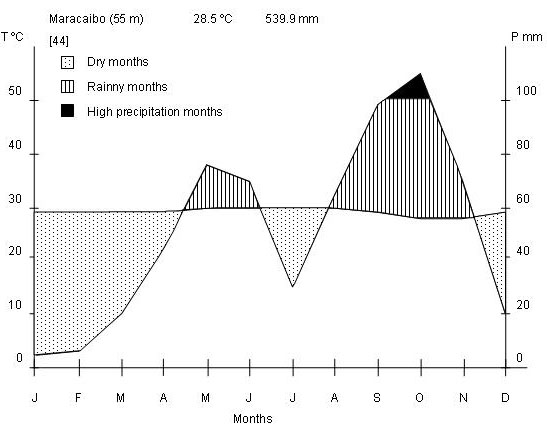
<body><![CDATA[<P ALIGN="JUSTIFY"><font face="Verdana" size="2">In Venezuela, buffelgrass is extensively distributed, specifically  in the Maracaibo plains, in Zulia State. This region has a Life Zone clasified as Very Dry Tropical Forest (3). However, nothing is known about  the behavior of buffelgrass in the Maracaibo plains. Research  about intraspecific competition of buffelgrass in this region will  provide information about the role of this species as a weed. Therefore,  the objective of this research was to evaluate intraspecific competition  of buffelgrass in pots, using ecophysiological parameters and  the application of a mathematical model.</font>     <P  ALIGN="justify"><B><font face="Verdana" size="2">Materials and methods</font></B>     <P  ALIGN="JUSTIFY"><B><font face="Verdana" size="2">Agroecological Conditions of the Experimental Area</font></B>     <P ALIGN="JUSTIFY"><font face="Verdana" size="2">Experiments were carried out in an area adjacent to the Faculty  of Sciences at the University of Zulia, Maracaibo, Venezuela. The area  has climatic conditions of a Very Dry Tropical Forest Life Zone (7)  with savannah formations. The introduced buffelgrass  (<I>Cenchrus ciliaris</I>)<I> </I>predominates, widely covering  the ground. Annual precipitation in the experimental zone is 400 to 600  mm, distributed in two seasons. Mean annual temperature is 28.5&#186;C,  based on data from the meteorological station at the Rafael  Urdaneta Airforce Base, Maracaibo (<a href="#fig1">figure 1</a>).</font>     <P  ALIGN="CENTER"><a name="fig1"><img border="0" src="/img/fbpe/rfaz/v23n2/art02img01.gif" width="547" height="425"></a>    
<P  ALIGN="center"><B><font face="Verdana" size="2">Figure 1. Climogram of the studied area.</font></B>     <P ALIGN="JUSTIFY"><B><font face="Verdana" size="2">Plant Material</font></B>     <P ALIGN="JUSTIFY"><font face="Verdana" size="2">Buffelgrass seeds were  collected from wild plants belonging to secondary grasslands  considered generally as monospecific, with some dispersed individuals of  <I>Prosopis</I> </font>     <P  ALIGN="JUSTIFY"><font face="Verdana" size="2"><I>juliflora </I>and <I>Acacia  tortuosa</I> located in an area close to the  experimental zone.<I> </I>To obtain enough  seedlings, Buffelgrass seeds were planted in 50 kg polyethylene bags, at a soil  depth of 2-3 cm. Soil was obtained from the Experimental Farm Ana Mar&iacute;a  Campos, Facultad de Agronom&iacute;a, Universidad del Zulia. Soil texture  was sandy, soil pH was 5-6, and the argilic horizon was 20-30 cm deep.</font>     <P ALIGN="JUSTIFY"><font face="Verdana" size="2">Seedlings were transplanted to pots according to densities  described by Patterson (12). Selection of transplanted seedlings was based  on: development of first leaf, vertical position, good health and  similar heights.</font>     ]]></body>
<body><![CDATA[<P ALIGN="JUSTIFY"><B><font face="Verdana" size="2">Pot Preparation</font></B>     <P ALIGN="JUSTIFY"><font face="Verdana" size="2">Plastic pots (6 kg capacity, 20  cm diameter and 314 cm<SUP>2 </SUP>area) were  filled with a layer of humus and fertilized with 1g of complete formula  12-24-12 (NPK). Fertilizer was added when pots were filled, and soil (humus  layer) was similar to that previously described for buffelgrass plantlets. At the experimental site, pots  were placed in a protected area to avoid the excess of wind. A barrier  was constructed with bricks and wire netting with big holes to avoid  plant damage. Plants were roofed with metalic screening with large  holes. This construction design protected plants from wind and herbivory.</font>     <P ALIGN="JUSTIFY"><B><font face="Verdana" size="2">Experiments and Harvests</font></B>      <P ALIGN="JUSTIFY"><font face="Verdana" size="2">Two experiments were performed, the first one  between January and March 2000, and the second one between May and  July 2000. Plants were watered daily using approximately 2 L of tap water per pot.</font>      <P ALIGN="JUSTIFY"><font face="Verdana" size="2">Plant evaluations were done 15 and 30 days after transplanting  in each experiment. Whole plants were harvested and separated into  leaves, stems, inflorescences and roots. Each treatment was repeated four times  (2, 4, 8 and 12 plants/pot/treatment/sampling).</font>     <P ALIGN="JUSTIFY"><font face="Verdana" size="2">Water pressure was used to remove soil and plant debris from  the root system. The root system was washed carefully and separated  from the shoot.</font>      <P ALIGN="JUSTIFY"><B><font face="Verdana" size="2">Ecophysiological Parameters</font> </B>     <P ALIGN="JUSTIFY"><font face="Verdana" size="2">The ecophysiological parameters analyzed were: plant height,  leaf area, shoot and root dry weight, total dry weight, number of leaves  and number of inflorescences.</font>      <P ALIGN="JUSTIFY"><font face="Verdana" size="2">Plant height was measured from the root base to the apex of the  flag leaf with a ruler. Leaf area (cm<SUP>2</SUP>)  was determined using a Delta-T Area Meter MK2 Devices LTD,  England. Plants were stored in labeled paper bags and placed in an oven during  72 h at 60&#186;C to obtain dry biomass.</font>      <P ALIGN="JUSTIFY"><font face="Verdana" size="2">Individual plant organs  (leaves, stems, flowers, roots) were weighted.</font>     ]]></body>
<body><![CDATA[<P  ALIGN="JUSTIFY"><font face="Verdana" size="2">Total dry weight was obtained by adding shoot and root dry  weights. Number of leaves and inflorescences was determined by counting them  on plants.</font>     <P ALIGN="JUSTIFY"><B><font face="Verdana" size="2">Experimental Design and Intraspecific  Competition Coefficient</font></B>     <P ALIGN="JUSTIFY"><font face="Verdana" size="2">A completely randomized block design with four  replications (repetitions in space) was used.</font>      <P ALIGN="JUSTIFY"><font face="Verdana" size="2">The Intraspecific Competition Coefficient was determined  according to the method of Spitters (16). The coefficient ratio  A<SUB>1</SUB>/A<SUB>0 </SUB>indicates intraspecific competitive  stress intensity by estimating the proportional decrease in weight  of isolated plants when intraspecific competitor density  increases, according to Patterson (12).</font>     <P ALIGN="JUSTIFY"><font face="Verdana" size="2">Parametric analysis of variance  (STATGRAPHICS, version 7.0) was done to evaluate intraspecific competition between buffelgrass plants via the effect of  population density (plants/pot) on ecophysiological parameters.</font>     <P  ALIGN="justify"><B><font face="Verdana" size="2">Results and discussion</font></B>     <P  ALIGN="JUSTIFY"><font face="Verdana" size="2">Significant differences  (P&lt;0.01) were detected for plant height, leaf area, and shoot, root and total  dry weights, <a href="#fig2"> figures 2-5</a>. Number of leaves is presented at the <a href="#fig6"> figure 6</a>,  and flowering occurred by the 30d harvest.</font>      <P  ALIGN="center"><a name="fig2"><img border="0" src="/img/fbpe/rfaz/v23n2/art02img02.gif" width="580" height="375"></a>    
<P  ALIGN="center"><B><font face="Verdana" size="2">Figure 2. Height of <I>Cenchrus  ciliaris</I> for 15 and 30d harvests. Different letters and numbers indicate significant differences (P&lt;0.01).</font></B>     <P  ALIGN="center"><a name="fig3"><img border="0" src="/img/fbpe/rfaz/v23n2/art02img03.gif" width="580" height="375"></a>    
]]></body>
<body><![CDATA[<P  ALIGN="center"><B><font face="Verdana" size="2">Figure 3. Leaf area of <I>Cenchrus  ciliaris</I> for 15 and 30d harvests. Different letters and numbers indicate  significant differences (P&lt;0.01).</font></B>     <P  ALIGN="center"><a name="fig4"><img border="0" src="/img/fbpe/rfaz/v23n2/art02img04.gif" width="580" height="353"></a>    
<P  ALIGN="center"><B><font face="Verdana" size="2">Figure 4. Biomass dry of <I>Cenchrus  ciliaris</I> for 15d harvest. Different letters and numbers indicate significant differences (P&lt;0.01).</font></B>     <P  ALIGN="center"><img border="0" src="/img/fbpe/rfaz/v23n2/art02img05.gif" width="580" height="353">    
<P  ALIGN="center"><B><font face="Verdana" size="2">Figure 5. Biomass dry of <I>Cenchrus  ciliaris</I> for 30d harvest. Different letters and numbers indicate significant differences (P&lt;0.01).</font></B>     <P  ALIGN="center"><a name="fig6"><img border="0" src="/img/fbpe/rfaz/v23n2/art02img06.gif" width="580" height="306"></a>    
<P  ALIGN="center"><B><font face="Verdana" size="2">Figure 6. Number of leaves of  <I>Cenchrus ciliaris</I> for 15 and 30d harvests. &nbsp;</font></B>      <P ALIGN="JUSTIFY"><font face="Verdana" size="2">The equation of the intraspecific competition, for the first 15d  harvest, was: 1/Wc = 0.94 + 0.255 Nc</font>     <P ALIGN="JUSTIFY"><font face="Verdana" size="2">The proportion between the coefficient for the variable N and  the intercept, A<SUB>1</SUB>/A<SUB>0 </SUB>for the equations is:</font>     <P ALIGN="JUSTIFY"><font face="Verdana" size="2">A<SUB>1</SUB>/A<SUB>0 </SUB>= 0.255/0.94 = 0.271</font>     ]]></body>
<body><![CDATA[<P ALIGN="JUSTIFY"><font face="Verdana" size="2">The intensity of competitive stress for the  30d harvest is described according to the equation:</font>     <P ALIGN="JUSTIFY"><font face="Verdana" size="2">1/WC = -0.0404237 + 0.184873 Nc</font>     <P ALIGN="JUSTIFY"><font face="Verdana" size="2">If only the absolute value is taken into account, the proportion  A<SUB>1</SUB>/A<SUB>0 </SUB>for the equation is:  A<SUB>1</SUB>/A<SUB>0 </SUB>= 0.184873/0.0404237 = 4.573.  Both equations are given in <a href="#Table 1"> table 1</a>.</font>      <P ALIGN="center"><B><font face="Verdana" size="2"><a name="Table 1">Table 1</a>. Intraspecific competition coefficients for  <I>Cenchrus ciliaris </I>for 15 and 30d  harvests.</font>  </B>     <P ALIGN="center" style="margin-top: 5">&nbsp;<B>     <div align="center">       <center><table border="1" cellspacing="1" style="border-collapse: collapse" width="570" id="AutoNumber1"><tr><td width="73">     <p ALIGN="justify"><font size="2" face="Verdana">&nbsp;</font></p>     </td><td width="156" colspan="2" align="center">        <p ALIGN="center"><font face="Verdana" size="2">    Intercept  (A<SUB>0</SUB>)</font></p>      </td><td width="174" colspan="2" align="center">        <p ALIGN="center"><font face="Verdana" size="2">    Intraespecific competition<B>    ]]></body>
<body><![CDATA[<br>    </B>coefficient  (A<SUB>1</SUB>)</font></p>  </td><td width="65" align="center">     <p ALIGN="center"><font size="2" face="Verdana">&nbsp;</font></p>     </td><td width="68" align="center">     <p ALIGN="center"><font size="2" face="Verdana">&nbsp;</font></p>     </td></tr><tr><td width="73">       <p ALIGN="justify"><font face="Verdana" size="2">   Harvest</font></p>  </td><td width="77" align="center">        <p ALIGN="center"><font face="Verdana" size="2">    Estimated     parameter</font></p>  </td><td width="73" align="center">        <p ALIGN="center"><font face="Verdana" size="2">    Standard     error</font></p>     </td><td width="74" align="center">        <p ALIGN="center"><font face="Verdana" size="2">    Estimated parameter</font></p>     </td><td width="94" align="center">        <p ALIGN="center"><font face="Verdana" size="2">    Standard         error</font></p>     </td><td width="65" align="center">        <p ALIGN="center"><font face="Verdana" size="2">    R<SUP>2     </SUP></font></p>     </td><td width="68" align="center">        <p ALIGN="center"><font face="Verdana" size="2">    A<SUB>1</SUB>/A<SUB>0</SUB></font></p>     </td></tr><tr><td width="73">       ]]></body>
<body><![CDATA[<p ALIGN="justify"><font face="Verdana" size="2">   15 days</font></p>  </td><td width="77" align="center">        <p ALIGN="center"><font face="Verdana" size="2">    0.94</font></p>  </td><td width="73" align="center">        <p ALIGN="center"><font face="Verdana" size="2">    0.214219</font></p>  </td><td width="74" align="center">        <p ALIGN="center"><font face="Verdana" size="2">    0.255</font></p>  </td><td width="94" align="center">        <p ALIGN="center"><font face="Verdana" size="2">    0.028374</font></p>  </td><td width="65" align="center">        <p ALIGN="center"><font face="Verdana" size="2">    0.9758</font></p>  </td><td width="68" align="center">        <p ALIGN="center"><font face="Verdana" size="2">    0.271</font></p>     </td></tr><tr><td width="73">       <p ALIGN="justify"><font face="Verdana" size="2">   30 days</font></p>  </td><td width="77" align="center">        <p ALIGN="center"><font face="Verdana" size="2">    -0.0404237</font></p>  </td><td width="73" align="center">        <p ALIGN="center"><font face="Verdana" size="2">    0.109588</font></p>  </td><td width="74" align="center">        ]]></body>
<body><![CDATA[<p ALIGN="center"><font face="Verdana" size="2">    0.184873</font></p>  </td><td width="94" align="center">        <p ALIGN="center"><font face="Verdana" size="2">    0.0145153</font></p>  </td><td width="65" align="center">        <p ALIGN="center"><font face="Verdana" size="2">    0.9872</font></p>  </td><td width="68" align="center">        <p ALIGN="center"><font face="Verdana" size="2">    4.573</font></p>  </td></tr></table>    </center> </div> </B>      <P ALIGN="JUSTIFY"><font face="Verdana" size="2">Results for the majority of the evaluated parameters (<a href="#fig2">figures 2-6</a>) allowed us to distinguish two groups. The first group contains treatments 12 and 8 (high density), with the lowest  valued variables. In the other group, treatments 4 and 2 (low density), the highest  values were obtained, generating highly significant differences (P&lt;0.01).  Results were similar in both samples.</font>     <P ALIGN="JUSTIFY"><font face="Verdana" size="2">The comparison between evaluated variables, in both  harvests, shows highly significant differences among treatments (P&lt;0.01) in  both periods. These differences were greatest for the 30 d harvest.  This result could be explained by the slow growth observed in  grasses during their initial developmental stage  (6). In addition, greater biomass accumulation and relative  increment in the evaluated variables is associated with the aging of plants  in the second harvest, due to the greater metabolic demand in  their physiological processes (14). However, the impact of competitive  stress among plant densities in the treatments in both harvests  is proportionally maintained.</font>     <P  ALIGN="JUSTIFY"><B><font face="Verdana" size="2">Height</font></B>     <P ALIGN="JUSTIFY"><font face="Verdana" size="2">Individuals with different heights were observed, even in  the same treatment (<a href="#fig2">figure 2</a>). Hereditary differences may exist  among individuals of the same species, contributing to  non-reciprocal competitive interactions. It has  been reported that maize plants (Poaceae) generally shade and  genetically suppress different individuals of the species by means of their height (2).</font>     <P ALIGN="JUSTIFY"><B><font face="Verdana" size="2">Leaf area</font></B>     <P ALIGN="JUSTIFY"><font face="Verdana" size="2">Leaf area values decreased when plant density increased (<a href="#fig3">figure 3</a>), indicating the great intraspecific competitive ability of buffelgrass  to interfere in leaf area development, even at low densities. This  was observed in both harvests, and could be explained by the semidecumbent growth of this grass species (13).</font>     ]]></body>
<body><![CDATA[<P ALIGN="JUSTIFY"><B><font face="Verdana" size="2">Shoot dry weight</font></B>     <P ALIGN="JUSTIFY"><font face="Verdana" size="2">Shoot dry weight values found in the low density treatments, <a href="#fig4">  figures 4-5</a>, could be related to climatic conditions of high temperature  and high irradiance, in a very dry tropical forest where the experiments  took place. These factors could increase the photosynthetic rate of buffelgrass.</font>     <P  ALIGN="JUSTIFY"><font face="Verdana" size="2">High carbon assimilation capacity  has been reported as one of the reasons for the higher growth rate  of introduced grass species (1).</font>     <P ALIGN="JUSTIFY"><B><font face="Verdana" size="2">Root dry weight</font></B>     <P ALIGN="JUSTIFY"><font face="Verdana" size="2">Results for this variable also show an inverse dependence  with plant density, <a href="#fig4"> figures 4-5</a>, and suggest competition at the root level for  space needed for expansion and development. This interference  effect is more evident as plants increase per unit space. The allelopatic effect developed by buffelgrass roots may  be similar to that reported in <I>Desmanthus  illinoensis</I> and <I>Cassia fasciculata</I>  (11).</font>      <P ALIGN="JUSTIFY"><B><font face="Verdana" size="2">Total dry weight</font></B>     <P ALIGN="JUSTIFY"><font face="Verdana" size="2">Strong intraspecific  competition in buffelgrass was detected, in relation to individual density, <a href="#fig4">  figures 4-5</a>. Biomass production is approximately linearly dependant  to resource uptake that limits growth, because biomass distribution  within plants varies according to competitive stress (16).</font>      <P ALIGN="JUSTIFY"><B><font face="Verdana" size="2">Number of leaves</font></B>     <P ALIGN="JUSTIFY"><font face="Verdana" size="2">Individuals in treatments with 2 and 4 plants/pot revealed  a relatively greater number of leaves, averaging 4.44 and 4.05  leaves/plant respectively, <a href="#fig6"> figure 6</a>. However, in treatments with 8 and 12  plants/pot, the average number of leaves/plant was 3.24 and 2.76  respectively. Presence of a greater number of  leaves in plants at low population densities could be explained by the lack  of physical interference (overlapping) between them, due to a larger  surface area available per individual, <a href="#fig6"> figure 6</a>. This, in turn, may increase the  capture of solar radiation, thus increasing the formation of  vegetative biomass, growth, development and plant productivity,  (13).</font>     <P ALIGN="JUSTIFY"><B><font face="Verdana" size="2">Number of flowers</font> </B>     ]]></body>
<body><![CDATA[<P ALIGN="JUSTIFY"><font face="Verdana" size="2">Treatments with low densities  of individuals (2 and 4 plants/pot) averaged 0.433 and 0.353  flowers/plant respectively, whereas those of high density (8 and 12 plants/pot)  did not produce flowers. This result may indicate the high degree of  intense competition in this species. In cases of intraspecific competition, a decrease  in supply of resources per individual has been related to inhibition of  fecundity and reproduction at the population<B>  </B>level (2).</font>     <P  ALIGN="JUSTIFY"><B><font face="Verdana" size="2">Effect of Density on Intraspecific Competition</font></B>     <P ALIGN="JUSTIFY"><font face="Verdana" size="2">The A<SUB>1</SUB>/A<SUB>0  </SUB>coefficient ratio, for the 15d harvest, <a href="#Table 1"> table 1</a>, estimates  a proportional decrease of 0.271 g in weight of an isolated plant,  when density of intraspecific competitors increases. Patterson (1990)  reported an A<SUB>1</SUB>/A<SUB>0 </SUB>ratio of 0.45 g in  <I>Anoda cristata</I>, a species of great  competitive ability; while Spitters (1983)  revealed similar findings in <I>Zea mays</I> (Poaceae). The relatively  low coefficient ratio for the 15d harvest of buffelgrass may be related to the  slow growth experienced by grasses during their initial developmental  stages, thus explaining its limited intraspecific competitive ability.</font>      <P ALIGN="JUSTIFY"><font face="Verdana" size="2">The 30d harvest revealed an  A<SUB>1</SUB>/A<SUB>0</SUB> coefficient of 4.573, <a href="#Table 1"> table 1</a>, suggesting that competition was more intense than in the first  period. However, the intercept (-0.0404237) does not differ significantly from  zero, and with a standard error of 0.109, <a href="#Table 1"> Table 1</a>; which indicate that  A<SUB>1</SUB>/A<SUB>0</SUB> ratio was not very precise for this  harvest. Similar results have been reported for  <I>Abutilon theophrasti</I>, an important weed in cotton and soybean crops  in the United States (Patterson 1990).</font>     <P  ALIGN="justify"><B><font face="Verdana" size="2">Conclusions</font></B>     <P  ALIGN="JUSTIFY"><font face="Verdana" size="2">Ecophysiological parameters indicate intense intraspecific competition in buffelgrass  (<I>Cenchrus ciliaris</I>) as population density increases.  The A<SUB>1</SUB>/A<SUB>0 </SUB>buffelgrass ratio showed relatively low competitive ability on the  15<SUP>th</SUP> harvest day, suggesting that, at this growth  stage, there is little agressivity toward other species found in the region.</font>     <P  ALIGN="justify"><B><font face="Verdana" size="2">Recommendations</font> </B>     <P  ALIGN="JUSTIFY"><font face="Verdana" size="2">This research should be extended to other weed species distributed in the Maracaibo Plains.</font>     <P  ALIGN="justify"><B><font face="Verdana" size="2">Acknowledgments</font></B>     <P  ALIGN="JUSTIFY"><font face="Verdana" size="2">The authors express their gratitude to the Council for  Scientific and Humanistic Development of University of Zulia for financial  aid, and to the Faculty of Sciences and Center for Biological Investigations, University of Zulia, for allowing access to their experimental area  and laboratories during the investigation. Clark Casler provided comments  that helped improve the manuscript.</font>     ]]></body>
<body><![CDATA[<P  ALIGN="justify"><B><font face="Verdana" size="2">Literature cited</font></B>     <!-- ref --><P  ALIGN="JUSTIFY"><font face="Verdana" size="2">1. Baruch, Z. 1986. Ecofisiolog&iacute;a  de algunos pastos en sabanas tropicales. Anales del IV Congreso Latinoamericano de  Bot&aacute;nica. Medell&iacute;n, Colombia 5: 24-36.</font>    &nbsp;&nbsp;&nbsp;&nbsp;&nbsp;&nbsp;&nbsp;&nbsp;[&#160;<a href="javascript:void(0);" onclick="javascript: window.open('/scielo.php?script=sci_nlinks&ref=1764004&pid=S0378-7818200600020000200001&lng=','','width=640,height=500,resizable=yes,scrollbars=1,menubar=yes,');">Links</a>&#160;]<!-- end-ref --><!-- ref --><P  ALIGN="JUSTIFY"><font face="Verdana" size="2">2. Begon, M., J. L. Harper and C.  R. Townsend. 1996. Ecology: Individuals, Populations  and Communities. Blackwell Science LTD. Third Edition.  Oxford, England 1068 pp.</font>    &nbsp;&nbsp;&nbsp;&nbsp;&nbsp;&nbsp;&nbsp;&nbsp;[&#160;<a href="javascript:void(0);" onclick="javascript: window.open('/scielo.php?script=sci_nlinks&ref=1764005&pid=S0378-7818200600020000200002&lng=','','width=640,height=500,resizable=yes,scrollbars=1,menubar=yes,');">Links</a>&#160;]<!-- end-ref --><!-- ref --><P ALIGN="JUSTIFY"><font face="Verdana" size="2">3. Caraballo, A. y B. Gonz&aacute;lez.  1991. Respuesta del Pasto Buffel (<I>Cenchrus  ciliaris</I>, cv. Biloela) a diferentes frecuencias y alturas  de corte y niveles de fertilizaci&oacute;n nitrogenada. Rev. Fac.  Agron. (LUZ) 8: 167-185.</font>    &nbsp;&nbsp;&nbsp;&nbsp;&nbsp;&nbsp;&nbsp;&nbsp;[&#160;<a href="javascript:void(0);" onclick="javascript: window.open('/scielo.php?script=sci_nlinks&ref=1764006&pid=S0378-7818200600020000200003&lng=','','width=640,height=500,resizable=yes,scrollbars=1,menubar=yes,');">Links</a>&#160;]<!-- end-ref --><!-- ref --><P ALIGN="JUSTIFY"><font face="Verdana" size="2">4. Cousens, R. 1991. Aspects of the  design and interpretation of competition (interference) experiments.  Weed Technol. 5: 664-673.</font>    &nbsp;&nbsp;&nbsp;&nbsp;&nbsp;&nbsp;&nbsp;&nbsp;[&#160;<a href="javascript:void(0);" onclick="javascript: window.open('/scielo.php?script=sci_nlinks&ref=1764007&pid=S0378-7818200600020000200004&lng=','','width=640,height=500,resizable=yes,scrollbars=1,menubar=yes,');">Links</a>&#160;]<!-- end-ref --><!-- ref --><P ALIGN="JUSTIFY"><font face="Verdana" size="2">5. Daehler, C. C. and D. A. Carino.  1998. Recent replacement of native pili grass (<I>Heteropogon  contortus</I>) by invasive African grasses in the Hawaiian Islands. Pacific  Science 52: 220-227.</font>    &nbsp;&nbsp;&nbsp;&nbsp;&nbsp;&nbsp;&nbsp;&nbsp;[&#160;<a href="javascript:void(0);" onclick="javascript: window.open('/scielo.php?script=sci_nlinks&ref=1764008&pid=S0378-7818200600020000200005&lng=','','width=640,height=500,resizable=yes,scrollbars=1,menubar=yes,');">Links</a>&#160;]<!-- end-ref --><!-- ref --><P ALIGN="JUSTIFY"><font face="Verdana" size="2">6. D&aacute;vila P. 2000. El mundo de  las gram&iacute;neas: algo m&aacute;s que hierbas o zacates. Disponible en:  http://xolo.conabio.gob.mx/biodiversitas/gram&iacute;neas.htm.</font>    &nbsp;&nbsp;&nbsp;&nbsp;&nbsp;&nbsp;&nbsp;&nbsp;[&#160;<a href="javascript:void(0);" onclick="javascript: window.open('/scielo.php?script=sci_nlinks&ref=1764009&pid=S0378-7818200600020000200006&lng=','','width=640,height=500,resizable=yes,scrollbars=1,menubar=yes,');">Links</a>&#160;]<!-- end-ref --><!-- ref --><P ALIGN="JUSTIFY"><font face="Verdana" size="2">7. Ewel, J. y A. Madriz. 1968. Zonas  de Vida de Venezuela. Ministerio de Agricultura y Cr&iacute;a, Ediciones  del Fondo Nacional de Investigaciones Agropecuarias. Editorial  Sucre, Caracas, Venezuela 264 pp.</font>    &nbsp;&nbsp;&nbsp;&nbsp;&nbsp;&nbsp;&nbsp;&nbsp;[&#160;<a href="javascript:void(0);" onclick="javascript: window.open('/scielo.php?script=sci_nlinks&ref=1764010&pid=S0378-7818200600020000200007&lng=','','width=640,height=500,resizable=yes,scrollbars=1,menubar=yes,');">Links</a>&#160;]<!-- end-ref --><!-- ref --><P ALIGN="JUSTIFY"><font face="Verdana" size="2">8. Kvet, J., J. P. Ondok, J. Necas and  P. G. Jarvis. 1971. Methods of growth analysis. P. 343-391.  <I>In</I> Z. Sestak <I>et al</I>. (ed.) Plant  photosynthetic production: Manual of methods. W. Junk, The Hague.</font>    &nbsp;&nbsp;&nbsp;&nbsp;&nbsp;&nbsp;&nbsp;&nbsp;[&#160;<a href="javascript:void(0);" onclick="javascript: window.open('/scielo.php?script=sci_nlinks&ref=1764011&pid=S0378-7818200600020000200008&lng=','','width=640,height=500,resizable=yes,scrollbars=1,menubar=yes,');">Links</a>&#160;]<!-- end-ref --><!-- ref --><P ALIGN="JUSTIFY"><font face="Verdana" size="2">9. Londsdale, W. M. 1994.  Inviting Trouble: introduced pasture species in Northern  Australia. Australian Journal of Ecology 19: 345-354.</font>    &nbsp;&nbsp;&nbsp;&nbsp;&nbsp;&nbsp;&nbsp;&nbsp;[&#160;<a href="javascript:void(0);" onclick="javascript: window.open('/scielo.php?script=sci_nlinks&ref=1764012&pid=S0378-7818200600020000200009&lng=','','width=640,height=500,resizable=yes,scrollbars=1,menubar=yes,');">Links</a>&#160;]<!-- end-ref --><!-- ref --><P ALIGN="JUSTIFY"><font face="Verdana" size="2">10. Morisawa, T. 2000. Wildland  Invasive Species Program. The Nature Conservancy. Disponible  en:<B> </B>http://tncweeds.ucdavis.edu/alert/alrtcenc.html<B>.</B> </font>    &nbsp;&nbsp;&nbsp;&nbsp;&nbsp;&nbsp;&nbsp;&nbsp;[&#160;<a href="javascript:void(0);" onclick="javascript: window.open('/scielo.php?script=sci_nlinks&ref=1764013&pid=S0378-7818200600020000200010&lng=','','width=640,height=500,resizable=yes,scrollbars=1,menubar=yes,');">Links</a>&#160;]<!-- end-ref --><!-- ref --><P  ALIGN="JUSTIFY"><font face="Verdana" size="2">11. Nurdin, T. and E. Fulbright.  1990. Germination of two legunes in leachate from introduced  grasses. Journal of Range Management 43: 466-467.</font>    &nbsp;&nbsp;&nbsp;&nbsp;&nbsp;&nbsp;&nbsp;&nbsp;[&#160;<a href="javascript:void(0);" onclick="javascript: window.open('/scielo.php?script=sci_nlinks&ref=1764014&pid=S0378-7818200600020000200011&lng=','','width=640,height=500,resizable=yes,scrollbars=1,menubar=yes,');">Links</a>&#160;]<!-- end-ref --><!-- ref --><P ALIGN="JUSTIFY"><font face="Verdana" size="2">12. Patterson, D. T. 1990. Effects  of density and species proportion on competition between  spurred anoda (<I>Anoda cristata</I>) and velvetleaf  (<I>Abutilon theophrasti</I>). Weed Science 38: 351-357.</font>    &nbsp;&nbsp;&nbsp;&nbsp;&nbsp;&nbsp;&nbsp;&nbsp;[&#160;<a href="javascript:void(0);" onclick="javascript: window.open('/scielo.php?script=sci_nlinks&ref=1764015&pid=S0378-7818200600020000200012&lng=','','width=640,height=500,resizable=yes,scrollbars=1,menubar=yes,');">Links</a>&#160;]<!-- end-ref --><!-- ref --><P ALIGN="JUSTIFY"><font face="Verdana" size="2">13. Rinc&oacute;n-Carruyo, X. R., T. J.  Clavero, E. Rinc&oacute;n, C. F. Quintero y A. T. M&aacute;rquez. 1997. Evaluaci&oacute;n  de par&aacute;metros agron&oacute;micos y fisiol&oacute;gicos en cuatro cultivares  de pasto bufel (<I>Cenchrus ciliaris </I>L.) en macetas. II. Planta Adulta.  Rev. Fac. Agrom. (LUZ) 14: 649-656.</font>    &nbsp;&nbsp;&nbsp;&nbsp;&nbsp;&nbsp;&nbsp;&nbsp;[&#160;<a href="javascript:void(0);" onclick="javascript: window.open('/scielo.php?script=sci_nlinks&ref=1764016&pid=S0378-7818200600020000200013&lng=','','width=640,height=500,resizable=yes,scrollbars=1,menubar=yes,');">Links</a>&#160;]<!-- end-ref --><!-- ref --><P ALIGN="JUSTIFY"><font face="Verdana" size="2">14. Rinc&oacute;n-Carruyo, X. R., T. J.  Clavero, A. T. M&aacute;rquez, E. Rinc&oacute;n y C.  F. Quintero. 1998. Crecimiento y producci&oacute;n de cultivares de  pasto bufel (<I>Cenchrus ciliaris</I> L.) en macetas. I. Fase  de establecimiento. Rev. Fac. Agrom. (LUZ) 15: 359-367.</font>    &nbsp;&nbsp;&nbsp;&nbsp;&nbsp;&nbsp;&nbsp;&nbsp;[&#160;<a href="javascript:void(0);" onclick="javascript: window.open('/scielo.php?script=sci_nlinks&ref=1764017&pid=S0378-7818200600020000200014&lng=','','width=640,height=500,resizable=yes,scrollbars=1,menubar=yes,');">Links</a>&#160;]<!-- end-ref --><!-- ref --><P ALIGN="JUSTIFY"><font face="Verdana" size="2">15. Sanders, A. C. 1996.  Noteworthy Collections: California. Madro&ntilde;o 43 (4): 525.</font>    &nbsp;&nbsp;&nbsp;&nbsp;&nbsp;&nbsp;&nbsp;&nbsp;[&#160;<a href="javascript:void(0);" onclick="javascript: window.open('/scielo.php?script=sci_nlinks&ref=1764018&pid=S0378-7818200600020000200015&lng=','','width=640,height=500,resizable=yes,scrollbars=1,menubar=yes,');">Links</a>&#160;]<!-- end-ref --><!-- ref --><P ALIGN="JUSTIFY"><font face="Verdana" size="2">16. Spitters, C. J. T. 1983. An  alternative approach to the analysis of mixed cropping experiments.  I. Estimation of competition effects. Neth. J. Agric. Sci. 31: 1-11.</font>    &nbsp;&nbsp;&nbsp;&nbsp;&nbsp;&nbsp;&nbsp;&nbsp;[&#160;<a href="javascript:void(0);" onclick="javascript: window.open('/scielo.php?script=sci_nlinks&ref=1764019&pid=S0378-7818200600020000200016&lng=','','width=640,height=500,resizable=yes,scrollbars=1,menubar=yes,');">Links</a>&#160;]<!-- end-ref --><!-- ref --><P ALIGN="JUSTIFY"><font face="Verdana" size="2">17. Tanji, A., R. L. Zimdahl and P. Westro. 1997. The competitive ability of wheat  (<I>Triticum aestivum</I>) compared to rigid ryegrass  (<I>Lolium rigidum</I>) and cowcockle (<I>Vaccaria  hispanica</I>). Weed Science 45: 481-487.</font>    &nbsp;&nbsp;&nbsp;&nbsp;&nbsp;&nbsp;&nbsp;&nbsp;[&#160;<a href="javascript:void(0);" onclick="javascript: window.open('/scielo.php?script=sci_nlinks&ref=1764020&pid=S0378-7818200600020000200017&lng=','','width=640,height=500,resizable=yes,scrollbars=1,menubar=yes,');">Links</a>&#160;]<!-- end-ref --><!-- ref --><P ALIGN="JUSTIFY"><font face="Verdana" size="2">18. White, R. O., R. G. Moir and J.  P. Cooper. 1959. Las gram&iacute;neas en la agricultura. FAO. Roma,  Italia. 417 pp.</font>    &nbsp;&nbsp;&nbsp;&nbsp;&nbsp;&nbsp;&nbsp;&nbsp;[&#160;<a href="javascript:void(0);" onclick="javascript: window.open('/scielo.php?script=sci_nlinks&ref=1764021&pid=S0378-7818200600020000200018&lng=','','width=640,height=500,resizable=yes,scrollbars=1,menubar=yes,');">Links</a>&#160;]<!-- end-ref --> ]]></body>
<back>
<ref-list>
<ref id="B1">
<label>1</label><nlm-citation citation-type="confpro">
<person-group person-group-type="author">
<name>
<surname><![CDATA[Baruch]]></surname>
<given-names><![CDATA[Z]]></given-names>
</name>
</person-group>
<source><![CDATA[Ecofisiología de algunos pastos en sabanas tropicales]]></source>
<year>1986</year>
<volume>5</volume>
<conf-name><![CDATA[IV Congreso Latinoamericano de Botánica]]></conf-name>
<conf-loc>Medellín </conf-loc>
<page-range>24-36</page-range></nlm-citation>
</ref>
<ref id="B2">
<label>2</label><nlm-citation citation-type="book">
<person-group person-group-type="author">
<name>
<surname><![CDATA[Begon]]></surname>
<given-names><![CDATA[M]]></given-names>
</name>
<name>
<surname><![CDATA[Harper]]></surname>
<given-names><![CDATA[J. L]]></given-names>
</name>
<name>
<surname><![CDATA[Townsend]]></surname>
<given-names><![CDATA[C. R]]></given-names>
</name>
</person-group>
<source><![CDATA[Ecology: Individuals, Populations and Communities]]></source>
<year>1996</year>
<edition>Third</edition>
<page-range>1068</page-range><publisher-loc><![CDATA[Oxford ]]></publisher-loc>
<publisher-name><![CDATA[Blackwell Science LTD]]></publisher-name>
</nlm-citation>
</ref>
<ref id="B3">
<label>3</label><nlm-citation citation-type="journal">
<person-group person-group-type="author">
<name>
<surname><![CDATA[Caraballo]]></surname>
<given-names><![CDATA[A]]></given-names>
</name>
<name>
<surname><![CDATA[González]]></surname>
<given-names><![CDATA[B]]></given-names>
</name>
</person-group>
<article-title xml:lang="es"><![CDATA[Respuesta del Pasto Buffel (Cenchrus ciliaris, cv. Biloela) a diferentes frecuencias y alturas de corte y niveles de fertilización nitrogenada]]></article-title>
<source><![CDATA[Rev. Fac. Agron. (LUZ)]]></source>
<year>1991</year>
<volume>8</volume>
<page-range>167-185</page-range></nlm-citation>
</ref>
<ref id="B4">
<label>4</label><nlm-citation citation-type="journal">
<person-group person-group-type="author">
<name>
<surname><![CDATA[Cousens]]></surname>
<given-names><![CDATA[R]]></given-names>
</name>
</person-group>
<article-title xml:lang="en"><![CDATA[Aspects of the design and interpretation of competition (interference) experiments]]></article-title>
<source><![CDATA[Weed Technol.]]></source>
<year>1991</year>
<volume>5</volume>
<page-range>664-673</page-range></nlm-citation>
</ref>
<ref id="B5">
<label>5</label><nlm-citation citation-type="journal">
<person-group person-group-type="author">
<name>
<surname><![CDATA[Daehler]]></surname>
<given-names><![CDATA[C. C.]]></given-names>
</name>
<name>
<surname><![CDATA[Carino]]></surname>
<given-names><![CDATA[D. A]]></given-names>
</name>
</person-group>
<article-title xml:lang="en"><![CDATA[Recent replacement of native pili grass (Heteropogon contortus) by invasive African grasses in the Hawaiian Islands]]></article-title>
<source><![CDATA[Pacific Science]]></source>
<year>1998</year>
<volume>52</volume>
<page-range>220-227</page-range></nlm-citation>
</ref>
<ref id="B6">
<label>6</label><nlm-citation citation-type="">
<person-group person-group-type="author">
<name>
<surname><![CDATA[Dávila]]></surname>
<given-names><![CDATA[P]]></given-names>
</name>
</person-group>
<source><![CDATA[El mundo de las gramíneas: algo más que hierbas o zacates]]></source>
<year>2000</year>
</nlm-citation>
</ref>
<ref id="B7">
<label>7</label><nlm-citation citation-type="book">
<person-group person-group-type="author">
<name>
<surname><![CDATA[Ewel]]></surname>
<given-names><![CDATA[J]]></given-names>
</name>
<name>
<surname><![CDATA[Madriz]]></surname>
<given-names><![CDATA[A]]></given-names>
</name>
</person-group>
<source><![CDATA[Zonas de Vida de Venezuela]]></source>
<year>1968</year>
<page-range>264</page-range><publisher-loc><![CDATA[Caracas ]]></publisher-loc>
<publisher-name><![CDATA[Ministerio de Agricultura y Cría, Ediciones del Fondo Nacional de Investigaciones Agropecuarias. Editorial Sucre]]></publisher-name>
</nlm-citation>
</ref>
<ref id="B8">
<label>8</label><nlm-citation citation-type="book">
<person-group person-group-type="author">
<name>
<surname><![CDATA[Kvet]]></surname>
<given-names><![CDATA[J]]></given-names>
</name>
<name>
<surname><![CDATA[Ondok]]></surname>
<given-names><![CDATA[J. P]]></given-names>
</name>
<name>
<surname><![CDATA[Necas]]></surname>
<given-names><![CDATA[J]]></given-names>
</name>
<name>
<surname><![CDATA[Jarvis]]></surname>
<given-names><![CDATA[P. G]]></given-names>
</name>
</person-group>
<article-title xml:lang="en"><![CDATA[Methods of growth analysis]]></article-title>
<person-group person-group-type="editor">
<name>
<surname><![CDATA[Sestak]]></surname>
<given-names><![CDATA[Z]]></given-names>
</name>
</person-group>
<source><![CDATA[Plant photosynthetic production: Manual of methods]]></source>
<year>1971</year>
<page-range>343-391</page-range><publisher-name><![CDATA[W. Junk, The Hague]]></publisher-name>
</nlm-citation>
</ref>
<ref id="B9">
<label>9</label><nlm-citation citation-type="journal">
<person-group person-group-type="author">
<name>
<surname><![CDATA[Londsdale]]></surname>
<given-names><![CDATA[W. M]]></given-names>
</name>
</person-group>
<article-title xml:lang="en"><![CDATA[Inviting Trouble: introduced pasture species in Northern Australia]]></article-title>
<source><![CDATA[Australian Journal of Ecology]]></source>
<year>1994</year>
<volume>19</volume>
<page-range>345-354</page-range></nlm-citation>
</ref>
<ref id="B10">
<label>10</label><nlm-citation citation-type="">
<person-group person-group-type="author">
<name>
<surname><![CDATA[Morisawa]]></surname>
<given-names><![CDATA[T]]></given-names>
</name>
</person-group>
<source><![CDATA[Wildland Invasive Species Program: The Nature Conservancy]]></source>
<year>2000</year>
</nlm-citation>
</ref>
<ref id="B11">
<label>11</label><nlm-citation citation-type="journal">
<person-group person-group-type="author">
<name>
<surname><![CDATA[Nurdin]]></surname>
<given-names><![CDATA[T.]]></given-names>
</name>
<name>
<surname><![CDATA[Fulbright]]></surname>
<given-names><![CDATA[E]]></given-names>
</name>
</person-group>
<article-title xml:lang="en"><![CDATA[Germination of two legunes in leachate from introduced grasses]]></article-title>
<source><![CDATA[Journal of Range Management]]></source>
<year>1990</year>
<volume>43</volume>
<page-range>466-467</page-range></nlm-citation>
</ref>
<ref id="B12">
<label>12</label><nlm-citation citation-type="journal">
<person-group person-group-type="author">
<name>
<surname><![CDATA[Patterson]]></surname>
<given-names><![CDATA[D. T]]></given-names>
</name>
</person-group>
<article-title xml:lang="en"><![CDATA[Effects of density and species proportion on competition between spurred anoda (Anoda cristata) and velvetleaf (Abutilon theophrasti)]]></article-title>
<source><![CDATA[Weed Science]]></source>
<year>1990</year>
<volume>38</volume>
<page-range>351-357</page-range></nlm-citation>
</ref>
<ref id="B13">
<label>13</label><nlm-citation citation-type="journal">
<person-group person-group-type="author">
<name>
<surname><![CDATA[Rincón-Carruyo]]></surname>
<given-names><![CDATA[X. R]]></given-names>
</name>
<name>
<surname><![CDATA[Clavero]]></surname>
<given-names><![CDATA[T. J]]></given-names>
</name>
<name>
<surname><![CDATA[Rincón]]></surname>
<given-names><![CDATA[E]]></given-names>
</name>
<name>
<surname><![CDATA[Quintero]]></surname>
<given-names><![CDATA[C. F]]></given-names>
</name>
<name>
<surname><![CDATA[Márquez]]></surname>
<given-names><![CDATA[A. T]]></given-names>
</name>
</person-group>
<article-title xml:lang="es"><![CDATA[Evaluación de parámetros agronómicos y fisiológicos en cuatro cultivares de pasto bufel (Cenchrus ciliaris L.) en macetas: II. Planta Adulta]]></article-title>
<source><![CDATA[Rev. Fac. Agrom. (LUZ)]]></source>
<year>1997</year>
<volume>14</volume>
<page-range>649-656</page-range></nlm-citation>
</ref>
<ref id="B14">
<label>14</label><nlm-citation citation-type="journal">
<person-group person-group-type="author">
<name>
<surname><![CDATA[Rincón-Carruyo]]></surname>
<given-names><![CDATA[X. R]]></given-names>
</name>
<name>
<surname><![CDATA[Clavero]]></surname>
<given-names><![CDATA[T. J]]></given-names>
</name>
<name>
<surname><![CDATA[Márquez]]></surname>
<given-names><![CDATA[A. T]]></given-names>
</name>
<name>
<surname><![CDATA[Rincón]]></surname>
<given-names><![CDATA[E]]></given-names>
</name>
<name>
<surname><![CDATA[Quintero]]></surname>
<given-names><![CDATA[C. F]]></given-names>
</name>
</person-group>
<article-title xml:lang="es"><![CDATA[Crecimiento y producción de cultivares de pasto bufel (Cenchrus ciliaris L.) en macetas: I. Fase de establecimiento]]></article-title>
<source><![CDATA[Rev. Fac. Agrom. (LUZ)]]></source>
<year>1998</year>
<volume>15</volume>
<page-range>359-367</page-range></nlm-citation>
</ref>
<ref id="B15">
<label>15</label><nlm-citation citation-type="journal">
<person-group person-group-type="author">
<name>
<surname><![CDATA[Sanders]]></surname>
<given-names><![CDATA[A. C]]></given-names>
</name>
</person-group>
<article-title xml:lang="en"><![CDATA[Noteworthy Collections: California]]></article-title>
<source><![CDATA[Madroño 43]]></source>
<year>1996</year>
<volume>(4)</volume>
<page-range>525</page-range></nlm-citation>
</ref>
<ref id="B16">
<label>16</label><nlm-citation citation-type="journal">
<person-group person-group-type="author">
<name>
<surname><![CDATA[Spitters]]></surname>
<given-names><![CDATA[C. J. T]]></given-names>
</name>
</person-group>
<article-title xml:lang="en"><![CDATA[An alternative approach to the analysis of mixed cropping experiments: I. Estimation of competition effects]]></article-title>
<source><![CDATA[Neth. J. Agric. Sci.]]></source>
<year>1983</year>
<volume>31</volume>
<page-range>1-11</page-range></nlm-citation>
</ref>
<ref id="B17">
<label>17</label><nlm-citation citation-type="journal">
<person-group person-group-type="author">
<name>
<surname><![CDATA[Tanji]]></surname>
<given-names><![CDATA[A]]></given-names>
</name>
<name>
<surname><![CDATA[Zimdahl]]></surname>
<given-names><![CDATA[R. L]]></given-names>
</name>
<name>
<surname><![CDATA[Westro]]></surname>
<given-names><![CDATA[P]]></given-names>
</name>
</person-group>
<article-title xml:lang="en"><![CDATA[The competitive ability of wheat (Triticum aestivum) compared to rigid ryegrass (Lolium rigidum) and cowcockle (Vaccaria hispanica)]]></article-title>
<source><![CDATA[Weed Science]]></source>
<year>1997</year>
<volume>45</volume>
<page-range>481-487</page-range></nlm-citation>
</ref>
<ref id="B18">
<label>18</label><nlm-citation citation-type="book">
<person-group person-group-type="author">
<name>
<surname><![CDATA[White]]></surname>
<given-names><![CDATA[R. O]]></given-names>
</name>
<name>
<surname><![CDATA[Moir]]></surname>
<given-names><![CDATA[R. G]]></given-names>
</name>
<name>
<surname><![CDATA[Cooper]]></surname>
<given-names><![CDATA[J. P]]></given-names>
</name>
</person-group>
<source><![CDATA[Las gramíneas en la agricultura]]></source>
<year>1959</year>
<page-range>417</page-range><publisher-loc><![CDATA[Roma ]]></publisher-loc>
<publisher-name><![CDATA[FAO]]></publisher-name>
</nlm-citation>
</ref>
</ref-list>
</back>
</article>
