<?xml version="1.0" encoding="ISO-8859-1"?><article xmlns:mml="http://www.w3.org/1998/Math/MathML" xmlns:xlink="http://www.w3.org/1999/xlink" xmlns:xsi="http://www.w3.org/2001/XMLSchema-instance">
<front>
<journal-meta>
<journal-id>0798-0264</journal-id>
<journal-title><![CDATA[Archivos Venezolanos de Farmacología y Terapéutica]]></journal-title>
<abbrev-journal-title><![CDATA[AVFT]]></abbrev-journal-title>
<issn>0798-0264</issn>
<publisher>
<publisher-name><![CDATA[Sociedad Venezolana de Farmacológia  y Farmacológia Clínica y Terapéutica. Escuela de MedicinaJosé Maria Vargas. Cátedra de Farmacológia, piso 3, esquina san jacinto, San José Caracas]]></publisher-name>
</publisher>
</journal-meta>
<article-meta>
<article-id>S0798-02642008000100004</article-id>
<title-group>
<article-title xml:lang="en"><![CDATA[The mechanism of cancer involves short interfering RNA (siRNA)]]></article-title>
</title-group>
<contrib-group>
<contrib contrib-type="author">
<name>
<surname><![CDATA[Wynter]]></surname>
<given-names><![CDATA[Coral]]></given-names>
</name>
<xref ref-type="aff" rid="A01"/>
</contrib>
<contrib contrib-type="author">
<name>
<surname><![CDATA[Alfonzo]]></surname>
<given-names><![CDATA[Marcelo]]></given-names>
</name>
<xref ref-type="aff" rid="A01"/>
</contrib>
<contrib contrib-type="author">
<name>
<surname><![CDATA[Lippo de Becemberg]]></surname>
<given-names><![CDATA[Itala]]></given-names>
</name>
<xref ref-type="aff" rid="A01"/>
</contrib>
</contrib-group>
<aff id="A01">
<institution><![CDATA[,Universidad Central de Venezuela Facultad de Medicina Instituto de Medicina Experimental]]></institution>
<addr-line><![CDATA[Caracas ]]></addr-line>
<country>Venezuela</country>
</aff>
<pub-date pub-type="pub">
<day>00</day>
<month>06</month>
<year>2008</year>
</pub-date>
<pub-date pub-type="epub">
<day>00</day>
<month>06</month>
<year>2008</year>
</pub-date>
<volume>27</volume>
<numero>1</numero>
<fpage>14</fpage>
<lpage>18</lpage>
<copyright-statement/>
<copyright-year/>
<self-uri xlink:href="http://ve.scielo.org/scielo.php?script=sci_arttext&amp;pid=S0798-02642008000100004&amp;lng=en&amp;nrm=iso"></self-uri><self-uri xlink:href="http://ve.scielo.org/scielo.php?script=sci_abstract&amp;pid=S0798-02642008000100004&amp;lng=en&amp;nrm=iso"></self-uri><self-uri xlink:href="http://ve.scielo.org/scielo.php?script=sci_pdf&amp;pid=S0798-02642008000100004&amp;lng=en&amp;nrm=iso"></self-uri><abstract abstract-type="short" xml:lang="en"><p><![CDATA[The recent discoveries of the RNA-mediated interference system in cells could explain all of the known features of human carcinogenesis. A novel idea, proposed here, is that the cell has the ability to recognize a mutated protein and/or mRNA. Secondly, the cell can generate its own short interfering RNA (siRNA) using an RNA polymerase to destroy mutated mRNA, even when only a single base pair in the gene has mutated. The anti-sense strand of the short RNA molecule (called sicRNA), targets the mutated mRNA of an oncogene or a tumour suppressor. During cell mitosis, the sicRNA complex can move into the nucleus to target the mutated gene. The sicRNA triggers the assembly of protein complexes leading to epigenetic modification of the promoter site of the mutant gene. In some instances, instead of methylation, the homologous DNA is degraded, leading to loss of heterozygosity. The factors controlling these two actions are unknown but the result is gene silencing or physical destruction of the mutant gene. An error in RNAi defence occurs when the sicRNA during methylation of the target gene, inadvertently interferes with the production of a miRNA specific for that tissue. This produces a change in the profile of correct proteins for that tissue. On a rare occasion, a preneoplastic stem cell will survive if miRNA interference switches on/off a gene involved in apoptosis, as well as a gene involved in cell proliferation and DNA damage surveillance. The driving force of carcinogenesis is the sequential loss of specific miRNAs.]]></p></abstract>
<kwd-group>
<kwd lng="en"><![CDATA[Cáncer]]></kwd>
<kwd lng="en"><![CDATA[siRNA]]></kwd>
<kwd lng="en"><![CDATA[CpG methylation]]></kwd>
<kwd lng="en"><![CDATA[RNAi]]></kwd>
<kwd lng="en"><![CDATA[LOH]]></kwd>
<kwd lng="en"><![CDATA[microRNA]]></kwd>
</kwd-group>
</article-meta>
</front><body><![CDATA[ <p align="center"><font face="Verdana"><b>The mechanism of cancer involves short  interfering RNA (siRNA)</b></font></p>     <p align="center"><font face="Verdana" size="2">Coral Wynter, Marcelo Alfonzo  and Itala Lippo de Becemberg.</font></p>     <p align="justify"><font face="Verdana" size="2">Sección de Biomembranas,  Instituto de Medicina Experimental, Cátedra de Patología General y  Fisiopatología, Facultad de Medicina, Universidad Central de Venezuela, Apdo  50587 Sabana Grande, Caracas, Venezuela.</font></p>     <p align="justify"><font face="Verdana" size="2">Short running title: Cancer as  a result of RNAi errors. Email: <a href="mailto:c.wynter@mailbox.uq.edu.au">c.wynter@mailbox.uq.edu.au</a>. Fax: 058 212 662  8877</font></p>     <p align="justify"><font face="Verdana" size="2"><b>Abstract</b></font></p>     <p align="justify"><font face="Verdana" size="2">The recent discoveries of the  RNA-mediated interference system in cells could explain all of the known  features of human carcinogenesis. A novel idea, proposed here, is that the cell  has the ability to recognize a mutated protein and/or mRNA. Secondly, the cell  can generate its own short interfering RNA (siRNA) using an RNA polymerase to  destroy mutated mRNA, even when only a single base pair in the gene has mutated.  The anti-sense strand of the short RNA molecule (called sicRNA), targets the  mutated mRNA of an oncogene or a tumour suppressor. During cell mitosis, the  sicRNA complex can move into the nucleus to target the mutated gene. The sicRNA  triggers the assembly of protein complexes leading to epigenetic modification of  the promoter site of the mutant gene. In some instances, instead of methylation,  the homologous DNA is degraded, leading to loss of heterozygosity. The factors  controlling these two actions are unknown but the result is gene silencing or  physical destruction of the mutant gene. An error in RNAi defence occurs when  the sicRNA during methylation of the target gene, inadvertently interferes with  the production of a miRNA specific for that tissue. This produces a change in  the profile of correct proteins for that tissue. On a rare occasion, a  preneoplastic stem cell will survive if miRNA interference switches on/off a  gene involved in apoptosis, as well as a gene involved in cell proliferation and  DNA damage surveillance. The driving force of carcinogenesis is the sequential  loss of specific miRNAs.</font></p>     <p align="justify"><font face="Verdana" size="2"><b>Key words:</b> Cáncer, siRNA,  CpG methylation, RNAi, LOH, microRNA</font></p>     <p align="justify"><font face="Verdana" size="2">Recibido: 20/10/2007 Aceptado:  18/11/2007</font></p>     <p align="justify"><font face="Verdana" size="2"><b>Text</b></font></p>     <p align="justify"><font face="Verdana" size="2">Cancer has been studied over  the last 30 years by the examination of hundreds, if not thousands, of different  genes, with more still being discovered. Familial cancers, which develop in an  individual usually before the age of 55 years, due to an inherited mutation in  one allele of a key gene, have led to many important discoveries of the myriad  of pathways that occur in spontaneous cancers due to old age. Each gene has a  role in controlling cell division, apoptosis, and maintenance of the integrity  of the genome or is located at a DNA damage checkpoint. It is considered highly  significant if only 15-20% of all cancers in one organ have a mutation in one  particular gene under examination. One allele of a gene could have hundreds of  different mutations, sometimes concentrated in hotspots, usually involving only  one base change, but the result inevitably led to a cancer. Thus the number of  different oncogenic phenotypes in one tissue has been confusing, defying  simplistic classifications.</font></p>     ]]></body>
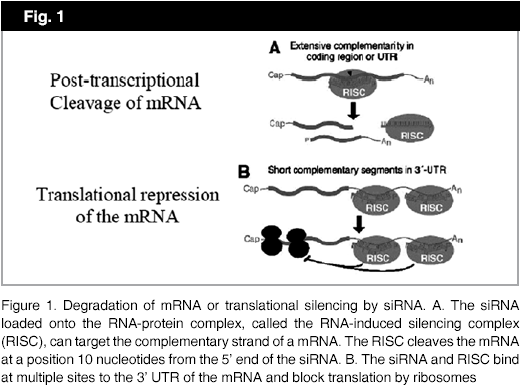
<body><![CDATA[<p align="justify"><font face="Verdana" size="2">The complex cellular  ramifications of carcinogenesis resulting in a complete restructuring of the  genome such as chromosomaldisintegration, fragmentation and multiple copies;  methylation and demethylation of specific promoter sites of genes, possibly up  to 1,000 changes in one cell; the disappearance of segments of genes, known as  loss of heterozygosity (LOH); dedifferentiation and loss of all tissue  specificity; has all been very puzzling. How did the cell survive and actually  thrive with such massive changes in the nucleus? Faced with this enormous  variability, and a vast amount of data that made little sense, the question as  to what mechanism generated such chaos was studiously avoided, as there was no  possible answer. Now the recent discoveries of RNA interference (RNAi) and the  role of short interfering RNAs (siRNAs) as well as that of microRNAs (miRNAs) in  controlling mRNA viability and protein translation in the cytoplasm begin to  provide an answer to the cancer puzzle<sup>1,3</sup>.</font></p>     <p align="justify"><font face="Verdana" size="2"><b>Mechanism of RNAi</b></font></p>     <p align="justify"><font face="Verdana" size="2">Briefly, the mechanism of RNAi  is a process whereby sequence specific, post-transcriptional gene silencing can  be initiated by a short dsRNA, which can be either a miRNA or a siRNA. This can  happen in two ways, either by post transcriptional cleavage of mRNA through  extensive complementarity in the coding region or the 3´untranslated region (UTR)  or by translational repression of the mRNA again in the 3´UTR (<a href="#fig1">Fig  1</a>). Perfect homology induces mRNA degradation, but high complementarity  induces repression of translation. Once the antisense strand of dsRNA or the  guide strand is assembled onto a RNA-protein complex, called the RNA-induced  silencing complex (RISC), it is the RISC that cleaves the targeted mRNA. Groups  of mRNAs that form part of a metabolic pathway can be regulated at one time  using a miRNA, which identifies it as a pleiotropic regulator of gene expression.</font></p>     <p align="center"><a name="fig1"> <img border="0" src="/img/fbpe/avft/v27n1/art04fig1.gif" width="521" height="389"></a></p>     
<p align="justify"><font face="Verdana" size="2">The process begins when a long  primary miRNA transcript (pri-miRNA) is transcribed by RNA polymerase II in the  nucleus. Each miRNA comes from a gene that is dedicated to the production of a  particular 22-nucleotide miRNA<sup>4</sup>. At least 474 miRNAs have been  identified and sequenced in the human genome as of November 2006<sup>5</sup> and  probably 1500 exist which regulate 5300 genes<sup>6</sup> although this figure  could be as high as 7500 genes. [See the miRNA registry at www.  microrna.sanger.ac.uk/Software/Rfam/mirna/index]. The primiRNAs are substrates  for nuclear RNase III enzymes called Drosha, which is linked with another  protein DGCR8 and together form a microprocessor (<a href="#fig2">Fig. 2</a>).</font></p>     <p align="center"><a name="fig2"> <img border="0" src="/img/fbpe/avft/v27n1/art04fig2.gif" width="521" height="593"></a></p>     
<p align="justify"><font face="Verdana" size="2">Following this initial  processing, these molecules fold to produce hairpin structures of about 70  nucleotides, labeled precursor miRNAs (pre-miRNA), which are recognised by the  two nucleotide 3´overhang (for reviews<sup>7,10</sup>). They are escorted out of  the nucleus through the nuclear pore by a transport receptor, EXPORTIN5, and a  Ran GTPase<sup>11</sup>. The pre-miRNAs are handed over to another RNase complex  called DICER in the cytoplasm for a second processing to produce a miRNA or a  siRNA duplex (<a href="#fig3">Fig. 3</a>). The only difference between a miRNA  and a siRNA is that the former are normal products of the nucleus and the latter  are synthetic. Generally, miRNA derive from RNA transcripts containing a stem  loop and load onto the RISC as single-stranded RNA. siRNAs begin as double  stranded RNA, usually depend on an artificial delivery system to the cell and  require selection of the antisense strand for incorporation into the RISC<sup>12</sup>.</font></p>     <p align="center"><a name="fig3"> <img border="0" src="/img/fbpe/avft/v27n1/art04fig3.gif" width="470" height="771"></a></p>     
<p align="justify"><font face="Verdana" size="2">DICER is part of the larger  protein complex that has several cofactors, a TAR RNA binding protein (TRBP),  PACT and AGO2<sup>13,15</sup>. TRBP recruits the DICER complex to AGO2 for miRNA  processing. AGO2, a member of the family of Argonaute proteins, which are highly  basic proteins of about 100 kD, contains two RNA binding domains. The PIWI  domain&nbsp; binds the small RNA guide at its 5´end and the PAZ domainwhich  binds the single stranded 3´ end of the small RNA<sup>16</sup>. In humans, AGO2  is the only one of four Argonaute proteins that can cleave targeted mRNA. It was  originally thought that the rejected strand or sense strand of the dsRNA was  separated by a helicase, but it has been shown that the destruction of this  strand is carried out by AGO2<sup>17</sup>.</font></p>     <p align="justify"><b><font face="Verdana" size="2">Cancer and RNAi</font></b></p>     ]]></body>
<body><![CDATA[<p align="justify"><font face="Verdana" size="2">What is the relevance of RNAi  to cancer? Several dogmas abound that prevent the above mechanism from being  fully utilised in our understanding of carcinogenesis. The above experiments  were largely carried out in non-mammalian organisms such as plants, fungi and  yeast, particularly Arabidopsis, Caernorhabditis elegans, Drosophila  melanogaster, Tetrahymena thermophila and Schizosaccharomyces pombe, all with  smaller genomes subject to easier genetic manipulation than mammalian cells.</font></p>     <p align="justify"><font face="Verdana" size="2">The first dogma that should be  re-examined is that the mammalian cell does not possess a protein checking  system, that is, a system which can check the functioning or tertiary structure  of the newly synthesized protein. The cell has a highly regulated system for  degradation of proteins through ubiquitylation. [for review see<sup>18</sup>)  The highly conserved ubiquitin protein of 76 amino acids is covalently  conjugated in a regulated multistep process by a ligase to the protein to be  degraded, by as many as four ubiquitin moieties. Many short lived proteins are  marked for degradation by the 26S proteasome, which is composed of a 20S  catalytic chamber, capped at both ends with19S regulatory units. Ubiquitin  status plays a major role in protein trafficking, and acts as a sorting signal  at the multivescicular body and at the plasma membrane. Ubiquitylation can also  induce endocytosis. The ubiquitin pathway is a major regulator of the protein  quality of misfolded proteins entering the Endoplasmic Reticulum. These  misshapen proteins are marked by ubiquitin for rapid degradation in the  cytoplasm by 26S proteasomes<sup>19</sup>.</font></p>     <p align="justify"><font face="Verdana" size="2">To initiate a protein check and  subsequent degradation, it would be expected that the errant protein must be  partially inactive. Not every mutant protein or mutated mRNA elicits a  carcinogenic response. The DNA repair protein, O<sup>6</sup>-methylguanine-DNA  methyltransferase (MGMT) was engineered to contain eight mutations within the  active site of the enzyme, although it still retained full activity. This  mutated mRNA and protein was tolerated with no ill effects, at least under cell&nbsp;  culture conditions<sup>20</sup>. It would be expected that the cell couldoperate  a sophisticated system to check protein function in much the same way the cell  operates multiple DNA repair mechanisms that survey the newly transcribed DNA  strand to ensure fidelity.</font></p>     <p align="justify"><font face="Verdana" size="2"><b>RNA-Dependent RNA Polymerase  and sicRNA</b></font></p>     <p align="justify"><font face="Verdana" size="2">The second dogma that should be  re-examined is that there is no RNA-dependent RNA polymerase (RdRP) in mammalian  cells that could synthesize a short antisense RNA. However research has  concentrated on finding a RNA-dependent RNA polymerase such as RNA polymerase  III, which behaves like a nuclear RNA polymerase, synthesizing molecules of a  large size, many thousands of base pairs. A specific search for a cytoplasmic  located RdRP that synthesizes short RNAs of a length as short as 20-25 bps and  no longer than 200 bps, similar to a miRNA is necessary. The cDNA of such an  enzyme might be very different from the RdRP found in plants.</font></p>     <p align="justify"><font face="Verdana" size="2">An important assumption of my  hypothesis is that the cell in self-defence against rogue mRNAs is able to  generate its own siRNA, which specifically attacks the mutated sequence to carry  out degradation of the homologous mRNA. This may be initiated on a signal from  the protein-checking system or from a mRNA checking system, based on a misfolded  protein structure or inadequate function. In the following discussion, sicRNA  here refers to endogenously generated, Small Interfering Cellular RNA, made by  the cell itself, using a 22 nucleotide sense strand of the mutant section of  mRNA as a guide, in response to a dysfunctional protein. This mechanism would  imply that the metazoan cell has a putative RdRP that is able to direct the  synthesis of a short section of antisense RNA (maybe no more than 22 nucleotides)  by an unknown recognition process of the aberrant mRNA.</font></p>     <p align="justify"><font face="Verdana" size="2">The resulting dsRNA consisting  of the mutant, short section of mRNA and the sicRNA is processed by DICER, binds  to the RISC complex, the sense strand is degraded and the sicRNA marks the mRNA  for degradation (<a href="#fig4">Fig.4</a>). An RNA Polymerase IV (RNApol IV)  found in plants, fungi and Caenorhabditis elegans, can generate thousands of  copies of an siRNA and is the basis of quelling<sup>21</sup>. So far no RNApol  IV has been found in Drosophila, insects and mammals but the evidence from the  extensive data on cancer suggests that there is some sort of mechanism for  generating such new sicRNAs. Perhaps in mammals, a sicRNA, using a different  enzyme or another form of an RNA polymerase pol II or pol III might be involved.  It is not suggested that the new sicRNA can move throughout the tissue thus  providing systemic resistance as in plants.</font></p>     <p align="center"><a name="fig4"> <img border="0" src="/img/fbpe/avft/v27n1/art04fig4.gif" width="522" height="483"></a></p>     
<p align="justify"><font face="Verdana" size="2">The sicRNA may be represented  by the newly discovered class of 750 tiny non-coding RNAs (tncRNAs), of 20 nt,  discovered in C. elegans<sup>22</sup>. They are precisely complementary to mRNA  from more than 500 different genes and seem to be endogenous siRNAs. So far  these tncRNAs have not been found in mammals. It is clear the defence system  must be infinitely adaptable as in any one oncogene hundreds of different  mutations have been identified. For example, there are 300 known mutations in  the APC gene; there are over 2000 different mutations in the two breast cancer  genes BRCA1 and BRCA2; and 225 different mutations in the DNA mismatch repair  gene, MLH1, have been sequenced. Usually only one organ of the body is targeted  for malignancy in a familial cancer, although every cell in all tissues carries  the mutation. Hence there must be a general, efficacious, adaptive mechanism  producing sicRNAs for targeting thousands of differently mutated mRNAs that can  arise. Otherwise, in an inherited cancer every cell in the body would be clogged  with large amounts of aberrant mRNAs and dysfunctional proteins and every tissue  would produce a cancer.</font></p>     <p align="justify"><font face="Verdana" size="2"><b>Transport of sic RNAs into  the nucleus</b></font></p>     ]]></body>
<body><![CDATA[<p align="justify"><font face="Verdana" size="2">Another key postulate of this  theory is that in a cancer-prone tissue, the anti-sense strand sicRNA made  against the mutant mRNA in the cytoplasm is able to be transported back into the  nucleus during cell division and initiate one of three outcomes,  hypermethylation or hypomethylation of the promoter site of the mutant gene or  LOH of the gene itself. It is thought the siRNA enters the nucleus during cell  division when the nuclear membrane breaks down. The factors determining which  one of these three results occur are not known. The RISC complex is not found in  the nucleus, so a different protein complex binds to the sicRNA to cause its  translocation into the nucleus and activation of the methylating machinery.  There is some evidence that an siRNA bound to the protein complex of an RNA-Induced  Initiation of Transcription gene Silencing (RITS) can carry out methylation. The  sicRNA binds to the homologous DNA being transcribed by RNA polymerase II and  methylation of the promoter site ensues, switching off the mutant gene. An  illustration of these processes is shown in <a href="#fig4">figura 4</a>.</font></p>     <p align="justify"><font face="Verdana" size="2">Another key postulate of our  theory is that the methylation or LOH of an oncogene or tumour suppressor due to  the action of a sicRNA interferes with the expression of an miRNA, fundamental  to that particular tissue. The sicRNA is generated to cope with any mutation,  and once linked up with the RITS machinery, it can affect CpG methylation of the  targeted gene.</font></p>     <p align="justify"><font face="Verdana" size="2">It should be noted that CpG  methylation can also switch on gene expression. Thus the sicRNA of a particular  oncogene could theoretically bind to sites all over the genome by annealing to  6-8 nucleotides on an homologous DNA strand, but this would produce a cancer in  many different tissues, depending on the sequence of the mutated site. As this  does not happen and a mutation of an oncogene always produces a cancer in one  specific tissue, the answer must be linked to the production of specific miRNAs  for that particular tissue. For example, an inherited mutation in the MLH1 gene  always initiates a cancer in the large colon, and sometimes in ovarian tissue,  but these are derived from the same embryonic tissue, but not in the lung nor  liver nor prostate gland, even though the mutation is present on one allele in  every cell in the body. An examination of what is currently known of miRNAs  supports this argument.</font></p>     <p align="justify"><font face="Verdana" size="2">The exact consequences of such  interference with a miRNA is not known. A sicRNA synthesized by the cell to stop  translation of a rogue mRNA, enters the nucleus during mitosis. The sicRNA  attached to a protein complex, binds to a homologous region of the gene,  methylates the promoter site and inadvertently prevents the production of a  miRNA close to that site or within the site. In a slightly different scenario,  some molecules of the sicRNA binds to an miRNA undergoing transcription and  abrogates its action. In an attempt to silence the production of the wrong genes  for that tissue, other genes are silenced by the same sicRNA mechanism. This  could result in hundreds of genes being methylated and silenced and more miRNAs  being disrupted. All of these events must occur in the stem cell.</font></p>     <p align="justify"><font face="Verdana" size="2">Most cells with a disabled  miRNA will be eliminated by apoptosis. Thus for the stem cell to survive, two  processes must be deactivated, apoptosis and normal control of cell  proliferation. In another scenario, the sicRNAs may compete with a small  modulatory dsRNA (smRNA), such as found in the neuron, described in detail below<sup>23</sup>,  and switch off synthesis of a large group of tissue specific mRNAs. The type of  miRNA that is disabled may depend on it being actively transcribed at the same  time the sicRNA enters the nucleus. In the next round of cell division, a  different miRNA could be inactivated, producing a cancer cell with a number of  different characteristics. It may need several rounds of cell division before a  second miRNA is disabled. This would add enormous variation to the resulting  phenotype, as described above with different siRNAs against p53. Hence the cell  begins a disintegration and a dedifferentiation of the particular architecture  of that tissue. The disruption of a specific miRNA marks a qualitative step that  signals the progress from a normal stem cell to a harmless Aberrant Crypt Foci (ACF),  to an adenoma or a hyperplastic polyp, to a serrated adenoma, at least in colon  cancer<sup>24</sup>.</font></p>     <p align="justify"><font face="Verdana" size="2">The hypotheses of this model  that need to be proven experimentally in humans are:</font></p>     <p align="justify"><font face="Verdana" size="2">1 There is a protein/mRNA  checking system for aberrations, perhaps based on poly A, similar to tRNA in  yeast or a system, assessed by the number of ubiquitylation and deubiquitylation  sites which can correctly diagnose a misfolded protein.</font></p>     <p align="justify"><font face="Verdana" size="2">2 The cell can generate its own  siRNAs by use of a mammalian RNA-dependant RNA polymerase with a sequence that  is the anti-sense strand to bind to any short section (20–25 nt) of mutated mRNA  that may arise.</font></p>     <p align="justify"><font face="Verdana" size="2">3 The newly synthesized siRNA,  called sicRNA, can hinder translation or degrade the mutated mRNA through the  RISC complex.</font></p>     <p align="justify"><font face="Verdana" size="2">4 In all tissues, the sicRNA/RITS  complex can move into the nucleus during cell division and silence the specific  mutated gene by CpG methylation or LOH. In non-cancerous tissue, which also  carries the mutant allele, this is the end of the story.</font></p>     ]]></body>
<body><![CDATA[<p align="justify"><font face="Verdana" size="2">5 A pre-tumor begins when CpG  Methylation and/or LOH disrupt a key miRNA specific for that tissue. For the  stem cell to survive, at least two processes, one involved in cell proliferation  and the other in apoptosis, must be disabled.</font></p>     <p align="justify"><font face="Verdana" size="2">6 A qualitative leap in  pathogenesis occurs when a sicRNA abrogates a pleiotropic miRNA, essential for  that tissue, leading to cell dedifferentiation.</font></p>     <p align="justify"><font face="Verdana" size="2">7 Cancers can be initiated by  many different pathways, utilizing sicRNAs, either elicited by a familial  germline mutation or by a spontaneous mutation which is deleterious to that  tissue, because of the specific miRNA. The exact phenotype even in the same  individual will depend on the initial error and the order of subsequent random  events.</font></p>     <p align="justify"><font face="Verdana" size="2"><b>Acknowledgement</b></font></p>     <p align="justify"><font face="Verdana" size="2">The authors are indebted to  CDCH PI.09.6030.2005 to Dr. Itala Lippo de Becemberg to support Dr. Coral Wynter  in Venezuela.</font></p>     <p align="justify"><font face="Verdana" size="2"><b>References</b></font></p>     <!-- ref --><p align="justify"><font face="Verdana" size="2">1. Filipowicz W. RNAi: the nuts  and bolts of the RISC machine. Cell 2005; 122: 17-20.</font>&nbsp;&nbsp;&nbsp;&nbsp;&nbsp;&nbsp;&nbsp;&nbsp;[&#160;<a href="javascript:void(0);" onclick="javascript: window.open('/scielo.php?script=sci_nlinks&ref=595067&pid=S0798-0264200800010000400001&lng=','','width=640,height=500,resizable=yes,scrollbars=1,menubar=yes,');">Links</a>&#160;]<!-- end-ref --><!-- ref --><p align="justify"><font face="Verdana" size="2">2. Hall PA, Russell SH. New  perspectives on neoplasia and the RNA world. Hematol Oncol 2005; 23: 49-53.</font>&nbsp;&nbsp;&nbsp;&nbsp;&nbsp;&nbsp;&nbsp;&nbsp;[&#160;<a href="javascript:void(0);" onclick="javascript: window.open('/scielo.php?script=sci_nlinks&ref=595068&pid=S0798-0264200800010000400002&lng=','','width=640,height=500,resizable=yes,scrollbars=1,menubar=yes,');">Links</a>&#160;]<!-- end-ref --><!-- ref --><p align="justify"><font face="Verdana" size="2">3. Wynter CVA. The dialectics of  cancer: A theory of the initiation and development of cancer through errors in  RNAi. Medical Hypotheses 2006; 66: 612-635.</font>&nbsp;&nbsp;&nbsp;&nbsp;&nbsp;&nbsp;&nbsp;&nbsp;[&#160;<a href="javascript:void(0);" onclick="javascript: window.open('/scielo.php?script=sci_nlinks&ref=595069&pid=S0798-0264200800010000400003&lng=','','width=640,height=500,resizable=yes,scrollbars=1,menubar=yes,');">Links</a>&#160;]<!-- end-ref --><!-- ref --><p align="justify"><font face="Verdana" size="2">4. Lim LP, Glasner ME, Yekta S,  Burge CB, Bartel DP. Vertebrate microRNA genes. Science 2003; 299: 1540.</font>&nbsp;&nbsp;&nbsp;&nbsp;&nbsp;&nbsp;&nbsp;&nbsp;[&#160;<a href="javascript:void(0);" onclick="javascript: window.open('/scielo.php?script=sci_nlinks&ref=595070&pid=S0798-0264200800010000400004&lng=','','width=640,height=500,resizable=yes,scrollbars=1,menubar=yes,');">Links</a>&#160;]<!-- end-ref --><!-- ref --><p align="justify"><font face="Verdana" size="2">5. Griffith-Jones S. The Micro  RNA Registry, NAR 2004; 32: Database Issue D109-D111</font>&nbsp;&nbsp;&nbsp;&nbsp;&nbsp;&nbsp;&nbsp;&nbsp;[&#160;<a href="javascript:void(0);" onclick="javascript: window.open('/scielo.php?script=sci_nlinks&ref=595071&pid=S0798-0264200800010000400005&lng=','','width=640,height=500,resizable=yes,scrollbars=1,menubar=yes,');">Links</a>&#160;]<!-- end-ref --><!-- ref --><p align="justify"><font face="Verdana" size="2">6. Zamore PD, Haley B. Ribo-gnome:  the big world of small RNAs. Science 2005; 309: 1519-24.</font>&nbsp;&nbsp;&nbsp;&nbsp;&nbsp;&nbsp;&nbsp;&nbsp;[&#160;<a href="javascript:void(0);" onclick="javascript: window.open('/scielo.php?script=sci_nlinks&ref=595072&pid=S0798-0264200800010000400006&lng=','','width=640,height=500,resizable=yes,scrollbars=1,menubar=yes,');">Links</a>&#160;]<!-- end-ref --><!-- ref --><p align="justify"><font face="Verdana" size="2">7. Ambros V. The functions of  animal microRNAs. Nature 2004; 431: 350-5.</font>&nbsp;&nbsp;&nbsp;&nbsp;&nbsp;&nbsp;&nbsp;&nbsp;[&#160;<a href="javascript:void(0);" onclick="javascript: window.open('/scielo.php?script=sci_nlinks&ref=595073&pid=S0798-0264200800010000400007&lng=','','width=640,height=500,resizable=yes,scrollbars=1,menubar=yes,');">Links</a>&#160;]<!-- end-ref --><!-- ref --><p align="justify"><font face="Verdana" size="2">8. Karagiannis T, EL-Osta A.  RNA interference and potential therapeutic applications of short interfering  RNAs. Cancer Gene Ther 2005; 12: 787-95.</font>&nbsp;&nbsp;&nbsp;&nbsp;&nbsp;&nbsp;&nbsp;&nbsp;[&#160;<a href="javascript:void(0);" onclick="javascript: window.open('/scielo.php?script=sci_nlinks&ref=595074&pid=S0798-0264200800010000400008&lng=','','width=640,height=500,resizable=yes,scrollbars=1,menubar=yes,');">Links</a>&#160;]<!-- end-ref --><!-- ref --><p align="justify"><font face="Verdana" size="2">9. Mattick J, Makunin IV. Small  regulatory RNAs in mammals. Hum Mol Genet Apr15 2005; 14: R121-32.</font>&nbsp;&nbsp;&nbsp;&nbsp;&nbsp;&nbsp;&nbsp;&nbsp;[&#160;<a href="javascript:void(0);" onclick="javascript: window.open('/scielo.php?script=sci_nlinks&ref=595075&pid=S0798-0264200800010000400009&lng=','','width=640,height=500,resizable=yes,scrollbars=1,menubar=yes,');">Links</a>&#160;]<!-- end-ref --><!-- ref --><p align="justify"><font face="Verdana" size="2">10. He L, Hannon GJ. MicroRNAs:  small RNAs with a big role in gene regulation. Nat Rev Genet 2004; 5: 522-31.</font>&nbsp;&nbsp;&nbsp;&nbsp;&nbsp;&nbsp;&nbsp;&nbsp;[&#160;<a href="javascript:void(0);" onclick="javascript: window.open('/scielo.php?script=sci_nlinks&ref=595076&pid=S0798-0264200800010000400010&lng=','','width=640,height=500,resizable=yes,scrollbars=1,menubar=yes,');">Links</a>&#160;]<!-- end-ref --><!-- ref --><p align="justify"><font face="Verdana" size="2">11. Kim VN. MicroRNA precursors  in motion: exportin-5mediates their nuclear export. Trends in Cell Biol 2004;  14: 156-9.</font>&nbsp;&nbsp;&nbsp;&nbsp;&nbsp;&nbsp;&nbsp;&nbsp;[&#160;<a href="javascript:void(0);" onclick="javascript: window.open('/scielo.php?script=sci_nlinks&ref=595077&pid=S0798-0264200800010000400011&lng=','','width=640,height=500,resizable=yes,scrollbars=1,menubar=yes,');">Links</a>&#160;]<!-- end-ref --><!-- ref --><p align="justify"><font face="Verdana" size="2">12. Valencia-Sanchez MA, Liu J,  Hannon GJ, Parker R. Control of translation and mRNA degradation by miRNAs and  siRNAs. Genes Dev. 2006; 20: 512-24.</font>&nbsp;&nbsp;&nbsp;&nbsp;&nbsp;&nbsp;&nbsp;&nbsp;[&#160;<a href="javascript:void(0);" onclick="javascript: window.open('/scielo.php?script=sci_nlinks&ref=595078&pid=S0798-0264200800010000400012&lng=','','width=640,height=500,resizable=yes,scrollbars=1,menubar=yes,');">Links</a>&#160;]<!-- end-ref --><!-- ref --><p align="justify"><font face="Verdana" size="2">13. Chendrimada TP, Gregory RI,  Kumaraswamy E, Norman J, Cooch N, Nishikura K, et al. TRBP recruits the Dicer  complex to Ago2 for microRNA processing and gene silencing. Nature 2005; 436:  740-4.</font>&nbsp;&nbsp;&nbsp;&nbsp;&nbsp;&nbsp;&nbsp;&nbsp;[&#160;<a href="javascript:void(0);" onclick="javascript: window.open('/scielo.php?script=sci_nlinks&ref=595079&pid=S0798-0264200800010000400013&lng=','','width=640,height=500,resizable=yes,scrollbars=1,menubar=yes,');">Links</a>&#160;]<!-- end-ref --><!-- ref --><p align="justify"><font face="Verdana" size="2">14. Haase AD, Jaskiewicz L,  Zhang H, Laine S, Sack R, Gatignol A, Filipowicz W. TRBP, a regulator of  cellular PKR and HIV-1 virus expression, interacts with Dicer and functions in  RNA silencing. EMBO Reports 2005;6:961-7.</font>&nbsp;&nbsp;&nbsp;&nbsp;&nbsp;&nbsp;&nbsp;&nbsp;[&#160;<a href="javascript:void(0);" onclick="javascript: window.open('/scielo.php?script=sci_nlinks&ref=595080&pid=S0798-0264200800010000400014&lng=','','width=640,height=500,resizable=yes,scrollbars=1,menubar=yes,');">Links</a>&#160;]<!-- end-ref --><!-- ref --><p align="justify"><font face="Verdana" size="2">15. Lee Y, Hur I, Park SY, Kim  YK, Suh MR, Kim VN. The role of PACT in the RNA silencing pathway. EMBO Journal  2006; 25: 522-32.</font>&nbsp;&nbsp;&nbsp;&nbsp;&nbsp;&nbsp;&nbsp;&nbsp;[&#160;<a href="javascript:void(0);" onclick="javascript: window.open('/scielo.php?script=sci_nlinks&ref=595081&pid=S0798-0264200800010000400015&lng=','','width=640,height=500,resizable=yes,scrollbars=1,menubar=yes,');">Links</a>&#160;]<!-- end-ref --><!-- ref --><p align="justify"><font face="Verdana" size="2">16. Liu J, Valencia-Sanchez MA,  Hannon GJ, Parker R. MicroRNA-dependent localization of targeted mRNAs to  mammalian P-bodies. Nature Cell Biol 2005; 7: 719-23.</font>&nbsp;&nbsp;&nbsp;&nbsp;&nbsp;&nbsp;&nbsp;&nbsp;[&#160;<a href="javascript:void(0);" onclick="javascript: window.open('/scielo.php?script=sci_nlinks&ref=595082&pid=S0798-0264200800010000400016&lng=','','width=640,height=500,resizable=yes,scrollbars=1,menubar=yes,');">Links</a>&#160;]<!-- end-ref --><!-- ref --><p align="justify"><font face="Verdana" size="2">17. Matranga C, Tomari Y, Shin  C, Bartel DP, Zamore PD. Passengerstrand cleavage facilitates assembly of siRNA  into Ago2-containing RNAi enzyme complexes. Cell 2005; 123: 607-20.</font>&nbsp;&nbsp;&nbsp;&nbsp;&nbsp;&nbsp;&nbsp;&nbsp;[&#160;<a href="javascript:void(0);" onclick="javascript: window.open('/scielo.php?script=sci_nlinks&ref=595083&pid=S0798-0264200800010000400017&lng=','','width=640,height=500,resizable=yes,scrollbars=1,menubar=yes,');">Links</a>&#160;]<!-- end-ref --><!-- ref --><p align="justify"><font face="Verdana" size="2">18. Kerscher O, Felberbaum R,  Hochstrasser M. Modification of proteins by ubiquitin and ubiquitin-like  proteins. Annu Rev Cell Develop Biol 2006; 22: 159-80.</font>&nbsp;&nbsp;&nbsp;&nbsp;&nbsp;&nbsp;&nbsp;&nbsp;[&#160;<a href="javascript:void(0);" onclick="javascript: window.open('/scielo.php?script=sci_nlinks&ref=595084&pid=S0798-0264200800010000400018&lng=','','width=640,height=500,resizable=yes,scrollbars=1,menubar=yes,');">Links</a>&#160;]<!-- end-ref --><!-- ref --><p align="justify"><font face="Verdana" size="2">19. Meusser B, Hirsch C,  Jaroosch E, Sommer T. ERAD: the long road to destruction. Nature Cell Biol 2005;  7: 766-72.</font>&nbsp;&nbsp;&nbsp;&nbsp;&nbsp;&nbsp;&nbsp;&nbsp;[&#160;<a href="javascript:void(0);" onclick="javascript: window.open('/scielo.php?script=sci_nlinks&ref=595085&pid=S0798-0264200800010000400019&lng=','','width=640,height=500,resizable=yes,scrollbars=1,menubar=yes,');">Links</a>&#160;]<!-- end-ref --><!-- ref --><p align="justify"><font face="Verdana" size="2">20. Loeb LA, Loeb KR, Anderson  JP. Multiple mutations and cancer. Proc Natl Acad Sci USA 2003; 100: 766-81.</font>&nbsp;&nbsp;&nbsp;&nbsp;&nbsp;&nbsp;&nbsp;&nbsp;[&#160;<a href="javascript:void(0);" onclick="javascript: window.open('/scielo.php?script=sci_nlinks&ref=595086&pid=S0798-0264200800010000400020&lng=','','width=640,height=500,resizable=yes,scrollbars=1,menubar=yes,');">Links</a>&#160;]<!-- end-ref --><!-- ref --><p align="justify"><font face="Verdana" size="2">21. Mello CC, Conte D.  Revealing the world of RNA interference. Nature 2004; 431: 338-42.</font>&nbsp;&nbsp;&nbsp;&nbsp;&nbsp;&nbsp;&nbsp;&nbsp;[&#160;<a href="javascript:void(0);" onclick="javascript: window.open('/scielo.php?script=sci_nlinks&ref=595087&pid=S0798-0264200800010000400021&lng=','','width=640,height=500,resizable=yes,scrollbars=1,menubar=yes,');">Links</a>&#160;]<!-- end-ref --><!-- ref --><p align="justify"><font face="Verdana" size="2">22. Ambros V, Lee RC, Lavanway  A, Williams PT, Jewell D. MicroRNAs and other tiny endogenous RNAs in C. elegans.  Curr Biol 2003; 13: 807-18.</font>&nbsp;&nbsp;&nbsp;&nbsp;&nbsp;&nbsp;&nbsp;&nbsp;[&#160;<a href="javascript:void(0);" onclick="javascript: window.open('/scielo.php?script=sci_nlinks&ref=595088&pid=S0798-0264200800010000400022&lng=','','width=640,height=500,resizable=yes,scrollbars=1,menubar=yes,');">Links</a>&#160;]<!-- end-ref --><!-- ref --><p align="justify"><font face="Verdana" size="2">23. Kuwabara T, Hsieh J,  Nakashima K, Taira K, Gage FH. A small modulatory dsRNA specifies the fate of  adult neural stem cells. Cell 2004; 116:779-93.</font>&nbsp;&nbsp;&nbsp;&nbsp;&nbsp;&nbsp;&nbsp;&nbsp;[&#160;<a href="javascript:void(0);" onclick="javascript: window.open('/scielo.php?script=sci_nlinks&ref=595089&pid=S0798-0264200800010000400023&lng=','','width=640,height=500,resizable=yes,scrollbars=1,menubar=yes,');">Links</a>&#160;]<!-- end-ref --><!-- ref --><p align="justify"><font face="Verdana" size="2">24. Wynter CVA, Walsh MD,  Higuchi T, Leggett BA, Young J, Jass JR. Methylation patterns define two types of  hyperplastic polyp associated with colorectal cancer. Gut 2004; 53: 573-80.</font>&nbsp;&nbsp;&nbsp;&nbsp;&nbsp;&nbsp;&nbsp;&nbsp;[&#160;<a href="javascript:void(0);" onclick="javascript: window.open('/scielo.php?script=sci_nlinks&ref=595090&pid=S0798-0264200800010000400024&lng=','','width=640,height=500,resizable=yes,scrollbars=1,menubar=yes,');">Links</a>&#160;]<!-- end-ref --> ]]></body>
<back>
<ref-list>
<ref id="B1">
<label>1</label><nlm-citation citation-type="journal">
<person-group person-group-type="author">
<name>
<surname><![CDATA[Filipowicz]]></surname>
<given-names><![CDATA[W]]></given-names>
</name>
</person-group>
<article-title xml:lang="en"><![CDATA[RNAi: the nuts and bolts of the RISC machine]]></article-title>
<source><![CDATA[Cell]]></source>
<year>2005</year>
<volume>122</volume>
<page-range>17-20</page-range></nlm-citation>
</ref>
<ref id="B2">
<label>2</label><nlm-citation citation-type="journal">
<person-group person-group-type="author">
<name>
<surname><![CDATA[Hall]]></surname>
<given-names><![CDATA[PA]]></given-names>
</name>
<name>
<surname><![CDATA[Russell]]></surname>
<given-names><![CDATA[SH]]></given-names>
</name>
</person-group>
<article-title xml:lang="en"><![CDATA[New perspectives on neoplasia and the RNA world]]></article-title>
<source><![CDATA[Hematol Oncol]]></source>
<year>2005</year>
<volume>23</volume>
<page-range>49-53</page-range></nlm-citation>
</ref>
<ref id="B3">
<label>3</label><nlm-citation citation-type="journal">
<person-group person-group-type="author">
<name>
<surname><![CDATA[Wynter]]></surname>
<given-names><![CDATA[CVA]]></given-names>
</name>
</person-group>
<article-title xml:lang="en"><![CDATA[The dialectics of cancer: A theory of the initiation and development of cancer through errors in RNAi]]></article-title>
<source><![CDATA[Medical Hypotheses]]></source>
<year>2006</year>
<volume>66</volume>
<page-range>612-635</page-range></nlm-citation>
</ref>
<ref id="B4">
<label>4</label><nlm-citation citation-type="journal">
<person-group person-group-type="author">
<name>
<surname><![CDATA[Lim]]></surname>
<given-names><![CDATA[LP]]></given-names>
</name>
<name>
<surname><![CDATA[Glasner]]></surname>
<given-names><![CDATA[ME]]></given-names>
</name>
<name>
<surname><![CDATA[Yekta]]></surname>
<given-names><![CDATA[S]]></given-names>
</name>
<name>
<surname><![CDATA[Burge]]></surname>
<given-names><![CDATA[CB]]></given-names>
</name>
<name>
<surname><![CDATA[Bartel]]></surname>
<given-names><![CDATA[DP]]></given-names>
</name>
</person-group>
<article-title xml:lang="en"><![CDATA[Vertebrate microRNA genes]]></article-title>
<source><![CDATA[Science]]></source>
<year>2003</year>
<volume>299</volume>
<page-range>1540</page-range></nlm-citation>
</ref>
<ref id="B5">
<label>5</label><nlm-citation citation-type="journal">
<person-group person-group-type="author">
<name>
<surname><![CDATA[Griffith-Jones]]></surname>
<given-names><![CDATA[S]]></given-names>
</name>
</person-group>
<article-title xml:lang="en"><![CDATA[The Micro RNA Registry]]></article-title>
<source><![CDATA[NAR]]></source>
<year>2004</year>
<volume>32</volume>
</nlm-citation>
</ref>
<ref id="B6">
<label>6</label><nlm-citation citation-type="journal">
<person-group person-group-type="author">
<name>
<surname><![CDATA[Zamore]]></surname>
<given-names><![CDATA[PD]]></given-names>
</name>
<name>
<surname><![CDATA[Haley]]></surname>
<given-names><![CDATA[B]]></given-names>
</name>
</person-group>
<article-title xml:lang="en"><![CDATA[Ribo-gnome: the big world of small RNAs]]></article-title>
<source><![CDATA[Science]]></source>
<year>2005</year>
<volume>309</volume>
<page-range>1519-24</page-range></nlm-citation>
</ref>
<ref id="B7">
<label>7</label><nlm-citation citation-type="journal">
<person-group person-group-type="author">
<name>
<surname><![CDATA[Ambros]]></surname>
<given-names><![CDATA[V]]></given-names>
</name>
</person-group>
<article-title xml:lang="en"><![CDATA[The functions of animal microRNAs]]></article-title>
<source><![CDATA[Nature]]></source>
<year>2004</year>
<volume>431</volume>
<page-range>350-5</page-range></nlm-citation>
</ref>
<ref id="B8">
<label>8</label><nlm-citation citation-type="journal">
<person-group person-group-type="author">
<name>
<surname><![CDATA[Karagiannis]]></surname>
<given-names><![CDATA[T]]></given-names>
</name>
<name>
<surname><![CDATA[EL-Osta]]></surname>
<given-names><![CDATA[A]]></given-names>
</name>
</person-group>
<article-title xml:lang="en"><![CDATA[RNA interference and potential therapeutic applications of short interfering RNAs]]></article-title>
<source><![CDATA[Cancer Gene Ther]]></source>
<year>2005</year>
<volume>12</volume>
<page-range>787-95</page-range></nlm-citation>
</ref>
<ref id="B9">
<label>9</label><nlm-citation citation-type="journal">
<person-group person-group-type="author">
<name>
<surname><![CDATA[Mattick]]></surname>
<given-names><![CDATA[J]]></given-names>
</name>
<name>
<surname><![CDATA[Makunin]]></surname>
<given-names><![CDATA[IV]]></given-names>
</name>
</person-group>
<article-title xml:lang="en"><![CDATA[Small regulatory RNAs in mammals]]></article-title>
<source><![CDATA[Hum Mol Genet]]></source>
<year>Apr1</year>
<month>5 </month>
<day>20</day>
<volume>14</volume>
<page-range>R121-32</page-range></nlm-citation>
</ref>
<ref id="B10">
<label>10</label><nlm-citation citation-type="journal">
<person-group person-group-type="author">
<name>
<surname><![CDATA[He]]></surname>
<given-names><![CDATA[L]]></given-names>
</name>
<name>
<surname><![CDATA[Hannon]]></surname>
<given-names><![CDATA[GJ]]></given-names>
</name>
</person-group>
<article-title xml:lang="en"><![CDATA[MicroRNAs: small RNAs with a big role in gene regulation]]></article-title>
<source><![CDATA[Nat Rev Genet]]></source>
<year>2004</year>
<volume>5</volume>
<page-range>522-31</page-range></nlm-citation>
</ref>
<ref id="B11">
<label>11</label><nlm-citation citation-type="journal">
<person-group person-group-type="author">
<name>
<surname><![CDATA[Kim]]></surname>
<given-names><![CDATA[VN]]></given-names>
</name>
</person-group>
<article-title xml:lang="en"><![CDATA[MicroRNA precursors in motion: exportin-5mediates their nuclear export]]></article-title>
<source><![CDATA[Trends in Cell Biol]]></source>
<year>2004</year>
<volume>14</volume>
<page-range>156-9</page-range></nlm-citation>
</ref>
<ref id="B12">
<label>12</label><nlm-citation citation-type="journal">
<person-group person-group-type="author">
<name>
<surname><![CDATA[Valencia-Sanchez]]></surname>
<given-names><![CDATA[MA]]></given-names>
</name>
<name>
<surname><![CDATA[Liu]]></surname>
<given-names><![CDATA[J]]></given-names>
</name>
<name>
<surname><![CDATA[Hannon]]></surname>
<given-names><![CDATA[GJ]]></given-names>
</name>
<name>
<surname><![CDATA[Parker]]></surname>
<given-names><![CDATA[R]]></given-names>
</name>
</person-group>
<article-title xml:lang="en"><![CDATA[Control of translation and mRNA degradation by miRNAs and siRNAs]]></article-title>
<source><![CDATA[Genes Dev.]]></source>
<year>2006</year>
<volume>20</volume>
<page-range>512-24</page-range></nlm-citation>
</ref>
<ref id="B13">
<label>13</label><nlm-citation citation-type="journal">
<person-group person-group-type="author">
<name>
<surname><![CDATA[Chendrimada]]></surname>
<given-names><![CDATA[TP]]></given-names>
</name>
<name>
<surname><![CDATA[Gregory]]></surname>
<given-names><![CDATA[RI]]></given-names>
</name>
<name>
<surname><![CDATA[Kumaraswamy]]></surname>
<given-names><![CDATA[E]]></given-names>
</name>
<name>
<surname><![CDATA[Norman]]></surname>
<given-names><![CDATA[J]]></given-names>
</name>
<name>
<surname><![CDATA[Cooch]]></surname>
<given-names><![CDATA[N]]></given-names>
</name>
<name>
<surname><![CDATA[Nishikura]]></surname>
<given-names><![CDATA[K]]></given-names>
</name>
</person-group>
<article-title xml:lang="en"><![CDATA[TRBP recruits the Dicer complex to Ago2 for microRNA processing and gene silencing]]></article-title>
<source><![CDATA[Nature]]></source>
<year>2005</year>
<volume>436</volume>
<page-range>740-4</page-range></nlm-citation>
</ref>
<ref id="B14">
<label>14</label><nlm-citation citation-type="journal">
<person-group person-group-type="author">
<name>
<surname><![CDATA[Haase]]></surname>
<given-names><![CDATA[AD]]></given-names>
</name>
<name>
<surname><![CDATA[Jaskiewicz]]></surname>
<given-names><![CDATA[L]]></given-names>
</name>
<name>
<surname><![CDATA[Zhang]]></surname>
<given-names><![CDATA[H]]></given-names>
</name>
<name>
<surname><![CDATA[Laine]]></surname>
<given-names><![CDATA[S]]></given-names>
</name>
<name>
<surname><![CDATA[Sack]]></surname>
<given-names><![CDATA[R]]></given-names>
</name>
<name>
<surname><![CDATA[Gatignol]]></surname>
<given-names><![CDATA[A]]></given-names>
</name>
<name>
<surname><![CDATA[Filipowicz]]></surname>
<given-names><![CDATA[W]]></given-names>
</name>
</person-group>
<article-title xml:lang="en"><![CDATA[TRBP, a regulator of cellular PKR and HIV-1 virus expression, interacts with Dicer and functions in RNA silencing]]></article-title>
<source><![CDATA[EMBO Reports]]></source>
<year>2005</year>
<volume>6</volume>
<page-range>961-7</page-range></nlm-citation>
</ref>
<ref id="B15">
<label>15</label><nlm-citation citation-type="journal">
<person-group person-group-type="author">
<name>
<surname><![CDATA[Lee]]></surname>
<given-names><![CDATA[Y]]></given-names>
</name>
<name>
<surname><![CDATA[Hur]]></surname>
<given-names><![CDATA[I]]></given-names>
</name>
<name>
<surname><![CDATA[Park]]></surname>
<given-names><![CDATA[SY]]></given-names>
</name>
<name>
<surname><![CDATA[Kim]]></surname>
<given-names><![CDATA[YK]]></given-names>
</name>
<name>
<surname><![CDATA[Suh]]></surname>
<given-names><![CDATA[MR]]></given-names>
</name>
<name>
<surname><![CDATA[Kim]]></surname>
<given-names><![CDATA[VN]]></given-names>
</name>
</person-group>
<article-title xml:lang="en"><![CDATA[The role of PACT in the RNA silencing pathway]]></article-title>
<source><![CDATA[EMBO Journal]]></source>
<year>2006</year>
<volume>25</volume>
<page-range>522-32</page-range></nlm-citation>
</ref>
<ref id="B16">
<label>16</label><nlm-citation citation-type="journal">
<person-group person-group-type="author">
<name>
<surname><![CDATA[Liu]]></surname>
<given-names><![CDATA[J]]></given-names>
</name>
<name>
<surname><![CDATA[Valencia-Sanchez]]></surname>
<given-names><![CDATA[MA]]></given-names>
</name>
<name>
<surname><![CDATA[Hannon]]></surname>
<given-names><![CDATA[GJ]]></given-names>
</name>
<name>
<surname><![CDATA[Parker]]></surname>
<given-names><![CDATA[R]]></given-names>
</name>
</person-group>
<article-title xml:lang="en"><![CDATA[MicroRNA-dependent localization of targeted mRNAs to mammalian P-bodies]]></article-title>
<source><![CDATA[Nature Cell Biol]]></source>
<year>2005</year>
<volume>7</volume>
<page-range>719-23</page-range></nlm-citation>
</ref>
<ref id="B17">
<label>17</label><nlm-citation citation-type="journal">
<person-group person-group-type="author">
<name>
<surname><![CDATA[Matranga]]></surname>
<given-names><![CDATA[C]]></given-names>
</name>
<name>
<surname><![CDATA[Tomari]]></surname>
<given-names><![CDATA[Y]]></given-names>
</name>
<name>
<surname><![CDATA[Shin]]></surname>
<given-names><![CDATA[C]]></given-names>
</name>
<name>
<surname><![CDATA[Bartel]]></surname>
<given-names><![CDATA[DP]]></given-names>
</name>
<name>
<surname><![CDATA[Zamore]]></surname>
<given-names><![CDATA[PD]]></given-names>
</name>
</person-group>
<article-title xml:lang="en"><![CDATA[Passengerstrand cleavage facilitates assembly of siRNA into Ago2-containing RNAi enzyme complexes]]></article-title>
<source><![CDATA[Cell]]></source>
<year>2005</year>
<volume>123</volume>
<page-range>607-20</page-range></nlm-citation>
</ref>
<ref id="B18">
<label>18</label><nlm-citation citation-type="journal">
<person-group person-group-type="author">
<name>
<surname><![CDATA[Kerscher]]></surname>
<given-names><![CDATA[O]]></given-names>
</name>
<name>
<surname><![CDATA[Felberbaum]]></surname>
<given-names><![CDATA[R]]></given-names>
</name>
<name>
<surname><![CDATA[Hochstrasser]]></surname>
<given-names><![CDATA[M]]></given-names>
</name>
</person-group>
<article-title xml:lang="en"><![CDATA[Modification of proteins by ubiquitin and ubiquitin-like proteins]]></article-title>
<source><![CDATA[Annu Rev Cell Develop Biol]]></source>
<year>2006</year>
<volume>22</volume>
<page-range>159-80</page-range></nlm-citation>
</ref>
<ref id="B19">
<label>19</label><nlm-citation citation-type="journal">
<person-group person-group-type="author">
<name>
<surname><![CDATA[Meusser]]></surname>
<given-names><![CDATA[B]]></given-names>
</name>
<name>
<surname><![CDATA[Hirsch]]></surname>
<given-names><![CDATA[C]]></given-names>
</name>
<name>
<surname><![CDATA[Jaroosch]]></surname>
<given-names><![CDATA[E]]></given-names>
</name>
<name>
<surname><![CDATA[Sommer]]></surname>
<given-names><![CDATA[T]]></given-names>
</name>
</person-group>
<article-title xml:lang="en"><![CDATA[ERAD: the long road to destruction]]></article-title>
<source><![CDATA[Nature Cell Biol]]></source>
<year>2005</year>
<volume>7</volume>
<page-range>766-72</page-range></nlm-citation>
</ref>
<ref id="B20">
<label>20</label><nlm-citation citation-type="journal">
<person-group person-group-type="author">
<name>
<surname><![CDATA[Loeb]]></surname>
<given-names><![CDATA[LA]]></given-names>
</name>
<name>
<surname><![CDATA[Loeb]]></surname>
<given-names><![CDATA[KR]]></given-names>
</name>
<name>
<surname><![CDATA[Anderson]]></surname>
<given-names><![CDATA[JP]]></given-names>
</name>
</person-group>
<article-title xml:lang="en"><![CDATA[Multiple mutations and cancer]]></article-title>
<source><![CDATA[Proc Natl Acad Sci USA]]></source>
<year>2003</year>
<volume>100</volume>
<page-range>766-81</page-range></nlm-citation>
</ref>
<ref id="B21">
<label>21</label><nlm-citation citation-type="journal">
<person-group person-group-type="author">
<name>
<surname><![CDATA[Mello]]></surname>
<given-names><![CDATA[CC]]></given-names>
</name>
<name>
<surname><![CDATA[Conte]]></surname>
<given-names><![CDATA[D]]></given-names>
</name>
</person-group>
<article-title xml:lang="en"><![CDATA[Revealing the world of RNA interference]]></article-title>
<source><![CDATA[Nature]]></source>
<year>2004</year>
<volume>431</volume>
<page-range>338-42</page-range></nlm-citation>
</ref>
<ref id="B22">
<label>22</label><nlm-citation citation-type="journal">
<person-group person-group-type="author">
<name>
<surname><![CDATA[Ambros]]></surname>
<given-names><![CDATA[V]]></given-names>
</name>
<name>
<surname><![CDATA[Lee]]></surname>
<given-names><![CDATA[RC]]></given-names>
</name>
<name>
<surname><![CDATA[Lavanway]]></surname>
<given-names><![CDATA[A]]></given-names>
</name>
<name>
<surname><![CDATA[Williams]]></surname>
<given-names><![CDATA[PT]]></given-names>
</name>
<name>
<surname><![CDATA[Jewell]]></surname>
<given-names><![CDATA[D]]></given-names>
</name>
</person-group>
<article-title xml:lang="en"><![CDATA[MicroRNAs and other tiny endogenous RNAs in C. elegans]]></article-title>
<source><![CDATA[Curr Biol]]></source>
<year>2003</year>
<volume>13</volume>
<page-range>807-18</page-range></nlm-citation>
</ref>
<ref id="B23">
<label>23</label><nlm-citation citation-type="journal">
<person-group person-group-type="author">
<name>
<surname><![CDATA[Kuwabara]]></surname>
<given-names><![CDATA[T]]></given-names>
</name>
<name>
<surname><![CDATA[Hsieh]]></surname>
<given-names><![CDATA[J]]></given-names>
</name>
<name>
<surname><![CDATA[Nakashima]]></surname>
<given-names><![CDATA[K]]></given-names>
</name>
<name>
<surname><![CDATA[Taira]]></surname>
<given-names><![CDATA[K]]></given-names>
</name>
<name>
<surname><![CDATA[Gage]]></surname>
<given-names><![CDATA[FH]]></given-names>
</name>
</person-group>
<article-title xml:lang="en"><![CDATA[A small modulatory dsRNA specifies the fate of adult neural stem cells]]></article-title>
<source><![CDATA[Cell]]></source>
<year>2004</year>
<volume>116</volume>
<page-range>779-93</page-range></nlm-citation>
</ref>
<ref id="B24">
<label>24</label><nlm-citation citation-type="journal">
<person-group person-group-type="author">
<name>
<surname><![CDATA[Wynter]]></surname>
<given-names><![CDATA[CVA]]></given-names>
</name>
<name>
<surname><![CDATA[Walsh]]></surname>
<given-names><![CDATA[MD]]></given-names>
</name>
<name>
<surname><![CDATA[Higuchi]]></surname>
<given-names><![CDATA[T]]></given-names>
</name>
<name>
<surname><![CDATA[Leggett]]></surname>
<given-names><![CDATA[BA]]></given-names>
</name>
<name>
<surname><![CDATA[Young]]></surname>
<given-names><![CDATA[J]]></given-names>
</name>
<name>
<surname><![CDATA[Jass]]></surname>
<given-names><![CDATA[JR]]></given-names>
</name>
</person-group>
<article-title xml:lang="en"><![CDATA[Methylation patterns define two types of hyperplastic polyp associated with colorectal cancer]]></article-title>
<source><![CDATA[Gut]]></source>
<year>2004</year>
<volume>53</volume>
<page-range>573-80</page-range></nlm-citation>
</ref>
</ref-list>
</back>
</article>
