<?xml version="1.0" encoding="ISO-8859-1"?><article xmlns:mml="http://www.w3.org/1998/Math/MathML" xmlns:xlink="http://www.w3.org/1999/xlink" xmlns:xsi="http://www.w3.org/2001/XMLSchema-instance">
<front>
<journal-meta>
<journal-id>0798-0264</journal-id>
<journal-title><![CDATA[Archivos Venezolanos de Farmacología y Terapéutica]]></journal-title>
<abbrev-journal-title><![CDATA[AVFT]]></abbrev-journal-title>
<issn>0798-0264</issn>
<publisher>
<publisher-name><![CDATA[Sociedad Venezolana de Farmacológia  y Farmacológia Clínica y Terapéutica. Escuela de MedicinaJosé Maria Vargas. Cátedra de Farmacológia, piso 3, esquina san jacinto, San José Caracas]]></publisher-name>
</publisher>
</journal-meta>
<article-meta>
<article-id>S0798-02642010000300002</article-id>
<title-group>
<article-title xml:lang="en"><![CDATA[Novel, broad-specrum antimycotic agents: the role of echinocandins today]]></article-title>
</title-group>
<contrib-group>
<contrib contrib-type="author">
<name>
<surname><![CDATA[Manfredi]]></surname>
<given-names><![CDATA[Roberto]]></given-names>
</name>
<xref ref-type="aff" rid="A01"/>
</contrib>
</contrib-group>
<aff id="A01">
<institution><![CDATA[,University of Bologna Department of Internal Medicine, Aging, and Nephrologic Diseases ]]></institution>
<addr-line><![CDATA[Bologna ]]></addr-line>
<country>Italy</country>
</aff>
<pub-date pub-type="pub">
<day>00</day>
<month>09</month>
<year>2010</year>
</pub-date>
<pub-date pub-type="epub">
<day>00</day>
<month>09</month>
<year>2010</year>
</pub-date>
<volume>29</volume>
<numero>3</numero>
<fpage>44</fpage>
<lpage>50</lpage>
<copyright-statement/>
<copyright-year/>
<self-uri xlink:href="http://ve.scielo.org/scielo.php?script=sci_arttext&amp;pid=S0798-02642010000300002&amp;lng=en&amp;nrm=iso"></self-uri><self-uri xlink:href="http://ve.scielo.org/scielo.php?script=sci_abstract&amp;pid=S0798-02642010000300002&amp;lng=en&amp;nrm=iso"></self-uri><self-uri xlink:href="http://ve.scielo.org/scielo.php?script=sci_pdf&amp;pid=S0798-02642010000300002&amp;lng=en&amp;nrm=iso"></self-uri><abstract abstract-type="short" xml:lang="en"><p><![CDATA[The echinocandins show comparable efficacy in the treatment of candidemia and invasive candidiasis. Caspofungin and micafungin appear to be similarly efficacious in salvage therapy in aspergillosis; anidulafungin has excellent in vitro activity against Aspergillus species but as yet there are no sufficient clinical data for anidulafungin in this disease state. Each drug has minor advantages and disadvantages compared to the others of the same classe; however, there are large differences in the approved indications for the different drugs. The formulary selection process should consider the direct and indirect costs of the single agents; the characteristics of the patient population at risk for invasive mycosis, such as frequent use of interacting drugs and the burden of monitoring plasma drug levels of drugs; and the implications of using products for indications which have not been still approved (off-label indications).]]></p></abstract>
<kwd-group>
<kwd lng="en"><![CDATA[antifungal drugs]]></kwd>
<kwd lng="en"><![CDATA[echinocandins]]></kwd>
<kwd lng="en"><![CDATA[caspofungin]]></kwd>
<kwd lng="en"><![CDATA[anidulafungin]]></kwd>
<kwd lng="en"><![CDATA[micafungin]]></kwd>
<kwd lng="en"><![CDATA[indications]]></kwd>
<kwd lng="en"><![CDATA[clinical studies]]></kwd>
</kwd-group>
</article-meta>
</front><body><![CDATA[   <b>     <p ALIGN="center" style="line-height: 100%"><font face="Verdana" size="3">Novel, broad-specrum antimycotic agents:</font></b><font size="3" face="Verdana"> </font><b><font face="Verdana" size="3">the role of echinocandins today</font></p> </b>     <p ALIGN="center" style="line-height: 100%"><font size="2" face="Verdana">Roberto Manfredi, MD</font></p>     <p ALIGN="justify" style="line-height: 100%"><font size="2" face="Verdana">Department of Internal Medicine, Aging, and Nephrologic Diseases, “Alma Mater Studiurum” University of Bologna, S. Orsola-Malpighi Hospital, Bologna, Italy</font></p>     <p ALIGN="justify" style="line-height: 100%"><font size="2" face="Verdana">Conflicts of interest, funding, sponsorship, acknowledgements: none</font></p>     <p ALIGN="justify" style="line-height: 100%"><font size="2" face="Verdana">Correspondence: Prof. Roberto Manfredi.</font> <font size="2" face="Verdana">c/o Infectious Diseases, S. Orsola Hospital, Via Massarenti, 11</font> <font size="2" face="Verdana">40138 Bologna</font></p>     <p ALIGN="justify" style="line-height: 100%"><font size="2" face="Verdana">Telefono: 051-6363355. Cellulare: 329-3156697. Telefax: 051-343500. E-mail: <a href="mailto:Roberto.manfredi@unibo.it">Roberto.manfredi@unibo.it</a></font></p>     <p ALIGN="justify" style="line-height: 100%"><b><font size="2" face="Verdana">Abstract</font></b></p>     <p ALIGN="justify" style="line-height: 100%"><font size="2" face="Verdana">The echinocandins show comparable efficacy in the treatment</font> <font size="2" face="Verdana">of candidemia and invasive candidiasis. Caspofungin</font> <font size="2" face="Verdana">and micafungin appear to be similarly efficacious in salvage</font> <font size="2" face="Verdana">therapy in aspergillosis; anidulafungin has excellent in vitro</font> <font size="2" face="Verdana">activity against Aspergillus species but as yet there are no</font> <font size="2" face="Verdana">sufficient clinical data for anidulafungin in this disease state.</font> <font size="2" face="Verdana">Each drug has minor advantages and disadvantages compared</font> <font size="2" face="Verdana">to the others of the same classe; however, there are</font> <font size="2" face="Verdana">large differences in the approved indications for the different</font> <font size="2" face="Verdana">drugs. The formulary selection process should consider the</font> <font size="2" face="Verdana">direct and indirect costs of the single agents; the characteristics</font> <font size="2" face="Verdana">of the patient population at risk for invasive mycosis,</font> <font size="2" face="Verdana">such as frequent use of interacting drugs and the burden of</font> <font size="2" face="Verdana">monitoring plasma drug levels of drugs; and the implications</font> <font size="2" face="Verdana">of using products for indications which have not been still approved</font> <font size="2" face="Verdana">(off-label indications).</font></p> <b>     <p ALIGN="justify" style="line-height: 100%"><font size="2" face="Verdana">Key words: </font></b><font size="2" face="Verdana">antifungal drugs, echinocandins, caspofungin,</font> <font size="2" face="Verdana">anidulafungin, micafungin, indications, clinical studies</font></p>     ]]></body>
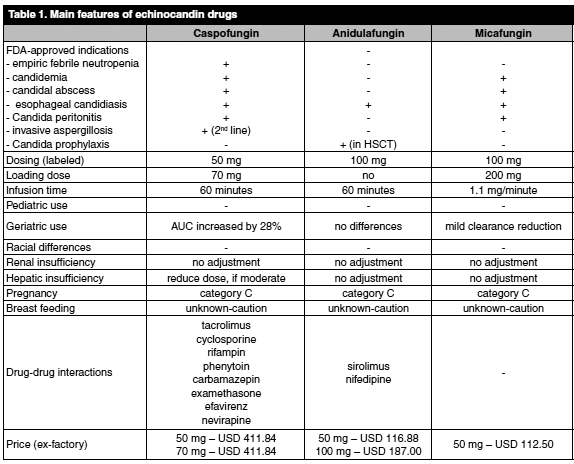
<body><![CDATA[<p ALIGN="justify" style="line-height: 100%"><font size="2" face="Verdana">Recibido: 07/06/2010 Aceptado: 01/09/2010</font></p>     <p ALIGN="justify" style="line-height: 100%"><b><font size="2" face="Verdana">Introduction</font></b></p>     <p ALIGN="justify" style="line-height: 100%"><font size="2" face="Verdana">The echinocandins are a class of drugs that have made an</font> <font size="2" face="Verdana">enormous impact on the treatment of fungal infections. Less</font> <font size="2" face="Verdana">expensive than lipid formulations of amphotericin B, they</font> <font size="2" face="Verdana">have less toxicity than amphotericin products and fewer drug</font> <font size="2" face="Verdana">interactions than azoles. Efficacy for yeast/Candida species</font> <font size="2" face="Verdana">is comparable to amphotericin-based products, and they</font> <font size="2" face="Verdana">have activity against many mold species. Caspofungin was</font> <font size="2" face="Verdana">the first echinocandin approved by the FDA, coming on the</font> <font size="2" face="Verdana">market in 2001. Since then, two more products have been</font> <font size="2" face="Verdana">approved: micafungin (2005) and anidulafungin (2006). The</font> <font size="2" face="Verdana">development of competition in the echinocandin market has</font> <font size="2" face="Verdana">prompted a class review of these drugs in order to determine</font> <font size="2" face="Verdana">the choice with the most favorable balance of economics,</font> <font size="2" face="Verdana">safety and efficacy. The indications, dosing and costs are</font> <font size="2" face="Verdana">summarized in <a href="#tab1"> Table 1</a>.</font></p>     <p ALIGN="center" style="line-height: 100%"><a name="tab1"><img border="0" src="/img/fbpe/avft/v29n3/art02tab1.gif" width="574" height="464"></a></p> <b>     
<p ALIGN="justify" style="line-height: 100%"><font size="2" face="Verdana">Pharmacological issues: an introduction</font></p> </b>     <p ALIGN="justify" style="line-height: 100%"><font size="2" face="Verdana">The echinocandins are large, semisynthetic, injectable lipopeptides</font> <font size="2" face="Verdana">derived from fungal fermentation products<sup>6,15,30</sup>.</font> <font size="2" face="Verdana">Their molecular weights range from 1,140 to 1,292 daltons.</font> <font size="2" face="Verdana">The echinocandins inhibit the growth of fungi by interfering</font> <font size="2" face="Verdana">with the synthesis of the fungal cell wall component 1,3- -Dglucan,</font> <font size="2" face="Verdana">a large polysaccharide that provides rigidity to the cell</font> <font size="2" face="Verdana">wall. The pharmacokinetic properties of the echinocandins</font> <font size="2" face="Verdana">are quite similar, and are summarized in <a href="#tab2"> Table 2</a>.</font></p>     <p ALIGN="center" style="line-height: 100%"><a name="tab2"><img border="0" src="/img/fbpe/avft/v29n3/art02tab2.gif" width="580" height="267"></a></p> <b>     
<p ALIGN="justify" style="line-height: 100%"><font size="2" face="Verdana">Antimycotic activity</font></p> </b>     <p ALIGN="justify" style="line-height: 100%"><font size="2" face="Verdana">All three of the currently available echinocandins have in vitro</font> <font size="2" face="Verdana">activity against a variety of species of Candida, Aspergillus</font> <font size="2" face="Verdana">and other opportunistic fungi. The relationship between in</font> <font size="2" face="Verdana">vitro activity and clinical efficacy against fungal isolates is unclear;</font> <font size="2" face="Verdana">interpretive criteria have not yet been defined<sup>8</sup>. <a href="#tab3"> Tables 3</a></font><a href="#tab3"> <font size="2" face="Verdana">and 4</font></a><font size="2" face="Verdana"> summarize the in vitro activity of the available echinocandins,</font> <font size="2" face="Verdana">according to consolidated literature evidences.</font></p>     <p ALIGN="center" style="line-height: 100%"><a name="tab3"><img border="0" src="/img/fbpe/avft/v29n3/art02tab3.gif" width="575" height="200"></a></p>     
]]></body>
<body><![CDATA[<p ALIGN="center" style="line-height: 100%"><img border="0" src="/img/fbpe/avft/v29n3/art02tab4.gif" width="578" height="260"></p> <b>     
<p ALIGN="justify" style="line-height: 100%"><font size="2" face="Verdana">Caspofungin vs. Candida</font></p> </b>     <p ALIGN="justify" style="line-height: 100%"><font size="2" face="Verdana">The in vitro activity of caspofungin against Candida species</font> <font size="2" face="Verdana">has been well documented. In six studies using 7,109 clinical</font> <font size="2" face="Verdana">isolates of various species of Candida, caspofungin inhibited</font> <font size="2" face="Verdana">the overwhelming majority of isolates at concentrations <font LANG="JA">&#8804;</font>2</font> <font size="2" face="Verdana">mcg/mL<sup>19,20,27,28,36,37</sup>. This held true even for fluconazole-resistant</font> <font size="2" face="Verdana">isolates. Candida parapsilosis isolates tended to have</font> <font size="2" face="Verdana">higher MICs than other species, but most were inhibited at or</font> <font size="2" face="Verdana">below 2 mcg/mL, and one study reported an MIC90 of &gt;8 for</font> <font size="2" face="Verdana">75 isolates of Candida guilliermondii<sup>28</sup>. Two studies reported</font> <font size="2" face="Verdana">overall MICs for all isolates in aggregate; for 751 isolates the</font> <font size="2" face="Verdana">MICs were 0.25-0.5 mcg/mL<sup>7,8</sup>.</font></p> <b>     <p ALIGN="justify" style="line-height: 100%"><font size="2" face="Verdana">Micafungin vs. Candida</font></p> </b>     <p ALIGN="justify" style="line-height: 100%"><font size="2" face="Verdana">Three studies evaluated the in vitro activity of micafungin</font> <font size="2" face="Verdana">against 551 clinical Candida isolates<sup>22,23,35</sup>. In one study of</font> <font size="2" face="Verdana">315 fluconazole-resistant isolates, the overall MIC90 was</font> <font size="2" face="Verdana">0.06 mcg/mL; C. glabrata isolates were the most sensitive to</font> <font size="2" face="Verdana">micafungin, with an overall MIC90 of 0.015 mcg/mL for 110</font> <font size="2" face="Verdana">isolates<sup>22</sup>. A second study also found excellent activity against</font> <font size="2" face="Verdana">all species of Candida, although MICs for C. parapsilosis were</font> <font size="2" face="Verdana">among the highest, ranging from 0.5 to 2 mcg/mL<sup>23</sup>.The third</font> <font size="2" face="Verdana">study found micafungin to be the least active when compared</font> <font size="2" face="Verdana">to several azole antifungals, amphotericin B and flucytosine,</font> <font size="2" face="Verdana">with an overall MIC90 for 164 isolates greater than 8 mcg/mL,</font> <font size="2" face="Verdana">but this finding was primarily due to the high MIC90s of the 16</font> <font size="2" face="Verdana">isolates of C. parapsilosis<sup>19</sup>.</font></p> <b>     <p ALIGN="justify" style="line-height: 100%"><font size="2" face="Verdana">Anidulafungin vs. Candida</font></p> </b>     <p ALIGN="justify" style="line-height: 100%"><font size="2" face="Verdana">The in vitro activity of anidulafungin against 3,251 clinical isolates</font> <font size="2" face="Verdana">of Candida species was evaluated in four studies<sup>1,5,30,37</sup>.</font> <font size="2" face="Verdana">Isolates of C. albicans and C. glabrata were highly susceptible</font> <font size="2" face="Verdana">to anidulafungin in all the four studies, with MIC90s of</font> <font size="2" face="Verdana">less than 2 mcg/mL. Higher MICs values were observed with</font> <font size="2" face="Verdana">isolates of C. parapsilosis in most of the studies, ranging from</font> <font size="2" face="Verdana">2-8 mcg/mL. MICs for C. tropicalis, Candida dubliniensis,</font> <font size="2" face="Verdana">Candida famata and C. guilliermondii were also found to be</font> <font size="2" face="Verdana">higher in some studies<sup>1,30</sup>.</font></p> <b>     <p ALIGN="justify" style="line-height: 100%"><font size="2" face="Verdana">Caspofungin vs. Other Fungi</font></p> </b>     <p ALIGN="justify" style="line-height: 100%"><font size="2" face="Verdana">The in vitro activity of caspofungin against 700 isolates of</font> <font size="2" face="Verdana">Aspergillus species was evaluated in three studies<sup>6,11,12</sup>. The</font> <font size="2" face="Verdana">great majority of isolates were highly susceptible to caspofungin,</font> <font size="2" face="Verdana">although in one study, the range of MICs for 13 isolates of</font> <font size="2" face="Verdana">Aspergillus fumigatus was 0.5-&gt;16 mcg/mL, with a mean MIC</font> <font size="2" face="Verdana">of 2.15 mcg/mL<sup>11</sup>. The largest study included isolates from</font> <font size="2" face="Verdana">environmental sources as well as clinical sources; caspofungin</font> <font size="2" face="Verdana">was potently active with an MIC90 of less than 0.007</font> <font size="2" face="Verdana">for all isolates regardless of the source<sup>12</sup>. Espinel-Ingroff et</font> <font size="2" face="Verdana">al. also evaluated the in vitro activity of caspofungin against</font> <font size="2" face="Verdana">other opportunistic fungi<sup>11</sup>. Caspofungin proved moderately</font> <font size="2" face="Verdana">active against Cladophiliophora bantiana, Bipolaris species,</font> <font size="2" face="Verdana">Scedosporidium prolifififi cans, Blastomyces dermatitidis and</font> <font size="2" face="Verdana">Histoplasma capsulatum, with MICs ranging from 2-8 mcg/mL. On the other hand, aspofungin tested inactive against</font> <font size="2" face="Verdana">Fusarium species, Rhizopus arrhizus, Cryptococcus neoformans</font> <font size="2" face="Verdana">and Trichosporon beigelii.</font></p> <b>     <p ALIGN="justify" style="line-height: 100%"><font size="2" face="Verdana">Micafungin vs. Other Fungi</font></p> </b>     ]]></body>
<body><![CDATA[<p ALIGN="justify" style="line-height: 100%"><font size="2" face="Verdana">The in vitro activity of micafungin against 596 environmental</font> <font size="2" face="Verdana">and clinical isolates of A. fumigatus was compared to that of</font> <font size="2" face="Verdana">five other antifungal agents<sup>21</sup>. Micafungin exhibited a very low</font> <font size="2" face="Verdana">MIC90 (&lt;0.007 mcg/mL) for all isolates regardless of whether</font> <font size="2" face="Verdana">the organism was obtained from a clinical or environmental</font> <font size="2" face="Verdana">site. The in vitro activity of micafungin against 16 species</font> <font size="2" face="Verdana">of molds was evaluated by Nakai et al.<sup>25</sup>. Micafungin was</font> <font size="2" face="Verdana">highly active against all the six species of Aspergillus and</font> <font size="2" face="Verdana">had intermediate activity against Cladosporium trichoides,</font> <font size="2" face="Verdana">two Exophiala species and Fonsecaea pedrosoi. Micafungin</font> <font size="2" face="Verdana">was inactive against Absidia corymbifera, Cunninghamella</font> <font size="2" face="Verdana">elegans, two Rhizopus species, Fusarium solani and Pseudallescheria</font> <font size="2" face="Verdana">boydii.</font></p> <b>     <p ALIGN="justify" style="line-height: 100%"><font size="2" face="Verdana">Anidulafungin vs. Other Fungi</font></p> </b>     <p ALIGN="justify" style="line-height: 100%"><font size="2" face="Verdana">The in vitro antifungal activity of anidulafungin against Aspergillus</font> <font size="2" face="Verdana">spp. was initially compared to those of four other antifungal</font> <font size="2" face="Verdana">agents<sup>6</sup>. Anidulafungin was highly active against all</font> <font size="2" face="Verdana">68 strains, with MICs of 0.03 mcg/mL for all strains tested.</font> <font size="2" face="Verdana">Later, Zhanel et al. evaluated the in vitro activity of anidulafungin</font> <font size="2" face="Verdana">against 64 clinical isolates of Cryptococcus neoformans,</font> <font size="2" face="Verdana">Blastomyces dermatitidis and Aspergillus species<sup>37</sup>. Anidulafungin</font> <font size="2" face="Verdana">potently inhibited all the five tested Aspergillus spp.</font> <font size="2" face="Verdana">It was ineffective against C. neoformans and B. dermatitidis.</font></p> <b>     <p ALIGN="justify" style="line-height: 100%"><font size="2" face="Verdana">Available clinical trials</font></p>     <p ALIGN="justify" style="line-height: 100%"><font size="2" face="Verdana">Caspofungin in Candida infections</font></p> </b>     <p ALIGN="justify" style="line-height: 100%"><font size="2" face="Verdana">Caspofungin     was compared to amphotericin B deoxycholate</font> <font size="2" face="Verdana">for     invasive candidiasis in a double-blind, randomized trial in</font> <font size="2" face="Verdana">adult     patients<sup>24</sup>. Eligible patients were adults with at least one</font> <font size="2" face="Verdana">positive     culture for Candida from blood or another sterile site</font> <font size="2" face="Verdana">plus     ]]></body>
<body><![CDATA[at least one sign of infection. Stepdown therapy with oral</font> <font size="2" face="Verdana">fluconazole     was permitted, if clinically warranted, after 10</font> <font size="2" face="Verdana">days     of IV therapy with the study drug. Patients were stratified     according to APACHE score and randomized to receive</font> <font size="2" face="Verdana">either     caspofungin as a 70-mg loading dose followed by 50</font> <font size="2" face="Verdana">mg     per day or amphotericin B at a dose of 0.6 to 0.7 mg/kg/day     for non-neutropenic patients and 0.7 to 1 mg/kg/day for</font> <font size="2" face="Verdana">neutropenic     patients. The primary efficacy measure was overall</font> <font size="2" face="Verdana">response     to therapy, with a favorable response defined as</font> <font size="2" face="Verdana">resolution     of all symptoms and signs of the infection as well</font> <font size="2" face="Verdana">as     ]]></body>
<body><![CDATA[microbiological eradication. Caspofungin would be considered</font> <font size="2" face="Verdana">non-inferior     to amphotericin B if there was less than</font> <font size="2" face="Verdana">20%     difference between the two study groups once APACHE</font> <font size="2" face="Verdana">scores     and neutropenia were accounted for. The rates of favorable</font> <font size="2" face="Verdana">response     at the end of IV therapy did not differ significantly     between the two groups (73.4% for caspofungin vs.</font> <font size="2" face="Verdana">61.75     for amphotericin B; p=0.09). Among the 186 patients</font> <font size="2" face="Verdana">who     met prespecified criteria for evaluation (inclusion in MITT</font> <font size="2" face="Verdana">analysis,     no concomitant antifungal therapy, no protocol violations</font> <font size="2" face="Verdana">that     could interfere with efficacy assessment, appropriate</font> <font size="2" face="Verdana">evaluation     ]]></body>
<body><![CDATA[at the end of therapy and receipt of study</font> <font size="2" face="Verdana">drugs     for five days or more), the respective response rates</font> <font size="2" face="Verdana">were     80.7% and64.9% (p=0.03); the criteria for non-inferiority</font> <font size="2" face="Verdana">were     met. There were significantly more patients in the amphotericin</font> <font size="2" face="Verdana">group     who had adverse events due to study drug</font> <font size="2" face="Verdana">(33     patients in the caspofungin MITT group; 28.9% vs. 73</font> <font size="2" face="Verdana">patients     in the amphotericin group; 58.4%; p=0.002). Significantly     more patients in the amphotericin group withdrew from</font> <font size="2" face="Verdana">the     study due to adverse events (23.2% vs. 2.6%; p=0.003).</font> <font size="2" face="Verdana">The     authors concluded that caspofungin was as effective as</font> <font size="2" face="Verdana">amphotericin     ]]></body>
<body><![CDATA[B for the treatment of invasive candidiasis and</font> <font size="2" face="Verdana">was     less toxic than amphotericin B. Caspofungin was compared</font> <font size="2" face="Verdana">to     amphotericin B deoxycholate for the treatment of</font> <font size="2" face="Verdana">endoscopically-confirmed     esophageal candidiasisin a randomized,</font> <font size="2" face="Verdana">double-blind     trial<sup>35</sup>. There were 128 patients enrolled</font> <font size="2" face="Verdana">in     the study; they were randomized to receive caspofungin</font> <font size="2" face="Verdana">50     mg/day, caspofungin 70 mg/day, or amphotericin B deoxycholate</font> <font size="2" face="Verdana">0.5     mg/kg/day. A favorable response was defined as</font> <font size="2" face="Verdana">the     resolution of symptoms plus either clearing of esophageal</font> <font size="2" face="Verdana">lesions     or an improvement of two or more grade levels. The</font> <font size="2" face="Verdana">response     ]]></body>
<body><![CDATA[rates at the end of therapy were high for all three</font> <font size="2" face="Verdana">treatments     (85% for caspofungin 50 mg, 96% for caspofungin</font> <font size="2" face="Verdana">70     mg, and 72% for amphotericin B). While the response</font> <font size="2" face="Verdana">rates     were higher for the caspofungin groups, the study was</font> <font size="2" face="Verdana">not     designed to show superiority, so no conclusions about</font> <font size="2" face="Verdana">the     relative efficacy can be drawn. Response rates were</font> <font size="2" face="Verdana">similar     regardless of the endoscopic grade of the lesions at</font> <font size="2" face="Verdana">enrollment.There     was a significant difference in the proportion</font> <font size="2" face="Verdana">of     patients who experienced adverse effects related to</font> <font size="2" face="Verdana">study     drug (61% for caspofungin 50 mg, 68% for caspofungin</font> <font size="2" face="Verdana">70     ]]></body>
<body><![CDATA[mg, and 93% for amphotericin; p&lt;0.01 for each caspofungin</font> <font size="2" face="Verdana">group     compared to amphotericin). The authors concluded</font> <font size="2" face="Verdana">that     caspofungin was effective and well-tolerated in</font> <font size="2" face="Verdana">the     treatment of esophageal candidiasis; the study was not</font> <font size="2" face="Verdana">designed     to show non-inferiority. Villanueva et al. compared</font> <font size="2" face="Verdana">caspofungin     to fluconazole for the treatment of esophageal</font> <font size="2" face="Verdana">candidiasis     in a double-blind, randomized study<sup>36</sup>. One hundred</font> <font size="2" face="Verdana">seventy-seven     adult patients with endoscopically-and</font> <font size="2" face="Verdana">microbiologically-confirmed     candidal esophagitis were randomized</font> <font size="2" face="Verdana">to     receive caspofungin 50 mg IV daily or fluconazole</font> <font size="2" face="Verdana">200     ]]></body>
<body><![CDATA[mg IV daily. The primary efficacy endpoint was clinical</font> <font size="2" face="Verdana">plus     endoscopic response. The combined clinical plus endoscopic</font> <font size="2" face="Verdana">response     rates among the modified intent-to-treat</font> <font size="2" face="Verdana">population     were 81% for the caspofungin group and 80% for</font> <font size="2" face="Verdana">the     fluconazole group. There were no significant differences</font> <font size="2" face="Verdana">between     the groups in the rates of endoscopic response,</font> <font size="2" face="Verdana">clinical     response or microbiological response. Relapse rates</font> <font size="2" face="Verdana">at     the two-week and four-week follow-up visits did not differ</font> <font size="2" face="Verdana">significantly     between the two treatment groups. Adverse</font> <font size="2" face="Verdana">events     occurred in over 30% of the patients in each group,</font> <font size="2" face="Verdana">but     ]]></body>
<body><![CDATA[only one event, a cellulitis in a fluconazole-treated patient,</font> <font size="2" face="Verdana">was     considered serious. There were no statistically significant</font> <font size="2" face="Verdana">differences     between the groups in the incidence of individual</font> <font size="2" face="Verdana">adverse     effects. The authors concluded that caspofungin was</font> <font size="2" face="Verdana">not     inferior to fluconazole for the treatment of esophageal</font> <font size="2" face="Verdana">candidiasis,     and that both drugs were well-tolerated. Kartsonis</font> <font size="2" face="Verdana">et     al. evaluated the safety and efficacy of caspofungin</font> <font size="2" face="Verdana">in an     open-label, compassionate-use study in adult patients</font> <font size="2" face="Verdana">with     esophageal/pharyngeal or invasive candidiasis who had</font> <font size="2" face="Verdana">failed     therapy with an IV formulation of amphotericin B due to</font> <font size="2" face="Verdana">either     ]]></body>
<body><![CDATA[inability to tolerate the drug or to refractory infection<sup>14</sup>.</font> <font size="2" face="Verdana">The     37 patients enrolled received a 70-mg loading dose followed</font> <font size="2" face="Verdana">by 50     mg daily. The primary efficacy measure was a</font> <font size="2" face="Verdana">favorable     response, defined for mucosal infections as resolution</font> <font size="2" face="Verdana">or     significant improvement in symptoms; a normal followup</font> <font size="2" face="Verdana">oropharyngeal     examination was also required in patients</font> <font size="2" face="Verdana">with     oropharyngeal candidiasis. For invasive infections, a favorable</font> <font size="2" face="Verdana">response     included resolution or significant improvement</font> <font size="2" face="Verdana">of     signs and symptoms and radiographic studies and</font> <font size="2" face="Verdana">negative     results of follow-up cultures. Among patients with</font> <font size="2" face="Verdana">mucosal     ]]></body>
<body><![CDATA[infections there was a favorable response rate of</font> <font size="2" face="Verdana">86%;     the rate among patients with invasive infections was</font> <font size="2" face="Verdana">87%.     The favorable response rates were high (93% and</font> <font size="2" face="Verdana">83%,     respectively) among the 29 patients who had failed</font> <font size="2" face="Verdana">previous     antifungal therapy. The response rates were similar</font> <font size="2" face="Verdana">regardless     of the pathogen identified. The mean duration</font> <font size="2" face="Verdana">of     therapy was 31.4 days and was similar for patients with</font> <font size="2" face="Verdana">mucosal     and systemic infections. Six patients died during</font> <font size="2" face="Verdana">the     study, although none of the deaths was attributed to the</font> <font size="2" face="Verdana">use     of caspofungin or to the Candida infection. One patient</font> <font size="2" face="Verdana">experienced     ]]></body>
<body><![CDATA[an adverse event attributed to caspofungin; a</font> <font size="2" face="Verdana">decreased     platelet count was observed in a patient who was</font> <font size="2" face="Verdana">already     thrombocytopenic due to an underlying HIV disease.</font> <font size="2" face="Verdana">The     authors concluded that caspofungin is safe and effective</font> <font size="2" face="Verdana">in     treating difficult Candida infections.</font></p>     <b>     <p ALIGN="justify" style="line-height: 100%"><font size="2" face="Verdana">Micafungin in Candida infections</font></p> </b>     <p ALIGN="justify" style="line-height: 100%"><font size="2" face="Verdana">DeWet     et al. compared micafungin to fluconazole in a randomized,</font> <font size="2" face="Verdana">double-blind,     dose-ranging study in adult patients with</font> <font size="2" face="Verdana">endoscopically-confirmed     ]]></body>
<body><![CDATA[esophageal candidiasis<sup>9</sup>. There</font> <font size="2" face="Verdana">were     251 patients randomized to receive either fluconazole</font> <font size="2" face="Verdana">200     mg IV daily or micafungin 50 mg, 100 mg or 150 mg IV</font> <font size="2" face="Verdana">daily.     The primary endpoint of the study was endoscopically confirmed     cure, defined as a mucosal condition of zero (no</font> <font size="2" face="Verdana">evidence     of lesions) on a 0-3 scale. The mean durations of</font> <font size="2" face="Verdana">therapy     in the micafungin 50 mg, 100 mg and 150 mg groups</font> <font size="2" face="Verdana">were     16.3, 13.4 and 14.0 days, respectively, while in the fluconazole</font> <font size="2" face="Verdana">group     it was 14.0 days. The cure rates among micafungin-treated     patients were dose-related at 68.6%, 77.4%</font> <font size="2" face="Verdana">and     ]]></body>
<body><![CDATA[89.8% for the 50 mg, 100 mg and 150 mg doses and</font> <font size="2" face="Verdana">86.7%     for the fluconazole group in the ITT population. The</font> <font size="2" face="Verdana">two     higher doses of micafungin had significantly higher cure</font> <font size="2" face="Verdana">rates     than the 50 mg dose in the per-protocol population, and</font> <font size="2" face="Verdana">the     150 mg dose was significantly better than the 50 mg dose</font> <font size="2" face="Verdana">in     the ITT population. Fluconazole also had a significantly</font> <font size="2" face="Verdana">higher     cure rate than the 50 mg dose of micafungin, but the</font> <font size="2" face="Verdana">two     higher doses of micafungin did not differ from fluconazole.</font> <font size="2" face="Verdana">For     the analysis of secondary endpoint response rates, the</font> <font size="2" face="Verdana">authors     combined the 100 mg and 150 mg doses of micafungin</font> <font size="2" face="Verdana">and     ]]></body>
<body><![CDATA[compared the combined group to fluconazole, finding</font> <font size="2" face="Verdana">no     significant difference between the combined group and</font> <font size="2" face="Verdana">fluconazole.     Nine patients who received micafungin relapsed</font> <font size="2" face="Verdana">(one     from the 50 mg group, five from the 100 mg group, and</font> <font size="2" face="Verdana">two     from the 150 mg group); no patient from the fluconazole</font> <font size="2" face="Verdana">group     experienced a relapse. Adverse events were common</font> <font size="2" face="Verdana">for     patients receiving either drug, but these were generally</font> <font size="2" face="Verdana">mild     or moderate and did not differ significantly in nature between</font> <font size="2" face="Verdana">the     groups. The authors concluded that micafungin at</font> <font size="2" face="Verdana">100     mg or 150 mg per day was comparable to fluconazole</font> <font size="2" face="Verdana">in     ]]></body>
<body><![CDATA[the treatment of esophageal candidiasis in patients with</font> <font size="2" face="Verdana">HIV     infection. A second study in 523 patients with esophageal</font> <font size="2" face="Verdana">candidiasis     compared the efficacy and safety of micafungin</font> <font size="2" face="Verdana">150     mg daily to that of fluconazole<sup>10</sup>. Patients at least 16</font> <font size="2" face="Verdana">years     old with symptomatic esophageal candidiasis that was</font> <font size="2" face="Verdana">confirmed     by endoscopy were eligible for enrollment. Patients</font> <font size="2" face="Verdana">were     randomized to receive either micafungin 150 mg IV daily</font> <font size="2" face="Verdana">or     fluconazole 200 mg IV daily. The primary efficacy endpoint</font> <font size="2" face="Verdana">was a     mucosal condition of zero on a 0-3 scale. The mean</font> <font size="2" face="Verdana">duration     of therapy for both groups was 14 days. The rates of</font> <font size="2" face="Verdana">endoscopically-confirmed     ]]></body>
<body><![CDATA[cures (mucosal condition of zero)</font> <font size="2" face="Verdana">were     87.7% for micafungin and 88.0% for fluconazole. The</font> <font size="2" face="Verdana">clinical     success rates, which included patients with cures</font> <font size="2" face="Verdana">and     with two-point improvements in mucosal condition, were</font> <font size="2" face="Verdana">94.2%     and 94.6%, respectively. Relapse rates did not differ</font> <font size="2" face="Verdana">significantly     between the groups. Adverse event rates were</font> <font size="2" face="Verdana">similar     and there was little difference between the groups in</font> <font size="2" face="Verdana">the     type and frequency of events. The authors concluded that</font> <font size="2" face="Verdana">micafungin     150 mg daily was not inferior to fluconazole 200</font> <font size="2" face="Verdana">mg     daily for the treatment of esophageal candidiasis. Ostrosky-Zeichner     ]]></body>
<body><![CDATA[et al. evaluated the use of micafungin in 126</font> <font size="2" face="Verdana">adult     and pediatric patients with candidemia, including cases</font> <font size="2" face="Verdana">refractory     to at least five days of therapy with an alternate</font> <font size="2" face="Verdana">systemic     antifungal<sup>27</sup>. Micafungin was dosed at 50 mg/day IV</font> <font size="2" face="Verdana">for     C. albicans infections and 100 mg/day for non-albicans or</font> <font size="2" face="Verdana">germ     tube-negative infections in patients weighing 40 kg or</font> <font size="2" face="Verdana">more;     the dose could be increased in 50 mg increments as</font> <font size="2" face="Verdana">deemed     necessary by the investigator. For patients weighing</font> <font size="2" face="Verdana">less     than 40 kg, the dose was 1-2 mg/kg with the possibility of</font> <font size="2" face="Verdana">increasing     the dose by 1 mg/kg increments. Micafungin was</font> <font size="2" face="Verdana">the     ]]></body>
<body><![CDATA[sole therapy in patients with new infections; patients who</font> <font size="2" face="Verdana">had     failed therapy could receive micafungin alone or in combination</font> <font size="2" face="Verdana">with     their current therapy. The primary endpoint of</font> <font size="2" face="Verdana">the     study was complete or partial response as determined by</font> <font size="2" face="Verdana">the     investigators at the end of therapy. Among the 72 patients</font> <font size="2" face="Verdana">with     new infections, 63 (87.5%) were treatment successes,</font> <font size="2" face="Verdana">with     55 (76.4%) complete responses; eight patients (11.1%)</font> <font size="2" face="Verdana">had     partial responses. Seven patients (9.7%) had stable or</font> <font size="2" face="Verdana">progressive     disease. Two patients were not evaluable. Among</font> <font size="2" face="Verdana">the     patients who had failed other therapy or prophylaxis, there</font> <font size="2" face="Verdana">were     ]]></body>
<body><![CDATA[54 (77.8%) who had a complete response, two (3.7%)</font> <font size="2" face="Verdana">who     had a partial response and 10 (18.4%) who had stable or</font> <font size="2" face="Verdana">progressive     disease. In this group of patients, the results were</font> <font size="2" face="Verdana">similar     regardless of whether the patients were treated with</font> <font size="2" face="Verdana">micafungin     alone or received micafungin in addition to their</font> <font size="2" face="Verdana">previous     therapy. Overall response rates were greater than</font> <font size="2" face="Verdana">80%     for patients with infections due to C. albicans, C. glabrata,</font> <font size="2" face="Verdana">C.     parapsilosis, and C. tropicalis. The response rate was lower</font> <font size="2" face="Verdana">(63.6%)     with C. krusei infections. The highest response rates</font> <font size="2" face="Verdana">(<font LANG="JA">&#8805;</font>90%)     were seen in patients receiving 75-150 mg/day. The</font> <font size="2" face="Verdana">overall     ]]></body>
<body><![CDATA[response rate among adult the patients was 84.9%,</font> <font size="2" face="Verdana">while     in children, including 11 neonates, it was 75.0%. Adverse</font> <font size="2" face="Verdana">effects     were generally mild and occurred in only 7.4%</font> <font size="2" face="Verdana">of     patients, a rate far lower than that observed in other clinical</font> <font size="2" face="Verdana">trials     for micafungin. The most common adverse event,</font> <font size="2" face="Verdana">occurring     in three (2%) patients, was thrombocytopenia. The</font> <font size="2" face="Verdana">authors     concluded that micafungin is safe and effective for</font> <font size="2" face="Verdana">use     as a first-line agent and as salvage therapy in Candida</font> <font size="2" face="Verdana">bloodstream     infections caused by a variety of species. In a</font> <font size="2" face="Verdana">randomized,     double-blind, non-inferiority study presented in</font> <font size="2" face="Verdana">abstract     ]]></body>
<body><![CDATA[form at the 46th ICAAC, micafungin 100 mg/day and</font> <font size="2" face="Verdana">150     mg/day were found to be non-inferior to caspofungin as</font> <font size="2" face="Verdana">a 70     mg loading dose followed by 50 mg/day in the treatment</font> <font size="2" face="Verdana">of     invasive candidiasis<sup>3</sup>. Patients received at least 10 days of</font> <font size="2" face="Verdana">study     drug, after which they could be converted over to oral</font> <font size="2" face="Verdana">therapy.     The overall success rates in the intent-to-treat population</font> <font size="2" face="Verdana">were     73.9% for micafungin 100 mg/day, 70.3% for micafungin</font> <font size="2" face="Verdana">150     mg/day and 71.4% for caspofungin. There was</font> <font size="2" face="Verdana">no     advantage in dosing micafungin at 150 mg/day over 100</font> <font size="2" face="Verdana">mg/day.     There were no differences in safety among the three</font> <font size="2" face="Verdana">treatment     ]]></body>
<body><![CDATA[arms.</font></p>     <b>     <p ALIGN="justify" style="line-height: 100%"><font size="2" face="Verdana">Anidulafungin in Candida infections</font></p> </b>     <p ALIGN="justify" style="line-height: 100%"><font size="2" face="Verdana">Krause et al. evaluated the use of anidulafungin in the treatment</font> <font size="2" face="Verdana">of esophageal candidiasis in a randomized, dose-ranging</font> <font size="2" face="Verdana">study in 123 adult patients<sup>17</sup>. Patients with positive blood</font> <font size="2" face="Verdana">or tissue cultures plus at least one sign or symptom of infection</font> <font size="2" face="Verdana">were randomized to receive 50 mg, 75 mg or 100 mg</font> <font size="2" face="Verdana">of IV anidulafungin once daily. The primary efficacy endpoint</font> <font size="2" face="Verdana">was global response, which included both clinical and microbiologic</font> <font size="2" face="Verdana">response. The global response rates were similar for</font> <font size="2" face="Verdana">all three doses (84%, 90% and 89% for the 50-mg, 75-mg</font> <font size="2" face="Verdana">and 100 mg-doses, respectively) at the end of therapy. The</font> <font size="2" face="Verdana">microbiological response rates were higher for the 75-mg and</font> <font size="2" face="Verdana">100-mg doses (93% and 89%, respectively) than for the 50-mg dose (84%), but no statistical significance was reported</font> <font size="2" face="Verdana">for this difference. Just fewer than 30% of patients experienced</font> <font size="2" face="Verdana">an adverse event that was considered to be related to</font> <font size="2" face="Verdana">therapy. Most events were of mild or moderate severity. The</font> <font size="2" face="Verdana">most common of these events was hypokalemia, occurring</font> <font size="2" face="Verdana">in four patients (10%) in the 50-mg dose group. The authors</font> <font size="2" face="Verdana">concluded that anidulafungin at 100 mg/day was as effective</font> <font size="2" face="Verdana">as other treatment options for esophageal candidiasis,</font> <font size="2" face="Verdana">and that it was well-tolerated. A randomized, double-blind,</font> <font size="2" face="Verdana">double-dummy trial compared anidulafungin to fluconazole</font> <font size="2" face="Verdana">for the treatment of esophageal candidiasis<sup>18</sup>. Adult patients</font> <font size="2" face="Verdana">(n=601) with endoscopically- and microbiologically-confirmed</font> <font size="2" face="Verdana">esophageal candidiasis plus at least one sign or symptom of</font> <font size="2" face="Verdana">infection were randomized to receive either anidulafungin 100</font> <font size="2" face="Verdana">mg IV on day one, followed by 50 mg/day plus oral placebo</font> <font size="2" face="Verdana">or fluconazole 200 mg PO on day one, followed by 100 mg/day plus IV placebo. The primary efficacy endpoint was endoscopic</font> <font size="2" face="Verdana">response at the end of therapy. The response rates</font> <font size="2" face="Verdana">among the intent-to-treat population were statistically similar</font> <font size="2" face="Verdana">(86.7% for anidulafungin and 88.0% for fluconazole). The two</font> <font size="2" face="Verdana">treatments were similar in the rates of clinical and mycologic</font> <font size="2" face="Verdana">responses as well. Among the 462 patients who were evaluated</font> <font size="2" face="Verdana">endoscopically two weeks after the end of treatment,</font> <font size="2" face="Verdana">significantly more patients in the fluconazole group had sustained</font> <font size="2" face="Verdana">endoscopic responses compared to the anidulafungin</font> <font size="2" face="Verdana">group (89.9% vs. 64.5%, respectively; p&lt;0.001). Adverse</font> <font size="2" face="Verdana">events related to treatment occurred in 9.3% of patients in the</font> <font size="2" face="Verdana">anidulafungin group and 12.0% of patients in the fluconazole</font> <font size="2" face="Verdana">group. Few serious adverse events attributed to study drugs</font> <font size="2" face="Verdana">were reported. There were three patients in the fluconazole</font> <font size="2" face="Verdana">group and two in the anidulafungin group who withdrew due</font> <font size="2" face="Verdana">to adverse events. Th e authors concluded that the two drugs</font> <font size="2" face="Verdana">were similarly effective and well-tolerated in treating esophageal</font> <font size="2" face="Verdana">candidiasis, but that fluconazole produced more sustained</font> <font size="2" face="Verdana">responses. There were more patients in the fluconazole</font> <font size="2" face="Verdana">group who were taking antiretrovirals drugs, a factor that</font> <font size="2" face="Verdana">could confound this analysis, but the authors do not indicate</font> <font size="2" face="Verdana">whether this difference was statistically significant.</font></p> <b>     <p ALIGN="justify" style="line-height: 100%"><font size="2" face="Verdana">Caspofungin in Aspergillus infections</font></p> </b>     <p ALIGN="justify" style="line-height: 100%"><font size="2" face="Verdana">Maertens et al. evaluated caspofungin as salvage therapy for</font> <font size="2" face="Verdana">invasive aspergillosis (IA) in an open-label, noncomparative</font> <font size="2" face="Verdana">trial<sup>20</sup>. Ninety patients with probable or proven IA who had disease</font> <font size="2" face="Verdana">progression or lack of improvement with at least seven</font> <font size="2" face="Verdana">days of amphotericin B, lipid amphotericin B or itraconazole,</font> <font size="2" face="Verdana">or who had nephrotoxicity, increased serum transaminases or</font> <font size="2" face="Verdana">severe infusion reactions with those therapies were enrolled.</font> <font size="2" face="Verdana">The patients received a 70-mg loading dose IV and a 50-mg dose daily thereafter. The primary efficacy endpoint was</font> <font size="2" face="Verdana">clinical response. Among the modified intent-to-treat population,</font> <font size="2" face="Verdana">44.6% of patients had a favorable response to therapy,</font> <font size="2" face="Verdana">7% had stable disease, and 48% were considered treatment</font> <font size="2" face="Verdana">failures. Of those patients who had a favorable response,</font> <font size="2" face="Verdana">the great majority (89.2%) had a partial rather than a complete</font> <font size="2" face="Verdana">response. The response rates were significantly higher</font> <font size="2" face="Verdana">among patients with hematologic malignancies compared to</font> <font size="2" face="Verdana">those who had undergone HSCT (41.7% vs. 14.3%, respectively;</font> <font size="2" face="Verdana">p=0.01). Significantly higher response rates were seen</font> <font size="2" face="Verdana">among patients enrolled due to intolerance to conventional</font> <font size="2" face="Verdana">therapy compared to those with refractory infections (75.0%</font> <font size="2" face="Verdana">vs. 39.4%, respectively; p=0.03). Three of the 31 patients who</font> <font size="2" face="Verdana">had had a clinical response and were also evaluated at the</font> <font size="2" face="Verdana">four-week follow-up visit were found to have relapsed, despite</font> <font size="2" face="Verdana">receiving suppressive therapy with itraconazole. Most of the</font> <font size="2" face="Verdana">study participants (93.3%) experienced at least one adverse</font> <font size="2" face="Verdana">effect, but only 12.2% of the participants had an untoward effect</font> <font size="2" face="Verdana">that was considered to be related to caspofungin. All but</font> <font size="2" face="Verdana">one was considered to be mild or moderate in severity. The</font> <font size="2" face="Verdana">authors concluded that caspofungin was effective and welltolerated</font> <font size="2" face="Verdana">as salvage therapy in IA. A second study evaluated</font> <font size="2" face="Verdana">caspofungin as salvage therapy in 48 adult patients with IA</font> <font size="2" face="Verdana">using the same methods and enrollment criteria as the Maertens</font> <font size="2" face="Verdana">study<sup>15</sup>. The majority of the enrollees (90%) had IA refractory</font> <font size="2" face="Verdana">to conventional therapy. The primary efficacy endpoint</font> <font size="2" face="Verdana">was clinical, radiographic and bronchoscopic response. The</font> <font size="2" face="Verdana">rate of favorable responses to caspofungin was 44.4%; of the</font> <font size="2" face="Verdana">favorable responses, 55% were partial responses and 45%</font> <font size="2" face="Verdana">were complete responses. The rate of unfavorable responses</font> <font size="2" face="Verdana">was 44.4% and for stable disease the rate was 11.1%. Factors</font> <font size="2" face="Verdana">associated with a lower favorable response rate were underlying</font> <font size="2" face="Verdana">hematologic disease, extrapulmonary aspergillosis</font> <font size="2" face="Verdana">and infection refractory to multiple alternate agents, although</font> <font size="2" face="Verdana">the authors did not report p values for all these findings. Half</font> <font size="2" face="Verdana">of the patients enrolled in the study died during the study or</font> <font size="2" face="Verdana">follow-up period, with the majority of those (79%) dying as a</font> <font size="2" face="Verdana">result of IA. Five patients experienced adverse events associated</font> <font size="2" face="Verdana">with the use of caspofungin. Only one of these events</font> <font size="2" face="Verdana">(anaphylaxis) was considered serious enough to discontinue</font> <font size="2" face="Verdana">the study drug. The authors concluded that caspofungin was</font> <font size="2" face="Verdana">safe and effective as salvage therapy for IA.</font></p> <b>     <p ALIGN="justify" style="line-height: 100%"><font size="2" face="Verdana">Micafungin in Aspergillus infections</font></p> </b>     <p ALIGN="justify" style="line-height: 100%"><font size="2" face="Verdana">Kohno et al. evaluated micafungin in the treatment of deepseated</font> <font size="2" face="Verdana">Aspergillus and Candida infections<sup>16</sup>. Seventy adult</font> <font size="2" face="Verdana">patients with clinical and mycological evidence of invasive</font> <font size="2" face="Verdana">mycoses were treated with micafungin at doses ranging from</font> <font size="2" face="Verdana">12.5 to 50 mg/day. The authors did not indicate how an initial</font> <font size="2" face="Verdana">dose was chosen; the daily dose could be escalated at</font> <font size="2" face="Verdana">seven-day intervals in aspergillosis and four-day intervals in</font> <font size="2" face="Verdana">candidiasis. The primary efficacy endpoint of the study was</font> <font size="2" face="Verdana">overall response. Study results were presented only for the</font> <font size="2" face="Verdana">56 patients considered evaluable by the investigators. Four of</font> <font size="2" face="Verdana">the 14 patients not evaluated were eliminated because they</font> <font size="2" face="Verdana">received fewer than seven days of therapy, and 10 patients</font> <font size="2" face="Verdana">did not match the appropriate diagnostic criteria. Of the 56</font> <font size="2" face="Verdana">evaluable patients, 42 had aspergillosis and 14 had candidiasis.</font> <font size="2" face="Verdana">Twenty-four (57%) of the patients with aspergillosis</font> <font size="2" face="Verdana">responded to therapy; response rates to the 150 mg dose</font> <font size="2" face="Verdana">were 80% for invasive pulmonary aspergillosis, 0% for disseminated</font> <font size="2" face="Verdana">aspergillosis; 75% for chronic necrotizing pulmonary</font> <font size="2" face="Verdana">aspergillosis and 67% for pulmonary aspergilloma. The</font> <font size="2" face="Verdana">corresponding response rates for the 75 mg dose were 33%,</font> <font size="2" face="Verdana">“not available”, 67%, and 63%. Among the patients with candidiasis,</font> <font size="2" face="Verdana">all patients who received 50 mg and 75 mg doses</font> <font size="2" face="Verdana">responded; the two patients with esophageal candidiasis who</font> <font size="2" face="Verdana">received 25 mg doses did not respond. The investigators did</font> <font size="2" face="Verdana">not differentiate between complete and partial responses. Adverse</font> <font size="2" face="Verdana">events related to micafungin were experienced by 30%</font> <font size="2" face="Verdana">of patients. The only event that was considered serious was</font> <font size="2" face="Verdana">neutropenia in a patient who withdrew from the study. The</font> <font size="2" face="Verdana">authors concluded that micafungin was safe and effective</font> <font size="2" face="Verdana">in the treatment of deep-seated fungal infections. Micafungin</font> <font size="2" face="Verdana">was evaluated in an open-label, non-comparative study</font> <font size="2" face="Verdana">in 331 patients with invasive aspergillosis who had failed or</font> <font size="2" face="Verdana">were intolerant to conventional therapy, or who had received</font> <font size="2" face="Verdana">less than 48 hours of other systemic antifungal therapy (the</font> <font size="2" face="Verdana">so-called “primary” patients)7. Patients with proven or possible</font> <font size="2" face="Verdana">invasive aspergillosis received micafungin 75 mg IV per</font> <font size="2" face="Verdana">day, or 1.5 mg/kg/day for patients weighing less than 40 kg.</font> <font size="2" face="Verdana">The dose could be increased in 75 mg/day or 1.5 mg/kg/day increments in 7-day intervals if cultures were persistently</font> <font size="2" face="Verdana">positive or if patients did not improve. Patients could continue</font> <font size="2" face="Verdana">to receive their prior therapy in addition to micafungin or could</font> <font size="2" face="Verdana">receive micafungin alone. The primary efficacy endpoint was</font> <font size="2" face="Verdana">favorable response to therapy based on clinical, radiologic</font> <font size="2" face="Verdana">and microbiologic evaluations. The rate of favorable (complete</font> <font size="2" face="Verdana">or partial) response among the modified intent-to-treat</font> <font size="2" face="Verdana">population was 35.6%, with another 11.1% of cases attaining</font> <font size="2" face="Verdana">stabilization of disease. The great majority of patients (85.3%)</font> <font size="2" face="Verdana">in this population were enrolled as refractory to their previous</font> <font size="2" face="Verdana">therapy. Among the refractory patients, 40.9% had a favorable</font> <font size="2" face="Verdana">response to micafungin as monotherapy (13.6% with a</font> <font size="2" face="Verdana">complete response and 27.3% with a partial response). The</font> <font size="2" face="Verdana">response rates for micafungin in combination were judged</font> <font size="2" face="Verdana">34.5% favorable, 7.5% complete and 27.0% partial. Among</font> <font size="2" face="Verdana">the primary group, response rates were 50.0% favorable, 0%</font> <font size="2" face="Verdana">complete and 50% partial for patients receiving micafungin</font> <font size="2" face="Verdana">alone, and 29.4%, 17.6% and 11.8%, respectively for micafungin</font> <font size="2" face="Verdana">in combination. Lower response rates were seen in</font> <font size="2" face="Verdana">patients with neutropenia, HSCT and HIV/AIDS. The mean</font> <font size="2" face="Verdana">daily dose administered to adults was 111.4 ± 50.97 mg.</font> <font size="2" face="Verdana">Sixty-seven percent of patients required at least one dose</font> <font size="2" face="Verdana">escalation. Of the 145 patients seen for a six-week follow-up</font> <font size="2" face="Verdana">visit, 32.4% had a complete or partial response at that time.</font> <font size="2" face="Verdana">Adverse events considered to be attributable to study drug</font> <font size="2" face="Verdana">occurred in 31.9% of patients. The most commonly occurring</font> <font size="2" face="Verdana">effects were bilirubinemia, nausea, liver function test abnormalities</font> <font size="2" face="Verdana">and diarrhea. Moderate or severe adverse events occurred</font> <font size="2" face="Verdana">in 23.9% of patients and 3.1% of patients experienced</font> <font size="2" face="Verdana">a life-threatening adverse event. The authors concluded that</font> <font size="2" face="Verdana">micafungin is an effective treatment for invasive aspergillosis</font> <font size="2" face="Verdana">and is well-tolerated.</font></p>     <p ALIGN="justify" style="line-height: 100%"><b><font size="2" face="Verdana">References</font></b></p>     <!-- ref --><p ALIGN="justify" style="line-height: 100%"><font size="2" face="Verdana">1. Arévalo MP, Carillo-Mu oz A-J, Salgado J, et al. Antifungal activity of</font> <font size="2" face="Verdana">the echinocandin anidulafungin (VER002, LY-303366) against yeast</font> <font size="2" face="Verdana">pathogens: a comparative study with M27-A microdilution method. J</font> <font size="2" face="Verdana">Antimicrob Chemother 2003; 51:163-166.</font>&nbsp;&nbsp;&nbsp;&nbsp;&nbsp;&nbsp;&nbsp;&nbsp;[&#160;<a href="javascript:void(0);" onclick="javascript: window.open('/scielo.php?script=sci_nlinks&ref=601033&pid=S0798-0264201000030000200001&lng=','','width=640,height=500,resizable=yes,scrollbars=1,menubar=yes,');">Links</a>&#160;]<!-- end-ref --><!-- ref --><p ALIGN="justify" style="line-height: 100%"><font size="2" face="Verdana">2. Barchiesi F, Schimizzi AM, Fothergill AW, et al. In vitro activity of the</font> <font size="2" face="Verdana">new echinocandin, MK-0991, against common and uncommon clinical</font> <font size="2" face="Verdana">isolates of Candida species. Eur J Clin Microbiol Inf Dis 1999;</font> <font size="2" face="Verdana">18:302-304.</font>&nbsp;&nbsp;&nbsp;&nbsp;&nbsp;&nbsp;&nbsp;&nbsp;[&#160;<a href="javascript:void(0);" onclick="javascript: window.open('/scielo.php?script=sci_nlinks&ref=601034&pid=S0798-0264201000030000200002&lng=','','width=640,height=500,resizable=yes,scrollbars=1,menubar=yes,');">Links</a>&#160;]<!-- end-ref --><!-- ref --><p ALIGN="justify" style="line-height: 100%"><font size="2" face="Verdana">3. Betts RF, Rotstein C, Talwar D, et al. Comparison of micafungin and</font> <font size="2" face="Verdana">caspofungin for candidemia or invasive candidiasis. Presented as an</font> <font size="2" face="Verdana">abstract at the 46th Annual Interscience Conference on Antimicrobial</font> <font size="2" face="Verdana">Agents and Chemotherapy (ICAAC), September 27-30, 2006.</font>&nbsp;&nbsp;&nbsp;&nbsp;&nbsp;&nbsp;&nbsp;&nbsp;[&#160;<a href="javascript:void(0);" onclick="javascript: window.open('/scielo.php?script=sci_nlinks&ref=601035&pid=S0798-0264201000030000200003&lng=','','width=640,height=500,resizable=yes,scrollbars=1,menubar=yes,');">Links</a>&#160;]<!-- end-ref --><!-- ref --><p ALIGN="justify" style="line-height: 100%"><font size="2" face="Verdana">4. Cuenca-Estrella M, Rodriguez D, Almirante B, et al. In vitro susceptibilities</font> <font size="2" face="Verdana">of bloodstream isolates of Candida species to six antifungal</font> <font size="2" face="Verdana">agents: results from a population-based active surveillance</font> <font size="2" face="Verdana">programme, Barcelona, Spain, 2002-2003. J Antimicrob Chemother</font> <font size="2" face="Verdana">2005; 55:194-199.</font>&nbsp;&nbsp;&nbsp;&nbsp;&nbsp;&nbsp;&nbsp;&nbsp;[&#160;<a href="javascript:void(0);" onclick="javascript: window.open('/scielo.php?script=sci_nlinks&ref=601036&pid=S0798-0264201000030000200004&lng=','','width=640,height=500,resizable=yes,scrollbars=1,menubar=yes,');">Links</a>&#160;]<!-- end-ref --><!-- ref --><p ALIGN="justify" style="line-height: 100%"><font size="2" face="Verdana">5. Cuenca-Estrella M, Gomez-Lopez A, Mellado E, et al. Head-to-head</font> <font size="2" face="Verdana">comparison of the activities of currently available antifungal agents</font> <font size="2" face="Verdana">against 3,378 Spanish clinical isolates of yeasts and filamentous fungi.</font> <font size="2" face="Verdana">Antimicrob Agents Chemother 2006; 50:917-921.</font>&nbsp;&nbsp;&nbsp;&nbsp;&nbsp;&nbsp;&nbsp;&nbsp;[&#160;<a href="javascript:void(0);" onclick="javascript: window.open('/scielo.php?script=sci_nlinks&ref=601037&pid=S0798-0264201000030000200005&lng=','','width=640,height=500,resizable=yes,scrollbars=1,menubar=yes,');">Links</a>&#160;]<!-- end-ref --><!-- ref --><p ALIGN="justify" style="line-height: 100%"><font size="2" face="Verdana">6. Del Carmen Serrano M, Valverde-Conde A, Chávez M, et al. In vitro</font> <font size="2" face="Verdana">activity of voriconazole, itraconazole, caspofungin, anidulafungin</font> <font size="2" face="Verdana">(VER-002, LY303366) and amphotericin B against Aspergillus spp.</font> <font size="2" face="Verdana">Diagn Microbiol Infect Dis 2003; 45:131-135.</font>&nbsp;&nbsp;&nbsp;&nbsp;&nbsp;&nbsp;&nbsp;&nbsp;[&#160;<a href="javascript:void(0);" onclick="javascript: window.open('/scielo.php?script=sci_nlinks&ref=601038&pid=S0798-0264201000030000200006&lng=','','width=640,height=500,resizable=yes,scrollbars=1,menubar=yes,');">Links</a>&#160;]<!-- end-ref --><!-- ref --><p ALIGN="justify" style="line-height: 100%"><font size="2" face="Verdana">7. Denning DW, Marr KA, Lau WM, et al. Micafungin (FK463), alone or in</font> <font size="2" face="Verdana">combination with other systemic antifungal agents, for the treatment</font> <font size="2" face="Verdana">of acute invasive aspergillosis. J Infect 2006; 53:337-349.</font>&nbsp;&nbsp;&nbsp;&nbsp;&nbsp;&nbsp;&nbsp;&nbsp;[&#160;<a href="javascript:void(0);" onclick="javascript: window.open('/scielo.php?script=sci_nlinks&ref=601039&pid=S0798-0264201000030000200007&lng=','','width=640,height=500,resizable=yes,scrollbars=1,menubar=yes,');">Links</a>&#160;]<!-- end-ref --><!-- ref --><p ALIGN="justify" style="line-height: 100%"><font size="2" face="Verdana">8. De Rosa FG, Garazzino S, Pasero D, Di Perri G, Rainieri VM. Invasive</font> <font size="2" face="Verdana">candidiasis and candidemia: new guidelines. Minerva Anestesiol</font> <font size="2" face="Verdana">2008; Dec 17 (Epub ahead of print)</font>&nbsp;&nbsp;&nbsp;&nbsp;&nbsp;&nbsp;&nbsp;&nbsp;[&#160;<a href="javascript:void(0);" onclick="javascript: window.open('/scielo.php?script=sci_nlinks&ref=601040&pid=S0798-0264201000030000200008&lng=','','width=640,height=500,resizable=yes,scrollbars=1,menubar=yes,');">Links</a>&#160;]<!-- end-ref --><!-- ref --><p ALIGN="justify" style="line-height: 100%"><font size="2" face="Verdana">9. DeWet N, Llanos-Cuentas A, Suleiman J, et al. A randomized, doubleblind,</font> <font size="2" face="Verdana">parallel-group, dose-finding study of micafungin compared with</font> <font size="2" face="Verdana">fluconazole for the treatment of esophageal candidiasis in HIV-positive</font> <font size="2" face="Verdana">patients. Clin Infect Dis 2004; 39:842-849.</font>&nbsp;&nbsp;&nbsp;&nbsp;&nbsp;&nbsp;&nbsp;&nbsp;[&#160;<a href="javascript:void(0);" onclick="javascript: window.open('/scielo.php?script=sci_nlinks&ref=601041&pid=S0798-0264201000030000200009&lng=','','width=640,height=500,resizable=yes,scrollbars=1,menubar=yes,');">Links</a>&#160;]<!-- end-ref --><!-- ref --><p ALIGN="justify" style="line-height: 100%"><font size="2" face="Verdana">10. DeWet NTE, Bester AJ, Viljoen JJ, et al. A randomized, double-blind,</font> <font size="2" face="Verdana">comparative trial of micafungin (FK463) vs. fluconazole for the treatment</font> <font size="2" face="Verdana">of oesophageal candidiasis. Aliment Pharmacol Ther 2005;</font> <font size="2" face="Verdana">21:899-907.</font>&nbsp;&nbsp;&nbsp;&nbsp;&nbsp;&nbsp;&nbsp;&nbsp;[&#160;<a href="javascript:void(0);" onclick="javascript: window.open('/scielo.php?script=sci_nlinks&ref=601042&pid=S0798-0264201000030000200010&lng=','','width=640,height=500,resizable=yes,scrollbars=1,menubar=yes,');">Links</a>&#160;]<!-- end-ref --><!-- ref --><p ALIGN="justify" style="line-height: 100%"><font size="2" face="Verdana">11. Espinel-Ingroff A. Comparison of in vitro activities of the new triazole</font> <font size="2" face="Verdana">SCH56592 and the echinocandins MK-0991 (L-743,872) and</font> <font size="2" face="Verdana">LY303366 against opportunistic filamentous and dimorphic fungi and</font> <font size="2" face="Verdana">yeasts. J Clin Microbiol 1998; 36:2950-2956.</font>&nbsp;&nbsp;&nbsp;&nbsp;&nbsp;&nbsp;&nbsp;&nbsp;[&#160;<a href="javascript:void(0);" onclick="javascript: window.open('/scielo.php?script=sci_nlinks&ref=601043&pid=S0798-0264201000030000200011&lng=','','width=640,height=500,resizable=yes,scrollbars=1,menubar=yes,');">Links</a>&#160;]<!-- end-ref --><!-- ref --><p ALIGN="justify" style="line-height: 100%"><font size="2" face="Verdana">12. Guinea J, Peláez T, Alcalá L, et al. Antifungal susceptibility of 596</font> <font size="2" face="Verdana">Aspergillus fumigatus strains isolated from outdoor air, hospital air,</font> <font size="2" face="Verdana">and clinical samples: Analysis by site of isolation. Antimicrob Agents</font> <font size="2" face="Verdana">Chemother 2005; 49:3495-3497.</font>&nbsp;&nbsp;&nbsp;&nbsp;&nbsp;&nbsp;&nbsp;&nbsp;[&#160;<a href="javascript:void(0);" onclick="javascript: window.open('/scielo.php?script=sci_nlinks&ref=601044&pid=S0798-0264201000030000200012&lng=','','width=640,height=500,resizable=yes,scrollbars=1,menubar=yes,');">Links</a>&#160;]<!-- end-ref --><!-- ref --><p ALIGN="justify" style="line-height: 100%"><font size="2" face="Verdana">13. Hebert MF, Smith HE, Marbury TC, et al. Pharmacokinetics of micafungin</font> <font size="2" face="Verdana">in healthy volunteers, volunteers with moderate liver disease,</font> <font size="2" face="Verdana">and volunteers with renal dysfunction. J Clin Pharmacol 2005;</font> <font size="2" face="Verdana">45:1145-1152.</font>&nbsp;&nbsp;&nbsp;&nbsp;&nbsp;&nbsp;&nbsp;&nbsp;[&#160;<a href="javascript:void(0);" onclick="javascript: window.open('/scielo.php?script=sci_nlinks&ref=601045&pid=S0798-0264201000030000200013&lng=','','width=640,height=500,resizable=yes,scrollbars=1,menubar=yes,');">Links</a>&#160;]<!-- end-ref --><!-- ref --><p ALIGN="justify" style="line-height: 100%"><font size="2" face="Verdana">14. Kartsonis NA, Saah A, Lipka J, et al. Second-line therapy with caspofungin</font> <font size="2" face="Verdana">for mucosal or invasive candidiasis: results from the caspofungin</font> <font size="2" face="Verdana">compassionate-use study. J Antimicrob Chemother 2004; 53:878-881.</font>&nbsp;&nbsp;&nbsp;&nbsp;&nbsp;&nbsp;&nbsp;&nbsp;[&#160;<a href="javascript:void(0);" onclick="javascript: window.open('/scielo.php?script=sci_nlinks&ref=601046&pid=S0798-0264201000030000200014&lng=','','width=640,height=500,resizable=yes,scrollbars=1,menubar=yes,');">Links</a>&#160;]<!-- end-ref --><!-- ref --><p ALIGN="justify" style="line-height: 100%"><font size="2" face="Verdana">15. Kartsonis NA, Saah AJ, Lipka CJ, et al. Salvage therapy with caspofungin</font> <font size="2" face="Verdana">for invasive aspergillosis. Results from the Caspofungin Compassionate</font> <font size="2" face="Verdana">Use Study. J Infect 2005; 50:196-205.</font>&nbsp;&nbsp;&nbsp;&nbsp;&nbsp;&nbsp;&nbsp;&nbsp;[&#160;<a href="javascript:void(0);" onclick="javascript: window.open('/scielo.php?script=sci_nlinks&ref=601047&pid=S0798-0264201000030000200015&lng=','','width=640,height=500,resizable=yes,scrollbars=1,menubar=yes,');">Links</a>&#160;]<!-- end-ref --><!-- ref --><p ALIGN="justify" style="line-height: 100%"><font size="2" face="Verdana">16. Kohno S, Masaoka T, Yamaguchi H, et al. A multicenter, open-label</font> <font size="2" face="Verdana">clinical study of micafungin (FK463) in the treatment of deep-seated</font> <font size="2" face="Verdana">mycosis in Japan. Scand J Infect Dis 2004; 36:372-379.</font>&nbsp;&nbsp;&nbsp;&nbsp;&nbsp;&nbsp;&nbsp;&nbsp;[&#160;<a href="javascript:void(0);" onclick="javascript: window.open('/scielo.php?script=sci_nlinks&ref=601048&pid=S0798-0264201000030000200016&lng=','','width=640,height=500,resizable=yes,scrollbars=1,menubar=yes,');">Links</a>&#160;]<!-- end-ref --><!-- ref --><p ALIGN="justify" style="line-height: 100%"><font size="2" face="Verdana">17. Krause DS, Reinhardt J, Vasquez JA, et al. Phase 2, randomized, dose</font> <font size="2" face="Verdana">ranging study evaluating the safety and efficacy of anidulafungin in</font> <font size="2" face="Verdana">invasive candidiasis and candidemia. Antimicrob Agents Chemother</font> <font size="2" face="Verdana">2004; 48:2021-2024.</font>&nbsp;&nbsp;&nbsp;&nbsp;&nbsp;&nbsp;&nbsp;&nbsp;[&#160;<a href="javascript:void(0);" onclick="javascript: window.open('/scielo.php?script=sci_nlinks&ref=601049&pid=S0798-0264201000030000200017&lng=','','width=640,height=500,resizable=yes,scrollbars=1,menubar=yes,');">Links</a>&#160;]<!-- end-ref --><!-- ref --><p ALIGN="justify" style="line-height: 100%"><font size="2" face="Verdana">18. Krause DS, Simjee AE, van Rensberg C, et al. A randomized, doubleblind</font> <font size="2" face="Verdana">trial of anidulafungin versus fluconazole for the treatment of esophageal</font> <font size="2" face="Verdana">candidiasis. Clin Infect Dis 2004; 39:770-775.</font>&nbsp;&nbsp;&nbsp;&nbsp;&nbsp;&nbsp;&nbsp;&nbsp;[&#160;<a href="javascript:void(0);" onclick="javascript: window.open('/scielo.php?script=sci_nlinks&ref=601050&pid=S0798-0264201000030000200018&lng=','','width=640,height=500,resizable=yes,scrollbars=1,menubar=yes,');">Links</a>&#160;]<!-- end-ref --><!-- ref --><p ALIGN="justify" style="line-height: 100%"><font size="2" face="Verdana">19. Laverdiere M, Hoban D, Restieri C, Habel F. In vitro susceptibilities</font> <font size="2" face="Verdana">of three new triazoles and one echinocandin against Candida bloodstream</font> <font size="2" face="Verdana">isolates from cancer patients. J Antimicrob Chemother 2002;</font> <font size="2" face="Verdana">50:119-123.</font>&nbsp;&nbsp;&nbsp;&nbsp;&nbsp;&nbsp;&nbsp;&nbsp;[&#160;<a href="javascript:void(0);" onclick="javascript: window.open('/scielo.php?script=sci_nlinks&ref=601051&pid=S0798-0264201000030000200019&lng=','','width=640,height=500,resizable=yes,scrollbars=1,menubar=yes,');">Links</a>&#160;]<!-- end-ref --><!-- ref --><p ALIGN="justify" style="line-height: 100%"><font size="2" face="Verdana">20. Maertens J, Raad I, Petrikkos G, et al. Efficacy and safety of caspofungin</font> <font size="2" face="Verdana">for treatment of invasive aspergillosis in patients refractory to</font> <font size="2" face="Verdana">or intolerant of conventional antifungal therapy. Clin Infect Dis 2004;</font> <font size="2" face="Verdana">39:1563-1571.</font>&nbsp;&nbsp;&nbsp;&nbsp;&nbsp;&nbsp;&nbsp;&nbsp;[&#160;<a href="javascript:void(0);" onclick="javascript: window.open('/scielo.php?script=sci_nlinks&ref=601052&pid=S0798-0264201000030000200020&lng=','','width=640,height=500,resizable=yes,scrollbars=1,menubar=yes,');">Links</a>&#160;]<!-- end-ref --><!-- ref --><p ALIGN="justify" style="line-height: 100%"><font size="2" face="Verdana">21. Marco F, Pfaller MA, Messer SA, Jones RN. Activity of MK-0991 (L-743,872), a new echinocandin, compared with those of LY303366 and</font> <font size="2" face="Verdana">four other antifungal agents tested against bloodstream isolates of</font>  <font size="2" face="Verdana">Candida species. Diagn Microbiol Infect Dis 1998; 31:33-37.</font>&nbsp;&nbsp;&nbsp;&nbsp;&nbsp;&nbsp;&nbsp;&nbsp;[&#160;<a href="javascript:void(0);" onclick="javascript: window.open('/scielo.php?script=sci_nlinks&ref=601053&pid=S0798-0264201000030000200021&lng=','','width=640,height=500,resizable=yes,scrollbars=1,menubar=yes,');">Links</a>&#160;]<!-- end-ref --><!-- ref --><p ALIGN="justify" style="line-height: 100%"><font size="2" face="Verdana">22. Messer SA, Diekema DJ, Boyken L, et al. Activities of micafungin</font> <font size="2" face="Verdana">against 315 invasive clinical isolates of fluconazole-resistant Candida</font> <font size="2" face="Verdana">spp. J Clin Microbiol 2006; 44:324-326.</font>&nbsp;&nbsp;&nbsp;&nbsp;&nbsp;&nbsp;&nbsp;&nbsp;[&#160;<a href="javascript:void(0);" onclick="javascript: window.open('/scielo.php?script=sci_nlinks&ref=601054&pid=S0798-0264201000030000200022&lng=','','width=640,height=500,resizable=yes,scrollbars=1,menubar=yes,');">Links</a>&#160;]<!-- end-ref --><!-- ref --><p ALIGN="justify" style="line-height: 100%"><font size="2" face="Verdana">23. Mikamo H, Sato Y, Tamaya T. In vitro activity of FK463, a new watersoluble</font> <font size="2" face="Verdana">echinocandinlike lipopeptide. J Antimicrob Chemother 2000;</font> <font size="2" face="Verdana">46:485-487.</font>&nbsp;&nbsp;&nbsp;&nbsp;&nbsp;&nbsp;&nbsp;&nbsp;[&#160;<a href="javascript:void(0);" onclick="javascript: window.open('/scielo.php?script=sci_nlinks&ref=601055&pid=S0798-0264201000030000200023&lng=','','width=640,height=500,resizable=yes,scrollbars=1,menubar=yes,');">Links</a>&#160;]<!-- end-ref --><!-- ref --><p ALIGN="justify" style="line-height: 100%"><font size="2" face="Verdana">24. Mora-Duarte J, Betts R, Rotstein C, et al. Comparison of caspofungin</font> <font size="2" face="Verdana">and amphotericin B for invasive candidiasis. New Engl J Med 2002;</font> <font size="2" face="Verdana">347:2020-2029.</font>&nbsp;&nbsp;&nbsp;&nbsp;&nbsp;&nbsp;&nbsp;&nbsp;[&#160;<a href="javascript:void(0);" onclick="javascript: window.open('/scielo.php?script=sci_nlinks&ref=601056&pid=S0798-0264201000030000200024&lng=','','width=640,height=500,resizable=yes,scrollbars=1,menubar=yes,');">Links</a>&#160;]<!-- end-ref --><!-- ref --><p ALIGN="justify" style="line-height: 100%"><font size="2" face="Verdana">25. Nakai T, Uno J, Otomo K, et al. In vitro activity of FK463, a novel</font> <font size="2" face="Verdana">lipopeptide antifungal agent, against a variety of clinically important</font> <font size="2" face="Verdana">molds. Chemother 2002; 48:78-81.</font>&nbsp;&nbsp;&nbsp;&nbsp;&nbsp;&nbsp;&nbsp;&nbsp;[&#160;<a href="javascript:void(0);" onclick="javascript: window.open('/scielo.php?script=sci_nlinks&ref=601057&pid=S0798-0264201000030000200025&lng=','','width=640,height=500,resizable=yes,scrollbars=1,menubar=yes,');">Links</a>&#160;]<!-- end-ref --><!-- ref --><p ALIGN="justify" style="line-height: 100%"><font size="2" face="Verdana">26. Ostrosky-Zeichner L, Rex JH, Pappas PG, et al. Antifungal susceptibility</font> <font size="2" face="Verdana">survey of 2,000 bloodstream Candida isolates in the United States.</font> <font size="2" face="Verdana">Antimicrob Agents Chemother 2003; 47:3149-3154.</font>&nbsp;&nbsp;&nbsp;&nbsp;&nbsp;&nbsp;&nbsp;&nbsp;[&#160;<a href="javascript:void(0);" onclick="javascript: window.open('/scielo.php?script=sci_nlinks&ref=601058&pid=S0798-0264201000030000200026&lng=','','width=640,height=500,resizable=yes,scrollbars=1,menubar=yes,');">Links</a>&#160;]<!-- end-ref --><!-- ref --><p ALIGN="justify" style="line-height: 100%"><font size="2" face="Verdana">27. Ostrosky-Zeichner L, Kontoyiannis D, Raffalli J, et al. International,</font> <font size="2" face="Verdana">open-label, noncomparative clinical trial of micafungin alone and in</font> <font size="2" face="Verdana">combination for treatment of newly diagnosed and refractory candidemia.</font> <font size="2" face="Verdana">Eur J Clin Microbiol Infect Dis 2005; 24:654-661.</font>&nbsp;&nbsp;&nbsp;&nbsp;&nbsp;&nbsp;&nbsp;&nbsp;[&#160;<a href="javascript:void(0);" onclick="javascript: window.open('/scielo.php?script=sci_nlinks&ref=601059&pid=S0798-0264201000030000200027&lng=','','width=640,height=500,resizable=yes,scrollbars=1,menubar=yes,');">Links</a>&#160;]<!-- end-ref --><!-- ref --><p ALIGN="justify" style="line-height: 100%"><font size="2" face="Verdana">28. Pfaller MA, Diekema DJ, Messer SA, et al. In vitro activities of</font> <font size="2" face="Verdana">caspofungin compared with those of fluconazole and itraconazole</font> <font size="2" face="Verdana">against 3,959 clinical isolates of Candida species, including 157</font> <font size="2" face="Verdana">fluconazole-resistant isolates. Antimicrob Agents Chemother 2003;</font> <font size="2" face="Verdana">47:1068-1071.</font>&nbsp;&nbsp;&nbsp;&nbsp;&nbsp;&nbsp;&nbsp;&nbsp;[&#160;<a href="javascript:void(0);" onclick="javascript: window.open('/scielo.php?script=sci_nlinks&ref=601060&pid=S0798-0264201000030000200028&lng=','','width=640,height=500,resizable=yes,scrollbars=1,menubar=yes,');">Links</a>&#160;]<!-- end-ref --><!-- ref --><p ALIGN="justify" style="line-height: 100%"><font size="2" face="Verdana">29. Pfaller MA, Messer SA, Boyken L, et al. Caspofungin activity against</font> <font size="2" face="Verdana">clinical isolates of fluconazole-resistant Candida. J Clin Microbiol</font> <font size="2" face="Verdana">2003; 41:5729-5731.</font>&nbsp;&nbsp;&nbsp;&nbsp;&nbsp;&nbsp;&nbsp;&nbsp;[&#160;<a href="javascript:void(0);" onclick="javascript: window.open('/scielo.php?script=sci_nlinks&ref=601061&pid=S0798-0264201000030000200029&lng=','','width=640,height=500,resizable=yes,scrollbars=1,menubar=yes,');">Links</a>&#160;]<!-- end-ref --><!-- ref --><p ALIGN="justify" style="line-height: 100%"><font size="2" face="Verdana">30. Pfaller MA, Boyken L, Hollis RJ, et al. In vitro activities of anidulafungin</font> <font size="2" face="Verdana">against more than</font> <font size="2" face="Verdana">2,500 clinical isolates of Candida spp., including 315 isolates resistant</font> <font size="2" face="Verdana">to fluconazole. J Clin Microbiol 2005; 43:5425-5427.</font>&nbsp;&nbsp;&nbsp;&nbsp;&nbsp;&nbsp;&nbsp;&nbsp;[&#160;<a href="javascript:void(0);" onclick="javascript: window.open('/scielo.php?script=sci_nlinks&ref=601062&pid=S0798-0264201000030000200030&lng=','','width=640,height=500,resizable=yes,scrollbars=1,menubar=yes,');">Links</a>&#160;]<!-- end-ref --><!-- ref --><p ALIGN="justify" style="line-height: 100%"><font size="2" face="Verdana">31. Product information. Cancidas (caspofungin). Whitehouse Station, NJ:</font> <font size="2" face="Verdana">Merck &amp; Co.; 2005.</font>&nbsp;&nbsp;&nbsp;&nbsp;&nbsp;&nbsp;&nbsp;&nbsp;[&#160;<a href="javascript:void(0);" onclick="javascript: window.open('/scielo.php?script=sci_nlinks&ref=601063&pid=S0798-0264201000030000200031&lng=','','width=640,height=500,resizable=yes,scrollbars=1,menubar=yes,');">Links</a>&#160;]<!-- end-ref --><!-- ref --><p ALIGN="justify" style="line-height: 100%"><font size="2" face="Verdana">32. Product information. Eraxis (anidulafungin). New York, NY: Pfizer, Inc.;</font> <font size="2" face="Verdana">2006.</font>&nbsp;&nbsp;&nbsp;&nbsp;&nbsp;&nbsp;&nbsp;&nbsp;[&#160;<a href="javascript:void(0);" onclick="javascript: window.open('/scielo.php?script=sci_nlinks&ref=601064&pid=S0798-0264201000030000200032&lng=','','width=640,height=500,resizable=yes,scrollbars=1,menubar=yes,');">Links</a>&#160;]<!-- end-ref --><!-- ref --><p ALIGN="justify" style="line-height: 100%"><font size="2" face="Verdana">33. Product information. Mycamine (micafungin). Deerfield, IL: Astellas</font> <font size="2" face="Verdana">Pharma US, Inc.; 2005.</font>&nbsp;&nbsp;&nbsp;&nbsp;&nbsp;&nbsp;&nbsp;&nbsp;[&#160;<a href="javascript:void(0);" onclick="javascript: window.open('/scielo.php?script=sci_nlinks&ref=601065&pid=S0798-0264201000030000200033&lng=','','width=640,height=500,resizable=yes,scrollbars=1,menubar=yes,');">Links</a>&#160;]<!-- end-ref --><!-- ref --><p ALIGN="justify" style="line-height: 100%"><font size="2" face="Verdana">34. Theuretzbacher U. Pharmacokinetics/pharmacodynamics of echinocandins.</font> <font size="2" face="Verdana">Eur J Clin Microbiol Inf Dis 2004; 23:805-812.</font>&nbsp;&nbsp;&nbsp;&nbsp;&nbsp;&nbsp;&nbsp;&nbsp;[&#160;<a href="javascript:void(0);" onclick="javascript: window.open('/scielo.php?script=sci_nlinks&ref=601066&pid=S0798-0264201000030000200034&lng=','','width=640,height=500,resizable=yes,scrollbars=1,menubar=yes,');">Links</a>&#160;]<!-- end-ref --><!-- ref --><p ALIGN="justify" style="line-height: 100%"><font size="2" face="Verdana">35. Villanueva A, Arathoon EG, Gotuzzo E, et al. A randomized, doubleblind</font> <font size="2" face="Verdana">study of caspofungin versus amphotericin for the treatment of</font> <font size="2" face="Verdana">candidal esophagitis. Clin Infect Dis 2001; 33:1529-1535.</font>&nbsp;&nbsp;&nbsp;&nbsp;&nbsp;&nbsp;&nbsp;&nbsp;[&#160;<a href="javascript:void(0);" onclick="javascript: window.open('/scielo.php?script=sci_nlinks&ref=601067&pid=S0798-0264201000030000200035&lng=','','width=640,height=500,resizable=yes,scrollbars=1,menubar=yes,');">Links</a>&#160;]<!-- end-ref --><!-- ref --><p ALIGN="justify" style="line-height: 100%"><font size="2" face="Verdana">36. Villanueva A, Gotuzzo E, Arathoon EG, et al. A double-blind, randomized</font> <font size="2" face="Verdana">study of caspofungin versus fluconazole for the treatment of</font> <font size="2" face="Verdana">esophageal candidiasis. Am J Med 2002; 113:294-299.</font>&nbsp;&nbsp;&nbsp;&nbsp;&nbsp;&nbsp;&nbsp;&nbsp;[&#160;<a href="javascript:void(0);" onclick="javascript: window.open('/scielo.php?script=sci_nlinks&ref=601068&pid=S0798-0264201000030000200036&lng=','','width=640,height=500,resizable=yes,scrollbars=1,menubar=yes,');">Links</a>&#160;]<!-- end-ref --><!-- ref --><p ALIGN="justify" style="line-height: 100%"><font size="2" face="Verdana">37. Zhanel GG, Karlowsky JA, Harding GAJ, et al. In vitro activity of a new</font> <font size="2" face="Verdana">semisynthetic echinocandin, LY-303366, against systemic isolates of</font> <font size="2" face="Verdana">Candida species, Cryptococcus neoformans, Blastomyces dermatitidis,</font> <font size="2" face="Verdana">and Aspergillus species. Antimicrob Agents Chemother 1997;</font> <font size="2" face="Verdana">41:863-865.</font>&nbsp;&nbsp;&nbsp;&nbsp;&nbsp;&nbsp;&nbsp;&nbsp;[&#160;<a href="javascript:void(0);" onclick="javascript: window.open('/scielo.php?script=sci_nlinks&ref=601069&pid=S0798-0264201000030000200037&lng=','','width=640,height=500,resizable=yes,scrollbars=1,menubar=yes,');">Links</a>&#160;]<!-- end-ref --> ]]></body>
<back>
<ref-list>
<ref id="B1">
<label>1</label><nlm-citation citation-type="journal">
<person-group person-group-type="author">
<name>
<surname><![CDATA[Arévalo]]></surname>
<given-names><![CDATA[MP]]></given-names>
</name>
<name>
<surname><![CDATA[Carillo-Mu oz]]></surname>
<given-names><![CDATA[A-J]]></given-names>
</name>
<name>
<surname><![CDATA[Salgado]]></surname>
<given-names><![CDATA[J]]></given-names>
</name>
</person-group>
<article-title xml:lang="en"><![CDATA[Antifungal activity of the echinocandin anidulafungin (VER002, LY-303366) against yeast pathogens: a comparative study with M27-A microdilution method]]></article-title>
<source><![CDATA[J Antimicrob Chemother]]></source>
<year>2003</year>
<volume>51</volume>
<page-range>163-166</page-range></nlm-citation>
</ref>
<ref id="B2">
<label>2</label><nlm-citation citation-type="journal">
<person-group person-group-type="author">
<name>
<surname><![CDATA[Barchiesi]]></surname>
<given-names><![CDATA[F]]></given-names>
</name>
<name>
<surname><![CDATA[Schimizzi]]></surname>
<given-names><![CDATA[AM]]></given-names>
</name>
<name>
<surname><![CDATA[Fothergill]]></surname>
<given-names><![CDATA[AW]]></given-names>
</name>
</person-group>
<article-title xml:lang="en"><![CDATA[In vitro activity of the new echinocandin, MK-0991, against common and uncommon clinical isolates of Candida species]]></article-title>
<source><![CDATA[Eur J Clin Microbiol Inf Dis]]></source>
<year>1999</year>
<volume>18</volume>
<page-range>302-304</page-range></nlm-citation>
</ref>
<ref id="B3">
<label>3</label><nlm-citation citation-type="confpro">
<person-group person-group-type="author">
<name>
<surname><![CDATA[Betts]]></surname>
<given-names><![CDATA[RF]]></given-names>
</name>
<name>
<surname><![CDATA[Rotstein]]></surname>
<given-names><![CDATA[C]]></given-names>
</name>
<name>
<surname><![CDATA[Talwar]]></surname>
<given-names><![CDATA[D]]></given-names>
</name>
</person-group>
<source><![CDATA[Comparison of micafungin and caspofungin for candidemia or invasive candidiasis]]></source>
<year></year>
<conf-name><![CDATA[46th Annual Interscience Conference on Antimicrobial Agents and Chemotherapy (ICAAC)]]></conf-name>
<conf-date>2006</conf-date>
<conf-loc> </conf-loc>
</nlm-citation>
</ref>
<ref id="B4">
<label>4</label><nlm-citation citation-type="journal">
<person-group person-group-type="author">
<name>
<surname><![CDATA[Cuenca-Estrella]]></surname>
<given-names><![CDATA[M]]></given-names>
</name>
<name>
<surname><![CDATA[Rodriguez]]></surname>
<given-names><![CDATA[D]]></given-names>
</name>
<name>
<surname><![CDATA[Almirante]]></surname>
<given-names><![CDATA[B]]></given-names>
</name>
</person-group>
<article-title xml:lang="en"><![CDATA[In vitro susceptibilities of bloodstream isolates of Candida species to six antifungal agents: results from a population-based active surveillance programme, Barcelona, Spain, 2002-2003]]></article-title>
<source><![CDATA[J Antimicrob Chemother]]></source>
<year>2005</year>
<volume>55</volume>
<page-range>194-199</page-range></nlm-citation>
</ref>
<ref id="B5">
<label>5</label><nlm-citation citation-type="journal">
<person-group person-group-type="author">
<name>
<surname><![CDATA[Cuenca-Estrella]]></surname>
<given-names><![CDATA[M]]></given-names>
</name>
<name>
<surname><![CDATA[Gomez-Lopez]]></surname>
<given-names><![CDATA[A]]></given-names>
</name>
<name>
<surname><![CDATA[Mellado]]></surname>
<given-names><![CDATA[E]]></given-names>
</name>
</person-group>
<article-title xml:lang="en"><![CDATA[Head-to-head comparison of the activities of currently available antifungal agents against 3,378 Spanish clinical isolates of yeasts and filamentous fungi]]></article-title>
<source><![CDATA[Antimicrob Agents Chemother]]></source>
<year>2006</year>
<volume>50</volume>
<page-range>917-921</page-range></nlm-citation>
</ref>
<ref id="B6">
<label>6</label><nlm-citation citation-type="journal">
<person-group person-group-type="author">
<name>
<surname><![CDATA[Del Carmen Serrano]]></surname>
<given-names><![CDATA[M]]></given-names>
</name>
<name>
<surname><![CDATA[Valverde-Conde]]></surname>
<given-names><![CDATA[A]]></given-names>
</name>
<name>
<surname><![CDATA[Chávez]]></surname>
<given-names><![CDATA[M]]></given-names>
</name>
</person-group>
<article-title xml:lang="en"><![CDATA[In vitro activity of voriconazole, itraconazole, caspofungin, anidulafungin (VER-002, LY303366) and amphotericin B against Aspergillus spp]]></article-title>
<source><![CDATA[Diagn Microbiol Infect Dis]]></source>
<year>2003</year>
<volume>45</volume>
<page-range>131-135</page-range></nlm-citation>
</ref>
<ref id="B7">
<label>7</label><nlm-citation citation-type="journal">
<person-group person-group-type="author">
<name>
<surname><![CDATA[Denning]]></surname>
<given-names><![CDATA[DW]]></given-names>
</name>
<name>
<surname><![CDATA[Marr]]></surname>
<given-names><![CDATA[KA]]></given-names>
</name>
<name>
<surname><![CDATA[Lau]]></surname>
<given-names><![CDATA[WM]]></given-names>
</name>
</person-group>
<article-title xml:lang="en"><![CDATA[Micafungin (FK463), alone or in combination with other systemic antifungal agents, for the treatment of acute invasive aspergillosis]]></article-title>
<source><![CDATA[J Infect]]></source>
<year>2006</year>
<volume>53</volume>
<page-range>337-349</page-range></nlm-citation>
</ref>
<ref id="B8">
<label>8</label><nlm-citation citation-type="journal">
<person-group person-group-type="author">
<name>
<surname><![CDATA[De Rosa]]></surname>
<given-names><![CDATA[FG]]></given-names>
</name>
<name>
<surname><![CDATA[Garazzino]]></surname>
<given-names><![CDATA[S]]></given-names>
</name>
<name>
<surname><![CDATA[Pasero]]></surname>
<given-names><![CDATA[D]]></given-names>
</name>
<name>
<surname><![CDATA[Di Perri]]></surname>
<given-names><![CDATA[G]]></given-names>
</name>
<name>
<surname><![CDATA[Rainieri]]></surname>
<given-names><![CDATA[VM]]></given-names>
</name>
</person-group>
<article-title xml:lang="en"><![CDATA[Invasive candidiasis and candidemia: new guidelines]]></article-title>
<source><![CDATA[Minerva Anestesiol]]></source>
<year>2008</year>
</nlm-citation>
</ref>
<ref id="B9">
<label>9</label><nlm-citation citation-type="journal">
<person-group person-group-type="author">
<name>
<surname><![CDATA[DeWet]]></surname>
<given-names><![CDATA[N]]></given-names>
</name>
<name>
<surname><![CDATA[Llanos-Cuentas]]></surname>
<given-names><![CDATA[A]]></given-names>
</name>
<name>
<surname><![CDATA[Suleiman]]></surname>
<given-names><![CDATA[J]]></given-names>
</name>
</person-group>
<article-title xml:lang="en"><![CDATA[A randomized, doubleblind, parallel-group, dose-finding study of micafungin compared with fluconazole for the treatment of esophageal candidiasis in HIV-positive patients]]></article-title>
<source><![CDATA[Clin Infect Dis]]></source>
<year>2004</year>
<volume>39</volume>
<page-range>842-849</page-range></nlm-citation>
</ref>
<ref id="B10">
<label>10</label><nlm-citation citation-type="journal">
<person-group person-group-type="author">
<name>
<surname><![CDATA[DeWet]]></surname>
<given-names><![CDATA[NTE]]></given-names>
</name>
<name>
<surname><![CDATA[Bester]]></surname>
<given-names><![CDATA[AJ]]></given-names>
</name>
<name>
<surname><![CDATA[Viljoen]]></surname>
<given-names><![CDATA[JJ]]></given-names>
</name>
</person-group>
<article-title xml:lang="en"><![CDATA[A randomized, double-blind, comparative trial of micafungin (FK463) vs. fluconazole for the treatment of oesophageal candidiasis]]></article-title>
<source><![CDATA[Aliment Pharmacol Ther]]></source>
<year>2005</year>
<volume>21</volume>
<page-range>899-907</page-range></nlm-citation>
</ref>
<ref id="B11">
<label>11</label><nlm-citation citation-type="journal">
<person-group person-group-type="author">
<name>
<surname><![CDATA[Espinel-Ingroff]]></surname>
<given-names><![CDATA[A]]></given-names>
</name>
</person-group>
<article-title xml:lang="en"><![CDATA[Comparison of in vitro activities of the new triazole SCH56592 and the echinocandins MK-0991 (L-743,872) and LY303366 against opportunistic filamentous and dimorphic fungi and yeasts]]></article-title>
<source><![CDATA[J Clin Microbiol]]></source>
<year>1998</year>
<volume>36</volume>
<page-range>2950-2956</page-range></nlm-citation>
</ref>
<ref id="B12">
<label>12</label><nlm-citation citation-type="journal">
<person-group person-group-type="author">
<name>
<surname><![CDATA[Guinea]]></surname>
<given-names><![CDATA[J]]></given-names>
</name>
<name>
<surname><![CDATA[Peláez]]></surname>
<given-names><![CDATA[T]]></given-names>
</name>
<name>
<surname><![CDATA[Alcalá]]></surname>
<given-names><![CDATA[L]]></given-names>
</name>
</person-group>
<article-title xml:lang="en"><![CDATA[Antifungal susceptibility of 596 Aspergillus fumigatus strains isolated from outdoor air, hospital air, and clinical samples: Analysis by site of isolation]]></article-title>
<source><![CDATA[Antimicrob Agents Chemother]]></source>
<year>2005</year>
<volume>49</volume>
<page-range>3495-3497</page-range></nlm-citation>
</ref>
<ref id="B13">
<label>13</label><nlm-citation citation-type="journal">
<person-group person-group-type="author">
<name>
<surname><![CDATA[Hebert]]></surname>
<given-names><![CDATA[MF]]></given-names>
</name>
<name>
<surname><![CDATA[Smith]]></surname>
<given-names><![CDATA[HE]]></given-names>
</name>
<name>
<surname><![CDATA[Marbury]]></surname>
<given-names><![CDATA[TC]]></given-names>
</name>
</person-group>
<article-title xml:lang="en"><![CDATA[Pharmacokinetics of micafungin in healthy volunteers, volunteers with moderate liver disease, and volunteers with renal dysfunction]]></article-title>
<source><![CDATA[J Clin Pharmacol]]></source>
<year>2005</year>
<volume>45</volume>
<page-range>1145-1152</page-range></nlm-citation>
</ref>
<ref id="B14">
<label>14</label><nlm-citation citation-type="journal">
<person-group person-group-type="author">
<name>
<surname><![CDATA[Kartsonis]]></surname>
<given-names><![CDATA[NA]]></given-names>
</name>
<name>
<surname><![CDATA[Saah]]></surname>
<given-names><![CDATA[A]]></given-names>
</name>
<name>
<surname><![CDATA[Lipka]]></surname>
<given-names><![CDATA[J]]></given-names>
</name>
</person-group>
<article-title xml:lang="en"><![CDATA[Second-line therapy with caspofungin for mucosal or invasive candidiasis: results from the caspofungin compassionate-use study]]></article-title>
<source><![CDATA[J Antimicrob Chemother]]></source>
<year>2004</year>
<volume>53</volume>
<page-range>878-881</page-range></nlm-citation>
</ref>
<ref id="B15">
<label>15</label><nlm-citation citation-type="journal">
<person-group person-group-type="author">
<name>
<surname><![CDATA[Kartsonis]]></surname>
<given-names><![CDATA[NA]]></given-names>
</name>
<name>
<surname><![CDATA[Saah]]></surname>
<given-names><![CDATA[AJ]]></given-names>
</name>
<name>
<surname><![CDATA[Lipka]]></surname>
<given-names><![CDATA[CJ]]></given-names>
</name>
</person-group>
<article-title xml:lang="en"><![CDATA[Salvage therapy with caspofungin for invasive aspergillosis.: Results from the Caspofungin Compassionate Use Study]]></article-title>
<source><![CDATA[J Infect]]></source>
<year>2005</year>
<volume>50</volume>
<page-range>196-205</page-range></nlm-citation>
</ref>
<ref id="B16">
<label>16</label><nlm-citation citation-type="journal">
<person-group person-group-type="author">
<name>
<surname><![CDATA[Kohno]]></surname>
<given-names><![CDATA[S]]></given-names>
</name>
<name>
<surname><![CDATA[Masaoka]]></surname>
<given-names><![CDATA[T]]></given-names>
</name>
<name>
<surname><![CDATA[Yamaguchi]]></surname>
<given-names><![CDATA[H]]></given-names>
</name>
</person-group>
<article-title xml:lang="en"><![CDATA[A multicenter, open-label clinical study of micafungin (FK463) in the treatment of deep-seated mycosis in Japan]]></article-title>
<source><![CDATA[Scand J Infect Dis]]></source>
<year>2004</year>
<volume>36</volume>
<page-range>372-379</page-range></nlm-citation>
</ref>
<ref id="B17">
<label>17</label><nlm-citation citation-type="journal">
<person-group person-group-type="author">
<name>
<surname><![CDATA[Krause]]></surname>
<given-names><![CDATA[DS]]></given-names>
</name>
<name>
<surname><![CDATA[Reinhardt]]></surname>
<given-names><![CDATA[J]]></given-names>
</name>
<name>
<surname><![CDATA[Vasquez]]></surname>
<given-names><![CDATA[JA]]></given-names>
</name>
</person-group>
<article-title xml:lang="en"><![CDATA[Phase 2, randomized, dose ranging study evaluating the safety and efficacy of anidulafungin in invasive candidiasis and candidemia]]></article-title>
<source><![CDATA[Antimicrob Agents Chemother]]></source>
<year>2004</year>
<volume>48</volume>
<page-range>2021-2024</page-range></nlm-citation>
</ref>
<ref id="B18">
<label>18</label><nlm-citation citation-type="journal">
<person-group person-group-type="author">
<name>
<surname><![CDATA[Krause]]></surname>
<given-names><![CDATA[DS]]></given-names>
</name>
<name>
<surname><![CDATA[Simjee]]></surname>
<given-names><![CDATA[AE]]></given-names>
</name>
<name>
<surname><![CDATA[van Rensberg]]></surname>
<given-names><![CDATA[C]]></given-names>
</name>
</person-group>
<article-title xml:lang="en"><![CDATA[A randomized, doubleblind trial of anidulafungin versus fluconazole for the treatment of esophageal candidiasis]]></article-title>
<source><![CDATA[Clin Infect Dis]]></source>
<year>2004</year>
<volume>39</volume>
<page-range>770-775</page-range></nlm-citation>
</ref>
<ref id="B19">
<label>19</label><nlm-citation citation-type="journal">
<person-group person-group-type="author">
<name>
<surname><![CDATA[Laverdiere]]></surname>
<given-names><![CDATA[M]]></given-names>
</name>
<name>
<surname><![CDATA[Hoban]]></surname>
<given-names><![CDATA[D]]></given-names>
</name>
<name>
<surname><![CDATA[Restieri]]></surname>
<given-names><![CDATA[C]]></given-names>
</name>
<name>
<surname><![CDATA[Habel]]></surname>
<given-names><![CDATA[F]]></given-names>
</name>
</person-group>
<article-title xml:lang="en"><![CDATA[In vitro susceptibilities of three new triazoles and one echinocandin against Candida bloodstream isolates from cancer patients]]></article-title>
<source><![CDATA[J Antimicrob Chemother]]></source>
<year>2002</year>
<volume>50</volume>
<page-range>119-123</page-range></nlm-citation>
</ref>
<ref id="B20">
<label>20</label><nlm-citation citation-type="journal">
<person-group person-group-type="author">
<name>
<surname><![CDATA[Maertens]]></surname>
<given-names><![CDATA[J]]></given-names>
</name>
<name>
<surname><![CDATA[Raad]]></surname>
<given-names><![CDATA[I]]></given-names>
</name>
<name>
<surname><![CDATA[Petrikkos]]></surname>
<given-names><![CDATA[G]]></given-names>
</name>
</person-group>
<article-title xml:lang="en"><![CDATA[Efficacy and safety of caspofungin for treatment of invasive aspergillosis in patients refractory to or intolerant of conventional antifungal therapy]]></article-title>
<source><![CDATA[Clin Infect Dis]]></source>
<year>2004</year>
<volume>39</volume>
<page-range>1563-1571</page-range></nlm-citation>
</ref>
<ref id="B21">
<label>21</label><nlm-citation citation-type="journal">
<person-group person-group-type="author">
<name>
<surname><![CDATA[Marco]]></surname>
<given-names><![CDATA[F]]></given-names>
</name>
<name>
<surname><![CDATA[Pfaller]]></surname>
<given-names><![CDATA[MA]]></given-names>
</name>
<name>
<surname><![CDATA[Messer]]></surname>
<given-names><![CDATA[SA]]></given-names>
</name>
<name>
<surname><![CDATA[Jones]]></surname>
<given-names><![CDATA[RN]]></given-names>
</name>
</person-group>
<article-title xml:lang="en"><![CDATA[Activity of MK-0991 (L-743,872), a new echinocandin, compared with those of LY303366 and four other antifungal agents tested against bloodstream isolates of Candida species]]></article-title>
<source><![CDATA[Diagn Microbiol Infect Dis]]></source>
<year>1998</year>
<volume>31</volume>
<page-range>33-37</page-range></nlm-citation>
</ref>
<ref id="B22">
<label>22</label><nlm-citation citation-type="journal">
<person-group person-group-type="author">
<name>
<surname><![CDATA[Messer]]></surname>
<given-names><![CDATA[SA]]></given-names>
</name>
<name>
<surname><![CDATA[Diekema]]></surname>
<given-names><![CDATA[DJ]]></given-names>
</name>
<name>
<surname><![CDATA[Boyken]]></surname>
<given-names><![CDATA[L]]></given-names>
</name>
</person-group>
<article-title xml:lang="en"><![CDATA[Activities of micafungin against 315 invasive clinical isolates of fluconazole-resistant Candida spp]]></article-title>
<source><![CDATA[J Clin Microbiol]]></source>
<year>2006</year>
<volume>44</volume>
<page-range>324-326</page-range></nlm-citation>
</ref>
<ref id="B23">
<label>23</label><nlm-citation citation-type="journal">
<person-group person-group-type="author">
<name>
<surname><![CDATA[Mikamo]]></surname>
<given-names><![CDATA[H]]></given-names>
</name>
<name>
<surname><![CDATA[Sato]]></surname>
<given-names><![CDATA[Y]]></given-names>
</name>
<name>
<surname><![CDATA[Tamaya]]></surname>
<given-names><![CDATA[T]]></given-names>
</name>
</person-group>
<article-title xml:lang="en"><![CDATA[In vitro activity of FK463, a new watersoluble echinocandinlike lipopeptide]]></article-title>
<source><![CDATA[J Antimicrob Chemother]]></source>
<year>2000</year>
<volume>46</volume>
<page-range>485-487</page-range></nlm-citation>
</ref>
<ref id="B24">
<label>24</label><nlm-citation citation-type="journal">
<person-group person-group-type="author">
<name>
<surname><![CDATA[Mora-Duarte]]></surname>
<given-names><![CDATA[J]]></given-names>
</name>
<name>
<surname><![CDATA[Betts]]></surname>
<given-names><![CDATA[R]]></given-names>
</name>
<name>
<surname><![CDATA[Rotstein]]></surname>
<given-names><![CDATA[C]]></given-names>
</name>
</person-group>
<article-title xml:lang="en"><![CDATA[Comparison of caspofungin and amphotericin B for invasive candidiasis]]></article-title>
<source><![CDATA[New Engl J Med]]></source>
<year>2002</year>
<volume>347</volume>
<page-range>2020-2029</page-range></nlm-citation>
</ref>
<ref id="B25">
<label>25</label><nlm-citation citation-type="journal">
<person-group person-group-type="author">
<name>
<surname><![CDATA[Nakai]]></surname>
<given-names><![CDATA[T]]></given-names>
</name>
<name>
<surname><![CDATA[Uno]]></surname>
<given-names><![CDATA[J]]></given-names>
</name>
<name>
<surname><![CDATA[Otomo]]></surname>
<given-names><![CDATA[K]]></given-names>
</name>
</person-group>
<article-title xml:lang="en"><![CDATA[In vitro activity of FK463, a novel lipopeptide antifungal agent, against a variety of clinically important molds]]></article-title>
<source><![CDATA[Chemother]]></source>
<year>2002</year>
<volume>48</volume>
<page-range>78-81</page-range></nlm-citation>
</ref>
<ref id="B26">
<label>26</label><nlm-citation citation-type="journal">
<person-group person-group-type="author">
<name>
<surname><![CDATA[Ostrosky-Zeichner]]></surname>
<given-names><![CDATA[L]]></given-names>
</name>
<name>
<surname><![CDATA[Rex]]></surname>
<given-names><![CDATA[JH]]></given-names>
</name>
<name>
<surname><![CDATA[Pappas]]></surname>
<given-names><![CDATA[PG]]></given-names>
</name>
</person-group>
<article-title xml:lang="en"><![CDATA[Antifungal susceptibility survey of 2,000 bloodstream Candida isolates in the United States]]></article-title>
<source><![CDATA[Antimicrob Agents Chemother]]></source>
<year>2003</year>
<volume>47</volume>
<page-range>3149-3154</page-range></nlm-citation>
</ref>
<ref id="B27">
<label>27</label><nlm-citation citation-type="journal">
<person-group person-group-type="author">
<name>
<surname><![CDATA[Ostrosky-Zeichner]]></surname>
<given-names><![CDATA[L]]></given-names>
</name>
<name>
<surname><![CDATA[Kontoyiannis]]></surname>
<given-names><![CDATA[D]]></given-names>
</name>
<name>
<surname><![CDATA[Raffalli]]></surname>
<given-names><![CDATA[J]]></given-names>
</name>
</person-group>
<article-title xml:lang="en"><![CDATA[International, open-label, noncomparative clinical trial of micafungin alone and in combination for treatment of newly diagnosed and refractory candidemia]]></article-title>
<source><![CDATA[Eur J Clin Microbiol Infect Dis]]></source>
<year>2005</year>
<volume>24</volume>
<page-range>654-661</page-range></nlm-citation>
</ref>
<ref id="B28">
<label>28</label><nlm-citation citation-type="journal">
<person-group person-group-type="author">
<name>
<surname><![CDATA[Pfaller]]></surname>
<given-names><![CDATA[MA]]></given-names>
</name>
<name>
<surname><![CDATA[Diekema]]></surname>
<given-names><![CDATA[DJ]]></given-names>
</name>
<name>
<surname><![CDATA[Messer]]></surname>
<given-names><![CDATA[SA]]></given-names>
</name>
</person-group>
<article-title xml:lang="en"><![CDATA[In vitro activities of caspofungin compared with those of fluconazole and itraconazole against 3,959 clinical isolates of Candida species, including 157 fluconazole-resistant isolates]]></article-title>
<source><![CDATA[Antimicrob Agents Chemother]]></source>
<year>2003</year>
<volume>47</volume>
<page-range>1068-1071</page-range></nlm-citation>
</ref>
<ref id="B29">
<label>29</label><nlm-citation citation-type="journal">
<person-group person-group-type="author">
<name>
<surname><![CDATA[Pfaller]]></surname>
<given-names><![CDATA[MA]]></given-names>
</name>
<name>
<surname><![CDATA[Messer]]></surname>
<given-names><![CDATA[SA]]></given-names>
</name>
<name>
<surname><![CDATA[Boyken]]></surname>
<given-names><![CDATA[L]]></given-names>
</name>
</person-group>
<article-title xml:lang="en"><![CDATA[Caspofungin activity against clinical isolates of fluconazole-resistant Candida]]></article-title>
<source><![CDATA[J Clin Microbiol]]></source>
<year>2003</year>
<volume>41</volume>
<page-range>5729-5731</page-range></nlm-citation>
</ref>
<ref id="B30">
<label>30</label><nlm-citation citation-type="journal">
<person-group person-group-type="author">
<name>
<surname><![CDATA[Pfaller]]></surname>
<given-names><![CDATA[MA]]></given-names>
</name>
<name>
<surname><![CDATA[Boyken]]></surname>
<given-names><![CDATA[L]]></given-names>
</name>
<name>
<surname><![CDATA[Hollis]]></surname>
<given-names><![CDATA[RJ]]></given-names>
</name>
</person-group>
<article-title xml:lang="en"><![CDATA[In vitro activities of anidulafungin against more than 2,500 clinical isolates of Candida spp., including 315 isolates resistant to fluconazole]]></article-title>
<source><![CDATA[J Clin Microbiol]]></source>
<year>2005</year>
<volume>43</volume>
<page-range>5425-5427</page-range></nlm-citation>
</ref>
<ref id="B31">
<label>31</label><nlm-citation citation-type="book">
<source><![CDATA[Cancidas (caspofungin)]]></source>
<year>2005</year>
<publisher-loc><![CDATA[Whitehouse Station^eNJ NJ]]></publisher-loc>
<publisher-name><![CDATA[Merck & Co]]></publisher-name>
</nlm-citation>
</ref>
<ref id="B32">
<label>32</label><nlm-citation citation-type="book">
<source><![CDATA[Eraxis (anidulafungin)]]></source>
<year>2006</year>
<publisher-loc><![CDATA[New York^eNY NY]]></publisher-loc>
<publisher-name><![CDATA[Pfizer, Inc]]></publisher-name>
</nlm-citation>
</ref>
<ref id="B33">
<label>33</label><nlm-citation citation-type="book">
<source><![CDATA[Mycamine (micafungin)]]></source>
<year>2005</year>
<publisher-loc><![CDATA[Deerfield^eIL IL]]></publisher-loc>
<publisher-name><![CDATA[Astellas Pharma US, Inc]]></publisher-name>
</nlm-citation>
</ref>
<ref id="B34">
<label>34</label><nlm-citation citation-type="journal">
<person-group person-group-type="author">
<name>
<surname><![CDATA[Theuretzbacher]]></surname>
<given-names><![CDATA[U]]></given-names>
</name>
</person-group>
<article-title xml:lang="en"><![CDATA[Pharmacokinetics/pharmacodynamics of echinocandins]]></article-title>
<source><![CDATA[Eur J Clin Microbiol Inf Dis]]></source>
<year>2004</year>
<volume>23</volume>
<page-range>805-812</page-range></nlm-citation>
</ref>
<ref id="B35">
<label>35</label><nlm-citation citation-type="journal">
<person-group person-group-type="author">
<name>
<surname><![CDATA[Villanueva]]></surname>
<given-names><![CDATA[A]]></given-names>
</name>
<name>
<surname><![CDATA[Arathoon]]></surname>
<given-names><![CDATA[EG]]></given-names>
</name>
<name>
<surname><![CDATA[Gotuzzo]]></surname>
<given-names><![CDATA[E]]></given-names>
</name>
</person-group>
<article-title xml:lang="en"><![CDATA[A randomized, doubleblind study of caspofungin versus amphotericin for the treatment of candidal esophagitis]]></article-title>
<source><![CDATA[Clin Infect Dis]]></source>
<year>2001</year>
<volume>33</volume>
<page-range>1529-1535</page-range></nlm-citation>
</ref>
<ref id="B36">
<label>36</label><nlm-citation citation-type="journal">
<person-group person-group-type="author">
<name>
<surname><![CDATA[Villanueva]]></surname>
<given-names><![CDATA[A]]></given-names>
</name>
<name>
<surname><![CDATA[Gotuzzo]]></surname>
<given-names><![CDATA[E]]></given-names>
</name>
<name>
<surname><![CDATA[Arathoon]]></surname>
<given-names><![CDATA[EG]]></given-names>
</name>
</person-group>
<article-title xml:lang="en"><![CDATA[A double-blind, randomized study of caspofungin versus fluconazole for the treatment of esophageal candidiasis]]></article-title>
<source><![CDATA[Am J Med]]></source>
<year>2002</year>
<volume>113</volume>
<page-range>294-299</page-range></nlm-citation>
</ref>
<ref id="B37">
<label>37</label><nlm-citation citation-type="journal">
<person-group person-group-type="author">
<name>
<surname><![CDATA[Zhanel]]></surname>
<given-names><![CDATA[GG]]></given-names>
</name>
<name>
<surname><![CDATA[Karlowsky]]></surname>
<given-names><![CDATA[JA]]></given-names>
</name>
<name>
<surname><![CDATA[Harding]]></surname>
<given-names><![CDATA[GAJ]]></given-names>
</name>
</person-group>
<article-title xml:lang="en"><![CDATA[In vitro activity of a new semisynthetic echinocandin, LY-303366, against systemic isolates of Candida species, Cryptococcus neoformans, Blastomyces dermatitidis, and Aspergillus species]]></article-title>
<source><![CDATA[Antimicrob Agents Chemother]]></source>
<year>1997</year>
<volume>41</volume>
<page-range>863-865</page-range></nlm-citation>
</ref>
</ref-list>
</back>
</article>
