<?xml version="1.0" encoding="ISO-8859-1"?><article xmlns:mml="http://www.w3.org/1998/Math/MathML" xmlns:xlink="http://www.w3.org/1999/xlink" xmlns:xsi="http://www.w3.org/2001/XMLSchema-instance">
<front>
<journal-meta>
<journal-id>0798-0264</journal-id>
<journal-title><![CDATA[Archivos Venezolanos de Farmacología y Terapéutica]]></journal-title>
<abbrev-journal-title><![CDATA[AVFT]]></abbrev-journal-title>
<issn>0798-0264</issn>
<publisher>
<publisher-name><![CDATA[Sociedad Venezolana de Farmacológia  y Farmacológia Clínica y Terapéutica. Escuela de MedicinaJosé Maria Vargas. Cátedra de Farmacológia, piso 3, esquina san jacinto, San José Caracas]]></publisher-name>
</publisher>
</journal-meta>
<article-meta>
<article-id>S0798-02642012000400002</article-id>
<title-group>
<article-title xml:lang="en"><![CDATA[Selective Mastoparan inhibition of muscarinic activation of bovine tracheal smooth muscle]]></article-title>
</title-group>
<contrib-group>
<contrib contrib-type="author">
<name>
<surname><![CDATA[Hassan-Soto]]></surname>
<given-names><![CDATA[Walid]]></given-names>
</name>
</contrib>
<contrib contrib-type="author">
<name>
<surname><![CDATA[Guerra de González]]></surname>
<given-names><![CDATA[Lérida]]></given-names>
</name>
</contrib>
<contrib contrib-type="author">
<name>
<surname><![CDATA[González de Alfonzo]]></surname>
<given-names><![CDATA[Ramona]]></given-names>
</name>
</contrib>
<contrib contrib-type="author">
<name>
<surname><![CDATA[Lippo de Becemberg]]></surname>
<given-names><![CDATA[Itala]]></given-names>
</name>
</contrib>
<contrib contrib-type="author">
<name>
<surname><![CDATA[Alfonzo]]></surname>
<given-names><![CDATA[Marcelo J]]></given-names>
</name>
</contrib>
</contrib-group>
<aff id="A">
<institution><![CDATA[,  ]]></institution>
<addr-line><![CDATA[ ]]></addr-line>
</aff>
<pub-date pub-type="pub">
<day>00</day>
<month>12</month>
<year>2012</year>
</pub-date>
<pub-date pub-type="epub">
<day>00</day>
<month>12</month>
<year>2012</year>
</pub-date>
<volume>31</volume>
<numero>4</numero>
<fpage>72</fpage>
<lpage>79</lpage>
<copyright-statement/>
<copyright-year/>
<self-uri xlink:href="http://ve.scielo.org/scielo.php?script=sci_arttext&amp;pid=S0798-02642012000400002&amp;lng=en&amp;nrm=iso"></self-uri><self-uri xlink:href="http://ve.scielo.org/scielo.php?script=sci_abstract&amp;pid=S0798-02642012000400002&amp;lng=en&amp;nrm=iso"></self-uri><self-uri xlink:href="http://ve.scielo.org/scielo.php?script=sci_pdf&amp;pid=S0798-02642012000400002&amp;lng=en&amp;nrm=iso"></self-uri><abstract abstract-type="short" xml:lang="en"><p><![CDATA[Muscarinic activation of bovine tracheal smooth muscle (BTSM) leading to smooth muscle contraction involves the generation of two cGMP signals (20 and 60 s), being 20s peak associated with soluble (sGC) and the second (60s) to membrane-bound Natriuretic Peptide- receptor-Guanylylcyclases (NPR-GC). In this study, we showed that pre-incubation of isolated BTSM strips with mastoparan and superactive mastoparan (mastoparan 7) decreased significantly the muscarinic dependent contractile smooth muscle responses in dose-dependent and non-competitive manner. Moreover, mastoparan (50 nM) inhibited completely the BTSM-muscarinic contractile responses and affected dramatically the carbachol-dependent cGMP signals being the first cGMP signal inhibited in a 63 ± 5%, whereas the second signal disappeared. Mastoparan inhibition of muscarinic activation is specific since other spasmogens as serotonin and histamine fully contracted these BTSM strips under mastoparan treatment. Cyclic GMP levels were evaluated by exposing BTSM strips to activators of NO-sensitive sGC as Sodium Nitroprussiate (SNP) and Natriuretic Peptides as CNP-53 for membrane-bound NPR-GC. Thus, SNP and CNP increased in a binary way, in more than 20 fold cGMP levels at 30-40 s being both increments inhibited by mastoparan. Furthermore, the Gi/o-protein involvement on mastoparan inhibition of cGMP elevations induced by CNP and SNP is suggested by Pertussis toxin pre-treatment, which reversed mastoparan effects. These results indicate that muscarinic signal transduction cascades leading to airway smooth muscle contractions involved two different guanylyl cyclases being both regulated by mastoparan-sensitive G-proteins. Abbreviations: ANP, Natriuretic Peptide type A; ASM, Airway Smooth Muscle; BTSM, Bovine Tracheal Smooth Muscle; CNP-53, Natriuretic Peptide type C-53; GPCR, G-Protein Coupled Receptor; Gq16, Heterotrimeric G protein subtype 16; Gi/o, Heterotrimeric G protein subtype i/o; m2AChR, muscarinic receptor type 2; m3AchR, muscarinic receptor type 3; NP, Natriuretic Peptides; NPR-GC, Natriuretic Peptides Receptor Guanylyl Cyclase; NPR-A, Natriuretic Peptides Receptor Guanylyl Cyclase type A ; NPR-B, Natriuretic Peptides Receptor Guanylyl Cyclase type B; PTX, Pertussis Toxin; sGC, soluble Guanylyl Cyclase; SNP, sodium nitroprusside; ODQ, 1H-[1,2,4]oxadiazolo[4,3-a]quinoxalin-1-one; PDE, cyclic nucleotide phosphosdi-esterase; TCA, tricloroacetic acid and BTSM, Bovine tracheal smooth muscle.]]></p></abstract>
<abstract abstract-type="short" xml:lang="es"><p><![CDATA[La activación muscarínica del músculo liso de las vías aéreas relacionada a la contracción de dicho músculo liso esta asociada a la generación de dos señales de GMPc (20 y 60 s), siendo la señal de los 20s relacionado a la activación de la guanililciclasa soluble mientras que el pico de los 60s a la guanililciclasa unida membranas y sensible a péptidos natriuréticos (NPR-GC). En este trabajo, nosotros mostramos que la pre-incubación de fragmentos del músculo liso traqueal de bovino (BTSM) con mastoparan y su análogo superactivo (mastoparan 7), en una forma dosis dependiente, son capaces de disminuir de manera significativa la actividad contráctil dependiente de agentes muscarinicos. Adicionalmente, mastoparan (50 nM) inhibió completamente la respuesta contráctil muscarinica del BTSM y afectó dramáticamente los picos de GMPc asociados a la activación muscarinica siendo la primera señal inhibida en un 63 ± 5%, mientras que la segunda señal desapareció completamente. Esta inhibición del mastoparan de la activación muscarínica es especifica ya que otros espamogenos como la serotonina y la histamina fueron capaces de inducir respuestas máximas en presencia del mastoparan y su análogos. Este efecto del mastoparan sobre los niveles del GMPc fue evaluado en presencia de otros agentes generadores de este segundo mensajero como son el nitroprusiato de sodio (SNP) que activa la guanililciclasa soluble sensible a NO y los péptidos natriureticos como el CNP-53 (CNP) activador de la NPR-GC asociada a membranas plasmáticas. Tanto, el SNP como el CNP aumentaron en mas de 50 veces los niveles de GMPc a los 30-40 s en forma bifasica, siendo estos incrementos inhibidos de manera significativa por el mastoparan. Ademas, se sugiere la participación de proteínas Gi/o en los efectos inhibitorios del mastoparan, porque la Toxina pertussis revertió los efectos inhibitorios. Estos resultados indican que la cascada de activación muscarinica que conduce a la contracción del músculo liso de las vías aéreas involucra a 2 diferentes guanililciclasas y ambas son reguladas por proteínas G sensibles al mastoparan.]]></p></abstract>
<kwd-group>
<kwd lng="en"><![CDATA[Tracheal smooth muscle]]></kwd>
<kwd lng="en"><![CDATA[carbachol]]></kwd>
<kwd lng="en"><![CDATA[mastoparan]]></kwd>
<kwd lng="en"><![CDATA[soluble guanylyl cyclase]]></kwd>
<kwd lng="en"><![CDATA[Natriuretic Peptide Receptor-guanylyl cyclase]]></kwd>
<kwd lng="es"><![CDATA[Músculo liso traqueal]]></kwd>
<kwd lng="es"><![CDATA[carbamilcolina]]></kwd>
<kwd lng="es"><![CDATA[mastoparan]]></kwd>
<kwd lng="es"><![CDATA[guanililciclasa soluble]]></kwd>
<kwd lng="es"><![CDATA[guanililciclasa sensible a péptidos natriúreticos]]></kwd>
</kwd-group>
</article-meta>
</front><body><![CDATA[ <p align="center"><font face="Verdana"><b>Selective Mastoparan inhibition of  muscarinic activation of bovine tracheal smooth muscle</b></font></p>     <p align="center"><font face="Verdana" size="2"><sup>1</sup>Walid Hassan-Soto, <sup>2</sup>Lérida Guerra de González, <sup>3</sup>Ramona González de Alfonzo, <sup>4</sup>Itala Lippo de Becemberg and <sup>5</sup>Marcelo J. Alfonzo*</font></p>     <p align="justify"><font face="Verdana" size="2"><sup>1</sup> Magister  Scientiarum en Bioquímica.</font></p>     <p align="justify"><font face="Verdana" size="2"><sup>2</sup> Doctora en  Bioquímica,</font></p>     <p align="justify"><font face="Verdana" size="2"><sup>3</sup> Doctora en  Bioquímica, Biología Celular y Molecular,</font></p>     <p align="justify"><font face="Verdana" size="2"><sup>4</sup> Doctora en  Medicina</font></p>     <p align="justify"><font face="Verdana" size="2"><sup>5</sup> Doctor en  Bioquímica, Biología Celular y Molecular</font></p>     <p align="justify"><font face="Verdana" size="2">Corresponding Author*: Dr.  Marcelo J. Alfonzo. Sección de Biomembranas. Instituto de Medicina Experimental.  Facultad de Medicina Universidad Central de Venezuela. Ciudad Universitaria.  Caracas. Venezuela. Teléfono: 0212-605-3654. Email: <a href="mailto:hmag5@hotmail.com">hmag5@hotmail.com</a></font></p>     <p align="justify"><font face="Verdana" size="2"><b>Abstract</b></font></p>     <p align="justify"><font face="Verdana" size="2">Muscarinic activation of bovine  tracheal smooth muscle (BTSM) leading to smooth muscle contraction involves the  generation of two cGMP signals (20 and 60 s), being 20s peak associated with  soluble (sGC) and the second (60s) to membrane-bound Natriuretic Peptide-  receptor-Guanylylcyclases (NPR-GC). In this study, we showed that pre-incubation  of isolated BTSM strips with mastoparan and superactive mastoparan (mastoparan  7) decreased significantly the muscarinic dependent contractile smooth muscle  responses in dose-dependent and non-competitive manner. Moreover, mastoparan (50  nM) inhibited completely the BTSM-muscarinic contractile responses and affected  dramatically the carbachol-dependent cGMP signals being the first cGMP signal  inhibited in a 63 ± 5%, whereas the second signal disappeared. Mastoparan  inhibition of muscarinic activation is specific since other spasmogens as  serotonin and histamine fully contracted these BTSM strips under mastoparan  treatment. Cyclic GMP levels were evaluated by exposing BTSM strips to  activators of NO-sensitive sGC as Sodium Nitroprussiate (SNP) and Natriuretic  Peptides as CNP-53 for membrane-bound NPR-GC. Thus, SNP and CNP increased in a  binary way, in more than 20 fold cGMP levels at 30-40 s being both increments  inhibited by mastoparan. Furthermore, the Gi/o-protein involvement on mastoparan  inhibition of cGMP elevations induced by CNP and SNP is suggested by Pertussis  toxin pre-treatment, which reversed mastoparan effects. These results indicate  that muscarinic signal transduction cascades leading to airway smooth muscle  contractions involved two different guanylyl cyclases being both regulated by  mastoparan-sensitive G-proteins.</font></p>     ]]></body>
<body><![CDATA[<p align="justify"><font face="Verdana" size="2"><b>Abbreviations:</b> ANP,  Natriuretic Peptide type A; ASM, Airway Smooth Muscle; BTSM, Bovine Tracheal  Smooth Muscle; CNP-53, Natriuretic Peptide type C-53; GPCR, G-Protein Coupled  Receptor; Gq16, Heterotrimeric G protein subtype 16; Gi/o, Heterotrimeric G  protein subtype i/o; m2AChR, muscarinic receptor type 2; m3AchR, muscarinic  receptor type 3; NP, Natriuretic Peptides; NPR-GC, Natriuretic Peptides Receptor  Guanylyl Cyclase; NPR-A, Natriuretic Peptides Receptor Guanylyl Cyclase type A ;  NPR-B, Natriuretic Peptides Receptor Guanylyl Cyclase type B; PTX, Pertussis  Toxin; sGC, soluble Guanylyl Cyclase; SNP, sodium nitroprusside; ODQ, 1H-[1,2,4]oxadiazolo[4,3-a]quinoxalin-1-one;  PDE, cyclic nucleotide phosphosdi-esterase; TCA, tricloroacetic acid and BTSM,  Bovine tracheal smooth muscle.</font></p>     <p align="justify"><font face="Verdana" size="2"><b>Key words:</b> Tracheal  smooth muscle; carbachol; mastoparan; soluble guanylyl cyclase; Natriuretic  Peptide Receptor-guanylyl cyclase.</font></p>     <p align="justify"><font face="Verdana" size="2"><b>Resumen</b></font></p>     <p align="justify"><font face="Verdana" size="2">La activación muscarínica del  músculo liso de las vías aéreas relacionada a la contracción de dicho músculo  liso esta asociada a la generación de dos señales de GMPc (20 y 60 s), siendo la  señal de los 20s relacionado a la activación de la guanililciclasa soluble  mientras que el pico de los 60s a la guanililciclasa unida membranas y sensible  a péptidos natriuréticos (NPR-GC). En este trabajo, nosotros mostramos que la  pre-incubación de fragmentos del músculo liso traqueal de bovino (BTSM) con  mastoparan y su análogo superactivo (mastoparan 7), en una forma dosis  dependiente, son capaces de disminuir de manera significativa la actividad  contráctil dependiente de agentes muscarinicos. Adicionalmente, mastoparan (50  nM) inhibió completamente la respuesta contráctil muscarinica del BTSM y afectó  dramáticamente los picos de GMPc asociados a la activación muscarinica siendo la  primera señal inhibida en un 63 ± 5%, mientras que la segunda señal desapareció  completamente. Esta inhibición del mastoparan de la activación muscarínica es  especifica ya que otros espamogenos como la serotonina y la histamina fueron  capaces de inducir respuestas máximas en presencia del mastoparan y su análogos.  Este efecto del mastoparan sobre los niveles del GMPc fue evaluado en presencia  de otros agentes generadores de este segundo mensajero como son el nitroprusiato  de sodio (SNP) que activa la guanililciclasa soluble sensible a NO y los  péptidos natriureticos como el CNP-53 (CNP) activador de la NPR-GC asociada a  membranas plasmáticas. Tanto, el SNP como el CNP aumentaron en mas de 50 veces  los niveles de GMPc a los 30-40 s en forma bifasica, siendo estos incrementos  inhibidos de manera significativa por el mastoparan. Ademas, se sugiere la  participación de proteínas Gi/o en los efectos inhibitorios del mastoparan,  porque la Toxina pertussis revertió los efectos inhibitorios. Estos resultados  indican que la cascada de activación muscarinica que conduce a la contracción  del músculo liso de las vías aéreas involucra a 2 diferentes guanililciclasas y  ambas son reguladas por proteínas G sensibles al mastoparan.</font></p>     <p align="justify"><font face="Verdana" size="2"><b>Palabras claves:</b> Músculo  liso traqueal, carbamilcolina, mastoparan, guanililciclasa soluble,  guanililciclasa sensible a péptidos natriúreticos.</font></p>     <p align="justify"><font face="Verdana" size="2">Recibido: 20/09/2011 Aceptado:  21/01/2012</font></p>     <p align="justify"><font face="Verdana" size="2"><b>Introduction</b></font></p>     <p align="justify"><font face="Verdana" size="2">Muscarinic activation is  physiologically responsible for the contraction of the airways smooth muscle  (ASM)<sup>1</sup>. Thus, the interaction between ACh with its muscarinic  receptors (mAChRs), causes the contraction of the ASM, the mucous secretion  stimulation and increase in the ion transport through epithelia of the airways,  which can be associated to bronchial hyper-reactivity presents in bronchial  asthma<sup>2</sup>.</font></p>     <p align="justify"><font face="Verdana" size="2">The muscarinic-dependent  contraction of the ASM is initiated by mAChRs activation at the smooth muscle  sarcolemma leading to the generation of the second messengers such as cGMP<sup>3</sup>,  being this cyclic nucleotide involves, in both, the contraction<sup>3,4</sup> or  relaxation<sup>5</sup> of the ASM. Airway smooth muscle cells have two sources  of cGMP, one is associated with the activation of an hemoprotein, NO-sensitive  guanylyl cyclase (sGC) mainly located at the cytoplasm and the second ones is  related to Natriuretic Peptide Receptor guanylyl cyclases (NPR-GC) at the ASM  sarcolemma<sup>6</sup>.</font></p>     <p align="justify"><font face="Verdana" size="2">Two mAChRs (m2 and m3) subtypes  are present at tracheal smooth muscle with m2/m3 (4/1) ratio in most of smooth  muscles studied<sup>7,8</sup>. These two receptors can interact, in opposite way,  with the NPR-GC located at smooth muscle sarcolemma<sup>6,9</sup>. Thus, m2AChRs  and m3AChRs are coupled to Gq16 and Gi/o proteins respectively, which mediate  the NPR-GC stimulation, via Gq16 <sup>10</sup> and via Gi/o proteins, the  inhibition of this NPR-GC<sup>6</sup>. These two G proteins are sensitive to  mastoparan, a cationic tetradecapeptide isolated from the wasp venom Vespula  lewisii<sup>11</sup>. Mastoparan activates directly G proteins increasing the  GTP/GDP exchange activity, which mimics the GDP/GTP Exchange Factor (GEF)  activity associated with some G proteins coupled receptors (GPCR)<sup>12</sup>.  Therefore, muscarinic activation of bovine tracheal smooth muscle (BTSM) is  mediated by G-proteins and mastoparan can influence this activation.</font></p>     ]]></body>
<body><![CDATA[<p align="justify"><font face="Verdana" size="2">Thus, in the present work, we  studied the effects of mastoparan on the muscarinic activation of BTSM,  specifically on some biological activities induced by muscarinic agonist (carbachol):  1.- The ASM contractile responses and 2.- the cGMP signals associated with such  activation. Furthermore, the mastoparan effects were evaluated in the presence  of others tracheal smooth muscle cGMP elevating substances such as Sodium  Nitroprusside (SNP), which is a NO donor and a classic activator of the sGC<sup>13</sup>  and the Natriuretic Peptides (CNP-53) to stimulate the plasma membrane bound NPR-GC-B<sup>14</sup>  being both enzymes locate in this smooth muscle type.</font></p>     <p align="justify"><font face="Verdana" size="2"><b>Materials and Methods</b></font></p>     <p align="justify"><font face="Verdana" size="2"><b>Materials</b></font></p>     <p align="justify"><font face="Verdana" size="2">Atropine, carbachol, EDTA,  glucose, histamine, serotonin and Pertussis toxin were purchased from Sigma  Chemical Company. CNP, mastoparan and mastoparan 7 were obtained from American  Peptide Co. Chemical reagents and salts were obtained from Merck and Fisher Co.  Cyclic [8,5-3H]GMP (25-50 Ci/mmol) and Liquifluor were purchased from New  England Nuclear. Diethylether from BDH-Chemicals GPR.</font></p>     <p align="justify"><font face="Verdana" size="2">Biotra Assay System TRK 500 for  determination of cGMP from Amersham-GE.</font></p>     <p align="justify"><font face="Verdana" size="2"><b>Preparation of Bovine  tracheal smooth muscle</b></font></p>     <p align="justify"><font face="Verdana" size="2">Tracheal smooth muscle was  dissected from fresh bovine tracheas obtained from the local slaughterhouse and  transferred to the laboratory in solution Krebs Ringer- Bicarbonate (KRB), the  composition of this KRB in mM is : NaCl 118.5; KCl 4.47; MgS04 1.18; KH2P04  1.18; CaCl2 2.54; NaHC03 24.9; Glucose 10; pH: 7.4. Once dissected the smooth  muscle was placed in the buffer KRB bubbled with a mixture of 95% O2/5% CO2 at  room temperature. Fresh KRB was replaced each 30 min. BTSM strips were employed  within 3 hours, after dissection.</font></p>     <p align="justify"><font face="Verdana" size="2"><b>Incubation of Smooth Muscle  Fragments</b></font></p>     <p align="justify"><font face="Verdana" size="2">The evaluation of smooth muscle  contraction and nucleotide concentration was performed using two procedures as  previously described<sup>4</sup>.</font></p>     <p align="justify"><font face="Verdana" size="2">Procedure 1: Briefly, smooth  muscle fragments were placed into an organ bath (20 mL) and equilibrated for 1  hr in KRB with 95% O2 and 5% CO2 (pH 7.4) at 37°, with medium replacement every  30 min. Strips were loaded with 1 g of tension, and the contraction was  expressed as an increase in tension of these preparations, measured  isometrically by using a force displacement transducer (Grass model FT03)  attached to a polygraph (Grass model 7-B). After 1 hr of incubation, the  different pharmacological agents (less than 20 &#956;L) were added. Later, the bath  was drained rapidly, and the strip was frozen in liquid nitrogen. The latter  step took around 5 s.</font></p>     ]]></body>
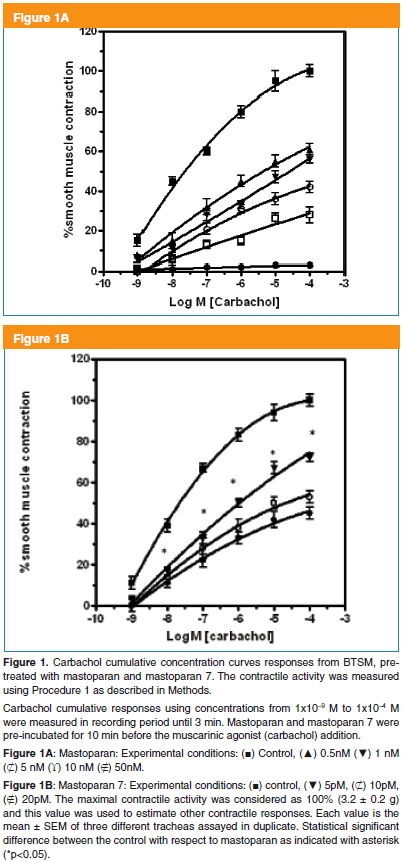
<body><![CDATA[<p align="justify"><font face="Verdana" size="2">Procedure 2: Smooth muscle  strips were placed into a specially designed multi-organ chamber with a volume  of 400 mL. This chamber has a system of aeration with 95% O2 and 5% CO2, and it  is able to hold simultaneously some 16 strips at 37°, at 1g of tension. After  addition of drugs, individual fragments were removed from the chamber, every 10  s and placed into liquid nitrogen (within less than 1s). Samples were kept in  liquid nitrogen until nucleotide extraction was performed.</font></p>     <p align="justify"><font face="Verdana" size="2"><b>Measurement of Cyclic GMP</b></font></p>     <p align="justify"><font face="Verdana" size="2">Briefly, frozen samples were  thawed and homogenized in 6% TCA as previously described4. TCA extractions were  performed twice, and the insoluble material was removed by centrifugation at  1500x g for 10 min at 4°. The insoluble material was processed for protein  determination as described later. The acid supernatants were combined, extracted  twice with water-saturated diethylether to remove TCA, frozen in liquid nitrogen,  and lyophilized. The acid-soluble lyophilized material was dissolved in a small  volume of 50 mM Tris, 4 mM EDTA, pH 7.4, that was named the acid-soluble  nucleotide extract, which was kept frozen at -80°. In each experiment, some  untreated frozen strips were used to evaluate the cyclic nucleotide recovery  following the procedure described latter. For this assay, 0.4 pmol of [3H]cGMP  was added to some samples, and the recovery was between 95 and 98% for this  labeled nucleotide. This recovery rate was assumed to be the same for all  samples. cGMP was determined using a radioimmunoassay as previously described<sup>4</sup>  with a commercial kit (TRK 500) from Amersham. TCA-insoluble material was  dissolved in 2 mL of 1 N NaOH and incubated at room temperature during overnight  and later was diluted five times to determine total tissue protein content by  using a procedure described elsewhere<sup>15</sup>.</font></p>     <p align="justify"><font face="Verdana" size="2">Cyclic nucleotide values are  presented as pmoles cGMP /mg of total tissue protein.</font></p>     <p align="justify"><font face="Verdana" size="2">There were no differences in  the cyclic nucleotide responses to the agents tested under the two experimental  procedures as above described.</font></p>     <p align="justify"><font face="Verdana" size="2"><b>Results</b></font></p>     <p align="justify"><font face="Verdana" size="2">BTSM strips, after 1 hr of  stabilization using Procedure 1, were pre-incubated for 15 min under three  different experimental conditions. Thus, the first condition was in the presence  of mastoparan (MP), a second with super-active mastoparan analog as mastoparan 7  (MP-7) and a third, without mastoparans (Control condition). After, this pre-treatment,  carbachol (CC) cumulative concentrations curves of the smooth muscle contractile  activities were measured during 3 min, after each agonist addition. In Control  condition, at CC amounts higher than 1 x 10<sup>-5</sup> M, the smooth muscle  contraction reached a plateau being maximal at 1 x 10<sup>-4</sup> M CC. These  carbachol concentration dependent activation curves as Control condition are  shown in <a href="#fig1">Figure 1A, B</a>. In addition, the carbachol-dependent smooth muscle  contractile responses were significantly affected by MP (<a href="#fig1">Fig 1A</a>) and MP-7 (<a href="#fig1">Fig  1B</a>). Moreover, both tetradecapeptides decreased, in a dose dependent manner, the  BTSM maximal contractile activities. However, we estimated EC50 values for CC in  all curves with values around EC50 = 1.0 ± 0.3 x 10<sup>-7</sup> M. In respect  to MP ability to alter BTSM contractile activities, it was found that MP-7  acting in the pM range was more powerful than MP, in the nM range. In this sense,  MP (50nM) inhibited completely the BTSM contraction induced by carbachol (1x10<sup>-4</sup>M).  These maximal concentrations of mastoparan and carbachol were used through this  study.</font></p>     <p align="center"><a name="fig1"> <img border="0" src="/img/fbpe/avft/v31n4/art02fig1.gif" width="403" height="862"></a></p>     
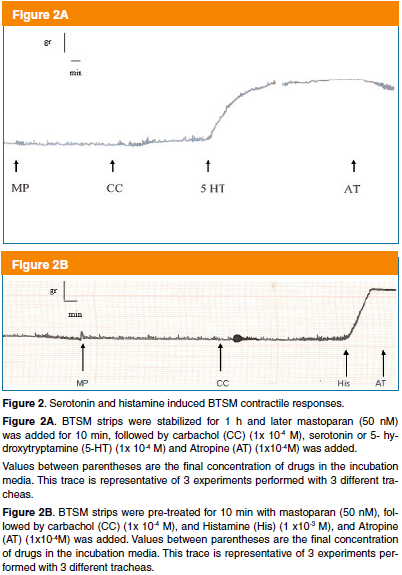
<p align="justify"><font face="Verdana" size="2">These results suggest that  mastoparans behave as “non-competitive” inhibitors of smooth muscle contraction  induced by muscarinic agonists.</font></p>     <p align="justify"><font face="Verdana" size="2">The powerful inhibition exerts  by mastoparans on BTSM muscarinic activation suggests that mastoparans may be  affecting the BTSM contractile machinery. To test that proposition using  Procedure 1, a set of experiments performed with other classic spasmogens of TSM  as 5 HT or histamine, which were assayed with the same BTSM strip, in which  mastoparan blocked the muscarinic agonist activation. In this sense, the  serotoninergic and histaminergic contractile responses were evaluated. A BTSM  powerful contraction induced by 5-hydroxytryptamine (5-HT) or serotonin (1 x 10<sup>-4</sup>  M) is shown in <a href="#fig2">Figure 2A</a>. Similar set of experiments were performed with  histamine (1x 10<sup>-3</sup> M) and a mastoparan-insensitive potent histamine  contractile response was observed, which is shown in <a href="#fig2">Figure 2B</a>. Both the  serotoninergic and histaminergic contractile responses of BTSM were not affected  by muscarinic antagonist atropine (1 x 10<sup>–4</sup> M). However, selective 5  HT or histamine antagonists were not assayed to block these serotoninergic and  histaminergic contractile responses because our main interest was to show that  BTSM still physiologically active. These results suggest that mastoparan seems  to be a specific inhibitor of this muscarinic activation system without  affecting the smooth muscle sarcolemma integrity and the contractile machinery  functionality.</font></p>     ]]></body>
<body><![CDATA[<p align="center"><a name="fig2"> <img border="0" src="/img/fbpe/avft/v31n4/art02fig2.gif" width="402" height="575"></a></p>     
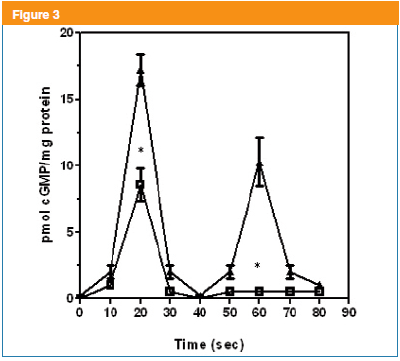
<p align="justify"><font face="Verdana" size="2">Muscarinic activation of BTSM  induced two cGMP signal peaks being the first peak at 20s and the second at 60 s  as previously described<sup>4</sup>. In order to evaluate, these cGMP signals  linked to muscarinic activation, several kinetic studies (0-70s) were undertaken.  In this sense, mastoparan (50 nM) significantly altered the first signal (20s),  that was partially inhibited 63 ± 2 % and the second signal (60s) disappeared  (<a href="#fig3">Figure 3</a>). These results suggest that mastoparan is altering, both cGMP signals  exerting a more profound effect on the 60 s peak, which is associated with the  NPR-GC. Interestingly, the first signal (20s) was significantly inhibited by  this tetradecapeptide. Taking into consideration, that mastoparan affected the  two cGMP signals; it was decided to explore the origin of these two signals,  which are related to specific guanylyl cyclases as above mentioned.</font></p>     <p align="center"><a name="fig3"> <img border="0" src="/img/fbpe/avft/v31n4/art02fig3.gif" width="400" height="361"></a></p>     
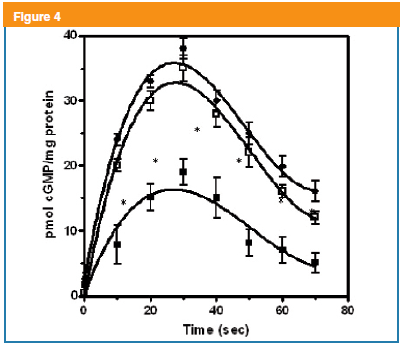
<p align="justify"><font face="Verdana" size="2">The dramatic disappearance of  the second peak (60s) was initially investigated. This second signal of cGMP is  product of a cascade coupling mAChRs to NPR-GC<sup>9,10</sup>.</font></p>     <p align="justify"><font face="Verdana" size="2">CNP-53 is the specific ligand  activator for the NPR-GC-B in BTSM<sup>14,16</sup>. From previous experiments,  it was found that CNP-53 (1x10<sup>-7</sup> M) induced the maximal cGMP levels  in the intact BTSM. Interestingly, in the “basal” condition, a cGMP binary  pattern emerged under CNP (1x10<sup>-7</sup> M) action, with a fast rise at 30 s  in cGMP levels reaching maximal values (37 ± 2 pmol/mg total tissue protein),  followed by a slow decline remaining higher at 70s (<a href="#fig4">Figure 4</a>). However, in the  presence of mastoparan, this distinct behavior remained but significant lower  values were observed (<a href="#fig4">Figure 4</a>). It has been reported that NPR-GC-B is coupled  to PTX and mastoparan-sensitive heterotrimeric Gi/o proteins<sup>9,10,16</sup>.  Interestingly, PTX pre-treatment reversed the mastoparan inhibitory effect on  the production of cGMP induced by CNP-53 at intact BTSM strips (<a href="#fig4">Figure 4</a>).</font></p>     <p align="center"><a name="fig4"> <img border="0" src="/img/fbpe/avft/v31n4/art02fig4.gif" width="401" height="345"></a></p>     
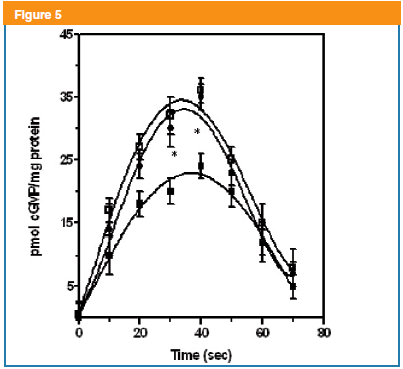
<p align="justify"><font face="Verdana" size="2">On the other hand, the first  cGMP signal (20s) is linked to mAChR activation at the plasma membrane  triggering a signal transducing cascade that leads to the stimulation of an ODQ-sensitive  sGC as previously reported<sup>4</sup>. This NO-sensitive sGC was evaluated  using a NO donor such as Sodium Nitroprusside (SNP)<sup>13</sup>. Thus, SNP (50  µM) in BTSM strips produced a cGMP parabolic-like binary pattern reaching  maximal values (35 ± 3 pmol/mg total tissue protein) around 40 s, followed by  cGMP decrement to basal levels at 70s (<a href="#fig5">Figure 5</a>). Mastoparan (50nM) pre-incubation  diminished in a significant way the levels of cGMP induced by SNP (<a href="#fig5">Figure 5</a>). Trying to unravel, these mastoparan effects on this “cGMP pool” linked to a NO  sensitive GC, that a new approach was undertaken. At this step, we have to  postulate the existence of a novel mastoparan-sensitive mAChR signaling  transducing cascade at plasma membrane, which can induce the inhibition of a NO-sensitive  sGC. It is well known that mAChR are GPCR systems coupled to PTX-sensitive G  proteins<sup>17</sup>. In this sense, PTX pre-incubation reversed the mastoparan  inhibition of the SNP-induced increments in isolated BTSM fragments, which is  shown in <a href="#fig5">Figure 5</a>. These data suggest that an ODQ-sensitive NO-stimulated GC  coupled to PTX and mastoparan-sensitive Gi/o proteins are present in BTSM cells.</font></p>     <p align="center"><a name="fig5"> <img border="0" src="/img/fbpe/avft/v31n4/art02fig5.gif" width="403" height="369"></a></p>     
<p align="justify"><font face="Verdana" size="2"><b>Discussion</b></font></p>     <p align="justify"><font face="Verdana" size="2">It is important to point out,  that this work was performed in the absence PDE inhibitors.</font></p>     ]]></body>
<body><![CDATA[<p align="justify"><font face="Verdana" size="2">Here, we evaluated the effect  of mastoparan<sup>11,12</sup> in nM range and super-active analog mastoparan 7<sup>18</sup>,  in pM range, on the BTSM contraction induced by muscarinic agonist as carbachol  (CC). Our original findings indicated that Mastoparans decreased the contractile  maximal responses induced by CC without changing its EC<sub>50</sub>. One  explanation for the decrement on the contractile maximal responses by  mastoparans may be related to the ability of these tetradecapeptides to disturb  the function and the contractile machinery of the BTSM type through cytotoxic  mechanisms, which have been described in other biological models, specifically  in the &#956;M concentration<sup>19,20</sup>. This assumption is not supported by our  results on the effects of classic TSM spasmogens as 5-HT and histamine<sup>21</sup>,  which produced potent contractions even in the presence of mastoparan (nM).  These findings can be explained since these bioactive amines have been claimed  to exert their physiological effects on TSM through specific GPCRs. These  receptors are the 5-HT2A for 5-HT and the H1HR for histamine. It is well known  that 5-HT induced activation of 5-HT2A receptors mediates the functional effects  of serotonin through activation of the Gq/11 protein and its downstream effector  phospholipase C (PLC) leading to intracellular phosphatidyl- inositol turnover  and Ca<sup>2+</sup>mobilization<sup>22</sup>. Likewise, the H<sub>1</sub>  histamine receptor (H<sub>1</sub>HR) mediates the functional effects of  histamine through activation of the Gq/11-PLC pathway results in the synthesis  of inositol 1,4,5-trisphosphate (IP<sub>3</sub>) and 1,2-diacylglycerol, which  in turn stimulate an increase in intracellular Ca<sup>2+</sup> and the  activation of protein kinase C (PKC) respectively<sup>21,23</sup>. These Gq/11  proteins are mastoparan-insensitive ones. The last facts can explain the  mastoparan-insensitivity of the serotoninergic and histaminergic transducing  cascades at BTSM. Furthermore, our results demonstrated that mastoparan inhibits  selectively the muscarinic activation without altering other spasmogens  transducing cascades at BTSM.</font></p>     <p align="justify"><font face="Verdana" size="2">Mastoparan may affect  specifically the signal cascades associated with the muscarinic activation at  BTSM sarcolemma, which are initiated with a mAChRs coupled to heterotrimeric  G-proteins<sup>17</sup>. These two molecular entities were evaluated. It found  that mastoparan in nM range and mastoparan 7 in pM range did not change the  muscarinic receptor activity expressed as [<sup>3</sup>H]QNB binding in plasma  membranes fractions isolated from this same BTSM (data not shown). These results  indicate that the most like candidates implicated in mastoparan effects are the  heterotrimeric G-proteins coupled to these mAChRs.</font></p>     <p align="justify"><font face="Verdana" size="2">The G protein involvement on  the mastoparan inhibition on BTSM muscarinic activation is supported by the  ability of this G-protein activator to alter the generation of the two GMPc  signals at 20s and 60s as previously described<sup>4</sup>. Mastoparan (50 nM)  induced a potent inhibition of these cGMP signals, that is correlated with a  significant reduction on the contractile maximal responses as here reported.  After mastoparan preincubation, the kinetics of cGMP intracellular levels was  evaluated following the muscarinic agonist exposure. Interestingly, the first  cGMP signal (20s) decreased in more than 60% and the second signal peak (60s)  vanished.</font></p>     <p align="justify"><font face="Verdana" size="2">The dramatic disappearance of  the second peak of cGMP (60s) was under intense scrutiny. This cGMP peak is  product of two opposite mAChRs-G-protein linked signaling cascades acting on a  NPR-GC<sup>9,10</sup>. In this sense, m<sub>3</sub>AChR coupled to Gq16 protein  activates<sup>24</sup> whereas, m<sub>2</sub>AChR coupled to Gi/o proteins  inhibits this NPR-GC<sup>9,10</sup>. Recently, we further recognized that  muscarinic agonist and mastoparan activations of NPR-GC in isolated BTSM plasma  membranes fraction involve this Gq16 protein<sup>9</sup>.</font></p>     <p align="justify"><font face="Verdana" size="2">This NPR-GC was evaluated in  intact BSTM strips by a direct stimulation using CNP-53, selective ligand  activator for this transmembrane GC enzyme as previously described<sup>16,14,24</sup>.  On basal conditions, CNP increased in more than 18 fold the cGMP production  reaching maximal values at 30 s and these cGMP levels decreased slowly and  remained high at 60 s. These results are similar to ones reported in guinea pig  TSM, where CNP caused a dose dependent rise in the tissue cGMP level, with a  peak at 1 min, which is correlated to its smooth muscle relaxant effects<sup>25</sup>.</font></p>     <p align="justify"><font face="Verdana" size="2">The participation of Gi/o-proteins  coupled to NPR-GC in mastoparan action was further supported using mastoparan  pre-incubated BTSM strips and later exposed to CNP.</font></p>     <p align="justify"><font face="Verdana" size="2">Under these experimental  conditions, there was a significant reduction, more than 50%, of cGMP-dependent-CNP  increments. However, PTX exposure, priori to, mastoparan and later CNP-53  addition, reverses mastoparan inhibition of CNP-dependent cGMP formation. These  mastoparan-PTX sensitive changes in cGMP levels linked to NPR-GC may be  explained since more than 50% of the NPR-GC activity presents in BTSM sarcolema  seems to be coupled to Gi/o proteins as showed in previous work<sup>16</sup>.</font></p>     <p align="justify"><font face="Verdana" size="2">The Gq16 and Gi/o proteins are  activated by mastoparan, being the former G-protein, an activator and the latter,  an inhibitor of NPR-GC as previously reported<sup>10,24</sup>. It is intriguing  that the Gi/o inhibitory effects on NPR-GC remained after 15 min, after  mastoparan addition. It is possibly that the higher abundance of m2AChR/m3AChR  ratio (4:1)<sup>6</sup> coupled to Gi/o vs Gq16 may explain the persistence of  Gi/o inhibition in intact BTSM. Moreover, it can be speculate that Gi/o subunits  have more affinity than Gq16 subunits for the putative GPRM on NPR-GC<sup>16</sup>.  However, more research has to be done to clarify these exciting results. All  these evidences indicated that mastoparan inhibition of the second cGMP signal  linked to NPR-GC is mediated by PTX-sensitive Gi/o proteins as previously  mentioned.</font></p>     <p align="justify"><font face="Verdana" size="2">Muscarinic activation of BTSM  displays a first peak of cGMP (20s), which is a product of an ODQ-sensitive-GC,  stimulated by a novel transducing cascade that does not involved the generation  of NO, as previously reported<sup>4</sup>. This novel cascade involves a mAChR  coupled to a G-protein, which targets a specific effector possibly an ODQ-sensitive-GC,  anchored to the internal face of the BTSM sarcolemma. Experimental evidences  from our group indicate that an ODQ-sensitive NO-stimulated GC activity is  translocated to the plasma membrane during muscarinic activation of BTSM<sup>26</sup>.  These evidences seem to be similar to ones reported in other biological systems,  where NO-sensitive GCs activities have been described at plasma membrane from  cardiomyocytes<sup>27</sup> and neurons<sup>28</sup>. Recently, it has been  suggested that the &#945;<sub>2</sub>&#946;<sub>2</sub> isoform of GC at plasma membrane  site, may provide a localized pool of cGMP<sup>29</sup>, which seems to be in a  similar trend suggested by our work. To assure that the mastoparan inhibition of  the first peak is related to a NO sensitive GC, some further experiments were  performed. On basal conditions, a NO donor such as SNP increased cGMP in BTSM  strips, as expected. Hence, SNP induced a binary response, wherein, cGMP  intracellular levels increased around 18-fold at 40 s followed by a reduction of  the intracellular levels to basal levels around 70s being the maximal values (35  ± 2 pmoles cGMP/mg total tissue protein). Thus, in the absence of PDE inhibitors,  comparable experimental results using SNP and other NO donors have been reported  in canine TSM. These authors reported a concentration-related increase in cGMP  content in about 18-fold above basal levels within 2 min, that was accompanied  by a concentration-dependent relaxation of canine TSM<sup>30</sup>.</font></p>     <p align="justify"><font face="Verdana" size="2">Interestingly, these SNP-dependent  cGMP responses were affected by mastoparan, but this peptide did not affect the  binary pattern but significantly decreased the maximal responses in about 45 ± 3  %. It is possible to postulate that this decrement on cGMP levels may be related  to the membrane-bound NO-sensitive GC isoform in this TSM.</font></p>     ]]></body>
<body><![CDATA[<p align="justify"><font face="Verdana" size="2">These original findings on  mastoparan affecting a NO-sensitive GC system and the fact that mastoparan can  affect PTX-sensitive Gi/o-proteins<sup>31</sup>, induced us to perform further  experiments with PTX. Under the last experimental conditions, PTX reversed the  mastoparan inhibition on the cGMP augmentation-induced by SNP. These results  suggest that a PTX-sensitive Gi/o protein may be responsible for this mastoparan  inhibition of the SNP actions. The identification of mAChR subtype, the PTX-sensitive  Gi/o-protein coupled to NO-sensitive sGC isoform, that are responsible of the  first cGMP signal peak is under research in our group.</font></p>     <p align="justify"><font face="Verdana" size="2">The BTSM muscarinic activation  is blocked by mastoparan as here described. This inhibition may be explained  since an early exposure of intact TSM strips to mastoparans, previous to  muscarinic agonist addition, can disrupt the muscarinic signal cascade. It is  well known that mastoparan directly activates G proteins stimulating the GTP/GDPexchange<sup>12,31</sup>,  which mimics the GEF activity associated with some agonist activated receptors<sup>31</sup>,  which seems to be our case. Thus, this G-protein activator can dissociate these  two G-proteins (Gi/o and Gq16) into their respective GTP and subunits. This  latter dissociation process may produce a transient desensitization of the  muscarinic agonist signal transducing cascade machinery presents in BTSM. Under  these last conditions, the “activated mAChRs” are not longer able to signal down  inside the BTSM cells. Consequently, the BTSM became unresponsive to muscarinic  agonist addition as described in this work. During the completion of this work,  similar results by mastoparan disrupting another cyclic nucleotide (cAMP) system  as &#946;-adrenoceptor-G(s) signaling present in1321N1 human astrocytoma cells have  been reported<sup>20</sup>. These authors suggest that mastoparan changes the  localization of G&#945;(s) from plasma membranes (lipid rafts) into the cytoplasm,  where it is not available to activate membrane-adenylyl cyclase. Whatever is the  molecular mechanism of mastoparan action, it is well know its ability to  dissociate this crucial heterotrimer GDP&#946;into their respective GTP and the  dimmer<sup>32</sup> leaving these subunits to interact freely with their  intracellular specific targets.</font></p>     <p align="justify"><font face="Verdana" size="2">Until now, the BTSM muscarinic  activation is unique biological system that involves two cGMP signals as second  messengers<sup>4,10</sup>. In addition, this activation is a highly regulated  biological process, which starts with m2/m3AChRs coupled to two mastoparan-sensitive  G proteins, leading to a fine time regulation and stimulation of two guanylyl  cyclases that accomplish the generation of these two cGMP signal peaks.</font></p>     <p align="justify"><font face="Verdana" size="2">Based in our results, it can be  postulated that the first signal (20s) is a product of the activation of one  mAChR subtype coupled to a novel mastoparan and PTX-sensitive-G protein that  leads to the activation of the heterodimer NO stimulated-hemoprotein guanylyl  cyclase possibly anchored to plasma membrane and the second signal peak is a  product of a the activation of m3AChR coupled to the stimulation of mastoparan-sensitive  PTX insensitive-Gq16<sup>24</sup> to turn on a transmembrane-homodimer as NPRGC  being inhibited by a mastoparan and PTX sensitive Gi/o proteins<sup>9,10</sup>.</font></p>     <p align="justify"><font face="Verdana" size="2">In addition, specific cGMP  phosphodiesterases<sup>33,34</sup> may be involved in the production of these  two sharp and short life cGMP signal peaks.</font></p>     <p align="justify"><font face="Verdana" size="2">Nevertheless, in the BTSM  system, when each guanylyl cyclase type is directly stimulated by its selective  ligands such as CNP-53 for NPR-GC<sup>14,16</sup> and SNP for the NO sensitive  GC<sup>13</sup>, a binary pattern emerged. Both activators induced a fast  increment in more than 50 fold of cGMP, reaching maximal values between 30-40s,  decreasing to basal values faster in the case of SNP-linked cGMP elevations,  possibly under the action of powerful cyclic nucleotide PDE-5 as reported in  this BTSM<sup>33,34</sup>.</font></p>     <p align="justify"><font face="Verdana" size="2">It is interesting that both SNP  and CNP stimulations reach a maximal values around 35-37 pmoles cGMP/mg total  tissue protein. It can be speculated that the latter cGMP intracellular  concentration range seems to act as a threshold to trigger a fast cGMP  hydrolyzing PDEs<sup>33-35</sup>, enzymes responsible for the cGMP levels  declines to basal values as here described.</font></p>     <p align="justify"><font face="Verdana" size="2">Finally, this work unravels  some of complex molecular mechanisms associated with the muscarinic activation  of ASM. This latter activation is the most physiologically and pharmacologically  relevant because it’s a neurotransmitter-linked stimulation of ASM.</font></p>     <p align="justify"><font face="Verdana" size="2">A disfunction of these mAChR  signal transducing cascades has been implied in the pathophysiological  mechanisms of bronchial asthma<sup>36</sup> and Chronic Obstructive Pulmonary  Disease (COPD)<sup>37</sup>. In that sense, this work opens new pharmacological  and therapeutical approaches for the treatment of these chronic respiratory  diseases, in which, the ASM is involved.</font></p>     <p align="justify"><font face="Verdana" size="2"><b>Acknowlegments:</b></font></p>     ]]></body>
<body><![CDATA[<p align="justify"><font face="Verdana" size="2">This work was supported by  Grants from Consejo de Desarrollo Científico Humanístico UCV, PI  09.00.6464.2006/2 and PG 09.7410.2008/1 to (RGA), 09.7726.2009 (ILB).</font></p>     <p align="justify"><font face="Verdana" size="2">WalidHassan is Graduate Student  at Curso de Postgrado en Ciencias Fisiológicas. Facultad de Medicina.  Universidad Central de Venezuela and he holds a fellowship from Misión Ciencia  from Ministerio del Poder Popular para la Ciencia, Tecnología e Industrias  Intermedias (MPPCTII) at Venezuela.</font></p>     <p align="justify"><font face="Verdana" size="2"><b>References</b></font></p>     <!-- ref --><p align="justify"><font face="Verdana" size="2">1. Barnes PJ. Airway smooth  muscle receptors. Recent Prog Med. 1990;81:184-192.</font>&nbsp;&nbsp;&nbsp;&nbsp;&nbsp;&nbsp;&nbsp;&nbsp;[&#160;<a href="javascript:void(0);" onclick="javascript: window.open('/scielo.php?script=sci_nlinks&ref=609100&pid=S0798-0264201200040000200001&lng=','','width=640,height=500,resizable=yes,scrollbars=1,menubar=yes,');">Links</a>&#160;]<!-- end-ref --><!-- ref --><p align="justify"><font face="Verdana" size="2">2. Jacoby DB, Fryer AD.  Anticholinergic therapy for airway diseases. Life Sci. 2001; 68: 2565-2572.</font>&nbsp;&nbsp;&nbsp;&nbsp;&nbsp;&nbsp;&nbsp;&nbsp;[&#160;<a href="javascript:void(0);" onclick="javascript: window.open('/scielo.php?script=sci_nlinks&ref=609101&pid=S0798-0264201200040000200002&lng=','','width=640,height=500,resizable=yes,scrollbars=1,menubar=yes,');">Links</a>&#160;]<!-- end-ref --><!-- ref --><p align="justify"><font face="Verdana" size="2">3. Katsuki S, Murad F.  Regulation of adenosine cyclic 3’,5’-monophosphate and guanosine cyclic 3’,5’-monophosphate  levels and contractility in bovine tracheal smooth muscle. Mol Pharmacol.  1977;13: 330-341.</font>&nbsp;&nbsp;&nbsp;&nbsp;&nbsp;&nbsp;&nbsp;&nbsp;[&#160;<a href="javascript:void(0);" onclick="javascript: window.open('/scielo.php?script=sci_nlinks&ref=609102&pid=S0798-0264201200040000200003&lng=','','width=640,height=500,resizable=yes,scrollbars=1,menubar=yes,');">Links</a>&#160;]<!-- end-ref --><!-- ref --><p align="justify"><font face="Verdana" size="2">4. Guerra de Gonzalez L, Misle  A, Pacheco G, Napoleon de Herrera V, Gonzalez de Alfonzo R, Lippo de Becemberg  I, Alfonzo MJ. Effects of 1H-[1,2,4]oxadiazolo[4,3-a]quinoxalin-1-one (ODQ) and  Nomega(6)-nitro-L-arginine methyl ester (NAME) on cyclic GMP levels during  muscarinic activation of tracheal smooth muscle. Biochem Pharmacol 1999; 58:563-574.</font>&nbsp;&nbsp;&nbsp;&nbsp;&nbsp;&nbsp;&nbsp;&nbsp;[&#160;<a href="javascript:void(0);" onclick="javascript: window.open('/scielo.php?script=sci_nlinks&ref=609103&pid=S0798-0264201200040000200004&lng=','','width=640,height=500,resizable=yes,scrollbars=1,menubar=yes,');">Links</a>&#160;]<!-- end-ref --><!-- ref --><p align="justify"><font face="Verdana" size="2">5. Carvajal J, Germain A,  Huidobro-Toro J, Weiner C. Molecular Mechanism of cGMP-mediated Smooth  Relaxation. J of Cell Physiology 2000;184: 409-420.</font>&nbsp;&nbsp;&nbsp;&nbsp;&nbsp;&nbsp;&nbsp;&nbsp;[&#160;<a href="javascript:void(0);" onclick="javascript: window.open('/scielo.php?script=sci_nlinks&ref=609104&pid=S0798-0264201200040000200005&lng=','','width=640,height=500,resizable=yes,scrollbars=1,menubar=yes,');">Links</a>&#160;]<!-- end-ref --><!-- ref --><p align="justify"><font face="Verdana" size="2">6. Lucas K, Pitari C,  Kazcrounian S, Ruiz-Stewart l, Park J, Schulz S, Chepenik K, Waldman SA.  Guanylyl Cyclases and Signaling by Cyclic GMP. Pharmacol Rev 2000; 52: 375-413.</font>&nbsp;&nbsp;&nbsp;&nbsp;&nbsp;&nbsp;&nbsp;&nbsp;[&#160;<a href="javascript:void(0);" onclick="javascript: window.open('/scielo.php?script=sci_nlinks&ref=609105&pid=S0798-0264201200040000200006&lng=','','width=640,height=500,resizable=yes,scrollbars=1,menubar=yes,');">Links</a>&#160;]<!-- end-ref --><!-- ref --><p align="justify"><font face="Verdana" size="2">7. Roffel A, Meurs H, Elzinga  C, Zagsma J. Characterization of the muscarinic receptor subtype involved in  phosphoinositide metabolism in bovine tracheal smooth muscle. Br J Pharmacol  1990; 99:293-296.</font>&nbsp;&nbsp;&nbsp;&nbsp;&nbsp;&nbsp;&nbsp;&nbsp;[&#160;<a href="javascript:void(0);" onclick="javascript: window.open('/scielo.php?script=sci_nlinks&ref=609106&pid=S0798-0264201200040000200007&lng=','','width=640,height=500,resizable=yes,scrollbars=1,menubar=yes,');">Links</a>&#160;]<!-- end-ref --><!-- ref --><p align="justify"><font face="Verdana" size="2">8. Misle AJ, Lippo de Becemberg  I, Gonzalez de Alfonzo R, Alfonzo MJ. Methoctramine binding sites sensitive to  alkylation on muscarinic receptors from tracheal smooth muscle. Biochem  Pharmacol. 1994; 48:191-195.</font>&nbsp;&nbsp;&nbsp;&nbsp;&nbsp;&nbsp;&nbsp;&nbsp;[&#160;<a href="javascript:void(0);" onclick="javascript: window.open('/scielo.php?script=sci_nlinks&ref=609107&pid=S0798-0264201200040000200008&lng=','','width=640,height=500,resizable=yes,scrollbars=1,menubar=yes,');">Links</a>&#160;]<!-- end-ref --><!-- ref --><p align="justify"><font face="Verdana" size="2">9. Alfonzo MJ, Lippo de  Becemberg I, Sanchez de Villaroel S, Napoleon de Herrera V, Misle AJ, Gonzalez  de Alfonzo R. Two opposite signal transducing mechanisms regulate a G-protein-coupled  guanylyl cyclase. Arch Biochem Biophys. 1998; 350:19-25.</font>&nbsp;&nbsp;&nbsp;&nbsp;&nbsp;&nbsp;&nbsp;&nbsp;[&#160;<a href="javascript:void(0);" onclick="javascript: window.open('/scielo.php?script=sci_nlinks&ref=609108&pid=S0798-0264201200040000200009&lng=','','width=640,height=500,resizable=yes,scrollbars=1,menubar=yes,');">Links</a>&#160;]<!-- end-ref --><!-- ref --><p align="justify"><font face="Verdana" size="2">10. Alfonzo M, Guerra L,  Sánchez S, Francis G, Misle A, Napoleón de Y, Gonzalez R, Lippo I. Signal  transduction pathways through mammalian guanylyl cyclases. New Advances in  Cardiovascular Physiology and Pharmacology. 1998; 147-175.</font>&nbsp;&nbsp;&nbsp;&nbsp;&nbsp;&nbsp;&nbsp;&nbsp;[&#160;<a href="javascript:void(0);" onclick="javascript: window.open('/scielo.php?script=sci_nlinks&ref=609109&pid=S0798-0264201200040000200010&lng=','','width=640,height=500,resizable=yes,scrollbars=1,menubar=yes,');">Links</a>&#160;]<!-- end-ref --><!-- ref --><p align="justify"><font face="Verdana" size="2">11. Hirai Y, Yasuhara T,  Yoshida H, Nakajima T, Fujino M, Kitada C. A new mast cell degranulating peptide  “mastoparan” in the venom of Vespula lewisii. Chem Pharm Bull (Tokyo). 1972; 27:  1942-1944.</font>&nbsp;&nbsp;&nbsp;&nbsp;&nbsp;&nbsp;&nbsp;&nbsp;[&#160;<a href="javascript:void(0);" onclick="javascript: window.open('/scielo.php?script=sci_nlinks&ref=609110&pid=S0798-0264201200040000200011&lng=','','width=640,height=500,resizable=yes,scrollbars=1,menubar=yes,');">Links</a>&#160;]<!-- end-ref --><!-- ref --><p align="justify"><font face="Verdana" size="2">12. Higashijima T, Uzu S,  Nakajima T, Ross E. Mastoparan a peptide toxin from wasp venom, mimics receptors  by activating GTP-binding regulatory proteins (G proteins). J Biol Chem 1988;  263: 6491-6494.</font>&nbsp;&nbsp;&nbsp;&nbsp;&nbsp;&nbsp;&nbsp;&nbsp;[&#160;<a href="javascript:void(0);" onclick="javascript: window.open('/scielo.php?script=sci_nlinks&ref=609111&pid=S0798-0264201200040000200012&lng=','','width=640,height=500,resizable=yes,scrollbars=1,menubar=yes,');">Links</a>&#160;]<!-- end-ref --><!-- ref --><p align="justify"><font face="Verdana" size="2">13. Arnold WP, Mittal CK,  Katsuki S, Murad F. Nitric oxide activates guanylate cyclase and increases  guanosine 3’:5’-cyclic monophosphate levels in various tissue preparations. Proc  Natl Acad Sci U S A. 1977; 74: 3203-3207.</font>&nbsp;&nbsp;&nbsp;&nbsp;&nbsp;&nbsp;&nbsp;&nbsp;[&#160;<a href="javascript:void(0);" onclick="javascript: window.open('/scielo.php?script=sci_nlinks&ref=609112&pid=S0798-0264201200040000200013&lng=','','width=640,height=500,resizable=yes,scrollbars=1,menubar=yes,');">Links</a>&#160;]<!-- end-ref --><!-- ref --><p align="justify"><font face="Verdana" size="2">14. Borges A, Sánchez S, Winand  N, Lippo I, Alfonzo MJ, González R . Molecular and Biochemical Characterization  of a CNP-sensitive Guanylyl Cyclase in Bovine Tracheal Smooth Muscle. Am J  Respir Cell Mol Biol 2001; 25: 98-103.</font>&nbsp;&nbsp;&nbsp;&nbsp;&nbsp;&nbsp;&nbsp;&nbsp;[&#160;<a href="javascript:void(0);" onclick="javascript: window.open('/scielo.php?script=sci_nlinks&ref=609113&pid=S0798-0264201200040000200014&lng=','','width=640,height=500,resizable=yes,scrollbars=1,menubar=yes,');">Links</a>&#160;]<!-- end-ref --><!-- ref --><p align="justify"><font face="Verdana" size="2">15. Bensadoun A, Weinstein D.  Assay of proteins in the presence of interfering materials. Analytical  Biochemistry 1976; 70: 241-250.</font>&nbsp;&nbsp;&nbsp;&nbsp;&nbsp;&nbsp;&nbsp;&nbsp;[&#160;<a href="javascript:void(0);" onclick="javascript: window.open('/scielo.php?script=sci_nlinks&ref=609114&pid=S0798-0264201200040000200015&lng=','','width=640,height=500,resizable=yes,scrollbars=1,menubar=yes,');">Links</a>&#160;]<!-- end-ref --><!-- ref --><p align="justify"><font face="Verdana" size="2">16. Alfonzo MJ, de Aguilar EP,  de Murillo AG, de Villarroel SS, de Alfonzo RG, Borges A, de Becemberg IL.  Characterization of a G protein-coupled guanylyl cyclase B receptor from bovine  tracheal smooth muscle. J Recept Signal Transduct Res. 2006; 26:269-297.</font>&nbsp;&nbsp;&nbsp;&nbsp;&nbsp;&nbsp;&nbsp;&nbsp;[&#160;<a href="javascript:void(0);" onclick="javascript: window.open('/scielo.php?script=sci_nlinks&ref=609115&pid=S0798-0264201200040000200016&lng=','','width=640,height=500,resizable=yes,scrollbars=1,menubar=yes,');">Links</a>&#160;]<!-- end-ref --><!-- ref --><p align="justify"><font face="Verdana" size="2">17. Murthy KS, Makhlouf GM.  Differential coupling of muscarinic m2 and m3 receptors to adenylyl cyclases V/VI  in smooth muscle. Concurrent M2-mediated inhibition via Galphai3 and m3-mediated  stimulation via Gbetagammaq. J Biol Chem. 1997; 272:21317-21324.</font>&nbsp;&nbsp;&nbsp;&nbsp;&nbsp;&nbsp;&nbsp;&nbsp;[&#160;<a href="javascript:void(0);" onclick="javascript: window.open('/scielo.php?script=sci_nlinks&ref=609116&pid=S0798-0264201200040000200017&lng=','','width=640,height=500,resizable=yes,scrollbars=1,menubar=yes,');">Links</a>&#160;]<!-- end-ref --><!-- ref --><p align="justify"><font face="Verdana" size="2">18. Bavec A. Novel features of  amphiphilic peptide Mas 7 in signalling via heterotrimeric G-proteins. J Pept  Sci. 2004; 10: 691-699.</font>&nbsp;&nbsp;&nbsp;&nbsp;&nbsp;&nbsp;&nbsp;&nbsp;[&#160;<a href="javascript:void(0);" onclick="javascript: window.open('/scielo.php?script=sci_nlinks&ref=609117&pid=S0798-0264201200040000200018&lng=','','width=640,height=500,resizable=yes,scrollbars=1,menubar=yes,');">Links</a>&#160;]<!-- end-ref --><!-- ref --><p align="justify"><font face="Verdana" size="2">19. Jones S, Howl J. Charge  delocalization and the design of novel mastoparan analogues: enhanced  cytotoxicity and secretory efficacy of [Lys5, Lys8, Aib10]MP. Regul Pept.  2004;15;121:121-128.</font>&nbsp;&nbsp;&nbsp;&nbsp;&nbsp;&nbsp;&nbsp;&nbsp;[&#160;<a href="javascript:void(0);" onclick="javascript: window.open('/scielo.php?script=sci_nlinks&ref=609118&pid=S0798-0264201200040000200019&lng=','','width=640,height=500,resizable=yes,scrollbars=1,menubar=yes,');">Links</a>&#160;]<!-- end-ref --><!-- ref --><p align="justify"><font face="Verdana" size="2">20. Sugama J, Yu JZ, Rasenick  MM, Nakahata N. Mastoparan inhibits betaadrenoceptor-G(s) signaling by changing  the localization of Galpha(s) in lipid rafts. Cell Signal 2007; 19: 2247-2254.</font>&nbsp;&nbsp;&nbsp;&nbsp;&nbsp;&nbsp;&nbsp;&nbsp;[&#160;<a href="javascript:void(0);" onclick="javascript: window.open('/scielo.php?script=sci_nlinks&ref=609119&pid=S0798-0264201200040000200020&lng=','','width=640,height=500,resizable=yes,scrollbars=1,menubar=yes,');">Links</a>&#160;]<!-- end-ref --><!-- ref --><p align="justify"><font face="Verdana" size="2">21. Pype JL, Mak JC, Dupont M,  Verleden GM, Barnes PJ. Desensitization of the histamine H1-receptor and  transcriptional down-regulation of histamine H1-receptor gene expression in  bovine tracheal smooth muscle. Br J Pharmacol 1998;125:1477-84.</font>&nbsp;&nbsp;&nbsp;&nbsp;&nbsp;&nbsp;&nbsp;&nbsp;[&#160;<a href="javascript:void(0);" onclick="javascript: window.open('/scielo.php?script=sci_nlinks&ref=609120&pid=S0798-0264201200040000200021&lng=','','width=640,height=500,resizable=yes,scrollbars=1,menubar=yes,');">Links</a>&#160;]<!-- end-ref --><!-- ref --><p align="justify"><font face="Verdana" size="2">22. Shi J, Zemaitaitis B, Muma  NA. Phosphorylation of Gq11 Protein Contributes to Agonist-Induced  Desensitization of 5-HT2A Receptor Signaling. Mol Pharmacol. 2007; 71:303-313.</font>&nbsp;&nbsp;&nbsp;&nbsp;&nbsp;&nbsp;&nbsp;&nbsp;[&#160;<a href="javascript:void(0);" onclick="javascript: window.open('/scielo.php?script=sci_nlinks&ref=609121&pid=S0798-0264201200040000200022&lng=','','width=640,height=500,resizable=yes,scrollbars=1,menubar=yes,');">Links</a>&#160;]<!-- end-ref --><!-- ref --><p align="justify"><font face="Verdana" size="2">23. Leurs R, Smit MJ, Timmerman  H. Molecular Pharmacological aspects of histamine receptors. Pharmacol Ther.  1995;66:413-463.</font>&nbsp;&nbsp;&nbsp;&nbsp;&nbsp;&nbsp;&nbsp;&nbsp;[&#160;<a href="javascript:void(0);" onclick="javascript: window.open('/scielo.php?script=sci_nlinks&ref=609122&pid=S0798-0264201200040000200023&lng=','','width=640,height=500,resizable=yes,scrollbars=1,menubar=yes,');">Links</a>&#160;]<!-- end-ref --><!-- ref --><p align="justify"><font face="Verdana" size="2">24. Bruges G, Borges A, Sanchez  de Villarroel S, Lippo de Becemberg I, Francis de Toba G, Placeres F, Gonzalez  de Alfonzo R, Alfonzo MJ. Coupling of M3 acetylcholine receptor to Gq16  activates a natriuretic peptide receptor guanylyl cyclase. J Recept Signal  Transduct Res. 2007; 27:189-216.</font>&nbsp;&nbsp;&nbsp;&nbsp;&nbsp;&nbsp;&nbsp;&nbsp;[&#160;<a href="javascript:void(0);" onclick="javascript: window.open('/scielo.php?script=sci_nlinks&ref=609123&pid=S0798-0264201200040000200024&lng=','','width=640,height=500,resizable=yes,scrollbars=1,menubar=yes,');">Links</a>&#160;]<!-- end-ref --><!-- ref --><p align="justify"><font face="Verdana" size="2">25. Takagi K, Araki N, Suzuki K. Relaxant effect of C-type natriuretic peptide on guinea-pig tracheal smooth  muscle. Arzneimittelforschung. 1992; 42:1329-1331.</font>&nbsp;&nbsp;&nbsp;&nbsp;&nbsp;&nbsp;&nbsp;&nbsp;[&#160;<a href="javascript:void(0);" onclick="javascript: window.open('/scielo.php?script=sci_nlinks&ref=609124&pid=S0798-0264201200040000200025&lng=','','width=640,height=500,resizable=yes,scrollbars=1,menubar=yes,');">Links</a>&#160;]<!-- end-ref --><!-- ref --><p align="justify"><font face="Verdana" size="2">26. Placeres Uray F., Gonzalez  de Alfonzo R., Lippo de Becemberg I. and Alfonzo MJ. Muscarinic agonists acting  through M2 acetylcholine receptors stimulate the migration of an NO-sensitive  guanylyl cyclase to the plasma membrane of bovine tracheal smooth muscle. J  Recept Signal Transduct Res. 2010; 30: 10-23.</font>&nbsp;&nbsp;&nbsp;&nbsp;&nbsp;&nbsp;&nbsp;&nbsp;[&#160;<a href="javascript:void(0);" onclick="javascript: window.open('/scielo.php?script=sci_nlinks&ref=609125&pid=S0798-0264201200040000200026&lng=','','width=640,height=500,resizable=yes,scrollbars=1,menubar=yes,');">Links</a>&#160;]<!-- end-ref --><!-- ref --><p align="justify"><font face="Verdana" size="2">27. Agulló L, Garcia-Dorado D,  Escalona N, Ruiz-Meana M, Mirabet M, Inserte J, Soler-Soler J. Membrane  association of nitric oxide-sensitive guanylyl cyclase in cardiomyocytes.  Cardiov. Res 2005; 68:65-74.</font>&nbsp;&nbsp;&nbsp;&nbsp;&nbsp;&nbsp;&nbsp;&nbsp;[&#160;<a href="javascript:void(0);" onclick="javascript: window.open('/scielo.php?script=sci_nlinks&ref=609126&pid=S0798-0264201200040000200027&lng=','','width=640,height=500,resizable=yes,scrollbars=1,menubar=yes,');">Links</a>&#160;]<!-- end-ref --><!-- ref --><p align="justify"><font face="Verdana" size="2">28. Bidmon HJ, Mohlberg H,  Habermann G, Buse E, Zilles K, Behrends S. Cerebellar localization of the NO-receptive  soluble guanylyl cyclase subunits-alpha(2)/beta (1) in non-human primates. Cell  Tissue Res. 2006; 326:707-714.</font>&nbsp;&nbsp;&nbsp;&nbsp;&nbsp;&nbsp;&nbsp;&nbsp;[&#160;<a href="javascript:void(0);" onclick="javascript: window.open('/scielo.php?script=sci_nlinks&ref=609127&pid=S0798-0264201200040000200028&lng=','','width=640,height=500,resizable=yes,scrollbars=1,menubar=yes,');">Links</a>&#160;]<!-- end-ref --><!-- ref --><p align="justify"><font face="Verdana" size="2">29. Belligham M, Evans TJ. The  &#945;2&#946;2 isoform of guanylyl cyclase mediates plasma membrane localized nitric oxide  signaling. Cellular Signalling, 2007, 19: 2183-2193.</font>&nbsp;&nbsp;&nbsp;&nbsp;&nbsp;&nbsp;&nbsp;&nbsp;[&#160;<a href="javascript:void(0);" onclick="javascript: window.open('/scielo.php?script=sci_nlinks&ref=609128&pid=S0798-0264201200040000200029&lng=','','width=640,height=500,resizable=yes,scrollbars=1,menubar=yes,');">Links</a>&#160;]<!-- end-ref --><!-- ref --><p align="justify"><font face="Verdana" size="2">30. Zhou HL, Torphy TJ.  Relationship between cyclic guanosine monophosphate accumulation and relaxation  of canine trachealis induced by nitrovasodilators. J Pharmacol Exp  Ther. 1991;258:972-978.</font>&nbsp;&nbsp;&nbsp;&nbsp;&nbsp;&nbsp;&nbsp;&nbsp;[&#160;<a href="javascript:void(0);" onclick="javascript: window.open('/scielo.php?script=sci_nlinks&ref=609129&pid=S0798-0264201200040000200030&lng=','','width=640,height=500,resizable=yes,scrollbars=1,menubar=yes,');">Links</a>&#160;]<!-- end-ref --><!-- ref --><p align="justify"><font face="Verdana" size="2">31. Higashijima T, Burnier J,  Ross EM. Regulation of Gi and Go by mastoparan, related amphiphilic peptides,  and hydrophobic amines. Mechanism and structural determinants of activity. J  Biol Chem. 1990; 265:14176-14186.</font>&nbsp;&nbsp;&nbsp;&nbsp;&nbsp;&nbsp;&nbsp;&nbsp;[&#160;<a href="javascript:void(0);" onclick="javascript: window.open('/scielo.php?script=sci_nlinks&ref=609130&pid=S0798-0264201200040000200031&lng=','','width=640,height=500,resizable=yes,scrollbars=1,menubar=yes,');">Links</a>&#160;]<!-- end-ref --><!-- ref --><p align="justify"><font face="Verdana" size="2">32. Oldham WM, Hamm HE. How do  receptors activate G proteins? Adv Protein Chem. 2007;74: 67-93.</font>&nbsp;&nbsp;&nbsp;&nbsp;&nbsp;&nbsp;&nbsp;&nbsp;[&#160;<a href="javascript:void(0);" onclick="javascript: window.open('/scielo.php?script=sci_nlinks&ref=609131&pid=S0798-0264201200040000200032&lng=','','width=640,height=500,resizable=yes,scrollbars=1,menubar=yes,');">Links</a>&#160;]<!-- end-ref --><!-- ref --><p align="justify"><font face="Verdana" size="2">33. Shahid M, van Amsterdam RG,  de Boer J, ten Berge RE, Nicholson CD, Zaagsma J. The presence of five cyclic  nucleotide phosphodiesterase isoenzyme activities in bovine tracheal smooth  muscle and the functional effects of selective inhibitors. Br J Pharmacol.  1991;104: 471-477.</font>&nbsp;&nbsp;&nbsp;&nbsp;&nbsp;&nbsp;&nbsp;&nbsp;[&#160;<a href="javascript:void(0);" onclick="javascript: window.open('/scielo.php?script=sci_nlinks&ref=609132&pid=S0798-0264201200040000200033&lng=','','width=640,height=500,resizable=yes,scrollbars=1,menubar=yes,');">Links</a>&#160;]<!-- end-ref --><!-- ref --><p align="justify"><font face="Verdana" size="2">34. Guerra de Gonzalez L,  González de Alfonzo R, Lippo de Becemberg I, Alfonzo MJ. Cyclic nucleotide-dependent  phosphodiesterases (PDEI) inhibition by muscarinic antagonists in bovine  tracheal smooth muscle. Biochem Pharmacol. 2004; 68:651-658.</font>&nbsp;&nbsp;&nbsp;&nbsp;&nbsp;&nbsp;&nbsp;&nbsp;[&#160;<a href="javascript:void(0);" onclick="javascript: window.open('/scielo.php?script=sci_nlinks&ref=609133&pid=S0798-0264201200040000200034&lng=','','width=640,height=500,resizable=yes,scrollbars=1,menubar=yes,');">Links</a>&#160;]<!-- end-ref --><!-- ref --><p align="justify"><font face="Verdana" size="2">35. Rybalkin SD, Yan C, Bornfeldt  KE, Beavo JA. Cyclic GMP phosphodiesterases and regulation of smooth muscle  function. Circ Res. 2003; 93:280-291.</font>&nbsp;&nbsp;&nbsp;&nbsp;&nbsp;&nbsp;&nbsp;&nbsp;[&#160;<a href="javascript:void(0);" onclick="javascript: window.open('/scielo.php?script=sci_nlinks&ref=609134&pid=S0798-0264201200040000200035&lng=','','width=640,height=500,resizable=yes,scrollbars=1,menubar=yes,');">Links</a>&#160;]<!-- end-ref --><!-- ref --><p align="justify"><font face="Verdana" size="2">36. Coulson FR, Fryer AD.  Muscarinic acetylcholine receptors and airway diseases. Pharmacol Ther. 2003;  98:59-69. Review.</font>&nbsp;&nbsp;&nbsp;&nbsp;&nbsp;&nbsp;&nbsp;&nbsp;[&#160;<a href="javascript:void(0);" onclick="javascript: window.open('/scielo.php?script=sci_nlinks&ref=609135&pid=S0798-0264201200040000200036&lng=','','width=640,height=500,resizable=yes,scrollbars=1,menubar=yes,');">Links</a>&#160;]<!-- end-ref --><!-- ref --><p align="justify"><font face="Verdana" size="2">37. Gosens R, Zaagsma J, Meurs  H, Halayko AJ. Muscarinic receptor signaling in the pathophysiology of asthma and  COPD. Respir Res. 2006; 7:73-86. Review.</font>&nbsp;&nbsp;&nbsp;&nbsp;&nbsp;&nbsp;&nbsp;&nbsp;[&#160;<a href="javascript:void(0);" onclick="javascript: window.open('/scielo.php?script=sci_nlinks&ref=609136&pid=S0798-0264201200040000200037&lng=','','width=640,height=500,resizable=yes,scrollbars=1,menubar=yes,');">Links</a>&#160;]<!-- end-ref --> ]]></body>
<back>
<ref-list>
<ref id="B1">
<label>1</label><nlm-citation citation-type="journal">
<person-group person-group-type="author">
<name>
<surname><![CDATA[Barnes]]></surname>
<given-names><![CDATA[PJ]]></given-names>
</name>
</person-group>
<article-title xml:lang="en"><![CDATA[Airway smooth muscle receptors]]></article-title>
<source><![CDATA[Recent Prog Med.]]></source>
<year>1990</year>
<volume>81</volume>
<page-range>184-192</page-range></nlm-citation>
</ref>
<ref id="B2">
<label>2</label><nlm-citation citation-type="journal">
<person-group person-group-type="author">
<name>
<surname><![CDATA[Jacoby]]></surname>
<given-names><![CDATA[DB]]></given-names>
</name>
<name>
<surname><![CDATA[Fryer]]></surname>
<given-names><![CDATA[AD]]></given-names>
</name>
</person-group>
<article-title xml:lang="en"><![CDATA[Anticholinergic therapy for airway diseases]]></article-title>
<source><![CDATA[Life Sci.]]></source>
<year>2001</year>
<volume>68</volume>
<page-range>2565-2572</page-range></nlm-citation>
</ref>
<ref id="B3">
<label>3</label><nlm-citation citation-type="journal">
<person-group person-group-type="author">
<name>
<surname><![CDATA[Katsuki]]></surname>
<given-names><![CDATA[S]]></given-names>
</name>
<name>
<surname><![CDATA[Murad]]></surname>
<given-names><![CDATA[F]]></given-names>
</name>
</person-group>
<article-title xml:lang="en"><![CDATA[Regulation of adenosine cyclic 3’,5’-monophosphate and guanosine cyclic 3’,5’-monophosphate levels and contractility in bovine tracheal smooth muscle]]></article-title>
<source><![CDATA[Mol Pharmacol.]]></source>
<year>1977</year>
<volume>13</volume>
<page-range>330-341</page-range></nlm-citation>
</ref>
<ref id="B4">
<label>4</label><nlm-citation citation-type="journal">
<person-group person-group-type="author">
<name>
<surname><![CDATA[Guerra de Gonzalez]]></surname>
<given-names><![CDATA[L]]></given-names>
</name>
<name>
<surname><![CDATA[Misle]]></surname>
<given-names><![CDATA[A]]></given-names>
</name>
<name>
<surname><![CDATA[Pacheco]]></surname>
<given-names><![CDATA[G]]></given-names>
</name>
<name>
<surname><![CDATA[Napoleon de Herrera]]></surname>
<given-names><![CDATA[V]]></given-names>
</name>
<name>
<surname><![CDATA[Gonzalez de Alfonzo]]></surname>
<given-names><![CDATA[R]]></given-names>
</name>
<name>
<surname><![CDATA[Lippo de Becemberg]]></surname>
<given-names><![CDATA[I]]></given-names>
</name>
<name>
<surname><![CDATA[Alfonzo]]></surname>
<given-names><![CDATA[MJ]]></given-names>
</name>
</person-group>
<article-title xml:lang="en"><![CDATA[Effects of 1H-[1,2,4]oxadiazolo[4,3-a]quinoxalin-1-one (ODQ) and Nomega(6)-nitro-L-arginine methyl ester (NAME) on cyclic GMP levels during muscarinic activation of tracheal smooth muscle]]></article-title>
<source><![CDATA[Biochem Pharmacol]]></source>
<year>1999</year>
<volume>58</volume>
<page-range>563-574</page-range></nlm-citation>
</ref>
<ref id="B5">
<label>5</label><nlm-citation citation-type="journal">
<person-group person-group-type="author">
<name>
<surname><![CDATA[Carvajal]]></surname>
<given-names><![CDATA[J]]></given-names>
</name>
<name>
<surname><![CDATA[Germain]]></surname>
<given-names><![CDATA[A]]></given-names>
</name>
<name>
<surname><![CDATA[Huidobro-Toro]]></surname>
<given-names><![CDATA[J]]></given-names>
</name>
<name>
<surname><![CDATA[Weiner]]></surname>
<given-names><![CDATA[C]]></given-names>
</name>
</person-group>
<article-title xml:lang="en"><![CDATA[Molecular Mechanism of cGMP-mediated Smooth Relaxation]]></article-title>
<source><![CDATA[J of Cell Physiology]]></source>
<year>2000</year>
<volume>184</volume>
<page-range>409-420</page-range></nlm-citation>
</ref>
<ref id="B6">
<label>6</label><nlm-citation citation-type="journal">
<person-group person-group-type="author">
<name>
<surname><![CDATA[Lucas]]></surname>
<given-names><![CDATA[K]]></given-names>
</name>
<name>
<surname><![CDATA[Pitari]]></surname>
<given-names><![CDATA[C]]></given-names>
</name>
<name>
<surname><![CDATA[Kazcrounian]]></surname>
<given-names><![CDATA[S]]></given-names>
</name>
<name>
<surname><![CDATA[Ruiz-Stewart]]></surname>
<given-names><![CDATA[l]]></given-names>
</name>
<name>
<surname><![CDATA[Park]]></surname>
<given-names><![CDATA[J]]></given-names>
</name>
<name>
<surname><![CDATA[Schulz]]></surname>
<given-names><![CDATA[S]]></given-names>
</name>
<name>
<surname><![CDATA[Chepenik]]></surname>
<given-names><![CDATA[K]]></given-names>
</name>
<name>
<surname><![CDATA[Waldman]]></surname>
<given-names><![CDATA[SA]]></given-names>
</name>
</person-group>
<article-title xml:lang="en"><![CDATA[Guanylyl Cyclases and Signaling by Cyclic GMP]]></article-title>
<source><![CDATA[Pharmacol Rev]]></source>
<year>2000</year>
<volume>52</volume>
<page-range>375-413</page-range></nlm-citation>
</ref>
<ref id="B7">
<label>7</label><nlm-citation citation-type="journal">
<person-group person-group-type="author">
<name>
<surname><![CDATA[Roffel]]></surname>
<given-names><![CDATA[A]]></given-names>
</name>
<name>
<surname><![CDATA[Meurs]]></surname>
<given-names><![CDATA[H]]></given-names>
</name>
<name>
<surname><![CDATA[Elzinga]]></surname>
<given-names><![CDATA[C]]></given-names>
</name>
<name>
<surname><![CDATA[Zagsma]]></surname>
<given-names><![CDATA[J]]></given-names>
</name>
</person-group>
<article-title xml:lang="en"><![CDATA[Characterization of the muscarinic receptor subtype involved in phosphoinositide metabolism in bovine tracheal smooth muscle]]></article-title>
<source><![CDATA[Br J Pharmacol]]></source>
<year>1990</year>
<volume>99</volume>
<page-range>293-296</page-range></nlm-citation>
</ref>
<ref id="B8">
<label>8</label><nlm-citation citation-type="journal">
<person-group person-group-type="author">
<name>
<surname><![CDATA[Misle]]></surname>
<given-names><![CDATA[AJ]]></given-names>
</name>
<name>
<surname><![CDATA[Lippo de Becemberg]]></surname>
<given-names><![CDATA[I]]></given-names>
</name>
<name>
<surname><![CDATA[Gonzalez de Alfonzo]]></surname>
<given-names><![CDATA[R]]></given-names>
</name>
<name>
<surname><![CDATA[Alfonzo]]></surname>
<given-names><![CDATA[MJ]]></given-names>
</name>
</person-group>
<article-title xml:lang="en"><![CDATA[Methoctramine binding sites sensitive to alkylation on muscarinic receptors from tracheal smooth muscle]]></article-title>
<source><![CDATA[Biochem Pharmacol.]]></source>
<year>1994</year>
<volume>48</volume>
<page-range>191-195</page-range></nlm-citation>
</ref>
<ref id="B9">
<label>9</label><nlm-citation citation-type="journal">
<person-group person-group-type="author">
<name>
<surname><![CDATA[Alfonzo]]></surname>
<given-names><![CDATA[MJ]]></given-names>
</name>
<name>
<surname><![CDATA[Lippo de Becemberg]]></surname>
<given-names><![CDATA[I]]></given-names>
</name>
<name>
<surname><![CDATA[Sanchez de Villaroel]]></surname>
<given-names><![CDATA[S]]></given-names>
</name>
<name>
<surname><![CDATA[Napoleon de Herrera]]></surname>
<given-names><![CDATA[V]]></given-names>
</name>
<name>
<surname><![CDATA[Misle]]></surname>
<given-names><![CDATA[AJ]]></given-names>
</name>
<name>
<surname><![CDATA[Gonzalez de Alfonzo]]></surname>
<given-names><![CDATA[R]]></given-names>
</name>
</person-group>
<article-title xml:lang="en"><![CDATA[Two opposite signal transducing mechanisms regulate a G-protein-coupled guanylyl cyclase]]></article-title>
<source><![CDATA[Arch Biochem Biophys.]]></source>
<year>1998</year>
<volume>350</volume>
<page-range>19-25</page-range></nlm-citation>
</ref>
<ref id="B10">
<label>10</label><nlm-citation citation-type="journal">
<person-group person-group-type="author">
<name>
<surname><![CDATA[Alfonzo]]></surname>
<given-names><![CDATA[M]]></given-names>
</name>
<name>
<surname><![CDATA[Guerra]]></surname>
<given-names><![CDATA[L]]></given-names>
</name>
<name>
<surname><![CDATA[Sánchez]]></surname>
<given-names><![CDATA[S]]></given-names>
</name>
<name>
<surname><![CDATA[Francis]]></surname>
<given-names><![CDATA[G]]></given-names>
</name>
<name>
<surname><![CDATA[Misle]]></surname>
<given-names><![CDATA[A]]></given-names>
</name>
<name>
<surname><![CDATA[Napoleón de]]></surname>
<given-names><![CDATA[Y]]></given-names>
</name>
<name>
<surname><![CDATA[Gonzalez]]></surname>
<given-names><![CDATA[R]]></given-names>
</name>
<name>
<surname><![CDATA[Lippo]]></surname>
<given-names><![CDATA[I]]></given-names>
</name>
</person-group>
<article-title xml:lang="en"><![CDATA[Signal transduction pathways through mammalian guanylyl cyclases]]></article-title>
<source><![CDATA[New Advances in Cardiovascular Physiology and Pharmacology]]></source>
<year>1998</year>
<page-range>147-175</page-range></nlm-citation>
</ref>
<ref id="B11">
<label>11</label><nlm-citation citation-type="journal">
<person-group person-group-type="author">
<name>
<surname><![CDATA[Hirai]]></surname>
<given-names><![CDATA[Y]]></given-names>
</name>
<name>
<surname><![CDATA[Yasuhara]]></surname>
<given-names><![CDATA[T]]></given-names>
</name>
<name>
<surname><![CDATA[Yoshida]]></surname>
<given-names><![CDATA[H]]></given-names>
</name>
<name>
<surname><![CDATA[Nakajima]]></surname>
<given-names><![CDATA[T]]></given-names>
</name>
<name>
<surname><![CDATA[Fujino]]></surname>
<given-names><![CDATA[M]]></given-names>
</name>
<name>
<surname><![CDATA[Kitada]]></surname>
<given-names><![CDATA[C]]></given-names>
</name>
</person-group>
<article-title xml:lang="en"><![CDATA[A new mast cell degranulating peptide “mastoparan” in the venom of Vespula lewisii]]></article-title>
<source><![CDATA[Chem Pharm Bull (Tokyo).]]></source>
<year>1972</year>
<volume>27</volume>
<page-range>1942-1944</page-range></nlm-citation>
</ref>
<ref id="B12">
<label>12</label><nlm-citation citation-type="journal">
<person-group person-group-type="author">
<name>
<surname><![CDATA[Higashijima]]></surname>
<given-names><![CDATA[T]]></given-names>
</name>
<name>
<surname><![CDATA[Uzu]]></surname>
<given-names><![CDATA[S]]></given-names>
</name>
<name>
<surname><![CDATA[Nakajima]]></surname>
<given-names><![CDATA[T]]></given-names>
</name>
<name>
<surname><![CDATA[Ross]]></surname>
<given-names><![CDATA[E]]></given-names>
</name>
</person-group>
<article-title xml:lang="en"><![CDATA[Mastoparan a peptide toxin from wasp venom, mimics receptors by activating GTP-binding regulatory proteins (G proteins)]]></article-title>
<source><![CDATA[J Biol Chem]]></source>
<year>1988</year>
<volume>263</volume>
<page-range>6491-6494</page-range></nlm-citation>
</ref>
<ref id="B13">
<label>13</label><nlm-citation citation-type="journal">
<person-group person-group-type="author">
<name>
<surname><![CDATA[Arnold]]></surname>
<given-names><![CDATA[WP]]></given-names>
</name>
<name>
<surname><![CDATA[Mittal]]></surname>
<given-names><![CDATA[CK]]></given-names>
</name>
<name>
<surname><![CDATA[Katsuki]]></surname>
<given-names><![CDATA[S]]></given-names>
</name>
<name>
<surname><![CDATA[Murad]]></surname>
<given-names><![CDATA[F]]></given-names>
</name>
</person-group>
<article-title xml:lang="en"><![CDATA[Nitric oxide activates guanylate cyclase and increases guanosine 3’:5’-cyclic monophosphate levels in various tissue preparations]]></article-title>
<source><![CDATA[Proc Natl Acad Sci U S A.]]></source>
<year>1977</year>
<volume>74</volume>
<page-range>3203-3207</page-range></nlm-citation>
</ref>
<ref id="B14">
<label>14</label><nlm-citation citation-type="journal">
<person-group person-group-type="author">
<name>
<surname><![CDATA[Borges]]></surname>
<given-names><![CDATA[A]]></given-names>
</name>
<name>
<surname><![CDATA[Sánchez]]></surname>
<given-names><![CDATA[S]]></given-names>
</name>
<name>
<surname><![CDATA[Winand]]></surname>
<given-names><![CDATA[N]]></given-names>
</name>
<name>
<surname><![CDATA[Lippo]]></surname>
<given-names><![CDATA[I]]></given-names>
</name>
<name>
<surname><![CDATA[Alfonzo]]></surname>
<given-names><![CDATA[MJ]]></given-names>
</name>
<name>
<surname><![CDATA[González]]></surname>
<given-names><![CDATA[R]]></given-names>
</name>
</person-group>
<article-title xml:lang="en"><![CDATA[Molecular and Biochemical Characterization of a CNP-sensitive Guanylyl Cyclase in Bovine Tracheal Smooth Muscle]]></article-title>
<source><![CDATA[Am J Respir Cell Mol Biol]]></source>
<year>2001</year>
<volume>25</volume>
<page-range>98-103</page-range></nlm-citation>
</ref>
<ref id="B15">
<label>15</label><nlm-citation citation-type="journal">
<person-group person-group-type="author">
<name>
<surname><![CDATA[Bensadoun]]></surname>
<given-names><![CDATA[A]]></given-names>
</name>
<name>
<surname><![CDATA[Weinstein]]></surname>
<given-names><![CDATA[D]]></given-names>
</name>
</person-group>
<article-title xml:lang="en"><![CDATA[Assay of proteins in the presence of interfering materials]]></article-title>
<source><![CDATA[Analytical Biochemistry]]></source>
<year>1976</year>
<volume>70</volume>
<page-range>241-250</page-range></nlm-citation>
</ref>
<ref id="B16">
<label>16</label><nlm-citation citation-type="journal">
<person-group person-group-type="author">
<name>
<surname><![CDATA[Alfonzo]]></surname>
<given-names><![CDATA[MJ]]></given-names>
</name>
<name>
<surname><![CDATA[de Aguilar]]></surname>
<given-names><![CDATA[EP]]></given-names>
</name>
<name>
<surname><![CDATA[de Murillo]]></surname>
<given-names><![CDATA[AG]]></given-names>
</name>
<name>
<surname><![CDATA[de Villarroel]]></surname>
<given-names><![CDATA[SS]]></given-names>
</name>
<name>
<surname><![CDATA[de Alfonzo]]></surname>
<given-names><![CDATA[RG]]></given-names>
</name>
<name>
<surname><![CDATA[Borges]]></surname>
<given-names><![CDATA[A]]></given-names>
</name>
<name>
<surname><![CDATA[de Becemberg]]></surname>
<given-names><![CDATA[IL]]></given-names>
</name>
</person-group>
<article-title xml:lang="en"><![CDATA[Characterization of a G protein-coupled guanylyl cyclase B receptor from bovine tracheal smooth muscle]]></article-title>
<source><![CDATA[J Recept Signal Transduct Res.]]></source>
<year>2006</year>
<volume>26</volume>
<page-range>269-297</page-range></nlm-citation>
</ref>
<ref id="B17">
<label>17</label><nlm-citation citation-type="journal">
<person-group person-group-type="author">
<name>
<surname><![CDATA[Murthy]]></surname>
<given-names><![CDATA[KS]]></given-names>
</name>
<name>
<surname><![CDATA[Makhlouf]]></surname>
<given-names><![CDATA[GM]]></given-names>
</name>
</person-group>
<article-title xml:lang="en"><![CDATA[Differential coupling of muscarinic m2 and m3 receptors to adenylyl cyclases V/VI in smooth muscle: Concurrent M2-mediated inhibition via Galphai3 and m3-mediated stimulation via Gbetagammaq]]></article-title>
<source><![CDATA[J Biol Chem.]]></source>
<year>1997</year>
<volume>272</volume>
<page-range>21317-21324</page-range></nlm-citation>
</ref>
<ref id="B18">
<label>18</label><nlm-citation citation-type="journal">
<person-group person-group-type="author">
<name>
<surname><![CDATA[Bavec]]></surname>
<given-names><![CDATA[A]]></given-names>
</name>
</person-group>
<article-title xml:lang="en"><![CDATA[Novel features of amphiphilic peptide Mas 7 in signalling via heterotrimeric G-proteins]]></article-title>
<source><![CDATA[J Pept Sci.]]></source>
<year>2004</year>
<volume>10</volume>
<page-range>691-699</page-range></nlm-citation>
</ref>
<ref id="B19">
<label>19</label><nlm-citation citation-type="journal">
<person-group person-group-type="author">
<name>
<surname><![CDATA[Jones]]></surname>
<given-names><![CDATA[S]]></given-names>
</name>
<name>
<surname><![CDATA[Howl]]></surname>
<given-names><![CDATA[J]]></given-names>
</name>
</person-group>
<article-title xml:lang="en"><![CDATA[Charge delocalization and the design of novel mastoparan analogues: enhanced cytotoxicity and secretory efficacy of [Lys5, Lys8, Aib10]MP]]></article-title>
<source><![CDATA[Regul Pept.]]></source>
<year>2004</year>
<volume>121</volume>
<page-range>121-128</page-range></nlm-citation>
</ref>
<ref id="B20">
<label>20</label><nlm-citation citation-type="journal">
<person-group person-group-type="author">
<name>
<surname><![CDATA[Sugama]]></surname>
<given-names><![CDATA[J]]></given-names>
</name>
<name>
<surname><![CDATA[Yu]]></surname>
<given-names><![CDATA[JZ]]></given-names>
</name>
<name>
<surname><![CDATA[Rasenick]]></surname>
<given-names><![CDATA[MM]]></given-names>
</name>
<name>
<surname><![CDATA[Nakahata]]></surname>
<given-names><![CDATA[N]]></given-names>
</name>
</person-group>
<article-title xml:lang="en"><![CDATA[Mastoparan inhibits betaadrenoceptor-G(s) signaling by changing the localization of Galpha(s) in lipid rafts]]></article-title>
<source><![CDATA[Cell Signal]]></source>
<year>2007</year>
<volume>19</volume>
<page-range>2247-2254</page-range></nlm-citation>
</ref>
<ref id="B21">
<label>21</label><nlm-citation citation-type="journal">
<person-group person-group-type="author">
<name>
<surname><![CDATA[Pype]]></surname>
<given-names><![CDATA[JL]]></given-names>
</name>
<name>
<surname><![CDATA[Mak]]></surname>
<given-names><![CDATA[JC]]></given-names>
</name>
<name>
<surname><![CDATA[Dupont]]></surname>
<given-names><![CDATA[M]]></given-names>
</name>
<name>
<surname><![CDATA[Verleden]]></surname>
<given-names><![CDATA[GM]]></given-names>
</name>
<name>
<surname><![CDATA[Barnes]]></surname>
<given-names><![CDATA[PJ]]></given-names>
</name>
</person-group>
<article-title xml:lang="en"><![CDATA[Desensitization of the histamine H1-receptor and transcriptional down-regulation of histamine H1-receptor gene expression in bovine tracheal smooth muscle]]></article-title>
<source><![CDATA[Br J Pharmacol]]></source>
<year>1998</year>
<volume>125</volume>
<page-range>1477-84</page-range></nlm-citation>
</ref>
<ref id="B22">
<label>22</label><nlm-citation citation-type="journal">
<person-group person-group-type="author">
<name>
<surname><![CDATA[Shi]]></surname>
<given-names><![CDATA[J]]></given-names>
</name>
<name>
<surname><![CDATA[Zemaitaitis]]></surname>
<given-names><![CDATA[B]]></given-names>
</name>
<name>
<surname><![CDATA[Muma]]></surname>
<given-names><![CDATA[NA]]></given-names>
</name>
</person-group>
<article-title xml:lang="en"><![CDATA[Phosphorylation of Gq11 Protein Contributes to Agonist-Induced Desensitization of 5-HT2A Receptor Signaling]]></article-title>
<source><![CDATA[Mol Pharmacol.]]></source>
<year>2007</year>
<volume>71</volume>
<page-range>303-313</page-range></nlm-citation>
</ref>
<ref id="B23">
<label>23</label><nlm-citation citation-type="journal">
<person-group person-group-type="author">
<name>
<surname><![CDATA[Leurs]]></surname>
<given-names><![CDATA[R]]></given-names>
</name>
<name>
<surname><![CDATA[Smit]]></surname>
<given-names><![CDATA[MJ]]></given-names>
</name>
<name>
<surname><![CDATA[Timmerman]]></surname>
<given-names><![CDATA[H]]></given-names>
</name>
</person-group>
<article-title xml:lang="en"><![CDATA[Molecular Pharmacological aspects of histamine receptors]]></article-title>
<source><![CDATA[Pharmacol Ther.]]></source>
<year>1995</year>
<volume>66</volume>
<page-range>413-463</page-range></nlm-citation>
</ref>
<ref id="B24">
<label>24</label><nlm-citation citation-type="journal">
<person-group person-group-type="author">
<name>
<surname><![CDATA[Bruges]]></surname>
<given-names><![CDATA[G]]></given-names>
</name>
<name>
<surname><![CDATA[Borges]]></surname>
<given-names><![CDATA[A]]></given-names>
</name>
<name>
<surname><![CDATA[Sanchez de Villarroel]]></surname>
<given-names><![CDATA[S]]></given-names>
</name>
<name>
<surname><![CDATA[Lippo de Becemberg]]></surname>
<given-names><![CDATA[I]]></given-names>
</name>
<name>
<surname><![CDATA[Francis de Toba]]></surname>
<given-names><![CDATA[G]]></given-names>
</name>
<name>
<surname><![CDATA[Placeres]]></surname>
<given-names><![CDATA[F]]></given-names>
</name>
<name>
<surname><![CDATA[Gonzalez de Alfonzo]]></surname>
<given-names><![CDATA[R]]></given-names>
</name>
<name>
<surname><![CDATA[Alfonzo]]></surname>
<given-names><![CDATA[MJ]]></given-names>
</name>
</person-group>
<article-title xml:lang="en"><![CDATA[Coupling of M3 acetylcholine receptor to Gq16 activates a natriuretic peptide receptor guanylyl cyclase]]></article-title>
<source><![CDATA[J Recept Signal Transduct Res.]]></source>
<year>2007</year>
<volume>27</volume>
<page-range>189-216</page-range></nlm-citation>
</ref>
<ref id="B25">
<label>25</label><nlm-citation citation-type="journal">
<person-group person-group-type="author">
<name>
<surname><![CDATA[Takagi]]></surname>
<given-names><![CDATA[K]]></given-names>
</name>
<name>
<surname><![CDATA[Araki]]></surname>
<given-names><![CDATA[N]]></given-names>
</name>
<name>
<surname><![CDATA[Suzuki]]></surname>
<given-names><![CDATA[K]]></given-names>
</name>
</person-group>
<article-title xml:lang="en"><![CDATA[Relaxant effect of C-type natriuretic peptide on guinea-pig tracheal smooth muscle]]></article-title>
<source><![CDATA[Arzneimittelforschung.]]></source>
<year>1992</year>
<volume>42</volume>
<page-range>1329-1331</page-range></nlm-citation>
</ref>
<ref id="B26">
<label>26</label><nlm-citation citation-type="journal">
<person-group person-group-type="author">
<name>
<surname><![CDATA[Placeres Uray]]></surname>
<given-names><![CDATA[F.]]></given-names>
</name>
<name>
<surname><![CDATA[Gonzalez de Alfonzo]]></surname>
<given-names><![CDATA[R.]]></given-names>
</name>
<name>
<surname><![CDATA[Lippo de Becemberg]]></surname>
<given-names><![CDATA[I.]]></given-names>
</name>
<name>
<surname><![CDATA[Alfonzo]]></surname>
<given-names><![CDATA[MJ]]></given-names>
</name>
</person-group>
<article-title xml:lang="en"><![CDATA[Muscarinic agonists acting through M2 acetylcholine receptors stimulate the migration of an NO-sensitive guanylyl cyclase to the plasma membrane of bovine tracheal smooth muscle]]></article-title>
<source><![CDATA[J Recept Signal Transduct Res.]]></source>
<year>2010</year>
<volume>30</volume>
<page-range>10-23</page-range></nlm-citation>
</ref>
<ref id="B27">
<label>27</label><nlm-citation citation-type="journal">
<person-group person-group-type="author">
<name>
<surname><![CDATA[Agulló]]></surname>
<given-names><![CDATA[L]]></given-names>
</name>
<name>
<surname><![CDATA[Garcia-Dorado]]></surname>
<given-names><![CDATA[D]]></given-names>
</name>
<name>
<surname><![CDATA[Escalona]]></surname>
<given-names><![CDATA[N]]></given-names>
</name>
<name>
<surname><![CDATA[Ruiz-Meana]]></surname>
<given-names><![CDATA[M]]></given-names>
</name>
<name>
<surname><![CDATA[Mirabet]]></surname>
<given-names><![CDATA[M]]></given-names>
</name>
<name>
<surname><![CDATA[Inserte]]></surname>
<given-names><![CDATA[J]]></given-names>
</name>
<name>
<surname><![CDATA[Soler-Soler]]></surname>
<given-names><![CDATA[J]]></given-names>
</name>
</person-group>
<article-title xml:lang="en"><![CDATA[Membrane association of nitric oxide-sensitive guanylyl cyclase in cardiomyocytes]]></article-title>
<source><![CDATA[Cardiov. Res]]></source>
<year>2005</year>
<volume>68</volume>
<page-range>65-74</page-range></nlm-citation>
</ref>
<ref id="B28">
<label>28</label><nlm-citation citation-type="journal">
<person-group person-group-type="author">
<name>
<surname><![CDATA[Bidmon]]></surname>
<given-names><![CDATA[HJ]]></given-names>
</name>
<name>
<surname><![CDATA[Mohlberg]]></surname>
<given-names><![CDATA[H]]></given-names>
</name>
<name>
<surname><![CDATA[Habermann]]></surname>
<given-names><![CDATA[G]]></given-names>
</name>
<name>
<surname><![CDATA[Buse]]></surname>
<given-names><![CDATA[E]]></given-names>
</name>
<name>
<surname><![CDATA[Zilles]]></surname>
<given-names><![CDATA[K]]></given-names>
</name>
<name>
<surname><![CDATA[Behrends]]></surname>
<given-names><![CDATA[S]]></given-names>
</name>
</person-group>
<article-title xml:lang="en"><![CDATA[Cerebellar localization of the NO-receptive soluble guanylyl cyclase subunits-alpha(2)/beta (1) in non-human primates]]></article-title>
<source><![CDATA[Cell Tissue Res.]]></source>
<year>2006</year>
<volume>326</volume>
<page-range>707-714</page-range></nlm-citation>
</ref>
<ref id="B29">
<label>29</label><nlm-citation citation-type="journal">
<person-group person-group-type="author">
<name>
<surname><![CDATA[Belligham]]></surname>
<given-names><![CDATA[M]]></given-names>
</name>
<name>
<surname><![CDATA[Evans]]></surname>
<given-names><![CDATA[TJ]]></given-names>
</name>
</person-group>
<article-title xml:lang="en"><![CDATA[The &#945;2&#946;2 isoform of guanylyl cyclase mediates plasma membrane localized nitric oxide signaling]]></article-title>
<source><![CDATA[Cellular Signalling]]></source>
<year>2007</year>
<volume>19</volume>
<page-range>2183-2193</page-range></nlm-citation>
</ref>
<ref id="B30">
<label>30</label><nlm-citation citation-type="journal">
<person-group person-group-type="author">
<name>
<surname><![CDATA[Zhou]]></surname>
<given-names><![CDATA[HL]]></given-names>
</name>
<name>
<surname><![CDATA[Torphy]]></surname>
<given-names><![CDATA[TJ]]></given-names>
</name>
</person-group>
<article-title xml:lang="en"><![CDATA[Relationship between cyclic guanosine monophosphate accumulation and relaxation of canine trachealis induced by nitrovasodilators]]></article-title>
<source><![CDATA[J Pharmacol Exp Ther.]]></source>
<year>1991</year>
<volume>258</volume>
<page-range>972-978</page-range></nlm-citation>
</ref>
<ref id="B31">
<label>31</label><nlm-citation citation-type="journal">
<person-group person-group-type="author">
<name>
<surname><![CDATA[Higashijima]]></surname>
<given-names><![CDATA[T]]></given-names>
</name>
<name>
<surname><![CDATA[Burnier]]></surname>
<given-names><![CDATA[J]]></given-names>
</name>
<name>
<surname><![CDATA[Ross]]></surname>
<given-names><![CDATA[EM]]></given-names>
</name>
</person-group>
<article-title xml:lang="en"><![CDATA[Regulation of Gi and Go by mastoparan, related amphiphilic peptides, and hydrophobic amines: Mechanism and structural determinants of activity]]></article-title>
<source><![CDATA[J Biol Chem.]]></source>
<year>1990</year>
<volume>265</volume>
<page-range>14176-14186</page-range></nlm-citation>
</ref>
<ref id="B32">
<label>32</label><nlm-citation citation-type="journal">
<person-group person-group-type="author">
<name>
<surname><![CDATA[Oldham]]></surname>
<given-names><![CDATA[WM]]></given-names>
</name>
<name>
<surname><![CDATA[Hamm]]></surname>
<given-names><![CDATA[HE]]></given-names>
</name>
</person-group>
<article-title xml:lang="en"><![CDATA[How do receptors activate G proteins?]]></article-title>
<source><![CDATA[Adv Protein Chem.]]></source>
<year>2007</year>
<volume>74</volume>
<page-range>67-93</page-range></nlm-citation>
</ref>
<ref id="B33">
<label>33</label><nlm-citation citation-type="journal">
<person-group person-group-type="author">
<name>
<surname><![CDATA[Shahid]]></surname>
<given-names><![CDATA[M]]></given-names>
</name>
<name>
<surname><![CDATA[van Amsterdam]]></surname>
<given-names><![CDATA[RG]]></given-names>
</name>
<name>
<surname><![CDATA[de Boer]]></surname>
<given-names><![CDATA[J]]></given-names>
</name>
<name>
<surname><![CDATA[ten Berge]]></surname>
<given-names><![CDATA[RE]]></given-names>
</name>
<name>
<surname><![CDATA[Nicholson]]></surname>
<given-names><![CDATA[CD]]></given-names>
</name>
<name>
<surname><![CDATA[Zaagsma]]></surname>
<given-names><![CDATA[J]]></given-names>
</name>
</person-group>
<article-title xml:lang="en"><![CDATA[The presence of five cyclic nucleotide phosphodiesterase isoenzyme activities in bovine tracheal smooth muscle and the functional effects of selective inhibitors]]></article-title>
<source><![CDATA[Br J Pharmacol.]]></source>
<year>1991</year>
<volume>104</volume>
<page-range>471-477</page-range></nlm-citation>
</ref>
<ref id="B34">
<label>34</label><nlm-citation citation-type="journal">
<person-group person-group-type="author">
<name>
<surname><![CDATA[Guerra de Gonzalez]]></surname>
<given-names><![CDATA[L]]></given-names>
</name>
<name>
<surname><![CDATA[González de Alfonzo]]></surname>
<given-names><![CDATA[R]]></given-names>
</name>
<name>
<surname><![CDATA[Lippo de Becemberg]]></surname>
<given-names><![CDATA[I]]></given-names>
</name>
<name>
<surname><![CDATA[Alfonzo]]></surname>
<given-names><![CDATA[MJ]]></given-names>
</name>
</person-group>
<article-title xml:lang="en"><![CDATA[Cyclic nucleotide-dependent phosphodiesterases (PDEI) inhibition by muscarinic antagonists in bovine tracheal smooth muscle]]></article-title>
<source><![CDATA[Biochem Pharmacol.]]></source>
<year>2004</year>
<volume>68</volume>
<page-range>651-658</page-range></nlm-citation>
</ref>
<ref id="B35">
<label>35</label><nlm-citation citation-type="journal">
<person-group person-group-type="author">
<name>
<surname><![CDATA[Rybalkin]]></surname>
<given-names><![CDATA[SD]]></given-names>
</name>
<name>
<surname><![CDATA[Yan]]></surname>
<given-names><![CDATA[C]]></given-names>
</name>
<name>
<surname><![CDATA[Bornfeldt]]></surname>
<given-names><![CDATA[KE]]></given-names>
</name>
<name>
<surname><![CDATA[Beavo]]></surname>
<given-names><![CDATA[JA]]></given-names>
</name>
</person-group>
<article-title xml:lang="en"><![CDATA[Cyclic GMP phosphodiesterases and regulation of smooth muscle function]]></article-title>
<source><![CDATA[Circ Res.]]></source>
<year>2003</year>
<volume>93</volume>
<page-range>280-291</page-range></nlm-citation>
</ref>
<ref id="B36">
<label>36</label><nlm-citation citation-type="journal">
<person-group person-group-type="author">
<name>
<surname><![CDATA[Coulson]]></surname>
<given-names><![CDATA[FR]]></given-names>
</name>
<name>
<surname><![CDATA[Fryer]]></surname>
<given-names><![CDATA[AD]]></given-names>
</name>
</person-group>
<article-title xml:lang="en"><![CDATA[Muscarinic acetylcholine receptors and airway diseases]]></article-title>
<source><![CDATA[Pharmacol Ther.]]></source>
<year>2003</year>
<volume>98</volume>
<page-range>59-69</page-range></nlm-citation>
</ref>
<ref id="B37">
<label>37</label><nlm-citation citation-type="journal">
<person-group person-group-type="author">
<name>
<surname><![CDATA[Gosens]]></surname>
<given-names><![CDATA[R]]></given-names>
</name>
<name>
<surname><![CDATA[Zaagsma]]></surname>
<given-names><![CDATA[J]]></given-names>
</name>
<name>
<surname><![CDATA[Meurs]]></surname>
<given-names><![CDATA[H]]></given-names>
</name>
<name>
<surname><![CDATA[Halayko]]></surname>
<given-names><![CDATA[AJ]]></given-names>
</name>
</person-group>
<article-title xml:lang="en"><![CDATA[Muscarinic receptor signaling in the pathophysiology of asthma and COPD]]></article-title>
<source><![CDATA[Respir Res.]]></source>
<year>2006</year>
<volume>7</volume>
<page-range>73-86</page-range></nlm-citation>
</ref>
</ref-list>
</back>
</article>