<?xml version="1.0" encoding="ISO-8859-1"?><article xmlns:mml="http://www.w3.org/1998/Math/MathML" xmlns:xlink="http://www.w3.org/1999/xlink" xmlns:xsi="http://www.w3.org/2001/XMLSchema-instance">
<front>
<journal-meta>
<journal-id>0798-2259</journal-id>
<journal-title><![CDATA[Revista Científica]]></journal-title>
<abbrev-journal-title><![CDATA[Rev. Cient.]]></abbrev-journal-title>
<issn>0798-2259</issn>
<publisher>
<publisher-name><![CDATA[UNIVERSIDAD DEL ZULIA]]></publisher-name>
</publisher>
</journal-meta>
<article-meta>
<article-id>S0798-22592007000300003</article-id>
<title-group>
<article-title xml:lang="en"><![CDATA[Levels of Immunoglobulin-A in Trachea, Gut and Bile Samples of Chickens Vaccinated Against Newcastle Disease.<A NAME="_VPID_5"></A>]]></article-title>
<article-title xml:lang="es"><![CDATA[Niveles de inmunoglobulina A en muestras de tráquea, intestino y bilis provenientes de aves vacunadas contra la enfermedad de Newcastle.]]></article-title>
</title-group>
<contrib-group>
<contrib contrib-type="author">
<name>
<surname><![CDATA[Perozo]]></surname>
<given-names><![CDATA[Francisco]]></given-names>
</name>
<xref ref-type="aff" rid="A01"/>
</contrib>
<contrib contrib-type="author">
<name>
<surname><![CDATA[Finol]]></surname>
<given-names><![CDATA[Giovanny]]></given-names>
</name>
<xref ref-type="aff" rid="A01"/>
</contrib>
<contrib contrib-type="author">
<name>
<surname><![CDATA[Mavárez]]></surname>
<given-names><![CDATA[Yaneth]]></given-names>
</name>
<xref ref-type="aff" rid="A02"/>
</contrib>
</contrib-group>
<aff id="A01">
<institution><![CDATA[,Universidad del Zulia Facultad de Ciencias Veterinarias ]]></institution>
<addr-line><![CDATA[Maracaibo Zulia]]></addr-line>
<country>Venezuela</country>
</aff>
<aff id="A02">
<institution><![CDATA[,University of Georgia Veterinary Pathology Department ]]></institution>
<addr-line><![CDATA[ Georgia]]></addr-line>
<country>USA</country>
</aff>
<pub-date pub-type="pub">
<day>00</day>
<month>05</month>
<year>2007</year>
</pub-date>
<pub-date pub-type="epub">
<day>00</day>
<month>05</month>
<year>2007</year>
</pub-date>
<volume>17</volume>
<numero>3</numero>
<fpage>226</fpage>
<lpage>230</lpage>
<copyright-statement/>
<copyright-year/>
<self-uri xlink:href="http://ve.scielo.org/scielo.php?script=sci_arttext&amp;pid=S0798-22592007000300003&amp;lng=en&amp;nrm=iso"></self-uri><self-uri xlink:href="http://ve.scielo.org/scielo.php?script=sci_abstract&amp;pid=S0798-22592007000300003&amp;lng=en&amp;nrm=iso"></self-uri><self-uri xlink:href="http://ve.scielo.org/scielo.php?script=sci_pdf&amp;pid=S0798-22592007000300003&amp;lng=en&amp;nrm=iso"></self-uri><abstract abstract-type="short" xml:lang="en"><p><![CDATA[Immunoglobulin-A (IgA) response to Newcastle diseases virus (NDV) vaccination was assessed using enzyme-linked immunosorbent assay. Total and NDV specific IgA levels were determined in tracheal washings, intestinal washings and bile. Chickens were primed with an in ovo recombinant avian adeno-associated vaccine coding for the NDV hemagglutinin-neuraminidase gene (rAAAV) and revaccinated with B1 or LaSota strains of the virus. The most suitable samples for IgA determinations were tracheal washings and bile. No NDV specific IgA response was elicited by the rAAAV alone. After revaccination with live NDV virus the IgA levels in the biological samples were significantly higher (P<0.005) than the levels in the unvaccinated controls. No strain dependant differences were observed in the NDV specific response after revaccination. No differences in total (unspecific) IgA levels between control and vaccinated birds were observed. In view of the importance of mucosal immune response to NDV infection, the assessment of local antibody levels can aid in the study of the host antiviral response.]]></p></abstract>
<abstract abstract-type="short" xml:lang="es"><p><![CDATA[Mediante la prueba de inmunoensayo ligado a enzimas se evaluó la respuesta de inmunoglobulina A (IgA) contra el virus de la enfermedad de Newcastle (VEN) en pollos. Se determinaron los niveles IgA total, así como los niveles de IgA específica contra el VEN en lavados traqueales, lavados intestinales y muestras de bilis. Las aves fueron inmunizadas in ovo con un virus adeno-asociado aviar recombinante expresando el gen de la hemaglutinina-neuraminidasa del VEN y fueron revacunadas con las cepas B1 o LaSota del virus. Los lavados traqueales y la bilis fueron las muestras más apropiadas para la determinación de los niveles de IgA específica para el VEN. El virus recombinante no estimuló la producción de IgA especifica contra el VEN. Los niveles de IgA en los fluidos analizados de las aves revacunadas con virus vivo fueron significativamente (P<0,05) más altos que los correspondientes a las aves control no vacunadas. No se observaron diferencias en los niveles de IgA especifica para el VEN, independientemente de la cepa utilizada para la revacunación. No se observaron diferencias en los niveles de IgA total (inespecíficos) entre los grupos vacunados y el control. Ante lo relevante de la respuesta inmune local contra la infección con el VEN, la determinación de los niveles de anticuerpos locales puede ser de ayuda para el estudio de la respuesta antiviral del hospedero.]]></p></abstract>
<kwd-group>
<kwd lng="en"><![CDATA[Newcastle disease virus]]></kwd>
<kwd lng="en"><![CDATA[immunoglobulin A]]></kwd>
<kwd lng="en"><![CDATA[avian adeno-associated virus]]></kwd>
<kwd lng="es"><![CDATA[Virus de la enfermedad de Newcastle]]></kwd>
<kwd lng="es"><![CDATA[IgA]]></kwd>
<kwd lng="es"><![CDATA[Lasota]]></kwd>
<kwd lng="es"><![CDATA[B1B1]]></kwd>
</kwd-group>
</article-meta>
</front><body><![CDATA[ <P        align=center><B><font color="#000000" face="Verdana" size="3">Levels of       Immunoglobulin-A in Trachea,     <BR>Gut and Bile Samples of Chickens        Vaccinated     <BR>Against Newcastle Disease.</font></B></P> <FONT face=Verdana size=2></FONT>           <P        align=center><font face="Verdana" size="2"><B><FONT color=#000000>Francisco Perozo       </FONT>        </B><FONT color=#000000><SUP><B>1</B></SUP><B>, Giovanny Finol </B><SUP><B>1</B></SUP><B> y        Yaneth Mavárez </B><SUP><B>2</B></SUP></FONT></font></P> <FONT face=Verdana size=2></FONT>           <P        align=justify><font face="Verdana" size="2"><SUP><FONT color=#000000>1</FONT></SUP> <FONT color=#000000> Facultad        de Ciencias Veterinarias, Universidad del Zulia. Apartado 15252. Maracaibo        4005-A Estado Zulia, Venezuela.     <BR><SUP>2</SUP> Veterinary Pathology       Department, University of Georgia. USA. E-mail: <A        href="mailto:frankperozo1@latinmail.com">frankperozo1@latinmail.com</A></FONT></font></P>           <P        align=justify><B><FONT face=Verdana color=#000000        size=2>ABSTRACT</FONT></B></P>           <P        align=justify><FONT face=Verdana color=#000000 size=2>Immunoglobulin-A (IgA) response to Newcastle diseases virus       (NDV) vaccination was assessed        using enzyme-linked immunosorbent assay. Total and NDV specific IgA levels        were determined in tracheal washings, intestinal washings and bile.        Chickens were primed with an <I>in ovo</I> recombinant avian adeno-associated vaccine coding for the NDV       hemagglutinin-neuraminidase        gene (rAAAV) and revaccinated with B1 or LaSota strains of the virus. The        most suitable samples for IgA determinations were tracheal washings and       bile. No NDV specific IgA response was elicited by the rAAAV alone. After        revaccination with live NDV virus the IgA levels in the biological samples        were significantly higher (P&lt;0.005) than the levels in the unvaccinated       controls. No strain dependant differences were observed in the NDV        specific response after revaccination. No differences in total (unspecific) IgA levels between control and vaccinated birds were       observed. In view of the importance of mucosal immune response to NDV       infection, the assessment of local antibody levels can aid in the study of        the host antiviral response.</FONT></P>           <P        align=justify><font face="Verdana" size="2"><B><FONT color=#000000>Key       words:</FONT></B>        <FONT face=Verdana color=#000000>        Newcastle disease virus, immunoglobulin A, avian adeno-associated        virus.</FONT></font></P>           <P        align=center><B><FONT face=Verdana color=#000000 size=2>Niveles de        inmunoglobulina A en muestras de tráquea, intestino y bilis provenientes            ]]></body>
<body><![CDATA[<BR>de aves vacunadas contra la enfermedad de Newcastle. </FONT></B> </P>           <P        align=justify><B><FONT face=Verdana color=#000000        size=2>RESUMEN</FONT></B></P>           <P        align=justify><FONT face=Verdana color=#000000 size=2>Mediante la prueba        de inmunoensayo ligado a enzimas se evaluó la respuesta de inmunoglobulina        A (IgA) contra el virus de la enfermedad de Newcastle (VEN) en pollos. Se        determinaron los niveles IgA total, así como los niveles de IgA específica        contra el VEN en lavados traqueales, lavados intestinales y muestras de        bilis. Las aves fueron inmunizadas <I>in ovo</I> con un virus adeno-asociado aviar recombinante expresando el gen de la       hemaglutinina-neuraminidasa del VEN y fueron revacunadas con las cepas B1        o LaSota del virus. Los lavados traqueales y la bilis fueron las muestras        más apropiadas para la determinación de los niveles de IgA específica para        el VEN. El virus recombinante no estimuló la producción de IgA especifica        contra el VEN. Los niveles de IgA en los fluidos analizados de las aves        revacunadas con virus vivo fueron significativamente (P&lt;0,05) más altos        que los correspondientes a las aves control no vacunadas. No se observaron        diferencias en los niveles de IgA especifica para el VEN,        independientemente de la cepa utilizada para la revacunación. No se        observaron diferencias en los niveles de IgA total (inespecíficos) entre        los grupos vacunados y el control. Ante lo relevante de la respuesta        inmune local contra la infección con el VEN, la determinación de los        niveles de anticuerpos locales puede ser de ayuda para el estudio de la        respuesta antiviral del hospedero.</FONT></P>           <P        align=justify><font face="Verdana" size="2"><B><FONT color=#000000>Palabras        clave:</FONT></B> <FONT face=Verdana color=#000000> Virus de la enfermedad de       Newcastle, IgA, Lasota,        B1B1.</FONT></font></P>           <P        align=justify><FONT face=Verdana color=#000000 size=2>Recibido: 16 / 05 /        2006. Aceptado: 18 / 01 / 2007.</FONT></P>           <P        align=justify><B><FONT face=Verdana color=#000000        size=2>INTRODUCCIÓN</FONT></B></P>           <P        align=justify><FONT face=Verdana color=#000000 size=2>Newcastle Disease        Virus (NDV) is a major concern to the poultry industry due to the costs of        vaccination programs and the consequences of sub-clinical and clinical        forms of the disease [1, 16, 17, 18, 24].        The classical approach to prevention of viral infectious diseases in        poultry medicine has relied, almost exclusively, in the use of inactivated        or live vaccines to elicit protective immune responses against pathogens        [1, 7, 22, 24].        Recent advances in the understanding of the molecular basis of        pathogenesis and in the mechanisms involved in the generation of        protective immune responses have opened new avenues for prevention of        infectious diseases [1, 10].</FONT></P>           <P        align=justify><font face="Verdana" size="2"><I><FONT color=#000000>In ovo </FONT>        </I><FONT face=Verdana color=#000000>vaccination is popular due to increased       speed, reduced labor costs,        and uniform vaccination [13, 15]. However, since current NDV vaccines cause embryonic mortality, the        alternative of using recombinant viruses to deliver the NDV immunogenic        epítopes to the embryo has shown to be feasible [1].</FONT></font></P>           <P        align=justify><FONT face=Verdana color=#000000 size=2>The resistance to        challenge with NDV virulent strains exhibited by chickens that display low        levels of systemic antibodies is a frequent observation, meaning that        systemic immunity is not enough and that local immune response (both cell        mediated and humoral) is required for full protection [12, 20].        Local immunity acts as a barrier at surfaces where primary viral        infections occur, thereby interfering with further spread of the virus [12,       21].        Local humoral immunity depends on locally produced antibodies, which are        actively transported through the epithelial cells and released across the        epithelium onto the mucosal surfaces [9, 19].        The IgA class predominates in most secretions and has been reported to be        detectable in chicken tears, saliva, tracheal and intestinal washes and        bile [4, 6, 9, 12, 21].</FONT></P>           <P        align=justify><FONT face=Verdana color=#000000 size=2>Monitoring systemic        antibody responses can be performed using the hemagglutination inhibition        test or the virus neutralization test. Lately the enzyme immunolinked        assays (ELISA) have become the test of choice for antibody measurement,        due to its sensitivity and reproducibility [2, 3, 4].</FONT></P>           ]]></body>
<body><![CDATA[<P        align=justify><FONT face=Verdana color=#000000 size=2>A recombinant avian       adeno-associated virus (rAAAV) developed in the Poultry Diagnostic and        Research Center of the University of Georgia, (Athens, Gerogia, USA), has        been proven to be infective for a wide variety of tissues both <I>in        vivo</I> and <I>in vitro</I> and can be used as a gene delivery system [8].        The type and extent of the immune response elicited by such recombinant        product need to be further characterized. This research aims to compare        the levels of total (unspecific) and NDV specific IgA in tracheal washes,        intestinal washes and bile of chickens primed <I>in ovo</I> with the rAAAV        coding for the hemmmaglutinin neuraminidase (HN) gene of NDV and        revaccinated with B1 or LaSota strains to assess the chicken response to        these vaccination protocols.</FONT></P>           <P        align=justify><B><FONT face=Verdana color=#000000 size=2>MATERIALS AND        METHODS</FONT></B></P>           <P        align=justify><B><FONT face=Verdana color=#000000        size=2>Viruses</FONT></B></P>           <P        align=justify><FONT face=Verdana color=#000000 size=2>A rAAAV coding for        the HN protein of the LaSota strain of NDV, constructed by simultaneous        transfection of 293 human embryo kidney cells with a plasmid containing        the HN gene, one the rep and cap genes of the avian adeno-associated virus        and a pHelper plasmid was constructed and used for initial <I>in ovo</I>        vaccination [8].        For the revaccination, commercial live vaccines containing LaSota and B1        strains of NDV (Merial Select, Inc. Gainesville, GA. USA.) were used        following manufactures dose and recommendations.</FONT></P>           <P        align=justify><B><FONT face=Verdana color=#000000 size=2>Experimental        design</FONT></B></P>           <P        align=justify><FONT face=Verdana color=#000000 size=2>A total of 96       specific-pathogen-free 18-day-old chicken embryos (Sunrise Farms, Catskill, NY. USA) were       used. Three groups of 24 embryos were inoculated        <I>in ovo</I> with 0.1 ml of the rAAAV (10<SUP>6</SUP> transfection units/ml). A fourth group       (unvaccinated control) was inoculated using 0.1        ml of phosphate buffered saline. After hatch, the birds were placed in        isolated units where appropriated husbandry was provided. At 28 and 38        days of age two of the groups (rAAAV + LaSota and rAAAV + B1) were        revaccinated by ocular-oral route using LaSota or B1 live NDV vaccines,       respectively. The third group (rAAAV) did not receive a secondary        vaccination and was maintained to measure the effect of the recombinant        virus alone. The fourth group remained as an unvaccinated        control.</FONT></P>           <P        align=justify><B><FONT face=Verdana color=#000000 size=2>Bird        Sampling</FONT></B></P>           <P        align=justify><FONT face=Verdana color=#000000 size=2>Three birds from        each group were retrieved at 14, 21 28, 31, 35, 38, 42 and 45 days of age        and bile, tracheal lavage samples and intestinal washes were obtained.       Briefly, in order to avoid blood contamination of the trachea, chickens        were euthanized using a CO<SUB>2</SUB>  chamber, the trachea was exposed        aseptically at the pharyngeal region and clamped before the syrinx using        an artery forceps, tracheal washes were obtained using a 16 gauge animal        feeding needle (Popper &amp; sons, inc., New York. USA) and 1 ml of PBS        was flushed in and out the tracheal lumen 10 times with a syringe. Similar        procedure was applied to an 8 centimeter portion of the duodenum to obtain        the intestinal washings. Bile was collected from the gall bladder by        direct puncture using a 22-gauge needle. All samples were placed in        sterile containers and processed fresh.</FONT></P>           <P        align=justify><B><FONT face=Verdana color=#000000 size=2>Mucosal Immune        Response</FONT></B></P>           <P        align=justify><FONT face=Verdana color=#000000 size=2>An indirect ELISA        test using<B> </B>plates coated with NDV strain LaSota and a commercial        goat anti-chicken IgA conjugate (Bethyl Laboratories, Inc. Montgomery,        Texas. USA.) was used to determine the NDV specific IgA levels in the        biological samples. The ELISA procedure was performed on bile, tracheal       washings, and intestinal washes. Briefly, 100 µl of undiluted bile,        tracheal and intestinal washes were added in duplicate (undiluted) to the        NDV coated wells, NDV negative chicken serums were used as controls. After        45 minutes of incubation at room temperature (25°C) each well was washed        five times using Tris buffer saline (TBS) with 0.05% of Tween 20. Chicken        IgA binding to the coating antigen was detected with the anti chicken IgA       conjugate. Finally, the plates were washed (five times) and bound        conjugate was detected by staining for 20 minutes with        Tetramethylbenzidine (TMB) substrate. The optical density at 650 (OD650)        was measured using a precision microplate reader (Molecular Devices. Inc.        New York, USA). Corrected optical density values were calculated by        deducting the optical density values of NDV negative control samples from        those of the test wells.</FONT></P>           ]]></body>
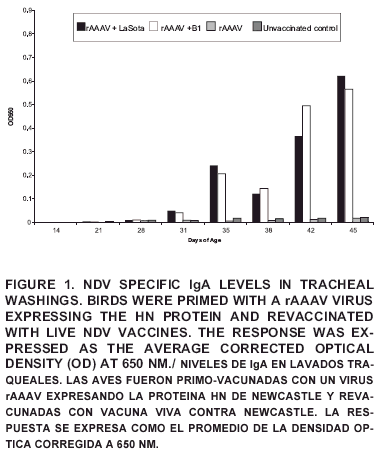
<body><![CDATA[<P        align=justify><FONT face=Verdana color=#000000 size=2>To estimate the        total (unspecific) IgA production in the respiratory and intestinal       epithelia, a commercial antigen capture ELISA chicken IgA quantitation kit       (Bethyl Laboratories, Inc. Montgomery, Texas. USA.) was used following the        manufacture’s recommendations. Checkerboard titrations established an        optimal conjugate dilution of 1/10000.</FONT></P>           <P        align=justify><B><FONT face=Verdana color=#000000 size=2>Statistical        analysis</FONT></B></P>           <P        align=justify><FONT face=Verdana color=#000000 size=2>The mean antibody        titers were compared using Student’s T test. Statistical significance was        established at the 0.05 level.</FONT></P>           <P        align=justify><B><FONT face=Verdana color=#000000 size=2>RESULTS AND        DISCUSSION</FONT></B></P>           <P        align=justify><FONT face=Verdana color=#000000 size=2>No major effect in        hatchability was observed in the <I>in ovo</I> vaccinated groups when        compared with the controls, no embryo-toxicity can be attributed to the        recombinant product. The safety of the <I>in ovo </I>vaccination procedure        has been described previously [13, 15].</FONT></P>           <P        align=justify><FONT face=Verdana color=#000000 size=2>The importance of        local immunity in the protection against infectious diseases has been        properly established for mammals and chickens [3, 4, 5, 6, 9, 11, 12, 19, 21,       23, 25].        In response to NDV infection the IgA antibodies induce virus        neutralization through its Fab fragment [3, 4, 9, 12].        IgA containing NDV immune complexes triggers the Fc receptors of several        types of leukocytes and induces phagocytosis, antibody-dependant cell-mediated cytotoxicity and production of reactive oxygen       intermediates, cytokines and other mediators of the inflammatory response        [19, 22].        These pathways are evidence of the importance of quantifying the mucosal        immune response to assess protection capabilities of NDV vaccines.</FONT></P>           <P        align=justify><FONT face=Verdana color=#000000 size=2>The IgA levels in        trachea after revaccination with either LaSota or B1 strains of NDV (groups rAAAV + LaSota and rAAAV + B1) differed (P&lt;0.05) from the        unvaccinated controls after 35 days of age (<a href="#f1">FIG 1</a>). These results are in        agreement with previous researchers that have reported an increase in        local IgA production to NDV infection or vaccination [4, 9, 12, 21].</FONT></P>           <P        align=center><a name="f1"><img border="0" src="/img/fbpe/rc/v17n3/art03i1.gif" width="377" height="453"></a></P>           
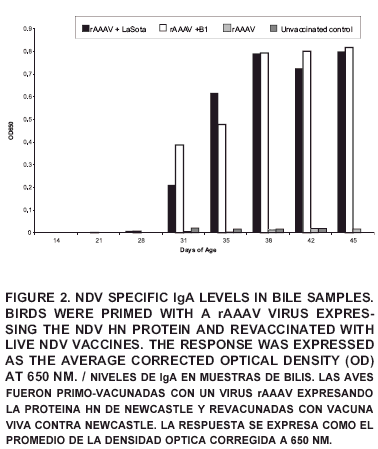
<P        align=justify><FONT face=Verdana color=#000000 size=2>When the effect of        the strain used for revaccination was compared, no differences were        observed in the IgA production regardless of the strain used, meaning no        difference in the induction of IgA between LaSota and B1 strains. These        results were unexpected, IgA production correlates positively with        antigenic stimulation, and LaSota strain has been proven to be more        immunogenic with a more aggressive epithelial tropism than B1. Strong       post-vaccine reactions are considered a drawback for LaSota strain when        applied to young birds with low levels of maternal antibodies [2, 9, 14, 16,       18].</FONT></P>           <P        align=justify><FONT face=Verdana color=#000000 size=2>The mucosal response        measured as IgA levels in bile was consistent with those of the tracheal        washing results and can be observed in <a href="#f2"> FIG 2</a>. Nevertheless, the overall        corrected optical density values (COD) in bile were higher than in other        biological samples despite of the treatment, probably due to the        physiological high concentration of all metabolites observed in the bile.        Literature reports have established the link between bile and local        protection against NDV showing the neutralizing capacity of bile obtained        from immunized animals on NDV preparations <I>in vitro</I>, probably due        to the presence of NDV specific neutralizing antibodies [14].        In mammals, the antibodies present in the bile are produced locally in the        intestinal tract and transported via the portal vein to the liver, where        IgA is actively transported through the epithelium [3].</FONT></P>           ]]></body>
<body><![CDATA[<P        align=center><a name="f2"><img border="0" src="/img/fbpe/rc/v17n3/art03i2.gif" width="378" height="449"></a></P>           
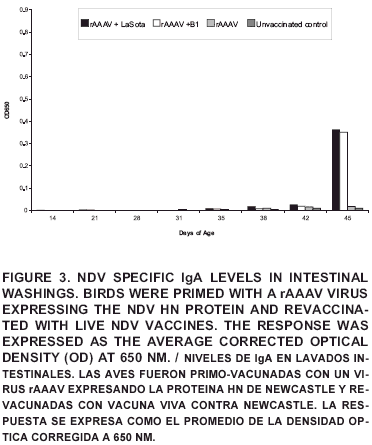
<P        align=justify><FONT face=Verdana color=#000000 size=2>Levels of IgA in the        intestinal washings were only significantly different from the control at        day 45 and overall were very low (<a href="#f3">FIG 3</a>). The diminished detection levels        when compared with the bile and the tracheal washings of homologous birds        may be explained by the dilution of local antibodies associated with the        method of collection and due to the poor intestinal tropism of the strains        used [12, 16].</FONT></P>           <P        align=center><a name="f3"><img border="0" src="/img/fbpe/rc/v17n3/art03i3.gif" width="372" height="445"></a></P>           
<P        align=justify><FONT face=Verdana color=#000000 size=2>No NDV specific IgA        response was observed in any of the tested samples on days 14, 21 or 28 in        birds primed <I>in ovo</I> with the rAAAV vaccine; only after        revaccination with live viruses a measurable IgA response was observed.        This means that the recombinant virus did not stimulate a measurable        mucosal immune response by itself, probably due to the nature of the        antigenic stimulation induced by the rAAAV which is a replication        defective virus that relays in the host cell machinery to express the HN       antigen, and due to the previously reported requirement of local viral        replication in order to induce an IgA response [8, 9].        The rAAAV expressing the HN protein of NDV is a novel product and its        complete mechanism of action for immunity is to be determined. Further        research is being conducted to determine tissue localization after <I>in        vivo</I> inoculation and mechanisms of immune response. Viral transduction        studies using a murine model and adeno-associated virus (another member of        the Parvoviridae family) reported genomic integration in 100% of the        hepatocytes and striated muscle system after a single intravenous        administration [11].</FONT></P>           <P        align=justify><FONT face=Verdana color=#000000 size=2>No significant        differences (P&lt;0.05) were observed in the levels of total IgA between        the control and any of the vaccinated groups in none of the biological        samples tested, suggesting that there is no effect of NDV vaccination in        the overall IgA load of the mucosal tissue in chickens. This observation        could be explained as the consequence of commensal and/or pathogenic        colonization of the respiratory and intestinal epithelial surfaces which        represent the putative site of initial antigen encounter [3, 6, 12, 19].       Furthermore, epithelial cells have been proved to provide co-stimulatory        signals promoting terminal differentiation of B-cells oriented towards IgA       production, generating relatively high and constant levels of the        immunoglobulin [4, 5, 21, 22].</FONT></P>           <P        align=justify><FONT face=Verdana color=#000000 size=2>Birds have a well-developed mucosal immune       system; its characteristics include local        production and secretion of IgA antibodies and trafficking of IgA        producing plasma cells, based on this the evaluation of IgA levels in the        mucosal immune response is important and can aid in the NDV control       strategies.</FONT></P>           <P        align=justify><B><FONT face=Verdana color=#000000        size=2>CONCLUSIONS</FONT></B></P>           <P        align=justify><FONT face=Verdana color=#000000 size=2>The most suitable        samples for IgA determinations were tracheal washings and bile. No        measurable NDV specific mucosal IgA levels response was elicited by the        recombinant adeno-associated virus coding for the HN protein of NDV.</FONT></P>           <P        align=justify><FONT face=Verdana color=#000000 size=2>Mucosal IgA levels        from revaccinated birds were significantly higher (P&lt;0.005) than the        levels in the control groups despite of the strain used for revaccination.</FONT></P>           <P        align=justify><FONT face=Verdana color=#000000 size=2>The evaluation of        IgA levels in the mucosal immune response is important and can aid in the        NDV control strategies.</FONT></P>           ]]></body>
<body><![CDATA[<P        align=justify><B><FONT face=Verdana color=#000000 size=2>BIBLIOGRAPHIC        REFERENCES</FONT></B></P>           <!-- ref --><P        align=justify><FONT face=Verdana color=#000000 size=2>1.        ALEXANDER, D. Gordon Memorial Lecture. Newcastle disease. <B>Br. Poult.        Sci. </B>42(1): 5-22. 2001.</FONT>&nbsp;&nbsp;&nbsp;&nbsp;&nbsp;&nbsp;&nbsp;&nbsp;[&#160;<a href="javascript:void(0);" onclick="javascript: window.open('/scielo.php?script=sci_nlinks&ref=1577105&pid=S0798-2259200700030000300001&lng=','','width=640,height=500,resizable=yes,scrollbars=1,menubar=yes,');">Links</a>&#160;]<!-- end-ref --><!-- ref --><P        align=justify><FONT face=Verdana color=#000000 size=2>2.        ALEXANDER, D. Newcastle Disease Virus and other Avian Paramyxoviruses. In:        D. E. Swayne, (Ed.). A laboratory Manual for Isolation and Identification        of Avian Pathogens, 4<SUP>th. </SUP>Ed. (235-240 pp). Kennett Square, PA:        <B>American. Association of Avian Pathologists.</B> 220-238 pp.        1998.</FONT>&nbsp;&nbsp;&nbsp;&nbsp;&nbsp;&nbsp;&nbsp;&nbsp;[&#160;<a href="javascript:void(0);" onclick="javascript: window.open('/scielo.php?script=sci_nlinks&ref=1577106&pid=S0798-2259200700030000300002&lng=','','width=640,height=500,resizable=yes,scrollbars=1,menubar=yes,');">Links</a>&#160;]<!-- end-ref --><!-- ref --><P        align=justify><FONT face=Verdana color=#000000 size=2>3. AL-GARIB, S.;       GIELKENS, A.; GRUYS, D.; KOCH, G. Review of Newcastle        disease virus with particular references to immunity and vaccination.        <B>World. Poult Sci. J</B>. 59(2): 185-200. 2003.</FONT>&nbsp;&nbsp;&nbsp;&nbsp;&nbsp;&nbsp;&nbsp;&nbsp;[&#160;<a href="javascript:void(0);" onclick="javascript: window.open('/scielo.php?script=sci_nlinks&ref=1577107&pid=S0798-2259200700030000300003&lng=','','width=640,height=500,resizable=yes,scrollbars=1,menubar=yes,');">Links</a>&#160;]<!-- end-ref --><!-- ref --><P        align=justify><FONT face=Verdana color=#000000 size=2>4. AL-GARIB, S.;       GIELKENS, A.; GRUYS, D.; HARTOG, L.; KOCH, G. Immunoglobulin        class distribution of systemic and mucosal antibody responses to Newcastle        disease in chickens. <B>Avian Dis.</B> 47(2): 32-40. 2003.</FONT>&nbsp;&nbsp;&nbsp;&nbsp;&nbsp;&nbsp;&nbsp;&nbsp;[&#160;<a href="javascript:void(0);" onclick="javascript: window.open('/scielo.php?script=sci_nlinks&ref=1577108&pid=S0798-2259200700030000300004&lng=','','width=640,height=500,resizable=yes,scrollbars=1,menubar=yes,');">Links</a>&#160;]<!-- end-ref --><!-- ref --><P        align=justify><FONT face=Verdana color=#000000 size=2>5. BRANDTZAEG, P. Role of secretory antibodies in the defense against       infections. <B>Int. J. Med. Microbiol. </B>293(1): 3-15. 2003.</FONT>&nbsp;&nbsp;&nbsp;&nbsp;&nbsp;&nbsp;&nbsp;&nbsp;[&#160;<a href="javascript:void(0);" onclick="javascript: window.open('/scielo.php?script=sci_nlinks&ref=1577109&pid=S0798-2259200700030000300005&lng=','','width=640,height=500,resizable=yes,scrollbars=1,menubar=yes,');">Links</a>&#160;]<!-- end-ref --><!-- ref --><P        align=justify><FONT face=Verdana color=#000000 size=2>6. DHINAKAR, R.;       JONES, R. Local antibody production in the oviduct and gut        of hens infected with a variant strain of infectious bronchitis virus.        <B>Vet. Immunol and Immunopathol. </B>53(1): 147-161. 1996.</FONT>&nbsp;&nbsp;&nbsp;&nbsp;&nbsp;&nbsp;&nbsp;&nbsp;[&#160;<a href="javascript:void(0);" onclick="javascript: window.open('/scielo.php?script=sci_nlinks&ref=1577110&pid=S0798-2259200700030000300006&lng=','','width=640,height=500,resizable=yes,scrollbars=1,menubar=yes,');">Links</a>&#160;]<!-- end-ref --><!-- ref --><P        align=justify><FONT face=Verdana color=#000000 size=2>7. ERF, G. Cell mediated immunity in       poultry. <B>Poult. Sci</B>. 83(2):        580-590. 2004.</FONT>&nbsp;&nbsp;&nbsp;&nbsp;&nbsp;&nbsp;&nbsp;&nbsp;[&#160;<a href="javascript:void(0);" onclick="javascript: window.open('/scielo.php?script=sci_nlinks&ref=1577111&pid=S0798-2259200700030000300007&lng=','','width=640,height=500,resizable=yes,scrollbars=1,menubar=yes,');">Links</a>&#160;]<!-- end-ref --><!-- ref --><P        align=justify><FONT face=Verdana color=#000000 size=2>8. ESTEVEZ, C.; VILLEGAS, P. Sequence       analysis, viral rescue from infectious        clones and generation of recombinant virion of the avian adeno-associated        virus. <B>Vir. Res. </B>105(1): 195-208. 2004.</FONT>&nbsp;&nbsp;&nbsp;&nbsp;&nbsp;&nbsp;&nbsp;&nbsp;[&#160;<a href="javascript:void(0);" onclick="javascript: window.open('/scielo.php?script=sci_nlinks&ref=1577112&pid=S0798-2259200700030000300008&lng=','','width=640,height=500,resizable=yes,scrollbars=1,menubar=yes,');">Links</a>&#160;]<!-- end-ref --><!-- ref --><P        align=justify><FONT face=Verdana color=#000000 size=2>9. EWERT, D.; BARGER, B.;       EIDSON, C. Local antibody response in chickens:        Analysis of the antibody synthesis to Newcastle disease virus by solid-phase radioimmunoassay and immunoflourescence with class specific        antibody for chicken immunoglobulins. <B>Infec. Immun. </B>24(1): 269-275.        1979.</FONT>&nbsp;&nbsp;&nbsp;&nbsp;&nbsp;&nbsp;&nbsp;&nbsp;[&#160;<a href="javascript:void(0);" onclick="javascript: window.open('/scielo.php?script=sci_nlinks&ref=1577113&pid=S0798-2259200700030000300009&lng=','','width=640,height=500,resizable=yes,scrollbars=1,menubar=yes,');">Links</a>&#160;]<!-- end-ref --><!-- ref --><P        align=justify><FONT face=Verdana color=#000000 size=2>10. JANENWAY, C. Humoral immune response. In Health and Diseases in       Immunobiology. By Elsevior Science Ltd/ Cralang Publishing<B>.</B>        6<SUP>th</SUP>  Ed. 363-376. pp. 2005.</FONT>&nbsp;&nbsp;&nbsp;&nbsp;&nbsp;&nbsp;&nbsp;&nbsp;[&#160;<a href="javascript:void(0);" onclick="javascript: window.open('/scielo.php?script=sci_nlinks&ref=1577114&pid=S0798-2259200700030000300010&lng=','','width=640,height=500,resizable=yes,scrollbars=1,menubar=yes,');">Links</a>&#160;]<!-- end-ref --><!-- ref --><P        align=justify><FONT face=Verdana color=#000000 size=2>11. GONCALVEZ, M.       Adeno-associated virus: from defective virus to effective        vector. <B>Virol. J</B>. 43(2):1186-1201. 2005.</FONT>&nbsp;&nbsp;&nbsp;&nbsp;&nbsp;&nbsp;&nbsp;&nbsp;[&#160;<a href="javascript:void(0);" onclick="javascript: window.open('/scielo.php?script=sci_nlinks&ref=1577115&pid=S0798-2259200700030000300011&lng=','','width=640,height=500,resizable=yes,scrollbars=1,menubar=yes,');">Links</a>&#160;]<!-- end-ref --><!-- ref --><P        align=justify><FONT face=Verdana color=#000000 size=2>12. JAYAWARDANE, G.;       SPRADBROW, P. Mucosal immunity in chickens vaccinated        with the V4 strain of Newcastle disease virus. <B>Vet. Microbiol.</B>        46(3): 69-77. 1995.</FONT>&nbsp;&nbsp;&nbsp;&nbsp;&nbsp;&nbsp;&nbsp;&nbsp;[&#160;<a href="javascript:void(0);" onclick="javascript: window.open('/scielo.php?script=sci_nlinks&ref=1577116&pid=S0798-2259200700030000300012&lng=','','width=640,height=500,resizable=yes,scrollbars=1,menubar=yes,');">Links</a>&#160;]<!-- end-ref --><!-- ref --><P        align=justify><FONT face=Verdana color=#000000 size=2>13. JOCHEMSEN, P.;       JUEURISSEN, S. The localization and uptake of in ovo        injected soluble and particle substances in the chicken. <B>Poult.        Sci.</B> 81(1):1811-1817. 2004.</FONT>&nbsp;&nbsp;&nbsp;&nbsp;&nbsp;&nbsp;&nbsp;&nbsp;[&#160;<a href="javascript:void(0);" onclick="javascript: window.open('/scielo.php?script=sci_nlinks&ref=1577117&pid=S0798-2259200700030000300013&lng=','','width=640,height=500,resizable=yes,scrollbars=1,menubar=yes,');">Links</a>&#160;]<!-- end-ref --><!-- ref --><P        align=justify><FONT face=Verdana color=#000000 size=2>14.        LEE, J.; HANSON, R. Effects of bile and gastrointestinal secretions on the        infectivity of Newcastle disease virus. <B>Infec. Immuni.</B> 11(4):        692-697. 1975.</FONT>&nbsp;&nbsp;&nbsp;&nbsp;&nbsp;&nbsp;&nbsp;&nbsp;[&#160;<a href="javascript:void(0);" onclick="javascript: window.open('/scielo.php?script=sci_nlinks&ref=1577118&pid=S0798-2259200700030000300014&lng=','','width=640,height=500,resizable=yes,scrollbars=1,menubar=yes,');">Links</a>&#160;]<!-- end-ref --><!-- ref --><P        align=justify><FONT face=Verdana color=#000000 size=2>15. NEGASH, T.; AL-GARIB, S.;       GRUYS, E. Comparison of in vivo and post-hatch vaccination with particular reference to infectious bursal       disease. <B>Vet. Quart.</B> 26(2): 76-87. 2004.</FONT>&nbsp;&nbsp;&nbsp;&nbsp;&nbsp;&nbsp;&nbsp;&nbsp;[&#160;<a href="javascript:void(0);" onclick="javascript: window.open('/scielo.php?script=sci_nlinks&ref=1577119&pid=S0798-2259200700030000300015&lng=','','width=640,height=500,resizable=yes,scrollbars=1,menubar=yes,');">Links</a>&#160;]<!-- end-ref --><!-- ref --><P        align=justify><FONT face=Verdana color=#000000 size=2>16. NUNES, J.;       VASCONCELOS, A.; JORGE, M. Comparative morphometric analysis of        vaccine virulence of some lentogenic strains of Newcastle disease virus in        tracheas of SPF chickens <B>Arq. Bra. Med. Vet. Zootec.</B> 54: 335-339.        2002.</FONT>&nbsp;&nbsp;&nbsp;&nbsp;&nbsp;&nbsp;&nbsp;&nbsp;[&#160;<a href="javascript:void(0);" onclick="javascript: window.open('/scielo.php?script=sci_nlinks&ref=1577120&pid=S0798-2259200700030000300016&lng=','','width=640,height=500,resizable=yes,scrollbars=1,menubar=yes,');">Links</a>&#160;]<!-- end-ref --><!-- ref --><P        align=justify><FONT face=Verdana color=#000000 size=2>17.        OFFICE INTERNATIONAL DES EPIZOOTIES (OIE). Newcastle Disease. OIE Manual        of Diagnostic Tests and Vaccines for Terrestrial Animals. Paris 161-169.        pp. 2004.</FONT>&nbsp;&nbsp;&nbsp;&nbsp;&nbsp;&nbsp;&nbsp;&nbsp;[&#160;<a href="javascript:void(0);" onclick="javascript: window.open('/scielo.php?script=sci_nlinks&ref=1577121&pid=S0798-2259200700030000300017&lng=','','width=640,height=500,resizable=yes,scrollbars=1,menubar=yes,');">Links</a>&#160;]<!-- end-ref --><!-- ref --><P        align=justify><FONT face=Verdana color=#000000 size=2>18. PEROZO, F.; NAVA, J.; RIVERA, S. Evaluation of two vaccination programs        against Newcastle disease in Ross line broiler chickens reared under field        conditions in Zulia State, Venezuela. 1. Productive parameters and        posvaccine reaction.&nbsp;<B>Rev. Científ. FCV-LUZ. </B>XIV<B> </B>(2):        331-337. 2004.</FONT>&nbsp;&nbsp;&nbsp;&nbsp;&nbsp;&nbsp;&nbsp;&nbsp;[&#160;<a href="javascript:void(0);" onclick="javascript: window.open('/scielo.php?script=sci_nlinks&ref=1577122&pid=S0798-2259200700030000300018&lng=','','width=640,height=500,resizable=yes,scrollbars=1,menubar=yes,');">Links</a>&#160;]<!-- end-ref --><!-- ref --><P        align=justify><FONT face=Verdana color=#000000 size=2>19. PILETTE, Y.;       QUADRHIRI, V.; GODDING, J.; SIBILLE, Y. Lung mucosal immunity:       immunoglobulin-A revisited. <B>Eur. Respir. J.</B> 18(1):        571-588. 2001.</FONT>&nbsp;&nbsp;&nbsp;&nbsp;&nbsp;&nbsp;&nbsp;&nbsp;[&#160;<a href="javascript:void(0);" onclick="javascript: window.open('/scielo.php?script=sci_nlinks&ref=1577123&pid=S0798-2259200700030000300019&lng=','','width=640,height=500,resizable=yes,scrollbars=1,menubar=yes,');">Links</a>&#160;]<!-- end-ref --><!-- ref --><P        align=justify><FONT face=Verdana color=#000000 size=2>20. REYNOLDS, D.;       MARAQA, A. Protective immunity against Newcastle disease:        the role of cell-mediated immunity. <B>Avian Dis.</B> 44(2): 145-154.        2000.</FONT>&nbsp;&nbsp;&nbsp;&nbsp;&nbsp;&nbsp;&nbsp;&nbsp;[&#160;<a href="javascript:void(0);" onclick="javascript: window.open('/scielo.php?script=sci_nlinks&ref=1577124&pid=S0798-2259200700030000300020&lng=','','width=640,height=500,resizable=yes,scrollbars=1,menubar=yes,');">Links</a>&#160;]<!-- end-ref --><!-- ref --><P        align=justify><FONT face=Verdana color=#000000 size=2>21. RUSSELL, P. Newcastle disease virus: virus replication in the Harderian        gland stimulates lachrymal IgA; the yolk sac provides early lachrymal IgG.        <B>Vet. Immunol. immunopathol</B>. 37(3): 151-163. 1993.</FONT>&nbsp;&nbsp;&nbsp;&nbsp;&nbsp;&nbsp;&nbsp;&nbsp;[&#160;<a href="javascript:void(0);" onclick="javascript: window.open('/scielo.php?script=sci_nlinks&ref=1577125&pid=S0798-2259200700030000300021&lng=','','width=640,height=500,resizable=yes,scrollbars=1,menubar=yes,');">Links</a>&#160;]<!-- end-ref --><!-- ref --><P        align=justify><FONT face=Verdana color=#000000 size=2>22. SCOTT, T. Our current understanding of humoral immunity in       poultry.        <B>Poult. Sci</B>. 83920: 574-579. 2004.</FONT>&nbsp;&nbsp;&nbsp;&nbsp;&nbsp;&nbsp;&nbsp;&nbsp;[&#160;<a href="javascript:void(0);" onclick="javascript: window.open('/scielo.php?script=sci_nlinks&ref=1577126&pid=S0798-2259200700030000300022&lng=','','width=640,height=500,resizable=yes,scrollbars=1,menubar=yes,');">Links</a>&#160;]<!-- end-ref --><!-- ref --><P        align=justify><FONT face=Verdana color=#000000 size=2>23. SEAL, B.S.; KING,       D.J.;. SELLERS, H. The avian response to Newcastle        disease virus. <B>Devel. Compar. Immunol</B>. 24(2): 257-268.        1995.</FONT>&nbsp;&nbsp;&nbsp;&nbsp;&nbsp;&nbsp;&nbsp;&nbsp;[&#160;<a href="javascript:void(0);" onclick="javascript: window.open('/scielo.php?script=sci_nlinks&ref=1577127&pid=S0798-2259200700030000300023&lng=','','width=640,height=500,resizable=yes,scrollbars=1,menubar=yes,');">Links</a>&#160;]<!-- end-ref --><!-- ref --><P        align=justify><FONT face=Verdana color=#000000 size=2>24.        VILLEGAS, P. Viral diseases of the respiratory system. <B>Poult Sci</B>        77(8): 1143-1145. 1998.</FONT>&nbsp;&nbsp;&nbsp;&nbsp;&nbsp;&nbsp;&nbsp;&nbsp;[&#160;<a href="javascript:void(0);" onclick="javascript: window.open('/scielo.php?script=sci_nlinks&ref=1577128&pid=S0798-2259200700030000300024&lng=','','width=640,height=500,resizable=yes,scrollbars=1,menubar=yes,');">Links</a>&#160;]<!-- end-ref --><!-- ref --><P        align=justify><FONT face=Verdana color=#000000 size=2>25. ZIGTERMAN, G.; VAN DE VEN, W.; VAN       GEFFEN, C.; LOEFFEN, A.; PANHUIJZEN,        J.; RIJKE, E.; VERMEULEN, A. Detection of mucosal immune responses in        chickens after immunization or infection. <B>Vet. Immunol. Immunopath.</B>        36: 281-91.<B> </B>1993.</FONT>&nbsp;&nbsp;&nbsp;&nbsp;&nbsp;&nbsp;&nbsp;&nbsp;[&#160;<a href="javascript:void(0);" onclick="javascript: window.open('/scielo.php?script=sci_nlinks&ref=1577129&pid=S0798-2259200700030000300025&lng=','','width=640,height=500,resizable=yes,scrollbars=1,menubar=yes,');">Links</a>&#160;]<!-- end-ref --> ]]></body>
<back>
<ref-list>
<ref id="B1">
<label>1</label><nlm-citation citation-type="journal">
<person-group person-group-type="author">
<name>
<surname><![CDATA[ALEXANDER]]></surname>
<given-names><![CDATA[D]]></given-names>
</name>
</person-group>
<article-title xml:lang="en"><![CDATA[Gordon Memorial Lecture: Newcastle disease]]></article-title>
<source><![CDATA[Br. Poult. Sci.]]></source>
<year>2001</year>
<volume>42</volume>
<numero>1</numero>
<issue>1</issue>
<page-range>5-22</page-range></nlm-citation>
</ref>
<ref id="B2">
<label>2</label><nlm-citation citation-type="book">
<person-group person-group-type="author">
<name>
<surname><![CDATA[Swayne]]></surname>
<given-names><![CDATA[D. E.]]></given-names>
</name>
</person-group>
<source><![CDATA[A laboratory Manual for Isolation and Identification of Avian Pathogens]]></source>
<year>1998</year>
<edition>4</edition>
<page-range>235-240</page-range><publisher-name><![CDATA[Kennett Square, PA: American. Association of Avian Pathologists]]></publisher-name>
</nlm-citation>
</ref>
<ref id="B3">
<label>3</label><nlm-citation citation-type="journal">
<person-group person-group-type="author">
<name>
<surname><![CDATA[AL-GARIB]]></surname>
<given-names><![CDATA[S]]></given-names>
</name>
<name>
<surname><![CDATA[GIELKENS]]></surname>
<given-names><![CDATA[A]]></given-names>
</name>
<name>
<surname><![CDATA[GRUYS]]></surname>
<given-names><![CDATA[D]]></given-names>
</name>
<name>
<surname><![CDATA[KOCH]]></surname>
<given-names><![CDATA[G]]></given-names>
</name>
</person-group>
<article-title xml:lang="en"><![CDATA[Review of Newcastle disease virus with particular references to immunity and vaccination]]></article-title>
<source><![CDATA[World. Poult Sci. J.]]></source>
<year>2003</year>
<volume>59</volume>
<numero>2</numero>
<issue>2</issue>
<page-range>185-200</page-range></nlm-citation>
</ref>
<ref id="B4">
<label>4</label><nlm-citation citation-type="journal">
<person-group person-group-type="author">
<name>
<surname><![CDATA[AL-GARIB]]></surname>
<given-names><![CDATA[S]]></given-names>
</name>
<name>
<surname><![CDATA[GIELKENS]]></surname>
<given-names><![CDATA[A]]></given-names>
</name>
<name>
<surname><![CDATA[GRUYS]]></surname>
<given-names><![CDATA[D]]></given-names>
</name>
<name>
<surname><![CDATA[HARTOG]]></surname>
<given-names><![CDATA[L]]></given-names>
</name>
<name>
<surname><![CDATA[KOCH]]></surname>
<given-names><![CDATA[G]]></given-names>
</name>
</person-group>
<article-title xml:lang="en"><![CDATA[Immunoglobulin class distribution of systemic and mucosal antibody responses to Newcastle disease in chickens]]></article-title>
<source><![CDATA[Avian Dis.]]></source>
<year>2003</year>
<volume>47</volume>
<numero>2</numero>
<issue>2</issue>
<page-range>32-40</page-range></nlm-citation>
</ref>
<ref id="B5">
<label>5</label><nlm-citation citation-type="journal">
<person-group person-group-type="author">
<name>
<surname><![CDATA[BRANDTZAEG]]></surname>
<given-names><![CDATA[P]]></given-names>
</name>
</person-group>
<article-title xml:lang="en"><![CDATA[Role of secretory antibodies in the defense against infections]]></article-title>
<source><![CDATA[Int. J. Med. Microbiol.]]></source>
<year>2003</year>
<volume>293</volume>
<numero>1</numero>
<issue>1</issue>
<page-range>3-15</page-range></nlm-citation>
</ref>
<ref id="B6">
<label>6</label><nlm-citation citation-type="journal">
<person-group person-group-type="author">
<name>
<surname><![CDATA[DHINAKAR]]></surname>
<given-names><![CDATA[R]]></given-names>
</name>
<name>
<surname><![CDATA[JONES]]></surname>
<given-names><![CDATA[R]]></given-names>
</name>
</person-group>
<article-title xml:lang="en"><![CDATA[Local antibody production in the oviduct and gut of hens infected with a variant strain of infectious bronchitis virus]]></article-title>
<source><![CDATA[Vet. Immunol and Immunopathol.]]></source>
<year>1996</year>
<volume>53</volume>
<numero>1</numero>
<issue>1</issue>
<page-range>147-161</page-range></nlm-citation>
</ref>
<ref id="B7">
<label>7</label><nlm-citation citation-type="journal">
<person-group person-group-type="author">
<name>
<surname><![CDATA[ERF]]></surname>
<given-names><![CDATA[G]]></given-names>
</name>
</person-group>
<article-title xml:lang="en"><![CDATA[Cell mediated immunity in poultry]]></article-title>
<source><![CDATA[Poult. Sci.]]></source>
<year>2004</year>
<volume>83</volume>
<numero>2</numero>
<issue>2</issue>
<page-range>580-590</page-range></nlm-citation>
</ref>
<ref id="B8">
<label>8</label><nlm-citation citation-type="journal">
<person-group person-group-type="author">
<name>
<surname><![CDATA[ESTEVEZ]]></surname>
<given-names><![CDATA[C]]></given-names>
</name>
<name>
<surname><![CDATA[VILLEGAS]]></surname>
<given-names><![CDATA[P]]></given-names>
</name>
</person-group>
<article-title xml:lang="en"><![CDATA[Sequence analysis, viral rescue from infectious clones and generation of recombinant virion of the avian adeno-associated virus]]></article-title>
<source><![CDATA[Vir. Res.]]></source>
<year>2004</year>
<volume>105</volume>
<numero>1</numero>
<issue>1</issue>
<page-range>195-208</page-range></nlm-citation>
</ref>
<ref id="B9">
<label>9</label><nlm-citation citation-type="journal">
<person-group person-group-type="author">
<name>
<surname><![CDATA[EWERT]]></surname>
<given-names><![CDATA[D]]></given-names>
</name>
<name>
<surname><![CDATA[BARGER]]></surname>
<given-names><![CDATA[B]]></given-names>
</name>
<name>
<surname><![CDATA[EIDSON]]></surname>
<given-names><![CDATA[C]]></given-names>
</name>
</person-group>
<article-title xml:lang="en"><![CDATA[Local antibody response in chickens: Analysis of the antibody synthesis to Newcastle disease virus by solid-phase radioimmunoassay and immunoflourescence with class specific antibody for chicken immunoglobulins]]></article-title>
<source><![CDATA[Infec. Immun.]]></source>
<year>1979</year>
<volume>24</volume>
<numero>1</numero>
<issue>1</issue>
<page-range>269-275</page-range></nlm-citation>
</ref>
<ref id="B10">
<label>10</label><nlm-citation citation-type="book">
<person-group person-group-type="author">
<name>
<surname><![CDATA[JANENWAY]]></surname>
<given-names><![CDATA[C]]></given-names>
</name>
</person-group>
<source><![CDATA[Humoral immune response]]></source>
<year>2005</year>
<edition>6</edition>
<page-range>363-376</page-range><publisher-name><![CDATA[By Elsevior Science Ltd/ Cralang Publishing]]></publisher-name>
</nlm-citation>
</ref>
<ref id="B11">
<label>11</label><nlm-citation citation-type="journal">
<person-group person-group-type="author">
<name>
<surname><![CDATA[GONCALVEZ]]></surname>
<given-names><![CDATA[M]]></given-names>
</name>
</person-group>
<article-title xml:lang="en"><![CDATA[Adeno-associated virus: from defective virus to effective vector]]></article-title>
<source><![CDATA[Virol. J.]]></source>
<year>2005</year>
<volume>43</volume>
<numero>2</numero>
<issue>2</issue>
<page-range>1186-1201</page-range></nlm-citation>
</ref>
<ref id="B12">
<label>12</label><nlm-citation citation-type="journal">
<person-group person-group-type="author">
<name>
<surname><![CDATA[JAYAWARDANE]]></surname>
<given-names><![CDATA[G]]></given-names>
</name>
<name>
<surname><![CDATA[SPRADBROW]]></surname>
<given-names><![CDATA[P]]></given-names>
</name>
</person-group>
<article-title xml:lang="en"><![CDATA[Mucosal immunity in chickens vaccinated with the V4 strain of Newcastle disease virus]]></article-title>
<source><![CDATA[Vet. Microbiol.]]></source>
<year>1995</year>
<volume>46</volume>
<numero>3</numero>
<issue>3</issue>
<page-range>69-77</page-range></nlm-citation>
</ref>
<ref id="B13">
<label>13</label><nlm-citation citation-type="journal">
<person-group person-group-type="author">
<name>
<surname><![CDATA[JOCHEMSEN]]></surname>
<given-names><![CDATA[P]]></given-names>
</name>
<name>
<surname><![CDATA[JUEURISSEN]]></surname>
<given-names><![CDATA[S]]></given-names>
</name>
</person-group>
<article-title xml:lang="en"><![CDATA[The localization and uptake of in ovo injected soluble and particle substances in the chicken]]></article-title>
<source><![CDATA[Poult. Sci.]]></source>
<year>2004</year>
<volume>81</volume>
<numero>1</numero>
<issue>1</issue>
<page-range>1811-1817</page-range></nlm-citation>
</ref>
<ref id="B14">
<label>14</label><nlm-citation citation-type="journal">
<person-group person-group-type="author">
<name>
<surname><![CDATA[LEE]]></surname>
<given-names><![CDATA[J]]></given-names>
</name>
<name>
<surname><![CDATA[HANSON]]></surname>
<given-names><![CDATA[R]]></given-names>
</name>
</person-group>
<article-title xml:lang="en"><![CDATA[Effects of bile and gastrointestinal secretions on the infectivity of Newcastle disease virus]]></article-title>
<source><![CDATA[Infec. Immuni.]]></source>
<year>1975</year>
<volume>11</volume>
<numero>4</numero>
<issue>4</issue>
<page-range>692-697</page-range></nlm-citation>
</ref>
<ref id="B15">
<label>15</label><nlm-citation citation-type="journal">
<person-group person-group-type="author">
<name>
<surname><![CDATA[NEGASH]]></surname>
<given-names><![CDATA[T]]></given-names>
</name>
<name>
<surname><![CDATA[AL-GARIB]]></surname>
<given-names><![CDATA[S]]></given-names>
</name>
<name>
<surname><![CDATA[GRUYS]]></surname>
<given-names><![CDATA[E]]></given-names>
</name>
</person-group>
<article-title xml:lang="en"><![CDATA[Comparison of in vivo and post-hatch vaccination with particular reference to infectious bursal disease]]></article-title>
<source><![CDATA[Vet. Quart.]]></source>
<year>2004</year>
<volume>26</volume>
<numero>2</numero>
<issue>2</issue>
<page-range>76-87</page-range></nlm-citation>
</ref>
<ref id="B16">
<label>16</label><nlm-citation citation-type="journal">
<person-group person-group-type="author">
<name>
<surname><![CDATA[NUNES]]></surname>
<given-names><![CDATA[J]]></given-names>
</name>
<name>
<surname><![CDATA[VASCONCELOS]]></surname>
<given-names><![CDATA[A]]></given-names>
</name>
<name>
<surname><![CDATA[JORGE]]></surname>
<given-names><![CDATA[M]]></given-names>
</name>
</person-group>
<article-title xml:lang="en"><![CDATA[Comparative morphometric analysis of vaccine virulence of some lentogenic strains of Newcastle disease virus in tracheas of SPF chickens Arq]]></article-title>
<source><![CDATA[Bra. Med. Vet. Zootec.]]></source>
<year>2002</year>
<volume>54</volume>
<page-range>335-339</page-range></nlm-citation>
</ref>
<ref id="B17">
<label>17</label><nlm-citation citation-type="">
<collab>OFFICE INTERNATIONAL DES EPIZOOTIES (OIE)</collab>
<source><![CDATA[Newcastle Disease]]></source>
<year>2004</year>
<page-range>161-169</page-range><publisher-loc><![CDATA[Paris ]]></publisher-loc>
</nlm-citation>
</ref>
<ref id="B18">
<label>18</label><nlm-citation citation-type="journal">
<person-group person-group-type="author">
<name>
<surname><![CDATA[PEROZO]]></surname>
<given-names><![CDATA[F]]></given-names>
</name>
<name>
<surname><![CDATA[NAVA]]></surname>
<given-names><![CDATA[J]]></given-names>
</name>
<name>
<surname><![CDATA[RIVERA]]></surname>
<given-names><![CDATA[S]]></given-names>
</name>
</person-group>
<article-title xml:lang="en"><![CDATA[Evaluation of two vaccination programs against Newcastle disease in Ross line broiler chickens reared under field conditions in Zulia State, Venezuela]]></article-title>
<source><![CDATA[1. Productive parameters and posvaccine reaction. Rev. Científ. FCV-LUZ. XIV]]></source>
<year>2004</year>
<volume>(2)</volume>
<page-range>331-337</page-range></nlm-citation>
</ref>
<ref id="B19">
<label>19</label><nlm-citation citation-type="journal">
<person-group person-group-type="author">
<name>
<surname><![CDATA[PILETTE]]></surname>
<given-names><![CDATA[Y]]></given-names>
</name>
<name>
<surname><![CDATA[QUADRHIRI]]></surname>
<given-names><![CDATA[V]]></given-names>
</name>
<name>
<surname><![CDATA[GODDING]]></surname>
<given-names><![CDATA[J]]></given-names>
</name>
<name>
<surname><![CDATA[SIBILLE]]></surname>
<given-names><![CDATA[Y]]></given-names>
</name>
</person-group>
<article-title xml:lang="en"><![CDATA[Lung mucosal immunity: immunoglobulin-A revisited]]></article-title>
<source><![CDATA[Eur. Respir. J.]]></source>
<year>2001</year>
<volume>18</volume>
<numero>1</numero>
<issue>1</issue>
<page-range>571-588</page-range></nlm-citation>
</ref>
<ref id="B20">
<label>20</label><nlm-citation citation-type="journal">
<person-group person-group-type="author">
<name>
<surname><![CDATA[REYNOLDS]]></surname>
<given-names><![CDATA[D]]></given-names>
</name>
<name>
<surname><![CDATA[MARAQA]]></surname>
<given-names><![CDATA[A]]></given-names>
</name>
</person-group>
<article-title xml:lang="en"><![CDATA[Protective immunity against Newcastle disease: the role of cell-mediated immunity]]></article-title>
<source><![CDATA[Avian Dis.]]></source>
<year>2000</year>
<volume>44</volume>
<numero>2</numero>
<issue>2</issue>
<page-range>145-154</page-range></nlm-citation>
</ref>
<ref id="B21">
<label>21</label><nlm-citation citation-type="journal">
<person-group person-group-type="author">
<name>
<surname><![CDATA[RUSSELL]]></surname>
<given-names><![CDATA[P]]></given-names>
</name>
</person-group>
<article-title xml:lang="en"><![CDATA[Newcastle disease virus: virus replication in the Harderian gland stimulates lachrymal IgA; the yolk sac provides early lachrymal IgG]]></article-title>
<source><![CDATA[Vet. Immunol. immunopathol.]]></source>
<year>1993</year>
<volume>37</volume>
<numero>3</numero>
<issue>3</issue>
<page-range>151-163</page-range></nlm-citation>
</ref>
<ref id="B22">
<label>22</label><nlm-citation citation-type="journal">
<person-group person-group-type="author">
<name>
<surname><![CDATA[SCOTT]]></surname>
<given-names><![CDATA[T]]></given-names>
</name>
</person-group>
<article-title xml:lang="en"><![CDATA[Our current understanding of humoral immunity in poultry]]></article-title>
<source><![CDATA[Poult. Sci.]]></source>
<year>2004</year>
<volume>83920</volume>
<page-range>574-579</page-range></nlm-citation>
</ref>
<ref id="B23">
<label>23</label><nlm-citation citation-type="journal">
<person-group person-group-type="author">
<name>
<surname><![CDATA[SEAL]]></surname>
<given-names><![CDATA[B.S]]></given-names>
</name>
<name>
<surname><![CDATA[KING]]></surname>
<given-names><![CDATA[D.J]]></given-names>
</name>
<name>
<surname><![CDATA[SELLERS]]></surname>
<given-names><![CDATA[H]]></given-names>
</name>
</person-group>
<article-title xml:lang="en"><![CDATA[The avian response to Newcastle disease virus]]></article-title>
<source><![CDATA[Devel. Compar. Immunol. 24 (]]></source>
<year>1995</year>
<volume>2)</volume>
<page-range>257-268</page-range></nlm-citation>
</ref>
<ref id="B24">
<label>24</label><nlm-citation citation-type="journal">
<person-group person-group-type="author">
<name>
<surname><![CDATA[VILLEGAS]]></surname>
<given-names><![CDATA[P]]></given-names>
</name>
</person-group>
<article-title xml:lang="en"><![CDATA[Viral diseases of the respiratory system]]></article-title>
<source><![CDATA[Poult Sci]]></source>
<year>1998</year>
<volume>77</volume>
<numero>8</numero>
<issue>8</issue>
<page-range>1143-1145</page-range></nlm-citation>
</ref>
<ref id="B25">
<label>25</label><nlm-citation citation-type="journal">
<person-group person-group-type="author">
<name>
<surname><![CDATA[ZIGTERMAN]]></surname>
<given-names><![CDATA[G]]></given-names>
</name>
<name>
<surname><![CDATA[VAN DE VEN]]></surname>
<given-names><![CDATA[W]]></given-names>
</name>
<name>
<surname><![CDATA[VAN GEFFEN]]></surname>
<given-names><![CDATA[C]]></given-names>
</name>
<name>
<surname><![CDATA[LOEFFEN]]></surname>
<given-names><![CDATA[A]]></given-names>
</name>
<name>
<surname><![CDATA[PANHUIJZEN]]></surname>
<given-names><![CDATA[J]]></given-names>
</name>
<name>
<surname><![CDATA[RIJKE]]></surname>
<given-names><![CDATA[E]]></given-names>
</name>
<name>
<surname><![CDATA[VERMEULEN]]></surname>
<given-names><![CDATA[A]]></given-names>
</name>
</person-group>
<article-title xml:lang="en"><![CDATA[Detection of mucosal immune responses in chickens after immunization or infection]]></article-title>
<source><![CDATA[Vet. Immunol. Immunopath.]]></source>
<year>1993</year>
<volume>36</volume>
<page-range>281-91</page-range></nlm-citation>
</ref>
</ref-list>
</back>
</article>