<?xml version="1.0" encoding="ISO-8859-1"?><article xmlns:mml="http://www.w3.org/1998/Math/MathML" xmlns:xlink="http://www.w3.org/1999/xlink" xmlns:xsi="http://www.w3.org/2001/XMLSchema-instance">
<front>
<journal-meta>
<journal-id>0798-2259</journal-id>
<journal-title><![CDATA[Revista Científica]]></journal-title>
<abbrev-journal-title><![CDATA[Rev. Cient. (Maracaibo)]]></abbrev-journal-title>
<issn>0798-2259</issn>
<publisher>
<publisher-name><![CDATA[UNIVERSIDAD DEL ZULIA]]></publisher-name>
</publisher>
</journal-meta>
<article-meta>
<article-id>S0798-22592008000500003</article-id>
<title-group>
<article-title xml:lang="es"><![CDATA[Factores que afectan el número de dientes incisivos al nacer en becerros criollo limonero: Desgaste dentario hasta los 12 meses de edad]]></article-title>
<article-title xml:lang="en"><![CDATA[Factors affecting the number of incisive teeth at birth in criollo limonero calves: Teeth waste until 12 months of age old]]></article-title>
</title-group>
<contrib-group>
<contrib contrib-type="author">
<name>
<surname><![CDATA[Urdaneta]]></surname>
<given-names><![CDATA[Margelys]]></given-names>
</name>
<xref ref-type="aff" rid="A01"/>
</contrib>
<contrib contrib-type="author">
<name>
<surname><![CDATA[Cuervo]]></surname>
<given-names><![CDATA[Alejandra]]></given-names>
</name>
<xref ref-type="aff" rid="A01"/>
</contrib>
<contrib contrib-type="author">
<name>
<surname><![CDATA[Perea]]></surname>
<given-names><![CDATA[Ylenia]]></given-names>
</name>
<xref ref-type="aff" rid="A01"/>
</contrib>
<contrib contrib-type="author">
<name>
<surname><![CDATA[Añez]]></surname>
<given-names><![CDATA[Nohely]]></given-names>
</name>
<xref ref-type="aff" rid="A01"/>
</contrib>
<contrib contrib-type="author">
<name>
<surname><![CDATA[Izquierdo]]></surname>
<given-names><![CDATA[Gabriel]]></given-names>
</name>
<xref ref-type="aff" rid="A01"/>
</contrib>
<contrib contrib-type="author">
<name>
<surname><![CDATA[González]]></surname>
<given-names><![CDATA[Raynel]]></given-names>
</name>
<xref ref-type="aff" rid="A01"/>
</contrib>
<contrib contrib-type="author">
<name>
<surname><![CDATA[Contreras]]></surname>
<given-names><![CDATA[Gloria]]></given-names>
</name>
<xref ref-type="aff" rid="A02"/>
</contrib>
<contrib contrib-type="author">
<name>
<surname><![CDATA[Zambrano]]></surname>
<given-names><![CDATA[Sunny]]></given-names>
</name>
<xref ref-type="aff" rid="A02"/>
</contrib>
<contrib contrib-type="author">
<name>
<surname><![CDATA[Landaeta-Hernández]]></surname>
<given-names><![CDATA[Antonio]]></given-names>
</name>
<xref ref-type="aff" rid="A01"/>
</contrib>
</contrib-group>
<aff id="A01">
<institution><![CDATA[,Universidad del Zulia Facultad de Ciencias Veterinarias Unidad de Investigaciones Zootécnicas UNIZ]]></institution>
<addr-line><![CDATA[Maracaibo ]]></addr-line>
<country>Venezuela</country>
</aff>
<aff id="A02">
<institution><![CDATA[,Instituto Nacional de Investigaciones Agropecuarias INIA  ]]></institution>
<addr-line><![CDATA[Maracaibo ]]></addr-line>
<country>Venezuela</country>
</aff>
<pub-date pub-type="pub">
<day>00</day>
<month>10</month>
<year>2008</year>
</pub-date>
<pub-date pub-type="epub">
<day>00</day>
<month>10</month>
<year>2008</year>
</pub-date>
<volume>18</volume>
<numero>5</numero>
<fpage>542</fpage>
<lpage>548</lpage>
<copyright-statement/>
<copyright-year/>
<self-uri xlink:href="http://ve.scielo.org/scielo.php?script=sci_arttext&amp;pid=S0798-22592008000500003&amp;lng=en&amp;nrm=iso"></self-uri><self-uri xlink:href="http://ve.scielo.org/scielo.php?script=sci_abstract&amp;pid=S0798-22592008000500003&amp;lng=en&amp;nrm=iso"></self-uri><self-uri xlink:href="http://ve.scielo.org/scielo.php?script=sci_pdf&amp;pid=S0798-22592008000500003&amp;lng=en&amp;nrm=iso"></self-uri><abstract abstract-type="short" xml:lang="es"><p><![CDATA[Los objetivos de este estudio fueron determinar el número de dientes incisivos al nacer en becerros Criollo Limonero y las variables que lo influencian, así como, caracterizar la secuencia de desgaste en relación con la edad. Desde su nacimiento y hasta los 12 meses de edad, se observó mensualmente en la dentadura incisiva de 216 becerros Criollo Limonero el número de dientes al nacer, tipo de desgaste y magnitud del desgaste. Todos los becerros nacieron en la Estación Local Carrasquero-INIA, Zulia, Venezuela. El número de dientes al nacer fue analizado mediante distribución de frecuencias. Para analizar los factores que influencian el número de incisivos al nacer se practicó un ANAVA con un modelo estadístico que incluyó las variables sexo del becerro, familia de la madre y familia del padre, condición corporal pre-parto y el número de partos de la madre. 70,8% de los becerros nacieron con 6 dientes incisivos y un 2,3% con 4 dientes. Todos los becerros presentaron sus dientes por pares. Las hembras nacieron con más dientes (6 vs 5; P<0,02) que los machos, y los becerros nacidos de madres con ³ 6 partos presentaron más dientes (5,8 ± 0,3vs 4,9 ± 0,2; P<0,04) que aquellos nacidos de hembras con £ 5 partos. La interacción sexo del becerro x número de partos de la madre tendió afectar el número de dientes al nacer (P>0,10). El desgaste dentario se inició con rasamiento leve a los 6 meses en pinzas, primeros y segundos medianos, este tipo de desgaste se acentuó a los 9 meses y se hizo marcado a los 12 meses de edad. Se concluyó que los becerros Criollo Limonero nacen predominantemente con 6 dientes, y que el número de dientes incisivos al nacer parece estar más influenciado por factores no genéticos como el sexo del becerro y el número de partos de la madre.]]></p></abstract>
<abstract abstract-type="short" xml:lang="en"><p><![CDATA[The objectives of this study were to determine the number of incisive teeth at birth in Criollo Limonero calves, factors influencing number of incisive teeth at birth and teeth waste until 12m age old. Incisive teeth from 216 Criollo Limonero calves owned by the Estación Local Carrasquero-INIA, Zulia, Venezuela were monthly observed from birth to 12 m age old. Likewise, type of teeth waste and its magnitude were monthly recorded. The number of incisive teeth at birth was analyzed by frequency distribution. In order to analyze the factors influencing the number of incisive teeth at birth, a statistical model that included the variables calf gender, dam and sire family, prepartum body condition score, and parity was built, and an ANOVA was performed. Most (70.8%) of calves were born with 6 incisive teeth, while 21.3% borh with 4 teeth. All calves had their teeth in pairs. Female calves were born with more (6 vs 5; P<0.02) teeth than male calves. Calves from dams with parity ³ 6 had more (5.8 ± 0.3vs 4.9 ± 0.2; P<0.04) incisive teeth than those from dams with parity £ 5. The interaction calf gender x parity tended (P>0.10) to have an influence on number of incisive teeth at birth. Mild teeth waste started at 6m age old in front, first, and second lateral teeth. Mild teeth waste became more evident at 9m age old, and strong teeth waste was evident at 12m age old. It was concluded that Criollo Limonero calves are predominatly born with 6 incisive teeth and this number seems to be more influenced by non-genetic factors such as calf gender and parity.]]></p></abstract>
<kwd-group>
<kwd lng="es"><![CDATA[Becerro]]></kwd>
<kwd lng="es"><![CDATA[criollo]]></kwd>
<kwd lng="es"><![CDATA[dientes]]></kwd>
<kwd lng="en"><![CDATA[Calves]]></kwd>
<kwd lng="en"><![CDATA[criollo]]></kwd>
<kwd lng="en"><![CDATA[teeth]]></kwd>
</kwd-group>
</article-meta>
</front><body><![CDATA[  <BASEFONT SIZE="3">     <P align="CENTER" style="word-spacing: 0; line-height: 100%"> <B><span style="color: black"><font face="Verdana" size="3">Factores que afectan el número de dientes incisivos al nacer en becerros criollo limonero. Desgaste dentario hasta los 12 meses de edad.</font></span></B></P>      <P align="CENTER" style="word-spacing: 0; line-height: 100%"><B><font color="000000" face="Verdana" size="3">Factors affecting the number of incisive teeth at birth in criollo limonero calves. Teeth waste until 12 months of age old.</font></B> </P>     <P align="CENTER" style="word-spacing: 0; line-height: 100%"><font size="2"><B><FONT COLOR="000000" face="Verdana"> Margelys Urdaneta </FONT> </B><FONT COLOR="000000" face="Verdana"> <SUP><B>1</B></SUP><B>, Alejandra Cuervo </B><SUP><B>1</B></SUP><B>, Ylenia Perea </B><SUP><B>1</B></SUP><B>, Nohely Añez </B><SUP><B>1</B></SUP><B>,  Gabriel Izquierdo </B><SUP><B>1</B></SUP><B>, Raynel González </B><SUP><B>1</B></SUP><B>, Gloria Contreras </B><SUP><B>2</B></SUP><B>, Sunny Zambrano  </B><SUP><B>2</B></SUP><B> y Antonio Landaeta-Hernández </B><SUP><B>1</B></SUP><B>*</B> </FONT></font></P>      <P align="justify" style="word-spacing: 0; line-height: 100%"><font face="Verdana" size="2"> 1  Universidad del Zulia, Facultad de Ciencias Veterinarias. Unidad de Investigaciones  Zootécnicas (UNIZ), Departamento de Producción e Industria Animal. Maracaibo,  Venezuela.</font></P>    <P align="justify" style="word-spacing: 0; line-height: 100%"><font face="Verdana" size="2"> 2  Instituto Nacional de Investigaciones Agropecuarias (INIA), Estación  Local Carrasquero. Maracaibo, Venezuela. *Correspondencia: landaetaa@yahoo.es</font></P>      <P align="justify" style="word-spacing: 0; line-height: 100%"><B><FONT COLOR="000000" face="Verdana" size="2">RESUMEN</FONT></B></P>      <P align="justify" style="word-spacing: 0; line-height: 100%"><FONT COLOR="000000" size="2" face="Verdana"> Los objetivos de este estudio fueron determinar el número de dientes incisivos  al nacer en becerros Criollo Limonero y las variables que lo influencian,  así como, caracterizar la secuencia de desgaste en relación con la edad.  Desde su nacimiento y hasta los 12 meses de edad, se observó mensualmente  en la dentadura incisiva de 216 becerros Criollo Limonero el número de  dientes al nacer, tipo de desgaste y magnitud del desgaste. Todos los becerros  nacieron en la Estación Local Carrasquero-INIA, Zulia, Venezuela. El número  de dientes al nacer fue analizado mediante distribución de frecuencias.  Para analizar los factores que influencian el número de incisivos al nacer  se practicó un ANAVA con un modelo estadístico que incluyó las variables  sexo del becerro, familia de la madre y familia del padre, condición corporal  pre-parto y el número de partos de la madre. 70,8% de los becerros nacieron  con 6 dientes incisivos y un 2,3% con 4 dientes. Todos los becerros presentaron  sus dientes por pares. Las hembras nacieron con más dientes (6 vs 5; P&lt;0,02)  que los machos, y los becerros nacidos de madres con </FONT><FONT COLOR="000000" size="2" face="Symbol">  ³</FONT><FONT COLOR="000000" size="2" face="Verdana">  6 partos presentaron  más dientes (5,8 ± 0,3<SUP> </SUP>vs 4,9 ± 0,2; P&lt;0,04) que aquellos nacidos de hembras  con </FONT><FONT COLOR="000000" size="2" face="Symbol">  £</FONT><FONT COLOR="000000" size="2" face="Verdana">  5 partos. La interacción sexo del becerro x número de partos de la  madre tendió afectar el número de dientes al nacer (P&gt;0,10). El desgaste  dentario se inició con rasamiento leve a los 6 meses en pinzas, primeros  y segundos medianos, este tipo de desgaste se acentuó a los 9 meses y se  hizo marcado a los 12 meses de edad. Se concluyó que los becerros Criollo  Limonero nacen predominantemente con 6 dientes, y que el número de dientes  incisivos al nacer parece estar más influenciado por factores no genéticos  como el sexo del becerro y el número de partos de la madre.</FONT></P>      <P align="justify" style="word-spacing: 0; line-height: 100%"><font face="Verdana" size="2"><B><FONT COLOR="000000"> Palabras clave</FONT></B><FONT COLOR="000000"><B>:</B></FONT>  Becerro, criollo, dientes.</font></P>      <P align="justify" style="word-spacing: 0; line-height: 100%"><B><FONT COLOR="000000" size="2" face="Verdana"> ABSTRACT </FONT></B></P>      ]]></body>
<body><![CDATA[<P align="justify" style="word-spacing: 0; line-height: 100%"><FONT COLOR="000000" size="2" face="Verdana"> The objectives of this study were to determine the number of incisive teeth  at birth in Criollo Limonero calves, factors influencing number of incisive  teeth at birth and teeth waste until 12m age old. Incisive teeth from 216  Criollo Limonero calves owned by the Estación Local Carrasquero-INIA, Zulia,  Venezuela were monthly observed from birth to 12 m age old. Likewise, type  of teeth waste and its magnitude were monthly recorded. The number of incisive  teeth at birth was analyzed by frequency distribution. In order to analyze  the factors influencing the number of incisive teeth at birth, a statistical  model that included the variables calf gender, dam and sire family, prepartum  body condition score, and parity was built, and an ANOVA was performed.  Most (70.8%) of calves were born with 6 incisive teeth, while 21.3% borh  with 4 teeth. All calves had their teeth in pairs. Female calves were born  with more (6 vs 5; P&lt;0.02) teeth than male calves. Calves from dams with  parity </FONT><FONT COLOR="000000" size="2" face="Symbol">  ³ </FONT><FONT COLOR="000000" size="2" face="Verdana">  6 had more (5.8 ± 0.3<SUP> </SUP>vs 4.9 ± 0.2; P&lt;0.04) incisive teeth than  those from dams with parity </FONT><FONT COLOR="000000" size="2" face="Symbol">  £ </FONT><FONT COLOR="000000" size="2" face="Verdana">  5. The interaction calf gender x parity tended  (P&gt;0.10) to have an influence on number of incisive teeth at birth. Mild  teeth waste started at 6m age old in front, first, and second lateral teeth.  Mild teeth waste became more evident at 9m age old, and strong teeth waste  was evident at 12m age old. It was concluded that Criollo Limonero calves  are predominatly born with 6 incisive teeth and this number seems to be  more influenced by non-genetic factors such as calf gender and parity. </FONT></P>    <P align="justify" style="word-spacing: 0; line-height: 100%"><font face="Verdana" size="2"><B><FONT COLOR="000000"> Key words</FONT></B><FONT COLOR="000000"><B>:</B></FONT>  Calves, criollo, teeth.</font></P>      <p style="word-spacing: 0; line-height: 100%" align="justify"><font size="2"><b><font COLOR="000000" face="Verdana">Recibido: </font></b><font COLOR="000000" face="Verdana">13 / 03 / 2007.&nbsp; <b>Aceptado: </b>13 / 11 / 2007.</font></font>      <P align="justify" style="word-spacing: 0; line-height: 100%"><font size="2"><B><FONT COLOR="000000" face="Verdana"> INTRODUCCI</FONT></B><FONT COLOR="000000" face="Verdana"><B>ÓN</B></FONT></font></P>      <P align="justify" style="word-spacing: 0; line-height: 100%"><FONT COLOR="000000" size="2" face="Verdana"> La formación de los dientes se inicia entre la 6<SUP>ta</SUP> y 7<SUP>ma</SUP> semana de desarrollo  embrionario, cuando del endodermo prolifera el epitelio bucal, cuya capa  basal origina al esbozo dentario, que se evagina en su fondo e inicia el  periodo de caperuza [8, 14]. En la cresta neural, el mesénquima forma la  papila dentaria donde se originan posteriormente la pulpa y dentina [14].  Mientras tanto, una capa membranosa vascularizada que rodea las papilas  dentarias dará origen al cemento, y las células epiteliales transformadas  en ameloblastos formaran el esmalte [8]. A medida que la capsula dental  crece y se profundiza, el diente adopta forma de campana. Externamente  al cemento se origina el ligamento periodontal, el cual afianza al diente  en su posición [8, 14]. </FONT></P>      <P align="justify" style="word-spacing: 0; line-height: 100%"><FONT COLOR="000000" size="2" face="Verdana"> Externamente, los dientes constan de tres partes: corona, cuello y raíz  [9, 11, 15, 16], mientras que internamente, los dientes se componen de  esmalte, dentina, cemento y pulpa [11, 16] (<a href="#fig1">FIG. 1</a>). El esmalte es la capa  más externa, dura y de color blanco, se compone de hidroxiapatita calcica  (aprox. 96%), material orgánico -glucoproteinas- (aprox. 4%) y agua. La  dentina está debajo del esmalte y es de color amarillento, se compone de  hidroxiapatita calcica (aprox. 65-75%), material orgánico -colágeno tipo  1, proteoglucanos y glucoproteinas- (aprox. 20-25%) y agua. El cemento,  le sigue a la dentina, y es de coloración grisácea, se compone de hidroxiapatita  de calcio (aprox. 45-50%), material orgánico (aprox. 50-55%) y agua. La  pulpa, es la parte más interna, recibe la irrigación e inervación, ocupa  la cavidad dentaria y está constituida por proteoglucanos y glucosaminoglicanos  [8]. Químicamente, los dientes están formados por minerales como el Ca,  P, Mg, F y Zn [4]. La movilización de estos minerales es regulada por factores  endocrinos (calcitonina, parato-hormona, vitamina D) y nutricionales. En  cuanto a la formación y crecimiento de los dientes, su regulación es mediada  por la somatotropina y múltiples factores de crecimiento [10]. </FONT></P>      <P align="center" style="word-spacing: 0; line-height: 100%"><a name="fig1"><img border="0" src="/img/fbpe/rc/v18n5/art03fig1.gif" width="513" height="377"></a></P>      
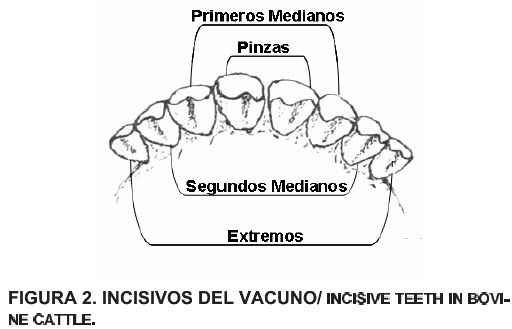
<P align="justify" style="word-spacing: 0; line-height: 100%"><FONT COLOR="000000" size="2" face="Verdana"> Luego del proceso de formación, 8 dientes incisivos se ubican en el extremo  anterior del maxilar inferior, y reciben la siguiente denominación: pinzas  o palas, primeros medianos, segundos medianos, y extremos (<a href="#fig2">FIG. 2</a>). La  fórmula dentaria temporal del bovino es 2 (I 0/4, C 0/0, PM 3/3, M 0/0)  = 20 Dientes [11]. </FONT></P>      <P align="center" style="word-spacing: 0; line-height: 100%"><a name="fig2"><img border="0" src="/img/fbpe/rc/v18n5/art03fig2.gif" width="512" height="329"></a></P>      
<P align="justify" style="word-spacing: 0; line-height: 100%"><FONT COLOR="000000" size="2" face="Verdana"> En los vacunos, los incisivos temporales emergen entre los dos últimos  meses de gestación y las primeras semanas después del nacimiento [15].  Sin embargo, se ha aceptado que el número de dientes incisivos al nacer  puede variar entre razas vacunas [1, 11, 15]. Según este criterio, las  razas vacunas pueden clasificarse como precoces (p.e., Hereford, Angus,  Shorthorn), poco precoces (p.e., Holstein, Normanda) y tardías (Criollos)  [6,13]. En referencia al ganado Criollo, éste ha sido considerado por algunos  autores como tardío debido a que nacen con 2 a 4 dientes incisivos [5,  11]. Sin embargo, en forma general la escasa información disponible no  parece tener fundamento científico [4, 11, 15] o es antagónica [1]. Por  otra parte, estudios previos hallaron diferencias entre becerros tauro-indicus  en la velocidad de crecimiento de los incisivos usando como medida la superficie  de la cara labial de los dientes incisivos entre 0 y 90 días de nacidos  [12]. En particular con el ganado Criollo, no parecen existir reportes  relativos al número de dientes al nacer y la secuencia del proceso de desgaste  dentario en relación con la edad.</FONT></P>      ]]></body>
<body><![CDATA[<P align="justify" style="word-spacing: 0; line-height: 100%"><FONT COLOR="000000" size="2" face="Verdana"> Los objetivos de este estudio fueron determinar el número de dientes incisivos  al nacer en becerros Criollo Limonero y las variables que lo influencian,  así como, conocer la secuencia de desgaste en relación con la edad. </FONT></P>      <P align="justify" style="word-spacing: 0; line-height: 100%"><B><FONT COLOR="000000" size="2" face="Verdana"> MATERIALES Y MÉTODOS </FONT></B></P>      <P align="justify" style="word-spacing: 0; line-height: 100%"><FONT COLOR="000000" size="2" face="Verdana"> A objeto de determinar los factores que afectan el número de dientes al  nacer y caracterizar su crecimiento y desgaste hasta los 12 meses, se observaron  216 becerros Criollo Limonero nacidos durante 18 meses en la Estación Experimental  Carrasquero-INIA, ubicada en el Sector Playa Bonita del municipio Mara,  estado Zulia,Venezuela. Esta región se describe agro-ecológicamente como  bosque seco tropical, pluviosidad 920 mm /año, humedad relativa 76% (min  67 y max 91), temperatura 27,4°C (min 19,7 y max 35,2°C) con suelos inundables  de origen aluvial (Fuente MARNR). </FONT></P>      <P align="justify" style="word-spacing: 0; line-height: 100%"><FONT COLOR="000000" size="2" face="Verdana"> En la Estación Experimental Carrasquero, faltando 30-45 días pre-parto,  las vacas son separadas al grupo de próximas. En este grupo de vacas próximas  al parto, la alimentación se fundamenta en pastoreo diurno (6 am - 6 pm)  en potreros de pasto Alemán (<I>Echinocloa polystachia</I>). En la noche son confinadas  y reciben pasto Alemán cortado + bloques multi-nutricionales. Una vez paridas,  las vacas reciben 1 kg de alimento concentrado comercial AM/PM durante  el ordeño. Todo el rebaño se maneja bajo un plan sanitario que incluye  la aplicación de vacunas contra: Brucelosis, Leptospirósis, Septicemia,  Triple, Aftosa, Rinotraqueitis Infecciosa Bovina (IBR) y Diarrea Viral  Bovina (DVB). Adicionalmente, existen planes de control de ecto, endo y  hemoparásitos. </FONT></P>      <P align="justify" style="word-spacing: 0; line-height: 100%"><FONT COLOR="000000" size="2" face="Verdana"> Dentro de las primeras 24 h de nacidos, los becerros reciben calostro,  son tatuados, pesados y como parte de esta rutina se incluyó el conteo  de dientes incisivos. Para efectos del registro se consideraron 3 categorías:  dientes completos (más de la mitad del diente expuesto), encarnados (menos  de la mitad del diente expuesto o aun cubiertos por la encía), y ausentes.  Los becerros son confinados en jaulas individuales, donde reciben 2 litros  de leche natural, alimento concentrado, pasto picado y agua hasta un aproximado  de 9 meses. </FONT></P>      <P align="justify" style="word-spacing: 0; line-height: 100%"><FONT COLOR="000000" size="2" face="Verdana"> A partir del mes de nacidos y cada 30 d, a todos los becerros nacidos se  les observó la dentadura incisiva. Estas observaciones se hicieron con  la finalidad de evidenciar los procesos de desgaste dentario (p.e., rasamiento  y nivelación) hasta los 12 meses de edad. Rasamiento, fue definido como  el desgaste dentario que involucra la pérdida del esmalte y exposición  de la dentina, fue clasificado como leve (</FONT><FONT COLOR="000000" size="2" face="Symbol">£ </FONT><FONT COLOR="000000" size="2" face="Verdana"> 2 mm) o marcado (</FONT><FONT COLOR="000000" size="2" face="Symbol">³</FONT><FONT COLOR="000000" size="2" face="Verdana">  2 mm) de  acuerdo al grado de exposición de la dentina [11]. Nivelación, se define  como un desgaste severo del diente en donde quedan expuestas la dentina  y el cemento, el diente presenta 2 bordes en su extremo superior [11].  También clasificada como leve (sin bordes anterior y posterior a la misma  altura) y marcada (bordes anterior y posterior a la misma altura).</FONT></P>      <P align="justify" style="word-spacing: 0; line-height: 100%"><FONT COLOR="000000" size="2" face="Verdana"> Las observaciones de campo fueron colectadas en planillas diseñadas para  este fin. El número de dientes al nacer, y su grado de desgaste a los 3;  6; 9 y 12 meses fue analizado mediante distribución de frecuencias usando  PROC FREQ (SAS) [18]. La data colectada para el número de dientes al nacer  describió una curva leptokúrtica. Dado que la kurtósis es una propiedad  de la normal, para el análisis de los factores que afectan el número de  dientes al nacer se practicó un ANAVA usando PROC GLM (SAS) [18]. El modelo  estadístico incluyó a las variables independientes discretas: sexo del  becerro, familia de la madre y familia del padre. Como variables independientes  continuas se incluyeron la condición corporal pre-parto y el número de  partos de la madre. El nivel de significancia fue pre-establecido en P&lt;0,05. </FONT></P>      <P align="justify" style="word-spacing: 0; line-height: 100%"><B><FONT COLOR="000000" size="2" face="Verdana"> RESULTADOS Y DISCUSIÓN </FONT></B></P>      <P align="justify" style="word-spacing: 0; line-height: 100%"><B><FONT COLOR="000000" size="2" face="Verdana"> Número de incisivos al nacer. </FONT></B></P>      <P align="justify" style="word-spacing: 0; line-height: 100%"><FONT COLOR="000000" size="2" face="Verdana"> Como se muestra en la <a href="#TABLA I"> TABLA I</a>, el 70,8% de los animales nacieron con 6  dientes incisivos, un 21,3% con 4 dientes, 4,2% con 8 dientes, y 3,7% con  2 dientes. Ningún becerro nació sin dientes. Todos los becerros presentaron  sus dientes por pares. En la<a href="#TABLA II"> TABLA II</a> se muestra que, el sexo del becerro  y el número de partos de la madre influenciaron el número de dientes incisivos  al nacer. Las hembras nacieron con más dientes (P&lt;0,02) que los machos,  y los becerros nacidos de madres con </FONT><FONT COLOR="000000" size="2" face="Symbol"> ³ </FONT><FONT COLOR="000000" size="2" face="Verdana">  6 partos presentaron más (P&lt;0,04)  dientes que aquellos nacidos de hembras con </FONT><FONT COLOR="000000" size="2" face="Symbol"> £ </FONT><FONT COLOR="000000" size="2" face="Verdana">  5 partos. La interacción  sexo del becerro x número de partos de la madre tendió afectar el número  de dientes al nacer (P&gt;0,10). </FONT></P>      ]]></body>
<body><![CDATA[<p ALIGN="CENTER"><font face="Verdana" size="2"><b><a name="TABLA I"><font COLOR="000000">TABLA I</font></a><font COLOR="000000">.</font></b><font COLOR="000000"> NÚMERO DE DIENTES AL NACER EN BECERROS CRIOLLO LIMONERO/ DISTRIBUCIÓN DE FRECUENCIAS/ TEETH AT BIRTH IN CRIOLLO LIMONERO CALVES. FREQUENCY DISTRIBUTION.</font></font></p>     <div align="center">       <center>   <table width="500" border="1">     <tr>       <td VALIGN="TOP" align="center">             <p ALIGN="CENTER"><font COLOR="000000" face="Verdana" size="2">N°         dientes</font></p>       </td>       <td VALIGN="TOP" align="center">             <p ALIGN="CENTER"><font COLOR="000000" face="Verdana" size="2">0</font></p>       </td>       <td VALIGN="TOP" align="center">             <p ALIGN="CENTER"><font COLOR="000000" face="Verdana" size="2">2</font></p>       </td>       <td VALIGN="TOP" align="center">             <p ALIGN="CENTER"><font COLOR="000000" face="Verdana" size="2">4</font></p>       </td>       <td VALIGN="TOP" align="center">             <p ALIGN="CENTER"><font COLOR="000000" face="Verdana" size="2">6</font></p>       </td>       <td VALIGN="TOP" align="center">             <p ALIGN="CENTER"><font COLOR="000000" face="Verdana" size="2">8</font></p>       </td>     </tr>     <tr>       <td VALIGN="TOP" align="center">             <p ALIGN="CENTER"><font COLOR="000000" face="Verdana" size="2">Frecuencias</font></p>       </td>       <td VALIGN="TOP" align="center"></td>       <td VALIGN="TOP" align="center">&nbsp;</td>       <td VALIGN="TOP" align="center">&nbsp;</td>       <td VALIGN="TOP" align="center">&nbsp;</td>       <td VALIGN="TOP" align="center">&nbsp;</td>     </tr>     <tr>       <td VALIGN="TOP" align="center">             ]]></body>
<body><![CDATA[<p ALIGN="CENTER"><font COLOR="000000" face="Verdana" size="2">(Nº)</font></p>       </td>       <td VALIGN="TOP" align="center">             <p ALIGN="CENTER"><font COLOR="000000" face="Verdana" size="2">0</font></p>       </td>       <td VALIGN="TOP" align="center">             <p ALIGN="CENTER"><font COLOR="000000" face="Verdana" size="2">8</font></p>       </td>       <td VALIGN="TOP" align="center">             <p ALIGN="CENTER"><font COLOR="000000" face="Verdana" size="2">46</font></p>       </td>       <td VALIGN="TOP" align="center">             <p ALIGN="CENTER"><font COLOR="000000" face="Verdana" size="2">153</font></p>       </td>       <td VALIGN="TOP" align="center">             <p ALIGN="CENTER"><font COLOR="000000" face="Verdana" size="2">9</font></p>       </td>     </tr>     <tr>       <td VALIGN="TOP" align="center">             <p ALIGN="CENTER"><font COLOR="000000" face="Verdana" size="2">(%)</font></p>       </td>       <td VALIGN="TOP" align="center">             <p ALIGN="CENTER"><font COLOR="000000" face="Verdana" size="2">0</font></p>       </td>       <td VALIGN="TOP" align="center">             <p ALIGN="CENTER"><font COLOR="000000" face="Verdana" size="2">3,7</font></p>       </td>       <td VALIGN="TOP" align="center">             <p ALIGN="CENTER"><font COLOR="000000" face="Verdana" size="2">21,3</font></p>       </td>       <td VALIGN="TOP" align="center">             ]]></body>
<body><![CDATA[<p ALIGN="CENTER"><font COLOR="000000" face="Verdana" size="2">70,8</font></p>       </td>       <td VALIGN="TOP" align="center">             <p ALIGN="CENTER"><font COLOR="000000" face="Verdana" size="2">4,2</font></p>       </td>     </tr>   </table>   </center> </div>     <p ALIGN="CENTER"><b><font COLOR="000000" face="Verdana" size="2"><a name="TABLA II">TABLA II</a>. </font></b><font COLOR="000000" face="Verdana" size="2">EFECTO DEL SEXO DEL BECERRO Y NÚMERO DE PARTOS DE LA MADRE SOBRE EL NÚMERO DE DIENTES AL NACER EN BECERROS CRIOLLO LIMONERO. MEDIAS POR MÍNIMOS CUADRADOS ± ERROR ESTANDAR/ EFFECT OF CALF GENDER AND PARITY ON TEETH AT BIRTH IN CRIOLLO LIMONERO CALVES.</font></p>     <div align="center">       <center>   <table width="500" border="1">     <tr>       <td VALIGN="TOP" align="center">             <p ALIGN="CENTER"><font COLOR="000000" face="Verdana" size="2">Variable</font></p>       </td>       <td VALIGN="TOP" align="center"><font face="Verdana" size="2">&nbsp;</font></td>       <td VALIGN="TOP" align="center">             <p ALIGN="CENTER"><font COLOR="000000" face="Verdana" size="2">N</font></p>       </td>       <td VALIGN="TOP" align="center">             <p ALIGN="CENTER"><font COLOR="000000" face="Verdana" size="2">LSM+EE</font></p>       </td>     </tr>     <tr>       <td VALIGN="TOP" ROWSPAN="2" align="center">             <p ALIGN="CENTER"><font COLOR="000000" face="Verdana" size="2">Sexo del         Becerro</font></p>       </td>       <td VALIGN="TOP" align="center">             <p ALIGN="CENTER"><font COLOR="000000" face="Verdana" size="2">Machos</font></p>       </td>       <td VALIGN="TOP" align="center">             ]]></body>
<body><![CDATA[<p ALIGN="CENTER"><font COLOR="000000" face="Verdana" size="2">114</font></p>       </td>       <td VALIGN="TOP" align="center">             <p ALIGN="LEFT"><font COLOR="000000" face="Verdana" size="2">5 ± 1,1<sup>a</sup></font></p>       </td>     </tr>     <tr>       <td VALIGN="TOP" align="center">             <p ALIGN="CENTER"><font COLOR="000000" face="Verdana" size="2">Hembras</font></p>       </td>       <td VALIGN="TOP" align="center">             <p ALIGN="CENTER"><font COLOR="000000" face="Verdana" size="2">98</font></p>       </td>       <td VALIGN="TOP" align="center">             <p ALIGN="LEFT"><font COLOR="000000" face="Verdana" size="2">6 ± 1,1<sup>b</sup></font></p>       </td>     </tr>     <tr>       <td VALIGN="TOP" ROWSPAN="2" align="center">             <p ALIGN="CENTER"><font COLOR="000000" face="Verdana" size="2">Nº de         Partos</font></p>       </td>       <td VALIGN="TOP" align="center">             <p ALIGN="CENTER"><font COLOR="000000" face="Verdana" size="2">1</font></p>       </td>       <td VALIGN="TOP" align="center">             <p ALIGN="CENTER"><font COLOR="000000" face="Verdana" size="2">52</font></p>       </td>       <td VALIGN="TOP" align="center">             <p ALIGN="LEFT"><font COLOR="000000" face="Verdana" size="2">5,6 ± 0,1<sup>c</sup></font></p>       </td>     </tr>     <tr>       <td VALIGN="TOP" align="center">             <p ALIGN="CENTER"><font COLOR="000000" face="Verdana" size="2">2</font></p>       </td>       <td VALIGN="TOP" align="center">             ]]></body>
<body><![CDATA[<p ALIGN="CENTER"><font COLOR="000000" face="Verdana" size="2">63</font></p>       </td>       <td VALIGN="TOP" align="center">             <p ALIGN="LEFT"><font COLOR="000000" face="Verdana" size="2">5,4 ± 0,1<sup>cde</sup></font></p>       </td>     </tr>     <tr>       <td VALIGN="TOP" align="center"><font face="Verdana" size="2">&nbsp;</font></td>       <td VALIGN="TOP" align="center">             <p ALIGN="CENTER"><font COLOR="000000" face="Verdana" size="2">3</font></p>       </td>       <td VALIGN="TOP" align="center">             <p ALIGN="CENTER"><font COLOR="000000" face="Verdana" size="2">38</font></p>       </td>       <td VALIGN="TOP" align="center">             <p ALIGN="LEFT"><font COLOR="000000" face="Verdana" size="2">5,4 ± 0,2<sup>cde</sup></font></p>       </td>     </tr>     <tr>       <td VALIGN="TOP" align="center"><font face="Verdana" size="2">&nbsp;</font></td>       <td VALIGN="TOP" align="center">             <p ALIGN="CENTER"><font COLOR="000000" face="Verdana" size="2">4</font></p>       </td>       <td VALIGN="TOP" align="center">             <p ALIGN="CENTER"><font COLOR="000000" face="Verdana" size="2">29</font></p>       </td>       <td VALIGN="TOP" align="center">             <p ALIGN="LEFT"><font COLOR="000000" face="Verdana" size="2">5,4 ± 0,2<sup>cde</sup></font></p>       </td>     </tr>     <tr>       <td VALIGN="TOP" align="center"><font face="Verdana" size="2">&nbsp;</font></td>       <td VALIGN="TOP" align="center">             <p ALIGN="CENTER"><font COLOR="000000" face="Verdana" size="2">5</font></p>       </td>       <td VALIGN="TOP" align="center">             <p ALIGN="CENTER"><font COLOR="000000" face="Verdana" size="2">16</font></p>       </td>       <td VALIGN="TOP" align="center">             ]]></body>
<body><![CDATA[<p ALIGN="LEFT"><font COLOR="000000" face="Verdana" size="2">4,9 ± 0,2<sup>df</sup></font></p>       </td>     </tr>     <tr>       <td VALIGN="TOP" align="center"><font face="Verdana" size="2">&nbsp;</font></td>       <td VALIGN="TOP" align="center">             <p ALIGN="CENTER"><font COLOR="000000" face="Verdana" size="2">6 o más</font></p>       </td>       <td VALIGN="TOP" align="center">             <p ALIGN="CENTER"><font COLOR="000000" face="Verdana" size="2">14</font></p>       </td>       <td VALIGN="TOP" align="center">             <p ALIGN="LEFT"><font COLOR="000000" face="Verdana" size="2">5,8 ± 0,3<sup>c</sup></font></p>       </td>     </tr>     <tr>       <td VALIGN="TOP" COLSPAN="4" align="center">             <p ALIGN="LEFT"><font COLOR="000000" face="Verdana" size="2">(a,b);         (c,d) difieren P&lt;0,05; (e,f) tienden a diferir P&lt;0,10.</font></p>       </td>     </tr>   </table>   </center> </div>     <P align="justify" style="word-spacing: 0; line-height: 100%"><FONT COLOR="000000" size="2" face="Verdana"> Aunque sin un sustento científico, otros autores [11, 15, 16, 17] han sugerido  que en los vacunos, el número de dientes al nacer pudiera ser considerado  un indicador de precocidad. No obstante, esto no pudo ser evidenciado en  un estudio que incluyó 14 genotipos [1]. En referencia al presente estudio,  los resultados encontrados en el número de dientes incisivos al nacer discrepan  con lo reportado por otros autores en becerros Criollos [5, 11]. Otro estudio  detectó en becerros Criollo Limonero y Carora una moda de 8 y 6 dientes  al nacer (rangos de 4 a 8), respectivamente [1]. No obstante, es difícil  de establecer alguna compatibilidad entre los resultados obtenidos y los  de este último estudio [1], debido a lo limitado de la data y su análisis.  Sobre la base a los hallazgos detectados y las limitaciones de los reportes  previos, puede concluirse que resulta incorrecto calificar al ganado Criollo  como tardío según su dentadura al nacer. Se podría especular que probablemente,  el motivo de las discrepancias entre el presente estudio y otros se deba  a las diferencias en el tamaño de la muestra observada [1] o a opiniones  sin sustento científico [5, 11]. </FONT></P>      <P align="justify" style="word-spacing: 0; line-height: 100%"><FONT COLOR="000000" size="2" face="Verdana"> Al igual que en el presente estudio, la erupción de dientes incisivos al  nacimiento en pares fue reportada antes en bucerros [2]. Probablemente,  la dentadura al nacer se presenta en esta forma debido al parentesco taxonómico  existente entre vacunos y búfalos. </FONT></P>      <P align="justify" style="word-spacing: 0; line-height: 100%"><FONT COLOR="000000" size="2" face="Verdana"> Modas de 8 dientes al nacer para machos y de 6 a 8 dientes en hembras fueron  halladas por Arzalluz [1] en 277 becerros de 14 genotipos. No obstante,  debido al tipo de análisis estadístico, tales resultados son difíciles  de comparar con los del presente estudio. Así mismo, en ese estudio [1],  el número de dientes al nacer en becerros machos y hembras tuvieron modas  de 8 para Criollo Limonero y de 6 y 6-8 en los machos y hembras Carora,  respectivamente. Sin embargo, de nuevo el tamaño reducido de la muestra  y su análisis dificultan las comparaciones. </FONT></P>      <P align="justify" style="word-spacing: 0; line-height: 100%"><FONT COLOR="000000" size="2" face="Verdana"> El efecto del sexo del becerro sobre el número de dientes incisivos al  nacer detectado en este estudio, pudiese ser explicable en base a efectos  endocrino-metabólicos que relacionan a los estrógenos y al calcio. Los  estrógenos contribuyen con la provisión de minerales para el desarrollo  óseo del feto, y junto a la PTH inducen a nivel renal la actividad de la  enzima 1-a-hidroxilasa que induce a incrementos del calcitriol circulante [13]. Esta enzima tiene mayor actividad a nivel de la placenta para proveer  calcio al feto y obtener un mayor crecimiento óseo [13]. No obstante, se  desconoce la magnitud que pudiese tener en este sentido la contribución  de estrógenos producidos por el feto hembra.</FONT></P>      <P align="justify" style="word-spacing: 0; line-height: 100%"><FONT COLOR="000000" size="2" face="Verdana"> El efecto del número de partos de la vaca sobre el número de dientes al  nacer pudiese ser explicado sobre bases nutricionales. Probablemente, las  vacas con más de 6 partos producen becerros con mayor número de dientes  debido a la reducción de sus requerimientos nutricionales [6, 19]. Por  otro lado, las vacas alcanzan sus mayores producciones de leche entre el  4 y 5 parto [3, 7]. La sub-nutrición a la que son sometidos los animales  en la Estación Local Carrasquero durante las etapas de cría y levante,  pudiese tener alguna relación con el crecimiento en edad adulta y la distribución  de nutrientes durante la gestación. </FONT></P>      ]]></body>
<body><![CDATA[<P align="justify" style="word-spacing: 0; line-height: 100%"><B><FONT COLOR="000000" size="2" face="Verdana"> Número de incisivos y desgaste dentario entre 3 y 12 meses. </FONT></B></P>      <P align="justify" style="word-spacing: 0; line-height: 100%"><FONT COLOR="000000" size="2" face="Verdana"> A los 3 meses, todos los becerros presentaron 8 dientes incisivos. En la <a href="#TABLA III">  TABLA III </a> se observa que en más del 95% de los casos no se halló ningún  proceso de desgaste en ningún diente. </FONT></P>      <p ALIGN="CENTER"><font face="Verdana" size="2" color="000000"><b><a name="TABLA III">TABLA III</a>. </b>DESGASTE DENTARIO EN BECERROS CRIOLLO LIMONERO A LOS 3 MESES DE EDAD. DISTRIBUCIÓN DE FRECUENCIAS/ TEETH WASTE IN CRIOLLO LIMONERO CALVES AT 3 MONTHS AGE OLD. FREQUENCY DISTRIBUTION.</font></p>     <div align="center">       <center>   <table width="500" border="1">     <tr>       <td VALIGN="TOP" COLSPAN="5" align="center">             <p ALIGN="CENTER"><font COLOR="000000" SIZE="2" face="Verdana">DIENTES</font></p>       </td>     </tr>     <tr>       <td VALIGN="TOP" align="center">             <p ALIGN="LEFT"><font COLOR="000000" SIZE="2" face="Verdana">Tipo de         desgaste</font></p>       </td>       <td VALIGN="TOP" align="center">             <p ALIGN="CENTER"><font COLOR="000000" SIZE="2" face="Verdana">Pinzas</font></p>       </td>       <td VALIGN="TOP" align="center">             <p ALIGN="CENTER"><font COLOR="000000" SIZE="2" face="Verdana">Primeros         medianos</font></p>       </td>       <td VALIGN="TOP" align="center">             <p ALIGN="CENTER"><font COLOR="000000" SIZE="2" face="Verdana">Segundos         medianos</font></p>       </td>       <td VALIGN="TOP" align="center">             ]]></body>
<body><![CDATA[<p ALIGN="CENTER"><font COLOR="000000" SIZE="2" face="Verdana">Extremos</font></p>       </td>     </tr>     <tr>       <td VALIGN="TOP" align="center">             <p ALIGN="LEFT"><font COLOR="000000" SIZE="2" face="Verdana">Limpio</font></p>       </td>       <td VALIGN="TOP" align="center">             <p ALIGN="CENTER"><font COLOR="000000" SIZE="2" face="Verdana">124         (96,1%)</font></p>       </td>       <td VALIGN="TOP" align="center">             <p ALIGN="CENTER"><font COLOR="000000" SIZE="2" face="Verdana">124         (96,1%)</font></p>       </td>       <td VALIGN="TOP" align="center">             <p ALIGN="CENTER"><font COLOR="000000" SIZE="2" face="Verdana">128         (99,2%)</font></p>       </td>       <td VALIGN="TOP" align="center">             <p ALIGN="CENTER"><font COLOR="000000" SIZE="2" face="Verdana">129         (100%)</font></p>       </td>     </tr>     <tr>       <td VALIGN="TOP" align="center">             <p ALIGN="LEFT"><font COLOR="000000" SIZE="2" face="Verdana">Rasamiento         Leve</font></p>       </td>       <td VALIGN="TOP" align="center">             <p ALIGN="CENTER"><font COLOR="000000" SIZE="2" face="Verdana">5 (3,9%)</font></p>       </td>       <td VALIGN="TOP" align="center">             <p ALIGN="CENTER"><font COLOR="000000" SIZE="2" face="Verdana">5 (3,9%)</font></p>       </td>       <td VALIGN="TOP" align="center">             <p ALIGN="CENTER"><font COLOR="000000" SIZE="2" face="Verdana">1 (0,8%)</font></p>       </td>       <td VALIGN="TOP" align="center">             ]]></body>
<body><![CDATA[<p ALIGN="CENTER"><font COLOR="000000" SIZE="2" face="Verdana">0 (0%)</font></p>       </td>     </tr>     <tr>       <td VALIGN="TOP" align="center">             <p ALIGN="LEFT"><font COLOR="000000" SIZE="2" face="Verdana">Rasamiento         marcado</font></p>       </td>       <td VALIGN="TOP" align="center">             <p ALIGN="CENTER"><font COLOR="000000" SIZE="2" face="Verdana">0 (0%)</font></p>       </td>       <td VALIGN="TOP" align="center">             <p ALIGN="CENTER"><font COLOR="000000" SIZE="2" face="Verdana">0 (0%)</font></p>       </td>       <td VALIGN="TOP" align="center">             <p ALIGN="CENTER"><font COLOR="000000" SIZE="2" face="Verdana">0 (0%)</font></p>       </td>       <td VALIGN="TOP" align="center">             <p ALIGN="CENTER"><font COLOR="000000" SIZE="2" face="Verdana">0 (0%)</font></p>       </td>     </tr>     <tr>       <td VALIGN="TOP" align="center">             <p ALIGN="LEFT"><font COLOR="000000" SIZE="2" face="Verdana">Nivelación</font></p>       </td>       <td VALIGN="TOP" align="center">             <p ALIGN="CENTER"><font COLOR="000000" SIZE="2" face="Verdana">0 (0%)</font></p>       </td>       <td VALIGN="TOP" align="center">             <p ALIGN="CENTER"><font COLOR="000000" SIZE="2" face="Verdana">0 (0%)</font></p>       </td>       <td VALIGN="TOP" align="center">             <p ALIGN="CENTER"><font COLOR="000000" SIZE="2" face="Verdana">0 (0%)</font></p>       </td>       <td VALIGN="TOP" align="center">             ]]></body>
<body><![CDATA[<p ALIGN="CENTER"><font COLOR="000000" SIZE="2" face="Verdana">0 (0%)</font></p>       </td>     </tr>   </table>   </center> </div>      <P align="justify" style="word-spacing: 0; line-height: 100%"><FONT COLOR="000000" size="2" face="Verdana"> Aunque predominantemente libres de desgaste (70%), la <a href="#TABLA IV"> TABLA IV</a> muestra  que a los 6 meses de edad comienza a observarse rasamiento leve en pinzas  y primeros medianos (34-36%), y en menor grado segundos medianos (27%)  y extremos (16%). </FONT></P>      <p ALIGN="CENTER"><font face="Verdana" size="2" color="000000"><b><a name="TABLA IV">TABLA IV</a>. </b>DESGASTE DENTARIO EN BECERROS CRIOLLO LIMONERO A LOS 6 MESES DE EDAD. DISTRIBUCIÓN DE FRECUENCIAS/ TEETH WASTE IN CRIOLLO LIMONERO CALVES AT 6 MONTHS AGE OLD. FREQUENCY DISTRIBUTION.</font></p>     <div align="center">       <center>   <table width="500" border="1">     <tr>       <td VALIGN="TOP" COLSPAN="5" align="center">             <p ALIGN="CENTER"><font COLOR="000000" SIZE="2" face="Verdana">DIENTES</font></p>       </td>     </tr>     <tr>       <td VALIGN="TOP" align="center">             <p ALIGN="LEFT"><font COLOR="000000" SIZE="2" face="Verdana">Tipo de         desgaste</font></p>       </td>       <td VALIGN="TOP" align="center">             <p ALIGN="CENTER"><font COLOR="000000" SIZE="2" face="Verdana">Pinzas</font></p>       </td>       <td VALIGN="TOP" align="center">             <p ALIGN="CENTER"><font COLOR="000000" SIZE="2" face="Verdana">Primeros         medianos</font></p>       </td>       <td VALIGN="TOP" align="center">             <p ALIGN="CENTER"><font COLOR="000000" SIZE="2" face="Verdana">Segundos         medianos</font></p>       </td>       <td VALIGN="TOP" align="center">             ]]></body>
<body><![CDATA[<p ALIGN="CENTER"><font COLOR="000000" SIZE="2" face="Verdana">Extremos</font></p>       </td>     </tr>     <tr>       <td VALIGN="TOP" align="center">             <p ALIGN="LEFT"><font COLOR="000000" SIZE="2" face="Verdana">Limpio</font></p>       </td>       <td VALIGN="TOP" align="center">             <p ALIGN="CENTER"><font COLOR="000000" SIZE="2" face="Verdana">72         (63,1%)</font></p>       </td>       <td VALIGN="TOP" align="center">             <p ALIGN="CENTER"><font COLOR="000000" SIZE="2" face="Verdana">70         (61,4%)</font></p>       </td>       <td VALIGN="TOP" align="center">             <p ALIGN="CENTER"><font COLOR="000000" SIZE="2" face="Verdana">82         (71,9%)</font></p>       </td>       <td VALIGN="TOP" align="center">             <p ALIGN="CENTER"><font COLOR="000000" SIZE="2" face="Verdana">95         (83,3%)</font></p>       </td>     </tr>     <tr>       <td VALIGN="TOP" align="center">             <p ALIGN="LEFT"><font COLOR="000000" SIZE="2" face="Verdana">Rasamiento         Leve</font></p>       </td>       <td VALIGN="TOP" align="center">             <p ALIGN="CENTER"><font COLOR="000000" SIZE="2" face="Verdana">39         (34,2%)</font></p>       </td>       <td VALIGN="TOP" align="center">             <p ALIGN="CENTER"><font COLOR="000000" SIZE="2" face="Verdana">41         (35,9%)</font></p>       </td>       <td VALIGN="TOP" align="center">             <p ALIGN="CENTER"><font COLOR="000000" SIZE="2" face="Verdana">31         (27,1%)</font></p>       </td>       <td VALIGN="TOP" align="center">             ]]></body>
<body><![CDATA[<p ALIGN="CENTER"><font COLOR="000000" SIZE="2" face="Verdana">18         (15,7%)</font></p>       </td>     </tr>     <tr>       <td VALIGN="TOP" align="center">             <p ALIGN="LEFT"><font COLOR="000000" SIZE="2" face="Verdana">Rasamiento         marcado</font></p>       </td>       <td VALIGN="TOP" align="center">             <p ALIGN="CENTER"><font COLOR="000000" SIZE="2" face="Verdana">2 (1,7%)</font></p>       </td>       <td VALIGN="TOP" align="center">             <p ALIGN="CENTER"><font COLOR="000000" SIZE="2" face="Verdana">2 (1,7%)</font></p>       </td>       <td VALIGN="TOP" align="center">             <p ALIGN="CENTER"><font COLOR="000000" SIZE="2" face="Verdana">0 (0%)</font></p>       </td>       <td VALIGN="TOP" align="center">             <p ALIGN="CENTER"><font COLOR="000000" SIZE="2" face="Verdana">0 (0%)</font></p>       </td>     </tr>     <tr>       <td VALIGN="TOP" align="center">             <p ALIGN="LEFT"><font COLOR="000000" SIZE="2" face="Verdana">Nivelación</font></p>       </td>       <td VALIGN="TOP" align="center">             <p ALIGN="CENTER"><font COLOR="000000" SIZE="2" face="Verdana">0 (0%)</font></p>       </td>       <td VALIGN="TOP" align="center">             <p ALIGN="CENTER"><font COLOR="000000" SIZE="2" face="Verdana">0 (0%)</font></p>       </td>       <td VALIGN="TOP" align="center">             <p ALIGN="CENTER"><font COLOR="000000" SIZE="2" face="Verdana">0 (0%)</font></p>       </td>       <td VALIGN="TOP" align="center">             ]]></body>
<body><![CDATA[<p ALIGN="CENTER"><font COLOR="000000" SIZE="2" face="Verdana">0 (0%)</font></p>       </td>     </tr>   </table>   </center> </div>      <P align="justify" style="word-spacing: 0; line-height: 100%"><FONT COLOR="000000" size="2" face="Verdana"> Como se observa en la <a href="#TABLA V"> TABLA V</a>, a los 9 meses, en la mayoría de los animales  se halló rasamiento leve en pinzas, primeros y segundos medianos (57-66%)  y extremos (48%). Así mismo, el rasamiento comenzó a hacerse marcado en  un 22 a 28% de pinzas, primeros y segundos medianos y 15% de los extremos. </FONT></P>      <p ALIGN="CENTER"><font face="Verdana" size="2" color="000000"><b><a name="TABLA VI">TABLA VI</a>.</b> DESGASTE DENTARIO EN BECERROS CRIOLLO LIMONERO A LOS 12 MESES DE EDAD. DISTRIBUCIÓN DE FRECUENCIAS/ TEETH WASTE IN CRIOLLO LIMONERO CALVES AT 12 MONTHS AGE OLD. FREQUENCY DISTRIBUTION.</font></p>     <div align="center">       <center>   <table width="500" border="1">     <tr>       <td VALIGN="TOP" COLSPAN="5" align="center">             <p ALIGN="CENTER"><font COLOR="000000" SIZE="2" face="Verdana">DIENTES</font></p>       </td>     </tr>     <tr>       <td VALIGN="TOP" align="center">             <p ALIGN="LEFT"><font COLOR="000000" SIZE="2" face="Verdana">Tipo de         desgaste</font></p>       </td>       <td VALIGN="TOP" align="center">             <p ALIGN="CENTER"><font COLOR="000000" SIZE="2" face="Verdana">Pinzas</font></p>       </td>       <td VALIGN="TOP" align="center">             <p ALIGN="CENTER"><font COLOR="000000" SIZE="2" face="Verdana">Primeros         medianos</font></p>       </td>       <td VALIGN="TOP" align="center">             <p ALIGN="CENTER"><font COLOR="000000" SIZE="2" face="Verdana">Segundos         medianos</font></p>       </td>       <td VALIGN="TOP" align="center">             ]]></body>
<body><![CDATA[<p ALIGN="CENTER"><font COLOR="000000" SIZE="2" face="Verdana">Extremos</font></p>       </td>     </tr>     <tr>       <td VALIGN="TOP" align="center">             <p ALIGN="LEFT"><font COLOR="000000" SIZE="2" face="Verdana">Limpio</font></p>       </td>       <td VALIGN="TOP" align="center">             <p ALIGN="CENTER"><font COLOR="000000" SIZE="2" face="Verdana">2 (2,3%)</font></p>       </td>       <td VALIGN="TOP" align="center">             <p ALIGN="CENTER"><font COLOR="000000" SIZE="2" face="Verdana">1 (1,1%)</font></p>       </td>       <td VALIGN="TOP" align="center">             <p ALIGN="CENTER"><font COLOR="000000" SIZE="2" face="Verdana">3 (3,4%)</font></p>       </td>       <td VALIGN="TOP" align="center">             <p ALIGN="CENTER"><font COLOR="000000" SIZE="2" face="Verdana">7 (7,9%)</font></p>       </td>     </tr>     <tr>       <td VALIGN="TOP" align="center">             <p ALIGN="LEFT"><font COLOR="000000" SIZE="2" face="Verdana">Rasamiento         Leve</font></p>       </td>       <td VALIGN="TOP" align="center">             <p ALIGN="CENTER"><font COLOR="000000" SIZE="2" face="Verdana">35         (39,3%)</font></p>       </td>       <td VALIGN="TOP" align="center">             <p ALIGN="CENTER"><font COLOR="000000" SIZE="2" face="Verdana">36         (40,5%)</font></p>       </td>       <td VALIGN="TOP" align="center">             <p ALIGN="CENTER"><font COLOR="000000" SIZE="2" face="Verdana">43         (48,3%)</font></p>       </td>       <td VALIGN="TOP" align="center">             ]]></body>
<body><![CDATA[<p ALIGN="CENTER"><font COLOR="000000" SIZE="2" face="Verdana">46         (51,7%)</font></p>       </td>     </tr>     <tr>       <td VALIGN="TOP" align="center">             <p ALIGN="LEFT"><font COLOR="000000" SIZE="2" face="Verdana">Rasamiento         marcado</font></p>       </td>       <td VALIGN="TOP" align="center">             <p ALIGN="CENTER"><font COLOR="000000" SIZE="2" face="Verdana">52         (58,4%)</font></p>       </td>       <td VALIGN="TOP" align="center">             <p ALIGN="CENTER"><font COLOR="000000" SIZE="2" face="Verdana">51         (57,3%)</font></p>       </td>       <td VALIGN="TOP" align="center">             <p ALIGN="CENTER"><font COLOR="000000" SIZE="2" face="Verdana">43         (48,3%)</font></p>       </td>       <td VALIGN="TOP" align="center">             <p ALIGN="CENTER"><font COLOR="000000" SIZE="2" face="Verdana">46         (40,4%)</font></p>       </td>     </tr>     <tr>       <td VALIGN="TOP" align="center">             <p ALIGN="LEFT"><font COLOR="000000" SIZE="2" face="Verdana">Nivelación</font></p>       </td>       <td VALIGN="TOP" align="center">             <p ALIGN="CENTER"><font COLOR="000000" SIZE="2" face="Verdana">0 (0%)</font></p>       </td>       <td VALIGN="TOP" align="center">             <p ALIGN="CENTER"><font COLOR="000000" SIZE="2" face="Verdana">1 (0%)</font></p>       </td>       <td VALIGN="TOP" align="center">             <p ALIGN="CENTER"><font COLOR="000000" SIZE="2" face="Verdana">0 (0%)</font></p>       </td>       <td VALIGN="TOP" align="center">             ]]></body>
<body><![CDATA[<p ALIGN="CENTER"><font COLOR="000000" SIZE="2" face="Verdana">0 (0%)</font></p>       </td>     </tr>   </table>   </center> </div>      <P align="justify" style="word-spacing: 0; line-height: 100%"><FONT COLOR="000000" size="2" face="Verdana"> En la <a href="#TABLA VI"> TABLA VI </a> se muestra que a los 12 meses de edad, la mayoría de los  animales presentó rasamiento, de leve a marcado, en todos sus incisivos.  También se observa que el rasamiento marcado fue predominante en pinzas  y primeros medianos. </FONT></P>      <p ALIGN="CENTER"><font face="Verdana" size="2" color="000000"><b><a name="TABLA V">TABLA V</a>. </b>DESGASTE DENTARIO EN BECERROS CRIOLLO LIMONERO A LOS 9 MESES DE EDAD. DISTRIBUCIÓN DE FRECUENCIAS/ TEETH WASTE IN CRIOLLO LIMONERO CALVES AT 9 MONTHS AGE OLD. FREQUENCY DISTRIBUTION.</font></p>     <div align="center">       <center>   <table width="500" border="1" height="193">     <tr>       <td VALIGN="TOP" COLSPAN="5" align="center" height="16">             <p ALIGN="CENTER"><font COLOR="000000" SIZE="2" face="Verdana">DIENTES</font></p>       </td>     </tr>     <tr>       <td VALIGN="TOP" align="center" height="32">             <p ALIGN="LEFT"><font COLOR="000000" SIZE="2" face="Verdana">Tipo de         desgaste</font></p>       </td>       <td VALIGN="TOP" align="center" height="32">             <p ALIGN="CENTER"><font COLOR="000000" SIZE="2" face="Verdana">Pinzas</font></p>       </td>       <td VALIGN="TOP" align="center" height="32">             <p ALIGN="CENTER"><font COLOR="000000" SIZE="2" face="Verdana">Primeros         medianos</font></p>       </td>       <td VALIGN="TOP" align="center" height="32">             <p ALIGN="CENTER"><font COLOR="000000" SIZE="2" face="Verdana">Segundos         medianos</font></p>       </td>       <td VALIGN="TOP" align="center" height="32">             ]]></body>
<body><![CDATA[<p ALIGN="CENTER"><font COLOR="000000" SIZE="2" face="Verdana">Extremos</font></p>       </td>     </tr>     <tr>       <td VALIGN="TOP" align="center" height="32">             <p ALIGN="LEFT"><font COLOR="000000" SIZE="2" face="Verdana">Limpio</font></p>       </td>       <td VALIGN="TOP" align="center" height="32">             <p ALIGN="CENTER"><font COLOR="000000" SIZE="2" face="Verdana">14         (14,7%)</font></p>       </td>       <td VALIGN="TOP" align="center" height="32">             <p ALIGN="CENTER"><font COLOR="000000" SIZE="2" face="Verdana">12         (12,6%)</font></p>       </td>       <td VALIGN="TOP" align="center" height="32">             <p ALIGN="CENTER"><font COLOR="000000" SIZE="2" face="Verdana">20         (71,9%)</font></p>       </td>       <td VALIGN="TOP" align="center" height="32">             <p ALIGN="CENTER"><font COLOR="000000" SIZE="2" face="Verdana">35         (36,9%)</font></p>       </td>     </tr>     <tr>       <td VALIGN="TOP" align="center" height="32">             <p ALIGN="LEFT"><font COLOR="000000" SIZE="2" face="Verdana">Rasamiento         Leve</font></p>       </td>       <td VALIGN="TOP" align="center" height="32">             <p ALIGN="CENTER"><font COLOR="000000" SIZE="2" face="Verdana">55         (57,9%)</font></p>       </td>       <td VALIGN="TOP" align="center" height="32">             <p ALIGN="CENTER"><font COLOR="000000" SIZE="2" face="Verdana">60         (66,2%)</font></p>       </td>       <td VALIGN="TOP" align="center" height="32">             <p ALIGN="CENTER"><font COLOR="000000" SIZE="2" face="Verdana">54         (56,9%)</font></p>       </td>       <td VALIGN="TOP" align="center" height="32">             ]]></body>
<body><![CDATA[<p ALIGN="CENTER"><font COLOR="000000" SIZE="2" face="Verdana">46         (48,4%)</font></p>       </td>     </tr>     <tr>       <td VALIGN="TOP" align="center" height="32">             <p ALIGN="LEFT"><font COLOR="000000" SIZE="2" face="Verdana">Rasamiento         marcado</font></p>       </td>       <td VALIGN="TOP" align="center" height="32">             <p ALIGN="CENTER"><font COLOR="000000" SIZE="2" face="Verdana">26         (27,4%)</font></p>       </td>       <td VALIGN="TOP" align="center" height="32">             <p ALIGN="CENTER"><font COLOR="000000" SIZE="2" face="Verdana">23         (24,2%)</font></p>       </td>       <td VALIGN="TOP" align="center" height="32">             <p ALIGN="CENTER"><font COLOR="000000" SIZE="2" face="Verdana">21         (22,1%)</font></p>       </td>       <td VALIGN="TOP" align="center" height="32">             <p ALIGN="CENTER"><font COLOR="000000" SIZE="2" face="Verdana">14         (14,7%)</font></p>       </td>     </tr>     <tr>       <td VALIGN="TOP" align="center" height="13">             <p ALIGN="LEFT"><font COLOR="000000" SIZE="2" face="Verdana">Nivelación</font></p>       </td>       <td VALIGN="TOP" align="center" height="13">             <p ALIGN="CENTER"><font COLOR="000000" SIZE="2" face="Verdana">0 (0%)</font></p>       </td>       <td VALIGN="TOP" align="center" height="13">             <p ALIGN="CENTER"><font COLOR="000000" SIZE="2" face="Verdana">0 (0%)</font></p>       </td>       <td VALIGN="TOP" align="center" height="13">             <p ALIGN="CENTER"><font COLOR="000000" SIZE="2" face="Verdana">0 (0%)</font></p>       </td>       <td VALIGN="TOP" align="center" height="13">             ]]></body>
<body><![CDATA[<p ALIGN="CENTER"><font COLOR="000000" SIZE="2" face="Verdana">0 (0%)</font></p>       </td>     </tr>   </table>   </center> </div>     <P align="justify" style="word-spacing: 0; line-height: 100%"><FONT COLOR="000000" size="2" face="Verdana"> El desgaste dentario es una consecuencia directa del tipo de alimentación  que el animal recibe. Aunque criados en jaulas individuales por un tiempo  prolongado, los becerros observados en este estudio recibieron leche, pasto  picado de calidad variable y en menor escala concentrado. Según los autores,  no existen trabajos que hayan comparado el grado de desgaste dentario en  función de diferentes niveles de fibra en la ración. No obstante, es de  esperar que el consumo de pastos fibrosos conlleve a un desgaste más rápido  y acentuado de la dentadura. Por tanto, los hallazgos pudiesen ser compatibles  con lo que ocurre en fincas tradicionales, en donde el becerro sale a pastoreo  desde edad temprana. Sin embargo, cualquier discusión es limitada por la  ausencia de información científica sobre este tópico. Este trabajo representa  el primer reporte tropical sobre cronología y desgaste dentario en becerros  Criollo Limonero. </FONT></P>      <P align="justify" style="word-spacing: 0; line-height: 100%"><B><FONT COLOR="000000" size="2" face="Verdana"> CONCLUSIONES </FONT></B></P>      <P align="justify" style="word-spacing: 0; line-height: 100%"><FONT COLOR="000000" size="2" face="Verdana"> De acuerdo al número de incisivos al nacer, el ganado Criollo Limonero  no debe considerarse tardío o poco precoz, ya que la mayoría de estos nacen  con 6 dientes. </FONT></P>      <P align="justify" style="word-spacing: 0; line-height: 100%"><FONT COLOR="000000" size="2" face="Verdana"> El número de dientes incisivos al nacer parece estar más influenciado por  factores no genéticos como el sexo del becerro y el número de partos de  la madre. En consecuencia, probablemente, la clasificación de razas por  precocidad de acuerdo al número de dientes al nacer carezca de base científica. </FONT></P>      <P align="justify" style="word-spacing: 0; line-height: 100%"><FONT COLOR="000000" size="2" face="Verdana"> Bajo las condiciones imperantes en este estudio, el desgaste dentario se  inicia con rasamiento leve a los 6 meses en pinzas, primeros y segundos  medianos, este tipo de desgaste se acentúa a los 9 meses y se hace marcado  a los 12 meses de edad. </FONT></P>      <P align="justify" style="word-spacing: 0; line-height: 100%"><B><FONT COLOR="000000" size="2" face="Verdana"> AGRADECIMIENTO </FONT></B> </P>      <P align="justify" style="word-spacing: 0; line-height: 100%"><FONT COLOR="000000" size="2" face="Verdana"> Se agradece toda la colaboración prestada por la Estación Local Carrasquero,  INIA-Zulia y su personal para el desarrollo del presente trabajo, el cual  se realizó dentro del marco de un acuerdo cooperativo entre la Unidad de  Investigaciones Zootécnicas de la FCV-LUZ y la Estación Local Carrasquero  perteneciente al INIA-Zulia. Este trabajo fue parcialmente presentado en  el XXIV Congreso Mundial de Buiatría, efectuado en Niza, Francia entre  los días 15 al 19 de Octubre, 2006. </FONT></P>      <P align="justify" style="word-spacing: 0; line-height: 100%"><B><FONT COLOR="000000" size="2" face="Verdana"> REFERENCIAS BIBLIOGRÁFICAS </FONT></B></P>      <!-- ref --><P align="justify" style="word-spacing: 0; line-height: 100%"><font color="000000" face="Verdana" size="2">1. </font><FONT COLOR="000000" size="2" face="Verdana"> ARZALLUZ, A. Determinación del número de incisivos en bovinos mestizos  al nacimiento en la región zuliana. Facultad de Ciencias Veterinarias,  Universidad del Zulia. FCV-LUZ. Trabajo de Ascenso. 42. pp 1992. </FONT>&nbsp;&nbsp;&nbsp;&nbsp;&nbsp;&nbsp;&nbsp;&nbsp;[&#160;<a href="javascript:void(0);" onclick="javascript: window.open('/scielo.php?script=sci_nlinks&ref=1601137&pid=S0798-2259200800050000300001&lng=','','width=640,height=500,resizable=yes,scrollbars=1,menubar=yes,');">Links</a>&#160;]<!-- end-ref --><!-- ref --><p align="justify" style="word-spacing: 0; line-height: 100%"><font color="000000" face="Verdana" size="2">2. </font><FONT COLOR="000000" size="2" face="Verdana"> ARZALLUZ, A.; MONTIEL, N.; CASTEJÓN, O.; ROJAS, N.; ANGULO, F.; HERNÁNDEZ,  A.; CAHUAO, N.; TORRES, I.; FERRER, E.; LUST, L.; PITA, N.; QUINTERO, R.  Determinación del número de incisivos en búfalos en la región de Carrasquero,  Estado Zulia. <B>Rev. Científ. FCV-LUZ.</B> VIII(3): 229-235. 1998. </FONT>&nbsp;&nbsp;&nbsp;&nbsp;&nbsp;&nbsp;&nbsp;&nbsp;[&#160;<a href="javascript:void(0);" onclick="javascript: window.open('/scielo.php?script=sci_nlinks&ref=1601138&pid=S0798-2259200800050000300002&lng=','','width=640,height=500,resizable=yes,scrollbars=1,menubar=yes,');">Links</a>&#160;]<!-- end-ref --><!-- ref --><p align="justify" style="word-spacing: 0; line-height: 100%"><font color="000000" face="Verdana" size="2">3. </font><FONT COLOR="000000" size="2" face="Verdana"> CONTRERAS, R.; RINCÓN, E. Curvas de lactancias de vacas Criollo Limonero  en un ambiente de trópico húmedo. <B>Rev. Fac. Agron LUZ.</B>  5: 458-467. 1979. </FONT>&nbsp;&nbsp;&nbsp;&nbsp;&nbsp;&nbsp;&nbsp;&nbsp;[&#160;<a href="javascript:void(0);" onclick="javascript: window.open('/scielo.php?script=sci_nlinks&ref=1601139&pid=S0798-2259200800050000300003&lng=','','width=640,height=500,resizable=yes,scrollbars=1,menubar=yes,');">Links</a>&#160;]<!-- end-ref --><!-- ref --><p align="justify" style="word-spacing: 0; line-height: 100%"><font color="000000" face="Verdana" size="2">4. </font><FONT COLOR="000000" size="2" face="Verdana"> CHURCH, D.C.; POND, W.G. Macrominerales; Capítulo 2; Microminerales o elementos  trazas. Capítulo 12; Vitaminas liposolubles Capítulo 14. <B>Fundamento de la Nutrición y Alimentación de Animales</B>, 1era Ed. Limusa (Grupo Noriega)  México. 155-173, 175-204, 217-236.pp. 1987. </FONT>&nbsp;&nbsp;&nbsp;&nbsp;&nbsp;&nbsp;&nbsp;&nbsp;[&#160;<a href="javascript:void(0);" onclick="javascript: window.open('/scielo.php?script=sci_nlinks&ref=1601140&pid=S0798-2259200800050000300004&lng=','','width=640,height=500,resizable=yes,scrollbars=1,menubar=yes,');">Links</a>&#160;]<!-- end-ref --><!-- ref --><p align="justify" style="word-spacing: 0; line-height: 100%"><font color="000000" face="Verdana" size="2">5. </font><FONT COLOR="000000" size="2" face="Verdana"> DUBUC, W.M. Cronometría y zoometría. Capítulo 10. <B>Zootecnia general.</B> 3<SUP>era</SUP>  Ed. Dumar, Caracas Venezuela. 265-279 pp. 1991. </FONT>&nbsp;&nbsp;&nbsp;&nbsp;&nbsp;&nbsp;&nbsp;&nbsp;[&#160;<a href="javascript:void(0);" onclick="javascript: window.open('/scielo.php?script=sci_nlinks&ref=1601141&pid=S0798-2259200800050000300005&lng=','','width=640,height=500,resizable=yes,scrollbars=1,menubar=yes,');">Links</a>&#160;]<!-- end-ref --><!-- ref --><p align="justify" style="word-spacing: 0; line-height: 100%"><font color="000000" face="Verdana" size="2">6. </font><FONT COLOR="000000" size="2" face="Verdana"> FRANKE, D.E.; BURNS, W.C.; KOGER, M. Milk yield and preweaning growth in  beef cattle. <B>J. Anim. Sci.</B> 41:193 (Abstr). 1975. </FONT>&nbsp;&nbsp;&nbsp;&nbsp;&nbsp;&nbsp;&nbsp;&nbsp;[&#160;<a href="javascript:void(0);" onclick="javascript: window.open('/scielo.php?script=sci_nlinks&ref=1601142&pid=S0798-2259200800050000300006&lng=','','width=640,height=500,resizable=yes,scrollbars=1,menubar=yes,');">Links</a>&#160;]<!-- end-ref --><!-- ref --><p align="justify" style="word-spacing: 0; line-height: 100%"><font color="000000" face="Verdana" size="2">7. </font><FONT COLOR="000000" size="2" face="Verdana"> GARCÍA-PÉREZ, M.J. La curva de lactancia Pardo Suizo-Brahman. <B>Gac. De Cien.  Vet</B>. 1: 11-44. 1995. </FONT>&nbsp;&nbsp;&nbsp;&nbsp;&nbsp;&nbsp;&nbsp;&nbsp;[&#160;<a href="javascript:void(0);" onclick="javascript: window.open('/scielo.php?script=sci_nlinks&ref=1601143&pid=S0798-2259200800050000300007&lng=','','width=640,height=500,resizable=yes,scrollbars=1,menubar=yes,');">Links</a>&#160;]<!-- end-ref --><!-- ref --><p align="justify" style="word-spacing: 0; line-height: 100%"><font color="000000" face="Verdana" size="2">8. </font><FONT COLOR="000000" size="2" face="Verdana"> GARTNER, L.D; HIATT, L.J. Sistema digestivo I; cavidad oral. Capítulo 16.  <B>Histología</B> (Texto Atlas). 2<SUP>da</SUP> Ed. McGraw-Hill, México DF. 320-330 pp. 1997. </FONT>&nbsp;&nbsp;&nbsp;&nbsp;&nbsp;&nbsp;&nbsp;&nbsp;[&#160;<a href="javascript:void(0);" onclick="javascript: window.open('/scielo.php?script=sci_nlinks&ref=1601144&pid=S0798-2259200800050000300008&lng=','','width=640,height=500,resizable=yes,scrollbars=1,menubar=yes,');">Links</a>&#160;]<!-- end-ref --><!-- ref --><p align="justify" style="word-spacing: 0; line-height: 100%"><font color="000000" face="Verdana" size="2">9. </font><FONT COLOR="000000" size="2" face="Verdana"> GENESER, F. Aparato digestivo, dientes. Capítulo 18.<B> Histología</B>. 3<SUP>era</SUP> Ed.  Editorial Médica Panamericana. Buenos Aires. 400-409 pp. 1990. </FONT>&nbsp;&nbsp;&nbsp;&nbsp;&nbsp;&nbsp;&nbsp;&nbsp;[&#160;<a href="javascript:void(0);" onclick="javascript: window.open('/scielo.php?script=sci_nlinks&ref=1601145&pid=S0798-2259200800050000300009&lng=','','width=640,height=500,resizable=yes,scrollbars=1,menubar=yes,');">Links</a>&#160;]<!-- end-ref --><!-- ref --><p align="justify" style="word-spacing: 0; line-height: 100%"><font color="000000" face="Verdana" size="2">10. </font><FONT COLOR="000000" size="2" face="Verdana"> GUYTON, A.C.; HALL, J.E. Hormona paratiroidea, calcitonina, metabolismo  del calcio y fósforo, vitamina D huesos y dientes. Capítulo 79. <B>Tratado  de Fisiología Medica.</B> 10<SUP>ma</SUP> Ed. Mc-Graw-Hill Interamericana, México. Pp  1081-1110. 2001. </FONT>&nbsp;&nbsp;&nbsp;&nbsp;&nbsp;&nbsp;&nbsp;&nbsp;[&#160;<a href="javascript:void(0);" onclick="javascript: window.open('/scielo.php?script=sci_nlinks&ref=1601146&pid=S0798-2259200800050000300010&lng=','','width=640,height=500,resizable=yes,scrollbars=1,menubar=yes,');">Links</a>&#160;]<!-- end-ref --><!-- ref --><p align="justify" style="word-spacing: 0; line-height: 100%"><font color="000000" face="Verdana" size="2">11. </font><FONT COLOR="000000" size="2" face="Verdana"> INCHAUSTI, D; TAGLE, E. Determinación de la edad del bovino. En: Inchausti,  D. y Tagle, E. (Eds). <B>Bovinotecnia</B>. 6<SUP>ta</SUP> Ed. Editorial El Ateneo Buenos  Aires. Pp 25-30. 1980. </FONT>&nbsp;&nbsp;&nbsp;&nbsp;&nbsp;&nbsp;&nbsp;&nbsp;[&#160;<a href="javascript:void(0);" onclick="javascript: window.open('/scielo.php?script=sci_nlinks&ref=1601147&pid=S0798-2259200800050000300011&lng=','','width=640,height=500,resizable=yes,scrollbars=1,menubar=yes,');">Links</a>&#160;]<!-- end-ref --><!-- ref --><p align="justify" style="word-spacing: 0; line-height: 100%"><font color="000000" face="Verdana" size="2">12. </font><FONT COLOR="000000" size="2" face="Verdana"> JAIN, M.K.; SING., N.P.; DAVE, B.K. Age determination in crossbred calves  using different techniques. <B>Indian J. Anim. Sci.</B> 71: 1058-1061. 2001. </FONT>&nbsp;&nbsp;&nbsp;&nbsp;&nbsp;&nbsp;&nbsp;&nbsp;[&#160;<a href="javascript:void(0);" onclick="javascript: window.open('/scielo.php?script=sci_nlinks&ref=1601148&pid=S0798-2259200800050000300012&lng=','','width=640,height=500,resizable=yes,scrollbars=1,menubar=yes,');">Links</a>&#160;]<!-- end-ref --><!-- ref --><p align="justify" style="word-spacing: 0; line-height: 100%"><font color="000000" face="Verdana" size="2">13. </font><FONT COLOR="000000" size="2" face="Verdana"> KACSOH B., MD. System-based endocrinology. The physiology of bone and the  homeostasis of calcium and phosphate. <B>Endocrine Physiology</B>, McGraw-Hill  Companies, USA. Pp 196. 2000. </FONT>&nbsp;&nbsp;&nbsp;&nbsp;&nbsp;&nbsp;&nbsp;&nbsp;[&#160;<a href="javascript:void(0);" onclick="javascript: window.open('/scielo.php?script=sci_nlinks&ref=1601149&pid=S0798-2259200800050000300013&lng=','','width=640,height=500,resizable=yes,scrollbars=1,menubar=yes,');">Links</a>&#160;]<!-- end-ref --><!-- ref --><p align="justify" style="word-spacing: 0; line-height: 100%"><font color="000000" face="Verdana" size="2">14. </font><FONT COLOR="000000" size="2" face="Verdana"> LANGMAN; T.; SADLER. W. Sección II, Embriología especial. Capítulo 16 cabeza  y cuello. <B>Sadler</B> <B>Embriología Médica</B>. 8<SUP>ta</SUP> Ed. Editorial Médica Panamericana.  España. Pp 300-329. 1993. </FONT>&nbsp;&nbsp;&nbsp;&nbsp;&nbsp;&nbsp;&nbsp;&nbsp;[&#160;<a href="javascript:void(0);" onclick="javascript: window.open('/scielo.php?script=sci_nlinks&ref=1601150&pid=S0798-2259200800050000300014&lng=','','width=640,height=500,resizable=yes,scrollbars=1,menubar=yes,');">Links</a>&#160;]<!-- end-ref --><!-- ref --><p align="justify" style="word-spacing: 0; line-height: 100%"><font color="000000" face="Verdana" size="2">15. </font><FONT COLOR="000000" size="2" face="Verdana"> LUENGO, J.; AROS, C.; GÓMEZ, L. Determinación de la edad del bovino según  las características morfológicas de los dientes incisivos. Contribución  a la aplicación de la norma Chilena 1424. Terminología y clasificación.  <B>Rev. Avance en Cien Vet</B>. 5: 41-48. 1990. </FONT>&nbsp;&nbsp;&nbsp;&nbsp;&nbsp;&nbsp;&nbsp;&nbsp;[&#160;<a href="javascript:void(0);" onclick="javascript: window.open('/scielo.php?script=sci_nlinks&ref=1601151&pid=S0798-2259200800050000300015&lng=','','width=640,height=500,resizable=yes,scrollbars=1,menubar=yes,');">Links</a>&#160;]<!-- end-ref --><!-- ref --><p align="justify" style="word-spacing: 0; line-height: 100%"><font color="000000" face="Verdana" size="2">16. </font><FONT COLOR="000000" size="2" face="Verdana"> OTEIZA, J. Cronometría. Cap. 6. En: Oteiza J. (Ed) <B>Introducción al estudio  del exterior del caballo y el toro</B>. 1 Ed. Editorial Continental CECSA.  México. 129-149. Pp 1983. </FONT>&nbsp;&nbsp;&nbsp;&nbsp;&nbsp;&nbsp;&nbsp;&nbsp;[&#160;<a href="javascript:void(0);" onclick="javascript: window.open('/scielo.php?script=sci_nlinks&ref=1601152&pid=S0798-2259200800050000300016&lng=','','width=640,height=500,resizable=yes,scrollbars=1,menubar=yes,');">Links</a>&#160;]<!-- end-ref --><!-- ref --><p align="justify" style="word-spacing: 0; line-height: 100%"><font color="000000" face="Verdana" size="2">17. </font><FONT COLOR="000000" size="2" face="Verdana"> POZUECO, R. <B>Instrucción tecnológica y agrícola</B>. Universidad de Nariño,  Colombia. Tomo I. 45-48 pp. 1983. </FONT>&nbsp;&nbsp;&nbsp;&nbsp;&nbsp;&nbsp;&nbsp;&nbsp;[&#160;<a href="javascript:void(0);" onclick="javascript: window.open('/scielo.php?script=sci_nlinks&ref=1601153&pid=S0798-2259200800050000300017&lng=','','width=640,height=500,resizable=yes,scrollbars=1,menubar=yes,');">Links</a>&#160;]<!-- end-ref --><!-- ref --><p align="justify" style="word-spacing: 0; line-height: 100%"><font color="000000" face="Verdana" size="2">18. </font><FONT COLOR="000000" size="2" face="Verdana"> STATISTICAL ANALYSIS SYSTEM INSTITUTE (SAS). User’s Guide: Statistics,  Version 8. Cary, NC. 2000. </FONT>&nbsp;&nbsp;&nbsp;&nbsp;&nbsp;&nbsp;&nbsp;&nbsp;[&#160;<a href="javascript:void(0);" onclick="javascript: window.open('/scielo.php?script=sci_nlinks&ref=1601154&pid=S0798-2259200800050000300018&lng=','','width=640,height=500,resizable=yes,scrollbars=1,menubar=yes,');">Links</a>&#160;]<!-- end-ref --><!-- ref --><p align="justify" style="word-spacing: 0; line-height: 100%"><font color="000000" face="Verdana" size="2">19. </font><FONT COLOR="000000" size="2" face="Verdana"> SHORT, R.E.; STAIMILLER, R.B.; BELLOWS, R.A.; GREER, R.C. Breeding heifers  at one year of age: biological and economical considerations. In: Fields,  M.J. and Sand, R.S. (Eds) <B>Factors Affecting Calf Crop.</B> CRC Press, Boca  Ratón, USA. 55-68 pp. 1994. </FONT>&nbsp;&nbsp;&nbsp;&nbsp;&nbsp;&nbsp;&nbsp;&nbsp;[&#160;<a href="javascript:void(0);" onclick="javascript: window.open('/scielo.php?script=sci_nlinks&ref=1601155&pid=S0798-2259200800050000300019&lng=','','width=640,height=500,resizable=yes,scrollbars=1,menubar=yes,');">Links</a>&#160;]<!-- end-ref --> ]]></body>
<back>
<ref-list>
<ref id="B1">
<label>1</label><nlm-citation citation-type="book">
<person-group person-group-type="author">
<name>
<surname><![CDATA[ARZALLUZ]]></surname>
<given-names><![CDATA[A]]></given-names>
</name>
</person-group>
<source><![CDATA[Determinación del número de incisivos en bovinos mestizos al nacimiento en la región zuliana]]></source>
<year>1992</year>
<page-range>42</page-range><publisher-name><![CDATA[Facultad de Ciencias Veterinarias, Universidad del Zulia. FCV-LUZ]]></publisher-name>
</nlm-citation>
</ref>
<ref id="B2">
<label>2</label><nlm-citation citation-type="journal">
<person-group person-group-type="author">
<name>
<surname><![CDATA[ARZALLUZ]]></surname>
<given-names><![CDATA[A.]]></given-names>
</name>
<name>
<surname><![CDATA[MONTIEL]]></surname>
<given-names><![CDATA[N.]]></given-names>
</name>
<name>
<surname><![CDATA[CASTEJÓN]]></surname>
<given-names><![CDATA[O.]]></given-names>
</name>
<name>
<surname><![CDATA[ROJAS]]></surname>
<given-names><![CDATA[N.]]></given-names>
</name>
<name>
<surname><![CDATA[ANGULO]]></surname>
<given-names><![CDATA[F.]]></given-names>
</name>
<name>
<surname><![CDATA[HERNÁNDEZ]]></surname>
<given-names><![CDATA[A.]]></given-names>
</name>
<name>
<surname><![CDATA[CAHUAO]]></surname>
<given-names><![CDATA[N.]]></given-names>
</name>
<name>
<surname><![CDATA[TORRES]]></surname>
<given-names><![CDATA[I.]]></given-names>
</name>
<name>
<surname><![CDATA[FERRER]]></surname>
<given-names><![CDATA[E.]]></given-names>
</name>
<name>
<surname><![CDATA[LUST]]></surname>
<given-names><![CDATA[L.]]></given-names>
</name>
<name>
<surname><![CDATA[PITA]]></surname>
<given-names><![CDATA[N.]]></given-names>
</name>
<name>
<surname><![CDATA[QUINTERO]]></surname>
<given-names><![CDATA[R]]></given-names>
</name>
</person-group>
<article-title xml:lang="es"><![CDATA[Determinación del número de incisivos en búfalos en la región de Carrasquero, Estado Zulia]]></article-title>
<source><![CDATA[Rev. Científ. FCV-LUZ.]]></source>
<year>1998</year>
<volume>VIII</volume>
<numero>3</numero>
<issue>3</issue>
<page-range>229-235</page-range></nlm-citation>
</ref>
<ref id="B3">
<label>3</label><nlm-citation citation-type="journal">
<person-group person-group-type="author">
<name>
<surname><![CDATA[CONTRERAS]]></surname>
<given-names><![CDATA[R.]]></given-names>
</name>
<name>
<surname><![CDATA[RINCÓN]]></surname>
<given-names><![CDATA[E]]></given-names>
</name>
</person-group>
<article-title xml:lang="es"><![CDATA[Curvas de lactancias de vacas Criollo Limonero en un ambiente de trópico húmedo]]></article-title>
<source><![CDATA[Rev. Fac. Agron LUZ.]]></source>
<year>1979</year>
<volume>5</volume>
<page-range>458-467</page-range></nlm-citation>
</ref>
<ref id="B4">
<label>4</label><nlm-citation citation-type="book">
<person-group person-group-type="author">
<name>
<surname><![CDATA[CHURCH]]></surname>
<given-names><![CDATA[D.C]]></given-names>
</name>
<name>
<surname><![CDATA[POND]]></surname>
<given-names><![CDATA[W.G]]></given-names>
</name>
</person-group>
<source><![CDATA[Macrominerales; Capítulo 2; Microminerales o elementos trazas. Capítulo 12; Vitaminas liposolubles Capítulo 14: Fundamento de la Nutrición y Alimentación de Animales]]></source>
<year>1987</year>
<edition>1era</edition>
<page-range>155-173, 175-204, 217-236</page-range><publisher-name><![CDATA[Grupo Noriega]]></publisher-name>
</nlm-citation>
</ref>
<ref id="B5">
<label>5</label><nlm-citation citation-type="book">
<person-group person-group-type="author">
<name>
<surname><![CDATA[DUBUC]]></surname>
<given-names><![CDATA[W.M]]></given-names>
</name>
</person-group>
<source><![CDATA[Cronometría y zoometría. Capítulo 10: Zootecnia general]]></source>
<year>1991</year>
<edition>3era</edition>
<page-range>265-279</page-range><publisher-loc><![CDATA[Caracas ]]></publisher-loc>
<publisher-name><![CDATA[Dumar]]></publisher-name>
</nlm-citation>
</ref>
<ref id="B6">
<label>6</label><nlm-citation citation-type="journal">
<person-group person-group-type="author">
<name>
<surname><![CDATA[FRANKE]]></surname>
<given-names><![CDATA[D.E.]]></given-names>
</name>
<name>
<surname><![CDATA[BURNS]]></surname>
<given-names><![CDATA[W.C.]]></given-names>
</name>
<name>
<surname><![CDATA[KOGER]]></surname>
<given-names><![CDATA[M]]></given-names>
</name>
</person-group>
<article-title xml:lang="en"><![CDATA[Milk yield and preweaning growth in beef cattle]]></article-title>
<source><![CDATA[J. Anim. Sci.]]></source>
<year>1975</year>
<volume>41</volume>
<page-range>193</page-range></nlm-citation>
</ref>
<ref id="B7">
<label>7</label><nlm-citation citation-type="journal">
<person-group person-group-type="author">
<name>
<surname><![CDATA[GARCÍA-PÉREZ]]></surname>
<given-names><![CDATA[M.J]]></given-names>
</name>
</person-group>
<article-title xml:lang="es"><![CDATA[La curva de lactancia Pardo Suizo-Brahman]]></article-title>
<source><![CDATA[Gac. De Cien. Vet.]]></source>
<year>1995</year>
<volume>1</volume>
<page-range>11-44</page-range></nlm-citation>
</ref>
<ref id="B8">
<label>8</label><nlm-citation citation-type="book">
<person-group person-group-type="author">
<name>
<surname><![CDATA[GARTNER]]></surname>
<given-names><![CDATA[L.D]]></given-names>
</name>
<name>
<surname><![CDATA[HIATT]]></surname>
<given-names><![CDATA[L.J]]></given-names>
</name>
</person-group>
<source><![CDATA[Sistema digestivo I; cavidad oral. Capítulo 16: Histología]]></source>
<year>1997</year>
<edition>2da</edition>
<page-range>320-330</page-range><publisher-loc><![CDATA[^eDF DF]]></publisher-loc>
<publisher-name><![CDATA[McGraw-Hill]]></publisher-name>
</nlm-citation>
</ref>
<ref id="B9">
<label>9</label><nlm-citation citation-type="book">
<person-group person-group-type="author">
<name>
<surname><![CDATA[GENESER]]></surname>
<given-names><![CDATA[F]]></given-names>
</name>
</person-group>
<source><![CDATA[Aparato digestivo, dientes. Capítulo 18: Histología]]></source>
<year>1990</year>
<edition>3era</edition>
<page-range>400-409</page-range><publisher-loc><![CDATA[Buenos Aires ]]></publisher-loc>
<publisher-name><![CDATA[Editorial Médica Panamericana]]></publisher-name>
</nlm-citation>
</ref>
<ref id="B10">
<label>10</label><nlm-citation citation-type="book">
<person-group person-group-type="author">
<name>
<surname><![CDATA[GUYTON]]></surname>
<given-names><![CDATA[A.C]]></given-names>
</name>
<name>
<surname><![CDATA[HALL]]></surname>
<given-names><![CDATA[J.E]]></given-names>
</name>
</person-group>
<source><![CDATA[Hormona paratiroidea, calcitonina, metabolismo del calcio y fósforo, vitamina D huesos y dientes. Capítulo 79: Tratado de Fisiología Medica]]></source>
<year>2001</year>
<edition>10ma</edition>
<page-range>1081-1110</page-range><publisher-name><![CDATA[Mc-Graw-Hill Interamericana]]></publisher-name>
</nlm-citation>
</ref>
<ref id="B11">
<label>11</label><nlm-citation citation-type="book">
<person-group person-group-type="author">
<name>
<surname><![CDATA[INCHAUSTI]]></surname>
<given-names><![CDATA[D]]></given-names>
</name>
<name>
<surname><![CDATA[TAGLE]]></surname>
<given-names><![CDATA[E]]></given-names>
</name>
</person-group>
<article-title xml:lang="es"><![CDATA[Determinación de la edad del bovino]]></article-title>
<person-group person-group-type="editor">
<name>
<surname><![CDATA[Inchausti]]></surname>
<given-names><![CDATA[D]]></given-names>
</name>
<name>
<surname><![CDATA[Tagle]]></surname>
<given-names><![CDATA[E]]></given-names>
</name>
</person-group>
<source><![CDATA[Bovinotecnia]]></source>
<year>1980</year>
<edition>6ta</edition>
<page-range>25-30</page-range><publisher-loc><![CDATA[Buenos Aires ]]></publisher-loc>
<publisher-name><![CDATA[Editorial El Ateneo]]></publisher-name>
</nlm-citation>
</ref>
<ref id="B12">
<label>12</label><nlm-citation citation-type="journal">
<person-group person-group-type="author">
<name>
<surname><![CDATA[JAIN]]></surname>
<given-names><![CDATA[M.K.]]></given-names>
</name>
<name>
<surname><![CDATA[SING.]]></surname>
<given-names><![CDATA[N.P.]]></given-names>
</name>
<name>
<surname><![CDATA[DAVE]]></surname>
<given-names><![CDATA[B.K]]></given-names>
</name>
</person-group>
<article-title xml:lang="en"><![CDATA[Age determination in crossbred calves using different techniques]]></article-title>
<source><![CDATA[Indian J. Anim. Sci.]]></source>
<year>2001</year>
<volume>71</volume>
<page-range>1058-1061</page-range></nlm-citation>
</ref>
<ref id="B13">
<label>13</label><nlm-citation citation-type="book">
<person-group person-group-type="author">
<name>
<surname><![CDATA[KACSOH  B]]></surname>
<given-names><![CDATA[MD]]></given-names>
</name>
</person-group>
<source><![CDATA[System-based endocrinology. The physiology of bone and the homeostasis of calcium and phosphate: Endocrine Physiology]]></source>
<year>2000</year>
<page-range>196</page-range><publisher-name><![CDATA[McGraw-Hill Companies]]></publisher-name>
</nlm-citation>
</ref>
<ref id="B14">
<label>14</label><nlm-citation citation-type="book">
<person-group person-group-type="author">
<name>
<surname><![CDATA[LANGMAN]]></surname>
<given-names><![CDATA[T]]></given-names>
</name>
<name>
<surname><![CDATA[SADLER]]></surname>
<given-names><![CDATA[W]]></given-names>
</name>
</person-group>
<source><![CDATA[Sección II, Embriología especial. Capítulo 16 cabeza y cuello: Sadler Embriología Médica]]></source>
<year>1993</year>
<edition>8ta</edition>
<page-range>300-329</page-range><publisher-name><![CDATA[Editorial Médica Panamericana]]></publisher-name>
</nlm-citation>
</ref>
<ref id="B15">
<label>15</label><nlm-citation citation-type="journal">
<person-group person-group-type="author">
<name>
<surname><![CDATA[LUENGO]]></surname>
<given-names><![CDATA[J.]]></given-names>
</name>
<name>
<surname><![CDATA[AROS]]></surname>
<given-names><![CDATA[C.]]></given-names>
</name>
<name>
<surname><![CDATA[GÓMEZ]]></surname>
<given-names><![CDATA[L]]></given-names>
</name>
</person-group>
<article-title xml:lang="es"><![CDATA[Determinación de la edad del bovino según las características morfológicas de los dientes incisivos: Contribución a la aplicación de la norma Chilena 1424. Terminología y clasificación]]></article-title>
<source><![CDATA[Rev. Avance en Cien Vet.]]></source>
<year>1990</year>
<volume>5</volume>
<page-range>41-48</page-range></nlm-citation>
</ref>
<ref id="B16">
<label>16</label><nlm-citation citation-type="book">
<person-group person-group-type="author">
<name>
<surname><![CDATA[OTEIZA]]></surname>
<given-names><![CDATA[J]]></given-names>
</name>
</person-group>
<article-title xml:lang="es"><![CDATA[Cronometría. Cap. 6]]></article-title>
<person-group person-group-type="editor">
<name>
<surname><![CDATA[Oteiza]]></surname>
<given-names><![CDATA[J]]></given-names>
</name>
</person-group>
<source><![CDATA[Introducción al estudio del exterior del caballo y el toro]]></source>
<year>1983</year>
<edition>1</edition>
<page-range>129-149</page-range><publisher-name><![CDATA[Editorial Continental CECSA]]></publisher-name>
</nlm-citation>
</ref>
<ref id="B17">
<label>17</label><nlm-citation citation-type="book">
<person-group person-group-type="author">
<name>
<surname><![CDATA[POZUECO]]></surname>
<given-names><![CDATA[R]]></given-names>
</name>
</person-group>
<source><![CDATA[Instrucción tecnológica y agrícola]]></source>
<year>1983</year>
<page-range>45-48</page-range><publisher-name><![CDATA[Universidad de Nariño]]></publisher-name>
</nlm-citation>
</ref>
<ref id="B18">
<label>18</label><nlm-citation citation-type="book">
<collab>STATISTICAL ANALYSIS SYSTEM INSTITUTE</collab>
<source><![CDATA[User’s Guide: Statistics, Version 8]]></source>
<year>2000</year>
<publisher-loc><![CDATA[^eNC NC]]></publisher-loc>
<publisher-name><![CDATA[Cary]]></publisher-name>
</nlm-citation>
</ref>
<ref id="B19">
<label>19</label><nlm-citation citation-type="book">
<person-group person-group-type="author">
<name>
<surname><![CDATA[SHORT]]></surname>
<given-names><![CDATA[R.E]]></given-names>
</name>
<name>
<surname><![CDATA[STAIMILLER]]></surname>
<given-names><![CDATA[R.B]]></given-names>
</name>
<name>
<surname><![CDATA[BELLOWS]]></surname>
<given-names><![CDATA[R.A]]></given-names>
</name>
<name>
<surname><![CDATA[GREER]]></surname>
<given-names><![CDATA[R.C]]></given-names>
</name>
</person-group>
<article-title xml:lang="en"><![CDATA[Breeding heifers at one year of age: biological and economical considerations]]></article-title>
<person-group person-group-type="editor">
<name>
<surname><![CDATA[Fields]]></surname>
<given-names><![CDATA[M.J]]></given-names>
</name>
<name>
<surname><![CDATA[Sand]]></surname>
<given-names><![CDATA[R.S]]></given-names>
</name>
</person-group>
<source><![CDATA[Factors Affecting Calf Crop]]></source>
<year>1994</year>
<page-range>55-68</page-range><publisher-loc><![CDATA[Boca Ratón ]]></publisher-loc>
<publisher-name><![CDATA[CRC Press]]></publisher-name>
</nlm-citation>
</ref>
</ref-list>
</back>
</article>
