<?xml version="1.0" encoding="ISO-8859-1"?><article xmlns:mml="http://www.w3.org/1998/Math/MathML" xmlns:xlink="http://www.w3.org/1999/xlink" xmlns:xsi="http://www.w3.org/2001/XMLSchema-instance">
<front>
<journal-meta>
<journal-id>0798-2259</journal-id>
<journal-title><![CDATA[Revista Científica]]></journal-title>
<abbrev-journal-title><![CDATA[Rev. cient. (Maracaibo)]]></abbrev-journal-title>
<issn>0798-2259</issn>
<publisher>
<publisher-name><![CDATA[UNIVERSIDAD DEL ZULIA]]></publisher-name>
</publisher>
</journal-meta>
<article-meta>
<article-id>S0798-22592010000400010</article-id>
<title-group>
<article-title xml:lang="en"><![CDATA[Relationship of mild fatty liver, &#946;-carotene, vitamins a and e status of periparturient Holstein cows]]></article-title>
<article-title xml:lang="es"><![CDATA[Relación del hígado graso leve y el estatus de &#946;-caroteno, vitaminas A y E en vacas Holstein durante el periparto]]></article-title>
</title-group>
<contrib-group>
<contrib contrib-type="author">
<name>
<surname><![CDATA[Rosendo]]></surname>
<given-names><![CDATA[Oswaldo]]></given-names>
</name>
<xref ref-type="aff" rid="A01"/>
</contrib>
<contrib contrib-type="author">
<name>
<surname><![CDATA[McDowell]]></surname>
<given-names><![CDATA[Lee R]]></given-names>
</name>
<xref ref-type="aff" rid="A02"/>
</contrib>
<contrib contrib-type="author">
<name>
<surname><![CDATA[Staples]]></surname>
<given-names><![CDATA[Charles]]></given-names>
</name>
<xref ref-type="aff" rid="A02"/>
</contrib>
<contrib contrib-type="author">
<name>
<surname><![CDATA[Shearer]]></surname>
<given-names><![CDATA[Jean K]]></given-names>
</name>
<xref ref-type="aff" rid="A03"/>
</contrib>
<contrib contrib-type="author">
<name>
<surname><![CDATA[Wilkinson]]></surname>
<given-names><![CDATA[Nancy S]]></given-names>
</name>
<xref ref-type="aff" rid="A02"/>
</contrib>
<contrib contrib-type="author">
<name>
<surname><![CDATA[Seymour]]></surname>
<given-names><![CDATA[William M]]></given-names>
</name>
<xref ref-type="aff" rid="A04"/>
</contrib>
</contrib-group>
<aff id="A01">
<institution><![CDATA[,Universidad Centroccidental Lisandro Alvarado Decanato de Ciencias Veterinarias ]]></institution>
<addr-line><![CDATA[Tarabana ]]></addr-line>
<country>Venezuela</country>
</aff>
<aff id="A02">
<institution><![CDATA[,University of Florida Departmentof Animal Sciences ]]></institution>
<addr-line><![CDATA[Gainesville Fl]]></addr-line>
<country>USA</country>
</aff>
<aff id="A03">
<institution><![CDATA[,University of Florida College of Veterinary Medicine ]]></institution>
<addr-line><![CDATA[Gainesville Fl]]></addr-line>
<country>USA</country>
</aff>
<aff id="A04">
<institution><![CDATA[,DSM Vitamins Inc  ]]></institution>
<addr-line><![CDATA[Parsippany NJ]]></addr-line>
<country>USA</country>
</aff>
<pub-date pub-type="pub">
<day>00</day>
<month>07</month>
<year>2010</year>
</pub-date>
<pub-date pub-type="epub">
<day>00</day>
<month>07</month>
<year>2010</year>
</pub-date>
<volume>20</volume>
<numero>4</numero>
<fpage>399</fpage>
<lpage>408</lpage>
<copyright-statement/>
<copyright-year/>
<self-uri xlink:href="http://ve.scielo.org/scielo.php?script=sci_arttext&amp;pid=S0798-22592010000400010&amp;lng=en&amp;nrm=iso"></self-uri><self-uri xlink:href="http://ve.scielo.org/scielo.php?script=sci_abstract&amp;pid=S0798-22592010000400010&amp;lng=en&amp;nrm=iso"></self-uri><self-uri xlink:href="http://ve.scielo.org/scielo.php?script=sci_pdf&amp;pid=S0798-22592010000400010&amp;lng=en&amp;nrm=iso"></self-uri><abstract abstract-type="short" xml:lang="en"><p><![CDATA[The objectives of this study were to determine the association between mild fatty liver and &#946;-carotene (BC), retinol (ROL), and a-tocopherol (AT) status. Multiparous Holstein cows were defined as having mild fatty liver using a threshold of 2% liver triacylglycerol (TAG, wet basis) at day (d) 2 after calving. Cows with mild fatty liver decreased dry matter intake (DMI) as a % of body weight (BW) from calving to 5th week (wk) of lactation (3.47 vs. 3.99, P = 0.02) and increased plasma nonesterified fatty acids (NEFA) concentration (345.0 vs. 266.0 µeq/dL, P = 0.10) as compared to normal cows. Fatty liver tended to lower plasma ROL (0.20 vs. 0.23 µg/mL, P = 0.10), but had no effect on plasma BC, plasma AT, liver BC, and liver ROL (P > 0.12) concentrations. However, depression in liver BC at calving was very small (8.0 vs. 68.0%) for fatty liver than for normal cows. Liver AT concentrations were greater (5.5 vs. 4.0 µg/g, P = 0.06) for cows with more than 2% liver TAG concentration. Concentration of plasma NEFA was positively correlated with plasma BC concentrations (r = 0.18, P < 0.05) and negatively correlated with concentrations of plasma ROL (r = -0.36, P < 0.0001) or AT (r = -0.35, P < 0.0001). A positive direct relationship between DMI and plasma vitamins status was found to exist only for ROL and AT, which suggests that stores of ROL or AT are less labile than stores for BC. At different times from calving, liver BC concentrations were positively correlated with liver TAG concentrations in a consistent manner but, correlations among liver ROL or liver AT concentrations and liver TAG concentrations were nonsignificants. The results suggest that the regulatory role of the liver in maintaining retinol concentrations in plasma may be compromise in cows with fatty liver.]]></p></abstract>
<abstract abstract-type="short" xml:lang="es"><p><![CDATA[Este estudio fue realizado con los objetivos de determinar la asociación entre hígado graso leve (HGL) y estatus de &#946;-caroteno (BC), retinol (ROL) y a-tocoferol (AT). Para definir HGL en vacas Holstein multíparas se empleó como valor crítico el 2% de triacilgliceroles (TAG, base fresca) en el hígado al segundo día después del parto. El consumo de materia seca (CMS), como porcentaje del peso vivo, disminuyó (3,47 vs. 3,99; P = 0,02) mientras que la concentración de ácidos grasos no-esterificados (AGNE) incrementó (345,0 vs. 266,0 µeq/dL; P = 0,10), desde el parto hasta la 5ta semana de lactancia en las vacas con HGL en comparación con las vacas control. El hígado graso tuvo la tendencia a disminuir el ROL plasmático (0,20 vs. 0,23 µg/mL, P = 0,10), pero no afectó las concentraciones de BC y AT en plasma, ni las de BC y ROL hepático (P > 0,12). Sin embargo, en el parto, la caída del BC hepático fue muy pequeña (8,0 vs. 68,0%) en las vacas con HGL. Las concentraciones de AT hepático fueron mayores (5,5 vs. 4,0 µg/g, P = 0,06) en las vacas con más de 2% de TAG hepático. La concentración plasmática de AGNE tuvo una correlación positiva con las concentraciones plasmáticas de BC (r = 0,18; P < 0,05) pero negativa con las concentraciones de ROL (r = -0,36: P < 0,0001) o AT (r = -0,35; P < 0,0001) plasmático. Solo el estatus plasmático de ROL y AT evidenciaron una relación directa positiva con el CMS, lo que sugiere que los depósitos de ROL o AT son menos lábiles que los de BC. En días diferentes del postparto, las concentraciones hepáticas de BC fueron correlacionadas positivamente con las concentraciones hepáticas de TAG de una manera consistente, pero las correlaciones entre las concentraciones de ROL o AT hepático vs. las de TAG hepático no fueron significativas. Los resultados sugieren que la función reguladora del hígado para mantener las concentraciones plasmáticas de retinol puede estar comprometida en las vacas que sufren hígado graso.]]></p></abstract>
<kwd-group>
<kwd lng="en"><![CDATA[Fatty liver]]></kwd>
<kwd lng="es"><![CDATA[Hígado graso]]></kwd>
<kwd lng="es"><![CDATA[vaca lechera]]></kwd>
<kwd lng="es"><![CDATA[vitaminas]]></kwd>
</kwd-group>
</article-meta>
</front><body><![CDATA[  <BASEFONT SIZE="3">      <P ALIGN="CENTER"><FONT COLOR="000000" SIZE="5" FACE="Arial"> <B></B></FONT><FONT COLOR="000000" FACE="Verdana"><B>RELATIONSHIP OF MILD FATTY LIVER, b–CAROTENE, VITAMINS A AND E STATUS OF  PERIPARTURIENT HOLSTEIN COWS</B> </FONT></P>      <P ALIGN="CENTER"><FONT COLOR="000000" FACE="Verdana" SIZE="2"><I>Oswaldo Rosendo </I><SUP>1*</SUP><I>, Lee R. McDowell </I><SUP>2</SUP><I>, Charles Staples </I><SUP>2</SUP><I>, Jean K. Shearer </I><SUP>3</SUP><I>,    <BR> Nancy S. Wilkinson </I><SUP>2</SUP><I> and William M. Seymour </I><SUP>4</SUP><I> </I></FONT></P>      <P ALIGN="CENTER"><FONT COLOR="000000" FACE="Verdana" SIZE="2"><SUP>1* </SUP><I>Decanato de Ciencias Veterinarias. Universidad Centroccidental Lisandro  Alvarado, Tarabana, Venezuela. </I></FONT></P>     <P ALIGN="CENTER"><FONT COLOR="000000" FACE="Verdana" SIZE="2"><SUP>2</SUP><I> Departmentof Animal Sciences, University  of Florida, Gainesville 32611, Fl. USA.    </I></FONT></P>     <P ALIGN="CENTER"><FONT COLOR="000000" FACE="Verdana" SIZE="2"><SUP>3 </SUP><I>College of Veterinary Medicine,  University of Florida, Gainesville 32611, Fl. USA.    </I><SUP>4</SUP><I> DSM Vitamins Inc.,  Parsippany, NJ 07054.  * orosendo@ucla.edu.ve. P</I></FONT><I><FONT COLOR="000000" FACE="Verdana" SIZE="2">hone</FONT><FONT COLOR="000000" FACE="Verdana" SIZE="2">:  58251/25</FONT><FONT COLOR="000000" FACE="Verdana" SIZE="3">92687.</FONT></I><FONT COLOR="000000" FACE="Verdana" SIZE="3"> </FONT></P>    <P ALIGN="justify"><FONT COLOR="000000" SIZE="2" FACE="Verdana"> <B>Abstract</B> </FONT></P>      <P ALIGN="justify"><FONT COLOR="000000" FACE="Verdana" SIZE="2">The objectives of this study were to determine the association between  mild fatty liver and b-carotene (BC), retinol (ROL), and a-tocopherol (AT)  status. Multiparous Holstein cows were defined as having mild fatty liver  using a threshold of 2% liver triacylglycerol (TAG, wet basis) at day (d)  2 after calving. Cows with mild fatty liver decreased dry matter intake  (DMI) as a % of body weight (BW) from calving to 5<SUP>th</SUP> week (wk) of lactation  (3.47 vs. 3.99, P = 0.02) and increased plasma nonesterified fatty acids  (NEFA) concentration (345.0 vs. 266.0 µeq/dL, P = 0.10) as compared to  normal cows. Fatty liver tended to lower plasma ROL (0.20 vs. 0.23 µg/mL,  P = 0.10), but had no effect on plasma BC, plasma AT, liver BC, and liver  ROL (P &gt; 0.12) concentrations. However, depression in liver BC at calving  was very small (8.0 vs. 68.0%) for fatty liver than for normal cows. Liver  AT concentrations were greater (5.5 vs. 4.0 µg/g, P = 0.06) for cows with  more than 2% liver TAG concentration. Concentration of plasma NEFA was  positively correlated with plasma BC concentrations (r = 0.18, P &lt; 0.05)  and negatively correlated with concentrations of plasma ROL (r = -0.36,  P &lt; 0.0001) or AT (r = -0.35, P &lt; 0.0001). A positive direct relationship  between DMI and plasma vitamins status was found to exist only for ROL  and AT, which suggests that stores of ROL or AT are less labile than stores  for BC. At different times from calving, liver BC concentrations were positively  correlated with liver TAG concentrations in a consistent manner but, correlations  among liver ROL or liver AT concentrations and liver TAG concentrations  were nonsignificants. The results suggest that the regulatory role of the  liver in maintaining retinol concentrations in plasma may be compromise  in cows with fatty liver. </FONT></P>      <P ALIGN="justify"><FONT COLOR="000000" FACE="Verdana" SIZE="2"><B>Key words:</B> Fatty liver, dairy cow, vitamins. </FONT></P>     ]]></body>
<body><![CDATA[<P ALIGN="justify"><FONT COLOR="000000" FACE="Verdana" SIZE="2"><B>Relación del hígado graso leve y el estatus de b–caroteno, vitaminas A  y E en vacas Holstein durante el periparto</B> </FONT></P>      <P ALIGN="justify"><FONT COLOR="000000" FACE="Verdana" SIZE="2"><B>RESUMEN</B> </FONT></P>      <P ALIGN="justify"><FONT COLOR="000000" FACE="Verdana" SIZE="2">Este estudio fue realizado con los objetivos de determinar la asociación  entre hígado graso leve (HGL) y estatus de b-caroteno (BC), retinol (ROL)  y a-tocoferol (AT). Para definir HGL en vacas Holstein multíparas se empleó  como valor crítico el 2% de triacilgliceroles (TAG, base fresca) en el hígado al segundo día después del parto. El consumo de materia seca (CMS),  como porcentaje del peso vivo, disminuyó (3,47 vs. 3,99; P = 0,02) mientras  que la concentración de ácidos grasos no-esterificados (AGNE) incrementó  (345,0 vs. 266,0 µeq/dL; P = 0,10), desde el parto hasta la 5ta semana  de lactancia en las vacas con HGL en comparación con las vacas control. El hígado graso tuvo la tendencia a disminuir el ROL plasmático (0,20 vs.  0,23 µg/mL, P = 0,10), pero no afectó las concentraciones de BC y AT en  plasma, ni las de BC y ROL hepático (P &gt; 0,12). Sin embargo, en el parto,  la caída del BC hepático fue muy pequeña (8,0 vs. 68,0%) en las vacas con  HGL. Las concentraciones de AT hepático fueron mayores (5,5 vs. 4,0 µg/g,  P = 0,06) en las vacas con más de 2% de TAG hepático. La concentración  plasmática de AGNE tuvo una correlación positiva con las concentraciones  plasmáticas de BC (r = 0,18; P &lt; 0,05) pero negativa con las concentraciones  de ROL (r = -0,36: P &lt; 0,0001) o AT (r = -0,35; P &lt; 0,0001) plasmático.  Solo el estatus plasmático de ROL y AT evidenciaron una relación directa  positiva con el CMS, lo que sugiere que los depósitos de ROL o AT son menos  lábiles que los de BC. En días diferentes del postparto, las concentraciones  hepáticas de BC fueron correlacionadas positivamente con las concentraciones  hepáticas de TAG de una manera consistente, pero las correlaciones entre  las concentraciones de ROL o AT hepático vs. las de TAG hepático no fueron  significativas. Los resultados sugieren que la función reguladora del hígado  para mantener las concentraciones plasmáticas de retinol puede estar comprometida  en las vacas que sufren hígado graso. </FONT></P>    <P ALIGN="justify"> <FONT COLOR="000000" FACE="Verdana" SIZE="2"><B>Palabras clave:</B> Hígado graso, vaca lechera, vitaminas. </FONT></P>     <P ALIGN="justify"><FONT COLOR="000000" FACE="Verdana" SIZE="2">Recibido: 29 /  04 / 2009. Aceptado: 01 / 03 / 2010.</FONT></P>     <p align="justify"><FONT COLOR="000000" FACE="Verdana" SIZE="2"><B>Introduction</B> </FONT> </p>      <P ALIGN="justify"><FONT COLOR="000000" FACE="Verdana" SIZE="2">During the transition from the nonlactating to the lactating state in the  dairy cow (<I>Bos taurus indicus</I>), changes in b-carotene (BC) and vitamins  A and E status occur but causes are still unclear. Fatty liver can develop  during the transition period, and changes on status of these vitamins may  be closely related to changes in liver triacylglycerol (TAG) concentration. </FONT></P>      <P ALIGN="justify"><FONT COLOR="000000" FACE="Verdana" SIZE="2">A negative association between decreased plasma BC and body fat mobilization  at the time of parturition has been suggested [5, 10]. However, based on  recent estimates, an increment on plasma nonesterified fatty acids (NEFA)  during the periparturient period would be associate to a negligible reduction  (an increase of 100 µeq/dL in NEFA would be expected to reduce BC by only  0.02 µg/mL) of plasma BC [14]. Cows with fat cow syndrome or severe fatty  liver had lower plasma retinol (ROL) and plasma a-tocopherol (AT) concentrations  than periparturient healthy cows<B> </B>[11].<B> </B>In contrast, Shaw [27] did not observe  a relationship between ketosis, a disorder led by fatty liver, and low  plasma vitamin A concentrations. In cows with mild fatty liver (&gt; 2% liver  TAG concentration), plasma AT concentrations decreased whereas liver AT  concentrations tended to increase [19]. </FONT></P>      <P ALIGN="justify"><FONT COLOR="000000" FACE="Verdana" SIZE="2">Cows that develop fatty liver during the transition period could have a  higher risk for retained placenta, metritis, and mastitis [1], conditions  all associated with a lower AT, ROL or BC status [13, 14, 16]. However,  the dynamics of all BC, ROL, and AT, in both plasma and liver, in relation  to fatty liver development have not been elucidated for periparturient  dairy cows. Therefore, the objectives of this study were to evaluate the  relationships between mild fatty liver, plasma and liver BC, ROL, and AT  concentrations. </FONT></P>      <P ALIGN="justify"><FONT COLOR="000000" FACE="Verdana" SIZE="2"><B>Materials and Methods</B> </FONT></P>      ]]></body>
<body><![CDATA[<P ALIGN="justify"><FONT COLOR="000000" SIZE="2" FACE="Verdana"> <B>Management of cows</B> </FONT></P>      <P ALIGN="justify"><FONT COLOR="000000" FACE="Verdana" SIZE="2">This study was conducted at the University of Florida, United State of  America (USA), with the approval of the Animal Care and Use Committee. Thirty-four multiparous and pregnant Holstein cows were monitored from  16 days (d) prepartum (d -16) to 35 d postpartum (d 35). Mean 305-d milk  production in the previous lactation was 10,533 ± 1,489 kg, and mean body  weight was 648 ± 76 kg at the start of the experiment, 16 d before expected  calving day. During the close-up dry period, cows were housed in shaded  pens, fed individually, and had free access to tap water. A total mixed  ration (DM basis) of corn (<I>Zea maiz</I>) silage (38.4%), bermudagrass (<I>Costal  bermudagrass</I>) hay (13.6%), citrus (<I>Citrus </I>spp<I>.</I>) pulp (3.8%), and concentrate  (44.2%) that provided 1.53 Mcal/kg of net energy of lactation (NE<SUB>L</SUB>), 13.4%  of crude protein (CP), and 36.1% of neutral detergent fiber (NDF) (dry  matter basis) was offered during the close-up dry period. These cows were  supplemented (based on feed chemical composition of mineral and vitamin  mix) with 80,000 IU of vitamin A/d, 10,000 IU of vitamin D/d, and 350 IU  of vitamin E/d. After calving cows were housed in a free-stall barn and  fed a diet based (DM basis) on corn silage (26.6%), alfalfa (<I>Medicago sativa</I>)  hay (10.0%), citrus pulp (9.5%), cottonseed (<I>Gossypium herbaceum) </I>hulls  (5.1%), and concentrate (48.8%). This diet consisted of 1.63 Mcal/kg of  NE<SUB>L</SUB>, 17.3% of CP, and 34.3% of NDF (DM basis). Lactating cows were supplemented  (based on feed chemical composition of mineral and vitamin mix) with 60,000  IU of vitamin A/d, 18,000 IU of vitamin D/d, and 350 IU of vitamin E/d. Dry matter content of corn silage was determined weekly at 55°C to adjust  as-fed ratios of forage and concentrate. Feed offered and refused was recorded  daily from d -16 prepartum to d 35 postpartum. The cows were milked three  times a day. </FONT></P>      <P ALIGN="justify"><FONT COLOR="000000" FACE="Verdana" SIZE="2"><B>Sampling and chemical analyses</B> </FONT></P>      <P ALIGN="justify"><FONT COLOR="000000" FACE="Verdana" SIZE="2">Body weight was determined on approximately d 20 (pretreatment) before  expected calving day, and on the same day each week throughout the trial  after the morning milking. Blood samples were collected via the coccygeal  artereo-vein at 5 h after the morning feeding on week -2, -1, 0, 1, 2,  3, 4, 5 relative to week of calving using evacuated tubes containing sodium  heparin (Vacutainer®; Becton Dickinson, Franklin Lakes, NJ, USA). Tubes  were immediately placed on ice and centrifuged (Superspeed Refrigerated  Centrifuge, RC-5, Sorvall, USA) within 4 h, at 4°C for 30 min at 3,000  x g. Plasma was harvested and stored at -20°C until analyzed for nonesterified  fatty acids (NEFA) using the NEFA-C kit (Wako Chemicals USA Inc., Richmond,  VA, USA) with the modifications of Johnson and Peters [12]. Plasma glucose  was analyzed with an automated analyzer (Bran + Luebbe, Model II, Bran  + Luebbe Analyzing Technologies, Elmsford, NY, USA), following a colorimetric  procedure [4]. Liver biopsy samples were collected with trocar and cannula  [23] at the 11<SUP>th</SUP> intercostals space at d 16 (10 to 30 d) before calving  date, and on d 2 (1 to 4), 16 (14 to 18 d), and 30 (27 to 34 d) postpartum  on the same cows. Upon collection the liver tissue was rinsed with saline  to removed excess blood and immediately placed into liquid nitrogen. After  freezing, samples were placed on dry ice for up to 2 h. Samples were stored  at -70°C until analyzed for triacylglycerol [23]. A cow was classified  as having fatty liver when liver TAG concentration was more than 2% (wet  weight) at d 2 after calving. None of the cows had severe fatty liver (more  than 10% liver TAG). </FONT></P>      <P ALIGN="justify"><FONT COLOR="000000" FACE="Verdana" SIZE="2">Concentrations of plasma and liver BC, ROL, and AT were determined by High  Performance Liquid Cromatografy (HPLC) after double extraction with petroleum  ether. The procedures have been described previously for measuring AT [21],  plasma BC and ROL [2] and liver BC and ROL [28]. </FONT></P>      <P ALIGN="justify"><FONT COLOR="000000" FACE="Verdana" SIZE="2"><B>Statistical analysis</B> </FONT></P>      <P ALIGN="justify"><FONT COLOR="000000" FACE="Verdana" SIZE="2">Plasma, liver, and performance data were analyzed using PROC MIXED of SAS  [26] according to the following model: </FONT></P>      <P ALIGN="justify"><FONT COLOR="000000" FACE="Verdana" SIZE="2">Y<SUB>ijk</SUB> = µ + T<SUB>i</SUB> + C<SUB>ji</SUB> + D<SUB>k</SUB> + TD<SUB>ik</SUB> + e<SUB>ijk</SUB> </FONT></P>      <P ALIGN="justify"><FONT COLOR="000000" SIZE="2" FACE="Verdana"> Where: </FONT></P>      <P ALIGN="justify"><FONT COLOR="000000" FACE="Verdana" SIZE="2">Y<SUB>ijk</SUB> is the dependent variable, </FONT></P>      ]]></body>
<body><![CDATA[<P ALIGN="justify"><FONT COLOR="000000" FACE="Verdana" SIZE="2">µ is the overall mean of the population, </FONT></P>      <P ALIGN="justify"><FONT COLOR="000000" SIZE="2" FACE="Verdana"> T<SUB>i</SUB> is the effect of Liver Condition <SUB>i </SUB>(normal or fatty), </FONT></P>      <P ALIGN="justify"><FONT COLOR="000000" SIZE="2" FACE="Verdana"> C<SUB>ji</SUB> is the effect of Cow <SUB>j</SUB> on Liver Condition <SUB>i</SUB>, </FONT></P>      <P ALIGN="justify"><FONT COLOR="000000" SIZE="2" FACE="Verdana"> D<SUB>k</SUB> is the effect of Time Period <SUB>k</SUB> of sampling relative    <BR>                to  parturition, </FONT></P>      <P ALIGN="justify"><FONT COLOR="000000" FACE="Verdana" SIZE="2">TD<SUB>ik</SUB> is the interaction effect of Liver Condition <SUB>i</SUB> by Time    <BR>                  Period <SUB>k</SUB> relative to parturition, </FONT></P>      <P ALIGN="justify"><FONT COLOR="000000" SIZE="2" FACE="Verdana"> e<SUB>ijk</SUB> is the unexplained residual assumed to be    <BR>                 independent  and identically distributed N (0, s<SUP>2</SUP>). </FONT></P>      <P ALIGN="justify"><FONT COLOR="000000" FACE="Verdana" SIZE="2">Cow nested within liver condition was used in the random statement as the  error term to test for treatment effects. Prepartum and postpartum data  were analyzed separately for dry matter intake (DMI), body weight (BW),  BW change, and DMI as a percentage of BW. Time period represented week  relative to calving for production and plasma data (week 0 represents the  week of calving) but represented day relative to calving for liver data. </FONT></P>      ]]></body>
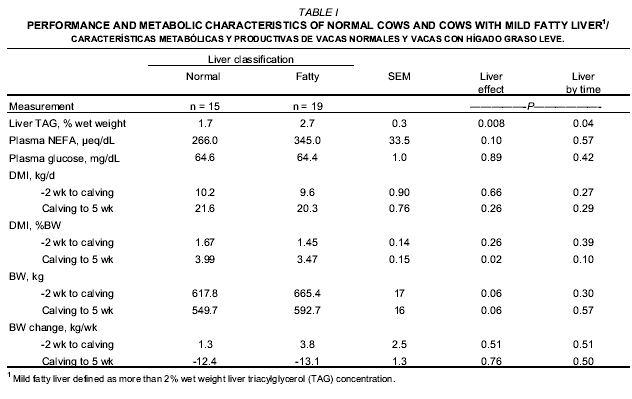
<body><![CDATA[<P ALIGN="justify"><FONT COLOR="000000" FACE="Verdana" SIZE="2">The repeated statement including d or week relative to calving but no random  statement was used in the program. Satterth option (performs a general  Satterhwaite approximation for the denominator degrees of freedom) was  included in the model statement. </FONT></P>      <P ALIGN="justify"><FONT COLOR="000000" FACE="Verdana" SIZE="2">For each analyzed variable, cow nested within treatment was subjected to  four covariance structures: compound symmetric, heterogeneous compound  symmetry, autoregressive order one, and unstructured variance components.  The covariance structure that yielded the better fit statistics criteria  was considered to be the most desirable analysis. Treatment differences  or treatment by time interactions were considered to be significant at  P &lt; 0.05, to have a tendency toward significant at P = 0.05 to P = 0.12,  and to be nonsignificant at P &gt; 0.12. When treatment by time interactions  were significant or tended to be significant, the slice option for LS MEANS  statement in PROC MIXED [26] was used to determine for which time period  means were different. Correlation analysis was performed to relate BC,  ROL, and AT status with body fat mobilization. Pearson correlation coefficients  were obtained using the PROC CORR procedure of SAS [26]. </FONT></P>      <P ALIGN="justify"><FONT COLOR="000000" FACE="Verdana" SIZE="2"><B>Results and Discussion</B> </FONT></P>      <P ALIGN="justify"><FONT COLOR="000000" FACE="Verdana" SIZE="2"><B>Mild fatty liver and feed intake</B> </FONT></P>      <P ALIGN="justify"><FONT COLOR="000000" FACE="Verdana" SIZE="2">The number of cows with more than 2% TAG (wet weight) at d two postcalving  was 19 among a cohort of 34 cows which gives a mild fatty liver prevalence  of 56%. Mean concentration of TAG in the liver was 2.7 and 1.7 for fatty  liver and non-fatty liver classifications (P = 0.008) (<a href="#t1">TABLE I</a>). The pattern  (interaction of liver condition by time from calving, P = 0.04) of liver  TAG concentration was different between the two groups of cows (<a href="#f1">FIG. 1</a>). At d 16 before calving, no differences in liver TAG concentration were  observed between groups, but liver TAG concentration markedLy increased  in the fatty liver group at d two and d 16 after calving. </FONT></P>     <P ALIGN="justify">&nbsp;</P>     <P ALIGN="justify"><a name="t1"></a></P>     <P ALIGN="center"><img border="0" src="/img/fbpe/rc/v20n4/art10t1.gif" width="632" height="399"></P>     
<P ALIGN="justify"><a name="f1"></a></P>     <P ALIGN="center"><img border="0" src="/img/fbpe/rc/v20n4/art10f1.gif" width="306" height="377"></P>      
]]></body>
<body><![CDATA[<P ALIGN="justify"><FONT COLOR="000000" FACE="Verdana" SIZE="2">In periparturient cows, Muylle et al. [20] defined mild fatty liver as  more than 2% liver TAG (wet basis). More recently, Bobe et al. [1] define  mild fatty liver as 1 to 5% liver TAG, elevated concentrations of urinary  ketones and decreased health status and reproductive performance. Although  liver TAG concentration at d 16 before calving was similar, cows that developed  fatty liver in this study had increased their liver TAG concentration by  125 and 98% by d two and 16 postpartum, respectively. The peak of liver  TAG was observed at d two after calving which has been described previously  [7, 9]. The persistence of fatty liver for the first two week of lactation  was similar to previous reports by some [9, 27] but not by others [8, 24]. </FONT></P>      <P ALIGN="justify"><FONT COLOR="000000" FACE="Verdana" SIZE="2">Plasma NEFA (P = 0.10) but not plasma glucose (P &gt; 0.12) concentrations  during the periparturient period tended to be greater for cows developing  fatty liver (<a href="#t1">TABLE I</a>). As previously described [20, 25], cows with fatty  liver tended to have greater plasma NEFA concentration than normal cows.  This means that cows with fatty liver had an increased rate of adipose  tissue lipolysis than normal cows, even though BW changes did not vary  between groups, before or after calving (<a href="#t1">TABLE I</a>). The results of this  study also showed that the plasma NEFA concentration was positively correlated  with the liver TAG concentration at d two (r = 0.65; P &lt; 0.001; not shown  on Tables). Plasma glucose concentration was not different between fatty  liver and non-fatty liver cows as previously reported [25]. </FONT></P>      <P ALIGN="justify"><FONT COLOR="000000" FACE="Verdana" SIZE="2">Mean dry matter intake (kg/d) was not affected by the fatty liver condition  as defined in this study during the peripartum period (-2 week to 5 week  related to calving). Cows with fatty liver tended to have greater mean  BW than cows with normal livers (P = 0.06) but no difference in body weight  change (BWC) was observed between cow groups from two week before calving  to five week of lactation (<a href="#t1">TABLE I</a>). Cows with mild fatty liver consumed  less DM as a percentage of BW than normal cows from calving to five week  of lactation (P = 0.02), but no difference between groups were observed  at week 1 and week 2 after calving (liver condition by week of lactation  interaction, P = 0.10) (<a href="#f2">FIG. 2</a>). As reviewed by Bobe et al. [1], no effects  of mild fatty liver on DMI had been observed previously. </FONT></P>     <P ALIGN="justify"><a name="f2"></a></P>     <P ALIGN="center"><img border="0" src="/img/fbpe/rc/v20n4/art10f2.gif" width="321" height="384"></P>      
<P ALIGN="justify"><FONT COLOR="000000" FACE="Verdana" SIZE="2"><B>Plasma vitamins status</B> </FONT></P>      <P ALIGN="justify"><FONT COLOR="000000" FACE="Verdana" SIZE="2">Because of decreased DMI as a %BW, increased liver TAG concentration, and  increased plasma NEFA concentration observed in cows defined as having  mild fatty liver, the changes in BC, ROL, and AT status could be associated  with increased body fat mobilization and fatty liver development. </FONT></P>      <P ALIGN="justify"><FONT COLOR="000000" FACE="Verdana" SIZE="2">Similar to previous reports [5, 16], plasma concentrations of BC were decreased at calving and continued decreasing slightly during the first four week  of lactation in both groups (<a href="#f3">FIG. 3</a>). However, plasma BC concentrations  were not different between groups of cows (P = 0.17) (<a href="#t2">TABLE II</a>). The effect  of lipid mobilization on plasma BC has been addressed before. Contrary  to the obtained results, Haraszti et al. [10] reported a marked elevation  of plasma NEFA (&gt; 0.60 mmol/L) with a simultaneous decrease of plasma total  carotene that exceeded 50% in cows between 30 to 45 d postpartum. </FONT></P>     <P ALIGN="justify"><a name="f3"></a></P>     <P ALIGN="center"><img border="0" src="/img/fbpe/rc/v20n4/art10f3.gif" width="310" height="323"></P>     
]]></body>
<body><![CDATA[<P ALIGN="center"><a name="t2"></a></P>     <P ALIGN="center"><img border="0" src="/img/fbpe/rc/v20n4/art10t2.gif" width="629" height="275"></P>      
<P ALIGN="justify"><FONT COLOR="000000" FACE="Verdana" SIZE="2">In the present study, plasma ROL concentrations increased slightly with  week of lactation (<a href="#f4">FIG. 4</a>) in both groups, but cows with mild fatty liver  tended to have lower plasma ROL (P = 0.10) (<a href="#t2">TABLE II</a>), as observed by others  [10, 11] in cows with severe fatty liver. Plasma ROL concentrations were  similar during the prepartum period but tended to be lower at week 0 and  week two related to calving for cows with fatty liver as compared to normal  cows (<a href="#f4">FIG. 4</a>). Mean plasma ROL concentrations observed in this study are  below concentrations (0.4 to 0.5 µg/mL) reported as typical when cows are  fed at least 50,000 IU of vitamin A/d [28]. However, plasma concentrations  of ROL are usually lower during the peripartum period [6, 16] as compared  with other stages of the cycle. Recently, values under 0.2 µg/mL have been  reported for periparturient Jersey cows fed 125,000 IU of supplemental  retinyl palmitate [5] and for periparturient cows from different commercial  herds [14]. Therefore, a poor relationship between intake of vitamin A  and plasma ROL concentrations is frequently observed as pointed out by  Weiss [28]. It has been suggested that the accumulation of TAG in the liver  may reduce the synthesis of retinol-binding protein [15] and plasma albumin  [18] which are both carriers for ROL from the liver to plasma. </FONT></P>     <P ALIGN="justify"><a name="f4"></a></P>     <P ALIGN="center"><img border="0" src="/img/fbpe/rc/v20n4/art10f4.gif" width="311" height="399"></P>      
<P ALIGN="justify"><FONT COLOR="000000" FACE="Verdana" SIZE="2">Mudron <I>et al.</I> [19] have reported that plasma AT concentrations decreased  in cows with mild fatty liver, but in the present study, plasma AT concentrations  were not different between groups of cows (P = 0.97) (<a href="#t3">TABLE II</a>). In both  groups, plasma AT concentrations increased with wk of lactation (<a href="#f5">FIG.&nbsp;5</a>)  as previously reported [6, 29]. </FONT></P>     <P ALIGN="justify"><a name="f5"></a></P>     <P ALIGN="center"><img border="0" src="/img/fbpe/rc/v20n4/art10f5.gif" width="316" height="399"></P>      
<P ALIGN="justify"><FONT COLOR="000000" FACE="Verdana" SIZE="2">Mean plasma AT concentrations (4.4 µg/mL) observed in this study were above  the critical concentrations of 3.0 to 3.5 µg/mL [29] or 2.0 µg/mL [13]  suggested for periparturient cows. </FONT></P>      <P ALIGN="justify"><FONT COLOR="000000" FACE="Verdana" SIZE="2"><B>Liver vitamins status</B> </FONT></P>      ]]></body>
<body><![CDATA[<P ALIGN="justify"><FONT COLOR="000000" FACE="Verdana" SIZE="2">No differences in mean liver BC and liver ROL between groups were observed  (<a href="#t2">TABLE II</a>). Liver BC (<a href="#f6">FIG. 6</a>) values decreased over time in both groups  of cows but the depression in liver BC at calving was more pronounced (68.0  vs. 8.0%, not shown in Tables) for normal than for fatty liver cows. At  d 2 postpartum, liver BC concentration was greater (P = 0.04) in cows with  fatty liver. Liver ROL concentrations (P = 0.10) tended to be greater in  cows with fatty liver at -16 and 2 d relative to calving but no differences  were observed at 16 and 30 d after calving (<a href="#f7">FIG. 7</a>). </FONT></P>     <P ALIGN="justify"><a name="f6"></a></P>     <P ALIGN="center"><img border="0" src="/img/fbpe/rc/v20n4/art10f6.gif" width="315" height="384"></P>     
<P ALIGN="center"><a name="f7"></a></P>     <P ALIGN="center"><img border="0" src="/img/fbpe/rc/v20n4/art10f7.gif" width="318" height="390"></P>      
<P ALIGN="justify"><FONT COLOR="000000" FACE="Verdana" SIZE="2">During the transition period, the ratio of liver ROL to liver BC was 174  and 165 for normal and fatty liver cows respectively, with results even  higher than values observed in steers deprived of dietary BC [17]. </FONT></P>      <P ALIGN="justify"><FONT COLOR="000000" FACE="Verdana" SIZE="2">Similar to findings reported by Mudron <I>et al. </I>[19] liver AT concentrations  were higher (P = 0.06) for cows with more than 2% liver TAG concentrations  (<a href="#t3">TABLE II</a>). At d -16 (P = 0.03) and d two (P = 0.04) related to calving,  liver AT concentrations were greater in cows with fatty liver but no differences  were observed at 16 and 30 d after calving. In normal cows, liver AT values  remains almost steady during the periparturient period (<a href="#f8">FIG. 8</a>). For both  groups of cows, liver stores were much higher for AT than for BC. </FONT></P>     <P ALIGN="justify"><a name="f8"></a></P>     <P ALIGN="center"><img border="0" src="/img/fbpe/rc/v20n4/art10f8.gif" width="311" height="388"></P>      
<P ALIGN="justify"><FONT COLOR="000000" FACE="Verdana" SIZE="2"><B>Dynamics of vitamins status and body fat mobilization</B> </FONT></P>      ]]></body>
<body><![CDATA[<P ALIGN="justify"><FONT COLOR="000000" FACE="Verdana" SIZE="2">Plasma BC concentrations were related positively whereas both plasma ROL  and plasma AT were related negatively to BW (P &lt; 0.0001). Dry matter intake  as a percentage of BW was highly and negatively related to plasma BC concentration  but positively related to plasma ROL and plasma AT concentrations (P &lt;  0.0001). A low but significant positive correlation between plasma NEFA  and plasma BC concentrations (r = 0.18; P &lt; 0.05) was detected in the present  study. Both plasma ROL (r = -0.36) and plasma AT (r = -0.35) concentrations  were related negatively to plasma NEFA concentration (P &lt; 0.0001) (<a href="#f3">TABLE III</a>). </FONT></P>     <P ALIGN="justify"><a name="t3"></a></P>     <P ALIGN="center"><img border="0" src="/img/fbpe/rc/v20n4/art10t3.gif" width="311" height="278"></P>      
<P ALIGN="justify"><FONT COLOR="000000" FACE="Verdana" SIZE="2">Contrary to the obtained results, Haraszti et al [10] reported a negative  correlation (r = -0.388 to -0.503) between plasma NEFA and plasma total  carotene in cows at -5 to 10 d from calving. However, the correlation found  between ROL and plasma NEFA in the present study was similar to Haraszti  et al [10] whom reported a negative correlation (r = -0.360 to -0.430)  between plasma NEFA and plasma vitamin A in cows at 0 to 45 d from calving. Similarly, at one week before calving, LeBlanc et al [14] found an inverse  and significant association of plasma NEFA concentrations with serum ROL  but not with serum BC concentrations. An increment of 100 µeq/dL in plasma  NEFA would be expected to decrease ROL by 60 ng/mL. </FONT></P>      <P ALIGN="justify"><FONT COLOR="000000" FACE="Verdana" SIZE="2">In the present study, plasma BC concentrations seems to be closely related  to degree of body fat mobilization as evidenced by a low but positive correlation  between NEFA and plasma BC concentrations. Plasma concentrations of BC  are related to forage intake, but no effect of feeding level (high vs.  low energy intake) was recently observed on plasma BC concentrations of  cows at mid lactation [22]. The negative correlation found between DMI,  as percentage of BW, and plasma BC concentrations means that cows with  lower DMI during the transition period have higher plasma BC concentrations. </FONT></P>      <P ALIGN="justify"><FONT COLOR="000000" FACE="Verdana" SIZE="2">A positive direct relationship between feed intake and plasma status of  vitamins was found only for ROL (r = 0.55; P &lt; 0.0001) and AT (0.46; (P  &lt; 0.0001), which suggests that stores of ROL or AT are less labile than  stores for BC. For cows at mid lactation, the contribution of adipose BC  pool to plasma BC was very small [22]. Based on present data and assuming  a liver weight of 6 kg, the contribution of mobilized liver BC to plasma  ROL (1 mg BC = 120 µg ROL) would be 1044 µg for normal vs. 115 µg for fatty  liver cows, at calving. </FONT></P>      <p align="justify"><FONT COLOR="000000" FACE="Verdana" SIZE="2">The regulatory mechanisms of the liver in maintaining plasma ROL concentrations,  particularly in dairy cows during the transition period are unknown. The  lower liver BC and greater plasma ROL concentrations observed in this study  for normal cows at calving suggests that stored ROL in liver first forces  available BC stores to be converted into ROL, thus decreasing the BC concentration  but not the ROL concentration in liver. However, these coordinated changes  might not operate for cows with fatty liver. </FONT></p>      <P ALIGN="justify"><FONT COLOR="000000" FACE="Verdana" SIZE="2">There was a substantial variation in correlation coefficients among liver  nutrients at each time from calving; therefore, a correlation coefficient  for each time from calving was computed. Liver BC and liver ROL concentrations  had a positive and significant correlation at d 30 (0.53; P &lt; 0.05) but  not at other times (P &gt; 0.12) (<a href="#t4">TABLE IV</a>) which suggests that the relationship  between liver stores of BC and ROL appeared only after liver TAG infiltration  declined (approximately 4 wk after calving).<B> </B>Positives correlations (range:  0.170 to 0.499) between liver total carotenes and liver vitamin A have  been found in Hereford calves [3]. </FONT></P>      <P ALIGN="justify"><FONT COLOR="000000" FACE="Verdana" SIZE="2">At d two from calving only, a positive correlation between liver BC and  liver AT was found (P &lt; 0.01) whereas no association between liver AT and  liver ROL concentrations was observed (P &gt; 0.12) at any time (<a href="#t4">TABLE IV</a>). </FONT></P>     <P ALIGN="justify"><a name="t4"></a></P>     ]]></body>
<body><![CDATA[<P ALIGN="center"><img border="0" src="/img/fbpe/rc/v20n4/art10t4.gif" width="537" height="238"></P>      
<P ALIGN="justify"><FONT COLOR="000000" FACE="Verdana" SIZE="2">At all times after calving, liver BC concentrations were positively (P &lt; 0.12) associated with liver TAG concentrations but, liver ROL concentrations  were not associated with liver TAG concentrations (<a href="#t4">TABLE IV</a>). An association  between liver AT and liver TAG concentrations was observed (0.43; <I>P</I> &lt; 0.05)  at d 30 from calving, only (<a href="#t4">TABLE IV</a>). </FONT></P>      <P ALIGN="justify"><FONT COLOR="000000" FACE="Verdana" SIZE="2">No information on the relationship among liver BC, liver ROL and liver  TAG was found in the literature and only one study has reported the relationships  between liver AT and liver TAG [19]. The findings of the present study  suggest that liver BC concentrations are related to liver TGA infiltration  and fatty liver development. </FONT></P>      <P ALIGN="justify"><FONT COLOR="000000" FACE="Verdana" SIZE="2"><B>Conclusions E IMPLICATIONS</B> </FONT></P>      <P ALIGN="justify"><FONT COLOR="000000" FACE="Verdana" SIZE="2">During the transition from the nonlactating to the lactating state in the  dairy cow, changes in b-carotene (BC) and vitamins A and E status occur.  Late prepartum and early postpartum Holstein cows received a corn silage  and alfalfa hay based diets. Changes in BC and vitamins A and E status  in cows were associated with increased body fat mobilization and fatty  liver development. Both plasma vitamins A and E had positives relationships  with feed intake, which suggests that stores of these vitamins are less  labile than stores for BC. Less liver BC was mobilized in cows with mild  fatty liver at calving. </FONT></P>      <P ALIGN="justify"><FONT COLOR="000000" FACE="Verdana" SIZE="2">The changes in BC, ROL, and AT status in periparturient dairy cows were  associated with increased body fat mobilization and fatty liver development. Plasma and liver BC would be expected to increase whereas both plasma ROL  and AT would decrease with lipolysis. Both plasma ROL and AT had positives  relationships with feed intake, which suggests that stores of ROL or AT  are less labile than stores for BC. </FONT></P>      <P ALIGN="justify"><FONT COLOR="000000" FACE="Verdana" SIZE="2">The lower liver BC and greater plasma ROL concentrations found in this  study for normal cows at calving suggest that stored ROL in liver first  forces available BC stores to be converted into ROL, thus decreasing the  BC concentration in liver without decreasing ROL concentration in liver. However, these coordinated changes might not operate for cows with fatty  liver because less liver BC was mobilized in cows with mild fatty liver  at calving. More information on the mechanisms of the liver for controlling  homeostasis of plasma ROL is needed, particularly in dairy cows during  the transition period. </FONT></P>      <P ALIGN="justify"><FONT COLOR="000000" FACE="Verdana" SIZE="2"><B>ACKNOWLEDGMENT</B> </FONT></P>      <P ALIGN="justify"><FONT COLOR="000000" FACE="Verdana" SIZE="2">This research was supported by the Florida Agricultural Experiment Station  and a grant from DSM Vitamins Inc., Parsippany, NJ. Additional support  provided by the Florida Dairy Checkoff. </FONT></P>      <P ALIGN="justify"><FONT COLOR="000000" FACE="Verdana" SIZE="2"><B>Bibliographic references</B> </FONT></P>      ]]></body>
<body><![CDATA[<!-- ref --><P ALIGN="justify"><FONT COLOR="000000" SIZE="2" FACE="Verdana"> 1. BOBE, G.; YOUNG, J.; BEITZ, D. Pathology, etiology, prevention, and treatment  of fatty liver in dairy cows. <B>J. Dairy Sci.</B> 87:3105-3124. 2004. </FONT>&nbsp;&nbsp;&nbsp;&nbsp;&nbsp;&nbsp;&nbsp;&nbsp;[&#160;<a href="javascript:void(0);" onclick="javascript: window.open('/scielo.php?script=sci_nlinks&ref=1642891&pid=S0798-2259201000040001000001&lng=','','width=640,height=500,resizable=yes,scrollbars=1,menubar=yes,');">Links</a>&#160;]<!-- end-ref --><!-- ref --><P ALIGN="justify"><FONT COLOR="000000" SIZE="2" FACE="Verdana"> 2. BROCAS, C.; RIVERA, R.; PAULA-LOPEZ, F.; MCDOWELL, L.; CALHOUN, M.; STAPLES,  C.; WILKINSON, N.; BONING, A.; CHENOWETH, P.; HANSEN, P. Deleterious actions  of gossypol on bovine spermatozoa, oocytes, and embryos. <B>Biol. Reprod.</B> 57:901-907. 1997. </FONT>&nbsp;&nbsp;&nbsp;&nbsp;&nbsp;&nbsp;&nbsp;&nbsp;[&#160;<a href="javascript:void(0);" onclick="javascript: window.open('/scielo.php?script=sci_nlinks&ref=1642892&pid=S0798-2259201000040001000002&lng=','','width=640,height=500,resizable=yes,scrollbars=1,menubar=yes,');">Links</a>&#160;]<!-- end-ref --><!-- ref --><P ALIGN="justify"><FONT COLOR="000000" SIZE="2" FACE="Verdana"> 3. DIVEN, R.; PAHNISH, O.; ROUBICEK, C.; ERWIN, E.; PAGE, H. Vitamin A and  carotenoid inter-relationships in bovine plasma and liver. <B>J. Dairy Sci.</B>  43:1632-1638. 1960. </FONT>&nbsp;&nbsp;&nbsp;&nbsp;&nbsp;&nbsp;&nbsp;&nbsp;[&#160;<a href="javascript:void(0);" onclick="javascript: window.open('/scielo.php?script=sci_nlinks&ref=1642893&pid=S0798-2259201000040001000003&lng=','','width=640,height=500,resizable=yes,scrollbars=1,menubar=yes,');">Links</a>&#160;]<!-- end-ref --><!-- ref --><P ALIGN="justify"><FONT COLOR="000000" SIZE="2" FACE="Verdana"> 4. GOCHMAN, N.; SCHMITZ, J. Application of a new peroxide indicator reaction  to the specific automated determination of glucose with glucose oxidase. <B>Clin. Chem.</B> 18:943-950. 1972. </FONT>&nbsp;&nbsp;&nbsp;&nbsp;&nbsp;&nbsp;&nbsp;&nbsp;[&#160;<a href="javascript:void(0);" onclick="javascript: window.open('/scielo.php?script=sci_nlinks&ref=1642894&pid=S0798-2259201000040001000004&lng=','','width=640,height=500,resizable=yes,scrollbars=1,menubar=yes,');">Links</a>&#160;]<!-- end-ref --><P ALIGN="justify"><FONT COLOR="000000" SIZE="2" FACE="Verdana"> 5. GOFF, J.; KIMURA, K.; HORST, R. Effect of mastectomy on milk fever, energy,  and vitamins A, E, and b–carotene status at parturition. <B>J. Dairy Sci.</B> 85: 1427-1436. 2002. </FONT></P>      <!-- ref --><P ALIGN="justify"><FONT COLOR="000000" SIZE="2" FACE="Verdana"> 6. GOFF, J.; STABEL, J. Decreased plasma retinol, a-tocopherol, and zinc concentration  during the periparturien period: Effect of Milk fever. <B>J. Dairy Sci.</B> 73:3195-3199.  1990. </FONT>&nbsp;&nbsp;&nbsp;&nbsp;&nbsp;&nbsp;&nbsp;&nbsp;[&#160;<a href="javascript:void(0);" onclick="javascript: window.open('/scielo.php?script=sci_nlinks&ref=1642896&pid=S0798-2259201000040001000006&lng=','','width=640,height=500,resizable=yes,scrollbars=1,menubar=yes,');">Links</a>&#160;]<!-- end-ref --><!-- ref --><P ALIGN="justify"><FONT COLOR="000000" SIZE="2" FACE="Verdana"> 7. GREENFIELD, R.; CECAVA, M.; DONKIN, S. Changes in mRNA expression for gluconeogenic  enzymes in liver of dairy cattle during the transition to lactation. <B>J.  Dairy Sci.</B> 83:1228-1236. 2000. </FONT>&nbsp;&nbsp;&nbsp;&nbsp;&nbsp;&nbsp;&nbsp;&nbsp;[&#160;<a href="javascript:void(0);" onclick="javascript: window.open('/scielo.php?script=sci_nlinks&ref=1642897&pid=S0798-2259201000040001000007&lng=','','width=640,height=500,resizable=yes,scrollbars=1,menubar=yes,');">Links</a>&#160;]<!-- end-ref --><!-- ref --><P ALIGN="justify"><FONT COLOR="000000" SIZE="2" FACE="Verdana"> 8. GRUM, D.; DRACKLEY, J.; HANSEN, L.; CREMIN, JR.; J. Production, digestion,  and hepatic lipid metabolism of dairy cows fed increased energy from fat  or concentrate. <B>J. Dairy Sci. </B>79:1836-1849. 1996. </FONT>&nbsp;&nbsp;&nbsp;&nbsp;&nbsp;&nbsp;&nbsp;&nbsp;[&#160;<a href="javascript:void(0);" onclick="javascript: window.open('/scielo.php?script=sci_nlinks&ref=1642898&pid=S0798-2259201000040001000008&lng=','','width=640,height=500,resizable=yes,scrollbars=1,menubar=yes,');">Links</a>&#160;]<!-- end-ref --><!-- ref --><P ALIGN="justify"><FONT COLOR="000000" SIZE="2" FACE="Verdana"> 9. Grummer, R. R.; Bertics, S. J.; Hackbart, R. A. Short communication: Effects  of prepartum milking on dry matter intake, liver triglyceride, and plasma  constituents. <B>J. Dairy Sci.</B> 83:60-61. 2000.</FONT>&nbsp;&nbsp;&nbsp;&nbsp;&nbsp;&nbsp;&nbsp;&nbsp;[&#160;<a href="javascript:void(0);" onclick="javascript: window.open('/scielo.php?script=sci_nlinks&ref=1642899&pid=S0798-2259201000040001000009&lng=','','width=640,height=500,resizable=yes,scrollbars=1,menubar=yes,');">Links</a>&#160;]<!-- end-ref --><!-- ref --><P ALIGN="justify"><FONT COLOR="000000" SIZE="2" FACE="Verdana"> 10. Haraszti, J.; Huszenicza, g.; Molnár, l.; Blaskovits, a. Effect of periparturient  lipid mobilization on serum total carotene and vitamin A concentrations  in cattle. <B>Acta Vet. Hungar.</B> 32:193-203. 1984. </FONT>&nbsp;&nbsp;&nbsp;&nbsp;&nbsp;&nbsp;&nbsp;&nbsp;[&#160;<a href="javascript:void(0);" onclick="javascript: window.open('/scielo.php?script=sci_nlinks&ref=1642900&pid=S0798-2259201000040001000010&lng=','','width=640,height=500,resizable=yes,scrollbars=1,menubar=yes,');">Links</a>&#160;]<!-- end-ref --><!-- ref --><P ALIGN="justify"><FONT COLOR="000000" SIZE="2" FACE="Verdana"> 11. Hidiroglou, M.; Hartin, k. e. Vitamins A, E and selenium blood levels in  the fat cow syndrome. <B>Can. Vet. J. </B>23: 255-258. 1982. </FONT>&nbsp;&nbsp;&nbsp;&nbsp;&nbsp;&nbsp;&nbsp;&nbsp;[&#160;<a href="javascript:void(0);" onclick="javascript: window.open('/scielo.php?script=sci_nlinks&ref=1642901&pid=S0798-2259201000040001000011&lng=','','width=640,height=500,resizable=yes,scrollbars=1,menubar=yes,');">Links</a>&#160;]<!-- end-ref --><!-- ref --><P ALIGN="justify"><FONT COLOR="000000" SIZE="2" FACE="Verdana"> 12. Johnson, M. M.; Peters, J. P. Technical note: an improved method to quantify  nonesterified fatty acids in bovine plasma. <B>J. Anim. Sci.</B> 71:753-756. 1993. </FONT>&nbsp;&nbsp;&nbsp;&nbsp;&nbsp;&nbsp;&nbsp;&nbsp;[&#160;<a href="javascript:void(0);" onclick="javascript: window.open('/scielo.php?script=sci_nlinks&ref=1642902&pid=S0798-2259201000040001000012&lng=','','width=640,height=500,resizable=yes,scrollbars=1,menubar=yes,');">Links</a>&#160;]<!-- end-ref --><!-- ref --><P ALIGN="justify"><FONT COLOR="000000" SIZE="2" FACE="Verdana"> 13. LeBlanc, S. J.; Duffield, T. F.; Leslie, K. E.; Bateman, K. G.; TenHag,  J.; Walton, J. S.; Johnson, W. H. The effect of prepartum injection of  vitamin E on health in transition dairy cows. <B>J. Dairy Sci.</B> 85:1416-1426.  2002. </FONT>&nbsp;&nbsp;&nbsp;&nbsp;&nbsp;&nbsp;&nbsp;&nbsp;[&#160;<a href="javascript:void(0);" onclick="javascript: window.open('/scielo.php?script=sci_nlinks&ref=1642903&pid=S0798-2259201000040001000013&lng=','','width=640,height=500,resizable=yes,scrollbars=1,menubar=yes,');">Links</a>&#160;]<!-- end-ref --><!-- ref --><P ALIGN="justify"><FONT COLOR="000000" SIZE="2" FACE="Verdana"> 14. LeBlanc, S. J.; Herdt, T. H.; Seymour, W. M.; Duffield, T. F.; Leslie,  K. E. Peripartum serum vitamin E, retinol, and beta-carotene in dairy cattle  and their associations with disease. <B>J. Dairy Sci.</B> 87:609-619. 2004. </FONT>&nbsp;&nbsp;&nbsp;&nbsp;&nbsp;&nbsp;&nbsp;&nbsp;[&#160;<a href="javascript:void(0);" onclick="javascript: window.open('/scielo.php?script=sci_nlinks&ref=1642904&pid=S0798-2259201000040001000014&lng=','','width=640,height=500,resizable=yes,scrollbars=1,menubar=yes,');">Links</a>&#160;]<!-- end-ref --><!-- ref --><P ALIGN="justify"><FONT COLOR="000000" SIZE="2" FACE="Verdana"> 15. Lindberg, L. A.; Sinkkonen, H.; Poso, A. R.; Tesfa, A. T.; Schroder, J.  Production of monoclonal antibodies and enzyme immunoassay (EIA) to bovine  retinol-binding protein (RBP) and determination of RBP serum levels and  retinol concentrations in serum and liver in dairy cows before and after  parturition. <B>Res. Vet. Sci.</B> 68:169-173. 1999. </FONT>&nbsp;&nbsp;&nbsp;&nbsp;&nbsp;&nbsp;&nbsp;&nbsp;[&#160;<a href="javascript:void(0);" onclick="javascript: window.open('/scielo.php?script=sci_nlinks&ref=1642905&pid=S0798-2259201000040001000015&lng=','','width=640,height=500,resizable=yes,scrollbars=1,menubar=yes,');">Links</a>&#160;]<!-- end-ref --><P ALIGN="justify"><FONT COLOR="000000" SIZE="2" FACE="Verdana"> 16. Michal, J. J.; Heirman, L. R.; Wong, T. S.; Chew, B. P.; Frigg, M.; VolkER,<I>  </I>L. Modulatory effects of dietary b-carotene on blood and mammary leukocyte  function in periparturient dairy cows. <B>J. Dairy Sci.</B> 77:1408-1421. 1994. </FONT></P>      <!-- ref --><P ALIGN="justify"><FONT COLOR="000000" SIZE="2" FACE="Verdana"> 17. Mora, O.; Romano, J. L.; González, E.; Ruiz, F. J.; Gómez, R.; Shimada. A<I>.</I> Presence of fed â-carotene in digesta, excreta, blood, and hepatic and  adipose tissues of Holstein steers. <B>Can. J. Anim. Sci.</B> 81:133-139. 2001. </FONT>&nbsp;&nbsp;&nbsp;&nbsp;&nbsp;&nbsp;&nbsp;&nbsp;[&#160;<a href="javascript:void(0);" onclick="javascript: window.open('/scielo.php?script=sci_nlinks&ref=1642907&pid=S0798-2259201000040001000017&lng=','','width=640,height=500,resizable=yes,scrollbars=1,menubar=yes,');">Links</a>&#160;]<!-- end-ref --><!-- ref --><P ALIGN="justify"><FONT COLOR="000000" SIZE="2" FACE="Verdana"> 18. Mudron, P.; Rehage, J.; Qualmann, K.; Sallmann, H. P.; Scholz, H. A study  of lipid peroxidation and vitamin E in dairy cows with hepatic insufficiency. <B>J. Vet. Med. A</B> 46: 219-224. 1999. </FONT>&nbsp;&nbsp;&nbsp;&nbsp;&nbsp;&nbsp;&nbsp;&nbsp;[&#160;<a href="javascript:void(0);" onclick="javascript: window.open('/scielo.php?script=sci_nlinks&ref=1642908&pid=S0798-2259201000040001000018&lng=','','width=640,height=500,resizable=yes,scrollbars=1,menubar=yes,');">Links</a>&#160;]<!-- end-ref --><!-- ref --><P ALIGN="justify"><FONT COLOR="000000" SIZE="2" FACE="Verdana"> 19. Mudron, P.; Rehage, J.; Sallmann, H. P.; Mertens, M.; Scholz, H.; Kovac,  G. Plasma and liver a-tocopherol in dairy cows with left abomasal displacement  and fatty liver. <B>J. Vet. Med. A.</B> 44: 91-97. 1997. </FONT>&nbsp;&nbsp;&nbsp;&nbsp;&nbsp;&nbsp;&nbsp;&nbsp;[&#160;<a href="javascript:void(0);" onclick="javascript: window.open('/scielo.php?script=sci_nlinks&ref=1642909&pid=S0798-2259201000040001000019&lng=','','width=640,height=500,resizable=yes,scrollbars=1,menubar=yes,');">Links</a>&#160;]<!-- end-ref --><!-- ref --><P ALIGN="justify"><FONT COLOR="000000" SIZE="2" FACE="Verdana"> 20. Muylle, E.; Van den Hende, C.; Sustronck, B.; Deprez, P. Biochemical profiles  in cows with abomasal displacement estimated by blood and liver parameters. <B>J. Vet. Med. A. </B>37: 259-263. 1990. </FONT>&nbsp;&nbsp;&nbsp;&nbsp;&nbsp;&nbsp;&nbsp;&nbsp;[&#160;<a href="javascript:void(0);" onclick="javascript: window.open('/scielo.php?script=sci_nlinks&ref=1642910&pid=S0798-2259201000040001000020&lng=','','width=640,height=500,resizable=yes,scrollbars=1,menubar=yes,');">Links</a>&#160;]<!-- end-ref --><!-- ref --><P ALIGN="justify"><FONT COLOR="000000" SIZE="2" FACE="Verdana"> 21. Njeru, C. A.; McDowell, L. R.; Shireman, R. M.; Wilkinson, N. S.; Rojas,  L. X.; Williams, S. N. Assessment of vitamin E nutritional status in yearling  beef heifers. <B>J. Anim. Sci.</B> 73:1440-1448. 1995.</FONT>&nbsp;&nbsp;&nbsp;&nbsp;&nbsp;&nbsp;&nbsp;&nbsp;[&#160;<a href="javascript:void(0);" onclick="javascript: window.open('/scielo.php?script=sci_nlinks&ref=1642911&pid=S0798-2259201000040001000021&lng=','','width=640,height=500,resizable=yes,scrollbars=1,menubar=yes,');">Links</a>&#160;]<!-- end-ref --><!-- ref --><P ALIGN="justify"><FONT COLOR="000000" SIZE="2" FACE="Verdana"> 22. Nozière, P.; Grolier, P.; Durand, D.; Ferlay, A.; Pradel, P.; Martin, B. Variations in carotenoids, fat-soluble micronutrients, and color in cows’  plasma and milk following changes in forage and feeding level. <B>J. Dairy  Sci.</B> 89:2634-2648. 2006. </FONT>&nbsp;&nbsp;&nbsp;&nbsp;&nbsp;&nbsp;&nbsp;&nbsp;[&#160;<a href="javascript:void(0);" onclick="javascript: window.open('/scielo.php?script=sci_nlinks&ref=1642912&pid=S0798-2259201000040001000022&lng=','','width=640,height=500,resizable=yes,scrollbars=1,menubar=yes,');">Links</a>&#160;]<!-- end-ref --><!-- ref --><P ALIGN="justify"><FONT COLOR="000000" SIZE="2" FACE="Verdana"> 23. Rosendo, O.; McDowell, L. R. Liver dry matter and liver lipids in periparturient  dairy cows. <B>Acta Vet. Brno.</B> 72: 541-546. 2003. </FONT>&nbsp;&nbsp;&nbsp;&nbsp;&nbsp;&nbsp;&nbsp;&nbsp;[&#160;<a href="javascript:void(0);" onclick="javascript: window.open('/scielo.php?script=sci_nlinks&ref=1642913&pid=S0798-2259201000040001000023&lng=','','width=640,height=500,resizable=yes,scrollbars=1,menubar=yes,');">Links</a>&#160;]<!-- end-ref --><!-- ref --><P ALIGN="justify"><FONT COLOR="000000" SIZE="2" FACE="Verdana"> 24. Rukkwamsuk, T.; Wensing, T.; Geelen, M. J. H. Effect of fatty liver on  hepatic gluconeogenesis in periparturient dairy cows. <B>J. Dairy Sci.</B> 82:500-505.  1999a. </FONT>&nbsp;&nbsp;&nbsp;&nbsp;&nbsp;&nbsp;&nbsp;&nbsp;[&#160;<a href="javascript:void(0);" onclick="javascript: window.open('/scielo.php?script=sci_nlinks&ref=1642914&pid=S0798-2259201000040001000024&lng=','','width=640,height=500,resizable=yes,scrollbars=1,menubar=yes,');">Links</a>&#160;]<!-- end-ref --><!-- ref --><P ALIGN="justify"><FONT COLOR="000000" SIZE="2" FACE="Verdana"> 25. Rukkwamsuk, T.; Wensing, T.; Kruip, T. A. M. Relationship between triacylglycerol  concentration in the liver and first ovulation in postpartum dairy cows. <B>Theriogenol.</B> 51: 1133-1142. 1999b. </FONT>&nbsp;&nbsp;&nbsp;&nbsp;&nbsp;&nbsp;&nbsp;&nbsp;[&#160;<a href="javascript:void(0);" onclick="javascript: window.open('/scielo.php?script=sci_nlinks&ref=1642915&pid=S0798-2259201000040001000025&lng=','','width=640,height=500,resizable=yes,scrollbars=1,menubar=yes,');">Links</a>&#160;]<!-- end-ref --><P ALIGN="justify"><FONT COLOR="000000" SIZE="2" FACE="Verdana"> 26. STATISTICAL ANALYSIS SYSTEM INSTITUTE (SAS).<B> </B>Software Statistics, Version  8.2 Edition. Cary, NC. 2001. </FONT></P>      <!-- ref --><P ALIGN="justify"><FONT COLOR="000000" SIZE="2" FACE="Verdana"> 27. Shaw, J. C. Studies on ketosis in dairy cattle. The effect of a vitamin  A deficiency. <B>J. Dairy Sci.</B> 33:486-495. 1950. </FONT>&nbsp;&nbsp;&nbsp;&nbsp;&nbsp;&nbsp;&nbsp;&nbsp;[&#160;<a href="javascript:void(0);" onclick="javascript: window.open('/scielo.php?script=sci_nlinks&ref=1642917&pid=S0798-2259201000040001000026&lng=','','width=640,height=500,resizable=yes,scrollbars=1,menubar=yes,');">Links</a>&#160;]<!-- end-ref --><!-- ref --><P ALIGN="justify"><FONT COLOR="000000" SIZE="2" FACE="Verdana"> 28. Weiss, W. P. Requirements of fat-soluble vitamins for dairy cows: A review. <B>J. Dairy Sci.</B> 81:2493-2501. 1998. </FONT>&nbsp;&nbsp;&nbsp;&nbsp;&nbsp;&nbsp;&nbsp;&nbsp;[&#160;<a href="javascript:void(0);" onclick="javascript: window.open('/scielo.php?script=sci_nlinks&ref=1642918&pid=S0798-2259201000040001000027&lng=','','width=640,height=500,resizable=yes,scrollbars=1,menubar=yes,');">Links</a>&#160;]<!-- end-ref --><!-- ref --><P ALIGN="justify"><FONT COLOR="000000" SIZE="2" FACE="Verdana"> 29. Weiss, W. P.; Todhunter, D. A.; Hogan, J. S.; Smith, K. L. Effect of duration  of supplementation of selenium and vitamin E on periparturient dairy cows. <B>J. Dairy Sci.</B> 73:3187-3194. 1990.</FONT>&nbsp;&nbsp;&nbsp;&nbsp;&nbsp;&nbsp;&nbsp;&nbsp;[&#160;<a href="javascript:void(0);" onclick="javascript: window.open('/scielo.php?script=sci_nlinks&ref=1642919&pid=S0798-2259201000040001000028&lng=','','width=640,height=500,resizable=yes,scrollbars=1,menubar=yes,');">Links</a>&#160;]<!-- end-ref --> ]]></body>
<back>
<ref-list>
<ref id="B1">
<label>1</label><nlm-citation citation-type="journal">
<person-group person-group-type="author">
<name>
<surname><![CDATA[BOBE]]></surname>
<given-names><![CDATA[G]]></given-names>
</name>
<name>
<surname><![CDATA[YOUNG]]></surname>
<given-names><![CDATA[J]]></given-names>
</name>
<name>
<surname><![CDATA[BEITZ]]></surname>
<given-names><![CDATA[D.]]></given-names>
</name>
</person-group>
<article-title xml:lang="en"><![CDATA[Pathology, etiology, prevention, and treatment of fatty liver in dairy cows]]></article-title>
<source><![CDATA[J. Dairy Sci.]]></source>
<year>2004</year>
<volume>87</volume>
<page-range>3105-3124</page-range></nlm-citation>
</ref>
<ref id="B2">
<label>2</label><nlm-citation citation-type="journal">
<person-group person-group-type="author">
<name>
<surname><![CDATA[BROCAS]]></surname>
<given-names><![CDATA[C]]></given-names>
</name>
<name>
<surname><![CDATA[RIVERA]]></surname>
<given-names><![CDATA[R]]></given-names>
</name>
<name>
<surname><![CDATA[PAULA-LOPEZ]]></surname>
<given-names><![CDATA[F]]></given-names>
</name>
<name>
<surname><![CDATA[MCDOWELL]]></surname>
<given-names><![CDATA[L]]></given-names>
</name>
<name>
<surname><![CDATA[CALHOUN]]></surname>
<given-names><![CDATA[M]]></given-names>
</name>
<name>
<surname><![CDATA[STAPLES]]></surname>
<given-names><![CDATA[C]]></given-names>
</name>
<name>
<surname><![CDATA[WILKINSON]]></surname>
<given-names><![CDATA[N]]></given-names>
</name>
<name>
<surname><![CDATA[BONING]]></surname>
<given-names><![CDATA[A]]></given-names>
</name>
<name>
<surname><![CDATA[CHENOWETH]]></surname>
<given-names><![CDATA[P]]></given-names>
</name>
<name>
<surname><![CDATA[HANSEN]]></surname>
<given-names><![CDATA[P.]]></given-names>
</name>
</person-group>
<article-title xml:lang="en"><![CDATA[Deleterious actions of gossypol on bovine spermatozoa, oocytes, and embryos]]></article-title>
<source><![CDATA[Biol. Reprod.]]></source>
<year>1997</year>
<volume>57</volume>
<page-range>901-907</page-range></nlm-citation>
</ref>
<ref id="B3">
<label>3</label><nlm-citation citation-type="journal">
<person-group person-group-type="author">
<name>
<surname><![CDATA[DIVEN]]></surname>
<given-names><![CDATA[R]]></given-names>
</name>
<name>
<surname><![CDATA[PAHNISH]]></surname>
<given-names><![CDATA[O]]></given-names>
</name>
<name>
<surname><![CDATA[ROUBICEK]]></surname>
<given-names><![CDATA[C]]></given-names>
</name>
<name>
<surname><![CDATA[ERWIN]]></surname>
<given-names><![CDATA[E]]></given-names>
</name>
<name>
<surname><![CDATA[PAGE]]></surname>
<given-names><![CDATA[H.]]></given-names>
</name>
</person-group>
<article-title xml:lang="en"><![CDATA[Vitamin A and carotenoid inter-relationships in bovine plasma and liver]]></article-title>
<source><![CDATA[J. Dairy Sci.]]></source>
<year>1960</year>
<volume>43</volume>
<page-range>1632-1638</page-range></nlm-citation>
</ref>
<ref id="B4">
<label>4</label><nlm-citation citation-type="journal">
<person-group person-group-type="author">
<name>
<surname><![CDATA[GOCHMAN]]></surname>
<given-names><![CDATA[N]]></given-names>
</name>
<name>
<surname><![CDATA[SCHMITZ]]></surname>
<given-names><![CDATA[J.]]></given-names>
</name>
</person-group>
<article-title xml:lang="en"><![CDATA[Application of a new peroxide indicator reaction to the specific automated determination of glucose with glucose oxidase]]></article-title>
<source><![CDATA[Clin. Chem.]]></source>
<year>1972</year>
<volume>18</volume>
<page-range>943-950</page-range></nlm-citation>
</ref>
<ref id="B5">
<label>5</label><nlm-citation citation-type="journal">
<person-group person-group-type="author">
<name>
<surname><![CDATA[GOFF]]></surname>
<given-names><![CDATA[J]]></given-names>
</name>
<name>
<surname><![CDATA[KIMURA]]></surname>
<given-names><![CDATA[K]]></given-names>
</name>
<name>
<surname><![CDATA[HORST]]></surname>
<given-names><![CDATA[R.]]></given-names>
</name>
</person-group>
<article-title xml:lang="en"><![CDATA[Effect of mastectomy on milk fever, energy, and vitamins A, E, and &#946;-carotene status at parturition]]></article-title>
<source><![CDATA[J. Dairy Sci.]]></source>
<year>2002</year>
<volume>85</volume>
<page-range>1427-1436</page-range></nlm-citation>
</ref>
<ref id="B6">
<label>6</label><nlm-citation citation-type="journal">
<person-group person-group-type="author">
<name>
<surname><![CDATA[GOFF]]></surname>
<given-names><![CDATA[J]]></given-names>
</name>
<name>
<surname><![CDATA[STABEL]]></surname>
<given-names><![CDATA[J.]]></given-names>
</name>
</person-group>
<article-title xml:lang="en"><![CDATA[Decreased plasma retinol, a-tocopherol, and zinc concentration during the periparturien period: Effect of Milk fever]]></article-title>
<source><![CDATA[J. Dairy Sci.]]></source>
<year>1990</year>
<volume>73</volume>
<page-range>3195-3199</page-range></nlm-citation>
</ref>
<ref id="B7">
<label>7</label><nlm-citation citation-type="journal">
<person-group person-group-type="author">
<name>
<surname><![CDATA[GREENFIELD]]></surname>
<given-names><![CDATA[R]]></given-names>
</name>
<name>
<surname><![CDATA[CECAVA]]></surname>
<given-names><![CDATA[M]]></given-names>
</name>
<name>
<surname><![CDATA[DONKIN]]></surname>
<given-names><![CDATA[S.]]></given-names>
</name>
</person-group>
<article-title xml:lang="en"><![CDATA[Changes in mRNA expression for gluconeogenic enzymes in liver of dairy cattle during the transition to lactation]]></article-title>
<source><![CDATA[J. Dairy Sci.]]></source>
<year>2000</year>
<volume>83</volume>
<page-range>1228-1236</page-range></nlm-citation>
</ref>
<ref id="B8">
<label>8</label><nlm-citation citation-type="journal">
<person-group person-group-type="author">
<name>
<surname><![CDATA[GRUM]]></surname>
<given-names><![CDATA[D]]></given-names>
</name>
<name>
<surname><![CDATA[DRACKLEY]]></surname>
<given-names><![CDATA[J]]></given-names>
</name>
<name>
<surname><![CDATA[HANSEN]]></surname>
<given-names><![CDATA[L]]></given-names>
</name>
<name>
<surname><![CDATA[CREMIN]]></surname>
<given-names><![CDATA[JR]]></given-names>
</name>
<name>
<surname><![CDATA[J.]]></surname>
<given-names><![CDATA[Production]]></given-names>
</name>
</person-group>
<article-title xml:lang="en"><![CDATA[digestion, and hepatic lipid metabolism of dairy cows fed increased energy from fat or concentrate]]></article-title>
<source><![CDATA[J. Dairy Sci.]]></source>
<year>1996</year>
<volume>79</volume>
<page-range>1836-1849</page-range></nlm-citation>
</ref>
<ref id="B9">
<label>9</label><nlm-citation citation-type="journal">
<person-group person-group-type="author">
<name>
<surname><![CDATA[Grummer]]></surname>
<given-names><![CDATA[R.R]]></given-names>
</name>
<name>
<surname><![CDATA[Bertics]]></surname>
<given-names><![CDATA[S.J]]></given-names>
</name>
<name>
<surname><![CDATA[Hackbart]]></surname>
<given-names><![CDATA[R.A.]]></given-names>
</name>
</person-group>
<article-title xml:lang="en"><![CDATA[Short communication: Effects of prepartum milking on dry matter intake, liver triglyceride, and plasma constituents]]></article-title>
<source><![CDATA[J. Dairy Sci.]]></source>
<year>2000</year>
<volume>83</volume>
<page-range>60-61</page-range></nlm-citation>
</ref>
<ref id="B10">
<label>10</label><nlm-citation citation-type="journal">
<person-group person-group-type="author">
<name>
<surname><![CDATA[Haraszti]]></surname>
<given-names><![CDATA[J]]></given-names>
</name>
<name>
<surname><![CDATA[Huszenicza]]></surname>
<given-names><![CDATA[G]]></given-names>
</name>
<name>
<surname><![CDATA[Molnár]]></surname>
<given-names><![CDATA[l]]></given-names>
</name>
<name>
<surname><![CDATA[Blaskovits]]></surname>
<given-names><![CDATA[A.]]></given-names>
</name>
</person-group>
<article-title xml:lang="en"><![CDATA[Effect of periparturient lipid mobilization on serum total carotene and vitamin A concentrations in cattle]]></article-title>
<source><![CDATA[Acta Vet. Hungar.]]></source>
<year>1984</year>
<volume>32</volume>
<page-range>193-203</page-range></nlm-citation>
</ref>
<ref id="B11">
<label>11</label><nlm-citation citation-type="journal">
<person-group person-group-type="author">
<name>
<surname><![CDATA[Hidiroglou]]></surname>
<given-names><![CDATA[M]]></given-names>
</name>
<name>
<surname><![CDATA[Hartin]]></surname>
<given-names><![CDATA[K.E.]]></given-names>
</name>
</person-group>
<article-title xml:lang="en"><![CDATA[Vitamins A, E and selenium blood levels in the fat cow syndrome]]></article-title>
<source><![CDATA[Can. Vet. J.]]></source>
<year>1982</year>
<volume>23</volume>
<page-range>255-258</page-range></nlm-citation>
</ref>
<ref id="B12">
<label>12</label><nlm-citation citation-type="journal">
<person-group person-group-type="author">
<name>
<surname><![CDATA[Johnson]]></surname>
<given-names><![CDATA[M]]></given-names>
</name>
<name>
<surname><![CDATA[M. Peters]]></surname>
<given-names><![CDATA[J. P.]]></given-names>
</name>
</person-group>
<article-title xml:lang="en"><![CDATA[Technical note: an improved method to quantify nonesterified fatty acids in bovine plasma]]></article-title>
<source><![CDATA[J. Anim. Sci.]]></source>
<year>1993</year>
<volume>71</volume>
<page-range>753-756</page-range></nlm-citation>
</ref>
<ref id="B13">
<label>13</label><nlm-citation citation-type="journal">
<person-group person-group-type="author">
<name>
<surname><![CDATA[LeBlanc]]></surname>
<given-names><![CDATA[S.J]]></given-names>
</name>
<name>
<surname><![CDATA[Duffield]]></surname>
<given-names><![CDATA[T.F]]></given-names>
</name>
<name>
<surname><![CDATA[Leslie]]></surname>
<given-names><![CDATA[K.E]]></given-names>
</name>
<name>
<surname><![CDATA[Bateman]]></surname>
<given-names><![CDATA[K.G]]></given-names>
</name>
<name>
<surname><![CDATA[TenHag]]></surname>
<given-names><![CDATA[J]]></given-names>
</name>
<name>
<surname><![CDATA[Walton]]></surname>
<given-names><![CDATA[J.S]]></given-names>
</name>
<name>
<surname><![CDATA[Johnson]]></surname>
<given-names><![CDATA[W.H.]]></given-names>
</name>
</person-group>
<article-title xml:lang="en"><![CDATA[The effect of prepartum injection of vitamin E on health in transition dairy cows]]></article-title>
<source><![CDATA[J. Dairy Sci.]]></source>
<year>2002</year>
<volume>85</volume>
<page-range>1416-1426</page-range></nlm-citation>
</ref>
<ref id="B14">
<label>14</label><nlm-citation citation-type="journal">
<person-group person-group-type="author">
<name>
<surname><![CDATA[LeBlanc]]></surname>
<given-names><![CDATA[S.J]]></given-names>
</name>
<name>
<surname><![CDATA[Herdt]]></surname>
<given-names><![CDATA[T.H]]></given-names>
</name>
<name>
<surname><![CDATA[Seymour]]></surname>
<given-names><![CDATA[W.M]]></given-names>
</name>
<name>
<surname><![CDATA[Duffield]]></surname>
<given-names><![CDATA[T.F]]></given-names>
</name>
<name>
<surname><![CDATA[Leslie]]></surname>
<given-names><![CDATA[K.E.]]></given-names>
</name>
</person-group>
<article-title xml:lang="en"><![CDATA[Peripartum serum vitamin E, retinol, and beta-carotene in dairy cattle and their associations with disease]]></article-title>
<source><![CDATA[J. Dairy Sci.]]></source>
<year>2004</year>
<volume>87</volume>
<page-range>609-619</page-range></nlm-citation>
</ref>
<ref id="B15">
<label>15</label><nlm-citation citation-type="journal">
<person-group person-group-type="author">
<name>
<surname><![CDATA[Lindberg]]></surname>
<given-names><![CDATA[L.A]]></given-names>
</name>
<name>
<surname><![CDATA[Sinkkonen]]></surname>
<given-names><![CDATA[H]]></given-names>
</name>
<name>
<surname><![CDATA[Poso]]></surname>
<given-names><![CDATA[A.R]]></given-names>
</name>
<name>
<surname><![CDATA[Tesfa]]></surname>
<given-names><![CDATA[A.T]]></given-names>
</name>
<name>
<surname><![CDATA[Schroder]]></surname>
<given-names><![CDATA[J.]]></given-names>
</name>
</person-group>
<article-title xml:lang="en"><![CDATA[Production of monoclonal antibodies and enzyme immunoassay (EIA) to bovine retinol-binding protein (RBP) and determination of RBP serum levels and retinol concentrations in serum and liver in dairy cows before and after parturition]]></article-title>
<source><![CDATA[Res. Vet. Sci.]]></source>
<year>1999</year>
<volume>68</volume>
<page-range>169-173</page-range></nlm-citation>
</ref>
<ref id="B16">
<label>16</label><nlm-citation citation-type="journal">
<person-group person-group-type="author">
<name>
<surname><![CDATA[Michal]]></surname>
<given-names><![CDATA[J.J]]></given-names>
</name>
<name>
<surname><![CDATA[Heirman]]></surname>
<given-names><![CDATA[L.R]]></given-names>
</name>
<name>
<surname><![CDATA[Wong]]></surname>
<given-names><![CDATA[T.S]]></given-names>
</name>
<name>
<surname><![CDATA[Chew]]></surname>
<given-names><![CDATA[B.P]]></given-names>
</name>
<name>
<surname><![CDATA[Frigg]]></surname>
<given-names><![CDATA[M]]></given-names>
</name>
<name>
<surname><![CDATA[VolkER]]></surname>
<given-names><![CDATA[L.]]></given-names>
</name>
</person-group>
<article-title xml:lang="en"><![CDATA[Modulatory effects of dietary &#946;-carotene on blood and mammary leukocyte function in periparturient dairy cows]]></article-title>
<source><![CDATA[J. Dairy Sci.]]></source>
<year>1994</year>
<volume>77</volume>
<page-range>1408-1421</page-range></nlm-citation>
</ref>
<ref id="B17">
<label>17</label><nlm-citation citation-type="journal">
<person-group person-group-type="author">
<name>
<surname><![CDATA[Mora]]></surname>
<given-names><![CDATA[O]]></given-names>
</name>
<name>
<surname><![CDATA[Romano]]></surname>
<given-names><![CDATA[J.L]]></given-names>
</name>
<name>
<surname><![CDATA[González]]></surname>
<given-names><![CDATA[E]]></given-names>
</name>
<name>
<surname><![CDATA[Ruiz]]></surname>
<given-names><![CDATA[F.J]]></given-names>
</name>
<name>
<surname><![CDATA[Gómez]]></surname>
<given-names><![CDATA[R]]></given-names>
</name>
<name>
<surname><![CDATA[Shimada]]></surname>
<given-names><![CDATA[A.]]></given-names>
</name>
</person-group>
<article-title xml:lang="en"><![CDATA[Presence of fed &#946;-carotene in digesta, excreta, blood, and hepatic and adipose tissues of Holstein steers]]></article-title>
<source><![CDATA[Can. J. Anim. Sci.]]></source>
<year>2001</year>
<volume>81</volume>
<page-range>133-139</page-range></nlm-citation>
</ref>
<ref id="B18">
<label>18</label><nlm-citation citation-type="journal">
<person-group person-group-type="author">
<name>
<surname><![CDATA[Mudron]]></surname>
<given-names><![CDATA[P]]></given-names>
</name>
<name>
<surname><![CDATA[Rehage]]></surname>
<given-names><![CDATA[J]]></given-names>
</name>
<name>
<surname><![CDATA[Qualmann]]></surname>
<given-names><![CDATA[K]]></given-names>
</name>
<name>
<surname><![CDATA[Sallmann]]></surname>
<given-names><![CDATA[H.P]]></given-names>
</name>
<name>
<surname><![CDATA[Scholz]]></surname>
<given-names><![CDATA[H.]]></given-names>
</name>
</person-group>
<article-title xml:lang="en"><![CDATA[A study of lipid peroxidation and vitamin E in dairy cows with hepatic insufficiency]]></article-title>
<source><![CDATA[J. Vet. Med. A]]></source>
<year>1999</year>
<volume>46</volume>
<page-range>219-224</page-range></nlm-citation>
</ref>
<ref id="B19">
<label>19</label><nlm-citation citation-type="journal">
<person-group person-group-type="author">
<name>
<surname><![CDATA[Mudron]]></surname>
<given-names><![CDATA[P]]></given-names>
</name>
<name>
<surname><![CDATA[Rehage]]></surname>
<given-names><![CDATA[J]]></given-names>
</name>
<name>
<surname><![CDATA[Sallmann]]></surname>
<given-names><![CDATA[H.P]]></given-names>
</name>
<name>
<surname><![CDATA[Mertens]]></surname>
<given-names><![CDATA[M]]></given-names>
</name>
<name>
<surname><![CDATA[Scholz]]></surname>
<given-names><![CDATA[H]]></given-names>
</name>
<name>
<surname><![CDATA[Kovac]]></surname>
<given-names><![CDATA[G.]]></given-names>
</name>
</person-group>
<article-title xml:lang="en"><![CDATA[Plasma and liver a-tocopherol in dairy cows with left abomasal displacement and fatty liver]]></article-title>
<source><![CDATA[J. Vet. Med. A.]]></source>
<year>1997</year>
<volume>44</volume>
<page-range>91-97</page-range></nlm-citation>
</ref>
<ref id="B20">
<label>20</label><nlm-citation citation-type="journal">
<person-group person-group-type="author">
<name>
<surname><![CDATA[Muylle]]></surname>
<given-names><![CDATA[E]]></given-names>
</name>
<name>
<surname><![CDATA[Van den Hende]]></surname>
<given-names><![CDATA[C]]></given-names>
</name>
<name>
<surname><![CDATA[Sustronck]]></surname>
<given-names><![CDATA[B]]></given-names>
</name>
<name>
<surname><![CDATA[Deprez]]></surname>
<given-names><![CDATA[P.]]></given-names>
</name>
</person-group>
<article-title xml:lang="en"><![CDATA[Biochemical profiles in cows with abomasal displacement estimated by blood and liver parameters]]></article-title>
<source><![CDATA[J. Vet. Med. A.]]></source>
<year>1990</year>
<volume>37</volume>
<page-range>259-263</page-range></nlm-citation>
</ref>
<ref id="B21">
<label>21</label><nlm-citation citation-type="journal">
<person-group person-group-type="author">
<name>
<surname><![CDATA[Njeru]]></surname>
<given-names><![CDATA[C.A]]></given-names>
</name>
<name>
<surname><![CDATA[McDowell]]></surname>
<given-names><![CDATA[L.R]]></given-names>
</name>
<name>
<surname><![CDATA[Shireman]]></surname>
<given-names><![CDATA[R.M]]></given-names>
</name>
<name>
<surname><![CDATA[Wilkinson]]></surname>
<given-names><![CDATA[N.S]]></given-names>
</name>
<name>
<surname><![CDATA[Rojas]]></surname>
<given-names><![CDATA[L.X]]></given-names>
</name>
<name>
<surname><![CDATA[Williams]]></surname>
<given-names><![CDATA[S.N.]]></given-names>
</name>
</person-group>
<article-title xml:lang="en"><![CDATA[Assessment of vitamin E nutritional status in yearling beef heifers]]></article-title>
<source><![CDATA[J. Anim. Sci.]]></source>
<year>1995</year>
<volume>73</volume>
<page-range>1440-1448</page-range></nlm-citation>
</ref>
<ref id="B22">
<label>22</label><nlm-citation citation-type="journal">
<person-group person-group-type="author">
<name>
<surname><![CDATA[Nozière]]></surname>
<given-names><![CDATA[P]]></given-names>
</name>
<name>
<surname><![CDATA[Grolier]]></surname>
<given-names><![CDATA[P]]></given-names>
</name>
<name>
<surname><![CDATA[Durand]]></surname>
<given-names><![CDATA[D]]></given-names>
</name>
<name>
<surname><![CDATA[Ferlay]]></surname>
<given-names><![CDATA[A]]></given-names>
</name>
<name>
<surname><![CDATA[Pradel]]></surname>
<given-names><![CDATA[P]]></given-names>
</name>
<name>
<surname><![CDATA[Martin]]></surname>
<given-names><![CDATA[B.]]></given-names>
</name>
</person-group>
<article-title xml:lang="en"><![CDATA[Variations in carotenoids, fat-soluble micronutrients, and color in cows’ plasma and milk following changes in forage and feeding level]]></article-title>
<source><![CDATA[J. Dairy Sci.]]></source>
<year>2006</year>
<volume>89</volume>
<page-range>2634-2648</page-range></nlm-citation>
</ref>
<ref id="B23">
<label>23</label><nlm-citation citation-type="journal">
<person-group person-group-type="author">
<name>
<surname><![CDATA[Rosendo]]></surname>
<given-names><![CDATA[O]]></given-names>
</name>
<name>
<surname><![CDATA[McDowell]]></surname>
<given-names><![CDATA[L.R.]]></given-names>
</name>
</person-group>
<article-title xml:lang="en"><![CDATA[Liver dry matter and liver lipids in periparturient dairy cows]]></article-title>
<source><![CDATA[Acta Vet. Brno.]]></source>
<year>2003</year>
<volume>72</volume>
<page-range>541-546</page-range></nlm-citation>
</ref>
<ref id="B24">
<label>24</label><nlm-citation citation-type="journal">
<person-group person-group-type="author">
<name>
<surname><![CDATA[Rukkwamsuk]]></surname>
<given-names><![CDATA[T]]></given-names>
</name>
<name>
<surname><![CDATA[Wensing]]></surname>
<given-names><![CDATA[T]]></given-names>
</name>
<name>
<surname><![CDATA[Geelen]]></surname>
<given-names><![CDATA[M.J.H.]]></given-names>
</name>
</person-group>
<article-title xml:lang="en"><![CDATA[Effect of fatty liver on hepatic gluconeogenesis in periparturient dairy cows]]></article-title>
<source><![CDATA[J. Dairy Sci.]]></source>
<year>1999</year>
<month>a</month>
<volume>82</volume>
<page-range>500-505</page-range></nlm-citation>
</ref>
<ref id="B25">
<label>25</label><nlm-citation citation-type="journal">
<person-group person-group-type="author">
<name>
<surname><![CDATA[Rukkwamsuk]]></surname>
<given-names><![CDATA[T]]></given-names>
</name>
<name>
<surname><![CDATA[Wensing]]></surname>
<given-names><![CDATA[T]]></given-names>
</name>
<name>
<surname><![CDATA[Kruip]]></surname>
<given-names><![CDATA[T.A.M.]]></given-names>
</name>
</person-group>
<article-title xml:lang="en"><![CDATA[Relationship between triacylglycerol concentration in the liver and first ovulation in postpartum dairy cows]]></article-title>
<source><![CDATA[Theriogenol.]]></source>
<year>1999</year>
<month>b</month>
<volume>51</volume>
<page-range>1133-1142</page-range></nlm-citation>
</ref>
<ref id="B26">
<label>27</label><nlm-citation citation-type="journal">
<person-group person-group-type="author">
<name>
<surname><![CDATA[Shaw]]></surname>
<given-names><![CDATA[J. C.]]></given-names>
</name>
</person-group>
<article-title xml:lang="en"><![CDATA[Studies on ketosis in dairy cattle. The effect of a vitamin A deficiency]]></article-title>
<source><![CDATA[J. Dairy Sci.]]></source>
<year>1950</year>
<volume>33</volume>
<page-range>486-495</page-range></nlm-citation>
</ref>
<ref id="B27">
<label>28</label><nlm-citation citation-type="journal">
<person-group person-group-type="author">
<name>
<surname><![CDATA[Weiss]]></surname>
<given-names><![CDATA[W.P.]]></given-names>
</name>
</person-group>
<article-title xml:lang="en"><![CDATA[Requirements of fat-soluble vitamins for dairy cows: A review]]></article-title>
<source><![CDATA[J. Dairy Sci.]]></source>
<year>1998</year>
<volume>81</volume>
<page-range>2493-2501</page-range></nlm-citation>
</ref>
<ref id="B28">
<label>29</label><nlm-citation citation-type="journal">
<person-group person-group-type="author">
<name>
<surname><![CDATA[Weiss]]></surname>
<given-names><![CDATA[W.P]]></given-names>
</name>
<name>
<surname><![CDATA[Todhunter]]></surname>
<given-names><![CDATA[D.A]]></given-names>
</name>
<name>
<surname><![CDATA[Hogan]]></surname>
<given-names><![CDATA[J.S]]></given-names>
</name>
<name>
<surname><![CDATA[Smith]]></surname>
<given-names><![CDATA[K.L.]]></given-names>
</name>
</person-group>
<article-title xml:lang="en"><![CDATA[Effect of duration of supplementation of selenium and vitamin E on periparturient dairy cows]]></article-title>
<source><![CDATA[J. Dairy Sci.]]></source>
<year>1990</year>
<volume>73</volume>
<page-range>3187-3194</page-range></nlm-citation>
</ref>
</ref-list>
</back>
</article>
