<?xml version="1.0" encoding="ISO-8859-1"?><article xmlns:mml="http://www.w3.org/1998/Math/MathML" xmlns:xlink="http://www.w3.org/1999/xlink" xmlns:xsi="http://www.w3.org/2001/XMLSchema-instance">
<front>
<journal-meta>
<journal-id>0798-4065</journal-id>
<journal-title><![CDATA[Revista de la Facultad de Ingeniería Universidad Central de Venezuela]]></journal-title>
<abbrev-journal-title><![CDATA[Rev. Fac. Ing. UCV]]></abbrev-journal-title>
<issn>0798-4065</issn>
<publisher>
<publisher-name><![CDATA[Universidad Central de Venezuela]]></publisher-name>
</publisher>
</journal-meta>
<article-meta>
<article-id>S0798-40652008000400009</article-id>
<title-group>
<article-title xml:lang="en"><![CDATA[Turbulence modeling in the numerical estimation of hemolysis in hemodialysis cannulae]]></article-title>
<article-title xml:lang="es"><![CDATA[Modelado de turbulencia en la estimación numérica de hemólisis en cánulas de diálisis]]></article-title>
</title-group>
<contrib-group>
<contrib contrib-type="author">
<name>
<surname><![CDATA[Salazar]]></surname>
<given-names><![CDATA[Félix A]]></given-names>
</name>
<xref ref-type="aff" rid="A01"/>
</contrib>
<contrib contrib-type="author">
<name>
<surname><![CDATA[Rojas-Solórzano]]></surname>
<given-names><![CDATA[Luis R]]></given-names>
</name>
<xref ref-type="aff" rid="A02"/>
</contrib>
<contrib contrib-type="author">
<name>
<surname><![CDATA[Blanco]]></surname>
<given-names><![CDATA[Armando J]]></given-names>
</name>
<xref ref-type="aff" rid="A03"/>
</contrib>
</contrib-group>
<aff id="A01">
<institution><![CDATA[,Universidad Simón Bolívar Laboratorio de Mecánica de Fluidos ]]></institution>
<addr-line><![CDATA[Caracas ]]></addr-line>
<country>Venezuela</country>
</aff>
<aff id="A02">
<institution><![CDATA[,Universidad Simón Bolívar Departamento de Conversión y Transporte de Energía ]]></institution>
<addr-line><![CDATA[Caracas ]]></addr-line>
<country>Venezuela</country>
</aff>
<aff id="A03">
<institution><![CDATA[,Universidad Simón Bolívar Departamento de Mecánica ]]></institution>
<addr-line><![CDATA[Caracas ]]></addr-line>
<country>Venezuela</country>
</aff>
<pub-date pub-type="pub">
<day>00</day>
<month>12</month>
<year>2008</year>
</pub-date>
<pub-date pub-type="epub">
<day>00</day>
<month>12</month>
<year>2008</year>
</pub-date>
<volume>23</volume>
<numero>4</numero>
<fpage>81</fpage>
<lpage>92</lpage>
<copyright-statement/>
<copyright-year/>
<self-uri xlink:href="http://ve.scielo.org/scielo.php?script=sci_arttext&amp;pid=S0798-40652008000400009&amp;lng=en&amp;nrm=iso"></self-uri><self-uri xlink:href="http://ve.scielo.org/scielo.php?script=sci_abstract&amp;pid=S0798-40652008000400009&amp;lng=en&amp;nrm=iso"></self-uri><self-uri xlink:href="http://ve.scielo.org/scielo.php?script=sci_pdf&amp;pid=S0798-40652008000400009&amp;lng=en&amp;nrm=iso"></self-uri><abstract abstract-type="short" xml:lang="en"><p><![CDATA[In recent years, CFD has become an increasingly used tool in the design of blood-based devices. Particularly, the estimation of red blood cells damage (hemolysis) becomes a very important challenge to CFD scientists since the blood is a complex fluid present in turbulent regime in most pumping devices. Thus, previous CFD studies on blood hemolysis lack of appropriate turbulence modeling and consequently, reliable relationships between hydraulic results and hematological responses. Cannula geometries were studied to numerically assess a relatively simple flow with well documented laboratory hematological data. For benchmarking purposes, numerical data from a coaxial jet array direct numerical simulation (DNS) was used in the selection of the most appropriate and economical turbulence model to be used in the cannula numerical analysis. Velocity and stress time-averaged profiles were compared between DNS results and RANS simulations with different turbulence models. These results, pointed to the Shear Stress Transport with Gamma-Theta transition model as the appropriate turbulence model in that geometry. Accurate and reliable hydrodynamic CFD results were obtained for the cannula as an important previous step to the study and development of further hematological calculations with a minimum degree of uncertainty in the flow field. These hematological calculations led to interesting results about the important role played by turbulence modeling in hemolysis estimation.]]></p></abstract>
<abstract abstract-type="short" xml:lang="es"><p><![CDATA[En años recientes, la dinámica de fluidos computacional (CFD por sus siglas en inglés) se ha venido utilizando en forma creciente en el diseño de dispositivos que manejen sangre. En particular, la estimación de la ruptura de glóbulos rojos (hemólisis) representa un importante reto para los científicos, ya que la sangre es un fluido complejo presente en régimen turbulento en la mayoría de los dispositivos. Asimismo, los estudios previos de hemólisis utilizando CFD carecen de un modelaje apropiado de turbulencia, y consecuentemente, de una relación confiable entre los resultados hidráulicos y la respuesta hematológica. Se estudió la geometría de cánulas para evaluar un flujo relativamente simple del cual se disponen datos experimentales de hemólisis. Para la validación del modelo de turbulencia, se utilizó una simulación numérica directa (DNS por sus siglas en inglés) de un arreglo de chorros coaxiales, para así seleccionar el modelo de turbulencia más apropiado para el análisis de las cánulas. Los perfiles de velocidad y de esfuerzo cortante promediados temporalmente fueron comparados entre el DNS y las simulaciones RANS con distintos modelos de turbulencia. Se obtuvo que el modelo de turbulencia más adecuado para la cánula es el de Transporte de Esfuerzos Cortantes con transición modelo Gamma- Theta. De esta manera se pudieron obtener resultados hidrodinámicos confiables, que serán utilizados en posteriores cálculos de hemólisis, con un mínimo de incertidumbre en el campo de flujo.]]></p></abstract>
<kwd-group>
<kwd lng="en"><![CDATA[Blood]]></kwd>
<kwd lng="en"><![CDATA[Hemolysis]]></kwd>
<kwd lng="en"><![CDATA[Cannula]]></kwd>
<kwd lng="en"><![CDATA[Turbulence]]></kwd>
<kwd lng="en"><![CDATA[Validation]]></kwd>
<kwd lng="es"><![CDATA[Sangre]]></kwd>
<kwd lng="es"><![CDATA[Hemólisis]]></kwd>
<kwd lng="es"><![CDATA[Cánula]]></kwd>
<kwd lng="es"><![CDATA[Turbulencia]]></kwd>
<kwd lng="es"><![CDATA[Validación]]></kwd>
</kwd-group>
</article-meta>
</front><body><![CDATA[   <font FACE="Verdana"><b>     <p align="center"> <span lang="EN-GB" style="font-family: TimesNewRomanPS-BoldMT">Turbulence  modeling in the numerical estimation of hemolysis in hemodialysis cannulae</span></p> </b></font><font FACE="Verdana" size="2">     <p ALIGN="center"><b>Félix A. Salazar<sup>1</sup>, Luis R. Rojas-Solórzano<sup>2</sup>,  Armando J. Blanco<sup>3</sup></b></p>     <p ALIGN="justify">1 Universidad Simón Bolívar. Laboratorio de Mecánica de  Fluidos. Caracas-Venezuela e-mail: <a href="mailto:felix.salazar@usb.ve"> felix.salazar@usb.ve</a></p>     <p ALIGN="justify">2 Universidad Simón Bolívar. Departamento de Conversión y  Transporte de Energía. Caracas-Venezuela e-mail: <a href="mailto:rrojas@usb.ve"> rrojas@usb.ve</a></p>     <p ALIGN="justify">3 Universidad Simón Bolívar, Departamento de Mecánica.  Caracas-Venezuela e-mail: <a href="mailto:ajblanco@usb.ve">ajblanco@usb.ve</a></p> <b>     <p ALIGN="justify">ABSTRACT</p> </b>     <p ALIGN="justify">In recent years, CFD has become an increasingly used tool in  the design of blood-based devices. Particularly, the estimation of red blood  cells damage (hemolysis) becomes a very important challenge to CFD scientists  since the blood is a complex fluid present in turbulent regime in most pumping  devices. Thus, previous CFD studies on blood hemolysis lack of appropriate  turbulence modeling and consequently, reliable relationships between hydraulic  results and hematological responses. Cannula geometries were studied to  numerically assess a relatively simple flow with well documented laboratory  hematological data. For benchmarking purposes, numerical data from a coaxial jet  array direct numerical simulation (DNS) was used in the selection of the most  appropriate and economical turbulence model to be used in the cannula numerical  analysis. Velocity and stress time-averaged profiles were compared between DNS  results and RANS simulations with different turbulence models. These results,  pointed to the Shear Stress Transport with Gamma-Theta transition model as the  appropriate turbulence model in that geometry. Accurate and reliable  hydrodynamic CFD results were obtained for the cannula as an important previous  step to the study and development of further hematological calculations with a  minimum degree of uncertainty in the flow field. These hematological  calculations led to interesting results about the important role played by  turbulence modeling in hemolysis estimation.</p>     <p ALIGN="justify"><b>Keywords</b><i>: </i>Blood, Hemolysis, Cannula, Turbulence,  Validation.</font></p>     <p align="center"><b><span style="font-family: TimesNewRomanPS-BoldMT"> <font size="2" face="Verdana">Modelado de turbulencia en la estimación numérica  de hemólisis en cánulas de diálisis</font></span></b></p> <b><font FACE="Verdana" SIZE="2">     ]]></body>
<body><![CDATA[<p ALIGN="justify">RESUMEN</p> </font></b><font FACE="Verdana" SIZE="2">     <p ALIGN="justify">En años recientes, la dinámica de fluidos computacional (CFD  por sus siglas en inglés) se ha venido utilizando en forma creciente en el  diseño de dispositivos que manejen sangre. En particular, la estimación de la  ruptura de glóbulos rojos (hemólisis) representa un importante reto para los  científicos, ya que la sangre es un fluido complejo presente en régimen  turbulento en la mayoría de los dispositivos. Asimismo, los estudios previos de  hemólisis utilizando CFD carecen de un modelaje apropiado de turbulencia, y  consecuentemente, de una relación confiable entre los resultados hidráulicos y  la respuesta hematológica. Se estudió la geometría de cánulas para evaluar un  flujo relativamente simple del cual se disponen datos experimentales de  hemólisis. Para la validación del modelo de turbulencia, se utilizó una  simulación numérica directa (DNS por sus siglas en inglés) de un arreglo de  chorros coaxiales, para así seleccionar el modelo de turbulencia más apropiado  para el análisis de las cánulas. Los perfiles de velocidad y de esfuerzo  cortante promediados temporalmente fueron comparados entre el DNS y las  simulaciones RANS con distintos modelos de turbulencia. Se obtuvo que el modelo  de turbulencia más adecuado para la cánula es el de Transporte de Esfuerzos  Cortantes con transición modelo Gamma- Theta. De esta manera se pudieron obtener  resultados hidrodinámicos confiables, que serán utilizados en posteriores  cálculos de hemólisis, con un mínimo de incertidumbre en el campo de flujo.</p>     <p align="justify"><b>Palabras clave</b><i>: </i>Sangre, Hemólisis, Cánula,  Turbulencia, Validación.</font></p>     <p align="justify"><font FACE="Verdana" SIZE="2">Recibido: enero de 2008  Recibido en forma final revisado: julio de 2008</font></p>     <p align="justify"><b><font size="2" face="Verdana">INTRODUCTION</font></b></p>     <p align="justify"><font size="2" face="Verdana">When the blood enters in  contact with a non-biological environment, several issues may arise. Osmotic and  thermal effects, chemical processes, or even the wall contact could lead to  damage of blood cells. However, the most relevant source of blood damage usually  comes from shear stresses. Under certain conditions, these stresses will provoke  the rupture of the membrane of red blood cells, and the subsequent release of  hemoglobin into plasma, which is called hemolysis.</font></p>     <p align="justify"><font size="2" face="Verdana">The study of this phenomenon is  primordial in the design of biomedical devices, such as blood pumps, dialysis  machines, heart valves, catheters and cannulae, among others. The invitro  evaluation of these devices is the most reliable way to perform the hematologic  study, as it can be seen in the ASTM standard F 1841-97 (ASTM, 1997). However,  to assure the validity of the results, it requires a great number of repetitions,  due to statistical variations. These experiments are quite expensive, increasing  both the time of design and development cost of the blood-based medical devices.</font></p>     <p align="justify"><font size="2" face="Verdana">A numerical hemolysis analysis  by means of computational fluid dynamics (CFD) appears as an attractive  alternative, as stated by Burgreen et al. (2001) and Apel et al. (2001), because  it may decrease the cost and time of design and development of such medical  devices. With CFD analysis, accurate calculation of hydrodynamic variables, such  as velocity, pressure and stress fields could be obtained for the devices under  study. Through a hemolysis model, a relationship between these hydraulic results  and the corresponding hemolytic response might be calculated. Nevertheless, a  reliable and validated general hemolysis model does not exist up till now. So  far, the data obtained for hemolysis at one-dimensional stress experiments has  been correlated by Giersiepen et al. (1990) into a multi-variable regression in  terms of shear stress and exposure time, but consensus about a methodology for  the application of such correlations to CFD results has not been established yet.</font></p>     <p align="justify"><font size="2" face="Verdana">Previous authors performed CFD  hemolysis analysis without any care in the selection of the turbulence model.  Some of them, like De Wachter et al. (2002), Garon et al. (2004) and Farinas et  al. (2006) solved the laminar steady-state Navier- Stokes equations, even though  the flow into the domain is turbulent. Others, like Kameneva et al. (2004), used  a turbulence model in the simulation, but the selection was not validated, and  the CFD hydrodynamics results lack of reliability and so does the hemolysis  calculation.</font></p>     <p align="justify"><font size="2" face="Verdana">For evaluation of reliability  and accuracy of hemolysys models, it is advisable to progressively test complex  geometries. The cannulae, which were studied in this work, and capillaries are  the simplest geometries of biomedical devices for which experimental  measurements of hemolysis are available. The experimental measurements of  hemolysis at cannulae were performed by De Wachter et al. (1997), and the  measurements for the capillaries were performed by Kameneva et al. (2004).</font></p> <font FACE="Verdana" SIZE="2"><b>     ]]></body>
<body><![CDATA[<p align="justify">Hemolysis Calculation and Estimation</p> </b>     <p ALIGN="justify">As mentioned before, the most popular hemolysis model, the  Giersiepen-Wurzinger equation (Giersiepen <i>et al</i>. 1990), is based on a  multi-variable regression over experimental data obtained from a one-dimensional  stress case. The equation has the following form:</p>     <p ALIGN="justify"><a name="ecu1"> <img border="0" src="/img/fbpe/rfiucv/v23n4/art09for1.gif" width="373" height="59"></a></p>     
<p align="justify">where:</p> </font><font FACE="Verdana" LANG="JA" SIZE="2">     <p align="justify">&#916;</font><font FACE="Verdana" SIZE="2"><i>PfHb </i>is the  change on the plasma-free hemoglobin, </font><i><font SIZE="2" face="Verdana">Hb&nbsp; </font><font FACE="TimesNewRomanPSMT" SIZE="2"><font FACE="Verdana" SIZE="2">is  the total amount of hemoglobin in the blood sample, </font></font></i> <font FACE="TimesNewRomanPSMT" SIZE="2"><font FACE="Verdana" LANG="JA"><i>&#964; </i> </font><i><font FACE="Verdana" SIZE="2">is the constant shear stress which the  blood sample, t undergoes and is the exposure time to that stress.</font></i></font></p>     <p align="justify"><font FACE="Verdana" SIZE="2">Several methods have been  proposed for the calculation of hemolysis departing from <a href="#ecu1"> Equation 1</a>. The integration along streamlines is certainly the most popular  (De Wachter et al. 2002; Arora et al. 2004). Other authors propose a Lagrangian  technique of particle seeding (Wu et al. 2005), and tracking the evolution of  the hemolysis on individual particles. The accuracy of both methods is related  with the accuracy of CFD results, and the number of streamlines or particles. An  Eulerian approach has been proposed (Garon et al. 2004; Farinas et al. 2006),  based on a transport equation (<a href="#ecu2">Equation 2</a>) derived directly  from <a href="#ecu1">Equation 1</a> and ASTM standards:</font></p>     <p align="justify"><a name="ecu2"> <img border="0" src="/img/fbpe/rfiucv/v23n4/art09for2.gif" width="479" height="75"></a></p>     
<p align="justify"><font FACE="Verdana" SIZE="2">where:</font></p> <i><font FACE="Verdana" SIZE="2">     <p align="justify">D<sub>L</sub> </font></i><font face="Verdana" size="2">stands  for the local linear blood damage. This variable represents a measure of the  hemolysis rate at each point of the computational domain. Details about the  development and simplifications of <a href="#ecu2">Equation 2</a> can be found  at Garon et al. (2004). They state that the accuracy of this Eulerian approach  is related only with the accuracy of the CFD results, which depend basically on  the mesh resolution and the turbulence model selected.</font></p>     <p align="justify"><font face="Verdana" size="2">The actual rheological  behaviour of the blood is non- Newtonian, manifested in its shear-thinning and  relaxation properties. Yeleswarapu et al. (1998) have showed that these  characteristics can be described quite well with a generalized Oldroyd-B fluid  model. Most of the previous works with CFD blood simulations, the Newtonian  behavior is assumed for the blood. This was done by Arora et al. (2004); De  Wachter et al. (2002) and Garon et al. (2006); just to mention a few of them.  According to Mazumdar (2004), the Newtonian-flow approximation is valid for  shear rates higher than 50 s<sup>-1</sup>. For these shear rates, the blood has  an asymptotic Newtonian behavior.</font></p>     ]]></body>
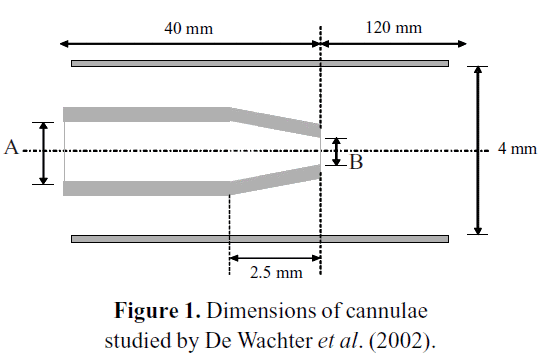
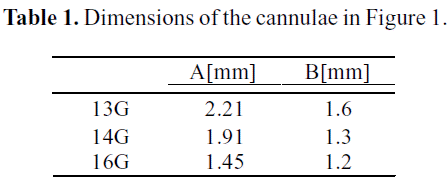
<body><![CDATA[<p align="justify"><font face="Verdana" size="2">De Wachter et al. (2002) and  Garon et al. (2004) used calf blood in their investigations. For comparative  purposes, the same fluid was studied within this work. The asymptotic value of  viscosity for the calf blood at high shear rates is 2.42 mPa s (cP), which is  the same value used by De Wachter et al. (2002) and Garon et al. (2004).</font></p>     <p align="justify"><font face="Verdana" size="2">Turbulence Modelling</font></p>     <p align="justify"><font face="Verdana" size="2">An adequate modeling of  turbulent stresses is very important in systems where blood is present, because  in most of the biomedical devices, and particularly in blood pumps, the flow  regime is predominantly turbulent. For example, Kameneva et al. (2004) have  proved numerically and empirically the remarkable effect of turbulent stresses  over hemolysis rates.</font></p>     <p align="justify"><font face="Verdana" size="2">De Wachter et al. (2002)  studied empirically and numerically the hemolysis in cannulae during a dialysis  procedure. <a href="#fig1">Figure 1</a> describes the geometry used in the  numerical study. The inner diameters A and B stand for the cannulae core and its  tapered end, respectively. The dimensions of the different sizes of cannulae  studied are listed in <a href="#tab1">Table 1</a>.</font></p>     <p align="center"><a name="fig1"> <img border="0" src="/img/fbpe/rfiucv/v23n4/art09fig1.gif" width="544" height="358"></a></p>     
<p align="center"><a name="tab1"> <img border="0" src="/img/fbpe/rfiucv/v23n4/art09tab1.gif" width="448" height="180"></a></p>     
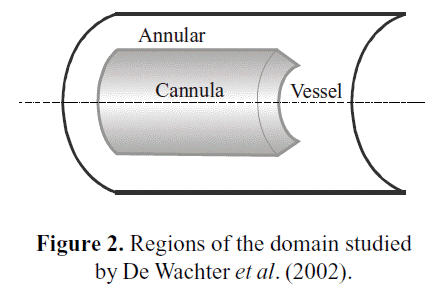
<p align="justify"><font face="Verdana" size="2">De Wachter et al. (2002)  specified an operational range of blood flow through cannulae in a dialysis  procedure, with a maximum of about 400 ml/min, and a physiological range of  blood flow through the arteries between 500 and 1200 ml/ min. <a href="#fig2"> Figure 2</a> details the different regions inside the vessel and around the  cannula.</font></p>     <p align="center"><a name="fig2"> <img border="0" src="/img/fbpe/rfiucv/v23n4/art09fig2.gif" width="432" height="289"></a></p>     
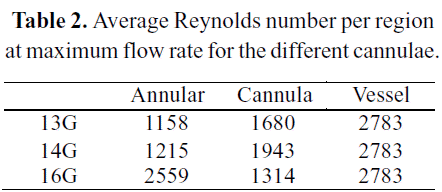
<p align="justify"><font face="Verdana" size="2">The Annular region corresponds  to the zone bounded by the blood vessel wall and the outer wall of the cannula.  The Cannula region, as its name indicates, is bounded by the cannula. The Vessel  region is neither part of the cannula nor annular regions, and it’s bounded by  the blood vessel. Taking the maximum value of flow ranges, the average Reynolds  number for each region can be calculated. The results are reported in <a href="#tab2">Table 2</a>.</font></p>     <p align="center"><a name="tab2"> <img border="0" src="/img/fbpe/rfiucv/v23n4/art09tab2.gif" width="442" height="192"></a></p>     
]]></body>
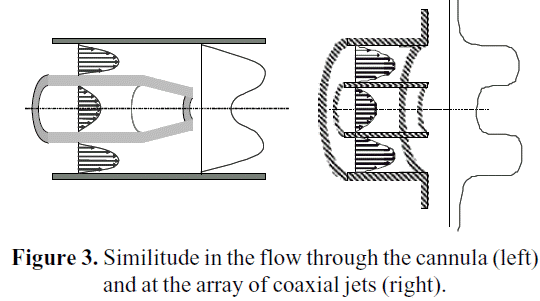
<body><![CDATA[<p align="justify"><font face="Verdana" size="2">Reynolds numbers above 2300 ~  2500 are a signal of the existence of a turbulent regime in that region.  Therefore, those Reynolds numbers indicate that transition from laminar to  turbulent regime may occur within the domain under study.This transition was not  considered neither in the previous numerical work by De Wachter et al. (2002),  or by Garon et al. (2004). Both of them solved the laminar steadystate Navier-Stokes  equations. On the other hand, Kameneva et al. (2004) have studied numerically  and experimentally a blood capillary tube. They analyzed both laminar and  turbulent regimes, showing a prominent effect of turbulence onto hemolysis rate.  Therefore, and accurate modeling of the turbulence its highly relevant, due to  the high amount of uncertainty added to the flow solutions by the selection of  different turbulence models.</font></p>     <p align="justify"><b><font face="Verdana" size="2">Turbulence Benchmark</font></b></p>     <p align="justify"><font face="Verdana" size="2">Based on the geometrical  characteristics of cannulae and the capillary, a benchmark to validate the  selection of the turbulence model has been selected. Balarac et al. (2005)  performed a direct numerical simulation (DNS) for an array of coaxial jets,  which resembles very closely the characteristics of the flow through a cannula,  as it can be seen in <a href="#fig3">Figure 3</a>.</font></p>     <p align="center"><a name="fig3"> <img border="0" src="/img/fbpe/rfiucv/v23n4/art09fig3.gif" width="540" height="301"></a></p>     
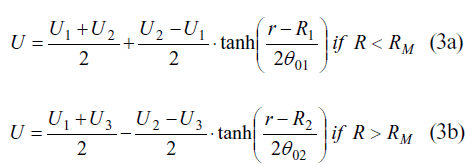
<p align="justify"><font face="Verdana" size="2">In both cases, there is a shear  layer between the inner and outer streams. The capillary might be considered as  a particular case of a jet flow (especially at the diverging cone), where both  annular and central velocity are alike. In this benchmark, a laminar velocity  profile is set at the inlet of a rectangular parallelepiped domain. The shape of  that profile is according to <a href="#ecu3">Equation 3</a>:</font></p>     <p align="justify"><a name="ecu3"> <img border="0" src="/img/fbpe/rfiucv/v23n4/art09for3.gif" width="466" height="167"></a></p>     
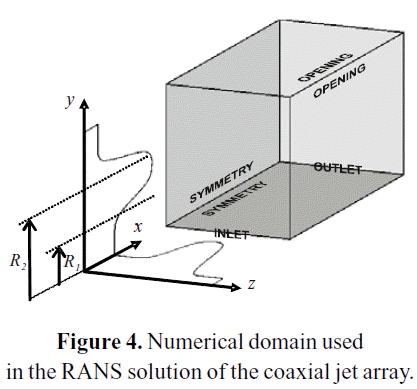
<p align="justify"><font face="Verdana" size="2">where:</font></p>     <p align="justify"><font face="Verdana" size="2">U<sub>1</sub>, U<sub>2</sub>  and U<sub>3</sub> stand for the average velocities at the inner jet, the outer  jet and the free stream, respectively. R<sub>1</sub> and R<sub>2</sub> are the  radius of the inner and outer jets, respectively, as specified at <a href="#fig4">Figure 4</a>. R<sub>M</sub> is the arithmetic average between R<sub>1</sub>  and R<sub>2</sub>. &#952;<sub>01</sub> and &#952;<sub>02</sub> are the inlet momentum  thickness of the inner and outer shear layers, respectively.</font></p>     <p align="center"><a name="fig4"> <img border="0" src="/img/fbpe/rfiucv/v23n4/art09fig4.gif" width="417" height="389"></a></p>     
<p align="justify"><b><font face="Verdana" size="2">NUMERICAL RESULTS</font></b></p>     ]]></body>
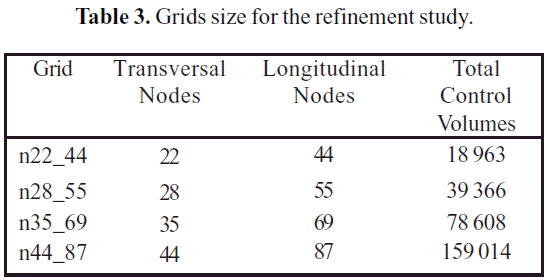
<body><![CDATA[<p align="justify"><font face="Verdana" size="2">Hydrodynamic results of jets  array studied by Balarac et al. (2005) were obtained with a commercial 3D finite  volume code (ANSYS CFX 10.0, Canonsburg, PA). This code uses finite volume for  the discretization of the incompressible Reynolds-Averaged Navier-Stokes (RANS)  equations. For the mathematical closure, the set of differential equations  corresponding to the turbulence model is solved within the preceding numerical  system. By comparison between the DNS velocity profiles and the corresponding  ones from the RANS simulation, the best suitable turbulence model was selected.  The velocity at centerline of the jets, and the radius of the jet were the  comparison variables.</font></p>     <p align="justify"><font face="Verdana" size="2"><a href="#fig4">Figure 4</a>  shows the structure of the numerical domain used for the solution of the RANS  equations. The domain was discretized with a non-uniform hexahedral mesh. The  hexahedral grid takes advantage of the polar symmetry of the jet array, working  only with one-quarter of the domain. <a href="#tab3">Table 3</a> presents the  number of control volumes on each grid used in the refinement study.</font></p>     <p align="center"><a name="tab3"> <img border="0" src="/img/fbpe/rfiucv/v23n4/art09tab3.gif" width="547" height="280"></a></p>     
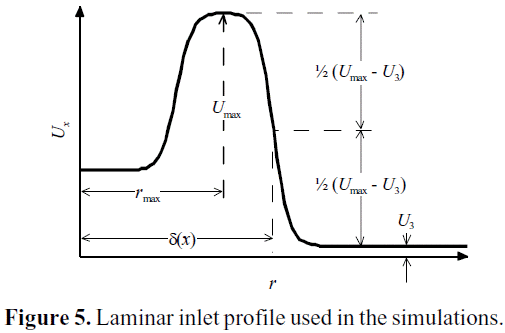
<p align="justify"><font face="Verdana" size="2">The boundary conditions for the  RANS simulations were set to mimic those from the DNS 2_17 simulation case  performed by Balarac et al. (2005): a laminar inlet profile, as shown in <a href="#fig5">Figure 5</a>. This figure also shows the significance of the  spreading rate of the jet &#948;(x), defined accordingly Balarac et al. (2005). The  jet development length is highly dependent of the turbulence parameters at the  inlet, particularly the turbulent-to-molecular viscosity ratio. A low viscosity  ratio means a less turbulent flow at inlet. In these simulations, the viscosity  ratio was set to a value as low as possible, resulting on a numerically stable  simulation (&#957;<i><sub>T</sub> /</i>&#957;<font SIZE="2">= 0.05). </font>Of that way,  the laminar profile used at the inlet of the DNS 2_17 case can be matched with  the «turbulent» profile at the inlet of the RANS simulation.</font></p>     <p align="center"><a name="fig5"> <img border="0" src="/img/fbpe/rfiucv/v23n4/art09fig5.gif" width="505" height="333"></a></p>     
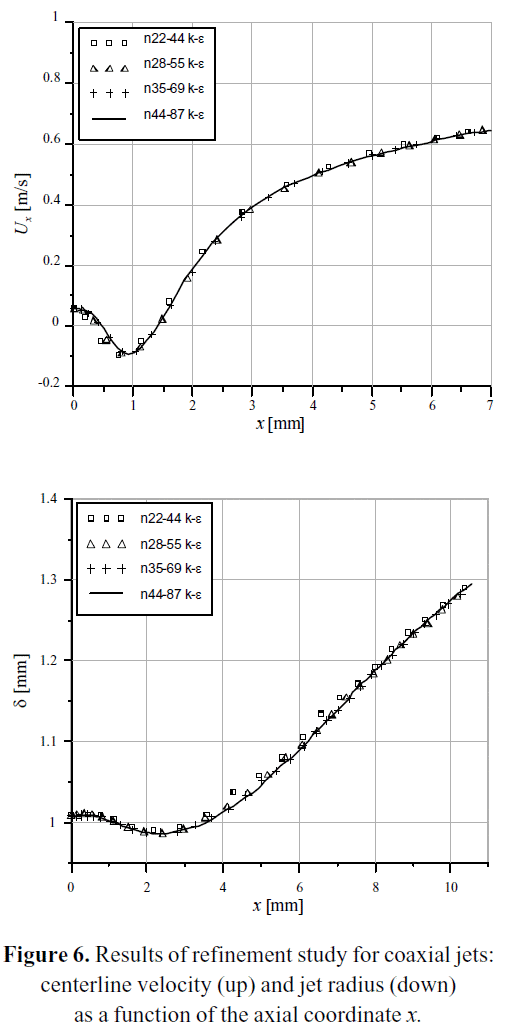
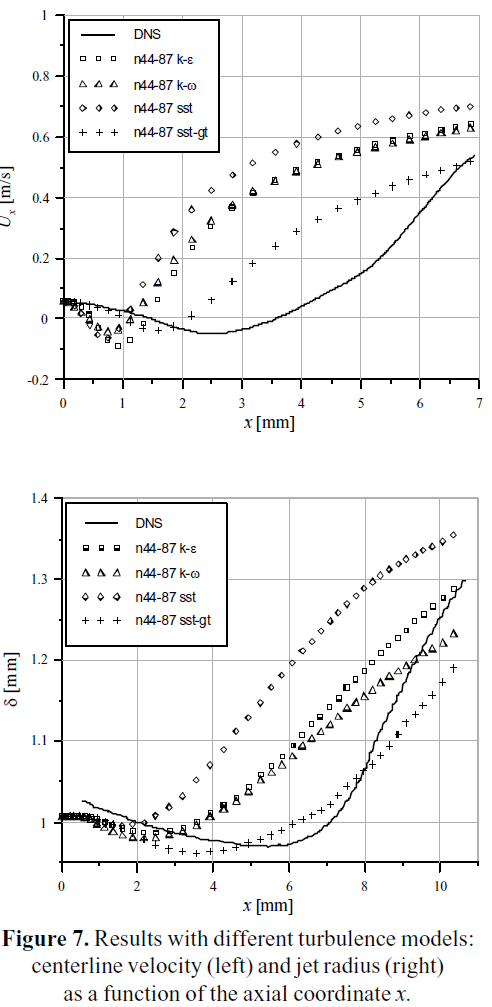
<p align="justify"><font face="Verdana" size="2">The centerline velocity U<sub>x</sub>  and the jet spreading rate &#948; were calculated for each grid of the <a href="#tab3">Table 3</a>, with a standard k-&#949; turbulence model. The results  are plotted in <a href="#fig6">Figure 6</a> as a function of the axial  coordinate x. As it can be seen, the curves are almost congruent, which is a  signal of a sufficiently refined grid. Additional simulations were performed  using the n44_87 grid with different turbulence models, specifically k-&#969;,  standard SST and SST with Gamma-Theta transition. The results are plotted on <a href="#fig7">Figure 7</a>, in comparison with the values of the DNS 2_17  case.</font></p>     <p align="center"><a name="fig6"> <img border="0" src="/img/fbpe/rfiucv/v23n4/art09fig6.gif" width="506" height="1033"></a></p>     
<p align="center"><a name="fig7"> <img border="0" src="/img/fbpe/rfiucv/v23n4/art09fig7.gif" width="492" height="1007"></a></p>     
<p align="justify"><b><font face="Verdana" size="2">DISCUSSION</font></b></p>     <p align="justify"><font face="Verdana" size="2">Different turbulence models  (k-&#949;, k-&#969;, SST and SST with Gamma-Theta transition model) were found to  significantly differ in predicting the flow development and the laminar to  turbulence transition. Among the considered models, the one that better  resembles the behavior of the jet’s DNS benchmark is the Shear Stress Transport  (SST) with Gamma- Theta transitional model, as it can be seen in <a href="#fig7"> Figure 7</a>. The SST transitional model predicts quite well the centerline  velocity evolution, and the spreading rate variation, in contrast with the other  models evaluated. Also, the wall treatment of this model could consider the  effects of the near wall behavior that exist in cannulae, and which is captured  at a very high computational cost when using DNS benchmark simulations.  Therefore, this turbulence model appears to be the choice for the simulation of  cannulae, capillaries and other geometrically similar biomedical devices, where  the transition from laminar to turbulent regime is present.</font></p>     ]]></body>
<body><![CDATA[<p align="justify"><font face="Verdana" size="2">CONCLUSIONS</font></p>     <p align="justify"><font face="Verdana" size="2">In this work, a simple  validation procedure for a turbulence model to be used in cannulae and  capillaries was developed. The accurate calculation of the turbulent stresses  becomes mandatory, especially when they have a predominant role in the numerical  estimation of blood damage inside these biomedical devices. The use of a  validated turbulence model diminishes the amount of uncertainty inherent to  numerical blood-damage estimation.</font></p>     <p align="justify"><font face="Verdana" size="2">In the case of the cannula  geometry, the turbulence model that has the best representation of the physics  within the fluid flow is the SST with Gamma-Theta transition model.</font></p>     <p align="justify"><b><font face="Verdana" size="2">ACKNOWLEDGEMENTS</font></b></p>     <p align="justify"><font face="Verdana" size="2">The authors want to acknowledge  the financial support of this investigation by the Universidad Simon Bolívar´s  Deanship of Research and Development under a Research Assistantship grant.  Thanks also to the Department of Energy Conversion and the Laboratory of Fluid  Mechanics, whose PC cluster hosted a large number of the simulations performed  in this investigation.</font></p>     <p align="justify"><b><font face="Verdana" size="2">REFERENCES</font></b></p>     <!-- ref --><p align="justify"><span style="font-size:10.0pt;font-family:Verdana">1. APEL,  J., PAUL, R., KLAUS, S., SIESS, T., REUL, H. (2001). </span> <span lang="EN-GB" style="font-size: 10.0pt; font-family: Verdana">Assessment of  hemolysis related quantities in a microaxial blood pump by computational fluid  dynamics. Artif. Organs, 25(5):341-347.</span>&nbsp;&nbsp;&nbsp;&nbsp;&nbsp;&nbsp;&nbsp;&nbsp;[&#160;<a href="javascript:void(0);" onclick="javascript: window.open('/scielo.php?script=sci_nlinks&ref=1856648&pid=S0798-4065200800040000900001&lng=','','width=640,height=500,resizable=yes,scrollbars=1,menubar=yes,');">Links</a>&#160;]<!-- end-ref --><!-- ref --><p align="justify"> <span lang="EN-GB" style="font-size: 10.0pt; font-family: Verdana">2. ARORA, D.,  BEHR, M., PASQUALI, M. (2004). A tensor-based measure for estimating blood  damage. Artif. Organs, 28(11):1002-1015.</span>&nbsp;&nbsp;&nbsp;&nbsp;&nbsp;&nbsp;&nbsp;&nbsp;[&#160;<a href="javascript:void(0);" onclick="javascript: window.open('/scielo.php?script=sci_nlinks&ref=1856649&pid=S0798-4065200800040000900002&lng=','','width=640,height=500,resizable=yes,scrollbars=1,menubar=yes,');">Links</a>&#160;]<!-- end-ref --><!-- ref --><p align="justify"> <span lang="EN-GB" style="font-size: 10.0pt; font-family: Verdana">3. ASTM  (1997). Designation F 1841-97: Standard practice for assessment of hemolysis in  continuous flow blood pumps. Annual Book of ASTM Standards, vol. 13:01.</span>&nbsp;&nbsp;&nbsp;&nbsp;&nbsp;&nbsp;&nbsp;&nbsp;[&#160;<a href="javascript:void(0);" onclick="javascript: window.open('/scielo.php?script=sci_nlinks&ref=1856650&pid=S0798-4065200800040000900003&lng=','','width=640,height=500,resizable=yes,scrollbars=1,menubar=yes,');">Links</a>&#160;]<!-- end-ref --><!-- ref --><p align="justify"> <span lang="EN-GB" style="font-size: 10.0pt; font-family: Verdana">4. BALARAC,  G., MÉTAIS, O. (2005). The near field of coaxial jets: a numerical study. Phys.  Fluids, 17(6): 065102/ 1-14.</span>&nbsp;&nbsp;&nbsp;&nbsp;&nbsp;&nbsp;&nbsp;&nbsp;[&#160;<a href="javascript:void(0);" onclick="javascript: window.open('/scielo.php?script=sci_nlinks&ref=1856651&pid=S0798-4065200800040000900004&lng=','','width=640,height=500,resizable=yes,scrollbars=1,menubar=yes,');">Links</a>&#160;]<!-- end-ref --><!-- ref --><p align="justify"> <span lang="EN-GB" style="font-size: 10.0pt; font-family: Verdana">5. BURGREEN,  G.W., ANTAKI, J.F., WU, Z.J., HOLMES, A.J. (2001). Computational fluid dynamics  as a development tool for rotary blood pumps. </span> <span style="font-size:10.0pt;font-family:Verdana">Artif. Organs, 25(5):336-  340.</span>&nbsp;&nbsp;&nbsp;&nbsp;&nbsp;&nbsp;&nbsp;&nbsp;[&#160;<a href="javascript:void(0);" onclick="javascript: window.open('/scielo.php?script=sci_nlinks&ref=1856652&pid=S0798-4065200800040000900005&lng=','','width=640,height=500,resizable=yes,scrollbars=1,menubar=yes,');">Links</a>&#160;]<!-- end-ref --><!-- ref --><p align="justify"><span style="font-size:10.0pt;font-family:Verdana">6. DE  WACHTER, D.S., VERDONCK, P.R., DE ROS, J.Y., HOMBROUCKX, R.O. (1997). </span> <span lang="EN-GB" style="font-size: 10.0pt; font-family: Verdana">Blood trauma  in plastic haemodialysis cannulae. Int. J. Artif. Organs, 20(7): 366-370.</span>&nbsp;&nbsp;&nbsp;&nbsp;&nbsp;&nbsp;&nbsp;&nbsp;[&#160;<a href="javascript:void(0);" onclick="javascript: window.open('/scielo.php?script=sci_nlinks&ref=1856653&pid=S0798-4065200800040000900006&lng=','','width=640,height=500,resizable=yes,scrollbars=1,menubar=yes,');">Links</a>&#160;]<!-- end-ref --><!-- ref --><p align="justify"><span style="font-size:10.0pt;font-family:Verdana">7. DE  WACHTER, D., VERDONCK, P. (2002). </span> <span lang="EN-GB" style="font-size: 10.0pt; font-family: Verdana">Numerical  calculation of hemolysis levels in peripheral hemodialysis cannulas. Artif.  Organs, 26(7): 576-582.</span>&nbsp;&nbsp;&nbsp;&nbsp;&nbsp;&nbsp;&nbsp;&nbsp;[&#160;<a href="javascript:void(0);" onclick="javascript: window.open('/scielo.php?script=sci_nlinks&ref=1856654&pid=S0798-4065200800040000900007&lng=','','width=640,height=500,resizable=yes,scrollbars=1,menubar=yes,');">Links</a>&#160;]<!-- end-ref --><!-- ref --><p align="justify"> <span lang="EN-GB" style="font-size: 10.0pt; font-family: Verdana">8. FARINAS,  M.I., GARON, A., LACASSE, D., N’DRI, D. (2006). Asymptotically consistent  numerical approximation of hemolysis. J. Biomech. Eng., 128(5):688-696.</span>&nbsp;&nbsp;&nbsp;&nbsp;&nbsp;&nbsp;&nbsp;&nbsp;[&#160;<a href="javascript:void(0);" onclick="javascript: window.open('/scielo.php?script=sci_nlinks&ref=1856655&pid=S0798-4065200800040000900008&lng=','','width=640,height=500,resizable=yes,scrollbars=1,menubar=yes,');">Links</a>&#160;]<!-- end-ref --><!-- ref --><p align="justify"> <span lang="EN-GB" style="font-size: 10.0pt; font-family: Verdana">9. GARON A.,  FARINAS, M.I. (2004). Fast three-dimensional numerical hemolysis approximation.  Artif. Organs, 28(11):1016-1025.</span>&nbsp;&nbsp;&nbsp;&nbsp;&nbsp;&nbsp;&nbsp;&nbsp;[&#160;<a href="javascript:void(0);" onclick="javascript: window.open('/scielo.php?script=sci_nlinks&ref=1856656&pid=S0798-4065200800040000900009&lng=','','width=640,height=500,resizable=yes,scrollbars=1,menubar=yes,');">Links</a>&#160;]<!-- end-ref --><!-- ref --><p align="justify"> <span lang="EN-GB" style="font-size: 10.0pt; font-family: Verdana">10.  GIERSIEPEN, M., WURZINGER, L.J., OPITZ, R., REUL, H. (1990). Estimation of shear  stress-related blood damage in heart valve prostheses - in vitro comparison of  25 aortic valves. Int. J. Artif. Organs, 13(5):300-306.</span>&nbsp;&nbsp;&nbsp;&nbsp;&nbsp;&nbsp;&nbsp;&nbsp;[&#160;<a href="javascript:void(0);" onclick="javascript: window.open('/scielo.php?script=sci_nlinks&ref=1856657&pid=S0798-4065200800040000900010&lng=','','width=640,height=500,resizable=yes,scrollbars=1,menubar=yes,');">Links</a>&#160;]<!-- end-ref --><!-- ref --><p align="justify"> <span lang="EN-GB" style="font-size: 10.0pt; font-family: Verdana">11. KAMENEVA,  M.V., BURGREEN, G.W., KONO, K., REPKO, B., ANTAKI, J.F., UMEZU, M. (2004).  Effects of turbulent stresses upon mechanical hemolysis: experimental and  computational analysis. ASAIO J., 50(5): 418-423.</span>&nbsp;&nbsp;&nbsp;&nbsp;&nbsp;&nbsp;&nbsp;&nbsp;[&#160;<a href="javascript:void(0);" onclick="javascript: window.open('/scielo.php?script=sci_nlinks&ref=1856658&pid=S0798-4065200800040000900011&lng=','','width=640,height=500,resizable=yes,scrollbars=1,menubar=yes,');">Links</a>&#160;]<!-- end-ref --><!-- ref --><p align="justify"> <span lang="EN-GB" style="font-size: 10.0pt; font-family: Verdana">12. MAZUMDAR,  J.N. (2004). Biofluid mechanics. World Scientific, Third. Edition, Singapore.</span>&nbsp;&nbsp;&nbsp;&nbsp;&nbsp;&nbsp;&nbsp;&nbsp;[&#160;<a href="javascript:void(0);" onclick="javascript: window.open('/scielo.php?script=sci_nlinks&ref=1856659&pid=S0798-4065200800040000900012&lng=','','width=640,height=500,resizable=yes,scrollbars=1,menubar=yes,');">Links</a>&#160;]<!-- end-ref --><!-- ref --><p align="justify"> <span lang="EN-GB" style="font-size: 10.0pt; font-family: Verdana">13. WU, J.,  ANTAKI, J.F., SNYDER, T.A., WAGNER, W.R., BOROVETZ, H.S., PADEN, B.E. (2005).  Design optimization of blood shearing instrument by computational fluid  dynamics. </span><span style="font-size:10.0pt;font-family: Verdana">Artif. Organs, 29(6): 482-489.</span>&nbsp;&nbsp;&nbsp;&nbsp;&nbsp;&nbsp;&nbsp;&nbsp;[&#160;<a href="javascript:void(0);" onclick="javascript: window.open('/scielo.php?script=sci_nlinks&ref=1856660&pid=S0798-4065200800040000900013&lng=','','width=640,height=500,resizable=yes,scrollbars=1,menubar=yes,');">Links</a>&#160;]<!-- end-ref --><!-- ref --><p align="justify"><span style="font-size: 10.0pt; font-family: Verdana">14.  YELESWARAPU, K.K., KAMENEVA, M.V., RAJAGOPAL, K.R., ANTAKI, J.F. (1998). </span> <span lang="EN-GB" style="font-size: 10.0pt; font-family: Verdana">The flow of  blood in tubes: theory and experiment. Mechanics Res. </span> <span style="font-size: 10.0pt; font-family: Verdana">Commun., 25(3): 257-262.</span>&nbsp;&nbsp;&nbsp;&nbsp;&nbsp;&nbsp;&nbsp;&nbsp;[&#160;<a href="javascript:void(0);" onclick="javascript: window.open('/scielo.php?script=sci_nlinks&ref=1856661&pid=S0798-4065200800040000900014&lng=','','width=640,height=500,resizable=yes,scrollbars=1,menubar=yes,');">Links</a>&#160;]<!-- end-ref --> ]]></body>
<back>
<ref-list>
<ref id="B1">
<label>1</label><nlm-citation citation-type="journal">
<person-group person-group-type="author">
<name>
<surname><![CDATA[APEL,]]></surname>
<given-names><![CDATA[J]]></given-names>
</name>
<name>
<surname><![CDATA[PAUL,]]></surname>
<given-names><![CDATA[R]]></given-names>
</name>
<name>
<surname><![CDATA[KLAUS,]]></surname>
<given-names><![CDATA[S]]></given-names>
</name>
<name>
<surname><![CDATA[SIESS,]]></surname>
<given-names><![CDATA[T]]></given-names>
</name>
<name>
<surname><![CDATA[REUL,]]></surname>
<given-names><![CDATA[H]]></given-names>
</name>
</person-group>
<article-title xml:lang="en"><![CDATA[Assessment of hemolysis related quantities in a microaxial blood pump by computational fluid dynamics]]></article-title>
<source><![CDATA[Artif. Organs]]></source>
<year>(200</year>
<month>1)</month>
<volume>25</volume>
<numero>5</numero>
<issue>5</issue>
<page-range>341-347</page-range></nlm-citation>
</ref>
<ref id="B2">
<label>2</label><nlm-citation citation-type="journal">
<person-group person-group-type="author">
<name>
<surname><![CDATA[ARORA,]]></surname>
<given-names><![CDATA[D]]></given-names>
</name>
<name>
<surname><![CDATA[BEHR,]]></surname>
<given-names><![CDATA[M]]></given-names>
</name>
<name>
<surname><![CDATA[PASQUALI,]]></surname>
<given-names><![CDATA[M]]></given-names>
</name>
</person-group>
<article-title xml:lang="en"><![CDATA[A tensor-based measure for estimating blood damage]]></article-title>
<source><![CDATA[Artif. Organs]]></source>
<year>(200</year>
<month>4)</month>
<volume>28</volume>
<numero>11</numero>
<issue>11</issue>
<page-range>1002-1015</page-range></nlm-citation>
</ref>
<ref id="B3">
<label>3</label><nlm-citation citation-type="">
<collab>ASTM</collab>
<source><![CDATA[Designation F 1841-97: Standard practice for assessment of hemolysis in continuous flow blood pumps]]></source>
<year>1997</year>
<volume>13</volume>
</nlm-citation>
</ref>
<ref id="B4">
<label>4</label><nlm-citation citation-type="journal">
<person-group person-group-type="author">
<name>
<surname><![CDATA[BALARAC,]]></surname>
<given-names><![CDATA[G]]></given-names>
</name>
<name>
<surname><![CDATA[MÉTAIS,]]></surname>
<given-names><![CDATA[O]]></given-names>
</name>
</person-group>
<article-title xml:lang="en"><![CDATA[The near field of coaxial jets: a numerical study]]></article-title>
<source><![CDATA[Phys. Fluids]]></source>
<year>(200</year>
<month>5)</month>
<volume>17(6)</volume>
<page-range>1-14</page-range></nlm-citation>
</ref>
<ref id="B5">
<label>5</label><nlm-citation citation-type="journal">
<person-group person-group-type="author">
<name>
<surname><![CDATA[BURGREEN,]]></surname>
<given-names><![CDATA[G.W]]></given-names>
</name>
<name>
<surname><![CDATA[ANTAKI,]]></surname>
<given-names><![CDATA[J.F]]></given-names>
</name>
<name>
<surname><![CDATA[WU,]]></surname>
<given-names><![CDATA[Z.J]]></given-names>
</name>
<name>
<surname><![CDATA[HOLMES,]]></surname>
<given-names><![CDATA[A.J]]></given-names>
</name>
</person-group>
<article-title xml:lang="en"><![CDATA[Computational fluid dynamics as a development tool for rotary blood pumps]]></article-title>
<source><![CDATA[Artif. Organs]]></source>
<year>(200</year>
<month>1)</month>
<volume>25</volume>
<numero>5</numero>
<issue>5</issue>
<page-range>336- 340</page-range></nlm-citation>
</ref>
<ref id="B6">
<label>6</label><nlm-citation citation-type="journal">
<person-group person-group-type="author">
<name>
<surname><![CDATA[DE WACHTER,]]></surname>
<given-names><![CDATA[D.S]]></given-names>
</name>
<name>
<surname><![CDATA[VERDONCK,]]></surname>
<given-names><![CDATA[P.R]]></given-names>
</name>
<name>
<surname><![CDATA[DE ROS,]]></surname>
<given-names><![CDATA[J.Y]]></given-names>
</name>
<name>
<surname><![CDATA[HOMBROUCKX,]]></surname>
<given-names><![CDATA[R.O]]></given-names>
</name>
</person-group>
<article-title xml:lang="en"><![CDATA[Blood trauma in plastic haemodialysis cannulae]]></article-title>
<source><![CDATA[Int. J. Artif. Organs]]></source>
<year>(199</year>
<month>7)</month>
<volume>20(7)</volume>
<page-range>366-370</page-range></nlm-citation>
</ref>
<ref id="B7">
<label>7</label><nlm-citation citation-type="journal">
<person-group person-group-type="author">
<name>
<surname><![CDATA[DE]]></surname>
<given-names><![CDATA[WACHTER, D]]></given-names>
</name>
<name>
<surname><![CDATA[VERDONCK,]]></surname>
<given-names><![CDATA[P]]></given-names>
</name>
</person-group>
<article-title xml:lang="en"><![CDATA[Numerical calculation of hemolysis levels in peripheral hemodialysis cannulas]]></article-title>
<source><![CDATA[Artif. Organs]]></source>
<year>(200</year>
<month>2)</month>
<volume>26</volume>
<numero>7</numero>
<issue>7</issue>
<page-range>576-582</page-range></nlm-citation>
</ref>
<ref id="B8">
<label>8</label><nlm-citation citation-type="journal">
<person-group person-group-type="author">
<name>
<surname><![CDATA[FARINAS,]]></surname>
<given-names><![CDATA[M.I]]></given-names>
</name>
<name>
<surname><![CDATA[GARON,]]></surname>
<given-names><![CDATA[A]]></given-names>
</name>
<name>
<surname><![CDATA[LACASSE,]]></surname>
<given-names><![CDATA[D]]></given-names>
</name>
<name>
<surname><![CDATA[N’DRI,]]></surname>
<given-names><![CDATA[D]]></given-names>
</name>
</person-group>
<article-title xml:lang="en"><![CDATA[Asymptotically consistent numerical approximation of hemolysis]]></article-title>
<source><![CDATA[J. Biomech. Eng.]]></source>
<year>(200</year>
<month>6)</month>
<volume>128(5)</volume>
<page-range>688-696</page-range></nlm-citation>
</ref>
<ref id="B9">
<label>9</label><nlm-citation citation-type="journal">
<person-group person-group-type="author">
<name>
<surname><![CDATA[GARON]]></surname>
<given-names><![CDATA[A]]></given-names>
</name>
<name>
<surname><![CDATA[FARINAS,]]></surname>
<given-names><![CDATA[M.I]]></given-names>
</name>
</person-group>
<article-title xml:lang="en"><![CDATA[Fast three-dimensional numerical hemolysis approximation]]></article-title>
<source><![CDATA[Artif. Organs]]></source>
<year>(200</year>
<month>4)</month>
<volume>28</volume>
<numero>11</numero>
<issue>11</issue>
<page-range>1016-1025</page-range></nlm-citation>
</ref>
<ref id="B10">
<label>10</label><nlm-citation citation-type="journal">
<person-group person-group-type="author">
<name>
<surname><![CDATA[GIERSIEPEN,]]></surname>
<given-names><![CDATA[M]]></given-names>
</name>
<name>
<surname><![CDATA[WURZINGER,]]></surname>
<given-names><![CDATA[L.J]]></given-names>
</name>
<name>
<surname><![CDATA[OPITZ,]]></surname>
<given-names><![CDATA[R]]></given-names>
</name>
<name>
<surname><![CDATA[REUL,]]></surname>
<given-names><![CDATA[H]]></given-names>
</name>
</person-group>
<article-title xml:lang="en"><![CDATA[Estimation of shear stress-related blood damage in heart valve prostheses - in vitro comparison of 25 aortic valves]]></article-title>
<source><![CDATA[Int. J. Artif. Organs]]></source>
<year>(199</year>
<month>0)</month>
<volume>13(5)</volume>
<page-range>300-306</page-range></nlm-citation>
</ref>
<ref id="B11">
<label>11</label><nlm-citation citation-type="journal">
<person-group person-group-type="author">
<name>
<surname><![CDATA[KAMENEVA,]]></surname>
<given-names><![CDATA[M.V]]></given-names>
</name>
<name>
<surname><![CDATA[BURGREEN,]]></surname>
<given-names><![CDATA[G.W]]></given-names>
</name>
<name>
<surname><![CDATA[KONO,]]></surname>
<given-names><![CDATA[K]]></given-names>
</name>
<name>
<surname><![CDATA[REPKO,]]></surname>
<given-names><![CDATA[B]]></given-names>
</name>
<name>
<surname><![CDATA[ANTAKI,]]></surname>
<given-names><![CDATA[J.F]]></given-names>
</name>
<name>
<surname><![CDATA[UMEZU,]]></surname>
<given-names><![CDATA[M]]></given-names>
</name>
</person-group>
<article-title xml:lang="en"><![CDATA[Effects of turbulent stresses upon mechanical hemolysis: experimental and computational analysis]]></article-title>
<source><![CDATA[ASAIO J.]]></source>
<year>(200</year>
<month>4)</month>
<volume>50(5)</volume>
<page-range>418-423</page-range></nlm-citation>
</ref>
<ref id="B12">
<label>12</label><nlm-citation citation-type="book">
<person-group person-group-type="author">
<name>
<surname><![CDATA[MAZUMDAR]]></surname>
<given-names><![CDATA[J.N]]></given-names>
</name>
</person-group>
<source><![CDATA[Biofluid mechanics]]></source>
<year>2004</year>
<edition>Third</edition>
<publisher-loc><![CDATA[Singapore ]]></publisher-loc>
<publisher-name><![CDATA[World Scientific]]></publisher-name>
</nlm-citation>
</ref>
<ref id="B13">
<label>13</label><nlm-citation citation-type="journal">
<person-group person-group-type="author">
<name>
<surname><![CDATA[WU,]]></surname>
<given-names><![CDATA[J]]></given-names>
</name>
<name>
<surname><![CDATA[ANTAKI,]]></surname>
<given-names><![CDATA[J.F]]></given-names>
</name>
<name>
<surname><![CDATA[SNYDER,]]></surname>
<given-names><![CDATA[T.A]]></given-names>
</name>
<name>
<surname><![CDATA[WAGNER,]]></surname>
<given-names><![CDATA[W.R]]></given-names>
</name>
<name>
<surname><![CDATA[BOROVETZ,]]></surname>
<given-names><![CDATA[H.S]]></given-names>
</name>
<name>
<surname><![CDATA[PADEN,]]></surname>
<given-names><![CDATA[B.E]]></given-names>
</name>
</person-group>
<article-title xml:lang="en"><![CDATA[Design optimization of blood shearing instrument by computational fluid dynamics]]></article-title>
<source><![CDATA[Artif. Organs]]></source>
<year>(200</year>
<month>5)</month>
<volume>29</volume>
<numero>6</numero>
<issue>6</issue>
<page-range>482-489</page-range></nlm-citation>
</ref>
<ref id="B14">
<label>14</label><nlm-citation citation-type="journal">
<person-group person-group-type="author">
<name>
<surname><![CDATA[YELESWARAPU,]]></surname>
<given-names><![CDATA[K.K]]></given-names>
</name>
<name>
<surname><![CDATA[KAMENEVA,]]></surname>
<given-names><![CDATA[M.V]]></given-names>
</name>
<name>
<surname><![CDATA[RAJAGOPAL,]]></surname>
<given-names><![CDATA[K.R]]></given-names>
</name>
<name>
<surname><![CDATA[ANTAKI,]]></surname>
<given-names><![CDATA[J.F]]></given-names>
</name>
</person-group>
<article-title xml:lang="en"><![CDATA[The flow of blood in tubes: theory and experiment]]></article-title>
<source><![CDATA[Mechanics Res. Commun.]]></source>
<year>(199</year>
<month>8)</month>
<volume>25</volume>
<numero>3</numero>
<issue>3</issue>
<page-range>257-262</page-range></nlm-citation>
</ref>
</ref-list>
</back>
</article>