<?xml version="1.0" encoding="ISO-8859-1"?><article xmlns:mml="http://www.w3.org/1998/Math/MathML" xmlns:xlink="http://www.w3.org/1999/xlink" xmlns:xsi="http://www.w3.org/2001/XMLSchema-instance">
<front>
<journal-meta>
<journal-id>0798-4065</journal-id>
<journal-title><![CDATA[Revista de la Facultad de Ingeniería Universidad Central de Venezuela]]></journal-title>
<abbrev-journal-title><![CDATA[Rev. Fac. Ing. UCV]]></abbrev-journal-title>
<issn>0798-4065</issn>
<publisher>
<publisher-name><![CDATA[Universidad Central de Venezuela]]></publisher-name>
</publisher>
</journal-meta>
<article-meta>
<article-id>S0798-40652009000100004</article-id>
<title-group>
<article-title xml:lang="en"><![CDATA[Can we accurately use laboratory-scale rheological parameters to model field-scale debris flow?]]></article-title>
<article-title xml:lang="es"><![CDATA[¿Es válido utilizar con precisión parámetros reológicos obtenidos en laboratorio para modelar aludes torrenciales a escala real?]]></article-title>
</title-group>
<contrib-group>
<contrib contrib-type="author">
<name>
<surname><![CDATA[Blanco]]></surname>
<given-names><![CDATA[Armando]]></given-names>
</name>
<xref ref-type="aff" rid="A01"/>
</contrib>
<contrib contrib-type="author">
<name>
<surname><![CDATA[Rodríguez]]></surname>
<given-names><![CDATA[Carmen]]></given-names>
</name>
<xref ref-type="aff" rid="A02"/>
</contrib>
<contrib contrib-type="author">
<name>
<surname><![CDATA[García]]></surname>
<given-names><![CDATA[Reinaldo]]></given-names>
</name>
<xref ref-type="aff" rid="A03"/>
</contrib>
</contrib-group>
<aff id="A01">
<institution><![CDATA[,Universidad Simón Bolívar Departamento de Mecánica ]]></institution>
<addr-line><![CDATA[ ]]></addr-line>
</aff>
<aff id="A02">
<institution><![CDATA[,EDELCA Centro de Investigaciones Aplicadas ]]></institution>
<addr-line><![CDATA[ ]]></addr-line>
</aff>
<aff id="A03">
<institution><![CDATA[,Florida International University  ]]></institution>
<addr-line><![CDATA[ ]]></addr-line>
<country>USA</country>
</aff>
<pub-date pub-type="pub">
<day>00</day>
<month>03</month>
<year>2009</year>
</pub-date>
<pub-date pub-type="epub">
<day>00</day>
<month>03</month>
<year>2009</year>
</pub-date>
<volume>24</volume>
<numero>1</numero>
<fpage>45</fpage>
<lpage>55</lpage>
<copyright-statement/>
<copyright-year/>
<self-uri xlink:href="http://ve.scielo.org/scielo.php?script=sci_arttext&amp;pid=S0798-40652009000100004&amp;lng=en&amp;nrm=iso"></self-uri><self-uri xlink:href="http://ve.scielo.org/scielo.php?script=sci_abstract&amp;pid=S0798-40652009000100004&amp;lng=en&amp;nrm=iso"></self-uri><self-uri xlink:href="http://ve.scielo.org/scielo.php?script=sci_pdf&amp;pid=S0798-40652009000100004&amp;lng=en&amp;nrm=iso"></self-uri><abstract abstract-type="short" xml:lang="en"><p><![CDATA[Numerical models are often used to predict debris flow behavior at field scale. However, rheological parameters that govern fluid behavior are difficult to obtain using conventional rheometers. Generally, laboratory experiments are combined with mathematical modeling to calibrate rheological models. Then, the laboratory-calibrated numerical model is used to predict debris flow behavior at field scales. This paper shows that extrapolating results from laboratory experiments to field scales may lead to non-accurate predictions. Usually, laboratory flumes are just a few meters long, while an actual debris flow event in the field can involve scales of several kilometers. Therefore, a rheological model that provides good results in the laboratory, does not necessarily replicate a field event. In this paper, we analyzed field-scale predictions using numerical models whose rheological parameters are adjusted from laboratory experiments. Results from water flow in large scale experimental facilities were simulated by different rheological models. Rheological parameters were adjusted using a mathematical model. Results showed that adjusting specific parameters, all rheological models could be adequately calibrated when using laboratory data for different flow conditions, even though water was the fluid used in laboratory experiences. However, when models were applied to a field event, there were significant differences in their predictions. This suggests that adjusting rheological parameters by using laboratory scale experiments may not be applicable for field-scale debris flow simulations.]]></p></abstract>
<abstract abstract-type="short" xml:lang="es"><p><![CDATA[Para predecir el comportamiento de aludes torrenciales a escala real se utilizan modelos numéricos. Sin embargo, los parámetros reológicos que permiten representar los fluidos que componen el flujo son difíciles de obtener utilizando reómetros convencionales. En general experiencias de laboratorio son combinadas con modelos matemáticos para calibrar los modelos reológicos. Luego, el modelo numérico calibrado es utilizado para predecir el comportamiento de los aludes torrenciales en campo. Sin embargo, extrapolar resultados a partir de experimentos de laboratorio a escala real puede conducir a predicciones no precisas. Normalmente, los canales de laboratorio se construyen de tamaño reducido a pocos metros de largo mientras que un alud torrencial puede desarrollarse en escala de kilómetros. En consecuencia, un modelo reológico que permite obtener buenos resultados a escala de laboratorio puede no ser suficientemente preciso a escala real. En este artículo se analizan predicciones a escala de campo utilizando modelos numéricos ajustados a partir de experiencias de laboratorio. Resultados obtenidos para flujo de agua en experiencias de laboratorio a gran escala fueron modeladas utilizando modelos reológicos distintos. Los parámetros de los modelos reológicos se ajustaron utilizando un modelo matemático. Los resultados muestran que aún cuando el fluido considerado en las experiencias de laboratorio fue el agua, todos los modelos reológicos pudieron ser adecuadamente calibrados. Sin embargo, cuando los modelos fueron aplicados a un evento a escala real, las predicciones obtenidas resultaron completamente distintas. Esto sugiere que ajustar modelos reológicos utilizando experimentos a escala de laboratorio para luego utilizarlos en predicciones de eventos a escala real podría ser una práctica muy cuestionable.]]></p></abstract>
<kwd-group>
<kwd lng="en"><![CDATA[Debris flows]]></kwd>
<kwd lng="en"><![CDATA[Resistance laws]]></kwd>
<kwd lng="en"><![CDATA[Rheological behavior of mixtures]]></kwd>
<kwd lng="en"><![CDATA[Numerical simulation]]></kwd>
<kwd lng="en"><![CDATA[Channel slope]]></kwd>
<kwd lng="es"><![CDATA[Alud torrencial]]></kwd>
<kwd lng="es"><![CDATA[Leyes de resistencia]]></kwd>
<kwd lng="es"><![CDATA[Comportamiento reológico de mezcla]]></kwd>
<kwd lng="es"><![CDATA[Simulación numérica]]></kwd>
<kwd lng="es"><![CDATA[Pendientes de canales]]></kwd>
</kwd-group>
</article-meta>
</front><body><![CDATA[ <p align="center"><b><span lang="EN-GB" style="font-family: Verdana">Can we  accurately use laboratory-scale rheological parameters to model field-scale  debris flow?</span></b></p> <font SIZE="2" face="Verdana">     <p ALIGN="center"><b>Armando Blanco<sup>1</sup>,  Carmen Rodríguez<sup>2</sup>,  Reinaldo García<sup>3</sup></b></p>     <p ALIGN="justify">1 Universidad  Simón Bolívar, Departamento de Mecánica. e-mail:  <a href="mailto:ajblanco@usb.ve">ajblanco@usb.ve</a></p>     <p ALIGN="justify">2 Centro  de Investigaciones Aplicadas (CIAP), EDELCA .  <a href="mailto:e-mail:carmrodriguez@edelca.com.ve">e-mail:carmrodriguez@edelca.com.ve</a></p>     <p ALIGN="justify">3 Florida  International University, Applied Research Center, USA.  <a href="mailto:e-mail:rgarcia@fiu.edu">e-mail:rgarcia@fiu.edu</a></p><b>     <p ALIGN="justify">ABSTRACT</p> </b>     <p ALIGN="JUSTIFY">Numerical models are often used to predict debris flow  behavior at field scale. However, rheological parameters that govern fluid  behavior are difficult to obtain using conventional rheometers. Generally,  laboratory experiments are combined with mathematical modeling to calibrate  rheological models. Then, the laboratory-calibrated numerical model is used to  predict debris flow behavior at field scales. This paper shows that  extrapolating results from laboratory experiments to field scales may lead to  non-accurate predictions. Usually, laboratory flumes are just a few meters long,  while an actual debris flow event in the field can involve scales of several  kilometers. Therefore, a rheological model that provides good results in the  laboratory, does not necessarily replicate a field event. In this paper, we  analyzed field-scale predictions using numerical models whose rheological  parameters are adjusted from laboratory experiments. Results from water flow in  large scale experimental facilities were simulated by different rheological  models. Rheological parameters were adjusted using a mathematical model. Results  showed that adjusting specific parameters, all rheological models could be  adequately calibrated when using laboratory data for different flow conditions,  even though water was the fluid used in laboratory experiences. However, when  models were applied to a field event, there were significant differences in  their predictions. This suggests that adjusting rheological parameters by using  laboratory scale experiments may not be applicable for field-scale debris flow  simulations. </p>     <p ALIGN="JUSTIFY"><b>Keywords</b>: Debris flows, Resistance laws, Rheological  behavior of mixtures, Numerical simulation, Channel slope.</p> </font><b><font SIZE="2">     <p class="MsoNormal" align="center"> <span style="font-size:10.0pt;font-family:Verdana">¿Es válido utilizar con  precisión parámetros reológicos obtenidos en laboratorio para modelar aludes  torrenciales a escala real?</span></p>     <p ALIGN="justify"><font face="Verdana">RESUMEN</font></p> </font></b><font FACE="Verdana" SIZE="2">     ]]></body>
<body><![CDATA[<p ALIGN="JUSTIFY">Para predecir el comportamiento de aludes torrenciales a  escala real se utilizan modelos numéricos. Sin embargo, los parámetros  reológicos que permiten representar los fluidos que componen el flujo son  difíciles de obtener utilizando reómetros convencionales. En general  experiencias de laboratorio son combinadas con modelos matemáticos para calibrar  los modelos reológicos. Luego, el modelo numérico calibrado es utilizado para  predecir el comportamiento de los aludes torrenciales en campo. Sin embargo,  extrapolar resultados a partir de experimentos de laboratorio a escala real  puede conducir a predicciones no precisas. Normalmente, los canales de  laboratorio se construyen de tamaño reducido a pocos metros de largo mientras  que un alud torrencial puede desarrollarse en escala de kilómetros. En  consecuencia, un modelo reológico que permite obtener buenos resultados a escala  de laboratorio puede no ser suficientemente preciso a escala real. En este  artículo se analizan predicciones a escala de campo utilizando modelos numéricos  ajustados a partir de experiencias de laboratorio. Resultados obtenidos para  flujo de agua en experiencias de laboratorio a gran escala fueron modeladas  utilizando modelos reológicos distintos. Los parámetros de los modelos  reológicos se ajustaron utilizando un modelo matemático. Los resultados muestran  que aún cuando el fluido considerado en las experiencias de laboratorio fue el  agua, todos los modelos reológicos pudieron ser adecuadamente calibrados. Sin  embargo, cuando los modelos fueron aplicados a un evento a escala real, las  predicciones obtenidas resultaron completamente distintas. Esto sugiere que  ajustar modelos reológicos utilizando experimentos a escala de laboratorio para  luego utilizarlos en predicciones de eventos a escala real podría ser una  práctica muy cuestionable.</p>     <p ALIGN="JUSTIFY"><b>Palabras clave</b>: Alud torrencial, Leyes de resistencia,  Comportamiento reológico de mezcla, Simulación numérica, Pendientes de canales.</p> <font SIZE="2">     <p ALIGN="JUSTIFY"><font SIZE="2" face="Verdana">Recibido: abril de 2008 Recibido en forma final revisado: febrero de 2009</font></p><b>     <p ALIGN="JUSTIFY">INTRODUCTION</p> </b></font>     <p ALIGN="JUSTIFY">Estimation of debris flow behavior is a key topic in hazard  assessment in mountainous areas. In particular, the identification of an  appropriate rheological model has long been regarded as the most important  aspect to the successful interpretation, modeling, and prediction of debris flow  behavior. A great deal of work has been done in order to establish the most  suitable rheological formula that models debris flow behavior in all different  phases.</p>     <p ALIGN="JUSTIFY">Thus, a variation of a Newtonian model has been employed by  Takahashi (2000). Newtonian turbulent model used in water flow channel modeling,  based on the introduction of the Manning friction coefficient, has been used  successfully. Some authors such as Armanini <i>et al</i>. (2003) employ  different methods that estimate rheological parameters in a Bingham Plastic  model. The popular Herschel-Bulkley model has been used by a significant number  of authors such as Coussot (1992). </p>     <p ALIGN="JUSTIFY">More complex models such as the Generalized Viscoplastic  Fluid (GVP) have been employed by Chen (1988). The dilatant inertial model has  been employed in actual events by Lo &amp; Chau (2003) and, in laboratory tests, by  Ghilardi <i>et al</i>. (2003). One of the most popular models was proposed by  O’Brien <i>et al</i>. (1993) and it constitutes the base line for the popular  FLO2D model. Voellmy type fluids have been used with success by McArdell <i>et  al</i>. (2003).</p>     <p ALIGN="JUSTIFY">Therefore, it is necessary to adjust a number of parameters  depending on which model is chosen for simulating debris flow. In particular,  there are several studies that have looked for the best adapted models to  numerical debris flow simulation. Rickenmann &amp; Koch (1997) tested five different  rheological models, while McArdell <i>et al</i>. (2003) used six different  rheological models with numerical experiments. In both studies one or two  rheological models were able to reproduce field events in a satisfactory way.  Model parameters were adjusted in order to reproduce physical characteristics of  the debris flow motion, such as velocity or highest deep at some test section.  In this way, the best formula is chosen to simulate debris flow motion in  particular areas.</p>     <p ALIGN="JUSTIFY">On the other hand, some authors such as Iverson (2003) argued  that non-unique rheology is likely to describe the range of mechanical behavior  exhibited in debris flow. This claim is based on quantitative data obtained from  large-scale experiment in a flume of around 66m long.</p>     <p ALIGN="JUSTIFY">In practice, rheological model should be selected in advance,  in order to establish several scenarios of disaster prevention. To do this,  rheology could be established from laboratory experiments. However, laboratory  scale may not be adequate for reproducing field behavior of debris flow. The  range of shear rate and shear stresses considered in a laboratory experiment,  including large scale experiments, is far from those achieved in real events.</p>     ]]></body>
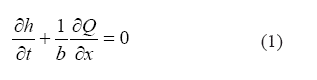
<body><![CDATA[<p ALIGN="JUSTIFY">In this study, we use a 1D model developed by Rodríguez <i>et  al</i>. (2006), that replicates debris flow. The aim is to compare numerical  results employing four different constitutive equations. This numerical model is  a high resolution and non-oscillatory scheme, based on the finite volume method.  Parameters of different rheological models were adjusted by using large scale  WES experiments (1960) for two different bed channel roughness. WES experiments  have been widely used for calibrating numerical models because they are among  the experiments carried out at the largest scales. Once rheological models were  adjusted, we considered two different hypothetical cases of dam-break problems,  with the same roughness used at the WES tests. Therefore, comparisons are made  between predictions of flow depth in several test stations as a function of  time. Finally, some conclusions about the possibility of determining rheological  parameters from laboratory experiments and to predict debris flow behavior in  actual events are provided.</p> <font SIZE="2"><b>     <p ALIGN="JUSTIFY">GOVERNING EQUATIONS</p> </b></font>     <p ALIGN="JUSTIFY">The mathematical model employed for the simulation assumes a  1D homogeneous water-sediment current over a rigid bed in unsteady conditions as  in Arattano &amp; Franzi (2003). It also assumed that no sediment deposition or  aggradation occurs along the torrent, and that there is no momentum exchange  between the water-sediment mixture and the bed. So, equations for flow in a 1D  channel with rectangular cross section b and with bed slope &#952; are:</p> <font SIZE="2">     <p ALIGN="JUSTIFY"> <img border="0" src="/img/fbpe/rfiucv/v24n1/art04ecu1.gif" width="317" height="80"></p>     
<p ALIGN="JUSTIFY"> <img border="0" src="/img/fbpe/rfiucv/v24n1/art04ecu2.gif" width="437" height="66"></p> </font>     
<p ALIGN="JUSTIFY">where:</p> <i>     <p ALIGN="JUSTIFY">x </i>is the spatial coordinate measured along the length of  the channel, <i>t </i>is the time, <i>h </i>is the flow depth, <i>A</i>(<i>x,t</i>)  the area of the flow cross section, <i>Q</i>(<i>x,t</i>) the water-sediment  discharge, <i>g </i>the gravity acceleration, </font><i> <font SIZE="2" face="Verdana">S<sub>0</sub> </font></i> <font FACE="Times New Roman,Times New Roman" SIZE="2"> <font SIZE="2" face="Verdana">the bed slope (tan<i>&#952;</i>) and </font><i> <font SIZE="2" face="Verdana">Sf </font></i><font SIZE="2" face="Verdana">the friction loss.</font></p> </font> <font FACE="Verdana" SIZE="2"> <font SIZE="2"><b>     <p ALIGN="JUSTIFY">FLOW RESISTANCE LAWS</p> </b></font>     <p ALIGN="JUSTIFY">For taking into account different kinds of rheological models,  the friction term in the equation of motion is modified (Rodríguez <i>et al</i>.  (2006) for details). Thus, the friction term was modeled by using four different  flow resistance laws in the same way as Rickenmann &amp; Koch (1997). So, Newtonian  turbulent, Bingham laminar, Voellmy and Dilatant inertial fluid models were  considered.</p> <i>     <p ALIGN="JUSTIFY">Homogeneous single phase models</p> </i>     ]]></body>
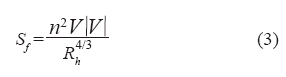
<body><![CDATA[<p ALIGN="JUSTIFY">For a Newtonian turbulent model </font> <i> <font FACE="Verdana" SIZE="2"> S</font><font FACE="Times New Roman,Times New Roman" SIZE="2"><font FACE="Verdana">f</font><font FACE="Verdana"> </font> </font></i> <font FACE="Times New Roman,Times New Roman" SIZE="2"> <font FACE="Verdana" SIZE="2"> is obtained from: </p>     <p ALIGN="JUSTIFY"> <img border="0" src="/img/fbpe/rfiucv/v24n1/art04ecu3.gif" width="286" height="77"></p>     
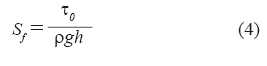
<p ALIGN="JUSTIFY">where:</p> <i>     <p ALIGN="JUSTIFY">n </i>is the Manning’s roughness coefficient and </font> <i> <font FACE="Verdana" SIZE="2"> R</font><font FACE="Times New Roman,Times New Roman" SIZE="2"><sub><font FACE="Verdana">h</font></sub><font FACE="Verdana" SIZE="2">=A/P </font> </font> </i> <font FACE="Times New Roman,Times New Roman" SIZE="2"> <font FACE="Verdana" SIZE="2"> is hydraulic radius and <i>P </i>being the wetted perimeter.</p>     <p ALIGN="JUSTIFY">For the Bingham plastic model: </p> <font SIZE="2">     <p ALIGN="JUSTIFY"> <img border="0" src="/img/fbpe/rfiucv/v24n1/art04ecu4.gif" width="267" height="66"></p> </font>     
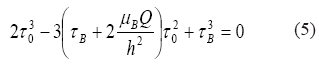
<p ALIGN="JUSTIFY">where:</p>     <p ALIGN="JUSTIFY"><i>t</i></font><font FACE="Times New Roman,Times New Roman" SIZE="2"><font FACE="Verdana"><i><sub>0</sub> </i></font> <font FACE="Verdana" SIZE="2"> is the basal shear stress obtained as the solution of the cubic  equation (Rickenmann &amp; Koch, 1997) </p>     <p ALIGN="JUSTIFY"> <img border="0" src="/img/fbpe/rfiucv/v24n1/art04ecu5.gif" width="319" height="71"></p>     
<p ALIGN="JUSTIFY">where:</p>     ]]></body>
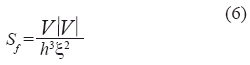
<body><![CDATA[<p ALIGN="JUSTIFY"><i>t</i></font><font FACE="Times New Roman,Times New Roman" SIZE="2"><font FACE="Verdana"><i><sub>B</sub> </i></font> <font FACE="Verdana" SIZE="2"> is the Bingham yield stress and &#956;</font><font FACE="Verdana"><i><sub>B</sub> </i></font> <font FACE="Verdana" SIZE="2"> the Bingham viscosity.</p> <i>     <p ALIGN="JUSTIFY">Solid-liquid mixtures models</p> </i>     <p ALIGN="JUSTIFY">For a dilatant inertial fluid (Rickenmann &amp; Koch, 1997): </p>     <p ALIGN="JUSTIFY"> <img border="0" src="/img/fbpe/rfiucv/v24n1/art04ecu6.gif" width="250" height="65"></p>     
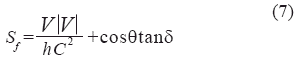
<p ALIGN="JUSTIFY">where:</p>     <p ALIGN="JUSTIFY">&#958; is a parameter accounting for grain and concentration  properties in granular flows.</p>     <p ALIGN="JUSTIFY">In the case of a Voellmy fluid (Rickenmann &amp; Koch, 1997): </p> <font SIZE="2">     <p ALIGN="JUSTIFY"> <img border="0" src="/img/fbpe/rfiucv/v24n1/art04ecu7.gif" width="301" height="64"></p> </font>     
<p ALIGN="JUSTIFY">where:</p>     <p ALIGN="JUSTIFY">C and &#948; are the Chézy roughness coefficient and the internal  friction angle, respectively.</p> <font SIZE="2"><b>     ]]></body>
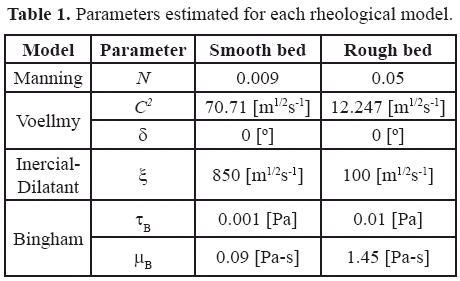
<body><![CDATA[<p ALIGN="JUSTIFY">RHEOLOGICAL PARAMETERS ESTIMATION</p> </b></font>     <p ALIGN="JUSTIFY">In all cases, the rheological parameters were obtained by  comparison with the results of two dam failure experiments made at the Waterways  Experiment Station (WES), U.S. Corps of Engineers (1960). The fluid used in the  experiments was water and the bed downstream of the dam site was initially dry.</p>     <p ALIGN="JUSTIFY">In these experiments, it was used a rectangular wooden flume,  lined with plastic-coated plywood, 122m long and 1.22m wide with a bottom slope  of </font> <i> <font FACE="Verdana" SIZE="2"> S</font><sub><font FACE="Verdana" SIZE="2">0</font></sub></i><font FACE="Times New Roman,Times New Roman" SIZE="2"><font FACE="Verdana" SIZE="2">=0.005.  The model dam was placed at the midsection (<i>x</i>=61m), impounding water to a  depth of 0.305m. The two experiments differed only in the value of hydraulic  resistance on the flume bottom: test 1.1 refers to a smooth bottom (<i>n</i>=0.009)  while test 1.2 corresponds to a rough one (<i>n</i>=0.050).</p>     <p ALIGN="JUSTIFY"><a href="#tab1">Table 1</a> shows the values of the different coefficients used  for each rheological model for both types of bed.</p>     <p ALIGN="center"><a name="tab1"> <img border="0" src="/img/fbpe/rfiucv/v24n1/art04tab1.gif" width="460" height="281"></a></p>     
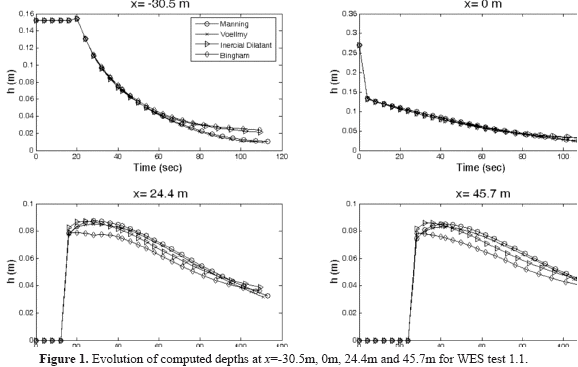
<p ALIGN="JUSTIFY">In <a href="#fig1">Figure 1</a>, it is observed the depth hygrograph predictions  of each model for <i>x </i>=-30.5m (upstream dam station), <i>x </i>= 0  (original dam station), <i>x </i>= 24.4m and <i>x </i>= 45.7m (downstream dam  stations) for smooth bottom test.</p>     <p ALIGN="center"><a name="fig1"> <img border="0" src="/img/fbpe/rfiucv/v24n1/art04fig1.gif" width="578" height="367"></a></p>     
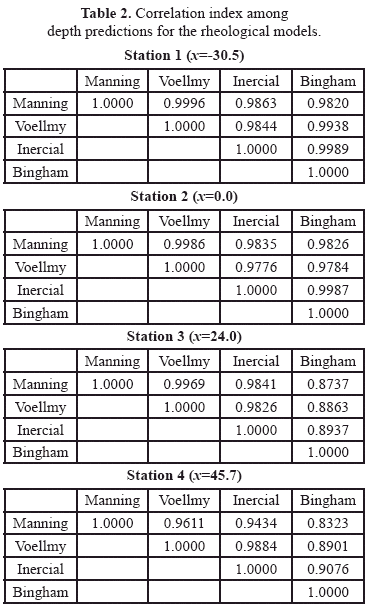
<p ALIGN="JUSTIFY">In all test cases, the predictions and the experimental data  coincide fairly well. In order to quantify deviation among predictions from  rheological models, the correlation index among different predictions was  estimated. <a href="#tab2">Table 2</a> shows the correlation index for WES Test 1.1.</p>     <p ALIGN="center"><a name="tab2"> <img border="0" src="/img/fbpe/rfiucv/v24n1/art04tab2.gif" width="370" height="605"></a></p> </font> </font> </font> </font> </font> </font><font SIZE="2" face="Verdana">     
<p ALIGN="JUSTIFY">In all test cases, the predictions and the experimental data  coincide fairly well. The greatest differences were found at the last  measurement station. This may be due to end effects because this station is the  closest one to the flume exit. However, the worse correlation index, 0.83,  between Newtonian model and Bingham Plastic model is not very far from 1, and  qualitative agreement among all predictions is very good. </p>     ]]></body>
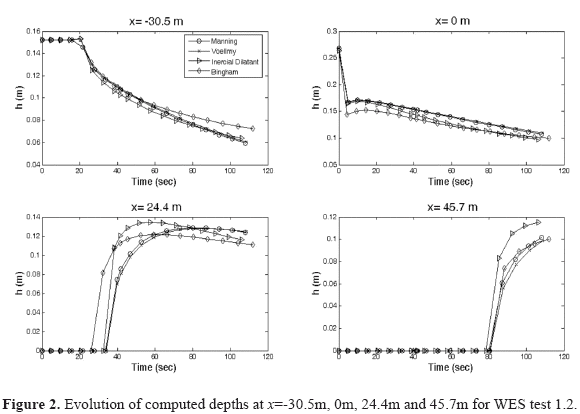
<body><![CDATA[<p ALIGN="JUSTIFY">Similar trends were observed for the rough bed channel  experience. <a href="#fig2">Figure 2</a> shows the depth hygrographs predictions for models in each  measurement station.</p>     <p ALIGN="center"><a name="fig2"> <img border="0" src="/img/fbpe/rfiucv/v24n1/art04fig2.gif" width="580" height="414"></a></p>     
<p ALIGN="JUSTIFY">Again, the predictions among different models coincide fairly well. The greatest differences were found at downstream  measurement stations, but qualitative agreement among all predictions is very  good and the lower correlation index, 0.82, in this case, between Voellmy model  and Bingham Plastic  model, has the same order of those found in the smooth bed  case. As a consequence n=0.82 will be used as reference value  for establishing similarities among predictions in different models.</p>     <p ALIGN="JUSTIFY">We concluded that, for practical purposes, these rheological parameters provide predictions of the fluid flow  characteristics (depth flow, front velocities, etc.) that can be considered  equals, independently of the rheological model chosen.</p> </font> <font SIZE="2" COLOR="#221e1f" face="Verdana">     <p ALIGN="JUSTIFY">In all test cases, the predictions and the experimental data  coincide fairly well. The greatest differences were found at the last  measurement station. This may be due to end effects because this station is the  closest one to the flume exit. However, the worse correlation index, 0.83,  between Newtonian model and Bingham Plastic model is not very far from 1, and  qualitative agreement among all predictions is very good. </p>     <p ALIGN="JUSTIFY">Similar trends were observed for the rough bed channel  experience. <a href="#fig2">Figure 2</a> shows the depth hygrographs predictions  for models in each measurement station.</p>     <p ALIGN="JUSTIFY">Again, the predictions among different models coincide fairly  well. The greatest differences were found at downstream measurement stations,  but qualitative agreement among all predictions is very good and the lower  correlation index, 0.82, in this case, between Voellmy model and Bingham Plastic  model, has the same order of those found in the smooth bed case. As a  consequence n=0.82 will be used as reference value for establishing similarities  among predictions in different models.</p>     <p>We concluded that, for practical purposes, these rheological parameters  provide predictions of the fluid flow characteristics (depth flow, front  velocities, etc.) that can be considered equals, independently of the  rheological model chosen.</p> <b>     <p ALIGN="JUSTIFY">FIELD SCALE CASE</p> </b>     <p ALIGN="JUSTIFY">The four rheological models, whose parameters were estimated  from WES large scale laboratory experiments, are used to model two field scale  cases: smooth and rough. The dam-break test case is defined as follow. A fluid  front generated by an idealized dam failure propagates downstream in a 10m width  channel, length 2L (L=500m), and slope &#952;. At t= 0s half of the channel is filled  with fluid from x = -L to x = 0. This is shown in <a href="#fig3">Figure 3</a>.</p>     ]]></body>
<body><![CDATA[<p ALIGN="center"><a name="fig3"> <img border="0" src="/img/fbpe/rfiucv/v24n1/art04fig3.gif" width="411" height="344"></a></p>     
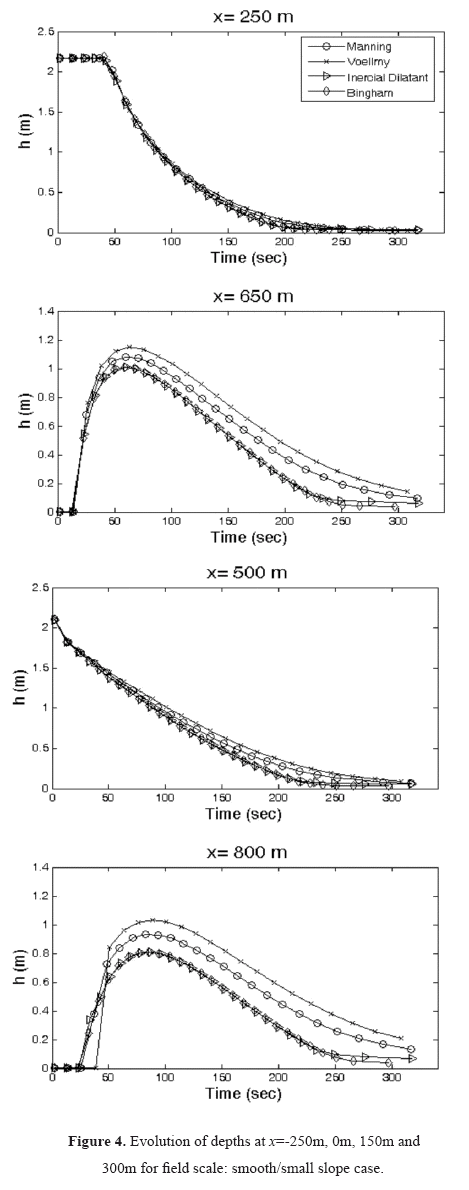
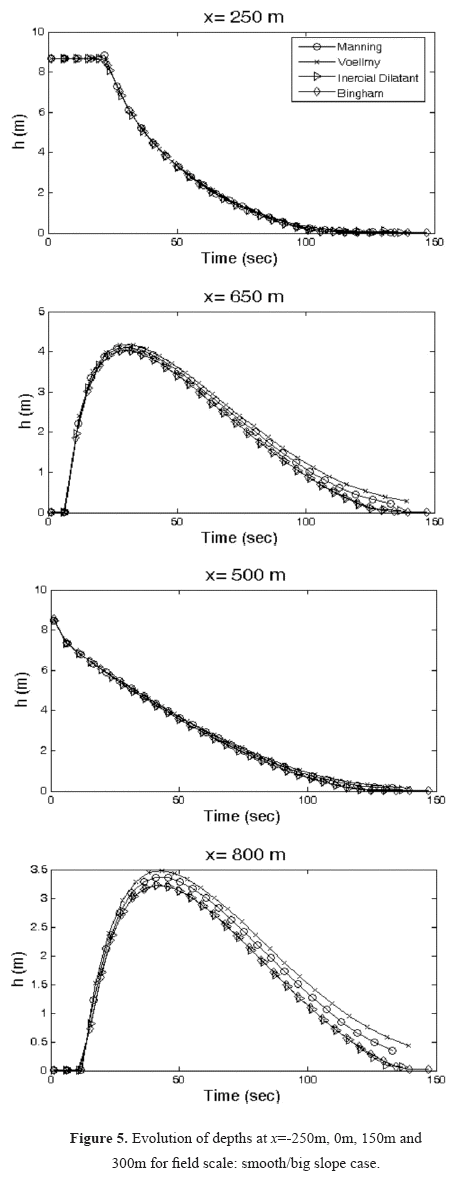
<p ALIGN="JUSTIFY">The fluid is initially at rest. The depth of the layer of  water downstream is <i>h</i><sub>min</sub> = 0.0001 m. The slope variation &#952; was  in the interval [0.5º, 2º]. &quot;Measurement stations&quot; were placed at x= -0.5L, 0L,  0.3L and 0.6L. The results for the lowest (0.5º) and the highest (2º) slope  considered in the smooth case are shown in <a href="#fig4">Figures 4</a> and <a href="#fig5">5</a>.</p>     <p ALIGN="center"><a name="fig4"> <img border="0" src="/img/fbpe/rfiucv/v24n1/art04fig4.gif" width="469" height="1190"></a></p>     
<p ALIGN="center"><a name="fig5"> <img border="0" src="/img/fbpe/rfiucv/v24n1/art04fig5.gif" width="476" height="1189"></a></p>     
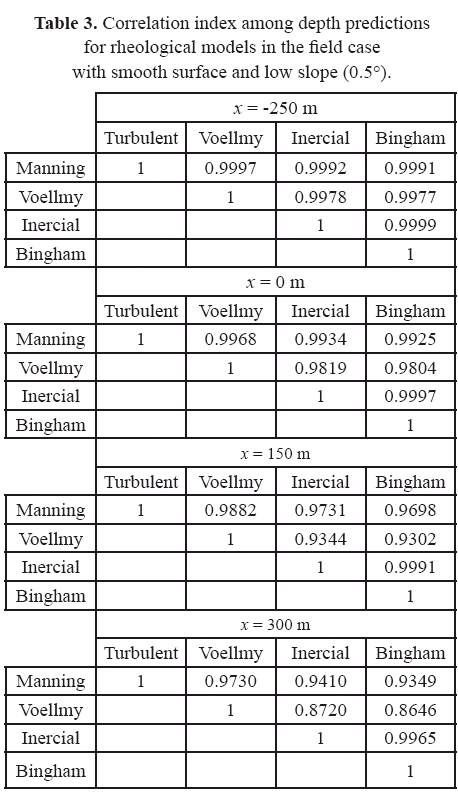
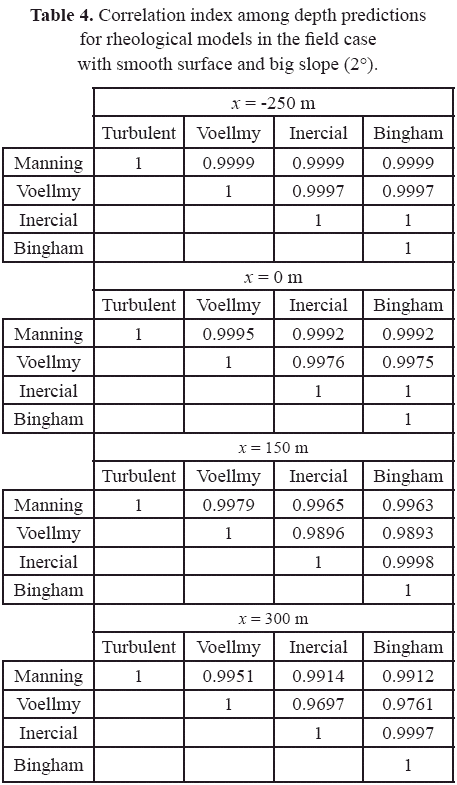
<p ALIGN="JUSTIFY">A good qualitative correspondence is observed for both cases  (lowest and highest angles). Correlation indexes are shown in <a href="#tab3"> Tables 3</a> and <a href="#tab4">4</a>.</p>     <p ALIGN="center"><a name="tab3"> <img border="0" src="/img/fbpe/rfiucv/v24n1/art04tab3.gif" width="458" height="793"></a></p>     
<p ALIGN="center"><a name="tab4"> <img border="0" src="/img/fbpe/rfiucv/v24n1/art04tab4.gif" width="457" height="785"></a></p>     
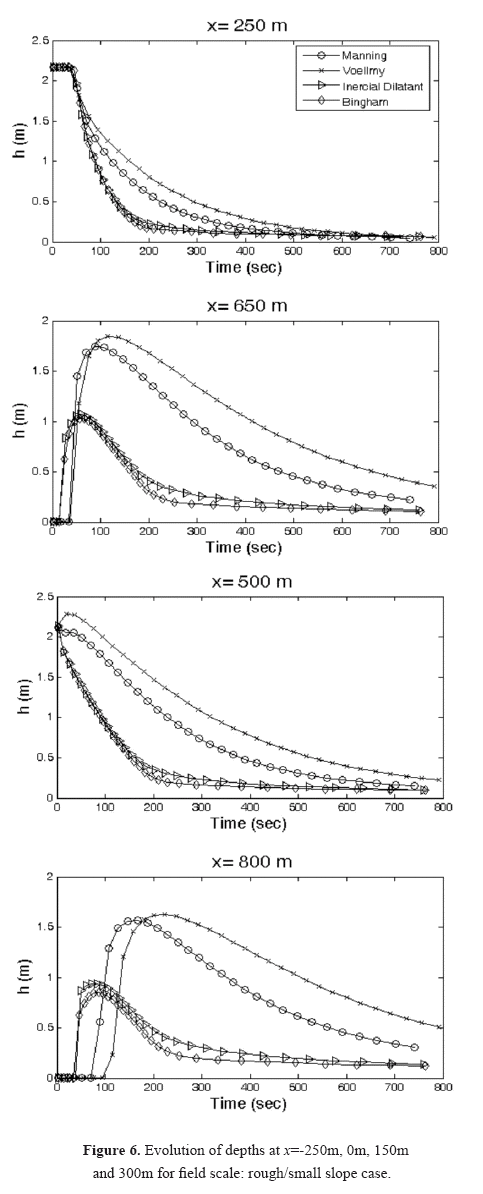
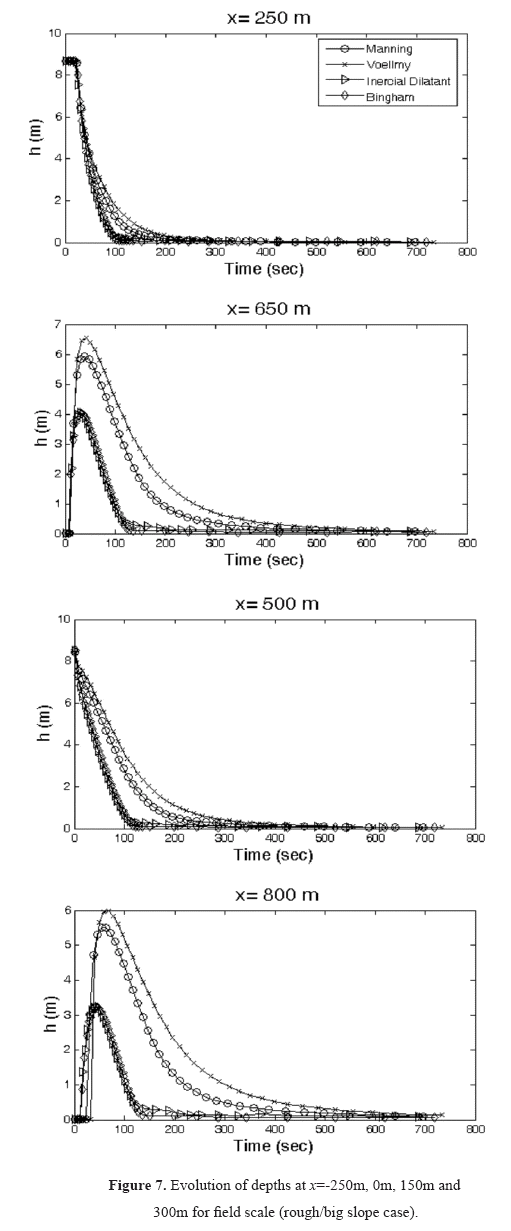
<p ALIGN="JUSTIFY">The highest value for correlation index was of n=0.8646. This  index is lower than the minimum value reached when rheological parameters for  different models were obtained. Arrival times for fluid front are very similar  in downstream stations. Maximum depth differences are in the ranges of 20%, and  are obtained at the closest station to the channel exit.</p>     <p ALIGN="JUSTIFY">Different results are found for the rough case. Depth  hygrographs are shown in <a href="#fig6">Figures 6</a> and <a href="#fig7">7</a>.</p>     <p ALIGN="center"><a name="fig6"> <img border="0" src="/img/fbpe/rfiucv/v24n1/art04fig6.gif" width="483" height="1194"></a></p>     
]]></body>
<body><![CDATA[<p ALIGN="center"><a name="fig7"> <img border="0" src="/img/fbpe/rfiucv/v24n1/art04fig7.gif" width="511" height="1231"></a></p>     
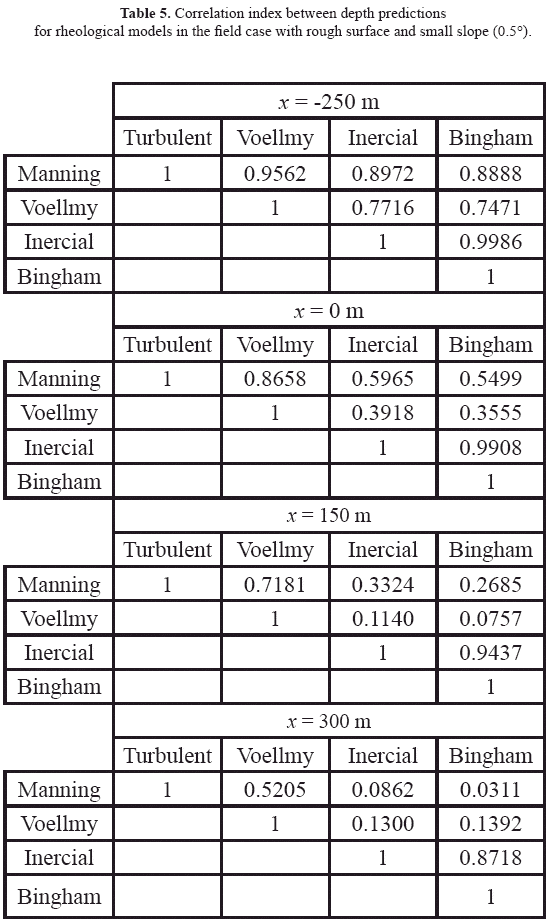
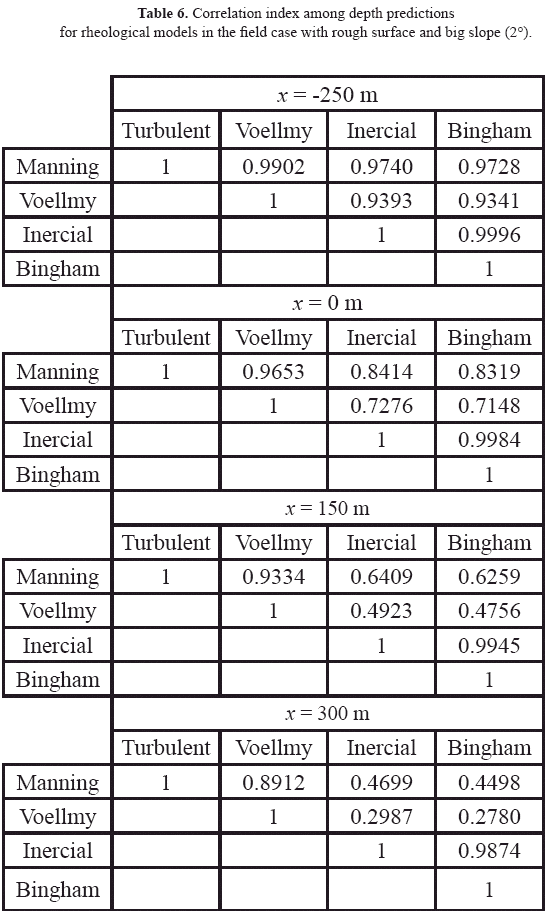
<p ALIGN="JUSTIFY">In the small slope case, very different front velocities are  found at arrival times to downstream measurement stations. Qualitatively,  predictions for different models at the high slope case are no as good as the  one for the smooth case. In particular, maximum depth differences are in ranges  of 100% and very different flow depth are obtained along the path channel as a  function of time. Correlation index for these cases are shown in <a href="#tab5"> Tables 5</a> and <a href="#tab6">6</a>.</p>     <p ALIGN="center"><a name="tab5"> <img border="0" src="/img/fbpe/rfiucv/v24n1/art04tab5.gif" width="551" height="922"></a></p>     
<p ALIGN="center"><a name="tab6"> <img border="0" src="/img/fbpe/rfiucv/v24n1/art04tab6.gif" width="549" height="915"></a></p>     
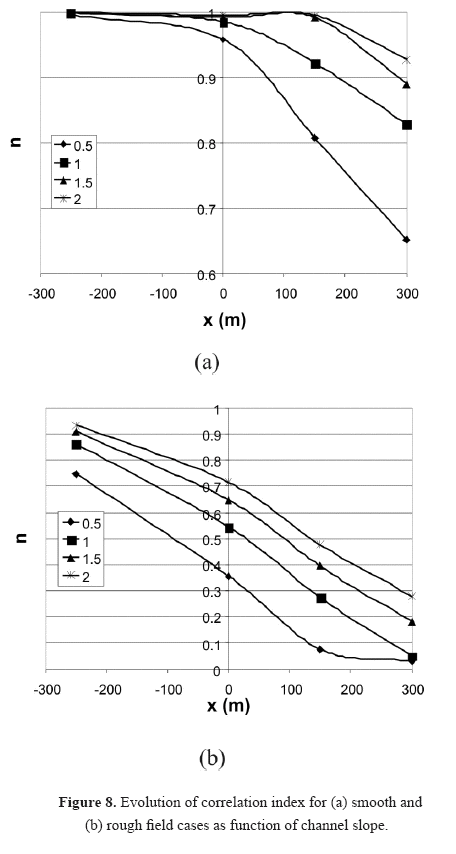
<p ALIGN="JUSTIFY">In the cases presented above no correlation can be  established among some models. <a href="#fig8">Figure 8</a> shows dependence  among the worse correlation indexes in each measurement station as slope  function.</font></p>     <p ALIGN="center"><a name="fig8"> <img border="0" src="/img/fbpe/rfiucv/v24n1/art04fig8.gif" width="456" height="854"></a></p> <font FACE="Verdana" SIZE="2" COLOR="#221e1f">     
<p align="justify">Upstream depths are less influenced by the rheological model  chosen. However, for the lowest angle, correlation index is lower than 0.82,  which had been chosen as the reference value. Downstream, we found that the  correlation indexes are too low for almost all cases considered.</p>     <p ALIGN="JUSTIFY">Thus, even though parameters for different rheological models  can be adjusted for reproducing laboratory experiences at large scale, when they  are employed for field scale test, predictions can be very different depending  on particular </font><font SIZE="2" COLOR="#221e1f"><font face="Verdana"> characteristics of each case. It was shown that it is particularly true when  channel roughness is appreciable. </font></p>     <p ALIGN="JUSTIFY"><font face="Verdana">In particular, for simulating debris-flow  events, the appro</font></font><font SIZE="2" COLOR="#221e1f" face="Verdana">ach</font><font SIZE="2" COLOR="#221e1f" face="Verdana">  to determine rheological parameters from laboratory experiences (although they  used large facilities), does not seem to be adequate</p> <b>     <p ALIGN="JUSTIFY">CONCLUSIONS</p> </b>     ]]></body>
<body><![CDATA[<p ALIGN="JUSTIFY">In this paper a 1D numerical model was used for comparing  predictions from four different resistance friction laws corresponding to four  different rheological models. Parameters for each model were obtained by  comparison with results from large scale laboratory experiments. </p>     <p ALIGN="JUSTIFY">Even though rheological parameters could be adjusted in order  to reproduce experimental data with good precision, when a field scale event is  simulated, the predictions are very different among them. This indicates that  calibration parameters may not be scale-independent.</p>     <p ALIGN="JUSTIFY">Consequently, it is concluded that for simulating debris-flow  events, the approach to determine rheological parameters from laboratory  experiences, although it can be done in large facilities, does not seem to be  extensible for field scale. Experiences in long flumes with mobile bed and  adjustable slope should be done in order to simulate large front velocities and  compare with predictions from different rheological models.</p> </font><font SIZE="2" COLOR="#221e1f" face="Verdana"><b>     <p ALIGN="JUSTIFY">ACKNOWLEDGMENTS</p> </b>     <p ALIGN="JUSTIFY">This study is funded by FONACIT project number G-2005000507.</p> <b>     <p ALIGN="JUSTIFY">REFERENCES</p> </b>     <!-- ref --><p ALIGN="JUSTIFY">1. Ar</font><font SIZE="2" face="Verdana">a</font><font FACE="Verdana" SIZE="2" COLOR="#221e1f">tt</font><font SIZE="2" face="Verdana">a</font><font SIZE="2" COLOR="#221e1f" face="Verdana">no</font><font SIZE="2" COLOR="#221e1f" face="Verdana">, </font><font SIZE="2" face="Verdana">M</font><font FACE="Verdana" SIZE="2" COLOR="#221e1f">.  &amp; Fr</font><font SIZE="2" face="Verdana">a</font><font SIZE="2" COLOR="#221e1f" face="Verdana">nci</font><font SIZE="2" COLOR="#221e1f" face="Verdana">, </font><font SIZE="2" face="Verdana">L</font><font FACE="Verdana" SIZE="2" COLOR="#221e1f">.  (2003). Resistance laws for debris-flow numerical simulation. In D. Rickenmann &amp;  C.L. Chen (eds), Debris-Flow Hazards Mitigation: Mechanics, prediction and  Assessment; Proceeding third International DFHM Conference, Davos, Switzerland,  September 10-12, 2003: 565-576. Rotterdam: Millpress.&nbsp;&nbsp;&nbsp;&nbsp;&nbsp;&nbsp;&nbsp;&nbsp;[&#160;<a href="javascript:void(0);" onclick="javascript: window.open('/scielo.php?script=sci_nlinks&ref=1858317&pid=S0798-4065200900010000400001&lng=','','width=640,height=500,resizable=yes,scrollbars=1,menubar=yes,');">Links</a>&#160;]<!-- end-ref --><!-- ref --><p ALIGN="JUSTIFY">2. Arm</font><font SIZE="2" face="Verdana">a</font><font SIZE="2" COLOR="#221e1f" face="Verdana">nini</font><font SIZE="2" COLOR="#221e1f" face="Verdana">,  A., </font><font SIZE="2" face="Verdana">Da</font><font SIZE="2" COLOR="#221e1f" face="Verdana">lrí</font><font SIZE="2" COLOR="#221e1f" face="Verdana">, </font><font SIZE="2" face="Verdana">C</font><font FACE="Verdana" SIZE="2" COLOR="#221e1f">.,  Fr</font><font SIZE="2" face="Verdana">a</font><font FACE="Verdana" SIZE="2" COLOR="#221e1f">cc</font><font SIZE="2" face="Verdana">a</font><font FACE="Verdana" COLOR="#221e1f" size="2">rollo</font><font FACE="Verdana" COLOR="#221e1f" size="2"> </font><font SIZE="2" face="Verdana">L</font><font FACE="Verdana" SIZE="2" COLOR="#221e1f">., </font><font SIZE="2" face="Verdana">La</font><font FACE="Verdana" COLOR="#221e1f" size="2">rcher</font><font FACE="Verdana" COLOR="#221e1f" size="2"> </font><font SIZE="2" face="Verdana">M</font><font FACE="Verdana" SIZE="2" COLOR="#221e1f">., </font><font SIZE="2" face="Verdana">Z</font><font SIZE="2" COLOR="#221e1f" face="Verdana">orzin</font><font SIZE="2" COLOR="#221e1f" face="Verdana">, </font><font face="Verdana"><font SIZE="2">E</font><font SIZE="2" COLOR="#221e1f">.  (2003). Experimental analysis of the general features of uniform mud-flow. In D.  Rickenmann &amp; C.L. Chen (eds), Debris-Flow Hazards Mitigation: Me</font></font><font SIZE="2" COLOR="#221e1f" face="Verdana">chanics</font><font SIZE="2" COLOR="#221e1f" face="Verdana">,  prediction and Assessment; Proceeding third International DFHM Conference,  Davos, Switzerland, September 10-12, 2003: 423-434. Rotterdam: Millpress. &nbsp;&nbsp;&nbsp;&nbsp;&nbsp;&nbsp;&nbsp;&nbsp;[&#160;<a href="javascript:void(0);" onclick="javascript: window.open('/scielo.php?script=sci_nlinks&ref=1858318&pid=S0798-4065200900010000400002&lng=','','width=640,height=500,resizable=yes,scrollbars=1,menubar=yes,');">Links</a>&#160;]<!-- end-ref --><!-- ref --><p ALIGN="JUSTIFY">3. C</font><font FACE="Verdana" SIZE="2" COLOR="#221e1f">hen, </font><font SIZE="2" face="Verdana">C</font><font FACE="Verdana" SIZE="2" COLOR="#221e1f">.</font><font SIZE="2" face="Verdana">L</font><font SIZE="2" COLOR="#221e1f"><font face="Verdana">.  (1988). Generalized viscoplastic modeling of debris flow. Journal of Hydraulic  Engineering. 114(3): 237-258. </font>&nbsp;&nbsp;&nbsp;&nbsp;&nbsp;&nbsp;&nbsp;&nbsp;[&#160;<a href="javascript:void(0);" onclick="javascript: window.open('/scielo.php?script=sci_nlinks&ref=1858319&pid=S0798-4065200900010000400003&lng=','','width=640,height=500,resizable=yes,scrollbars=1,menubar=yes,');">Links</a>&#160;]<!-- end-ref --><!-- ref --><p ALIGN="JUSTIFY">4. C</font><font SIZE="2" COLOR="#221e1f" face="Verdana">oussot</font><font SIZE="2" COLOR="#221e1f" face="Verdana">,  P. (1992). Rhéologie des boues et laves torrentielles. Étude de dispersions et  suspensions concentrées. These de Doctorat. Laboratoire de Rhéologie. Institut  Nacional Polytechnique de Grenoble. Études de CEMAGREF. CEMAGREF.&nbsp;&nbsp;&nbsp;&nbsp;&nbsp;&nbsp;&nbsp;&nbsp;[&#160;<a href="javascript:void(0);" onclick="javascript: window.open('/scielo.php?script=sci_nlinks&ref=1858320&pid=S0798-4065200900010000400004&lng=','','width=640,height=500,resizable=yes,scrollbars=1,menubar=yes,');">Links</a>&#160;]<!-- end-ref --><!-- ref --><p ALIGN="JUSTIFY">5. G</font><font FACE="Verdana" SIZE="2" COLOR="#221e1f">hil</font><font SIZE="2" face="Verdana">a</font><font SIZE="2" COLOR="#221e1f" face="Verdana">rdi</font><font SIZE="2" COLOR="#221e1f" face="Verdana">,  P., </font><font SIZE="2" face="Verdana">Na</font><font FACE="Verdana" SIZE="2" COLOR="#221e1f">t</font><font SIZE="2" face="Verdana">a</font><font SIZE="2" COLOR="#221e1f" face="Verdana">le</font><font SIZE="2" COLOR="#221e1f" face="Verdana">, </font><font SIZE="2" face="Verdana">L</font><font FACE="Verdana" SIZE="2" COLOR="#221e1f">., </font><font SIZE="2" face="Verdana">Sa</font><font SIZE="2" COLOR="#221e1f" face="Verdana">vi</font><font SIZE="2" COLOR="#221e1f" face="Verdana">,  F. (2003). Experimental investigation and mathematical simulation of debris-flow  runout distance and deposition area. In D. Rickenmann &amp; C.L. Chen (eds), Debris-Flow  Hazards Mitigation: Mechanics, prediction and Assessment; Proceeding third  International DFHM Conference, Davos, Switzerland, September 10-12,  2003:601-610. Rotterdam: Millpress.&nbsp;&nbsp;&nbsp;&nbsp;&nbsp;&nbsp;&nbsp;&nbsp;[&#160;<a href="javascript:void(0);" onclick="javascript: window.open('/scielo.php?script=sci_nlinks&ref=1858321&pid=S0798-4065200900010000400005&lng=','','width=640,height=500,resizable=yes,scrollbars=1,menubar=yes,');">Links</a>&#160;]<!-- end-ref --><!-- ref --><p ALIGN="JUSTIFY">6. I</font><font SIZE="2" COLOR="#221e1f" face="Verdana">verson</font><font SIZE="2" COLOR="#221e1f" face="Verdana">, </font><font SIZE="2" face="Verdana">R</font><font FACE="Verdana" SIZE="2" COLOR="#221e1f">. </font><font face="Verdana"><font SIZE="2">M</font><font SIZE="2" COLOR="#221e1f">.  (2003). The debris-flow rheology myth. In D. Rickenmann &amp; C.L. Chen (eds),  Debris-Flow Ha</font></font><font SIZE="2" COLOR="#221e1f" face="Verdana">zards</font><font SIZE="2" COLOR="#221e1f" face="Verdana">  Mitigation: Mechanics, prediction and Assessment; Proceeding third International  DFHM Conference, Davos, Switzerland, September 10-12:303-314. Rotterdam:  Millpress.&nbsp;&nbsp;&nbsp;&nbsp;&nbsp;&nbsp;&nbsp;&nbsp;[&#160;<a href="javascript:void(0);" onclick="javascript: window.open('/scielo.php?script=sci_nlinks&ref=1858322&pid=S0798-4065200900010000400006&lng=','','width=640,height=500,resizable=yes,scrollbars=1,menubar=yes,');">Links</a>&#160;]<!-- end-ref --><!-- ref --><p ALIGN="JUSTIFY">7. L</font><font FACE="Verdana" SIZE="2" COLOR="#221e1f">o,  K. </font><font SIZE="2" face="Verdana">H</font><font FACE="Verdana" SIZE="2" COLOR="#221e1f">., </font><font SIZE="2" face="Verdana">C</font><font FACE="Verdana" SIZE="2" COLOR="#221e1f">h</font><font SIZE="2" face="Verdana">a</font><font SIZE="2" COLOR="#221e1f" face="Verdana">u</font><font SIZE="2" COLOR="#221e1f" face="Verdana">,  K. </font><font face="Verdana"><font SIZE="2">T</font><font SIZE="2" COLOR="#221e1f">.  (2003). Debris-Flow simulation for Tsing Shan in Hong Kong. In D. Rickenmann &amp;  C.L. Chen (eds), Debris-Flow Hazards Mitigation: Mecha</font></font><font SIZE="2" COLOR="#221e1f" face="Verdana">nics</font><font SIZE="2" COLOR="#221e1f" face="Verdana">,  prediction and Assessment; Proceeding third International DFHM Conference,  Davos, Switzerland, September 10-12, 2003:577-588. Rotterdam: Millpress.&nbsp;&nbsp;&nbsp;&nbsp;&nbsp;&nbsp;&nbsp;&nbsp;[&#160;<a href="javascript:void(0);" onclick="javascript: window.open('/scielo.php?script=sci_nlinks&ref=1858323&pid=S0798-4065200900010000400007&lng=','','width=640,height=500,resizable=yes,scrollbars=1,menubar=yes,');">Links</a>&#160;]<!-- end-ref --><!-- ref --><p ALIGN="JUSTIFY">8. M</font><font SIZE="2" COLOR="#221e1f" face="Verdana">cArdell</font><font SIZE="2" COLOR="#221e1f" face="Verdana">,  B. W., </font><font SIZE="2" face="Verdana">Za</font><font SIZE="2" COLOR="#221e1f" face="Verdana">nuttigh</font><font SIZE="2" COLOR="#221e1f" face="Verdana">,  B., </font><font SIZE="2" face="Verdana">La</font><font FACE="Verdana" SIZE="2" COLOR="#221e1f">m</font><font SIZE="2" face="Verdana">b</font><font SIZE="2" COLOR="#221e1f" face="Verdana">erti</font><font SIZE="2" COLOR="#221e1f" face="Verdana">,  A., </font><font SIZE="2" face="Verdana">R</font><font FACE="Verdana" SIZE="2" COLOR="#221e1f">ic</font><font SIZE="2" face="Verdana">k</font><font FACE="Verdana" SIZE="2" COLOR="#221e1f">enm</font><font SIZE="2" face="Verdana">a</font><font SIZE="2" COLOR="#221e1f" face="Verdana">nn</font><font SIZE="2" COLOR="#221e1f" face="Verdana">, </font><font face="Verdana"><font SIZE="2">D</font><font SIZE="2" COLOR="#221e1f">.  (2003). Systematic comparison of debris-flow laws at the Illgraven torrent,  Switzerland. In D. Rickenmann &amp; C.L. Chen (eds), Debris-Flow Hazards Mi</font></font><font SIZE="2" COLOR="#221e1f" face="Verdana">tigation</font><font SIZE="2" COLOR="#221e1f" face="Verdana">:  Mechanics, prediction and Assessment; Proceeding third International DFHM  Conference, Davos, Switzerland, September 10-12, 2003: 647-657. Rotterdam:  Millpress.&nbsp;&nbsp;&nbsp;&nbsp;&nbsp;&nbsp;&nbsp;&nbsp;[&#160;<a href="javascript:void(0);" onclick="javascript: window.open('/scielo.php?script=sci_nlinks&ref=1858324&pid=S0798-4065200900010000400008&lng=','','width=640,height=500,resizable=yes,scrollbars=1,menubar=yes,');">Links</a>&#160;]<!-- end-ref --><!-- ref --><p ALIGN="JUSTIFY">9. O</font><font SIZE="2" COLOR="#221e1f" face="Verdana">’Brien</font><font SIZE="2" COLOR="#221e1f" face="Verdana">,  J.</font><font SIZE="2" face="Verdana">S</font><font FACE="Verdana" SIZE="2" COLOR="#221e1f">.,  Julien, P.Y., Fullerton, W.</font><font SIZE="2" face="Verdana">T</font><font SIZE="2" COLOR="#221e1f"><font face="Verdana">.  (1993). Two-dimensional water flood and mudflow simulation. Journal of Hydraulic  Engineering. 119(2): 244-259. </font>&nbsp;&nbsp;&nbsp;&nbsp;&nbsp;&nbsp;&nbsp;&nbsp;[&#160;<a href="javascript:void(0);" onclick="javascript: window.open('/scielo.php?script=sci_nlinks&ref=1858325&pid=S0798-4065200900010000400009&lng=','','width=640,height=500,resizable=yes,scrollbars=1,menubar=yes,');">Links</a>&#160;]<!-- end-ref --><!-- ref --><p>10. R</font><font FACE="Verdana" SIZE="2" COLOR="#221e1f">ic</font><font SIZE="2" face="Verdana">k</font><font FACE="Verdana" SIZE="2" COLOR="#221e1f">enm</font><font SIZE="2" face="Verdana">a</font><font SIZE="2" COLOR="#221e1f" face="Verdana">nn</font><font SIZE="2" COLOR="#221e1f" face="Verdana">, </font><font SIZE="2" face="Verdana">D</font><font FACE="Verdana" SIZE="2" COLOR="#221e1f">.,  Koch., </font><font SIZE="2" face="Verdana">T</font><font FACE="Verdana" SIZE="2" COLOR="#221e1f">. </font><font face="Verdana" SIZE="2" COLOR="#221e1f">(1997). In C.L.  Chen (eds), Debris-Flow Hazards </font> <font FACE="Verdana" SIZE="2" COLOR="#221e1f">Mitigation: Mechanics, prediction  and Assessment; Proceeding first International DFHM Conference, San Francisco,  USA, August 7-9, 1997: 576-585. NewYork: Millpress.&nbsp;&nbsp;&nbsp;&nbsp;&nbsp;&nbsp;&nbsp;&nbsp;[&#160;<a href="javascript:void(0);" onclick="javascript: window.open('/scielo.php?script=sci_nlinks&ref=1858326&pid=S0798-4065200900010000400010&lng=','','width=640,height=500,resizable=yes,scrollbars=1,menubar=yes,');">Links</a>&#160;]<!-- end-ref --><!-- ref --><p ALIGN="JUSTIFY">11. R</font><font FACE="Verdana" SIZE="2" COLOR="#221e1f">odríguez, </font><font SIZE="2" face="Verdana">C</font><font FACE="Verdana" SIZE="2" COLOR="#221e1f">.,  Bl</font><font SIZE="2" face="Verdana">a</font><font FACE="Verdana" SIZE="2" COLOR="#221e1f">nco,  A., </font><font SIZE="2" face="Verdana">Ga</font><font FACE="Verdana" SIZE="2" COLOR="#221e1f">rcí</font><font SIZE="2" face="Verdana">a</font><font FACE="Verdana" SIZE="2" COLOR="#221e1f">, </font><font face="Verdana"><font SIZE="2">R</font><font SIZE="2" COLOR="#221e1f">.  (2006). Comparison of 1D debris flow modeling approaches using a high </font> </font><font FACE="Verdana" SIZE="2" COLOR="#221e1f">resolution and non-oscillatory  numerical scheme based on the finite volume method. In Monitoring, Simulation,  Prevention and Remediation of Dense and Debris Flows, WIT Transactions on  Ecology and the Environment. (59): 59-68.&nbsp;&nbsp;&nbsp;&nbsp;&nbsp;&nbsp;&nbsp;&nbsp;[&#160;<a href="javascript:void(0);" onclick="javascript: window.open('/scielo.php?script=sci_nlinks&ref=1858327&pid=S0798-4065200900010000400011&lng=','','width=640,height=500,resizable=yes,scrollbars=1,menubar=yes,');">Links</a>&#160;]<!-- end-ref --><!-- ref --><p ALIGN="JUSTIFY">12. Taka</font><font FACE="Verdana" SIZE="2" COLOR="#221e1f">h</font><font SIZE="2" face="Verdana">a</font><font FACE="Verdana" SIZE="2" COLOR="#221e1f">shi, </font><font SIZE="2" face="Verdana">T</font><font FACE="Verdana" SIZE="2" COLOR="#221e1f">., </font><font SIZE="2" face="Verdana">Naka</font><font FACE="Verdana" SIZE="2" COLOR="#221e1f">g</font><font SIZE="2" face="Verdana">awa</font><font FACE="Verdana" SIZE="2" COLOR="#221e1f">, </font><font SIZE="2" face="Verdana">H</font><font FACE="Verdana" SIZE="2" COLOR="#221e1f">., </font><font SIZE="2" face="Verdana">Sa</font><font FACE="Verdana" SIZE="2" COLOR="#221e1f">to</font><font SIZE="2" face="Verdana">f</font><font FACE="Verdana" SIZE="2" COLOR="#221e1f">u</font><font SIZE="2" face="Verdana">ka</font><font FACE="Verdana" SIZE="2" COLOR="#221e1f">,  Y</font><font SIZE="2" COLOR="#221e1f"><font face="Verdana">. (2000). Newtonian  fluid model for viscous debris-flow. In Wieczorek &amp; Naeser (eds), Debris-Flow  Hazards Mitigation: Mechanics, prediction and Assessment; Proceeding first  International DFHM Conference, Taipei, Taiwan, August 16-18, 2000: 255-262.  Rotterdam: Balkema.</font>&nbsp;&nbsp;&nbsp;&nbsp;&nbsp;&nbsp;&nbsp;&nbsp;[&#160;<a href="javascript:void(0);" onclick="javascript: window.open('/scielo.php?script=sci_nlinks&ref=1858328&pid=S0798-4065200900010000400012&lng=','','width=640,height=500,resizable=yes,scrollbars=1,menubar=yes,');">Links</a>&#160;]<!-- end-ref --><!-- ref --><p><font face="Verdana">13. WES (Waterways Experiment Station). (1961). Floods  re</font></font><font SIZE="2" COLOR="#221e1f" face="Verdana">sulting</font><font SIZE="2" COLOR="#221e1f" face="Verdana">  from suddenly breached dams. Misc paper No. 2-374, Report No 1: Conditions of  minimum resistance, 1960, Report No 2: Conditions of high resistance. US Army  Corp of Engineers, 1961.</font>&nbsp;&nbsp;&nbsp;&nbsp;&nbsp;&nbsp;&nbsp;&nbsp;[&#160;<a href="javascript:void(0);" onclick="javascript: window.open('/scielo.php?script=sci_nlinks&ref=1858329&pid=S0798-4065200900010000400013&lng=','','width=640,height=500,resizable=yes,scrollbars=1,menubar=yes,');">Links</a>&#160;]<!-- end-ref --> ]]></body>
<back>
<ref-list>
<ref id="B1">
<label>1</label><nlm-citation citation-type="confpro">
<person-group person-group-type="author">
<name>
<surname><![CDATA[Arattano]]></surname>
<given-names><![CDATA[M]]></given-names>
</name>
<name>
<surname><![CDATA[Franci]]></surname>
<given-names><![CDATA[L]]></given-names>
</name>
</person-group>
<article-title xml:lang="en"><![CDATA[Resistance laws for debris-flow numerical simulation]]></article-title>
<person-group person-group-type="editor">
<name>
<surname><![CDATA[Rickenmann]]></surname>
<given-names><![CDATA[D]]></given-names>
</name>
<name>
<surname><![CDATA[Chen]]></surname>
<given-names><![CDATA[C.L]]></given-names>
</name>
</person-group>
<source><![CDATA[Debris-Flow Hazards Mitigation: Mechanics, prediction and Assessment]]></source>
<year>2003</year>
<conf-name><![CDATA[third International DFHM Conference]]></conf-name>
<conf-date>2003</conf-date>
<conf-loc> </conf-loc>
<page-range>565-576</page-range><publisher-name><![CDATA[Millpress]]></publisher-name>
</nlm-citation>
</ref>
<ref id="B2">
<label>2</label><nlm-citation citation-type="confpro">
<person-group person-group-type="author">
<name>
<surname><![CDATA[Armanini]]></surname>
<given-names><![CDATA[A]]></given-names>
</name>
<name>
<surname><![CDATA[Dalrí]]></surname>
<given-names><![CDATA[C]]></given-names>
</name>
<name>
<surname><![CDATA[Fraccarollo]]></surname>
<given-names><![CDATA[L]]></given-names>
</name>
<name>
<surname><![CDATA[Larcher]]></surname>
<given-names><![CDATA[M]]></given-names>
</name>
<name>
<surname><![CDATA[Zorzin]]></surname>
<given-names><![CDATA[E]]></given-names>
</name>
</person-group>
<article-title xml:lang="en"><![CDATA[Experimental analysis of the general features of uniform mud-flow]]></article-title>
<person-group person-group-type="editor">
<name>
<surname><![CDATA[Rickenmann]]></surname>
<given-names><![CDATA[D]]></given-names>
</name>
<name>
<surname><![CDATA[Chen]]></surname>
<given-names><![CDATA[C.L.]]></given-names>
</name>
</person-group>
<source><![CDATA[Debris-Flow Hazards Mitigation: Mechanics, prediction and Assessment]]></source>
<year>2003</year>
<conf-name><![CDATA[third International DFHM Conference]]></conf-name>
<conf-date>2003</conf-date>
<conf-loc> </conf-loc>
<page-range>423-434</page-range><publisher-name><![CDATA[Millpress]]></publisher-name>
</nlm-citation>
</ref>
<ref id="B3">
<label>3</label><nlm-citation citation-type="journal">
<person-group person-group-type="author">
<name>
<surname><![CDATA[Chen]]></surname>
<given-names><![CDATA[C.L]]></given-names>
</name>
</person-group>
<article-title xml:lang="en"><![CDATA[Generalized viscoplastic modeling of debris flow]]></article-title>
<source><![CDATA[Journal of Hydraulic Engineering]]></source>
<year>1988</year>
<volume>114</volume>
<numero>3</numero>
<issue>3</issue>
<page-range>237-258</page-range></nlm-citation>
</ref>
<ref id="B4">
<label>4</label><nlm-citation citation-type="book">
<person-group person-group-type="author">
<name>
<surname><![CDATA[Coussot]]></surname>
<given-names><![CDATA[P]]></given-names>
</name>
</person-group>
<source><![CDATA[Rhéologie des boues et laves torrentielles: Étude de dispersions et suspensions concentrées]]></source>
<year>1992</year>
<publisher-name><![CDATA[These de Doctorat. Laboratoire de Rhéologie. Institut Nacional Polytechnique de Grenoble. Études de CEMAGREF. CEMAGREF]]></publisher-name>
</nlm-citation>
</ref>
<ref id="B5">
<label>5</label><nlm-citation citation-type="confpro">
<person-group person-group-type="author">
<name>
<surname><![CDATA[Ghilardi]]></surname>
<given-names><![CDATA[P]]></given-names>
</name>
<name>
<surname><![CDATA[Natale]]></surname>
<given-names><![CDATA[L]]></given-names>
</name>
<name>
<surname><![CDATA[Savi]]></surname>
<given-names><![CDATA[F]]></given-names>
</name>
</person-group>
<article-title xml:lang="en"><![CDATA[Experimental investigation and mathematical simulation of debris-flow runout distance and deposition area]]></article-title>
<person-group person-group-type="editor">
<name>
<surname><![CDATA[Rickenmann]]></surname>
<given-names><![CDATA[D]]></given-names>
</name>
<name>
<surname><![CDATA[Chen]]></surname>
<given-names><![CDATA[C.L]]></given-names>
</name>
</person-group>
<source><![CDATA[Debris-Flow Hazards Mitigation: Mechanics, prediction and Assessment]]></source>
<year>2003</year>
<conf-name><![CDATA[third International DFHM Conference, Davos]]></conf-name>
<conf-date>2003</conf-date>
<conf-loc> </conf-loc>
<page-range>601-610</page-range><publisher-name><![CDATA[Millpress]]></publisher-name>
</nlm-citation>
</ref>
<ref id="B6">
<label>6</label><nlm-citation citation-type="confpro">
<person-group person-group-type="author">
<name>
<surname><![CDATA[Iverson]]></surname>
<given-names><![CDATA[R. M]]></given-names>
</name>
</person-group>
<article-title xml:lang="en"><![CDATA[The debris-flow rheology myth]]></article-title>
<person-group person-group-type="editor">
<name>
<surname><![CDATA[Rickenmann]]></surname>
<given-names><![CDATA[D]]></given-names>
</name>
<name>
<surname><![CDATA[Chen]]></surname>
<given-names><![CDATA[C.L]]></given-names>
</name>
</person-group>
<source><![CDATA[Debris-Flow Hazards Mitigation: Mechanics, prediction and Assessment]]></source>
<year>2003</year>
<conf-name><![CDATA[third International DFHM Conference]]></conf-name>
<conf-loc>Davos </conf-loc>
<page-range>303-314</page-range><publisher-name><![CDATA[Millpress]]></publisher-name>
</nlm-citation>
</ref>
<ref id="B7">
<label>7</label><nlm-citation citation-type="confpro">
<person-group person-group-type="author">
<name>
<surname><![CDATA[Lo]]></surname>
<given-names><![CDATA[K. H]]></given-names>
</name>
<name>
<surname><![CDATA[Chau]]></surname>
<given-names><![CDATA[K. T]]></given-names>
</name>
</person-group>
<article-title xml:lang="en"><![CDATA[Debris-Flow simulation for Tsing Shan in Hong Kong]]></article-title>
<person-group person-group-type="editor">
<name>
<surname><![CDATA[Rickenmann]]></surname>
<given-names><![CDATA[D]]></given-names>
</name>
<name>
<surname><![CDATA[Chen]]></surname>
<given-names><![CDATA[C.L]]></given-names>
</name>
</person-group>
<source><![CDATA[Debris-Flow Hazards Mitigation: Mechanics, prediction and Assessment]]></source>
<year>2003</year>
<conf-name><![CDATA[third International DFHM Conference]]></conf-name>
<conf-date>2003</conf-date>
<conf-loc>Davos </conf-loc>
<page-range>577-588</page-range><publisher-name><![CDATA[Millpress]]></publisher-name>
</nlm-citation>
</ref>
<ref id="B8">
<label>8</label><nlm-citation citation-type="confpro">
<person-group person-group-type="author">
<name>
<surname><![CDATA[McArdell]]></surname>
<given-names><![CDATA[B. W]]></given-names>
</name>
<name>
<surname><![CDATA[Zanuttigh]]></surname>
<given-names><![CDATA[B]]></given-names>
</name>
<name>
<surname><![CDATA[Lamberti]]></surname>
<given-names><![CDATA[A]]></given-names>
</name>
<name>
<surname><![CDATA[Rickenmann]]></surname>
<given-names><![CDATA[D]]></given-names>
</name>
</person-group>
<article-title xml:lang="en"><![CDATA[Systematic comparison of debris-flow laws at the Illgraven torrent, Switzerland]]></article-title>
<person-group person-group-type="editor">
<name>
<surname><![CDATA[Rickenmann]]></surname>
<given-names><![CDATA[D]]></given-names>
</name>
<name>
<surname><![CDATA[Chen]]></surname>
<given-names><![CDATA[C.L]]></given-names>
</name>
</person-group>
<source><![CDATA[Debris-Flow Hazards Mitigation: Mechanics, prediction and Assessment]]></source>
<year>2003</year>
<conf-name><![CDATA[third International DFHM Conference]]></conf-name>
<conf-date>2003</conf-date>
<conf-loc>Davos </conf-loc>
<page-range>647-657</page-range><publisher-name><![CDATA[Millpress]]></publisher-name>
</nlm-citation>
</ref>
<ref id="B9">
<label>9</label><nlm-citation citation-type="journal">
<person-group person-group-type="author">
<name>
<surname><![CDATA[O’Brien]]></surname>
<given-names><![CDATA[J.S]]></given-names>
</name>
<name>
<surname><![CDATA[Julien]]></surname>
<given-names><![CDATA[P.Y]]></given-names>
</name>
<name>
<surname><![CDATA[Fullerton]]></surname>
<given-names><![CDATA[W.T]]></given-names>
</name>
</person-group>
<article-title xml:lang="en"><![CDATA[Two-dimensional water flood and mudflow simulation]]></article-title>
<source><![CDATA[Journal of Hydraulic Engineering]]></source>
<year>1993</year>
<volume>119</volume>
<numero>2</numero>
<issue>2</issue>
<page-range>244-259</page-range></nlm-citation>
</ref>
<ref id="B10">
<label>10</label><nlm-citation citation-type="confpro">
<person-group person-group-type="author">
<name>
<surname><![CDATA[Rickenmann]]></surname>
<given-names><![CDATA[D]]></given-names>
</name>
<name>
<surname><![CDATA[Koch]]></surname>
<given-names><![CDATA[T]]></given-names>
</name>
</person-group>
<person-group person-group-type="editor">
<name>
<surname><![CDATA[Chen]]></surname>
<given-names><![CDATA[C.L]]></given-names>
</name>
</person-group>
<source><![CDATA[Debris-Flow Hazards Mitigation: Mechanics, prediction and Assessment]]></source>
<year>1997</year>
<conf-name><![CDATA[first International DFHM Conference]]></conf-name>
<conf-date>1997</conf-date>
<conf-loc>San Francisco </conf-loc>
<page-range>576-585</page-range><publisher-loc><![CDATA[NewYork: ]]></publisher-loc>
<publisher-name><![CDATA[Millpress]]></publisher-name>
</nlm-citation>
</ref>
<ref id="B11">
<label>11</label><nlm-citation citation-type="journal">
<person-group person-group-type="author">
<name>
<surname><![CDATA[Rodríguez]]></surname>
<given-names><![CDATA[C]]></given-names>
</name>
<name>
<surname><![CDATA[Blanco]]></surname>
<given-names><![CDATA[A]]></given-names>
</name>
<name>
<surname><![CDATA[García]]></surname>
<given-names><![CDATA[R]]></given-names>
</name>
</person-group>
<article-title xml:lang="en"><![CDATA[Comparison of 1D debris flow modeling approaches using a high resolution and non-oscillatory numerical scheme based on the finite volume method]]></article-title>
<source><![CDATA[In Monitoring]]></source>
<year>2006</year>
<volume>Simulation, Prevention and Remediation of Dense and Debris Flows, WIT Transactions on Ecology and the Environment.</volume>
<numero>59</numero>
<issue>59</issue>
<page-range>59-68</page-range></nlm-citation>
</ref>
<ref id="B12">
<label>12</label><nlm-citation citation-type="confpro">
<person-group person-group-type="author">
<name>
<surname><![CDATA[Takahashi]]></surname>
<given-names><![CDATA[T]]></given-names>
</name>
<name>
<surname><![CDATA[Nakagawa]]></surname>
<given-names><![CDATA[H]]></given-names>
</name>
<name>
<surname><![CDATA[Satofuka]]></surname>
<given-names><![CDATA[Y]]></given-names>
</name>
</person-group>
<article-title xml:lang="en"><![CDATA[Newtonian fluid model for viscous debris-flow]]></article-title>
<person-group person-group-type="editor">
<name>
<surname><![CDATA[Wieczorek]]></surname>
</name>
<name>
<surname><![CDATA[Naeser]]></surname>
</name>
</person-group>
<source><![CDATA[Debris-Flow Hazards Mitigation: Mechanics, prediction and Assessment]]></source>
<year>2000</year>
<conf-name><![CDATA[first International DFHM Conference]]></conf-name>
<conf-date>2000</conf-date>
<conf-loc>Taiwan </conf-loc>
<page-range>255-262</page-range><publisher-name><![CDATA[Rotterdam: Balkema]]></publisher-name>
</nlm-citation>
</ref>
<ref id="B13">
<label>13</label><nlm-citation citation-type="book">
<collab>^rND^sTakahashi^nT</collab>
<source><![CDATA[Floods resulting from suddenly breached dams]]></source>
<year>1961</year>
<publisher-name><![CDATA[US Army Corp of Engineers]]></publisher-name>
</nlm-citation>
</ref>
</ref-list>
</back>
</article>