<?xml version="1.0" encoding="ISO-8859-1"?><article xmlns:mml="http://www.w3.org/1998/Math/MathML" xmlns:xlink="http://www.w3.org/1999/xlink" xmlns:xsi="http://www.w3.org/2001/XMLSchema-instance">
<front>
<journal-meta>
<journal-id>0798-4065</journal-id>
<journal-title><![CDATA[Revista de la Facultad de Ingeniería Universidad Central de Venezuela]]></journal-title>
<abbrev-journal-title><![CDATA[Rev. Fac. Ing. UCV]]></abbrev-journal-title>
<issn>0798-4065</issn>
<publisher>
<publisher-name><![CDATA[Universidad Central de Venezuela]]></publisher-name>
</publisher>
</journal-meta>
<article-meta>
<article-id>S0798-40652010000400002</article-id>
<title-group>
<article-title xml:lang="en"><![CDATA[Evaluating block preconditioners in the solution of saddle point systems]]></article-title>
<article-title xml:lang="es"><![CDATA[Evaluación de precondicionadores en bloque en la solución de sistemas de punto de ensilladura]]></article-title>
</title-group>
<contrib-group>
<contrib contrib-type="author">
<name>
<surname><![CDATA[Castillo]]></surname>
<given-names><![CDATA[Zenaida]]></given-names>
</name>
<xref ref-type="aff" rid="A01"/>
</contrib>
<contrib contrib-type="author">
<name>
<surname><![CDATA[Suárez]]></surname>
<given-names><![CDATA[Jean Piero]]></given-names>
</name>
<xref ref-type="aff" rid="A02"/>
</contrib>
</contrib-group>
<aff id="A01">
<institution><![CDATA[,Universidad Central de Venezuela Facultad de Ciencias Escuela de Computación]]></institution>
<addr-line><![CDATA[Caracas ]]></addr-line>
<country>Venezuela</country>
</aff>
<aff id="A02">
<institution><![CDATA[,San Diego State University Computational Science Research ]]></institution>
<addr-line><![CDATA[San Diego CA]]></addr-line>
<country>USA</country>
</aff>
<pub-date pub-type="pub">
<day>00</day>
<month>12</month>
<year>2010</year>
</pub-date>
<pub-date pub-type="epub">
<day>00</day>
<month>12</month>
<year>2010</year>
</pub-date>
<volume>25</volume>
<numero>4</numero>
<fpage>7</fpage>
<lpage>15</lpage>
<copyright-statement/>
<copyright-year/>
<self-uri xlink:href="http://ve.scielo.org/scielo.php?script=sci_arttext&amp;pid=S0798-40652010000400002&amp;lng=en&amp;nrm=iso"></self-uri><self-uri xlink:href="http://ve.scielo.org/scielo.php?script=sci_abstract&amp;pid=S0798-40652010000400002&amp;lng=en&amp;nrm=iso"></self-uri><self-uri xlink:href="http://ve.scielo.org/scielo.php?script=sci_pdf&amp;pid=S0798-40652010000400002&amp;lng=en&amp;nrm=iso"></self-uri><abstract abstract-type="short" xml:lang="en"><p><![CDATA[This paper presents a new approach to precondition linear systems of the saddle point kind. Specifically we consider block diagonal, block triangular and block indefinite preconditioning techniques on nonsymmetric systems. These preconditioners require the computation of some inverses and we propose to use sparse approximate inverses (SPAI) to construct these approximations. The computation of these inverses involves solving a set of uncoupled least squares problems, which can be easily parallelized on a memory distributed machine. Comparison with other techniques suggests that block diagonal and block triangular preconditioning can be more effective if they are combined with SPAI techniques in the computation of approximate inverses. Results are promising and show the effectiveness of these preconditioners when improving the convergence of Krylov methods such as GMRES, which suggests the application of this approach in the large-scale setting.]]></p></abstract>
<abstract abstract-type="short" xml:lang="es"><p><![CDATA[Este artículo presenta una nueva técnica para precondicionar sistemas lineales conocidos en la literatura como sistemas de punto de ensilladura. Específicamente consideramos precondicionadores en bloque del tipo diagonal, triangular e indefinido, sobre sistemas de punto de ensilladura no simétricos. Estos precondicionadores requieren el cálculo de inversas y proponemos usar la técnica de aproximación de inversa conocida como SPAI (Aproximación dispersa de la inversa) por sus siglas en inglés. La construcción o cálculo de estas inversas requiere de la resolución de un conjunto de problemas desacoplados de mínimos cuadrados, que puede fácilmente paralelizarse en máquinas con memoria distribuida o máquinas vectoriales. Se presenta un análisis comparativo de tres precondicionadores propuestos. Los resultados numéricos muestran que los precondicionadores en bloque del tipo diagonal y triangular pueden ser más efectivos si se combinan con técnicas SPAI para el cálculo aproximado de las inversas, una vez que se mejoran sustancialmente las características de convergencia de métodos de Krylov como GMRES. Esto nos permite sugerir la aplicación de esta técnica en la resolución de sistemas de gran magnitud.]]></p></abstract>
<kwd-group>
<kwd lng="en"><![CDATA[Saddle point linear systems]]></kwd>
<kwd lng="en"><![CDATA[Block preconditioners]]></kwd>
<kwd lng="en"><![CDATA[Sparse approximate inverses]]></kwd>
<kwd lng="en"><![CDATA[SPAI techniques]]></kwd>
<kwd lng="en"><![CDATA[Krylov methods]]></kwd>
<kwd lng="en"><![CDATA[GMRES]]></kwd>
<kwd lng="es"><![CDATA[Sistemas lineales de punto de ensilladura]]></kwd>
<kwd lng="es"><![CDATA[Precondicionadores en bloque]]></kwd>
<kwd lng="es"><![CDATA[Aproximación dispersa de inversas]]></kwd>
<kwd lng="es"><![CDATA[Técnicas SPAI]]></kwd>
<kwd lng="es"><![CDATA[Métodos de Krylov]]></kwd>
<kwd lng="es"><![CDATA[GMRES]]></kwd>
</kwd-group>
</article-meta>
</front><body><![CDATA[ <p ALIGN="center" style="line-height: 100%"><b><span lang="EN-US" style="font-size:12.0pt;font-family: Verdana;mso-fareast-font-family:&quot;Times New Roman&quot;;mso-bidi-font-family:&quot;Times New Roman&quot;; mso-ansi-language:EN-US;mso-fareast-language:ES;mso-bidi-language:AR-SA">Evaluating block preconditioners</span></b><span lang="EN-US" style="font-size:12.0pt; font-family:Verdana;mso-fareast-font-family:&quot;Times New Roman&quot;;mso-bidi-font-family: &quot;Times New Roman&quot;;mso-ansi-language:EN-US;mso-fareast-language:ES;mso-bidi-language: AR-SA"> <b>in the solution of saddle point <span style="text-transform:capitalize">systems</span></b></span></p>     <p ALIGN="center" style="line-height: 100%"><font size="2" face="Verdana">Zenaida Castillo<sup>1</sup>, Jean Piero Suárez<sup>2</sup></font></p>     <p ALIGN="justify" style="line-height: 100%"><font size="2" face="Verdana"><sup>1</sup>Universidad Central de Venezuela, Facultad de Ciencias, Escuela de Computación, Caracas, 1041-A, Venezuela, e-mail: <a href="mailto:zenaida.castillo@ciens.ucv.ve">zenaida.castillo@ciens.ucv.ve</a></font></p>     <p ALIGN="justify" style="line-height: 100%"><font size="2" face="Verdana"><sup>2</sup>San Diego State University, Computational Science Research, San Diego CA 92182 -1245, USA, email: <a href="mailto:jsuarez@sciences.sdsu.edu">jsuarez@sciences.sdsu.edu</a></font></p> <b>     <p ALIGN="justify" style="line-height: 100%"><font size="2" face="Verdana">ABSTRACT</font></p> </b>     <p ALIGN="justify" style="line-height: 100%"><font size="2" face="Verdana">This paper presents a new approach to precondition linear systems of the saddle point kind. Specifically we consider block diagonal, block triangular and block indefinite preconditioning techniques on nonsymmetric systems. These preconditioners require the computation of some inverses and we propose to use sparse approximate inverses (SPAI) to construct these approximations. The computation of these inverses involves solving a set of uncoupled least squares problems, which can be easily parallelized on a memory distributed machine. Comparison with other techniques suggests that block diagonal and block triangular preconditioning can be more effective if they are combined with SPAI techniques in the computation of approximate inverses. Results are promising and show the effectiveness of these preconditioners when improving the convergence of Krylov methods such as GMRES, which suggests the application of this approach in the large-scale setting.</font></p>     <p ALIGN="justify" style="line-height: 100%"><font size="2" face="Verdana"><b>Keywords:</b> Saddle point linear systems, Block preconditioners, Sparse approximate inverses, SPAI techniques, Krylov methods, GMRES.</font></p>     <p ALIGN="center" style="line-height: 100%"><b><span style="font-size:10.0pt;font-family:Verdana; mso-fareast-font-family:&quot;Times New Roman&quot;;mso-bidi-font-family:&quot;Times New Roman&quot;; mso-ansi-language:ES;mso-fareast-language:ES;mso-bidi-language:AR-SA">Evaluación de precondicionadores en bloque</span></b><span style="font-size:10.0pt; font-family:Verdana;mso-fareast-font-family:&quot;Times New Roman&quot;;mso-bidi-font-family: &quot;Times New Roman&quot;;mso-ansi-language:ES;mso-fareast-language:ES;mso-bidi-language: AR-SA"> <b>en la solución de sistemas de punto de ensilladura</b></span><b></p>     <p ALIGN="justify" style="line-height: 100%"><font size="2" face="Verdana">RESUMEN</font></p> </b>     <p ALIGN="justify" style="line-height: 100%"><font size="2" face="Verdana">Este artículo presenta una nueva técnica para precondicionar sistemas lineales conocidos en la literatura como sistemas de punto de ensilladura. Específicamente consideramos precondicionadores en bloque del tipo diagonal, triangular e indefinido, sobre sistemas de punto de ensilladura no simétricos. Estos precondicionadores requieren el cálculo de inversas y proponemos usar la técnica de aproximación de inversa conocida como SPAI (Aproximación dispersa de la inversa) por sus siglas en inglés. La construcción o cálculo de estas inversas requiere de la resolución de un conjunto de problemas desacoplados de mínimos cuadrados, que puede fácilmente paralelizarse en máquinas con memoria distribuida o máquinas vectoriales. Se presenta un análisis comparativo de tres precondicionadores propuestos. Los resultados numéricos muestran que los precondicionadores en bloque del tipo diagonal y triangular pueden ser más efectivos si se combinan con técnicas SPAI para el cálculo aproximado de las inversas, una vez que se mejoran sustancialmente las características de convergencia de métodos de Krylov como GMRES. Esto nos permite sugerir la aplicación de esta técnica en la resolución de sistemas de gran magnitud.</font></p>     ]]></body>
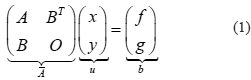
<body><![CDATA[<p ALIGN="justify" style="line-height: 100%"><font size="2" face="Verdana"><b>Palabras clave:</b> Sistemas lineales de punto de ensilladura, Precondicionadores en bloque, Aproximación dispersa de inversas, Técnicas SPAI, Métodos de Krylov, GMRES.</font></p>     <p ALIGN="justify" style="line-height: 100%"><font size="2" face="Verdana">Recibido: febrero de 2009 <font LANG="JA">Recibido en forma final revisado: julio de 2010</font></font></p>     <p ALIGN="justify" style="line-height: 100%"><span style="FONT-WEIGHT: bold" class="font3"><font size="2" face="Verdana">INTRODUCTION</font></span></p>     <p ALIGN="justify" style="line-height: 100%"><font size="2" face="Verdana">The numerical solution of many important problems in sciences and engineering, such as computational fluid dynamics, electromagnetism, nonlinear quadratic programming, constrained optimization and computer graphics is often obtained by solving saddle point linear systems (SPLS), see for example the works in (Glowinsky, 2003; Gould <i>et al</i>. 2001; Wright, 1997). The general structure for these linear systems is:</font></p>     <p ALIGN="center" style="line-height: 100%"><img border="0" src="/img/fbpe/rfiucv/v25n4/art02ec1.gif" width="251" height="80"></p>     
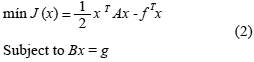
<p ALIGN="justify" style="line-height: 100%"><font size="2" face="Verdana">where <i>A <span style="mso-char-type: symbol; mso-symbol-font-family: Symbol; font-size: 10.0pt; mso-bidi-font-size: 12.0pt; font-family: Symbol; mso-ascii-font-family: Verdana; mso-fareast-font-family: Times New Roman; mso-hansi-font-family: Verdana; mso-bidi-font-family: Times New Roman; mso-ansi-language: ES; mso-fareast-language: ES; mso-bidi-language: AR-SA">Î </span></i><b>R</b><i><sup>nxn</sup></i>, <i>B <span style="mso-char-type: symbol; mso-symbol-font-family: Symbol; font-size: 10.0pt; mso-bidi-font-size: 12.0pt; font-family: Symbol; mso-ascii-font-family: Verdana; mso-fareast-font-family: Times New Roman; mso-hansi-font-family: Verdana; mso-bidi-font-family: Times New Roman; mso-ansi-language: ES; mso-fareast-language: ES; mso-bidi-language: AR-SA">Î </span></i><b>R</b><i><sup>mxn</sup> </i><font LANG="JA">and n </font><font LANG="JA">&#8805;</font><font LANG="JA"> m. This kind of linear systems</font> <font LANG="JA">are known as saddle point problems due to the equivalence</font> <font LANG="JA">with the solution of the equality constrained quadratic</font> programming problem:</font></p>     <p ALIGN="center" style="line-height: 100%"><img border="0" src="/img/fbpe/rfiucv/v25n4/art02ec2.gif" width="254" height="62"></p>     
<p ALIGN="justify" style="line-height: 100%"><font size="2" face="Verdana">In this problem, the vector y in the linear system (1) represents Lagrange multipliers and the solution of this system is a saddle point of the Lagrangian:</font></p>     <p ALIGN="center" style="line-height: 100%"><img border="0" src="/img/fbpe/rfiucv/v25n4/art02ec3.gif" width="296" height="39"></p>     
<p ALIGN="justify" style="line-height: 100%"><font size="2" face="Verdana"><font LANG="JA">In practical applications, system (1) comes from the discretization</font> <font LANG="JA">of partial differential equations (PDE), thus,</font> <font LANG="JA">the coeffient matrix </font><i><span style="mso-bidi-font-size: 12.0pt; mso-fareast-font-family: Times New Roman; mso-bidi-font-family: Times New Roman; mso-ansi-language: ES; mso-fareast-language: ES; mso-bidi-language: AR-SA">&#256;</span> </i>is large and sparse. For that reason, <font LANG="JA">we are interested in a good approximation of the solution,</font> which can give us important information about the modeled system. In these cases, non analytical or iterative methods are preferred, although direct methods like Gaussian elimination and its variants can be used if the size of the system <font LANG="JA">is moderated (Benzi </font><i>et al</i><font LANG="JA">. 2005).</font></font></p>     ]]></body>
<body><![CDATA[<p ALIGN="justify" style="line-height: 100%"><font size="2" face="Verdana"><font LANG="JA">Spectral and symmetry properties of matrix </font><span style="mso-bidi-font-size: 12.0pt; mso-fareast-font-family: Times New Roman; mso-bidi-font-family: Times New Roman; mso-ansi-language: ES; mso-fareast-language: ES; mso-bidi-language: AR-SA"><i>&#256;</i></span>, the upper left block of <i>A</i>, play an important role when choosing a <font LANG="JA">numerical method to solve the linear system (1). In particu</font>lar, the case when <i>A </i><font LANG="JA">is symmetric and positive definite has</font> <font LANG="JA">been studied and developed widely by several authors; see</font> <font LANG="JA">for example the works in (Axelson </font><i>et al</i><font LANG="JA">. 2003; Sylvester </font><i>et</i> <i>al</i><font LANG="JA">. 2001; Elman </font><i>et al</i><font LANG="JA">. 1996).</font></font></p>     <p ALIGN="justify" style="line-height: 100%"><font size="2" face="Verdana"><font LANG="JA">However, SPLS in which the matrix </font><i>A </i>is no symmetric are <font LANG="JA">of great importance and solving them efficiently has been a</font> topic of research in recent years. Numerical solution of this kind of systems will be considered in this work.</font></p>     <p ALIGN="justify" style="line-height: 100%"><font size="2" face="Verdana"><font LANG="JA">It is known that when the coefficient matrix </font><i><span style="mso-bidi-font-size: 12.0pt; mso-fareast-font-family: Times New Roman; mso-bidi-font-family: Times New Roman; mso-ansi-language: ES; mso-fareast-language: ES; mso-bidi-language: AR-SA">&#256;</span></i><i> </i>is large and ill conditioned an iterative preconditioned Krylov subspace solver such as preconditioned GMRES is the best choice to <font LANG="JA">get a good approximation. Several preconditioners based</font> <font LANG="JA">on incomplete factorizations, sparse approximate inverses</font> and algebraic multilevel methods have been proposed for <font LANG="JA">SPLS (Benzi, 2002; Van der Vorst, 2003), some of which</font> have turned out to be well-suited for general saddle point systems. In particular, considering the block structure of the <font LANG="JA">coefficient matrix, some authors have independently proposed</font> <font LANG="JA">block preconditioners to solve SPLS, see for example</font> <font LANG="JA">the references (Ipsen 2001; Murphy </font><i>et al</i><font LANG="JA">. 2000; Perugia </font><i>et</i> <i>al</i><font LANG="JA">. 2000; Rozloznk, 2002).</font></font></p>     <p ALIGN="justify" style="line-height: 100%"><font size="2" face="Verdana">The main contribution of this work is to provide an evalua<font LANG="JA">tion of current block preconditioners when using a SPAI</font> <font LANG="JA">(Sparse Approximate Inverse) technique for the computa</font>tion of the inverses involved. The construction of each one <font LANG="JA">of these block preconditioners requires exact inverses of</font> <font LANG="JA">matrices which are smaller in magnitude than the matrix </font><i><span style="mso-bidi-font-size: 12.0pt; mso-fareast-font-family: Times New Roman; mso-bidi-font-family: Times New Roman; mso-ansi-language: ES; mso-fareast-language: ES; mso-bidi-language: AR-SA">&#256;</span></i>, <font LANG="JA">and we propose to replace those inverses by sparse approxi</font>mations of them.</font></p> <b>     <p ALIGN="justify" style="line-height: 100%"><font size="2" face="Verdana">CURRENT APPROACHES</font></p> </b>     <p ALIGN="justify" style="line-height: 100%"><font size="2" face="Verdana"><font LANG="JA">Algorithms for saddle point problems can be classified in</font> segregated and coupled. Segregated methods take advan<font LANG="JA">tage</font> <font LANG="JA">of the block structure of (1) and compute vectors </font><i>x</i> and <i>y </i><font LANG="JA">separately, by solving linear systems with coefficient</font> matrices of smaller dimensions than <i><span style="mso-bidi-font-size: 12.0pt; mso-fareast-font-family: Times New Roman; mso-bidi-font-family: Times New Roman; mso-ansi-language: ES; mso-fareast-language: ES; mso-bidi-language: AR-SA">&#256;</span></i>.</font></p>     <p ALIGN="justify" style="line-height: 100%"><font size="2" face="Verdana"><font LANG="JA">The main representations of these techniques are based on</font> <font LANG="JA">Schur complement reduction (Vavasis, 1994; McGuire </font><i>et</i> <i>al</i><font LANG="JA">. 1979) and null space methods (Arioli </font><i>et al</i><font LANG="JA">. 2002), which</font> <font LANG="JA">solve the equivalent problem:</font></font></p> <i>     <p ALIGN="center" style="line-height: 100%"><font size="2" face="Verdana">Ax </font></i><font size="2" face="Verdana">+ </font><i><font size="2" face="Verdana">B<sup>T</sup> y = f</font></p>     <p ALIGN="center" style="line-height: 100%"><font size="2" face="Verdana">Bx = g&nbsp;&nbsp;&nbsp; </font></i><font size="2" face="Verdana">&nbsp; <b>(4)</b></font></p>     <p ALIGN="justify" style="line-height: 100%"><font size="2" face="Verdana"><font LANG="JA">Schur complement reduction is a technique commonly used</font> <font LANG="JA">in problems where the matrix </font><i>A </i><font LANG="JA">is symmetric positive defi</font>nite and <i>B </i>has full column rank. Based on these considerations, vector <i>x </i><font LANG="JA">in (4) can be eliminated, obtaining a symmetric</font> <font LANG="JA">positive definite linear system of </font><i>m </i>x <i>m</i>:</font></p> <i>     ]]></body>
<body><![CDATA[<p ALIGN="center" style="line-height: 100%"><font size="2" face="Verdana">Sy </font></i><font size="2" face="Verdana">= <i>BA</i><sup>-1</sup> <i>f </i>- <i>g &nbsp;&nbsp;&nbsp;</i><b><font LANG="JA">(5)</font></b></font></p>     <p ALIGN="justify" style="line-height: 100%"><font size="2" face="Verdana"><font LANG="JA">where the matrix </font><i>S </i>= <i>BA</i><sup>-1</sup><i>B<sup>T</sup> </i>is known as the Schur complement.</font></p>     <p ALIGN="justify" style="line-height: 100%"><font size="2" face="Verdana"><font LANG="JA">When the inverse of </font><i>A </i><font LANG="JA">exists, the linear system (5) can be</font> <font LANG="JA">solved using conjugate gradient without explicitly constructing</font> <font LANG="JA">the matrix </font><i>S</i>, which is in general dense and its com<font LANG="JA">putation</font> <font LANG="JA">is expensive. This technique is very effective when</font> the order <i>m </i>is not large. The main disadvantage of Schur complement reductions is that the inverse of <i>A </i><font LANG="JA">is required,</font> thus, when <i>A </i>is dense and large, null space methods are preferred.</font></p>     <p ALIGN="justify" style="line-height: 100%"><font size="2" face="Verdana"><font LANG="JA">Null space methods are used generally when matrix </font><i>A </i>is <font LANG="JA">symmetric positive semidefinite (singular) and </font><i>B </i>has full column rank. These methods compute a particular solution <i><sub><img border="0" src="/img/fbpe/rfiucv/v25n4/art02ecx.gif"></sub> </i>of <i>Bx </i>= <i>g </i><font LANG="JA">and a matrix Z <span style="mso-char-type: symbol; mso-symbol-font-family: Symbol; font-size: 10.0pt; mso-bidi-font-size: 12.0pt; font-family: Symbol; mso-ascii-font-family: Verdana; mso-fareast-font-family: Times New Roman; mso-hansi-font-family: Verdana; mso-bidi-font-family: Times New Roman; mso-ansi-language: ES; mso-fareast-language: ES; mso-bidi-language: AR-SA">Î </span></font><b>R</b><sup><i>n</i>x<font LANG="JA">(</font><i>n - m</i></sup><font LANG="JA"><sup>)</sup> </font>whose columns form a basis for the null space of <i>B</i><font LANG="JA">; then, the general solution of</font> <i>Bx </i>= <i>g </i>is given by <i>x </i>= <i>Zv + </i><sub><img border="0" src="/img/fbpe/rfiucv/v25n4/art02ecx.gif"></sub>, where the unknown vector <i>v </i><font LANG="JA">is the solution of the reduced symmetric positive definite</font> linear system:</font></p>     
<p ALIGN="center" style="line-height: 100%"><font size="2" face="Verdana"><font LANG="JA">(</font><i>Z <sup>T</sup> AZ </i><font LANG="JA">)</font><i>x </i>= <i>Z <sup>T</sup> </i><font LANG="JA">( </font><i>f - A</i><sub><img border="0" src="/img/fbpe/rfiucv/v25n4/art02ecx.gif"></sub><font LANG="JA">) &nbsp;&nbsp;&nbsp;&nbsp;&nbsp; <b>(6)</b></font></font></p>     
<p ALIGN="justify" style="line-height: 100%"><font size="2" face="Verdana"><font LANG="JA">of dimension (n-m)</font>x<font LANG="JA">(n-m). The solution of (6) can be obtained</font> <font LANG="JA">using a conjugate gradient method (Hestenes </font><i>et al</i>. <font LANG="JA">1952; Saad, 2003), which is especially attractive when </font><i>n </i>- <i>m</i> is small.</font></p>     <p ALIGN="justify" style="line-height: 100%"><font size="2" face="Verdana">On the other hand, coupled methods deal with the linear system as a whole, computing the unknown vectors <i>x </i>and <i>y</i> simultaneously.</font></p>     <p ALIGN="justify" style="line-height: 100%"><font size="2" face="Verdana">Finally, for both kinds of methods, segregated and coupled, one could use iterative or direct solvers, however, it is known that in the large scale setting, iterative Krylov subspace methods play an important role.</font></p> <b>     <p ALIGN="justify" style="line-height: 100%"><font size="2" face="Verdana">Krylov subspace methods</font></p> </b>     <p ALIGN="justify" style="line-height: 100%"><font size="2" face="Verdana">Iterative methods in Krylov subspaces consider an ini<font LANG="JA">tial</font> <font LANG="JA">approximation </font><i>u</i><sub>0</sub> <b>R</b><sup><i>n </i>+ </sup><i><sup>m</sup> </i><font LANG="JA">of (1) and a residual vector</font> <i>r</i><sub>0</sub> = b - <i>Au</i><sub>0</sub> <font LANG="JA">to define an iteration that in </font><i>i </i>steps generates an <font LANG="JA">approximated to the solution in the space:</font></font></p> <i>     ]]></body>
<body><![CDATA[<p ALIGN="center" style="line-height: 100%"><font size="2" face="Verdana">K<sub>i </sub></font></i><font size="2" face="Verdana"><font LANG="JA">(</font><i><span style="mso-bidi-font-size: 12.0pt; mso-fareast-font-family: Times New Roman; mso-bidi-font-family: Times New Roman; mso-ansi-language: ES; mso-fareast-language: ES; mso-bidi-language: AR-SA">&#256;</span></i><i>,r</i><sub>0</sub><font LANG="JA">) </font><i>= span</i>{<i>r</i><sub>0</sub>,<i><span style="mso-bidi-font-size: 12.0pt; mso-fareast-font-family: Times New Roman; mso-bidi-font-family: Times New Roman; mso-ansi-language: ES; mso-fareast-language: ES; mso-bidi-language: AR-SA">&#256;</span></i><i>r</i><sub>0</sub>, <i><span style="mso-bidi-font-size: 12.0pt; mso-fareast-font-family: Times New Roman; mso-bidi-font-family: Times New Roman; mso-ansi-language: ES; mso-fareast-language: ES; mso-bidi-language: AR-SA">&#256;</span></i><sup>2</sup><i>r</i><sub>0</sub>,...,<i><span style="mso-bidi-font-size: 12.0pt; mso-fareast-font-family: Times New Roman; mso-bidi-font-family: Times New Roman; mso-ansi-language: ES; mso-fareast-language: ES; mso-bidi-language: AR-SA">&#256;</span></i><i> <sup>i </sup></i><sup>- 1</sup> <i>r</i><sub>0</sub>} &nbsp;&nbsp;&nbsp; <font LANG="JA"><b>(7)</b></font></font></p>     <p ALIGN="justify" style="line-height: 100%"><font size="2" face="Verdana"><font LANG="JA">which is called Krylov subspace generated by the matrix </font><i><span style="mso-bidi-font-size: 12.0pt; mso-fareast-font-family: Times New Roman; mso-bidi-font-family: Times New Roman; mso-ansi-language: ES; mso-fareast-language: ES; mso-bidi-language: AR-SA">&#256;</span></i> and the initial vector <i>r</i><sub>0</sub> <font LANG="JA">(Saad, 2003).</font></font></p>     <p ALIGN="justify" style="line-height: 100%"><font size="2" face="Verdana"><font LANG="JA">Conjugate gradient (CG) (Hestenes, 1952), minimum residual</font> <font LANG="JA">(MINRES) (Paige </font><i>et al</i><font LANG="JA">. 1975) and generalized minimal</font> <font LANG="JA">residual (GMRES) (Saad,1986) are examples of Krylov</font> <font LANG="JA">subspace methods used frequently for solving large-scale</font> <font LANG="JA">SPLS. In particular, the CG method is used for symmetric</font> <font LANG="JA">positive definite systems, MINRES for symmetric and possibly</font> <font LANG="JA">indefinite systems, and GMRES for nonsymmetric</font> systems. Additionally, CG and MINRES have been proposed to solve saddle point problems in its segregated form <font LANG="JA">when the matrix </font><i><span style="mso-bidi-font-size: 12.0pt; mso-fareast-font-family: Times New Roman; mso-bidi-font-family: Times New Roman; mso-ansi-language: ES; mso-fareast-language: ES; mso-bidi-language: AR-SA">&#256;</span></i><i> </i>is symmetric.</font></p>     <p ALIGN="justify" style="line-height: 100%"><font size="2" face="Verdana">Since we are interested in analyzing the behavior of block preconditioners for nonsymmetric saddle point linear sys<font LANG="JA">tems,</font> <font LANG="JA">we solve the coupled linear system (1) using the me</font>thod of generalized residuals GMRES.</font></p>     <p ALIGN="justify" style="line-height: 100%"><font size="2" face="Verdana"><font LANG="JA">Generally, iterative Krylov solvers require the application</font> <font LANG="JA">of preconditioning techniques to accelerate the convergen</font>ce. This work considers block diagonal, block triangular <font LANG="JA">and block indefinite preconditioners, which will be presented</font> <font LANG="JA">in details in the next section.</font></font></p> <b>     <p ALIGN="justify" style="line-height: 100%"><font size="2" face="Verdana">PRECONDITIONING SPLS</font></p> </b>     <p ALIGN="justify" style="line-height: 100%"><font size="2" face="Verdana"><font LANG="JA">Preconditioning a linear system means to convert it into an</font> <font LANG="JA">equivalent and more tractable system with a better condition.</font> <font LANG="JA">This can be done by premultiplicating and (or) post</font>-<font LANG="JA">multiplicating by some suitable preconditioner matrix </font><i>P</i>. <font LANG="JA">Preconditioning (1) by the left results in the following li</font>near system:</font></p> <i>     <p ALIGN="center" style="line-height: 100%"><font size="2" face="Verdana">P<span style="mso-bidi-font-size: 12.0pt; mso-fareast-font-family: Times New Roman; mso-bidi-font-family: Times New Roman; mso-ansi-language: ES; mso-fareast-language: ES; mso-bidi-language: AR-SA">&#256;</span>u </font></i><font size="2" face="Verdana">= <i>Pb &nbsp;&nbsp;&nbsp;&nbsp;&nbsp; </i><font LANG="JA"><b>(8)</b></font></font></p>     <p ALIGN="justify" style="line-height: 100%"><font size="2" face="Verdana">and by the right:</font></p> <i>     <p ALIGN="center" style="line-height: 100%"><font face="Verdana" size="2"><span style="mso-bidi-font-size: 12.0pt; mso-fareast-font-family: Times New Roman; mso-bidi-font-family: Times New Roman; mso-ansi-language: ES; mso-fareast-language: ES; mso-bidi-language: AR-SA">&#256;</span>Py </font></i><font face="Verdana" size="2">= <i>b, x </i>= <i>Py &nbsp;&nbsp;&nbsp;&nbsp;&nbsp;&nbsp;&nbsp; </i><font LANG="JA"><b>(9)</b></font></font></p>     ]]></body>
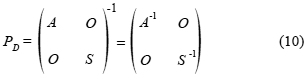
<body><![CDATA[<p ALIGN="justify" style="line-height: 100%"><font size="2" face="Verdana">One should take <i>P </i><font LANG="JA">as an inexpensive approximation of the</font> inverse of <i><span style="mso-bidi-font-size: 12.0pt; mso-fareast-font-family: Times New Roman; mso-bidi-font-family: Times New Roman; mso-ansi-language: ES; mso-fareast-language: ES; mso-bidi-language: AR-SA">&#256;</span></i>, such that the preconditioned system has a low <font LANG="JA">degree minimum polynomial, i.e., the coefficient matrix of</font> <font LANG="JA">the new system should have a few distinct eigenvalues; in</font> this case, iterative methods like GMRES generally present faster convergence.</font></p>     <p ALIGN="justify" style="line-height: 100%"><font size="2" face="Verdana">In the present work, we apply block preconditioned <font LANG="JA">GMRES to the coupled system (1). This approach can be</font> superior to others for very large matrices since the cost of <font LANG="JA">computing several matrix-vector products with matrices </font><i>A</i> and <i>B </i>simultaneously is comparable to the computation of <font LANG="JA">one matrix-vector product with matrix </font><i><span style="mso-bidi-font-size: 12.0pt; mso-fareast-font-family: Times New Roman; mso-bidi-font-family: Times New Roman; mso-ansi-language: ES; mso-fareast-language: ES; mso-bidi-language: AR-SA">&#256;</span></i>, considering memory references. In particular, block methods enable the <font LANG="JA">use of level 3-BLAS, which usually results in a better per</font>formance on high level computer architectures supporting vector and parallel processing.</font></p> <b>     <p ALIGN="justify" style="line-height: 100%"><font size="2" face="Verdana">Block diagonal preconditioner</font></p> </b>     <p ALIGN="justify" style="line-height: 100%"><font size="2" face="Verdana"><font LANG="JA">For saddle point problems, Murphy, Golub and Wathen in</font> <font LANG="JA">2000 proposed an efficient preconditioner, which has the</font> following structure when <i>A </i>is nonsingular:</font></p>     <p ALIGN="center" style="line-height: 100%">&nbsp;<img border="0" src="/img/fbpe/rfiucv/v25n4/art02ec10.gif" width="304" height="75"></p>     
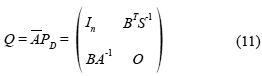
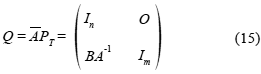
<p ALIGN="justify" style="line-height: 100%"><font size="2" face="Verdana">In this case, the right preconditioned linear system has a <font LANG="JA">coefficient matrix given by:</font></font></p>     <p ALIGN="center" style="line-height: 100%"><img border="0" src="/img/fbpe/rfiucv/v25n4/art02ec11.gif" width="262" height="76"></p>     
<p ALIGN="justify" style="line-height: 100%"><font size="2" face="Verdana"><font LANG="JA">It has been proved in (Murphy </font><i>et al</i><font LANG="JA">. 2000) that </font><i>Q </i>is diagonalizable having just four distinct eigenvalues:</font></p>     <p ALIGN="center" style="line-height: 100%"><img border="0" src="/img/fbpe/rfiucv/v25n4/art02ec12.gif" width="223" height="40"></p>     
<p ALIGN="justify" style="line-height: 100%"><font size="2" face="Verdana">therefore, for any arbitrary <i>r</i></font><font size="2" face="Symbol">Î</font><font size="2" face="Verdana"><b>R</b><sup><i>n </i>+ </sup><i><sup>m</sup>, </i>the Krylov subspace:</font></p>     ]]></body>
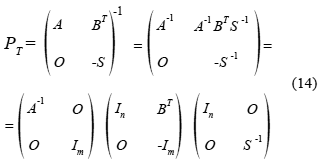
<body><![CDATA[<p ALIGN="center" style="line-height: 100%"><font size="2" face="Verdana">span{<i>r </i>, <i>Qr </i>, <i>Q</i><sup>2</sup><i>r </i>, <i>Q</i><font LANG="JA"><sup>3</sup></font><i>r </i><font LANG="JA">,...} &nbsp;&nbsp;&nbsp;&nbsp;&nbsp; <b>(13)</b></font></font></p>     <p ALIGN="justify" style="line-height: 100%"><font size="2" face="Verdana">has at most dimension three if <i>Q </i>is nonsingular, and dimension four if <i>Q </i><font LANG="JA">is singular. In particular, one could expect that</font> iterative methods like GMRES applied to the preconditio<font LANG="JA">ned</font> <font LANG="JA">linear system will terminate in at most 3 or 4 iterations</font> <font LANG="JA">in exact arithmetic.</font></font></p> <b>     <p ALIGN="justify" style="line-height: 100%"><font size="2" face="Verdana">Block triangular preconditioner</font></p> </b>     <p ALIGN="justify" style="line-height: 100%"><font size="2" face="Verdana">This kind of preconditioners, introduced by Bramble &amp; <font LANG="JA">Pasciak in 1998, has the following structure:</font></font></p>     <p ALIGN="center" style="line-height: 100%"><img border="0" src="/img/fbpe/rfiucv/v25n4/art02ec14.gif" width="319" height="162"></p>     
<p ALIGN="justify" style="line-height: 100%"><font size="2" face="Verdana"><font LANG="JA">Thus, the coefficient matrix of the right preconditioned li</font>near system is:</font></p>     <p ALIGN="center" style="line-height: 100%"><img border="0" src="/img/fbpe/rfiucv/v25n4/art02ec15.gif" width="261" height="74"></p>     
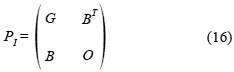
<p ALIGN="justify" style="line-height: 100%"><font size="2" face="Verdana">and the spectrum of <i>Q </i>is {1}, which implies faster convergence for Krylov methods like GMRES.</font></p> <b>     <p ALIGN="justify" style="line-height: 100%"><font size="2" face="Verdana">Indefinite preconditioner</font></p> </b>     <p ALIGN="justify" style="line-height: 100%"><font size="2" face="Verdana">In this case, the preconditioner has the same block structure <font LANG="JA">than the original problem (1):</font></font></p>     ]]></body>
<body><![CDATA[<p ALIGN="center" style="line-height: 100%"><img border="0" src="/img/fbpe/rfiucv/v25n4/art02ec16.gif" width="234" height="72"></p>     
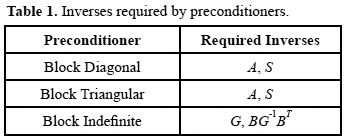
<p ALIGN="justify" style="line-height: 100%"><font size="2" face="Verdana"><font LANG="JA">where G &#8800; </font><i>A </i><font LANG="JA">is some approximation of </font><i>A</i>, chosen in such <font LANG="JA">a way that the preconditioned linear system is significantly</font> <font LANG="JA">easier to solve than the original problem (1). Some implementations</font> <font LANG="JA">of this preconditioner can be found in (Berga</font>maschi <i>et al</i><font LANG="JA">. 2004; Keller </font><i>et al</i><font LANG="JA">. 2000).</font></font></p>     <p ALIGN="justify" style="line-height: 100%"><font size="2" face="Verdana">The construction of each block preconditioner involves the <font LANG="JA">inverses of some matrices. This requirement per precondi</font>tioner is summarized in <a href="#tab1"> Table 1</a>.</font></p>     <p ALIGN="center" style="line-height: 100%"><a name="tab1"><img border="0" src="/img/fbpe/rfiucv/v25n4/art02tab1.gif" width="345" height="140"></a></p>     
<p ALIGN="justify" style="line-height: 100%"><font size="2" face="Verdana"><font LANG="JA">This paper proposes to replace these exact inverses by SPAI</font> <font LANG="JA">approximations, using the methodology studied by Grote</font> <font LANG="JA">and Huckle in 1997. The general idea of this technique will</font> <font LANG="JA">be described in the next section.</font></font></p> <b>     <p ALIGN="justify" style="line-height: 100%"><font size="2" face="Verdana">SPARSE APPROXIMATE INVERSE (SPAI)</font></p> </b>     <p ALIGN="justify" style="line-height: 100%"><font size="2" face="Verdana"><font LANG="JA">Given a nonsingular matrix A <span style="mso-char-type: symbol; mso-symbol-font-family: Symbol; font-size: 10.0pt; mso-bidi-font-size: 12.0pt; font-family: Symbol; mso-ascii-font-family: Verdana; mso-fareast-font-family: Times New Roman; mso-hansi-font-family: Verdana; mso-bidi-font-family: Times New Roman; mso-ansi-language: ES; mso-fareast-language: ES; mso-bidi-language: AR-SA">Î</span> </font><i>R<sup>n</sup></i><sup>x<i>n</i></sup>, the basic idea of this <font LANG="JA">technique (Grote &amp; Huckle, 1997), is to compute a sparse</font> <font LANG="JA">matrix </font><i>P </i><font LANG="JA">&#8776; </font><i>A</i><sup>-1</sup> which minimizes the Frobenius norm of the <font LANG="JA">residual matrix </font><i>I<sub>n</sub> </i>- <i>AP</i>, denoted by ||<i>AP </i>- <i>I<sub>n</sub>|| <sub>F</sub> </i><font LANG="JA">. By definition:</font></font></p>     <p ALIGN="center" style="line-height: 100%"><img border="0" src="/img/fbpe/rfiucv/v25n4/art02ec17.gif" width="283" height="47"></p>     
<p ALIGN="justify" style="line-height: 100%"><font size="2" face="Verdana">where <i>e<sub>k</sub> </i>y <i>p<sub>k</sub> </i>are the <i>k</i>-th column of the identity and <i>P </i>matrices respectively. Thus, one could minimize globally the Frobenius norm&nbsp; ||<i>AP </i>- <i>I<sub>n</sub>|| <sub>F</sub> </i>as a function of <i>P</i>. Another possibility is to minimize the function <i>f<sub>k</sub> </i>for each k = 1,...,<i>n</i> <font LANG="JA">defined by:</font></font></p> <i>     <p ALIGN="center" style="line-height: 100%"><font size="2" face="Verdana">f<sub>k</sub></font></i><font size="2" face="Verdana"><font LANG="JA">( </font><i>p<sub>k</sub> </i><font LANG="JA">) = ||</font><i>Ap<sub>k</sub> </i>- <i>e<sub>k</sub>||</i><sub>2</sub> &nbsp;&nbsp;&nbsp;&nbsp;<font LANG="JA"><b>(18)</b></font></font></p>     ]]></body>
<body><![CDATA[<p ALIGN="justify" style="line-height: 100%"><font size="2" face="Verdana">This last strategy is very suitable when working in parallel architectures, since the problem of minimizing ||<i>AP </i>- <i>I<sub>n</sub>||</i><i> </i>can be separated into <i>n </i><font LANG="JA">independent least squares problems:</font></font></p>     <p ALIGN="center" style="line-height: 100%"><img border="0" src="/img/fbpe/rfiucv/v25n4/art02ec19.gif" width="287" height="32"></p>     
<p ALIGN="justify" style="line-height: 100%"><font size="2" face="Verdana">The preconditioner <i>P </i><font LANG="JA">should be a sparse matrix; this condition</font> <font LANG="JA">allows the reduction of (19) to </font><i>n </i><font LANG="JA">least squares problems</font> of small dimension that can be solved easily using traditional methods based on <i>QR </i>factorizations.</font></p>     <p ALIGN="justify" style="line-height: 100%"><font size="2" face="Verdana"><font LANG="JA">The main difficulty of this preconditioning technique is the</font> selection of a sparsity structure of <i>P </i>that results in an effective preconditioner. The sparsity pattern should retain the sparse structure of <i>A </i>in <i>P</i>, dropping those entries that do not <font LANG="JA">contribute to the quality of the preconditioner. For example,</font> it is desirable to ignore those entries that are small in absolute value with respect to some tolerance, and retain those with greater values. Nevertheless, the location of the entries in <i>A</i><sup>-1</sup> with greater values is not normally known, thus, the <font LANG="JA">choosing of a sparsity pattern could be a very difficult task.</font></font></p>     <p ALIGN="justify" style="line-height: 100%"><font size="2" face="Verdana">To determine the sparsity pattern of <i>P </i>one could use adaptive strategies in which nonzero elements are dynamically <font LANG="JA">defined, or one can select static strategies where the struc</font>ture of <i>P </i><font LANG="JA">is fixed a priori.</font></font></p>     <p ALIGN="justify" style="line-height: 100%"><font size="2" face="Verdana"><font LANG="JA">Once the sparsity pattern is defined, the number of non</font>zero entries in <i>P </i>increases until the Euclidean norm of the residual vector <i>r<sub>k</sub> </i>= <i>Ap<sub>k</sub> </i>- <i>e<sub>k</sub> </i><font LANG="JA">satisfies a criterion of the</font> type ||<i>r<sub>k</sub>|| </i><sub>2</sub> &lt; </font><font LANG="JA" face="Symbol" size="2">e</font><font size="2" face="Verdana"><font LANG="JA"> </font>for a given tolerance </font><font LANG="JA" face="Symbol" size="2">e</font><font size="2" face="Verdana"><font LANG="JA">, or when a maximum</font> number of nonzero elements in the column <i>p<sub>k</sub> </i>is reached. <font LANG="JA">Examples of successful implementations of this technique</font> <font LANG="JA">can be found in (Castillo, 2009; Baggag </font><i>et al</i><font LANG="JA">. 2004; Broker</font> <i>et al</i><font LANG="JA">. 2002; Elman </font><i>et al</i><font LANG="JA">. 2002).</font></font></p> <b>     <p ALIGN="justify" style="line-height: 100%"><font size="2" face="Verdana">NUMERICAL EXPERIMENTS</font></p> </b>     <p ALIGN="justify" style="line-height: 100%"><font size="2" face="Verdana">This section presents numerical results obtained after the application of the three block preconditioners described previously, on some interesting test problems. The package IFISS, developed by Elman, Ramage <i>et al</i>. 1996, was used to produce our test problems. This package allow us to <font LANG="JA">define linear systems arising in the discretization of steady</font> <font LANG="JA">state Navier Stokes equations governing a incompressible</font> <font LANG="JA">viscous flows:</font></font></p>     <p ALIGN="center" style="line-height: 100%"><font size="2" face="Verdana">-<i>v</i></font><font LANG="JA" face="Symbol" size="2">D</font><font size="2" face="Verdana"><sup>2</sup><i>u </i>+ <i>u </i>. </font><font LANG="JA" face="Symbol" size="2">D</font><font size="2" face="Verdana"><i>u </i>+ <i><span style="mso-char-type: symbol; mso-symbol-font-family: Symbol; font-size: 10.0pt; mso-bidi-font-size: 12.0pt; font-family: Symbol; mso-ascii-font-family: Verdana; mso-fareast-font-family: Times New Roman; mso-hansi-font-family: Verdana; mso-bidi-font-family: Times New Roman; mso-ansi-language: ES; mso-fareast-language: ES; mso-bidi-language: AR-SA">Ñ</span>p </i>= </font><i><font size="2" face="Verdana">f</font></p> </i>     <p ALIGN="center" style="line-height: 100%"><font size="2" face="Verdana">div <i>u </i>= 0&nbsp;&nbsp; <font LANG="JA"><b>(20)</b></font></font></p>     ]]></body>
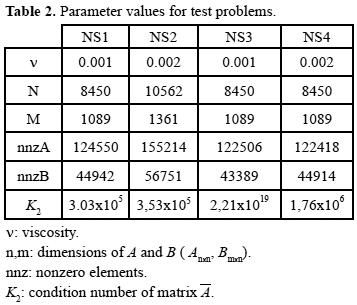
<body><![CDATA[<p ALIGN="justify" style="line-height: 100%"><font size="2" face="Verdana">Here, <i>v </i><font LANG="JA">&gt; 0 is the viscosity of the fluid, </font><i>u </i>is the velocity in the point <i>x </i>on the domain, <i>p </i>is the pressure in <i>x</i>, and <i>f</i> represents the action of gravity and the interaction between <font LANG="JA">the fluid forces.</font></font></p>     <p ALIGN="justify" style="line-height: 100%"><font size="2" face="Verdana"><font LANG="JA">Specifically, we consider the following Navier Stokes test</font> problems generated by IFISS:</font></p>     <p ALIGN="justify" style="line-height: 100%"><font LANG="JA" size="2" face="Verdana">1. Channel domain (NS1).</font></p>     <p ALIGN="justify" style="line-height: 100%"><font LANG="JA" size="2" face="Verdana">2. Flow over a backward facing step (NS2).</font></p>     <p ALIGN="justify" style="line-height: 100%"><font LANG="JA" size="2" face="Verdana">3. Lid driven cavity (NS3).</font></p>     <p ALIGN="justify" style="line-height: 100%"><font LANG="JA" size="2" face="Verdana">4. Flow over a plate (NS4).</font></p>     <p ALIGN="justify" style="line-height: 100%"><font size="2" face="Verdana">Each one of these problems is discretized using the Taylor-<font LANG="JA">Hood method (Elman </font><i>et al</i><font LANG="JA">. 2005) with uniform grids for</font> <font LANG="JA">NS1, NS2 and NS4 and stretched grid for NS3 (with grid</font> <font LANG="JA">parameter equal to six and horizontal parameter equal to</font> <font LANG="JA">two). After discretization, linear systems with the saddle</font> <font LANG="JA">point structure (1) are obtained. In all cases, </font><i>A </i>is nonsingular and nonsymmetric, and <i>B </i><font LANG="JA">is a full column rank matrix.</font> Viscosity and characteristics of matrices <i>A </i>and <i>B </i>for all test problems were chosen by default. <a href="#tab2"> Table 2</a> shows the values of these parameters.</font></p>     <p ALIGN="center" style="line-height: 100%"><a name="tab2"><img border="0" src="/img/fbpe/rfiucv/v25n4/art02tab2.gif" width="357" height="305"></a></p>     
<p ALIGN="justify" style="line-height: 100%"><font size="2" face="Verdana">Since the block <i>A </i>is nonsymmetric in all test cases, a Schur complement reduction combined with conjugate gradient method is discarded. In addition, due to the size of the systems, null space methods are not attractive, thus, a precon<font LANG="JA">ditioned</font> <font LANG="JA">GMRES was used to get an approximated solution</font> for the whole system <i><span style="mso-bidi-font-size: 12.0pt; mso-fareast-font-family: Times New Roman; mso-bidi-font-family: Times New Roman; mso-ansi-language: ES; mso-fareast-language: ES; mso-bidi-language: AR-SA">&#256;</span> u = b </i>.</font></p>     <p ALIGN="justify" style="line-height: 100%"><font size="2" face="Verdana">Versions of block diagonal, block triangular and block in<font LANG="JA">definite</font> <font LANG="JA">preconditioned GMRES were constructed to solve</font> each linear system numerically. In the construction of block diagonal and block triangular preconditioners the inverse of <i>A </i><font LANG="JA">was replaced by its SPAI approximation.</font></font></p>     ]]></body>
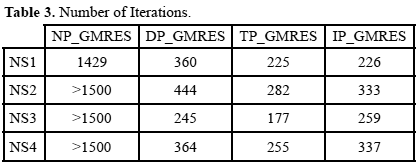
<body><![CDATA[<p ALIGN="justify" style="line-height: 100%"><font size="2" face="Verdana">The inverse of the Schur complement was also replaced by <font LANG="JA">a SPAI approximation of </font><i>BD<sub>A</sub><sup>-1</sup> B<sup>T</sup> </i>, where <i>D<sub>A</sub> </i>is a diago<font LANG="JA">nal</font> <font LANG="JA">matrix whose elements are the same as the diagonal of</font> <font LANG="JA">A. This last approximation was also used to construct the</font> <font LANG="JA">block indefinite preconditioner, choosing </font><i>G = D<sub>A</sub> </i>.</font></p>     <p ALIGN="justify" style="line-height: 100%"><font size="2" face="Verdana"><font LANG="JA">It is important to point out that numerical experiments</font> using full inverses to construct each preconditioner were done, but this strategy was not feasible, due to the memory <font LANG="JA">requirements for these calculations and the prohibitive</font> computational cost.</font></p>     <p ALIGN="justify" style="line-height: 100%"><font size="2" face="Verdana"><font LANG="JA">The construction of SPAI approximations for the required</font> <font LANG="JA">inverses for each preconditioner (<a href="#tab1">table 1</a>) is based on the</font> Grote and Huckle strategy with a static pattern for the preconditioner <i>M</i>. <i>A </i>dynamic pattern was also attempted, but it was not effective and its construction was time consuming.</font></p>     <p ALIGN="justify" style="line-height: 100%"><font size="2" face="Verdana">In all cases, </font><font LANG="JA" face="Symbol" size="2">e</font><font size="2" face="Verdana"><font LANG="JA"> = 0.35 was used as level of tolerance for</font> <font LANG="JA">the residual in the construction of each column of SPAI</font> <font LANG="JA">approximation. This value of </font></font><font LANG="JA" face="Symbol" size="2">e</font><font size="2" face="Verdana"><font LANG="JA"> </font>was enough to produce <font LANG="JA">approximations of the inverses with the same nonzero den</font>sity of the respective matrices, which is desirable since it does not increase the computational cost by iteration of the iterative method.</font></p>     <p ALIGN="justify" style="line-height: 100%"><font size="2" face="Verdana"><font LANG="JA">Sparse inverse approximations were constructed by the</font> right, thus, the system was preconditioned by the same side. Full GMRES was applied, with zero as initial guess, a tolerance of 10<sup>-8</sup> <font LANG="JA">for the relative error and a maximum of 1500</font> <font LANG="JA">iterations. All experiments were performed using Matlab</font> <font LANG="JA">7.0 on a Toshiba computer with a Core Duo T2400 1.83</font> <font LANG="JA">Ghz processor, with 3.25 GB RAM memory.</font></font></p>     <p ALIGN="justify" style="line-height: 100%"><font size="2" face="Verdana">In each case, the linear system was solved with and without <font LANG="JA">preconditioning. <a href="#tab3"> Table 3</a> presents, for each test problem,</font> <font LANG="JA">the number of iterations required for each solver. GMRES</font> block preconditioned versions were named as:</font></p>     <p ALIGN="center" style="line-height: 100%"><a name="tab3"><img border="0" src="/img/fbpe/rfiucv/v25n4/art02tab3.gif" width="418" height="167"></a></p>     
<p ALIGN="justify" style="line-height: 100%"><font LANG="JA" size="2" face="Verdana">NP_GMRES: No preconditioned GMRES.</font></p>     <p ALIGN="justify" style="line-height: 100%"><font LANG="JA" size="2" face="Verdana">DP_GMRES: Diagonal preconditioned GMRES.</font></p>     <p ALIGN="justify" style="line-height: 100%"><font LANG="JA" size="2" face="Verdana">TP_GMRES: Triangular preconditioned GMRES.</font></p>     ]]></body>
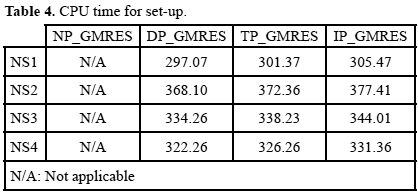
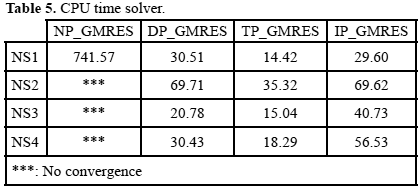
<body><![CDATA[<p ALIGN="justify" style="line-height: 100%"><font LANG="JA" size="2" face="Verdana">IP_GMRES: Indefinite preconditioned GMRES.</font></p>     <p ALIGN="justify" style="line-height: 100%"><font size="2" face="Verdana"><font LANG="JA"><a href="#tab4">Table 4</a> reports set-up time (preconditioner construction</font> <font LANG="JA">and preconditioner application), while <a href="#tab5"> table 5</a> shows CPU</font> time consumed by GMRES when it reaches convergence.</font></p>     <p ALIGN="center" style="line-height: 100%"><a name="tab4"><img border="0" src="/img/fbpe/rfiucv/v25n4/art02tab4.gif" width="418" height="195"></a></p>     
<p ALIGN="center" style="line-height: 100%"><a name="tab5"><img border="0" src="/img/fbpe/rfiucv/v25n4/art02tab5.gif" width="419" height="190"></a></p>     
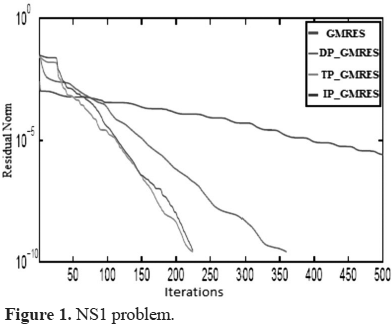
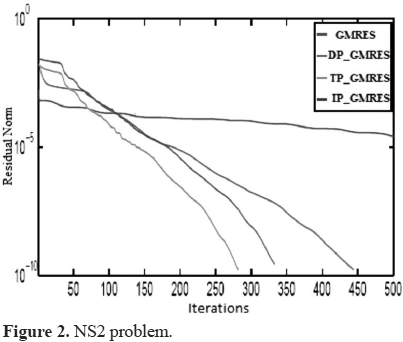
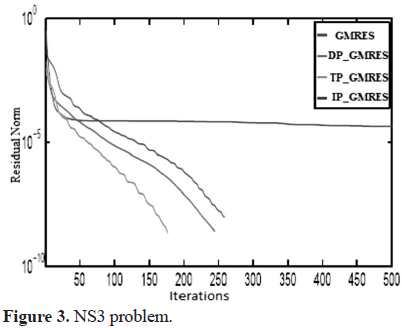
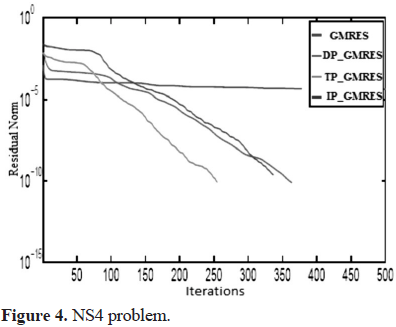
<p ALIGN="justify" style="line-height: 100%"><font face="Verdana" size="2"><font LANG="JA">On the other hand, <a href="#fig1"> figures 1-4</a> below illustrate the reduction</font> of the residual norm when using GMRES without precondi<font LANG="JA">tioning</font> <font LANG="JA">and GMRES with the inexact versions of block diagonal,</font> <font LANG="JA">block triangular and indefinite preconditioners, denoted</font> <font LANG="JA">in the figures as GMRES, DP_GMRES, TP_GMRES</font> <font LANG="JA">and IP_GMRES respectively.</font></font></p>     <p ALIGN="center" style="line-height: 100%"><a name="fig1"><img border="0" src="/img/fbpe/rfiucv/v25n4/art02fig1.gif" width="392" height="325"></a></p>     
<p ALIGN="center" style="line-height: 100%"><img border="0" src="/img/fbpe/rfiucv/v25n4/art02fig2.gif" width="403" height="342"></p>     
<p ALIGN="center" style="line-height: 100%"><img border="0" src="/img/fbpe/rfiucv/v25n4/art02fig3.gif" width="402" height="328"></p>     
<p ALIGN="center" style="line-height: 100%"><img border="0" src="/img/fbpe/rfiucv/v25n4/art02fig4.gif" width="396" height="327"></p>     
<p ALIGN="justify" style="line-height: 100%"><font size="2" face="Verdana">For all test problems, preconditioned GMRES converged in less than 400 iterations. Nevertheless, GMRES without preconditioning only reached convergence for the NS1 pro<font LANG="JA">blem</font> <font LANG="JA">with a number of iterations close to the maximum,</font> which clearly suggest the need of a preconditioner to solve these problems.</font></p>     ]]></body>
<body><![CDATA[<p ALIGN="justify" style="line-height: 100%"><font size="2" face="Verdana"><font LANG="JA">With respect to the block preconditioned versions of</font> GMRES, in all cases, the best results, considering time and number of iterations, were obtained with block triangular preconditioners. Additionally, although the construction and application of block diagonal preconditioner consume <font LANG="JA">the smaller amount of time (<a href="#tab4">table 4</a>), GMRES with this preconditioner</font> <font LANG="JA">requires more iterations to converge than the</font> <font LANG="JA">others (<a href="#tab3">table 3</a>).</font></font></p>     <p ALIGN="justify" style="line-height: 100%"><font size="2" face="Verdana"><font LANG="JA">Block indefinite preconditioners were in general denser</font> <font LANG="JA">than the others preconditioners; thus, its construction and</font> application consumed more time.</font></p> <b>     <p ALIGN="justify" style="line-height: 100%"><font size="2" face="Verdana">CONCLUSIONS AND FUTURE WORK</font></p> </b>     <p ALIGN="justify" style="line-height: 100%"><font size="2" face="Verdana"><font LANG="JA">Sparse approximations of inverses were used to construct</font> versions of block diagonal, block triangular and block in<font LANG="JA">definite</font> <font LANG="JA">preconditioners for the solution of saddle point</font> problems. The application of these blocks preconditioners along with GMRES on nonsymmetric saddle point linear <font LANG="JA">systems (SPLS) is promising. The proposed technique of</font> <font LANG="JA">constructing block preconditioners using sparse approxi</font>mation of inverses reduced time and the number of iterations, leading a faster convergence of GMRES in each test problem.</font></p>     <p ALIGN="justify" style="line-height: 100%"><font size="2" face="Verdana">It is important to recognize that others preconditioners, such as ILU and its variants, have been more effective in the so<font LANG="JA">lution</font> <font LANG="JA">of the test problems when sequential codes are used.</font> However, it is well known that ILU preconditioners do not perform well and suffer from breakdowns over ill-conditio<font LANG="JA">ned</font> <font LANG="JA">systems, and it is very difficult to implement ILU type</font> preconditioners on distributed memory parallel computers, <font LANG="JA">where the communication overhead is significantly large.</font> <font LANG="JA">On other hand, SPAI preconditioners are highly paralleli</font>zable and it does not suffer from the usual drawbacks of incomplete factorization methods.</font></p>     <p ALIGN="justify" style="line-height: 100%"><font size="2" face="Verdana">In this article we evaluated and compared a non-preconditioned version of GMRES and three block preconditio<font LANG="JA">ned</font> <font LANG="JA">versions of GMRES on a sequential machine. Results</font> show the reliability of these approaches for different test problems, and suggest that they can be competitive for solving large-scale saddle point linear systems. Due to these <font LANG="JA">results, and taking into account that the SPAI constructions</font> <font LANG="JA">are highly parallelizable, the next step in this direction</font> should be to evaluate the scalability of this approach in the solution of very large saddle point systems in a parallel environment.</font></p> <b>     <p ALIGN="justify" style="line-height: 100%"><font size="2" face="Verdana">ACKNOWLEDGMENT</font></p> </b>     <p ALIGN="justify" style="line-height: 100%"><font size="2" face="Verdana"><font LANG="JA">The authors thank Andy Wathen from Oxford University</font> <font LANG="JA">for providing the test matrices used in the numerical expe</font>riments.</font></p> <b>     <p ALIGN="justify" style="line-height: 100%"><font size="2" face="Verdana">REFERENCES</font></p> </b>     <!-- ref --><p ALIGN="justify" style="line-height: 100%"><font size="2" face="Verdana">1. Arioli, M. &amp; Manzini, G. (2002). A null space algorithm for mixed finite-element approximation of Darcy’s equation, Comm. Numer. Meth. Engng., 18, pp. 645–657.</font>&nbsp;&nbsp;&nbsp;&nbsp;&nbsp;&nbsp;&nbsp;&nbsp;[&#160;<a href="javascript:void(0);" onclick="javascript: window.open('/scielo.php?script=sci_nlinks&ref=1870080&pid=S0798-4065201000040000200001&lng=','','width=640,height=500,resizable=yes,scrollbars=1,menubar=yes,');">Links</a>&#160;]<!-- end-ref --><!-- ref --><p ALIGN="justify" style="line-height: 100%"><font size="2" face="Verdana">2. Axelsson, O. &amp; Neytcheva, M. (2003). Preconditioning methods for linear systems arising in constrained optimization problems, Numer. Linear Algebra Appl., 10, pp. 3–31.</font>&nbsp;&nbsp;&nbsp;&nbsp;&nbsp;&nbsp;&nbsp;&nbsp;[&#160;<a href="javascript:void(0);" onclick="javascript: window.open('/scielo.php?script=sci_nlinks&ref=1870081&pid=S0798-4065201000040000200002&lng=','','width=640,height=500,resizable=yes,scrollbars=1,menubar=yes,');">Links</a>&#160;]<!-- end-ref --><!-- ref --><p ALIGN="justify" style="line-height: 100%"><font size="2" face="Verdana">3. Baggag, A. &amp; Sameh, A. (2004). A nested iterative scheme for indefinite linear systems in particulate flows, Comput. Methods Appl. Mech. Engrg., 193, pp. 1923–1957.</font>&nbsp;&nbsp;&nbsp;&nbsp;&nbsp;&nbsp;&nbsp;&nbsp;[&#160;<a href="javascript:void(0);" onclick="javascript: window.open('/scielo.php?script=sci_nlinks&ref=1870082&pid=S0798-4065201000040000200003&lng=','','width=640,height=500,resizable=yes,scrollbars=1,menubar=yes,');">Links</a>&#160;]<!-- end-ref --><!-- ref --><p ALIGN="justify" style="line-height: 100%"><font size="2" face="Verdana">4. Benzi, M. &amp; Golub, G. (2002). Preconditioning techniques for large linear systems: a survey, J. Comput. Phys., 182, pp. 418–477.</font>&nbsp;&nbsp;&nbsp;&nbsp;&nbsp;&nbsp;&nbsp;&nbsp;[&#160;<a href="javascript:void(0);" onclick="javascript: window.open('/scielo.php?script=sci_nlinks&ref=1870083&pid=S0798-4065201000040000200004&lng=','','width=640,height=500,resizable=yes,scrollbars=1,menubar=yes,');">Links</a>&#160;]<!-- end-ref --><!-- ref --><p ALIGN="justify" style="line-height: 100%"><font size="2" face="Verdana">5. Benzi, M. &amp; Golub, G. (2005). Numerical solution of saddle point problems, Acta Numerica, pp1-137.</font>&nbsp;&nbsp;&nbsp;&nbsp;&nbsp;&nbsp;&nbsp;&nbsp;[&#160;<a href="javascript:void(0);" onclick="javascript: window.open('/scielo.php?script=sci_nlinks&ref=1870084&pid=S0798-4065201000040000200005&lng=','','width=640,height=500,resizable=yes,scrollbars=1,menubar=yes,');">Links</a>&#160;]<!-- end-ref --><!-- ref --><p ALIGN="justify" style="line-height: 100%"><font size="2" face="Verdana">6. Bargamaschi, L., Gondzio, J., Zilli, G. (2004). Preconditioning indefinite systems in interior point methods for optimization, Comput. Optim. Appl., 28, pp. 149—171.</font>&nbsp;&nbsp;&nbsp;&nbsp;&nbsp;&nbsp;&nbsp;&nbsp;[&#160;<a href="javascript:void(0);" onclick="javascript: window.open('/scielo.php?script=sci_nlinks&ref=1870085&pid=S0798-4065201000040000200006&lng=','','width=640,height=500,resizable=yes,scrollbars=1,menubar=yes,');">Links</a>&#160;]<!-- end-ref --><!-- ref --><p ALIGN="justify" style="line-height: 100%"><font size="2" face="Verdana">7. Bramble, J. H. &amp; Pasciak, J. E. (1998). A preconditioning technique for indefinite systems resulting from mixed approximations of elliptic problems, Math. Comp., 50, pp. 1–17.</font>&nbsp;&nbsp;&nbsp;&nbsp;&nbsp;&nbsp;&nbsp;&nbsp;[&#160;<a href="javascript:void(0);" onclick="javascript: window.open('/scielo.php?script=sci_nlinks&ref=1870086&pid=S0798-4065201000040000200007&lng=','','width=640,height=500,resizable=yes,scrollbars=1,menubar=yes,');">Links</a>&#160;]<!-- end-ref --><!-- ref --><p ALIGN="justify" style="line-height: 100%"><font size="2" face="Verdana">8. Broker, O., Grote, M., Mayer, C., Reusken, A. (2001). Sparse approximate inverse smoothers for geometric and algebraic multigrid, Appl. Numer. Math., 41, pp. 61–80.</font>&nbsp;&nbsp;&nbsp;&nbsp;&nbsp;&nbsp;&nbsp;&nbsp;[&#160;<a href="javascript:void(0);" onclick="javascript: window.open('/scielo.php?script=sci_nlinks&ref=1870087&pid=S0798-4065201000040000200008&lng=','','width=640,height=500,resizable=yes,scrollbars=1,menubar=yes,');">Links</a>&#160;]<!-- end-ref --><!-- ref --><p ALIGN="justify" style="line-height: 100%"><font size="2" face="Verdana">9. Castillo, Z., Xui, X., Sorensen, D., Embree, M., Pasquali, M. (2009). Parallel solution of large-scale free surface viscoelastic flows via sparse approximate inverse preconditioning. Journal of Non-Newtonian Fluid Mechanics. Vol 157, Nos. 1-2, pp. 44-54.</font>&nbsp;&nbsp;&nbsp;&nbsp;&nbsp;&nbsp;&nbsp;&nbsp;[&#160;<a href="javascript:void(0);" onclick="javascript: window.open('/scielo.php?script=sci_nlinks&ref=1870088&pid=S0798-4065201000040000200009&lng=','','width=640,height=500,resizable=yes,scrollbars=1,menubar=yes,');">Links</a>&#160;]<!-- end-ref --><!-- ref --><p ALIGN="justify" style="line-height: 100%"><font size="2" face="Verdana">10. Elman, H. C., Ramage, A. R., Silvester, D. J. (1996). Incompressible Flow Iterative Solution Software Package, <a href="http://www.cs.umd.edu/~elman/ifiss/">http://www.cs.umd.edu/~elman/ifiss/</a>.</font>&nbsp;&nbsp;&nbsp;&nbsp;&nbsp;&nbsp;&nbsp;&nbsp;[&#160;<a href="javascript:void(0);" onclick="javascript: window.open('/scielo.php?script=sci_nlinks&ref=1870089&pid=S0798-4065201000040000200010&lng=','','width=640,height=500,resizable=yes,scrollbars=1,menubar=yes,');">Links</a>&#160;]<!-- end-ref --><!-- ref --><p ALIGN="justify" style="line-height: 100%"><font size="2" face="Verdana">11. Elman, H. C. &amp; Silvester, D. J. (1996). Fast nonsymmetric iterations and preconditioning for Navier-Stokes equations, SIAM J. Sci. Comput., 17, pp. 33–46.</font>&nbsp;&nbsp;&nbsp;&nbsp;&nbsp;&nbsp;&nbsp;&nbsp;[&#160;<a href="javascript:void(0);" onclick="javascript: window.open('/scielo.php?script=sci_nlinks&ref=1870090&pid=S0798-4065201000040000200011&lng=','','width=640,height=500,resizable=yes,scrollbars=1,menubar=yes,');">Links</a>&#160;]<!-- end-ref --><!-- ref --><p ALIGN="justify" style="line-height: 100%"><font size="2" face="Verdana">12. Elman, H. C., Silvester, D. J., Wathen, A.J. (1997). Iterative methods for problems in computational fluid dynamics, Iterative Methods in Scientific Computing, Chan R., Chan T. and Golub G. (Eds), Springer-Verlag, pp. 271–327.</font>&nbsp;&nbsp;&nbsp;&nbsp;&nbsp;&nbsp;&nbsp;&nbsp;[&#160;<a href="javascript:void(0);" onclick="javascript: window.open('/scielo.php?script=sci_nlinks&ref=1870091&pid=S0798-4065201000040000200012&lng=','','width=640,height=500,resizable=yes,scrollbars=1,menubar=yes,');">Links</a>&#160;]<!-- end-ref --><!-- ref --><p ALIGN="justify" style="line-height: 100%"><font size="2" face="Verdana">13. Elman, H. C., Silvester, D. J., Wathen, A.J. (2002). Block preconditioners for the discrete incompressible Navier- Stokes equations, Internat. J. Numer. Methods Fluids, 40, pp. 333–344.</font>&nbsp;&nbsp;&nbsp;&nbsp;&nbsp;&nbsp;&nbsp;&nbsp;[&#160;<a href="javascript:void(0);" onclick="javascript: window.open('/scielo.php?script=sci_nlinks&ref=1870092&pid=S0798-4065201000040000200013&lng=','','width=640,height=500,resizable=yes,scrollbars=1,menubar=yes,');">Links</a>&#160;]<!-- end-ref --><!-- ref --><p ALIGN="justify" style="line-height: 100%"><font size="2" face="Verdana">14. Elman, H. C., Silvester, D. J., Wathen, A.J. (2005). Finite Elements and Fast Iterative Solvers, Oxford University Press.</font>&nbsp;&nbsp;&nbsp;&nbsp;&nbsp;&nbsp;&nbsp;&nbsp;[&#160;<a href="javascript:void(0);" onclick="javascript: window.open('/scielo.php?script=sci_nlinks&ref=1870093&pid=S0798-4065201000040000200014&lng=','','width=640,height=500,resizable=yes,scrollbars=1,menubar=yes,');">Links</a>&#160;]<!-- end-ref --><!-- ref --><p ALIGN="justify" style="line-height: 100%"><font size="2" face="Verdana">15. Glowinsky, R. (2003). Finite element methods for incompressible viscous flow. Vol. IX of Handbook of Numerical Analysis, part 3: Numerical methods for fluids, North-Holland, Amsterdam.</font>&nbsp;&nbsp;&nbsp;&nbsp;&nbsp;&nbsp;&nbsp;&nbsp;[&#160;<a href="javascript:void(0);" onclick="javascript: window.open('/scielo.php?script=sci_nlinks&ref=1870094&pid=S0798-4065201000040000200015&lng=','','width=640,height=500,resizable=yes,scrollbars=1,menubar=yes,');">Links</a>&#160;]<!-- end-ref --><!-- ref --><p ALIGN="justify" style="line-height: 100%"><font size="2" face="Verdana">16. Gould, N. I. M., Hribar, M. E., Nocedal, J. (2001). On the solution of equality constrained quadratic programming problems arising in optimization, SIAM J. Sci. Comput., 23, pp. 1376–1395.</font>&nbsp;&nbsp;&nbsp;&nbsp;&nbsp;&nbsp;&nbsp;&nbsp;[&#160;<a href="javascript:void(0);" onclick="javascript: window.open('/scielo.php?script=sci_nlinks&ref=1870095&pid=S0798-4065201000040000200016&lng=','','width=640,height=500,resizable=yes,scrollbars=1,menubar=yes,');">Links</a>&#160;]<!-- end-ref --><!-- ref --><p ALIGN="justify" style="line-height: 100%"><font size="2" face="Verdana">17. Grote, M. J. &amp; Huckle, T. (1997). Parallel preconditioning with sparse approximate inverses, SIAM J. Sci. Comput., 10, pp. 838–853.</font>&nbsp;&nbsp;&nbsp;&nbsp;&nbsp;&nbsp;&nbsp;&nbsp;[&#160;<a href="javascript:void(0);" onclick="javascript: window.open('/scielo.php?script=sci_nlinks&ref=1870096&pid=S0798-4065201000040000200017&lng=','','width=640,height=500,resizable=yes,scrollbars=1,menubar=yes,');">Links</a>&#160;]<!-- end-ref --><!-- ref --><p ALIGN="justify" style="line-height: 100%"><font size="2" face="Verdana">18. Hestenes, M. R. &amp; Stiefel, E. (1952). Methods of conjugate gradients for solving linear systems, J. Res. Nat. Bureau of Standards, 49, pp. 409–436.</font>&nbsp;&nbsp;&nbsp;&nbsp;&nbsp;&nbsp;&nbsp;&nbsp;[&#160;<a href="javascript:void(0);" onclick="javascript: window.open('/scielo.php?script=sci_nlinks&ref=1870097&pid=S0798-4065201000040000200018&lng=','','width=640,height=500,resizable=yes,scrollbars=1,menubar=yes,');">Links</a>&#160;]<!-- end-ref --><!-- ref --><p ALIGN="justify" style="line-height: 100%"><font size="2" face="Verdana">19. Ipsen, I. (2001). A note on preconditioning nonsymmetric matrices, SIAM J. Sci. Comput., 23, pp. 1050–1051.</font>&nbsp;&nbsp;&nbsp;&nbsp;&nbsp;&nbsp;&nbsp;&nbsp;[&#160;<a href="javascript:void(0);" onclick="javascript: window.open('/scielo.php?script=sci_nlinks&ref=1870098&pid=S0798-4065201000040000200019&lng=','','width=640,height=500,resizable=yes,scrollbars=1,menubar=yes,');">Links</a>&#160;]<!-- end-ref --><!-- ref --><p ALIGN="justify" style="line-height: 100%"><font size="2" face="Verdana">20. Keller, C., Gould, N. I. M., Wathen, A. J. (2000). Constraint preconditioning for indefinite linear systems, SIAM J. Matrix Anal. Appl., 21, pp. 1300–1317.</font>&nbsp;&nbsp;&nbsp;&nbsp;&nbsp;&nbsp;&nbsp;&nbsp;[&#160;<a href="javascript:void(0);" onclick="javascript: window.open('/scielo.php?script=sci_nlinks&ref=1870099&pid=S0798-4065201000040000200020&lng=','','width=640,height=500,resizable=yes,scrollbars=1,menubar=yes,');">Links</a>&#160;]<!-- end-ref --><!-- ref --><p ALIGN="justify" style="line-height: 100%"><font size="2" face="Verdana">21. McGuire, W. &amp; Gallagher, R. H. (1979). Matrix Structural Analysis, Wiley, New York.</font>&nbsp;&nbsp;&nbsp;&nbsp;&nbsp;&nbsp;&nbsp;&nbsp;[&#160;<a href="javascript:void(0);" onclick="javascript: window.open('/scielo.php?script=sci_nlinks&ref=1870100&pid=S0798-4065201000040000200021&lng=','','width=640,height=500,resizable=yes,scrollbars=1,menubar=yes,');">Links</a>&#160;]<!-- end-ref --><!-- ref --><p ALIGN="justify" style="line-height: 100%"><font size="2" face="Verdana">22. Murphy, M.F., Golub, G.H., Wathen, A. J. (2000). A note on preconditioning for indefinite linear systems, SIAM J. Sci. Comput., 21, pp. 1969–1972.</font>&nbsp;&nbsp;&nbsp;&nbsp;&nbsp;&nbsp;&nbsp;&nbsp;[&#160;<a href="javascript:void(0);" onclick="javascript: window.open('/scielo.php?script=sci_nlinks&ref=1870101&pid=S0798-4065201000040000200022&lng=','','width=640,height=500,resizable=yes,scrollbars=1,menubar=yes,');">Links</a>&#160;]<!-- end-ref --><!-- ref --><p ALIGN="justify" style="line-height: 100%"><font size="2" face="Verdana">23. Paige, C. C., Saunders, M. A. (1975). Solution of sparse indefinite systems of linear equations, SIAM J. Numer. Anal., 12, pp. 617–629.</font>&nbsp;&nbsp;&nbsp;&nbsp;&nbsp;&nbsp;&nbsp;&nbsp;[&#160;<a href="javascript:void(0);" onclick="javascript: window.open('/scielo.php?script=sci_nlinks&ref=1870102&pid=S0798-4065201000040000200023&lng=','','width=640,height=500,resizable=yes,scrollbars=1,menubar=yes,');">Links</a>&#160;]<!-- end-ref --><!-- ref --><p ALIGN="justify" style="line-height: 100%"><font size="2" face="Verdana">24. Perugia, I. &amp; Simoncini, V. (2000). Block diagonal and indefinite symmetric preconditioners for mixed finite element formulations, Numer. Linear Algebra Appl., 7, pp. 585–616.</font>&nbsp;&nbsp;&nbsp;&nbsp;&nbsp;&nbsp;&nbsp;&nbsp;[&#160;<a href="javascript:void(0);" onclick="javascript: window.open('/scielo.php?script=sci_nlinks&ref=1870103&pid=S0798-4065201000040000200024&lng=','','width=640,height=500,resizable=yes,scrollbars=1,menubar=yes,');">Links</a>&#160;]<!-- end-ref --><!-- ref --><p ALIGN="justify" style="line-height: 100%"><font size="2" face="Verdana">25. Rozloznk, M. &amp; Simoncini, V. (2002). Krylov subspace methods for saddle point problems with indefinite preconditioning, SIAM J. Matrix Anal. Appl., 24, pp. 368–391.</font>&nbsp;&nbsp;&nbsp;&nbsp;&nbsp;&nbsp;&nbsp;&nbsp;[&#160;<a href="javascript:void(0);" onclick="javascript: window.open('/scielo.php?script=sci_nlinks&ref=1870104&pid=S0798-4065201000040000200025&lng=','','width=640,height=500,resizable=yes,scrollbars=1,menubar=yes,');">Links</a>&#160;]<!-- end-ref --><!-- ref --><p ALIGN="justify" style="line-height: 100%"><font size="2" face="Verdana">26. Saad, Y. (2003). Iterative Methods for Sparse Linear Systems, SIAM, Philadelphia, PA.</font>&nbsp;&nbsp;&nbsp;&nbsp;&nbsp;&nbsp;&nbsp;&nbsp;[&#160;<a href="javascript:void(0);" onclick="javascript: window.open('/scielo.php?script=sci_nlinks&ref=1870105&pid=S0798-4065201000040000200026&lng=','','width=640,height=500,resizable=yes,scrollbars=1,menubar=yes,');">Links</a>&#160;]<!-- end-ref --><!-- ref --><p ALIGN="justify" style="line-height: 100%"><font size="2" face="Verdana">27. Saad, Y. &amp; Schultz, M. H. (1986). Gmres: A generalized minimal residual algorithm for solving nonsymmetric linear systems, SIAM J. Sci. Statist. Comput., 7, pp. 856–869.</font>&nbsp;&nbsp;&nbsp;&nbsp;&nbsp;&nbsp;&nbsp;&nbsp;[&#160;<a href="javascript:void(0);" onclick="javascript: window.open('/scielo.php?script=sci_nlinks&ref=1870106&pid=S0798-4065201000040000200027&lng=','','width=640,height=500,resizable=yes,scrollbars=1,menubar=yes,');">Links</a>&#160;]<!-- end-ref --><!-- ref --><p ALIGN="justify" style="line-height: 100%"><font size="2" face="Verdana">28. Silvester, D. J., Elman, H. C., Kay, D., Wathen, A. (2001). Efficient preconditioning of the linearized Navier- Stokes equations, J. Comput. Appl. Math., 128, pp. 261–279.</font>&nbsp;&nbsp;&nbsp;&nbsp;&nbsp;&nbsp;&nbsp;&nbsp;[&#160;<a href="javascript:void(0);" onclick="javascript: window.open('/scielo.php?script=sci_nlinks&ref=1870107&pid=S0798-4065201000040000200028&lng=','','width=640,height=500,resizable=yes,scrollbars=1,menubar=yes,');">Links</a>&#160;]<!-- end-ref --><!-- ref --><p ALIGN="justify" style="line-height: 100%"><font size="2" face="Verdana">29. Van Der Vorst, H. A. (2003). Iterative krylov methods for large linear systems, Cambridge Monographs on Applied and Computational Mathematics, 13.</font>&nbsp;&nbsp;&nbsp;&nbsp;&nbsp;&nbsp;&nbsp;&nbsp;[&#160;<a href="javascript:void(0);" onclick="javascript: window.open('/scielo.php?script=sci_nlinks&ref=1870108&pid=S0798-4065201000040000200029&lng=','','width=640,height=500,resizable=yes,scrollbars=1,menubar=yes,');">Links</a>&#160;]<!-- end-ref --><!-- ref --><p ALIGN="justify" style="line-height: 100%"><font size="2" face="Verdana">30. Vavasis, S. A. (1994). Stable numerical algorithms for equilibrium systems, SIAM J. Matrix Anal. Appl., 15, pp. 1108–1131.</font>&nbsp;&nbsp;&nbsp;&nbsp;&nbsp;&nbsp;&nbsp;&nbsp;[&#160;<a href="javascript:void(0);" onclick="javascript: window.open('/scielo.php?script=sci_nlinks&ref=1870109&pid=S0798-4065201000040000200030&lng=','','width=640,height=500,resizable=yes,scrollbars=1,menubar=yes,');">Links</a>&#160;]<!-- end-ref --><!-- ref --><p ALIGN="justify" style="line-height: 100%"><font size="2" face="Verdana">31. Wright, S. J. (1997). Primal-Dual interior point methods, SIAM, Philadelphia, PA.</font>&nbsp;&nbsp;&nbsp;&nbsp;&nbsp;&nbsp;&nbsp;&nbsp;[&#160;<a href="javascript:void(0);" onclick="javascript: window.open('/scielo.php?script=sci_nlinks&ref=1870110&pid=S0798-4065201000040000200031&lng=','','width=640,height=500,resizable=yes,scrollbars=1,menubar=yes,');">Links</a>&#160;]<!-- end-ref --> ]]></body>
<back>
<ref-list>
<ref id="B1">
<label>1</label><nlm-citation citation-type="journal">
<person-group person-group-type="author">
<name>
<surname><![CDATA[Arioli]]></surname>
<given-names><![CDATA[M]]></given-names>
</name>
<name>
<surname><![CDATA[Manzini]]></surname>
<given-names><![CDATA[G]]></given-names>
</name>
</person-group>
<article-title xml:lang="en"><![CDATA[A null space algorithm for mixed finite-element approximation of Darcy’s equation]]></article-title>
<source><![CDATA[Comm. Numer. Meth. Engng.]]></source>
<year>2002</year>
<volume>18</volume>
<page-range>645-657</page-range></nlm-citation>
</ref>
<ref id="B2">
<label>2</label><nlm-citation citation-type="journal">
<person-group person-group-type="author">
<name>
<surname><![CDATA[Axelsson]]></surname>
<given-names><![CDATA[O]]></given-names>
</name>
<name>
<surname><![CDATA[Neytcheva]]></surname>
<given-names><![CDATA[M]]></given-names>
</name>
</person-group>
<article-title xml:lang="en"><![CDATA[Preconditioning methods for linear systems arising in constrained optimization problems]]></article-title>
<source><![CDATA[Numer. Linear Algebra Appl.]]></source>
<year>2003</year>
<volume>10</volume>
<page-range>3-31</page-range></nlm-citation>
</ref>
<ref id="B3">
<label>3</label><nlm-citation citation-type="journal">
<person-group person-group-type="author">
<name>
<surname><![CDATA[Baggag]]></surname>
<given-names><![CDATA[A]]></given-names>
</name>
<name>
<surname><![CDATA[Sameh]]></surname>
<given-names><![CDATA[A]]></given-names>
</name>
</person-group>
<article-title xml:lang="en"><![CDATA[A nested iterative scheme for indefinite linear systems in particulate flows]]></article-title>
<source><![CDATA[Comput. Methods Appl. Mech. Engrg.]]></source>
<year>2004</year>
<volume>193</volume>
<page-range>1923-1957</page-range></nlm-citation>
</ref>
<ref id="B4">
<label>4</label><nlm-citation citation-type="journal">
<person-group person-group-type="author">
<name>
<surname><![CDATA[Benzi]]></surname>
<given-names><![CDATA[M]]></given-names>
</name>
<name>
<surname><![CDATA[Golub]]></surname>
<given-names><![CDATA[G]]></given-names>
</name>
</person-group>
<article-title xml:lang="en"><![CDATA[Preconditioning techniques for large linear systems: a survey]]></article-title>
<source><![CDATA[J. Comput. Phys.]]></source>
<year>2002</year>
<volume>182</volume>
<page-range>418-477</page-range></nlm-citation>
</ref>
<ref id="B5">
<label>5</label><nlm-citation citation-type="journal">
<person-group person-group-type="author">
<name>
<surname><![CDATA[Benzi]]></surname>
<given-names><![CDATA[M]]></given-names>
</name>
<name>
<surname><![CDATA[Golub]]></surname>
<given-names><![CDATA[G]]></given-names>
</name>
</person-group>
<article-title xml:lang="en"><![CDATA[Numerical solution of saddle point problems]]></article-title>
<source><![CDATA[Acta Numerica]]></source>
<year>2005</year>
<page-range>1-137</page-range></nlm-citation>
</ref>
<ref id="B6">
<label>6</label><nlm-citation citation-type="journal">
<person-group person-group-type="author">
<name>
<surname><![CDATA[Bargamaschi]]></surname>
<given-names><![CDATA[L]]></given-names>
</name>
<name>
<surname><![CDATA[Gondzio]]></surname>
<given-names><![CDATA[J]]></given-names>
</name>
<name>
<surname><![CDATA[Zilli]]></surname>
<given-names><![CDATA[G]]></given-names>
</name>
</person-group>
<article-title xml:lang="en"><![CDATA[Preconditioning indefinite systems in interior point methods for optimization]]></article-title>
<source><![CDATA[Comput. Optim. Appl.]]></source>
<year>2004</year>
<volume>28</volume>
<page-range>149-171</page-range></nlm-citation>
</ref>
<ref id="B7">
<label>7</label><nlm-citation citation-type="journal">
<person-group person-group-type="author">
<name>
<surname><![CDATA[Bramble]]></surname>
<given-names><![CDATA[J. H]]></given-names>
</name>
<name>
<surname><![CDATA[Pasciak]]></surname>
<given-names><![CDATA[J. E]]></given-names>
</name>
</person-group>
<article-title xml:lang="en"><![CDATA[A preconditioning technique for indefinite systems resulting from mixed approximations of elliptic problems]]></article-title>
<source><![CDATA[Math. Comp.]]></source>
<year>1998</year>
<volume>50</volume>
<page-range>1-17</page-range></nlm-citation>
</ref>
<ref id="B8">
<label>8</label><nlm-citation citation-type="journal">
<person-group person-group-type="author">
<name>
<surname><![CDATA[Broker]]></surname>
<given-names><![CDATA[O]]></given-names>
</name>
<name>
<surname><![CDATA[Grote]]></surname>
<given-names><![CDATA[M]]></given-names>
</name>
<name>
<surname><![CDATA[Mayer]]></surname>
<given-names><![CDATA[C]]></given-names>
</name>
<name>
<surname><![CDATA[Reusken]]></surname>
<given-names><![CDATA[A]]></given-names>
</name>
</person-group>
<article-title xml:lang="en"><![CDATA[Sparse approximate inverse smoothers for geometric and algebraic multigrid]]></article-title>
<source><![CDATA[Appl. Numer. Math.]]></source>
<year>2001</year>
<volume>41</volume>
<page-range>61-80</page-range></nlm-citation>
</ref>
<ref id="B9">
<label>9</label><nlm-citation citation-type="journal">
<person-group person-group-type="author">
<name>
<surname><![CDATA[Castillo]]></surname>
<given-names><![CDATA[Z]]></given-names>
</name>
<name>
<surname><![CDATA[Xui]]></surname>
<given-names><![CDATA[X]]></given-names>
</name>
<name>
<surname><![CDATA[Sorensen]]></surname>
<given-names><![CDATA[D]]></given-names>
</name>
<name>
<surname><![CDATA[Embree]]></surname>
<given-names><![CDATA[M]]></given-names>
</name>
<name>
<surname><![CDATA[Pasquali]]></surname>
<given-names><![CDATA[M]]></given-names>
</name>
</person-group>
<article-title xml:lang="en"><![CDATA[Parallel solution of large-scale free surface viscoelastic flows via sparse approximate inverse preconditioning]]></article-title>
<source><![CDATA[Journal of Non-Newtonian Fluid Mechanics]]></source>
<year>2009</year>
<volume>157</volume>
<numero>1-2</numero>
<issue>1-2</issue>
<page-range>44-54</page-range></nlm-citation>
</ref>
<ref id="B10">
<label>10</label><nlm-citation citation-type="">
<person-group person-group-type="author">
<name>
<surname><![CDATA[Elman]]></surname>
<given-names><![CDATA[H. C]]></given-names>
</name>
<name>
<surname><![CDATA[Ramage]]></surname>
<given-names><![CDATA[A. R]]></given-names>
</name>
<name>
<surname><![CDATA[Silvester]]></surname>
<given-names><![CDATA[D. J]]></given-names>
</name>
</person-group>
<source><![CDATA[Incompressible Flow Iterative Solution Software Package]]></source>
<year>1996</year>
</nlm-citation>
</ref>
<ref id="B11">
<label>11</label><nlm-citation citation-type="journal">
<person-group person-group-type="author">
<name>
<surname><![CDATA[Elman]]></surname>
<given-names><![CDATA[H. C]]></given-names>
</name>
<name>
<surname><![CDATA[Silvester]]></surname>
<given-names><![CDATA[D. J]]></given-names>
</name>
</person-group>
<article-title xml:lang="en"><![CDATA[Fast nonsymmetric iterations and preconditioning for Navier-Stokes equations]]></article-title>
<source><![CDATA[SIAM J. Sci. Comput.]]></source>
<year>1996</year>
<volume>17</volume>
<page-range>33-46</page-range></nlm-citation>
</ref>
<ref id="B12">
<label>12</label><nlm-citation citation-type="book">
<person-group person-group-type="author">
<name>
<surname><![CDATA[Elman]]></surname>
<given-names><![CDATA[H. C]]></given-names>
</name>
<name>
<surname><![CDATA[Silvester]]></surname>
<given-names><![CDATA[D. J]]></given-names>
</name>
<name>
<surname><![CDATA[Wathen]]></surname>
<given-names><![CDATA[A.J]]></given-names>
</name>
</person-group>
<article-title xml:lang="en"><![CDATA[Iterative methods for problems in computational fluid dynamics]]></article-title>
<person-group person-group-type="editor">
<name>
<surname><![CDATA[Chan]]></surname>
<given-names><![CDATA[R]]></given-names>
</name>
<name>
<surname><![CDATA[Chan]]></surname>
<given-names><![CDATA[T]]></given-names>
</name>
<name>
<surname><![CDATA[Golub]]></surname>
<given-names><![CDATA[G]]></given-names>
</name>
</person-group>
<source><![CDATA[Iterative Methods in Scientific Computing]]></source>
<year>1997</year>
<page-range>271-327</page-range><publisher-name><![CDATA[Springer-Verlag]]></publisher-name>
</nlm-citation>
</ref>
<ref id="B13">
<label>13</label><nlm-citation citation-type="journal">
<person-group person-group-type="author">
<name>
<surname><![CDATA[Elman]]></surname>
<given-names><![CDATA[H. C]]></given-names>
</name>
<name>
<surname><![CDATA[Silvester]]></surname>
<given-names><![CDATA[D. J]]></given-names>
</name>
<name>
<surname><![CDATA[Wathen]]></surname>
<given-names><![CDATA[A.J]]></given-names>
</name>
</person-group>
<article-title xml:lang="en"><![CDATA[Block preconditioners for the discrete incompressible Navier- Stokes equations]]></article-title>
<source><![CDATA[Internat. J. Numer. Methods Fluids]]></source>
<year>2002</year>
<volume>40</volume>
<page-range>333-344</page-range></nlm-citation>
</ref>
<ref id="B14">
<label>14</label><nlm-citation citation-type="book">
<person-group person-group-type="author">
<name>
<surname><![CDATA[Silvester]]></surname>
<given-names><![CDATA[D. J]]></given-names>
</name>
<name>
<surname><![CDATA[Wathen]]></surname>
<given-names><![CDATA[A.J]]></given-names>
</name>
<name>
<surname><![CDATA[Elman]]></surname>
<given-names><![CDATA[H. C]]></given-names>
</name>
</person-group>
<person-group person-group-type="editor">
<name>
</name>
<name>
</name>
<name>
</name>
</person-group>
<source><![CDATA[Finite Elements and Fast Iterative Solvers]]></source>
<year>2005</year>
<publisher-name><![CDATA[Oxford University Press]]></publisher-name>
</nlm-citation>
</ref>
<ref id="B15">
<label>15</label><nlm-citation citation-type="book">
<person-group person-group-type="author">
<name>
<surname><![CDATA[Glowinsky]]></surname>
<given-names><![CDATA[R]]></given-names>
</name>
</person-group>
<source><![CDATA[Finite element methods for incompressible viscous flow. Vol. IX of Handbook of Numerical Analysis, part 3: Numerical methods for fluids]]></source>
<year>2003</year>
<publisher-loc><![CDATA[Amsterdam ]]></publisher-loc>
<publisher-name><![CDATA[North-Holland]]></publisher-name>
</nlm-citation>
</ref>
<ref id="B16">
<label>16</label><nlm-citation citation-type="journal">
<person-group person-group-type="author">
<name>
<surname><![CDATA[Gould]]></surname>
<given-names><![CDATA[N. I. M]]></given-names>
</name>
<name>
<surname><![CDATA[Hribar]]></surname>
<given-names><![CDATA[M. E]]></given-names>
</name>
<name>
<surname><![CDATA[Nocedal]]></surname>
<given-names><![CDATA[J]]></given-names>
</name>
</person-group>
<article-title xml:lang="en"><![CDATA[On the solution of equality constrained quadratic programming problems arising in optimization]]></article-title>
<source><![CDATA[SIAM J. Sci. Comput.]]></source>
<year>2001</year>
<volume>23</volume>
<page-range>1376-1395</page-range></nlm-citation>
</ref>
<ref id="B17">
<label>17</label><nlm-citation citation-type="journal">
<person-group person-group-type="author">
<name>
<surname><![CDATA[Grote]]></surname>
<given-names><![CDATA[M. J]]></given-names>
</name>
<name>
<surname><![CDATA[Huckle]]></surname>
<given-names><![CDATA[T]]></given-names>
</name>
</person-group>
<article-title xml:lang="en"><![CDATA[Parallel preconditioning with sparse approximate inverses]]></article-title>
<source><![CDATA[SIAM J. Sci. Comput.]]></source>
<year>1997</year>
<volume>10</volume>
<page-range>838-853</page-range></nlm-citation>
</ref>
<ref id="B18">
<label>18</label><nlm-citation citation-type="journal">
<person-group person-group-type="author">
<name>
<surname><![CDATA[Hestenes]]></surname>
<given-names><![CDATA[M. R]]></given-names>
</name>
<name>
<surname><![CDATA[Stiefel]]></surname>
<given-names><![CDATA[E]]></given-names>
</name>
</person-group>
<article-title xml:lang="en"><![CDATA[Methods of conjugate gradients for solving linear systems]]></article-title>
<source><![CDATA[J. Res. Nat. Bureau of Standards]]></source>
<year>1952</year>
<volume>49</volume>
<page-range>409-436</page-range></nlm-citation>
</ref>
<ref id="B19">
<label>19</label><nlm-citation citation-type="journal">
<person-group person-group-type="author">
<name>
<surname><![CDATA[Ipsen]]></surname>
<given-names><![CDATA[I]]></given-names>
</name>
</person-group>
<article-title xml:lang="en"><![CDATA[A note on preconditioning nonsymmetric matrices]]></article-title>
<source><![CDATA[SIAM J. Sci. Comput.]]></source>
<year>2001</year>
<volume>23</volume>
<page-range>1050-1051</page-range></nlm-citation>
</ref>
<ref id="B20">
<label>20</label><nlm-citation citation-type="journal">
<person-group person-group-type="author">
<name>
<surname><![CDATA[Keller]]></surname>
<given-names><![CDATA[C]]></given-names>
</name>
<name>
<surname><![CDATA[Gould]]></surname>
<given-names><![CDATA[N. I. M]]></given-names>
</name>
<name>
<surname><![CDATA[Wathen]]></surname>
<given-names><![CDATA[A. J]]></given-names>
</name>
</person-group>
<article-title xml:lang="en"><![CDATA[Constraint preconditioning for indefinite linear systems]]></article-title>
<source><![CDATA[SIAM J. Matrix Anal. Appl.]]></source>
<year>2000</year>
<volume>21</volume>
<page-range>1300-1317</page-range></nlm-citation>
</ref>
<ref id="B21">
<label>21</label><nlm-citation citation-type="book">
<person-group person-group-type="author">
<name>
<surname><![CDATA[McGuire]]></surname>
<given-names><![CDATA[W]]></given-names>
</name>
<name>
<surname><![CDATA[Gallagher]]></surname>
<given-names><![CDATA[R. H]]></given-names>
</name>
</person-group>
<source><![CDATA[Matrix Structural Analysis]]></source>
<year>1979</year>
<publisher-loc><![CDATA[New York ]]></publisher-loc>
<publisher-name><![CDATA[Wiley]]></publisher-name>
</nlm-citation>
</ref>
<ref id="B22">
<label>22</label><nlm-citation citation-type="journal">
<person-group person-group-type="author">
<name>
<surname><![CDATA[Murphy]]></surname>
<given-names><![CDATA[M.F]]></given-names>
</name>
<name>
<surname><![CDATA[Golub]]></surname>
<given-names><![CDATA[G.H]]></given-names>
</name>
<name>
<surname><![CDATA[Wathen]]></surname>
<given-names><![CDATA[A. J]]></given-names>
</name>
</person-group>
<article-title xml:lang="en"><![CDATA[A note on preconditioning for indefinite linear systems]]></article-title>
<source><![CDATA[SIAM J. Sci. Comput.]]></source>
<year>2000</year>
<volume>21</volume>
<page-range>1969-1972</page-range></nlm-citation>
</ref>
<ref id="B23">
<label>23</label><nlm-citation citation-type="journal">
<person-group person-group-type="author">
<name>
<surname><![CDATA[Paige]]></surname>
<given-names><![CDATA[C. C]]></given-names>
</name>
<name>
<surname><![CDATA[Saunders]]></surname>
<given-names><![CDATA[M. A]]></given-names>
</name>
</person-group>
<article-title xml:lang="en"><![CDATA[Solution of sparse indefinite systems of linear equations]]></article-title>
<source><![CDATA[SIAM J. Numer. Anal.]]></source>
<year>1975</year>
<volume>12</volume>
<page-range>617-629</page-range></nlm-citation>
</ref>
<ref id="B24">
<label>24</label><nlm-citation citation-type="journal">
<person-group person-group-type="author">
<name>
<surname><![CDATA[Perugia]]></surname>
<given-names><![CDATA[I]]></given-names>
</name>
<name>
<surname><![CDATA[Simoncini]]></surname>
<given-names><![CDATA[V]]></given-names>
</name>
</person-group>
<article-title xml:lang="en"><![CDATA[Block diagonal and indefinite symmetric preconditioners for mixed finite element formulations]]></article-title>
<source><![CDATA[Numer. Linear Algebra Appl.]]></source>
<year>2000</year>
<volume>7</volume>
<page-range>585-616</page-range></nlm-citation>
</ref>
<ref id="B25">
<label>25</label><nlm-citation citation-type="journal">
<person-group person-group-type="author">
<name>
<surname><![CDATA[Rozloznk]]></surname>
<given-names><![CDATA[M]]></given-names>
</name>
<name>
<surname><![CDATA[Simoncini]]></surname>
<given-names><![CDATA[V]]></given-names>
</name>
</person-group>
<article-title xml:lang="en"><![CDATA[Krylov subspace methods for saddle point problems with indefinite preconditioning]]></article-title>
<source><![CDATA[SIAM J. Matrix Anal. Appl.]]></source>
<year>2002</year>
<volume>24</volume>
<page-range>368-391</page-range></nlm-citation>
</ref>
<ref id="B26">
<label>26</label><nlm-citation citation-type="book">
<person-group person-group-type="author">
<name>
<surname><![CDATA[Saad]]></surname>
<given-names><![CDATA[Y]]></given-names>
</name>
</person-group>
<source><![CDATA[Iterative Methods for Sparse Linear Systems]]></source>
<year>2003</year>
<publisher-loc><![CDATA[Philadelphia^ePA PA]]></publisher-loc>
<publisher-name><![CDATA[SIAM]]></publisher-name>
</nlm-citation>
</ref>
<ref id="B27">
<label>27</label><nlm-citation citation-type="journal">
<person-group person-group-type="author">
<name>
<surname><![CDATA[Saad]]></surname>
<given-names><![CDATA[Y]]></given-names>
</name>
<name>
<surname><![CDATA[Schultz]]></surname>
<given-names><![CDATA[M. H]]></given-names>
</name>
</person-group>
<article-title xml:lang="en"><![CDATA[Gmres: A generalized minimal residual algorithm for solving nonsymmetric linear systems]]></article-title>
<source><![CDATA[SIAM J. Sci. Statist. Comput.]]></source>
<year>1986</year>
<volume>7</volume>
<page-range>856-869</page-range></nlm-citation>
</ref>
<ref id="B28">
<label>28</label><nlm-citation citation-type="journal">
<person-group person-group-type="author">
<name>
<surname><![CDATA[Silvester]]></surname>
<given-names><![CDATA[D. J]]></given-names>
</name>
<name>
<surname><![CDATA[Elman]]></surname>
<given-names><![CDATA[H. C]]></given-names>
</name>
<name>
<surname><![CDATA[Kay]]></surname>
<given-names><![CDATA[D]]></given-names>
</name>
<name>
<surname><![CDATA[Wathen]]></surname>
<given-names><![CDATA[A]]></given-names>
</name>
</person-group>
<article-title xml:lang="en"><![CDATA[Efficient preconditioning of the linearized Navier- Stokes equations]]></article-title>
<source><![CDATA[J. Comput. Appl. Math.]]></source>
<year>2001</year>
<volume>128</volume>
<page-range>261-279</page-range></nlm-citation>
</ref>
<ref id="B29">
<label>29</label><nlm-citation citation-type="book">
<person-group person-group-type="author">
<name>
<surname><![CDATA[Van Der Vorst]]></surname>
<given-names><![CDATA[H. A]]></given-names>
</name>
</person-group>
<source><![CDATA[Iterative krylov methods for large linear systems]]></source>
<year>2003</year>
<page-range>13</page-range><publisher-name><![CDATA[Cambridge Monographs on Applied and Computational Mathematics]]></publisher-name>
</nlm-citation>
</ref>
<ref id="B30">
<label>30</label><nlm-citation citation-type="journal">
<person-group person-group-type="author">
<name>
<surname><![CDATA[Vavasis]]></surname>
<given-names><![CDATA[S. A]]></given-names>
</name>
</person-group>
<article-title xml:lang="en"><![CDATA[Stable numerical algorithms for equilibrium systems]]></article-title>
<source><![CDATA[SIAM J. Matrix Anal. Appl.]]></source>
<year>1994</year>
<volume>15</volume>
<page-range>1108-1131</page-range></nlm-citation>
</ref>
<ref id="B31">
<label>31</label><nlm-citation citation-type="book">
<person-group person-group-type="author">
<name>
<surname><![CDATA[Wright]]></surname>
<given-names><![CDATA[S. J]]></given-names>
</name>
</person-group>
<source><![CDATA[Primal-Dual interior point methods]]></source>
<year>1997</year>
<publisher-loc><![CDATA[Philadelphia^ePA PA]]></publisher-loc>
<publisher-name><![CDATA[SIAM]]></publisher-name>
</nlm-citation>
</ref>
</ref-list>
</back>
</article>