<?xml version="1.0" encoding="ISO-8859-1"?><article xmlns:mml="http://www.w3.org/1998/Math/MathML" xmlns:xlink="http://www.w3.org/1999/xlink" xmlns:xsi="http://www.w3.org/2001/XMLSchema-instance">
<front>
<journal-meta>
<journal-id>0798-4065</journal-id>
<journal-title><![CDATA[Revista de la Facultad de Ingeniería Universidad Central de Venezuela]]></journal-title>
<abbrev-journal-title><![CDATA[Rev. Fac. Ing. UCV]]></abbrev-journal-title>
<issn>0798-4065</issn>
<publisher>
<publisher-name><![CDATA[Universidad Central de Venezuela]]></publisher-name>
</publisher>
</journal-meta>
<article-meta>
<article-id>S0798-40652010000400010</article-id>
<title-group>
<article-title xml:lang="en"><![CDATA[Frequency selective filtering using weighted order statistic admitting real-valued weights]]></article-title>
<article-title xml:lang="es"><![CDATA[Filtros de frecuencia selectiva basados en orden estadístico admitiendo poderaciones reales]]></article-title>
</title-group>
<contrib-group>
<contrib contrib-type="author">
<name>
<surname><![CDATA[Paredes]]></surname>
<given-names><![CDATA[José Luis]]></given-names>
</name>
<xref ref-type="aff" rid="A01"/>
</contrib>
<contrib contrib-type="author">
<name>
<surname><![CDATA[Pérez García]]></surname>
<given-names><![CDATA[Nelson]]></given-names>
</name>
</contrib>
</contrib-group>
<aff id="A01">
<institution><![CDATA[,Universidad de Los Andes Grupo de Investigación de Telecomunicaciones (GITEL) ]]></institution>
<addr-line><![CDATA[ ]]></addr-line>
</aff>
<pub-date pub-type="pub">
<day>00</day>
<month>12</month>
<year>2010</year>
</pub-date>
<pub-date pub-type="epub">
<day>00</day>
<month>12</month>
<year>2010</year>
</pub-date>
<volume>25</volume>
<numero>4</numero>
<fpage>95</fpage>
<lpage>105</lpage>
<copyright-statement/>
<copyright-year/>
<self-uri xlink:href="http://ve.scielo.org/scielo.php?script=sci_arttext&amp;pid=S0798-40652010000400010&amp;lng=en&amp;nrm=iso"></self-uri><self-uri xlink:href="http://ve.scielo.org/scielo.php?script=sci_abstract&amp;pid=S0798-40652010000400010&amp;lng=en&amp;nrm=iso"></self-uri><self-uri xlink:href="http://ve.scielo.org/scielo.php?script=sci_pdf&amp;pid=S0798-40652010000400010&amp;lng=en&amp;nrm=iso"></self-uri><abstract abstract-type="short" xml:lang="en"><p><![CDATA[In this paper, a weighted order statistic (WOS) filtering structure admitting real-valued weights is introduced. The proposed filtering approach can effectively address a number of signal and image processing applications that require robust bandpass or highpass operations where the underlying contamination follows a nonsymmetric heavy-tailed distribution. The effect of negative weighting in the filtering operation is studied under a statistical viewpoint using a weight monotonic test. Furthermore, an adaptive optimization algorithm for the design of this class of WOS filters is also introduced. Several computer simulations show the performance of the proposed filtering structure.]]></p></abstract>
<abstract abstract-type="short" xml:lang="es"><p><![CDATA[En este artículo, se desarrollan filtros de orden estadísticos ponderados admitiendo ponderaciones reales. El enfoque de filtrado propuesto puede ser utilizado eficientemente en innumerables aplicaciones de procesamiento de señales e imágenes que requieren filtrado robusto tipo paso-alto o paso-banda, donde la contaminación de fondo es un ruido de naturaleza impulsiva, modelado por distribuciones de "colas pesadas" asimétricas. El efecto de las ponderaciones negativas en el proceso de filtrado se analiza bajo un punto de vista estadístico empleando pruebas monotónicas ponderadas. Adicionalmente, también se presenta un algoritmo de optimización para el diseño de esta nueva familia de filtros no lineales. Se muestran numerosas simulaciones del desempeño de los filtros propuestos, así como también su correspondiente algoritmo de optimización.]]></p></abstract>
<kwd-group>
<kwd lng="en"><![CDATA[Robust signal processing]]></kwd>
<kwd lng="en"><![CDATA[Nonlinear filters]]></kwd>
<kwd lng="en"><![CDATA[Impulsive noise]]></kwd>
<kwd lng="en"><![CDATA[Weigthed order statistic]]></kwd>
<kwd lng="en"><![CDATA[Median filters]]></kwd>
<kwd lng="es"><![CDATA[Procesamiento robusto de señales]]></kwd>
<kwd lng="es"><![CDATA[Filtros no lineales]]></kwd>
<kwd lng="es"><![CDATA[Ruido impulsivo]]></kwd>
<kwd lng="es"><![CDATA[Orden estadístico ponderado]]></kwd>
<kwd lng="es"><![CDATA[Filtros de mediana]]></kwd>
</kwd-group>
</article-meta>
</front><body><![CDATA[ <p style="line-height: 100%" align="center"><b><span lang="EN-US" style="mso-fareast-font-family: Times New Roman; mso-ansi-language: EN-US; mso-fareast-language: ES; mso-bidi-language: AR-SA"><font face="Verdana" size="3">Frequency selective filtering using weighted order statistic admitting real-valued weights</font></span></b></p>     <p style="line-height: 100%" align="center"><font size="2" face="Verdana"><span class="font0">J</span><span class="font2">osé</span><span class="font0"> L</span><span class="font2">uis</span><span class="font0"> Paredes<sup>1</sup>, Nelson Pérez García<sup>2</sup></span></font></p>     <p style="line-height: 100%" align="justify"><span class="font3"><font size="2" face="Verdana"><sup>1</sup>Universidad de Los Andes, Grupo de Investigación de Telecomunicaciones (GITEL).</font></span></p>     <p style="line-height: 100%" align="justify"><span class="font3"><font size="2" face="Verdana">e-mail: <a href="mailto:paredesj@ula.ve">paredesj@ula.ve</a></font></span></p>     <p style="line-height: 100%" align="justify"><span style="FONT-WEIGHT: bold" class="font3"><font size="2" face="Verdana">ABSTRACT</font></span></p>     <p style="line-height: 100%" align="justify"><span class="font3"><font size="2" face="Verdana">In this paper, a weighted order statistic (WOS) filtering structure admitting real-valued weights is introduced. The proposed filtering approach can effectively address a number of signal and image processing applications that require robust bandpass or highpass operations where the underlying contamination follows a nonsymmetric heavy-tailed distribution. The effect of negative weighting in the filtering operation is studied under a statistical viewpoint using a weight monotonic test. Furthermore, an adaptive optimization algorithm for the design of this class of WOS filters is also introduced. Several computer simulations show the performance of the proposed filtering structure.</font></span></p>     <p style="line-height: 100%" align="justify"><font size="2" face="Verdana"><b>Keywords:</b><span class="font3"> Robust signal processing, Nonlinear filters, Impulsive noise, Weigthed order statistic, Median filters.</span></font></p>     <p style="line-height: 100%" align="center"><span class="font4"><b><font size="2" face="Verdana"><span style="mso-fareast-font-family: Times New Roman; mso-ansi-language: ES; mso-fareast-language: ES; mso-bidi-language: AR-SA">Filtros de frecuencia selectiva basados en orden estadístico admitiendo poderaciones reales</span></font></b></span></p>     <p style="line-height: 100%" align="justify"><span style="FONT-WEIGHT: bold" class="font3"><font size="2" face="Verdana">RESUMEN</font></span></p>     <p style="line-height: 100%" align="justify"><span class="font3"><font size="2" face="Verdana">En este artículo, se desarrollan filtros de orden estadísticos ponderados admitiendo ponderaciones reales. El enfoque de filtrado propuesto puede ser utilizado eficientemente en innumerables aplicaciones de procesamiento de señales e imágenes que requieren filtrado robusto tipo paso-alto o paso-banda, donde la contaminación de fondo es un ruido de naturaleza impulsiva, modelado por distribuciones de &quot;colas pesadas&quot; asimétricas. El efecto de las ponderaciones negativas en el proceso de filtrado se analiza bajo un punto de vista estadístico empleando pruebas monotónicas ponderadas. Adicionalmente, también se presenta un algoritmo de optimización para el diseño de esta nueva familia de filtros no lineales. Se muestran numerosas simulaciones del desempeño de los filtros propuestos, así como también su correspondiente algoritmo de optimización.</font></span></p>     ]]></body>
<body><![CDATA[<p style="line-height: 100%" align="justify"><font size="2" face="Verdana"><b>Palabras clave:</b><span class="font3"> Procesamiento robusto de señales, Filtros no lineales, Ruido impulsivo, Orden estadístico ponderado, Filtros de mediana.</span></font></p>     <p style="line-height: 100%" align="justify"><span class="font3"><font size="2" face="Verdana">Recibido: diciembre de 2007&nbsp;Recibido en forma final revisado: diciembre de 2010</font></span></p>     <p style="line-height: 100%" align="justify"><span style="FONT-WEIGHT: bold" class="font3"><font size="2" face="Verdana">INTRODUCTION</font></span></p>     <p style="line-height: 100%" align="justify"><font size="2" face="Verdana"><span class="font3">Nonlinear filters based on weighted rank ordering of the input samples have been proven to outperform linear filters in applications where the underlying contamination has impulsive characteristic or obeys a heavy-tailed distribution (Mitra &amp; Sicuranza, 2001). In particular, weighted order statistic (WOS) filtering structure (Yu &amp; Liao, 1994; Yli-Harja</span><span style="FONT-STYLE: italic" class="font3"> et al.,</span><span class="font3"> 1991), that encompasses weighted median (WM), median, and rank order filters, has received considerable attention since they have demonstrated improved filtering ability compared to other popular non-linear filters.</span></font></p>     <p style="line-height: 100%" align="justify"><font size="2" face="Verdana"><span class="font3">WOS exploits, in some sense, the information provided by the relative ranking of the input samples as well as in their temporal ordering. More precisely, given an observation vector</span><span style="FONT-WEIGHT: bold" class="font3"> X = [ X<sub>1</sub>, X<sub>2</sub>,...,X<sub>N</sub> ]<sup>T</sup></span><span class="font3"> , a set of weights</span><span style="FONT-WEIGHT: bold" class="font3">  </span></font><span style="FONT-WEIGHT: bold" class="font3"> <span class="font3"><b><span style="mso-char-type: symbol; mso-symbol-font-family: Symbol; font-size: 12.0pt; mso-ascii-font-family: Times New Roman; mso-fareast-font-family: Times New Roman; mso-hansi-font-family: Times New Roman; mso-bidi-font-family: Times New Roman; mso-ansi-language: EN-US; mso-fareast-language: ES; mso-bidi-language: AR-SA" lang="EN-US"><font size="2" face="Symbol">á</font></span></b></span><font size="2" face="Verdana">W<sub>1</sub> , W, ... , W<sub>N</sub>  </font> <span class="font3"><b><span style="mso-char-type: symbol; mso-symbol-font-family: Symbol; font-size: 12.0pt; font-family: Symbol; mso-ascii-font-family: Times New Roman; mso-fareast-font-family: Times New Roman; mso-hansi-font-family: Times New Roman; mso-bidi-font-family: Times New Roman; mso-ansi-language: EN-US; mso-fareast-language: ES; mso-bidi-language: AR-SA" lang="EN-US"><font size="2" face="Symbol">ñ</font></span></b></span></span><font size="2" face="Verdana"><span class="font3"> and a threshold value</span><span style="FONT-WEIGHT: bold" class="font3"> W<sub>0</sub></span><span class="font3"> , the output of a WOS filter is defined as:</span></font></p>     <p style="line-height: 100%" align="center"><font size="2" face="Verdana"><span style="FONT-WEIGHT: bold" class="font3">Y = W<sub>0</sub></span><span class="font3"> :</span><span style="FONT-STYLE: italic" class="font3"> th</span><span class="font3"> largest value of the set</span></font></p>     <p style="line-height: 100%" align="center"><font size="2" face="Verdana"><span style="FONT-WEIGHT: bold" class="font3">[ W1 &#9674; X1 , W2 &#9674; X2 ,..., W<sub>N</sub> &#9674; X<sub>N</sub> ]</span><span class="font3">&nbsp;&nbsp;&nbsp;&nbsp;&nbsp; (1)</span></font></p>     <p style="line-height: 100%" align="justify"><font size="2" face="Verdana"><span class="font3">where</span><span style="FONT-WEIGHT: bold" class="font3"> &#9674;</span><span class="font3"> denotes the replication operator defined as</span></font></p>     <p style="line-height: 100%" align="center"><font size="2" face="Verdana"><img border="0" src="/img/fbpe/rfiucv/v25n4/art10ec1.gif" width="165" height="49"></font></p>     
<p style="line-height: 100%" align="justify"><span class="font3"><font size="2" face="Verdana">In (1), the filter weights are restricted to be nonnegative — a constrain that leads to a filtering structure with &quot;lowpass&quot;</font> </span></p>      ]]></body>
<body><![CDATA[<p style="line-height: 100%" align="justify"><span class="font1"><font size="2" face="Verdana">filtering behavior. Hence, this filtering structure is discarded for applications that require &quot;bandpass&quot; or &quot;highpass&quot; type filtering characteristics. Since these filters are smoothers they will be referred, hereinafter, as WOS smoothers to differentiate them from the new structure to be proposed in this paper.</font></span></p>     <p style="line-height: 100%" align="justify"><font size="2" face="Verdana"><span class="font1">The limitations of WOS smoothers have motivated a number of researches to define more powerful order statistic type filters capable of addressing the more demanding filter tasks. For instance, hybrid filtering structure has been developed in (Yin &amp; Neuvo, 1994 and Song &amp; Lee, 1996), whereas Arce</span><span style="FONT-STYLE: italic" class="font1"> et al.</span><span class="font1"> in (Arce</span><span style="FONT-STYLE: italic" class="font1"> et al.</span><span class="font1"> 1995) add data-dependent weighting to the structure of WOS smoothers. The shortcomings of all these filtering approaches, however, are their computational complexity and the large number of filter parameters.</span></font></p>     <p style="line-height: 100%" align="justify"><span class="font1"><font size="2" face="Verdana">In this paper, we propose a more general and powerful WOS filtering structure that is able to address problems that require bandpass or highpass operations. Since the new structure can synthesize any frequency-selective characteristic, they will be referred as WOS filters. In the new framework, WOS filters are allowed to use real-valued weights, and therefore they can be designed to retain or restore some desired signal frequency and reject others, similar to linear filters but with the implicit robustness in the rank-ordering operation.</font></span></p>     <p style="line-height: 100%" align="justify"><font size="2" face="Verdana"><span class="font1">Much like the class of WOS smoothers belongs to a richer family of nonlinear filters, the so-called stack smoothers (Wendt</span><span style="FONT-STYLE: italic" class="font1"> et al.</span><span class="font1"> 1986), the proposed filters are part of a wider family of nonlinear filters, the so-called stack filters (Paredes &amp; Arce, 1999). Moreover, like WOS smoothers that are defined by a threshold logic gate (Yli-Haija</span><span style="FONT-STYLE: italic" class="font1"> et al.</span><span class="font1"> 1991) in the binary domain created by a threshold decomposition operator, the proposed WOS filtering structure admits a similar binary representation, as well. Furthermore, WOS filters include, as special cases, WOS smoothers (Yli-Haija</span><span style="FONT-STYLE: italic" class="font1"> et al.</span><span class="font1"> 1991), WM smoothers (Yin</span><span style="FONT-STYLE: italic" class="font1"> et al.</span><span class="font1"> 1996) and WM filters admitting negative-valued weights. This last class of filters has been recently introduced in (Arce, 1998) and proven to be successful in applications that require robust bandpass characteristics. However, their performance degrades when the underlying contamination no longer follows a symmetric distribution. The round trip time in the transmission control protocol (Li, 2000) and non-Rayleigh amplitude distribution in a broadband communication channel (Middleton. 1999) are just two examples that are better modelled by a nonsymmetric heavy-tail distribution.</span></font></p>     <p style="line-height: 100%" align="justify"><span class="font1"><font size="2" face="Verdana">In general, the real-valued weights of the proposed WOS filter must be determined following some optimal criterion.</font></span></p>     <p style="line-height: 100%" align="justify"><span class="font1"><font size="2" face="Verdana">In this paper, we exploit the binary representation of the proposed filter to develop an iterative optimization algorithm to find the best filter weights that minimize the mean absolute error (MAE) between the filter output and some desired signal. We compare the performances of the optimal WOS filter to those yielded by a WOS smoother, an FIR filter and a WM filter designed for the same tasks.</font></span></p>     <p style="line-height: 100%" align="justify"><span class="font1"><font size="2" face="Verdana">The organization of the paper is as follows. In the first section, the new WOS filtering structure admitting real valued weights is introduced. Next, we explore a binary representation of the WOS filtering operation using threshold decomposition. Then, the effect of negative weights in the filtering operation is studied. An adaptive optimization algorithm for the design of the proposed filter is developed and used in the design of a robust highpass filter and a frequency selective filter. Finally, some conclusions are drawn at the end.</font></span></p>     <p style="line-height: 100%" align="justify"><span style="FONT-WEIGHT: bold" class="font1"><font size="2" face="Verdana">WEIGHTED ORDER STATISTIC FILTERS ADMITTING NEGATIVE WEIGHTS</font></span></p>     <p style="line-height: 100%" align="justify"><font size="2" face="Verdana"><span class="font1">To define the running WOS filters, let</span><span style="FONT-WEIGHT: bold" class="font1"> {X(.)}</span><span class="font1"> be a discrete-time continuous-valued signal. The running WOS filter passes a window over the signal</span><span style="FONT-WEIGHT: bold" class="font1"> {X(.)}</span><span class="font1"> that selects, at each instant n, a set of samples to constitute the observation vector</span></font></p>     <p style="line-height: 100%" align="center"><span style="FONT-WEIGHT: bold" class="font1"><font size="2" face="Verdana">X(n) = [X(n - b), X(n - b + 1),...,X(n),...,X(n + b) ]<sup>T</sup> = = X<sub>1</sub>(n)X<sub>2</sub>(n),..., X<sub>N</sub>(n)]<sup>T</sup></font></span></p>     ]]></body>
<body><![CDATA[<p style="line-height: 100%" align="justify"><font size="2" face="Verdana"><span class="font1">where</span><span style="FONT-WEIGHT: bold" class="font1"> X<sub>i</sub>(n) = X(n - b + i -1), N = 2b + 1,</span><span class="font1"> is the observation window size and</span><span style="FONT-STYLE: italic" class="font1"> T</span><span class="font1"> denotes the transpose operation. Following a similar approach to that described in (Arce, 1998), the output of a WOS filter with real-valued weights </span></font><span class="font3"><b><span style="mso-char-type: symbol; mso-symbol-font-family: Symbol; font-size: 12.0pt; mso-ascii-font-family: Times New Roman; mso-fareast-font-family: Times New Roman; mso-hansi-font-family: Times New Roman; mso-bidi-font-family: Times New Roman; mso-ansi-language: EN-US; mso-fareast-language: ES; mso-bidi-language: AR-SA" lang="EN-US"><font size="2" face="Symbol">á</font></span></b></span><font size="2" face="Verdana"><span style="FONT-WEIGHT: bold" class="font1">W<sub>1</sub>,W<sub>2</sub> ,...,W<sub>N</sub> ;W<sub>0</sub></span></font><span class="font3"><b><span style="mso-char-type: symbol; mso-symbol-font-family: Symbol; font-size: 12.0pt; font-family: Symbol; mso-ascii-font-family: Times New Roman; mso-fareast-font-family: Times New Roman; mso-hansi-font-family: Times New Roman; mso-bidi-font-family: Times New Roman; mso-ansi-language: EN-US; mso-fareast-language: ES; mso-bidi-language: AR-SA" lang="EN-US"><font size="2" face="Symbol">ñ</font></span></b></span><font size="2" face="Verdana"><span class="font1"> is defined as:</span></font></p>     <p style="line-height: 100%" align="center"><font size="2" face="Verdana"><span style="FONT-WEIGHT: bold" class="font1">Y(n) = W<sub>0</sub>:</span><span class="font1"> th largest value of the set</span></font></p>     <p style="line-height: 100%" align="center"><font size="2" face="Verdana"><span style="FONT-WEIGHT: bold" class="font1">[|W<sub>1</sub>|</span><span class="font1"> </span><span style="FONT-WEIGHT: bold" class="font3"> &#9674;</span><span class="font1"> s</span><span style="FONT-WEIGHT: bold" class="font1">gn(W<sub>1</sub>)X<sub>1</sub>(n),...,|W<sub>N</sub>|</span><span style="FONT-WEIGHT: bold" class="font3">&#9674;</span><span style="FONT-WEIGHT: bold" class="font1"> sgn(W<sub>N</sub>)X<sub>N</sub>(n)]</span><span class="font1">&nbsp;&nbsp;&nbsp; (2)</span></font></p>     <p style="line-height: 100%" align="justify"><font size="2" face="Verdana"><span class="font1">where</span><span style="FONT-WEIGHT: bold" class="font1"> sgn(.)</span><span class="font1"> is the sign function defined as</span><span style="FONT-WEIGHT: bold" class="font1"> sgn(x) = +1</span><span class="font1"> for </span><span style="FONT-WEIGHT: bold" class="font1">x </span><span class="font0">&#8805;</span><span style="FONT-WEIGHT: bold" class="font1"> 0 , -1 otherwise. W<sub>0</sub></span><span class="font1"> is the selection parameter and must be in the range <sub><img border="0" src="/img/fbpe/rfiucv/v25n4/art10ec2a.gif" width="88" height="30"></sub></span></font></p>     
<p style="line-height: 100%" align="justify"><font size="2" face="Verdana"><span class="font1">Note that for each sample in the observation window the sign of the weight is passed to the corresponding sample to yield the signed sample, </span><span style="FONT-WEIGHT: bold" class="font1">S<sub>i</sub> = sgn(W<sub>i</sub>)X<sub>i</sub></span><span class="font1">, that is weighed through the replication operator by the magnitude of</span><span style="FONT-WEIGHT: bold" class="font1"> W<sub>i</sub>. </span><span class="font1">Thus, weighting in the WOS filter structure is equivalent to uncoupling the weight sign from its magnitude, merging the sign with the observation sample and replicating the &quot;signed&quot; sample according to the magnitude of the weight (Arce, 1998). The filter output is then the</span><span style="FONT-WEIGHT: bold" class="font1"> W<sub>0</sub></span><span class="font1"> largest value of the &quot;signed&quot; sample set. Although the weights in (2) may</span> seem restricted to integer values, a more general interpretation of the <span style="FONT-WEIGHT: bold" class="font3"> &#9674;</span> operator is presented next similar to the one used for WOS smoothers (Yin &amp; Neuvo, 1994).</font></p>     <p style="line-height: 100%" align="justify"><font size="2" face="Verdana">The output of a WOS filter for non-integer weights can be determined as follows:</font></p>     <p style="line-height: 100%" align="justify"><font size="2" face="Verdana">1) Sort the &quot;signed&quot; sample set <sub><img border="0" src="/img/fbpe/rfiucv/v25n4/art10ec2b.gif" width="131" height="32"></sub></font></p>     
<p style="mso-layout-grid-align: none; text-autospace: none; line-height: 100%" align="justify"><font face="Verdana"><span lang="EN-US" style="mso-ansi-language: EN-US"><font size="2">2) Start from the higher end of the sorted “signed” samples</font></span> <font size="2"> <span lang="EN-US" style="mso-fareast-font-family: Times New Roman; mso-bidi-font-family: Times New Roman; mso-ansi-language: EN-US; mso-fareast-language: ES; mso-bidi-language: AR-SA">and add up the corresponding magnitude weight.</span></font></font></p>     <p style="mso-layout-grid-align: none; text-autospace: none; line-height: 100%" align="justify"><font face="Verdana"><span lang="EN-US" style="mso-ansi-language: EN-US"><font size="2">3) The WOS filter output is the signed sample whose</font></span> <font size="2"> <span lang="EN-US" style="mso-fareast-font-family: Times New Roman; mso-bidi-font-family: Times New Roman; mso-ansi-language: EN-US; mso-fareast-language: ES; mso-bidi-language: AR-SA">magnitude weight causes the sum to become </span><b><span style="mso-hansi-font-family: TimesNewRomanPSMT; mso-bidi-font-family: Times New Roman; mso-ansi-language: EN-US; mso-fareast-language: ES; mso-bidi-language: AR-SA">&#8805;<span lang="EN-US"> W</span></span><span lang="EN-US" style="mso-hansi-font-family: TimesNewRomanPSMT; mso-bidi-font-family: Times New Roman; mso-ansi-language: EN-US; mso-fareast-language: ES; mso-bidi-language: AR-SA"><sub>0</sub> </span></b><span lang="EN-US" style="mso-fareast-font-family: Times New Roman; mso-bidi-font-family: Times New Roman; mso-ansi-language: EN-US; mso-fareast-language: ES; mso-bidi-language: AR-SA">.</span></font></font></p>     <p style="mso-layout-grid-align: none; text-autospace: none; line-height: 100%" align="justify"><font size="2" face="Verdana"><span lang="EN-US" style="mso-ansi-language: EN-US">As an example, consider the WOS filter with real-valued</span> <span lang="EN-US" style="mso-ansi-language: EN-US">weights </span></font><span class="font3"><b><span style="mso-char-type: symbol; mso-symbol-font-family: Symbol; mso-ascii-font-family: Times New Roman; mso-fareast-font-family: Times New Roman; mso-hansi-font-family: Times New Roman; mso-bidi-font-family: Times New Roman; mso-ansi-language: EN-US; mso-fareast-language: ES; mso-bidi-language: AR-SA" lang="EN-US"><font size="2" face="Symbol">á</font></span></b></span><font size="2" face="Verdana"><b><span lang="EN-US" style="mso-hansi-font-family: TimesNewRomanPSMT; mso-ansi-language: EN-US">0.2, -0.4, 0.6, -0.4, 0.1; 0.55</span></b></font><span class="font3"><b><span style="mso-char-type: symbol; mso-symbol-font-family: Symbol; font-size: 12.0pt; font-family: Symbol; mso-ascii-font-family: Times New Roman; mso-fareast-font-family: Times New Roman; mso-hansi-font-family: Times New Roman; mso-bidi-font-family: Times New Roman; mso-ansi-language: EN-US; mso-fareast-language: ES; mso-bidi-language: AR-SA" lang="EN-US"><font size="2" face="Symbol">ñ</font></span></b></span><font size="2" face="Verdana"><b><span lang="EN-US" style="mso-hansi-font-family: TimesNewRomanPSMT; mso-ansi-language: EN-US"> </span></b><span lang="EN-US" style="mso-ansi-language: EN-US">acting on an observation</span> <span lang="EN-US" style="mso-ansi-language: EN-US">vector </span><b><span lang="EN-US" style="mso-hansi-font-family: TimesNewRomanPSMT; mso-ansi-language: EN-US">X = [6, -8, 4, 3, 2]<sup>T</sup></span></b><span lang="EN-US" style="mso-ansi-language: EN-US">. The filter output is 6 since</span> <span lang="EN-US" style="mso-ansi-language: EN-US">when starting from the right (largest value of the signed</span> <span lang="EN-US" style="mso-ansi-language: EN-US">set) adding up the weights, the selection parameter </span><b><span lang="EN-US" style="mso-hansi-font-family: TimesNewRomanPSMT; mso-bidi-font-family: Times New Roman; mso-ansi-language: EN-US; mso-fareast-language: ES; mso-bidi-language: AR-SA">W<sub>0</sub></span><span lang="EN-US" style="mso-hansi-font-family: TimesNewRomanPSMT; mso-ansi-language: EN-US"> </span></b><span lang="EN-US" style="mso-ansi-language: EN-US">is</span> <span lang="EN-US" style="mso-ansi-language: EN-US">not reached until the weight associate with this sample is</span> <span style="mso-fareast-font-family: Times New Roman; mso-bidi-font-family: Times New Roman; mso-ansi-language: ES; mso-fareast-language: ES; mso-bidi-language: AR-SA">added.</span></font></p>     ]]></body>
<body><![CDATA[<p class="MsoNormal" style="mso-layout-grid-align: none; text-autospace: none; line-height: 100%" align="justify"><font size="2" face="Verdana"><span lang="EN-US" style="mso-bidi-font-size:10.0pt;mso-ansi-language:EN-US">The three-step procedure described above to compute the</span> <span lang="EN-US" style="mso-bidi-font-size:10.0pt;mso-ansi-language:EN-US">output of the WOS filter can be compactly expressed as follows.</span> <span lang="EN-US" style="mso-bidi-font-size:10.0pt;mso-ansi-language:EN-US">Let </span><b><span lang="EN-US" style="mso-bidi-font-size:10.0pt;mso-fareast-font-family:TimesNewRomanPS-BoldMT; mso-ansi-language:EN-US">S</span><span lang="EN-US" style="mso-bidi-font-size: 6.0pt;mso-fareast-font-family:TimesNewRomanPS-BoldMT;mso-ansi-language:EN-US"><sub>(i)</sub> </span></b><span lang="EN-US" style="mso-bidi-font-size:10.0pt;mso-ansi-language: EN-US">be the <i>i</i>-th smallest sample in the signed sample</span> <span lang="EN-US" style="mso-bidi-font-size:10.0pt;mso-ansi-language:EN-US">set, where </span><b><span lang="EN-US" style="mso-bidi-font-size:10.0pt;mso-fareast-font-family: TimesNewRomanPS-BoldMT;mso-ansi-language:EN-US">S</span><span lang="EN-US" style="mso-bidi-font-size:6.0pt;mso-fareast-font-family:TimesNewRomanPS-BoldMT; mso-ansi-language:EN-US"><sub>(1)</sub> </span><span style="mso-bidi-font-size: 10.0pt; mso-ascii-font-family: Times New Roman; mso-hansi-font-family: Times New Roman; mso-ansi-language: EN-US">&#8804;</span><span lang="EN-US" style="mso-bidi-font-size:10.0pt;mso-fareast-font-family:TimesNewRomanPS-BoldMT; mso-ansi-language:EN-US"> S</span><span lang="EN-US" style="mso-bidi-font-size: 6.0pt;mso-fareast-font-family:TimesNewRomanPS-BoldMT;mso-ansi-language:EN-US"><sub>(2)</sub> </span><span style="mso-bidi-font-size: 10.0pt; mso-ascii-font-family: Times New Roman; mso-hansi-font-family: Times New Roman; mso-ansi-language: EN-US">&#8804;</span><span lang="EN-US" style="mso-bidi-font-size: 10.0pt;mso-fareast-font-family:TimesNewRomanPS-BoldMT;mso-ansi-language:EN-US"> ... S</span><span lang="EN-US" style="mso-bidi-font-size:6.0pt;mso-fareast-font-family: TimesNewRomanPS-BoldMT;mso-ansi-language:EN-US"><sub>(N)</sub></span></b><span lang="EN-US" style="mso-bidi-font-size:10.0pt;mso-ansi-language:EN-US">. Further, let <sub><img border="0" src="/img/fbpe/rfiucv/v25n4/art10ec2c.gif" width="38" height="27"></sub></span><b><span lang="EN-US" style="mso-bidi-font-size: 6.0pt;mso-fareast-font-family:TimesNewRomanPS-BoldMT;mso-ansi-language:EN-US"> </span></b><span lang="EN-US" style="mso-bidi-font-size:10.0pt;mso-ansi-language: EN-US">be the</span> <span lang="EN-US" style="mso-bidi-font-size:10.0pt;mso-ansi-language:EN-US">absolute valued weights corresponding to the sorted samples,</span> <span lang="EN-US" style="mso-bidi-font-size:10.0pt;mso-ansi-language:EN-US">where </span><b><span lang="EN-US" style="mso-bidi-font-size:8.0pt;mso-fareast-font-family:TimesNewRomanPS-BoldMT; mso-ansi-language:EN-US">I<sub>(k)</sub> </span></b><span lang="EN-US" style="mso-bidi-font-size: 10.0pt;mso-ansi-language:EN-US">is the location in the observation window</span> <span lang="EN-US" style="mso-bidi-font-size:10.0pt;mso-ansi-language:EN-US">of the <i>k</i>-th order statistic. Then a necessary and sufficient</span> <span lang="EN-US" style="mso-bidi-font-size:10.0pt;mso-ansi-language:EN-US">condition for </span><b><span lang="EN-US" style="mso-bidi-font-size:10.0pt;mso-fareast-font-family: TimesNewRomanPS-BoldMT;mso-ansi-language:EN-US">S</span><span lang="EN-US" style="mso-bidi-font-size:6.0pt;mso-fareast-font-family:TimesNewRomanPS-BoldMT; mso-ansi-language:EN-US"><sub>(N - k)</sub></span></b><span lang="EN-US" style="mso-bidi-font-size: 10.0pt;mso-ansi-language:EN-US">, </span><b><span lang="EN-US" style="mso-bidi-font-size: 10.0pt;mso-fareast-font-family:TimesNewRomanPS-BoldMT;mso-ansi-language:EN-US">0 </span><span style="mso-bidi-font-size: 10.0pt; mso-ascii-font-family: Times New Roman; mso-hansi-font-family: Times New Roman; mso-ansi-language: EN-US">&#8804;</span><span lang="EN-US" style="mso-bidi-font-size: 10.0pt;mso-fareast-font-family:TimesNewRomanPS-BoldMT;mso-ansi-language:EN-US"> k </span><span style="mso-bidi-font-size: 10.0pt; mso-ascii-font-family: Times New Roman; mso-hansi-font-family: Times New Roman; mso-ansi-language: EN-US">&#8804;</span><span lang="EN-US" style="mso-bidi-font-size: 10.0pt;mso-fareast-font-family:TimesNewRomanPS-BoldMT;mso-ansi-language:EN-US"> N - 1</span></b><span lang="EN-US" style="mso-bidi-font-size:10.0pt;mso-ansi-language: EN-US">, to be the output of the</span> <span style="font-size:12.0pt;mso-bidi-font-size:10.0pt;font-family:&quot;Times New Roman&quot;; mso-fareast-font-family:&quot;Times New Roman&quot;;mso-ansi-language:ES;mso-fareast-language: ES;mso-bidi-language:AR-SA">WOS filter is</span></font></p>     
<p class="MsoNormal" style="mso-layout-grid-align: none; text-autospace: none; line-height: 100%" align="center"><font size="2" face="Verdana"><img border="0" src="/img/fbpe/rfiucv/v25n4/art10ec3.gif" width="273" height="70"></font></p>     
<p style="mso-layout-grid-align: none; text-autospace: none; line-height: 100%" align="justify"><font size="2" face="Verdana">For the above example, for <b>j = 1</b>,</font></p>     <p class="MsoNormal" style="mso-layout-grid-align: none; text-autospace: none; line-height: 100%" align="center"><font size="2" face="Verdana"><img border="0" src="/img/fbpe/rfiucv/v25n4/art10ec3a.gif" width="308" height="38"></font></p>     
<p style="mso-layout-grid-align: none; text-autospace: none; line-height: 100%" align="justify"><font size="2" face="Verdana"><span lang="EN-US" style="mso-bidi-font-size: 10.0pt; mso-ansi-language: EN-US">therefore the filter outputs </span><b> <span lang="EN-US" style="mso-bidi-font-size:10.0pt;mso-fareast-font-family: TimesNewRomanPS-BoldMT;mso-ansi-language:EN-US">S</span><span lang="EN-US" style="mso-bidi-font-size:6.0pt;mso-fareast-font-family: TimesNewRomanPS-BoldMT;mso-ansi-language:EN-US"><sub>(N - 1)</sub> </span> <span lang="EN-US" style="mso-bidi-font-size:10.0pt;mso-fareast-font-family: TimesNewRomanPS-BoldMT;mso-ansi-language:EN-US">= 6</span></b><span lang="EN-US" style="mso-bidi-font-size:10.0pt;mso-ansi-language:EN-US">.</span></font></p>     <p style="mso-layout-grid-align: none; text-autospace: none; line-height: 100%" align="justify"><font size="2" face="Verdana"><span lang="EN-US" style="mso-bidi-font-size:10.0pt;mso-ansi-language:EN-US">Note that as </span><b><span lang="EN-US" style="mso-bidi-font-size:10.0pt;mso-fareast-font-family: TimesNewRomanPS-BoldMT;mso-ansi-language:EN-US">W</span><span lang="EN-US" style="mso-bidi-font-size:6.0pt;mso-fareast-font-family:TimesNewRomanPS-BoldMT; mso-ansi-language:EN-US"><sub>0</sub> </span><span style="mso-char-type: symbol; mso-symbol-font-family: Symbol; font-size: 12.0pt; font-family: Symbol; mso-ascii-font-family: Verdana; mso-fareast-font-family: Times New Roman; mso-hansi-font-family: Verdana; mso-bidi-font-family: Times New Roman; mso-ansi-language: ES; mso-fareast-language: ES; mso-bidi-language: AR-SA">®</span><span style="mso-bidi-font-size:10.0pt;mso-fareast-font-family:TimesNewRomanPS-BoldMT; mso-ansi-language:EN-US"> <span lang="EN-US">0</span></span></b><span lang="EN-US" style="mso-bidi-font-size:10.0pt;mso-ansi-language:EN-US">, WOS filter outputs the largest signed</span> <span lang="EN-US" style="mso-bidi-font-size:10.0pt;mso-ansi-language:EN-US">sample whereas for </span><b><span lang="EN-US" style="mso-bidi-font-size:10.0pt; mso-fareast-font-family:TimesNewRomanPS-BoldMT;mso-ansi-language:EN-US">W</span><span lang="EN-US" style="mso-bidi-font-size:6.0pt;mso-fareast-font-family:TimesNewRomanPS-BoldMT; mso-ansi-language:EN-US"><sub>0</sub> </span><span style="mso-char-type: symbol; mso-symbol-font-family: Symbol; font-size: 12.0pt; font-family: Symbol; mso-ascii-font-family: Verdana; mso-fareast-font-family: Times New Roman; mso-hansi-font-family: Verdana; mso-bidi-font-family: Times New Roman; mso-ansi-language: ES; mso-fareast-language: ES; mso-bidi-language: AR-SA">®</span><span lang="EN-US" style="mso-bidi-font-size:10.0pt;mso-fareast-font-family:TimesNewRomanPS-BoldMT; mso-ansi-language:EN-US"> </span><span lang="EN-US" style="mso-bidi-font-size: 6.0pt;mso-fareast-font-family:TimesNewRomanPS-BoldMT;mso-ansi-language:EN-US"><sub><img border="0" src="/img/fbpe/rfiucv/v25n4/art10ec3b.gif" width="59" height="25"></sub> </span></b><span lang="EN-US" style="mso-bidi-font-size:10.0pt;mso-ansi-language: EN-US">, the filter output</span> <span lang="EN-US" style="mso-bidi-font-size:10.0pt;mso-ansi-language:EN-US">becomes the smallest value in the signed set. Note also</span> <span lang="EN-US" style="mso-bidi-font-size:10.0pt;mso-ansi-language:EN-US">that WOS filters include median, rank order, and weighted</span> <span lang="EN-US" style="mso-bidi-font-size:10.0pt;mso-ansi-language:EN-US">median (WM) filters as special cases. In particular, if the</span> <span lang="EN-US" style="mso-bidi-font-size:10.0pt;mso-ansi-language:EN-US">selection parameter </span><b><span lang="EN-US" style="mso-bidi-font-size:10.0pt; mso-fareast-font-family:TimesNewRomanPS-BoldMT;mso-ansi-language:EN-US">W</span><span lang="EN-US" style="mso-bidi-font-size:6.0pt;mso-fareast-font-family:TimesNewRomanPS-BoldMT; mso-ansi-language:EN-US"><sub>0</sub> </span></b><span lang="EN-US" style="mso-bidi-font-size: 10.0pt;mso-ansi-language:EN-US">is set to <b><sub><img border="0" src="/img/fbpe/rfiucv/v25n4/art10ec3b.gif" width="59" height="25"></sub>/2</b>, the WOS filter</span> <span lang="EN-US" style="mso-bidi-font-size:10.0pt;mso-ansi-language:EN-US">reduces to a weighted median (WM) filter admitting realvalued</span> <span lang="EN-US" style="mso-bidi-font-size:10.0pt;mso-ansi-language:EN-US">weights (Arce, 1998). Furthermore, if the weights</span> <span lang="EN-US" style="mso-bidi-font-size:10.0pt;mso-ansi-language:EN-US">are restricted to be nonnegative WOS filters become WOS</span>  <span lang="EN-US" style="mso-bidi-font-size:10.0pt;mso-fareast-font-family:&quot;Times New Roman&quot;;mso-ansi-language: EN-US;mso-fareast-language:ES;mso-bidi-language:AR-SA">smoothers (</span><span lang="EN-US" style="mso-bidi-font-size:10.0pt;mso-fareast-font-family:&quot;Times New Roman&quot;;mso-ansi-language: EN-US;mso-fareast-language:ES;mso-bidi-language:AR-SA">Yu &amp; Liao. 1994; Yli-Harja <i>et al</i>. 1991).</span></font></p>     
<p style="mso-layout-grid-align: none; text-autospace: none; line-height: 100%" align="justify"><b><span lang="EN-US" style="mso-bidi-font-size:10.0pt;mso-fareast-font-family:TimesNewRomanPS-BoldMT; mso-ansi-language:EN-US"><font size="2" face="Verdana">THRESHOLD DECOMPOSITION AND WOS FILTERS</font></span></b></p>     <p style="mso-layout-grid-align: none; text-autospace: none; line-height: 100%" align="justify"><font size="2" face="Verdana"><span lang="EN-US" style="mso-bidi-font-size:10.0pt;mso-fareast-font-family:TimesNewRomanPS-BoldMT; mso-ansi-language:EN-US">Threshold decomposition (TD) is a useful tool utilized in</span> <span lang="EN-US" style="mso-bidi-font-size:10.0pt;mso-fareast-font-family:TimesNewRomanPS-BoldMT; mso-ansi-language:EN-US">the analysis and optimization of stack filters (Arce, 1998)</span> <span lang="EN-US" style="mso-bidi-font-size:10.0pt;mso-fareast-font-family:TimesNewRomanPS-BoldMT; mso-ansi-language:EN-US">and smoothers (Wendt <i>et al</i>. 1986). TD has been initially</span> <span lang="EN-US" style="mso-bidi-font-size:10.0pt;mso-fareast-font-family:TimesNewRomanPS-BoldMT; mso-ansi-language:EN-US">developed for signal quantized to finite number of levels</span> <span lang="EN-US" style="mso-bidi-font-size:10.0pt;mso-fareast-font-family:TimesNewRomanPS-BoldMT; mso-ansi-language:EN-US">(Wendt <i>et al</i>. 1986) and extended later to real-valued signals</span> <span style="mso-bidi-font-size:10.0pt;mso-fareast-font-family:TimesNewRomanPS-BoldMT">(Yin &amp; Neuvo. 1994; Arce. 1998). </span><span lang="EN-US" style="mso-bidi-font-size: 10.0pt;mso-fareast-font-family:TimesNewRomanPS-BoldMT;mso-ansi-language:EN-US">For the purpose of</span> <span lang="EN-US" style="mso-bidi-font-size:10.0pt;mso-fareast-font-family:TimesNewRomanPS-BoldMT; mso-ansi-language:EN-US">this paper, we adopt a similar approach to that described</span> <span lang="EN-US" style="mso-bidi-font-size:10.0pt;mso-fareast-font-family:TimesNewRomanPS-BoldMT; mso-ansi-language:EN-US">in (Arce, 1998). Let <b>Z </b></span></font><b><span style="mso-char-type: symbol; mso-symbol-font-family: Symbol; font-size: 12.0pt; mso-bidi-font-size: 10.0pt; font-family: Symbol; mso-ascii-font-family: Times New Roman; mso-fareast-font-family: Times New Roman; mso-hansi-font-family: Times New Roman; mso-bidi-font-family: Times New Roman; mso-ansi-language: EN-US; mso-fareast-language: ES; mso-bidi-language: AR-SA" lang="EN-US"><font size="2" face="Symbol">Î</font><font size="2" face="Verdana"> </font><font size="2" face="Symbol"> Â</font></span></b><font size="2" face="Verdana"><span lang="EN-US" style="mso-bidi-font-size:10.0pt;mso-fareast-font-family:TimesNewRomanPS-BoldMT; mso-ansi-language:EN-US"><b><sup>N </sup></b>be an <i>N</i>-dimensional vector,</span> <span lang="EN-US" style="mso-bidi-font-size:10.0pt;mso-fareast-font-family:TimesNewRomanPS-BoldMT; mso-ansi-language:EN-US">where </span></font><b><span style="mso-char-type: symbol; mso-symbol-font-family: Symbol; font-size: 12.0pt; mso-bidi-font-size: 10.0pt; font-family: Symbol; mso-ascii-font-family: Times New Roman; mso-fareast-font-family: Times New Roman; mso-hansi-font-family: Times New Roman; mso-bidi-font-family: Times New Roman; mso-ansi-language: EN-US; mso-fareast-language: ES; mso-bidi-language: AR-SA" lang="EN-US"><font size="2" face="Symbol">Â</font><font size="2" face="Verdana"> </font> </span></b><font size="2" face="Verdana"><span lang="EN-US" style="mso-bidi-font-size:10.0pt;mso-fareast-font-family:TimesNewRomanPS-BoldMT; mso-ansi-language:EN-US">denotes the set of real numbers.</span></font></p>     <p style="mso-layout-grid-align: none; text-autospace: none; line-height: 100%" align="justify"><font size="2" face="Verdana"><span lang="EN-US" style="mso-bidi-font-size:10.0pt;mso-fareast-font-family:TimesNewRomanPS-BoldMT; mso-ansi-language:EN-US">The threshold decomposition acting on this vector is defined</span> <span style="mso-bidi-font-size:10.0pt;mso-fareast-font-family: TimesNewRomanPS-BoldMT">as:</span></font></p>     <p style="mso-layout-grid-align: none; text-autospace: none; line-height: 100%" align="center"><font size="2" face="Verdana"><img border="0" src="/img/fbpe/rfiucv/v25n4/art10ec4.gif" width="310" height="101"></font></p>     
]]></body>
<body><![CDATA[<p style="mso-layout-grid-align: none; text-autospace: none; line-height: 100%" align="justify"><font size="2" face="Verdana"><span lang="EN-US" style="mso-bidi-font-size:10.0pt;mso-ansi-language:EN-US">where <b>q</b> </span></font><b><span style="mso-char-type: symbol; mso-symbol-font-family: Symbol; font-size: 12.0pt; mso-bidi-font-size: 10.0pt; font-family: Symbol; mso-ascii-font-family: Times New Roman; mso-fareast-font-family: Times New Roman; mso-hansi-font-family: Times New Roman; mso-bidi-font-family: Times New Roman; mso-ansi-language: EN-US; mso-fareast-language: ES; mso-bidi-language: AR-SA" lang="EN-US"><font size="2" face="Symbol">Î Â</font><font size="2" face="Verdana"> </font> </span></b><font size="2" face="Verdana"><span lang="EN-US" style="mso-bidi-font-size:10.0pt;mso-ansi-language:EN-US">and </span></font><b><span style="mso-char-type: symbol; mso-symbol-font-family: Symbol; font-size: 12.0pt; mso-bidi-font-size: 10.0pt; font-family: Symbol; mso-ascii-font-family: Times New Roman; mso-fareast-font-family: Times New Roman; mso-hansi-font-family: Times New Roman; mso-bidi-font-family: Times New Roman; mso-ansi-language: EN-US; mso-fareast-language: ES; mso-bidi-language: AR-SA" lang="EN-US"><font size="2" face="Symbol">À</font><font size="2" face="Verdana"> </font> </span></b><font size="2" face="Verdana"><span lang="EN-US" style="mso-bidi-font-size:10.0pt;mso-ansi-language:EN-US"><b>= {-1,1}</b>. Thus, TD maps a real-valued</span> <span lang="EN-US" style="mso-bidi-font-size:10.0pt;mso-ansi-language:EN-US">vector to an infinite set of binary vectors. For short notation,</span> <span lang="EN-US" style="mso-bidi-font-size:10.0pt;mso-ansi-language:EN-US">TD of a vector </span><b><span lang="EN-US" style="mso-bidi-font-size:10.0pt;mso-fareast-font-family: TimesNewRomanPS-BoldMT;mso-ansi-language:EN-US">Z </span></b><span lang="EN-US" style="mso-bidi-font-size:10.0pt;mso-ansi-language:EN-US">at level <i>q </i>is denoted as</span></font></p>     <p style="mso-layout-grid-align: none; text-autospace: none; line-height: 100%" align="center"><font size="2" face="Verdana"><b><span style="mso-bidi-font-size:10.0pt;mso-fareast-font-family:TimesNewRomanPS-BoldMT">z</span><span style="mso-bidi-font-size:6.0pt;mso-fareast-font-family:TimesNewRomanPS-BoldMT"><sup>q</sup> </span><span style="mso-bidi-font-size:10.0pt;mso-fareast-font-family: TimesNewRomanPS-BoldMT">= [z</span><span style="mso-bidi-font-size:6.0pt; mso-fareast-font-family:TimesNewRomanPS-BoldMT"><sub>1</sub></span><span style="mso-bidi-font-size:6.0pt;mso-fareast-font-family:TimesNewRomanPS-BoldMT"><sup>q</sup></span><span style="mso-bidi-font-size:10.0pt;mso-fareast-font-family:TimesNewRomanPS-BoldMT">,...,z</span><span style="mso-bidi-font-size:6.0pt;mso-fareast-font-family:TimesNewRomanPS-BoldMT"><sub>N</sub><sup>q</sup></span><span style="mso-bidi-font-size:10.0pt;mso-fareast-font-family:TimesNewRomanPS-BoldMT">]</span><span style="mso-bidi-font-size:6.0pt;mso-fareast-font-family:TimesNewRomanPS-BoldMT"><sup>T</sup> </span><span style="mso-bidi-font-size:10.0pt;mso-fareast-font-family: TimesNewRomanPS-BoldMT">= [sgn(Z</span><sub><span style="mso-bidi-font-size: 6.0pt;mso-fareast-font-family:TimesNewRomanPS-BoldMT">1 </span></sub><span style="mso-bidi-font-size:10.0pt;mso-fareast-font-family:TimesNewRomanPS-BoldMT"><sub>- q</sub>),..., sgn(Z</span><sub><span style="mso-bidi-font-size:6.0pt;mso-fareast-font-family: TimesNewRomanPS-BoldMT">N </span></sub><span style="mso-bidi-font-size:10.0pt; mso-fareast-font-family:TimesNewRomanPS-BoldMT"><sub>- q</sub>)]</span><span style="mso-bidi-font-size:6.0pt;mso-fareast-font-family:TimesNewRomanPS-BoldMT"><sup>T</sup></span></b><span style="mso-bidi-font-size:10.0pt">.</span></font></p>     <p style="mso-layout-grid-align: none; text-autospace: none; line-height: 100%" align="justify"><font size="2" face="Verdana"><span lang="EN-US" style="mso-bidi-font-size:10.0pt;mso-ansi-language:EN-US">Each component of the original real-valued vector can be</span> <span lang="EN-US" style="mso-bidi-font-size:10.0pt; mso-ansi-language:EN-US">reconstructed from its binary representation as:</span></font></p>     <p style="mso-layout-grid-align: none; text-autospace: none; line-height: 100%" align="center"><font size="2" face="Verdana"><img border="0" src="/img/fbpe/rfiucv/v25n4/art10ec5.gif" width="235" height="41"></font></p>     
<p style="mso-layout-grid-align: none; text-autospace: none; line-height: 100%" align="justify"><font size="2" face="Verdana"><span lang="EN-US" style="mso-bidi-font-size:10.0pt;mso-ansi-language:EN-US">Now, let </span><b><span lang="EN-US" style="mso-bidi-font-size:10.0pt;mso-fareast-font-family:TimesNewRomanPS-BoldMT; mso-ansi-language:EN-US">X </span></b><span lang="EN-US" style="mso-bidi-font-size: 10.0pt;mso-ansi-language:EN-US">be an observation vector and let </span><i><span style="mso-bidi-font-size: 6.0pt; mso-fareast-font-family: Times New Roman; mso-ansi-language: EN-US; mso-fareast-language: ES; mso-bidi-language: AR-SA" lang="EN-US">S</span><sup><span style="mso-bidi-font-size: 6.0pt; mso-fareast-font-family: Times New Roman; mso-ansi-language: EN-US; mso-fareast-language: ES; mso-bidi-language: AR-SA" lang="EN-US">q</span></sup><span lang="EN-US" style="mso-bidi-font-size:6.0pt;mso-ansi-language:EN-US"> </span></i><span lang="EN-US" style="mso-bidi-font-size:10.0pt;mso-ansi-language:EN-US">be the TD of the signed observation vector at level <i>q</i>, i.e.,</span></font></p>     <p style="line-height: 100%" align="center"><font size="2" face="Verdana"> <b><span lang="EN-US" style="mso-bidi-font-size: 10.0pt; mso-fareast-font-family: TimesNewRomanPS-BoldMT; mso-ansi-language: EN-US; mso-fareast-language: ES; mso-bidi-language: AR-SA">s</span><span lang="EN-US" style="font-size:12.0pt;mso-bidi-font-size:6.0pt;font-family:&quot;Times New Roman&quot;; mso-fareast-font-family:TimesNewRomanPS-BoldMT;mso-ansi-language:EN-US; mso-fareast-language:ES;mso-bidi-language:AR-SA"><sup>q</sup></span><span lang="EN-US" style="font-size:12.0pt;mso-bidi-font-size:10.0pt;font-family:&quot;Times New Roman&quot;; mso-fareast-font-family:TimesNewRomanPS-BoldMT;mso-ansi-language:EN-US; mso-fareast-language:ES;mso-bidi-language:AR-SA">=[s</span><span lang="EN-US" style="font-size:12.0pt;mso-bidi-font-size:6.0pt;font-family:&quot;Times New Roman&quot;; mso-fareast-font-family:TimesNewRomanPS-BoldMT;mso-ansi-language:EN-US; mso-fareast-language:ES;mso-bidi-language:AR-SA"><sub>1</sub><sup>q</sup></span><span lang="EN-US" style="font-size:12.0pt;mso-bidi-font-size:10.0pt;font-family:&quot;Times New Roman&quot;; mso-fareast-font-family:TimesNewRomanPS-BoldMT;mso-ansi-language:EN-US; mso-fareast-language:ES;mso-bidi-language:AR-SA">,...,s</span><span lang="EN-US" style="font-size:12.0pt;mso-bidi-font-size:6.0pt;font-family:&quot;Times New Roman&quot;; mso-fareast-font-family:TimesNewRomanPS-BoldMT;mso-ansi-language:EN-US; mso-fareast-language:ES;mso-bidi-language:AR-SA"><sub>N</sub><sup>q</sup></span><span lang="EN-US" style="font-size:12.0pt;mso-bidi-font-size:10.0pt;font-family:&quot;Times New Roman&quot;; mso-fareast-font-family:TimesNewRomanPS-BoldMT;mso-ansi-language:EN-US; mso-fareast-language:ES;mso-bidi-language:AR-SA">]</span><span lang="EN-US" style="font-size:12.0pt;mso-bidi-font-size:6.0pt;font-family:&quot;Times New Roman&quot;; mso-fareast-font-family:TimesNewRomanPS-BoldMT;mso-ansi-language:EN-US; mso-fareast-language:ES;mso-bidi-language:AR-SA"><sup>T</sup></span><span lang="EN-US" style="font-size:12.0pt;mso-bidi-font-size:10.0pt;font-family:&quot;Times New Roman&quot;; mso-fareast-font-family:TimesNewRomanPS-BoldMT;mso-ansi-language:EN-US; mso-fareast-language:ES;mso-bidi-language:AR-SA">=[sgn(sgn(W</span><span lang="EN-US" style="font-size:12.0pt;mso-bidi-font-size:6.0pt;font-family:&quot;Times New Roman&quot;; mso-fareast-font-family:TimesNewRomanPS-BoldMT;mso-ansi-language:EN-US; mso-fareast-language:ES;mso-bidi-language:AR-SA"><sub>1</sub></span><span lang="EN-US" style="font-size:12.0pt;mso-bidi-font-size:10.0pt;font-family:&quot;Times New Roman&quot;; mso-fareast-font-family:TimesNewRomanPS-BoldMT;mso-ansi-language:EN-US; mso-fareast-language:ES;mso-bidi-language:AR-SA">)X</span><span lang="EN-US" style="font-size:12.0pt;mso-bidi-font-size:6.0pt;font-family:&quot;Times New Roman&quot;; mso-fareast-font-family:TimesNewRomanPS-BoldMT;mso-ansi-language:EN-US; mso-fareast-language:ES;mso-bidi-language:AR-SA"><sub>1</sub></span><span lang="EN-US" style="font-size:12.0pt;mso-bidi-font-size:10.0pt;font-family:&quot;Times New Roman&quot;; mso-fareast-font-family:TimesNewRomanPS-BoldMT;mso-ansi-language:EN-US; mso-fareast-language:ES;mso-bidi-language:AR-SA"><sub>-q</sub>),...,sgn(sgn(W</span><span lang="EN-US" style="font-size:12.0pt;mso-bidi-font-size:6.0pt;font-family:&quot;Times New Roman&quot;; mso-fareast-font-family:TimesNewRomanPS-BoldMT;mso-ansi-language:EN-US; mso-fareast-language:ES;mso-bidi-language:AR-SA"><sub>N</sub></span><span lang="EN-US" style="font-size:12.0pt;mso-bidi-font-size:10.0pt;font-family:&quot;Times New Roman&quot;; mso-fareast-font-family:TimesNewRomanPS-BoldMT;mso-ansi-language:EN-US; mso-fareast-language:ES;mso-bidi-language:AR-SA">)X</span><span lang="EN-US" style="font-size:12.0pt;mso-bidi-font-size:6.0pt;font-family:&quot;Times New Roman&quot;; mso-fareast-font-family:TimesNewRomanPS-BoldMT;mso-ansi-language:EN-US; mso-fareast-language:ES;mso-bidi-language:AR-SA"><sub>N</sub></span><span lang="EN-US" style="font-size:12.0pt;mso-bidi-font-size:10.0pt;font-family:&quot;Times New Roman&quot;; mso-fareast-font-family:TimesNewRomanPS-BoldMT;mso-ansi-language:EN-US; mso-fareast-language:ES;mso-bidi-language:AR-SA"><sub>-q</sub>)]</span><span lang="EN-US" style="font-size:12.0pt;mso-bidi-font-size:6.0pt;font-family:&quot;Times New Roman&quot;; mso-fareast-font-family:TimesNewRomanPS-BoldMT;mso-ansi-language:EN-US; mso-fareast-language:ES;mso-bidi-language:AR-SA"><sup>T</sup></span></b><span lang="EN-US" style="font-size:12.0pt;mso-bidi-font-size:10.0pt;font-family:&quot;Times New Roman&quot;; mso-fareast-font-family:&quot;Times New Roman&quot;;mso-ansi-language:EN-US;mso-fareast-language: ES;mso-bidi-language:AR-SA">,</span> </font>     <p style="mso-layout-grid-align: none; text-autospace: none; line-height: 100%" align="justify"><font size="2" face="Verdana"><span lang="EN-US" style="mso-bidi-font-size:10.0pt;mso-ansi-language:EN-US">for some filter coefficients <sub><img border="0" src="/img/fbpe/rfiucv/v25n4/art10ec5a.gif" width="37" height="31"></sub> . In the binary domain, the</span> <span lang="EN-US" style="mso-bidi-font-size:10.0pt;mso-ansi-language:EN-US">output of the WOS filter with weights <sub><img border="0" src="/img/fbpe/rfiucv/v25n4/art10ec5a.gif" width="37" height="31"> </sub>and threshold</span> <span lang="EN-US" style="font-size:12.0pt;mso-bidi-font-size:10.0pt;font-family: &quot;Times New Roman&quot;;mso-fareast-font-family:&quot;Times New Roman&quot;;mso-ansi-language: EN-US;mso-fareast-language:ES;mso-bidi-language:AR-SA">parameter </span><b><span lang="EN-US" style="font-size:12.0pt;mso-bidi-font-size:10.0pt;font-family:&quot;Times New Roman&quot;; mso-fareast-font-family:TimesNewRomanPS-BoldMT;mso-ansi-language:EN-US; mso-fareast-language:ES;mso-bidi-language:AR-SA">W</span><span lang="EN-US" style="font-size:12.0pt;mso-bidi-font-size:6.0pt;font-family:&quot;Times New Roman&quot;; mso-fareast-font-family:TimesNewRomanPS-BoldMT;mso-ansi-language:EN-US; mso-fareast-language:ES;mso-bidi-language:AR-SA"><sub>0</sub> </span></b><span lang="EN-US" style="font-size:12.0pt;mso-bidi-font-size:10.0pt;font-family:&quot;Times New Roman&quot;; mso-fareast-font-family:&quot;Times New Roman&quot;;mso-ansi-language:EN-US;mso-fareast-language: ES;mso-bidi-language:AR-SA">reduces to</span></font></p>     
<p style="mso-layout-grid-align: none; text-autospace: none; line-height: 100%" align="center"><font size="2" face="Verdana"><img border="0" src="/img/fbpe/rfiucv/v25n4/art10ec6.gif" width="371" height="184"></font></p>     
<p style="mso-layout-grid-align: none; text-autospace: none; line-height: 100%" align="justify"><font size="2" face="Verdana">In (6) the compact representation (3) of the filtering operation has been exploited. Furthermore, <b>f(s<sup>q</sup>)</b> is a special case of Boolean functions, and is called threshold logic gate (Muroga, 1971).</font></p>      <p style="mso-layout-grid-align: none; text-autospace: none; line-height: 100%" align="justify"><font size="2" face="Verdana">Using (5) the real-valued WOS filter output can be obtained by an integration operation as follows</font></p>      ]]></body>
<body><![CDATA[<p style="mso-layout-grid-align: none; text-autospace: none; line-height: 100%" align="center"><img border="0" src="/img/fbpe/rfiucv/v25n4/art10ec7.gif" width="259" height="46"></p>      
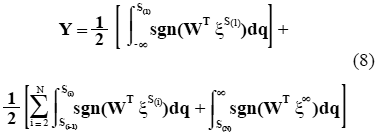
<p style="mso-layout-grid-align: none; text-autospace: none; line-height: 100%" align="justify"><font size="2" face="Verdana">Note that applying WOS filter on a real-valued signal is equivalent to decomposing the real-valued signal using threshold decomposition, applying the binary WOS filter (6) to each binary signal separately, and then adding up the binary outputs to obtain the real-valued output (Paredes &amp; Arce, 1999).</font></p>      <p style="mso-layout-grid-align: none; text-autospace: none; line-height: 100%" align="justify"><font size="2" face="Verdana">The integral term in (7) seems to be difficult to implement. However, further simplification of this expression can be achieved if we note that for any q </font> <b><span style="mso-char-type: symbol; mso-symbol-font-family: Symbol; font-size: 12.0pt; mso-bidi-font-size: 10.0pt; font-family: Symbol; mso-ascii-font-family: Times New Roman; mso-fareast-font-family: Times New Roman; mso-hansi-font-family: Times New Roman; mso-bidi-font-family: Times New Roman; mso-ansi-language: EN-US; mso-fareast-language: ES; mso-bidi-language: AR-SA" lang="EN-US"><font size="2" face="Symbol">Î</font><font size="2" face="Verdana"> </font> </span></b><font size="2" face="Verdana">(-<span style="mso-bidi-font-size: 12.0pt; mso-fareast-font-family: Times New Roman; mso-bidi-font-family: Times New Roman; mso-ansi-language: ES; mso-fareast-language: ES; mso-bidi-language: AR-SA">&#8734;</span> , S<sub>(1)</sub>] or q </font> <b><span style="mso-char-type: symbol; mso-symbol-font-family: Symbol; font-size: 12.0pt; mso-bidi-font-size: 10.0pt; font-family: Symbol; mso-ascii-font-family: Times New Roman; mso-fareast-font-family: Times New Roman; mso-hansi-font-family: Times New Roman; mso-bidi-font-family: Times New Roman; mso-ansi-language: EN-US; mso-fareast-language: ES; mso-bidi-language: AR-SA" lang="EN-US"><font size="2" face="Symbol">Î</font><font size="2" face="Verdana"> </font> </span></b><font size="2" face="Verdana">(S<sub>(i-1)</sub>, S<sub>(i)</sub>], i = 2,..., N or q </font> <b><span style="mso-char-type: symbol; mso-symbol-font-family: Symbol; font-size: 12.0pt; mso-bidi-font-size: 10.0pt; font-family: Symbol; mso-ascii-font-family: Times New Roman; mso-fareast-font-family: Times New Roman; mso-hansi-font-family: Times New Roman; mso-bidi-font-family: Times New Roman; mso-ansi-language: EN-US; mso-fareast-language: ES; mso-bidi-language: AR-SA" lang="EN-US"><font size="2" face="Symbol">Î</font><font size="2" face="Verdana"> </font> </span></b><font size="2" face="Verdana">(S<sub>(N)</sub>,<span style="font-size:10.0pt;mso-bidi-font-size:12.0pt; font-family:Verdana;mso-fareast-font-family:&quot;Times New Roman&quot;;mso-bidi-font-family: &quot;Times New Roman&quot;;mso-ansi-language:ES;mso-fareast-language:ES;mso-bidi-language: AR-SA">&#8734;</span>] , TD outputs the same binary vector. Hence, there are at most N + 1 different binary vectors s<sup>q</sup>. Using this fact, Eq. (7) becomes</font></p>      <p style="mso-layout-grid-align: none; text-autospace: none; line-height: 100%" align="center"><img border="0" src="/img/fbpe/rfiucv/v25n4/art10ec8.gif" width="375" height="136"></p>      
<p style="mso-layout-grid-align: none; text-autospace: none; line-height: 100%" align="justify"><font size="2" face="Verdana">As <sub><img border="0" src="/img/fbpe/rfiucv/v25n4/art10ec8a.gif" width="90" height="34"></sub> and after some simplification, (8) reduces to</font></p>      
<p style="mso-layout-grid-align: none; text-autospace: none; line-height: 100%" align="center"><img border="0" src="/img/fbpe/rfiucv/v25n4/art10ec9.gif" width="392" height="52"></p>      
<p style="mso-layout-grid-align: none; text-autospace: none; line-height: 100%" align="justify"><font size="2" face="Verdana">where S<sub>(i)</sub> is the i-th smallest signed sample. This is another form to implement the WOS filtering operation and gives the same result as the one obtained using the three-step procedure showed above. This representation, however, provides us with an interesting interpretation of the WOS filter. It turns out that, the filter output is given by the sum of the midrange of the signed samples (S<sub>(1)</sub> + S<sub>(N)</sub>)/<b>2</b> and a linear combination of the difference between successive order statistic (S<sub>(i)</sub> - S<sub>(i-1)</sub>) weighted by a factor of ±<b>1/2</b>.</font></p>      <p style="mso-layout-grid-align: none; text-autospace: none; line-height: 100%" align="justify"><b><font size="2" face="Verdana">EFFECTS OF NEGATIVE WEIGHTS IN THE FILTERING OPERATION</font></b></p>      <p style="mso-layout-grid-align: none; text-autospace: none; line-height: 100%" align="justify"><font size="2" face="Verdana">In this section, we study the effect that real-valued weights have in the WOS filtering process. The approach followed in this section is different to the one presented by Arce in (Arce, 1998) where the effects of negative weighting in WM filters are studied using the theory of maximum likelihood estimate of location and the analogies between FIR and WM filters. Here, we exploit the concept of weight monotonic property recently introduced in (Marshall, 2002; Marshall, 2004).</font></p>      <p style="mso-layout-grid-align: none; text-autospace: none; line-height: 100%" align="justify"><font size="2" face="Verdana">As mentioned above, WOS filters belong to a richer class of nonlinear filters, the so-called stack filters (Paredes &amp; Arce, 1999) and, hence, they satisfy the stacking property. More precisely, if two binary vectors u </font><font size="2" face="Symbol"><span style="mso-char-type: symbol; mso-symbol-font-family: Symbol; font-size: 12.0pt; mso-bidi-font-size: 10.0pt; font-family: Symbol; mso-ascii-font-family: Times New Roman; mso-fareast-font-family: Times New Roman; mso-hansi-font-family: Times New Roman; mso-bidi-font-family: Times New Roman; mso-ansi-language: EN-US; mso-fareast-language: ES; mso-bidi-language: AR-SA" lang="EN-US"><b>Î</b></span></font><font size="2" face="Verdana"> </font><font size="2" face="Symbol"><span style="mso-char-type: symbol; mso-symbol-font-family: Symbol; font-size: 12.0pt; mso-bidi-font-size: 10.0pt; font-family: Symbol; mso-ascii-font-family: Times New Roman; mso-fareast-font-family: Times New Roman; mso-hansi-font-family: Times New Roman; mso-bidi-font-family: Times New Roman; mso-ansi-language: EN-US; mso-fareast-language: ES; mso-bidi-language: AR-SA" lang="EN-US"><b>À</b></span></font><font size="2" face="Verdana"><sup>N </sup>and v </font><font size="2" face="Symbol"><span style="mso-char-type: symbol; mso-symbol-font-family: Symbol; font-size: 12.0pt; mso-bidi-font-size: 10.0pt; font-family: Symbol; mso-ascii-font-family: Times New Roman; mso-fareast-font-family: Times New Roman; mso-hansi-font-family: Times New Roman; mso-bidi-font-family: Times New Roman; mso-ansi-language: EN-US; mso-fareast-language: ES; mso-bidi-language: AR-SA" lang="EN-US"><b>Î</b></span></font><font size="2" face="Verdana"> </font><font size="2" face="Symbol"><span style="mso-char-type: symbol; mso-symbol-font-family: Symbol; font-size: 12.0pt; mso-bidi-font-size: 10.0pt; font-family: Symbol; mso-ascii-font-family: Times New Roman; mso-fareast-font-family: Times New Roman; mso-hansi-font-family: Times New Roman; mso-bidi-font-family: Times New Roman; mso-ansi-language: EN-US; mso-fareast-language: ES; mso-bidi-language: AR-SA" lang="EN-US"><b>À</b></span></font><font size="2" face="Verdana"><sup>N </sup>stack (i.e. u<sub>i</sub> <span style="font-size:12.0pt;font-family:Verdana; mso-fareast-font-family:&quot;Times New Roman&quot;;mso-bidi-font-family:&quot;Times New Roman&quot;; mso-ansi-language:ES;mso-fareast-language:ES;mso-bidi-language:AR-SA">&#8804;</span> u<sub>i</sub> for i = 2,..., N), their respective outputs stack, f (u) <span style="font-size:12.0pt;font-family:Verdana; mso-fareast-font-family:&quot;Times New Roman&quot;;mso-bidi-font-family:&quot;Times New Roman&quot;; mso-ansi-language:ES;mso-fareast-language:ES;mso-bidi-language:AR-SA">&#8804;</span> f (v). This property is a restriction on the type of signal processing tasks that can be carried out by a filter possessing this property.</font></p>      ]]></body>
<body><![CDATA[<p style="mso-layout-grid-align: none; text-autospace: none; line-height: 100%" align="justify"><font size="2" face="Verdana">Based on this fact, Marshall developed in (Marshall, 2002) a test to define whether the kind of filters satisfying the stacking property are useful or not for a specific application. Thus, a simple test is applied to the training data set to determine if it is suitable for processing with a filter having the stacking property. The basic idea in the test is to determine whether the training samples possess the weight monotonic property, defined as follows (Marshall, 2002).</font></p>      <p style="mso-layout-grid-align: none; text-autospace: none; line-height: 100%" align="justify"><font size="2" face="Verdana">Let {<b>X(.)</b>} be an observed process that is statistically related to a desired process {<b>D(.)</b>}. Define a set of training samples {(<b>X</b>(<i>n</i>), <b>D</b>(<i>n</i>)) for n = n<sub>0</sub> ,..., L, L &gt; n<sub>0</sub> }, where <b>X</b>(<i>n</i>) is the N-dimensional observation vector defined as before. This set of training samples satisfies the weight monotonic property if</font></p>      <p style="mso-layout-grid-align: none; text-autospace: none; line-height: 100%" align="center"><font size="2" face="Verdana"><b><font LANG="JA">Pr(d = 1</font></b>||<b>x</b>|<b>= k) </b>&#8805; <b><font LANG="JA">Pr (d = 1</font></b><b><font LANG="JA"></font></b>||<b>x</b>|<b>= j</b>)&nbsp;&nbsp;&nbsp;&nbsp;&nbsp; (10)</font></p>      <p style="mso-layout-grid-align: none; text-autospace: none; line-height: 100%" align="justify"><font size="2" face="Verdana">for <b>k </b>&gt; <b>j </b>with <sub><img border="0" src="/img/fbpe/rfiucv/v25n4/art10ec10a.gif" width="113" height="36"></sub> and where <b><font LANG="JA">Pr(</font>.</b>|<b>.) </b>is the conditional probability, <i>d </i>and <b>x<sub>i</sub> </b>are the TD of D and <b>X<sub>i</sub> </b>, respectively, at an arbitrary threshold level <i>q</i>. Note that|<b>x</b>| is just the number of 1’s in the observation window. Thus, the weight monotonic property holds for distributions where the probability of the output being 1 increases with |<b>x</b>|. If this property holds then stack filters, like WOS filters, will yield good performance in restoring the desired signal from the corrupted one; otherwise it is useless (Marshall, 2004).</font></p>      
<p align="justify" style="line-height: 100%"><font size="2" face="Verdana">For the applications at hand, we are interested in the use of WOS filters in a frequency selection type of filtering process and therefore the weight monotonic property should be held in order to achieve the desired performance. For instance, consider the application of designing a high-pass filter whose main goal is to preserve a high-frequency tone while removing all low-frequency terms. More precisely, let <b>X(n) = sin(2</b></font><font size="2" face="Symbol">p</font><font size="2" face="Verdana"><b>f<sub>1</sub>n) + sin(2</b></font><font size="2" face="Symbol">p</font><font size="2" face="Verdana"><b>f<sub>2</sub>n + </b></font><font size="2" face="Symbol">p</font><font size="2" face="Verdana"><b>/4) + </b></font><font size="2" face="Symbol">h</font><font size="2" face="Verdana"><b>(n) </b>be the corrupted input signal where </font><font size="2" face="Symbol">h</font><font size="2" face="Verdana"><b>(.) </b>is the noise obeying a normal distribution <i>N</i>(0, 0.1) and let <b>D(n) = </b></font><font size="2" face="Verdana"><b>sin(2</b></font><font size="2" face="Symbol">p</font><font size="2" face="Verdana"><b>f<sub>2</sub>n + </b></font><font size="2" face="Symbol">p</font><font size="2" face="Verdana"><b>/4)</b> be the desired signal for some <b>f<sub>1</sub> </b>&lt; <b>f<sub>2</sub></b>.</font></p>     <p align="justify" style="line-height: 100%"><font size="2" face="Verdana">To see if the weight monotonic property is valid for this set of training samples the output conditional probability is determined for two different cases of filter weights. In the first one, all the filter weights are assumed to be positive, i.e. a WOS smoother is used. In the second case, the filter weights are allowed to be negative. In this later case, to compute |<b>x</b>|, the TD of the signed samples is used in place of the TD of the original input sample.</font></p>     <p align="justify" style="line-height: 100%"><font size="2" face="Verdana"> <a href="#fig1">Figure 1(a)</a> depicts the conditional probability function when all the filter weights are positive for an observation window size 7. Note that the values of <b><font LANG="JA">Pr (d = 1</font></b>| |<b>x</b>|<b>)</b> do not increase monotonically as the number of 1’s in the observation window increases. Therefore, the weight monotonic property does not hold and WOS smoothers should be discarded for this application. On the other hand, <a href="#fig1">Fig. 1(b)</a> shows the output conditional probability for the same window size and <b>sgn(W<sub>2</sub>) = -1</b>, <b>sgn(W<sub>6</sub>) = -1</b>, all the other weights are positive. Note that using negative weights the value of <b><font LANG="JA">Pr (d = 1</font></b>| |<b>x</b>|<b>) </b>does increase monotonically as|<b>x</b>| increases, and therefore WOS filters can indeed be used for this application.</font></p>     <p align="center" style="line-height: 100%"><a name="fig1"> <img border="0" src="/img/fbpe/rfiucv/v25n4/art10fig1.gif" width="576" height="328"></a></p>     
<p align="justify" style="line-height: 100%"><font size="2" face="Verdana">In this example, we have shown the effect that negative weights have on the conditional probability. We observe that passing the sign of the weights to the observation samples, indeed, changes <b><font LANG="JA">Pr (d = 1</font></b>| |<b>x</b>|<b>)</b>, forcing the weight monotonic property to hold and therefore enriching the field of application of WOS filters and, overcoming the limitations of WOS smoothers.</font></p> <b>     <p align="justify" style="line-height: 100%"><font size="2" face="Verdana">OPTIMIZATION OF WOS FILTERS</font></p> </b>     ]]></body>
<body><![CDATA[<p align="justify" style="line-height: 100%"><font size="2" face="Verdana">The main objective in an optimization algorithm is to find the best filter coefficients such that a performance criterion is minimized. A criterion widely used in the design of WOS smoothers (Yin <i>et al</i>. 1996) is the mean absolute error (MAE) between the filter’s output and the desired signal. If <b>{D(.)} </b>and <b>{X(.)} </b>are jointly stationary, then the cost function to be minimized is</font></p> <b>     <p align="center" style="line-height: 100%"><font size="2" face="Verdana">J(W) = E{|D(n) - Y(n)|}&nbsp;</font></b><font size="2" face="Verdana"><b>&nbsp;&nbsp;&nbsp;&nbsp; </b>(11)</font></p>     <p align="justify" style="line-height: 100%"><font size="2" face="Verdana">where <b>E{.} </b>denotes the statistical expectation, <b>W = [W<sub>0</sub>,</b> <b>W<sub>1</sub>,..., W<sub>N</sub>]<sup>T</sup> </b>and <b>Y(n) </b>is the WOS filter output given by (2) for an input observation vector <b>X</b>(<i>n</i>). Using TD, it is easy to prove that Eq. (11) reduces to</font></p>      <p style="mso-layout-grid-align: none; text-autospace: none; line-height: 100%" align="center"><img border="0" src="/img/fbpe/rfiucv/v25n4/art10ec12.gif" width="345" height="107"></p>      
<p align="justify" style="line-height: 100%"><font size="2" face="Verdana">where the fact that, for any instant <i>n</i>, the argument inside the absolute value operator can only take on values either in the set {&#8722;2, 0} or in the set {0, 2}, has been used to interchange the absolute value and the integral operators in (12) and to replace the absolute value operator by a properly scaled second power operator in (13).</font></p>     <p align="justify" style="line-height: 100%"><font size="2" face="Verdana">Since it is not possible to find a closed form expression for the filter coefficients that minimize (13), we resort to the steepest descend algorithm to form the iterative optimization algorithm</font></p> <b>     <p align="center" style="line-height: 100%"><font size="2" face="Verdana">W</font></b><font size="2" face="Verdana"><b>(n + 1) = W(n)</b> <b>+ 2</b></font><font LANG="JA" face="Symbol" size="2">m</font><font size="2" face="Verdana"><b>[- </b><span style="mso-char-type: symbol; mso-symbol-font-family: Symbol; font-size: 12.0pt; font-family: Symbol; mso-ascii-font-family: Verdana; mso-fareast-font-family: Times New Roman; mso-hansi-font-family: Verdana; mso-bidi-font-family: Times New Roman; mso-ansi-language: ES; mso-fareast-language: ES; mso-bidi-language: AR-SA">Ñ</span><b>J]&nbsp;&nbsp;&nbsp;&nbsp;&nbsp;&nbsp; </b>(14)</font></p>     <p align="justify" style="line-height: 100%"><font size="2" face="Verdana">where the gradient of the cost function <b>(</b><span style="mso-char-type: symbol; mso-symbol-font-family: Symbol; font-size: 12.0pt; font-family: Symbol; mso-ascii-font-family: Verdana; mso-fareast-font-family: Times New Roman; mso-hansi-font-family: Verdana; mso-bidi-font-family: Times New Roman; mso-ansi-language: ES; mso-fareast-language: ES; mso-bidi-language: AR-SA">Ñ</span><b>J) </b>has to be computed to update the filter weights. However, since the sgn function has a discontinuity at the origin, its derivative introduces the <i>dirac </i>function which is not convenient for further analysis. To overcome this difficulty, the sgn function is approximated by a differentiable function. We approximate sgn(<i>x</i>) by tanh(<i>x</i>) whose derivative is sech(<i>x</i>). With this approximation, the gradient of the cost function becomes</font></p>      <p style="mso-layout-grid-align: none; text-autospace: none; line-height: 100%" align="center"><img border="0" src="/img/fbpe/rfiucv/v25n4/art10ec15.gif" width="371" height="129"></p>      
<p align="justify" style="line-height: 100%"><font size="2" face="Verdana">for <i><span style="font-size:12.0pt;font-family:&quot;Times New Roman&quot;; mso-fareast-font-family:&quot;Times New Roman&quot;;mso-ansi-language:ES;mso-fareast-language: ES;mso-bidi-language:AR-SA">&#8467; </span></i>= <b>1,..., N</b>, and where <b>e<sup>q</sup>(n) </b>is the TD of the error at threshold level <i>q</i>, i.e. <b>e<sup>q</sup>(n) </b>= <b>sgn(D(n) - q) - sgn</b>(<b>(W<sup>T</sup></b></font><font size="2" face="Symbol">x</font><font size="2" face="Verdana"><b><sup>q</sup>(n))</b>. Upon closer examination, this error term takes on nonzero values only if q is between the desired output <b>D(n) </b>and the actual filter output <b>Y(n)</b>. Assuming that the desired output is one of the signed samples, say <b>S<sub>(m)</sub></b>, and that the actual output <b>Y(n) </b>is <b>S<sub>(j)</sub></b>; <b>e<sup>q</sup></b></font><b><font size="2" face="Verdana">(n)</font></b><font size="2" face="Verdana"><b><font LANG="JA"> &#8800; 0 </font></b>only for <b>q </b></font><font size="2" face="Symbol"><span style="mso-char-type: symbol; mso-symbol-font-family: Symbol; font-size: 12.0pt; mso-bidi-font-size: 10.0pt; font-family: Symbol; mso-ascii-font-family: Times New Roman; mso-fareast-font-family: Times New Roman; mso-hansi-font-family: Times New Roman; mso-bidi-font-family: Times New Roman; mso-ansi-language: EN-US; mso-fareast-language: ES; mso-bidi-language: AR-SA" lang="EN-US"><b>Î </b></span></font><font size="2" face="Verdana"><b>(min(S<sub>(m)</sub>, S<sub>(j)</sub>),</b> <b>max(S<sub>(m)</sub>), S<sub>(j)</sub>) </b>. Furthermore, as mentioned in section III, for any instant <i>n</i>, <b>s<sup>q</sup>(n) </b>takes at most <b>N + 1 </b>different values, so does </font><font size="2" face="Symbol">x</font><font size="2" face="Verdana"><b><sup>q</sup>(n)</b>. Those vectors </font><font size="2" face="Symbol">x</font><font size="2" face="Verdana"><b><sup>q</sup>(n) </b>are for <b>q = S<sub>(i)</sub>(n)</b>, <b>i = 1,</b> <b>2,..., N </b>and <b>q </b>= </font><font size="2" face="Verdana"><span style="mso-fareast-font-family: Times New Roman; mso-bidi-font-family: Times New Roman; mso-ansi-language: ES; mso-fareast-language: ES; mso-bidi-language: AR-SA"><b>&#8734;</b></span></font><font size="2" face="Verdana">. Hence, combining these two facts, the adaptive optimization algorithm reduces to:</font></p>      ]]></body>
<body><![CDATA[<p style="mso-layout-grid-align: none; text-autospace: none; line-height: 100%" align="center"><img border="0" src="/img/fbpe/rfiucv/v25n4/art10ec17.gif" width="360" height="192"></p>      
<p align="justify" style="line-height: 100%"><font size="2" face="Verdana">for <i><span style="font-size:12.0pt;font-family:&quot;Times New Roman&quot;; mso-fareast-font-family:&quot;Times New Roman&quot;;mso-ansi-language:ES;mso-fareast-language: ES;mso-bidi-language:AR-SA">&#8467;</span></i> = <b>1, 2,..., N</b>, and where the instantaneous estimate for the gradient has been used. <b>P[.] </b>is a projection operator defined as <b>P(x) = x</b>, if <b>x<span style="font-size:10.0pt;mso-bidi-font-size:12.0pt; font-family:Verdana;mso-fareast-font-family:&quot;Times New Roman&quot;;mso-bidi-font-family: &quot;Times New Roman&quot;;mso-ansi-language:ES;mso-fareast-language:ES;mso-bidi-language: AR-SA">&#8805;</span> 0 </b>and 0 otherwise. This ensures that the selection parameter takes on nonnegative values (Yin &amp; Neuvo. 1994).</font></p>     <p align="justify" style="line-height: 100%"><font size="2" face="Verdana">Further simplifications of this optimization algorithm can be achieved following the same arguments used in (Arce. 1998) and (Yin &amp; Neuvo. 1994). It turns out that each term in the summations of (17) and (18) contributes to the weight updating by an amount that basically depends on the function </font><b><font size="2" face="Verdana">sec h(W<sup>T</sup></font></b><font size="2" face="Symbol">x</font><b><font size="2" face="Verdana"><sup>q</sup>)</font></b><font size="2" face="Verdana">, which reaches a maximum when its argument is zero. Therefore, for some value of <i>q</i>, </font><b><font size="2" face="Verdana">W<sup>T</sup></font></b><font size="2" face="Symbol">x</font><b><font size="2" face="Verdana"><sup>q</sup></font></b><font size="2" face="Verdana"> takes its closest value to zero. It is easy to show that for <b>q</b> = <b>Y(n)</b>, </font><b><font size="2" face="Verdana">W<sup>T</sup></font></b><font size="2" face="Symbol">x</font><b><font size="2" face="Verdana"><sup>q</sup></font></b><font size="2" face="Verdana"><b> </b>is closest to zero (Yin &amp; Neuvo. 1994; Arce. 1998). Thus, <b>q </b>= <b>Y(n) </b>produces the largest update contribution. Using this fact, the optimization algorithm reduces to:</font></p> <b>     <p align="center" style="line-height: 100%"><font size="2" face="Verdana">W<sub>0</sub>(n + 1) </font></b><font size="2" face="Verdana">= <b>P[W<sub>0</sub>(n) - </b></font><font size="2" face="Symbol">m</font><font size="2" face="Verdana"><b>(D(n) - Y(n))]&nbsp;&nbsp; </b>(19)</font></p> <b>     <p align="center" style="line-height: 100%"><font size="2" face="Verdana">W</font></b><font size="2" face="Verdana"><i><span style="font-size:12.0pt;font-family:&quot;Times New Roman&quot;; mso-fareast-font-family:&quot;Times New Roman&quot;;mso-ansi-language:ES;mso-fareast-language: ES;mso-bidi-language:AR-SA"><sub>&#8467;</sub></span></i> <b>(n + 1) </b>= <b>W</b><i><span style="font-size:12.0pt;font-family:&quot;Times New Roman&quot;; mso-fareast-font-family:&quot;Times New Roman&quot;;mso-ansi-language:ES;mso-fareast-language: ES;mso-bidi-language:AR-SA"><sub>&#8467;</sub></span></i> <b>(n) </b>+ </font><font size="2" face="Symbol">m</font><font size="2" face="Verdana"><b>sgn(W</b><i><span style="font-size:12.0pt;font-family:&quot;Times New Roman&quot;; mso-fareast-font-family:&quot;Times New Roman&quot;;mso-ansi-language:ES;mso-fareast-language: ES;mso-bidi-language:AR-SA"><sub>&#8467;</sub></span></i><b>)(D(n) </b>- <b>Y(n))</b></font><font size="2" face="Symbol">x</font><font size="2" face="Verdana"><i><span style="font-size:12.0pt;font-family:&quot;Times New Roman&quot;; mso-fareast-font-family:&quot;Times New Roman&quot;;mso-ansi-language:ES;mso-fareast-language: ES;mso-bidi-language:AR-SA"><sub>&#8467;</sub></span></i><b><sup>Y(n)</sup>&nbsp;&nbsp; </b>(20)</font></p>      <p style="mso-layout-grid-align: none; text-autospace: none; line-height: 100%" align="justify"><font size="2" face="Verdana">for <i><span style="font-size:12.0pt;font-family:&quot;Times New Roman&quot;; mso-fareast-font-family:&quot;Times New Roman&quot;;mso-ansi-language:ES;mso-fareast-language: ES;mso-bidi-language:AR-SA">&#8467;</span></i> = <b>1, 2,..., N</b>, and where</font></p>      <p style="mso-layout-grid-align: none; text-autospace: none; line-height: 100%" align="center"><img border="0" src="/img/fbpe/rfiucv/v25n4/art10ec19a.gif" width="255" height="36"></p>      
<p align="justify" style="line-height: 100%"><font size="2" face="Verdana">The principle of the adaptive optimization algorithm can be explained as follows. When the actual output of the WOS filter is smaller than the desired signal, the selection parameter <b>(W<sub>0</sub>) </b>is decremented whereas the magnitude of those weights corresponding to the signed samples that are larger than the filter output are incremented (they become more positive if they are positive or more negative if they are negative). Note that the new values of <b>W<sub>0</sub> </b>and <sub><img border="0" src="/img/fbpe/rfiucv/v25n4/art10ec19b.gif" width="39" height="26"></sub> try to push the estimate toward the desired signal. A similar analysis can be done if the output of the WOS filter is larger than the desired output.</font></p> <b>     
<p align="justify" style="line-height: 100%"><font size="2" face="Verdana">COMPUTER SIMULATIONS</font></p> </b>     <p align="justify" style="line-height: 100%"><font size="2" face="Verdana">To illustrate the performance of the proposed filters and their corresponding adaptive optimization algorithm, two frequency selective applications are carried out. In the first example, we have designed a high-pass WOS filter using the simplified version of the adaptive optimization algorithm, and compare it to the performances yielded by a linear FIR filter, a WOS smoother (Yin &amp; Neuvo, 1994) and a WM filter (Arce, 1998). As performance measures we use the MSE and MAE as well as a visual inspection of the output signals. The second example concerns with the design of a robust frequency selective filter. This last application is quite helpful in biomedical signal processing since it can be used to reduce the effect of the undesired, but always present, 60 Hz frequency component in a biomedical signal.</font></p>     ]]></body>
<body><![CDATA[<p align="justify" style="line-height: 100%"><b><font size="2" face="Verdana">A. Design of a high-pass WOS filter</font></b></p>     <p style="line-height: 100%" align="justify"><font size="2" face="Verdana">The first application at hand is the design of a 33-tap high-pass WOS filter with a cut-off frequency of 0.15 Hz (normalized Nyquist frequency equal to 1). As a training signal we use the two-tone signal described in Section IV with <b>f<sub>1</sub> </b>= <b>0.03Hz </b>and <b>f<sub>2</sub> </b>= <b>0.25Hz</b>, where the desired signal is the higher frequency component. Whereas as test signals the two-tone signal is contaminated with nonsymmetric </font><font size="2" face="Symbol">a</font><font size="2" face="Verdana">-stable noise simulating noise with impulsive characteristic (Nikias &amp; Shao, 1995).</font></p>     <p align="justify" style="line-height: 100%"><font size="2" face="Verdana">The simplified adaptive optimization algorithm is used to design the WOS filter where the filter weights were initialized to small random numbers (on the order of 10<sup>-1</sup>) and the step-size has been fixed to 10<sup>-3</sup>.</font></p>     <p align="justify" style="line-height: 100%"><font size="2" face="Verdana">For comparative purposes, a 33-tap linear FIR filter is designed using Matlab’s fir1 function with a cut-off frequency of <b>0.15Hz</b>. On the other hand, a WOS smoother is designed for the same task using Yin’s fast adaptive algorithms (Yin &amp; Neuvo, 1994). Likewise, the fast optimization algorithm introduced by Arce in (Arce, 1998) is used to design a WM filter. For both algorithms, the same training data, weight initial condition and step-size, as described above, are used.</font></p>     <p align="justify" style="line-height: 100%"><font size="2" face="Verdana"> <a href="#fig2">Figure 2</a> shows the performance of the various filters for the application at hand on noise-free signal (left half) and on impulsive noise signal (right half). Note, in <a href="#fig2">Fig. 2(e)</a>, that the WOS smoother fails to remove the low-frequency component, as expected since those filters can only synthe size low-pass behavior. Note also that WM filter as well as WOS filter yield similar performance, at least, visually for the noise-free part of the signal.</font></p>     <p align="center" style="line-height: 100%"><a name="fig2"> <img border="0" src="/img/fbpe/rfiucv/v25n4/art10fig2.gif" width="579" height="451"></a></p>     
<p align="justify" style="line-height: 100%"><font size="2" face="Verdana">In order to test the robustness of the different filters, the two-tone signal is contaminated with additive nonsymmetric impulsive noise. The additive noise was chosen to have a zero-mean nonsymmetric </font><font size="2" face="Symbol">a</font><font size="2" face="Verdana">-stable distribution (Nikias &amp; Shao, 1995) with a <i>characteristic exponent </i></font><font size="2" face="Symbol">a</font><font size="2" face="Verdana"><font LANG="JA"> </font>= <b>1.5</b>, a dispersion </font><font size="2" face="Symbol">d</font><font size="2" face="Verdana"><font LANG="JA"> </font>= <b>0.5 </b>and a <i>skewness parameter </i></font><font lang="JA" face="Symbol" size="2">b</font><font size="2" face="Verdana"><font lang="JA"> </font>= <b>0.75</b>. Impulsive noise is well-modelled by the heavy-tailed class of </font><font size="2" face="Symbol">a</font><font size="2" face="Verdana">-stable distributions which include the Gaussian distribution as special case when </font><font LANG="JA" face="Symbol" size="2">a</font><font size="2" face="Verdana"><font LANG="JA"> </font>= <b>2 </b>and </font><font LANG="JA" face="Symbol" size="2">b</font><font size="2" face="Verdana"><font LANG="JA"> </font>= <b>0</b>. The characteristic exponent (0 &lt; </font><font LANG="JA" face="Symbol" size="2">a</font><font size="2" face="Verdana"><font LANG="JA"> </font>&#8804; 2) measures the heaviness of the tails (a smaller value indicates heavier tails), whereas the dispersion decides the spread of the distribution around the origin. The skewness parameter ( -1 &#8804; </font><font LANG="JA" face="Symbol" size="2">b</font><font size="2" face="Verdana"><font LANG="JA"> </font>&#8804; 1 ) is a shape parameter that defines the degree of symmetric around the origin of the distribution. Thus, when </font><font LANG="JA" face="Symbol" size="2">b</font><font size="2" face="Verdana"><font LANG="JA"> </font>= <b>0 </b>the distribution is symmetric whereas as </font><font LANG="JA" face="Symbol" size="2">b</font><font size="2" face="Verdana"><font LANG="JA"> </font><b><font LANG="JA">&#8594; 1 </font></b>(</font><font LANG="JA" face="Symbol" size="2">b</font><font size="2" face="Verdana"><font LANG="JA"> </font><b><font LANG="JA">&#8594; -1</font></b>) the probability that a negative (positive) impulse occurs is decreased.</font></p>     <p align="justify" style="line-height: 100%"><font size="2" face="Verdana"> <a href="#fig2">Figure 2</a> (right half) depicts the filter outputs of the various filter for a noise input signal. Note the poor performance of the linear FIR filter. On the other hand, WOS and WM filter outputs, shown in <a href="#fig2">Fig. 2(c) and Fig. 2(d)</a>, respectively, are not severely degraded by the impulsive noise. However, several minor artifacts appear at the output of the WM filter that are not present in the WOS filter output.</font></p>     <p align="justify" style="line-height: 100%"><font size="2" face="Verdana">The MSE and MAE for several values of parameter &#945; are computed and shown in <a href="#tab1">Table 1</a>. Each entry in the table was obtained by averaging out the MSE and MAE of 500 realizations of the contaminated two-tone signal. The results in  <a href="#tab1">Table I</a> indicate that WOS filters outperform the others for noise signals. Furthermore, the linear FIR filter outperforms the nonlinear structures in the noise-free case, as expected.</font></p>     <p align="center" style="line-height: 100%"><a name="tab1"> <img border="0" src="/img/fbpe/rfiucv/v25n4/art10tab1.gif" width="576" height="253"></a></p>     
]]></body>
<body><![CDATA[<p align="justify" style="line-height: 100%"><font size="2" face="Verdana">Finally, <a href="#fig3">Fig. 3</a> shows the ensemble-averaged absolute error for the simplified iterative algorithm. This curve plots the absolute error, averaged over 100 trials, as a function of algorithm iterations. As this curve indicates, the adaptive algorithm converges in about 350 iterations.</font></p>     <p align="center" style="line-height: 100%"><a name="fig3"> <img border="0" src="/img/fbpe/rfiucv/v25n4/art10fig3.gif" width="525" height="450"></a></p>     
<p align="justify" style="line-height: 100%"><b><font size="2" face="Verdana">B. Design of a robust frequency selective WOS filter</font></b></p>     <p align="justify" style="line-height: 100%"><font size="2" face="Verdana">To test the frequency selective capabilities of the proposed filter, the adaptive optimization algorithm described in Section V is used to design a 43-tap WOS filter to remove the middle-frequency tone from a signal compounded of three sinusoidal signals corrupted by impulsive noise. The training signals are: the observed signal <b><sub><img border="0" src="/img/fbpe/rfiucv/v25n4/art10ec19c.gif" width="196" height="26"></sub> </b>and the desired signal <b>D(n)</b> <b>= sin(2</b></font><font lang="JA" face="Symbol" size="2">p</font><font size="2" face="Verdana"><b>f<sub>0</sub>n) + sin(2</b></font><font lang="JA" face="Symbol" size="2">p</font><font size="2" face="Verdana"><b>f<sub>2</sub>n) </b>where <b>f<sub>0</sub> </b>= <b>0.015</b>, <b>f<sub>1</sub> </b>= <b>0.12</b>, and <b>f<sub>2</sub> </b>= <b>0.20 </b>(normalized Nyquist frequency equal to 1). The additive noise is nonsymmetric </font><font lang="JA" face="Symbol" size="2">a</font><font size="2" face="Verdana">-stable noise with </font><font size="2" face="Symbol">a</font><font size="2" face="Verdana"><font LANG="JA"> </font>= <b>1.5</b>, </font><font LANG="JA" face="Symbol" size="2">b</font><font size="2" face="Verdana"><font LANG="JA"> </font>= <b>0.5 </b>and </font><font LANG="JA" face="Symbol" size="2">d</font><font size="2" face="Verdana"><font LANG="JA"> </font>= <b>0.5</b>. The test signal, shown in <a href="#fig4">Fig. 4(a)</a>, is a 1000-sample sequence where the first 500 samples are noise-free whereas the last 500 samples are corrupted with impulsive noise.</font></p>     
<p align="center" style="line-height: 100%"><a name="fig4"> <img border="0" src="/img/fbpe/rfiucv/v25n4/art10fig4.gif" width="569" height="449"></a></p>     
<p align="justify" style="line-height: 100%"><font size="2" face="Verdana"> <a href="#fig4">Figure 4(d)</a> shows the output of the optimal WOS filter. It can be seen that the performance of WOS filters is not severely affected by the presence of impulsive noise. In contrast, a 43-tap FIR filter designed using Matlab’s fir1 function with passed bands <b>0 </b>&#8804; <b>f </b>&#8804; <b>0.09 </b>and <b>0.15 </b>&#8804; <b>f </b>&#8804; <b>0.25</b> performances poorly in the part of the input signal corrupted by impulsive noise. <a href="#fig4">Figure 4(c)</a> shows the FIR filter output for the test signal.</font></p> <b>     <p align="justify" style="line-height: 100%"><font size="2" face="Verdana">CONCLUSION</font></p> </b>     <p align="justify" style="line-height: 100%"><font size="2" face="Verdana">In this paper, we have presented a new class of robust nonlinear filters based on order statistic. The proposed filter can be suitable in applications where robustness as well as high-pass or bandpass behavior are needed in nonsymmetric impulsive noise environments. An adaptive optimization algorithm for the design of this kind of filters was also introduced. The performance of the proposed filters was compared to the performances of the linear FIR filters, WOS smoothers and WM filters through computer-based simulations. It was shown that the proposed filters outperform the other filters not only in the MSE and MAE performance measures but also visually.</font></p> <b>     <p align="justify" style="line-height: 100%"><font size="2" face="Verdana">ACKNOWLEDGMENT</font></p> </b>     <p align="justify" style="line-height: 100%"><font size="2" face="Verdana">This work was supported by the University of Los Andes Council of Scientific, Humanistic and Technological Development (CDCHT) under project I-768-04-02-B. Mérida. Venezuela.</font></p> <b>     ]]></body>
<body><![CDATA[<p style="line-height: 100%" align="justify"><font size="2" face="Verdana">REFERENCES</font></p> </b>     <!-- ref --><p align="justify" style="line-height: 100%"><font size="2" face="Verdana">1. Arce, G.R., Hall, T.A. &amp; Barner, K.E. (Aug. 1995), Permutation weighted order statistic filter lattice. IEEE Transactions Image Processing, Vol. 4, No. 8, pp. 1070–1083.</font>&nbsp;&nbsp;&nbsp;&nbsp;&nbsp;&nbsp;&nbsp;&nbsp;[&#160;<a href="javascript:void(0);" onclick="javascript: window.open('/scielo.php?script=sci_nlinks&ref=1871175&pid=S0798-4065201000040001000001&lng=','','width=640,height=500,resizable=yes,scrollbars=1,menubar=yes,');">Links</a>&#160;]<!-- end-ref --><!-- ref --><p align="justify" style="line-height: 100%"><font size="2" face="Verdana">2. Arce, G.R. (Dic. 1998), A general weighted median filter structure admitting negative weights. IEEE Transactions Signal Processing, Vol. 46, No. 12, pp. 3195–3205.</font>&nbsp;&nbsp;&nbsp;&nbsp;&nbsp;&nbsp;&nbsp;&nbsp;[&#160;<a href="javascript:void(0);" onclick="javascript: window.open('/scielo.php?script=sci_nlinks&ref=1871176&pid=S0798-4065201000040001000002&lng=','','width=640,height=500,resizable=yes,scrollbars=1,menubar=yes,');">Links</a>&#160;]<!-- end-ref --><!-- ref --><p align="justify" style="line-height: 100%"><font size="2" face="Verdana">3. Li, Q. (May. 2000), Delay characterization and performance control of wide-area networks,” Ph.D. dissertation, University of Delaware, Newark [Online]. Available in: <a href="http://www.ece.udel.edu/~qli">www.ece.udel.edu/~qli</a>.</font>&nbsp;&nbsp;&nbsp;&nbsp;&nbsp;&nbsp;&nbsp;&nbsp;[&#160;<a href="javascript:void(0);" onclick="javascript: window.open('/scielo.php?script=sci_nlinks&ref=1871177&pid=S0798-4065201000040001000003&lng=','','width=640,height=500,resizable=yes,scrollbars=1,menubar=yes,');">Links</a>&#160;]<!-- end-ref --><!-- ref --><p align="justify" style="line-height: 100%"><font size="2" face="Verdana">4. Marshall, S. (Sep. 2002), Optimum non linear image restoration through linear greyscale operations. Presented at EUSIPCO. Toulouse, France.</font>&nbsp;&nbsp;&nbsp;&nbsp;&nbsp;&nbsp;&nbsp;&nbsp;[&#160;<a href="javascript:void(0);" onclick="javascript: window.open('/scielo.php?script=sci_nlinks&ref=1871178&pid=S0798-4065201000040001000004&lng=','','width=640,height=500,resizable=yes,scrollbars=1,menubar=yes,');">Links</a>&#160;]<!-- end-ref --><!-- ref --><p align="justify" style="line-height: 100%"><font size="2" face="Verdana">5. Marshall, S. (Feb. 2004), New direct design method for weighted order statistic filters. Vision, Image and Signal Processing IEE Proceedings, Vol. 151, No. 1, pp. 1–8.</font>&nbsp;&nbsp;&nbsp;&nbsp;&nbsp;&nbsp;&nbsp;&nbsp;[&#160;<a href="javascript:void(0);" onclick="javascript: window.open('/scielo.php?script=sci_nlinks&ref=1871179&pid=S0798-4065201000040001000005&lng=','','width=640,height=500,resizable=yes,scrollbars=1,menubar=yes,');">Links</a>&#160;]<!-- end-ref --><!-- ref --><p align="justify" style="line-height: 100%"><font size="2" face="Verdana">6. Middleton, D. (May. 1999), Non-gaussian noise models in signal processing for telecommunications: new methods an results for class A and class B noise models. IEEE Transactions on Information Theory, Vol. 45, No. 4, pp. 1129 – 1149.</font>&nbsp;&nbsp;&nbsp;&nbsp;&nbsp;&nbsp;&nbsp;&nbsp;[&#160;<a href="javascript:void(0);" onclick="javascript: window.open('/scielo.php?script=sci_nlinks&ref=1871180&pid=S0798-4065201000040001000006&lng=','','width=640,height=500,resizable=yes,scrollbars=1,menubar=yes,');">Links</a>&#160;]<!-- end-ref --><!-- ref --><p align="justify" style="line-height: 100%"><font size="2" face="Verdana">7. Mitra, S.K. &amp; Sicuranza, G. (2001), Nonlinear Image Processing, (Communications, Networking and Multimedia). Academic Press.</font>&nbsp;&nbsp;&nbsp;&nbsp;&nbsp;&nbsp;&nbsp;&nbsp;[&#160;<a href="javascript:void(0);" onclick="javascript: window.open('/scielo.php?script=sci_nlinks&ref=1871181&pid=S0798-4065201000040001000007&lng=','','width=640,height=500,resizable=yes,scrollbars=1,menubar=yes,');">Links</a>&#160;]<!-- end-ref --><!-- ref --><p align="justify" style="line-height: 100%"><font size="2" face="Verdana">8. Muroga, S. (1971), Threshold Logic and its Applications. New York, USA: Wiley-Interscience.</font>&nbsp;&nbsp;&nbsp;&nbsp;&nbsp;&nbsp;&nbsp;&nbsp;[&#160;<a href="javascript:void(0);" onclick="javascript: window.open('/scielo.php?script=sci_nlinks&ref=1871182&pid=S0798-4065201000040001000008&lng=','','width=640,height=500,resizable=yes,scrollbars=1,menubar=yes,');">Links</a>&#160;]<!-- end-ref --><!-- ref --><p align="justify" style="line-height: 100%"><font size="2" face="Verdana">9. Nikias, C. &amp; Shao, M. (1995) Signal Processing with Alpha-Stable Distributions and Applications. New York: Wiley.</font>&nbsp;&nbsp;&nbsp;&nbsp;&nbsp;&nbsp;&nbsp;&nbsp;[&#160;<a href="javascript:void(0);" onclick="javascript: window.open('/scielo.php?script=sci_nlinks&ref=1871183&pid=S0798-4065201000040001000009&lng=','','width=640,height=500,resizable=yes,scrollbars=1,menubar=yes,');">Links</a>&#160;]<!-- end-ref --><!-- ref --><p align="justify" style="line-height: 100%"><font size="2" face="Verdana">10. Paredes, J.L. &amp; Arce, G.R. (Oct. 1999), Stack filters, stack smoothers and mirrored threshold decomposition. IEEE Transactions Signal Processing, Vol. 47, No. 10, pp. 2757–2767.</font>&nbsp;&nbsp;&nbsp;&nbsp;&nbsp;&nbsp;&nbsp;&nbsp;[&#160;<a href="javascript:void(0);" onclick="javascript: window.open('/scielo.php?script=sci_nlinks&ref=1871184&pid=S0798-4065201000040001000010&lng=','','width=640,height=500,resizable=yes,scrollbars=1,menubar=yes,');">Links</a>&#160;]<!-- end-ref --><!-- ref --><p align="justify" style="line-height: 100%"><font size="2" face="Verdana">11. Song, J. &amp; Lee, Y.H. (May. 1996), Linear combination of weighted order statistic filters: Canonical structure and optimal design. IEEE Transactions Circuits Syst. II, Vol. 43, No. 5, pp. 349–362.</font>&nbsp;&nbsp;&nbsp;&nbsp;&nbsp;&nbsp;&nbsp;&nbsp;[&#160;<a href="javascript:void(0);" onclick="javascript: window.open('/scielo.php?script=sci_nlinks&ref=1871185&pid=S0798-4065201000040001000011&lng=','','width=640,height=500,resizable=yes,scrollbars=1,menubar=yes,');">Links</a>&#160;]<!-- end-ref --><!-- ref --><p align="justify" style="line-height: 100%"><font size="2" face="Verdana">12. Wendt, P., Coyle, E. &amp; Gallagher, N.J. (Aug. 1986), Stack filter. IEEE Transactions Speech Audio Processing, Vol. 34, No. 4, pp. 898–911.</font>&nbsp;&nbsp;&nbsp;&nbsp;&nbsp;&nbsp;&nbsp;&nbsp;[&#160;<a href="javascript:void(0);" onclick="javascript: window.open('/scielo.php?script=sci_nlinks&ref=1871186&pid=S0798-4065201000040001000012&lng=','','width=640,height=500,resizable=yes,scrollbars=1,menubar=yes,');">Links</a>&#160;]<!-- end-ref --><!-- ref --><p align="justify" style="line-height: 100%"><font size="2" face="Verdana">13. Yin, L. &amp; Neuvo, Y. (Jul. 1994), Fast adaptation and performance characteristics of FIR-WOS hybrid filters. IEEE Transactions Signal Processing, Vol. 42, No. 7, pp. 1610–1628.</font>&nbsp;&nbsp;&nbsp;&nbsp;&nbsp;&nbsp;&nbsp;&nbsp;[&#160;<a href="javascript:void(0);" onclick="javascript: window.open('/scielo.php?script=sci_nlinks&ref=1871187&pid=S0798-4065201000040001000013&lng=','','width=640,height=500,resizable=yes,scrollbars=1,menubar=yes,');">Links</a>&#160;]<!-- end-ref --><!-- ref --><p align="justify" style="line-height: 100%"><font size="2" face="Verdana">14. Yin, L., Yang, R., Gabbouj, M. &amp; Neuvo, Y. (Mar. 1996), Weighted median filters: A tutorial. IEEE Transactions Circuits Syst. II, Vol. 47, pp. 157–192.</font>&nbsp;&nbsp;&nbsp;&nbsp;&nbsp;&nbsp;&nbsp;&nbsp;[&#160;<a href="javascript:void(0);" onclick="javascript: window.open('/scielo.php?script=sci_nlinks&ref=1871188&pid=S0798-4065201000040001000014&lng=','','width=640,height=500,resizable=yes,scrollbars=1,menubar=yes,');">Links</a>&#160;]<!-- end-ref --><!-- ref --><p align="justify" style="line-height: 100%"><font size="2" face="Verdana">15. Yli-Harja, O., Astola, J. &amp; Neuvo, Y. (Feb. 1991), Analysis of the properties of median and weighted median filters using threshold logic and stack filter representation. IEEE Transactions Signal Processing, Vol. 39, No. 2, pp. 395–410.</font>&nbsp;&nbsp;&nbsp;&nbsp;&nbsp;&nbsp;&nbsp;&nbsp;[&#160;<a href="javascript:void(0);" onclick="javascript: window.open('/scielo.php?script=sci_nlinks&ref=1871189&pid=S0798-4065201000040001000015&lng=','','width=640,height=500,resizable=yes,scrollbars=1,menubar=yes,');">Links</a>&#160;]<!-- end-ref --><!-- ref --><p align="justify" style="line-height: 100%"><font size="2" face="Verdana">16. Yu, P. &amp; Liao, W. (Oct. 1994), Weighted order statistics filters — their classification, some properties, and conversion algorithm. IEEE Transactions Signal Processing, Vol. 42, No. 10, pp. 2678–2691.</font>&nbsp;&nbsp;&nbsp;&nbsp;&nbsp;&nbsp;&nbsp;&nbsp;[&#160;<a href="javascript:void(0);" onclick="javascript: window.open('/scielo.php?script=sci_nlinks&ref=1871190&pid=S0798-4065201000040001000016&lng=','','width=640,height=500,resizable=yes,scrollbars=1,menubar=yes,');">Links</a>&#160;]<!-- end-ref --> ]]></body>
<back>
<ref-list>
<ref id="B1">
<label>1</label><nlm-citation citation-type="journal">
<person-group person-group-type="author">
<name>
<surname><![CDATA[Arce]]></surname>
<given-names><![CDATA[G.R]]></given-names>
</name>
<name>
<surname><![CDATA[Hall]]></surname>
<given-names><![CDATA[T.A]]></given-names>
</name>
<name>
<surname><![CDATA[Barner]]></surname>
<given-names><![CDATA[K.E]]></given-names>
</name>
</person-group>
<article-title xml:lang="en"><![CDATA[Permutation weighted order statistic filter lattice]]></article-title>
<source><![CDATA[IEEE Transactions Image Processing]]></source>
<year>Aug.</year>
<month> 1</month>
<day>99</day>
<volume>4</volume>
<numero>8</numero>
<issue>8</issue>
<page-range>1070-1083</page-range></nlm-citation>
</ref>
<ref id="B2">
<label>2</label><nlm-citation citation-type="journal">
<person-group person-group-type="author">
<name>
<surname><![CDATA[Arce]]></surname>
<given-names><![CDATA[G.R]]></given-names>
</name>
</person-group>
<article-title xml:lang="en"><![CDATA[A general weighted median filter structure admitting negative weights]]></article-title>
<source><![CDATA[IEEE Transactions Signal Processing]]></source>
<year>Dic.</year>
<month> 1</month>
<day>99</day>
<volume>46</volume>
<numero>12</numero>
<issue>12</issue>
<page-range>3195-3205</page-range></nlm-citation>
</ref>
<ref id="B3">
<label>3</label><nlm-citation citation-type="">
<person-group person-group-type="author">
<name>
<surname><![CDATA[Li]]></surname>
<given-names><![CDATA[Q]]></given-names>
</name>
</person-group>
<source><![CDATA[Delay characterization and performance control of wide-area networks]]></source>
<year>2000</year>
</nlm-citation>
</ref>
<ref id="B4">
<label>4</label><nlm-citation citation-type="">
<person-group person-group-type="author">
<name>
<surname><![CDATA[Marshall]]></surname>
<given-names><![CDATA[S]]></given-names>
</name>
</person-group>
<source><![CDATA[Optimum non linear image restoration through linear greyscale operations]]></source>
<year>2002</year>
<publisher-loc><![CDATA[Toulouse ]]></publisher-loc>
</nlm-citation>
</ref>
<ref id="B5">
<label>5</label><nlm-citation citation-type="journal">
<person-group person-group-type="author">
<name>
<surname><![CDATA[Marshall]]></surname>
<given-names><![CDATA[S]]></given-names>
</name>
</person-group>
<article-title xml:lang="en"><![CDATA[New direct design method for weighted order statistic filters]]></article-title>
<source><![CDATA[Vision, Image and Signal Processing IEE Proceedings]]></source>
<year>Feb.</year>
<month> 2</month>
<day>00</day>
<volume>151</volume>
<numero>1</numero>
<issue>1</issue>
<page-range>1-8</page-range></nlm-citation>
</ref>
<ref id="B6">
<label>6</label><nlm-citation citation-type="journal">
<person-group person-group-type="author">
<name>
<surname><![CDATA[Middleton]]></surname>
<given-names><![CDATA[D]]></given-names>
</name>
</person-group>
<article-title xml:lang="en"><![CDATA[Non-gaussian noise models in signal processing for telecommunications: new methods an results for class A and class B noise models]]></article-title>
<source><![CDATA[IEEE Transactions on Information Theory]]></source>
<year>May.</year>
<month> 1</month>
<day>99</day>
<volume>45</volume>
<numero>4</numero>
<issue>4</issue>
<page-range>1129 - 1149</page-range></nlm-citation>
</ref>
<ref id="B7">
<label>7</label><nlm-citation citation-type="book">
<person-group person-group-type="author">
<name>
<surname><![CDATA[Mitra]]></surname>
<given-names><![CDATA[S.K]]></given-names>
</name>
<name>
<surname><![CDATA[Sicuranza]]></surname>
<given-names><![CDATA[G]]></given-names>
</name>
</person-group>
<source><![CDATA[Nonlinear Image Processing, (Communications, Networking and Multimedia)]]></source>
<year>2001</year>
<publisher-name><![CDATA[Academic Press]]></publisher-name>
</nlm-citation>
</ref>
<ref id="B8">
<label>8</label><nlm-citation citation-type="book">
<person-group person-group-type="author">
<name>
<surname><![CDATA[Muroga]]></surname>
<given-names><![CDATA[S]]></given-names>
</name>
</person-group>
<source><![CDATA[Threshold Logic and its Applications]]></source>
<year>1971</year>
<publisher-loc><![CDATA[New York ]]></publisher-loc>
<publisher-name><![CDATA[Wiley-Interscience]]></publisher-name>
</nlm-citation>
</ref>
<ref id="B9">
<label>9</label><nlm-citation citation-type="book">
<person-group person-group-type="author">
<name>
<surname><![CDATA[Nikias]]></surname>
<given-names><![CDATA[C]]></given-names>
</name>
<name>
<surname><![CDATA[Shao]]></surname>
<given-names><![CDATA[M]]></given-names>
</name>
</person-group>
<source><![CDATA[Signal Processing with Alpha-Stable Distributions and Applications]]></source>
<year>1995</year>
<publisher-loc><![CDATA[New York ]]></publisher-loc>
<publisher-name><![CDATA[Wiley]]></publisher-name>
</nlm-citation>
</ref>
<ref id="B10">
<label>10</label><nlm-citation citation-type="journal">
<person-group person-group-type="author">
<name>
<surname><![CDATA[Paredes]]></surname>
<given-names><![CDATA[J.L]]></given-names>
</name>
<name>
<surname><![CDATA[Arce]]></surname>
<given-names><![CDATA[G.R]]></given-names>
</name>
</person-group>
<article-title xml:lang="en"><![CDATA[Stack filters, stack smoothers and mirrored threshold decomposition]]></article-title>
<source><![CDATA[IEEE Transactions Signal Processing]]></source>
<year>Oct.</year>
<month> 1</month>
<day>99</day>
<volume>47</volume>
<numero>10</numero>
<issue>10</issue>
<page-range>2757-2767</page-range></nlm-citation>
</ref>
<ref id="B11">
<label>11</label><nlm-citation citation-type="journal">
<person-group person-group-type="author">
<name>
<surname><![CDATA[Song]]></surname>
<given-names><![CDATA[J]]></given-names>
</name>
<name>
<surname><![CDATA[Lee]]></surname>
<given-names><![CDATA[Y.H]]></given-names>
</name>
</person-group>
<article-title xml:lang="en"><![CDATA[Linear combination of weighted order statistic filters: Canonical structure and optimal design]]></article-title>
<source><![CDATA[IEEE Transactions Circuits Syst. II]]></source>
<year>May.</year>
<month> 1</month>
<day>99</day>
<volume>43</volume>
<numero>5</numero>
<issue>5</issue>
<page-range>349-362</page-range></nlm-citation>
</ref>
<ref id="B12">
<label>12</label><nlm-citation citation-type="journal">
<person-group person-group-type="author">
<name>
<surname><![CDATA[Wendt]]></surname>
<given-names><![CDATA[P]]></given-names>
</name>
<name>
<surname><![CDATA[Coyle]]></surname>
<given-names><![CDATA[E]]></given-names>
</name>
<name>
<surname><![CDATA[Gallagher]]></surname>
<given-names><![CDATA[N.J]]></given-names>
</name>
</person-group>
<article-title xml:lang="en"><![CDATA[Stack filter]]></article-title>
<source><![CDATA[IEEE Transactions Speech Audio Processing]]></source>
<year>Aug.</year>
<month> 1</month>
<day>98</day>
<volume>34</volume>
<numero>4</numero>
<issue>4</issue>
<page-range>898-911</page-range></nlm-citation>
</ref>
<ref id="B13">
<label>13</label><nlm-citation citation-type="journal">
<person-group person-group-type="author">
<name>
<surname><![CDATA[Yin]]></surname>
<given-names><![CDATA[L]]></given-names>
</name>
<name>
<surname><![CDATA[Neuvo]]></surname>
<given-names><![CDATA[Y]]></given-names>
</name>
</person-group>
<article-title xml:lang="en"><![CDATA[Fast adaptation and performance characteristics of FIR-WOS hybrid filters]]></article-title>
<source><![CDATA[IEEE Transactions Signal Processing]]></source>
<year>Jul.</year>
<month> 1</month>
<day>99</day>
<volume>42</volume>
<numero>7</numero>
<issue>7</issue>
<page-range>1610-1628</page-range></nlm-citation>
</ref>
<ref id="B14">
<label>14</label><nlm-citation citation-type="journal">
<person-group person-group-type="author">
<name>
<surname><![CDATA[Yin]]></surname>
<given-names><![CDATA[L]]></given-names>
</name>
<name>
<surname><![CDATA[Yang]]></surname>
<given-names><![CDATA[R]]></given-names>
</name>
<name>
<surname><![CDATA[Gabbouj]]></surname>
<given-names><![CDATA[M]]></given-names>
</name>
<name>
<surname><![CDATA[Neuvo]]></surname>
<given-names><![CDATA[Y]]></given-names>
</name>
</person-group>
<article-title xml:lang="en"><![CDATA[Weighted median filters: A tutorial]]></article-title>
<source><![CDATA[IEEE Transactions Circuits Syst. II]]></source>
<year>Mar.</year>
<month> 1</month>
<day>99</day>
<volume>47</volume>
<page-range>157-192</page-range></nlm-citation>
</ref>
<ref id="B15">
<label>15</label><nlm-citation citation-type="journal">
<person-group person-group-type="author">
<name>
<surname><![CDATA[Yli-Harja]]></surname>
<given-names><![CDATA[O]]></given-names>
</name>
<name>
<surname><![CDATA[Astola]]></surname>
<given-names><![CDATA[J]]></given-names>
</name>
<name>
<surname><![CDATA[Neuvo]]></surname>
<given-names><![CDATA[Y]]></given-names>
</name>
</person-group>
<article-title xml:lang="en"><![CDATA[Analysis of the properties of median and weighted median filters using threshold logic and stack filter representation]]></article-title>
<source><![CDATA[IEEE Transactions Signal Processing]]></source>
<year>Feb.</year>
<month> 1</month>
<day>99</day>
<volume>39</volume>
<numero>2</numero>
<issue>2</issue>
<page-range>395-410</page-range></nlm-citation>
</ref>
<ref id="B16">
<label>16</label><nlm-citation citation-type="journal">
<person-group person-group-type="author">
<name>
<surname><![CDATA[Yu]]></surname>
<given-names><![CDATA[P]]></given-names>
</name>
<name>
<surname><![CDATA[Liao]]></surname>
<given-names><![CDATA[W]]></given-names>
</name>
</person-group>
<article-title xml:lang="en"><![CDATA[Weighted order statistics filters - their classification, some properties, and conversion algorithm]]></article-title>
<source><![CDATA[IEEE Transactions Signal Processing]]></source>
<year>Oct.</year>
<month> 1</month>
<day>99</day>
<volume>42</volume>
<numero>10</numero>
<issue>10</issue>
<page-range>2678-2691</page-range></nlm-citation>
</ref>
</ref-list>
</back>
</article>