<?xml version="1.0" encoding="ISO-8859-1"?><article xmlns:mml="http://www.w3.org/1998/Math/MathML" xmlns:xlink="http://www.w3.org/1999/xlink" xmlns:xsi="http://www.w3.org/2001/XMLSchema-instance">
<front>
<journal-meta>
<journal-id>1012-1587</journal-id>
<journal-title><![CDATA[Opción]]></journal-title>
<abbrev-journal-title><![CDATA[Opcion]]></abbrev-journal-title>
<issn>1012-1587</issn>
<publisher>
<publisher-name><![CDATA[Universidad del Zulia]]></publisher-name>
</publisher>
</journal-meta>
<article-meta>
<article-id>S1012-15872007000100007</article-id>
<title-group>
<article-title xml:lang="es"><![CDATA[Cambios en las distancias culturales entre países: Un análisis a las dimensiones culturales de Hofstede]]></article-title>
<article-title xml:lang="en"><![CDATA[Changes in the Cultural Distances Between Countries: An Analysis of Hofstede’s Culture Dimensions]]></article-title>
</title-group>
<contrib-group>
<contrib contrib-type="author">
<name>
<surname><![CDATA[Farías Nazel]]></surname>
<given-names><![CDATA[Pablo]]></given-names>
</name>
<xref ref-type="aff" rid="A01"/>
</contrib>
</contrib-group>
<aff id="A01">
<institution><![CDATA[,Universidad de Chile  ]]></institution>
<addr-line><![CDATA[ ]]></addr-line>
</aff>
<pub-date pub-type="pub">
<day>00</day>
<month>01</month>
<year>2007</year>
</pub-date>
<pub-date pub-type="epub">
<day>00</day>
<month>01</month>
<year>2007</year>
</pub-date>
<volume>23</volume>
<numero>52</numero>
<fpage>85</fpage>
<lpage>103</lpage>
<copyright-statement/>
<copyright-year/>
<self-uri xlink:href="http://ve.scielo.org/scielo.php?script=sci_arttext&amp;pid=S1012-15872007000100007&amp;lng=en&amp;nrm=iso"></self-uri><self-uri xlink:href="http://ve.scielo.org/scielo.php?script=sci_abstract&amp;pid=S1012-15872007000100007&amp;lng=en&amp;nrm=iso"></self-uri><self-uri xlink:href="http://ve.scielo.org/scielo.php?script=sci_pdf&amp;pid=S1012-15872007000100007&amp;lng=en&amp;nrm=iso"></self-uri><abstract abstract-type="short" xml:lang="es"><p><![CDATA[En los setenta, Hofstede (1980) identificó y cuantificó cuatro dimensiones de la cultura nacional. Dos décadas después, Fernández et al. (1997) cuantificaron estas cuatro dimensiones usando una escala distinta (Dorfman y Howell, 1988). Hofstede propone que variables económicas, demográficas y geográficas, entre otras, pueden afectar estas dimensiones. Consecuentemente, uno esperaría que las distancias culturales entre países no fuesen estáticas. Para comprobar esta hipótesis, se usó una medida estandarizada de distancia cultural en ambos estudios (Kogut y Singh, 1988). Posteriormente, se usó escalamiento multidimensional (EMD) para representar dichas distancias. Los análisis confirmaron la hipótesis de investigación.]]></p></abstract>
<abstract abstract-type="short" xml:lang="en"><p><![CDATA[In the seventies, Hofstede (1980) identified and quantified four dimensions of the national culture. Two decades later, Fernández et al. (1997) quantified these four dimensions using a different scale (Dorfman and Howell, 1988). Hofstede proposes that economic, demographic and geographic variables, among others, can affect these dimensions. Consequently, one would expect the cultural distances between countries not to be static. In order to verify this hypothesis, a standardized index of cultural distance was used in both studies (Kogut and Singh, 1988). Subsequently, multidimensional scaling (MDS) was used to represent these distances. The analyses performed confirmed the research hypothesis.]]></p></abstract>
<kwd-group>
<kwd lng="es"><![CDATA[Dimensiones culturales]]></kwd>
<kwd lng="es"><![CDATA[distancias culturales]]></kwd>
<kwd lng="es"><![CDATA[cultura nacional]]></kwd>
<kwd lng="es"><![CDATA[Hofstede]]></kwd>
<kwd lng="es"><![CDATA[escalamiento multidimensional]]></kwd>
<kwd lng="en"><![CDATA[Cultural dimensions]]></kwd>
<kwd lng="en"><![CDATA[cultural distance]]></kwd>
<kwd lng="en"><![CDATA[national culture]]></kwd>
<kwd lng="en"><![CDATA[Hofstede]]></kwd>
<kwd lng="en"><![CDATA[multidimensional scaling]]></kwd>
</kwd-group>
</article-meta>
</front><body><![CDATA[  <BASEFONT SIZE="3">     <P ALIGN="CENTER" style="line-height: 100%"> <B><font color="000000" face="Verdana" size="3">Cambios en las distancias culturales entre países: Un análisis a las dimensiones  culturales de Hofstede</font></B> </P>      <P ALIGN="CENTER" style="line-height: 100%"><I><B><FONT COLOR="000000" size="2" face="Verdana"> Pablo Farías Nazel </FONT></B></I> </P>      <P ALIGN="CENTER" style="line-height: 100%"> <I><FONT COLOR="000000" size="2" face="Verdana"> Universidad de Chile. pablofariasnazel@yahoo.com </FONT></I></P>      <P ALIGN="justify" style="line-height: 100%"><B><FONT COLOR="000000" size="2" face="Verdana"> Resumen </FONT></B> </P>      <P ALIGN="justify" style="line-height: 100%"><FONT COLOR="000000" size="2" face="Verdana"> En los setenta, Hofstede (1980) identificó y cuantificó cuatro dimensiones  de la cultura nacional. Dos décadas después, Fernández <I>et al.</I> (1997) cuantificaron  estas cuatro dimensiones usando una escala distinta (Dorfman y Howell,  1988). Hofstede propone que variables económicas, demográficas y geográficas,  entre otras, pueden afectar estas dimensiones. Consecuentemente, uno esperaría  que las distancias culturales entre países no fuesen estáticas. Para comprobar  esta hipótesis, se usó una medida estandarizada de distancia cultural en  ambos estudios (Kogut y Singh, 1988). Posteriormente, se usó escalamiento  multidimensional (EMD) para representar dichas distancias. Los análisis  confirmaron la hipótesis de investigación. </FONT></P>      <P ALIGN="justify" style="line-height: 100%"><font face="Verdana" size="2"> <B><FONT COLOR="000000"> Palabras clave: </FONT></B><font color="000000"> Dimensiones culturales, distancias culturales, cultura nacional, Hofstede,  escalamiento multidimensional.</font></font></P>      <P ALIGN="CENTER" style="line-height: 100%"><font color="000000" face="Verdana" size="3"><b>Changes in the Cultural Distances Between Countries: An Analysis of Hofstede’s  Culture Dimensions</b></font></P>      <P ALIGN="justify" style="line-height: 100%"><B><FONT COLOR="000000" size="2" face="Verdana"> Abstract </FONT></B> </P>      <P ALIGN="justify" style="line-height: 100%"><FONT COLOR="000000" face="Verdana" size="2">In the seventies, Hofstede (1980) identified and quantified four dimensions  of the national culture. Two decades later, Fernández <I>et al. </I>(1997) quantified  these four dimensions using a different scale (Dorfman and Howell, 1988). Hofstede proposes that economic, demographic and geographic variables,  among others, can affect these dimensions. Consequently, one would expect  the cultural distances between countries not to be static. In order to  verify this hypothesis, a standardized index of cultural distance was used  in both studies (Kogut and Singh, 1988). Subsequently, multidimensional  scaling (MDS) was used to represent these distances. The analyses performed  confirmed the research hypothesis. </FONT></P>      ]]></body>
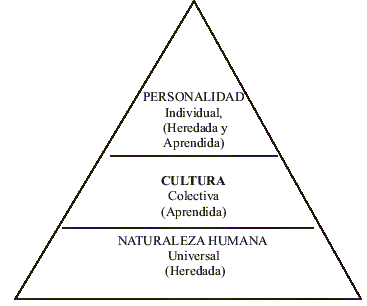
<body><![CDATA[<P ALIGN="justify" style="line-height: 100%"><font face="Verdana" size="2"> <B><FONT COLOR="000000"> Key words: </FONT> </B><font color="000000"> Cultural dimensions, cultural distance, national culture, Hofstede, multidimensional  scaling.</font></font></P>      <P ALIGN="justify" style="line-height: 100%"><font COLOR="000000" face="Verdana" size="2">Recibido: 08 de febrero de 2007 • Aceptado: 21 de marzo de 2007</font></P>      <P ALIGN="justify" style="line-height: 100%"><B><FONT COLOR="000000" size="2" face="Verdana"> INTRODUCCIÓN </FONT></B> </P>      <P ALIGN="justify" style="line-height: 100%"><FONT COLOR="000000" size="2" face="Verdana"> Un importante número de investigaciones ha demostrado que la cultura nacional  influye en aspectos tales como el proceso de toma de decisiones (Lu <I>et  al.</I>, 1999; Singhapakdi <I>et al.</I>, 1994; Swaidan y Hayes, 2005; Vitell <I>et al.</I>,  1993), la sensibilidad a los problemas éticos (Armstrong, 1996; Swaidan  y Hayes, 2005), el intercambio comercial (Aviv <I>et al.</I>, 1997; Heide, 1994;  Lee y Jang, 1998), el comportamiento del consumidor (Dawar <I>et al.</I>, 1996;  De Mooij y Hofstede, 2002; Erickson <I>et al.</I>, 1984), la tasa de adopción  de nuevos productos y servicios (Dwyer <I>et al.</I>, 2005), el desarrollo de  estrategias de compensación e incentivos (Gómez-Mejía y Welbourne, 1991;  Hodgetts y Luthans, 1993), las prácticas de recursos humanos (Aycan <I>et  al.</I>, 2000; Ryan <I>et al.</I>, 1999), etc. Sin lugar a dudas, las diferencias  que se presentan en la forma de pensar, actuar y reaccionar frente a diversas  situaciones en distintos países tiene un gran impacto sobre todas las áreas  de las ciencias sociales. Debido a esto adquiere gran importancia el hecho  de poder reconocer y medir las distancias entre las culturas nacionales. </FONT></P>      <P ALIGN="justify" style="line-height: 100%"><FONT COLOR="000000" size="2" face="Verdana"> En los setenta, Geert Hofstede (1980) identificó y cuantificó cuatro dimensiones  de la cultura nacional: Distancia de poder (<I>Power Distance Index</I>, PDI),  Aversión a la incertidumbre (<I>Uncertainty Avoidance Index</I>, UAI), Individualismo  (<I>Individualism Index</I>, IDV) y Masculinidad (<I>Masculinity Index</I>, MAS). Dos  décadas después, Fernández <I>et al.</I> (1997) cuantificaron estas cuatro dimensiones  usando una escala distinta (Dorfman y Howell, 1988) a la utilizada por  Hofstede, en nueve países, siete de los cuales (Alemania, Chile, Japón,  México, USA, Venezuela y Yugoslavia) coinciden con los países analizados  por Hofstede. </FONT></P>      <P ALIGN="justify" style="line-height: 100%"><FONT COLOR="000000" size="2" face="Verdana"> Hofstede (1980; 2001) propone que variables económicas (<I>e.g.</I>, PNB per capita),  demográficas (<I>e.g.</I>, tamaño de la población), geográficas (<I>e.g.</I>, clima),  entre otras, pueden afectar las dimensiones de la cultura nacional. Como  consecuencia, uno esperaría que las distancias culturales entre países  no fuesen estáticas. Pese a esto, Hofstede (1980; 2001) plantea que las  dimensiones culturales son estables en el mediano plazo. Como resultado,  Hofstede utiliza actualmente en sus investigaciones los mismos índices  calculados hace ya casi cuarenta años atrás (e.g., De Mooij y Hofstede,  2002; Hofstede, 2001). El hecho de tener siete países en común en ambos  estudios posibilita examinar si se han producido cambios en las distancias  culturales entre países, y el hecho de que ambos estudios usen distintas  escalas exige utilizar una medida estandarizada para analizar dicha evolución  en las distancias culturales. Por lo tanto, con el objetivo de analizar  posibles cambios en las distancias culturales entre países, se usó una  medida estandarizada de distancia cultural (Kogut y Singh, 1988). Posteriormente,  se recurrió a escalamientos multidimensionales (EMD) para representar de  forma gráfica dichas distancias. </FONT></P>      <P ALIGN="justify" style="line-height: 100%"><B><FONT COLOR="000000" size="2" face="Verdana"> 1. MARCO CONCEPTUAL </FONT></B> </P>      <P ALIGN="justify" style="line-height: 100%"><B><FONT COLOR="000000" size="2" face="Verdana"> 1.1. Cultura nacional </FONT></B></P>      <P ALIGN="justify" style="line-height: 100%"><FONT COLOR="000000" size="2" face="Verdana"> Siguiendo a Hofstede (1991; 1994), se define “cultura” como la programación  mental colectiva que diferencia a miembros de un grupo o categoría de personas  de los de otros.<B> </B>Los programas mentales pueden ser heredados (transferidos  a través de nuestros genes), o pueden ser aprendidos después de nacer.  Hofstede (2001) define tres niveles de programación mental: individual,  colectiva, universal (<a href="#fig1">Figura 1</a>). Hofstede (2001) señala que a nivel individual  (personalidad), al menos una parte de la programación mental debe ser heredada;  de lo contrario, es difícil explicar diferencias en habilidades y temperamento  entre niños de una misma familia y criados en un mismo ambiente social.  A nivel colectivo (cultura), la mayoría de nuestra programación mental  es aprendida; Hofstede (2001) lo ejemplifica a través de los estadounidenses,  quienes a pesar de representar una diversidad de legados genéticos, muestran  una programación mental colectiva que es claramente percibida por un observador  externo. El nivel universal de la programación mental es compartido por  todos los seres humanos y es intrínseco a la naturaleza humana. La naturaleza  humana es heredada a través de los genes, determinando nuestro funcionamiento  físico y psicológico básico. La capacidad humana de sentir miedo, furia,  amor, placer, enojo, etc., pertenecen a este nivel de programación mental.  Por otra parte, Hofstede se refiere a grupo como el conjunto de personas  que mantienen contacto unas con otras, y una categoría consiste de personas  que, sin necesariamente tener contacto entre ellas, tienen algo en común.  Por ejemplo, todas las mujeres ejecutivas, las personas que nacieron antes  de 1940, los habitantes de Chile, etc. (Hofstede, 1991). </FONT></P>      <P ALIGN="center" style="line-height: 100%"><font color="000000" size="2" face="Verdana"><b><a name="fig1"></a>Figura 1. Los tres niveles de programación mental (Hofstede, 2001)</b></font></P>      ]]></body>
<body><![CDATA[<p ALIGN="center" style="line-height: 100%"><img border="0" src="/img/fbpe/op/v23n52/art07fig1.gif" width="367" height="306">     
<P ALIGN="justify" style="line-height: 100%"><FONT COLOR="000000" size="2" face="Verdana"> La definición de cultura propuesta por Hofstede se refiere más tangiblemente  a fortalecer las características personales que sean comunes y estándares  en una sociedad dada (Nakata y Sivakumar, 1996). Dado que existe una gran  variedad de personalidades individuales en cualquier sociedad, aquélla  que se observa con mayor frecuencia (en términos estadísticos) ha sido  usada para aproximarse a la cultura nacional (Clark, 1990; Nakata y Sivakumar,  1996). El término “cultura” en este sentido puede ser aplicado a naciones,  organizaciones, ocupaciones y profesiones, grupos religiosos, grupos étnicos,  etc. Sin embargo, las manifestaciones de cultura a esos diferentes niveles  varía considerablemente (Hofstede, 1991; 1994). El concepto de cultura  es aplicable estrictamente hablando, más a sociedades que a naciones. Sin  embargo, muchas naciones históricamente han desarrollado una forma conjunta,  aun si estas naciones consisten de grupos claramente diferentes y aun si  estas naciones contienen minorías menos integradas (Hofstede, 1991). Ello  pues, al interior de las naciones han existido a través del tiempo, “fuerzas”  que posibilitan la integración: un lenguaje nacional dominante, medios  masivos comunes, sistema educacional nacional, ejército nacional, sistema  político nacional, representación nacional en eventos deportivos, mercados  nacionales de productos y servicios, etc. (Hofstede, 1991; Hofstede, 2001).  Aún cuando no se debe desconocer que también existen “fuerzas” que dificultan  la integración. Por ejemplo, en cada nación existen grupos religiosos o  étnicos que buscan su propia identidad. </FONT></P>      <P ALIGN="justify" style="line-height: 100%"><B><FONT COLOR="000000" size="2" face="Verdana"> 1.2. Las dimensiones de la cultura nacional </FONT></B> </P>      <P ALIGN="justify" style="line-height: 100%"><FONT COLOR="000000" size="2" face="Verdana"> Hofstede (1991) define dimensión como un aspecto de una cultura que puede  ser medido relativo a otras culturas. Hofstede (1980) identificó inicialmente  cuatro dimensiones de cultura nacional que definen las diferencias culturales  entre países: Distancia de Poder (PDI), Aversión a la Incertidumbre (UAI),  Individualismo (IDV) y Masculinidad (MAS). Posteriormente, agregó una quinta  dimensión propuesta por Bond <I>et al.</I> (1987), incorporándola en Hofstede  y Bond (1988) con el nombre de Orientación de Largo Plazo (<I>Long-Term Orientation</I>,  LTO). Dado que el índice LTO fue propuesto por Bond <I>et al.</I> (1987) a finales  de los noventa, Hofstede (1980) y Fernández <I>et al.</I> (1997) no midieron esta  dimensión en sus respectivos estudios. </FONT></P>      <P ALIGN="justify" style="line-height: 100%"><FONT COLOR="000000" size="2" face="Verdana"> Estudios independientes han identificado las mismas o similares dimensiones  a las encontradas por Hofstede (<I>e.g.</I>, Bond <I>et al.</I>, 1987; Fernández <I>et al.</I>,  1997; Hoppe, 1990; Ng <I>et al.</I>, 1982; Sondergaard, 1994). Estos estudios  independientes soportan la robustez de la tipología de Hofstede, proveyendo  una base para incrementar el entendimiento de las diferencias culturales  entre países (Lu <I>et al.</I>, 1999). La tipología de Hofstede es una de las  más importantes y populares teorías de tipos de cultura (Sondergaard, 1994).  Por ejemplo, la <I>Social Science Citation Index</I> (SSCI) incluye 1036 artículos  en revistas académicas que citan a Hofstede (1980) sólo en el período de  1980 a 1993. No obstante, varios autores han criticado las dimensiones  de la cultura nacional propuestas por Hofstede, criticando por ejemplo,  la poca información que se obtiene de los ítems que miden cada dimensión  (Robinson, 1983), que la muestra original utilizada estaba compuesta únicamente  de empleados de la multinacional IBM, sesgando los resultados (Jaeger,  1986), que estas dimensiones son sólo a nivel nacional y no a nivel individual  (Armstrong, 1996), etc. Adicionalmente, es necesario señalar el hecho de  que se han desarrollado otras dimensiones de cultura en la literatura (tanto  teóricas como empíricas) relacionadas en mayor o menor medida a las originalmente  propuestas por Hofstede (Hofstede, 2001; Hall, 1976; Hall y Hall, 1990;  Ogliastri <I>et al.</I>, 1999; Pollay, 1983; Singh, 2004; Trompenaars, 1994).  Dicho esto, se describen a continuación las cinco dimensiones de la cultura  nacional propuestas por Hofstede (2001): </FONT></P>      <P ALIGN="justify" style="line-height: 100%"><font size="2"> <I><FONT COLOR="000000" face="Verdana"> Distancia de Poder (PDI). </FONT> </I><FONT COLOR="000000" face="Verdana"> La dimensión de distancia de poder se define  como el grado en el cual una sociedad acepta la distribución desigual de  poder en instituciones y organizaciones (Aycan <I>et al.</I>, 2000; De Mooij y  Hofstede, 2002; Hodgetts y Luthans, 1993; Hofstede, 1980; 1991; 1994; 2001;  Hofstede <I>et al.</I>, 1990; Ryan <I>et al.</I>, 1999; Shane, 1995). Las “instituciones”  son los elementos básicos de la sociedad tales como la familia, la escuela,  y la comunidad; las “organizaciones” son los lugares donde las personas  trabajan (Hofstede, 1991). Un alto PDI indica que las desigualdades de  poder y riqueza son consideradas aceptables dentro de la sociedad. Estas  sociedades son más probables de seguir un sistema de castas con baja movilidad  ascendente entre sus miembros (Hofstede, 2001). Estas sociedades aceptan  diferencias en poder y riqueza con mayor facilidad que sociedades con bajos  PDI (Nakata y Sivakumar, 1996). Un bajo PDI indica que la sociedad no promueve  las diferencias de poder y riqueza entre individuos (Gómez-Mejía y Welbourne,  1991; Hofstede, 2001). </FONT></font></P>      <P ALIGN="justify" style="line-height: 100%"><font size="2"> <I><FONT COLOR="000000" face="Verdana"> Aversión a la Incertidumbre (UAI). </FONT> </I><FONT COLOR="000000" face="Verdana"> La aversión a la incertidumbre es el  grado en el cual los miembros de la sociedad se sienten inconfortables  en situaciones no estructuradas (Hofstede, 1980; 2001). Las situaciones  no estructuradas son nuevas, desconocidas, sorpresivas e inusuales. El  problema básico involucrado en esta dimensión es el grado en el cual una  sociedad intenta controlar lo incontrolable (Hofstede, 2001). Hofstede  (1994) señala que también esta dimensión puede ser definida como el grado  en el cual las personas en un país prefieren situaciones estructuradas  sobre situaciones no estructuradas. Un alto UAI indica que los ciudadanos  del país tienen una baja tolerancia hacia la incertidumbre y la ambigüedad.  Esto crea una sociedad orientada a las reglas, que instruye normas, leyes,  regulaciones y controles para reducir el nivel de incertidumbre (Dawar  <I>et al.</I>, 1996; De Mooij y Hofstede, 2002; Hodgetts y Luthans, 1993; Hofstede,  2001; Lu <I>et al.</I>, 1999; Nakata y Sivakumar, 1996; Shane, 1995; Swaidan y  Hayes, 2005). Estas reglas pueden ser escritas, pero también pueden ser  no escritas y seguidas por tradición (Hofstede, 1994; Stohl, 1993). En  culturas con alto UAI la gente busca situaciones estructuradas, conocer  con precisión qué va a ocurrir (Ogliastri <I>et al.</I>, 1999; Ryan <I>et al.</I>, 1999;  Triandis, 1990; 2004). En estos casos, la predicción de los eventos futuros  es altamente valorado (Triandis, 2004). Por otro lado, un bajo UAI indica  que la sociedad tiene una menor preocupación por la incertidumbre y la  ambigüedad. Esto se refleja en una sociedad menos orientada a las reglas,  que acepta más fácilmente el cambio, más tolerante a opiniones y comportamientos  alternativos, y una sociedad que adquiere más y mayores riesgos (Armstrong,  1996; Hofstede, 1984; 2001; Swaidan y Hayes, 2005). </FONT></font></P>      <P ALIGN="justify" style="line-height: 100%"><font size="2"> <I><FONT COLOR="000000" face="Verdana"> Individualismo (IDV). </FONT> </I><FONT COLOR="000000" face="Verdana"> La dimensión de individualismo se refiere al grado  en el cual los individuos prefieren actuar como individuos en lugar de  actuar como miembros de un grupo (Hofstede, 1994). Es decir, es el grado  en el cual una sociedad valora los objetivos personales, autonomía y privacidad  por sobre la lealtad al grupo, el compromiso con las normas grupales y  actividades colectivas, cohesividad social e intensa sociabilización (Hofstede,  1980; 1984; 2001; Nakata y Sivakumar, 1996; Swaidan y Hayes, 2005; Triandis,  2004). Un alto IDV indica que la individualidad y los derechos individuales  son supremos dentro de la sociedad. Las sociedades individualistas tienden  a creer que los intereses personales son más importantes que los intereses  de grupo (Hofstede, 1984; Lu <I>et al.</I>, 1999; Peabody, 1985). Un bajo IDV  caracteriza a sociedades de una naturaleza más colectivista con lazos cercanos  entre los individuos. Las culturas colectivistas muestran un alto grado  de comportamiento e interés grupal para promover su continua existencia,  manteniéndose emocionalmente más ligados a sus <I>in-groups</I> y ubicando sus  objetivos personales, motivaciones y deseos cerca de aquellos <I>in-groups</I>  (Kagitcibasi, 1997; Nakata y Sivakumar, 1996; Swaidan y Hayes, 2005). Los  <I>in-groups</I> son generalmente caracterizados por las similitudes entre sus  miembros y un sentido de “destino común” que tienen los individuos con  su grupo, el cual puede ser la familia, amigos, partidos políticos, clases  sociales o grupos religiosos (Triandis, 1995). En estas culturas, cuando  las necesidades individuales y de grupo entran en conflicto, se espera  que el individuo renuncie a sus necesidades individuales a favor de las  necesidades del grupo (Ramamoorthy y Carroll, 1998). </FONT></font></P>      <P ALIGN="justify" style="line-height: 100%"><font size="2"> <I><FONT COLOR="000000" face="Verdana"> Masculinidad (MAS). </FONT> </I><FONT COLOR="000000" face="Verdana"> Hofstede (1994) define esta dimensión como el grado  en el cual valores como asertividad, desempeño, éxito y competición, los  que son asociados con el rol masculino, prevalecen sobre valores como la  calidad de vida, relaciones personales, servicio, solidaridad, los que  son asociados con el rol femenino. Hofstede (1985) define Masculinidad  como una preferencia por el logro, heroísmo, asertividad y éxito material.<I>  </I>Una sociedad más “masculina” (alto MAS) otorga mayor énfasis a la riqueza,  al éxito, a la ambición, a las cosas materiales y a los logros, mientras  que una sociedad más “femenina” (bajo MAS) otorga mayor valor a la gente,  a ayudar a otros, a preservar el medio ambiente y a la igualdad (Dawar  <I>et al.</I>, 1996; Hodgetts y Luthans, 1993; Hofstede, 1980; 1983; 1984; 1991;  Hofstede <I>et al.</I>, 1990; Nakata y Sivakumar, 1996; Peabody, 1985; Swaidan  y Hayes, 2005). En una cultura “masculina” se dice que “se vive para trabajar”,  en cambio, en una cultura “femenina” se dice que se “trabaja para vivir”  (Helgstrand y Stuhlmacher, 1999; Hofstede, 1980; 2001). </FONT></font></P>      <P ALIGN="justify" style="line-height: 100%"><font size="2"> <I><FONT COLOR="000000" face="Verdana"> Orientación de Largo Plazo (LTO). </FONT> </I><FONT COLOR="000000" face="Verdana"> El índice LTO se define como el grado  en el cual los miembros de la sociedad aceptan postergar la gratificación  de sus necesidades materiales, sociales y emocionales (Hofstede, 2001).  Un alto LTO indica que la sociedad valora los compromisos de largo plazo,  donde la recompensa de largo plazo es esperada como resultado del duro  trabajo de hoy (Swaidan y Hayes, 2005). Un bajo LTO indica que la sociedad  no refuerza el concepto de orientación de largo plazo. En estas culturas,  los cambios pueden ocurrir más rápidamente, debido a que los compromisos  de largo plazo no son impedimentos del cambio (Hofstede, 2001; Hofstede  y Bond, 1988). </FONT></font></P>      ]]></body>
<body><![CDATA[<P ALIGN="justify" style="line-height: 100%"><B><FONT COLOR="000000" size="2" face="Verdana"> 1.3. Hipótesis </FONT></B> </P>      <P ALIGN="justify" style="line-height: 100%"><FONT COLOR="000000" size="2" face="Verdana"> Hofstede (1980; 2001) propone que variables económicas (<I>e.g.</I>, PNB per capita),  demográficas (<I>e.g.</I>, tamaño de la población), geográficas (<I>e.g.</I>, clima),  entre otras, pueden afectar las dimensiones de la cultura nacional. </FONT></P>      <P ALIGN="justify" style="line-height: 100%"><FONT COLOR="000000" size="2" face="Verdana"> Hofstede (2001) señala que el tamaño de la población puede estar correlacionado  positivamente con el índice PDI, debido a que sistemas sociales grandes  por definición presentan una mayor distancia entre el primer y el último  individuo. Por otro lado, Hofstede (2001) sugiere que el PNB per capita  (riqueza) puede estar correlacionado negativamente con el índice PDI, debido  a que un mayor nivel de riqueza acompañado al crecimiento de los estratos  medios, puede construir un acercamiento entre poderosos y menos poderosos. </FONT></P>      <P ALIGN="justify" style="line-height: 100%"><FONT COLOR="000000" size="2" face="Verdana"> Hofstede (2001) sugiere que un rápido crecimiento económico (PNB per capita)  puede producir ansiedad (mayor UAI) en la población. </FONT></P>      <P ALIGN="justify" style="line-height: 100%"><FONT COLOR="000000" size="2" face="Verdana"> También muestra que el índice IDV y el PNB per capita están correlacionados  positivamente. Además, analiza la causalidad entre ambas variables y considera  que el PNB per capita puede causar mayor individualismo (IDV), debido a  que los individuos de sociedades de alto PNB per capita poseen mayores  recursos para tener “sus propias cosas” (su propio televisor, una moto  o auto propio, casa propia, etc.). </FONT></P>      <P ALIGN="justify" style="line-height: 100%"><FONT COLOR="000000" size="2" face="Verdana"> Por otro lado, observa una correlación positiva entre el índice MAS y el  tamaño de la población. Asimismo, el crecimiento de la población depende  fuertemente del tamaño de las familias. Levinson, (1977) después de revisar  una serie de estudios antropológicos de culturas tradicionales, concluye  que la población aumenta cuando la mujer es relativamente sumisa al hombre.  La <I>UNICEF </I>(1995) muestra que si la mujer pudiese elegir el número de hijos,  ellas podrían tener (en promedio) 1,41 hijos menos. </FONT></P>      <P ALIGN="justify" style="line-height: 100%"><FONT COLOR="000000" size="2" face="Verdana"> Como consecuencia, dado que las variables económicas, demográficas y geográficas,  entre otras, varían de manera heterogénea entre países (IMD, 2005), uno  esperaría que las distancias culturales entre países no fuesen estáticas  a través del tiempo. </FONT></P>      <P ALIGN="justify" style="line-height: 100%"><B><FONT COLOR="000000" size="2" face="Verdana"> 2. INVESTIGACIÓN </FONT></B></P>      <P ALIGN="justify" style="line-height: 100%"><B><FONT COLOR="000000" size="2" face="Verdana"> 2.1. Evolución de las cuatro dimensiones de Hofstede </FONT></B></P>      <P ALIGN="justify" style="line-height: 100%"><FONT COLOR="000000" size="2" face="Verdana"> El estudio de Hofstede (1980) se sustenta en un banco de datos de una encuesta  efectuada a los empleados de IBM en un total de 40 países. La encuesta  fue realizada entre los años 1967 y 1973, produciendo más de 116 mil cuestionarios.  Para ese estudio en particular se tomaron en cuenta 26 preguntas de las  150 preguntas originales que incluía el cuestionario de IBM (Hofstede,  1980; 2001). Por otro lado, el estudio de Fernández <I>et al.</I> (1997) fue realizado  en los años 1989 y 1990, en nueve países, abarcando cuatro continentes.  La muestra consistió de 7201 empleados de nivel profesional de negocios  y estudiantes de negocios avanzados. Siete de estos países habían sido  incluidos en el estudio de Hofstede (Alemania, Chile, Japón, México, USA,  Venezuela y Yugoslavia), agregando a China y a Rusia. El tener siete países  en común en ambos estudios posibilita examinar si se han producido cambios  en las distancias culturales entre países. </FONT></P>      ]]></body>
<body><![CDATA[<P ALIGN="justify" style="line-height: 100%"><FONT COLOR="000000" size="2" face="Verdana"> Fernández <I>et al.</I> (1997), a diferencia de Hofstede (Metodología de Hofstede,  2001, siguen la metodología desarrollada por Dorfman y Howell (1988) para  cuantificar las dimensiones culturales de Hofstede. Por lo tanto, ambos  estudios difieren en las escalas utilizadas para medir cada una de las  cuatro dimensiones (Cuadro 1). Si se desea comparar directamente los índices  de los estudios de Hofstede (1980) y Fernández <I>et al.</I> (1997), estos índices  se deben estandarizar, obteniendo índices con distribuciones de media cero  y varianza uno. Los índices para los siete países en las cuatro dimensiones  pueden ser estandarizados de la siguiente manera: el índice estandarizado  resulta de restar al índice original del país la media del índice en los  siete países y dividir esa resta por la desviación estándar del índice  en los siete países. En el <a href="#cua1"> Cuadro 1</a> se presentan los índices originales  y en la <a href="#cua2"> Cuadro 2</a> se presentan los índices estandarizados de cada dimensión  para los siete países analizados. </FONT></P>      <p ALIGN="center" style="line-height: 100%"><b><font COLOR="000000" face="Verdana" size="2"><a name="cua1"></a>Cuadro 1 Índices originales</font></b></p>     <div align="center">       <center>   <table width="500" border="1">     <tr>       <td VALIGN="TOP">             <p ALIGN="justify" style="line-height: 100%"><font face="Verdana" size="2">&nbsp;</font></p>       </td>       <td VALIGN="TOP" COLSPAN="4">             <p ALIGN="justify" style="line-height: 100%"><font COLOR="000000" face="Verdana" size="2">Hofstede         (1980)</font></p>       </td>       <td VALIGN="TOP" COLSPAN="4">             <p ALIGN="justify" style="line-height: 100%"><font COLOR="000000" face="Verdana" size="2">Fernández         et al. (1997)</font></p>       </td>     </tr>     <tr>       <td VALIGN="TOP">             <p ALIGN="justify" style="line-height: 100%"><font face="Verdana" size="2">&nbsp;</font></p>       </td>       <td VALIGN="TOP">             <p ALIGN="justify" style="line-height: 100%"><font COLOR="000000" face="Verdana" size="2">PDI</font></p>       </td>       <td VALIGN="TOP">             <p ALIGN="justify" style="line-height: 100%"><font COLOR="000000" face="Verdana" size="2">UAI</font></p>       </td>       <td VALIGN="TOP">             ]]></body>
<body><![CDATA[<p ALIGN="justify" style="line-height: 100%"><font COLOR="000000" face="Verdana" size="2">IDV</font></p>       </td>       <td VALIGN="TOP">             <p ALIGN="justify" style="line-height: 100%"><font COLOR="000000" face="Verdana" size="2">MAS</font></p>       </td>       <td VALIGN="TOP">             <p ALIGN="justify" style="line-height: 100%"><font COLOR="000000" face="Verdana" size="2">PDI</font></p>       </td>       <td VALIGN="TOP">             <p ALIGN="justify" style="line-height: 100%"><font COLOR="000000" face="Verdana" size="2">UAI</font></p>       </td>       <td VALIGN="TOP">             <p ALIGN="justify" style="line-height: 100%"><font COLOR="000000" face="Verdana" size="2">IDV</font></p>       </td>       <td VALIGN="TOP">             <p ALIGN="justify" style="line-height: 100%"><font COLOR="000000" face="Verdana" size="2">MAS</font></p>       </td>     </tr>     <tr>       <td VALIGN="TOP">             <p ALIGN="justify" style="line-height: 100%"><font COLOR="000000" face="Verdana" size="2">Alemania</font></p>       </td>       <td VALIGN="TOP">             <p ALIGN="justify" style="line-height: 100%"><font COLOR="000000" face="Verdana" size="2">35</font></p>       </td>       <td VALIGN="TOP">             <p ALIGN="justify" style="line-height: 100%"><font COLOR="000000" face="Verdana" size="2">65</font></p>       </td>       <td VALIGN="TOP">             <p ALIGN="justify" style="line-height: 100%"><font COLOR="000000" face="Verdana" size="2">67</font></p>       </td>       <td VALIGN="TOP">             ]]></body>
<body><![CDATA[<p ALIGN="justify" style="line-height: 100%"><font COLOR="000000" face="Verdana" size="2">66</font></p>       </td>       <td VALIGN="TOP">             <p ALIGN="justify" style="line-height: 100%"><font COLOR="000000" face="Verdana" size="2">11,89</font></p>       </td>       <td VALIGN="TOP">             <p ALIGN="justify" style="line-height: 100%"><font COLOR="000000" face="Verdana" size="2">12,36</font></p>       </td>       <td VALIGN="TOP">             <p ALIGN="justify" style="line-height: 100%"><font COLOR="000000" face="Verdana" size="2">11,64</font></p>       </td>       <td VALIGN="TOP">             <p ALIGN="justify" style="line-height: 100%"><font COLOR="000000" face="Verdana" size="2">10,46</font></p>       </td>     </tr>     <tr>       <td VALIGN="TOP">             <p ALIGN="justify" style="line-height: 100%"><font COLOR="000000" face="Verdana" size="2">Chile</font></p>       </td>       <td VALIGN="TOP">             <p ALIGN="justify" style="line-height: 100%"><font COLOR="000000" face="Verdana" size="2">63</font></p>       </td>       <td VALIGN="TOP">             <p ALIGN="justify" style="line-height: 100%"><font COLOR="000000" face="Verdana" size="2">86</font></p>       </td>       <td VALIGN="TOP">             <p ALIGN="justify" style="line-height: 100%"><font COLOR="000000" face="Verdana" size="2">23</font></p>       </td>       <td VALIGN="TOP">             <p ALIGN="justify" style="line-height: 100%"><font COLOR="000000" face="Verdana" size="2">28</font></p>       </td>       <td VALIGN="TOP">             ]]></body>
<body><![CDATA[<p ALIGN="justify" style="line-height: 100%"><font COLOR="000000" face="Verdana" size="2">12,71</font></p>       </td>       <td VALIGN="TOP">             <p ALIGN="justify" style="line-height: 100%"><font COLOR="000000" face="Verdana" size="2">14,73</font></p>       </td>       <td VALIGN="TOP">             <p ALIGN="justify" style="line-height: 100%"><font COLOR="000000" face="Verdana" size="2">12,17</font></p>       </td>       <td VALIGN="TOP">             <p ALIGN="justify" style="line-height: 100%"><font COLOR="000000" face="Verdana" size="2">12,1</font></p>       </td>     </tr>     <tr>       <td VALIGN="TOP">             <p ALIGN="justify" style="line-height: 100%"><font COLOR="000000" face="Verdana" size="2">Japón</font></p>       </td>       <td VALIGN="TOP">             <p ALIGN="justify" style="line-height: 100%"><font COLOR="000000" face="Verdana" size="2">54</font></p>       </td>       <td VALIGN="TOP">             <p ALIGN="justify" style="line-height: 100%"><font COLOR="000000" face="Verdana" size="2">92</font></p>       </td>       <td VALIGN="TOP">             <p ALIGN="justify" style="line-height: 100%"><font COLOR="000000" face="Verdana" size="2">46</font></p>       </td>       <td VALIGN="TOP">             <p ALIGN="justify" style="line-height: 100%"><font COLOR="000000" face="Verdana" size="2">95</font></p>       </td>       <td VALIGN="TOP">             <p ALIGN="justify" style="line-height: 100%"><font COLOR="000000" face="Verdana" size="2">10,38</font></p>       </td>       <td VALIGN="TOP">             ]]></body>
<body><![CDATA[<p ALIGN="justify" style="line-height: 100%"><font COLOR="000000" face="Verdana" size="2">12,87</font></p>       </td>       <td VALIGN="TOP">             <p ALIGN="justify" style="line-height: 100%"><font COLOR="000000" face="Verdana" size="2">10,91</font></p>       </td>       <td VALIGN="TOP">             <p ALIGN="justify" style="line-height: 100%"><font COLOR="000000" face="Verdana" size="2">12,18</font></p>       </td>     </tr>     <tr>       <td VALIGN="TOP">             <p ALIGN="justify" style="line-height: 100%"><font COLOR="000000" face="Verdana" size="2">México</font></p>       </td>       <td VALIGN="TOP">             <p ALIGN="justify" style="line-height: 100%"><font COLOR="000000" face="Verdana" size="2">81</font></p>       </td>       <td VALIGN="TOP">             <p ALIGN="justify" style="line-height: 100%"><font COLOR="000000" face="Verdana" size="2">82</font></p>       </td>       <td VALIGN="TOP">             <p ALIGN="justify" style="line-height: 100%"><font COLOR="000000" face="Verdana" size="2">30</font></p>       </td>       <td VALIGN="TOP">             <p ALIGN="justify" style="line-height: 100%"><font COLOR="000000" face="Verdana" size="2">69</font></p>       </td>       <td VALIGN="TOP">             <p ALIGN="justify" style="line-height: 100%"><font COLOR="000000" face="Verdana" size="2">14,15</font></p>       </td>       <td VALIGN="TOP">             <p ALIGN="justify" style="line-height: 100%"><font COLOR="000000" face="Verdana" size="2">12,31</font></p>       </td>       <td VALIGN="TOP">             ]]></body>
<body><![CDATA[<p ALIGN="justify" style="line-height: 100%"><font COLOR="000000" face="Verdana" size="2">12,23</font></p>       </td>       <td VALIGN="TOP">             <p ALIGN="justify" style="line-height: 100%"><font COLOR="000000" face="Verdana" size="2">12,54</font></p>       </td>     </tr>     <tr>       <td VALIGN="TOP">             <p ALIGN="justify" style="line-height: 100%"><font COLOR="000000" face="Verdana" size="2">USA</font></p>       </td>       <td VALIGN="TOP">             <p ALIGN="justify" style="line-height: 100%"><font COLOR="000000" face="Verdana" size="2">40</font></p>       </td>       <td VALIGN="TOP">             <p ALIGN="justify" style="line-height: 100%"><font COLOR="000000" face="Verdana" size="2">46</font></p>       </td>       <td VALIGN="TOP">             <p ALIGN="justify" style="line-height: 100%"><font COLOR="000000" face="Verdana" size="2">91</font></p>       </td>       <td VALIGN="TOP">             <p ALIGN="justify" style="line-height: 100%"><font COLOR="000000" face="Verdana" size="2">62</font></p>       </td>       <td VALIGN="TOP">             <p ALIGN="justify" style="line-height: 100%"><font COLOR="000000" face="Verdana" size="2">12,7</font></p>       </td>       <td VALIGN="TOP">             <p ALIGN="justify" style="line-height: 100%"><font COLOR="000000" face="Verdana" size="2">14,88</font></p>       </td>       <td VALIGN="TOP">             <p ALIGN="justify" style="line-height: 100%"><font COLOR="000000" face="Verdana" size="2">13,41</font></p>       </td>       <td VALIGN="TOP">             ]]></body>
<body><![CDATA[<p ALIGN="justify" style="line-height: 100%"><font COLOR="000000" face="Verdana" size="2">10,46</font></p>       </td>     </tr>     <tr>       <td VALIGN="TOP">             <p ALIGN="justify" style="line-height: 100%"><font COLOR="000000" face="Verdana" size="2">Venezuela</font></p>       </td>       <td VALIGN="TOP">             <p ALIGN="justify" style="line-height: 100%"><font COLOR="000000" face="Verdana" size="2">81</font></p>       </td>       <td VALIGN="TOP">             <p ALIGN="justify" style="line-height: 100%"><font COLOR="000000" face="Verdana" size="2">76</font></p>       </td>       <td VALIGN="TOP">             <p ALIGN="justify" style="line-height: 100%"><font COLOR="000000" face="Verdana" size="2">12</font></p>       </td>       <td VALIGN="TOP">             <p ALIGN="justify" style="line-height: 100%"><font COLOR="000000" face="Verdana" size="2">73</font></p>       </td>       <td VALIGN="TOP">             <p ALIGN="justify" style="line-height: 100%"><font COLOR="000000" face="Verdana" size="2">12,15</font></p>       </td>       <td VALIGN="TOP">             <p ALIGN="justify" style="line-height: 100%"><font COLOR="000000" face="Verdana" size="2">14,08</font></p>       </td>       <td VALIGN="TOP">             <p ALIGN="justify" style="line-height: 100%"><font COLOR="000000" face="Verdana" size="2">11,83</font></p>       </td>       <td VALIGN="TOP">             <p ALIGN="justify" style="line-height: 100%"><font COLOR="000000" face="Verdana" size="2">10,49</font></p>       </td>     </tr>     <tr>       <td VALIGN="TOP">             ]]></body>
<body><![CDATA[<p ALIGN="justify" style="line-height: 100%"><font COLOR="000000" face="Verdana" size="2">Yugoslavia</font></p>       </td>       <td VALIGN="TOP">             <p ALIGN="justify" style="line-height: 100%"><font COLOR="000000" face="Verdana" size="2">76</font></p>       </td>       <td VALIGN="TOP">             <p ALIGN="justify" style="line-height: 100%"><font COLOR="000000" face="Verdana" size="2">88</font></p>       </td>       <td VALIGN="TOP">             <p ALIGN="justify" style="line-height: 100%"><font COLOR="000000" face="Verdana" size="2">27</font></p>       </td>       <td VALIGN="TOP">             <p ALIGN="justify" style="line-height: 100%"><font COLOR="000000" face="Verdana" size="2">21</font></p>       </td>       <td VALIGN="TOP">             <p ALIGN="justify" style="line-height: 100%"><font COLOR="000000" face="Verdana" size="2">11,81</font></p>       </td>       <td VALIGN="TOP">             <p ALIGN="justify" style="line-height: 100%"><font COLOR="000000" face="Verdana" size="2">13,53</font></p>       </td>       <td VALIGN="TOP">             <p ALIGN="justify" style="line-height: 100%"><font COLOR="000000" face="Verdana" size="2">12,14</font></p>       </td>       <td VALIGN="TOP">             <p ALIGN="justify" style="line-height: 100%"><font COLOR="000000" face="Verdana" size="2">11,36</font></p>       </td>     </tr>     <tr>       <td VALIGN="TOP">             <p ALIGN="justify" style="line-height: 100%"><b><font COLOR="000000" face="Verdana" size="2">Media</font></b></p>       </td>       <td VALIGN="TOP">             ]]></body>
<body><![CDATA[<p ALIGN="justify" style="line-height: 100%"><b><font COLOR="000000" face="Verdana" size="2">61,43</font></b></p>       </td>       <td VALIGN="TOP">             <p ALIGN="justify" style="line-height: 100%"><b><font COLOR="000000" face="Verdana" size="2">76,43</font></b></p>       </td>       <td VALIGN="TOP">             <p ALIGN="justify" style="line-height: 100%"><b><font COLOR="000000" face="Verdana" size="2">42,29</font></b></p>       </td>       <td VALIGN="TOP">             <p ALIGN="justify" style="line-height: 100%"><b><font COLOR="000000" face="Verdana" size="2">59,14</font></b></p>       </td>       <td VALIGN="TOP">             <p ALIGN="justify" style="line-height: 100%"><b><font COLOR="000000" face="Verdana" size="2">12,26</font></b></p>       </td>       <td VALIGN="TOP">             <p ALIGN="justify" style="line-height: 100%"><b><font COLOR="000000" face="Verdana" size="2">13,54</font></b></p>       </td>       <td VALIGN="TOP">             <p ALIGN="justify" style="line-height: 100%"><b><font COLOR="000000" face="Verdana" size="2">12,05</font></b></p>       </td>       <td VALIGN="TOP">             <p ALIGN="justify" style="line-height: 100%"><b><font COLOR="000000" face="Verdana" size="2">11,37</font></b></p>       </td>     </tr>     <tr>       <td VALIGN="TOP">             <p ALIGN="justify" style="line-height: 100%"><b><font COLOR="000000" face="Verdana" size="2">Varianza</font></b></p>       </td>       <td VALIGN="TOP">             <p ALIGN="justify" style="line-height: 100%"><b><font COLOR="000000" face="Verdana" size="2">365,6</font></b></p>       </td>       <td VALIGN="TOP">             ]]></body>
<body><![CDATA[<p ALIGN="justify" style="line-height: 100%"><b><font COLOR="000000" face="Verdana" size="2">259,29</font></b></p>       </td>       <td VALIGN="TOP">             <p ALIGN="justify" style="line-height: 100%"><b><font COLOR="000000" face="Verdana" size="2">778,57</font></b></p>       </td>       <td VALIGN="TOP">             <p ALIGN="justify" style="line-height: 100%"><b><font COLOR="000000" face="Verdana" size="2">675,81</font></b></p>       </td>       <td VALIGN="TOP">             <p ALIGN="justify" style="line-height: 100%"><b><font COLOR="000000" face="Verdana" size="2">1,31</font></b></p>       </td>       <td VALIGN="TOP">             <p ALIGN="justify" style="line-height: 100%"><b><font COLOR="000000" face="Verdana" size="2">1,14</font></b></p>       </td>       <td VALIGN="TOP">             <p ALIGN="justify" style="line-height: 100%"><b><font COLOR="000000" face="Verdana" size="2">0,57</font></b></p>       </td>       <td VALIGN="TOP">             <p ALIGN="justify" style="line-height: 100%"><b><font COLOR="000000" face="Verdana" size="2">0,83</font></b></p>       </td>     </tr>   </table>   </center> </div>     <p ALIGN="justify" style="line-height: 100%"><font COLOR="000000" face="Verdana" size="2">Fuente: Hofstede (1980), Fernández <i>et al. </i>(1997).</font></p>     <p ALIGN="center" style="line-height: 100%"><b><font COLOR="000000" face="Verdana" size="2"><a name="cua2"></a>Cuadro 2 Índices estandarizados</font></b></p>     <div align="center">       ]]></body>
<body><![CDATA[<center>   <table width="500" border="1">     <tr>       <td VALIGN="TOP">             <p ALIGN="justify" style="line-height: 100%"><font face="Verdana" size="2">&nbsp;</font></p>       </td>       <td VALIGN="TOP" COLSPAN="4">             <p ALIGN="justify" style="line-height: 100%"><font COLOR="000000" face="Verdana" size="2">Hofstede         (1980)</font></p>       </td>       <td VALIGN="TOP" COLSPAN="4">             <p ALIGN="justify" style="line-height: 100%"><font COLOR="000000" face="Verdana" size="2">Fernández         et al. (1997)</font></p>       </td>     </tr>     <tr>       <td VALIGN="TOP">             <p ALIGN="justify" style="line-height: 100%"><font face="Verdana" size="2">&nbsp;</font></p>       </td>       <td VALIGN="TOP">             <p ALIGN="justify" style="line-height: 100%"><font COLOR="000000" face="Verdana" size="2">PDI</font></p>       </td>       <td VALIGN="TOP">             <p ALIGN="justify" style="line-height: 100%"><font COLOR="000000" face="Verdana" size="2">UAI</font></p>       </td>       <td VALIGN="TOP">             <p ALIGN="justify" style="line-height: 100%"><font COLOR="000000" face="Verdana" size="2">IDV</font></p>       </td>       <td VALIGN="TOP">             <p ALIGN="justify" style="line-height: 100%"><font COLOR="000000" face="Verdana" size="2">MAS</font></p>       </td>       <td VALIGN="TOP">             <p ALIGN="justify" style="line-height: 100%"><font COLOR="000000" face="Verdana" size="2">PDI</font></p>       </td>       <td VALIGN="TOP">             ]]></body>
<body><![CDATA[<p ALIGN="justify" style="line-height: 100%"><font COLOR="000000" face="Verdana" size="2">UAI</font></p>       </td>       <td VALIGN="TOP">             <p ALIGN="justify" style="line-height: 100%"><font COLOR="000000" face="Verdana" size="2">IDV</font></p>       </td>       <td VALIGN="TOP">             <p ALIGN="justify" style="line-height: 100%"><font COLOR="000000" face="Verdana" size="2">MAS</font></p>       </td>     </tr>     <tr>       <td VALIGN="TOP">             <p ALIGN="justify" style="line-height: 100%"><font COLOR="000000" face="Verdana" size="2">Alemania</font></p>       </td>       <td VALIGN="TOP">             <p ALIGN="justify" style="line-height: 100%"><font COLOR="000000" face="Verdana" size="2">-1,38</font></p>       </td>       <td VALIGN="TOP">             <p ALIGN="justify" style="line-height: 100%"><font COLOR="000000" face="Verdana" size="2">-0,71</font></p>       </td>       <td VALIGN="TOP">             <p ALIGN="justify" style="line-height: 100%"><font COLOR="000000" face="Verdana" size="2">0,89</font></p>       </td>       <td VALIGN="TOP">             <p ALIGN="justify" style="line-height: 100%"><font COLOR="000000" face="Verdana" size="2">0,26</font></p>       </td>       <td VALIGN="TOP">             <p ALIGN="justify" style="line-height: 100%"><font COLOR="000000" face="Verdana" size="2">-0,32</font></p>       </td>       <td VALIGN="TOP">             <p ALIGN="justify" style="line-height: 100%"><font COLOR="000000" face="Verdana" size="2">-1,10</font></p>       </td>       <td VALIGN="TOP">             ]]></body>
<body><![CDATA[<p ALIGN="justify" style="line-height: 100%"><font COLOR="000000" face="Verdana" size="2">-0,54</font></p>       </td>       <td VALIGN="TOP">             <p ALIGN="justify" style="line-height: 100%"><font COLOR="000000" face="Verdana" size="2">-1,00</font></p>       </td>     </tr>     <tr>       <td VALIGN="TOP">             <p ALIGN="justify" style="line-height: 100%"><font COLOR="000000" face="Verdana" size="2">Chile</font></p>       </td>       <td VALIGN="TOP">             <p ALIGN="justify" style="line-height: 100%"><font COLOR="000000" face="Verdana" size="2">0,08</font></p>       </td>       <td VALIGN="TOP">             <p ALIGN="justify" style="line-height: 100%"><font COLOR="000000" face="Verdana" size="2">0,59</font></p>       </td>       <td VALIGN="TOP">             <p ALIGN="justify" style="line-height: 100%"><font COLOR="000000" face="Verdana" size="2">-0,69</font></p>       </td>       <td VALIGN="TOP">             <p ALIGN="justify" style="line-height: 100%"><font COLOR="000000" face="Verdana" size="2">-1,20</font></p>       </td>       <td VALIGN="TOP">             <p ALIGN="justify" style="line-height: 100%"><font COLOR="000000" face="Verdana" size="2">0,40</font></p>       </td>       <td VALIGN="TOP">             <p ALIGN="justify" style="line-height: 100%"><font COLOR="000000" face="Verdana" size="2">1,12</font></p>       </td>       <td VALIGN="TOP">             <p ALIGN="justify" style="line-height: 100%"><font COLOR="000000" face="Verdana" size="2">0,16</font></p>       </td>       <td VALIGN="TOP">             ]]></body>
<body><![CDATA[<p ALIGN="justify" style="line-height: 100%"><font COLOR="000000" face="Verdana" size="2">0,80</font></p>       </td>     </tr>     <tr>       <td VALIGN="TOP">             <p ALIGN="justify" style="line-height: 100%"><font COLOR="000000" face="Verdana" size="2">Japón</font></p>       </td>       <td VALIGN="TOP">             <p ALIGN="justify" style="line-height: 100%"><font COLOR="000000" face="Verdana" size="2">-0,39</font></p>       </td>       <td VALIGN="TOP">             <p ALIGN="justify" style="line-height: 100%"><font COLOR="000000" face="Verdana" size="2">0,97</font></p>       </td>       <td VALIGN="TOP">             <p ALIGN="justify" style="line-height: 100%"><font COLOR="000000" face="Verdana" size="2">0,13</font></p>       </td>       <td VALIGN="TOP">             <p ALIGN="justify" style="line-height: 100%"><font COLOR="000000" face="Verdana" size="2">1,38</font></p>       </td>       <td VALIGN="TOP">             <p ALIGN="justify" style="line-height: 100%"><font COLOR="000000" face="Verdana" size="2">-1,64</font></p>       </td>       <td VALIGN="TOP">             <p ALIGN="justify" style="line-height: 100%"><font COLOR="000000" face="Verdana" size="2">-0,62</font></p>       </td>       <td VALIGN="TOP">             <p ALIGN="justify" style="line-height: 100%"><font COLOR="000000" face="Verdana" size="2">-1,51</font></p>       </td>       <td VALIGN="TOP">             <p ALIGN="justify" style="line-height: 100%"><font COLOR="000000" face="Verdana" size="2">0,89</font></p>       </td>     </tr>     <tr>       <td VALIGN="TOP">             ]]></body>
<body><![CDATA[<p ALIGN="justify" style="line-height: 100%"><font COLOR="000000" face="Verdana" size="2">México</font></p>       </td>       <td VALIGN="TOP">             <p ALIGN="justify" style="line-height: 100%"><font COLOR="000000" face="Verdana" size="2">1,02</font></p>       </td>       <td VALIGN="TOP">             <p ALIGN="justify" style="line-height: 100%"><font COLOR="000000" face="Verdana" size="2">0,35</font></p>       </td>       <td VALIGN="TOP">             <p ALIGN="justify" style="line-height: 100%"><font COLOR="000000" face="Verdana" size="2">-0,44</font></p>       </td>       <td VALIGN="TOP">             <p ALIGN="justify" style="line-height: 100%"><font COLOR="000000" face="Verdana" size="2">0,38</font></p>       </td>       <td VALIGN="TOP">             <p ALIGN="justify" style="line-height: 100%"><font COLOR="000000" face="Verdana" size="2">1,66</font></p>       </td>       <td VALIGN="TOP">             <p ALIGN="justify" style="line-height: 100%"><font COLOR="000000" face="Verdana" size="2">-1,15</font></p>       </td>       <td VALIGN="TOP">             <p ALIGN="justify" style="line-height: 100%"><font COLOR="000000" face="Verdana" size="2">0,24</font></p>       </td>       <td VALIGN="TOP">             <p ALIGN="justify" style="line-height: 100%"><font COLOR="000000" face="Verdana" size="2">1,28</font></p>       </td>     </tr>     <tr>       <td VALIGN="TOP">             <p ALIGN="justify" style="line-height: 100%"><font COLOR="000000" face="Verdana" size="2">USA</font></p>       </td>       <td VALIGN="TOP">             ]]></body>
<body><![CDATA[<p ALIGN="justify" style="line-height: 100%"><font COLOR="000000" face="Verdana" size="2">-1,12</font></p>       </td>       <td VALIGN="TOP">             <p ALIGN="justify" style="line-height: 100%"><font COLOR="000000" face="Verdana" size="2">-1,89</font></p>       </td>       <td VALIGN="TOP">             <p ALIGN="justify" style="line-height: 100%"><font COLOR="000000" face="Verdana" size="2">1,75</font></p>       </td>       <td VALIGN="TOP">             <p ALIGN="justify" style="line-height: 100%"><font COLOR="000000" face="Verdana" size="2">0,11</font></p>       </td>       <td VALIGN="TOP">             <p ALIGN="justify" style="line-height: 100%"><font COLOR="000000" face="Verdana" size="2">0,39</font></p>       </td>       <td VALIGN="TOP">             <p ALIGN="justify" style="line-height: 100%"><font COLOR="000000" face="Verdana" size="2">1,26</font></p>       </td>       <td VALIGN="TOP">             <p ALIGN="justify" style="line-height: 100%"><font COLOR="000000" face="Verdana" size="2">1,81</font></p>       </td>       <td VALIGN="TOP">             <p ALIGN="justify" style="line-height: 100%"><font COLOR="000000" face="Verdana" size="2">-1,00</font></p>       </td>     </tr>     <tr>       <td VALIGN="TOP">             <p ALIGN="justify" style="line-height: 100%"><font COLOR="000000" face="Verdana" size="2">Venezuela</font></p>       </td>       <td VALIGN="TOP">             <p ALIGN="justify" style="line-height: 100%"><font COLOR="000000" face="Verdana" size="2">1,02</font></p>       </td>       <td VALIGN="TOP">             ]]></body>
<body><![CDATA[<p ALIGN="justify" style="line-height: 100%"><font COLOR="000000" face="Verdana" size="2">-0,03</font></p>       </td>       <td VALIGN="TOP">             <p ALIGN="justify" style="line-height: 100%"><font COLOR="000000" face="Verdana" size="2">-1,09</font></p>       </td>       <td VALIGN="TOP">             <p ALIGN="justify" style="line-height: 100%"><font COLOR="000000" face="Verdana" size="2">0,53</font></p>       </td>       <td VALIGN="TOP">             <p ALIGN="justify" style="line-height: 100%"><font COLOR="000000" face="Verdana" size="2">-0,09</font></p>       </td>       <td VALIGN="TOP">             <p ALIGN="justify" style="line-height: 100%"><font COLOR="000000" face="Verdana" size="2">0,51</font></p>       </td>       <td VALIGN="TOP">             <p ALIGN="justify" style="line-height: 100%"><font COLOR="000000" face="Verdana" size="2">-0,29</font></p>       </td>       <td VALIGN="TOP">             <p ALIGN="justify" style="line-height: 100%"><font COLOR="000000" face="Verdana" size="2">-0,97</font></p>       </td>     </tr>     <tr>       <td VALIGN="TOP">             <p ALIGN="justify" style="line-height: 100%"><font COLOR="000000" face="Verdana" size="2">Yugoslavia</font></p>       </td>       <td VALIGN="TOP">             <p ALIGN="justify" style="line-height: 100%"><font COLOR="000000" face="Verdana" size="2">0,76</font></p>       </td>       <td VALIGN="TOP">             <p ALIGN="justify" style="line-height: 100%"><font COLOR="000000" face="Verdana" size="2">0,72</font></p>       </td>       <td VALIGN="TOP">             ]]></body>
<body><![CDATA[<p ALIGN="justify" style="line-height: 100%"><font COLOR="000000" face="Verdana" size="2">-0,55</font></p>       </td>       <td VALIGN="TOP">             <p ALIGN="justify" style="line-height: 100%"><font COLOR="000000" face="Verdana" size="2">-1,47</font></p>       </td>       <td VALIGN="TOP">             <p ALIGN="justify" style="line-height: 100%"><font COLOR="000000" face="Verdana" size="2">-0,39</font></p>       </td>       <td VALIGN="TOP">             <p ALIGN="justify" style="line-height: 100%"><font COLOR="000000" face="Verdana" size="2">-0,01</font></p>       </td>       <td VALIGN="TOP">             <p ALIGN="justify" style="line-height: 100%"><font COLOR="000000" face="Verdana" size="2">0,12</font></p>       </td>       <td VALIGN="TOP">             <p ALIGN="justify" style="line-height: 100%"><font COLOR="000000" face="Verdana" size="2">-0,01</font></p>       </td>     </tr>     <tr>       <td VALIGN="TOP">             <p ALIGN="justify" style="line-height: 100%"><b><font COLOR="000000" face="Verdana" size="2">Media</font></b></p>       </td>       <td VALIGN="TOP">             <p ALIGN="justify" style="line-height: 100%"><b><font COLOR="000000" face="Verdana" size="2">0,00</font></b></p>       </td>       <td VALIGN="TOP">             <p ALIGN="justify" style="line-height: 100%"><b><font COLOR="000000" face="Verdana" size="2">0,00</font></b></p>       </td>       <td VALIGN="TOP">             <p ALIGN="justify" style="line-height: 100%"><b><font COLOR="000000" face="Verdana" size="2">0,00</font></b></p>       </td>       <td VALIGN="TOP">             ]]></body>
<body><![CDATA[<p ALIGN="justify" style="line-height: 100%"><b><font COLOR="000000" face="Verdana" size="2">0,00</font></b></p>       </td>       <td VALIGN="TOP">             <p ALIGN="justify" style="line-height: 100%"><b><font COLOR="000000" face="Verdana" size="2">0,00</font></b></p>       </td>       <td VALIGN="TOP">             <p ALIGN="justify" style="line-height: 100%"><b><font COLOR="000000" face="Verdana" size="2">0,00</font></b></p>       </td>       <td VALIGN="TOP">             <p ALIGN="justify" style="line-height: 100%"><b><font COLOR="000000" face="Verdana" size="2">0,00</font></b></p>       </td>       <td VALIGN="TOP">             <p ALIGN="justify" style="line-height: 100%"><b><font COLOR="000000" face="Verdana" size="2">0,00</font></b></p>       </td>     </tr>     <tr>       <td VALIGN="TOP">             <p ALIGN="justify" style="line-height: 100%"><b><font COLOR="000000" face="Verdana" size="2">Varianza</font></b></p>       </td>       <td VALIGN="TOP">             <p ALIGN="justify" style="line-height: 100%"><b><font COLOR="000000" face="Verdana" size="2">1,00</font></b></p>       </td>       <td VALIGN="TOP">             <p ALIGN="justify" style="line-height: 100%"><b><font COLOR="000000" face="Verdana" size="2">1,00</font></b></p>       </td>       <td VALIGN="TOP">             <p ALIGN="justify" style="line-height: 100%"><b><font COLOR="000000" face="Verdana" size="2">1,00</font></b></p>       </td>       <td VALIGN="TOP">             <p ALIGN="justify" style="line-height: 100%"><b><font COLOR="000000" face="Verdana" size="2">1,00</font></b></p>       </td>       <td VALIGN="TOP">             ]]></body>
<body><![CDATA[<p ALIGN="justify" style="line-height: 100%"><b><font COLOR="000000" face="Verdana" size="2">1,00</font></b></p>       </td>       <td VALIGN="TOP">             <p ALIGN="justify" style="line-height: 100%"><b><font COLOR="000000" face="Verdana" size="2">1,00</font></b></p>       </td>       <td VALIGN="TOP">             <p ALIGN="justify" style="line-height: 100%"><b><font COLOR="000000" face="Verdana" size="2">1,00</font></b></p>       </td>       <td VALIGN="TOP">             <p ALIGN="justify" style="line-height: 100%"><b><font COLOR="000000" face="Verdana" size="2">1,00</font></b></p>       </td>     </tr>   </table>   </center> </div>     <p ALIGN="justify" style="line-height: 100%"><font COLOR="000000" face="Verdana" size="2">Fuente: Hofstede (1980), Fernández <i>et al. </i>(1997).</font></p>      <P ALIGN="justify" style="line-height: 100%"><B><FONT COLOR="000000" size="2" face="Verdana"> 2.2. Evolución de las distancias culturales entre los siete países </FONT></B> </P>      <P ALIGN="justify" style="line-height: 100%"><FONT COLOR="000000" size="2" face="Verdana"> Con el objetivo de comprobar la hipótesis de que las distancias culturales  entre países no son estáticas, se usó una medida estandarizada de distancia  cultural (Kogut y Singh, 1988). Este índice combina las cuatro dimensiones  culturales de Hofstede en una medida agregada de distancias culturales  entre países. Este índice ha sido ampliamente usado en investigaciones  (<I>e.g.</I>, Agarwal, 1994; Barkema <I>et al.</I>, 1996; Roth y O’Donnel, 1996). Esta  medida de distancia cultural se forma a partir del promedio de las desviaciones  de los índices (I) entre el país “X” y el país “Y” en cada una de las “i”  dimensiones, corregidas por la varianza (V) de cada “i” dimensión (Kogut  y Singh, 1988). Algebraicamente, el índice de Distancia Cultural <I>(Cultural  Distance)</I> entre el país “X” y el país “Y” es el siguiente (<a href="#ecua1">Ecuación 1</a>): </FONT></P>      <P ALIGN="justify" style="line-height: 100%"><FONT COLOR="000000" size="2" face="Verdana"><a name="ecua1"><img border="0" src="/img/fbpe/op/v23n52/art07ecua1.gif" width="204" height="73"></a>&nbsp; (1) </FONT></P>      
<P ALIGN="justify" style="line-height: 100%"><FONT COLOR="000000" size="2" face="Verdana"> Usando como variables de entrada las distancias culturales calculadas para  los años 70 y para los años 90 (<a href="#cua3">Cuadros 3</a> y <a href="#cua4">4</a>), se recurrió a escalamientos  multidimensionales (EMD) para graficar estas distancias entre los siete  países. Las coordenadas para cada país que entregó el programa SPSS 11.5  se presentan en el <a href="#cua5"> Cuadro 5</a>. La Figura 2 muestra la representación gráfica  de las distancias culturales encontradas entre los siete países utilizando  los datos de Hofstede (1980). Los índices de ajuste de este análisis de  EMD (Stress = ,02130; RSQ = ,99771) resultan muy adecuados (Hair <I>et al.</I>,  1999). Cabe señalar que el Stress mide el mal ajuste o la proporción de  la varianza de los datos de escala óptima que no explica el EMD. Como referencia  un Stress del 0,20 ó superior es considerado malo; 0,05 es considerado  bueno y bajo 0,025 es considerado excelente (Malhotra, 2004). Por su parte,  RSQ (R cuadrado) indica la proporción de varianza de los datos de escala  óptima que pueden explicarse con el EMD, considerándose aceptables valores  de 0,60 en adelante (Malhotra, 2004). De acuerdo a la <a href="#fig2"> Figura 2</a>, es posible  observar cuatro grupos de países en los 70: Chile y Yugoslavia; USA y Alemania;  México y Venezuela; y Japón. </FONT></P>      <p ALIGN="center" style="line-height: 100%"><b><font COLOR="000000" face="Verdana" size="2"><a name="cua3"></a>Cuadro 3 Matriz de Distancias Culturales en los años 70</font></b></p>     ]]></body>
<body><![CDATA[<div align="center">       <center>   <table width="500" border="1">     <tr>       <td VALIGN="TOP">             <p ALIGN="justify" style="line-height: 100%"><font face="Verdana" size="2">&nbsp;</font></p>       </td>       <td VALIGN="TOP">             <p ALIGN="justify" style="line-height: 100%"><font COLOR="000000" face="Verdana" size="2">ALE</font></p>       </td>       <td VALIGN="TOP">             <p ALIGN="justify" style="line-height: 100%"><font COLOR="000000" face="Verdana" size="2">CHI</font></p>       </td>       <td VALIGN="TOP">             <p ALIGN="justify" style="line-height: 100%"><font COLOR="000000" face="Verdana" size="2">JAP</font></p>       </td>       <td VALIGN="TOP">             <p ALIGN="justify" style="line-height: 100%"><font COLOR="000000" face="Verdana" size="2">MEX</font></p>       </td>       <td VALIGN="TOP">             <p ALIGN="justify" style="line-height: 100%"><font COLOR="000000" face="Verdana" size="2">USA</font></p>       </td>       <td VALIGN="TOP">             <p ALIGN="justify" style="line-height: 100%"><font COLOR="000000" face="Verdana" size="2">VEN</font></p>       </td>       <td VALIGN="TOP">             <p ALIGN="justify" style="line-height: 100%"><font COLOR="000000" face="Verdana" size="2">YUG</font></p>       </td>     </tr>     <tr>       <td VALIGN="TOP">             ]]></body>
<body><![CDATA[<p ALIGN="justify" style="line-height: 100%"><font COLOR="000000" face="Verdana" size="2">Alemania</font></p>       </td>       <td VALIGN="TOP">             <p ALIGN="justify" style="line-height: 100%"><font COLOR="000000" face="Verdana" size="2">–</font></p>       </td>       <td VALIGN="TOP">             <p ALIGN="justify" style="line-height: 100%"><font COLOR="000000" face="Verdana" size="2">2,12</font></p>       </td>       <td VALIGN="TOP">             <p ALIGN="justify" style="line-height: 100%"><font COLOR="000000" face="Verdana" size="2">1,40</font></p>       </td>       <td VALIGN="TOP">             <p ALIGN="justify" style="line-height: 100%"><font COLOR="000000" face="Verdana" size="2">2,17</font></p>       </td>       <td VALIGN="TOP">             <p ALIGN="justify" style="line-height: 100%"><font COLOR="000000" face="Verdana" size="2">0,56</font></p>       </td>       <td VALIGN="TOP">             <p ALIGN="justify" style="line-height: 100%"><font COLOR="000000" face="Verdana" size="2">2,55</font></p>       </td>       <td VALIGN="TOP">             <p ALIGN="justify" style="line-height: 100%"><font COLOR="000000" face="Verdana" size="2">2,92</font></p>       </td>     </tr>     <tr>       <td VALIGN="TOP">             <p ALIGN="justify" style="line-height: 100%"><font COLOR="000000" face="Verdana" size="2">Chile</font></p>       </td>       <td VALIGN="TOP">             <p ALIGN="justify" style="line-height: 100%"><font COLOR="000000" face="Verdana" size="2">2,12</font></p>       </td>       <td VALIGN="TOP">             ]]></body>
<body><![CDATA[<p ALIGN="justify" style="line-height: 100%"><font COLOR="000000" face="Verdana" size="2">–</font></p>       </td>       <td VALIGN="TOP">             <p ALIGN="justify" style="line-height: 100%"><font COLOR="000000" face="Verdana" size="2">1,92</font></p>       </td>       <td VALIGN="TOP">             <p ALIGN="justify" style="line-height: 100%"><font COLOR="000000" face="Verdana" size="2">0,87</font></p>       </td>       <td VALIGN="TOP">             <p ALIGN="justify" style="line-height: 100%"><font COLOR="000000" face="Verdana" size="2">3,82</font></p>       </td>       <td VALIGN="TOP">             <p ALIGN="justify" style="line-height: 100%"><font COLOR="000000" face="Verdana" size="2">1,11</font></p>       </td>       <td VALIGN="TOP">             <p ALIGN="justify" style="line-height: 100%"><font COLOR="000000" face="Verdana" size="2">0,14</font></p>       </td>     </tr>     <tr>       <td VALIGN="TOP">             <p ALIGN="justify" style="line-height: 100%"><font COLOR="000000" face="Verdana" size="2">Japón</font></p>       </td>       <td VALIGN="TOP">             <p ALIGN="justify" style="line-height: 100%"><font COLOR="000000" face="Verdana" size="2">1,40</font></p>       </td>       <td VALIGN="TOP">             <p ALIGN="justify" style="line-height: 100%"><font COLOR="000000" face="Verdana" size="2">1,92</font></p>       </td>       <td VALIGN="TOP">             <p ALIGN="justify" style="line-height: 100%"><font COLOR="000000" face="Verdana" size="2">–</font></p>       </td>       <td VALIGN="TOP">             ]]></body>
<body><![CDATA[<p ALIGN="justify" style="line-height: 100%"><font COLOR="000000" face="Verdana" size="2">0,93</font></p>       </td>       <td VALIGN="TOP">             <p ALIGN="justify" style="line-height: 100%"><font COLOR="000000" face="Verdana" size="2">3,23</font></p>       </td>       <td VALIGN="TOP">             <p ALIGN="justify" style="line-height: 100%"><font COLOR="000000" face="Verdana" size="2">1,30</font></p>       </td>       <td VALIGN="TOP">             <p ALIGN="justify" style="line-height: 100%"><font COLOR="000000" face="Verdana" size="2">2,49</font></p>       </td>     </tr>     <tr>       <td VALIGN="TOP">             <p ALIGN="justify" style="line-height: 100%"><font COLOR="000000" face="Verdana" size="2">México</font></p>       </td>       <td VALIGN="TOP">             <p ALIGN="justify" style="line-height: 100%"><font COLOR="000000" face="Verdana" size="2">2,17</font></p>       </td>       <td VALIGN="TOP">             <p ALIGN="justify" style="line-height: 100%"><font COLOR="000000" face="Verdana" size="2">0,87</font></p>       </td>       <td VALIGN="TOP">             <p ALIGN="justify" style="line-height: 100%"><font COLOR="000000" face="Verdana" size="2">0,93</font></p>       </td>       <td VALIGN="TOP">             <p ALIGN="justify" style="line-height: 100%"><font COLOR="000000" face="Verdana" size="2">–</font></p>       </td>       <td VALIGN="TOP">             <p ALIGN="justify" style="line-height: 100%"><font COLOR="000000" face="Verdana" size="2">3,61</font></p>       </td>       <td VALIGN="TOP">             ]]></body>
<body><![CDATA[<p ALIGN="justify" style="line-height: 100%"><font COLOR="000000" face="Verdana" size="2">0,14</font></p>       </td>       <td VALIGN="TOP">             <p ALIGN="justify" style="line-height: 100%"><font COLOR="000000" face="Verdana" size="2">0,91</font></p>       </td>     </tr>     <tr>       <td VALIGN="TOP">             <p ALIGN="justify" style="line-height: 100%"><font COLOR="000000" face="Verdana" size="2">USA</font></p>       </td>       <td VALIGN="TOP">             <p ALIGN="justify" style="line-height: 100%"><font COLOR="000000" face="Verdana" size="2">0,56</font></p>       </td>       <td VALIGN="TOP">             <p ALIGN="justify" style="line-height: 100%"><font COLOR="000000" face="Verdana" size="2">3,82</font></p>       </td>       <td VALIGN="TOP">             <p ALIGN="justify" style="line-height: 100%"><font COLOR="000000" face="Verdana" size="2">3,23</font></p>       </td>       <td VALIGN="TOP">             <p ALIGN="justify" style="line-height: 100%"><font COLOR="000000" face="Verdana" size="2">3,61</font></p>       </td>       <td VALIGN="TOP">             <p ALIGN="justify" style="line-height: 100%"><font COLOR="000000" face="Verdana" size="2">–</font></p>       </td>       <td VALIGN="TOP">             <p ALIGN="justify" style="line-height: 100%"><font COLOR="000000" face="Verdana" size="2">4,07</font></p>       </td>       <td VALIGN="TOP">             <p ALIGN="justify" style="line-height: 100%"><font COLOR="000000" face="Verdana" size="2">4,52</font></p>       </td>     </tr>     <tr>       <td VALIGN="TOP">             ]]></body>
<body><![CDATA[<p ALIGN="justify" style="line-height: 100%"><font COLOR="000000" face="Verdana" size="2">Venezuela</font></p>       </td>       <td VALIGN="TOP">             <p ALIGN="justify" style="line-height: 100%"><font COLOR="000000" face="Verdana" size="2">2,55</font></p>       </td>       <td VALIGN="TOP">             <p ALIGN="justify" style="line-height: 100%"><font COLOR="000000" face="Verdana" size="2">1,11</font></p>       </td>       <td VALIGN="TOP">             <p ALIGN="justify" style="line-height: 100%"><font COLOR="000000" face="Verdana" size="2">1,30</font></p>       </td>       <td VALIGN="TOP">             <p ALIGN="justify" style="line-height: 100%"><font COLOR="000000" face="Verdana" size="2">0,14</font></p>       </td>       <td VALIGN="TOP">             <p ALIGN="justify" style="line-height: 100%"><font COLOR="000000" face="Verdana" size="2">4,07</font></p>       </td>       <td VALIGN="TOP">             <p ALIGN="justify" style="line-height: 100%"><font COLOR="000000" face="Verdana" size="2">–</font></p>       </td>       <td VALIGN="TOP">             <p ALIGN="justify" style="line-height: 100%"><font COLOR="000000" face="Verdana" size="2">1,23</font></p>       </td>     </tr>   </table>   </center> </div>     <p ALIGN="center" style="line-height: 100%"><b><font COLOR="000000" face="Verdana" size="2"><a name="cua4"></a>Cuadro 4 Matriz de Distancias Culturales en los años 90</font></b></p>     <div align="center">       ]]></body>
<body><![CDATA[<center>   <table width="500" border="1">     <tr>       <td VALIGN="TOP">             <p ALIGN="justify" style="line-height: 100%"><font face="Verdana" size="2">&nbsp;</font></p>       </td>       <td VALIGN="TOP">             <p ALIGN="justify" style="line-height: 100%"><font COLOR="000000" face="Verdana" size="2">ALE</font></p>       </td>       <td VALIGN="TOP">             <p ALIGN="justify" style="line-height: 100%"><font COLOR="000000" face="Verdana" size="2">CHI</font></p>       </td>       <td VALIGN="TOP">             <p ALIGN="justify" style="line-height: 100%"><font COLOR="000000" face="Verdana" size="2">JAP</font></p>       </td>       <td VALIGN="TOP">             <p ALIGN="justify" style="line-height: 100%"><font COLOR="000000" face="Verdana" size="2">MEX</font></p>       </td>       <td VALIGN="TOP">             <p ALIGN="justify" style="line-height: 100%"><font COLOR="000000" face="Verdana" size="2">USA</font></p>       </td>       <td VALIGN="TOP">             <p ALIGN="justify" style="line-height: 100%"><font COLOR="000000" face="Verdana" size="2">VEN</font></p>       </td>       <td VALIGN="TOP">             <p ALIGN="justify" style="line-height: 100%"><font COLOR="000000" face="Verdana" size="2">YUG</font></p>       </td>     </tr>     <tr>       <td VALIGN="TOP">             <p ALIGN="justify" style="line-height: 100%"><font COLOR="000000" face="Verdana" size="2">Alemania</font></p>       </td>       <td VALIGN="TOP">             ]]></body>
<body><![CDATA[<p ALIGN="justify" style="line-height: 100%"><font COLOR="000000" face="Verdana" size="2">–</font></p>       </td>       <td VALIGN="TOP">             <p ALIGN="justify" style="line-height: 100%"><font COLOR="000000" face="Verdana" size="2">2,29</font></p>       </td>       <td VALIGN="TOP">             <p ALIGN="justify" style="line-height: 100%"><font COLOR="000000" face="Verdana" size="2">1,62</font></p>       </td>       <td VALIGN="TOP">             <p ALIGN="justify" style="line-height: 100%"><font COLOR="000000" face="Verdana" size="2">2,43</font></p>       </td>       <td VALIGN="TOP">             <p ALIGN="justify" style="line-height: 100%"><font COLOR="000000" face="Verdana" size="2">2,89</font></p>       </td>       <td VALIGN="TOP">             <p ALIGN="justify" style="line-height: 100%"><font COLOR="000000" face="Verdana" size="2">0,68</font></p>       </td>       <td VALIGN="TOP">             <p ALIGN="justify" style="line-height: 100%"><font COLOR="000000" face="Verdana" size="2">0,65</font></p>       </td>     </tr>     <tr>       <td VALIGN="TOP">             <p ALIGN="justify" style="line-height: 100%"><font COLOR="000000" face="Verdana" size="2">Chile</font></p>       </td>       <td VALIGN="TOP">             <p ALIGN="justify" style="line-height: 100%"><font COLOR="000000" face="Verdana" size="2">2,29</font></p>       </td>       <td VALIGN="TOP">             <p ALIGN="justify" style="line-height: 100%"><font COLOR="000000" face="Verdana" size="2">–</font></p>       </td>       <td VALIGN="TOP">             ]]></body>
<body><![CDATA[<p ALIGN="justify" style="line-height: 100%"><font COLOR="000000" face="Verdana" size="2">2,49</font></p>       </td>       <td VALIGN="TOP">             <p ALIGN="justify" style="line-height: 100%"><font COLOR="000000" face="Verdana" size="2">1,74</font></p>       </td>       <td VALIGN="TOP">             <p ALIGN="justify" style="line-height: 100%"><font COLOR="000000" face="Verdana" size="2">1,49</font></p>       </td>       <td VALIGN="TOP">             <p ALIGN="justify" style="line-height: 100%"><font COLOR="000000" face="Verdana" size="2">0,98</font></p>       </td>       <td VALIGN="TOP">             <p ALIGN="justify" style="line-height: 100%"><font COLOR="000000" face="Verdana" size="2">0,63</font></p>       </td>     </tr>     <tr>       <td VALIGN="TOP">             <p ALIGN="justify" style="line-height: 100%"><font COLOR="000000" face="Verdana" size="2">Japón</font></p>       </td>       <td VALIGN="TOP">             <p ALIGN="justify" style="line-height: 100%"><font COLOR="000000" face="Verdana" size="2">1,62</font></p>       </td>       <td VALIGN="TOP">             <p ALIGN="justify" style="line-height: 100%"><font COLOR="000000" face="Verdana" size="2">2,49</font></p>       </td>       <td VALIGN="TOP">             <p ALIGN="justify" style="line-height: 100%"><font COLOR="000000" face="Verdana" size="2">–</font></p>       </td>       <td VALIGN="TOP">             <p ALIGN="justify" style="line-height: 100%"><font COLOR="000000" face="Verdana" size="2">3,59</font></p>       </td>       <td VALIGN="TOP">             ]]></body>
<body><![CDATA[<p ALIGN="justify" style="line-height: 100%"><font COLOR="000000" face="Verdana" size="2">5,54</font></p>       </td>       <td VALIGN="TOP">             <p ALIGN="justify" style="line-height: 100%"><font COLOR="000000" face="Verdana" size="2">2,15</font></p>       </td>       <td VALIGN="TOP">             <p ALIGN="justify" style="line-height: 100%"><font COLOR="000000" face="Verdana" size="2">1,35</font></p>       </td>     </tr>     <tr>       <td VALIGN="TOP">             <p ALIGN="justify" style="line-height: 100%"><font COLOR="000000" face="Verdana" size="2">México</font></p>       </td>       <td VALIGN="TOP">             <p ALIGN="justify" style="line-height: 100%"><font COLOR="000000" face="Verdana" size="2">2,43</font></p>       </td>       <td VALIGN="TOP">             <p ALIGN="justify" style="line-height: 100%"><font COLOR="000000" face="Verdana" size="2">1,74</font></p>       </td>       <td VALIGN="TOP">             <p ALIGN="justify" style="line-height: 100%"><font COLOR="000000" face="Verdana" size="2">3,59</font></p>       </td>       <td VALIGN="TOP">             <p ALIGN="justify" style="line-height: 100%"><font COLOR="000000" face="Verdana" size="2">–</font></p>       </td>       <td VALIGN="TOP">             <p ALIGN="justify" style="line-height: 100%"><font COLOR="000000" face="Verdana" size="2">3,76</font></p>       </td>       <td VALIGN="TOP">             <p ALIGN="justify" style="line-height: 100%"><font COLOR="000000" face="Verdana" size="2">2,78</font></p>       </td>       <td VALIGN="TOP">             ]]></body>
<body><![CDATA[<p ALIGN="justify" style="line-height: 100%"><font COLOR="000000" face="Verdana" size="2">1,79</font></p>       </td>     </tr>     <tr>       <td VALIGN="TOP">             <p ALIGN="justify" style="line-height: 100%"><font COLOR="000000" face="Verdana" size="2">USA</font></p>       </td>       <td VALIGN="TOP">             <p ALIGN="justify" style="line-height: 100%"><font COLOR="000000" face="Verdana" size="2">2,89</font></p>       </td>       <td VALIGN="TOP">             <p ALIGN="justify" style="line-height: 100%"><font COLOR="000000" face="Verdana" size="2">1,49</font></p>       </td>       <td VALIGN="TOP">             <p ALIGN="justify" style="line-height: 100%"><font COLOR="000000" face="Verdana" size="2">5,54</font></p>       </td>       <td VALIGN="TOP">             <p ALIGN="justify" style="line-height: 100%"><font COLOR="000000" face="Verdana" size="2">3,76</font></p>       </td>       <td VALIGN="TOP">             <p ALIGN="justify" style="line-height: 100%"><font COLOR="000000" face="Verdana" size="2">–</font></p>       </td>       <td VALIGN="TOP">             <p ALIGN="justify" style="line-height: 100%"><font COLOR="000000" face="Verdana" size="2">1,29</font></p>       </td>       <td VALIGN="TOP">             <p ALIGN="justify" style="line-height: 100%"><font COLOR="000000" face="Verdana" size="2">1,50</font></p>       </td>     </tr>     <tr>       <td VALIGN="TOP">             <p ALIGN="justify" style="line-height: 100%"><font COLOR="000000" face="Verdana" size="2">Venezuela</font></p>       </td>       <td VALIGN="TOP">             ]]></body>
<body><![CDATA[<p ALIGN="justify" style="line-height: 100%"><font COLOR="000000" face="Verdana" size="2">0,68</font></p>       </td>       <td VALIGN="TOP">             <p ALIGN="justify" style="line-height: 100%"><font COLOR="000000" face="Verdana" size="2">0,98</font></p>       </td>       <td VALIGN="TOP">             <p ALIGN="justify" style="line-height: 100%"><font COLOR="000000" face="Verdana" size="2">2,15</font></p>       </td>       <td VALIGN="TOP">             <p ALIGN="justify" style="line-height: 100%"><font COLOR="000000" face="Verdana" size="2">2,78</font></p>       </td>       <td VALIGN="TOP">             <p ALIGN="justify" style="line-height: 100%"><font COLOR="000000" face="Verdana" size="2">1,29</font></p>       </td>       <td VALIGN="TOP">             <p ALIGN="justify" style="line-height: 100%"><font COLOR="000000" face="Verdana" size="2">–</font></p>       </td>       <td VALIGN="TOP">             <p ALIGN="justify" style="line-height: 100%"><font COLOR="000000" face="Verdana" size="2">0,36</font></p>       </td>     </tr>   </table>   </center> </div>      <P ALIGN="center" style="line-height: 100%"><font color="000000" face="Verdana" size="2"><b><a name="cua5"></a>Cuadro 5 Coordenadas de los mapas por nación</b></font></P>      <div align="center">       <center>   <table width="468" border="1">     <tr>       <td VALIGN="TOP" colspan="5" width="458"><font face="Verdana" size="2">&nbsp;&nbsp;&nbsp;&nbsp;&nbsp;&nbsp;&nbsp;&nbsp;&nbsp;&nbsp;&nbsp;&nbsp;&nbsp;&nbsp;&nbsp;&nbsp;&nbsp;&nbsp;&nbsp;&nbsp;&nbsp;&nbsp;         Hofstede         (1980)&nbsp;&nbsp;&nbsp;&nbsp;&nbsp;&nbsp;&nbsp;&nbsp;         Fernández et al (1997)</font></td>     </tr>     <tr>       <td VALIGN="TOP" width="110">&nbsp;</td>       <td VALIGN="TOP" width="67"><font face="Verdana" size="2">Eje 1</font></td>       <td VALIGN="TOP" width="74"><font face="Verdana" size="2">Eje 2</font></td>       <td VALIGN="TOP" width="78"><font face="Verdana" size="2">Eje 1</font></td>       <td VALIGN="TOP" width="105"><font face="Verdana" size="2">Eje 2</font></td>     </tr>     <tr>       <td VALIGN="TOP" width="110">             ]]></body>
<body><![CDATA[<p ALIGN="justify" style="line-height: 100%"><font COLOR="000000" face="Verdana" size="2">Alemania</font></p>       </td>       <td VALIGN="TOP" width="67"><font face="Verdana" size="2">1,3201</font></td>       <td VALIGN="TOP" width="74"><font face="Verdana" size="2">0,1747</font></td>       <td VALIGN="TOP" width="78"><font face="Verdana" size="2">0,5859</font></td>       <td VALIGN="TOP" width="105"><font face="Verdana" size="2">-0,8849</font></td>     </tr>     <tr>       <td VALIGN="TOP" width="110">             <p ALIGN="justify" style="line-height: 100%"><font COLOR="000000" face="Verdana" size="2">Chile</font></p>       </td>       <td VALIGN="TOP" width="67"><font face="Verdana" size="2">-0,7676</font></td>       <td VALIGN="TOP" width="74"><font face="Verdana" size="2">0,6922</font></td>       <td VALIGN="TOP" width="78"><font face="Verdana" size="2">-0,6753</font></td>       <td VALIGN="TOP" width="105"><font face="Verdana" size="2">0,5773</font></td>     </tr>     <tr>       <td VALIGN="TOP" width="110">             <p ALIGN="justify" style="line-height: 100%"><font COLOR="000000" face="Verdana" size="2">Japón</font></p>       </td>       <td VALIGN="TOP" width="67"><font face="Verdana" size="2">0,0654</font></td>       <td VALIGN="TOP" width="74"><font face="Verdana" size="2">-1,1584</font></td>       <td VALIGN="TOP" width="78"><font face="Verdana" size="2">1,9086</font></td>       <td VALIGN="TOP" width="105"><font face="Verdana" size="2">-0,2144</font></td>     </tr>     <tr>       <td VALIGN="TOP" width="110">             <p ALIGN="justify" style="line-height: 100%"><font COLOR="000000" face="Verdana" size="2">México</font></p>       </td>       <td VALIGN="TOP" width="67"><font face="Verdana" size="2">-0,7393</font></td>       <td VALIGN="TOP" width="74"><font face="Verdana" size="2">-0,3098</font></td>       <td VALIGN="TOP" width="78"><font face="Verdana" size="2">0,3564</font></td>       <td VALIGN="TOP" width="105"><font face="Verdana" size="2">1,8748</font></td>     </tr>     <tr>       <td VALIGN="TOP" width="110">             <p ALIGN="justify" style="line-height: 100%"><font COLOR="000000" face="Verdana" size="2">USA</font></p>       </td>       <td VALIGN="TOP" width="67"><font face="Verdana" size="2">2,3849</font></td>       <td VALIGN="TOP" width="74"><font face="Verdana" size="2">0,3222</font></td>       <td VALIGN="TOP" width="78"><font face="Verdana" size="2">-1,9876</font></td>       <td VALIGN="TOP" width="105"><font face="Verdana" size="2">-0,4814</font></td>     </tr>     <tr>       <td VALIGN="TOP" width="110">             <p ALIGN="justify" style="line-height: 100%"><font COLOR="000000" face="Verdana" size="2">Venezuela</font></p>       </td>       <td VALIGN="TOP" width="67"><font face="Verdana" size="2">-0,9548</font></td>       <td VALIGN="TOP" width="74"><font face="Verdana" size="2">-0,4585</font></td>       <td VALIGN="TOP" width="78"><font face="Verdana" size="2">-0,1407</font></td>       <td VALIGN="TOP" width="105"><font face="Verdana" size="2">-0,727</font></td>     </tr>   </table>   </center> </div>     <P ALIGN="center" style="line-height: 100%"><b><font color="000000" size="2" face="Verdana"><a name="fig2"></a>Figura 2 Distancias Culturales en los 70 Hofstede (1980)</font></b></P>      <p ALIGN="center" style="line-height: 100%"><img border="0" src="/img/fbpe/op/v23n52/art07fig2.gif" width="533" height="340"></p>      
<P ALIGN="justify" style="line-height: 100%"><FONT COLOR="000000" size="2" face="Verdana"> <a href="#fig3"> La Figura 3</a> (EMD; Stress = ,05115; RSQ = ,98196) presenta las distancias  culturales existentes entre los siete países, utilizando los datos de Fernández  <I>et al.</I> (1997). De acuerdo con la <a href="#fig3"> Figura 3</a>, es posible observar en los 90  la disgregación de estos cuatro grupos de países. En efecto, el cambio  en las distancias culturales entre países es estadísticamente significativo  (t-value= 6,096, g.l.= 20, p-value ,001). Este resultado da soporte a la  hipótesis de que las distancias culturales entre países no son estáticas.  Por ejemplo, Venezuela se ha distanciado culturalmente de México, pero  se ha acercado a Yugoslavia y Alemania (<a href="#cua4">Cuadros 4</a> y <a href="#cua5">5</a>). </FONT></P>      <P ALIGN="center" style="line-height: 100%"><font face="Verdana" size="2"><b><a name="fig3"></a>Figura 3 Distancias Culturales en los 90 Fernández et al (1997)</b></font></P>      ]]></body>
<body><![CDATA[<p ALIGN="center" style="line-height: 100%"><img border="0" src="/img/fbpe/op/v23n52/art07fig3.gif" width="503" height="338"></p>     
<P ALIGN="justify" style="line-height: 100%"> <B><FONT COLOR="000000" size="2" face="Verdana"> CONCLUSIONES </FONT></B> </P>      <P ALIGN="justify" style="line-height: 100%"><FONT COLOR="000000" size="2" face="Verdana"> Es posible argumentar que los países que presentan valores en común pueden  desarrollar mejores relaciones (Morgan y Hunt, 1994). Los cambios en las  distancias culturales entre países conlleva importantes consecuencias en  todos los ámbitos de las ciencias sociales; por lo tanto, asimilar estos  cambios provee una importante fuente de ventaja competitiva para las organizaciones  que consideren dichos cambios (e.g., en la formulación de sus estrategias). </FONT></P>      <P ALIGN="justify" style="line-height: 100%"><FONT COLOR="000000" size="2" face="Verdana"> Es de esperar que en el futuro tanto investigadores como administradores  puedan contar con estudios que incorporen en su análisis un mayor número  de países, de manera de poder evaluar la evolución tanto en las dimensiones  como en las distancias culturales y su potencial impacto en los diversos  ámbitos de las ciencias sociales. </FONT></P>      <P ALIGN="justify" style="line-height: 100%"><B><FONT COLOR="000000" size="2" face="Verdana"> Bibliografía </FONT></B> </P>      <!-- ref --><P ALIGN="justify" style="line-height: 100%"><FONT COLOR="000000" size="2" face="Verdana"> 1. AGARWAL, S. 1994. “Influence of Formalization on Role Stress”,<B> Journal  of International Business Studies</B>, Vol. 24 (4), pp. 715-740. </FONT>&nbsp;&nbsp;&nbsp;&nbsp;&nbsp;&nbsp;&nbsp;&nbsp;[&#160;<a href="javascript:void(0);" onclick="javascript: window.open('/scielo.php?script=sci_nlinks&ref=1472415&pid=S1012-1587200700010000700001&lng=','','width=640,height=500,resizable=yes,scrollbars=1,menubar=yes,');">Links</a>&#160;]<!-- end-ref --><!-- ref --><P ALIGN="justify" style="line-height: 100%"><FONT COLOR="000000" size="2" face="Verdana"> 2. ARMSTRONG, R. 1996. “The relationship between culture and perception of  ethical problems in international marketing”, <B>Journal of Business Ethics</B>,  Vol. 15 (11), pp. 1199-1208. </FONT>&nbsp;&nbsp;&nbsp;&nbsp;&nbsp;&nbsp;&nbsp;&nbsp;[&#160;<a href="javascript:void(0);" onclick="javascript: window.open('/scielo.php?script=sci_nlinks&ref=1472416&pid=S1012-1587200700010000700002&lng=','','width=640,height=500,resizable=yes,scrollbars=1,menubar=yes,');">Links</a>&#160;]<!-- end-ref --><!-- ref --><P ALIGN="justify" style="line-height: 100%"><FONT COLOR="000000" size="2" face="Verdana"> 3. AVIV, S., ROSE, G. y KROPP, F. 1997. “Conflict in International Channels  of Distribution”, <B>Journal of Global Marketing</B>, Vol. 11 (2), pp. 5-22. </FONT>&nbsp;&nbsp;&nbsp;&nbsp;&nbsp;&nbsp;&nbsp;&nbsp;[&#160;<a href="javascript:void(0);" onclick="javascript: window.open('/scielo.php?script=sci_nlinks&ref=1472417&pid=S1012-1587200700010000700003&lng=','','width=640,height=500,resizable=yes,scrollbars=1,menubar=yes,');">Links</a>&#160;]<!-- end-ref --><!-- ref --><P ALIGN="justify" style="line-height: 100%"><FONT COLOR="000000" size="2" face="Verdana"> 4. AYCAN, Z., KANUNGO, R., MENDONCA, M., YU, K., DELLER, J., STAHL, G. y KURSHID,  A. 2000. “Impact of Culture on Human Resource Management Practices: A 10-Country  Comparison”, <B>Applied Psychology: An International Revie</B><I>w</I>, Vol. 49 (1),  pp. 192-221. </FONT>&nbsp;&nbsp;&nbsp;&nbsp;&nbsp;&nbsp;&nbsp;&nbsp;[&#160;<a href="javascript:void(0);" onclick="javascript: window.open('/scielo.php?script=sci_nlinks&ref=1472418&pid=S1012-1587200700010000700004&lng=','','width=640,height=500,resizable=yes,scrollbars=1,menubar=yes,');">Links</a>&#160;]<!-- end-ref --><!-- ref --><P ALIGN="justify" style="line-height: 100%"><FONT COLOR="000000" size="2" face="Verdana"> 5. BARKEMA, H., BELL, J. y PENNINGS, J. 1996. “Foreign Entry, Cultural Barriers  and Learning”, <B>Strategic Management Journal</B>, Vol. 17, pp.&nbsp;151-166. </FONT>&nbsp;&nbsp;&nbsp;&nbsp;&nbsp;&nbsp;&nbsp;&nbsp;[&#160;<a href="javascript:void(0);" onclick="javascript: window.open('/scielo.php?script=sci_nlinks&ref=1472419&pid=S1012-1587200700010000700005&lng=','','width=640,height=500,resizable=yes,scrollbars=1,menubar=yes,');">Links</a>&#160;]<!-- end-ref --><!-- ref --><P ALIGN="justify" style="line-height: 100%"><FONT COLOR="000000" size="2" face="Verdana"> 6. BOND, M. <I>et al.</I> 1987. “Chinese values and the search for Culture-Free Dimensions  of Culture”, <B>Journal of Cross-Cultural Psychology</B>, Vol. 18 (June) 2, pp.  143-164. </FONT>&nbsp;&nbsp;&nbsp;&nbsp;&nbsp;&nbsp;&nbsp;&nbsp;[&#160;<a href="javascript:void(0);" onclick="javascript: window.open('/scielo.php?script=sci_nlinks&ref=1472420&pid=S1012-1587200700010000700006&lng=','','width=640,height=500,resizable=yes,scrollbars=1,menubar=yes,');">Links</a>&#160;]<!-- end-ref --><!-- ref --><P ALIGN="justify" style="line-height: 100%"><FONT COLOR="000000" size="2" face="Verdana"> 7. CLARK, T. 1990. “International Marketing and National Character: A review  and proposal for an integrative theory”, <B>Journal of Marketing</B>, Vol. 54  (October), pp. 66-79. </FONT>&nbsp;&nbsp;&nbsp;&nbsp;&nbsp;&nbsp;&nbsp;&nbsp;[&#160;<a href="javascript:void(0);" onclick="javascript: window.open('/scielo.php?script=sci_nlinks&ref=1472421&pid=S1012-1587200700010000700007&lng=','','width=640,height=500,resizable=yes,scrollbars=1,menubar=yes,');">Links</a>&#160;]<!-- end-ref --><!-- ref --><P ALIGN="justify" style="line-height: 100%"><FONT COLOR="000000" size="2" face="Verdana"> 8. DAWAR, N., PARKER, P. y PRICE, L. 1996. “A cross-cultural study of interpersonal  information exchange”, <B>Journal of International Business Studies</B>, Vol.  27 (3), pp. 497-516. </FONT>&nbsp;&nbsp;&nbsp;&nbsp;&nbsp;&nbsp;&nbsp;&nbsp;[&#160;<a href="javascript:void(0);" onclick="javascript: window.open('/scielo.php?script=sci_nlinks&ref=1472422&pid=S1012-1587200700010000700008&lng=','','width=640,height=500,resizable=yes,scrollbars=1,menubar=yes,');">Links</a>&#160;]<!-- end-ref --><!-- ref --><P ALIGN="justify" style="line-height: 100%"><FONT COLOR="000000" size="2" face="Verdana"> 9. DE MOOIJ, M. y HOFSTEDE, G. 2002. “Convergence and divergence in consumer  behavior: implications for international retailing”, <B>Journal of Retailing</B>,  Vol. 78, pp. 61-69. </FONT>&nbsp;&nbsp;&nbsp;&nbsp;&nbsp;&nbsp;&nbsp;&nbsp;[&#160;<a href="javascript:void(0);" onclick="javascript: window.open('/scielo.php?script=sci_nlinks&ref=1472423&pid=S1012-1587200700010000700009&lng=','','width=640,height=500,resizable=yes,scrollbars=1,menubar=yes,');">Links</a>&#160;]<!-- end-ref --><!-- ref --><P ALIGN="justify" style="line-height: 100%"><FONT COLOR="000000" size="2" face="Verdana"> 10. DORFMAN, P. y HOWELL, J. 1988. “Dimensions of national culture and effective  leadership patterns: Hofstede revisited”, In R.N. Farmer &amp; E.G.McGoun (Eds),  <B>Advances in International Comparative Management</B>, Vol. 3, pp. 127-150.  Greenwich, CT: JAI Press. </FONT>&nbsp;&nbsp;&nbsp;&nbsp;&nbsp;&nbsp;&nbsp;&nbsp;[&#160;<a href="javascript:void(0);" onclick="javascript: window.open('/scielo.php?script=sci_nlinks&ref=1472424&pid=S1012-1587200700010000700010&lng=','','width=640,height=500,resizable=yes,scrollbars=1,menubar=yes,');">Links</a>&#160;]<!-- end-ref --><!-- ref --><P ALIGN="justify" style="line-height: 100%"><FONT COLOR="000000" size="2" face="Verdana"> 11. DWYER, S., MESAK, H. y HSU, M. 2005. “An Exploratory Examination of the  Influence of National Culture on Cross-National Product Diffusion”, <B>Journal  of International Marketing</B>, Vol. 13 (2), pp. 1-28. </FONT>&nbsp;&nbsp;&nbsp;&nbsp;&nbsp;&nbsp;&nbsp;&nbsp;[&#160;<a href="javascript:void(0);" onclick="javascript: window.open('/scielo.php?script=sci_nlinks&ref=1472425&pid=S1012-1587200700010000700011&lng=','','width=640,height=500,resizable=yes,scrollbars=1,menubar=yes,');">Links</a>&#160;]<!-- end-ref --><!-- ref --><P ALIGN="justify" style="line-height: 100%"><FONT COLOR="000000" size="2" face="Verdana"> 12. ERICKSON, G., JOHANSSON, J. y CHAO, P. 1984. “Image Variables in multi-attribute  product evaluations: Country of origin effects”, <B>Journal of Consumer Research</B>,  Vol. 11 (Sept.), pp. 697-700. </FONT>&nbsp;&nbsp;&nbsp;&nbsp;&nbsp;&nbsp;&nbsp;&nbsp;[&#160;<a href="javascript:void(0);" onclick="javascript: window.open('/scielo.php?script=sci_nlinks&ref=1472426&pid=S1012-1587200700010000700012&lng=','','width=640,height=500,resizable=yes,scrollbars=1,menubar=yes,');">Links</a>&#160;]<!-- end-ref --><!-- ref --><P ALIGN="justify" style="line-height: 100%"><FONT COLOR="000000" size="2" face="Verdana"> 13. FERNÁNDEZ, D., CARLSON, D., STEPINA, L. y NICHOLSON, J. 1997. “Hofstede´s  Country Classification, 25 years later”, <I>T</I><B>he Journal of Social Psychology</B>,  Vol. 137, pp. 43-55. </FONT>&nbsp;&nbsp;&nbsp;&nbsp;&nbsp;&nbsp;&nbsp;&nbsp;[&#160;<a href="javascript:void(0);" onclick="javascript: window.open('/scielo.php?script=sci_nlinks&ref=1472427&pid=S1012-1587200700010000700013&lng=','','width=640,height=500,resizable=yes,scrollbars=1,menubar=yes,');">Links</a>&#160;]<!-- end-ref --><!-- ref --><P ALIGN="justify" style="line-height: 100%"><FONT COLOR="000000" size="2" face="Verdana"> 14. GÓMEZ-MEJÍA, L. y WELBOURNE, T. 1991. “Compensation strategies in a global  context”, <B>Human Resource Planning</B>, Vol. 14 (1), pp. 29-41 </FONT>&nbsp;&nbsp;&nbsp;&nbsp;&nbsp;&nbsp;&nbsp;&nbsp;[&#160;<a href="javascript:void(0);" onclick="javascript: window.open('/scielo.php?script=sci_nlinks&ref=1472428&pid=S1012-1587200700010000700014&lng=','','width=640,height=500,resizable=yes,scrollbars=1,menubar=yes,');">Links</a>&#160;]<!-- end-ref --><!-- ref --><P ALIGN="justify" style="line-height: 100%"><FONT COLOR="000000" size="2" face="Verdana"> 15. HAIR, J., ANDERSON, R., TATHAM, R. y BLACK, W. 1999. <B>Análisis Multivariante</B>,  Quinta Edición, Prentice Hall. </FONT>&nbsp;&nbsp;&nbsp;&nbsp;&nbsp;&nbsp;&nbsp;&nbsp;[&#160;<a href="javascript:void(0);" onclick="javascript: window.open('/scielo.php?script=sci_nlinks&ref=1472429&pid=S1012-1587200700010000700015&lng=','','width=640,height=500,resizable=yes,scrollbars=1,menubar=yes,');">Links</a>&#160;]<!-- end-ref --><!-- ref --><P ALIGN="justify" style="line-height: 100%"><span lang="EN-US" style="font-size:10.0pt;font-family: Verdana;mso-fareast-font-family:&quot;Times New Roman&quot;;mso-bidi-font-family:&quot;Times New Roman&quot;; color:black;mso-ansi-language:EN-US;mso-fareast-language:ES;mso-bidi-language: AR-SA">16. HALL, E. (1976). <b>Beyond Culture</b>, Garden City. New York: Doubleday.</span>&nbsp;&nbsp;&nbsp;&nbsp;&nbsp;&nbsp;&nbsp;&nbsp;[&#160;<a href="javascript:void(0);" onclick="javascript: window.open('/scielo.php?script=sci_nlinks&ref=1472430&pid=S1012-1587200700010000700016&lng=','','width=640,height=500,resizable=yes,scrollbars=1,menubar=yes,');">Links</a>&#160;]<!-- end-ref --><!-- ref --><P ALIGN="justify" style="line-height: 100%"><span lang="EN-US" style="font-size:10.0pt;font-family: Verdana;mso-fareast-font-family:&quot;Times New Roman&quot;;mso-bidi-font-family:&quot;Times New Roman&quot;; color:black;mso-ansi-language:EN-US;mso-fareast-language:ES;mso-bidi-language: AR-SA">17. HALL, E. y HALL, M. 1990. <b>Understanding Cultural Differences</b>. Maine: Intercultural Press, Inc.</span>&nbsp;&nbsp;&nbsp;&nbsp;&nbsp;&nbsp;&nbsp;&nbsp;[&#160;<a href="javascript:void(0);" onclick="javascript: window.open('/scielo.php?script=sci_nlinks&ref=1472431&pid=S1012-1587200700010000700017&lng=','','width=640,height=500,resizable=yes,scrollbars=1,menubar=yes,');">Links</a>&#160;]<!-- end-ref --><!-- ref --><P ALIGN="justify" style="line-height: 100%"><FONT COLOR="000000" size="2" face="Verdana"> 18. HEIDE, J. 1994. “Interorganizational Governance in Marketing Channels”,  <B>Journal of Marketing</B>, Vol. 58, pp. 71-85. </FONT>&nbsp;&nbsp;&nbsp;&nbsp;&nbsp;&nbsp;&nbsp;&nbsp;[&#160;<a href="javascript:void(0);" onclick="javascript: window.open('/scielo.php?script=sci_nlinks&ref=1472432&pid=S1012-1587200700010000700018&lng=','','width=640,height=500,resizable=yes,scrollbars=1,menubar=yes,');">Links</a>&#160;]<!-- end-ref --><!-- ref --><P ALIGN="justify" style="line-height: 100%"><FONT COLOR="000000" size="2" face="Verdana"> 19. HELGSTRAND, K. y STUHLMACHER, A. 1999. “National culture: An influence  on leader evaluations?” <I>I</I><B>nternational Journal of Organizational Analysis</B>,  Vol. 7 (2), pp. 153-168. </FONT>&nbsp;&nbsp;&nbsp;&nbsp;&nbsp;&nbsp;&nbsp;&nbsp;[&#160;<a href="javascript:void(0);" onclick="javascript: window.open('/scielo.php?script=sci_nlinks&ref=1472433&pid=S1012-1587200700010000700019&lng=','','width=640,height=500,resizable=yes,scrollbars=1,menubar=yes,');">Links</a>&#160;]<!-- end-ref --><!-- ref --><P ALIGN="justify" style="line-height: 100%"><FONT COLOR="000000" size="2" face="Verdana"> 20. HODGETTS, R. y LUTHANS, F. 1993. “U.S. multinationals’ compensation strategies  for local management: Cross-cultural implications”, <B>Compensation &amp; Benefits  Review</B>, Vol. 25 (2), pp. 42-48. </FONT>&nbsp;&nbsp;&nbsp;&nbsp;&nbsp;&nbsp;&nbsp;&nbsp;[&#160;<a href="javascript:void(0);" onclick="javascript: window.open('/scielo.php?script=sci_nlinks&ref=1472434&pid=S1012-1587200700010000700020&lng=','','width=640,height=500,resizable=yes,scrollbars=1,menubar=yes,');">Links</a>&#160;]<!-- end-ref --><!-- ref --><P ALIGN="justify" style="line-height: 100%"><span lang="EN-US" style="font-size:10.0pt;font-family: Verdana;mso-fareast-font-family:&quot;Times New Roman&quot;;mso-bidi-font-family:&quot;Times New Roman&quot;; color:black;mso-ansi-language:EN-US;mso-fareast-language:ES;mso-bidi-language: AR-SA">21. HOFSTEDE, G. 1980. <b>Culture´s Consequences: International Differences in work-related values</b>. Beverly Hills, CA: Sage Publications.</span>&nbsp;&nbsp;&nbsp;&nbsp;&nbsp;&nbsp;&nbsp;&nbsp;[&#160;<a href="javascript:void(0);" onclick="javascript: window.open('/scielo.php?script=sci_nlinks&ref=1472435&pid=S1012-1587200700010000700021&lng=','','width=640,height=500,resizable=yes,scrollbars=1,menubar=yes,');">Links</a>&#160;]<!-- end-ref --><!-- ref --><P ALIGN="justify" style="line-height: 100%"><FONT COLOR="000000" size="2" face="Verdana"> 22. HOFSTEDE, G. 1983. “National Cultures in four Dimensions: A research-Based  Theory of Cultural differences among nations”.<B> International Studies of  Management &amp; Organization</B>, Vol. 13 (1, 2), pp. 46-74. </FONT>&nbsp;&nbsp;&nbsp;&nbsp;&nbsp;&nbsp;&nbsp;&nbsp;[&#160;<a href="javascript:void(0);" onclick="javascript: window.open('/scielo.php?script=sci_nlinks&ref=1472436&pid=S1012-1587200700010000700022&lng=','','width=640,height=500,resizable=yes,scrollbars=1,menubar=yes,');">Links</a>&#160;]<!-- end-ref --><!-- ref --><P ALIGN="justify" style="line-height: 100%"><span lang="EN-US" style="font-size:10.0pt;font-family: Verdana;mso-fareast-font-family:&quot;Times New Roman&quot;;mso-bidi-font-family:&quot;Times New Roman&quot;; color:black;mso-ansi-language:EN-US;mso-fareast-language:ES;mso-bidi-language: AR-SA">23. HOFSTEDE, G. 1984. <b>Culture’s Consequences: International Differences in Work-Related values</b>. Beverly Hills, CA: Abridged ed Sage.</span>&nbsp;&nbsp;&nbsp;&nbsp;&nbsp;&nbsp;&nbsp;&nbsp;[&#160;<a href="javascript:void(0);" onclick="javascript: window.open('/scielo.php?script=sci_nlinks&ref=1472437&pid=S1012-1587200700010000700023&lng=','','width=640,height=500,resizable=yes,scrollbars=1,menubar=yes,');">Links</a>&#160;]<!-- end-ref --><!-- ref --><P ALIGN="justify" style="line-height: 100%"><FONT COLOR="000000" size="2" face="Verdana"> 24. HOFSTEDE, G. 1985. “The Interaction between National and Organizational  Value Systems,” <B>Journal of Management Studies</B>, Vol. 22 (4), pp.&nbsp;347-357. </FONT>&nbsp;&nbsp;&nbsp;&nbsp;&nbsp;&nbsp;&nbsp;&nbsp;[&#160;<a href="javascript:void(0);" onclick="javascript: window.open('/scielo.php?script=sci_nlinks&ref=1472438&pid=S1012-1587200700010000700024&lng=','','width=640,height=500,resizable=yes,scrollbars=1,menubar=yes,');">Links</a>&#160;]<!-- end-ref --><!-- ref --><P ALIGN="justify" style="line-height: 100%"><span lang="EN-US" style="font-size:10.0pt;font-family: Verdana;mso-fareast-font-family:&quot;Times New Roman&quot;;mso-bidi-font-family:&quot;Times New Roman&quot;; color:black;mso-ansi-language:EN-US;mso-fareast-language:ES;mso-bidi-language: AR-SA">25. HOFSTEDE, G. 1991. <b>Cultures and Organizations: Software of the Mind</b>. McGraw-Hill.</span>&nbsp;&nbsp;&nbsp;&nbsp;&nbsp;&nbsp;&nbsp;&nbsp;[&#160;<a href="javascript:void(0);" onclick="javascript: window.open('/scielo.php?script=sci_nlinks&ref=1472439&pid=S1012-1587200700010000700025&lng=','','width=640,height=500,resizable=yes,scrollbars=1,menubar=yes,');">Links</a>&#160;]<!-- end-ref --><!-- ref --><P ALIGN="justify" style="line-height: 100%"><FONT COLOR="000000" size="2" face="Verdana"> 26. HOFSTEDE, G. 1994. “Management Scientists are human”, <B>Management Science</B>,  40 (January), Vol. 1, pp. 4-13. </FONT>&nbsp;&nbsp;&nbsp;&nbsp;&nbsp;&nbsp;&nbsp;&nbsp;[&#160;<a href="javascript:void(0);" onclick="javascript: window.open('/scielo.php?script=sci_nlinks&ref=1472440&pid=S1012-1587200700010000700026&lng=','','width=640,height=500,resizable=yes,scrollbars=1,menubar=yes,');">Links</a>&#160;]<!-- end-ref --><!-- ref --><P ALIGN="justify" style="line-height: 100%"><span lang="EN-US" style="font-size:10.0pt;font-family: Verdana;mso-fareast-font-family:&quot;Times New Roman&quot;;mso-bidi-font-family:&quot;Times New Roman&quot;; color:black;mso-ansi-language:EN-US;mso-fareast-language:ES;mso-bidi-language: AR-SA">27. HOFSTEDE, G. 2001. <b>Culture´s Consequences: Comparing Values, Behaviors, Institutions, and Organizations across Nations</b>. 2<sup>nd</sup> Edition. USA, CA: Sage Publications.</span>&nbsp;&nbsp;&nbsp;&nbsp;&nbsp;&nbsp;&nbsp;&nbsp;[&#160;<a href="javascript:void(0);" onclick="javascript: window.open('/scielo.php?script=sci_nlinks&ref=1472441&pid=S1012-1587200700010000700027&lng=','','width=640,height=500,resizable=yes,scrollbars=1,menubar=yes,');">Links</a>&#160;]<!-- end-ref --><!-- ref --><P ALIGN="justify" style="line-height: 100%"><FONT COLOR="000000" size="2" face="Verdana"> 28. HOFSTEDE, G. y BOND, M. 1984. “Hofstede’s Culture Dimensions: An independent  validation using rokeach’s value survey,” <B>Journal of Cross-Cultural Psychology</B>,  Vol. 15 (December), pp. 417-433. </FONT>&nbsp;&nbsp;&nbsp;&nbsp;&nbsp;&nbsp;&nbsp;&nbsp;[&#160;<a href="javascript:void(0);" onclick="javascript: window.open('/scielo.php?script=sci_nlinks&ref=1472442&pid=S1012-1587200700010000700028&lng=','','width=640,height=500,resizable=yes,scrollbars=1,menubar=yes,');">Links</a>&#160;]<!-- end-ref --><!-- ref --><P ALIGN="justify" style="line-height: 100%"><FONT COLOR="000000" size="2" face="Verdana"> 29. HOFSTEDE, G. y BOND, M. 1988. “The Confucius Connection: From Cultural  Roots to Economic Growth,”<B> Organizational Dynamics</B>, Vol. 16 (Spring), pp.  5-21. </FONT>&nbsp;&nbsp;&nbsp;&nbsp;&nbsp;&nbsp;&nbsp;&nbsp;[&#160;<a href="javascript:void(0);" onclick="javascript: window.open('/scielo.php?script=sci_nlinks&ref=1472443&pid=S1012-1587200700010000700029&lng=','','width=640,height=500,resizable=yes,scrollbars=1,menubar=yes,');">Links</a>&#160;]<!-- end-ref --><!-- ref --><P ALIGN="justify" style="line-height: 100%"><FONT COLOR="000000" size="2" face="Verdana"> 30. HOFSTEDE, G., NEUIJEN, B., OHAYV, D. y SANDERS, G. 1990. “Measuring organizational  cultures: A qualitative and quantitative study across twenty cases”, <B>Administrative  Science Quarterly</B>, Vol. 35, pp. 286-316 </FONT>&nbsp;&nbsp;&nbsp;&nbsp;&nbsp;&nbsp;&nbsp;&nbsp;[&#160;<a href="javascript:void(0);" onclick="javascript: window.open('/scielo.php?script=sci_nlinks&ref=1472444&pid=S1012-1587200700010000700030&lng=','','width=640,height=500,resizable=yes,scrollbars=1,menubar=yes,');">Links</a>&#160;]<!-- end-ref --><!-- ref --><P ALIGN="justify" style="line-height: 100%"><FONT COLOR="000000" size="2" face="Verdana"> 31. HOPPE, M. 1990. <B>A replication of Hofstede’s culture dimensions</B>, Ph.D. dissertation.  Chapel Hill: University of North Carolina. </FONT>&nbsp;&nbsp;&nbsp;&nbsp;&nbsp;&nbsp;&nbsp;&nbsp;[&#160;<a href="javascript:void(0);" onclick="javascript: window.open('/scielo.php?script=sci_nlinks&ref=1472445&pid=S1012-1587200700010000700031&lng=','','width=640,height=500,resizable=yes,scrollbars=1,menubar=yes,');">Links</a>&#160;]<!-- end-ref --><!-- ref --><P ALIGN="justify" style="line-height: 100%"><FONT COLOR="000000" size="2" face="Verdana"><span lang="EN-US" style="font-size:10.0pt;font-family: Verdana;mso-fareast-font-family:&quot;Times New Roman&quot;;mso-bidi-font-family:&quot;Times New Roman&quot;; color:black;mso-ansi-language:EN-US;mso-fareast-language:ES;mso-bidi-language: AR-SA">32. IMD. 2005. <b>IMD World Competitiveness Yearbook 2005</b>: Institute for Management Development. Lausanne, Switzerland.</span></FONT>&nbsp;&nbsp;&nbsp;&nbsp;&nbsp;&nbsp;&nbsp;&nbsp;[&#160;<a href="javascript:void(0);" onclick="javascript: window.open('/scielo.php?script=sci_nlinks&ref=1472446&pid=S1012-1587200700010000700032&lng=','','width=640,height=500,resizable=yes,scrollbars=1,menubar=yes,');">Links</a>&#160;]<!-- end-ref --><!-- ref --><P ALIGN="justify" style="line-height: 100%"><FONT COLOR="000000" size="2" face="Verdana"> 33. JAEGER, A. 1986. “Organization development and national culture: Where’s  the fit?”,<B> Academy of Management Review</B>. Vol. 11, pp. 178-190. </FONT>&nbsp;&nbsp;&nbsp;&nbsp;&nbsp;&nbsp;&nbsp;&nbsp;[&#160;<a href="javascript:void(0);" onclick="javascript: window.open('/scielo.php?script=sci_nlinks&ref=1472447&pid=S1012-1587200700010000700033&lng=','','width=640,height=500,resizable=yes,scrollbars=1,menubar=yes,');">Links</a>&#160;]<!-- end-ref --><!-- ref --><P ALIGN="justify" style="line-height: 100%"><FONT COLOR="000000" size="2" face="Verdana"> 34. KAGITCIBASI, C. 1997. “Individualism and Collectivism”, <B>Handbook of Cross-Cultural  Psychology</B><I>, </I>Vol. 3: Social Behavior and Applications, pp. 1-49. </FONT>&nbsp;&nbsp;&nbsp;&nbsp;&nbsp;&nbsp;&nbsp;&nbsp;[&#160;<a href="javascript:void(0);" onclick="javascript: window.open('/scielo.php?script=sci_nlinks&ref=1472448&pid=S1012-1587200700010000700034&lng=','','width=640,height=500,resizable=yes,scrollbars=1,menubar=yes,');">Links</a>&#160;]<!-- end-ref --><!-- ref --><P ALIGN="justify" style="line-height: 100%"><FONT COLOR="000000" size="2" face="Verdana"> 35. KOGUT, B. y SINGH, H. 1988. “The effect of national culture on the choice  of entry mode”,<B> Journal of International Business Studies</B>, Vol. 19(3),  pp. 411-433. </FONT>&nbsp;&nbsp;&nbsp;&nbsp;&nbsp;&nbsp;&nbsp;&nbsp;[&#160;<a href="javascript:void(0);" onclick="javascript: window.open('/scielo.php?script=sci_nlinks&ref=1472449&pid=S1012-1587200700010000700035&lng=','','width=640,height=500,resizable=yes,scrollbars=1,menubar=yes,');">Links</a>&#160;]<!-- end-ref --><!-- ref --><P ALIGN="justify" style="line-height: 100%"><FONT COLOR="000000" size="2" face="Verdana">36. LEE, D., y JAN, J. 1998. “The Role of Relational Exchange between Exporters  and Importers: Evidence from Small and Medium Sized Australian Exporters”,  <B>Journal of Small Business management</B>, Vol. 3 (4), pp. 12-23. </FONT>&nbsp;&nbsp;&nbsp;&nbsp;&nbsp;&nbsp;&nbsp;&nbsp;[&#160;<a href="javascript:void(0);" onclick="javascript: window.open('/scielo.php?script=sci_nlinks&ref=1472450&pid=S1012-1587200700010000700036&lng=','','width=640,height=500,resizable=yes,scrollbars=1,menubar=yes,');">Links</a>&#160;]<!-- end-ref --><!-- ref --><P ALIGN="justify" style="line-height: 100%"><FONT COLOR="000000" size="2" face="Verdana"> 37. LEVINSON, D. 1977. “What have we learned from cross-cultural surveys?”,  <B>American Behavioral Scientist</B>, Vol. 20, pp. 757-792. </FONT>&nbsp;&nbsp;&nbsp;&nbsp;&nbsp;&nbsp;&nbsp;&nbsp;[&#160;<a href="javascript:void(0);" onclick="javascript: window.open('/scielo.php?script=sci_nlinks&ref=1472451&pid=S1012-1587200700010000700037&lng=','','width=640,height=500,resizable=yes,scrollbars=1,menubar=yes,');">Links</a>&#160;]<!-- end-ref --><!-- ref --><P ALIGN="justify" style="line-height: 100%"><FONT COLOR="000000" size="2" face="Verdana"> 38. LU, L., ROSE, G. y BLODGETT, J. 1999. “The effects of cultural dimensions  on ethical decision making in marketing: An exploratory study”, <B>Journal  of Business Ethics</B>, Vol. 18 (1), pp. 91-105. </FONT>&nbsp;&nbsp;&nbsp;&nbsp;&nbsp;&nbsp;&nbsp;&nbsp;[&#160;<a href="javascript:void(0);" onclick="javascript: window.open('/scielo.php?script=sci_nlinks&ref=1472452&pid=S1012-1587200700010000700038&lng=','','width=640,height=500,resizable=yes,scrollbars=1,menubar=yes,');">Links</a>&#160;]<!-- end-ref --><!-- ref --><P ALIGN="justify" style="line-height: 100%"><FONT COLOR="000000" size="2" face="Verdana"> 39. MALHOTRA, N. 2004.<B> Investigación de Mercados: Un Enfoque Aplicado</B><I>, </I>Cuarta Edición. Prentice Hall. </FONT>&nbsp;&nbsp;&nbsp;&nbsp;&nbsp;&nbsp;&nbsp;&nbsp;[&#160;<a href="javascript:void(0);" onclick="javascript: window.open('/scielo.php?script=sci_nlinks&ref=1472453&pid=S1012-1587200700010000700039&lng=','','width=640,height=500,resizable=yes,scrollbars=1,menubar=yes,');">Links</a>&#160;]<!-- end-ref --><!-- ref --><P ALIGN="justify" style="line-height: 100%"><FONT COLOR="000000" size="2" face="Verdana"> 40. MORGAN, R. y HUNT, S. 1994. “The Commitment-Trust Theory of Relationship  Marketing”, <B>Journal of Marketing</B>, Vol. 28, pp. 20-38. </FONT>&nbsp;&nbsp;&nbsp;&nbsp;&nbsp;&nbsp;&nbsp;&nbsp;[&#160;<a href="javascript:void(0);" onclick="javascript: window.open('/scielo.php?script=sci_nlinks&ref=1472454&pid=S1012-1587200700010000700040&lng=','','width=640,height=500,resizable=yes,scrollbars=1,menubar=yes,');">Links</a>&#160;]<!-- end-ref --><!-- ref --><P ALIGN="justify" style="line-height: 100%"><FONT COLOR="000000" size="2" face="Verdana"> 41. NAKATA, C. y SIVAKUMAR, K. 1996. “National culture and new product development:  An integrative review”, <B>Journal of Marketin</B><I>g</I>, Vol. 60 (1), pp. 61-72. </FONT>&nbsp;&nbsp;&nbsp;&nbsp;&nbsp;&nbsp;&nbsp;&nbsp;[&#160;<a href="javascript:void(0);" onclick="javascript: window.open('/scielo.php?script=sci_nlinks&ref=1472455&pid=S1012-1587200700010000700041&lng=','','width=640,height=500,resizable=yes,scrollbars=1,menubar=yes,');">Links</a>&#160;]<!-- end-ref --><!-- ref --><P ALIGN="justify" style="line-height: 100%"><FONT COLOR="000000" size="2" face="Verdana"> 42. NG, S. <I>Et al</I>. 1982. “Human values in nine countries”, in <B>Diversity and  Unity in Cross-Cultural Psychology</B>, R. Rath, ed. Lisse, Netherlands: Swets  and Zeitlinger. </FONT>&nbsp;&nbsp;&nbsp;&nbsp;&nbsp;&nbsp;&nbsp;&nbsp;[&#160;<a href="javascript:void(0);" onclick="javascript: window.open('/scielo.php?script=sci_nlinks&ref=1472456&pid=S1012-1587200700010000700042&lng=','','width=640,height=500,resizable=yes,scrollbars=1,menubar=yes,');">Links</a>&#160;]<!-- end-ref --><!-- ref --><P ALIGN="justify" style="line-height: 100%"><FONT COLOR="000000" size="2" face="Verdana"> 43. OGLIASTRI, E., MCMILLEN, C., ALTSCHUL, C., ARIAS, M., DE BUSTAMANTE, C.,  DÁVILA, C., DORFMAN, P., FERREIRA DE LA COLLETA, M., FIMMEN, C., ICKIS,  J. y MARTÍNEZ, S. 1999. “Cultura y liderazgo organizacional en 10 países  de América Latina: el estudio Globe”, <B>Revista Latinoamericana de Administración</B>,  Vol. 22, pp. 29-57. </FONT>&nbsp;&nbsp;&nbsp;&nbsp;&nbsp;&nbsp;&nbsp;&nbsp;[&#160;<a href="javascript:void(0);" onclick="javascript: window.open('/scielo.php?script=sci_nlinks&ref=1472457&pid=S1012-1587200700010000700043&lng=','','width=640,height=500,resizable=yes,scrollbars=1,menubar=yes,');">Links</a>&#160;]<!-- end-ref --><!-- ref --><P ALIGN="justify" style="line-height: 100%"><span lang="EN-US" style="font-size:10.0pt;font-family: Verdana;mso-fareast-font-family:&quot;Times New Roman&quot;;mso-bidi-font-family:&quot;Times New Roman&quot;; color:black;mso-ansi-language:EN-US;mso-fareast-language:ES;mso-bidi-language: AR-SA">44. PEABODY, D. 1985. <b>National Characteristics</b>. Cambridge, UK: Cambridge University Press.</span>&nbsp;&nbsp;&nbsp;&nbsp;&nbsp;&nbsp;&nbsp;&nbsp;[&#160;<a href="javascript:void(0);" onclick="javascript: window.open('/scielo.php?script=sci_nlinks&ref=1472458&pid=S1012-1587200700010000700044&lng=','','width=640,height=500,resizable=yes,scrollbars=1,menubar=yes,');">Links</a>&#160;]<!-- end-ref --><!-- ref --><P ALIGN="justify" style="line-height: 100%"><FONT COLOR="000000" size="2" face="Verdana"> 45. POLLAY, W. 1983. “Measuring the Cultural Values Manifest in Advertising”,  In <B>Current Issues and Research in Advertising</B>, eds. James H. Leigh and  Claude R. Martin Jr., Ann Arbor, MI: University of Michigan Graduate School  of Business Division of Research. </FONT>&nbsp;&nbsp;&nbsp;&nbsp;&nbsp;&nbsp;&nbsp;&nbsp;[&#160;<a href="javascript:void(0);" onclick="javascript: window.open('/scielo.php?script=sci_nlinks&ref=1472459&pid=S1012-1587200700010000700045&lng=','','width=640,height=500,resizable=yes,scrollbars=1,menubar=yes,');">Links</a>&#160;]<!-- end-ref --><!-- ref --><P ALIGN="justify" style="line-height: 100%"><FONT COLOR="000000" size="2" face="Verdana"> 46. RAMAMOORTHY, N. y CARROLL, S. 1998. “Individualism/collectivism orientations  and reactions toward alternative human resource management practices”,  <B>Human Relations</B>, Vol. 51 (5), pp. 571-588 </FONT>&nbsp;&nbsp;&nbsp;&nbsp;&nbsp;&nbsp;&nbsp;&nbsp;[&#160;<a href="javascript:void(0);" onclick="javascript: window.open('/scielo.php?script=sci_nlinks&ref=1472460&pid=S1012-1587200700010000700046&lng=','','width=640,height=500,resizable=yes,scrollbars=1,menubar=yes,');">Links</a>&#160;]<!-- end-ref --><!-- ref --><P ALIGN="justify" style="line-height: 100%"><FONT COLOR="000000" size="2" face="Verdana"> 47. ROBINSON, R. 1983. “Review of Culture’s consequences: International differences  in work-related values”,<B> Work and Occupations</B>, Vol. 10, pp. 110-115. </FONT>&nbsp;&nbsp;&nbsp;&nbsp;&nbsp;&nbsp;&nbsp;&nbsp;[&#160;<a href="javascript:void(0);" onclick="javascript: window.open('/scielo.php?script=sci_nlinks&ref=1472461&pid=S1012-1587200700010000700047&lng=','','width=640,height=500,resizable=yes,scrollbars=1,menubar=yes,');">Links</a>&#160;]<!-- end-ref --><!-- ref --><P ALIGN="justify" style="line-height: 100%"><FONT COLOR="000000" size="2" face="Verdana"> 48. ROTH, K. y O’DONNEL, S. 1996. “Foreign Subsidiary Compensation Strategy:  An Agency Theory Perspective”, <B>Academy of Management Journal</B>, Vol. 39 (3),  pp. 678-704. </FONT>&nbsp;&nbsp;&nbsp;&nbsp;&nbsp;&nbsp;&nbsp;&nbsp;[&#160;<a href="javascript:void(0);" onclick="javascript: window.open('/scielo.php?script=sci_nlinks&ref=1472462&pid=S1012-1587200700010000700048&lng=','','width=640,height=500,resizable=yes,scrollbars=1,menubar=yes,');">Links</a>&#160;]<!-- end-ref --><!-- ref --><P ALIGN="justify" style="line-height: 100%"><FONT COLOR="000000" size="2" face="Verdana"> 49. RYAN, A., MCFARLAND, L., BARON, H. y PAGE, R. 1999. “An international look  at selection practices: Nation and culture as explanations for variability  in practice”, <B>Personnel Psychology</B>, Vol. 52 (2), pp. 359-391. </FONT>&nbsp;&nbsp;&nbsp;&nbsp;&nbsp;&nbsp;&nbsp;&nbsp;[&#160;<a href="javascript:void(0);" onclick="javascript: window.open('/scielo.php?script=sci_nlinks&ref=1472463&pid=S1012-1587200700010000700049&lng=','','width=640,height=500,resizable=yes,scrollbars=1,menubar=yes,');">Links</a>&#160;]<!-- end-ref --><!-- ref --><P ALIGN="justify" style="line-height: 100%"><FONT COLOR="000000" size="2" face="Verdana"> 50. SHANE, S. 1995. “Uncertainty avoidance and the preference for innovation  championing roles”, <B>Journal of International Business Studies</B>, Vol. 26  (1), pp. 47-68. </FONT>&nbsp;&nbsp;&nbsp;&nbsp;&nbsp;&nbsp;&nbsp;&nbsp;[&#160;<a href="javascript:void(0);" onclick="javascript: window.open('/scielo.php?script=sci_nlinks&ref=1472464&pid=S1012-1587200700010000700050&lng=','','width=640,height=500,resizable=yes,scrollbars=1,menubar=yes,');">Links</a>&#160;]<!-- end-ref --><!-- ref --><P ALIGN="justify" style="line-height: 100%"><font color="000000" face="Verdana" size="2">51. SINGH, N. 2004. “From Cultural Models to Cultural Categories: A framework  for Cultural Analysis”, <B>Journal of American Academy of Business,</B> September,  pp. 95-101.</font>&nbsp;&nbsp;&nbsp;&nbsp;&nbsp;&nbsp;&nbsp;&nbsp;[&#160;<a href="javascript:void(0);" onclick="javascript: window.open('/scielo.php?script=sci_nlinks&ref=1472465&pid=S1012-1587200700010000700051&lng=','','width=640,height=500,resizable=yes,scrollbars=1,menubar=yes,');">Links</a>&#160;]<!-- end-ref --><!-- ref --><P ALIGN="justify" style="line-height: 100%"><FONT COLOR="000000" size="2" face="Verdana"> 52. SINGHAPAKDI, A., VITELL, S. y LEELAKULTHANIT, O. 1994. “A Cross-Cultural  Study of Moral Philosophies, Ethical Perceptions and Judgements: A comparison  of American and Thai marketers”, <B>International Marketing Review</B>, Vol. 11  (6), pp. 65-78. </FONT>&nbsp;&nbsp;&nbsp;&nbsp;&nbsp;&nbsp;&nbsp;&nbsp;[&#160;<a href="javascript:void(0);" onclick="javascript: window.open('/scielo.php?script=sci_nlinks&ref=1472466&pid=S1012-1587200700010000700052&lng=','','width=640,height=500,resizable=yes,scrollbars=1,menubar=yes,');">Links</a>&#160;]<!-- end-ref --><!-- ref --><P ALIGN="justify" style="line-height: 100%"><FONT COLOR="000000" size="2" face="Verdana"> 53. SONDERGAARD, M. 1994. “Research Note: Hofstede’s consequences: A study  of reviews, citations and replications”, <B>Organization Studies</B>, Vol. 15,  pp. 447-456. </FONT>&nbsp;&nbsp;&nbsp;&nbsp;&nbsp;&nbsp;&nbsp;&nbsp;[&#160;<a href="javascript:void(0);" onclick="javascript: window.open('/scielo.php?script=sci_nlinks&ref=1472467&pid=S1012-1587200700010000700053&lng=','','width=640,height=500,resizable=yes,scrollbars=1,menubar=yes,');">Links</a>&#160;]<!-- end-ref --><!-- ref --><P ALIGN="justify" style="line-height: 100%"><FONT COLOR="000000" size="2" face="Verdana"> 54. STOHL, C. 1993. “European managers’ interpretations of participation: A  semantic network analysis”, <B>Human Communication Research</B>, Vol. 20, pp.  97-117. </FONT>&nbsp;&nbsp;&nbsp;&nbsp;&nbsp;&nbsp;&nbsp;&nbsp;[&#160;<a href="javascript:void(0);" onclick="javascript: window.open('/scielo.php?script=sci_nlinks&ref=1472468&pid=S1012-1587200700010000700054&lng=','','width=640,height=500,resizable=yes,scrollbars=1,menubar=yes,');">Links</a>&#160;]<!-- end-ref --><!-- ref --><P ALIGN="justify" style="line-height: 100%"><FONT COLOR="000000" size="2" face="Verdana"> 55. SWAIDAN, Z. y HAYES, L. 2005. “Hofstede Theory and Cross Cultural Ethics  Conceptualization, Review, and Research Agenda”, <B>Journal of American Academy  of Business</B>, Vol. 2 (March), pp. 10-15. </FONT>&nbsp;&nbsp;&nbsp;&nbsp;&nbsp;&nbsp;&nbsp;&nbsp;[&#160;<a href="javascript:void(0);" onclick="javascript: window.open('/scielo.php?script=sci_nlinks&ref=1472469&pid=S1012-1587200700010000700055&lng=','','width=640,height=500,resizable=yes,scrollbars=1,menubar=yes,');">Links</a>&#160;]<!-- end-ref --><!-- ref --><P ALIGN="justify" style="line-height: 100%"><FONT COLOR="000000" size="2" face="Verdana"> 56. TRIANDIS, H. 1990. “Theoretical concepts that are applicable to the analysis  of ethnocentrism”, In Brislin RW (Ed.), <B>Applied Cross-cultural Psychology</B>,  Newbury Park, CA: SaRe. </FONT>&nbsp;&nbsp;&nbsp;&nbsp;&nbsp;&nbsp;&nbsp;&nbsp;[&#160;<a href="javascript:void(0);" onclick="javascript: window.open('/scielo.php?script=sci_nlinks&ref=1472470&pid=S1012-1587200700010000700056&lng=','','width=640,height=500,resizable=yes,scrollbars=1,menubar=yes,');">Links</a>&#160;]<!-- end-ref --><!-- ref --><P ALIGN="justify" style="line-height: 100%"><FONT COLOR="000000" size="2" face="Verdana"> 57. TRIANDIS, H. 1994. “Cross-cultural industrial and organizational psychology”,  In H.C. Triandis, M.D. Dunnette, &amp; L.M. Hough (Eds.), <B>Handbook of Industrial  and Organizational Psychology</B>, Vol. 4, pp. 103-172. Palo Alto, CA: Consulting  Psychologists Press. </FONT>&nbsp;&nbsp;&nbsp;&nbsp;&nbsp;&nbsp;&nbsp;&nbsp;[&#160;<a href="javascript:void(0);" onclick="javascript: window.open('/scielo.php?script=sci_nlinks&ref=1472471&pid=S1012-1587200700010000700057&lng=','','width=640,height=500,resizable=yes,scrollbars=1,menubar=yes,');">Links</a>&#160;]<!-- end-ref --><!-- ref --><P ALIGN="justify" style="line-height: 100%"><span lang="EN-US" style="font-size:10.0pt;font-family: Verdana;mso-fareast-font-family:&quot;Times New Roman&quot;;mso-bidi-font-family:&quot;Times New Roman&quot;; color:black;mso-ansi-language:EN-US;mso-fareast-language:ES;mso-bidi-language: AR-SA">58. TRIANDIS, H. 1995. <b>Individualism &amp; Collectivism</b>. Boulder, CO: Westview Press, Inc.</span>&nbsp;&nbsp;&nbsp;&nbsp;&nbsp;&nbsp;&nbsp;&nbsp;[&#160;<a href="javascript:void(0);" onclick="javascript: window.open('/scielo.php?script=sci_nlinks&ref=1472472&pid=S1012-1587200700010000700058&lng=','','width=640,height=500,resizable=yes,scrollbars=1,menubar=yes,');">Links</a>&#160;]<!-- end-ref --><!-- ref --><P ALIGN="justify" style="line-height: 100%"><FONT COLOR="000000" size="2" face="Verdana"> 59. TRIANDIS, H. 2004. “The many dimensions of culture”, <B>Academy of management  executive</B>, Vol. 18, pp. 88-93. </FONT>&nbsp;&nbsp;&nbsp;&nbsp;&nbsp;&nbsp;&nbsp;&nbsp;[&#160;<a href="javascript:void(0);" onclick="javascript: window.open('/scielo.php?script=sci_nlinks&ref=1472473&pid=S1012-1587200700010000700059&lng=','','width=640,height=500,resizable=yes,scrollbars=1,menubar=yes,');">Links</a>&#160;]<!-- end-ref --><!-- ref --><P ALIGN="justify" style="line-height: 100%"><FONT COLOR="000000" size="2" face="Verdana"> 60. TROMPENAARS, F. 1994. <B>Riding the waves of Culture: Understanding Diversity  in Global Business</B>. New York: Professional Publishing. </FONT>&nbsp;&nbsp;&nbsp;&nbsp;&nbsp;&nbsp;&nbsp;&nbsp;[&#160;<a href="javascript:void(0);" onclick="javascript: window.open('/scielo.php?script=sci_nlinks&ref=1472474&pid=S1012-1587200700010000700060&lng=','','width=640,height=500,resizable=yes,scrollbars=1,menubar=yes,');">Links</a>&#160;]<!-- end-ref --><!-- ref --><P ALIGN="justify" style="line-height: 100%"><FONT COLOR="000000" size="2" face="Verdana"> 61. UNICEF 1995.<B> The state of the world’s children 1995</B>. New York: UNICEF/Oxford  University Press. </FONT>&nbsp;&nbsp;&nbsp;&nbsp;&nbsp;&nbsp;&nbsp;&nbsp;[&#160;<a href="javascript:void(0);" onclick="javascript: window.open('/scielo.php?script=sci_nlinks&ref=1472475&pid=S1012-1587200700010000700061&lng=','','width=640,height=500,resizable=yes,scrollbars=1,menubar=yes,');">Links</a>&#160;]<!-- end-ref --><!-- ref --><P ALIGN="justify" style="line-height: 100%"><FONT COLOR="000000" size="2" face="Verdana"> 62. VITELL, S., NWACHUKWU, S. y BARNES, J. 1993. “The effects of Culture on  ethical decision-making: an application of Hofstede’s Typology”,<I> </I><B>Journal  of Business Ethics</B>, Vol. 12, pp. 753-760. </FONT>&nbsp;&nbsp;&nbsp;&nbsp;&nbsp;&nbsp;&nbsp;&nbsp;[&#160;<a href="javascript:void(0);" onclick="javascript: window.open('/scielo.php?script=sci_nlinks&ref=1472476&pid=S1012-1587200700010000700062&lng=','','width=640,height=500,resizable=yes,scrollbars=1,menubar=yes,');">Links</a>&#160;]<!-- end-ref --> ]]></body>
<back>
<ref-list>
<ref id="B1">
<label>1</label><nlm-citation citation-type="journal">
<person-group person-group-type="author">
<name>
<surname><![CDATA[AGARWAL]]></surname>
<given-names><![CDATA[S]]></given-names>
</name>
</person-group>
<article-title xml:lang="en"><![CDATA[Influence of Formalization on Role Stress]]></article-title>
<source><![CDATA[Journal of International Business Studies]]></source>
<year>1994</year>
<volume>24</volume>
<numero>4</numero>
<issue>4</issue>
<page-range>715-740</page-range></nlm-citation>
</ref>
<ref id="B2">
<label>2</label><nlm-citation citation-type="journal">
<person-group person-group-type="author">
<name>
<surname><![CDATA[ARMSTRONG]]></surname>
<given-names><![CDATA[R]]></given-names>
</name>
</person-group>
<article-title xml:lang="en"><![CDATA[The relationship between culture and perception of ethical problems in international marketing]]></article-title>
<source><![CDATA[Journal of Business Ethics]]></source>
<year>1996</year>
<volume>15</volume>
<numero>11</numero>
<issue>11</issue>
<page-range>1199-1208</page-range></nlm-citation>
</ref>
<ref id="B3">
<label>3</label><nlm-citation citation-type="journal">
<person-group person-group-type="author">
<name>
<surname><![CDATA[AVIV]]></surname>
<given-names><![CDATA[S]]></given-names>
</name>
<name>
<surname><![CDATA[ROSE]]></surname>
<given-names><![CDATA[G]]></given-names>
</name>
<name>
<surname><![CDATA[KROPP]]></surname>
<given-names><![CDATA[F]]></given-names>
</name>
</person-group>
<article-title xml:lang="en"><![CDATA[Conflict in International Channels of Distribution]]></article-title>
<source><![CDATA[Journal of Global Marketing]]></source>
<year>1997</year>
<volume>11</volume>
<numero>2</numero>
<issue>2</issue>
<page-range>5-22</page-range></nlm-citation>
</ref>
<ref id="B4">
<label>4</label><nlm-citation citation-type="journal">
<person-group person-group-type="author">
<name>
<surname><![CDATA[AYCAN]]></surname>
<given-names><![CDATA[Z]]></given-names>
</name>
<name>
<surname><![CDATA[KANUNGO]]></surname>
<given-names><![CDATA[R]]></given-names>
</name>
<name>
<surname><![CDATA[MENDONCA]]></surname>
<given-names><![CDATA[M]]></given-names>
</name>
<name>
<surname><![CDATA[YU]]></surname>
<given-names><![CDATA[K]]></given-names>
</name>
<name>
<surname><![CDATA[DELLER]]></surname>
<given-names><![CDATA[J]]></given-names>
</name>
<name>
<surname><![CDATA[STAHL]]></surname>
<given-names><![CDATA[G]]></given-names>
</name>
<name>
<surname><![CDATA[KURSHID]]></surname>
<given-names><![CDATA[A]]></given-names>
</name>
</person-group>
<article-title xml:lang="en"><![CDATA[Impact of Culture on Human Resource Management Practices: A 10-Country Comparison]]></article-title>
<source><![CDATA[Applied Psychology: An International Review]]></source>
<year>2000</year>
<volume>49</volume>
<numero>1</numero>
<issue>1</issue>
<page-range>192-221</page-range></nlm-citation>
</ref>
<ref id="B5">
<label>5</label><nlm-citation citation-type="journal">
<person-group person-group-type="author">
<name>
<surname><![CDATA[BARKEMA]]></surname>
<given-names><![CDATA[H]]></given-names>
</name>
<name>
<surname><![CDATA[BELL]]></surname>
<given-names><![CDATA[J]]></given-names>
</name>
<name>
<surname><![CDATA[PENNINGS]]></surname>
<given-names><![CDATA[J]]></given-names>
</name>
</person-group>
<article-title xml:lang="en"><![CDATA[Foreign Entry, Cultural Barriers and Learning]]></article-title>
<source><![CDATA[Strategic Management Journal]]></source>
<year>1996</year>
<volume>17</volume>
<numero>151-166</numero>
<issue>151-166</issue>
</nlm-citation>
</ref>
<ref id="B6">
<label>6</label><nlm-citation citation-type="journal">
<person-group person-group-type="author">
<name>
<surname><![CDATA[BOND]]></surname>
<given-names><![CDATA[M]]></given-names>
</name>
</person-group>
<article-title xml:lang="en"><![CDATA[Chinese values and the search for Culture-Free Dimensions of Culture]]></article-title>
<source><![CDATA[Journal of Cross-Cultural Psychology]]></source>
<year>1987</year>
<volume>18</volume>
<numero>2</numero>
<issue>2</issue>
<page-range>143-164</page-range></nlm-citation>
</ref>
<ref id="B7">
<label>7</label><nlm-citation citation-type="journal">
<person-group person-group-type="author">
<name>
<surname><![CDATA[CLARK]]></surname>
<given-names><![CDATA[T]]></given-names>
</name>
</person-group>
<article-title xml:lang="en"><![CDATA[International Marketing and National Character: A review and proposal for an integrative theory]]></article-title>
<source><![CDATA[Journal of Marketing]]></source>
<year>1990</year>
<volume>54</volume>
<page-range>66-79</page-range></nlm-citation>
</ref>
<ref id="B8">
<label>8</label><nlm-citation citation-type="journal">
<person-group person-group-type="author">
<name>
<surname><![CDATA[DAWAR]]></surname>
<given-names><![CDATA[N]]></given-names>
</name>
<name>
<surname><![CDATA[PARKER]]></surname>
<given-names><![CDATA[P]]></given-names>
</name>
<name>
<surname><![CDATA[PRICE]]></surname>
<given-names><![CDATA[L]]></given-names>
</name>
</person-group>
<article-title xml:lang="en"><![CDATA[A cross-cultural study of interpersonal information exchange]]></article-title>
<source><![CDATA[Journal of International Business Studies]]></source>
<year>1996</year>
<volume>27</volume>
<numero>3</numero>
<issue>3</issue>
<page-range>497-516</page-range></nlm-citation>
</ref>
<ref id="B9">
<label>9</label><nlm-citation citation-type="journal">
<person-group person-group-type="author">
<name>
<surname><![CDATA[DE MOOIJ]]></surname>
<given-names><![CDATA[M]]></given-names>
</name>
<name>
<surname><![CDATA[HOFSTEDE]]></surname>
<given-names><![CDATA[G]]></given-names>
</name>
</person-group>
<article-title xml:lang="en"><![CDATA[Convergence and divergence in consumer behavior: implications for international retailing]]></article-title>
<source><![CDATA[Journal of Retailing]]></source>
<year>2002</year>
<volume>78</volume>
<page-range>61-69</page-range></nlm-citation>
</ref>
<ref id="B10">
<label>10</label><nlm-citation citation-type="journal">
<person-group person-group-type="author">
<name>
<surname><![CDATA[DORFMAN]]></surname>
<given-names><![CDATA[P]]></given-names>
</name>
<name>
<surname><![CDATA[HOWELL]]></surname>
<given-names><![CDATA[J]]></given-names>
</name>
</person-group>
<article-title xml:lang="en"><![CDATA[Dimensions of national culture and effective leadership patterns: Hofstede revisited]]></article-title>
<person-group person-group-type="editor">
<name>
<surname><![CDATA[Farmer]]></surname>
<given-names><![CDATA[R.N]]></given-names>
</name>
<name>
<surname><![CDATA[McGoun]]></surname>
<given-names><![CDATA[E.G]]></given-names>
</name>
</person-group>
<source><![CDATA[Advances in International Comparative Management]]></source>
<year>1988</year>
<volume>3</volume>
<page-range>127-150</page-range><publisher-loc><![CDATA[Greenwich ]]></publisher-loc>
<publisher-name><![CDATA[JAI Press.]]></publisher-name>
</nlm-citation>
</ref>
<ref id="B11">
<label>11</label><nlm-citation citation-type="journal">
<person-group person-group-type="author">
<name>
<surname><![CDATA[DWYER]]></surname>
<given-names><![CDATA[S]]></given-names>
</name>
<name>
<surname><![CDATA[MESAK]]></surname>
<given-names><![CDATA[H]]></given-names>
</name>
<name>
<surname><![CDATA[HSU]]></surname>
<given-names><![CDATA[M]]></given-names>
</name>
</person-group>
<article-title xml:lang="en"><![CDATA[An Exploratory Examination of the Influence of National Culture on Cross-National Product Diffusion]]></article-title>
<source><![CDATA[Journal of International Marketing]]></source>
<year>2005</year>
<volume>13</volume>
<numero>2</numero>
<issue>2</issue>
<page-range>1-28</page-range></nlm-citation>
</ref>
<ref id="B12">
<nlm-citation citation-type="journal">
<person-group person-group-type="author">
<name>
<surname><![CDATA[ERICKSON]]></surname>
<given-names><![CDATA[G]]></given-names>
</name>
<name>
<surname><![CDATA[JOHANSSON]]></surname>
<given-names><![CDATA[J]]></given-names>
</name>
<name>
<surname><![CDATA[CHAO]]></surname>
<given-names><![CDATA[P]]></given-names>
</name>
</person-group>
<article-title xml:lang="en"><![CDATA[Image Variables in multi-attribute product evaluations: Country of origin effects]]></article-title>
<source><![CDATA[Journal of Consumer Research]]></source>
<year>1984</year>
<volume>11</volume>
<page-range>697-700</page-range></nlm-citation>
</ref>
<ref id="B13">
<label>13</label><nlm-citation citation-type="journal">
<person-group person-group-type="author">
<name>
<surname><![CDATA[FERNÁNDEZ]]></surname>
<given-names><![CDATA[D]]></given-names>
</name>
<name>
<surname><![CDATA[CARLSON]]></surname>
<given-names><![CDATA[D]]></given-names>
</name>
<name>
<surname><![CDATA[STEPINA]]></surname>
<given-names><![CDATA[L]]></given-names>
</name>
<name>
<surname><![CDATA[NICHOLSON]]></surname>
<given-names><![CDATA[J]]></given-names>
</name>
</person-group>
<article-title xml:lang="en"><![CDATA[Hofstede´s Country Classification, 25 years later]]></article-title>
<source><![CDATA[The Journal of Social Psychology]]></source>
<year>1997</year>
<volume>137</volume>
<page-range>43-55</page-range></nlm-citation>
</ref>
<ref id="B14">
<label>14</label><nlm-citation citation-type="journal">
<person-group person-group-type="author">
<name>
<surname><![CDATA[GÓMEZ-MEJÍA]]></surname>
<given-names><![CDATA[L]]></given-names>
</name>
<name>
<surname><![CDATA[WELBOURNE]]></surname>
<given-names><![CDATA[T]]></given-names>
</name>
</person-group>
<article-title xml:lang="en"><![CDATA[Compensation strategies in a global context]]></article-title>
<source><![CDATA[Human Resource Planning]]></source>
<year>1991</year>
<volume>14</volume>
<numero>1</numero>
<issue>1</issue>
<page-range>29-41</page-range></nlm-citation>
</ref>
<ref id="B15">
<label>15</label><nlm-citation citation-type="book">
<person-group person-group-type="author">
<name>
<surname><![CDATA[HAIR]]></surname>
<given-names><![CDATA[J]]></given-names>
</name>
<name>
<surname><![CDATA[ANDERSON]]></surname>
<given-names><![CDATA[R]]></given-names>
</name>
<name>
<surname><![CDATA[TATHAM]]></surname>
<given-names><![CDATA[R.]]></given-names>
</name>
<name>
<surname><![CDATA[BLACK]]></surname>
<given-names><![CDATA[W]]></given-names>
</name>
</person-group>
<source><![CDATA[Análisis Multivariante,]]></source>
<year>1999</year>
<edition>Quinta</edition>
<publisher-name><![CDATA[Prentice Hall]]></publisher-name>
</nlm-citation>
</ref>
<ref id="B16">
<label>16</label><nlm-citation citation-type="book">
<person-group person-group-type="author">
<name>
<surname><![CDATA[HALL]]></surname>
<given-names><![CDATA[E]]></given-names>
</name>
</person-group>
<source><![CDATA[Beyond Culture, Garden City]]></source>
<year>(197</year>
<month>6)</month>
<publisher-loc><![CDATA[New York ]]></publisher-loc>
<publisher-name><![CDATA[Doubleday]]></publisher-name>
</nlm-citation>
</ref>
<ref id="B17">
<label>17</label><nlm-citation citation-type="book">
<person-group person-group-type="author">
<name>
<surname><![CDATA[HALL]]></surname>
<given-names><![CDATA[E.]]></given-names>
</name>
<name>
<surname><![CDATA[HALL]]></surname>
<given-names><![CDATA[M]]></given-names>
</name>
</person-group>
<source><![CDATA[Understanding Cultural Differences]]></source>
<year>1990</year>
<publisher-loc><![CDATA[Maine ]]></publisher-loc>
<publisher-name><![CDATA[Intercultural Press, Inc]]></publisher-name>
</nlm-citation>
</ref>
<ref id="B18">
<label>18</label><nlm-citation citation-type="journal">
<person-group person-group-type="author">
<name>
<surname><![CDATA[HEIDE]]></surname>
<given-names><![CDATA[J]]></given-names>
</name>
</person-group>
<article-title xml:lang="en"><![CDATA[Interorganizational Governance in Marketing Channels]]></article-title>
<source><![CDATA[Journal of Marketing]]></source>
<year>1994</year>
<volume>58</volume>
<page-range>71-85</page-range></nlm-citation>
</ref>
<ref id="B19">
<label>19</label><nlm-citation citation-type="journal">
<person-group person-group-type="author">
<name>
<surname><![CDATA[HELGSTRAND]]></surname>
<given-names><![CDATA[K]]></given-names>
</name>
<name>
<surname><![CDATA[STUHLMACHER]]></surname>
<given-names><![CDATA[A]]></given-names>
</name>
</person-group>
<article-title xml:lang="en"><![CDATA[National culture: An influence on leader evaluations?]]></article-title>
<source><![CDATA[International Journal of Organizational Analysis]]></source>
<year>1999</year>
<volume>7</volume>
<numero>2</numero>
<issue>2</issue>
<page-range>153-168</page-range></nlm-citation>
</ref>
<ref id="B20">
<label>20</label><nlm-citation citation-type="journal">
<person-group person-group-type="author">
<name>
<surname><![CDATA[HODGETTS]]></surname>
<given-names><![CDATA[R]]></given-names>
</name>
<name>
<surname><![CDATA[LUTHANS]]></surname>
<given-names><![CDATA[F]]></given-names>
</name>
</person-group>
<article-title xml:lang="en"><![CDATA[“U.S. multinationals’ compensation strategies for local management: Cross-cultural implications]]></article-title>
<source><![CDATA[Compensation & Benefits Review]]></source>
<year>1993</year>
<volume>25</volume>
<numero>2</numero>
<issue>2</issue>
<page-range>42-48</page-range></nlm-citation>
</ref>
<ref id="B21">
<label>21</label><nlm-citation citation-type="book">
<person-group person-group-type="author">
<name>
<surname><![CDATA[HOFSTEDE]]></surname>
<given-names><![CDATA[G]]></given-names>
</name>
</person-group>
<source><![CDATA[Culture´s Consequences: International Differences in work-related values]]></source>
<year>1980</year>
<publisher-loc><![CDATA[Beverly Hills, CA ]]></publisher-loc>
<publisher-name><![CDATA[Sage Publications]]></publisher-name>
</nlm-citation>
</ref>
<ref id="B22">
<label>22</label><nlm-citation citation-type="journal">
<person-group person-group-type="author">
<name>
<surname><![CDATA[HOFSTEDE]]></surname>
<given-names><![CDATA[G]]></given-names>
</name>
</person-group>
<article-title xml:lang="en"><![CDATA[National Cultures in four Dimensions: A research-Based Theory of Cultural differences among nations]]></article-title>
<source><![CDATA[International Studies of Management & Organization]]></source>
<year>1983</year>
<volume>13</volume>
<numero>1, 2</numero>
<issue>1, 2</issue>
<page-range>46-74</page-range></nlm-citation>
</ref>
<ref id="B23">
<label>23</label><nlm-citation citation-type="book">
<person-group person-group-type="author">
<name>
<surname><![CDATA[HOFSTEDE]]></surname>
<given-names><![CDATA[G]]></given-names>
</name>
</person-group>
<source><![CDATA[Culture’s Consequences: International Differences in Work-Related values]]></source>
<year>1984</year>
<publisher-loc><![CDATA[Beverly Hills, CA ]]></publisher-loc>
<publisher-name><![CDATA[Abridged ed Sage]]></publisher-name>
</nlm-citation>
</ref>
<ref id="B24">
<label>24</label><nlm-citation citation-type="journal">
<person-group person-group-type="author">
<name>
<surname><![CDATA[HOFSTEDE]]></surname>
<given-names><![CDATA[G]]></given-names>
</name>
</person-group>
<article-title xml:lang="en"><![CDATA[The Interaction between National and Organizational Value Systems]]></article-title>
<source><![CDATA[Journal of Management Studies]]></source>
<year>1985</year>
<volume>22</volume>
<numero>4</numero>
<issue>4</issue>
<page-range>347-357</page-range></nlm-citation>
</ref>
<ref id="B25">
<label>25</label><nlm-citation citation-type="book">
<person-group person-group-type="author">
<name>
<surname><![CDATA[HOFSTEDE]]></surname>
<given-names><![CDATA[G]]></given-names>
</name>
</person-group>
<source><![CDATA[Cultures and Organizations: Software of the Mind]]></source>
<year>1991</year>
<publisher-name><![CDATA[McGraw-Hill]]></publisher-name>
</nlm-citation>
</ref>
<ref id="B26">
<label>26</label><nlm-citation citation-type="journal">
<person-group person-group-type="author">
<name>
<surname><![CDATA[HOFSTEDE]]></surname>
<given-names><![CDATA[G]]></given-names>
</name>
</person-group>
<article-title xml:lang="en"><![CDATA[Management Scientists are human]]></article-title>
<source><![CDATA[Management Science]]></source>
<year>1994</year>
<volume>1</volume>
<numero>40</numero>
<issue>40</issue>
<page-range>4-13</page-range></nlm-citation>
</ref>
<ref id="B27">
<label>27</label><nlm-citation citation-type="book">
<person-group person-group-type="author">
<name>
<surname><![CDATA[HOFSTEDE]]></surname>
<given-names><![CDATA[G]]></given-names>
</name>
</person-group>
<source><![CDATA[Culture´s Consequences: Comparing Values, Behaviors, Institutions, and Organizations across Nations.]]></source>
<year>2001</year>
<edition>2nd</edition>
<publisher-loc><![CDATA[USA, CA ]]></publisher-loc>
<publisher-name><![CDATA[Sage Publications]]></publisher-name>
</nlm-citation>
</ref>
<ref id="B28">
<label>28</label><nlm-citation citation-type="journal">
<person-group person-group-type="author">
<name>
<surname><![CDATA[HOFSTEDE]]></surname>
<given-names><![CDATA[G]]></given-names>
</name>
<name>
<surname><![CDATA[BOND]]></surname>
<given-names><![CDATA[M]]></given-names>
</name>
</person-group>
<article-title xml:lang="en"><![CDATA[Hofstede’s Culture Dimensions: An independent validation using rokeach’s value survey]]></article-title>
<source><![CDATA[Journal of Cross-Cultural Psychology]]></source>
<year>1984</year>
<volume>15</volume>
<page-range>417-433</page-range></nlm-citation>
</ref>
<ref id="B29">
<label>29</label><nlm-citation citation-type="journal">
<person-group person-group-type="author">
<name>
<surname><![CDATA[BOND]]></surname>
<given-names><![CDATA[M]]></given-names>
</name>
<name>
<surname><![CDATA[HOFSTEDE]]></surname>
<given-names><![CDATA[G]]></given-names>
</name>
</person-group>
<article-title xml:lang="en"><![CDATA[The Confucius Connection: From Cultural Roots to Economic Growth]]></article-title>
<source><![CDATA[Organizational Dynamics]]></source>
<year>1988</year>
<volume>16</volume>
<page-range>5-21</page-range></nlm-citation>
</ref>
<ref id="B30">
<label>30</label><nlm-citation citation-type="journal">
<person-group person-group-type="author">
<name>
<surname><![CDATA[BOND]]></surname>
<given-names><![CDATA[M]]></given-names>
</name>
<name>
<surname><![CDATA[NEUIJEN]]></surname>
<given-names><![CDATA[B]]></given-names>
</name>
<name>
<surname><![CDATA[OHAYV]]></surname>
<given-names><![CDATA[D]]></given-names>
</name>
<name>
<surname><![CDATA[SANDERS]]></surname>
<given-names><![CDATA[G]]></given-names>
</name>
</person-group>
<article-title xml:lang="en"><![CDATA[Measuring organizational cultures: A qualitative and quantitative study across twenty cases]]></article-title>
<source><![CDATA[Administrative Science Quarterly]]></source>
<year>1990</year>
<volume>35</volume>
<page-range>286-316</page-range></nlm-citation>
</ref>
<ref id="B31">
<label>31</label><nlm-citation citation-type="book">
<person-group person-group-type="author">
<name>
<surname><![CDATA[HOPPE]]></surname>
<given-names><![CDATA[M]]></given-names>
</name>
</person-group>
<source><![CDATA[A replication of Hofstede’s culture dimensions, Ph. D. dissertation]]></source>
<year>1990</year>
<publisher-loc><![CDATA[Chapel Hill ]]></publisher-loc>
<publisher-name><![CDATA[University of North Carolina]]></publisher-name>
</nlm-citation>
</ref>
<ref id="B32">
<label>32</label><nlm-citation citation-type="book">
<collab>IMD</collab>
<source><![CDATA[IMD World Competitiveness Yearbook 2005: Institute for Management Development]]></source>
<year>2005</year>
<publisher-loc><![CDATA[Lausanne ]]></publisher-loc>
<publisher-name><![CDATA[Switzerland]]></publisher-name>
</nlm-citation>
</ref>
<ref id="B33">
<label>33</label><nlm-citation citation-type="journal">
<person-group person-group-type="author">
<name>
<surname><![CDATA[JAEGER]]></surname>
<given-names><![CDATA[A]]></given-names>
</name>
</person-group>
<article-title xml:lang="en"><![CDATA[Organization development and national culture: Where’s the fit?]]></article-title>
<source><![CDATA[Academy of Management Review]]></source>
<year>1986</year>
<volume>11</volume>
<page-range>178-190</page-range></nlm-citation>
</ref>
<ref id="B34">
<label>34</label><nlm-citation citation-type="journal">
<person-group person-group-type="author">
<name>
<surname><![CDATA[KAGITCIBASI]]></surname>
<given-names><![CDATA[C]]></given-names>
</name>
</person-group>
<article-title xml:lang="en"><![CDATA[Individualism and Collectivism]]></article-title>
<source><![CDATA[Handbook of Cross-Cultural Psychology]]></source>
<year>1997</year>
<volume>3</volume>
<page-range>1-49</page-range><publisher-name><![CDATA[Social Behavior and Applications]]></publisher-name>
</nlm-citation>
</ref>
<ref id="B35">
<label>35</label><nlm-citation citation-type="journal">
<person-group person-group-type="author">
<name>
<surname><![CDATA[KOGUT]]></surname>
<given-names><![CDATA[B]]></given-names>
</name>
<name>
<surname><![CDATA[SINGH]]></surname>
<given-names><![CDATA[H]]></given-names>
</name>
</person-group>
<article-title xml:lang="en"><![CDATA[The effect of national culture on the choice of entry mode]]></article-title>
<source><![CDATA[Journal of International Business Studies]]></source>
<year>1988</year>
<volume>19</volume>
<numero>3</numero>
<issue>3</issue>
<page-range>411-433</page-range></nlm-citation>
</ref>
<ref id="B36">
<label>36</label><nlm-citation citation-type="journal">
<person-group person-group-type="author">
<name>
<surname><![CDATA[LEE]]></surname>
<given-names><![CDATA[D]]></given-names>
</name>
<name>
<surname><![CDATA[JAN]]></surname>
<given-names><![CDATA[J]]></given-names>
</name>
</person-group>
<article-title xml:lang="en"><![CDATA[The Role of Relational Exchange between Exporters and Importers: Evidence from Small and Medium Sized Australian Exporters]]></article-title>
<source><![CDATA[Journal of Small Business management,]]></source>
<year>1998</year>
<volume>3</volume>
<numero>4</numero>
<issue>4</issue>
<page-range>12-23</page-range></nlm-citation>
</ref>
<ref id="B37">
<label>37</label><nlm-citation citation-type="journal">
<person-group person-group-type="author">
<name>
<surname><![CDATA[LEVINSON]]></surname>
<given-names><![CDATA[D]]></given-names>
</name>
</person-group>
<article-title xml:lang="en"><![CDATA[What have we learned from cross-cultural surveys?]]></article-title>
<source><![CDATA[American Behavioral Scientist]]></source>
<year>1977</year>
<volume>20</volume>
<page-range>757-792</page-range></nlm-citation>
</ref>
<ref id="B38">
<label>38</label><nlm-citation citation-type="journal">
<person-group person-group-type="author">
<name>
<surname><![CDATA[LU]]></surname>
<given-names><![CDATA[L]]></given-names>
</name>
<name>
<surname><![CDATA[ROSE]]></surname>
<given-names><![CDATA[G]]></given-names>
</name>
<name>
<surname><![CDATA[BLODGETT]]></surname>
<given-names><![CDATA[J]]></given-names>
</name>
</person-group>
<article-title xml:lang="en"><![CDATA[The effects of cultural dimensions on ethical decision making in marketing: An exploratory study]]></article-title>
<source><![CDATA[Journal of Business Ethics]]></source>
<year>1999</year>
<volume>18</volume>
<numero>1</numero>
<issue>1</issue>
<page-range>91-105</page-range></nlm-citation>
</ref>
<ref id="B39">
<label>39</label><nlm-citation citation-type="book">
<person-group person-group-type="author">
<name>
<surname><![CDATA[MALHOTRA]]></surname>
<given-names><![CDATA[N]]></given-names>
</name>
</person-group>
<source><![CDATA[Investigación de Mercados: Un Enfoque Aplicado, Cuarta Edición]]></source>
<year>2004</year>
<publisher-name><![CDATA[Prentice Hall]]></publisher-name>
</nlm-citation>
</ref>
<ref id="B40">
<label>40</label><nlm-citation citation-type="journal">
<person-group person-group-type="author">
<name>
<surname><![CDATA[MORGAN]]></surname>
<given-names><![CDATA[R]]></given-names>
</name>
<name>
<surname><![CDATA[HUNT]]></surname>
<given-names><![CDATA[S]]></given-names>
</name>
</person-group>
<article-title xml:lang="en"><![CDATA[The Commitment-Trust Theory of Relationship Marketing]]></article-title>
<source><![CDATA[Journal of Marketing]]></source>
<year>1994</year>
<volume>28</volume>
<page-range>20-38</page-range></nlm-citation>
</ref>
<ref id="B41">
<label>41</label><nlm-citation citation-type="journal">
<person-group person-group-type="author">
<name>
<surname><![CDATA[NAKATA]]></surname>
<given-names><![CDATA[C]]></given-names>
</name>
<name>
<surname><![CDATA[SIVAKUMAR]]></surname>
<given-names><![CDATA[K]]></given-names>
</name>
</person-group>
<article-title xml:lang="en"><![CDATA[National culture and new product development: An integrative review]]></article-title>
<source><![CDATA[Journal of Marketing]]></source>
<year>1996</year>
<volume>60</volume>
<numero>1</numero>
<issue>1</issue>
<page-range>61-72</page-range></nlm-citation>
</ref>
<ref id="B42">
<label>42</label><nlm-citation citation-type="book">
<person-group person-group-type="author">
<name>
<surname><![CDATA[NG]]></surname>
<given-names><![CDATA[S]]></given-names>
</name>
</person-group>
<article-title xml:lang="en"><![CDATA[Human values in nine countries]]></article-title>
<person-group person-group-type="editor">
<name>
<surname><![CDATA[Rath]]></surname>
<given-names><![CDATA[R]]></given-names>
</name>
</person-group>
<source><![CDATA[Diversity and Unity in Cross-Cultural Psychology]]></source>
<year>1982</year>
<publisher-loc><![CDATA[Netherlands ]]></publisher-loc>
<publisher-name><![CDATA[ed. Lisse]]></publisher-name>
</nlm-citation>
</ref>
<ref id="B43">
<label>43</label><nlm-citation citation-type="journal">
<person-group person-group-type="author">
<name>
<surname><![CDATA[OGLIASTRI]]></surname>
<given-names><![CDATA[E]]></given-names>
</name>
<name>
<surname><![CDATA[MCMILLEN]]></surname>
<given-names><![CDATA[C]]></given-names>
</name>
<name>
<surname><![CDATA[ALTSCHUL]]></surname>
<given-names><![CDATA[C]]></given-names>
</name>
<name>
<surname><![CDATA[ARIAS]]></surname>
<given-names><![CDATA[M]]></given-names>
</name>
<name>
<surname><![CDATA[DE BUSTAMANTE]]></surname>
<given-names><![CDATA[C]]></given-names>
</name>
<name>
<surname><![CDATA[DÁVILA]]></surname>
<given-names><![CDATA[C]]></given-names>
</name>
<name>
<surname><![CDATA[DORFMAN]]></surname>
<given-names><![CDATA[P]]></given-names>
</name>
<name>
<surname><![CDATA[FERREIRA DE LA COLLETA]]></surname>
<given-names><![CDATA[M]]></given-names>
</name>
<name>
<surname><![CDATA[FIMMEN]]></surname>
<given-names><![CDATA[C]]></given-names>
</name>
<name>
<surname><![CDATA[ICKIS]]></surname>
<given-names><![CDATA[J]]></given-names>
</name>
<name>
<surname><![CDATA[MARTÍNEZ]]></surname>
<given-names><![CDATA[S]]></given-names>
</name>
</person-group>
<article-title xml:lang="en"><![CDATA[Cultura y liderazgo organizacional en 10 países de América Latina: el estudio Globe]]></article-title>
<source><![CDATA[Revista Latinoamericana de Administración]]></source>
<year>1999</year>
<volume>22</volume>
<page-range>29-57</page-range></nlm-citation>
</ref>
<ref id="B44">
<label>44</label><nlm-citation citation-type="book">
<person-group person-group-type="author">
<name>
<surname><![CDATA[PEABODY]]></surname>
<given-names><![CDATA[D]]></given-names>
</name>
</person-group>
<source><![CDATA[National Characteristics]]></source>
<year>1985</year>
<publisher-loc><![CDATA[Cambridge, UK ]]></publisher-loc>
<publisher-name><![CDATA[Cambridge University Press]]></publisher-name>
</nlm-citation>
</ref>
<ref id="B45">
<label>45</label><nlm-citation citation-type="book">
<person-group person-group-type="author">
<name>
<surname><![CDATA[POLLAY]]></surname>
<given-names><![CDATA[W]]></given-names>
</name>
</person-group>
<article-title xml:lang="en"><![CDATA[Measuring the Cultural Values Manifest in Advertising]]></article-title>
<person-group person-group-type="editor">
<name>
<surname><![CDATA[James H]]></surname>
<given-names><![CDATA[Leigh]]></given-names>
</name>
<name>
<surname><![CDATA[Claude R]]></surname>
<given-names><![CDATA[Martin Jr]]></given-names>
</name>
</person-group>
<source><![CDATA[Current Issues and Research in Advertising]]></source>
<year>1983</year>
<publisher-name><![CDATA[University of Michigan Graduate School of Business Division of Research]]></publisher-name>
</nlm-citation>
</ref>
<ref id="B46">
<label>46</label><nlm-citation citation-type="journal">
<person-group person-group-type="author">
<name>
<surname><![CDATA[RAMAMOORTHY]]></surname>
<given-names><![CDATA[N]]></given-names>
</name>
<name>
<surname><![CDATA[CARROLL]]></surname>
<given-names><![CDATA[S]]></given-names>
</name>
</person-group>
<article-title xml:lang="en"><![CDATA[“Individualism/collectivism orientations and reactions toward alternative human resource management practices]]></article-title>
<source><![CDATA[Human Relations]]></source>
<year>1998</year>
<volume>51</volume>
<numero>5</numero>
<issue>5</issue>
<page-range>571-588</page-range></nlm-citation>
</ref>
<ref id="B47">
<label>47</label><nlm-citation citation-type="journal">
<person-group person-group-type="author">
<name>
<surname><![CDATA[ROBINSON]]></surname>
<given-names><![CDATA[R]]></given-names>
</name>
</person-group>
<article-title xml:lang="en"><![CDATA[Review of Culture’s consequences: International differences in work-related values]]></article-title>
<source><![CDATA[Work and Occupations]]></source>
<year>1983</year>
<volume>10</volume>
<page-range>110-115</page-range></nlm-citation>
</ref>
<ref id="B48">
<label>48</label><nlm-citation citation-type="journal">
<person-group person-group-type="author">
<name>
<surname><![CDATA[ROTH]]></surname>
<given-names><![CDATA[K]]></given-names>
</name>
<name>
<surname><![CDATA[O’DONNEL]]></surname>
<given-names><![CDATA[S]]></given-names>
</name>
</person-group>
<article-title xml:lang="en"><![CDATA[Foreign Subsidiary Compensation Strategy: An Agency Theory Perspective]]></article-title>
<source><![CDATA[Academy of Management Journal]]></source>
<year>1996</year>
<volume>39</volume>
<numero>3</numero>
<issue>3</issue>
<page-range>678-704</page-range></nlm-citation>
</ref>
<ref id="B49">
<label>49</label><nlm-citation citation-type="journal">
<person-group person-group-type="author">
<name>
<surname><![CDATA[RYAN]]></surname>
<given-names><![CDATA[A]]></given-names>
</name>
<name>
<surname><![CDATA[MCFARLAND]]></surname>
<given-names><![CDATA[L]]></given-names>
</name>
<name>
<surname><![CDATA[BARON]]></surname>
<given-names><![CDATA[H]]></given-names>
</name>
<name>
<surname><![CDATA[PAGE]]></surname>
<given-names><![CDATA[R]]></given-names>
</name>
</person-group>
<article-title xml:lang="en"><![CDATA[An international look at selection practices: Nation and culture as explanations for variability in practice]]></article-title>
<source><![CDATA[Personnel Psychology]]></source>
<year>1999</year>
<volume>52</volume>
<numero>2</numero>
<issue>2</issue>
<page-range>359-391</page-range></nlm-citation>
</ref>
<ref id="B50">
<label>50</label><nlm-citation citation-type="journal">
<person-group person-group-type="author">
<name>
<surname><![CDATA[SHANE]]></surname>
<given-names><![CDATA[S]]></given-names>
</name>
</person-group>
<article-title xml:lang="en"><![CDATA[Uncertainty avoidance and the preference for innovation championing roles]]></article-title>
<source><![CDATA[Journal of International Business Studies]]></source>
<year>1995</year>
<volume>26</volume>
<numero>1</numero>
<issue>1</issue>
<page-range>47-68</page-range></nlm-citation>
</ref>
<ref id="B51">
<label>51</label><nlm-citation citation-type="journal">
<person-group person-group-type="author">
<name>
<surname><![CDATA[SINGH]]></surname>
<given-names><![CDATA[N]]></given-names>
</name>
</person-group>
<article-title xml:lang="en"><![CDATA[From Cultural Models to Cultural Categories: A framework for Cultural Analysis]]></article-title>
<source><![CDATA[Journal of American Academy of Business]]></source>
<year>2004</year>
<page-range>95-101</page-range></nlm-citation>
</ref>
<ref id="B52">
<label>52</label><nlm-citation citation-type="journal">
<person-group person-group-type="author">
<name>
<surname><![CDATA[SINGHAPAKDI]]></surname>
<given-names><![CDATA[A]]></given-names>
</name>
<name>
<surname><![CDATA[VITELL]]></surname>
<given-names><![CDATA[S]]></given-names>
</name>
<name>
<surname><![CDATA[LEELAKULTHANIT]]></surname>
<given-names><![CDATA[O]]></given-names>
</name>
</person-group>
<article-title xml:lang="en"><![CDATA[A Cross-Cultural Study of Moral Philosophies, Ethical Perceptions and Judgements: A comparison of American and Thai marketers]]></article-title>
<source><![CDATA[International Marketing Review]]></source>
<year>1994</year>
<volume>11</volume>
<numero>6</numero>
<issue>6</issue>
<page-range>65-78</page-range></nlm-citation>
</ref>
<ref id="B53">
<label>53</label><nlm-citation citation-type="journal">
<person-group person-group-type="author">
<name>
<surname><![CDATA[SONDERGAARD]]></surname>
<given-names><![CDATA[M]]></given-names>
</name>
</person-group>
<article-title xml:lang="en"><![CDATA[Research Note: Hofstede’s consequences: A study of reviews, citations and replications]]></article-title>
<source><![CDATA[Organization Studies]]></source>
<year>1994</year>
<volume>15</volume>
<page-range>447-456</page-range></nlm-citation>
</ref>
<ref id="B54">
<label>54</label><nlm-citation citation-type="journal">
<person-group person-group-type="author">
<name>
<surname><![CDATA[STOHL]]></surname>
<given-names><![CDATA[C]]></given-names>
</name>
</person-group>
<article-title xml:lang="en"><![CDATA[European managers’ interpretations of participation: A semantic network analysis]]></article-title>
<source><![CDATA[Human Communication Research]]></source>
<year>1993</year>
<volume>20</volume>
<page-range>97-117</page-range></nlm-citation>
</ref>
<ref id="B55">
<label>55</label><nlm-citation citation-type="journal">
<person-group person-group-type="author">
<name>
<surname><![CDATA[SWAIDAN]]></surname>
<given-names><![CDATA[Z]]></given-names>
</name>
<name>
<surname><![CDATA[HAYES]]></surname>
<given-names><![CDATA[L]]></given-names>
</name>
</person-group>
<article-title xml:lang="en"><![CDATA[Hofstede Theory and Cross Cultural Ethics Conceptualization, Review, and Research Agenda]]></article-title>
<source><![CDATA[Journal of American Academy of Business]]></source>
<year>2005</year>
<volume>2</volume>
<page-range>10-15</page-range></nlm-citation>
</ref>
<ref id="B56">
<label>56</label><nlm-citation citation-type="book">
<person-group person-group-type="author">
<name>
<surname><![CDATA[TRIANDIS]]></surname>
<given-names><![CDATA[H]]></given-names>
</name>
</person-group>
<article-title xml:lang="en"><![CDATA[Theoretical concepts that are applicable to the analysis of ethnocentrism]]></article-title>
<person-group person-group-type="editor">
<name>
<surname><![CDATA[Brislin]]></surname>
<given-names><![CDATA[RW]]></given-names>
</name>
</person-group>
<source><![CDATA[Applied Cross-cultural Psychology]]></source>
<year>1990</year>
<publisher-loc><![CDATA[Newbury Park^eCA CA]]></publisher-loc>
<publisher-name><![CDATA[SaRe]]></publisher-name>
</nlm-citation>
</ref>
<ref id="B57">
<label>57</label><nlm-citation citation-type="journal">
<person-group person-group-type="author">
<name>
<surname><![CDATA[TRIANDIS]]></surname>
<given-names><![CDATA[H]]></given-names>
</name>
</person-group>
<article-title xml:lang="en"><![CDATA[Cross-cultural industrial and organizational psychology]]></article-title>
<person-group person-group-type="editor">
<name>
<surname><![CDATA[Triandis]]></surname>
<given-names><![CDATA[H.C]]></given-names>
</name>
<name>
<surname><![CDATA[Dunnette]]></surname>
<given-names><![CDATA[M.D]]></given-names>
</name>
<name>
<surname><![CDATA[Hough]]></surname>
<given-names><![CDATA[L.M]]></given-names>
</name>
</person-group>
<source><![CDATA[Handbook of Industrial and Organizational Psychology]]></source>
<year>1994</year>
<volume>4</volume>
<page-range>103-172</page-range><publisher-loc><![CDATA[Palo Alto ]]></publisher-loc>
<publisher-name><![CDATA[Consulting Psychologists Press.]]></publisher-name>
</nlm-citation>
</ref>
<ref id="B58">
<label>58</label><nlm-citation citation-type="book">
<person-group person-group-type="author">
<name>
<surname><![CDATA[TRIANDIS]]></surname>
<given-names><![CDATA[H]]></given-names>
</name>
</person-group>
<source><![CDATA[Individualism & Collectivism]]></source>
<year>1995</year>
<publisher-loc><![CDATA[Boulder, CO ]]></publisher-loc>
<publisher-name><![CDATA[Westview Press, Inc]]></publisher-name>
</nlm-citation>
</ref>
<ref id="B59">
<label>59</label><nlm-citation citation-type="journal">
<person-group person-group-type="author">
<name>
<surname><![CDATA[TRIANDIS]]></surname>
<given-names><![CDATA[H]]></given-names>
</name>
</person-group>
<article-title xml:lang="en"><![CDATA[The many dimensions of culture]]></article-title>
<source><![CDATA[Academy of management executive]]></source>
<year>2004</year>
<numero>18</numero>
<issue>18</issue>
<page-range>88-93</page-range></nlm-citation>
</ref>
<ref id="B60">
<label>60</label><nlm-citation citation-type="book">
<person-group person-group-type="author">
<name>
<surname><![CDATA[TROMPENAARS]]></surname>
<given-names><![CDATA[F]]></given-names>
</name>
</person-group>
<source><![CDATA[Riding the waves of Culture: Understanding Diversity in Global Business]]></source>
<year>1994</year>
<publisher-loc><![CDATA[New York ]]></publisher-loc>
<publisher-name><![CDATA[Professional Publishing]]></publisher-name>
</nlm-citation>
</ref>
<ref id="B61">
<label>61</label><nlm-citation citation-type="book">
<collab>UNICEF</collab>
<source><![CDATA[The state of the world’s children 1995]]></source>
<year>1995</year>
<publisher-loc><![CDATA[New York ]]></publisher-loc>
<publisher-name><![CDATA[UNICEF/Oxford University Press]]></publisher-name>
</nlm-citation>
</ref>
<ref id="B62">
<label>62</label><nlm-citation citation-type="journal">
<person-group person-group-type="author">
<name>
<surname><![CDATA[VITELL]]></surname>
<given-names><![CDATA[S]]></given-names>
</name>
<name>
<surname><![CDATA[NWACHUKWU]]></surname>
<given-names><![CDATA[S]]></given-names>
</name>
<name>
<surname><![CDATA[BARNES]]></surname>
<given-names><![CDATA[J]]></given-names>
</name>
</person-group>
<article-title xml:lang="en"><![CDATA[The effects of Culture on ethical decision-making: an application of Hofstede’s Typology]]></article-title>
<source><![CDATA[Journal of Business Ethics]]></source>
<year>1993</year>
<volume>12</volume>
<page-range>753-760</page-range></nlm-citation>
</ref>
</ref-list>
</back>
</article>