<?xml version="1.0" encoding="ISO-8859-1"?><article xmlns:mml="http://www.w3.org/1998/Math/MathML" xmlns:xlink="http://www.w3.org/1999/xlink" xmlns:xsi="http://www.w3.org/2001/XMLSchema-instance">
<front>
<journal-meta>
<journal-id>1316-3361</journal-id>
<journal-title><![CDATA[Bioagro]]></journal-title>
<abbrev-journal-title><![CDATA[Bioagro]]></abbrev-journal-title>
<issn>1316-3361</issn>
<publisher>
<publisher-name><![CDATA[Decanato de Agronomía de la Universidad Centroccidental "Lisandro Alvarado" (UCLA)]]></publisher-name>
</publisher>
</journal-meta>
<article-meta>
<article-id>S1316-33612017000300005</article-id>
<title-group>
<article-title xml:lang="en"><![CDATA[Characterization of a wild strain of Saccharomyces cerevisiae for obtaining a biopreparation with probiotic profile]]></article-title>
<article-title xml:lang="es"><![CDATA[Caracterización de una cepa nativa de Saccharomyces cerevisiae para obtener un biopreparado con perfil probiótico]]></article-title>
</title-group>
<contrib-group>
<contrib contrib-type="author">
<name>
<surname><![CDATA[Arias]]></surname>
<given-names><![CDATA[Johanna M]]></given-names>
</name>
<xref ref-type="aff" rid="A01"/>
</contrib>
<contrib contrib-type="author">
<name>
<surname><![CDATA[Lara]]></surname>
<given-names><![CDATA[Cecilia]]></given-names>
</name>
<xref ref-type="aff" rid="A02"/>
</contrib>
<contrib contrib-type="author">
<name>
<surname><![CDATA[Salgado]]></surname>
<given-names><![CDATA[Rodrigo]]></given-names>
</name>
<xref ref-type="aff" rid="A03"/>
</contrib>
<contrib contrib-type="author">
<name>
<surname><![CDATA[Torregroza]]></surname>
<given-names><![CDATA[Angélica M]]></given-names>
</name>
<xref ref-type="aff" rid="A03"/>
</contrib>
<contrib contrib-type="author">
<name>
<surname><![CDATA[Torregroza]]></surname>
<given-names><![CDATA[Ana C]]></given-names>
</name>
<xref ref-type="aff" rid="A04"/>
</contrib>
</contrib-group>
<aff id="A01">
<institution><![CDATA[,Institución Educativa Marceliano Polo  ]]></institution>
<addr-line><![CDATA[Cereté ]]></addr-line>
<country>Colombia</country>
</aff>
<aff id="A02">
<institution><![CDATA[,Universidad de Córdoba  ]]></institution>
<addr-line><![CDATA[Montería ]]></addr-line>
<country>Colombia</country>
</aff>
<aff id="A03">
<institution><![CDATA[,Corporación Universitaria del Caribe (CECAR) Facultad de Ciencias Básicas, Ingeniería y Arquitectura ]]></institution>
<addr-line><![CDATA[Sincelejo ]]></addr-line>
<country>Colombia</country>
</aff>
<aff id="A04">
<institution><![CDATA[,Corporación Universidad de la Costa (CUC) Facultad de Ingeniería ]]></institution>
<addr-line><![CDATA[Barranquilla ]]></addr-line>
<country>Colombia</country>
</aff>
<pub-date pub-type="pub">
<day>00</day>
<month>12</month>
<year>2017</year>
</pub-date>
<pub-date pub-type="epub">
<day>00</day>
<month>12</month>
<year>2017</year>
</pub-date>
<volume>29</volume>
<numero>3</numero>
<fpage>197</fpage>
<lpage>206</lpage>
<copyright-statement/>
<copyright-year/>
<self-uri xlink:href="http://ve.scielo.org/scielo.php?script=sci_arttext&amp;pid=S1316-33612017000300005&amp;lng=en&amp;nrm=iso"></self-uri><self-uri xlink:href="http://ve.scielo.org/scielo.php?script=sci_abstract&amp;pid=S1316-33612017000300005&amp;lng=en&amp;nrm=iso"></self-uri><self-uri xlink:href="http://ve.scielo.org/scielo.php?script=sci_pdf&amp;pid=S1316-33612017000300005&amp;lng=en&amp;nrm=iso"></self-uri><abstract abstract-type="short" xml:lang="en"><p><![CDATA[Generation of organic wastes is a worldwide environmental issue, although, if properly handled they may be a valuable source of animal nutrients. The objective was to determine the performance of a wild strain Saccharomyces cerevisiae in a biopreparation from ruminal content enriched with peels of fruits. Probiotic properties of the wild strain such as tolerance to bile salts, pH changes, changes in temperature, high concentrations of sodium chloride; additional to antagonism testing and gas production from glucose were verified in vitro. Microbial growth was evaluated in a medium prepared from clarified ruminal content 40 % v/v, enriched with peel wastes from papaya, pineapple and banana at 25, 50, and 75 % w/w concentrations. Results showed that wild strain had a higher growth in the medium obtained with 50 % w/v fruit wastes. Growth of the strain in this medium disclosed the highest biomass production at 40 hours (2.28x10(8) cfu·mL-1). The viability of the strain showed no important decrease during two months in the log scale of the inoculum. It is concluded that ruminal content enriched with fruit peels provides necessary nutrients for growth of the wild strain S. cerevisiae with probiotic characteristics and the biopreparation represents a supplement which may be useful not only at nutritional level but also to decrease environmental impact caused by these organic wastes.]]></p></abstract>
<abstract abstract-type="short" xml:lang="es"><p><![CDATA[La generación de desechos orgánicos es un problema medioambiental mundial, aunque, si se maneja adecuadamente, puede ser una valiosa fuente de nutrientes para animales. El objetivo fue determinar el rendimiento de una cepa silvestre de Saccharomyces cerevisiae en un biopreparado a partir de contenido ruminal enriquecido con cáscaras de frutas. Se verificaron in vitro las propiedades probióticas de la cepa como tolerancia a sales biliares, cambios de pH, cambios de temperatura y altas concentraciones de cloruro de sodio, así como de pruebas de antagonismo y producción de gas a partir de la glucosa. Se evaluó el crecimiento microbiano en el medio elaborado a partir del contenido ruminal al 40% v/v, enriquecido con desechos de cáscaras de papaya, piña y banano en concentraciones de 25, 50 y 75 %. El mayor crecimiento se produjo en el medio con 50 % de desechos de frutas y la cepa reveló la mayor producción de biomasa a las 40 horas (2,28x10(8) ufc·mL-1). Su viabilidad no presentó disminución importante en la escala logarítmica del inóculo durante dos meses. Se concluye que el contenido ruminal enriquecido con cáscaras de frutas al 50 %, proporciona los nutrientes necesarios para el crecimiento de S. cerevisiae con características probióticas, y el biopreparado representa un suplemento que no solo puede ser benéfico a nivel nutricional, sino que también disminuiría el impacto ambiental ocasionado por estos desechos orgánicos.]]></p></abstract>
<kwd-group>
<kwd lng="en"><![CDATA[Ananas comosus]]></kwd>
<kwd lng="en"><![CDATA[Carica papaya]]></kwd>
<kwd lng="en"><![CDATA[Musa sapientum]]></kwd>
<kwd lng="en"><![CDATA[ruminal content]]></kwd>
<kwd lng="es"><![CDATA[Ananas comosus]]></kwd>
<kwd lng="es"><![CDATA[Carica papaya]]></kwd>
<kwd lng="es"><![CDATA[contenido ruminal]]></kwd>
<kwd lng="es"><![CDATA[Musa sapientum]]></kwd>
</kwd-group>
</article-meta>
</front><body><![CDATA[ <p style="page-break-after: auto" align="center"><font face="Verdana"> <span lang="EN-US" style="text-transform: none; font-weight: 700"> Characterization of a wild strain of <i>Saccharomyces cerevisiae </i>for  obtaining a biopreparation with probiotic profile</span></font></p>     <p style="page-break-after: auto" align="center"><font face="Verdana" size="2"> <span lang="EN-GB">Johanna M. Arias<sup>1</sup>, Cecilia Lara<sup>2†</sup>,  Rodrigo Salgado<sup>3</sup>, Angélica M. Torregroza<sup>3 </sup>and Ana C.  Torregroza<sup>4</sup></span></font></p>     <p align="left" style="text-align: justify; margin-left: 0"> <font face="Verdana" size="2"><sup><span lang="EN-GB">1</span></sup><span lang="es-ve"> </span>Institución Educativa Marceliano Polo, Cereté, Colombia.<span lang="ES-CO">  e-mail: <a href="mailto:johannarias@hotmail.com">johannarias@hotmail.com</a></span></font></p>     <p align="left" style="text-align: justify; margin-left: 0"> <font face="Verdana" size="2"><sup><span lang="ES-CO">2</span></sup><span lang="ES-CO">  Universidad de Córdoba, Montería, Colombia</span></font></p>     <p style="margin-left: 0" align="justify"><font face="Verdana" size="2"><sup> <span lang="ES-CO">3</span></sup><span lang="ES-CO"> Corporación Universitaria  del Caribe (CECAR), Facultad de Ciencias Básicas, Ingeniería y Arquitectura. </span>Sincelejo, Colombia. e-mail: <a href="mailto:rodrigo.salgado@cecar.edu.co">rodrigo.salgado@cecar.edu.co</a>  (autor de correspondencia); &nbsp;<span lang="ES-VE"><a href="mailto:angelica.torregroza@cecar.edu.co">angelica.torregroza@cecar.edu.co</a></span></font></p>     <p style="margin-left: 0" align="justify"><font face="Verdana" size="2"><sup> <span lang="ES-VE">4</span></sup><span lang="ES-VE"> Corporación Universidad de  la Costa (CUC), </span>Facultad de Ingeniería, Programa de Ingeniería  Agroinsdustrial. Barranquilla, Colombia.<span lang="ES-VE"> e-mail: </span> <a href="mailto:atorregr4@cuc.edu.co">atorregr4@cuc.edu.co</a></font></p>     <p align="justify"><b><font face="Verdana" size="2"><span lang="EN-GB">ABSTRACT</span></font></b></p>     <p align="justify"><font face="Verdana" size="2"><span lang="EN-US">Generation  of organic wastes is a worldwide environmental issue, although, if properly  handled they may be a valuable source of animal nutrients. The objective was to  determine the performance of a wild strain <i>Saccharomyces</i> <i>cerevisiae</i>  in a biopreparation from ruminal content enriched with peels of fruits.  Probiotic properties of the wild strain such as tolerance to bile salts, pH  changes, changes in temperature, high concentrations of sodium chloride;  additional to antagonism testing and gas production from glucose were verified <i>in vitro</i>. Microbial growth was evaluated in a medium prepared from  clarified ruminal content 40 % v/v, enriched with peel wastes from papaya,  pineapple and banana at 25, 50, and 75 % w/w concentrations. Results showed that  wild strain had a higher growth in the medium obtained with 50 % w/v fruit  wastes. Growth of the strain in this medium disclosed the highest biomass  production at 40 hours (2.28x10<sup>8</sup> cfu·mL<sup>-1</sup>). The viability  of the strain showed no important decrease during two months in the log scale of  the inoculum. It is concluded that ruminal content enriched with fruit peels  provides necessary nutrients for growth of the wild strain <i>S. cerevisiae</i>  with probiotic characteristics and the biopreparation represents a </span> <span lang="EN-US" style="letter-spacing: -.2pt">supplement which may be useful  not only at nutritional level but also to decrease environmental impact caused  by these organic wastes.</span></font></p>     <p align="justify"><font face="Verdana" size="2"><b>Additional key words</b>: <i> Ananas comosus</i>, <i>Carica papaya</i>, <i>Musa sapientum</i>, ruminal content</font></p>     <p align="center"><b><font face="Verdana" size="2">Caracterización de una cepa  nativa de <i>Saccharomyces cerevisiae</i> para obtener un biopreparado con  perfil probiótico</font></b></p>     ]]></body>
<body><![CDATA[<p align="justify"><b><font face="Verdana" size="2">RESUMEN</font></b></p>     <p align="justify"><font face="Verdana" size="2">La generación de desechos  orgánicos es un problema medioambiental mundial, aunque, si se maneja  adecuadamente, puede ser una valiosa fuente de nutrientes para animales. El  objetivo fue determinar el rendimiento de una cepa silvestre de <i>Saccharomyces  cerevisiae</i> en un biopreparado a partir de contenido ruminal enriquecido con  cáscaras de frutas. <span lang="ES-VE">Se verificaron <i>in vitro</i></span> l<span lang="ES-VE">as  propiedades probióticas de la cepa como tolerancia a sales biliares, cambios de  pH, cambios de temperatura y altas concentraciones de cloruro de sodio, así como  de pruebas de antagonismo y producción de gas a partir de la glucosa. Se evaluó  el crecimiento microbiano en el medio elaborado a partir del contenido ruminal  al 40% v/v, enriquecido con desechos de cáscaras de papaya, piña y banano en  concentraciones de 25, 50 y 75 %. El mayor crecimiento </span>se produjo en el  medio con 50 % de desechos de frutas y la<span lang="ES-VE"> cepa reveló la  mayor producción de biomasa a las 40 horas (2,28x10<sup>8</sup> ufc·mL<sup>-1</sup>).  Su viabilidad no presentó disminución importante en la escala logarítmica del  inóculo durante dos meses. Se concluye que el contenido ruminal enriquecido con  cáscaras de frutas al 50 %, proporciona los nutrientes necesarios para el  crecimiento de <i>S. cerevisiae</i> con características probióticas, y el  biopreparado representa un suplemento que no solo puede ser benéfico a nivel  nutricional, sino que también disminuiría el impacto ambiental ocasionado por  estos desechos orgánicos.</span></font></p>     <p align="justify"><b><span style="font-size: 10.0pt; font-family: Verdana"> Palabras clave adicionales</span></b><span style="font-family: Verdana"><font size="2">: </font></span><i><span style="font-family: Verdana"><font size="2">Ananas  comosus</font></span></i><span style="font-family: Verdana"><font size="2">, <i> Carica papaya</i>, contenido ruminal, </font><i><font size="2">Musa sapientum</font></i></span></p>     <p align="justify"><font face="Verdana" size="2">Recibido: Enero 24,  2017&nbsp;&nbsp;Aceptado: Agosto 1, 2017</font></p>     <p align="justify"><span style="text-transform: uppercase"><b> <font face="Verdana" size="2"><span lang="EN-US">INTRODUCTioN</span></font></b></span></p>     <p align="justify"> <span lang="EN-US" style="font-size: 10.0pt; font-family: Verdana">Nowadays  generation of organic wastes is a worldwide environmental issue, especially  those produced from meat industry, because they represent high waste volumes  which are also accumulated in inappropriate spaces (Guerrero &amp; Ramirez, 2004).  Every year production of worldwide bovine meat increases, it is estimated that  growth has been 2.3 million tons during last years, and production of waste from  animal sacrifice has grown at an accelerated rate, as a consequence of the  productive process of meat processing plants and slaughterhouses. Ruminal  content is one of the contaminants with the highest environmental impact because  it produces a high organic amount in effluents from meat processor that, due to  their settle form, lead to septic tanks, </span><font face="Verdana" size="2"> <span lang="EN-US">municipal landfills and waste waters (FAO, 2006), thereby  promoting contamination. However, ruminal content, instead of being considered  contaminant, may be analyzed as a valuable source of animal nutrients because it  contains raw protein and energetic materials (Rendueles &amp; Díaz, 2014). </span> </font></p>     <p style="text-indent: 0cm" align="justify"><font face="Verdana" size="2"> <span lang="EN-US">In other hand, wastes or agricultural by-products such as  peels, shells, seeds, cores and ends or crowns produced by the consumption of  fruits also negatively affect environment (Lopera et al., 2009). When disposed,  microorganisms, parasites and enzymes present in food are the main sources of  decomposition through vital phenomena, intervening in physical and chemical  transformation processes of substances composing them (Pascual &amp; Calderon, 2000;  Mossel et al., 2003).</span></font></p>     <p style="text-indent: 0cm" align="justify"><font face="Verdana" size="2"> <span lang="EN-US">According to the National Agricultural Survey, the department  of Córdoba is the main producer of papaya crops (<i>Carica papaya</i>) in  Colombia with a total of 69.6 tons equivalent to 65.6 % of national production  in the year 2014 (DANE, 2014); also, this department produced 284 tons of  pineapple (<i>Ananas comosus</i>), representing 0,17% of total in the country.  Data of banana crops (<i>Musa sapientum</i>) are not present in the survey, but  this fruit is always available because Córdoba is close to the department of  Antioquia, one of the highest production of this fruit in Colombia.</span></font></p>     <p style="text-indent: 0cm" align="justify"><font face="Verdana" size="2"> <span lang="EN-US">For all the above exposed, by the suitable use of said  organic wastes (ruminal content and fruit peels) in the elaboration of a  biopreparation, it is intended to give not only added value to the by-products  of livestock and fruit growing activities, for having nutritionally interesting  elements instead of being considered as contaminants, but also, when providing  food for animals, they may increase quality and decrease production costs  thereof.</span></font></p>     <p style="text-indent: 0cm" align="justify"><font face="Verdana" size="2"> <span lang="EN-US">Incorporation of probiotic crops as additives that promote  productive response in animals has shown a renewed interest as a solution to the  need of reducing the use of antibiotics in the animal food, being also  beneficial for the final user (García, 2012). </span>Existen millares de  micro-organismos patógenos de animales por lo que uno de los medios más eficaces  para combatirlos es la que puede realizar la propia flora intestinal (Drisko et  al., 2003). <span lang="EN-US">The reason of this is the advantages offered by  use thereof, by being from safe origin, generally stable, do not produce  accumulative effects, are useful in controlling diseases without causing adverse  effects, improve conversion of food, increase live weight and animal growth, as  well as improved metabolism of food. It is emphasized that probiotics allow the  intestinal microbiota to be kept under equilibrium and therefore, avoid  settlement of gut pathogens (Valdovinos, 2013), thus preventing the use of  antibiotics and increases of economic expenses (Valdovinos, 2013; Abreu, 2012).  Therefore, the objective of this study was to determine conditions necessary to  obtain a high concentration of biomass of the wild strain <i>Saccharomyces</i> <i>cerevisiae</i> with probiotic characteristics using a biopreparation from  ruminal content as substrate, enriched with peels of three fruits found in the  Department of Córdoba (papaya, pineapple and banana), in order to be evaluated <i>in vivo</i> in subsequent research.</span></font></p>     ]]></body>
<body><![CDATA[<p align="justify"><span style="text-transform: uppercase"><b> <font face="Verdana" size="2"><span lang="EN-US">MATERIALS Y METhODS</span></font></b></span></p>     <p style="text-indent: 0cm" align="justify"><font face="Verdana" size="2"> <span lang="EN-US">The research was carried out through the following three  stages:</span></font></p>     <p style="text-indent: 0cm" align="justify"><font face="Verdana" size="2"><b> <span lang="EN-US">A) <i>In vitro</i> probiotic capacity test. </span></b> </font></p>     <p style="text-indent: 0cm" align="justify"><font face="Verdana" size="2"> <span lang="EN-US">A suspension of a wild strain of <i>S. cerevisiae</i> was  provided by Grubiodeq Lab (Biotechnology Group, University of Cordoba), to which  testing was carried out to evaluate probiotic capacity thereof. Assays were  carried out in triplicate. To carry out <i>in vitro</i> probiotic tests, yeast  extract-peptone-dextrose (YPD) culture media were prepared (yeast extract 1 %,  peptone 2 %, dextrose 1 %). Inoculums of the wild strain of <i>S.</i> <i> cerevisiae</i> used in each testing had known concentration (logarithmic range  10<sup>7</sup>) for subsequent analysis.</span></font></p>     <p style="text-indent: 0cm" align="justify"><font face="Verdana" size="2"> <span lang="EN-US">Tolerance to bile salts: Salt concentrations evaluated were  0.05, 0.10, 0.15 and 0.30 % (w/v) of bile salt by adjusting pH 7.0±0.2. One  mililiter of the wild strain was inoculated in each YPD media (9 mL contained in  glass flasks), incubated at 30 ºC, and counts of viable cell carried out 24  hours later (Rubio, 2008).</span></font></p>     <p align="justify"> <span lang="EN-US" style="font-size: 10.0pt; font-family: Verdana">Tolerance to  pH: Tests were performed at pH 3, &nbsp;4, &nbsp;5.6, &nbsp;and 7 ± 0.2 &nbsp;(by &nbsp;adjusting &nbsp;the  YPD culture medium with undiluted HCl as of the case), followed by sterilization  process. Adding 1 mL of the suspension of the wild strain in glass flasks with 9  mL of YPD broth, incubating at 30 ºC and carrying out viable cell count at 24  hours (Rubio, 2008).</span></p>     <p style="text-indent: 0cm" align="justify"><font face="Verdana" size="2"> <span lang="EN-US">Tolerance to different temperatures: The growth of the wild  strain was evaluated at 28 and 43 ± 1 °C. One milliliter of the suspension was  added in 9 mL of YPD broth, inoculated during 24 hours and counts of viable cell  was carried out (Rubio, 2008). </span></font></p>     <p style="text-indent: 0cm" align="justify"><font face="Verdana" size="2"> <span lang="EN-US">Tolerances to high NaCl concentrations. The wild strain  suspension was inoculated in YPD broth in the presence of 2, 4, 7 and 10 % (w/v)  NaCl, and incubated at 37 ºC for 24 hours. At this time, growth was determined  by measuring optical density at 600 nm (Rodón et al., 2004). </span></font></p>     <p style="text-indent: 0cm" align="justify"><font face="Verdana" size="2"> <span lang="EN-US">Antagonism test: A massive bacterial population of <i> Escherichia</i> <i>coli</i> was grown in Petri dishes with agar Mueller Hinton.  Then, discs impregnated with the suspension of the wild strain<font color="#FFFFFF"><span style="background-position: 0% 0%"> </span></font>were placed on it. The dishes were refrigerated at 10 ± 2 ºC by  half hour, then incubated at 37º C. After 48 hours growth inhibition zone was  observed and measured (Leiva et al., 2004). </span></font></p>     <p style="text-indent: 0cm" align="justify"><font face="Verdana" size="2"> <span lang="EN-US">Gas production from glucose: For this test 0.3 mL of the wild  strain suspension were inoculated in inverted vials with YPD media, containing  0.2 % (v/v) bromocresol purple aqueous solution (0.5 %). After inoculation, they  were incubated for 48 hours at 37 ºC. Then, the presence or absence of gas  burbles was registered (Rodón et al., 2004).</span></font></p>     ]]></body>
<body><![CDATA[<p style="text-indent: 0cm" align="justify"><font face="Verdana" size="2"><b> <span lang="EN-US">B) Formulating the biopreparation</span></b></font></p>     <p style="text-indent: 0cm" align="justify"><font face="Verdana" size="2"> <span lang="EN-US">Preparation of media was carried out by collecting samples of  fruit shells (peels) in fruit shops of the city of Montería, and ruminal content  was collected from the slaughterhouse in Cereté, both localities in the  department of Córdoba. </span></font></p>     <p style="text-indent: 0cm" align="justify"><font face="Verdana" size="2"> <span lang="EN-US">Peels from papaya, pineapple and banana were selected because  these are the fruits found in the department of Córdoba and which are available  during the whole year, and therefore, waste production is higher compared to  others fruits. </span></font></p>     <p style="text-indent: 0cm" align="justify"><font face="Verdana" size="2"> <span lang="EN-US">Clarification of the ruminal content started by separating  manually solid from liquid part, this last was filtered to obtain a homogeneous  liquid, that was 40 % v/v. Subsequently, weighting, cutting and liquefying of  peels was carried out and adjusting pH to 6.34 ± 0.03 with sodium bicarbonate  solution for liquid and solid media. Concentrations of 25, 50, and 75 % w/v of  peels were used to obtain three different biopreparations of the ruminal  content-fruit peels media. </span></font></p>     <p style="text-indent: 0cm" align="justify"><font face="Verdana" size="2"> <span lang="EN-US">To determine the effect of the media on growth and biomass  production of the wild strain, 1 mL of the strain suspension was inoculated in  30 mL glass flasks with the media at each of the mentioned three concentrations  and incubated for 48 hour at room temperature (±28 °C) with constant stirring in  a shaker. Growth was determined by the serial dilutions method and viable cell  count was observed in colony-forming units (cfu). A completely randomized design  of the treatments was used in this experiment.</span></font></p>     <p style="text-indent: 0cm" align="justify"><font face="Verdana" size="2"> <span lang="EN-US">Additionally, the following chemical analysis were carried  out in triplicate to the best medium (<span style="letter-spacing:-.2pt">the one  that allowed the highest microbial growth):</span> </span></font></p>     <p style="text-indent: 0cm" align="justify"><font face="Verdana" size="2"> <span lang="EN-GB">Carbohydrates </span><span lang="EN-US">were determined with  a Perkin Elmer Lambda spectrophotometer. The sample was treated with phenol 5 %  and concentrated sulfuric acid in 1:5 ratio and measured at 490 nm wave length.  Calibration curve with the equation Abs= 0.0127 Conc + 0.9996 (R<sup>2 </sup>=  0.99) was used.</span></font></p>     <p style="text-indent: 0cm" align="justify"><font face="Verdana" size="2"> <span lang="EN-US">Proteins were determined using the Kjeldahl method 955.04 (AOAC,  1990). </span></font></p>     <p style="text-indent: 0cm" align="justify"><font face="Verdana" size="2"> <span lang="EN-US">Ash percentage was determined using the method 942.05 (AOAC,  1990). </span></font></p>     <p style="text-indent: 0cm" align="justify"><font face="Verdana" size="2"> <span lang="EN-US">Humidity percentage was determined by the method 930.15 (AOAC,  1990). </span></font></p>     ]]></body>
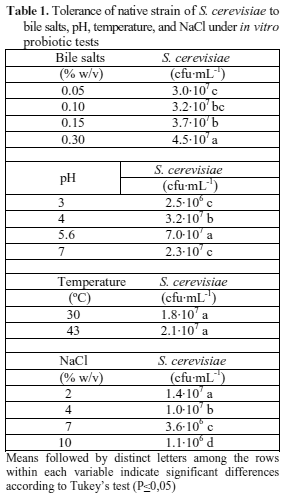
<body><![CDATA[<p style="text-indent: 0cm" align="justify"><font face="Verdana" size="2"> <span lang="EN-US">For determination of elements potassium, sodium, copper,  manganese, iron, and zinc, a Perkin Elmer 3110 atomic absorption equipment was  used at 767, 589, 325 280, 249 and 214 nm wave lengths, respectively. Elements  sulfur and phosphorous were determined using a Perkin Elmer LX spectrophotometer  at 420 and 660 nm wave lengths, respectively. Calcium and magnesium were  determined through complexo-metry (APHA, 1998). </span></font></p>     <p style="text-indent: 0cm" align="justify"><font face="Verdana" size="2"><b> <span lang="EN-US">C) Evaluation of strain viability over time</span></b></font></p>     <p style="text-indent: 0cm" align="justify"><font face="Verdana" size="2"> <span lang="EN-US">To evaluate the wild strain viability, 9 mL of the best <span style="letter-spacing: -.2pt">medium</span> were used in glass flasks. Every flask was inoculated with  1 mL of the wild strain suspension, stored at ±28 °C with constant stirring in a  shaker. At times 0, 15, 30, 45 and 60 days (considering at day 0 the wild strain  48 hours of being incubated) viable cell count was carried out (Marin et al.,  2009). </span></font></p>     <p align="justify"> <span lang="EN-GB" style="font-size: 10.0pt; font-family: Verdana">The results  for the <i>in vitro</i> tests were analyzed by ANOVA and Tukey test after  confirming the assumptions of normality of the data (Shapiro-Wilk test) and  homogeneity of variance (Bartlett test). &nbsp;</span><font face="Verdana" size="2">The  data from the experiment of the effect of three media on growth and biomass  production of the wild strain did not conform normality nor homogeneity of  variance, thus a non parametrical test was used (Kruskal-Wallis and Dunn test).  All analyses were performed using the R statistical analysis program (R  Development Core Team. Auckland University,</font><span style="letter-spacing: 0pt; font-size: 10.0pt; font-family: Verdana" lang="EN-US">  New Zealand)</span></p>     <p style="text-indent: 0cm" align="justify"><font face="Verdana" size="2"> <span lang="EN-US">The results of the wild strain growth and viability over time  were presented as figures with standard errors. </span></font></p>     <p align="justify"><span style="text-transform: uppercase"><b> <font face="Verdana" size="2"><span lang="EN-US">Results AND DISCUSSIoN</span></font></b></span></p>     <p style="text-indent: 0cm" align="justify"><font face="Verdana" size="2"> <span lang="EN-US">Results obtained in each <i>in vitro</i> testing to the wild  strain of <i>S.</i> <i>cerevisiae</i> are shown below. </span></font></p>     <p style="text-indent: 0cm" align="justify"><font face="Verdana" size="2"><b> <span lang="EN-US">Tolerance to bile salts</span></b><span lang="EN-US">. Wild  strain kept population concentration thereof in the same logarithmic unit with  respect to the initial population (10<sup>7</sup> cfu·mL<sup>-1</sup>),  therefore, it is capable of tolerating and maintaining the range of  concentration of bile salts tested as observed in the counts (<a href="#tab1">Table 1</a>).</span></font></p>     <p style="text-indent: 0cm" align="center"><a name="tab1"> <img border="0" src="/img/fbpe/ba/v29n3/art05tab1.gif" width="283" height="496"></a></p>     
<p style="text-indent: 0cm" align="justify"><font face="Verdana" size="2"> <span lang="EN-US">The highest average cell growth was obtained at a  concentration of 0.2 % of bile salts, and the lowest at a concentration of 0.05  %. The test showed that there was no significant difference between the  concentrations 0.15 and 0.1, and between 0.1 and 0.05.</span></font></p>     ]]></body>
<body><![CDATA[<p align="justify"> <span lang="EN-US" style="font-size: 10.0pt; font-family: Verdana; letter-spacing: -.1pt"> According to Ortiz et al. (1997), <i>S.</i></span><i><span lang="EN-US" style="font-size: 10.0pt; font-family: Verdana">  cerevisiae</span></i><span lang="EN-US" style="font-size: 10.0pt; font-family: Verdana">  has integral ATP-binding membrane proteins (ABC proteins), responsible for the  translocation of bile salts and may efficiently transport conjugated bile acids.  Another mechanism through which yeast is resistant to high concentration of bile  salts is based on the accumulation of polyols and glycerol, as mechanism to  regulate osmotic pressure in the cell (Moser &amp; Savage, 2001), suggesting that  yeast species which tolerate bile salts contribute to the function of  microorganisms in the gastrointestinal tract (Duncan et al., 2013). Maintenance  of probiotic microorganism population composing a commercial biopreparation  should be in the range of 10<sup>6</sup>-10<sup>8</sup> </span> <span lang="EN-GB" style="font-size: 10.0pt; font-family: Verdana">cfu·mL<sup>-1</sup></span><span lang="EN-US" style="font-size: 10.0pt; font-family: Verdana">,  when reaching target cells, to assure they may act on the host (Cavazzoni et  al., 1998). It suggests that it is necessary for an <i>in vivo</i> evaluation to  start from an inoculum with higher biomass concentration, in order to assure  that yeast facing bile salts, having antimicrobial activity, decrease their cell  viability, but still maintaining the necessary concentration to affect  positively the host (Salmines et al., 1999).</span></p>     <p style="text-indent: 0cm" align="justify"><font face="Verdana" size="2"> <span lang="EN-US">Wild strain of <i>S. cerevisiae</i> showed to be a  microorganism with capacity to tolerate bile salt concentrations from 0.05 to  0.3 % (w/v), keeping a constant number of cfu and being able to develop  metabolic activities thereof, without being inhibited or altered, characteristic  which is important for formulating a probiotic preparation. </span></font></p>     <p align="justify"><b> <span lang="EN-US" style="font-size: 10.0pt; font-family: Verdana">pH Tolerance</span></b><span lang="EN-US" style="font-size: 10.0pt; font-family: Verdana">.  There were significant differences in average cell growth at different pH levels  and a growth decrease occurred as the pH moved away from a mean value (<a href="#tab1">Table 1</a>).  The highest cell growth was obtained with pH 5.6 and the lowest was obtained  with pH 3. When exposed to this latter pH, there was a large decrease of the  wild strain population with respect to the initial one as observed by the net  decrease in one logarithmical unit (10<sup>7 </sup>to 10<sup>6</sup>), whereas  for the others, the order of magnitude of the population was maintained. A  probiotic microorganism population should be in 10<sup>8</sup> </span> <span lang="EN-GB" style="font-size: 10.0pt; font-family: Verdana">cfu·mL<sup>-1</sup></span><span lang="EN-US" style="font-size: 10.0pt; font-family: Verdana">  when administered and when reaching enterocytes, and it should be viable, with a  maximum viability loss of two logarithmic units (Cavazzoni et al., 1998). Hence,  it is required to have an inoculum with higher microorganism concentration as  mentioned before.</span></p>     <p style="text-indent: 0cm" align="justify"><font face="Verdana" size="2"> <span lang="EN-US">Tolerance to pH may rely on two types of Na<sup>+/</sup>H<sup>+</sup>  anti-transporters in the yeast: Nha1p, found in the plasmatic membrane and  Nhx1p, both located in the prevacuolar endosomal compartment (Membré et al.,  1999). These proteins catalyze monovalent cation exchange (Na<sup>+</sup> or K<sup>+</sup>)  and H<sup>+</sup> through membranes, then they regulate cation concentrations  and pH at cytoplasmic level and organelles (Mitsui et al., 2005; Ohgaki et al.,  2005). Another possible regulation mechanisms is represented by ATPase located  in the cytoplasmic membrane, which may create a proton electrochemical gradient  leading to the secondary solute transport which is implied for maintaining pH  close to neutral (Viegas et al., 1998; Sychrovae et al., 1999). </span></font> </p>     <p style="text-indent: 0cm" align="justify"><font face="Verdana" size="2"><b> <span lang="EN-US">Tolerance to change in temperature</span></b><span lang="EN-US">.  The response of</span><span lang="EN-US" style="letter-spacing: -.1pt"> the wild  strain under two different temperatures</span><span lang="EN-US"> showed that  the increase from 30 to 43 ºC did not affect the microorganism growth,  maintaining the logarithmic population regarding the initial one (<a href="#tab1">Table 1</a>).  Thereby the wild strain met another criterion to be considered as a suitable probiotic for the elaboration of a biopreparation</span><span lang="EN-GB">.</span></font></p>     <p style="text-indent: 0cm" align="justify"><font face="Verdana" size="2"> <span lang="EN">Temperature is a relevant factor because from the  microbiological point of view, microorganisms have optimal temperatures for  growth thereof obtaining the highest yield. This temperature is often close to  the maximum tolerated and varies according to the type of microorganism. In  yeasts, temperature affects their capacity to split sugars, reproduction and  cell growth (</span><span lang="EN-GB">Manovacía et al., 2008</span><span lang="EN">).  In this test, the temperature used was in the appropriate range for <i>S.  cerevisiae</i> growth.</span></font></p>     <p style="text-indent: 0cm" align="justify"><font face="Verdana" size="2"><b> <span lang="EN" style="letter-spacing: -.1pt">Tolerance to high NaCl  concentrations</span></b><span lang="EN" style="letter-spacing: -.1pt">. </span> <span lang="EN-GB" style="letter-spacing: -.1pt">There</span><span lang="EN-GB">  were highly significant differences in the average absorbance at each of the  NaCl concentrations (<a href="#tab1">Table 1</a>). </span><span lang="EN">The wild strain proved  tolerance for concentrations of 2 and 4 % w/v NaCl (<a href="#tab1">Table 1</a>), but it showed a  decrease in tolerance and decrease in the growth rate for the higher salt  concentrations &nbsp;of &nbsp;7 and 10 % w/v.</span></font></p>     <p style="text-indent: 0cm" align="justify"><font face="Verdana" size="2"> <span lang="EN-US">According to Martinez (2016), when <i>S. cerevisiae </i>faces  a high osmolarity condition, suffers an immediate change in cell volume due to  the water loss in the cytosol. </span><span lang="EN-GB">Dehydration is a short  process, which takes very short time, and it is partially compensated by the  influx of water from the vacuole as it accumulates ions for the benefit of the  &nbsp;cytoplasm and organelles (Serrano, 1996). This influence is shown as an  internal <span style="letter-spacing:-.2pt">response to the differences in  osmotic concentrations</span> between the cytoplasm and the interior of the  vacuole that tries to maintain the hydration of the cell, also helped by the  contact surface with the cytoplasm that allows the passive movement of solutes  and water to survive and maintain growth (Blomberg, 2000). Dehydrated &nbsp;cells  &nbsp;may recover stiffness provided stress severity is physiologically acceptable.  Cell proliferation may resume after a conditioning period (Tao et al., 1999). At  the same time, mechanisms involved in stress resistance are induced, such as  increase in the glycerol intracellular concentration and induction of products  that participate in production of protecting proteins and readjustment in levels  of carbohydrate, lipids and amino acids (Rep et al., 2000). </span> <span lang="ES-MX">For all the above mentioned, it can be stated that wild  strain has the capacity to condition and stabilize itself before high bile acid  concentration, allowing the maintenance of population when it is introduced as a  beneficial microorganism resisting different salinity conditions. </span></font> </p>     <p style="text-indent: 0cm" align="justify"><font face="Verdana" size="2"><b> <span lang="EN-GB">Antagonism test. </span></b><span lang="EN-GB">Antagonism  test with respect to <i>E. coli </i>showed that, <i>in vitro</i>, yeast does not  produce antimicrobial substances which might spread to the medium and being  capable of counteracting growth of the pathogen evaluated. </span></font></p>     <p style="text-indent: 0cm" align="justify"><font face="Verdana" size="2"> <span lang="EN-GB">It was observed, however, that the wild strain has some  advantage for the competitive exclusion, which suggests that they could be more  resistant to gastrointestinal environment being colonization and multiplication  thereof more productive compared to pathogens. This assumption may be valid if  we consider that it is difficult to evaluate antagonism <i>in vitro </i>because  the difficulty to promote gastrointestinal conditions. </span></font></p>     ]]></body>
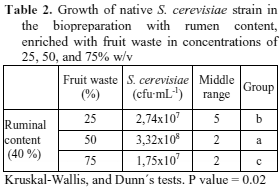
<body><![CDATA[<p align="justify"><b> <span lang="EN-US" style="font-size: 10.0pt; font-family: Verdana">Production of  gas from glucose. </span></b> <span lang="EN-GB" style="font-size: 10.0pt; font-family: Verdana">Wild strain  showed poor gas production; this property is very important because diet of  hosts is commonly based on glucose and if a gas producing probiotic is used,  digestive problems will appear and it may be considered as a loss of energy for  the host, because it is potential energy not used for metabolic processes of the </span><span lang="EN-US" style="font-size: 10.0pt; font-family: Verdana"> microorganisms</span><span lang="EN-GB" style="font-size: 10.0pt; font-family: Verdana">.</span></p>     <p style="text-indent: 0cm" align="justify"><font face="Verdana" size="2"><b> <span lang="EN-US">Microbial growth in the media from ruminal content and fruit  peels. </span></b><span lang="EN-US">Mean values of the results obtained for  growth of the wild strain of <i>S. cerevisiae</i></span><span lang="EN-GB">, </span><span lang="EN-US">under previously established conditions, in the  culture medium from ruminal content enriched with fruit wastes in concentrations  of 25, 50, and 75 % are summarized in <a href="#tab2">Table 2</a>.</span></font></p>     <p style="text-indent: 0cm" align="center"><a name="tab2"> <img border="0" src="/img/fbpe/ba/v29n3/art05tab2.gif" width="280" height="189"></a></p>     
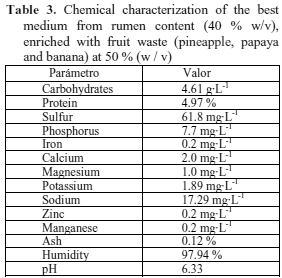
<p style="text-indent: 0cm" align="justify"><font face="Verdana" size="2"> <span lang="EN-US">It is observed that the wild strain has better population  growth in the biopreparation with 50 % w/v fruit waste content than  concentrations of 25 and 75 % of wastes.</span></font></p>     <p align="justify"> <span lang="EN-US" style="font-size: 10.0pt; font-family: Verdana">Based on the  above, the ruminal content medium enriched with fruit wastes 50 % w/v was  selected for chemical characterization because this medium </span> <span class="MsoCommentReference"> <span lang="EN-US" style="font-family: Verdana"><font size="2">was the one that  allowed the </font></span></span> <span lang="EN-US" style="font-size: 10.0pt; font-family: Verdana">greatest  growth of the wild strain <i>S. cerevisiae.</i></span></p>     <p style="text-indent: 0cm" align="justify"><font face="Verdana" size="2"><b> <span lang="EN-US">Chemical analysis of the best medium from ruminal content and  fruit peels. </span></b><span lang="EN-US">The results of the chemical  characterization made to the medium with 50 % w/v fruit waste concentration  shows that it counts on the nutritional requirements necessary for the good  growth of the wild strain of <i>S. cerevisiae </i>in the elaboration of a  biopreparation (<a href="#tab3">Table 3</a>).</span></font></p>     <p style="text-indent: 0cm" align="center"><a name="tab3"> <img border="0" src="/img/fbpe/ba/v29n3/art05tab3.gif" width="282" height="278"></a></p>     
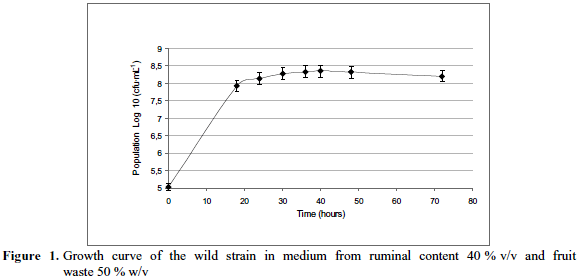
<p style="text-indent: 0cm" align="justify"><font face="Verdana" size="2"> <span lang="EN-US">The carbohydrate (</span><span lang="EN-GB" style="line-height: 102%">4.61  g·L<sup>-1</sup>), protein (</span><span lang="EN-US" style="line-height: 102%">4.97  %) </span><span lang="EN-GB" style="line-height: 102%">and </span> <span lang="EN-US" style="line-height: 102%">phosphorus (7.7 mg·L<sup>-1</sup>)  contents </span><span lang="EN-GB" style="line-height: 102%">were higher than  those found in different media such as </span><i><span lang="EN-GB">Psidium  araca</span></i><span lang="EN-GB" style="line-height: 102%"> (Lara et al.,  2008), </span><i><span lang="EN-US">Ipomoea batatas </span></i> <span lang="EN-US">(Lobaina Rodríguez et al., 2007), or a mix of vegetable  residues (Lara et al., 2010). </span></font></p>     <p align="justify"> <span lang="EN-US" style="font-size: 10.0pt; font-family: Verdana">On the other  hand, mineral microelements such as sulfur and sodium that are fundamental for  microorganism growth (Bridson, 1994) were found in important amounts in the  medium. The sulfur and sodium concentrations (61.8 and 17 mg·L<sup>-1</sup>)  surpassed the values of 6. mg·L<sup>-1</sup> and 14.93 reported by Lara et al.  (2008; 2010) for those nutrients, respectively. These comparisons demonstrate  good nutritional contents that can favour the growth of <i>S. cerevisiae</i>.</span></p>     <p style="text-indent: 0cm" align="justify"><font face="Verdana" size="2"><b> <span lang="EN-US" style="letter-spacing: -.3pt">Evaluation of the strain  viability over time. </span></b> <span lang="EN-US" style="letter-spacing: -.3pt">The</span><span lang="EN-US">  <a href="#fig1">Figure 1</a> represents the population of viable cells existing in the medium from ruminal content (40% v/v) with residues of the mixtures fruits (papaya,  pineapple and banana) at a concentration of 50% w/v. According to plotted  biomass production logarithm data, it is observed that the strain <i>S.  cerevisiae </i>adapted quickly to the culture medium evaluated and remained in  logarithmic phase increasing initial population by 60 % en 18 hours, thereby  achieving maximum growth at 40 hours, to subsequently decrease; decrease which  is probably produced by the exhaustion of nutrients present in de medium.</span></font></p>     ]]></body>
<body><![CDATA[<p style="text-indent: 0cm" align="center"><a name="fig1"> <img border="0" src="/img/fbpe/ba/v29n3/art05fig1.gif" width="578" height="278"></a></p>     
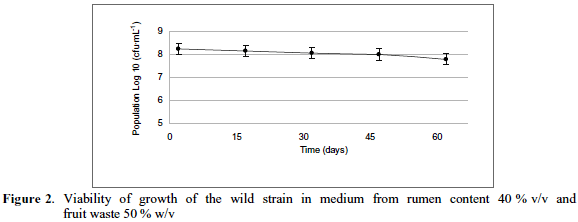
<p align="justify"> <span lang="EN-US" style="font-size: 10.0pt; font-family: Verdana">In  <a href="#fig2">Figure 2</a>,  the trend of population viability of the wild strain of <i>S. cerevisiae </i>can  be observed every 15 days during two months, in the best medium, i.e. the medium  from ruminal content (40% v/v), with fruit wastes (papaya, pineapple and banana)  at 50% w/v concentration.</span></p>     <p align="center"> <a name="fig2"> <img border="0" src="/img/fbpe/ba/v29n3/art05fig2.gif" width="578" height="222"></a></p>     
<p style="text-indent: 0cm" align="justify"><font face="Verdana" size="2"> <span lang="EN-GB">In this research, the three results obtained after 45 days of  storage maintained the log scale of 10<sup>8</sup></span><b><span lang="EN-GB"> </span></b><span lang="EN-GB">cfu·mL</span><sup><span lang="EN-GB" style="color: #333333">-</span><span lang="EN-GB">1</span></sup><span lang="EN-GB">,  with a decrease in counts made in last 15 days to the log scale 10<sup>7</sup>;  it i supposed that refrigeration may have had consequences in the decrease, as  well as the decrease of nutrients available in the medium. </span> <span lang="EN-US">According to nutritional viability parameters of probiotics  in food (FAO, 2016), <i>S. cerevisiae </i>met the requirement of viability,  which should be higher than10<sup>6</sup>. These</span><span lang="EN-GB">  results may confirm that the biopreparation selected is a good vehicle for  probiotic administration. </span><span lang="EN-US">Organic waste used in this  study have been subject of several individual research, in order to take  advantage of nutritional value thereof, finding the production of flours,  nutritional blocks and compost (Yato &amp; Orihuela, 2015; Seema, 2015), in the case  of ruminal content; and for the peels of different fruits, elaboration of jams,  flours (Gil et al., 2011), dietary fiber (Gutiérrez et al., 2002) and  fermentation products (Saval, 2012).</span></font></p>     <p align="justify"><span style="text-transform: uppercase"><b> <font face="Verdana" size="2"><span lang="EN-US">Conclusions</span></font></b></span></p>     <p align="justify"> <span lang="EN-US" style="font-size: 10.0pt; font-family: Verdana">Elaboration  of a biopreparation from clarified ruminal content 40% v/v, enriched with peels  from three fruits (pineapple, papaya and banana) 50 % w/v, produced in  slaughterhouses (Cereté, Colombia) and fruit shops (Montería, Colombia)  respectively, with the strain <i>Saccharomyces cerevisiae </i>constitute a  viable byproduct, which may contribute to the improvement of environment, by  decreasing by-products caused in the livestock and fruit production.</span></p>     <p style="text-indent: 0cm" align="justify"><font face="Verdana" size="2"> <span lang="EN-US">Wild strain of <i>S. cerevisiae</i> showed favorable results  for tests of tolerance to bile salts, changes in temperature, high salt  concentrations, additionally to showing a competitive exclusion competence. W</span><span lang="EN-GB">ild  strain showed poor gas production, which a very important property </span> <span lang="EN-US">because the consumption of glucose by the yeast causes  decreasing bioavailability of this carbohydrate for the host organism.</span></font></p>     <p style="text-indent: 0cm" align="justify"><font face="Verdana" size="2"> <span lang="EN-US">Best growth and maintenance of the wild strain of species <i> S.</i> <i>cerevisiae</i> was observed in the clarified ruminal content medium  (40 % w/v) and fruit peels (pineapple, papaya and banana) 50 % w/v. And chemical  analysis showed that the medium has the necessary nutrients for the yeast in the  elaboration of a biopreparation.</span></font></p>     <p align="center" style="text-align: justify"><font face="Verdana" size="2"><b> <span lang="EN-US" style="text-transform: uppercase">Acknowledgement</span></b></font></p>     <p style="text-indent: 0cm" align="justify"><font face="Verdana" size="2"> <span lang="ES-MX">The authors thank </span><span lang="ES-VE">Universidad</span><span lang="ES-MX">  de Córdoba (Montería, Colombia) and Corporación Universitaria del Caribe (CECAR)  (Sincelejo, Colombia).</span></font></p>     ]]></body>
<body><![CDATA[<p align="justify"> <span lang="EN-US" style="font-size: 10.0pt; font-family: Verdana; font-weight: 700"> LITERATURA CITADA</span></p>     <!-- ref --><p style="text-indent: 0cm; margin-left: 0cm" align="justify"> <font face="Verdana" size="2"><span lang="EN-GB">1. AOAC. 1990. Methods of  Analysis. Association of Official Analytical Chemist. Washington, D.C.</span></font>&nbsp;&nbsp;&nbsp;&nbsp;&nbsp;&nbsp;&nbsp;&nbsp;[&#160;<a href="javascript:void(0);" onclick="javascript: window.open('/scielo.php?script=sci_nlinks&ref=707551&pid=S1316-3361201700030000500001&lng=','','width=640,height=500,resizable=yes,scrollbars=1,menubar=yes,');">Links</a>&#160;]<!-- end-ref --><!-- ref --><p style="text-indent: 0cm; margin-left: 0cm" align="justify"> <font face="Verdana" size="2"><span lang="EN-GB">2. Abreu-Abreu, A. 2012.  Prebióticos, probióticos y simbióticos. Rev Gastroenterol Mex. 77: 26-28.</span></font>&nbsp;&nbsp;&nbsp;&nbsp;&nbsp;&nbsp;&nbsp;&nbsp;[&#160;<a href="javascript:void(0);" onclick="javascript: window.open('/scielo.php?script=sci_nlinks&ref=707552&pid=S1316-3361201700030000500002&lng=','','width=640,height=500,resizable=yes,scrollbars=1,menubar=yes,');">Links</a>&#160;]<!-- end-ref --><!-- ref --><p style="text-indent: 0cm; margin-left: 0cm" align="justify"> <font face="Verdana" size="2"><span lang="EN-GB">3. APHA. 1998. Standard methods  for the examination of water and wastewater. </span><span lang="ES-MX">American  Public Health Association. Washington, D.C.</span></font>&nbsp;&nbsp;&nbsp;&nbsp;&nbsp;&nbsp;&nbsp;&nbsp;[&#160;<a href="javascript:void(0);" onclick="javascript: window.open('/scielo.php?script=sci_nlinks&ref=707553&pid=S1316-3361201700030000500003&lng=','','width=640,height=500,resizable=yes,scrollbars=1,menubar=yes,');">Links</a>&#160;]<!-- end-ref --><!-- ref --><p style="text-indent: 0cm; margin-left: 0cm" align="justify"> <font face="Verdana" size="2"><span lang="EN-US">4. Blomberg, A. 2000. </span> <span lang="EN-GB">Metabolic surprises in <i>Saccharomyces</i> <i>cerevisiae</i>  during adaptation to saline conditions: questions, some answers and a model. </span><span lang="EN-US">FEMS Microbiol Lett. 182(1): 1-8.</span></font>&nbsp;&nbsp;&nbsp;&nbsp;&nbsp;&nbsp;&nbsp;&nbsp;[&#160;<a href="javascript:void(0);" onclick="javascript: window.open('/scielo.php?script=sci_nlinks&ref=707554&pid=S1316-3361201700030000500004&lng=','','width=640,height=500,resizable=yes,scrollbars=1,menubar=yes,');">Links</a>&#160;]<!-- end-ref --><!-- ref --><p style="text-indent: 0cm; margin-left: 0cm" align="justify"> <font face="Verdana" size="2"><span lang="EN-GB">5. Bridson, E. 1994. The  Development, Manufacture and Control of Microbiological Culture Media. Unipath.  Bedford, UK.</span></font>&nbsp;&nbsp;&nbsp;&nbsp;&nbsp;&nbsp;&nbsp;&nbsp;[&#160;<a href="javascript:void(0);" onclick="javascript: window.open('/scielo.php?script=sci_nlinks&ref=707555&pid=S1316-3361201700030000500005&lng=','','width=640,height=500,resizable=yes,scrollbars=1,menubar=yes,');">Links</a>&#160;]<!-- end-ref --><!-- ref --><p style="text-indent: 0cm; margin-left: 0cm" align="justify"> <font face="Verdana" size="2"><span lang="IT">6. Cavazzoni, V., A. Adami and G.  Castrovilli. </span><span lang="ES-MX">1998. </span><span lang="EN-US"> Performance of broiler chickens </span><span lang="EN-GB">supplemented with <i> Bacillus coagulans</i> as probiotic. British Poultry Science, 30: 526-529.</span></font>&nbsp;&nbsp;&nbsp;&nbsp;&nbsp;&nbsp;&nbsp;&nbsp;[&#160;<a href="javascript:void(0);" onclick="javascript: window.open('/scielo.php?script=sci_nlinks&ref=707556&pid=S1316-3361201700030000500006&lng=','','width=640,height=500,resizable=yes,scrollbars=1,menubar=yes,');">Links</a>&#160;]<!-- end-ref --><!-- ref --><p style="text-indent: 0cm; margin-left: 0cm" align="justify"> <font face="Verdana" size="2"><span lang="ES-MX">7. DANE (Dirección Nacional de  Estadística). 2014. Censo Nacional Agropuecuario. <a style="color: blue; text-decoration: underline; text-underline: single" href="http://www.dane.gov.co/index.php/estadisticas-por-tema/agropecuario/"> <span lang="EN-US"> http://www.dane.gov.co/index.php/estadisticas-por-tema/agropecuario/</span></a> </span><span lang="EN-US">(visited 07/28/2017).</span></font>&nbsp;&nbsp;&nbsp;&nbsp;&nbsp;&nbsp;&nbsp;&nbsp;[&#160;<a href="javascript:void(0);" onclick="javascript: window.open('/scielo.php?script=sci_nlinks&ref=707557&pid=S1316-3361201700030000500007&lng=','','width=640,height=500,resizable=yes,scrollbars=1,menubar=yes,');">Links</a>&#160;]<!-- end-ref --><!-- ref --><p style="text-indent: 0cm; margin-left: 0cm" align="justify"> <font face="Verdana" size="2"><span lang="EN-GB">8. Drisko, J., C. Giles and B.  Bischoff. 2003. Probiotics in health maintenance and disease prevention. </span> Altern. Med. Rev. 8(2): 143-155.</font>&nbsp;&nbsp;&nbsp;&nbsp;&nbsp;&nbsp;&nbsp;&nbsp;[&#160;<a href="javascript:void(0);" onclick="javascript: window.open('/scielo.php?script=sci_nlinks&ref=707558&pid=S1316-3361201700030000500008&lng=','','width=640,height=500,resizable=yes,scrollbars=1,menubar=yes,');">Links</a>&#160;]<!-- end-ref --><!-- ref --><p style="text-indent: 0cm; margin-left: 0cm" align="justify"> <font face="Verdana" size="2"><span lang="EN-GB">9. Duncan, S., K. Scott, A.  Ramsay, H. Harmsen, W. Gjalt and S. Colin. </span><span lang="EN-US">2013. </span><span lang="EN-GB">Effects of alternative dietary substrates on  competition between human colonic bacteria in an anaerobic fermentor system. </span><span lang="EN-US">Appl. Env. Microbiol. 69: 1136-1142.</span></font>&nbsp;&nbsp;&nbsp;&nbsp;&nbsp;&nbsp;&nbsp;&nbsp;[&#160;<a href="javascript:void(0);" onclick="javascript: window.open('/scielo.php?script=sci_nlinks&ref=707559&pid=S1316-3361201700030000500009&lng=','','width=640,height=500,resizable=yes,scrollbars=1,menubar=yes,');">Links</a>&#160;]<!-- end-ref --><!-- ref --><p style="text-indent: 0cm; margin-left: 0cm" align="justify"> <font face="Verdana" size="2"><span lang="EN-GB">10. FAO. 2006. Livestock's long  shadow. Environmental issues and options. &nbsp;Food and Agriculture Organization of  the United Nations. Rome. 290 p.</span></font>&nbsp;&nbsp;&nbsp;&nbsp;&nbsp;&nbsp;&nbsp;&nbsp;[&#160;<a href="javascript:void(0);" onclick="javascript: window.open('/scielo.php?script=sci_nlinks&ref=707560&pid=S1316-3361201700030000500010&lng=','','width=640,height=500,resizable=yes,scrollbars=1,menubar=yes,');">Links</a>&#160;]<!-- end-ref --><!-- ref --><p style="text-indent: 0cm; margin-left: 0cm" align="justify"> <font face="Verdana" size="2"><span lang="EN-GB">11. FAO. 2016. Probiotics in  animal nutrition: production, impact and regulation. Animal Production and  Health. Paper 179. Rome.</span></font>&nbsp;&nbsp;&nbsp;&nbsp;&nbsp;&nbsp;&nbsp;&nbsp;[&#160;<a href="javascript:void(0);" onclick="javascript: window.open('/scielo.php?script=sci_nlinks&ref=707561&pid=S1316-3361201700030000500011&lng=','','width=640,height=500,resizable=yes,scrollbars=1,menubar=yes,');">Links</a>&#160;]<!-- end-ref --><!-- ref --><p style="text-indent: 0cm; margin-left: 0cm" align="justify"> <font face="Verdana" size="2"><span lang="FR">12. García, M., Y. López and A.  Carcassés. </span><span lang="ES-MX">2012. Empleo de probióticos en los  animales. Sitio Argentino de Producción Animal. 8 p. <a style="color: blue; text-decoration: underline; text-underline: single" href="http://produccion-animal.com.ar/"> http://<span style="letter-spacing:-.1pt">produccion-animal.com.ar</span></a><span style="letter-spacing:-.1pt">  (visited 07/28/2017).</span></span></font>&nbsp;&nbsp;&nbsp;&nbsp;&nbsp;&nbsp;&nbsp;&nbsp;[&#160;<a href="javascript:void(0);" onclick="javascript: window.open('/scielo.php?script=sci_nlinks&ref=707562&pid=S1316-3361201700030000500012&lng=','','width=640,height=500,resizable=yes,scrollbars=1,menubar=yes,');">Links</a>&#160;]<!-- end-ref --><!-- ref --><p style="text-indent: 0cm; margin-left: 0cm" align="justify"> <font face="Verdana" size="2">13. Gil, M.<span lang="ES-MX">,</span> L. Vélez, <span lang="ES-MX">L</span>.<span lang="ES-MX">d. Millán, M. Acosta, A. Díez,  N. Cardona and G. Villa. 2011. Desarrollo de un producto de panadería con alto  valor nutricional a partir de la harina obtenida del banano verde con cáscara:  una nueva opción para el aprovechamiento de residuos de la industria de  exportación. Producción+Limpia 6(1): 96-107.</span></font>&nbsp;&nbsp;&nbsp;&nbsp;&nbsp;&nbsp;&nbsp;&nbsp;[&#160;<a href="javascript:void(0);" onclick="javascript: window.open('/scielo.php?script=sci_nlinks&ref=707563&pid=S1316-3361201700030000500013&lng=','','width=640,height=500,resizable=yes,scrollbars=1,menubar=yes,');">Links</a>&#160;]<!-- end-ref --><!-- ref --><p style="text-indent: 0cm; margin-left: 0cm" align="justify"> <font face="Verdana" size="2"><span lang="ES-MX">14. Guerrero, E. and F.  Ramírez. 2004. Manejo ambiental de residuos en mataderos de pequeños municipios.  Scientia et Technica 10(26): 199-204.</span></font>&nbsp;&nbsp;&nbsp;&nbsp;&nbsp;&nbsp;&nbsp;&nbsp;[&#160;<a href="javascript:void(0);" onclick="javascript: window.open('/scielo.php?script=sci_nlinks&ref=707564&pid=S1316-3361201700030000500014&lng=','','width=640,height=500,resizable=yes,scrollbars=1,menubar=yes,');">Links</a>&#160;]<!-- end-ref --><!-- ref --><p style="text-indent: 0cm; margin-left: 0cm" align="justify"> <font face="Verdana" size="2"><span lang="ES-MX">15. Gutiérrez, E., G. Medina,  M. Roman, O. Florez and O. Martínez. 2002. Obtención y cuantificación de fibra  dietaria a partir de residuos de algunas frutas comunes en Colombia. Vitae 9(1):  5-14.</span></font>&nbsp;&nbsp;&nbsp;&nbsp;&nbsp;&nbsp;&nbsp;&nbsp;[&#160;<a href="javascript:void(0);" onclick="javascript: window.open('/scielo.php?script=sci_nlinks&ref=707565&pid=S1316-3361201700030000500015&lng=','','width=640,height=500,resizable=yes,scrollbars=1,menubar=yes,');">Links</a>&#160;]<!-- end-ref --><!-- ref --><p style="text-indent: 0cm; margin-left: 0cm" align="justify"> <font face="Verdana" size="2"><span lang="EN-GB">16. Lara, C. 2008. Chemical  composition of a culture medium from bitter guava (<i>Psidium araca</i>) and its  relation to the ruminals microorganisms nutrition. </span><span lang="ES-MX"> Revista Colombiana de Biotecnología, 2: 44-49.</span></font>&nbsp;&nbsp;&nbsp;&nbsp;&nbsp;&nbsp;&nbsp;&nbsp;[&#160;<a href="javascript:void(0);" onclick="javascript: window.open('/scielo.php?script=sci_nlinks&ref=707566&pid=S1316-3361201700030000500016&lng=','','width=640,height=500,resizable=yes,scrollbars=1,menubar=yes,');">Links</a>&#160;]<!-- end-ref --><!-- ref --><p style="text-indent: 0cm; margin-left: 0cm" align="justify"> <font face="Verdana" size="2"><span lang="ES-MX">17. Lara, C., L. García and L.  Oviedo. 2010. Medio de cultivo utilizando residuos-sólidos para el crecimiento  de una bacteria nativa con potencial biofertilizante. Revista Colombiana de  Biotecnología, 12 (1): 103-112.</span></font>&nbsp;&nbsp;&nbsp;&nbsp;&nbsp;&nbsp;&nbsp;&nbsp;[&#160;<a href="javascript:void(0);" onclick="javascript: window.open('/scielo.php?script=sci_nlinks&ref=707567&pid=S1316-3361201700030000500017&lng=','','width=640,height=500,resizable=yes,scrollbars=1,menubar=yes,');">Links</a>&#160;]<!-- end-ref --><!-- ref --><p style="text-indent: 0cm; margin-left: 0cm" align="justify"> <font face="Verdana" size="2"><span lang="ES-MX">18. Leiva, S., M. Yáñez, L.  Zaror, H. Rodríguez and H. García. 2004. Actividad antimicrobiana de  actinomycetes aislados desde ambientes acuáticos del sur de Chile. Revista  Médica de Chile, 132: 151-159.</span></font>&nbsp;&nbsp;&nbsp;&nbsp;&nbsp;&nbsp;&nbsp;&nbsp;[&#160;<a href="javascript:void(0);" onclick="javascript: window.open('/scielo.php?script=sci_nlinks&ref=707568&pid=S1316-3361201700030000500018&lng=','','width=640,height=500,resizable=yes,scrollbars=1,menubar=yes,');">Links</a>&#160;]<!-- end-ref --><!-- ref --><p style="text-indent: 0cm; margin-left: 0cm" align="justify"> <font face="Verdana" size="2">19. Lopera, M., J. Homez, M. Ordoñez and H. Pabon.  2009. <span lang="ES-MX">Guía Ambiental Hortifruticula de Colombia. Edit. Nuevas  Ediciones. Bogotá.</span></font>&nbsp;&nbsp;&nbsp;&nbsp;&nbsp;&nbsp;&nbsp;&nbsp;[&#160;<a href="javascript:void(0);" onclick="javascript: window.open('/scielo.php?script=sci_nlinks&ref=707569&pid=S1316-3361201700030000500019&lng=','','width=640,height=500,resizable=yes,scrollbars=1,menubar=yes,');">Links</a>&#160;]<!-- end-ref --><!-- ref --><p style="text-indent: 0cm; margin-left: 0cm" align="justify"> <font face="Verdana" size="2">20. Lobaina, T., C. Rodríguez and&nbsp; R. Zhurbenko.  2007. Caracterización de un extracto de <i>Ipomoea batatas</i> para ser  utilizado en calidad de base nutritiva en medios de cultivo. Rev. Cubana Med.  Trop. 59(3): 218-26.</font>&nbsp;&nbsp;&nbsp;&nbsp;&nbsp;&nbsp;&nbsp;&nbsp;[&#160;<a href="javascript:void(0);" onclick="javascript: window.open('/scielo.php?script=sci_nlinks&ref=707570&pid=S1316-3361201700030000500020&lng=','','width=640,height=500,resizable=yes,scrollbars=1,menubar=yes,');">Links</a>&#160;]<!-- end-ref --><!-- ref --><p style="text-indent: 0cm; margin-left: 0cm" align="justify"> <font face="Verdana" size="2">21. Manovacía, N., A. Moreno, O. Mayorga and R.  Barahona. 2008. Evaluation of the nutrient content and biomass production in  Colombian and commercial yeast strains. Revista Facultad Nacional de Agronomía  (Medellín) 61(2): 4542-4553.</font>&nbsp;&nbsp;&nbsp;&nbsp;&nbsp;&nbsp;&nbsp;&nbsp;[&#160;<a href="javascript:void(0);" onclick="javascript: window.open('/scielo.php?script=sci_nlinks&ref=707571&pid=S1316-3361201700030000500021&lng=','','width=640,height=500,resizable=yes,scrollbars=1,menubar=yes,');">Links</a>&#160;]<!-- end-ref --><!-- ref --><p style="text-indent: 0cm; margin-left: 0cm" align="justify"> <font face="Verdana" size="2"><span lang="ES-MX">22. Marín, Z., M. Cortes and O.  Montoya. 2009. Evaluación de la viabilidad de crecimiento de la cepa nativa <i> Lactobacillus plantarum</i> lpbm10 y la cepa comercial <i>Lactobacillus casei</i>  atcc 393 en pulpa de uchuva y en solución isotónica de glucosa. Vitae 16(2):  210-217.</span></font>&nbsp;&nbsp;&nbsp;&nbsp;&nbsp;&nbsp;&nbsp;&nbsp;[&#160;<a href="javascript:void(0);" onclick="javascript: window.open('/scielo.php?script=sci_nlinks&ref=707572&pid=S1316-3361201700030000500022&lng=','','width=640,height=500,resizable=yes,scrollbars=1,menubar=yes,');">Links</a>&#160;]<!-- end-ref --><!-- ref --><p style="text-indent: 0cm; margin-left: 0cm" align="justify"> <font face="Verdana" size="2"><span lang="ES-MX">23. Martínez, E., A. Torregroza,  Ana. Torregroza and D. Mogollón. 2016. Efecto de la deshidratación  osmótica-microondas sobre propiedades fisicoquímicas del mango (<i>Mangifera  indica</i> L.) variedad Corazón. Agronomía&nbsp; Colombiana, 34: 1236-1239.</span></font>&nbsp;&nbsp;&nbsp;&nbsp;&nbsp;&nbsp;&nbsp;&nbsp;[&#160;<a href="javascript:void(0);" onclick="javascript: window.open('/scielo.php?script=sci_nlinks&ref=707573&pid=S1316-3361201700030000500023&lng=','','width=640,height=500,resizable=yes,scrollbars=1,menubar=yes,');">Links</a>&#160;]<!-- end-ref --><!-- ref --><p style="text-indent: 0cm; margin-left: 0cm" align="justify"> <font face="Verdana" size="2"><span lang="EN-GB">24. Membré, J., M. Kubaczka and  C. Chene. </span><span lang="EN-US">1999. </span><span lang="EN-GB">Combined  effects of pH and sugar on growth rate of <i>Zygosaccharomyces rouxii</i>, a  bakery product spoilage yeast. </span><span lang="EN-US">Appl. Env. Microbiol.  69(2): 1136-1142.</span></font>&nbsp;&nbsp;&nbsp;&nbsp;&nbsp;&nbsp;&nbsp;&nbsp;[&#160;<a href="javascript:void(0);" onclick="javascript: window.open('/scielo.php?script=sci_nlinks&ref=707574&pid=S1316-3361201700030000500024&lng=','','width=640,height=500,resizable=yes,scrollbars=1,menubar=yes,');">Links</a>&#160;]<!-- end-ref --><!-- ref --><p style="text-indent: 0cm; margin-left: 0cm" align="justify"> <font face="Verdana" size="2"><span lang="EN-US">25. Mitsui, K., H. Yasui, N.  Nakamura and H. Kanazawa. 2005. </span><span lang="EN-GB">Oligomerization of the <i>Saccharomyces cerevisiae</i> Na<sup>+</sup>/H<sup>+</sup> antiporter NHa1p:  Implications for its antiporter activity. Biochim. Biophys. 1720: 125-136.</span></font>&nbsp;&nbsp;&nbsp;&nbsp;&nbsp;&nbsp;&nbsp;&nbsp;[&#160;<a href="javascript:void(0);" onclick="javascript: window.open('/scielo.php?script=sci_nlinks&ref=707575&pid=S1316-3361201700030000500025&lng=','','width=640,height=500,resizable=yes,scrollbars=1,menubar=yes,');">Links</a>&#160;]<!-- end-ref --><!-- ref --><p style="text-indent: 0cm; margin-left: 0cm" align="justify"> <font face="Verdana" size="2"><span lang="EN-GB">26. Moser, S. and D. Savage.  2001. Bile salt hydrolase activity and resistance to toxicity of conjugated bile  salts are unrelated properties in <i>Lactobacilli</i>. </span> <span lang="ES-MX">Appl. Env. Microbiol. 67(8): 3476-3480.</span></font>&nbsp;&nbsp;&nbsp;&nbsp;&nbsp;&nbsp;&nbsp;&nbsp;[&#160;<a href="javascript:void(0);" onclick="javascript: window.open('/scielo.php?script=sci_nlinks&ref=707576&pid=S1316-3361201700030000500026&lng=','','width=640,height=500,resizable=yes,scrollbars=1,menubar=yes,');">Links</a>&#160;]<!-- end-ref --><!-- ref --><p style="text-indent: 0cm; margin-left: 0cm" align="justify"> <font face="Verdana" size="2"><span lang="ES-MX">27. Mossel, D., B. Moreno and C.  Struijk. 2003. Microbiología de Los Alimentos. Edit. Acribia. Zaragoza, Spain.</span></font>&nbsp;&nbsp;&nbsp;&nbsp;&nbsp;&nbsp;&nbsp;&nbsp;[&#160;<a href="javascript:void(0);" onclick="javascript: window.open('/scielo.php?script=sci_nlinks&ref=707577&pid=S1316-3361201700030000500027&lng=','','width=640,height=500,resizable=yes,scrollbars=1,menubar=yes,');">Links</a>&#160;]<!-- end-ref --><!-- ref --><p style="text-indent: 0cm; margin-left: 0cm" align="justify"> <font face="Verdana" size="2"><span lang="ES-MX">28. Ohgaki, R., N. Nakamura, K.  Mitsui and&nbsp; H. Kanazawa. 2005. </span><span lang="EN-GB">Characterization of the  ion transport activity of the budding yeast Na<sup>+</sup>/H<sup>+</sup>  antiporter, NHA1P, using isolated secretory vesicles. Bioch. Biophys. Acta.  1712: 185-196.</span></font>&nbsp;&nbsp;&nbsp;&nbsp;&nbsp;&nbsp;&nbsp;&nbsp;[&#160;<a href="javascript:void(0);" onclick="javascript: window.open('/scielo.php?script=sci_nlinks&ref=707578&pid=S1316-3361201700030000500028&lng=','','width=640,height=500,resizable=yes,scrollbars=1,menubar=yes,');">Links</a>&#160;]<!-- end-ref --><!-- ref --><p style="text-indent: 0cm; margin-left: 0cm" align="justify"> <font face="Verdana" size="2"><span lang="EN-GB">29. Ortiz, D., M. St.Pierre, A.  Abdulmessih and I. Arias. 1997. A yeast ATP-binding cassettetype protein  medianting ATP-depe</span><span lang="ES-MX">ndent bile acid transport. J. Biol.  Chem. 272: 15358-15365.</span></font>&nbsp;&nbsp;&nbsp;&nbsp;&nbsp;&nbsp;&nbsp;&nbsp;[&#160;<a href="javascript:void(0);" onclick="javascript: window.open('/scielo.php?script=sci_nlinks&ref=707579&pid=S1316-3361201700030000500029&lng=','','width=640,height=500,resizable=yes,scrollbars=1,menubar=yes,');">Links</a>&#160;]<!-- end-ref --><!-- ref --><p style="text-indent: 0cm; margin-left: 0cm" align="justify"> <font face="Verdana" size="2"><span lang="EN-GB" style="letter-spacing: -.1pt"> 30. Pascual, M. and V. Calderón. </span> <span lang="ES-MX" style="letter-spacing: -.1pt">2000. Microbiología</span><span lang="ES-MX">  Alimentaria. Metodología Analítica para alimentos y bebidas. Edit. Díaz de  Santos. Madrid.</span></font>&nbsp;&nbsp;&nbsp;&nbsp;&nbsp;&nbsp;&nbsp;&nbsp;[&#160;<a href="javascript:void(0);" onclick="javascript: window.open('/scielo.php?script=sci_nlinks&ref=707580&pid=S1316-3361201700030000500030&lng=','','width=640,height=500,resizable=yes,scrollbars=1,menubar=yes,');">Links</a>&#160;]<!-- end-ref --><!-- ref --><p style="text-indent: 0cm; margin-left: 0cm" align="justify"> <font face="Verdana" size="2"><span lang="EN-US" style="letter-spacing: -.2pt"> 31. Rendueles, M. and M. Díaz. 2014. Biotecnología</span><span lang="EN-US">  industrial. </span><span lang="EN-GB">Arbor CPC 190-768(a155): 13 p.</span></font>&nbsp;&nbsp;&nbsp;&nbsp;&nbsp;&nbsp;&nbsp;&nbsp;[&#160;<a href="javascript:void(0);" onclick="javascript: window.open('/scielo.php?script=sci_nlinks&ref=707581&pid=S1316-3361201700030000500031&lng=','','width=640,height=500,resizable=yes,scrollbars=1,menubar=yes,');">Links</a>&#160;]<!-- end-ref --><!-- ref --><p style="text-indent: 0cm; margin-left: 0cm" align="justify"> <font face="Verdana" size="2"><span lang="EN-GB">31. Rep, M., M. Krantz, J.  Thevelein and S. Hohmann. 2000. The transcriptional response of <i>Saccharomyces  cerevisiae</i> to osmotic shoc</span><span lang="ES-MX">k. Hot1p and Msn2p/Msn4p  are required for the induction of subsets of high osmolarity glycerol pathway-dependent  genes. J. Biol Chem. 275(12): 8290-300.</span></font>&nbsp;&nbsp;&nbsp;&nbsp;&nbsp;&nbsp;&nbsp;&nbsp;[&#160;<a href="javascript:void(0);" onclick="javascript: window.open('/scielo.php?script=sci_nlinks&ref=707582&pid=S1316-3361201700030000500032&lng=','','width=640,height=500,resizable=yes,scrollbars=1,menubar=yes,');">Links</a>&#160;]<!-- end-ref --><!-- ref --><p style="text-indent: 0cm; margin-left: 0cm" align="justify"> <font face="Verdana" size="2"><span lang="ES-MX">33. Rodón, A., L. Samaniego, R.  Bocourt, S. Rodríguez, G. Milián, M. Ramilla and M. Pérez. 2004. Ciencia y  Tecnología Alimentaria, 6(1): 56-63.</span></font>&nbsp;&nbsp;&nbsp;&nbsp;&nbsp;&nbsp;&nbsp;&nbsp;[&#160;<a href="javascript:void(0);" onclick="javascript: window.open('/scielo.php?script=sci_nlinks&ref=707583&pid=S1316-3361201700030000500033&lng=','','width=640,height=500,resizable=yes,scrollbars=1,menubar=yes,');">Links</a>&#160;]<!-- end-ref --><!-- ref --><p style="text-indent: 0cm; margin-left: 0cm" align="justify"> <font face="Verdana" size="2"><span lang="ES-MX">34. Rubio, A. 2008.  Identificación preliminar <i>in vitro</i> de propiedades probióticas en cepas de <i>S. cerevisiae</i>. MVZ 13(1): 1157-1169.</span></font>&nbsp;&nbsp;&nbsp;&nbsp;&nbsp;&nbsp;&nbsp;&nbsp;[&#160;<a href="javascript:void(0);" onclick="javascript: window.open('/scielo.php?script=sci_nlinks&ref=707584&pid=S1316-3361201700030000500034&lng=','','width=640,height=500,resizable=yes,scrollbars=1,menubar=yes,');">Links</a>&#160;]<!-- end-ref --><!-- ref --><p style="text-indent: 0cm; margin-left: 0cm" align="justify"> <font face="Verdana" size="2"><span lang="EN-GB">35. Salmines, S., A. Ouwenhand  and Y. Lee. 1999. Probiotics: how should they be defined. Trends of Food Science  and Technology, </span><span lang="ES-MX">10: 107-110.</span></font>&nbsp;&nbsp;&nbsp;&nbsp;&nbsp;&nbsp;&nbsp;&nbsp;[&#160;<a href="javascript:void(0);" onclick="javascript: window.open('/scielo.php?script=sci_nlinks&ref=707585&pid=S1316-3361201700030000500035&lng=','','width=640,height=500,resizable=yes,scrollbars=1,menubar=yes,');">Links</a>&#160;]<!-- end-ref --><!-- ref --><p style="text-indent: 0cm; margin-left: 0cm" align="justify"> <font face="Verdana" size="2"><span lang="ES-MX">36. Saval, S. 2012.  Aprovechamiento de residuos agroindustriales: pasado, presente y futuro.  BioTecnología 16(2): 14-46.</span></font>&nbsp;&nbsp;&nbsp;&nbsp;&nbsp;&nbsp;&nbsp;&nbsp;[&#160;<a href="javascript:void(0);" onclick="javascript: window.open('/scielo.php?script=sci_nlinks&ref=707586&pid=S1316-3361201700030000500036&lng=','','width=640,height=500,resizable=yes,scrollbars=1,menubar=yes,');">Links</a>&#160;]<!-- end-ref --><!-- ref --><p style="text-indent: 0cm; margin-left: 0cm" align="justify"> <font face="Verdana" size="2"><span lang="ES-MX">37. Seema, R. 2015. Probiotics  in valorization of innate immunity across various animal models. Journal of  Functional Foods, 14: 549-561.</span></font>&nbsp;&nbsp;&nbsp;&nbsp;&nbsp;&nbsp;&nbsp;&nbsp;[&#160;<a href="javascript:void(0);" onclick="javascript: window.open('/scielo.php?script=sci_nlinks&ref=707587&pid=S1316-3361201700030000500037&lng=','','width=640,height=500,resizable=yes,scrollbars=1,menubar=yes,');">Links</a>&#160;]<!-- end-ref --><!-- ref --><p style="text-indent: 0cm; margin-left: 0cm" align="justify"> <font face="Verdana" size="2"><span lang="EN-US">38. Serrano, R. 1996. Salt  tolerance in plants and microorganisms: toxicity targets and defense responses.  Int. Rev. of Cyt. 165: 1-52.</span></font>&nbsp;&nbsp;&nbsp;&nbsp;&nbsp;&nbsp;&nbsp;&nbsp;[&#160;<a href="javascript:void(0);" onclick="javascript: window.open('/scielo.php?script=sci_nlinks&ref=707588&pid=S1316-3361201700030000500038&lng=','','width=640,height=500,resizable=yes,scrollbars=1,menubar=yes,');">Links</a>&#160;]<!-- end-ref --><!-- ref --><p style="text-indent: 0cm; margin-left: 0cm" align="justify"> <font face="Verdana" size="2"><span lang="EN-GB">39. Sychrovae, H., J. Ramírez  and A. Peña. 1999. Involvement of Nha1 antiporter in regulation of intracellular  pH in <i>Saccharomyces cerevisiae</i>. Microbiol. Let. 171(2): 167-172.</span></font>&nbsp;&nbsp;&nbsp;&nbsp;&nbsp;&nbsp;&nbsp;&nbsp;[&#160;<a href="javascript:void(0);" onclick="javascript: window.open('/scielo.php?script=sci_nlinks&ref=707589&pid=S1316-3361201700030000500039&lng=','','width=640,height=500,resizable=yes,scrollbars=1,menubar=yes,');">Links</a>&#160;]<!-- end-ref --><!-- ref --><p style="text-indent: 0cm; margin-left: 0cm" align="justify"> <font face="Verdana" size="2"><span lang="DE">40. Tao, W., J. Deschenes and J.  Fassler. </span><span lang="EN-GB">1999. Intracellular glycerol levels modulate  the activity of Sln1p, a <i>Saccharomyces cerevisiae</i> two-component  regulator. </span><span lang="ES-MX">J Biol Chem. 274(1): 360-367.</span></font>&nbsp;&nbsp;&nbsp;&nbsp;&nbsp;&nbsp;&nbsp;&nbsp;[&#160;<a href="javascript:void(0);" onclick="javascript: window.open('/scielo.php?script=sci_nlinks&ref=707590&pid=S1316-3361201700030000500040&lng=','','width=640,height=500,resizable=yes,scrollbars=1,menubar=yes,');">Links</a>&#160;]<!-- end-ref --><!-- ref --><p style="text-indent: 0cm; margin-left: 0cm" align="justify"> <font face="Verdana" size="2"><span lang="EN-GB">41. Uicab-Brito, L. A. and C.A. Sandoval. </span><span lang="ES-MX">2003. Uso del contenido ruminal y algunos  residuos de la industria cárnica en la elaboración de composta. Tropical and  Subtropical Agroecosystems 2: 45-63.</span></font>&nbsp;&nbsp;&nbsp;&nbsp;&nbsp;&nbsp;&nbsp;&nbsp;[&#160;<a href="javascript:void(0);" onclick="javascript: window.open('/scielo.php?script=sci_nlinks&ref=707591&pid=S1316-3361201700030000500041&lng=','','width=640,height=500,resizable=yes,scrollbars=1,menubar=yes,');">Links</a>&#160;]<!-- end-ref --><!-- ref --><p style="text-indent: 0cm; margin-left: 0cm" align="justify"> <font face="Verdana" size="2"><span lang="ES-MX">42. Valdovinos, M. 2013.  Microbiota intestinal en los trastornos digestivos. Probióticos, prebióticos y  simbióticos. Revista de Gastroenterología de México 78: 25-27.</span></font>&nbsp;&nbsp;&nbsp;&nbsp;&nbsp;&nbsp;&nbsp;&nbsp;[&#160;<a href="javascript:void(0);" onclick="javascript: window.open('/scielo.php?script=sci_nlinks&ref=707592&pid=S1316-3361201700030000500042&lng=','','width=640,height=500,resizable=yes,scrollbars=1,menubar=yes,');">Links</a>&#160;]<!-- end-ref --><!-- ref --><p style="text-indent: 0cm; margin-left: 0cm" align="justify"> <font face="Verdana" size="2"><span lang="PT-BR">43. Viegas, C., P. Almeida, M.  Cavaco and I. Sá-Correia. </span><span lang="ES-MX">1998. The H-ATPase in the  plasma membrane of <i>Saccharo</i></span><i><span lang="EN-GB">myces cerevisiae</span></i><span lang="EN-GB">  is activated during growth latency in octanoic acid-supplemented medium  accompanying the decrease in intracellular pH and cell viability. </span> <span lang="ES-MX">Appl. Environ. Microbiol 64(2): 779-783.</span></font>&nbsp;&nbsp;&nbsp;&nbsp;&nbsp;&nbsp;&nbsp;&nbsp;[&#160;<a href="javascript:void(0);" onclick="javascript: window.open('/scielo.php?script=sci_nlinks&ref=707593&pid=S1316-3361201700030000500043&lng=','','width=640,height=500,resizable=yes,scrollbars=1,menubar=yes,');">Links</a>&#160;]<!-- end-ref --><!-- ref --><p align="justify"> <span lang="EN-GB" style="font-size: 10.0pt; font-family: Verdana">44. Yato, G.  and J. Orihuela. </span><span style="font-size: 10.0pt; font-family: Verdana"> 2015. Uso de fuentes no convencionales de nitrógeno en la fertilización del maíz  (<i>Zea mays</i> L.) en Cañete (Perú). I: Rendimiento y extracción de N, P y K.  Ecología Aplicada 14(2): 157-162.</span>&nbsp;&nbsp;&nbsp;&nbsp;&nbsp;&nbsp;&nbsp;&nbsp;[&#160;<a href="javascript:void(0);" onclick="javascript: window.open('/scielo.php?script=sci_nlinks&ref=707594&pid=S1316-3361201700030000500044&lng=','','width=640,height=500,resizable=yes,scrollbars=1,menubar=yes,');">Links</a>&#160;]<!-- end-ref --> ]]></body>
<back>
<ref-list>
<ref id="B1">
<label>1</label><nlm-citation citation-type="book">
<collab>AOAC</collab>
<source><![CDATA[Methods of Analysis]]></source>
<year>1990</year>
<publisher-loc><![CDATA[Washington^eD.C D.C]]></publisher-loc>
<publisher-name><![CDATA[Association of Official Analytical Chemist]]></publisher-name>
</nlm-citation>
</ref>
<ref id="B2">
<label>2</label><nlm-citation citation-type="journal">
<person-group person-group-type="author">
<name>
<surname><![CDATA[Abreu-Abreu]]></surname>
<given-names><![CDATA[A]]></given-names>
</name>
</person-group>
<article-title xml:lang="es"><![CDATA[Prebióticos, probióticos y simbióticos]]></article-title>
<source><![CDATA[Rev Gastroenterol Mex]]></source>
<year>2012</year>
<volume>77</volume>
<page-range>26-28</page-range></nlm-citation>
</ref>
<ref id="B3">
<label>3</label><nlm-citation citation-type="book">
<collab>APHA</collab>
<source><![CDATA[Standard methods for the examination of water and wastewater]]></source>
<year>1998</year>
<publisher-loc><![CDATA[Washington^eD.C D.C]]></publisher-loc>
<publisher-name><![CDATA[American Public Health Association]]></publisher-name>
</nlm-citation>
</ref>
<ref id="B4">
<label>4</label><nlm-citation citation-type="journal">
<person-group person-group-type="author">
<name>
<surname><![CDATA[Blomberg]]></surname>
<given-names><![CDATA[A]]></given-names>
</name>
</person-group>
<article-title xml:lang="en"><![CDATA[Metabolic surprises in Saccharomyces cerevisiae during adaptation to saline conditions: questions, some answers and a model]]></article-title>
<source><![CDATA[FEMS Microbiol Lett.]]></source>
<year>2000</year>
<volume>182</volume>
<numero>1</numero>
<issue>1</issue>
<page-range>1-8</page-range></nlm-citation>
</ref>
<ref id="B5">
<label>5</label><nlm-citation citation-type="book">
<person-group person-group-type="author">
<name>
<surname><![CDATA[Bridson]]></surname>
<given-names><![CDATA[E]]></given-names>
</name>
</person-group>
<source><![CDATA[The Development, Manufacture and Control of Microbiological Culture Media]]></source>
<year>1994</year>
<publisher-loc><![CDATA[Bedford ]]></publisher-loc>
<publisher-name><![CDATA[Unipath]]></publisher-name>
</nlm-citation>
</ref>
<ref id="B6">
<label>6</label><nlm-citation citation-type="journal">
<person-group person-group-type="author">
<name>
<surname><![CDATA[Cavazzoni]]></surname>
<given-names><![CDATA[V]]></given-names>
</name>
<name>
<surname><![CDATA[Adami]]></surname>
<given-names><![CDATA[A]]></given-names>
</name>
<name>
<surname><![CDATA[Castrovilli]]></surname>
<given-names><![CDATA[G]]></given-names>
</name>
</person-group>
<article-title xml:lang="en"><![CDATA[Performance of broiler chickens supplemented with Bacillus coagulans as probiotic]]></article-title>
<source><![CDATA[British Poultry Science]]></source>
<year>1998</year>
<volume>30</volume>
<page-range>526-529</page-range></nlm-citation>
</ref>
<ref id="B7">
<label>7</label><nlm-citation citation-type="">
<collab>Dirección Nacional de Estadística</collab>
<source><![CDATA[Censo Nacional Agropuecuario]]></source>
<year>2014</year>
</nlm-citation>
</ref>
<ref id="B8">
<label>8</label><nlm-citation citation-type="journal">
<person-group person-group-type="author">
<name>
<surname><![CDATA[Drisko]]></surname>
<given-names><![CDATA[J]]></given-names>
</name>
<name>
<surname><![CDATA[Giles]]></surname>
<given-names><![CDATA[C]]></given-names>
</name>
<name>
<surname><![CDATA[Bischoff]]></surname>
<given-names><![CDATA[B]]></given-names>
</name>
</person-group>
<article-title xml:lang="en"><![CDATA[Probiotics in health maintenance and disease prevention]]></article-title>
<source><![CDATA[Altern. Med. Rev.]]></source>
<year>2003</year>
<volume>8</volume>
<numero>2</numero>
<issue>2</issue>
<page-range>143-155</page-range></nlm-citation>
</ref>
<ref id="B9">
<label>9</label><nlm-citation citation-type="journal">
<person-group person-group-type="author">
<name>
<surname><![CDATA[Duncan]]></surname>
<given-names><![CDATA[S]]></given-names>
</name>
<name>
<surname><![CDATA[Scott]]></surname>
<given-names><![CDATA[K]]></given-names>
</name>
<name>
<surname><![CDATA[Ramsay]]></surname>
<given-names><![CDATA[A]]></given-names>
</name>
<name>
<surname><![CDATA[Harmsen]]></surname>
<given-names><![CDATA[H]]></given-names>
</name>
<name>
<surname><![CDATA[Gjalt]]></surname>
<given-names><![CDATA[W]]></given-names>
</name>
<name>
<surname><![CDATA[Colin]]></surname>
<given-names><![CDATA[S]]></given-names>
</name>
</person-group>
<article-title xml:lang="en"><![CDATA[Effects of alternative dietary substrates on competition between human colonic bacteria in an anaerobic fermentor system]]></article-title>
<source><![CDATA[Appl. Env. Microbiol.]]></source>
<year>2013</year>
<volume>69</volume>
<page-range>1136-1142</page-range></nlm-citation>
</ref>
<ref id="B10">
<label>10</label><nlm-citation citation-type="book">
<collab>FAO</collab>
<source><![CDATA[Livestock's long shadow: Environmental issues and options]]></source>
<year>2006</year>
<page-range>290</page-range><publisher-loc><![CDATA[Rome ]]></publisher-loc>
<publisher-name><![CDATA[Food and Agriculture Organization of the United Nations]]></publisher-name>
</nlm-citation>
</ref>
<ref id="B11">
<label>11</label><nlm-citation citation-type="">
<collab>FAO</collab>
<source><![CDATA[Probiotics in animal nutrition: production, impact and regulation]]></source>
<year>2016</year>
<publisher-loc><![CDATA[Rome ]]></publisher-loc>
</nlm-citation>
</ref>
<ref id="B12">
<label>12</label><nlm-citation citation-type="">
<person-group person-group-type="author">
<name>
<surname><![CDATA[García]]></surname>
<given-names><![CDATA[M]]></given-names>
</name>
<name>
<surname><![CDATA[López]]></surname>
<given-names><![CDATA[Y]]></given-names>
</name>
<name>
<surname><![CDATA[Carcassés]]></surname>
<given-names><![CDATA[A]]></given-names>
</name>
</person-group>
<source><![CDATA[Empleo de probióticos en los animales: Sitio Argentino de Producción Animal]]></source>
<year>2012</year>
<page-range>8</page-range></nlm-citation>
</ref>
<ref id="B13">
<label>13</label><nlm-citation citation-type="journal">
<person-group person-group-type="author">
<name>
<surname><![CDATA[Gil]]></surname>
<given-names><![CDATA[M]]></given-names>
</name>
<name>
<surname><![CDATA[Vélez]]></surname>
<given-names><![CDATA[L]]></given-names>
</name>
<name>
<surname><![CDATA[Millán]]></surname>
<given-names><![CDATA[L.d]]></given-names>
</name>
<name>
<surname><![CDATA[Acosta]]></surname>
<given-names><![CDATA[M]]></given-names>
</name>
<name>
<surname><![CDATA[Díez]]></surname>
<given-names><![CDATA[A]]></given-names>
</name>
<name>
<surname><![CDATA[Cardona]]></surname>
<given-names><![CDATA[N]]></given-names>
</name>
<name>
<surname><![CDATA[Villa]]></surname>
<given-names><![CDATA[G]]></given-names>
</name>
</person-group>
<article-title xml:lang="es"><![CDATA[Desarrollo de un producto de panadería con alto valor nutricional a partir de la harina obtenida del banano verde con cáscara: una nueva opción para el aprovechamiento de residuos de la industria de exportación]]></article-title>
<source><![CDATA[Producción+Limpia]]></source>
<year>2011</year>
<volume>6</volume>
<numero>1</numero>
<issue>1</issue>
<page-range>96-107</page-range></nlm-citation>
</ref>
<ref id="B14">
<label>14</label><nlm-citation citation-type="journal">
<person-group person-group-type="author">
<name>
<surname><![CDATA[Guerrero]]></surname>
<given-names><![CDATA[E]]></given-names>
</name>
<name>
<surname><![CDATA[Ramírez]]></surname>
<given-names><![CDATA[F]]></given-names>
</name>
</person-group>
<article-title xml:lang="es"><![CDATA[Manejo ambiental de residuos en mataderos de pequeños municipios]]></article-title>
<source><![CDATA[Scientia et Technica]]></source>
<year>2004</year>
<volume>10</volume>
<numero>26</numero>
<issue>26</issue>
<page-range>199-204</page-range></nlm-citation>
</ref>
<ref id="B15">
<label>15</label><nlm-citation citation-type="journal">
<person-group person-group-type="author">
<name>
<surname><![CDATA[Gutiérrez]]></surname>
<given-names><![CDATA[E]]></given-names>
</name>
<name>
<surname><![CDATA[Medina]]></surname>
<given-names><![CDATA[G]]></given-names>
</name>
<name>
<surname><![CDATA[Roman]]></surname>
<given-names><![CDATA[M]]></given-names>
</name>
<name>
<surname><![CDATA[Florez]]></surname>
<given-names><![CDATA[O]]></given-names>
</name>
<name>
<surname><![CDATA[Martínez]]></surname>
<given-names><![CDATA[O]]></given-names>
</name>
</person-group>
<article-title xml:lang="es"><![CDATA[Obtención y cuantificación de fibra dietaria a partir de residuos de algunas frutas comunes en Colombia]]></article-title>
<source><![CDATA[Vitae]]></source>
<year>2002</year>
<volume>9</volume>
<numero>1</numero>
<issue>1</issue>
<page-range>5-14</page-range></nlm-citation>
</ref>
<ref id="B16">
<label>16</label><nlm-citation citation-type="journal">
<person-group person-group-type="author">
<name>
<surname><![CDATA[Lara]]></surname>
<given-names><![CDATA[C]]></given-names>
</name>
</person-group>
<article-title xml:lang="en"><![CDATA[Chemical composition of a culture medium from bitter guava (Psidium araca) and its relation to the ruminals microorganisms nutrition]]></article-title>
<source><![CDATA[Revista Colombiana de Biotecnología]]></source>
<year>2008</year>
<volume>2</volume>
<page-range>44-49</page-range></nlm-citation>
</ref>
<ref id="B17">
<label>17</label><nlm-citation citation-type="journal">
<person-group person-group-type="author">
<name>
<surname><![CDATA[Lara]]></surname>
<given-names><![CDATA[C]]></given-names>
</name>
<name>
<surname><![CDATA[García]]></surname>
<given-names><![CDATA[L]]></given-names>
</name>
<name>
<surname><![CDATA[Oviedo]]></surname>
<given-names><![CDATA[L]]></given-names>
</name>
</person-group>
<article-title xml:lang="es"><![CDATA[Medio de cultivo utilizando residuos-sólidos para el crecimiento de una bacteria nativa con potencial biofertilizante]]></article-title>
<source><![CDATA[Revista Colombiana de Biotecnología]]></source>
<year>2010</year>
<volume>12</volume>
<numero>1</numero>
<issue>1</issue>
<page-range>103-112</page-range></nlm-citation>
</ref>
<ref id="B18">
<label>18</label><nlm-citation citation-type="journal">
<person-group person-group-type="author">
<name>
<surname><![CDATA[Leiva]]></surname>
<given-names><![CDATA[S]]></given-names>
</name>
<name>
<surname><![CDATA[Yáñez]]></surname>
<given-names><![CDATA[M]]></given-names>
</name>
<name>
<surname><![CDATA[Zaror]]></surname>
<given-names><![CDATA[L]]></given-names>
</name>
<name>
<surname><![CDATA[Rodríguez]]></surname>
<given-names><![CDATA[H]]></given-names>
</name>
<name>
<surname><![CDATA[García]]></surname>
<given-names><![CDATA[H]]></given-names>
</name>
</person-group>
<article-title xml:lang="es"><![CDATA[Actividad antimicrobiana de actinomycetes aislados desde ambientes acuáticos del sur de Chile]]></article-title>
<source><![CDATA[Revista Médica de Chile]]></source>
<year>2004</year>
<volume>132</volume>
<page-range>151-159</page-range></nlm-citation>
</ref>
<ref id="B19">
<label>19</label><nlm-citation citation-type="book">
<person-group person-group-type="author">
<name>
<surname><![CDATA[Lopera]]></surname>
<given-names><![CDATA[M]]></given-names>
</name>
<name>
<surname><![CDATA[Homez]]></surname>
<given-names><![CDATA[J]]></given-names>
</name>
<name>
<surname><![CDATA[Ordoñez]]></surname>
<given-names><![CDATA[M]]></given-names>
</name>
<name>
<surname><![CDATA[Pabon]]></surname>
<given-names><![CDATA[H]]></given-names>
</name>
</person-group>
<source><![CDATA[Guía Ambiental Hortifruticula de Colombia]]></source>
<year>2009</year>
<publisher-loc><![CDATA[Bogotá ]]></publisher-loc>
<publisher-name><![CDATA[Edit. Nuevas Ediciones]]></publisher-name>
</nlm-citation>
</ref>
<ref id="B20">
<label>20</label><nlm-citation citation-type="journal">
<person-group person-group-type="author">
<name>
<surname><![CDATA[Lobaina]]></surname>
<given-names><![CDATA[T]]></given-names>
</name>
<name>
<surname><![CDATA[Rodríguez]]></surname>
<given-names><![CDATA[C]]></given-names>
</name>
<name>
<surname><![CDATA[Zhurbenko]]></surname>
<given-names><![CDATA[R]]></given-names>
</name>
</person-group>
<article-title xml:lang="es"><![CDATA[Caracterización de un extracto de Ipomoea batatas para ser utilizado en calidad de base nutritiva en medios de cultivo]]></article-title>
<source><![CDATA[Rev. Cubana Med. Trop.]]></source>
<year>2007</year>
<volume>59</volume>
<numero>3</numero>
<issue>3</issue>
<page-range>218-26</page-range></nlm-citation>
</ref>
<ref id="B21">
<label>21</label><nlm-citation citation-type="journal">
<person-group person-group-type="author">
<name>
<surname><![CDATA[Manovacía]]></surname>
<given-names><![CDATA[N]]></given-names>
</name>
<name>
<surname><![CDATA[Moreno]]></surname>
<given-names><![CDATA[A]]></given-names>
</name>
<name>
<surname><![CDATA[Mayorga]]></surname>
<given-names><![CDATA[O]]></given-names>
</name>
<name>
<surname><![CDATA[Barahona]]></surname>
<given-names><![CDATA[R]]></given-names>
</name>
</person-group>
<article-title xml:lang="en"><![CDATA[Evaluation of the nutrient content and biomass production in Colombian and commercial yeast strains]]></article-title>
<source><![CDATA[Revista Facultad Nacional de Agronomía]]></source>
<year>2008</year>
<volume>61</volume>
<numero>2</numero>
<issue>2</issue>
<page-range>4542-4553</page-range><publisher-loc><![CDATA[Medellín ]]></publisher-loc>
</nlm-citation>
</ref>
<ref id="B22">
<label>22</label><nlm-citation citation-type="journal">
<person-group person-group-type="author">
<name>
<surname><![CDATA[Marín]]></surname>
<given-names><![CDATA[Z]]></given-names>
</name>
<name>
<surname><![CDATA[Cortes]]></surname>
<given-names><![CDATA[M]]></given-names>
</name>
<name>
<surname><![CDATA[Montoya]]></surname>
<given-names><![CDATA[O]]></given-names>
</name>
</person-group>
<article-title xml:lang="es"><![CDATA[Evaluación de la viabilidad de crecimiento de la cepa nativa Lactobacillus plantarum lpbm10 y la cepa comercial Lactobacillus casei atcc 393 en pulpa de uchuva y en solución isotónica de glucosa]]></article-title>
<source><![CDATA[Vitae]]></source>
<year>2009</year>
<volume>16</volume>
<numero>2</numero>
<issue>2</issue>
<page-range>210-217</page-range></nlm-citation>
</ref>
<ref id="B23">
<label>23</label><nlm-citation citation-type="journal">
<person-group person-group-type="author">
<name>
<surname><![CDATA[Martínez]]></surname>
<given-names><![CDATA[E]]></given-names>
</name>
<name>
<surname><![CDATA[Torregroza]]></surname>
<given-names><![CDATA[A]]></given-names>
</name>
<name>
<surname><![CDATA[Torregroza]]></surname>
<given-names><![CDATA[Ana]]></given-names>
</name>
<name>
<surname><![CDATA[Mogollón]]></surname>
<given-names><![CDATA[D]]></given-names>
</name>
</person-group>
<article-title xml:lang="es"><![CDATA[Efecto de la deshidratación osmótica-microondas sobre propiedades fisicoquímicas del mango (Mangifera indica L.) variedad Corazón]]></article-title>
<source><![CDATA[Agronomía Colombiana]]></source>
<year>2016</year>
<volume>34</volume>
<page-range>1236-1239</page-range></nlm-citation>
</ref>
<ref id="B24">
<label>24</label><nlm-citation citation-type="journal">
<person-group person-group-type="author">
<name>
<surname><![CDATA[Membré]]></surname>
<given-names><![CDATA[J]]></given-names>
</name>
<name>
<surname><![CDATA[Kubaczka]]></surname>
<given-names><![CDATA[M]]></given-names>
</name>
<name>
<surname><![CDATA[Chene]]></surname>
<given-names><![CDATA[C]]></given-names>
</name>
</person-group>
<article-title xml:lang="en"><![CDATA[Combined effects of pH and sugar on growth rate of Zygosaccharomyces rouxii, a bakery product spoilage yeast]]></article-title>
<source><![CDATA[Appl. Env. Microbiol.]]></source>
<year>1999</year>
<volume>69</volume>
<numero>2</numero>
<issue>2</issue>
<page-range>1136-1142</page-range></nlm-citation>
</ref>
<ref id="B25">
<label>25</label><nlm-citation citation-type="journal">
<person-group person-group-type="author">
<name>
<surname><![CDATA[Mitsui]]></surname>
<given-names><![CDATA[K]]></given-names>
</name>
<name>
<surname><![CDATA[Yasui]]></surname>
<given-names><![CDATA[H]]></given-names>
</name>
<name>
<surname><![CDATA[Nakamura]]></surname>
<given-names><![CDATA[N]]></given-names>
</name>
<name>
<surname><![CDATA[Kanazawa]]></surname>
<given-names><![CDATA[H]]></given-names>
</name>
</person-group>
<article-title xml:lang="en"><![CDATA[Oligomerization of the Saccharomyces cerevisiae Na+/H+ antiporter NHa1p: Implications for its antiporter activity]]></article-title>
<source><![CDATA[Biochim. Biophys.]]></source>
<year>2005</year>
<volume>1720</volume>
<page-range>125-136</page-range></nlm-citation>
</ref>
<ref id="B26">
<label>26</label><nlm-citation citation-type="journal">
<person-group person-group-type="author">
<name>
<surname><![CDATA[Moser]]></surname>
<given-names><![CDATA[S]]></given-names>
</name>
<name>
<surname><![CDATA[Savage]]></surname>
<given-names><![CDATA[D]]></given-names>
</name>
</person-group>
<article-title xml:lang="en"><![CDATA[Bile salt hydrolase activity and resistance to toxicity of conjugated bile salts are unrelated properties in Lactobacilli]]></article-title>
<source><![CDATA[Appl. Env. Microbiol.]]></source>
<year>2001</year>
<volume>67</volume>
<numero>8</numero>
<issue>8</issue>
<page-range>3476-3480</page-range></nlm-citation>
</ref>
<ref id="B27">
<label>27</label><nlm-citation citation-type="book">
<person-group person-group-type="author">
<name>
<surname><![CDATA[Mossel]]></surname>
<given-names><![CDATA[D]]></given-names>
</name>
<name>
<surname><![CDATA[Moreno]]></surname>
<given-names><![CDATA[B]]></given-names>
</name>
<name>
<surname><![CDATA[Struijk]]></surname>
<given-names><![CDATA[C]]></given-names>
</name>
</person-group>
<source><![CDATA[Microbiología de Los Alimentos]]></source>
<year>2003</year>
<publisher-loc><![CDATA[Zaragoza ]]></publisher-loc>
<publisher-name><![CDATA[Edit. Acribia]]></publisher-name>
</nlm-citation>
</ref>
<ref id="B28">
<label>28</label><nlm-citation citation-type="journal">
<person-group person-group-type="author">
<name>
<surname><![CDATA[Ohgaki]]></surname>
<given-names><![CDATA[R]]></given-names>
</name>
<name>
<surname><![CDATA[Nakamura]]></surname>
<given-names><![CDATA[N]]></given-names>
</name>
<name>
<surname><![CDATA[Mitsui]]></surname>
<given-names><![CDATA[K]]></given-names>
</name>
<name>
<surname><![CDATA[Kanazawa]]></surname>
<given-names><![CDATA[H]]></given-names>
</name>
</person-group>
<article-title xml:lang="en"><![CDATA[Characterization of the ion transport activity of the budding yeast Na+/H+ antiporter, NHA1P, using isolated secretory vesicles]]></article-title>
<source><![CDATA[Bioch. Biophys. Acta.]]></source>
<year>2005</year>
<volume>1712</volume>
<page-range>185-196</page-range></nlm-citation>
</ref>
<ref id="B29">
<label>29</label><nlm-citation citation-type="journal">
<person-group person-group-type="author">
<name>
<surname><![CDATA[Ortiz]]></surname>
<given-names><![CDATA[D]]></given-names>
</name>
<name>
<surname><![CDATA[St.Pierre]]></surname>
<given-names><![CDATA[M]]></given-names>
</name>
<name>
<surname><![CDATA[Abdulmessih]]></surname>
<given-names><![CDATA[A]]></given-names>
</name>
<name>
<surname><![CDATA[Arias]]></surname>
<given-names><![CDATA[I]]></given-names>
</name>
</person-group>
<article-title xml:lang="en"><![CDATA[A yeast ATP-binding cassettetype protein medianting ATP-dependent bile acid transport]]></article-title>
<source><![CDATA[J. Biol. Chem.]]></source>
<year>1997</year>
<volume>272</volume>
<page-range>15358-15365</page-range></nlm-citation>
</ref>
<ref id="B30">
<label>30</label><nlm-citation citation-type="book">
<person-group person-group-type="author">
<name>
<surname><![CDATA[Pascual]]></surname>
<given-names><![CDATA[M]]></given-names>
</name>
<name>
<surname><![CDATA[Calderón]]></surname>
<given-names><![CDATA[V]]></given-names>
</name>
</person-group>
<source><![CDATA[Microbiología Alimentaria: Metodología Analítica para alimentos y bebidas]]></source>
<year>2000</year>
<publisher-loc><![CDATA[Madrid ]]></publisher-loc>
<publisher-name><![CDATA[Edit. Díaz de Santos]]></publisher-name>
</nlm-citation>
</ref>
<ref id="B31">
<label>31</label><nlm-citation citation-type="journal">
<person-group person-group-type="author">
<name>
<surname><![CDATA[Rendueles]]></surname>
<given-names><![CDATA[M]]></given-names>
</name>
<name>
<surname><![CDATA[Díaz]]></surname>
<given-names><![CDATA[M]]></given-names>
</name>
</person-group>
<article-title xml:lang="es"><![CDATA[Biotecnología industrial]]></article-title>
<source><![CDATA[Arbor CPC]]></source>
<year>2014</year>
<volume>190-768</volume>
<numero>a155</numero>
<issue>a155</issue>
<page-range>13 p</page-range></nlm-citation>
</ref>
<ref id="B32">
<label>31</label><nlm-citation citation-type="journal">
<person-group person-group-type="author">
<name>
<surname><![CDATA[Rep]]></surname>
<given-names><![CDATA[M]]></given-names>
</name>
<name>
<surname><![CDATA[Krantz]]></surname>
<given-names><![CDATA[M]]></given-names>
</name>
<name>
<surname><![CDATA[Thevelein]]></surname>
<given-names><![CDATA[J]]></given-names>
</name>
<name>
<surname><![CDATA[Hohmann]]></surname>
<given-names><![CDATA[S]]></given-names>
</name>
</person-group>
<article-title xml:lang="en"><![CDATA[The transcriptional response of Saccharomyces cerevisiae to osmotic shock]]></article-title>
<source><![CDATA[Hot1p and Msn2p/Msn4p are required for the induction of subsets of high osmolarity glycerol pathway-dependent genes. J. Biol Chem.]]></source>
<year>2000</year>
<volume>275</volume>
<numero>12</numero>
<issue>12</issue>
<page-range>8290-300</page-range></nlm-citation>
</ref>
<ref id="B33">
<label>33</label><nlm-citation citation-type="journal">
<person-group person-group-type="author">
<name>
<surname><![CDATA[Rodón]]></surname>
<given-names><![CDATA[A]]></given-names>
</name>
<name>
<surname><![CDATA[Samaniego]]></surname>
<given-names><![CDATA[L]]></given-names>
</name>
<name>
<surname><![CDATA[Bocourt]]></surname>
<given-names><![CDATA[R]]></given-names>
</name>
<name>
<surname><![CDATA[Rodríguez]]></surname>
<given-names><![CDATA[S]]></given-names>
</name>
<name>
<surname><![CDATA[Milián]]></surname>
<given-names><![CDATA[G]]></given-names>
</name>
<name>
<surname><![CDATA[Ramilla]]></surname>
<given-names><![CDATA[M]]></given-names>
</name>
<name>
<surname><![CDATA[Pérez]]></surname>
<given-names><![CDATA[M]]></given-names>
</name>
</person-group>
<source><![CDATA[Ciencia y Tecnología Alimentaria]]></source>
<year>2004</year>
<volume>6</volume>
<numero>1</numero>
<issue>1</issue>
<page-range>56-63</page-range></nlm-citation>
</ref>
<ref id="B34">
<label>34</label><nlm-citation citation-type="journal">
<person-group person-group-type="author">
<name>
<surname><![CDATA[Rubio]]></surname>
<given-names><![CDATA[A]]></given-names>
</name>
</person-group>
<article-title xml:lang="es"><![CDATA[Identificación preliminar in vitro de propiedades probióticas en cepas de S. cerevisiae]]></article-title>
<source><![CDATA[MVZ]]></source>
<year>2008</year>
<volume>13</volume>
<numero>1</numero>
<issue>1</issue>
<page-range>1157-1169</page-range></nlm-citation>
</ref>
<ref id="B35">
<label>35</label><nlm-citation citation-type="journal">
<person-group person-group-type="author">
<name>
<surname><![CDATA[Salmines]]></surname>
<given-names><![CDATA[S]]></given-names>
</name>
<name>
<surname><![CDATA[Ouwenhand]]></surname>
<given-names><![CDATA[A]]></given-names>
</name>
<name>
<surname><![CDATA[Lee]]></surname>
<given-names><![CDATA[Y]]></given-names>
</name>
</person-group>
<article-title xml:lang="en"><![CDATA[Probiotics: how should they be defined]]></article-title>
<source><![CDATA[Trends of Food Science and Technology]]></source>
<year>1999</year>
<volume>10</volume>
<page-range>107-110</page-range></nlm-citation>
</ref>
<ref id="B36">
<label>36</label><nlm-citation citation-type="journal">
<person-group person-group-type="author">
<name>
<surname><![CDATA[Saval]]></surname>
<given-names><![CDATA[S]]></given-names>
</name>
</person-group>
<article-title xml:lang="es"><![CDATA[Aprovechamiento de residuos agroindustriales: pasado, presente y futuro]]></article-title>
<source><![CDATA[BioTecnología]]></source>
<year>2012</year>
<volume>16</volume>
<numero>2</numero>
<issue>2</issue>
<page-range>14-46</page-range></nlm-citation>
</ref>
<ref id="B37">
<label>37</label><nlm-citation citation-type="journal">
<person-group person-group-type="author">
<name>
<surname><![CDATA[Seema]]></surname>
<given-names><![CDATA[R]]></given-names>
</name>
</person-group>
<article-title xml:lang="en"><![CDATA[Probiotics in valorization of innate immunity across various animal models]]></article-title>
<source><![CDATA[Journal of Functional Foods]]></source>
<year>2015</year>
<volume>14</volume>
<page-range>549-561</page-range></nlm-citation>
</ref>
<ref id="B38">
<label>38</label><nlm-citation citation-type="journal">
<person-group person-group-type="author">
<name>
<surname><![CDATA[Serrano]]></surname>
<given-names><![CDATA[R]]></given-names>
</name>
</person-group>
<article-title xml:lang="en"><![CDATA[Salt tolerance in plants and microorganisms: toxicity targets and defense responses]]></article-title>
<source><![CDATA[Int. Rev. of Cyt.]]></source>
<year>1996</year>
<volume>165</volume>
<page-range>1-52</page-range></nlm-citation>
</ref>
<ref id="B39">
<label>39</label><nlm-citation citation-type="journal">
<person-group person-group-type="author">
<name>
<surname><![CDATA[Sychrovae]]></surname>
<given-names><![CDATA[H]]></given-names>
</name>
<name>
<surname><![CDATA[Ramírez]]></surname>
<given-names><![CDATA[J]]></given-names>
</name>
<name>
<surname><![CDATA[Peña]]></surname>
<given-names><![CDATA[A]]></given-names>
</name>
</person-group>
<article-title xml:lang="en"><![CDATA[Involvement of Nha1 antiporter in regulation of intracellular pH in Saccharomyces cerevisiae]]></article-title>
<source><![CDATA[Microbiol. Let.]]></source>
<year>1999</year>
<volume>171</volume>
<numero>2</numero>
<issue>2</issue>
<page-range>167-172</page-range></nlm-citation>
</ref>
<ref id="B40">
<label>40</label><nlm-citation citation-type="journal">
<person-group person-group-type="author">
<name>
<surname><![CDATA[Tao]]></surname>
<given-names><![CDATA[W]]></given-names>
</name>
<name>
<surname><![CDATA[Deschenes]]></surname>
<given-names><![CDATA[J]]></given-names>
</name>
<name>
<surname><![CDATA[Fassler]]></surname>
<given-names><![CDATA[J]]></given-names>
</name>
</person-group>
<article-title xml:lang="en"><![CDATA[Intracellular glycerol levels modulate the activity of Sln1p, a Saccharomyces cerevisiae two-component regulator]]></article-title>
<source><![CDATA[J Biol Chem.]]></source>
<year>1999</year>
<volume>274</volume>
<numero>1</numero>
<issue>1</issue>
<page-range>360-367</page-range></nlm-citation>
</ref>
<ref id="B41">
<label>41</label><nlm-citation citation-type="journal">
<person-group person-group-type="author">
<name>
<surname><![CDATA[Uicab-Brito]]></surname>
<given-names><![CDATA[L. A]]></given-names>
</name>
<name>
<surname><![CDATA[Sandoval]]></surname>
<given-names><![CDATA[C.A]]></given-names>
</name>
</person-group>
<article-title xml:lang="es"><![CDATA[Uso del contenido ruminal y algunos residuos de la industria cárnica en la elaboración de composta]]></article-title>
<source><![CDATA[Tropical and Subtropical Agroecosystems]]></source>
<year>2003</year>
<volume>2</volume>
<page-range>45-63</page-range></nlm-citation>
</ref>
<ref id="B42">
<label>42</label><nlm-citation citation-type="journal">
<person-group person-group-type="author">
<name>
<surname><![CDATA[Valdovinos]]></surname>
<given-names><![CDATA[M]]></given-names>
</name>
</person-group>
<article-title xml:lang="es"><![CDATA[Microbiota intestinal en los trastornos digestivos: Probióticos, prebióticos y simbióticos]]></article-title>
<source><![CDATA[Revista de Gastroenterología de México]]></source>
<year>2013</year>
<volume>78</volume>
<page-range>25-27</page-range></nlm-citation>
</ref>
<ref id="B43">
<label>43</label><nlm-citation citation-type="journal">
<person-group person-group-type="author">
<name>
<surname><![CDATA[Viegas]]></surname>
<given-names><![CDATA[C]]></given-names>
</name>
<name>
<surname><![CDATA[Almeida]]></surname>
<given-names><![CDATA[P]]></given-names>
</name>
<name>
<surname><![CDATA[Cavaco]]></surname>
<given-names><![CDATA[M]]></given-names>
</name>
<name>
<surname><![CDATA[Sá-Correia]]></surname>
<given-names><![CDATA[I]]></given-names>
</name>
</person-group>
<article-title xml:lang="en"><![CDATA[The H-ATPase in the plasma membrane of Saccharomyces cerevisiae is activated during growth latency in octanoic acid-supplemented medium accompanying the decrease in intracellular pH and cell viability]]></article-title>
<source><![CDATA[Appl. Environ. Microbiol]]></source>
<year>1998</year>
<volume>64</volume>
<numero>2</numero>
<issue>2</issue>
<page-range>779-783</page-range></nlm-citation>
</ref>
<ref id="B44">
<label>44</label><nlm-citation citation-type="journal">
<person-group person-group-type="author">
<name>
<surname><![CDATA[Yato]]></surname>
<given-names><![CDATA[G]]></given-names>
</name>
<name>
<surname><![CDATA[Orihuela]]></surname>
<given-names><![CDATA[J]]></given-names>
</name>
</person-group>
<article-title xml:lang="es"><![CDATA[Uso de fuentes no convencionales de nitrógeno en la fertilización del maíz (Zea mays L.) en Cañete (Perú). I: Rendimiento y extracción de N, P y K]]></article-title>
<source><![CDATA[Ecología Aplicada]]></source>
<year>2015</year>
<volume>14</volume>
<numero>2</numero>
<issue>2</issue>
<page-range>157-162</page-range></nlm-citation>
</ref>
</ref-list>
</back>
</article>