<?xml version="1.0" encoding="ISO-8859-1"?><article xmlns:mml="http://www.w3.org/1998/Math/MathML" xmlns:xlink="http://www.w3.org/1999/xlink" xmlns:xsi="http://www.w3.org/2001/XMLSchema-instance">
<front>
<journal-meta>
<journal-id>1690-4648</journal-id>
<journal-title><![CDATA[Boletín de Malariología y Salud Ambiental]]></journal-title>
<abbrev-journal-title><![CDATA[Bol Mal Salud Amb]]></abbrev-journal-title>
<issn>1690-4648</issn>
<publisher>
<publisher-name><![CDATA[Instituto de Altos Estudios en Salud Pública Dr. Arnoldo Gabaldon]]></publisher-name>
</publisher>
</journal-meta>
<article-meta>
<article-id>S1690-46482011000200006</article-id>
<title-group>
<article-title xml:lang="es"><![CDATA[Chagas disease inapparent infection in asymptomatic individuals from a Yukpa ethnic community in western Venezuela]]></article-title>
<article-title xml:lang="en"><![CDATA[Detección de infecciones inaparentes de la enfermedad de Chagas en individuos asintomáticos de la etnia Yukpa del occidente de Venezuela]]></article-title>
</title-group>
<contrib-group>
<contrib contrib-type="author">
<name>
<surname><![CDATA[Añez]]></surname>
<given-names><![CDATA[Néstor]]></given-names>
</name>
<xref ref-type="aff" rid="A01"/>
</contrib>
<contrib contrib-type="author">
<name>
<surname><![CDATA[Atencio]]></surname>
<given-names><![CDATA[Ricardo]]></given-names>
</name>
<xref ref-type="aff" rid="A02"/>
</contrib>
<contrib contrib-type="author">
<name>
<surname><![CDATA[Rivero]]></surname>
<given-names><![CDATA[Zulbey]]></given-names>
</name>
<xref ref-type="aff" rid="A03"/>
</contrib>
<contrib contrib-type="author">
<name>
<surname><![CDATA[Bracho]]></surname>
<given-names><![CDATA[Angela]]></given-names>
</name>
<xref ref-type="aff" rid="A03"/>
</contrib>
<contrib contrib-type="author">
<name>
<surname><![CDATA[Rojas]]></surname>
<given-names><![CDATA[Agustina]]></given-names>
</name>
<xref ref-type="aff" rid="A01"/>
</contrib>
<contrib contrib-type="author">
<name>
<surname><![CDATA[Romero]]></surname>
<given-names><![CDATA[Maximiliano]]></given-names>
</name>
<xref ref-type="aff" rid="A01"/>
</contrib>
<contrib contrib-type="author">
<name>
<surname><![CDATA[Crisante]]></surname>
<given-names><![CDATA[Gladys]]></given-names>
</name>
<xref ref-type="aff" rid="A01"/>
</contrib>
</contrib-group>
<aff id="A01">
<institution><![CDATA[,Universidad de Los Andes Facultad de Ciencias Departamento de Biología]]></institution>
<addr-line><![CDATA[Mérida ]]></addr-line>
<country>Venezuela</country>
</aff>
<aff id="A02">
<institution><![CDATA[,Universidad del Zulia Facultad de Medicina Laboratorio Regional de Referencia Virológica]]></institution>
<addr-line><![CDATA[Maracaibo ]]></addr-line>
<country>Venezuela</country>
</aff>
<aff id="A03">
<institution><![CDATA[,Universidad del Zulia Facultad de Medicina Escuela de Bioanálisis]]></institution>
<addr-line><![CDATA[ ]]></addr-line>
</aff>
<pub-date pub-type="pub">
<day>00</day>
<month>12</month>
<year>2011</year>
</pub-date>
<pub-date pub-type="epub">
<day>00</day>
<month>12</month>
<year>2011</year>
</pub-date>
<volume>51</volume>
<numero>2</numero>
<fpage>167</fpage>
<lpage>176</lpage>
<copyright-statement/>
<copyright-year/>
<self-uri xlink:href="http://ve.scielo.org/scielo.php?script=sci_arttext&amp;pid=S1690-46482011000200006&amp;lng=en&amp;nrm=iso"></self-uri><self-uri xlink:href="http://ve.scielo.org/scielo.php?script=sci_abstract&amp;pid=S1690-46482011000200006&amp;lng=en&amp;nrm=iso"></self-uri><self-uri xlink:href="http://ve.scielo.org/scielo.php?script=sci_pdf&amp;pid=S1690-46482011000200006&amp;lng=en&amp;nrm=iso"></self-uri><abstract abstract-type="short" xml:lang="en"><p><![CDATA[Inapparent infections by Trypanosoma cruzi were detected, for the first time, in symptomless seropositive healthy individuals from a Yukpa ethnic community in western Venezuela where Chagas disease had not been previously reported. Seropositivity was detected in 24 out of 173 (13.9%) sera samples taken from asymptomatic people by using three serological methods (DAT, IFAT, ELISA). Complementary analyses by IFAT revealed a low level of anti-T. cruzi specific IgM and IgG in all seropositive people when compared with detected levels in acute and chronic chagasic patients included as positive controls. In addition, 100% of the sampled dogs (8) were seropositive showing a level of anti-T. cruzi IgG similar to that detected in humans. Genotyping of a T. cruzi isolate obtained from an infected wild specimen of Rhodnius pictipes, revealed the circulation of lineage1 (DTU1) in the study area. The importance of the detection of asymptomatic T.cruzi-infections in this indigenous community and its potential epidemiological implications are discussed.]]></p></abstract>
<abstract abstract-type="short" xml:lang="es"><p><![CDATA[Infecciones inaparentes por Trypanosoma cruzi fueron detectadas, por vez primera, en individuos seropositivos asintomáticos muestreados en una comunidad Yukpa del occidente de Venezuela donde no se ha registrado hasta el presente enfermedad de Chagas. De un total de 173 muestras de suero examinadas 24 (13,9%) fueron registradas como seropositivas utilizando tres pruebas serológicas. Análisis complementarios por IFI revelaron bajos niveles de IgM e IgG cuando las muestras de individuos seropositivos asintomáticos fueron comparadas con casos agudos y crónicos incluidos como controles positivos. La totalidad de perros examinados (8) reveló seropositividad, registrándose niveles de IgG similares a los detectados en el grupo humano. La caracterización molecular de un aislado de T. cruzi obtenido de un espécimen silvestre de Rhodnius pictipes reveló la circulación del linaje 1 (DTU1) en el área de estudio. Se discute la importancia de infecciones asintomáticas por T. cruzi y sus implicaciones epidemiológicas en la comunidad indígena estudiada.]]></p></abstract>
<kwd-group>
<kwd lng="en"><![CDATA[Chagas disease]]></kwd>
<kwd lng="en"><![CDATA[Inapparent infection]]></kwd>
<kwd lng="en"><![CDATA[Yukpa ethnic]]></kwd>
<kwd lng="en"><![CDATA[Venezuela]]></kwd>
<kwd lng="es"><![CDATA[Enfermedad de Chagas]]></kwd>
<kwd lng="es"><![CDATA[Infección inaparente]]></kwd>
<kwd lng="es"><![CDATA[Etnia Yukpa]]></kwd>
<kwd lng="es"><![CDATA[Venezuela]]></kwd>
</kwd-group>
</article-meta>
</front><body><![CDATA[ <p align="center"><b><font face="Verdana">Chagas disease inapparent infection in  asymptomatic individuals from a Yukpa ethnic community in western Venezuela</p>     <p align="center">Detección de infecciones inaparentes de la enfermedad de  Chagas en individuos asintomáticos de la etnia Yukpa del occidente de Venezuela</p> </font><font SIZE="2" face="Verdana">     <p align="center">Néstor Añez<sup>1*</sup>, Ricardo Atencio<sup>2</sup>, Zulbey  Rivero<sup>3</sup>, Angela Bracho<sup>3</sup>, Agustina Rojas<sup>1</sup>,  Maximiliano Romero<sup>1</sup> &amp; Gladys Crisante<sup>1</sup></p> </font></b>     <p align="justify"><font size="2"><font face="Verdana">1 Investigaciones  Parasitológicas &quot;J.F.Torrealba&quot;, Departamento de Biología, Facultad de Ciencias,  Universidad de Los Andes, Mérida, 5101, Venezuela</font></p>     <p align="justify"><font face="Verdana">2 Instituto de Investigaciones Clínicas  &quot;Dr. Américo Negrette&quot;, Laboratorio Regional de Referencia Virológica, Facultad  de Medicina, Universidad del Zulia, Maracaibo, Venezuela</font></p>     <p align="justify"><font face="Verdana">3 Escuela de Bioanálisis, Facultad de  Medicina, Universidad del Zulia, Maracaibo, Venezuela </font></p>     <p align="justify"><font face="Verdana">*Autor de correspondencia: <a href="mailto:nanes@ula.ve">nanes@ula.ve</a></font></p> </font>     <p align="justify"><font size="2"><font face="Verdana"><b>SUMMARY</b> </font> </p>     <p align="justify"><font face="Verdana">Inapparent infections by </font></font> <font FACE="Verdana" SIZE="2"><i>Trypanosoma cruzi </i>were detected, for the  first time, in symptomless seropositive healthy individuals from a Yukpa ethnic  community in western Venezuela where Chagas disease had not been previously  reported. Seropositivity was detected in 24 out of 173 (13.9%) sera samples  taken from asymptomatic people by using three serological methods (DAT, IFAT,  ELISA). Complementary analyses by IFAT revealed a low level of anti-<i>T. cruzi </i>specific IgM and IgG in all seropositive people when compared with detected  levels in acute and chronic chagasic patients included as positive controls. In  addition, 100% of the sampled dogs (8) were seropositive showing a level of anti-<i>T.  cruzi </i>IgG similar to that detected in humans. Genotyping of a <i>T. cruzi </i>isolate obtained from an infected wild specimen of <i>Rhodnius pictipes</i>,  revealed the circulation of lineage1 (DTU1) in the study area. The importance of  the detection of asymptomatic <i>T.cruzi</i>-infections in this indigenous  community and its potential epidemiological implications are discussed.</p> <b>     <p align="justify">Key words: </b>Chagas disease, Inapparent infection, Yukpa  ethnic, Venezuela</p> </font>     ]]></body>
<body><![CDATA[<p align="justify"><font size="2"><font face="Verdana"><b>RESUMEN</b></font></p>     <p align="justify"><font face="Verdana">Infecciones inaparentes por </font> </font><font FACE="Verdana" SIZE="2">Trypanosoma cruzi fueron detectadas, por  vez primera, en individuos seropositivos asintomáticos muestreados en una  comunidad Yukpa del occidente de Venezuela donde no se ha registrado hasta el  presente enfermedad de Chagas. De un total de 173 muestras de suero examinadas  24 (13,9%) fueron registradas como seropositivas utilizando tres pruebas  serológicas. Análisis complementarios por IFI revelaron bajos niveles de IgM e  IgG cuando las muestras de individuos seropositivos asintomáticos fueron  comparadas con casos agudos y crónicos incluidos como controles positivos. La  totalidad de perros examinados (8) reveló seropositividad, registrándose niveles  de IgG similares a los detectados en el grupo humano. La caracterización  molecular de un aislado de T. cruzi obtenido de un espécimen silvestre de  Rhodnius pictipes reveló la circulación del linaje 1 (DTU1) en el área de  estudio. Se discute la importancia de infecciones asintomáticas por T. cruzi y  sus implicaciones epidemiológicas en la comunidad indígena estudiada. </p> <b>     <p align="justify">Palabras claves: </b>Enfermedad de Chagas, Infección  inaparente, Etnia Yukpa, Venezuela</p> </font><font SIZE="2">     <p align="justify"><font face="Verdana">Recibido el 25/08/2011 Aceptado el  03/10/2011</font></p> </font>     <p align="justify"><font SIZE="2"><font face="Verdana"><b>INTRODUCTION</b> </font></p>     <p align="justify"><font face="Verdana">Inapparent infections caused by </font> </font><font FACE="Verdana" SIZE="2"><i>Trypanosoma cruzi </i>in areas where  Chagas disease is endemic were first suggested by Garnham (1980), who foresaw  its significance and pointed up that this stage may be considered in the general  context of this disease. More recently, Añez <i>et al. </i>(2001) detected  inapparent infections by <i>T. cruzi </i>in symptomless seropositive people  living in close proximity to acute chagasic patients from rural areas of western  Venezuela. The authors pointed out the significance of inapparent </font> <font SIZE="2"><font face="Verdana">infections in Chagas disease taking into  consideration the high proportion of seropositive people presenting this  condition in the studied rural population. The above referred antecedents,  together with the scanty information related to this subject, have motivated  this investigation in a place where Chagas disease risk factors are suspected. </font></p>     <p align="justify"><font face="Verdana">The present paper deals with the  detection of inapparent infections by </font></font> <font FACE="Verdana" SIZE="2"><i>T. cruzi </i>in asymptomatic seropositive  healthy individuals from a Yukpa ethnic community in western Venezuela where  Chagas disease had not been previously reported. The diagnosis was performed  following serologic criteria using three different methods to detect  seropositive people in the study population. In addition, estimation of <i>T.  cruzi</i>-specific IgM/IgG levels in sera samples allowed to </font> <font SIZE="2"><font face="Verdana">distinguishing those individuals bearing  occult or inapparent infections in the indigenous community from the true acute  or chronic positive control chagasic patients included for comparison purposes. </font></p>     <p align="justify"><font face="Verdana">The detection of infected dogs and the  presence of </font></font><font FACE="Verdana" SIZE="2"><i>T. cruzi </i></font> <font SIZE="2"><font face="Verdana">in a collected wild bug demonstrate  circulation of the parasite in the study community and justify the present work.</font></p>     <p align="justify"><b><font face="Verdana">MATERIALS AND METHODS</font></b></p> </font><font FACE="Verdana" SIZE="2"><i>     <p align="justify">Study area </p> </i>     ]]></body>
<body><![CDATA[<p align="justify">The present work was carried out in a local area,  establishment of a Yukpa community named Toromo located at 275 m.a.s.l., between  72º 15´and 73º 15´W and 9º 00´ and 11º 10´ N at La Sierra de Perijá, state of  Zulia in western Venezuela nearby the Colombian border. The village of Toromo (=  Bijao leaf -Heliconia bihai- in Yukpa language) was established 40-50 years ago  in a natural ecological system (N. Borjas &amp; L. Martinez, 2011, personal  communication). It presents an average annual rain fall of 1,500-2,400 mm, a  mean temperature of 26ºC (range 30ºC - 13ºC) and a relative humidity over 70%.  According to the information of the local health officer the village has at  present nearly 1,000 inhabitants, living at different places of the community,  named Nispero, Anapa, Manapa and Toromo. The main economic activities are  agriculture and the manufacture of diverse tools made of plant materials. </p> <i>     <p align="justify">Study population </p> </i>     <p align="justify">One hundred and seventy three healthy, asymptomatic  individuals belonging to the Yukpa ethnic group were serologically evaluated  during the present study. The group was composed of 92 males (53%) and 81  females (47%) with a male to female sex ratio 1:0.8, and a mean ± standard  deviation age of 27.5 ± 17 years (range, 3 to 77 years). </p>     <p ALIGN="JUSTIFY">Most of the evaluated people were able to recognize <i>T.  cruzi </i>vectors when shown during an interview prior to sampling. They use to  name the insect Shuparaku which they recognize as hematophagous; they also  confirmed its presence indoor and in peridomestic areas. In addition, some of  the interviewed people referred that they have occasionally eaten triatomine  bugs and other insects (Konaiku). Regarding possible <i>T. cruzi </i>mammal  hosts most individuals recognized Didelphis marsupialis, Dasipus novencintus,  Cuniculus paca, among others, which they use to hunt and eat.</p> <i>     <p ALIGN="JUSTIFY">Sampled dogs </p> </i>     <p ALIGN="JUSTIFY">A total of eight dogs living in close proximity to  seropositive individuals were sampled for serologic testing. Although present in  almost all the houses, dogs resulted difficult to be sampled because they were  extremely aggressive and the owners disliked animals´ disturbance. Sample  consisted of 5mL of peripheral blood taken by venipuncture from the dog  saphenous vein, and processed as indicated below. </p>     <p ALIGN="JUSTIFY">Written consent from every single individual who entered the  protocol, or from their representative in case of children, was obtained before  the study plan and sample collection was carried out. The study was approved by  the ethical committee at the Instituto de Investigaciones Clinicas, Faculty of  Medicine, Universidad del Zulia, Maracaibo, Venezuela, and from a similar  committee at Universidad de Los Andes, Mérida, Venezuela. </p> <i>     <p ALIGN="JUSTIFY">Sample collection and processing </p> </i>     <p align="justify">A peripheral blood sample was obtained by venopuncture from  each individual for parasitologic examination, PCR assay, and serologic testing.  The two first observations were carried out using biphasic NNN culture medium  and a protocol as previously reported (Añez <i>et al</i>., 1999a; Schijman <i>et  al</i>., 2011). For serology, three serologic tests were used to detect  circulating anti-<i>T. cruzi </i>antibodies (Ab). These included a direct  agglutination test (DAT), an indirect immunofluorescence antibody test (IFAT)  both for polyvalent and <i>T. cruzi </i>specific IgM/IgG subtypes, and  an ELISA, following the conditions and procedures previously described (Añez <i> et al.</i>, 1999a; 1999b; 2011). Samples from dogs were processed by DAT and by  IFAT for specific <i>T. cruzi </i>IgG as previously reported (Crisante <i>et al</i>.,  2006). In addition, parasites were isolated from an infected wild specimen of  Rhodnius pictipes, collected in an open area of the village where members of the  community were offering their products for sale. The wild bug was dissected out  and abundant flagellates were detected in the rectal ampulla. A sample from the  rectum was placed on a glass slide, fixed with methanol and stained with Giemsa  stain, which revealed metacyclic forms morphologically similar to <i>T. cruzi</i>.  Flagellates were used to inoculate mice, which exhibited blood circulating  trypomastigotes 3 weeks later. Parasites were collected from an infected mouse  by cardiopuncture and placed in an axenic diphasic NNN medium to grow a culture  used for species identification and genetic typing of <i>T. cruzi </i>isolate by  specific PCR assays as indicated below. </p> <i>     <p align="justify">Diagnostic criteria </p> </i>     ]]></body>
<body><![CDATA[<p align="justify">The diagnostic criteria used in this work were the same used  in previous diagnosis to detect <i>T. cruzi</i>-seropositive individuals and/or  for patients follow up (Añez <i>et al.</i>, 2001). In all cases, sero-samples  showing Ab titters &#8805; 1:64 for DAT and IFAT and optical absorbance &#8805; 0.4 for  ELISA were considered positive for <i>T. cruzi</i>-infection. An individual was  considered as seropositive when show reactivity in at least 2 of the 3 used  serologic tests. Inapparent infections were considered those detected in  asymptomatic seropositive people who showed by IFAT low IgM (&#8804; 1:256) and low  IgG (&#8804; 1:256) levels as previously reported (Añez <i>et al.</i>, 2001). This  condition was established after contrasting them with samples from acute (&#8805;  1:512 IgM; &#8804; 1:256 IgG) and chronic (&#8805; 1:512 IgG; &#8804; 1:256 IgM) chagasic patients  included as positive control for comparison purposes.</p> <i>     <p align="justify">Parasite species identification and genetic typing by PCR  assay</p> </i>     <p align="justify">The identification of the isolate obtained from an infected  wild bug was carried out demonstrating the presence of <i>T. cruzi</i>-DNA in  samples taken from the established culture medium, using a specific PCR </font><font SIZE="2"><font face="Verdana">assay for kDNA with primer:</font></p>     <p align="justify"><font face="Verdana">121(5´-AAATAATGTACGGGGGAGATGCATGA-3´)</font></p>     <p align="justify"><font face="Verdana">and</font></p>     <p align="justify"><font face="Verdana">122 ( 5´- GGTTCGATTGGGGTTGGTGTAATATA-3´). </font></p>     <p align="justify"><font face="Verdana">PCR assay was performed following a  protocol standardized by an international team work (Schijman </font></font> <font FACE="Verdana" SIZE="2"><i>et al</i>., 2011) and validated by WHO/PAHO  (2008).</p>     <p align="justify">In addition, the isolate was typed through PCR amplification  using primers</p> </font><font SIZE="2">     <p align="justify"><font face="Verdana">D71 (5´- AAGGTGCGTCGACAGTGTGG-3´) and</font></p>     <p align="justify"><font face="Verdana">D72 (5´- TTTTCAGAATGGCCGAACAGT-3´)</font></p> </font><font FACE="Verdana" SIZE="2">     ]]></body>
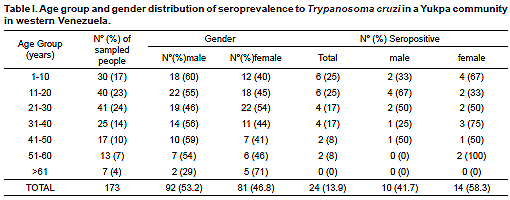
<body><![CDATA[<p align="justify">designed from the divergent domain of the 24 S&#945; RNA gene  described by Souto <i>et al. </i></font><font SIZE="2"><font face="Verdana"> (1996), and primers</font></p>     <p align="justify"><font face="Verdana">TC (5´- CCCCCCTCCCAGGCCACACTG-3´),</font></p>     <p align="justify"><font face="Verdana">TC1 (5´- GTGTCCGCCACCTCCTTCGGGCC-3´)</font></p>     <p align="justify"><font face="Verdana">and </font></p>     <p align="justify"><font face="Verdana">TC2 (5´- CCTGCAGGCACACGTGTGTGTG-3´)</font></p> </font><font FACE="Verdana" SIZE="2">     <p align="justify">for amplification of an intergenic region of the mini-exon  gene described by Souto <i>et al. </i>(1996). The PCR amplified product was  separated by electrophoresis in </font><font SIZE="2"><font face="Verdana">3%  agarose gels, and stained with ethidium bromide. </font></p>     <p align="justify"><font face="Verdana"><b>RESULTS</b> </font></p>     <p align="justify"><font face="Verdana">Serological analyses carried out in 173  individuals belonging to a Yukpa community from western Venezuela showed  positive results for anti-</font></font><font FACE="Verdana" SIZE="2"><i>T.  cruzi </i>Abs in 24 (13.9%) of them. Except for the group over 60 years old,  seropositives were detected in all the remaining study age groups regardless  gender. During clinical examination the evaluated people did not show evidence  of being suffering or have suffered Chagas disease. Although none of them  recognized typical signs or symptoms attributable to <i>T. cruzi</i>-infection,  most of the people were able to recognize triatomine-bug vectors (Shuparaku) as  well as various mammal hosts as possible reservoirs of the parasite. Details on  evaluated people including age group, gender and distribution of <i>T. cruzi </i> </font><font SIZE="2"><font face="Verdana">seropositivity is presented in <a href="#tab1">Table I</a>.</font></font></p>     <p align="center"><font SIZE="2"><a name="tab1"> <img border="0" src="/img/fbpe/bmsa/v51n2/art06tab1.gif" width="510" height="200"></a></p>     
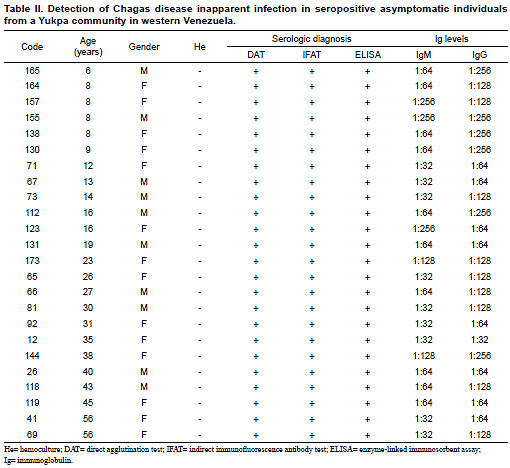
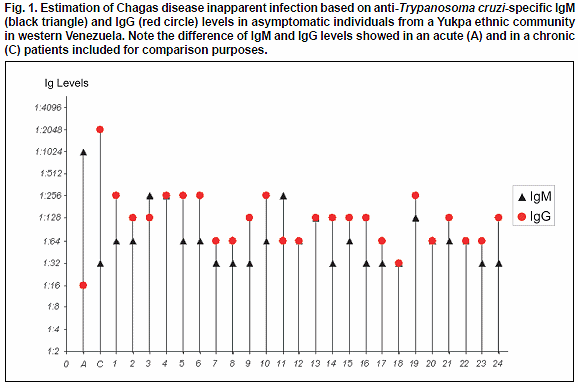
<p align="justify"><font face="Verdana">The presence of anti-</font></font><font FACE="Verdana" SIZE="2"><i>T.  cruzi </i>Abs was detected in healthy asymptomatic individuals with ages between  6 to 56 years old. Seropositivity was confirmed with the 3 serological methods  used in each of the examined individual from the Yukpa community. In addition,  using IFAT all the examined samples from seropositives revealed anti-<i>T. cruzi </i>specific IgM and IgG low levels with titers corresponding to dilutions  between 1:32 to 1:256, which defined them as bearing <i>T. cruzi </i>inapparent  infections according to the criteria established in the present work. No blood  circulating trypomastigotes of <i>T. cruzi </i>were detected in any of the  evaluated people when hemoculture and PCR assay were used to detect the parasite  itself or portion of its genome. <a href="#tab2">Table II</a> shows details of  the results obtained in the 24 seropositive individuals from the studied  community including each serologic test used and the level of IgM/IgG detected  during the analysis. Results of Ig (M and G) levels obtained in all the  seropositive individuals were compared to those detected in the included acute  and chronic chagasic patient positive controls, and are shown in <a href="#fig1"> Fig. 1</a>.</font></p>     ]]></body>
<body><![CDATA[<p align="center"><font FACE="Verdana" SIZE="2"><a name="tab2"> <img border="0" src="/img/fbpe/bmsa/v51n2/art06tab2.gif" width="510" height="468"></a></font></p>     
<p align="center"><font FACE="Verdana" SIZE="2"><a name="fig1"> <img border="0" src="/img/fbpe/bmsa/v51n2/art06fig1.gif" width="578" height="388"></a></p>     
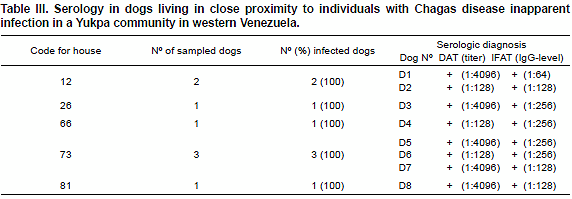
<p align="justify">Similarly, examination of dogs living in close proximity to  the above referred seropositive individuals also showed negative results for  circulating parasites and positive results for anti-<i>T. cruzi </i>Abs. In all  of them, high Ab-titters were detected according to the DAT test. However, IFAT  analysis detected specific <i>T. cruzi </i></font><font SIZE="2"> <font face="Verdana">IgG at dilutions of 1:64 to 1:256 supporting result  obtained in the human group. Details on the results in examined dogs are shown  in <a href="#tab3">Table III</a>.</font></font></p>     <p align="center"><font SIZE="2"><a name="tab3"> <img border="0" src="/img/fbpe/bmsa/v51n2/art06tab3.gif" width="572" height="199"></a></p>     
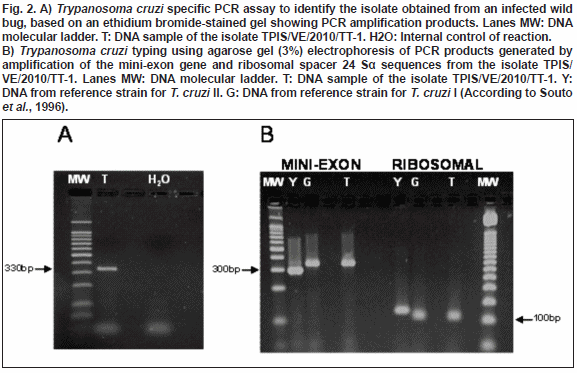
<p align="justify"><font face="Verdana">A </font></font> <font FACE="Verdana" SIZE="2"><i>T. cruzi </i>isolate from a natural infected  wild specimen of R.pictipes was obtained and <font SIZE="2">named as TPIS/VE/2010/TT-1  following expert’s recommendation (Anonymous, 1999). The isolate was molecularly  identified with a PCR assay specific for <i>T. cruzi </i>which amplified a  fragment of 330bp from a kDNA minicircle variable region (<a href="#fig2">Fig.  2A</a>). Additionally, the isolate was genetically typed through a specific PCR  amplification based on the divergent domain of the 24S&#945; RNA gene (D71/D72) and  the intergenic region of the mini-exon gene (TC/TC1/TC2) generating 110bp and  350bp DNA bands for ribosomal and mini-exon genes, respectively, corresponding  to <i>T. cruzi </i>DTU 1 (lineage I) as shown in <a href="#fig2">Fig. 2B</a>.</font></font></p>     <p align="center"><font SIZE="2" FACE="Verdana"><a name="fig2"> <img border="0" src="/img/fbpe/bmsa/v51n2/art06fig2.gif" width="577" height="373"></a></p>     
<p align="justify"><b>DISCUSSION</b> </p>     <p align="justify">In the present study, from a total of 173 blood samples  belonging to members of a Yukpa community serologically tested to detect  circulating anti-<i>T. cruzi </i>Abs, 24 (13.9%) satisfied the established  criteria to be considered as seropositives. The coincidence of the three  serological methods used to diagnose the infected people, together with the  physical healthy condition of the seropositive individuals confirmed during  clinical examination, their testimony at the time of sampling they had never  exhibited symptoms attributable to Chagas disease and the lack of previous  report in the area of symptomatic chagasic patients, suggested the existence of <i>T. cruzi </i>inapparent infection in this indigenous community. </p>     <p align="justify">Although the sample size analyzed during this preliminary  study seems to be insufficient to reach any conclusion on the significance of  Chagas disease inapparent infections in this community, the interesting fact is  that most of the infections were detected in the young population. In fact, from  the 24 seropositive individuals detected during the sampling 25% were children  under 10 years old, and a similar figure in the group up to 20 years old. These  findings appear to support early ideas on inapparent infections proposed by  Nicolle (1933), creator of the concept, who at the same time, stressed the  importance to estimate to what degree this kind of infections affect children,  since it should act as a potential genesis of an epidemic. </p>     <p align="justify">Clinical events attributable to Chagas disease in the study  Yukpa community is, at present, unknown. However, risk factors detected here  including the presence of triatomine-bugs and <i>T. cruzi</i>-isolates as well  as infected animals and human hosts and excellent conducive environmental  conditions for the development of the disease provide arguments to consider the  region as potentially endemic for Chagas disease. </p>     ]]></body>
<body><![CDATA[<p align="justify">The fact that non acute and/or chronic cases have occurred  during the last years may possibly be attributed to a special immunological  condition present in the entire Yukpa population. This condition, together with  a scanty number of parasites provoking infection after contacting with <i>T.  cruzi</i>-infected wild bugs, may explain the presence of the here detected  inapparent infection in the study community. The above argument seems to be  supported by the excellent physical conditions observed in the screened people  and the unsuccessful results obtained when houses were examined indoor looking  for triatomine bugs. It is necessary to stress that the only bug collected from  the study was a specimen of R. pictipes, which is basically a sylvatic species  generally found in palm trees and in bromeliads ( Lent &amp; Wigodzinsky, 1979).  Although the collected bug showed a heavy infection, which allowed the isolation,  identification and genetic typing of the circulating <i>T. cruzi</i>, the  infrequent finding of the insect vector indoors may suggest another way to get  the infection. This should be possibly attributed to infected domestic and/or  wild mammal hosts. </font><font SIZE="2"><font face="Verdana">Suspicion for the  former is based on all the examined dogs that resulted to be seropositives  during the study, and for the latter, due to the common practice to hunt and eat  wild animals, that highly probably were associated with infected bugs. In  addition, as informed by local people, in this routine practice are involved  dogs, hunters and all the family members who may infect themselves by  establishing contact with parasites circulating in the blood, which is also  frequently ingested without cooking it, in the belief that it cures some  diseases (Shaman, 2011, personal communication). </font></p>     <p align="justify"><font face="Verdana">Whatever the way infection is attained  what appears to be important is the high proportion of seropositives detected in  this indigenous community </font></font><font FACE="Verdana" SIZE="2">which  uncover a nearly 14% seroprevalence, a figure significantly higher than the  recorded average for areas where Chagas disease is endemic in Venezuela (Añez <i> et al</i>., 2003; 2004; Feliciangeli <i>et al.</i>, 2003; Suarez <i>et al.</i>,  2004; Sanchez-Martin <i>et al.</i></font><font SIZE="2"><font face="Verdana">,  2006). </font></p>     <p align="justify"><font face="Verdana">More impressive seems to be the fact  that 25% of the 24 infected individuals were children from 6 to 9 years old, who  were strongly reactive in all the serological methods used for diagnosis,  showing all of them IgG levels between 1:128 and 1:256 which </font></font> <font FACE="Verdana" SIZE="2">represent 40% (6/15) of the seropositive people  bearing the highest titters for this <i>T. cruzi </i>specific Ig. These figures  are reinforced by the fact that 20% of the screened children under 10 showed to  be infected, a result also detected in the group from 11 to 20 years which  revealed a 15% (6/40) of infection. </p>     <p align="justify">These findings seem to indicate that <i>T. cruzi </i> infection is, at present, an active event in the Yukpa community judging by its  frequent appearance in the young population, which appears to have a special  resistance to the parasite since they do not show the typical symptoms related  to Chagas disease observed in other endemic areas (Añez <i>et al.</i>, 1999a;  1999b). However, a much more detailed study is suggested in order to establish  the cause provoking the asymptomatic clinical profile and the low threshold  humoral response in the <i>T. cruzi </i></font><font SIZE="2"> <font face="Verdana">seropositive people detected during the present work. </font></p>     <p align="justify"><font face="Verdana">The examination of dogs living in close  proximity to members of the community that resulted seropositives to </font> </font><font FACE="Verdana" SIZE="2"><i>T. cruzi </i>bearing Chagas disease  inapparent infection, served to evaluate the role of these animals as a  potential risk factor in the maintenance of the parasite in the study area.  Indeed, the fact that 100% of the dogs sampled in 5 of the houses showed to be  seropositive appears to indicate that this mammal should be incriminated in the  circulation of <i>T. cruzi </i>in the yukpa community acting as a source for  infection to human, as previously reported in areas where Chagas disease is  endemic (Zeledon <i>et al.</i>, 1973; Gürtler <i>et a.</i>., 1996; Crisante <i> et al</i></font><font SIZE="2"><font face="Verdana">., 2006). </font></p>     <p align="justify"><font face="Verdana">One more point to be added to the  aforementioned facts that may have potential </font></font> <font FACE="Verdana" SIZE="2">epidemiological importance, is the finding of the  circulation of <i>T. cruzi </i></font><font SIZE="2"><font face="Verdana"> lineage I (DTU1) carried by R. pictipes, a species that so far has not been  incriminated in the transmission of Chagas disease in Venezuela. </font></p>     <p align="justify"><font face="Verdana">Finally, the results obtained in this  preliminary </font></font><font FACE="Verdana" SIZE="2">study, detecting for the  first time Chagas disease </font><font SIZE="2"><font face="Verdana">inapparent  infection in the Yukpas, may serve to call the attention for the potential  epidemiological problem in this indigenous community, and also suggest that more  investigation must be done in all aspects concerning this parasitic disease. </font></p>     <p align="justify"><font face="Verdana"><b>CONFLICT OF INTERESTS</b>: None  declared.</font></p>     <p align="justify"><font face="Verdana"><b>ACKNOWLEDGEMENTS</b> </font></p>     <p align="justify"><font face="Verdana">This work was supported by grant from  FONACIT-G-2005-000370 (N.A.). G. Crisante and A. Rojas are Ph.D. students of the  Biotecnology of Microorganism Post Graduate Program, Universidad de Los  Andes-Mérida, Venezuela. A. Bracho is a Ph.D. student of the National  Parasitology Post Graduate Program, Universidad Central de Venezuela,  Caracas-Venezuela. We are indebted to Prof. G. Fermin for carefully reviewing  the manuscript. This modest contribution is dedicated to the people of Toromo. </font></p>     ]]></body>
<body><![CDATA[<p align="justify"><b><font face="Verdana">REFERENCES</font></b></p>     <!-- ref --><p align="justify"><font face="Verdana">1. Anonymous (1999). Recommendations  from a satellite meeting. </font></font><font FACE="Verdana" SIZE="2"><i>Mem.  Inst. Oswaldo Cruz. </i><b>94: </b></font><font SIZE="2"><font face="Verdana"> 429-432. </font>&nbsp;&nbsp;&nbsp;&nbsp;&nbsp;&nbsp;&nbsp;&nbsp;[&#160;<a href="javascript:void(0);" onclick="javascript: window.open('/scielo.php?script=sci_nlinks&ref=2843663&pid=S1690-4648201100020000600001&lng=','','width=640,height=500,resizable=yes,scrollbars=1,menubar=yes,');">Links</a>&#160;]<!-- end-ref --><!-- ref --><p align="justify"><font face="Verdana">2. Añez N., Carrasco H., Parada H.,  Crisante G., Rojas A., González N., et al. (1999a). Acute Chagas Disease in  western Venezuela: A clinical, seroparasitologic, and epidemiologic study. </font></font><font FACE="Verdana" SIZE="2"><i>Am. J. Trop. Med. Hyg. </i><b>60: </b></font><font SIZE="2"><font face="Verdana">215-222. </font>&nbsp;&nbsp;&nbsp;&nbsp;&nbsp;&nbsp;&nbsp;&nbsp;[&#160;<a href="javascript:void(0);" onclick="javascript: window.open('/scielo.php?script=sci_nlinks&ref=2843664&pid=S1690-4648201100020000600002&lng=','','width=640,height=500,resizable=yes,scrollbars=1,menubar=yes,');">Links</a>&#160;]<!-- end-ref --><!-- ref --><p align="justify"><font face="Verdana">3. Añez N., Carrasco H., Parada H.,  Crisante G., Rojas A., Fuenmayor C., </font></font> <font FACE="Verdana" SIZE="2"><i>et al. </i>(1999b). Myocardial parasite  persistence in chronic chagasic patients. <i>Am. J. Trop. Med. Hyg. </i><b>60: </b></font><font SIZE="2"><font face="Verdana">726-732.</font>&nbsp;&nbsp;&nbsp;&nbsp;&nbsp;&nbsp;&nbsp;&nbsp;[&#160;<a href="javascript:void(0);" onclick="javascript: window.open('/scielo.php?script=sci_nlinks&ref=2843665&pid=S1690-4648201100020000600003&lng=','','width=640,height=500,resizable=yes,scrollbars=1,menubar=yes,');">Links</a>&#160;]<!-- end-ref --><!-- ref --><p align="justify"><font face="Verdana">4. Añez N., Crisante G., Rojas A.,  Carrasco H., Parada H., Yepez Y., </font></font><font FACE="Verdana" SIZE="2"> <i>et al. </i>(2001). Detection and significance of inapparent infection in  Chagas Disease in Western Venezuela. <i>Am. J. Trop. Med. Hyg. </i><b>65: </b> </font><font SIZE="2"><font face="Verdana">227-232. </font>&nbsp;&nbsp;&nbsp;&nbsp;&nbsp;&nbsp;&nbsp;&nbsp;[&#160;<a href="javascript:void(0);" onclick="javascript: window.open('/scielo.php?script=sci_nlinks&ref=2843666&pid=S1690-4648201100020000600004&lng=','','width=640,height=500,resizable=yes,scrollbars=1,menubar=yes,');">Links</a>&#160;]<!-- end-ref --><!-- ref --><p align="justify"><font face="Verdana">5. Añez N., Crisante G., Rojas A., Diaz  N., Añez-Rojas N., Carrasco H., Parada H. </font></font> <font FACE="Verdana" SIZE="2"><i>et al. </i>(2003). La cara oculta de la  enfermedad de Chagas en Venezuela. <i>Bol. Mal. Salud. Amb. </i><b>43: </b> </font><font SIZE="2"><font face="Verdana">45-57.</font>&nbsp;&nbsp;&nbsp;&nbsp;&nbsp;&nbsp;&nbsp;&nbsp;[&#160;<a href="javascript:void(0);" onclick="javascript: window.open('/scielo.php?script=sci_nlinks&ref=2843667&pid=S1690-4648201100020000600005&lng=','','width=640,height=500,resizable=yes,scrollbars=1,menubar=yes,');">Links</a>&#160;]<!-- end-ref --><!-- ref --><p align="justify"><font face="Verdana">6. Añez N., Crisante G. &amp; Rojas A.  (2004). Update on Chagas Disease in Venezuela - A Review. </font></font> <font FACE="Verdana" SIZE="2"><i>Mem. Inst. Oswaldo Cruz. </i><b>99: </b></font> <font SIZE="2"><font face="Verdana">781-787. </font>&nbsp;&nbsp;&nbsp;&nbsp;&nbsp;&nbsp;&nbsp;&nbsp;[&#160;<a href="javascript:void(0);" onclick="javascript: window.open('/scielo.php?script=sci_nlinks&ref=2843668&pid=S1690-4648201100020000600006&lng=','','width=640,height=500,resizable=yes,scrollbars=1,menubar=yes,');">Links</a>&#160;]<!-- end-ref --><!-- ref --><p align="justify"><font face="Verdana">7. Añez N., Crisante G., Caraballo F.,  Delgado W. &amp; Parada H. (2011). </font></font><font FACE="Verdana" SIZE="2"><i> Trypanosoma cruzi </i>persistence at oral inflammatory foci in chronic chagasic  patients. <i>Acta Trop. </i><b>117: </b></font><font SIZE="2"> <font face="Verdana">207-211.</font>&nbsp;&nbsp;&nbsp;&nbsp;&nbsp;&nbsp;&nbsp;&nbsp;[&#160;<a href="javascript:void(0);" onclick="javascript: window.open('/scielo.php?script=sci_nlinks&ref=2843669&pid=S1690-4648201100020000600007&lng=','','width=640,height=500,resizable=yes,scrollbars=1,menubar=yes,');">Links</a>&#160;]<!-- end-ref --><!-- ref --><p align="justify"><font face="Verdana">8. Crisante G., Rojas A., Teixeira M. M.  G. &amp; Añez N. (2006). Infected dogs as a risk factor in the transmission of human </font></font><font FACE="Verdana" SIZE="2"><i>Trypanosoma cruzi </i>infection  in western Venezuela. <i>Acta Trop. </i><b>98: </b></font><font SIZE="2"> <font face="Verdana">247-254. </font>&nbsp;&nbsp;&nbsp;&nbsp;&nbsp;&nbsp;&nbsp;&nbsp;[&#160;<a href="javascript:void(0);" onclick="javascript: window.open('/scielo.php?script=sci_nlinks&ref=2843670&pid=S1690-4648201100020000600008&lng=','','width=640,height=500,resizable=yes,scrollbars=1,menubar=yes,');">Links</a>&#160;]<!-- end-ref --><!-- ref --><p align="justify"><font face="Verdana">9. Feliciangeli M. D., Campbell-Lendrum  D., Martinez C., Gonzalez D., Coleman P. &amp; Davis C. (2003). Chagas disease  control in Venezuela: Lessons for the Andean region and beyond. </font></font> <font FACE="Verdana" SIZE="2"><i>Trends Parasitol. </i><b>19: </b>11-19.&nbsp;&nbsp;&nbsp;&nbsp;&nbsp;&nbsp;&nbsp;&nbsp;[&#160;<a href="javascript:void(0);" onclick="javascript: window.open('/scielo.php?script=sci_nlinks&ref=2843671&pid=S1690-4648201100020000600009&lng=','','width=640,height=500,resizable=yes,scrollbars=1,menubar=yes,');">Links</a>&#160;]<!-- end-ref --><!-- ref --><p align="justify">10. Garnham P. C. C. (1980). The significance of inapparent  infections in Chagas disease and other forms of trypanosomiasis. <i>Mem. Inst.  Oswaldo Cruz. </i><b>75: </b></font><font SIZE="2"><font face="Verdana">181-188.</font>&nbsp;&nbsp;&nbsp;&nbsp;&nbsp;&nbsp;&nbsp;&nbsp;[&#160;<a href="javascript:void(0);" onclick="javascript: window.open('/scielo.php?script=sci_nlinks&ref=2843672&pid=S1690-4648201100020000600010&lng=','','width=640,height=500,resizable=yes,scrollbars=1,menubar=yes,');">Links</a>&#160;]<!-- end-ref --><!-- ref --><p align="justify"><font face="Verdana">11. Gürtler R. E., Cecere M. C.,  Castanera M. B., Canale D., Lauricella M. A., Chuit R. &amp; Segura E. L. (1996).  Probability of infection with </font></font><font FACE="Verdana" SIZE="2"><i> Trypanosoma cruzi </i>of the vector Triatoma infestans fed on infected humans  and dogs in northwest Argentina. <i>Am. J. Trop. Med. Hyg. </i><b>55: </b> </font><font SIZE="2"><font face="Verdana">24-31. </font>&nbsp;&nbsp;&nbsp;&nbsp;&nbsp;&nbsp;&nbsp;&nbsp;[&#160;<a href="javascript:void(0);" onclick="javascript: window.open('/scielo.php?script=sci_nlinks&ref=2843673&pid=S1690-4648201100020000600011&lng=','','width=640,height=500,resizable=yes,scrollbars=1,menubar=yes,');">Links</a>&#160;]<!-- end-ref --><!-- ref --><p align="justify"><font face="Verdana">12. Lent H. &amp; Wygodzinsky P. (1979).  Revision of the Triatominae (Hemiptera:Reduviidae) and their </font></font> <font FACE="Verdana" SIZE="2">significance as vectors of Chagas disease. <i> Bull. Am. Mus. Nat. Hist. </i><b>163: </b></font><font SIZE="2"> <font face="Verdana">125-520.</font>&nbsp;&nbsp;&nbsp;&nbsp;&nbsp;&nbsp;&nbsp;&nbsp;[&#160;<a href="javascript:void(0);" onclick="javascript: window.open('/scielo.php?script=sci_nlinks&ref=2843674&pid=S1690-4648201100020000600012&lng=','','width=640,height=500,resizable=yes,scrollbars=1,menubar=yes,');">Links</a>&#160;]<!-- end-ref --><!-- ref --><p align="justify"><font face="Verdana">13. Nicolle C. (1933). Les infections  inapparentes. </font></font><font FACE="Verdana" SIZE="2"><i>Scientia. </i><b> 33: </b></font><font SIZE="2"><font face="Verdana">181-271.</font>&nbsp;&nbsp;&nbsp;&nbsp;&nbsp;&nbsp;&nbsp;&nbsp;[&#160;<a href="javascript:void(0);" onclick="javascript: window.open('/scielo.php?script=sci_nlinks&ref=2843675&pid=S1690-4648201100020000600013&lng=','','width=640,height=500,resizable=yes,scrollbars=1,menubar=yes,');">Links</a>&#160;]<!-- end-ref --><!-- ref --><p align="justify"><font face="Verdana">14. Sanchez-Martin M. J., Feliciangeli  M. D., Campbell-Lendrum D. &amp; Davis C. R. (2006). Could the Chagas disease  elimination programme in Venezuela be compromised by reinvasion of houses by  sylvatic Rhodnius prolixus bug populations? </font></font> <font FACE="Verdana" SIZE="2"><i>Trop. Med. Int. Health. </i><b>2: </b></font> <font SIZE="2"><font face="Verdana">1585-1593.</font>&nbsp;&nbsp;&nbsp;&nbsp;&nbsp;&nbsp;&nbsp;&nbsp;[&#160;<a href="javascript:void(0);" onclick="javascript: window.open('/scielo.php?script=sci_nlinks&ref=2843676&pid=S1690-4648201100020000600014&lng=','','width=640,height=500,resizable=yes,scrollbars=1,menubar=yes,');">Links</a>&#160;]<!-- end-ref --><!-- ref --><p align="justify"><font face="Verdana">15. Schijman A.G., Bisio M., Crisante G., Añez  N., </font></font><font FACE="Verdana" SIZE="2"><i>et al.</i>  (2011). International study to evaluate PCR methods for detection of <i> Trypanosoma cruzi </i>DNA in blood samples from Chagas disease patients. PLOS  Neglected Tropical Diseases. <b>5(1): </b></font><font SIZE="2"> <font face="Verdana">e931.</font>&nbsp;&nbsp;&nbsp;&nbsp;&nbsp;&nbsp;&nbsp;&nbsp;[&#160;<a href="javascript:void(0);" onclick="javascript: window.open('/scielo.php?script=sci_nlinks&ref=2843677&pid=S1690-4648201100020000600015&lng=','','width=640,height=500,resizable=yes,scrollbars=1,menubar=yes,');">Links</a>&#160;]<!-- end-ref --><!-- ref --><p align="justify"><font face="Verdana">16. Souto R. P., Fernandes O., Macedo A.  M., Campbell </font></font><font FACE="Verdana" SIZE="2">D. A. &amp; Zingales B.  (1996). DNA markers define two major phylogenetic lineages of <i>Trypanosoma  cruzi</i>. <i>Mol. Bioch. Parasitol. </i><b>83: </b>141-152. &nbsp;&nbsp;&nbsp;&nbsp;&nbsp;&nbsp;&nbsp;&nbsp;[&#160;<a href="javascript:void(0);" onclick="javascript: window.open('/scielo.php?script=sci_nlinks&ref=2843678&pid=S1690-4648201100020000600016&lng=','','width=640,height=500,resizable=yes,scrollbars=1,menubar=yes,');">Links</a>&#160;]<!-- end-ref --><!-- ref --><p align="justify">17. Suárez B., Hernández M., Duque N., Martínez C. &amp;  Feliciangeli M. D. (2004). Conocimiento sobre la enfermedad de Chagas en los  estados Barinas y Portuguesa, Venezuela. <i>Bol. Mal. Salud Amb. </i><b>44: </b> 109-118. &nbsp;&nbsp;&nbsp;&nbsp;&nbsp;&nbsp;&nbsp;&nbsp;[&#160;<a href="javascript:void(0);" onclick="javascript: window.open('/scielo.php?script=sci_nlinks&ref=2843679&pid=S1690-4648201100020000600017&lng=','','width=640,height=500,resizable=yes,scrollbars=1,menubar=yes,');">Links</a>&#160;]<!-- end-ref --><!-- ref --><p align="justify">18. WHO/PAHO (2008). In: <i>Schijman, A. (Ed.) Workshop on  standardization and validation of clinical use of PCR for </i>Trypanosoma cruzi <i>DNA detection in Chagas disease</i></font><font SIZE="2"><font face="Verdana">.  LAMMECH INGEBI-CONICET, Buenos Aires, Argentina. </font>&nbsp;&nbsp;&nbsp;&nbsp;&nbsp;&nbsp;&nbsp;&nbsp;[&#160;<a href="javascript:void(0);" onclick="javascript: window.open('/scielo.php?script=sci_nlinks&ref=2843680&pid=S1690-4648201100020000600018&lng=','','width=640,height=500,resizable=yes,scrollbars=1,menubar=yes,');">Links</a>&#160;]<!-- end-ref --><!-- ref --><p align="justify"><font face="Verdana">19. Zeledon R., Solano G., Zúñiga A. &amp;  Swartzwelder J. C. (1973). Biology and ethology of Triatoma dimidiata (Latreillie,  1811). III. Habitat and blood sources. </font></font> <font FACE="Verdana" SIZE="2"><i>J. Med. Entomol. </i><b>10: </b>363-370.</font>&nbsp;&nbsp;&nbsp;&nbsp;&nbsp;&nbsp;&nbsp;&nbsp;[&#160;<a href="javascript:void(0);" onclick="javascript: window.open('/scielo.php?script=sci_nlinks&ref=2843681&pid=S1690-4648201100020000600019&lng=','','width=640,height=500,resizable=yes,scrollbars=1,menubar=yes,');">Links</a>&#160;]<!-- end-ref --> ]]></body>
<back>
<ref-list>
<ref id="B1">
<label>1</label><nlm-citation citation-type="journal">
<person-group person-group-type="author">
<name>
</name>
<name>
</name>
</person-group>
<article-title xml:lang="en"><![CDATA[Recommendations from a satellite meeting]]></article-title>
<source><![CDATA[Mem. Inst. Oswaldo Cruz.]]></source>
<year>1999</year>
<volume>94</volume>
<page-range>429-432</page-range></nlm-citation>
</ref>
<ref id="B2">
<label>2</label><nlm-citation citation-type="journal">
<person-group person-group-type="author">
<name>
<surname><![CDATA[Añez]]></surname>
<given-names><![CDATA[N.]]></given-names>
</name>
<name>
<surname><![CDATA[Carrasco]]></surname>
<given-names><![CDATA[H.]]></given-names>
</name>
<name>
<surname><![CDATA[Parada]]></surname>
<given-names><![CDATA[H.]]></given-names>
</name>
<name>
<surname><![CDATA[Crisante]]></surname>
<given-names><![CDATA[G.]]></given-names>
</name>
<name>
<surname><![CDATA[Rojas]]></surname>
<given-names><![CDATA[A.]]></given-names>
</name>
<name>
<surname><![CDATA[González]]></surname>
<given-names><![CDATA[N.]]></given-names>
</name>
</person-group>
<article-title xml:lang="en"><![CDATA[Acute Chagas Disease in western Venezuela: A clinical, seroparasitologic, and epidemiologic study]]></article-title>
<source><![CDATA[Am. J. Trop. Med. Hyg.]]></source>
<year>1999</year>
<month>a</month>
<volume>60</volume>
<page-range>215-222</page-range></nlm-citation>
</ref>
<ref id="B3">
<label>3</label><nlm-citation citation-type="journal">
<person-group person-group-type="author">
<name>
<surname><![CDATA[Añez]]></surname>
<given-names><![CDATA[N.]]></given-names>
</name>
<name>
<surname><![CDATA[Carrasco]]></surname>
<given-names><![CDATA[H.]]></given-names>
</name>
<name>
<surname><![CDATA[Parada]]></surname>
<given-names><![CDATA[H.]]></given-names>
</name>
<name>
<surname><![CDATA[Crisante]]></surname>
<given-names><![CDATA[G.]]></given-names>
</name>
<name>
<surname><![CDATA[Rojas]]></surname>
<given-names><![CDATA[A.]]></given-names>
</name>
<name>
<surname><![CDATA[Fuenmayor]]></surname>
<given-names><![CDATA[C.]]></given-names>
</name>
</person-group>
<article-title xml:lang="en"><![CDATA[Myocardial parasite persistence in chronic chagasic patients]]></article-title>
<source><![CDATA[Am. J. Trop. Med. Hyg.]]></source>
<year>1999</year>
<month>b</month>
<volume>60</volume>
<page-range>726-732</page-range></nlm-citation>
</ref>
<ref id="B4">
<label>4</label><nlm-citation citation-type="journal">
<person-group person-group-type="author">
<name>
<surname><![CDATA[Añez]]></surname>
<given-names><![CDATA[N.]]></given-names>
</name>
<name>
<surname><![CDATA[Crisante]]></surname>
<given-names><![CDATA[G.]]></given-names>
</name>
<name>
<surname><![CDATA[Rojas]]></surname>
<given-names><![CDATA[A.]]></given-names>
</name>
<name>
<surname><![CDATA[Carrasco]]></surname>
<given-names><![CDATA[H.]]></given-names>
</name>
<name>
<surname><![CDATA[Parada]]></surname>
<given-names><![CDATA[H.]]></given-names>
</name>
<name>
<surname><![CDATA[Yepez]]></surname>
<given-names><![CDATA[Y.]]></given-names>
</name>
</person-group>
<article-title xml:lang="en"><![CDATA[Detection and significance of inapparent infection in Chagas Disease in Western Venezuela]]></article-title>
<source><![CDATA[Am. J. Trop. Med. Hyg.]]></source>
<year>2001</year>
<volume>65</volume>
<page-range>227-232</page-range></nlm-citation>
</ref>
<ref id="B5">
<label>5</label><nlm-citation citation-type="journal">
<person-group person-group-type="author">
<name>
<surname><![CDATA[Añez]]></surname>
<given-names><![CDATA[N.]]></given-names>
</name>
<name>
<surname><![CDATA[Crisante]]></surname>
<given-names><![CDATA[G.]]></given-names>
</name>
<name>
<surname><![CDATA[Rojas]]></surname>
<given-names><![CDATA[A.]]></given-names>
</name>
<name>
<surname><![CDATA[Diaz]]></surname>
<given-names><![CDATA[N.]]></given-names>
</name>
<name>
<surname><![CDATA[Añez-Rojas]]></surname>
<given-names><![CDATA[N.]]></given-names>
</name>
<name>
<surname><![CDATA[Carrasco]]></surname>
<given-names><![CDATA[H.]]></given-names>
</name>
<name>
<surname><![CDATA[Parada]]></surname>
<given-names><![CDATA[H.]]></given-names>
</name>
</person-group>
<article-title xml:lang="es"><![CDATA[La cara oculta de la enfermedad de Chagas en Venezuela]]></article-title>
<source><![CDATA[Bol. Mal. Salud. Amb.]]></source>
<year>2003</year>
<volume>43</volume>
<page-range>45-57</page-range></nlm-citation>
</ref>
<ref id="B6">
<label>6</label><nlm-citation citation-type="journal">
<person-group person-group-type="author">
<name>
<surname><![CDATA[Añez]]></surname>
<given-names><![CDATA[N.]]></given-names>
</name>
<name>
<surname><![CDATA[Crisante]]></surname>
<given-names><![CDATA[G.]]></given-names>
</name>
<name>
<surname><![CDATA[Rojas]]></surname>
<given-names><![CDATA[A]]></given-names>
</name>
</person-group>
<article-title xml:lang="en"><![CDATA[Update on Chagas Disease in Venezuela - A Review]]></article-title>
<source><![CDATA[Mem. Inst. Oswaldo Cruz.]]></source>
<year>2004</year>
<volume>99</volume>
<page-range>781-787</page-range></nlm-citation>
</ref>
<ref id="B7">
<label>7</label><nlm-citation citation-type="journal">
<person-group person-group-type="author">
<name>
<surname><![CDATA[Añez]]></surname>
<given-names><![CDATA[N.]]></given-names>
</name>
<name>
<surname><![CDATA[Crisante]]></surname>
<given-names><![CDATA[G.]]></given-names>
</name>
<name>
<surname><![CDATA[Caraballo]]></surname>
<given-names><![CDATA[F.]]></given-names>
</name>
<name>
<surname><![CDATA[Delgado]]></surname>
<given-names><![CDATA[W.]]></given-names>
</name>
<name>
<surname><![CDATA[Parada]]></surname>
<given-names><![CDATA[H]]></given-names>
</name>
</person-group>
<article-title xml:lang="en"><![CDATA[Trypanosoma cruzi persistence at oral inflammatory foci in chronic chagasic patients]]></article-title>
<source><![CDATA[Acta Trop.]]></source>
<year>2011</year>
<volume>117</volume>
<page-range>207-211</page-range></nlm-citation>
</ref>
<ref id="B8">
<label>8</label><nlm-citation citation-type="journal">
<person-group person-group-type="author">
<name>
<surname><![CDATA[Crisante]]></surname>
<given-names><![CDATA[G.]]></given-names>
</name>
<name>
<surname><![CDATA[Rojas]]></surname>
<given-names><![CDATA[A.]]></given-names>
</name>
<name>
<surname><![CDATA[Teixeira]]></surname>
<given-names><![CDATA[M. M. G.]]></given-names>
</name>
<name>
<surname><![CDATA[Añez]]></surname>
<given-names><![CDATA[N]]></given-names>
</name>
</person-group>
<article-title xml:lang="en"><![CDATA[Infected dogs as a risk factor in the transmission of human Trypanosoma cruzi infection in western Venezuela]]></article-title>
<source><![CDATA[Acta Trop.]]></source>
<year>2006</year>
<volume>98</volume>
<page-range>247-254</page-range></nlm-citation>
</ref>
<ref id="B9">
<label>9</label><nlm-citation citation-type="journal">
<person-group person-group-type="author">
<name>
<surname><![CDATA[Feliciangeli]]></surname>
<given-names><![CDATA[M. D.]]></given-names>
</name>
<name>
<surname><![CDATA[Campbell-Lendrum]]></surname>
<given-names><![CDATA[D.]]></given-names>
</name>
<name>
<surname><![CDATA[Martinez]]></surname>
<given-names><![CDATA[C.]]></given-names>
</name>
<name>
<surname><![CDATA[Gonzalez]]></surname>
<given-names><![CDATA[D.]]></given-names>
</name>
<name>
<surname><![CDATA[Coleman]]></surname>
<given-names><![CDATA[P.]]></given-names>
</name>
<name>
<surname><![CDATA[Davis]]></surname>
<given-names><![CDATA[C]]></given-names>
</name>
</person-group>
<article-title xml:lang="en"><![CDATA[Chagas disease control in Venezuela: Lessons for the Andean region and beyond]]></article-title>
<source><![CDATA[Trends Parasitol.]]></source>
<year>2003</year>
<volume>19</volume>
<page-range>11-19</page-range></nlm-citation>
</ref>
<ref id="B10">
<label>10</label><nlm-citation citation-type="journal">
<person-group person-group-type="author">
<name>
<surname><![CDATA[Garnham]]></surname>
<given-names><![CDATA[P. C. C]]></given-names>
</name>
</person-group>
<article-title xml:lang="en"><![CDATA[The significance of inapparent infections in Chagas disease and other forms of trypanosomiasis]]></article-title>
<source><![CDATA[Mem. Inst. Oswaldo Cruz.]]></source>
<year>1980</year>
<volume>75</volume>
<page-range>181-188</page-range></nlm-citation>
</ref>
<ref id="B11">
<label>11</label><nlm-citation citation-type="journal">
<person-group person-group-type="author">
<name>
<surname><![CDATA[Gürtler]]></surname>
<given-names><![CDATA[R. E.]]></given-names>
</name>
<name>
<surname><![CDATA[Cecere]]></surname>
<given-names><![CDATA[M. C.]]></given-names>
</name>
<name>
<surname><![CDATA[Castanera]]></surname>
<given-names><![CDATA[M. B.]]></given-names>
</name>
<name>
<surname><![CDATA[Canale]]></surname>
<given-names><![CDATA[D.]]></given-names>
</name>
<name>
<surname><![CDATA[Lauricella]]></surname>
<given-names><![CDATA[M. A.]]></given-names>
</name>
<name>
<surname><![CDATA[Chuit]]></surname>
<given-names><![CDATA[R.]]></given-names>
</name>
<name>
<surname><![CDATA[Segura]]></surname>
<given-names><![CDATA[E. L]]></given-names>
</name>
</person-group>
<article-title xml:lang="en"><![CDATA[Probability of infection with Trypanosoma cruzi of the vector Triatoma infestans fed on infected humans and dogs in northwest Argentina]]></article-title>
<source><![CDATA[Am. J. Trop. Med. Hyg.]]></source>
<year>1996</year>
<volume>55</volume>
<page-range>24-31</page-range></nlm-citation>
</ref>
<ref id="B12">
<label>12</label><nlm-citation citation-type="journal">
<person-group person-group-type="author">
<name>
<surname><![CDATA[Lent]]></surname>
<given-names><![CDATA[H.]]></given-names>
</name>
<name>
<surname><![CDATA[Wygodzinsky]]></surname>
<given-names><![CDATA[P]]></given-names>
</name>
</person-group>
<article-title xml:lang="en"><![CDATA[Revision of the Triatominae (Hemiptera:Reduviidae) and their significance as vectors of Chagas disease]]></article-title>
<source><![CDATA[Bull. Am. Mus. Nat. Hist.]]></source>
<year>1979</year>
<volume>163</volume>
<page-range>125-520</page-range></nlm-citation>
</ref>
<ref id="B13">
<label>13</label><nlm-citation citation-type="journal">
<person-group person-group-type="author">
<name>
<surname><![CDATA[Nicolle]]></surname>
<given-names><![CDATA[C]]></given-names>
</name>
</person-group>
<article-title xml:lang="fr"><![CDATA[Les infections inapparentes]]></article-title>
<source><![CDATA[Scientia.]]></source>
<year>1933</year>
<volume>33</volume>
<page-range>181-271</page-range></nlm-citation>
</ref>
<ref id="B14">
<label>14</label><nlm-citation citation-type="journal">
<person-group person-group-type="author">
<name>
<surname><![CDATA[Sanchez-Martin]]></surname>
<given-names><![CDATA[M. J.]]></given-names>
</name>
<name>
<surname><![CDATA[Feliciangeli]]></surname>
<given-names><![CDATA[M. D.]]></given-names>
</name>
<name>
<surname><![CDATA[Campbell-Lendrum]]></surname>
<given-names><![CDATA[D.]]></given-names>
</name>
<name>
<surname><![CDATA[Davis]]></surname>
<given-names><![CDATA[C. R]]></given-names>
</name>
</person-group>
<article-title xml:lang="en"><![CDATA[Could the Chagas disease elimination programme in Venezuela be compromised by reinvasion of houses by sylvatic Rhodnius prolixus bug populations?]]></article-title>
<source><![CDATA[Trop. Med. Int. Health.]]></source>
<year>2006</year>
<volume>2</volume>
<page-range>1585-1593</page-range></nlm-citation>
</ref>
<ref id="B15">
<label>15</label><nlm-citation citation-type="journal">
<person-group person-group-type="author">
<name>
<surname><![CDATA[Schijman]]></surname>
<given-names><![CDATA[A.G.]]></given-names>
</name>
<name>
<surname><![CDATA[Bisio]]></surname>
<given-names><![CDATA[M.]]></given-names>
</name>
<name>
<surname><![CDATA[Crisante]]></surname>
<given-names><![CDATA[G.]]></given-names>
</name>
<name>
<surname><![CDATA[Añez]]></surname>
<given-names><![CDATA[N.]]></given-names>
</name>
</person-group>
<article-title xml:lang="en"><![CDATA[International study to evaluate PCR methods for detection of Trypanosoma cruzi DNA in blood samples from Chagas disease patients]]></article-title>
<source><![CDATA[PLOS Neglected Tropical Diseases.]]></source>
<year>2011</year>
<volume>5</volume>
<numero>1</numero>
<issue>1</issue>
<page-range>e931</page-range></nlm-citation>
</ref>
<ref id="B16">
<label>16</label><nlm-citation citation-type="journal">
<person-group person-group-type="author">
<name>
<surname><![CDATA[Souto]]></surname>
<given-names><![CDATA[R. P.]]></given-names>
</name>
<name>
<surname><![CDATA[Fernandes]]></surname>
<given-names><![CDATA[O.]]></given-names>
</name>
<name>
<surname><![CDATA[Macedo]]></surname>
<given-names><![CDATA[A. M.]]></given-names>
</name>
<name>
<surname><![CDATA[Campbell]]></surname>
<given-names><![CDATA[D. A.]]></given-names>
</name>
<name>
<surname><![CDATA[Zingales]]></surname>
<given-names><![CDATA[B]]></given-names>
</name>
</person-group>
<article-title xml:lang="en"><![CDATA[DNA markers define two major phylogenetic lineages of Trypanosoma cruzi]]></article-title>
<source><![CDATA[Mol. Bioch. Parasitol.]]></source>
<year>1996</year>
<volume>83</volume>
<page-range>141-152</page-range></nlm-citation>
</ref>
<ref id="B17">
<label>17</label><nlm-citation citation-type="journal">
<person-group person-group-type="author">
<name>
<surname><![CDATA[Suárez]]></surname>
<given-names><![CDATA[B.]]></given-names>
</name>
<name>
<surname><![CDATA[Hernández]]></surname>
<given-names><![CDATA[M.]]></given-names>
</name>
<name>
<surname><![CDATA[Duque]]></surname>
<given-names><![CDATA[N.]]></given-names>
</name>
<name>
<surname><![CDATA[Martínez]]></surname>
<given-names><![CDATA[C.]]></given-names>
</name>
<name>
<surname><![CDATA[Feliciangeli]]></surname>
<given-names><![CDATA[M. D]]></given-names>
</name>
</person-group>
<article-title xml:lang="es"><![CDATA[Conocimiento sobre la enfermedad de Chagas en los estados Barinas y Portuguesa, Venezuela]]></article-title>
<source><![CDATA[Bol. Mal. Salud Amb.]]></source>
<year>2004</year>
<volume>44</volume>
<page-range>109-118</page-range></nlm-citation>
</ref>
<ref id="B18">
<label>18</label><nlm-citation citation-type="book">
<collab>WHO/PAHO</collab>
<person-group person-group-type="author">
<name>
<surname><![CDATA[Schijman]]></surname>
<given-names><![CDATA[A]]></given-names>
</name>
</person-group>
<source><![CDATA[Workshop on standardization and validation of clinical use of PCR for Trypanosoma cruzi DNA detection in Chagas disease.]]></source>
<year>2008</year>
<publisher-loc><![CDATA[Buenos Aires ]]></publisher-loc>
<publisher-name><![CDATA[LAMMECH INGEBI-CONICET]]></publisher-name>
</nlm-citation>
</ref>
<ref id="B19">
<label>19</label><nlm-citation citation-type="journal">
<person-group person-group-type="author">
<name>
<surname><![CDATA[Zeledon]]></surname>
<given-names><![CDATA[R.]]></given-names>
</name>
<name>
<surname><![CDATA[Solano]]></surname>
<given-names><![CDATA[G.]]></given-names>
</name>
<name>
<surname><![CDATA[Zúñiga]]></surname>
<given-names><![CDATA[A.]]></given-names>
</name>
<name>
<surname><![CDATA[Swartzwelder]]></surname>
<given-names><![CDATA[J. C]]></given-names>
</name>
</person-group>
<article-title xml:lang="en"><![CDATA[Biology and ethology of Triatoma dimidiata (Latreillie, 1811).: III. Habitat and blood sources]]></article-title>
<source><![CDATA[J. Med. Entomol.]]></source>
<year>1973</year>
<volume>10</volume>
<page-range>363-370</page-range></nlm-citation>
</ref>
</ref-list>
</back>
</article>