<?xml version="1.0" encoding="ISO-8859-1"?><article xmlns:mml="http://www.w3.org/1998/Math/MathML" xmlns:xlink="http://www.w3.org/1999/xlink" xmlns:xsi="http://www.w3.org/2001/XMLSchema-instance">
<front>
<journal-meta>
<journal-id>0004-0622</journal-id>
<journal-title><![CDATA[Archivos Latinoamericanos de Nutrición]]></journal-title>
<abbrev-journal-title><![CDATA[ALAN]]></abbrev-journal-title>
<issn>0004-0622</issn>
<publisher>
<publisher-name><![CDATA[Sociedad Latinoamericana de Nutrición]]></publisher-name>
</publisher>
</journal-meta>
<article-meta>
<article-id>S0004-06222000000100011</article-id>
<title-group>
<article-title xml:lang="es"><![CDATA[Elaboración de un yogurt con base en una mezcla de leche y garbanzo (Cicer arietinum)]]></article-title>
</title-group>
<contrib-group>
<contrib contrib-type="author">
<name>
<surname><![CDATA[Morales de León]]></surname>
<given-names><![CDATA[Josefina C]]></given-names>
</name>
<xref ref-type="aff" rid="A01"/>
</contrib>
<contrib contrib-type="author">
<name>
<surname><![CDATA[Cassís Nosthas]]></surname>
<given-names><![CDATA[Ma. Lorena]]></given-names>
</name>
<xref ref-type="aff" rid="A01"/>
</contrib>
<contrib contrib-type="author">
<name>
<surname><![CDATA[Cortés Penedo]]></surname>
<given-names><![CDATA[Elizabeth]]></given-names>
</name>
<xref ref-type="aff" rid="A01"/>
</contrib>
</contrib-group>
<aff id="A01">
<institution><![CDATA[,Instituto Nacional de la Nutricion Salvador Zubiran  ]]></institution>
<addr-line><![CDATA[México, D.F ]]></addr-line>
</aff>
<pub-date pub-type="pub">
<day>00</day>
<month>03</month>
<year>2000</year>
</pub-date>
<pub-date pub-type="epub">
<day>00</day>
<month>03</month>
<year>2000</year>
</pub-date>
<volume>50</volume>
<numero>1</numero>
<fpage>81</fpage>
<lpage>86</lpage>
<copyright-statement/>
<copyright-year/>
<self-uri xlink:href="http://ve.scielo.org/scielo.php?script=sci_arttext&amp;pid=S0004-06222000000100011&amp;lng=en&amp;nrm=iso"></self-uri><self-uri xlink:href="http://ve.scielo.org/scielo.php?script=sci_abstract&amp;pid=S0004-06222000000100011&amp;lng=en&amp;nrm=iso"></self-uri><self-uri xlink:href="http://ve.scielo.org/scielo.php?script=sci_pdf&amp;pid=S0004-06222000000100011&amp;lng=en&amp;nrm=iso"></self-uri><abstract abstract-type="short" xml:lang="es"><p><![CDATA[El presente trabajo, tuvo como objetivo determinar las condiciones experimentales de elaboración de un yogurt extendido con garbanzo (Cicer arietinum L.), inoculado con St. thermophilus y L bulgaricus, para compararlo fisicoquímica, microbiológica y sensorialmente con un yogurt elaborado con base en leche descremada. Los resultados obtenidos indicaron que de las mezclas obtenidas por el método de calificación química (cálculo de aminoácidos) que cumplieron con los objetivos propuestos fueron la mezcla 70:30 y 80:20 (leche descremada: extracto de garbanzo). Los yogurt elaborados con la mezcla 70:30 adicionados con almidones modificados (ULTRA SPERCE M y COL-FLO) , no eliminaron la sinéresis presente en los productos así como tampoco mejoraron las características sensoriales de los mismos; sin embargo, en el yogurt elaborado con la mezcla 80:20, y el almidón modificado (ULTRA SPERCE M.) se logró eliminar la sinéresis obteniéndose un yogurt «extendido» con características de sabor y textura similar a la de un yogurt elaborado con base en leche, el cuál fue aceptado por el 80% de los jueces y que cumple además con las especificaciones de la norma oficial mexicana para yogurt.]]></p></abstract>
<abstract abstract-type="short" xml:lang="en"><p><![CDATA[Elaboration of yogurt made of milk and chickpea (Cicer arietinum) mixture. The objective of ibis work was to establish the experimental conditions for the production of yogurt extended with chickpea (Cicer arietinum), inoculated with St. thermophilus and L. bulgaricus and compare its chemical, microbiological and sensorial characteristics versus a yogurt made of skimmed milk. Results indicated that 70:30 and 80:20 (skimmed milk and chickpea extract) mixtures obtained by chemical score fulfilled with the proposed objectives. Yogurt made with 70:30 mixture added with modified starch (UL- TRA SPERCE M and COL-FLO), did not remove syneresis present in these products and did not improve its sensory characteristics neither. Nevertheless, yogurt made with 80:20 mixture and modified starch (ULTRA SPERCE M) removed syneresis and present flavor and texture characteristics alike yogurt made of milk, this "extended" yogurt was accepted by the 80% of the judge and fulfill with yogurt specification established in the mexican regulations for this products.]]></p></abstract>
<kwd-group>
<kwd lng="es"><![CDATA[Yogurt]]></kwd>
<kwd lng="es"><![CDATA[extensor]]></kwd>
<kwd lng="es"><![CDATA[garbanzo]]></kwd>
<kwd lng="en"><![CDATA[Yogurt]]></kwd>
<kwd lng="en"><![CDATA[extend]]></kwd>
<kwd lng="en"><![CDATA[chickpea]]></kwd>
</kwd-group>
</article-meta>
</front><body><![CDATA[   <B><FONT SIZE=4>    <P ALIGN="CENTER">Elaboraci&oacute;n de un yogurt con base en una mezcla de leche y garbanzo <I>(Cicer arietinum)</P> </B></FONT>    <P ALIGN="CENTER">Josefina </I>C. <I>Morales de Le&oacute;n, Ma. Lorena Cass&iacute;s Nosthas. Elizabeth Cort&eacute;s Penedo</P> </I>    <P ALIGN="CENTER">Instituto Nacional de la Nutrici&oacute;n Salvador Zubir&aacute;n (INNSZ), M&eacute;xico, D.F.</P> <B>    <P ALIGN="JUSTIFY">RESUMEN</B>. </P>     <P ALIGN="JUSTIFY">&nbsp;&nbsp;&nbsp; El presente trabajo, tuvo como objetivo determinar las condiciones experimentales de elaboraci&oacute;n de un yogurt extendido con garbanzo <I>(Cicer arietinum L.), </I>inoculado con <I>St. thermophilus y L bulgaricus, </I>para compararlo fisicoqu&iacute;mica, microbiol&oacute;gica y sensorialmente con un yogurt elaborado con base en leche descremada. Los resultados obtenidos indicaron que de las mezclas obtenidas por el m&eacute;todo de calificaci&oacute;n qu&iacute;mica (c&aacute;lculo de amino&aacute;cidos) que cumplieron con los objetivos propuestos fueron la mezcla 70:30 y 80:20 (leche descremada: extracto de garbanzo). Los yogurt elaborados con la mezcla 70:30 adicionados con almidones modificados (ULTRA SPERCE M y COL-FLO) , no eliminaron la sin&eacute;resis presente en los productos as&iacute; como tampoco mejoraron las caracter&iacute;sticas sensoriales de los mismos; sin embargo, en el yogurt elaborado con la mezcla 80:20, y el almid&oacute;n modificado (ULTRA SPERCE M.) se logr&oacute; eliminar la sin&eacute;resis obteni&eacute;ndose un yogurt «extendido» con caracter&iacute;sticas de sabor y textura similar a la de un yogurt elaborado con base en leche, el cu&aacute;l fue aceptado por el 80% de los jueces y que cumple adem&aacute;s con las especificaciones de la norma oficial mexicana para yogurt. </P> <B>    <P ALIGN="JUSTIFY">Palabras clave</B>: Yogurt, «extensor», garbanzo. </P> <B>    <P ALIGN="JUSTIFY">SUMMARY. </P>     <P ALIGN="JUSTIFY">&nbsp;&nbsp;&nbsp; Elaboration of yogurt made of milk and chickpea <I>(Cicer arietinum) </I>mixture</B>. The objective of ibis work was to establish the experimental conditions for the production of yogurt extended with chickpea <I>(Cicer arietinum), </I>inoculated with <I>St. thermophilus </I>and <I>L. bulgaricus </I>and compare its chemical, microbiological and sensorial characteristics versus a yogurt made of skimmed milk. Results indicated that 70:30 and 80:20 (skimmed milk and chickpea extract) mixtures obtained by chemical score fulfilled with the proposed objectives. Yogurt made with 70:30 mixture added with modified starch (UL- TRA SPERCE M and COL-FLO), did not remove syneresis present in these products and did not improve its sensory characteristics neither. Nevertheless, yogurt made with 80:20 mixture and modified starch (ULTRA SPERCE M) removed syneresis and present flavor and texture characteristics alike yogurt made of milk, this "extended" yogurt was accepted by the 80% of the judge and fulfill with yogurt specification established in the mexican regulations for this products. </P> <B>    <P ALIGN="JUSTIFY">Key words</B>: Yogurt, "extend", chickpea. </P>     ]]></body>
<body><![CDATA[<P ALIGN="JUSTIFY">Recibido: 06-01-1999 Aceptado: 16-12-1999</P> <B>    <P>INTRODUCCION</P> </B>    <P ALIGN="JUSTIFY">&nbsp;&nbsp;&nbsp; Desde hace varios a&ntilde;os, M&eacute;xico se ha enfrentado a una producci&oacute;n insuficiente de leche, no solo para consumo como leche fluida sino tambi&eacute;n para la elaboraci&oacute;n de derivados l&aacute;cteos, situaci&oacute;n que en los &uacute;ltimos a&ntilde;os se ha visto agravada por el incremento de la poblaci&oacute;n, un menor poder adquisitivo, la poca productividad de los hatos lecheros, el acaparamiento del producto en las grandes ciudades, los sistemas de distribuci&oacute;n, etc. <B><SUP>(1,7)</B></SUP> </P>     <P ALIGN="JUSTIFY">&nbsp;&nbsp;&nbsp; Las estad&iacute;sticas informan que para octubre de 1997, la producci&oacute;n nacional de leche fue de 727.1 millones de litros, sin embargo, esta producci&oacute;n no fue suficiente para cubrir la demanda para consumo como leche fluida as&iacute; como para la elaboraci&oacute;n de productos l&aacute;cteos, por lo que fue complementada con importaciones, donde la leche en polvo fue la m&aacute;s importante. <B><SUP>(2,20)</B></SUP> </P>     <P ALIGN="JUSTIFY">&nbsp;&nbsp;&nbsp; Particularmente, las leches fermentadas se han consumido durante miles de a&ntilde;os, su historia se relaciona no s&oacute;lo con su sabor agradable y ligeramente &aacute;cido, sino tambi&eacute;n con su mayor per&iacute;odo de conservaci&oacute;n en comparaci&oacute;n con la leche. En las d&eacute;cadas recientes, se ha puesto mayor inter&eacute;s en los efectos ben&eacute;ficos potenciales de las leches fermentadas sobre la salud, lo que ha impactado en los vol&uacute;menes de venta y la variedad disponible de &eacute;stos productos alrededor del mundo. <B><SUP>(2)</B></SUP> </P>     <P ALIGN="JUSTIFY">&nbsp;&nbsp;&nbsp; El yogurt, es un producto resultante de la fermentaci&oacute;n de la lactosa por acci&oacute;n de las bacterias <I>St. themophilus </I>y <I>L. bulgaricus </I>con producci&oacute;n de &aacute;cido l&aacute;ctico. <B><SUP>(3)</B></SUP> En M&eacute;xico, el consumo nacional de yogurt en 1980 fue de 15 mil toneladas lo que represent&oacute; el 8% del total de los derivados l&aacute;cteos producidos; en 1985, el consumo se elev&oacute; a 32 mil toneladas (incremento mayor al 100%) y para 1990 se estim&oacute; un consumo de unas 49 mil toneladas, lo que nos indica un incremento creciente de la demanda. <B><SUP>(17) </B></SUP>Para octubre de 1997, el incremento en la producci&oacute;n nacional y en las importaciones de &eacute;ste derivado l&aacute;cteo, fue de 131,809 y 537 toneladas, respectivamente. </P>     <P ALIGN="JUSTIFY">&nbsp;&nbsp;&nbsp; Las leguminosas, particularmente el garbanzo <I>(Cicer arietinum) </I>ocupa el tercer lugar de producci&oacute;n nacional despu&eacute;s del frijol <I>(Phaseolus vulgaris) </I>y la soya <I>(Glicine max); </I>sin embargo, el grano que se utiliza para consumo humano, normalmente se exporta a otros pa&iacute;ses, pero solamente el 80% del mismo cumple con las normas comerciales, el 20% restante se destina en su mayor&iacute;a para alimento animal, con lo que se pierde una fuente importante de prote&iacute;na, <B><SUP>(5,6)</B></SUP> la cu&aacute;l puede utilizarse para el desarrollo de nuevos productos. </P>     <P ALIGN="JUSTIFY">&nbsp;&nbsp;&nbsp; El sustituir parcialmente un, producto de mayor costo por otro similar pero de menor precio, se conoce como "extensi&oacute;n". Para que sea aceptable, se requiere que la "extensi&oacute;n" de los productos se realice con materias primas que conserven o mejoren las caracter&iacute;sticas sanitarias y nutricias de las materias primas que sustituyen. <B><SUP>(13)</B></SUP> </P>     <P ALIGN="JUSTIFY">&nbsp;&nbsp;&nbsp; La utilizaci&oacute;n del garbanzo y otras leguminosas como el frijol y la soya, han sido informadas por diferentes autores; <B><SUP>(7- 9)</B></SUP> Pinthong et al. desarrollaron un yogurt con base en soya y le adicionaron St. <I>thermophilus </I>y <I>L. bulgaricus, </I>con el objeto de mejorar el sabor y la aceptaci&oacute;n de &eacute;ste tipo de productos. <B><SUP>(10)</B></SUP> Tambi&eacute;n, en &eacute;ste mismo a&ntilde;o, Schmidt et al, informaron los efectos del tratamiento t&eacute;rmico y del almacenamiento sobre las caracter&iacute;sticas f&iacute;sicas y sensoriales, en un yogurt «fortificado» con aislado de soya. <B><SUP>(11)</B></SUP> Garc&iacute;a, G.M.I. en 1986, desarroll&oacute; un producto tipo yogurt, elaborado con soya, al con el objeto de mantener las caracter&iacute;sticas de sabor, aroma y consistencia similares a las de un yogurt elaborado con base en leche y un nivel de aceptaci&oacute;n del producto del 80% de la poblaci&oacute;n utilizada en el estudio. <B><SUP>(12)</B></SUP> Shirai et al., evaluaron la aceptaci&oacute;n de un yogurt con base en una mezcla de soya, harina de avena y suero de leche, adicionada con diferentes cultivos iniciadores y aditivos. <B><SUP>(13)</B></SUP> </P>     <P ALIGN="JUSTIFY">&nbsp;&nbsp;&nbsp; Con base en lo anterior, los objetivos del presente estudio fueron: determinar las condiciones experimentales de elaboraci&oacute;n de un yogurt extendido con garbanzo (Cicer <I>arietinum</I>) y evaluar f&iacute;sica, qu&iacute;mica, microbiol&oacute;gica y sensorialmente el yogurt extendido, en comparaci&oacute;n con un yogurt elaborado con base en leche. </P> <B>    ]]></body>
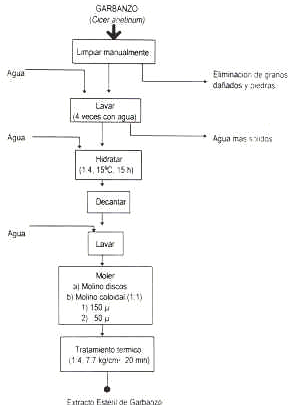
<body><![CDATA[<P>MATERIAL Y METODOS</P>     <P ALIGN="JUSTIFY">Desarrollo experimental </P> </B>    <P ALIGN="JUSTIFY">&nbsp;&nbsp;&nbsp; Con el fin de conocer la composici&oacute;n y la calidad sanitaria de las materias primas (garbanzo y leche descremada), se llevaron a cabo an&aacute;lisis qu&iacute;micos y microbiol&oacute;gicos. </P>     <P ALIGN="JUSTIFY">&nbsp;&nbsp;&nbsp; El cultivo mixto de inoculaci&oacute;n directa <I>(Lactobacilus bulgaricus </I>y <I>Streptococcus thermophilus) </I>se seleccion&oacute; con base en los resultados de diversos estudios <B><SUP>(6,7,10,12)</B></SUP> de los que se observ&oacute; que, &eacute;ste cultivo mixto proporciona las caracter&iacute;sticas f&iacute;sicas y sensoriales de un yogurt, producto objetivo del presente trabajo. </P>     <P ALIGN="JUSTIFY">&nbsp;&nbsp;&nbsp; Para obtener el extracto est&eacute;ril de garbanzo, se sigui&oacute; el diagrama de elaboraci&oacute;n que se presenta en la <a href="#fig1">Figura 1</a>. <B><SUP>(14)</B></SUP> La pasta obtenida se someti&oacute; a an&aacute;lisis microbiol&oacute;gico, con el fin de confirmar la ausencia de microorganismos en el extracto. </P> <B><a name="fig1"></a>    <P align="center">FIGURA 1</P> </B>    <P ALIGN="CENTER">Proceso de obtenci&oacute;n de extracto est&eacute;ril de garbanzo <B><SUP>(14)</P> </B></SUP>    <P ALIGN="CENTER"><IMG SRC="/img/fbpe/alan/v50n1/art11img1.gif" WIDTH=289 HEIGHT=405></P>     
<P ALIGN="JUSTIFY">&nbsp;&nbsp;&nbsp; Las mezclas te&oacute;ricas de leche y garbanzo se obtuvieron mediante el m&eacute;todo de c&aacute;lculo qu&iacute;mico (en &eacute;ste se calcula el amino&aacute;cido limitante en las mezclas) en las que la concentraci&oacute;n de materias primas var&iacute;a de 10 en 10 iniciando con 100% leche y 0% garbanzo, hasta 0% leche y 100% garbanzo. De &eacute;stas mezclas, se seleccionaron aquellas que cumplieron con una relaci&oacute;n metionina m&aacute;s cistina m&iacute;nima del 80% con respecto al patr&oacute;n FAO/OMS. Las mezclas seleccionadas se prepararon y se caracterizaron mediante pruebas f&iacute;sicas y sensoriales; las mezclas que presentaron un color igual al de la leche, fueron las que se seleccionaron para continuar el estudio. </P>     <P ALIGN="JUSTIFY">&nbsp;&nbsp;&nbsp; Se elaboraron los yogurt extendidos con garbanzo as&iacute; como tambi&eacute;n un yogurt testigo elaborado con base en leche descremada, de acuerdo al diagrama que se presenta en la <a href="#fig2">Figura 2</a> (A y B). Los yogurt elaborados deber&iacute;an reunir las siguientes especificaciones: un contenido m&iacute;nimo de prote&iacute;na de 3.4 g/100g, un m&iacute;nimo de 12% de s&oacute;lidos, un pH menos de 4.5, y una acidez de 0.8 a 1.8 g &aacute;c.l&aacute;ctico/100 g de muestra. </P>     ]]></body>
<body><![CDATA[<P ALIGN="JUSTIFY">&nbsp;&nbsp;&nbsp; Se contempl&oacute; la adici&oacute;n de estabilizantes particularmente Col-Flo 67 y Ultra Sperse M<SUP>(1)</SUP>, con el objeto de evitar sin&eacute;resis en los yogurt extendidos con garbanzo, adicion&aacute;ndose en una concentraci&oacute;n de12%, recomendada por el proveedor. </P>     <P ALIGN="JUSTIFY">&nbsp;&nbsp;&nbsp; Los productos finalmente obtenidos, se caracterizaron por medio de an&aacute;lisis qu&iacute;mico, f&iacute;sico, microbiol&oacute;gico y sensorial. </P> <B>    <P ALIGN="JUSTIFY">M&eacute;todos de an&aacute;lisis </P> </B>    <P ALIGN="JUSTIFY">&nbsp;&nbsp;&nbsp; Los an&aacute;lisis a los que se sometieron tanto las materias primas como el yogurt con base en leche (testigo) y el yogurt extendido con garbanzo fueron: </P> <I>    <P ALIGN="JUSTIFY">&nbsp;&nbsp;&nbsp; An&aacute;lisis qu&iacute;mico </I>de acuerdo a las t&eacute;cnicas oficiales del AOAC <B><SUP>(15) </B></SUP>en las que se incluye humedad (925.09), cenizas </P> <I>    <P ALIGN="JUSTIFY">&nbsp;&nbsp;&nbsp;</I> <I>An&aacute;lisis qu&iacute;mico</I> de acuerdo a las t&eacute;cnicas oficiales del AOAC <B><SUP>(15)</B></SUP> en las que se incluye humedad (925.09), cenizas (923.03), prote&iacute;na (976.05), extracto et&eacute;reo (920.39), fibra cruda (962.09). Los hidratos de carbono, se calculan restando a 100, la suma de los valores obtenidos en las citadas determinaciones. </P> <I>    <P ALIGN="JUSTIFY">&nbsp;&nbsp;&nbsp; Acidez total titulable (ATT), </I>de acuerdo a la t&eacute;cnica oficial del AOAC (m&eacute;todo potenciom&eacute;trico). <B><SUP>(15)</P> </B></SUP><I>    <P ALIGN="JUSTIFY">&nbsp;&nbsp;&nbsp; An&aacute;lisis microbiol&oacute;gicos, </I>de acuerdo a las t&eacute;cnicas del manual de microbiolog&iacute;a del INNSZ, <B><SUP>(16)</B></SUP> en las que se incluye: cuenta total, cuenta total de bacterias l&aacute;cticas, cuenta total de coliformes totales, hongos y levaduras, <I>Salmonella </I>y <I>Staphylococcus aureus </I>.</P> <I>    <P ALIGN="JUSTIFY">&nbsp;&nbsp;&nbsp; Color y sabor de las mezclas. </I>Las mezclas preparadas con base en garbanzo y leche descremada, se evaluaron con respecto al color, por 10 personas no entrenadas, a las que se les pidi&oacute; que compararan cada una de ellas con una muestra de leche como referencia. En cuanto al sabor, a &eacute;stas mismas personas se les pidi&oacute; que degustaran cada una de las mezclas e indicaran aquella o aquellas muestras que no presentaran sabor predominante a garbanzo. </P> <I>    <P ALIGN="JUSTIFY">&nbsp;&nbsp;&nbsp; Determinaci&oacute;n del pH. </I>de acuerdo a la t&eacute;cnica del potenci&oacute;metro orion-research, modelo 601-A. <B><SUP>(17)</B></SUP> </P> <I>    ]]></body>
<body><![CDATA[<P ALIGN="JUSTIFY">&nbsp;&nbsp;&nbsp; S&oacute;lidos totales </I>(%), por medio de un refract&oacute;metro abb&eacute;. <B><SUP>(18)</B></SUP> </P> <I>    <P ALIGN="JUSTIFY">&nbsp;&nbsp;&nbsp; Viscosidad, </I>por medio de un viscos&iacute;metro de brookfield, modelo RV, spin No.7, 20 r.p.m. </P> <I>    <P ALIGN="JUSTIFY">&nbsp;&nbsp;&nbsp; Evaluaci&oacute;n Sensorial. </I>Los yogurt extendidos con garbanzo se evaluaron a nivel laboratorio, participaron 30 jueces no entrenados, consumidores de yogurt. A &eacute;stas personas se les aplic&oacute; una prueba de Nivel de Agrado con escala hed&oacute;nica de 7 puntos, en donde 1 corresponde a "Disgusta Mucho" y 7 a "Gusta Mucho". Para la interpretaci&oacute;n estad&iacute;stica de la comparaci&oacute;n de ambos productos, se aplic&oacute; una prueba t-student a una p 0.05. Se calcul&oacute; tambi&eacute;n el porcentaje de aceptaci&oacute;n de los yogurt evaluados tomando como base que los 30 sujetos representan el 100%. <B><SUP>(20,21)</B></SUP> </P> <B><a name="fig2"></a>    <P align="center">FIGURA 2</P> </B>    <P ALIGN="CENTER">Proceso de elaboraci&oacute;n de yogurt con base en leche y de un yogurt extendido con extracto est&eacute;ril de garbanzo</P>     <P ALIGN="CENTER"><IMG SRC="/img/fbpe/alan/v50n1/art11img2.gif" WIDTH=319 HEIGHT=419></P> <B>    
<P>RESULTADOS Y DISCUSI&Oacute;N</P> </B>    <P ALIGN="JUSTIFY">&nbsp;&nbsp;&nbsp; En la <a href="#tab1">Tabla 1</a> se presentan los resultados del an&aacute;lisis qu&iacute;mico de las materias primas.</P> <B><a name="tab1"></a>    <P align="center">TABLA 1</P> </B>    <P ALIGN="CENTER">An&aacute;lisis qu&iacute;mico de las materias primas (g/100g)</P>     ]]></body>
<body><![CDATA[<P ALIGN="CENTER">&nbsp;</P>     <P ALIGN="CENTER">    <div align="center">     <P ALIGN="CENTER">    <CENTER><TABLE BORDER="1" CELLSPACING=1 WIDTH=530> <TR><TD WIDTH="205" VALIGN="TOP">     <P>Determinaci&oacute;n</TD> <TD WIDTH="148" VALIGN="TOP">     <P ALIGN="CENTER">Leche descremada</TD> <TD WIDTH="155" VALIGN="TOP">     <P ALIGN="CENTER">Garbanzo (Cicer arietinum)</TD> </TR> <TR><TD WIDTH="205" VALIGN="TOP">     <P>Humedad</P>     <P>Cenizas</P>     ]]></body>
<body><![CDATA[<P>Fibra cruda</P>     <P>Prote&iacute;na*</P>     <P>Extracto et&eacute;reo</P>     <P>Hidratos de carbono **</TD> <TD WIDTH="148" VALIGN="TOP">     <P ALIGN="CENTER">4.0</P>     <P ALIGN="CENTER">8.0</P>     <P ALIGN="CENTER">-</P>     <P ALIGN="CENTER">36.1</P>     <P ALIGN="CENTER">0.9</P>     <P ALIGN="CENTER">51.2</TD> <TD WIDTH="155" VALIGN="TOP">     ]]></body>
<body><![CDATA[<P ALIGN="CENTER">9.9</P>     <P ALIGN="CENTER">2.9</P>     <P ALIGN="CENTER">3.2</P>     <P ALIGN="CENTER">16.3</P>     <P ALIGN="CENTER">6.4</P>     <P ALIGN="CENTER">61.</TD> </TR> </TABLE> </CENTER></div>     <p>&nbsp;&nbsp;&nbsp;&nbsp;&nbsp;&nbsp;&nbsp;&nbsp;&nbsp;&nbsp;&nbsp;&nbsp;&nbsp;&nbsp;&nbsp;&nbsp;&nbsp;&nbsp;&nbsp; * Nitr&oacute;geno x 6.38 para leche&nbsp;</p>     <p>&nbsp;&nbsp;&nbsp;&nbsp;&nbsp;&nbsp;&nbsp;&nbsp;&nbsp;&nbsp;&nbsp;&nbsp;&nbsp;&nbsp;&nbsp;&nbsp;&nbsp;&nbsp;&nbsp; Nitr&oacute;geno x 6.25 para garbanzo</p> &nbsp;&nbsp;&nbsp;&nbsp;&nbsp;&nbsp;&nbsp;&nbsp;&nbsp;&nbsp;&nbsp;&nbsp;&nbsp;&nbsp;&nbsp;&nbsp;&nbsp;&nbsp;&nbsp; **Por diferencia      <P ALIGN="JUSTIFY">&nbsp;&nbsp;&nbsp; En cuanto al an&aacute;lisis microbiol&oacute;gico (<a href="#tab2">Tabla 2</a>) de la leche descremada, se puede observar que la cuenta total de mes&oacute;filos, hongos y levaduras, coliformes as&iacute; como <I>Salmonella y </I>S. <I>aureus, </I>se encuentran dentro de los l&iacute;mites establecidos por la Norma Oficial para leche (50,000 UFC/g, Menos de 10 UFC/ g, NMP menos de 3/g, y Negativo en 25g respectivamente). <B><SUP>(21,23)</B></SUP> Para el extracto de garbanzo, <B><SUP>(14)</B></SUP> despu&eacute;s del tratamiento t&eacute;rmico, se encontr&oacute; exento de microorganismos. </P> <B><a name="tab2"></a>    <P align="center">TABLA 2</P> </B>    ]]></body>
<body><![CDATA[<P ALIGN="CENTER">An&aacute;lisis microbil&oacute;gico de la leche descremada y garbanzo (Cicer arietinum)</P>     <P ALIGN="CENTER">&nbsp;</P>     <div align="center">    <CENTER><TABLE BORDER="1" CELLSPACING=1 WIDTH=527> <TR><TD WIDTH="180" VALIGN="TOP">     <P>Determinaci&oacute;n</TD> <TD WIDTH="168" VALIGN="TOP">     <P ALIGN="CENTER">Leche descremada</TD> <TD WIDTH="157" VALIGN="TOP">     <P ALIGN="CENTER">Garbanzo (Cicer arietinum)</TD> </TR> <TR><TD WIDTH="180" VALIGN="TOP">     <P>Cuenta Total</P>     <P>Hongos y Levaduras</P>     <P>Coliformes Totales</P>     ]]></body>
<body><![CDATA[<P>Coliformes Fecales</P> <I>    <P>Salmonella</P>     <P>S.aureus</I></TD> <TD WIDTH="168" VALIGN="TOP">     <P ALIGN="CENTER">22 X 10<SUP>3</SUP> UFC/g</P>     <P ALIGN="CENTER">Menos de 10 UFC/g</P>     <P ALIGN="CENTER">NMP menos de 3/g</P>     <P ALIGN="CENTER">NMP menos de 3/g</P>     <P ALIGN="CENTER">Negativo en 25 g</P>     <P ALIGN="CENTER">Menos de 10 UFC/g</TD> <TD WIDTH="157" VALIGN="TOP">     <P ALIGN="CENTER">Menos de 10 UFC/g</P>     ]]></body>
<body><![CDATA[<P ALIGN="CENTER">Menos de 10 UFC/g</P>     <P ALIGN="CENTER">NMP menos de 3/g</P>     <P ALIGN="CENTER">NMP menos de 3/g</P>     <P ALIGN="CENTER">Negativo en 25 g</P>     <P ALIGN="CENTER">Menos de 10 UFC/g</TD> </TR> </TABLE> </CENTER>      <P ALIGN="CENTER"></div>     <P ALIGN="JUSTIFY">&nbsp;&nbsp;&nbsp; En la <a href="#tab3">Tabla 3</a> se presenta el porcentaje de metionina + cistina y triptofano obtenido en las mezclas te&oacute;ricas de leche y garbanzo; se observa que de las 11 mezclas obtenidas s&oacute;lo 6 cumplieron con la especificaci&oacute;n establecida, esto es que cumplan con el 80% del patr&oacute;n FAO/OMS/73 para metionina+cistina. Los resultados de la caracterizaci&oacute;n de las mezclas seleccionadas se presentan en la <a href="#tab4">Tabla 4</a>. De &eacute;sta se observa que las caracter&iacute;sticas f&iacute;sicas y sensoriales de las mezclas de leche descremada m&aacute;s extracto est&eacute;ril de garbanzo, fueron muy semejantes a las de la leche, no as&iacute; el sabor, en donde las mezclas 50:50 y 60:40 (leche descremada: extracto est&eacute;ril de garbanzo), presentaron un marcado sabor a garbanzo y las mezclas 70:30 y 80:20, solamente un ligero sabor a &eacute;sta leguminosa; por lo que y con base en lo anterior, se seleccionaron &eacute;stas dos &uacute;ltimas mezclas para continuar el estudio. </P> <B><a name="tab3"></a>    <P align="center">TABLA 3</P> </B>    <P ALIGN="CENTER">Porcentaje de metionina + cistina y triptofano obtenido de las mezclas&nbsp;</P>     <P ALIGN="CENTER">de leche y garbanzo (Cicer arietinum) con respecto al patr&oacute;n FAO/OMS/73<SUP>2 </P> </SUP>    ]]></body>
<body><![CDATA[<div align="center"></P>     <P ALIGN="CENTER">    <CENTER><TABLE BORDER CELLSPACING=1 WIDTH=498> <TR><TD WIDTH="51%" VALIGN="TOP"> <B>    <P>Leche</P>     <P ALIGN="CENTER">+</P>     <P ALIGN="CENTER">Garbanzo</P>     <P ALIGN="CENTER">(%)</B></TD> <TD WIDTH="23%" VALIGN="TOP"> <B>    <P>Metionina</P>     <P ALIGN="CENTER">+</P>     <P ALIGN="CENTER">Cistina</P>     ]]></body>
<body><![CDATA[<P ALIGN="CENTER">(%)</B></TD> <TD WIDTH="26%" VALIGN="TOP"> <B>    <P>Triptofano</P>     <P ALIGN="CENTER">(%)</B></TD> </TR> <TR><TD WIDTH="51%" VALIGN="TOP">     <P ALIGN="CENTER">100:0</P>     <P ALIGN="CENTER">90:10</P>     <P ALIGN="CENTER">80:20</P>     <P ALIGN="CENTER">70:30</P>     <P ALIGN="CENTER">60:40</P>     <P ALIGN="CENTER">50:50</P>     <P ALIGN="CENTER">40:60</P>     ]]></body>
<body><![CDATA[<P ALIGN="CENTER">30:70</P>     <P ALIGN="CENTER">20:80</P>     <P ALIGN="CENTER">10:90</P>     <P ALIGN="CENTER">0:100</TD> <TD WIDTH="23%" VALIGN="TOP">     <P ALIGN="CENTER">100</P>     <P ALIGN="CENTER">96.3</P>     <P ALIGN="CENTER">92.6</P>     <P ALIGN="CENTER">88.9</P>     <P ALIGN="CENTER">85.2</P>     <P ALIGN="CENTER">81.5</P>     ]]></body>
<body><![CDATA[<P ALIGN="CENTER">77.7</P>     <P ALIGN="CENTER">74.0</P>     <P ALIGN="CENTER">70.3</P>     <P ALIGN="CENTER">66.6</P>     <P ALIGN="CENTER">62.9</TD> <TD WIDTH="26%" VALIGN="TOP">     <P ALIGN="CENTER">146.9</P>     <P ALIGN="CENTER">140.2</P>     <P ALIGN="CENTER">133.5</P>     <P ALIGN="CENTER">126.9</P>     <P ALIGN="CENTER">128.2</P>     ]]></body>
<body><![CDATA[<P ALIGN="CENTER">113.3</P>     <P ALIGN="CENTER">106.9</P>     <P ALIGN="CENTER">100.2</P>     <P ALIGN="CENTER">93.2</P>     <P ALIGN="CENTER">86.9</P>     <P ALIGN="CENTER">80.2</TD> </TR> <TR><TD WIDTH="51%" VALIGN="TOP">     <P>PATRON FAO/OMS&nbsp;</P>     <P>73(g/100 g prote&iacute;na)</TD> <TD WIDTH="23%" VALIGN="TOP">     <P ALIGN="CENTER">&nbsp; </P>     <P ALIGN="CENTER">3.5</TD> <TD WIDTH="26%" VALIGN="TOP">     ]]></body>
<body><![CDATA[<P ALIGN="CENTER">&nbsp; </P>     <P ALIGN="CENTER">1.0</TD> </TR> </TABLE> </CENTER></P>      <P ALIGN="CENTER"></div><DIR> <DIR> <DIR> <DIR>      <BLOCKQUOTE>Base h&uacute;meda </BLOCKQUOTE>     <BLOCKQUOTE>FUENTE: Amino-acid Content of Foods and Bi010gica1 Data on Proteins. Food Policy and Food Science Service, Nutrition Division, FAO. Food and Agricu1ture Organization of the United Nations, Rome, 1970. </BLOCKQUOTE>     <BLOCKQUOTE>2. Energy and Protein Requirements. Report of a Joint FAO/ WHO.Nutrition reporto series No.52,FAO Rome.1973. </BLOCKQUOTE></DIR> </DIR> </DIR> </DIR>  <B><a name="tab4"></a>    <P align="center">TABLA 4</P> </B>    <P ALIGN="CENTER">Caracter&iacute;sticas f&iacute;sicas y sensoriales de las mezclas con base en leche descremada&nbsp;</P>     <P ALIGN="CENTER">y extracto est&eacute;ril de garbanzo</P>     <div align="center">     ]]></body>
<body><![CDATA[<P ALIGN="CENTER">    <CENTER><TABLE BORDER="1" CELLSPACING=1 WIDTH=536> <TR><TD WIDTH="150" VALIGN="TOP"> <B>    <P>Leche</P>     <P>Descremada +</P>     <P>Extracto est&eacute;ril</P>     <P>de garbanzo</B></TD> <TD WIDTH="25" VALIGN="TOP"> <B>    <P ALIGN="CENTER">&nbsp;</P>     <P ALIGN="CENTER">pH</B></TD> <TD WIDTH="56" VALIGN="TOP"> <B>    <P ALIGN="CENTER">S&oacute;lido</P>     <P ALIGN="CENTER">(%)</B></TD> <TD WIDTH="93" VALIGN="TOP"> <B>    ]]></body>
<body><![CDATA[<P>&nbsp;</P>     <P ALIGN="CENTER">Viscosidad</P>     <P ALIGN="CENTER">(cps)</B></TD> <TD WIDTH="55" VALIGN="TOP"> <B>    <P ALIGN="CENTER">Color</P>     <P ALIGN="CENTER">o tono</B></TD> <TD WIDTH="117" VALIGN="TOP"> <B>    <P ALIGN="CENTER">Sabor</B></TD> </TR> <TR><TD WIDTH="150" VALIGN="TOP">     <P ALIGN="CENTER">90 : 10</P>     <P ALIGN="CENTER">80: 20</P>     <P ALIGN="CENTER">70: 30</P>     <P ALIGN="CENTER">60: 40</P>     ]]></body>
<body><![CDATA[<P ALIGN="CENTER">50: 50</TD> <TD WIDTH="25" VALIGN="TOP">     <P ALIGN="CENTER">6.6</P>     <P ALIGN="CENTER">6.6</P>     <P ALIGN="CENTER">6.6</P>     <P ALIGN="CENTER">6.7</P>     <P ALIGN="CENTER">6.7</TD> <TD WIDTH="56" VALIGN="TOP">     <P ALIGN="CENTER">10.2</P>     <P ALIGN="CENTER">9.4</P>     <P ALIGN="CENTER">8.5</P>     <P ALIGN="CENTER">8.0</P>     ]]></body>
<body><![CDATA[<P ALIGN="CENTER">7.9</TD> <TD WIDTH="93" VALIGN="TOP">     <P ALIGN="CENTER">2,000</P>     <P ALIGN="CENTER">2,000</P>     <P ALIGN="CENTER">2,000</P>     <P ALIGN="CENTER">2,000</P>     <P ALIGN="CENTER">2,000</TD> <TD WIDTH="55" VALIGN="TOP">     <P ALIGN="CENTER">Blanco</P>     <P ALIGN="CENTER">Blanco</P>     <P ALIGN="CENTER">Blanco</P>     <P ALIGN="CENTER">Blanco</P>     ]]></body>
<body><![CDATA[<P ALIGN="CENTER">Blanco</TD> <TD WIDTH="117" VALIGN="TOP">     <P>Leche</P>     <P>Ligeramente a Garbanzo</P>     <P>Ligeramente a Garbanzo</P>     <P>Garbanzo</P>     <P>Garbanzo</TD> </TR> </TABLE> </CENTER>      <P ALIGN="CENTER"></div>     <P ALIGN="JUSTIFY">&nbsp;&nbsp;&nbsp; Los yogurt elaborados con las mezclas 70:30 y 80:20 (leche descremada: extracto est&eacute;ril de garbanzo) presentaron sin&eacute;resis, por lo que se procedi&oacute; a adicionar los estabilizantes. En la <a href="#tab5">Tabla 5</a> se presentan las caracter&iacute;sticas sensoriales obtenidas en los yogurt elaborados con las mezclas 70:30 y 80:20 (leche descremada : extracto est&eacute;ril de garbanzo) adicionados de estabilizantes. Se observ&oacute; que el yogurt elaborado con la mezcla 70:30 adicionado con 2% de Ultra Sperse M, present&oacute; un co&aacute;gulo firme y poca sin&eacute;resis, sin embargo, cuando se utiliz&oacute; el estabilizante Col-Flo 67 ,en una concentraci&oacute;n de 2%, se observ&oacute; (visualmente) una mayor sin&eacute;resis; al degustarlos sensorialmente, los jueces indicaron que en ambos productos, se percibi&oacute; una textura granulosa con sabor a garbanzo cocido, obteni&eacute;ndose una media de nivel de agrado de 4.8 (Ni gusta Ni disgusta) lo que representa un 68.6% de aceptaci&oacute;n de los jueces. </P> <B><a name="tab5"></a>    <P align="center">TABLA 5</P> </B>    <P ALIGN="CENTER">Caracter&iacute;sticas sensoriales obtenidas en los yogurt extendidos con garbanzo (70:30 y 80:20, leche descremada: extracto est&eacute;ril de garbanzo) adicionados con estabilizantes (Ultra S.M y COL-FLO 64)*</P>     ]]></body>
<body><![CDATA[<div align="center">     <P ALIGN="CENTER">    <CENTER><TABLE BORDER="1" CELLSPACING=1 WIDTH=543> <TR><TD WIDTH="69" VALIGN="TOP"> <B>    <P>Yogurt</P>     <P ALIGN="CENTER">extendido</B></TD> <TD WIDTH="149" VALIGN="TOP"> <B>    <P ALIGN="CENTER">Consistencia</B></TD> <TD WIDTH="241" VALIGN="TOP"> <B>    <P ALIGN="CENTER">Sabor</B></TD> <TD WIDTH="55" VALIGN="TOP"> <B>    <P>Nivel de</P>     <P ALIGN="CENTER">Agrado</P>     <P ALIGN="CENTER">(x)</B></TD> <TD WIDTH="77" VALIGN="TOP"> <B>    ]]></body>
<body><![CDATA[<P>Aceptaci&oacute;n</P>     <P ALIGN="CENTER">(%)</B></TD> </TR> <TR><TD WIDTH="69" VALIGN="TOP">     <P ALIGN="CENTER">70:30</P>     <P>ULTRA S.M</TD> <TD WIDTH="149" VALIGN="TOP">     <P>Co&aacute;gulo firme,&nbsp;</P>     <P>Poca sin&eacute;resis.&nbsp;</P>     <P>Ligeramente granuloso</TD> <TD WIDTH="241" VALIGN="TOP">     <P>Garbanzo</P>     <P>cocido</TD> <TD WIDTH="55" VALIGN="TOP">     <P ALIGN="CENTER">4.8</TD> <TD WIDTH="77" VALIGN="TOP">     ]]></body>
<body><![CDATA[<P ALIGN="CENTER">68.6</TD> </TR> <TR><TD WIDTH="69" VALIGN="TOP">     <P>70:30</P>     <P>COL-FLO</TD> <TD WIDTH="149" VALIGN="TOP">     <P>Co&aacute;gulo firme,&nbsp;</P>     <P>Sin&eacute;resis.&nbsp;</P>     <P>Granuloso</TD> <TD WIDTH="241" VALIGN="TOP">     <P>Garbanzo</P>     <P>cocido</TD> <TD WIDTH="55" VALIGN="TOP">     <P ALIGN="CENTER">4.8</TD> <TD WIDTH="77" VALIGN="TOP">     <P ALIGN="CENTER">68.6</TD> </TR> <TR><TD WIDTH="69" VALIGN="TOP">     ]]></body>
<body><![CDATA[<P>80:20</P>     <P>ULTRA S.M.</TD> <TD WIDTH="149" VALIGN="TOP">     <P>Co&aacute;gulo firme,&nbsp; </P>     <P>consistencia suave</TD> <TD WIDTH="241" VALIGN="TOP">     <P>Yogurt</TD> <TD WIDTH="55" VALIGN="TOP">     <P ALIGN="CENTER">5.6</TD> <TD WIDTH="77" VALIGN="TOP">     <P ALIGN="CENTER">80.0</TD> </TR> <TR><TD WIDTH="69" VALIGN="TOP">     <P>80:20</P>     <P>COL-FLO</TD> <TD WIDTH="149" VALIGN="TOP">     <P>Co&aacute;gulo firme,&nbsp;</P>     ]]></body>
<body><![CDATA[<P>Poca sin&eacute;resis;&nbsp;</P>     <P>Ligeramentegranuloso</TD> <TD WIDTH="241" VALIGN="TOP">     <P>Yogurt con notas ligeramente &aacute;cidas</TD> <TD WIDTH="55" VALIGN="TOP">     <P ALIGN="CENTER">5.0</TD> <TD WIDTH="77" VALIGN="TOP">     <P ALIGN="CENTER">80.0</TD> </TR> </TABLE> </CENTER>      <P ALIGN="CENTER"></div>     <P ALIGN="JUSTIFY">&nbsp;&nbsp;&nbsp; En el caso del yogurt elaborado con la mezcla 80:20 adicionado con 2% del estabilizante Col-Flo 67 se observ&oacute; ligera presencia de sin&eacute;resis y se percibi&oacute; una consistencia granulosa, mientras que, con el estabilizante Ultra Sperse M al 2%, se elimin&oacute; la sin&eacute;resis y se obtuvo un producto de textura suave y con sabor a yogurt. </P>     <P ALIGN="JUSTIFY">&nbsp;&nbsp;&nbsp; Los yogurt elaborados con la mezcla 80:20 y 70:30 adicionados con el estabilizante Ultra Sperse M (2 %), presentaron una media de nivel de agrado de 5.6 (bueno) y 4.8 (Ni gusta ni Disgusta), respectivamente. La interpretaci&oacute;n estad&iacute;stica de los resultados indic&oacute; diferencias significativas entre las muestras (p&lt;0.05). </P>     <P ALIGN="JUSTIFY">&nbsp;&nbsp;&nbsp; Con base en &eacute;stos resultados. se seleccion&oacute; el estabilizante Ultra Sperce M al 2% para utilizarlo en la elaboraci&oacute;n de un yogurt extendido con garbanzo en una mezcla de 80:20 ( leche descremada: extracto est&eacute;ril de garbanzo). </P>     <P ALIGN="JUSTIFY">&nbsp;&nbsp;&nbsp; En la <a href="#tab6">Tabla 6</a>, se presentan los resultados obtenidos del an&aacute;lisis qu&iacute;mico y f&iacute;sico del yogurt con base en leche (testigo) y el yogurt extendido con garbanzo (80:20, leche descremada: extracto est&eacute;ril de garbanzo); de esta se observa que el yogurt extendido present&oacute; un mayor contenido de prote&iacute;na y de cenizas que el yogurt testigo, as&iacute; como un ligero incremento en el contenido de extracto et&eacute;reo lo que se justifica por el aporte del garbanzo al producto. En cuanto al por ciento de s&oacute;lidos, la viscosidad. el pH y la acidez obtenida en el yogurt extendido, se encontr&oacute; dentro de los l&iacute;mites establecidos por la norma oficial mexicana para yogurt, <B><SUP>(22)</B></SUP> obteni&eacute;ndose un producto de consistencia similar al del yogurt elaborado con base en leche. </P> <B><a name="tab6"></a>    ]]></body>
<body><![CDATA[<P align="center">TABLA 6</P> </B>    <P ALIGN="CENTER">An&aacute;lisis qu&iacute;mico y f&iacute;sico del yogurt con base en leche (testigo) y&nbsp;</P>     <P ALIGN="CENTER">del yogurt extendido con garbanzo (80:20) (g / 100g)</P>     <div align="center">     <P ALIGN="CENTER">    <CENTER><TABLE BORDER="1" CELLSPACING=1 WIDTH=538> <TR><TD WIDTH="236" VALIGN="TOP"> <B>    <P>&nbsp;</P>     <P ALIGN="CENTER">Determinaci&oacute;n</B></TD> <TD WIDTH="173" VALIGN="TOP"> <B>    <P>Yogurt con base</P>     <P ALIGN="CENTER">en leche</B></TD> <TD WIDTH="107" VALIGN="TOP"> <B>    ]]></body>
<body><![CDATA[<P>Yogurt extendido</P>     <P ALIGN="CENTER">con garbanzo</B></TD> </TR> <TR><TD WIDTH="236" VALIGN="TOP">     <P ALIGN="left">Humedad</P>     <P ALIGN="left">Cenizas</P>     <P ALIGN="left">Prote&iacute;na*</P>     <P ALIGN="left">Extracto et&eacute;reo</P>     <P ALIGN="left">Hidratos de carbono*</P>     <P ALIGN="left">pH</P>     <P ALIGN="left">Acidez</P>     <P ALIGN="left">(g &aacute;c. L&aacute;ctico/100g)</P>     ]]></body>
<body><![CDATA[<P ALIGN="left">S&oacute;lidos (%)</P>     <P ALIGN="left">Viscosidad (cps)</P>     <P ALIGN="left">Energ&iacute;a (kcal/100g)</P>     <P ALIGN="left">(kJ/100g)</TD> <TD WIDTH="173" VALIGN="TOP">     <P ALIGN="CENTER">85.1</P>     <P ALIGN="CENTER">0.7</P>     <P ALIGN="CENTER">6.3</P>     <P ALIGN="CENTER">1.0</P>     <P ALIGN="CENTER">6.9</P>     <P ALIGN="CENTER">4.2</P>     ]]></body>
<body><![CDATA[<P ALIGN="CENTER">1.7</P>     <P ALIGN="CENTER">&nbsp;</P>     <P ALIGN="CENTER">12</P>     <P ALIGN="CENTER">5,500</P>     <P ALIGN="CENTER">64.6</P>     <P ALIGN="CENTER">274.3</TD> <TD WIDTH="107" VALIGN="TOP">     <P ALIGN="CENTER">85.4</P>     <P ALIGN="CENTER">1.1</P>     <P ALIGN="CENTER">8.0</P>     <P ALIGN="CENTER">0.58</P>     ]]></body>
<body><![CDATA[<P ALIGN="CENTER">4.9</P>     <P ALIGN="CENTER">4.2</P>     <P ALIGN="CENTER">1.8</P>     <P ALIGN="CENTER">&nbsp;</P>     <P ALIGN="CENTER">11.6</P>     <P ALIGN="CENTER">5.800</P>     <P ALIGN="CENTER">61.22</P>     <P ALIGN="CENTER">260.04</TD> </TR> </TABLE> </CENTER>      <P ALIGN="CENTER"></div><DIR> <DIR> <DIR> <DIR>      <BLOCKQUOTE>* Nitr&oacute;geno x 6.25 para Yogurt extendido con garbanzo.</BLOCKQUOTE>     ]]></body>
<body><![CDATA[<BLOCKQUOTE>Nitr&oacute;geno x 6.38 Yogurt con base en leche.</BLOCKQUOTE>     <BLOCKQUOTE>** Por diferencia</BLOCKQUOTE></DIR> </DIR> </DIR> </DIR>      <P ALIGN="JUSTIFY">&nbsp;&nbsp;&nbsp; Del an&aacute;lisis microbiol&oacute;gico (<a href="#tab7">Tabla 7</a>), el yogurt extendido con garbanzo, cumple con las especificaciones de la Norma Oficial para un yogurt elaborado con base en leche, <B><SUP>(22)</B></SUP> por lo que resulta apto para su consumo. </P> <B><a name="tab7"></a>    <P align="center">TABLA 7</P> </B>    <P ALIGN="CENTER">An&aacute;lisis microbiol&oacute;gico del yogurt extendido con garbanzo (80:20) vs normal oficial (UFC/g)</P>     <P ALIGN="CENTER">    <div align="center">     <CENTER><TABLE BORDER="1" CELLSPACING=1 WIDTH=529> <TR><TD WIDTH="332" VALIGN="TOP"> <B>    <P>Determinaci&oacute;n</B></TD> <TD WIDTH="138" VALIGN="TOP"> <B>    <P>Yogurt extendido</P>     ]]></body>
<body><![CDATA[<P ALIGN="CENTER">(80:20)</B></TD> <TD WIDTH="60" VALIGN="TOP"> <B>    <P>Normal oficial*</B></TD> </TR> <TR><TD WIDTH="332" VALIGN="TOP">     <P ALIGN="CENTER">Bacterias l&aacute;cticas vivas</P>     <P>Cuentas de coliformes totales y fecales</P>     <P>Investigaci&oacute;n de <I>Salmonella</P> </I>    <P>Cuenta de <I>S. AUREUS</P> </I>    <P>Cuenta de hongos y levaduras</TD> <TD WIDTH="138" VALIGN="TOP">     <P ALIGN="CENTER">34x10<SUP>6</P> </SUP>    <P ALIGN="CENTER">Menos de 10</P>     <P ALIGN="CENTER">Negativo en 25 g</P>     ]]></body>
<body><![CDATA[<P ALIGN="CENTER">Menos de 10</P>     <P ALIGN="CENTER">Menos de 10 </TD> <TD WIDTH="60" VALIGN="TOP">     <P ALIGN="CENTER">2x10<SUP>6</P> </SUP>    <P ALIGN="CENTER">M&aacute;ximo 10UFC/g</P>     <P ALIGN="CENTER">Negativo en 25 g</P>     <P ALIGN="CENTER">Menos de 10</P>     <P ALIGN="CENTER">M&aacute;ximo 10 UFC/g</TD> </TR> </TABLE> </CENTER></div>    <P>&nbsp;&nbsp;&nbsp;&nbsp;&nbsp;&nbsp;&nbsp;&nbsp;&nbsp;&nbsp;&nbsp;&nbsp;&nbsp;&nbsp;&nbsp;&nbsp;&nbsp;&nbsp;&nbsp; *NOM –F-4441983. Yogurt o leche b&uacute;lgara. Secretaria de Comercio y Fomento Industrial.</P>    <P>&nbsp;&nbsp;&nbsp;&nbsp;&nbsp;&nbsp;&nbsp;&nbsp;&nbsp;&nbsp;&nbsp;&nbsp;&nbsp;&nbsp;&nbsp;&nbsp;&nbsp;&nbsp;&nbsp;&nbsp;&nbsp;&nbsp; Direcci&oacute;n General de Normas. M&eacute;xico, D.F.</P> <B>    <P>CONCLUSIONES</P> </B>    ]]></body>
<body><![CDATA[<P ALIGN="JUSTIFY">&nbsp;&nbsp;&nbsp; Los resultados obtenidos permiten concluir sobre la posibilidad de aprovechar el garbanzo <I>(Cicer arietinum) </I>en el desarrollo de derivados l&aacute;cteos como el yogurt, obteni&eacute;ndose un producto con caracter&iacute;sticas f&iacute;sicas y sensoriales similares a la de un yogurt elaborado con 100% leche, un mayor contenido prote&iacute;nico y un aporte energ&eacute;tico de 140.7 kcal/ 100g o 597.6 kJ/100g. </P>     <P ALIGN="JUSTIFY">&nbsp;&nbsp;&nbsp; Dada la insuficiente disponibilidad de leche en el pa&iacute;s y el incremento en la demanda de yogurt por parte de los consumidores en M&eacute;xico, el lograr "extender" la leche con &eacute;sta leguminosa, resultan una ventaja para la industria de derivados l&aacute;cteos, ya que podr&aacute; ofrecer productos de calidad nutricia equivalente a los yogurt elaborados con 100% leche. </P> <B>    <P>AGRADECIMIENTOS</P> </B>    <P ALIGN="JUSTIFY">&nbsp;&nbsp;&nbsp; Los autores agradecen al Consejo Nacional de Ciencia y Tecnolog&iacute;a (CONACYT) por el financiamiento parcial del proyecto; as&iacute; mismo a la Q.B.P. Ma. de la Luz Col&oacute;n del Departamento de Ciencia y Tecnolog&iacute;a de Alimentos del INNSZ, por su apoyo en el &aacute;rea de microbiolog&iacute;a, a la empresa Aranal Comercial, M&eacute;xico, por la donaci&oacute;n de los estabilizantes utilizados en dicha investigaci&oacute;n y agradecen tambi&eacute;n a la Srta. Margarita Montiel Romero del Depto. de Ciencia y Tecnolog&iacute;a de los Alimentos del INNSZ, por su labor secretarial. </P> <B>    <P>REFERENCIAS</P> </B>    <!-- ref --><P>1. Viniegra GG. The role of lactic fermentations in food industry. Food Technology 1993;36(2):11-13.&nbsp;&nbsp;&nbsp;&nbsp;&nbsp;&nbsp;&nbsp;&nbsp;[&#160;<a href="javascript:void(0);" onclick="javascript: window.open('/scielo.php?script=sci_nlinks&ref=345382&pid=S0004-0622200000010001100001&lng=','','width=640,height=500,resizable=yes,scrollbars=1,menubar=yes,');">Links</a>&#160;]<!-- end-ref --><!-- ref --><P>2. Solorza FJ. El papel nutriciona1 del yogurt; posibles efectos ben&eacute;ficos a la salud. L&aacute;cteos mexicanos 1991 Oct/Nov: 5-7.&nbsp;&nbsp;&nbsp;&nbsp;&nbsp;&nbsp;&nbsp;&nbsp;[&#160;<a href="javascript:void(0);" onclick="javascript: window.open('/scielo.php?script=sci_nlinks&ref=345383&pid=S0004-0622200000010001100002&lng=','','width=640,height=500,resizable=yes,scrollbars=1,menubar=yes,');">Links</a>&#160;]<!-- end-ref --><!-- ref --><P>3. Danone World Newsletter. Beneficios de las leches fermentadas y de los probi&oacute;ticos sobre la salud: Una revisi&oacute;n. Decimosexto Congreso Internacional de Nutrici&oacute;n: De la Ciencia Nutricional a la Nutrici&oacute;n para una mejor salud global; 1997 (15).&nbsp;&nbsp;&nbsp;&nbsp;&nbsp;&nbsp;&nbsp;&nbsp;[&#160;<a href="javascript:void(0);" onclick="javascript: window.open('/scielo.php?script=sci_nlinks&ref=345384&pid=S0004-0622200000010001100003&lng=','','width=640,height=500,resizable=yes,scrollbars=1,menubar=yes,');">Links</a>&#160;]<!-- end-ref --><!-- ref --><P>4. SAGAR. Bolet&iacute;n Mensual de Leche. Centro de Estad&iacute;stica Agropecuaria. 1997 Diciembre:(12), M&eacute;xico. D.F.&nbsp;&nbsp;&nbsp;&nbsp;&nbsp;&nbsp;&nbsp;&nbsp;[&#160;<a href="javascript:void(0);" onclick="javascript: window.open('/scielo.php?script=sci_nlinks&ref=345385&pid=S0004-0622200000010001100004&lng=','','width=640,height=500,resizable=yes,scrollbars=1,menubar=yes,');">Links</a>&#160;]<!-- end-ref --><!-- ref --><P>5. Cass&iacute;s NL y Morales LJ. El garbanzo <I>(Cicer arietimun L). </I>Cuadernos de nutrici&oacute;n 1995;18(5):11-16. M&eacute;xico, D.F.&nbsp;&nbsp;&nbsp;&nbsp;&nbsp;&nbsp;&nbsp;&nbsp;[&#160;<a href="javascript:void(0);" onclick="javascript: window.open('/scielo.php?script=sci_nlinks&ref=345386&pid=S0004-0622200000010001100005&lng=','','width=640,height=500,resizable=yes,scrollbars=1,menubar=yes,');">Links</a>&#160;]<!-- end-ref --><!-- ref --><P>6. Kao R. Nutritional aspects of fermented foods from chickpea, horsebean and soybean. Cereal Chem 1978; 55(4):512-517.&nbsp;&nbsp;&nbsp;&nbsp;&nbsp;&nbsp;&nbsp;&nbsp;[&#160;<a href="javascript:void(0);" onclick="javascript: window.open('/scielo.php?script=sci_nlinks&ref=345387&pid=S0004-0622200000010001100006&lng=','','width=640,height=500,resizable=yes,scrollbars=1,menubar=yes,');">Links</a>&#160;]<!-- end-ref --><!-- ref --><P>7. Zamora FA and Fields ML. Nutritional quality of fermented cowpeas <I>(Vigna sinensis) </I>and chickpeas <I>(Cicer arietinum) </I>J Food Sci 1979;44(1):234-236.&nbsp;&nbsp;&nbsp;&nbsp;&nbsp;&nbsp;&nbsp;&nbsp;[&#160;<a href="javascript:void(0);" onclick="javascript: window.open('/scielo.php?script=sci_nlinks&ref=345388&pid=S0004-0622200000010001100007&lng=','','width=640,height=500,resizable=yes,scrollbars=1,menubar=yes,');">Links</a>&#160;]<!-- end-ref --><!-- ref --><P>8. Ulloa JA. Valencia ME. Calidad nutritiva de un concentrado proteico de garbanzo <I>(Cicer arietinum) </I>obtenido por ultrafiltraci&oacute;n. Arch Latinoam Nutr 1992;42(4):428-431.&nbsp;&nbsp;&nbsp;&nbsp;&nbsp;&nbsp;&nbsp;&nbsp;[&#160;<a href="javascript:void(0);" onclick="javascript: window.open('/scielo.php?script=sci_nlinks&ref=345389&pid=S0004-0622200000010001100008&lng=','','width=640,height=500,resizable=yes,scrollbars=1,menubar=yes,');">Links</a>&#160;]<!-- end-ref --><!-- ref --><P>9. Gonz&aacute;lez CJ. Aprovechamiento de garbanzo de baja calidad comercial mediante fermentaci&oacute;n en el estado s&oacute;lido. M&eacute;xico:UNAM.1992.&nbsp;&nbsp;&nbsp;&nbsp;&nbsp;&nbsp;&nbsp;&nbsp;[&#160;<a href="javascript:void(0);" onclick="javascript: window.open('/scielo.php?script=sci_nlinks&ref=345390&pid=S0004-0622200000010001100009&lng=','','width=640,height=500,resizable=yes,scrollbars=1,menubar=yes,');">Links</a>&#160;]<!-- end-ref --><!-- ref --><P>10. Pinthong R. Macras R, Rothwell J. The development of soya based yogurt. Food Technology 1980;45(4):647.&nbsp;&nbsp;&nbsp;&nbsp;&nbsp;&nbsp;&nbsp;&nbsp;[&#160;<a href="javascript:void(0);" onclick="javascript: window.open('/scielo.php?script=sci_nlinks&ref=345391&pid=S0004-0622200000010001100010&lng=','','width=640,height=500,resizable=yes,scrollbars=1,menubar=yes,');">Links</a>&#160;]<!-- end-ref --><!-- ref --><P>11. Schmidt R. Sistrunk C. Comell J. Heat tratment and storage effects on texture characteristics of milk and yogurt systems fortified with oilseeds proteins. J Food Science 1980;45(3):471.&nbsp;&nbsp;&nbsp;&nbsp;&nbsp;&nbsp;&nbsp;&nbsp;[&#160;<a href="javascript:void(0);" onclick="javascript: window.open('/scielo.php?script=sci_nlinks&ref=345392&pid=S0004-0622200000010001100011&lng=','','width=640,height=500,resizable=yes,scrollbars=1,menubar=yes,');">Links</a>&#160;]<!-- end-ref --><!-- ref --><P>12. Garc&iacute;a GMI. Desarrollo de un producto tipo yogurt elaborado con un sustituto l&aacute;cteo a base de soya. M&eacute;xico: U.I.A.1986&nbsp;&nbsp;&nbsp;&nbsp;&nbsp;&nbsp;&nbsp;&nbsp;[&#160;<a href="javascript:void(0);" onclick="javascript: window.open('/scielo.php?script=sci_nlinks&ref=345393&pid=S0004-0622200000010001100012&lng=','','width=640,height=500,resizable=yes,scrollbars=1,menubar=yes,');">Links</a>&#160;]<!-- end-ref --><!-- ref --><P>13. Shirai K, Guti&eacute;rrez-Dur&aacute;n M, Marshall VME, Revah-Moiseev S. y Garc&iacute;a-Garibay M. Production of a yogurt-like product from plant food stuffs and whey. Sensory evaluation and physical attributes. J Sci Food Agri 1992;59: 205-210.&nbsp;&nbsp;&nbsp;&nbsp;&nbsp;&nbsp;&nbsp;&nbsp;[&#160;<a href="javascript:void(0);" onclick="javascript: window.open('/scielo.php?script=sci_nlinks&ref=345394&pid=S0004-0622200000010001100013&lng=','','width=640,height=500,resizable=yes,scrollbars=1,menubar=yes,');">Links</a>&#160;]<!-- end-ref --><!-- ref --><P>14. Morales LJ, Cass&iacute;s NL y Cec&iacute;n SP. Obtenci&oacute;n de un extracto . fermentado de garbanzo <I>(Cicer arietinum L.) </I>para utilizarlo en el desarrollo de productos «extendidos». Arch Latinoam Nutr 1998 (Enviado para su publicaci&oacute;n).&nbsp;&nbsp;&nbsp;&nbsp;&nbsp;&nbsp;&nbsp;&nbsp;[&#160;<a href="javascript:void(0);" onclick="javascript: window.open('/scielo.php?script=sci_nlinks&ref=345395&pid=S0004-0622200000010001100014&lng=','','width=640,height=500,resizable=yes,scrollbars=1,menubar=yes,');">Links</a>&#160;]<!-- end-ref --><!-- ref --><P>15. Association of Officia1 Analytical Chemists. Official Methods of Analysis of the AOAC.16th ed. Washington, 1995.&nbsp;&nbsp;&nbsp;&nbsp;&nbsp;&nbsp;&nbsp;&nbsp;[&#160;<a href="javascript:void(0);" onclick="javascript: window.open('/scielo.php?script=sci_nlinks&ref=345396&pid=S0004-0622200000010001100015&lng=','','width=640,height=500,resizable=yes,scrollbars=1,menubar=yes,');">Links</a>&#160;]<!-- end-ref --><!-- ref --><P>16. Col&oacute;n HML, Morales U. Manual de microbiolog&iacute;a de alimentos. Instituto Nacional de la Nutrici&oacute;n Salvador Zubir&aacute;n. Departamento de Ciencia y Tecnolog&iacute;a de los Alimentos. 1993. M&eacute;xico, D.F.&nbsp;&nbsp;&nbsp;&nbsp;&nbsp;&nbsp;&nbsp;&nbsp;[&#160;<a href="javascript:void(0);" onclick="javascript: window.open('/scielo.php?script=sci_nlinks&ref=345397&pid=S0004-0622200000010001100016&lng=','','width=640,height=500,resizable=yes,scrollbars=1,menubar=yes,');">Links</a>&#160;]<!-- end-ref --><!-- ref --><P>17. Manual del potenci&oacute;metro Orion-Research, modelo 601-A/ digital analyser.&nbsp;&nbsp;&nbsp;&nbsp;&nbsp;&nbsp;&nbsp;&nbsp;[&#160;<a href="javascript:void(0);" onclick="javascript: window.open('/scielo.php?script=sci_nlinks&ref=345398&pid=S0004-0622200000010001100017&lng=','','width=640,height=500,resizable=yes,scrollbars=1,menubar=yes,');">Links</a>&#160;]<!-- end-ref --><!-- ref --><P>18. Manual del refract&oacute;metro Abbe-3L <I>I </I>Bausch and Lomb. .1&nbsp;&nbsp;&nbsp;&nbsp;&nbsp;&nbsp;&nbsp;&nbsp;[&#160;<a href="javascript:void(0);" onclick="javascript: window.open('/scielo.php?script=sci_nlinks&ref=345399&pid=S0004-0622200000010001100018&lng=','','width=640,height=500,resizable=yes,scrollbars=1,menubar=yes,');">Links</a>&#160;]<!-- end-ref --><!-- ref --><P>19. Manual del viscos&iacute;metro de Brookfield, modelo rv, spin NO.7, r.p.m.&nbsp;&nbsp;&nbsp;&nbsp;&nbsp;&nbsp;&nbsp;&nbsp;[&#160;<a href="javascript:void(0);" onclick="javascript: window.open('/scielo.php?script=sci_nlinks&ref=345400&pid=S0004-0622200000010001100019&lng=','','width=640,height=500,resizable=yes,scrollbars=1,menubar=yes,');">Links</a>&#160;]<!-- end-ref --><!-- ref --><P>20. Pedrero FDL y Pangborn RM. Evaluaci&oacute;n sensorial de los alimentos. M&eacute;todos anal&iacute;ticos. Ed. Alhambra Mexicana. M&eacute;xico, D.F., 1989.&nbsp;&nbsp;&nbsp;&nbsp;&nbsp;&nbsp;&nbsp;&nbsp;[&#160;<a href="javascript:void(0);" onclick="javascript: window.open('/scielo.php?script=sci_nlinks&ref=345401&pid=S0004-0622200000010001100020&lng=','','width=640,height=500,resizable=yes,scrollbars=1,menubar=yes,');">Links</a>&#160;]<!-- end-ref --><!-- ref --><P>21. NOM 091-SSA 1-1994. Leche pasteurizada de vaca. Disposiciones y especificaciones sanitarias. Diario Oficial. Secretar&iacute;a de Salud. M&eacute;xico, D.F.&nbsp;&nbsp;&nbsp;&nbsp;&nbsp;&nbsp;&nbsp;&nbsp;[&#160;<a href="javascript:void(0);" onclick="javascript: window.open('/scielo.php?script=sci_nlinks&ref=345402&pid=S0004-0622200000010001100021&lng=','','width=640,height=500,resizable=yes,scrollbars=1,menubar=yes,');">Links</a>&#160;]<!-- end-ref --><!-- ref --><P>22. NOM - F- 444- 1983. Yogurt o Leche B&uacute;lgara. Secretar&iacute;a de Comercio y Fomento Industrial. Direcci&oacute;n General de Normas. M&eacute;xico, D.F.&nbsp;&nbsp;&nbsp;&nbsp;&nbsp;&nbsp;&nbsp;&nbsp;[&#160;<a href="javascript:void(0);" onclick="javascript: window.open('/scielo.php?script=sci_nlinks&ref=345403&pid=S0004-0622200000010001100022&lng=','','width=640,height=500,resizable=yes,scrollbars=1,menubar=yes,');">Links</a>&#160;]<!-- end-ref --><!-- ref --><P>23. NOM-F-26-1986 4/7. Alimentos-Lacteos-Leche en Polvo. Secretaria de Comercio y Fomento Industrial. Direcci&oacute;n General de Normas, M&eacute;xico, D.F.&nbsp;&nbsp;&nbsp;&nbsp;&nbsp;&nbsp;&nbsp;&nbsp;[&#160;<a href="javascript:void(0);" onclick="javascript: window.open('/scielo.php?script=sci_nlinks&ref=345404&pid=S0004-0622200000010001100023&lng=','','width=640,height=500,resizable=yes,scrollbars=1,menubar=yes,');">Links</a>&#160;]<!-- end-ref --> ]]></body>
<back>
<ref-list>
<ref id="B1">
<label>1</label><nlm-citation citation-type="journal">
<person-group person-group-type="author">
<name>
<surname><![CDATA[Viniegra]]></surname>
<given-names><![CDATA[GG]]></given-names>
</name>
</person-group>
<article-title xml:lang="en"><![CDATA[The role of lactic fermentations in food industry]]></article-title>
<source><![CDATA[Food Technology]]></source>
<year>1993</year>
<volume>36</volume>
<numero>2</numero>
<issue>2</issue>
<page-range>11-13</page-range></nlm-citation>
</ref>
<ref id="B2">
<label>2</label><nlm-citation citation-type="book">
<person-group person-group-type="author">
<name>
<surname><![CDATA[Solorza]]></surname>
<given-names><![CDATA[FJ]]></given-names>
</name>
</person-group>
<source><![CDATA[El papel nutriciona1 del yogurt: posibles efectos benéficos a la salud]]></source>
<year>1991</year>
<page-range>5-7</page-range><publisher-name><![CDATA[Lácteos mexicanos]]></publisher-name>
</nlm-citation>
</ref>
<ref id="B3">
<label>3</label><nlm-citation citation-type="confpro">
<collab>Danone World Newsletter</collab>
<source><![CDATA[Beneficios de las leches fermentadas y de los probióticos sobre la salud: Una revisión]]></source>
<year>1997</year>
<conf-name><![CDATA[Decimosexto Congreso Internacional de Nutrición: De la Ciencia Nutricional a la Nutrición para una mejor salud global]]></conf-name>
<conf-loc> </conf-loc>
<page-range>15</page-range></nlm-citation>
</ref>
<ref id="B4">
<label>4</label><nlm-citation citation-type="book">
<collab>SAGAR</collab>
<source><![CDATA[Boletín Mensual de Leche]]></source>
<year>1997</year>
<page-range>12</page-range><publisher-loc><![CDATA[México. D.F ]]></publisher-loc>
<publisher-name><![CDATA[Centro de Estadística Agropecuaria]]></publisher-name>
</nlm-citation>
</ref>
<ref id="B5">
<label>5</label><nlm-citation citation-type="journal">
<person-group person-group-type="author">
<name>
<surname><![CDATA[Cassís]]></surname>
<given-names><![CDATA[NL]]></given-names>
</name>
<name>
<surname><![CDATA[Morales]]></surname>
<given-names><![CDATA[LJ]]></given-names>
</name>
</person-group>
<article-title xml:lang="es"><![CDATA[El garbanzo (Cicer arietimun L)]]></article-title>
<source><![CDATA[Cuadernos de nutrición]]></source>
<year>1995</year>
<volume>18</volume>
<numero>5</numero>
<issue>5</issue>
<page-range>11-16</page-range><publisher-loc><![CDATA[México, D.F ]]></publisher-loc>
</nlm-citation>
</ref>
<ref id="B6">
<label>6</label><nlm-citation citation-type="journal">
<person-group person-group-type="author">
<name>
<surname><![CDATA[Kao]]></surname>
<given-names><![CDATA[R]]></given-names>
</name>
</person-group>
<article-title xml:lang="en"><![CDATA[Nutritional aspects of fermented foods from chickpea, horsebean and soybean]]></article-title>
<source><![CDATA[Cereal Chem]]></source>
<year>1978</year>
<volume>55</volume>
<numero>4</numero>
<issue>4</issue>
<page-range>512-517</page-range></nlm-citation>
</ref>
<ref id="B7">
<label>7</label><nlm-citation citation-type="journal">
<person-group person-group-type="author">
<name>
<surname><![CDATA[Zamora]]></surname>
<given-names><![CDATA[FA]]></given-names>
</name>
<name>
<surname><![CDATA[Fields]]></surname>
<given-names><![CDATA[ML]]></given-names>
</name>
</person-group>
<article-title xml:lang="en"><![CDATA[Nutritional quality of fermented cowpeas (Vigna sinensis) and chickpeas (Cicer arietinum)]]></article-title>
<source><![CDATA[J Food Sci]]></source>
<year>1979</year>
<volume>44</volume>
<numero>1</numero>
<issue>1</issue>
<page-range>234-236</page-range></nlm-citation>
</ref>
<ref id="B8">
<label>8</label><nlm-citation citation-type="journal">
<person-group person-group-type="author">
<name>
<surname><![CDATA[Ulloa]]></surname>
<given-names><![CDATA[JA]]></given-names>
</name>
<name>
<surname><![CDATA[Valencia]]></surname>
<given-names><![CDATA[ME]]></given-names>
</name>
</person-group>
<article-title xml:lang="es"><![CDATA[Calidad nutritiva de un concentrado proteico de garbanzo (Cicer arietinum) obtenido por ultrafiltración]]></article-title>
<source><![CDATA[Arch Latinoam Nutr]]></source>
<year>1992</year>
<volume>42</volume>
<numero>4</numero>
<issue>4</issue>
<page-range>428-431</page-range></nlm-citation>
</ref>
<ref id="B9">
<label>9</label><nlm-citation citation-type="book">
<person-group person-group-type="author">
<name>
<surname><![CDATA[González]]></surname>
<given-names><![CDATA[CJ]]></given-names>
</name>
</person-group>
<source><![CDATA[Aprovechamiento de garbanzo de baja calidad comercial mediante fermentación en el estado sólido]]></source>
<year>1992</year>
<publisher-name><![CDATA[UNAM]]></publisher-name>
</nlm-citation>
</ref>
<ref id="B10">
<label>10</label><nlm-citation citation-type="journal">
<person-group person-group-type="author">
<name>
<surname><![CDATA[Pinthong]]></surname>
<given-names><![CDATA[R]]></given-names>
</name>
<name>
<surname><![CDATA[Macras]]></surname>
<given-names><![CDATA[R]]></given-names>
</name>
<name>
<surname><![CDATA[Rothwell]]></surname>
<given-names><![CDATA[J]]></given-names>
</name>
</person-group>
<article-title xml:lang="en"><![CDATA[The development of soya based yogurt]]></article-title>
<source><![CDATA[Food Technology]]></source>
<year>1980</year>
<volume>45</volume>
<numero>4</numero>
<issue>4</issue>
<page-range>647</page-range></nlm-citation>
</ref>
<ref id="B11">
<label>11</label><nlm-citation citation-type="journal">
<person-group person-group-type="author">
<name>
<surname><![CDATA[Schmidt]]></surname>
<given-names><![CDATA[R]]></given-names>
</name>
<name>
<surname><![CDATA[Sistrunk]]></surname>
<given-names><![CDATA[C]]></given-names>
</name>
<name>
<surname><![CDATA[Comell]]></surname>
<given-names><![CDATA[J]]></given-names>
</name>
</person-group>
<article-title xml:lang="en"><![CDATA[Heat tratment and storage effects on texture characteristics of milk and yogurt systems fortified with oilseeds proteins]]></article-title>
<source><![CDATA[J Food Science]]></source>
<year>1980</year>
<volume>45</volume>
<numero>3</numero>
<issue>3</issue>
<page-range>471</page-range></nlm-citation>
</ref>
<ref id="B12">
<label>12</label><nlm-citation citation-type="book">
<person-group person-group-type="author">
<name>
<surname><![CDATA[García]]></surname>
<given-names><![CDATA[GMI]]></given-names>
</name>
</person-group>
<source><![CDATA[Desarrollo de un producto tipo yogurt elaborado con un sustituto lácteo a base de soya]]></source>
<year>1986</year>
<publisher-name><![CDATA[U.I.A]]></publisher-name>
</nlm-citation>
</ref>
<ref id="B13">
<label>13</label><nlm-citation citation-type="journal">
<person-group person-group-type="author">
<name>
<surname><![CDATA[Shirai]]></surname>
<given-names><![CDATA[K]]></given-names>
</name>
<name>
<surname><![CDATA[Gutiérrez-Durán]]></surname>
<given-names><![CDATA[M]]></given-names>
</name>
<name>
<surname><![CDATA[Marshall]]></surname>
<given-names><![CDATA[VME]]></given-names>
</name>
<name>
<surname><![CDATA[Revah-Moiseev]]></surname>
<given-names><![CDATA[S]]></given-names>
</name>
<name>
<surname><![CDATA[García-Garibay]]></surname>
<given-names><![CDATA[M]]></given-names>
</name>
</person-group>
<article-title xml:lang="en"><![CDATA[Production of a yogurt-like product from plant food stuffs and whey: Sensory evaluation and physical attributes]]></article-title>
<source><![CDATA[J Sci Food Agri]]></source>
<year>1992</year>
<volume>59</volume>
<page-range>205-210</page-range></nlm-citation>
</ref>
<ref id="B14">
<label>14</label><nlm-citation citation-type="journal">
<person-group person-group-type="author">
<name>
<surname><![CDATA[Morales]]></surname>
<given-names><![CDATA[LJ]]></given-names>
</name>
<name>
<surname><![CDATA[Cassís]]></surname>
<given-names><![CDATA[NL]]></given-names>
</name>
<name>
<surname><![CDATA[Cecín]]></surname>
<given-names><![CDATA[SP]]></given-names>
</name>
</person-group>
<article-title xml:lang="es"><![CDATA[Obtención de un extracto . fermentado de garbanzo (Cicer arietinum L.) para utilizarlo en el desarrollo de productos «extendidos]]></article-title>
<source><![CDATA[Arch Latinoam Nutr]]></source>
<year>1998</year>
</nlm-citation>
</ref>
<ref id="B15">
<label>15</label><nlm-citation citation-type="">
<collab>Association of Officia1 Analytical Chemists</collab>
<source><![CDATA[Official Methods of Analysis of the AOAC]]></source>
<year>1995</year>
<edition>16</edition>
<publisher-loc><![CDATA[Washington ]]></publisher-loc>
</nlm-citation>
</ref>
<ref id="B16">
<label>16</label><nlm-citation citation-type="book">
<person-group person-group-type="author">
<name>
<surname><![CDATA[Colón]]></surname>
<given-names><![CDATA[HML]]></given-names>
</name>
<name>
<surname><![CDATA[Morales]]></surname>
<given-names><![CDATA[U]]></given-names>
</name>
</person-group>
<source><![CDATA[Manual de microbiología de alimentos]]></source>
<year>1993</year>
<publisher-loc><![CDATA[México, D.F ]]></publisher-loc>
<publisher-name><![CDATA[Instituto Nacional de la Nutrición Salvador ZubiránDepartamento de Ciencia y Tecnología de los Alimentos]]></publisher-name>
</nlm-citation>
</ref>
<ref id="B17">
<label>17</label><nlm-citation citation-type="">
<source><![CDATA[Manual del potenciómetro Orion-Research, modelo 601-A/ digital analyser]]></source>
<year></year>
</nlm-citation>
</ref>
<ref id="B18">
<label>18</label><nlm-citation citation-type="">
<source><![CDATA[Manual del refractómetro Abbe-3L I Bausch and Lomb. .1]]></source>
<year></year>
</nlm-citation>
</ref>
<ref id="B19">
<label>19</label><nlm-citation citation-type="">
<source><![CDATA[Manual del viscosímetro de Brookfield, modelo rv, spin NO.7, r.p.m]]></source>
<year></year>
</nlm-citation>
</ref>
<ref id="B20">
<label>20</label><nlm-citation citation-type="book">
<person-group person-group-type="author">
<name>
<surname><![CDATA[Pedrero]]></surname>
<given-names><![CDATA[FDL]]></given-names>
</name>
<name>
<surname><![CDATA[Pangborn]]></surname>
<given-names><![CDATA[RM]]></given-names>
</name>
</person-group>
<source><![CDATA[Evaluación sensorial de los alimentos: Métodos analíticos]]></source>
<year>1989</year>
<publisher-loc><![CDATA[México, D.F ]]></publisher-loc>
<publisher-name><![CDATA[Ed. Alhambra Mexicana]]></publisher-name>
</nlm-citation>
</ref>
<ref id="B21">
<label>21</label><nlm-citation citation-type="book">
<source><![CDATA[NOM 091-SSA 1-1994: Leche pasteurizada de vaca. Disposiciones y especificaciones sanitarias]]></source>
<year></year>
<publisher-loc><![CDATA[México, D.F ]]></publisher-loc>
<publisher-name><![CDATA[Diario Oficial. Secretaría de Salud]]></publisher-name>
</nlm-citation>
</ref>
<ref id="B22">
<label>22</label><nlm-citation citation-type="book">
<source><![CDATA[NOM - F- 444- 1983: Yogurt o Leche Búlgara]]></source>
<year></year>
<publisher-loc><![CDATA[México, D.F ]]></publisher-loc>
<publisher-name><![CDATA[Secretaría de Comercio y Fomento Industrial. Dirección General de Normas]]></publisher-name>
</nlm-citation>
</ref>
<ref id="B23">
<label>23</label><nlm-citation citation-type="book">
<source><![CDATA[NOM-F-26-1986 4/7: Alimentos-Lacteos-Leche en Polvo]]></source>
<year></year>
<publisher-loc><![CDATA[México, D.F ]]></publisher-loc>
<publisher-name><![CDATA[Secretaria de Comercio y Fomento Industrial. Dirección General de Normas]]></publisher-name>
</nlm-citation>
</ref>
</ref-list>
</back>
</article>
