<?xml version="1.0" encoding="ISO-8859-1"?><article xmlns:mml="http://www.w3.org/1998/Math/MathML" xmlns:xlink="http://www.w3.org/1999/xlink" xmlns:xsi="http://www.w3.org/2001/XMLSchema-instance">
<front>
<journal-meta>
<journal-id>0004-0622</journal-id>
<journal-title><![CDATA[Archivos Latinoamericanos de Nutrición]]></journal-title>
<abbrev-journal-title><![CDATA[ALAN]]></abbrev-journal-title>
<issn>0004-0622</issn>
<publisher>
<publisher-name><![CDATA[Sociedad Latinoamericana de Nutrición]]></publisher-name>
</publisher>
</journal-meta>
<article-meta>
<article-id>S0004-06222002000400005</article-id>
<title-group>
<article-title xml:lang="es"><![CDATA[Estudio comparativo de la utilización biologica de ß-caroteno sintético y de fuentes naturales en ratas]]></article-title>
</title-group>
<contrib-group>
<contrib contrib-type="author">
<name>
<surname><![CDATA[Baracaldo Barrera]]></surname>
<given-names><![CDATA[Cesar Mauricio]]></given-names>
</name>
<xref ref-type="aff" rid="A01"/>
</contrib>
<contrib contrib-type="author">
<name>
<surname><![CDATA[Rozo]]></surname>
<given-names><![CDATA[Camilo]]></given-names>
</name>
<xref ref-type="aff" rid="A01"/>
</contrib>
<contrib contrib-type="author">
<name>
<surname><![CDATA[Castro de Navarro]]></surname>
<given-names><![CDATA[Lucía]]></given-names>
</name>
<xref ref-type="aff" rid="A01"/>
</contrib>
</contrib-group>
<aff id="A01">
<institution><![CDATA[,Instituto Nacional de SaludUniversidad De La Salle Subdireccion de Nutricion Universidad De La Salle]]></institution>
<addr-line><![CDATA[Bogotá ]]></addr-line>
<country>Colombia</country>
</aff>
<pub-date pub-type="pub">
<day>00</day>
<month>12</month>
<year>2002</year>
</pub-date>
<pub-date pub-type="epub">
<day>00</day>
<month>12</month>
<year>2002</year>
</pub-date>
<volume>52</volume>
<numero>4</numero>
<fpage>355</fpage>
<lpage>361</lpage>
<copyright-statement/>
<copyright-year/>
<self-uri xlink:href="http://ve.scielo.org/scielo.php?script=sci_arttext&amp;pid=S0004-06222002000400005&amp;lng=en&amp;nrm=iso"></self-uri><self-uri xlink:href="http://ve.scielo.org/scielo.php?script=sci_abstract&amp;pid=S0004-06222002000400005&amp;lng=en&amp;nrm=iso"></self-uri><self-uri xlink:href="http://ve.scielo.org/scielo.php?script=sci_pdf&amp;pid=S0004-06222002000400005&amp;lng=en&amp;nrm=iso"></self-uri><abstract abstract-type="short" xml:lang="es"><p><![CDATA[El propósito de este estudio fue evaluar el cambio en la concentración de retinol y ß-caroteno (BC) en hígado y suero de ratas, después de la suplementación con BC sintético y vegetales comúnmente consumidos ricos en carotenoides (zanahoria y espinaca). Se utilizaron 68 ratas Wistar machos recién destetadas y se asignaron al azar en 4 grupos de 16 ratas cada uno. Los 4 grupos de ratas fueron suplementados de acuerdo al siguiente esquema: 1. Grupo control (GC), 0.2 mL de aceite de maíz; 2. Grupo BC puro (GBC), 60 µg RE en 0.2 mL de aceite de maíz; 3. Grupo Zanahoria (GZ), 60 µg RE en 0.2 mL de aceite de maíz; 4. Grupo Espinaca (GE), 60 µg RE en 0.2 mL de aceite de maíz. Los análisis del contenido de retinol y BC en suero e hígado fueron realizados por HPLC. El análisis de varianza no mostró diferencias significativas ((=0.05) en el incremento del peso de los animales ni en el incremento de retinol y BC en suero e hígado en los 4 grupos durante las 4 semanas de suplementación. El análisis de correlación entre los niveles de retinol y BC en suero y en hígado no mostró relación entre estos dos parámetros. El análisis de regresión de los niveles de BC hepático en los 4 tratamientos mostró las siguientes pendientes: GBC: 0.909; GZ: 0.451; GE: 0.444 y GC: 0.203. Estos resultados indican que la mayor absorción se presentó en el grupo GBC, mientras que la absorción de BC en los grupos GZ y GC fue de aproximadamente la mitad.]]></p></abstract>
<abstract abstract-type="short" xml:lang="en"><p><![CDATA[Comparative study of the biological utilization of ß-carotene from synthetic and natural sources in rats. The purpose of this study was to evaluate the change in concentration of retinol and ß-carotene (BC) in blood serum and liver tissue of rats, after supplementation with synthetic BC and commonly consumed carotenoid-rich vegetables (carrot and spinach). Weanling male Wistar rats were randomly assigned in four groups of 16 rats each. The four groups of rats were supplemented according to the following feeding treatments: 1) Control group (0G), 0.2 mL corn oil; 2) Pure BC group (BCG), 60 µg RE in 0.2 mL corn oil; 3) Carrot group (CG), 60 µg RE in 0.2 mL corn oil; 4) Spinach group (SG), 60 µg RE in 0.2 mL corn oil. Analysis of retinol and BC contents in serum and liver was performed by HPLC procedures. The variance analysis showed no significant differences ((=0.05) in the increase of weight of the animals and in the increase of retinol and BC levels in serum and in liver of the four treatments during the four weeks of supplementation. The correlation analysis between levels of retinol and BC in serum and in liver showed no relation between these two parameters. A regression analysis of liver BC levels in the four treatments showed the following slopes of the regression lines: BCG, 0.909; CG, 0.451; SG, 0.444, and 0G, 0.203. These results indicate that the highest BC absorption was in the BCG treatment, whereas the BC absorption in the CG and SG treatments was approximately one half.]]></p></abstract>
<kwd-group>
<kwd lng="es"><![CDATA[ß-caroteno]]></kwd>
<kwd lng="es"><![CDATA[retinol]]></kwd>
<kwd lng="es"><![CDATA[vitamina A]]></kwd>
<kwd lng="es"><![CDATA[biodisponibilidad y ratas]]></kwd>
<kwd lng="en"><![CDATA[ß-carotene]]></kwd>
<kwd lng="en"><![CDATA[retinol]]></kwd>
<kwd lng="en"><![CDATA[vitamin A]]></kwd>
<kwd lng="en"><![CDATA[bioavailability and rats]]></kwd>
</kwd-group>
</article-meta>
</front><body><![CDATA[   <B>    <P ALIGN="CENTER"><font face="Times New Roman" size="4">Estudio comparativo de la utilizaci&oacute;n biologica de &szlig;-caroteno sint&eacute;tico y de fuentes naturales en ratas</font></P> </B>     <P ALIGN="CENTER"><font face="Times New Roman" size="3">Cesar Mauricio Baracaldo Barrera, Camilo Rozo y Luc&iacute;a Castro de Navarro</font></P>     <P ALIGN="CENTER"><font face="Times New Roman" size="3">Instituto Nacional de Salud, Subdirecci&oacute;n de Nutrici&oacute;n y Universidad De La Salle, Facultad de Ingenier&iacute;a de Alimentos. Bogot&aacute;, Colombia</font></P> <B>    <P ALIGN="JUSTIFY"><font face="Times New Roman" size="3">RESUMEN</font></B><font face="Times New Roman" size="3">.</font> </P>     <P ALIGN="JUSTIFY"><font face="Times New Roman" size="3">&nbsp;&nbsp;&nbsp; El prop&oacute;sito de este estudio fue evaluar el cambio en la concentraci&oacute;n de retinol y &szlig;-caroteno (BC) en h&iacute;gado y suero de ratas, despu&eacute;s de la suplementaci&oacute;n con BC sint&eacute;tico y vegetales com&uacute;nmente consumidos ricos en carotenoides (zanahoria y espinaca). Se utilizaron 68 ratas Wistar machos reci&eacute;n destetadas y se asignaron al azar en 4 grupos de 16 ratas cada uno. Los 4 grupos de ratas fueron suplementados de acuerdo al siguiente esquema: 1. Grupo control (GC), 0.2 mL de aceite de ma&iacute;z; 2. Grupo BC puro (GBC), 60 µg RE en 0.2 mL de aceite de ma&iacute;z; 3. Grupo Zanahoria (GZ), 60 µg RE en 0.2 mL de aceite de ma&iacute;z; 4. Grupo Espinaca (GE), 60 µg RE en 0.2 mL de aceite de ma&iacute;z. Los an&aacute;lisis del contenido de retinol y BC en suero e h&iacute;gado fueron realizados por HPLC. El an&aacute;lisis de varianza no mostr&oacute; diferencias significativas (<font FACE="Symbol">a</font>=0.05) en el incremento del peso de los animales ni en el incremento de retinol y BC en suero e h&iacute;gado en los 4 grupos durante las 4 semanas de suplementaci&oacute;n. El an&aacute;lisis de correlaci&oacute;n entre los niveles de retinol y BC en suero y en h&iacute;gado no mostr&oacute; relaci&oacute;n entre estos dos par&aacute;metros. El an&aacute;lisis de regresi&oacute;n de los niveles de BC hep&aacute;tico en los 4 tratamientos mostr&oacute; las siguientes pendientes: GBC: 0.909; GZ: 0.451; GE: 0.444 y GC: 0.203. Estos resultados indican que la mayor absorci&oacute;n se present&oacute; en el grupo GBC, mientras que la absorci&oacute;n de BC en los grupos GZ y GC fue de aproximadamente la mitad.</font></P> <B>     <P ALIGN="JUSTIFY"><font face="Times New Roman" size="3">Palabras clave</font></B><font face="Times New Roman" size="3">: &szlig;-caroteno, retinol, vitamina A, biodisponibilidad y ratas.</font></P> <B>    <P ALIGN="JUSTIFY"><font face="Times New Roman" size="3">SUMMARY.</font> </P>     <P ALIGN="JUSTIFY"><font face="Times New Roman" size="3">&nbsp;&nbsp;&nbsp; Comparative study of the biological utilization of  &szlig;-carotene from synthetic and natural sources in rats</font></B><font face="Times New Roman" size="3">. The purpose of this study was to evaluate the change in concentration of retinol and &szlig;-carotene (BC) in blood serum and liver tissue of rats, after supplementation with synthetic BC and commonly consumed carotenoid-rich vegetables (carrot and spinach). Weanling male Wistar rats were randomly assigned in four groups of 16 rats each. The four groups of rats were supplemented according to the following feeding treatments: 1) Control group (0G), 0.2 mL corn oil; 2) Pure BC group (BCG), 60 µg RE in 0.2 mL corn oil; 3) Carrot group (CG), 60 µg RE in 0.2 mL corn oil; 4) Spinach group (SG), 60 µg RE in 0.2 mL corn oil. Analysis of retinol and BC contents in serum and liver was performed by HPLC procedures. The variance analysis showed no significant differences (a=0.05) in the increase of weight of the animals and in the increase of retinol and BC levels in serum and in liver of the four treatments during the four weeks of supplementation. The correlation analysis between levels of retinol and BC in serum and in liver showed no relation between these two parameters. A regression analysis of liver BC levels in the four treatments showed the following slopes of the regression lines: BCG, 0.909; CG, 0.451; SG, 0.444, and 0G, 0.203. These results indicate that the highest BC absorption was in the BCG treatment, whereas the BC absorption in the CG and SG treatments was approximately one half.</font></P> <B>     <P ALIGN="JUSTIFY"><font face="Times New Roman" size="3">Key  words</font></B><font face="Times New Roman" size="3">: &szlig;-carotene, retinol, vitamin A, bioavailability and rats.</font></P>     ]]></body>
<body><![CDATA[<P ALIGN="JUSTIFY"><font face="Times New Roman" size="3">Recibido: 29-03-2001 Aceptado: 28-06-2002</font></P> <B>    <P><font face="Times New Roman" size="3">INTRODUCCION</font></P> </B>     <P ALIGN="JUSTIFY">&nbsp;&nbsp;&nbsp; <font face="Times New Roman" size="3">El t&eacute;rmino de vitamina A se utiliza para designar aquellos compuestos que poseen actividad biol&oacute;gica de todo-trans-retinol y desempe&ntilde;an funciones importantes en muchos procesos biol&oacute;gicos esenciales. Cada forma de vitamina A ejecuta tareas espec&iacute;ficas; por ejemplo, el retinal es activo en la visi&oacute;n y participa en la conversi&oacute;n de retinol a &aacute;cido retinoico. La vitamina A se encuentra en alimentos de origen animal como h&iacute;gado y otros &oacute;rganos, yema de huevo, grasa de la leche y los extractos de aceite de h&iacute;gado de algunos peces y mam&iacute;feros. Los carotenoides son los pigmentos rojo, anaranjado y amarillo de las plantas como zanahoria, espinaca, br&oacute;coli, tomate y papaya entre otras, aunque tambi&eacute;n se encuentran en varios alimentos animales tales como el salm&oacute;n y otros peces, yema de huevo, moluscos, leche y pollo. Solamente ciertos carotenoides (&szlig;-caroteno) act&uacute;an como precursores o provitaminas, los cuales pueden ser f&aacute;cilmente convertidos en vitamina A en la pared intestinal.<sup><b>(1)</b></sup></font></P>     <P ALIGN="JUSTIFY">&nbsp;&nbsp;&nbsp; <font face="Times New Roman" size="3">Las principales manifestaciones cl&iacute;nicas de la deficiencia de Vitamina A son la presencia de manchas de Bitot, queratomalacia, xerosis de la c&oacute;rnea en ni&ntilde;os y en poblaci&oacute;n joven y adulta, ceguera nocturna y muerte por depleci&oacute;n de los dep&oacute;sitos de vitamina A. Durante m&aacute;s de tres d&eacute;cadas, la deficiencia de vitamina A ha sido reconocida como un problema de salud p&uacute;blica en los pa&iacute;ses en desarrollo, igualmente el estado marginal o deficiencia subcl&iacute;nica de vitamina A, el cual se define como un estado donde est&aacute;n ausentes los signos cl&iacute;nicos evidentes en los ojos, pero hay incremento de riesgo de infecci&oacute;n severa en ni&ntilde;os.<b><sup> (2)</sup></b></font></P>     <P ALIGN="JUSTIFY">&nbsp;&nbsp;&nbsp; <font face="Times New Roman" size="3">Adicionalmente, evidencias epidemiol&oacute;gicas indican que la administraci&oacute;n de altas cantidades de &szlig;-caroteno presentes en vegetales verdes y amarillos contribuyen a reducir el riesgo de padecer varios tipos de c&aacute;ncer y algunas enfermedades cr&oacute;nicas.<b><sup>(3,4)</sup></b></font></P>     <P ALIGN="JUSTIFY">&nbsp;&nbsp;&nbsp; <font face="Times New Roman" size="3">El objetivo del presente trabajo fue el de comparar la utilizaci&oacute;n biol&oacute;gica del &szlig;-caroteno sint&eacute;tico frente a fuentes naturales (zanahoria y espinaca), mediante la utilizaci&oacute;n de un modelo de medida del aumento de (&szlig;-caroteno en sangre y de la reserva hep&aacute;tica en ratas.</font></P> <B>    <P><font face="Times New Roman" size="3">MATERIALES Y METODOS</font></P> </B>     <P ALIGN="JUSTIFY">&nbsp;&nbsp;&nbsp; <font face="Times New Roman" size="3">Para el presente estudio se utiliz&oacute; el modelo de medida del aumento de &szlig; -caroteno de la reserva hep&aacute;tica en ratas. La biodisponibilidad se defini&oacute; como la cantidad de &szlig; -caroteno de la dieta aprovechado por absorci&oacute;n intacta y aumento de las concentraciones de &szlig; -caroteno y retinol en suero e h&iacute;gado.<b><sup>(5)</sup></b></font></P>     <P ALIGN="JUSTIFY">&nbsp;&nbsp;&nbsp; <font face="Times New Roman" size="3">Para el estudio se seleccionaron la zanahoria y la espinaca, vegetales que son com&uacute;nmente consumidos por humanos, ricos en carotenoides pro-vitamina A y aceptados por las ratas. Como patr&oacute;n de referencia se us&oacute; &szlig; -caroteno sint&eacute;tico (Lucarotin®  30Ş BASF).</font></P> <B>    <P ALIGN="JUSTIFY"><font face="Times New Roman" size="3">Suplementos</font></P> </B>    ]]></body>
<body><![CDATA[<P ALIGN="JUSTIFY"><font face="Times New Roman" size="3">&nbsp;&nbsp;&nbsp; Se prepararon soluciones acuosas concentradas de espinaca (50 g en 200 mL) y de zanahoria (35g en 200 mL). Ambas soluciones se licuaron y se les agreg&oacute; 0.2 g de &aacute;cido asc&oacute;rbico como antioxidante. <b><sup> (6)</sup></b> Las soluciones se distribuyeron en ampolletas de vidrio para liofilizar (0.3 mL por ampolleta) y se mantuvieron a -70°C durante la noche. Luego se liofilizaron siguiendo el manual del equipo VIRTIS, Mod: 10-145, MR-BA. Las ampollas con los liofilizados, se recubrieron con papel aluminio, se sometieron a vac&iacute;o, se sellaron con llama y se mantuvieron bajo refrigeraci&oacute;n de 2 a 8°C hasta su uso durante cuatro semanas.</font></P> <B>    <P ALIGN="JUSTIFY"><font face="Times New Roman" size="3">Determinaci&oacute;n del contenido de &szlig; -caroteno en los liofilizados de zanahoria y espinaca</font></P> </B>    <P ALIGN="JUSTIFY"><font face="Times New Roman" size="3">&nbsp;&nbsp;&nbsp; La concentraci&oacute;n de ß-caroteno en los concentrados liofilizados se determin&oacute; por HPLC con un equipo marca Waters, mediante un sistema de inyecci&oacute;n manual Reodyne 77251, un sistema de suministro de solventes 660E, un detector UV-VIS 400 y una columna C-18 Simetry, utilizando el software Milenium para su manejo. Se pes&oacute; 1 g del concentrado a evaluar y se denatur&oacute; con 5 mL de etanol absoluto el cual conten&iacute;a butil hidroxitolueno (BHT: 1,0 g/L), como antioxidante y 0.5 µg/mL de etil- &szlig; -apo-8-carotenoato (Roche), como est&aacute;ndar interno.  La mezcla se extrajo cinco veces con 5 mL de hexano.  El hexano separado se evapor&oacute; con N2 gaseoso y el residuo se reconstituy&oacute; con 200 µL de metanol y una al&iacute;cuota de 50 µL se inyect&oacute; al sistema HPLC. Se hicieron tres cromatogramas por cada concentrado a evaluar. La concentraci&oacute;n de &szlig; -caroteno en zanahoria y espinaca se determin&oacute; usando una curva patr&oacute;n.</font></P> <B>    <P ALIGN="JUSTIFY"><font face="Times New Roman" size="3">Preparaci&oacute;n de los suplementos</font></P> </B>    <P ALIGN="JUSTIFY"><font face="Times New Roman" size="3">&nbsp;&nbsp;&nbsp; El contenido de &szlig; -caroteno en los liofilizados de zanahoria y espinaca fu&eacute; 26.643 µg RE y 21.244 µg RE/g respectivamente. Con base en estos resultados se prepararon 100 mL de cada uno de los suplementos con una concentraci&oacute;n de 300 µg RE/mL, utilizando como diluyente aceite de ma&iacute;z refinado. Adicionalmente se prepar&oacute; un suplemento de &szlig; -caroteno sint&eacute;tico (Lucarotin®  30Ş BASF), en la misma concentraci&oacute;n que los anteriores. Los suplementos se almacenaron en frascos &aacute;mbar y se mantuvieron en refrigeraci&oacute;n (2 a 8°C) hasta el momento de su uso.</font></P> <B>    <P ALIGN="JUSTIFY"><font face="Times New Roman" size="3">Animales</font></P> </B>    <P ALIGN="JUSTIFY"><font face="Times New Roman" size="3">&nbsp;&nbsp;&nbsp; Se utilizaron 68 ratas Wistar macho de cuatro semanas, suministradas por el Instituto Nacional de Salud (INS). Las ratas ten&iacute;an pesos entre 60 y 80 g. Los animales se dividieron en 4 grupos de 16 ratas cada uno. Las ratas se colocaron en grupos de 4 en cajas de policarbonato y se alimentaron con alimento comercial para animales de laboratorio (Rodentina® Purina), con un contenido de 500,000 UI/g de palmitato de retinol. Los animales se mantuvieron en el Bioterio del INS bajo condiciones de humedad, luz y temperatura controladas.</font></P> <B>    <P ALIGN="JUSTIFY"><font face="Times New Roman" size="3">Suplementaci&oacute;n</font></P> </B>    <P ALIGN="JUSTIFY"><font face="Times New Roman" size="3">&nbsp;&nbsp;&nbsp; Teniendo en cuenta los requerimientos m&iacute;nimos de vitamina A de la rata (30 µg RE/d&iacute;a) <sup><b> (7)</b></sup> y los resultados de los estudios de Tee ES, Lim CL, Chong YH and Khor SC, <b><sup> (8)</sup></b> cada animal se suplement&oacute; con 60 µg RE/ rata por d&iacute;a, para cada una de las fuentes de &szlig; -caroteno a probar. Esta cantidad corresponde al doble de los requerimientos m&iacute;nimos. En la <a href="#tab1">Tabla 1</a> se muestra el programa de suplementaci&oacute;n de las ratas.</font></P>     <P ALIGN="CENTER" style="line-height: 100%; margin-top: 0; margin-bottom: 0"><a name="tab1"></a><font face="Times New Roman" size="3"><b>TABLA 1</b></font></P>     ]]></body>
<body><![CDATA[<P ALIGN="CENTER" style="line-height: 100%; margin-top: 0; margin-bottom: 0"><font face="Times New Roman" size="3">Programa de alimentaci&oacute;n para la suplementaci&oacute;n de las ratas</font></P>     <P ALIGN="CENTER" style="line-height: 100%; margin-top: 0; margin-bottom: 0">    <CENTER>     <div align="center">       <center><TABLE BORDER="1" CELLSPACING=1> <TR><TD VALIGN="TOP">     <P ALIGN="JUSTIFY"><font face="Times New Roman" size="3">Grupo</font></TD> <TD VALIGN="TOP">     <P ALIGN="JUSTIFY"><font face="Times New Roman" size="3">Tratamiento</font></TD> </TR> <TR><TD VALIGN="TOP">     <P ALIGN="JUSTIFY"><font face="Times New Roman" size="3">1</font></P>     <P ALIGN="JUSTIFY"><font face="Times New Roman" size="3">2</font></P>     <P ALIGN="JUSTIFY"><font face="Times New Roman" size="3">3</font></P>     ]]></body>
<body><![CDATA[<P ALIGN="JUSTIFY"><font face="Times New Roman" size="3">4</font></TD> <TD VALIGN="TOP">     <P ALIGN="JUSTIFY"><font face="Times New Roman" size="3">Grupo control   0.2 ml de aceite de ma&iacute;z</font> </P>     <P ALIGN="JUSTIFY"><font face="Times New Roman" size="3">&szlig; -caroteno (60 µg RE) en 0.2 ml de aceite de ma&iacute;z</font></P>     <P ALIGN="JUSTIFY"><font face="Times New Roman" size="3">Zanahoria (60 µg RE) en 0.2 ml de aceite de ma&iacute;z</font></P>     <P ALIGN="JUSTIFY"><font face="Times New Roman" size="3">Espinaca (60 µg RE) en 0.2 ml de aceite de ma&iacute;z</font></TD> </TR> </TABLE>   </center> </div> </CENTER>     <P ALIGN="JUSTIFY">&nbsp;&nbsp;&nbsp; <font face="Times New Roman" size="3">Los suplementos y el aceite vegetal se suministraron a los animales oralmente utilizando una jeringa desechable de 1 mL, graduada en 0.01 mL unida a sonda nasog&aacute;strica de nelaton calibre 4 o 6. Este sistema se purg&oacute; con los suplementos antes de realizar el procedimiento de alimentaci&oacute;n forzada.</font></P>     <P ALIGN="JUSTIFY">&nbsp;&nbsp;&nbsp; <font face="Times New Roman" size="3">Las ratas se pesaron diariamente en una balanza electr&oacute;nica y se suplementaron con 0.2 mL del suplemento o del aceite vegetal. Durante la suplementaci&oacute;n la sonda se introdujo por el es&oacute;fago del animal hasta alcanzar el est&oacute;mago. El procedimiento se hizo r&aacute;pidamente y no produjo ning&uacute;n malestar en el animal. La sonda y la jeringa se cambiaron diariamente para evitar contaminaci&oacute;n de los animales o de los suplementos. Semanalmente se seleccionaron al azar 4 ratas para obtener muestras de sangre y de h&iacute;gado.</font></P>     <P ALIGN="JUSTIFY">&nbsp;&nbsp;&nbsp; <font face="Times New Roman" size="3">Al final de la prueba se efect&uacute;o la disecci&oacute;n completa del intestino delgado y est&oacute;mago a cada una de las ratas, para evaluar la fisiolog&iacute;a de su epitelio y establecer la presencia de posibles &uacute;lceras producidas por estr&eacute;s o por inadecuada manipulaci&oacute;n del animal durante el procedimiento de suplementaci&oacute;n, evaluando los siguientes criterios: color, presencia o ausencia de hemorragia sangrante, hemorragia equim&oacute;tica y hemorragia lineal.</font></P>     <P ALIGN="JUSTIFY">&nbsp;&nbsp;&nbsp; <font face="Times New Roman" size="3">Para obtener las muestras de sangre e h&iacute;gado las ratas se anestesiaron con una mezcla de quetamina y xylasine. Se extrajeron 5 mL de sangre por punci&oacute;n card&iacute;aca con una jeringa desechable. Los h&iacute;gados de los animales fueron extra&iacute;dos y lavados con soluci&oacute;n salina est&eacute;ril para remover restos de sangre y colectados en frascos &aacute;mbar taparrosca. La sangre se centrifug&oacute; a 3000 rpm por 10 min y el suero se separ&oacute; y almacen&oacute; en frascos &aacute;mbar junto con los h&iacute;gados a -70°C hasta el momento del an&aacute;lisis.</font></P>     <P ALIGN="JUSTIFY">&nbsp;&nbsp;&nbsp; <font face="Times New Roman" size="3">Antes de iniciar la suplementaci&oacute;n, se seleccionaron al azar cuatro ratas y se sacrificaron para determinar la l&iacute;nea base de &szlig;-caroteno y retinol en sangre e h&iacute;gado.</font> </P> <B>    ]]></body>
<body><![CDATA[<P ALIGN="JUSTIFY"><font face="Times New Roman" size="3">Determinaci&oacute;n simultanea de retinol y &szlig;-caroteno en sangre e h&iacute;gado por HPLC</font></P> </B>    <P ALIGN="JUSTIFY"><font face="Times New Roman" size="3">&nbsp;&nbsp;&nbsp; Se pesaron 0.5 g de h&iacute;gado o se midieron 0.5 mL de suero a evaluar y se denaturaron con 2.5 mL de potasa alcoh&oacute;lica (10 vol&uacute;menes de etanol, 1 volumen de hidr&oacute;xido de potasio 11.0 N y 1,0 g/L de BHT) y se agregaron 0.5 µg/mL de etil- &szlig; -apo-8-carotenoato, como est&aacute;ndar interno. Los tubos se incubaron en ba&ntilde;o de agua a 700C durante 30 minutos y se enfriaron a temperatura ambiente. El suero se denatur&oacute; con 0.5 mL de etanol absoluto con BHT (1,0 g/L), como antioxidante y 0.5 µg/mL de etil- &szlig; -apo-8-carotenoato y 0,5 µg/mL de acetato de retinol, como est&aacute;ndar interno.  La mezcla se extrajo cinco veces con 5 mL de hexano con 0,5 µg/dL de acetato de retinol como est&aacute;ndar interno, para el caso del h&iacute;gado.  El hexano separado se evapor&oacute; con N2 y el residuo fue reconstitu&iacute;do con 200 µL de metanol, una al&iacute;cuota de 50 µL fue inyectada en el sistema HPLC. Se hicieron tres cromatogramas por cada concentrado a evaluar.</font> </P> <B>    <P ALIGN="JUSTIFY"><font face="Times New Roman" size="3">M&eacute;todos estad&iacute;sticos</font></P> </B>    <P ALIGN="JUSTIFY"><font face="Times New Roman" size="3">&nbsp;&nbsp;&nbsp; Para el an&aacute;lisis estad&iacute;stico se us&oacute; el programa SAS versi&oacute;n 6.12, Institute Inc., Cary, NC, USA, con el cual se hicieron los an&aacute;lisis de varianza para determinar diferencias significativas para cada una de las variables respuesta comparando las diferentes dietas. Se utilizaron las pruebas de Duncan, Tukey y Scheffe para determinar cu&aacute;les dietas resultaban estad&iacute;sticamente iguales o diferentes. Para todos los c&aacute;lculos se trabaj&oacute; con una significancia del 5%.</font> </P> <B>    <P><font face="Times New Roman" size="3">RESULTADOS Y DISCUSION</font></P> </B>     <P ALIGN="JUSTIFY">&nbsp;&nbsp;&nbsp; <font face="Times New Roman" size="3">En la <a href="#tab2">Tabla 2</a> se presentan los resultados promedio de la variaci&oacute;n del peso de las ratas durante las cuatro semanas de suplementaci&oacute;n. Los datos muestran que le incremento de peso de las ratas fue satisfactorio y no se observ&oacute; en ninguno de los grupos que el suplemento suministrado ni el procedimiento de suplementaci&oacute;n causara efectos adversos en el crecimiento del animal. Adem&aacute;s se comprob&oacute; la ausencia de &uacute;lceras en el est&oacute;mago y el intestino que hubieran podido aparecer como consecuencia del estr&eacute;s o en el proceso de suplementaci&oacute;n. Estos resultados concuerdan con lo reportado por Tee ES, Lim CL, Chong YH and Khor SC <b><sup> (8)</sup></b> y Grolier P, Agouda S and Azais-Braesco V <b><sup> (9)</sup></b> quienes utilizando el mismo modelo animal y suministrando los suplementos mediante el sistema de sonda nasog&aacute;strica, no encontraron ning&uacute;n efecto adverso del procedimiento de suplementaci&oacute;n al realizar la comparaci&oacute;n de la variaci&oacute;n del peso con el grupo control no suplementado.</font> </P>     <P ALIGN="center" style="line-height: 100%; margin-top: 0; margin-bottom: 0"><a name="tab2"></a><font face="Times New Roman" size="3"><b>TABLA 2</b></font> </P>     <P ALIGN="CENTER" style="line-height: 100%; margin-top: 0; margin-bottom: 0"><font face="Times New Roman" size="3">Peso de las ratas durante la suplementaci&oacute;n con diferentes fuentes de vitamina A</font></P>     <P ALIGN="JUSTIFY" style="line-height: 100%; margin-top: 0; margin-bottom: 0"></P>     <CENTER>     ]]></body>
<body><![CDATA[<div align="center">       <center><TABLE BORDER="1" CELLSPACING=1 width=460> <TR><TD width="181" VALIGN="TOP" COLSPAN=3>     <P ALIGN="JUSTIFY"><font face="Times New Roman" size="3">Semana</font></TD> <TD width="263" VALIGN="TOP" COLSPAN=3>     <P ALIGN="center"><font face="Times New Roman" size="3">Peso de las ratas</font></TD> </TR> <TR><TD width="20" VALIGN="TOP">     <P ALIGN="JUSTIFY"><font face="Times New Roman" size="3">No</font></TD> <TD width="89" VALIGN="TOP">     <P ALIGN="JUSTIFY"><font face="Times New Roman" size="3">Aceite vegetal</font></TD> <TD width="126" VALIGN="TOP" COLSPAN=2>     <P ALIGN="JUSTIFY"><font face="Times New Roman" size="3">&szlig; –caroteno</font> <font face="Times New Roman" size="3">sint&eacute;tico</font></P>   </TD> <TD width="90" VALIGN="TOP">     <P ALIGN="center"><font face="Times New Roman" size="3">Espinaca</font></TD> <TD width="101" VALIGN="TOP">     <P ALIGN="center"><font face="Times New Roman" size="3">Zanahoria</font></TD> </TR> <TR><TD width="20" VALIGN="TOP">     <P ALIGN="JUSTIFY"><font face="Times New Roman" size="3">0</font></TD> <TD width="89" VALIGN="TOP">     ]]></body>
<body><![CDATA[<P ALIGN="center"><font face="Times New Roman" size="3">71.5± 5.04</font></TD> <TD width="126" VALIGN="TOP" COLSPAN=2>     <P ALIGN="center"><font face="Times New Roman" size="3">71.5± 5.04</font></TD> <TD width="90" VALIGN="TOP">     <P ALIGN="center"><font face="Times New Roman" size="3">71.5 ± 5.04</font></TD> <TD width="101" VALIGN="TOP">     <P ALIGN="center"><font face="Times New Roman" size="3">71.5± 5.04</font></TD> </TR> <TR><TD width="20" VALIGN="TOP">     <P ALIGN="JUSTIFY"><font face="Times New Roman" size="3">1</font></TD> <TD width="89" VALIGN="TOP">     <P ALIGN="center"><font face="Times New Roman" size="3">93.53 ± 3.73</font></TD> <TD width="126" VALIGN="TOP" COLSPAN=2>     <P ALIGN="center"><font face="Times New Roman" size="3">100.33 ± 6.13</font></TD> <TD width="90" VALIGN="TOP">     <P ALIGN="center"><font face="Times New Roman" size="3">102.03 ± 5.11</font></TD> <TD width="101" VALIGN="TOP">     <P ALIGN="center"><font face="Times New Roman" size="3">94 ± 5.64</font></TD> </TR> <TR><TD width="20" VALIGN="TOP">     <P ALIGN="JUSTIFY"><font face="Times New Roman" size="3">2</font></TD> <TD width="89" VALIGN="TOP">     ]]></body>
<body><![CDATA[<P ALIGN="center"><font face="Times New Roman" size="3">162.45 ± 3.64</font></TD> <TD width="126" VALIGN="TOP" COLSPAN=2>     <P ALIGN="center"><font face="Times New Roman" size="3">147.03 ± 11.23</font></TD> <TD width="90" VALIGN="TOP">     <P ALIGN="center"><font face="Times New Roman" size="3">128.65 ± 1.37</font></TD> <TD width="101" VALIGN="TOP">     <P ALIGN="center"><font face="Times New Roman" size="3">157.28 ± 7.48</font></TD> </TR> <TR><TD width="20" VALIGN="TOP">     <P ALIGN="JUSTIFY"><font face="Times New Roman" size="3">3</font></TD> <TD width="89" VALIGN="TOP">     <P ALIGN="center"><font face="Times New Roman" size="3">172.5±( 1.51</font></TD> <TD width="126" VALIGN="TOP" COLSPAN=2>     <P ALIGN="center"><font face="Times New Roman" size="3">185.53 ± 19.32</font></TD> <TD width="90" VALIGN="TOP">     <P ALIGN="center"><font face="Times New Roman" size="3">167.1 ± 6.22</font></TD> <TD width="101" VALIGN="TOP">     <P ALIGN="center"><font face="Times New Roman" size="3">183.68 ± 9.31</font></TD> </TR> <TR><TD width="20" VALIGN="TOP">     <P ALIGN="JUSTIFY"><font face="Times New Roman" size="3">4</font></TD> <TD width="89" VALIGN="TOP">     ]]></body>
<body><![CDATA[<P ALIGN="center"><font face="Times New Roman" size="3">211.78± 7.27</font></TD> <TD width="126" VALIGN="TOP" COLSPAN=2>     <P ALIGN="center"><font face="Times New Roman" size="3">209.73 ± 9.42</font></TD> <TD width="90" VALIGN="TOP">     <P ALIGN="center"><font face="Times New Roman" size="3">209.3 ± 13.61</font></TD> <TD width="101" VALIGN="TOP">     <P ALIGN="center"><font face="Times New Roman" size="3">198.85 ± 11.92</font></TD> </TR> </TABLE>   </center> </div> </CENTER>     <P ALIGN="JUSTIFY">&nbsp;&nbsp;&nbsp; <font face="Times New Roman" size="3">El an&aacute;lisis estad&iacute;stico mostr&oacute; que no existe diferencia significativa entre los pesos de los animales para los diferentes suplementos, excepto en los pesos tomados en la segunda semana en el grupo suplementado con espinaca los cuales presentaron un peso inferior cuando se compara con el obtenido con los grupos suplementados con &szlig;-caroteno sint&eacute;tico y zanahoria. Esto puede deberse a que este grupo disminuy&oacute; el consumo de rodentina durante dicho per&iacute;odo de tiempo mientras se adaptaba al suplemento. Estos resultados concuerdan con lo reportado por Tee ES, Lim CL, Chong YH and Khor SC, <sup><b> (8) </b></sup> quienes encontraron el mismo comportamiento trabajando con un modelo similar.</font></P>     <P ALIGN="JUSTIFY">&nbsp;&nbsp;&nbsp; <font face="Times New Roman" size="3">El an&aacute;lisis de varianza muestr&oacute; que la suplementaci&oacute;n no tiene un efecto significativo sobre los niveles de retinol en suero. El tiempo de suplementaci&oacute;n tiene un efecto significativo sobre la respuesta, puesto que la mayor concentraci&oacute;n se obtiene en la semana cuatro seguida de las semanas tres, dos, uno y cero. Este comportamiento est&aacute; relacionado con el crecimiento y desarrollo del animal.</font></P>     <blockquote>       <blockquote>         <blockquote>     <P ALIGN="center" style="line-height: 100%; margin-top: 0; margin-bottom: 0"><a name="tab3"></a><font face="Times New Roman" size="3"><b>TABLA 3</b></font></P>           ]]></body>
<body><![CDATA[<P ALIGN="center" style="line-height: 100%; margin-top: 0; margin-bottom: 0"><font face="Times New Roman" size="3">Concentración       de retinol en sangre durante la suplementación de ratas con diferentes       fuentes de vitamina A</font></P>     </blockquote>   </blockquote> </blockquote>     <CENTER>     <div align="center">       <center><TABLE BORDER="1" CELLSPACING=1> <TR><TD VALIGN="TOP" COLSPAN=5>     <P ALIGN="JUSTIFY"><font face="Times New Roman" size="3">Semana</font>&nbsp;&nbsp;&nbsp;&nbsp;&nbsp;&nbsp;&nbsp;&nbsp;&nbsp;&nbsp;&nbsp;&nbsp;&nbsp;&nbsp;&nbsp;&nbsp;&nbsp;&nbsp;&nbsp;&nbsp; <font face="Times New Roman" size="3">Concentraci&oacute;n de retinol (µg/dL)</font></TD> </TR> <TR><TD VALIGN="TOP">     <P ALIGN="JUSTIFY"><font face="Times New Roman" size="3">No</font></TD> <TD VALIGN="TOP">     <P ALIGN="CENTER"><font face="Times New Roman" size="3">Aceite vegetal</font></TD> <TD VALIGN="TOP">     <P ALIGN="CENTER"><font face="Times New Roman" size="3"> &szlig;-caroteno</font> <font face="Times New Roman" size="3">sint&eacute;tico</font></P>   </TD> <TD VALIGN="TOP">     <P ALIGN="CENTER"><font face="Times New Roman" size="3">Espinaca</font></TD> <TD VALIGN="TOP">     <P ALIGN="CENTER"><font face="Times New Roman" size="3">Zanahoria</font></TD> </TR> <TR><TD VALIGN="TOP">     ]]></body>
<body><![CDATA[<P ALIGN="JUSTIFY"><font face="Times New Roman" size="3">0</font></TD> <TD VALIGN="TOP">     <P ALIGN="CENTER"><font face="Times New Roman" size="3">26.62 ± 5.89</font></TD> <TD VALIGN="TOP">     <P ALIGN="CENTER"><font face="Times New Roman" size="3">26.62 ± 5.89</font></TD> <TD VALIGN="TOP">     <P ALIGN="CENTER"><font face="Times New Roman" size="3">26.62 ± 5.89</font></TD> <TD VALIGN="TOP">     <P ALIGN="CENTER"><font face="Times New Roman" size="3">26.62 ± 5.89</font></TD> </TR> <TR><TD VALIGN="TOP">     <P ALIGN="JUSTIFY"><font face="Times New Roman" size="3">1</font></TD> <TD VALIGN="TOP">     <P ALIGN="CENTER"><font face="Times New Roman" size="3">36.49 ± 1.60</font></TD> <TD VALIGN="TOP">     <P ALIGN="CENTER"><font face="Times New Roman" size="3">35.15 ± 6.98</font></TD> <TD VALIGN="TOP">     <P ALIGN="CENTER"><font face="Times New Roman" size="3">34.42 ± 5.32</font></TD> <TD VALIGN="TOP">     <P ALIGN="CENTER"><font face="Times New Roman" size="3">33.11 ± 5.64</font></TD> </TR> <TR><TD VALIGN="TOP">     ]]></body>
<body><![CDATA[<P ALIGN="JUSTIFY"><font face="Times New Roman" size="3">2</font></TD> <TD VALIGN="TOP">     <P ALIGN="CENTER"><font face="Times New Roman" size="3">36.21 ± 3.18</font></TD> <TD VALIGN="TOP">     <P ALIGN="CENTER"><font face="Times New Roman" size="3">36.02 ± 3.12</font></TD> <TD VALIGN="TOP">     <P ALIGN="CENTER"><font face="Times New Roman" size="3">35.95 ± 6.80</font></TD> <TD VALIGN="TOP">     <P ALIGN="CENTER"><font face="Times New Roman" size="3">41.23 ± 1.78</font></TD> </TR> <TR><TD VALIGN="TOP">     <P ALIGN="JUSTIFY"><font face="Times New Roman" size="3">3</font></TD> <TD VALIGN="TOP">     <P ALIGN="CENTER"><font face="Times New Roman" size="3">32.75 ± 4.48</font></TD> <TD VALIGN="TOP">     <P ALIGN="CENTER"><font face="Times New Roman" size="3">45.49 ± 2.64</font></TD> <TD VALIGN="TOP">     <P ALIGN="CENTER"><font face="Times New Roman" size="3">39.07 ± 11.15</font></TD> <TD VALIGN="TOP">     <P ALIGN="CENTER"><font face="Times New Roman" size="3">42.21 ± 4.19</font></TD> </TR> <TR><TD VALIGN="TOP">     ]]></body>
<body><![CDATA[<P ALIGN="JUSTIFY"><font face="Times New Roman" size="3">4</font></TD> <TD VALIGN="TOP">     <P ALIGN="CENTER"><font face="Times New Roman" size="3">42.03 ± 9.48</font></TD> <TD VALIGN="TOP">     <P ALIGN="CENTER"><font face="Times New Roman" size="3">44.15 ± 2.88</font></TD> <TD VALIGN="TOP">     <P ALIGN="CENTER"><font face="Times New Roman" size="3">38.01 ± 2.68</font></TD> <TD VALIGN="TOP">     <P ALIGN="CENTER"><font face="Times New Roman" size="3">40.25 ± 4.41</font></TD> </TR> </TABLE>   </center> </div> </CENTER>     <P ALIGN="JUSTIFY">&nbsp;&nbsp;&nbsp; <font face="Times New Roman" size="3">El resultado del an&aacute;lisis de varianza de todos los datos mostr&oacute; que  ni la suplementaci&oacute;n ni el tiempo tiene un efecto significativo sobre los niveles de &szlig;-caroteno en sangre.</font></P>     <P ALIGN="JUSTIFY">&nbsp;&nbsp;&nbsp; <font face="Times New Roman" size="3">Como se muestra en la <a href="#tab4">Tabla 4</a>, los niveles de &szlig;-caroteno en sangre son muy bajos con relaci&oacute;n a la proporci&oacute;n que recibieron los animales diariamente en la suplementaci&oacute;n. Esto se debe probablemente a que un 60% a 70% de &szlig;-caroteno se rompe por acci&oacute;n enzim&aacute;tica en el intestino.<b><sup>(10, 11) </sup></b> Por otra parte van Vliet T, Schreurs WHP, and vanden Berg H <b><sup> (12)</sup></b> realizaron un estudio en ratas suministrando simult&aacute;neamente palmitato de retinol en diferentes concentraciones junto con  caroteno, para establecer si la ingesta de retinol disminu&iacute;a el rompimiento de &szlig;-caroteno en el intestino, midiendo la actividad enzim&aacute;tica de la deoxigenasa en los tejidos intestinal y hep&aacute;tico. Este trabajo comprob&oacute; que el suministro de altas cantidades de retinol a los animales disminuye el rompimiento intestinal de &szlig;-caroteno.  En el presente estudio los animales consumieron en su dieta diaria palmitato de retinol. Probablemente este retinol disminuy&oacute; la proporci&oacute;n de rompimiento intestinal de &szlig; -caroteno, permitiendo una mayor absorci&oacute;n del compuesto intacto, a diferencia del estudio de Tee ES, Lim CL, Chong YH and Khor SC <b><sup>(8)</sup></b> quienes suministraron a los animales una dieta libre de retinol, y no encontraron niveles detectables de &szlig;- caroteno en suero.</font></P>     <blockquote>       <blockquote>         <blockquote>     ]]></body>
<body><![CDATA[<P ALIGN="CENTER" style="line-height: 100%; margin-top: 0; margin-bottom: 0"><font face="Times New Roman" size="3"><a name="#tab4"></a><b>TABLA 4</b></font></P>     <P ALIGN="CENTER" style="line-height: 100%; margin-top: 0; margin-bottom: 0"><font face="Times New Roman" size="3">Concentraci&oacute;n de &szlig; -caroteno en sangre durante la suplementaci&oacute;n de ratas con diferentes fuentes de vitamina A</font></P>     </blockquote>   </blockquote> </blockquote>     <CENTER>     <div align="center">       <center><TABLE BORDER="1" CELLSPACING=1> <TR><TD VALIGN="TOP" COLSPAN=5>     <P ALIGN="JUSTIFY"><font face="Times New Roman" size="3">Semana</font>&nbsp;&nbsp;&nbsp;&nbsp;&nbsp;&nbsp;&nbsp;&nbsp;&nbsp;&nbsp;&nbsp;&nbsp;&nbsp;&nbsp;&nbsp; <font face="Times New Roman" size="3">Concentraci&oacute;n de &szlig; -carotenos (µg/dL)</font></TD> </TR> <TR><TD VALIGN="TOP">     <P ALIGN="JUSTIFY"><font face="Times New Roman" size="3">No</font></TD> <TD VALIGN="TOP">     <P ALIGN="CENTER"><font face="Times New Roman" size="3">Aceite vegetal</font></TD> <TD VALIGN="TOP">     <P ALIGN="CENTER"><font face="Times New Roman" size="3">&szlig; –caroteno</font> <font face="Times New Roman" size="3">sint&eacute;tico</font></P>   </TD> <TD VALIGN="TOP">     <P ALIGN="CENTER"><font face="Times New Roman" size="3">Espinaca</font></TD> <TD VALIGN="TOP">     ]]></body>
<body><![CDATA[<P ALIGN="CENTER"><font face="Times New Roman" size="3">Zanahoria</font></TD> </TR> <TR><TD VALIGN="TOP">     <P ALIGN="JUSTIFY"><font face="Times New Roman" size="3">0</font></TD> <TD VALIGN="TOP">     <P ALIGN="CENTER"><font face="Times New Roman" size="3">0.686 ± 0.33</font></TD> <TD VALIGN="TOP">     <P ALIGN="CENTER"><font face="Times New Roman" size="3">0.686 ± 0.33</font></TD> <TD VALIGN="TOP">     <P ALIGN="CENTER"><font face="Times New Roman" size="3">0.686 ± 0.33</font></TD> <TD VALIGN="TOP">     <P ALIGN="CENTER"><font face="Times New Roman" size="3">0.686 ± 0.33</font></TD> </TR> <TR><TD VALIGN="TOP">     <P ALIGN="JUSTIFY"><font face="Times New Roman" size="3">1</font></TD> <TD VALIGN="TOP">     <P ALIGN="CENTER"><font face="Times New Roman" size="3">1.661 ± 0.87</font></TD> <TD VALIGN="TOP">     <P ALIGN="CENTER"><font face="Times New Roman" size="3">1.201 ± 0.33</font></TD> <TD VALIGN="TOP">     <P ALIGN="CENTER"><font face="Times New Roman" size="3">1.432 ± 0.48</font></TD> <TD VALIGN="TOP">     ]]></body>
<body><![CDATA[<P ALIGN="CENTER"><font face="Times New Roman" size="3">0.521 ± 0.06</font></TD> </TR> <TR><TD VALIGN="TOP">     <P ALIGN="JUSTIFY"><font face="Times New Roman" size="3">2</font></TD> <TD VALIGN="TOP">     <P ALIGN="CENTER"><font face="Times New Roman" size="3">1.00± 0.32</font></TD> <TD VALIGN="TOP">     <P ALIGN="CENTER"><font face="Times New Roman" size="3">1.497 ± 0.58</font></TD> <TD VALIGN="TOP">     <P ALIGN="CENTER"><font face="Times New Roman" size="3">1.179 ± 0.6</font></TD> <TD VALIGN="TOP">     <P ALIGN="CENTER"><font face="Times New Roman" size="3">0.673 ± 0.12</font></TD> </TR> <TR><TD VALIGN="TOP">     <P ALIGN="JUSTIFY"><font face="Times New Roman" size="3">3</font></TD> <TD VALIGN="TOP">     <P ALIGN="CENTER"><font face="Times New Roman" size="3">0.856 ± 0.35</font></TD> <TD VALIGN="TOP">     <P ALIGN="CENTER"><font face="Times New Roman" size="3">1.55 ± 0.58</font></TD> <TD VALIGN="TOP">     <P ALIGN="CENTER"><font face="Times New Roman" size="3">1.272 ± 0.73</font></TD> <TD VALIGN="TOP">     ]]></body>
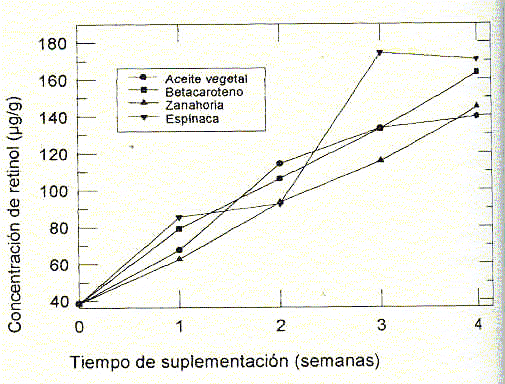
<body><![CDATA[<P ALIGN="CENTER"><font face="Times New Roman" size="3">2.254 ± 0.88</font></TD> </TR> <TR><TD VALIGN="TOP">     <P ALIGN="JUSTIFY"><font face="Times New Roman" size="3">4</font></TD> <TD VALIGN="TOP">     <P ALIGN="CENTER"><font face="Times New Roman" size="3">1.13 ± 0.29</font></TD> <TD VALIGN="TOP">     <P ALIGN="CENTER"><font face="Times New Roman" size="3">1.271 ± 0.31</font></TD> <TD VALIGN="TOP">     <P ALIGN="CENTER"><font face="Times New Roman" size="3">2.486 ± 1.37</font></TD> <TD VALIGN="TOP">     <P ALIGN="CENTER"><font face="Times New Roman" size="3">2.141 ± 0.85</font></TD> </TR> </TABLE>   </center> </div> </CENTER> <B>    <P ALIGN="JUSTIFY"><font face="Times New Roman" size="3">Concentraciones de retinol y &#98; -caroteno en h&iacute;gado</font></P> </B>    <P ALIGN="JUSTIFY"><font face="Times New Roman" size="3">&nbsp;&nbsp;&nbsp; En la <a href="#fig1">Figura 1</a> se presenta el comportamiento de los niveles de retinol en h&iacute;gado en los diferentes grupos de experimentaci&oacute;n durante las cuatro semanas de suplementaci&oacute;n. Se observa un incremento en la concentraci&oacute;n a trav&eacute;s del tiempo en todos los grupos.</font></P>     <blockquote>       <blockquote>         ]]></body>
<body><![CDATA[<blockquote>     <P ALIGN="CENTER" style="line-height: 100%; margin-top: 0; margin-bottom: 0"><font face="Times New Roman" size="3"><a name="fig1"></a><b>FIGURA 1</b></font></P>     <P ALIGN="CENTER" style="line-height: 100%; margin-top: 0; margin-bottom: 0"><font face="Times New Roman" size="3">Cambios en la concentraci&oacute;n de retinol en h&iacute;gado durante la suplementaci&oacute;n con diferentes fuentes de vitamina A</font></P>     </blockquote>   </blockquote> </blockquote>     <P ALIGN="CENTER"><font face="Times New Roman" size="3"><IMG SRC="/img/fbpe/alan/v52n4/art5img1.gif" WIDTH=505 HEIGHT=384 align="center"></font></P>     
<P ALIGN="JUSTIFY">&nbsp;&nbsp;&nbsp; <font face="Times New Roman" size="3">El an&aacute;lisis de varianza mostr&oacute; que la suplementaci&oacute;n no tiene un efecto significativo sobre los niveles de retinol en h&iacute;gado. El tiempo de suplementaci&oacute;n tiene un efecto significativo sobre la respuesta, puesto que la mayor concentraci&oacute;n se obtiene en la semana cuatro seguida de las semanas tres, dos, uno y cero.</font></P>     <P ALIGN="JUSTIFY">&nbsp;&nbsp;&nbsp; <font face="Times New Roman" size="3">En la <a href="#fig2">Figura 2</a> se presentan las concentraciones de &szlig;-caroteno en h&iacute;gado obtenidas durante las cuatro semanas de suplementaci&oacute;n. El grupo suplementado con &szlig;-caroteno sint&eacute;tico obtuvo la mayor proporci&oacute;n de &szlig;-caroteno almacenado en h&iacute;gado. Estos resultados concuerdan con los de estudios realizados en humanos por Erdman JW, Bierer TL, and Gugger ET, <sup><b> (13)</b></sup> Brown ED, Micozzi MS, Craft NE, Bieri JG, Beecher G, Edwards BK, Rose A, Taylor PR and Smith JC <b><sup> (14)</sup></b> y Micozzi MS, Brown ED, Edwards BK, Bieri JG, Taylor PR, Khachik F, Beecher GR, and Smith Jr JC, <b><sup>(15)</sup></b> quienes demostraron que el &szlig;-caroteno administrado en cristales es m&aacute;s biodisponible que cuando se administra en alimentos como zanahoria, tomate u otras fuentes de origen vegetal. Por tanto en estudios posteriores realizados por Zhou JR, Gugger ET and Erdman Jr JW, <b><sup> (16)</sup></b> y van Vliet T, Schreurs WHP, and vanden Berg H <b><sup> (12)</sup></b> utilizaron cristales de &szlig;-caroteno como grupo control de mayor absorci&oacute;n.</font></P>     <blockquote>       <blockquote>         <blockquote>     <P ALIGN="CENTER" style="line-height: 100%; margin-top: 0; margin-bottom: 0"><font face="Times New Roman" size="3"><a name="fig2"></a><b>FIGURA 2</b></font></P>     ]]></body>
<body><![CDATA[<P ALIGN="CENTER" style="line-height: 100%; margin-top: 0; margin-bottom: 0"><font face="Times New Roman" size="3">Cambios en la concentraci&oacute;n de &szlig;-caroteno en h&iacute;gado durante la suplementaci&oacute;n con diferentes fuentes de vitamina A</font></P>     </blockquote>   </blockquote> </blockquote>     <P ALIGN="CENTER"><font face="Times New Roman" size="3"><IMG SRC="/img/fbpe/alan/v52n4/art5img2.gif" WIDTH=547 HEIGHT=395 align="center"></font></P>     
<P ALIGN="JUSTIFY">&nbsp;&nbsp;&nbsp; <font face="Times New Roman" size="3">Como se observa en la <a href="#fig2">Figura 2</a>, no hay un aumento considerable en los niveles de &szlig;-caroteno en h&iacute;gado en la &uacute;ltima semana de suplementaci&oacute;n para el grupo de &szlig;-caroteno sint&eacute;tico. Este hecho como lo demostr&oacute; van Vliet T., van Vlissingen M.F., van Schaik F and van den Berg H., puede deberse al papel que juega el contenido de vitamina A en h&iacute;gado sobre la actividad enzim&aacute;tica de la &szlig;-caroteno 15, 15 dioxigenasa como un mecanismo de regulaci&oacute;n del organismo para evitar una excesiva acumulaci&oacute;n del compuesto. <b><sup> (17)</sup></b></font></P>     <P ALIGN="JUSTIFY">&nbsp;&nbsp;&nbsp; <font face="Times New Roman" size="3">Hay dos formas de regulaci&oacute;n de la actividad enzim&aacute;tica de la &szlig;-caroteno 15, 15 dioxigenasa. La primera forma est&aacute; relacionada con la proporci&oacute;n de retinol presente en el intestino, de tal manera que altas cantidades de retinol en el intestino disminuyen la actividad enzim&aacute;tica intestinal y en este caso el rompimiento de &szlig;-caroteno disminuye aumentando la absorci&oacute;n del compuesto intacto. Adicionalmente bajas concentraciones de retinol en el intestino conducen a un aumento en la actividad enzim&aacute;tica intestinal y al rompimiento de &szlig;-caroteno para compensar los requerimientos de retinol del organismo. La segunda forma se relaciona con la proporci&oacute;n de vitamina A almacenado en el h&iacute;gado como resultado de un mecanismo de regulaci&oacute;n hemost&aacute;tico. <b><sup> (17,18)</sup></b>  Adem&aacute;s de acuerdo a lo encontrado por Olso J.A.,<b><sup>(19)</sup></b> del 10 al 40% de vitamina A absorbida y preformada es oxidada y conjugada en el h&iacute;gado y posteriormente secretada en la bilis.</font></P>     <P ALIGN="JUSTIFY">&nbsp;&nbsp;&nbsp; <font face="Times New Roman" size="3">Los resultados del an&aacute;lisis de varianza muestran que tanto la suplementaci&oacute;n como el tiempo tienen un efecto significativo sobre los niveles de &szlig;-caroteno en h&iacute;gado. Los grupos &szlig;-caroteno, espinaca y zanahoria no muestran diferencia significativa, pero si hay diferencia significativa de estos con el grupo aceite. Los grupos espinaca, zanahoria aceite tampoco muestran diferencia significativa, pero si hay diferencia de estos con el grupo &szlig;-caroteno. Los niveles mas altos se obtienen en el grupo suplementado con &szlig;-caroteno sint&eacute;tico, seguido por los grupos de espinaca, zanahoria y aceite.</font> </P>     <P ALIGN="JUSTIFY">&nbsp;&nbsp;&nbsp; <font face="Times New Roman" size="3">En la <a href="#fig3">Figura 3</a> se muestran las regresiones lineales obtenidas de las concentraciones de &szlig;-caroteno en h&iacute;gado de los cuatro grupos. El mayor valor de pendiente (0.909) se encontr&oacute; para el grupo suplementado con &szlig;-caroteno sint&eacute;tico, seguido de los grupos de espinaca (0.444) y zanahoria (0.451) y por &uacute;ltimo el grupo suplementado con aceite vegetal (0.203). Estos datos indican que durante el periodo de suplementaci&oacute;n el &szlig;-caroteno sint&eacute;tico es absorbido en mayor proporci&oacute;n, mientras que la absorci&oacute;n de &szlig;-caroteno en los grupos suplementados con zanahoria y espinaca fue de aproximadamente la mitad.</font></P>     <blockquote>       <blockquote>         <blockquote>     <P ALIGN="CENTER" style="line-height: 100%; margin-top: 0; margin-bottom: 0"><font face="Times New Roman" size="3"><a name="fig3"></a><b>FIGURA 3</b></font></P>     ]]></body>
<body><![CDATA[<P ALIGN="CENTER" style="line-height: 100%; margin-top: 0; margin-bottom: 0"><font face="Times New Roman" size="3">Regresi&oacute;n lineal de las concentraciones de &szlig;-caroteno en h&iacute;gado obtenidas con los diferentes tratamientos</font></P>     </blockquote>   </blockquote> </blockquote>     <P ALIGN="CENTER"><font face="Times New Roman" size="3"><IMG SRC="/img/fbpe/alan/v52n4/art5img3.gif" WIDTH=536 HEIGHT=369 align="center"></font></P>     
<P ALIGN="JUSTIFY">&nbsp;&nbsp;&nbsp; <font face="Times New Roman" size="3">Estos resultados permiten confirmar lo mencionado anteriormente, en cuanto a que el &szlig;-caroteno suministrado en cristales se absorbe en mayor proporci&oacute;n que cuando se administra en un alimento que posea compuestos que puedan interferir su absorci&oacute;n. La proporci&oacute;n de fibra dietaria que tienen la espinaca (3 g) y la zanahoria (3 g) es alta, <b><sup> (20)</sup></b> lo que probablemente disminuye la absorci&oacute;n de &szlig;-caroteno. Estos resultados concuerdan con lo reportado por Parker RS, <b><sup> (5)</sup></b> quien adem&aacute;s indic&oacute; otros posibles factores que interfieren en la absorci&oacute;n como la presencia de suficiente cantidad de l&iacute;pidos, la presencia de compuestos provitamina A y la presencia de sustancias interferentes como la fibra dietaria.</font></P>     <P ALIGN="JUSTIFY">&nbsp;&nbsp;&nbsp; <font face="Times New Roman" size="3">Para establecer la relaci&oacute;n entre los niveles de retinol sangu&iacute;neo y hep&aacute;tico se realiz&oacute; un diagrama de dispersi&oacute;n de los datos (<a href="#fig4">Figura 4</a>), de la misma manera se relacionaron las concentraciones de &szlig;-caroteno sangu&iacute;neo y hep&aacute;tico (<a href="#fig5">Figura 5</a>). El patr&oacute;n obtenido en el diagrama de dispersi&oacute;n para retinol (<a href="#fig4">Figura 4</a>) sugiere que no hay una relaci&oacute;n entre las dos variables. Estos resultados ratifican lo planteado por Tee ES, Lim CL, Chong YH and Khor SC, <b><sup> (8)</sup></b> quienes reportaron que las concentraciones de retinol en suero no son un buen indicador de los niveles de retinol almacenados en h&iacute;gado. Este comportamiento se debe probablemente a que los niveles de retinol en sangre se encuentran homeost&aacute;ticamente regulados. <b><sup> (1)</sup></b></font></P>     <P ALIGN="JUSTIFY">&nbsp;&nbsp;&nbsp; <font face="Times New Roman" size="3">Debido a que el diagrama de dispersi&oacute;n que relaciona los niveles de &szlig;-caroteno sangu&iacute;neos y hep&aacute;ticos (<a href="#fig5">Figura 5</a>) no establece una relaci&oacute;n entre las dos variables, se presume que, al igual que el retinol, los niveles sangu&iacute;neos de &szlig;-caroteno se encuentran homeost&aacute;ticamente regulados y por lo tanto no son un buen indicador de los niveles en los tejidos.</font></P>     <P ALIGN="center" style="line-height: 100%; margin-top: 0; margin-bottom: 0"><font face="Times New Roman" size="3"><a name="fig4"></a><b>FIGURA 4</b></font></P>     <P ALIGN="CENTER" style="line-height: 100%; margin-top: 0; margin-bottom: 0"><font face="Times New Roman" size="3">Comparaci&oacute;n entre los niveles de retinol sangu&iacute;neos y hep&aacute;ticos</font></P>     <P ALIGN="center"><font face="Times New Roman" size="3"><IMG SRC="/img/fbpe/alan/v52n4/art5img4.gif" width=546 height=441 align="center"></font></P>     
<P ALIGN="CENTER" style="line-height: 100%; margin-top: 0; margin-bottom: 0"><font face="Times New Roman" size="3"><a name="fig5"></a><b>FIGURA 5</b></font></P>     <P ALIGN="CENTER" style="line-height: 100%; margin-top: 0; margin-bottom: 0"><font face="Times New Roman" size="3">Comparaci&oacute;n entre los niveles de &szlig;-caroteno sangu&iacute;neos y hep&aacute;ticos</font></P>     ]]></body>
<body><![CDATA[<P align="center"><font face="Times New Roman" size="3"><IMG SRC="/img/fbpe/alan/v52n4/art5img5.gif" width=513 height=411 align="center"></font></P>     
<P><B><font face="Times New Roman" size="3">CONCLUSIONES</font></P> </B>     <P ALIGN="JUSTIFY">&nbsp;&nbsp;&nbsp; <font face="Times New Roman" size="3">La suplementaci&oacute;n de animales con &szlig;-caroteno sint&eacute;tico aumenta la reserva hep&aacute;tica del compuesto, en niveles superiores a los encontrados en animales suplementados con aceite vegetal, zanahoria y espinaca, siendo esta diferencia estad&iacute;sticamente significativa.</font></P>     <P ALIGN="JUSTIFY">&nbsp;&nbsp;&nbsp; <font face="Times New Roman" size="3">Los comportamientos de las concentraciones de &szlig;-caroteno en h&iacute;gado de los grupos suplementados con el compuesto sint&eacute;tico, zanahoria y espinaca se ajustaron a una recta cuya ecuaci&oacute;n podr&iacute;a ser una medida de la biodisponibilidad de &szlig;-caroteno en los alimentos.</font></P>     <P ALIGN="JUSTIFY">&nbsp;&nbsp;&nbsp; <font face="Times New Roman" size="3">Los niveles sangu&iacute;neos de retinol y &szlig;-caroteno no son un buen indicador de la reserva hep&aacute;tica de dichos compuestos.</font> </P> <B>    <P><font face="Times New Roman" size="3">AGRADECIMIENTOS</font></P> </B>     <P ALIGN="JUSTIFY">&nbsp;&nbsp;&nbsp; <font face="Times New Roman" size="3">Los autores agradecen al Instituto Nacional de Salud la financiaci&oacute;n del proyecto de investigaci&oacute;n y su valiosa participaci&oacute;n en el apoyo t&eacute;cnico a la Ingeniera Soraya Pinto, Gerente de Nutrici&oacute;n y Salud Humana de Laboratorios de Roche Colombia, a BASF Qu&iacute;mica Colombiana S.A., al Veterinario Edgar Celi, a la Estad&iacute;stica Mar&iacute;a Carlina Castillo, a las Bacteri&oacute;logas Ivonne Guti&eacute;rrez R. y Luz Marina Parra y a la Microbi&oacute;loga Ana Ligia due&ntilde;as del Instituto Nacional de Salud.</font></P> <B>    <P><font face="Times New Roman" size="3">REFERENCIAS</font></P> </B>     <!-- ref --><p style="line-height: 150%; margin-top: 0; margin-bottom: 0"><font face="Times New Roman" size="3">1. Biesalski HK. Bioavailability of vitamin A. Eur J Clin Nutr. 1997;51 Sppl: S71-S75.</font>    &nbsp;&nbsp;&nbsp;&nbsp;&nbsp;&nbsp;&nbsp;&nbsp;[&#160;<a href="javascript:void(0);" onclick="javascript: window.open('/scielo.php?script=sci_nlinks&ref=402015&pid=S0004-0622200200040000500001&lng=','','width=640,height=500,resizable=yes,scrollbars=1,menubar=yes,');">Links</a>&#160;]<!-- end-ref --><P ALIGN="JUSTIFY" style="line-height: 150%; margin-top: 0; margin-bottom: 0"></P>     ]]></body>
<body><![CDATA[<!-- ref --><p style="line-height: 150%; margin-top: 0; margin-bottom: 0"><font face="Times New Roman" size="3">2. Castro L y Nichols S. Deficiencia de hierro, vitamina A y prevalencia de parasitismo intestinal en la poblaci&oacute;n infantil colombiana.Instituto Nacional de Salud. Bogot&aacute;: Colombia, 1998: 38-40.</font>&nbsp;&nbsp;&nbsp;&nbsp;&nbsp;&nbsp;&nbsp;&nbsp;[&#160;<a href="javascript:void(0);" onclick="javascript: window.open('/scielo.php?script=sci_nlinks&ref=402017&pid=S0004-0622200200040000500002&lng=','','width=640,height=500,resizable=yes,scrollbars=1,menubar=yes,');">Links</a>&#160;]<!-- end-ref --><P ALIGN="JUSTIFY" style="line-height: 150%; margin-top: 0; margin-bottom: 0"></P>     <!-- ref --><p style="line-height: 150%; margin-top: 0; margin-bottom: 0"><font face="Times New Roman" size="3">3. Greenberg ER, Baron JA, Tosteson TD, et al. A clinical trial of antioxidant vitamins to prevent colorectal adenoma. N Engl J Med. 1996;331: 141-147.</font>&nbsp;&nbsp;&nbsp;&nbsp;&nbsp;&nbsp;&nbsp;&nbsp;[&#160;<a href="javascript:void(0);" onclick="javascript: window.open('/scielo.php?script=sci_nlinks&ref=402019&pid=S0004-0622200200040000500003&lng=','','width=640,height=500,resizable=yes,scrollbars=1,menubar=yes,');">Links</a>&#160;]<!-- end-ref --><P ALIGN="JUSTIFY" style="line-height: 150%; margin-top: 0; margin-bottom: 0"></P>     <!-- ref --><p style="line-height: 150%; margin-top: 0; margin-bottom: 0"><font face="Times New Roman" size="3">4. Ziegler RG. Vegetables, fruits and carotenoids and risk of cancer. Am J Clin Nutr. 1991;53 Suppl: S251-S259.</font>&nbsp;&nbsp;&nbsp;&nbsp;&nbsp;&nbsp;&nbsp;&nbsp;[&#160;<a href="javascript:void(0);" onclick="javascript: window.open('/scielo.php?script=sci_nlinks&ref=402021&pid=S0004-0622200200040000500004&lng=','','width=640,height=500,resizable=yes,scrollbars=1,menubar=yes,');">Links</a>&#160;]<!-- end-ref --><P ALIGN="JUSTIFY" style="line-height: 150%; margin-top: 0; margin-bottom: 0"></P>     <!-- ref --><p style="line-height: 150%; margin-top: 0; margin-bottom: 0"><font face="Times New Roman" size="3">5. Parker RS. Bioavailability of vitamin A. Eur J Clin Nutr. 1997;51 Suppl: S86-S90.</font>&nbsp;&nbsp;&nbsp;&nbsp;&nbsp;&nbsp;&nbsp;&nbsp;[&#160;<a href="javascript:void(0);" onclick="javascript: window.open('/scielo.php?script=sci_nlinks&ref=402023&pid=S0004-0622200200040000500005&lng=','','width=640,height=500,resizable=yes,scrollbars=1,menubar=yes,');">Links</a>&#160;]<!-- end-ref --><P ALIGN="JUSTIFY" style="line-height: 150%; margin-top: 0; margin-bottom: 0"></P>     <!-- ref --><p style="line-height: 150%; margin-top: 0; margin-bottom: 0"><font face="Times New Roman" size="3">6. White WS, Peck KM, Ulman EA and Erdman JW. The ferret as a model for evaluation of the bioavailabilities of all-trans-&szlig;-carotene and its isomers. J Nutr. 1993;123: 1129-1139.</font>&nbsp;&nbsp;&nbsp;&nbsp;&nbsp;&nbsp;&nbsp;&nbsp;[&#160;<a href="javascript:void(0);" onclick="javascript: window.open('/scielo.php?script=sci_nlinks&ref=402025&pid=S0004-0622200200040000500006&lng=','','width=640,height=500,resizable=yes,scrollbars=1,menubar=yes,');">Links</a>&#160;]<!-- end-ref --><P ALIGN="JUSTIFY" style="line-height: 150%; margin-top: 0; margin-bottom: 0"></P>     ]]></body>
<body><![CDATA[<!-- ref --><p style="line-height: 150%; margin-top: 0; margin-bottom: 0"><font face="Times New Roman" size="3">7. National Academy of Sciences. Nutrient requirements of the laboratory rat. In Nutrient Requirements of Laboratory Animals, 3rd edn. National Academy of Sciences, Washington, 1978;pp 7-37</font>&nbsp;&nbsp;&nbsp;&nbsp;&nbsp;&nbsp;&nbsp;&nbsp;[&#160;<a href="javascript:void(0);" onclick="javascript: window.open('/scielo.php?script=sci_nlinks&ref=402027&pid=S0004-0622200200040000500007&lng=','','width=640,height=500,resizable=yes,scrollbars=1,menubar=yes,');">Links</a>&#160;]<!-- end-ref --><P ALIGN="JUSTIFY" style="line-height: 150%; margin-top: 0; margin-bottom: 0"></P>     <!-- ref --><p style="line-height: 150%; margin-top: 0; margin-bottom: 0"><font face="Times New Roman" size="3">8. Tee ES, Lim CL, Chong YH and Khor SC. A study of the biological utilization of carotenoids of carrot and swamp cabbage in rats. Food Chemistry. 1996;56 (1) 21-32.</font>&nbsp;&nbsp;&nbsp;&nbsp;&nbsp;&nbsp;&nbsp;&nbsp;[&#160;<a href="javascript:void(0);" onclick="javascript: window.open('/scielo.php?script=sci_nlinks&ref=402029&pid=S0004-0622200200040000500008&lng=','','width=640,height=500,resizable=yes,scrollbars=1,menubar=yes,');">Links</a>&#160;]<!-- end-ref --><P ALIGN="JUSTIFY" style="line-height: 150%; margin-top: 0; margin-bottom: 0"></P>     <!-- ref --><p style="line-height: 150%; margin-top: 0; margin-bottom: 0"><font face="Times New Roman" size="3">9. Grolier P, Agouda S and Azais-Braesco V. Comparative bioavailability of diet oil and emulsion-based preparations of vitamin A and &szlig;-carotene in rat. Nutrition Research. 1995;15 (10) 1507-1516.</font>&nbsp;&nbsp;&nbsp;&nbsp;&nbsp;&nbsp;&nbsp;&nbsp;[&#160;<a href="javascript:void(0);" onclick="javascript: window.open('/scielo.php?script=sci_nlinks&ref=402031&pid=S0004-0622200200040000500009&lng=','','width=640,height=500,resizable=yes,scrollbars=1,menubar=yes,');">Links</a>&#160;]<!-- end-ref --><P ALIGN="JUSTIFY" style="line-height: 150%; margin-top: 0; margin-bottom: 0"></P>     <!-- ref --><p style="line-height: 150%; margin-top: 0; margin-bottom: 0"><font face="Times New Roman" size="3">10. Olson JA and Hayaishi O. The enzymatic cleavage of &szlig;-carotene into vitamin A by soluble enzymes of rat liver and intestine. Proc Natl Acad Sci. 1965;54: 1364-1370</font>&nbsp;&nbsp;&nbsp;&nbsp;&nbsp;&nbsp;&nbsp;&nbsp;[&#160;<a href="javascript:void(0);" onclick="javascript: window.open('/scielo.php?script=sci_nlinks&ref=402033&pid=S0004-0622200200040000500010&lng=','','width=640,height=500,resizable=yes,scrollbars=1,menubar=yes,');">Links</a>&#160;]<!-- end-ref --><P ALIGN="JUSTIFY" style="line-height: 150%; margin-top: 0; margin-bottom: 0"></P>     <!-- ref --><p style="line-height: 150%; margin-top: 0; margin-bottom: 0"><font face="Times New Roman" size="3">11. Goodman D, Blomstrand R, Werner B, Huang H and Shiratori T. The intestinal absorption and metabolism of vitamin A and (-carotene in man. J Clin Invest. 1966;45:1615-1623.</font>&nbsp;&nbsp;&nbsp;&nbsp;&nbsp;&nbsp;&nbsp;&nbsp;[&#160;<a href="javascript:void(0);" onclick="javascript: window.open('/scielo.php?script=sci_nlinks&ref=402035&pid=S0004-0622200200040000500011&lng=','','width=640,height=500,resizable=yes,scrollbars=1,menubar=yes,');">Links</a>&#160;]<!-- end-ref --><P ALIGN="JUSTIFY" style="line-height: 150%; margin-top: 0; margin-bottom: 0"></P>     ]]></body>
<body><![CDATA[<!-- ref --><p style="line-height: 150%; margin-top: 0; margin-bottom: 0"><font face="Times New Roman" size="3">12. Van Vliet T, Schreurs WHP, and vanden Berg H. Intestinal (-carotene absorption an cleavage in men: Response of (-carotene and retinyl esters in the Triglyceride rich lipoprotein fraction after a single oral dose of (-carotene. Am J Clin Nutr.1995; 62: 110-116.</font>&nbsp;&nbsp;&nbsp;&nbsp;&nbsp;&nbsp;&nbsp;&nbsp;[&#160;<a href="javascript:void(0);" onclick="javascript: window.open('/scielo.php?script=sci_nlinks&ref=402037&pid=S0004-0622200200040000500012&lng=','','width=640,height=500,resizable=yes,scrollbars=1,menubar=yes,');">Links</a>&#160;]<!-- end-ref --><P ALIGN="JUSTIFY" style="line-height: 150%; margin-top: 0; margin-bottom: 0"></P>     <!-- ref --><p style="line-height: 150%; margin-top: 0; margin-bottom: 0"><font face="Times New Roman" size="3">13. Erdman JW, Bierer TL, and Gugger ET. Absorption and transport of carotenoids. Ann NY Acad Sci. 1993;691: 76-85.</font>&nbsp;&nbsp;&nbsp;&nbsp;&nbsp;&nbsp;&nbsp;&nbsp;[&#160;<a href="javascript:void(0);" onclick="javascript: window.open('/scielo.php?script=sci_nlinks&ref=402039&pid=S0004-0622200200040000500013&lng=','','width=640,height=500,resizable=yes,scrollbars=1,menubar=yes,');">Links</a>&#160;]<!-- end-ref --><P ALIGN="JUSTIFY" style="line-height: 150%; margin-top: 0; margin-bottom: 0"></P>     <!-- ref --><p style="line-height: 150%; margin-top: 0; margin-bottom: 0"><font face="Times New Roman" size="3">14. Brown ED, Micozzi MS, Craft NE, Bieri JG, Beecher G, Edwards BK, Rose A, Taylor PR and Smith JC. Plasma carotenoids in normal men after a single ingestion of vegetables or purified &szlig;-carotene. Am J Clin Nutr. 1989;49: 1258-1265.</font>&nbsp;&nbsp;&nbsp;&nbsp;&nbsp;&nbsp;&nbsp;&nbsp;[&#160;<a href="javascript:void(0);" onclick="javascript: window.open('/scielo.php?script=sci_nlinks&ref=402041&pid=S0004-0622200200040000500014&lng=','','width=640,height=500,resizable=yes,scrollbars=1,menubar=yes,');">Links</a>&#160;]<!-- end-ref --><P ALIGN="JUSTIFY" style="line-height: 150%; margin-top: 0; margin-bottom: 0"></P>     <!-- ref --><p style="line-height: 150%; margin-top: 0; margin-bottom: 0"><font face="Times New Roman" size="3">15. Micozzi MS, Brown ED, Edwards BK, Bieri JG, Taylor PR, Khachik F, Beecher GR, and Smith Jr JC. Plasma carotenoid response to chronic intake of selected foods and &szlig;-carotene suplements in men. Am J Clin Nutr. 1992;55:1120-1225.</font>&nbsp;&nbsp;&nbsp;&nbsp;&nbsp;&nbsp;&nbsp;&nbsp;[&#160;<a href="javascript:void(0);" onclick="javascript: window.open('/scielo.php?script=sci_nlinks&ref=402043&pid=S0004-0622200200040000500015&lng=','','width=640,height=500,resizable=yes,scrollbars=1,menubar=yes,');">Links</a>&#160;]<!-- end-ref --><P ALIGN="JUSTIFY" style="line-height: 150%; margin-top: 0; margin-bottom: 0"></P>     <!-- ref --><p style="line-height: 150%; margin-top: 0; margin-bottom: 0"><font face="Times New Roman" size="3">16. Zhou JR, Gugger ET and Erdman Jr JW.The Crystalline from of carotenes and the food matrix in carrot root decrease the relative bioavalability of beta and alpha- carotene in the ferret model. Journal of the American College of Nutrition. 1996;15 (1) 84.91</font>&nbsp;&nbsp;&nbsp;&nbsp;&nbsp;&nbsp;&nbsp;&nbsp;[&#160;<a href="javascript:void(0);" onclick="javascript: window.open('/scielo.php?script=sci_nlinks&ref=402045&pid=S0004-0622200200040000500016&lng=','','width=640,height=500,resizable=yes,scrollbars=1,menubar=yes,');">Links</a>&#160;]<!-- end-ref --><P ALIGN="JUSTIFY" style="line-height: 150%; margin-top: 0; margin-bottom: 0"></P>     ]]></body>
<body><![CDATA[<!-- ref --><p style="line-height: 150%; margin-top: 0; margin-bottom: 0"><font face="Times New Roman" size="3">17. Van Vliet T, van Vlissingen MF, van Schaik F and van den Berg H. &szlig;-carotene absorption and cleavage in rats is affected by the vitamin A concentration of the diet. J Nutr. 1996;126: 499-507.</font>&nbsp;&nbsp;&nbsp;&nbsp;&nbsp;&nbsp;&nbsp;&nbsp;[&#160;<a href="javascript:void(0);" onclick="javascript: window.open('/scielo.php?script=sci_nlinks&ref=402047&pid=S0004-0622200200040000500017&lng=','','width=640,height=500,resizable=yes,scrollbars=1,menubar=yes,');">Links</a>&#160;]<!-- end-ref --><P ALIGN="JUSTIFY" style="line-height: 150%; margin-top: 0; margin-bottom: 0"></P>     <!-- ref --><p style="line-height: 150%; margin-top: 0; margin-bottom: 0"><font face="Times New Roman" size="3">18. Rajan N, Blaner WS, Soprano DR, Suhara A and Goodman DS. Cellular retinol-binding protein messenger RNA levels in normal and retinoid-deficient rats. J. Cancer. 29Ş: 1990;1335-1344.</font>&nbsp;&nbsp;&nbsp;&nbsp;&nbsp;&nbsp;&nbsp;&nbsp;[&#160;<a href="javascript:void(0);" onclick="javascript: window.open('/scielo.php?script=sci_nlinks&ref=402049&pid=S0004-0622200200040000500018&lng=','','width=640,height=500,resizable=yes,scrollbars=1,menubar=yes,');">Links</a>&#160;]<!-- end-ref --><P ALIGN="JUSTIFY" style="line-height: 150%; margin-top: 0; margin-bottom: 0"></P>     <!-- ref --><p style="line-height: 150%; margin-top: 0; margin-bottom: 0"><font face="Times New Roman" size="3">19. Olso JA. Vitamin A, retinoids and carotenoids in: Modern Nutrition in Health and Disease, 8 th ed.,vol 1, pp 287-307. Lea&amp;Febiger, Philadelphia, PA. 1994.</font>&nbsp;&nbsp;&nbsp;&nbsp;&nbsp;&nbsp;&nbsp;&nbsp;[&#160;<a href="javascript:void(0);" onclick="javascript: window.open('/scielo.php?script=sci_nlinks&ref=402051&pid=S0004-0622200200040000500019&lng=','','width=640,height=500,resizable=yes,scrollbars=1,menubar=yes,');">Links</a>&#160;]<!-- end-ref --><P ALIGN="JUSTIFY" style="line-height: 150%; margin-top: 0; margin-bottom: 0"></P>     <!-- ref --><p style="line-height: 150%; margin-top: 0; margin-bottom: 0"><font face="Times New Roman" size="3">20. Kunerrh WB. Handbook of the nutritional value of foods in common units. United States Department of Agriculture, 1986.</font>&nbsp;&nbsp;&nbsp;&nbsp;&nbsp;&nbsp;&nbsp;&nbsp;[&#160;<a href="javascript:void(0);" onclick="javascript: window.open('/scielo.php?script=sci_nlinks&ref=402053&pid=S0004-0622200200040000500020&lng=','','width=640,height=500,resizable=yes,scrollbars=1,menubar=yes,');">Links</a>&#160;]<!-- end-ref --> ]]></body>
<back>
<ref-list>
<ref id="B1">
<label>1</label><nlm-citation citation-type="journal">
<person-group person-group-type="author">
<name>
<surname><![CDATA[Biesalski]]></surname>
<given-names><![CDATA[HK]]></given-names>
</name>
</person-group>
<article-title xml:lang="en"><![CDATA[Bioavailability of vitamin A]]></article-title>
<source><![CDATA[Eur J Clin Nutr]]></source>
<year>1997</year>
<volume>51</volume>
<numero>^sSppl</numero>
<issue>^sSppl</issue>
<supplement>Sppl</supplement>
<page-range>S71-S75</page-range></nlm-citation>
</ref>
<ref id="B2">
<label>2</label><nlm-citation citation-type="book">
<person-group person-group-type="author">
<name>
<surname><![CDATA[Castro]]></surname>
<given-names><![CDATA[L]]></given-names>
</name>
<name>
<surname><![CDATA[Nichols]]></surname>
<given-names><![CDATA[S]]></given-names>
</name>
</person-group>
<source><![CDATA[Deficiencia de hierro, vitamina A y prevalencia de parasitismo intestinal en la población infantil colombiana]]></source>
<year>1998</year>
<page-range>38-40</page-range><publisher-loc><![CDATA[Bogotá ]]></publisher-loc>
<publisher-name><![CDATA[Instituto Nacional de Salud]]></publisher-name>
</nlm-citation>
</ref>
<ref id="B3">
<label>3</label><nlm-citation citation-type="journal">
<person-group person-group-type="author">
<name>
<surname><![CDATA[Greenberg]]></surname>
<given-names><![CDATA[ER]]></given-names>
</name>
<name>
<surname><![CDATA[Baron]]></surname>
<given-names><![CDATA[JA]]></given-names>
</name>
<name>
<surname><![CDATA[Tosteson]]></surname>
<given-names><![CDATA[TD]]></given-names>
</name>
</person-group>
<article-title xml:lang="en"><![CDATA[A clinical trial of antioxidant vitamins to prevent colorectal adenoma]]></article-title>
<source><![CDATA[N Engl J Med]]></source>
<year>1996</year>
<volume>331</volume>
<page-range>141-147</page-range></nlm-citation>
</ref>
<ref id="B4">
<label>4</label><nlm-citation citation-type="journal">
<person-group person-group-type="author">
<name>
<surname><![CDATA[Ziegler]]></surname>
<given-names><![CDATA[RG]]></given-names>
</name>
</person-group>
<article-title xml:lang="en"><![CDATA[Vegetables, fruits and carotenoids and risk of cancer]]></article-title>
<source><![CDATA[Am J Clin Nutr]]></source>
<year>1991</year>
<volume>53</volume>
<numero>^sSuppl</numero>
<issue>^sSuppl</issue>
<supplement>Suppl</supplement>
<page-range>S251-S259</page-range></nlm-citation>
</ref>
<ref id="B5">
<label>5</label><nlm-citation citation-type="journal">
<person-group person-group-type="author">
<name>
<surname><![CDATA[Parker]]></surname>
<given-names><![CDATA[RS]]></given-names>
</name>
</person-group>
<article-title xml:lang="en"><![CDATA[Bioavailability of vitamin A]]></article-title>
<source><![CDATA[Eur J Clin Nutr]]></source>
<year>1997</year>
<volume>51</volume>
<numero>^sSuppl</numero>
<issue>^sSuppl</issue>
<supplement>Suppl</supplement>
<page-range>S86-S90</page-range></nlm-citation>
</ref>
<ref id="B6">
<label>6</label><nlm-citation citation-type="journal">
<person-group person-group-type="author">
<name>
<surname><![CDATA[White]]></surname>
<given-names><![CDATA[WS]]></given-names>
</name>
<name>
<surname><![CDATA[Peck]]></surname>
<given-names><![CDATA[KM]]></given-names>
</name>
<name>
<surname><![CDATA[Ulman]]></surname>
<given-names><![CDATA[EA]]></given-names>
</name>
<name>
<surname><![CDATA[Erdman]]></surname>
<given-names><![CDATA[JW]]></given-names>
</name>
</person-group>
<article-title xml:lang="en"><![CDATA[The ferret as a model for evaluation of the bioavailabilities of all-trans-ß-carotene and its isomers]]></article-title>
<source><![CDATA[J Nutr]]></source>
<year>1993</year>
<volume>123</volume>
<page-range>1129-1139</page-range></nlm-citation>
</ref>
<ref id="B7">
<nlm-citation citation-type="book">
<source><![CDATA[Nutrient Requirements of Laboratory Animals]]></source>
<year>1978</year>
<edition>3</edition>
<page-range>7-37</page-range><publisher-loc><![CDATA[Washington ]]></publisher-loc>
<publisher-name><![CDATA[National Academy of Sciences]]></publisher-name>
</nlm-citation>
</ref>
<ref id="B8">
<label>8</label><nlm-citation citation-type="journal">
<person-group person-group-type="author">
<name>
<surname><![CDATA[Tee]]></surname>
<given-names><![CDATA[ES]]></given-names>
</name>
<name>
<surname><![CDATA[Lim]]></surname>
<given-names><![CDATA[CL]]></given-names>
</name>
<name>
<surname><![CDATA[Chong]]></surname>
<given-names><![CDATA[YH]]></given-names>
</name>
<name>
<surname><![CDATA[Khor]]></surname>
<given-names><![CDATA[SC]]></given-names>
</name>
</person-group>
<article-title xml:lang="en"><![CDATA[A study of the biological utilization of carotenoids of carrot and swamp cabbage in rats]]></article-title>
<source><![CDATA[Food Chemistry]]></source>
<year>1996</year>
<volume>56</volume>
<numero>1</numero>
<issue>1</issue>
<page-range>21-32</page-range></nlm-citation>
</ref>
<ref id="B9">
<label>9</label><nlm-citation citation-type="journal">
<person-group person-group-type="author">
<name>
<surname><![CDATA[Grolier]]></surname>
<given-names><![CDATA[P]]></given-names>
</name>
<name>
<surname><![CDATA[Agouda]]></surname>
<given-names><![CDATA[S]]></given-names>
</name>
<name>
<surname><![CDATA[Azais-Braesco]]></surname>
<given-names><![CDATA[V]]></given-names>
</name>
</person-group>
<article-title xml:lang="en"><![CDATA[Comparative bioavailability of diet oil and emulsion-based preparations of vitamin A and ß-carotene in rat]]></article-title>
<source><![CDATA[Nutrition Research]]></source>
<year>1995</year>
<volume>15</volume>
<numero>10</numero>
<issue>10</issue>
<page-range>1507-1516</page-range></nlm-citation>
</ref>
<ref id="B10">
<label>10</label><nlm-citation citation-type="journal">
<person-group person-group-type="author">
<name>
<surname><![CDATA[Olson]]></surname>
<given-names><![CDATA[JA]]></given-names>
</name>
<name>
<surname><![CDATA[Hayaishi]]></surname>
<given-names><![CDATA[O]]></given-names>
</name>
</person-group>
<article-title xml:lang="en"><![CDATA[The enzymatic cleavage of ß-carotene into vitamin A by soluble enzymes of rat liver and intestine]]></article-title>
<source><![CDATA[Proc Natl Acad Sci]]></source>
<year>1965</year>
<volume>54</volume>
<page-range>1364-1370</page-range></nlm-citation>
</ref>
<ref id="B11">
<label>11</label><nlm-citation citation-type="journal">
<person-group person-group-type="author">
<name>
<surname><![CDATA[Goodman]]></surname>
<given-names><![CDATA[D]]></given-names>
</name>
<name>
<surname><![CDATA[Blomstrand]]></surname>
<given-names><![CDATA[R]]></given-names>
</name>
<name>
<surname><![CDATA[Werner]]></surname>
<given-names><![CDATA[B]]></given-names>
</name>
<name>
<surname><![CDATA[Huang]]></surname>
<given-names><![CDATA[H]]></given-names>
</name>
<name>
<surname><![CDATA[Shiratori]]></surname>
<given-names><![CDATA[T]]></given-names>
</name>
</person-group>
<article-title xml:lang="en"><![CDATA[The intestinal absorption and metabolism of vitamin A and ß-carotene in man]]></article-title>
<source><![CDATA[J Clin Invest]]></source>
<year>1966</year>
<volume>45</volume>
<page-range>1615-1623</page-range></nlm-citation>
</ref>
<ref id="B12">
<label>12</label><nlm-citation citation-type="journal">
<person-group person-group-type="author">
<name>
<surname><![CDATA[Van Vliet]]></surname>
<given-names><![CDATA[T]]></given-names>
</name>
<name>
<surname><![CDATA[Schreurs]]></surname>
<given-names><![CDATA[WHP]]></given-names>
</name>
<name>
<surname><![CDATA[vanden Berg]]></surname>
<given-names><![CDATA[H]]></given-names>
</name>
</person-group>
<article-title xml:lang="en"><![CDATA[Intestinal ß-carotene absorption an cleavage in men: Response of ß -carotene and retinyl esters in the Triglyceride rich lipoprotein fraction after a single oral dose of ß-carotene]]></article-title>
<source><![CDATA[Am J Clin Nutr]]></source>
<year>1995</year>
<volume>62</volume>
<page-range>110-116</page-range></nlm-citation>
</ref>
<ref id="B13">
<label>13</label><nlm-citation citation-type="journal">
<person-group person-group-type="author">
<name>
<surname><![CDATA[Erdman]]></surname>
<given-names><![CDATA[JW]]></given-names>
</name>
<name>
<surname><![CDATA[Bierer]]></surname>
<given-names><![CDATA[TL]]></given-names>
</name>
<name>
<surname><![CDATA[Gugger]]></surname>
<given-names><![CDATA[ET]]></given-names>
</name>
</person-group>
<article-title xml:lang="en"><![CDATA[Absorption and transport of carotenoids]]></article-title>
<source><![CDATA[Ann NY Acad Sci]]></source>
<year>1993</year>
<volume>691</volume>
<page-range>76-85</page-range></nlm-citation>
</ref>
<ref id="B14">
<label>14</label><nlm-citation citation-type="journal">
<person-group person-group-type="author">
<name>
<surname><![CDATA[Brown]]></surname>
<given-names><![CDATA[ED]]></given-names>
</name>
<name>
<surname><![CDATA[Micozzi]]></surname>
<given-names><![CDATA[MS]]></given-names>
</name>
<name>
<surname><![CDATA[Craft]]></surname>
<given-names><![CDATA[NE]]></given-names>
</name>
<name>
<surname><![CDATA[Bieri]]></surname>
<given-names><![CDATA[JG]]></given-names>
</name>
<name>
<surname><![CDATA[Beecher]]></surname>
<given-names><![CDATA[G]]></given-names>
</name>
<name>
<surname><![CDATA[Edwards]]></surname>
<given-names><![CDATA[BK]]></given-names>
</name>
<name>
<surname><![CDATA[Rose]]></surname>
<given-names><![CDATA[A]]></given-names>
</name>
<name>
<surname><![CDATA[Taylor]]></surname>
<given-names><![CDATA[PR]]></given-names>
</name>
<name>
<surname><![CDATA[Smith]]></surname>
<given-names><![CDATA[JC]]></given-names>
</name>
</person-group>
<article-title xml:lang="en"><![CDATA[Plasma carotenoids in normal men after a single ingestion of vegetables or purified ß-carotene]]></article-title>
<source><![CDATA[Am J Clin Nutr]]></source>
<year>1989</year>
<volume>49</volume>
<page-range>1258-1265</page-range></nlm-citation>
</ref>
<ref id="B15">
<label>15</label><nlm-citation citation-type="journal">
<person-group person-group-type="author">
<name>
<surname><![CDATA[Micozzi]]></surname>
<given-names><![CDATA[MS]]></given-names>
</name>
<name>
<surname><![CDATA[Brown]]></surname>
<given-names><![CDATA[ED]]></given-names>
</name>
<name>
<surname><![CDATA[Edwards]]></surname>
<given-names><![CDATA[BK]]></given-names>
</name>
<name>
<surname><![CDATA[Bieri]]></surname>
<given-names><![CDATA[JG]]></given-names>
</name>
<name>
<surname><![CDATA[Taylor]]></surname>
<given-names><![CDATA[PR]]></given-names>
</name>
<name>
<surname><![CDATA[Khachik]]></surname>
<given-names><![CDATA[F]]></given-names>
</name>
<name>
<surname><![CDATA[Beecher]]></surname>
<given-names><![CDATA[GR]]></given-names>
</name>
<name>
<surname><![CDATA[Smith Jr]]></surname>
<given-names><![CDATA[JC]]></given-names>
</name>
</person-group>
<article-title xml:lang="en"><![CDATA[Plasma carotenoid response to chronic intake of selected foods and ß-carotene suplements in men]]></article-title>
<source><![CDATA[Am J Clin Nutr]]></source>
<year>1992</year>
<volume>55</volume>
<page-range>1120-1225</page-range></nlm-citation>
</ref>
<ref id="B16">
<label>16</label><nlm-citation citation-type="journal">
<person-group person-group-type="author">
<name>
<surname><![CDATA[Zhou]]></surname>
<given-names><![CDATA[JR]]></given-names>
</name>
<name>
<surname><![CDATA[Gugger]]></surname>
<given-names><![CDATA[ET]]></given-names>
</name>
<name>
<surname><![CDATA[Erdman Jr]]></surname>
<given-names><![CDATA[JW]]></given-names>
</name>
</person-group>
<article-title xml:lang="en"><![CDATA[The Crystalline from of carotenes and the food matrix in carrot root decrease the relative bioavalability of beta and alpha- carotene in the ferret model]]></article-title>
<source><![CDATA[Journal of the American College of Nutrition]]></source>
<year>1996</year>
<volume>15</volume>
<numero>1</numero>
<issue>1</issue>
<page-range>84.91</page-range></nlm-citation>
</ref>
<ref id="B17">
<label>17</label><nlm-citation citation-type="journal">
<person-group person-group-type="author">
<name>
<surname><![CDATA[Van Vliet]]></surname>
<given-names><![CDATA[T]]></given-names>
</name>
<name>
<surname><![CDATA[van Vlissingen]]></surname>
<given-names><![CDATA[MF]]></given-names>
</name>
<name>
<surname><![CDATA[van Schaik]]></surname>
<given-names><![CDATA[F]]></given-names>
</name>
<name>
<surname><![CDATA[van den Berg]]></surname>
<given-names><![CDATA[H]]></given-names>
</name>
</person-group>
<article-title xml:lang="en"><![CDATA[ß-carotene absorption and cleavage in rats is affected by the vitamin A concentration of the diet]]></article-title>
<source><![CDATA[J Nutr]]></source>
<year>1996</year>
<volume>126</volume>
<page-range>499-507</page-range></nlm-citation>
</ref>
<ref id="B18">
<label>18</label><nlm-citation citation-type="book">
<person-group person-group-type="author">
<name>
<surname><![CDATA[Rajan]]></surname>
<given-names><![CDATA[N]]></given-names>
</name>
<name>
<surname><![CDATA[Blaner]]></surname>
<given-names><![CDATA[WS]]></given-names>
</name>
<name>
<surname><![CDATA[Soprano]]></surname>
<given-names><![CDATA[DR]]></given-names>
</name>
<name>
<surname><![CDATA[Suhara]]></surname>
<given-names><![CDATA[A]]></given-names>
</name>
<name>
<surname><![CDATA[Goodman]]></surname>
<given-names><![CDATA[DS]]></given-names>
</name>
</person-group>
<source><![CDATA[Cellular retinol-binding protein messenger RNA levels in normal and retinoid-deficient rats]]></source>
<year>1990</year>
<edition>29</edition>
<page-range>1335-1344</page-range><publisher-name><![CDATA[J. Cancer]]></publisher-name>
</nlm-citation>
</ref>
<ref id="B19">
<nlm-citation citation-type="book">
<source><![CDATA[Modern Nutrition in Health and Disease]]></source>
<year>1994</year>
<volume>1</volume>
<edition>8</edition>
<page-range>287-307</page-range><publisher-loc><![CDATA[Philadelphia^ePA PA]]></publisher-loc>
<publisher-name><![CDATA[Lea & Febiger]]></publisher-name>
</nlm-citation>
</ref>
<ref id="B20">
<label>20</label><nlm-citation citation-type="book">
<person-group person-group-type="author">
<name>
<surname><![CDATA[Kunerrh]]></surname>
<given-names><![CDATA[WB]]></given-names>
</name>
</person-group>
<source><![CDATA[Handbook of the nutritional value of foods in common units]]></source>
<year>1986</year>
<publisher-name><![CDATA[United States Department of Agriculture]]></publisher-name>
</nlm-citation>
</ref>
</ref-list>
</back>
</article>
