<?xml version="1.0" encoding="ISO-8859-1"?><article xmlns:mml="http://www.w3.org/1998/Math/MathML" xmlns:xlink="http://www.w3.org/1999/xlink" xmlns:xsi="http://www.w3.org/2001/XMLSchema-instance">
<front>
<journal-meta>
<journal-id>0378-1844</journal-id>
<journal-title><![CDATA[Interciencia]]></journal-title>
<abbrev-journal-title><![CDATA[INCI]]></abbrev-journal-title>
<issn>0378-1844</issn>
<publisher>
<publisher-name><![CDATA[ASOCIACIÓN INTERCIENCIA]]></publisher-name>
</publisher>
</journal-meta>
<article-meta>
<article-id>S0378-18442004001200008</article-id>
<title-group>
<article-title xml:lang="en"><![CDATA[Prediction of goat litter size using body measurements]]></article-title>
</title-group>
<contrib-group>
<contrib contrib-type="author">
<name>
<surname><![CDATA[Mellado]]></surname>
<given-names><![CDATA[Miguel]]></given-names>
</name>
<xref ref-type="aff" rid="A01"/>
</contrib>
<contrib contrib-type="author">
<name>
<surname><![CDATA[García]]></surname>
<given-names><![CDATA[José E.]]></given-names>
</name>
<xref ref-type="aff" rid="A02"/>
</contrib>
<contrib contrib-type="author">
<name>
<surname><![CDATA[Ledezma]]></surname>
<given-names><![CDATA[Rogelio]]></given-names>
</name>
<xref ref-type="aff" rid="A03"/>
</contrib>
<contrib contrib-type="author">
<name>
<surname><![CDATA[Mellado]]></surname>
<given-names><![CDATA[Jesús]]></given-names>
</name>
<xref ref-type="aff" rid="A04"/>
</contrib>
</contrib-group>
<aff id="A01">
<institution><![CDATA[,Universidad Autonoma Agraria Antonio Narro  ]]></institution>
<addr-line><![CDATA[ ]]></addr-line>
<country>México</country>
</aff>
<aff id="A02">
<institution><![CDATA[,UAAAN  ]]></institution>
<addr-line><![CDATA[ ]]></addr-line>
</aff>
<aff id="A03">
<institution><![CDATA[,Universidad Autonoma de Nuevo Leon UANL  ]]></institution>
<addr-line><![CDATA[ ]]></addr-line>
</aff>
<aff id="A04">
<institution><![CDATA[,Universidad Autonoma de Nuevo Leon UANL  ]]></institution>
<addr-line><![CDATA[ ]]></addr-line>
</aff>
<pub-date pub-type="pub">
<day>00</day>
<month>12</month>
<year>2004</year>
</pub-date>
<pub-date pub-type="epub">
<day>00</day>
<month>12</month>
<year>2004</year>
</pub-date>
<volume>29</volume>
<numero>12</numero>
<fpage>698</fpage>
<lpage>701</lpage>
<copyright-statement/>
<copyright-year/>
<self-uri xlink:href="http://ve.scielo.org/scielo.php?script=sci_arttext&amp;pid=S0378-18442004001200008&amp;lng=en&amp;nrm=iso"></self-uri><self-uri xlink:href="http://ve.scielo.org/scielo.php?script=sci_abstract&amp;pid=S0378-18442004001200008&amp;lng=en&amp;nrm=iso"></self-uri><self-uri xlink:href="http://ve.scielo.org/scielo.php?script=sci_pdf&amp;pid=S0378-18442004001200008&amp;lng=en&amp;nrm=iso"></self-uri><abstract abstract-type="short" xml:lang="es"><p><![CDATA[El cambio de la circunferencia abdominal, el peso corporal y la distancia vulva-cervix fueron utilizados para predecir el número de fetos de cabras en agostadero. El incremento de peso de las cabras durante la gestación fue de 5,49 ±2,3 y 6,9 ±2,9kg (media ±error estándar) para las cabras con uno o dos fetos, respectivamente. El incremento en la circunferencia abdominal fue de 9,3 ±2,9 y 10,6 ±3,3cm para cabras con uno o dos fetos, respectivamente. Al final de la preñez la distancia vulva-cervix fue de 3,0 ±1,6 y 3,3 ±1,2cm para cabras con uno o dos fetos, respectivamente. Los análisis discriminatorios de mediciones corporales de 97 cabras mostraron que entre 68 y 90 días de preñez, el cambio de peso de las cabras fue la variable más adecuada para separar las cabras según el número de fetos, acertándose en el 62% de las cabras con gestaciones múltiples. Entre los días 91 a 114 de gestación la circunferencia abdominal permitió identificar dos tercios de las cabras con dos fetos. Entre los 115 y 142 días de preñez, el peso vivo de las cabras fue la variable más confiable para predecir el número de fetos de las cabras. En todos los estadios de gestación la distancia vulva-cervix fue la variable menos precisa para distinguir a las cabras de acuerdo al número de sus fetos. Con la combinación de las mediciones corporales indicadas se incrementó muy poco la precisión para predecir el número de fetos de las cabras. Se concluye que el cambio en la circunferencia abdominal alrededor del día 100 de gestación puede predecir con moderada exactitud el número de fetos de cabras gestantes en condiciones de agostadero.]]></p></abstract>
<abstract abstract-type="short" xml:lang="en"><p><![CDATA[Changes in abdominal circumference (total and right half), live weight and vulva-cervix distance were used to predict the number of fetuses under range conditions. Total body weight gain during gestation was 5.49 ±2.3 and 6.9 ±2.9kg (mean ±standard error) for single and twin-bearing does, respectively. The increment in abdominal circumference was 9.3 ±2.9 and 10.6 ±3.3cm for single and twin-bearing does, respectively. At the end of pregnancy the vulva cervix distance was 3.0 ±1.6 and 3.3 ±1.2cm for single and twin-bearing does, respectively. Discriminant analyses on records of 97 goats indicated that at 68-90 days of pregnancy, live weight change was the best predictor variable, with 62% being correctly classified as twin-bearing does. At 91-114 days of gestation abdominal circumference on average identified two thirds of twin-bearing does. At 115-142 days of pregnancy live weight gain was again the best predictor variable for separation of does according to number of fetuses. In all stages of pregnancy, the vulva-cervix distance was an erratic variable for discriminating between single-and twin-bearing does. Little precision in predicting litter size was gained by combining pairs of variables. It is concluded that change in abdominal circumference at around 100 days of gestation is of moderate practical significance for predicting multiple fetuses in goats under field conditions.]]></p></abstract>
<abstract abstract-type="short" xml:lang="pt"><p><![CDATA[A mudança da circunferência abdominal, o peso corporal e a distância vulva-cervix foram utilizados para prever o número de fetos de cabras em refúgios de verão. O incremento de peso das cabras durante a gestação foi de 5,49 ± 2,3 e 6,9 ± 2,9kg (media ± erro estandar) para as cabras com um ou dois fetos, respectivamente. O incremento na circunferência abdominal foi de 9,3 ± 2,9 e 10,6 ± 3,3cm para cabras com um ou dois fetos, respectivamente. No final da gestação à distância vulva-cervix foi de 3,0 ± 1,6 e 3,3 ± 1,2cm para cabras com um ou dois fetos, respectivamente. As análises discriminatórias de medições corporais de 97 cabras mostraram que entre 68 e 90 dias de gestação, a mudança de peso das cabras foi a variável mais adequada para separar as cabras segundo o número de fetos, acertando-se em 62% das cabras com gestações múltiplas. Entre os dias 91 a 114 de gestação a circunferência abdominal permitiu identificar dois terços das cabras com dois fetos. Entre os 115 e 142 dias de gestação, o peso vivo das cabras foi a variável mais confiável para prever o número de fetos das cabras. Em todos os estágios de gestação, a distância vulva-cervix foi a variável menos precisa para distinguir às cabras de acordo ao número de seus fetos. Com a combinação das medições corporais indicadas incrementou-se muito pouco a precisão para prever o número de fetos das cabras. Conclui-se que a mudança na circunferência abdominal ao redor do dia 100 da gestação pode prever com moderada exatidão o número de fetos de cabras gestantes em condições de refúgios de verão]]></p></abstract>
<kwd-group>
<kwd lng="en"><![CDATA[Abdominal Circumference]]></kwd>
<kwd lng="en"><![CDATA[Goats]]></kwd>
<kwd lng="en"><![CDATA[Litter Size]]></kwd>
<kwd lng="en"><![CDATA[Live Weight]]></kwd>
</kwd-group>
</article-meta>
</front><body><![CDATA[   <B>    <P ALIGN="CENTER" style="line-height: 150%"><font face="Times New Roman" size="4">Prediction of goat litter size using body measurements</font></P> </B>    <P ALIGN="center" style="line-height: 150%"><font size="3" face="Times New Roman">Miguel Mellado, Jos&eacute; E. Garc&iacute;a, Rogelio Ledezma and Jes&uacute;s Mellado</font></P>     <P ALIGN="justify" style="line-height: 150%"><font size="3" face="Times New Roman">Miguel Mellado. </font> <B><font size="3" face="Times New Roman">Doctor, Universidad Aut&oacute;noma Agraria Antonio Narro (UAAAN), Mexico. Professor, UAAAN, Mexico. Direcci&oacute;n: Departamento de Nutrici&oacute;n. UAAAN. Buenavista s/n, Saltillo, Coah. 25315 M&eacute;xico. e mail: mmellbosq@yahoo.com</font></P> </B>    <P ALIGN="justify" style="line-height: 150%"><font size="3" face="Times New Roman">Jos&eacute; E. Garc&iacute;a. </font> <B><font size="3" face="Times New Roman">M.C., UAAAN. Mexico. Professor, UAAAN, Mexico. e-mail: egarcia@uaaan.mx</font></P> </B>    <P ALIGN="justify" style="line-height: 150%"><font size="3" face="Times New Roman">Rogelio Ledezma. </font> <B><font size="3" face="Times New Roman">Doctor, Universidad Aut&oacute;noma de Nuevo Le&oacute;n (UANL), Mexico. Professor, UANL, Mexico. e-mail: ledesma210470@hotmail.com</font></P> </B>    <P ALIGN="justify" style="line-height: 150%"><font size="3" face="Times New Roman">Jes&uacute;s Mellado. </font> <B><font size="3" face="Times New Roman">M.C., UAAAN, M&eacute;xico. Professor, UAAAN, Mexico. e mail: chuymellado@aol.com</font></P>     <P ALIGN="justify" style="line-height: 150%"><font size="3" face="Times New Roman">Resumen</font></P> </B>    <P ALIGN="justify" style="line-height: 150%"><font size="3" face="Times New Roman">El cambio de la circunferencia abdominal, el peso corporal y la distancia vulva-cervix fueron utilizados para predecir el n&uacute;mero de fetos de cabras en agostadero. El incremento de peso de las cabras durante la gestaci&oacute;n fue de 5,49 ±2,3 y 6,9 ±2,9kg (media ±error est&aacute;ndar) para las cabras con uno o dos fetos, respectivamente. El incremento en la circunferencia abdominal fue de 9,3 ±2,9 y 10,6 ±3,3cm para cabras con uno o dos fetos, respectivamente. Al final de la pre&ntilde;ez la distancia vulva-cervix fue de 3,0 ±1,6 y 3,3 ±1,2cm para cabras con uno o dos fetos, respectivamente. Los an&aacute;lisis discriminatorios de mediciones corporales de 97 cabras mostraron que entre 68 y 90 d&iacute;as de pre&ntilde;ez, el cambio de peso de las cabras fue la variable m&aacute;s adecuada para separar las cabras seg&uacute;n el n&uacute;mero de fetos, acert&aacute;ndose en el 62% de las cabras con gestaciones m&uacute;ltiples. Entre los d&iacute;as 91 a 114 de gestaci&oacute;n la circunferencia abdominal permiti&oacute; identificar dos tercios de las cabras con dos fetos. Entre los 115 y 142 d&iacute;as de pre&ntilde;ez, el peso vivo de las cabras fue la variable m&aacute;s confiable para predecir el n&uacute;mero de fetos de las cabras. En todos los estadios de gestaci&oacute;n la distancia vulva-cervix fue la variable menos precisa para distinguir a las cabras de acuerdo al n&uacute;mero de sus fetos. Con la combinaci&oacute;n de las mediciones corporales indicadas se increment&oacute; muy poco la precisi&oacute;n para predecir el n&uacute;mero de fetos de las cabras. Se concluye que el cambio en la circunferencia abdominal alrededor del d&iacute;a 100 de gestaci&oacute;n puede predecir con moderada exactitud el n&uacute;mero de fetos de cabras gestantes en condiciones de agostadero.</font></P> <B>    <P ALIGN="justify" style="line-height: 150%"><font size="3" face="Times New Roman">Summary</font></P> </B>    ]]></body>
<body><![CDATA[<P ALIGN="justify" style="line-height: 150%"><font size="3" face="Times New Roman">Changes in abdominal circumference (total and right half), live weight and vulva-cervix distance were used to predict the number of fetuses under range conditions. Total body weight gain during gestation was 5.49 ±2.3 and 6.9 ±2.9kg (mean ±standard error) for single and twin-bearing does, respectively. The increment in abdominal circumference was 9.3 ±2.9 and 10.6 ±3.3cm for single and twin-bearing does, respectively. At the end of pregnancy the vulva cervix distance was 3.0 ±1.6 and 3.3 ±1.2cm for single and twin-bearing does, respectively. Discriminant analyses on records of 97 goats indicated that at 68-90 days of pregnancy, live weight change was the best predictor variable, with 62% being correctly classified as twin-bearing does. At 91-114 days of gestation abdominal circumference on average identified two thirds of twin-bearing does. At 115-142 days of pregnancy live weight gain was again the best predictor variable for separation of does according to number of fetuses. In all stages of pregnancy, the vulva-cervix distance was an erratic variable for discriminating between single-and twin-bearing does. Little precision in predicting litter size was gained by combining pairs of variables. It is concluded that change in abdominal circumference at around 100 days of gestation is of moderate practical significance for predicting multiple fetuses in goats under field conditions.</font></P> <B>    <P ALIGN="justify" style="line-height: 150%"><font size="3" face="Times New Roman">Resumo</font></P> </B>    <P ALIGN="justify" style="line-height: 150%"><font size="3" face="Times New Roman">A mudan&ccedil;a da circunfer&ecirc;ncia abdominal, o peso corporal e a dist&acirc;ncia vulva-cervix foram utilizados para prever o n&uacute;mero de fetos de cabras em ref&uacute;gios de ver&atilde;o. O incremento de peso das cabras durante a gesta&ccedil;&atilde;o foi de 5,49 ± 2,3 e 6,9 ± 2,9kg (media ± erro estandar) para as cabras com um ou dois fetos, respectivamente. O incremento na circunfer&ecirc;ncia abdominal foi de 9,3 ± 2,9 e 10,6 ± 3,3cm para cabras com um ou dois fetos, respectivamente. No final da gesta&ccedil;&atilde;o &agrave; dist&acirc;ncia vulva-cervix foi de 3,0 ± 1,6 e 3,3 ± 1,2cm para cabras com um ou dois fetos, respectivamente. As an&aacute;lises discriminat&oacute;rias de medi&ccedil;&otilde;es corporais de 97 cabras mostraram que entre 68 e 90 dias de gesta&ccedil;&atilde;o, a mudan&ccedil;a de peso das cabras foi a vari&aacute;vel mais adequada para separar as cabras segundo o n&uacute;mero de fetos, acertando-se em 62% das cabras com gesta&ccedil;&otilde;es m&uacute;ltiplas. Entre os dias 91 a 114 de gesta&ccedil;&atilde;o a circunfer&ecirc;ncia abdominal permitiu identificar dois ter&ccedil;os das cabras com dois fetos. Entre os 115 e 142 dias de gesta&ccedil;&atilde;o, o peso vivo das cabras foi a vari&aacute;vel mais confi&aacute;vel para prever o n&uacute;mero de fetos das cabras. Em todos os est&aacute;gios de gesta&ccedil;&atilde;o, a dist&acirc;ncia vulva-cervix foi a vari&aacute;vel menos precisa para distinguir &agrave;s cabras de acordo ao n&uacute;mero de seus fetos. Com a combina&ccedil;&atilde;o das medi&ccedil;&otilde;es corporais indicadas incrementou-se muito pouco a precis&atilde;o para prever o n&uacute;mero de fetos das cabras. Conclui-se que a mudan&ccedil;a na circunfer&ecirc;ncia abdominal ao redor do dia 100 da gesta&ccedil;&atilde;o pode prever com moderada exatid&atilde;o o n&uacute;mero de fetos de cabras gestantes em condi&ccedil;&otilde;es de ref&uacute;gios de ver&atilde;o</font></P> <B>    <P ALIGN="justify" style="line-height: 150%"><font size="3" face="Times New Roman">KEYWORDS / Abdominal Circumference / Goats / Litter Size / Live Weight /</font></P> </B>    <P ALIGN="justify" style="line-height: 150%"><font size="3" face="Times New Roman"><b>Received:</b> 09/03/2004. <b> Modified: </b> 11/11/2004. <b> Accepted:</b> 11/12/2004.</font></P> <B>    <P ALIGN="justify" style="line-height: 150%"><font size="3" face="Times New Roman">Introduction</font></P> </B>    <P ALIGN="justify" style="line-height: 150%"><font size="3" face="Times New Roman">In small ruminants, nutritional status is very important during the last trimester of pregnancy for both mother and fetuses (Holst et al., 1992). Therefore, detection of the number of fetuses is of economic value to the goat industry, because it allows appropriate nutritional management of goats with multiple fetuses.</font></P>     <P ALIGN="justify" style="line-height: 150%"><font size="3" face="Times New Roman">A number of methods are available to detect fetal numbers in small ruminants, among which ultrasonography (real-time, B-mode) is currently the most reliable, safe, and commercially practical method under field conditions (Fowler and Wilkins, 1984; Davey, 1986; Gearhart et al., 1988; Hallford et al., 1990; Schrick and Inskeep, 1993). However, the initial cost of equipment and the operator skill and experience that is required makes general use of ultrasonography prohibitive for commercial goat operations under range conditions in developing countries. Hormone analysis is also a tool for predicting fetal numbers. Ewes carrying twins have about twice the concentration of progesterone as ewes carrying single lambs (Schneider and Hallford, 1996; Manalu and Sumaryadi, 1998; Khan and Ludri, 2002; Muller et al., 2003). Pregnancy-specific protein B (Hallford et al., 1990) and pregnancy-associated glycoprotein (Batalha et al., 2001) have also been used to estimate fetal numbers in small ruminants. Again, the cost of kits and equipment, and operator skills, are limiting factors to these methods for diagnosis of fetal numbers in resource-poor goat operations.</font></P>     <P ALIGN="justify" style="line-height: 150%"><font size="3" face="Times New Roman">Detection of fetal numbers in small ruminants by rectal-abdominal palpation is a quick, simple and cheap, but inaccurate technique (Hulet, 1973; Chauhan et al., 1991). Besides, the risk of rectal damage (bruising, abrasion or perforation) with the palpating road, and the occurrence of abortion and death in sheep (Turner and Hindson, 1975; Tyrrell and Plant, 1979) and goats (Ott et al., 1981) is relatively high, which makes this procedure unattractive for goat owners. Because of the need of a simple, reliable, safe and cheap diagnostic technique for detecting number of fetuses in goats under extensive conditions, a technique of body measurements was investigated as an alternative method for litter size diagnosis in goats. This was based on the fact that, in contrast to other ruminants, pregnant does present a marked abdominal expansion in late gestation.</font></P> <B>    <P ALIGN="justify" style="line-height: 150%"><font size="3" face="Times New Roman">Materials and Methods</font></P> </B>    ]]></body>
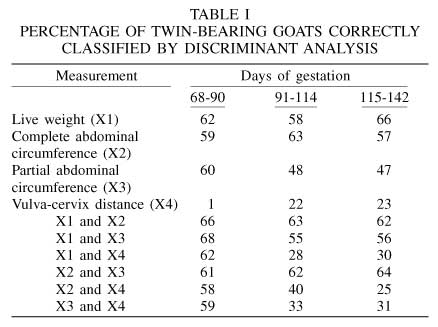
<body><![CDATA[<P ALIGN="justify" style="line-height: 150%"><font size="3" face="Times New Roman">Site description and goat management</font></P>     <P ALIGN="justify" style="line-height: 150%"><font size="3" face="Times New Roman">The study was carried out in a rural community settlement in Northeast Mexico (25º14’N and 101º10’W). The climate is semiarid with annual precipitation averaging 320mm. Seventy percent of the total annual precipitation falls from June to October. The average annual temperature is 18.2ºC, and mean elevation is 1700m. The study area vegetation is characterized as Chihuahan desert rangeland. Crossbred goats (Criollo x dairy breeds) of different ages, guided by a herdsman, foraged exclusively on native vegetation for approximately 8h daily (from 10:00 to 18:00) and spent the night in an unroofed pen made of branches. Goats did not receive supplemental feed and had no health intervention. Does were field mated during 4 weeks in January for June kidding.</font></P>     <P ALIGN="justify" style="line-height: 150%"><font size="3" face="Times New Roman">Experimental procedure</font></P>     <P ALIGN="justify" style="line-height: 150%"><font size="3" face="Times New Roman">Goat body weight, total abdominal circumference, right half-abdominal circumference (from the umbilical scar to the third lumbar vertebra) and vulva-cervix distance were recorded in 97 mixed-breed does of all ages every 21 days, starting at the end of the breeding period. Body measurements were recorded with a flexible measuring tape, and the vulva-cervix distance was determined with the plastic sheath of an insemination gun, with a measuring scale placed internally. This sheath was gently introduced into the vagina until resistance was encountered. This sheath was cleaned, dipped in an antiseptic solution, and lubricated with a water soluble gel after each measurement. Kiddings, abortions and litter size were recorded. Gestation length was assumed to be 150 days; thus, the interval between date of parturition and date of measurements gave the stage of pregnancy at each measurement.</font></P>     <P ALIGN="justify" style="line-height: 150%"><font size="3" face="Times New Roman">Statistical methods</font></P>     <P ALIGN="justify" style="line-height: 150%"><font size="3" face="Times New Roman">Discriminant analyses (SAS, 1989) were carried out using the following variables at different stages of pregnancy: body weight, complete abdominal circumference, half abdominal circumference (right side) and vulva-cervix distance. Linear regressions were used to describe the association between days of gestation and body measurements. Tests of heterogeneity of regression were made to detect differences between goats bearing single or twin fetuses.</font></P> <B>    <P ALIGN="justify" style="line-height: 150%"><font size="3" face="Times New Roman">Results</font></P> </B>    <P ALIGN="justify" style="line-height: 150%"><font size="3" face="Times New Roman">The results of discriminant analyses for individual and combined variables are presented in <a href="#t1"> Table I</a>. At 68-90 days of pregnancy live weight change was the most effective single variable for identifying twin-bearing does. At 91-114 days of gestation complete abdominal circumference distinguished with moderate accuracy the goats carrying twins (63% were correctly classified). At 115-142 days of gestation live weight change was again the best single variable for identifying does carrying twins, increasing precision by 4 percent points over that achieved by the same variable at 68-90 days of gestation. In all stages of pregnancy very little precision in predicting fetal numbers was gained by combining pairs of variables to predict fetal numbers.</font></P>     <P ALIGN="center" style="line-height: 150%"><a name="t1"><img border="0" src="/img/fbpe/inci/v29n12/Image1452.jpg" width="438" height="327"></a></P>     
<P ALIGN="justify" style="line-height: 150%"><font size="3" face="Times New Roman">The relationship between days of pregnancy and live weight change during gestation is illustrated in <a href="#f1"> Figure 1</a>. Weight of twin-bearing does started to increase at day 52 of gestation, whereas weight of single-bearing does started to increase at 59 days of pregnancy. Total body weight gain during gestation was 5.49 ±2.5 and 6.87 ±2.9kg (mean ±standard deviation) for single and twin-bearing does, respectively. For the complete abdominal circumference, the test for heterogeneity of slopes and intercepts between single and twin-bearing does revealed that regression coefficients were constant over groups. Therefore, a single regression line was used to describe the association between this variable and days of pregnancy (<a href="#f2">Figure 2</a>). From day 55 of gestation until kidding the abdominal circumference showed a steady expansion with a total increment of 9.3 ±2.9 and 10.6 ±3.3cm for single and twin-bearing does, respectively.</font></P>     ]]></body>
<body><![CDATA[<P ALIGN="justify" style="line-height: 150%"><font size="3" face="Times New Roman">In addition, a single regression line was indicated for the association between partial abdominal circumference and time of gestation. In this case, the right part of the abdomen started to expand at 55 days of gestation, with a total increment of 5cm at the end of gestation, for both single and twin-bearing does (<a href="#f2">Figure 2</a>). Different to other body measurements, the vulva-cervix distance in pregnant does began to increase after day 60 of gestation (<a href="#f3">Figure 3</a>). At the end of pregnancy the cervix was 3.0 ±1.6cm and 3.3 ±1.2cm deeper in single and twin-bearing does, respectively.</font></P>     <P ALIGN="center" style="line-height: 150%"><a name="f1"><img border="0" src="/img/fbpe/inci/v29n12/Image1453.jpg" width="298" height="301"></a></P>     
<P ALIGN="center" style="line-height: 150%"><a name="f2"><img border="0" src="/img/fbpe/inci/v29n12/Image1454.jpg" width="284" height="304"></a></P>     
<P ALIGN="center" style="line-height: 150%"><a name="f3"><img border="0" src="/img/fbpe/inci/v29n12/Image1455.jpg" width="278" height="267"></a></P> <B>    
<P ALIGN="justify" style="line-height: 150%"><font size="3" face="Times New Roman">Discussion</font></P> </B>    <P ALIGN="justify" style="line-height: 150%"><font size="3" face="Times New Roman">Live weight was superior to all other body measurements for discriminating between goats carrying one or two fetuses at the middle and end of gestation. At 68 to 90 days of pregnancy the increment in weight would, on average, correctly classify 62% of pregnant does, which closely agree with data of Burton et al. (1990) in ewes. At this stage of gestation the accuracy of this method to diagnose fetal numbers is close to the rectal abdominal palpation technique (Hulet, 1973; Chauhan et al., 1991; Sandabe et al., 1994) and slightly lower than those of plasma progesterone concentrations (Gadsby et al., 1972) and plasma pregnancy-specific protein B (Willard et al., 1995). Thus, in order to identify two thirds of twin-bearing does, the increment in body weight should be checked after day 115 of pregnancy (in extensive systems, 3.5 months after the end of a 30 days breeding period). Considering that the greatest fetus development occurs in the last trimester of gestation, detecting the number of fetuses at this time of pregnancy would allow enough time to adjust nutrient intake of twin-bearing does before parturition.</font></P>     <P ALIGN="justify" style="line-height: 150%"><font size="3" face="Times New Roman">During the present study the availability of food throughout the gestation period was exceptionally good, which resulted in a 19% increment in the body weight of pregnant does. Typically, this is not the case in Northeast Mexico, where weight gain of pregnant does is normally limited or a body weight loss can occur, in which case abortion may take place (Mellado et al., 2001). Thus, as indicated in other studies (Richardson, 1972), live weight increment after breeding would not always be a reliable indication of pregnancy or fetal numbers under range conditions.</font></P>     <P ALIGN="justify" style="line-height: 150%"><font size="3" face="Times New Roman">At 91 to 114 days of gestation the increment in abdominal circumference would identify two thirds of the twin bearing goats. Thus, this approach seems to be the most adequate among the methods tested, because abdominal scoring is fast and does not require equipment or experienced operating staff. At this stage of gestation the increment in abdominal circumference for single and twin-bearing does was 5.8 ±2.6 and 6.5 ±2.8cm, respectively. For practical purposes, the following steps (Burton et al., 1990) would be necessary to predict the number of fetuses: 1) estimate the percentage of does that are likely to bear twins (e.g. for the present study 47% of the pregnant does had twins); 2) determine the abdominal circumference of pregnant does to set a cut-off point "x" such that 47% of does have scores greater than "x"; 3) separate the flock into two groups, with abdominal circumferences greater and less than "x". If more than 47% of does goes to the group with higher scores, the cut-off point "x" should be increased, if less, "x" should be decreased.</font></P>     <P ALIGN="justify" style="line-height: 150%"><font size="3" face="Times New Roman">In classifying the twin-bearing does throughout gestation, the vulva-cervix distance was an ineffective method. Besides, this technique requires that the sheath used for measurements be cleaned, dipped in an antiseptic solution and lubricated after each measurement, which is difficult to be performed by goat owners under resource-poor conditions.</font></P> <B>    <P ALIGN="justify" style="line-height: 150%"><font size="3" face="Times New Roman">Conclusions</font></P> </B>    ]]></body>
<body><![CDATA[<P ALIGN="justify" style="line-height: 150%"><font size="3" face="Times New Roman">This study determined that the increment in abdominal circumference at around 100 days of pregnancy is a simple, rapid, practical and safe technique for separation of single- and multiple-bearing does. However, it would be expected that only two-thirds of does would be correctly classified with this technique under farm conditions. A follow-up study whereby pregnant does would not have access to the acceptable nutritional level at which the does in the present study were, is warranted.</font></P> <B>    <P ALIGN="justify" style="line-height: 150%"><font size="3" face="Times New Roman">ACKNOWLEDGMENTS</font></P> </B>    <P ALIGN="justify" style="line-height: 150%"><font size="3" face="Times New Roman">Appreciation is extended to COECYT (grant number COAH-2002-C01-3753) for funding of this study.</font></P> <B>    <P ALIGN="justify" style="line-height: 150%"><font size="3" face="Times New Roman">REFERENCES</font></P> </B>    <!-- ref --><P ALIGN="justify" style="line-height: 150%"><font size="3" face="Times New Roman">1. Batalha ES, Sulon J, Figueiredo JR, Beckers JF, Martins GA, Silva LDM (2001) Relationship between maternal concentrations of caprine pregnancy-associated glycoprotein in Alpine goats and the number of fetuses using a homologous radioimmunoassay. Small Rumin. Res. 42: 105-109.</font>&nbsp;&nbsp;&nbsp;&nbsp;&nbsp;&nbsp;&nbsp;&nbsp;[&#160;<a href="javascript:void(0);" onclick="javascript: window.open('/scielo.php?script=sci_nlinks&ref=978089&pid=S0378-1844200400120000800001&lng=','','width=640,height=500,resizable=yes,scrollbars=1,menubar=yes,');">Links</a>&#160;]<!-- end-ref --><!-- ref --><P ALIGN="justify" style="line-height: 150%"><font size="3" face="Times New Roman">2. Burton RN, Saville DJ, Bray AR, Moss RA (1990) Prediction of ewe litter size using udder scores, liveweights, and condition scores. N.Z. J. Agr. Res. 33: 41-48.</font>&nbsp;&nbsp;&nbsp;&nbsp;&nbsp;&nbsp;&nbsp;&nbsp;[&#160;<a href="javascript:void(0);" onclick="javascript: window.open('/scielo.php?script=sci_nlinks&ref=978090&pid=S0378-1844200400120000800002&lng=','','width=640,height=500,resizable=yes,scrollbars=1,menubar=yes,');">Links</a>&#160;]<!-- end-ref --><!-- ref --><P ALIGN="justify" style="line-height: 150%"><font size="3" face="Times New Roman">3. Chauhan FS, Sandabe UK, Oyedipe EO (1991) Predicting numbers of fetus(es) in small ruminants. Indian Vet. J. 68: 751-754.</font>&nbsp;&nbsp;&nbsp;&nbsp;&nbsp;&nbsp;&nbsp;&nbsp;[&#160;<a href="javascript:void(0);" onclick="javascript: window.open('/scielo.php?script=sci_nlinks&ref=978091&pid=S0378-1844200400120000800003&lng=','','width=640,height=500,resizable=yes,scrollbars=1,menubar=yes,');">Links</a>&#160;]<!-- end-ref --><!-- ref --><P ALIGN="justify" style="line-height: 150%"><font size="3" face="Times New Roman">4. Davey CG (1986) An evaluation of pregnancy testing in sheep using real-time ultrasound scanner. Aust. Vet. J. 63: 347-348.</font>&nbsp;&nbsp;&nbsp;&nbsp;&nbsp;&nbsp;&nbsp;&nbsp;[&#160;<a href="javascript:void(0);" onclick="javascript: window.open('/scielo.php?script=sci_nlinks&ref=978092&pid=S0378-1844200400120000800004&lng=','','width=640,height=500,resizable=yes,scrollbars=1,menubar=yes,');">Links</a>&#160;]<!-- end-ref --><!-- ref --><P ALIGN="justify" style="line-height: 150%"><font size="3" face="Times New Roman">5. Fowler DG, Wilkins JF (1984) Diagnosis of pregnancy and number of the fetuses in sheep by real-time ultrasonic imaging: 1. Effect of number of fetuses, stage of gestation, operator and breed of ewe on accuracy of diagnosis. Liv. Prod. Sci. 11: 437-450.</font>&nbsp;&nbsp;&nbsp;&nbsp;&nbsp;&nbsp;&nbsp;&nbsp;[&#160;<a href="javascript:void(0);" onclick="javascript: window.open('/scielo.php?script=sci_nlinks&ref=978093&pid=S0378-1844200400120000800005&lng=','','width=640,height=500,resizable=yes,scrollbars=1,menubar=yes,');">Links</a>&#160;]<!-- end-ref --><!-- ref --><P ALIGN="justify" style="line-height: 150%"><font size="3" face="Times New Roman">6. Gadsby JE, Heap RB, Powell DG, Walters DE (1972) Diagnosis of pregnancy and of the number of fetuses in sheep from plasma progesterone concentrations. Vet. Rec. 90: 339-341.</font>&nbsp;&nbsp;&nbsp;&nbsp;&nbsp;&nbsp;&nbsp;&nbsp;[&#160;<a href="javascript:void(0);" onclick="javascript: window.open('/scielo.php?script=sci_nlinks&ref=978094&pid=S0378-1844200400120000800006&lng=','','width=640,height=500,resizable=yes,scrollbars=1,menubar=yes,');">Links</a>&#160;]<!-- end-ref --><!-- ref --><P ALIGN="justify" style="line-height: 150%"><font size="3" face="Times New Roman">7. Gearhart MA, Wingfield WE, Knight AP, Smith JA, Dargatz DA, Boon JA, Stokes CA (1988) Real-time ultrasonography for determining pregnancy status and viable fetal numbers in ewes. Theriogenology 30: 323-337.</font>&nbsp;&nbsp;&nbsp;&nbsp;&nbsp;&nbsp;&nbsp;&nbsp;[&#160;<a href="javascript:void(0);" onclick="javascript: window.open('/scielo.php?script=sci_nlinks&ref=978095&pid=S0378-1844200400120000800007&lng=','','width=640,height=500,resizable=yes,scrollbars=1,menubar=yes,');">Links</a>&#160;]<!-- end-ref --><!-- ref --><P ALIGN="justify" style="line-height: 150%"><font size="3" face="Times New Roman">8. Hallford DM, Ross TT, Oetting BC, Sachse JM, Heird CE, Sasser RG (1990) Estimation of fetal numbers in ewes using ultrasound or serum concentrations of progesterone or pregnancy-specific protein B. Proc. West Sec. Am. Soc. Anim. Sci. 41: 380.</font>&nbsp;&nbsp;&nbsp;&nbsp;&nbsp;&nbsp;&nbsp;&nbsp;[&#160;<a href="javascript:void(0);" onclick="javascript: window.open('/scielo.php?script=sci_nlinks&ref=978096&pid=S0378-1844200400120000800008&lng=','','width=640,height=500,resizable=yes,scrollbars=1,menubar=yes,');">Links</a>&#160;]<!-- end-ref --><!-- ref --><P ALIGN="justify" style="line-height: 150%"><font size="3" face="Times New Roman">9. Holst PJ, Allan, CJ, Gilmour AR (1992) Effects of a restricted diet during mid pregnancy of ewes on uterine and fetal growth and lamb birth weight. Austr. J. Agr. Res. 43: 315-324.</font>&nbsp;&nbsp;&nbsp;&nbsp;&nbsp;&nbsp;&nbsp;&nbsp;[&#160;<a href="javascript:void(0);" onclick="javascript: window.open('/scielo.php?script=sci_nlinks&ref=978097&pid=S0378-1844200400120000800009&lng=','','width=640,height=500,resizable=yes,scrollbars=1,menubar=yes,');">Links</a>&#160;]<!-- end-ref --><!-- ref --><P ALIGN="justify" style="line-height: 150%"><font size="3" face="Times New Roman">10. Hulet CV (1973) Determining fetal numbers in pregnant ewes. J. Anim. Sci. 36: 325-330.</font>&nbsp;&nbsp;&nbsp;&nbsp;&nbsp;&nbsp;&nbsp;&nbsp;[&#160;<a href="javascript:void(0);" onclick="javascript: window.open('/scielo.php?script=sci_nlinks&ref=978098&pid=S0378-1844200400120000800010&lng=','','width=640,height=500,resizable=yes,scrollbars=1,menubar=yes,');">Links</a>&#160;]<!-- end-ref --><!-- ref --><P ALIGN="justify" style="line-height: 150%"><font size="3" face="Times New Roman">11. Khan JR, Ludri, RS (2002) Hormonal profiles during periparturient period in single and twin fetus bearing goats. Asian - Australasian J. Anim. Sci. 15: 346-351.</font>&nbsp;&nbsp;&nbsp;&nbsp;&nbsp;&nbsp;&nbsp;&nbsp;[&#160;<a href="javascript:void(0);" onclick="javascript: window.open('/scielo.php?script=sci_nlinks&ref=978099&pid=S0378-1844200400120000800011&lng=','','width=640,height=500,resizable=yes,scrollbars=1,menubar=yes,');">Links</a>&#160;]<!-- end-ref --><!-- ref --><P ALIGN="justify" style="line-height: 150%"><font size="3" face="Times New Roman">12. Manalu W, Sumaryadi MY (1998) Maternal serum progesterone concentration during gestation and mammary gland growth and development at parturition in Javanese thin-tail ewes carrying a single or multiple fetuses. Small Rumin. Res. 27: 131-136.</font>&nbsp;&nbsp;&nbsp;&nbsp;&nbsp;&nbsp;&nbsp;&nbsp;[&#160;<a href="javascript:void(0);" onclick="javascript: window.open('/scielo.php?script=sci_nlinks&ref=978100&pid=S0378-1844200400120000800012&lng=','','width=640,height=500,resizable=yes,scrollbars=1,menubar=yes,');">Links</a>&#160;]<!-- end-ref --><!-- ref --><P ALIGN="justify" style="line-height: 150%"><font size="3" face="Times New Roman">13. Mellado M, Gonz&aacute;lez H, Garc&iacute;a JE (2001) Body traits, parity and number of fetuses as risk factors for abortion in range goats. Agrociencia 35: 355-361.</font>&nbsp;&nbsp;&nbsp;&nbsp;&nbsp;&nbsp;&nbsp;&nbsp;[&#160;<a href="javascript:void(0);" onclick="javascript: window.open('/scielo.php?script=sci_nlinks&ref=978101&pid=S0378-1844200400120000800013&lng=','','width=640,height=500,resizable=yes,scrollbars=1,menubar=yes,');">Links</a>&#160;]<!-- end-ref --><!-- ref --><P ALIGN="justify" style="line-height: 150%"><font size="3" face="Times New Roman">14. Muller T, Schubert H, Schwab M (2003) Early prediction of fetal numbers<B> </B>in sheep based on peripheral plasma progesterone concentrations and season of the year. Vet. Rec. 152: 137-138.</font>&nbsp;&nbsp;&nbsp;&nbsp;&nbsp;&nbsp;&nbsp;&nbsp;[&#160;<a href="javascript:void(0);" onclick="javascript: window.open('/scielo.php?script=sci_nlinks&ref=978102&pid=S0378-1844200400120000800014&lng=','','width=640,height=500,resizable=yes,scrollbars=1,menubar=yes,');">Links</a>&#160;]<!-- end-ref --><!-- ref --><P ALIGN="justify" style="line-height: 150%"><font size="3" face="Times New Roman">15. Ott RS, Barun WF, Lock TF, Memon MA, Stowater JL (1981) A comparison of intrarectal Doppler and rectal abdominal palpation for pregnancy testing in goats. J. Am. Vet. Med. Assoc. 178: 730-731.</font>&nbsp;&nbsp;&nbsp;&nbsp;&nbsp;&nbsp;&nbsp;&nbsp;[&#160;<a href="javascript:void(0);" onclick="javascript: window.open('/scielo.php?script=sci_nlinks&ref=978103&pid=S0378-1844200400120000800015&lng=','','width=640,height=500,resizable=yes,scrollbars=1,menubar=yes,');">Links</a>&#160;]<!-- end-ref --><!-- ref --><P ALIGN="justify" style="line-height: 150%"><font size="3" face="Times New Roman">16. Richardson C (1972) Pregnancy diagnosis in the ewe: A review. Vet. Rec. 90: 264-275.</font>&nbsp;&nbsp;&nbsp;&nbsp;&nbsp;&nbsp;&nbsp;&nbsp;[&#160;<a href="javascript:void(0);" onclick="javascript: window.open('/scielo.php?script=sci_nlinks&ref=978104&pid=S0378-1844200400120000800016&lng=','','width=640,height=500,resizable=yes,scrollbars=1,menubar=yes,');">Links</a>&#160;]<!-- end-ref --><!-- ref --><P ALIGN="justify" style="line-height: 150%"><font size="3" face="Times New Roman">17. Sandabe UK, Chauhan FS, Chaudhri SUR, Wiziri MA (1994) Studies on predicting number of foetus(es) in small ruminants. Pakistan Vet. J. 14: 97-100.</font>&nbsp;&nbsp;&nbsp;&nbsp;&nbsp;&nbsp;&nbsp;&nbsp;[&#160;<a href="javascript:void(0);" onclick="javascript: window.open('/scielo.php?script=sci_nlinks&ref=978105&pid=S0378-1844200400120000800017&lng=','','width=640,height=500,resizable=yes,scrollbars=1,menubar=yes,');">Links</a>&#160;]<!-- end-ref --><!-- ref --><P ALIGN="justify" style="line-height: 150%"><font size="3" face="Times New Roman">18. SAS (1989) SAS User’s Guide. SAS Institute, Inc. Cary, NC, USA. 505 pp.</font>&nbsp;&nbsp;&nbsp;&nbsp;&nbsp;&nbsp;&nbsp;&nbsp;[&#160;<a href="javascript:void(0);" onclick="javascript: window.open('/scielo.php?script=sci_nlinks&ref=978106&pid=S0378-1844200400120000800018&lng=','','width=640,height=500,resizable=yes,scrollbars=1,menubar=yes,');">Links</a>&#160;]<!-- end-ref --><!-- ref --><P ALIGN="justify" style="line-height: 150%"><font size="3" face="Times New Roman">19. Schneider FA, Hallford DM (1996) Use of a rapid progesterone radioimmunoassay to predict pregnancy and fetal numbers in ewes. Sheep Goat Res. J. 12: 33-38.</font>&nbsp;&nbsp;&nbsp;&nbsp;&nbsp;&nbsp;&nbsp;&nbsp;[&#160;<a href="javascript:void(0);" onclick="javascript: window.open('/scielo.php?script=sci_nlinks&ref=978107&pid=S0378-1844200400120000800019&lng=','','width=640,height=500,resizable=yes,scrollbars=1,menubar=yes,');">Links</a>&#160;]<!-- end-ref --><!-- ref --><P ALIGN="justify" style="line-height: 150%"><font size="3" face="Times New Roman">20. Schrick FN, Inskeep EK (1993) Determination of early pregnancy in ewes utilizing transrectal ultrasonography. Theriogenology 40: 295-306.</font>&nbsp;&nbsp;&nbsp;&nbsp;&nbsp;&nbsp;&nbsp;&nbsp;[&#160;<a href="javascript:void(0);" onclick="javascript: window.open('/scielo.php?script=sci_nlinks&ref=978108&pid=S0378-1844200400120000800020&lng=','','width=640,height=500,resizable=yes,scrollbars=1,menubar=yes,');">Links</a>&#160;]<!-- end-ref --><!-- ref --><P ALIGN="justify" style="line-height: 150%"><font size="3" face="Times New Roman">21. Turner CB, Hindson, JC (1975) An assessment of a method of manual pregnancy diagnosis in the ewe. Vet. Rec. 96: 59-61.</font>&nbsp;&nbsp;&nbsp;&nbsp;&nbsp;&nbsp;&nbsp;&nbsp;[&#160;<a href="javascript:void(0);" onclick="javascript: window.open('/scielo.php?script=sci_nlinks&ref=978109&pid=S0378-1844200400120000800021&lng=','','width=640,height=500,resizable=yes,scrollbars=1,menubar=yes,');">Links</a>&#160;]<!-- end-ref --><!-- ref --><P ALIGN="justify" style="line-height: 150%"><font size="3" face="Times New Roman">22. Tyrrell RN, Plant JW (1979) Rectal damage in ewes following pregnancy diagnosis by rectal abdominal palpation. J. Anim. Sci. 48: 348-354.</font>&nbsp;&nbsp;&nbsp;&nbsp;&nbsp;&nbsp;&nbsp;&nbsp;[&#160;<a href="javascript:void(0);" onclick="javascript: window.open('/scielo.php?script=sci_nlinks&ref=978110&pid=S0378-1844200400120000800022&lng=','','width=640,height=500,resizable=yes,scrollbars=1,menubar=yes,');">Links</a>&#160;]<!-- end-ref --><!-- ref --><P ALIGN="justify" style="line-height: 150%"><font size="3" face="Times New Roman">23. Willard JM, White DR, Wesson CAR, Stellflug J, Sasser RG (1995) Detection of fetal twins in sheep using radioimmunoassay for pregnancy-specific protein B. J. Anim. Sci. 73: 960-966.</font>&nbsp;&nbsp;&nbsp;&nbsp;&nbsp;&nbsp;&nbsp;&nbsp;[&#160;<a href="javascript:void(0);" onclick="javascript: window.open('/scielo.php?script=sci_nlinks&ref=978111&pid=S0378-1844200400120000800023&lng=','','width=640,height=500,resizable=yes,scrollbars=1,menubar=yes,');">Links</a>&#160;]<!-- end-ref --> ]]></body>
<back>
<ref-list>
<ref id="B1">
<label>1</label><nlm-citation citation-type="">
<person-group person-group-type="author">
<name>
<surname><![CDATA[Batalha]]></surname>
<given-names><![CDATA[ES]]></given-names>
</name>
<name>
<surname><![CDATA[Sulon]]></surname>
<given-names><![CDATA[J]]></given-names>
</name>
<name>
<surname><![CDATA[Figueiredo]]></surname>
<given-names><![CDATA[JR]]></given-names>
</name>
<name>
<surname><![CDATA[Beckers]]></surname>
<given-names><![CDATA[JF]]></given-names>
</name>
<name>
<surname><![CDATA[Martins]]></surname>
<given-names><![CDATA[GA]]></given-names>
</name>
<name>
<surname><![CDATA[Silva]]></surname>
<given-names><![CDATA[LDM]]></given-names>
</name>
</person-group>
<source><![CDATA[Relationship between maternal concentrations of caprine pregnancy-associated glycoprotein in Alpine goats and the number of fetuses using a homologous radioimmunoassay. Small Rumin. Res.]]></source>
<year>2001</year>
<volume>42</volume>
<page-range>105-109</page-range></nlm-citation>
</ref>
<ref id="B2">
<label>2</label><nlm-citation citation-type="">
<person-group person-group-type="author">
<name>
<surname><![CDATA[Burton]]></surname>
<given-names><![CDATA[RN]]></given-names>
</name>
<name>
<surname><![CDATA[Saville]]></surname>
<given-names><![CDATA[DJ]]></given-names>
</name>
<name>
<surname><![CDATA[Bray]]></surname>
<given-names><![CDATA[AR]]></given-names>
</name>
<name>
<surname><![CDATA[Moss]]></surname>
<given-names><![CDATA[RA]]></given-names>
</name>
</person-group>
<source><![CDATA[Prediction of ewe litter size using udder scores, liveweights, and condition scores. N.Z. J. Agr. Res.]]></source>
<year>1990</year>
<volume>33</volume>
<page-range>41-48.</page-range></nlm-citation>
</ref>
<ref id="B3">
<label>3</label><nlm-citation citation-type="">
<person-group person-group-type="author">
<name>
<surname><![CDATA[Chauhan]]></surname>
<given-names><![CDATA[FS]]></given-names>
</name>
<name>
<surname><![CDATA[Sandabe]]></surname>
<given-names><![CDATA[UK]]></given-names>
</name>
<name>
<surname><![CDATA[Oyedipe]]></surname>
<given-names><![CDATA[EO]]></given-names>
</name>
</person-group>
<source><![CDATA[Predicting numbers of fetus(es) in small ruminants. Indian Vet. J]]></source>
<year>1991</year>
<volume>68</volume>
<page-range>751-754</page-range></nlm-citation>
</ref>
<ref id="B4">
<label>4</label><nlm-citation citation-type="">
<person-group person-group-type="author">
<name>
<surname><![CDATA[Davey]]></surname>
<given-names><![CDATA[CG]]></given-names>
</name>
</person-group>
<source><![CDATA[An evaluation of pregnancy testing in sheep using real-time ultrasound scanner. Aust. Vet. J.]]></source>
<year>1986</year>
<volume>63</volume>
<page-range>347-348</page-range></nlm-citation>
</ref>
<ref id="B5">
<label>5</label><nlm-citation citation-type="">
<person-group person-group-type="author">
<name>
<surname><![CDATA[Fowler]]></surname>
<given-names><![CDATA[DG]]></given-names>
</name>
<name>
<surname><![CDATA[Wilkins]]></surname>
<given-names><![CDATA[JF]]></given-names>
</name>
</person-group>
<source><![CDATA[Diagnosis of pregnancy and number of the fetuses in sheep by real-time ultrasonic imaging: 1. Effect of number of fetuses, stage of gestation, operator and breed of ewe on accuracy of diagnosis. Liv. Prod. Sci]]></source>
<year>1984</year>
<volume>11</volume>
<page-range>437-450.</page-range></nlm-citation>
</ref>
<ref id="B6">
<label>6</label><nlm-citation citation-type="">
<person-group person-group-type="author">
<name>
<surname><![CDATA[Gadsby]]></surname>
<given-names><![CDATA[JE]]></given-names>
</name>
<name>
<surname><![CDATA[Powell]]></surname>
<given-names><![CDATA[DG]]></given-names>
</name>
<name>
<surname><![CDATA[Walters]]></surname>
<given-names><![CDATA[DE]]></given-names>
</name>
</person-group>
<source><![CDATA[Diagnosis of pregnancy and of the number of fetuses in sheep from plasma progesterone concentrations. Vet. Rec.]]></source>
<year>1972</year>
<volume>90</volume>
<page-range>339-341.</page-range></nlm-citation>
</ref>
<ref id="B7">
<label>7</label><nlm-citation citation-type="">
<person-group person-group-type="author">
<name>
<surname><![CDATA[Gearhart]]></surname>
<given-names><![CDATA[MA]]></given-names>
</name>
<name>
<surname><![CDATA[Wingfield]]></surname>
<given-names><![CDATA[WE]]></given-names>
</name>
<name>
<surname><![CDATA[Stokes]]></surname>
<given-names><![CDATA[CA]]></given-names>
</name>
</person-group>
<source><![CDATA[Real-time ultrasonography for determining pregnancy status and viable fetal numbers in ewes. Theriogenology]]></source>
<year>1988</year>
<volume>30</volume>
<page-range>323-337.</page-range></nlm-citation>
</ref>
<ref id="B8">
<label>8</label><nlm-citation citation-type="">
<person-group person-group-type="author">
<name>
<surname><![CDATA[Hallford]]></surname>
<given-names><![CDATA[DM]]></given-names>
</name>
<name>
<surname><![CDATA[Oetting]]></surname>
<given-names><![CDATA[BC]]></given-names>
</name>
<name>
<surname><![CDATA[Sachse]]></surname>
<given-names><![CDATA[JM]]></given-names>
</name>
<name>
<surname><![CDATA[Heird]]></surname>
<given-names><![CDATA[CE]]></given-names>
</name>
<name>
<surname><![CDATA[Sasser]]></surname>
<given-names><![CDATA[RG]]></given-names>
</name>
</person-group>
<source><![CDATA[Estimation of fetal numbers in ewes using ultrasound or serum concentrations of progesterone or pregnancy-specific protein B. Proc. West Sec. Am. Soc. Anim. Sci]]></source>
<year>1990</year>
<volume>41</volume>
<page-range>380.</page-range></nlm-citation>
</ref>
<ref id="B9">
<label>9.</label><nlm-citation citation-type="journal">
<person-group person-group-type="author">
<name>
<surname><![CDATA[Holst]]></surname>
<given-names><![CDATA[PJ]]></given-names>
</name>
<name>
<surname><![CDATA[Allan,]]></surname>
<given-names><![CDATA[CJ]]></given-names>
</name>
<name>
<surname><![CDATA[Gilmour]]></surname>
<given-names><![CDATA[AR]]></given-names>
</name>
</person-group>
<article-title xml:lang="en"><![CDATA[Effects of a restricted diet during mid pregnancy of ewes on uterine and fetal growth and lamb birth weight]]></article-title>
<source><![CDATA[Austr. J. Agr. Res]]></source>
<year>1992</year>
<volume>43</volume>
<page-range>315-324.</page-range></nlm-citation>
</ref>
<ref id="B10">
<label>10</label><nlm-citation citation-type="journal">
<person-group person-group-type="author">
<name>
<surname><![CDATA[Hulet]]></surname>
<given-names><![CDATA[CV]]></given-names>
</name>
</person-group>
<article-title xml:lang="en"><![CDATA[Determining fetal numbers in pregnant ewes]]></article-title>
<source><![CDATA[J. Anim. Sci.]]></source>
<year>1973</year>
<volume>36</volume>
<page-range>325-330.</page-range></nlm-citation>
</ref>
<ref id="B11">
<label>11</label><nlm-citation citation-type="journal">
<person-group person-group-type="author">
<name>
<surname><![CDATA[Khan]]></surname>
<given-names><![CDATA[JR]]></given-names>
</name>
<name>
<surname><![CDATA[Ludri]]></surname>
<given-names><![CDATA[RS]]></given-names>
</name>
</person-group>
<article-title xml:lang="en"><![CDATA[Hormonal profiles during periparturient period in single and twin fetus bearing goats]]></article-title>
<source><![CDATA[Asian - Australasian J. Anim. Sci.]]></source>
<year>2002</year>
<volume>15</volume>
<page-range>346-351.</page-range></nlm-citation>
</ref>
<ref id="B12">
<label>12</label><nlm-citation citation-type="">
<person-group person-group-type="author">
<name>
<surname><![CDATA[Manalu]]></surname>
<given-names><![CDATA[W]]></given-names>
</name>
<name>
<surname><![CDATA[Sumaryadi]]></surname>
<given-names><![CDATA[MY]]></given-names>
</name>
</person-group>
<source><![CDATA[Maternal serum progesterone concentration during gestation and mammary gland growth and development at parturition in Javanese thin-tail ewes carrying a single or multiple fetuses. Small Rumin. Res]]></source>
<year>1998</year>
<volume>27</volume>
<page-range>131-136.</page-range></nlm-citation>
</ref>
<ref id="B13">
<label>13</label><nlm-citation citation-type="journal">
<person-group person-group-type="author">
<name>
<surname><![CDATA[Mellado]]></surname>
<given-names><![CDATA[M]]></given-names>
</name>
<name>
<surname><![CDATA[González]]></surname>
<given-names><![CDATA[H]]></given-names>
</name>
<name>
<surname><![CDATA[García]]></surname>
<given-names><![CDATA[JE]]></given-names>
</name>
</person-group>
<article-title xml:lang="en"><![CDATA[Body traits, parity and number of fetuses as risk factors for abortion in range goats]]></article-title>
<source><![CDATA[Agrociencia]]></source>
<year>2001</year>
<volume>35</volume>
<page-range>355-361</page-range></nlm-citation>
</ref>
<ref id="B14">
<label>14</label><nlm-citation citation-type="book">
<person-group person-group-type="author">
<name>
<surname><![CDATA[Muller]]></surname>
<given-names><![CDATA[T]]></given-names>
</name>
<name>
<surname><![CDATA[Schubert]]></surname>
<given-names><![CDATA[H]]></given-names>
</name>
<name>
<surname><![CDATA[Schwab]]></surname>
<given-names><![CDATA[M]]></given-names>
</name>
</person-group>
<source><![CDATA[Early prediction of fetal numbers in sheep based on peripheral plasma progesterone concentrations and season of the year.]]></source>
<year>2003</year>
<volume>152</volume>
<page-range>137-138.</page-range><publisher-name><![CDATA[Vet. Rec]]></publisher-name>
</nlm-citation>
</ref>
<ref id="B15">
<label>15</label><nlm-citation citation-type="journal">
<person-group person-group-type="author">
<name>
<surname><![CDATA[Ott]]></surname>
<given-names><![CDATA[RS]]></given-names>
</name>
<name>
<surname><![CDATA[Barun]]></surname>
<given-names><![CDATA[WF]]></given-names>
</name>
<name>
<surname><![CDATA[Lock]]></surname>
<given-names><![CDATA[TF]]></given-names>
</name>
<name>
<surname><![CDATA[Memon]]></surname>
<given-names><![CDATA[MA]]></given-names>
</name>
<name>
<surname><![CDATA[Stowater]]></surname>
<given-names><![CDATA[JL]]></given-names>
</name>
</person-group>
<article-title xml:lang="en"><![CDATA[A comparison of intrarectal Doppler and rectal abdominal palpation for pregnancy testing in goats]]></article-title>
<source><![CDATA[J. Am. Vet. Med. Assoc.]]></source>
<year>1981</year>
<volume>178</volume>
<page-range>730-731</page-range></nlm-citation>
</ref>
<ref id="B16">
<label>16</label><nlm-citation citation-type="book">
<person-group person-group-type="author">
<name>
<surname><![CDATA[Richardson]]></surname>
<given-names><![CDATA[C]]></given-names>
</name>
</person-group>
<source><![CDATA[Pregnancy diagnosis in the ewe]]></source>
<year>1972</year>
<volume>90</volume>
<page-range>264-275</page-range><publisher-name><![CDATA[A review. Vet. Rec]]></publisher-name>
</nlm-citation>
</ref>
<ref id="B17">
<label>17</label><nlm-citation citation-type="book">
<person-group person-group-type="author">
<name>
<surname><![CDATA[Sandabe]]></surname>
<given-names><![CDATA[UK]]></given-names>
</name>
<name>
<surname><![CDATA[Chauhan]]></surname>
<given-names><![CDATA[FS]]></given-names>
</name>
<name>
<surname><![CDATA[Chaudhri]]></surname>
<given-names><![CDATA[SUR]]></given-names>
</name>
<name>
<surname><![CDATA[Wiziri]]></surname>
<given-names><![CDATA[MA]]></given-names>
</name>
</person-group>
<source><![CDATA[Studies on predicting number of foetus(es) in small ruminants.]]></source>
<year>1994</year>
<volume>14</volume>
<page-range>97-100</page-range><publisher-name><![CDATA[Pakistan Vet. J]]></publisher-name>
</nlm-citation>
</ref>
<ref id="B18">
<label>18.</label><nlm-citation citation-type="book">
<collab>SAS</collab>
<source><![CDATA[SAS User’s Guide. SAS Institute,]]></source>
<year>1989</year>
<page-range>505</page-range><publisher-name><![CDATA[Inc. Cary, NC,]]></publisher-name>
</nlm-citation>
</ref>
<ref id="B19">
<label>19</label><nlm-citation citation-type="">
<person-group person-group-type="author">
<name>
<surname><![CDATA[Schneider]]></surname>
<given-names><![CDATA[FA]]></given-names>
</name>
<name>
<surname><![CDATA[Hallford]]></surname>
<given-names><![CDATA[DM]]></given-names>
</name>
</person-group>
<source><![CDATA[Use of a rapid progesterone radioimmunoassay to predict pregnancy and fetal numbers in ewes. Sheep Goat Res. J.]]></source>
<year>1996</year>
<volume>12</volume>
<page-range>33-38.</page-range></nlm-citation>
</ref>
<ref id="B20">
<label>20</label><nlm-citation citation-type="journal">
<person-group person-group-type="author">
<name>
<surname><![CDATA[Schrick]]></surname>
<given-names><![CDATA[FN]]></given-names>
</name>
<name>
<surname><![CDATA[Inskeep]]></surname>
<given-names><![CDATA[EK]]></given-names>
</name>
</person-group>
<article-title xml:lang="en"><![CDATA[Determination of early pregnancy in ewes utilizing transrectal ultrasonography]]></article-title>
<source><![CDATA[Theriogenology]]></source>
<year>1993</year>
<volume>40:</volume>
<page-range>295-306</page-range></nlm-citation>
</ref>
<ref id="B21">
<label>21</label><nlm-citation citation-type="">
<person-group person-group-type="author">
<name>
<surname><![CDATA[Turner]]></surname>
<given-names><![CDATA[CB]]></given-names>
</name>
<name>
<surname><![CDATA[Hindson]]></surname>
<given-names><![CDATA[JC]]></given-names>
</name>
</person-group>
<source><![CDATA[An assessment of a method of manual pregnancy diagnosis in the ewe. Vet. Rec.]]></source>
<year>1975</year>
<volume>96</volume>
<page-range>59-61.</page-range></nlm-citation>
</ref>
<ref id="B22">
<label>22</label><nlm-citation citation-type="journal">
<person-group person-group-type="author">
<name>
<surname><![CDATA[Tyrrell]]></surname>
<given-names><![CDATA[RN]]></given-names>
</name>
<name>
<surname><![CDATA[Plant]]></surname>
<given-names><![CDATA[JW]]></given-names>
</name>
</person-group>
<article-title xml:lang="en"><![CDATA[Rectal damage in ewes following pregnancy diagnosis by rectal abdominal palpation]]></article-title>
<source><![CDATA[J. Anim. Sci.]]></source>
<year>1979</year>
<volume>48</volume>
<page-range>348-354.</page-range></nlm-citation>
</ref>
<ref id="B23">
<label>23</label><nlm-citation citation-type="journal">
<person-group person-group-type="author">
<name>
<surname><![CDATA[Willard]]></surname>
<given-names><![CDATA[JM]]></given-names>
</name>
<name>
<surname><![CDATA[White]]></surname>
<given-names><![CDATA[DR]]></given-names>
</name>
<name>
<surname><![CDATA[Wesson]]></surname>
<given-names><![CDATA[CAR]]></given-names>
</name>
</person-group>
<article-title xml:lang="en"><![CDATA[Detection of fetal twins in sheep using radioimmunoassay for pregnancy-specific protein]]></article-title>
<source><![CDATA[B. J. Anim. Sci]]></source>
<year>1995</year>
<volume>73</volume>
<page-range>960-966</page-range></nlm-citation>
</ref>
</ref-list>
</back>
</article>
