<?xml version="1.0" encoding="ISO-8859-1"?><article xmlns:mml="http://www.w3.org/1998/Math/MathML" xmlns:xlink="http://www.w3.org/1999/xlink" xmlns:xsi="http://www.w3.org/2001/XMLSchema-instance">
<front>
<journal-meta>
<journal-id>0378-1844</journal-id>
<journal-title><![CDATA[Interciencia]]></journal-title>
<abbrev-journal-title><![CDATA[INCI]]></abbrev-journal-title>
<issn>0378-1844</issn>
<publisher>
<publisher-name><![CDATA[ASOCIACIÓN INTERCIENCIA]]></publisher-name>
</publisher>
</journal-meta>
<article-meta>
<article-id>S0378-18442007000100007</article-id>
<title-group>
<article-title xml:lang="en"><![CDATA[Methane soil-vegetation-atmosphere fluxes in tropical ecosystems]]></article-title>
<article-title xml:lang="es"><![CDATA[Flujos de metano del sistema suelo-vegetación-atmósfera en ecosistemas tropicales]]></article-title>
<article-title xml:lang="pt"><![CDATA[Fluxos de metano do sistema solo-vegetação-atmosfera em ecossistemas tropicais]]></article-title>
</title-group>
<contrib-group>
<contrib contrib-type="author">
<name>
<surname><![CDATA[Sanhueza]]></surname>
<given-names><![CDATA[Eugenio]]></given-names>
</name>
<xref ref-type="aff" rid="A01"/>
</contrib>
</contrib-group>
<aff id="A01">
<institution><![CDATA[,Instituto Venezolano de Investigaciones Científicas (IVIC)  ]]></institution>
<addr-line><![CDATA[Caracas ]]></addr-line>
<country>Venezuela</country>
</aff>
<pub-date pub-type="pub">
<day>00</day>
<month>01</month>
<year>2007</year>
</pub-date>
<pub-date pub-type="epub">
<day>00</day>
<month>01</month>
<year>2007</year>
</pub-date>
<volume>32</volume>
<numero>1</numero>
<fpage>30</fpage>
<lpage>34</lpage>
<copyright-statement/>
<copyright-year/>
<self-uri xlink:href="http://ve.scielo.org/scielo.php?script=sci_arttext&amp;pid=S0378-18442007000100007&amp;lng=en&amp;nrm=iso"></self-uri><self-uri xlink:href="http://ve.scielo.org/scielo.php?script=sci_abstract&amp;pid=S0378-18442007000100007&amp;lng=en&amp;nrm=iso"></self-uri><self-uri xlink:href="http://ve.scielo.org/scielo.php?script=sci_pdf&amp;pid=S0378-18442007000100007&amp;lng=en&amp;nrm=iso"></self-uri><abstract abstract-type="short" xml:lang="en"><p><![CDATA[Recently, a surprising discovery indicated that, by an unknown process, vegetation emits methane to the atmosphere. This finding could have serious implications in atmospheric chemistry, climate, and mitigation of global change. In order to evaluate the magnitude of the tropical vegetation source, a re-evaluation of results obtained at various Venezuelan ecosystems is made. CH4 fluxes from the soil-grass system in savanna ecosystems indicate that grasses produce CH4 at ~10ng·m-2·s-1. Furthermore, CH4 accumulation within the nocturnal mixing layer at the Guri site, which is affected by savanna and forest emissions, was used to make a rough upper limit estimation of <70ng·m-2·s-1 for CH4 emission from forest vegetation. These estimates are likely to be somewhat low as they do not take into account the light-induced production of CH4 by the vegetation. Global extrapolation of these fluxes indicates that, ignoring the possible stimulating effects of solar radiation, savanna and forest vegetation result in CH4 emissions of ~5Tg·yr-1 and <22Tg·yr-1, respectively. These estimates are in agreement with the lower estimates based on laboratory CH4 flux measurements, reported in the literature. On the other hand, the global extrapolation of the atmosphere-soil uptake fluxes results CH4 sinks of ~1.3Tg·yr-1 in savannas and of 3.3Tg·yr-1 in forests. In conclusion, Venezuelan field measurements support the discovery that vegetation emits CH4. However, global extrapolation indicates that tropical vegetation would contribute modestly to global methane emission, which, additionally, is offset in part by savanna and forest CH4 soil uptake. Most likely, carbon sequestration benefits from forestation should not be significantly affected by CH4 emissions by trees.]]></p></abstract>
<abstract abstract-type="short" xml:lang="es"><p><![CDATA[Recientemente, un sorpresivo descubrimiento mostró que, por un proceso no establecido, la vegetación emite metano. Esto podría tener serias implicaciones en química atmosférica, el clima, y las actividades de mitigación del cambio global. Para evaluar la magnitud de la vegetación tropical como fuente de CH4, se re-evalúan los resultados obtenidos en varios ecosistemas venezolanos. Los flujos a la atmósfera desde el sistema suelo-pasto en la sabana indican que los pastos producen CH4 a una velocidad de ~10ng·m-2·s-1. Además, la acumulación de CH4 dentro de la capa de mezcla nocturna en el Guri, lugar afectado por las emisiones de los ecosistemas de sabana y bosque, permite hacer una primera estimación del límite superior de la emisión de CH4 de la vegetación de bosque de <70ng·m-2·s-1. Estos valores podrían estar subestimados pues no incluyen el efecto de la radiación solar sobre la producción de CH4 por la vegetación. Ignorando el posible efecto de la radiación solar, la extrapolación global de estos flujos producen una emisión de CH4 de ~5Tg·año-1 y <22Tg·año-1, para la vegetación de sabana y bosque, respectivamente, valores que concuerdan con estimaciones más bajas reportadas en la literatura, basadas en mediciones de flujos en laboratorio. Por otra parte, la extrapolación global del consumo de CH4 por los suelos produce un sumidero de ~1,3Tg·año-1 para sabanas y 3,3Tg·año-1 para bosques. En conclusión, mediciones de campo en Venezuela apoyan el descubrimiento que la vegetación emite metano. Sin embargo, la extrapolación global indica que la vegetación tropical haría una modesta contribución a la emisión global, la cual adicionalmente sería compensada por el consumo de CH4 en los suelos. Los beneficios del secuestro de carbono por forestación no serían significativamente afectados por la emisión de CH4 por los árboles.]]></p></abstract>
<abstract abstract-type="short" xml:lang="pt"><p><![CDATA[Recentemente, um surpreendente descobrimento mostrou que, por um processo não estabelecido, a vegetação emite metano. Isto poderia ter serias implicações em química atmosférica, o clima, e as atividades de mitigação da mudança global. Para avaliar a magnitude da vegetação tropical como fonte de CH4, se reavaliam os resultados obtidos em vários ecossistemas venezuelanos. Os fluxos para a atmosfera desde o sistema solo-pasto na savana indicam que os pastos produzem CH4 a uma velocidade de ~10ng·m-2·s-1. Além disso, a acumulação de CH4 dentro da capa de mistura noturna em Guri, lugar afetado pelas emissões dos ecossistemas de savana e bosque, permite fazer uma primeira estimação do limite superior da emissão de CH4 da vegetação de bosque <70ng·m-2·s-1. Estes valores poderiam estar subestimados pois não incluem o efeito da radiação solar sobre a produção de CH4 pela vegetação. Ignorando o possível efeito da radiação solar, a extrapolação global destes fluxos produzem uma emissão de CH4 de ~5Tg·ano-1 e <22Tg·ano-1, para a vegetação de savana e bosque, respectivamente, valores que concordam com estimações mais baixas relatadas na literatura, baseadas em medições de fluxos em laboratório. Por outra parte, a extrapolação global do consumo de CH4 pelos solos produz um sumidouro de ~1,3Tg·ano-1 para savanas e 3,3Tg·ano-1 para bosques. Em conclusão, medições de campo na Venezuela apóiam o descobrimento de que a vegetação emite metano. No entanto, a extrapolação global indica que a vegetação tropical faria uma modesta contribuição à emissão global, a qual adicionalmente seria compensada pelo consumo de CH4 nos solos. Os benefícios do seqüestro de carbono por florestação não seriam significativamente afetados com a emissão de CH4 pelas árvores.]]></p></abstract>
<kwd-group>
<kwd lng="en"><![CDATA[Global Methane Budget]]></kwd>
<kwd lng="en"><![CDATA[Methane from Vegetation]]></kwd>
<kwd lng="en"><![CDATA[Methane in Tropical Ecosystems]]></kwd>
</kwd-group>
</article-meta>
</front><body><![CDATA[   <B>    <P align="center"><span style="mso-ansi-language: EN-US" lang="EN-US"><font size="3" face="Verdana">Methane soil-vegetation-atmosphere fluxes in tropical ecosystems</font></span></P>     <P style="line-height: 100%" align="justify"><font face="Verdana" size="2">Eugenio Sanhueza</font></P>     <P style="line-height: 100%" align="justify"></B> <font face="Verdana" size="2"> Doctor in Sciences, Universidad de Chile. Researcher, Instituto Venezolano de Investigaciones Cient&iacute;ficas (IVIC), Venezuela. Address: Atmospheric Chemistry Laboratory, IVIC. Apdo. 22117. Caracas 1020A, Venezuela. e-mail: esanhuez@ivic.ve</font></P> <I>    <P style="line-height: 100%" align="justify"><b><font face="Verdana" size="2">SUMMARY</font></b></P>  </I>      <P style="line-height: 100%" align="justify"><font face="Verdana" size="2">Recently, a surprising discovery indicated that, by an unknown process, vegetation emits methane to the atmosphere. This finding could have serious implications in atmospheric chemistry, climate, and mitigation of global change. In order to evaluate the magnitude of the tropical vegetation source, a re-evaluation of results obtained at various Venezuelan ecosystems is made. CH<SUB>4</SUB> fluxes from the soil-grass system in savanna ecosystems indicate that grasses produce CH<SUB>4</SUB> at ~10ng·m<SUP>-2</SUP>·s<SUP>-1</SUP>. Furthermore, CH<SUB>4</SUB> accumulation within the nocturnal mixing layer at the Guri site, which is affected by savanna and forest emissions, was used to make a rough upper limit estimation of &lt;70ng·m<SUP>-2</SUP>·s<SUP>-1</SUP> for CH<SUB>4</SUB> emission from forest vegetation. These estimates are likely to be somewhat low as they do not take into account the light-induced production of CH<SUB>4</SUB> by the vegetation. Global extrapolation of these fluxes indicates that, ignoring the possible stimulating effects of solar radiation, savanna and forest vegetation result in CH<SUB>4</SUB> emissions of ~5Tg·yr<SUP>-1</SUP> and &lt;22Tg·yr<SUP>-1</SUP>, respectively. These estimates are in agreement with the lower estimates based on laboratory CH<SUB>4</SUB> flux measurements, reported in the literature. On the other hand, the global extrapolation of the atmosphere-soil uptake fluxes results CH<SUB>4</SUB> sinks of ~1.3Tg·yr<SUP>-1</SUP> in savannas and of 3.3Tg·yr<SUP>-1</SUP> in forests. In conclusion, Venezuelan field measurements support the discovery that vegetation emits CH<SUB>4</SUB>. However, global extrapolation indicates that tropical vegetation would contribute modestly to global methane emission, which, additionally, is offset in part by savanna and forest CH<SUB>4</SUB> soil uptake. Most likely, carbon sequestration benefits from forestation should not be significantly affected by CH<SUB>4</SUB> emissions by trees.</font></P>  <B>    <P style="line-height: 100%" align="center"><font face="Verdana" size="2"><span style="mso-fareast-font-family: Times New Roman; mso-bidi-font-family: Times New Roman; mso-ansi-language: ES; mso-fareast-language: ES; mso-bidi-language: AR-SA">Flujos de metano del sistema suelo-vegetación-atmósfera en ecosistemas tropicales</span></font></P> </B> <I>    <P style="line-height: 100%" align="justify"><b><font face="Verdana" size="2">RESUMEN</font></b></P>  </I>      <P style="line-height: 100%" align="justify"><font face="Verdana" size="2">Recientemente, un sorpresivo descubrimiento mostr&oacute; que, por un proceso no establecido, la vegetaci&oacute;n emite metano. Esto podr&iacute;a tener serias implicaciones en qu&iacute;mica atmosf&eacute;rica, el clima, y las actividades de mitigaci&oacute;n del cambio global. Para evaluar la magnitud de la vegetaci&oacute;n tropical como fuente de CH<SUB>4</SUB>, se re-eval&uacute;an los resultados obtenidos en varios ecosistemas venezolanos. Los flujos a la atm&oacute;sfera desde el sistema suelo-pasto en la sabana indican que los pastos producen CH<SUB>4</SUB> a una velocidad de ~10ng·m<SUP>-2</SUP>·s<SUP>-1</SUP>. Adem&aacute;s, la acumulaci&oacute;n de CH<SUB>4</SUB> dentro de la capa de mezcla nocturna en el Guri, lugar afectado por las emisiones de los ecosistemas de sabana y bosque, permite hacer una primera estimaci&oacute;n del l&iacute;mite superior de la emisi&oacute;n de CH<SUB>4</SUB> de la vegetaci&oacute;n de bosque de &lt;70ng·m<SUP>-2</SUP>·s<SUP>-1</SUP>. Estos valores podr&iacute;an estar subestimados pues no incluyen el efecto de la radiaci&oacute;n solar sobre la producci&oacute;n de CH<SUB>4</SUB> por la vegetaci&oacute;n. Ignorando el posible efecto de la radiaci&oacute;n solar, la extrapolaci&oacute;n global de estos flujos producen una emisi&oacute;n de CH<SUB>4</SUB> de ~5Tg·a&ntilde;o<SUP>-1</SUP> y &lt;22Tg·a&ntilde;o<SUP>-1</SUP>, para la vegetaci&oacute;n de sabana y bosque, respectivamente, valores que concuerdan con estimaciones m&aacute;s bajas reportadas en la literatura, basadas en mediciones de flujos en laboratorio. Por otra parte, la extrapolaci&oacute;n global del consumo de CH<SUB>4</SUB> por los suelos produce un sumidero de ~1,3Tg·a&ntilde;o<SUP>-1</SUP> para sabanas y 3,3Tg·a&ntilde;o<SUP>-1</SUP> para bosques. En conclusi&oacute;n, mediciones de campo en Venezuela apoyan el descubrimiento que la vegetaci&oacute;n emite metano. Sin embargo, la extrapolaci&oacute;n global indica que la vegetaci&oacute;n tropical har&iacute;a una modesta contribuci&oacute;n a la emisi&oacute;n global, la cual adicionalmente ser&iacute;a compensada por el consumo de CH<SUB>4</SUB> en los suelos. Los beneficios del secuestro de carbono por forestaci&oacute;n no ser&iacute;an significativamente afectados por la emisi&oacute;n de CH<SUB>4</SUB> por los &aacute;rboles.</font></P>     <p style="line-height: 100%" align="center"><b><font face="Verdana" size="2"><span style="mso-fareast-font-family: Times New Roman; mso-bidi-font-family: Times New Roman; mso-ansi-language: ES; mso-fareast-language: ES; mso-bidi-language: AR-SA">Fluxos de metano do sistema solo-vegetação-atmosfera em ecossistemas tropicais</span></font></b></p>     ]]></body>
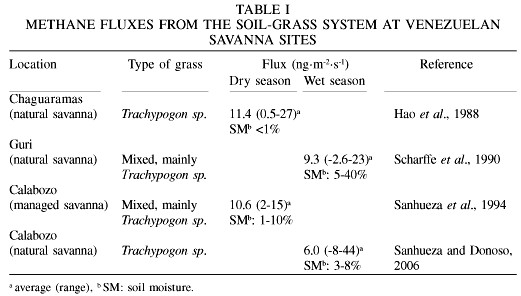
<body><![CDATA[<P style="line-height: 100%" align="justify"><b><font face="Verdana" size="2">RESUMO</font></b></P>      <P style="line-height: 100%" align="justify"><font face="Verdana" size="2">Recentemente, um surpreendente descobrimento mostrou que, por um processo n&atilde;o estabelecido, a vegeta&ccedil;&atilde;o emite metano. Isto poderia ter serias implica&ccedil;&otilde;es em qu&iacute;mica atmosf&eacute;rica, o clima, e as atividades de mitiga&ccedil;&atilde;o da mudan&ccedil;a global. Para avaliar a magnitude da vegeta&ccedil;&atilde;o tropical como fonte de CH<SUB>4</SUB>, se reavaliam os resultados obtidos em v&aacute;rios ecossistemas venezuelanos. Os fluxos para a atmosfera desde o sistema solo-pasto na savana indicam que os pastos produzem CH<SUB>4</SUB> a uma velocidade de ~10ng·m<SUP>-2</SUP>·s<SUP>-1</SUP>. Al&eacute;m disso, a acumula&ccedil;&atilde;o de CH<SUB>4</SUB> dentro da capa de mistura noturna em Guri, lugar afetado pelas emiss&otilde;es dos ecossistemas de savana e bosque, permite fazer uma primeira estima&ccedil;&atilde;o do limite superior da emiss&atilde;o de CH<SUB>4</SUB> da vegeta&ccedil;&atilde;o de bosque &lt;70ng·m<SUP>-2</SUP>·s<SUP>-1</SUP>. Estes valores poderiam estar subestimados pois n&atilde;o incluem o efeito da radia&ccedil;&atilde;o solar sobre a produ&ccedil;&atilde;o de CH<SUB>4</SUB> pela vegeta&ccedil;&atilde;o. Ignorando o poss&iacute;vel efeito da radia&ccedil;&atilde;o solar, a extrapola&ccedil;&atilde;o global destes fluxos produzem uma emiss&atilde;o de CH<SUB>4</SUB> de ~5Tg·ano<SUP>-1</SUP> e &lt;22Tg·ano<SUP>-1</SUP>, para a vegeta&ccedil;&atilde;o de savana e bosque, respectivamente, valores que concordam com estima&ccedil;&otilde;es mais baixas relatadas na literatura, baseadas em medi&ccedil;&otilde;es de fluxos em laborat&oacute;rio. Por outra parte, a extrapola&ccedil;&atilde;o global do consumo de CH<SUB>4</SUB> pelos solos produz um sumidouro de ~1,3Tg·ano<SUP>-1</SUP> para savanas e 3,3Tg·ano<SUP>-1</SUP> para bosques. Em conclus&atilde;o, medi&ccedil;&otilde;es de campo na Venezuela ap&oacute;iam o descobrimento de que a vegeta&ccedil;&atilde;o emite metano. No entanto, a extrapola&ccedil;&atilde;o global indica que a vegeta&ccedil;&atilde;o tropical faria uma modesta contribui&ccedil;&atilde;o &agrave; emiss&atilde;o global, a qual adicionalmente seria compensada pelo consumo de CH<SUB>4</SUB> nos solos. Os benef&iacute;cios do seq&uuml;estro de carbono por floresta&ccedil;&atilde;o n&atilde;o seriam significativamente afetados com a emiss&atilde;o de CH<SUB>4</SUB> pelas &aacute;rvores.</font></P>  <B>    <P style="line-height: 100%" align="justify"><font face="Verdana" size="2">KEY WORDS / Global Methane Budget / Methane from Vegetation / Methane in Tropical Ecosystems /</font> </P> </B><FONT SIZE=2>    <P style="line-height: 100%" align="justify"><b><font face="Verdana">Received</font></b><font face="Verdana">: 08/11/2006. <b>Modified</b>: 12/11/2006. <b>Accepted</b>: 12/12/2006.</font></P> </FONT>    <P style="line-height: 100%" align="justify"><font face="Verdana" size="2">Atmospheric methane is an important greenhouse gas whose radiative properties and atmospheric chemistry affect both climate and stratospheric ozone. Recently, researchers at the Max Plank Institute for Nuclear Physics in Heidelberg made a surprising discovery: by an unknown process, dead and live vegetation emit CH<SUB>4</SUB> to the atmosphere. The first field measurements supporting the finding came from studies made in Venezuelan ecosystems (Crutzen <I>et al</I>., 2006; Sanhueza and Donoso, 2006), indicating that tropical vegetation produces methane. Also, CH<SUB>4</SUB> emissions from vegetation may explain recent satellite observations over the Amazon forest, indicating high atmospheric levels of methane (Frankenberg <I>et al</I>., 2005, 2006). The discovery is surprising because chemistry in plants is generally thought as an aerobic process and methane production is mainly associated with anaerobic environments (e.g., wetlands, enteric fermentation).</font></P>     <P style="line-height: 100%" align="justify"><font face="Verdana" size="2">The global extrapolation made by Keppler <I>et al</I>. (2006), based on laboratory measurements of CH<SUB>4</SUB> fluxes from plants and net primary productivity (NPP) of ecosystems, indicates CH<SUB>4</SUB> quantities that appear to be very significant (up to 30%) for the global budget. Although the budget has some significant uncertainties (Prather and Ehhalt, 2001) this emission from plants would be difficult to incorporate without some significant re-evaluation of the sources already evaluated. As expected, the Keppler <I>et al</I>. (2006) article created an intense debate and concern, not only in the scientific community but also in policy makers, due to the spin given by certain media coverage (NIEPS, 2006); a significant emission of methane from trees would have serious implications in offsetting greenhouse emissions by reforestation, promoted by the Kyoto protocol.</font></P>     <P style="line-height: 100%" align="justify"><font face="Verdana" size="2">Kirschbaum <I>et al</I>. (2006), using the same basic CH<SUB>4</SUB> flux information produced by Keppler <I>et al</I>. (2006) presented alternative extrapolations, based on foliage biomass and photosynthetic rates, which indicate much lower global plant CH<SUB>4</SUB> emissions. Ferretti <I>et al</I>. (2006) tested the global production reported by Keppler <I>et al</I>. (2006) against ice core records of atmospheric CH<SUB>4</SUB> concentrations and stable carbon isotope ratios (d<SUP>13</SUP>CH<SUB>4</SUB>) over the last 2000 years and also concluded that global emission from plants must be much lower than the one proposed by these authors. In the past, our research group measured methane soil-vegetation-atmosphere fluxes at various ecosystems in Venezuela, which are re-analyzed and summarized in this article. It is concluded that, in agreement with Keppler <I>et al</I>. (2006), tropical vegetation would emit methane; however, the magnitude of this source should be much lower than the one estimated by these authors, in concordance with Kirschbaum <I>et al</I>. (2006) and Ferretti <I>et al</I>. (2006) calculations. Global emissions of CH<SUB>4</SUB> from tropical savannas and forests would be readily reconciled within the uncertainties in the established methane budget.</font></P> <B>     <P style="line-height: 100%" align="justify"><font face="Verdana" size="2">Field measurements</font></P> </B>     <P style="line-height: 100%" align="justify"><font face="Verdana" size="2">Measurements were made during dry and wet seasons at various sites in the Venezuelan savanna climate region (Table I). A map indicating the locations of the sites (i.e., Chaguaramas, Guri, Calabozo) is found in Sanhueza <I>et al</I>. (2000). Two well defined climatic periods occur in the region: a dry season from Dec to Apr and a rainy season from May to Nov. Surface annual temperatures range from 24 to 28ºC. The amplitudes of daily temperatures are 10-15ºC, with larger deviations occurring during the dry season (Sanhueza <I>et al</I>., 1988). The annual rainfall is 900-2100mm, with only ~10% occurring during the dry season. Soils are acidic and poor in nutrients, with a low rate of mineralization. They support gramineous grasses interrupted by trees and shrub. In the northern part of the Guayana shield (Guri site), relatively exuberant patches of forest occurs. Physical and chemical properties of soils and other local characteristics of the study sites are found in references listed in <a href="#tab1"> Table I</a>.</font></P>      <P style="line-height: 100%" align="center"><a name="tab1"><img border="0" src="/img/fbpe/inci/v32n1/art07tab1.jpg" width="521" height="296"></a></P>      
]]></body>
<body><![CDATA[<P style="line-height: 100%" align="justify"><font face="Verdana" size="2">Fluxes from savanna soil-grass systems and forest soils were measured using the static chamber technique. CH<SUB>4</SUB> was analyzed by gas chromatography, using a flame ionization detector. Other experimental/analytical details are given by Scharffe <I>et al</I>. (1990). Gravimetric soil moistures were measured in samples of 2cm depth and soil temperatures, at 1cm depth, were recorded continuously with a thermocouple during the flux measurements.</font></P>     <P style="line-height: 100%" align="justify"><font face="Verdana" size="2">At the Guri site, which was selected in order to study &quot;simultaneously&quot; fluxes of trace gases from forest and savanna soils, atmospheric concentrations of methane were also taken at 2m height, at locations shown in Sanhueza <I>et al</I>. (1990). Based on calibration gas measurements, under field conditions, the precision of CH<SUB>4</SUB> measurements was 1.0 ±0.5% (n= 175), with an accuracy of 2%.</font></P>  <B>    <P style="line-height: 100%" align="justify"><font face="Verdana" size="2">Results and Discussion</font></P> </B><I>    <P style="line-height: 100%" align="justify"><font face="Verdana" size="2">Methane uptake by Venezuelan savanna and forest soils</font></P> </I>     <P style="line-height: 100%" align="justify"><font face="Verdana" size="2">Oxidation of atmospheric CH<SUB>4</SUB> by methylotrophic bacteria in aerated soils (Conrad, 1996) is a significant (~5%) global methane sink (Prather and Ehhalt, 2001). Methylotrophic bacteria are those aerobic bacteria that utilize one-carbon compounds as a source of carbon and energy and assimilate formaldehyde as a major source of cellular carbon (Hanson and Hanson, 1996). In general, different soils exhibit different CH<SUB>4</SUB> oxidation responses with respect to temperature, indicating that populations of methanotrophs in nature could adapt to different temperatures (Hanson and Hanson, 1996). The CH<SUB>4</SUB> supply to CH<SUB>4</SUB>-oxidizing organisms is diffusion controlled and decreases under high soil moisture conditions, and oxidation rates are lower (Striegl, 1993). When soils are too wet, soil micro-sites become anaerobic and CH<SUB>4</SUB> is produced rather than consumed; wetlands are the major global source of methane (Prather and Ehhalt, 2001).</font></P>  <I>    <P style="line-height: 100%" align="justify"><font face="Verdana" size="2">Savanna soils</font></I><font face="Verdana" size="2">.<B> </B>CH<SUB>4</SUB> flux measurements were made in unperturbed and cleared plots in a <I>Trachypogon </I>sp. savanna in Calabozo (Sanhueza and Donoso, 2006). In cleared plots standing grasses were clipped to just above soil surface and plant litter removed from the soil surface. Average soil moistures during the measurement period ranged from 3 to 8%; therefore, there should not be any gas transport limitation between atmospheric CH<SUB>4</SUB> and the soil bacteria. The results indicate that <I>Trachipogon</I> sp. savanna soils in Calabozo consume methane under wet season conditions, at a rate of -4.7ng·m<SUP>-2·</SUP>s<SUP>-1</SUP> (Sanhueza and Donoso, 2006). This flux is in the range of consumption reported by Seiler <I>et al</I>. (1984) in soils of a broad-leafed savanna in South Africa. On the other hand, under very dry conditions, the consumption of atmospheric methane by savanna soils would be negligible during the dry season, as suggested by the results reported by Hao <I>et al</I>. (1988) and Zepp <I>et al</I>. (1996), most likely due to an inhibition of the soil microbial processes under dry conditions (Schnell and King, 1996).</font></P>  <I>    <P style="line-height: 100%" align="justify"><font face="Verdana" size="2">Forest soils</font></I><font face="Verdana" size="2">. Soil flux measurements made in the forest at Guri show an average consumption of ~10ng·m<SUP>-2</SUP>·s<SUP>-1</SUP> (Scharffe <I>et al</I>., 1990). This value is in agreement with fluxes found in tropical forests in Costa Rica (Keller and Reiners, 1994) and Australia (Kiese <I>et al</I>., 2003). At both Costa Rica and Australia sites, rates of CH<SUB>4</SUB> uptake during the less wet periods were higher, as compared to the wetter periods.</font></P> <I>     <P style="line-height: 100%" align="justify"><font face="Verdana" size="2">Methane emission from savanna grasses</font></P> </I>     <P style="line-height: 100%" align="justify"><font face="Verdana" size="2">Confusing and controversial results, respectively, were reported in studies of CH<SUB>4</SUB> surface fluxes in the Venezuelan savanna region (Hao <I>et al</I>., 1988; Scharffe <I>et al</I>., 1990; Sanhueza <I>et al</I>., 1994). On average, a net emission of CH<SUB>4</SUB> was reported. However, quite often consumption was observed in individual plots (see Table I). According to Sanhueza <I>et al</I>. (1994) these results contrast with the general belief that non-flooded soils of temperate, subtropical, and tropical regions only act as sinks for atmospheric CH<SUB>4</SUB>. Sanhueza <I>et al</I>. (1994) speculated that, by an unknown mechanism, it is possible that the CH<SUB>4</SUB> emitted in the Venezuelan savanna region was produced by biogenic activity. Now, after the publication of the Keppler <I>et al</I>. (2006) paper, showing that both live plants and plant debris produce CH<SUB>4</SUB>, it is clear that the soil-grass system is more complex than assumed in the past. Therefore, to understand and explain the CH<SUB>4</SUB> flux variability, the presence of live or dead plants should be taken into consideration in addition to soil processes. Measurements made in savannas of Brazil (Poth <I>et al</I>., 1995) and South Africa (Zepp <I>et al</I>., 1996) also indicated emission of CH<SUB>4</SUB> to the atmosphere from the soil-grass system. The average emissions from the soil-grass system in global tropical savanna ecosystems may range from 5 to 11ng·m<SUP>-2</SUP>·s<SUP>-1</SUP> (Sanhueza and Donoso, 2006).</font></P>     <P style="line-height: 100%" align="justify"><font face="Verdana" size="2">Recently, the analysis of measurements made during the 1990 wet season in Calabozo (<I>Estaci&oacute;n Biol&oacute;gica de los Llanos</I>, Gu&aacute;rico state) indicated that the emissions of CH<SUB>4</SUB> originating from the soil-grass system is actually due to production of CH<SUB>4</SUB> by grasses (Sanhueza and Donoso, 2006). Measurements were made in unperturbed plots and plots where standing dry and green <I>Trachypogon</I> sp. grasses were clipped just above the soil surface. The results indicate that plots with grass emit CH<SUB>4</SUB>, whereas those without grass consume CH<SUB>4</SUB>. From the difference between plots with and without grass it was calculated that the dry/green mixture of grasses produce CH<SUB>4</SUB> at a rate of ~10ng·m<SUP>-2</SUP>·s<SUP>-1</SUP>. Fluxes from the soil-grass system obtained during the 1988 dry season in Chaguaramas (Hao <I>et al</I>., 1988), are in good agreement with the ones observed in Calabozo during the wet season; in this case CH<SUB>4</SUB> consumption by dry soils should be negligible (Sanhueza and Donoso, 2006). The results also suggest that both dry and green grasses should produce CH<SUB>4</SUB> at similar rates. These results were obtained using opaque chambers to measure fluxes. Additional research is required to better quantify the effect of solar radiation enhancing the fluxes, as found by Keppler <I>et al</I>. (2006).</font></P>     ]]></body>
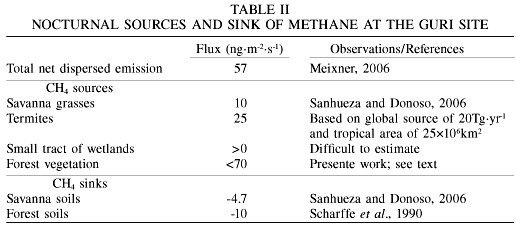
<body><![CDATA[<P style="line-height: 100%" align="justify"><font face="Verdana" size="2">The relatively low production of CH<SUB>4</SUB> from tropical savanna grasses is in agreement with results obtained using opaque chambers to measure the fluxes in temperate grasslands (Mosier <I>et al</I>., 1991, 1997) and tropical pastures (Keller and Reiners, 1994; Mosier and Delgado, 1997). These studies mainly indicated that the soil-grass system of these ecosystems consume CH<SUB>4</SUB>. In these ecosystems, CH<SUB>4</SUB> soil uptake would predominate over CH<SUB>4</SUB> production by grasses.</font></P>  <I>    <P style="line-height: 100%" align="justify"><font face="Verdana" size="2">Methane emission from tropical forests</font></P> </I>     <P style="line-height: 100%" align="justify"><font face="Verdana" size="2">Satellite measurements using the SCHIAMACHY instrument indicated high CH<SUB>4</SUB> levels over the Amazon forest, exceeding modeled concentrations and revealing that emissions inventories underestimated CH<SUB>4</SUB> sources of the region (Frankenberg <I>et al</I>., 2005). Methane emission from the vegetation, not included in the models, was suggested to be responsible for the discrepancy (Keppler <I>et al</I>., 2006). As discussed below, our results suggest that forest vegetation emits CH<SUB>4</SUB>, but its magnitude would be much lower than needed to explain the discrepancy between satellite measurements and underestimated emission inventories.</font></P>     <P style="line-height: 100%" align="justify"><font face="Verdana" size="2">Increasing concentrations of CH<SUB>4</SUB> during nighttime in the northern part of the Guayana shield, Venezuela, during the 1988 wet season, suggest the presence of a substantial methane source (Scharffe <I>et al</I>., 1990). The site is within the savanna climate region, but it is also affected by emissions from a nearby forest. Using the CH<SUB>4</SUB> accumulation within a 100m deep nocturnal boundary layer (NBL), the authors estimated a CH<SUB>4</SUB> flux of 130ng·m<SUP>-2</SUP>·s<SUP>-1</SUP>, which extrapolated to a corresponding global savanna source of ~60Tg·yr<SUP>-1</SUP>. A dispersed source of CH<SUB>4</SUB> (i.e., termites, small tract of flooded soils) was invoked to account for these results. Now, with the new available information, a fraction of this emission could be due to the vegetation present at the site.</font></P>     <P style="line-height: 100%" align="justify"><font face="Verdana" size="2">A re-interpretation of the Guri data was made by Crutzen <I>et al</I>. (2006). These authors concluded that the Guri field data is indicative of large CH<SUB>4</SUB> production rates from tropical vegetation. These authors suggest that it is quite feasible that, in addition to wetlands, tropical ecosystems produce some 30-60Tg·yr<SUP>-1</SUP>, mostly coming from the vegetation, with some uncertain contribution from termites, which for the whole globe may amount to 20Tg·yr<SUP>-1</SUP> (Frankenberg <I>et al</I>., 2005). The authors recognize that the main uncertainties of the new analysis arise from the extrapolation of measurements at one site with savanna and forest vegetation, to a surface equivalent of the global savanna, and from the numerical evaluation of the CH<SUB>4</SUB> fluxes in the NBL.</font></P>     <P style="line-height: 100%" align="justify"><font face="Verdana" size="2">Here, in order to be able to make a first approach to the emission of CH<SUB>4</SUB> from tropical rainforest vegetation, a detailed evaluation/estimation of sources and sinks of CH<SUB>4</SUB> at the Guri site is made. Since nighttime vertical profiles of O<SUB>3</SUB> within the NBL at the Guri site (Sanhueza <I>et al</I>., 2000) indicate that gases (including CH<SUB>4</SUB>) are not uniformly mixed in a 100m deep NBL, it is likely that there is a vertical gradient of CH<SUB>4</SUB> from the surface to the top of the NBL. Assuming a linear decrease of the concentration and integrating between the surface (0m) and the top of the NBL (100m), which could also be visualized as an &quot;imaginary nocturnal box&quot; of 50m of height (Denmead <I>et al</I>., 1996), a &quot;total&quot; CH<SUB>4</SUB> flux coming from dispersed savanna and forest sources of 57ng·m<SUP>-2</SUP>·s<SUP>-1</SUP> was estimated by Meixner (2006). This flux is in good agreement with the estimated nocturnal emissions of CH<SUB>4</SUB> produced by a &quot;dispersed source&quot; (termites, anaerobic decay of waterlogged wood, poorly drained patches of soils, thick moss mats, cavities of tank bromeliads) in the Amazon forest, which range from 23 to 230 (most likely 75) ng·m<SUP>-2</SUP>·s<SUP>-1</SUP> (do Carmo <I>et al</I>., 2006).</font></P>     <P style="line-height: 100%" align="justify"><font face="Verdana" size="2">Nocturnal sources and sinks of methane at the Guri site are summarized in Table II. Considering that measurements were made near the border of the savanna/forest ecosystems, an equal contribution (by unit area) from savanna and forest ecosystems was assumed in the calculations. As discussed in the previous section, an emission of 10ng·m<SUP>-2</SUP>·s<SUP>-1</SUP> is due to savanna grasses, which is in agreement with the CH<SUB>4</SUB> fluxes measured from the soil-grass system at the Guri site (Scharffe <I>et al</I>., 1990). Assuming that tropical emissions of methane from termites (~20Tg·yr<SUP>-1</SUP>) are homogenously distributed, a flux of ~25ng·m<SUP>-2</SUP>·s<SUP>-1</SUP> could be derived for this source. It is very difficult to estimate the contribution of &quot;small wetland pockets&quot;, however, since the region is quite hilly, emission of CH<SUB>4</SUB> from this source should be likely small, but &gt;0. The only nocturnal CH<SUB>4</SUB> sinks would be microbial consumption in soils and the fluxes used in the calculation are those discussed in a previous section. Assuming that the contribution from scarce savanna trees is negligible, the emission of CH<SUB>4</SUB> from the forest vegetation could be estimated using the values given in <a href="#tab2"> Table II</a> and the relation</font></P>      <P style="line-height: 100%" align="justify"><font face="Verdana" size="2">Net dispersed source  = vegetation emissions + other emissions - soil consumption</font></P>      <P style="line-height: 100%" align="justify"><font face="Verdana" size="2">where the net dispersed source equals 57ng·m<SUP>-2</SUP>·s<SUP>-1</SUP>, the soil consumption (assumed to be the average of CH<SUB>4</SUB> consumption by savanna and forest soils, respectively) is 7.5ng·m<SUP>-2</SUP>·s<SUP>-1</SUP>, and other sources (termites + wetland pockets) are estimated to be &gt;25ng·m<SUP>-2</SUP>·s<SUP>-1</SUP>. Therefore, the vegetation emission, considered to originate from savanna grasses and forest vegetation, will result in &lt;40ng·m<SUP>-2</SUP>·s<SUP>-1</SUP>.</font></P>      <P style="line-height: 100%" align="center"><a name="tab2"><img border="0" src="/img/fbpe/inci/v32n1/art07tab2.jpg" width="516" height="232"></a></P>      
]]></body>
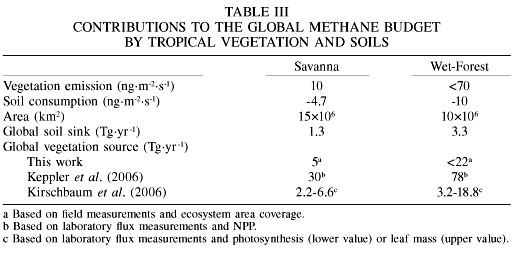
<body><![CDATA[<P style="line-height: 100%" align="justify"><font face="Verdana" size="2">Therefore, an upper limit for the nocturnal forest vegetation emission of &lt;70ng·m<SUP>-2</SUP>·s<SUP>-1</SUP> is calculated. However, considering that solar radiation stimulates methane emissions from vegetation, it is likely that the estimated nighttime emission rate somewhat underestimates the CH<SUB>4</SUB> emission throughout the day. Clearly, there are large uncertainties in this estimate, easily by a factor of 2.</font></P> <I>     <P style="line-height: 100%" align="justify"><font face="Verdana" size="2">Global extrapolations</font></P> </I>     <P style="line-height: 100%" align="justify"><font face="Verdana" size="2">Assuming that the estimated fluxes presented in previous sections are representative of world savannas and wet forests, a first approach to the global contribution of these ecosystems to the global CH<SUB>4</SUB> budget can be made. The appropriate/pertinent information and results of the extrapolation are summarized in <a href="#tab3"> Table III.</a></font></P>      <P style="line-height: 100%" align="center"><a name="tab3"><img border="0" src="/img/fbpe/inci/v32n1/art07tab3.jpg" width="512" height="254"></a></P>      
<P style="line-height: 100%" align="justify"><font face="Verdana" size="2">The global CH<SUB>4</SUB> sink by savanna soils is ~1.3Tg·yr<SUP>-1</SUP> (7 months wet season) and 3.3Tg·yr<SUP>-1</SUP> by forest soils. This corresponds to only ~0.9% of the total global sink of 576Tg·yr<SUP>-1</SUP> (Prather and Ehhalt, 2001); most of CH<SUB>4</SUB> is removed from the atmosphere by reaction with the OH radical. Ignoring the effects of light on methane emissions from vegetation, the global CH<SUB>4</SUB> emissions from savanna and forest vegetation are ~5 and &lt;22Tg·yr<SUP>-1</SUP>, respectively. Considering that the total global source is 598Tg·yr<SUP>-1</SUP> (Prather and Ehhalt, 2001) the contribution of tropical vegetation would be &lt;5%.</font></P>     <P style="line-height: 100%" align="justify"><font face="Verdana" size="2">As shown in Table III, the global tropical vegetation source of CH<SUB>4</SUB> estimated in this work, based on field measurements and ecosystem area coverage, is much lower than the value given by Keppler <I>et al</I>. (2006), which is based on laboratory experiments (mostly individual plants) and ecosystem net primary productivities (NPP). However, our estimates are within the range produced by the alternative calculations, based on foliage biomass and photosynthetic rates, made by Kirschbaum <I>et al</I>. (2006).</font></P>     <P style="line-height: 100%" align="justify"><font face="Verdana" size="2">Considering that tropical ecosystems cover a large fraction of world continents, it is likely that the global emissions of methane from vegetation from all ecosystems should be rather low. As mentioned, the soil-grass system of temperate grasslands (Mosier <I>et al</I>., 1991, 1997) and tropical pastures (Keller and Reiners, 1994; Mosier and Delgado, 1997) ecosystems consume CH<SUB>4</SUB>. Kirschbaum <I>et al</I>. (2006) and Ferretti <I>et al</I>. (2006) found that vegetation makes a small contribution to the global emission of CH<SUB>4</SUB>. Therefore, carbon sequestration (consumption of atmospheric CO<SUB>2</SUB> by growing trees) due to forestation should outweigh the radiative forcing (warming) produced by CH<SUB>4</SUB> tree emissions. A quite similar conclusion was reached by NIEPS (2006).</font></P>  <B>    <P style="line-height: 100%" align="justify"><font face="Verdana" size="2">Conclusions</font></P> </B>     <P style="line-height: 100%" align="justify"><font face="Verdana" size="2">Field measurement results indicate that tropical vegetation (savanna and wet-forest) emits CH<SUB>4</SUB>, supporting the surprising discovery made by Keppler <I>et al</I>. (2006). However, the global extrapolation of Venezuelan ecosystems field data indicate that tropical vegetation is likely to make a modest contribution to the global emission of CH<SUB>4</SUB>. Furthermore, vegetation emissions are in part additionally offset by savanna and forest soils uptake. It is most likely that the carbon sequestration benefits from forestation should not be significantly affected by CH<SUB>4</SUB> emissions from trees. All pertinent estimates have large uncertainties especially with respect to effects of solar radiation on the emissions. Further field studies are needed to better define methane emissions from plants.</font></P>  <B>    <P style="line-height: 100%" align="justify"><font face="Verdana" size="2">References</font></P> </B>     ]]></body>
<body><![CDATA[<!-- ref --><P style="line-height: 100%" align="justify"><font face="Verdana" size="2">1. Conrad R (1996) Soil microorganisms as controllers of atmospheric trace gases (H<SUB>2</SUB>, CO, CH<SUB>4</SUB>, OCS, N<SUB>2</SUB>O, and NO). <I>Microbiol. Rev. 60</I>: 609-640.</font>&nbsp;&nbsp;&nbsp;&nbsp;&nbsp;&nbsp;&nbsp;&nbsp;[&#160;<a href="javascript:void(0);" onclick="javascript: window.open('/scielo.php?script=sci_nlinks&ref=1033629&pid=S0378-1844200700010000700001&lng=','','width=640,height=500,resizable=yes,scrollbars=1,menubar=yes,');">Links</a>&#160;]<!-- end-ref --><!-- ref --><P style="line-height: 100%" align="justify"><font face="Verdana" size="2">2. Crutzen PJ, Sanhueza E, Brenninkmeijer CAM (2006) Methane production from mixed tropical savanna and forest vegetation in Venezuela. <I>Atmos. Chem. Phys. Discuss</I>.<I> 6</I>: 3093-3097. www.copernicus.org/EGU/acp/acpd/published_papers.htm</font>&nbsp;&nbsp;&nbsp;&nbsp;&nbsp;&nbsp;&nbsp;&nbsp;[&#160;<a href="javascript:void(0);" onclick="javascript: window.open('/scielo.php?script=sci_nlinks&ref=1033630&pid=S0378-1844200700010000700002&lng=','','width=640,height=500,resizable=yes,scrollbars=1,menubar=yes,');">Links</a>&#160;]<!-- end-ref --><!-- ref --><P style="line-height: 100%" align="justify"><font face="Verdana" size="2">3. Denmead OT, Raupach MR, Dunin FX, Cleugh HA, Leuning R (1996) Boundary layer budgets for regional estimates of scalar fluxes. <I>Global Change Biol</I>.<I> 2</I>: 255-264.</font> &nbsp;&nbsp;&nbsp;&nbsp;&nbsp;&nbsp;&nbsp;&nbsp;[&#160;<a href="javascript:void(0);" onclick="javascript: window.open('/scielo.php?script=sci_nlinks&ref=1033631&pid=S0378-1844200700010000700003&lng=','','width=640,height=500,resizable=yes,scrollbars=1,menubar=yes,');">Links</a>&#160;]<!-- end-ref --><!-- ref --><P style="line-height: 100%" align="justify"><font face="Verdana" size="2">4. do Carmo JB, Keller M, D&iacute;az JD, Camargo PB, Crill P (2006) A source of methane from upland forests in the Brazilian Amazon. <I>Geophys. Res. Lett</I>.<I> 33</I>: L04809, doi:10.1029/2005GL025436, 2006.</font>&nbsp;&nbsp;&nbsp;&nbsp;&nbsp;&nbsp;&nbsp;&nbsp;[&#160;<a href="javascript:void(0);" onclick="javascript: window.open('/scielo.php?script=sci_nlinks&ref=1033632&pid=S0378-1844200700010000700004&lng=','','width=640,height=500,resizable=yes,scrollbars=1,menubar=yes,');">Links</a>&#160;]<!-- end-ref --><!-- ref --><P style="line-height: 100%" align="justify"><font face="Verdana" size="2">5. Ferretti DF, Miller JB, White JWC, Lassey KR, Lowe DC, Etheridge DM (2006) Stable isotopes provide revised global limits of aerobic methane emissions from plants. <I>Atmos. Chem. Phys. Discuss. 6</I>: 5867-5875. www.copernicus.org/EGU/acp/acpd/ published_papers.htm</font>&nbsp;&nbsp;&nbsp;&nbsp;&nbsp;&nbsp;&nbsp;&nbsp;[&#160;<a href="javascript:void(0);" onclick="javascript: window.open('/scielo.php?script=sci_nlinks&ref=1033633&pid=S0378-1844200700010000700005&lng=','','width=640,height=500,resizable=yes,scrollbars=1,menubar=yes,');">Links</a>&#160;]<!-- end-ref --><!-- ref --><P style="line-height: 100%" align="justify"><font face="Verdana" size="2">6. Frankenberg C, Meirink JF, van Weele M, Platt U, Wagner, T (2005) Assessing methane emissions from global space-borne observations. <I>Science 308</I>: 1010-1014.</font>&nbsp;&nbsp;&nbsp;&nbsp;&nbsp;&nbsp;&nbsp;&nbsp;[&#160;<a href="javascript:void(0);" onclick="javascript: window.open('/scielo.php?script=sci_nlinks&ref=1033634&pid=S0378-1844200700010000700006&lng=','','width=640,height=500,resizable=yes,scrollbars=1,menubar=yes,');">Links</a>&#160;]<!-- end-ref --><!-- ref --><P style="line-height: 100%" align="justify"><font face="Verdana" size="2">7. Frankenberg C, Meirink JF, Bergamaschi P, Goede APH, Heiman M, K&ouml;rner S, Platt U, van Weele M, Wagner T (2006) Satellite chartography of atmospheric methane from SCIAMACHY on board ENVISAT: Analysis of the years 2003 and 2004. <I>J. Geophys Res. 111</I>: DO7303, doi:10.1029/2005JD006235, 2006.</font>&nbsp;&nbsp;&nbsp;&nbsp;&nbsp;&nbsp;&nbsp;&nbsp;[&#160;<a href="javascript:void(0);" onclick="javascript: window.open('/scielo.php?script=sci_nlinks&ref=1033635&pid=S0378-1844200700010000700007&lng=','','width=640,height=500,resizable=yes,scrollbars=1,menubar=yes,');">Links</a>&#160;]<!-- end-ref --><!-- ref --><P style="line-height: 100%" align="justify"><font face="Verdana" size="2">8. Hanson RS, Hanson TE (1996) Methanotrophic bacteria. <I>Microbiol. Rev. 60</I>: 439-471.</font>&nbsp;&nbsp;&nbsp;&nbsp;&nbsp;&nbsp;&nbsp;&nbsp;[&#160;<a href="javascript:void(0);" onclick="javascript: window.open('/scielo.php?script=sci_nlinks&ref=1033636&pid=S0378-1844200700010000700008&lng=','','width=640,height=500,resizable=yes,scrollbars=1,menubar=yes,');">Links</a>&#160;]<!-- end-ref --><!-- ref --><P style="line-height: 100%" align="justify"><font face="Verdana" size="2">9. Hao WM, Scharffe D, Crutzen PJ, Sanhueza E (1988) Production of N<SUB>2</SUB>O, CH<SUB>4</SUB> and CO<SUB>2</SUB> from soils in the tropical savannah during the dry season.<I> J. Atmos. Chem. 7</I>: 93-105.</font>&nbsp;&nbsp;&nbsp;&nbsp;&nbsp;&nbsp;&nbsp;&nbsp;[&#160;<a href="javascript:void(0);" onclick="javascript: window.open('/scielo.php?script=sci_nlinks&ref=1033637&pid=S0378-1844200700010000700009&lng=','','width=640,height=500,resizable=yes,scrollbars=1,menubar=yes,');">Links</a>&#160;]<!-- end-ref --><!-- ref --><P style="line-height: 100%" align="justify"><font face="Verdana" size="2">10. Keller M, Reiners WA (1994) Soil-atmosphere exchange of nitrous oxide, nitric oxide, and methane under secondary succession of pasture to forest in the Atlantic lowlands of Costa Rica. <I>Global Biogeochem. Cycles 8</I>: 399-409.</font>&nbsp;&nbsp;&nbsp;&nbsp;&nbsp;&nbsp;&nbsp;&nbsp;[&#160;<a href="javascript:void(0);" onclick="javascript: window.open('/scielo.php?script=sci_nlinks&ref=1033638&pid=S0378-1844200700010000700010&lng=','','width=640,height=500,resizable=yes,scrollbars=1,menubar=yes,');">Links</a>&#160;]<!-- end-ref --><!-- ref --><P style="line-height: 100%" align="justify"><font face="Verdana" size="2">11. Keppler F, Hamilton JTG, Brass M, Roeckmann T (2006) Methane emissions from terrestrial plants under aerobic conditions. <I>Nature 439</I>: 187-191.</font>&nbsp;&nbsp;&nbsp;&nbsp;&nbsp;&nbsp;&nbsp;&nbsp;[&#160;<a href="javascript:void(0);" onclick="javascript: window.open('/scielo.php?script=sci_nlinks&ref=1033639&pid=S0378-1844200700010000700011&lng=','','width=640,height=500,resizable=yes,scrollbars=1,menubar=yes,');">Links</a>&#160;]<!-- end-ref --><!-- ref --><P style="line-height: 100%" align="justify"><font face="Verdana" size="2">12. Kiese R, Hewett B, Graham A, Butterbach-Bahl K (2003) Seasonal variability of N<SUB>2</SUB>O emission and CH<SUB>4</SUB> uptake by tropical rainforest soils of Queensland, Australia. <I>Global Biogeochem. Cycles 17</I>: 1004, doi:10.1029/2002GB002014</font>&nbsp;&nbsp;&nbsp;&nbsp;&nbsp;&nbsp;&nbsp;&nbsp;[&#160;<a href="javascript:void(0);" onclick="javascript: window.open('/scielo.php?script=sci_nlinks&ref=1033640&pid=S0378-1844200700010000700012&lng=','','width=640,height=500,resizable=yes,scrollbars=1,menubar=yes,');">Links</a>&#160;]<!-- end-ref --><!-- ref --><P style="line-height: 100%" align="justify"><font face="Verdana" size="2">13. Kirschbaum MUF, Bruhn D, Etheridge DM, Evans JR, Farquhar GD, Gifford RM, Paul KI, Winters AJ (2006) A comment on the quantitative significance of aerobic methane release by plants. <I>Funct. Plant Biol. 33</I>: 521-530.</font>&nbsp;&nbsp;&nbsp;&nbsp;&nbsp;&nbsp;&nbsp;&nbsp;[&#160;<a href="javascript:void(0);" onclick="javascript: window.open('/scielo.php?script=sci_nlinks&ref=1033641&pid=S0378-1844200700010000700013&lng=','','width=640,height=500,resizable=yes,scrollbars=1,menubar=yes,');">Links</a>&#160;]<!-- end-ref --><!-- ref --><P style="line-height: 100%" align="justify"><font face="Verdana" size="2">14. Meixner F (2006) Interactive comments on &quot;Methane production from mixed tropical savanna and forest vegetation in Venezuela by Crutzen <I>et al</I>.&quot; <I>Atmos. Chem. Phys. Discuss. 6</I>: S1717-S1722. www.copernicus.org/EGU/acp/acpd/published_papers. htm</font>&nbsp;&nbsp;&nbsp;&nbsp;&nbsp;&nbsp;&nbsp;&nbsp;[&#160;<a href="javascript:void(0);" onclick="javascript: window.open('/scielo.php?script=sci_nlinks&ref=1033642&pid=S0378-1844200700010000700014&lng=','','width=640,height=500,resizable=yes,scrollbars=1,menubar=yes,');">Links</a>&#160;]<!-- end-ref --><!-- ref --><P style="line-height: 100%" align="justify"><font face="Verdana" size="2">15. Mosier AR, Delgado JA (1997) Methane and nitrous oxide fluxes in grasslands in western Puerto Rico. <I>Chemosphere 35</I>: 2059-2082.</font>&nbsp;&nbsp;&nbsp;&nbsp;&nbsp;&nbsp;&nbsp;&nbsp;[&#160;<a href="javascript:void(0);" onclick="javascript: window.open('/scielo.php?script=sci_nlinks&ref=1033643&pid=S0378-1844200700010000700015&lng=','','width=640,height=500,resizable=yes,scrollbars=1,menubar=yes,');">Links</a>&#160;]<!-- end-ref --><!-- ref --><P style="line-height: 100%" align="justify"><font face="Verdana" size="2">16. Mosier A, Schimel D, Valentine D, Bronson K, Parton W (1991) Methane and nitrous oxide fluxes in native, fertilized and cultivated grassland. <I>Nature 350</I>: 330-332.</font>&nbsp;&nbsp;&nbsp;&nbsp;&nbsp;&nbsp;&nbsp;&nbsp;[&#160;<a href="javascript:void(0);" onclick="javascript: window.open('/scielo.php?script=sci_nlinks&ref=1033644&pid=S0378-1844200700010000700016&lng=','','width=640,height=500,resizable=yes,scrollbars=1,menubar=yes,');">Links</a>&#160;]<!-- end-ref --><!-- ref --><P style="line-height: 100%" align="justify"><font face="Verdana" size="2">17. Mosier AR, Parton WJ, Valentine DW, Ojima DS, Schimel DS, Heinemeyer O (1997) CH<SUB>4</SUB> and N<SUB>2</SUB>O fluxes in the Colorado shortgrass steppe 2. Long-term impact of land use change, <I>Global Biogeochem. Cycles 11</I>: 29-42.</font>&nbsp;&nbsp;&nbsp;&nbsp;&nbsp;&nbsp;&nbsp;&nbsp;[&#160;<a href="javascript:void(0);" onclick="javascript: window.open('/scielo.php?script=sci_nlinks&ref=1033645&pid=S0378-1844200700010000700017&lng=','','width=640,height=500,resizable=yes,scrollbars=1,menubar=yes,');">Links</a>&#160;]<!-- end-ref --><!-- ref --><P style="line-height: 100%" align="justify"><font face="Verdana" size="2">18. NIEPS (2006) <I>Do recent scientific findings undermine the climate benefits of carbon sequestration in forest?</I> An expert review of recent studies on methane emissions and water tradeoffs. Nicholas Institute for Environmental Policy Solutions. Duke University, USA. Feb. 9, 2006. www.env.duke.edu/institute/methanewater.pdf</font>&nbsp;&nbsp;&nbsp;&nbsp;&nbsp;&nbsp;&nbsp;&nbsp;[&#160;<a href="javascript:void(0);" onclick="javascript: window.open('/scielo.php?script=sci_nlinks&ref=1033646&pid=S0378-1844200700010000700018&lng=','','width=640,height=500,resizable=yes,scrollbars=1,menubar=yes,');">Links</a>&#160;]<!-- end-ref --><!-- ref --><P style="line-height: 100%" align="justify"><font face="Verdana" size="2">19. Poth M, Anderson IC, Miranda HS, Miranda AC, Riggan PJ (1995) The magnitude and persistence of soil NO, N<SUB>2</SUB>O, CH<SUB>4</SUB>, and CO<SUB>2</SUB> fluxes from burned tropical savanna in Brazil. <I>Global Biogeochem. Cycles 9</I>: 503-513.</font>&nbsp;&nbsp;&nbsp;&nbsp;&nbsp;&nbsp;&nbsp;&nbsp;[&#160;<a href="javascript:void(0);" onclick="javascript: window.open('/scielo.php?script=sci_nlinks&ref=1033647&pid=S0378-1844200700010000700019&lng=','','width=640,height=500,resizable=yes,scrollbars=1,menubar=yes,');">Links</a>&#160;]<!-- end-ref --><!-- ref --><P style="line-height: 100%" align="justify"><font face="Verdana" size="2">20. Prather M, Ehhalt D (2001) Atmospheric chemistry and greenhouse gases. In <I>Climate Change 2001. The Scientific Basis</I>. Cambridge University Press. Cambridge, UK. pp. 239-287.</font>&nbsp;&nbsp;&nbsp;&nbsp;&nbsp;&nbsp;&nbsp;&nbsp;[&#160;<a href="javascript:void(0);" onclick="javascript: window.open('/scielo.php?script=sci_nlinks&ref=1033648&pid=S0378-1844200700010000700020&lng=','','width=640,height=500,resizable=yes,scrollbars=1,menubar=yes,');">Links</a>&#160;]<!-- end-ref --><!-- ref --><P style="line-height: 100%" align="justify"><font face="Verdana" size="2">21. Sanhueza E, Donoso L (2006) Methane emission from tropical <I>Trachypogon </I>sp. grasses. <I>Atmos. Chem. Phys. 6</I>: 5315-5319. www.copernicus.org/EGU/acp/acpd/ published_papers.htm</font>&nbsp;&nbsp;&nbsp;&nbsp;&nbsp;&nbsp;&nbsp;&nbsp;[&#160;<a href="javascript:void(0);" onclick="javascript: window.open('/scielo.php?script=sci_nlinks&ref=1033649&pid=S0378-1844200700010000700021&lng=','','width=640,height=500,resizable=yes,scrollbars=1,menubar=yes,');">Links</a>&#160;]<!-- end-ref --><!-- ref --><P style="line-height: 100%" align="justify"><font face="Verdana" size="2">22. Sanhueza E, Cuenca G, G&oacute;mez MJ, Herrera R, Ishizaki Ch, Mart&iacute; I, Paolini J (1988) Characterization of Venezuelan environment and its potential for acidification. In Rodhe H, Herrera R (Eds.) <I>Acidification in Tropical Countries</I>. Wiley. Chichester, UK. pp. 197-255.</font>&nbsp;&nbsp;&nbsp;&nbsp;&nbsp;&nbsp;&nbsp;&nbsp;[&#160;<a href="javascript:void(0);" onclick="javascript: window.open('/scielo.php?script=sci_nlinks&ref=1033650&pid=S0378-1844200700010000700022&lng=','','width=640,height=500,resizable=yes,scrollbars=1,menubar=yes,');">Links</a>&#160;]<!-- end-ref --><!-- ref --><P style="line-height: 100%" align="justify"><font face="Verdana" size="2">23. Sanhueza E, Hao WM, Scharffe D, Donoso L, Crutzen PJ (1990) N<SUB>2</SUB>O and NO<SUB>x</SUB> emissions from soils of the northern part of the Guayana shield, Venezuela. <I>J. Geophys. Res. 95D</I>: 22481-22488.</font>&nbsp;&nbsp;&nbsp;&nbsp;&nbsp;&nbsp;&nbsp;&nbsp;[&#160;<a href="javascript:void(0);" onclick="javascript: window.open('/scielo.php?script=sci_nlinks&ref=1033651&pid=S0378-1844200700010000700023&lng=','','width=640,height=500,resizable=yes,scrollbars=1,menubar=yes,');">Links</a>&#160;]<!-- end-ref --><!-- ref --><P style="line-height: 100%" align="justify"><font face="Verdana" size="2">24. Sanhueza E, C&aacute;rdenas L, Donoso L, Santana M (1994) Effect of plowing on CO<SUB>2</SUB>, CO, CH<SUB>4</SUB>, N<SUB>2</SUB>O and NO fluxes from tropical savanna soils. <I>J. Geophys. Res</I>.<I> 99D</I>: 16429-16434.</font>&nbsp;&nbsp;&nbsp;&nbsp;&nbsp;&nbsp;&nbsp;&nbsp;[&#160;<a href="javascript:void(0);" onclick="javascript: window.open('/scielo.php?script=sci_nlinks&ref=1033652&pid=S0378-1844200700010000700024&lng=','','width=640,height=500,resizable=yes,scrollbars=1,menubar=yes,');">Links</a>&#160;]<!-- end-ref --><!-- ref --><P style="line-height: 100%" align="justify"><font face="Verdana" size="2">25. Sanhueza E, Fern&aacute;ndez E, Donoso L, Romero J (2000) Boundary layer ozone in the tropical American northern hemisphere region. <I>J. Atmos. Chem. 35</I>: 249-272.</font>&nbsp;&nbsp;&nbsp;&nbsp;&nbsp;&nbsp;&nbsp;&nbsp;[&#160;<a href="javascript:void(0);" onclick="javascript: window.open('/scielo.php?script=sci_nlinks&ref=1033653&pid=S0378-1844200700010000700025&lng=','','width=640,height=500,resizable=yes,scrollbars=1,menubar=yes,');">Links</a>&#160;]<!-- end-ref --><!-- ref --><P style="line-height: 100%" align="justify"><font face="Verdana" size="2">26. Scharffe D, Donoso L, Crutzen PJ, Sanhueza E (1990) Soil Fluxes and atmospheric concentrations of CO and CH<SUB>4</SUB> in the northern part of the Guayana shield, Venezuela, <I>J. Gephys. Res</I>.<I> 95D</I>: 22475-22480.</font>&nbsp;&nbsp;&nbsp;&nbsp;&nbsp;&nbsp;&nbsp;&nbsp;[&#160;<a href="javascript:void(0);" onclick="javascript: window.open('/scielo.php?script=sci_nlinks&ref=1033654&pid=S0378-1844200700010000700026&lng=','','width=640,height=500,resizable=yes,scrollbars=1,menubar=yes,');">Links</a>&#160;]<!-- end-ref --><!-- ref --><P style="line-height: 100%" align="justify"><font face="Verdana" size="2">27. Schnell S, King GM (1996) Response of methanotrophic activity in soil and cultures to water stress. <I>Appl. Environ. Microbiol. 62</I>: 3203-3209.</font>&nbsp;&nbsp;&nbsp;&nbsp;&nbsp;&nbsp;&nbsp;&nbsp;[&#160;<a href="javascript:void(0);" onclick="javascript: window.open('/scielo.php?script=sci_nlinks&ref=1033655&pid=S0378-1844200700010000700027&lng=','','width=640,height=500,resizable=yes,scrollbars=1,menubar=yes,');">Links</a>&#160;]<!-- end-ref --><!-- ref --><P style="line-height: 100%" align="justify"><font face="Verdana" size="2">28. Seiler W, Conrad R, Scharffe D (1984) Field studies of methane emission from termite nests into the atmosphere and measurements of methane uptake by tropical soils. <I>J. Atmos. Chem. 1</I>: 171-186.</font>&nbsp;&nbsp;&nbsp;&nbsp;&nbsp;&nbsp;&nbsp;&nbsp;[&#160;<a href="javascript:void(0);" onclick="javascript: window.open('/scielo.php?script=sci_nlinks&ref=1033656&pid=S0378-1844200700010000700028&lng=','','width=640,height=500,resizable=yes,scrollbars=1,menubar=yes,');">Links</a>&#160;]<!-- end-ref --><!-- ref --><P style="line-height: 100%" align="justify"><font face="Verdana" size="2">29. Striegl RG (1993) Diffusional limits to the consumption of atmospheric methane by soils. <I>Chemosphere 26</I>: 715-720.</font>&nbsp;&nbsp;&nbsp;&nbsp;&nbsp;&nbsp;&nbsp;&nbsp;[&#160;<a href="javascript:void(0);" onclick="javascript: window.open('/scielo.php?script=sci_nlinks&ref=1033657&pid=S0378-1844200700010000700029&lng=','','width=640,height=500,resizable=yes,scrollbars=1,menubar=yes,');">Links</a>&#160;]<!-- end-ref --><!-- ref --><P style="line-height: 100%" align="justify"><font face="Verdana" size="2">30. Zepp RG, Miller WL, Burke RA, Dirk A, Parsons B, Scholes MC (1996) Effects of moisture and burning on soil-atmosphere exchange of trace carbon gases in a southern African savanna. <I>J. Geophys. Res</I>. 101: 23699-23706.</font>&nbsp;&nbsp;&nbsp;&nbsp;&nbsp;&nbsp;&nbsp;&nbsp;[&#160;<a href="javascript:void(0);" onclick="javascript: window.open('/scielo.php?script=sci_nlinks&ref=1033658&pid=S0378-1844200700010000700030&lng=','','width=640,height=500,resizable=yes,scrollbars=1,menubar=yes,');">Links</a>&#160;]<!-- end-ref --> ]]></body>
<back>
<ref-list>
<ref id="B1">
<label>1</label><nlm-citation citation-type="journal">
<person-group person-group-type="author">
<name>
<surname><![CDATA[Conrad]]></surname>
<given-names><![CDATA[R]]></given-names>
</name>
</person-group>
<article-title xml:lang="en"><![CDATA[Soil microorganisms as controllers of atmospheric trace gases (H2, CO, CH4, OCS, N2O, and NO)]]></article-title>
<source><![CDATA[Microbiol. Rev.]]></source>
<year>1996</year>
<volume>60</volume>
<page-range>609-640</page-range></nlm-citation>
</ref>
<ref id="B2">
<label>2</label><nlm-citation citation-type="journal">
<person-group person-group-type="author">
<name>
<surname><![CDATA[Crutzen]]></surname>
<given-names><![CDATA[PJ]]></given-names>
</name>
<name>
<surname><![CDATA[Sanhueza]]></surname>
<given-names><![CDATA[E]]></given-names>
</name>
<name>
<surname><![CDATA[Brenninkmeijer]]></surname>
<given-names><![CDATA[CAM]]></given-names>
</name>
</person-group>
<article-title xml:lang="en"><![CDATA[Methane production from mixed tropical savanna and forest vegetation in Venezuela]]></article-title>
<source><![CDATA[Atmos. Chem. Phys. Discuss.]]></source>
<year>2006</year>
<volume>6</volume>
<page-range>3093-3097</page-range></nlm-citation>
</ref>
<ref id="B3">
<label>3</label><nlm-citation citation-type="journal">
<person-group person-group-type="author">
<name>
<surname><![CDATA[Denmead]]></surname>
<given-names><![CDATA[OT]]></given-names>
</name>
<name>
<surname><![CDATA[Raupach]]></surname>
<given-names><![CDATA[MR]]></given-names>
</name>
<name>
<surname><![CDATA[Dunin]]></surname>
<given-names><![CDATA[FX]]></given-names>
</name>
<name>
<surname><![CDATA[Cleugh]]></surname>
<given-names><![CDATA[HA]]></given-names>
</name>
<name>
<surname><![CDATA[Leuning]]></surname>
<given-names><![CDATA[R]]></given-names>
</name>
</person-group>
<article-title xml:lang="en"><![CDATA[Boundary layer budgets for regional estimates of scalar fluxes]]></article-title>
<source><![CDATA[Global Change Biol.]]></source>
<year>1996</year>
<volume>2</volume>
<page-range>255-264</page-range></nlm-citation>
</ref>
<ref id="B4">
<label>4</label><nlm-citation citation-type="journal">
<person-group person-group-type="author">
<name>
<surname><![CDATA[do]]></surname>
<given-names><![CDATA[Carmo JB]]></given-names>
</name>
<name>
<surname><![CDATA[Keller]]></surname>
<given-names><![CDATA[M]]></given-names>
</name>
<name>
<surname><![CDATA[Díaz]]></surname>
<given-names><![CDATA[JD]]></given-names>
</name>
<name>
<surname><![CDATA[Camargo]]></surname>
<given-names><![CDATA[PB]]></given-names>
</name>
<name>
<surname><![CDATA[Crill]]></surname>
<given-names><![CDATA[P]]></given-names>
</name>
</person-group>
<article-title xml:lang="en"><![CDATA[A source of methane from upland forests in the Brazilian Amazon]]></article-title>
<source><![CDATA[Geophys. Res. Lett.]]></source>
<year>2006</year>
<volume>33</volume>
<page-range>L04809, doi:10.1029/2005GL025436, 2006</page-range></nlm-citation>
</ref>
<ref id="B5">
<label>5</label><nlm-citation citation-type="journal">
<person-group person-group-type="author">
<name>
<surname><![CDATA[Ferretti]]></surname>
<given-names><![CDATA[DF]]></given-names>
</name>
<name>
<surname><![CDATA[Miller]]></surname>
<given-names><![CDATA[JB]]></given-names>
</name>
<name>
<surname><![CDATA[White]]></surname>
<given-names><![CDATA[JWC]]></given-names>
</name>
<name>
<surname><![CDATA[Lassey]]></surname>
<given-names><![CDATA[KR]]></given-names>
</name>
<name>
<surname><![CDATA[Lowe]]></surname>
<given-names><![CDATA[DC]]></given-names>
</name>
<name>
<surname><![CDATA[Etheridge]]></surname>
<given-names><![CDATA[DM]]></given-names>
</name>
</person-group>
<article-title xml:lang="en"><![CDATA[Stable isotopes provide revised global limits of aerobic methane emissions from plants]]></article-title>
<source><![CDATA[Atmos. Chem. Phys. Discuss.]]></source>
<year>2006</year>
<volume>6</volume>
<page-range>5867-5875</page-range></nlm-citation>
</ref>
<ref id="B6">
<label>6</label><nlm-citation citation-type="journal">
<person-group person-group-type="author">
<name>
<surname><![CDATA[Frankenberg]]></surname>
<given-names><![CDATA[C]]></given-names>
</name>
<name>
<surname><![CDATA[Meirink]]></surname>
<given-names><![CDATA[JF]]></given-names>
</name>
<name>
<surname><![CDATA[van]]></surname>
<given-names><![CDATA[Weele M]]></given-names>
</name>
<name>
<surname><![CDATA[Platt]]></surname>
<given-names><![CDATA[U]]></given-names>
</name>
<name>
<surname><![CDATA[Wagner,]]></surname>
<given-names><![CDATA[T]]></given-names>
</name>
</person-group>
<article-title xml:lang="en"><![CDATA[Assessing methane emissions from global space-borne observations]]></article-title>
<source><![CDATA[Science]]></source>
<year>2005</year>
<volume>308</volume>
<page-range>1010-1014</page-range></nlm-citation>
</ref>
<ref id="B7">
<label>7</label><nlm-citation citation-type="journal">
<person-group person-group-type="author">
<name>
<surname><![CDATA[Frankenberg]]></surname>
<given-names><![CDATA[C]]></given-names>
</name>
<name>
<surname><![CDATA[Meirink]]></surname>
<given-names><![CDATA[JF]]></given-names>
</name>
<name>
<surname><![CDATA[Bergamaschi]]></surname>
<given-names><![CDATA[P]]></given-names>
</name>
<name>
<surname><![CDATA[Goede]]></surname>
<given-names><![CDATA[APH]]></given-names>
</name>
<name>
<surname><![CDATA[Heiman]]></surname>
<given-names><![CDATA[M]]></given-names>
</name>
<name>
<surname><![CDATA[Körner]]></surname>
<given-names><![CDATA[S]]></given-names>
</name>
<name>
<surname><![CDATA[Platt]]></surname>
<given-names><![CDATA[U]]></given-names>
</name>
<name>
<surname><![CDATA[van Weele]]></surname>
<given-names><![CDATA[M]]></given-names>
</name>
<name>
<surname><![CDATA[Wagner]]></surname>
<given-names><![CDATA[T]]></given-names>
</name>
</person-group>
<source><![CDATA[J. Geophys ResSatellite chartography of atmospheric methane from SCIAMACHY on board ENVISAT: Analysis of the years 2003 and 2004]]></source>
<year>2006</year>
<month>20</month>
<day>06</day>
<volume>111</volume>
</nlm-citation>
</ref>
<ref id="B8">
<label>8</label><nlm-citation citation-type="journal">
<person-group person-group-type="author">
<name>
<surname><![CDATA[Hanson]]></surname>
<given-names><![CDATA[RS]]></given-names>
</name>
<name>
<surname><![CDATA[Hanson]]></surname>
<given-names><![CDATA[TE]]></given-names>
</name>
</person-group>
<article-title xml:lang="en"><![CDATA[Methanotrophic bacteria]]></article-title>
<source><![CDATA[Microbiol. Rev.]]></source>
<year>1996</year>
<volume>60</volume>
<page-range>439-471</page-range></nlm-citation>
</ref>
<ref id="B9">
<label>9</label><nlm-citation citation-type="journal">
<person-group person-group-type="author">
<name>
<surname><![CDATA[Hao]]></surname>
<given-names><![CDATA[WM]]></given-names>
</name>
<name>
<surname><![CDATA[Scharffe]]></surname>
<given-names><![CDATA[D]]></given-names>
</name>
<name>
<surname><![CDATA[Crutzen]]></surname>
<given-names><![CDATA[PJ]]></given-names>
</name>
<name>
<surname><![CDATA[Sanhueza]]></surname>
<given-names><![CDATA[E]]></given-names>
</name>
</person-group>
<article-title xml:lang="en"><![CDATA[Production of N2O, CH4 and CO2 from soils in the tropical savannah during the dry season]]></article-title>
<source><![CDATA[J. Atmos. Chem.]]></source>
<year>1988</year>
<volume>7</volume>
<page-range>93-105</page-range></nlm-citation>
</ref>
<ref id="B10">
<label>10</label><nlm-citation citation-type="journal">
<person-group person-group-type="author">
<name>
<surname><![CDATA[Keller]]></surname>
<given-names><![CDATA[M]]></given-names>
</name>
<name>
<surname><![CDATA[Reiners]]></surname>
<given-names><![CDATA[WA]]></given-names>
</name>
</person-group>
<article-title xml:lang="en"><![CDATA[Soil-atmosphere exchange of nitrous oxide, nitric oxide, and methane under secondary succession of pasture to forest in the Atlantic lowlands of Costa Rica]]></article-title>
<source><![CDATA[Global Biogeochem. Cycles]]></source>
<year>1994</year>
<volume>8</volume>
<page-range>399-409</page-range></nlm-citation>
</ref>
<ref id="B11">
<label>11</label><nlm-citation citation-type="journal">
<person-group person-group-type="author">
<name>
<surname><![CDATA[Keppler]]></surname>
<given-names><![CDATA[F]]></given-names>
</name>
<name>
<surname><![CDATA[Hamilton]]></surname>
<given-names><![CDATA[JTG]]></given-names>
</name>
<name>
<surname><![CDATA[Brass]]></surname>
<given-names><![CDATA[M]]></given-names>
</name>
<name>
<surname><![CDATA[Roeckmann]]></surname>
<given-names><![CDATA[T]]></given-names>
</name>
</person-group>
<article-title xml:lang="en"><![CDATA[Methane emissions from terrestrial plants under aerobic conditions]]></article-title>
<source><![CDATA[Nature]]></source>
<year>2006</year>
<volume>439</volume>
<page-range>187-191</page-range></nlm-citation>
</ref>
<ref id="B12">
<label>12</label><nlm-citation citation-type="journal">
<person-group person-group-type="author">
<name>
<surname><![CDATA[Kiese]]></surname>
<given-names><![CDATA[R]]></given-names>
</name>
<name>
<surname><![CDATA[Hewett]]></surname>
<given-names><![CDATA[B]]></given-names>
</name>
<name>
<surname><![CDATA[Graham]]></surname>
<given-names><![CDATA[A]]></given-names>
</name>
<name>
<surname><![CDATA[Butterbach-Bahl]]></surname>
<given-names><![CDATA[K]]></given-names>
</name>
</person-group>
<article-title xml:lang="en"><![CDATA[Seasonal variability of N2O emission and CH4 uptake by tropical rainforest soils of Queensland, Australia]]></article-title>
<source><![CDATA[Global Biogeochem. Cycles]]></source>
<year>2003</year>
<volume>17</volume>
<page-range>1004</page-range></nlm-citation>
</ref>
<ref id="B13">
<label>13</label><nlm-citation citation-type="journal">
<person-group person-group-type="author">
<name>
<surname><![CDATA[Kirschbaum]]></surname>
<given-names><![CDATA[MUF]]></given-names>
</name>
<name>
<surname><![CDATA[Bruhn]]></surname>
<given-names><![CDATA[D]]></given-names>
</name>
<name>
<surname><![CDATA[Etheridge]]></surname>
<given-names><![CDATA[DM]]></given-names>
</name>
<name>
<surname><![CDATA[Evans]]></surname>
<given-names><![CDATA[JR]]></given-names>
</name>
<name>
<surname><![CDATA[Farquhar]]></surname>
<given-names><![CDATA[GD]]></given-names>
</name>
<name>
<surname><![CDATA[Gifford]]></surname>
<given-names><![CDATA[RM]]></given-names>
</name>
<name>
<surname><![CDATA[Paul]]></surname>
<given-names><![CDATA[KI]]></given-names>
</name>
<name>
<surname><![CDATA[Winters]]></surname>
<given-names><![CDATA[AJ]]></given-names>
</name>
</person-group>
<article-title xml:lang="en"><![CDATA[A comment on the quantitative significance of aerobic methane release by plants]]></article-title>
<source><![CDATA[Funct. Plant Biol.]]></source>
<year>2006</year>
<volume>33</volume>
<page-range>521-530</page-range></nlm-citation>
</ref>
<ref id="B14">
<label>14</label><nlm-citation citation-type="journal">
<person-group person-group-type="author">
<name>
<surname><![CDATA[Meixner]]></surname>
<given-names><![CDATA[F]]></given-names>
</name>
</person-group>
<article-title xml:lang="en"><![CDATA[Interactive comments on "Methane production from mixed tropical savanna and forest vegetation in Venezuela by Crutzen et al."]]></article-title>
<source><![CDATA[Atmos. Chem. Phys. Discuss.]]></source>
<year>2006</year>
<volume>6</volume>
<page-range>S1717-S1722</page-range></nlm-citation>
</ref>
<ref id="B15">
<label>15</label><nlm-citation citation-type="journal">
<person-group person-group-type="author">
<name>
<surname><![CDATA[Mosier]]></surname>
<given-names><![CDATA[AR]]></given-names>
</name>
<name>
<surname><![CDATA[Delgado]]></surname>
<given-names><![CDATA[JA]]></given-names>
</name>
</person-group>
<article-title xml:lang="en"><![CDATA[Methane and nitrous oxide fluxes in grasslands in western Puerto Rico]]></article-title>
<source><![CDATA[Chemosphere]]></source>
<year>1997</year>
<volume>35</volume>
<page-range>2059-2082</page-range></nlm-citation>
</ref>
<ref id="B16">
<label>16</label><nlm-citation citation-type="journal">
<person-group person-group-type="author">
<name>
<surname><![CDATA[Mosier]]></surname>
<given-names><![CDATA[A]]></given-names>
</name>
<name>
<surname><![CDATA[Schimel]]></surname>
<given-names><![CDATA[D]]></given-names>
</name>
<name>
<surname><![CDATA[Valentine]]></surname>
<given-names><![CDATA[D]]></given-names>
</name>
<name>
<surname><![CDATA[Bronson]]></surname>
<given-names><![CDATA[K]]></given-names>
</name>
<name>
<surname><![CDATA[Parton]]></surname>
<given-names><![CDATA[W]]></given-names>
</name>
</person-group>
<article-title xml:lang="en"><![CDATA[Methane and nitrous oxide fluxes in native, fertilized and cultivated grassland]]></article-title>
<source><![CDATA[Nature]]></source>
<year>1991</year>
<volume>350</volume>
<page-range>330-332</page-range></nlm-citation>
</ref>
<ref id="B17">
<label>17</label><nlm-citation citation-type="journal">
<person-group person-group-type="author">
<name>
<surname><![CDATA[Mosier]]></surname>
<given-names><![CDATA[AR]]></given-names>
</name>
<name>
<surname><![CDATA[Parton]]></surname>
<given-names><![CDATA[WJ]]></given-names>
</name>
<name>
<surname><![CDATA[Valentine]]></surname>
<given-names><![CDATA[DW]]></given-names>
</name>
<name>
<surname><![CDATA[Ojima]]></surname>
<given-names><![CDATA[DS]]></given-names>
</name>
<name>
<surname><![CDATA[Schimel]]></surname>
<given-names><![CDATA[DS]]></given-names>
</name>
<name>
<surname><![CDATA[Heinemeyer]]></surname>
<given-names><![CDATA[O]]></given-names>
</name>
</person-group>
<article-title xml:lang="en"><![CDATA[CH4 and N2O fluxes in the Colorado shortgrass steppe 2]]></article-title>
<source><![CDATA[Long-term impact of land use change, Global Biogeochem. Cycles]]></source>
<year>1997</year>
<volume>11</volume>
<page-range>29-42</page-range></nlm-citation>
</ref>
<ref id="B18">
<label>18</label><nlm-citation citation-type="book">
<collab>NIEPS</collab>
<source><![CDATA[Do recent scientific findings undermine the climate benefits of carbon sequestration in forest? An expert review of recent studies on methane emissions and water tradeoffs.]]></source>
<year>2006</year>
<publisher-name><![CDATA[Nicholas Institute for Environmental Policy Solutions. Duke University]]></publisher-name>
</nlm-citation>
</ref>
<ref id="B19">
<label>19</label><nlm-citation citation-type="journal">
<person-group person-group-type="author">
<name>
<surname><![CDATA[Poth]]></surname>
<given-names><![CDATA[M]]></given-names>
</name>
<name>
<surname><![CDATA[Anderson]]></surname>
<given-names><![CDATA[IC]]></given-names>
</name>
<name>
<surname><![CDATA[Miranda]]></surname>
<given-names><![CDATA[HS]]></given-names>
</name>
<name>
<surname><![CDATA[Miranda]]></surname>
<given-names><![CDATA[AC]]></given-names>
</name>
<name>
<surname><![CDATA[Riggan]]></surname>
<given-names><![CDATA[PJ]]></given-names>
</name>
</person-group>
<article-title xml:lang="en"><![CDATA[The magnitude and persistence of soil NO, N2O, CH4, and CO2 fluxes from burned tropical savanna in Brazil]]></article-title>
<source><![CDATA[Global Biogeochem. Cycles]]></source>
<year>1995</year>
<volume>9</volume>
<page-range>503-513</page-range></nlm-citation>
</ref>
<ref id="B20">
<label>20</label><nlm-citation citation-type="">
<person-group person-group-type="author">
<name>
<surname><![CDATA[Prather]]></surname>
<given-names><![CDATA[M]]></given-names>
</name>
<name>
<surname><![CDATA[Ehhalt]]></surname>
<given-names><![CDATA[D]]></given-names>
</name>
</person-group>
<source><![CDATA[Atmospheric chemistry and greenhouse gases]]></source>
<year>2001</year>
<page-range>239-287</page-range></nlm-citation>
</ref>
<ref id="B21">
<label>21</label><nlm-citation citation-type="journal">
<person-group person-group-type="author">
<name>
<surname><![CDATA[Sanhueza]]></surname>
<given-names><![CDATA[E]]></given-names>
</name>
<name>
<surname><![CDATA[Donoso]]></surname>
<given-names><![CDATA[L]]></given-names>
</name>
</person-group>
<article-title xml:lang="en"><![CDATA[Methane emission from tropical Trachypogon sp]]></article-title>
<source><![CDATA[grasses. Atmos. Chem. Phys.]]></source>
<year>2006</year>
<volume>6</volume>
<page-range>5315-5319.</page-range></nlm-citation>
</ref>
<ref id="B22">
<label>22</label><nlm-citation citation-type="book">
<person-group person-group-type="author">
<name>
<surname><![CDATA[Sanhueza]]></surname>
<given-names><![CDATA[E]]></given-names>
</name>
<name>
<surname><![CDATA[Cuenca]]></surname>
<given-names><![CDATA[G]]></given-names>
</name>
<name>
<surname><![CDATA[Gómez]]></surname>
<given-names><![CDATA[MJ]]></given-names>
</name>
<name>
<surname><![CDATA[Herrera]]></surname>
<given-names><![CDATA[R]]></given-names>
</name>
<name>
<surname><![CDATA[Ishizaki]]></surname>
<given-names><![CDATA[Ch]]></given-names>
</name>
<name>
<surname><![CDATA[Martí]]></surname>
<given-names><![CDATA[I]]></given-names>
</name>
<name>
<surname><![CDATA[Paolini]]></surname>
<given-names><![CDATA[J]]></given-names>
</name>
</person-group>
<article-title xml:lang="en"><![CDATA[Characterization of Venezuelan environment and its potential for acidification]]></article-title>
<person-group person-group-type="editor">
<name>
<surname><![CDATA[In]]></surname>
<given-names><![CDATA[Rodhe H]]></given-names>
</name>
<name>
<surname><![CDATA[Herrera]]></surname>
<given-names><![CDATA[R]]></given-names>
</name>
</person-group>
<source><![CDATA[Acidification in Tropical Countries]]></source>
<year>1988</year>
<page-range>197-255</page-range><publisher-loc><![CDATA[Chichester ]]></publisher-loc>
<publisher-name><![CDATA[Wiley]]></publisher-name>
</nlm-citation>
</ref>
<ref id="B23">
<label>23</label><nlm-citation citation-type="journal">
<person-group person-group-type="author">
<name>
<surname><![CDATA[Sanhueza]]></surname>
<given-names><![CDATA[E]]></given-names>
</name>
<name>
<surname><![CDATA[Hao]]></surname>
<given-names><![CDATA[WM]]></given-names>
</name>
<name>
<surname><![CDATA[Scharffe]]></surname>
<given-names><![CDATA[D]]></given-names>
</name>
<name>
<surname><![CDATA[Donoso]]></surname>
<given-names><![CDATA[L]]></given-names>
</name>
<name>
<surname><![CDATA[Crutzen]]></surname>
<given-names><![CDATA[PJ]]></given-names>
</name>
</person-group>
<article-title xml:lang="en"><![CDATA[N2O and NOx emissions from soils of the northern part of the Guayana shield, Venezuela]]></article-title>
<source><![CDATA[J. Geophys. Res.]]></source>
<year>1990</year>
<volume>95D</volume>
<page-range>22481-22488</page-range></nlm-citation>
</ref>
<ref id="B24">
<label>24</label><nlm-citation citation-type="journal">
<person-group person-group-type="author">
<name>
<surname><![CDATA[Sanhueza]]></surname>
<given-names><![CDATA[E]]></given-names>
</name>
<name>
<surname><![CDATA[Cárdenas]]></surname>
<given-names><![CDATA[L]]></given-names>
</name>
<name>
<surname><![CDATA[Donoso]]></surname>
<given-names><![CDATA[L]]></given-names>
</name>
<name>
<surname><![CDATA[Santana]]></surname>
<given-names><![CDATA[M]]></given-names>
</name>
</person-group>
<article-title xml:lang="en"><![CDATA[Effect of plowing on CO2, CO, CH4, N2O and NO fluxes from tropical savanna soils]]></article-title>
<source><![CDATA[J. Geophys. Res.]]></source>
<year>1994</year>
<volume>99D</volume>
<page-range>16429-16434</page-range></nlm-citation>
</ref>
<ref id="B25">
<label>25</label><nlm-citation citation-type="journal">
<person-group person-group-type="author">
<name>
<surname><![CDATA[Sanhueza]]></surname>
<given-names><![CDATA[E]]></given-names>
</name>
<name>
<surname><![CDATA[Fernández]]></surname>
<given-names><![CDATA[E]]></given-names>
</name>
<name>
<surname><![CDATA[Donoso]]></surname>
<given-names><![CDATA[L]]></given-names>
</name>
<name>
<surname><![CDATA[Romero]]></surname>
<given-names><![CDATA[J]]></given-names>
</name>
</person-group>
<article-title xml:lang="en"><![CDATA[Boundary layer ozone in the tropical American northern hemisphere region]]></article-title>
<source><![CDATA[J. Atmos. Chem.]]></source>
<year>2000</year>
<volume>35</volume>
<page-range>249-272</page-range></nlm-citation>
</ref>
<ref id="B26">
<label>26</label><nlm-citation citation-type="journal">
<person-group person-group-type="author">
<name>
<surname><![CDATA[Scharffe]]></surname>
<given-names><![CDATA[D]]></given-names>
</name>
<name>
<surname><![CDATA[Donoso]]></surname>
<given-names><![CDATA[L]]></given-names>
</name>
<name>
<surname><![CDATA[Crutzen]]></surname>
<given-names><![CDATA[PJ]]></given-names>
</name>
<name>
<surname><![CDATA[Sanhueza]]></surname>
<given-names><![CDATA[E]]></given-names>
</name>
</person-group>
<article-title xml:lang="en"><![CDATA[Soil Fluxes and atmospheric concentrations of CO and CH4 in the northern part of the Guayana shield, Venezuela]]></article-title>
<source><![CDATA[J. Gephys. Res.]]></source>
<year>1990</year>
<volume>95D</volume>
<page-range>22475-22480</page-range></nlm-citation>
</ref>
<ref id="B27">
<label>27</label><nlm-citation citation-type="journal">
<person-group person-group-type="author">
<name>
<surname><![CDATA[Schnell]]></surname>
<given-names><![CDATA[S]]></given-names>
</name>
<name>
<surname><![CDATA[King]]></surname>
<given-names><![CDATA[GM]]></given-names>
</name>
</person-group>
<article-title xml:lang="en"><![CDATA[Response of methanotrophic activity in soil and cultures to water stress]]></article-title>
<source><![CDATA[Appl. Environ. Microbiol.]]></source>
<year>1996</year>
<volume>62</volume>
<page-range>3203-3209</page-range></nlm-citation>
</ref>
<ref id="B28">
<label>28</label><nlm-citation citation-type="journal">
<person-group person-group-type="author">
<name>
<surname><![CDATA[Seiler]]></surname>
<given-names><![CDATA[W]]></given-names>
</name>
<name>
<surname><![CDATA[Conrad]]></surname>
<given-names><![CDATA[R]]></given-names>
</name>
<name>
<surname><![CDATA[Scharffe]]></surname>
<given-names><![CDATA[D]]></given-names>
</name>
</person-group>
<article-title xml:lang="en"><![CDATA[Field studies of methane emission from termite nests into the atmosphere and measurements of methane uptake by tropical soils]]></article-title>
<source><![CDATA[J. Atmos. Chem.]]></source>
<year>1984</year>
<volume>1</volume>
<page-range>171-186</page-range></nlm-citation>
</ref>
<ref id="B29">
<label>29</label><nlm-citation citation-type="journal">
<person-group person-group-type="author">
<name>
<surname><![CDATA[Striegl]]></surname>
<given-names><![CDATA[RG]]></given-names>
</name>
</person-group>
<article-title xml:lang="en"><![CDATA[Diffusional limits to the consumption of atmospheric methane by soils]]></article-title>
<source><![CDATA[Chemosphere]]></source>
<year>1993</year>
<volume>26</volume>
<page-range>715-720</page-range></nlm-citation>
</ref>
<ref id="B30">
<label>30</label><nlm-citation citation-type="journal">
<person-group person-group-type="author">
<name>
<surname><![CDATA[Zepp]]></surname>
<given-names><![CDATA[RG]]></given-names>
</name>
<name>
<surname><![CDATA[Miller]]></surname>
<given-names><![CDATA[WL]]></given-names>
</name>
<name>
<surname><![CDATA[Burke]]></surname>
<given-names><![CDATA[RA]]></given-names>
</name>
<name>
<surname><![CDATA[Dirk]]></surname>
<given-names><![CDATA[A]]></given-names>
</name>
<name>
<surname><![CDATA[Parsons]]></surname>
<given-names><![CDATA[B]]></given-names>
</name>
<name>
<surname><![CDATA[Scholes]]></surname>
<given-names><![CDATA[MC]]></given-names>
</name>
</person-group>
<article-title xml:lang="en"><![CDATA[Effects of moisture and burning on soil-atmosphere exchange of trace carbon gases in a southern African savanna]]></article-title>
<source><![CDATA[J. Geophys. Res.]]></source>
<year>1996</year>
<volume>101</volume>
<page-range>23699-23706</page-range></nlm-citation>
</ref>
</ref-list>
</back>
</article>