<?xml version="1.0" encoding="ISO-8859-1"?><article xmlns:mml="http://www.w3.org/1998/Math/MathML" xmlns:xlink="http://www.w3.org/1999/xlink" xmlns:xsi="http://www.w3.org/2001/XMLSchema-instance">
<front>
<journal-meta>
<journal-id>0535-5133</journal-id>
<journal-title><![CDATA[Investigación Clínica]]></journal-title>
<abbrev-journal-title><![CDATA[Invest. clín]]></abbrev-journal-title>
<issn>0535-5133</issn>
<publisher>
<publisher-name><![CDATA[Instituto de Investigaciones Clínicas "Dr. Américo Negrette", Facultad de Medicina, Universidad del Zulia]]></publisher-name>
</publisher>
</journal-meta>
<article-meta>
<article-id>S0535-51332010000100012</article-id>
<title-group>
<article-title xml:lang="en"><![CDATA[Description of envenomation by the “gusano-pollo” caterpillar (Megalopyge opercularis) in Venezuela]]></article-title>
<article-title xml:lang="es"><![CDATA[Descripción del envenenamiento causado por la oruga “gusano-pollo” (Megalopyge opercularis) en Venezuela]]></article-title>
</title-group>
<contrib-group>
<contrib contrib-type="author">
<name>
<surname><![CDATA[Avilán]]></surname>
<given-names><![CDATA[Luisana]]></given-names>
</name>
<xref ref-type="aff" rid="A01"/>
</contrib>
<contrib contrib-type="author">
<name>
<surname><![CDATA[Guerrero]]></surname>
<given-names><![CDATA[Belsy]]></given-names>
</name>
<xref ref-type="aff" rid="A02"/>
</contrib>
<contrib contrib-type="author">
<name>
<surname><![CDATA[Álvarez]]></surname>
<given-names><![CDATA[Edinovsky]]></given-names>
</name>
<xref ref-type="aff" rid="A03"/>
</contrib>
<contrib contrib-type="author">
<name>
<surname><![CDATA[Rodríguez-Acosta]]></surname>
<given-names><![CDATA[Alexis]]></given-names>
</name>
<xref ref-type="aff" rid="A04"/>
</contrib>
</contrib-group>
<aff id="A01">
<institution><![CDATA[,Universidad de los Andes Laboratorio de Fisiología Animal Centro de Ingeniería Genética (CIGEN)]]></institution>
<addr-line><![CDATA[Mérida ]]></addr-line>
<country>Venezuela</country>
</aff>
<aff id="A02">
<institution><![CDATA[,Instituto Venezolano de Investigaciones Científicas Centro de Medicina Experimental Laboratorio de Fisiopatología]]></institution>
<addr-line><![CDATA[Caracas ]]></addr-line>
<country>Venezuela</country>
</aff>
<aff id="A03">
<institution><![CDATA[,Clínica Albarregas  ]]></institution>
<addr-line><![CDATA[Mérida ]]></addr-line>
<country>Venezuela</country>
</aff>
<aff id="A04">
<institution><![CDATA[,Universidad Central de Venezuela Instituto Anatómico Sección de Ultraestructura Toxinológica]]></institution>
<addr-line><![CDATA[Caracas ]]></addr-line>
<country>Venezuela</country>
</aff>
<pub-date pub-type="pub">
<day>00</day>
<month>03</month>
<year>2010</year>
</pub-date>
<pub-date pub-type="epub">
<day>00</day>
<month>03</month>
<year>2010</year>
</pub-date>
<volume>51</volume>
<numero>1</numero>
<fpage>127</fpage>
<lpage>132</lpage>
<copyright-statement/>
<copyright-year/>
<self-uri xlink:href="http://ve.scielo.org/scielo.php?script=sci_arttext&amp;pid=S0535-51332010000100012&amp;lng=en&amp;nrm=iso"></self-uri><self-uri xlink:href="http://ve.scielo.org/scielo.php?script=sci_abstract&amp;pid=S0535-51332010000100012&amp;lng=en&amp;nrm=iso"></self-uri><self-uri xlink:href="http://ve.scielo.org/scielo.php?script=sci_pdf&amp;pid=S0535-51332010000100012&amp;lng=en&amp;nrm=iso"></self-uri><abstract abstract-type="short" xml:lang="en"><p><![CDATA[Lepidoptera is a large order of insects, with more than 180,000 species word-wide, showing larval stages of butterflies andmoths known as wormlike caterpillars. Almost 12 families of butterflies around the world are capable of causing severe human injuries, varying from dermatitis, renal failure, hemostatic alterations, respiratory failure and neurotoxic symptoms. These caterpillars are coated in long, hair-like setae containing venom to protectthemselves against aggressive predators. The setae cause a painful reaction, upon contact, due to presence of neurotoxins. These caterpillars are extensively dispersed all through North America and often, during the dry and wet seasons in tropical regions, being able to sustain two annual larval generations. There exist several species of Megalopyge caterpillars; however, Megalopyge opercularis is the most widely distributed species in Latin America and the United States. This work reports, to our knowledge, the first case of envenomation by the “gusano-pollo” (Megalopyge opercularis), a stinging caterpillar, described in Venezuela. The patient in this report presented severesymptoms, including systemic reactions such as intense hand pain irradiated to the upper arm, restricted swelling, headache, dizziness, serious chest distress and shock-likesymptoms that required hospitalization. Symptoms improved upon treatment with opiaceous analgesic drugs.]]></p></abstract>
<abstract abstract-type="short" xml:lang="es"><p><![CDATA[Lepidoptera es un orden de insectos con más de 180,000 especies descritas en el ámbito mundial, con estadios larvales de mariposas conocidas como orugas parecidas a gusanos. Cerca de 12 familias de mariposas alrededor del mundo son capaces de causar lesiones graves que van desde una dermatitis hasta la insuficiencia renal, incluyendo alteraciones de la hemostasia, fallo respiratorio y síntomas neurotóxicos. Estas orugas están cubiertas de largas cerdas, parecidas a pelos, que contienen veneno y lo usan para protegerse contra sus predadores. La cerda causa una reacción dolorosa, debido a la presencia de neurotoxinas. Estas orugas se encuentran ampliamente esparcidas en Norteamérica y a menudo durante las estaciones seca y lluviosa, en regiones tropicales, pudiendo crear 2 generaciones de larvas al año. Existen varias especies de estas orugas, sin embargo, Megalopyge opercularis es la especie más extensamente distribuida en América Latina y los Estados Unidos. Este trabajo refiere, a nuestra revisión de la literatura, el primer caso descrito de envenenamiento por el “Gusano-pollo" (Megalopyge opercularis) en Venezuela. El caso en estudio presentó síntomas muy severos, incluyendo las reacciones sistémicas, así como dolor intenso en la mano, irradiado a la parte alta del miembro, edema restringido, cefalea, mareos, opresión retroesternal y síntomas parecidos al choque, que requirieron su hospitalización. La sintomatología mejoró con opiáceos y analgésicos fuertes.]]></p></abstract>
<kwd-group>
<kwd lng="en"><![CDATA[Caterpillar]]></kwd>
<kwd lng="en"><![CDATA[Lepidoptera]]></kwd>
<kwd lng="en"><![CDATA[Megalopyge opercularis]]></kwd>
<kwd lng="en"><![CDATA[neurotoxins]]></kwd>
<kwd lng="en"><![CDATA[venom]]></kwd>
<kwd lng="es"><![CDATA[Oruga]]></kwd>
<kwd lng="es"><![CDATA[Lepidoptera]]></kwd>
<kwd lng="es"><![CDATA[Megalopyge opercularis]]></kwd>
<kwd lng="es"><![CDATA[neurotoxina]]></kwd>
<kwd lng="es"><![CDATA[veneno]]></kwd>
</kwd-group>
</article-meta>
</front><body><![CDATA[  <BASEFONT SIZE="3">     <P ALIGN="center" style="line-height: 100%"><font color="#1f1a17" face="Verdana" size="3"><b>Description of envenomation by the &#147;gusano-pollo&#148; caterpillar (<I>Megalopyge  opercularis</I>) in Venezuela.</b></font></P>     <P ALIGN="center" style="line-height: 100%"><font size="2" face="Verdana">Luisana Avil&#225;n<sup>1</sup>, Belsy Guerrero<sup>2</sup>, Edinovsky &#193;lvarez<sup>3</sup> and Alexis Rodr&#237;guez-Acosta<sup>4</sup>.</font></P>     <P ALIGN="justify" style="line-height: 100%"><font face="Verdana" size="2"><SUP> <FONT COLOR="#1f1a17">1</FONT></SUP><FONT COLOR="#1f1a17">Centro de Ingenier&#237;a Gen&#233;tica (CIGEN), Laboratorio de Fisiolog&#237;a Animal,  Universidad de los Andes, M&#233;rida, Venezuela, <SUP>2</SUP>Laboratorio de Fisiopatolog&#237;a,  Centro de Medicina Experimental, Instituto Venezolano de Investigaciones  Cient&#237;ficas, Caracas, Venezuela, <SUP>3</SUP>Cl&#237;nica Albarregas, M&#233;rida, Venezuela  y <SUP>4</SUP>Secci&#243;n de Ultraestructura Toxinol&#243;gica, Instituto Anat&#243;mico, Universidad  Central de Venezuela, Caracas, Venezuela.</FONT></font></P>     <P ALIGN="justify" style="line-height: 100%"><font COLOR="#1f1a17" face="Verdana" size="2">Corresponding author: Alexis Rodríguez. Sección de Ultraestructura Toxinológica, Instituto Anatómico, Universidad Central de Venezuela. Caracas, Venezuela. E-mail: <a href="mailto:rodriguezacosta1946@yahoo.es">rodriguezacosta1946@yahoo.es</a>.</font></P>     <P ALIGN="justify" style="line-height: 100%"><font face="Verdana" size="2"> <B><FONT COLOR="#1f1a17"> Abstract.</FONT></B> <FONT COLOR="#1f1a17">  Lepidoptera is a large order of insects, with more than 180,000  species word-wide, showing larval stages of butterflies and<SUP> </SUP>moths known  as wormlike caterpillars. Almost 12 families of butterflies around the  world are capable of causing severe human injuries, varying from dermatitis,  renal failure, hemostatic alterations, respiratory failure and neurotoxic  symptoms. These caterpillars are coated in long, hair-like setae containing  venom to protect<SUP> </SUP>themselves against aggressive predators. The setae cause  a painful reaction, upon contact, due to presence of neurotoxins. These  caterpillars are extensively dispersed all through North America and often,  during the dry and wet seasons in tropical regions, being able to sustain  two annual larval generations. There exist several species of <I>Megalopyge  </I>caterpillars; however, <I>Megalopyge opercularis </I>is the most widely distributed  species in Latin America and the United States. This work reports, to our  knowledge, the first case of envenomation by the &#147;gusano-pollo&#148; (<I>Megalopyge  opercularis</I>), a stinging caterpillar, described in Venezuela. The patient  in this report presented severe<SUP> </SUP>symptoms, including systemic reactions  such as intense hand pain irradiated to the upper arm, restricted swelling,  headache, dizziness, serious chest distress and shock-like<SUP> </SUP>symptoms that  required hospitalization. Symptoms improved upon treatment with opiaceous  analgesic drugs.</FONT></font></P>     <P ALIGN="justify" style="line-height: 100%"><font face="Verdana" size="2"> <B><FONT COLOR="#1f1a17"> Key words:&nbsp;</FONT></B><FONT COLOR="#1f1a17">Caterpillar, Lepidoptera, <I>Megalopyge opercularis,</I> neurotoxins, venom.</FONT></font></P>     <P ALIGN="center" style="line-height: 100%"><font face="Verdana" size="2"> <B><FONT COLOR="#1f1a17"> Descripci&#243;n del envenenamiento causado por la oruga &#147;gusano-pollo&#148; (</FONT></B><FONT COLOR="#1f1a17"><I><B>Megalopyge  opercularis</B></I><B>) en Venezuela.</B></FONT></font></P>     <P ALIGN="justify" style="line-height: 100%"><font face="Verdana" size="2"> <B><FONT COLOR="#1f1a17"> Resumen. </FONT> </B><FONT COLOR="#1f1a17"> Lepidoptera es un orden de insectos con m&#225;s de 180,000 especies  descritas en el &#225;mbito mundial, con estadios larvales de mariposas conocidas  como orugas parecidas a gusanos. Cerca de 12 familias de mariposas alrededor  del mundo son capaces de causar lesiones graves que van desde una dermatitis  hasta la insuficiencia renal, incluyendo alteraciones de la hemostasia,  fallo respiratorio y s&#237;ntomas neurot&#243;xicos. Estas orugas est&#225;n cubiertas  de largas cerdas, parecidas a pelos, que contienen veneno y lo usan para  protegerse contra sus predadores. La cerda causa una reacci&#243;n dolorosa,  debido a la presencia de neurotoxinas. Estas orugas se encuentran ampliamente  esparcidas en Norteam&#233;rica y a menudo durante las estaciones seca y lluviosa,  en regiones tropicales, pudiendo crear 2 generaciones de larvas al a&#241;o.  Existen varias especies de estas orugas, sin embargo, <I>Megalopyge opercularis</I>  es la especie m&#225;s extensamente distribuida en Am&#233;rica Latina y los Estados  Unidos. Este trabajo refiere, a nuestra revisi&#243;n de la literatura, el primer  caso descrito de envenenamiento por el &#147;Gusano-pollo&quot; (<I>Megalopyge opercularis</I>)  en Venezuela. El caso en estudio present&#243; s&#237;ntomas muy severos, incluyendo  las reacciones sist&#233;micas, as&#237; como dolor intenso en la mano, irradiado  a la parte alta del miembro, edema restringido, cefalea, mareos, opresi&#243;n  retroesternal y s&#237;ntomas parecidos al choque, que requirieron su hospitalizaci&#243;n.  La sintomatolog&#237;a mejor&#243; con opi&#225;ceos y analg&#233;sicos fuertes.</FONT></font></P>     <P ALIGN="justify" style="line-height: 100%"><font face="Verdana" size="2"> <B><FONT COLOR="#1f1a17"> Palabras clave:&nbsp;</FONT></B><FONT COLOR="#1f1a17">Oruga, Lepidoptera, <I>Megalopyge opercularis, </I>neurotoxina, veneno</FONT></font></P>     ]]></body>
<body><![CDATA[<P ALIGN="justify" style="line-height: 100%"><FONT COLOR="#1f1a17" size="2" face="Verdana"> Received: 03-04-2009. Accepted: 11-02-2010.</FONT></P>     <P ALIGN="justify" style="line-height: 100%"> <B><FONT COLOR="#1f1a17" size="2" face="Verdana"> INTRODUCTION&nbsp; </FONT></B> </P>     <P ALIGN="justify" style="line-height: 100%"><FONT COLOR="#1f1a17" size="2" face="Verdana"> Among a group known as slug caterpillars, there are small larval moths  also known in Venezuela as &#147;gusano-pollo&#148;<I> </I>(<I>Megalopyge opercularis</I>), which  belong to the Megalopygida family. Until now, this caterpillar has not  been described from a medical standpoint in Venezuela. The current work  reports a new pathological entity in our Country. The caterpillar is able  to cause stings in all larvae stages and lesions are proportional to the  size of the insect and the susceptibility of each victim. This caterpillar  (gusano-pollo) is oval-shaped, and roofed in feathery hairs that decrease  into dorsal breakaway spines (1). Upon contact with their spines, they  discharge toxins containing highly neurotoxic activity. These caterpillars  are found living in colonies on many trees, including lemon, eucalyptus,  acacia, pine and ornamental trees, from where they fall onto the victims  producing multiple stings (1).&nbsp; </FONT></P>     <P ALIGN="justify" style="line-height: 100%"><FONT COLOR="#1f1a17" size="2" face="Verdana"> In this case study, a patient presented an envenomation triggered for the  spines of the caterpillar, which produced severe pain, burning, swelling,  chest distress, and a headache. To the best of our knowledge, this is the  first case study in Venezuela caused by this caterpillar, and this work  sheds light on the symptoms with the purpose of aiding in the diagnoses  of the clinical case by caused by the venom of this caterpillar.&nbsp; </FONT></P>     <P ALIGN="justify" style="line-height: 100%"> <B><FONT COLOR="#1f1a17" size="2" face="Verdana"> CASE REPORT&nbsp; </FONT></B> </P>     <P ALIGN="justify" style="line-height: 100%"><font face="Verdana" size="2"> <B><FONT COLOR="#1f1a17"> Case description</FONT></B><FONT COLOR="#1f1a17">&nbsp;</FONT></font></P>     <P ALIGN="justify" style="line-height: 100%"><FONT COLOR="#1f1a17" size="2" face="Verdana"> We discuss the case of a 48-year-old female gardener from M&#233;rida city (M&#233;rida  state, Venezuela) (<a href="#fig1">Fig. 1</a>) who complained of immediate pain when a &#147;hairy  brunette caterpillar&#148; (<I>Megalopyge opercularis</I>) fell across her fingers  (left hand). This caterpillar is one of more than 50 species of caterpillars  that can cause envenomation in the western hemisphere and we consider it  to be one of the most dangerous.</FONT></P>     <P ALIGN="center" style="line-height: 100%"><a name="fig1"><img border="0" src="/img/fbpe/ic/v51n1/art12fig1.gif" width="418" height="429"></a></P>     
<P ALIGN="justify" style="line-height: 100%"><FONT COLOR="#1f1a17" size="2" face="Verdana"> The patient described that the burning itch due to the tiny spines was  instantaneous and felt like that of a wasp sting, followed by an increasing  burning sensation that slowly irradiated toward the hand. In approximately  two hours, the pain had irradiated to the whole arm (with the same level  of intensity) and then to the chest, but no paralytic symptoms were observed.  A sharp, contraction-like pain persisted through out the night, only slightly  diminishing upon the administration of opiaceous analgesic drugs. The following  morning, the pain in the finger had decreased, but persisted in the chest,  disappearing later in the evening.&nbsp; </FONT></P>     <P ALIGN="justify" style="line-height: 100%"><FONT COLOR="#1f1a17" size="2" face="Verdana"> One minute after the patient was stung, small, shiny, light, reddish-brown  papules of approximately 1 mm in diameter, emerged above the exterior of  the inflamed spot. As the local symptoms disappeared, two small red punctures  surrounded by a light erythema persisted for about 3 days. There was a  trace of hemorrhage around the punctured area giving it a petechial aspect (<a href="#fig2">Fig. 2</a>).</FONT></P>     ]]></body>
<body><![CDATA[<P ALIGN="center" style="line-height: 100%"><a name="fig2"><img border="0" src="/img/fbpe/ic/v51n1/art12fig2.gif" width="525" height="320"></a></P>     
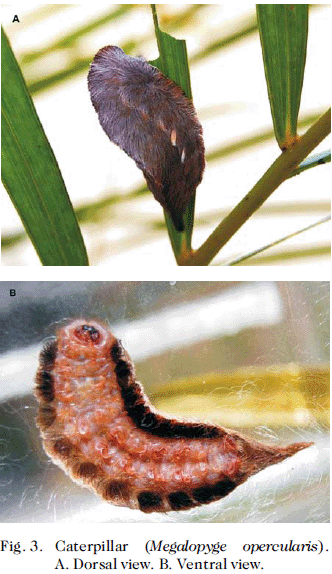
<P ALIGN="justify" style="line-height: 100%"><font face="Verdana" size="2"> <B><FONT COLOR="#1f1a17"> Laboratory results</FONT></B><FONT COLOR="#1f1a17">&nbsp;</FONT></font></P>     <P ALIGN="justify" style="line-height: 100%"><FONT COLOR="#1f1a17" size="2" face="Verdana"> The blood work revealed alterations in the white blood cells count: 12,200  (mm<FONT COLOR="#1f1a17"><SUP>3</SUP>) (normal control: 5,000 &#150; 10,000/mm<SUP>3</SUP>), lymphocytes 13.2 &#215; 10<SUP>9</SUP>/L (normal  control: 1.0-4.8 &#215; 10<SUP>9</SUP>/L). The platelet count showed a moderate reduction  to 148,000 (mm<SUP>3</SUP>) (normal controls: 200,000 to 300,000/mm<SUP>3</SUP>).&nbsp;</FONT> </FONT></P>     <P ALIGN="justify" style="line-height: 100%"><FONT COLOR="#1f1a17" size="2" face="Verdana"> Granulocytes: 1.83 &#215; 10<FONT COLOR="#1f1a17"><SUP>9</SUP>/L (normal control: 1.8-8 &#215; 10<SUP>9</SUP>/L); hemoglobin:  14 g/L (normal control: 12-16 g/L) and creatine 1.2 mg/dL (normal control:  0.8 to 1.2 mg/dL) showed normal results.&nbsp;</FONT> </FONT></P>     <P ALIGN="justify" style="line-height: 100%"><FONT COLOR="#1f1a17" size="2" face="Verdana"> Early results obtained within 24 h after caterpillar exposure indicated  moderate coagulation abnormalities. On clinic arrival, prothrombin time  (PT): 14.0 s (control: 12.4 s); partial thromboplastin time (PTT): 32.0  s (control 27.7 s); fibrinogen (Fg): 280 mg/dL (normal range is 200-400  mg/dL). After 12 h, PT: 13.41 s (control 12.4 s); PTT: 31.7 s (control:  27.7 s); Fg: 275 mg/dL.&nbsp; </FONT></P>     <P ALIGN="justify" style="line-height: 100%"><font face="Verdana" size="2"> <B><FONT COLOR="#1f1a17"> Caterpillar description</FONT></B><FONT COLOR="#1f1a17">&nbsp;</FONT></font></P>     <P ALIGN="justify" style="line-height: 100%"><font face="Verdana" size="2"> <I><FONT COLOR="#1f1a17"> Megalopyge opercularis </FONT></I> <FONT COLOR="#1f1a17">  matures in envelopes attached to brushwood. They  are teardrop-like with elongated silky hairs. The color of the larvae varies  from grimy white to golden-brown to dark charcoal gray, and often with  a streak of bright orange running longitudinally. The mature larva (caterpillar)  is 2.5-3.5 cm in length, with eight pairs of suction-cup like claspers  on the back of the body (prolegs) (<a href="#fig3">Figs. 3A and 3B</a>). The adult moth has  rounded wings covered with long undulating hair ranging from light orange  to lemon yellow, with hairy legs and fuzzy black feet. The mid-body contains  hairs that are small spines that release venom upon contact. The head and  prolegs are not detectable from the top. The adult moth having a life-span  of one week lays eggs on shrubs and trees and within a few days the larva  come out feeding mainly on deciduous trees and shrubs (2).</FONT></font></P>     <P ALIGN="center" style="line-height: 100%"><a name="fig3"><img border="0" src="/img/fbpe/ic/v51n1/art12fig3.gif" width="332" height="574"></a></P>     
<P ALIGN="justify" style="line-height: 100%"> <B><FONT COLOR="#1f1a17" size="2" face="Verdana"> DISCUSSION&nbsp; </FONT></B> </P>     <P ALIGN="justify" style="line-height: 100%"><FONT COLOR="#1f1a17" size="2" face="Verdana"> The caterpillar <I>Megalopyge opercularis</I> has developed exceptional practices  of defense against predators with biological interactions including defensive  mimicry and proteolytic, neurotoxic and allergenic toxins. The venomous  molecules can accumulate in the spines, tegument and urticating hairs,  and they are formed by glandular epithelial cells located under the larvae&#146;s  skin, which are spread by the hemolymph (2, 3). Caterpillars owning merely  venomous spines are described as phanerotoxic; while caterpillars containing  toxins in the hemolymph and not in the spines are known as cryptotoxic  (4). Caterpillar envenomation always demands consultation, hospitalization  and even treatment in an emergency unit care. It is essential to recognize  the offending venomous caterpillar species in order to determine the risks.  In a study carried out by Everson <I>et al. </I>(1990) (5), the clinical effects  frequently reported were local pain, erythema and swelling in 96, 89 and  72% of affected patients, respectively. Uncommon responses, including muscle  spasms, paresthesia and radiating pain to an extremity, such as those observed  in our current case, were noted in 26% of patients. Symptoms, such as nausea,  serious chest distress and intense irradiating pain, frequently confuse  the clinical diagnosis by the physicians, since health care workers are  unacquainted that this symptomatology is usually caused by the venom of  this caterpillar. In addition, knowledge of these toxic animals is scarce  among people and even worse amid physicians. Further studies will be necessary  to describe the biochemical and toxic activities of their venom in order  to evaluate the need of antivenom.&nbsp; </FONT></P>     ]]></body>
<body><![CDATA[<P ALIGN="justify" style="line-height: 100%"><FONT COLOR="#1f1a17" size="2" face="Verdana"> In the last century, considerable occurrences of puss caterpillar (<I>M. opercularis)</I><FONT COLOR="#1f1a17"><SUP>  </SUP>stings in school age children from San Antonio and Galveston (Texas, USA)  were described (5, 6). Characteristic sting sites incorporated uncovered<SUP>  </SUP>arms, faces, heads and particularly the necks behind the shirt<SUP> </SUP>collar (5).  Very little is known about the venom of <I>M. opercularis</I>, but there is a  very similar caterpillar in the USA known as the buss caterpillar (<I>Lagoa  crispate</I>), which has a protein in its venom with high kallikrein activity.  The high tannin content in the diet of <I>L. crispate</I> is reflected in spine  extracts, found to be high in tannins (7). These extracts contain toxic  activity, but is lost with time. Lamdin <I>et al.</I> (7) isolated fractions from  the extract of <I>L. crispate</I> by gel filtration and found them to be void  of hyaluronidase, protease and phosphohydrolase activites.&nbsp;</FONT> </FONT></P>     <P ALIGN="justify" style="line-height: 100%"><FONT COLOR="#1f1a17" size="2" face="Verdana"> In terms of coagulation screening, prothrombin time (PT) and partial thromboplastin  time (PTT) were slightly subtly prolonged, and the levels of fibrinogen  (Fg) were not affected. However, it is known that these tests on many occasions  are only altered 48 h after the accident (8), and this patient was not  given a follow up screening. The patient did present a subtle leukocytosis  with a high lymphocytosis. As it is known, transient absolute lymphocytosis  is an under recognized phenomenon that has been depicted in patients with  emergency medical circumstances, including trauma (9).&nbsp; </FONT></P>     <P ALIGN="justify" style="line-height: 100%"><FONT COLOR="#1f1a17" size="2" face="Verdana"> From a therapeutic point of view, the treatment for <I>M. opercularis </I>envenoming  has been inconsistent, and many patients turn to domestic therapy with  some level of achievement. For instance, some apply adhesive tape to the  affected area to remove the spines deposited by the caterpillars. Furthermore,  ice, baking soda, steroid cream, antihistamine or oat (<I>Avena sativa</I>) derived  lotions, have been commonly used. Eagleman (2) reported that for severe  pain, codeine, meperidine HCl, or morphine would sometimes be administered,  since salicylates were not helpful. However, injury to the eyes should  be attended by an ophthalmologist without delay. The use of systemic corticosteroids  has also been suggested to alleviate the symptoms caused by these caterpillars  (10, 11).&nbsp; </FONT></P>     <P ALIGN="justify" style="line-height: 100%"><FONT COLOR="#1f1a17" size="2" face="Verdana"> As mentioned above, very little is known about the activities of the venom  obtained from this caterpillar, and a study is currently under way to define  <I>in vitro</I> hemostatic activities along with in vivo lethal doses. Thus far,  preliminary activity on fibrin plates is promising (data not shown), and  further studies that will involve a battery of assays should reveal information  that can be compared to the clinical aspects of envenoming.&nbsp; </FONT></P>     <P ALIGN="justify" style="line-height: 100%"> <B><FONT COLOR="#1f1a17" size="2" face="Verdana"> ACKNOWLEDGEMENTS&nbsp; </FONT></B> </P>     <P ALIGN="justify" style="line-height: 100%"><FONT COLOR="#1f1a17" size="2" face="Verdana"> This work was developed under the FONACIT grant No. PG 2005000400.&nbsp; </FONT></P>     <P ALIGN="justify" style="line-height: 100%"> <B><FONT COLOR="#1f1a17" size="2" face="Verdana"> REFERENCES&nbsp; </FONT></B> </P>     <!-- ref --><P ALIGN="justify" style="line-height: 100%"><FONT COLOR="#1f1a17" size="2" face="Verdana"> 1.&nbsp;<B>Diaz JH.</B> The evolving global epidemiology, syndromic classification, management,  and prevention of caterpillar envenoming. Am J Trop Med Hyg 2005; 72:347-357.&nbsp;</FONT>&nbsp;&nbsp;&nbsp;&nbsp;&nbsp;&nbsp;&nbsp;&nbsp;[&#160;<a href="javascript:void(0);" onclick="javascript: window.open('/scielo.php?script=sci_nlinks&ref=1181826&pid=S0535-5133201000010001200001&lng=','','width=640,height=500,resizable=yes,scrollbars=1,menubar=yes,');">Links</a>&#160;]<!-- end-ref --><!-- ref --><P ALIGN="justify" style="line-height: 100%"><FONT COLOR="#1f1a17" size="2" face="Verdana"> 2.&nbsp;<B>Eagleman DM.</B> Envenomation by the asp caterpillar (<I>Megalopyge opercularis</I>).  Clin Toxicol (Phila) 2008; 46:201-205.&nbsp;</FONT>&nbsp;&nbsp;&nbsp;&nbsp;&nbsp;&nbsp;&nbsp;&nbsp;[&#160;<a href="javascript:void(0);" onclick="javascript: window.open('/scielo.php?script=sci_nlinks&ref=1181827&pid=S0535-5133201000010001200002&lng=','','width=640,height=500,resizable=yes,scrollbars=1,menubar=yes,');">Links</a>&#160;]<!-- end-ref --><!-- ref --><P ALIGN="justify" style="line-height: 100%"><FONT COLOR="#1f1a17" size="2" face="Verdana"> 3.&nbsp;<B>Gilmer PM. </B>A comparative study of the poison apparatus of certain lepidopterous  larvae. Ann Entomol Soc Am 1925; 18: 203-239.&nbsp;</FONT>&nbsp;&nbsp;&nbsp;&nbsp;&nbsp;&nbsp;&nbsp;&nbsp;[&#160;<a href="javascript:void(0);" onclick="javascript: window.open('/scielo.php?script=sci_nlinks&ref=1181828&pid=S0535-5133201000010001200003&lng=','','width=640,height=500,resizable=yes,scrollbars=1,menubar=yes,');">Links</a>&#160;]<!-- end-ref --><!-- ref --><P ALIGN="justify" style="line-height: 100%"><FONT COLOR="#1f1a17" size="2" face="Verdana"> 4.&nbsp;<B>Mebs D. </B>Butterflies, moths, and their caterpillars. Mebs D, ed. Venomous  and Poisonous Animals: A Handbook for Biologists, Toxicologists, and Toxinologists<I>,  </I>Physicians and Pharmacists. Boca Raton, FL: CRC Press; 2002, p 205-208.&nbsp;</FONT>&nbsp;&nbsp;&nbsp;&nbsp;&nbsp;&nbsp;&nbsp;&nbsp;[&#160;<a href="javascript:void(0);" onclick="javascript: window.open('/scielo.php?script=sci_nlinks&ref=1181829&pid=S0535-5133201000010001200004&lng=','','width=640,height=500,resizable=yes,scrollbars=1,menubar=yes,');">Links</a>&#160;]<!-- end-ref --><!-- ref --><P ALIGN="justify" style="line-height: 100%"><FONT COLOR="#1f1a17" size="2" face="Verdana"> 5.&nbsp;<B>Everson GW, Chapin JB, Normann SA. </B>Caterpillar envenomations: a prospective  study of 112 cases. Vet Hum Toxicol 1990; 32:114-119.&nbsp;</FONT>&nbsp;&nbsp;&nbsp;&nbsp;&nbsp;&nbsp;&nbsp;&nbsp;[&#160;<a href="javascript:void(0);" onclick="javascript: window.open('/scielo.php?script=sci_nlinks&ref=1181830&pid=S0535-5133201000010001200005&lng=','','width=640,height=500,resizable=yes,scrollbars=1,menubar=yes,');">Links</a>&#160;]<!-- end-ref --><!-- ref --><P ALIGN="justify" style="line-height: 100%"><FONT COLOR="#1f1a17" size="2" face="Verdana"> 6.&nbsp;<B>Micks DW. </B>Clinical effects of the &#147;puss caterpillar&#148; (<I>Megalopyge opercularis</I>)  on man. Tex Rep Biol Med 1952; 10:399-405.&nbsp;</FONT>&nbsp;&nbsp;&nbsp;&nbsp;&nbsp;&nbsp;&nbsp;&nbsp;[&#160;<a href="javascript:void(0);" onclick="javascript: window.open('/scielo.php?script=sci_nlinks&ref=1181831&pid=S0535-5133201000010001200006&lng=','','width=640,height=500,resizable=yes,scrollbars=1,menubar=yes,');">Links</a>&#160;]<!-- end-ref --><!-- ref --><P ALIGN="justify" style="line-height: 100%"><FONT COLOR="#1f1a17" size="2" face="Verdana"> 7.&nbsp;<B>Lamdin JM, Howell DE, Kocan KM, Murphey DR, Arnold DC, Fenton AW, Odell  GV, Ownby CL. </B>The venomous hair structure, venom and life cycle of <I>Logoa  crispata</I>, a puss caterpillar of Oklahoma. Toxicon 2000; 38:1163-1189.&nbsp;</FONT>&nbsp;&nbsp;&nbsp;&nbsp;&nbsp;&nbsp;&nbsp;&nbsp;[&#160;<a href="javascript:void(0);" onclick="javascript: window.open('/scielo.php?script=sci_nlinks&ref=1181832&pid=S0535-5133201000010001200007&lng=','','width=640,height=500,resizable=yes,scrollbars=1,menubar=yes,');">Links</a>&#160;]<!-- end-ref --><!-- ref --><P ALIGN="justify" style="line-height: 100%"><FONT COLOR="#1f1a17" size="2" face="Verdana"> 8.&nbsp;<B>Arocha-Pi&#241;ango CL, Layrisse M.</B> Fibrinolysis produced by contact with a  caterpillar. Lancet. 1969; 1(7599):810-812.&nbsp;</FONT>&nbsp;&nbsp;&nbsp;&nbsp;&nbsp;&nbsp;&nbsp;&nbsp;[&#160;<a href="javascript:void(0);" onclick="javascript: window.open('/scielo.php?script=sci_nlinks&ref=1181833&pid=S0535-5133201000010001200008&lng=','','width=640,height=500,resizable=yes,scrollbars=1,menubar=yes,');">Links</a>&#160;]<!-- end-ref --><!-- ref --><P ALIGN="justify" style="line-height: 100%"><FONT COLOR="#1f1a17" size="2" face="Verdana"> 9.&nbsp;<B>Teggatz JR, Parkin J, Peterson L.</B> Transient atypical lymphocytosis in patients  with emergency medical conditions. Arch Pathol Lab Med 1987; 111:712-714.&nbsp;</FONT>&nbsp;&nbsp;&nbsp;&nbsp;&nbsp;&nbsp;&nbsp;&nbsp;[&#160;<a href="javascript:void(0);" onclick="javascript: window.open('/scielo.php?script=sci_nlinks&ref=1181834&pid=S0535-5133201000010001200009&lng=','','width=640,height=500,resizable=yes,scrollbars=1,menubar=yes,');">Links</a>&#160;]<!-- end-ref --><!-- ref --><P ALIGN="justify" style="line-height: 100%"><FONT COLOR="#1f1a17" size="2" face="Verdana"> 10.&nbsp;<B>Rosen T. </B>Caterpillar dermatitis. Dermatologic Clinics. 1990; 8:245-252.&nbsp;</FONT>&nbsp;&nbsp;&nbsp;&nbsp;&nbsp;&nbsp;&nbsp;&nbsp;[&#160;<a href="javascript:void(0);" onclick="javascript: window.open('/scielo.php?script=sci_nlinks&ref=1181835&pid=S0535-5133201000010001200010&lng=','','width=640,height=500,resizable=yes,scrollbars=1,menubar=yes,');">Links</a>&#160;]<!-- end-ref --><!-- ref --><P ALIGN="justify" style="line-height: 100%"><FONT COLOR="#1f1a17" size="2" face="Verdana"> 11.&nbsp;<B>Erickson T, Ahrens WR, Aks S, Baum C, Ling L. </B>Pediatric toxicology: Diagnosis  and management of the poisoned child. New York: McGraw-Hill Professional;  2004, p. 501.</FONT>&nbsp;&nbsp;&nbsp;&nbsp;&nbsp;&nbsp;&nbsp;&nbsp;[&#160;<a href="javascript:void(0);" onclick="javascript: window.open('/scielo.php?script=sci_nlinks&ref=1181836&pid=S0535-5133201000010001200011&lng=','','width=640,height=500,resizable=yes,scrollbars=1,menubar=yes,');">Links</a>&#160;]<!-- end-ref --> ]]></body>
<back>
<ref-list>
<ref id="B1">
<label>1</label><nlm-citation citation-type="journal">
<person-group person-group-type="author">
<name>
<surname><![CDATA[Diaz]]></surname>
<given-names><![CDATA[JH]]></given-names>
</name>
</person-group>
<article-title xml:lang="en"><![CDATA[The evolving global epidemiology, syndromic classification, management, and prevention of caterpillar envenoming]]></article-title>
<source><![CDATA[Am J Trop Med Hyg]]></source>
<year>2005</year>
<volume>72</volume>
<page-range>347-357</page-range></nlm-citation>
</ref>
<ref id="B2">
<label>2</label><nlm-citation citation-type="journal">
<person-group person-group-type="author">
<name>
<surname><![CDATA[Eagleman]]></surname>
<given-names><![CDATA[DM]]></given-names>
</name>
</person-group>
<article-title xml:lang="en"><![CDATA[Envenomation by the asp caterpillar (Megalopyge opercularis)]]></article-title>
<source><![CDATA[Clin Toxicol (Phila)]]></source>
<year>2008</year>
<volume>46</volume>
<page-range>201-205</page-range></nlm-citation>
</ref>
<ref id="B3">
<label>3</label><nlm-citation citation-type="journal">
<person-group person-group-type="author">
<name>
<surname><![CDATA[Gilmer]]></surname>
<given-names><![CDATA[PM]]></given-names>
</name>
</person-group>
<article-title xml:lang="en"><![CDATA[A comparative study of the poison apparatus of certain lepidopterous larvae]]></article-title>
<source><![CDATA[Ann Entomol Soc Am]]></source>
<year>1925</year>
<volume>18</volume>
<page-range>203-239</page-range></nlm-citation>
</ref>
<ref id="B4">
<label>4</label><nlm-citation citation-type="book">
<person-group person-group-type="author">
<name>
<surname><![CDATA[Mebs]]></surname>
<given-names><![CDATA[D]]></given-names>
</name>
</person-group>
<article-title xml:lang="en"><![CDATA[Butterflies, moths, and their caterpillars]]></article-title>
<person-group person-group-type="editor">
<name>
<surname><![CDATA[Mebs]]></surname>
<given-names><![CDATA[D]]></given-names>
</name>
</person-group>
<source><![CDATA[Venomous and Poisonous Animals: A Handbook for Biologists, Toxicologists, and Toxinologists, Physicians and Pharmacists]]></source>
<year>2002</year>
<page-range>205-208</page-range><publisher-loc><![CDATA[Boca Raton^eFL FL]]></publisher-loc>
<publisher-name><![CDATA[CRC Press]]></publisher-name>
</nlm-citation>
</ref>
<ref id="B5">
<label>5</label><nlm-citation citation-type="journal">
<person-group person-group-type="author">
<name>
<surname><![CDATA[Everson]]></surname>
<given-names><![CDATA[GW]]></given-names>
</name>
<name>
<surname><![CDATA[Chapin]]></surname>
<given-names><![CDATA[JB]]></given-names>
</name>
<name>
<surname><![CDATA[Normann]]></surname>
<given-names><![CDATA[SA]]></given-names>
</name>
</person-group>
<article-title xml:lang="en"><![CDATA[Caterpillar envenomations: a prospective study of 112 cases]]></article-title>
<source><![CDATA[Vet Hum Toxicol]]></source>
<year>1990</year>
<volume>32</volume>
<page-range>114-119</page-range></nlm-citation>
</ref>
<ref id="B6">
<label>6</label><nlm-citation citation-type="journal">
<person-group person-group-type="author">
<name>
<surname><![CDATA[Micks]]></surname>
<given-names><![CDATA[DW]]></given-names>
</name>
</person-group>
<article-title xml:lang="en"><![CDATA[Clinical effects of the “puss caterpillar” (Megalopyge opercularis) on man]]></article-title>
<source><![CDATA[Tex Rep Biol Med]]></source>
<year>1952</year>
<volume>10</volume>
<page-range>399-405</page-range></nlm-citation>
</ref>
<ref id="B7">
<label>7</label><nlm-citation citation-type="journal">
<person-group person-group-type="author">
<name>
<surname><![CDATA[Lamdin]]></surname>
<given-names><![CDATA[JM]]></given-names>
</name>
<name>
<surname><![CDATA[Howell]]></surname>
<given-names><![CDATA[DE]]></given-names>
</name>
<name>
<surname><![CDATA[Kocan]]></surname>
<given-names><![CDATA[KM]]></given-names>
</name>
<name>
<surname><![CDATA[Murphey]]></surname>
<given-names><![CDATA[DR]]></given-names>
</name>
<name>
<surname><![CDATA[Arnold]]></surname>
<given-names><![CDATA[DC]]></given-names>
</name>
<name>
<surname><![CDATA[Fenton]]></surname>
<given-names><![CDATA[AW]]></given-names>
</name>
<name>
<surname><![CDATA[Odell]]></surname>
<given-names><![CDATA[GV]]></given-names>
</name>
<name>
<surname><![CDATA[Ownby]]></surname>
<given-names><![CDATA[CL]]></given-names>
</name>
</person-group>
<article-title xml:lang="en"><![CDATA[The venomous hair structure, venom and life cycle of Logoa crispata, a puss caterpillar of Oklahoma]]></article-title>
<source><![CDATA[Toxicon]]></source>
<year>2000</year>
<volume>38</volume>
<page-range>1163-1189</page-range></nlm-citation>
</ref>
<ref id="B8">
<label>8</label><nlm-citation citation-type="journal">
<person-group person-group-type="author">
<name>
<surname><![CDATA[Arocha-Piñango]]></surname>
<given-names><![CDATA[CL]]></given-names>
</name>
<name>
<surname><![CDATA[Layrisse]]></surname>
<given-names><![CDATA[M]]></given-names>
</name>
</person-group>
<article-title xml:lang="en"><![CDATA[Fibrinolysis produced by contact with a caterpillar]]></article-title>
<source><![CDATA[Lancet.]]></source>
<year>1969</year>
<volume>1</volume>
<numero>7599</numero>
<issue>7599</issue>
<page-range>810-812</page-range></nlm-citation>
</ref>
<ref id="B9">
<label>9</label><nlm-citation citation-type="journal">
<person-group person-group-type="author">
<name>
<surname><![CDATA[Teggatz]]></surname>
<given-names><![CDATA[JR]]></given-names>
</name>
<name>
<surname><![CDATA[Parkin]]></surname>
<given-names><![CDATA[J]]></given-names>
</name>
<name>
<surname><![CDATA[Peterson]]></surname>
<given-names><![CDATA[L]]></given-names>
</name>
</person-group>
<article-title xml:lang="en"><![CDATA[Transient atypical lymphocytosis in patients with emergency medical conditions]]></article-title>
<source><![CDATA[Arch Pathol Lab Med]]></source>
<year>1987</year>
<volume>111</volume>
<page-range>712-714</page-range></nlm-citation>
</ref>
<ref id="B10">
<label>10</label><nlm-citation citation-type="journal">
<person-group person-group-type="author">
<name>
<surname><![CDATA[Rosen]]></surname>
<given-names><![CDATA[T]]></given-names>
</name>
</person-group>
<article-title xml:lang="en"><![CDATA[Caterpillar dermatitis]]></article-title>
<source><![CDATA[Dermatologic Clinics.]]></source>
<year>1990</year>
<volume>8</volume>
<page-range>245-252</page-range></nlm-citation>
</ref>
<ref id="B11">
<label>11</label><nlm-citation citation-type="book">
<person-group person-group-type="author">
<name>
<surname><![CDATA[Erickson]]></surname>
<given-names><![CDATA[T]]></given-names>
</name>
<name>
<surname><![CDATA[Ahrens]]></surname>
<given-names><![CDATA[WR]]></given-names>
</name>
<name>
<surname><![CDATA[Aks]]></surname>
<given-names><![CDATA[S]]></given-names>
</name>
<name>
<surname><![CDATA[Baum]]></surname>
<given-names><![CDATA[C]]></given-names>
</name>
<name>
<surname><![CDATA[Ling]]></surname>
<given-names><![CDATA[L]]></given-names>
</name>
</person-group>
<source><![CDATA[Pediatric toxicology: Diagnosis and management of the poisoned child]]></source>
<year>2004</year>
<page-range>501</page-range><publisher-loc><![CDATA[New York ]]></publisher-loc>
<publisher-name><![CDATA[McGraw-Hill Professional]]></publisher-name>
</nlm-citation>
</ref>
</ref-list>
</back>
</article>