<?xml version="1.0" encoding="ISO-8859-1"?><article xmlns:mml="http://www.w3.org/1998/Math/MathML" xmlns:xlink="http://www.w3.org/1999/xlink" xmlns:xsi="http://www.w3.org/2001/XMLSchema-instance">
<front>
<journal-meta>
<journal-id>0798-2259</journal-id>
<journal-title><![CDATA[Revista Científica]]></journal-title>
<abbrev-journal-title><![CDATA[Rev. Cient. (Maracaibo)]]></abbrev-journal-title>
<issn>0798-2259</issn>
<publisher>
<publisher-name><![CDATA[UNIVERSIDAD DEL ZULIA]]></publisher-name>
</publisher>
</journal-meta>
<article-meta>
<article-id>S0798-22592009000200003</article-id>
<title-group>
<article-title xml:lang="en"><![CDATA[Bursal restoration after intermediate and intermediate plus infectious bursal disease virus vaccination]]></article-title>
<article-title xml:lang="es"><![CDATA[Restauración de la bolsa posterior a la vacunación con cepas intermedias e intermedias plus del virus de la enfermedad infecciosa de la bolsa.]]></article-title>
</title-group>
<contrib-group>
<contrib contrib-type="author">
<name>
<surname><![CDATA[Castro]]></surname>
<given-names><![CDATA[María]]></given-names>
</name>
<xref ref-type="aff" rid="A01"/>
</contrib>
<contrib contrib-type="author">
<name>
<surname><![CDATA[Saume]]></surname>
<given-names><![CDATA[Elsy]]></given-names>
</name>
<xref ref-type="aff" rid="A01"/>
</contrib>
<contrib contrib-type="author">
<name>
<surname><![CDATA[Díaz]]></surname>
<given-names><![CDATA[Carmen]]></given-names>
</name>
<xref ref-type="aff" rid="A02"/>
</contrib>
<contrib contrib-type="author">
<name>
<surname><![CDATA[García]]></surname>
<given-names><![CDATA[Judith]]></given-names>
</name>
<xref ref-type="aff" rid="A03"/>
</contrib>
<contrib contrib-type="author">
<name>
<surname><![CDATA[Perozo]]></surname>
<given-names><![CDATA[Francisco]]></given-names>
</name>
<xref ref-type="aff" rid="A04"/>
</contrib>
</contrib-group>
<aff id="A01">
<institution><![CDATA[,Instituto Nacional de Investigaciones Agrícolas  ]]></institution>
<addr-line><![CDATA[ ]]></addr-line>
</aff>
<aff id="A02">
<institution><![CDATA[,2Facultad de Ciencias Veterinarias  ]]></institution>
<addr-line><![CDATA[ ]]></addr-line>
</aff>
<aff id="A03">
<institution><![CDATA[,Universidad Central de Venezuela Facultad de Ciencias Agronómicas ]]></institution>
<addr-line><![CDATA[ ]]></addr-line>
</aff>
<aff id="A04">
<institution><![CDATA[,Universidad del Zulia Facultad de Ciencias Veterinarias ]]></institution>
<addr-line><![CDATA[ ]]></addr-line>
<country>Venezuela</country>
</aff>
<pub-date pub-type="pub">
<day>00</day>
<month>04</month>
<year>2009</year>
</pub-date>
<pub-date pub-type="epub">
<day>00</day>
<month>04</month>
<year>2009</year>
</pub-date>
<volume>19</volume>
<numero>2</numero>
<fpage>119</fpage>
<lpage>123</lpage>
<copyright-statement/>
<copyright-year/>
<self-uri xlink:href="http://ve.scielo.org/scielo.php?script=sci_arttext&amp;pid=S0798-22592009000200003&amp;lng=en&amp;nrm=iso"></self-uri><self-uri xlink:href="http://ve.scielo.org/scielo.php?script=sci_abstract&amp;pid=S0798-22592009000200003&amp;lng=en&amp;nrm=iso"></self-uri><self-uri xlink:href="http://ve.scielo.org/scielo.php?script=sci_pdf&amp;pid=S0798-22592009000200003&amp;lng=en&amp;nrm=iso"></self-uri><abstract abstract-type="short" xml:lang="en"><p><![CDATA[Infectious bursal disease (IBD) is an acute, contagious, viral disease of young chickens characterized by diarrhea, vent picking, trembling, incoordination, inflammation followed by atrophy of the bursa of Fabricius and by variable degrees of immunosuppression. The diseases is caused by the infectious bursal disease virus (IBDV) which upon its antigenic characteristics and pathogenicity has been classified as classic (mild, intermediate and intermediate plus) strains, very virulent IBDV (vvIBDV) and variant strains. With the widespread presence of vvIBDV, the poultry industry has resorted to the use of less attenuated vaccines raising the concern about bursal integrity after vaccination. IBD vaccination using intermediate plus vaccine strains can temporarily deplete the bursal follicles and interrupt the normal B-cell development; if the damage is reversible this process can be followed by B-cell repopulation and histological regeneration. In order to assess this bursal restoration process, specific pathogen free birds were vaccinated with intermediate and intermediate plus IBDV vaccine and bursas were evaluated by histopathology and immunohistochemistry. Both B and T cells were detected in the recovering bursas. At the end of the trial, signs of bursal regeneration and B cell repopulation were observed in the intermediate IBDV vaccinated birds. The bursal restoration process was impaired or delayed in the intermediate plus vaccine group. Relevance of B and T cell repopulation is discussed.]]></p></abstract>
<abstract abstract-type="short" xml:lang="es"><p><![CDATA[La enfermedad infecciosa de la bolsa (por sus siglas en Inglés IBD) es una enfermedad viral aguda y contagiosa que afecta a los pollos jóvenes, caracterizada por diarrea, picado de la cloaca, temblores, incoordinación, inflamación seguida de atrofia de la bolsa de Fabricious y por grados variables de inmunosupresión. La enfermedad es causada por el virus de la enfermedad infecciosa de la bolsa (por sus siglas en Inglés IBDV) que basado en sus características antigénicas y de patogenicidad ha sido clasificado en cepas clásicas (virus suaves, intermedios e intermedios plus), IBDV muy virulento y cepas variantes. Debido a la amplia presencia de IBDV muy virulento, la industria avícola ha implementado la utilización de vacunas menos atenuadas, lo que genera preocupación por la integridad de la bolsa posterior a la vacunación. La vacunación contra IBD utilizando vacunas intermedias plus puede despoblar los folículos de la bolsa e interrumpir el desarrollo normal de las células B, si el daño es reversible este proceso puede ser seguido de la repoblación de la bolsa con células B y de regeneración histológica. Con la finalidad de evaluar este proceso de restauración, se vacunaron aves libres de patógenos específicos con vacunas intermedia e intermedia plus contra IBDV y se evaluaron las bolsas mediante histopatología e inmunohistoquímica. En las bolsas en recuperación se detectaron tanto células B como células T. Al final del experimento, en las aves vacunadas con la cepa intermedia se observaron signos de regeneración de la bolsa y repoblación de células B. El proceso de restauración de la bolsa se vio comprometido o retrasado en el grupo vacunado con la cepa intermedia plus. Se discute la relevancia de la repoblación de la bolsa con células T y B.]]></p></abstract>
<kwd-group>
<kwd lng="en"><![CDATA[Infectious bursal disease virus]]></kwd>
<kwd lng="en"><![CDATA[vaccination]]></kwd>
<kwd lng="en"><![CDATA[restoration]]></kwd>
<kwd lng="es"><![CDATA[Virus de la enfermedad infecciosa de la bolsa]]></kwd>
<kwd lng="es"><![CDATA[vacunación]]></kwd>
<kwd lng="es"><![CDATA[restauración]]></kwd>
</kwd-group>
</article-meta>
</front><body><![CDATA[  <BASEFONT SIZE="3">     <P ALIGN="center"><FONT COLOR="000000" SIZE="2" FACE="Verdana"> <B>BURSAL RESTORATION AFTER INTERMEDIATE AND INTERMEDIATE PLUS INFECTIOUS BURSAL  DISEASE VIRUS VACCINATION.</B> </FONT></P>      <P ALIGN="center"><FONT COLOR="000000" SIZE="2" FACE="Verdana"> <B>María Castro</B><SUP><B>1</B></SUP><B>, Elsy Saume</B><SUP><B>1</B></SUP><B>, Carmen Díaz</B><SUP><B>2</B></SUP><B>, Judith García</B><SUP><B>3</B></SUP><B> y Francisco Perozo</B><SUP><B>4</B></SUP> </FONT></P>      <P ALIGN="justify"><FONT COLOR="000000" SIZE="2" FACE="Verdana"> <SUP>1</SUP><I>Instituto Nacional de Investigaciones Agrícolas. Maracay, Venezuela.  <a href="mailto:mcastro@inia.gob.ve">mcastro@inia.gob.ve</a> ;  <a href="mailto:esaume@inia.gob.ve">esaume@inia.gob.ve</a></I></FONT></P>     <P ALIGN="justify"><FONT COLOR="000000" SIZE="2" FACE="Verdana"> <SUP>2</SUP><I>Facultad de Ciencias Veterinarias.  <a href="mailto:carmenteresad@yahoo.com">carmenteresad@yahoo.com</a> </I> </FONT></P>     <P ALIGN="justify"><FONT COLOR="000000" SIZE="2" FACE="Verdana"> <SUP>3</SUP><I>Facultad de Ciencias Agronómicas.  <a href="mailto:garciaj@agr.ucv.ve">garciaj@agr.ucv.ve</a> , Universidad Central  de Venezuela.</I></FONT></P>     <P ALIGN="justify"><FONT COLOR="000000" SIZE="2" FACE="Verdana"> <SUP>4</SUP><I>Facultad de Ciencias Veterinarias. Universidad del Zulia. Apartado 15252.Maracaibo 4005-A, Venezuela  <a href="mailto:fperozo@uga.edu">fperozo@uga.edu</a> .</I> </FONT></P>      <P ALIGN="justify"><FONT COLOR="000000" SIZE="2" FACE="Verdana"> <B>ABSTRACT</B> </FONT></P>      <P ALIGN="justify"><FONT COLOR="000000" SIZE="2" FACE="Verdana"> Infectious bursal disease (IBD) is an acute, contagious, viral disease  of young chickens characterized by diarrhea, vent picking, trembling, incoordination,  inflammation followed by atrophy of the bursa of Fabricius and by variable  degrees of immunosuppression. The diseases is caused by the infectious  bursal disease virus (IBDV) which upon its antigenic characteristics and  pathogenicity has been classified as classic (mild, intermediate and intermediate  plus) strains, very virulent IBDV (vvIBDV) and variant strains. With the  widespread presence of vvIBDV, the poultry industry has resorted to the  use of less attenuated vaccines raising the concern about bursal integrity  after vaccination. IBD vaccination using intermediate plus vaccine strains  can temporarily deplete the bursal follicles and interrupt the normal B-cell  development; if the damage is reversible this process can be followed by  B-cell repopulation and histological regeneration. In order to assess this  bursal restoration process, specific pathogen free birds were vaccinated  with intermediate and intermediate plus IBDV vaccine and bursas were evaluated  by histopathology and immunohistochemistry. Both B and T cells were detected  in the recovering bursas. At the end of the trial, signs of bursal regeneration  and B cell repopulation were observed in the intermediate IBDV vaccinated  birds. The bursal restoration process was impaired or delayed in the intermediate  plus vaccine group. Relevance of B and T cell repopulation is discussed. </FONT></P>     <p align="justify"><FONT COLOR="000000" SIZE="2" FACE="Verdana"> <B>Key words:</B> Infectious bursal disease virus, vaccination, restoration. </FONT></p>     ]]></body>
<body><![CDATA[<P ALIGN="justify"><FONT COLOR="000000" SIZE="2" FACE="Verdana"> <B>Restauración de la bolsa posterior a la vacunación con cepas intermedias  e intermedias plus del virus de la enfermedad infecciosa de la bolsa.</B> </FONT></P>      <P ALIGN="justify"><FONT COLOR="000000" SIZE="2" FACE="Verdana"> <B>RESUMEN</B> </FONT></P>      <P ALIGN="justify"><FONT COLOR="000000" SIZE="2" FACE="Verdana"> La enfermedad infecciosa de la bolsa (por sus siglas en Inglés IBD) es  una enfermedad viral aguda y contagiosa que afecta a los pollos jóvenes,  caracterizada por diarrea, picado de la cloaca, temblores, incoordinación,  inflamación seguida de atrofia de la bolsa de Fabricious y por grados variables  de inmunosupresión. La enfermedad es causada por el virus de la enfermedad  infecciosa de la bolsa (por sus siglas en Inglés IBDV) que basado en sus  características antigénicas y de patogenicidad ha sido clasificado en cepas  clásicas (virus suaves, intermedios e intermedios plus), IBDV muy virulento  y cepas variantes. Debido a la amplia presencia de IBDV muy virulento,  la industria avícola ha implementado la utilización de vacunas menos atenuadas,  lo que genera preocupación por la integridad de la bolsa posterior a la  vacunación. La vacunación contra IBD utilizando vacunas intermedias plus  puede despoblar los folículos de la bolsa e interrumpir el desarrollo normal  de las células B, si el daño es reversible este proceso puede ser seguido  de la repoblación de la bolsa con células B y de regeneración histológica.  Con la finalidad de evaluar este proceso de restauración, se vacunaron  aves libres de patógenos específicos con vacunas intermedia e intermedia  plus contra IBDV y se evaluaron las bolsas mediante histopatología e inmunohistoquímica.  En las bolsas en recuperación se detectaron tanto células B como células  T. Al final del experimento, en las aves vacunadas con la cepa intermedia  se observaron signos de regeneración de la bolsa y repoblación de células  B. El proceso de restauración de la bolsa se vio comprometido o retrasado  en el grupo vacunado con la cepa intermedia plus. Se discute la relevancia  de la repoblación de la bolsa con células T y B. </FONT></P>      <P ALIGN="justify"><FONT COLOR="000000" SIZE="2" FACE="Verdana"> <B>Palabras clave:</B> Virus de la enfermedad infecciosa de la bolsa, vacunación, restauración. </FONT></P>     <P ALIGN="justify"><font color="#000000" size="2" face="Verdana">Recibido: 27 /  11 / 2007. Aceptado: 29 / 02 / 2008.</font></P>    <P ALIGN="justify"> <FONT COLOR="000000" SIZE="2" FACE="Verdana"> <B>INTRODUCTION</B> </FONT></P>      <P ALIGN="justify"><FONT COLOR="000000" SIZE="2" FACE="Verdana"> Infectious bursal disease (IBD) is a highly infectious viral disease of  chickens that induces bursal atrophy and consequently immunosuppression.  This infection has a worldwide distribution and the virus can be detected  in most commercial farms [12]. The infectious bursal disease virus (IBDV)  is a member of the <I>Birnaviridae </I>family, and is classified into the genus  <I>Avibirnavirus </I>[10].<I> </I>The genome of IBDV consists of two segments of double-stranded  RNA. The viral particles are single shelled, non-enveloped with icosahedral  symmetry [15, 16]. The bursa of Fabricius is the main target organ for  IBDV replication [7]. After the virus enters the host, IBDV causes acute  lytic infections and high titers of anti-IBDV antibodies [5, 14]. IBDV  replicates in actively dividing IgM<SUP>+</SUP> B cells in the bursa of Fabricius. Moreover, IBDV is able to replicate in non-bursal locations, such as spleen,  thymus and liver [9]. Infection results in lymphoid depletion and severe  atrophy of the bursa as the predominant feature of the pathogenesis of  this disease [13]. </FONT></P>      <P ALIGN="justify"><FONT COLOR="000000" SIZE="2" FACE="Verdana"> In addition to mortality, the birds infected with IBDV may develop immunosuppression;  this condition may enhance the susceptibility to other infections such  as inclusion body hepatitis [3], infectious bronchitis [17], infectious  laryngotracheitis [21], salmonellosis and colibacilosis [23]. Furthermore,  the birds previously infected with IBDV may elicit a suboptimal immune  response to live attenuated vaccines as it has been reported with the vaccinations  against infectious bronchitis and Newcastle disease [9, 12, 13]. </FONT></P>      <P ALIGN="justify"><FONT COLOR="000000" SIZE="2" FACE="Verdana"> The IBDV infection elicits an elevated anti-IBDV antibody response. This  antibody response is believed to play a major role in the defense against  the disease. Therefore, attenuated live and inactivated IBDV vaccines are  selected on their ability to induce antibodies and protection [13]. The  immunization of breeder flocks is especially important to transmit immunity  from the dam to the progeny via the yolk of the egg; this passive immunity  can protect chickens against clinical signs at early age [11]. To induce  high titers of maternally derived antibodies that persist over the whole  laying period, breeders are vaccinated with inactivated oil-emulsified  vaccines. However, vaccination of the broilers is also necessary to protect  them against clinical disease after hatching due to the high infectivity  of IBDV [9, 12]. There are different types of live vaccines available;  the differences are based on the virulence and antigenic characteristics  of the vaccine strains. The factors that may have an impact on the efficacy  of the vaccination on the farm include the appropriate vaccination time,  the level of maternal antibodies, virulence of the vaccine virus and the  route of administration [14, 20]. </FONT></P>      <P ALIGN="justify"><FONT COLOR="000000" SIZE="2" FACE="Verdana"> The primary role of the avian bursa of Fabricius is to provide an essential  microenvironment for B-lymphocytes to diversify their immunoglobulin genes  by gene hyperconversion [22]. After vaccination, the severity of the bursal  lesions may be varied from transitional to irreversible depending on the  pathogenicity of the virus strains. In cases, when the damage is reversible,  the histological regeneration of the bursa of Fabricius has been reported  [6]. The aim of this work was to assess the bursal tissue damage induced  by IBDV vaccines and the extent of bursal recovery and repopulation during  commercial rearing time. </FONT></P>     ]]></body>
<body><![CDATA[<p align="justify"><font face="Verdana" size="2">    <BR>  </font><FONT COLOR="000000" SIZE="2" FACE="Verdana"> <B>MATERIALS AND METHODS</B> </FONT></p>      <P ALIGN="justify"><FONT COLOR="000000" SIZE="2" FACE="Verdana"> <B>Viruses</B> </FONT></P>      <P ALIGN="justify"><FONT COLOR="000000" SIZE="2" FACE="Verdana"> IBDV-Lukert intermediate and intermediate plus commercial vaccines were  used following manufactures recommendations. The following live commercial  vaccines were given by intra-conjunctiva instillation at 6 and 14 days  of age respectively: intermediate strain Lukert and intermediate plus strain  Lukert 2 (Bursine Fort Dodge Animal Health, Inc., Fort Dodge, IA. USA). </FONT></P>      <P ALIGN="justify"><FONT COLOR="000000" SIZE="2" FACE="Verdana"> <B>Experimental design</B> </FONT></P>      <P ALIGN="justify"><FONT COLOR="000000" SIZE="2" FACE="Verdana"> A total of 90 specific pathogen free (SPF) birds were used to assess the  effects of two IBDV vaccines of different pathogenicity applied at the  dose and time recommended by the manufacturer. Birds were divided in three  groups of 10 each with three replicates and raised in isolation up to 42  days of age. The treatments applied were: T1 = IBDV intermediate at day  6; T2 = IBDV intermediate plus at day 14; T3 = non-vaccinated. Ten days  post vaccination and at the end of the experiment, 15 birds in each group  were randomly selected and euthanized by cervical dislocation for sampling. </FONT></P>      <P ALIGN="justify"><FONT COLOR="000000" SIZE="2" FACE="Verdana"> <B>Histopathology</B> </FONT></P>      <P ALIGN="justify"><FONT COLOR="000000" SIZE="2" FACE="Verdana"> Bursas were collected and fixed by immersion in 10% neutral buffered formalin  for 24 hours. Tissues were processed and embedded in paraffin using routine  histological techniques. The paraffin-embedded tissues were sectioned,  mounted, stained with hematoxylin and eosin (H&amp;E) and examined by light  microscopy to grade bursal lesions as previously reported [4]. Briefly,  grade 0: no changes; grade 1: mild multifocal lymphoid necrosis; grade  2: moderate to severe lymphoid necrosis up to 20% of the follicles, presence  of cists in the parenchyma; grade 3: up to 50% of the follicles are affected  and there are abundant cist formations; grade 4: between 60 and 80% of  the follicles are affected by lymphoid depletion and cysts. </FONT></P>      <P ALIGN="justify"><FONT COLOR="000000" SIZE="2" FACE="Verdana"> <B>Immunohistochemistry (IHC) identification of bursal lymphocyte subpopulation</B> </FONT></P>      <P ALIGN="justify"><FONT COLOR="000000" SIZE="2" FACE="Verdana"> In order to evaluate bursal restoration and to differentiate cell subtypes  during repopulation, bursal tissue sections were cut (5 ìm) from paraffin-embedded  samples and mounted on charged glass slides. Immunohistochemical staining  was carried out using the avidin-biotin immunoperoxidase technique with  the polyvalent immunoperoxidase kit (Omnitag, Lipshaw, MI, USA with DAB  Chromogen) according to the manufacturer’s recommendations. For B cell  identification a CD20 (IgG2a clone L26, Termo Shadon, USA) mouse monoclonal  antiserum was used as primary antibody. For T cell identification a primary  antibody was a CD45RO (IgG2a clone UCHL1, Termo Shadon, USA) mouse monoclonal  antibody. The secondary antibody was a biotin labeled polymer conjugated  to anti-mouse immunoglobulins. DAB was used as substrate for reaction development.  The proportion of B and T cells was calculated by counting 100 cells in  each one of five randomly chosen fields using light microscope. </FONT></P>     ]]></body>
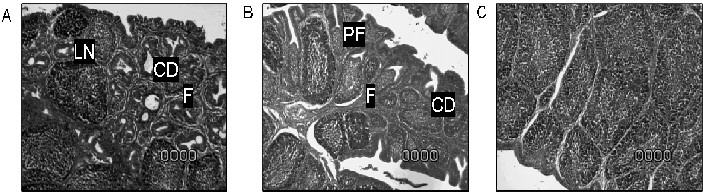
<body><![CDATA[<p align="justify"><font face="Verdana" size="2">    <BR>  </font><FONT COLOR="000000" SIZE="2" FACE="Verdana"> <B>RESULTS AND DISCUSSION</B> </FONT></p>      <P ALIGN="justify"><FONT COLOR="000000" SIZE="2" FACE="Verdana"> The main target cell for IBDV is the actively dividing B-lymphocyte, replicating  virus depletes the bursal follicles, inhibiting the expansion of the immune  repertoire. Ivan et al. [6] suggested a model for the immunosuppression  and restoration of the immune response following IBDV vaccination that  was tested in this trial. </FONT></P>      <P ALIGN="justify"><FONT COLOR="000000" SIZE="2" FACE="Verdana"> In this experiment, the intermediate vaccine group presented moderate to  severe damage to the bursal tissue (grade&nbsp;3) ten days post vaccination.  In the intermediate plus vaccinated group severe lymphoid depletion of  the follicles, increased amount of stoma between follicles and severe follicular  atrophy lesions were observed (grade 4). The extent of the lesions is compared  with the unvaccinated control group in FIG. 1. These results are in agreement  with previous reports on the damage induced by less attenuated IBDV strains  [13, 18]. </FONT></P>      <P ALIGN="justify"><FONT COLOR="000000" SIZE="2" FACE="Verdana"> At the end of the experiment (42 days of age), signs of bursal restoration  represented by repopulation of the follicles and a more normal appearance  of the bursa were observed in the intermediate vaccine group, a grade 1  lesion score was assigned. Severe damage to the bursa remained present  in the intermediate plus vaccine group to which a grade 4 lesion score  was assigned; the lesions are observed in FIG. 2. </FONT></P>      <P ALIGN="justify"><FONT COLOR="000000" SIZE="2" FACE="Verdana"> IBDV is a lymphotropic virus that can cause humoral and to a lower degree,  cell-mediated immunosuppression in chickens infected before 3 weeks of  age [9]. There are reports that the duration of immunosuppression and restoration  of the humoral immune response seems to be correlated with the histological  regeneration of the bursa of Fabricius. Edwards et al. [2], investigated  the relationship between the bursal damage and the depression of humoral  immune response to <I>Brucella abortus</I> in SPF chickens caused by IBDV and  suggested that chickens are unlikely to be fully immunocompetent until  approximately 50% of the bursa is fully repopulated. Intermediate and intermediate  plus IBDV vaccination has been reported to induce histopathological lesions  in primary lymphoid organs, compromising in some extent the humoral immune  response [18]. </FONT></P>      <P ALIGN="justify"><FONT COLOR="000000" SIZE="2" FACE="Verdana">  Cell subtypes in the bursal repopulation process were assessed by immunohistochemistry;  the proportion of B and T cell lymphocytes is of functional relevance.  The proportion of B and T cells are shown in TABLE 1, in this trial, proportion  of B and T cells in the non-vaccinated controls was of 74 and 2%, respectively,  this results are in agreement with Kim et al. [8], whom reported that between  63 and 84% the cells in the bursa of naïve chickens were B lymphocytes  and less than 4% were T cells, seven days post vaccination with an intermediate  IBDV strain the proportions inverted showing near 80% T lymphocytes. </FONT></P>      <P ALIGN="justify"><FONT COLOR="000000" SIZE="2" FACE="Verdana"> The results from the present experiment demonstrated at ten days post-vaccination  (PV) 12% of B cells and 58% of T cells for the intermediate vaccinated  group. At the end of the experiment (42 days of age) the proportion was  21 and 46% for B and T cells, respectively, indicating B cell repopulation.  For the intermediate plus vaccinated group, the proportion ten days PV  was 12 and 75% for B and T cells, respectively. At 42 days of age, B lymphocytes  remained low at 8% and T cells represented 75% of the cells counted indicating  less B cell repopulation. In similar studies Rautenschlein et al. [19],  reported that after IBDV infection the number of IgM<SUP>+</SUP> cells drop precipitously  as the virus replicated within bursal follicles. However, the appearance  of viral antigen in the bursa is accompanied by a dramatic infiltration  of T cells in and around the site of virus replication the infiltrating  T cells can be detected as early as day one PV and persisted until at least  12 weeks, although the viral antigen had disappeared by three weeks PV. </FONT></P>     <P ALIGN="center"><font face="Verdana" size="2"> <img border="0" src="/img/fbpe/rc/v19n2/art03fig1.JPG"></font></P>     
<p><font FACE="Verdana" COLOR="#231f20" size="2"><b>FIGURE 1. EFFECT OF  INTERMEDIATE AND INTERMEDIATE PLUS IBDV VACCINATION ON BURSAL TISSUE 10 DAYS  POST VACCINATION. (A) = INTERMEDIATE IBDV VACCINATION INDUCED FOLLICULAR ATROPHY  (F), LYMPHOID NECROSIS (LN) AND CYSTIC DEGENERATION (CD) WERE OBSERVED (SCORE  3). (B) = INTERMEDIATE PLUS VACCINATED CHICKENS, SAME TYPE OF LESIONS IN LARGER  SURFACE OF THE BURSAS (SCORE 4) WERE OBSERVED. (C) =NONVACCINATED CONTROLS NO  LESIONS WERE OBSERVED (SCORE 0) / EFECTO DE LA VACUNACIÓNINTERMEDIA E INTERMEDIA  PLUS CONTRA IBDV EN EL TEJIDO DE LA BOLSA 10 DÍAS POST-VACUNACIÓN. (A) = LA  VACUNACIÓN CON LA CEPA INTERMEDIA DE IBDV INDUJO ATROFIA FOLICULAR, NECROSIS  LINFOIDE Y DEGENERACIÓN QUÍSTICA (NIVEL 3). (B) = LAS AVES VACUNADAS CON LA CEPA  INTERMEDIA PLUS MOSTRARON EL MISMO TIPO DE LESIONES SÓLO QUE MÁS EXTENDIDAS EN  LA BOLSA (NIVEL 4). (C) = CONTROLES NO VACUNADOS, NO SE OBSERVARON LESIONES.</p> </b></font>     ]]></body>
<body><![CDATA[<P ALIGN="justify"><FONT COLOR="000000" SIZE="2" FACE="Verdana"> B-cell lysis caused by the replicating virus is probably a random process;  consequently, those lymphocytes which respond to the IBDV antigens might  also be affected to a certain level. However, surviving B-cells produce  sufficient IBDV-specific antibody to provide an effective immune response  [1], the later has been proved not to be true for the immune response against  several other common poultry pathogens after IBDV infection [3, 17, 21,  23]. After restriction of virus replication, histological regeneration  allows the bursa to resume to its original function and serve as an efficient  primary lymphoid organ. The spleen and the peripheral lymphoid organs are  then recolonized, which may contribute to the restitution of normal humoral  responses [9]. </FONT></P>      <P ALIGN="justify"><FONT COLOR="000000" SIZE="2" FACE="Verdana"> Pathogenesis studies have looked into the role of T cells after infection  and the mechanism of recovery from acute infection, the dramatic influx  of T cells at the site of viral replication, suggest that T cells may be  involved in limiting viral spread and thus initiating the recovery process  [22]. Nevertheless, it is possible that IBDV-induced T cells may enhance  viral lesions. For example, cytotoxic T cells may exasperate virus-induced  cellular destruction by lysing cells expressing viral antigens. T cells  may also promote the production of inflammatory factors that may accentuate  tissue destruction. Nitric oxide (NO) produced by macrophages activated  by T cell cytokines (e.g. IFN-ã) may promote cellular destruction [19].  Together with an increased virus replication due to higher virulence the  T cell effects may explain the diminished recovery of the intermediate  plus vaccinated bursas in this trial. </FONT></P>     <P ALIGN="center"><font face="Verdana" size="2"> <img border="0" src="/img/fbpe/rc/v19n2/art03fig2.JPG"></font></P>     
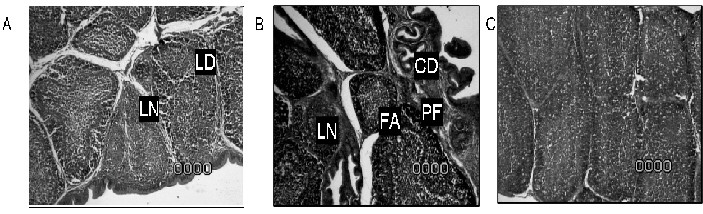
<p><font face="Verdana" size="2">&nbsp;</font><font FACE="Verdana" SIZE="2" COLOR="#231f20"><b>FIGURE 2. EFFECT OF INTERMEDIATE AND INTERMEDIATE PLUS IBDV VACCINATION ON  BURSAL TISSUE AT 42 DAYS OF AGE. BIRDS IN THE INTERMEDIATE VACCINE GROUP (A) =  RECOVERED TO A SCORE 1, SOME LYMPHOID NECROSIS (LN) AND DEPLETION (LD) WERE  OBSERVED. INTERMEDIATE PLUS VACCINATED CHICKENS (B) REMAINED AS A SCORE 4 WITH  FOLLICULAR ATROPHY (FA), LYMPHOID NECROSIS (LN) AND CYSTIC DEGENERATION (CD) AND  PERIFOLLICULAR FIBROSIS. (C) = NON-VACCINATED CONTROLS, NO LESIONS WERE OBSERVED  (SCORE 0) / EFECTO DE LA VACUNACIÓN INTERMEDIA E INTERMEDIA PLUS CONTRA IBDV EN  EL TEJIDO DE LA BOLSA A LOS 42 DÍAS DE EDAD. LAS AVES EN EL GRUPO DE LA VACUNA  INTERMEDIA (A) = SE RECUPERARON A NIVEL 1, AUNQUE SE OBSERVÓ ALGÚN GRADO DE  NECROSIS LINFOIDE Y DEPLECIÓN LINFOIDE. LAS AVES VACUNADAS CON LA CEPA  INTERMEDIA PLUS PERMANECIERON EN&nbsp; EL NIVEL 4 CON ATROFIA FOLICULAR,  NECROSIS LINFOIDE DEGENERACIÓN QUÍSTICA Y FIBROSIS PERIFOLICULAR. (C) =  CONTROLES NO VACUNADOS, NO SE OBSERVARON LESIONES.</p> </b></font> <basefont>     <p align="center"><font color="#000000" size="2" face="Verdana"><b>TABLE I    <br> IMMUNOHISTOCHEMICAL DETECTION OF BURSAL LYMPHOCYTE SUBPOPULATION / DETECCIÓN POR  INMUNOHISTOQUÍMICA DE LA POBLACIÓN DE LINFOCITOS PRESENTES EN LA BOLSA DE  FABRICIOUS</b></font><b><font color="#000000" size="2" face="Verdana"> </font> </b></p> <table id="table1" width="880"> 	<tr> 		<td vAlign="top" rowSpan="3" width="176"> 		    <p align="center"><font color="#000000" size="2" face="Verdana"> 		Antibodies used for B and T cell identification </font></td> 		<td vAlign="top" colSpan="7"> 		    <p align="center"><font color="#000000" size="2" face="Verdana">%  		Positively stained cells </font></td> 	</tr> 	<tr> 		<td vAlign="top" colSpan="4"> 		    <p align="center"><font color="#000000" size="2" face="Verdana">10 days  		post-vaccination </font></td> 		<td vAlign="top" colSpan="3"> 		    <p align="center"><font color="#000000" size="2" face="Verdana">42 days  		of age </font></td> 	</tr> 	<tr> 		<td vAlign="top" width="138"> 		    ]]></body>
<body><![CDATA[<p align="center"><font color="#000000" size="2" face="Verdana"> 		Non-vaccinated </font></td> 		<td vAlign="top" width="82"> 		    <p align="center"><font color="#000000" size="2" face="Verdana">IBDV    <br> 		intermediate </font></td> 		<td vAlign="top" width="124"> 		    <p align="center"><font color="#000000" size="2" face="Verdana">IBDV  		intermediate plus </font></td> 		<td vAlign="top" width="11"><font face="Verdana" size="2">&nbsp;</font></td> 		<td vAlign="top" width="124"> 		    <p align="center"><font color="#000000" size="2" face="Verdana"> 		Non-vaccinated </font></td> 		<td vAlign="top" width="82"> 		    <p align="center"><font color="#000000" size="2" face="Verdana">IBDV    <br> 		intermediate </font></td> 		<td vAlign="top" width="109"> 		    <p align="center"><font color="#000000" size="2" face="Verdana">IBDV  		intermediate plus </font></td> 	</tr> 	<tr> 		<td vAlign="top" width="176"> 		    <p align="center"><font color="#000000" size="2" face="Verdana">CD20 		</font></td> 		<td vAlign="top" width="138"> 		    <p align="center"><font color="#000000" size="2" face="Verdana">74 		</font></td> 		<td vAlign="top" width="82"> 		    ]]></body>
<body><![CDATA[<p align="center"><font color="#000000" size="2" face="Verdana">12 		</font></td> 		<td vAlign="top" width="124"> 		    <p align="center"><font color="#000000" size="2" face="Verdana">12 		</font></td> 		<td vAlign="top" width="11"><font face="Verdana" size="2">&nbsp;</font></td> 		<td vAlign="top" width="124"> 		    <p align="center"><font color="#000000" size="2" face="Verdana">73 		</font></td> 		<td vAlign="top" width="82"> 		    <p align="center"><font color="#000000" size="2" face="Verdana">21 		</font></td> 		<td vAlign="top" width="109"> 		    <p align="center"><font color="#000000" size="2" face="Verdana">8 </font> 		</td> 	</tr> 	<tr> 		<td vAlign="top" width="176"> 		    <p align="center"><font color="#000000" size="2" face="Verdana">CD45RO 		</font></td> 		<td vAlign="top" width="138"> 		    <p align="center"><font color="#000000" size="2" face="Verdana">2 </font> 		</td> 		<td vAlign="top" width="82"> 		    <p align="center"><font color="#000000" size="2" face="Verdana">58 		</font></td> 		<td vAlign="top" width="124"> 		    <p align="center"><font color="#000000" size="2" face="Verdana">75 		</font></td> 		<td vAlign="top" width="11"><font face="Verdana" size="2">&nbsp;</font></td> 		<td vAlign="top" width="124"> 		    <p align="center"><font color="#000000" size="2" face="Verdana">2 </font> 		</td> 		<td vAlign="top" width="82"> 		    ]]></body>
<body><![CDATA[<p align="center"><font color="#000000" size="2" face="Verdana">46 		</font></td> 		<td vAlign="top" width="109"> 		    <p align="center"><font color="#000000" size="2" face="Verdana">75 		</font></td> 	</tr> </table>     <P ALIGN="justify"><FONT COLOR="000000" SIZE="2" FACE="Verdana"> <B>CONCLUSIONS</B> </FONT></P>      <P ALIGN="justify"><FONT COLOR="000000" SIZE="2" FACE="Verdana"> Increased histopathological bursal damage and delayed recovery was observed  in the intermediate plus vaccinated group when compared with the intermediate  strain. Signs of bursal restoration were observed at 42 days of age, mainly in  the intermediate vaccinated group. </FONT></P>      <P ALIGN="justify"><FONT COLOR="000000" SIZE="2" FACE="Verdana"> <B>BIBLIOGRAPHIC REFERENCES</B> </FONT></P>      <!-- ref --><P ALIGN="justify"><FONT COLOR="000000" SIZE="2" FACE="Verdana"> 1.BURKHARDT, E.; MÜLLER, H. Susceptibility of chicken blood lymphoblasts  and monocytes to infectious bursal disease virus (IBDV). <B>Arch. Virol. </B>94:  97-303. 1987. </FONT>&nbsp;&nbsp;&nbsp;&nbsp;&nbsp;&nbsp;&nbsp;&nbsp;[&#160;<a href="javascript:void(0);" onclick="javascript: window.open('/scielo.php?script=sci_nlinks&ref=1614081&pid=S0798-2259200900020000300001&lng=','','width=640,height=500,resizable=yes,scrollbars=1,menubar=yes,');">Links</a>&#160;]<!-- end-ref --><!-- ref --><P ALIGN="justify"><FONT COLOR="000000" SIZE="2" FACE="Verdana"> 2.EDWARDS, K.; MUSKETT, J.; THORNTON, D. Duration of immunosuppression caused  by a vaccine strain of infectious bursal disease. <B>Res. Vet. Sci.</B> 32:79-83.  1982. </FONT>&nbsp;&nbsp;&nbsp;&nbsp;&nbsp;&nbsp;&nbsp;&nbsp;[&#160;<a href="javascript:void(0);" onclick="javascript: window.open('/scielo.php?script=sci_nlinks&ref=1614082&pid=S0798-2259200900020000300002&lng=','','width=640,height=500,resizable=yes,scrollbars=1,menubar=yes,');">Links</a>&#160;]<!-- end-ref --><!-- ref --><P ALIGN="justify"><FONT COLOR="000000" SIZE="2" FACE="Verdana"> 3.FADLY, A.; WINTERFIELD, R.; OLANDER, H. Role of the bursa of Fabricius  in the pathogenicity of inclusion body hepatitis and infectious bursal  disease virus. <B>Avian Dis</B>. 20:467-477. 1976. </FONT>&nbsp;&nbsp;&nbsp;&nbsp;&nbsp;&nbsp;&nbsp;&nbsp;[&#160;<a href="javascript:void(0);" onclick="javascript: window.open('/scielo.php?script=sci_nlinks&ref=1614083&pid=S0798-2259200900020000300003&lng=','','width=640,height=500,resizable=yes,scrollbars=1,menubar=yes,');">Links</a>&#160;]<!-- end-ref --><!-- ref --><P ALIGN="justify"><FONT COLOR="000000" SIZE="2" FACE="Verdana"> 4.HENRY, C.; BREWER, R.; EDGAR, S.; GRAY, B. Studies on Infectious Bursal  Disease in Chickens. 2. Scoring Microscopic Lesions in the Bursa of Fabricius,  Thymus, Spleen, and Kidney in Gnotobiotic and Battery Reared White Leghorns  Experimentally Infected with Infectious Bursal Disease Virus. <B>Poult. Sci.</B>  59:1006-1007. 1980. </FONT>&nbsp;&nbsp;&nbsp;&nbsp;&nbsp;&nbsp;&nbsp;&nbsp;[&#160;<a href="javascript:void(0);" onclick="javascript: window.open('/scielo.php?script=sci_nlinks&ref=1614084&pid=S0798-2259200900020000300004&lng=','','width=640,height=500,resizable=yes,scrollbars=1,menubar=yes,');">Links</a>&#160;]<!-- end-ref --><!-- ref --><P ALIGN="justify"><FONT COLOR="000000" SIZE="2" FACE="Verdana"> 5.HITCHNER, S.. Persistence of parental infectious bursal disease antibody  and its effects on susceptibility of young chickens. <B>Avian Dis</B>. 15:894-900.  1971 </FONT>&nbsp;&nbsp;&nbsp;&nbsp;&nbsp;&nbsp;&nbsp;&nbsp;[&#160;<a href="javascript:void(0);" onclick="javascript: window.open('/scielo.php?script=sci_nlinks&ref=1614085&pid=S0798-2259200900020000300005&lng=','','width=640,height=500,resizable=yes,scrollbars=1,menubar=yes,');">Links</a>&#160;]<!-- end-ref --><!-- ref --><P ALIGN="justify"><FONT COLOR="000000" SIZE="2" FACE="Verdana"> 6.IVAN, J.; NAGY, N.; MAGYAR, A.; KACSKOVICS, I.; MESZAROS, J.. Functional  restoration of the bursa of fabricius following in ovo infectious bursal  disease vaccination. <B>Vet. Immunol. immunopath</B>.<B> </B>79:235-248. 2001. </FONT>&nbsp;&nbsp;&nbsp;&nbsp;&nbsp;&nbsp;&nbsp;&nbsp;[&#160;<a href="javascript:void(0);" onclick="javascript: window.open('/scielo.php?script=sci_nlinks&ref=1614086&pid=S0798-2259200900020000300006&lng=','','width=640,height=500,resizable=yes,scrollbars=1,menubar=yes,');">Links</a>&#160;]<!-- end-ref --><!-- ref --><P ALIGN="justify"><FONT COLOR="000000" SIZE="2" FACE="Verdana"> 7.KAUFER, I.; WEISS, E. Significance of bursa of Fabricius as target organ  in infectious bursal disease of chickens. <B>Infect. Immun.</B> 27:364-367. 1980. </FONT>&nbsp;&nbsp;&nbsp;&nbsp;&nbsp;&nbsp;&nbsp;&nbsp;[&#160;<a href="javascript:void(0);" onclick="javascript: window.open('/scielo.php?script=sci_nlinks&ref=1614087&pid=S0798-2259200900020000300007&lng=','','width=640,height=500,resizable=yes,scrollbars=1,menubar=yes,');">Links</a>&#160;]<!-- end-ref --><!-- ref --><P ALIGN="justify"><FONT COLOR="000000" SIZE="2" FACE="Verdana"> 8.KIM, I.; YOU, S.; KIM, H.; YEH, H.; SHARMA, J. Characteristics of bursal  T lymphocytes induced by infectious bursal disease virus. <B>J. Virol.</B> 74:8884-8892.  2000. </FONT>&nbsp;&nbsp;&nbsp;&nbsp;&nbsp;&nbsp;&nbsp;&nbsp;[&#160;<a href="javascript:void(0);" onclick="javascript: window.open('/scielo.php?script=sci_nlinks&ref=1614088&pid=S0798-2259200900020000300008&lng=','','width=640,height=500,resizable=yes,scrollbars=1,menubar=yes,');">Links</a>&#160;]<!-- end-ref --><!-- ref --><P ALIGN="justify"><FONT COLOR="000000" SIZE="2" FACE="Verdana"> 9.LASHER, H; SHANE, S. Infectious bursal disease. <B>World’s Poult. Sci. J.  </B>50:133-166. 1994. </FONT>&nbsp;&nbsp;&nbsp;&nbsp;&nbsp;&nbsp;&nbsp;&nbsp;[&#160;<a href="javascript:void(0);" onclick="javascript: window.open('/scielo.php?script=sci_nlinks&ref=1614089&pid=S0798-2259200900020000300009&lng=','','width=640,height=500,resizable=yes,scrollbars=1,menubar=yes,');">Links</a>&#160;]<!-- end-ref --><!-- ref --><P ALIGN="justify"><FONT COLOR="000000" SIZE="2" FACE="Verdana"> 10.LEONG, J. C; BROWN, D; DOBOS, P; KIBENGE, F, S; LUDERT, J. E; MÜLLER, H;MUNDT,  E; NICHOLSON, B. Family Birnaviridae. In: <B>Virus Taxonomy.</B> Seventh Report  of the International Committee on the taxonomy of Viruses. San Diego. Academic  Press. 481-490 pp. 2000. </FONT>&nbsp;&nbsp;&nbsp;&nbsp;&nbsp;&nbsp;&nbsp;&nbsp;[&#160;<a href="javascript:void(0);" onclick="javascript: window.open('/scielo.php?script=sci_nlinks&ref=1614090&pid=S0798-2259200900020000300010&lng=','','width=640,height=500,resizable=yes,scrollbars=1,menubar=yes,');">Links</a>&#160;]<!-- end-ref --><!-- ref --><P ALIGN="justify"><FONT COLOR="000000" SIZE="2" FACE="Verdana"> 11.LUCIO, B; HITCHNER, S. Infectious bursal disease emulsified vaccine: effect  upon neutralizing antibody levels in the dam. <B>Avian Dis.</B> 23:466-478. 1979. </FONT>&nbsp;&nbsp;&nbsp;&nbsp;&nbsp;&nbsp;&nbsp;&nbsp;[&#160;<a href="javascript:void(0);" onclick="javascript: window.open('/scielo.php?script=sci_nlinks&ref=1614091&pid=S0798-2259200900020000300011&lng=','','width=640,height=500,resizable=yes,scrollbars=1,menubar=yes,');">Links</a>&#160;]<!-- end-ref --><!-- ref --><P ALIGN="justify"><FONT COLOR="000000" SIZE="2" FACE="Verdana"> 12.LUKERT, P. D; SAIF, Y. M. Infectious Bursal Disease. In: SAIF, Y. M; BARNES,  H. J; GLISSON, J. R; FADLY, A. M; MCDOUGALD, L. R; SWAYNE, D. E. (Eds),<B>  Diseases of Poultry, </B>11<SUP>th</SUP> Ed. Blackwell Publishing Co. 161-179 pp. 2003. </FONT>&nbsp;&nbsp;&nbsp;&nbsp;&nbsp;&nbsp;&nbsp;&nbsp;[&#160;<a href="javascript:void(0);" onclick="javascript: window.open('/scielo.php?script=sci_nlinks&ref=1614092&pid=S0798-2259200900020000300012&lng=','','width=640,height=500,resizable=yes,scrollbars=1,menubar=yes,');">Links</a>&#160;]<!-- end-ref --><!-- ref --><P ALIGN="justify"><FONT COLOR="000000" SIZE="2" FACE="Verdana"> 13.MÜLLER, H; ISLAM, M.; RAUE, R. Research on infectious bursal disease the  past, the present and the future. <B>Vet. Microbiol.</B> 97:153-165. 2003. </FONT>&nbsp;&nbsp;&nbsp;&nbsp;&nbsp;&nbsp;&nbsp;&nbsp;[&#160;<a href="javascript:void(0);" onclick="javascript: window.open('/scielo.php?script=sci_nlinks&ref=1614093&pid=S0798-2259200900020000300013&lng=','','width=640,height=500,resizable=yes,scrollbars=1,menubar=yes,');">Links</a>&#160;]<!-- end-ref --><!-- ref --><P ALIGN="justify"><FONT COLOR="000000" SIZE="2" FACE="Verdana"> 14.NAQI, S.; MARQUEZ, B.; SAHIN, N. Maternal antibody and its effect on infectious  bursal disease immunization. <B>Avian Dis. </B>27:623-631. 1981. </FONT>&nbsp;&nbsp;&nbsp;&nbsp;&nbsp;&nbsp;&nbsp;&nbsp;[&#160;<a href="javascript:void(0);" onclick="javascript: window.open('/scielo.php?script=sci_nlinks&ref=1614094&pid=S0798-2259200900020000300014&lng=','','width=640,height=500,resizable=yes,scrollbars=1,menubar=yes,');">Links</a>&#160;]<!-- end-ref --><!-- ref --><P ALIGN="justify"><FONT COLOR="000000" SIZE="2" FACE="Verdana"> 15.NICK, H.;CURSIEFEN, D.; BECHT, H. Structural and growth characteristics  of infectious bursal disease virus. <B>J. Virol.</B> 18:227-234. 1976. </FONT>&nbsp;&nbsp;&nbsp;&nbsp;&nbsp;&nbsp;&nbsp;&nbsp;[&#160;<a href="javascript:void(0);" onclick="javascript: window.open('/scielo.php?script=sci_nlinks&ref=1614095&pid=S0798-2259200900020000300015&lng=','','width=640,height=500,resizable=yes,scrollbars=1,menubar=yes,');">Links</a>&#160;]<!-- end-ref --><!-- ref --><P ALIGN="justify"><FONT COLOR="000000" SIZE="2" FACE="Verdana"> 16.OZEL, M.; GELDERBLOM, H. Capsid symmetry of viruses of the proposed birnavirus  group. <B>Arch. Virol.</B> 84:149-161. 1985. </FONT>&nbsp;&nbsp;&nbsp;&nbsp;&nbsp;&nbsp;&nbsp;&nbsp;[&#160;<a href="javascript:void(0);" onclick="javascript: window.open('/scielo.php?script=sci_nlinks&ref=1614096&pid=S0798-2259200900020000300016&lng=','','width=640,height=500,resizable=yes,scrollbars=1,menubar=yes,');">Links</a>&#160;]<!-- end-ref --><!-- ref --><P ALIGN="justify"><FONT COLOR="000000" SIZE="2" FACE="Verdana"> 17.PEJKOVSKI, C.; DAVELAR, F.; KOUWENHOVEN, B. Immunosuppressive effect of  infectious bursal disease virus on vaccination against infectious bronchitis.  <B>Avian Pathol.</B> 8:95-106. 1979. </FONT>&nbsp;&nbsp;&nbsp;&nbsp;&nbsp;&nbsp;&nbsp;&nbsp;[&#160;<a href="javascript:void(0);" onclick="javascript: window.open('/scielo.php?script=sci_nlinks&ref=1614097&pid=S0798-2259200900020000300017&lng=','','width=640,height=500,resizable=yes,scrollbars=1,menubar=yes,');">Links</a>&#160;]<!-- end-ref --><!-- ref --><P ALIGN="justify"><FONT COLOR="000000" SIZE="2" FACE="Verdana"> 18.RAUTENSCHLEIN, S.; YEH, Y.; SHARMA, J. Comparative immunopathogenesis of  mild, intermediate, and virulent strains of classic infectious bursal disease  virus. <B>Avian Dis</B>. 47:66-78. 2003. </FONT>&nbsp;&nbsp;&nbsp;&nbsp;&nbsp;&nbsp;&nbsp;&nbsp;[&#160;<a href="javascript:void(0);" onclick="javascript: window.open('/scielo.php?script=sci_nlinks&ref=1614098&pid=S0798-2259200900020000300018&lng=','','width=640,height=500,resizable=yes,scrollbars=1,menubar=yes,');">Links</a>&#160;]<!-- end-ref --><!-- ref --><P ALIGN="justify"><FONT COLOR="000000" SIZE="2" FACE="Verdana"> 19.RAUTENSCHLEIN, S.; YEH, Y.; SHARMA, J. The role of T cells in protection  by an inactivated infectious bursal disease virus vaccine. <B>Vet Immunol  Immunopathol.</B> 89:159-167. 2002. </FONT>&nbsp;&nbsp;&nbsp;&nbsp;&nbsp;&nbsp;&nbsp;&nbsp;[&#160;<a href="javascript:void(0);" onclick="javascript: window.open('/scielo.php?script=sci_nlinks&ref=1614099&pid=S0798-2259200900020000300019&lng=','','width=640,height=500,resizable=yes,scrollbars=1,menubar=yes,');">Links</a>&#160;]<!-- end-ref --><!-- ref --><P ALIGN="justify"><FONT COLOR="000000" SIZE="2" FACE="Verdana"> 20.ROSALES, A.; VILLEGAS, P.; LUKERT, P.; FLETCHER, O.; MOHAMED, M.; BROWN,  J. Pathogenicity of recent isolates of infectious bursal disease virus  in specific-pathogen-free chickens. <B>Avian Dis</B>. 33:729-734. 1989. </FONT>&nbsp;&nbsp;&nbsp;&nbsp;&nbsp;&nbsp;&nbsp;&nbsp;[&#160;<a href="javascript:void(0);" onclick="javascript: window.open('/scielo.php?script=sci_nlinks&ref=1614100&pid=S0798-2259200900020000300020&lng=','','width=640,height=500,resizable=yes,scrollbars=1,menubar=yes,');">Links</a>&#160;]<!-- end-ref --><!-- ref --><P ALIGN="justify"><FONT COLOR="000000" SIZE="2" FACE="Verdana"> 21.ROSENBERGER, J.; GELB, J. Response to several avian respiratory viruses  as affected by infectious bursal disease virus. <B>Avian Dis</B>. 22:95-105. 1978. </FONT>&nbsp;&nbsp;&nbsp;&nbsp;&nbsp;&nbsp;&nbsp;&nbsp;[&#160;<a href="javascript:void(0);" onclick="javascript: window.open('/scielo.php?script=sci_nlinks&ref=1614101&pid=S0798-2259200900020000300021&lng=','','width=640,height=500,resizable=yes,scrollbars=1,menubar=yes,');">Links</a>&#160;]<!-- end-ref --><!-- ref --><P ALIGN="justify"><FONT COLOR="000000" SIZE="2" FACE="Verdana"> 22.SHARMA, J.; KIM, J.; RAUTENSCHLEIN, S.; YEH, Y. Infectious Bursal disease  virus of chickens: pathogenesis and immunosuppression. <B>Devel. &amp; Comp. Immunol.</B>  24: 223-235. 2000. </FONT>&nbsp;&nbsp;&nbsp;&nbsp;&nbsp;&nbsp;&nbsp;&nbsp;[&#160;<a href="javascript:void(0);" onclick="javascript: window.open('/scielo.php?script=sci_nlinks&ref=1614102&pid=S0798-2259200900020000300022&lng=','','width=640,height=500,resizable=yes,scrollbars=1,menubar=yes,');">Links</a>&#160;]<!-- end-ref --><!-- ref --><P ALIGN="justify"><FONT COLOR="000000" SIZE="2" FACE="Verdana"> 23.WYETH, P. J. Effect of infectious bursal disease on the response of chickens  to S. typhymurium and E. coli infection. <B>Vet. Rec</B>. 96:238-243. 1975. </FONT>&nbsp;&nbsp;&nbsp;&nbsp;&nbsp;&nbsp;&nbsp;&nbsp;[&#160;<a href="javascript:void(0);" onclick="javascript: window.open('/scielo.php?script=sci_nlinks&ref=1614103&pid=S0798-2259200900020000300023&lng=','','width=640,height=500,resizable=yes,scrollbars=1,menubar=yes,');">Links</a>&#160;]<!-- end-ref --> ]]></body>
<back>
<ref-list>
<ref id="B1">
<label>1</label><nlm-citation citation-type="journal">
<person-group person-group-type="author">
<name>
<surname><![CDATA[BURKHARDT]]></surname>
<given-names><![CDATA[E.]]></given-names>
</name>
<name>
<surname><![CDATA[MÜLLER]]></surname>
<given-names><![CDATA[H]]></given-names>
</name>
</person-group>
<article-title xml:lang="en"><![CDATA[Susceptibility of chicken blood lymphoblasts and monocytes to infectious bursal disease virus (IBDV)]]></article-title>
<source><![CDATA[Arch. Virol.]]></source>
<year>1987</year>
<volume>94</volume>
<page-range>97-303</page-range></nlm-citation>
</ref>
<ref id="B2">
<label>2</label><nlm-citation citation-type="journal">
<person-group person-group-type="author">
<name>
<surname><![CDATA[EDWARDS]]></surname>
<given-names><![CDATA[K.]]></given-names>
</name>
<name>
<surname><![CDATA[MUSKETT]]></surname>
<given-names><![CDATA[J.]]></given-names>
</name>
<name>
<surname><![CDATA[THORNTON]]></surname>
<given-names><![CDATA[D]]></given-names>
</name>
</person-group>
<article-title xml:lang="en"><![CDATA[Duration of immunosuppression caused by a vaccine strain of infectious bursal disease]]></article-title>
<source><![CDATA[Res. Vet. Sci.]]></source>
<year>1982</year>
<volume>32</volume>
<page-range>79-83</page-range></nlm-citation>
</ref>
<ref id="B3">
<label>3</label><nlm-citation citation-type="journal">
<person-group person-group-type="author">
<name>
<surname><![CDATA[FADLY]]></surname>
<given-names><![CDATA[A.]]></given-names>
</name>
<name>
<surname><![CDATA[WINTERFIELD]]></surname>
<given-names><![CDATA[R.]]></given-names>
</name>
<name>
<surname><![CDATA[OLANDER]]></surname>
<given-names><![CDATA[H]]></given-names>
</name>
</person-group>
<article-title xml:lang="en"><![CDATA[Role of the bursa of Fabricius in the pathogenicity of inclusion body hepatitis and infectious bursal disease virus]]></article-title>
<source><![CDATA[Avian Dis.]]></source>
<year>1976</year>
<volume>20</volume>
<page-range>467-477</page-range></nlm-citation>
</ref>
<ref id="B4">
<label>4</label><nlm-citation citation-type="journal">
<person-group person-group-type="author">
<name>
<surname><![CDATA[HENRY]]></surname>
<given-names><![CDATA[C.]]></given-names>
</name>
<name>
<surname><![CDATA[BREWER]]></surname>
<given-names><![CDATA[R.]]></given-names>
</name>
<name>
<surname><![CDATA[EDGAR]]></surname>
<given-names><![CDATA[S.]]></given-names>
</name>
<name>
<surname><![CDATA[GRAY]]></surname>
<given-names><![CDATA[B]]></given-names>
</name>
</person-group>
<article-title xml:lang="en"><![CDATA[Studies on Infectious Bursal Disease in Chickens]]></article-title>
<source><![CDATA[2. Scoring Microscopic Lesions in the Bursa of Fabricius, Thymus, Spleen, and Kidney in Gnotobiotic and Battery Reared White Leghorns Experimentally Infected with Infectious Bursal Disease Virus. Poult. Sci.]]></source>
<year>1980</year>
<volume>59</volume>
<page-range>1006-1007</page-range></nlm-citation>
</ref>
<ref id="B5">
<label>5</label><nlm-citation citation-type="journal">
<person-group person-group-type="author">
<name>
<surname><![CDATA[HITCHNER]]></surname>
<given-names><![CDATA[S.]]></given-names>
</name>
</person-group>
<article-title xml:lang="en"><![CDATA[Persistence of parental infectious bursal disease antibody and its effects on susceptibility of young chickens]]></article-title>
<source><![CDATA[Avian Dis.]]></source>
<year>1971</year>
<volume>15</volume>
<page-range>894-900</page-range></nlm-citation>
</ref>
<ref id="B6">
<label>6</label><nlm-citation citation-type="journal">
<person-group person-group-type="author">
<name>
<surname><![CDATA[IVAN]]></surname>
<given-names><![CDATA[J.]]></given-names>
</name>
<name>
<surname><![CDATA[NAGY]]></surname>
<given-names><![CDATA[N.]]></given-names>
</name>
<name>
<surname><![CDATA[MAGYAR]]></surname>
<given-names><![CDATA[A.]]></given-names>
</name>
<name>
<surname><![CDATA[KACSKOVICS]]></surname>
<given-names><![CDATA[I.]]></given-names>
</name>
<name>
<surname><![CDATA[MESZAROS]]></surname>
<given-names><![CDATA[J.]]></given-names>
</name>
</person-group>
<article-title xml:lang="en"><![CDATA[Functional restoration of the bursa of fabricius following in ovo infectious bursal disease vaccination]]></article-title>
<source><![CDATA[Vet. Immunol. immunopath.]]></source>
<year>2001</year>
<volume>79</volume>
<page-range>235-248</page-range></nlm-citation>
</ref>
<ref id="B7">
<label>7</label><nlm-citation citation-type="journal">
<person-group person-group-type="author">
<name>
<surname><![CDATA[KAUFER]]></surname>
<given-names><![CDATA[I.]]></given-names>
</name>
<name>
<surname><![CDATA[WEISS]]></surname>
<given-names><![CDATA[E]]></given-names>
</name>
</person-group>
<article-title xml:lang="en"><![CDATA[Significance of bursa of Fabricius as target organ in infectious bursal disease of chickens]]></article-title>
<source><![CDATA[Infect. Immun.]]></source>
<year>1980</year>
<volume>27</volume>
<page-range>364-367</page-range></nlm-citation>
</ref>
<ref id="B8">
<label>8</label><nlm-citation citation-type="journal">
<person-group person-group-type="author">
<name>
<surname><![CDATA[KIM]]></surname>
<given-names><![CDATA[I.]]></given-names>
</name>
<name>
<surname><![CDATA[YOU]]></surname>
<given-names><![CDATA[S.]]></given-names>
</name>
<name>
<surname><![CDATA[KIM]]></surname>
<given-names><![CDATA[H.]]></given-names>
</name>
<name>
<surname><![CDATA[YEH]]></surname>
<given-names><![CDATA[H.]]></given-names>
</name>
<name>
<surname><![CDATA[SHARMA]]></surname>
<given-names><![CDATA[J]]></given-names>
</name>
</person-group>
<article-title xml:lang="en"><![CDATA[Characteristics of bursal T lymphocytes induced by infectious bursal disease virus]]></article-title>
<source><![CDATA[J. Virol.]]></source>
<year>2000</year>
<volume>74</volume>
<page-range>8884-8892</page-range></nlm-citation>
</ref>
<ref id="B9">
<label>9</label><nlm-citation citation-type="journal">
<person-group person-group-type="author">
<name>
<surname><![CDATA[LASHER]]></surname>
<given-names><![CDATA[H]]></given-names>
</name>
<name>
<surname><![CDATA[SHANE]]></surname>
<given-names><![CDATA[S]]></given-names>
</name>
</person-group>
<article-title xml:lang="en"><![CDATA[Infectious bursal disease]]></article-title>
<source><![CDATA[World’s Poult. Sci. J.]]></source>
<year>1994</year>
<volume>50</volume>
<page-range>133-166</page-range></nlm-citation>
</ref>
<ref id="B10">
<label>10</label><nlm-citation citation-type="book">
<person-group person-group-type="author">
<name>
<surname><![CDATA[LEONG]]></surname>
<given-names><![CDATA[J. C]]></given-names>
</name>
<name>
<surname><![CDATA[BROWN]]></surname>
<given-names><![CDATA[D]]></given-names>
</name>
<name>
<surname><![CDATA[DOBOS]]></surname>
<given-names><![CDATA[P]]></given-names>
</name>
<name>
<surname><![CDATA[KIBENGE]]></surname>
<given-names><![CDATA[F]]></given-names>
</name>
<name>
<surname><![CDATA[LUDERT]]></surname>
<given-names><![CDATA[S]]></given-names>
</name>
<name>
<surname><![CDATA[MÜLLER]]></surname>
<given-names><![CDATA[J. E]]></given-names>
</name>
<name>
<surname><![CDATA[MUNDT]]></surname>
<given-names><![CDATA[H]]></given-names>
</name>
<name>
<surname><![CDATA[NICHOLSON]]></surname>
<given-names><![CDATA[E]]></given-names>
</name>
</person-group>
<source><![CDATA[B. Family Birnaviridae: Virus Taxonomy]]></source>
<year>2000</year>
<page-range>481-490</page-range><publisher-loc><![CDATA[San Diego ]]></publisher-loc>
<publisher-name><![CDATA[Academic Press]]></publisher-name>
</nlm-citation>
</ref>
<ref id="B11">
<label>11</label><nlm-citation citation-type="journal">
<person-group person-group-type="author">
<name>
<surname><![CDATA[LUCIO]]></surname>
<given-names><![CDATA[B]]></given-names>
</name>
<name>
<surname><![CDATA[HITCHNER]]></surname>
<given-names><![CDATA[S]]></given-names>
</name>
</person-group>
<article-title xml:lang="en"><![CDATA[Infectious bursal disease emulsified vaccine: effect upon neutralizing antibody levels in the dam]]></article-title>
<source><![CDATA[Avian Dis.]]></source>
<year>1979</year>
<volume>23</volume>
<page-range>466-478</page-range></nlm-citation>
</ref>
<ref id="B12">
<label>12</label><nlm-citation citation-type="book">
<person-group person-group-type="author">
<name>
<surname><![CDATA[LUKERT]]></surname>
<given-names><![CDATA[P. D]]></given-names>
</name>
<name>
<surname><![CDATA[SAIF]]></surname>
<given-names><![CDATA[Y. M.]]></given-names>
</name>
</person-group>
<article-title xml:lang="en"><![CDATA[Infectious Bursal Disease]]></article-title>
<person-group person-group-type="editor">
<name>
<surname><![CDATA[SAIF]]></surname>
<given-names><![CDATA[Y. M]]></given-names>
</name>
<name>
<surname><![CDATA[BARNES]]></surname>
<given-names><![CDATA[H. J]]></given-names>
</name>
<name>
<surname><![CDATA[GLISSON]]></surname>
<given-names><![CDATA[J. R]]></given-names>
</name>
<name>
<surname><![CDATA[FADLY]]></surname>
<given-names><![CDATA[A. M]]></given-names>
</name>
<name>
<surname><![CDATA[MCDOUGALD]]></surname>
<given-names><![CDATA[L. R]]></given-names>
</name>
<name>
<surname><![CDATA[SWAYNE]]></surname>
<given-names><![CDATA[D. E.]]></given-names>
</name>
</person-group>
<source><![CDATA[Diseases of Poultry]]></source>
<year>2003</year>
<edition>11th Ed</edition>
<page-range>161-179</page-range><publisher-name><![CDATA[Blackwell Publishing Co.]]></publisher-name>
</nlm-citation>
</ref>
<ref id="B13">
<label>13</label><nlm-citation citation-type="journal">
<person-group person-group-type="author">
<name>
<surname><![CDATA[MÜLLER]]></surname>
<given-names><![CDATA[H]]></given-names>
</name>
<name>
<surname><![CDATA[ISLAM]]></surname>
<given-names><![CDATA[M.]]></given-names>
</name>
<name>
<surname><![CDATA[RAUE]]></surname>
<given-names><![CDATA[R]]></given-names>
</name>
</person-group>
<article-title xml:lang="en"><![CDATA[Research on infectious bursal disease the past, the present and the future]]></article-title>
<source><![CDATA[Vet. Microbiol.]]></source>
<year>2003</year>
<volume>97</volume>
<page-range>153-165</page-range></nlm-citation>
</ref>
<ref id="B14">
<label>14</label><nlm-citation citation-type="journal">
<person-group person-group-type="author">
<name>
<surname><![CDATA[NAQI]]></surname>
<given-names><![CDATA[S.]]></given-names>
</name>
<name>
<surname><![CDATA[MARQUEZ]]></surname>
<given-names><![CDATA[B.]]></given-names>
</name>
<name>
<surname><![CDATA[SAHIN]]></surname>
<given-names><![CDATA[N]]></given-names>
</name>
</person-group>
<article-title xml:lang="en"><![CDATA[Maternal antibody and its effect on infectious bursal disease immunization]]></article-title>
<source><![CDATA[Avian Dis.]]></source>
<year>1981</year>
<volume>27</volume>
<page-range>623-631</page-range></nlm-citation>
</ref>
<ref id="B15">
<label>15</label><nlm-citation citation-type="journal">
<person-group person-group-type="author">
<name>
<surname><![CDATA[NICK]]></surname>
<given-names><![CDATA[H.;CURSIEFEN, D.]]></given-names>
</name>
<name>
<surname><![CDATA[BECHT]]></surname>
<given-names><![CDATA[H]]></given-names>
</name>
</person-group>
<article-title xml:lang="en"><![CDATA[Structural and growth characteristics of infectious bursal disease virus]]></article-title>
<source><![CDATA[J. Virol.]]></source>
<year>1976</year>
<volume>18</volume>
<page-range>227-234</page-range></nlm-citation>
</ref>
<ref id="B16">
<label>16</label><nlm-citation citation-type="journal">
<person-group person-group-type="author">
<name>
<surname><![CDATA[OZEL]]></surname>
<given-names><![CDATA[M.]]></given-names>
</name>
<name>
<surname><![CDATA[GELDERBLOM]]></surname>
<given-names><![CDATA[H]]></given-names>
</name>
</person-group>
<article-title xml:lang="en"><![CDATA[Capsid symmetry of viruses of the proposed birnavirus group]]></article-title>
<source><![CDATA[Arch. Virol.]]></source>
<year>1985</year>
<volume>84</volume>
<page-range>149-161</page-range></nlm-citation>
</ref>
<ref id="B17">
<label>17</label><nlm-citation citation-type="journal">
<person-group person-group-type="author">
<name>
<surname><![CDATA[PEJKOVSKI]]></surname>
<given-names><![CDATA[C]]></given-names>
</name>
<name>
<surname><![CDATA[DAVELAR]]></surname>
<given-names><![CDATA[F]]></given-names>
</name>
<name>
<surname><![CDATA[KOUWENHOVEN]]></surname>
<given-names><![CDATA[B.]]></given-names>
</name>
</person-group>
<article-title xml:lang="en"><![CDATA[Immunosuppressive effect of infectious bursal disease virus on vaccination against infectious bronchitis]]></article-title>
<source><![CDATA[Avian Pathol]]></source>
<year>1979</year>
<volume>8</volume>
<page-range>95-106</page-range></nlm-citation>
</ref>
<ref id="B18">
<label>18</label><nlm-citation citation-type="journal">
<person-group person-group-type="author">
<name>
<surname><![CDATA[RAUTENSCHLEIN]]></surname>
<given-names><![CDATA[S.]]></given-names>
</name>
<name>
<surname><![CDATA[YEH]]></surname>
<given-names><![CDATA[Y.]]></given-names>
</name>
<name>
<surname><![CDATA[SHARMA]]></surname>
<given-names><![CDATA[J]]></given-names>
</name>
</person-group>
<article-title xml:lang="en"><![CDATA[Comparative immunopathogenesis of mild, intermediate, and virulent strains of classic infectious bursal disease virus]]></article-title>
<source><![CDATA[Avian Dis.]]></source>
<year>2003</year>
<volume>47</volume>
<page-range>66-78</page-range></nlm-citation>
</ref>
<ref id="B19">
<label>19</label><nlm-citation citation-type="journal">
<person-group person-group-type="author">
<name>
<surname><![CDATA[RAUTENSCHLEIN]]></surname>
<given-names><![CDATA[S.]]></given-names>
</name>
<name>
<surname><![CDATA[YEH]]></surname>
<given-names><![CDATA[Y.]]></given-names>
</name>
<name>
<surname><![CDATA[SHARMA]]></surname>
<given-names><![CDATA[J]]></given-names>
</name>
</person-group>
<article-title xml:lang="en"><![CDATA[The role of T cells in protection by an inactivated infectious bursal disease virus vaccine]]></article-title>
<source><![CDATA[Vet Immunol Immunopathol.]]></source>
<year>2002</year>
<volume>89</volume>
<page-range>159-167</page-range></nlm-citation>
</ref>
<ref id="B20">
<label>20</label><nlm-citation citation-type="journal">
<person-group person-group-type="author">
<name>
<surname><![CDATA[ROSALES]]></surname>
<given-names><![CDATA[A.]]></given-names>
</name>
<name>
<surname><![CDATA[VILLEGAS]]></surname>
<given-names><![CDATA[P.]]></given-names>
</name>
<name>
<surname><![CDATA[LUKERT]]></surname>
<given-names><![CDATA[P.]]></given-names>
</name>
<name>
<surname><![CDATA[FLETCHER]]></surname>
<given-names><![CDATA[O.]]></given-names>
</name>
<name>
<surname><![CDATA[MOHAMED]]></surname>
<given-names><![CDATA[M.]]></given-names>
</name>
<name>
<surname><![CDATA[BROWN]]></surname>
<given-names><![CDATA[J]]></given-names>
</name>
</person-group>
<article-title xml:lang="en"><![CDATA[Pathogenicity of recent isolates of infectious bursal disease virus in specific-pathogen-free chickens]]></article-title>
<source><![CDATA[Avian Dis.]]></source>
<year>1989</year>
<volume>33</volume>
<page-range>729-734</page-range></nlm-citation>
</ref>
<ref id="B21">
<label>21</label><nlm-citation citation-type="journal">
<person-group person-group-type="author">
<name>
<surname><![CDATA[ROSENBERGER]]></surname>
<given-names><![CDATA[J.]]></given-names>
</name>
<name>
<surname><![CDATA[GELB]]></surname>
<given-names><![CDATA[J]]></given-names>
</name>
</person-group>
<article-title xml:lang="en"><![CDATA[Response to several avian respiratory viruses as affected by infectious bursal disease virus]]></article-title>
<source><![CDATA[Avian Dis.]]></source>
<year>1978</year>
<volume>22</volume>
<page-range>95-105</page-range></nlm-citation>
</ref>
<ref id="B22">
<label>22</label><nlm-citation citation-type="journal">
<person-group person-group-type="author">
<name>
<surname><![CDATA[SHARMA]]></surname>
<given-names><![CDATA[J.]]></given-names>
</name>
<name>
<surname><![CDATA[KIM]]></surname>
<given-names><![CDATA[J.]]></given-names>
</name>
<name>
<surname><![CDATA[RAUTENSCHLEIN]]></surname>
<given-names><![CDATA[S.]]></given-names>
</name>
<name>
<surname><![CDATA[YEH]]></surname>
<given-names><![CDATA[Y]]></given-names>
</name>
</person-group>
<article-title xml:lang="en"><![CDATA[Infectious Bursal disease virus of chickens: pathogenesis and immunosuppression]]></article-title>
<source><![CDATA[Devel. & Comp. Immunol.]]></source>
<year>2000</year>
<volume>24</volume>
<page-range>223-235</page-range></nlm-citation>
</ref>
<ref id="B23">
<label>23</label><nlm-citation citation-type="journal">
<person-group person-group-type="author">
<name>
<surname><![CDATA[WYETH]]></surname>
<given-names><![CDATA[P. J.]]></given-names>
</name>
</person-group>
<article-title xml:lang="en"><![CDATA[Effect of infectious bursal disease on the response of chickens to S. typhymurium and E. coli infection.]]></article-title>
<source><![CDATA[Vet. Rec.]]></source>
<year>1975</year>
<volume>96</volume>
<page-range>238-243</page-range></nlm-citation>
</ref>
</ref-list>
</back>
</article>
