<?xml version="1.0" encoding="ISO-8859-1"?><article xmlns:mml="http://www.w3.org/1998/Math/MathML" xmlns:xlink="http://www.w3.org/1999/xlink" xmlns:xsi="http://www.w3.org/2001/XMLSchema-instance">
<front>
<journal-meta>
<journal-id>1315-2556</journal-id>
<journal-title><![CDATA[Revista de la Sociedad Venezolana de Microbiología]]></journal-title>
<abbrev-journal-title><![CDATA[Rev. Soc. Ven. Microbiol.]]></abbrev-journal-title>
<issn>1315-2556</issn>
<publisher>
<publisher-name><![CDATA[Organo Oficial de la Sociedad Venezolana de Microbiología.]]></publisher-name>
</publisher>
</journal-meta>
<article-meta>
<article-id>S1315-25562008000100010</article-id>
<title-group>
<article-title xml:lang="es"><![CDATA[Estafilococos oxacilino resistentes en queso blanco fabricado en el estado Anzoátegui, Venezuela]]></article-title>
<article-title xml:lang="en"><![CDATA[Oxacyllin resistant Staphylococcus in white cheese manufactured at the Anzoategui State, Venezuela]]></article-title>
</title-group>
<contrib-group>
<contrib contrib-type="author">
<name>
<surname><![CDATA[Lemus Espinoza]]></surname>
<given-names><![CDATA[Druvic]]></given-names>
</name>
<xref ref-type="aff" rid="A01"/>
</contrib>
<contrib contrib-type="author">
<name>
<surname><![CDATA[Maniscalchi Badaoui]]></surname>
<given-names><![CDATA[María Teresa]]></given-names>
</name>
<xref ref-type="aff" rid="A01"/>
</contrib>
<contrib contrib-type="author">
<name>
<surname><![CDATA[Hassoun]]></surname>
<given-names><![CDATA[Mazn]]></given-names>
</name>
<xref ref-type="aff" rid="A01"/>
</contrib>
<contrib contrib-type="author">
<name>
<surname><![CDATA[Vizcaya]]></surname>
<given-names><![CDATA[Heycarid]]></given-names>
</name>
<xref ref-type="aff" rid="A01"/>
</contrib>
</contrib-group>
<aff id="A01">
<institution><![CDATA[,Universidad de Oriente (UDO) Escuela de Ciencias de la Salud Dpto. Microbiología y Parasitología]]></institution>
<addr-line><![CDATA[ ]]></addr-line>
<country>Venezuela</country>
</aff>
<pub-date pub-type="pub">
<day>00</day>
<month>06</month>
<year>2008</year>
</pub-date>
<pub-date pub-type="epub">
<day>00</day>
<month>06</month>
<year>2008</year>
</pub-date>
<volume>28</volume>
<numero>1</numero>
<fpage>48</fpage>
<lpage>54</lpage>
<copyright-statement/>
<copyright-year/>
<self-uri xlink:href="http://ve.scielo.org/scielo.php?script=sci_arttext&amp;pid=S1315-25562008000100010&amp;lng=en&amp;nrm=iso"></self-uri><self-uri xlink:href="http://ve.scielo.org/scielo.php?script=sci_abstract&amp;pid=S1315-25562008000100010&amp;lng=en&amp;nrm=iso"></self-uri><self-uri xlink:href="http://ve.scielo.org/scielo.php?script=sci_pdf&amp;pid=S1315-25562008000100010&amp;lng=en&amp;nrm=iso"></self-uri><abstract abstract-type="short" xml:lang="es"><p><![CDATA[El objetivo de esta investigación fue detectar especies estafilocócicas oxacilino resistentes en quesos blanco duro y blando, fabricados artesanalmente en diversos municipios de la zona norte del estado Anzoátegui. Las cepas de Staphylococcus fueron aisladas e identificadas empleando métodos convencionales y se confirmaron las especies coagulasa negativas mediante galerías API 32 Staph (BioMérieux); la susceptibilidad a oxacilina y otros antibióticos por el método de difusión en disco y la presencia del gen mecA, por prueba de látex MRSA Slidex (BioMérieux) que pone de manifiesto la proteína PBP2a. De 130 quesos evaluados, se aislaron 171 cepas estafilocócicas, 26 (15,2%) resistentes a oxacilina (61,5% con presencia del gen), distribuidas como sigue: 14 cepas de S. epidermidis (8,2%), 6 de S. capitis (3,4%), 2 de S. aureus (1,2%), 2 de S. hominis (1,2%), 1 de S. warneri (0,6%) y 1 de S. saprophyticus (0,6%). La presencia del gen que codifica para la proteína PBP2a se detectó tanto en cepas con homorresistencia (76,9%) como con heterorresistencia (23,1%). S. haemolitycus fue 100% sensible a oxacilina. La presencia de cepas estafilocócicas oxacilino resistentes en el queso blanco, puede representar un riesgo para salud pública ya que podría servir como fuente de diseminación de éstas y acrecentar el problema de la resistencia.]]></p></abstract>
<abstract abstract-type="short" xml:lang="en"><p><![CDATA[The purpose of this study was to detect oxacyllin resistant Staphylococcus species in hard and soft white cheese manufactured by artisans at various municipalities of the northern area of Anzoátegui State. The Staphylococcus strains were isolated and identified using conventional methods and coagulase negative species were confirmed through API 32 Staph (BioMérieux) galleries; susceptibility to oxacyllin and other antibiotics was determined by the disk diffusion method and presence of the mecA gene with the MRSA Slidex (BioMérieux) latex test that identifies PBP2a protein. From 130 cheeses evaluated, we isolated 171 Staphylococcus strains, 26 of which (15,2%) were oxacyllin-resistant (61,5% with presence of the gene), distributed as follows: 14, S. epidermidis strains (8,2%); 6, S. capitis (3,4%); 2, S. aureus (1,2%); 2, S. hominis (1,2%); 1, S. warneri (0.6%); and 1, S. saprophyticus (0.6%). Presence of the protein PBP2a codifying gene was detected in both homoresistant (76.9%) and heteroresistant (23.1%) strains. S. haemolitycus was 100% oxacyllin sensitive. Presence of oxacyllin resistant strains in white cheese can represent a public health risk since it could serve as a dissemination source, increasing the resistance problem.]]></p></abstract>
<kwd-group>
<kwd lng="es"><![CDATA[Staphylococcus spp]]></kwd>
<kwd lng="es"><![CDATA[oxacilino resistente]]></kwd>
<kwd lng="es"><![CDATA[proteína PBP2a]]></kwd>
<kwd lng="es"><![CDATA[queso blanco]]></kwd>
<kwd lng="en"><![CDATA[Staphylococcus spp]]></kwd>
<kwd lng="en"><![CDATA[oxacyllin resistant]]></kwd>
<kwd lng="en"><![CDATA[PBP2a protein]]></kwd>
<kwd lng="en"><![CDATA[white cheese]]></kwd>
</kwd-group>
</article-meta>
</front><body><![CDATA[ <p style="line-height: normal" align="center"><font face="Verdana"> <span lang="ES-VE" style="font-weight: 700">Estafilococos<i> </i>oxacilino  resistentes<i> </i>en queso blanco fabricado en el estado Anzoátegui, Venezuela</span></font></p>     <p style="line-height: normal" align="center"><font face="Verdana" size="2"> <span lang="ES" style="font-weight: 700">Druvic Lemus Espinoza<sup>*</sup>,  María Teresa Maniscalchi Badaoui, Mazn Hassoun, Heycarid Vizcaya</span></font></p>     <p style="line-height: normal" align="justify"><font face="Verdana"><i> <span lang="ES-VE" style="font-weight: normal"><font size="2">Dpto.  Microbiología y Parasitología. Escuela de Ciencias de la Salud. Universidad de  Oriente (UDO) </font></span> <span lang="ES-VE" style="font-size: 10.0pt; font-weight: normal">Núcleo de  Anzoátegui. Venezuela.</span></i></font></p>     <p style="text-align: justify"><font face="Verdana" size="2"><span lang="EN-US"> * Correspondencia: </span></font><b><i> <span lang="PT-BR" style="font-family: Verdana"><font size="2">E-mail</font></span></i><span lang="PT-BR" style="font-family: Verdana"><font size="2">:  <a href="mailto:lemusd@yahoo.com">lemusd@yahoo.com</a></font></span></b></p>     <p style="text-align: justify; line-height: normal"> <font face="Verdana" size="2"><span lang="ES"><b>Resumen</b>:</span></font></p>     <p style="text-align: justify; line-height: normal"><font face="Verdana"> <span lang="ES-VE" style="font-weight: normal"><font size="2">El objetivo de  esta investigación fue detectar especies estafilocócicas<i> </i>oxacilino  resistentes<i> </i>en quesos blanco duro y blando, fabricados artesanalmente en  diversos municipios de la zona norte del estado Anzoátegui. Las cepas de <i> Staphylococcus </i>fueron aisladas e identificadas empleando métodos  convencionales y se confirmaron las especies coagulasa negativas mediante  galerías API 32 Staph (BioMérieux); la susceptibilidad a oxacilina y otros  antibióticos por el método de difusión en disco y la presencia del gen <i>mec</i>A,  por prueba de látex MRSA Slidex (BioMérieux) que pone de manifiesto la proteína </font><font size="2">PBP2a</font><font size="2">. De 130 quesos evaluados, se  aislaron 171 cepas estafilocócicas, 26 (15,2%) resistentes a oxacilina (61,5%  con presencia del gen), distribuidas como sigue: 14 cepas de <i>S. epidermidis </i>(8,2%), 6 de <i>S. capitis </i>(3,4%), 2 de <i>S. aureus </i>(1,2%),<i> </i> 2 de <i>S. hominis </i>(1,2%), 1 de <i>S. warneri </i>(0,6%)<i> </i>y 1 de <i>S.  saprophyticus </i>(0,6%). La presencia del gen que codifica para la proteína  PBP2a se detectó tanto en cepas con homorresistencia (76,9%) como con  heterorresistencia (23,1%). <i>S. haemolitycus</i> fue 100% sensible a oxacilina<i>. </i>La presencia de cepas estafilocócicas oxacilino resistentes en el queso  blanco, puede representar un riesgo para salud pública ya que podría servir como  fuente de diseminación de éstas y acrecentar el problema de la resistencia.</font></span></font></p>     <p style="text-align: justify; line-height: normal"><font face="Verdana"> <span lang="ES"><font size="2"><b>Palabras clave</b>:</font></span><span lang="ES" style="font-weight: normal"><font size="2"> </font></span><i><span lang="ES" style="font-weight: normal"><font size="2"> Staphylococcus </font></span></i><span lang="ES" style="font-weight: normal"> <font size="2">spp. oxacilino resistente, proteína PBP2a, queso blanco </font></span></font></p>     <p align="center"><b><font face="Verdana"> <span lang="EN-US"><font size="2">Oxacyllin resistant <i>Staphylococcus</i> in  white cheese manufactured at the Anzoategui State, Venezuela</font></span></font></b></p>     <p style="text-align: justify; line-height: normal"><font face="Verdana"> <span lang="EN-US"><font size="2"><b>Abstract</b>:</font></span></font></p>     <p style="text-align: justify; line-height: normal"><font face="Verdana"> <span lang="EN-GB" style="font-weight: normal"><font size="2">The purpose of  this study was to detect oxacyllin resistant <i>Staphylococcus</i> species in  hard and soft white cheese manufactured by artisans at various municipalities of  the northern area of Anzoátegui State. </font></span> <span lang="ES-VE" style="font-weight: normal"><font size="2">The <i> Staphylococcus </i>strains were isolated and identified using conventional  methods and coagulase negative species were confirmed through API 32 Staph (BioMérieux)  galleries; susceptibility to oxacyllin and other antibiotics was determined by  the disk diffusion method and presence of the <i>mecA </i>gene with the MRSA  Slidex (BioMérieux) latex test that identifies PBP2a protein. </font></span> <span lang="EN-US" style="font-weight: normal"><font size="2">From 130 cheeses  evaluated, we isolated 171 <i>Staphylococcus </i>strains, 26 of which (15,2%)  were oxacyllin-resistant (61,5% with presence of the gene), distributed as  follows: 14, <i>S. epidermidis </i>strains (8,2%); 6, <i>S. capitis </i>(3,4%);  2, <i>S. aureus </i>(1,2%); 2, <i>S. hominis </i>&nbsp;(1,2%); 1, <i>S. warneri </i> (0.6%); and 1, <i>S. saprophyticus </i>(0.6%). </font></span> <span lang="EN-GB" style="font-weight: normal"><font size="2">Presence of the  protein PBP2a codifying gene was detected in both homoresistant (76.9%) and  heteroresistant (23.1%) strains. </font></span><i> <span lang="ES-VE" style="font-weight: normal"><font size="2">S. haemolitycus </font></span></i><span lang="ES-VE" style="font-weight: normal"><font size="2"> was 100% oxacyllin sensitive. Presence of oxacyllin resistant strains in white  cheese can represent a public health risk since it could serve as a  dissemination source,&nbsp; increasing the resistance problem.</font></span><span lang="EN-US"><font size="2">&nbsp;</font></span></font></p>     ]]></body>
<body><![CDATA[<p align="justify"><b><span lang="EN-US" style="font-family: Verdana"> <font size="2">Key words: </font></span></b><i> <span lang="EN-US" style="font-family: Verdana"><font size="2">Staphylococcus </font></span></i><span lang="EN-US" style="font-family: Verdana"> <font size="2">spp, oxacyllin resistant, PBP2a protein, white cheese</font></span></p>     <p align="center" style="text-align: justify"><font face="Verdana" size="2"> <span lang="ES">Recibido 03 de septiembre de 2007; aceptado 13 de noviembre de  2007</span></font></p>     <p align="left" style="text-align: justify; line-height: normal"> <font face="Verdana"> <span lang="PT-BR" style="font-size: 10.0pt; font-weight: 700">Introducción</span></font></p>     <p align="justify"> <span lang="ES" style="font-size: 10.0pt; font-family: Verdana">Aunque  anualmente se dispone en el mercado de nuevos antimicrobianos para enfrentar el  problema de la resistencia microbiana, las bacterias son capaces de desarrollar  ‘defensas’ más efectivas contra estos nuevos y poderosos antibióticos. En este  sentido, el valor terapéutico de estos antimicrobianos ha estado en evolución a  través de los años. Las características mismas de los microorganismos hacen que  la lucha contra ellos se haya convertido en una carrera donde ha habido la  necesidad de emplear todo tipo de estrategias, desde la búsqueda de compuestos  nuevos</span></p>     <p style="text-align: justify; line-height: normal"><font face="Verdana"> <span lang="ES-VE" style="font-size: 10.0pt; font-weight: normal">con mayor  actividad biológica, hasta el diseño de moléculas nuevas mediante procedimientos  de biotecnología, pasando por combinaciones de antimicrobianos [1,2].</span></font></p>     <p style="text-align: justify"><font face="Verdana"> <span lang="ES" style="font-size: 10.0pt; color: black">La resistencia  bacteriana es un tema muy importante en el estudio de los antibióticos, porque  su comprobación implica el fracaso de la terapéutica. La terapia antibiótica ha  conducido a una prolongación en la expectativa y calidad de vida, como parte de  los avances en la medicina moderna que han reducido la morbimortalidad de  numerosos padecimientos, en especial de las enfermedades infecciosas; en  contraste, el aumento del uso de estos medicamentos, a veces de forma  indiscriminada, desde la década de 1950 se ha acompañado del alza creciente en  la resistencia, cuya principal causa es la selección de cepas bacterianas que  fortalecen sus genes de resistencia a la mayoría de los antibióticos y la  bacteria responsable de la infección logra evadir su acción [</span><span lang="ES" style="font-size: 10.0pt">1,2]</span><span lang="ES" style="font-size: 10.0pt; color: black">.</span></font></p>     <p style="text-align: justify"><font face="Verdana"> <span lang="ES" style="font-size: 10.0pt; color: black">La producción de ß-lactamasas  es el medio más importante de resistencia a los antibióticos ß-lactámicos y, en  la actualidad, hay varias clases de esta enzima de origen bacteriano [</span><span lang="ES" style="font-size: 10.0pt">1,2]</span><span lang="ES" style="font-size: 10.0pt; color: black">.  Se ha señalado, que dentro de los antibió-ticos a los cuales diversas bacterias  han desarrollado resistencia, está la meticilina, primera penicilina </span> <span lang="ES" style="font-size: 10.0pt">eficaz ante la acción de las </span> </font><span lang="ES" style="font-size: 10.0pt; font-family: Verdana">b</span><font face="Verdana"><span lang="ES" style="font-size: 10.0pt">-lactamasas<span style="color: black">,  que actúa inhibiendo la síntesis de la pared bacteriana al unirse a las  proteínas fijadoras de penicilina (PBP), enzimas encargadas de llevar a cabo la  transpeptidación que permite el entrecruzamiento del peptidoglicano de la pared  celular bacteriana. La resistencia a meticilina, viene mediada principalmente  por la adquisición del gen <i>mecA</i>, el cual codifica para la producción de  la PBP2a, una transpeptidasa con baja afinidad por los antibióticos </span> </span></font> <span lang="ES" style="font-size: 10.0pt; font-family: Verdana; color: black">b</span><font face="Verdana"><span lang="ES" style="font-size: 10.0pt; color: black">-lactámicos,  pero que conserva su función en la síntesis de la pared celular </span> <span lang="ES" style="font-size: 10.0pt; color: black">[</span><span lang="ES" style="font-size: 10.0pt">3]</span><span lang="ES" style="font-size: 10.0pt; color: black">.</span></font></p>     <p style="text-align: justify; text-autospace: none"><font face="Verdana"> <span lang="ES" style="font-size: 10.0pt">El género <i>Staphylococcus</i> es uno  de los grupos bacterianos al que más se le ha estudiado su patrón de  susceptibilidad a los antibióticos; se hallan en la piel y mucosas y pueden  llegar a los alimentos a través de manipuladores de alimentos con infecciones  piógenas agudas o por portadores asintomáticos, que los albergan en fosas  nasales y faringe [4-8] asociándose, entonces, su presencia en alimentos a una  inadecuada manipulación o al empleo de materia prima contaminada  constituyéndose, a su vez, en fuente de diseminación a nuevos hospedadores  susceptibles de adquirir la infección.</span></font></p>     <p style="text-align: justify; text-autospace: none"><font face="Verdana"> <span lang="ES" style="font-size: 10.0pt; color: black">En <i>Staphylococcus  aureus </i>(<i>S. aureus</i>), se han descrito, además, otros mecanismos, que  pueden ser responsables de la resistencia a meticilina y que median la llamada  resistencia ‘borderline’, con valores de concentración mínima inhibitoria (CMI)  cercanos o justo en el punto de corte (4-8 </span></font> <span lang="ES" style="font-size: 10.0pt; font-family: Verdana; color: black">m</span><font face="Verdana"><span lang="ES" style="font-size: 10.0pt; color: black">g/ml  para la oxacilina), entre los que se encuentra la hiperproducción de </span> </font> <span lang="ES" style="font-size: 10.0pt; font-family: Verdana; color: black">b</span><font face="Verdana"><span lang="ES" style="font-size: 10.0pt; color: black">-lactamasa  y la presencia de PBP modificadas (PBP 1, 2 ó 4) diferentes a la PBP2a, los  cuales a diferencia de la resistencia mediada por el gen <i>mecA</i>, no  comparten resistencia con el resto de los antibióticos </span></font> <span lang="ES" style="font-size: 10.0pt; font-family: Verdana; color: black">b</span><font face="Verdana"><span lang="ES" style="font-size: 10.0pt; color: black">-lactámicos,  sin embargo, su frecuencia e implicación terapéutica no está bien definida </span><span lang="ES" style="font-size: 10.0pt; color: black">[</span><span lang="ES" style="font-size: 10.0pt">3,9,10]</span><span lang="ES" style="font-size: 10.0pt; color: black">.</span></font></p>     <p style="text-align: justify; text-autospace: none"><font face="Verdana"> <span lang="ES-VE" style="font-size: 10.0pt">El queso blanco constituye uno de  los principales alimentos dentro de la pirámide nutricional, ya que es una buena  fuente de proteínas, vitaminas y minerales en especial de calcio<sup> </sup> </span><span lang="ES" style="font-size: 10.0pt; color: black">[</span><span lang="ES" style="font-size: 10.0pt">11]</span><span lang="ES-VE" style="font-size: 10.0pt">. </span><span lang="ES" style="font-size: 10.0pt">Debido al tipo de proceso que  conlleva su manufacturación, este alimento también es un caldo de cultivo de  microorganismos, y por su alta salinidad, favorece a las especies de <i> Staphylococcus.</i> Aunado a ello, a veces no se siguen las normas de higiene  adecuadas, lo que trae como consecuencia que el producto obtenido resulte  contaminado o que esta contaminación se genere después de elaborado,  posiblemente como consecuencia de un mal almacenamiento o a la exposición  ambiental durante la comercialización y/o por parte de los manipuladores de  alimentos y en los hogares de los consumidores. Por lo anteriormente expuesto se  debe<span style="color: #292526"> considerar todos los segmentos de la cadena  alimentaría</span>,<span style="color: #292526"> en su integridad desde la  producción primaria hasta el consumo, donde cada elemento tiene potencial de  influir sobre la inocuidad del producto, convirtiendo a ésta en una vía  potencial de transmisión de microorganismos resistentes desde los animales y el  ambiente al hombre</span>.</span></font></p>     ]]></body>
<body><![CDATA[<p style="text-align: justify; text-autospace: none"><font face="Verdana"> <span lang="ES-VE" style="font-size: 10.0pt">Hoy día, la función de los  laboratorios de microbiología ha sido ampliada incluyendo dentro de sus  responsabilidades la vigilancia de la resistencia bacteriana a los antibióticos.  Como objetivo de esta investigación, se propuso detectar especies  estafilocócicas oxacilino resistentes en queso blanco duro y blando, fabricado  artesanalmente en diversos municipios de la zona norte del estado Anzoátegui,  Venezuela.</span></font></p>     <p align="left" style="text-align: justify; line-height: normal"><b> <font face="Verdana"> <span lang="ES-VE" style="font-size: 10.0pt; text-transform: uppercase">M</span><span lang="ES-VE" style="font-size: 10.0pt">ateriales  y métodos</span></font></b></p>     <p align="justify"> <span lang="ES" style="font-size: 10.0pt; font-family: Verdana">Se procesaron  130 muestras de queso blanco blando y duro de fabricación artesanal de los  municipios Urbaneja, Sotillo, Peñalver, Simón Rodríguez, Bolívar, Mesa de  Guanipa, Freites, Aragua de Barcelona y Anaco, obtenidas de forma aleatoria en  diversos establecimientos, durante el período Junio 2005 – Enero 2006. Las  muestras fueron colocadas por los mismos vendedores en bolsas transparentes,  estériles, con cierre hermético y posteriormente fueron transportadas en cavas a  18ºC hasta el Laboratorio de Microbiología y Parasitología de la Escuela de  Ciencias de la Salud de la Universidad de Oriente, Núcleo de Anzoátegui. El  aislamiento bacteriano se realizó por el método convencional descrito por la  Norma COVENIN 1292-89 [12] y según recomendaciones del manual analítico de la  Food and Drug Administration (FDA) de los Estados Unidos [13]. Las cepas de <i> Staphylococcus </i>aisladas fueron identificadas empleando pruebas específicas  para ello (crecimiento en medios selectivos, detección de coagulasa en tubo,  catalasa) [14] y se confirmó la identificación de las especies coagulasa  negativas mediante el uso de galerías API 32 Staph (BioMérieux), empleándose las  cepas control de ensayos <i>S. aureus</i> ATCC 25923 y <i>S. epidermidis </i> ATCC 14990. La susceptibilidad a oxacilina y otros antibióticos (vancomicina,  clindamicina, gentamicina, eritromicina, tetraciclina y ciprofloxacina) se  determinó por el método de difusión en disco <span style="color: black">[</span>15]  y se detectó la presencia del gen <i>mec</i>A, por prueba de látex MRSA Slidex (BioMérieux)  que pone de manifiesto la proteína PBP2a. El análisis descriptivo de los  resultados se realizó mediante</span></p>     <p style="text-align: justify"><font face="Verdana"> <span lang="ES" style="font-size: 10.0pt">el programa Statistical Product and  Service Solutions (SPSS) versión 9.0 para Windows y para determinar las  relaciones estadísticas se aplicó Chi cuadrado (X<sup>2</sup>)<sup> </sup>con un  nivel de significancia del 95% (p &lt; 0,05).</span></font></p>     <p align="justify"><font face="Verdana"><b> <span lang="ES" style="font-size: 10.0pt">Resultados</span></b></font></p>     <p align="justify"> <span lang="ES" style="font-size: 10.0pt; font-family: Verdana">Se aislaron un  total de 171 cepas de <i>Staphylococcus</i> spp., de 130 muestras de queso  blanco (blando y duro) procesadas. Predominó el aislamiento de <i>Staphylococcus</i>  coagulasa negativa (67,7 %) sobre los aislamientos de <i>Staphylococcus</i>  coagulasa positiva (32,20%). Las especies detectadas por orden de frecuencia  fueron (<a href="#Tabla_1">Tabla 1</a>): en quesos blandos: <i>S. epidermidis</i>  (28,1%), <i>S. aureus</i> (11,7%), <i>S. capitis </i>(4,1%), <i>S. haemolitycus </i>(1,7%),<i> S. saprophyticus </i>(1,7%), <i>S. hominis </i>(1,2 %) y<i> S.  warneri </i>(0,6%); en las muestras de queso duro la distribución de las  especies fue: <i>S. epidermidis</i> (21,6 %), <i>S. aureus</i> (20,5%), <i>S.  capitis </i>(4,1%), <i>S. haemolitycus </i>(1,7%)<i>, S. saprophyticus </i> (1,7%) y <i>S. hominis </i>(1,2 %). La presencia de <i>S. aureus</i> en las  muestras de queso duro, obtuvo un valor estadísticamente significativo, así como  cuando se relacionó la presencia<i> </i>de <i>S. epidermidis</i> en queso  blando.</span></p>     <p align="justify"><b><span lang="ES" style="font-family: Verdana"> <font size="2"><a name="Tabla_1">Tabla 1</a>. Estafilococos aislados de muestras  de queso blanco (blando y duro) fabricado artesanalmente en el Edo. Anzoátegui.</font></span></b></p>     <div align="center"> 	<table class="MsoNormalTable" border="1" cellspacing="0" cellpadding="0" width="514" style="width: 550px; border-left: medium none; border-right: medium none; border-top: 1.0pt solid windowtext; border-bottom: 1.0pt solid windowtext" id="table1"> 		<tr style="height: 17.0pt"> 			<td rowspan="3" style="width: 128px; height: 17.0pt; border-left: medium none; border-right: medium none; border-top: 1.0pt solid windowtext; border-bottom: medium none; padding: 0cm"> 			    <p style="line-height: normal" align="justify"> 			<font face="Verdana" size="2"> 			<span lang="ES" style="font-weight: 700">Especie</span></font></td> 			<td colspan="4" style="width: 290px; height: 17.0pt; border-left: medium none; border-right: medium none; border-top: 1.0pt solid windowtext; border-bottom: medium none; padding: 0cm" align="center"> 			    <p style="line-height: normal"><font face="Verdana" size="2"> 			<span lang="ES" style="font-weight: 700">Tipo de queso</span></font></td> 			<td width="129" colspan="2" rowspan="2" style="width: 97.05pt; height: 17.0pt; border-left: medium none; border-right: medium none; border-top: 1.0pt solid windowtext; border-bottom: medium none; padding: 0cm" align="center"> 			    ]]></body>
<body><![CDATA[<p style="line-height: normal"><font face="Verdana" size="2"> 			<span lang="ES" style="font-weight: 700">Total</span></font></td> 		</tr> 		<tr style="height: 14.2pt"> 			<td colspan="2" style="width: 149px; height: 14.2pt; border: medium none; padding: 0cm" align="center"> 			    <p style="line-height: normal"><font face="Verdana" size="2"> 			<span lang="ES" style="font-weight: 700">Blando</span></font></td> 			<td width="134" colspan="2" style="width: 100.65pt; height: 14.2pt; border: medium none; padding: 0cm" align="center"> 			    <p style="line-height: normal"><font face="Verdana" size="2"> 			<span lang="ES" style="font-weight: 700">Duro</span></font></td> 		</tr> 		<tr style="height: 36.4pt"> 			<td style="width: 85px; height: 36.4pt; border: medium none; padding: 0cm" align="center"> 			    <p style="line-height: normal"><font face="Verdana" size="2"> 			<span lang="ES" style="font-weight: 700">Nº Aislados</span></font></td> 			<td width="60" style="width: 45.25pt; height: 36.4pt; border: medium none; padding: 0cm" align="center"> 			    <p style="line-height: normal"><font face="Verdana" size="2"> 			<span lang="ES" style="font-weight: 700">%</span></font></td> 			<td width="73" style="width: 54.95pt; height: 36.4pt; border: medium none; padding: 0cm" align="center"> 			    <p style="line-height: normal"><font face="Verdana" size="2"> 			<span lang="ES" style="font-weight: 700">Nº Aislados</span></font></td> 			<td width="61" style="width: 45.7pt; height: 36.4pt; border: medium none; padding: 0cm" align="center"> 			    <p style="line-height: normal"><font face="Verdana" size="2"> 			<span lang="ES" style="font-weight: 700">%</span></font></td> 			<td width="74" style="width: 55.85pt; height: 36.4pt; border: medium none; padding: 0cm" align="center"> 			    <p style="line-height: normal"><font face="Verdana" size="2"> 			<span lang="ES" style="font-weight: 700">Nº Aislados</span></font></td> 			<td width="55" style="width: 41.2pt; height: 36.4pt; border: medium none; padding: 0cm" align="center"> 			    <p style="line-height: normal"><font face="Verdana" size="2"> 			<span lang="ES" style="font-weight: 700">%</span></font></td> 		</tr> 		<tr style="height: 14.2pt"> 			<td style="width: 124px; height: 14.2pt; border-left: medium none; border-right: medium none; border-top: 1.0pt solid windowtext; border-bottom: medium none; padding-left: 2.85pt; padding-right: 0cm; padding-top: 0cm; padding-bottom: 0cm"> 			    <p align="left" style="text-align: justify; line-height: normal"> 			<font face="Verdana" size="2"><i> 			<span lang="ES" style="font-weight: normal">S. aureus</span></i></font></td> 			<td style="width: 85px; height: 14.2pt; border-left: medium none; border-right: medium none; border-top: 1.0pt solid windowtext; border-bottom: medium none; padding: 0cm" align="center"> 			    ]]></body>
<body><![CDATA[<p style="line-height: normal"><font face="Verdana" size="2"> 			<span lang="ES" style="font-weight: normal">20</span></font></td> 			<td width="60" style="width: 45.25pt; height: 14.2pt; border-left: medium none; border-right: medium none; border-top: 1.0pt solid windowtext; border-bottom: medium none; padding: 0cm" align="center"> 			    <p style="line-height: normal"><font face="Verdana" size="2"> 			<span lang="ES" style="font-weight: normal">11,7</span></font></td> 			<td width="73" style="width: 54.95pt; height: 14.2pt; border-left: medium none; border-right: medium none; border-top: 1.0pt solid windowtext; border-bottom: medium none; padding: 0cm" align="center"> 			    <p style="line-height: normal"><font face="Verdana" size="2"> 			<span lang="ES" style="font-weight: normal">35</span></font></td> 			<td width="61" style="width: 45.7pt; height: 14.2pt; border-left: medium none; border-right: medium none; border-top: 1.0pt solid windowtext; border-bottom: medium none; padding: 0cm" align="center"> 			    <p style="line-height: normal"><font face="Verdana"> 			<span lang="ES" style="font-weight: normal"><font size="2">20,5 			</font></span><span lang="ES"><font size="2">*</font></span></font></td> 			<td width="74" style="width: 55.85pt; height: 14.2pt; border-left: medium none; border-right: medium none; border-top: 1.0pt solid windowtext; border-bottom: medium none; padding: 0cm" align="center"> 			    <p style="line-height: normal"><font face="Verdana" size="2"> 			<span lang="ES" style="font-weight: normal">55</span></font></td> 			<td width="55" style="width: 41.2pt; height: 14.2pt; border-left: medium none; border-right: medium none; border-top: 1.0pt solid windowtext; border-bottom: medium none; padding: 0cm" align="center"> 			    <p style="line-height: normal"><font face="Verdana" size="2"> 			<span lang="ES" style="font-weight: normal">32,2</span></font></td> 		</tr> 		<tr style="height: 14.2pt"> 			<td style="width: 124px; height: 14.2pt; border: medium none; padding-left: 2.85pt; padding-right: 0cm; padding-top: 0cm; padding-bottom: 0cm"> 			    <p align="left" style="text-align: justify; line-height: normal"> 			<font face="Verdana" size="2"><i> 			<span lang="EN-US" style="font-weight: normal">S. epidermidis</span></i></font></td> 			<td style="width: 85px; height: 14.2pt; border: medium none; padding: 0cm" align="center"> 			    <p style="line-height: normal"><font face="Verdana" size="2"> 			<span lang="EN-US" style="font-weight: normal">48</span></font></td> 			<td width="60" style="width: 45.25pt; height: 14.2pt; border: medium none; padding: 0cm" align="center"> 			    <p style="line-height: normal"><font face="Verdana"> 			<span lang="EN-US" style="font-weight: normal"><font size="2">28,1 			</font></span><span lang="EN-US"><font size="2">*</font></span></font></td> 			<td width="73" style="width: 54.95pt; height: 14.2pt; border: medium none; padding: 0cm" align="center"> 			    <p style="line-height: normal"><font face="Verdana" size="2"> 			<span lang="EN-US" style="font-weight: normal">37</span></font></td> 			<td width="61" style="width: 45.7pt; height: 14.2pt; border: medium none; padding: 0cm" align="center"> 			    ]]></body>
<body><![CDATA[<p style="line-height: normal"><font face="Verdana" size="2"> 			<span lang="EN-US" style="font-weight: normal">21,6</span></font></td> 			<td width="74" style="width: 55.85pt; height: 14.2pt; border: medium none; padding: 0cm" align="center"> 			    <p style="line-height: normal"><font face="Verdana" size="2"> 			<span lang="EN-US" style="font-weight: normal">85</span></font></td> 			<td width="55" style="width: 41.2pt; height: 14.2pt; border: medium none; padding: 0cm" align="center"> 			    <p style="line-height: normal"><font face="Verdana" size="2"> 			<span lang="EN-US" style="font-weight: normal">49,7</span></font></td> 		</tr> 		<tr style="height: 14.2pt"> 			<td style="width: 124px; height: 14.2pt; border: medium none; padding-left: 2.85pt; padding-right: 0cm; padding-top: 0cm; padding-bottom: 0cm"> 			    <p align="left" style="text-align: justify; line-height: normal"> 			<font face="Verdana" size="2"><i> 			<span lang="ES" style="font-weight: normal">S. capitis</span></i></font></td> 			<td style="width: 85px; height: 14.2pt; border: medium none; padding: 0cm" align="center"> 			    <p style="line-height: normal"><font face="Verdana" size="2"> 			<span lang="EN-US" style="font-weight: normal">7</span></font></td> 			<td width="60" style="width: 45.25pt; height: 14.2pt; border: medium none; padding: 0cm" align="center"> 			    <p style="line-height: normal"><font face="Verdana" size="2"> 			<span lang="EN-US" style="font-weight: normal">4,1</span></font></td> 			<td width="73" style="width: 54.95pt; height: 14.2pt; border: medium none; padding: 0cm" align="center"> 			    <p style="line-height: normal"><font face="Verdana" size="2"> 			<span lang="EN-US" style="font-weight: normal">7</span></font></td> 			<td width="61" style="width: 45.7pt; height: 14.2pt; border: medium none; padding: 0cm" align="center"> 			    <p style="line-height: normal"><font face="Verdana" size="2"> 			<span lang="EN-US" style="font-weight: normal">4,1</span></font></td> 			<td width="74" style="width: 55.85pt; height: 14.2pt; border: medium none; padding: 0cm" align="center"> 			    <p style="line-height: normal"><font face="Verdana" size="2"> 			<span lang="EN-US" style="font-weight: normal">14</span></font></td> 			<td width="55" style="width: 41.2pt; height: 14.2pt; border: medium none; padding: 0cm" align="center"> 			    <p style="line-height: normal"><font face="Verdana" size="2"> 			<span lang="EN-US" style="font-weight: normal">8,2</span></font></td> 		</tr> 		<tr style="height: 14.2pt"> 			<td style="width: 124px; height: 14.2pt; border: medium none; padding-left: 2.85pt; padding-right: 0cm; padding-top: 0cm; padding-bottom: 0cm"> 			    ]]></body>
<body><![CDATA[<p align="left" style="text-align: justify; line-height: normal"> 			<font face="Verdana" size="2"><i> 			<span lang="EN-US" style="font-weight: normal">S. haemolitycus</span></i></font></td> 			<td style="width: 85px; height: 14.2pt; border: medium none; padding: 0cm" align="center"> 			    <p style="line-height: normal"><font face="Verdana" size="2"> 			<span lang="EN-US" style="font-weight: normal">3</span></font></td> 			<td width="60" style="width: 45.25pt; height: 14.2pt; border: medium none; padding: 0cm" align="center"> 			    <p style="line-height: normal"><font face="Verdana" size="2"> 			<span lang="EN-US" style="font-weight: normal">1,7</span></font></td> 			<td width="73" style="width: 54.95pt; height: 14.2pt; border: medium none; padding: 0cm" align="center"> 			    <p style="line-height: normal"><font face="Verdana" size="2"> 			<span lang="EN-US" style="font-weight: normal">3</span></font></td> 			<td width="61" style="width: 45.7pt; height: 14.2pt; border: medium none; padding: 0cm" align="center"> 			    <p style="line-height: normal"><font face="Verdana" size="2"> 			<span lang="EN-US" style="font-weight: normal">1,7</span></font></td> 			<td width="74" style="width: 55.85pt; height: 14.2pt; border: medium none; padding: 0cm" align="center"> 			    <p style="line-height: normal"><font face="Verdana" size="2"> 			<span lang="EN-US" style="font-weight: normal">6</span></font></td> 			<td width="55" style="width: 41.2pt; height: 14.2pt; border: medium none; padding: 0cm" align="center"> 			    <p style="line-height: normal"><font face="Verdana" size="2"> 			<span lang="EN-US" style="font-weight: normal">3,5</span></font></td> 		</tr> 		<tr style="height: 14.2pt"> 			<td style="width: 124px; height: 14.2pt; border: medium none; padding-left: 2.85pt; padding-right: 0cm; padding-top: 0cm; padding-bottom: 0cm"> 			    <p align="left" style="text-align: justify; line-height: normal"> 			<font face="Verdana" size="2"><i> 			<span lang="EN-US" style="font-weight: normal">S. saprophyticus</span></i></font></td> 			<td style="width: 85px; height: 14.2pt; border: medium none; padding: 0cm" align="center"> 			    <p style="line-height: normal"><font face="Verdana" size="2"> 			<span lang="EN-US" style="font-weight: normal">3</span></font></td> 			<td width="60" style="width: 45.25pt; height: 14.2pt; border: medium none; padding: 0cm" align="center"> 			    <p style="line-height: normal"><font face="Verdana" size="2"> 			<span lang="EN-US" style="font-weight: normal">1,7</span></font></td> 			<td width="73" style="width: 54.95pt; height: 14.2pt; border: medium none; padding: 0cm" align="center"> 			    ]]></body>
<body><![CDATA[<p style="line-height: normal"><font face="Verdana" size="2"> 			<span lang="EN-US" style="font-weight: normal">3</span></font></td> 			<td width="61" style="width: 45.7pt; height: 14.2pt; border: medium none; padding: 0cm" align="center"> 			    <p style="line-height: normal"><font face="Verdana" size="2"> 			<span lang="EN-US" style="font-weight: normal">1,7</span></font></td> 			<td width="74" style="width: 55.85pt; height: 14.2pt; border: medium none; padding: 0cm" align="center"> 			    <p style="line-height: normal"><font face="Verdana" size="2"> 			<span lang="EN-US" style="font-weight: normal">6</span></font></td> 			<td width="55" style="width: 41.2pt; height: 14.2pt; border: medium none; padding: 0cm" align="center"> 			    <p style="line-height: normal"><font face="Verdana" size="2"> 			<span lang="EN-US" style="font-weight: normal">3,5</span></font></td> 		</tr> 		<tr style="height: 14.2pt"> 			<td style="width: 124px; height: 14.2pt; border: medium none; padding-left: 2.85pt; padding-right: 0cm; padding-top: 0cm; padding-bottom: 0cm"> 			    <p align="left" style="text-align: justify; line-height: normal"> 			<font face="Verdana" size="2"><i> 			<span lang="EN-US" style="font-weight: normal">S. hominis</span></i></font></td> 			<td style="width: 85px; height: 14.2pt; border: medium none; padding: 0cm" align="center"> 			    <p style="line-height: normal"><font face="Verdana" size="2"> 			<span lang="EN-US" style="font-weight: normal">2</span></font></td> 			<td width="60" style="width: 45.25pt; height: 14.2pt; border: medium none; padding: 0cm" align="center"> 			    <p style="line-height: normal"><font face="Verdana" size="2"> 			<span lang="EN-US" style="font-weight: normal">1,2</span></font></td> 			<td width="73" style="width: 54.95pt; height: 14.2pt; border: medium none; padding: 0cm" align="center"> 			    <p style="line-height: normal"><font face="Verdana" size="2"> 			<span lang="EN-US" style="font-weight: normal">2</span></font></td> 			<td width="61" style="width: 45.7pt; height: 14.2pt; border: medium none; padding: 0cm" align="center"> 			    <p style="line-height: normal"><font face="Verdana" size="2"> 			<span lang="EN-US" style="font-weight: normal">1,2</span></font></td> 			<td width="74" style="width: 55.85pt; height: 14.2pt; border: medium none; padding: 0cm" align="center"> 			    <p style="line-height: normal"><font face="Verdana" size="2"> 			<span lang="EN-US" style="font-weight: normal">4</span></font></td> 			<td width="55" style="width: 41.2pt; height: 14.2pt; border: medium none; padding: 0cm" align="center"> 			    ]]></body>
<body><![CDATA[<p style="line-height: normal"><font face="Verdana" size="2"> 			<span lang="EN-US" style="font-weight: normal">2,3</span></font></td> 		</tr> 		<tr style="height: 14.2pt"> 			<td style="width: 124px; height: 14.2pt; border: medium none; padding-left: 2.85pt; padding-right: 0cm; padding-top: 0cm; padding-bottom: 0cm"> 			    <p align="left" style="text-align: justify; line-height: normal"> 			<font face="Verdana" size="2"><i> 			<span lang="EN-US" style="font-weight: normal">S. warneri</span></i></font></td> 			<td style="width: 85px; height: 14.2pt; border: medium none; padding: 0cm" align="center"> 			    <p style="line-height: normal"><font face="Verdana" size="2"> 			<span lang="EN-US" style="font-weight: normal">1</span></font></td> 			<td width="60" style="width: 45.25pt; height: 14.2pt; border: medium none; padding: 0cm" align="center"> 			    <p style="line-height: normal"><font face="Verdana" size="2"> 			<span lang="EN-US" style="font-weight: normal">0,6</span></font></td> 			<td width="73" style="width: 54.95pt; height: 14.2pt; border: medium none; padding: 0cm" align="center"> 			    <p style="line-height: normal"><font face="Verdana" size="2"> 			<span lang="EN-US" style="font-weight: normal">0</span></font></td> 			<td width="61" style="width: 45.7pt; height: 14.2pt; border: medium none; padding: 0cm" align="center"> 			    <p style="line-height: normal"><font face="Verdana" size="2"> 			<span lang="EN-US" style="font-weight: normal">0</span></font></td> 			<td width="74" style="width: 55.85pt; height: 14.2pt; border: medium none; padding: 0cm" align="center"> 			    <p style="line-height: normal"><font face="Verdana" size="2"> 			<span lang="EN-US" style="font-weight: normal">1</span></font></td> 			<td width="55" style="width: 41.2pt; height: 14.2pt; border: medium none; padding: 0cm" align="center"> 			    <p style="line-height: normal"><font face="Verdana" size="2"> 			<span lang="EN-US" style="font-weight: normal">0,6</span></font></td> 		</tr> 		<tr style="height: 17.0pt"> 			<td style="width: 128px; height: 17.0pt; border: medium none; padding: 0cm"> 			    <p style="line-height: normal" align="justify"> 			<font face="Verdana" size="2"><span lang="EN-US">TOTAL</span></font></td> 			<td style="width: 85px; height: 17.0pt; border: medium none; padding: 0cm" align="center"> 			    <p style="line-height: normal"><font face="Verdana" size="2"> 			<span lang="ES" style="font-weight: normal">84</span></font></td> 			<td width="60" style="width: 45.25pt; height: 17.0pt; border: medium none; padding: 0cm" align="center"> 			    ]]></body>
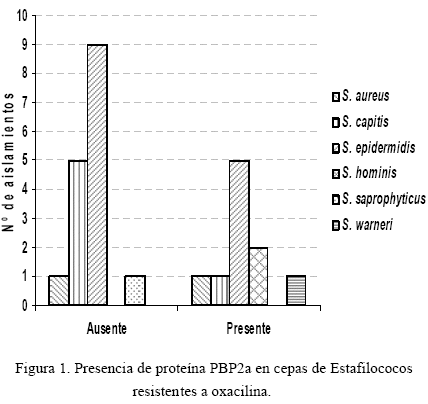
<body><![CDATA[<p style="line-height: normal"><font face="Verdana" size="2"> 			<span lang="ES" style="font-weight: normal">49,1</span></font></td> 			<td width="73" style="width: 54.95pt; height: 17.0pt; border: medium none; padding: 0cm" align="center"> 			    <p style="line-height: normal"><font face="Verdana" size="2"> 			<span lang="ES" style="font-weight: normal">87</span></font></td> 			<td width="61" style="width: 45.7pt; height: 17.0pt; border: medium none; padding: 0cm" align="center"> 			    <p style="line-height: normal"><font face="Verdana" size="2"> 			<span lang="ES" style="font-weight: normal">50,9</span></font></td> 			<td width="74" style="width: 55.85pt; height: 17.0pt; border: medium none; padding: 0cm" align="center"> 			    <p style="line-height: normal"><font face="Verdana" size="2"> 			<span lang="ES" style="font-weight: normal">171</span></font></td> 			<td width="55" style="width: 41.2pt; height: 17.0pt; border: medium none; padding: 0cm" align="center"> 			    <p style="line-height: normal"><font face="Verdana" size="2"> 			<span lang="ES" style="font-weight: normal">100</span></font></td> 		</tr> 	</table> </div>     <p align="justify"><font face="Verdana" size="1"><span lang="ES">*p &lt; 0,05</span></font></p>     <p align="justify"> <span lang="ES" style="font-size: 10.0pt; font-family: Verdana">La resistencia  asociada a los antibióticos evaluados fue la siguiente: eritromicina (67,7%),  gentamicina (64,7%), ciprofloxacina (57%), clindamicina (49,2%) y tetraciclina  (46,2%). Todas las cepas de <i>Staphylococcus</i> aisladas &nbsp;fueron sensibles a  la vancomicina y 26 (15,2%) resistentes a oxacilina (<a href="#Tabla_2">Tabla 2</a>).  Todos los aislados de <i>S. haemolyticus</i> (100%) fueron sensibles a oxacilina.  En una de las cepas oxacilino-resitente de <i>S. aureus</i> no se detectó la  presencia de la proteína PBP2a (<a href="#fig1">Figura 1</a>), no obstante, en  este estudio se observó una significancia estadística (p &lt; 0,05) cuando se  relacionó a las especies <i>S. aureus, S. capitis, S. hominis </i>y<i> S.  warneri, </i>que fueron resistentes a oxacilina y en ellas se evidenció la  presencia de la proteína PBP2a</span></p>     <p align="center"><b><font face="Verdana" size="2"><span lang="ES"> <a name="Tabla_2">Tabla 2</a>. Susceptibilidad a oxacilina de especies  estafilocócicas aisladas de muestras de queso blanco (blando y duro) fabricado  artesanalmente en el Edo. Anzoátegui.</span></font></b></p>     <div align="center"> 	<table class="MsoNormalTable" border="1" cellspacing="0" cellpadding="0" width="527" style="width: 560px; border-left: medium none; border-right: medium none; border-top: 1.0pt solid windowtext; border-bottom: 1.0pt solid windowtext" id="table4"> 		<tr style="height: 17.0pt"> 			<td width="99" rowspan="3" style="width: 74.2pt; height: 17.0pt; border: medium none; padding: 0cm"> 			    <p align="justify"><b><font face="Verdana" size="2"><span lang="ES"> 			&nbsp; Especie</span></font></b></td> 			<td width="299" colspan="4" style="width: 224.0pt; height: 17.0pt; border: medium none; padding: 0cm"> 			    ]]></body>
<body><![CDATA[<p align="center"><b><font face="Verdana" size="2"><span lang="ES"> 			Oxacilina</span></font></b></td> 			<td width="129" colspan="2" rowspan="2" style="width: 96.85pt; height: 17.0pt; border: medium none; padding: 0cm"> 			    <p align="center"><b><font face="Verdana" size="2"><span lang="ES"> 			Total</span></font></b></td> 		</tr> 		<tr style="height: 14.2pt"> 			<td width="168" colspan="2" style="width: 126.3pt; height: 14.2pt; border: medium none; padding: 0cm"> 			    <p align="center"><b><font face="Verdana" size="2"><span lang="ES"> 			Sensible</span></font></b></td> 			<td width="130" colspan="2" style="width: 97.7pt; height: 14.2pt; border: medium none; padding: 0cm"> 			    <p align="center"><b><font face="Verdana" size="2"><span lang="ES"> 			Resistente</span></font></b></td> 		</tr> 		<tr style="height: 14.2pt"> 			<td width="113" style="width: 84.4pt; height: 14.2pt; border: medium none; padding: 0cm"> 			    <p align="center"><b><font face="Verdana" size="2"><span lang="ES"> 			Nº aislados</span></font></b></td> 			<td width="56" style="width: 41.9pt; height: 14.2pt; border: medium none; padding: 0cm"> 			    <p align="center"><b><font face="Verdana" size="2"><span lang="ES">%</span></font></b></td> 			<td width="74" style="width: 55.6pt; height: 14.2pt; border: medium none; padding: 0cm"> 			    <p align="center"><b><font face="Verdana" size="2"><span lang="ES"> 			Nº aislados</span></font></b></td> 			<td width="56" style="width: 42.1pt; height: 14.2pt; border: medium none; padding: 0cm"> 			    <p align="center"><b><font face="Verdana" size="2"><span lang="ES">%</span></font></b></td> 			<td width="74" style="width: 55.6pt; height: 14.2pt; border: medium none; padding: 0cm"> 			    <p align="center"><b><font face="Verdana" size="2"><span lang="ES"> 			Nº aislados</span></font></b></td> 			<td width="55" style="width: 41.25pt; height: 14.2pt; border: medium none; padding: 0cm"> 			    <p align="center"><b><font face="Verdana" size="2"><span lang="ES">%</span></font></b></td> 		</tr> 		<tr style="height: 14.2pt"> 			<td width="99" style="width: 74.2pt; height: 14.2pt; border: medium none; padding-left: 2.85pt; padding-right: 0cm; padding-top: 0cm; padding-bottom: 0cm"> 			    ]]></body>
<body><![CDATA[<p align="justify"><font face="Verdana" size="2"><i><span lang="ES"> 			S. aureus</span></i></font></td> 			<td width="113" style="width: 84.4pt; height: 14.2pt; border: medium none; padding: 0cm"> 			    <p align="center"><font face="Verdana" size="2"><span lang="ES">53</span></font></td> 			<td width="56" style="width: 41.9pt; height: 14.2pt; border: medium none; padding: 0cm"> 			    <p align="center"><font face="Verdana" size="2"><span lang="ES">31</span></font></td> 			<td width="74" style="width: 55.6pt; height: 14.2pt; border: medium none; padding: 0cm"> 			    <p align="center"><font face="Verdana" size="2"><span lang="ES">2</span></font></td> 			<td width="56" style="width: 42.1pt; height: 14.2pt; border: medium none; padding: 0cm"> 			    <p align="center"><font face="Verdana" size="2"><span lang="ES">1,2<b>*</b></span></font></td> 			<td width="74" style="width: 55.6pt; height: 14.2pt; border: medium none; padding: 0cm"> 			    <p align="center"><font face="Verdana" size="2"><span lang="ES">55</span></font></td> 			<td width="55" style="width: 41.25pt; height: 14.2pt; border: medium none; padding: 0cm"> 			    <p align="center"><font face="Verdana" size="2"><span lang="ES">32,2</span></font></td> 		</tr> 		<tr style="height: 14.2pt"> 			<td width="99" style="width: 74.2pt; height: 14.2pt; border: medium none; padding-left: 2.85pt; padding-right: 0cm; padding-top: 0cm; padding-bottom: 0cm"> 			    <p align="justify"><font face="Verdana" size="2"><i> 			<span lang="EN-US">S. epidermidis</span></i></font></td> 			<td width="113" style="width: 84.4pt; height: 14.2pt; border: medium none; padding: 0cm"> 			    <p align="center"><font face="Verdana" size="2"><span lang="EN-US"> 			71</span></font></td> 			<td width="56" style="width: 41.9pt; height: 14.2pt; border: medium none; padding: 0cm"> 			    <p align="center"><font face="Verdana" size="2"><span lang="EN-US"> 			41,5</span></font></td> 			<td width="74" style="width: 55.6pt; height: 14.2pt; border: medium none; padding: 0cm"> 			    ]]></body>
<body><![CDATA[<p align="center"><font face="Verdana" size="2"><span lang="EN-US"> 			14</span></font></td> 			<td width="56" style="width: 42.1pt; height: 14.2pt; border: medium none; padding: 0cm"> 			    <p align="center"><font face="Verdana" size="2"><span lang="EN-US"> 			8,2</span></font></td> 			<td width="74" style="width: 55.6pt; height: 14.2pt; border: medium none; padding: 0cm"> 			    <p align="center"><font face="Verdana" size="2"><span lang="EN-US"> 			85</span></font></td> 			<td width="55" style="width: 41.25pt; height: 14.2pt; border: medium none; padding: 0cm"> 			    <p align="center"><font face="Verdana" size="2"><span lang="EN-US"> 			49,7</span></font></td> 		</tr> 		<tr style="height: 14.2pt"> 			<td width="99" style="width: 74.2pt; height: 14.2pt; border: medium none; padding-left: 2.85pt; padding-right: 0cm; padding-top: 0cm; padding-bottom: 0cm"> 			    <p align="justify"><font face="Verdana" size="2"><i><span lang="ES"> 			S. capitis</span></i></font></td> 			<td width="113" style="width: 84.4pt; height: 14.2pt; border: medium none; padding: 0cm"> 			    <p align="center"><font face="Verdana" size="2"><span lang="EN-US">8</span></font></td> 			<td width="56" style="width: 41.9pt; height: 14.2pt; border: medium none; padding: 0cm"> 			    <p align="center"><font face="Verdana" size="2"><span lang="EN-US"> 			4,8</span></font></td> 			<td width="74" style="width: 55.6pt; height: 14.2pt; border: medium none; padding: 0cm"> 			    <p align="center"><font face="Verdana" size="2"><span lang="EN-US">6</span></font></td> 			<td width="56" style="width: 42.1pt; height: 14.2pt; border: medium none; padding: 0cm"> 			    <p align="center"><font face="Verdana"><span lang="EN-US"> 			<font size="2">3,4</font></span><b><span lang="ES"><font size="2">*</font></span></b></font></td> 			<td width="74" style="width: 55.6pt; height: 14.2pt; border: medium none; padding: 0cm"> 			    <p align="center"><font face="Verdana" size="2"><span lang="EN-US"> 			14</span></font></td> 			<td width="55" style="width: 41.25pt; height: 14.2pt; border: medium none; padding: 0cm"> 			    ]]></body>
<body><![CDATA[<p align="center"><font face="Verdana" size="2"><span lang="EN-US"> 			8,2</span></font></td> 		</tr> 		<tr style="height: 14.2pt"> 			<td width="99" style="width: 74.2pt; height: 14.2pt; border: medium none; padding-left: 2.85pt; padding-right: 0cm; padding-top: 0cm; padding-bottom: 0cm"> 			    <p align="justify"><font face="Verdana" size="2"><i> 			<span lang="EN-US">S. haemolitycus</span></i></font></td> 			<td width="113" style="width: 84.4pt; height: 14.2pt; border: medium none; padding: 0cm"> 			    <p align="center"><font face="Verdana" size="2"><span lang="EN-US">6</span></font></td> 			<td width="56" style="width: 41.9pt; height: 14.2pt; border: medium none; padding: 0cm"> 			    <p align="center"><font face="Verdana" size="2"><span lang="EN-US"> 			3,4</span></font></td> 			<td width="74" style="width: 55.6pt; height: 14.2pt; border: medium none; padding: 0cm"> 			    <p align="center"><font face="Verdana" size="2"><span lang="EN-US">0</span></font></td> 			<td width="56" style="width: 42.1pt; height: 14.2pt; border: medium none; padding: 0cm"> 			    <p align="center"><font face="Verdana" size="2"><span lang="EN-US">0</span></font></td> 			<td width="74" style="width: 55.6pt; height: 14.2pt; border: medium none; padding: 0cm"> 			    <p align="center"><font face="Verdana" size="2"><span lang="EN-US">6</span></font></td> 			<td width="55" style="width: 41.25pt; height: 14.2pt; border: medium none; padding: 0cm"> 			    <p align="center"><font face="Verdana" size="2"><span lang="EN-US"> 			3,4</span></font></td> 		</tr> 		<tr style="height: 14.2pt"> 			<td width="99" style="width: 74.2pt; height: 14.2pt; border: medium none; padding-left: 2.85pt; padding-right: 0cm; padding-top: 0cm; padding-bottom: 0cm"> 			    <p align="justify"><font face="Verdana" size="2"><i> 			<span lang="EN-US">S. saprophyticus</span></i></font></td> 			<td width="113" style="width: 84.4pt; height: 14.2pt; border: medium none; padding: 0cm"> 			    <p align="center"><font face="Verdana" size="2"><span lang="EN-US">5</span></font></td> 			<td width="56" style="width: 41.9pt; height: 14.2pt; border: medium none; padding: 0cm"> 			    ]]></body>
<body><![CDATA[<p align="center"><font face="Verdana" size="2"><span lang="EN-US"> 			2,8</span></font></td> 			<td width="74" style="width: 55.6pt; height: 14.2pt; border: medium none; padding: 0cm"> 			    <p align="center"><font face="Verdana" size="2"><span lang="EN-US">1</span></font></td> 			<td width="56" style="width: 42.1pt; height: 14.2pt; border: medium none; padding: 0cm"> 			    <p align="center"><font face="Verdana" size="2"><span lang="EN-US"> 			0,6</span></font></td> 			<td width="74" style="width: 55.6pt; height: 14.2pt; border: medium none; padding: 0cm"> 			    <p align="center"><font face="Verdana" size="2"><span lang="EN-US">6</span></font></td> 			<td width="55" style="width: 41.25pt; height: 14.2pt; border: medium none; padding: 0cm"> 			    <p align="center"><font face="Verdana" size="2"><span lang="EN-US"> 			3,4</span></font></td> 		</tr> 		<tr style="height: 14.2pt"> 			<td width="99" style="width: 74.2pt; height: 14.2pt; border: medium none; padding-left: 2.85pt; padding-right: 0cm; padding-top: 0cm; padding-bottom: 0cm"> 			    <p align="justify"><font face="Verdana" size="2"><i> 			<span lang="EN-US">S. hominis</span></i></font></td> 			<td width="113" style="width: 84.4pt; height: 14.2pt; border: medium none; padding: 0cm"> 			    <p align="center"><font face="Verdana" size="2"><span lang="EN-US">2</span></font></td> 			<td width="56" style="width: 41.9pt; height: 14.2pt; border: medium none; padding: 0cm"> 			    <p align="center"><font face="Verdana" size="2"><span lang="EN-US"> 			1,2</span></font></td> 			<td width="74" style="width: 55.6pt; height: 14.2pt; border: medium none; padding: 0cm"> 			    <p align="center"><font face="Verdana" size="2"><span lang="EN-US">2</span></font></td> 			<td width="56" style="width: 42.1pt; height: 14.2pt; border: medium none; padding: 0cm"> 			    <p align="center"><font face="Verdana"><span lang="EN-US"> 			<font size="2">1,2</font></span><b><span lang="ES"><font size="2">*</font></span></b></font></td> 			<td width="74" style="width: 55.6pt; height: 14.2pt; border: medium none; padding: 0cm"> 			    ]]></body>
<body><![CDATA[<p align="center"><font face="Verdana" size="2"><span lang="EN-US">4</span></font></td> 			<td width="55" style="width: 41.25pt; height: 14.2pt; border: medium none; padding: 0cm"> 			    <p align="center"><font face="Verdana" size="2"><span lang="EN-US"> 			2,4</span></font></td> 		</tr> 		<tr style="height: 14.2pt"> 			<td width="99" style="width: 74.2pt; height: 14.2pt; border: medium none; padding-left: 2.85pt; padding-right: 0cm; padding-top: 0cm; padding-bottom: 0cm"> 			    <p align="justify"><font face="Verdana" size="2"><i> 			<span lang="EN-US">S. warneri</span></i></font></td> 			<td width="113" style="width: 84.4pt; height: 14.2pt; border: medium none; padding: 0cm"> 			    <p align="center"><font face="Verdana" size="2"><span lang="EN-US">0</span></font></td> 			<td width="56" style="width: 41.9pt; height: 14.2pt; border: medium none; padding: 0cm"> 			    <p align="center"><font face="Verdana" size="2"><span lang="EN-US">0</span></font></td> 			<td width="74" style="width: 55.6pt; height: 14.2pt; border: medium none; padding: 0cm"> 			    <p align="center"><font face="Verdana" size="2"><span lang="EN-US">1</span></font></td> 			<td width="56" style="width: 42.1pt; height: 14.2pt; border: medium none; padding: 0cm"> 			    <p align="center"><font face="Verdana"><span lang="EN-US"> 			<font size="2">0,6</font></span><b><span lang="ES"><font size="2">*</font></span></b></font></td> 			<td width="74" style="width: 55.6pt; height: 14.2pt; border: medium none; padding: 0cm"> 			    <p align="center"><font face="Verdana" size="2"><span lang="EN-US">1</span></font></td> 			<td width="55" style="width: 41.25pt; height: 14.2pt; border: medium none; padding: 0cm"> 			    <p align="center"><font face="Verdana" size="2"><span lang="EN-US"> 			0,6</span></font></td> 		</tr> 		<tr style="height: 17.0pt"> 			<td width="99" style="width: 74.2pt; height: 17.0pt; border: medium none; padding: 0cm"> 			    <p align="center" style="text-align: justify"> 			<font face="Verdana" size="2"><b><span lang="EN-US">TOTAL</span></b></font></td> 			<td width="113" style="width: 84.4pt; height: 17.0pt; border: medium none; padding: 0cm"> 			    ]]></body>
<body><![CDATA[<p align="center"><font face="Verdana" size="2"><span lang="ES">145</span></font></td> 			<td width="56" style="width: 41.9pt; height: 17.0pt; border: medium none; padding: 0cm"> 			    <p align="center"><font face="Verdana" size="2"><span lang="ES"> 			84,75</span></font></td> 			<td width="74" style="width: 55.6pt; height: 17.0pt; border: medium none; padding: 0cm"> 			    <p align="center"><font face="Verdana" size="2"><span lang="ES">26</span></font></td> 			<td width="56" style="width: 42.1pt; height: 17.0pt; border: medium none; padding: 0cm"> 			    <p align="center"><font face="Verdana" size="2"><span lang="ES">15,2</span></font></td> 			<td width="74" style="width: 55.6pt; height: 17.0pt; border: medium none; padding: 0cm"> 			    <p align="center"><font face="Verdana" size="2"><span lang="ES">171</span></font></td> 			<td width="55" style="width: 41.25pt; height: 17.0pt; border: medium none; padding: 0cm"> 			    <p align="center"><font face="Verdana" size="2"><span lang="ES">100</span></font></td> 		</tr> 	</table> </div>     <p align="justify"><font face="Verdana" size="1"> <span lang="ES-VE" style="font-weight: normal">* p &lt; 0,05</span></font></p>     <p align="center"><a name="fig1"> <img border="0" src="/img/fbpe/rsvm/v28n1/art10fig1.gif" width="428" height="404"></a></p>     
<p style="text-align: justify"><font face="Verdana"> <span lang="ES" style="font-size: 10.0pt">La presencia del gen que codifica para  la proteína PBP2a se detectó tanto en cepas con homorresistencia como en cepas  con heterorresistencia (<a href="#Tabla_3">Tabla 3</a>); de las cepas que  mostraron resistencia absoluta u homorresistencia se evidenció la presencia del  gen <i>mecA</i> en el 30,8%, mientras que solo en 2 casos (7,7%) de aquellas que  presentaron heterorresistencia a oxacilina.</span></font></p>     <p style="text-align: center"><b><font face="Verdana"><a name="Tabla_3"> <span lang="ES" style="font-size: 10.0pt">&nbsp;</span></font><span lang="ES"><font face="Verdana" size="2">Tabla  3</font></a><font face="Verdana" size="2">. Distribución porcentual de la  presencia del gen &nbsp;<i>mecA</i> de acuerdo al tipo de resistencia observada en  cepas aisladas de queso blanco </font></span> <span lang="ES" style="font-family: Verdana"><font size="2">(duro y blando)  fabricado artesanalmente.</font></span></b></p>     ]]></body>
<body><![CDATA[<div align="center"> 	<table class="MsoNormalTable" border="1" cellspacing="0" cellpadding="0" width="594" style="width: 570px; border-left: medium none; border-right: medium none; border-top: 1.0pt solid windowtext; border-bottom: 1.0pt solid windowtext" id="table3"> 		<tr style="height: 14.2pt"> 			<td width="165" rowspan="3" style="width: 123.4pt; height: 14.2pt; border: medium none; padding: 0cm"> 			    <p style="line-height: normal" align="justify"> 			<font face="Verdana" size="2"> 			<span lang="ES" style="font-weight: 700">Tipo de Resistencia</span></font></td> 			<td width="278" colspan="4" style="width: 208.8pt; height: 14.2pt; border: medium none; padding: 0cm"> 			    <p style="line-height: normal" align="center"> 			<font face="Verdana" size="2"> 			<span lang="ES" style="font-weight: 700">Gen <i>mecA</i></span></font></td> 			<td width="151" colspan="2" rowspan="2" style="width: 113.1pt; height: 14.2pt; border: medium none; padding: 0cm"> 			    <p style="line-height: normal" align="center"> 			<font face="Verdana" size="2"> 			<span lang="ES" style="font-weight: 700">Total</span></font></td> 		</tr> 		<tr style="height: 14.2pt"> 			<td width="139" colspan="2" style="width: 104.4pt; height: 14.2pt; border: medium none; padding: 0cm"> 			    <p style="line-height: normal" align="center"> 			<font face="Verdana" size="2"> 			<span lang="ES" style="font-weight: 700">Ausente</span></font></td> 			<td width="139" colspan="2" style="width: 104.4pt; height: 14.2pt; border: medium none; padding: 0cm"> 			    <p style="line-height: normal" align="center"> 			<font face="Verdana" size="2"> 			<span lang="ES" style="font-weight: 700">Presente</span></font></td> 		</tr> 		<tr style="height: 14.2pt"> 			<td width="87" style="width: 65.2pt; height: 14.2pt; border: medium none; padding: 0cm"> 			    <p style="line-height: normal" align="center"> 			<font face="Verdana" size="2"> 			<span lang="ES" style="font-weight: 700">Nº Aislados</span></font></td> 			<td width="52" style="width: 39.2pt; height: 14.2pt; border: medium none; padding: 0cm"> 			    <p style="line-height: normal" align="center"> 			<font face="Verdana" size="2"> 			<span lang="ES" style="font-weight: 700">%</span></font></td> 			<td width="87" style="width: 65.2pt; height: 14.2pt; border: medium none; padding: 0cm"> 			    <p style="line-height: normal" align="center"> 			<font face="Verdana" size="2"> 			<span lang="ES" style="font-weight: 700">Nº Aislados</span></font></td> 			<td width="52" style="width: 39.2pt; height: 14.2pt; border: medium none; padding: 0cm"> 			    <p style="line-height: normal" align="center"> 			<font face="Verdana" size="2"> 			<span lang="ES" style="font-weight: 700">%</span></font></td> 			<td width="87" style="width: 65.2pt; height: 14.2pt; border: medium none; padding: 0cm"> 			    ]]></body>
<body><![CDATA[<p style="line-height: normal" align="center"> 			<font face="Verdana" size="2"> 			<span lang="ES" style="font-weight: 700">Nº Aislados</span></font></td> 			<td width="64" style="width: 47.9pt; height: 14.2pt; border: medium none; padding: 0cm"> 			    <p style="line-height: normal" align="center"> 			<font face="Verdana" size="2"> 			<span lang="ES" style="font-weight: 700">%</span></font></td> 		</tr> 		<tr style="height: 17.0pt"> 			<td width="165" style="width: 123.4pt; height: 17.0pt; border-left: medium none; border-right: medium none; border-top: 1.0pt solid windowtext; border-bottom: medium none; padding: 0cm"> 			    <p style="line-height: normal" align="justify"> 			<font face="Verdana" size="2"> 			<span lang="ES" style="font-weight: normal">Homorresistente</span></font></td> 			<td width="87" style="width: 65.2pt; height: 17.0pt; border-left: medium none; border-right: medium none; border-top: 1.0pt solid windowtext; border-bottom: medium none; padding: 0cm"> 			    <p style="line-height: normal" align="center"> 			<font face="Verdana" size="2"> 			<span lang="ES" style="font-weight: normal">12</span></font></td> 			<td width="52" style="width: 39.2pt; height: 17.0pt; border-left: medium none; border-right: medium none; border-top: 1.0pt solid windowtext; border-bottom: medium none; padding: 0cm"> 			    <p style="line-height: normal" align="center"> 			<font face="Verdana" size="2"> 			<span lang="ES" style="font-weight: normal">46,2</span></font></td> 			<td width="87" style="width: 65.2pt; height: 17.0pt; border-left: medium none; border-right: medium none; border-top: 1.0pt solid windowtext; border-bottom: medium none; padding: 0cm"> 			    <p style="line-height: normal" align="center"> 			<font face="Verdana" size="2"> 			<span lang="ES" style="font-weight: normal">8</span></font></td> 			<td width="52" style="width: 39.2pt; height: 17.0pt; border-left: medium none; border-right: medium none; border-top: 1.0pt solid windowtext; border-bottom: medium none; padding: 0cm"> 			    <p style="line-height: normal" align="center"> 			<font face="Verdana" size="2"> 			<span lang="ES" style="font-weight: normal">30,8</span></font></td> 			<td width="87" style="width: 65.2pt; height: 17.0pt; border-left: medium none; border-right: medium none; border-top: 1.0pt solid windowtext; border-bottom: medium none; padding: 0cm"> 			    <p style="line-height: normal" align="center"> 			<font face="Verdana" size="2"> 			<span lang="ES" style="font-weight: normal">20</span></font></td> 			<td width="64" style="width: 47.9pt; height: 17.0pt; border-left: medium none; border-right: medium none; border-top: 1.0pt solid windowtext; border-bottom: medium none; padding: 0cm"> 			    <p style="line-height: normal" align="center"> 			<font face="Verdana" size="2"> 			<span lang="ES" style="font-weight: normal">76,9</span></font></td> 		</tr> 		<tr style="height: 17.0pt"> 			<td width="165" style="width: 123.4pt; height: 17.0pt; border: medium none; padding: 0cm"> 			    <p style="line-height: normal" align="justify"> 			<font face="Verdana" size="2"> 			<span lang="ES" style="font-weight: normal">Heterorresistente</span></font></td> 			<td width="87" style="width: 65.2pt; height: 17.0pt; border: medium none; padding: 0cm"> 			    ]]></body>
<body><![CDATA[<p style="line-height: normal" align="center"> 			<font face="Verdana" size="2"> 			<span lang="ES" style="font-weight: normal">4</span></font></td> 			<td width="52" style="width: 39.2pt; height: 17.0pt; border: medium none; padding: 0cm"> 			    <p style="line-height: normal" align="center"> 			<font face="Verdana" size="2"> 			<span lang="ES" style="font-weight: normal">15,4</span></font></td> 			<td width="87" style="width: 65.2pt; height: 17.0pt; border: medium none; padding: 0cm"> 			    <p style="line-height: normal" align="center"> 			<font face="Verdana" size="2"> 			<span lang="ES" style="font-weight: normal">2</span></font></td> 			<td width="52" style="width: 39.2pt; height: 17.0pt; border: medium none; padding: 0cm"> 			    <p style="line-height: normal" align="center"> 			<font face="Verdana" size="2"> 			<span lang="ES" style="font-weight: normal">7,7</span></font></td> 			<td width="87" style="width: 65.2pt; height: 17.0pt; border: medium none; padding: 0cm"> 			    <p style="line-height: normal" align="center"> 			<font face="Verdana" size="2"> 			<span lang="ES" style="font-weight: normal">6</span></font></td> 			<td width="64" style="width: 47.9pt; height: 17.0pt; border: medium none; padding: 0cm"> 			    <p style="line-height: normal" align="center"> 			<font face="Verdana" size="2"> 			<span lang="ES" style="font-weight: normal">23,1</span></font></td> 		</tr> 		<tr style="height: 17.0pt"> 			<td width="165" style="width: 123.4pt; height: 17.0pt; border: medium none; padding: 0cm"> 			    <p style="line-height: normal" align="justify"> 			<font face="Verdana" size="2"> 			<span lang="ES" style="font-weight: normal">Total</span></font></td> 			<td width="87" style="width: 65.2pt; height: 17.0pt; border: medium none; padding: 0cm"> 			    <p style="line-height: normal" align="center"> 			<font face="Verdana" size="2"> 			<span lang="ES" style="font-weight: normal">16</span></font></td> 			<td width="52" style="width: 39.2pt; height: 17.0pt; border: medium none; padding: 0cm"> 			    <p style="line-height: normal" align="center"> 			<font face="Verdana" size="2"> 			<span lang="ES" style="font-weight: normal">61,6</span></font></td> 			<td width="87" style="width: 65.2pt; height: 17.0pt; border: medium none; padding: 0cm"> 			    <p style="line-height: normal" align="center"> 			<font face="Verdana" size="2"> 			<span lang="ES" style="font-weight: normal">10</span></font></td> 			<td width="52" style="width: 39.2pt; height: 17.0pt; border: medium none; padding: 0cm"> 			    ]]></body>
<body><![CDATA[<p style="line-height: normal" align="center"> 			<font face="Verdana" size="2"> 			<span lang="ES" style="font-weight: normal">38,5</span></font></td> 			<td width="87" style="width: 65.2pt; height: 17.0pt; border: medium none; padding: 0cm"> 			    <p style="line-height: normal" align="center"> 			<font face="Verdana" size="2"> 			<span lang="ES" style="font-weight: normal">26</span></font></td> 			<td width="64" style="width: 47.9pt; height: 17.0pt; border: medium none; padding: 0cm"> 			    <p style="line-height: normal" align="center"> 			<font face="Verdana" size="2"> 			<span lang="ES" style="font-weight: normal">100</span></font></td> 		</tr> 	</table> </div>     <p style="text-align: justify"><font face="Verdana"><b> <span lang="ES" style="font-size: 10.0pt">Discusión</span></b></font></p>     <p style="text-align: justify"><font face="Verdana"> <span lang="ES" style="font-size: 10.0pt">Tomando en consideración que el género <i>Staphylococcus</i> está integrado por especies halófilas, y existen factores  fisicoquímicos y de almacenaje del queso que permiten el óptimo desarrollo de  las mismas (rangos de temperatura de 35ºC a 36ºC, pH entre 4.0 y 9.8, atmósfera  aeróbica y una actividad del agua, Aw, 0.98, entre otros) que crean un hábitat  idóneo para la proliferación de estos mesófilos </span> <span lang="ES" style="font-size: 10.0pt">[16], se puede justificar su presencia  en quesos blancos elaborados artesanalmente.</span></font></p>     <p align="justify"> <span lang="ES" style="font-size: 10.0pt; font-family: Verdana">Sin embargo, al  comparar los valores de frecuencia obtenidos para &nbsp;<i>S. aureus </i>y<i> &nbsp;S.  epidermidis</i> en queso duro y blando respectivamente, se observó una  diferencia estadísticamente significativa que puede ser explicada si  consideramos los siguientes parámetros: 1.- La variación en la concentración de  sal en la elaboración de los diferentes tipos de quesos (en duros,  aproximadamente 4% de NaCl y en semi-duros o blandos cerca de 3% de NaCl [17],  2.- Una capacidad de adaptabilidad del S<i>. aureus</i> a concentraciones de  NaCl superior que el <i>S. epidermidis</i>, debido probablemente, a diferencias  en los constituyentes lipídicos de la célula (principalmente por la diferencia  en las cantidades de cardiolipina que son mayores en <i>S. aureus </i>[18-22] y  la protección que pueden conferirle al <i>S. aureus </i>los iones Ca<sup>++</sup>  del queso [23]. Cabe destacar, que la contaminación bacteriana del queso de  producción artesanal, es facilitada por la exposición de las manos de las  personas que procesan el alimento, al suelo, al agua, a objetos contaminados, el  contacto con animales reservorios <span style="color: black">[2</span>4-26], así  como también por la diseminación microbiana desde las mucosas que tapizan fosas  nasales y garganta <span style="color: black">[</span>4-6] de los manipuladores  del alimento como ha sido demostrado por varios autores en la evaluación  microbiológica del personal que procesa alimentos y su relación con el grado de  contaminación del producto alimenticio <span style="color: black">[</span>6,27].</span></p>     <p style="text-align: justify; line-height: normal"><font face="Verdana"> <span lang="ES-VE" style="font-size: 10.0pt; font-weight: normal">Estudios sobre  la calidad microbiológica de los quesos blancos frescos venezolanos de  elaboración artesanal, indican que en más del 90% de las muestras analizadas,  las poblaciones de especies de <i>Staphylococcus</i> están por encima de los  límites aceptables <span style="color: black">[</span>28-30]. En la elaboración  de los quesos blancos frescos se emplea leche cruda y en muchos casos hay  deficiencias en las buenas prácticas de manufactura (pobres condiciones  higiénicas del ordeño, la no refrigeración de la leche después de éste, el  ordeño de vacas con mastitis, entre otros), lo que explica que estos productos  sean riesgosos para la salud de los consumidores <span style="color: black">[</span>29,30].</span></font></p>     <p align="justify"> <span lang="ES-VE" style="font-size: 10.0pt; font-family: Verdana">T</span><span lang="ES" style="font-size: 10.0pt; font-family: Verdana">odas  las cepas de <i>S. haemolyticus</i> aislados de los quesos fueron sensibles a  oxacilina, a diferencia de los hallazgos de Louie et al. [31], quienes evaluaron  la susceptibilidad a oxacilina de cepas provenientes de muestras clínicas  encontrando que 11/15 aislados de&nbsp; <i>S. haemolyticus</i> eran resistentes. Este  resultado es interesante y significativo, ya que pudiera deberse a que éstas&nbsp;  habrían estado en contacto con cepas o variantes de bacterias con desarrollo de  mecanismos </span><font face="Verdana"> <span lang="ES" style="font-size: 10.0pt">de resistencia antibiótica, en  concordancia con lo demostrado por Teuber et al. <span style="color: black">[</span>32]<b> </b>quienes señalaron la posibilidad de la transferencia genética de información  de resistencia bacteriana, entre cepas de la misma o diferentes especies  provenientes de animales tratados con antibióticos y cepas de alimentos, como el  queso.</span></font></p>     <p style="text-align: justify"><font face="Verdana"> <span lang="ES" style="font-size: 10.0pt">La frecuencia de los aislados de  muestras de quesos, resistentes a oxacilina, fueron menores a los reportados por  la mayoría de los investigadores para el grupo de <i>Staphylococcus</i>  provenientes de muestras de pacientes hospitalizados <span style="color: black"> [</span>31,33], pero similares a los obtenidos por Normanno et al. <span style="color: black">[</span>34], quienes igualmente estudiaron la  presencia de especies oxacilino-resistentes en quesos italianos (mozarella y  pecorino). Aún cuando es obvio que es más factible el hallazgo de cepas de  origen nosocomial u hospitalarias resistentes a cualquier antibiótico (incluso  en portadores asintomáticos que acuden o trabajan en estos centros de salud), en  donde este ambiente termina siendo fuente de diseminación para dichos  microorganismos, se justifica el estudio de la detección de cepas de origen  comunitario provenientes de alimentos, debido a que implica, epidemiológicamente,  la existencia de cepas de circulación ambiental que ya poseen la capacidad de  resistir los efectos de la oxacilina y por lo tanto a todos los &#946;-lactámicos y a  las combinaciones de &#946;-lactámicos con inhibidores de &#946;-lactamasas. Este tipo de  investigación ha sido poco implementado tanto en el ámbito internacional como en  el nacional.</span></font></p>     <p style="text-align: justify; line-height: normal"><font face="Verdana"> <span lang="ES-VE" style="font-size: 10.0pt; font-weight: normal">No </span> <span lang="ES-VE" style="font-size: 10.0pt; font-weight: normal">se detectó la  proteína PBP2 expresada por el gen <i>mec</i>A, en</span><span lang="ES-VE" style="font-size: 10.0pt; font-weight: normal">  todas las </span> <span lang="ES-VE" style="font-size: 10.0pt; font-weight: normal">cepas  oxacilino resitentes aisladas, lo que implica que se puede atribuir la  resistencia a la presencia de otras PBP modificadas o a la hiperproducción de </span></font> <span lang="ES-VE" style="font-size: 10.0pt; font-family: Verdana; font-weight: normal"> b</span><font face="Verdana"><span lang="ES-VE" style="font-size: 10.0pt; font-weight: normal">-lactamasa </span> <span lang="ES-VE" style="font-size: 10.0pt; color: black; font-weight: normal"> [3,</span><span lang="ES-VE" style="font-size: 10.0pt; font-weight: normal">9,10]</span><span lang="ES-VE" style="font-size: 10.0pt; font-weight: normal">.</span><span lang="ES-VE" style="font-size: 10.0pt; font-weight: normal">  Sin embargo, e</span><span lang="ES-VE" style="font-size: 10.0pt; font-weight: normal">n  este estudio se observó una correlación estadísticamente significativa</span><span lang="ES-VE" style="font-size: 10.0pt; font-weight: normal"> </span><span lang="ES-VE" style="font-size: 10.0pt; font-weight: normal">cuando  se relacionó la presencia de la proteína PBP2a y las especies aisladas de <i> Staphylococcus aureus, S. capitis, S. hominis </i>y<i> S. warneri</i>, lo que  amerita más estudios para determinar si las cepas locales de estas especies han  desarrollado mayor oportunidad<span style="color: blue"> </span>y/o capacidad de  expresar este mecanismo de evasión a los antibioticos, en comparación con otras  especies o es simplemente un hallazgo estadístico fortuito<i>.</i> La presencia  del gen que codifica para la proteína PBP2a se observó tanto en cepas con  homorresistencia como en cepas con heterorresistencia, probablemente debido a  que este tipo de cepas oxacilino resistentes poseen una variabilidad extrema en  la expresión de rasgos de resistencia </span> <span lang="ES-VE" style="font-size: 10.0pt; color: black; font-weight: normal"> [</span><span lang="ES-VE" style="font-size: 10.0pt; font-weight: normal">3]</span><span lang="ES-VE" style="font-size: 10.0pt; font-weight: normal">.</span></font></p>     ]]></body>
<body><![CDATA[<p style="text-align: justify"><font face="Verdana"> <span lang="ES" style="font-size: 10.0pt">Además del <i>S. aureus</i>, los <i> Staphylococcus</i> coagulasa negativos son reconocidos como importante causa de  infecciones nosocomiales; el origen de la contaminación con este microorganismo  puede ser de endógeno o exógeno, comúnmente transferido a través de las manos  del personal que está involucrado </span> <span lang="ES" style="font-size: 10.0pt; color: black">[</span><span lang="ES" style="font-size: 10.0pt">35-37].  Otro factor crítico de la transmisión, es la capacidad que poseen estos gérmenes  para sobrevivir en diferentes ambientes, así como también la capacidad de  adherencia en biopelículas, formación implicada como factor de virulencia </span> <span lang="ES" style="font-size: 10.0pt; color: black">[</span><span lang="ES" style="font-size: 10.0pt">36,38].  La tasa de resistencia a oxacilina de este grupo de microorganismo tiene una  tendencia al aumento en varios países, como por ejemplo Estados Unidos de  América </span><span lang="ES" style="font-size: 10.0pt; color: black">[</span><span lang="ES" style="font-size: 10.0pt">37],  e inclusive en Venezuela [39], de aquí la importancia de la identificación de  las especies y su comportamiento de susceptibilidad individual para el mejor  monitoreo epidemiológico de estas bacterias.</span></font></p>     <p style="text-align: justify"><font face="Verdana"> <span lang="ES" style="font-size: 10.0pt">Son muchos los trabajos que evalúan la  calidad microbiológica de alimentos de diversos orígenes, como lácteos o  cárnicos, no obstante, en muy pocos se determina la posibilidad del desarrollo  de resistencia a los antibióticos y su posible papel como fuente de infección  desde los alimentos al hombre o animales <span style="color: black"> [25,32,34,40-42</span>].</span></font></p>     <p style="text-align: justify"><font face="Verdana"> <span lang="ES" style="font-size: 10.0pt">A pesar de que los hallazgos  porcentuales de <i>Staphylococcus</i> oxacilino resistentes descritos en este  estudio son bajos, conforman un modelo factible como fuente de diseminación de  los mismos que deberían ser considerados desde un enfoque sanitario, como un  problema de salud pública donde se incrementan los factores de riesgo de  adquirir en la comunidad, una infección por un <i>Staphylococcus</i> oxacilino  resistente. Esto requerirá medidas educativas y preventivas dirigidas a los  operadores de alimentos y a los productores agropecuarios, orientadas a la  modificación de las condiciones que favorecen el desarrollo de estas cepas a fin  de minimizar el riesgo en la comunidad. </span></font></p>     <p style="text-align: justify"><font face="Verdana"> <span lang="ES" style="font-size: 10.0pt">&nbsp;</span><span lang="ES-VE" style="font-size: 10.0pt; font-weight: 700">Conclusiones</span></font></p>     <p style="text-align: justify; text-indent: 0cm; line-height: normal; margin-left: 0cm"> <font face="Verdana"> <span lang="ES-VE" style="font-size: 10.0pt; font-weight: normal">·</span></font><span style="font-style: normal; font-variant: normal; font-weight: normal; font-family: Verdana" lang="ES-VE"><font size="2">&nbsp;&nbsp;</font></span><font face="Verdana"><span lang="ES-VE" style="font-size: 10.0pt; font-weight: normal">Se  observó el predominio de cepas </span><i> <span lang="ES" style="font-size: 10.0pt; font-weight: normal">Staphylococcus</span></i><span lang="ES" style="font-size: 10.0pt; font-weight: normal">  coagulasa negativas en ambos tipos de queso blanco: blando y duro.</span></font></p>     <p style="text-align: justify; text-indent: 0cm; line-height: normal; margin-left: 0cm"> <font face="Verdana"> <span lang="ES" style="font-size: 10.0pt; font-weight: normal">·</span></font><span style="font-style: normal; font-variant: normal; font-weight: normal; font-family: Verdana" lang="ES"><font size="2">&nbsp;&nbsp;</font></span><font face="Verdana"><span lang="ES" style="font-size: 10.0pt; font-weight: normal">La  resistencia de los <i>Staphylococcus </i>spp. a la oxacilina mediada por el </span><span lang="ES-VE" style="font-size: 10.0pt; font-weight: normal">gen <i> mecA</i> </span><span lang="ES" style="font-size: 10.0pt; font-weight: normal"> está presente en cepas ambientales de fácil intercambio entre &nbsp;individuos.</span></font></p>     <p style="text-align: justify; text-indent: 0cm; line-height: normal; margin-left: 0cm"> <font face="Verdana"> <span lang="ES-VE" style="font-size: 10.0pt; font-weight: normal">·</span></font><span style="font-style: normal; font-variant: normal; font-weight: normal; font-family: Verdana" lang="ES-VE"><font size="2">&nbsp;&nbsp;</font></span><font face="Verdana"><span lang="ES" style="font-size: 10.0pt; font-weight: normal">No  se observó relación estadísticamente significativa entre el tipo de resistencia  a oxacilina y la presencia de la proteína PBP2a.</span></font></p>     <p style="text-align: justify; text-indent: 0cm; line-height: normal; margin-left: 0cm"> <font face="Verdana"> <span lang="ES-VE" style="font-size: 10.0pt; font-weight: normal">·</span></font><span style="font-style: normal; font-variant: normal; font-weight: normal; font-family: Verdana" lang="ES-VE"><font size="2">&nbsp;</font></span><font face="Verdana"><span lang="ES-VE" style="font-size: 10.0pt; font-weight: normal">La  resistencia de algunas cepas </span> <span lang="ES" style="font-size: 10.0pt; font-weight: normal">de <i> Staphylococcus </i>spp. a la oxacilina se asoció con multirresistencia  (resistencia simultánea a </span> <span lang="ES-VE" style="font-size: 10.0pt; font-weight: normal">eritromicina,  gentamicina, ciprofloxacina, clindamicina y tetraciclina).</span></font></p>     <p style="text-align: justify; text-indent: 0cm; margin-left: 0cm"> <font face="Verdana"><span lang="ES-VE" style="font-size: 10.0pt">·</span></font><span style="font-style: normal; font-variant: normal; font-weight: normal; font-family: Verdana" lang="ES-VE"><font size="2">&nbsp;</font></span><font face="Verdana"><span lang="ES-VE" style="font-size: 10.0pt">La  presencia de cepas de estafilococo oxacilino resistentes en un alimento de  consumo masivo, como son los quesos de fabricación artesanal, puede representar  un problema de salud pública por el aumento del riesgo de diseminación de estas  &nbsp;&nbsp;&nbsp;&nbsp;&nbsp;&nbsp;&nbsp;&nbsp; cepas en la comunidad.</span></font></p>     <p style="text-align: justify"><b><font face="Verdana"> <span lang="ES" style="font-size: 10.0pt">&nbsp;</span><span lang="ES-VE" style="font-size: 10.0pt">Agradecimiento</span></font></b></p>     ]]></body>
<body><![CDATA[<p style="text-align: justify"><font face="Verdana"> <span lang="ES" style="font-size: 10.0pt">Expresamos nuestro agradecimiento al  Centro Venezolano de Colecciones de Microorganismos (CVCM), Instituto de  Biología Experimental (IBE), por la certificación de las cepas <i>Staphylococcus </i>coagulasa negativas.</span></font></p>     <p align="left" style="text-align: justify; text-indent: 0cm; line-height: normal; page-break-after: auto"> <font face="Verdana"> <span lang="ES" style="font-size: 10.0pt; font-weight: normal">&nbsp;</span><span lang="ES" style="font-size: 10.0pt; font-weight: 700">Referencias</span></font></p>     <!-- ref --><p style="text-align: justify; "> <span lang="EN-US"><font face="Verdana" size="2">1.</font><span style="font-style: normal; font-variant: normal; font-weight: normal; font-family: Verdana"><font size="2">&nbsp;</font></span></span><font face="Verdana"><span lang="ES"><font size="2">Martin  G.<i> </i>Resistencia Bacteriana a ß-lactámicos. Evolución y Mecanismos. <i>AVFT</i>  &nbsp;2002; 21: 107-16.</font></span></font>&nbsp;&nbsp;&nbsp;&nbsp;&nbsp;&nbsp;&nbsp;&nbsp;[&#160;<a href="javascript:void(0);" onclick="javascript: window.open('/scielo.php?script=sci_nlinks&ref=2000257&pid=S1315-2556200800010001000001&lng=','','width=640,height=500,resizable=yes,scrollbars=1,menubar=yes,');">Links</a>&#160;]<!-- end-ref --><!-- ref --><p align="justify"><span lang="ES" style="font-family: Verdana"><font size="2"> 2. Cavalieri S, Hardbeck R, McCarter Y, Ortez J, Rankin I, Sautter R y col. Manual  de pruebas de susceptibilidad antimicrobiana. Editor Marie Coyle. Departments of  Laboratory </font></span><font face="Verdana" size="2"><span lang="ES">Medicine  and Microbiology University of Washington. OPS/ASM. (2005). Disponible en:  <a href="http://www.paho.org/-Spanish/AD/THS/EV/labs_susep_antimicro.htm">http://www.paho.org/-Spanish/AD/THS/EV/labs_susep_antimicro.htm</a>.</span></font>&nbsp;&nbsp;&nbsp;&nbsp;&nbsp;&nbsp;&nbsp;&nbsp;[&#160;<a href="javascript:void(0);" onclick="javascript: window.open('/scielo.php?script=sci_nlinks&ref=2000258&pid=S1315-2556200800010001000002&lng=','','width=640,height=500,resizable=yes,scrollbars=1,menubar=yes,');">Links</a>&#160;]<!-- end-ref --><!-- ref --><p align="justify"><span lang="EN-US" style="font-size: 9.0pt"> <font face="Verdana" size="2">3. Chambers H. Methicillin resistance in  Staphylococci: molecular and biochemical basis and clinical implications. Clin  Microbiol Rev 1997; 10:781-91.</font></span>&nbsp;&nbsp;&nbsp;&nbsp;&nbsp;&nbsp;&nbsp;&nbsp;[&#160;<a href="javascript:void(0);" onclick="javascript: window.open('/scielo.php?script=sci_nlinks&ref=2000259&pid=S1315-2556200800010001000003&lng=','','width=640,height=500,resizable=yes,scrollbars=1,menubar=yes,');">Links</a>&#160;]<!-- end-ref --><!-- ref --><p align="justify"><span lang="EN-US" style="font-size: 9.0pt"> <font face="Verdana" size="2">4. Boyce J. Are the epidemiology and microbiology of  methicillin-resistant <i>Staphylococcus aureus </i>changing? JAMA 1998;  279:623-4.</font></span>&nbsp;&nbsp;&nbsp;&nbsp;&nbsp;&nbsp;&nbsp;&nbsp;[&#160;<a href="javascript:void(0);" onclick="javascript: window.open('/scielo.php?script=sci_nlinks&ref=2000260&pid=S1315-2556200800010001000004&lng=','','width=640,height=500,resizable=yes,scrollbars=1,menubar=yes,');">Links</a>&#160;]<!-- end-ref --><!-- ref --><p align="justify"><span lang="en-us"><font size="2"><font face="Verdana">5</font>. </font></span><span lang="EN-US" style="font-size: 9.0pt"> <font face="Verdana" size="2">Rao G. Risk factors for the spread of  antibiotic-resistant bacteria. Drugs 1998; 55:323-30.</font></span>&nbsp;&nbsp;&nbsp;&nbsp;&nbsp;&nbsp;&nbsp;&nbsp;[&#160;<a href="javascript:void(0);" onclick="javascript: window.open('/scielo.php?script=sci_nlinks&ref=2000261&pid=S1315-2556200800010001000005&lng=','','width=640,height=500,resizable=yes,scrollbars=1,menubar=yes,');">Links</a>&#160;]<!-- end-ref --><!-- ref --><p align="justify"><font face="Verdana"> <span lang="EN-US" style="color: black"><font size="2">6. Hatakka M, Bjorkroth KJ,  Asplund K, Maki-Petays N, Korkeala HJ.</font></span><span lang="EN-US"><font size="2"> <span style="color: black">Genotypes and enterotoxicity of <i>Staphylococcus  aureus</i> isolated from the hands and nasal cavities of flight-catering  employees. </span></font><span style="color: black"><font size="2">J Food Prot  2000; 63:1487-91.</font></span></span></font>&nbsp;&nbsp;&nbsp;&nbsp;&nbsp;&nbsp;&nbsp;&nbsp;[&#160;<a href="javascript:void(0);" onclick="javascript: window.open('/scielo.php?script=sci_nlinks&ref=2000262&pid=S1315-2556200800010001000006&lng=','','width=640,height=500,resizable=yes,scrollbars=1,menubar=yes,');">Links</a>&#160;]<!-- end-ref --><!-- ref --><p align="justify"><span lang="EN-US" style="font-size: 9.0pt"> <font face="Verdana" size="2">7. Camargo LF, Strabelli TM, Ribeiro FG, Iwahashi ER,  Ebaid M, Filho HH, y col. Epidemiological investigation of an outbreak of  coagulase negative <i>Staphylococcus </i>primary bacterium in a newborn  intensive care unit. Infect Control Hosp Epidemiol<i>.</i> 1995; 16: 595-6.</font></span>&nbsp;&nbsp;&nbsp;&nbsp;&nbsp;&nbsp;&nbsp;&nbsp;[&#160;<a href="javascript:void(0);" onclick="javascript: window.open('/scielo.php?script=sci_nlinks&ref=2000263&pid=S1315-2556200800010001000007&lng=','','width=640,height=500,resizable=yes,scrollbars=1,menubar=yes,');">Links</a>&#160;]<!-- end-ref --><!-- ref --><p align="justify"><span lang="en-us"><font size="2"><font face="Verdana">8</font>. </font></span><span lang="EN-US" style="font-size: 9.0pt"> <font face="Verdana" size="2">Al-Shemari H, Abou-Hamad W, Libman M, Desrosiers  M. Bacteriology of the sinus cavities of asymptomatic individuals after  endoscopic sinus surgery. J Otolaryngol 2007; 36:43-8.</font></span>&nbsp;&nbsp;&nbsp;&nbsp;&nbsp;&nbsp;&nbsp;&nbsp;[&#160;<a href="javascript:void(0);" onclick="javascript: window.open('/scielo.php?script=sci_nlinks&ref=2000264&pid=S1315-2556200800010001000008&lng=','','width=640,height=500,resizable=yes,scrollbars=1,menubar=yes,');">Links</a>&#160;]<!-- end-ref --><!-- ref --><p align="justify"><font face="Verdana" size="2">9. <span lang="EN-US">Brakstad  O, MacLand J. Mecanism of methicilin resistente in Staphylococci<i>.</i> APMIS  1997; 105:264-76.</span></font>&nbsp;&nbsp;&nbsp;&nbsp;&nbsp;&nbsp;&nbsp;&nbsp;[&#160;<a href="javascript:void(0);" onclick="javascript: window.open('/scielo.php?script=sci_nlinks&ref=2000265&pid=S1315-2556200800010001000009&lng=','','width=640,height=500,resizable=yes,scrollbars=1,menubar=yes,');">Links</a>&#160;]<!-- end-ref --><!-- ref --><p align="justify"><font face="Verdana" size="2"><span lang="ES">10. Calvo A,  Rodríguez C, Andrade O, Bertuglia F, Márquez N. <i>Staphylococcus aureus</i>  meticilino resistente: detección de PBP2’ mediante la técnica de látex y  evaluación de la resistencia asociada. Bol Venez Infectol &nbsp;2004; 15: 18-22.</span></font>&nbsp;&nbsp;&nbsp;&nbsp;&nbsp;&nbsp;&nbsp;&nbsp;[&#160;<a href="javascript:void(0);" onclick="javascript: window.open('/scielo.php?script=sci_nlinks&ref=2000266&pid=S1315-2556200800010001000010&lng=','','width=640,height=500,resizable=yes,scrollbars=1,menubar=yes,');">Links</a>&#160;]<!-- end-ref --><!-- ref --><p align="justify"><span lang="ES" style="font-size: 9.0pt"> <font face="Verdana" size="2">11. Torres E., Pacheco de D. E. Evaluación  nutricional, física y sensorial de panes de trigo, yuca y queso llanero. R</font></span><font face="Verdana" size="2"><span lang="ES">ev  Chil Nutr 2007; 34: 133-41.</span></font>&nbsp;&nbsp;&nbsp;&nbsp;&nbsp;&nbsp;&nbsp;&nbsp;[&#160;<a href="javascript:void(0);" onclick="javascript: window.open('/scielo.php?script=sci_nlinks&ref=2000267&pid=S1315-2556200800010001000011&lng=','','width=640,height=500,resizable=yes,scrollbars=1,menubar=yes,');">Links</a>&#160;]<!-- end-ref --><!-- ref --><p align="justify"><span lang="en-us"><font size="2"><font face="Verdana">12</font>. </font></span><font face="Verdana" size="2"><span lang="ES">Comisión  Venezolana de Normas Industriales (COVENIN). Norma 1292-89. Alimentos.  Aislamiento y Recuento de <i>Staphylococcus aureus</i>. FONDONORMA. 1989.</span></font>&nbsp;&nbsp;&nbsp;&nbsp;&nbsp;&nbsp;&nbsp;&nbsp;[&#160;<a href="javascript:void(0);" onclick="javascript: window.open('/scielo.php?script=sci_nlinks&ref=2000268&pid=S1315-2556200800010001000012&lng=','','width=640,height=500,resizable=yes,scrollbars=1,menubar=yes,');">Links</a>&#160;]<!-- end-ref --><!-- ref --><p align="justify"><font face="Verdana"><font size="2">13. <span lang="EN-US">Food  and Drug Administration USA (FDA). Bacteriological Analitycal Manual (BAM).  Chapters 12. 8º ed. </span> </font><span lang="ES"><font size="2">Washington.  1998.</font></span></font>&nbsp;&nbsp;&nbsp;&nbsp;&nbsp;&nbsp;&nbsp;&nbsp;[&#160;<a href="javascript:void(0);" onclick="javascript: window.open('/scielo.php?script=sci_nlinks&ref=2000269&pid=S1315-2556200800010001000013&lng=','','width=640,height=500,resizable=yes,scrollbars=1,menubar=yes,');">Links</a>&#160;]<!-- end-ref --><!-- ref --><p align="justify"><font face="Verdana"><font size="2"><span lang="en-gb">14. </span><span lang="ES">Forbes  B., Sahm D., Weissfeld A. Bailey &amp; Scott. Diagnóstico microbiológico. 11ª  edición. </span> </font><span lang="EN-GB"><font size="2">Argentina: Editorial  Médica Panameric</font></span><span lang="EN-US"><font size="2">ana. 2004.</font></span></font>&nbsp;&nbsp;&nbsp;&nbsp;&nbsp;&nbsp;&nbsp;&nbsp;[&#160;<a href="javascript:void(0);" onclick="javascript: window.open('/scielo.php?script=sci_nlinks&ref=2000270&pid=S1315-2556200800010001000014&lng=','','width=640,height=500,resizable=yes,scrollbars=1,menubar=yes,');">Links</a>&#160;]<!-- end-ref --><!-- ref --><p align="justify"><font face="Verdana"><font size="2"> 15. <span lang="EN-US">NCCLS. National Comittee for Clinical Laboratory Standards. Perfomance Standards  for Antimicrobial Susceptibility Testing; 15<sup>th</sup> Informational  Supplement. </span> </font><span lang="ES"><font size="2">M2-A8. 2005. Vol 25-1.</font></span></font>&nbsp;&nbsp;&nbsp;&nbsp;&nbsp;&nbsp;&nbsp;&nbsp;[&#160;<a href="javascript:void(0);" onclick="javascript: window.open('/scielo.php?script=sci_nlinks&ref=2000271&pid=S1315-2556200800010001000015&lng=','','width=640,height=500,resizable=yes,scrollbars=1,menubar=yes,');">Links</a>&#160;]<!-- end-ref --><!-- ref --><p align="justify"><font face="Verdana" size="2"><span lang="ES">16. Adams M.  Microbiología de los Alimentos. Zaragoza- España: Acribia., S.A. 1997.</span></font>&nbsp;&nbsp;&nbsp;&nbsp;&nbsp;&nbsp;&nbsp;&nbsp;[&#160;<a href="javascript:void(0);" onclick="javascript: window.open('/scielo.php?script=sci_nlinks&ref=2000272&pid=S1315-2556200800010001000016&lng=','','width=640,height=500,resizable=yes,scrollbars=1,menubar=yes,');">Links</a>&#160;]<!-- end-ref --><!-- ref --><p align="justify"><span lang="en-us"><font size="2"><font face="Verdana">17</font>. </font></span><font face="Verdana" size="2"><span lang="ES">Comisión  Venezolana de Normas Industriales (COVENIN). Norma 3821:2003. Queso Blanco.  Categoría B. ICS 2003:67.100.30. FONDONORMA.</span></font>&nbsp;&nbsp;&nbsp;&nbsp;&nbsp;&nbsp;&nbsp;&nbsp;[&#160;<a href="javascript:void(0);" onclick="javascript: window.open('/scielo.php?script=sci_nlinks&ref=2000273&pid=S1315-2556200800010001000017&lng=','','width=640,height=500,resizable=yes,scrollbars=1,menubar=yes,');">Links</a>&#160;]<!-- end-ref --><!-- ref --><p align="justify"><font face="Verdana" size="2">18. <span lang="EN-US">Short S.,  White, D. Metabolism of phosphatidylglycerol, lysylphosphatidylglycerol and  cardiolipin of <i>Staphylococcus aureus</i>. J Bacteriol 1971; 108: 219-26.</span></font>&nbsp;&nbsp;&nbsp;&nbsp;&nbsp;&nbsp;&nbsp;&nbsp;[&#160;<a href="javascript:void(0);" onclick="javascript: window.open('/scielo.php?script=sci_nlinks&ref=2000274&pid=S1315-2556200800010001000018&lng=','','width=640,height=500,resizable=yes,scrollbars=1,menubar=yes,');">Links</a>&#160;]<!-- end-ref --><!-- ref --><p align="justify"><span lang="EN-US" style="font-size: 9.0pt"> <font face="Verdana" size="2">19. Komaratat P, Kates M. The lipid composition of a  halotolerant species of <i>Staphylococcus epidermidis</i>. Biochem Biophys Acta  1975; 398:464-84.</font></span>&nbsp;&nbsp;&nbsp;&nbsp;&nbsp;&nbsp;&nbsp;&nbsp;[&#160;<a href="javascript:void(0);" onclick="javascript: window.open('/scielo.php?script=sci_nlinks&ref=2000275&pid=S1315-2556200800010001000019&lng=','','width=640,height=500,resizable=yes,scrollbars=1,menubar=yes,');">Links</a>&#160;]<!-- end-ref --><!-- ref --><p align="justify"><span lang="EN-US" style="font-size: 9.0pt"> <font face="Verdana" size="2">20. Kanemasa Y, Takatsu T, Sasai K, Kojima I, Hayashi  H. The salt-resistance mechanism of <i>Staphylococcus aureus</i> examined by  salt-sensitive mutants. Acta Med Okayama 1976; 30: 271-6.</font></span>&nbsp;&nbsp;&nbsp;&nbsp;&nbsp;&nbsp;&nbsp;&nbsp;[&#160;<a href="javascript:void(0);" onclick="javascript: window.open('/scielo.php?script=sci_nlinks&ref=2000276&pid=S1315-2556200800010001000020&lng=','','width=640,height=500,resizable=yes,scrollbars=1,menubar=yes,');">Links</a>&#160;]<!-- end-ref --><!-- ref --><p align="justify"><span lang="EN-US" style="font-size: 9.0pt"> <font face="Verdana" size="2">21. Hurst A, Ofori E, El-Banna AA, Harwig J.  Adaptational changes in <i>Staphylococcus aureus</i> MF31 grown above its  maximum temperature when protected by NaCl: physiological studies. Can J  Microbiol 1984; 30:1105-11.</font></span>&nbsp;&nbsp;&nbsp;&nbsp;&nbsp;&nbsp;&nbsp;&nbsp;[&#160;<a href="javascript:void(0);" onclick="javascript: window.open('/scielo.php?script=sci_nlinks&ref=2000277&pid=S1315-2556200800010001000021&lng=','','width=640,height=500,resizable=yes,scrollbars=1,menubar=yes,');">Links</a>&#160;]<!-- end-ref --><!-- ref --><p align="justify"><span lang="EN-US" style="font-size: 9.0pt"> <font face="Verdana" size="2">22. Hurst A, Ofori E, Vishnubhatla I, Kates M.  Adaptational changes in <i>Staphylococcus aureus </i>MF31 grown above its  maximum growth temperature when protected by sodium chloride: lipid studies. Can  J Microbiol 1984; 30:1424-7.</font></span>&nbsp;&nbsp;&nbsp;&nbsp;&nbsp;&nbsp;&nbsp;&nbsp;[&#160;<a href="javascript:void(0);" onclick="javascript: window.open('/scielo.php?script=sci_nlinks&ref=2000278&pid=S1315-2556200800010001000022&lng=','','width=640,height=500,resizable=yes,scrollbars=1,menubar=yes,');">Links</a>&#160;]<!-- end-ref --><!-- ref --><p align="justify"><span lang="EN-US" style="font-size: 9.0pt"> <font face="Verdana" size="2">23. Ochiai T. <i>Staphylococcus aureus</i> requires  increased level of Ca<sup>2+</sup> or Mn<sup>2+</sup> to grow normally in a  high-NaCl/low-Mg<sup>2+</sup> medium. Microbiol Inmunol 2001; 45: 769-76.</font></span>&nbsp;&nbsp;&nbsp;&nbsp;&nbsp;&nbsp;&nbsp;&nbsp;[&#160;<a href="javascript:void(0);" onclick="javascript: window.open('/scielo.php?script=sci_nlinks&ref=2000279&pid=S1315-2556200800010001000023&lng=','','width=640,height=500,resizable=yes,scrollbars=1,menubar=yes,');">Links</a>&#160;]<!-- end-ref --><!-- ref --><p align="justify"><font face="Verdana"><font size="2"><span lang="en-us">24. </span><span lang="ES">V</span></font><span lang="NL"><font size="2">an  Duijkeren E, Wolfhagen M, Box A, Heck M, Wannet W. &nbsp;</font></span><span lang="EN-US"><font size="2">Human-to-dog  transmission of methicillin-resistant <i>Staphylococcus aureus.</i> Emerg Infect  Dis 2004; 10: 2235-7.</font></span></font>&nbsp;&nbsp;&nbsp;&nbsp;&nbsp;&nbsp;&nbsp;&nbsp;[&#160;<a href="javascript:void(0);" onclick="javascript: window.open('/scielo.php?script=sci_nlinks&ref=2000280&pid=S1315-2556200800010001000024&lng=','','width=640,height=500,resizable=yes,scrollbars=1,menubar=yes,');">Links</a>&#160;]<!-- end-ref --><!-- ref --><p align="justify"><font face="Verdana" size="2"><span lang="EN-US"> <span class="ti">25. </span>Vautor E, Abadie G, Guibert JM, Chevalier N, Pépin M. Nasal carriage of <i> Staphylococcus aureus</i> in dairy sheep.<span class="ti"> Vet Microbiol 2005;  106:235-9.</span></span></font>&nbsp;&nbsp;&nbsp;&nbsp;&nbsp;&nbsp;&nbsp;&nbsp;[&#160;<a href="javascript:void(0);" onclick="javascript: window.open('/scielo.php?script=sci_nlinks&ref=2000281&pid=S1315-2556200800010001000025&lng=','','width=640,height=500,resizable=yes,scrollbars=1,menubar=yes,');">Links</a>&#160;]<!-- end-ref --><!-- ref --><p align="justify"><font face="Verdana" size="2"><span lang="EN-US"> <span class="ti"> 26. </span>Bagcigil FA, Moodley A, Baptiste KE, Jensen VF, Guardabassi L. Occurrence,  species distribution, antimicrobial resistance and clonality of methicillin- and  erythromycin-resistant staphylococci in the nasal cavity of domestic animals.<span class="ti">  Vet Microbiol 2007;121:307-15.</span></span></font>&nbsp;&nbsp;&nbsp;&nbsp;&nbsp;&nbsp;&nbsp;&nbsp;[&#160;<a href="javascript:void(0);" onclick="javascript: window.open('/scielo.php?script=sci_nlinks&ref=2000282&pid=S1315-2556200800010001000026&lng=','','width=640,height=500,resizable=yes,scrollbars=1,menubar=yes,');">Links</a>&#160;]<!-- end-ref --><!-- ref --><p align="justify"><font face="Verdana"><font size="2"> <span lang="en-us"><span class="ti">27. </span></span><span lang="ES">Fueyo JM, Mendoza MC, Martín MC. </span> </font><span lang="EN-US"> <font size="2">Enterotoxins and toxic shock syndrome toxin in <i>Staphylococcus  aureus</i> recovered from human nasal carriers and manually handled foods:  epidemiological and genetic findings.</font><span class="ti"><font size="2">  Microbes Infect 2005; 7:187-94.</font></span></span></font>&nbsp;&nbsp;&nbsp;&nbsp;&nbsp;&nbsp;&nbsp;&nbsp;[&#160;<a href="javascript:void(0);" onclick="javascript: window.open('/scielo.php?script=sci_nlinks&ref=2000283&pid=S1315-2556200800010001000027&lng=','','width=640,height=500,resizable=yes,scrollbars=1,menubar=yes,');">Links</a>&#160;]<!-- end-ref --><!-- ref --><p align="justify"><font face="Verdana"><span lang="ES"><font size="2">28. Mendoza  C, Oyón R. Estudio comparativo de dos coberturas para queso llanero madurado. </font></span><span lang="ES-VE"><font size="2">Rev Fac. Agron 2002; 28: 1-11.</font></span></font>&nbsp;&nbsp;&nbsp;&nbsp;&nbsp;&nbsp;&nbsp;&nbsp;[&#160;<a href="javascript:void(0);" onclick="javascript: window.open('/scielo.php?script=sci_nlinks&ref=2000284&pid=S1315-2556200800010001000028&lng=','','width=640,height=500,resizable=yes,scrollbars=1,menubar=yes,');">Links</a>&#160;]<!-- end-ref --><!-- ref --><p align="justify"><font face="Verdana"><font size="2"><span lang="en-us">29. </span><span lang="ES-VE">Cava  R, Sangronis E, Lucci E, Woyzechowsky L. Efecto de adición de nisina en queso  fresco &quot;telita&quot; sobre la supervivencia de </span> </font> <span lang="ES-VE"><i><font size="2"> Staphylococcus aureus. </font></i></span><span lang="ES"><font size="2">An Venez  Nutr<i>. </i>2006; 19: 69-73.</font></span></font>&nbsp;&nbsp;&nbsp;&nbsp;&nbsp;&nbsp;&nbsp;&nbsp;[&#160;<a href="javascript:void(0);" onclick="javascript: window.open('/scielo.php?script=sci_nlinks&ref=2000285&pid=S1315-2556200800010001000029&lng=','','width=640,height=500,resizable=yes,scrollbars=1,menubar=yes,');">Links</a>&#160;]<!-- end-ref --><!-- ref --><p align="justify"><font face="Verdana" size="2"><span lang="en-us">30. </span><span lang="ES">Miró A, Ríos  de Selgrad M. Calidad microbiológica de los quesos blancos venezolanos,  analizados en el Instituto Nacional de Higiene &quot;Rafael Rangel&quot;. Período: Enero  1988 a Junio 1998. Rev Inst Nac Hig &quot;Rafael Rangel&quot; 1999; 30: 14-20.</span></font>&nbsp;&nbsp;&nbsp;&nbsp;&nbsp;&nbsp;&nbsp;&nbsp;[&#160;<a href="javascript:void(0);" onclick="javascript: window.open('/scielo.php?script=sci_nlinks&ref=2000286&pid=S1315-2556200800010001000030&lng=','','width=640,height=500,resizable=yes,scrollbars=1,menubar=yes,');">Links</a>&#160;]<!-- end-ref --><!-- ref --><p align="justify"><span lang="EN-US" style="font-size: 9.0pt"> <font face="Verdana" size="2">31. Louie A, Goodfellow J, Louie M, Simor A.  Evaluation of a latex agglutination test (mrsa-screen) from detection of  oxacillin resistance in coagulase-negative Staphylococci. Rev Clin Microbiol  2001; 39:4149-51.</font></span>&nbsp;&nbsp;&nbsp;&nbsp;&nbsp;&nbsp;&nbsp;&nbsp;[&#160;<a href="javascript:void(0);" onclick="javascript: window.open('/scielo.php?script=sci_nlinks&ref=2000287&pid=S1315-2556200800010001000031&lng=','','width=640,height=500,resizable=yes,scrollbars=1,menubar=yes,');">Links</a>&#160;]<!-- end-ref --><!-- ref --><p align="justify"><span lang="en-us"><font size="2"><font face="Verdana">32</font>.&nbsp;</font></span><span lang="EN-US" style="font-size: 9.0pt"><font face="Verdana" size="2">Teuber M, Meile L, Schwarz F. Acquired antibiotic  resistance in lactic acid bacteria from food. Antonie van Leeuwenhoek 1999; 76:115-37.</font></span>&nbsp;&nbsp;&nbsp;&nbsp;&nbsp;&nbsp;&nbsp;&nbsp;[&#160;<a href="javascript:void(0);" onclick="javascript: window.open('/scielo.php?script=sci_nlinks&ref=2000288&pid=S1315-2556200800010001000032&lng=','','width=640,height=500,resizable=yes,scrollbars=1,menubar=yes,');">Links</a>&#160;]<!-- end-ref --><!-- ref --><p align="justify"><span lang="EN-US" style="font-size: 9.0pt"> <font face="Verdana" size="2">33. Tenover F, Jones R, Swenson J, Zimmer B,  McAllister S, Jorgens J. Methods for improved detection of oxacillin resístance  in coagulase-negative Staphylococci: results of a multicenter study. J Clin  Microbiol 1999; 37:4051-8.</font></span>&nbsp;&nbsp;&nbsp;&nbsp;&nbsp;&nbsp;&nbsp;&nbsp;[&#160;<a href="javascript:void(0);" onclick="javascript: window.open('/scielo.php?script=sci_nlinks&ref=2000289&pid=S1315-2556200800010001000033&lng=','','width=640,height=500,resizable=yes,scrollbars=1,menubar=yes,');">Links</a>&#160;]<!-- end-ref --><!-- ref --><p align="justify"><font face="Verdana"><font size="2"> <span lang="en-us">34. </span><span lang="IT">Normanno G, Corrente M, La Salandra G, Dambrosio A, Quaglia NC, Parisi A, y col. </span> </font><span lang="EN-US"><font size="2">Methicillin-resistant <i> Staphylococcus aureus</i> (MRSA) in foods of animal origin product in Italy. Int  J Food Microbiol 2007; 117:219-22.</font></span></font>&nbsp;&nbsp;&nbsp;&nbsp;&nbsp;&nbsp;&nbsp;&nbsp;[&#160;<a href="javascript:void(0);" onclick="javascript: window.open('/scielo.php?script=sci_nlinks&ref=2000290&pid=S1315-2556200800010001000034&lng=','','width=640,height=500,resizable=yes,scrollbars=1,menubar=yes,');">Links</a>&#160;]<!-- end-ref --><!-- ref --><p align="justify"><span lang="en-us"><font face="Verdana" size="2">35. </font> </span><font face="Verdana"><span lang="PT-BR"> <font size="2">Sandri AM, Dalarosa MG, Ruschel de Alcantara L, da Silva EL,  Zavascki AP. </font></span><span lang="EN-US"><font size="2">Reduction in  incidence of nosocomial methicillin-resistant <i>Staphylococcus aureus</i> (MRSA)  infection in an intensive care unit: role of treatment with mupirocin ointment  and chlorhexidine baths for nasal carriers of MRSA.</font><span class="ti"><font size="2">  Infect Control Hosp Epidemiol<i>.</i> 2006; 27:185-7.</font></span></span></font>&nbsp;&nbsp;&nbsp;&nbsp;&nbsp;&nbsp;&nbsp;&nbsp;[&#160;<a href="javascript:void(0);" onclick="javascript: window.open('/scielo.php?script=sci_nlinks&ref=2000291&pid=S1315-2556200800010001000035&lng=','','width=640,height=500,resizable=yes,scrollbars=1,menubar=yes,');">Links</a>&#160;]<!-- end-ref --><!-- ref --><p align="justify"><font face="Verdana" size="2"><span lang="EN-US"> <span class="ti">36. </span>Satorres S, Alcaráz L. Prevalence of icaA and icaD genes in <i>Staphylococcus  aureus</i> and <i>S. epidermidis</i> strains isolated from patients and hospital  staff.<span class="ti"> Cent Eur J Public Health 2007; 15:87-90.</span></span></font>&nbsp;&nbsp;&nbsp;&nbsp;&nbsp;&nbsp;&nbsp;&nbsp;[&#160;<a href="javascript:void(0);" onclick="javascript: window.open('/scielo.php?script=sci_nlinks&ref=2000292&pid=S1315-2556200800010001000036&lng=','','width=640,height=500,resizable=yes,scrollbars=1,menubar=yes,');">Links</a>&#160;]<!-- end-ref --><!-- ref --><p align="justify"><span lang="EN-US" style="font-size: 9.0pt"> <font face="Verdana" size="2">37. Edmond M, Wallace D, Mc Chish M, Pfaller R,  Wenzel P. Nosocomial Infections in United States hospitals a three-year  analysis. Clin Infect Dis &nbsp;1999; 29:239-44.</font></span>&nbsp;&nbsp;&nbsp;&nbsp;&nbsp;&nbsp;&nbsp;&nbsp;[&#160;<a href="javascript:void(0);" onclick="javascript: window.open('/scielo.php?script=sci_nlinks&ref=2000293&pid=S1315-2556200800010001000037&lng=','','width=640,height=500,resizable=yes,scrollbars=1,menubar=yes,');">Links</a>&#160;]<!-- end-ref --><!-- ref --><p align="justify"><span lang="en-us"><font face="Verdana" size="2">38. </font> </span><span lang="EN-US" style="font-family: Verdana"> <font size="2">Alcaráz L, Satorres S, Lucero R, Puig de Centorbi O. Species  identification, slime productin and oxacillin susceptibil</font></span><font face="Verdana" size="2"><span lang="EN-US">ity  in coagulase-negative <i>Staphylococcus</i> isolated from nosocomial specimens.  Brazilian J &nbsp;Microbiol 2003; 34:45-51.</span></font>&nbsp;&nbsp;&nbsp;&nbsp;&nbsp;&nbsp;&nbsp;&nbsp;[&#160;<a href="javascript:void(0);" onclick="javascript: window.open('/scielo.php?script=sci_nlinks&ref=2000294&pid=S1315-2556200800010001000038&lng=','','width=640,height=500,resizable=yes,scrollbars=1,menubar=yes,');">Links</a>&#160;]<!-- end-ref --><!-- ref --><p align="justify"><font face="Verdana"><font size="2"><span lang="en-us">39. </span><span lang="ES">De La  Parte-Perez Ma, Brito A, Hurtado P,<i> </i>Landaeta JM, Guzmán M, Carmona O.  Cambios en la resistencia de <i>Staphylococcus aureus</i> a los antimicrobianos  en centros clínicos del área metropolitana de Caracas, Venezuela. </span> </font> <span lang="EN-US"><font size="2">Período 1995-2002.</font></span><i><span lang="EN-US"><font size="2"> </font></span></i><span lang="EN-US"><font size="2">Rev Soc Ven Microbiol  2003; 23: 190-5.</font></span></font>&nbsp;&nbsp;&nbsp;&nbsp;&nbsp;&nbsp;&nbsp;&nbsp;[&#160;<a href="javascript:void(0);" onclick="javascript: window.open('/scielo.php?script=sci_nlinks&ref=2000295&pid=S1315-2556200800010001000039&lng=','','width=640,height=500,resizable=yes,scrollbars=1,menubar=yes,');">Links</a>&#160;]<!-- end-ref --><!-- ref --><p align="justify"><font face="Verdana" size="2"> <span lang="EN-US" style="color: black">40. De Buyser M, Dufour B, Maire M, Lafarge  V. Implication of milk and milk products in food-borne diseases in France and in  different industrialized countries. Int J Food Microbiol 2001; 67:1-17.</span></font>&nbsp;&nbsp;&nbsp;&nbsp;&nbsp;&nbsp;&nbsp;&nbsp;[&#160;<a href="javascript:void(0);" onclick="javascript: window.open('/scielo.php?script=sci_nlinks&ref=2000296&pid=S1315-2556200800010001000040&lng=','','width=640,height=500,resizable=yes,scrollbars=1,menubar=yes,');">Links</a>&#160;]<!-- end-ref --><!-- ref --><p align="justify"><span lang="EN-US" style="font-size: 9.0pt"> <font face="Verdana" size="2">41. Hwa Lee J. Methicillin (oxacillin)-resistant <i> Staphylococcus aureus </i>strains isolated from major food animals and their  potential transmission to humans. Appl Environ Microbiol 2003; 69: 6489–94.</font></span>&nbsp;&nbsp;&nbsp;&nbsp;&nbsp;&nbsp;&nbsp;&nbsp;[&#160;<a href="javascript:void(0);" onclick="javascript: window.open('/scielo.php?script=sci_nlinks&ref=2000297&pid=S1315-2556200800010001000041&lng=','','width=640,height=500,resizable=yes,scrollbars=1,menubar=yes,');">Links</a>&#160;]<!-- end-ref --><!-- ref --><p align="justify"><span lang="EN-US" style="font-size: 9.0pt"> <font face="Verdana" size="2">42. Jørgensen HJ, Mørk T, Rørvik LM. The occurrence of <i>Staphylococcus aureus</i> on a farm with small-scale production of raw milk  cheese. J Dairy Sci &nbsp;2005; 88:3810-7.</font></span>&nbsp;&nbsp;&nbsp;&nbsp;&nbsp;&nbsp;&nbsp;&nbsp;[&#160;<a href="javascript:void(0);" onclick="javascript: window.open('/scielo.php?script=sci_nlinks&ref=2000298&pid=S1315-2556200800010001000042&lng=','','width=640,height=500,resizable=yes,scrollbars=1,menubar=yes,');">Links</a>&#160;]<!-- end-ref --> ]]></body>
<back>
<ref-list>
<ref id="B1">
<label>1</label><nlm-citation citation-type="journal">
<person-group person-group-type="author">
<name>
<surname><![CDATA[Martin]]></surname>
<given-names><![CDATA[G]]></given-names>
</name>
</person-group>
<article-title xml:lang="es"><![CDATA[Resistencia Bacteriana a ß-lactámicos]]></article-title>
<source><![CDATA[Evolución y Mecanismos. AVFT]]></source>
<year>2002</year>
<volume>21</volume>
<page-range>107-16</page-range></nlm-citation>
</ref>
<ref id="B2">
<label>2</label><nlm-citation citation-type="book">
<person-group person-group-type="author">
<name>
<surname><![CDATA[Cavalieri]]></surname>
<given-names><![CDATA[S]]></given-names>
</name>
<name>
<surname><![CDATA[Hardbeck]]></surname>
<given-names><![CDATA[R]]></given-names>
</name>
<name>
<surname><![CDATA[McCarter]]></surname>
<given-names><![CDATA[Y]]></given-names>
</name>
<name>
<surname><![CDATA[Ortez]]></surname>
<given-names><![CDATA[J]]></given-names>
</name>
<name>
<surname><![CDATA[Rankin]]></surname>
<given-names><![CDATA[I]]></given-names>
</name>
<name>
<surname><![CDATA[Sautter]]></surname>
<given-names><![CDATA[R]]></given-names>
</name>
<name>
<surname><![CDATA[Coyle]]></surname>
<given-names><![CDATA[Marie]]></given-names>
</name>
</person-group>
<source><![CDATA[Manual de pruebas de susceptibilidad antimicrobiana]]></source>
<year>2005</year>
<publisher-name><![CDATA[Departments of Laboratory Medicine and Microbiology University of Washington. OPS/ASM.]]></publisher-name>
</nlm-citation>
</ref>
<ref id="B3">
<label>3</label><nlm-citation citation-type="journal">
<person-group person-group-type="author">
<name>
<surname><![CDATA[Chambers]]></surname>
<given-names><![CDATA[H]]></given-names>
</name>
</person-group>
<article-title xml:lang="en"><![CDATA[Methicillin resistance in Staphylococci: molecular and biochemical basis and clinical implications]]></article-title>
<source><![CDATA[Clin Microbiol Rev]]></source>
<year>1997</year>
<volume>10</volume>
<page-range>781-91</page-range></nlm-citation>
</ref>
<ref id="B4">
<label>4</label><nlm-citation citation-type="journal">
<person-group person-group-type="author">
<name>
<surname><![CDATA[Boyce]]></surname>
<given-names><![CDATA[J]]></given-names>
</name>
</person-group>
<article-title xml:lang="en"><![CDATA[Are the epidemiology and microbiology of methicillin-resistant Staphylococcus aureus changing?]]></article-title>
<source><![CDATA[JAMA]]></source>
<year>1998</year>
<volume>279</volume>
<page-range>623-4</page-range></nlm-citation>
</ref>
<ref id="B5">
<label>5</label><nlm-citation citation-type="journal">
<person-group person-group-type="author">
<name>
<surname><![CDATA[Rao]]></surname>
<given-names><![CDATA[G]]></given-names>
</name>
</person-group>
<article-title xml:lang="en"><![CDATA[Risk factors for the spread of antibiotic-resistant bacteria]]></article-title>
<source><![CDATA[Drugs]]></source>
<year>1998</year>
<volume>55</volume>
<page-range>323-30</page-range></nlm-citation>
</ref>
<ref id="B6">
<label>6</label><nlm-citation citation-type="journal">
<person-group person-group-type="author">
<name>
<surname><![CDATA[Hatakka]]></surname>
<given-names><![CDATA[M]]></given-names>
</name>
<name>
<surname><![CDATA[Bjorkroth]]></surname>
<given-names><![CDATA[KJ]]></given-names>
</name>
<name>
<surname><![CDATA[Asplund]]></surname>
<given-names><![CDATA[K]]></given-names>
</name>
<name>
<surname><![CDATA[Maki-Petays]]></surname>
<given-names><![CDATA[N]]></given-names>
</name>
<name>
<surname><![CDATA[Korkeala]]></surname>
<given-names><![CDATA[HJ]]></given-names>
</name>
</person-group>
<article-title xml:lang="en"><![CDATA[Genotypes and enterotoxicity of Staphylococcus aureus isolated from the hands and nasal cavities of flight-catering employees]]></article-title>
<source><![CDATA[J Food Prot]]></source>
<year>2000</year>
<volume>63</volume>
<page-range>1487-91</page-range></nlm-citation>
</ref>
<ref id="B7">
<label>7</label><nlm-citation citation-type="journal">
<person-group person-group-type="author">
<name>
<surname><![CDATA[Camargo]]></surname>
<given-names><![CDATA[LF]]></given-names>
</name>
<name>
<surname><![CDATA[Strabelli]]></surname>
<given-names><![CDATA[TM]]></given-names>
</name>
<name>
<surname><![CDATA[Ribeiro]]></surname>
<given-names><![CDATA[FG]]></given-names>
</name>
<name>
<surname><![CDATA[Iwahashi]]></surname>
<given-names><![CDATA[ER]]></given-names>
</name>
<name>
<surname><![CDATA[Ebaid]]></surname>
<given-names><![CDATA[M]]></given-names>
</name>
<name>
<surname><![CDATA[Filho]]></surname>
<given-names><![CDATA[HH]]></given-names>
</name>
<name>
<surname><![CDATA[y]]></surname>
<given-names><![CDATA[col]]></given-names>
</name>
</person-group>
<article-title xml:lang="en"><![CDATA[Epidemiological investigation of an outbreak of coagulase negative Staphylococcus primary bacterium in a newborn intensive care unit]]></article-title>
<source><![CDATA[Infect Control Hosp Epidemiol.]]></source>
<year>1995</year>
<volume>16</volume>
<page-range>595-6</page-range></nlm-citation>
</ref>
<ref id="B8">
<label>8</label><nlm-citation citation-type="journal">
<person-group person-group-type="author">
<name>
<surname><![CDATA[Al-Shemari]]></surname>
<given-names><![CDATA[H]]></given-names>
</name>
<name>
<surname><![CDATA[Abou-Hamad]]></surname>
<given-names><![CDATA[W]]></given-names>
</name>
<name>
<surname><![CDATA[Libman]]></surname>
<given-names><![CDATA[M]]></given-names>
</name>
<name>
<surname><![CDATA[Desrosiers]]></surname>
<given-names><![CDATA[M]]></given-names>
</name>
</person-group>
<article-title xml:lang="en"><![CDATA[Bacteriology of the sinus cavities of asymptomatic individuals after endoscopic sinus surgery]]></article-title>
<source><![CDATA[J Otolaryngol]]></source>
<year>2007</year>
<volume>36</volume>
<page-range>43-8</page-range></nlm-citation>
</ref>
<ref id="B9">
<label>9</label><nlm-citation citation-type="journal">
<person-group person-group-type="author">
<name>
<surname><![CDATA[Brakstad]]></surname>
<given-names><![CDATA[O]]></given-names>
</name>
<name>
<surname><![CDATA[MacLand]]></surname>
<given-names><![CDATA[J]]></given-names>
</name>
</person-group>
<article-title xml:lang="en"><![CDATA[Mecanism of methicilin resistente in Staphylococci]]></article-title>
<source><![CDATA[APMIS]]></source>
<year>1997</year>
<volume>105</volume>
<page-range>264-76</page-range></nlm-citation>
</ref>
<ref id="B10">
<label>10</label><nlm-citation citation-type="journal">
<person-group person-group-type="author">
<name>
<surname><![CDATA[Calvo]]></surname>
<given-names><![CDATA[A]]></given-names>
</name>
<name>
<surname><![CDATA[Rodríguez]]></surname>
<given-names><![CDATA[C]]></given-names>
</name>
<name>
<surname><![CDATA[Andrade]]></surname>
<given-names><![CDATA[O]]></given-names>
</name>
<name>
<surname><![CDATA[Bertuglia]]></surname>
<given-names><![CDATA[F]]></given-names>
</name>
<name>
<surname><![CDATA[Márquez]]></surname>
<given-names><![CDATA[N]]></given-names>
</name>
</person-group>
<article-title xml:lang="en"><![CDATA[Staphylococcus aureus meticilino resistente: detección de PBP2’ mediante la técnica de látex y evaluación de la resistencia asociada]]></article-title>
<source><![CDATA[Bol Venez Infectol]]></source>
<year>2004</year>
<volume>15</volume>
<page-range>18-22</page-range></nlm-citation>
</ref>
<ref id="B11">
<label>11</label><nlm-citation citation-type="journal">
<person-group person-group-type="author">
<name>
<surname><![CDATA[Torres]]></surname>
<given-names><![CDATA[E.]]></given-names>
</name>
<name>
<surname><![CDATA[Pacheco de]]></surname>
<given-names><![CDATA[D E]]></given-names>
</name>
</person-group>
<article-title xml:lang="es"><![CDATA[Evaluación nutricional, física y sensorial de panes de trigo, yuca y queso llanero]]></article-title>
<source><![CDATA[Rev Chil Nutr]]></source>
<year>2007</year>
<volume>34</volume>
<page-range>133-41</page-range></nlm-citation>
</ref>
<ref id="B12">
<label>12</label><nlm-citation citation-type="book">
<collab>Comisión Venezolana de Normas Industriales (COVENIN)</collab>
<source><![CDATA[Norma 1292-89. Alimentos. Aislamiento y Recuento de Staphylococcus aureus]]></source>
<year>1989</year>
<publisher-name><![CDATA[FONDONORMA]]></publisher-name>
</nlm-citation>
</ref>
<ref id="B13">
<label>13</label><nlm-citation citation-type="">
<collab>Food and Drug Administration USA (FDA)</collab>
<source><![CDATA[Bacteriological Analitycal Manual (BAM).]]></source>
<year>1998</year>
<edition>8º</edition>
<publisher-loc><![CDATA[Washington ]]></publisher-loc>
</nlm-citation>
</ref>
<ref id="B14">
<label>14</label><nlm-citation citation-type="book">
<person-group person-group-type="author">
<name>
<surname><![CDATA[Forbes]]></surname>
<given-names><![CDATA[B]]></given-names>
</name>
<name>
<surname><![CDATA[Sahm]]></surname>
<given-names><![CDATA[D]]></given-names>
</name>
<name>
<surname><![CDATA[Weissfeld]]></surname>
<given-names><![CDATA[A]]></given-names>
</name>
</person-group>
<source><![CDATA[Diagnóstico microbiológico.]]></source>
<year>2004</year>
<edition>11ª</edition>
<publisher-loc><![CDATA[Argentina ]]></publisher-loc>
<publisher-name><![CDATA[Editorial Médica Panamericana]]></publisher-name>
</nlm-citation>
</ref>
<ref id="B15">
<label>15</label><nlm-citation citation-type="">
<collab>NCCLS. National Comittee for Clinical Laboratory Standards</collab>
<source><![CDATA[Perfomance Standards for Antimicrobial Susceptibility Testing]]></source>
<year>2005</year>
<volume>25-1</volume>
<edition>15th</edition>
</nlm-citation>
</ref>
<ref id="B16">
<label>16</label><nlm-citation citation-type="book">
<person-group person-group-type="author">
<name>
<surname><![CDATA[Adams]]></surname>
<given-names><![CDATA[M]]></given-names>
</name>
</person-group>
<source><![CDATA[Microbiología de los Alimentos]]></source>
<year>1997</year>
<publisher-loc><![CDATA[Zaragoza ]]></publisher-loc>
<publisher-name><![CDATA[Acribia., S.A]]></publisher-name>
</nlm-citation>
</ref>
<ref id="B17">
<label>17</label><nlm-citation citation-type="book">
<collab>Comisión Venezolana de Normas Industriales (COVENIN)</collab>
<source><![CDATA[Norma 3821:2003. Queso Blanco. Categoría B.]]></source>
<year></year>
<publisher-name><![CDATA[FONDONORMA]]></publisher-name>
</nlm-citation>
</ref>
<ref id="B18">
<label>18</label><nlm-citation citation-type="journal">
<person-group person-group-type="author">
<name>
<surname><![CDATA[Short]]></surname>
<given-names><![CDATA[S.]]></given-names>
</name>
<name>
<surname><![CDATA[White,]]></surname>
<given-names><![CDATA[D]]></given-names>
</name>
</person-group>
<article-title xml:lang="en"><![CDATA[Metabolism of phosphatidylglycerol, lysylphosphatidylglycerol and cardiolipin of Staphylococcus aureus]]></article-title>
<source><![CDATA[J Bacteriol]]></source>
<year>1971</year>
<volume>108</volume>
<page-range>219-26</page-range></nlm-citation>
</ref>
<ref id="B19">
<label>19</label><nlm-citation citation-type="journal">
<person-group person-group-type="author">
<name>
<surname><![CDATA[Komaratat]]></surname>
<given-names><![CDATA[P]]></given-names>
</name>
<name>
<surname><![CDATA[Kates]]></surname>
<given-names><![CDATA[M]]></given-names>
</name>
</person-group>
<article-title xml:lang="en"><![CDATA[The lipid composition of a halotolerant species of Staphylococcus epidermidis]]></article-title>
<source><![CDATA[Biochem Biophys Acta]]></source>
<year>1975</year>
<volume>398</volume>
<page-range>464-84</page-range></nlm-citation>
</ref>
<ref id="B20">
<label>20</label><nlm-citation citation-type="journal">
<person-group person-group-type="author">
<name>
<surname><![CDATA[Kanemasa]]></surname>
<given-names><![CDATA[Y]]></given-names>
</name>
<name>
<surname><![CDATA[Takatsu]]></surname>
<given-names><![CDATA[T]]></given-names>
</name>
<name>
<surname><![CDATA[Sasai]]></surname>
<given-names><![CDATA[K]]></given-names>
</name>
<name>
<surname><![CDATA[Kojima]]></surname>
<given-names><![CDATA[I]]></given-names>
</name>
<name>
<surname><![CDATA[Hayashi]]></surname>
<given-names><![CDATA[H]]></given-names>
</name>
</person-group>
<article-title xml:lang="en"><![CDATA[The salt-resistance mechanism of Staphylococcus aureus examined by salt-sensitive mutants]]></article-title>
<source><![CDATA[Acta Med Okayama]]></source>
<year>1976</year>
<volume>30</volume>
<page-range>271-6</page-range></nlm-citation>
</ref>
<ref id="B21">
<label>21</label><nlm-citation citation-type="journal">
<person-group person-group-type="author">
<name>
<surname><![CDATA[Hurst]]></surname>
<given-names><![CDATA[A]]></given-names>
</name>
<name>
<surname><![CDATA[Ofori]]></surname>
<given-names><![CDATA[E]]></given-names>
</name>
<name>
<surname><![CDATA[El-Banna]]></surname>
<given-names><![CDATA[AA]]></given-names>
</name>
<name>
<surname><![CDATA[Harwig]]></surname>
<given-names><![CDATA[J]]></given-names>
</name>
</person-group>
<article-title xml:lang="en"><![CDATA[Adaptational changes in Staphylococcus aureus MF31 grown above its maximum temperature when protected by NaCl: physiological studies]]></article-title>
<source><![CDATA[Can J Microbiol]]></source>
<year>1984</year>
<volume>30</volume>
<page-range>1105-11</page-range></nlm-citation>
</ref>
<ref id="B22">
<label>22</label><nlm-citation citation-type="journal">
<person-group person-group-type="author">
<name>
<surname><![CDATA[Hurst]]></surname>
<given-names><![CDATA[A]]></given-names>
</name>
<name>
<surname><![CDATA[Ofori]]></surname>
<given-names><![CDATA[E]]></given-names>
</name>
<name>
<surname><![CDATA[Vishnubhatla]]></surname>
<given-names><![CDATA[I]]></given-names>
</name>
<name>
<surname><![CDATA[Kates]]></surname>
<given-names><![CDATA[M]]></given-names>
</name>
</person-group>
<article-title xml:lang="en"><![CDATA[Adaptational changes in Staphylococcus aureus MF31 grown above its maximum growth temperature when protected by sodium chloride: lipid studies]]></article-title>
<source><![CDATA[Can J Microbiol]]></source>
<year>1984</year>
<volume>30</volume>
<page-range>1424-7</page-range></nlm-citation>
</ref>
<ref id="B23">
<label>23</label><nlm-citation citation-type="journal">
<person-group person-group-type="author">
<name>
<surname><![CDATA[Ochiai]]></surname>
<given-names><![CDATA[T]]></given-names>
</name>
</person-group>
<article-title xml:lang="en"><![CDATA[Staphylococcus aureus requires increased level of Ca2+ or Mn2+ to grow normally in a high-NaCl/low-Mg2+ medium]]></article-title>
<source><![CDATA[Microbiol Inmunol]]></source>
<year>2001</year>
<volume>45</volume>
<page-range>769-76</page-range></nlm-citation>
</ref>
<ref id="B24">
<label>24</label><nlm-citation citation-type="journal">
<person-group person-group-type="author">
<name>
<surname><![CDATA[Van Duijkeren]]></surname>
<given-names><![CDATA[E]]></given-names>
</name>
<name>
<surname><![CDATA[Wolfhagen]]></surname>
<given-names><![CDATA[M]]></given-names>
</name>
<name>
<surname><![CDATA[Box]]></surname>
<given-names><![CDATA[A]]></given-names>
</name>
<name>
<surname><![CDATA[Heck]]></surname>
<given-names><![CDATA[M]]></given-names>
</name>
<name>
<surname><![CDATA[Wannet]]></surname>
<given-names><![CDATA[W]]></given-names>
</name>
</person-group>
<article-title xml:lang="en"><![CDATA[Human-to-dog transmission of methicillin-resistant Staphylococcus aureus]]></article-title>
<source><![CDATA[Emerg Infect Dis]]></source>
<year>2004</year>
<volume>10</volume>
<page-range>2235-7</page-range></nlm-citation>
</ref>
<ref id="B25">
<label>25</label><nlm-citation citation-type="journal">
<person-group person-group-type="author">
<name>
<surname><![CDATA[Vautor]]></surname>
<given-names><![CDATA[E]]></given-names>
</name>
<name>
<surname><![CDATA[Abadie]]></surname>
<given-names><![CDATA[G]]></given-names>
</name>
<name>
<surname><![CDATA[Guibert]]></surname>
<given-names><![CDATA[JM]]></given-names>
</name>
<name>
<surname><![CDATA[Chevalier]]></surname>
<given-names><![CDATA[N]]></given-names>
</name>
<name>
<surname><![CDATA[Pépin]]></surname>
<given-names><![CDATA[M]]></given-names>
</name>
</person-group>
<article-title xml:lang="en"><![CDATA[Nasal carriage of Staphylococcus aureus in dairy sheep]]></article-title>
<source><![CDATA[Vet Microbiol]]></source>
<year>2005</year>
<volume>106</volume>
<page-range>235-9</page-range></nlm-citation>
</ref>
<ref id="B26">
<label>26</label><nlm-citation citation-type="journal">
<person-group person-group-type="author">
<name>
<surname><![CDATA[Bagcigil]]></surname>
<given-names><![CDATA[FA]]></given-names>
</name>
<name>
<surname><![CDATA[Moodley]]></surname>
<given-names><![CDATA[A]]></given-names>
</name>
<name>
<surname><![CDATA[Baptiste]]></surname>
<given-names><![CDATA[KE]]></given-names>
</name>
<name>
<surname><![CDATA[Jensen]]></surname>
<given-names><![CDATA[VF]]></given-names>
</name>
<name>
<surname><![CDATA[Guardabassi]]></surname>
<given-names><![CDATA[L]]></given-names>
</name>
</person-group>
<article-title xml:lang="en"><![CDATA[Occurrence, species distribution, antimicrobial resistance and clonality of methicillin- and erythromycin-resistant staphylococci in the nasal cavity of domestic animals]]></article-title>
<source><![CDATA[Vet Microbiol]]></source>
<year>2007</year>
<volume>121</volume>
<page-range>307-15</page-range></nlm-citation>
</ref>
<ref id="B27">
<label>27</label><nlm-citation citation-type="journal">
<person-group person-group-type="author">
<name>
<surname><![CDATA[Fueyo]]></surname>
<given-names><![CDATA[JM]]></given-names>
</name>
<name>
<surname><![CDATA[Mendoza]]></surname>
<given-names><![CDATA[MC]]></given-names>
</name>
<name>
<surname><![CDATA[Martín]]></surname>
<given-names><![CDATA[MC]]></given-names>
</name>
</person-group>
<article-title xml:lang="en"><![CDATA[Enterotoxins and toxic shock syndrome toxin in Staphylococcus aureus recovered from human nasal carriers and manually handled foods: epidemiological and genetic findings]]></article-title>
<source><![CDATA[Microbes Infect]]></source>
<year>2005</year>
<volume>7</volume>
<page-range>187-94</page-range></nlm-citation>
</ref>
<ref id="B28">
<label>28</label><nlm-citation citation-type="journal">
<person-group person-group-type="author">
<name>
<surname><![CDATA[Mendoza]]></surname>
<given-names><![CDATA[C]]></given-names>
</name>
<name>
<surname><![CDATA[Oyón]]></surname>
<given-names><![CDATA[R]]></given-names>
</name>
</person-group>
<article-title xml:lang="es"><![CDATA[Estudio comparativo de dos coberturas para queso llanero madurado]]></article-title>
<source><![CDATA[Rev Fac. Agron]]></source>
<year>2002</year>
<volume>28</volume>
<page-range>1-11</page-range></nlm-citation>
</ref>
<ref id="B29">
<label>29</label><nlm-citation citation-type="journal">
<person-group person-group-type="author">
<name>
<surname><![CDATA[Cava]]></surname>
<given-names><![CDATA[R]]></given-names>
</name>
<name>
<surname><![CDATA[Sangronis]]></surname>
<given-names><![CDATA[E]]></given-names>
</name>
<name>
<surname><![CDATA[Lucci]]></surname>
<given-names><![CDATA[E]]></given-names>
</name>
<name>
<surname><![CDATA[Woyzechowsky]]></surname>
<given-names><![CDATA[L]]></given-names>
</name>
</person-group>
<article-title xml:lang="es"><![CDATA[Efecto de adición de nisina en queso fresco "telita" sobre la supervivencia de Staphylococcus aureus]]></article-title>
<source><![CDATA[An Venez Nutr.]]></source>
<year>2006</year>
<volume>19</volume>
<page-range>69-73</page-range></nlm-citation>
</ref>
<ref id="B30">
<label>30</label><nlm-citation citation-type="journal">
<person-group person-group-type="author">
<name>
<surname><![CDATA[Miró]]></surname>
<given-names><![CDATA[A]]></given-names>
</name>
<name>
<surname><![CDATA[Ríos de Selgrad]]></surname>
<given-names><![CDATA[M]]></given-names>
</name>
</person-group>
<article-title xml:lang="es"><![CDATA[Calidad microbiológica de los quesos blancos venezolanos, analizados en el Instituto Nacional de Higiene "Rafael Rangel". Período: Enero 1988 a Junio 1998]]></article-title>
<source><![CDATA[Rev Inst Nac Hig "Rafael Rangel"]]></source>
<year>1999</year>
<volume>30</volume>
<page-range>14-20</page-range></nlm-citation>
</ref>
<ref id="B31">
<label>31</label><nlm-citation citation-type="journal">
<person-group person-group-type="author">
<name>
<surname><![CDATA[Louie]]></surname>
<given-names><![CDATA[A]]></given-names>
</name>
<name>
<surname><![CDATA[Goodfellow]]></surname>
<given-names><![CDATA[J]]></given-names>
</name>
<name>
<surname><![CDATA[Louie]]></surname>
<given-names><![CDATA[M]]></given-names>
</name>
<name>
<surname><![CDATA[Simor]]></surname>
<given-names><![CDATA[A]]></given-names>
</name>
</person-group>
<article-title xml:lang="en"><![CDATA[Evaluation of a latex agglutination test (mrsa-screen) from detection of oxacillin resistance in coagulase-negative Staphylococci]]></article-title>
<source><![CDATA[Rev Clin Microbiol]]></source>
<year>2001</year>
<volume>39</volume>
<page-range>4149-51</page-range></nlm-citation>
</ref>
<ref id="B32">
<label>32</label><nlm-citation citation-type="journal">
<person-group person-group-type="author">
<name>
<surname><![CDATA[Teuber]]></surname>
<given-names><![CDATA[M]]></given-names>
</name>
<name>
<surname><![CDATA[Meile]]></surname>
<given-names><![CDATA[L]]></given-names>
</name>
<name>
<surname><![CDATA[Schwarz]]></surname>
<given-names><![CDATA[F]]></given-names>
</name>
</person-group>
<article-title xml:lang="en"><![CDATA[Acquired antibiotic resistance in lactic acid bacteria from food]]></article-title>
<source><![CDATA[Antonie van Leeuwenhoek]]></source>
<year>1999</year>
<volume>76</volume>
<page-range>115-37</page-range></nlm-citation>
</ref>
<ref id="B33">
<label>33</label><nlm-citation citation-type="journal">
<person-group person-group-type="author">
<name>
<surname><![CDATA[Tenover]]></surname>
<given-names><![CDATA[F]]></given-names>
</name>
<name>
<surname><![CDATA[Jones]]></surname>
<given-names><![CDATA[R]]></given-names>
</name>
<name>
<surname><![CDATA[Swenson]]></surname>
<given-names><![CDATA[J]]></given-names>
</name>
<name>
<surname><![CDATA[Zimmer]]></surname>
<given-names><![CDATA[B]]></given-names>
</name>
<name>
<surname><![CDATA[McAllister]]></surname>
<given-names><![CDATA[S]]></given-names>
</name>
<name>
<surname><![CDATA[Jorgens]]></surname>
<given-names><![CDATA[J]]></given-names>
</name>
</person-group>
<article-title xml:lang="en"><![CDATA[Methods for improved detection of oxacillin resístance in coagulase-negative Staphylococci: results of a multicenter study]]></article-title>
<source><![CDATA[J Clin Microbiol]]></source>
<year>1999</year>
<volume>37</volume>
<page-range>4051-8</page-range></nlm-citation>
</ref>
<ref id="B34">
<label>34</label><nlm-citation citation-type="journal">
<person-group person-group-type="author">
<name>
<surname><![CDATA[Normanno]]></surname>
<given-names><![CDATA[G]]></given-names>
</name>
<name>
<surname><![CDATA[Corrente]]></surname>
<given-names><![CDATA[M]]></given-names>
</name>
<name>
<surname><![CDATA[La Salandra]]></surname>
<given-names><![CDATA[G]]></given-names>
</name>
<name>
<surname><![CDATA[Dambrosio]]></surname>
<given-names><![CDATA[A]]></given-names>
</name>
<name>
<surname><![CDATA[Quaglia]]></surname>
<given-names><![CDATA[NC]]></given-names>
</name>
<name>
<surname><![CDATA[Parisi]]></surname>
<given-names><![CDATA[A]]></given-names>
</name>
<name>
<surname><![CDATA[y]]></surname>
<given-names><![CDATA[col]]></given-names>
</name>
</person-group>
<article-title xml:lang="en"><![CDATA[Methicillin-resistant Staphylococcus aureus (MRSA) in foods of animal origin product in Italy]]></article-title>
<source><![CDATA[Int J Food Microbiol]]></source>
<year>2007</year>
<volume>117</volume>
<page-range>219-22</page-range></nlm-citation>
</ref>
<ref id="B35">
<label>35</label><nlm-citation citation-type="journal">
<person-group person-group-type="author">
<name>
<surname><![CDATA[Sandri]]></surname>
<given-names><![CDATA[AM]]></given-names>
</name>
<name>
<surname><![CDATA[Dalarosa]]></surname>
<given-names><![CDATA[MG]]></given-names>
</name>
<name>
<surname><![CDATA[Ruschel de Alcantara]]></surname>
<given-names><![CDATA[L]]></given-names>
</name>
<name>
<surname><![CDATA[da Silva]]></surname>
<given-names><![CDATA[EL]]></given-names>
</name>
<name>
<surname><![CDATA[Zavascki]]></surname>
<given-names><![CDATA[AP]]></given-names>
</name>
</person-group>
<article-title xml:lang="en"><![CDATA[Reduction in incidence of nosocomial methicillin-resistant Staphylococcus aureus (MRSA) infection in an intensive care unit: role of treatment with mupirocin ointment and chlorhexidine baths for nasal carriers of MRSA]]></article-title>
<source><![CDATA[Infect Control Hosp Epidemiol.]]></source>
<year>2006</year>
<volume>27</volume>
<page-range>185-7</page-range></nlm-citation>
</ref>
<ref id="B36">
<label>36</label><nlm-citation citation-type="journal">
<person-group person-group-type="author">
<name>
<surname><![CDATA[Satorres]]></surname>
<given-names><![CDATA[S]]></given-names>
</name>
<name>
<surname><![CDATA[Alcaráz]]></surname>
<given-names><![CDATA[L]]></given-names>
</name>
</person-group>
<article-title xml:lang="en"><![CDATA[Prevalence of icaA and icaD genes in Staphylococcus aureus and S. epidermidis strains isolated from patients and hospital staff]]></article-title>
<source><![CDATA[Cent Eur J Public Health]]></source>
<year>2007</year>
<volume>15</volume>
<page-range>87-90</page-range></nlm-citation>
</ref>
<ref id="B37">
<label>37</label><nlm-citation citation-type="journal">
<person-group person-group-type="author">
<name>
<surname><![CDATA[Edmond]]></surname>
<given-names><![CDATA[M]]></given-names>
</name>
<name>
<surname><![CDATA[Wallace]]></surname>
<given-names><![CDATA[D]]></given-names>
</name>
<name>
<surname><![CDATA[McChish]]></surname>
<given-names><![CDATA[M]]></given-names>
</name>
<name>
<surname><![CDATA[Pfaller]]></surname>
<given-names><![CDATA[R]]></given-names>
</name>
<name>
<surname><![CDATA[Wenzel]]></surname>
<given-names><![CDATA[P]]></given-names>
</name>
</person-group>
<article-title xml:lang="en"><![CDATA[Nosocomial Infections in United States hospitals a three-year analysis]]></article-title>
<source><![CDATA[Clin Infect Dis]]></source>
<year>1999</year>
<volume>29</volume>
<page-range>239-44</page-range></nlm-citation>
</ref>
<ref id="B38">
<label>38</label><nlm-citation citation-type="journal">
<person-group person-group-type="author">
<name>
<surname><![CDATA[Alcaráz]]></surname>
<given-names><![CDATA[L]]></given-names>
</name>
<name>
<surname><![CDATA[Satorres]]></surname>
<given-names><![CDATA[S]]></given-names>
</name>
<name>
<surname><![CDATA[Lucero]]></surname>
<given-names><![CDATA[R]]></given-names>
</name>
<name>
<surname><![CDATA[Puigde Centorbi]]></surname>
<given-names><![CDATA[O]]></given-names>
</name>
</person-group>
<article-title xml:lang="en"><![CDATA[Species identification, slime productin and oxacillin susceptibility in coagulase-negative Staphylococcus isolated from nosocomial specimens]]></article-title>
<source><![CDATA[Brazilian J Microbiol]]></source>
<year>2003</year>
<volume>34</volume>
<page-range>45-51</page-range></nlm-citation>
</ref>
<ref id="B39">
<label>39</label><nlm-citation citation-type="journal">
<person-group person-group-type="author">
<name>
<surname><![CDATA[De La Parte-Perez]]></surname>
<given-names><![CDATA[Ma]]></given-names>
</name>
<name>
<surname><![CDATA[Brito]]></surname>
<given-names><![CDATA[A]]></given-names>
</name>
<name>
<surname><![CDATA[Hurtado]]></surname>
<given-names><![CDATA[P]]></given-names>
</name>
<name>
<surname><![CDATA[Landaeta]]></surname>
<given-names><![CDATA[JM]]></given-names>
</name>
<name>
<surname><![CDATA[Guzmán]]></surname>
<given-names><![CDATA[M]]></given-names>
</name>
<name>
<surname><![CDATA[Carmona]]></surname>
<given-names><![CDATA[O]]></given-names>
</name>
</person-group>
<article-title xml:lang="es"><![CDATA[Cambios en la resistencia de Staphylococcus aureus a los antimicrobianos en centros clínicos del área metropolitana de Caracas, Venezuela: Período 1995-2002]]></article-title>
<source><![CDATA[Rev Soc Ven Microbiol]]></source>
<year>2003</year>
<volume>23</volume>
<page-range>190-5</page-range></nlm-citation>
</ref>
<ref id="B40">
<label>40</label><nlm-citation citation-type="journal">
<person-group person-group-type="author">
<name>
<surname><![CDATA[De Buyser]]></surname>
<given-names><![CDATA[M]]></given-names>
</name>
<name>
<surname><![CDATA[Dufour]]></surname>
<given-names><![CDATA[B]]></given-names>
</name>
<name>
<surname><![CDATA[Maire]]></surname>
<given-names><![CDATA[M]]></given-names>
</name>
<name>
<surname><![CDATA[Lafarge]]></surname>
<given-names><![CDATA[V]]></given-names>
</name>
</person-group>
<article-title xml:lang="en"><![CDATA[Implication of milk and milk products in food-borne diseases in France and in different industrialized countries]]></article-title>
<source><![CDATA[Int J Food Microbiol]]></source>
<year>2001</year>
<volume>67</volume>
<page-range>1-17</page-range></nlm-citation>
</ref>
<ref id="B41">
<label>41</label><nlm-citation citation-type="journal">
<person-group person-group-type="author">
<name>
<surname><![CDATA[Hwa Lee]]></surname>
<given-names><![CDATA[J]]></given-names>
</name>
</person-group>
<article-title xml:lang="en"><![CDATA[Methicillin (oxacillin)-resistant Staphylococcus aureus strains isolated from major food animals and their potential transmission to humans]]></article-title>
<source><![CDATA[Appl Environ Microbiol]]></source>
<year>2003</year>
<volume>69</volume>
<page-range>6489-94</page-range></nlm-citation>
</ref>
<ref id="B42">
<label>42</label><nlm-citation citation-type="journal">
<person-group person-group-type="author">
<name>
<surname><![CDATA[Jørgensen]]></surname>
<given-names><![CDATA[HJ]]></given-names>
</name>
<name>
<surname><![CDATA[Mørk]]></surname>
<given-names><![CDATA[T]]></given-names>
</name>
<name>
<surname><![CDATA[Rørvik]]></surname>
<given-names><![CDATA[LM]]></given-names>
</name>
</person-group>
<article-title xml:lang="en"><![CDATA[The occurrence of Staphylococcus aureus on a farm with small-scale production of raw milk cheese]]></article-title>
<source><![CDATA[J Dairy Sci]]></source>
<year>2005</year>
<volume>88</volume>
<page-range>3810-7</page-range></nlm-citation>
</ref>
</ref-list>
</back>
</article>
