<?xml version="1.0" encoding="ISO-8859-1"?><article xmlns:mml="http://www.w3.org/1998/Math/MathML" xmlns:xlink="http://www.w3.org/1999/xlink" xmlns:xsi="http://www.w3.org/2001/XMLSchema-instance">
<front>
<journal-meta>
<journal-id>0378-1844</journal-id>
<journal-title><![CDATA[Interciencia]]></journal-title>
<abbrev-journal-title><![CDATA[INCI]]></abbrev-journal-title>
<issn>0378-1844</issn>
<publisher>
<publisher-name><![CDATA[ASOCIACIÓN INTERCIENCIA]]></publisher-name>
</publisher>
</journal-meta>
<article-meta>
<article-id>S0378-18442009000500011</article-id>
<title-group>
<article-title xml:lang="en"><![CDATA[b-n-acetylglucosaminidase production by Lecanicillium (Verticillium) lecanii ATCC 26854 by solid-state fermentation utilizing shrimp shell]]></article-title>
<article-title xml:lang="es"><![CDATA[Producción de b-n-acetilglucosaminidasa de lecanicillium (verticillium) lecanii ATCC 26854 por cultivo sólido fermentado utilizando caparazón de camarón]]></article-title>
<article-title xml:lang="pt"><![CDATA[Produção de b-n-acetilglucosaminidasa de lecanicillium (verticillium) lecanii ATCC 26854 em fermentação em estado sólido utilizou exoesqueleto do camarão]]></article-title>
</title-group>
<contrib-group>
<contrib contrib-type="author">
<name>
<surname><![CDATA[Barranco Florido]]></surname>
<given-names><![CDATA[Esteban]]></given-names>
</name>
<xref ref-type="aff" rid="A01"/>
</contrib>
<contrib contrib-type="author">
<name>
<surname><![CDATA[Bustamante Camilo]]></surname>
<given-names><![CDATA[Patricia]]></given-names>
</name>
<xref ref-type="aff" rid="A02"/>
</contrib>
<contrib contrib-type="author">
<name>
<surname><![CDATA[Mayorga-Reyes]]></surname>
<given-names><![CDATA[Lino]]></given-names>
</name>
<xref ref-type="aff" rid="A03"/>
</contrib>
<contrib contrib-type="author">
<name>
<surname><![CDATA[González Cervantes]]></surname>
<given-names><![CDATA[Rina]]></given-names>
</name>
<xref ref-type="aff" rid="A04"/>
</contrib>
<contrib contrib-type="author">
<name>
<surname><![CDATA[Martínez Cruz]]></surname>
<given-names><![CDATA[Patricia]]></given-names>
</name>
<xref ref-type="aff" rid="A05"/>
</contrib>
<contrib contrib-type="author">
<name>
<surname><![CDATA[Azaola]]></surname>
<given-names><![CDATA[Alejandro]]></given-names>
</name>
<xref ref-type="aff" rid="A06"/>
</contrib>
</contrib-group>
<aff id="A01">
<institution><![CDATA[,UAM  ]]></institution>
<addr-line><![CDATA[Xochimilco ]]></addr-line>
<country>Mexico</country>
</aff>
<aff id="A02">
<institution><![CDATA[,UAM  ]]></institution>
<addr-line><![CDATA[Xochimilco ]]></addr-line>
<country>México</country>
</aff>
<aff id="A03">
<institution><![CDATA[,UAM  ]]></institution>
<addr-line><![CDATA[Xochimilco ]]></addr-line>
<country>Mexico</country>
</aff>
<aff id="A04">
<institution><![CDATA[,UAM  ]]></institution>
<addr-line><![CDATA[Xochimilco ]]></addr-line>
<country>Mexico</country>
</aff>
<aff id="A05">
<institution><![CDATA[,UAM  ]]></institution>
<addr-line><![CDATA[Xochimilco ]]></addr-line>
<country>Mexico</country>
</aff>
<aff id="A06">
<institution><![CDATA[,UAM  ]]></institution>
<addr-line><![CDATA[Xochimilco ]]></addr-line>
<country>Mexico</country>
</aff>
<pub-date pub-type="pub">
<day>00</day>
<month>05</month>
<year>2009</year>
</pub-date>
<pub-date pub-type="epub">
<day>00</day>
<month>05</month>
<year>2009</year>
</pub-date>
<volume>34</volume>
<numero>5</numero>
<fpage>356</fpage>
<lpage>360</lpage>
<copyright-statement/>
<copyright-year/>
<self-uri xlink:href="http://ve.scielo.org/scielo.php?script=sci_arttext&amp;pid=S0378-18442009000500011&amp;lng=en&amp;nrm=iso"></self-uri><self-uri xlink:href="http://ve.scielo.org/scielo.php?script=sci_abstract&amp;pid=S0378-18442009000500011&amp;lng=en&amp;nrm=iso"></self-uri><self-uri xlink:href="http://ve.scielo.org/scielo.php?script=sci_pdf&amp;pid=S0378-18442009000500011&amp;lng=en&amp;nrm=iso"></self-uri><abstract abstract-type="short" xml:lang="en"><p><![CDATA[Lecanicillium (Verticillium) lecanii produced chitinases using shrimp shell as inducer. Maximum production of b-N-acetylglucosaminidase was measured at 80h. Enzyme stability was obtained at temperatures ranging from 30 to 40°C and maximum activity at 50°C, pH 6.0. Enzyme activity increased with Ba2+, Co2+, Fe3+ and Zn2+. Bioassays against the phytopathogenic fungus Oidium spp. showed mycelial and germination inhibition. SDS-PAGE electrophoresis of the partially purified extract revealed four bands of 70, 58, 45 and 31kDa and this extract showed activity of b-N-acetylglucosaminidase through zymogram analysis. Chitinases produced by L. lecanii are potentially useful against phytopathogenic fungi, insects and chitosan bioconversions.]]></p></abstract>
<abstract abstract-type="short" xml:lang="es"><p><![CDATA[Lecanicilium (Verticillium) lecanii produjo quitinasas mediante el uso de caparazón de camarón como inductor. La máxima producción de b-N-acetylglucosaminidasa se obtuvo a las 80h. Se observó estabilidad de la enzima en el intervalo de temperatura entre 30 y 40°C y su actividad máxima a los 50°C, pH 6,0. La actividad enzimática se incrementó con Ba2+, Co2+, Fe3+ and Zn2+. El bioensayo contra el hongo fitopatógeno Oidium spp. mostró inhibición micelar y de la germinación. La electroforesis SDS-PAGE del extracto parcialmente purificado mostró cuatro bandas de 70, 58, 45 y 31kDa y este extracto mostró actividad de b-N-acetylglucosaminidasa a través de un análisis de zimograma. Las quitinasas producidas por L. lecanii pueden ser potencialmente utilizadas contra hongos fitopatógenos, insectos y en la bioconversión del quitosán.]]></p></abstract>
<abstract abstract-type="short" xml:lang="pt"><p><![CDATA[Lecanicillium (Verticillium) lecanii producido quitinases utilizou exoesqueleto do camarão como inductor. Produção máxima de b-N-acetilglucosaminidasa foi obtido em 80h. A estabilidade de enzima estava em o intervalo de temperaturas de 30 - 40°C e os niveis máximos de atividade enzimática foram obtidos em 50°C, pH 6,0. A atividade de enzima foi aumentada com Ba2+, Co2+, Fe3+ e Zn2+. O Bioensaios contra fungo fitopatógenos Oidium spp. mostrou inibição miceliar e germinação. O electroforesis SDS-PAGE do extrato parcialmente purificado revelou quatro faixas de 70, 58, 45 e 31kDa e este extrato apresentou atividade b-N-acetilglucosaminidasa através de uma análise zimograma. O quitinases produzido por L. lecanii são potencialmente capaz de ser utilizado contra fungos fitopatógenos, insetos e bioconversions de quitosano]]></p></abstract>
<kwd-group>
<kwd lng="es"><![CDATA[Antagonism]]></kwd>
<kwd lng="es"><![CDATA[b-N-acetylglucosaminidase]]></kwd>
<kwd lng="es"><![CDATA[Lecanicillium lecanii]]></kwd>
<kwd lng="es"><![CDATA[Oidium ssp]]></kwd>
<kwd lng="es"><![CDATA[Solid State Fermentation]]></kwd>
</kwd-group>
</article-meta>
</front><body><![CDATA[   <B>    <P style="word-spacing: 0; line-height: 100%" align="center"><span style="mso-ansi-language: EN-US" lang="EN-US"><font size="3" face="Symbol">b</font><font size="3" face="Verdana">-n-acetylglucosaminidase production by <i>Lecanicillium </i>(<i>Verticillium</i>) <i>lecanii </i>ATCC 26854 by solid-state fermentation utilizing shrimp shell</font></span> </P>     <P style="word-spacing: 0; line-height: 100%" align="center"><font face="Verdana" size="2">Esteban Barranco Florido <sup>1</sup>, Patricia Bustamante Camilo <sup>2</sup>, Lino Mayorga-Reyes <sup>3</sup>,</font></B>  <B><font face="Verdana" size="2">Rina Gonz&aacute;lez Cervantes <sup>4</sup>, Patricia Mart&iacute;nez Cruz <sup>5</sup> and Alejandro Azaola <sup>6</sup></font> </P> </B>    <P style="word-spacing: 0; line-height: 100%" align="justify"><font face="Verdana" size="2"><sup>1</sup>  <B> </B></font><font face="Verdana" size="2">Ph.D. in Biotechnology, Universidad Aut&oacute;noma Metropolitana (UAM), Mexico. Lecturer-Researcher, UAM-Xochimilco, Mexico. Address: Departamento de Sistemas Biol&oacute;gicos, Unidad Xochimilco, UAM. Calz. Del Hueso 1100, Coyoac&aacute;n C.P. 04960. M&eacute;xico D.F. e-mail: <a href="mailto:barranco@correo.xoc.uam.mx"> barranco@correo.xoc.uam.mx</a>&nbsp;</font></P>     <P style="word-spacing: 0; line-height: 100%" align="justify"><font face="Verdana" size="2"><sup>2</sup> M.Sc. in Pharmaceutical Sciences, UAM, Mexico. Doctorate Student in Biological Sciences, UAM-Xochimilco, M&eacute;xico. e-mail: <a href="mailto:pbcamilo@correo.xoc.uam.mx"> pbcamilo@correo.xoc.uam.mx</a>&nbsp;</font></P>     <P style="word-spacing: 0; line-height: 100%" align="justify"><font face="Verdana" size="2"><sup>3</sup> Ph.D. in Biotechnology, Cinvestav-IPN, Mexico. Lecturer-Researcher, UAM-Xochimilco, Mexico. e-mail: <a href="mailto:lmayorga@correo.xoc.uam.mx"> lmayorga@correo.xoc.uam.mx</a>&nbsp;</font></P>     <P style="word-spacing: 0; line-height: 100%" align="justify"><font face="Verdana" size="2"><sup>4</sup> Ph.D.  in Biological Sciences, UAM, Mexico. Lecturer-Researcher, UAM-Xochimilco, Mexico. e-mail: <a href="mailto:gcrm4280@correo.xoc.uam.mx"> gcrm4280@correo.xoc.uam.mx</a>&nbsp;</font></P>     <P style="word-spacing: 0; line-height: 100%" align="justify"><font face="Verdana" size="2"><sup>5</sup> M.Sc.in Biotechnology, Universidad Nacional Aut&oacute;noma de M&eacute;xico. Lecturer-Researcher, UAM-Xochimilco, Mexico. e-mail: <a href="mailto:pmartine@correo.xoc.uam.mx"> pmartine@correo.xoc.uam.mx</a>&nbsp;</font></P>     <P style="word-spacing: 0; line-height: 100%" align="justify"><font face="Verdana" size="2"><sup>6</sup> Ph.D. in Biological Sciences, UAM, M&eacute;xico. Lecturer-Researcher, UAM-Xochimilco, Mexico, M&eacute;xico. e-mail: <a href="mailto:azaola@correo.xoc.uam.mx"> azaola@correo.xoc.uam.mx</a>&nbsp;</font></P>      <P style="word-spacing: 0; line-height: 100%" align="justify"><font face="Verdana" size="2"><b>SUMMARY</b></font></P>      ]]></body>
<body><![CDATA[<P style="word-spacing: 0; line-height: 100%" align="justify"><font face="Verdana" size="2">Lecanicillium (Verticillium) lecanii produced chitinases using shrimp shell as inducer. Maximum production of </font><font size="2" face="Symbol">b</font><font face="Verdana" size="2">-N-acetylglucosaminidase was measured at 80h. Enzyme stability was obtained at temperatures ranging from 30 to 40°C and maximum activity at 50°C, pH 6.0. Enzyme activity increased with Ba<SUP>2+</SUP>, Co<SUP>2+</SUP>, Fe<SUP>3+</SUP> and Zn<SUP>2+</SUP>. Bioassays against the phytopathogenic fungus Oidium spp. showed mycelial and germination inhibition. SDS-PAGE electrophoresis of the partially purified extract revealed four bands of 70, 58, 45 and 31kDa and this extract showed activity of </font><font size="2" face="Symbol">b</font><font face="Verdana" size="2">-N-acetylglucosaminidase through zymogram analysis. Chitinases produced by L. lecanii are potentially useful against phytopathogenic fungi, insects and chitosan bioconversions.</font></P>      <P style="word-spacing: 0; line-height: 100%" align="center"><b><span style="font-size:10.0pt;font-family:Verdana">Producción de </span><span style="font-size: 10.0pt"><font face="Symbol">b</font></span></b><span style="font-size:10.0pt;font-family:Verdana"><b>-n-acetilglucosaminidasa de <i>lecanicillium </i>(<i>verticillium</i>) <i>lecanii </i>ATCC 26854 por cultivo sólido fermentado utilizando caparazón de camarón</b></span></P>      <P style="word-spacing: 0; line-height: 100%" align="justify"><font face="Verdana" size="2"><b>RESUMEN</b></font></P>      <P style="word-spacing: 0; line-height: 100%" align="justify"><font face="Verdana" size="2">Lecanicilium (Verticillium) lecanii produjo quitinasas mediante el uso de caparaz&oacute;n de camar&oacute;n como inductor. La m&aacute;xima producci&oacute;n de b-N-acetylglucosaminidasa se obtuvo a las 80h. Se observ&oacute; estabilidad de la enzima en el intervalo de temperatura entre 30 y 40°C y su actividad m&aacute;xima a los 50°C, pH 6,0. La actividad enzim&aacute;tica se increment&oacute; con Ba<SUP>2+</SUP>, Co<SUP>2+</SUP>, Fe<SUP>3+</SUP> and Zn<SUP>2+</SUP>. El bioensayo contra el hongo fitopat&oacute;geno Oidium spp. mostr&oacute; inhibici&oacute;n micelar y de la germinaci&oacute;n. La electroforesis SDS-PAGE del extracto parcialmente purificado mostr&oacute; cuatro bandas de 70, 58, 45 y 31kDa y este extracto mostr&oacute; actividad de </font><font size="2" face="Symbol">b</font><font face="Verdana" size="2">-N-acetylglucosaminidasa a trav&eacute;s de un an&aacute;lisis de zimograma. Las quitinasas producidas por L. lecanii pueden ser potencialmente utilizadas contra hongos fitopat&oacute;genos, insectos y en la bioconversi&oacute;n del quitos&aacute;n.</font></P>      <P style="word-spacing: 0; line-height: 100%" align="center"><b><span style="font-size:10.0pt;font-family:Verdana">Produção de </span></b><span style="font-size: 10.0pt"><font face="Symbol"><b>b</b></font></span><span style="font-size:10.0pt;font-family:Verdana"><b>-n-acetilglucosaminidasa de <i>lecanicillium </i>(<i>verticillium</i>)<i> lecanii</i> ATCC 26854 em fermentação em estado sólido utilizou exoesqueleto do camarão</b></span></P>      <P style="word-spacing: 0; line-height: 100%" align="justify"><font face="Verdana" size="2"><b>RESUMO</b></font></P>      <P style="word-spacing: 0; line-height: 100%" align="justify"><font face="Verdana" size="2">Lecanicillium (Verticillium) lecanii producido quitinases utilizou exoesqueleto do camar&atilde;o como inductor. Produ&ccedil;&atilde;o m&aacute;xima de b-N-acetilglucosaminidasa foi obtido em 80h. A estabilidade de enzima estava em o intervalo de temperaturas de 30 - 40°C e os niveis m&aacute;ximos de atividade enzim&aacute;tica foram obtidos em 50°C, pH 6,0. A atividade de enzima foi aumentada com Ba<SUP>2+</SUP>, Co<SUP>2+</SUP>, Fe<SUP>3+</SUP> e Zn<SUP>2+</SUP>. O Bioensaios contra fungo fitopat&oacute;genos Oidium spp. mostrou inibi&ccedil;&atilde;o miceliar e germina&ccedil;&atilde;o. O electroforesis SDS-PAGE do extrato parcialmente purificado revelou quatro faixas de 70, 58, 45 e 31kDa e este extrato apresentou atividade </font><font size="2" face="Symbol">b</font><font face="Verdana" size="2">-N-acetilglucosaminidasa atrav&eacute;s de uma an&aacute;lise zimograma. O quitinases produzido por L. lecanii s&atilde;o potencialmente capaz de ser utilizado contra fungos fitopat&oacute;genos, insetos e bioconversions de quitosano</font></P>  <B>    <P style="word-spacing: 0; line-height: 100%" align="justify"><font face="Verdana" size="2">KEY WORDS </font> </B><font face="Verdana" size="2"> / Antagonism / </font><font size="2" face="Symbol">b</font><font face="Verdana" size="2">-N-acetylglucosaminidase / Lecanicillium lecanii / Oidium ssp / Solid State Fermentation /</font> </P> <FONT SIZE=2>    <P style="word-spacing: 0; line-height: 100%" align="justify"><font face="Verdana" size="2"><b>Received:</b> 07/02/2007 <b> Modified: </b> 05/18/2009. <b> Accepted: </b> 05/19/2009.</font></P> </FONT> <B>    <P style="word-spacing: 0; line-height: 100%" align="justify"><font face="Verdana" size="2">Introduction</font></P> </B>     ]]></body>
<body><![CDATA[<P style="word-spacing: 0; line-height: 100%" align="justify"><font face="Verdana" size="2">Agricultural practice has recently experienced a reorientation toward ecologically sustainable management. This has motivated the chemical industry to search for new technologies based on biological alternatives for pest control. As a result, an economic increment of 20% has been directed to explore biotechnological products of microbial origin, such as biofertilizers, biopesticides and microbial enzymes used for crop bioprocesses (Tergerdy and Szak&aacute;cs, 1998).</font></P>     <P style="word-spacing: 0; line-height: 100%" align="justify"><font face="Verdana" size="2">Companies such as Cyanamid, Ciba, Dupont, Monsanto, Sandoz and Zeneca have designed genetic engineering programs in order to develop crops resistant to insects, diseases and chemical herbicides (Froyd, 1997). These companies have evaluated natural products such as plant metabolites and microorganisms as an alternative practice for control. Strains of entomopathogenic fungi are the basis of diverse commercial products such as Mycotal, Biogreen, Mycotrol GH, Laginex (Butt <I>et al</I>., 2001). Among other applications, <I>Lecanicillium (Verticillium) lecanii</I> has been used to control whitefly and aphids (Steenberg and Humber, 1999) because <I>L. lecanii</I> synthesizes hydrolytic enzymes, such as proteases and chitinases. Chitinases have been used as mycopesticides (Deshpande, 1999) and, in the pharmaceutical industry, to convert chitin into chitosan (Nahar <I>et al</I>., 2004), an excipient that can be used for drug liberation (Alonso and S&aacute;nchez, 2003; Cerchiara <I>et al</I>., 2003).</font></P>     <P style="word-spacing: 0; line-height: 100%" align="justify"><font face="Verdana" size="2">Viniegra <I>et al</I>. (2003) have shown effective fungal growth and enzyme production in solid-state fermentation (SSF) systems, compared with liquid culture. Additional advantages of SSF are low water activity (a<SUB>w</SUB>), which reduces contamination problems; more thermostable enzymes and greater productivity (Matsumoto <I>et al</I>., 2004). In particular, <I>L. lecanii</I> ATCC 26854 has been used for the production of hydrolytic enzymes in solid-state culture with insect cuticle and shrimp waste silage as chitinases inducers (Barranco <I>et al</I>., 2002; Matsumoto <I>et al</I>., 2004). Shrimp shell wastes may be used as a disposable and economic substrate.</font></P>     <P style="word-spacing: 0; line-height: 100%" align="justify"><font face="Verdana" size="2">In this study the production and the biochemical characteristics of the </font><font size="2" face="Symbol">b</font><font face="Verdana" size="2">-N-acetylglucosaminidase produced by <I>L. lecanii </I>in SSF using shrimp shell as C source and inducer were investigated. The application of the Gompertz model is proposed to evaluate overall enzyme kinetic production.</font></P> <B>     <P style="word-spacing: 0; line-height: 100%" align="justify"><font face="Verdana" size="2">Materials and Methods</font></P> </B><I>     <P style="word-spacing: 0; line-height: 100%" align="justify"><font face="Verdana" size="2">Strain and stock medium</font></P> </I>     <P style="word-spacing: 0; line-height: 100%" align="justify"><font face="Verdana" size="2">The entomopathogenic fungus <I>L. lecanii</I> ATCC 26854 and the phytopathogenic fungus <I>Oidium </I>spp. wild strain isolate in Morelos, Mex. were grown on potato/dextrose/agar (PDA) (Sigma) at 25ªC.</font></P>  <I>    <P style="word-spacing: 0; line-height: 100%" align="justify"><font face="Verdana" size="2">Solid-state fermentation</font></P> </I>     <P style="word-spacing: 0; line-height: 100%" align="justify"><font face="Verdana" size="2">Solid-state cultivation of <I>L. lecanii </I>was performed in 250ml Erlenmeyer flasks. Culture medium was prepared as described by Barranco <I>et al</I> (2002). For chitinase induction, shrimp shell was used (60g·l<SUP>-1</SUP>) at pH 5.0. A concentration of 1×10<SUP>7</SUP> spores was inoculated per gram of moisture matter.</font></P>  <I>    <P style="word-spacing: 0; line-height: 100%" align="justify"><font face="Verdana" size="2">pH and protein determination</font></P> </I>     ]]></body>
<body><![CDATA[<P style="word-spacing: 0; line-height: 100%" align="justify"><font face="Verdana" size="2">Two g of solid culture were added to 20ml of distilled water, mixed during 10min and the pH measured. Protein concentration was determined by Lowry’s method (Lowry <I>et al.</I>, 1951) using BSA as a standard.</font></P>  <I>    <P style="word-spacing: 0; line-height: 100%" align="justify"><font face="Verdana" size="2">Enzyme extraction</font></P> </I>     <P style="word-spacing: 0; line-height: 100%" align="justify"><font face="Verdana" size="2">Once fermentation had taken place, water was added to the flask content 1:1 (w/v). It was pressed at 1500psi with a hydraulic press (ERKCO Aeroquip Mexican, S.A.) and centrifuged at 5000rpm for 10min. The extract was partially purified in a Spectrum Filtration System with a Micro-ProDiCon<SUP>TM</SUP> membrane (MWCO 250kD), and stored at -20°C.</font></P>  <I>    <P style="word-spacing: 0; line-height: 100%" align="justify"><font face="Verdana" size="2">Bioassay</font></P>      <P style="word-spacing: 0; line-height: 100%" align="justify"><font face="Verdana" size="2">Oidium</font></I> <font face="Verdana" size="2"> spp. was utilized as antagonist. For the mycelial inhibition test, <I>L. lecanii</I> and <I>Oidium</I> spp. were inoculated in PDA agar. They were incubated at 25°C and their radial growth was determined each 24h for 5 days. To determine the inhibitory effect of the antagonist fungus on germination, 200ml of <I>Oidium</I> spp. at concentration of 1×10<SUP>7 </SUP>spores/ml were inoculated in the center of a Petri dish with PDA. Then, 500ml of the enzymatic extract was added and the dishes were incubated at 25°C during 5 days (Lorito <I>et al</I>., 1994). A culture with the antagonist <I>Oidium</I> spp. without extract was used as a control.</font></P>  <I>    <P style="word-spacing: 0; line-height: 100%" align="justify"><font face="Verdana" size="2">Enzymatic assays</font></P> </I>     <P style="word-spacing: 0; line-height: 100%" align="justify"><font size="2" face="Symbol">b</font><font face="Verdana" size="2">-N-acetylglucosaminidase activity was determined as described by Coudron <I>et al</I>. (1984), using <I>p</I>-nitrophenol N-acetyl-b-D-glucosamine (Sigma) as substrate. Fifty ml of the enzymatic extract were added to a mixture of 150ml of de-ionised water, 200ml of 0.2M citrate-phosphate buffer (pH 5.6) and 200ml of substrate (1mg·ml<SUP>-1</SUP>). The reaction mixture was incubated for 1h at 37°C and the reaction stopped with 1ml of a 0.02M NaOH solution. One unit of activity was defined as the amount of enzyme that releases 1mmole of <I>p</I>-nitrophenol per min at O.D of 400nm. All experiments were conducted in triplicate and the mean represents the number of enzyme units produced per gram of shrimp shell (Kunamneni <I>et al</I>., 2005).</font></P>  <I>    <P style="word-spacing: 0; line-height: 100%" align="justify"><font face="Verdana" size="2">Effect of metal ions</font></P> </I>     <P style="word-spacing: 0; line-height: 100%" align="justify"><font face="Verdana" size="2">The effect of different metal ions on enzymatic activity was determined by the addition to the reaction mixture of 1mM of each of the following ions: Ba<SUP>2+</SUP>, Co<SUP>2+</SUP>, Fe<SUP>2+</SUP>, Fe<SUP>3+</SUP>, Mn<SUP>2+</SUP>, Zn<SUP>2+</SUP>, K<SUP>+</SUP>, Li<SUP>+</SUP>, Ag<SUP>+</SUP>, Ca<SUP>2+</SUP> and Mg<SUP>2+</SUP>. Enzymatic activity was subsequently assayed under standard conditions.</font></P>  <I>    <P style="word-spacing: 0; line-height: 100%" align="justify"><font face="Verdana" size="2">Electrophoresis and zymogram</font></P> </I>     ]]></body>
<body><![CDATA[<P style="word-spacing: 0; line-height: 100%" align="justify"><font face="Verdana" size="2">SDS-PAGE on 11% (w/v) polyacrylamide slab gels was performed according to Laemmli (1970). Gels were stained with silver nitrate and zymograms were run according to Guthrie <I>et al</I>. (2005). In brief, proteins were separated in polyacrylamide gel electrophoresis (PAGE) in native conditions lacking SDS. Crude protein samples were prepared in 125mmol·l<SUP>-1</SUP> Tris-HCl (pH 6.8), 20% glycerol (v/v) and 0.2% bromophenol blue. Samples were loaded into 1.0mm gels with a 4% stacking gel and separated along a 10% resolving gel in a vertical electrophoresis system (OmniPAGE CVS10D, Cleaver Scientific Ltd). Native gel was simply washed in distilled water for 5min before being placed in the agarose-substrate solution previously prepared by heating 20ml of 100mmol·l<SUP>-1</SUP> sodium acetate (pH 5.6), 1% agarose at 50ºC. The substrate 4-methyllumbelliferyl <I>N</I>-acetyl-b-D-glucosaminide [4-MU(GlcNAc)] (Sigma) was added to final concentration of 0.025mg·ml<SUP>-1</SUP>; gel was agitated gently in this solution for 5min at 37ºC prior to detection under UV light.</font></P> <I>     <P style="word-spacing: 0; line-height: 100%" align="justify"><font face="Verdana" size="2">Statistical analysis</font></P> </I>     <P style="word-spacing: 0; line-height: 100%" align="justify"><font face="Verdana" size="2">Data are reported as the arithmetic mean of three independent experiments ±SD and a One Way ANOVA (p&lt;0.05) for Tukey HSD test was run for significant differences in program SPSS 13 for Windows.</font></P>  <I>    <P style="word-spacing: 0; line-height: 100%" align="justify"><font face="Verdana" size="2">Theoretical considerations of the model</font></P> </I>     <P style="word-spacing: 0; line-height: 100%" align="justify"><font face="Verdana" size="2">Enzyme production was simulated using the Gompertz model. The integrated form of the Gompertz model allows for an algebraic relation of time-enzymatic activity (Saucedo <I>et al</I>., 1990) as follows:</font></P>     <P style="word-spacing: 0; line-height: 100%" align="justify"><font face="Verdana" size="2">P= P<SUB>max</SUB> exp[-b exp(-kt)]</font></P>      <P style="word-spacing: 0; line-height: 100%" align="justify"><font face="Verdana" size="2">where P: enzymatic activity, t: time, k: the enzymatic production rate constant, and P<SUB>max</SUB>: the highest enzymatic activity. The differential form of the Gompertz model can determine instant rates of enzymatic activity as:</font></P>      <P style="word-spacing: 0; line-height: 100%" align="justify"><font face="Verdana" size="2">dP/dt= k P ln(P<SUB>max</SUB>/P)</font></P>      <P style="word-spacing: 0; line-height: 100%" align="justify"><font face="Verdana" size="2">Parameters may be estimated using least squares in a nonlinear regression by the Marquardt method (Marquardt, 1963). The goodness of fit of the nonlinear regressions was evaluated by determination of correlation (R<SUP>2</SUP>), mean square error (MS<SUB>E</SUB>) and the residual values (Noguera <I>et al</I>., 2004).</font></P> <B>     <P style="word-spacing: 0; line-height: 100%" align="justify"><font face="Verdana" size="2">Results and Discussion</font></P> </B>     ]]></body>
<body><![CDATA[<P style="word-spacing: 0; line-height: 100%" align="justify"><font size="2" face="Symbol">b</font><font face="Verdana" size="2"><I>-N-acetylglucosaminidase activity of </I>L. lecanii</font><I> <font face="Verdana" size="2"> in solid culture</font></P>      <P style="word-spacing: 0; line-height: 100%" align="justify"><font face="Verdana" size="2">L. lecanii</font></I> <font face="Verdana" size="2"> is a fungus that adapts to solid-state cultivation (Barranco <I>et al</I>., 2002). Barranco (2004) showed a correlation between enzymatic activity and increase of the CO<SUB>2</SUB> produced during growth of the fungus, which indirectly reflects a biomass increment, and enzymatic activity was thus considered as an indirect measurement of fungal growth. As shown in <a href="#fig1"> Figure 1</a>, enzyme production fitted the integrated form of the Gompertz model with the Marquardt algorithm (correlation coefficient= 0.997; MSE= 0.0038). Using the differential form, the instant rate of activity shows a maximum at 38h, during fermentation. Activity developed gradually; it began after the spore germination period (lag phase) during the first 20h of fermentation, reaching its maximum value after 70h and remaining at it for the 130h of cultivation. Previously, <I>L. lecanii </I>was used for chitinase production in two systems, solid-state fermentation with shrimp waste silage as carbon source (Matsumoto <I>et al</I>., 2004) and submerged fermentation with shrimp and crab shell powder (Bing-Lan <I>et al</I>., 2003). However, the high content of impurities in silage, in the first case, and the long cultivation time required in the second, demanded improvement of the chitinase production process, including an easier and cleaner enzyme-recovery operation. The present results of <I>L. lecanii</I> enzymatic activity are higher than those reported for <I>Talaromyces flavus</I> in liquid culture (Duo <I>et al</I>., 2005) and similar to those for <I>Aeromonas schubertti</I> (Shang <I>et al</I>., 2004). Throughout fermentation, the medium pH rose from 5.0 to 7.75 due to NH<SUB>4</SUB><SUP>+</SUP> liberation, resulting in a microenvironment modified by the fungus, which is a factor contributing to the pathogenic mechanism of the fungus (St-Leger <I>et al</I>., 1999). Total protein concentration increased during the fermentation process as a result of hydrolysis of the complex substrate and of the excreted extra cellular protein.</font></P>      <P style="word-spacing: 0; line-height: 100%" align="center"><a name="fig1"><img border="0" src="/img/fbpe/inci/v34n5/art11fig1.jpg" align="center" width="364" height="215"></a></P>     
<p align="center"><font face="Verdana" size="2"><b>Figure 1.</b> Fitted </font><font size="2" face="Symbol">b</font><font face="Verdana" size="2">-N-acetylglucosaminidase activity of L. lecanii. The symbols represent obtained experimental data, while the line is the result of data adjustment through the Gompertz model and the broken line is the enzymatic activity instant rate.</font></p> <I>      <P style="word-spacing: 0; line-height: 100%" align="justify"><font face="Verdana" size="2">Antagonism of </font> </I><font size="2" face="Verdana">L. lecanii<I> to </I>Oidium</font><I> <font face="Verdana" size="2"> ssp.</font></P> </I>     <P style="word-spacing: 0; line-height: 100%" align="justify"><font face="Verdana" size="2">As is well known, the biodiversity of an ecosystem affects species survival. <I>L. lecanii</I> synthesizes metabolites that affect the growth and germination of phytopathogenic fungi. <a href="#fig2"> Figure 2</a> illustrates the antagonism between <I>L. lecanii</I> and the phytopathogen fungus <I>Oidium</I> ssp., a plague of peach plantations (<I>Prunus persica</I>). Although radial growth of <I>Oidium</I> was greater than that of <I>L. lecanii</I> after 5 days, this latter fungus initiated a mycoparasitic process by invading mycelia of <I>Oidium</I> ssp., thus inhibiting mycelium growth. This biological activity requires degradation of the cell wall of the phytopathogenic fungus, a process in which chitinases play a fundamental role, as reported for <I>Trichoderma</I> spp. (Kubicek <I>et al.,</I> 2001). The enzymatic extract produced an inhibitory effect upon spore germination of the antagonist, as previously observed for <I>Trichoderma harzianum</I> and <I>Gliocladium virens</I>, which inhibit the germination of <I>Botrytis cinerea</I> spores (Lorito <I>et al</I>., 1994). Production of chitinases able to degrade the cell wall of other fungi would potentially allow the use of <I>L. lecanii</I> as a mycopesticide.</font></P>     <P style="word-spacing: 0; line-height: 100%" align="center"><a name="fig2"><img border="0" src="/img/fbpe/inci/v34n5/art11fig2.jpg" align="center" width="337" height="327"></a></P>     
<P style="word-spacing: 0; line-height: 100%" align="center"><font face="Verdana" size="2"><b>Figure 2.</b> Interaction of L. lecanii with the phytopathogenic fungus Oidium spp. in the antagonism bioassay. 200µl of spores (1×10⁷ spores/ml) of L. lecanii and Oidium spp. were inoculated in PDA agar and incubated at 25°C.</font></P> <I>      <P style="word-spacing: 0; line-height: 100%" align="justify"><font face="Verdana" size="2">Effect of temperature and pH on </font> </I><font size="2" face="Symbol">b</font><I><font face="Verdana" size="2">-N-acetylglucosaminidase stability and activity</font></P> </I>     <P style="word-spacing: 0; line-height: 100%" align="justify"><font face="Verdana" size="2">The effect of temperature on stability of </font><font size="2" face="Symbol">b</font><font face="Verdana" size="2">-N-acetylglucosaminidase activity is shown in <a href="#fig3"> Figure 3a</a>. Residual activity was determined in an enzyme solution. <I>L. lecanii</I>  </font><font size="2" face="Symbol">b</font><font face="Verdana" size="2">-N-acetylglucosaminidase activity was most stable at 30-40°C. At 65°C residual activity was 15% and at 70°C the enzyme was inactive. Enzymatic thermostability was similar to that of the <I>T. flavus</I> chitinases CHIT41 and CHIT32, with maximum activity at 40°C, but with a higher resistance to heat inactivation (Duo <I>et al</I>., 2005). However, thermostability was lower than that reported for <I>Pseudomonas aeruginosa</I> (San and Wen, 1997). The effect of pH on enzymatic activity is shown in <a href="#fig3"> Figure 3b</a>. Activity was highest at pH 5.0-6.0. At pH 3.0 and pH 9.0 residual activity was lower. Similar pH values have been found for several chitinases of other mycoparasitic fungi (Di Pietro <I>et al</I>., 1993; Harman <I>et al</I>., 1993; Duo <I>et al</I>., 2005). The enzyme showed maximum activity at 50°C, diminishing to approximately 20% at 60°C (<a href="#fig3">Figure 3c</a>).</font></P>      ]]></body>
<body><![CDATA[<P style="word-spacing: 0; line-height: 100%" align="center"><a name="fig3"><img border="0" src="/img/fbpe/inci/v34n5/art11fig3.jpg" align="center" width="309" height="538"></a></P>      
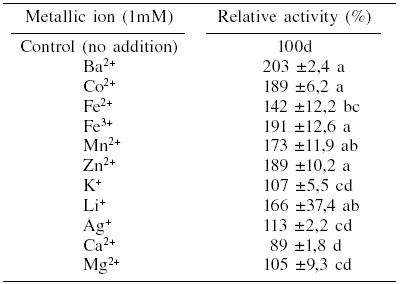
<p ALIGN="center" style="word-spacing: 0; line-height: 100%"><font face="Verdana" size="2"><b>Figure 3.</b> a: Effect of temperature on </font><font size="2" face="Symbol">b</font><font face="Verdana" size="2">-Nacetylglucosaminidase stability; optimum temperature was determined by incubating at different temperatures ranging from 25°C to 70°C. Residual activity was assayed as described in Methods. b: Effect of pH on </font><font size="2" face="Symbol">b</font><font face="Verdana" size="2">-N-acetylglucosaminidase activity measured at various pH values at 50°C for 60 min; enzyme activity was defined as 100% which corresponds to 1.6U. c: Effect of temperature on enzymatic activity, activity measured from 30 to 60°C as described in Methods.</font></p>  <I>    <P style="word-spacing: 0; line-height: 100%" align="justify"><font face="Verdana" size="2">Effects of metal ions</font></P> </I>     <P style="word-spacing: 0; line-height: 100%" align="justify"><font face="Verdana" size="2">The enzymatic extract was incubated with different salt solutions (0.1mM) at 37°C for 1h. <a href="#tab1"> Table I</a> shows significant increases in </font><font size="2" face="Symbol">b</font><font face="Verdana" size="2">-N-acetylglucosaminidase activity with the addition of Ba<SUP>2+</SUP>, Co<SUP>2+</SUP>, Fe<SUP>3+</SUP>, Zn<SUP>2+</SUP>, Mn<SUP>2+</SUP>, Li<SUP>+</SUP> and Fe<SUP>2+</SUP>; and a decrease when Ca<SUP>2+</SUP> was added. The enzyme activity was not affected by the presence of Ag<SUP>+</SUP>, K<SUP>+</SUP> or Mg<SUP>2+</SUP>. These results show how diverse the effect of the metallic ions on the chitinases may be. Sutrisno <I>et al</I>. (2004) reported that the chitinase excreted by <I>Ralstonia</I> sp. A-471 was activated by Mn<SUP>2+</SUP>, Cu<SUP>2+</SUP>, Ca<SUP>2+</SUP> and Mg<SUP>2+</SUP>, while <I>Bacillus</I> sp. 13.26 chitinase was slightly activated by Mg<SUP>2+</SUP>, inhibited by Ca<SUP>2+</SUP> and significantly affected by Mn<SUP>2+</SUP> and Co<SUP>2+</SUP> (Yuli <I>et al</I>., 2004). Chitinase of <I>Stenotrophomonas maltophilia</I> was inhibited by Hg<SUP>2+</SUP>, while K<SUP>+</SUP>, Mg<SUP>2+</SUP>, Ca<SUP>2+</SUP>, Zn<SUP>2+</SUP>, Ni<SUP>2+</SUP> and Co<SUP>2+</SUP> did not affect this activity (Zhang <I>et al</I>., 2001). The variability of the effect of metallic ions possibly reflects different enzyme forms synthesized in order to hydrolyze the diverse chitin polymers existing in nature (Patil <I>et al</I>., 2000).</font></P>      <p ALIGN="center"><font SIZE="2" face="Verdana"><b><a name="tab1">TABLE I</a></b></font></p>     <p ALIGN="center"><font face="Verdana" size="2">METALLIC ION EFFECT ON RELATIVE â-N-ACETYLGLUCOSAMINIDASE ACTIVITY PRODUCED BY <i>L. lecanii </i>ATCC 26854</font></p>     <p ALIGN="center"><img border="0" src="/img/fbpe/inci/v34n5/art11tab1.gif" align="center" width="400" height="284"></p>  <I>    
<P style="word-spacing: 0; line-height: 100%" align="justify"><font face="Verdana" size="2">Electrophoresis and zymogram</font> </P> </I>     <P style="word-spacing: 0; line-height: 100%" align="justify"><font face="Verdana" size="2">SDS-PAGE electrophoresis of enzyme extract is shown in <a href="#fig4"> Figure 4</a>. The gel image consistently shows three protein bands of 31, 48 and 58kDa. Although chitinolytic activity with the chromogenic substrate was detected after 24h in the enzymatic assay, the bands only appeared at 48h, when activity increased. In addition, band intensity increased with fermentation time. These results coincide with previous reports. Krieger <I>et al</I>. (2003) identified a band of 31kDa, with exo and endochitinase activity in <I>M. anisopliae</I> after growing the microorganism on chitin; Baratto <I>et al</I>. (2003) reported a 42kDa protein with endochitinase activity in <I>M. anisopliae</I>, coinciding with other species such as <I>T. harzianum</I> (Carsolio <I>et al</I>., 1994) and <I>Aspergillus nidulans</I> (Baratto <I>et al</I>., 2003); Chul <I>et al</I>. (1998) reported a 58kDa protein in a cDNA library of <I>M. anisopliae</I> ATCC 20500, which presents homologous sequences to proteins from other microorganisms. <a href="#fig4"> Figure 4b</a> shows the fluorescence of 4-MU from the zymogram with enzymatic extract visible under UV light, as a consequence of the activity of </font><font size="2" face="Symbol">b</font><font face="Verdana" size="2">-N-acetylglucosaminidase.</font></P>      <P style="word-spacing: 0; line-height: 100%" align="center"><a name="fig4"><img border="0" src="/img/fbpe/inci/v34n5/art11fig4.jpg" align="center" width="476" height="233"></a></P>      
]]></body>
<body><![CDATA[<P style="word-spacing: 0; line-height: 100%" align="center"><font face="Verdana" size="2"><b>Figure 4.</b> a: SDS-PAGE (11%) electrophoresis of enzyme extract from different fermentation times using shrimp shell as C source. M: standard marker, 1: 0h, 2: 24h 3: 48h, 4: 72h, 5: 96h. b: Zymogram of enzyme extract prepared from a 96h culture of <i>L. lecanii</i>; native gel was incubated in an agarose-4MU(GlcNAc) solution for 5min at 37ºC, with 5ìg (1) or 50ìg (2) of crude protein.</font></P>      <P style="word-spacing: 0; line-height: 100%" align="justify"><font face="Verdana" size="2">In conclusion, the solid-state fermentation system with shrimp shell as the substrate was suitable for <I>L. lecanii</I>  </font><font size="2" face="Symbol">b</font><font face="Verdana" size="2">-N-acetylglucosaminidase production, since it induced enzyme activity and did not interfere with protein recovery. Moreover, the antagonistic assay showed that <I>L. lecanii</I> may potentially be used against phytopathogenic fungi on account of its chitinase activity and possibly also because of other metabolites produced by the fermentation process.</font></P>  <B>    <P style="word-spacing: 0; line-height: 100%" align="justify"><font face="Verdana" size="2">References</font></P> </B>     <!-- ref --><P style="word-spacing: 0; line-height: 100%" align="justify"><font face="Verdana" size="2">1. Alonso MJ, S&aacute;nchez A (2003) The potential of chitosan in ocular drug delivery. <I>J. Pharm. Pharmacol. 55</I>: 1451-1463.</font>&nbsp;&nbsp;&nbsp;&nbsp;&nbsp;&nbsp;&nbsp;&nbsp;[&#160;<a href="javascript:void(0);" onclick="javascript: window.open('/scielo.php?script=sci_nlinks&ref=1089541&pid=S0378-1844200900050001100001&lng=','','width=640,height=500,resizable=yes,scrollbars=1,menubar=yes,');">Links</a>&#160;]<!-- end-ref --><!-- ref --><P style="word-spacing: 0; line-height: 100%" align="justify"><font face="Verdana" size="2">2. Baratto CM, Da Silva MV, Santi L, Passaglia L, Silviera Schrank I, Henning VM, Schrank A (2003) Expression and characterization of the 42 kDa chitinase of biocontrol fungus <I>Metarhizium anisopliae</I> in <I>Escherichia coli</I>. <I>Can. J. Microbiol. 49</I>: 723-726.</font>&nbsp;&nbsp;&nbsp;&nbsp;&nbsp;&nbsp;&nbsp;&nbsp;[&#160;<a href="javascript:void(0);" onclick="javascript: window.open('/scielo.php?script=sci_nlinks&ref=1089542&pid=S0378-1844200900050001100002&lng=','','width=640,height=500,resizable=yes,scrollbars=1,menubar=yes,');">Links</a>&#160;]<!-- end-ref --><!-- ref --><P style="word-spacing: 0; line-height: 100%" align="justify"><font face="Verdana" size="2">3. Barranco JE (2004) <I>Contribuci&oacute;n al Estudio de las Actividades Enzim&aacute;ticas Involucradas en el Mecanismo de Patogenicidad de</I> Lecanicillium <I>(</I>Verticillium<I>)</I> lecanii <I>Cultivado en Medio S&oacute;lido</I>. Tesis. UAM-Iztapalapa, Mexico. 70 pp.</font>&nbsp;&nbsp;&nbsp;&nbsp;&nbsp;&nbsp;&nbsp;&nbsp;[&#160;<a href="javascript:void(0);" onclick="javascript: window.open('/scielo.php?script=sci_nlinks&ref=1089543&pid=S0378-1844200900050001100003&lng=','','width=640,height=500,resizable=yes,scrollbars=1,menubar=yes,');">Links</a>&#160;]<!-- end-ref --><!-- ref --><P style="word-spacing: 0; line-height: 100%" align="justify"><font face="Verdana" size="2">4. Barranco JE, Alatorre R, Guti&eacute;rrez M, Viniegra G, Saucedo G (2002) Criteria for the selection of strains of entomopathogenic fungi <I>Verticillium lecanii</I>. <I>Enz. Microbiol. Technol. 30</I>: 910-915.</font>&nbsp;&nbsp;&nbsp;&nbsp;&nbsp;&nbsp;&nbsp;&nbsp;[&#160;<a href="javascript:void(0);" onclick="javascript: window.open('/scielo.php?script=sci_nlinks&ref=1089544&pid=S0378-1844200900050001100004&lng=','','width=640,height=500,resizable=yes,scrollbars=1,menubar=yes,');">Links</a>&#160;]<!-- end-ref --><!-- ref --><P style="word-spacing: 0; line-height: 100%" align="justify"><font face="Verdana" size="2">5. Bing-Lan L, Pao-Min K, Yew-Min T, Kuo-Ching F (2003) Production of chitinase from <I>Verticillium lecanii</I> F091 using submerged fermentation. <I>Enz. Microb. Technol. 33</I>: 410-415.</font>&nbsp;&nbsp;&nbsp;&nbsp;&nbsp;&nbsp;&nbsp;&nbsp;[&#160;<a href="javascript:void(0);" onclick="javascript: window.open('/scielo.php?script=sci_nlinks&ref=1089545&pid=S0378-1844200900050001100005&lng=','','width=640,height=500,resizable=yes,scrollbars=1,menubar=yes,');">Links</a>&#160;]<!-- end-ref --><!-- ref --><P style="word-spacing: 0; line-height: 100%" align="justify"><font face="Verdana" size="2">6. Butt TM, Jackson C, Magan M (2001) Introduction of fungal biological control agents: progress, problems and potential. In Butt TM, Jackson C, Magan N (Eds.) <I>Fungi as Biocontrol Agents.</I> CABI. Publishing New York, USA. pp. 1-8.</font>&nbsp;&nbsp;&nbsp;&nbsp;&nbsp;&nbsp;&nbsp;&nbsp;[&#160;<a href="javascript:void(0);" onclick="javascript: window.open('/scielo.php?script=sci_nlinks&ref=1089546&pid=S0378-1844200900050001100006&lng=','','width=640,height=500,resizable=yes,scrollbars=1,menubar=yes,');">Links</a>&#160;]<!-- end-ref --><!-- ref --><P style="word-spacing: 0; line-height: 100%" align="justify"><font face="Verdana" size="2">7. Carsolio C, Guti&eacute;rrez A, Jim&eacute;nez B, Van Montagu M, Herrera-Estrella A (1994) Characterization of ech-42, a <I>Trichoderma harzianum</I> endochitinase gene expressed during mycoparasitism. <I>Proc. Natl. Acad. Sci. USA 91</I>: 10903-10907.</font>&nbsp;&nbsp;&nbsp;&nbsp;&nbsp;&nbsp;&nbsp;&nbsp;[&#160;<a href="javascript:void(0);" onclick="javascript: window.open('/scielo.php?script=sci_nlinks&ref=1089547&pid=S0378-1844200900050001100007&lng=','','width=640,height=500,resizable=yes,scrollbars=1,menubar=yes,');">Links</a>&#160;]<!-- end-ref --><!-- ref --><P style="word-spacing: 0; line-height: 100%" align="justify"><font face="Verdana" size="2">8. Cerchiara T, Luppi B, Bigucci F, Zecchi V (2003) Chitosan salts as nasal sustained delivery systems for peptidic drugs. <I>J. Pharm. Pharmacol</I>. 55: 1623-1627.</font>&nbsp;&nbsp;&nbsp;&nbsp;&nbsp;&nbsp;&nbsp;&nbsp;[&#160;<a href="javascript:void(0);" onclick="javascript: window.open('/scielo.php?script=sci_nlinks&ref=1089548&pid=S0378-1844200900050001100008&lng=','','width=640,height=500,resizable=yes,scrollbars=1,menubar=yes,');">Links</a>&#160;]<!-- end-ref --><!-- ref --><P style="word-spacing: 0; line-height: 100%" align="justify"><font face="Verdana" size="2">9. Chul S, Park S, Gyu G (1998) Isolation and characterization of a chitinase cDNA from the entomopathogenic fungus <I>Metarhizium anisopliae</I>. <I>FEMS Microbiol. Lett. 165</I>: 267-271.</font>&nbsp;&nbsp;&nbsp;&nbsp;&nbsp;&nbsp;&nbsp;&nbsp;[&#160;<a href="javascript:void(0);" onclick="javascript: window.open('/scielo.php?script=sci_nlinks&ref=1089549&pid=S0378-1844200900050001100009&lng=','','width=640,height=500,resizable=yes,scrollbars=1,menubar=yes,');">Links</a>&#160;]<!-- end-ref --><!-- ref --><P style="word-spacing: 0; line-height: 100%" align="justify"><font face="Verdana" size="2">10. Coudron TA, Kroha MJ, Ignoffo CM (1984) Levels of chitinolytic activity during development of three entomopathogenic fungi. <I>Compr. Biochem. Physiol. 79B</I>: 339-348.</font>&nbsp;&nbsp;&nbsp;&nbsp;&nbsp;&nbsp;&nbsp;&nbsp;[&#160;<a href="javascript:void(0);" onclick="javascript: window.open('/scielo.php?script=sci_nlinks&ref=1089550&pid=S0378-1844200900050001100010&lng=','','width=640,height=500,resizable=yes,scrollbars=1,menubar=yes,');">Links</a>&#160;]<!-- end-ref --><!-- ref --><P style="word-spacing: 0; line-height: 100%" align="justify"><font face="Verdana" size="2">11. Deshpande MV (1999) Mycopesticide production by fermentation: Potential and challenges. <I>Crit. Rev. Microbiol. 25</I>: 229-243.</font>&nbsp;&nbsp;&nbsp;&nbsp;&nbsp;&nbsp;&nbsp;&nbsp;[&#160;<a href="javascript:void(0);" onclick="javascript: window.open('/scielo.php?script=sci_nlinks&ref=1089551&pid=S0378-1844200900050001100011&lng=','','width=640,height=500,resizable=yes,scrollbars=1,menubar=yes,');">Links</a>&#160;]<!-- end-ref --><!-- ref --><P style="word-spacing: 0; line-height: 100%" align="justify"><font face="Verdana" size="2">12. Di Pietro A, Lorito M, Hayes CK, Broadway RM, Harman GE (1993) Endochitinase from<I> Gliocladium virens</I>: Isolation, characterization and synergistic antifungal activity in combination with gliotoxin. <I>Phytopathology 83</I>: 308-313.</font>&nbsp;&nbsp;&nbsp;&nbsp;&nbsp;&nbsp;&nbsp;&nbsp;[&#160;<a href="javascript:void(0);" onclick="javascript: window.open('/scielo.php?script=sci_nlinks&ref=1089552&pid=S0378-1844200900050001100012&lng=','','width=640,height=500,resizable=yes,scrollbars=1,menubar=yes,');">Links</a>&#160;]<!-- end-ref --><!-- ref --><P style="word-spacing: 0; line-height: 100%" align="justify"><font face="Verdana" size="2">13. Duo LI, Chen S, Jing LU (2005) Purification and partial characterization of two chitinases from the mycoparasitic fungus <I>Talaromyces</I> <I>flavus</I>. <I>Mycopathologia 159</I>: 223-229.</font>&nbsp;&nbsp;&nbsp;&nbsp;&nbsp;&nbsp;&nbsp;&nbsp;[&#160;<a href="javascript:void(0);" onclick="javascript: window.open('/scielo.php?script=sci_nlinks&ref=1089553&pid=S0378-1844200900050001100013&lng=','','width=640,height=500,resizable=yes,scrollbars=1,menubar=yes,');">Links</a>&#160;]<!-- end-ref --><!-- ref --><P style="word-spacing: 0; line-height: 100%" align="justify"><font face="Verdana" size="2">14. Froyd JD (1997) Can synthetic pesticides be replaced with biologically based alternatives? –an industry perspective<I>.</I> <I>J. Ind. Microbiol. Biotechnol. 194</I>: 192-195.</font>&nbsp;&nbsp;&nbsp;&nbsp;&nbsp;&nbsp;&nbsp;&nbsp;[&#160;<a href="javascript:void(0);" onclick="javascript: window.open('/scielo.php?script=sci_nlinks&ref=1089554&pid=S0378-1844200900050001100014&lng=','','width=640,height=500,resizable=yes,scrollbars=1,menubar=yes,');">Links</a>&#160;]<!-- end-ref --><!-- ref --><P style="word-spacing: 0; line-height: 100%" align="justify"><font face="Verdana" size="2">15. Guthrie JL, Khalif S, Castle AJ (2005) An improved method for detection and quantification of chitinase activities. <I>Can. J. Microbiol. 51</I>: 491-495.</font>&nbsp;&nbsp;&nbsp;&nbsp;&nbsp;&nbsp;&nbsp;&nbsp;[&#160;<a href="javascript:void(0);" onclick="javascript: window.open('/scielo.php?script=sci_nlinks&ref=1089555&pid=S0378-1844200900050001100015&lng=','','width=640,height=500,resizable=yes,scrollbars=1,menubar=yes,');">Links</a>&#160;]<!-- end-ref --><!-- ref --><P style="word-spacing: 0; line-height: 100%" align="justify"><font face="Verdana" size="2">16. Harman GE, Hayes CK, Lorito M, Broadway RM, Tronsmo A, Woo SL, Di Pietro A (1993) Chitinolytic enzymes produced by <I>Trichoderma harzianum</I>: Purification of chitobiosidase and endochitinase. <I>Phytopathology 83</I>: 313-318.</font>&nbsp;&nbsp;&nbsp;&nbsp;&nbsp;&nbsp;&nbsp;&nbsp;[&#160;<a href="javascript:void(0);" onclick="javascript: window.open('/scielo.php?script=sci_nlinks&ref=1089556&pid=S0378-1844200900050001100016&lng=','','width=640,height=500,resizable=yes,scrollbars=1,menubar=yes,');">Links</a>&#160;]<!-- end-ref --><!-- ref --><P style="word-spacing: 0; line-height: 100%" align="justify"><font face="Verdana" size="2">17. Krieger C, Schrank A, Henning VM (2003) Regulation of extracellular chitinases and proteases in the entomopathogen and acaricide <I>Metarhizium anisopliae</I>. <I>Curr. Microbiol. 46</I>: 205-210.</font>&nbsp;&nbsp;&nbsp;&nbsp;&nbsp;&nbsp;&nbsp;&nbsp;[&#160;<a href="javascript:void(0);" onclick="javascript: window.open('/scielo.php?script=sci_nlinks&ref=1089557&pid=S0378-1844200900050001100017&lng=','','width=640,height=500,resizable=yes,scrollbars=1,menubar=yes,');">Links</a>&#160;]<!-- end-ref --><!-- ref --><P style="word-spacing: 0; line-height: 100%" align="justify"><font face="Verdana" size="2">18. Kubicek CP, Mach RL, Peterbauer CK, Lorito M (2001) <I>Trichoderma</I> from genes to biocontrol. <I>J. Plant. Pathol. 83</I>: 11-23.</font>&nbsp;&nbsp;&nbsp;&nbsp;&nbsp;&nbsp;&nbsp;&nbsp;[&#160;<a href="javascript:void(0);" onclick="javascript: window.open('/scielo.php?script=sci_nlinks&ref=1089558&pid=S0378-1844200900050001100018&lng=','','width=640,height=500,resizable=yes,scrollbars=1,menubar=yes,');">Links</a>&#160;]<!-- end-ref --><!-- ref --><P style="word-spacing: 0; line-height: 100%" align="justify"><font face="Verdana" size="2">19. Kunamneni A, Permaul K, Singh S (2005) Amylase production in solid state fermentation by the thermophilic fungus <I>Thermomyces lanuginosus</I>. <I>J. Biosci. Bioeng. 100</I>: 168-171.</font>&nbsp;&nbsp;&nbsp;&nbsp;&nbsp;&nbsp;&nbsp;&nbsp;[&#160;<a href="javascript:void(0);" onclick="javascript: window.open('/scielo.php?script=sci_nlinks&ref=1089559&pid=S0378-1844200900050001100019&lng=','','width=640,height=500,resizable=yes,scrollbars=1,menubar=yes,');">Links</a>&#160;]<!-- end-ref --><!-- ref --><P style="word-spacing: 0; line-height: 100%" align="justify"><font face="Verdana" size="2">20. Laemmli UK (1970) Cleavage of structural proteins during the assembly of the head of bacteriophage T4. <I>Nature 227</I>: 680-685.</font>&nbsp;&nbsp;&nbsp;&nbsp;&nbsp;&nbsp;&nbsp;&nbsp;[&#160;<a href="javascript:void(0);" onclick="javascript: window.open('/scielo.php?script=sci_nlinks&ref=1089560&pid=S0378-1844200900050001100020&lng=','','width=640,height=500,resizable=yes,scrollbars=1,menubar=yes,');">Links</a>&#160;]<!-- end-ref --><!-- ref --><P style="word-spacing: 0; line-height: 100%" align="justify"><font face="Verdana" size="2">21. Lorito M, Peterbauer CK, Hayes CK, Woo SL, Harman GE (1994) Synergistic combination of cell wall degrading enzymes and different antifungal compounds enhances inhibition of spore germination. <I>Microbiology 140</I>: 623-629.</font>&nbsp;&nbsp;&nbsp;&nbsp;&nbsp;&nbsp;&nbsp;&nbsp;[&#160;<a href="javascript:void(0);" onclick="javascript: window.open('/scielo.php?script=sci_nlinks&ref=1089561&pid=S0378-1844200900050001100021&lng=','','width=640,height=500,resizable=yes,scrollbars=1,menubar=yes,');">Links</a>&#160;]<!-- end-ref --><!-- ref --><P style="word-spacing: 0; line-height: 100%" align="justify"><font face="Verdana" size="2">22. Lowry OH, Rosebrough NJ, Farr AL, Randall RJ (1951) Protein measurement with the Folin-phenol reagent. <I>J. Biol. Chem. 193</I>: 265-275.</font> &nbsp;&nbsp;&nbsp;&nbsp;&nbsp;&nbsp;&nbsp;&nbsp;[&#160;<a href="javascript:void(0);" onclick="javascript: window.open('/scielo.php?script=sci_nlinks&ref=1089562&pid=S0378-1844200900050001100022&lng=','','width=640,height=500,resizable=yes,scrollbars=1,menubar=yes,');">Links</a>&#160;]<!-- end-ref --><!-- ref --><P style="word-spacing: 0; line-height: 100%" align="justify"><font face="Verdana" size="2">23. Marquardt DL (1963) An algorithm for the least squares estimation of non linear parameters. <I>J. Soc. Ind. Appl. Math 2</I>: 431-441.</font>&nbsp;&nbsp;&nbsp;&nbsp;&nbsp;&nbsp;&nbsp;&nbsp;[&#160;<a href="javascript:void(0);" onclick="javascript: window.open('/scielo.php?script=sci_nlinks&ref=1089563&pid=S0378-1844200900050001100023&lng=','','width=640,height=500,resizable=yes,scrollbars=1,menubar=yes,');">Links</a>&#160;]<!-- end-ref --><!-- ref --><P style="word-spacing: 0; line-height: 100%" align="justify"><font face="Verdana" size="2">24. Matsumoto Y, Saucedo-Casta&ntilde;eda G, Revah S, Shirai K (2004) Production of b-N-acetylhexosaminidase of <I>Verticillium lecanii</I> by solid state and submerged fermentations utilizing shrimp waste silage as substrate and inducer. <I>Process Biochem. 39</I>: 665-671.</font>&nbsp;&nbsp;&nbsp;&nbsp;&nbsp;&nbsp;&nbsp;&nbsp;[&#160;<a href="javascript:void(0);" onclick="javascript: window.open('/scielo.php?script=sci_nlinks&ref=1089564&pid=S0378-1844200900050001100024&lng=','','width=640,height=500,resizable=yes,scrollbars=1,menubar=yes,');">Links</a>&#160;]<!-- end-ref --><!-- ref --><P style="word-spacing: 0; line-height: 100%" align="justify"><font face="Verdana" size="2">25. Nahar P, Ghormade V, Deshpande MV (2004) The extracellular constitutive production of chitin deacetylase in <I>Metarhizium anisopliae</I>: possible edge to entomopathogenic fungi in the biological control of insect pests. <I>J. Invertebr. Pathol. 85</I>: 80-88.</font>&nbsp;&nbsp;&nbsp;&nbsp;&nbsp;&nbsp;&nbsp;&nbsp;[&#160;<a href="javascript:void(0);" onclick="javascript: window.open('/scielo.php?script=sci_nlinks&ref=1089565&pid=S0378-1844200900050001100025&lng=','','width=640,height=500,resizable=yes,scrollbars=1,menubar=yes,');">Links</a>&#160;]<!-- end-ref --><!-- ref --><P style="word-spacing: 0; line-height: 100%" align="justify"><font face="Verdana" size="2">26. Noguera RR, Saliba EO, Mauricio RM (2004) Comparaci&oacute;n de modelos matem&aacute;ticos para estimar los par&aacute;metros de degradaci&oacute;n obtenidos a trav&eacute;s de la t&eacute;cnica de producci&oacute;n de gas. <I>Livestock Res. Rural Dev. </I>From <a href="http://www.lrrd.org/lrrd16/11/nogu16086.htm"> http://www.lrrd.org/lrrd16/11/nogu16086.htm</a>&nbsp;</font>&nbsp;&nbsp;&nbsp;&nbsp;&nbsp;&nbsp;&nbsp;&nbsp;[&#160;<a href="javascript:void(0);" onclick="javascript: window.open('/scielo.php?script=sci_nlinks&ref=1089566&pid=S0378-1844200900050001100026&lng=','','width=640,height=500,resizable=yes,scrollbars=1,menubar=yes,');">Links</a>&#160;]<!-- end-ref --><!-- ref --><P style="word-spacing: 0; line-height: 100%" align="justify"><font face="Verdana" size="2">27. Patil RS, Ghormade V, Deshpande MV (2000) Chitinolytic enzymes: an exploration. <I>Enzyme Microbiol Technol 26</I>: 473-483.</font>&nbsp;&nbsp;&nbsp;&nbsp;&nbsp;&nbsp;&nbsp;&nbsp;[&#160;<a href="javascript:void(0);" onclick="javascript: window.open('/scielo.php?script=sci_nlinks&ref=1089567&pid=S0378-1844200900050001100027&lng=','','width=640,height=500,resizable=yes,scrollbars=1,menubar=yes,');">Links</a>&#160;]<!-- end-ref --><!-- ref --><P style="word-spacing: 0; line-height: 100%" align="justify"><font face="Verdana" size="2">28. San W, Wen Ch (1997) Purification and characterization of two bifunctional chitinases/lysozymes extracellularly produced by <I>Pseudomonas aeruginosa</I> K-187 in a shrimp and crab shell powder medium. <I>Appl. Env. Microbiol. 63</I>: 380-386.</font>&nbsp;&nbsp;&nbsp;&nbsp;&nbsp;&nbsp;&nbsp;&nbsp;[&#160;<a href="javascript:void(0);" onclick="javascript: window.open('/scielo.php?script=sci_nlinks&ref=1089568&pid=S0378-1844200900050001100028&lng=','','width=640,height=500,resizable=yes,scrollbars=1,menubar=yes,');">Links</a>&#160;]<!-- end-ref --><!-- ref --><P style="word-spacing: 0; line-height: 100%" align="justify"><font face="Verdana" size="2">29. Saucedo GC, Gonz&aacute;lez PB, Revah SM, Viniegra GG, Raimbault M (1990) Effect of lactobacilli inoculation on cassava (<I>Manihot esculenta</I>) silage: fermentation pattern and kinetic analysis. <I>J. Sci. Food Agric. 50</I>: 467-477.</font>&nbsp;&nbsp;&nbsp;&nbsp;&nbsp;&nbsp;&nbsp;&nbsp;[&#160;<a href="javascript:void(0);" onclick="javascript: window.open('/scielo.php?script=sci_nlinks&ref=1089569&pid=S0378-1844200900050001100029&lng=','','width=640,height=500,resizable=yes,scrollbars=1,menubar=yes,');">Links</a>&#160;]<!-- end-ref --><!-- ref --><P style="word-spacing: 0; line-height: 100%" align="justify"><font face="Verdana" size="2">30. Shang G, Jeen C, Wen L (2004) Purification and characterization of extracellular chitinase from <I>Aeromonas schubertti</I>. <I>Enz. Microbiol. Technol. 35</I>: 550-556.</font>&nbsp;&nbsp;&nbsp;&nbsp;&nbsp;&nbsp;&nbsp;&nbsp;[&#160;<a href="javascript:void(0);" onclick="javascript: window.open('/scielo.php?script=sci_nlinks&ref=1089570&pid=S0378-1844200900050001100030&lng=','','width=640,height=500,resizable=yes,scrollbars=1,menubar=yes,');">Links</a>&#160;]<!-- end-ref --><!-- ref --><P style="word-spacing: 0; line-height: 100%" align="justify"><font face="Verdana" size="2">31. Steenberg T, Humber RA (1999) Entomopathogenic potential of <I>Verticillium </I>and <I>Acremonium </I>species<I> </I>(Deuteromycotina:Hyphomycetes). <I>J. Invertebr. Pathol. 73</I>: 309-314.</font>&nbsp;&nbsp;&nbsp;&nbsp;&nbsp;&nbsp;&nbsp;&nbsp;[&#160;<a href="javascript:void(0);" onclick="javascript: window.open('/scielo.php?script=sci_nlinks&ref=1089571&pid=S0378-1844200900050001100031&lng=','','width=640,height=500,resizable=yes,scrollbars=1,menubar=yes,');">Links</a>&#160;]<!-- end-ref --><!-- ref --><P style="word-spacing: 0; line-height: 100%" align="justify"><font face="Verdana" size="2">32. St-Leger RJ, Nelson JO, Screen SE (1999) The entomopathogenic fungus <I>Metarhizium anisopliae</I> alters ambient pH, allowing extracellular protease production and activity. <I>Microbiology</I> <I>145</I>: 2691-2699.</font>&nbsp;&nbsp;&nbsp;&nbsp;&nbsp;&nbsp;&nbsp;&nbsp;[&#160;<a href="javascript:void(0);" onclick="javascript: window.open('/scielo.php?script=sci_nlinks&ref=1089572&pid=S0378-1844200900050001100032&lng=','','width=640,height=500,resizable=yes,scrollbars=1,menubar=yes,');">Links</a>&#160;]<!-- end-ref --><!-- ref --><P style="word-spacing: 0; line-height: 100%" align="justify"><font face="Verdana" size="2">33. Sutrisno A, Ueda M, Abe Y, Nakazawa M, Miyatake K (2004) A chitinase with high activity toward partially N-acetylated chitosan from a new, moderately thermophilic, chitin-degrading bacterium, <I>Ralstonia</I> sp. A-471. <I>Appl. Microbiol. Biotechnol. 63</I>: 398-406.</font>&nbsp;&nbsp;&nbsp;&nbsp;&nbsp;&nbsp;&nbsp;&nbsp;[&#160;<a href="javascript:void(0);" onclick="javascript: window.open('/scielo.php?script=sci_nlinks&ref=1089573&pid=S0378-1844200900050001100033&lng=','','width=640,height=500,resizable=yes,scrollbars=1,menubar=yes,');">Links</a>&#160;]<!-- end-ref --><!-- ref --><P style="word-spacing: 0; line-height: 100%" align="justify"><font face="Verdana" size="2">34. Tergerdy RP, Szak&aacute;cs G (1998) Perspectives in agrobiotechnology. <I>J. Biotechnol. 66</I>: 91-99.</font>&nbsp;&nbsp;&nbsp;&nbsp;&nbsp;&nbsp;&nbsp;&nbsp;[&#160;<a href="javascript:void(0);" onclick="javascript: window.open('/scielo.php?script=sci_nlinks&ref=1089574&pid=S0378-1844200900050001100034&lng=','','width=640,height=500,resizable=yes,scrollbars=1,menubar=yes,');">Links</a>&#160;]<!-- end-ref --><!-- ref --><P style="word-spacing: 0; line-height: 100%" align="justify"><font face="Verdana" size="2">35. Viniegra G, Favela E, Aguilar CN, Romero-G&oacute;mez SJ, D&iacute;az-God&iacute;nez G, Augur C (2003) Advantages of fungal enzyme production in solid state over liquid fermentation systems. <I>Biochem. Eng. J. 13</I>: 157-167.</font>&nbsp;&nbsp;&nbsp;&nbsp;&nbsp;&nbsp;&nbsp;&nbsp;[&#160;<a href="javascript:void(0);" onclick="javascript: window.open('/scielo.php?script=sci_nlinks&ref=1089575&pid=S0378-1844200900050001100035&lng=','','width=640,height=500,resizable=yes,scrollbars=1,menubar=yes,');">Links</a>&#160;]<!-- end-ref --><!-- ref --><P style="word-spacing: 0; line-height: 100%" align="justify"><font face="Verdana" size="2">36. Yuli PE, Suhartono MT, Rukayadi Y, Hwang JK, Pyun YR (2004) Characteristics of thermostable chitinase enzymes from the Indonesian <I>Bacillus</I> sp.13.26. <I>Enz. Microbiol. Technol. 35</I>: 147-153.</font>&nbsp;&nbsp;&nbsp;&nbsp;&nbsp;&nbsp;&nbsp;&nbsp;[&#160;<a href="javascript:void(0);" onclick="javascript: window.open('/scielo.php?script=sci_nlinks&ref=1089576&pid=S0378-1844200900050001100036&lng=','','width=640,height=500,resizable=yes,scrollbars=1,menubar=yes,');">Links</a>&#160;]<!-- end-ref --><!-- ref --><P style="word-spacing: 0; line-height: 100%" align="justify"><font face="Verdana" size="2">37. Zhang Z, Yuen GY, Sarath G, Penheiter AR (2001) Chitinases from the plant disease biocontrol agent, <I>Stenotrophomonas maltophilia </I>C3. <I>Phytopathology 91</I>: 204-211.</font>&nbsp;&nbsp;&nbsp;&nbsp;&nbsp;&nbsp;&nbsp;&nbsp;[&#160;<a href="javascript:void(0);" onclick="javascript: window.open('/scielo.php?script=sci_nlinks&ref=1089577&pid=S0378-1844200900050001100037&lng=','','width=640,height=500,resizable=yes,scrollbars=1,menubar=yes,');">Links</a>&#160;]<!-- end-ref --> ]]></body>
<back>
<ref-list>
<ref id="B1">
<label>1</label><nlm-citation citation-type="journal">
<person-group person-group-type="author">
<name>
<surname><![CDATA[Alonso]]></surname>
<given-names><![CDATA[MJ]]></given-names>
</name>
<name>
<surname><![CDATA[Sánchez]]></surname>
<given-names><![CDATA[A]]></given-names>
</name>
</person-group>
<article-title xml:lang="en"><![CDATA[The potential of chitosan in ocular drug delivery]]></article-title>
<source><![CDATA[J. Pharm. Pharmacol.]]></source>
<year>2003</year>
<volume>55</volume>
<page-range>1451-1463</page-range></nlm-citation>
</ref>
<ref id="B2">
<label>2</label><nlm-citation citation-type="journal">
<person-group person-group-type="author">
<name>
<surname><![CDATA[Baratto]]></surname>
<given-names><![CDATA[CM]]></given-names>
</name>
<name>
<surname><![CDATA[Da Silva]]></surname>
<given-names><![CDATA[MV]]></given-names>
</name>
<name>
<surname><![CDATA[Santi]]></surname>
<given-names><![CDATA[L]]></given-names>
</name>
<name>
<surname><![CDATA[Passaglia]]></surname>
<given-names><![CDATA[L]]></given-names>
</name>
<name>
<surname><![CDATA[Silviera]]></surname>
<given-names><![CDATA[Schrank I]]></given-names>
</name>
<name>
<surname><![CDATA[Henning]]></surname>
<given-names><![CDATA[VM]]></given-names>
</name>
<name>
<surname><![CDATA[Schrank]]></surname>
<given-names><![CDATA[A]]></given-names>
</name>
</person-group>
<article-title xml:lang="en"><![CDATA[Expression and characterization of the 42 kDa chitinase of biocontrol fungus Metarhizium anisopliae in Escherichia coli]]></article-title>
<source><![CDATA[Can. J. Microbiol.]]></source>
<year>2003</year>
<volume>49</volume>
<page-range>723-726</page-range></nlm-citation>
</ref>
<ref id="B3">
<label>3</label><nlm-citation citation-type="book">
<person-group person-group-type="author">
<name>
<surname><![CDATA[Barranco]]></surname>
<given-names><![CDATA[JE]]></given-names>
</name>
</person-group>
<source><![CDATA[Contribución al Estudio de las Actividades Enzimáticas Involucradas en el Mecanismo de Patogenicidad de Lecanicillium (Verticillium) lecanii Cultivado en Medio Sólido]]></source>
<year>2004</year>
<page-range>70</page-range><publisher-name><![CDATA[UAM-Iztapalapa]]></publisher-name>
</nlm-citation>
</ref>
<ref id="B4">
<label>4</label><nlm-citation citation-type="journal">
<person-group person-group-type="author">
<name>
<surname><![CDATA[Barranco]]></surname>
<given-names><![CDATA[JE]]></given-names>
</name>
<name>
<surname><![CDATA[Alatorre]]></surname>
<given-names><![CDATA[R]]></given-names>
</name>
<name>
<surname><![CDATA[Gutiérrez]]></surname>
<given-names><![CDATA[M]]></given-names>
</name>
<name>
<surname><![CDATA[Viniegra]]></surname>
<given-names><![CDATA[G]]></given-names>
</name>
<name>
<surname><![CDATA[Saucedo]]></surname>
<given-names><![CDATA[G]]></given-names>
</name>
</person-group>
<article-title xml:lang="en"><![CDATA[Criteria for the selection of strains of entomopathogenic fungi Verticillium lecanii]]></article-title>
<source><![CDATA[Enz. Microbiol. Technol.]]></source>
<year>2002</year>
<volume>30</volume>
<page-range>910-915</page-range></nlm-citation>
</ref>
<ref id="B5">
<label>5</label><nlm-citation citation-type="journal">
<person-group person-group-type="author">
<name>
<surname><![CDATA[Bing-Lan]]></surname>
<given-names><![CDATA[L]]></given-names>
</name>
<name>
<surname><![CDATA[Pao-Min]]></surname>
<given-names><![CDATA[K]]></given-names>
</name>
<name>
<surname><![CDATA[Yew-Min]]></surname>
<given-names><![CDATA[T]]></given-names>
</name>
<name>
<surname><![CDATA[Kuo-Ching]]></surname>
<given-names><![CDATA[F]]></given-names>
</name>
</person-group>
<article-title xml:lang="en"><![CDATA[Production of chitinase from Verticillium lecanii F091 using submerged fermentation]]></article-title>
<source><![CDATA[Enz. Microb. Technol.]]></source>
<year>2003</year>
<volume>33</volume>
<page-range>410-415</page-range></nlm-citation>
</ref>
<ref id="B6">
<label>6</label><nlm-citation citation-type="book">
<person-group person-group-type="author">
<name>
<surname><![CDATA[Butt]]></surname>
<given-names><![CDATA[TM]]></given-names>
</name>
<name>
<surname><![CDATA[Jackson]]></surname>
<given-names><![CDATA[C]]></given-names>
</name>
<name>
<surname><![CDATA[Magan]]></surname>
<given-names><![CDATA[M]]></given-names>
</name>
</person-group>
<article-title xml:lang="en"><![CDATA[Introduction of fungal biological control agents: progress, problems and potential]]></article-title>
<person-group person-group-type="editor">
<name>
<surname><![CDATA[Butt]]></surname>
<given-names><![CDATA[TM]]></given-names>
</name>
<name>
<surname><![CDATA[Jackson]]></surname>
<given-names><![CDATA[C]]></given-names>
</name>
<name>
<surname><![CDATA[Magan]]></surname>
<given-names><![CDATA[N]]></given-names>
</name>
</person-group>
<source><![CDATA[Fungi as Biocontrol Agents]]></source>
<year>2001</year>
<page-range>1-8</page-range><publisher-name><![CDATA[CABI. Publishing New York]]></publisher-name>
</nlm-citation>
</ref>
<ref id="B7">
<label>7</label><nlm-citation citation-type="journal">
<person-group person-group-type="author">
<name>
<surname><![CDATA[Carsolio]]></surname>
<given-names><![CDATA[C]]></given-names>
</name>
<name>
<surname><![CDATA[Gutiérrez]]></surname>
<given-names><![CDATA[A]]></given-names>
</name>
<name>
<surname><![CDATA[Jiménez]]></surname>
<given-names><![CDATA[B]]></given-names>
</name>
<name>
<surname><![CDATA[Van Montagu]]></surname>
<given-names><![CDATA[M]]></given-names>
</name>
<name>
<surname><![CDATA[Herrera-Estrella]]></surname>
<given-names><![CDATA[A]]></given-names>
</name>
</person-group>
<article-title xml:lang="en"><![CDATA[Characterization of ech-42, a Trichoderma harzianum endochitinase gene expressed during mycoparasitism]]></article-title>
<source><![CDATA[Proc. Natl. Acad. Sci. USA]]></source>
<year>1994</year>
<volume>91</volume>
<page-range>10903-10907</page-range></nlm-citation>
</ref>
<ref id="B8">
<label>8</label><nlm-citation citation-type="journal">
<person-group person-group-type="author">
<name>
<surname><![CDATA[Cerchiara]]></surname>
<given-names><![CDATA[T]]></given-names>
</name>
<name>
<surname><![CDATA[Luppi]]></surname>
<given-names><![CDATA[B]]></given-names>
</name>
<name>
<surname><![CDATA[Bigucci]]></surname>
<given-names><![CDATA[F]]></given-names>
</name>
<name>
<surname><![CDATA[Zecchi]]></surname>
<given-names><![CDATA[V]]></given-names>
</name>
</person-group>
<article-title xml:lang="en"><![CDATA[Chitosan salts as nasal sustained delivery systems for peptidic drugs]]></article-title>
<source><![CDATA[J. Pharm. Pharmacol.]]></source>
<year>2003</year>
<volume>55</volume>
<page-range>1623-1627</page-range></nlm-citation>
</ref>
<ref id="B9">
<label>9</label><nlm-citation citation-type="journal">
<person-group person-group-type="author">
<name>
<surname><![CDATA[Chul]]></surname>
<given-names><![CDATA[S]]></given-names>
</name>
<name>
<surname><![CDATA[Park]]></surname>
<given-names><![CDATA[S]]></given-names>
</name>
<name>
<surname><![CDATA[Gyu]]></surname>
<given-names><![CDATA[G]]></given-names>
</name>
</person-group>
<article-title xml:lang="en"><![CDATA[Isolation and characterization of a chitinase cDNA from the entomopathogenic fungus Metarhizium anisopliae]]></article-title>
<source><![CDATA[FEMS Microbiol. Lett.]]></source>
<year>1998</year>
<volume>165</volume>
<page-range>267-271</page-range></nlm-citation>
</ref>
<ref id="B10">
<label>10</label><nlm-citation citation-type="journal">
<person-group person-group-type="author">
<name>
<surname><![CDATA[Coudron]]></surname>
<given-names><![CDATA[TA]]></given-names>
</name>
<name>
<surname><![CDATA[Kroha]]></surname>
<given-names><![CDATA[MJ]]></given-names>
</name>
<name>
<surname><![CDATA[Ignoffo]]></surname>
<given-names><![CDATA[CM]]></given-names>
</name>
</person-group>
<article-title xml:lang="en"><![CDATA[Levels of chitinolytic activity during development of three entomopathogenic fungi]]></article-title>
<source><![CDATA[Compr. Biochem. Physiol.]]></source>
<year>1984</year>
<volume>79B</volume>
<page-range>339-348</page-range></nlm-citation>
</ref>
<ref id="B11">
<label>11</label><nlm-citation citation-type="journal">
<person-group person-group-type="author">
<name>
<surname><![CDATA[Deshpande]]></surname>
<given-names><![CDATA[MV]]></given-names>
</name>
</person-group>
<article-title xml:lang="en"><![CDATA[Mycopesticide production by fermentation: Potential and challenges]]></article-title>
<source><![CDATA[Crit. Rev. Microbiol.]]></source>
<year>1999</year>
<volume>25</volume>
<page-range>229-243</page-range></nlm-citation>
</ref>
<ref id="B12">
<label>12</label><nlm-citation citation-type="journal">
<person-group person-group-type="author">
<name>
<surname><![CDATA[Di]]></surname>
<given-names><![CDATA[Pietro A]]></given-names>
</name>
<name>
<surname><![CDATA[Lorito]]></surname>
<given-names><![CDATA[M]]></given-names>
</name>
<name>
<surname><![CDATA[Hayes]]></surname>
<given-names><![CDATA[CK]]></given-names>
</name>
<name>
<surname><![CDATA[Broadway]]></surname>
<given-names><![CDATA[RM]]></given-names>
</name>
<name>
<surname><![CDATA[Harman]]></surname>
<given-names><![CDATA[GE]]></given-names>
</name>
</person-group>
<article-title xml:lang="en"><![CDATA[Endochitinase from Gliocladium virens: Isolation, characterization and synergistic antifungal activity in combination with gliotoxin]]></article-title>
<source><![CDATA[Phytopathology]]></source>
<year>1993</year>
<volume>83</volume>
<page-range>308-313</page-range></nlm-citation>
</ref>
<ref id="B13">
<label>13</label><nlm-citation citation-type="journal">
<person-group person-group-type="author">
<name>
<surname><![CDATA[Duo]]></surname>
<given-names><![CDATA[LI]]></given-names>
</name>
<name>
<surname><![CDATA[Chen]]></surname>
<given-names><![CDATA[S]]></given-names>
</name>
<name>
<surname><![CDATA[Jing]]></surname>
<given-names><![CDATA[LU]]></given-names>
</name>
</person-group>
<article-title xml:lang="en"><![CDATA[Purification and partial characterization of two chitinases from the mycoparasitic fungus Talaromyces flavus]]></article-title>
<source><![CDATA[Mycopathologia]]></source>
<year>2005</year>
<volume>159</volume>
<page-range>223-229</page-range></nlm-citation>
</ref>
<ref id="B14">
<label>14</label><nlm-citation citation-type="journal">
<person-group person-group-type="author">
<name>
<surname><![CDATA[Froyd]]></surname>
<given-names><![CDATA[JD]]></given-names>
</name>
</person-group>
<article-title xml:lang="en"><![CDATA[Can synthetic pesticides be replaced with biologically based alternatives? -an industry perspective]]></article-title>
<source><![CDATA[J. Ind. Microbiol. Biotechnol.]]></source>
<year>1997</year>
<volume>194</volume>
<page-range>192-195</page-range></nlm-citation>
</ref>
<ref id="B15">
<label>15</label><nlm-citation citation-type="journal">
<person-group person-group-type="author">
<name>
<surname><![CDATA[Guthrie]]></surname>
<given-names><![CDATA[JL]]></given-names>
</name>
<name>
<surname><![CDATA[Khalif]]></surname>
<given-names><![CDATA[S]]></given-names>
</name>
<name>
<surname><![CDATA[Castle]]></surname>
<given-names><![CDATA[AJ]]></given-names>
</name>
</person-group>
<article-title xml:lang="en"><![CDATA[An improved method for detection and quantification of chitinase activities]]></article-title>
<source><![CDATA[Can. J. Microbiol.]]></source>
<year>2005</year>
<volume>51</volume>
<page-range>491-495</page-range></nlm-citation>
</ref>
<ref id="B16">
<label>16</label><nlm-citation citation-type="journal">
<person-group person-group-type="author">
<name>
<surname><![CDATA[Harman]]></surname>
<given-names><![CDATA[GE]]></given-names>
</name>
<name>
<surname><![CDATA[Hayes]]></surname>
<given-names><![CDATA[CK]]></given-names>
</name>
<name>
<surname><![CDATA[Lorito]]></surname>
<given-names><![CDATA[M]]></given-names>
</name>
<name>
<surname><![CDATA[Broadway]]></surname>
<given-names><![CDATA[RM]]></given-names>
</name>
<name>
<surname><![CDATA[Tronsmo]]></surname>
<given-names><![CDATA[A]]></given-names>
</name>
<name>
<surname><![CDATA[Woo]]></surname>
<given-names><![CDATA[SL]]></given-names>
</name>
<name>
<surname><![CDATA[Di Pietro]]></surname>
<given-names><![CDATA[A]]></given-names>
</name>
</person-group>
<article-title xml:lang="en"><![CDATA[Chitinolytic enzymes produced by Trichoderma harzianum: Purification of chitobiosidase and endochitinase]]></article-title>
<source><![CDATA[Phytopathology]]></source>
<year>1993</year>
<volume>83</volume>
<page-range>313-318</page-range></nlm-citation>
</ref>
<ref id="B17">
<label>17</label><nlm-citation citation-type="journal">
<person-group person-group-type="author">
<name>
<surname><![CDATA[Krieger]]></surname>
<given-names><![CDATA[C]]></given-names>
</name>
<name>
<surname><![CDATA[Schrank]]></surname>
<given-names><![CDATA[A]]></given-names>
</name>
<name>
<surname><![CDATA[Henning]]></surname>
<given-names><![CDATA[VM]]></given-names>
</name>
</person-group>
<article-title xml:lang="en"><![CDATA[Regulation of extracellular chitinases and proteases in the entomopathogen and acaricide Metarhizium anisopliae]]></article-title>
<source><![CDATA[Curr. Microbiol.]]></source>
<year>2003</year>
<volume>46</volume>
<page-range>205-210</page-range></nlm-citation>
</ref>
<ref id="B18">
<label>18</label><nlm-citation citation-type="journal">
<person-group person-group-type="author">
<name>
<surname><![CDATA[Kubicek]]></surname>
<given-names><![CDATA[CP]]></given-names>
</name>
<name>
<surname><![CDATA[Mach]]></surname>
<given-names><![CDATA[RL]]></given-names>
</name>
<name>
<surname><![CDATA[Peterbauer]]></surname>
<given-names><![CDATA[CK]]></given-names>
</name>
<name>
<surname><![CDATA[Lorito]]></surname>
<given-names><![CDATA[M]]></given-names>
</name>
</person-group>
<article-title xml:lang="en"><![CDATA[Trichoderma from genes to biocontrol]]></article-title>
<source><![CDATA[J. Plant. Pathol.]]></source>
<year>2001</year>
<volume>83</volume>
<page-range>11-23</page-range></nlm-citation>
</ref>
<ref id="B19">
<label>19</label><nlm-citation citation-type="journal">
<person-group person-group-type="author">
<name>
<surname><![CDATA[Kunamneni]]></surname>
<given-names><![CDATA[A]]></given-names>
</name>
<name>
<surname><![CDATA[Permaul]]></surname>
<given-names><![CDATA[K]]></given-names>
</name>
<name>
<surname><![CDATA[Singh]]></surname>
<given-names><![CDATA[S]]></given-names>
</name>
</person-group>
<article-title xml:lang="en"><![CDATA[Amylase production in solid state fermentation by the thermophilic fungus Thermomyces lanuginosus]]></article-title>
<source><![CDATA[J. Biosci. Bioeng.]]></source>
<year>2005</year>
<volume>100</volume>
<page-range>168-171</page-range></nlm-citation>
</ref>
<ref id="B20">
<label>20</label><nlm-citation citation-type="journal">
<person-group person-group-type="author">
<name>
<surname><![CDATA[Laemmli]]></surname>
<given-names><![CDATA[UK]]></given-names>
</name>
</person-group>
<article-title xml:lang="en"><![CDATA[Cleavage of structural proteins during the assembly of the head of bacteriophage T4]]></article-title>
<source><![CDATA[Nature]]></source>
<year>1970</year>
<volume>227</volume>
<page-range>680-685</page-range></nlm-citation>
</ref>
<ref id="B21">
<label>21</label><nlm-citation citation-type="journal">
<person-group person-group-type="author">
<name>
<surname><![CDATA[Lorito]]></surname>
<given-names><![CDATA[M]]></given-names>
</name>
<name>
<surname><![CDATA[Peterbauer]]></surname>
<given-names><![CDATA[CK]]></given-names>
</name>
<name>
<surname><![CDATA[Hayes]]></surname>
<given-names><![CDATA[CK]]></given-names>
</name>
<name>
<surname><![CDATA[Woo]]></surname>
<given-names><![CDATA[SL]]></given-names>
</name>
<name>
<surname><![CDATA[Harman]]></surname>
<given-names><![CDATA[GE]]></given-names>
</name>
</person-group>
<article-title xml:lang="en"><![CDATA[Synergistic combination of cell wall degrading enzymes and different antifungal compounds enhances inhibition of spore germination]]></article-title>
<source><![CDATA[Microbiology]]></source>
<year>1994</year>
<volume>140</volume>
<page-range>623-629</page-range></nlm-citation>
</ref>
<ref id="B22">
<label>22</label><nlm-citation citation-type="journal">
<person-group person-group-type="author">
<name>
<surname><![CDATA[Lowry]]></surname>
<given-names><![CDATA[OH]]></given-names>
</name>
<name>
<surname><![CDATA[Rosebrough]]></surname>
<given-names><![CDATA[NJ]]></given-names>
</name>
<name>
<surname><![CDATA[Farr]]></surname>
<given-names><![CDATA[AL]]></given-names>
</name>
<name>
<surname><![CDATA[Randall]]></surname>
<given-names><![CDATA[RJ]]></given-names>
</name>
</person-group>
<article-title xml:lang="en"><![CDATA[Protein measurement with the Folin-phenol reagent]]></article-title>
<source><![CDATA[J. Biol. Chem.]]></source>
<year>1951</year>
<volume>193</volume>
<page-range>265-275</page-range></nlm-citation>
</ref>
<ref id="B23">
<label>23</label><nlm-citation citation-type="journal">
<person-group person-group-type="author">
<name>
<surname><![CDATA[Marquardt]]></surname>
<given-names><![CDATA[DL]]></given-names>
</name>
</person-group>
<article-title xml:lang="en"><![CDATA[An algorithm for the least squares estimation of non linear parameters]]></article-title>
<source><![CDATA[J. Soc. Ind. Appl. Math]]></source>
<year>1963</year>
<volume>2</volume>
<page-range>431-441</page-range></nlm-citation>
</ref>
<ref id="B24">
<label>24</label><nlm-citation citation-type="journal">
<person-group person-group-type="author">
<name>
<surname><![CDATA[Matsumoto]]></surname>
<given-names><![CDATA[Y]]></given-names>
</name>
<name>
<surname><![CDATA[Saucedo-Castañeda]]></surname>
<given-names><![CDATA[G]]></given-names>
</name>
<name>
<surname><![CDATA[Revah]]></surname>
<given-names><![CDATA[S]]></given-names>
</name>
<name>
<surname><![CDATA[Shirai]]></surname>
<given-names><![CDATA[K]]></given-names>
</name>
</person-group>
<article-title xml:lang="en"><![CDATA[Production of b-N-acetylhexosaminidase of Verticillium lecanii by solid state and submerged fermentations utilizing shrimp waste silage as substrate and inducer]]></article-title>
<source><![CDATA[Process Biochem.]]></source>
<year>2004</year>
<volume>39</volume>
<page-range>665-671</page-range></nlm-citation>
</ref>
<ref id="B25">
<label>25</label><nlm-citation citation-type="journal">
<person-group person-group-type="author">
<name>
<surname><![CDATA[Nahar]]></surname>
<given-names><![CDATA[P]]></given-names>
</name>
<name>
<surname><![CDATA[Ghormade]]></surname>
<given-names><![CDATA[V]]></given-names>
</name>
<name>
<surname><![CDATA[Deshpande]]></surname>
<given-names><![CDATA[MV]]></given-names>
</name>
</person-group>
<article-title xml:lang="en"><![CDATA[The extracellular constitutive production of chitin deacetylase in Metarhizium anisopliae: possible edge to entomopathogenic fungi in the biological control of insect pests]]></article-title>
<source><![CDATA[J. Invertebr. Pathol.]]></source>
<year>2004</year>
<volume>85</volume>
<page-range>80-88</page-range></nlm-citation>
</ref>
<ref id="B26">
<label>26</label><nlm-citation citation-type="journal">
<person-group person-group-type="author">
<name>
<surname><![CDATA[Noguera]]></surname>
<given-names><![CDATA[RR]]></given-names>
</name>
<name>
<surname><![CDATA[Saliba]]></surname>
<given-names><![CDATA[EO]]></given-names>
</name>
<name>
<surname><![CDATA[Mauricio]]></surname>
<given-names><![CDATA[RM]]></given-names>
</name>
</person-group>
<article-title xml:lang="es"><![CDATA[Comparación de modelos matemáticos para estimar los parámetros de degradación obtenidos a través de la técnica de producción de gas]]></article-title>
<source><![CDATA[Livestock Res. Rural Dev]]></source>
<year>2004</year>
</nlm-citation>
</ref>
<ref id="B27">
<label>27</label><nlm-citation citation-type="journal">
<person-group person-group-type="author">
<name>
<surname><![CDATA[Patil]]></surname>
<given-names><![CDATA[RS]]></given-names>
</name>
<name>
<surname><![CDATA[Ghormade]]></surname>
<given-names><![CDATA[V]]></given-names>
</name>
<name>
<surname><![CDATA[Deshpande]]></surname>
<given-names><![CDATA[MV]]></given-names>
</name>
</person-group>
<article-title xml:lang="en"><![CDATA[Chitinolytic enzymes: an exploration]]></article-title>
<source><![CDATA[Enzyme Microbiol Technol]]></source>
<year>2000</year>
<volume>26</volume>
<page-range>473-483</page-range></nlm-citation>
</ref>
<ref id="B28">
<label>28</label><nlm-citation citation-type="journal">
<person-group person-group-type="author">
<name>
<surname><![CDATA[San]]></surname>
<given-names><![CDATA[W]]></given-names>
</name>
<name>
<surname><![CDATA[Wen]]></surname>
<given-names><![CDATA[Ch]]></given-names>
</name>
</person-group>
<article-title xml:lang="en"><![CDATA[Purification and characterization of two bifunctional chitinases/lysozymes extracellularly produced by Pseudomonas aeruginosa K-187 in a shrimp and crab shell powder medium]]></article-title>
<source><![CDATA[Appl. Env. Microbiol.]]></source>
<year>1997</year>
<volume>63</volume>
<page-range>380-386</page-range></nlm-citation>
</ref>
<ref id="B29">
<label>29</label><nlm-citation citation-type="journal">
<person-group person-group-type="author">
<name>
<surname><![CDATA[Saucedo]]></surname>
<given-names><![CDATA[GC]]></given-names>
</name>
<name>
<surname><![CDATA[González]]></surname>
<given-names><![CDATA[PB]]></given-names>
</name>
<name>
<surname><![CDATA[Revah]]></surname>
<given-names><![CDATA[SM]]></given-names>
</name>
<name>
<surname><![CDATA[Viniegra]]></surname>
<given-names><![CDATA[GG]]></given-names>
</name>
<name>
<surname><![CDATA[Raimbault]]></surname>
<given-names><![CDATA[M]]></given-names>
</name>
</person-group>
<article-title xml:lang="en"><![CDATA[Effect of lactobacilli inoculation on cassava (Manihot esculenta) silage: fermentation pattern and kinetic analysis]]></article-title>
<source><![CDATA[J. Sci. Food Agric.]]></source>
<year>1990</year>
<volume>50</volume>
<page-range>467-477</page-range></nlm-citation>
</ref>
<ref id="B30">
<label>30</label><nlm-citation citation-type="journal">
<person-group person-group-type="author">
<name>
<surname><![CDATA[Shang]]></surname>
<given-names><![CDATA[G]]></given-names>
</name>
<name>
<surname><![CDATA[Jeen]]></surname>
<given-names><![CDATA[C]]></given-names>
</name>
<name>
<surname><![CDATA[Wen]]></surname>
<given-names><![CDATA[L]]></given-names>
</name>
</person-group>
<article-title xml:lang="en"><![CDATA[Purification and characterization of extracellular chitinase from Aeromonas schubertti]]></article-title>
<source><![CDATA[Enz. Microbiol. Technol.]]></source>
<year>2004</year>
<volume>35</volume>
<page-range>550-556</page-range></nlm-citation>
</ref>
<ref id="B31">
<label>31</label><nlm-citation citation-type="journal">
<person-group person-group-type="author">
<name>
<surname><![CDATA[Steenberg]]></surname>
<given-names><![CDATA[T]]></given-names>
</name>
<name>
<surname><![CDATA[Humber]]></surname>
<given-names><![CDATA[RA]]></given-names>
</name>
</person-group>
<article-title xml:lang="en"><![CDATA[Entomopathogenic potential of Verticillium and Acremonium species (Deuteromycotina:Hyphomycetes)]]></article-title>
<source><![CDATA[J. Invertebr. Pathol.]]></source>
<year>1999</year>
<volume>73</volume>
<page-range>309-314</page-range></nlm-citation>
</ref>
<ref id="B32">
<label>32</label><nlm-citation citation-type="journal">
<person-group person-group-type="author">
<name>
<surname><![CDATA[St-Leger]]></surname>
<given-names><![CDATA[RJ]]></given-names>
</name>
<name>
<surname><![CDATA[Nelson]]></surname>
<given-names><![CDATA[JO]]></given-names>
</name>
<name>
<surname><![CDATA[Screen]]></surname>
<given-names><![CDATA[SE]]></given-names>
</name>
</person-group>
<article-title xml:lang="en"><![CDATA[The entomopathogenic fungus Metarhizium anisopliae alters ambient pH, allowing extracellular protease production and activity]]></article-title>
<source><![CDATA[Microbiology]]></source>
<year>1999</year>
<volume>145</volume>
<page-range>2691-2699</page-range></nlm-citation>
</ref>
<ref id="B33">
<label>33</label><nlm-citation citation-type="journal">
<person-group person-group-type="author">
<name>
<surname><![CDATA[Sutrisno]]></surname>
<given-names><![CDATA[A]]></given-names>
</name>
<name>
<surname><![CDATA[Ueda]]></surname>
<given-names><![CDATA[M]]></given-names>
</name>
<name>
<surname><![CDATA[Abe]]></surname>
<given-names><![CDATA[Y]]></given-names>
</name>
<name>
<surname><![CDATA[Nakazawa]]></surname>
<given-names><![CDATA[M]]></given-names>
</name>
<name>
<surname><![CDATA[Miyatake]]></surname>
<given-names><![CDATA[K]]></given-names>
</name>
</person-group>
<article-title xml:lang="en"><![CDATA[A chitinase with high activity toward partially N-acetylated chitosan from a new, moderately thermophilic, chitin-degrading bacterium, Ralstonia sp]]></article-title>
<source><![CDATA[A-471. Appl. Microbiol. Biotechnol.]]></source>
<year>2004</year>
<volume>63</volume>
<page-range>398-406</page-range></nlm-citation>
</ref>
<ref id="B34">
<label>34</label><nlm-citation citation-type="journal">
<person-group person-group-type="author">
<name>
<surname><![CDATA[Tergerdy]]></surname>
<given-names><![CDATA[RP]]></given-names>
</name>
<name>
<surname><![CDATA[Szakács]]></surname>
<given-names><![CDATA[G]]></given-names>
</name>
</person-group>
<article-title xml:lang="en"><![CDATA[Perspectives in agrobiotechnology]]></article-title>
<source><![CDATA[J. Biotechnol.]]></source>
<year>1998</year>
<volume>66</volume>
<page-range>91-99</page-range></nlm-citation>
</ref>
<ref id="B35">
<label>35</label><nlm-citation citation-type="journal">
<person-group person-group-type="author">
<name>
<surname><![CDATA[Viniegra]]></surname>
<given-names><![CDATA[G]]></given-names>
</name>
<name>
<surname><![CDATA[Favela]]></surname>
<given-names><![CDATA[E]]></given-names>
</name>
<name>
<surname><![CDATA[Aguilar]]></surname>
<given-names><![CDATA[CN]]></given-names>
</name>
<name>
<surname><![CDATA[Romero-Gómez]]></surname>
<given-names><![CDATA[SJ]]></given-names>
</name>
<name>
<surname><![CDATA[Díaz-Godínez]]></surname>
<given-names><![CDATA[G]]></given-names>
</name>
<name>
<surname><![CDATA[Augur]]></surname>
<given-names><![CDATA[C]]></given-names>
</name>
</person-group>
<article-title xml:lang="en"><![CDATA[Advantages of fungal enzyme production in solid state over liquid fermentation systems]]></article-title>
<source><![CDATA[Biochem. Eng. J.]]></source>
<year>2003</year>
<volume>13</volume>
<page-range>157-167</page-range></nlm-citation>
</ref>
<ref id="B36">
<label>36</label><nlm-citation citation-type="journal">
<person-group person-group-type="author">
<name>
<surname><![CDATA[Yuli]]></surname>
<given-names><![CDATA[PE]]></given-names>
</name>
<name>
<surname><![CDATA[Suhartono]]></surname>
<given-names><![CDATA[MT]]></given-names>
</name>
<name>
<surname><![CDATA[Rukayadi]]></surname>
<given-names><![CDATA[Y]]></given-names>
</name>
<name>
<surname><![CDATA[Hwang]]></surname>
<given-names><![CDATA[JK]]></given-names>
</name>
<name>
<surname><![CDATA[Pyun]]></surname>
<given-names><![CDATA[YR]]></given-names>
</name>
</person-group>
<article-title xml:lang="en"><![CDATA[Characteristics of thermostable chitinase enzymes from the Indonesian Bacillus sp.13.26]]></article-title>
<source><![CDATA[Enz. Microbiol. Technol.]]></source>
<year>2004</year>
<volume>35</volume>
<page-range>147-153</page-range></nlm-citation>
</ref>
<ref id="B37">
<label>37</label><nlm-citation citation-type="journal">
<person-group person-group-type="author">
<name>
<surname><![CDATA[Zhang]]></surname>
<given-names><![CDATA[Z]]></given-names>
</name>
<name>
<surname><![CDATA[Yuen]]></surname>
<given-names><![CDATA[GY]]></given-names>
</name>
<name>
<surname><![CDATA[Sarath]]></surname>
<given-names><![CDATA[G]]></given-names>
</name>
<name>
<surname><![CDATA[Penheiter]]></surname>
<given-names><![CDATA[AR]]></given-names>
</name>
</person-group>
<article-title xml:lang="en"><![CDATA[Chitinases from the plant disease biocontrol agent, Stenotrophomonas maltophilia C3]]></article-title>
<source><![CDATA[Phytopathology]]></source>
<year>2001</year>
<volume>91</volume>
<page-range>204-211</page-range></nlm-citation>
</ref>
</ref-list>
</back>
</article>