<?xml version="1.0" encoding="ISO-8859-1"?><article xmlns:mml="http://www.w3.org/1998/Math/MathML" xmlns:xlink="http://www.w3.org/1999/xlink" xmlns:xsi="http://www.w3.org/2001/XMLSchema-instance">
<front>
<journal-meta>
<journal-id>0798-0264</journal-id>
<journal-title><![CDATA[Archivos Venezolanos de Farmacología y Terapéutica]]></journal-title>
<abbrev-journal-title><![CDATA[AVFT]]></abbrev-journal-title>
<issn>0798-0264</issn>
<publisher>
<publisher-name><![CDATA[Sociedad Venezolana de Farmacológia  y Farmacológia Clínica y Terapéutica. Escuela de MedicinaJosé Maria Vargas. Cátedra de Farmacológia, piso 3, esquina san jacinto, San José Caracas]]></publisher-name>
</publisher>
</journal-meta>
<article-meta>
<article-id>S0798-02642015000100002</article-id>
<title-group>
<article-title xml:lang="en"><![CDATA[Effectiveness and tolerability of the Petasites hybridus leaf extract Ze 339 in the treatment of allergic rhinitis in a paediatric population]]></article-title>
<article-title xml:lang="es"><![CDATA[Efectividad y tolerabilidad del extracto de la hoja de Petasites hybridus Ze 339 en el tratamiento de la rinitis alérgica en una población pediátrica]]></article-title>
</title-group>
<contrib-group>
<contrib contrib-type="author">
<name>
<surname><![CDATA[Molla]]></surname>
<given-names><![CDATA[Cordula]]></given-names>
</name>
<xref ref-type="aff" rid="A01"/>
</contrib>
<contrib contrib-type="author">
<name>
<surname><![CDATA[Zahnera]]></surname>
<given-names><![CDATA[Catherine]]></given-names>
</name>
<xref ref-type="aff" rid="A01"/>
</contrib>
<contrib contrib-type="author">
<name>
<surname><![CDATA[Rodríguez de Marquis]]></surname>
<given-names><![CDATA[Mercedes]]></given-names>
</name>
<xref ref-type="aff" rid="A02"/>
</contrib>
<contrib contrib-type="author">
<name>
<surname><![CDATA[González Yibirín]]></surname>
<given-names><![CDATA[Maria]]></given-names>
</name>
<xref ref-type="aff" rid="A02"/>
</contrib>
<contrib contrib-type="author">
<name>
<surname><![CDATA[Ruiz Rodríguez]]></surname>
<given-names><![CDATA[Jairo J]]></given-names>
</name>
<xref ref-type="aff" rid="A02"/>
</contrib>
</contrib-group>
<aff id="A01">
<institution><![CDATA[,Max Zeller Söhne AG  ]]></institution>
<addr-line><![CDATA[Romanshorn ]]></addr-line>
<country>Switzerland</country>
</aff>
<aff id="A02">
<institution><![CDATA[,Laboratorios Leti, S.A.V  ]]></institution>
<addr-line><![CDATA[Guarenas ]]></addr-line>
<country>Venezuela</country>
</aff>
<pub-date pub-type="pub">
<day>00</day>
<month>03</month>
<year>2015</year>
</pub-date>
<pub-date pub-type="epub">
<day>00</day>
<month>03</month>
<year>2015</year>
</pub-date>
<volume>34</volume>
<numero>1</numero>
<fpage>4</fpage>
<lpage>10</lpage>
<copyright-statement/>
<copyright-year/>
<self-uri xlink:href="http://ve.scielo.org/scielo.php?script=sci_arttext&amp;pid=S0798-02642015000100002&amp;lng=en&amp;nrm=iso"></self-uri><self-uri xlink:href="http://ve.scielo.org/scielo.php?script=sci_abstract&amp;pid=S0798-02642015000100002&amp;lng=en&amp;nrm=iso"></self-uri><self-uri xlink:href="http://ve.scielo.org/scielo.php?script=sci_pdf&amp;pid=S0798-02642015000100002&amp;lng=en&amp;nrm=iso"></self-uri><abstract abstract-type="short" xml:lang="en"><p><![CDATA[Background: Allergic rhinitis (AR) is one of the most prevalent chronic allergic diseases in children, with a high impact on a child’s quality of life and co-morbidities like asthma. Objective: The objective of this analysis was to investigate the effectiveness and tolerability of the Petasites hybridus leaf extract Ze 339 (Ze 339) in the treatment of AR in paediatric patients. Methods: We present a paediatric sub-analysis of a recent Venezuelan observational study, which investigated the effect of Ze 339 on clinical symptoms of AR in patients treated under conditions of daily practice. Among those 927 previously studied patients, 92 patients were less than 18 years old. Thereof, we included 53 children and adolescents in this intention-to-treat sub-analysis. Patients were advised to take one tablet of Ze 339 (corresponding to 8 mg petasins) two or three times a day up to one month. Symptoms of AR were recorded at every medical visit using a 4-point rating scale to indicate the level of severity. Single symptoms of AR (rhinorrhoea, nasal congestion, sneezing, itchy eyes, red eyes, itchy throat) and several composite scores (total symptom score, total nasal symptom score, total nasal and ocular symptom score) were evaluated. The overall therapeutic response of patients to the medication indicating effectiveness and tolerability was evaluated by a 5-point rating scale by both the physician and patient. Results: Full recovery and a significant improvement of symptoms were seen in 86.8% of patients. This was also reflected in a significant improvement of the different composite scores (p<0.001). Overall, the results showed that Ze 339 is effective and well tolerated in the treatment of AR in paediatric patients. Conclusion: Ze 339 is effective and well tolerated in the relief of all symptoms of AR. Beneficial effects were reported by patients and physicians. Ze 339 may be considered for the treatment of AR in paediatric patients.]]></p></abstract>
<kwd-group>
<kwd lng="en"><![CDATA[Petasites hybridus]]></kwd>
<kwd lng="en"><![CDATA[allergic rhinitis]]></kwd>
<kwd lng="en"><![CDATA[children]]></kwd>
<kwd lng="en"><![CDATA[adolescents]]></kwd>
<kwd lng="en"><![CDATA[paediatric population]]></kwd>
<kwd lng="en"><![CDATA[Ze 339]]></kwd>
</kwd-group>
</article-meta>
</front><body><![CDATA[ <p align="center"><font face="Verdana"><b>Effectiveness and tolerability of the  Petasites hybridus leaf extract Ze 339 in the treatment of allergic rhinitis in  a paediatric population</b></font></p>     <p align="center"><font face="Verdana"><b>Efectividad y tolerabilidad del  extracto de la hoja de Petasites hybridus Ze 339 en el tratamiento de la rinitis  alérgica en una población pediátrica</b></font></p>     <p align="center"><font face="Verdana" size="2">Cordula Molla*, Catherine  Zahnera<sup>a</sup>, Mercedes Rodríguez de Marquis<sup>b</sup>, Maria González  Yibirín<sup>b</sup> and Jairo J. Ruiz Rodríguez<sup>b</sup>, on behalf of the  Study Group<sup>1</sup></font></p>     <p align="justify"><font face="Verdana" size="2"><sup>a</sup> Max Zeller Söhne  AG, Romanshorn, Switzerland</font></p>     <p align="justify"><font face="Verdana" size="2"><sup>b</sup> Laboratorios Leti,  S.A.V., Guarenas, Venezuela</font></p>     <p align="justify"><font face="Verdana" size="2">*Correspondence to Dr. C. Moll,  Max Zeller Söhne AG, Romanshorn, Switzerland; E-mail: <a href="mailto:cordula.moll@zellerag.ch">cordula.moll@zellerag.ch</a></font></p>     <p align="justify"><font face="Verdana" size="2"><sup>1</sup> Participating  practical physicians are all listed in Rodríguez de Marquis &amp; González Yibirín  (2012).</font></p>     <p align="justify"><font face="Verdana" size="2"><b>Abstract</b></font></p>     <p align="justify"><font face="Verdana" size="2"><b>Background:</b> Allergic  rhinitis (AR) is one of the most prevalent chronic allergic diseases in children,  with a high impact on a child’s quality of life and co-morbidities like asthma.</font></p>     <p align="justify"><font face="Verdana" size="2"><b>Objective: </b>The objective  of this analysis was to investigate the effectiveness and tolerability of the  Petasites hybridus leaf extract Ze 339 (Ze 339) in the treatment of AR in  paediatric patients.</font></p>     ]]></body>
<body><![CDATA[<p align="justify"><font face="Verdana" size="2"><b>Methods:</b> We present a  paediatric sub-analysis of a recent Venezuelan observational study, which  investigated the effect of Ze 339 on clinical symptoms of AR in patients treated  under conditions of daily practice. Among those 927 previously studied patients,  92 patients were less than 18 years old. Thereof, we included 53 children and  adolescents in this intention-to-treat sub-analysis. Patients were advised to  take one tablet of Ze 339 (corresponding to 8 mg petasins) two or three times a  day up to one month. Symptoms of AR were recorded at every medical visit using a  4-point rating scale to indicate the level of severity. Single symptoms of AR (rhinorrhoea,  nasal congestion, sneezing, itchy eyes, red eyes, itchy throat) and several  composite scores (total symptom score, total nasal symptom score, total nasal  and ocular symptom score) were evaluated. The overall therapeutic response of  patients to the medication indicating effectiveness and tolerability was  evaluated by a 5-point rating scale by both the physician and patient.</font></p>     <p align="justify"><font face="Verdana" size="2"><b>Results: </b>Full recovery  and a significant improvement of symptoms were seen in 86.8% of patients. This  was also reflected in a significant improvement of the different composite  scores (p&lt;0.001). Overall, the results showed that Ze 339 is effective and well  tolerated in the treatment of AR in paediatric patients.</font></p>     <p align="justify"><font face="Verdana" size="2"><b>Conclusion:</b> Ze 339 is  effective and well tolerated in the relief of all symptoms of AR. Beneficial  effects were reported by patients and physicians. Ze 339 may be considered for  the treatment of AR in paediatric patients.</font></p>     <p align="justify"><font face="Verdana" size="2"><b>Keywords:</b> Petasites  hybridus, allergic rhinitis, children, adolescents, paediatric population, Ze  339</font></p>     <p align="justify"><font face="Verdana" size="2">Recibido: 20/10/2015 Aceptado:  21/11/2015</font></p>     <p align="justify"><font face="Verdana" size="2"><b>Introduction</b></font></p>     <p align="justify"><font face="Verdana" size="2">Traditionally, allergic  rhinitis (AR) has been classified by the time and mode of exposure into three  groups: seasonal, perennial, and more recently, the occupational one. The  seasonal AR is caused by pollen from grass, weeds and trees. The perennial AR is  caused in most cases by dermatophagoides mainly by excreta of house dust mites,  animal dander, some fungi and cockroach. The occupational AR is caused by  airborne agents in relation to work. It may be caused for example by laboratory  animals, wood dust, grain or chemicals. According to the Allergic Rhinitis and  its Impact on Asthma (ARIA) guideline<sup>1</sup> AR is alternatively classified  into two further broad categories regarding their time-course in intermittent  and persistent AR. The duration of intermittent AR is less than 4 days a week  and less than 4 consecutive weeks and persistent AR means that the symptoms are  present more than 4 days a week and for more than 4 consecutive weeks. This  classification of the ARIA guideline is more practical and appropriate to daily  practice as the duration of AR has a high impact on the patient’s quality of  life. Furthermore, AR is classified by severity and categorised into mild,  moderate and severe based on individual symptoms (e.g. sleep disturbance,  impairment of daily activities, leisure and/or sport, impairment of school or  work)<sup>1</sup>.</font></p>     <p align="justify"><font face="Verdana" size="2">As not only daily activities  but also performance in school can be influenced by AR an effective treatment of  AR is very important for children and adolescents. Both, the family physician  and different specialists (allergologists, otolaryngologists, pulmonologists,  paediatricians, etc.), are often involved in the treatment of patients with AR.  The diagnosis is based primarily on clinical history, physical examination and  allergic skin tests. Currently there are different therapeutic options for AR  available. Dependent on the kind of symptoms, antihistamines, corticosteroids,  leukotriene antagonists or cromoglycate are used. Since symptoms like  rhinorrhoea and sneezing are histamine driven symptoms, antihistamines might be  the treatment of choice for these symptoms. However, if the patient also suffers  from nasal congestion, corticosteroids should be considered as additional  treatment. Synthetic drugs for the treatment of AR show a good efficacy for  relieving the symptoms. But for antihistamines (mainly those of the first  generation) side effects like sedation are well known. Beside synthetic drugs  there is also an effective and well tolerated herbal medicinal product  containing the Petasites hybridus leaf extract Ze 339 (Ze 339) available for the  treatment of AR. Ze 339 is a CO<sub>2</sub>-extract from leaves of Petasites  hybridus, L. and standardized to 8 mg petasins (Drug-extraction ratio of 50-  100:1). The herbal medicinal products containing Ze 339 are indicated for the  treatment of AR in patients from 12 years on. In clinical studies it was shown  that Ze 339 relieves symptoms of AR like rhinorrhoea, sneezing, itchy nose and  eyes and nasal congestion<sup>2-5</sup>. Ze 339 acts by various ways. Petasin  and its isomers are considered to be the main active compounds of Ze 339  defining the anti-inflammatory activity of Ze 339<sup>4,6,7</sup>. Mast cells  and eosinophils are two very important cells in the allergic process as their  degranulation releases different mediators of AR like histamine and leukotrienes  that cause the symptoms and typical complications of allergy. Ze 339 has an  impact on the early response of AR by inhibiting mast cell and eosinophil  degranulation, and on the late response of AR, the inflammation, by blocking  leukotrienes and prostaglandins synthesis<sup>4,6,8,9</sup>. Therefore, a dual  mode of action is suggested for Ze 339 due to its antiallergic and anti-inflammatory  properties in the early and late phase of AR.</font></p>     <p align="justify"><font face="Verdana" size="2">As paediatric patients are a  special population, data from post marketing surveillance studies are of high  interest to confirm the effectiveness and tolerability of Ze 339 in this special  patient population. Three post marketing observational studies were published  that investigated the treatment of AR with Ze 339. In these studies the  inclusion of patients was not restricted to adults<sup>10-12</sup>. However, so  far no detailed analysis of the paediatric population was published.</font></p>     <p align="justify"><font face="Verdana" size="2"><b>Objective</b></font></p>     ]]></body>
<body><![CDATA[<p align="justify"><font face="Verdana" size="2">The objective of this sub-analysis  from an observational study was to investigate the effectiveness and  tolerability of Ze 339 in the treatment of AR in paediatric patients (patients  aged from 2 to 18 years).</font></p>     <p align="justify"><font face="Verdana" size="2"><b>Methods</b></font></p>     <p align="justify"><font face="Verdana" size="2">We evaluated the evolution of  clinical symptoms of AR in patients treated with Ze 339 (Tesalin<sup>®</sup>;  standardized to 8 mg of total petasins per tablet; manufactured by Zeller  Medical AG Romanshorn, Switzerland) during an open prospective, postmarketing  observational study of daily practice conditions in Venezuela<sup>12</sup>. The  focus of the study was to evaluate the effectiveness and tolerability of Ze 339  in the Venezuelan population. According to the current law in Venezuela this  kind of observational studies has not to be notified to the health agency and no  approval by an ethics committee was necessary. The parents or the legal  representatives signed a written informed consent for the use of their  children’s study related data before participation. The sample included patients  of any gender or ethnicity. Patients were informed about the therapy, advised to  comply with the treatment and to attend medical checks. The results of the  observational study including all patients (a total of 927 subjects)  irrespectively of their age were previously published by Rodríguez de Marquis  and González Yibirín<sup>12</sup>, however, no subgroup analysis of paediatric  patients was performed.</font></p>     <p align="justify"><font face="Verdana" size="2">In this paper, we therefore  investigated the subset of paediatric patients. Among the total of 927 patients  in the observational study, 92 patients were less than 18 years old and were  included in the current sub-analysis. Patients, who attended at least one post-treatment  follow-up consultation, were included in the intention-to-treat (ITT) analysis  resulting in a study population of 53 children and adolescents (<a href="#fig1">Figure 1</a>).</font></p>     <p align="center"><a name="fig1"> <img border="0" src="/img/fbpe/avft/v34n1/art02fig1.gif" width="420" height="327"></a></p>     
<p align="justify"><font face="Verdana" size="2">In the original study,  including 927 subjects, patients were excluded with a significant history of  metabolic, cardiovascular, neurological, haematological, hepatic,  gastrointestinal, cerebrovascular, respiratory or renal disease, or any other  disorder, which the physician deemed likely to interfere with the study, or  requiring any treatment likely to interfere with the objectives of the study.  Furthermore, patients were excluded if they suffered from upper respiratory  tract infections or sinusitis and would have required antibiotic therapy in the  preceding two weeks, or if they experienced a viral respiratory infection during  the week prior to the start of the study. Patients with suspected or clinical  evidence of nasal candidiasis were also excluded<sup>12</sup>.</font></p>     <p align="justify"><font face="Verdana" size="2">The symptoms of AR were  recorded at each of their medical visits at the beginning of the treatment and  on a follow up visit up to one month after starting treatment using a 4-point  rating scale (0=absent, 1=mild, 2=moderate, 3=severe) to indicate the grade of  severity<sup>12</sup>. In this sub-analysis further composite scores have been  added. Beneath the evaluation of single symptoms (rhinorrhoea, nasal congestion,  sneezing, itchy eyes, red eyes, itchy throat) also a total symptom score (TSS;  sum score of all single symptoms), a total nasal symptom score (TNSS) with the  three nasal symptoms (rhinorrhoea, nasal congestion, sneezing) and a total nasal  and ocular symptom score (TNOSS) with the nasal symptoms and the symptoms itchy  eyes and red eyes were evaluated according to the U.S. Food and Drug  Administration Guidance for Industry on clinical trials for AR<sup>13</sup>. The  overall therapeutic response of patients to the medication was evaluated by a 5-point  rating scale for the improvement of symptoms (1=full recovery, 2=significant  improvement, 3=moderate improvement, 4=mild improvement, 5=treatment failure).  Based on this 5-point rating scale the effectiveness and tolerability of Ze 339  were analysed by both the physician and parents.</font></p>     <p align="justify"><font face="Verdana" size="2">Patients took one tablet of Ze  339 two or three times a day for a maximum of one month. Furthermore, the  patients were allowed to take any other concomitant medication for AR (including  antihistamines, corticosteroids) and other, except antibiotic agents.</font></p>     <p align="justify"><font face="Verdana" size="2">The IBM SPSS software (version  21.0) was used for statistical analyses. For analysis of demographics and  improvement of symptoms descriptive statistics were used. For variables not  normally distributed appropriate nonparametric tests were applied. The Wilcoxon  signed ranks test was used for within-group comparison, the Mann-Whitney-U test  for unpaired between-group comparisons and the Fisher’s exact test for  contingency tables with small sample sizes. The level of significance was  p=0.05.</font></p>     <p align="justify"><font face="Verdana" size="2"><b>Results</b></font></p>     ]]></body>
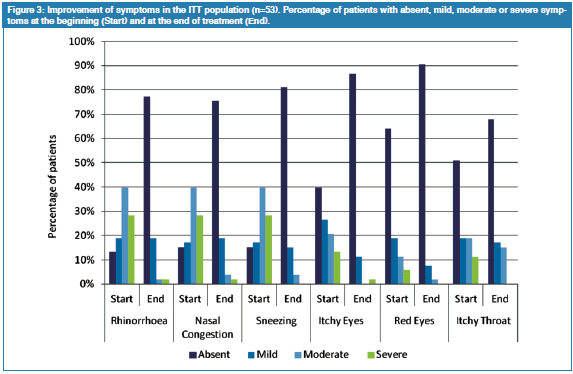
<body><![CDATA[<p align="justify"><font face="Verdana" size="2"><b>Patient characteristics</b></font></p>     <p align="justify"><font face="Verdana" size="2">The overall results of this  observational study were published by Rodríguez de Marquis and González  Yibirín12 and out of 927 subjects 92 patients were less than 18-years-old  defining the paediatric population. Thereof, 53 patients were included into the  ITT population of this sub-analysis (<a href="#fig1">Figure 1</a>). In the latter population, four  patients were children (median=10.5 years) and 49 patients were adolescents  (median=15 years). The mean ± SD age of all patients was 14.4 ± 2.05 years. The  sex of the patients was equally distributed (45.3% male; 47.2% female; 7.5% not  reported).</font></p>     <p align="justify"><font face="Verdana" size="2">Furthermore, 83.0% (44 patients)  of the patients had no specific medical history. In the remaining 17% of the  patients, medical history such as AR (9.4%), allergy (3.8%), allergic bronchitis  (1.9%) and allergic conjunctivitis (1.9%) was reported. Furthermore, 64.2% (34  patients) took no concomitant medication whereas 19 patients took antihistamines  (such as loratadine (9.4%), desloratadine (7.5%), fexofenadine (5.7%),  cetirizine (5.7%) and other concomitant medications (7.5%). The severity of AR  at baseline was considered as mild in 10 patients (18.9%), moderate in 26  patients (49.1%) and severe in 12 patients (22.6%). For 9.4% of the patients  (n=5) the severity of symptoms was not reported. In most of the patients, the  treatment duration was one week (62.3%, n=33). For the other patients, the  treatment duration was either two weeks (1.9%, n=1), one month (22.7%, n=12) or  only reported at the beginning of the study (13.2%, n=7). For one patient (1.9%)  no treatment duration was reported. The dosage of Ze 339 was in the most cases  one tablet twice daily (86.8%, n=46). Some of the patients also received a  dosage of one tablet three times daily (9.4%, n=5). For two patients (3.8%) the  dosage was not reported.</font></p>     <p align="justify"><font face="Verdana" size="2"><b>Improvement of symptoms</b></font></p>     <p align="justify"><font face="Verdana" size="2">An improvement of symptoms was  reported for most of the patients (83.0%, n=44) already after one week. Further  7.5% of the patients (n=4) had a time to improvement of one month. In 7.5% of  the patients (n=4) the time to improvement was not reported. For one patient  (1.9%) an improvement of symptoms at the beginning of the study was reported. In  most of the patients the extent of improvement in symptoms of AR was reported as  full recovery (52.8%, n=28) or significant improvement (34.0%, n=18,  <a href="#fig2">Figure 2</a>). Most of the patients (67.9%- 90.6%) reported the symptoms to be absent at the  end of treatment (<a href="#fig3">Figure 3</a>). This is also reflected by a statistically  significant improvement of the single symptoms of AR (rhinorrhoea, p&lt;0.001;  nasal congestion, p&lt;0.001; sneezing, p&lt;0.001; itchy eyes, p&lt;0.001; red eyes,  p&lt;0.005; itchy throat, p&lt;0.05) at the end of treatment. The TSS and the  composite scores TNSS and TNOSS (<a href="#fig4">Figure 4</a>) also decreased with statistical  significance until the end of treatment (<a href="#tab1">Table 1</a>).</font></p>     <p align="center"><a name="fig2"> <img border="0" src="/img/fbpe/avft/v34n1/art02fig2.gif" width="421" height="327"></a></p>     
<p align="center"><a name="fig3"> <img border="0" src="/img/fbpe/avft/v34n1/art02fig3.gif" width="573" height="374"></a></p>     
<p align="center"><a name="fig4"> <img border="0" src="/img/fbpe/avft/v34n1/art02fig4.gif" width="575" height="451"></a></p>     
<p align="center"><a name="tab1"> <img border="0" src="/img/fbpe/avft/v34n1/art02tab1.gif" width="578" height="295"></a></p>     
<p align="justify"><font face="Verdana" size="2"><b>Concomitant medication</b></font></p>     ]]></body>
<body><![CDATA[<p align="justify"><font face="Verdana" size="2">In the ITT population (n=53)  some patients also took comedication as described above. In both groups,  patients with (n=19) and without (n=34) comedication, all single symptoms of AR  were improved at the end of treatment (<a href="#fig5">Figure 5</a>). The TSS, TNSS, TNOSS and the  single symptoms rhinorrhoea, nasal congestion, sneezing, itchy eyes and red eyes  were significantly improved in both groups (<a href="#tab1">Table 1</a>). In patients without  comedication also the symptom itchy throat significantly improved, whereas the  improvement in patients with comedication was not significant (<a href="#tab1">Table 1</a>). At the  beginning of the treatment the TSS showed a tendency to be higher in patients  with concomitant medication (p=0.082). However, all symptoms except rhinorrhoea  were not statistically different between the groups. For the symptom rhinorrhoea  patients with comedication had a significantly higher score at the beginning of  the treatment (p=0.004) and also the change from baseline of rhinorrhoea was  significantly different between patients with and without comedication (<a href="#tab1">Table  1</a>). At the end of treatment the symptom score for rhinorrhoea was similar in  both groups (p=0.247).</font></p>     <p align="center"><a name="fig5"> <img border="0" src="/img/fbpe/avft/v34n1/art02fig5.gif" width="579" height="497"></a></p>     
<p align="justify"><font face="Verdana" size="2"><b>Overall effectiveness and  tolerability</b></font></p>     <p align="justify"><font face="Verdana" size="2">The treatment was evaluated by  the physicians and the patients as effective in 90.6% and 84.9%, respectively  (<a href="#fig6">Figure 6 a and b</a>). Furthermore, 90.6% of the physicians and 86.8% of the  patients considered the treatment as well tolerated (<a href="#fig7">Figure 7 a) and b</a>).</font></p>     <p align="center"><a name="fig6"> <img border="0" src="/img/fbpe/avft/v34n1/art02fig6.gif" width="576" height="250"></a></p>     
<p align="center"><a name="fig7"> <img border="0" src="/img/fbpe/avft/v34n1/art02fig7.gif" width="569" height="243"></a></p>     
<p align="justify"><font face="Verdana" size="2"><b>Discussion</b></font></p>     <p align="justify"><font face="Verdana" size="2">In Western Europe the  prevalence of AR ranges from 17-29% in adults and is frequently undiagnosed<sup>14</sup>.  However, AR is already a common paediatric condition. In a worldwide study of  over one million adolescents aging between 13 and 14 years, the prevalence was  14.6%<sup>15</sup>. It is not only the most common allergic disease, but it is  among the top ten reasons for medical consultation<sup>16</sup>, which  represents a great economic impact and decreases quality of life.</font></p>     <p align="justify"><font face="Verdana" size="2">This has promoted advances in  treatment and design of new strategies based on new pathogenic concepts and the  impact of the patient’s quality of life. Although antihistamines are not a cure  for AR, its use for the treatment of the condition is widespread. Antihistamines  do not stop the allergic reaction and are not very effective in relieving nasal  congestion, which responds better to leukotriene inhibitors and corticosteroids.  Antihistamines temporarily relieve some of the symptoms of AR. However, there  are possible side effects of antihistamines, which include: dry mouth, throat  and eyes, and drowsiness.</font></p>     <p align="justify"><font face="Verdana" size="2">For, Ze 339 two randomised  controlled clinical studies confirmed the efficacy of Ze 339 in comparison with  antihistamines. The effects of Ze 339 were similar to those of cetirizine or  fexofenadine in patients with seasonal AR<sup>17,18</sup>. Therefore, Ze 339 is  effective in relieving symptoms of AR and well tolerated. Regarding the mode of  action, it is noted that a doubleblind, randomised, cross-over study  investigated the efficacy and mode of action of Petasites hybridus leaf extract  Ze 339, desloratadine and placebo in symptoms of AR by measuring the nasal  airflow after unilateral nasal allergen provocation. An interesting finding was  that Ze 339 significantly reduced IL-8 and leukotriene B4 levels. Furthermore,  Ze 339 showed greater efficacy in relieving nasal obstruction and inhibition of  mediators than desloratadine. Thus, the authors concluded that Ze 339 expands  the therapeutic options for the symptomatic treatment of AR<sup>3</sup>.</font></p>     ]]></body>
<body><![CDATA[<p align="justify"><font face="Verdana" size="2">In comparison to randomised  controlled clinical studies observational studies have some limitations.  Observational studies are usually performed in the relevant target population.  Therefore, they possess a high external validity, however, at the potential cost  of a compromised internal validity. Despite the important differences between  both study types observational studies may provide complementary data for  example for special populations. The present sub-analysis of a paediatric  population shows that the treatment with Ze 339 was effective in the majority of  paediatric patients, being considered as excellent, very good or good in 90.6%  of cases evaluated by the physician and in 84.9% of cases evaluated by the  patient. Furthermore, also the tolerability was evaluated as excellent, very  good or good by 90.6% of the physicians and 86.8% of the patients. This response  to the treatment was in accordance with the results of the total study  population<sup>12</sup>.</font></p>     <p align="justify"><font face="Verdana" size="2">For the evaluation of symptoms  not only the nasal symptoms rhinorrhoea, sneezing and nasal congestion but also  the symptoms itchy eyes and itchy throat were scored. The patients treated only  with Ze 339 without comedication showed a statistically significant improvement  in all single symptom scores and the composite scores TNSS and TNOSS (<a href="#tab1">Table 1</a>).  In patients treated with Ze 339 and comedication the symptom itchy throat was  not statistically significantly improved. This could be explained by a more  severe grade of AR in these patients. At the beginning of the treatment, the  symptom score for rhinorrhoea was significantly higher in patients treated with  comedication than in patients treated only with Ze 339. Oral H<sub>1</sub>-antihistamines  are effective in the treatment of nasal symptoms like rhinorrhoea but less of  nasal congestion. For this reason, the high value of rhinorrhoea at the  beginning of the treatment justified the concomitant use of antihistamines.</font></p>     <p align="justify"><font face="Verdana" size="2">Also noteworthy is the fact  that a rapid response to the treatment was obtained. For more than half of the  patients (62.3%) the treatment duration was one week and most of the patients  (86.8%) took one tablet of Ze 339 twice daily. In the summary of product  characteristics, a dosage of two tablets daily is recommended for basic  treatment. Therefore, our results confirm the effectiveness of the recommended  dosage. This is also supported by two post-marketing surveillance studies  conducted in Switzerland<sup>10,11</sup>.</font></p>     <p align="justify"><font face="Verdana" size="2">The opinion of physicians and  patients regarding the effectiveness as well as the tolerability of Ze 339 was  comparable. This is very important due to the impact that AR has on the  patient’s quality of life. Importantly, the results of the paediatric population  greatly resemble those obtained in the general population of the original study<sup>12</sup>.</font></p>     <p align="justify"><font face="Verdana" size="2">These findings, together with  the fact of absence of significant adverse reaction reports allows us to suggest  that Ze 339 is an effective and well tolerated therapy for the treatment of AR  in children and adolescents. Ze 339 does not act like antihistamines but due to  its dual mode of action comprises benefits in the treatment of the early and  late allergic response in AR. Therefore, it is not only eligible for becoming a  first line therapy but also an alternative for those patients who cannot be  treated with antihistamines for any reason.</font></p>     <p align="justify"><font face="Verdana" size="2"><b>Conclusion</b></font></p>     <p align="justify"><font face="Verdana" size="2">Ze 339 is effective, well  tolerated and safe in the relief of all symptoms of AR. Beneficial effects were  reported by patients and physicians. Ze 339 may be considered for the treatment  of AR in paediatric populations.</font></p>     <p align="justify"><font face="Verdana" size="2"><b>Acknowledgements</b></font></p>     <p align="justify"><font face="Verdana" size="2">We would like to thank  Professor Jürgen Drewe and Dr. Sabine Nebel for reviewing the manuscript. We  would also like to thank all physicians who took part in the observational study.  For the full list of attending physicians please be referred to the publication  of the original study<sup>12</sup>.</font></p>     <p align="justify"><font face="Verdana" size="2"><b>Conflict of interests</b></font></p>     ]]></body>
<body><![CDATA[<p align="justify"><font face="Verdana" size="2">Mercedes Rodríguez de Marquis,  Maria González Yibirín and Jairo J. Ruiz Rodríguez are employees of Laboratorios  Leti, S.A.V., Guarenas, Venezuela. Cordula Moll is an employee of Max Zeller  Söhne AG, Romanshorn, Switzerland.</font></p>     <p align="justify"><font face="Verdana" size="2"><b>Referencias</b></font></p>     <!-- ref --><p align="justify"><font face="Verdana" size="2">1. Bousquet J, Khaltaev N, Cruz  AA, et al. Allergic Rhinitis and its Impact on Asthma (ARIA) 2008 update (in  collaboration with the World Health Organization, GA(2)LEN and AllerGen).  Allergy. Apr 2008;63 Suppl 86:8-160.</font>&nbsp;&nbsp;&nbsp;&nbsp;&nbsp;&nbsp;&nbsp;&nbsp;[&#160;<a href="javascript:void(0);" onclick="javascript: window.open('/scielo.php?script=sci_nlinks&ref=613721&pid=S0798-0264201500010000200001&lng=','','width=640,height=500,resizable=yes,scrollbars=1,menubar=yes,');">Links</a>&#160;]<!-- end-ref --><!-- ref --><p align="justify"><font face="Verdana" size="2">2. Schapowal A. Treating  intermittent allergic rhinitis: a prospective, randomized, placebo and  antihistamine-controlled study of Butterbur extract Ze 339. Phytother Res. May.  2005;19(6):530-537.</font>&nbsp;&nbsp;&nbsp;&nbsp;&nbsp;&nbsp;&nbsp;&nbsp;[&#160;<a href="javascript:void(0);" onclick="javascript: window.open('/scielo.php?script=sci_nlinks&ref=613722&pid=S0798-0264201500010000200002&lng=','','width=640,height=500,resizable=yes,scrollbars=1,menubar=yes,');">Links</a>&#160;]<!-- end-ref --><!-- ref --><p align="justify"><font face="Verdana" size="2">3. Dumitru AF, Shamji M,  Wagenmann M, et al. Petasol butenoate complex (Ze 339) relieves allergic  rhinitis-induced nasal obstruction more effectively than desloratadine. J  Allergy Clin Immunol. Jun 2011;127(6):1515-1521.</font>&nbsp;&nbsp;&nbsp;&nbsp;&nbsp;&nbsp;&nbsp;&nbsp;[&#160;<a href="javascript:void(0);" onclick="javascript: window.open('/scielo.php?script=sci_nlinks&ref=613723&pid=S0798-0264201500010000200003&lng=','','width=640,height=500,resizable=yes,scrollbars=1,menubar=yes,');">Links</a>&#160;]<!-- end-ref --><!-- ref --><p align="justify"><font face="Verdana" size="2">4. Thomet OA, Schapowal A,  Heinisch IV, Wiesmann UN, Simon HU. Anti-inflammatory activity of an extract of  Petasites hybridus in allergic rhinitis. Int Immunopharmacol. Jun  2002;2(7):997-1006.</font>&nbsp;&nbsp;&nbsp;&nbsp;&nbsp;&nbsp;&nbsp;&nbsp;[&#160;<a href="javascript:void(0);" onclick="javascript: window.open('/scielo.php?script=sci_nlinks&ref=613724&pid=S0798-0264201500010000200004&lng=','','width=640,height=500,resizable=yes,scrollbars=1,menubar=yes,');">Links</a>&#160;]<!-- end-ref --><!-- ref --><p align="justify"><font face="Verdana" size="2">5. Schapowal A. Butterbur Ze339  for the treatment of intermittent allergic rhinitis: dose-dependent efficacy in  a prospective, randomized, double-blind, placebo-controlled study. Arch  Otolaryngol Head Neck Surg. Dec 2004;130(12):1381-1386.</font>&nbsp;&nbsp;&nbsp;&nbsp;&nbsp;&nbsp;&nbsp;&nbsp;[&#160;<a href="javascript:void(0);" onclick="javascript: window.open('/scielo.php?script=sci_nlinks&ref=613725&pid=S0798-0264201500010000200005&lng=','','width=640,height=500,resizable=yes,scrollbars=1,menubar=yes,');">Links</a>&#160;]<!-- end-ref --><!-- ref --><p align="justify"><font face="Verdana" size="2">6. Thomet OA, Wiesmann UN,  Blaser K, Simon HU. Differential inhibition of inflammatory effector functions  by petasin, isopetasin and neopetasin in human eosinophils. Clin Exp Allergy.  Aug 2001;31(8):1310-1320.</font>&nbsp;&nbsp;&nbsp;&nbsp;&nbsp;&nbsp;&nbsp;&nbsp;[&#160;<a href="javascript:void(0);" onclick="javascript: window.open('/scielo.php?script=sci_nlinks&ref=613726&pid=S0798-0264201500010000200006&lng=','','width=640,height=500,resizable=yes,scrollbars=1,menubar=yes,');">Links</a>&#160;]<!-- end-ref --><!-- ref --><p align="justify"><font face="Verdana" size="2">7. Thomet OA, Wiesmann UN,  Schapowal A, Bizer C, Simon HU. Role of petasin in the potential anti-inflammatory  activity of a plant extract of petasites hybridus. Biochem Pharmacol. Apr 15  2001;61(8):1041- 1047.</font>&nbsp;&nbsp;&nbsp;&nbsp;&nbsp;&nbsp;&nbsp;&nbsp;[&#160;<a href="javascript:void(0);" onclick="javascript: window.open('/scielo.php?script=sci_nlinks&ref=613727&pid=S0798-0264201500010000200007&lng=','','width=640,height=500,resizable=yes,scrollbars=1,menubar=yes,');">Links</a>&#160;]<!-- end-ref --><!-- ref --><p align="justify"><font face="Verdana" size="2">8. Berger D, Burkard W,  Schaffner W. Influence of Petasites hybridus on dopamine-D2 and histamine-H1  receptors. Pharm Acta Helv. Feb 1998;72(6):373-375.</font>&nbsp;&nbsp;&nbsp;&nbsp;&nbsp;&nbsp;&nbsp;&nbsp;[&#160;<a href="javascript:void(0);" onclick="javascript: window.open('/scielo.php?script=sci_nlinks&ref=613728&pid=S0798-0264201500010000200008&lng=','','width=640,height=500,resizable=yes,scrollbars=1,menubar=yes,');">Links</a>&#160;]<!-- end-ref --><!-- ref --><p align="justify"><font face="Verdana" size="2">9. Scheidegger C, Dahinden C,  Wiesmann U. Effects of extracts and of individual components from Petasites on  prostaglandin synthesis in cultured skin fibroblasts and on leucotriene  synthesis in isolated human peripheral leucocytes. Pharm Acta Helv.  1998;72(6):376-378.</font>&nbsp;&nbsp;&nbsp;&nbsp;&nbsp;&nbsp;&nbsp;&nbsp;[&#160;<a href="javascript:void(0);" onclick="javascript: window.open('/scielo.php?script=sci_nlinks&ref=613729&pid=S0798-0264201500010000200009&lng=','','width=640,height=500,resizable=yes,scrollbars=1,menubar=yes,');">Links</a>&#160;]<!-- end-ref --><!-- ref --><p align="justify"><font face="Verdana" size="2">10. Keusch A, Notter D,  Brattstrom A, Morandell D, Polasek W. Treatment of the allergic rhinitis with  the Butterbur special extract Ze 339. Ars Medici. 2004;10:509-515.</font>&nbsp;&nbsp;&nbsp;&nbsp;&nbsp;&nbsp;&nbsp;&nbsp;[&#160;<a href="javascript:void(0);" onclick="javascript: window.open('/scielo.php?script=sci_nlinks&ref=613730&pid=S0798-0264201500010000200010&lng=','','width=640,height=500,resizable=yes,scrollbars=1,menubar=yes,');">Links</a>&#160;]<!-- end-ref --><!-- ref --><p align="justify"><font face="Verdana" size="2">11. Käufeler R, Polasek W,  Brattström A, Koetter U. Efficacy and safety of butterbur herbal extract Ze 339  in seasonal allergic rhinitis: postmarketing surveillance study. Adv Ther. Mar-Apr  2006;23(2):373-384.</font>&nbsp;&nbsp;&nbsp;&nbsp;&nbsp;&nbsp;&nbsp;&nbsp;[&#160;<a href="javascript:void(0);" onclick="javascript: window.open('/scielo.php?script=sci_nlinks&ref=613731&pid=S0798-0264201500010000200011&lng=','','width=640,height=500,resizable=yes,scrollbars=1,menubar=yes,');">Links</a>&#160;]<!-- end-ref --><!-- ref --><p align="justify"><font face="Verdana" size="2">12. Rodríguez de Marquis M,  González Yibirín M. Post marketing report: effectiveness of the standardized  extract of leaves of Petasites hybridus (Tesalin®) in the treatment of allergic  rhinitis. AVFT 2012;31(1):11-16.</font>&nbsp;&nbsp;&nbsp;&nbsp;&nbsp;&nbsp;&nbsp;&nbsp;[&#160;<a href="javascript:void(0);" onclick="javascript: window.open('/scielo.php?script=sci_nlinks&ref=613732&pid=S0798-0264201500010000200012&lng=','','width=640,height=500,resizable=yes,scrollbars=1,menubar=yes,');">Links</a>&#160;]<!-- end-ref --><!-- ref --><p align="justify"><font face="Verdana" size="2">13. FDA. Guidance for Industry:  Allergic Rhinitis: Clinical Development Programs for Drug Products. Draft  Guidance. 2000.</font>&nbsp;&nbsp;&nbsp;&nbsp;&nbsp;&nbsp;&nbsp;&nbsp;[&#160;<a href="javascript:void(0);" onclick="javascript: window.open('/scielo.php?script=sci_nlinks&ref=613733&pid=S0798-0264201500010000200013&lng=','','width=640,height=500,resizable=yes,scrollbars=1,menubar=yes,');">Links</a>&#160;]<!-- end-ref --><!-- ref --><p align="justify"><font face="Verdana" size="2">14. Bauchau V, Durham SR.  Prevalence and rate of diagnosis of allergic rhinitis in Europe. The European  respiratory journal. Nov 2004;24(5):758-764.</font>&nbsp;&nbsp;&nbsp;&nbsp;&nbsp;&nbsp;&nbsp;&nbsp;[&#160;<a href="javascript:void(0);" onclick="javascript: window.open('/scielo.php?script=sci_nlinks&ref=613734&pid=S0798-0264201500010000200014&lng=','','width=640,height=500,resizable=yes,scrollbars=1,menubar=yes,');">Links</a>&#160;]<!-- end-ref --><!-- ref --><p align="justify"><font face="Verdana" size="2">15. Aït-Khaled N, Pearce N,  Anderson HR, Ellwood P, Montefort S, Shah J. Global map of the prevalence of  symptoms of rhinoconjunctivitis in children: The International Study of Asthma  and Allergies in Childhood (ISAAC) Phase Three. Allergy. Jan 2009;64(1):123-148.</font>&nbsp;&nbsp;&nbsp;&nbsp;&nbsp;&nbsp;&nbsp;&nbsp;[&#160;<a href="javascript:void(0);" onclick="javascript: window.open('/scielo.php?script=sci_nlinks&ref=613735&pid=S0798-0264201500010000200015&lng=','','width=640,height=500,resizable=yes,scrollbars=1,menubar=yes,');">Links</a>&#160;]<!-- end-ref --><!-- ref --><p align="justify"><font face="Verdana" size="2">16. Gregory C, Cifaldi M,  Tanner LA. Targeted intervention programs: creating a customized practice model  to improve the treatment of allergic rhinitis in a managed care population. The  American journal of managed care. Apr 1999;5(4):485-496.</font>&nbsp;&nbsp;&nbsp;&nbsp;&nbsp;&nbsp;&nbsp;&nbsp;[&#160;<a href="javascript:void(0);" onclick="javascript: window.open('/scielo.php?script=sci_nlinks&ref=613736&pid=S0798-0264201500010000200016&lng=','','width=640,height=500,resizable=yes,scrollbars=1,menubar=yes,');">Links</a>&#160;]<!-- end-ref --><!-- ref --><p align="justify"><font face="Verdana" size="2">17. Schapowal A. Treating  Intermittent Allergic Rhinitis: A Prospective, Randomized, Placebo and  Antihistamine-controlled Study of Butterbur Extract Ze 339. Phytother Res. Jun  2005;19(6):530-537.</font>&nbsp;&nbsp;&nbsp;&nbsp;&nbsp;&nbsp;&nbsp;&nbsp;[&#160;<a href="javascript:void(0);" onclick="javascript: window.open('/scielo.php?script=sci_nlinks&ref=613737&pid=S0798-0264201500010000200017&lng=','','width=640,height=500,resizable=yes,scrollbars=1,menubar=yes,');">Links</a>&#160;]<!-- end-ref --><!-- ref --><p align="justify"><font face="Verdana" size="2">18. Schapowal A. Randomised  controlled trial of butterbur and cetirizine for treating seasonal allergic  rhinitis. BMJ. Jan 19 2002;324(7330):144-146.</font>&nbsp;&nbsp;&nbsp;&nbsp;&nbsp;&nbsp;&nbsp;&nbsp;[&#160;<a href="javascript:void(0);" onclick="javascript: window.open('/scielo.php?script=sci_nlinks&ref=613738&pid=S0798-0264201500010000200018&lng=','','width=640,height=500,resizable=yes,scrollbars=1,menubar=yes,');">Links</a>&#160;]<!-- end-ref --> ]]></body>
<back>
<ref-list>
<ref id="B1">
<label>1</label><nlm-citation citation-type="journal">
<person-group person-group-type="author">
<name>
<surname><![CDATA[Bousquet]]></surname>
<given-names><![CDATA[J]]></given-names>
</name>
<name>
<surname><![CDATA[Khaltaev]]></surname>
<given-names><![CDATA[N]]></given-names>
</name>
<name>
<surname><![CDATA[Cruz]]></surname>
<given-names><![CDATA[AA]]></given-names>
</name>
</person-group>
<article-title xml:lang="en"><![CDATA[Allergic Rhinitis and its Impact on Asthma (ARIA) 2008 update (in collaboration with the World Health Organization, GA(2)LEN and AllerGen)]]></article-title>
<source><![CDATA[Allergy.]]></source>
<year>Apr </year>
<month>20</month>
<day>08</day>
<volume>63 Suppl 86</volume>
<page-range>8-160</page-range></nlm-citation>
</ref>
<ref id="B2">
<label>2</label><nlm-citation citation-type="journal">
<person-group person-group-type="author">
<name>
<surname><![CDATA[Schapowal]]></surname>
<given-names><![CDATA[A]]></given-names>
</name>
</person-group>
<article-title xml:lang="en"><![CDATA[Treating intermittent allergic rhinitis: a prospective, randomized, placebo and antihistamine-controlled study of Butterbur extract Ze 339]]></article-title>
<source><![CDATA[Phytother Res.]]></source>
<year>2005</year>
<volume>19</volume>
<numero>6</numero>
<issue>6</issue>
<page-range>530-537</page-range></nlm-citation>
</ref>
<ref id="B3">
<label>3</label><nlm-citation citation-type="journal">
<person-group person-group-type="author">
<name>
<surname><![CDATA[Dumitru]]></surname>
<given-names><![CDATA[AF]]></given-names>
</name>
<name>
<surname><![CDATA[Shamji]]></surname>
<given-names><![CDATA[M]]></given-names>
</name>
<name>
<surname><![CDATA[Wagenmann]]></surname>
<given-names><![CDATA[M]]></given-names>
</name>
</person-group>
<article-title xml:lang="en"><![CDATA[Petasol butenoate complex (Ze 339) relieves allergic rhinitis-induced nasal obstruction more effectively than desloratadine]]></article-title>
<source><![CDATA[J Allergy Clin Immunol.]]></source>
<year>2011</year>
<volume>127</volume>
<numero>6</numero>
<issue>6</issue>
<page-range>1515-1521</page-range></nlm-citation>
</ref>
<ref id="B4">
<label>4</label><nlm-citation citation-type="journal">
<person-group person-group-type="author">
<name>
<surname><![CDATA[Thomet]]></surname>
<given-names><![CDATA[OA]]></given-names>
</name>
<name>
<surname><![CDATA[Schapowal]]></surname>
<given-names><![CDATA[A]]></given-names>
</name>
<name>
<surname><![CDATA[Heinisch]]></surname>
<given-names><![CDATA[IV]]></given-names>
</name>
<name>
<surname><![CDATA[Wiesmann]]></surname>
<given-names><![CDATA[UN]]></given-names>
</name>
<name>
<surname><![CDATA[Simon]]></surname>
<given-names><![CDATA[HU]]></given-names>
</name>
</person-group>
<article-title xml:lang="en"><![CDATA[Anti-inflammatory activity of an extract of Petasites hybridus in allergic rhinitis]]></article-title>
<source><![CDATA[Int Immunopharmacol.]]></source>
<year>2002</year>
<volume>2</volume>
<numero>7</numero>
<issue>7</issue>
<page-range>997-1006</page-range></nlm-citation>
</ref>
<ref id="B5">
<label>5</label><nlm-citation citation-type="journal">
<person-group person-group-type="author">
<name>
<surname><![CDATA[Schapowal]]></surname>
<given-names><![CDATA[A]]></given-names>
</name>
</person-group>
<article-title xml:lang="en"><![CDATA[Butterbur Ze339 for the treatment of intermittent allergic rhinitis: dose-dependent efficacy in a prospective, randomized, double-blind, placebo-controlled study]]></article-title>
<source><![CDATA[Arch Otolaryngol Head Neck Surg.]]></source>
<year>2004</year>
<volume>130</volume>
<numero>12</numero>
<issue>12</issue>
<page-range>1381-1386</page-range></nlm-citation>
</ref>
<ref id="B6">
<label>6</label><nlm-citation citation-type="journal">
<person-group person-group-type="author">
<name>
<surname><![CDATA[Thomet]]></surname>
<given-names><![CDATA[OA]]></given-names>
</name>
<name>
<surname><![CDATA[Wiesmann]]></surname>
<given-names><![CDATA[UN]]></given-names>
</name>
<name>
<surname><![CDATA[Blaser]]></surname>
<given-names><![CDATA[K]]></given-names>
</name>
<name>
<surname><![CDATA[Simon]]></surname>
<given-names><![CDATA[HU]]></given-names>
</name>
</person-group>
<article-title xml:lang="en"><![CDATA[Differential inhibition of inflammatory effector functions by petasin, isopetasin and neopetasin in human eosinophils]]></article-title>
<source><![CDATA[Clin Exp Allergy.]]></source>
<year>2001</year>
<volume>31</volume>
<numero>8</numero>
<issue>8</issue>
<page-range>1310-1320</page-range></nlm-citation>
</ref>
<ref id="B7">
<label>7</label><nlm-citation citation-type="journal">
<person-group person-group-type="author">
<name>
<surname><![CDATA[Thomet]]></surname>
<given-names><![CDATA[OA]]></given-names>
</name>
<name>
<surname><![CDATA[Wiesmann]]></surname>
<given-names><![CDATA[UN]]></given-names>
</name>
<name>
<surname><![CDATA[Schapowal]]></surname>
<given-names><![CDATA[A]]></given-names>
</name>
<name>
<surname><![CDATA[Bizer]]></surname>
<given-names><![CDATA[C]]></given-names>
</name>
<name>
<surname><![CDATA[Simon]]></surname>
<given-names><![CDATA[HU]]></given-names>
</name>
</person-group>
<article-title xml:lang="en"><![CDATA[Role of petasin in the potential anti-inflammatory activity of a plant extract of petasites hybridus]]></article-title>
<source><![CDATA[Biochem Pharmacol.]]></source>
<year>2001</year>
<volume>61</volume>
<numero>8</numero>
<issue>8</issue>
<page-range>1041- 1047</page-range></nlm-citation>
</ref>
<ref id="B8">
<label>8</label><nlm-citation citation-type="journal">
<person-group person-group-type="author">
<name>
<surname><![CDATA[Berger]]></surname>
<given-names><![CDATA[D]]></given-names>
</name>
<name>
<surname><![CDATA[Burkard]]></surname>
<given-names><![CDATA[W]]></given-names>
</name>
<name>
<surname><![CDATA[Schaffner]]></surname>
<given-names><![CDATA[W]]></given-names>
</name>
</person-group>
<article-title xml:lang="en"><![CDATA[Influence of Petasites hybridus on dopamine-D2 and histamine-H1 receptors]]></article-title>
<source><![CDATA[Pharm Acta Helv.]]></source>
<year>1998</year>
<volume>72</volume>
<numero>6</numero>
<issue>6</issue>
<page-range>373-375</page-range></nlm-citation>
</ref>
<ref id="B9">
<label>9</label><nlm-citation citation-type="journal">
<person-group person-group-type="author">
<name>
<surname><![CDATA[Scheidegger]]></surname>
<given-names><![CDATA[C]]></given-names>
</name>
<name>
<surname><![CDATA[Dahinden]]></surname>
<given-names><![CDATA[C]]></given-names>
</name>
<name>
<surname><![CDATA[Wiesmann]]></surname>
<given-names><![CDATA[U]]></given-names>
</name>
</person-group>
<article-title xml:lang="en"><![CDATA[Effects of extracts and of individual components from Petasites on prostaglandin synthesis in cultured skin fibroblasts and on leucotriene synthesis in isolated human peripheral leucocytes]]></article-title>
<source><![CDATA[Pharm Acta Helv.]]></source>
<year>1998</year>
<volume>72</volume>
<numero>6</numero>
<issue>6</issue>
<page-range>376-378</page-range></nlm-citation>
</ref>
<ref id="B10">
<label>10</label><nlm-citation citation-type="journal">
<person-group person-group-type="author">
<name>
<surname><![CDATA[Keusch]]></surname>
<given-names><![CDATA[A]]></given-names>
</name>
<name>
<surname><![CDATA[Notter]]></surname>
<given-names><![CDATA[D]]></given-names>
</name>
<name>
<surname><![CDATA[Brattstrom]]></surname>
<given-names><![CDATA[A]]></given-names>
</name>
<name>
<surname><![CDATA[Morandell]]></surname>
<given-names><![CDATA[D]]></given-names>
</name>
<name>
<surname><![CDATA[Polasek]]></surname>
<given-names><![CDATA[W]]></given-names>
</name>
</person-group>
<article-title xml:lang="en"><![CDATA[Treatment of the allergic rhinitis with the Butterbur special extract Ze 339]]></article-title>
<source><![CDATA[Ars Medici.]]></source>
<year>2004</year>
<volume>10</volume>
<page-range>509-515</page-range></nlm-citation>
</ref>
<ref id="B11">
<label>11</label><nlm-citation citation-type="journal">
<person-group person-group-type="author">
<name>
<surname><![CDATA[Käufeler]]></surname>
<given-names><![CDATA[R]]></given-names>
</name>
<name>
<surname><![CDATA[Polasek]]></surname>
<given-names><![CDATA[W]]></given-names>
</name>
<name>
<surname><![CDATA[Brattström]]></surname>
<given-names><![CDATA[A]]></given-names>
</name>
<name>
<surname><![CDATA[Koetter]]></surname>
<given-names><![CDATA[U]]></given-names>
</name>
</person-group>
<article-title xml:lang="en"><![CDATA[Efficacy and safety of butterbur herbal extract Ze 339 in seasonal allergic rhinitis: postmarketing surveillance study]]></article-title>
<source><![CDATA[Adv Ther.]]></source>
<year>2006</year>
<volume>23</volume>
<numero>2</numero>
<issue>2</issue>
<page-range>373-384</page-range></nlm-citation>
</ref>
<ref id="B12">
<label>12</label><nlm-citation citation-type="journal">
<person-group person-group-type="author">
<name>
<surname><![CDATA[Rodríguez de Marquis]]></surname>
<given-names><![CDATA[M]]></given-names>
</name>
<name>
<surname><![CDATA[González Yibirín]]></surname>
<given-names><![CDATA[M]]></given-names>
</name>
</person-group>
<article-title xml:lang="en"><![CDATA[Post marketing report: effectiveness of the standardized extract of leaves of Petasites hybridus (Tesalin®) in the treatment of allergic rhinitis]]></article-title>
<source><![CDATA[AVFT]]></source>
<year>2012</year>
<volume>31</volume>
<numero>1</numero>
<issue>1</issue>
<page-range>11-16</page-range></nlm-citation>
</ref>
<ref id="B13">
<label>13</label><nlm-citation citation-type="">
<collab>FDA</collab>
<source><![CDATA[Guidance for Industry: Allergic Rhinitis: Clinical Development Programs for Drug Products]]></source>
<year>2000</year>
</nlm-citation>
</ref>
<ref id="B14">
<label>14</label><nlm-citation citation-type="journal">
<person-group person-group-type="author">
<name>
<surname><![CDATA[Bauchau]]></surname>
<given-names><![CDATA[V]]></given-names>
</name>
<name>
<surname><![CDATA[Durham]]></surname>
<given-names><![CDATA[SR]]></given-names>
</name>
</person-group>
<article-title xml:lang="en"><![CDATA[Prevalence and rate of diagnosis of allergic rhinitis in Europe]]></article-title>
<source><![CDATA[The European respiratory journal.]]></source>
<year>2004</year>
<volume>24</volume>
<numero>5</numero>
<issue>5</issue>
<page-range>758-764</page-range></nlm-citation>
</ref>
<ref id="B15">
<label>15</label><nlm-citation citation-type="journal">
<person-group person-group-type="author">
<name>
<surname><![CDATA[Aït-Khaled]]></surname>
<given-names><![CDATA[N]]></given-names>
</name>
<name>
<surname><![CDATA[Pearce]]></surname>
<given-names><![CDATA[N]]></given-names>
</name>
<name>
<surname><![CDATA[Anderson]]></surname>
<given-names><![CDATA[HR]]></given-names>
</name>
<name>
<surname><![CDATA[Ellwood]]></surname>
<given-names><![CDATA[P]]></given-names>
</name>
<name>
<surname><![CDATA[Montefort]]></surname>
<given-names><![CDATA[S]]></given-names>
</name>
<name>
<surname><![CDATA[Shah]]></surname>
<given-names><![CDATA[J]]></given-names>
</name>
</person-group>
<article-title xml:lang="en"><![CDATA[Global map of the prevalence of symptoms of rhinoconjunctivitis in children: The International Study of Asthma and Allergies in Childhood (ISAAC) Phase Three]]></article-title>
<source><![CDATA[Allergy.]]></source>
<year>2009</year>
<volume>64</volume>
<numero>1</numero>
<issue>1</issue>
<page-range>123-148</page-range></nlm-citation>
</ref>
<ref id="B16">
<label>16</label><nlm-citation citation-type="journal">
<person-group person-group-type="author">
<name>
<surname><![CDATA[Gregory]]></surname>
<given-names><![CDATA[C]]></given-names>
</name>
<name>
<surname><![CDATA[Cifaldi]]></surname>
<given-names><![CDATA[M]]></given-names>
</name>
<name>
<surname><![CDATA[Tanner]]></surname>
<given-names><![CDATA[LA]]></given-names>
</name>
</person-group>
<article-title xml:lang="en"><![CDATA[Targeted intervention programs: creating a customized practice model to improve the treatment of allergic rhinitis in a managed care population]]></article-title>
<source><![CDATA[The American journal of managed care.]]></source>
<year>1999</year>
<volume>5</volume>
<numero>4</numero>
<issue>4</issue>
<page-range>485-496</page-range></nlm-citation>
</ref>
<ref id="B17">
<label>17</label><nlm-citation citation-type="journal">
<person-group person-group-type="author">
<name>
<surname><![CDATA[Schapowal]]></surname>
<given-names><![CDATA[A]]></given-names>
</name>
</person-group>
<article-title xml:lang="en"><![CDATA[Treating Intermittent Allergic Rhinitis: A Prospective, Randomized, Placebo and Antihistamine-controlled Study of Butterbur Extract Ze 339]]></article-title>
<source><![CDATA[Phytother Res.]]></source>
<year>2005</year>
<volume>19</volume>
<numero>6</numero>
<issue>6</issue>
<page-range>530-537</page-range></nlm-citation>
</ref>
<ref id="B18">
<label>18</label><nlm-citation citation-type="journal">
<person-group person-group-type="author">
<name>
<surname><![CDATA[Schapowal]]></surname>
<given-names><![CDATA[A]]></given-names>
</name>
</person-group>
<article-title xml:lang="en"><![CDATA[Randomised controlled trial of butterbur and cetirizine for treating seasonal allergic rhinitis]]></article-title>
<source><![CDATA[BMJ.]]></source>
<year>2002</year>
<volume>324</volume>
<numero>7330</numero>
<issue>7330</issue>
<page-range>144-146</page-range></nlm-citation>
</ref>
</ref-list>
</back>
</article>