<?xml version="1.0" encoding="ISO-8859-1"?><article xmlns:mml="http://www.w3.org/1998/Math/MathML" xmlns:xlink="http://www.w3.org/1999/xlink" xmlns:xsi="http://www.w3.org/2001/XMLSchema-instance">
<front>
<journal-meta>
<journal-id>0798-4065</journal-id>
<journal-title><![CDATA[Revista de la Facultad de Ingeniería Universidad Central de Venezuela]]></journal-title>
<abbrev-journal-title><![CDATA[Rev. Fac. Ing. UCV]]></abbrev-journal-title>
<issn>0798-4065</issn>
<publisher>
<publisher-name><![CDATA[Universidad Central de Venezuela]]></publisher-name>
</publisher>
</journal-meta>
<article-meta>
<article-id>S0798-40652015000100021</article-id>
<title-group>
<article-title xml:lang="en"><![CDATA[High density polyethylene - hydroxyapatite composites synthetized by in situ ethylene polymerization]]></article-title>
<article-title xml:lang="es"><![CDATA[Compuestos de polietileno de alta densidad hidroxiapatita (PEAD-HA) sintetizados mediante la polimerizacion in situ de etileno]]></article-title>
</title-group>
<contrib-group>
<contrib contrib-type="author">
<name>
<surname><![CDATA[Hermán]]></surname>
<given-names><![CDATA[Vanessa]]></given-names>
</name>
<xref ref-type="aff" rid="A01"/>
</contrib>
<contrib contrib-type="author">
<name>
<surname><![CDATA[Karam]]></surname>
<given-names><![CDATA[Arquimedes]]></given-names>
</name>
<xref ref-type="aff" rid="A01"/>
</contrib>
<contrib contrib-type="author">
<name>
<surname><![CDATA[Albano]]></surname>
<given-names><![CDATA[Carmen]]></given-names>
</name>
<xref ref-type="aff" rid="A02"/>
</contrib>
<contrib contrib-type="author">
<name>
<surname><![CDATA[González]]></surname>
<given-names><![CDATA[Gema]]></given-names>
</name>
<xref ref-type="aff" rid="A03"/>
</contrib>
</contrib-group>
<aff id="A01">
<institution><![CDATA[,Instituto Venezolano de Investigaciones Científicas (IVIC) Laboratorio de Polímeros Centro de Química]]></institution>
<addr-line><![CDATA[Caracas ]]></addr-line>
<country>Venezuela</country>
</aff>
<aff id="A02">
<institution><![CDATA[,Universidad Central de Venezuela Facultad de Ingeniería Escuela de Ingeniería Química]]></institution>
<addr-line><![CDATA[Caracas ]]></addr-line>
<country>Venezuela</country>
</aff>
<aff id="A03">
<institution><![CDATA[,Instituto Venezolano de Investigaciones Científicas (IVIC) Laboratorio de Materiales Centro Ing. Materiales y Nanotecnología]]></institution>
<addr-line><![CDATA[Caracas ]]></addr-line>
<country>Venezuela</country>
</aff>
<pub-date pub-type="pub">
<day>00</day>
<month>03</month>
<year>2015</year>
</pub-date>
<pub-date pub-type="epub">
<day>00</day>
<month>03</month>
<year>2015</year>
</pub-date>
<volume>30</volume>
<numero>1</numero>
<fpage>211</fpage>
<lpage>218</lpage>
<copyright-statement/>
<copyright-year/>
<self-uri xlink:href="http://ve.scielo.org/scielo.php?script=sci_arttext&amp;pid=S0798-40652015000100021&amp;lng=en&amp;nrm=iso"></self-uri><self-uri xlink:href="http://ve.scielo.org/scielo.php?script=sci_abstract&amp;pid=S0798-40652015000100021&amp;lng=en&amp;nrm=iso"></self-uri><self-uri xlink:href="http://ve.scielo.org/scielo.php?script=sci_pdf&amp;pid=S0798-40652015000100021&amp;lng=en&amp;nrm=iso"></self-uri><abstract abstract-type="short" xml:lang="en"><p><![CDATA[A novel synthesis method of obtaining polyethylene - hydroxyapatite (HDPE-HA) composites is proposed using in situ ethylene polymerization, employing Cp2ZrCl2/MAO as catalytic system. In this work, the influence of different polymerization conditions on the HA dispersion was evaluated. The parameters studied were: stirring velocity (600-2000 rpm) and temperature (10-75°C). It was found that, combining high stirring velocities (2000 rpm) and low temperatures (10 °C), it was possible to reach good filler dispersion with the HA nanocrystals interconnected in a network without the presence of agglomerates. Thermal degradation of HDPE-HA composites involved chemical degradation reaction of first order, accompanied by formation of the gas phase inside the melt polymer.]]></p></abstract>
<abstract abstract-type="short" xml:lang="es"><p><![CDATA[Los materiales compuestos de polietileno de alta densidad - hidroxiapatita (PEAD-HA) fueron sintetizados mediante la polimerización in situ de etileno, empleando Cp2ZrCl2/MAO como sistema catalítico. En el presente trabajo se estudió la influencia de diferentes condiciones de polimerización en la dispersión de la HA. Los parámetros estudiados fueron: velocidad de agitación (600-2000 rpm) y temperatura (10-75°C). Al combinar altas velocidades de agitación (2000 rpm) con bajas temperaturas (10 °C) fue posible obtener una buena dispersión de las nanopartículas de HA interconectadas entre sí formando una red sin la presencia de aglomerados. La degradación de los materiales compuestos PEAD-HA ocurre mediante una reacción de primer orden, acompañado por la formación de gas dentro del polímero fundido.]]></p></abstract>
<kwd-group>
<kwd lng="en"><![CDATA[Synthesis]]></kwd>
<kwd lng="en"><![CDATA[polyethylene]]></kwd>
<kwd lng="en"><![CDATA[Composites]]></kwd>
<kwd lng="en"><![CDATA[Hydroxiapatite]]></kwd>
<kwd lng="en"><![CDATA[Thermal degradation]]></kwd>
<kwd lng="es"><![CDATA[Síntesis]]></kwd>
<kwd lng="es"><![CDATA[Polietileno]]></kwd>
<kwd lng="es"><![CDATA[compuestos]]></kwd>
<kwd lng="es"><![CDATA[Hidroxiapatita]]></kwd>
<kwd lng="es"><![CDATA[Degradación térmica]]></kwd>
</kwd-group>
</article-meta>
</front><body><![CDATA[ <p style="text-autospace: none" align="center"><font face="Verdana"><b> <span lang="EN-GB" style="font-family: TimesNewRomanPS-BoldMT">High density  polyethylene - hydroxyapatite composites synthetized by </span><i> <span lang="EN-GB" style="font-family: TimesNewRomanPS-BoldItalicMT">in situ </span></i><span lang="EN-GB" style="font-family: TimesNewRomanPS-BoldMT"> ethylene polymerization</span></b></font></p>     <p style="text-autospace: none" align="center"> <font face="Verdana"> <span style="font-size: 10.0pt; font-family: TimesNewRomanPS-ItalicMT-SC700"> Vanessa Hermán</span><span style="font-family: TimesNewRomanPS-ItalicMT-SC700"><font size="2"><sup>1</sup>*</font></span><span style="font-size: 10.0pt; font-family: TimesNewRomanPS-ItalicMT-SC700">,  Arquimedes Karam</span><sup><span style="font-family: TimesNewRomanPS-ItalicMT-SC700"><font size="2">1</font></span></sup><span style="font-size: 10.0pt; font-family: TimesNewRomanPS-ItalicMT-SC700">,  Carmen Albano</span><sup><span style="font-family: TimesNewRomanPS-ItalicMT-SC700"><font size="2">2</font></span></sup><span style="font-size: 10.0pt; font-family: TimesNewRomanPS-ItalicMT-SC700">,  Gema González</span><sup><span style="font-family: TimesNewRomanPS-ItalicMT-SC700"><font size="2">3</font></span></sup></font></p>     <p style="text-autospace: none" align="justify"> <font face="Verdana"><sup> <span style="font-family: TimesNewRomanPSMT"><font size="2">1</font></span></sup><span style="font-size: 10.0pt; font-family: TimesNewRomanPSMT"> Centro  de Química, Laboratorio de Polímeros, Instituto Venezolano de Investigaciones  Científicas (IVIC). Caracas 1020, Venezuela. Email:  <a href="mailto:vherman@ivic.gob.ve">vherman@ivic.gob.ve</a>,  <a href="mailto:akaram@ivic.gob.ve">akaram@ivic.gob.ve</a>  Phone: +58212-5041832</span></font></p>     <p style="text-autospace: none" align="justify"> <font face="Verdana"> <span style="font-family: TimesNewRomanPSMT"><font size="2"><sup>2</sup> </font> </span> <span style="font-size: 10.0pt; font-family: TimesNewRomanPSMT">Universidad  Central de Venezuela, Facultad de Ingeniería, Escuela de Ingeniería Química, Zip  Code 1020, Caracas, Venezuela. Email: <a href="mailto:carmen.albano@ucv.ve">carmen.albano@ucv.ve</a></span></font></p>     <p style="text-autospace: none" align="justify"> <font face="Verdana"> <span style="font-family: TimesNewRomanPSMT"><font size="2"><sup>3</sup> </font> </span> <span style="font-size: 10.0pt; font-family: TimesNewRomanPSMT">Centro Ing.  Materiales y Nanotecnología, Laboratorio de Materiales, IVIC. </span> <span lang="EN-GB" style="font-size: 10.0pt; font-family: TimesNewRomanPSMT"> Caracas 1020, Venezuela. Email: <a href="mailto:gemagonz@ivic.gob.ve">gemagonz@ivic.gob.ve</a> Phone: +58212-5041430</span></font></p>     <p style="text-autospace: none" align="justify"> <font face="Verdana"> <span lang="EN-GB" style="font-family: TimesNewRomanPSMT"><font size="2">*</font></span><span lang="EN-GB" style="font-size: 10.0pt; font-family: TimesNewRomanPSMT">Corresponding  author</span></font></p>     <p style="text-autospace: none" align="justify"><b> <span lang="EN-GB" style="font-family: TimesNewRomanPS-BoldMT"> <font size="2" face="Verdana">ABSTRACT</font></span></b></p>     <p style="text-autospace: none" align="justify"> <font face="Verdana"> <span lang="EN-GB" style="font-size: 10.0pt; font-family: TimesNewRomanPSMT">A  novel synthesis method of obtaining polyethylene - hydroxyapatite (HDPE-HA)  composites is proposed using </span><i> <span lang="EN-GB" style="font-size: 10.0pt; font-family: TimesNewRomanPS-ItalicMT"> in situ </span></i> <span lang="EN-GB" style="font-size: 10.0pt; font-family: TimesNewRomanPSMT"> ethylene polymerization, employing </span><span style="font-size: 10.0pt; font-family: TimesNewRomanPSMT">Cp</span><sub><span style="font-family: TimesNewRomanPSMT"><font size="2">2</font></span></sub><span style="font-size: 10.0pt; font-family: TimesNewRomanPSMT">ZrCl</span><sub><span style="font-family: TimesNewRomanPSMT"><font size="2">2</font></span></sub><span style="font-size: 10.0pt; font-family: TimesNewRomanPSMT">/MAO</span><span lang="EN-GB" style="font-size: 10.0pt; font-family: TimesNewRomanPSMT"> as catalytic system. In this work, the influence of different polymerization  conditions on the HA dispersion was evaluated. The parameters studied were:  stirring velocity (600-2000 rpm) and temperature (10-75°C). It was found that,  combining high stirring velocities (2000 rpm) and low temperatures (10 °C), it  was possible to reach good filler dispersion with the HA nanocrystals  interconnected in a network without the presence of agglomerates. Thermal  degradation of HDPE-HA composites involved chemical degradation reaction of  first order, accompanied by formation of the gas phase inside the melt polymer.</span></font></p>     <p style="text-autospace: none" align="justify"><font face="Verdana"><b> <span lang="EN-GB" style="font-size: 10.0pt; font-family: TimesNewRomanPS-ItalicMT"> Keywords</span><span lang="EN-GB" style="font-size: 10.0pt; font-family: TimesNewRomanPSMT">:</span></b><span lang="EN-GB" style="font-size: 10.0pt; font-family: TimesNewRomanPSMT">  Synthesis, polyethylene, Composites, Hydroxiapatite, Thermal degradation.</span></font></p>     <p style="text-autospace: none" align="center"><font face="Verdana"><b> <span style="font-family: TimesNewRomanPS-BoldMT"><font size="2">Compuestos de polietileno de  alta densidad hidroxiapatita (PEAD-HA) sintetizados mediante la polimerizacion </font> </span><font size="2"><i><span style="font-family: TimesNewRomanPS-BoldItalicMT">in situ </span> </i></font><span style="font-family: TimesNewRomanPS-BoldMT"><font size="2">de etileno</font></span></b></font></p>     ]]></body>
<body><![CDATA[<p style="text-autospace: none" align="justify"><font face="Verdana"><b> <span style="font-size: 10.0pt; font-family: TimesNewRomanPS-BoldMT">RESUMEN</span></b></font></p>     <p style="text-autospace: none" align="justify"> <font face="Verdana"> <span style="font-size: 10.0pt; font-family: TimesNewRomanPSMT">Los materiales  compuestos de polietileno de alta densidad – hidroxiapatita (PEAD-HA) fueron  sintetizados mediante la polimerización </span><i> <span style="font-size: 10.0pt; font-family: TimesNewRomanPS-ItalicMT">in situ </span></i><span style="font-size: 10.0pt; font-family: TimesNewRomanPSMT">de  etileno, empleando Cp</span><sub><span style="font-family: TimesNewRomanPSMT"><font size="2">2</font></span></sub><span style="font-size: 10.0pt; font-family: TimesNewRomanPSMT">ZrCl</span><sub><span style="font-family: TimesNewRomanPSMT"><font size="2">2</font></span></sub><span style="font-size: 10.0pt; font-family: TimesNewRomanPSMT">/MAO  como sistema catalítico. En el presente trabajo se estudió la influencia de  diferentes condiciones de polimerización en la dispersión de la HA. Los  parámetros estudiados fueron: velocidad de agitación (600-2000 rpm) y  temperatura (10-75°C). Al combinar altas velocidades de agitación (2000 rpm) con  bajas temperaturas (10 °C) fue posible obtener una buena dispersión de las  nanopartículas de HA interconectadas entre sí formando una red sin la presencia  de aglomerados. La degradación de los materiales compuestos PEAD-HA ocurre  mediante una reacción de primer orden, acompañado por la formación de gas dentro  del polímero fundido.</span></font></p>     <p align="justify"><font face="Verdana"> <b><span style="font-size: 10.0pt; font-family: TimesNewRomanPS-ItalicMT"> Palabras clave</span><span style="font-size: 10.0pt; font-family: TimesNewRomanPSMT">:</span></b><span style="font-size: 10.0pt; font-family: TimesNewRomanPSMT">  Síntesis, Polietileno, compuestos, Hidroxiapatita, Degradación térmica</span></font></p>     <p align="justify"> <font size="2" face="Verdana">Recibido: diciembre 2013&nbsp; Recibido en forma final revisado: diciembre 2014</font></p>     <p style="text-autospace: none" align="justify"><font face="Verdana"><b> <span lang="EN-GB" style="font-size: 10.0pt; font-family: TimesNewRomanPS-BoldMT"> INTRODUCTION</span></b></font></p>     <p style="text-autospace: none" align="justify"> <font face="Verdana"> <span lang="EN-GB" style="font-size: 10.0pt; font-family: TimesNewRomanPSMT"> High density polyethylene (HDPE) is a polyolefin that is widely used in diverse  fields, including biomedicine, mainly due to its bioinert characteristics  (Billmeyer, 1984; Park, 2003). Nevertheless, its application in biomedicine has  been restricted due to poor mechanical properties, such as low resistance  (Billmeyer, 1984; Bonfield </span><i> <span lang="EN-GB" style="font-size: 10.0pt; font-family: TimesNewRomanPS-ItalicMT"> et al.</span></i><span lang="EN-GB" style="font-size: 10.0pt; font-family: TimesNewRomanPSMT">,  1981; Park, 2003; Wang </span><i> <span lang="EN-GB" style="font-size: 10.0pt; font-family: TimesNewRomanPS-ItalicMT"> et al.</span></i><span lang="EN-GB" style="font-size: 10.0pt; font-family: TimesNewRomanPSMT">,  1994; Tanner </span><i> <span lang="EN-GB" style="font-size: 10.0pt; font-family: TimesNewRomanPS-ItalicMT"> et al.</span></i><span lang="EN-GB" style="font-size: 10.0pt; font-family: TimesNewRomanPSMT">,  1994). To overcome these problems, HDPE has been used in composites, in which  the polyolefin acts as a matrix, and different fillers have been incorporated to  improve mechanical properties. Some of the fillers include silica (Woo </span> <i> <span lang="EN-GB" style="font-size: 10.0pt; font-family: TimesNewRomanPS-ItalicMT"> et al.</span></i><span lang="EN-GB" style="font-size: 10.0pt; font-family: TimesNewRomanPSMT">,  1995, 1999) clays (Yano A </span><i> <span lang="EN-GB" style="font-size: 10.0pt; font-family: TimesNewRomanPS-ItalicMT"> et al.</span></i><span lang="EN-GB" style="font-size: 10.0pt; font-family: TimesNewRomanPSMT">,  1998), carbon nanotubes (Bonduel </span><i> <span lang="EN-GB" style="font-size: 10.0pt; font-family: TimesNewRomanPS-ItalicMT"> et al.</span></i><span lang="EN-GB" style="font-size: 10.0pt; font-family: TimesNewRomanPSMT">,  2005; Tong </span><i> <span lang="EN-GB" style="font-size: 10.0pt; font-family: TimesNewRomanPS-ItalicMT"> et al.</span></i><span lang="EN-GB" style="font-size: 10.0pt; font-family: TimesNewRomanPSMT">,  2004), and hydroxyapatite (HA) (Bonfield </span><i> <span lang="EN-GB" style="font-size: 10.0pt; font-family: TimesNewRomanPS-ItalicMT"> et al.</span></i><span lang="EN-GB" style="font-size: 10.0pt; font-family: TimesNewRomanPSMT">,  1981). The last one is a biocompatible inorganic salt that has been used in  implant manufacture, because of its structural and physicochemical similarity  with human bone (Bonfield, 1981; Park, 2003).</span></font></p>     <p style="text-autospace: none" align="justify"> <font face="Verdana"> <span lang="EN-GB" style="font-size: 10.0pt; font-family: TimesNewRomanPSMT"> Diverse methods have been employed to obtain HDPE-HA composites, including  chemical solutions and melt mixing. However, these methods did not succeed in  obtaining a good dispersion of HA, resulting in agglomerates formation.</span></font></p>     <p style="text-autospace: none" align="justify"> <font face="Verdana"> <span lang="EN-GB" style="font-size: 10.0pt; font-family: TimesNewRomanPSMT"> These agglomerates decrease the torsional and tensile modulus of the HDPE-HA  composite produced, since filler-rich sites promote fracture (Unwin </span><i> <span lang="EN-GB" style="font-size: 10.0pt; font-family: TimesNewRomanPS-ItalicMT"> et al.</span></i><span lang="EN-GB" style="font-size: 10.0pt; font-family: TimesNewRomanPSMT">,  2001; Albano </span><i> <span lang="EN-GB" style="font-size: 10.0pt; font-family: TimesNewRomanPS-ItalicMT"> et al.</span></i><span lang="EN-GB" style="font-size: 10.0pt; font-family: TimesNewRomanPSMT">,  2006a and 2006b; Wang. </span><i> <span lang="EN-GB" style="font-size: 10.0pt; font-family: TimesNewRomanPS-ItalicMT"> et al.</span></i><span lang="EN-GB" style="font-size: 10.0pt; font-family: TimesNewRomanPSMT">,  2002; Shahbazi </span><i> <span lang="EN-GB" style="font-size: 10.0pt; font-family: TimesNewRomanPS-ItalicMT"> et al.</span></i><span lang="EN-GB" style="font-size: 10.0pt; font-family: TimesNewRomanPSMT">,  2006; Zhang </span><i> <span lang="EN-GB" style="font-size: 10.0pt; font-family: TimesNewRomanPS-ItalicMT"> et al.</span></i><span lang="EN-GB" style="font-size: 10.0pt; font-family: TimesNewRomanPSMT">,  2008).</span></font></p>     <p style="text-autospace: none" align="justify"> <font face="Verdana"> <span lang="EN-GB" style="font-size: 10.0pt; font-family: TimesNewRomanPSMT"> Recent studies have reported that using </span><i> <span lang="EN-GB" style="font-size: 10.0pt; font-family: TimesNewRomanPS-ItalicMT"> in situ </span></i> <span lang="EN-GB" style="font-size: 10.0pt; font-family: TimesNewRomanPSMT"> polymerization gives better filler dispersion especially at higher filler  contents than simple melt compounding. </span><i> <span lang="EN-GB" style="font-size: 10.0pt; font-family: TimesNewRomanPS-ItalicMT"> In situ </span></i> <span lang="EN-GB" style="font-size: 10.0pt; font-family: TimesNewRomanPSMT"> polymerization of monomers in the presence of nanofillers is a promising  approach for a more homogeneous distribution, due to the close contact of  polymer and filler during synthesis( Kaminsky </span><i> <span lang="EN-GB" style="font-size: 10.0pt; font-family: TimesNewRomanPS-ItalicMT"> et al.</span></i><span lang="EN-GB" style="font-size: 10.0pt; font-family: TimesNewRomanPSMT">,  2006).</span></font></p>     <p style="text-autospace: none" align="justify"><font face="Verdana"><i> <span lang="EN-GB" style="font-size: 10.0pt; font-family: TimesNewRomanPS-ItalicMT"> In situ </span></i> <span lang="EN-GB" style="font-size: 10.0pt; font-family: TimesNewRomanPSMT"> ethylene polymerization using HA as filler has not been reported up to now, to  the best of our knowledge. Due to the important potential applications of this  composite and to the possible beneficial effects of nanohydroxyapatite in  biomedical applications, in the present work the synthesis of HDPE-HA composites  using </span><i> <span lang="EN-GB" style="font-size: 10.0pt; font-family: TimesNewRomanPS-ItalicMT"> in situ </span></i> <span lang="EN-GB" style="font-size: 10.0pt; font-family: TimesNewRomanPSMT"> ethylene polymerization with </span><span style="font-size: 10.0pt; font-family: TimesNewRomanPSMT">Cp</span><sub><span style="font-family: TimesNewRomanPSMT"><font size="2">2</font></span></sub><span style="font-size: 10.0pt; font-family: TimesNewRomanPSMT">ZrCl</span><sub><span style="font-family: TimesNewRomanPSMT"><font size="2">2</font></span></sub><span style="font-size: 10.0pt; font-family: TimesNewRomanPSMT">/MAO</span><span lang="EN-GB" style="font-size: 10.0pt; font-family: TimesNewRomanPSMT"> as catalytic system was studied by varying different reactions parameters in  order to improve HA dispersability into HDPE matrix.</span></font></p>     ]]></body>
<body><![CDATA[<p style="text-autospace: none" align="justify"><font face="Verdana"><b> <span lang="EN-GB" style="font-size: 10.0pt; font-family: TimesNewRomanPS-BoldMT"> EXPERIMENTAL TECHNIQUES</span></b></font></p>     <p style="text-autospace: none" align="justify"><font face="Verdana"><b> <span lang="EN-GB" style="font-size: 10.0pt; font-family: TimesNewRomanPS-BoldMT"> Materials</span></b></font></p>     <p style="text-autospace: none" align="justify"> <font face="Verdana"> <span lang="EN-GB" style="font-size: 10.0pt; font-family: TimesNewRomanPSMT"> Calcium hydroxide and di-amonium hydrogen phosphate were supplied by Fisher  Chemicals. Ethylene 5.0 grade of purity (Boc Gases). Toluene (Riedel de Haën,  p.a.). Cp</span><sub><span lang="EN-GB" style="font-family: TimesNewRomanPSMT"><font size="2">2</font></span></sub><span lang="EN-GB" style="font-size: 10.0pt; font-family: TimesNewRomanPSMT">ZrCl</span><span lang="EN-GB" style="font-family: TimesNewRomanPSMT"><font size="2"><sub>2</sub> </font> </span> <span lang="EN-GB" style="font-size: 10.0pt; font-family: TimesNewRomanPSMT"> (Sigma Aldrich). MAO with 12.77% aluminum (Akzo Chemicals).</span></font></p>     <p style="text-autospace: none" align="justify"><font face="Verdana"><b> <span lang="EN-GB" style="font-size: 10.0pt; font-family: TimesNewRomanPS-BoldMT"> Synthesis of HA</span></b></font></p>     <p style="text-autospace: none" align="justify"> <font face="Verdana"> <span lang="EN-GB" style="font-size: 10.0pt; font-family: TimesNewRomanPSMT">A  wet chemical precipitation reaction was used to synthesize HA with equimolar  solution of calcium hydroxide and di-amonium hydrogen phosphate (Koutsopoulos,  2002). The resulting suspension was washed with de-ionized water and centrifuged  several times until neutral pH was achieved. Afterwards, HA was dried at 80 °C  for 48 h to remove water absorbed and then pulverized and sieved.</span></font></p>     <p style="text-autospace: none" align="justify"><font face="Verdana"><b> <span style="font-size: 10.0pt; font-family: TimesNewRomanPS-BoldMT">Synthesis  of HDPE-HA composites</span></b></font></p>     <p style="text-autospace: none" align="justify"> <font face="Verdana"> <span lang="EN-GB" style="font-size: 10.0pt; font-family: TimesNewRomanPSMT"> HDPE-HA composites were synthesized by </span><i> <span lang="EN-GB" style="font-size: 10.0pt; font-family: TimesNewRomanPS-ItalicMT"> in situ </span></i> <span lang="EN-GB" style="font-size: 10.0pt; font-family: TimesNewRomanPSMT"> ethylene polymerization, previously dried toluene was used as solvent,  (Aemarego, 2003) and </span><span style="font-size: 10.0pt; font-family: TimesNewRomanPSMT">Cp</span><sub><span style="font-family: TimesNewRomanPSMT"><font size="2">2</font></span></sub><span style="font-size: 10.0pt; font-family: TimesNewRomanPSMT">ZrCl</span><sub><span style="font-family: TimesNewRomanPSMT"><font size="2">2</font></span></sub><span style="font-size: 10.0pt; font-family: TimesNewRomanPSMT">/MAO</span><span lang="EN-GB" style="font-size: 10.0pt; font-family: TimesNewRomanPSMT"> as the catalytic system. All manipulations were carried out under nitrogen  atmosphere using standard Schlenck techniques and dry box (Shiver, 1986). </span> <i> <span lang="EN-GB" style="font-size: 10.0pt; font-family: TimesNewRomanPS-ItalicMT"> In situ </span></i> <span lang="EN-GB" style="font-size: 10.0pt; font-family: TimesNewRomanPSMT"> ethylene polymerization was carried out at different stirring velocities  (600-2000 rpm) and temperatures (10-75 ºC), with a constant filler percentage  (15wt% ~</span></font><span style="font-size: 10.0pt; font-family: Verdana"> </span> <font face="Verdana"> <span lang="EN-GB" style="font-size: 10.0pt; font-family: TimesNewRomanPSMT"> 0.8720 g). HA was suspended in toluene and transferred to a Büchi reactor by  Schlenck techniques. After 10 min of stirring, toluene catalyst solution (1</span><span style="font-size: 10.0pt; font-family: TimesNewRomanPSMT">&#956;</span><span lang="EN-GB" style="font-size: 10.0pt; font-family: TimesNewRomanPSMT">mol/ml)  was transferred into the reactor. Polymerization was carried out at a constant  ethylene pressure (1 bar) for 30 min. The reaction was quenched by addition of  an acidic solution (10 % HCl in ethanol). The polymer obtained was washed  several times with ethanol and dried in vacuum at 60 ºC for 12 h.</span></font></p>     <p style="text-autospace: none" align="justify"><font face="Verdana"><b> <span lang="EN-GB" style="font-size: 10.0pt; font-family: TimesNewRomanPS-BoldMT"> Characterization of HA and HDPE-HA composites</span></b></font></p>     <p style="text-autospace: none" align="justify"> <font face="Verdana"> <span lang="EN-GB" style="font-size: 10.0pt; font-family: TimesNewRomanPSMT"> Fourier transformed infrared spectroscopy (FTIR, Nicolet iS10) was used to  determinate characteristic functional groups of HA, using KBr and 64 scans.  Transmission electron microscopy was carried out in a JEOL 1220, operating at  100 KeV to study morphology, size, and dispersion of HA nanoparticles into the  polymeric matrix. Samples were prepared by suspension in water: ethanol (70:30).</span></font></p>     <p style="text-autospace: none" align="justify"> <font face="Verdana"> <span lang="EN-GB" style="font-size: 10.0pt; font-family: TimesNewRomanPSMT"> Differential scanning calorimetric (DSC) analyses were carried out in a  Mettler-Toledo DSC 822e. Samples (9 10 mg) were heated up to 170 °C and  subsequently kept for about 3 min in order to erase the previous thermal  history. This initial heating was performed at a rate of 20 °C/min. Then, the  samples were cooled to room temperature and subsequently heated up to 170 °C  both at a rate of 10 °C/min. The values of melting temperature (T</span><sub><span lang="EN-GB" style="font-family: TimesNewRomanPSMT"><font size="2">m</font></span></sub><span lang="EN-GB" style="font-size: 10.0pt; font-family: TimesNewRomanPSMT">),  crystallization temperature (T</span><sub><span lang="EN-GB" style="font-family: TimesNewRomanPSMT"><font size="2">c</font></span></sub><span lang="EN-GB" style="font-size: 10.0pt; font-family: TimesNewRomanPSMT">),  and crystallinity degree (</span></font><font face="Symbol"><span style="font-size: 10.0pt; font-family: TimesNewRomanPSMT">c</span></font><font face="Verdana"><span lang="EN-GB" style="font-size: 10.0pt; font-family: TimesNewRomanPSMT">)  were determined from the thermograms of the cooling and second heating.  Crystallinity degree was calculated using equation (1):</span></font></p>     ]]></body>
<body><![CDATA[<p style="text-autospace: none" align="center"> <img border="0" src="/img/fbpe/rfiucv/v30n1/art21ec1.gif" width="225" height="37"></p>     
<p style="text-autospace: none" align="justify"> <font face="Verdana"> <span lang="EN-GB" style="font-size: 10.0pt; font-family: TimesNewRomanPSMT"> where </span></font><font face="Symbol"> <span style="font-size: 10.0pt; font-family: TimesNewRomanPSMT"> c</span></font><font face="Verdana"><span lang="EN-GB" style="font-family: TimesNewRomanPSMT"><font size="2"><sub>c</sub> </font> </span> <span lang="EN-GB" style="font-size: 10.0pt; font-family: TimesNewRomanPSMT">is  the crystallinity degree, </span> <span style="font-size: 10.0pt; font-family: TimesNewRomanPSMT">&#916;</span><span lang="EN-GB" style="font-size: 10.0pt; font-family: TimesNewRomanPSMT">Hm</span><span lang="EN-GB" style="font-family: TimesNewRomanPSMT"><font size="2"><sub>exp</sub> </font> </span> <span lang="EN-GB" style="font-size: 10.0pt; font-family: TimesNewRomanPSMT">is  the experimental melting enthalpy and </span> <span style="font-size: 10.0pt; font-family: TimesNewRomanPSMT">&#916;</span><span lang="EN-GB" style="font-size: 10.0pt; font-family: TimesNewRomanPSMT">Hm</span><span lang="EN-GB" style="font-family: TimesNewRomanPSMT"><font size="2"><sub>theo</sub> </font> </span> <span lang="EN-GB" style="font-size: 10.0pt; font-family: TimesNewRomanPSMT"> corresponds to 100% of crystalline PE, 293 J/g (Bandrup, 1999).</span></font></p>     <p style="text-autospace: none" align="justify"> <font face="Verdana"> <span lang="EN-GB" style="font-size: 10.0pt; font-family: TimesNewRomanPSMT"> Thermogravimetric analysis (TGA) was performed in order to elucidate the thermal  stability of the synthetized composites. Samples (9-10 mg) were heated from room  temperature up to 700 °C at 10 °C/min in a Mettler-ToledoTGA/STDA analyzer.  Coasts-Redfern kinetic model (Coats </span><i> <span lang="EN-GB" style="font-size: 10.0pt; font-family: TimesNewRomanPS-ItalicMT"> et al.</span></i><span lang="EN-GB" style="font-size: 10.0pt; font-family: TimesNewRomanPSMT">,  1964) was used to determine the reaction order (n) and E</span><span lang="EN-GB" style="font-family: TimesNewRomanPSMT"><font size="2">2 </font> </span> <span lang="EN-GB" style="font-size: 10.0pt; font-family: TimesNewRomanPSMT"> Function model (Chen </span><i> <span lang="EN-GB" style="font-size: 10.0pt; font-family: TimesNewRomanPS-ItalicMT"> et al.</span></i><span lang="EN-GB" style="font-size: 10.0pt; font-family: TimesNewRomanPSMT">,  2004) to calculate kinetics parameters (Ea and A). The equation used for this  calculation is the following:</span></font></p>     <p style="text-autospace: none" align="center"> <img border="0" src="/img/fbpe/rfiucv/v30n1/art21ec2.gif" width="260" height="38"></p>     
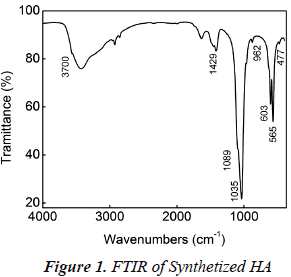
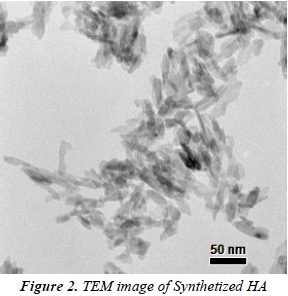
<p style="text-autospace: none" align="justify"> <font face="Verdana"> <span lang="EN-GB" style="font-size: 10.0pt; font-family: TimesNewRomanPSMT"> where </span><span style="font-size: 10.0pt; font-family: TimesNewRomanPSMT">&#945;</span><span lang="EN-GB" style="font-size: 10.0pt; font-family: TimesNewRomanPSMT">  is the degree of conversion, G(</span><span style="font-size: 10.0pt; font-family: TimesNewRomanPSMT">&#945;</span><span lang="EN-GB" style="font-size: 10.0pt; font-family: TimesNewRomanPSMT">)  the integral conversion function (reaction mechanism), </span> <span style="font-size: 10.0pt; font-family: TimesNewRomanPSMT">&#946;</span><span lang="EN-GB" style="font-size: 10.0pt; font-family: TimesNewRomanPSMT">  the constant heating rate, T the temperature in Kelvin, R the universal gas  constant, Ea the activation energy for the decomposition process and A the  pre-exponential factor.</span></font></p>     <p style="text-autospace: none" align="justify"><font face="Verdana"><b> <span lang="EN-GB" style="font-size: 10.0pt; font-family: TimesNewRomanPS-BoldMT"> RESULTS AND DISCUSSION</span></b></font></p>     <p style="text-autospace: none" align="justify"> <font face="Verdana"> <span lang="EN-GB" style="font-size: 10.0pt; font-family: TimesNewRomanPSMT"> Hydroxyapatite (HA) synthesis was extremely effective, resulting in a high yield  (99%). Characterization by FTIR showed the characteristic HA functional groups  bands: OH- (3700 and 1600 cm</span><sup><span lang="EN-GB" style="font-family: TimesNewRomanPSMT"><font size="2">-1</font></span></sup><span lang="EN-GB" style="font-size: 10.0pt; font-family: TimesNewRomanPSMT">),  PO</span><span lang="EN-GB" style="font-family: TimesNewRomanPSMT"><font size="2"><span style="letter-spacing: -2pt"><sub>4</sub></span><sup><span style="letter-spacing: -2pt">-</span>3</sup> </font> </span> <span lang="EN-GB" style="font-size: 10.0pt; font-family: TimesNewRomanPSMT"> (1089-1035, 962, 603-565, and 477 cm</span><sup><span lang="EN-GB" style="font-family: TimesNewRomanPSMT"><font size="2">-1</font></span></sup><span lang="EN-GB" style="font-size: 10.0pt; font-family: TimesNewRomanPSMT">)  (<a href="#fig1">figure 1</a>) (Rehman I </span><i> <span lang="EN-GB" style="font-size: 10.0pt; font-family: TimesNewRomanPS-ItalicMT"> et al.</span></i><span lang="EN-GB" style="font-size: 10.0pt; font-family: TimesNewRomanPSMT">,  1997). HA nanocrystals have needle-like morphology with an average length around  (AL) of (55 ± 9) nm and average diameter (AD) of (10 ± 1) nm as can be seen in  <a href="#fig2">figure 2</a> (Koutsopoulos, 2002).</span></font></p>     <p style="text-autospace: none" align="center"> <a name="fig1"> <img border="0" src="/img/fbpe/rfiucv/v30n1/art21fig1.gif" width="291" height="277"></a></p>     
<p style="text-autospace: none" align="center"> <a name="fig2"> <img border="0" src="/img/fbpe/rfiucv/v30n1/art21fig2.gif" width="288" height="296"></a></p>     
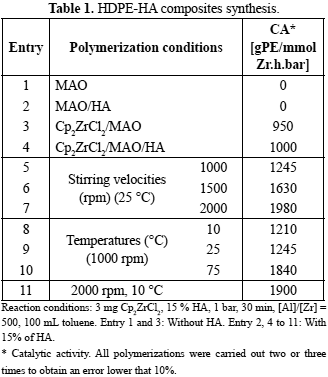
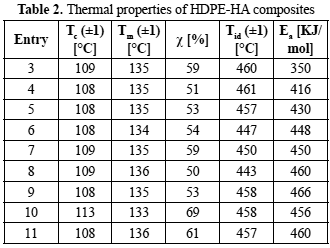
<p style="text-autospace: none" align="justify"> <font face="Verdana"> <span lang="EN-GB" style="font-size: 10.0pt; font-family: TimesNewRomanPSMT">In  order to standardize the polymerization reaction MAO, MAO/HA, and </span><span style="font-size: 10.0pt; font-family: TimesNewRomanPSMT">Cp</span><sub><span style="font-family: TimesNewRomanPSMT"><font size="2">2</font></span></sub><span style="font-size: 10.0pt; font-family: TimesNewRomanPSMT">ZrCl</span><sub><span style="font-family: TimesNewRomanPSMT"><font size="2">2</font></span></sub><span style="font-size: 10.0pt; font-family: TimesNewRomanPSMT">/MAO</span><span lang="EN-GB" style="font-size: 10.0pt; font-family: TimesNewRomanPSMT">  were tested on high density polyethylene production (HDPE). The ethylene  polymerizations were carried out under the conditions presented on  <a href="#tab1">table 1</a>  (entry 1-4). It was found that MAO or MAO/HA was not active on the ethylene  polymerization. Cp</span><sub><span lang="EN-GB" style="font-family: TimesNewRomanPSMT"><font size="2">2</font></span></sub><span lang="EN-GB" style="font-size: 10.0pt; font-family: TimesNewRomanPSMT">ZrCl</span><sub><span lang="EN-GB" style="font-family: TimesNewRomanPSMT"><font size="2">x</font></span></sub><span lang="EN-GB" style="font-size: 10.0pt; font-family: TimesNewRomanPSMT">/MAO  was active producing HDPE as expected (thermal properties presented on  <a href="#tab2">table 2</a>  are similar to the theoretical thermal properties previously reported) (Bandrup </span><i> <span lang="EN-GB" style="font-size: 10.0pt; font-family: TimesNewRomanPS-ItalicMT"> et al.</span></i><span lang="EN-GB" style="font-size: 10.0pt; font-family: TimesNewRomanPSMT">,  1999). The HDPE mass obtained was used as reference to calculate the equivalent  mass of 15 wt% HA, that was employed in the synthesis of HDPE-HA composites. HA  effect on the catalytic activity was studied (reaction 3 versus 4,  <a href="#tab1">table 1</a>) it  can be observed that HDPE production was not affected by the incorporation of  the filler into polymerization medium. In general, it has been reported that  supports that contain hydroxyl surface groups (i.e. zeolites, clays, others)  show a decay in the catalytic activity due to block of active sites for  polymerization (Hlatky, 2000). In the particular case of HA, a few OH groups are  at the surface (Koutsopoulos, 2002), therefore, that the catalytic would decay,  however, this effect was not observed in these experiments. Once it was confirm  that HA has no negative effect on catalytic activity and polymer production,  then the influence of stirring velocity and temperature on the filler dispersion  was evaluated.</span></font></p>     ]]></body>
<body><![CDATA[<p style="text-autospace: none" align="center"> <a name="tab1"> <img border="0" src="/img/fbpe/rfiucv/v30n1/art21tab1.gif" width="328" height="377"></a></p>     
<p style="text-autospace: none" align="center"> <a name="tab2"> <img border="0" src="/img/fbpe/rfiucv/v30n1/art21tab2.gif" width="330" height="248"></a></p>     
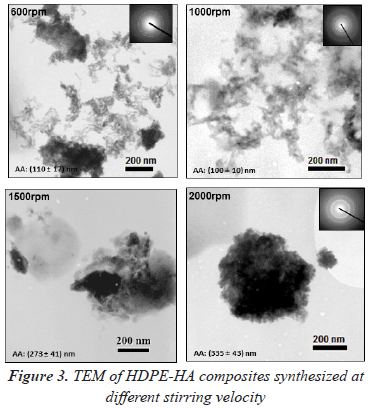
<p style="text-autospace: none" align="justify"> <font face="Verdana"> <span lang="EN-GB" style="font-size: 10.0pt; font-family: TimesNewRomanPSMT">The  stirring velocity was evaluated at first from 600 to 2000 rpm (<a href="#tab1">table 1</a>, entry  4-7). As can be seen at 2000 rpm (<a href="#tab1">table 1</a>, entry 7) the amount of polymer  obtained was almost twice the amount when 600 rpm was used (<a href="#tab1">table 1</a>, entry 4).  This is attributed to a better dispersion of the catalyst in the reaction medium  at higher stirring velocities and also to a better dispersion of the synthesized  polymer (Quijada </span><i> <span lang="EN-GB" style="font-size: 10.0pt; font-family: TimesNewRomanPS-ItalicMT"> et al.</span></i><span lang="EN-GB" style="font-size: 10.0pt; font-family: TimesNewRomanPSMT">,  1998).</span></font></p>     <p style="text-autospace: none" align="justify"> <font face="Verdana"> <span lang="EN-GB" style="font-size: 10.0pt; font-family: TimesNewRomanPSMT">TEM  images of HDPE-HA composites obtained at different stirring velocities are shown  in <a href="#fig3">figure 3</a>. At higher stirring velocities (1500 and 2000 rpm) formation of HA  agglomerates were obtained. This could be a consequence of the higher amount of  polymer formed impeding a good dispersion of the filler. To corroborate these  observations several measures of different images were carried out, obtaining  the following AA sizes: (273 ± 41) nm for 1500 rpm and (345 ± 43) nm for 2000  rpm. When the synthesis was carried out at lower stirring velocities (600 rpm)  few agglomerates can be observed presenting an AA of (110 ± 17) nm. The best HA  dispersion was obtained at 1000 rpm with the lowest AA size of (100 ± 10) nm,  this result indicated that at room temperature the better dispersion is achieved  when intermediate stirring velocities are used.</span></font></p>     <p style="text-autospace: none" align="center"> <a name="fig3"> <img border="0" src="/img/fbpe/rfiucv/v30n1/art21fig3.gif" width="368" height="408"></a></p>     
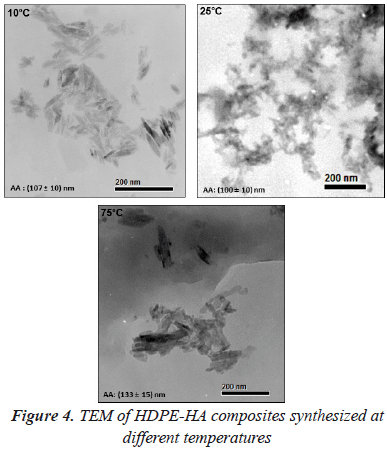
<p style="text-autospace: none" align="justify"> <font face="Verdana"> <span lang="EN-GB" style="font-size: 10.0pt; font-family: TimesNewRomanPSMT">The  effect of temperature (10 -75 °C) was evaluated at 1000 rpm because under this  stirring velocity the best HA nanocrystals dispersion was achieved. No  significant differences on the catalytic activity were obtained at 10 and 25 °C  (entry 8-9). However, when the synthesis was carried out at 75 °C, an increase  of approximately 20 % on HDPE production was obtained. This increasing reaction  rate with temperature is caused by the increased molecular collisions frequency,  as a consequence olefin molecules travels faster and react more often with the  active site, which is stable under these polymerization conditions. Similar  results have been reported in the synthesis on high density polyethylene-carbon  nanotube composites (Bonduel </span><i> <span lang="EN-GB" style="font-size: 10.0pt; font-family: TimesNewRomanPS-ItalicMT"> et al.</span></i><span lang="EN-GB" style="font-size: 10.0pt; font-family: TimesNewRomanPSMT">,  2007; Kao, 2006; Quijada </span><i> <span lang="EN-GB" style="font-size: 10.0pt; font-family: TimesNewRomanPS-ItalicMT"> et al.</span></i><span lang="EN-GB" style="font-size: 10.0pt; font-family: TimesNewRomanPSMT">,  1998; Kaminsky </span><i> <span lang="EN-GB" style="font-size: 10.0pt; font-family: TimesNewRomanPS-ItalicMT"> et al.</span></i><span lang="EN-GB" style="font-size: 10.0pt; font-family: TimesNewRomanPSMT">,  2006).</span></font></p>     <p style="text-autospace: none" align="justify"> <font face="Verdana"> <span lang="EN-GB" style="font-size: 10.0pt; font-family: TimesNewRomanPSMT">HA  nanocrystals dispersion was studied by TEM images (<a href="#fig4">figure 4</a>). Composites synthetized at 10 and 25 °C did not present significant differences in AA sizes  (107 ± 10 nm and 100 ± 10nm, respectively). However, at 10 °C it was found a  better dispersion being possible to differentiate each single HA nanocrystal.  Meanwhile, small agglomerates were observed at 25 °C. When the temperature was  raised to 75 °C there was an increase in the formation agglomerates. This could  be a consequence of the higher amount of polymer formed impeding a good  dispersion of the filler. In the TEM image it was observed how the HA  nanocrystals are embedded into the polymeric matrix.</span></font></p>     <p style="text-autospace: none" align="center"> <a name="fig4"> <img border="0" src="/img/fbpe/rfiucv/v30n1/art21fig4.gif" width="387" height="450"></a></p>     
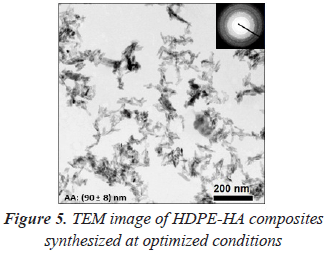
<p style="text-autospace: none" align="justify"> <font face="Verdana"> <span lang="EN-GB" style="font-size: 10.0pt; font-family: TimesNewRomanPSMT">In  order to produce higher amount of HDPE and maintain the polymer/filler ratio,  HDPE-HA composites were synthetized at 2000 rpm and 10 °C (<a href="#tab1">table 1</a>, entry 11).  Combining high stirring velocities and low temperatures HDPE production was  increased on a 60% with respect to entry 5 and 8 (<a href="#tab1">table 1</a>). A synergistic effect  of these two reactions parameters seems to be present, resulting in the best  filler dispersion throughout these studies, with HA nanocrystals interconnected  in a network without formation of agglomerates (<a href="#fig5">figure 5</a>). Therefore it can be  conclude that </span><i> <span lang="EN-GB" style="font-size: 10.0pt; font-family: TimesNewRomanPS-ItalicMT"> in situ </span></i> <span lang="EN-GB" style="font-size: 10.0pt; font-family: TimesNewRomanPSMT"> ethylene polymerization is an alternative synthesis method for the synthesis of  HDPE-HA composites, and the different parameters studied showed that it is  possible to obtain optimum conditions able to accomplish a good dispersion,  compared to the other synthesis methodologies previously reported (Albano </span> <i> <span lang="EN-GB" style="font-size: 10.0pt; font-family: TimesNewRomanPS-ItalicMT"> et al.</span></i><span lang="EN-GB" style="font-size: 10.0pt; font-family: TimesNewRomanPSMT">,  2006c; Wang </span><i> <span lang="EN-GB" style="font-size: 10.0pt; font-family: TimesNewRomanPS-ItalicMT"> et al.</span></i><span lang="EN-GB" style="font-size: 10.0pt; font-family: TimesNewRomanPSMT">,  1998; Roeder </span><i> <span lang="EN-GB" style="font-size: 10.0pt; font-family: TimesNewRomanPS-ItalicMT"> et al.</span></i><span lang="EN-GB" style="font-size: 10.0pt; font-family: TimesNewRomanPSMT">,  2003; Zhang </span><i> <span lang="EN-GB" style="font-size: 10.0pt; font-family: TimesNewRomanPS-ItalicMT"> et al.</span></i><span lang="EN-GB" style="font-size: 10.0pt; font-family: TimesNewRomanPSMT">,  2003).</span></font></p>     <p style="text-autospace: none" align="center"> <a name="fig5"> <img border="0" src="/img/fbpe/rfiucv/v30n1/art21fig5.gif" width="326" height="258"></a></p>     
]]></body>
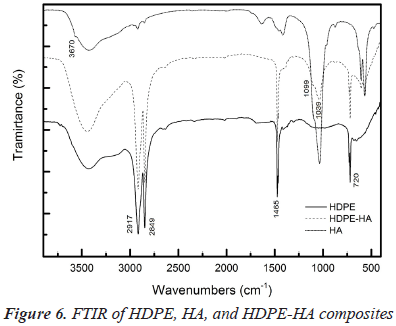
<body><![CDATA[<p style="text-autospace: none" align="justify"> <font face="Verdana"> <span lang="EN-GB" style="font-size: 10.0pt; font-family: TimesNewRomanPSMT"> HDPE and HDPE-HA composites were characterized by FTIR, composites spectra were  very similar, for this reason only the spectrum of HDPE-HA composite synthetized  at 2000 rpm and 10ºC is presented (<a href="#fig6">figure 6</a>). The HDPE spectrum shows the signal  associated to the vibrational deformation mode of methylene CH groups (CH</span><sub><span lang="EN-GB" style="font-family: TimesNewRomanPSMT"><font size="2">2</font></span></sub><span lang="EN-GB" style="font-size: 10.0pt; font-family: TimesNewRomanPSMT">)</span><span lang="EN-GB" style="font-family: TimesNewRomanPSMT"><font size="2"><sub>n</sub> </font> </span> <span lang="EN-GB" style="font-size: 10.0pt; font-family: TimesNewRomanPSMT">in  the polymer at 720 cm</span><sup><span lang="EN-GB" style="font-family: TimesNewRomanPSMT"><font size="2">-1</font></span></sup><span lang="EN-GB" style="font-size: 10.0pt; font-family: TimesNewRomanPSMT">,  this vibration is characteristic for polymers with more than 4 carbon atoms in  the polymer chain. Also, the bands associated to vibrational deformation C-H  bond at 1465 cm</span><span lang="EN-GB" style="font-family: TimesNewRomanPSMT"><font size="2"><sup>-1</sup> </font> </span> <span lang="EN-GB" style="font-size: 10.0pt; font-family: TimesNewRomanPSMT"> (Bandrup </span><i> <span lang="EN-GB" style="font-size: 10.0pt; font-family: TimesNewRomanPS-ItalicMT"> et al.</span></i><span lang="EN-GB" style="font-size: 10.0pt; font-family: TimesNewRomanPSMT">,  1999), were observed. The HDPE-HA composite spectrum presents the bands of the  two main components of the composites, when HDPE-HA spectrum is compared to the  HA spectrum significance displacement of the signals associated to filler  functional groups were observed, this behavior was observed in all the  synthetized composites.</span></font></p>     <p style="text-autospace: none" align="center"> <a name="fig6"> <img border="0" src="/img/fbpe/rfiucv/v30n1/art21fig6.gif" width="396" height="326"></a></p>     
<p style="text-autospace: none" align="justify"> <font face="Verdana"> <span lang="EN-GB" style="font-size: 10.0pt; font-family: TimesNewRomanPSMT"> Additionally, the thermal behavior of HDPE-HA composites was studied by TGA. It  was found that HA incorporation into the polymeric matrix did not have a  significant effect on polyethylene thermal properties, such as crystallization  temperature, melting temperature, or crystalline percentage (<a href="#tab2">table 2</a>) (Albano </span><i> <span lang="EN-GB" style="font-size: 10.0pt; font-family: TimesNewRomanPS-ItalicMT"> et al.</span></i><span lang="EN-GB" style="font-size: 10.0pt; font-family: TimesNewRomanPSMT">,  2006a, 2006b; Minkova </span><i> <span lang="EN-GB" style="font-size: 10.0pt; font-family: TimesNewRomanPS-ItalicMT"> et al.</span></i><span lang="EN-GB" style="font-size: 10.0pt; font-family: TimesNewRomanPSMT">,  1993). However, in some cases there are some significant changes in this thermal  properties, it has been reported that this kind of behavior could be attributed  to a change in polymer molecular weight, that can be due to the differences  synthesis conditions (Cossee </span><i> <span lang="EN-GB" style="font-size: 10.0pt; font-family: TimesNewRomanPS-ItalicMT"> et al.</span></i><span lang="EN-GB" style="font-size: 10.0pt; font-family: TimesNewRomanPSMT">,  1964; Chien </span><i> <span lang="EN-GB" style="font-size: 10.0pt; font-family: TimesNewRomanPS-ItalicMT"> et al.</span></i><span lang="EN-GB" style="font-size: 10.0pt; font-family: TimesNewRomanPSMT">,  1993)</span></font></p>     <p style="text-autospace: none" align="justify"> <font face="Verdana"> <span lang="EN-GB" style="font-size: 10.0pt; font-family: TimesNewRomanPSMT"> Also, a slightly change (0.2-3.7) % of the initial decomposition temperatures of  HDPE-HA compounds with respect to the polymerization of ethylene without filler  was observed. The activation energy (Ea) of the polymer and each composite was  calculated using E</span><span lang="EN-GB" style="font-family: TimesNewRomanPSMT"><font size="2"><sub>2</sub> </font> </span> <span lang="EN-GB" style="font-size: 10.0pt; font-family: TimesNewRomanPSMT"> Function model (<a href="#tab2">table 2</a>), the results obtained presented an increased on this  parameter when HA was added into the polymeric matrix, this could indicate that  although HA does not change the thermal properties produced an improvement on  the thermal stability of the composites, slowing down the degradation processes  of the HDPE (Bikiaris, 2011; Chrissafisa </span><i> <span lang="EN-GB" style="font-size: 10.0pt; font-family: TimesNewRomanPS-ItalicMT"> et al.</span></i><span lang="EN-GB" style="font-size: 10.0pt; font-family: TimesNewRomanPSMT">,  2011; Hermán </span><i> <span lang="EN-GB" style="font-size: 10.0pt; font-family: TimesNewRomanPS-ItalicMT"> et al.</span></i><span lang="EN-GB" style="font-size: 10.0pt; font-family: TimesNewRomanPSMT">,  2013).</span></font></p>     <p style="text-autospace: none" align="justify"> <font face="Verdana"> <span lang="EN-GB" style="font-size: 10.0pt; font-family: TimesNewRomanPSMT">As  it is known, polymers degradation is a very complex phenomenon, consequently,  the degradation process are represented by a set of functions and not for a  single function. Although the E</span><span lang="EN-GB" style="font-family: TimesNewRomanPSMT"><font size="2"><sub>2</sub> </font> </span> <span lang="EN-GB" style="font-size: 10.0pt; font-family: TimesNewRomanPSMT"> Function model allowed obtaining Ea value using the heating rate, the proper  kinetic model must be chosen employing a model fitting method. The best reaction  mechanism will be that which best fits equation (Eq. 2). In this article,  fourteen mechanisms functions were evaluated(Budrugeac </span><i> <span lang="EN-GB" style="font-size: 10.0pt; font-family: TimesNewRomanPS-ItalicMT"> et al.</span></i><span lang="EN-GB" style="font-size: 10.0pt; font-family: TimesNewRomanPSMT">,  2001; Mamleev </span><i> <span lang="EN-GB" style="font-size: 10.0pt; font-family: TimesNewRomanPS-ItalicMT"> et al.</span></i><span lang="EN-GB" style="font-size: 10.0pt; font-family: TimesNewRomanPSMT">,  2000). The best fit obtained for all samples was the nth order reaction  mechanism with n = 1. The models with the second and third best fits were  nucleation and nucleus growth with n = 1/2 and 1/3, respectively. In general,  the thermal degradation of polymeric composites is a heterogeneous process ruled  by more than one mechanism. Therefore, thermal degradation of HDPE-HA composites  evaluated in the present work, can be describe as a physicochemical phenomenon  that involves chemical degradation reaction of first order, accompanied by  formation of the gas phase inside the melt polymer and by nucleation and nucleus  growth kinetics of degraded species in a heterogeneous medium (Budrugeac </span> <i> <span lang="EN-GB" style="font-size: 10.0pt; font-family: TimesNewRomanPS-ItalicMT"> et al.</span></i><span lang="EN-GB" style="font-size: 10.0pt; font-family: TimesNewRomanPSMT">,  2001; Hermán </span><i> <span lang="EN-GB" style="font-size: 10.0pt; font-family: TimesNewRomanPS-ItalicMT"> et al.</span></i><span lang="EN-GB" style="font-size: 10.0pt; font-family: TimesNewRomanPSMT">,  2013; Mamleev </span><i> <span lang="EN-GB" style="font-size: 10.0pt; font-family: TimesNewRomanPS-ItalicMT"> et al.</span></i><span lang="EN-GB" style="font-size: 10.0pt; font-family: TimesNewRomanPSMT">,  2000).</span></font></p>     <p style="text-autospace: none" align="justify"> <font face="Verdana"> <span lang="EN-GB" style="font-size: 10.0pt; font-family: TimesNewRomanPSMT"> Entry 1 and 2 are not in the table because in these syntheses conditions  polyethylene was not obtained.</span></font></p>     <p style="text-autospace: none" align="justify"><font face="Verdana"><b> <span lang="EN-GB" style="font-size: 10.0pt; font-family: TimesNewRomanPS-BoldMT"> CONCLUSIONS</span></b></font></p>     <p style="text-autospace: none" align="justify"><font face="Verdana"><i> <span lang="EN-GB" style="font-size: 10.0pt; font-family: TimesNewRomanPS-ItalicMT"> In situ </span></i> <span lang="EN-GB" style="font-size: 10.0pt; font-family: TimesNewRomanPSMT"> ethylene polymerization is an alternative synthesis method for the synthesis of  HDPE-HA composites, combining high stirring velocities (2000 rpm) and low  temperatures (10 °C) was possible to reach good dispersion of HA nanocrystals  interconnected in a network without the presence of agglomerates.</span></font></p>     <p style="text-autospace: none" align="justify"> <font face="Verdana"> <span lang="EN-GB" style="font-size: 10.0pt; font-family: TimesNewRomanPSMT">A  possible interaction between the filler and the polymer is proposed due to a  significant displacement of HA functional groups observed in FTIR spectra.  Thermal properties of HDPE-HA did not change significantly compared to HDPE  alone. Activation energy increased with HA incorporation, indicating that HA  improves the thermal stability of the composites. Thermal degradation of HDPE-HA  composites involved chemical degradation reaction of first order, accompanied by  formation of the gas phase inside the melt polymer.</span></font></p>     <p style="text-autospace: none" align="justify"> <font face="Verdana"> <span lang="EN-GB" style="font-size: 10.0pt; font-family: TimesNewRomanPSMT">The  use of </span><i> <span lang="EN-GB" style="font-size: 10.0pt; font-family: TimesNewRomanPS-ItalicMT"> in situ </span></i> <span lang="EN-GB" style="font-size: 10.0pt; font-family: TimesNewRomanPSMT"> ethylene polymerization for synthetized these composites can be interesting to  improve mechanical properties for biomedical applications; these properties are  under current investigations.</span></font></p>     ]]></body>
<body><![CDATA[<p style="text-autospace: none" align="justify"><font face="Verdana"><b> <span lang="EN-GB" style="font-size: 10.0pt; font-family: TimesNewRomanPS-BoldMT"> ABREVATIONS</span></b></font></p>     <p style="text-autospace: none" align="justify"> <font face="Verdana"> <span lang="EN-GB" style="font-size: 10.0pt; font-family: TimesNewRomanPSMT">CA:  Catalytic activity</span></font></p>     <p style="text-autospace: none" align="justify"> <font face="Verdana"> <span lang="EN-GB" style="font-size: 10.0pt; font-family: TimesNewRomanPSMT">Cp</span><sub><span lang="EN-GB" style="font-family: TimesNewRomanPSMT"><font size="2">2</font></span></sub><span lang="EN-GB" style="font-size: 10.0pt; font-family: TimesNewRomanPSMT">ZrCl</span><sub><span lang="EN-GB" style="font-family: TimesNewRomanPSMT"><font size="2">2</font></span></sub><span lang="EN-GB" style="font-size: 10.0pt; font-family: TimesNewRomanPSMT">:  Bis-(cyclopentadienyl) zirconium dichloride</span></font></p>     <p style="text-autospace: none" align="justify"> <font face="Verdana"> <span lang="EN-GB" style="font-size: 10.0pt; font-family: TimesNewRomanPSMT">HA:  Hydroxyapatite</span></font></p>     <p style="text-autospace: none" align="justify"> <font face="Verdana"> <span lang="EN-GB" style="font-size: 10.0pt; font-family: TimesNewRomanPSMT"> HDPE: High density polyethylene</span></font></p>     <p style="text-autospace: none" align="justify"> <font face="Verdana"> <span lang="EN-GB" style="font-size: 10.0pt; font-family: TimesNewRomanPSMT"> FTIR: Fourier transforms infrared spectroscopy</span></font></p>     <p style="text-autospace: none" align="justify"> <font face="Verdana"> <span lang="EN-GB" style="font-size: 10.0pt; font-family: TimesNewRomanPSMT"> MAO: Metylaluminoxane</span></font></p>     <p style="text-autospace: none" align="justify"> <font face="Verdana"> <span lang="EN-GB" style="font-size: 10.0pt; font-family: TimesNewRomanPSMT">T</span><sub><span lang="EN-GB" style="font-family: TimesNewRomanPSMT"><font size="2">C</font></span></sub><span lang="EN-GB" style="font-size: 10.0pt; font-family: TimesNewRomanPSMT">:  Crystallization temperature</span></font></p>     <p style="text-autospace: none" align="justify"> <font face="Verdana"> <span lang="EN-GB" style="font-size: 10.0pt; font-family: TimesNewRomanPSMT"> TEM: Transmission electron microscopy</span></font></p>     <p style="text-autospace: none" align="justify"> <font face="Verdana"> <span lang="EN-GB" style="font-size: 10.0pt; font-family: TimesNewRomanPSMT">T</span><sub><span lang="EN-GB" style="font-family: TimesNewRomanPSMT"><font size="2">id</font></span></sub><span lang="EN-GB" style="font-size: 10.0pt; font-family: TimesNewRomanPSMT">:  Initial decomposition temperature</span></font></p>     ]]></body>
<body><![CDATA[<p style="text-autospace: none" align="justify"> <font face="Verdana"> <span lang="EN-GB" style="font-size: 10.0pt; font-family: TimesNewRomanPSMT">T</span><sub><span lang="EN-GB" style="font-family: TimesNewRomanPSMT"><font size="2">m</font></span></sub><span lang="EN-GB" style="font-size: 10.0pt; font-family: TimesNewRomanPSMT">:  Melting temperature</span></font></p>     <p style="text-autospace: none" align="justify"> <font face="Verdana"> <span style="font-size: 10.0pt; font-family: TimesNewRomanPSMT">XRD: X-ray  diffraction</span></font></p>     <p align="justify"><font face="Verdana"> <b><span style="font-size: 10.0pt; font-family: TimesNewRomanPS-BoldMT"> REFERENCES</span></b></font></p>     <!-- ref --><p style="text-align:justify"> <span lang="EN-US" style="font-size: 10.0pt; font-family: Verdana; color: black"> 1. Aemarego (2003). Purifaction of Laboratory Chemicals. Woburn:  Heinemann-Butterworth.</span>&nbsp;&nbsp;&nbsp;&nbsp;&nbsp;&nbsp;&nbsp;&nbsp;[&#160;<a href="javascript:void(0);" onclick="javascript: window.open('/scielo.php?script=sci_nlinks&ref=1902002&pid=S0798-4065201500010002100001&lng=','','width=640,height=500,resizable=yes,scrollbars=1,menubar=yes,');">Links</a>&#160;]<!-- end-ref --><!-- ref --><p style="text-align:justify"> <span lang="EN-US" style="font-size: 10.0pt; font-family: Verdana; color: black"> 2. Albano C., Karam A., Dominguez N., Sanchez Y., Perera R., Gonzalez G.  (2006a). Optimal condictionting for preparation of HDPE-HA composite in an  internal mixer. Mol. Cryst. Liq. Cryst. 448: 251-259.</span>&nbsp;&nbsp;&nbsp;&nbsp;&nbsp;&nbsp;&nbsp;&nbsp;[&#160;<a href="javascript:void(0);" onclick="javascript: window.open('/scielo.php?script=sci_nlinks&ref=1902003&pid=S0798-4065201500010002100002&lng=','','width=640,height=500,resizable=yes,scrollbars=1,menubar=yes,');">Links</a>&#160;]<!-- end-ref --><!-- ref --><p style="text-align:justify"> <span lang="EN-US" style="font-size: 10.0pt; font-family: Verdana; color: black"> 3. Albano C., Karam A., Gonzalez G., Domínguez N., Sanchez Y. (2006b). Study of  Gamma Radiation Effect on PMMA/HA Composites Prepared by Solution. </span> <span style="font-size:10.0pt; font-family:Verdana;color:black">Mol. Cryst. Liq. Cryst. 448: 845-851.</span>&nbsp;&nbsp;&nbsp;&nbsp;&nbsp;&nbsp;&nbsp;&nbsp;[&#160;<a href="javascript:void(0);" onclick="javascript: window.open('/scielo.php?script=sci_nlinks&ref=1902004&pid=S0798-4065201500010002100003&lng=','','width=640,height=500,resizable=yes,scrollbars=1,menubar=yes,');">Links</a>&#160;]<!-- end-ref --><!-- ref --><p style="text-align:justify"> <span style="font-size:10.0pt; font-family:Verdana;color:black">4. Albano C., Karam A., Perera R., González G.,  Domínguez N., González J., Sánchez Y. (2006c). </span> <span lang="EN-US" style="font-size: 10.0pt; font-family: Verdana; color: black"> HDPE/HA composites obtained in solution: Effect of the gamma radiation. Nucl.  Instr. Meth. Phys. Res. B. 247: 331-341. </span>&nbsp;&nbsp;&nbsp;&nbsp;&nbsp;&nbsp;&nbsp;&nbsp;[&#160;<a href="javascript:void(0);" onclick="javascript: window.open('/scielo.php?script=sci_nlinks&ref=1902005&pid=S0798-4065201500010002100004&lng=','','width=640,height=500,resizable=yes,scrollbars=1,menubar=yes,');">Links</a>&#160;]<!-- end-ref --><!-- ref --><p style="text-align:justify"> <span lang="EN-US" style="font-size: 10.0pt; font-family: Verdana; color: black"> 5. Bandrup J., Immergut E. H., Grulke E. A. (1999). Polymer Handbook. New York:  John Wiley &amp; Sons.</span>&nbsp;&nbsp;&nbsp;&nbsp;&nbsp;&nbsp;&nbsp;&nbsp;[&#160;<a href="javascript:void(0);" onclick="javascript: window.open('/scielo.php?script=sci_nlinks&ref=1902006&pid=S0798-4065201500010002100005&lng=','','width=640,height=500,resizable=yes,scrollbars=1,menubar=yes,');">Links</a>&#160;]<!-- end-ref --><!-- ref --><p style="text-align:justify"> <span lang="EN-US" style="font-size: 10.0pt; font-family: Verdana; color: black"> 6. Bikiaris D. (2011). Can nanoparticles really enhance thermal stability of  polymers? Part II: An overview on thermal decomposition of polycondensation  polymers. Thermochimica Acta. 523: 25-45.</span>&nbsp;&nbsp;&nbsp;&nbsp;&nbsp;&nbsp;&nbsp;&nbsp;[&#160;<a href="javascript:void(0);" onclick="javascript: window.open('/scielo.php?script=sci_nlinks&ref=1902007&pid=S0798-4065201500010002100006&lng=','','width=640,height=500,resizable=yes,scrollbars=1,menubar=yes,');">Links</a>&#160;]<!-- end-ref --><!-- ref --><p style="text-align:justify"> <span lang="EN-US" style="font-size: 10.0pt; font-family: Verdana; color: black"> 7. Billmeyer Von F. W. (1984). Textbook of Polymer Science. New York: John Wiley  &amp; Sons.</span>&nbsp;&nbsp;&nbsp;&nbsp;&nbsp;&nbsp;&nbsp;&nbsp;[&#160;<a href="javascript:void(0);" onclick="javascript: window.open('/scielo.php?script=sci_nlinks&ref=1902008&pid=S0798-4065201500010002100007&lng=','','width=640,height=500,resizable=yes,scrollbars=1,menubar=yes,');">Links</a>&#160;]<!-- end-ref --><!-- ref --><p style="text-align:justify"> <span lang="EN-US" style="font-size: 10.0pt; font-family: Verdana; color: black"> 8. Bonfield W., Grynpas M.D., Tully A.E., Bowman J., Abram J. (1981).  Hydroxyapatite reinforced polyethylen a mechanically ompatible implant material  for bone replacement. Biomaterials. 1-2: 185-186.</span>&nbsp;&nbsp;&nbsp;&nbsp;&nbsp;&nbsp;&nbsp;&nbsp;[&#160;<a href="javascript:void(0);" onclick="javascript: window.open('/scielo.php?script=sci_nlinks&ref=1902009&pid=S0798-4065201500010002100008&lng=','','width=640,height=500,resizable=yes,scrollbars=1,menubar=yes,');">Links</a>&#160;]<!-- end-ref --><!-- ref --><p style="text-align:justify"> <span lang="EN-US" style="font-size: 10.0pt; font-family: Verdana; color: black"> 9. Bonduel D., Mainil M., Alexandre M., Monteverdeb F., Dubois P. (2005).  Supported coordination polymerization: a unique way to potent polyolefin carbon  nanotube nanocomposites. Chem. Common. 14(6): 781-783.</span>&nbsp;&nbsp;&nbsp;&nbsp;&nbsp;&nbsp;&nbsp;&nbsp;[&#160;<a href="javascript:void(0);" onclick="javascript: window.open('/scielo.php?script=sci_nlinks&ref=1902010&pid=S0798-4065201500010002100009&lng=','','width=640,height=500,resizable=yes,scrollbars=1,menubar=yes,');">Links</a>&#160;]<!-- end-ref --><!-- ref --><p style="text-align:justify"> <span lang="EN-US" style="font-size: 10.0pt; font-family: Verdana; color: black"> 10. Bonduel D., Breadeu S., Alexandre M., Monteverde F., Dubois P. (2007).  Supported metalloce catalysis as an efficient toll for the preparation of  polyhetylene/carbon nanotube nanocomposites: effect of the catalytica system on  the coating morphology. </span> <span style="font-size:10.0pt;font-family:Verdana;color:black">J. Mater. Chem.  17: 2359- 2366.</span>&nbsp;&nbsp;&nbsp;&nbsp;&nbsp;&nbsp;&nbsp;&nbsp;[&#160;<a href="javascript:void(0);" onclick="javascript: window.open('/scielo.php?script=sci_nlinks&ref=1902011&pid=S0798-4065201500010002100010&lng=','','width=640,height=500,resizable=yes,scrollbars=1,menubar=yes,');">Links</a>&#160;]<!-- end-ref --><!-- ref --><p style="text-align:justify"> <span lang="EN-US" style="font-size: 10.0pt; font-family: Verdana; color: black"> 11. Budrugeac P., Segal E. (2001). Some methodological problems concerning  nonisothermal kinetic analysis of heterogeneous solid gas reactions. </span> <span lang="FR" style="font-size: 10.0pt; font-family: Verdana; color: black"> International Int. J. Chem. Kinet. 33(10): 564-573.</span>&nbsp;&nbsp;&nbsp;&nbsp;&nbsp;&nbsp;&nbsp;&nbsp;[&#160;<a href="javascript:void(0);" onclick="javascript: window.open('/scielo.php?script=sci_nlinks&ref=1902012&pid=S0798-4065201500010002100011&lng=','','width=640,height=500,resizable=yes,scrollbars=1,menubar=yes,');">Links</a>&#160;]<!-- end-ref --><!-- ref --><p style="text-align:justify"> <span lang="FR" style="font-size: 10.0pt; font-family: Verdana; color: black"> 12. Chen H., Lai K., Lin Y. (2004). </span> <span lang="EN-US" style="font-size: 10.0pt; font-family: Verdana; color: black"> Methods for Determining the Kinetic Parameters from Nonisothermal  Thermogravimetry: A Comparison of Reliability. J. Chem. Eng. Japan. 37(9):  1172-1178.</span>&nbsp;&nbsp;&nbsp;&nbsp;&nbsp;&nbsp;&nbsp;&nbsp;[&#160;<a href="javascript:void(0);" onclick="javascript: window.open('/scielo.php?script=sci_nlinks&ref=1902013&pid=S0798-4065201500010002100012&lng=','','width=640,height=500,resizable=yes,scrollbars=1,menubar=yes,');">Links</a>&#160;]<!-- end-ref --><!-- ref --><p style="text-align:justify"> <span lang="EN-US" style="font-size: 10.0pt; font-family: Verdana; color: black"> 13. Chien J., Woei-Min T. (1993). Zirconocenium cation catalysis of propene  polymerization. Makromol. Chem., Macromol. Symp. 66(1): 141-156.</span>&nbsp;&nbsp;&nbsp;&nbsp;&nbsp;&nbsp;&nbsp;&nbsp;[&#160;<a href="javascript:void(0);" onclick="javascript: window.open('/scielo.php?script=sci_nlinks&ref=1902014&pid=S0798-4065201500010002100013&lng=','','width=640,height=500,resizable=yes,scrollbars=1,menubar=yes,');">Links</a>&#160;]<!-- end-ref --><!-- ref --><p style="text-align:justify"> <span lang="EN-US" style="font-size: 10.0pt; font-family: Verdana; color: black"> 14. Chrissafisa K., Bikiaris D. (2011). Can nanoparticles really enhance thermal  stability of polymers? Part I: An overview on thermal decomposition of addition  polymers. Thermochimica Acta. 523: 1-24.</span>&nbsp;&nbsp;&nbsp;&nbsp;&nbsp;&nbsp;&nbsp;&nbsp;[&#160;<a href="javascript:void(0);" onclick="javascript: window.open('/scielo.php?script=sci_nlinks&ref=1902015&pid=S0798-4065201500010002100014&lng=','','width=640,height=500,resizable=yes,scrollbars=1,menubar=yes,');">Links</a>&#160;]<!-- end-ref --><!-- ref --><p style="text-align:justify"> <span lang="EN-US" style="font-size: 10.0pt; font-family: Verdana; color: black"> 15. Coats A.W., Redfern J.P. (1964). Kinetic parameters from thermogravimetric  data. Nature. 201:68-78.</span>&nbsp;&nbsp;&nbsp;&nbsp;&nbsp;&nbsp;&nbsp;&nbsp;[&#160;<a href="javascript:void(0);" onclick="javascript: window.open('/scielo.php?script=sci_nlinks&ref=1902016&pid=S0798-4065201500010002100015&lng=','','width=640,height=500,resizable=yes,scrollbars=1,menubar=yes,');">Links</a>&#160;]<!-- end-ref --><!-- ref --><p style="text-align:justify"> <span lang="EN-US" style="font-size: 10.0pt; font-family: Verdana; color: black"> 16. Cossee P., Arlman E. J. (1964). Ziegler-Natta Catalysis III. Stereospecific  Polymerization of Propene with the Catalyst System TiCI<span class="A5">3</span>-AlEt<span class="A5">3</span>. </span><span style="font-size:10.0pt;font-family:Verdana;color:black">J. Cat. 3:  99-104.</span>&nbsp;&nbsp;&nbsp;&nbsp;&nbsp;&nbsp;&nbsp;&nbsp;[&#160;<a href="javascript:void(0);" onclick="javascript: window.open('/scielo.php?script=sci_nlinks&ref=1902017&pid=S0798-4065201500010002100016&lng=','','width=640,height=500,resizable=yes,scrollbars=1,menubar=yes,');">Links</a>&#160;]<!-- end-ref --><!-- ref --><p style="text-align:justify"> <span style="font-size:10.0pt; font-family:Verdana;color:black">17. Hermán V., Albano C., Karam A., González  G., Covis M. (2013). </span> <span lang="EN-US" style="font-size: 10.0pt; font-family: Verdana; color: black"> Thermodegradative study of HDPE–HA nanocomposites: IKP and E<span class="A5">2 </span>function. Polym. Bull. 70: 81-96.</span>&nbsp;&nbsp;&nbsp;&nbsp;&nbsp;&nbsp;&nbsp;&nbsp;[&#160;<a href="javascript:void(0);" onclick="javascript: window.open('/scielo.php?script=sci_nlinks&ref=1902018&pid=S0798-4065201500010002100017&lng=','','width=640,height=500,resizable=yes,scrollbars=1,menubar=yes,');">Links</a>&#160;]<!-- end-ref --><!-- ref --><p style="text-align:justify"> <span lang="EN-US" style="font-size: 10.0pt; font-family: Verdana; color: black"> 18. Hlatky (2000). Heterogeneous Single-site catalysts for olefin  polymerization. Chem. Rev. 100: 1347-1376.</span>&nbsp;&nbsp;&nbsp;&nbsp;&nbsp;&nbsp;&nbsp;&nbsp;[&#160;<a href="javascript:void(0);" onclick="javascript: window.open('/scielo.php?script=sci_nlinks&ref=1902019&pid=S0798-4065201500010002100018&lng=','','width=640,height=500,resizable=yes,scrollbars=1,menubar=yes,');">Links</a>&#160;]<!-- end-ref --><!-- ref --><p style="text-align:justify"> <span lang="EN-US" style="font-size: 10.0pt; font-family: Verdana; color: black"> 19. Kaminsky W., Funck A., Wiemann K. (2006). Nanocomposites by <i>In Situ </i> Polymerization of Olefins with Metallocene Catalysts. Macromol. Symp. 239: 1-6.</span>&nbsp;&nbsp;&nbsp;&nbsp;&nbsp;&nbsp;&nbsp;&nbsp;[&#160;<a href="javascript:void(0);" onclick="javascript: window.open('/scielo.php?script=sci_nlinks&ref=1902020&pid=S0798-4065201500010002100019&lng=','','width=640,height=500,resizable=yes,scrollbars=1,menubar=yes,');">Links</a>&#160;]<!-- end-ref --><!-- ref --><p style="text-align:justify"> <span lang="EN-US" style="font-size: 10.0pt; font-family: Verdana; color: black"> 20. Kao Kuo-Tseng L. (2006). Nanosized silica-supported metallocene/MAO  catalyst for propylene polymerization. J. Appl. Polym. Sci. 101(4): 2573-2580.</span>&nbsp;&nbsp;&nbsp;&nbsp;&nbsp;&nbsp;&nbsp;&nbsp;[&#160;<a href="javascript:void(0);" onclick="javascript: window.open('/scielo.php?script=sci_nlinks&ref=1902021&pid=S0798-4065201500010002100020&lng=','','width=640,height=500,resizable=yes,scrollbars=1,menubar=yes,');">Links</a>&#160;]<!-- end-ref --><!-- ref --><p style="text-align:justify"> <span lang="EN-US" style="font-size: 10.0pt; font-family: Verdana; color: black"> 21. Koutsopoulos S. (2002). Synthesis anda characterization of hydroxyapatite  crystals: A review study in analytical methods. J. Biomed. Mater. Res. 62(4):  600-612.</span>&nbsp;&nbsp;&nbsp;&nbsp;&nbsp;&nbsp;&nbsp;&nbsp;[&#160;<a href="javascript:void(0);" onclick="javascript: window.open('/scielo.php?script=sci_nlinks&ref=1902022&pid=S0798-4065201500010002100021&lng=','','width=640,height=500,resizable=yes,scrollbars=1,menubar=yes,');">Links</a>&#160;]<!-- end-ref --><!-- ref --><p style="text-align:justify"> <span lang="EN-US" style="font-size: 10.0pt; font-family: Verdana; color: black"> 22. Mamleev V., Bourbigot S., Le Bras M., Dequesne S., Sestak J. (2000).  Modelling of nonisothermal kinetics in thermogravimetry. Phys. Chem. Chem. Phys.  2: 4708- 4716.</span>&nbsp;&nbsp;&nbsp;&nbsp;&nbsp;&nbsp;&nbsp;&nbsp;[&#160;<a href="javascript:void(0);" onclick="javascript: window.open('/scielo.php?script=sci_nlinks&ref=1902023&pid=S0798-4065201500010002100022&lng=','','width=640,height=500,resizable=yes,scrollbars=1,menubar=yes,');">Links</a>&#160;]<!-- end-ref --><!-- ref --><p style="text-align:justify"> <span lang="EN-US" style="font-size: 10.0pt; font-family: Verdana; color: black"> 23. Minkova L., Magagnini P. L. (1993). Crystallization behaviour and thermal  stability of HDPE filled during polymerization. Polym. Degra. Stab. 42: 107-115.</span>&nbsp;&nbsp;&nbsp;&nbsp;&nbsp;&nbsp;&nbsp;&nbsp;[&#160;<a href="javascript:void(0);" onclick="javascript: window.open('/scielo.php?script=sci_nlinks&ref=1902024&pid=S0798-4065201500010002100023&lng=','','width=640,height=500,resizable=yes,scrollbars=1,menubar=yes,');">Links</a>&#160;]<!-- end-ref --><!-- ref --><p style="text-align:justify"> <span lang="EN-US" style="font-size: 10.0pt; font-family: Verdana; color: black"> 24. Park J. (2003). Biomaterials: Principles and Applications. EUA: CRC Press.</span>&nbsp;&nbsp;&nbsp;&nbsp;&nbsp;&nbsp;&nbsp;&nbsp;[&#160;<a href="javascript:void(0);" onclick="javascript: window.open('/scielo.php?script=sci_nlinks&ref=1902025&pid=S0798-4065201500010002100024&lng=','','width=640,height=500,resizable=yes,scrollbars=1,menubar=yes,');">Links</a>&#160;]<!-- end-ref --><!-- ref --><p style="text-align:justify"> <span lang="EN-US" style="font-size: 10.0pt; font-family: Verdana; color: black"> 25. Quijada R., Rojasa R., Narvaeza A., Alzamorab L., Retuertb J., Rabagliatic  F. M. (1998). The effect of reaction parameters on catalytic activity in the  polymerization of ethylene using supported and unsupported metallocene  catalysts. App. Cat. A: General. 166(1): 207-213.</span>&nbsp;&nbsp;&nbsp;&nbsp;&nbsp;&nbsp;&nbsp;&nbsp;[&#160;<a href="javascript:void(0);" onclick="javascript: window.open('/scielo.php?script=sci_nlinks&ref=1902026&pid=S0798-4065201500010002100025&lng=','','width=640,height=500,resizable=yes,scrollbars=1,menubar=yes,');">Links</a>&#160;]<!-- end-ref --><!-- ref --><p style="text-align:justify"> <span lang="EN-US" style="font-size: 10.0pt; font-family: Verdana; color: black"> 26. Rehman I., Bonfield W. (1997). Characterization of hydroxyapatite and  carbonated apatite by photo acoustic FTIR spectroscopy. J. Mater. Scie.: Mater.  Med. 8(1): 1-4.</span>&nbsp;&nbsp;&nbsp;&nbsp;&nbsp;&nbsp;&nbsp;&nbsp;[&#160;<a href="javascript:void(0);" onclick="javascript: window.open('/scielo.php?script=sci_nlinks&ref=1902027&pid=S0798-4065201500010002100026&lng=','','width=640,height=500,resizable=yes,scrollbars=1,menubar=yes,');">Links</a>&#160;]<!-- end-ref --><!-- ref --><p style="text-align:justify"> <span lang="EN-US" style="font-size: 10.0pt; font-family: Verdana; color: black"> 27. Roede R., Sproul M., Turner C. (2003). Hydroxyapatite whiskers provie  improved mechanical properties in reinforced polymer composite. J. Biomed.  Mater. Res. Part A. 67: 801-812.</span>&nbsp;&nbsp;&nbsp;&nbsp;&nbsp;&nbsp;&nbsp;&nbsp;[&#160;<a href="javascript:void(0);" onclick="javascript: window.open('/scielo.php?script=sci_nlinks&ref=1902028&pid=S0798-4065201500010002100027&lng=','','width=640,height=500,resizable=yes,scrollbars=1,menubar=yes,');">Links</a>&#160;]<!-- end-ref --><!-- ref --><p style="text-align:justify"> <span lang="EN-US" style="font-size: 10.0pt; font-family: Verdana; color: black"> 28. Shahbazi R., Javadpour J., Khavandi A. R. (2006). Effect of nanosized  reinforcement particles on mechanical properties of high density polyethylene-hydroxyapatite  composites. Adv. App. Ceram. 105(5): 253-258.</span>&nbsp;&nbsp;&nbsp;&nbsp;&nbsp;&nbsp;&nbsp;&nbsp;[&#160;<a href="javascript:void(0);" onclick="javascript: window.open('/scielo.php?script=sci_nlinks&ref=1902029&pid=S0798-4065201500010002100028&lng=','','width=640,height=500,resizable=yes,scrollbars=1,menubar=yes,');">Links</a>&#160;]<!-- end-ref --><!-- ref --><p style="text-align:justify"> <span lang="EN-US" style="font-size: 10.0pt; font-family: Verdana; color: black"> 29. Shiver D. F., Drezdozn M. A. (1986). The manipulation of air-sensitive  compounds. Wiley Interscience pp. 7-10.</span>&nbsp;&nbsp;&nbsp;&nbsp;&nbsp;&nbsp;&nbsp;&nbsp;[&#160;<a href="javascript:void(0);" onclick="javascript: window.open('/scielo.php?script=sci_nlinks&ref=1902030&pid=S0798-4065201500010002100029&lng=','','width=640,height=500,resizable=yes,scrollbars=1,menubar=yes,');">Links</a>&#160;]<!-- end-ref --><!-- ref --><p style="text-align:justify"> <span lang="EN-US" style="font-size: 10.0pt; font-family: Verdana; color: black"> 30. Tanner K., Downes R. N., Bonfield W. (1994). Clinical applications of  hydroxyapatite-reinforced polyethylene materials. </span> <span lang="FR" style="font-size: 10.0pt; font-family: Verdana; color: black"> Br. Ceram. Trans. 93: 104-107.</span>&nbsp;&nbsp;&nbsp;&nbsp;&nbsp;&nbsp;&nbsp;&nbsp;[&#160;<a href="javascript:void(0);" onclick="javascript: window.open('/scielo.php?script=sci_nlinks&ref=1902031&pid=S0798-4065201500010002100030&lng=','','width=640,height=500,resizable=yes,scrollbars=1,menubar=yes,');">Links</a>&#160;]<!-- end-ref --><!-- ref --><p style="text-align:justify"> <span lang="FR" style="font-size: 10.0pt; font-family: Verdana; color: black"> 31. Tong X., Liu C., Hui-Ming C., Zhao H., Yang F., Zhang X. (2004). </span> <span lang="EN-US" style="font-size: 10.0pt; font-family: Verdana; color: black"> Surface modification of a single wall carbon nanotubes with polyethylene via <i> in situ </i>Ziegler-Natta polymerization J. App. Polym. Sci. 92(92): 3697-3700.</span>&nbsp;&nbsp;&nbsp;&nbsp;&nbsp;&nbsp;&nbsp;&nbsp;[&#160;<a href="javascript:void(0);" onclick="javascript: window.open('/scielo.php?script=sci_nlinks&ref=1902032&pid=S0798-4065201500010002100031&lng=','','width=640,height=500,resizable=yes,scrollbars=1,menubar=yes,');">Links</a>&#160;]<!-- end-ref --><!-- ref --><p style="text-align:justify"> <span lang="EN-US" style="font-size: 10.0pt; font-family: Verdana; color: black"> 32. Unwin A. P., Ward I. M., Ukleja P., Weng J. (2001). The role of pressure  annealing in improving the stiffness of polyehtylene/hydroxyapatite composites.  J. Mater. Sci.: Mater.Med. 36: 3165-3177.</span>&nbsp;&nbsp;&nbsp;&nbsp;&nbsp;&nbsp;&nbsp;&nbsp;[&#160;<a href="javascript:void(0);" onclick="javascript: window.open('/scielo.php?script=sci_nlinks&ref=1902033&pid=S0798-4065201500010002100032&lng=','','width=640,height=500,resizable=yes,scrollbars=1,menubar=yes,');">Links</a>&#160;]<!-- end-ref --><!-- ref --><p style="text-align:justify"> <span lang="EN-US" style="font-size: 10.0pt; font-family: Verdana; color: black"> 33. Wang M., Porter D., Bonfield W. (1994). Processing, characterization, and  evaluation of hydroxyapatite reinforced polyethyelene composites. </span> <span style="font-size:10.0pt; font-family:Verdana;color:black">Br. Ceram. Trans. 93(3): 91-95.</span>&nbsp;&nbsp;&nbsp;&nbsp;&nbsp;&nbsp;&nbsp;&nbsp;[&#160;<a href="javascript:void(0);" onclick="javascript: window.open('/scielo.php?script=sci_nlinks&ref=1902034&pid=S0798-4065201500010002100033&lng=','','width=640,height=500,resizable=yes,scrollbars=1,menubar=yes,');">Links</a>&#160;]<!-- end-ref --><!-- ref --><p style="text-align:justify"> <span lang="EN-US" style="font-size: 10.0pt; font-family: Verdana; color: black"> 34. Wang M., Chandrasekaran M., Bonfield W. (1998). Hydroxyapatite-polyethylene  composites for bone substitution: effects of ceramic particle size and  morphology. Biomaterials. 19: 2357-2366.</span>&nbsp;&nbsp;&nbsp;&nbsp;&nbsp;&nbsp;&nbsp;&nbsp;[&#160;<a href="javascript:void(0);" onclick="javascript: window.open('/scielo.php?script=sci_nlinks&ref=1902035&pid=S0798-4065201500010002100034&lng=','','width=640,height=500,resizable=yes,scrollbars=1,menubar=yes,');">Links</a>&#160;]<!-- end-ref --><!-- ref --><p style="text-align:justify"> <span lang="EN-US" style="font-size: 10.0pt; font-family: Verdana; color: black"> 35. Wang M., Joseph R., Bonfield W. (2002). Friction and wear of hydroxyapatite  reinforced high density polyethylene againts the stainless steel counterface. J.  Mater. Sci.: Mater. Med. 13: 607-611.</span>&nbsp;&nbsp;&nbsp;&nbsp;&nbsp;&nbsp;&nbsp;&nbsp;[&#160;<a href="javascript:void(0);" onclick="javascript: window.open('/scielo.php?script=sci_nlinks&ref=1902036&pid=S0798-4065201500010002100035&lng=','','width=640,height=500,resizable=yes,scrollbars=1,menubar=yes,');">Links</a>&#160;]<!-- end-ref --><!-- ref --><p style="text-align:justify"> <span lang="EN-US" style="font-size: 10.0pt; font-family: Verdana; color: black"> 36. Woo S., Soo Ko Y., Kyu Han T. (1995). Polymerization of ethylene over  metallocenes confined inside the supercage of a NaY zeolite. Macromol. Rapid.  Comm. 16(7): 489-494.</span>&nbsp;&nbsp;&nbsp;&nbsp;&nbsp;&nbsp;&nbsp;&nbsp;[&#160;<a href="javascript:void(0);" onclick="javascript: window.open('/scielo.php?script=sci_nlinks&ref=1902037&pid=S0798-4065201500010002100036&lng=','','width=640,height=500,resizable=yes,scrollbars=1,menubar=yes,');">Links</a>&#160;]<!-- end-ref --><!-- ref --><p style="text-align:justify"> <span lang="EN-US" style="font-size: 10.0pt; font-family: Verdana; color: black"> 37. Woo S. (1999). Process for preparing metallocene catalyst for polyolefin  polymerization US 5,869,417 A.</span>&nbsp;&nbsp;&nbsp;&nbsp;&nbsp;&nbsp;&nbsp;&nbsp;[&#160;<a href="javascript:void(0);" onclick="javascript: window.open('/scielo.php?script=sci_nlinks&ref=1902038&pid=S0798-4065201500010002100037&lng=','','width=640,height=500,resizable=yes,scrollbars=1,menubar=yes,');">Links</a>&#160;]<!-- end-ref --><!-- ref --><p style="text-align:justify"> <span lang="EN-US" style="font-size: 10.0pt; font-family: Verdana; color: black"> 38. Yano A., Morihiko S. (1998) Olefin polymerization catalyst and olefin  polymerization process. US 5,830,820.</span>&nbsp;&nbsp;&nbsp;&nbsp;&nbsp;&nbsp;&nbsp;&nbsp;[&#160;<a href="javascript:void(0);" onclick="javascript: window.open('/scielo.php?script=sci_nlinks&ref=1902039&pid=S0798-4065201500010002100038&lng=','','width=640,height=500,resizable=yes,scrollbars=1,menubar=yes,');">Links</a>&#160;]<!-- end-ref --><!-- ref --><p style="text-align:justify"> <span lang="EN-US" style="font-size: 10.0pt; font-family: Verdana; color: black"> 39. Zhang Y., Tanner K. E. (2003). Impact behavior of hydroxyapatite reinforced  polyethylene composites. J. Mater. Sci. Mater. Med. 14: 63-68.</span>&nbsp;&nbsp;&nbsp;&nbsp;&nbsp;&nbsp;&nbsp;&nbsp;[&#160;<a href="javascript:void(0);" onclick="javascript: window.open('/scielo.php?script=sci_nlinks&ref=1902040&pid=S0798-4065201500010002100039&lng=','','width=640,height=500,resizable=yes,scrollbars=1,menubar=yes,');">Links</a>&#160;]<!-- end-ref --><!-- ref --><p align="justify"> <span lang="EN-US" style="font-size: 10.0pt; font-family: Verdana; color: black"> 40. Zhang Y., Tanner K. E. (2008). Effect of filler surface morphology on the  impact behaviour of hydroxyapatite reinforced high density polyethylene  composites. </span> <span style="font-size: 10.0pt; font-family: Verdana; color: black">J. Mater.  Sci: Mater. Med. 19: 761-766.</span>&nbsp;&nbsp;&nbsp;&nbsp;&nbsp;&nbsp;&nbsp;&nbsp;[&#160;<a href="javascript:void(0);" onclick="javascript: window.open('/scielo.php?script=sci_nlinks&ref=1902041&pid=S0798-4065201500010002100040&lng=','','width=640,height=500,resizable=yes,scrollbars=1,menubar=yes,');">Links</a>&#160;]<!-- end-ref --> ]]></body>
<back>
<ref-list>
<ref id="B1">
<label>1</label><nlm-citation citation-type="book">
<person-group person-group-type="author">
<name>
<surname><![CDATA[Aemarego]]></surname>
</name>
</person-group>
<source><![CDATA[Purifaction of Laboratory Chemicals]]></source>
<year>2003</year>
<publisher-loc><![CDATA[Woburn ]]></publisher-loc>
<publisher-name><![CDATA[Heinemann-Butterworth]]></publisher-name>
</nlm-citation>
</ref>
<ref id="B2">
<label>2</label><nlm-citation citation-type="journal">
<person-group person-group-type="author">
<name>
<surname><![CDATA[Albano]]></surname>
<given-names><![CDATA[C]]></given-names>
</name>
<name>
<surname><![CDATA[Karam]]></surname>
<given-names><![CDATA[A]]></given-names>
</name>
<name>
<surname><![CDATA[Dominguez]]></surname>
<given-names><![CDATA[N]]></given-names>
</name>
<name>
<surname><![CDATA[Sanchez]]></surname>
<given-names><![CDATA[Y]]></given-names>
</name>
<name>
<surname><![CDATA[Perera]]></surname>
<given-names><![CDATA[R]]></given-names>
</name>
<name>
<surname><![CDATA[Gonzalez]]></surname>
<given-names><![CDATA[G]]></given-names>
</name>
</person-group>
<article-title xml:lang="en"><![CDATA[Optimal condictionting for preparation of HDPE-HA composite in an internal mixer]]></article-title>
<source><![CDATA[Mol. Cryst. Liq. Cryst.]]></source>
<year>2006</year>
<month>a</month>
<volume>448</volume>
<page-range>251-259</page-range></nlm-citation>
</ref>
<ref id="B3">
<label>3</label><nlm-citation citation-type="journal">
<person-group person-group-type="author">
<name>
<surname><![CDATA[Albano]]></surname>
<given-names><![CDATA[C]]></given-names>
</name>
<name>
<surname><![CDATA[Karam]]></surname>
<given-names><![CDATA[A]]></given-names>
</name>
<name>
<surname><![CDATA[Gonzalez]]></surname>
<given-names><![CDATA[G]]></given-names>
</name>
<name>
<surname><![CDATA[Domínguez]]></surname>
<given-names><![CDATA[N]]></given-names>
</name>
<name>
<surname><![CDATA[Sanchez]]></surname>
<given-names><![CDATA[Y]]></given-names>
</name>
</person-group>
<article-title xml:lang="en"><![CDATA[Study of Gamma Radiation Effect on PMMA/HA Composites Prepared by Solution]]></article-title>
<source><![CDATA[Mol. Cryst. Liq. Cryst.]]></source>
<year>2006</year>
<month>b</month>
<volume>448</volume>
<page-range>845-851</page-range></nlm-citation>
</ref>
<ref id="B4">
<label>4</label><nlm-citation citation-type="journal">
<person-group person-group-type="author">
<name>
<surname><![CDATA[Albano]]></surname>
<given-names><![CDATA[C]]></given-names>
</name>
<name>
<surname><![CDATA[Karam]]></surname>
<given-names><![CDATA[A]]></given-names>
</name>
<name>
<surname><![CDATA[Perera]]></surname>
<given-names><![CDATA[R]]></given-names>
</name>
<name>
<surname><![CDATA[González]]></surname>
<given-names><![CDATA[G]]></given-names>
</name>
<name>
<surname><![CDATA[Domínguez]]></surname>
<given-names><![CDATA[N]]></given-names>
</name>
<name>
<surname><![CDATA[González]]></surname>
<given-names><![CDATA[J]]></given-names>
</name>
<name>
<surname><![CDATA[Sánchez]]></surname>
<given-names><![CDATA[Y]]></given-names>
</name>
</person-group>
<article-title xml:lang="en"><![CDATA[HDPE/HA composites obtained in solution: Effect of the gamma radiation]]></article-title>
<source><![CDATA[Nucl. Instr. Meth. Phys. Res. B.]]></source>
<year>2006</year>
<month>c</month>
<volume>247</volume>
<page-range>331-341</page-range></nlm-citation>
</ref>
<ref id="B5">
<label>5</label><nlm-citation citation-type="book">
<person-group person-group-type="author">
<name>
<surname><![CDATA[Bandrup]]></surname>
<given-names><![CDATA[J]]></given-names>
</name>
<name>
<surname><![CDATA[Immergut]]></surname>
<given-names><![CDATA[E. H]]></given-names>
</name>
<name>
<surname><![CDATA[Grulke]]></surname>
<given-names><![CDATA[E. A]]></given-names>
</name>
</person-group>
<source><![CDATA[Polymer Handbook.]]></source>
<year>1999</year>
<publisher-loc><![CDATA[New York ]]></publisher-loc>
<publisher-name><![CDATA[John Wiley & Sons]]></publisher-name>
</nlm-citation>
</ref>
<ref id="B6">
<label>6</label><nlm-citation citation-type="journal">
<person-group person-group-type="author">
<name>
<surname><![CDATA[Bikiaris]]></surname>
<given-names><![CDATA[D]]></given-names>
</name>
</person-group>
<article-title xml:lang="en"><![CDATA[Can nanoparticles really enhance thermal stability of polymers? Part II: An overview on thermal decomposition of polycondensation polymers]]></article-title>
<source><![CDATA[Thermochimica Acta.]]></source>
<year>2011</year>
<volume>523</volume>
<page-range>25-45</page-range></nlm-citation>
</ref>
<ref id="B7">
<label>7</label><nlm-citation citation-type="book">
<person-group person-group-type="author">
<name>
<surname><![CDATA[BillmeyerVon]]></surname>
<given-names><![CDATA[F. W]]></given-names>
</name>
</person-group>
<source><![CDATA[Textbook of Polymer Science]]></source>
<year>1984</year>
<publisher-loc><![CDATA[New York ]]></publisher-loc>
<publisher-name><![CDATA[John Wiley & Sons]]></publisher-name>
</nlm-citation>
</ref>
<ref id="B8">
<label>8</label><nlm-citation citation-type="journal">
<person-group person-group-type="author">
<name>
<surname><![CDATA[Bonfield]]></surname>
<given-names><![CDATA[W]]></given-names>
</name>
<name>
<surname><![CDATA[Grynpas]]></surname>
<given-names><![CDATA[M.D]]></given-names>
</name>
<name>
<surname><![CDATA[Tully]]></surname>
<given-names><![CDATA[A.E]]></given-names>
</name>
<name>
<surname><![CDATA[Bowman]]></surname>
<given-names><![CDATA[J]]></given-names>
</name>
<name>
<surname><![CDATA[Abram]]></surname>
<given-names><![CDATA[J]]></given-names>
</name>
</person-group>
<article-title xml:lang="en"><![CDATA[Hydroxyapatite reinforced polyethylen a mechanically ompatible implant material for bone replacement]]></article-title>
<source><![CDATA[Biomaterials.]]></source>
<year>1981</year>
<volume>1-2</volume>
<page-range>185-186</page-range></nlm-citation>
</ref>
<ref id="B9">
<label>9</label><nlm-citation citation-type="journal">
<person-group person-group-type="author">
<name>
<surname><![CDATA[Bonduel]]></surname>
<given-names><![CDATA[D]]></given-names>
</name>
<name>
<surname><![CDATA[Mainil]]></surname>
<given-names><![CDATA[M]]></given-names>
</name>
<name>
<surname><![CDATA[Alexandre]]></surname>
<given-names><![CDATA[M]]></given-names>
</name>
<name>
<surname><![CDATA[Monteverdeb]]></surname>
<given-names><![CDATA[F]]></given-names>
</name>
<name>
<surname><![CDATA[Dubois]]></surname>
<given-names><![CDATA[P]]></given-names>
</name>
</person-group>
<article-title xml:lang="en"><![CDATA[Supported coordination polymerization: a unique way to potent polyolefin carbon nanotube nanocomposites]]></article-title>
<source><![CDATA[Chem. Common.]]></source>
<year>2005</year>
<volume>14</volume>
<numero>6</numero>
<issue>6</issue>
<page-range>781-783</page-range></nlm-citation>
</ref>
<ref id="B10">
<label>10</label><nlm-citation citation-type="journal">
<person-group person-group-type="author">
<name>
<surname><![CDATA[Bonduel]]></surname>
<given-names><![CDATA[D]]></given-names>
</name>
<name>
<surname><![CDATA[Breadeu]]></surname>
<given-names><![CDATA[S]]></given-names>
</name>
<name>
<surname><![CDATA[Alexandre]]></surname>
<given-names><![CDATA[M]]></given-names>
</name>
<name>
<surname><![CDATA[Monteverde]]></surname>
<given-names><![CDATA[F]]></given-names>
</name>
<name>
<surname><![CDATA[Dubois]]></surname>
<given-names><![CDATA[P]]></given-names>
</name>
</person-group>
<article-title xml:lang="en"><![CDATA[Supported metalloce catalysis as an efficient toll for the preparation of polyhetylene/carbon nanotube nanocomposites: effect of the catalytica system on the coating morphology]]></article-title>
<source><![CDATA[J. Mater. Chem.]]></source>
<year>2007</year>
<volume>17</volume>
<page-range>2359- 2366</page-range></nlm-citation>
</ref>
<ref id="B11">
<label>11</label><nlm-citation citation-type="journal">
<person-group person-group-type="author">
<name>
<surname><![CDATA[Budrugeac]]></surname>
<given-names><![CDATA[P]]></given-names>
</name>
<name>
<surname><![CDATA[Segal]]></surname>
<given-names><![CDATA[E]]></given-names>
</name>
</person-group>
<article-title xml:lang="en"><![CDATA[Some methodological problems concerning nonisothermal kinetic analysis of heterogeneous solid gas reactions]]></article-title>
<source><![CDATA[International Int. J. Chem. Kinet.]]></source>
<year>2001</year>
<volume>33</volume>
<numero>10</numero>
<issue>10</issue>
<page-range>564-573</page-range></nlm-citation>
</ref>
<ref id="B12">
<label>12</label><nlm-citation citation-type="journal">
<person-group person-group-type="author">
<name>
<surname><![CDATA[Chen]]></surname>
<given-names><![CDATA[H]]></given-names>
</name>
<name>
<surname><![CDATA[Lai]]></surname>
<given-names><![CDATA[K]]></given-names>
</name>
<name>
<surname><![CDATA[Lin]]></surname>
<given-names><![CDATA[Y]]></given-names>
</name>
</person-group>
<article-title xml:lang="en"><![CDATA[Methods for Determining the Kinetic Parameters from Nonisothermal Thermogravimetry: A Comparison of Reliability]]></article-title>
<source><![CDATA[J. Chem. Eng. Japan.]]></source>
<year>2004</year>
<volume>37</volume>
<numero>9</numero>
<issue>9</issue>
<page-range>1172-1178</page-range></nlm-citation>
</ref>
<ref id="B13">
<label>13</label><nlm-citation citation-type="journal">
<person-group person-group-type="author">
<name>
<surname><![CDATA[Chien]]></surname>
<given-names><![CDATA[J]]></given-names>
</name>
<name>
<surname><![CDATA[Woei-Min]]></surname>
<given-names><![CDATA[T]]></given-names>
</name>
</person-group>
<article-title xml:lang="en"><![CDATA[Zirconocenium cation catalysis of propene polymerization]]></article-title>
<source><![CDATA[Makromol. Chem., Macromol. Symp.]]></source>
<year>1993</year>
<volume>66</volume>
<numero>1</numero>
<issue>1</issue>
<page-range>141-156</page-range></nlm-citation>
</ref>
<ref id="B14">
<label>14</label><nlm-citation citation-type="journal">
<person-group person-group-type="author">
<name>
<surname><![CDATA[Chrissafisa]]></surname>
<given-names><![CDATA[K]]></given-names>
</name>
<name>
<surname><![CDATA[Bikiaris]]></surname>
<given-names><![CDATA[D]]></given-names>
</name>
</person-group>
<article-title xml:lang="en"><![CDATA[Can nanoparticles really enhance thermal stability of polymers? Part I: An overview on thermal decomposition of addition polymers]]></article-title>
<source><![CDATA[Thermochimica Acta.]]></source>
<year>2011</year>
<volume>523</volume>
<page-range>1-24</page-range></nlm-citation>
</ref>
<ref id="B15">
<label>15</label><nlm-citation citation-type="journal">
<person-group person-group-type="author">
<name>
<surname><![CDATA[Coats]]></surname>
<given-names><![CDATA[A.W]]></given-names>
</name>
<name>
<surname><![CDATA[Redfern]]></surname>
<given-names><![CDATA[J.P]]></given-names>
</name>
</person-group>
<article-title xml:lang="en"><![CDATA[Kinetic parameters from thermogravimetric data]]></article-title>
<source><![CDATA[Nature.]]></source>
<year>1964</year>
<volume>201</volume>
<page-range>68-78</page-range></nlm-citation>
</ref>
<ref id="B16">
<label>16</label><nlm-citation citation-type="journal">
<person-group person-group-type="author">
<name>
<surname><![CDATA[Cossee]]></surname>
<given-names><![CDATA[P]]></given-names>
</name>
<name>
<surname><![CDATA[Arlman]]></surname>
<given-names><![CDATA[E. J]]></given-names>
</name>
</person-group>
<article-title xml:lang="en"><![CDATA[Ziegler-Natta Catalysis III: Stereospecific Polymerization of Propene with the Catalyst System TiCI3-AlEt3]]></article-title>
<source><![CDATA[J. Cat.]]></source>
<year>1964</year>
<volume>3</volume>
<page-range>99-104</page-range></nlm-citation>
</ref>
<ref id="B17">
<label>17</label><nlm-citation citation-type="journal">
<person-group person-group-type="author">
<name>
<surname><![CDATA[Hermán]]></surname>
<given-names><![CDATA[V]]></given-names>
</name>
<name>
<surname><![CDATA[Albano]]></surname>
<given-names><![CDATA[C]]></given-names>
</name>
<name>
<surname><![CDATA[Karam]]></surname>
<given-names><![CDATA[A]]></given-names>
</name>
<name>
<surname><![CDATA[González]]></surname>
<given-names><![CDATA[G]]></given-names>
</name>
<name>
<surname><![CDATA[Covis]]></surname>
<given-names><![CDATA[M]]></given-names>
</name>
</person-group>
<article-title xml:lang="en"><![CDATA[Thermodegradative study of HDPE-HA nanocomposites: IKP and E2 function]]></article-title>
<source><![CDATA[Polym. Bull.]]></source>
<year>2013</year>
<volume>70</volume>
<page-range>81-96</page-range></nlm-citation>
</ref>
<ref id="B18">
<label>18</label><nlm-citation citation-type="journal">
<person-group person-group-type="author">
<name>
<surname><![CDATA[Hlatky]]></surname>
</name>
</person-group>
<article-title xml:lang="en"><![CDATA[Heterogeneous Single-site catalysts for olefin polymerization]]></article-title>
<source><![CDATA[Chem. Rev.]]></source>
<year>2000</year>
<volume>100</volume>
<page-range>1347-1376</page-range></nlm-citation>
</ref>
<ref id="B19">
<label>19</label><nlm-citation citation-type="journal">
<person-group person-group-type="author">
<name>
<surname><![CDATA[Kaminsky]]></surname>
<given-names><![CDATA[W]]></given-names>
</name>
<name>
<surname><![CDATA[Funck]]></surname>
<given-names><![CDATA[A]]></given-names>
</name>
<name>
<surname><![CDATA[Wiemann]]></surname>
<given-names><![CDATA[K]]></given-names>
</name>
</person-group>
<article-title xml:lang="en"><![CDATA[Nanocomposites by In Situ Polymerization of Olefins with Metallocene Catalysts]]></article-title>
<source><![CDATA[Macromol. Symp.]]></source>
<year>2006</year>
<volume>239</volume>
<page-range>1-6</page-range></nlm-citation>
</ref>
<ref id="B20">
<label>20</label><nlm-citation citation-type="journal">
<person-group person-group-type="author">
<name>
<surname><![CDATA[Kao]]></surname>
<given-names><![CDATA[Kuo-Tseng L]]></given-names>
</name>
</person-group>
<article-title xml:lang="en"><![CDATA[Nanosized silica-supported metallocene/MAO catalyst for propylene polymerization]]></article-title>
<source><![CDATA[J. Appl. Polym. Sci.]]></source>
<year>2006</year>
<volume>101</volume>
<numero>4</numero>
<issue>4</issue>
<page-range>2573-2580</page-range></nlm-citation>
</ref>
<ref id="B21">
<label>21</label><nlm-citation citation-type="journal">
<person-group person-group-type="author">
<name>
<surname><![CDATA[Koutsopoulos]]></surname>
<given-names><![CDATA[S]]></given-names>
</name>
</person-group>
<article-title xml:lang="en"><![CDATA[Synthesis anda characterization of hydroxyapatite crystals: A review study in analytical methods]]></article-title>
<source><![CDATA[J. Biomed. Mater. Res.]]></source>
<year>2002</year>
<volume>62</volume>
<numero>4</numero>
<issue>4</issue>
<page-range>600-612</page-range></nlm-citation>
</ref>
<ref id="B22">
<label>22</label><nlm-citation citation-type="journal">
<person-group person-group-type="author">
<name>
<surname><![CDATA[Mamleev]]></surname>
<given-names><![CDATA[V]]></given-names>
</name>
<name>
<surname><![CDATA[Bourbigot]]></surname>
<given-names><![CDATA[S]]></given-names>
</name>
<name>
<surname><![CDATA[Le Bras]]></surname>
<given-names><![CDATA[M]]></given-names>
</name>
<name>
<surname><![CDATA[Dequesne]]></surname>
<given-names><![CDATA[S]]></given-names>
</name>
<name>
<surname><![CDATA[Sestak]]></surname>
<given-names><![CDATA[J]]></given-names>
</name>
</person-group>
<article-title xml:lang="en"><![CDATA[Modelling of nonisothermal kinetics in thermogravimetry]]></article-title>
<source><![CDATA[Phys. Chem. Chem. Phys.]]></source>
<year>2000</year>
<volume>2</volume>
<page-range>4708- 4716</page-range></nlm-citation>
</ref>
<ref id="B23">
<label>23</label><nlm-citation citation-type="journal">
<person-group person-group-type="author">
<name>
<surname><![CDATA[Minkova]]></surname>
<given-names><![CDATA[L]]></given-names>
</name>
<name>
<surname><![CDATA[Magagnini]]></surname>
<given-names><![CDATA[P. L]]></given-names>
</name>
</person-group>
<article-title xml:lang="en"><![CDATA[Crystallization behaviour and thermal stability of HDPE filled during polymerization]]></article-title>
<source><![CDATA[Polym. Degra. Stab.]]></source>
<year>1993</year>
<volume>42</volume>
<page-range>107-115</page-range></nlm-citation>
</ref>
<ref id="B24">
<label>24</label><nlm-citation citation-type="book">
<person-group person-group-type="author">
<name>
<surname><![CDATA[Park]]></surname>
<given-names><![CDATA[J]]></given-names>
</name>
</person-group>
<source><![CDATA[Biomaterials: Principles and Applications]]></source>
<year>2003</year>
<publisher-name><![CDATA[CRC Press]]></publisher-name>
</nlm-citation>
</ref>
<ref id="B25">
<label>25</label><nlm-citation citation-type="journal">
<person-group person-group-type="author">
<name>
<surname><![CDATA[Quijada]]></surname>
<given-names><![CDATA[R]]></given-names>
</name>
<name>
<surname><![CDATA[Rojasa]]></surname>
<given-names><![CDATA[R]]></given-names>
</name>
<name>
<surname><![CDATA[Narvaeza]]></surname>
<given-names><![CDATA[A]]></given-names>
</name>
<name>
<surname><![CDATA[Alzamorab]]></surname>
<given-names><![CDATA[L]]></given-names>
</name>
<name>
<surname><![CDATA[Retuertb]]></surname>
<given-names><![CDATA[J]]></given-names>
</name>
<name>
<surname><![CDATA[Rabagliatic]]></surname>
<given-names><![CDATA[F. M]]></given-names>
</name>
</person-group>
<article-title xml:lang="en"><![CDATA[The effect of reaction parameters on catalytic activity in the polymerization of ethylene using supported and unsupported metallocene catalysts]]></article-title>
<source><![CDATA[App. Cat. A: General.]]></source>
<year>1998</year>
<volume>166</volume>
<numero>1</numero>
<issue>1</issue>
<page-range>207-213</page-range></nlm-citation>
</ref>
<ref id="B26">
<label>26</label><nlm-citation citation-type="journal">
<person-group person-group-type="author">
<name>
<surname><![CDATA[Rehman]]></surname>
<given-names><![CDATA[I]]></given-names>
</name>
<name>
<surname><![CDATA[Bonfield]]></surname>
<given-names><![CDATA[W]]></given-names>
</name>
</person-group>
<article-title xml:lang="en"><![CDATA[Characterization of hydroxyapatite and carbonated apatite by photo acoustic FTIR spectroscopy]]></article-title>
<source><![CDATA[J. Mater. Scie.: Mater. Med.]]></source>
<year>1997</year>
<volume>8</volume>
<numero>1</numero>
<issue>1</issue>
<page-range>1-4</page-range></nlm-citation>
</ref>
<ref id="B27">
<label>27</label><nlm-citation citation-type="journal">
<person-group person-group-type="author">
<name>
<surname><![CDATA[Roede]]></surname>
<given-names><![CDATA[R]]></given-names>
</name>
<name>
<surname><![CDATA[Sproul]]></surname>
<given-names><![CDATA[M]]></given-names>
</name>
<name>
<surname><![CDATA[Turner]]></surname>
<given-names><![CDATA[C]]></given-names>
</name>
</person-group>
<article-title xml:lang="en"><![CDATA[Hydroxyapatite whiskers provie improved mechanical properties in reinforced polymer composite]]></article-title>
<source><![CDATA[J. Biomed. Mater. Res. Part A.]]></source>
<year>2003</year>
<volume>67</volume>
<page-range>801-812</page-range></nlm-citation>
</ref>
<ref id="B28">
<label>28</label><nlm-citation citation-type="journal">
<person-group person-group-type="author">
<name>
<surname><![CDATA[Shahbazi]]></surname>
<given-names><![CDATA[R]]></given-names>
</name>
<name>
<surname><![CDATA[Javadpour]]></surname>
<given-names><![CDATA[J]]></given-names>
</name>
<name>
<surname><![CDATA[Khavandi]]></surname>
<given-names><![CDATA[A. R]]></given-names>
</name>
</person-group>
<article-title xml:lang="en"><![CDATA[Effect of nanosized reinforcement particles on mechanical properties of high density polyethylene-hydroxyapatite composites]]></article-title>
<source><![CDATA[Adv. App. Ceram.]]></source>
<year>2006</year>
<volume>105</volume>
<numero>5</numero>
<issue>5</issue>
<page-range>253-258</page-range></nlm-citation>
</ref>
<ref id="B29">
<label>29</label><nlm-citation citation-type="book">
<person-group person-group-type="author">
<name>
<surname><![CDATA[Shiver]]></surname>
<given-names><![CDATA[D. F]]></given-names>
</name>
<name>
<surname><![CDATA[Drezdozn]]></surname>
<given-names><![CDATA[M. A]]></given-names>
</name>
</person-group>
<source><![CDATA[The manipulation of air-sensitive compounds]]></source>
<year>1986</year>
<page-range>7-10</page-range><publisher-name><![CDATA[Wiley Interscience]]></publisher-name>
</nlm-citation>
</ref>
<ref id="B30">
<label>30</label><nlm-citation citation-type="journal">
<person-group person-group-type="author">
<name>
<surname><![CDATA[Tanner]]></surname>
<given-names><![CDATA[K]]></given-names>
</name>
<name>
<surname><![CDATA[Downes]]></surname>
<given-names><![CDATA[R. N]]></given-names>
</name>
<name>
<surname><![CDATA[Bonfield]]></surname>
<given-names><![CDATA[W]]></given-names>
</name>
</person-group>
<article-title xml:lang="en"><![CDATA[Clinical applications of hydroxyapatite-reinforced polyethylene materials]]></article-title>
<source><![CDATA[Br. Ceram. Trans.]]></source>
<year>1994</year>
<volume>93</volume>
<page-range>104-107</page-range></nlm-citation>
</ref>
<ref id="B31">
<label>31</label><nlm-citation citation-type="journal">
<person-group person-group-type="author">
<name>
<surname><![CDATA[Tong]]></surname>
<given-names><![CDATA[X]]></given-names>
</name>
<name>
<surname><![CDATA[Liu]]></surname>
<given-names><![CDATA[C]]></given-names>
</name>
<name>
<surname><![CDATA[Hui-Ming]]></surname>
<given-names><![CDATA[C]]></given-names>
</name>
<name>
<surname><![CDATA[Zhao]]></surname>
<given-names><![CDATA[H]]></given-names>
</name>
<name>
<surname><![CDATA[Yang]]></surname>
<given-names><![CDATA[F]]></given-names>
</name>
<name>
<surname><![CDATA[Zhang]]></surname>
<given-names><![CDATA[X]]></given-names>
</name>
</person-group>
<article-title xml:lang="en"><![CDATA[Surface modification of a single wall carbon nanotubes with polyethylene via in situ Ziegler-Natta polymerization J]]></article-title>
<source><![CDATA[App. Polym. Sci.]]></source>
<year>2004</year>
<volume>92</volume>
<numero>92</numero>
<issue>92</issue>
<page-range>3697-3700</page-range></nlm-citation>
</ref>
<ref id="B32">
<label>32</label><nlm-citation citation-type="journal">
<person-group person-group-type="author">
<name>
<surname><![CDATA[Unwin]]></surname>
<given-names><![CDATA[A. P]]></given-names>
</name>
<name>
<surname><![CDATA[Ward]]></surname>
<given-names><![CDATA[I. M]]></given-names>
</name>
<name>
<surname><![CDATA[Ukleja]]></surname>
<given-names><![CDATA[P]]></given-names>
</name>
<name>
<surname><![CDATA[Weng]]></surname>
<given-names><![CDATA[J]]></given-names>
</name>
</person-group>
<article-title xml:lang="en"><![CDATA[The role of pressure annealing in improving the stiffness of polyehtylene/hydroxyapatite composites]]></article-title>
<source><![CDATA[J. Mater. Sci.: Mater.Med.]]></source>
<year>2001</year>
<volume>36</volume>
<page-range>3165-3177</page-range></nlm-citation>
</ref>
<ref id="B33">
<label>33</label><nlm-citation citation-type="journal">
<person-group person-group-type="author">
<name>
<surname><![CDATA[Wang]]></surname>
<given-names><![CDATA[M]]></given-names>
</name>
<name>
<surname><![CDATA[Porter]]></surname>
<given-names><![CDATA[D]]></given-names>
</name>
<name>
<surname><![CDATA[Bonfield]]></surname>
<given-names><![CDATA[W]]></given-names>
</name>
</person-group>
<article-title xml:lang="en"><![CDATA[Processing, characterization, and evaluation of hydroxyapatite reinforced polyethyelene composites]]></article-title>
<source><![CDATA[Br. Ceram. Trans.]]></source>
<year>1994</year>
<volume>93</volume>
<numero>3</numero>
<issue>3</issue>
<page-range>91-95</page-range></nlm-citation>
</ref>
<ref id="B34">
<label>34</label><nlm-citation citation-type="journal">
<person-group person-group-type="author">
<name>
<surname><![CDATA[Wang]]></surname>
<given-names><![CDATA[M]]></given-names>
</name>
<name>
<surname><![CDATA[Chandrasekaran]]></surname>
<given-names><![CDATA[M]]></given-names>
</name>
<name>
<surname><![CDATA[Bonfield]]></surname>
<given-names><![CDATA[W]]></given-names>
</name>
</person-group>
<article-title xml:lang="en"><![CDATA[Hydroxyapatite-polyethylene composites for bone substitution: effects of ceramic particle size and morphology]]></article-title>
<source><![CDATA[Biomaterials.]]></source>
<year>1998</year>
<volume>19</volume>
<page-range>2357-2366</page-range></nlm-citation>
</ref>
<ref id="B35">
<label>35</label><nlm-citation citation-type="journal">
<person-group person-group-type="author">
<name>
<surname><![CDATA[Wang]]></surname>
<given-names><![CDATA[M]]></given-names>
</name>
<name>
<surname><![CDATA[Joseph]]></surname>
<given-names><![CDATA[R]]></given-names>
</name>
<name>
<surname><![CDATA[Bonfield]]></surname>
<given-names><![CDATA[W]]></given-names>
</name>
</person-group>
<article-title xml:lang="en"><![CDATA[Friction and wear of hydroxyapatite reinforced high density polyethylene againts the stainless steel counterface]]></article-title>
<source><![CDATA[J. Mater. Sci.: Mater. Med.]]></source>
<year>2002</year>
<volume>13</volume>
<page-range>607-611</page-range></nlm-citation>
</ref>
<ref id="B36">
<label>36</label><nlm-citation citation-type="journal">
<person-group person-group-type="author">
<name>
<surname><![CDATA[Woo]]></surname>
<given-names><![CDATA[S]]></given-names>
</name>
<name>
<surname><![CDATA[Soo Ko]]></surname>
<given-names><![CDATA[Y]]></given-names>
</name>
<name>
<surname><![CDATA[Kyu Han]]></surname>
<given-names><![CDATA[T]]></given-names>
</name>
</person-group>
<article-title xml:lang="en"><![CDATA[Polymerization of ethylene over metallocenes confined inside the supercage of a NaY zeolite]]></article-title>
<source><![CDATA[Macromol. Rapid. Comm.]]></source>
<year>1995</year>
<volume>16</volume>
<numero>7</numero>
<issue>7</issue>
<page-range>489-494</page-range></nlm-citation>
</ref>
<ref id="B37">
<label>37</label><nlm-citation citation-type="">
<person-group person-group-type="author">
<name>
<surname><![CDATA[Woo]]></surname>
<given-names><![CDATA[S]]></given-names>
</name>
</person-group>
<source><![CDATA[Process for preparing metallocene catalyst for polyolefin polymerization US 5,869,417 A]]></source>
<year>1999</year>
</nlm-citation>
</ref>
<ref id="B38">
<label>38</label><nlm-citation citation-type="">
<person-group person-group-type="author">
<name>
<surname><![CDATA[Yano]]></surname>
<given-names><![CDATA[A]]></given-names>
</name>
<name>
<surname><![CDATA[Morihiko]]></surname>
<given-names><![CDATA[S]]></given-names>
</name>
</person-group>
<source><![CDATA[Olefin polymerization catalyst and olefin polymerization process]]></source>
<year>1998</year>
</nlm-citation>
</ref>
<ref id="B39">
<label>39</label><nlm-citation citation-type="journal">
<person-group person-group-type="author">
<name>
<surname><![CDATA[Zhang]]></surname>
<given-names><![CDATA[Y]]></given-names>
</name>
<name>
<surname><![CDATA[Tanner]]></surname>
<given-names><![CDATA[K. E]]></given-names>
</name>
</person-group>
<article-title xml:lang="en"><![CDATA[Impact behavior of hydroxyapatite reinforced polyethylene composites]]></article-title>
<source><![CDATA[J. Mater. Sci. Mater. Med.]]></source>
<year>2003</year>
<volume>14</volume>
<page-range>63-68</page-range></nlm-citation>
</ref>
<ref id="B40">
<label>40</label><nlm-citation citation-type="journal">
<person-group person-group-type="author">
<name>
<surname><![CDATA[Zhang]]></surname>
<given-names><![CDATA[Y]]></given-names>
</name>
<name>
<surname><![CDATA[Tanner]]></surname>
<given-names><![CDATA[K. E]]></given-names>
</name>
</person-group>
<article-title xml:lang="en"><![CDATA[Effect of filler surface morphology on the impact behaviour of hydroxyapatite reinforced high density polyethylene composites. J. Mater. Sci: Mater]]></article-title>
<source><![CDATA[Med.]]></source>
<year>2008</year>
<volume>19</volume>
<page-range>761-766</page-range></nlm-citation>
</ref>
</ref-list>
</back>
</article>