
ISSN 2960-2467
versión on-line
INSTRUCTIONS TO AUTHORS
|
ISSN 2960-2467
|
|
|
The thematic scope of e-Revista Multidisciplinaria del Saber is set within the context of the social sciences, based on human behavior and its multiple interrelationships with society, adopting a multidisciplinary approach, where the published literary works are centered on the four subdivisions into which the social sciences are divided: Sciences focused on the evolution of society: within this context we find topics related to Demography, Archaeology, History, and Human Ecology. Sciences dedicated to the study of the human cognitive system: featuring discussions focused on Psychology and Law. Sciences that study social interaction: here you will find articles based on Anthropology, Economics, Ethnography, and Sociology. Applied social sciences: focused on various studies based on Management, Urbanism, Pedagogy, Accounting, and International Relations. We owe it to our readers; therefore, all our publications undergo a rigorous double-blind external peer review process in order to maintain the high quality of each article presented and to facilitate indexing in various international databases, ensuring greater visibility for the published works—all under the updated APA 2023 reference and citation guidelines. |
Form and Preparation of Manuscripts
|
The e-Revista Multidisciplinaria del Saber (e-RMS) strictly adheres to the APA Publication Manual (7th edition, 2023) to ensure the utmost quality and consistency in all its publications. We accept a wide range of contributions, including original articles, literature reviews, research protocols, technical and scientific notes, brief communications, essays and reviews, letters to the editor, and editorials. To be considered for publication, submitted manuscripts must meet the following criteria: originality and relevance of content, clarity and coherence in writing, methodological rigor with adequate bibliographic support, and a significant contribution to the corresponding field of knowledge.
The table details the different types of documents accepted by the e-RMS, specifying the general structure they must follow, the type of document and the allowed number of authors, the word count, the maximum number of graphic elements, and the required range of references.
Original Articles: The submitted contributions must report original and unpublished research in the field of social sciences. They must articulate a solid theoretical problem, employ clear methodologies, and develop comprehensive analyses, culminating in final considerations that significantly contribute to the field of study. Literature Reviews: Articles that analyze and synthesize the existing literature on specific topics within the social sciences, with special emphasis on behavior, well-being, and human health, as well as their social interrelationships. A rigorous methodological approach in selecting updated sources and interpreting results is required. Research Protocols: Articles offering a critical analysis of research methodologies in specific areas. The works must be supported by a solid academic foundation and provide novel perspectives that foster dialogue and discussion in the field. Technical and Scientific Notes: Articles containing critical reflections that present novel findings, preliminary results, or descriptions of new technologies, techniques, or methodologies. These works must emphasize the relevance and potential impact of the advances presented. Brief Communications, Essays, and Reviews: Concise, high-impact reports that present opinions, general ideas, or reviewed evaluations on specific topics. They must include a clear description of the context, an analysis of relevant practices, and well-founded conclusions. Letters to the Editor: Opinions and comments that offer feedback on articles published in the journal or on relevant topics within the social sciences. These communications aim to foster constructive dialogue between authors and readers, using clear and concise arguments, and should address issues of interest for dissemination in the e-Revista Multidisciplinaria del Saber. Editorial: This type of contribution reflects the publication's stance and seeks to influence the reader’s thinking, generate debate, or highlight an important issue. Editorials should be persuasive and well-supported texts covering the latest news and current issues in the social sciences and their subdivisions.
The journal promotes maximum transparency and reproducibility in published research. Therefore, an explicit declaration of all software used in the investigative process is required. Authors are encouraged to consider specialized tools such as VOSVIEWER for bibliometric analysis and ATLAS.ti for qualitative research, among others that enhance the rigor and clarity of their studies. 2.1 International System of Units and Nomenclature: The e-RMS adopts the International System of Units (SI) as a mandatory standard. The precise use of the seven SI base units and their derivatives, along with the corresponding prefixes, is required following the guidelines of the International Bureau of Weights and Measures (BIPM) (www.bipm.org). The correct application of symbols, nomenclature, and the precise expression of numerical values is crucial to ensure uniformity and facilitate global scientific communication. 2.2 Numerical Format and Decimal Separation: To ensure consistency in data presentation, integers with more than four digits should be grouped in triads separated by thin spaces (e.g., 1 000), in accordance with ISO 80000-1. Regarding decimal separation, a comma will be used for manuscripts in Spanish and Portuguese (e.g., 10,50) (https://blog.ansi.org/iso-80000-1-2022-quantities-and-units/), and a period for those in English. This distinction ensures clarity and precision in data interpretation. 2.3 Title The title of an academic document transcends a mere label; it is the first impression, the calling card that invites or dissuades the reader. Its primary function is to encapsulate the essence of the study, offering a clear and concise glimpse of its content. A well-conceived title acts as a beacon, guiding the reader toward the relevance and value of the work. 2.3.1 Precision and Elegance in Formulation: Clarity and conciseness are fundamental pillars in constructing an effective title. It is recommended to avoid information overload by choosing a title that spans between 15 and 20 words. Additionally, the use of acronyms and abbreviations should be avoided unless absolutely necessary and universally recognized. The language must be formal, suitable for the academic field, avoiding colloquial expressions or rhetorical devices that could distract from the main message. 2.3.2 Style and Presentation Standards: The presentation of the title must adhere to the stylistic standards established by the journal or institution. For example, following the guidelines of the 7th edition of the APA Manual, the first word and proper names are capitalized, while the rest are written in lowercase. This uniformity in presentation contributes to the professionalism and coherence of the document. 2.4 Author or Authors The identification of authors in an academic document must follow certain standards to ensure clarity, proper recognition, and correct attribution of work. The contribution per author is defined as one primary contribution per volume per year, and up to two (2) as co-authors; furthermore, e-RMS reserves the right to admit candidates with a higher number of authors as provided by these guidelines. Below are the key guidelines: 2.4.1 Identification and Order of Authorship The first author, or primary author, is generally the one who has contributed the most to the work, followed by the co-authors, listed in order of importance or contribution. It is essential to provide the full names of all authors, including both first and last names, as well as their institutional affiliations (including institution, department, or faculty, and geographic location such as city and country). In addition, a corresponding author must be designated, with their email provided to facilitate communication. Each author should also provide their ORCID number and declare any potential conflict of interest related to the study. 2.4.2 Contributions and Authorship Roles To ensure transparency in authorship, the CRediT taxonomy is used to define the roles of each contributor in the research. These roles are listed in the following order: Conceptualization; data curation, formal analysis, funding acquisition, investigation, methodology, project administration, resources, software, supervision, validation, visualization, original draft writing, and review & editing. Each author must be assigned to the roles corresponding to their contribution, omitting those that do not apply. 2.5 Abstract To maximize its usefulness and global reach, the abstract must be presented in Spanish, English, and Portuguese, with a concise length of no more than 250 words. This summary should encapsulate the essence of the document, addressing the fundamental questions: What is the purpose or objective of the study? What methodology was used? What are the crucial findings? And what conclusions can be drawn? 2.5.1 Clarity, Style, and Logical Structure: The abstract is founded on clarity and precision. The language should be direct, avoiding unnecessary technical jargon while using complete, active sentences. Abbreviations and external references are forbidden. 2.5.3 Relevance and Keywords: The abstract must be a faithful reflection of the complete document, highlighting the most relevant aspects for the target audience. To facilitate indexing and database search, 3 to 5 keywords that capture the main themes of the article must be included. It is recommended to use the UNESCO Thesaurus as a guide for selecting these keywords, ensuring their pertinence and usefulness in retrieving information. 2.3.1 Guidelines for the General Structure of the Abstract According to the Document Type: The table provides a clear vision of how each document type addresses content presentation and to which audience it is directed. For example, original articles present a detailed abstract in a formal style aimed at researchers, while brief communications adopt a more reflective and accessible approach intended for a general interested audience.
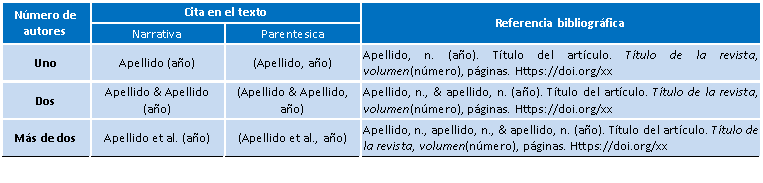
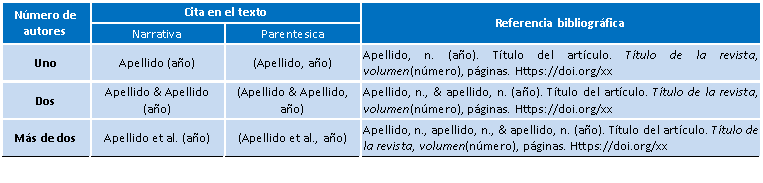
3. Style Guidelines 3.1 Format and Presentation of the Manuscript: To ensure clarity and consistency in review and publication, manuscripts must adhere to a standardized format. The use of Calibri 11-point font with 1.5 line spacing throughout the document is required. Margins must be 2.54 cm (1 inch) on all sides. This format ensures readability and facilitates the final editing and design process. 3.2 Citation Guidelines: Citations within the text must strictly follow the APA (American Psychological Association) 7th edition style. Direct quotations of fewer than 40 words should be presented in italics within double quotation marks, followed by the author's last name, year, and page number in parentheses. Quotations longer than 40 words should be presented as a separate paragraph with a double indent on the left and a single indent on the right, also within double quotation marks, and followed by the author's details. Paraphrased citations should be constructed either as an integrated narrative or parenthetically at the end of the sentence. 3.2.1 Academic Integrity and Self-Citation Limitations: To uphold academic integrity and foster an honest research environment, authors are expected to avoid excessive self-citations, limiting them to a maximum of 15%. 3.3 Bibliographic References: References must be formatted in accordance with the 7th edition of the APA guidelines, presented in alphabetical order. It is required that 60% of the references are recent (no older than five years) and sourced from indexed journals. Additionally, at least 50% of the references should be supported by prestigious databases such as SCOPUS or Web of Science (WOS). A maximum of 30% of the documents may come from non-indexed sources, such as theses, corporate reports, or websites. Scientific Journal Articles
Theses
3.4 General Guidelines for Tables 3.4.1 Clear Table Structure and Numbering: Tables should be presented in a systematic and easily referable manner, numbered consecutively (Table 1, Table 2, etc.). Each table must have a concise, descriptive title placed above it and written in italics without a trailing period. This title should reflect the essence of the content, allowing the reader to quickly understand its purpose and relevance. 3.4.2 Data Presentation and Format: The table should prioritize readability and comprehension. It is recommended to use rows and columns with clear and descriptive headers that allow the reader to easily identify the presented information. To maintain visual clarity, only horizontal borders that delimit the header, content, and footer should be used. 3.4.3 Notes, Citations, and Information Sources: Explanatory, clarifying, or source notes should be placed below the table, following a specific order: general note, specific notes (identified by letters), and statistical notes (identified by symbols). If the table is based on information from another source, a complete reference must be included in the document’s reference list along with a footnote accrediting the original source, following the appropriate citation format (e.g., Author (year)). 3.5 General Guidelines for Figures 3.5.1 Figure Identification and Captioning: Each figure must be uniquely identified with consecutive numbering (Figure 1, Figure 2, etc.) for easy reference within the text. The concise, descriptive caption should be placed immediately below the figure in italics and without a trailing period. 3.5.2 Format and Visual Clarity: Figures must be designed with clarity in mind, featuring a clean and legible layout in which all elements, including text labels, are easily distinguishable. In the case of graphs, the X and Y axes should be clearly labeled to allow precise data interpretation. 3.5.3 Citations, Notes, and Information Sources: If a figure is based on information from another source, a complete citation must be included in the figure caption following the established citation guidelines and e-RMS standards. Any additional clarifications necessary for understanding the figure should be provided in a footnote, beginning with the word "Note" in italics. 4 Double-Blind Peer Review The e-RMS is committed to excellence and academic integrity through a rigorous double-blind peer review process. This system ensures confidentiality and objectivity by allowing subject matter experts to evaluate each manuscript without knowing the authors' identities, and vice versa. 4.1 Comprehensive Evaluation and Constructive Feedback Reviewers, who are experts in their respective fields, meticulously evaluate each manuscript, considering fundamental aspects such as originality, clarity of writing, methodological robustness, relevance of results, and the depth of discussion. This process not only ensures the quality of the published content but also provides authors with constructive feedback to enhance their work and further contribute to scientific knowledge. 4.2 Editorial Decision and Communication with Authors After the peer review, the e-RMS editorial board makes an informed decision regarding the acceptance, revision, or rejection of the manuscript. This decision is communicated to the authors promptly, ensuring transparency and respect throughout the editorial process. In cases of acceptance, a formal letter is issued once the manuscript is finalized, marking the beginning of its dissemination within the academic community. 5 Publication Ethics e-RMS prioritizes publication ethics as a cornerstone for scientific integrity and rigor. We adhere to the guidelines of the Committee on Publication Ethics (COPE) (https://publicationethics.org/), requiring that all submissions be original, unpublished, and not under simultaneous consideration by other journals. Authors must secure permission for any copyrighted data or images. 5.1 Plagiarism, Similarity, and Artificial Intelligence Manuscripts are evaluated using Turnitin, and those with a similarity index exceeding 20% are rejected. The use of AI must be declared, specifying its application and ensuring that it does not compromise academic ethics or scientific quality. 5.2 Consequences of Plagiarism and Ethical Commitment e-RMS rejects manuscripts with indications of plagiarism, even retracting previously accepted articles. Academic integrity is paramount. These editorial guidelines are intended to enhance both efficiency and quality in our publications. 6 Submission of Manuscripts The first step for authors interested in publishing with e-RMS is to register on the digital platform (OJS) used by the journal for submission management. Next, authors must prepare their manuscripts following the templates provided on the journal’s website, ensuring they are in Word or PDF format. Along with the manuscript, a cover letter addressed to the editor is required, summarizing the work's content and declaring that it has not been simultaneously submitted to other journals, as well as noting any potential conflicts of interest. Once the manuscript is received, the e-RMS editorial board conducts a preliminary editorial review to verify that it meets the journal’s guidelines and that its subject matter is appropriate for publication. If the manuscript passes this initial review, it is then sent for double-blind peer evaluation, ensuring that both the authors and reviewers remain anonymous throughout the review process. Link: https://revista.investigaciondetecnologias.com/index.php/e-RMS/about/submissions Guidelines for Authors (Download pdf) Peer Review Form (Download pdf) |
|
The structure of the manuscript will be adjusted to the usual sections: Introduction, Materials and Methods, Results, and Discussion (in the case of an original article). In other cases (review article, letter to the editor, short communication), a logical structure will be adopted to facilitate the location of a direct quotation. References: These must comply with the APA style guidelines (Publication Manual, 7th ed.). They should be placed at the end of the text under the heading References (in bold and centered), arranged alphabetically by the author's last name in single spacing (within and between references), and with a hanging indent of 0.5, as established by the guidelines. |
[Home] [About the journal] [Editorial board] [Subscriptions]
 All content of this magazine, except where indicated, is under a Creative Commons License

 Books
Books Websites
 Corporate Sources